FM 3-94 THEATER ARMY, CORPS, AND DIVISION OPERATIONS (APRIL 2014) - page 4
Chapter 5
operations much like the Army’s operations and intelligence work group. The joint collection working
group—
z
Receives requirements from subordinate echelons.
z
Validates these requirements against priority intelligence requirements.
z
Prioritizes requirements against the commander’s stated ISR collection priorities.
z
Prioritizes requirements against organic and attached ISR assets.
z
Coordinates allocation of aerial ISR collection assets.
z
Approves collection target decks for inclusion in the reconnaissance, surveillance, and target
acquisition annex in the daily ATO.
5-66. The Joint Collection Management Board reviews the aggregate daily collection requirements,
deconflicts them where necessary, and prioritizes said requirements. It assigns priorities for the allocation
of platforms against requirements and sensors. It articulates collection management guidance to the
components while ensuring coordination and deconfliction of requirements with the intelligence
community. The components act on the guidance and direction provided from the Joint Collection
Management Board. They ensure proper resourcing and allocation of targets to assets for which they are
assigned collection operations management authority. This process streamlines tasking and effectively and
efficiently uses limited collection assets.
SPACE SUPPORT
5-67. The Army relies on space-based capabilities and systems, such as navigation and timing, global
positioning, satellite communications, weather satellites, and information collection platforms. These
systems are essential tools used by the corps to plan, communicate, navigate, and maneuver forces,
maintain situational awareness, engage the enemy, provide missile warning, and protect and sustain forces.
Space-enabled capabilities are ubiquitous and every element of the joint force uses them. To meet corps
requirements, planning and coordination of space support requires national, Service, joint, and theater-
based capabilities. The corps staff has an Army space support element. This element coordinates with other
space control elements at the JAOC, the theater army, and national resources. The corps becomes the
principal integrator of space capabilities in support of the land component. The space support element
coordinates directly with the joint space coordinating authority—normally the JFACC—for support by
space-based systems to meet corps requirements.
5-68. The loss of space-based communications due to enemy activity remains a major concern for Army
forces conducting deployed operations. Whether enemy action against U.S. satellites causes an interruption
of the communications through persistent jamming or spoofing, the resulting blackout requires Army forces
to adapt and adjust until U.S. forces restore the capability. Short-term loss of satellite communications may
be mitigated through alternative communications methods and courier networks.
AIR AND MISSILE DEFENSE
5-69. The threat posed by enemy ballistic missiles, cruise missiles, and unmanned aircraft systems is
increasing. During Operation Iraqi Freedom I, for example, an Iraqi missile (probably a FROG 7) scored a
direct hit on the command post of the Second Brigade of the 3d Infantry division. Earlier in the campaign,
the Iraqis employed antiship cruise missiles against land targets. Defending friendly assets against future
threats becomes very important. Ballistic and cruise missiles can engage and destroy targets from well
beyond the corps area of operations and threaten theater-level bases. Protecting the force from these
weapons demands an integrated, AOR-wide air and missile defense umbrella. The AAMDC provides this
capability. The AAMDC is attached to the theater army and commands all Army air defense units within
the AOR. The command and support relationships among the subordinate units of the AAMDC, joint
forces, and the corps vary extensively according to the threat.
5-70. The AAMDC normally provides direct support to the AADC. Frequently the JFACC is also the
AADC. The AADC is the commander with the preponderance of air defense assets in a joint operations
area. The AADC integrates air and missile defense capabilities in the joint operations area. Specifically, the
AADC establishes central control of theater air and missile defense. This requires integration of joint
5-16
FM 3-94
21 April 2014
Corps Operations
control systems and Army mission command systems with sensor, strike, and shooter assets. Normally, the
AAMDC commander is the deputy AADC.
5-71. The AAMDC commands one or more air defense brigades. The composition of the air defense
brigade depends upon the threat, but normally includes Terminal High Altitude Area Defense (known as
THAAD), Patriot, Avenger, and counter rocket, artillery, and mortar
(C-RAM) units. The brigade
commander task-organizes batteries under air defense battalions. In general, Terminal High Altitude Area
Defense and Patriot units operate in direct support of the AADC. Task-organized air defense battalions
consisting of Avenger and C-RAM batteries provide direct support to the corps.
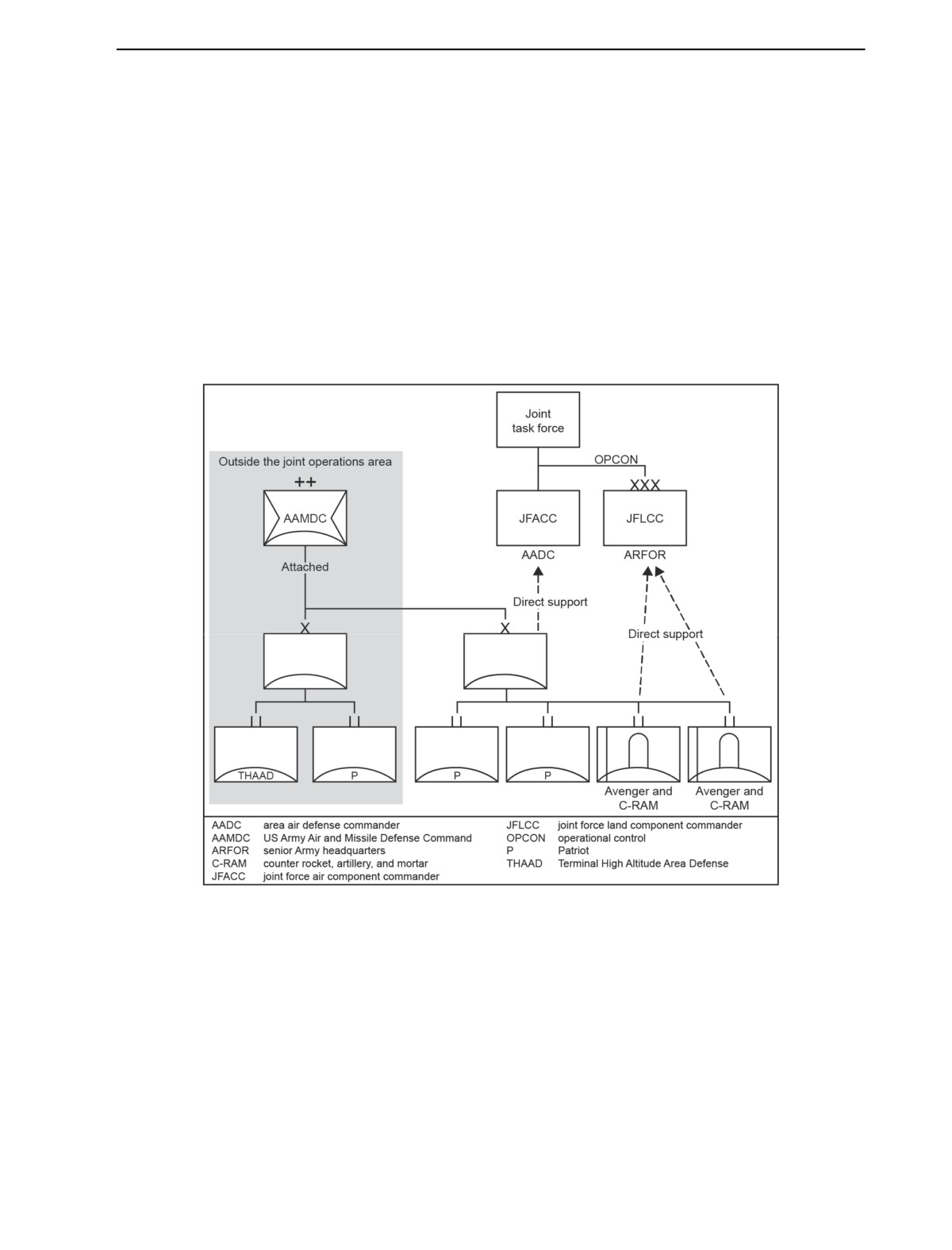
5-72. Figure 5-2 provides an example of air and missile defense for a major operation. In this example, the
AAMDC commands two air defense brigades. One brigade defends theater assets outside the joint
operations area. A second brigade provides direct support to the JFACC or AADC with two Patriot
battalions. The brigade commander places two task-organized battalions consisting of Avenger and
C-RAM batteries in direct support of the corps.
Figure 5-2. Air and missile defense
5-73. The corps distributes air defense capabilities provided by the AAMDC between the divisions and the
support area by establishing priorities for air and missile defense. Depending upon the tactical situation,
further decentralization of air defense batteries to individual brigades may occur. The AAMDC may detach
Avenger and C-RAM units to the corps, division, or a BCT. However, TACON of engagements remains
with the AADC and regional control centers to allow friendly air power maximum latitude to achieve air
superiority and support ground forces.
NUCLEAR OPERATIONS
5-74. The United States Army Nuclear and Combating Weapons of Mass Destruction Agency (known as
USANCA) maintains nuclear employment augmentation teams (NEATs) to deploy and augment the
planning staff of at corps or echelons above corps for adaptive nuclear planning at the commander’s
21 April 2014
FM 3-94
5-17
Chapter 5
request. The NEAT provides the resident expertise in nuclear planning and execution to offset a lack of
knowledge and doctrine at the geographic combatant command level to ensure an Army and joint interface
in theater nuclear operations.
5-75. The NEAT provides nuclear targeting experience and assistance in analyzing the impact of offensive
nuclear weapons on the friendly scheme of maneuver. The NEAT provides the supported commander with
independent analysis theater nuclear plans to ensure that these plans are synchronized with ground
operations. The NEAT is available at all times to assist Army planning staffs in nuclear operations, exercise
participation, and OPLAN development.
CYBER ELECTROMAGNETIC ACTIVITIES
5-76. Cyber electromagnetic activities are activities leveraged to seize, retain, and exploit an advantage
over adversaries and enemies in both cyberspace and the electromagnetic spectrum, while simultaneously
denying and degrading adversary and enemy use of the same and protecting the mission command system
(ADRP 3-0). CEMA consist of cyberspace operations, electronic warfare, and spectrum management
operations. CEMA integrate and synchronize the functions and capabilities of cyberspace operations,
electronic warfare, and spectrum management operations to produce complementary and reinforcing
effects. While these activities differ in their employment and tactics, their functions and capabilities are
integrated and synchronized to maximize their effects. CEMA provide commanders with the ability to gain
and maintain an advantage in cyberspace and the electromagnetic spectrum.
5-77. The CEMA element and working group within the corps, working with similar elements at division
and theater, becomes the primary integrating headquarters staff for CEMA. The corps receives
augmentation for the 1st Information Operations Command to increase its ability to coordinate and
integrate CEMA. The corps CEMA personnel may initiate or otherwise process requests for support
through the targeting process. Requests for cyberspace effects are submitted to the joint headquarters for
approval and resourcing. The CEMA element supports corps efforts to build, operate, and defend the
network; attack and exploit enemy and adversary systems; gain situational understanding; and protect
individuals and platforms. The CEMA elements at each echelon identify the enemy’s high-value networks
and identify means to disrupt enemy electronics and communications activities at critical times. These
attacks can disrupt enemy target acquisition, intelligence gathering, and command and control systems. The
object is either to destroy the enemy’s command and control system or create ambiguity and interrupt the
enemy’s ability to identify, decide, and transmit plans and orders. Military deception and jamming—
combined with operations security—cause lethal and nonlethal effects on the enemy while protecting
division and corps information systems from similar enemy activities.
5-78. CEMA require joint capabilities and planning and often employ strategic resources. Corps, division,
and theater headquarters may receive augmentation from Army and joint organizations. The role of the
corps determines whether it receives a cyber support element or an expeditionary cyber support element. If
a corps deploys as a JTF, then USCYBERCOM would provide it with the expeditionary cyber support
element. If the corps becomes the joint force land component command, then U.S. Army Cyber Command
would provide it with the cyber support element. The corps, working with theater CEMA and subordinate
division elements, normally develops requests for CEMA effects through the targeting or other applicable
processes. Operations in cyberspace or against a physical cyber asset occur under national or combatant
commander authority and are subject to applicable rules of engagement. Corps commanders may be
restricted from conducting offensive cyber operations but should prepare for lethal actions against known
enemy cyber assets within their area of operations. Requests for offensive cyber and electronic warfare
capabilities go to the joint headquarters for approval and resourcing. Because of the classification involved,
some or all requests for this support go through special information channels. (For more information on the
cyber support element and expeditionary cyber support element, see ATP 3-09.32, appendixes K and L.)
UNITED STATES MARINE CORPS
5-79. Soldiers and Marines have fought together for over 150 years. As a joint force land component, the
corps may have TACON or OPCON over a Marine Corps force. Normally, the largest Marine Corps force
that may be under the corps control is a Marine expeditionary brigade organized as a MAGTF. The Marine
expeditionary brigade normally includes a Marine Corps rifle regiment with attached artillery, armor, and
5-18
FM 3-94
21 April 2014
Corps Operations
other combat support. Marine Corps combat forces are organized and equipped to fight as air-ground
combined arms task forces with their own fixed-wing and rotary-wing assets. The Marine expeditionary
brigade includes a Marine air squadron with both types of assets. A Marine Corps brigadier general
commands the MAGTF.
5-80. The Marine expeditionary brigade is a powerful force with different capabilities and limitations from
an Army BCT. It is well suited for independent operations under corps control in a large area of operations.
The Marine expeditionary brigade has tanks, more infantry, and more armored vehicles than an infantry
BCT, as well as its own close air and attack aviation. It has less tactical mobility than the Stryker BCT and
less shock and firepower than an armored BCT, but the Marine expeditionary brigade can mitigate both
with its air squadron. The Marine expeditionary brigade has its own sustainment unit but requires general
support from an Army sustainment brigade for operations lasting more than 30 days. For protracted
operations away from the Navy, the Marine expeditionary brigade requires health service support, and may
require missile defense depending on the threat. The Marine expeditionary brigade requires Army engineer
and CBRN support and typically receives additional specialized intelligence support.
5-81. A Marine Corps aviation combat element organized as part of the MAGTF includes Marine Corps air
command and control system capabilities tailored for the size of the aviation combat element. Smaller
regimental-based MAGTFs (with unmanned aircraft systems) may be integrated in a similar manner to
BCTs. Larger MAGTFs bring the full joint capability to control airspace over the MAGTF area of
operations. Large MAGTFs include a Marine Corps division and constitute a Marine expeditionary force.
The Marine expeditionary force deploys with the full range of Marine Corps rotary- and fixed-wing
aviation as well as a robust Marine Corps air command and control system. A joint doctrinal relationship
exists between the JFACC and JFLCC. In operations involving a MAGTF, the Marines establish direct
liaison within the air operations center to coordinate airspace and air operations directly with the JAOC.
JOINT CHEMICAL, BIOLOGICAL, RADIOLOGICAL, AND NUCLEAR ASSETS
5-82. The 20th CBRNE headquarters can act as a joint force component for elimination of WMD, or it can
provide the basis for a CBRN task force under the OPCON of the JFLCC. Specialized capabilities from the
Defense Threats Reduction Agency may augment the corps. A WMD coordination element from the 20th
CBRNE may be attached to the corps of a subordinate division, depending upon the CBRN threat.
DECISIVE ACTION
5-83. The scope and scale of corps operations ensure that corps forces conduct simultaneous offensive,
defensive, and stability tasks. For purposes of this section, the discussion of offense, defense, and stability
considers that most corps forces are engaged in that related set of tasks. To understand decisive action in
corps operations, this publication reviews two distinct roles for the corps. The first, and more common
employment of the corps, is that of a land component command. As a land component, the corps functions
at the operational level, translating campaign objectives into tactical tasks for subordinate units. The overall
size of the land component varies, but it typically includes two or three divisions or their equivalent. In
most campaigns, the land component is the principal component used by the JFC to achieve the end state.
DECISIVE ACTION AT THE OPERATIONAL LEVEL
5-84. Operational environments confronting the joint force land component are chaotic. Typically, the land
component confronts hybrid threats, wherein the enemy includes a variable mix of conventional military
units, SOF, well-armed and highly motivated paramilitary forces, loosely organized irregular forces, and
armed, organized criminal organizations, including terrorists. The corps may also confront anti-access and
area-denial threats, possessing sophisticated and asymmetric capabilities. The host nation, if friendly, may
be under internal and external threats and have limited control over portions of its citizens. Indigenous
government forces often lack adequate sustainment. Their ability to conduct combined arms operations is
limited by equipment and training.
5-85. In this type of environment, the land component decentralizes the tactical conduct of operations to its
subordinate divisions. Each division conducts offensive, defensive, and stability tasks as required to alter
conditions within an operational environment. (See Part Four of this publication.) BCTs supported by
21 April 2014
FM 3-94
5-19
Chapter 5
divisional units conduct offensive, defensive, and stability missions. The land component develops the land
operation based upon lines of effort, assesses conditions, and resources the divisions. As the land
component, the corps headquarters manages operational complexity—the myriad tasks associated with
turning tactical success into operational-level progress towards the end state. The land component focuses
on enabling divisions to complete the current phase of operations while simultaneously establishing
conditions for tactical success in the next phase.
5-86. The land component commander adds or subtracts joint and Army capabilities from the divisions
through the task organization, adjusts their areas of operations, and oversees their sustainment. As the
ARFOR, the corps coordinates support from the theater army and supporting commands. In this type of
operational environment, the ESC and medical brigade (support) provide support to the divisions on an area
basis. The land component commander positions sustainment and medical resources, either within a
division area of operations or in a support area. When the land component establishes a support area, it
assigns it as an area of operations with responsibility to a subordinate unit such as a MEB. The land
component maintains a relatively small and mobile reserve, often consisting of ground forces positioned
centrally in the land component area of operations supported by joint and Army aviation. For example, the
land component may direct a division to provide the reserve consisting of one infantry battalion and assault
aviation assets sufficient to move it. The land component commander exercises OPCON of the reserve,
although ADCON remains the responsibility of the division commander and parent brigades.
5-87. The land component commander primarily establishes the conditions for successive phases with joint
capabilities, multinational forces, interagency coordination, and theater army support. Joint capabilities—
particularly fires, network, intelligence, CEMA, SOF, and air movement—shape conditions across the joint
operations area. The land component works closely with the JFACC to integrate air and land capabilities.
Air movement of forces and logistics extends the land component’s operational reach. The land component
coordinates intelligence requirements through both the JFC and JFACC depending upon the source. The
JFC provides CEMA support as requested and as made available through joint and strategic assets. The JFC
establishes guidance and direction for unified action, but the details of interagency support and
collaboration fall mainly on the land component (since these agencies operate in the land domain).
5-88. The land component and SOF exchange supporting and supported roles as the campaign progresses.
As early as possible, the SOF component and land component exchange liaison and planning elements. The
more closely the land component and SOF collaborate, the more effective land component and SOF
operations become. The SOF aviation and ground elements receive critical support from the land
component including sustainment, medical, and air and missile defense. The land component also provides
artillery and aviation in support of special operations and may provide a combat reserve. When required,
the land component may conduct operations to link up with and extract SOF units in the land component
area of operations. In return, the land component receives intelligence, unconventional warfare, foreign
internal defense, and counterterrorism support from SOF units.
5-89. Ideally, security cooperation requirements associated with rebuilding or re-equipping host-nation
forces become the responsibility of the JFC and theater army. Although the land component commander
remains responsible for tactical security cooperation requirements, the theater army should establish a
separate command under the JFC as soon as possible to control large-scale restructuring of host-nation
forces. Experience demonstrates that security cooperation that involves improvement or restructuring of the
entire armed forces of a host nation can overwhelm the land component with concurrent requirements
during decisive action.
5-90. The multinational command and control responsibilities of the land component are complex and time
consuming. Although the multinational forces may make up a minority of the combat power within the
combined land component, their employment requires the commander’s careful attention. Again, capable
liaison detachments become critical to effective command and control. The land component should receive
a liaison element from each national force under its command, and any division controlling a multinational
force receives a liaison detachment. Either the corps headquarters or the gaining U.S. division provides the
U.S. liaison detachment. At a minimum, the land component ensures that the U.S. liaison detachment has
reliable, network-capable communications able to convey and exchange the common operational picture.
As conditions in the land area of operations permit, the land component commander should visit
multinational forces frequently as well as consult with their liaison officers at the land component
5-20
FM 3-94
21 April 2014
Corps Operations
headquarters. The commander ensures that the land component and U.S. divisions employ multinational
forces to the maximum of their operational capability consistent with any limitations placed on their
employment by their respective national command authorities. (Refer to JP 3-16 and FM 3-16.)
DECISIVE ACTION AT THE TACTICAL LEVEL
5-91. When the corps functions as a tactical headquarters, a potential operational environment and role of
the corps differs from that of a joint force land component. The corps serves as a tactical echelon,
commanding divisions as part of a much larger joint and multinational force. The Army corps can expect to
operate adjacent to a Marine expeditionary force, such as it did in Operation Iraqi Freedom I in 2003 under
the command of Third U.S. Army. In an alliance or AOR-wide war, the corps may operate with adjacent
multinational corps as part of an Army group or equivalent, which in turn falls under a ground component
command or equivalent. The corps functions at the tactical level despite controlling multiple divisions
while a land headquarters one or two echelons higher serves as the operational land component.
5-92. In this operational environment, the corps combines offensive and defensive tasks with simultaneous
stability tasks incident to its combat missions. The higher land headquarters establishes the corps task
organization and area of operations. Both change according to the tactical situation. In general, the corps
area of operations is smaller, the higher land headquarters uses boundaries, together with permissive and
restrictive control measures to de-conflict and regulate the corps operations with adjacent and following
units. The degree of control exerted by the corps over the divisions is greater because of the need to
synchronize operations with adjacent corps and Army-level formations.
Offensive Tasks
5-93. In major operations involving large-scale combat, the corps conducts all four primary offensive
tasks—movement to contact, attack, exploitation, and pursuit. (See ADRP 3-90 for offensive tasks.) The
corps commander’s primary means of attack are the divisions under corps command. The corps monitors
the divisions’ operations and focuses on establishing conditions for tactical success during the next phase of
operations. The corps’ means of shaping and establishing conditions for offensive operations are primarily
joint capabilities provided through the JFC. The corps commander’s options for affecting current
operations include—
z
Maintain a personal presence.
z
Change the task organization of the corps.
z
Modify the area of operations of subordinate units.
z
Reinforce a committed division with corps assets.
z
Change the priorities and distribution of support for joint and Army capabilities.
z
Commit the corps reserve.
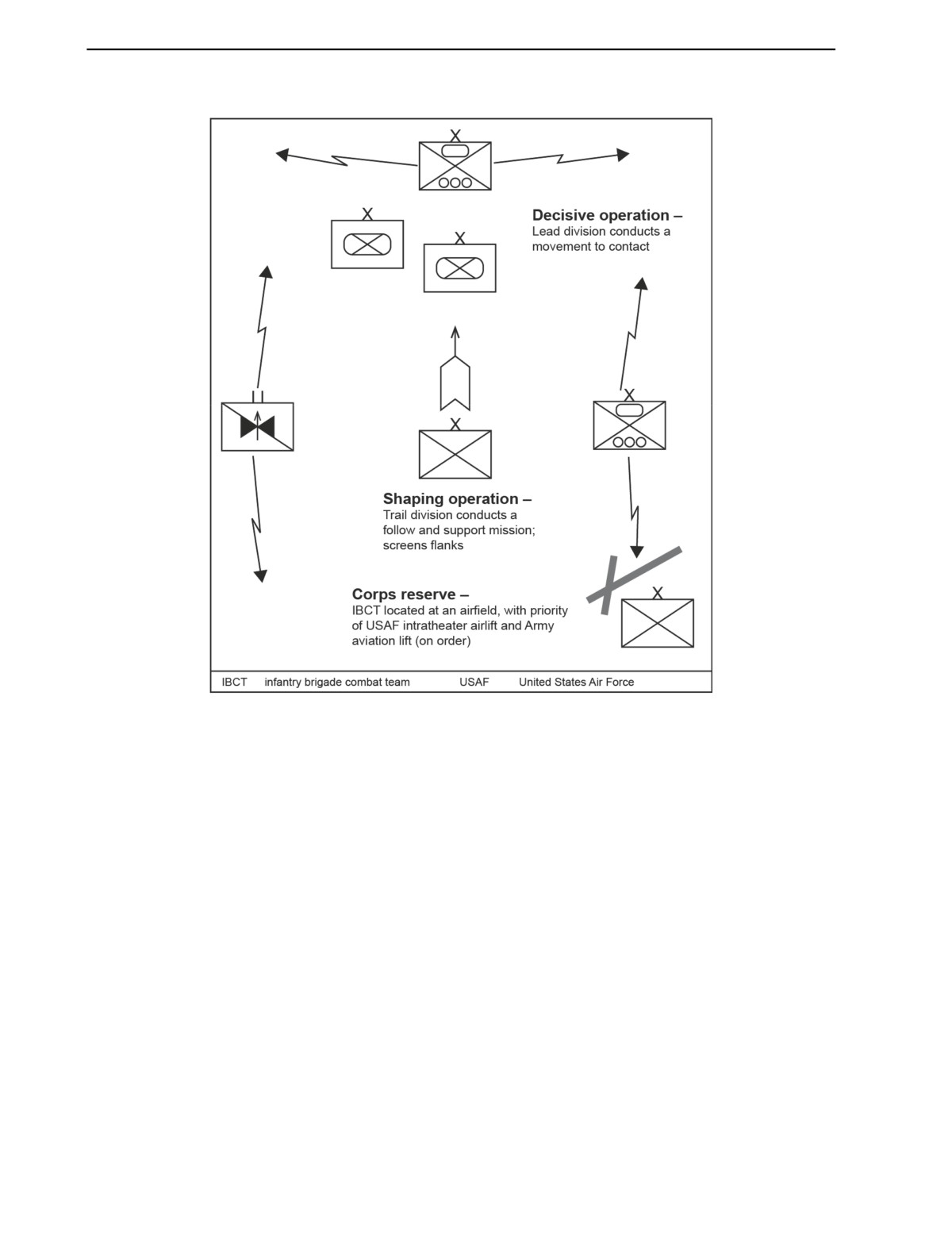
Movement to Contact
5-94. The corps may conduct a movement to contact with divisions abreast, with each division conducting
a movement to contact in its area of operations. As an alternative, the corps may lead with one division and
follow with another. Figure 5-3 on page 5-22 illustrates two divisions conducting a movement to contact
with one division leading. The lead division is the decisive operation and the trail division follows and
supports. In some situations, the trail division could have a follow-and-assume mission. The lead division
engages and destroys enemy security forces. The trail division eliminates bypassed enemy forces, secures
key terrain, screens the flanks of the corps, and conducts stability tasks. It also provides one infantry BCT
as the corps reserve. The trail division eliminates bypassed enemy forces, secures key terrain, and conducts
stability tasks. Depending upon the mission variables, the trail division may assume decisive operations.
The corps reserve is an infantry BCT positioned at an airfield in the corps area of operations. When the
reserve is committed, the corps provides aviation support and intratheater airlift. The corps normally uses
phase lines to control an operation as the divisions advance. If the lead division encounters a prepared
enemy defense, the corps transitions to a deliberate offensive operation. If the enemy is unprepared or
defending weakly, the corps conducts hasty offensive operations and exploits any favorable situations. (See
ADRP 3-90.)
21 April 2014
FM 3-94
5-21
Chapter 5
Figure 5-3. Example of corps movement to contact
Attack
5-95. The corps employs multiple divisions in the attack. Normally, the corps attacks with two or more
divisions abreast and one or two divisions following, either in support (follow and support) or prepared to
continue the offense (follow and assume). The corps commander normally retains one BCT uncommitted
as the corps reserve.
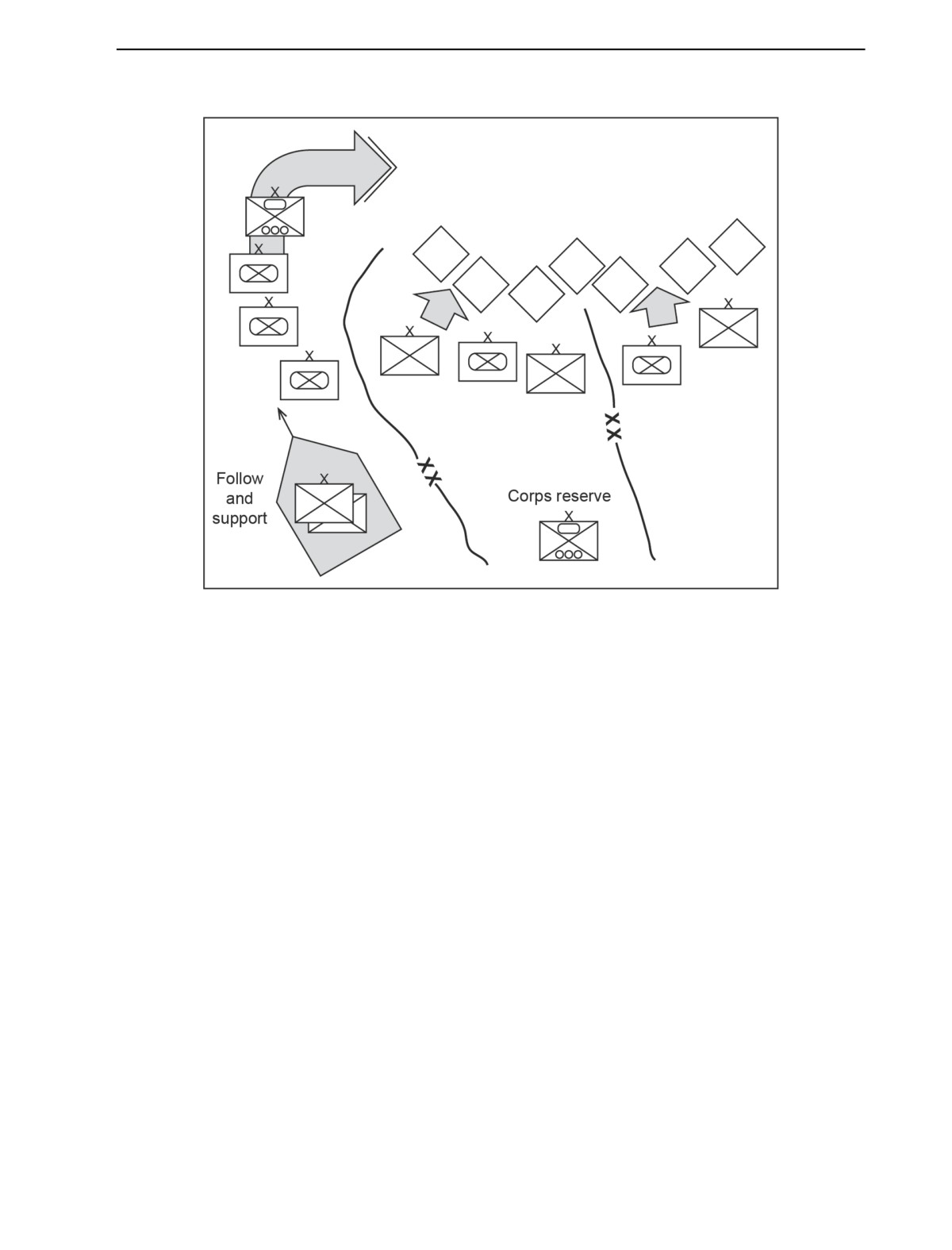
5-96. If the situation permits, the corps fixes the main enemy defense using feints and limited attacks,
while conducting a turning movement with two divisions. Figure 5-4 illustrates a four-division corps attack
using two divisions to conduct a turning movement. The corps commander weights the turning movement
(decisive operation) using a second division with two BCTs to follow and support. The divisions in the
turning maneuver receive all available corps and joint assets. The corps commander retains one BCT in
reserve.
5-97. If the corps cannot envelop or turn the enemy’s defense, the corps then conducts a penetration.
Typically, the corps concentrates one division on a narrow area of operations and places a second, larger
division in position to follow and assume. The corps makes the penetration division the main effort and the
follow-on division the decisive operation as soon as the penetration allows exploitation. The other divisions
conduct shaping attacks, military deception, and economy of force operations.
5-22
FM 3-94
21 April 2014
Corps Operations
Figure 5-4. Example of corps attack
Exploitation
5-98. Exploitation follows a successful deliberate offensive operation; therefore, the corps staff develops
branch plans to exploit any deliberate offensive operation. The corps exploits to dislocate defending forces
not defeated in the initial attacks and to seize terrain that allows for further exploitation and precludes
enemy re-organization and counterattack. As the enemy reacts to the rapidly changing situation, the corps
commander shapes through interdiction and attacks on enemy command and control. The objective of the
attack becomes the integrity of the enemy’s defense. As the enemy’s cohesion deteriorates and it attempts
to move forces, the corps employs available air support to destroy enemy forces and prevent the enemy
from re-establishing an effective defense. If the enemy forces remain in or near their original locations, the
corps encircles and destroys as much of the enemy forces as possible. If the enemy attempts to extract
enemy units, the corps transitions to pursuit.
5-99. The corps commander should anticipate the transition to exploitation and immediately shift assets to
that division enjoying success. Often success disorganizes the attacker; therefore, the corps commander
should have resources for reinforcing success and retaining the initiative. This does not necessarily mean
that the corps will control the exploitation. Initially, the corps reinforces the division that achieves its
objectives and detects opportunity. When and if the initial attack produces an operationally significant
change in the situation, the corps redirects assets to reinforce success. At that point, the commander
commits the corps reserve and reconstitutes the corps reserve from other assets. Sustainment assets not
already placed in direct support to the corps should now pass to direct support of the corps, with be-
prepared missions to provide direct support to exploiting divisions.
5-100. The challenge for the corps commander and staff is keeping the corps focused on the next
operation after the completion of the current phase. The corps commander should be thinking several
engagements ahead of the current situation. Critical decisions concerning logistics, follow-on operations,
and reconstitution of depleted units need to be made well in advance. In particular, the corps commander
calculates the operational reach of the corps and anticipates the likely culmination of the current offensive
21 April 2014
FM 3-94
5-23
Chapter 5
operation. This allows the corps to impose, remove, or adjust control measures and retain the initiative for
as long as possible.
Pursuit
5-101. The pursuit is highly decentralized tactically with divisions conducting hasty operations based
upon the situation. Even with advanced mission command systems, the corps’ understanding of the
situation lags behind the situation reported in lower echelons. Before the corps releases divisions to pursue,
the corps commander should update the commander’s intent, stressing the priority between tactical tasks
and outlining acceptable risks. Corps orders should adjust control measures, particularly division area of
operations and the FSCL.
5-102. The most important changes the corps needs to make concern support of the divisions. Because the
pursuit is highly decentralized and the situation changes so rapidly, the corps commander may request
TACON over the ESC and its sustainment brigades. Once that change to the corps organization is granted,
the corps commander adjusts priorities of support and may elect to place sustainment units in direct support
of each division engaged in the pursuit. The ESC commander recommends the most effective use of
sustainment assets to support the corps across rapidly increasing distances. The corps requests intratheater
lift from the JFACC to support distribution of logistics to pursuing units. Simultaneously, the ESC and
corps plan the sustainment posture of the corps following the pursuit. The corps develops the plan for the
tactical positions and missions of the combat units of the corps. The ESC plans for additional bases and the
transportation assets that move to them.
5-103. A critical consideration during pursuit operations is the handling of enemy prisoners of war. The
ESC and MP brigades not only plan for supporting large numbers of enemy prisoners of war, they develop
plans to move them to detention facilities. Initially the divisions control enemy prisoners of war, but the
corps should accept enemy prisoners of war from the divisions as soon as possible. Large numbers of
enemy prisoners of war can slow down the pursuit and block available lines of communications more than
enemy resistance if the corps does not enforce movement discipline on corps routes and evacuate enemy
prisoners of war rapidly and efficiently. Corps aviation assets can shift supplies and personnel forward to
take control of enemy prisoners of war until ground transportation catches up with the offense.
Defensive Tasks
5-104. As a tactical land headquarters, the corps may conduct defensive operations. This often occurs
during the initial stages of a campaign when the joint force is deploying and before friendly combat power
becomes too great for the enemy to defeat. Since World War II, large enemy offensive operations offer an
opportunity to employ the full capacity of American air, sea, and land powers to destroy the enemy’s best
ground forces quickly. If joint operations can destroy the enemy’s offensive capability, the subsequent
campaign can eliminate residual enemy combat power much more easily.
5-105. The corps combines area and mobile defense based upon the commander’s intent and higher
headquarters concept of operations. The corps may also conduct retrograde operations. (See ADRP 3-90.)
When defending in an area of operations, the corps organizes the divisions and assigns their areas of
operations based upon defeating the enemy’s main effort. The corps commander organizes the corps
defense in depth, allowing the committed divisions maneuver room to conduct their own mobile defense.
The area selected by the corps for defense by the committed divisions becomes the main battle area of the
corps. Ideally, the committed divisions should have enough depth to conduct covering force operations
before the enemy contacts with the main force of each division. The corps commander accepts risk to mass
combat power in depth along the enemy’s main axis of attack. The corps reinforces the main effort division
with additional fires, engineer support, and attack aviation, and allocates it priority of air defense support.
5-106. The corps positions the ESC and other sustainment assets outside the main battle area and protects
them against enemy unconventional forces and missile attack. Due to the fluidity of the defensive battle,
the ESC normally is in direct support of the corps and positions itself in the JSA. Sustainment brigades
move to positions behind the committed divisions in the main battle area. The corps may request TACON
of sustainment brigades near the main battle area if the tactical situation becomes fluid and the corps needs
to make rapid changes to division boundaries.
5-24
FM 3-94
21 April 2014
Corps Operations
5-107. The corps commander shapes the defensive battle through surveillance and reconnaissance, joint
fires, and CEMA before the enemy reaches the main battle area. The corps focuses on disrupting the
enemy’s attacking forces before they encounter the main battle area and break up the enemy’s combined
arms capability. Targeting should attack both the weapons and the command and control for that enemy
unit or system. The corps commander pays particular attention to disrupting the enemy’s command and
control, with intent of making the enemy more vulnerable to the corps counterattack.
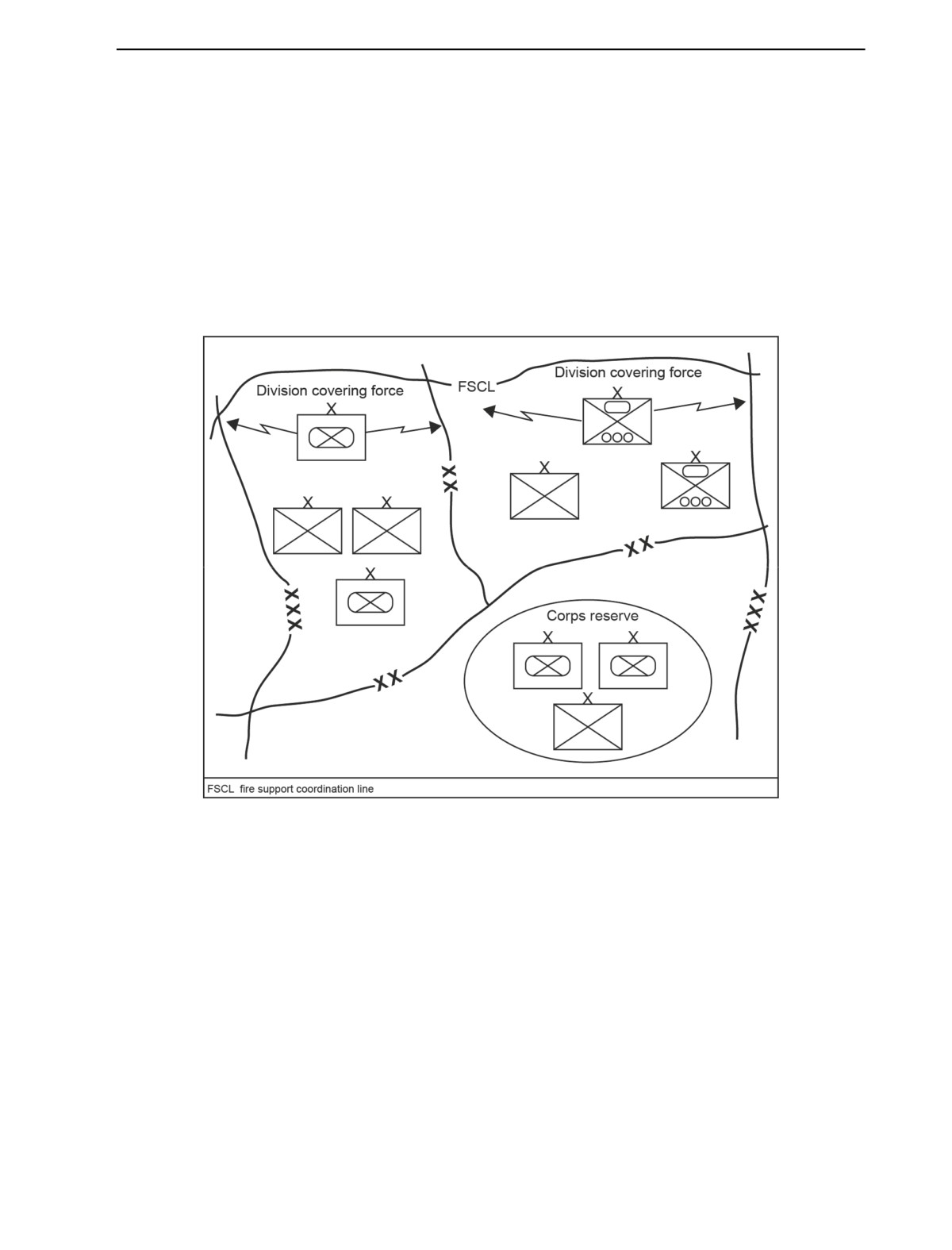
5-108. The corps maintains the most powerful reserve possible, typically a division, with the intent of not
only defeating the enemy’s attack, but also regaining the initiative. The corps accepts risk to counterattack
at the time and place when the attack enemy culminates before the enemy has time to consolidate and
reorganize. If successful, the corps counterattack becomes the opening maneuver for a friendly
counteroffensive. Figure 5-5 illustrates a corps defense.
Figure 5-5. Example of corps defense
Stability Tasks
5-109. All corps operations conducted outside the boundaries of the United States involve stability tasks.
In most campaigns, the corps commits more effort over time to stability tasks than to offensive or defensive
tasks. The corps determines the lines of effort and priorities for stability tasks for the land areas of the joint
operations area and translates them into orders to the subordinate divisions and brigades.
5-110. The corps headquarters analyzes the situation to determine the essential stability tasks and the
priority associated with each task. The priorities and effort given to stability tasks vary within subordinate
units’ areas of operations. This analysis includes a planned transition to stability priorities when offensive
and defensive operations are executed. Stability tasks during offensive operations include restoration of
essential services and populace control in areas controlled by advancing forces. During defensive
operations, forces protect civilians from enemy attacks, maintain control, or evacuate civilians from areas
of operations controlled by friendly units. Initially, stability tasks may be incident to combat operations.
The divisions will not be task-organized to conduct stability-intensive operations but should include civil
affairs units. The corps retains control over forces such as MP and engineers so it can reinforce divisions or
21 April 2014
FM 3-94
5-25
Chapter 5
conduct stability tasks directly. As requirements for combat diminish, the corps adjusts the task
organization of divisions for anticipated or known stability operations.
5-111. The corps staff plans for logistics and medical support to indigenous populations affected by
combat operations. As the joint force land component, the corps works directly with host-nation authorities
to identify minimum-essential support that U.S. forces must provide to meet international accords. The
corps staff collaborates with the joint staff and theater army to forecast requirements for each successive
phase of operations. As required, the theater army requests additional Army units to manage stability tasks
in the joint operations area.
5-112. The civil affairs brigade normally attached to the corps is a critical resource. Civil affairs personnel
assist in identifying stability requirements and identifying tasks in planning for stability operations and
their associated transitions. Using this information, commanders plan the time and method to task-organize
forces, re-allocate areas of operations and priorities of support, and request additional forces to perform the
previously identified stability tasks. These additional forces include MP, medical, sustainment, civil affairs,
MISO, general engineering, and EOD units. MP units provide population control and infrastructure
security. Medical units provide public health services. Sustainment units provide food and water, including
water purification and bulk water transport. Civil affairs, MISO, and other information-related capabilities
conduct information-related activities to engage the population. They publicize curfews, checkpoint
procedures, evacuation routes, food and water distribution points, emergency health care, and vector
control. General engineering units repair infrastructure or provide emergency shelter. EOD units clear
unexploded ordnance based on the scope, scale, and duration of the requirements.
Defense Support of Civil Authorities
5-113. The corps headquarters may deploy to support domestic civil authorities for military activities
known as DSCA. DSCA applies to domestic emergencies, designated law enforcement support, and other
activities upon request for assistance from civil authorities. It includes operations that address the
consequences of natural or man-made disasters, accidents, terrorist attacks, and incidents in the United
States and its territories. Army forces conduct DSCA operations when civil authorities request assistance
and the Secretary of Defense concurs. In DSCA, military forces always play a supporting role. State and
federal laws define how military forces can support civil authorities. Often, a state’s National Guard forces,
acting in their state capacities under Title 32 are enough to provide an adequate response to a situation.
However, when these forces are not enough, governors may request additional support from federal
authorities.
5-114. The unique domestic environment limits the corps headquarters’ role in DSCA. Two
circumstances might involve the corps with a DSCA mission. In the first circumstance, the corps
headquarters battalion may provide troops and support to civil authorities within the scope of immediate
response authority. This assistance involves unit-level deploying unarmed Regular Army Soldiers and
equipment to a disaster scene to save lives and mitigate suffering. Regular Army Soldiers providing
immediate response may not perform any law enforcement activities outside their installations. A corps
commander as the senior commander on an Army installation could order this type of response, but beyond
72 hours, it requires DOD approval. (See ADRP 3-28.)
5-115. The other circumstance might be a catastrophic incident that initiates cascading deterioration of
infrastructure and services. In that event, an Army corps could deploy to command ground forces as part of
a multi-division federal response. Although disasters occur every year in the United States, a disaster of this
magnitude rarely occurs. In an extreme emergency, the size of the federal military commitment may require
mission command system capabilities provided by a corps headquarters. However, the scope and scale of
such a catastrophe would exceed current U.S. Government planning and response capabilities. If alerted,
the corps headquarters exercises command over joint military units involved in DSCA over a multistate
area. On order, the corps passes to the OPCON of USNORTHCOM with USARNORTH functioning as the
ASCC. The corps does not become an ARFOR; USARNORTH retains that responsibility. For planning
purposes, the corps should deploy an augmented tactical command post to the disaster region while
continuing to operate the main command post from home station. The corps should organize and prepare to
deploy numerous liaison teams equipped with high-mobility vehicles, military and civil communications,
5-26
FM 3-94
21 April 2014
Corps Operations
and 72 hours of sustainment resources. Unless expressly authorized by the Secretary of Defense, all
personnel deploy without weapons. (See ADRP 3-28 for additional information.)
OPERATIONAL FRAMEWORK
5-116. The corps commander uses the operational framework to relate time, space, and purpose within the
concept of operations. ADRP 3-0 articulates common operational frameworks for commanders to visualize
and conceptually organize operations: decisive, shaping, and sustaining or deep, close, and security. As an
operational headquarters, the corps typically frames operations using decisive, shaping, and sustaining.
When serving as a tactical headquarters, the corps typically frames operations in terms of close, deep, and
security.
DECISIVE, SHAPING, AND SUSTAINING FRAMEWORK
5-117. The corps normally uses the decisive, shaping, and sustaining framework when it is the joint force
land component unless the JFC dictates otherwise. The decisive land operation directly performs the most
essential task of the joint force land component for that phase of the campaign. The corps commander
conducts decisive operations by—
z
Task-organizing the division for the decisive operation.
z
Allocating resources by establishing priorities of support.
z
Echeloning combat power.
z
Assigning appropriate areas of operations.
z
Employing other forces to shape conditions to guarantee success of the decisive operation.
Decisive Operations
5-118. Weighting the decisive operation requires the corps commander to accept risk to guarantee the
success of the decisive operation. Each division commander requests enough combat power to guarantee
that division’s success. The most common mistake made in developing the plan for the corps is minimizing
the combat power allotted to the decisive operation to maximize combat power in each division’s area of
operations. The decisive operation requires more than priority of fires or sustainment. It requires the
preponderance of the corps’ combat power, while the shaping operations receive the minimum combat
power necessary for their missions. If shaping and decisive operations require more combat power than the
corps can provide simultaneously, the corps commander phases the operations to allow combat power to
transfer from shaping to the decisive operation when the latter begins.
Shaping Operations
5-119. At the corps level, depth and timing distinguish shaping operations. Given the operational reach of
the joint force, shaping operations extend to the limits of the joint operations area, although the majority of
shaping occurs within the corps area of operations. Shaping operations set the necessary conditions for
success of the division conducting the decisive operation. Shaping operations set the conditions for the
decisive operation by preparing and isolating the battlefield, disrupting the enemy’s ability to synchronize
forces, deceiving the enemy, and delaying entry of enemy reinforcements to the main battle area. A shaping
operation can be one of several actions within the scope of decisive action. The corps commander uses joint
capabilities including joint intelligence, joint fires, CEMA and SOF with decisive action to shape
conditions.
5-120. When serving as an operational-level land headquarters, corps shaping operations focus on setting
favorable conditions for the decisive operation in next phase of the campaign. Tactical management of
battles and engagements pass to the divisions; the corps commander plans decisive, shaping, and sustaining
operations weeks ahead. The commander’s understanding of an operational environment becomes vital.
The commander visualizes changes occurring in each operational variable because of current operations.
Some variables are direct; many others are indirect and difficult to predict accurately. The corps staff, with
the joint staff, forecasts a likely operational environment for the next phase of operations, highlighting
those conditions that the corps can alter directly, such as enemy military capability, or key economic
21 April 2014
FM 3-94
5-27
Chapter 5
infrastructure. The staff anticipates direct and indirect changes in an operational environment and explores
a range of shaping actions. The tools applied include analysis of the center of gravity, decisive points, lines
of operation and effort, and risk. The methods used by the staff to develop their analysis often include a
combination of operational design and the military decisionmaking process. (See ADRP 5-0.) The crucial
determinant is available combat power and the need to balance it between current operations and shaping
for the next operation. The corps commander and staff must maintain this operational-level perspective,
recognizing that at their level what comes next is more important than details of current tactical operations.
Sustaining Operations
5-121. Effective sustainment ensures freedom of action, extends operational reach, and prolongs
endurance. It provides support at the right place, at the right time, and in the right quantity. Because
operational reach underpins all corps maneuver, sustainment is intrinsic to the corps scheme of maneuver.
Operational-level maneuver demands anticipation, careful planning, and synchronization of sustainment
with corps operations. The key to sustaining operations depend on the supporting and supported
commanders understanding requirements, capabilities, priorities, and the operational environments. An
effective single logistics chain anticipates the requirements of the corps commander and minimizes the
logistics footprint, facilitating operational reach and increasing tempo. Sustainment at this level depends on
preparation well before the decisive operation occurs and becomes closely linked with shaping operations.
In other words, the corps not only shapes to set conditions for the decisive operation, it shapes to ensure the
success of sustaining operations. Sustaining operations focus on friendly forces rather than on the enemy or
environment. The corps commander considers the operational reach of the corps in terms of logistics
capacity, distribution, evacuation and treatment of casualties, and personnel services. The corps—
z
Assesses the sustainment posture of the corps.
z
Positions and protects sustainment and medical units.
z
Establishes priorities of support.
z
Establishes a corps or joint support area as required or directed.
z
Secures and maintains lines of communications with Army and host-nation forces.
z
Manages movement of corps forces and coordinates across the corps for movement of
sustainment units.
5-122. Normally, the ESC and its subordinate organizations provide direct support to the corps when it is
the joint force land component and ARFOR. The MEDCOM (DS) does so also. The JFC and TSC
commanders specify the relationship in their operation orders. Collaborative planning and continuous
coordination among the TSC, MEDCOM (DS), ESC, and the corps staff develops the situational
understanding necessary for synchronizing and integrating sustaining operations with the corps concept of
operations.
5-123. The corps staff coordinates movement of troops, equipment, and supplies across the corps area of
operations and establishes priorities for movement for specified elements within the areas of operations of
its subordinate formations. Movement control involves planning, routing, scheduling, controlling, and
coordinating personnel, units, equipment, and supplies moving over multiple lines of communications. The
transportation element within the main command post sustainment cell plans and monitors movement in the
corps area of operations. The movement and maneuver cell executes terrain management for the
commanding general.
5-124. The corps establishes a support area when required. The support area requires a controlling
headquarters; the minimum responsible echelon is a MEB. For major operations, considerably greater
capabilities may be required. This may include a multinational division, regional support groups, and
possibly the corps tactical command post reconfigured to control the support area.
5-125. When the corps is a tactical echelon, it plans for displacement of the support area based upon the
adjustment of tactical areas of operations. For example, a multinational force land component commander
adjusts the rear boundary of the corps in a very large combat operation. Displacing the support area
normally entails more time and effort than shifting a division. Many units operating in the support area are
not 100-percent mobile (including the corps main command post). The corps plans to displace the support
area based on movement, general engineering, security, and protection capabilities.
5-28
FM 3-94
21 April 2014
Corps Operations
DEEP, CLOSE, AND SECURITY OPERATIONS
5-126. The corps typically uses the deep, close, and security operational framework when it is a tactical
land headquarters operating adjacent to other corps-sized formations. The multinational or joint force land
component commander develops a concept of operations and describes the conduct of operations in terms
of space (distance from the main battle area) and time (enemy forces more distant require more time to
enter the battle).
5-127. The corps deep operations begin beyond the division’s forward boundary and extend to the limit of
the corps assigned area of operations. Deep operations are normally those conducted against the enemy’s
forces, functions, or resources not engaged against the committed divisions. Commanders attack
simultaneously across great depth and breadth in a manner that appears as one continuous operation to
overwhelm and demoralize the enemy. Deep operations are not necessarily a function of geographic
distance, but rather a function of the intent of the operation. Deep operations nullify the firepower, disrupt
the command and control, and impair the synchronization of enemy forces. Commanders combine
maneuver, joint fires, MISO, and CEMA supported by intelligence to conduct deep operations.
5-128. The corps close operations usually include operations of the committed divisions. The divisions in
the main battle area develop their own nested deep, close, and security operations.
5-129. Security operations involve efforts to provide an early and accurate warning of enemy operations
and to provide time and maneuver space within which to react to the enemy. These operations protect the
force from surprise and develop the situation to allow the commander to use the force effectively. Security
operations include necessary actions to retain freedom of action and ensure uninterrupted support or
sustainment of all other operations. The security area is that area that begins at the forward area of the
battlefield and extends as far to the front and flanks as security forces are deployed. Forces in the security
area furnish information on the enemy; delay, deceive, and disrupt the enemy; and conduct counter-
reconnaissance. A commander may conduct security operations to the front, flanks, or rear of the friendly
force. (See ADRP 3-90.) Corps security operations emphasize protection of support areas and the JSA, if
the latter is a corps responsibility. The corps employs combined arms to defeat conventional and
unconventional threats detected in the support areas.
5-130. When fighting as a tactical land headquarters, the entire corps area of operations moves, not just
the divisions’ subordinate forces and areas of operations. For example, as the corps advances, the Army
may shift the rear boundary of the corps forward. This means that the corps needs to reposition sustaining
assets and corps units in advance of the change in boundaries.
MAIN AND SUPPORTING EFFORTS
5-131. The corps designates a main and one or more supporting efforts in either operational framework.
This confers temporary priority of all available resources to that unit designated as the main effort. At the
corps level, this normally is one of the divisions. However, it could be a unit or temporary group of forces
performing a particular task. For example, the corps may plan and execute a military deception operation.
The headquarters managing the deception may become the main effort. All other units provide support as
directed by the corps headquarters or in accordance with priorities of support.
THE CORPS AND FORCIBLE ENTRY OPERATIONS
5-132. At the operational and strategic levels of war, the Armed Forces of the United States must be
capable of deploying and fighting to gain access to geographic areas controlled by hostile forces. Forcible
entry is the seizing and holding of a military lodgment in the face of armed opposition. Forcible entry
operations constitute a unique subset of decisive action. Forcible entry operations range in scope from an
operation designed as an initial phase of a campaign or major operation to a coup de main in which the
decisive results are accomplished in one swift stroke. Forcible entry operations combine large-scale
offensive, defensive, and stability tasks during the simultaneous deployment and employment of Army
forces. Forcible entry operations are inherently joint operations; they comprise the most dangerous and
most closely synchronized combat operations conducted by the Armed Forces.
21 April 2014
FM 3-94
5-29
Chapter 5
5-133. The U.S. military maintains three primary forcible entry capabilities or options: amphibious
assault, airborne assault, and air assault. Local air and maritime superiority are essential for the duration of
the entry operation. The JFC seeks comprehensive control of a potential operational environment,
permitting as many such options as possible to frustrate enemy plans. JFCs may select one entry capability
or a combination of capabilities based upon METT-TC. The JFC may task JFLCCs to perform the detailed
planning for a forcible entry operation. (See JP 3-31.)
5-134. Army forces may conduct parachute assault, air assault, or amphibious operations as part of a joint
forcible entry operation. The forcible entry itself may use any combination of the means of entry to seize
and hold a lodgment. The forcible entry force normally consists of one or multiple assault echelons if the
JFC combines different means of forcible entry. The assault echelon seizes key terrain necessary to accept
additional friendly forces, usually an existing airfield or port, or critical choke points to deny enemy access
to the airhead or beachhead, such as bridges or mountain passes. A reinforcing echelon follows the assault
echelon immediately, deploying sufficient combat forces and sustainment to expand the lodgment and
defend it against immediate enemy counterattack. The expanded lodgment should be large enough to
accommodate the entry of follow-on forces by air and sealift. If the JFC intends to initiate major operations
from the lodgment, follow-on forces deploy into the lodgment, complete RSOI, and conduct operations as
required by their component headquarters.
5-135. If the Army provides the preponderance of forcible entry forces, the corps may be designated as
the JTF headquarters. The division providing the assault echelon becomes the assault force headquarters
and the ARFOR. If the forcible entry involves a simultaneous amphibious assault by Marine Corps forces,
Navy forces control the amphibious portion of the operation, the ARFOR conducts the parachute assault,
and the JTF synchronizes both operations. The Service components may transition into a joint force land
component after the airhead and beachhead join into a single lodgment. At this point, the combatant
commander adjusts command and control of the operation based upon the objectives of the campaign.
5-136. Following seizure of the lodgment, the corps may remain the JTF if the land operation remains a
division-sized effort, with a MEU under the TACON of the Army division. (See chapter 7.) However, if the
campaign requires the deployment of significant follow-on forces, either a full Marine expeditionary force
or a second Army division, the combatant commander may replace the corps as the JTF headquarters. At
the point when a second division begins to arrive, the combatant commander and GCC may assume control
and the corps transitions to a tactical headquarters and the ARFOR. Alternatively, the corps may serve as
the joint force land component with command of a Marine Corps division, while the Marine expeditionary
force headquarters can become the JTF. During the transition, the corps tactical command post, with
augmentation, may exercise TACON or OPCON over Marine Corps and Army forces until the main
command post becomes operational.
5-137. When the corps is not the JTF, it provides command and control expertise and augmentation to the
fleet and Marine Corps headquarters when controlling an amphibious assault combined with Army
parachute and air assault. The corps provides additional staff and communications as required to the Army
division providing the parachute forces. The corps also organizes and runs the deployment of the Army
division’s assault echelon and reinforcing echelons.
(For more information on joint forcible entry
operations, see JP 3-18.)
5-30
FM 3-94
21 April 2014
PART THREE
The Army Division
Part three discusses the Army division headquarters and operations at the division
echelon. The Army division’s primary role is command of Army brigades in combat
operations across the range of military operations. Its other roles include serving as a
joint force land component (and Army component) under a joint task force and as a
joint task force headquarters
(with joint augmentation) in a limited contingency
operation.
Chapter 6
Division Roles and Organization
ROLES OF THE DIVISION
6-1. This chapter discusses the division’s roles and organization. The division commands multiple Army
brigades and is the Army’s primary tactical headquarters for decisive action. When required it may serve as
a JTF or joint force land component headquarters in a limited contingency operation. As required, the
division may be the Army component (ARFOR) and the joint force land component within a JTF. When
the division headquarters serves as a JTF headquarters or a joint force land component headquarters, it
requires joint augmentation.
6-2. The division is the Army’s primary tactical
Roles of the Division
warfighting headquarters. Its primary role is as a
• Tactical headquarters commanding brigade
tactical headquarters commanding brigades in
combat teams.
decisive action. The division combines offensive,
• Joint force land component command or
defensive, and either stability or DSCA tasks in an
multinational force land component for a
area of operations assigned by its higher
small contingency operation.
headquarters, normally a corps. It task-organizes
• Joint task force for a limited contingency
its subordinate forces according to the mission
operation.
variables of METT-TC to accomplish its mission.
• ARFOR for a small contingency operation.
Depending upon the METT-TC, the division
commands between two and five BCTs and a mix of multifunctional support brigades.
6-3. The division headquarters may serve as a joint force land component headquarters with joint staff
augmentation (primarily Marine Corps) in a limited contingency operation. When required to serve as an
ARFOR in a limited contingency operation, it normally requires support from an ESC. With extensive joint
augmentation, it may serve as a JTF for a limited contingency operation. When serving as the ARFOR,
joint force land component, or JTF, the division is primarily concerned with the conduct of operational
tasks. The theater army provides most of the ADCON and Army support to forces deployed in the joint
operations area. Joint manning documents specify other Service augmentation according to the role
determined by the combatant commander, either as a JTF or as a joint force land component headquarters.
When serving as a JTF headquarters, the division headquarters organizes and operates in accordance with
joint doctrine. (JP 3-33 provides doctrine for the JTF, and JP 3-31 provides it for the joint force land
component command.)
21 April 2014
FM 3-94
6-1
Chapter 6
COMMAND BRIGADE COMBAT TEAMS
6-4. The striking power of the U.S. Army is concentrated in its BCTs. The division headquarters is
organized, trained, and equipped to command between two and five BCTs in combat as well as support the
BCTs with any mix of multifunctional support brigades. Because the BCTs and the division headquarters
are modular, any division headquarters may command any mix of armored, infantry, and Stryker BCTs.
JOINT FORCE LAND COMPONENT COMMAND
6-5. In a limited contingency operation, the JFC may organize the JTF with the division as the joint force
land component. The joint force land component of such a JTF may have TACON of Marine Corps and
multinational forces. The Marine Corps unit may be a MEU, but is often smaller. When a MEU is under the
control of an Army division, the division employs it as a BCT, although with different capabilities from the
Army BCT. (See the discussion of Marine Corps forces in chapter 7.) The division headquarters receives
staff augmentation from the Marine Corps and other Services, as well as individual Army augmentation
and communications support from the theater army. Although the mix of other brigades varies according to
the mission, the division should have OPCON of a brigade special troops battalion (BTSB) to meet the
demand for intelligence and integration of collection assets.
6-6. When it is the joint force land component, the Army division becomes the ARFOR. As the ARFOR,
the division retains OPCON of all Army forces not subordinated to another component of the JTF. To
function effectively as both the joint force land component and the ARFOR, the division headquarters
requires the support of an ESC and its sustainment brigades. The ESC normally operates in direct support
to the division (ARFOR). This enables the division to oversee logistics and administrative support to all
Army forces, while also providing logistics support to other Services and multinational units. Without it,
the ARFOR responsibilities for sustainment would degrade the operational focus of the division. If the
tactical situation permits, the division headquarters and ESC co-locate to integrate land operations and
sustainment closely.
Note. If the scale of the operation requires only one sustainment brigade, the TSC commander
may elect to deploy the brigade without an ESC.
MULTINATIONAL HEADQUARTERS
6-7. Either as a tactical headquarters or as a joint force land component, the division commands
multinational forces. Normally, these forces are under the TACON of the division. Depending on the size
of the multinational force, the division commander reorganizes the staff and command group. (See
JP 3-16.) In Afghanistan, for example, American divisions frequently operated with a NATO general
officer in their command group when the division commanded a brigade equivalent from that nation. The
division commander may deploy the tactical command post to the command post of a large multinational
formation to ensure that the multinational force has full connectivity with the division main command post.
Normally, the division receives a digital liaison detachment to support this requirement.
6-8. The higher headquarters—corps, Marine expeditionary force, or combined JTF—assesses the
additional load placed on the mission command system of the division headquarters as multinational forces
come under the division’s control. The division headquarters requires communications and personnel
augmentation to fill liaison requirements. As the intensity of combat increases, the higher headquarters
should assess the span of control of any division commanding multiple multinational brigade equivalents.
Often as the division adds additional combat multipliers (fires, engineers, and sustainment), its agility
decreases.
THE DIVISION HEADQUARTERS AS A JOINT TASK FORCE HEADQUARTERS
6-9. The division headquarters is not the preferred Army unit for a JTF headquarters; that is the corps.
However, in a limited contingency operation involving limited combat, peace operations, or humanitarian
operations, the division headquarters may become the base for a JTF headquarters. The division may fall in
on a small theater army command post already deployed and use some of its personnel to accelerate JTF
6-2
FM 3-94
21 April 2014
Division Roles and Organization
staff integration. When it becomes a JTF headquarters, the division headquarters requires extensive
augmentation, joint and Army. The combatant commander provides joint network capabilities and each
Service provides command and control detachments. The USAF provides the JTF with a joint air
component coordination element. (See discussion in paragraph 5-42.) Normally, Navy forces have a
supporting relationship to the JTF if present. When the division headquarters becomes a JTF headquarters,
it requires an ARFOR. The expeditious solution is to designate the division tactical command post as the
ARFOR headquarters. The tactical command post, with an assistant division commander, co-locates with
the largest brigade’s command post and exercises OPCON over land forces. The division commander and
the main command post form the JTF headquarters. The TSC tailors a sustainment task force to support the
deployed Army force. Because of the limited size of the force, the TSC may place the deployed
sustainment unit under TACON to the ARFOR.
LIMITATIONS
6-10. In large-scale operations, the division normally commands three or four BCTs, together with one of
each type of multifunctional support brigade.
(The discussion beginning in paragraph
6-17 covers
multifunctional support brigades.) The division can command more than five maneuver brigade equivalents
in a protracted land operation with limited combat and relatively static areas of operations. The division
headquarters can become a joint force land component headquarters with command of a MEU, but it still
requires Marine Corps augmentation. The division headquarters may become a JTF headquarters for a
limited contingency operation, but requires extensive augmentation.
6-11. The division has a tactical command post and a main command post. The division’s tactical
command post is 100-percent mobile using organic transportation. The division main command post is not
100-percent mobile; it requires additional transportation to displace. It is also not fully transportable by
C-130 aircraft and requires numerous C-17 sorties to deploy by air. Normally the main command post
deploys by a combination of air and sealift; it also requires RSOI to reach full capacity. Neither command
post has an organic security force. The division tasks a subordinate unit to secure the main and tactical
command posts as required.
6-12. The Army has only one division headquarters trained and equipped to command airborne operations.
When the airborne division conducts a large parachute assault, it requires extensive sustainment and
intelligence support from the higher headquarters. Other divisions may command an airborne task force
once it arrives on the drop zone. Only one Army division trains for multi-brigade air assault operations,
although all divisions can conduct a one-brigade air assault operation with OPCON of sufficient aviation.
SUBORDINATE FORCES
6-13. The division’s composition determines its capabilities. To achieve its full capabilities and be capable
of conducting decisive action on a large scale, the division commands between two and five BCTs. The
division also commands at least one of each of the multifunctional support brigades including combat
aviation, fires, maneuver enhancement, and battlefield surveillance. One sustainment brigade supports the
BCTs and modular brigades, normally on an area basis. One or more medical brigades provide health
service support to the division on an area basis. The corps normally controls several functional brigades,
including engineer, civil affairs, and network. The corps reinforces the division with assets from these
brigades and specialized units.
BRIGADE COMBAT TEAMS
6-14. BCTs maneuver against, close with, and destroy the enemy. BCTs seize and retain key terrain,
exerting constant pressure, and breaking the enemy’s will to fight. They are the principal ground maneuver
unit of the division. Three BCT designs make up the ground maneuver power of the division: armored,
infantry, and Stryker. These BCTs have organic combined arms capabilities, including battalion-sized
maneuver, field artillery, reconnaissance, and sustainment units. Each BCT has organic medical support.
Division maneuver combines joint capabilities with the organic capabilities of the BCT to provide mutual
support across large areas of operations and enable BCTs to conduct operations within contiguous or
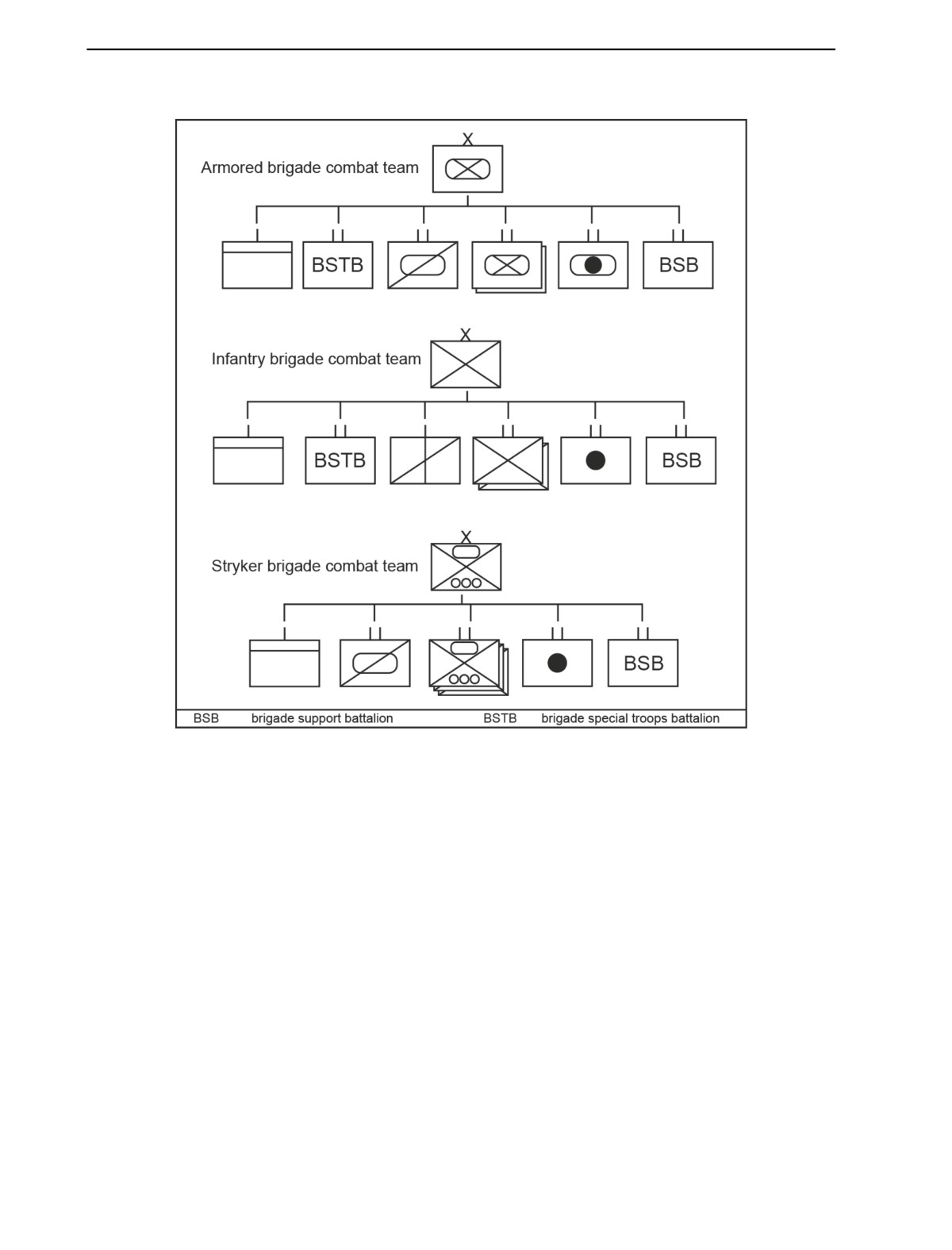
noncontiguous areas of operations. Figure 6-1 on page 6-4 shows the three types of BCTs.
21 April 2014
FM 3-94
6-3
Chapter 6
Figure 6-1. Three types of brigade combat teams (current organization)
6-15. The division task-organizes and assigns an area of operations to each BCT. The commander’s intent
and concept of operations allow a BCT to perform assigned tasks with minimum control from the division
by use of mission orders. The BCT conducts decisive action. That does not mean that the BCT is ideal for
all decisive tasks. The division normally allows the BCT commander to create task forces for specific
missions. The BCT may require task organization changes, even for combat operations, because it does not
have all the combat multipliers that are often required. For example, it does not have organic air and missile
defense or engineer bridging assets.
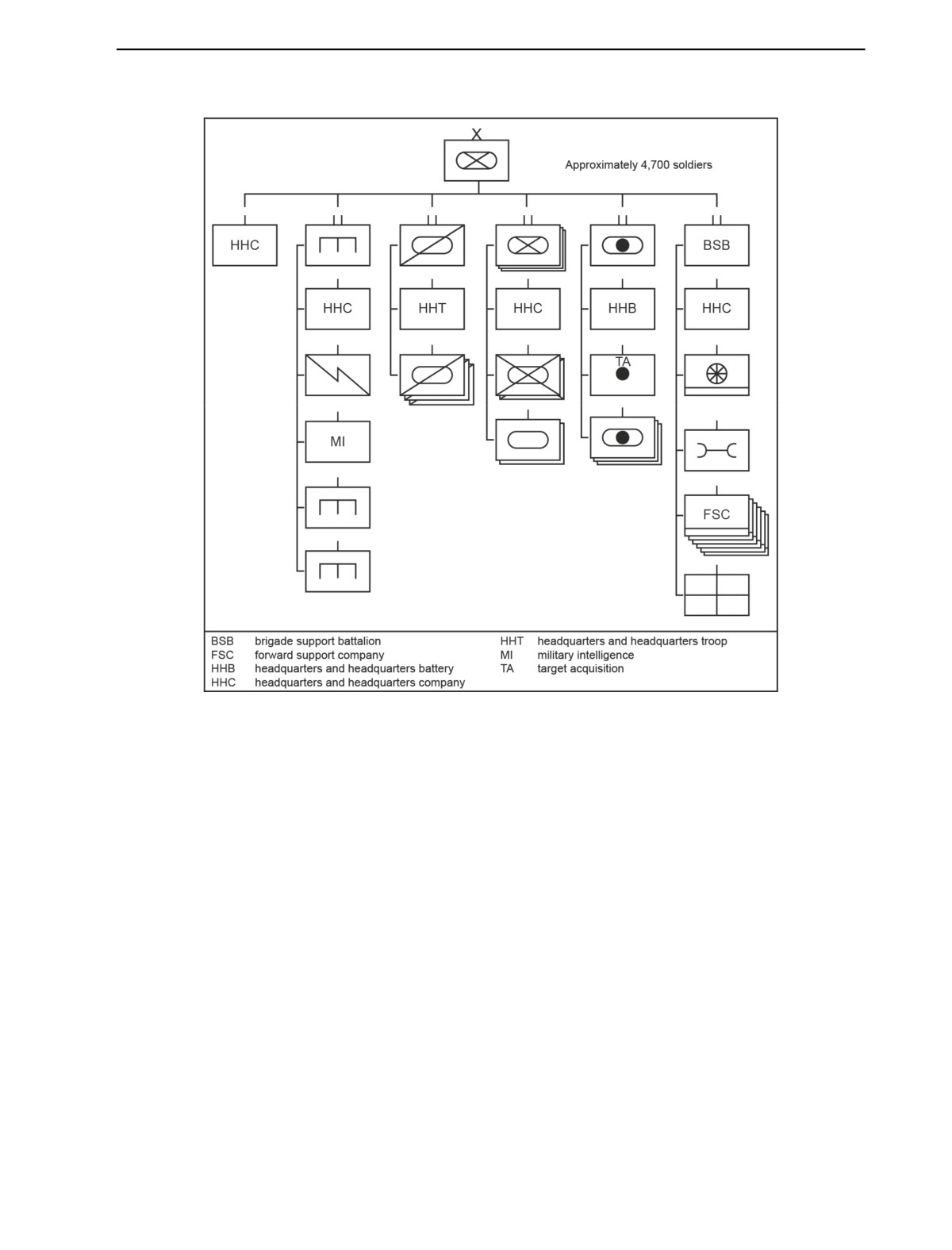
6-16. The organization of BCTs will likely change during the lifespan of this publication. The Army plans
to add a third maneuver battalion to the armored and infantry BCTs. The reconnaissance, surveillance, and
target acquisition battalion then becomes a cavalry squadron with three reconnaissance troops. A separate
headquarters and headquarters company then replaces the brigade special troops battalion. A new engineer
battalion headquarters then commands the signal company, two engineer companies, and the military
intelligence company. The engineer battalion organic to the armored BCT and infantry BCT will include
assault bridging (the Stryker BCT already has this capability). The field artillery battalion receives a third
firing battery, and the brigade support battalion will receive additional assets. The Stryker BCT
organization will also change. Figure 6-2 illustrates an armored BCT with the expanded organization. Refer
to FM 3-90.6 for detail on the organization of BCTs.
6-4
FM 3-94
21 April 2014
Division Roles and Organization
Figure 6-2. Example of a reorganized armored brigade combat team
MULTIFUNCTIONAL SUPPORT BRIGADES
6-17. The modular force features five types of multifunctional support brigades that complement and
reinforce the BCTs. These multifunctional support brigades are combat aviation, battlefield surveillance,
maneuver enhancement, fires, and sustainment. These multifunctional support brigades are combined arms
units that accomplish a broad mission such as protection, in the case of the MEB. Each multifunctional
support brigade includes a headquarters, brigade troops, and specialized battalions. A mix of other
specialized battalions is attached or OPCON to the brigade to match capabilities to requirements. During
operations, the division commander task-organizes between the multifunctional support brigades and
BCTs. Unlike the BCT, tailoring and task organization leads to considerable variation among
multifunctional support brigades of the same type.
6-18. The multifunctional support brigades may occupy terrain within other BCT areas of operations and
can conduct operations in support of BCT operations or in any area the division retains under its control.
The BTSB collects information, the field artillery brigade accomplishes fires missions, and the combat
aviation brigade conducts attacks and other operations in these division retained areas. (Paragraph 6-19
through paragraph 6-33 discusses the various types of brigades.)
21 April 2014
FM 3-94
6-5
Chapter 6
Field Artillery Brigade
6-19. The field artillery brigade conducts operations to provide shaping and decisive fires for the division.
Figure 6-3 illustrates a field artillery brigade. The field artillery brigade is capable of employing Army and
joint fires as well as supporting SOF operations, electronic warfare, and airspace control elements. Field
artillery brigades have the ability to reconnoiter, detect, and attack targets and confirm the effectiveness of
their fires. They have the necessary capabilities to facilitate the efficient application of fires. The field
artillery brigade provides the division with the following capabilities:
z
Force field artillery headquarters for the division.
z
Fires and counterfire for the division.
z
Close reinforcing fires in support of BCTs.
z
Fires, counterfire, unmanned aircraft system, and radar coverage for the combat aviation,
battlefield surveillance, maneuver enhancement, and sustainment brigades.
z
A headquarters able to control Army and joint fires.
Figure 6-3. Field artillery brigade
Combat Aviation Brigade
6-20. The combat aviation brigade is the primary integrator of aviation assets within the division. The
brigade must prepare to fight as a whole, support BCTs using pure or task-organized units, and accomplish
multiple independent missions requiring pure or task-organized units. Each aviation brigade is tailored for
specific missions; however, each accepts other organizations and accomplishes missions not necessarily
defined in the table of organization and equipment (known as TOE) mission statement. Aviation brigade
missions include reconnaissance, security, movement to contact, attack (interdiction, and close combat
attack), air assault, air movement, aerial medical evacuation and casualty evacuation operations, personnel
recovery operations, downed aircraft recovery, forward arming and refueling point operations, aviation
maintenance, and air traffic services.
6-6
FM 3-94
21 April 2014
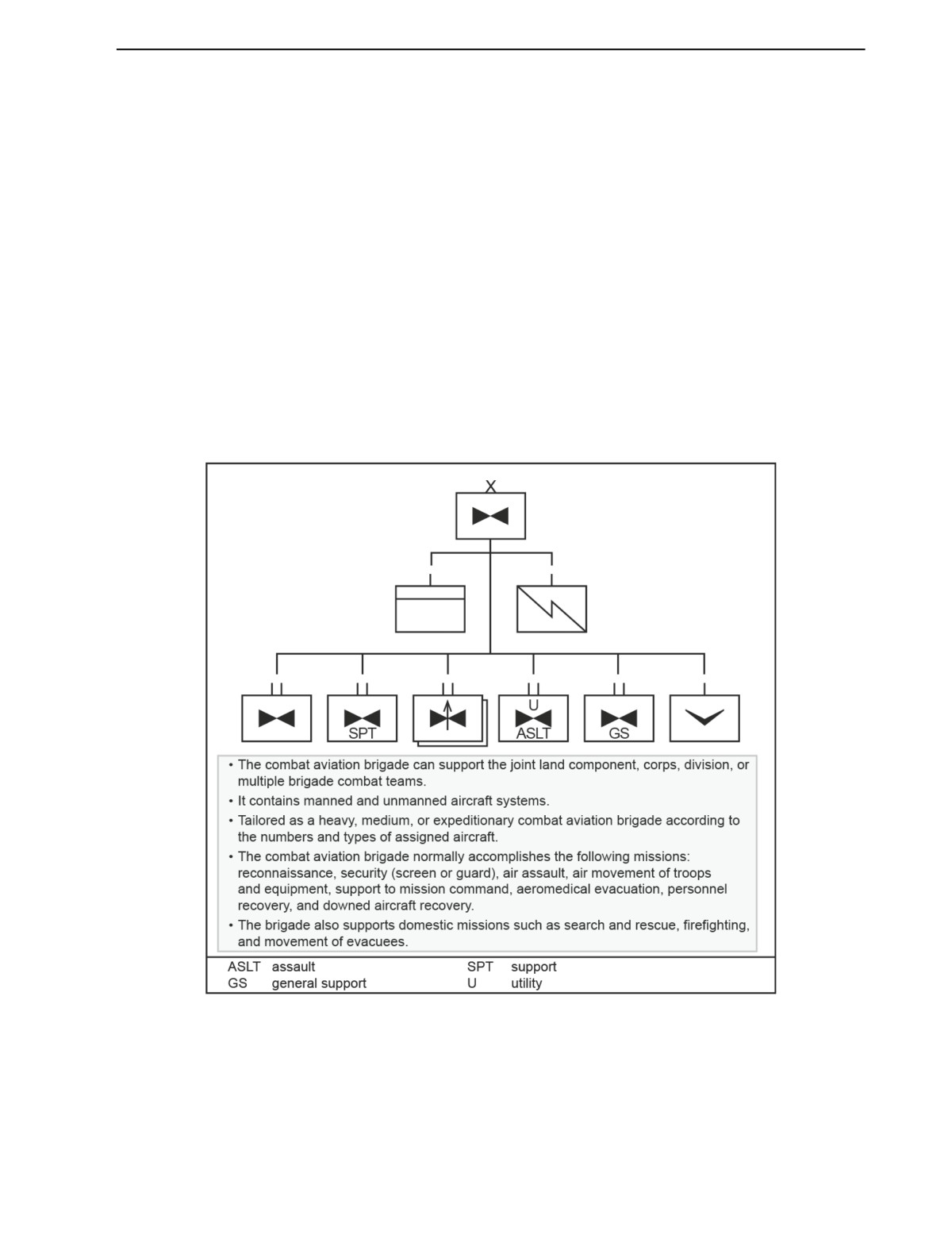
Division Roles and Organization
6-21. Combat aviation brigades come in three types: heavy, medium, and expeditionary. Each combat
aviation brigade normally includes two attack reconnaissance battalions
(or one battalion and one
squadron), an assault helicopter battalion, a general support aviation battalion, an aviation support battalion,
and typically an unmanned aircraft system company. Each brigade contains a headquarters and
headquarters company providing personnel, equipment, and security and defense for the brigade command
post. One combat aviation brigade normally supports the operations of each division with task-organized
aviation capabilities. The bulk of Army aviation’s combat power resides in the combat aviation brigade
organized to support the division, the BCTs, and other brigades. Based on priorities and missions, the
combat aviation brigade collaborates directly with supported brigades for operational details of the support
required.
6-22. The combat aviation brigade (expeditionary) primarily supports homeland security. These operations
include counterdrug missions, humanitarian assistance, disaster relief, civil disturbance, counterterrorism,
and domestic support (for which the National Guard is uniquely suited to conduct). Elements of the brigade
can be task-organized for deployment abroad.
6-23. The combat aviation brigade can accomplish a screen mission for the division. With artillery, ground
maneuver forces, and other support, it can accomplish a guard mission. The combat aviation brigade
normally supports a BCT in a covering force mission. Figure 6-4 illustrates the combat aviation brigade.
Figure 6-4. Combat aviation brigade
Battlefield Surveillance Brigade
6-24. The BFSB collects information that answers the division commander’s critical information
requirements, specifically priority intelligence requirements, and other information requirements based on
the priorities established by the division. The collected information focuses on the enemy, terrain and
21 April 2014
FM 3-94
6-7
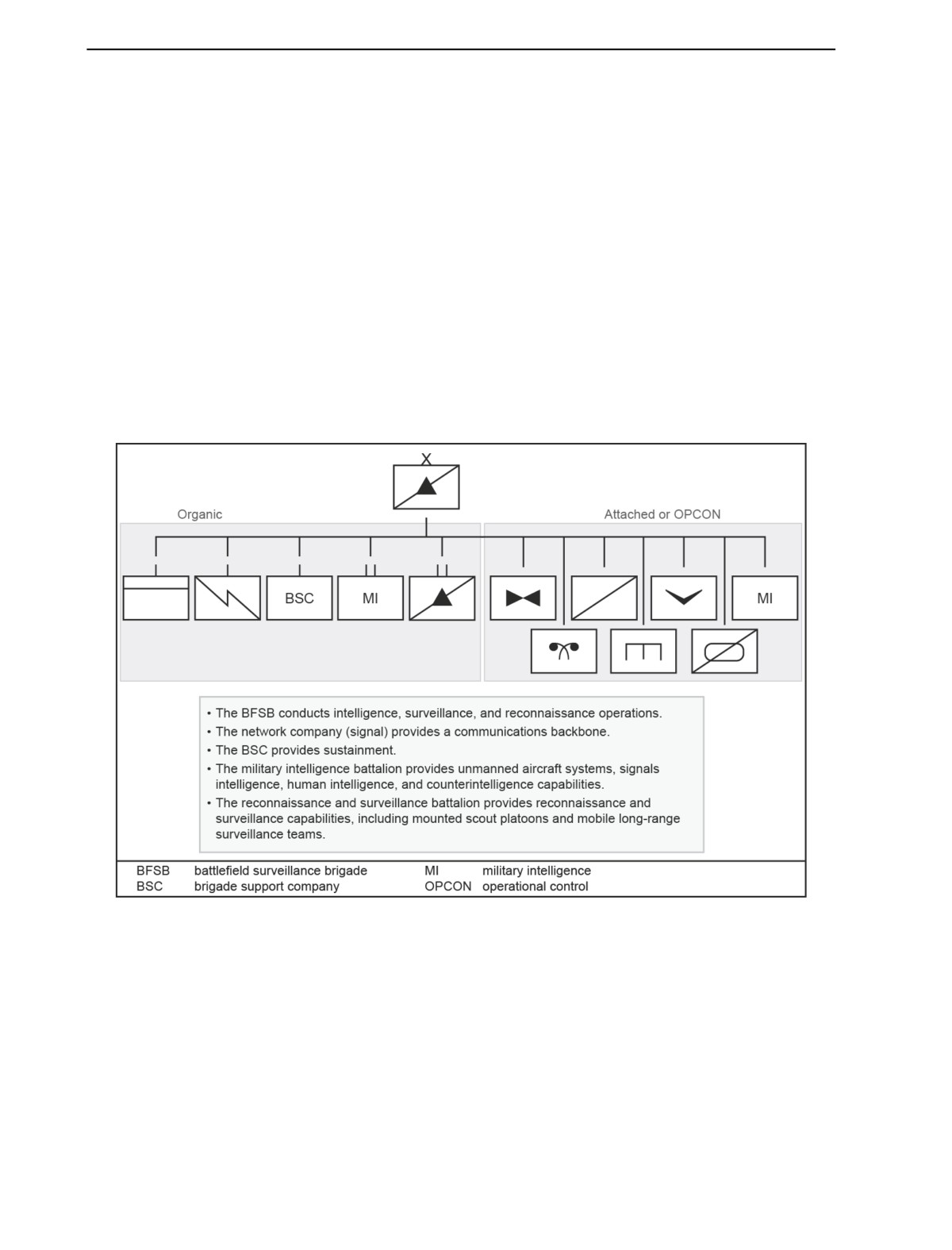
Chapter 6
weather, and civil consideration aspects of METT-TC. In turn, these feed the development and update of
the division’s common operational picture. Normally, the priority of the BFSB collection efforts is the
division’s area of operations outside the BCT’s area of operations. It receives tasking from the division.
The division commander describes the operation, identifies the commander’s critical information
requirements, and prioritizes other information requirements.
6-25. BFSB assets can provide direct or general support to the BCTs. The specific relationship depends on
the capacity of the BFSB to effectively control and maintain these systems or formations and the ability of
each BCT to receive, analyze, and disseminate the information received. The BFSB provides the
intelligence gathered to commands at each echelon based on information requirements, regardless of the
responsibility for an area of operations.
6-26. Normally the BFSB commander retains OPCON over all the BFSB assets involved in collecting
information on enemy, terrain, and civil considerations in response to taskings from the division. The BCTs
retain control of their collection assets but prioritize their collection efforts as required by the division plan.
BFSBs may provide intelligence support to BCTs as designated by the division, corps, or JTF commander
to include multifunctional teams, human intelligence collection teams, low-level voice intercept teams,
counterintelligence teams, and long-range surveillance teams. (See figure 6-5.)
Figure 6-5. Battlefield surveillance brigade
6-27. The BFSB is a high-demand, low-density asset. The division frequently manages scarcity since there
are not enough BFSBs to provide one to each committed division. In the absence of a BFSB, the division
G-2 manages intelligence capabilities across the division. The division commander requests additional
assets from the corps as needed.
Maneuver Enhancement Brigade
6-28. The MEB receives and controls forces that provide protection, mobility, and countermobility. The
MEB is responsible for security within its assigned area of operations, which typically encompasses the
support area and main supply routes. Typical missions include area security, line of communications
security and maintenance, mobility and countermobility, vertical and horizontal construction, CBRN
6-8
FM 3-94
21 April 2014
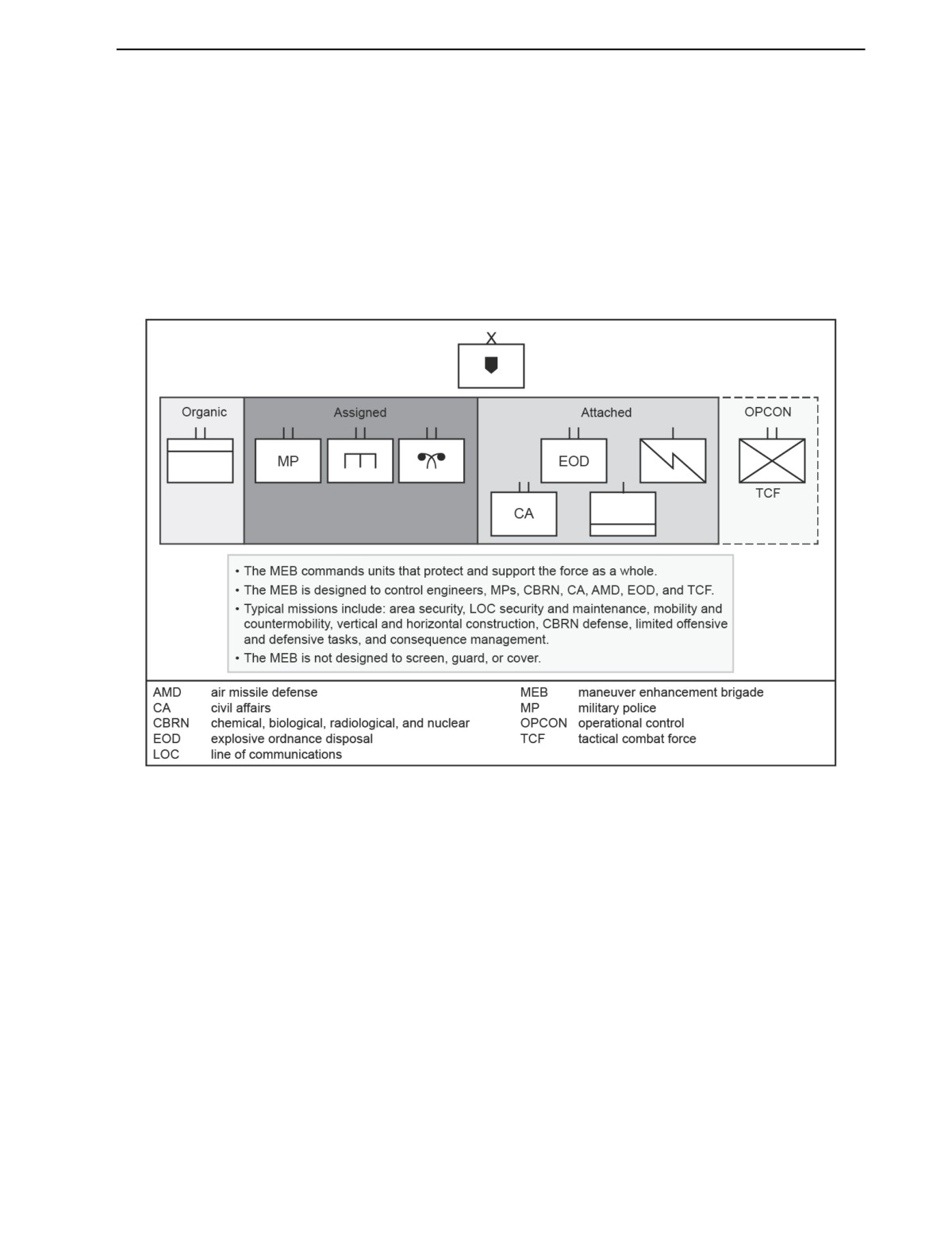
Division Roles and Organization
defense, and limited offensive and defensive tasks. The organization of each MEB varies based upon the
missions for which it is tailored. A typical force mix includes engineer, CBRN, MP, and EOD assets. In
some circumstances, such as when the division is the initial entry force, the MEB may receive direct
support from air and missile defense units, including short-range air defense and C-RAM systems. The
brigade is also task-organized with a tactical combat force when assigned an area security mission.
6-29. The presence of a MEB within the area of operations does not supplant unit self-defense
responsibilities. Units remain responsible for self-protection against Level I threats. The MEB provides
forces to respond to Level II threats and, when task-organized with the tactical combat force, they can
respond to Level III threats. The MEB has some area of operations-wide responsibilities for CBRN
response and air and missile defense, when it controls these types of units. Figure 6-6 illustrates a MEB.
Figure 6-6. Maneuver enhancement brigade
Sustainment Brigade
6-30. Sustainment brigades are subordinate to the TSC (or by extension the ESC). The sustainment brigade
is a flexible, multifunctional sustainment organization, tailored and task-organized according to METT-TC.
It plans, prepares, executes, and assesses sustaining operations within an area of operations. It conducts
sustaining operations and distribution management.
6-31. Sustainment brigades normally provide logistics support to the brigades of the division on an area
basis. This support includes, but is not limited to, the provision of supplies, field services, as well as field
and sustainment maintenance. One or more sustainment brigades may provide support for the combat
operations of the entire division. Subordinate elements of the brigade support reconstitution for BCTs
rotating out of combat operations.
6-32. The sustainment brigade coordinates the movement of sustainment convoys when moving through
the area of operations of other brigades. A movement control battalion may be co-located with the
sustainment brigade. The movement control team from the movement control battalion coordinates with the
G-4 division transportation element to plan and control convoy movement throughout the division area of
operations.
21 April 2014
FM 3-94
6-9
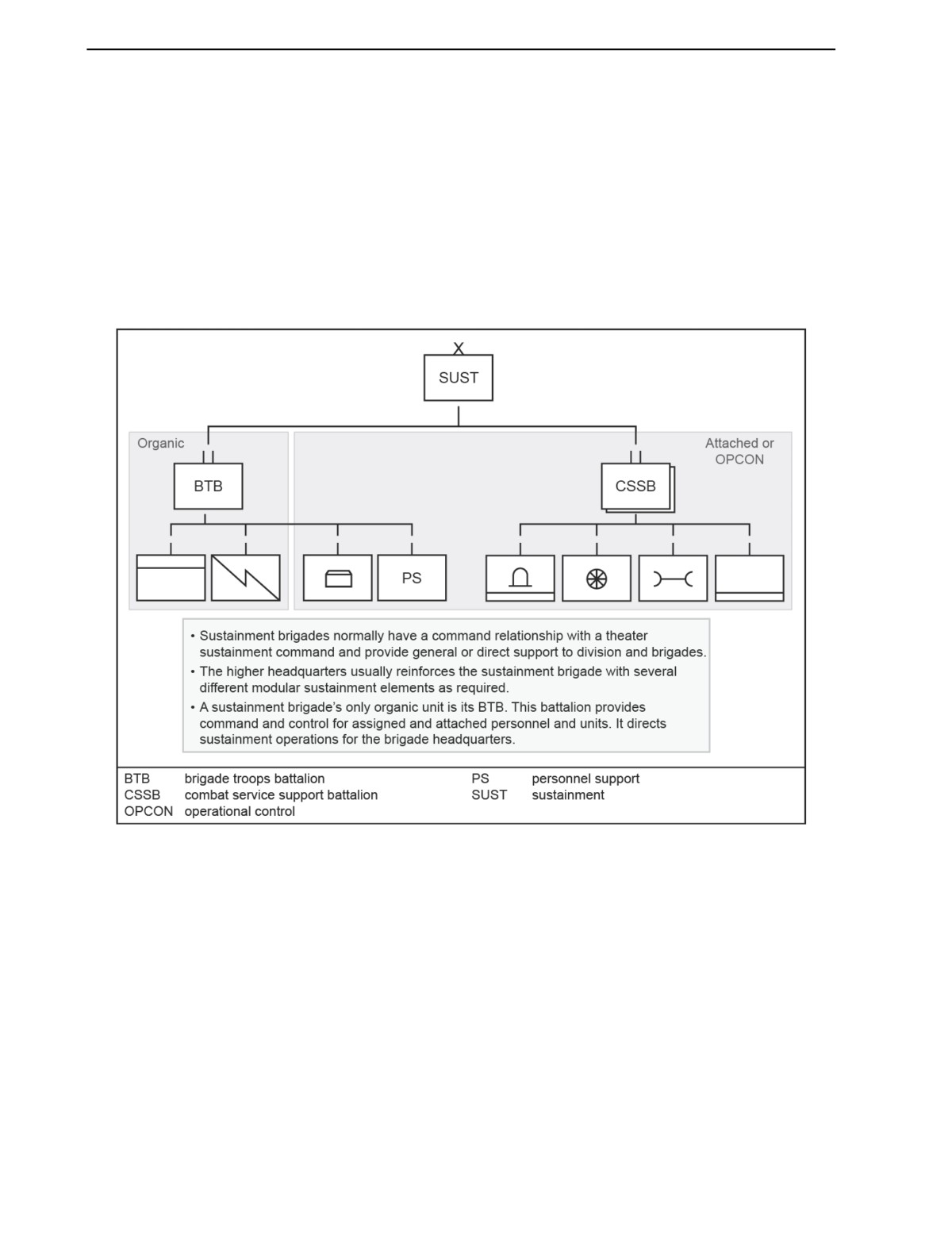
Chapter 6
6-33. The sustainment brigade coordinates with the owning division commander for terrain within the
division’s area of operations. Normally the sustainment brigade operates from a support area. The division
assigns responsibility for this area of operations to a MEB. When there is a serious and persistent threat to
sustaining operations, or in the absence of a MEB, the division commander may assign an area of
operations to a BCT within which the division concentrates its sustaining operations. Within the support
area, the sustainment brigade answers to the MEB or BCT for protection, security, and related matters. The
sustainment brigade establishes ground and aerial lines of communications to link the brigade support areas
to the sustainment brigade area and back to the theater base. It is important to note that command and
support relationships may change during different phases of the operation. The division should plan for
security of ground and aerial lines of communications that link the sustainment brigade area with the
theater base. Figure 6-7 illustrates a sustainment brigade.
Figure 6-7. Sustainment brigade
SEPARATE UNITS AND OTHER FORCES
6-34. Other units and forces contribute to the division role. These consist of a civil affairs battalion, a
tactical military information support company, an EOD battalion or company, CBRN units, SOF, a military
history detachment, and a mobile public affairs detachment.
Civil Affairs Battalion
6-35. Normally, a civil affairs battalion is attached to each division if sufficient civil affairs units are
available. This support can come from either the Regular Army or the Reserve Component civil affairs
battalions with the conventional force support mission. The composition of both civil affairs battalions is
similar in the areas of a civil affairs planning team, CMOC, civil liaison team, and the civil information
management cell. Unlike the more robust functional specialty structure or the Reserve Component civil
affairs battalion, the special function team within the Regular Army battalion provides limited capability
for intermediate-level assessment of threats to the civil component of an operational environment at the
6-10
FM 3-94
21 April 2014
Division Roles and Organization
provincial to local levels. The organization also allows civil affairs battalion to assess mission planning
requirements, and to develop, coordinate, and synchronize resources for stability tasks. Missions that
require more in-depth functional specialty support than the allocated civil affairs battalion can be
accomplished through reachback to the civil affairs regiment. Reserve Component functional specialty cells
contain subject matter experts in the areas of rule of law, economic stability, infrastructure, governance,
public health and welfare, and public education and information.
6-36. The civil affairs battalion’s CMOC is capable of managing, coordinating, and synchronizing civil
affairs operations and civil-military operations within a division’s area of operations. The CMOC provides
a place where stakeholders can coordinate their activities as unified action partners. This center serves as
the primary coordination interface for U.S. forces and indigenous populations and institutions,
humanitarian organizations, intergovernmental organizations, nongovernmental organizations,
multinational forces, host-nation government agencies, and other civilian agencies of the U.S. Government.
The division G-9 provides direction and oversight to the CMOC through the CMOC officer in charge
(usually the civil affairs battalion commander). The CMOC is tailored to the specific tasks associated with
the mission based on a METT-TC analysis. Protection is a key concern when considering where to locate
the CMOC. Placing the CMOC within the division’s consolidated command post can enhance security for
the CMOC, but this may also interfere with its ability to interact with nongovernmental organizations and
other stakeholders. The division G-9 should carefully consider the location and security of the CMOC. The
CMOC should be accessible to government and nongovernment agencies. It should be secure from
irregular threats, but the presence of sizeable U.S. security may create an unfavorable impression with host-
nation authorities.
6-37. As part of the civil affairs battalion, the civil affairs planning team is skilled in the military
decisionmaking process and the operations planning process. The civil affairs planning team can assist the
G-9 and division staff with planning and integrating civil affairs operations, stability tasks, and civil-
military operations into the supported commander’s overall plan. The G-9 synchronizes all civil affairs
operations throughout the division area of operations. (For more on the civil affairs battalion and support to
the division, see FM 3-57.)
Tactical Military Information Support Company
6-38. The division normally receives a tactical military information support company to support the
maneuver commanders. It enables the maneuver commander to influence, either directly or indirectly,
foreign populations to achieve behavior changes consistent with the maneuver commander’s stated
objectives. The tactical military information support company develops messages and actions in a series to
address operational requirements of the maneuver unit. Series development consists of developing both
product concepts and actions for a psychological effect. MISO units develop messages and talking points
for Soldiers and leaders conducting senior leader engagement. The company command section augments
the maneuver unit staff to provide MISO, senior leader engagement, and military deception planning
assistance. The tactical military information support company commander works with the supported unit
staff to integrate attached MISO forces. The company requires sustainment support from the HHB as its
organization does not include sustainment assets.
Explosive Ordnance Disposal Units
6-39. An EOD battalion may support the division. An EOD company attached to the battalion may support
either a BCT or the MEB.
Explosive Ordnance Disposal Battalion
6-40. The EOD battalion is a functional headquarters for EOD operations. The EOD battalion is
responsible for staff planning and staff control of all counter-improvised explosive device (known as IED)
assets within a division area of operations. The EOD battalion is capable of conducting and supervising
EOD operations for two to seven EOD companies. The EOD battalion reports directly to the EOD group.
The EOD battalion may be attached or OPCON to a theater army, corps, division, JTF, or combined JTF
for a specific operation. (See ATP 4-32.)
21 April 2014
FM 3-94
6-11
Chapter 6
Explosive Ordnance Disposal Company
6-41. The EOD company commands between one and five EOD platoons and provides company-level
planning and support based on the level of employment. The EOD company normally provides direct
support or general support to a BCT or MEB. The EOD company may also be placed under the OPCON or
TACON of Army special forces units. (See ATP 4-32.)
Chemical, Biological, Radiological, and Nuclear Units
6-42. The Army chemical corps maintains two CBRN echelons: battalion and brigade. These two
headquarters provide intermediate CBRN capabilities for divisions or at echelons above division. These
organizations provide the supported command with the capacity to mass the effects and capabilities of
CBRN units at decisive locations or times on the battlefield. The CBRN battalion is a stand-alone
headquarters that commands up to six CBRN companies or equivalent CBRN elements. The battalion is
typically employed in support of a division or at echelons above division. Its command and support
relationship may include attached, OPCON, or direct support, depending on the factors of METT-TC. It
may also be task-organized to a CBRN brigade, an MEB, or as an independent CBRN battalion to a
CBRNE operational headquarters.
6-43. Army CBRN units that make up a CBRN battalion or brigade offer a range of capabilities to division
operations. They can accomplish missions as units, teams, or individuals. Diverse landpower requirements
often require a mix of different units—decontamination, CBRN reconnaissance, and bio-detection. CBRN
units provide the capability to accomplish or support WMD counterforce missions (interdiction, offensive
operations, and elimination) and CBRN consequence management, while maintaining capabilities to
conduct CBRN passive defense operations that are required for the Army to prevent, shape, and win. The
CBRN force organization within a division depends greatly on the threat. Based on the mission variables
prevailing in the AOR, the commander tailors available CBRN forces for the specific situation. The senior
chemical unit commander, staff, and functional units assigned normally conduct CBRN operations to
provide support across the joint force in addition to Army units. (See FM 3-11.)
Special Operations Forces (Other than Civil Affairs and MISO)
6-44. The division may have SOF under its control or operating in its area of operations. When this is the
case, the division may receive a special forces liaison element to synchronize SOF activities with division
operations. This element should locate at the appropriate command post.
Military History Detachment
6-45. A military history detachment may support the division headquarters battalion in preserving
historical documentation and artifacts. Individuals in this detachment may attend key briefings and
meetings and interview key personnel to gather firsthand observations, facts, and impressions. The
personnel within the detachment keep a daily journal of their personal observations and key events. They
also assist the division information management element in packaging and forwarding collected
information to appropriate agencies. The information collected by this detachment assists the division
complete after action reviews and document the division’s lessons learned.
Mobile Public Affairs Detachment
6-46. A mobile public affairs detachment provides support to units in support of Army, combined, joint, or
multinational operations. A mobile public affairs detachment is assigned, attached, or OPCON to echelons
at division and above. It may support the ASCC, TSC, or corps public affairs staff sections. It also may
augment a press camp headquarters in operating a media operations center or deploy independently in
support of other Services and operations. A mobile public affairs detachment has personnel and equipment
to—
z
Assist and advise commanders on public affairs programs and missions.
z
Plan, prepare, and execute information strategies.
6-12
FM 3-94
21 April 2014
Division Roles and Organization
z
Facilitate, assess, and monitor media activity.
z
Acquire and process public affairs digital video, audio, and imagery.
THE DIVISION HEADQUARTERS
6-47. The division headquarters is organized and equipped for sustained combat operations. By design, it
resembles the corps headquarters, but it has different manning (chiefly standards of grade) and equipment.
The headquarters consists of a main command post, tactical command post (which may be reorganized into
an EECP), mobile command group, and HHB. Plans and operations across these staff sections, cells,
command posts, and echelons are facilitated by a network and suite of mission command systems to
enhance collaboration and synchronization.
MAIN COMMAND POST
6-48. The main command post is the primary command post of the division. It controls division operations.
The division main command post is responsible for the sustained conduct of current operations, future
planning, analysis for current and future operations, sustainment coordination, and other staff functions.
The division staff at the main command post operates under the general supervision of the division chief of
staff. The main command post can accomplish its mission command warfighting functions without the
tactical command post. It is a complete command post capable of autonomous operation. Staff
responsibilities include:
z Controlling all division operations.
z Serving as the primary location for plans, analysis, and sustainment coordination.
z Monitoring and assessing operations for impact on future operations.
z Planning operations.
z Producing operation and contingency plans.
z Integrating intelligence operations into both current and future operations.
z Producing all-source intelligence products.
z Producing terrain products.
z Conducting information management and knowledge management.
z Coordinating and managing force structure to include request for forces and equipment.
z Synchronizing the division’s targeting process.
z Controlling division-assigned airspace with the assigned ASOC. (See paragraph 6-52.)
z Coordinating offensive, defensive, and stability (or DSCA in the homeland) operations.
z Providing DSCA as part of a JTF-state (for National Guard Divisions), a USPACOM JTF, or a
USNORTHCOM JTF. (See ADRP 3-28.)
z Preparing and maintaining division running estimates, plans, and orders to support future
operations.
z Planning and synchronizing division sustaining operations.
z Preparing all reports required by higher headquarters.
6-49. Division assigned airspace is normally that airspace assigned by the airspace control authority within
the boundaries of the division’s area of operations up to the coordinating altitude. The airspace assigned
may not be over the entire area of operations, but could be from the rear boundary to the FSCL between the
lateral boundaries. The airspace control authority may not assign the division the airspace over the entire
division area of operations, depending on the size of the area. The terrain or just the volume of air over the
entire area of operations, if it is very large, can exceed the ASOCs ability to control.
6-50. Figure 6-8 on page 6-14 illustrates the organization of the main command post. The main command
post consists of a command group, functional cells, and integrating cells. There are five functional cells—
intelligence, movement and maneuver, fires, protection, and sustainment. The movement and maneuver
functional cell forms three integrating cells—current operations integrating cell, future operations cell, and
plans cell—to which other staff cells attach subject matter experts. The cells are scalable to accommodate
21 April 2014
FM 3-94
6-13
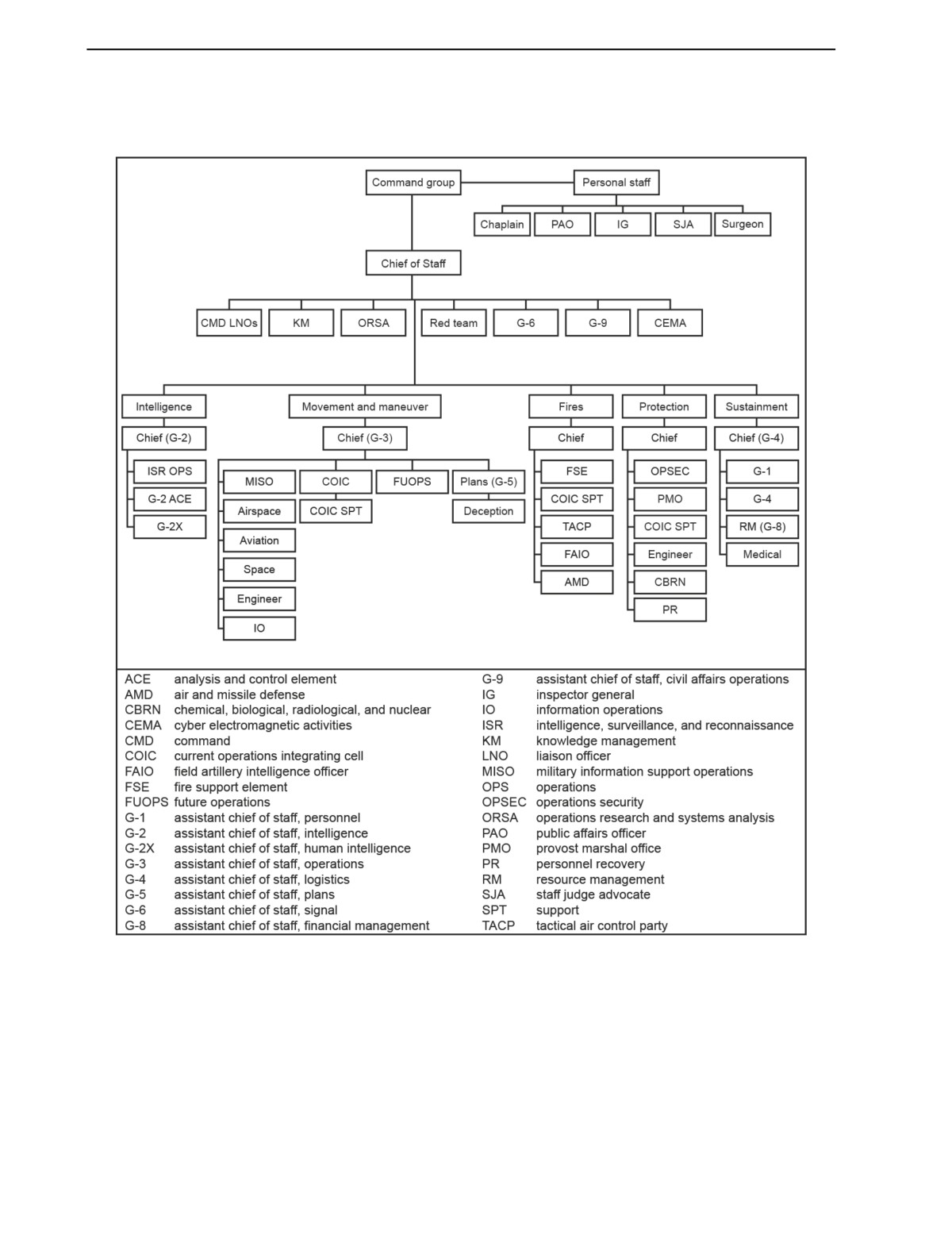
Chapter 6
joint staff augmentation when required, such as when the division becomes a joint force land component or
JTF headquarters.
Figure 6-8. Main command post of a division
6-51. The integrating cells operate across the warfighting functions. The three integrating cells consist of
individuals and elements from within the functional cells and focus on integrating plans and operations
across division structure. The three integrating cells are the current operations integrating cell, the future
operations cell, and the plans cell. The integrating cells divide responsibilities for planning and execution
based on the complexity of the plan, the planning horizons for planning and execution, or another criterion
selected by the commander. As an alternative, a commander could assign a specific plan to an individual
staff member or group of staff members to develop from origin to execution. Managing the handoff of a
plan from G-5 plans to G-3 future operations to G-3 current operations is the responsibility of the G-3.
6-14
FM 3-94
21 April 2014
Division Roles and Organization
6-52. The USAF provides an air support operations squadron as well as the ASOC to the division to
control close air support and other air support in the division’s airspace area of operations. The ASOC and
TACP personnel work within the division fires cell and airspace element. Together with the Army
personnel, they form a JAGIC. This center integrates and coordinates fires and air operations over and
within the division commander’s area of operations. A JAGIC is located within the current operations
integrating cell and works directly for the current operations chief. Chapter
7 discusses tactical
considerations concerning USAF support. The JAGIC—
z
Executes the ATO as directed by the joint or multinational force air component commander.
z
Provides procedural control of close air support aircraft operating in the area of operations.
z
Establishes, maintains, and operates the air communications architecture.
z
Provides decentralized execution of immediate air support and obtains clearance of fires from
the appropriate fires echelon.
z
Integrates, coordinates, directs, and controls other air component missions.
z
Coordinates air missions that fly within the division-assigned airspace but do not directly
support the ground component and other supporting arms activities (such as Army Tactical
Missile System missions) to de-conflict with ground force maneuver and fires, in addition to
receiving target and threat updates.
z
Assists with dynamic targeting and friendly force location information.
z
Advises the division commander on close air support employment, target nominations for those
air interdiction and suppression of enemy air defenses (known as SEAD) missions that support
the ground force, airborne surveillance, and airlift that directly supports the division.
z
Integrates division fires with other complementary and reinforcing functions for achieving air-
ground integration.
6-53. Some staff elements work directly for the chief of staff, such as the G-6, while other elements
become part of the integrating and functional cells. This includes most of the special staff. The commander
determines which elements of the personal staff, if any, will work in an integrating or functional cell.
TACTICAL COMMAND POST
6-54. The division employs the tactical command post to control specific operations. The tactical command
post maintains continuous communication with subordinates, higher headquarters, the other command
posts, and supporting joint assets. It is also capable of controlling division operations for a limited time
when the main command post is displacing or otherwise not available. However, the tactical command, if
separated from the main command post, requires augmentation from a main command post to control
operations for extended operations. The tactical command post contains a robust network capability with
many of the same mission command systems as the main command post. The tactical command post can
maintain situational awareness and connectivity with higher headquarters and subordinate units when the
main command post is displacing or not available. (See figure 6-9 on page 6-16.)
6-55. One of the two assistant division commanders controls operations from the tactical command post.
The G-3 staff section is responsible for the operation of the tactical command post. The division
commander may command the division from the deployed mobile command group, the tactical command
post, or the main command post, as dictated by the mission variables of METT-TC.
6-56. The tactical command post extends the division headquarters’ capabilities to specific actions within a
larger operation. The division commander may use the tactical command post to control any operation
involving two brigades but not the rest of the division. For example, the tactical command post may control
a passage of lines between BCTs or the relief in place of a BCT by a MEB. The tactical command post may
control a BCT and supporting forces in a covering force mission while the main command post controls
defensive preparations in the main battle area. The tactical command post also controls forces committed to
a specified operation, such as brigade-sized air assaults, river crossings, deliberate breaching operations, or
a passage of lines involving multiple subordinate units or a large-scale stability operation. The tactical
command post may form the headquarters of a task force with subordinate units task-organized under its
control, such as establishing security. However, it could also control particularly complex sustaining
operations such as RSOI or reconstitution involving multiple subordinate brigades.
21 April 2014
FM 3-94
6-15
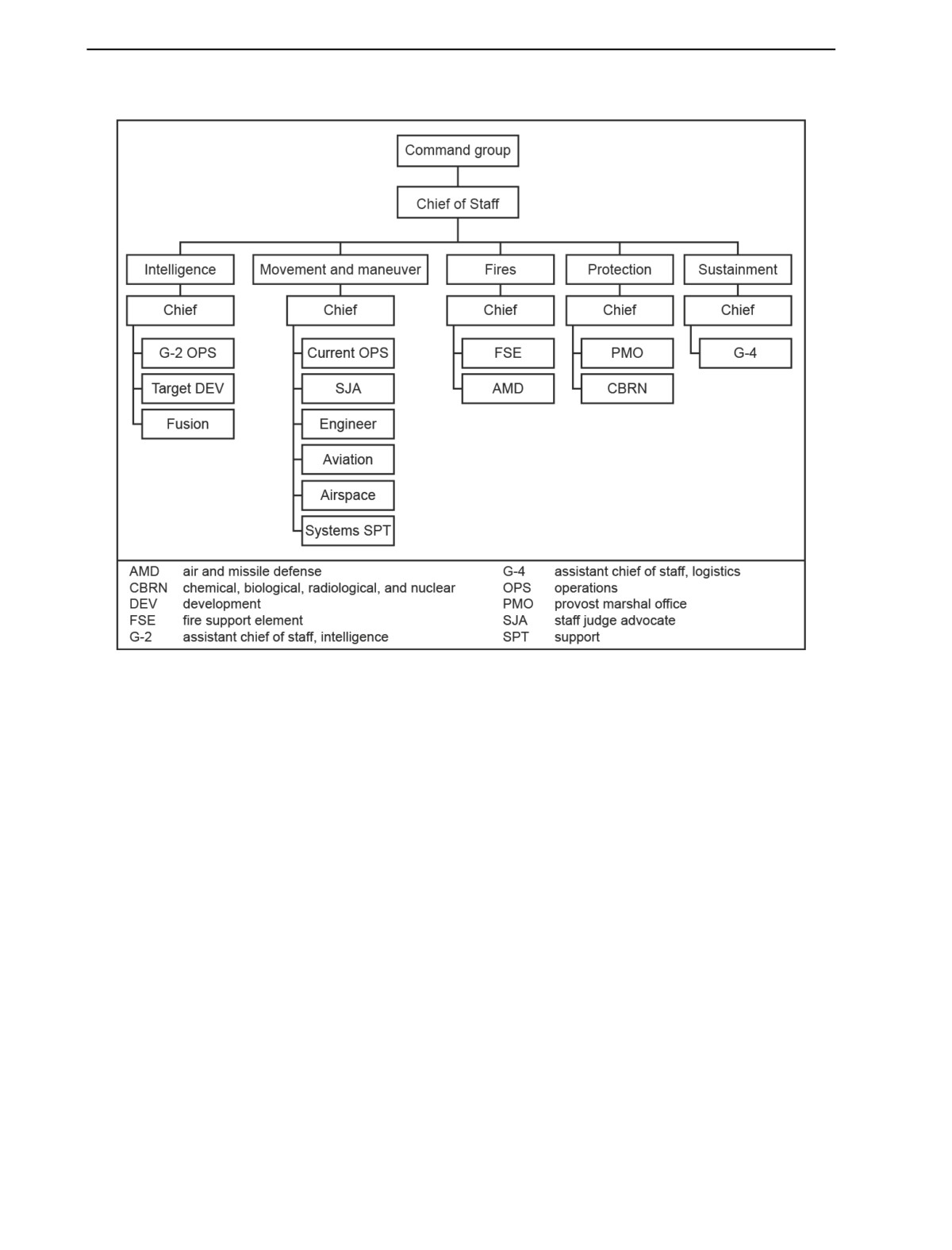
Chapter 6
Figure 6-9. Division tactical command post
6-57. When the division employs the tactical command post to control the execution of the division’s
overall operations, such as when the main command post is deploying into or displacing within the area of
operations, then the tactical command post maintains the common operational picture for the division
according to the command information management plan. In this case, the tactical command post performs
duties that may include the following:
z
Control units and activities conducting the decisive operation or shaping operations.
z
Maintain the current operations estimate.
z
Maintain and disseminate the common operational picture throughout the division.
z
Populate the common operational picture to meet the commander’s requirements.
z
Monitor division-level sustaining operations.
z
Prepare a forward location for issuing orders and conducting rehearsals.
z
Prepare a forward short-term planning facility when the main command post displaces.
z
Provide the majority of the personnel and equipment to form an assault or EECP.
z
Provide personnel with specific skills sets to support the mobile command group.
6-58. The tactical command post is completely mobile and can displace all its personnel and equipment
with organic transportation. Factors that influence the movement of the tactical command post include the
flow of operations, the threat of enemy action, and the desires of the commander. Elimination of the
dependency on line-of-sight communications systems, with their inherent range limitations, allows the
tactical command post to remain stationary longer and maintain control over units conducting operations
over extended distances. However, the tactical command post should remain close enough to subordinate
brigades for the staff to be cognizant of an operational environment in which the brigades are operating.
Some potential roles for the tactical command post include the following:
6-16
FM 3-94
21 April 2014
Division Roles and Organization
z The tactical command post can act as the headquarters of a multi-brigade task force organized
from divisional units for a mission. During the conduct of widespread offensive actions, the
commander may designate the tactical command post to control the operations of forces
eliminating bypassed enemy forces within small cities along a line of operations while the main
command post controls the decisive operation.
z The tactical command post may control decisive, shaping, and sustaining operations. The
division commander may distribute control of decisive, shaping, and sustaining operations
between command posts in complex operations. Whichever command post is controlling the
decisive operation also controls the shaping operations that are setting conditions. This ensures
the controlling headquarters has visibility over both and can effectively synchronize the entire
operation.
z In protracted operations, the commander may combine the tactical command post and the main
command post into a single co-located command post. This single command post increases the
capacity to control particularly complex tasks that may be performed in the area of operations.
z The tactical command post can employ forces and deploy forces simultaneously with the main
command post. The main command post can control the deployment of forces into the area of
operations while the tactical command post is in the area of operations controlling initial
operations.
EARLY-ENTRY COMMAND POST
6-59. The EECP is an ad hoc organization comprised of equipment and personnel from the staff of the
tactical command post and the main command post. The tactical command post provides the base for the
EECP. The division adds or subtracts personnel based on mission requirements. The EECP includes a mix
of current operations personnel, planners, and logisticians able to coordinate the reception of the division
and plan its initial operations.
6-60. When the division headquarters alerts for deployment, the tactical command post moves to a high-
readiness posture, configuring equipment and personnel into a command post package to fit constrained lift
with the other equipment and personnel prepared to follow. A division deployment might consist of a
consolidated main command post (main and tactical command posts) at home station that provides control
of pre-deployment preparation, mission rehearsals, collaborative planning, training with higher
headquarters, and initial phases of unit deployment. The EECP deploys early in the deployment sequence.
While the EECP is deploying, the division main command post monitors deployment of subordinate units
and coordinates with the gaining headquarters. Once the EECP is fully functional within the joint
operations area, the commander determines the best time to deploy the remainder of the main command
post. The commander determines the initial locations, sequence, and timing of deployment and
displacement for all command posts. The commander deploys along with elements of the command group
forward once a fully functional command post becomes operational in the division area of operations.
MOBILE COMMAND GROUP
6-61. The purpose of a mobile command group is to allow the commander to exercise personal leadership
at a critical time and place during the conduct of operations. It allows the commander to displace from a
command post while maintaining continuous access to the common operational picture. Mobile command
groups allow commanders to—
z
Provide personal leadership, intent, and guidance at the critical place.
z
Make a personal assessment of the situation.
z
Maintain situational understanding while moving around the area of operations by allowing them
to have continuous access to updated information.
z
Travel with key staff officers necessary to provide information relevant to the current operation.
6-62. The mobile command group allows the division commander to move to the point of decision. The
division commander moves to a location to best assess the risks and make adjustment decisions by seeing,
hearing, and understanding what is occurring. What division commanders learn and see helps them
mentally visualize adjustments needed in current and future operations while moving about the area of
21 April 2014
FM 3-94
6-17
Chapter 6
operations and interact with their subordinate commanders and different staffs. Thus the mobile command
group allows the division commander to command from anywhere in the area of operations and not become
tied to the tactical command post or main command post.
6-63. The mobile command group has both a ground and an aerial component. The mobile command
group’s ground component consists of specially configured vehicles, each with multifunctional mission
command systems that provide the commander with networked communications while moving. The air
component of the mobile command group consists of helicopters (each equipped with a mission command
system) assigned to a combat aviation brigade and provided when required. Data links for connectivity to
many ground and airborne platforms provide the commander with the flexibility to operate in all
environments without additional equipment.
6-64. The mobile command group requires a security force. The division tasks a subordinate unit to
provide a security force to the entire HHB that secures the mobile command group and division command
posts.
6-65. The division commander selects the individuals who staff the mobile command group. These
personnel are normally functional representatives of those staff sections control combat operations (such as
maneuver, fires, and intelligence) in addition to the air liaison officer, and when needed, a joint terminal
attack controller. The mission and staff available, however, dictate its makeup.
THE HEADQUARTERS AND HEADQUARTERS BATTALION
6-66. The division HHB provides all administrative support, life support, communications, and
transportation for the division’s two command posts and the mobile command group. The HHB has a
complete battalion staff. The HHB consist of four companies with distinct missions: the headquarters
support company, the operations company, the intelligence and sustainment company, and a signal
(network support) company. The division headquarters also requires a security company that is not
currently resourced. The division band (if present) is attached to the HHB. (See figure 6-10.)
6-67. The organization of the division HHB is quite similar to that of the corps headquarters battalion. The
headquarters support company includes life support and maintenance sections for the division main and
tactical command posts. These can be task-organized to support the configuration of the division
headquarters. The operations company provides administrative support to the movement and maneuver,
fires, and protection sections of the staff. The intelligence and sustainment company provides
administrative support to the intelligence and sustainment sections. The signal company task-organizes to
support the main and tactical command posts, in whatever configuration the division commander directs. It
connects the division headquarters into the Army global network enterprise, and through it, into the DOD
information networks. The signal company ties into the network through a supporting expeditionary signal
battalion from the theater tactical signal brigade.
6-18
FM 3-94
21 April 2014
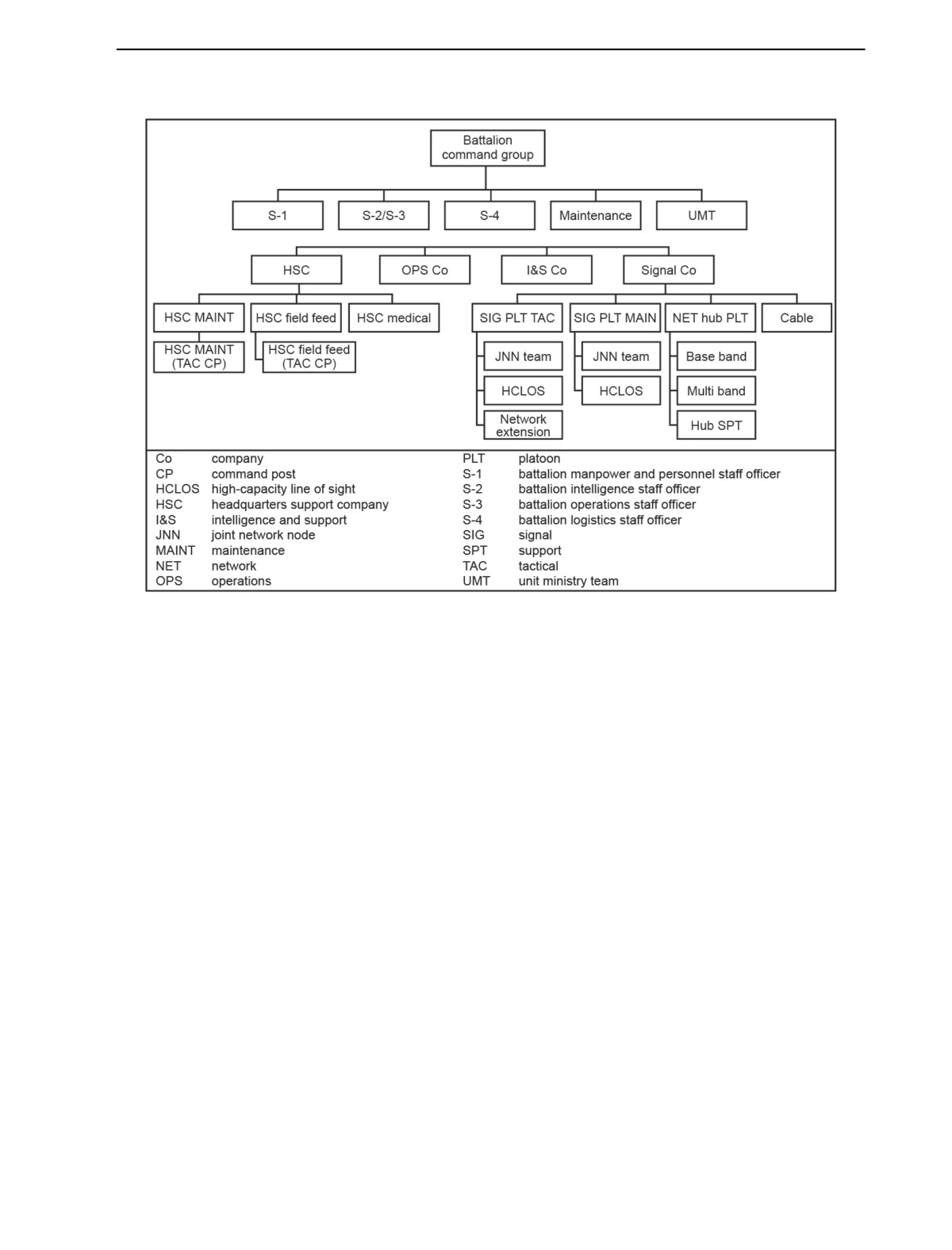
Division Roles and Organization
Figure 6-10. Division headquarters and headquarters battalion
21 April 2014
FM 3-94
6-19
Chapter 7
Division Operations
THE TACTICAL ENVIRONMENT
7-1. The Army division headquarters deploys and commands multiple brigades across the range of
military operations. It operates in any geographic region. The division synchronizes brigade maneuver with
joint and Army capabilities to conduct battles and engagements. Its higher headquarters normally is an
Army corps, which assigns the division its tactical tasks and allocates joint support. The Army corps
assigns the division its tactical tasks and provides capabilities and resources to the division to achieve
specified objectives. The corps commander distributes air support made available by the JFACC. The corps
commander’s distribution decision affects the priority of use for close air support and the sorties available
to subordinate divisions. The division may operate under the commander of a Marine expeditionary force
or a multinational corps headquarters, supported by the theater army.
7-2. The division operates in tactical environments spanning the range of military operations. In its most
likely missions, the division conducts simultaneous offensive, defensive, and stability operations under the
command of a joint force land component as part of joint force. Likely conditions in the area of operations
could include the following:
z
Hybrid threats and irregular warfare.
z
Host-nation authorities under duress due to conflict and civil instability.
z
Dense population areas within which threat forces may attempt to operate.
z
Damaged, deteriorating, and inadequate infrastructure.
7-3. In less likely but more dangerous environments, the division conducts battles and engagements
against large, well-trained, and heavily armed conventional forces operating with unconventional forces.
Often the division is supported by CBRN and cyber electromagnetic capabilities. Division units conduct
stability tasks incident to combat operations with host-nation authorities.
7-4. In either case, the division commander translates the higher headquarters’ broad operational
objectives into tactical tasks assigned to subordinate BCTs and supporting brigades. Exercising mission
command at this echelon requires synchronization of joint and Army capabilities with brigade maneuver.
The division commander focuses on the current operation and potential branches to the current operation
while visualizing the concept of operations for next tactical phase (sequels). The division commander
allocates and re-allocates capabilities under the division’s control between brigades constantly. Planning
horizons for the division are shorter than for the corps, cycling, as they must, within the longer campaign
horizons of the corps. The division commander conveys requirements for joint shaping through the corps
commander while limiting most division shaping efforts to those things affecting the immediate operation.
7-5. The division commander employs BCTs in combined arms operations, integrated with aviation, fires,
and intelligence. Maneuvering the BCTs into position to destroy enemy forces through close combat is the
principal means by which the division accomplishes offensive and defensive missions. Joint capabilities
coordinated through the corps are enablers for the division, allowing the division commander to economize
or weight subordinate brigades. Where the corps commander develops operations based upon operational
reach, the division commander calculates mutual support, supporting range, and supporting distance. The
division commander also carefully monitors the endurance of subordinate brigades in terms of days and
hours until their organic sustainment units require replenishment. The tempo of operations becomes as
important as the distance between the division’s brigades and the supporting sustainment elements; these
factors determine the relative endurance of the division.
7-6. The division commander assesses stability tasks in terms of how they affect local conditions, which
might be quite different from another division’s area. Whereas the joint force land component engages with
21 April 2014
FM 3-94
7-1