FM 3-94 THEATER ARMY, CORPS, AND DIVISION OPERATIONS (APRIL 2014) - page 3
Chapter 3
level of analysis, production, and dissemination required at the operational and strategic levels. They
receive augmentation
(language and cultural expertise, regional analysis, and mass communications
delivery capability). The regional and media operations battalion from the combatant command level
normally reinforces the task force with these capabilities. Depending upon its missions, the military
information support task force receives additional augmentation from the supported maneuver unit and the
Army Reserve strategic dissemination company. Selected MISO units train to support forcible entry
operations.
ARMY SPECIAL OPERATIONS FORCES
3-63. The theater special operations command is the subordinate special operations command through
which the GCC normally exercises OPCON of all SOF within the AOR. (See FM 3-05.) The commander of
the theater special operations command serves as the primary advisor to the combatant commander for
applying regionally aligned, ARSOF. As directed by the geographic combatant command, the theater army
provides support to deployed SOF. The special operations commander coordinates with the theater army
for sustainment requirements. The ADCON of ARSOF and logistics support of SOF unique items will
normally remain in special operations channels.
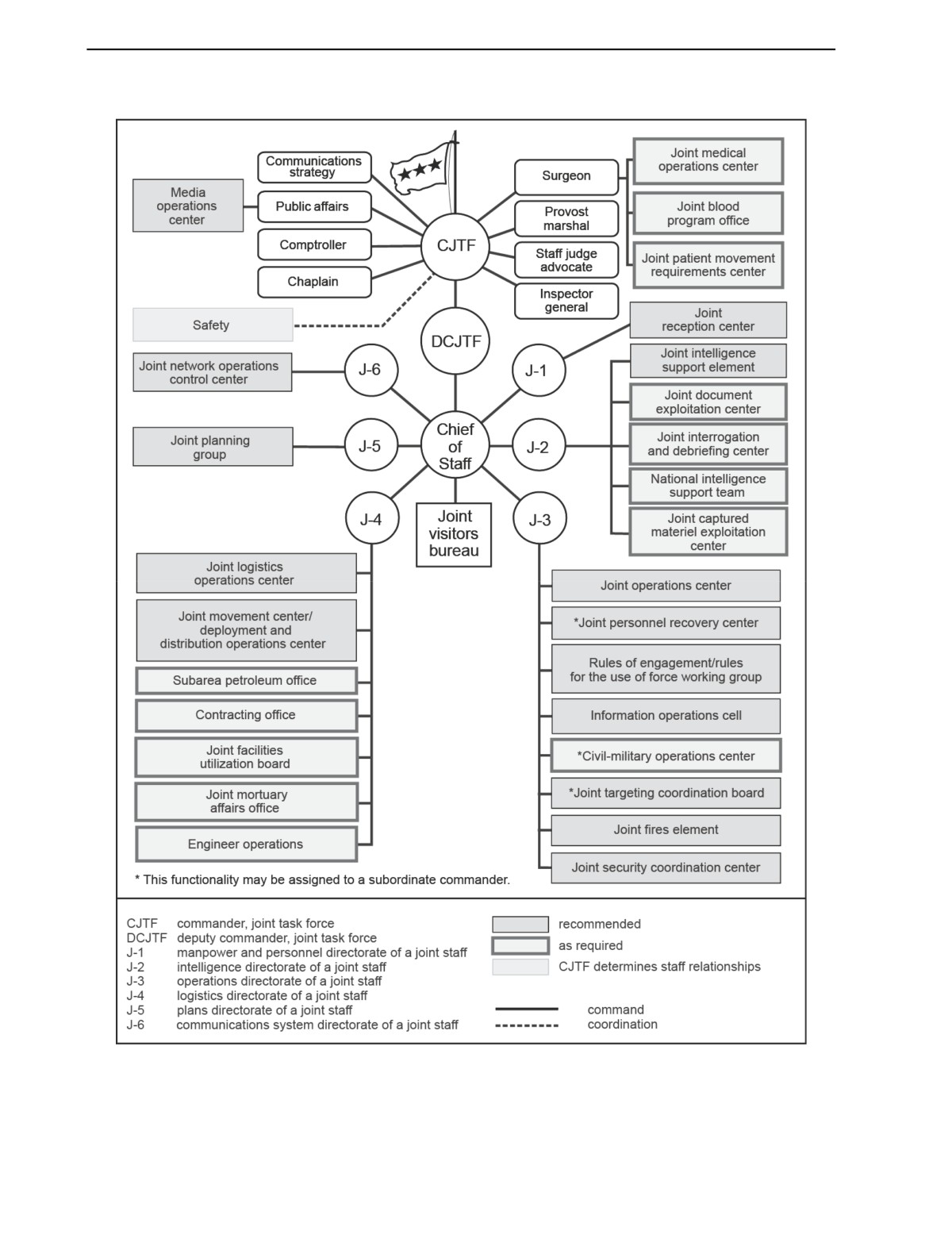
THE EXPANDED THEATER
3-64. Protracted campaigns that include large-scale combat operations cause the theater army to expand to
support Army, joint, and multinational forces. This occurs as the combatant commander adapts the joint
command and control mechanism to the demands of the campaign. The theater army maintains its AOR-
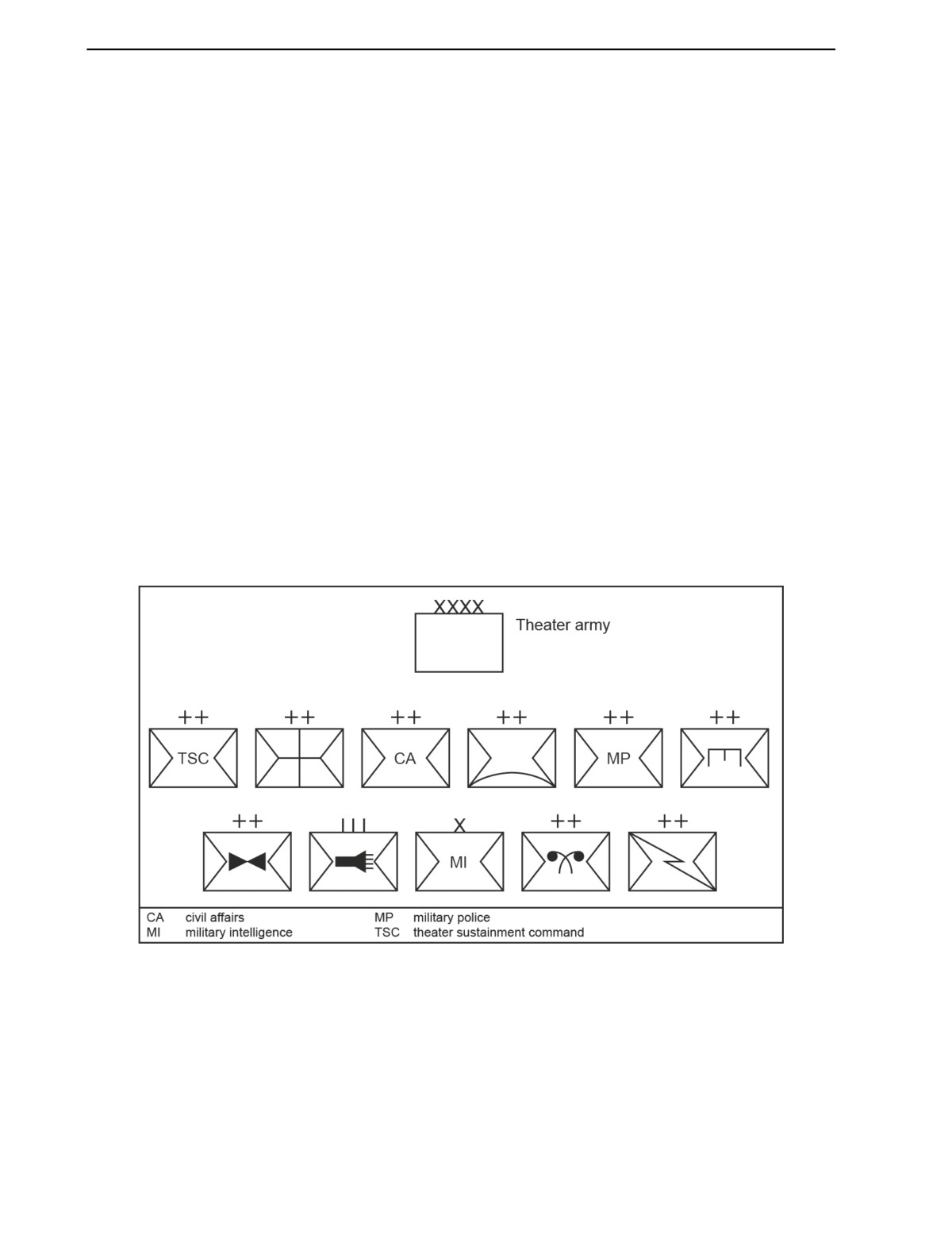
wide focus while developing a mature support structure within the joint operations area. The mature theater
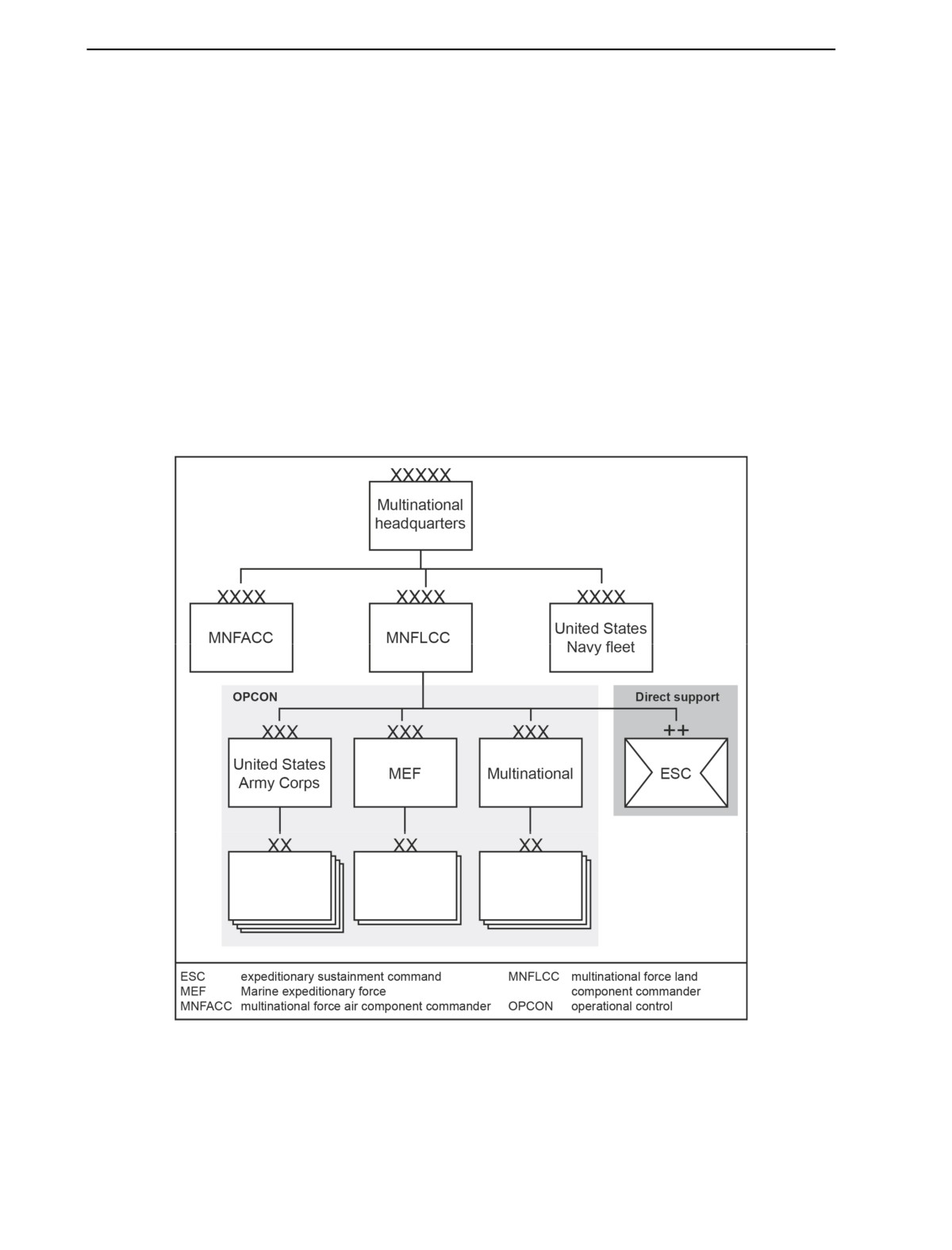
could include some or all of the commands shown in figure 3-5.
Figure 3-5. Example of mature theater
DEPENDENCIES
3-65. The theater army headquarters depends on theater-enabling units for staff functions or supporting
capabilities. While these enablers may vary considerably by size and type between geographic combatant
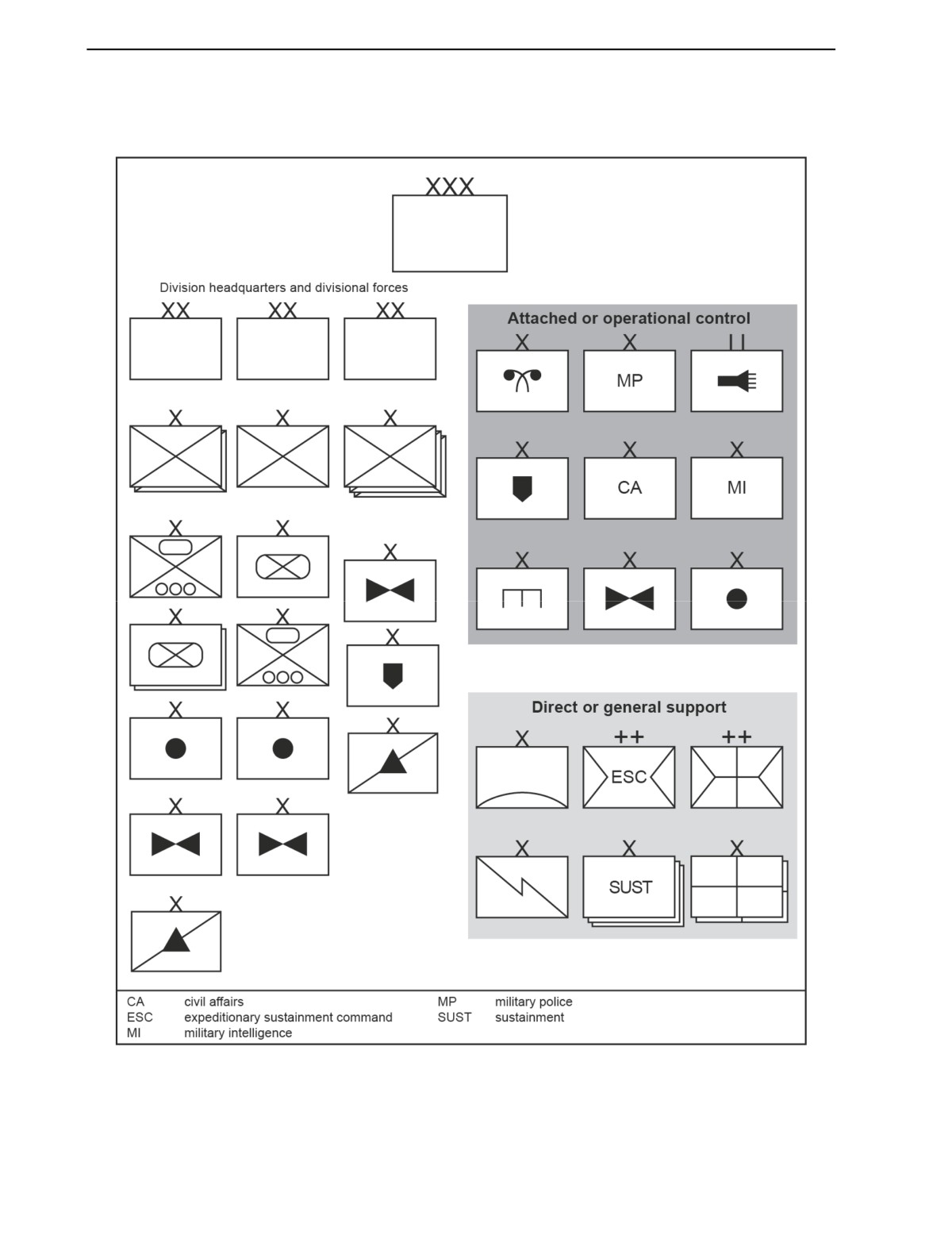
commands, paragraph 3-66 through paragraph 3-72 explain basic theater army dependencies.
3-66. The theater army depends on the theater signal command or brigade for connectivity to all
LandWarNet services, including the establishment and operation of the theater network architecture to
support theater army headquarters and all Army and joint forces operating within the AOR. The theater
3-14
FM 3-94
21 April 2014
Theater-Level Commands and Units
army headquarters has no organic signal capability and depends on the theater signal command or brigade
for all network and signal capabilities. These capabilities include regional hub node, joint network node, or
command post node elements to support the contingency command post when it deploys to conduct
operations.
3-67. The theater army depends on the garrison command of the installation on which it is located for
installation access control and local security of the permanent headquarters
(garrison or installation
security). Regional support groups provide contingency base operations functions at intermediate staging
bases or bases in the Army support area.
3-68. The theater army depends on the theater military intelligence brigade for access to top secret and
sensitive compartmented information communications and information systems used for analytical support.
The access enables the theater intelligence unit to provide regionally focused collection, analysis, and
production to support theater army planning (OPLAN or concept plan development) and operational
intelligence to support conduct of limited contingency operations. In addition, the theater intelligence unit
may provide regionally focused intelligence collection and analysis in support of JTFs, JFLCC
headquarters, ARFOR, and other Army forces operating in joint operations areas within the AOR.
3-69. The theater army depends on the Army Materiel Command for support through the aligned Army
field support brigade, contracting support brigade, and logistics civil augmentation program. The Army
field support brigade provides national level, materiel-focused sustainment support, as well as logistics civil
augmentation program planning and management. The contracting support brigade provides operational
contract support and planning assistance.
3-70. The theater army depends on the Army Corps of Engineers for engineering and construction
(including roads and buildings), real estate, and environmental management products and services.
Additionally, an engineer topographic company or geospatial planning cell provides geospatial information
and services to the theater army.
3-71. The MP protective services detachment provides protective service details for the theater army
commander, deputy commanders, and other designated high-risk personnel, as required. A force protection
team assists the theater army antiterrorism or force protection section in protection, physical security,
antiterrorism, and response force operations.
3-72. The theater army also depends on several unique teams to accomplish specialized functions. Defense
Logistics Agency personnel provide the theater army logistics reach to the national supply system. A civil
affairs planning team from a civil affairs brigade or command provides staff augmentation to the theater
army G-9 for operations. A modular CBRN team is assigned to the theater army to establish a full-time
CBRN planning expertise and assessment capability within the headquarters. Public affairs detachments or
teams augment the organic theater army staff and establish a media support or broadcast center, if required.
An Army band is assigned to the theater army to enhance unit cohesion and Soldier morale and provide
musical support. The theater army depends on the human resources sustainment center and financial
management center of the TSC for the execution of specified personnel and financial management
activities. Digital liaison detachments provide liaison between the theater army and multinational
headquarters or partners during operations and exercises.
21 April 2014
FM 3-94
3-15
Chapter 3
JOINT THEATER ENABLERS
3-73. If the theater army assumes an operational headquarters role, the combatant commander provides it
with joint enablers. The Joint Enabling Capabilities Command of the USTRANSCOM provides mission-
tailored, joint capability packages to combatant commanders to facilitate rapid establishment of joint force
headquarters, fulfill global response force execution, and bridge joint operational requirements. This
command includes the joint planning support element, joint communications support element, and joint
public affairs support element. The joint planning support element provides rapidly deployable, tailored
joint planners, operators, logisticians, knowledge managers, and intelligence specialists. This first element
accelerates the formation and increases the effectiveness of newly formed joint force headquarters. The
joint communications support element provides rapidly deployable, en route, early-entry, and scalable
command, control, communications, computer, intelligence, surveillance, and reconnaissance capabilities
across the range of military operations. This element facilitates rapid establishment of joint force
headquarters and bridges joint relevant requirements. The joint public affairs support element provides a
ready, rapidly deployable joint public affairs capability to combatant commanders. This last element
facilitates rapid establishment of joint force headquarters, bridges joint public affairs requirements, and
manages public affairs training to meet theater information challenges.
3-16
FM 3-94
21 April 2014
PART TWO
The Army Corps
Part two discusses the Army corps headquarters and operations at the corps
echelon. The corps headquarters can serve as the ARFOR as a joint force land
component headquarters under a joint task force, as a joint task force headquarters
(with joint augmentation), and as a tactical-level land force headquarters as part of a
multinational land component. It is deployable and scalable. In combat it can
command Army, Marine Corps, and multinational divisions across the range of
military operations. The corps headquarters is the most versatile of the echelon
above brigade formations. It commands Army, joint, and multinational forces
engaged in crisis response, limited contingency operations, major operations, and
campaigns.
Part two includes two chapters. Chapter 4 describes the corps headquarters; its
capabilities, limitations, and organization; and the array of forces that it commands.
Chapter 5 describes the employment of the corps and its subordinate forces in
decisive action.
Chapter 4
Corps Roles and Organization
ROLES OF THE CORPS
4-1. The effective integration of landpower
Roles of the Corps
across the range of military operations
• As the ARFOR in a campaign or major operation.
requires an expeditionary, scalable, and
• Joint (or multinational) force land component in a
operationally flexible headquarters able to
campaign or major operation.
exercise command in a variety of roles. The
• Joint task force headquarters in a crisis response
combatant commander (command authority)
or contingency operation.
can use the corps as the ARFOR, joint force
• Tactical echelon in large-scale ground combat
land component command, JTF headquarters,
operations incident to a campaign.
or as a tactical echelon.
ARMY COMPONENT (ARFOR) IN CAMPAIGNS AND MAJOR OPERATIONS
4-2. The corps headquarters is organized, trained, and equipped to serve as the ARFOR in campaigns and
major operations, with command of two or more Army divisions, together with supporting theater-level
organizations, across the range of military operations. As the ARFOR for the JFC, the corps serves as an
operational-level headquarters, conducting land operations as the Service component. The corps can control
up to five Army divisions in large-scale combat operations. The corps normally has one ESC and one
medical brigade (support) in direct support. Other theater-level assets are attached as required. The
headquarters of the corps allows it to adapt to operational- or tactical-level roles, depending upon the
combatant commander’s requirements.
21 April 2014
FM 3-94
4-1
Chapter 4
4-3. In addition to operational requirements, the corps has extensive ADCON requirements as the
ARFOR. When it serves as the ARFOR, the corps is responsible through the theater army commander for
the Service specific support of all Army forces in the joint operations area, as well as for providing any
ASOS with forces deployed in the joint operations area. As it tailors the Army forces provided to the JTF,
the theater army accomplishes two things. First, the Army force package attached to the ARFOR receives
the sustainment necessary to conduct land operations effectively and indefinitely. Second, the theater army
relieves as much of the ARFOR requirements from the corps using theater-level units for support of the
combat units within the joint operations area. The right balance allows the corps commander to retain
responsibility for Service component actions while delegating as much as possible to the various theater-
level commands and units.
4-4. Command and support relationships between the corps headquarters
(as ARFOR) and forces
provided from the theater army require the particular attention of the corps and theater army commander.
There are several options. The preferred option is placing the sustainment and medical headquarters
operating in the joint operations area in direct support of the corps, while the theater army attaches other
units to the corps. This option allows the corps commander to set priorities for Army sustainment and
support to other Services while delegating most Title 10 tasks and ASOS to these commands. Air units
require centralized control of fires through the AADC, and signal units must integrate into an AOR-wide
network. Therefore, these units may remain attached to the theater commands and provide direct or general
support. Attachment of units—such as the civil affairs, engineers, MP, and aviation—allows the corps
commander to allocate their capabilities among the divisions, multinational units, and corps troops.
4-5. The establishing directives for the JTF may allow the JFC to retain OPCON of the medical brigade
(deployment support) and sustainment command by designating them as separate functional components.
In this case, the corps receives general support from the functional logistics and medical functional
components. This has two advantages. When the corps controls sizeable multinational forces, its ability to
control operations may be stressed by multinational complications. These joint force support components
allow the corps to focus on its operational responsibilities while allowing the joint sustainment command to
focus on support of Army forces. The second advantage is that it allows the JFC to prioritize support
provided to other functional components even though the ARFOR may have the majority of deployed
personnel. The theater army augments the joint sustainment and medical command as required.
4-6. Air and missile defense units are assigned, attached, or OPCON to an AAMDC, normally operating
at theater level in direct support of the AADC. Air defense brigades may defend assets within the corps
area of operations. The AAMDC is responsible for balancing Army counterair and countermissile
capabilities between the ground forces and the theater-level requirements specified in the JFC approved
defended asset list and the area air defense plan.
JOINT FORCE LAND COMPONENT IN CAMPAIGNS AND MAJOR OPERATIONS
4-7. When designated as a joint force land component, the corps exercises TACON or OPCON over
Marine Corps forces, as required by the JFC, in addition to its attached Army forces. The corps functions as
an operational-level headquarters. The corps commander becomes the JFLCC when the Army provides the
preponderance of land forces. Land operations achieve the campaign objectives directly through land
operations or indirectly through support of other components of the joint force. Joint land operations
require synchronization and integration of all instruments of national power to achieve strategic and
operational objectives. Normally, joint land operations also involve multinational land forces
(see
paragraph 4-14). Joint land operations specifically include control of assigned areas of operations. The
JFLCC employs land forces, supported by naval and air forces (as appropriate), to achieve military
objectives in vital areas of the operational area. (See JP 3-31.)
4-8. The corps is an ideal joint force land component for the JFC. The corps headquarters can command
joint land forces with modest augmentation from the Marine Corps. It has the necessary staff and
experience to control land operations across a joint operations area. When the mission dictates, the corps
headquarters identifies and fills needs for specialized skills not organic to the corps headquarters. This is
particularly true in protracted operations such as a counterinsurgency. The headquarters organizes
according to the JFC’s implementing directive. This document establishes the roles and responsibilities of
the joint force land component, assigns the mission, and designates forces. Normally, the staff consists of
4-2
FM 3-94
21 April 2014
Corps Roles and Organization
corps staff, augmented with members of the other Service components. The distribution of other Service
personnel onto the corps staff allocates key staff billets so that all Services share equitably in staffing tasks.
Ideally, the deputy JFLCC or chief of staff comes from a different Service. Replicating this construct
throughout the staff leadership ensures all leaders understand the distinct capabilities of each Service to
optimize employment of the forces.
4-9. As the joint force land component, the corps headquarters normally commands two or three Army
divisions and exercises TACON over Marine Corps forces made available for tasking by the JFC. As the
senior Army echelon within the JTF, the corps is the ARFOR with the additional responsibility of ADCON
over all attached Army forces. As required by the JFC, the corps normally receives a special operations
liaison element and supports SOF throughout the land area of operations.
Note. The JFC may place the Marine Corps force under the OPCON of the corps but normally
specifies TACON if the Marine Corps force is a Marine air-ground task force (MAGTF).
4-10. When designated as a joint force land component, the corps follows joint doctrine. (See JP 3-31.) As
a joint force land component headquarters, the corps has tasks that include, but are not limited to—
z
Advise the JFC on the proper employment of forces and capabilities.
z
Develop joint plans and orders in support of the JFC’s concept of operations and optimize the
operations of task-organized land forces.
z
Execute and assess land control operations.
z
Coordinate the planning and execution of joint land operations with the other components and
supporting agencies.
z
Synchronize and integrate all elements of combat power in support of land operations.
z
Designate the target priorities, effects, and timing for joint land operations.
z
Establish a personnel recovery element to account for and report the status of isolated personnel
and to coordinate and control land component personnel recovery events.
z
Provide mutual support to other components by conducting operations within the joint
operations area.
z
Coordinate with other functional and Service components in support of achieving JFC’s
objectives.
z
Provide an assistant or deputy to the AADC (normally provided by the AAMDC) for land-based
joint theater air and missile defense operations as determined by the JFC. The JFLCC provides
inputs to the JFC-approved joint area air defense plan and the airspace control plan.
z
Support the JFC’s information operations by developing the information operations
requirements that support land control operations and synchronize land force information
operations assets when directed.
z
Integrate the joint and Army networks within the DOD information networks throughout the
AOR. Performing this function may require joint and Service augmentation.
z
Integrate special operations as required into overall land operations.
z
Perform joint security functions.
z
Supervise detainee operations.
z
Establish standing operating procedures and other directives based on the JFC’s guidance.
z
Assess and as necessary restore or reconstruct civilian infrastructure.
4-11. When organizing joint forces, simplicity and clarity are critical. By providing the joint force land
component a single commander for joint land operations, the JFC can enhance synchronization of
operations not only between U.S. ground components, but with multinational land forces as well. Forming
a joint force land component builds unity of effort, an integrated staff, a single voice for land forces and
land control operations, one single concept and focus of effort for land control operations, and a
synchronized and integrated land force planning and execution. The disadvantages of a single commander
are that joint force land component normally retains Service component responsibilities to the JFC
(requires split focus of the staff), it challenges integrating staffs, it requires more lead time to establish
21 April 2014
FM 3-94
4-3
Chapter 4
headquarters before execution, and it lacks the ability to resource the staffs. (See JP 3-31 for additional
doctrinal guidance on establishing the joint force land component.)
4-12. Within the joint force land component headquarters, the corps commander, deputy commander, chief
of staff, and key members of the staff should be fully integrated with representation from the forces and
capabilities made available to the JFLCC. Key members of the staff include the J-1, J-2, J-3, J-4, J-5, and
J-6. The corps commander as the JFLCC provides the core elements of the staff to assist in planning,
coordinating, and executing functional land component operations.
4-13. To facilitate joint security operations, the JFC
joint security area
may establish a joint security element with a designated
A specific surface area, designated by the
joint security coordinator to coordinate operations in a
joint force commander to facilitate protection
JSA. If the JTF commander gives the JFLCC
of joint bases and their connecting lines of
responsibility for a JSA, the corps commander may
communications that support joint operations.
elect to split the corps headquarters responsibilities.
The deputy corps commander—with part of the corps staff, augmentation from theater echelon units, and
an Army MEB—receives TACON of the theater echelon units in the JSA for protection and movement.
The deputy corps commander becomes the joint security coordinator. (See JP 3-10.)
MULTINATIONAL LAND COMPONENT HEADQUARTERS
4-14. The associated requirement of the corps headquarters controlling U.S. land forces is as a
multinational land component headquarters. The corps continues to function as an operational-level
headquarters. This expands its role as a joint force land component. Only rarely will the land component be
purely American in composition. In most operations, the corps exercises TACON over multinational
brigades and divisions. If the corps commander exercises command over multinational forces in addition to
U.S. forces, then it becomes a multinational joint force land component, and the corps commander becomes
a multinational force land component commander. Command of multinational forces is complicated and
politically sensitive. The higher grades structured into the design of the corps headquarters facilitate this.
Commanders and staff operating as a joint headquarters must be aware that multinational brigades normally
lack the ability to communicate digitally, or if they do, their systems might prove incompatible. This
creates an additional layer of complexity to planning and execution. The corps also trains in multinational
exercises as part of theater engagement and security assistance managed by the theater army. (See JP 3-16
and FM 3-16.)
JOINT TASK FORCE HEADQUARTERS FOR CRISIS RESPONSE AND LIMITED CONTINGENCY
OPERATIONS
4-15. The corps is the preferred Army echelon for use as a JTF headquarters. A corps headquarters acting
as a JTF headquarters requires a separate ARFOR because of the differing roles and responsibilities
inherent in each. JTFs focus on the operational level of war and use joint rather than Army doctrine. The
combatant commander may form a JTF on a geographic or functional basis, but the corps is normally a
geographic JTF, commanding all forces within a joint operations area. Normally, the commander of the
JTF exercises OPCON over all forces and other resources within the joint operations area. The JTF
includes functional and Service components. It may also have subordinate JTFs. Once constituted as a JTF,
the corps operates according to joint doctrine. (See also JP 3-33, JP 5-0, and supporting documents.)
Forming a Joint Task Force Staff
4-16. The corps headquarters needs individual augmentation to become a JTF. Identifying requirements for
individual augmentation is one of the earliest tasks the corps staff performs. These individuals can be Army
personnel identified and requested by the corps to fill slots in the joint manning document. For example, a
corps G-8 section does not have a joint doctrinal mission, nor is it structured to man and execute the
functions of a JTF comptroller section without significant augmentation. The corps staff identifies the
number, skill set, type, and availability of augmentees while the JTF is still forming. This enables the
headquarters to request military forces, Army civilians, representatives from other government agencies,
and contractors. Frequently, individual augmentees are functional experts to chair, provide guidance, or
4-4
FM 3-94
21 April 2014
Corps Roles and Organization
serve on meetings (to include working groups and boards), centers, cells, and planning teams associated
with joint operations. As with other augmentation, individual augmentees may not remain throughout a
campaign.
joint manning documents
Documents that identify all manpower requirements essential to the command and control of a JTF
headquarters organization. Joint manning documents are created in the electronic Joint Manpower and
Personnel System (known as eJMAPS) in accordance with established business rules for the use of the
electronic Joint Manpower and Personnel System.
The organizational structure and size of a JTF headquarters, as reflected in the joint manning document,
should be based on mission requirements, a concept of operations, the combined JTF decisionmaking
process, both the supported combatant commander and combined JTF’s guidance, and other factors
external to the JTF headquarters control, such as an imposed maximum footprint ceiling or multinational
participation. A well-balanced JTF headquarters staff should be representative of its subordinate forces
and possess a thorough knowledge of their capabilities and limitations. Furthermore, the organization of
the staff should be established and modified as the needs of the headquarters evolve over time.
JP 3-33
4-17. The corps headquarters needs augmentation from other Service officers and special operations
personnel to transform it into a JTF headquarters. This augmentation includes officers inserted into the
integrating cells, primarily the plans cell and the current operations integrating cell. This augmentation does
not include the personnel needed to augment the corps headquarters battalion network capability.
Additional staff augmentation would be required for each functional cell, as well as the public affairs and
other personal staff sections.
4-18. When provided with the necessary joint augmentation, the JTF initiates campaign planning, deploys
its early-entry command post (EECP) and advance support elements, and establishes initial command and
control capabilities in the joint operations area. The JTF headquarters can initiate shaping operations and
coordinate with host-nation and multinational partners in the joint operations area. As the size of the force
in the joint operations area increases, the corps main command post deploys to the joint operations area,
and the combatant commander provides additional augmentation. Figure 4-1 on page 4-6 provides an
example of a JTF staff.
Organization
4-19. The JTF command group retains its basic Army organization with a commander, one or more
deputies, a senior enlisted advisor, and several aides and personal assistants. Personal and special staff
groups assist the command group with special matters over which the JTF commander wishes to exercise
personal control. This group may expand to fit the circumstances, for example, personal interpreters or
translators, a cultural advisor, and special liaison officers. The chief of staff supervises staff actions and
serves as the principal integrator of the joint staff. The chief of staff typically oversees organizational
integration, efficiency, and effectiveness by reporting through a deputy commander to the JTF commander.
The JTF’s mission and area of operations dictate its organization and relationship with other organizations.
The composition of existing and potential adversaries, the nature of the crisis (for example, floods,
earthquakes, and pandemics), and the time available to achieve the end state are factors when forming a
JTF.
21 April 2014
FM 3-94
4-5
Chapter 4
Figure 4-1. Example of joint task force staff
4-6
FM 3-94
21 April 2014
Corps Roles and Organization
Joint Augmentation
4-20. Several joint organizations exist to augment the joint community in the execution of military
operations. The Joint Staff tasks these organizations to provide enabling capabilities to the corps as it
becomes a JTF. Many of these entities can support training exercises as resources allow. Some joint
enabling capabilities are self-supporting, while others require support from the supported headquarters.
(See JP 3-33.) These joint organizations include—
z
The joint communications support element that provides rapidly deployable, en route, early-
entry, and scalable command, control, communications, computer, intelligence, surveillance and
reconnaissance capabilities across the range of military operations. This element facilitates rapid
establishment of joint force headquarters and bridges joint requirements for such capabilities.
z
A national intelligence support team that provides a national-level, deployable, all-source
intelligence team to the JTF.
z
The Defense Threat Reduction Agency that provides subject matter expert augmentees to
counter CBRNE.
z
The Joint Information Operations Warfare Command that augments JTF planning, coordinating,
and executing efforts for the joint information operations community.
z
The Joint Personnel Recovery Agency that coordinates and executes personnel recovery.
z
The joint public affairs support element that provides a ready, rapidly deployable joint public
affairs capability to combatant commanders to facilitate rapid establishment of joint force
headquarters, bridge joint public affairs requirements, and manage public affairs training to meet
theater information challenges.
z
Defense Logistics Agency contingency support teams that deploy or support the JTF.
z
The deployable joint command and control system that provides the JTF with tools for planning,
executing, and assessing joint operations.
z
The joint fires integration and interoperability team that provides rapidly deployable battlefield
assessment teams to augment large-scale training exercises and operational deployments to
gather data on planning, preparing, and executing joint fires.
z
The joint systems integration center that provides operational and technical expertise and
technology to augment joint command and control capabilities as well as to solve joint
interoperability problems, focusing at the JTF level.
z
The joint enabling capability command that augments the JTF with a mission-tailored, joint
capability package to facilitate the rapid establishment of a JTF headquarters.
z
The joint planning support element that enables the JTF headquarters to rapidly form, plan,
operate, and integrate with interagency and nonmilitary instruments of national power for crisis
resolution.
Training
4-21. Each option for forming the JTF requires staff with specific military skill sets and training levels.
One important requisite skill set is the staff’s proficiency with joint command and control systems,
networks, and software applications. The corps headquarters is equipped with various Army mission
command systems so the staff can train on them. However, the respective echelon headquarters coordinates
with the geographic combatant command to gain access to joint command and control capabilities for
command post training. The division tactical command post, corps EECP, or theater army contingency
command post can and should deploy as part of a joint rapid deployment exercise. The headquarters can
also exercise in simulation as the core element of a JTF for limited interventions. It should also provide
augmentation as a staff plug to another Service headquarters tasked to form a JTF headquarters as part of
an exercise. Each opportunity to participate in joint exercises increases the experience of the corps staff and
builds knowledge that the corps staff can incorporate in unit standard operating procedures and contingency
plans.
4-22. An effective training program involves the corps in joint exercises with access to joint command and
control systems. The deployable joint command and control suite of equipment for each geographic
combatant command provides a rapidly deployable, scalable, modular command post suite.
21 April 2014
FM 3-94
4-7
Chapter 4
Reconfiguration of the deployable joint command and control system allows for rapid response and en
route communications capabilities if required. Deployable joint command and control provides a
standardized command post with full joint command and control capabilities. These capabilities include the
servers, workstations, and satellite uplinks to support the Joint Worldwide Intelligence Communication
System (known as JWICS), global mission network, nongovernment organizations, SECRET Internet
Protocol Router Networks (known as SIPRNETs), Nonsecure Internet Protocol Router Networks (known as
NIPRNETs), the Global Command and Control System-Joint, and other collaborative information
environment and communications capabilities.
TACTICAL ECHELON IN LARGE-SCALE COMBAT OPERATIONS
4-23. Very large combat operations require the corps headquarters to function as a tactical land
headquarters under a multinational force land component or subordinate to a field army equivalent
established under an alliance. This is the original purpose of the Army corps and the role performed by
Army corps in both Operation Desert Storm and Operation Iraqi Freedom I. Today, a corps could serve as a
tactical land headquarters if war recurred on the Korean peninsula, or if a future crisis led to a general war.
In this case, the corps would operate within a mature theater of war as a tactical headquarters under a joint
or multinational land command. Figure 4-2 illustrates an Army corps in this role.
Figure 4-2. The corps as a tactical headquarters
LIMITATIONS
4-24. Although the corps is a large and robust headquarters, its commander’s ability to exercise mission
command has limits. The corps may command up to five U.S. divisions and supporting units. However, if
4-8
FM 3-94
21 April 2014
Corps Roles and Organization
the corps commands a multinational division (or its equivalent) outside a formal military alliance such as
the North Atlantic Treaty Organization (NATO), then the span of control diminishes.
4-25. The ESC and medical brigades are not normally attached or OPCON to the corps. Therefore, the
corps staff pays particular attention to identifying and coordinating support provided by these commands.
When fully coordinated, the sustainment and medical commands provide effective and efficient support to
the corps. However, responsibilities for terrain management, area security, and priorities for movement
within areas of operations are inherently the corps commander’s responsibilities. These responsibilities
require continuous coordination among the corps headquarters and its supporting commands.
4-26. The corps main command post has limited mobility and no organic security. The tactical command
post is fully mobile, but has no organic security. Deployment of the corps main command post is lift-
intensive and requires careful integration into the deployment sequence. Once deployed, the corps
headquarters battalion normally receives an attached security company, such as a reinforced MP company.
SUBORDINATE FORCES
4-27. There is no standard configuration for the modular corps echelon. Almost every type of Army unit
may be task-organized under the corps headquarters. The primary function of the corps is to command
Army divisions in combat. In addition to the divisional units, the corps may command BCTs and several
different types of multifunctional and functional brigades. Other units provide direct or general support.
The corps attaches smaller, more specialized units as needed. Chapter 5 discusses task organization of the
corps.
4-28. When tailored for major operations, the corps becomes very large. Figure 4-3 on page 4-10 provides
an example of a corps tailored for major operations. In this example, the corps commands three Army
divisions and 28 brigades as well as and various detachments and smaller units. An ESC and a MEDCOM
(DS) provide sustainment with another five brigades. The corps receives direct support from signal and air
defense brigades commanded by the theater signal command and AAMDC respectively. The corps
commander uses the brigades under corps command to reinforce the divisions and to conduct shaping
operations for subordinate units. These brigades also support the corps as a whole. In a limited contingency
operation or crisis response, the corps commands a much smaller force.
4-29. The corps routinely commands multinational forces. The organization of these units varies as will
their support and sustainment capabilities. The corps commander should give particular attention to the
national capabilities and limitations of each multinational partner. Some limitations are tactical, while
others may be political. (Refer to FM 3-16.)
DIVISIONS
4-30. Divisions are the Army’s primary tactical warfighting headquarters. Divisions can control up to five
BCTs in major combat operations. They can control more BCTs in protracted stability operations. A
division force package may include any mix of armored, infantry, and Stryker BCTs. In addition to BCTs,
each division controls a tailored array of multifunctional support brigades and functional brigades. Since
divisions have no organic structure beyond the headquarters, all types of brigades may not be present in an
operation. In some operations, divisions may control multiple brigades of the same type. They may also
control functional groups, battalions, or separate companies; however, these are normally task-organized to
a brigade. The important point is that division organizations vary for each operation. The division is the
primary headquarters for the employment of brigades.
SUPPORTING COMMANDS
4-31. The theater army provides direct and general support to the corps. As the joint force land component
and ARFOR, the corps normally receives direct support from an ESC and a medical brigade (support).
Other theater commands and brigades provide general support in addition to any units attached to the corps.
For example, the AAMDC may place one of its assigned brigades in direct support to the corps. This
brigade then is responsible for providing air and missile defense for the corps commander’s priorities
21 April 2014
FM 3-94
4-9
Chapter 4
(defended asset list). The parent unit (the AAMDC) retains OPCON, while the regional or sector air
defense commander exercises TACON of this brigade for direction of fires.
Figure 4-3. An example of headquarters and units task-organized under the corps
4-10
FM 3-94
21 April 2014
Corps Roles and Organization
SUPPORTING BRIGADES AND OTHER FORCES
4-32. The Army force package includes a mix of BCTs, multifunctional brigades, and functional support
brigades as well as specialized units. The corps normally task-organizes the divisions with a mix of BCTs
and multifunctional support brigades. Depending upon the situation, the corps may retain OPCON of one or
more BCTs for security operations or as a reserve. (See chapter 5.) Specialized units such as a civil affairs
brigade may be attached to the corps headquarters and their subordinate battalions task-organized with the
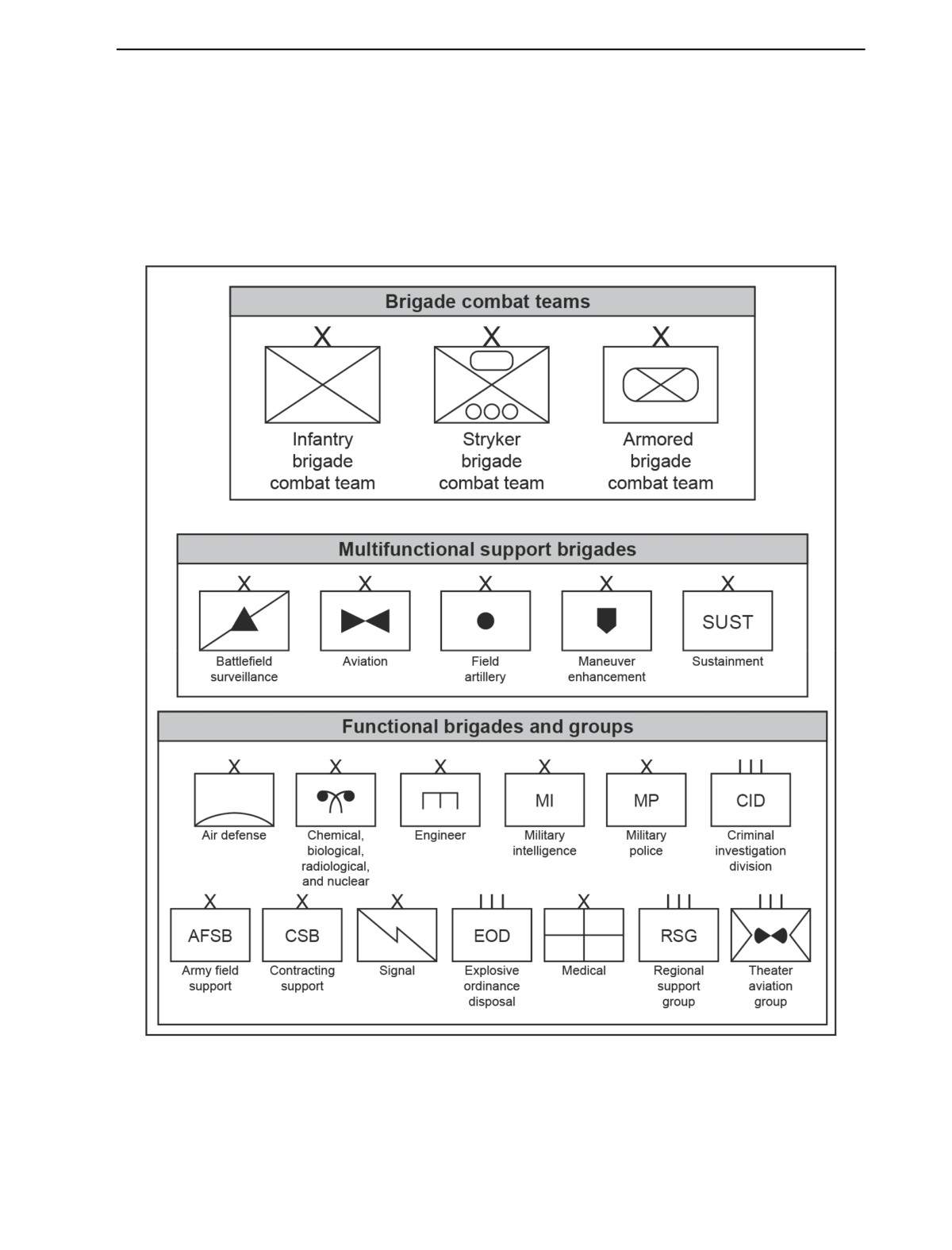
divisions. Figure 4-4 illustrates the various types of modular brigades.
Figure 4-4. Modular brigades and groups
4-33. Normally the multifunctional support brigades are attached or OPCON to a division headquarters.
However, any of the brigades may be attached to a corps or theater-level command, or they may be under
OPCON to a joint functional component commander (for example, the JFACC), to another Service
21 April 2014
FM 3-94
4-11
Chapter 4
headquarters (for example, a Marine expeditionary force), or to a multinational headquarters. When
operating under the control of the JFC, another Service, or a multinational force, the ARFOR commander
exercises ADCON over that multifunctional support brigade.
(For additional detail on BCTs and
multifunctional support brigades, see chapter 6.)
THE CORPS HEADQUARTERS
4-34. The corps headquarters consists of four constituent parts: a main command post, a tactical command
post, a mobile command group, and a HHB. The composition of the corps headquarters allows the corps
commander and chief of staff great flexibility to structure the organization according to the demands of the
situation.
MAIN COMMAND POST
4-35. The main command post controls current operations, performs detailed analysis, and plans future
operations. The main command post includes the command group and most of the coordinating, special,
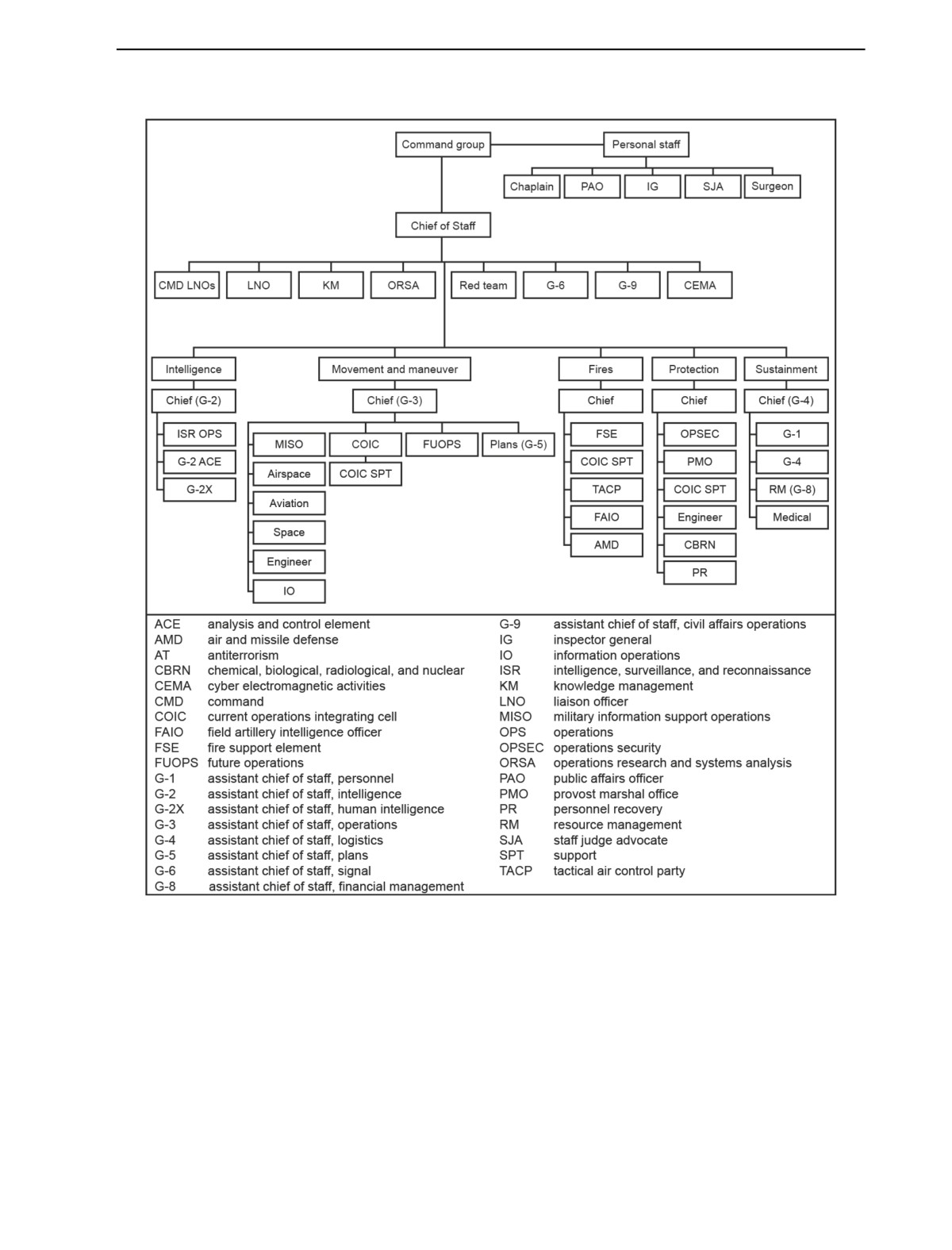
and personal staff. The staff organizes into five functionally focused cells (intelligence, movement and
maneuver, fires, protection, and sustainment) with broad responsibilities for coordinating these warfighting
functions across the corps. The movement and maneuver staff organizes further into the three integrating
cells—current operations integration cell, future operations cell, and plans cell. The integrating cells
include subject matter experts from across the entire staff. The movement and maneuver cell includes
several specialized elements such as airspace control. It also absorbs U.S. Air Force elements such as the
joint air component coordination element. (See discussion beginning in paragraph 5-41.) Because there is
no mission command functional cell, staff elements responsible for mission command tasks either receive
direction and priorities from the chief of staff or work within an integrating cell. Liaison elements from
higher, adjacent, and subordinate units locate at the main command post. If provided, the SOF coordinating
element locates here. See figure 4-5.
4-36. Although the corps main command post can operate from a field location, the preferred location for
the corps main command post is a permanent structure such as an unused warehouse or office complex,
augmented by field shelters as required. The ideal location for the main command post is often a forward
operating base located near the division main command posts and the supporting commands. Whenever
possible, the main command post should be within a short driving distance of a fixed-wing capable airstrip.
Once emplaced, the main command post normally remains in place for the duration of that phase of the
campaign.
4-37. The size and importance of the main command post create security challenges. Protection
emphasizes both active and passive measures, including a designated security force, air and missile
defense, access control, dispersion, and hardening of facilities.
TACTICAL COMMAND POST
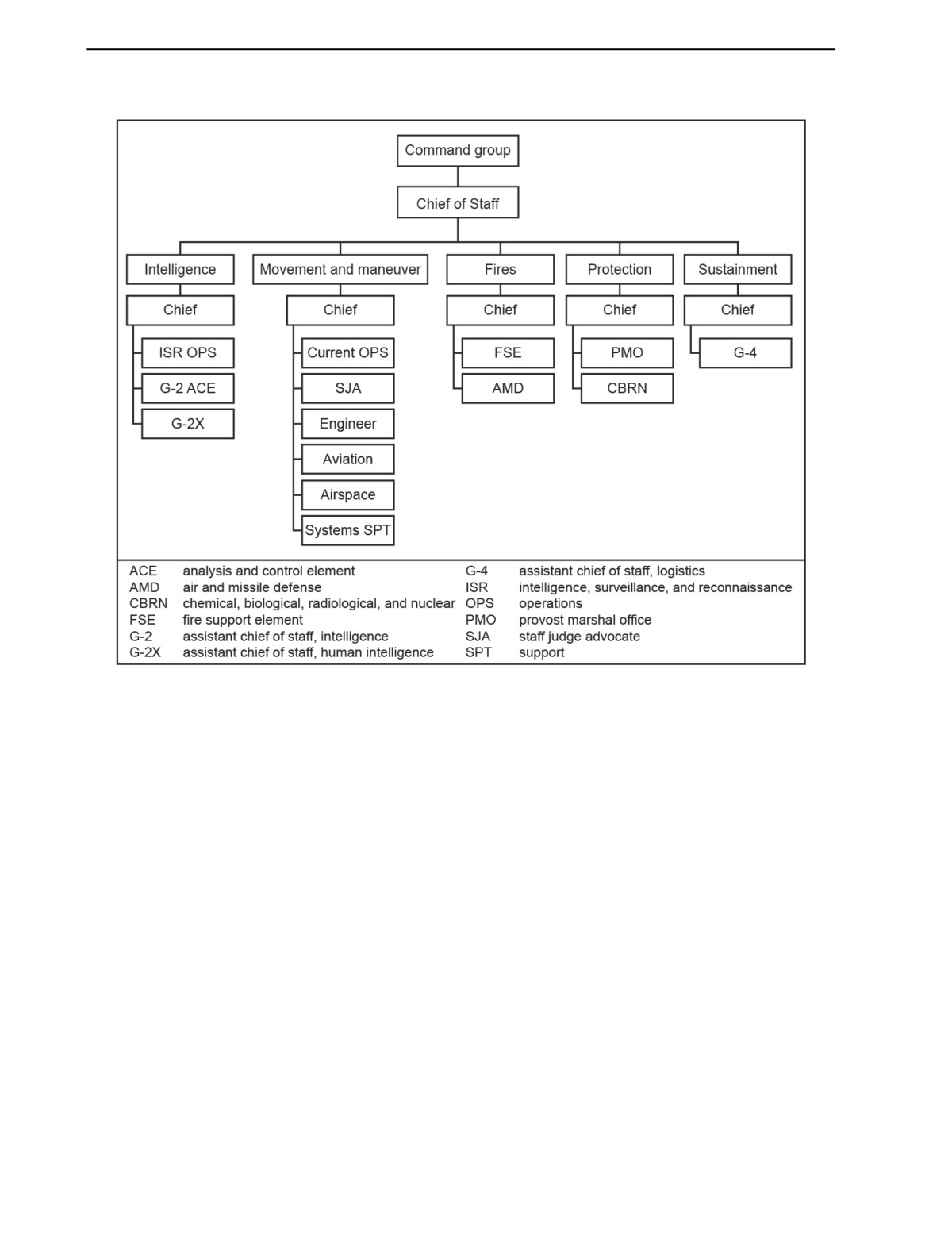
4-38. The tactical command post is mobile and more easily deployed or displaced since most of its
transportation is organic. The tactical command post can control corps operations for a limited time and
form the nucleus of a forward-deployed early-entry command post (sometimes designated as an assault
command post). In a protracted campaign where operations are decentralized and divisions focus on lines
of effort rather than maneuver, the tactical command post normally co-locates with the main command post
and may reinforce the main command post staff. On the other hand, it may remain organized as a separate
command post to facilitate rapid displacement and function as an alternate command post. See figure 4-6
on page 4-14.
4-12
FM 3-94
21 April 2014
Corps Roles and Organization
Figure 4-5. The corps main command post
4-39. When the tactical command post is an alternate command post, the corps deputy commander may
deploy with it to supervise the operation, exercising those command authorities specifically delegated by
the corps commander. The deputy G-3 usually acts as the tactical command post’s operations officer. The
deputy G-3 is responsible for establishing and coordinating the activities of the current operations
integrating cell and future operations cell, if manned. The G-5 may provide a dedicated planning element to
the tactical command post. Normally the cell and section chiefs for the tactical command post are deputies
of the coordinating staff officers or functional cell chiefs. Sometimes they are officers with required special
expertise peculiar to the operation or line of effort controlled by the tactical command post. Unless
employed for an extended period, the tactical command post does not manage planning or transitions from
plans to operations.
21 April 2014
FM 3-94
4-13
Chapter 4
Figure 4-6. Example of corps tactical command post
4-40. The primary role of the tactical command post is as the alternate command post of the corps. It
provides a place from which the commander can exercise mission command while the main command post
deploys or displaces. In a high-threat situation, the tactical command post may offset from the main
command post to provide redundancy in the event of an attack on the main command post. Commanders
can also employ it as—
z
A task force headquarters.
z
The controlling command post for a distinct operation within a phase.
z
The controlling headquarters for a distinct portion of the corps area of operations.
z
A forward-positioned headquarters during deployment.
z
The controlling headquarters for a JSA.
4-41. First, commanders can employ the tactical command post as a task force headquarters that
temporarily controls a named operation. The tactical command post functions as a major subordinate
command, providing staff support and command post facilities to support the task force commander. The
corps deputy commander may conduct the operation. For example, the corps may conduct a large military
deception operation with several brigades, while the bulk of the corps displaces.
4-42. If the concept of operations envisions a significant shaping operation, such as a demonstration or
retrograde, then the corps commander may employ the tactical command post as the controlling
headquarters for that distinct operation. The main command post controls the majority of the corps while
the tactical command post controls forces in a named, distinct operation.
4-14
FM 3-94
21 April 2014
Corps Roles and Organization
4-43. Commanders can also employ the tactical command post as the controlling command post for a
portion of the area of operations within which the predominant tasks or mix of forces differs sharply from
that of the remainder of the corps. For example, a multinational division may be conducting stability tasks
and security operations in its area of operations and the corps provides supporting brigades and other U.S.
capabilities. The tactical command post moves to that area of operations to facilitate employment of U.S.
brigades and supporting capabilities.
4-44. Commanders employ the tactical command post as a forward-positioned headquarters when the corps
is a tactical headquarters. In this role, the corps tactical command post locates in or near a committed
division’s area of operations. It may also position itself near a multinational division to provide more
extensive coordination and network capability than a liaison detachment.
4-45. Lastly, commanders can also employ the tactical command post as the controlling headquarters for a
JSA when the joint command and control requirements exceed the span of control of the MEB.
4-46. Displacing the tactical command post requires transportation assets, initially with intertheater airlift,
and subsequently with intratheater assets. The tactical command post should be strategically deployable by
a minimum number of C-17 aircraft. Once in theater, the tactical command post should need minimal RSOI
before becoming functional. By adjusting the vehicle and equipment mix, the tactical command post
reconfigures for movement by C-130 aircraft to forward locations.
EARLY-ENTRY COMMAND POST
4-47. The corps tactical command post can provide an EECP when the mission dictates. Ideally, manning
and equipment should allow the EECP to deploy aboard a single aircraft, although the composition adjusts
to the lift available. It should be 100 percent mobile and provide en route planning and rehearsal capability.
The function of the EECP is to act as the advance element of the corps headquarters. It includes network
specialists, drivers, and selected personnel from the current operations integrating cell, and normally the
deputy corps commander leads it. One or more aircraft from a subordinate aviation brigade may augment
the EECP if support facilities are available. Security for the EECP comes from co-location with a
subordinate unit’s command post already deployed into the joint operations area. If the environment is
benign, the EECP may deploy to a host-nation military facility.
4-48. The EECP serves as the eyes and ears of the corps commander during the initial deployment of the
corps. It normally does not exercise TACON over the entry operation. That is the responsibility of the
assault or entry echelon commander, normally the lead division commander. During most deployments, the
corps commander remains at home station with the main command post until the tactical command post
arrives and the EECP merges with the tactical command post. The corps commander delegates authority to
the deputy commander to adjust the corps plan as needed based upon on-the-spot coordination with
committed commanders. The EECP may also coordinate with military and other government organizations
based on the existing situation. If the theater army has deployed its contingency command post, the corps
EECP may move to that location to facilitate transition from the theater army to corps command of the
operation.
MOBILE COMMAND GROUP
4-49. The mobile command group consists of specially equipped vehicles that allow the corps commander
to move by ground within the land portions of the joint operations area and have network access to the
common operational picture, subordinate commanders, and the corps staff. In addition to the drivers and
gunners, the commander normally selects a handful of staff experts to handle en route communications and
coordination. A supporting aviation brigade has specially equipped helicopters that can substitute for the
vehicles when distance requires air movement.
PLANNING FOR COMMAND POST EMPLOYMENT
4-50. When circumstances require each of the corps command posts to operate in a separate area, the corps
staff and headquarters battalion staff develops plans for their security, sustainment, and communications.
21 April 2014
FM 3-94
4-15
Chapter 4
The commander, deputy commanders, chief of staff, G-3, and G-6 should consider factors related to
transportation, endurance, security, communications, and the exercise of mission command.
4-51. Movement of the various corps command posts is a function of transportation means and capacity.
The main command post requires considerable external transportation support to move. Once displaced, the
main command post requires time to set up facilities, establish network communications, and correct
connectivity problems.
HEADQUARTERS AND HEADQUARTERS BATTALION
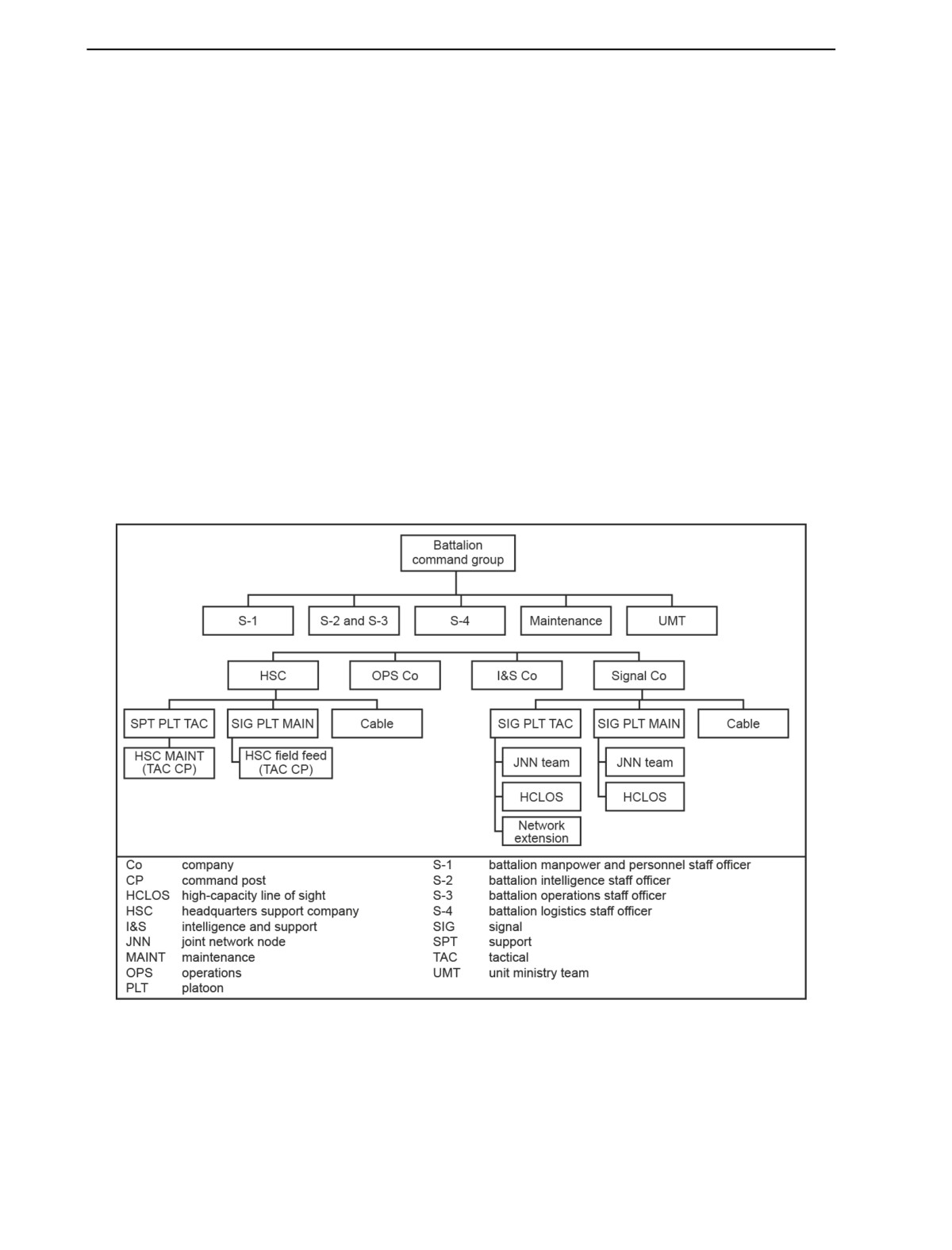
4-52. The only troops organic to the corps are in the headquarters battalion. The HHB has four subordinate
companies as shown in figure 4-7. The battalion provides communications, transportation, and medical
support to the corps headquarters. The battalion’s personnel and equipment support the main command
post, tactical command post, and mobile command group. The battalion provides administrative (including
the Uniform Code of Military Justice) and life support to the additional resources assigned or attached to
the corps headquarters—such as a band, security assets, and joint or interagency augmentation—as
required. The subordinate elements of each company report to the company chain of command. The
company commander, in turn, reports to the headquarters battalion commander. The battalion command
group provides supervision and exercises administrative command functions over personnel assigned to the
corps headquarters. It consists of a commander, executive officer, command sergeants major, rear
detachment commander, rear detachment noncommissioned officer, and a vehicle driver. The battalion
commander also serves as the headquarters commandant for the corps headquarters.
Figure 4-7. The headquarters and headquarters battalion of the corps
4-53. The headquarters battalion staff consists of five staff sections. They provide administrative support,
human resources, logistics support, religious support, and life support to corps headquarters elements in
garrison and the field. When deployed, the battalion staff sections are responsible for unit-level
communications support, property accountability, transportation, and medical, food service, and
maintenance support for the main command post, tactical command post, and mobile command group.
4-16
FM 3-94
21 April 2014
Corps Roles and Organization
4-54. The headquarters support company contains all members of the headquarters battalion staff. The
headquarters support company has two sections. One section supports Soldiers at the main command post
and one section supports the tactical command post. This company can split support between the tactical
command post and an EECP if required. The medical treatment section provides medical care for the corps
main command post personnel as well as emergency and advanced trauma management to main and
tactical command post personnel. It also provides sick call services, medical surveillance and preventive
medicine, and unit-level ground and en route patient care.
4-55. The operations company (A Company) provides company-level administrative and logistics support
to Soldiers in the movement and maneuver, protection, and fires warfighting function cells. The
headquarters battalion commander may direct the operations company headquarters to provide additional
support to the tactical command post.
4-56. The intelligence and sustainment company (B Company) provides company-level administrative and
logistics support to the Soldiers in the intelligence cell and the sustainment cell, as well as the tactical
command post elements of these cells. It also provides specialized communications support (such as
Operation Trojan Spirit) to the corps intelligence sections. When the tactical command post deploys, the
HHB commander may direct the headquarters support company to provide additional support to the tactical
command post.
4-57. The signal company (C Company) provides network and communications support to the corps
headquarters. It includes platoons that directly support the corps main and tactical command posts. The
signal company headquarters provides logistics support to the signal company. The company receives
maintenance support from the headquarters battalion. The company headquarters oversees installation and
operation of support for the main and tactical command posts including network, radio (line-of-sight and
satellite communications), wireless network extension, wire, and cable. Each support platoon provides
communications support using the Warfighter Information Network-Tactical (known as WIN-T) to connect
user devices such as telephones and computers. The two platoons have nearly identical capabilities to
provide terrestrial and space-based communications support to each command post. Platoon capabilities
include secure tactical defense switched network voice, SECRET Internet Protocol Router Networks
(known as SIPRNETs), Nonsecure Internet Protocol Router Networks (known as NIPRNETs), Joint
Worldwide Intelligence Communications System, and video teleconferencing. The tactical command post
has the wireless network extension teams for extended frequency modulation retransmission. The platoon
cable section provides support to the main and tactical command posts on a mission basis.
21 April 2014
FM 3-94
4-17
Chapter 5
Corps Operations
OPERATIONS AT THE CORPS LEVEL
5-1. The corps headquarters is the most versatile of the echelons above brigades. It may become a joint
and multinational headquarters responsible for conducting deterrence, crisis response, and limited
contingency operations. In campaigns and major operations, the corps commands multiple divisions and
attached brigades, serves as the land component, and serves as the operational-level headquarters for the
employment of landpower. The corps headquarters participates in multinational exercises designed to
improve OPLANs and theater security in each of the geographic combatant commands.
5-2. The corps commander synchronizes the employment of joint capabilities in conjunction with Army
decisive action. Corps operations shape an operational environment and set the conditions for tactical
actions by the division and lower echelons. In combat operations, the corps task-organizes and maneuvers
divisions to destroy enemy land forces, seize key terrain and critical infrastructure, and dominate the land
portion of the joint operations area. In protracted campaigns dominated by stability tasks or a foreign
humanitarian crisis, the corps commander integrates Army operations with those of host-nation forces,
other government agencies, and nongovernment agencies across multiple lines of effort.
5-3. Chapter 5 focuses on the corps as a joint force land component and ARFOR, or as a tactical
headquarters. The corps can and will become a JTF headquarters; however, its operations as a JTF are
governed by joint doctrine, specifically JP 3-33. When designated as a joint force land component, the
corps modifies its operations and organization per JP 3-31. When the corps also serves a multinational
force land component, it follows doctrine prescribed in JP 3-16 and FM 3-16.
5-4. The corps is normally the highest Army echelon deployed to a joint operations area. It commands
joint, Army, and multinational land forces in campaigns and major operations. The distinguishing aspects
of corps operations are their scope and scale. Normally, the corps exercises OPCON over two or more U.S.
Army divisions and a variety of supporting brigades, exercises TACON over various multinational units
and United States Marine Corps units, and is supported by various theater sustainment organizations. As a
land component headquarters, the corps becomes the bridge between the operational and tactical levels.
Mission command at this echelon requires operational art, tactical expertise, and complementary
employment of the warfighting functions, with special emphasis on sustainment. The corps commander and
staff need to understand joint capabilities and use them to the maximum extent feasible throughout the
campaign.
OPERATIONAL ART
5-5. Planning horizons are much longer at the corps level than for the division. Corps-sized operations
rarely take less than a week and may require several months to achieve a campaign objective. The corps
commander shapes throughout an operational environment to set the conditions for the tactical success of
subordinate divisions. In practice, this means that the corps is shaping and sustaining in preparation for the
next phase of operations, while the divisions are conducting tactical shaping and the decisive operation
within the current phase. Because the corps operates at the nexus of operational and tactical levels, the
ability of the corps commander to influence current operations is more limited than that of the subordinate
division commanders. The commander can shift joint capabilities and alter the boundaries between
divisions relatively quickly. Changing task organization, committing the corps reserve, and modifying lines
of operation and sustainment priorities take time and intensive staff coordination. The corps commander
anticipates requirements, requests joint capabilities, and repositions forces and resources for the next phase
of operations. The corps staff coordinates with higher, adjacent, and subordinate headquarters to ensure that
plans and tactical conditions for the next phase of operations are set.
21 April 2014
FM 3-94
5-1
Chapter 5
5-6. The scale of corps operations is much greater than that of division and brigade operations. The corps
commander and staff need to understand and master operational reach, and understand the related elements
of operational art—culmination, basing, lines of operation, and tempo. Operational reach is the distance
and duration across which a joint force can successfully employ military capabilities (JP 3-0). As a land
component, the corps assumes responsibility for the land portion of the joint operations area. That area can
extend over thousands of square kilometers. The corps commander and staff think of distance in terms of
time and resources. They consider how long it takes to move by ground from one point to another in the
corps area of operations for a brigade or a division. They determine the assets needed to support movement
in the corps area of operations. They consider how long it takes for different types of aircraft to transit the
same distance.
5-7. Operational reach is relative; it requires careful analysis of the enemy’s capabilities compared with
friendly forces. This consideration becomes particularly important as the corps’ combat power becomes
widely dispersed, typical in offensive exploitation and stability-intensive area of operations. The
commander estimates the risks to friendly forces as the distance between subordinate forces increases. The
point at which the enemy (or the civil situation in the case of stability tasks) has the potential to overwhelm
committed units before other joint and Army forces can intervene marks the culminating point. By
employing all available joint capabilities such as intratheater airlift, and shifting boundaries, forces, and
priorities, the corps commander extends the operational reach of the corps. The corps commander needs to
implement each decision in time to alter the corps posture before the divisions reach their culminating
point. The corps can limit the effects of time and distance by carefully phasing the operation when its scope
and scale make culmination likely. This allows the joint or multinational land component to retain and
exploit the initiative.
ANALYSIS OF AN OPERATIONAL ENVIRONMENT
5-8. As an operational-level headquarters, the corps commander visualizes, describes, and directs its
subordinate echelons, based on its understanding of an operational environment from their vantage point.
The corps shapes and sets conditions for success. This demands a comprehensive analysis of the
operational variables
(sometimes called PMESII-PT). Corps staffs should thoroughly understand the
operational variables and describe those variables to the tactical echelons. The tactical echelons can then
translate those operational variables identified by the operational headquarters into the mission variables
(sometimes called METT-TC).
DEPLOYMENT OF A CORPS
5-9. The corps headquarters and the forces that make up the corps normally deploy from the CONUS as
part of joint force projection. USTRANSCOM manages joint force projection in accordance with priorities
developed by the geographic combatant command. Force projection is the military component of power
projection. It is a central element of the national military strategy. Speed is paramount; force projection is a
race between friendly forces and the enemy or situation. The side that achieves an operational capability
first can seize the initiative. The goal is a combat-ready force deployed to an operational area before the
enemy is ready or the situation deteriorates further.
5-10. Corps commanders visualize force projection as one seamless operation. Deployment speed sets the
initial tempo of military activity in the operational area. Commanders understand how speed, sequence, and
mix of deploying forces (tailoring) affect their employment options. They see how their employment
concept establishes deployment requirements. The theater army develops a recommended deployment
sequence for Army forces into the AOR. However, the corps has an active and collaborative role in the
tailoring process. During planning, the corps commander recommends to the theater army commander a
proposed mix of forces and their arrival sequence that best supports the future operations of the corps. If the
corps commander and theater army commander focus only on the land component, to the exclusion of
complementary joint capabilities, they may not achieve the correct force sequencing. Commanders exercise
active and continuous control during force projection.
5-11. Force projection encompasses five processes: mobilization, deployment, employment, sustainment,
and redeployment. These processes occur in a continuous, overlapping, and repeating sequence throughout
an operation. Each process has its own criteria. Mobilization is the process of bringing the armed forces to
5-2
FM 3-94
21 April 2014
Corps Operations
a state of readiness in response to a contingency. Deployment is the relocation of forces and materiel to a
desired operational area in response to a contingency. It has four supporting components: pre-deployment
activities, fort to port, port to port, and RSOI. Employment is the conduct of operations to support a JFC.
Sustainment involves providing and maintaining personnel and materiel required to support a JFC.
Redeployment is the return of forces and materiel to the home or demobilization station. (See JP 3-35 and
FM 3-35.)
5-12. The theater army is responsible for coordinating RSOI of arriving Army forces. This responsibility
normally is delegated to the TSC. The ESC or other sustainment headquarters supporting the corps
reassembles deploying units and quickly moves them into staging areas. The corps assumes OPCON of
units as they complete integration of personnel equipment and unit logistics and the TSC releases the unit.
Even as the units complete RSOI, the corps ensures that unit commanders and key leaders are fully briefed
on the situation and their subsequent missions. Effective RSOI establishes a smooth flow of personnel,
equipment, and materiel from ports of debarkation through employment as reassembled, mission-capable
forces. A deploying unit is most vulnerable between its arrival and operational employment, so protection
is vital. If the corps is conducting operations while major subordinate units are still arriving, the corps
commander may employ the corps tactical command post as the corps’ interface with the ESC and arriving
forces at the port of debarkation.
5-13. The corps commander can influence—but not dictate tailoring of—the corps’ subordinate units. The
combatant commander, theater army, supporting combatant commands, USTRANSCOM, and FORSCOM
all make decisions concerning the composition and deployment sequence of the corps. The corps
commander, can, however, organize and prepare the corps command posts for efficient and effective
movement throughout the deployment. By selecting personnel with the right skill sets and providing the
right mix of equipment, the commander, chief of staff, and G-3 match corps capabilities with the
requirements at home station and in the joint operations area. Four areas require particular consideration:
z
RSOI involves USTRANSCOM, the theater army, the TSC, the ESC, and gaining headquarters.
As early in the deployment sequence as feasible, the corps deploys a command post—EECP
then tactical command post, in sequence, or if lift is available, the entire tactical command
post—to oversee the initial arrival and deployment of the corps. Unless the deployment involves
forcible entry, the EECP should be one of the first deploying elements of the corps.
z
Organization of the corps command posts should factor both the mission command requirements
and endurance. Commanders factor in the number of requirements each command post controls
and the duration corps command posts are required to control corps forces.
z
Each deployment will differ. The corps commander should determine when personal presence in
the joint operations area would be required. For planning purposes, the corps commander can
influence deployment more effectively from the corps main command post at home station than
in an austere facility in the reception area. The earliest the corps commander should deploy is
when elements of two divisions and their command posts are operational. Before that, the corps
EECP or tactical command post with the deputy commander should suffice.
z
The mission support element permanently based at the corps’ home station should serve as the
corps main command post during the period when the main command post begins to deploy until
the main command post completes RSOI. The chief of staff designates individuals who work
from the home station location and deploy late in the sequence. This facilitates control during
deployment and handover of any ongoing responsibilities such as support to other geographic
combatant commands.
TASK-ORGANIZING THE CORPS
5-14. The task organization of the corps is the foundation of mission command. It determines which
commander works for or supports which commander. It states who exercises mission command and who
operates under it. It also provides the limits of mission command in terms of further organizational changes
and the degree of control exercised by each commander. (See ADRP 5-0 for discussion of Army command
and support relationships.)
5-15. The theater army tailors the Army force package provided to the JFC according to the broad
requirements of the campaign; the corps task-organizes it according to operational requirements within the
21 April 2014
FM 3-94
5-3
Chapter 5
joint operations area. The corps staff collaborates with the theater army staff insofar as ensuring that the
tailored force package mirrors the initial corps task organization. The theater army commander
accomplishes several things through the tailoring. First, through tailoring, the theater army determines the
sequence of deployment for the Army force package, including the corps headquarters. This provides the
corps with a projection of what forces are available and when those forces should complete RSOI. The
tailored force package mirrors the initial task organization of the corps as closely as deployment
requirements allow. Second, tailoring determines the initial ADCON responsibilities for the corps as the
ARFOR. The Secretary of Defense attaches deploying Army forces to a gaining geographic combatant
command. The theater army receives attachment of these forces and retains control of them until they
complete deployment and RSOI. With the JFC’s concurrence, the theater army attaches Army forces to the
gaining ARFOR headquarters. Army attachment conveys operational and administrative responsibility for
the subordinate force, thus ADCON follows the subordination established by attachment.
Note. The theater army normally retains attachment of sustainment and medical units through
the TSC and MEDCOM (DS) respectively.
Third, the tailored force package determines initial sustainment responsibilities. The TSC and MEDCOM
(DS) arrange the deployment sequence and RSOI of the ESC and medical brigades to support the corps as
it deploys into the initial phase of operations.
5-16. When forces complete RSOI, attachment transfers to the gaining corps headquarters. As the ARFOR,
the corps exercises OPCON of all Army units not otherwise subordinated by the JFC to another component,
or controlled by the theater army through a theater command. The corps commander task-organizes the
corps for the upcoming phase of operations by specifying command or support relationships between
headquarters and subordinate units. (See table 5-1 on pages 5-6 and 5-7.) The corps commander organizes
the corps according to a hierarchy of considerations.
DIVISIONS
5-17. The first priority for organizing the corps is the combat power required by the divisions. The
divisions are the principal instrument with which the corps accomplishes its missions. Through the military
decisionmaking process, the corps commander determines the number and types of BCTs necessary for the
divisions to accomplish their respective missions. Unless there is an overriding operational requirement for
the corps to retain command of a BCT, the division headquarters should control all the BCTs. The BCTs
should retain their organic units. In some situations, the corps commander may detach one of the
subordinate battalions of a BCT, but the corps should only do so based upon an important operational
requirement, such as the corps reserve. The preponderance of BCTs goes to that division conducting the
decisive operation.
5-18. Based on the missions of the divisions and allocation of BCTs, the corps commander determines the
appropriate command and support relationships for brigades under the divisions. The corps may retain
some brigades under corps command. This is both science and art. The optimum exercise of mission
command at the corps is through the divisions. The corps’ focus is normally at the operational level, and its
planning horizons are different. In short, the corps commander provides the division commander with the
combat power needed to fight battles and conduct tactical operations envisioned for that phase of
operations, while the corps sets the conditions for the next phase through interdependent joint capabilities.
The divisions require a mix of warfighting functions in addition to those organic to the BCTs that it can
apply to the immediate operation. Ideally, the division controls a full set of multifunctional brigades (fires,
maneuver enhancement, battlefield surveillance, and combat aviation) and receives medical and logistics
support as required from the nearest theater sustainment brigades. However, the forces available are rarely
enough to satisfy all the operational requirements, so the corps may retain control of selected brigades in
order to influence current operations and manage scarcity.
BRIGADES UNDER CORPS CONTROL
5-19. The corps commander retains control of those brigades or smaller units with which it can directly
affect the outcome of division operations in time and space. This is a function of supporting range and
5-4
FM 3-94
21 April 2014
Corps Operations
supporting distance. (ADRP 3-0 discusses supporting range and supporting distance.) These factors become
critical given the scope and scale of corps operations. For example, the corps may retain OPCON of a field
artillery brigade and its multiple launch rocket system or High Mobility Artillery Rocket System battalions
to shape the current battle across two or more division areas of operations. However, if the cannon
battalions of the field artillery brigade are out of supporting range of all but one division, it makes little
sense to retain them in general support. Therefore, the corps orders the field artillery brigade to reinforce
the division conducting the decisive operation with the cannon battalions and uses missiles and joint fires to
shape the corps operation. In another example, the Army force package may only include one tailored
BFSB. The corps retains the BFSB under its control. The corps then task-organizes the capabilities of the
BFSB, such as human intelligence and counterintelligence, into packages for attachment to the divisions.
5-20. Whether the corps retains control over selected brigades also depends upon tasks that the corps must
perform, and for which a division is unavailable, excessive, or unsuitable. For example, if the JFC orders
the corps to secure and control a JSA, the corps may retain OPCON of a MEB and reinforce the MEB for
that mission. The corps commander evaluates the overall capability of each brigade for the particular task.
If the threat, size of the JSA, and number of forces located inside it are too great for the MEB’s capabilities,
the corps commander normally assigns the mission to a division, if available. If the divisions are committed
elsewhere, the corps could organize a corps task force built around the corps tactical command post with
OPCON of a MEB, a MP brigade, and possibly supported by an air and missile defense battalion. The
corps normally commands theater-level brigades and commands—theater tactical signal brigade, civil
affairs, MISO, military intelligence brigades—other than the medical and sustainment brigades. The corps
transfers control of subordinate elements of the theater-level units to the divisions as required by
METT-TC. For example, a sustainment brigade operating within the division’s area of operations would be
under the TACON of that division for protection and movement, although it would remain attached to the
ESC and provide support on an area basis to many units.
5-21. The CBRN brigade is one of the U.S. Army’s functional brigades. It is a stand-alone headquarters,
and it commands between two and six CBRN battalions together with attached separate companies and
detachments. The headquarters is 100 percent mobile. The CBRN brigade normally supports the corps
when the latter is the joint land component and ARFOR, but the brigade may be OPCON to a multinational
forces land component headquarters or the JTF. (If a division is the ARFOR, the CBRN brigade supports
that division.) The CBRN brigade commander may also exercise mission command of WMD elimination
capabilities subordinate to a CBRNE operational headquarters. Its functions include exercising mission
command of CBRN operations, providing ADCON for attached CBRN battalions, providing intelligence
support for CBRN operations, and controlling battlefield obscuration. (See ATP 3-11.36.)
THE CORPS RESERVE
5-22. The corps constitutes, controls, and reconstitutes a corps reserve. The corps reserve serves as a hedge
against uncertainty and allows the corps commander to react to opportunity and difficulty. The reserve is a
fundamental component of the corps concept of operations. The size and composition of the reserve
depends upon METT-TC, as will the specific command relationship within the corps task organization. The
reserve should be large enough to affect changing tactical conditions that are beyond the capability of the
divisions, but not so large that it seriously impairs the combat power of the division to accomplish its
mission in the first place. If a division cannot accomplish its mission without the corps reserve, the concept
of operations is flawed. There is always a degree of risk associated with the corps reserve. It should be
powerful enough that it can exploit opportunity, or it can counter an enemy action without compromising
the entire corps operation.
5-23. The composition of the reserve depends upon both its inherent combat power and its mobility. The
reserve should have sufficient combat power to change the tactical outcome of a division’s operation
assuming a range of possible situations. It should be mobile enough that it is in supporting distance of corps
tactical operations. The corps commander considers capability and location when positioning or
designating the reserve. The corps commander has two options for control of the reserve. The corps can
control the reserve, or the corps can restrict the employment of a specified force under divisional command
until the corps commander orders its commitment.
21 April 2014
FM 3-94
5-5

Chapter 5
5-24. The corps commander alone has the authority to commit the reserve. Once committed, the corps
commander issues orders to reconstitute the corps reserve from available units within the corps.
Table 5-1. Command and support relationships for the corps
Relationship
Use
Task Organization
Movement and
Administrative
Employment
Control (ADCON)
Attached
The attachment should
The corps has the
The corps can
Unless modified by
last for the duration of
authority to task-
position the unit
the DA or the
the campaign. A unit is
organize as
anywhere in the AO
ASCC, ADCON
often attached when
required, using any
or delegate the unit
transfers to the
the subordinate unit
command or support
to a subordinate
gaining HQ. The
augments a higher
relationship.
commander through
corps assumes
headquarters.
task organization.
ADCON of the unit,
including logistics,
medical, and
administration.
Operational
OPCON is a temporary
The corps can place
The corps can
ADCON remains
control
change of organization
the entire unit or
position the unit
with the parent unit
(OPCON)
that allows the gaining
parts under OPCON,
anywhere in the AO
headquarters.
commander maximum
TACON, or in
or delegate the unit
Additional logistics
flexibility to employ the
support of another
to a subordinate
and medical
subordinate unit.
unit. The corps may
commander through
support provided
not attach the unit to
task organization.
on an area basis.
another unit.
Tactical
TACON is a temporary
The corps may not
The corps may
ADCON remains
control
command relationship
change the
position the unit
with the parent unit
(TACON)
used among Army
organization of the
anywhere in the AO
headquarters.
headquarters, other
unit under TACON.
or delegate a
Additional logistics
Services, and
However, the
positioning authority
and medical
multinational forces.
gaining commander
to a subordinate
support provided
The JFC may specify
may place the entire
commander by task
on an area basis.
TACON over specific
unit under TACON
organization.
capabilities (such as
or in support of
ADA fires) while
another unit.
leaving the Army task
organization
unchanged.
Direct support
Direct support allows
The corps
The corps may
Parent unit retains
(DS)
the corps commander
commander may put
position the unit
ADCON. Additional
to set priorities and
the DS unit in any
within its AO or
logistics and
position the DS unit. It
support relationship
delegate positioning
medical support
is similar to TACON
to another unit. This
authority to a
provided on an
but allows a larger unit
includes support
subordinate
area basis.
to support a smaller
relationships
commander through
formation. It allows the
between subunits.
a change in task
DS commander
Note that the parent
organization. The
maximum flexibility
supporting
unit commander
while conforming to the
may adjust the task
commander
corps’ priorities.
organization of the
recommends the
DS unit as needed.
locations from which
the DS unit can best
support the mission.
ADA
air defense artillery
ASCC
Army Service component command HQ
headquarters
AO
area of operations
DA
Department of the Army
JFC
joint force commander
5-6
FM 3-94
21 April 2014

Corps Operations
Table 5-1. Command and support relationships for the corps (continued)
Relationship
Use
Task Organization
Movement and
Administrative
Employment
Control (ADCON)
Reinforcing
This relationship is
The parent unit task-
The corps HQ
Parent unit retains
(R)
between supporting
organizes the
coordinates with the
ADCON. Additional
units with similar
reinforcing unit. The
maneuver HQ
logistics and
capabilities such as
supported unit
owning the AO. The
medical support
artillery units, but not
(providing DS) may
division or brigade
provided on an
between different
not specify further
allocates terrain to
area basis.
warfighting functions.
support alignments.
the reinforcing unit
The DS unit
based on
commander sets
recommendations
priorities for the
from the DS unit.
reinforcing unit, and
recommends positions
for it to maneuver
commander.
General
GS units provide
The parent unit task-
Movement and
Parent unit retains
support (GS)
support to the corps as
organizes the GS
positioning are
ADCON. Additional
a whole. Units
unit.
controlled by the
logistics and
providing GS normally
maneuver
medical support
provide the support on
commander owning
provided on an
an area basis. The
that AO.
area basis.
JFC specifies priorities
of support.
General
GSR prioritizes
The parent unit task-
Movement and
Parent unit retains
support
additional capabilities
organizes the GSR
positioning are
ADCON. Additional
reinforcing
between supporting
unit primarily to
controlled by the
logistics and
(GSR)
units from the same
provide support to
maneuver
medical support
headquarters. The
the force as a whole.
commander owning
provided on an
headquarters assigns
Supported units may
that AO. The higher
area basis.
one or more units to
not specify further
HQ of the supporting
support to the entire
support
unit coordinates for
force. If a unit in DS or
relationships.
movement and
R requests
terrain with the HQ
reinforcement, the
owning that AO.
GSR unit gives priority
to that support unit
ahead of other
requests unless
disapproved by the
higher HQ.
AO
area of operations
HQ
headquarters
DA
Department of the Army
JFC
joint force commander
OTHER SERVICE AND MULTINATIONAL UNITS
5-25. As a land component responsible for the use of landpower in a campaign, the corps often has control
of other Service forces and multinational forces. Unless the JFC specifies otherwise, the corps exercises
TACON over such forces made available. The corps absorbs these units within its task organization
effectively when it adheres to certain considerations.
5-26. As the joint force land component, the corps normally is delegated TACON of other Service forces.
The JFLCC and staff should understand the capabilities and limitations of other Service forces. A MAGTF
placed TACON to an Army corps normally includes Marine Corps tactical air assets. The MAGTF
commander retains OPCON of organic air assets. Consequently, commanders should address specifically
the issue of employment of Marine tactical aviation
(that is, independent functional component air
operations) during planning. Therefore, the activities of the BCD and Marine liaison element to the JAOC
should be coordinated. The joint force land component also must be prepared to receive and coordinate
21 April 2014
FM 3-94
5-7
Chapter 5
with Navy expeditionary forces (for example, riverine units and Navy construction engineers). The land
component commander also coordinates with USTRANSCOM and the naval commander concerning a
maritime pre-positioning force or the equipment of Army pre-positioned stocks. (See JP 3-31.)
5-27. Different land forces units have unique capabilities. TACON maintains the tactical integrity of the
other Service forces. The corps places the other Service forces under the TACON of a higher echelon with
the capability of controlling and employing that force to its full capabilities. In the case of Marine
expeditionary brigades and Marine expeditionary units (MEUs), with their organic aviation assets, the
controlling echelon is normally two echelons above the subordinate Marine expeditionary force. The corps
retains TACON of the entire Marine expeditionary brigade and an Army division may have TACON of a
MEU. The corps exchanges liaison with the subordinate other-Service units under its direct command. In
the case of a Marine expeditionary brigade, the corps incorporates Marine Corps staff into a joint force land
component headquarters.
5-28. Multinational forces have both unique abilities and unique requirements. The corps commander
should retain national integrity at the highest level feasible. This is not necessarily the same as the most
efficient distribution of multinational troops. The art of command and science of control for mission
command applies even more for multinational forces. Every multinational force has strengths and
weaknesses. In some cases, the multinational units integrate with U.S. forces at a small-unit level to
improve training and ensure the survival of the multinational unit. In other cases, the multinational unit
remains directly under the land component’s command because of political considerations. Multinational
forces also come with constraints unique to the particular arrangement of the coalition or alliance.
Commanders and staff remain aware that multinational forces may not have the ability to communicate
digitally, or if they do, their systems might not be compatible. This often creates an additional layer of
complexity to planning and execution. To maintain situational understanding of the multinational issues
and perspectives, the corps should have a liaison detachment from each national force embedded in the
combined land component headquarters. The corps also provides additional communications and liaison
support to each multinational force, either directly or by tasking a subordinate Army unit. In many cases,
this requires reinforcement by the theater army to the supporting communications units. For example, the
corps may receive and deploy tasking a digital liaison detachment a subordinate theater army unit. (See
FM 3-16.)
OPERATIONAL CONTROL AND SUPPORT
5-29. The corps specifies OPCON primarily when changing the subordination of one Army unit to another
in the task organization. The supporting theater sustainment and medical units adjust their support in
accordance with the priority of support and the position of each to the supported Army unit. In the case of
small, specialized units such as civil affairs and MISO, the corps attaches them to the gaining division or
brigade headquarters unless the subordination will be brief. This changes the ADCON relationship between
the supporting unit and gaining unit but simplifies administration and logistics when the subordination is
lengthy.
5-30. The corps specifies a support relationship between units in the corps when a superior and subordinate
relationship is inappropriate. This is the case when the echelon of the supporting and supported units is the
same or the supporting unit is a higher echelon formation. A support relationship also recognizes that the
type of support provided is specialized, and the supported commander only specifies priorities and
minimum movement and terrain control measures.
5-31. The corps current operations integrating cell maintains the complete corps task organization and
distributes it across the corps staff. Any change to the corps task organization is made through an operation
order or a fragmentary order sent by the current operations integrating cell.
5-32. Several theater-level commands normally support corps operations: the TSC (through the ESC); the
MEDCOM (DS) through the deployed medical brigade (support); the signal command (theater); the
military information operations group; and the AAMDC. The TSC remains attached to the theater army,
and the ESC normally provides direct support to the corps. The MEDCOM (DS) is attached to the theater
army, and its subordinate medical brigade(s) (support) deploy to the joint operations area in direct support
of the corps. The signal command (theater) extends the network by deploying tactical signal brigades to
5-8
FM 3-94
21 April 2014
Corps Operations
link headquarters across the AOR. The AAMDC normally provides direct support to the AADC and may
provide air defense units in direct support of the corps. As a supported command, the corps develops
priorities for sustainment, health service support, and air defense. To provide the support, the subordinate
units of the theater-level commands require terrain within the corps area of operations and protection from
ground threats. The theater army commander ensures that the TSC, ESC, and AAMDC collaborate with the
corps in developing all plans and orders. Each command should provide a liaison element to the corps
headquarters along with planners as requested by the corps. As the campaign expands in scale, other theater
commands provide additional support. (Refer to chapter 3.)
THE CORPS AREA OF OPERATIONS
5-33. The JFC assigns the corps its area of operations
Responsibilities within an assigned area
when the corps is a land component. Within the land area
of operations
of operations, the corps commander is the supported
• Terrain management.
commander and the other components provide support in
• Information collection.
accordance with the joint concept of operations. The
• Intelligence collection, integration,
corps commander collaborates with the JFC to determine
and synchronization.
how much of the land portion of the joint operations area
• Civil affairs operations.
that the land component can effectively control. The
• Movement control (ground and air).
corps commander considers forces available, the area of
• Clearance of fires.
influence, and joint capabilities when recommending the
• Security.
land area of operations. Ideally, the land area of
• Personnel recovery.
operations equals the area of influence of the land forces
• Airspace control.
• Environmental considerations.
available, balanced against the capabilities of the total
joint force. The corps commander estimates the corps’
area of influence—a geographical area wherein a commander is directly capable of influencing operations
by maneuver or fire support systems normally under the commander’s command or control (JP 3-0). The
actual area of operations may be somewhat smaller than the area of influence. This difference requires a
balance between forces available and the size of the area of operations. Too large an area with regard to the
available forces and the corps may not accomplish its mission. If the area of operations is too small, the
corps may fail to use subordinate forces to their full capacities.
5-34. The corps commander assigns subordinate areas of operations based upon METT-TC. The area of
operations is a fundamental control measure. It empowers subordinate initiative and provides a limit for
decentralized execution. The first priority for allocation of terrain is to the divisions. The division’s area of
operations should allow the division commander full use of the division’s BCTs and supporting brigades.
When assigned an area of operations, the subordinate division commander takes responsibility for
managing terrain, collecting information, conducting security operations, controlling airspace and ground
movement, clearing fires, and conducting operations in that area of operations. (See ADRP 3-0 for a
discussion of area of operations.) The corps also assigns areas of operations to Marine Corps combat units,
multinational divisions and brigades controlled by the corps, and MEBs attached to the corps.
5-35. If the corps has a multinational unit under its control, the corps commander carefully reviews the
area of operations assigned to that headquarters. The corps commander reviews tasks inherent with control
of the area of operations and discusses corps contingencies developed for that area with each multinational
commander. Areas of operations and boundaries between forces of different nations are always potential
weak points. This is not a discredit to the multinational force; it is recognition of the inherent friction in
multinational operations. The friction results from different doctrines, networks, languages, and force
structures. The corps commander stresses to adjacent multinational commanders and U.S. commanders the
importance of effective liaison between both and directs the corps staff to support liaison requirements.
5-36. The commanding general may divide the corps area of operations in one of three ways: contiguous
area of operations, where subordinate units share a common boundary; noncontiguous area of operations,
where they do not; or a combination of the two, containing some areas reserved for corps control. (See
figure 5-1 on page 5-10.) At the corps level, a combination is typical with the corps assigning the majority
of the area of operations to its divisions in contiguous areas, and retaining control of areas beyond the
influence of the divisions. Figure 5-1 shows this on the left side. An area assigned to corps control is that
21 April 2014
FM 3-94
5-9
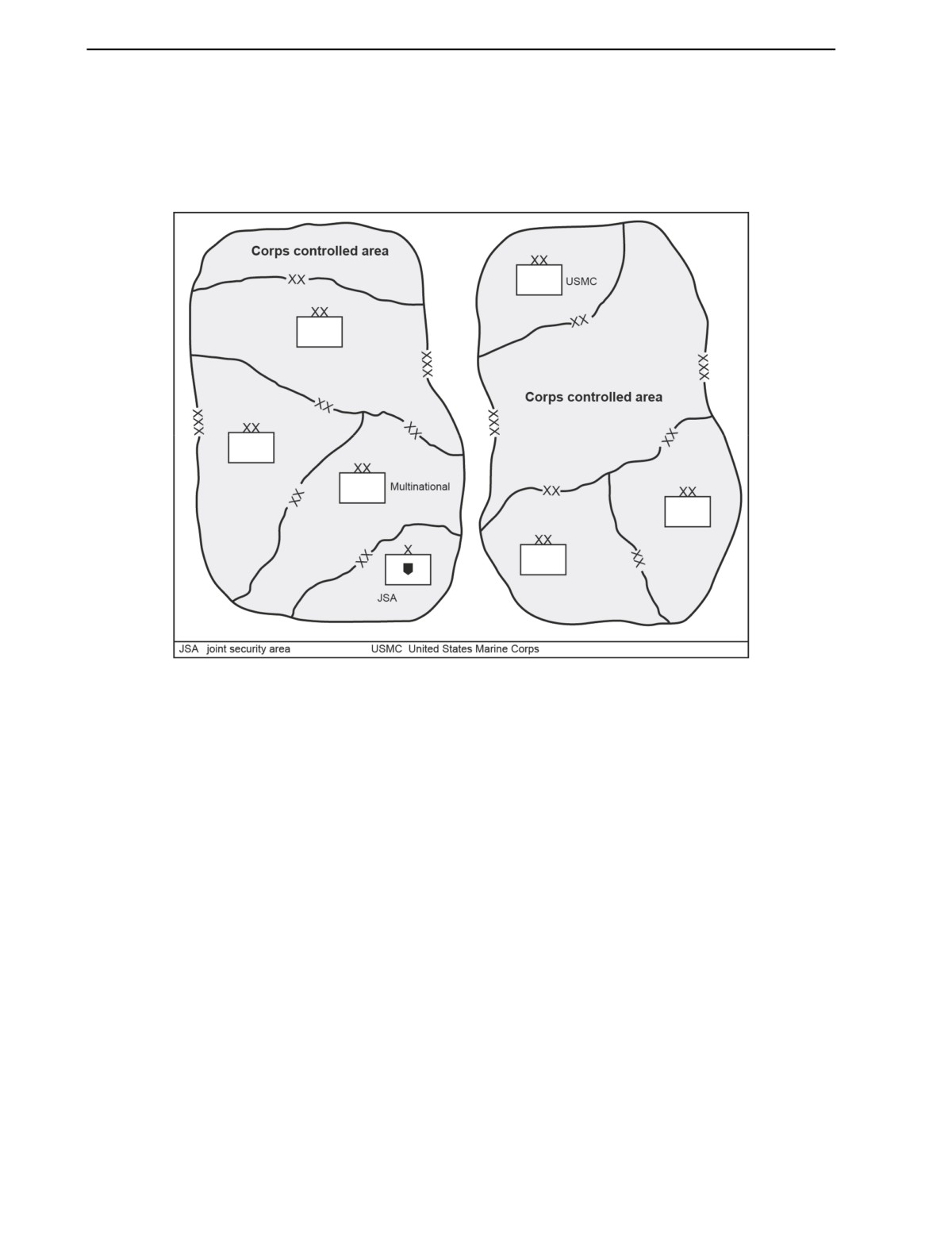
Chapter 5
area between noncontiguous areas of operations or beyond contiguous areas of operations. This area
becomes the corps deep area (see the right side of figure 5-1). The higher headquarters is responsible for
controlling those areas of operations not assigned to its subordinate units. (See ADRP 3-0.) The type of
area of operations affects the corps’s requirement to resource the assigned mission. The unit controlling the
ground has responsibility for terrain.
Figure 5-1. Possible configurations for the corps area of operations
5-37. Within the areas not assigned to a division, the corps should develop sufficient situational awareness
to prevent the enemy from massing forces and capabilities that endanger elements of the corps. The corps
assesses the risk and reacts accordingly. The corps staff develops a contingency plan to cover the corps
areas with increased intelligence assets and sufficient forces to defeat a potential threat. The corps can
control areas of operations that have low risk in many ways. For example, areas with no indication of
enemy forces only receive periodic surveillance and reconnaissance. If the potential risk increases, the
corps could assign some or all the area to a subordinate unit with orders to develop the situation, collect
information, and disrupt any enemy forces detected in the area. At a minimum, the corps commander can
assign be-prepared tasks to subordinate units adjacent to the corps areas for dealing with potential threats.
5-38. The commanding general has several options available to gain and maintain control of the corps area
of operations not assigned to subordinate units. The commanding general coordinates with joint, host-
nation, and multinational forces to take responsibility for all or portions of the area. Designated units may
initially control corps areas by temporarily occupying portions of the area. For example, friendly forces
may continuously transit from contiguous to noncontiguous areas or from one noncontiguous area to
another. These forces can provide intelligence and coverage of the areas.
5-39. The corps may designate a support area adjacent to the divisions’ areas of operations. The support
area becomes that area in which the corps concentrates sustainment, available aviation, and support units
for other Services. The corps delineates the support area based on its geographical advantages for
sustaining the force and protecting these assets. Although the support area may be noncontiguous with the
other major subordinate units, this is rare. An area between the divisions and their support that is not under
division control always poses a weakness to the corps’ freedom of action. If necessary, the corps
commander positions sustainment units in bases located inside the divisional areas and assigns line-of-
5-10
FM 3-94
21 April 2014
Corps Operations
communications security to the divisions. A similar situation may occur when the JFC establishes a JSA for
theater support. The corps commander should designate an area of operations that encompasses the ground
lines of communications between the corps and theater support area.
THE CORPS AND JOINT FORCES
5-40. The corps as a land component has the principal responsibility for arranging joint capabilities
together with landpower. Joint capabilities are the primary means available to the corps commander for
setting conditions and shaping the environment for division operations. The corps requests, plans for,
employs, and allocates joint capabilities to subordinate forces.
AIR FORCE
5-41. The United States Air Force (USAF) is a crucial partner to the Army in any major operation or
campaign. The USAF provides the corps headquarters with an air support operations group (ASOG). The
ASOG’s mission is to provide specially configured liaison packages to assist the corps commander with
integrating the full range of air power appropriate to the mission of the corps. Thus, both the mission and
makeup of the ASOG will change when the mission of the corps changes. The USAF provides the division
headquarters an air support operations squadron (known to the Air Force as ASOS). The air support
operations squadron provides the division with tactical air control parties (TACPs) and an air support
operations center (ASOC) that functions at the division level. The TACP supports the subordinate units of
the division and the ASOC supports the division headquarters.
5-42. Each corps has an assigned air liaison officer. When the corps becomes the operational-level land
component headquarters (joint force land component or multinational forces land component) or the JTF
headquarters, the USAF ASOG will form the nucleus of a joint air component coordination element
(known as the JACCE) to the JFLCC or JTF headquarters. The joint air component coordination element is
the direct representative of the commander, Air Force forces and JFACC. This element co-locates with the
joint force land component to coordinate and integrate air power into land operations at the operational
level of war. If the corps is the ARFOR (for RSOI), then the ASOG serves as the nucleus of the USAF
coordination element. When established, the commander of the USAF coordination element acts as the
commander, Air Force forces’ primary representative to the ARFOR. This element advises the ARFOR
commander and staff on the capabilities and limitations of airpower and assists the ARFOR commander
with the request for forces and RSOI of Air Force forces directly supporting Army forces.
5-43. When the corps serves as a tactical headquarters, the corps does not receive the joint air component
coordination element. Instead, the USAF commander directs the division air support operations squadrons
to provide an ASOC capability to the corps headquarters. The ASOC is a modular element and the USAF
adjusts the staffing and communications capability to the responsibility for the corps when it operates as a
tactical or intermediate headquarters. The ASOC is the principal USAF command and control node for
integrating air power into Army land operations. As a direct subordinate element of the JAOC, the ASOC is
responsible for the direction and control of air component operations directly supporting the Army land
operation. It processes and coordinates air missions requiring integration with other supporting ground
forces. The ASOC usually co-locates with the senior Army tactical echelon (normally a division, but it may
be a corps) and coordinates operations with the permanently aligned TACPs and the JAOC. The ASOC and
TACP normally integrate with the current operations fires cell and airspace element to form a joint air
ground integration center (JAGIC). The JAGIC integrates and coordinates fires and air operations over and
within the commander’s area of operations. As the air component portion of the JAGIC, the ASOC is
responsible for the direction and control of air operations in the corps’ assigned airspace within its area of
operations requiring integration with other supporting arms and ground forces. If the ASOC uses a fire
support coordination line (FSCL), the ASOC normally controls air component operations short of this
FSCL and below the coordinating altitude. (For further information on Army assigned airspace, see
FM 3-52.)
5-44. As previously discussed, the ASOC may also coordinate in other mission areas, to include air
interdiction, joint information activities, air defense, information collection, joint suppression of enemy air
defenses (known as J-SEAD), airlift, and joint personnel recovery. Air missions that fly within the corps
21 April 2014
FM 3-94
5-11
Chapter 5
airspace but do not directly support the ground component normally are coordinated through the ASOC to
de-conflict with ground force maneuver and fires as well as to receive target and threat updates.
Planning for Air Support
5-45. The supported ground commander is responsible for ensuring that the supporting air commander
understands the assistance required. (See JP 1.) When the corps becomes the joint force land component
command or a single Service headquarters controlling land operations (as an ARFOR), specific inputs to
the supporting air component affect air support to ground forces. This includes but is not limited to the air
apportionment recommendation, air operations directive, and air tasking order (ATO). The Army also
provides critical input to the area air defense plan and supporting tactical operational data. The air
operations directive has the most current and significant guidance for each air battle plan to drive the daily
joint air tasking cycle. It delineates targeting priorities for the use of joint air assets. The ATO is the key
document published and disseminated by the JFACC to delineate all air operations for 24-hour duration.
The airspace control plan and airspace control order are airspace control authority functions that affect both
ground and air operations. The land component commander (JFLCC or ARFOR commander) ensures that
both support Army airspace requirements. The senior air and missile defense commander (normally the
AAMDC commander) provides area air defense plan and tactical operational data input to the AADC.
5-46. The supported Army headquarters processes and either approves or denies preplanned and immediate
air support requests through the Army air-ground system to identify external air support requirements to the
air component. One type of air support request is a joint tactical air strike request (JTAR). JTARs go
through fire support planning and process through the fires cell. Each echelon approves and prioritizes
these requests before going to the BCD at the JAOC with the Army’s battle rhythm complementing the
joint air tasking cycle. Preplanned JTARs must go to the supporting air component in sufficient time to
meet the planning stages of the joint air tasking cycle and to appear on the ATO. Normally the BCD sets
the suspense for preplanned JTARs and ensures that the supported Army staff adjusts its planning
accordingly. Immediate JTARs occur after publication of the ATO. The supported ASOC normally answers
immediate requests (when given decentralized execution authority) with best available air assets that are
already on the ATO.
Air Mobility Operations
5-47. The Army is the largest user of airlift. The airlift system can respond to Service and joint
commander’s needs with rapid response globally and within the theater. The air mobility system can
provide a direct delivery preference from outside the AOR directly into operating locations within the AOR
to reduce cargo downtime. This mobility system provides air movement, air-refueling support to airlift
aircraft, aeromedical evacuation, and air-drop options for the Army and joint forces. The corps, as the joint
force land component or ARFOR, prioritizes transportation and movement requirements based on
operational necessities. Intratheater airlift provides a capability to respond to high priority combat and
logistics movement requirements. The corps validates and prioritizes intratheater airlift requests. One
request includes airborne operations processed through the G-3 to the J-3. Another is the Army’s air
mobility requests normally processed through the G-4 to the Deployment and Distribution Operations
Center to coordinate and prioritize theater airlift requests for the joint force.
5-48. The JAOC air mobility division monitors airlift operations and scheduling. The BCD airlift section
co-locates with the air mobility division and monitors joint airlift operations. The BCD airlift section is the
point of contact within the JAOC for coordinating and monitoring Army airlift requests, changes, and
cancellations. The USAF provides air mobility liaison officers to Army corps, division, TSCs, separate
regiments, selected brigade echelons, and other jointly validated headquarters to provide air mobility
liaison, special staff assistance, and controlled airdrops for the ground commander.
Direct Support Airlift
5-49. If the common-user airlift system proves inadequate for the needs of the joint force land component
(or ARFOR), then the JFC can task the JFACC to provide direct support airlift to JFLCC. In cases where
the JFC operates by Service component, the JFACC provides the ARFOR with direct support airlift. The
JFC apportions a certain amount of the total number of airlift sorties required to support theater movement
5-12
FM 3-94
21 April 2014
Corps Operations
requirements for priority mission critical or time sensitive airlift. The joint force land component (or
ARFOR) determines the timing and routing priorities of these missions and relays this information to the
JFACC combined air operations center for planning and execution. Aircraft accomplishing this mission are
under TACON of the JFACC. The missions normally operate via a support agreement with the supported
component, in this case the joint force land component.
Fire Support Coordination Line
5-50. The corps plan should make maximum use of the operational reach of U.S. air power. To maximize
the ability of the JFACC to strike and interdict enemy forces, the corps commander uses a carefully
selected FSCL. The FSCL is a permissive fire control measure for expeditious engagement of targets of
opportunity beyond the coordinating measure. An FSCL does not divide an area of operations. It delimits
the areas within which the land component is conducting ground operations and areas in the corps area of
operations where the JFACC can employ maximum combat power in support of the corps. Short of an
FSCL, the corps commander controls all air-to-ground and surface-to-surface engagement operations in the
area of operations. For maximum flexibility from the supporting air component, the corps establishes the
FSCL beyond the effective cannon range of the committed BCTs and then adjusts the FSCL as maneuver
dictates displacement of artillery and other corps supporting assets.
5-51. Use of an FSCL is not mandatory. Forces engaging targets beyond an FSCL must inform all affected
commanders in sufficient time to allow necessary reaction to avoid fratricide, both in the air and on the
land. The FSCL applies to all fires of air, land, and sea-based weapons systems using munitions against
surface targets. In exceptional circumstances, the inability to complete this coordination does not preclude
the engagement of targets beyond the FSCL. However, failure to do so increases the risk of casualties from
friendly fire. (See JP 3-09.)
Airspace Control
5-52. Army airspace users are ground forces operating in an inherently joint environment. Army
commanders are responsible for integrating Army airspace users, regardless of who controls the airspace,
within the larger joint airspace control framework. The Army depends on its joint partners for capabilities
that do not reside within the Army, and it operates more effectively with their support. The Army air-
ground system interfaces with the theater air-ground system to integrate air support with ground operations.
The Army air-ground system allows the coordinating and integrating air operations with the ground
commander’s concept of operations. It allows for initiating and processing air support requests, collection
requirements, airspace coordination, joint fires, air and missile defense, and liaison. Army commanders use
the Army air-ground system to coordinate and integrate airspace use and users over the ground
commanders’ assigned area of operations.
5-53. The corps headquarters oversees airspace control policy and standardization of tactics, techniques,
and procedures throughout the corps area of operations. It executes airspace responsibilities when it serves
as an intermediate tactical headquarters, an operational-level Army force, a joint force land component
command, or a JTF headquarters. Airspace element personnel in the main and tactical command posts
integrate airspace operations with the functional and integrating cells. The airspace element coordinates
with the TACP and with either the joint air component coordination element or ASOC co-located with the
headquarters. In most situations, the corps headquarters is the senior Army airspace element. As such, the
corps headquarters contributes to the BCD’s airspace section to ensure the joint airspace policies and
documents incorporate the Army airspace priorities and requirements.
5-54. The corps has airspace responsibilities to coordinate Army and supporting airspace user requirements
within its area of operations, including portions of the area of operations further assigned to subordinate
units. The corps may have additional airspace control responsibilities to provide joint airspace control for
airspace as directed by its higher headquarters or the airspace control authority and as defined in the
airspace control plan. This corps-assigned airspace is normally that airspace assigned by the airspace
control authority that is within the boundaries of the corps’ area of operations up to the coordinating
altitude. The assigned airspace may not be over the entire corps’ area of operations but could be a smaller
area within the corps’ area of operations. The airspace assigned depends on the corps’ ability to control it
effectively. (See FM 3-52 and JP 3-52.)
21 April 2014
FM 3-94
5-13
Chapter 5
5-55. The corps’ specific responsibilities for managing airspace depend on responsibilities delegated to it
by the airspace control authority and its role (operational or tactical headquarters) within the joint force. As
an operational headquarters (joint force land component command, multinational forces land component, or
ARFOR), the corps headquarters normally decentralizes airspace control to subordinate divisions within
their respective areas of operations (division-controlled airspace). It authorizes direct liaison between them
and other theater air-ground system airspace control nodes provided by other Services. The corps retains
responsibility for integrating airspace users. The corps integrates all airspace requirements for corps-
controlled BCTs and other brigades not assigned an area of operations. The corps airspace element may
retain responsibility for airspace control over any portions of the area of operations not assigned to
subordinate units (corps-controlled airspace). Responsibility depends upon the size of the corps controlled
portions of the area of operations, the capabilities of the corps airspace element, and the details of joint air
operations.
5-56. When the corps headquarters functions as a tactical headquarters under a joint or multinational land
component, the corps normally controls airspace over the corps area of operations directly. This is because
the corps area of operations is usually much smaller. In this situation, the corps headquarters would have an
ASOC or equivalent instead of the joint air component coordination element it would receive as an
operational headquarters. (For a more complete discussion of airspace control, see FM 3-52.)
SPECIAL OPERATIONS FORCES
5-57. Within the corps’ area of operations, conventional forces and SOF often operate near each other to
accomplish the JFC’s mission. Historically, commanders have employed SOF in the advance phases of
operations. During extended or large-scale operations involving both conventional forces and SOF, control
and de-confliction measures become vital to the integration and synchronization of conventional and
special operations missions. The corps commander considers both conventional forces and SOF capabilities
and limitations, particularly in tasks associated with mission command and sustainment warfighting
functions. The exchange of liaison elements between the staffs of appropriate conventional forces and SOF
further enhances integration of all forces concerned.
5-58. During mission planning, the corps staff and SOF planners include options regarding how to
integrate conventional forces and SOF ground elements. Successful integration and interoperability of
conventional forces and SOF depend on understanding each other’s missions, systems, capabilities, and
limitations. Exchange and use of liaison and control elements are critical when conventional forces and
SOF conduct operations in the same operational area against the same threat. Integration of SOF with
conventional forces is always a critical concern for SOF commanders, and areas of interest typically
include, but are not limited to—
z
Target de-confliction.
z
Communications systems.
z
Political concerns.
z
Civil populace.
z
Possible linkup of ARSOF with conventional forces.
z
Mission command.
z
Information operations staff section.
z
Electromagnetic spectrum management.
z
Information collection.
z
Airspace control.
z
Fire support coordination, to include fire control measures.
z
Coordination of logistics and area of operations support.
z
Personnel recovery.
5-59. ARSOF provide capabilities that expand the options available to the corps commander; however,
ARSOF are not the ideal solution to all problems requiring a military response. The best means of
employing ARSOF is usually with conventional forces in which each force operates as a component of the
joint force. This expands options for dealing with hybrid threats, for example, because ARSOF conduct
5-14
FM 3-94
21 April 2014
Corps Operations
unconventional warfare, foreign internal defense, and counterterrorism. The mutually beneficial actions of
SOF and conventional forces contribute to shaping and military engagement. The corps frequently supports
joint security cooperation activities as part of the campaign. Army conventional forces and SOF units train
partner units to increase multinational units’ proficiency. It is important to sustain a long-term relationship
between conventional forces and SOF because they benefit each other. ARSOF relies on operating with the
support of conventional forces. (See JP 3-05 and ADRP 3-05 for more information on special operations.)
5-60. Conventional force operations and special operations require coordination and liaison among all
components of the joint force and the joint force land component command to ensure that component
command and control, intelligence, movements and maneuver, fire support, and sustainment are fully
integrated and interoperable. The focal point for synchronization of SOF activities with conventional joint
land operations is the special operations command and control element (SOCCE) which co-locates with the
supported or supporting command element of the joint force land component. (See JP 3-31.)
5-61. The SOCCE is predominantly an ARSOF element but Navy and Marine Corps SOF may form
SOCCEs when these forces operate with the joint force land component. The SOCCE performs command
and control and liaison according to mission requirements and as directed by the establishing SOF
commander (the theater special operations command, joint force special operations component commander,
or commander, joint special operations task force). The SOCCE can receive operational intelligence and
target acquisition reports directly from deployed SOF elements and provide the reports directly to the
associated headquarters of the joint force land component. The SOCCE remains under OPCON of the
establishing SOF commander, but may be in direct support of the joint force land component. (See
JP 3-31.)
JOINT INTELLIGENCE AND INFORMATION COLLECTION
5-62. Planning, execution, and assessment of information collection activities require integration across all
echelons. The corps integrates corps capabilities with all other joint activities, systems, efforts, and
capabilities to provide the information the commander requires to make timely decisions. Subordinate
Army commanders submit their requests for information through echelon channels; if the corps as the land
component cannot satisfy the requests, the information requests pass to the JTF for research and response.
Corps and division commanders can submit a request for collection or request for joint support to the joint
intelligence operations center, which apportions its assets or resources from higher echelons against the
requests in order of priority, as defined by the JTF commander. Collection requirements that the JTF cannot
satisfy using assets controlled or apportioned by the JTF go into the national intelligence system for
collection.
5-63. An understanding of joint intelligence, surveillance, and reconnaissance
(ISR) is required to
understand the relationship of Army intelligence operations and information collection to joint ISR. (See
ADRP 2-0.) In joint collection management operations, the synchronization manager, in coordination with
the operations directorate, forwards collection requirements to the Service component commander
exercising TACON over joint ISR assets. A mission tasking order goes to the unit selected as responsible
for the collection operation. The selected unit, sometimes called the mission manager, makes the final
choice of specific platforms, equipment, and personnel required for the collection operation, based on
operational considerations, such as maintenance, schedules, training, and experience.
5-64. Joint air planning products produced by the JAOC include the ATO, airspace control order, and
special instructions (known as SPINS). An ATO is used to task and disseminate across components,
subordinate units, and headquarters all projected aircraft sorties and aerial capabilities for the affected joint
operations area. The airspace control order is an order implementing the airspace control plan that provides
the details of the approved requests for airspace coordinating measures. It is published either as part of the
ATO or as a separate document. (JP 3-52 provides more details on airspace control orders.) Special
instructions are instructions issued to aviators that describe detailed procedures for loss of communication,
escape and evasion, and search and rescue operations. (See JP 3-30.)
5-65. At the JTF or joint force land component, aerial collection missions are developed via the joint
collection working group and the Joint Collection Management Board. The joint collection working group
is the ISR planning forum for the management of collection requirements and the coordination of collection
21 April 2014
FM 3-94
5-15