FM 3-94 THEATER ARMY, CORPS, AND DIVISION OPERATIONS (APRIL 2014) - page 2
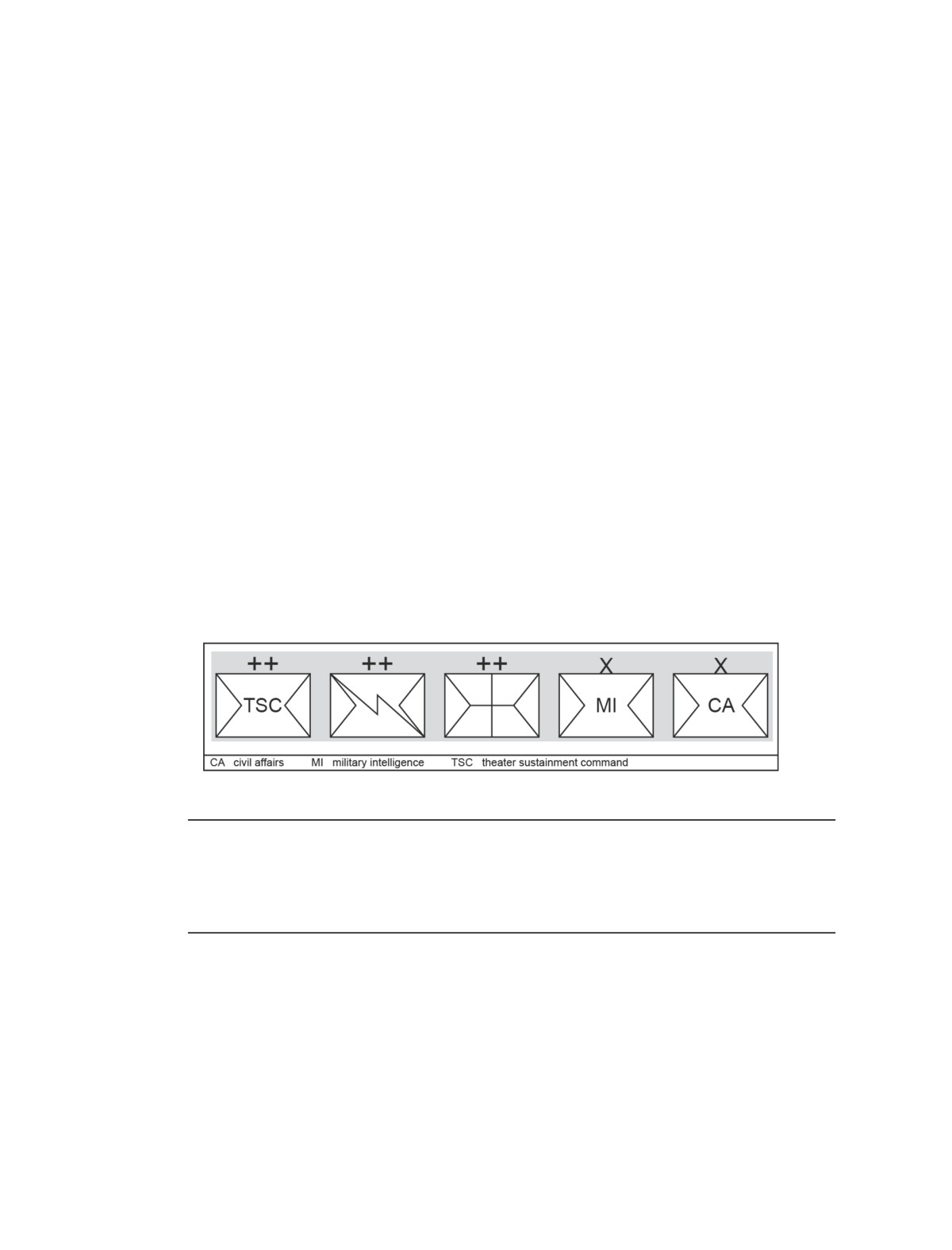
Echelons Above Brigade
OPERATIONAL AREAS
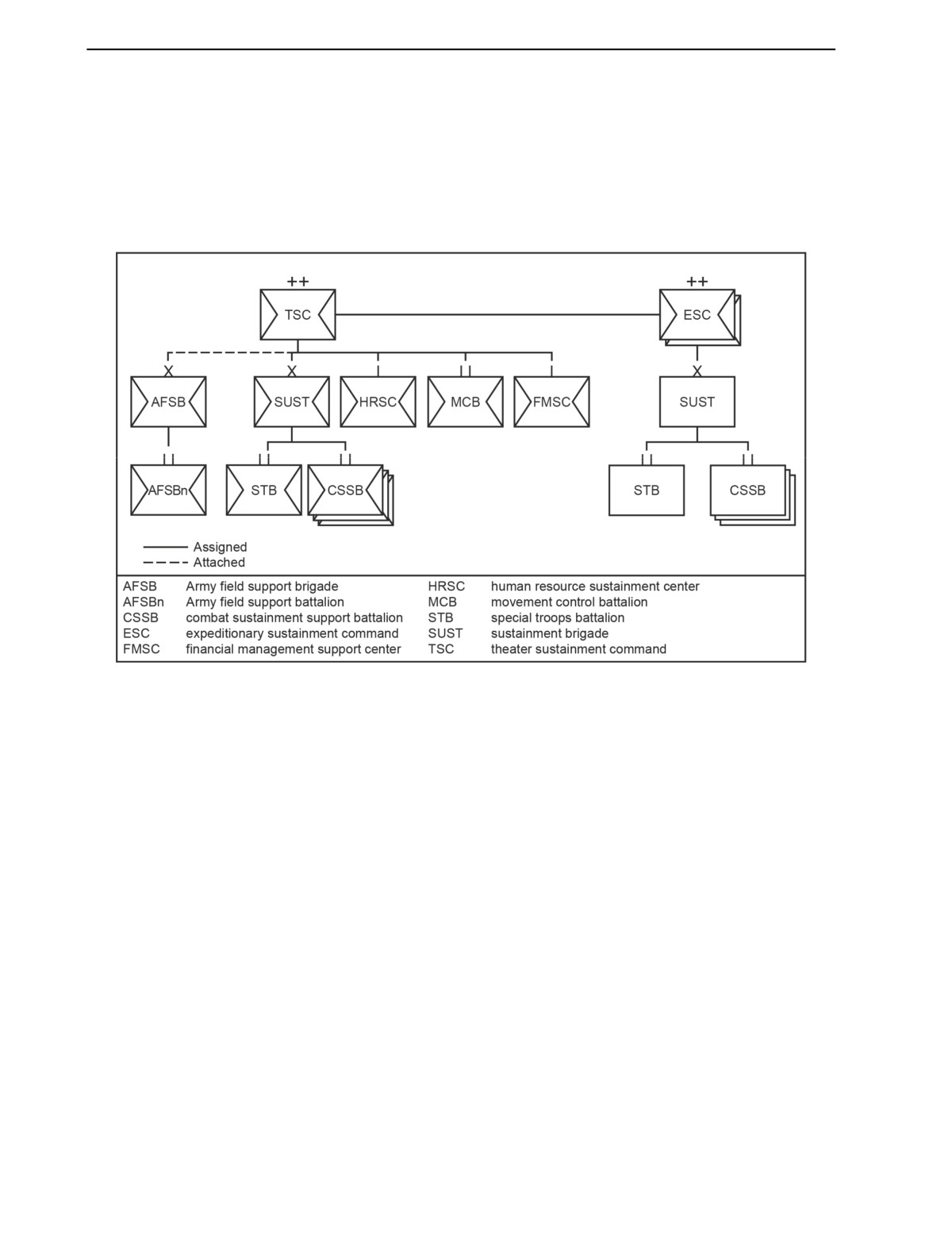
1-91. This manual refers throughout to a hierarchy of operational areas. Within the AOR, the combatant
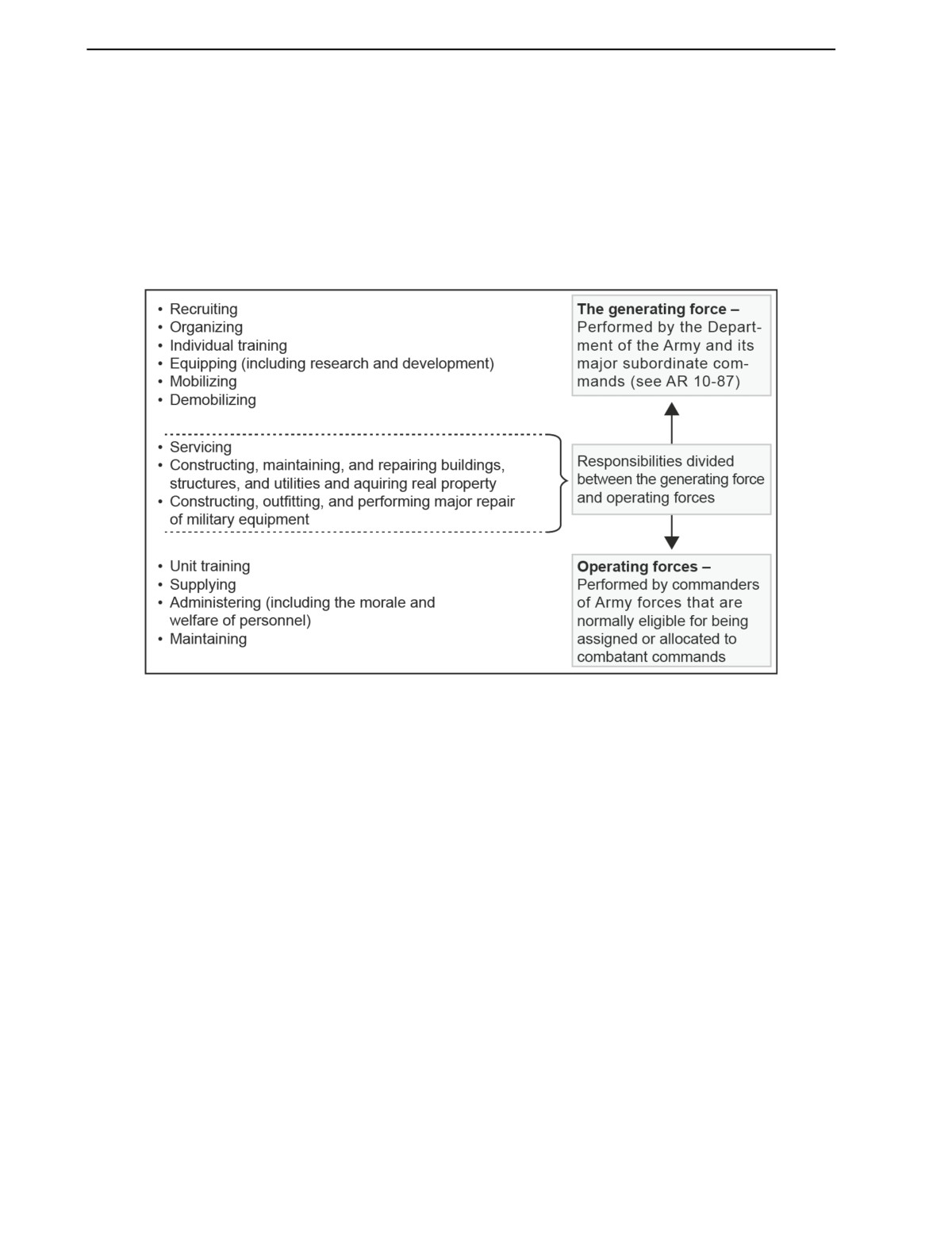
commander exercises COCOM over assigned forces. All U.S. forces within the AOR (assigned, attached,
OPCON, or in transit through the region) fall under the control of that geographic combatant command for
as long as they remain in the AOR. The theater army commander exercises OPCON and ADCON for all
Army forces within the AOR, except for Army forces in transit.
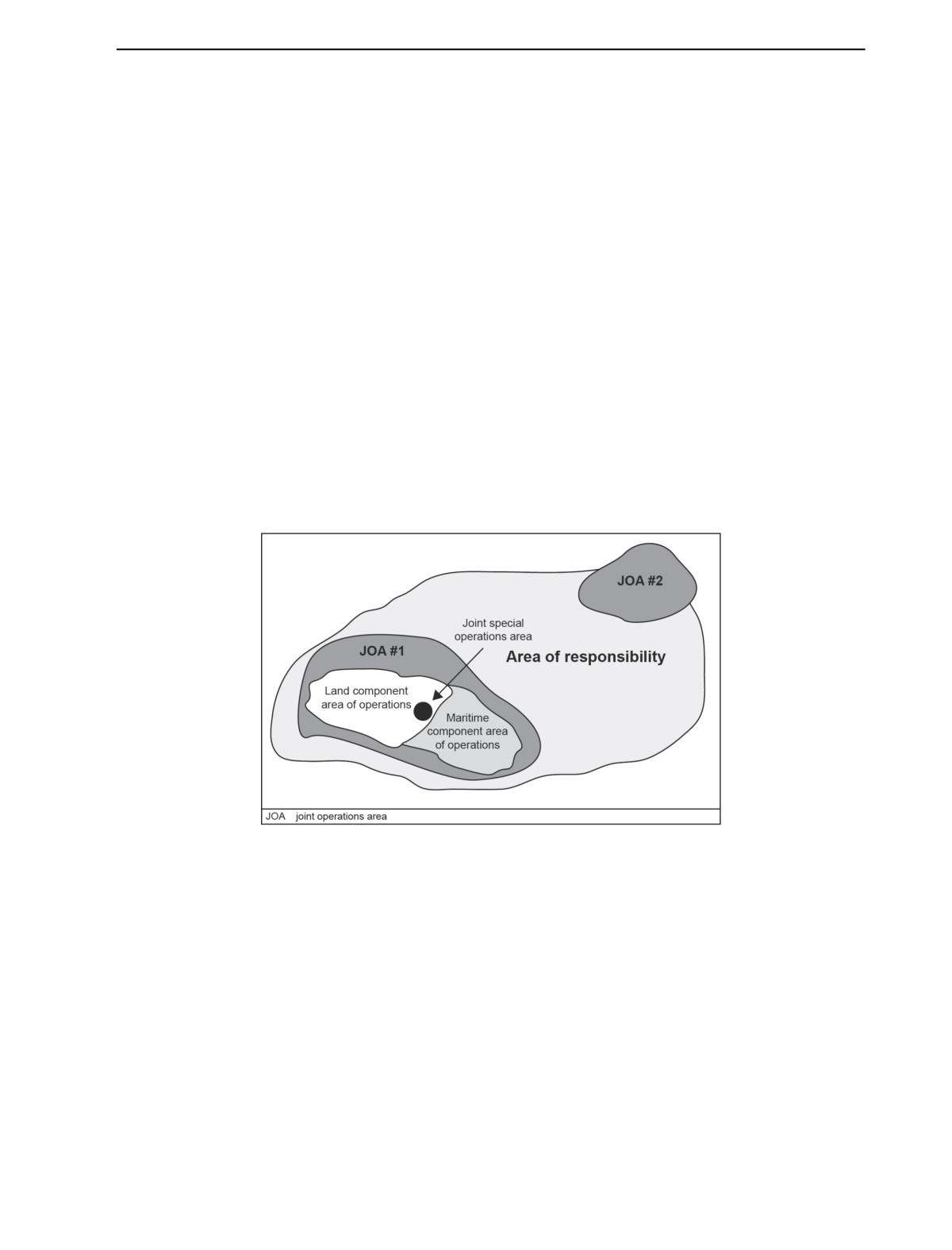
1-92. The combatant commander establishes subordinate joint commands, normally a JTF. The combatant
commander assigns the JTF a joint operations area that encompasses the three dimensional volume of sea,
land, and air within which the JTF will operate. Areas of operations are defined by the JFC for surface
(land and maritime) forces. The JFC may specify an area for SOF, designated as a joint special operations
area.
1-93. An area of operations assigned to the joint force land component does not typically encompass the
entire operational area of the JFC, but it should be large enough for the JFLCC to accomplish the mission
and protect the forces or capabilities provided. The JFLCC establishes an operational framework for the
area of operations that assigns responsibilities to subordinate land commanders and maximizes the
operational capabilities of all subordinate elements. Within the area of operations designated by the JFC,
the JFLCC (or ARFOR commander) is the supported commander. Within the designated area of operations,
the JFLCC (or ARFOR commander) integrates and synchronizes maneuver, fires, and interdiction. To
facilitate this integration and synchronization, such commanders have the authority to designate target
priority, effects, and timing of fires within their area of operations (see figure 1-10).
Figure 1-10. The area of responsibility and joint operations areas
1-94. Synchronization of efforts within land area of operations with joint operations in the joint operations
area is of particular importance. To facilitate synchronization, the JFC establishes priorities for all forces
within the joint operations area, including land forces. The JFACC is normally the supported commander
for the JFC’s overall air interdiction effort, while land and maritime component commanders are supported
commanders for interdiction in their area of operations.
1-95. In coordination with the JFLCC, those commanders designated by the JFC to execute AOR- and/or
joint operations area-wide functions have the latitude to plan and execute these JFC prioritized operations
within the land area of operations. Any commander accomplishing such a mission within a land area of
operations must coordinate the operation to avoid adverse effects and fratricide. If those operations can
adversely impact the land area of operations, the commander assigned to execute the joint operations area-
wide functions must re-adjust the plan, solve the problem with the JFLCC, or consult with the JFC for
resolution.
21 April 2014
FM 3-94
1-27
This page intentionally left blank.
Chapter 2
The Theater Army
ARMY SERVICE COMPONENT COMMAND
2-1. The theater army enables the combatant commander to employ landpower anywhere in the AOR
across the range of military operations. It commands all Army forces in the region until the combatant
commander attaches selected Army forces to a JFC. When that happens, the theater army divides its
responsibilities between the Army component in the joint operations area (the ARFOR) and Army forces
operating in other parts of the AOR. Each theater army supports the Army strategic roles—prevent, shape,
and win—and facilitates the use of landpower in JTFs. The theater army is deeply involved in security
cooperation across the region. The theater army is organized, manned, and equipped to be the ASCC for
that geographic combatant command. It has limited capabilities to perform two other roles—JTF
headquarters for a limited contingency operation and joint force land component command for a limited
contingency operation.
2-2. The primary role of the theater army is that of the ASCC to that GCC. Title 10 establishes this in
law; it is reiterated in DODD 5100.01. The combatant commander exercises COCOM over all Army forces
assigned or attached to the command. Army forces under COCOM are attached to the theater army. Under
COCOM, the theater army exercises OPCON of Army forces until the combatant commander attaches
Army forces to a subordinate JFC, typically a JTF commander. For example, the Secretary of Defense
assigns (or attaches) an Army division headquarters and subordinate BCTs to USPACOM. Because the
DOD assigns them to the GCC, the division and its subordinate brigades attach automatically to the
USARPAC, the theater army. USARPAC exercises OPCON and ADCON over the division and brigades.
If the combatant commander creates a JTF and subordinates the division and BCTs to the JTF, then
OPCON of the division transfers from USARPAC to the JTF commander. However, ADCON and support
requirements remain the responsibility the theater army.
2-3. The theater army commander remains responsible to the Department of the Army for Service-
specific requirements. This falls under the ADCON chain of authority. This authority establishes a
hierarchy for Army support to deployed forces without modifying the operational chain of command that
runs from the combatant commander through subordinate JFCs. For example, theater army commanders
establish centers in the AOR to train individual replacements; complete collective training, theater
orientation, and theater acclimation; and manage force modernization of Army forces before their
employment by the JFC in the joint operations area.
2-4. DODD 5100.01 identifies the responsibilities of the military departments. The generating force and
operating forces of the Army divide responsibility for carrying out these functions. Figure 2-1 on page 2-2
illustrates the Service responsibilities inherent with ADCON.
2-5. The theater army and theater-level commands shift execution of much of the Service-specific
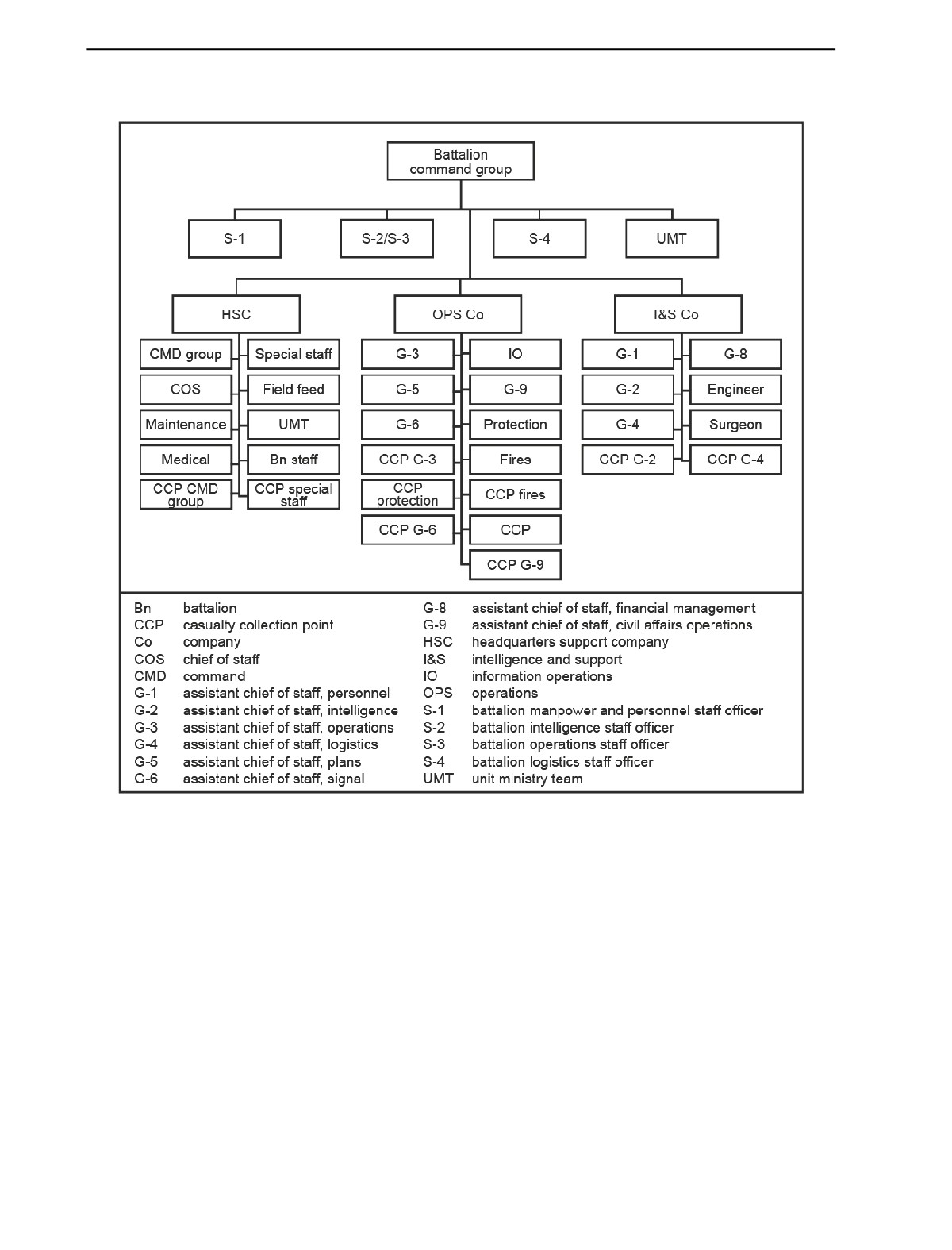
functions from the ARFOR, the senior Army echelon in a JTF, to the theater army. This shift allows the
corps or division commander to exercise flexible mission command over tactical units and permits the
ARFOR staffs to focus on their operational missions.
ARMY SUPPORT TO OTHER SERVICES
2-6. In all joint operations, sustainment is a Service responsibility except as specified by DOD CCSA
directives, combatant commanders’ lead Service designations, or inter-Service support agreements. Each
Service retains its responsibility for sustainment. Combatant commanders direct theater army commanders
to provide common-user logistics and ASOS, agencies, or multinational forces, as required. However,
shared sustainment responsibility or common-user logistics is more effective, especially for joint
operations. Title 10 authorizes combatant commanders to assign common-user logistics responsibilities that
21 April 2014
FM 3-94
2-1
Chapter 2
overlap the military department’s prescribed functions. Additionally, directive authority for logistics is the
additional authority used by combatant commanders to eliminate duplicated or overlapped sustainment
responsibilities. The theater army coordinates with the combatant command staff to determine joint
sustainment requirements, identify responsibilities, and enable commanders to exercise mission command
for sustainment. Theater army commanders focus on operational-level theater support involving force
generation and sustainment during campaigns and joint operations. They match sustainment requirements
for a campaign to the Army forces’ capabilities. Combatant commanders may designate a Service
component as either the temporary common-user logistics lead or long-term, single integrated theater
logistics manager if required. (See ADRP 4-0 for more information.)
Figure 2-1. Service-specific responsibilities
PROTECTION
2-7. The Unified Command Plan directs force protection responsibility for all Title 10 DOD forces
stationed in, operating in, residing in, or transiting an AOR to the GCC. In support of the GCC, this
responsibility falls on the theater army commander for all Title 10 Army forces in the AOR. Since there is
no Army theater-level protection command, staff responsibility for planning and oversight falls entirely on
the theater army staff. If a JFLCC or joint security coordinator is required, the GCC normally assigns that
responsibility to the theater army commander. The tasks of the theater army include the exercise of
TACON over Title 10 Army forces stationed in, operating in, residing in, or transiting the AOR.
2-8. In addition to assets that provide protection, such as CBRN and explosive ordnance disposal (EOD)
units, the theater army staff focuses on two enablers of protection: mission command and sustainment. The
theater requirements for air and missile defense, for example, often exceed the capabilities available. As the
force is tailored, the theater army staff coordinates with the GCC and is supported by the GCC’s aligned air
and missile defense command. The staff estimates the mission command and sustainment assets necessary
for both the campaign and an increased threat across the AOR. The staff also requests forces to meet the
combatant commander’s priorities. This planning necessarily involves coordination with multiple host-
nation militaries and the Department of State. Through careful planning, the theater army develops an air
and missile defense task force package consisting of sustainment assets, security forces, and headquarters
for deployment to partner nations outside the joint operations area. ADCON of these distributed task forces
becomes a challenge, and the theater army may require additional staff and earlier deployment of its air and
missile defense command in order to fulfill its ADCON requirements.
2-2
FM 3-94
21 April 2014
The Theater Army
2-9. If the JFC elects to establish a joint security area (JSA) within the joint operations area, the ARFOR
normally determines its structure and its controlling headquarters. The options for the JSA depend on the
threat and the mission variables, particularly forces available. If the threat to the JSA is low to moderate,
the theater army commander may tailor the ARFOR with a MEB specifically for controlling the JSA. The
MEB may include additional military police (MP) and intelligence assets. If the threat to theater bases and
lines of communications is significant, the theater army may tailor the ARFOR with an additional BCT to
control that area of operations, and the supported commander in the JSA for protection. A third option, in
the case of very high threat levels, is to assign the mission to an Army division with BCTs and one or more
MEBs. (See ADRP 3-37.)
UNIFIED ACTION IN THE GEOGRAPHIC COMBATANT COMMAND
2-10. The Army provides each GCC with an assigned theater army headquarters with capabilities matched
to that AOR. The theater army and its theater-assigned Army forces support the combatant commander’s
theater engagement plans and security cooperation. The theater army and its theater-assigned Army forces
set the theater and the joint operations area for the employment of landpower in contingencies and
campaigns. The theater army’s contingency command post also provides the combatant commander with
command and control capabilities for immediate crisis response, assessment, and initial control of
operations. The theater army anticipates, plans, requests, receives, trains, sustains, and supports
redeployment of landpower within each geographic combatant command. In short, the theater army
provides and sustains the landpower in the AOR.
KEY TASKS AND LIMITATIONS
2-11. The theater army has operational and administrative tasks. Its operational focus is to plan for, tailor,
and control Army forces in that geographic combatant command. Its other purpose is to execute the Service
responsibilities specified in Title 10 and DODD 5100.01.
2-12. The tasks of the theater army include the following:
z
Exercise ADCON over all Army forces in the AOR to include sustainment of all Army forces.
z
Exercise OPCON over all Army forces not attached or under OPCON to a subordinate JFC
within that geographic combatant command.
z
Provide Army support to theater security cooperation and theater engagement plans.
z
Anticipate requirements and develop plans for the employment of Army forces in limited
contingency operations, crisis response, major operations, and campaigns.
z
Set conditions in the theater for the employment of landpower; set the theater.
z
Serve as the joint force land component command for military engagement, security cooperation,
and deterrence across the entire AOR when designated by the combatant commander.
z
Coordinate with Department of the Army, Army commands, and supporting ASCCs for
additional Army forces and tailor them for the combatant commander.
z
Control RSOI of Army forces deploying to the AOR.
z
Provide ASOS and SOF including lead agent, common-user logistics, and CCSA requirements.
z
Provide Army estimates and plans as well as advice to the GCC and to the Department of the
Army for the required exercises, engagements, and other activities in support of theater security
cooperation plans.
z
Support other government agencies as directed by the combatant commander.
z
Provide sustainment and other directed support to multinational forces as required by the
combatant commander.
z
Provide a JFC and command post for limited contingency operations.
z
Manage close and continual coordination with the Reserve Component in support of the ASCC
headquarters.
z
Exercise TACON (for force protection) over all Regular Army forces stationed in, operating in,
residing in, or transiting the AOR. (This does not apply to Army National Guard forces under
state or territorial command.)
21 April 2014
FM 3-94
2-3
Chapter 2
2-13. The limitations of the theater army headquarters include the following:
z
The theater army is not designed, organized, or equipped to function as a combined forces land
component command or a field army in major combat operations. It does not exercise OPCON
over corps and larger formations.
z
The main command post operates from a fixed location and is not mobile.
z
The main command post can provide personnel for a multinational land component
headquarters, but this degrades the ability of the headquarters to provide and control theater-
level support across the area of operations.
z
The contingency command post requires joint augmentation for employment as a JTF
headquarters. With augmentation, it can become a JTF for limited contingency operations.
Although the contingency command post is deployable, it has limited endurance without
reinforcement and additional security.
z
Some of the theater-level capabilities required for campaigns and major operations must deploy
from the continental United States (CONUS).
z
Augmentation for both a JTF and for theater-level capabilities is frequently provided by forces
mobilized from the United States Army Reserve and Army National Guard.
z
Most theater-level capabilities required for campaigns and major operations are in the Reserve
Component and must be mobilized and deploy from the CONUS.
LANDPOWER FOR THE GEOGRAPHIC COMBATANT COMMANDS
2-14. The strategic environment requires landpower to prevent, shape, and win. This requirement falls first
on the theater army. Army forces, in support of the combatant commander, work with partner nations to set
the conditions to prevent conflict as well as ensure the theater is prepared to execute contingency plans.
Strategically, the Army meets the demands for landpower from geographic combatant commands. Today,
most of this landpower comes through rotational units instead of forward stationed forces. Therefore, the
theater armies coordinate closely with the various Army commands and direct reporting units for
infrastructure, deployment and distribution operations, and in-theater support requirements. The CONUS
along with its territories and possessions constitute a unique and special AOR, with legally distinct
National Guard operations at the state level and multi-component federal military support when authorized
by the President. The Army National Guard provides the majority of military forces for state-level response
and for defense support of civil authorities (DSCA).
REGIONALLY ALIGNED FORCES CONCEPT
2-15. In support of the geographic combatant commands’ campaign plans, the Department of the Army, in
conjunction with FORSCOM, identifies regionally aligned forces to prevent, shape, and win in each AOR.
These forces maintain proficiency in the fundamentals of decisive action, but also possess particular
capabilities tailored for one or more of the missions specified for a geographic combatant command.
Regionally aligned forces provide the combatant commander with an Army headquarters tailored to that
mission, from tactical level to JTF-capable. These forces include Army units assigned to combatant
commands, units allocated to a combatant command, and units retained by the Service, aligned with a
combatant command, and prepared by the Army for regional missions. Regionally aligned forces
complement Army organizations and capabilities that are forward-stationed; complement those already
operating in an AOR; or support that combatant commander from outside the AOR. The latter extends to
those organizations providing reachback support and prepared-to-deploy forces into the AOR.
2-16. Combatant command requirements drive regional missions. These missions require the Army to
develop an understanding of the cultures, geography, languages, and militaries of the countries to where
Soldiers are most likely to be employed, as well as expertise in imparting military knowledge and skills to
others. This approach requires the Army to adapt forces from the lowest levels by emphasizing leader
development and leveraging technology to empower the force. Each theater army has a supporting theater
intelligence brigade, which enables regionally aligned forces and global response force units to connect to
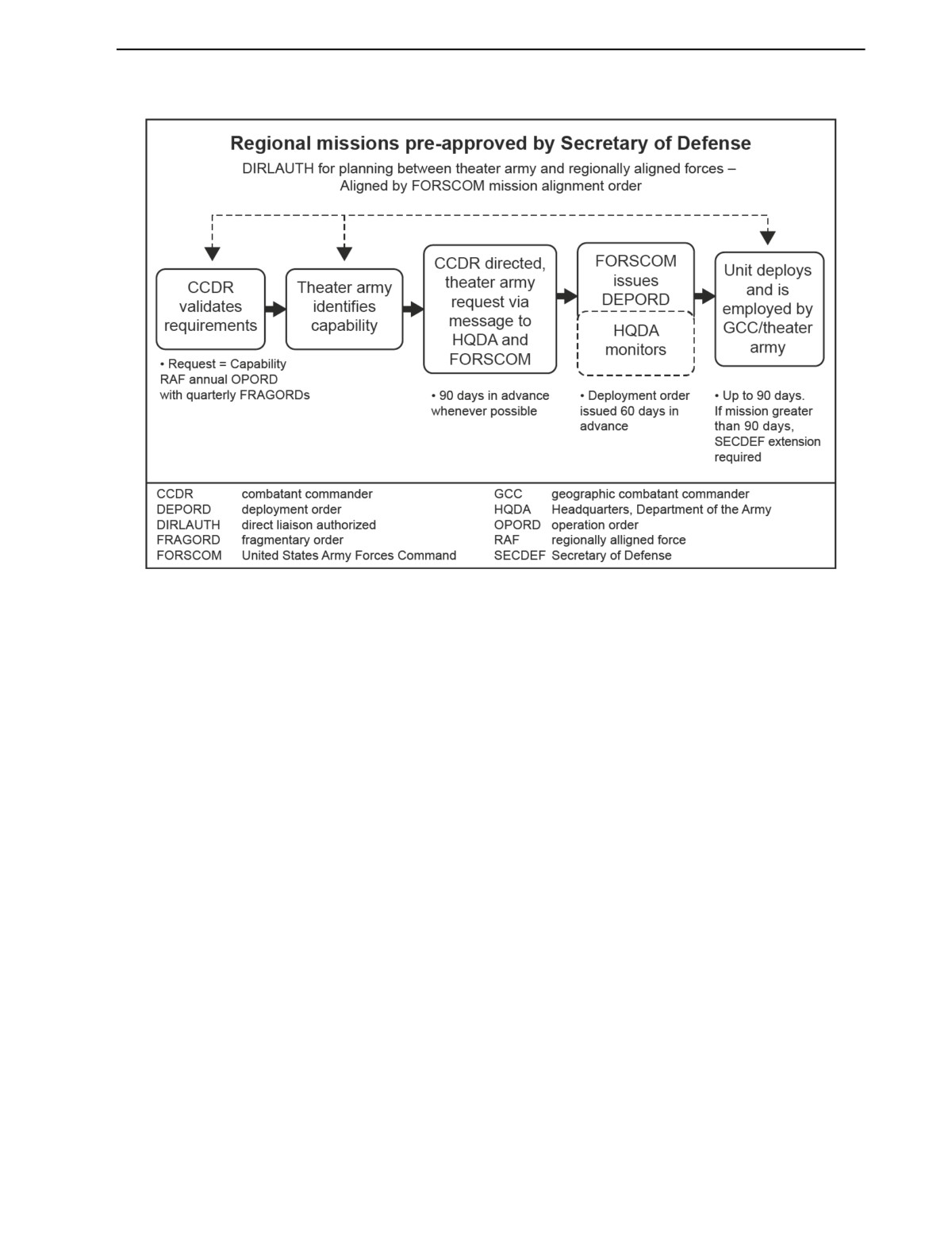
the combatant command’s intelligence architecture for enhanced situational understanding. Figure 2-2
illustrates the theater army’s role in requesting regionally aligned forces.
2-4
FM 3-94
21 April 2014
The Theater Army
Figure 2-2. Theater army’s role in requesting regionally aligned forces
THE THEATER ARMY AND CAMPAIGNS
2-17. A better understanding of the theater army’s responsibilities develops when examined in the context
of the joint phases. The theater army enables the Army to accomplish the strategic roles identified in
ADP 1: prevent, shape, and win. The joint phasing model uses six phases—shape, deter, seize the initiative,
dominate, stabilize, and enable civil authority. At the conclusion of the sixth phase, the cycle resets to
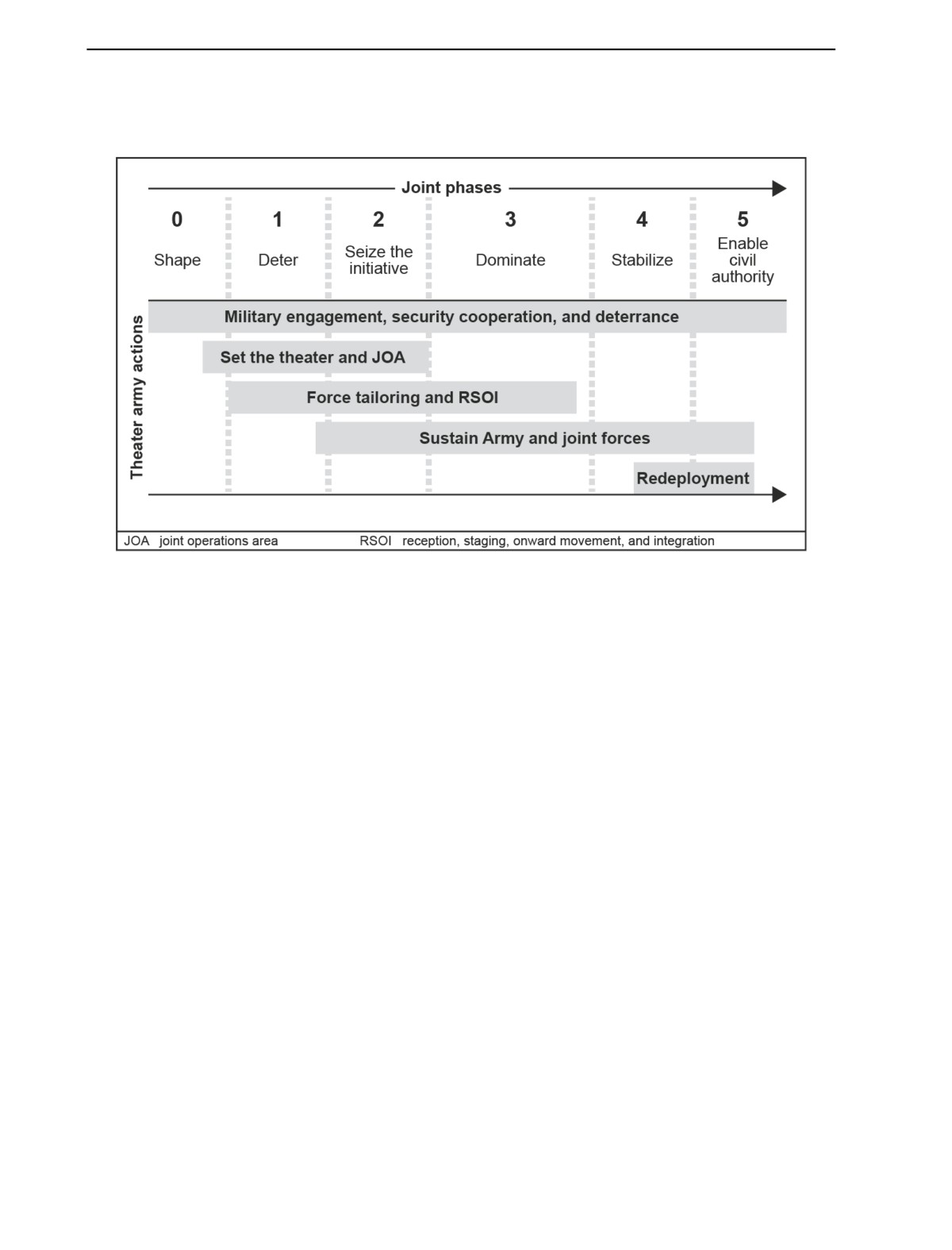
phase zero—shape—within a new equilibrium across the AOR. The theater army plays a key part in the
conduct of campaigns and major operations, illustrated in figure 2-3 on page 2-6.
THEATER ARMY ACROSS PHASES
2-18. The actions of the theater army across phases are examined in more detail in paragraph 2-19 through
paragraph 2-27. Chapter 3 discusses theater army subordinate units that support deployed forces.
Steady State Activities and Phase Zero—Shape
2-19. The shape phase includes missions, tasks, and actions that deter adversaries and assure friends, as
well as establish conditions for possible contingencies. Security cooperation is the predominant activity.
Shape activities are continuous. The combatant commander uses them to improve security within partner
nations, enhance international legitimacy, and gain multinational cooperation. This cooperation includes
information exchange and intelligence sharing, obtaining access for U.S. forces in peacetime and crisis, and
mitigating conditions that could lead to a crisis. The theater army integrates landpower within theater
engagement plans and security cooperation activities. Integrating landpower requires the theater army to
train and prepare assigned forces for operations as well as to coordinate training and readiness requirements
with the Service force providers. Integrating landpower also includes extending the signal and network and
establishing the network that supports operations by the joint force land component. Notably, security
cooperation continues throughout the AOR even as the primary effort within the geographic combatant
command shifts during phase zero to the conduct of a campaign in a portion of the AOR. The ability to
21 April 2014
FM 3-94
2-5
Chapter 2
manage landpower within a campaign while continuing to support AOR-wide steady state activities to
include security cooperation underscores the requirement for a robust theater army.
Figure 2-3. Joint phases and the theater army
Phase One—Deter
2-20. The intent of this phase is to deter an adversary from undesirable actions because of friendly
capabilities and the will to use them. The deter phase is characterized by actions to protect friendly forces
and indicate the intent to execute subsequent phases of the planned operation. The theater army can
implement a number of flexible deterrent options during this phase. With the initial shift of the geographic
combatant command from shaping to deterrence, the theater army priority of effort moves to setting the
AOR and the joint operations area. Most of this initial effort focuses on refining contingency plans and
preparing initial estimates for the landpower needed for flexible deterrent options. As the dimensions of the
crisis take shape, the theater army examines a range of basing and deployment options. When the
combatant commander decides on specific deterrent options, then the theater army begins the process of
tailoring landpower for the deterrent options while refining plans for the full employment of landpower
should deterrence fail to resolve the crisis. As soon as feasible, Army forces attached to the theater deploy,
and the theater army receives, stages, and integrates additional Army forces into the JTF. During this phase,
the theater army develops additional basing requirements. As Army forces deploy into the joint operations
area, the theater army expands its footprint to sustain and protect Army, joint, and multinational forces, as
directed by the GCC. Military engagement, security cooperation, and deterrence continue across the
theater.
2-21. Concurrently with actions intended to confront and deter an adversary, the theater army commander
sets the theater to enable landpower to exert its full capabilities. This includes extending the existing signal
and network infrastructure to accept the land component and its supporting units. Enabling landpower may
include negotiation and contracting through the GCC with adjacent nations to establish tactical staging
bases and realignment of security cooperation efforts based on emerging threats. The theater army requests
not only forces that from the ARFOR involved in deterrence, but also the theater-level units necessary as
the flexible deterrent option expands and as those forces needed for supporting operations if deterrence
fails. An important consideration for the theater army is training for Army forces deployed as a flexible
deterrent option. The theater army works with host-nation officials to develop suitable training facilities
since the deter phase may be very lengthy if it is successful.
2-6
FM 3-94
21 April 2014
The Theater Army
Phase Two—Seize the Initiative
2-22. JFCs seek to seize the initiative through decisive use of joint capabilities. In combat, this involves
both defensive and offensive operations at the earliest possible time, forcing the enemy to react and setting
the conditions for decisive operations. When the JFC determines that joint combat power is sufficient to
seize the initiative, then the theater army’s priority shifts to sustaining and protecting deployed forces in the
joint operations area. However, the theater army continues to request and receive Army forces, and to
expand theater bases in and outside the joint operations area. During this phase the theater army expands
the number and capability of its subordinate commands to meet the demand for operations in the dominate
phase. Military engagement, security cooperation, and deterrence outside the joint operations area continue.
The theater army initiates transition planning for operations beyond the dominate phase.
2-23. During this phase, the theater army begins planning for phases beyond phase two. As early as
possible, the theater army develops plans and requests for forces for approval by the combatant
commander. Planning for the transition beyond the dominate phase requires intensive coordination with the
Department of the Army, supporting theater armies, the ARFOR, and theater-level commands such as the
TSC. The stabilize phase often requires different Army capabilities and headquarters from those required
for the dominate phase. The theater army also begins to develop redeployment plans in conjunction with
the geographic combatant command staff and USTRANSCOM for Army units that will no longer be
required.
Phase Three—Dominate
2-24. This phase focuses on breaking the enemy’s will to resist or, in noncombat situations, to control an
operational environment. Success in the dominate phase depends on overmatching enemy capabilities at the
critical time and place. Operations can range from large-scale combat to various stability operations
depending on the nature of the enemy. In a humanitarian crisis, this requires achieving a level of
effectiveness equal to the demands of host-nation and international agencies for U.S. military support.
Dominate phase activities may establish the conditions to achieve strategic objectives early or may set the
conditions for transition to the next phase of the operation. The theater army’s priority is sustaining Army
and joint forces throughout the dominate phase. During this phase, the number of forces controlled by the
theater army and its capacity reaches its maximum. The theater army staff coordinates with the ARFOR to
identify capabilities required for the stabilize phase. The theater army works with the geographic combatant
command to validate these requirements and transmit them to the Department of the Army and Army
commands. In many campaigns, landpower necessary for the stabilize phase will differ dramatically from
that used in the dominate phase. As the Department of the Army transforms requests for forces into force
requirements, the theater army plans to receive forces identified for stabilization and to enable civil
authority. The staff develops plans for redeployment of forces no longer required in coordination with the
geographic combatant command, JFC, and ARFOR. Military engagement, security cooperation, and
deterrence continue outside the joint operations area.
Phase Four—Stabilize
2-25. The stabilize phase is characterized by a shift in focus from sustained combat operations to stability
operations. These operations help reestablish a safe and secure environment and provide essential
government services, emergency infrastructure reconstruction, and humanitarian relief. The composition of
Army forces continues to evolve. The theater army completes plans and requests forces needed for the
enable civil authority phase. Redeployment begins for forces not needed for this phase. The theater army
adjusts its theater posture in anticipation of new phase zero requirements. In particular, the security
cooperation requirements across the AOR change to meet new realities. Typically, the combatant
commander directs the theater army to plan for the establishment for long-term commitment of joint forces.
This often requires the transfer of theater army assets to a standing joint force, along with the creation of a
standing headquarters capable of controlling Army forces and supporting ARFOR requirements. Military
engagement, security cooperation, and deterrence continue outside the joint operations area.
21 April 2014
FM 3-94
2-7
Chapter 2
Phase Five—Enable Civil Authority
2-26. This phase is characterized by joint force support to legitimate civil governance. The commander
provides this support by agreement with the appropriate civil authority. The purpose is to help the civil
authority regain its ability to govern and administer services and other needs of the population. The theater
army priority shifts to security cooperation under different conditions in the AOR. The theater army
manages Army support of forces remaining in the joint operations area, normally through a new ARFOR
identified and tailored for that purpose. Military engagement, security cooperation, and deterrence continue
outside the joint operations area.
2-27. At the conclusion of the enable civil authority phase, the cycle of phases is complete and the
combatant command resumes its phase zero posture. The environment of the theater of operations in the
new phase zero will be different, and the theater army adapts its activities accordingly.
THEATER ARMY ACTIONS
2-28. Paragraph 2-29 through paragraph 2-46 examine the theater army actions across the campaign in
more detail.
Military Engagement, Security Cooperation, and Deterrence
2-29. In phase zero, GCCs shape their regions through many cooperative actions with partner nations. The
equipment, training, and financial assistance the United States provides to partner nations improve their
abilities to secure themselves. This assistance often improves access to key regions. Security cooperation
communicates U.S. intent and capabilities to potential adversaries in that region. If necessary, combat-
ready Army units deploy to threatened areas to conduct exercises, communicating unmistakable U.S. intent
to partners and adversaries. These are tangible effects of the Army’s role in security cooperation and
assistance. Other benefits are less tangible; these develop through face-to-face training involving U.S.
Soldiers and the soldiers of partner nations. Working together develops trust between military partners. The
impression U.S. Soldiers make upon multinational forces, local leaders, and other government agencies can
produce lasting benefits.
(See ADP 1 and FM 3-22 for more information on shaping and security
cooperation.)
2-30. The theater campaign plan drives security cooperation in each AOR. The theater army has a critical
role in the theater campaign planning process. Theater army and supporting ASCCs participate in
operational planning teams, planning conferences, and the development and implementation of associated
documents. This participation includes conveying Service and DOD requirements to the combatant
command, conveying combatant command equities to their Service, assisting with concept design
(especially tasks and activities supporting theater-level tactical military objectives), determining resources
required to execute activities, and developing a synchronization plan for such activities.
2-31. The theater campaign plan differs from an operational campaign plan. The theater campaign
organizes and aligns operations, activities, events, and investments in time, space, and purpose to achieve a
strategic effect rather than an operational effect. While theater campaign plans have a large component
related to security cooperation, they also address posture, ongoing combat operations where applicable, and
the phase zero component of the combatant command’s contingency planning—or setting and shaping the
theater in which the theater army plays a significant role. The actions and objectives in each area will affect
the other areas; the commander balances actions and objectives carefully to ensure objectives in one area
reinforce those in another area without accidently undermining those of another.
2-32. The theater army, supported by the generating force, is crucial in resourcing and sustaining the
security cooperation activities. The theater campaign plan identifies steady-state force and resource
requirements. The theater army staff identifies and plans for likely deviations from desired requirements in
geographic combatant command contingency plans. The theater campaign can accomplish the following:
z
Integrate shaping (phase zero) actions directly in support of particular contingency plans with
broad shaping and security cooperation activities.
z
Enable DOD to synchronize global strategies with that geographic combatant command set of
contingency plans.
2-8
FM 3-94
21 April 2014
The Theater Army
z
Incorporate the combatant commander’s communication synchronization to convey clear
messages to partners, friends, and adversaries. Connect posture changes to DOD’s global and
regional strategies and provide a vehicle for continuously reassessing posture needs, refining
those needs, and updating DOD and regional posture plans accordingly.
z
Identify and establish intermediate staging bases.
Set the Theater and Joint Operations Area
2-33. The term set the theater refers to a broad range of actions necessary to employ landpower before and
during a crisis. This includes base development, theater opening, RSOI, ASOS, DOD CCSA requirements,
and other sustainment-related support in the AOR. The theater army, in conjunction with its associated
TSC, prepares support and sustainment estimates that outline the responsibilities and requirements for
maintaining access and setting the theater where U.S. military presence is forward stationed or deployed.
The theater army executes many of these responsibilities through the TSC—some during phase zero, and
other actions in the deter phase. Setting the theater may also involve—
z
Providing flexible Army headquarters to meet various joint command and control requirements.
z
Providing force protection.
z
Forward-stationing and rotational deployment of Army forces.
z
Modernizing forward-stationed Army units.
2-34. The theater army and its supporting commands assess the adequacy of infrastructure in the AOR to
support anticipated military operations, determine requirements for additional infrastructure, and manage
infrastructure development programs assigned to Army forces for execution. The theater army develops
these plans and its assigned TSC in close collaboration with the combatant command’s J-4 and the Army
Corps of Engineers. Infrastructure development activities may include identifying requirements for forward
basing and air, land, and sea transit rights through the sovereign territories of partner or neutral nations
within the AOR. The Army identifies the requirements for basing and transit rights needed to support
landpower. However, the Department of State and the appropriate U.S. diplomatic mission must negotiate
bilateral or multilateral agreements.
2-35. As the combatant commander shifts priorities to a specific nation or region in the AOR, the theater
army focuses on setting the joint operations area. In conjunction with the geographic combatant command
staff and interagency partners, the theater army identifies bases in the joint operations area for logistics,
medical support, protection, and infrastructure development. The functions inherent in setting the joint
operations area include identifying responsibility for ASOS and agencies, land transportation, inland
petroleum pipeline operations, and common-user logistics. The associated functions of theater opening,
port and terminal operations, and RSOI of Army and joint forces are critical to the initiation of military
operations in the joint operations area.
2-36. The theater army also prepares to support joint command and control in the joint operations area.
Army contributions to joint command and control include establishing, maintaining, and defending the
communications and network architecture to support Army and joint forces operating within the joint
operations area, and maintain connectivity between land-based forces and the rest of the AOR. The Army is
designated as the DOD CCSA for theater communications and network architecture. Army forces execute
the responsibilities primarily through the signal command (theater) assigned to support the AOR.
2-37. Theater communications support is rapidly evolving. Cyberspace operations consist of DOD
information networks (formerly known as the Global Information Grid), and network operations, enterprise
management, network defense, and content management. Cyberspace operations provide network and
information system availability, information protection, and information delivery across strategic,
operational, and tactical boundaries. This includes a full range of defensive capabilities and when necessary
actions actively taken to defeat cyberspace threats.
2-38. At the joint level, cyberspace operations are operational missions accomplished by the commander,
USCYBERCOM (a subunified command of USSTRATCOM). This commander provides the command
and control as well as situational awareness required to operate and defend DOD information networks.
Army Cyber Command, as the ASCC USCYBERCOM, extends the command and control of the network
21 April 2014
FM 3-94
2-9
Chapter 2
through its OPCON relationship with each theater network operations and security center and through the
Army orders process to each of the signal commands (theater).
Tailor Army Forces
2-39. Force
tailoring
combines two complementary
force tailoring
requirements—selecting the right forces and deploying the
The process of determining the right
forces in the optimum sequence. The first—selecting the right
mix of forces and the sequence of
force—involves identifying, selecting, and sourcing required
their deployment in support of a
Army capabilities and establishing their initial task organization
joint force commander. (ADRP 3-0)
to accomplish the mission. The result is an Army force package
matched to the needs of the combatant commander. The force package can accomplish little until deployed.
The second requirement of force tailoring establishes order of deployment for the force package, given the
available lift and the combatant commander’s priorities. The U.S. Army Reserve, through augmentation
staff aligned to each theater, facilitates force tailoring. For example, U.S. Army Reserve augmentation to
the staff facilitates theater-level coordination with other government agencies and nongovernment agencies
for security cooperation. Tailoring the force is a complicated and intensively managed Army-wide process
and the theater army plays a critical role in it.
2-40. The majority of Army conventional operating forces
Service retained forces
is designated as “Service Retained” forces in the Global
Those operating forces not assigned to a
Force Management Implementation Guidance assignment
combatant command by the “Forces for
tables and is primarily based in the CONUS. FORSCOM,
Unified
Commands Memorandum.”
the largest of the Army commands, commands Active
These forces remain under the
Component conventional forces (Regular Army, mobilized
command of the Secretary of the Army,
Army National Guard, and mobilized Army Reserve);
exercised through Army commands, until
executes training and readiness oversight of Army National
allocated by the Secretary of Defense to
a combatant commander through the
Guard forces under state command; and does the same for
joint global force management process.
nonmobilized Army Reserve units.
2-41. Based upon the landpower requirements developed by the theater armies and validated by the Joint
Staff, the Department of the Army and FORSCOM develop force packages based on cyclical readiness.
This is the ARFORGEN process. This includes forces for contingencies and forces needed to support
security cooperation activities. Wherever possible, the Department of the Army identifies regionally
aligned forces that concentrate on missions and capabilities required for a particular AOR. The regionally
aligned forces begin planning for their mission in conjunction with the theater army staff. The tailored force
package is task-organized by FORSCOM to facilitate strategic deployment and support the gaining JFC’s
operational requirements. FORSCOM is not the sole provider of Army forces; other supporting ASCCs
may contribute forces. The result is a set of trained and ready Army forces intended either for contingencies
or for planned deployments, such as a rotation of forward-based forces.
2-42. The theater army works closely with FORSCOM to match the composition of the force with the
forces identified in theater engagement plans, security cooperation plans, or contingency plans for a crisis.
FORSCOM modifies force packages as needed. The theater army commander identifies the major task
organization and pre-deployment training required for the mission. FORSCOM then modifies force
packages and training as needed. Whenever possible, FORSCOM (or the supporting ASCC) attaches forces
to its gaining higher headquarters during deployment (for example, BCTs to a different gaining division
headquarters). If geography or the sequence of deployment makes this impractical, the theater army
executes task organization changes when forces arrive in the AOR. The gaining theater army commander
modifies ADCON as required based upon the organization of the JTF and the support structure available in
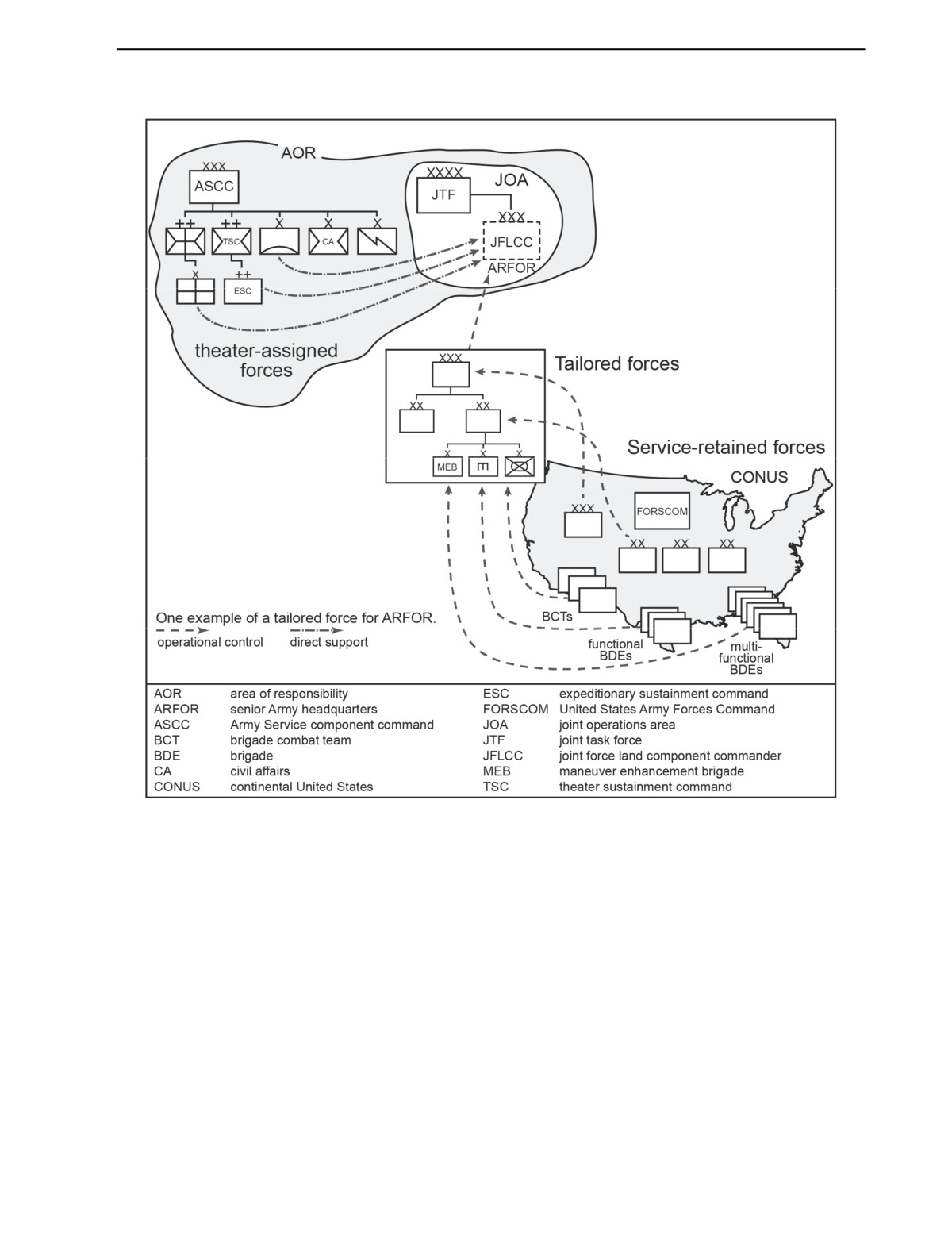
the theater. Figure 2-4 illustrates force tailoring.
2-10
FM 3-94
21 April 2014
The Theater Army
Figure 2-4. An overview of force tailoring
2-43. The theater army also recommends the optimum deployment sequence for Army forces to the
geographic combatant command staff. The geographic combatant command staff may modify this
recommendation in coordination with FORSCOM and USTRANSCOM, based upon factors such as
available lift, location and readiness of deploying forces, and surface transportation requirements. Since the
initial deployment may not match the situation developing in the joint operations area, the theater army
refines the task organization based upon the ARFOR requirements. The theater army adjusts support
provided by theater assets to match the requirements of the forces on the ground.
2-44. In addition to forces allocated to the JFC from FORSCOM and supporting ASCCs, theater armies
provide Army forces from theater-assigned forces. Army sustainment units
(logistics and medical)
normally have a support relationship with the deployed Army forces in the joint operations area. Other
Army theater forces such as military police, aviation, engineers, or civil affairs units may be attached or
OPCON to divisions or corps headquarters. Other units remain OPCON to the theater army and provide
direct or general support to the ARFOR. (See chapter 4 and chapter 6 for additional detail.)
21 April 2014
FM 3-94
2-11
Chapter 2
2-45. The organization established in force tailoring is not necessarily the same as the task organization for
combat. It is a macro-level organization established to control the forces through deployment and RSOI.
The gaining operational commander, typically the JFLCC, modifies this organization depending upon the
situation. Once deploying Army forces have completed RSOI, the OPCON passes to the JFC and gaining
functional component commander in the joint operations area. That commander further task-organizes the
force for land operations as needed. (See ADRP 6-0 for a discussion of task organization.)
Reception, Staging, Onward Movement, and Integration
2-46. Except for forcible entry operations, Army forces arrive in theater via the most efficient use of
available lift. Almost all personnel move by airlift, and 95 percent of their equipment and supplies move by
sea. The process of reassembling personnel, equipment, and supplies is RSOI. The theater army normally
assigns RSOI to the TSC and its attached ESC. Upon arrival in the AOR, attachment of the unit transfers
from the supporting commander (usually FORSCOM) to the theater army. The theater army passes
TACON of the unit to the ESC or other Army headquarters responsible for RSOI. Upon arrival of the
deploying unit’s chain of command, the theater army and gaining operational commander establish a
relationship of direct liaison authorized in order to facilitate communications and planning. The ESC
receives personnel and equipment at the joint theater base established in or near the joint operations area
(reception). When the unit is fully assembled, it moves as a unit to a designated assembly area within the
joint operations area (staging). At this point the ESC transfers OPCON to the gaining JFC or joint
functional command, and the theater army reassigns ADCON to the ARFOR in the joint operations area
(integration). (For a detailed discussion of RSOI, see JP 3-35 and FM 3-35.)
SUSTAIN ARMY AND JOINT FORCES
2-47. The Department of the Army is responsible for raising, training, equipping, disciplining, and
sustaining Army operating forces. These functions are Title 10 or ADCON functions. The administrative
chain of control passes from Department of the Army directly to the theater army for Army forces under
the COCOM of that geographic combatant command. Unless modified by Department of the Army, the
theater army provides ADCON of all Army forces assigned, attached, or OPCON to the geographic
combatant command, including those forces engaged in exercises and training. The theater army also is
responsible for the readiness and training of Army forces stationed in the AOR. It coordinates training and
readiness requirements for any forces identified for deployment to the AOR with their parent Army
commands or supporting ASCC.
2-48. Sustainment of Army forces under OPCON of a JTF remains a primary responsibility of the theater
army throughout all phases of a campaign. The theater army sustains the deployed forces by reinforcing the
organic sustainment capability of modular Army brigades and headquarters with theater army assets
dedicated to logistics, health service support, and personnel services. The deployed ESC and sustainment
brigades normally support on an area basis, utilizing a joint support area and bases distributed in the joint
operations area. Sustainment may be augmented through an intermediate staging base located outside the
joint operations area. (See ADRP 4-0 for a discussion of bases.)
2-49. The overarching consideration for all sustaining operations is to relieve the corps, division, and
brigade headquarters as much as possible of the requirements for managing sustainment across the joint
operations area. This grants the land commander greater flexibility to employ modular brigades using
mission orders across large areas. It also facilitates rapid changes in OPCON between Army units and joint
force headquarters.
Logistics and Personnel Support
2-50. The TSC manages logistics and personnel support across the entire AOR. One or more ESCs,
attached to the TSC, provide logistics and personnel support within the joint operations area. The ESC
provides logistics support by combining logistics and personnel support units into task-organized,
multifunctional sustainment brigades. The ESC and its attached sustainment brigades deploy to the joint
operations area, normally in direct support of the ARFOR. The sustainment brigades provide support on an
area basis to units of the ARFOR and other joint forces. Paragraph 2-51 through paragraph 2-54 discuss the
exceptions.
2-12
FM 3-94
21 April 2014
The Theater Army
2-51. There are several options for command of logistics units, depending upon the geography and
distribution of forces within the JTF. The most flexible option retains command in the logistics
organization and provides logistics support on an area basis. The ESC is attached to the TSC and remains
under its OPCON. All sustainment brigades remain attached to the ESC. With the concurrence of the JFC,
the TSC places the ESC in an appropriate support relationship to the deployed ARFOR. The support
relationship will vary according to sustainment requirements within the joint operations area.
2-52. In high intensity combat, the ESC will provide direct support to the ARFOR, and its sustainment
brigades will provide direct support to the tactical units specified by the ARFOR. For example, large-scale,
high-tempo corps operations with rapidly changing tactical situations require decentralized logistics
support. The ESC, placed in direct support of a corps, normally places one task-organized sustainment
brigade in direct support of each committed Army division while one or more sustainment brigades
continue to provide general support to other forces in the operational areas outside the committed divisions’
area of operations. The corps commander plans for this option when the scheme of maneuver and division
task organization will produce very fluid maneuver and a rapidly changing situation. This will be the case
during attack, pursuit, and exploitation, or in a mobile defense. A variant of this option places a sustainment
brigade under OPCON of a division for detached operations. This may be the situation when an Army
division is conducting operations at a great distance from the rest of the corps, and its operations are
distinctly different from the remainder of the force. For example, an Army division may be defending
within a different area of the joint operations area while the remainder of the land component initiates
offensive operations.
2-53. In a protracted, stability intensive operations, the ESC will be in general support, with sustainment
provided on an area basis from established operating bases to joint, multinational, and Army units. The
ESC adjusts the size and composition of the individual sustainment brigades based on the density of Army
and joint forces drawing logistics support within the distribution radius of that sustainment brigade.
2-54. The JFC may centralize sustaining operations within the joint operations area. This arrangement may
support a multi-corps land force with a large contingent of Marine Corps and multinational forces. The JFC
establishes a joint logistics task force built around a sustainment command and subordinates Marine Corps
sustainment units and Army sustainment brigades to it. For the Army units at brigade and below, this
arrangement is largely transparent; they continue to receive support on an area basis. However, it permits
greater flexibility at the joint level to address competing priorities for logistics by Army, Marine Corps,
multinational forces, and SOF.
Health Service Support
2-55. The MEDCOM (DS) provides health service support for the deployed joint force on an area basis.
Army medical units form the backbone of a highly integrated joint medical support and evacuation system
that provides advanced medical care to all deployed joint forces, interagency personnel, and any
multinational forces specified by the combatant commander. The MEDCOM (DS) oversees AOR-wide
health service support and exercises OPCON of deployed medical units through its operational command
post. The operational command post commands one or more medical brigades, which in turn control
multifunctional medical battalions. The medical units subordinate to the medical brigade (support) can
include hospitalization, medical regulating and evacuation, dental services, laboratory services, veterinary
services, combat operational stress control, treatment, preventive medicine, and medical logistics. Medical
units will normally locate within joint and Army bases. The distribution and capability of medical units
depends upon the density of U.S. forces, available infrastructure, and evacuation capabilities. The
MEDCOM (DS) may place a task-organized medical unit in direct support of an Army division involved in
high-intensity, fluid combat operations or entry operations.
VERY LARGE-SCALE COMBAT OPERATIONS
2-56. Very large-scale combat operations may require the U.S. Army to conduct land operations with
multiple corps-sized formations, either as part of as part of a mature theater of war or under a joint or
multinational command. This could require a theater army headquarters to expand and transform into an
operational land headquarters (field army equivalent) exercising command over multiple Army corps and a
Marine expeditionary force. This is the original purpose of numbered armies and the role performed by
21 April 2014
FM 3-94
2-13
Chapter 2
Third U.S. Army in both Operation Desert Storm and Operation Iraqi Freedom I. In this case, U.S. Army
corps would operate as tactical headquarters alongside Marine expeditionary forces. Such a campaign may
include large multinational forces and would operate under a joint or multinational land component. In
order to assume this role, the theater army requires extensive augmentation and time to assimilate not only
the personnel, but also the additional responsibilities. For example, before Operation Iraqi Freedom I, Third
U.S. Army (part of USARCENT) received approximately 70 Marine Corps staff officers to enable it to
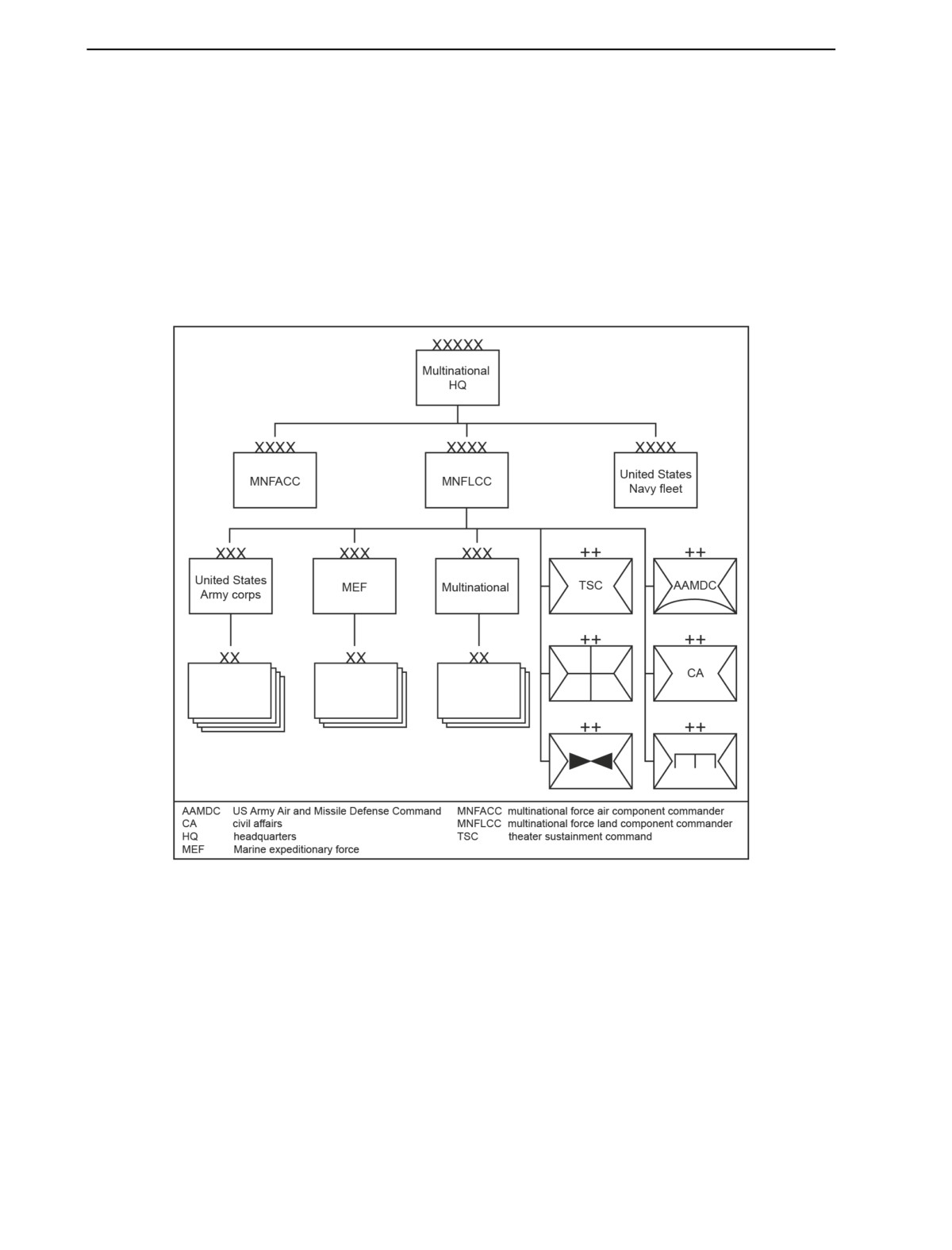
control the Marine expeditionary force. Figure 2-5 illustrates a theater army in the role of a multinational
forces land component. If designated as a multinational forces land component, the Army headquarters will
follow joint doctrine contained in JP 3-31 and JP 3-16. Note that in such a campaign, theater-level
commands (such as the TSC and Army air and missile defense command [AAMDC]) may deploy into the
joint operations area to control several functional support brigades.
Figure 2-5. Theater army as a multinational force land component in a theater of war
2-57. The field army (when constituted) performs operational ARFOR tasks and is the Army component of
the joint force to which it is assigned. A field army, specifically tailored to the mission requirements, may
be assigned to a JFC with an enduring operational requirement. Typically, a subunified command is
established instead of a JTF when the military operation is anticipated to be enduring or protracted. In this
case, a field army would be appropriate as the Army component or ARFOR to the subunified command.
2-58. The theater army exercises ADCON over the field army and its subordinate Army forces, and it
provides the field army and its JFC with all Army Service functions. This includes Title 10, common-user
logistics, ASOS, and Army executive agent responsibilities, and sustainment and medical support for Army
and joint forces operating in the joint operations area or the theater of operations where the field army is
assigned. At the direction of the GCC, the theater army may delegate execution authority to the field army
for specified Army service functions.
2-14
FM 3-94
21 April 2014
The Theater Army
2-59. The situation on the Korean Peninsula is an example of an enduring military operation for which the
United States established a subunified command
(United States Forces, Korea) as the joint force
headquarters, instead of a JTF. Until the situation in the Republic of Korea is further resolved, the U.S.
Army will retain a unique structure on the Korean Peninsula. Eighth U.S. Army will serve as the forward
deployed field army headquarters and ARFOR to United States Forces, Korea or its successor joint and
combined forces headquarters. Eighth U.S. Army is configured and would be staffed to provide an
operational capability for Army forces engaged in multinational operations. Eighth U.S. Army remains
under the ADCON of USARPAC for most Army Service functions.
DEFENSE SUPPORT OF CIVIL AUTHORITIES
2-60. Two geographic combatant commands, USNORTHCOM (also known as NORTHCOM) and
USPACOM (also known as PACOM) have responsibility for DSCA. The majority of DSCA falls to
USNORTHCOM with responsibility for the 48 continental United States, Alaska, and the U.S. possessions
in the Caribbean. USPACOM accomplishes DSCA missions in Hawaii, U.S. territories, and U.S.
possessions in the Pacific Ocean.
2-61. USARNORTH has unique responsibilities focused on homeland defense, homeland security, DSCA,
and theater security cooperation. Its responsibilities include the 48 continental United States, Alaska, and
the Caribbean territories of the United States. Within this vast area, USARNORTH prepares deliberate
contingency plans for homeland defense, DSCA, and theater security cooperation. It conducts operations in
close coordination with the Department of Homeland Security. USARNORTH maintains defense
coordinating officers and defense coordinating elements in each of the ten Federal Emergency Management
Agency regions.
2-62. Because the domestic operational environment is so unique, many tasks performed by
USARNORTH and USARPAC in support of domestic authorities are distinct. The two most important
differences distinctions are the legal limitations imposed on federal forces operating within the United
States and the different command structure for units of the National Guard. To highlight the most important
differences, Regular Army forces may not directly enforce the law, although they may provide equipment
and training for law enforcement agencies. National Guard forces remain under state command. National
Guard forces operate in parallel with federal military forces but under a distinct state chain of command.
There are exceptions. JP 3-28 and ADRP 3-28 provide extensive discussions about the unique requirements
of DSCA missions.
THEATER ARMY HEADQUARTERS
2-63. The theater army headquarters divides its staff focus among AOR-wide control, support of Army
forces, and ADCON of Army and joint forces within an active joint operations area. The staff will continue
to plan, prepare, and assess military engagement, security cooperation, and deterrence outside the joint
operations area. Simultaneously, the staff will focus on support of Army, joint, and multinational forces
inside a joint operations area. Because each geographic combatant command is unique, each theater army
will have unique methods for organizing its headquarters to address these challenges.
MAIN COMMAND POST
2-64. The theater army main command post has limited operational responsibilities for Army forces
operating in a joint operations area; however, it provides support such as intelligence analysis and long-
range planning. The theater army main command post is the location for both routine day-to-day operations
as well as crisis action planning. The main command post is typically both a day-to-day headquarters as
well as an operational-level command post. For example, the regionally focused military intelligence
brigade collects against threats and adversaries in the AOR. It also provides all-source intelligence
concerning the threat and civil considerations to the theater army and other U.S. forces operating in the
AOR, as required. The TSC provides sustainment (less medical) for all Army forces forward-stationed,
transiting, or operating in the AOR, including those Army forces assigned or under OPCON to JTFs
operating in joint operations areas established in that AOR. In addition, the TSC provides ASOS, other
government agencies, common-user logistics, and other specific requirements established under specific
21 April 2014
FM 3-94
2-15
Chapter 2
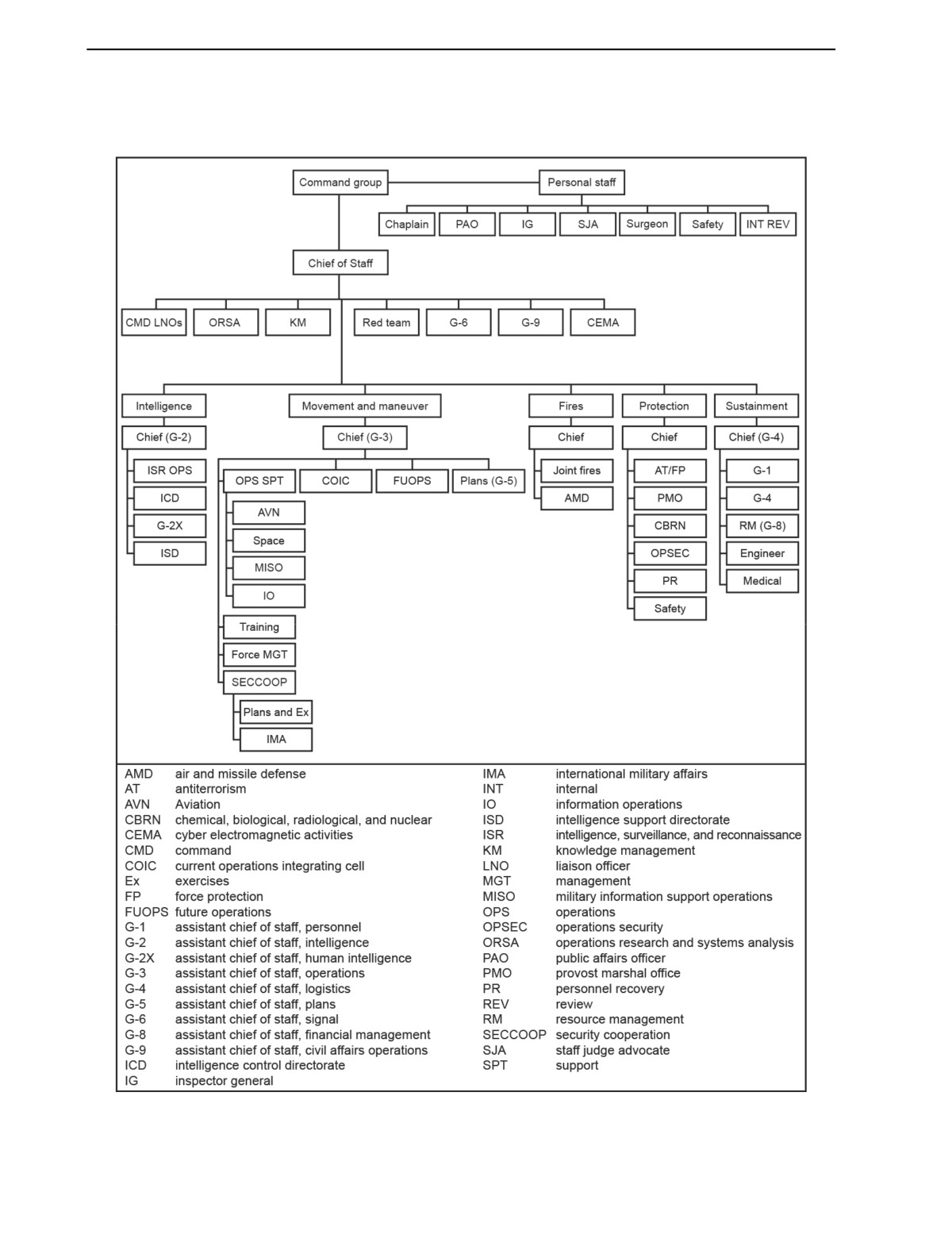
operation plans (OPLANs) or contingency plans and Army CCSA agreements. (Figure 2-6 depicts the
organization of a main command post.)
Figure 2-6. Theater army main command post organization
2-16
FM 3-94
21 April 2014
The Theater Army
2-65. The theater army oversees AOR-wide contingency planning and coordination, including developing
and maintaining operation and contingency plans, updating regionally focused intelligence estimates, and
updating Service-specific support plans to the geographic combatant command theater campaign plan. The
theater army collaborates with divisions, corps, or other designated Army headquarters assigned to execute
major exercises in the AOR or to execute specific operation or contingency plans. It also collaborates with
those headquarters aligned with the geographic combatant command for planning purposes. In particular,
the theater army contributes its considerable regional expertise (including cultural factors and regionally
focused intelligence and cyber threat estimates) to the collaborative planning process with division or corps
headquarters preparing to conduct operations in the AOR.
2-66. The main command post is primarily a planning and coordination element. It develops and maintains
OPLANs, contingency plans, and Service supporting plans for the combatant commander’s theater
campaign plan. The main command post may control Army forces involved in operations, training
exercises, and other security cooperation activities. It also coordinates collaborative planning with any
Army headquarters designated to deploy within the AOR. This collaborative planning facilitates the
transition of existing operation and contingency plans into the incoming headquarters’ own operation
orders for execution. The main command post provides planning support to the contingency command post
when it deploys command forces involved in limited contingencies or to participate in exercises and other
theater security cooperation activities.
2-67. The main command post also manages the support given Army, joint, and multinational forces
deployed to joint operations areas established in the AOR. This support includes theater opening, RSOI,
common-user logistics, and other Services associated with Army CCSA responsibilities. Most of these
responsibilities are sustainment related and performed through a subordinate TSC or deployed ESC.
2-68. The plans-to-operations transition across the integrating cells (current operations integrating cell,
future operations cell, and plans cell) in the main command post differs from a corps or division
headquarters. For example, in phase zero, the G-5 staff, with the support of an operational planning team
element, prepares the Army portions of the geographic combatant command’s theater engagement, security
cooperation, and contingency plans. The training section of the G-3 may plan exercises and readiness tests,
while the current operations integrating cell monitors exercises, deployment, and redeployments in
progress. In phase two, the plans cell supports campaign planning. The future operations cell prepares plans
and orders for flexible deterrent options, and the current operations integrating cell will monitor the AOR
and deployment of Army forces outside the AOR. The current operations integrating cell will control the
in-theater activities such as RSOI and air and missile defense activities as well as establish direct liaison
authorities between deploying Army headquarters. By phase three, the plans cell will be refining phase four
plans and preparing initial estimates for the transition to stabilization and post-campaign posture. The chief
of staff reorganizes the staff to obtain the necessary liaison and planners from the supporting commands,
while adjusting the priorities for the integrating and functional cells. The chief of staff also determines the
individual augmentation requirements for the staff and ensures that requests for additional specialists go to
the Department of the Army.
2-69. Throughout the campaign, the chief of staff and commander monitor the stress on the mission
command warfighting function created by current operations in the active joint operations area, and they
monitor the need to maintain an AOR-wide perspective. Although their priorities are the support of Army
forces committed in combat, they exercise mission command and shift the detail and method of support
onto their subordinate commands. The chief of staff and commander maintain a balance between the needs
of the JTF and the needs of the post-conflict theater.
CONTINGENCY COMMAND POST
2-70. The contingency command post enables the theater army to conduct small-scale operations. This may
include command of up to two BCTs or their equivalent for 30 days. Environments for these operations
vary from peaceful and permissive through uncertain to hostile. Employing the contingency command post
for an assigned mission involves a trade-off between the contingency command post’s immediate
responsive capability and its known limitations. These limitations address the scale, scope, complexity,
intensity, and duration of operations that it can effectively command without significant augmentation. The
contingency command post includes a command group, a personal staff section, and intelligence,
21 April 2014
FM 3-94
2-17
Chapter 2
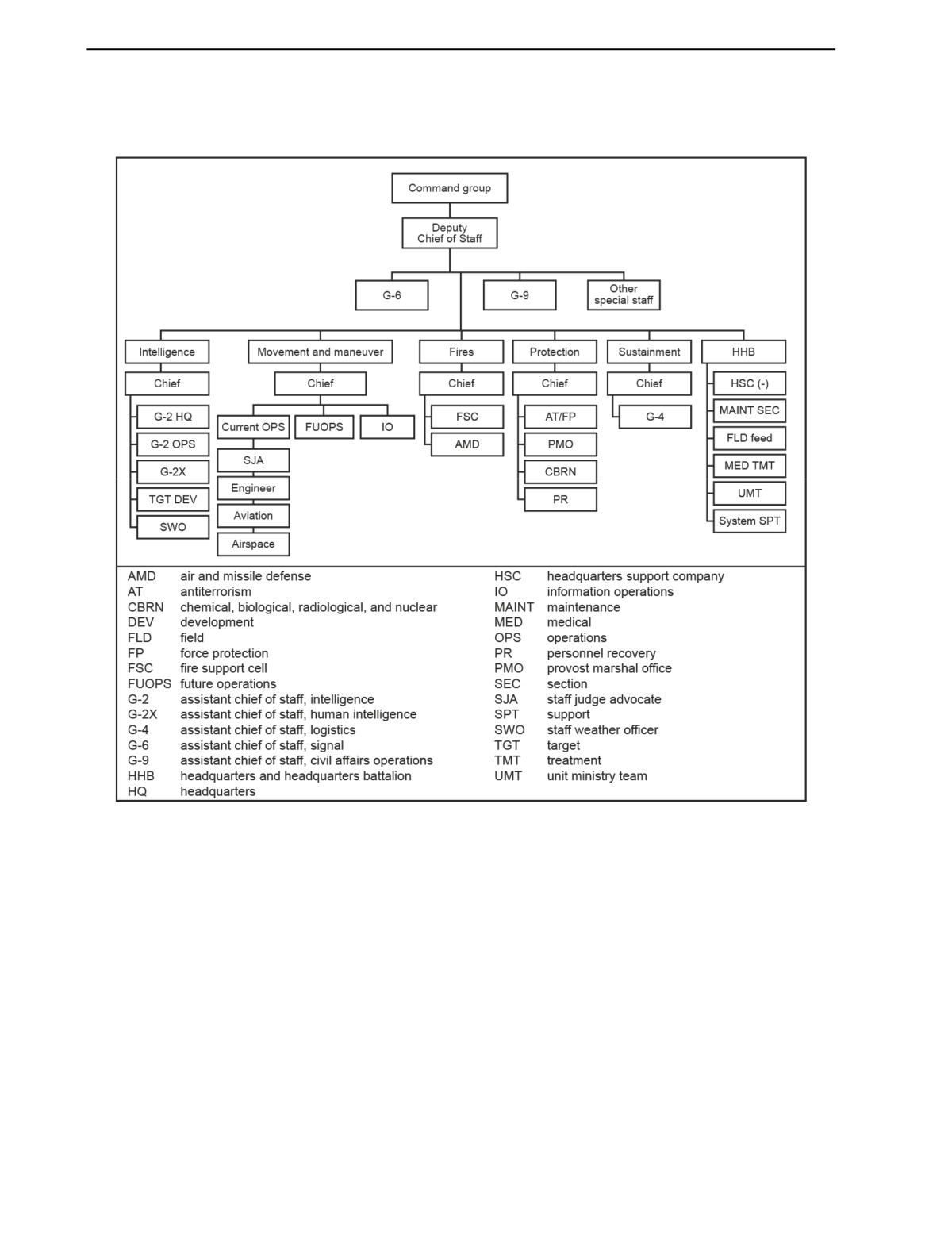
movement and maneuver, fires, protection, and sustainment cells depicted in figure 2-7. The headquarters
support company of the HHB provides support to the contingency command post when deployed.
Figure 2-7. Theater army contingency command post organization
2-71. The contingency command post is organized with a command group, support and security elements
from the HHB, and a staff organized under the same five functional cells found in the main command post
organization. Unlike the main command post, the contingency command post is organized with only two of
the three integrating cells—a robust current operations integrating cell and a small future operations cell.
The contingency command post depends upon the main command post for long-range planning and special
staff functional support, if required. The contingency command post staff can access and employ joint
capabilities (such as fires, intelligence, and signal) and coordinate additional required capabilities through
the main command post. The contingency command post special staff normally includes personnel from the
main command post’s knowledge management and public affairs sections. Sometimes the special staff may
include representatives from other special staff elements based on the assessment of the operational
variables.
JOINT TASK FORCE HEADQUARTERS
2-72. The combatant commander may use the theater army contingency command post as the nucleus of a
small JTF headquarters. The contingency command post receives additional personnel based upon a joint
2-18
FM 3-94
21 April 2014
The Theater Army
manning document or individual augmentation requests for Army and other Service forces to accomplish
the mission. The contingency command post is a viable option for short notice and limited duration
operations because of its established internal staff working relationship. This capitalizes on the contingency
command post’s flexibility and rapid deployment. The contingency command post is deployable by C-130
(intratheater) aircraft. The contingency command post receives joint augmentation from the geographic
combatant command in accordance with a joint manning document for that specific mission.
2-73. The theater army provides the geographic combatant command with a deployable command post
element for contingencies that develop in the AOR. If a humanitarian crisis occurs simultaneously with a
campaign, the only headquarters available may the theater army’s contingency command post. The theater
army commander and chief of staff should maintain the integrity of the contingency command post during
the campaign for this eventuality. However, the contingency command post should redeploy as soon as
adequate Army headquarters are operational.
HEADQUARTERS AND HEADQUARTERS BATTALION
2-74. The theater army HHB provides administrative and sustainment support to the theater army
headquarters and contingency command post when the contingency command post deploys. The HHB
commander, staff, and three companies assist the theater army commander and staff in the areas of
administration, logistics, deployment, redeployment, life support, command post operations, and
coordination for area security. The HHB receives direction from the theater army chief of staff. The HHB
includes a command group, an S-1 section, an S-2 and S-3 section, an S-4 section, unit ministry teams, a
headquarters support company, an operations company, and the intelligence and sustainment company.
Figure 2-8 on page 2-20 shows the organization of the HHB.
2-75. The headquarters support company is composed of a company headquarters section, the HHB staff,
and the food service, medical treatment, and maintenance sections. This company—designed to deploy
with the contingency command post—provides sustainment support and commands the local security
section provided by an outside organization. Personnel assigned to the headquarters support company
include the commander and deputy commander sections, commander’s personal staff, chief of staff section,
special staff, HHB staff, contingency command post command group, contingency command post special
staff, and contingency command post support sections. The headquarters support company commander is
designated as the headquarters commandant for the deployed contingency command post. The headquarters
support company commander is responsible for administrative and sustainment support for the
headquarters as well as planning and commanding the access control, perimeter defense, and reaction
forces.
2-76. The operations company includes a company headquarters and the movement and maneuver, fires,
protection, G-6, G-9, and CEMA staff elements. The intelligence and sustainment company includes a
company headquarters section and the personnel assigned to the intelligence and sustainment functional
cells.
21 April 2014
FM 3-94
2-19
Chapter 2
Figure 2-8. Theater army headquarters and headquarters battalion organization
2-20
FM 3-94
21 April 2014
Chapter 3
Theater-Level Commands and Units
ASSIGNED AND ALIGNED THEATER FORCES
3-1. Each theater army has assigned theater-level forces for enabling capabilities (sustainment, signal,
medical, military intelligence, and civil affairs) based on specific requirements for the AOR. These
commands and brigades perform theater army tasks to support a joint operations area. The TSCs or ESCs
perform the majority of these tasks, normally through a support relationship to the ARFOR in the joint
operations area. The theater army tailors additional functional or multifunctional support brigades based on
mission variables. Divisions and corps then employ these supporting brigades as needed. The command
and support relationships for these organizations differ depending on the specific requirements of each
AOR.
3-2. Each theater army has assigned Army forces that enable it to support military engagement, security
cooperation, and deterrence for that geographic combatant command. These units allow the theater army to
support Army forces operating in the AOR and extend ASOS, interagency partners, and multinational
forces. The size and composition of assigned forces vary based on the continuing requirements for Army
support. Figure 3-1 illustrates a range of typically assigned forces. Not every theater army will have the
forces shown. Not every theater army will have these units assigned. In some cases, a brigade is assigned to
an Army command (or direct reporting unit), and aligned to the theater army. In other cases, the theater
army has a brigade in lieu of a full command. In each case, the aligned command or brigade is not part of
the force pool but is committed to the supported theater army and is integrated in all theater planning.
Figure 3-1. Example of theater commands and brigades
Note. Theater-level units in the Reserve Components are regionally aligned but not assigned to
theater armies. For example, most of the civil affairs brigades are in the Army Reserve. When
mobilized, these units are attached by a DOD order to their gaining geographic combatant
command. Upon attachment, the theater army exercises OPCON over them. This is the case with
all theater army units in the Reserve Components.
THEATER SUSTAINMENT COMMAND
3-3. Normally, one TSC is assigned to each theater army. Each theater army (less USAFRICOM) has an
assigned TSC. USAFRICOM receives theater sustainment support from USEUCOM. The theater army
provides support to Army forces and common-user logistics to other Services as directed by the combatant
commander and other authoritative instructions. The TSC is the Army’s senior logistics headquarters
within the AOR. When directed, the TSC provides lead service sustainment and executive agency support
for designated logistics and services to other government agencies, multinational forces, and
nongovernmental organizations. The TSC concentrates on strategic and operational sustainment
management. The command ensures the information flow from strategic deployment, distribution, and
sustainment partners is accurate, timely, and adequate to support the actions of the theater sustainment
21 April 2014
FM 3-94
3-1
Chapter 3
forces providing movement control for RSOI and all other sustaining operations. The TSC coordinates
strategic and operational distribution through its distribution management center. The TSC ensures that an
integrated and responsive theater-level distribution system is employed to anticipate and respond to theater
army requirements. The TSC will receive and deploy an ESC when it determines that a forward command
headquarters is required. The ESC will employ sustainment brigades to execute theater opening, theater
sustaining, and theater distribution operations. Generally, when two or more sustainment brigades deploy to
a joint operations area, the Army tailors the TSC with an ESC. Figure 3-2 depicts a TSC. (See ATP 4-94.)
Figure 3-2. Example of theater sustainment command
Expeditionary Sustainment Command
3-4. For each joint major operation or campaign requiring substantial commitment of Army forces, at
least one ESC is attached to the TSC. The ESC commands attached sustainment units in a land area of
operations defined by the JFC. The ESC extends the ability of the TSC to manage logistics and personnel
support by becoming the forward-deployed sustainment headquarters in the joint operations area.
Additional ESCs may be attached to the TSC if the combatant commander establishes a JSA or staging
base. Depending on the command structure within the theater, ESCs may support specific Army forces
within a joint operations area or support other ESCs and sustainment brigades with theater opening or
theater distribution capabilities. In most cases, the ESC will provide direct support to the ARFOR. In
certain circumstances, the ESC may be under OPCON of a corps, ARFOR, or JTF as required by an
appropriate order. It may serve as a basis for an expeditionary command for joint logistics when required
by the combatant commander or JFC. The ESC concentrates on synchronizing operational-level sustaining
operations to meet the day-to-day and projected operational requirements of the supported force. It
accomplishes this, in part, by establishing mid-range and short-range planning horizons derived from the
supported commanders OPLAN, commander’s intent, commander’s critical information requirements,
tempo, and distribution system capacity. The ESC supports the deployed force while the TSC maintains
AOR-wide focus. The expeditionary capability of ESCs becomes critical when multiple JTFs operate
within the AOR.
3-5. The theater army attaches sustainment brigades to the ESC. The ESC, when deployed, normally
assumes command of all Army sustainment units (less medical) that are not organic, assigned, or attached
to a brigade within that area of operations or joint operations area. Deployment of the ESC improves
3-2
FM 3-94
21 April 2014
Theater-Level Commands and Units
logistics and personnel support by placing the ESC in proximity to the supported force. When given a
regional focus by the Army, the ESC can refine that portion of the TSC logistics preparation of the theater
for the JFC. The ESC normally establishes its command post near the ports of debarkation from which it
can effectively control both reception and sustaining operations. This location may be a secure base within
the joint operations area or in the JSA. The ESC is responsible for theater opening, including the execution
of port and terminal operations and RSOI.
3-6. The theater army commander normally specifies an Army support relationship between the ESC
(supporting commander) and the ARFOR (supported commander). This is normally direct support. When
conditions warrant, the ESC may pass to the OPCON or TACON of a corps, ARFOR, or JTF. When the
ESC provides direct support to the ARFOR, it subordinates units of the ARFOR on an area basis. For
example, a sustainment brigade supports all Army units within a division’s area of operations and provides
Army support to agencies and other Services, regardless of task organization. Operational and tactical
requirements vary as will command and support relationships between supporting and supported units. (See
Parts Three and Four.)
Sustainment Brigade
3-7. The theater army commander and TSC commander task-organize sustainment brigades for the
campaign. Each sustainment brigade is a multifunctional sustainment organization with a flexible, modular
headquarters organization capable of accomplishing multiple sustaining missions. Each sustainment
brigade is a key organization in linking sustainment support from the operational to tactical levels. It can
provide a full range of logistics and personnel services to supported units. The number of CSSBs attached
to the sustainment brigade varies with the task organization established by the ESC commander.
Subordinate units of the sustainment brigade may include CSSBs, functional logistics battalions, and
functional logistics companies, platoons, and detachments. Selected CSSBs may also be organized to
provide specific types of support to BCTs and to other support brigades lacking full internal sustainment
capability. The sustainment brigade usually has human resources and financial management units attached.
Under normal circumstances, the sustainment brigade will not have medical organizations attached.
3-8. The sustainment brigade is attached to either a TSC or ESC. The ESC normally provides direct
support to the deployed ARFOR. In turn, the sustainment brigade provides general support to all Army,
joint, and multinational forces located in or passing through an area determined by the ESC. Although the
area support may coincide with a tactical area of operations, for example a division area of operations, it
does not have to. The ESC commander adjusts area support based upon sustainment demands and the
capabilities of each sustainment brigade. In general, the sustainment brigade providing area support is
capable of providing support from the operational to tactical levels.
Medical Logistics Management Center
3-9. The medical logistics management center’s forward support team normally co-locates with the
distribution management center within the TSC (or ESC) and is subordinate to the MEDCOM (DS)
commander. The medical logistics management center’s forward support team is the supply chain manager
responsible for executing and influencing theater Class VIII policies and the commander’s intent. The
medical logistics management center is the single integrated medical logistics manager as directed by the
combatant commander. (FM 4-02.1 discusses medical logistics management center.)
Specialized Sustainment Units
3-10. The TSC normally receives augmentation from the Army Material Command and Army direct
reporting units. These specialized units include the Financial Management Center, Human Resource
Sustainment Center, and Army field support brigade. The Army field support brigade, for example,
coordinates material readiness, logistics civil augmentation program support, and acquisition logistics
within the theater. Depending upon the situation in theater, these units will deploy their subordinate teams
to the ESC and its sustainment brigades. The Army Contracting Command provides tactical contracting
teams to deployed units. Contracting may become a key enabler during the early phases of a campaign.
(See ADRP 4-0 for additional information.)
21 April 2014
FM 3-94
3-3
Chapter 3
THEATER-LEVEL SIGNAL SUPPORT
3-11. The joint force depends upon an integrated communications architecture that connects strategic,
operational, and tactical commanders across the globe. DOD information networks are the DOD’s globally
interconnected, end-to-end set of information capabilities, associated processes, and personnel for
collecting, processing, storing, disseminating, and managing information on demand to joint forces and
support personnel. DOD information networks includes all owned and leased communications and
computing systems and services, software (including applications), data, security services, and other
associated services necessary to achieve information security. Operation and defense of DOD information
networks is largely a matter of overarching common processes, standards, and protocols integrated by
USSTRATCOM. (See JP 6-0.) The Army connects to DOD information networks through the NETCOM
and its subordinate signal commands and brigades.
Network Command
3-12. NETCOM is the Armywide provider for all network services. NETCOM enables commanders to
exercise mission command and freedom of access to the network in all phases of operations. It installs,
operates, and defends the Army’s Global Network Enterprise. NETCOM accomplishes this mission
through four signal commands (theater). Two of the signal commands (theater) are in the Regular Army
and assigned to NETCOM. The other two are in the Reserve Component and assigned to the U.S. Army
Reserve Command.
Signal Command (Theater)
3-13. Each signal command (theater) provides communications engineering and system control capabilities
for the theater-level network. The signal command and its subordinate units plan, engineer, install, operate,
maintain, and protect the Army’s portion of the theater network. The signal command theater normally
exercises OPCON and ADCON for the Army signal organizations within an AOR.
3-14. Within the CONUS, NETCOM commands the signal command (theater). The U.S.-based signal
command supports multiple Army commands, direct reporting units, and ASCCs, but it remains assigned to
NETCOM. Outside CONUS, one signal command (theater) provides network and information systems
support for all Army forces in that AOR. The signal command (theater) installs, operates, maintains, and
defends communication and information systems in support of the theater army headquarters, and as
required, to joint and multinational organizations throughout the theater. Although the signal command
(theater) is not deployable, they can deploy various capabilities to support specific mission requirements. A
signal command (theater) has one or more assigned theater network operations and security centers that
serve as the operational component of network operations. The theater network operations and security
centers are OPCON to Army Cyber Command for day-to-day defense of the Army’s portion of the DOD
information networks.
3-15. The signal command (theater) commands multiple signal organizations with different capabilities.
Subordinate signal organizations include nondeployable and deployable signal brigades. The theater
strategic signal brigade is not deployable; the theater tactical signal brigade is. These may be assigned,
attached, OPCON, or in direct support to the signal command (theater).
Theater Strategic Signal Brigade
3-16. The theater strategic signal brigade based in the United States includes network enterprise centers
(known as NECs). When stationed outside CONUS, a theater strategic signal brigade includes strategic
signal battalions, fixed satellite communications facilities, and many other strategic capabilities. The theater
strategic signal brigades plan, engineer, install, operate, maintain, and defend the Army portion of the
communication synchronization backbone in the form of terrestrial and satellite radio links and cable
systems. At Army camps, posts, and stations where the director of information management belongs to
NETCOM, network enterprise centers (CONUS) or strategic signal battalions (outside CONUS) are the
designated providers of baseline services to Army and other government agencies. The network enterprise
center or strategic signal battalion at each installation functions as part of the larger Army Global Network
Enterprise while remaining responsive to customer needs. Network enterprise centers and strategic signal
3-4
FM 3-94
21 April 2014
Theater-Level Commands and Units
battalions support the generating force and operating forces engaged in operations through the transparent
delivery of LandWarNet capabilities. These capabilities include secure and nonsecure fixed-voice
communications, wireless voice, data and video connectivity services, and video conferencing services (not
including desktop video teleconferencing collaboration). Network enterprise centers and strategic signal
battalions provide telecommunications infrastructure support, collaboration and messaging services,
application and Web-hosting services, and desktop management support, to include service desk and
continuity of operation services. Although the theater strategic signal brigade and its subordinate units do
not deploy, they can, based on mission requirements, deploy personnel with specific technical skills to
support ongoing operations.
Theater Tactical Signal Brigade
3-17. The theater tactical signal brigade is deployable and normally includes expeditionary signal
battalions, combat camera assets, and tactical installation and networking companies. Theater tactical signal
brigades and expeditionary signal battalions are the Army signal formations optimized for deployment.
Theater tactical signal brigades provide detailed planning, engineering, installation, maintenance, and
defense of tactical networks. Theater tactical signal brigades augment the corps or division G-6 and
command one or more expeditionary signal battalions in large-scale operations. The expeditionary signal
battalion supports deployed Army forces that have no organic network systems and services. Expeditionary
signal battalions reinforce the network operations capabilities of an Army corps, division, BCT, and
multifunctional support brigade headquarters, and provide signal support to other Services components or
multinational headquarters as required. Expeditionary signal battalions provide line-of-sight and beyond-
line-of-sight communication links and network operations capabilities to extend information services to
supported headquarters. Normally, the theater army tailors expeditionary signal battalions to a theater
tactical signal brigade, although the theater army may detach an expeditionary signal battalion to support a
corps or division headquarters, depending upon the situation.
MEDICAL COMMAND (DEPLOYMENT SUPPORT)
3-18. The MEDCOM (DS) serves as the senior medical command within the theater. The MEDCOM (DS)
commands medical units that provide health care in support of deployed forces. The MEDCOM (DS) is a
regionally focused command and provides subordinate medical organizations to operate under the medical
brigade
(support) or multifunctional medical battalion
(medical battalion
[multifunctional]). The
MEDCOM (DS) includes a main command post and an operational command post. Figure 3-3 on page 3-6
illustrates the theater medical structure.
Medical Brigade
3-19. The medical brigade (support) is a subordinate organization of the MEDCOM (DS). It is tailored
with multifunctional and specialized medical units. The focus of the medical brigade (support) is driven by
the factors of mission, enemy, terrain and weather, troops and support available, time available, and civil
considerations (METT-TC). One or more medical brigades may support Army forces in a joint operations
area. One medical brigade (support) may provide direct support to a division commander, another may
provide Army health service support on an area basis to another division and corps headquarters, and a
third may provide area medical support to theater sustainment forces in the JSA. These organizations often
provide simultaneous support to interagency organizations and multinational operations occurring within
their areas of operations. The medical brigade provides all the control and planning capabilities necessary
to deliver responsive and effective medical support. The medical brigade (support) can provide an early-
entry module, an expansion module, and a campaign module. It can be tailored to the operation. As the
supported forces grow in size and complexity, the medical brigade (support) can deploy additional modules
that build upon one another to support unified land operations. When required, the commander of a medical
brigade
(support) may exercise mission command for task-organized medical functional teams,
detachments, and companies.
21 April 2014
FM 3-94
3-5
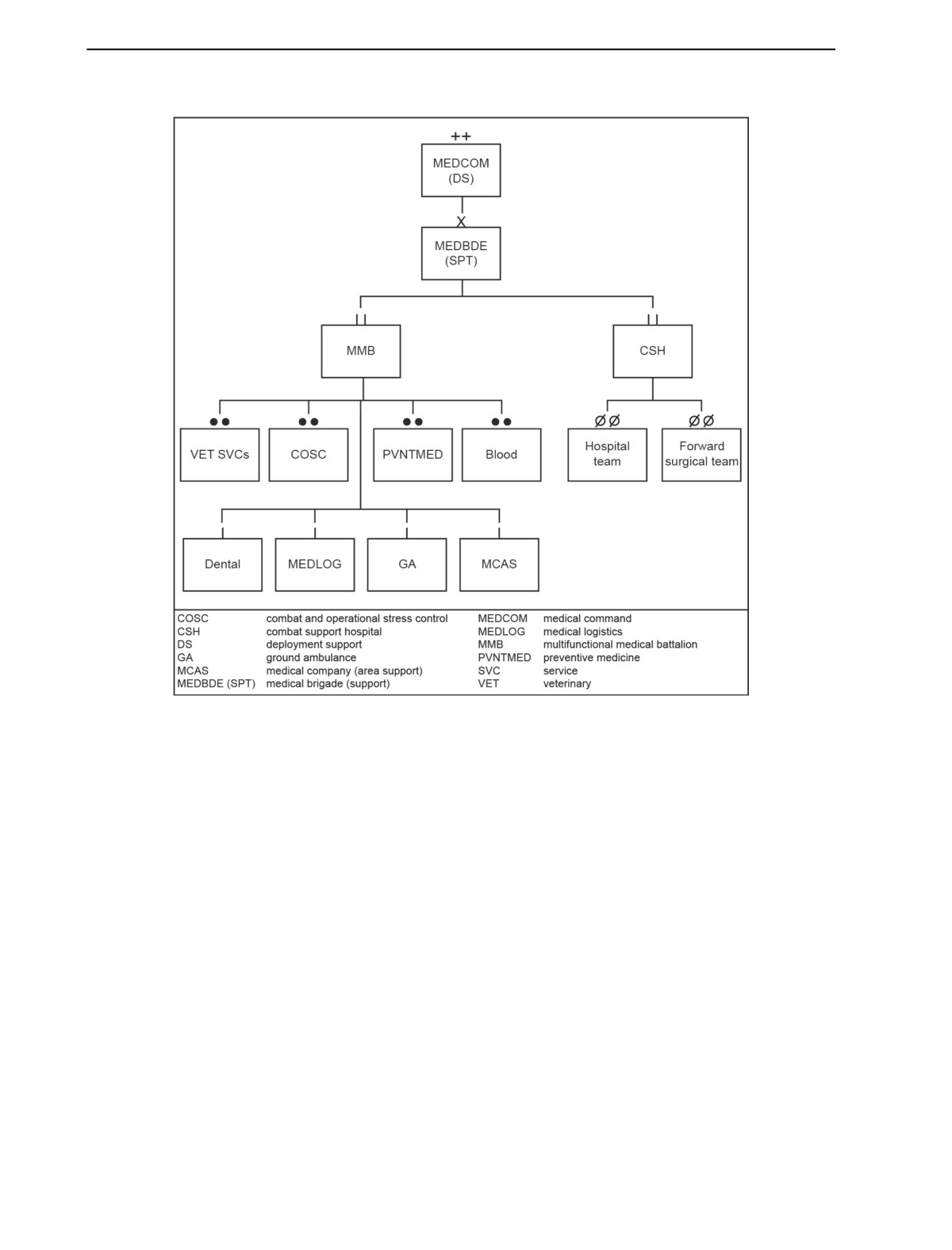
Chapter 3
Figure 3-3. Modular medical support for the Army
Medical Battalion (Multifunctional)
3-20. The medical battalion (multifunctional) is designed as a multifunctional headquarters. It can also
command expeditionary forces in early-entry operations and facilitate the RSOI of theater medical forces.
Any higher-echelon medical companies, detachments, and teams in theater may be assigned, attached, or
placed under the OPCON of a medical battalion (multifunctional). The medical battalion (multifunctional)
is under the command of the medical brigade (support). One medical battalion (multifunctional) will
normally provide medical support on an area basis.
Area Medical Laboratory
3-21. The MEDCOM (DS) may attach an area medical laboratory to the medical brigade (support) or
medical battalion (multifunctional) if the supported units face a biological threat in the area of operations.
The health protection mission is supported by the area medical laboratory. This laboratory can provide field
confirmatory analysis of suspect chemical and biological warfare agents.
THEATER MILITARY INTELLIGENCE BRIGADE
3-22. A theater military intelligence brigade normally supports each theater army. Every theater military
intelligence brigade is attached or under OPCON of the theater army. Although the military intelligence
brigade headquarters is theater-committed, it can provide subordinate battalions for operations outside its
3-6
FM 3-94
21 April 2014
Theater-Level Commands and Units
AOR. When deployed to support the ARFOR in a joint operations area, military intelligence battalions are
normally attached to a military battlefield surveillance brigade (BFSB) or other brigade-level organization.
Note. USARNORTH is subject to domestic intelligence oversight restrictions. Because of these
restrictions applicable to the homeland, USARNORTH has different requirements for Army
military intelligence support.
3-23. The theater military intelligence brigade provides regionally focused collection and analysis in
support of theater army daily operations requirements and limited contingency operations. In particular, the
theater army headquarters relies heavily on the military intelligence brigade for threat characteristics,
intelligence estimates, threat and civil considerations, data files and databases, and all-source intelligence
products. These products support theater army planning requirements, including development of Army
plans supporting the theater campaign plan and maintenance of OPLANs and contingency plans. The
theater army headquarters’ intelligence cell depends on the theater military intelligence brigade for
intelligence operations and analytic support.
3-24. A theater army and its subordinate theater military intelligence brigade may provide intelligence
support to Army and joint forces in the joint operations area in one of two ways. First, they deploy military
intelligence assets forward and then attach or place those assets under OPCON or in direct support to the
ARFOR. Second, they provide intelligence support on a general support or direct support basis. In either
case, the supported Army forces operating headquarters tasks the military intelligence brigade assets by
identifying information requirements and priority intelligence requirements. The associated collection
requirements are assigned to the supporting military intelligence brigade or its operational elements.
3-25. The theater military intelligence brigade’s regional focus enhances its capabilities to develop and
exploit language skills and cultural insights specific to the AOR. The theater intelligence brigade’s regional
focus also provides the benefits of continuity and cultural context to its analytic intelligence products. The
theater military intelligence brigade can collect, analyze, and track the threat characteristics and doctrine of
partner nations, enemies, and adversaries over many years. These abilities allow the brigade to create and
maintain a valuable database of intelligence regarding regional military forces, persons of interest, and
evolving doctrine and capabilities of regional military forces.
CIVIL AFFAIRS COMMAND
3-26. Each theater army (except for USARNORTH) receives support from a Reserve Component civil
affairs command. The civil affairs command provides theater-level civil affairs planning, coordination,
policies, and programs in support of the geographic combatant command’s regional civil-military
operations strategy and stabilization, reconstruction, and development efforts. The civil affairs command
mobilizes and deploys with one or more civil affairs brigades and civil affairs planning teams. It also has
one or more civil-military operations centers (CMOCs). One civil affairs brigade normally supports the
land component command; a second brigade may support the ESC. A civil affairs brigade with its CMOC
can become the core of a joint civil-military operations task force under the OPCON of the JTF. Civil
affairs battalions from the civil affairs brigade are task-organized to Army divisions. Civil affairs planning
teams augment the geographic combatant command, theater army, joint land forces component command,
and division, corps, and brigades. Such augmentation provides liaison, coordination, education and
training, and area assessment functions. The theater army commander may employ a civil affairs brigade
CMOC in support of the G-9. Civil affairs elements are normally attached to the headquarters they support.
(See FM 3-57.)
3-27. A theater army normally has an aligned, regionally focused Regular Army civil affairs battalion. The
battalions provide regionally focused civil affairs support to the theater army commands as well as
conventional forces through the ARFORGEN process. The civil affairs battalion focuses on the supported
commander’s ready capability to plan, enable, shape, and manage civil affairs operations as well as
provides dedicated support to stability operations. The civil affairs battalion also enables, enhances, and
supports civil-military operations assigned to the theater army command by the theater security cooperation
plan. During stability operations, the battalion provides tactical-level civil affairs support to a division
command or an equivalent-level Army command or JTF.
21 April 2014
FM 3-94
3-7
Chapter 3
OTHER THEATER-LEVEL ARMY FORCES
3-28. For protracted major operations, the theater army may be reinforced by an array of Army capabilities
deployed from the United States and supporting theater armies. Other Army functional or multifunctional
headquarters and units may be made available to the theater army based on requirements of the AOR such
as forward stationing, base operations, security force assistance missions, theater security cooperation
activities, or ongoing military operations. These Army functional or multifunctional units may have either a
command or a support relationship with the theater army. In some cases, the Department of the Army tasks
certain functional or multifunctional battalions to support more than one theater army.
THEATER AVIATION
3-29. Each theater aviation brigade can conduct assault or general support aviation tasks in support of the
theater and its subordinate commands. Unlike combat aviation brigades, a theater aviation brigade lacks the
attack and reconnaissance battalions. The theater aviation brigade has a mix of lift helicopters and fixed-
wing aircraft. The brigade can conduct air assault, air movement, and sustaining operations. It will
normally not have attached unmanned aircraft systems. The theater aviation brigade reinforces combat
aviation brigades with additional assault, general support, heavy lift, and aeromedical evacuation. It flies
fixed-wing sorties in support of the ARFOR, theater army, and JFC.
3-30. A theater aviation sustainment maintenance group may be attached to a theater army to provide
depot-level maintenance support. The theater aviation sustainment maintenance group may be subsequently
attached to the TSC. (See TC 3-04.7.)
3-31. Army air traffic service units at the theater level consist of the theater airfield operations group with
its subordinate airfield operations battalions. These units are normally attached to the theater aviation
command; they establish and operate airfields as needed in the AOR. Advanced operations bases can
operate a fully instrumented airfield with airport surveillance radar approach, precision approach radar, and
controlling airspace necessary to support airfield operations. (See FM 3-04.120.)
ARMY AIR AND MISSILE DEFENSE COMMAND
3-32. When required by the geographic combatant command, one AAMDC will be attached to the theater
army, if not assigned. Air and missile defense units in the AOR are assigned or attached to the AAMDC.
3-33. The JFC establishes air and missile defense priorities, allocates forces, and apportions air power. The
JFC typically assigns overall responsibility for counterair and interdiction missions to the JFACC.
Normally, the JFACC also serves as both the AADC and the airspace control authority. The JFACC is
responsible for defensive counterair operations. The AADC coordinates with joint and multinational
partners to develop procedures for the theater air and missile defense plan. The AAMDC supports the
AADC for air and missile defensive operations throughout the area of operations.
3-34. The AAMDC commander has several responsibilities. These include command of all subordinate
Army air and missile defense units; army air and missile defense coordinator for the land component and
ARFOR; and deputy AADC if designated. The AAMDC commander has overall responsibility for
planning Army air and missile defense operations in support of the JFC. The AAMDC task-organizes and
assigns missions to subordinate brigades. The AAMDC has dedicated liaison teams able to deploy to a
major theater. It provides elements to the joint force air component, joint force land component, and joint
special operations task force to integrate air and missile defense operations.
3-35. The threat from hostile ballistic missiles, aircraft, cruise missiles, and unmanned aircraft systems
may originate from outside the joint operations area. Therefore, the JFACC may have AOR-wide
responsibility as the AADC. The AAMDC commander distributes air and missile defense assets to protect
not only the joint operations area, but also other high-value assets across the AOR. If the AAMDC is not
located in the joint operations area, the air defense artillery brigade commander may serve as the deputy
AADC. The air defense artillery brigade commander may serve as the deputy AADC. That brigade takes
responsibility for planning and for providing liaison to the JFLCC and AADC or JFACC. (JP 3-01,
FM 3-01, FM 3-01.7, and FM 3-01.94 explain the command and support relationships for theater air and
missile defense.)
3-8
FM 3-94
21 April 2014
Theater-Level Commands and Units
THEATER ENGINEER COMMAND
3-36. The theater engineer command provides theater-wide engineer support as well as engineer support to
forces deployed within a joint operations area. The engineer command supervises geospatial support,
construction, real property maintenance activities, line of communications sustainment, engineer logistics
management, and base development. The command has primary responsibility for theater infrastructure
repair or development as required. The command supports Department of State or host-nation efforts to
restore essential services and aids in infrastructure development. Subordinate units of the command include
tailored engineer brigades.
3-37. The theater engineer command typically serves as the senior engineer headquarters for the theater
army as well as all assigned or attached engineer brigades and other engineer units. When directed, it may
also command engineers from other Services and multinational forces and provide oversight of contracted
construction engineers. The command provides peacetime training and support of military engagement for
their supported respective combatant commanders. The command also coordinates closely with the senior
contract construction agents in the joint operations area.
3-38. The theater engineer command can deploy modular staff elements and organizations to provide the
operational commander with technical engineering expertise and support. Each command can deploy its
main command post and two deployable command posts to provide flexibility and a rotational capability.
The Army Corps of Engineers augments the engineer command post as required and provides construction
contracting, real estate, and interagency coordination. DOD information networks enable deployed
elements to collaborate with subject matter experts in the Army Corps of Engineers, other Services
technical laboratories and research centers, and the civilian community.
3-39. In some cases, the theater army receives an engineer brigade in lieu of an engineer command. When
assigned or attached to the theater army, the engineer brigade is tailored to conduct combat engineer,
general engineering, or geospatial engineer operations. The engineer brigade can rapidly deploy in modular
elements to support the corps, division, JTF, or theater-level mission. The engineer brigade can provide a
wide range of technical engineering expertise and support including construction design and management,
coordinating support from the Army Corps of Engineers, and other Services’ technical laboratories and
research centers. The engineer brigade can control low-density, high-demand engineer assets to include
military working dogs, an engineer facility detachment, forward engineer support teams, and facilities
engineer teams, bridge units, and others. The brigade relies on DOD information networks to connect with
engineering expertise within the Army and across the DOD. These capabilities include technical assistance,
project planning and design, contract construction, real estate acquisition, infrastructure support, and
support to nation-building capacities. (See FM 3-34 and ATTP 3-34.23 for more information.)
CHEMICAL, BIOLOGICAL, RADIOLOGICAL, AND NUCLEAR UNITS
3-40. Army CBRN units offer a range of capabilities to theater (joint) force protection operations. Units
such as the standing joint force headquarters for elimination and chemical, biological, radiological, nuclear,
and high-yield explosives (CBRNE) operational headquarters support the combatant commander, JFC, and
functional components faced with a CBRN threat. The CBRN force organization within a theater depends
on weapons of mass destruction (WMD) threat. Based on the mission variables prevailing in the theater, the
theater army commander will request and tailor Army CBRN forces for the GCC. (See FM 3-11.)
Standing Joint Force Headquarters for Elimination
3-41. When ordered, a GCC may coordinate U.S. military efforts to identify, counter, secure, and eliminate
WMD threats. This mission requires special skills forces not normally organic to a geographic combatant
command staff.
3-42. The standing joint force headquarters for elimination
(SJFHQ-E) provides the GCC with the
planning, intelligence, and operational capabilities required to eliminate a foreign nation’s WMD and
related programs. It provides a full-time, trained joint command and control element able to integrate into
deployed headquarters to help accomplish the WMD elimination mission. The SJFHQ-E is a permanent
headquarters trained and ready to act. It works closely with the GCC, completing crisis planning and testing
response procedures during major exercises.
21 April 2014
FM 3-94
3-9
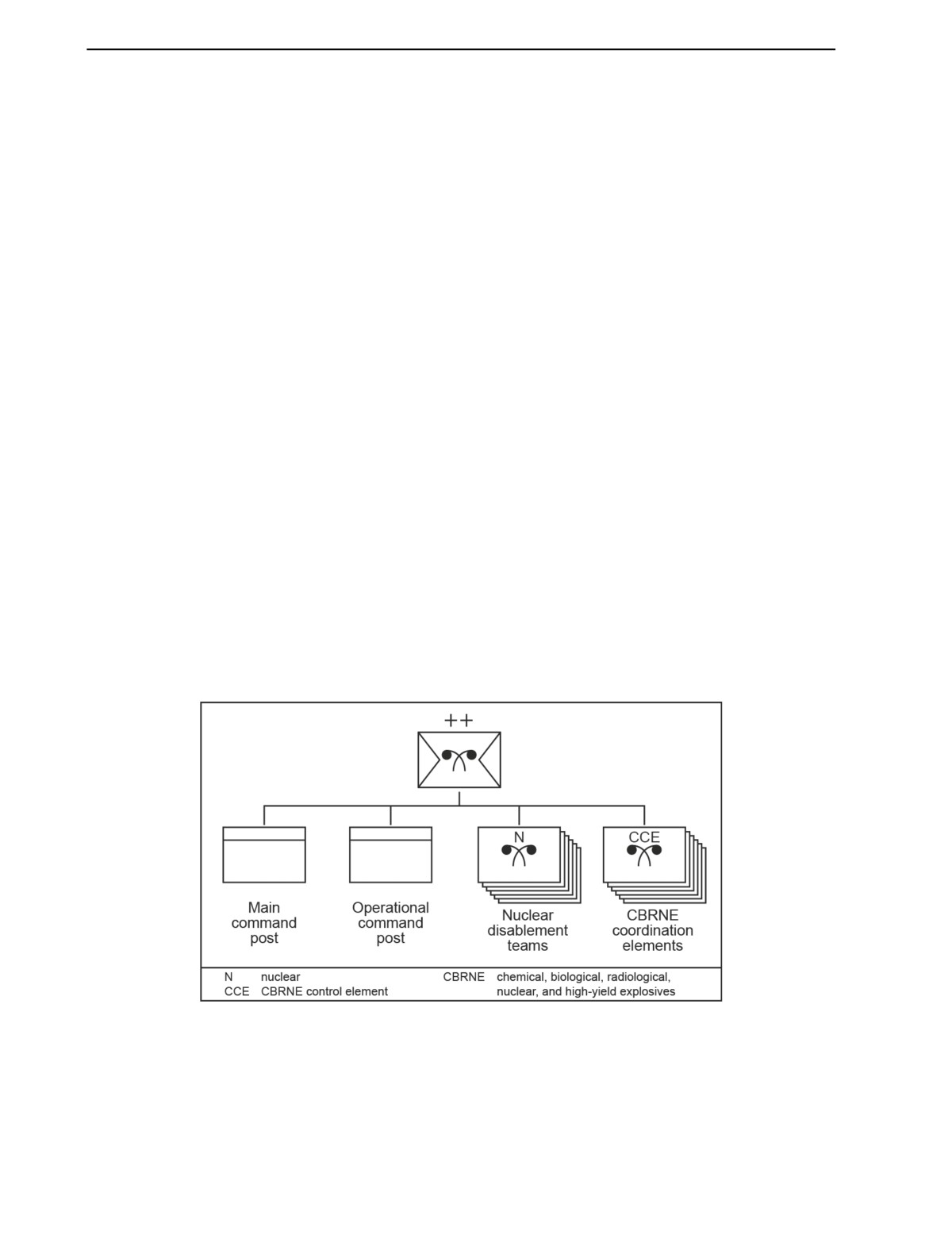
Chapter 3
3-43. Leveraging the capabilities of the Defense Threat Reduction Agency and USSTRATCOM’s Center
for Combating Weapons of Mass Destruction, the SJFHQ-E deploys to augment the geographic combatant
command headquarters and accomplish the WMD elimination mission. The SJFHQ-E provides robust
technical resources and expertise to the geographic combatant command and its subordinate commands.
The SJFHQ-E provides the command and control necessary to locate, characterize, secure, disable, and
dispose of hostile WMD so they no longer pose a threat. The SJFHQ-E includes specialized technical
intelligence oversight.
CBRNE Operational Headquarters
3-44. The CBRNE operational headquarters is DOD’s deployable headquarters for directing operational-
level elimination of WMD. The CBRNE operational headquarters is a multifunctional headquarters
consisting of CBRN, EOD, nuclear, intelligence, signal, and medical specialists. The headquarters can be
tailored and task-organized based on the mission and situation. The CBRNE operational headquarters’
operational command post can also serve as a JTF headquarters for elimination of WMD.
3-45. The CBRNE operational headquarters commands specialized, technical operations that achieve
campaign objectives for elimination of WMD. The CBRNE operational headquarters has capabilities to
support a GCC, Service component commander, or JTF commander directing and synchronizing each of
the four activities associated with elimination of WMD (isolation, exploitation, destruction, and monitoring
and redirection). The CBRNE operational headquarters also provides CBRNE threats and hazards-related
technical expertise to supported commanders and helps establish conditions for the long-term elimination
of WMD production sites and other related activities. It accomplishes its mission throughout the range of
military operations. The CBRNE operational headquarters is can support overseas campaigns and
homeland security operations (defense support of civil authorities) simultaneously.
3-46. The CBRNE operational headquarters is organized, trained, and equipped to serve as a subordinate
JTF under a JFC. It does not conduct major combat operations as, for example, an Army corps headquarters
does. Although the CBRNE operational headquarters’ subordinate units facilitate the JFC’s protection
requirements, the CBRNE operational headquarters lacks organic security elements. It depends on the
supported unit for operational area security requirements beyond individual protection. Figure 3-4 shows
the organization of the CBRNE operational headquarters. (See also ATP 3-11.36.)
Figure 3-4. CBRNE operational headquarters
EXPLOSIVE ORDNANCE DISPOSAL GROUP
3-47. A theater army supporting major operations is allocated an EOD group. An EOD group commander
can exercise mission command for two to six EOD battalions. EOD battalions support Army forces at the
theater army, JTF, combined JTF, corps, and division levels. EOD groups and battalions position their
3-10
FM 3-94
21 April 2014
Theater-Level Commands and Units
EOD companies at locations where they can support the maneuver commander. The EOD group
headquarters commands all Army EOD assets and operations in a theater and can serve as the basis for a
counter-improvised explosive device task force. The senior EOD commander normally functions as the
EOD special staff officer for the senior deployed Army headquarters. (See ATP 4-32, FM 3-34.210, and
FM 3-34.214.)
REGIONAL SUPPORT GROUPS
3-48. Regional support groups deploy to provide contingency and expeditionary base operations support.
These groups have responsibilities for managing facilities, providing administrative and logistics support of
Soldier services, and ensuring the security of personnel and facilities on a base camp.
MILITARY POLICE SUPPORT
3-49. The theater army normally receives one MP command when more than one MP brigade is required.
For MP tasks across the AOR, the MP command provides an organizational framework. The MP command
focuses on reinforcing and augmenting tactical-level MP efforts and developing the theater detention or
resettlement operations base requirements. The commander of the MP command also serves as the
commander of detainee operations. The theater-level MP force is tailored to a specific region based on
several factors:
z
Nature of the operation, whether unilateral, joint, or multinational.
z
Size of the security areas.
z
Maturity of the theater of operations.
z
Nature of the civilian population found within the support area—friendly or hostile.
z
Ability of the host nation to provide MP-related support.
z
The extent of civil police operations.
z
U.S. and multinational detainee evacuation and detention policy.
z
MP support required for main supply routes within the division, corps, and joint support areas.
z
The number of designated critical facilities to secure.
z
Resources or key personnel requiring dedicated MP security.
z
Ability of host-nation forces to control the civilian population to preclude interference with
military operations.
(FM 3-39 discusses MP forces.)
Provost Marshal
3-50. The senior MP officer assigned or attached to the theater army becomes the provost marshal for the
AOR. The senior MP officer assigned or attached to the theater army becomes the provost marshal and is
responsible for assisting the commander in exercising control over MP forces in the AOR. The provost
marshal is responsible for coordinating MP assets and operations for the command. The commander
typically designates the provost marshal as a personal staff officer for law enforcement issues concerning
U.S. military forces and U.S. civilians. The provost marshal—
z
Advises the commander and staff of MP capabilities.
z
Prepares plans and policies.
z
Coordinates MP and detainee operations.
z
Assists, coordinates, and supervises supporting and supported units’ interactions.
z
Reviews current MP operations.
z
Coordinates with allied forces and host-nation military and civilian police.
z
Synchronizes military working dog support.
3-51. The theater army provides personnel, administrative, morale, detention, resettlement, and
confinement services within the AOR. (JP 3-63 provides the Army doctrine on detention operations.) The
21 April 2014
FM 3-94
3-11
Chapter 3
MPs receive, process, and safeguard the detainees. The MP detention battalion and MP battalion provide
this support and are responsible for—
z
Controlling detainees and dislocated civilians.
z
Coordinating with other government agencies, host-nation personnel, military territorial
organizations, civilian police authorities, and nongovernmental organizations on matters
pertaining to control of detainees and dislocated civilians.
z
Exercising OPCON of all detention and resettlement units.
z
Handling detainees as set forth by U.S. law, the Geneva Conventions, other international laws,
and the United Nations, as applicable.
z
Handling U.S. military prisoners, to include operating a theater-level military confinement
facility.
3-52. A military intelligence battalion (interrogation) may be attached or placed in direct support of the MP
command accomplishing an internment mission. The interrogation battalion is functionally not a part of the
theater military intelligence brigade.
Military Police Brigades
3-53. The MP brigade is one of the functional brigades of the Army. It can commandup to five mission-
tailored MP battalions; integrate capabilities from all three MP disciplines (police operations, detention
operations, and security and mobility support); and integrate police intelligence operations. It can also
command other non-MP units (focused on performing area support, detention, or resettlement tasks) and
synchronize MP support across multiple organizations that control an area of operations in support of
stability tasks. A functional MP brigade is not designed to control terrain; significant augmentation and task
organization would be required to assign the MP brigade an area of operations.
3-54. The corps or division requires one or more MP brigades when the number of MP units or the
functional nature of MP missions (such as the synchronization of technical MP capabilities across an area
of operations) requires brigade-level command. A corps normally receives a MP brigade headquarters to
command the MP units in its area of operations. Once deployed, MP brigades become the focal point for
apportioning and allocating mission-tailored MP forces across the area of operations.
Criminal Investigation Command
3-55. The Army Criminal Investigation Command helps theater army commanders maintain discipline and
order by preventing or investigating crimes. This command is a direct reporting unit whose special agents
in the field report through the Army Criminal Investigation Command’s chain of command (detachment to
battalion to group) to the commanding general of the Army Criminal Investigation Command. This general
reports directly to the Chief of Staff of the Army and Secretary of the Army. Normally an MP group
(criminal investigation division) supports a theater army. The group is placed in general support of the
theater but remains under the OPCON of the Army Criminal Investigation Command. Commanders of
criminal investigation command tactical units advise their supported commanders on criminal investigation
matters, as appropriate, although no formal operational command relationship exists. The MP group
(criminal investigation division) ensures the connectivity between all criminal investigation command units
within and external to the theater. (See FM 3-39.)
Military Police Command
3-56. An MP command is normally established and assigned directly to the theater army in a mature
theater with several MP brigades and a criminal investigation command group. Once established, the senior
MP commander serves as the theater army provost marshal and is normally designated as the chief of
detainee operations.
INFORMATION OPERATIONS SUPPORT
3-57. The Army provides information operations support to the theater army through elements dedicated to
helping theater organizations analyze and operate within an increasingly complex information environment.
3-12
FM 3-94
21 April 2014
Theater-Level Commands and Units
These units augment theater forces with deployable mission-tailored support teams and CONUS-based
operational planning support, intelligence analysis, and technical assistance. They train to operate within
the joint information operations doctrinal construct and the Army’s inform and influence construct. These
support organizations include the 1st Information Operations Command (Land) from the Regular Army and
theater information operations groups from the Reserve Components. The 1st Information Operations
Command (Land) is a subordinate command of INSCOM and under ADCON of the Army Cyber
Command. These organizations provide the following support:
z
Field support teams provide information operations subject matter expertise to supported
commands. The teams help those commands with the planning, execution, and assessment of
information operations.
z
Vulnerability assessment teams help the supported commands identify information operations
and cyberspace vulnerabilities within their operational procedures, policies, practices, and
training. The teams also collaborate with the supported commands as they work to resolve the
identified vulnerabilities.
z
Operations security support teams assist supported commands in assessing and developing unit
operations security programs.
z
Reachback elements provide information operations and cyberspace operational planning
support, intelligence analysis, and technical assistance for deployed forces requesting support.
z
Cyber opposing forces provide a noncooperative cyberspace threat during major exercises and
training center rotations to help fully challenge the ability of deploying units operate in a hostile
cyber threat environment.
3-58. Digital liaison detachments can provide liaison capability among Army forces, joint or multinational
forces land component, JTF, subordinate headquarters, and multinational headquarters to ensure
communication, mutual understanding, and unity of purpose and action.
BATTLEFIELD COORDINATION DETACHMENT
3-59. A battlefield coordination detachment (BCD) is a specialized, regionally focused Army element that
serves as the senior Army operational commander’s liaison with the air component or joint force air
component command. A BCD is co-located with the joint air operations center (JAOC), combined air
operations center, or the Air Force air operations center. The BCD is the Army’s interface for systems
connectivity to the JAOC and for personnel integration with their JAOC counterparts. Tasks include
facilitating the exchange of current intelligence and operational data, processing air support requests,
monitoring and interpreting the land battle situation, coordinating air and missile defense, coordinating
airlift, and integrating airspace requirements. (See ATTP 3-09.13.)
3-60. The BCD supports the ARFOR commander (see discussion of ARFOR in paragraph 1-57). When the
corps is either the joint force land component command or ARFOR, the BCD commander becomes the
corps commander’s liaison to the JAOC. The corps staff relays land component requirements and requests
for joint force air component command support through the BCD, and the BCD represents the corps
commander throughout the joint air tasking cycle in the JAOC.
MILITARY INFORMATION SUPPORT OPERATIONS
3-61. A tailored military information support task force supports the combatant commander, JTF
commander, theater special operations commander, and joint special operations task force commanders.
The military information support task force plans, develops, and
(when directed) executes military
information support operations (MISO). The military information support task force functions as the central
coordination point for all MISO activities executed in the AOR. Military information support task forces
contribute to the planning and execution of discreet, precise, and scalable MISO to achieve the joint
commander’s overall objectives.
3-62. Military information support groups from the Army Reserve support conventional Army forces
within an AOR. The group controls military information support task forces that support Army corps,
divisions, and brigades. A military information support task force normally operates in support of a corps,
but may provide direct support to a division. The group’s capabilities are tactical in nature and lack the
21 April 2014
FM 3-94
3-13