FM 3-94 THEATER ARMY, CORPS, AND DIVISION OPERATIONS (APRIL 2014) - page 1
*FM 3-94 (FM 3-92, FM 3-93)
Field Manual
Headquarters
Department of the Army
No. 3-94
Washington, DC, 21 April 2014
Theater Army, Corps, and Division Operations
Contents
Page
PREFACE
v
INTRODUCTION
vii
PART ONE LANDPOWER TAILORED FOR THE JOINT FORCE
Chapter 1
ECHELONS ABOVE BRIGADE
1-1
A Modular, Tailorable Army
1-1
Combatant Command Through Tactical Headquarters
1-4
Operational and Administrative Chains of Command
1-14
Army Service Component Command
1-18
ARFOR
1-19
Army Logistics and Medical Support
1-22
Overlapping Operational and Administrative Chains
1-24
Operational Areas
1-27
Chapter 2
THE THEATER ARMY
2-1
Army Service Component Command
2-1
Unified Action in the Geographic Combatant Command
2-3
The Theater Army and Campaigns
2-5
Defense Support of Civil Authorities
2-15
Theater Army Headquarters
2-15
Chapter 3
THEATER-LEVEL COMMANDS AND UNITS
3-1
Assigned and Aligned Theater Forces
3-1
Other Theater-Level Army Forces
3-8
PART TWO THE ARMY CORPS
Chapter 4
CORPS ROLES AND ORGANIZATION
4-1
Roles of the Corps
4-1
Subordinate Forces
4-9
The Corps Headquarters
4-12
Distribution Restriction: Approved for public release; distribution is unlimited.
*This manual supersedes FM 3-92 (dated 26 November 2010) and FM 3-93 (dated 12 October 2011).
i
Contents
Chapter 5
CORPS OPERATIONS
5-1
Operations at the Corps Level
5-1
Deployment of a Corps
5-2
Task-Organizing the Corps
5-3
The Corps Area of Operations
5-9
The Corps and Joint Forces
5-11
Decisive Action
5-19
Operational Framework
5-27
The Corps and Forcible Entry Operations
5-29
PART THREE THE ARMY DIVISION
Chapter 6
DIVISION ROLES AND ORGANIZATION
6-1
Roles of the Division
6-1
Subordinate Forces
6-3
The Division Headquarters
6-13
Chapter 7
DIVISION OPERATIONS
7-1
The Tactical Environment
7-1
Deployment of a Division
7-2
Task-Organizing the Division
7-2
The Division Area of Operations
7-6
Air Force Support
7-8
Marine Corps Units
7-10
Decisive Action
7-11
Operational Framework
7-16
GLOSSARY
Glossary-1
REFERENCES
References-1
INDEX
Index-1
Figures
Figure 1-1. The range of military operations
1-4
Figure 1-2. Functional and integrating cells
1-8
Figure 1-3. Planning horizons for integrating cells
1-10
Figure 1-4. Distribution of staff sections within a main command post
1-12
Figure 1-5. Example of echelons above brigade command post
1-13
Figure 1-6. The operational chain of command and administrative control
1-15
Figure 1-7. Possible joint task force components
1-20
Figure 1-8. Overlapping chains of authority
1-25
Figure 1-9. Joint task force organized by Service and functional components
1-26
Figure 1-10. The area of responsibility and joint operations areas
1-27
Figure 2-1. Service-specific responsibilities
2-2
Figure 2-2. Theater army’s role in requesting regionally aligned forces
2-5
Figure 2-3. Joint phases and the theater army
2-6
ii
FM 3-94
21 April 2014
Contents
Figure
2-4. An overview of force tailoring
2-11
Figure
2-5. Theater army as a multinational force land component in a theater of war
2-14
Figure
2-6. Theater army main command post organization
2-16
Figure
2-7. Theater army contingency command post organization
2-18
Figure
2-8. Theater army headquarters and headquarters battalion organization
2-20
Figure
3-1. Example of theater commands and brigades
3-1
Figure
3-2. Example of theater sustainment command
3-2
Figure
3-3. Modular medical support for the Army
3-6
Figure
3-4. CBRNE operational headquarters
3-10
Figure
3-5. Example of mature theater
3-14
Figure
4-1. Example of joint task force staff
4-6
Figure
4-2. The corps as a tactical headquarters
4-8
Figure
4-3. An example of headquarters and units task-organized under the corps
4-10
Figure
4-4. Modular brigades and groups
4-11
Figure
4-5. The corps main command post
4-13
Figure
4-6. Example of corps tactical command post
4-14
Figure
4-7. The headquarters and headquarters battalion of the corps
4-16
Figure
5-1. Possible configurations for the corps area of operations
5-10
Figure
5-2. Air and missile defense
5-17
Figure
5-3. Example of corps movement to contact
5-22
Figure
5-4. Example of corps attack
5-23
Figure
5-5. Example of corps defense
5-25
Figure
6-1. Three types of brigade combat teams (current organization)
6-4
Figure
6-2. Example of a reorganized armored brigade combat team
6-5
Figure
6-3. Field artillery brigade
6-6
Figure
6-4. Combat aviation brigade
6-7
Figure
6-5. Battlefield surveillance brigade
6-8
Figure
6-6. Maneuver enhancement brigade
6-9
Figure
6-7. Sustainment brigade
6-10
Figure
6-8. Main command post of a division
6-14
Figure
6-9. Division tactical command post
6-16
Figure
6-10. Division headquarters and headquarters battalion
6-19
Figure
7-1. An example of a task-organized division
7-6
Figure
7-2. Example of division using contiguous and noncontiguous areas of
operations
7-7
Figure 7-3. Division contiguous and noncontiguous area of operations
7-9
Figure 7-4. Example of division movement to contact
7-12
21 April 2014
FM 3-94
iii
Contents
Tables
Table 1-1. The Army’s structure
1-2
Table 1-2. Combatant commands and their ASCCs
1-5
Table 1-3. Joint command relationships
1-16
Table 5-1. Command and support relationships for the corps
5-6
Table 7-1. Command and support relationships for the division
7-4
iv
FM 3-94
21 April 2014
Preface
FM 3-94 provides Army doctrine for the theater army, corps, and division. FM 3-94 explains the organization of
the theater army, corps, and division headquarters and their respective command posts. It establishes the roles
for each headquarters, including their respective contributions to joint operations. It discusses subordinate units
and each headquarters’ organization of its units, establishment of command and support relationships, and
conduct of operations.
The principal audience for FM 3-94 is theater army, corps, and division commanders and staffs. It also provides
relevant information regarding the organization and operations for commanders and staffs at field army,
subordinate theater-level commands and brigades, geographic combatant commands, and other Service
headquarters.
Commanders, staffs, and subordinates ensure their decisions and actions comply with applicable United States,
international, and in some cases host-nation laws and regulations. Commanders at all levels ensure their
Soldiers operate in accordance with the law of war and the rules of engagement. (See FM 27-10.)
FM 3-94 implements STANAG 2014, Format for Orders and Designation of Timings, Locations and
Boundaries; STANAG 2019, NATO Joint Military Symbology; STANAG 2248, Glossary of Land Military
Terms and Definitions; STANAG 2281, Coalition Operations Handbook; and AAP-06, NATO Glossary of
Terms and Definitions.
FM 3-94 uses joint terms where applicable. Selected joint and Army terms and definitions appear in both the
glossary and the text. The term for which FM 3-94 is proponent is marked with an asterisk in the glossary. Its
definition is boldfaced in the text. For other terms and definitions shown in the text, the term is italicized and
the number of the proponent publication follows the definition.
FM 3-94 applies to the Active Army, Army National Guard/Army National Guard of the United States, and
United States Army Reserve unless otherwise stated.
The proponent of FM 3-94 is the United States Army Combined Arms Center. The preparing agency is the
Combined Arms Doctrine Directorate, United States Army Combined Arms Center. Send comments and
recommendations on a DA Form 2028 (Recommended Changes to Publications and Blank Forms) to
Commander, United States Army Combined Arms Center and Fort Leavenworth, ATTN: ATZL-MCD
(FM 3-94),
300 McPherson Avenue, Fort Leavenworth, KS
66027-2337; by e-mail to
usarmy.leavenworth.mccoe.mbx.cadd-org-mailbox@mail.mil; or submit an electronic DA Form 2028.
21 April 2014
FM 3-94
v
Introduction
The Army gives the combatant commander depth and versatility because landpower
expands the friendly range of military options. The Army, uniquely, provides a
combination of armored, medium, light, and airborne forces. Along with a full suite of
enablers, this allows us to provide tailorable and scalable force packages for various
contingencies. By multiplying the range of U.S. capabilities that the adversary must
counter, the Army narrows options that might otherwise work against a lesser opponent
or a coalition partner supported only by U.S. air and maritime power.
ADP 1
The unique and crucial role of the Army is to provide landpower to the geographic combatant commanders.
Landpower, as ADP 1 notes, is “is the ubiquitous tool of the joint force—often decisive, sometimes
indirect, but indispensable.” FM 3-94 examines the employment of Army forces within a geographic
combatant command. It describes how the Army supports the combatant commander across the range of
military operations in that area of responsibility (AOR).
“The land domain is the most complex of the domains, because it addresses humanity—its cultures,
ethnicities, religions, and politics”
(ADP 1). The operational variables—political, military, economic,
social, information, infrastructure, physical environment, and time
(known as PMESII-PT)—affect
operations within the land domain far more than in any other domain. The individual variables and their
effect on an operational environment also differ dramatically for each campaign. Conditions affected by
military operations, directly or indirectly, defy easy analysis. Thus, Army headquarters operating at
echelons above brigade constantly adapt their organization and planning to the conditions in that joint
operations area.
In addition to being the largest of the Armed Forces of the United States, the Army has a greater variety of
units than the other Services, each with a different organization and purpose. Therefore, the Army provides
the combatant commander with an interlocking array of higher headquarters trained and equipped to apply
landpower from the theater level, through the operational level, and down to the tactical employment of
various brigades, groups, and battalions. Together the theater army, corps, and division give the combatant
commander several options necessary for the employment of landpower in an interdependent joint force.
The combatant commander has ever-changing needs for landpower to prevent, shape, and win across the
AOR. Prevention requires flexible and credible United States (U.S.) military power to dissuade potential
adversaries from threatening vital American security interests. The theater army integrates landpower with
other deterrent capabilities. The corps represents an operationally significant Army force capable of
altering the land balance of forces in each geographic combatant command. The division is the tactical
hammer, translating operational-level plans into offensive, defensive, and stability tasks on the ground.
Partner nations under an external threat understand that introducing U.S. landpower alters the regional
military balance and bolsters their resolve to resist aggression.
All nations have land security elements, even if lacking credible air and naval forces. Army forces deploy
around the world to train with security forces of other nations. This diminishes regional tensions and is vital
to American security interests. Each geographic combatant commander develops programs to improve
regional stability and promote peace through security cooperation. Shaping with military assets to improve
security cannot prevent conflict, but it nudges global regions away from military confrontation and
increases the effects of diplomatic, informational, and economic instruments of national power. Shaping the
strategic security environment improves the chance for peace around the world. This is a critical task
assigned to the theater army.
When war occurs, joint force commanders require Army units that can defeat the enemy and dominate land
portions of the joint operations area. Land combat remains chaotic, lethal, and intensely human.
Technology is important, but the outcome depends upon the skill and resolve of Soldiers, Marines, and
21 April 2014
FM 3-94
vii
Introduction
multinational ground forces. The ability to prevail in ground combat is often the decisive factor in breaking
the enemy’s will. History reflects that an enemy may cede the air and maritime domains to U.S. forces,
while placing his faith in close combat. Winning in this environment requires the theater army to set the
theater and assist Army forces into the fight. It requires the corps to integrate landpower throughout each
phase of a campaign. Divisions outmaneuver the enemy, destroy enemy ground forces, seize and exploit
operationally significant objectives, and match decisive action to ground conditions.
The theater army commander sets conditions for effective use of landpower. While commanding Army
forces supporting AOR-wide engagement, the theater army commander matches Army capabilities to joint
requirements, oversees the arrival of Army forces in the theater, and ensures that Soldiers across the AOR
receive the support they require for as long as they are in the AOR. The corps is the principal headquarters
for applying landpower as a component of a campaign. The corps commander translates campaign
objectives into broad missions for ground forces and sets the conditions for the tactical use of Army and
multinational ground forces to accomplish those missions. The corps commander coordinates land forces
with air maritime and special operations forces to dominate land portions of joint operations areas. The
division controls ground forces, synchronizing Army and joint combat power according to the conditions
on the ground.
Each echelon above brigade headquarters has considerable flexibility built into its structure. Each can fulfill
multiple roles depending upon the combatant commander’s requirements and appropriate joint
augmentation. This ranges from serving as the joint task force headquarters, as a joint and multinational
force land component, down through the tactical employment of brigades and battalions. The theater army
tailors each echelon, including itself, for its role in the campaign. Each headquarters varies its internal
organization to accomplish the mission. Each echelon adjusts the distribution of subordinate units between
headquarters—task organization—to the particular requirements of that phase or mission.
Operational and administrative responsibilities vary between echelons. Operational responsibilities include
command of forces, direction of operations in time and space, and control of assigned areas of operations.
The administrative responsibilities encompass the Service-specific requirements for equipping,
sustainment, training, unit readiness, discipline, and personnel matters. The Army also has specified
Service responsibilities to the joint force including certain logistics support and specialized support such as
chemical, biological, radiological, and nuclear defense. The theater army, as the Army Service component
command for that geographic combatant command, determines the most effective and efficient distribution
of Service responsibilities. Depending upon the joint structure, the corps or division assumes Army
component responsibilities within that joint force.
FM 3-94 has seven chapters organized under three parts.
Part One describes the Army hierarchy within a geographic combatant command and goes into detail about
the theater army, the senior echelon in each geographic combatant command. It includes three chapters.
Chapter 1 provides an overview of the higher echelons of the Army. It introduces the three senior echelons
of the Army within a geographic combatant command. It describes their roles and tasks in general terms. It
lays out the Army concept of sustainment and support provided by theater army. This chapter also
discusses operational and administrative chains of command and their differences. The chapter concludes
with a brief review of operational areas. Chapter 2 describes the roles and tasks of the theater army. It
discusses the staff organization of the theater army. It also discusses the main command post and
contingency command post of the theater army and their employment by the theater army commander.
Chapter 3 summarizes the theater-level commands and supporting organizations that allow the theater army
to fulfill its roles and enable the corps and division to accomplish theirs.
Part Two discusses the corps and includes two chapters. Chapter 4 explains the roles and tasks of the corps,
together with its operational and administrative responsibilities. The chapter summarizes the subordinate
units typically found in the corps echelon. The chapter then discusses the internal organization of the corps
and the various command posts available to the corps commander. Chapter 5 examines corps-level
operations. This includes how the corps arranges its combat power, organizes the area of operations, and
conducts decisive action.
Part Three addresses the division in two chapters. Chapter 6 explains the roles and tasks of the division
headquarters, together with its operational and administrative responsibilities. The chapter summarizes the
viii
FM 3-94
21 April 2014
Introduction
subordinate units normally under the operational or tactical control of the division. The chapter then
discusses the internal organization of the division headquarters and the various command posts available to
the division commander. Chapter 7 examines division-level operations. This includes how the division
arranges its combat power, organizes the area of operations, and conducts decisive action.
More details on each echelon will be published in three supporting Army techniques publications (ATPs).
One will cover the theater army in detail. Another will provide details and vignettes on the corps and corps
operations. It will also describe how the corps headquarters transforms into a joint task force (JTF) for
contingencies. A third will address the division, with an extensive discussion on decisive action at the
tactical level.
This book is proponent for a single term, ARFOR. FM 3-94 modifies the definition of ARFOR. FM 3-94 is
not the proponent for any new Army terms. It does not rescind any defined terms.
21 April 2014
FM 3-94
ix
PART ONE
Landpower Tailored for the Joint Force
The Army provides landpower to an interdependent joint force. Landpower is tailored
for any combination of offensive, defensive, and stability or defense support of civil
authorities tasks. Brigades are the principal tactical units for conducting operations.
The exercise of mission command above the brigade level requires theater army,
corps, and division headquarters. They may be tailored as functional land
components with command of joint and multinational units. They will serve as
Service components as organized or required. When the combatant commander so
determines, they will become joint task force headquarters. The mix of echelons is
not a rigid hierarchy and does not require a standard array of forces. Each
headquarters provides a menu of capabilities to best match the combatant
commander’s requirements.
Chapter 1
Echelons Above Brigade
A MODULAR, TAILORABLE ARMY
1-1. In 2003, the Army undertook a fundamental shift from a division-based force toward a brigade-based
force. The highly integrated organization of the Army’s divisions in the late 1990s made it difficult to
deploy divisional units apart from their divisional base and keep the rest of the division ready for other
missions. The Army needed to reorganize around smaller, more versatile formations able to deploy more
promptly and sustain the fight indefinitely, while meeting global commitments outside the conflict region.
The ensuing transformation reorganized the Army into brigade combat teams (BCTs), multifunctional and
functional support brigades, and deployable, self-contained division and corps headquarters. The shift to a
brigade-based Army with modular corps and division headquarters allowed the Army to tailor forces
rapidly into expeditionary force packages that matched the combatant commander’s requirements.
1-2. The BCT-based Army facilitated rotation of complete units rather than individual replacement. The
BCTs become the centerpiece for Army maneuver. Today, the Army pools BCTs, multifunctional support
brigades, and functional brigades into expeditionary force packages. The force package consists of infantry,
Stryker, and armored BCTs; a variable mix of multifunctional and functional brigades; and division and
corps headquarters as required. The two Reserve Components of the Army (Army Reserve and Army
National Guard) making up about one-half of the total uniformed force, are integrated into the cycle of
force packages identified for contingencies or deployment to an active operation. The force package
combines Regular Army, Army National Guard, and U.S. Army Reserve units and Soldiers. (See ADP 1.)
1-3. The National Military Strategy and the Joint Strategic
force provider
Capabilities Plan determine the combatant commanders’
A combatant commander or
requirements for Army forces and operational requirements forecast
Secretary of a Military
by the combatant commanders. The Army meets its strategic
Department assigned to provide
responsibility to provide forces consistent with global requirements
forces by the Secretary of
through the joint process known as global force management. The
Defense via a deployment order.
21 April 2014
FM 3-94
1-1

Chapter 1
Army’s process for identifying and providing
Service force provider
forces is Army force generation (ARFORGEN).
A subcategory of force provider. An organization
As part of joint global force management,
designated by the Military Department Secretaries
FORSCOM executes functions, duties, and
to provide trained and ready forces to combatant
responsibilities as a Service force provider on
commands as directed by the Secretary of Defense.
behalf of the Secretary of the Army. As part of
Possesses authorities, as delegated by Secretary of
force generation, the Department of the Army, in
Defense to Military Department Secretaries (which
conjunction with FORSCOM, establishes
Secretaries may further delegate) to exercise
manning, training, and readiness cycles; assigns
Training and Readiness Oversight, and provide
forces
to
headquarters;
and manages
global sourcing recommendations.
modernization. Guidance provided through the
Joint Chiefs of Staff, based on combatant commanders’ input, establishes requirements for ARFORGEN.
This in turn drives Regular Army, Army National Guard, and U.S. Army Reserve readiness cycles.
ARMY STRUCTURE
1-4. In addition to being the largest of the Armed Services, the Army has a greater variety of units than
the other Services, each with different organizations and purposes. Therefore, the Army provides the
combatant commander with an interlocking array of modular headquarters trained and equipped to apply
landpower from the theater level, through the operational level, down to the tactical employment of various
brigades, groups, and battalions. Together the theater army, corps, and division give the combatant
commander a menu of options necessary for the employment of landpower in an interdependent joint force.
Table 1-1 illustrates the variety of Army headquarters and units of brigade and larger size. The total
number of units and organizations will vary from the numbers shown.
Table 1-1. The Army’s structure
Element
No. in
Description
Example
Army
Organizations
Army command
3
ACOMs are four-star Service commands. All Army
TRADOC, AMC,
(ACOM)
commands are part of the generating force.
FORSCOM
Direct reporting
10
A DRU is a two- or three-star command under the
NETCOM, INSCOM,
unit (DRU)
Department of the Army. DRUs fulfill unique Army
USACE
requirements as part of the generating force.
Army Service
8
The ASCC for each geographic combatant command is
USARCENT, SDDC
component
a theater army (5). There are three ASCCs for the
command
functional combatant commands.
(ASCC)
Field army
1
A field army commands two or more corps in
Eighth U.S. Army
campaigns and major operations. EUSA is the ARFOR
(EUSA) is the only
for U.S. Forces Korea, a subunified command of U.S.
field army
Pacific Command.
Other Army
1
Other Army Service components may be a service
USARCYBER
Service
component of USCYBERCOM, a subunified command
components
of USSTRATCOM.
Command
42
A command is a theater-level headquarters that
AAMDC, MEDCOM
commands functional brigades and provides support to
(DS)
deployed Army forces across the area of responsibility.
Corps
3
A corps headquarters is the Army’s primary operational-
I Corps, III Corps,
headquarters
level headquarters. Each corps has training and
XVIII Corps
readiness responsibilities for Army divisions.
Division
18
A division is the primary tactical headquarters for
101st Abn Div
operations. Each division headquarters has training and
(Regular Army); 40th
readiness authority BCTs.
Div (Army National
Guard)
1-2
FM 3-94
21 April 2014

Echelons Above Brigade
Table 1-1. The Army’s structure (continued)
Element
No. in
Description
Example
Army
Organizations
Brigade combat
~64
There are three types of BCTs: Armored (ABCT),
1st BCT 82d Abn Div
team (BCT)
Infantry (IBCT), and Stryker (SBCT).
(IBCT); 3d BCT 2d ID
(SBCT)
Multifunctional
98
A multifunctional support brigade provides support to
5 types of brigades:
support brigade
BCTs. Organization varies. Normally, attached to a
CAB; MEB; BFSB
division, but may be under a corps, or a joint or
sustainment; fires
multinational headquarters. An ESC normally
commands sustainment brigades and provides support
on an area basis.
Functional
131
A functional support brigade is a brigade or group that
ADA, engineer, MP,
support brigade
provides a single function or capability. These
signal, EOD, medical,
brigades can provide support for a theater, corps, or
regional support
division, depending upon how each is tailored. The
groups, theater
organization varies extensively.
aviation
Special
28
A special functional support brigade is a small brigade
AFSB, CSB, Space,
functional
or group that augments echelon above brigade
TASM-G
support brigade
headquarters and manages Title 10 requirements.
Special
24
Special operations units and forces are brigades,
Ranger, SF, and
operations unit
groups, and regiments that support the conventional
Special Operations
and force
forces or operate under U.S. Special Operations
Aviation
Command.
Ceremonial unit
1
The Old Guard provides national Army ceremonial
3rd Infantry Regiment
support and has operational commitments. It is part of
the operating force.
AAMDC U.S. Army Air and Missile Defense Command
MEDCOM (DS) medical command (deployment support)
Abn
airborne
MP
military police
ADA
air defense artillery
NETCOM network command
AFSB
Army field support brigade
No.
number
AMC
Army Materiel Command
SDDC
Surface Deployment and Distribution Command
ARFOR
senior Army component headquarters
SF
special forces
BFSB
battlefield surveillance brigade
TASM-G
Theater Aviation Sustainment Maintenance
CAB
combat aviation brigade
Group
CSB
contracting support brigade
TRADOC U.S. Army Training and Doctrine Command
Div
division
U.S.
United States
EOD
explosive ordnance disposal
USACE
U.S. Army Corps of Engineers
ESC
expeditionary sustainment brigade
USARCENT
U.S. Army, Central Command
FORSCOM U.S. Army Forces Command
USARCYBER
U.S. Army Cyber Command
ID
infantry division
USCYBERCOM
U.S. Cyber Command
INSCOM
U.S. Army Intelligence and Security Command
USSTRATCOM
U.S. Strategic Command
MEB
maneuver enhancement brigade
1-5. At the tactical level, subordinate units routinely operate in noncontiguous areas of operations. This
contrasts sharply with the contiguous and hierarchical arrangement of land forces in operations prevalent in
the large wars of the 20th century. Irregular warfare and hybrid threats have become commonplace.
Massive battles involving multiple divisions are infrequent, while the intensity and lethality of small-unit
engagements have increased. Army doctrine adapted, first embracing full spectrum operations and then
evolving its operational concept to unified land operations. Both have at their core the necessity of
simultaneous combinations of offensive, defensive, and stability tasks
(or defense support of civil
authorities within the homeland).
1-6. The configuration of today’s higher echelon headquarters is determined less by their mobility than by
their ability to command forces across vast land areas, while integrating joint capabilities, interagency
support, and multinational forces. Commanders exercise mission command over widely dispersed
formations while maintaining a common operational picture with higher headquarters and subordinates
units.
21 April 2014
FM 3-94
1-3
Chapter 1
THE RANGE OF MILITARY OPERATIONS
1-7. Joint doctrine divides operations into three broad categories illustrated in figure 1-1. Army forces
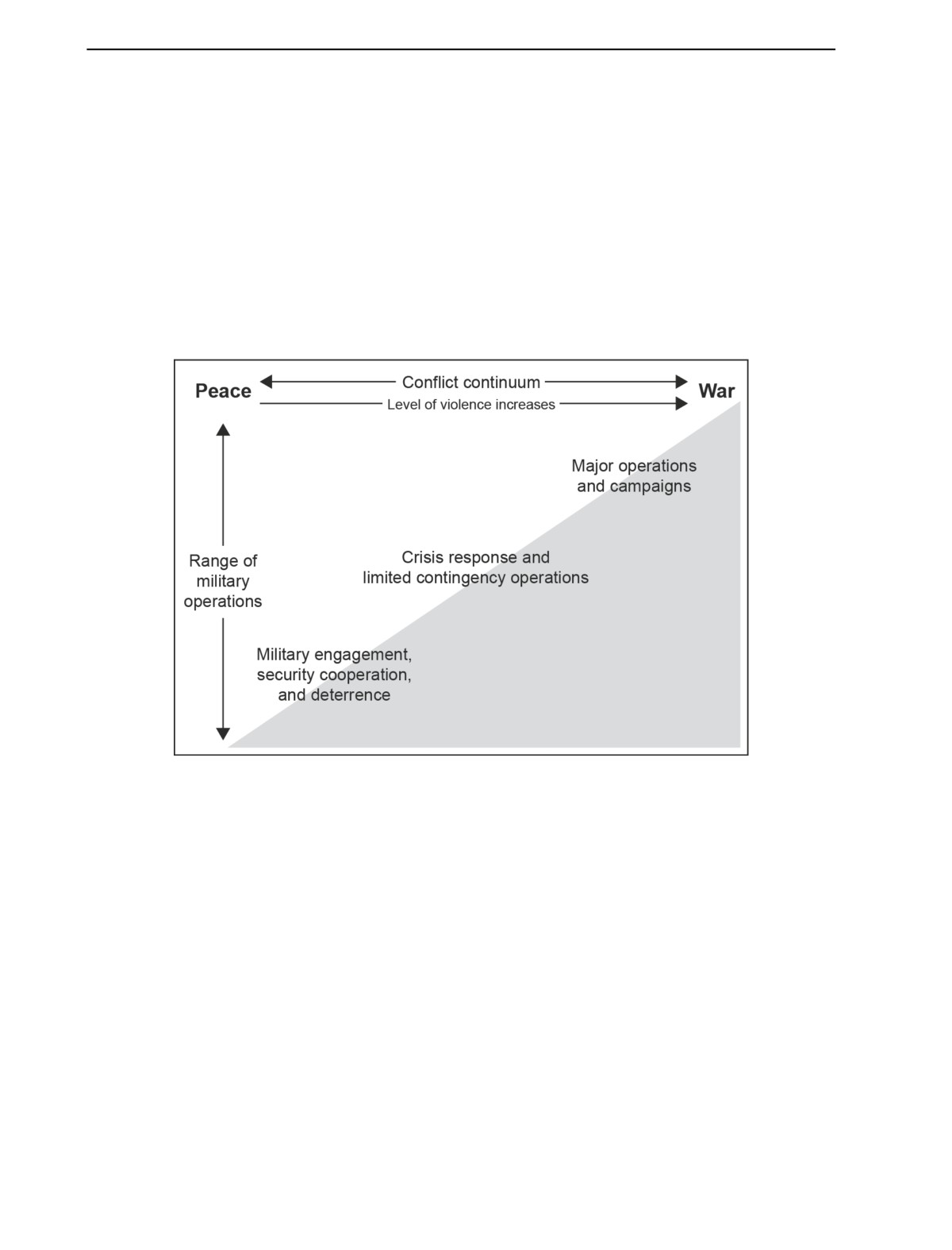
provide versatile higher headquarters tailored for contingencies and capable of evolving so commanders
can exercise mission command for campaigns and major operations. The Army provides headquarters for
joint land operations and often provides JTF headquarters for contingency operations. The nature of
counterinsurgency campaigns, such as those in Afghanistan and Iraq, require Army headquarters to
function as joint and multinational integrators. As the nature of warfare continues to evolve, interactions
among U.S forces and myriad indigenous and external groups will complicate every aspect of operations.
While dealing with the complexities of multinational and interagency operations, the headquarters deploy,
evolve, and tailor its organizations as the campaign progresses. As recent natural disasters showed, Army
headquarters also enable commanders to exercise mission command for Regular Army, Army National
Guard, and U.S. Army Reserve elements that respond to disasters of all types, whether at home or abroad.
Figure 1-1. The range of military operations
COMBATANT COMMAND THROUGH TACTICAL HEADQUARTERS
1-8. Army transformation redesigned the division to be a self-contained headquarters instead of a fixed
echelon with permanently assigned units. The division can command any combination of brigades,
including up to five BCTs, for a particular mission. The corps headquarters received additional personnel
and organic support. By adding to their organic communications, fire coordination, and life support, the
division and corps headquarters became more flexible, no longer depending on subordinate units to reach
full capability. This increased the flexibility of higher headquarters and allowed division and corps
headquarters to adapt to diverse missions. Because the corps and division headquarters are self-contained,
they are able to deploy with any mix of forces allowing for strategic flexibility during protracted
campaigns. During the conflicts in Iraq and Afghanistan, division headquarters often commanded BCTs
from posts across the Army, including Korea. The corps headquarters performed roles ranging from tactical
command of maneuvering divisions to operational command of multinational forces charged with
rebuilding a nation.
1-9. Army transformation restructured echelon-above-corps responsibilities to better support employment
of Army forces in that geographic combatant command. In order to make a modular Army work,
significant changes became necessary at echelons above corps. The Army Service component command
1-4
FM 3-94
21 April 2014

Echelons Above Brigade
(ASCC) for each geographic combatant command became a dedicated theater army with a common design.
The theater army is the primary interface between the combatant commander and the Department of the
Army; it is responsible for administration and support of all Army forces assigned, attached, or under the
operational control (OPCON) of the geographic combatant command. The theater army commander plans
and requests tailored Army force packages. Tailoring the force requires the theater army to determine the
composition of the force (how many and what types of units); its optimum deployment sequence given
combatant commander priorities and available lift; and the initial command and support relationships. The
theater army assumes responsibility for supporting all deployed Army forces in that AOR and OPCON of
all Army forces within the AOR that are not OPCON to a JTF or subunified command. The theater army is
responsible for reception, staging, onward movement, and integration (RSOI) of the Army force package
into the joint force. Although the theater army grew in size in order to control Army forces operating across
the AOR, the capability to use it as a field army commanding multiple army corps disappeared when the
Army deleted the operational command post module built into the design.
COMBATANT COMMANDS
1-10. There are three types of combatant commands. Functional combatant commands have global
responsibilities for U.S. military power, but do not have an AOR. Geographic combatant commands have a
regional responsibility defined by an AOR. A specified combatant command (there is none currently) is
established by the Secretary of Defense for a specific purpose and is normally composed of forces from a
single military department. Every combatant command has an ASCC. Table
1-2 lists the existing
combatant commands and their ASCCs.
Table 1-2. Combatant commands and their ASCCs
Combatant Command
Army Service Component Command
U.S. Pacific Command (GCC)
U.S. Army Pacific (theater army)
U.S. European Command (GCC)
U.S. Army Europe (theater army)
U.S. Central Command (GCC)
U.S. Army Central (theater army)
U.S. Africa Command (GCC)
U.S. Army Africa (theater army)
U.S. Southern Command (GCC)
U.S. Army South (theater army)
U.S. Northern Command (GCC)
U.S. Army North (theater army)
U.S. Transportation Command (FCC)
U.S. Army Surface Deployment and Distribution Command
U.S. Army Space and Missile Defense Command - Army
U.S. Strategic Command (FCC)
Strategic Command
U.S. Special Operations Command (FCC)
U.S. Army Special Operations Command
FCC
functional combatant command
U.S.
United States
GCC
geographic combatant command
THEATER ARMY
1-11. The theater army is the ASCC assigned to a geographic combatant command. It is organized,
manned, and equipped to perform three roles:
z
Theater army for the geographic combatant command to which it is assigned.
z
JTF headquarters (with augmentation) for a limited contingency operation in that AOR.
z
Joint force land component (with augmentation) for a limited contingency operation in that
AOR.
1-12. The key tasks associated with its roles include:
z
Serve as the primary interface between the Department of the Army, Army commands, and other
ASCCs.
z
Develop Army plans to support the theater campaign plan within that AOR.
z
Tailor Army forces for employment in the AOR.
z
Control RSOI for Army forces in the AOR.
21 April 2014
FM 3-94
1-5
Chapter 1
z
Exercise OPCON of deployed Army forces not subordinated to a joint force commander (JFC).
z
Exercise administrative control (ADCON) of all Army forces operating within the AOR.
z
Provide support as directed by the combatant commander to other Service forces, multinational
forces, and interagency partners.
z
Exercise OPCON of all joint forces attached to it as either a joint force land component
command or JTF headquarters, as required by the combatant commander.
z
Provide planning in support to the geographic combatant commander’s (GCC’s) strategic
planning, theater campaign plan, theater posture plan, theater security cooperation plans, theater
global force management planning, deliberate plans, and crisis action planning.
1-13. The combatant commander relies upon the theater army commander to integrate landpower into the
GCC’s plans for that AOR. The theater army coordinates with Department of the Army and the primary
Service force provider, FORSCOM, to integrate combatant commander requirements within the global
force management and ARFORGEN processes. The theater army coordinates through FORSCOM for
theater-specific training and preparation of regionally aligned forces by providing Army Training
Development Capability approved task names and task numbers to FORSCOM. As required, the theater
army may also coordinate directly with supporting combatant command ASCCs if the Secretary of Defense
directs the supporting combatant commander to provide forces. The gaining theater army commander
recommends to the combatant commander the composition, sequence of deployment, and operational chain
of command for Army forces deploying to the AOR. The theater army commander exercises OPCON as
specified by the combatant commander and ADCON as specified by the Secretary of the Army. (See
paragraph 1-51 for administrative control.)
1-14. The theater army performs a critical task in shaping the AOR for the geographic combatant
command. The theater army maintains a theater wide focus in support of security cooperation. ADP 1
succinctly explains:
Shaping the strategic security environment improves the chance for peace around the
world. It diminishes regional tensions and is therefore vital to American security
interests. Each geographic combatant commander develops programs to improve
regional stability and promote peace through security cooperation. American military
capabilities can reassure allies, while dissuading adversaries. Shaping by itself cannot
prevent conflict, but it nudges global regions away from military confrontation and
increases the effect of diplomatic, informational, and economic instruments of national
power… Soldiers are particularly important in this effort, since all nations have land
security elements, even if lacking credible air and naval forces. To the degree that other
nations see us as the best army in the world, they gravitate to us to help them achieve the
same high standards of military performance, or tie their security to the world’s most
capable army.
ADP 1
1-15. As required, the theater army provides Army support to other Services (ASOS), provides common-
user logistics, and carries out Department of Defense
(DOD)-specified Service executive agent and
combatant command support agent (CCSA) responsibilities in the AOR. These ARFOR responsibilities are
discussed in more detail beginning with paragraph 1-64.
ARMY CORPS
1-16. The Army corps is the Army’s most versatile headquarters. The corps must be as adept at planning a
rapid noncombatant evacuation operation as supporting a multiyear major combat operation. The Army
corps is deployable and scalable to meet almost every requirement of the combatant commander for a
senior level headquarters. The corps now functions as the principal integrator of landpower into campaigns
and is the link between the operational and tactical levels of war. In the conflicts in Afghanistan and Iraq,
for example, U.S. Army corps has commanded all land forces in those countries. The corps is the preferred
Army headquarters for joint augmentation and employment as a JTF. As a joint or multinational land
component command, an Army corps headquarters commands multiple Army divisions, brigades, and other
formations, and multinational forces and organizations. The corps headquarters often functions as the
1-6
FM 3-94
21 April 2014
Echelons Above Brigade
ARFOR (a senior headquarters) for deployed Army forces, exercising command over Army forces in a
joint operations area and prioritizing the extensive support provided by the theater army against the tactical
needs of joint and multinational forces. (See paragraph 1-57 for discussion of ARFOR.)
1-17. The corps headquarters is an essential element of the Army’s expeditionary capabilities. These
capabilities enable the Army to deploy combined arms forces into any AOR and operate effectively upon
arrival. Contingency operations require the corps and its subordinate forces to deploy quickly and set
conditions to seize the initiative and accomplish the mission. The corps is organized, manned, and equipped
to serve in four roles:
z
Provide the ARFOR within a joint force for campaigns and major operations.
z
Serve as the joint or multinational land component command headquarters (with augmentation)
in campaigns and major operations.
z
Serve as a JTF headquarters (with augmentation) for crisis response and limited contingency
operations.
z
Serve as a tactical headquarters commanding 2 to 5 Army divisions together with supporting
brigades and commands in campaigns and major operations.
1-18. The key tasks involved in these roles include:
z
Command Marine Corps and multinational brigades and divisions.
z
As a supported component, integrate supporting joint capabilities with landpower within a joint
operations area.
z
As a supporting component, integrate Army capabilities with supported component operations.
z
Exercise ADCON over Army forces in a joint operations area as specified by the ASCC.
z
Integrate special operations forces (SOF) with conventional force operations.
z
Provide ASOS as required by the JFC.
Each of these roles and tasks is discussed in detail in chapter 4.
ARMY DIVISION
1-19. The division headquarters operates as a tactical headquarters under OPCON of an Army corps or
Marine expeditionary force headquarters. It may become a joint force land component headquarters. In
limited contingency operations, it may become a JTF. As a tactical echelon of command, the division task-
organizes subordinate units and specifies the command or support relationships needed. The division
assesses the effort required for offensive, defensive, and stability tasks in its area of operations and
organizes its subordinate units accordingly. The division headquarters sets the conditions for employment
of its brigades, then controls and synchronizes their tactical actions. The division allocates resources,
designates the main effort as required, forecasts operational requirements, and establishes priorities of
support. Sustainment and other functional units (military police, engineer, air and missile defense, and
military intelligence) provide support in accordance with priorities established by the supported division
commander. The historical designations of the division headquarters, such as the 1st Cavalry Division, do
not necessarily reflect the capabilities of the subordinate forces task-organized under them.
1-20. The roles of the division include:
z
Serve as a tactical headquarters in campaigns and major operations.
z
Serve as the joint and multinational land component headquarters under a JTF in crisis response
and limited contingency operations.
z
Serve as a JTF headquarters (with augmentation) for limited contingency operations.
z
Serve as the ARFOR within a JTF in crisis response and limited contingency operations.
1-21. Key tasks for the division include:
z
Command two to five BCTs together with supporting brigades in decisive action.
z
Serve as the joint or multinational land component headquarters under a JTF (or multinational
JTF) in crisis response and limited contingency operations.
21 April 2014
FM 3-94
1-7
Chapter 1
z
Exercise tactical control (TACON) over Marine Corps and multinational forces.
z
Exercise ADCON over attached Army forces.
Each of these roles and tasks is discussed in detail in chapter 6.
COMMON DESIGN, DIFFERENT MANNING
1-22. The theater army, corps, and division headquarters derive from a common design philosophy.
Although commanders have the authority to reorganize the headquarters to best suit the requirements of the
mission, the base design of echelon above brigade headquarters stems from a set of design criteria and
organizational principles.
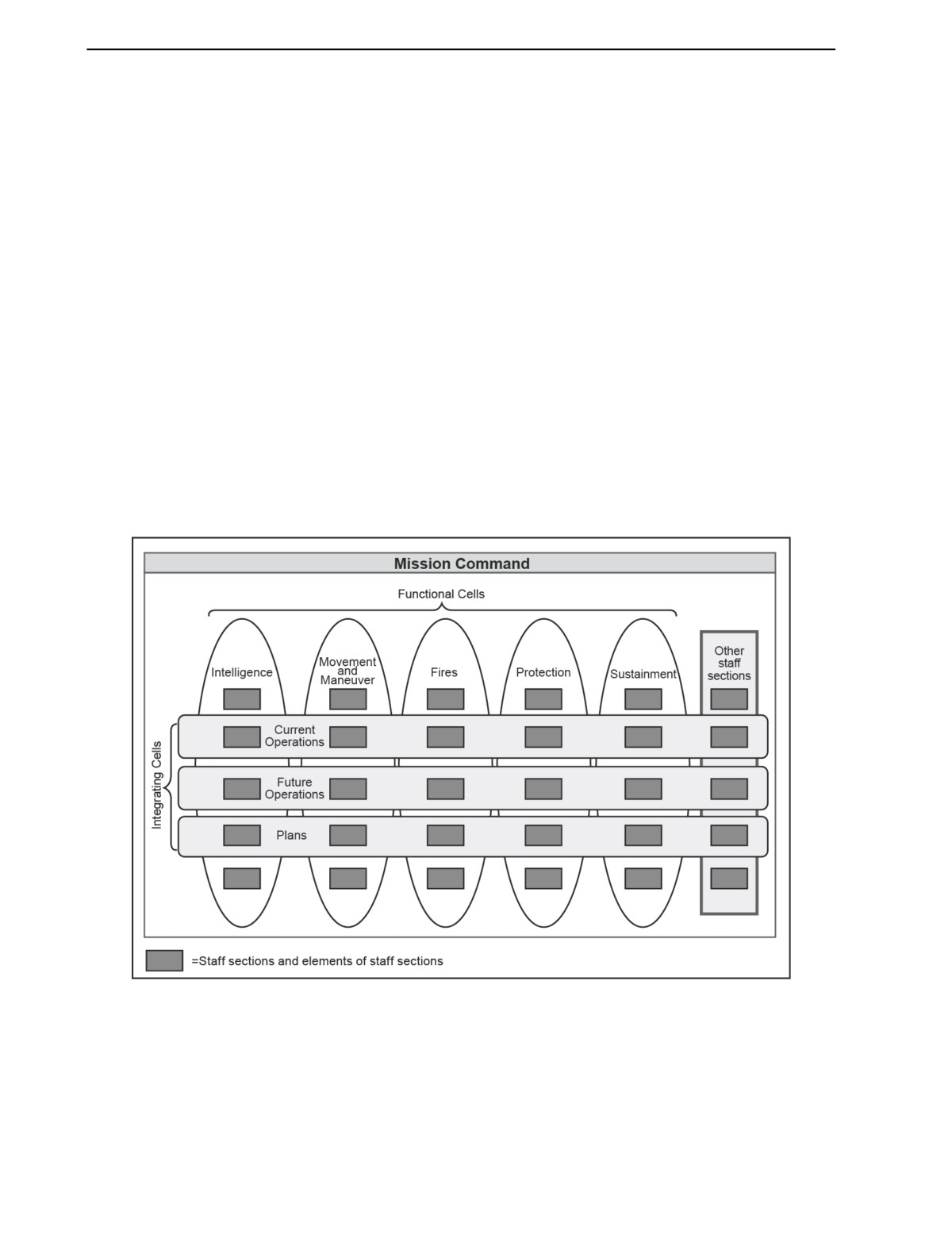
1-23. The basis for the organizational design is warfighting functions. There are five functional cells in the
headquarters design—intelligence, movement and maneuver, fires, protection, and sustainment. Elements
from coordinating and special staff sections (and in some cases, the personal staff) work within the
functional cells. Most of the functional cells contain representatives from different coordinating and special
staff sections; however, their activities fall within that warfighting function. The example protection cell in
figure 1-2 might include provost marshal; chemical, biological, radiological, and nuclear (CBRN); safety;
and personnel recovery. Each of the five functional cells has as its chief the senior officer from a
coordinating staff section. Normally, the chief of the protection cell will be a special staff officer. The sixth
warfighting function, mission command, does not form a separate functional cell. The function of mission
command applies to the entire headquarters. The chief of staff directly supervises the coordinating and
special staff sections that do not work within a functional cell.
Figure 1-2. Functional and integrating cells
1-24. The movement and maneuver cell provides the nucleus for the three integrating cells—current
operations integrating, future operations, and plans. Integrating cells group personnel and equipment by
planning horizon. The current operations integrating, future operations, and plans cells assist the
commander in integrating the warfighting functions within the short-, mid-, and long-range planning
horizons respectively.
1-8
FM 3-94
21 April 2014
Echelons Above Brigade
1-25. Each headquarters contains a commander; a command group; and coordinating, special, and personal
staff. Most coordinating and special staff sections divide into functional and integrating cells, normally on a
permanent basis. Designated staff sections, for example the G-6, normally report to the chief of staff
directly. The reporting channels for the personal staff vary within each command. Regardless of echelon,
the headquarters design provides for a main command post and a smaller, more mobile forward command
post. The latter is a contingency command post within the theater army structure and a tactical command
post at the corps and division levels. All three echelons have a headquarters and headquarters battalion
(HHB), although the structure for each echelon’s headquarters battalion differs. Rank and grade structures
also vary.
1-26. The higher headquarters design is based on the concept of matrix organizations. Staff cells, centers,
and working groups are organized into functional teams working together on a single line of effort or a
common purpose. This functional design facilitates the vertical integration of the staff elements in
permanent or ad hoc organizations. Multiple lines of effort meet in three permanently organized integrating
cells. The three integrating cells combine multiple functions and allow the commander considerable
flexibility to integrate the operation by planning horizon or by phases of the operation. A network and suite
of mission command systems enhance the ability to plan and coordinate operations across these staff
sections, cells, command posts, and echelons.
1-27. Vertical integration groups closely related tasks and functions. These groupings form the basis for
establishing five functional cells: intelligence, movement and maneuver, fires, protection, and sustainment
functional cells. Although described as functional cells, in reality, the cells contain subject matter experts
from multiple staff sections. For example, the sustainment warfighting function involves logistics,
personnel, medical, and resource management tasks, and the sustainment warfighting function cell includes
personnel with the appropriate skills, training, and experience to perform those tasks. The sustainment
warfighting function cell usually has personnel from the G-1, G-4, and G-8 staff sections and medical staff
element. The functional cells provide a standardized method of vertically integrating closely related tasks.
1-28. Horizontal integration occurs in three integrating cells that synchronize across three planning
horizons (or by the phases of the operation). Like the functional cells, the integrating cells (current
operations integrating, future operations, and plans) are matrix organizations established around core
elements organized as components of the movement and maneuver functional cell. In addition to the core
elements, all the functional cells and special staff elements are represented in the integrating cells, either on
a permanent basis or as required by the situation. Each headquarters has a command group, personal staff
officers, coordinating staff officers, and special staff officers.
(See ADRP 6-0 for a more detailed
discussion of their responsibilities). For each headquarters, the table of organization and equipment (known
as TOE) documents personnel by section and organizational design. The organizational design derives from
warfighting functions and reflects the organization of the staff for operations.
Functional Cells
1-29. The organizational design of each headquarters allocates personnel against six warfighting
functions—intelligence, movement and maneuver, fires, protection, sustainment, and mission command.
The staff in the intelligence, fires, protection, and sustainment warfighting functions form functional cells
and reinforce the integrating cells with subject matter experts. The movement and maneuver function
becomes the basis for the integrating cells—current operations integrating, future operations, and plans—
under the overall supervision of the G-3. As dictated by the situation, the chief of staff forms temporary
teams such as working groups, boards, and centers.
1-30. The distribution of the mission command warfighting function is unique because mission command
is both the purpose of the headquarters and the warfighting function enabled by the entire staff. The
function includes elements that support the entire headquarters and enable it to operate, for example
network operations and knowledge management. It also includes highly specialized personnel, such as
intelligence analysts, space operations officers, cyber electromagnetic activities (CEMA) personnel, or civil
affairs specialists. It includes the command group, personal staff, information operations officer, and civil
affairs operations section. Typically, the battle roster distributes some special staff sections under a
functional cell while other sections merge into one of the three integrating cells. The chief of staff normally
21 April 2014
FM 3-94
1-9
Chapter 1
supervises the G-6 and designated special staff sections. The arrangement of responsibility between the
chief of staff and the functional and integrating cells depends upon the mission variables. (See ADRP 6-0.)
Integrating Cells
1-31. Echelons above brigade have three integrating cells—current operations integrating, future
operations, and plans. Whereas functional cells focus on a particular function (such as fires), the integrating
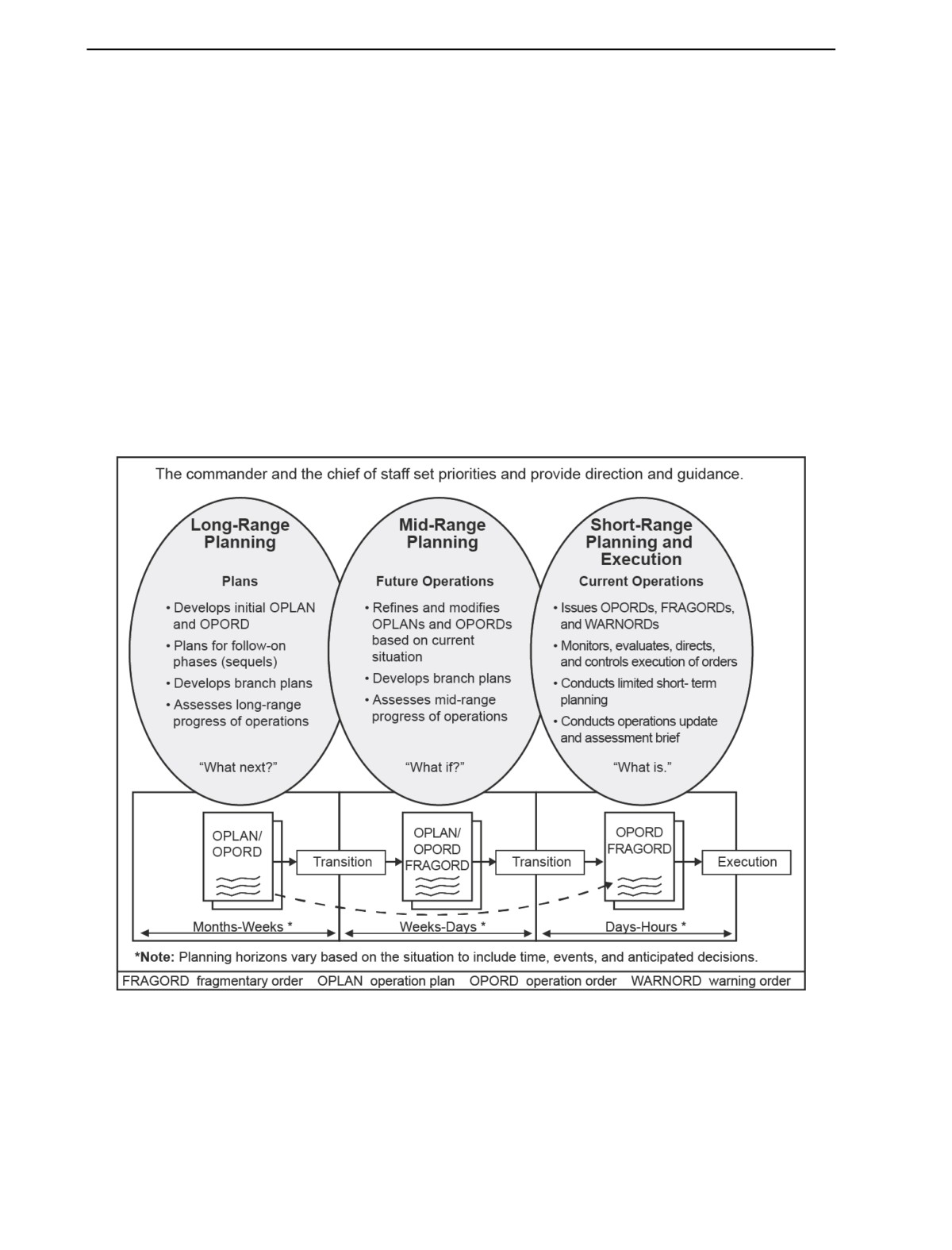
cells are organized by planning horizons (see figure 1-3). The current operations integrating cell, future
operations cell, and plans cell coordinate and synchronize forces and capabilities within a specified
planning horizon. A planning horizon is a point in time commanders use to focus the organization’s
planning efforts to shape future events (ADRP 5-0). The three planning horizons are long, mid, and short.
In general, long-term planning is associated with the plans cell, mid-term planning with the future
operations cell, and short-term planning with the current operations integrating cell. Planning horizons are
situation dependent; they can range from hours and days to weeks and months. As a rule, the higher the
echelon, the more distant the planning horizon with which each integrating cell is concerned. The G-3
allocates integrating cell personnel between the main command post and smaller deployable command
posts. Normally, the tactical or contingency command posts have a core group of current operations staff
augmented by individuals from plans and future operations cells according to the situation.
Figure 1-3. Planning horizons for integrating cells
Flexible Staff Organization
1-32. The complexity of land operations—constant adjustment between the elements of decisive action,
multiple lines of effort and operations, and frequent changes to task organization—requires agility and
teamwork throughout the staff. The Army designed echelons above brigade to have the flexibility to meet
these challenges. The commander and chief of staff adjust expertise across the staff according to the
1-10
FM 3-94
21 April 2014
Echelons Above Brigade
situation and do not adhere rigidly to the organizational document. The organization of each echelon’s staff
varies according to the mission, tailored force structure, multinational responsibilities, and other
circumstances.
1-33. The functional structure of the staff allows the commander and chief of staff considerable flexibility
to shift expertise among functional cells, integrating cells, centers, and temporary teams (such as boards
and working groups). It also allows the commander and chief of staff to adjust manning levels between the
various command posts employed by different echelons. For example, a corps headquarters on alert during
a crisis will expand its plans cell. Subsequently, the corps commander might deploy the corps tactical
command post with a deputy corps commander to the crisis area of operations. The chief of staff reinforces
the tactical command post with a small combined plans cell, a future operations cell, and additional
sustainment experts. When the main command post deploys, the staff reorganizes again, and the tactical
command post loses its planners. In another example, a division headquarters deployed in response to a
domestic disaster (a defense support of civil authority mission) will reorganize. Because of domestic legal
constraints, the chief of staff may redistribute the intelligence cell into the integrating cells to provide
“incident awareness and assessment” (see ADRP 3-28). Since there will be no requirement for fire support,
the chief of staff may shift personnel from the fires cell to liaison duties, airspace coordination, and rescue
coordination.
1-34. Figure 1-4 and figure 1-5 (pages 1-12 and 1-13 respectively) illustrate the design of echelons above
brigade headquarters. Echelons above brigade have large staffs to support the commander. Regardless of
whether the headquarters is a theater army, corps, or division, each has a command group, personal staff,
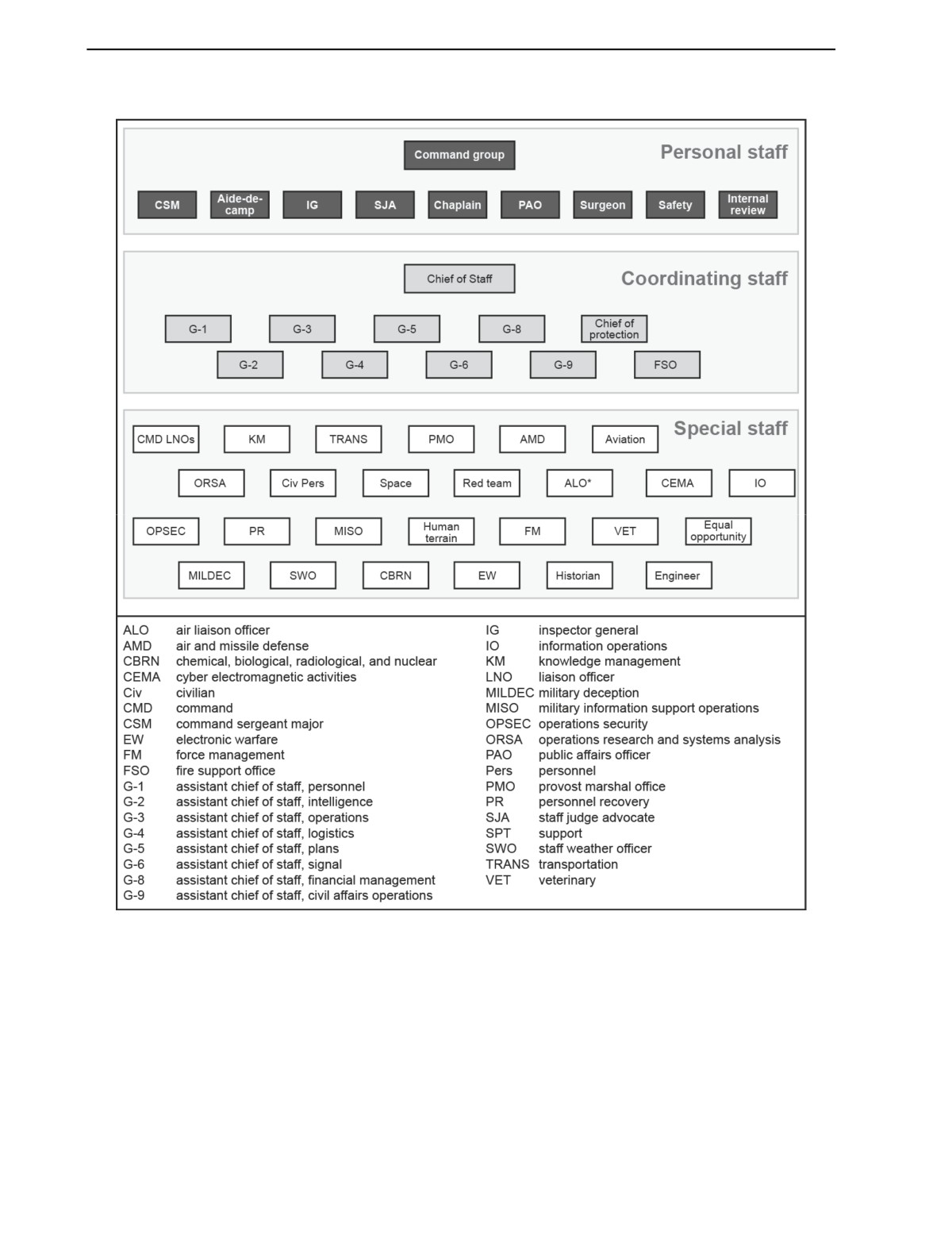
coordinating staff, and special staff, as shown in figure 1-4. In general, the personal staff works for the
commanding general. The coordinating staff and special staff work for the chief of staff. (ADRP 6-0
discusses personal, coordinating, and special staff sections in more detail.)
21 April 2014
FM 3-94
1-11
Chapter 1
Figure 1-4. Distribution of staff sections within a main command post
1-12
FM 3-94
21 April 2014
Echelons Above Brigade
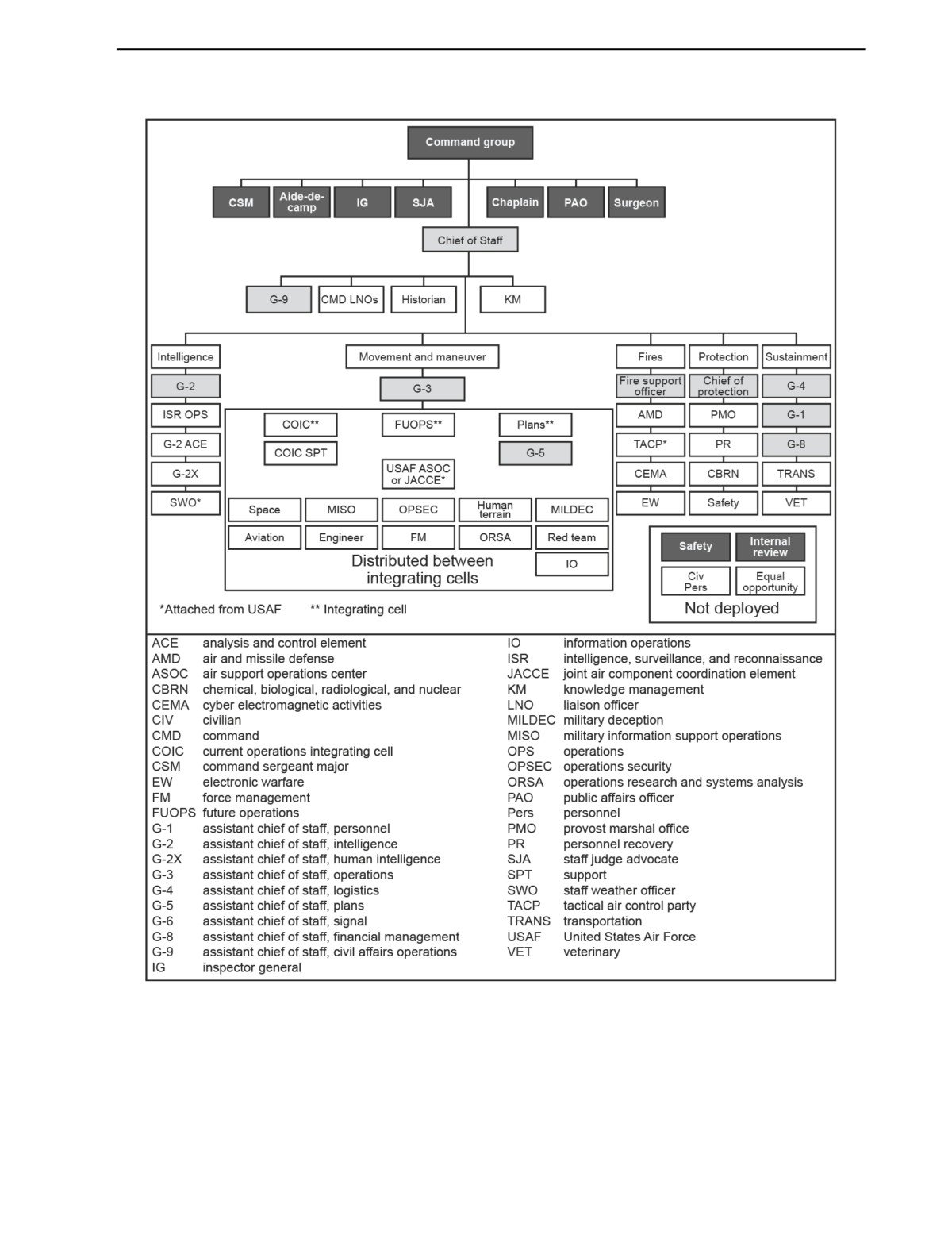
Figure 1-5. Example of echelons above brigade command post
1-35. Organizational designs of the headquarters at theater army, corps, and division utilize a staff structure
based upon the warfighting functions. Figure 1-5 provides a sample echelons above brigade headquarters.
The personal staff works directly for the commander. Most of the coordinating and special staff separate
into cells derived from the warfighting functions. Five cells—intelligence, movement and maneuver, fires,
protection, and sustainment—receive the bulk of the sections. The movement and maneuver cell is the
largest and includes three integrating cells: current operations, future operations, and plans. The mission
command warfighting function does not have a distinct cell since the entire headquarters supports mission
21 April 2014
FM 3-94
1-13
Chapter 1
command. However, coordinating staff elements that enable the tasks within the mission command
warfighting function such as the G-6 and G-9 often work directly for the chief of staff. Note that some of
the personal and special staff may remain at home station; this is situation dependent. The corps and
division receive large elements from the U.S. Air Force. Depending upon echelon and mission, different
headquarters will organize differently. A modified table of organization and equipment (known as MTOE)
delineates the specific organization, and the commander modifies the structure further based upon the role
and mission of that particular headquarters.
1-36. Other factors can alter the staff organization as well. If the headquarters is multinational in
composition, the commander may adjust it to fit the staff organization familiar to the international forces.
This is typically a derivative of the G-staff model, with G-1 through G-9 replacing the cells based on
warfighting functions. If the headquarters becomes a JTF, it reorganizes accordingly. Individual experience
and skill qualification play an important part. The most important determinant, however, remains the needs
of the commander. The commander communicates anticipated decisionmaking needs, and the staff adjusts
its organization and priorities accordingly.
1-37. Each echelon headquarters has a different table of organization and equipment, and each
organizational design is in the respective chapters on theater army, corps, and division. A modified table of
organization and equipment specifies the actual organization for each theater army, corps, and division
headquarters. The commander modifies the staff organization further based upon roles and missions
assigned.
OPERATIONAL AND ADMINISTRATIVE CHAINS OF COMMAND
1-38. Echelons above brigade exercise a mixture of OPCON and ADCON over subordinate forces. As
described in JP 1, the President and Secretary of Defense exercise authority and control of the armed forces
through two distinct branches of the chain of command. One branch runs from the President, through the
Secretary of Defense, to the combatant commanders for missions and forces assigned to combatant
commands. This is the operational chain of command. For purposes other than the operational direction of
combatant commands, the chain of command runs from the President to the Secretary of Defense, to the
secretaries of the military departments, and, as prescribed by the secretaries, to the commanders of U.S.
forces. Each military department operates under the authority, direction, and control of the secretary of that
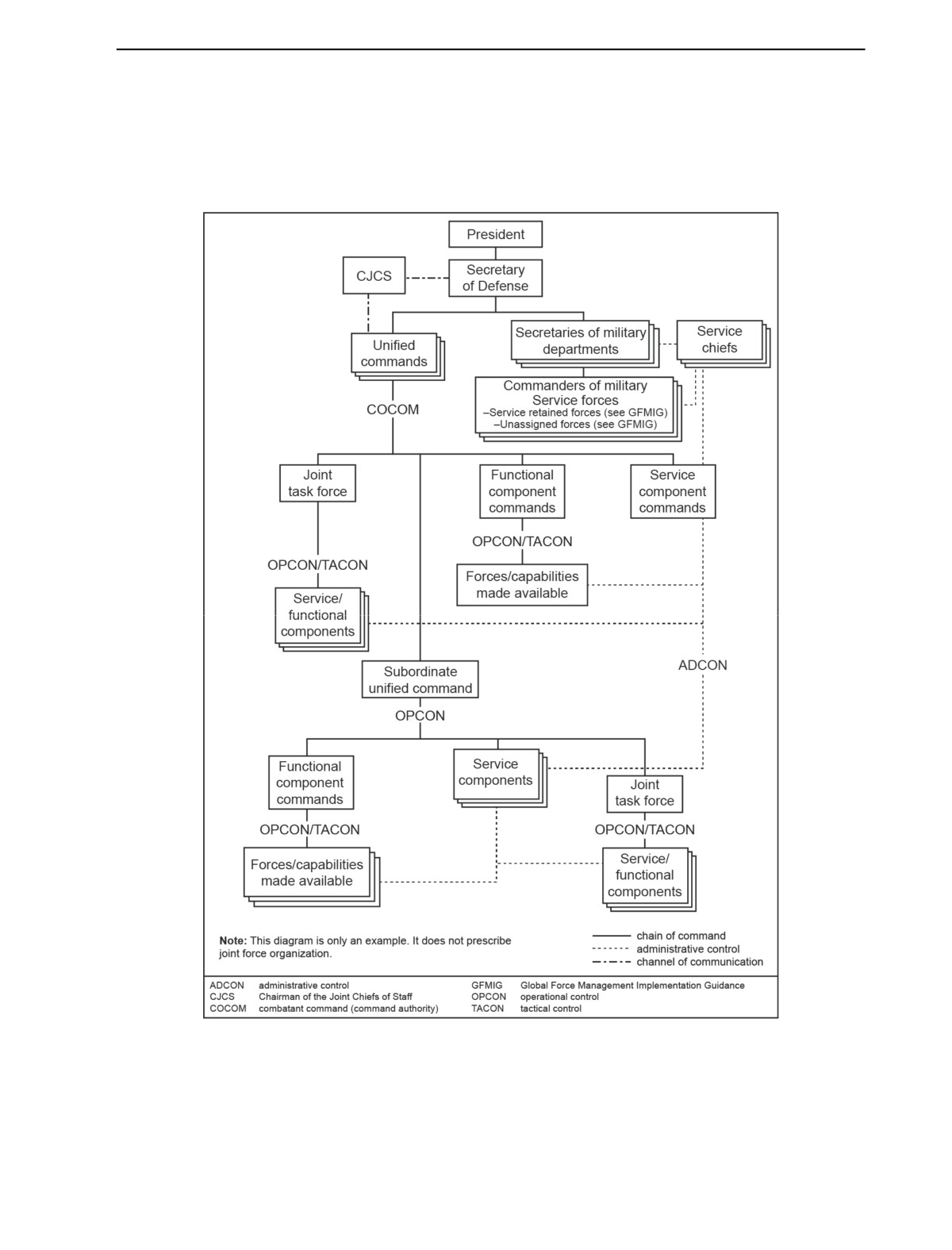
military department. This is the ADCON of forces. (See figure 1-6.)
1-39. At brigade and below, the distinction between the branches of command is small because in most
cases the operational and administrative chains are the same. The brigade commander is responsible for the
operations and administration of the brigade and all Army units attached to it. Above the brigade, the
responsibilities associated with the operational and administrative chains multiply. At the theater army
echelon, the support needed by deployed Army and joint forces requires not only the theater army
headquarters, but also large support commands. The theater army provides essential sustainment to the
corps through sustainment and medical commands. The theater echelon reduces the workload imposed on
the operational headquarters by shifting the sustainment, support to other Services, and multinational and
CCSA requirements from the corps and division. Without it, the support requirements could overwhelm the
ability of the corps and division to exercise effective operational command of their subordinate forces.
OPERATIONAL CHAIN OF COMMAND
1-40. The assignment of forces to the combatant commands
comes from the Secretary of Defense in the Forces for Unified
Global Force Management
Implementation Guidance
Commands memorandum, and force assignments are
documented in the Global Force Management Implementation
Guidance issued by the Secretary of
Defense which codifies the
Guidance assignment tables. According to the Global Force
processes used by Department of
Management Implementation Guidance, unless otherwise
Defense to execute Global Force
directed by the President or the Secretary of Defense, all forces
Management. The text in this
operating in the geographic area assigned to a combatant
document is updated in even fiscal
commander are assigned or attached to that combatant
years and the Force Assignment
commander. A force assigned or attached to a combatant
tables are updated every fiscal year.
commander may be transferred from that commander to another
1-14
FM 3-94
21 April 2014
Echelons Above Brigade
combatant commander only when directed by the Secretary of Defense and approved by the President. The
Secretary of Defense specifies the command relationship the gaining commander will exercise (and the
losing commander will relinquish). Establishing authorities for subordinate unified commands and JTFs
may direct the assignment or attachment of their forces to those subordinate commands and delegate the
command relationship as appropriate. (See JP 1.)
Figure 1-6. The operational chain of command and administrative control
1-41. Inherent in command is the authority that a military commander lawfully exercises over subordinates
including authority to assign missions and accountability for their successful completion. Although
commanders may delegate authority to accomplish missions, they may not absolve themselves of the
responsibility for the accomplishment of these missions. Authority is never absolute; the establishing
21 April 2014
FM 3-94
1-15

Chapter 1
authority specifies its extent in accordance with DOD directives, and U.S. law. The specific command
relationship—combatant command (command authority) (COCOM), OPCON, TACON, and support—will
define the level of authority each commander has over assigned or attached forces. (See table 1-3 for a brief
summary of the joint command relationships.)
Table 1-3. Joint command relationships
Joint
Description (Extracted from JP 1)
Relationship
Combatant
COCOM is the command authority over assigned forces vested only in the
command
commanders of CCMDs and cannot be delegated or transferred. COCOM provides
(command
full authority for a combatant commander to perform those functions of command
authority)
over assigned forces involving organizing and employing commands and forces,
(COCOM)
assigning tasks, designating objectives, and giving authoritative direction over all
aspects of military operations and joint training.
Operational
OPCON is exercised by commanders at any echelon at or below the level of a
control (OPCON)
CCMD and may be delegated within the command. OPCON can be delegated from
a lesser authority than COCOM. It provides authority for organizing and employing
subordinate forces, assigning tasks, designating objectives, and giving authoritative
direction over all aspects of military operations and joint training necessary to
accomplish the mission. Normally, this authority is exercised through subordinate
JFCs, Service commanders, and/or functional component commanders. OPCON
provides authority to organize and employ commands and forces as the commander
considers necessary to accomplish missions. It does not include authoritative
direction for logistics or matters of administration, discipline, internal organization, or
unit training.
Tactical control
TACON is an authority over assigned or attached forces or commands, or military
(TACON)
capability or forces made available for tasking, that is limited to the detailed direction
and control of movements and maneuvers within the operational area necessary to
accomplish missions or tasks assigned by the commander exercising OPCON or
TACON of the attached force. TACON does not provide the authority to give or
change the function of the subordinate commander, or modify the organization of the
subordinate unit.
Support
Support is a command authority. A support relationship is established by a common
superior commander between subordinate commanders when one organization
should aid, protect, complement, or sustain another force. The support command
relationship is used by SecDef to establish and prioritize support between and
among combatant commanders, and it is used by JFCs to establish support
relationships between and among subordinate commanders. The designation of
supporting relationships is important as it conveys priorities to commanders and
staffs that are planning or executing joint operations. The establishing authority (the
common JFC) ensures that both the supported and supporting commanders
understand the degree of authority that the supported commander is granted.
CCMD combatant command
JFC
joint force commander
SecDef Secretary of Defense
1-42. The typical operational chain of command extends from the combatant commander to a JTF
commander, then to a functional component commander or a Service component commander. JTFs and
functional component commands, such as a joint force land component, comprise forces that are normally
subordinate to a Service component command but placed under the OPCON of the JTF, and subsequently
to a functional component commander. Conversely, the combatant commander may designate one of the
Service component commanders as the JTF commander or as a functional component commander. In some
cases, the combatant commander may not establish a JTF, retaining OPCON over subordinate functional
commands and Service components directly.
1-43. A JTF is the organization most often used by a combatant commander for contingencies. Combatant
commanders establish JTFs and designate the JFCs for these commands. Those commanders exercise
OPCON of all U.S. forces through functional component commands, Service components, subordinate
JTFs, or a combination of these. (See JP 3-33.)
1-16
FM 3-94
21 April 2014
Echelons Above Brigade
1-44. Support is a command authority in joint doctrine. When one organization should aid, protect,
complement, or sustain another force, a supported and supporting relationship is established by a superior
commander between subordinate commanders. Designating a support relationship does not provide
authority to organize and employ commands and forces, nor does it include authoritative direction for
administrative and logistics support.
1-45. JP 1 specifies four categories of support:
z
General support.
z
Mutual support.
z
Direct support.
z
Close support.
1-46. General support is that support that is given to the supported force as a whole and not to any
particular subdivision thereof. Mutual support is that support that units render each other against an enemy
because of their assigned tasks, their position relative to each other and to the enemy, and their inherent
capabilities. Direct support is a mission requiring a force to support another specific force and authorizing it
to answer directly to the supported force’s request for assistance. Close support is that action of the
supporting force against targets or objectives that are sufficiently near the supported force as to require
detailed integration or coordination of the supporting action with the fire, movement, or other actions of the
supported force.
1-47. Joint support is somewhat vague but very flexible. Establishing authorities ensure both supported and
supporting commanders understand the authority of supported commanders. JFCs often establish supported
and supporting relationships among components. For example, the maritime component commander is
normally the supported commander for sea control operations; the air component commander is normally
the supported commander for counterair operations. For example, an Army corps headquarters designated
as the joint force land component may be the supporting force during some campaign phases and the
supported force in other phases. Often the JFC specifies only a supported and supporting relationship
between forces. In that case, the supporting force will be in general support.
Note. A joint support relationship is not used when an Army commander task-organizes
subordinate Army forces. When task-organized to support another Army force, Army forces use
one of four Army support relationships. (See ADRP 5-0.)
1-48. The JFC may establish a support relationship between functional and Service component
commanders. Conducting operations across a large operational area often involves both the land and air
component commanders. The JTF commander places the joint force land component in general support of
the air component until the latter achieves air superiority. Conversely, within the land area of operations,
the joint force land component commander (JFLCC) becomes the supported commander and the air
component commander provides close support.
1-49. When an Army corps headquarters becomes the joint force land component as part of a JTF, Army
units subordinated to it are normally attached, and OPCON is inherent. Marine Corps forces made available
to a joint force land component are normally under TACON, but the JFC may specify an OPCON
relationship. (See JP 3-31.) The JFLCC makes recommendations to the JFC on properly using attached,
OPCON, or TACON assets; planning and coordinating land operations; and accomplishing such
operational missions as assigned.
1-50. When the Secretary of Defense assigns Army forces to a combatant command, the transfer is either
permanent or the duration is unknown but very lengthy. The combatant commander exercises COCOM
over assigned forces. When the Secretary of Defense allocates Army units (from FORSCOM or a
supporting combatant command) to another combatant command, the transfer of units is relatively
temporary. Allocated forces normally return to their parent combatant command at the end of the
deployment. The combatant commander exercises OPCON of the allocated force. In either case, the
combatant commander normally exercises OPCON over Army forces through the ASCC until the
combatant commander establishes a JTF and functional components. At that time, the combatant
commander delegates OPCON to the JTF commander. When the JFC establishes any command
21 April 2014
FM 3-94
1-17
Chapter 1
relationship
(including a joint support relationship), the theater army clearly specifies sustainment
responsibilities for all affected Army commanders.
ADMINISTRATIVE CONTROL
1-51. Administrative control is direction or exercise of authority over subordinate or other organizations in
respect to administration and support (JP 1). This administration and support includes organization of
Service forces, control of resources and equipment, personnel management, unit logistics, individual and
unit training, readiness, mobilization, demobilization, discipline, and other matters not included in the
operational missions of the subordinate or other organizations. It is a Service authority, not a joint
authority. ADCON is exercised under the authority of and is delegated by the Secretary of the Army.
ADCON is synonymous with the Army’s Title 10 authorities and responsibilities. (See DODD 5100.01.)
1-52. ADCON does not necessarily follow to the operational chain of command at echelons above brigade.
Unless modified by the Secretary of the Army, administrative responsibilities normally flow from
Department of the Army through the ASCC to those Army forces assigned, attached, or OPCON to that
combatant command. As the ASCC, the theater army delegates ADCON as required to Army forces
attached by the combatant commander to a joint (or joint and multinational) task force. The ARFOR
commander and associated headquarters exercises ADCON of Army forces within that JTF as specified by
the theater army commander.
ARMY SERVICE COMPONENT COMMAND
1-53. The Army Service component command is the command responsible for recommendations to the
joint force commander on the allocation and employment of Army forces within a combatant command
(JP 3-31). The ASCC is the senior Army command assigned to a combatant command. It consists of the
Army Service component commander and all those Army forces, such as individuals, units, detachments,
organizations, and installations under that command, including the support forces assigned to a combatant
command or further assigned to a subordinate unified command. If the combatant commander of a
geographic combatant command establishes a subordinate unified command, the Department of the Army
will form an Army component headquarters appropriate for that subordinate unified command.
1-54. The Secretary of the Army may redirect some or all Service responsibilities outside the normal
ASCC channels. In similar fashion, the ASCC may distribute some administrative responsibilities outside
the ARFOR. They primarily focus on the effectiveness of Army forces and the care of Soldiers.
1-55. Shared ADCON refers to the internal allocation of Title 10, United States Code (known as USC),
section
3013(b) responsibilities and functions. ASCCs usually share ADCON for at least some
administrative or support functions. This is especially true for Reserve Component forces. Certain
administrative functions, such as pay, stay with the Reserve Component headquarters even after unit
mobilization. Shared ADCON also applies to direct reporting units of the Army that typically perform
single or unique functions. The direct reporting unit, rather than the ASCC, typically manages individual
and unit training for these units. The Secretary of the Army directs shared ADCON. For example, the
theater army normally divides ADCON responsibilities for a military intelligence brigade stationed in that
AOR. INSCOM manages intelligence-specific equipment, activities, manning, and funding. The theater
army manages facilities, common item maintenance, and discipline.
1-56. Each theater army will have operational and administrative responsibilities. Through assignment or
attachment of Army forces to that geographic combatant command by the DOD, the theater army exercises
OPCON of all Army forces until the combatant commander attaches those forces to a subordinate joint
command. Regardless of whether Army forces are OPCON to the theater army or not, the theater army
commander retains responsibility for ADCON of all Army forces. Although the responsibility for ADCON
of Army forces within the AOR remains with the theater army commander, that responsibility involves the
entire Army.
1-18
FM 3-94
21 April 2014
Echelons Above Brigade
ARFOR
1-57. By definition, the ARFOR is the Army component and senior Army headquarters of all Army
forces assigned or attached to a combatant command, subordinate joint force command, joint
functional command, or multinational command. The ARFOR is the Army component of any joint
force. (See JP 1 and JP 3-0.) Army doctrine distinguishes, however, between the Army component of a
combatant command and that of a joint force formed by the combatant commander. The Army component
of the combatant command is an ASCC, and the Army component of the subordinate joint force is an
ARFOR.
ARFOR IN A SUBORDINATE JOINT FORCE
1-58. All JTFs that include Army forces have an ARFOR. The ARFOR consists of the Army commander,
the commander’s associated headquarters, and all Army forces attached to the JTF. The ARFOR provides
administrative and logistics support to all Army forces and retains OPCON over Army units not
subordinate to another component of the JTF. The senior Army officer assigned to the JTF, not in a joint
duty assignment, becomes the ARFOR commander. Since the preferred joint approach for a JTF
headquarters uses an existing Service headquarters, the JTF commander and headquarters would retain all
responsibilities associated with both command positions (ARFOR and JTF). This can overload the JTF
headquarters unless the commander delegates authority for Service-specific matters to another commander.
For example, when a corps becomes a JTF headquarters, the corps commander becomes the JTF
commander. The corps retains ARFOR responsibilities through the ASCC back to the Army, unless the
corps commander shifts Service responsibilities to another headquarters. The corps commander normally
designates a subordinate Army commander and staff as the deputy ARFOR commander for performing
those duties. (See JP 1 and JP 3-33.)
1-59. The typical JTF has a combination of Service and functional components.
(See figure
1-7,
page 1-20.) While the JTF will always have an ARFOR if it commands Army units, the operational roles of
the ARFOR can vary. It is important to understand that the ARFOR exercises both OPCON and ADCON
over Army forces in the JTF. However, not all Army forces are necessarily OPCON to the ARFOR. The
ARFOR commander retains OPCON over Army forces attached to the joint force until the JFC places
selected Army units under the command of another component in the JTF. The JFC may designate the
senior Army commander and headquarters as the joint force land component command, in which case the
Army commander exercises OPCON or TACON over other Service forces, in addition to OPCON and
ADCON over Army forces. In this case, dual command responsibilities as ARFOR and joint force land
component are manageable, since the preponderance of forces are Army and missions assigned to other
land forces are similar in nature.
1-60. The combatant commander detaches Army forces from the theater army and attaches them to a JTF
(or another joint force, such as a subunified command). This removes them from the OPCON of the theater
army and places them under the OPCON of the gaining JFC (see note). When command transfers to the
gaining JTF, the ARFOR in the JTF exercises OPCON over Army forces attached to the JTF until the JFC
directs otherwise. The JTF commander organizes the joint force by specifying command relationships
(OPCON, TACON, or support) between attached forces. The ARFOR commander retains OPCON over
those Army forces not subordinate to another component commander such as a joint special operations
component. The ARFOR commander is responsible for all aspects of planning and executing operations as
tasked by the JFC.
Note. Attachment has different purposes in joint and Army doctrine. The combatant commander
attaches forces to a JTF in order to transfer OPCON. The Army attaches forces to transfer both
OPCON and ADCON. Therefore, when the combatant commander attaches an Army unit to a
JTF, it is automatically attached to the ARFOR unless the JFC specifies otherwise. The ARFOR
then exercises OPCON and ADCON over the Army unit.
21 April 2014
FM 3-94
1-19
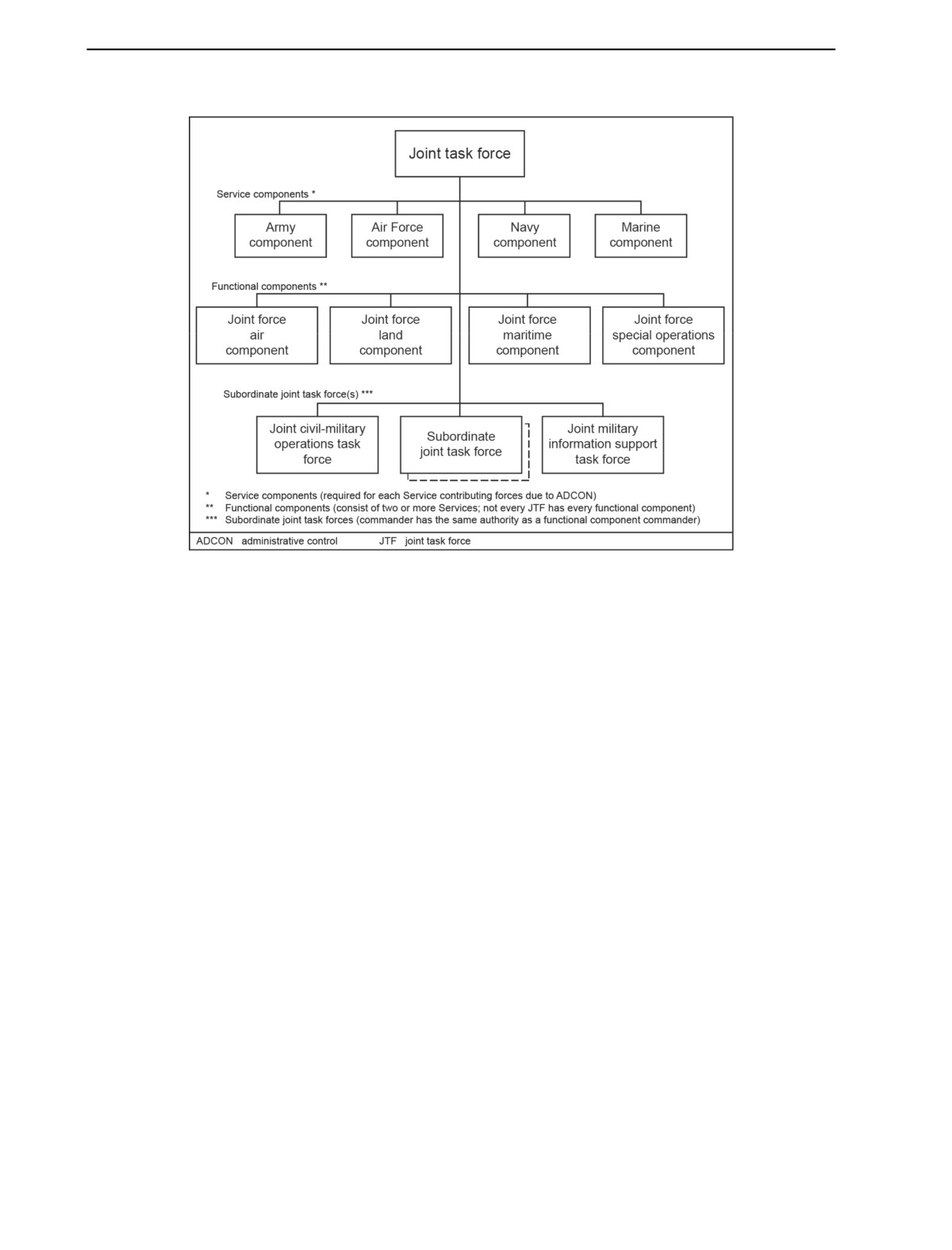
Chapter 1
Figure 1-7. Possible joint task force components
1-61. In addition to controlling Army forces, the ARFOR coordinates ASOS. ASOS includes provision of
common-user logistics and executive agent support to the JTF as required the JTF establishing authority.
To make this coordination more manageable, the theater army normally retains command of logistics and
medical support units that are not part of the brigades. These units provide area support not only to the
Army forces but also to the joint force. The ARFOR headquarters manages support to other Services
including, but not limited to:
z
Missile defense.
z
Fire support.
z
Base defense.
z
Transportation.
z
Fuel distribution.
z
General engineering.
z
Intratheater medical evacuation.
z
Veterinary services.
z
Logistics management.
z
Communications.
z
Chemical, biological, radiological, and nuclear defense.
z
Consequence management capability.
z
Explosive ordnance disposal.
1-62. As required by the theater army, the ARFOR commander exercises ADCON over all Army forces in
the JTF, including those subordinate to other components. Depending on the JTF organization, the ARFOR
commander may exercise OPCON of some or all Army forces assigned to the task force, and remain
responsible for ADCON of those forces. However, the exercise of OPCON is a delegation of joint
command authority and not a function of ADCON.
1-63. The theater army commander will specify the ADCON responsibilities of the ARFOR, with the
theater army normally retaining control of RSOI, logistics support of the deployed force, personnel support,
1-20
FM 3-94
21 April 2014
Echelons Above Brigade
and medical support. Administrative responsibilities normally retained by the ARFOR include internal
administration and discipline, training within the joint operations area, and Service-specific reporting. The
theater army normally retains OPCON of Army sustainment and medical commands operating in the joint
operations area. The theater army commander establishes an Army support relationship between the
ARFOR and these units. (See chapter 2 for further details.)
ARFOR RESPONSIBILITIES
1-64. A division or corps headquarters serving as the ARFOR for a JTF includes the headquarters
controlling multiple subordinate tactical formations and the Army forces placed under a joint or
multinational headquarters. The Army commander is responsible to the JFC for these operational
requirements. However, the JFC is not responsible for Service-specific matters involving administration
and support of Army forces. The Army forces commander answers to the Secretary of the Army through
the ASCC for Service-specific matters, whether it is a theater army or functional command (for example,
SDDC of the USTRANSCOM). A theater army provides ADCON or Title
10 authorities and
responsibilities for all Army units within the JTF, including those not under OPCON of the headquarters. In
certain circumstances, such as geographic separation between the ADCON headquarters and the
intermediate tactical headquarters, the theater army commander can delegate authority to execute specified
administrative tasks to Army component commanders under OPCON of JFCs operating in joint operations
areas within an area of operations.
1-65. The ARFOR within a joint operations area normally exercises OPCON over all Army maneuver,
fires, and maneuver support forces (such as military police, air and missile defense, engineer, civil affairs,
and CBRN), except for Army forces providing sustainment (including medical support). The ARFOR in a
joint operations area identifies requirements, establishes priorities of support for Army forces, and
coordinates with the theater army for providing sustainment. The ASCC may itself function as an ARFOR
unless the combatant commander exercises command and control through subordinate JFCs. In this case,
each subordinate JFC potentially has subordinate Army forces, while the ASCC exercises ADCON of all
Army forces across the AOR. The ASCC provides ASOS, common-user logistics, assignment eligibility
and availability, and sustainment to interagency elements and Army, joint, and multinational forces in a
joint operations area.
1-66. This relationship relieves division or
Army executive agent responsibilities. Under the
corps headquarters (as ARFOR within the joint
authority of the Secretary of Defense and Title 10,
operations area) of responsibility for directly
U.S. Code, the Army has been designated the
exercising ADCON and sustaining tasks for
executive agent by the Secretary of Defense or
Army forces and providing ASOS, common-
Deputy Secretary of Defense for foundational
user logistics, and Army executive agent
activities that are not necessarily landpower equities,
responsibilities. The sustainment concept splits
but functions necessary to the entire joint force.
These functions include, but are not limited to—
the responsibilities between the ARFOR in the
• DOD Detainee Operations Policy.
joint operations area or the joint force command
• Armed Services Blood Program Office.
(division or corps) and the theater army. The
• Chemical and Biological Defense Program.
theater army provides sustainment to all Army
• Chemical Demilitarization.
forces stationed in, transiting through, or
• DOD Combat Feeding Research and
operating within the area of operations. It also
Engineering Program.
provides most ASOS, common-user logistics,
• Defense Language Institute Foreign
and Army executive agent support to unified
Language Center.
action partners within the area of operations.
• DOD Level III Corrections.
The theater army executes these sustainment
• Explosives Safety Management.
responsibilities through its assigned theater
sustainment command (TSC) with expeditionary sustainment commands (ESCs) and tailored sustainment
brigades provided from the Army pool of Service-retained rotational forces. The theater army provides
medical services to support the force through its assigned medical command
(deployment support)
(MEDCOM [DS]) and forward deployed medical brigades. (See FM 4-02.)
1-67. For each of the combatant commands, the Secretary of Defense has assigned administrative and
logistics support for subordinate joint elements to one of the four military services. The Department of the
Army delegates its assigned CCSA responsibilities to the respective theater army (or in the case of Korea,
21 April 2014
FM 3-94
1-21
Chapter 1
to the Eighth Army) for that geographic combatant command. U.S. Army South conducts CCSA for
USSOUTHCOM and USSOCOM South. U.S. Army Europe conducts CCSA for USEUCOM, U.S. Special
Operations Command Europe, USAFRICOM, and U.S. Special Operations Command Africa. Eighth Army
conducts CCSA for U.S. Joint Forces Korea and U.S. Special Operations Command Korea. USASOC
conducts CCSA for Joint Special Operations Command. (See DODD 5100.03.)
ARMY LOGISTICS AND MEDICAL SUPPORT
1-68. The logistics concept of support, and its counterpart in the medical concept of support, affects the
command and support relationships among the theater army, the ARFOR
(a division or corps
headquarters), and the logistics and medical units supporting Army and joint forces conducting operations
in a joint operations area. Under the logistics and medical support concepts, the logistics and medical units
above brigade level maintain a command relationship with their parent logistics and medical commands
and have a support relationship with the ARFOR in the joint operations area. The objectives of the logistics
and medical support concepts are to maximize the efficiency, effectiveness, and flexibility of logistics and
medical support provided to Army and joint forces operating in a joint operations area. Sustainment
provided by the ESC and medical brigade (support) relieves the ARFOR of most of the responsibilities for
sustainment, including ASOS, common-user logistics, and some executive agent functions. This allows the
ARFOR to focus on the operational maneuver, maneuver support, and fires tasks of land operations while
the logistics and medical commands provide tailored support to the Army and joint forces. The logistics
and medical units deployed within the joint operations area are normally in direct support of the ARFOR
and provide general support to joint and multinational forces on an area basis.
LOGISTICS CONCEPT OF SUPPORT
1-69. The purpose of sustaining operations is to generate and maintain combat power. Logistics operations
enable both shaping and decisive operations by extending operational reach and enabling commanders to
mass effects and maintain freedom of action. A structure that provides unity of command from a strategic
level to tactical level is critical to the success of sustaining operations. This applies equally to both logistics
and medical operations in support of Army and joint forces.
1-70. Sustainment of landpower requires an uninterrupted link between the strategic, operational, and
tactical levels. It requires close coordination and collaboration with other Services, allies, host nations, and
other governmental and nongovernmental organizations. The sustainment command headquarters serves as
the link necessary to extend operational reach, endurance, and freedom of action that are essential for
success of unified land operations. Sustainment planning and execution must establish command and
support relationships at the operational and tactical levels and across joint and Army forces.
1-71. The TSC is the senior Army logistics headquarters in the theater. It plans, coordinates, and resources
all Army or lead service logistics requirements, prioritizes requirements, and synchronizes distribution
throughout the theater. Integral to the TSC success is its ability to leverage and synchronize support from
joint and strategic partners (such as, the USTRANSCOM, the Defense Logistics Agency, the Air Mobility
Command, the General Services Administration, and the U.S. Army Materiel Command). The TSC is part
of an integrated network that links to both the joint and Army logistics networks for logistics focus and
command functions.
1-72. Sustainment commanders and staffs (logisticians, medical, and personnel services) develop theater
concept of support plans that ensure Army forces are sustained throughout all phases of an operation. These
plans are developed in close coordination with the theater army and the combatant commander to ensure
that all forces can be sustained in accordance with the joint commander’s priorities. Sustainment resides in
the TSC, ESC, MEDCOM (DS), sustainment brigades, and combat sustainment support battalion (CSSB)
headquarters. At echelons above brigade, functional sustainment units execute sustaining operations. These
units are specialized to perform unique sustainment capabilities primarily on a general support relationship.
At each echelon, information management systems capture sustainment requirements to produce a theater
sustainment common operational picture, allowing sustainment commanders to manage and prioritize
supply stocks, distribution assets, and medical assets. The sustainment command relationship is designed to
maximize sustainment efficiencies and provide effective medical, materiel, and distribution management
throughout the entire theater of operations.
1-22
FM 3-94
21 April 2014
Echelons Above Brigade
1-73. Centralized logistics command means that staffs plan and coordinate theater logistics at the TSC and
ESC levels. The execution of logistics is decentralized, performed by the sustainment brigade and support
battalions within each brigade. The concept of centralized logistics command supports the theater army
commander by ensuring continuity of logistics support to land operations across the theater. Centralized
logistics requires continuous coordination, maintaining a common operation picture, and supported and
supporting commanders who focus on understanding each other’s capabilities and intents.
1-74. Centralized control of logistics maximizes three main responsibilities with which the TSC and ESC
are charged: theater opening, theater distribution, and theater sustainment. Materiel and distribution
management are critical to ensure that these responsibilities are executed efficiently and in accordance with
the commander’s intent and priorities. Within the logistics chain of command, the S-4, G-4, or J-4 staff and
support operations offices at each sustainment level ensure a seamless coordination effort to synchronize
materiel and distribution management.
1-75. The primary staff for logistics within an operational headquarters is the S-4, G-4, or J-4. The S-4,
G-4, or J-4 develops, coordinates, and monitors plans, policies, procedures, and programs for supply,
transportation, maintenance, field services, and facilities for the command’s subordinate units. This staff
determines logistics requirements for subordinate units, monitors the logistics posture of subordinate units,
and establishes support priorities in accordance with the commander’s priorities and intent. This staff
section provides supervision of all classes of supply operations as well as monitors and analyzes
subordinate unit equipment and supply readiness status. The S-4, G-4, or J-4 identifies systematic
sustainment problems, provides solutions to fix sustainment problems, and then makes recommendations
for provisions of adequate sustainment force structure to mitigate those problems. The S-4, G-4, or J-4 is
also responsible for planning and management of fixed facilities and coordination of construction, utilities,
and real estate for the command.
1-76. In conjunction with the theater army G-3, the G-4—who maintains oversight of Army unit
equipment readiness in the theater—develops plans for cross-leveling equipment to meet changing
operational requirements. Cross-leveling of materiel is communicated to the TSC and ESC so that U.S.
Army Materiel Command—responsible for the management and accountability of equipment replacement
stocks—can meet strategic and operational stockage objectives. During theater drawdown and retrograde of
equipment, the theater army G-4 (in coordination with the TSC and U.S. Army Materiel Command)
monitors equipment disposition and drawdown activities to ensure Army equipment is processed out of the
theater properly.
1-77. The support operations staff is a unique primary staff position found in logistics organizations.
Unlike the S-4, G-4, or J-4, the support operations staff focuses on the logistics mission of providing
support to customer units. The support operations staff is responsible for providing logistics support to
supported organizations in accordance with the logistics plan. It does detailed planning support for
deployment and the Army portion of the theater distribution system. This staff section manages supply,
maintenance, hazardous waste management, field services, transportation, and movement control activities
associated with support to the force. It integrates transportation and movement of units, supplies, and
materiel into, within, and out of theater. It provides this support through a distribution management center.
1-78. The TSC and ESC distribution management centers consist of seven subordinate branches:
distribution integration, supply, material readiness, munitions, mobility, logistics automation, and
operational contract support. Based on mission variables, medical supply and support to Army special
operations forces (ARSOF) may be included. These branches serve as the central logistics management cell
linking operational sustainment to strategic sustaining operations.
1-79. Normally the TSC is assigned to the theater army. Forces allocated to the TSC (ESC, sustainment
brigades, battalions, and companies) are normally attached. In almost all instances, companies and
battalions will be further attached to a sustainment brigade headquarters. The TSC organizes forces,
establishes command relationships and priorities of support, and allocates resources as necessary to support
mission requirements.
1-80. The subordinate units of the TSC that deploy into a joint operations area (an ESC with subordinate
sustainment brigades, for example) normally have a support relationship with the corps or division
headquarters serving as the ARFOR. As required by the JFC, the sustainment command will also support
21 April 2014
FM 3-94
1-23
Chapter 1
joint forces. The specific support relationship depends on several factors. If the mission of the ARFOR
requires extensive maneuver by brigades and divisions, then the sustainment command normally provides
direct support to the ARFOR based on ARFOR commander’s priorities. In campaigns dominated by
stability tasks where brigade-sized maneuvers are uncommon, the sustainment command normally is in
general support to the ARFOR and provides sustainment according to the JFC’s priorities and coordination
with the theater army and TSC. Subordinate units of the ARFOR normally receive support on an area basis.
If the JFC establishes a joint functional logistics command and designates the ESC as the logistics
headquarters, then the ESC provides general support to the ARFOR.
1-81. Under certain conditions, the corps or division may require TACON or OPCON of deployed
sustainment units. The JFC could also exercise OPCON of Army sustainment units directly. Regardless of
the command or support relationship to headquarters in the joint operations area, the TSC retains ADCON
of Army logistics units and maintains situational awareness through command reporting enabled by
automated logistics control systems and other mechanisms established by the theater army. (For detailed
information on the TSC and ESCs, refer to ATP 4-94.)
MEDICAL CONCEPT OF SUPPORT
1-82. The medical concept of support uses a single medical chain of command and the provision of
medical support on an area basis.
Centralized Medical Chain of Command
1-83. Like a single logistics structure, a centralized medical structure that provides unity of command from
strategic to tactical levels results from a need to fuse multiple capabilities together to achieve JFC
campaign objectives. A centralized medical chain of command enables medical commanders to meet the
requirements of dynamic operations. This allows medical commanders in the single chain of command to
identify and specify the need to re-route medical assets within the joint operations area and AOR. The
centralized medical chain of command enables the medical commander to effectively plan and execute
theater-wide (AOR) distribution of medical support between multiple joint operations areas.
1-84. The MEDCOM (DS) is the senior Army medical headquarters in an AOR. A MEDCOM (DS) is
normally assigned to the theater army and serves as the medical force provider within the AOR. The
MEDCOM (DS) executes its responsibility to provide health services through forward deployed medical
brigades. Medical brigades are normally in direct support of the ARFOR and provide general support on an
area basis to joint and multinational forces as well as governmental and nongovernmental organizations.
Under certain conditions, a medical brigade may be attached or placed under OPCON to an Army division
or corps headquarters (as ARFOR), but this limits the senior medical commander’s ability to rapidly task-
organize and reallocate resources across the AOR. Thus, all Army health service units maintain a command
relationship with a medical chain of command from the medical battalion (multifunctional) through the
medical brigade (support) to the MEDCOM (DS). (See FM 4-02.)
Provision of Medical Support on an Area Basis
1-85. Like logistics support, medical elements (medical brigades or medical battalions [multifunctional])
provide support on an area basis. Medical battalions (multifunctional) that provide Army health services to
the force are task-organized to a medical brigade and assigned an area of support. Medical brigades
(support) or medical battalions
(multifunctional) provide support to designated Army, joint, and
multinational forces as well as governmental and nongovernmental organizations within that assigned area
of support.
OVERLAPPING OPERATIONAL AND ADMINISTRATIVE CHAINS
1-86. At echelons above brigade, the operational and administrative chains of command intertwine. The
operational chain of command extends downward from the combatant commander through the JFC to
Service and functional components within a subordinate joint command. ADCON of Army forces extends
downward from the theater army through the ARFOR and from there through task-organized Army units.
The ARFOR will have OPCON over many Army units, but not necessarily all. The ARFOR will exercise
1-24
FM 3-94
21 April 2014
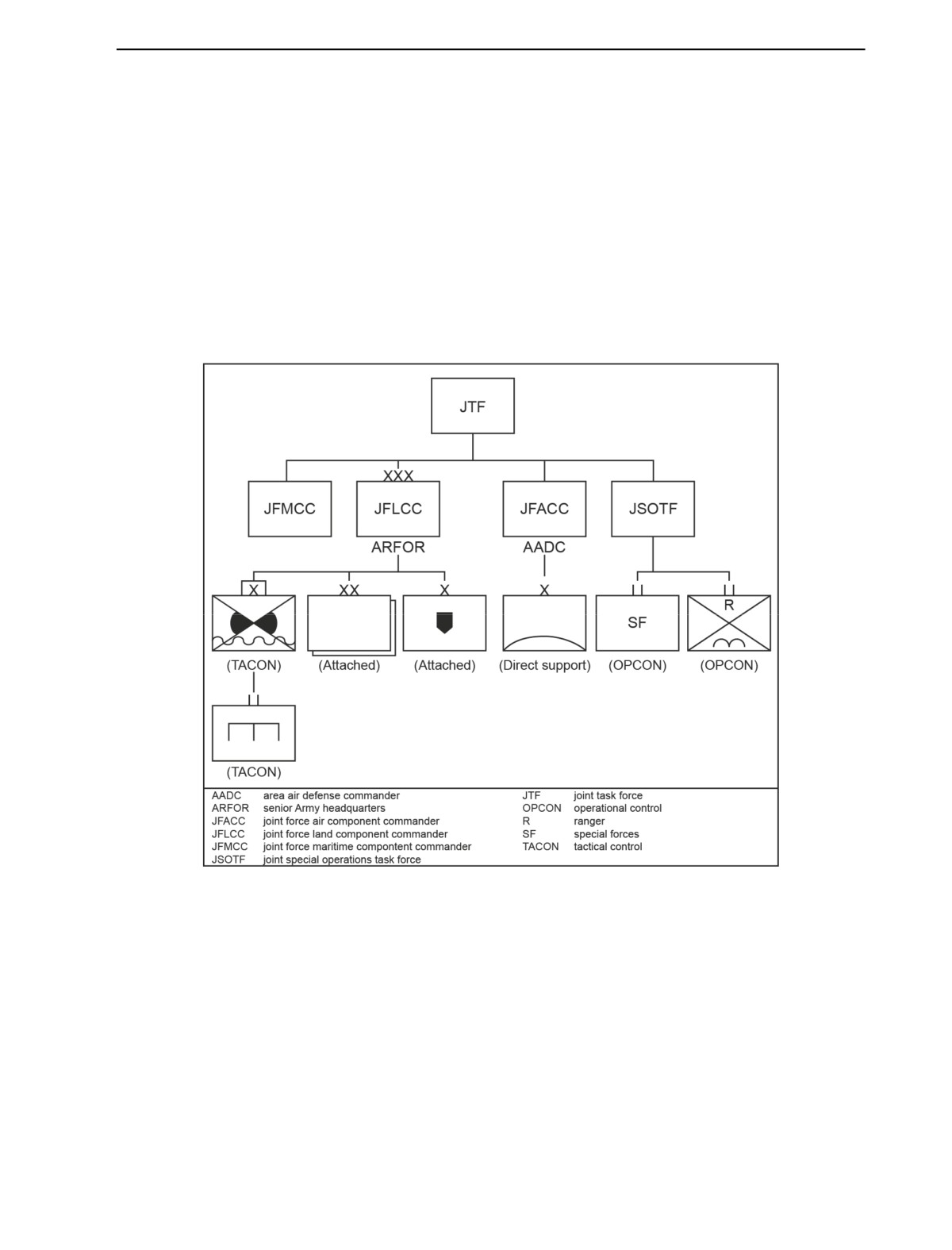
Echelons Above Brigade
ADCON over all Army units, but the theater army will retain ADCON for selected tasks or Army units. For
example, an Army corps headquarters may become a joint force land component within a JTF. (See
figure 1-8.) The corps commander exercises OPCON automatically over the attached Army divisions and
the maneuver enhancement brigade (MEB). The corps has TACON of a Marine expeditionary brigade. The
corps commander has placed an Army engineer battalion under the TACON of the Marine Corps
commander. The JFC has placed an air defense brigade in direct support of the joint force air component
commander (JFACC), who is also the area air defense commander (AADC). The JFC has organized a joint
special operations task force and attached an Army special forces unit and a Ranger unit to it. Therefore,
the joint special operations task force has OPCON of these Army forces. As the senior Army commander,
the corps commander exercises ADCON over the Army units distributed across the JTF. This ensures that
Service responsibilities are fulfilled while giving the JFC maximum flexibility for employing the joint
force. Unless modified by the Secretary of the Army or the theater army commander, Service
responsibilities continue through the ARFOR to the respective Army commanders.
Figure 1-8. Overlapping chains of authority
1-87. In some limited contingency operations, the JFC may elect to employ Marine Corps and Army forces
as Service components, instead of creating a functional joint force land component. In that case, the
ARFOR and Marine Corps forces would exercise OPCON over their respective Service forces as well as
ADCON. This arrangement may occur in a forcible entry operation due to the complexity of parachute, air,
and amphibious operations and limited time available for joint integration. As soon as the joint operations
area matures with the arrival of follow-on forces and headquarters, the JFC may establish a joint force land
component command.
1-88. Figure 1-9 on page 1-26 illustrates another case. If Army forces are the only conventional forces
attached to a JTF, the JFC may fight with the ARFOR serving as both the Service and operational-level
land component of that task force. Note that because the ARFOR does not control other Service forces, it is
not a joint force land component command. It functions as a co-equal component to the functional
components—JFACC, joint force maritime component commander, and joint force special operations
21 April 2014
FM 3-94
1-25
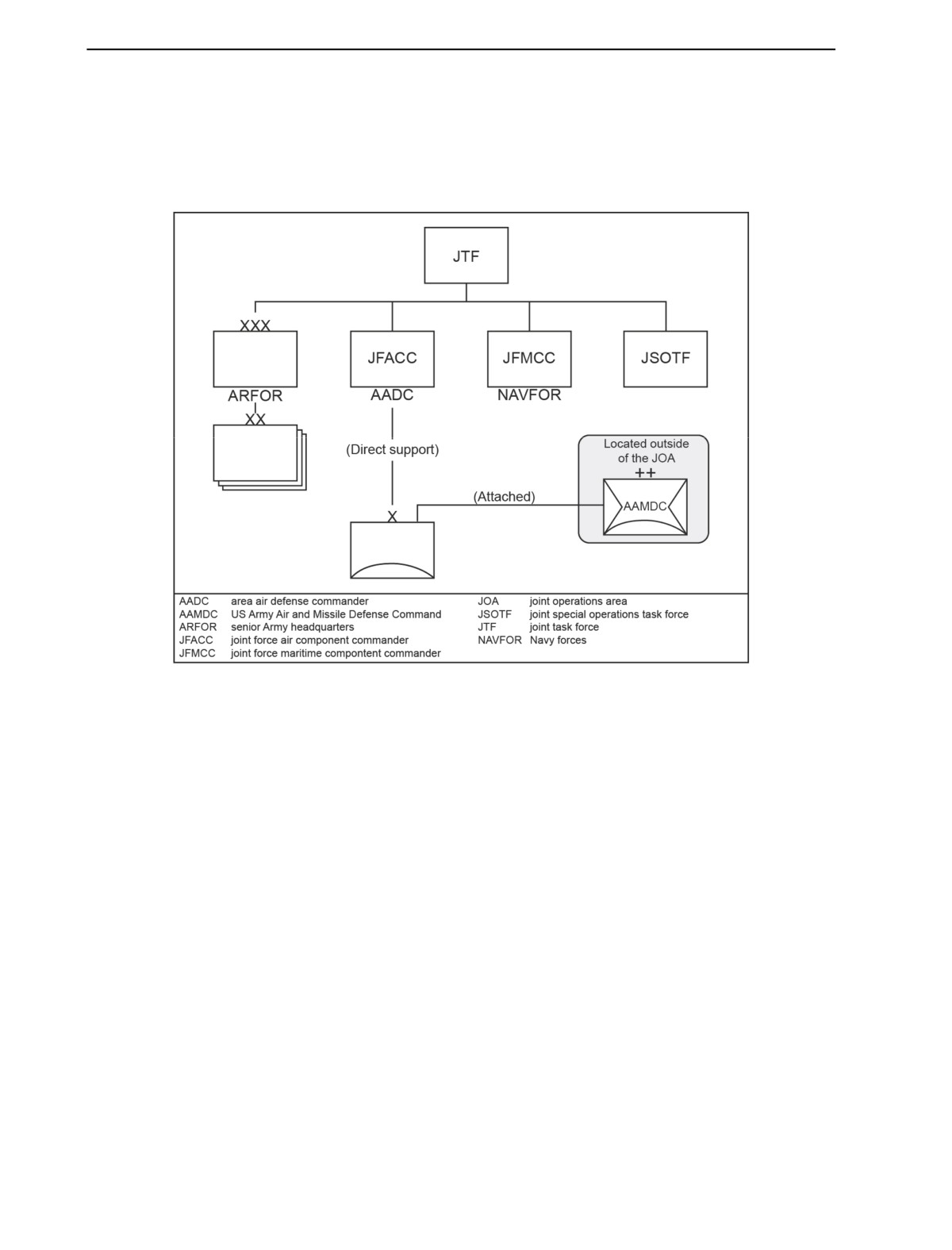
Chapter 1
component commander within the JTF. As the joint force land component, the ARFOR employs landpower
to accomplish the objectives of the campaign. Its focus is at the operational level. As the Service
component, the ARFOR has ADCON over the all the Army units attached to the JTF. It does not have
OPCON over all the Army units in this example. The air and missile defense brigade provides direct
support to the JFACC because the JFACC is also the AADC.
Figure 1-9. Joint task force organized by Service and functional components
1-89. Multinational operations may also complicate the chain of command. In general, multinational forces
will operate under the TACON of a U.S. headquarters. However, the National Command Authority of the
multinational force may impose constraints and restraints on the use of their forces. Army forces may
operate under the TACON or in direct support of a multinational headquarters but remain subject to U.S.
command. The ARFOR retains ADCON over all Army units under multinational command. The ARFOR
and its supporting sustainment command will often provide support to multinational forces within a
coalition. The combatant commander normally provides a formal agreement negotiated between the
supported multinational force and the U.S. joint force based on agreements concluded at the national level.
1-90. Although nations will often participate in multinational operations, they rarely relinquish national
command of their forces. As such, forces participating in a multinational operation will have at least two
distinct chains of command: a national chain of command and a multinational chain of command. As
Commander in Chief, the President retains and cannot relinquish national command over U.S. forces.
Command authority for a multinational force commander is normally negotiated between the participating
nations and can vary from nation to nation. U.S. Army forces can operate under the TACON of, or in direct
support to, a multinational headquarters but remain subject to U.S. command. The ARFOR retains
ADCON over all Army units under multinational command. The ARFOR and its associated sustainment
command often provide support to multinational forces. The combatant commander normally provides a
formal agreement negotiated between the multinational forces and the U.S. forces, based on agreements
concluded at the national level. (For more information, refer to JP 3-16.)
1-26
FM 3-94
21 April 2014
///////////////////////////////////////