FM 3-94 THEATER ARMY, CORPS, AND DIVISION OPERATIONS (APRIL 2014) - page 5
Chapter 7
the U.S. country team, national authorities, and regional host-nation authorities, the division commander
most often works with provincial and local officials. The division commander frequently engages with
other agencies on the ground. The division commander and the brigade commanders often meet and build
relationships with other U.S. government agencies.
DEPLOYMENT OF A DIVISION
7-7. As soon as possible in the deployment sequence, the division deploys an EECP followed by the
remainder of the tactical command post. The earlier that the division can deploy a functioning command
post, the earlier the division commander can move to the area of operations. This is important because
some of the brigades joining the division may have never before worked with that commander. The
division commander deploys as soon as the division has a functioning command post. The division
commander and staff collaborate with the deploying brigades even before the brigades complete RSOI.
7-8. The commander also evaluates the situation and determines from where the main command post will
deploy and what the tactical command post and mobile command group will need to do based on actual
conditions in the area of operations.
TASK-ORGANIZING THE DIVISION
7-9. Exercising mission command at the division level depends on commanders completely
understanding of the chain of command, support responsibilities, and geographic responsibilities. The
division order specifies command and support relationships within the division’s task organization. The
commander assigns subordinate areas of operations together with the minimum necessary control measures
for that phase of operations. The order then clearly states the mission, commander’s intent, and concept of
operations. Regardless of the nature of the mission, the G-3 transmits any changes to every subordinate unit
in the division and receives a formal acknowledgement from each unit. The current operations integrating
cell tracks each transmission and receipt.
7-10. Division commanders designate command and support relationships to ensure subordinate and
supporting commanders understand their roles in the operation and support the division commander’s
intent. Table 7-1 on pages 7-4 and 7-5 highlights command and support relationships used by the division.
Command and support relationships carry with them varying responsibilities to the subordinate unit by the
parent and the gaining units. (See ADRP 5-0.) Commanders consider four related guidelines organizing the
division for decisive action:
z
The BCTs are organized, trained, and equipped to fight as a combined arms force. The division
commander normally reinforces the BCT with capabilities from the multifunctional support
brigades and adjusts the tasks assigned to the BCT accordingly. The division may temporarily
detach one of the BCT’s organic battalions. For example, the division may place a Stryker
battalion under the OPCON of a MEB as a tactical combat force.
z
Multifunctional support brigades are more effective when they operate as they organized and
trained. The division commander maintains the tailored organization of multifunctional support
brigades until tactical circumstances require temporary reallocation of subunits.
z
The division operates more effectively when the commander adjusts tasks to subordinate units
rather than constantly adjusting the division’s task organization.
z
The commander assesses the span of command for each brigade and does not exceed it.
7-11. When the mission assigned to a particular BCT or the combat aviation brigade requires more combat
power than what is organic to that unit, then the division commander may decrease the size the subordinate
brigade area of operations. Resizing the area of operations conforms the size of the division area of
operations more closely to its area of influence. Conversely, the commander adds combat power to the
BCT or combat aviation brigade by placing a battalion with support from another BCT, a multifunctional
support brigade, or a functional brigade temporarily under its command. Considerations concerning other
warfighting functions, especially for sustainment, may preclude multiple reorganizations of attached BCT
and combat aviation brigade internal structures.
7-2
FM 3-94
21 April 2014
Division Operations
7-12. Division commanders should avoid imposing an excessive span of control on subordinate
commanders. Span of control refers to the number of subordinate units under a single commander.
Allocating subordinates more units typically gives subordinates greater flexibility and increases the number
of tactical options available. However, subordinate commanders should not be given more units than they
can effectively command. The addition of multinational units to a subordinate U.S. brigade’s task
organization can reduce its span of control, even though the number of units appears manageable.
Additional units can slow the operations process in that brigade, particularly as the tactical situation
becomes more fluid.
7-13. An effective division task organization—
z
Facilitates the division commander’s intent and concept of operations.
z
Retains flexibility within the concept of operations.
z
Weights the division’s decisive operation.
z
Adapts to conditions imposed by the mission variables of METT-TC.
z
Maintains or creates effective combined arms teams.
z
Provides mutual support among brigades.
z
Ensures flexibility to meet unforeseen events and support future operations.
z
Allocates resources with minimum restrictions on their employment.
z
Ensures unity of command and synchronization of effort through proper use of command and
support relationships.
z
Offsets limitations and maximizes the potential of all available forces.
z
Exploits enemy vulnerabilities.
21 April 2014
FM 3-94
7-3

Chapter 7
Table 7-1. Command and support relationships for the division
Relationship
Use
Task organization
Movement and
Administrative
employment
control
(ADCON)
Attached
Attached applies to a
The division task-
The division can
ADCON transfers
long-term transfer. The
organizes as
position the unit
to the gaining
command relationship
required, using any
anywhere in the AO
HQ. The division
should last for the
command or support
or delegate to a
assumes
duration of the campaign.
relationship.
subordinate
ADCON of the
Normally used when the
commander through
unit, including
subordinate unit
task organization.
logistics,
augments an attached
medical, and
brigade. BCTs and
administration.
multifunctional support
brigades (less
sustainment) normally
are attached.
Operational
OPCON applies to a
The division can
The division can
ADCON remains
control
temporary transfer that
place the entire unit
position the unit
with the parent
(OPCON)
allows the gaining
or parts under
anywhere in its AO,
unit. Additional
commander maximum
OPCON, TACON, or
or delegate to a
logistics and
flexibility to employ the
in support of another
subordinate through
medical support
subordinate unit.
unit. The division
task organization.
provided on an
Battalions transferred
may not attach the
area basis.
from corps-controlled
unit to another unit.
units are normally
OPCON.
Tactical
TACON is a temporary
The division may not
The division may
ADCON remains
control
command relationship
change the
position the unit
with the parent
(TACON)
used among the division,
organization of the
anywhere in the AO
unit
other Service, and
unit under TACON.
or delegate
headquarters.
multinational forces.
However, the
positioning authority
Additional
gaining commander
to a subordinate
logistics and
may place the entire
commander by task
medical support
unit under TACON
organization.
provided on an
or in support of
area basis.
another unit.
Direct support
DS allows the division
The division can
The division serves
Parent unit
(DS)
commander to set
assign the DS unit
as the terrain
retains ADCON.
priorities and position the
any support
manager for DS
The ESC and
DS unit. DS allows a
relationship. This
units operating
medical brigade
larger unit to support a
includes support
within its AO. DS
(support)
smaller formation. The
relationships
units positioned
supports DS
division may receive DS
between subunits.
within the division
units.
from ADA, engineer, and
Note that the parent
AO is under the
signal units.
unit commander
TACON of the
may adjust the task
division for
organization of the
protection and
DS unit as needed.
movement.
ADA
air defense artillery
ESC
expeditionary sustainment command
AO
area of operations
HQ
headquarters
BCT
brigade combat team
7-4
FM 3-94
21 April 2014

Division Operations
Table 7-1. Command and support relationships for the division (continued)
Relationship
Use
Task organization
Movement and
Administrative
employment
control
(ADCON)
Reinforcing
R is used when two or
The force field
Based on
Parent unit
(R)
more units are
artillery commander
coordination with the
retains ADCON.
supporting one of the
(normally a field
DS unit, the BCT or
Additional
division’s units. The
artillery brigade)
MEB owning the AO
logistics and
reinforcing unit answers
task-organizes the
allocates terrain to
medical support
requests for additional
reinforcing unit. The
the reinforcing unit.
provided on an
capability from a DS unit.
supported unit
area basis.
R is normally used by
(providing DS) may
field artillery when one
not specify further
field artillery battalion is
support alignments.
in DS to the field artillery
battalion of a BCT, and a
third field artillery
battalion reinforces the
DS battalion.
General
GSR prioritizes additional
The parent unit task-
Movement and
Parent unit
support
capabilities among three
organizes the GSR
positioning are
retains ADCON.
reinforcing
supporting units. The first
unit primarily to
controlled by the
Additional
(GSR)
priority of a GSR unit is
provide support to
maneuver
logistics and
normally to the land
the force as a whole.
commander owning
medical support
component or corps. If a
Supported units do
that AO. The higher
provided on an
DS or its reinforcing unit
not specify further
HQ of the supporting
area basis.
requests help, the GSR
support
unit coordinates for
unit gives priority to that
relationships.
movement and
support unit ahead of
terrain with the HQ
other requests, unless
owning that AO.
disapproved by the
higher HQ.
General
GS units provide support
The parent unit task-
Movement and
Parent unit
support (GS)
to the land component as
organizes the GS
positioning are
retains ADCON.
a whole, normally on an
unit.
controlled by the
Additional
area basis. The JFC
maneuver
logistics and
specifies priorities of
commander owning
medical support
support. The division
that AO.
provided on an
receives GS from the
area basis.
sustainment, medical,
and signal brigades.
AO
area of operations
JFC
joint force commander
BCT
brigade combat team
MEB
maneuver enhancement brigade
HQ
headquarters
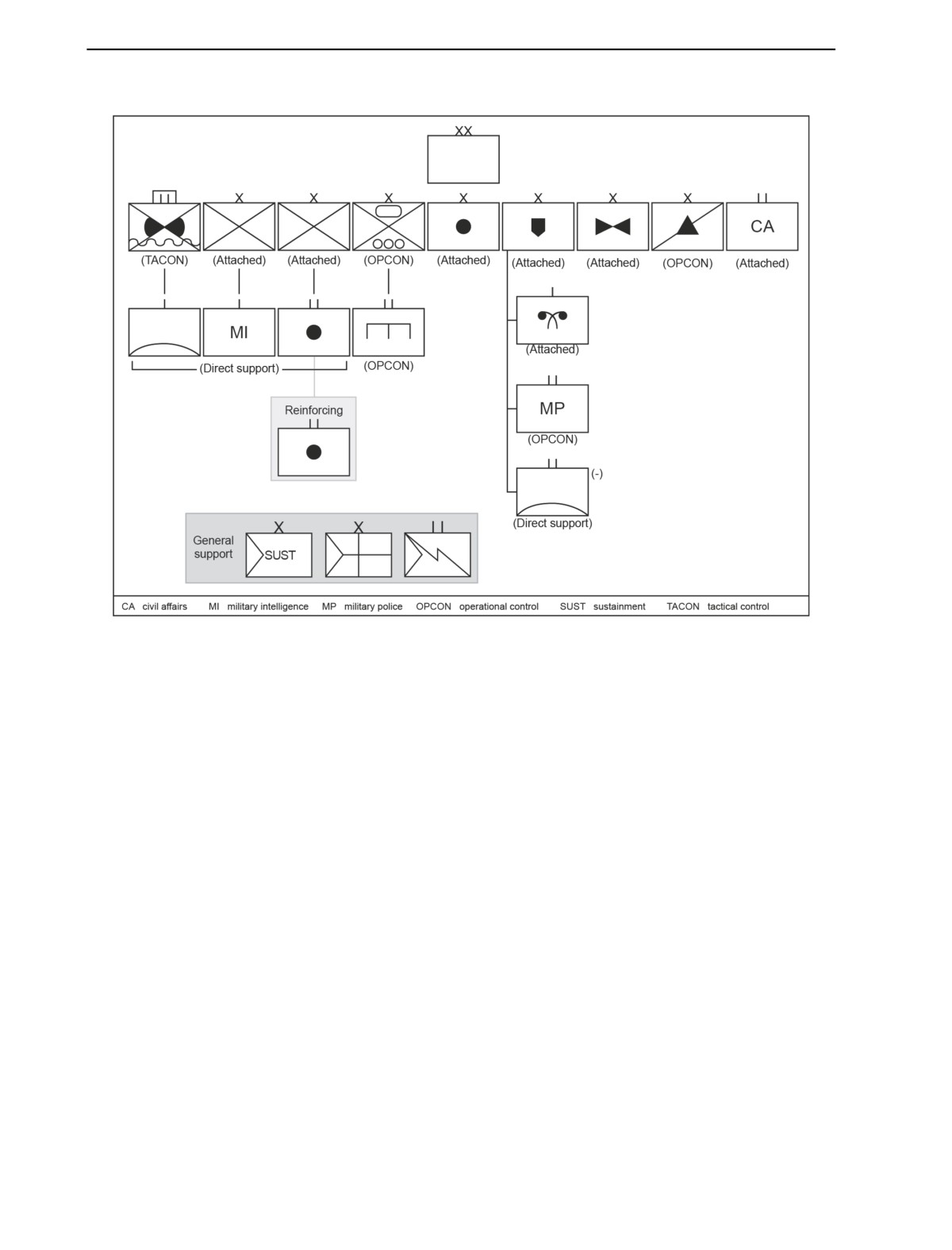
7-14. Figure 7-1 on page 7-6 illustrates some of the command and support relationships used within the
division. The division in the example originally deployed with three infantry BCTs, a field artillery brigade,
a MEB, and a combat aviation brigade. The corps task-organized the division as shown. The corps detached
one infantry BCT to another division and placed a Stryker brigade OPCON to the division. The corps
placed a MEU under TACON of the division and attached a civil affairs battalion to the division. The corps
placed a BTSB under OPCON to the division. The field artillery brigade commander, as the force field
artillery commander, supports the 2d Infantry BCT with two battalions—one direct support and one
reinforcing. The division commander organizes forces received from the corps as shown. The division
commander opts to attach an additional chemical company to the MEB while placing a corps MP battalion
under OPCON and an air defense artillery battalion (-) in direct support. The division commander places
one of the air defense artillery batteries in direct support of the MEU. The sustainment, medical, and signal
brigades are in general support and provide support on an area basis.
21 April 2014
FM 3-94
7-5
Chapter 7
Figure 7-1. An example of a task-organized division
THE DIVISION AREA OF OPERATIONS
7-15. The higher commander (corps or land component) defines the division’s area of operations. The
division area of operations should be large enough for the commander to accomplish the mission and
protect forces. The division commander employs assigned, attached, OPCON, and TACON units and
positions supporting units within the division’s assigned area of operations. Within the division area of
operations, subordinate commanders synchronize their operations with the division’s plan.
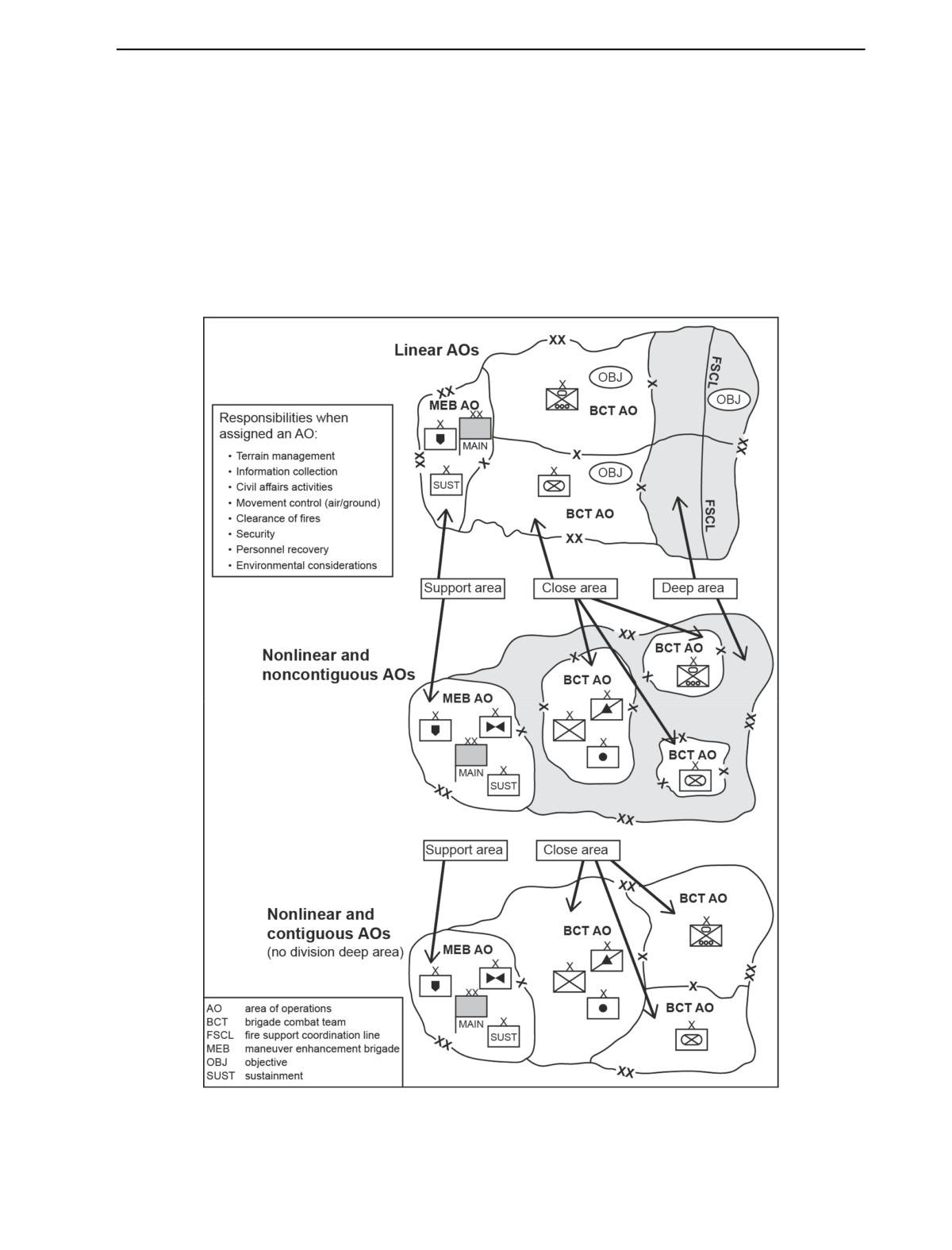
7-16. The division assigns areas of operations to the BCTs, multinational forces, and Marine Corps units.
The MEB, if available, also receives an area of operations. The other types of multifunctional support
brigades do not normally control an area of operations. The brigade controlling the area of operations is
responsible for terrain management, information collection, civil affairs operations, air and ground
movement control, clearance of fires, security, personnel recovery, and environmental considerations.
Minimum-essential stability tasks are inherent to any commander assigned an area of operations.
7-17. The division, utilizing its ASOC, receives airspace control responsibilities for its area of operations
from the airspace control authority. Division-controlled airspace typically extends from the rear boundary
to the FSCL and between the lateral boundaries, up to the coordinating altitude.
7-18. The division typically assigns the MEB an area of operations that includes the support area. Other
brigades such as the sustainment brigade, BTSB, field artillery brigade, and the combat aviation brigade
may occupy terrain in the MEB’s area of operations. The division may also position the main command
post or tactical command post in the MEB’s area. The division commander assesses the threat to the
division’s units and determines the distribution of protection capabilities in accordance with established
priorities. The priority accounts for differences in vulnerability and mobility of different units to hostile
means of detection and attack. At the division level, protection includes passive measures such as
7-6
FM 3-94
21 April 2014
Division Operations
dispersion and concealment. The division tasks the MEB to improve survivability of critical assets located
in its area of operations that often includes sustainment, aviation, and the division main command post.
7-19. Division commanders use a mix of permissive and restrictive control measures to ensure subordinate
commanders have the maximum flexibility to accomplish the mission. The concepts of area of interest and
area of influence are applicable when assigning area of operations to brigades. (See ADRP 3-0.) The area
of operations should coincide generally with the area of influence, and the higher headquarters (the joint
force and corps commanders) should provide intelligence concerning the area of interest. The division
assigns contiguous areas of operations, noncontiguous areas of operations, or a combination of adjacent and
distinct areas of operations, as shown in figure 7-2. When assigning a noncontiguous area of operations, the
division retains control of any areas in the division area of operations not assigned to a BCT or other units.
Figure 7-2. Example of division using contiguous and noncontiguous areas of operations
21 April 2014
FM 3-94
7-7
Chapter 7
CONTIGUOUS AREAS OF OPERATION
7-20. In most operations, the division employs contiguous areas of operations. This allows the division
commander to control the majority of the area of operations by using subordinate BCTs while avoiding
gaps and seams in responsibility. The division assumes responsibility for the area of its area of operations
beyond the brigade area of operations. Contiguous areas of operations may provide additional security for
maneuver units as well as headquarters and the support area. Reasons that might favor using contiguous
areas of operations include—
z
A manageable size of the division area of operations in relation to the number of BCTs.
z
Concentrated enemy forces.
z
Limits to the gaps between BCTs.
NONCONTIGUOUS AREAS OF OPERATION
7-21. In special circumstances, the division may assign a BCT or another maneuver force such as a MEU a
noncontiguous area of operations. The reasons for using a noncontiguous area vary but begin with
geographical separation of important terrain from the remainder of the division areas of operations. The
commander’s decision deploys part of the force into a noncontiguous area of operations, regardless of
command echelon, derived from analysis of the mission variables of METT-TC. In particular, the division
commander evaluates the threat and ability of the enemy to mass combat power sufficient to threaten
friendly forces in noncontiguous areas of operations. Second, the commander evaluates the enemy’s ability
to sever ground lines of communications between the noncontiguous areas of operations and the bulk of the
division.
CONTIGUOUS AND NONCONTIGUOUS AREAS OF OPERATIONS COMBINED
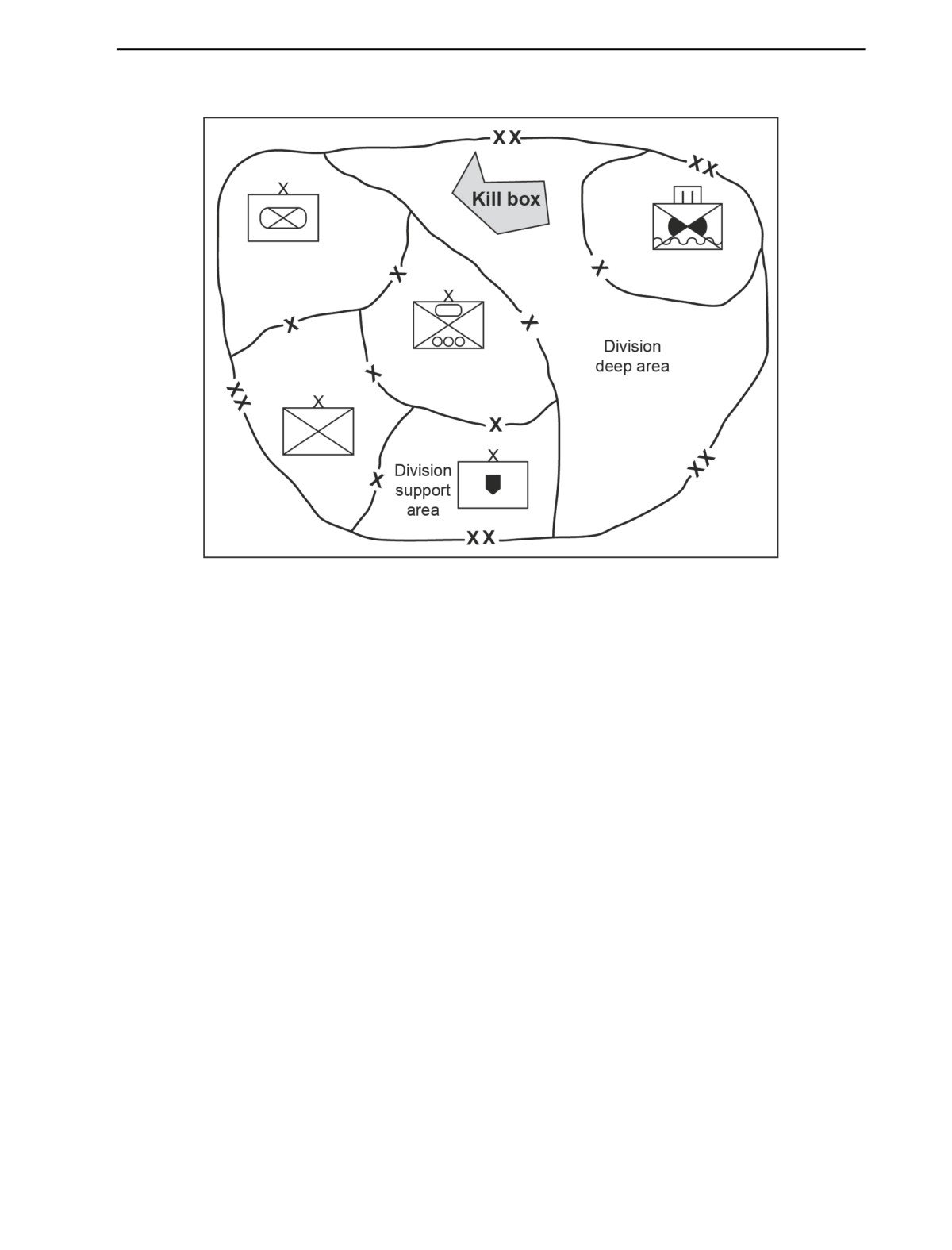
7-22. Figure 7-3 illustrates a combination of contiguous and noncontiguous areas of operations. A division
with three BCTs, a MEB, and a MEU conducts operations in this example of area of operations. Note that
the Marine Corps area of operations is within the division’s area of operations but not contiguous with the
other brigades. In this case, the division assumes responsibility for that area between the different
subordinate areas of operations. The division coordinates with the JFACC to establish a kill box (a fire
control measure) within the division-controlled area. This allows the JFACC to attack targets freely within
that part of the area of operations even though it lies within the division’s boundaries. In some tactical
situations, the JFACC may become the supported commander within the kill box, and the division may
become the supporting commander within that area. The division may provide artillery for suppression of
enemy air defenses and attack aviation to screen along the kill box boundaries.
7-23. The ESC and sustainment brigade normally provide logistics and administrative support to the units
of the division on an area basis. The area of sustainment support does not necessarily equal the division’s
area of operations since the sustainment brigade supports corps, division, other Service, and some
multinational units. The location and logistics demands of these units determine which units draw support
from a particular CSSB, not the supported units command relationship. In the conduct of offensive and
defensive operations, a sustainment brigade normally provides direct support to each committed division
and area support to corps units on an area basis. The division commander exercises TACON over
sustainment units located in the division’s area of operations for protection and movement through the area
of operations. The division staff coordinates continuously with the sustainment brigade staff supporting
them. The BCT or MEB assigned an area of operations including a sustainment brigade or base locates its
command post in proximity to the sustainment unit’s command post to improve tactical planning and
execution of protection and movement.
AIR FORCE SUPPORT
7-24. Tactical success at the division echelon emphasizes joint interdependence. USAF liaisons at each
echelon of command integrate air support operations with the division’s concept of operations, scheme of
maneuver, and fires. The division depends on joint fires and capabilities provided by fixed-wing aircraft to
include close air support, surveillance and reconnaissance, air interdiction, electronic warfare, and airlift
missions.
7-8
FM 3-94
21 April 2014
Division Operations
Figure 7-3. Division contiguous and noncontiguous area of operations
AIR SUPPORT OPERATIONS CENTER AT THE DIVISION
7-25. The air support operations squadron deploys to support each Army division with an ASOC and
enough TACPs to support the division headquarters down to the maneuver battalions within the attached
BCTs. When deployed, the ASOC and TACPs within the division are under the command of a single
officer; they remain equipped and manned to perform distinct functions in support of BCTs.
7-26. The division commander considers three factors about the ASOC. First, the ASOC is a control center
and derives synergy and efficiency from Air Force personnel working with division field artillery personnel
in the JAGIC. The division commander should not split up the ASOC and JAGIC to co-locate it with
multiple command posts, other than when the main command post is relocating. Second, the ASOC needs
to be located in a relatively secure location. Due to the firepower the ASOC can potentially bring, its loss
due to enemy action could have serious consequences for the ground forces. Third, the need for a relatively
secure location has to be balanced by the ASOC’s primary limitation—communications. To control
airpower, it needs to be able to communicate with the aircraft, which in most cases remains restricted by
ultrahigh frequency
(known as UHF) or very high frequency
(known as VHF) line-of-sight
communications. The ASOC should maintain communications in all airspace short the FSCL. Depending
upon terrain, radio relays, Joint Surveillance Target Attack Radar System (known as JSTARS), and
airborne forward air controllers, the ASOC can extend these distances for a limited time.
7-27. Normally, the ASOC co-locates with the main command post within the current operations
integrating cell as part of the JAGIC. However, the ASOC or JAGIC may displace to the tactical command
post when the division shifts control of operations to the tactical command post or if the main command
post is out of radio range of aircraft operating further forward. The ASOC commander recommends the
best location for positioning the ASOC to the division commander based on the mission variables.
REQUESTS FOR AIR SUPPORT
7-28. The Army processes preplanned and immediate air support requests—JTARs—through the Army
air-ground system. JTARs are how the Army approves or denies requests for external air support and
21 April 2014
FM 3-94
7-9
Chapter 7
identifies air support requirements to the air component. The fires cell plans and processes JTARs, which
then flow to higher headquarters for approval and prioritization. Once approved and prioritized, JTARs go
to the air component. The JAGIC advises and assists the fires cell with completing valid JTARs.
7-29. The use of joint air assets requires the Army to submit its air support requests in time to meet the
daily battle rhythm of the joint air tasking cycle. The division submits its preplanned JTARs through the
corps (or other higher headquarters) to the supporting air component in sufficient time to meet the planning
stages of the joint air tasking cycle. The joint air tasking cycle is time driven and designed to enable the
JFACC to publish the ATO in time to enable tasked aircraft units to complete tactical mission planning and
prepare for their missions. The BCD normally identifies the suspense to the corps and division
headquarters, which in turn drives that portion of Army planning. When the system works as designed and
the requests arrive on time at the JAOC, the supported ground forces commander knows whether or not
there are dedicated air sorties available to support the ground force.
7-30. It is important for the division staff to send preplanned JTARs to the JAOC on time. Depending on
the situation, the division fires cell can take initiative to submit preplanned JTARs for those subordinate
units unable to meet the suspense. The division can submit JTARs for on-call air missions and area targets
to get dedicated sorties on the ATO to support its BCTs. JTARs need to include sufficient information to
task aircraft on the ATO but may require additional information before the flying unit can complete tactical
mission planning. The preferred method for processing JTARs is the Advanced Field Artillery Tactical
Data System. Units should use the Advanced Field Artillery Tactical Data System to process their JTARs
in a prioritized air support list. The BCD has an Advanced Field Artillery Tactical Data System that nets
with Air Force command and control systems at the JAOC. Digital submission enables the Army BCD to
parse JTARs into the database for the air component to plan and resource.
7-31. Immediate JTARs are sent after publication of the ATO. The ASOC resources immediate JTARS
(when given decentralized execution authorities) with suitable air assets that are already available on the
ATO. Those JTARs that arrive too late to allow the BCD sufficient time to include them in the planning
stages (target development, weaponeering, and allocation) of the joint air tasking cycle are treated as
immediate JTARs. The ASOC and JTARs can use the joint air request net or Air Force air request net to
send urgent requests as immediate JTARs. However, when time is available, JTARs should go through the
Army air-ground system using the Advanced Field Artillery Tactical Data System.
WEATHER SUPPORT
7-32. Weather services provided by attached Air Force forces provide environmental information,
including both space environment and atmospheric weather, to commanders for their objectives and plans
at the strategic, operational, and tactical levels. Weather services gather, analyze, and provide
meteorological data for mission planning and execution. Environmental information is integral to the
decision process and timing for employing forces and planning and conducting air, ground, and space
launch operations. Weather services also influence the selection of targets, routes, weapons systems, and
delivery tactics.
MARINE CORPS UNITS
7-33. The division may control a MEU. The normal command relationship is TACON. The MEU consists
of a reinforced Marine Corps rifle battalion and a composite air squadron with attached logistics support. A
Marine Corps colonel commands the MEU. Although the MEU differs from an Army BCT in capability,
the division employs it as a combined arms maneuver formation equivalent to the BCTs. The MEU has less
artillery than a BCT, but the Marine Corps air squadron deploys fighter-bombers assault helicopters and
attack helicopters. The MEU normally includes light armored units. The MEU’s command and control
capabilities equal those of a BCT; its airspace control is superior. The MEU normally deploys with 30-45
days of supplies. However, medical support away from the fleet is limited. The MEU’s engineer and CBRN
assets are normally limited. It has no missile defense capability once it maneuvers beyond the fleet’s air
and missile defense capability.
7-34. The MEU can conduct independent operations in a large area of operations. For offensive and
defensive operations, the division reinforces the MEU with additional engineers and artillery, typically a
7-10
FM 3-94
21 April 2014
Division Operations
battalion of each. The MEU, if available, may be the unit of choice for an economy of force operation
within a large area of operations. The MEU may also follow and support an armored or Stryker BCT. For
stability intensive operations, the MEU normally requires support from Army civil affairs and MISO.
DECISIVE ACTION
7-35. The division conducts simultaneous offensive, defensive, and stability tasks throughout any
campaign. The weight of effort allotted to each task varies by phase and within phases. The division’s
primary means of conducting decisive action are its BCTs operating in assigned area of operations,
supported by various brigades. Subordinate brigades perform all three tasks, although one task normally
requires the preponderance of their combat power. When deployed as part of a major operation or
campaign, the division may command Marine Corps and multinational ground forces. When required, the
division supports domestic authorities (using DSCA) in response to domestic disasters and during special
events requiring large-scale military support.
OFFENSIVE TASKS
7-36. The division conducts offensive tasks to defeat, destroy, or neutralize an enemy. The preferred
method of conducting offensive tasks is to find and disrupt the enemy at distance from friendly troop
positions to set the conditions necessary for the division’s decisive maneuver.
7-37. The division commander must leverage every available technological advantage to gain intelligence
and to employ lethal fires, offensive cyberspace operations, and electronic attack as a precursor to a
decisive operation. The division’s BCTs can then precisely maneuver for the final, decisive blow.
7-38. Division commanders array their BCTs and supporting brigades so their subordinate commanders
can employ their weapons systems with precision while degrading the enemy’s ability to employ their
weapons. This allows division commanders, assisted by their staffs, to assess the operation as it unfolds,
conserve combat power, and minimize risk.
7-39. Division commanders seek to achieve decisive results by massing overwhelming combat power at
the point of attack while avoiding the enemy’s main strength. They employ their subordinate BCTs to
disrupt the cohesiveness of enemy defenses and force the enemy off plan. Ideally, division commanders
force the enemy to give up the advantage of fighting from prepared defensive positions by attacking the
enemy’s flanks or selecting a location or time of attack when the enemy is most vulnerable. Division
commanders use the four primary offensive tasks.
Movement to Contact
7-40. Although the corps and division commanders may have an accurate idea of the overall situation and
enemy disposition before they attack, their degree of situational understanding decreases as the situation
becomes fluid and as large enemy and friendly forces maneuver. Division-sized movements to contact also
may become necessary when the division fights against dispersed hybrid threats. The division’s
reconnaissance and surveillance systems are less effective when the enemy conceals himself in difficult
terrain and urban areas. Under these conditions, the division largely depends on human intelligence
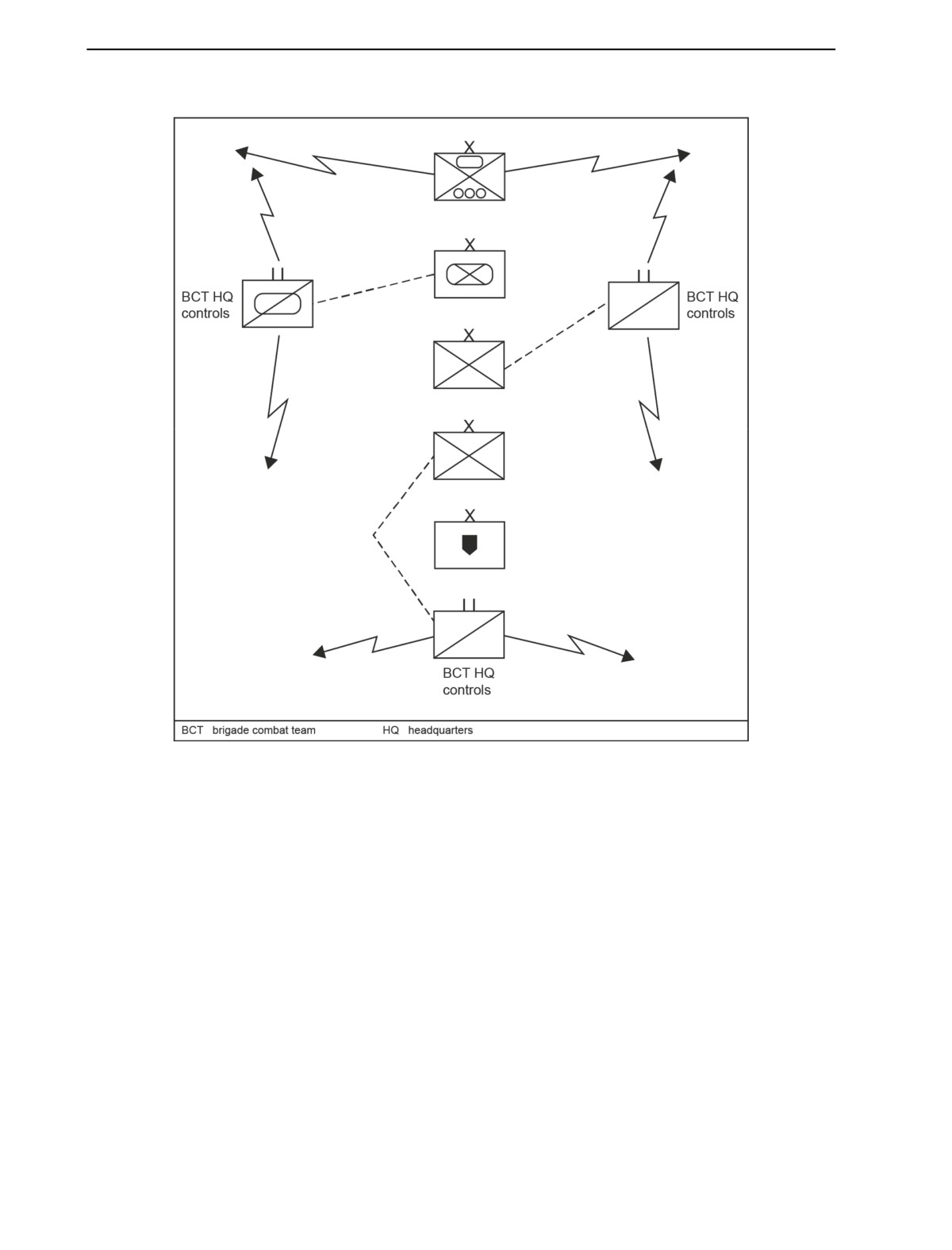
resources, including ground reconnaissance, to find the enemy. See figure 7-4 on page 7-12.
21 April 2014
FM 3-94
7-11
Chapter 7
Figure 7-4. Example of division movement to contact
7-41. The characteristics of a movement to contact are centralized planning, decentralized control, rapid
movement along multiple axes, and rapid transition of BCTs from the march to the attack. The division
focuses its efforts on two priorities: finding the enemy and rapidly developing the situation. On contact, the
commander has five options: attack, defend, bypass, delay, or withdraw. Opportunities for hasty attack and
exploitation may be numerous. For example, in Operation Iraqi Freedom I, the 3d Division conducted a
movement to contact extending from Kuwait to Baghdad.
7-42. The division conducting a movement to contact organizes its BCTs, the combat aviation brigade, and
supporting brigades into a forward security element and a main body. The combat aviation brigade
normally screens ahead and to the flanks of the lead BCT. The lead BCT acts either as an offensive
covering force or as an advance guard. The division commander reinforces it with engineer assets to
conduct breach and mobility support. The advance guard BCT engages any enemy force with which it
makes contact using maneuver and fires. If possible, the advance guard eliminates the opposing forces and
continues to advance. If not, the advance guard BCT maneuvers to either side of the initial contact in order
to fix the enemy force and develop the situation.
7-43. The main body includes the remainder of the division. The division’s BCTs and units of the combat
aviation brigade within the main body prepare to respond to enemy contact when the lead BCT locates
significant enemy forces. When moving, the BCTs located in the main body normally provide flank
security (screen or guard mission). In a very fluid environment, the trail BCT may provide a rear security
7-12
FM 3-94
21 April 2014
Division Operations
unit and maintain contact with the remainder of the corps. If the situation allows, the commander can assign
a follow and support mission or a follow and assume mission to a BCT from the main body. Both groups
conduct security and reconnaissance operations throughout the movement to contact.
7-44. The division commander designates a portion of the main body as a reserve. The size of the reserve
depends on the mission variables and the amount of uncertainty concerning the enemy. The more uncertain
the enemy situation, the larger the reserve becomes. In a division movement to contact, one BCT remains
uncommitted as the division’s reserve. (See ADRP 3-90.)
Attack
7-45. An attack differs from a movement to contact. In an attack, the division has useable intelligence on
the disposition and strength of the enemy, which allows the commander to achieve greater synchronization.
This enables the commander to mass combat power more effectively in an attack than in a movement to
contact.
7-46. Division attacks are either hasty or deliberate, depending on the time available for planning and
preparation. Commanders execute hasty attacks when the situation calls for immediate action with
available forces and minimal preparation. They conduct deliberate attacks when they have more time to
plan and prepare. Success depends on skillfully massing the effects of combat power. (ADRP 3-90 provides
more detail on offensive tasks.)
7-47. The division task-organizes its BCTs and supporting brigades based upon the commander’s intent
and concept of operations. Normally one BCT constitutes the division’s decisive operation. The
commander weights the decisive operation by adding combat power to that BCT, giving it priority of
support, and allocating the majority of joint support to that BCT. Depending upon the depth of the attack,
the commander may use another BCT in a follow and support or follow and assume mission behind the
initial main effort BCT. Each BCT receives enough combat power to accomplish its mission.
7-48. The division designates and maintains a reserve. The size and composition of the division reserve
depends upon the mission variables. Typically, the division commander withholds at least one maneuver
battalion, although the reserve units remain under the direct command of their parent brigades. The
commander may move the reserve or direct aviation attack and lift assets to be prepared to reinforce at
critical points.
Exploitation
7-49. Exploitation follows a successful attack and disorganizes the enemy in depth. Commanders of
exploiting forces receive the greatest possible latitude to accomplish their missions. Exploitations may be
local or major. Local exploitations take advantage of tactical opportunities. Division and higher
headquarters normally conduct major exploitations using their most mobile BCTs to transform tactical
success into a pursuit.
7-50. The BCTs and combat aviation brigade conducting the division’s attack are also the forces that
initially exploit that attack’s success. The division then follows with commitment of the division reserve
BCT. Division commanders request additional resources from the JFLCC, including close air support, air
reconnaissance, and priority for sustainment support.
7-51. The division commander preparing to exploit should specify the acceptable degree of damage or risk
to each BCT in the course of the current operation. The commander estimates the depth and time before the
committed BCTs require relief. At that point, before the attacking BCT is exhausted, the commander
commits the following or reserve BCT to continue to exploit.
7-52. BCTs designated to follow and assume conduct a forward passage of lines and replace the initial
exploiting BCTs when they approach their culminating point. When possible, BCTs assigned these tasks
should possess mobility equal to that of the exploiting BCTs or receive additional engineers and
transportation assets to provide the necessary mobility. Once organized, they are committed forces and
should have a priority of support from the division’s multifunctional support brigades in accordance with
the mission variables.
21 April 2014
FM 3-94
7-13
Chapter 7
Pursuit
7-53. A pursuit catches or cuts off a hostile force attempting to escape, with the aim of destroying it.
Pursuits may commence at any point when enemy forces are beginning to disintegrate or disengage. If
enemy resistance has broken down entirely and enemy forces are fleeing, a force can transition to a pursuit
from any type of offensive or defensive operation. Pursuits require speed and decentralized control.
7-54. The division commander uses BCTs to perform two pursuit options. Each option involves a direct-
pressure force. The first is a frontal pursuit that employs only a direct-pressure force. The second is a
combination that uses a BCT as direct-pressure force and an encircling force comprising one or more very
mobile BCTs. The combination pursuit is generally more effective. Either the direct-pressure force or the
encircling force can conduct the decisive operation in a combination pursuit.
7-55. For pursuits, the division commanders organize their brigades into security, direct-pressure,
encircling, follow and support, and reserve forces. Each of these forces is normally at least of brigade size.
The commander can employ available airborne and air assault brigades as part of the encircling force
because of their ability to conduct vertical envelopments. The division maintains a small combined arms
reserve to exploit tactical opportunities or respond to enemy counterattacks.
Forcible Entry
7-56. Forcible entry operations are special forms of attack employed by the JFC. The division conducts
forcible entry operations using air assault, parachute assault, or a combination of both methods. Forcible
entry differs from vertical entry in that it is an operational maneuver to seize and retain a lodgment. It is
always a major joint operation and demands extremely careful planning and synchronized execution. The
requirement for air or sea movement across a major geographic feature to get to the lodgment with ground
forces makes it potentially one of the most hazardous missions assigned to a division. The mission to seize
and retain the lodgment normally goes to either an airborne or an air assault division, based upon the
primary means of assault.
7-57. Based upon the joint operation plan, the division organizes an assault echelon, typically a BCT
tailored to the lift available, and an immediate reinforcing echelon consisting of the remaining BCTs of the
division. The reinforcing echelon, configured for combat upon arrival, deploys by air landing in the
lodgment secured by the initial assault. Elements of the supporting brigades not attached to the BCTs arrive
with follow-on forces that conduct RSOI before joining the division.
7-58. The division deploys a small EECP as part of the assault echelon. The EECP accompanies the lead
BCT by helicopter or aircraft. The tactical command post, tailored for available lift, follows in the
reinforcing echelon. The main command post arrives with follow-on forces. (JP 3-18, FM 90-26, and
ATTP 3-18.12 provide additional details on forcible entry operations.)
DEFENSIVE TASKS
7-59. The division conducts defensive tasks—mobile defense, area defense, and retrograde. A mobile
defense defeats the attacking forces by permitting the enemy to advance into a position that exposes him to
counterattack. Area defenses orient on retaining terrain; they draw the enemy in an interlocking series of
positions and destroy the enemy largely by fires. A retrograde moves the friendly force away from the
enemy to gain time, preserve forces, place the enemy in unfavorable positions, or avoid combat under
undesirable conditions. Defending commanders combine the three types of defensive tasks to fit the
situation.
7-60. All three types of defense use mobile and static elements. In mobile defenses, static positions help
control the depth and breadth of the enemy penetration and retain ground from which to launch
counterattacks. In area defenses, commanders closely integrate patrols, security forces and sensors, and
reserve forces to cover gaps among defensive positions. They reinforce positions as necessary and
counterattack as directed. In retrograde operations, some units conduct area or mobile defenses or security
operations to protect other units that execute carefully controlled maneuver or movement rearward. They
use static elements to fix, disrupt, turn, or block the attackers. They use mobile elements to counterattack
and destroy the enemy.
7-14
FM 3-94
21 April 2014
Division Operations
7-61. The scheme of maneuver chosen by the division commander varies according to METT-TC.
However, certain fundamentals guide the employment of forces. Regardless of the defensive task, the
division commander maneuvers forces and adjusts supporting capabilities to pit the greatest friendly
combat power against the enemy’s main effort. The commander accepts risk and economizes in less
threatened areas of operations to mass sufficient combat power and to defeat the enemy’s main effort.
7-62. Tactical depth is critical. The longer the time and the greater the distance that the enemy attacking
force exposes itself, then the greater the damage that joint fires can inflict before the enemy joins in close
combat. Defensive depth allows the division to disrupt enemy combined arms capabilities. Depth equals
time; it permits the division commander to develop the situation and understand the enemy’s intent. The
division commander conducts security operations (screen, guard, and cover) to add depth to the defense and
develop the situation. The division shifts forces and fires to mass combat power according to the enemy’s
actual versus anticipated attack.
7-63. The enemy begins with the initiative. The division defends to slow and stop the enemy’s attack, at
which point the operational initiative is uncertain. As the attacking force culminates, it requires time and
resources to consolidate and reorganize due to casualties and disorganization. A counterattack delivered at
this time multiplies the effects of surprise and shock. A smaller counterattacking force can defeat a much
larger and disorganized attacking force. The effect of the counterattack is often more emotional than it is
physical; fear, fatigue, and uncertainty may break the enemy’s coherence more completely than attrition.
Through the counterattack, the division seizes the initiative and exploits any tactical advantage it creates to
defeat not only the enemy’s main effort, but also the entire enemy scheme of maneuver.
STABILITY TASKS
7-64. The division plans and conducts stability tasks simultaneously with offensive and defensive tasks.
Stability operations is an overarching term encompassing various military missions, tasks, and activities
conducted outside the United States in coordination with other instruments of national power to maintain or
reestablish a safe and secure environment, provide essential governmental services, emergency
infrastructure reconstruction, and humanitarian relief (JP 3-0). Stability operations support a host-nation or
interim government or an occupation when no government exists. These operations are designed to
establish a safe and secure environment; facilitate reconciliation among local or regional adversaries;
establish political, legal, social (educational, health, and welfare), and economic institutions; and facilitate
the transition to legitimate local governance. Stability operations involve both coercive and constructive
military actions. (See ADRP 3-07.)
7-65. The tactical priority of stability tasks determines the missions allotted to subordinate units. The effort
required to perform these tasks vary within the area of operations given to the BCTs and MEB (if
available). The priorities of stability tasks are:
z
Provide civil security.
z
Establish civil control.
z
Restore essential services.
z
Support to governance.
z
Support to economic and infrastructure development.
7-66. The first priority in stability is civil security. There is a tactical security threshold for performing any
of the other stability tasks. That threshold varies tremendously in different operational environments. As a
minimum, the division and its brigades protect noncombatants from large-scale hostile attacks. The division
and its BCTs conduct offensive and defensive tasks against armed threats until a specified area is safe
enough for the friendly force and interagency partners to address the next stability priority. If available,
host-nation security forces should assume this task with division support. If large-scale combat operations
are ongoing or anticipated, the division assists the local authorities with evacuation of noncombatants as
authorized by the JFLCC.
7-67. Civil control is the regulation of noncombatant activity within an area of operations. When operating
within a friendly host nation with a functioning civilian government, the division supports civil authority to
ensure that noncombatants and Soldiers can coexist. At the opposite extreme, the division regulates a
hostile population through military authority until a competent civil administration relieves them. In the
21 April 2014
FM 3-94
7-15
Chapter 7
aftermath of a battle, damage to civilian infrastructure may be so great that the BCTs assume temporary
responsibility for civil control. The division should attach civil affairs and additional MP units as required
to allow the BCTs to provide minimal civil control in that area of operations.
7-68. With security and control established, the division assesses the state of local infrastructure to support
the local population. The division either supports local authorities or provides directly the minimum-
essential supplies and services to prevent further loss of life and mitigate extreme suffering. This includes
food, water, temporary shelter, minimum sanitation, and critical medical support. In extreme cases,
essential services may include the temporary evacuation of noncombatants to an area where the higher
headquarters and local authorities can provide the essential services requirements.
7-69. Support to governance and development of the local infrastructure and economy are subsequent tasks
assigned to the division based upon the overall campaign plan. Initiation of these tasks requires a secure
environment, at least secure enough to permit other government agencies to operate alongside Army forces.
Army forces undertake these tasks when ordered by higher headquarters, and not, as is the case with the
previous three tasks, in response to the situation extant. The corps normally provides additional forces and
sustainment during the latter phases of the campaign to address these requirements. Both tasks require
divisional support of interagency and host-nation actions.
7-70. In stability intensive missions, the division should adjust the BCT areas of operations to conform to
administrative boundaries such as provinces and districts as closely as tactical conditions permit.
DEFENSE SUPPORT OF CIVIL AUTHORITIES TASKS
7-71. When ordered by the Secretary of Defense, a Regular Army division deploys and supports domestic
authorities through missions collectively labeled as DSCA. Most DSCA missions require only small
numbers of Regular Army and Army Reserve Soldiers, and the division only deploys during a major
catastrophe. When ordered to deploy, OPCON of the division passes to the gaining theater army, either
USARPAC or USARNORTH. During a disaster, the division controls federal military forces in support of
the appropriate civil authorities. The Army division works in parallel with National Guard forces under
state command. The division may also deploy and support a national special security event when
authorized by the President. Note that National Guard divisions may conduct DSCA under state command.
(See DODD 3025.18 and ADRP 3-28 for additional details.)
7-72. If the division is the senior headquarters on an Army installation, the division may initiate DSCA
under immediate response authority. Immediate response authority allows the division commander to
deploy Army units in response to a disaster in the region, but only under specific circumstances. Such
circumstances include a request for assistance from a civil authority, imminently serious conditions, and
time constraints that do not permit approval from higher authority. In all cases, the division should consult
the servicing staff judge advocate. There are critical restrictions on what federal military forces can do on
U.S. soil. Division units assist civil authorities to save lives, reduce suffering, and prevent great property
damage. Soldiers are not in charge; the civil authorities are. The division commander adheres to three
restrictions. First, Soldiers may not undertake any law enforcement tasks. Second, Soldiers providing
DSCA under immediate response authority will not carry weapons. Third, unless authorized by the
Secretary of Defense, the authority for immediate response ends after 72 hours. (See DODD 3025.18 and
ADRP 3-28 for additional details.)
OPERATIONAL FRAMEWORK
7-73. The division commander chooses the appropriate operational framework for the mission. The
framework links purpose to time and space. For most operations, the division allots as much or more effort
to stability tasks as to offensive and defensive tasks. The BCTs conduct offensive or defensive operations
in their area of operations as required by circumstances in that area, the synchronization between BCTs is
less important. In this tactical environment, the division describes the concept of operations through
decisive, shaping, and sustaining operations.
7-74. In large-scale combat operations that require synchronized offensive and defensive tasks between the
BCTs, or when the higher headquarters uses it, the division frames its concept of operations through deep,
close, and security areas. This associates the purpose of division combat operations to time and space. It
7-16
FM 3-94
21 April 2014
Division Operations
aligns responsibilities for division shaping operations in areas beyond the brigade area of operations (deep).
It specifies the areas within which the division commander employs BCTs in decisive action (close). This
framework links area security to sustainment in an area of operations protected by BCTs in adjacent close
areas (security). It also links time and distance with purpose. While the enemy’s main force is too distant
for close combat, the division employs joint and Army fires in the deep area to set the conditions for the
BCTs. When an attacking enemy enters the close area or the BCTs maneuver into range of defending
forces, the enemy is subjected to concentrated close combat supported by all available fires. Throughout,
logistics and medical units remain in the security area, distant enough from major enemy forces to allow for
uninterrupted sustainment, secured by the MEB or a BCT.
7-75. In either framework, the commander temporarily adjusts priorities for the situation by designating a
particular unit as the main effort at that time and place. By definition, other units in the corps become
supporting efforts. The division designates a main effort and weights it to conduct the decisive operation.
The commander avoids parceling out the division’s combat power to each BCT equally. The main effort
receives the priority of support from the multifunctional support brigades and any functional brigades
provided by the corps. The division task organization specifies command and support relationships to
provide immediate combat power and sustainment to the main effort. Examples of actions to weight the
main effort include the following:
z
Temporarily attach one or two maneuver battalions to the BCT.
z
Place attack aviation in direct support or under TACON to the main effort BCT.
z
Narrow the area of operations to concentrate the combat power of decisive operations.
z
Reinforce the main effort BCT with reinforcing and general support fires from the field artillery
brigade.
z
Allocate the majority of close air support and assign priority for joint fires to the decisive
operation.
z
Move one or more MP battalions in or near the supported BCT to process detainees and control
movement of dislocated civilians.
z
Position support areas forward to increase distribution of key logistics.
z
Coordinate with the ESC to reinforce the BCT’s brigade support battalion with direct support
from a CSSB.
z
Assign the main effort BCT priority of network resources, such as bandwidth and preemption
level of information.
z
Provide aviation assets in direct support to a BCT for lift support for troop movement and
resupply of critical items.
z
Attach one or more MISO units to the main effort BCT.
SHAPING OPERATIONS
7-76. The division conducts shaping operations to set and maintain tactical conditions for the success of
the decisive operation. In combat, this generally involves centrally planned and decentralized completion of
tasks assigned to BCTs and multifunctional support brigades in support of the BCT conducting the decisive
operation. This includes stability tasks. In protracted joint stability operations, shaping operations often
involve offensive and defensive tasks to establish a relatively secure environment for nonlethal activities.
Shaping operations, by their nature, require economical distribution of division capabilities. Therefore, the
division prioritizes them according to the length of time needed for them to be effective, and according the
force required to achieve the minimum desired condition before the decisive operation. Because most joint
support requires adequate lead time to provide support, the division and corps collaborate on the
distribution of joint support.
7-77. Reconnaissance and surveillance precede every division operation and continue throughout the
operation. The division commander establishes the commander’s critical information requirements and the
division staff plans reconnaissance and surveillance operations to answer these requirements.
Reconnaissance and surveillance operations require movement and maneuver to develop a clearer
situational understanding. This requires tactical art. The commander balances the need to develop the
situation while avoiding a needlessly large engagement that detracts from the decisive operation. The
21 April 2014
FM 3-94
7-17
Chapter 7
commander also emphasizes the need for subordinate unit reconnaissance and surveillance actions. As the
division’s operation continues and the situation becomes fluid, the level of situational understanding
decreases. Without adequate reconnaissance and surveillance, the risks of missed opportunities and tactical
surprise increase. Intelligence synchronization increases common, shared situational understanding.
7-78. Fires, lethal and nonlethal, remain the most timely and flexible asset available to the division for
shaping in combat. The division integrates shaping fires with fires supporting the decisive operation
through the targeting process. When available, the division employs an attached field artillery brigade as
the force field artillery headquarters to manage all field artillery systems and synchronize fire support with
maneuver.
7-79. BCTs use movement and maneuver. The BCTs and the attached combat aviation brigade shape
through maneuver. The BCTs and combat aviation brigade conduct security operations (screen, guard, and
cover). They also perform offensive and defensive tasks intended to set the conditions for the decisive
operation. Note that the division is tasked to conduct security operations as part of the corps scheme of
maneuver.
7-80. CEMA occur before, during, and after every operation. The degree of input that the division has to
overall CEMA varies enormously depending on METT-TC. Some CEMA require planning and approval at
levels far above the corps and JFCs.
7-81. BCTs use information-related capabilities to shape within their area of operations. In concert with
corps-planned information operations, the division develops its supporting plans for activities within its
area of operations. The division submits requests for support from MISO to the corps. Division-developed
MISO activities normally require approval above the division level before implementation. There may also
be a considerable lag time between the time that activities commence and any appreciable effect on
operations.
SUSTAINING OPERATIONS
7-82. The commander may establish a support area within the division’s area of operations. The support
area is an effective and efficient means of concentrating and protecting logistics, personnel, and medical
support. In particular, the support area allows the division to exercise TACON over sustaining units for
protection and movement without interfering with the sustainment unit’s ability to provide flexible and
responsive area support. When the division designates a support area, it normally gives the mission of
controlling it to an attached MEB.
7-83. The corps collaborates with the ESC to establish logistics and administrative priorities. The corps
staff develops plans for the positioning and repositioning of sustainment units. Major elements of the ESC
and MEDCOM (DS) position within the support area (or the joint support area). However, units of the ESC
and MEDCOM (DS) often deploy forward into the support area. For example, a sustainment brigade may
move forward to the support area. Although the sustainment brigade is in general support, it responds to the
division commander owning that area of operations for positioning, security, and movement within that
area of operations or support area. The division staff, MEB or BCT staff, medical staff, and sustainment
headquarters coordinates the employment of sustainment assets operating within the support area.
Sustainment is the key to freedom of action. Properly integrated, the area support provided by the ESC and
MEDCOM (DS) units allows the divisional brigades to maneuver, concentrate their capabilities, and adjust
their task organization quickly. If poorly coordinated, sustainment becomes a major contributor to loss of
momentum and inadequate operational reach. The division staff gives particular attention to integrating the
sustainment brigade’s requirements into the concept of operations. This includes careful selection and
security for forward operating bases in the division’s area of operations.
7-84. Friction, chance, and uncertainty often disrupt even the most carefully planned concept of
sustainment. The division commander emphasizes exercise of mission command vice detailed control of
sustainment. The sustainment brigade and ESC commanders adjust their operations to conform to the
division’s requirements, given the commander’s intent, an up-to-date common operational picture, and
effective liaison between the supported division and the supporting sustainment brigade.
7-18
FM 3-94
21 April 2014
Division Operations
SUPPORT AREA
7-85. Divisions may establish a support area and assign responsibility for it to a MEB. The support area
provides terrain to units supporting the division or the corps (such as medical, sustainment, engineer,
aviation, and air defense), allowing the division commander to control and protect the area using the MEB.
The support area also provides the division a place to position and protect its main command post in a
location outside of the BCT areas of operation. The MEB commander organizes the support area into one
or more bases, and assigns security responsibilities to units located within the bases. The MEB commander
positions available air defense forces, MP forces, and the tactical combat force. The MEB controls
movement in and through the division support area and provides security elements for convoys that require
them.
7-86. The division clearly defines responsibilities for the security of units within the support area. The
MEB’s area of operations normally is the support area. The MEB commander designates the commanders
of tenant units within the support area (less medical corps officers) as base and base cluster commanders.
Those base and base cluster commanders are responsible for the local security of their respective bases and
base clusters. The division may receive a regional support group to assist in control of multiple bases and
base clusters within the support area. The MEB commander establishes protection priorities and defensive
readiness conditions for tenant units and units transiting through the support area. The MEB staff
coordinates with the division main command post to synchronize security operations in the support area
with the sustainment and movement priorities established by the division.
7-87. The location and size of the support area varies according to METT-TC. It should be contiguous with
the BCT areas of operations and have adequate lines of communications to each BCT. Convoys from the
support area to the brigades and back should not require excessive driving time.
7-88. Divisions operating in Iraq and Afghanistan were accustomed to receiving support from large, fixed
bases located centrally within the division’s area of operations. In major combat operations, the situation
may greatly differ. When the division maneuvers, the support area and all the bases located in it move. The
division should develop plans for displacing the units within the support area in conjunction with the
scheme of maneuver. The plan should include the displacement sequence, movement tables, and security
responsibilities.
7-89. Displacing the support area and the units operating within always proves challenging; the presence of
multiple units that provide general support complicates division-sized maneuver. The division staff, the
MEB staff, the ESC, and medical brigade should carefully plan the movement plan for the support area. In
offensive operations, the division locates the support area as far forward as possible consistent with security
and protection considerations. The key planning consideration is operational reach. As the distance between
the support area and each brigade support battalion increases, the risk of culmination increases. In
defensive operations, the support area is as far behind the BCTs as feasible. The distance between the
support area and the brigade support battalions of the BCTs should permit the BCTs to maneuver and
defend in depth without forcing units in the support area to displace. The combat aviation brigade is a
major sustainment multiplier. The division commander and staff should develop plans to employ assault
and heavy lift aircraft for resupply of committed BCTs and the field artillery brigade.
7-90. In stability intensive environments, the reduced tempo of operations allows the corps, division, ESC,
and MEDCOM (DS) to focus on efficient sustainment across very large areas of operations. The support
area usually is centrally located between all the brigades, and the arrangement of bases facilitates
throughput from the support area to the brigades and battalions with minimum transshipment. The primary
consideration is protection.
ENEMY PRISONERS OF WAR
7-91. In large-scale combat operations, Army units may capture enemy combatants in large numbers.
While not a major subfunction of the sustainment warfighting function, detainee operations require
logistics, personnel services, and health service support. MP units relieve maneuver forces of captured and
detained individuals and assume responsibility for coordinating shelter, protection, accountability, and
sustainment for them. However, MP units will need extensive support if the number of captured individuals
is large. This requires a wide range of support, including logistics (particularly transportation), personnel
21 April 2014
FM 3-94
7-19
Chapter 7
services, and medical treatment for detainees. The presence of dislocated civilians can compound the
problems of handling numerous detainees. Unless the division and corps carefully plan for the likelihood of
enemy prisoners of war, dealing with detainees and dislocated civilians will overtax existing sustainment
networks. Planning considerations should include:
z
The possibility of capturing significant numbers of enemy personnel.
z
Essential stability tasks in support of noncombatants.
z
Availability of MP units for detainee operations.
z
The capability of the BCTs and MEB to manage detainees and noncombatants.
z
The capability of logistics units to provide support.
z
The capacity of medical units to treat captured and wounded enemy personnel.
z
The capability of the corps and its subordinate units to provide support.
z
The combat aviation brigade’s ability to shift assets to support detainee operations.
7-20
FM 3-94
21 April 2014
Glossary
The glossary lists acronyms and terms with Army or joint definitions. Terms for
which FM 3-94 is the proponent are marked with an asterisk (*).
SECTION I - ACRONYMS AND ABBREVIATIONS
AADC
area air defense commander
AAMDC
Army air and missile defense command
AAP
Allied administrative publication
ADCON
administrative control
ADP
Army doctrine publication
ADRP
Army doctrine reference publication
AOR
area of responsibility
AR
Army regulation
ARFORGEN
Army force generation
ARSOF
Army special operations forces
ASCC
Army Service component command
ASOC
air support operations center
ASOG
air support operations group
ASOS
Army support to other Services
ATO
air tasking order
ATP
Army techniques publication
ATTP
Army tactics, techniques, and procedures
BCD
battlefield coordination detachment
BCT
brigade combat team
BFSB
battlefield surveillance brigade
BTSB
brigade special troops battalion
CBRN
chemical, biological, radiological, and nuclear
CBRNE
chemical, biological, radiological, nuclear and high-yield explosives
CCSA
combatant command support agent
CEMA
cyber electromagnetic activities
CMOC
civil-military operations center
COCOM
combatant command (command authority)
CONUS
continental United States
C-RAM
counter rocket, artillery, and mortar
CSSB
combat sustainment support battalion
DA
Department of the Army
DOD
Department of Defense
DODD
Department of Defense directive
DSCA
defense support of civil authorities
EECP
early-entry command post
21 April 2014
FM 3-94
Glossary-1
Glossary
EOD
explosive ordnance disposal
ESC
expeditionary sustainment command
FM
field manual
FORSCOM
United States Army Forces Command
FSCL
fire support coordination line
G-1
assistant chief of staff, personnel
G-2
assistant chief of staff, intelligence
G-3
assistant chief of staff, operations
G-4
assistant chief of staff, logistics
G-5
assistant chief of staff, plans
G-6
assistant chief of staff, signal
G-8
assistant chief of staff, financial management
G-9
assistant chief of staff, civil affairs operations
GCC
geographic combatant commander
HHB
headquarters and headquarters battalion
INSCOM
United States Army Intelligence and Security Command
ISR
intelligence, surveillance, and reconnaissance
J-1
manpower and personnel directorate of a joint staff
J-2
intelligence directorate of a joint staff
J-3
operations directorate of a joint staff
J-4
logistics directorate of a joint staff
J-5
plans directorate of a joint staff
J-6
communications system directorate of a joint staff
JAGIC
joint air ground integration center
JAOC
joint air operations center
JFACC
joint force air component commander
JFC
joint force commander
JFLCC
joint force land component commander
JP
joint publication
JSA
joint security area
JTAR
joint tactical air strike request
JTF
joint task force
MAGTF
Marine air-ground task force
MEB
maneuver enhancement brigade
MEDCOM (DS)
medical command (deployment support)
METT-TC
mission, enemy, terrain and weather, troops and support available, time
available, and civil considerations
MEU
Marine expeditionary unit
MISO
military information support operations
MP
military police
NATO
North Atlantic Treaty Organization
NEAT
nuclear employment augmentation team
Glossary-2
FM 3-94
21 April 2014
Glossary
NETCOM
Network Enterprise Technology Command
OPCON
operational control
OPLAN
operation plan
RSOI
reception, staging, onward movement, and integration
S-1
personnel staff officer
S-2
intelligence staff officer
S-3
operations staff officer
S-4
logistics staff officer
SDDC
Surface Deployment and Distribution Command
SJFHQ-E
standing joint force headquarters for elimination
SOCCE
special operations command and control element
SOF
special operations forces
STANAG
standardization agreement
TACON
tactical control
TACP
tactical air control party
TSC
theater sustainment command
U.S.
United States
USAF
United States Air Force
USAFRICOM
United States Africa Command
USARCENT
United States Army, Central Command
USARNORTH
United States Army North
USARPAC
United States Army, Pacific Command
USASOC
United States Army Special Operations Command
USCYBERCOM
United States Cyber Command
USEUCOM
United States European Command
USNORTHCOM
United States Northern Command
USPACOM
United States Pacific Command
USSOCOM
United States Special Operations Command
USSOUTHCOM
United States Southern Command
USSTRATCOM
United States Strategic Command
USTRANSCOM
United States Transportation Command
WMD
weapons of mass destruction
SECTION II - TERMS
administrative control
Direction or exercise of authority over subordinate or other organizations in respect to administration
and support. (JP 1)
area of influence
A geographical area wherein a commander is directly capable of influencing operations by maneuver
or fire support systems normally under the commander’s command or control. (JP 3-0)
21 April 2014
FM 3-94
Glossary-3
Glossary
*ARFOR
The Army component and senior Army headquarters of all Army forces assigned or attached to a
combatant command, subordinate joint force command, joint functional command, or multinational
command.
Army Service component command
Command responsible for recommendations to the joint force commander on the allocation and
employment of Army forces within a combatant command. (JP 3-31)
cyber electromagnetic activities
Activities leveraged to seize, retain, and exploit an advantage over adversaries and enemies in both
cyberspace and the electromagnetic spectrum, while simultaneously denying and degrading adversary
and enemy use of the same and protecting the mission command system. (ADRP 3-0)
operational reach
The distance and duration across which a joint force can successfully employ military capabilities.
(JP 3-0)
planning horizon
A point in time commanders use to focus the organization’s planning efforts to shape future events.
(ADRP 5-0)
stability operations
An overarching term encompassing various military missions, tasks, and activities conducted outside
the United States in coordination with other instruments of national power to maintain or reestablish a
safe and secure environment, provide essential governmental services, emergency infrastructure
reconstruction, and humanitarian relief. (JP 3-0)
Glossary-4
FM 3-94
21 April 2014
References
All URLs were accessed on 6 March 2014.
REQUIRED PUBLICATIONS
These documents must be available to intended users of this publication.
ADRP 1-02. Terms and Military Symbols. 24 September 2013.
JP 1-02. Department of Defense Dictionary of Military and Associated Terms. 08 November 2010.
RELATED PUBLICATIONS
These documents contain relevant supplemental information.
JOINT AND DEPARTMENT OF DEFENSE PUBLICATIONS
Most joint publications are available online: <http://www.dtic.mil/doctrine/new_pubs/jointpub.htm >.
DODD 3025.18. Defense Support of Civil Authorities (DSCA). 29 December 2010.
DODD 5100.01. Functions of the Department of Defense and Its Major Components.
21 December 2010.
DODD 5100.03. Support of the Headquarters of Combatant and Subordinate Unified Commands.
09 February 2011.
JP 1. Doctrine for the Armed Forces of the United States. 25 March 2013.
JP 3-0. Joint Operations. 11 August 2011.
JP 3-01. Countering Air and Missile Threats. 23 March 2012.
JP 3-05. Special Operations. 18 April 2011.
JP 3-09. Joint Fire Support. 30 June 2010.
JP 3-10. Joint Security Operations in Theater. 03 February 2010.
JP 3-16. Multinational Operations. 16 July 2013.
JP 3-18. Joint Forcible Entry Operations. 27 November 2012.
JP 3-28. Defense Support of Civil Authorities. 31 July 2013.
JP 3-30. Command and Control for Joint Air Operations. 10 February 2014.
JP 3-31. Command and Control for Joint Land Operations. 24 February 2014.
JP 3-33. Joint Task Force Headquarters. 30 July 2012.
JP 3-35. Deployment and Redeployment Operations. 31 January 2013.
JP 3-52. Joint Airspace Control. 20 May 2010.
JP 3-63. Detainee Operations. 30 May 2008.
JP 5-0. Joint Operation Planning. 11 August 2011.
JP 6-0. Joint Communications System. 10 June 2010.
ARMY PUBLICATIONS
ADP 1. The Army. 17 September 2012.
ADRP 2-0. Intelligence. 31 August 2012.
ADRP 3-0. Unified Land Operations. 16 May 2012.
ADRP 3-05. Special Operations. 31 August 2012.
ADRP 3-07. Stability. 31 August 2012.
ADRP 3-28. Defense Support of Civil Authorities. 14 June 2013.
21 April 2014
FM 3-94
References-1
References
ADRP 3-37. Protection. 31 August 2012.
ADRP 3-90. Offense and Defense. 31 August 2012.
ADRP 4-0. Sustainment. 31 July 2012.
ADRP 5-0. The Operations Process. 17 May 2012.
ADRP 6-0. Mission Command. 17 May 2012.
AR 10-87. Army Commands, Army Service Component Commands, and Direct Reporting Units.
04 September 2007.
ATP 3-09.32. JFIRE: Multi-Service Tactics, Techniques, and Procedures for the Joint Application of
Firepower. 30 November 2012.
ATP 3-11.36. Multi-Service Tactics, Techniques, and Procedures for Chemical, Biological,
Radiological, and Nuclear Aspects of Command and Control. 01 November 2013.
ATP 4-32. Explosive Ordnance Disposal (EOD) Operations. 30 September 2013.
ATP 4-94. Theater Sustainment Command. 28 June 2013.
ATTP 3-09.13. The Battlefield Coordination Detachment. 21 July 2010.
ATTP 3-18.12. Air Assault Operations. 01 March 2011.
ATTP 3-34.23. Engineer Operations-Echelons Above Brigade Combat Team. 08 July 2010.
FM 3-01. U.S. Army Air and Missile Defense Operations. 25 November 2009.
FM 3-01.7. Air Defense Artillery Brigade Operations. 11 February 2010.
FM 3-01.94. Army Air and Missile Defense Command Operations. 08 April 2005.
FM 3-04.120. Air Traffic Services Operations. 16 February 2007.
FM 3-05. Army Special Operations. 09 January 2014.
FM 3-11. Multi-Service Doctrine for Chemical, Biological, Radiological, and Nuclear Operations.
01 July 2011
FM 3-16. The Army in Multinational Operations. 20 May 2010.
FM 3-22. Army Support to Security Cooperation. 22 January 2013.
FM 3-34. Engineer Operations. 04 August 2011.
FM 3-34.210. Explosive Hazards Operations. 27 March 2007.
FM 3-34.214. Explosives and Demolitions. 11 July 2007.
FM 3-35. Army Deployment and Redeployment. 21 April 2010.
FM 3-39. Military Police Operations. 26 August 2013.
FM 3-52. Airspace Control. 08 February 2013.
FM 3-57. Civil Affairs Operations. 31 October 2011.
FM 3-90.6. Brigade Combat Team. 14 September 2010.
FM 4-02. Army Health System. 26 August 2013.
FM 4-02.1. Army Medical Logistics. 08 December 2009.
FM 27-10. The Law of Land Warfare. 18 July 1956.
FM 90-26. Airborne Operations. 18 December 1990.
TC 3-04.7. Army Aviation Maintenance. 02 February 2010.
OTHER PUBLICATIONS
Most NATO publications are available online:
AAP-06. NATO Glossary of Terms and Definitions. 03 April 2013.
Global Force Management Implementation Guidance. FY 2010 - 2011, approved by Secretary of
Defense Memorandum OSD 77941-09, January 7, 2010.
Joint Strategic Capabilities Plan. Washington, DC: U.S. Government Printing Office, 2013.
References-2
FM 3-94
21 April 2014
References
National Military Strategy of the United States of America. Washington, DC: U.S. Government
Printing Office, 2011.
STANAG 2014. Format for Orders and Designation of Timings, Locations and Boundaries.
STANAG 2019. NATO Joint Military Symbology.
STANAG 2248. Glossary of Land Military Terms and Definitions.
STANAG 2281. Coalition Operations Handbook.
Title 10, United States Code. Armed Forces.
Title 32, United States Code. National Guard.
PRESCRIBED FORMS
None.
REFERENCED FORMS
DA Form 2028. Recommended Changes to Publications and Blank Forms.
21 April 2014
FM 3-94
References-3