FMI 4-93.2 The Sustainment Brigade (February 2009) - page 3
Chapter 3
3-36. TIS-TO is composed of the following three modules and one interface providing the prime
functionality used to manage military movements in a theater of operations:
z
Theater Address System (TAS) - TAS provides a central repository of addressing and related
information on shippers, receivers, and carriers. Because of this, it is normally contained at the
highest level of transportation command or agency within the theater of operations. New and
revised address information that is received from other TIS-TO sites is validated, processed, and
automatically redistributed. This module is also used to maintain and distribute theater-unique
code tables.
z
Shipment Management Module (SMM) - SMM provides both shipment visibility and
controlled movements capabilities. Within shipment visibility, is the capability to receive and
process import ocean cargo data, forecast shipment delivery, and maintain voyage information.
The controlled move capability enables the user to process trace, hold, divert, expedite, and re-
consign requests and responses. The controlled move capability can also record specified cargo
movement events, record and report controlled move transactions, and process query requests
and responses. It provides the automated capability to forecast the arrival of inter-theater cargo
and containerized shipments. This module also maintains visibility of inter-theater command-
interest cargo as well as import cargo arriving and departing from water ports of debarkation to
the customer. SMM also produces management reports that can be transmitted to transportation
controllers throughout the theater of operations.
z
Movement Control Team (MCT) - MCT provides automated capability to coordinate
transportation services for shippers, carriers, and receiving activities. The functionality includes
the capability to record and task movement requirements, monitor, and control container
movements, monitors inter-modal asset flow, and process shipment trace, hold, divert, expedite,
and re-consign requests. The module is used to create a movement release based on
requirements. Transaction files are automatically created for the responsible military mode
operators and the destination MCTs. Other functionality includes the capability to receive and
process container forecasts, report container status, and capture movement-related costs.
Movement status is provided to the SMM module, which can be furnished to external movement
C2 systems contributing to ITV.
z
Worldwide Port System (WPS) Interface - TIS-TO receives advanced ocean cargo manifest
data from WPS at the port of embarkation (POE) by means of File Transfer Protocol (FTP) prior
to a vessel's arrival at a water port of debarkation (WPOD). Arriving cargo information is then
formatted into a report, sorted by consignee and forecasted to the appropriate supply or materiel
management center. Once cargo arrives at a WPOD, TIS-TO is notified again that the vessel has
been discharged or if the port needs mode assets to move the cargo to the consignee. The
movement record is updated one final time when the cargo departs the port and is delivered to
the consignee.
JOINT SYSTEMS
3-37. Joint automation systems provide technological interoperability across the Services. Systems like
TC-AIMS II, and MC4 (the Army component of the joint system) provide the military integrated data
management and mutual functionalities for common services like transportation and healthcare.
MEDICAL COMMUNICATIONS FOR COMBAT CASUALTY CARE (MC4) SYSTEM
3-38. MC4 is the Army’s medical information system. As the Army component of the Joint Theater
Medical Information Program (TMIP), MC4 will provide the hardware infrastructure for the TMIP medical
functionality software, as well as software required to ensure MC4/TMIP interoperability with Army C2
and sustainment systems and provide reach to the sustaining base. The MC4/TMIP systems will rely on
Army communications systems for transmission of health care information.
3-10
FMI 4-93.2
4 February 2009
Command, Control, Automation, and Communication
3-39. The TMIP software will enable the following medical functionalities:
z
Electronic medical record.
z
Medical surveillance.
z
Patient tracking.
z
Blood management.
z
Medical logistics support.
z
Medical reporting.
3-40. The primary TMIP software application to document health care information is Armed Forces Health
Longitudinal Technology Application Theater
(AHLTA-T). Armed Forces Health Longitudinal
Technology Application-Mobile (AHLTA-M) will be used by combat medics and certain health care
providers at health care Role
3 to initiate documentation of health care information. Health care
information documented will be contained in the electronic medical record for each Soldier. The Joint
Medical Work Station (JMeWS) will provide C2 and health surveillance information and will be the source
of various medical reports. Using spiral development, the TMIP acquisition strategy includes incremental
releases that will improve upon existing systems or add new capabilities. The Class VIII inventory
management system is presented in a previous paragraph in this document.
3-41. The direct users of the MC4/TMIP systems will be all tactical Army medical personnel who support
the following Force Health Protection functional areas:
z
Medical C2.
z
Forward casualty resuscitation and treatment.
z
Hospitalization.
z
Medical logistics and blood management.
z
Preventive medicine.
z
Veterinary and food inspection.
z
Laboratory support.
z
Dental health.
z
Medical evacuation.
z
Combat and operational stress control support.
3-42. The MC4 system must be interoperable with Army Battle Command Systems, such as GCCS-A and
BCS3, in order to provide critical medical information for warfighting situational awareness and assist in
planning and decision making. The MC4/TMIP systems will also be interoperable with sustaining base
knowledge center systems, such as Center for Disease Control and Prevention and the Center for Health
Protection and Preventive Medicine.
TECHNOLOGIES
3-43. Advances in science and technology provide logisticians with capabilities that enhance or
complement existing automation systems. The following paragraphs describe some of tools that help
sustainment brigade planners and executers better perform their wartime functions by expanding or
strengthening the capabilities of C2 automation systems or STAMIS.
RADIO FREQUENCY IDENTIFICATION (RFID)
3-44. RFID when linked to a network of interrogators provide logisticians a means to remotely identify,
categorize, and locate materiel in the distribution system. Remote interrogators electronically read the tags
and send location/status data to an ITV server.
4 February 2009
FMI 4-93.2
3-11
Chapter 3
3-45. RFID is a generic name given to devices used to provide timely and accurate information on the
location, movement, status, and identity of units, personnel, equipment, and supplies to users via radio
frequency technology.
z
It encompasses a range of wireless devices that send, receive, and store data.
z
The technology employs electronic readers known as "interrogators" that send or receive radio
wave signals to/from compact storage modules called “RF tags.”
z
Interrogators may be either fixed or handheld.
z
Docking stations, handheld devices, or interrogators may be used to write data to tags.
3-46. A wide range of tags are available for mounting on products and assets. The type and design of
RFID tags are selected according to customer requirements. The right selection of RFID tags enables high
speed automatic scanning of products and assets equipped with an RFID tag. Among the tag types
available are active tags, semi-active, and passive.
3-47. The data placed on the RFID tag is written from automated information systems such as
Transportation Coordinator’s-Automated Information for Movements System Version II (TC-AIMS II),
TC-ACCIS, SARSS, Standard Army Ammunition System-Modernization
(SAAS-MOD) which are
normally loaded on the same computer as the tag writing software.
AUTOMATIC IDENTIFICATION TECHNOLOGY (AIT)
3-48. AIT is not a system or a single product, but a family of commercial technologies that provides a
spectrum of enabling capabilities into DOD information systems. It includes, but is not limited to, bar
coding, RFID, integrated circuit cards or "smart cards," memory buttons, magnetic stripe, and optical
memory cards. AIT introduces information system efficiencies using enabling technology and standards,
providing interoperability not only across DOD, but also with our Coalition and commercial business
partners, ensuring a seamless flow of data pertaining to goods in the supply chain.
IN-TRANSIT VISIBILITY (ITV)
3-49. ITV provides real-time data to collaboratively plan and prioritize logistics operations, the capability
to track and redirect your unit’s equipment and supplies that are en route, and “inside-the-box” visibility of
shipments.
3-50. RF tags supply the en route reporting that is required to have ITV, but there are other AIT devices
that are also important in gathering the data required to provide ITV.
z
Bar Codes: The linear bar code provides item identification and document control information
for individual items and shipments by document number.
z
2-D Bar Codes and Military Shipping Labels (MSLs): 2D bar codes and MSLs are used when
the individual items or the items that make up the document number are consolidated into a
larger container (for example, a tri-wall box). They identify the contents of the box or another
type of container where individual items are consolidated.
EMERGING SYSTEMS
3-51. The Army is working on a number of systems and methods to support force projection operations in
the near-term and beyond. Commanders and logistics’ managers at various levels of the Army need access
to these systems and their products in order to effectively manage distribution and the movement and
sustainment of the force.
GLOBAL COMBAT SUPPORT SYSTEM-ARMY (GCSS-ARMY)
3-52. Global Combat Support System-Army (Field/Tactical) (GCSS-Army (F/T)) is the replacement for
several of the Army’s current STAMIS. It will operate in conjunction with other key systems (such as
BCS3). It provides support personnel detailed information about support required by the warfighter and the
current availability of needed materiel, to include items in the distribution system. GCSS-Army F/T will
3-12
FMI 4-93.2
4 February 2009
Command, Control, Automation, and Communication
address the Army’s current automation dilemma of having stove-piped systems, that is, systems that do not
share information horizontally among different functional areas. It will employ state-of-the-art technology
to include client-server technology designed to take full advantage of modern communications protocols
and procedures. It will be designed with the maximum amount of communications capability and flexibility
so that it can take advantage of any available communication systems to include commercial or military,
terrestrial or space-based. GCSS-Army F/T will comply with the defense information infrastructure
(DII)/common operating environment technical and data element standards. Compliance with these
DOD-level standards is a critical step toward achieving the required joint interoperability to support the
DOD GCSS.
DEFENSE INTEGRATED MILITARY HUMAN RESOURCES SYSTEM (DIMHRS)
3-53. DIMHRS is an internet based single, integrated military personnel and pay management system for
all DOD military Services and components during peace and wartime, including mobilization and
demobilization. DIMHRS will provide the following functions:
z
Common DOD data definitions, business rules, and functionality in most instances including
Service-unique and component-unique features where necessary at both the HQ and field levels.
z
A record for each individual that contains personnel and pay data and includes historical records
of service in all components (true integration of AC/RC).
z
A single entry of data with specified standards for timeliness, accuracy, security, and
interoperability.
z
Accountability of all personnel assets. This includes capturing and maintaining accurate and
timely personnel data in theaters of operation and at home bases.
z
Empower human resource managers through automated workflow processes for personnel and
pay with policies embedded in automated business rules.
z
Provide Soldiers with convenience and improved customer service throughout their career life
cycle.
SECTION III - COMMUNICATIONS
3-54. The sustainment brigade passes information quickly and accurately to the TSC/ASCC, subordinates
organizations, and units located in or passing through its support areas. The following paragraphs discuss
the functions of the S-6 staff section and C2 planning, as well as the use of subscriber devices, radio nets,
and contingency satellite communications in the sustainment brigade.
S-6 STAFF SECTION
3-55. The sustainment brigade S-6 is the principal staff officer for all matters concerning communications
operations. The S-6 section is organized to support the commanders’ intent. The S-6 and staff plan the
communications and information systems support for the brigade, brigade command posts, and assigned
subordinate units.
3-56. The S-6 section personnel are located within the brigade command posts to support the commander’s
communications requirements across the AO. The S-6 works closely with the Brigade Signal
Company/Network Support Detachment (Brigade Signal Company/NSD) commanders. The brigade S-6
exercises technical oversight of all signal elements.
4 February 2009
FMI 4-93.2
3-13
Chapter 3
BRIGADE S-6 STAFF RESPONSIBILITIES
3-57. The brigade S-6 staff responsibilities include:
z
Prepare, maintain, and update command, control, communications, and computer operations,
operations estimates, plans, and orders. Orders will often cause configuration management
changes across multiple battalions.
z
Monitors and makes recommendations on all technical communications operations.
z
Advises the commander, staff, and subordinate commanders on communications operations and
network priorities.
z
Develop, produce, change/update, and distribute signal operating instructions.
z
Prepare/publish communications operations SOPs for command posts.
z
Coordinate, plan, and manage electro-magnetic spectrum within its AOR.
z
Plan and coordinate with higher and lower HQ regarding information systems upgrade,
replacement, elimination, and integration.
z
In coordination with the S-2 and S-3, coordinates, plans, and directs all information architecture
activities and communications operations vulnerability and risk assessments.
z
In coordination with the staff, actively coordinates with a variety of external agencies to develop
the information and communications plans, manage the information network, obtain required
services, and support mission requirements.
z
Confirms and validates user information requirements in direct response to the mission.
z
Establishes communications policies and procedures for the use and management of information
tools and resources.
BRIGADE SIGNAL COMPANY
3-58. The Brigade Signal Company may be assigned or attached to the sustainment brigade STB. The
Brigade Signal Company has a HQ and range extension platoon. When assigned to the STB, the Brigade
Signal Company provides line of sight (LOS) and beyond-line-of-sight (BLOS) connectivity. It is capable
of direct standardized tactical entry point interface when required. The net support platoon provides
wireless network extension for the single channel ground and airborne radio system (SINCGARS) and
enhanced position location and reporting system (EPLRS). There is an embedded communications and
electronics maintenance section that accepts turn-ins and provides replacement of components.
HEADQUARTERS AND RANGE EXTENSION PLATOON
3-59. The Brigade Signal Company headquarters and range extension platoon within the sustainment
brigade consist of the company headquarters, signal maintenance team, NETOPS team, small command
post (CP) support team(s), and retransmission team(s). The range extension platoon has additional range
extension assets to support the large operating area of the sustainment brigades.
COMPANY HEADQUARTERS
3-60. The company headquarters within the Brigade Signal Company provides C2, logistics, and
administrative support for the company/detachment.
Signal Maintenance Team
3-61. The signal maintenance section the Brigade Signal Company performs field level maintenance on
special organic network equipment, such as the joint network node (JNN) suite of equipment. This section
also facilitates troubleshooting of all other communication-electronic (C-E) equipment in the company and
manages the company’s communications-electronics Combat spares. The C-E maintenance team evacuates
equipment that cannot be repaired at the unit level to the brigade’s sustainment battalion contact team. If
3-14
FMI 4-93.2
4 February 2009
Command, Control, Automation, and Communication
further maintenance is needed, the equipment will either be supported by contract maintenance, COTS
replacements, or depot level rebuild.
NETOPS Team
3-62. The NETOPS teams within the Brigade Signal Company provide company level specific NETOPS
support. The team works closely with the NETOPS personnel within the brigade S-6 section.
Small CP Team(s)
3-63. The small CP support team of the Brigade Signal Company provides BLOS connectivity and tactical
Local Area Network (LAN) support to the brigade CP and other C2 nodes.
Network Extension Platoon
3-64. The network extension platoon consists of the JNN and extension sections and is designed to support
a major C2 node. The Brigade Signal Company network extension platoon support requires one network
extension platoon. The Brigade Signal Company assigned/attached to the sustainment brigade has
additional range extension assets to support the large operating area of the sustainment brigade.
z
The JNN section provides voice, video, and data services. It provides habitual BLOS and LOS
support. The JNN has the ability to terminate circuits, provide data and battlefield video-
teleconferencing center connectivity to host equipment, and interface special circuits; such as
DSN, NATO circuits, and commercial gateways.
z
The extension section provides frequency modulation retransmission, EPLRS network
management, and an EPLRS gateway team for the assigned CP.
COMMUNICATIONS SUPPORT PLAN
3-65. When preparing for projected operations, the S-6 prepares or revises existing communications
estimates. During the preparation of the communications annex to the TSC operation plan/operation order
(OPLAN/OPORD), the S-6:
z
Analyzes the communications requirements of the HQ and units for projected operations.
z
Determines the extent of communications support required.
z
Recommends to the S-3 locations for command posts based on the information environment.
z
In conjunction with the S-2 and S-3, plans office performs communications systems
vulnerability and risk management.
z
Determines the sources and availability of communications assets.
z
Coordinates with the TSC G-6 on the availability of HN commercial information systems and
services for military use.
z
Develops plans to provide the HQ with continuous communications from the time of alert
through establishing operations in the AO.
z
Recommends essential elements of friendly information for communications.
z
Supports CSSAMO with sustainment of non-secure communications operations such as
STAMIS and related systems.
z
Ensures that redundant communications means are planned and available to pass time-sensitive
critical information.
z
Coordinates, plans, and directs all information architecture activities conducted within the
command.
z
Requests and receives, as necessary, assistance from the TSC.
4 February 2009
FMI 4-93.2
3-15
Chapter 3
HOST NATION INTERFACE
3-66. HN commercial telephone service can supplement tactical communications systems. To reduce the
burden on tactical communications systems, sustainment brigade units use the commercial phone system
when it is feasible to do so without compromising operations.
3-67. Where HN support agreements exist, the sustainment brigade command net and DMC net may
interface with supporting HN organizations. Communications between the HN and the sustainment brigade
occur via fixed and field-type communications links. To ensure interoperability with HN supporting units,
the sustainment brigade needs communications and automation equipment that allows them to interface
with the communications network of supporting HN organizations. Using existing HN telephone lines
enable communications with US liaison teams.
3-68. Standardization agreement (STANAG) 4214 covers digital interoperability with North Atlantic
Treaty Organization
(NATO) units. STANAG 5000 covers facsimile AN/UXC-10 interoperability
capabilities.
RADIO NETS
3-69. S-6 section personnel analyze the types of radio net requirements discussed below and arrange for
installation as required by operations. As with wire communications, radio nets support both the internal
and external operations of the brigade.
HIGH FREQUENCY (HF) NET
3-70. Support operations section personnel may use the HF radio command operations net to coordinate
supportability issues with TSC HQ and subordinate commands. The HF command net enables the brigade
staff to discuss critical support issues with the TSC control centers. The HF command net enables brigade
staff to obtain real-time information and to maintain communications when relocating the CP.
3-71. The brigade HF command net enables the command section staff and support operations staff
officers to disseminate mission tasking and transmit critical requirements data with the TSC, subordinate
units, and control centers.
FREQUENCY MODULATION (FM) NET
3-72. The FM net enables sustainment brigade HQ and subordinate functional centers and commands to
react quickly to changes in OPLANs and support requirements and to direct/redirect subordinate units. It
provides a means to transmit daily support data and it supports inter-staff coordination. The FM net allows
support operations staff officers to confer with staff counterparts in subordinate organizations.
3-73. The brigade support operations staff officers use the FM net to direct support efforts of subordinate
organizations and coordinate efforts with other sustainment commands and units. The FM command net
also allows support operations staff to transmit critical or time-sensitive information on the status of units
and supportability of specific operations.
SECURITY OPERATIONS NET
3-74. Organic short-range FM radios are also authorized to facilitate transmitting operational data. They
allow the brigade HQ to coordinate with the TSC, response forces, and other units in the brigade’s AO.
3-75. The STB commander and HQ company commander use their FM radios for base security and to
communicate with other base elements. This net allows base and base cluster elements to report incidents
and request support.
3-16
FMI 4-93.2
4 February 2009
Command, Control, Automation, and Communication
MOVEMENT TRACKING SYSTEM (MTS)
3-76. MTS provides commanders and their vehicle operators the capability to track vehicles and
communicate while on and off the road nearly anywhere. There are two main components to the system: a
mobile unit mounted on a unit's vehicles and a control station, which monitors a vehicle’s location. Both
components use the same basic communications software and hardware, although the control station uses a
computer with a larger display and faster processor. Communications between the two is provided by a
commercial satellite vendor that allows units to send and receive traffic over the horizon, anytime,
anywhere.
3-77. MTS incorporates digital maps in the vehicles and allows two-way satellite text messaging thereby
allowing the transportation coordinator the ability to 'talk' to the driver of any truck, regardless of location,
without having to put up antennas or involve more Soldiers. The MTS is adaptable to future incorporation
of radio frequency technology, automatic reporting of vehicle diagnostics, and other features that support
in transit visibility.
CONTINGENCY SATELLITE COMMUNICATIONS
3-78. Satellite-based communications systems integral to the sustainment brigade’s mission. They must be
configured with single-entry data points that handle multiple users and purposes. They cannot be limited by
geography or distance. The signal command supporting the theater provides tactical satellite (TACSAT)
support to the sustainment brigade during contingency operations missions. TACSAT provides the brigade
with standard secure voice or data and analog or digital capability that is compatible with other operational
level HQ in the AO. A contingency package from the Expeditionary Signal Battalion (ESB) may be in the
form of a CPN, JNN, or SSS terminal depending on the communications support required.
3-79. Though TACSAT provides the communication link, planners consider the following:
z
The limited availability of TACSAT terminals.
z
Possible long lead-time for satellite access requests (SAR). If the HQ moves, early completion
of the SAR improves the chances of getting the request approved and back in a timely manner.
z
Preemption by higher priority users. In rare instances, users with higher priority cause the
antenna used by the TACSAT terminal to switch to another user. While these instances are rare,
they do happen and system administrators give users plenty of warning to seek other means of
communications.
z
Data rate constraints for satellite communications. Not all TACSAT terminals can provide the
higher data required by the subscribers. Planers should take care to place the most critical
circuits on the TACSAT and use other means for less important communications.
z
The effect of weather on satellite communications.
z
Limited electronic warfare survivability.
z
Possible gaps in service when acquiring connections to satellites.
COMBAT SERVICE SUPPORT AUTOMATED INFORMATION SYSTEMS INTERFACE (CAISI)
3-80. CAISI will accept information from automation devices interfacing over military communication
networks (for example, CSS satellite communications, MC4, Defense Data Network, Defense Switching
Network, VSAT, US public switched networks, and commercial communications systems of nations with
which the US has defense agreements). It provides connectivity for network capable STAMIS through a
12 port 10Base2 multi-port wireless device module. Each port can support up to 24 users. However, the
low density of network capable systems should permit each STAMIS to be assigned to a separate port. This
lets a user connect or disconnect from CAISI without causing disruptions to other users. CAISI connects to
an Inline Encryption Device and communicates over the CSS satellite communications to route traffic to
distant CAISIs and hosts. The three CAISI components are: Bridge module (CBM), Client module (CCM),
and a System Support Representative (SSR). It is a high data rate, sensitive but unclassified wireless LAN.
3-81. Features: Client module: connect up to 7 computers to wan; CBM: connect up to 14 computers to
wide area network (WAN); radio relay; display switch locator routing backup; connect to Army common
4 February 2009
FMI 4-93.2
3-17
Chapter 3
user/commercial communications; system support laptop with component configuration software router
with NAT and Dynamic Host Configuration Protocol (DHCP) capability; the SSR provides: laptop with
component configuration software router with national DHCP protocol for automating the configuration of
computers that use traffic control post/IP capability; a CAISI fielding may currently include a maximum of
7 computer users per CCM, 14 per CBM, and as many as 8 CCMs to CBM bridge connections without
degrading RF at the central root node; 1 CBM is designated at each unit as the central/root node; this node
controls the LAN parameters and traffic for that service area; the root node can link a CAISI LAN to a
neighboring CBM to expand the network; any CBM may link to a VSAT, MSE, JNN, or brigade
Subscriber Node in order to access TPN and other wider reaching protocols such as the NIPRNET and
limited voice over internet protocol (VOIP) communications; the CCM may also be and is more commonly
connected directly to a CSS VSAT.
VSAT (VERY SMALL APERTURE TERMINALS)
3-82. VSAT provides forward deployed sustainment units a communication capability for logistics
systems or STAMIS that is substantially the same as in the garrison environment. VSAT connects
sustainment elements across the globe. VSAT are small, software-driven earth stations used for the reliable
transmission of data or voice via satellite. It requires no staff or additional technology to operate it. It
simply plugs into existing terminal equipment. VSAT satellite communications provide virtually error-free
digital data communications and better than 99.9 percent network reliability. VSAT services are delivered
through the use of KU-Band geostationary satellites. VSAT uses a star network with the use of satellite
earth stations that rely on a large central hub. They can be configured in both one-way (receive only) and
two-way (interactive) VSAT terminals.
3-18
FMI 4-93.2
4 February 2009
Chapter 4
SUPPORT TO THE OPERATING FORCES
In full spectrum operations, every unit—regardless of type—either generates or
maintains combat power. Generating and maintaining combat power throughout an
operation is essential to success. Commanders must have a thorough understanding
of the sustainment warfighting function and the sustainment assets available in order
to properly stage those assets in a way that preserves momentum. This chapter
discusses the sustainment warfighting function and subfunctions and describes the
elements within the sustainment brigade that perform the functions. The intent is to
provide and understanding of what must be done and what assets are available to
provide support to the operating forces. See FM
3-0 for more information on
warfighting functions.
SECTION I - OVERVIEW
SUSTAINMENT WARFIGHTING FUNCTION
4-1. The Sustainment warfighting function is comprised of the related tasks and systems that provide
support and services to ensure freedom of action, extend operational reach, and prolong endurance. The
endurance of Army forces is primarily a function of their sustainment. Sustainment determines the depth to
which Army forces can conduct operations. It is essential to retaining and exploiting the initiative.
Sustainment is the provision of the logistics, personnel services, and health service support necessary to
maintain operations until mission accomplishment. Health services support and force health protection are
both mission areas of the Army Health System. While health services support is a subfunction of the
sustainment warfighting function, force health protection is a subfunction of the protection warfighting
function.
LOGISTICS SUB-FUNCTION
4-2. Logistics is the science of planning, preparing, executing, and assessing the movement and
maintenance of forces. In its broadest sense, logistics includes the design, development, acquisition,
fielding, and maintenance of equipment and systems. Logistics integrates strategic, operational, and tactical
support of deployed forces while scheduling the mobilization and deployment of additional forces and
materiel. Logistics includes—
z
Maintenance.
z
Supply.
z
Field services.
z
Transportation.
z
General engineering support.
Publication Date (Draft)
FMI 4-93.2
4-1
Chapter 4
PERSONNEL SERVICES SUB-FUNCTION
4-3. Personnel services are those sustainment functions related to Soldiers’ welfare, readiness, and quality
of life. Personnel services complement logistics by planning for and coordinating efforts that provide and
sustain personnel. Personnel services include—
z
Human resources support.
z
Financial management.
z
Legal support.
z
Religious support.
z
Band support.
HEALTH SERVICE SUPPORT SUB-FUNCTION
4-4. Health service support consists of all support and services performed, provided, and arranged by the
Army Medical Department. It promotes, improves, conserves, or restores the mental and physical well
being of Soldiers and, as directed, other personnel. This includes casualty care, which involves all Army
Medical Department functions, including—
z
Organic and area medical support.
z
Hospitalization.
z
Dental care.
z
Behavioral health and neuropsychiatric treatment.
z
Clinical laboratory services and treatment of chemical, biological, radiological, and nuclear
patients.
z
Medical evacuation.
z
Medical logistics.
SUPPORT OPERATIONS UNDER CENTRALIZED LOG C2
4-5. The design of the Theater Sustainment Command reduces command layers once present in the AOE
logistics organizational hierarchy and integrates the other major subfunctions of the Sustainment
Warfighting Function -- Personnel Services and Health Service Support. The realignment of support
functions enables centralized control and decentralized execution of sustainment operations in accordance
with the commander’s priorities and intent. The TSC is the proponent for theater distribution and is
responsible for theater RSO, movement, sustainment, and redeployment functions in support of Army
forces (all of which include the subfunctions of sustainment). It is also responsible for establishing and
synchronizing the intra-theater segment of the distribution system with the strategic-to-theater segment of
the global distribution network.
4-6. The TSC, ESC, and sustainment brigade SPO translates the commander’s operational priorities into
priorities of support. The SPO prepares concept of support annexes to the OPLAN/OPORD and balances
capabilities with requirements. The SPO coordinates, develops, and monitors the preparation and execution
of plans, policies, procedures, and programs for external and area support. The TSC SPO monitors theater
stocks, personnel, financial management, and the integration of aviation asset requirements into the overall
support plan. The SPO is also responsible for coordinating movements and throughput of personnel,
supplies, and equipment.
4-7. The sustainment brigade SPO’s materiel management effort is focused on the management of its
supply support activities (SSA) in accordance with TSC plans, programs, policies, and directives. The
sustainment brigade SPO coordinates and controls supply functions to meet the operational requirements of
its supported units in accordance with TSC guidelines; employing near real-time situational awareness of
stock records and asset visibility to provide responsive and agile support. Analysis of stock status and
mission requirements enables the sustainment brigade SPO section to effectively manage its work load and
control potential backlogs or bottlenecks generated by competing requirements and/or priorities. The
4-2
FMI 4-93.2
4 February 2009
Support to the Operating Forces
sustainment brigade SPO, when directed by the TSC, can manage the manager review file (MRF) and
perform Routing Identifier Code-Geographic (RIC-GEO) management for units in its AO.
ORGANIZATIONAL OPTIONS
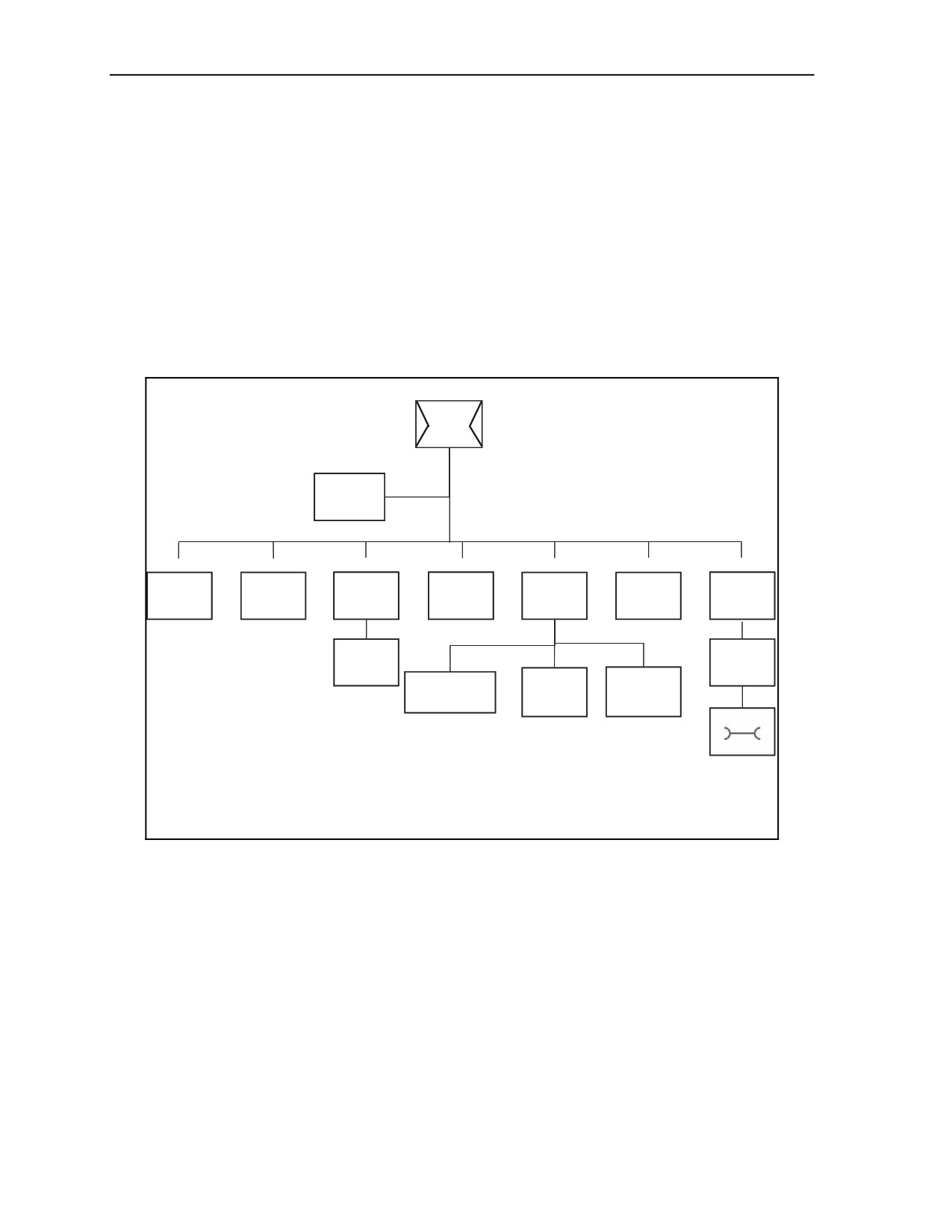
4-8. The sustainment brigade is designed to be a flexible organization that is task organized to meet
mission requirements. The sustainment brigade has a command and staff structure capable of providing the
full range of sustainment to the operational or the tactical level. It does not have the organic capacity to
execute its assigned mission without the assignment of subordinate support units. The sustainment brigade
is augmented by a number of different types of tailored organizations. The types and numbers of these
organizations depend on the mission and the number, size, and type of organizations the sustainment
brigade must support. Figure 4-1 shows the organization of a notional sustainment brigade task organized
for support operations.
4-9. The rest of this chapter covers some of the considerations and options for task organizing the
sustainment brigade’s CSSBs and subordinate units in an AO. It also provides an overview of some of the
units that might be found in attached CSSBs.
X
SUST
Organic
Attached
As required by ME
-TC
II
II
II
II
II
STB
CSSB
CSSB
CSSB
I
I
I
I
HR
(R5)
(Attached to STB or CSSB)
CSSB–Combat Sustainment Support Battalion
HR (R5– Human Resources (Reception, Replacement, Return to d
nd Recuperation, Redeployment)
STB– Special Troops Battalion
Figure 4-1. Notional Sustainment Brigade
SECTION II - COMBAT SUSTAINMENT SUPPORT BATTALION (CSSB)
4-10. CSSB is a tailored, multifunctional logistics organization. It is a flexible and responsive team that
executes logistics throughout the depth of their assigned AO. The CSSB subordinate elements may consist
of functional companies providing supplies, ammunition, fuel, water, transportation, cargo transfer, MA,
maintenance, field services, and HR management. This framework enables the employment of a tailored
4 February 2009
FMI 4-93.2
4-3
Chapter 4
logistics unit capable of adapting quickly to changing tactical conditions. The CSSB works through the
sustainment brigade in concert with the TSC for logistics operations to effectively support the maneuver
commander.
4-11. Three to seven total subordinate battalions may be attached to a single sustainment brigade
depending on the brigade’s mission. The CSSB is under the C2 of the sustainment brigade commander. It
is the base organization from which force packages are tailored for each operation. Through task
organization, the CSSB is capable of providing support during all phases of operations. The CSSB is
structured to optimize the use of resources through situational understanding and common operational
picture (COP). The mission of the CSSB is to C2 organic and attached units; provide training and readiness
oversight; and provide technical advice, equipment recovery, and mobilization assistance to supported
units. The headquarters detachment provides unit administration and sustainment support to the battalion
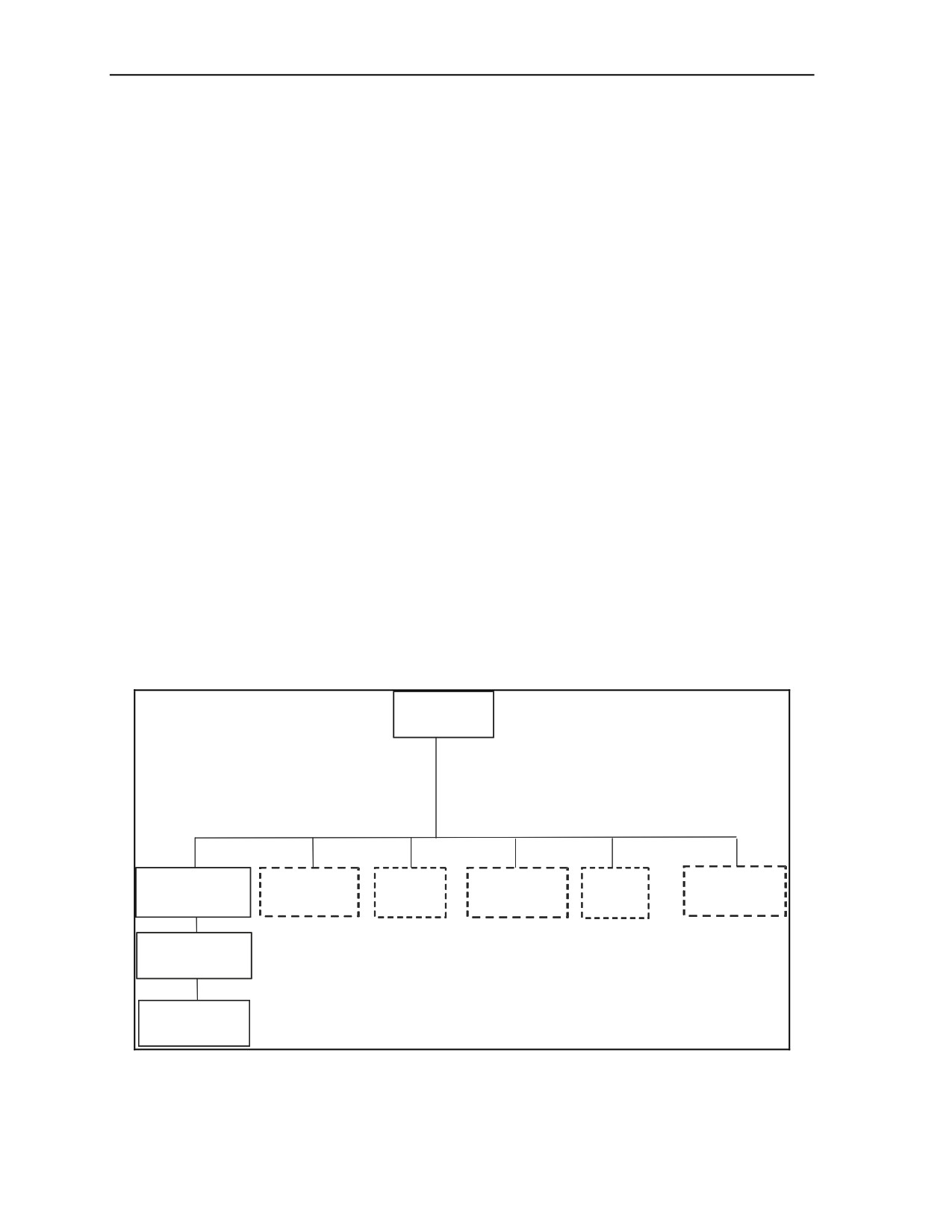
staff sections. Figure 4-2 shows an organizational chart for the CSSB.
II
CSSB
CMD
Section
•••
HQ
S-1
S-2/3
S-4
S-6
SPO
UMT
DET
FIELD
PBO
FEED
EQUIP
PLANS
CSSAMO
READINESS
CMD- Command
CSSAM –Combat Service Support Automation Management Office
CSSB– Combat Sustainment Support Battalion
HQ DET– Headquarters Detachment
PBO–Property Book Office
SPO–Support Operations
UMT– Unit Ministry Team
Figure 4-2. The CSSB Headquarters
CSSB Subordinate Organization Functions
4-12. Supported units are reliant upon CSSBs to meet replenishment requirements beyond their internal
capabilities. The CSSB is the entity of the sustainment brigade that provides the distribution link between
theater base, APOD(s), SPODs, and the supported units. The structure includes cargo transfer and
movement control assets, fused with supply functions. The CSSB also performs the function of
transporting commodities to and from the BSB of the maneuver BCT and to and from theater repair or
storage facilities. Its function is to maintain the flow of replenishment; to retrograde unserviceable
components, end items, and supplies; to monitor the distribution of replenishment that is throughput
directly from the theater base by assets of the sustainment brigade tasked with providing theater
distribution; and to assist with coordination and delivery if necessary. The CSSB augments/supplements
supported units during the normal replenishment cycle, delivering supplies that are not being throughput
4-4
FMI 4-93.2
4 February 2009
Support to the Operating Forces
directly to units. A brief discussion of some of the CSSBs functions follows. More in-depth information on
the subordinate units that provide these functions can be found later in this chapter.
Ammunition
4-13. Ammunition elements assigned to the CSSB provide for the receipt, storage, issue, and
reconfiguration of ammunition items. These elements provide flexibility and can be tailored in order to
support the full spectrum of operations. Ammunition platoons can be attached as needed to meet surge
requirements. Bulk Class V is received at the SPOD where ammunition elements of the TSC configure unit
loads of Class V within its ASA. The ammunition is then throughput directly to using units, to CRSPs, or
to the ASA, and ammunition transfer and holding points (ATHP) for distribution to supported units as
required.
Transportation
4-14. Transportation assets of the CSSB provide mobility of personnel and all classes of supplies. When
the CSSB is assigned to a sustainment brigade tasked to provide theater distribution, it will be heavily
weighted with transportation assets. At the operational level, the CSSBs transportation assets will normally
operate between the operational and the tactical levels. However, loads can be throughput from the
strategic level direct to the tactical level (for example, BSB) based on METT-TC. At the tactical level, the
CSSBs transportation assets will provide mobility from the CSSB base to the BSB and the FSCs within the
BCT area.
Maintenance
4-15. Maintenance assets of the CSSB provide maintenance based on the two-level (field and sustainment)
maintenance characteristics. The CSSB normally provides field maintenance support to the task force.
Field maintenance is provided on an area basis. CSSB maintenance elements are designed with the
capability to send slice elements forward to support a maintenance surge or to help clear maintenance
backlogs at the BSBs and FSCs. Deployed CRCs and field repair activities remain under the C2 of the
AFSB, but may collocate with a CSSB to provide sustainment maintenance support. Medical equipment
maintenance, calibrations, and verification/certification in the sustainment brigade will be provided by
medical equipment repairers from the supporting Medical Logistics Company (MLC).
Supply and Services
4-16. Supply and Services (S&S) assets of the CSSB provide all classes of supplies (less Class VIII) and
quality of life operations for personnel operating in or transiting the AO. Supply involves acquiring,
managing, receiving, storing, and issuing all classes of supply (less Class VIII). The CSSB provides field
services such as laundry, shower, light textile repair, MA, and aerial delivery support. The CSSB may also
provide billeting, food services, and sanitation when conducting base camp operations.
Human Resources and Financial Management
4-17. An organizational option is to attach the HR and FM companies as depicted in Chapter 2 to the
CSSB instead of the STB of the sustainment brigade as discussed in Chapter 2.
COMMAND GROUP
4-18. The CSSB has a command group and staff that is the same as any other battalion and performs the
same functions as in the sustainment discussed in Chapter 2.
SECTION III - LOGISTICS SUBFUNCTION
4-19. The purpose of this section is to describe how key logistics functions will be performed by the
sustainment brigade. In addition to providing descriptions of the logistics functions performed by the
sustainment brigade, this section will identify many of the units that execute these functions. Logistics
4 February 2009
FMI 4-93.2
4-5
Chapter 4
reporting (formerly called LOGSTAT) supports all the other functions within this chapter and is critical for
C2 and situational awareness of unit status for both combat HQ and also supporting units. It is critical to
the timeliness and accuracy of replenishment of all classes of supply. Logistics reporting is discussed
further discussed in Appendix C, including a proposed standard report.
MAINTENANCE
4-20. The overarching principle of replace forward/fix rear remains unchanged. Tailorable organizations
execute the two-level maintenance system, composed of field maintenance and sustainment maintenance.
Field maintenance involves platform tasks normally done by assets internal to the owning organization that
return systems to a mission capable status. At field maintenance level, all functions are focused on
replacing damaged components and returning the repaired item to the user. The desired end state is to
reduce repair cycle times by providing capabilities as far forward as possible, maximizing reliance on parts
distribution, stock visibility, and component replacement. Sustainment maintenance involves platform
tasks that are done primarily in support of the supply system (repair and return to supply), and will not
normally be performed inside the brigade/BCT AO. There are no fixed repair time guidelines for
performing field or sustainment repair. In the current Army, maintenance procedures and doctrinal methods
are changed to gain greater effectiveness and efficiencies.
4-21. The Army maintenance system employs tailorable field level maintenance units called support
maintenance companies (SMCs). Sustainment level maintenance units called component repair companies
(CRCs) are sent forward in the CSSB of the sustainment brigade. Each type of maintenance organization is
built from a company HQ that can accept platoon and team level elements. These organizations are also
capable of having 10 percent of their structure composed of contractors or DA/DOD civilians.
SUPPORT MAINTENANCE COMPANY (SMC)
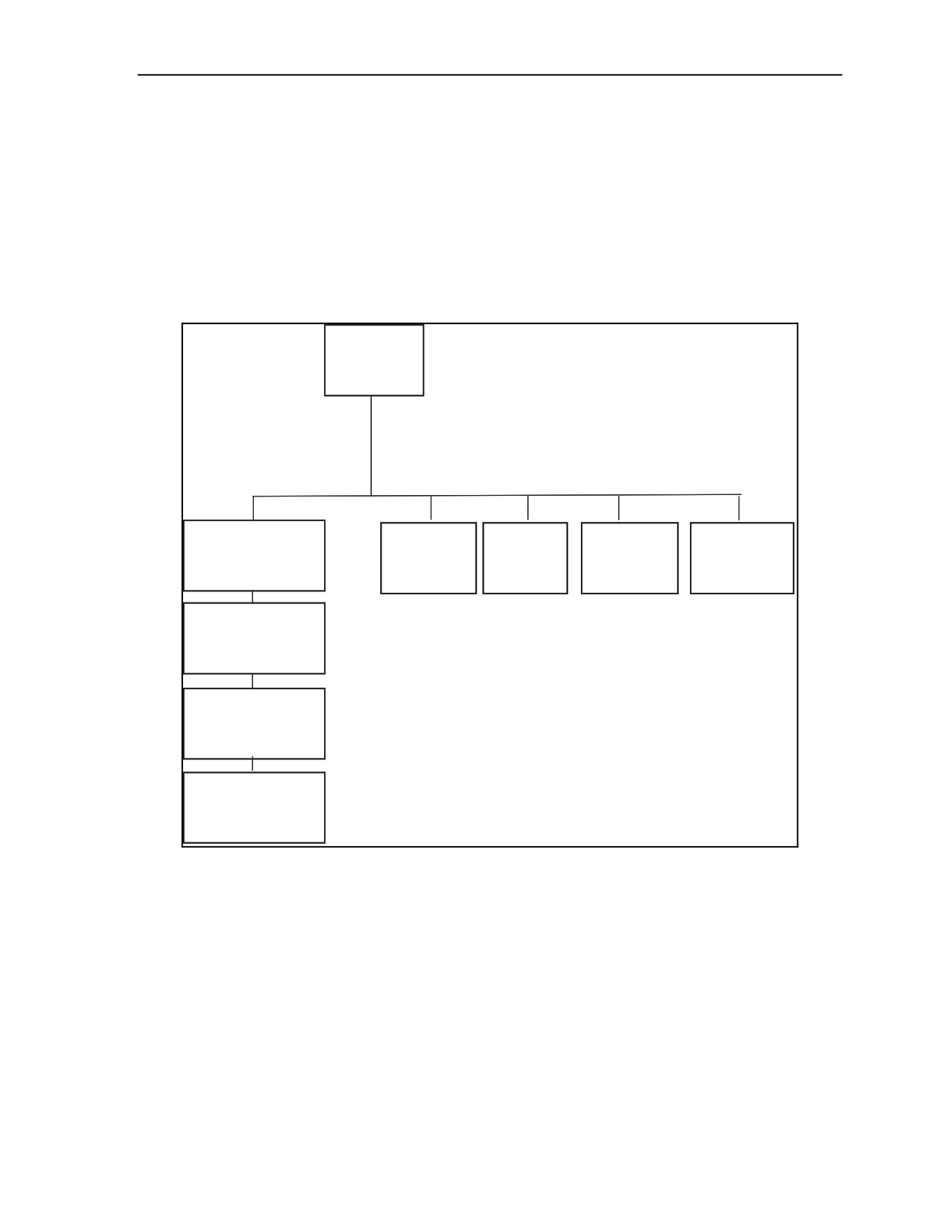
4-22. The SMC (see Figure 4-3) provides area support to units in the sustainment brigade AO.
z
Provides support field maintenance.
z
Supports theater opening packages (Army pre-positioned stocks).
z
The SMC is capable of accepting modules (platoons/sections/teams) from CRCs and C&Cs.
SUPPORT
MAINTENANCE
COMPANY
AUTOMATION/
ELECTRICAL
TRACK
MISSILE
HEADQUARTERS
GSE
ARMAMENT
MAINTENANCE
REC
MAINTENANCE
PLATOON
PLATOON
PLATOON
PLATOON
MOD
PLATOON
MAINTENANCE
CONTRACTING
SECTION
SERVICE/
RECOVERY
SECTION
Figure 4-3. Support Maintenance Company
4-6
FMI 4-93.2
4 February 2009
Support to the Operating Forces
COMPONENT REPAIR COMPANY (CRC)
4-23. The CRC (see Figure 4-4) provides repair and return to the theater supply system. CRCs are
employed in the distribution system beginning at the national source of repair. These units can be pushed
forward at the direction of the AFSB into the AO only as needed and will be workloaded by the AFSB.
These units:
z
Provide repair and return to the supply system.
z
Operate in conjunction with a supply support activity (SSA).
z
Can attach platoons/sections/teams to SMC or other sustainment units.
z
Integrated maintenance repair activities with AFSB.
COMP
REP
COMPANY
ARM
ELEC
AUTO
HEADQUARTERS
GSE
REP
REP
REPAIR
PLATOON
PLATOON
PLATOON
PLATOON
PLATOON
MAINTENANCE
CONTRACTING
SECTION
SHOP
SUPPLY
SECTION
ALLIED
TRADE
SECTION
Figure 4-4. Component Repair Company
SUPPLY
4-24. Providing the force with general supplies is the mission of the attached/assigned quartermaster
elements of the CSSB and functional battalions. Supply operations must effectively support a brigade-
based force. To accomplish this, Quartermaster units, tailored together with other sustainment units to form
multi-functional CSSBs within Sustainment Brigades, provide logistics support at the operational level.
The current force maneuver and support brigades have organic support capabilities that provide operational
endurance. Command and control and management of supply operations begin at the TSC and its
supporting multi-functional Sustainment Brigades, and is executed by CSSBs. Supply elements generally
provide subsistence, general supplies, bulk fuel, heavy materiel, repair parts, and water. Personal demand
items (Class VI) and medical supplies (Class VIII) are not typically provided by units under the C2 of the
sustainment brigade, but must be considered during the planning process.
4 February 2009
FMI 4-93.2
4-7
Chapter 4
CLASS I, FOOD AND FIELD FEEDING
4-25. The current field feeding standard is expected to remain in effect. This feeding standard dictates that
a ration is three quality meals each day, with the capability to distribute, prepare, and serve at least one
Unitized Group Ration-A (UGR-A) or UGR-Heat & Serve (UGR-H&S) meal per day (METT-TC
dependent). The family of operational rations used to support this standard consists of individual meals
(Meal-Ready-to-Eat; Meal, Religious, Kosher/Halal; Meal, Cold Weather/Food packet, Long Range Patrol;
along with the emerging First Strike Ration and Compressed Meal) and unitized group meals (UGR-A and
UGR-H&S, along with the emerging Unitized Group Ration-Express (UGR-E)), plus enhancements such
as bread, cereal, fruit, and salad and the mandatory supplement of milk to ensure the nutritional adequacy
of the group rations. The inclusion of a cook-prepared hot meal in the standard of three quality meals per
day is based on units having the required personnel and equipment necessary for implementation. During
extended deployments of 90 days and beyond, the feeding standard is expanded to include the UGR-A
Short Order Supplemental Menus. This option provides easy to prepare breakfast and lunch/dinner short
order menus and affords choices in menu selection for Soldiers. The feeding standard applied when troops
are deployed beyond 180 days includes the incorporation of the DA 21-Day menu that can be prepared
using organic field kitchens or contractor logistics support. See FM 10-1, Quartermaster Principles, for
more details.
Class I Distribution
4-26. Class I items are pushed from the strategic level (vendors and/or depots) to the operational area
based on supported unit strength reports. When logistic personnel, rations, transportation, and equipment
are in place, a “Pull” or “Request” system will be implemented as UGR-H&S and UGR-A are introduced.
The mix of perishable and semi-perishable rations depends on the Operational Commander’s Feeding
Policy and the availability of refrigerated storage and Subsistence Platoons. Class I stocks brought into the
theater of operations will be moved to the Subsistence Platoon residing within Quartermaster Support
Companies (QSC). The Commander’s Stockage Policy will determine the number of days of Class I
supplies to be maintained at various levels/locations. As an example, stockage levels set at 10 days of
supply (DOS) at theater level are reduced to 3 to 5 DOS in the Subsistence Platoon of the sustainment
brigade.
4-27. Class I bulk will be transported from the strategic level to the operational level in 20- or 40-foot
refrigerated and non-refrigerated containers. The TSC will maintain the predominance of theater Class I
stockage, which will be maintained by the Subsistence Platoon(s) of the QSC located in the operational
level Sustainment Brigade or an equivalent civilian organization. At this location, the QSC’s Subsistence
Platoon(s) will also provide Class I area support to units located in the numbered Army level area. Rations
are distributed in bulk from the operational level via internal single temperature refrigerated containers or
leased refrigerated containers on semi-trailers, and via leased 20- or 40-foot ISO containers on semi-trailers
for semi-perishable assets, to the Subsistence Platoon of the Sustainment Brigade CSSB supporting the
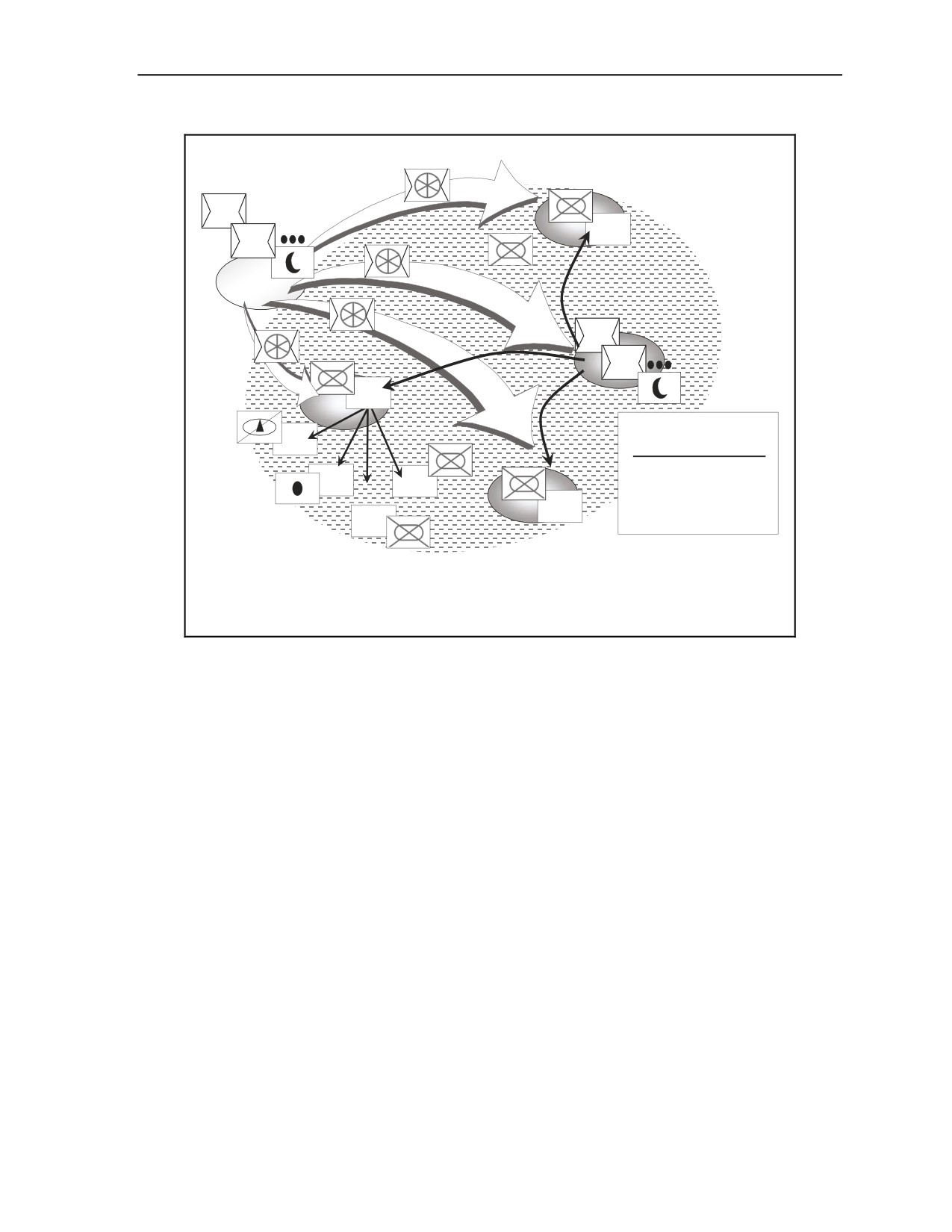
higher tactical. The Class I distribution flow is depicted in Figure 4-5. It is envisioned that bulk Class I will
be transported from the sustainment base to the Subsistence Platoon of the Sustainment Brigade CSSB
Quartermaster Support Company, which will build support packages for the maneuver brigades. The
rationale for the Subsistence Platoon shipping in bulk is: it more efficiently uses the limited transportation
assets available; it most effectively supports large base-camp operations (as seen in Iraq); and it allows the
QSC Subsistence Platoon to respond within the required 72 hour turnaround from the order placement to
the order delivery for its customers. A 72 hour turnaround is required to respond to changes in operational
pace and still support the Army’s field feeding policy to provide the Soldiers with at least one hot meal a
day, METT-TC.
4-8
FMI 4-93.2
4 February 2009
Support to the Operating Forces
I
X
X
II
SUST
II
XX
BSB
CSSB
I
Sustainment
I
Base
X
I
SUST
II
X
CSSB
II
BSB
II
I
Modular Class I and
FSC
II
Field Feeding Concept
II
I
I
X
• Operational Echelons
FSC
FSC
II
• Push then Pull System
I
II
BSB
• Subsistence loads built to
FSC
kitchen requirements
BSB - Brigade Support Battalion
CSSB - Combat Sustainment Support Battalion
FSC - Forward Support Company
SUST - Sustainment Brigade
Figure 4-5. Class I and Field Feeding Operations
WATER PRODUCTION AND DISTRIBUTION
4-28. Water production and distribution operations in the current force can be characterized by a greater
degree of self-reliance by maneuver units. This is due to a mobile storage capability, organic water
purification, and improved distribution system within the brigade. This added water generation capability,
along with the reduction in echelons and mobility improvements, will enhance the integration of
sustainment into the operational battle rhythm. Modular Quartermaster Water Purification and Distribution
Companies provide tailored water production package capabilities, storage, and bulk area distribution at
the operational and tactical levels. Arrival of water units into the theater of operations is synchronized in
such a way that the Water Distribution System will expand from commercial packaged water distribution
early on, to water production and distribution as the theater of operations matures. Water distribution and
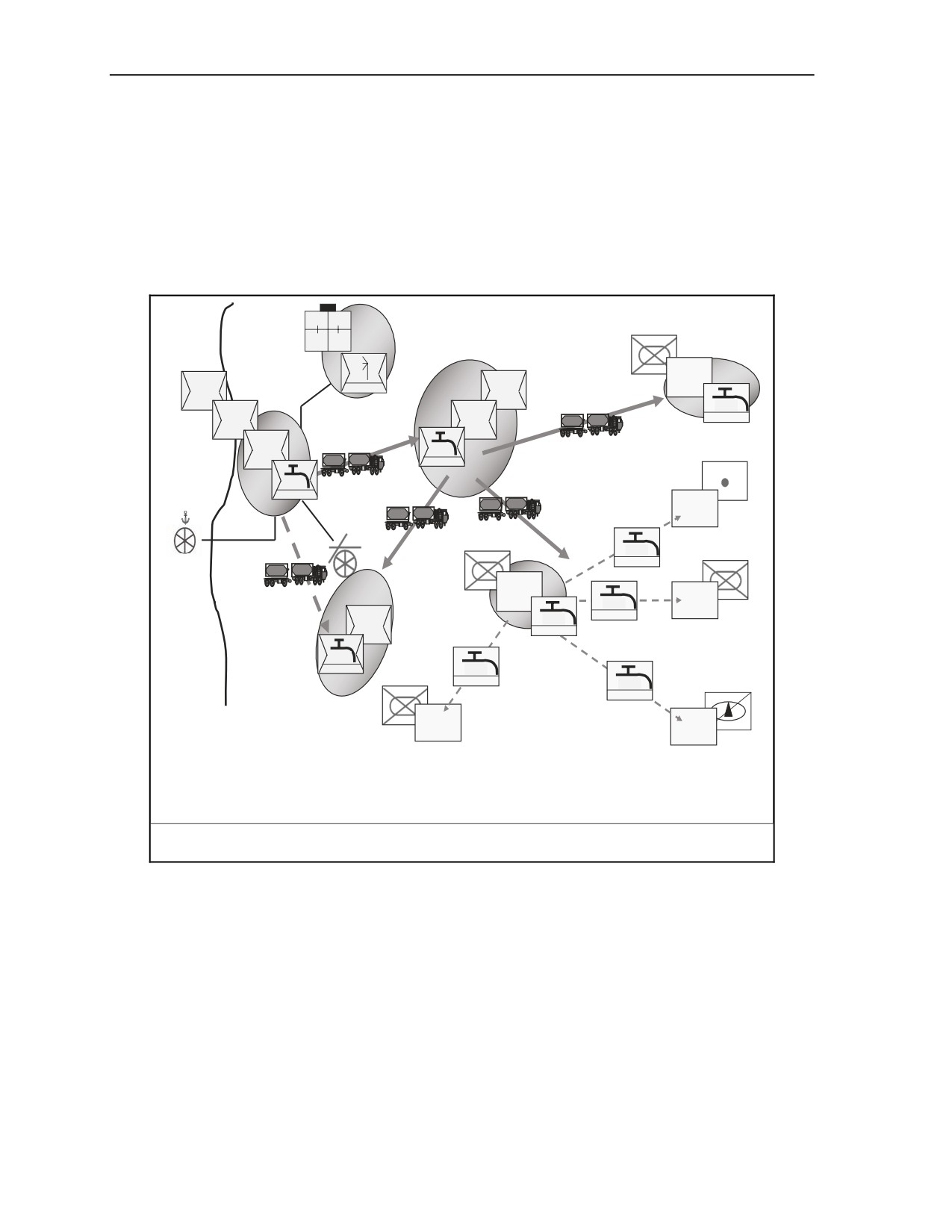
the dispersion of the Water Purification and Distribution Companies to support current forces are shown in
Figure 4-6.
Water Purification
4-29. Quartermaster Water Purification and Distribution Companies and Augmentation Water Support
Companies are assigned to CSSBs in Sustainment Brigades. The Water Purification and Distribution
Company can provide up to 360,000 gallons of potable water per day from a fresh water source at up to
eight water points. When using a salt water or brackish water source, production equals 240,000 gallons.
This company can store 160,000 gallons; 80,000 per platoon. The Augmentation Water Support Company
for arid environments can purify up to 720,000 gallons from a fresh water source or 480,000 from a
brackish water source, and store 1.9 million gallons.
4 February 2009
FMI 4-93.2
4-9
Chapter 4
Water Support within Brigades
4-30. In temperate climates, water purification, packaging, storage, and distribution will take place in the
BSB and JSOTF. The BSB has distribution assets to deliver limited package and bulk water forward to
FSCs during replenishment operations. FSCs within BCTs do not have water support capability. Water will
be issued using supply point distribution from the FSCs. Bulk water purification is able to be conducted
forward of the BSB through the employment of high mobility multipurpose wheeled vehicle (HMMWV)-
mounted light water purification systems. Water purification within the JSOTF may take place forward of
the BSB.
Force Provider
X
Sustainment
••
II
Base
++
X
…
BSB
TSC
SUST
X
II
PURE
Pipeline
SUST
I
CSSB
II
CSSB
I
PURE
II
PURE
I
FSC
Pipeline
Ø
Pipeline
X
PURE
II
II
Ø
I
…
BSB
II
PURE
FSC
PURE
I
CSSB
Ø
PURE
Ø
PURE
II
PURE
II
I
I
BSB - Brigade Support Battalion
FSC
FSC
CSSB - Combat Sustainment Support Battalion
FSC - Forward Support Company
SUST - Sustainment Brigade
TSC - Theater Sustainment Command
PURE = Purification Capability. At EAB; 3000 and 1500 GPH Reverse Osmosis Water Purification Units
At the BSB; Tactical Water Purification System (TWPS) and Lightweight Water Purifier (LWP)
Figure 4-6. Example of Water Distribution in a Mature Theater of Operations
Operations in Arid Environments
4-31. In an arid environment water sources are limited and widely dispersed, while requirements for
potable water are increased. Therefore, operations in arid or other-than-temperate environments, place
greater demand on purification, storage, and distribution capabilities than in other climatic conditions. A
greater commitment of water assets at the operational level may be required due to limited raw water
sources available and mobility requirements at tactical levels. Augmentation Water Support Companies
may be employed to provide the additional capability required to meet the increased demand for water
purification and storage. Line haul distribution will be accomplished using semi-trailer mounted fabric
tanks transported by Transportation Medium Truck Companies.
4-10
FMI 4-93.2
4 February 2009
Support to the Operating Forces
GENERAL SUPPLIES (CLASS II, III (P), IV)
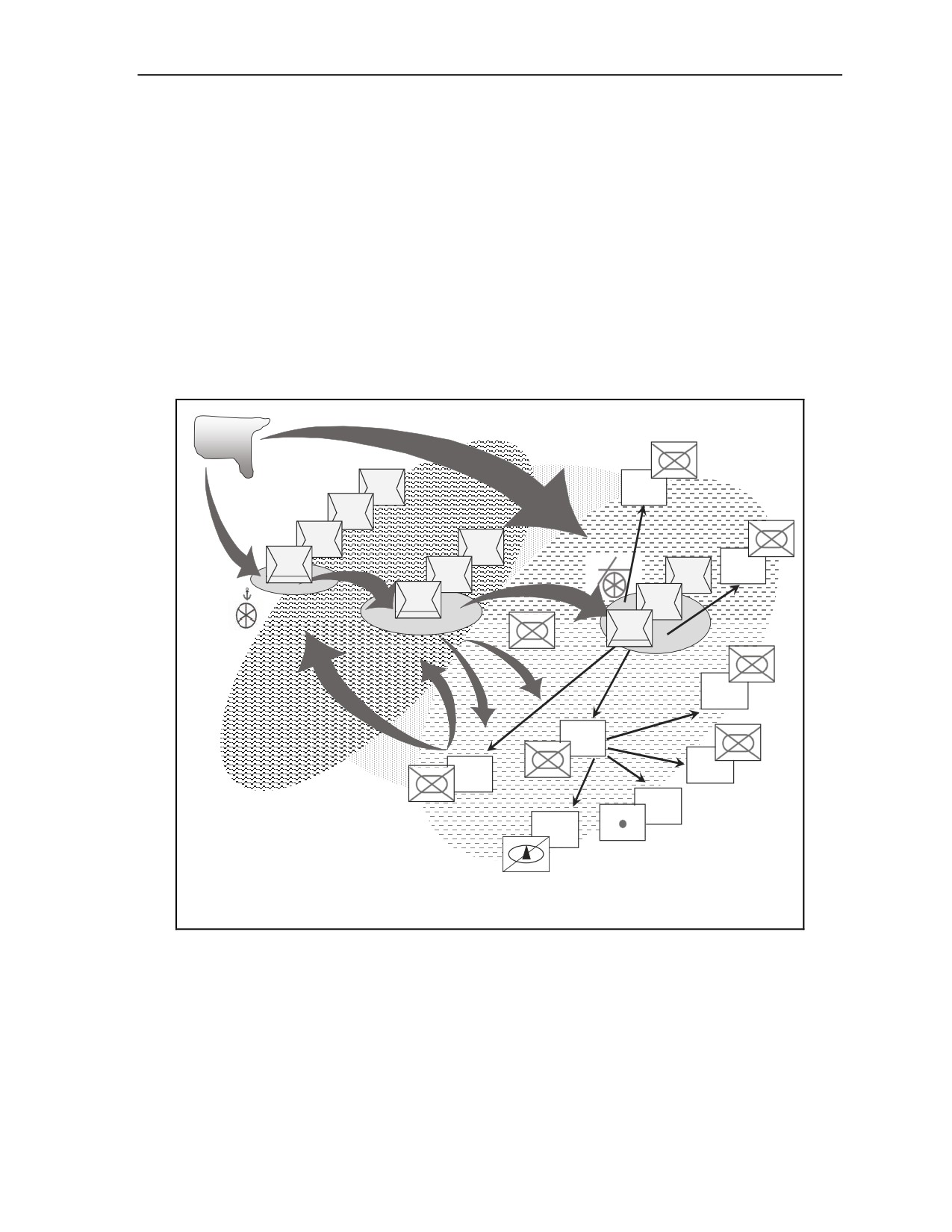
4-32. Figure 4-7 shows the flow of general supplies from the sustainment base forward to the BCTs. This
process is described in detail below. Supply distribution for general classes of supply is characterized by
throughput of loads as far forward as the BSB and JSOTF (40-foot containers will not go forward of the
sustainment brigade). Supply distribution is conducted by the QSC, assigned to the Sustainment Brigade
CSSBs at the operational and higher tactical levels.
4-33. The QSC, as the Consolidated Supply Support Activity (CSSA), provides for the receipt, storage,
and issue of 207.8 ST of Classes II, III (P), IV, VII, and IX (less aviation, missile repair parts, and
communications security equipment) stocks per day. It packages/repackages supplies as required, to
include retrograde and redistribution. The QSC is the center-post of the Distribution Hub at the sustainment
base level, receiving all stocks as they enter the theater of operations that cannot be readily throughput to a
unit destination. The QSC Area Support Platoons at the operational level configure pure pallet packages to
satisfy unit requests or assemble support packages to re-supply the QSC at higher tactical levels.
CONUS
X
II
++
X
TSC
BSB
II
SUST
X
X
I
CSSB
II
II
SUST
X
QSC
BSB
I
CSSB
SUST
II
QSC
I
CSSB
Sustainment
XX
Base
QSC
II
Distribution
I
Hub
FSC
II
II
X
BSB
I
II
X
FSC
BSB
I
II
I
FSC
BSB - Brigade Support Battalion
CSSB - Combat Sustainment Support Battalion
II
FSC
FSC - Forward Support Company
QSC - Quartermaster Support Company
SUST - Sustainment Brigade
TSC - Theater Sustainment Command
Figure 4-7. Supply Distribution for General Supplies
4-34. The QSC Area Support Platoons will build customized loads, combining pre-packaged loads
received from designated distributors. These loads will be further combined with any required bulk
supplies. Combined packages received from the strategic level will also be packaged for issue and forward
movement to meet unit requests. These loads can be throughput as far forward as feasible.
4-35. Once supplies have been identified and configured for forward movement to the customer, the QSC
will coordinate through its CSSB SPO for the most expeditious mode of transport. The TSC Support
4 February 2009
FMI 4-93.2
4-11
Chapter 4
Operations/Distribution Management Center will establish the priority of effort for and coordination of the
supply flow, maintenance and component repair activities, transportation, and distribution assets.
Quartermaster Support Company (QSC)
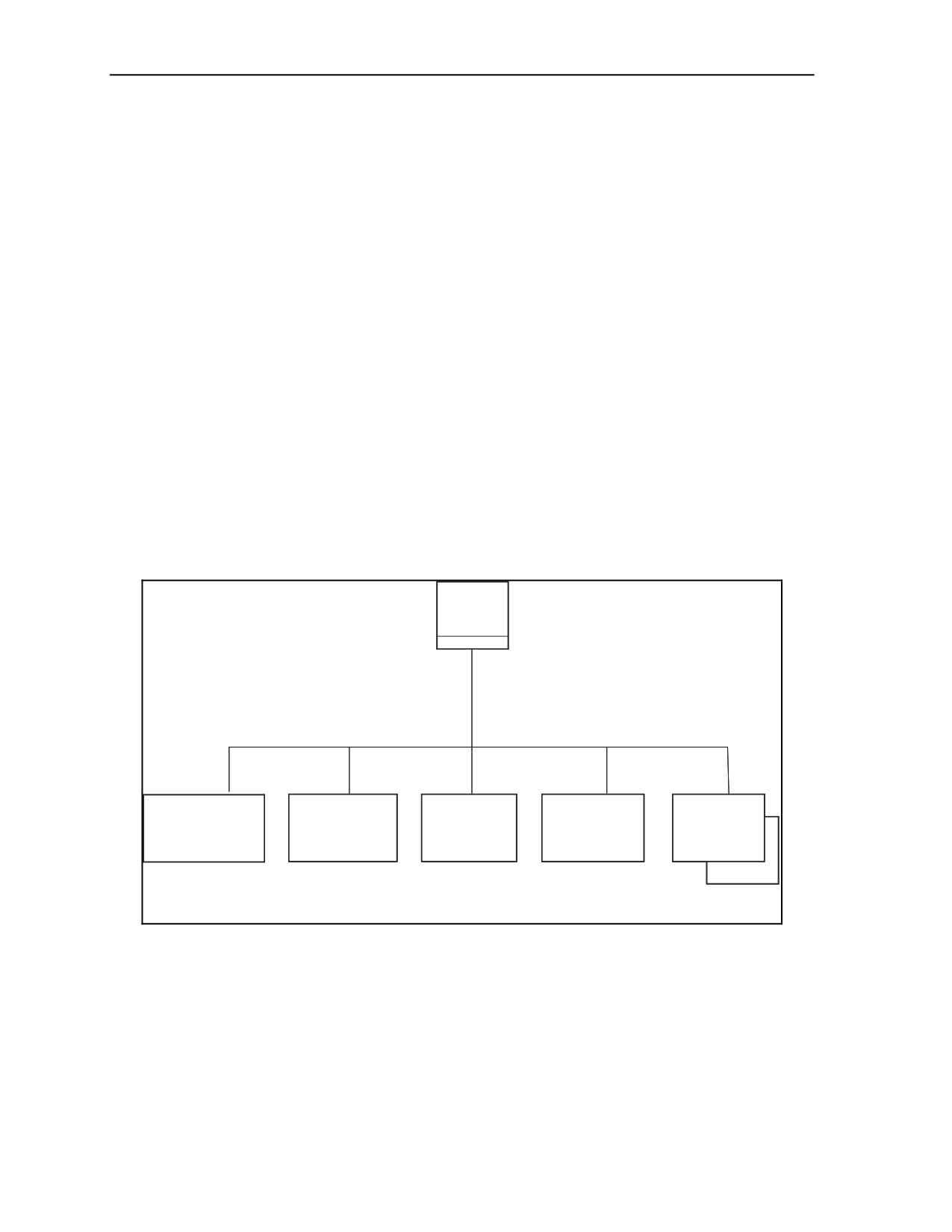
4-36. The QSC (see Figure 4-8) provides C2 for two to four subsistence or area support platoons. It
provides C2, food service, and supervision and common tools for unit level maintenance. The QSC is
attached to a CSSB. When task organized with one subsistence platoon and three area support platoons, the
unit can:
z
Receive, store, and issue a cumulative of approximately 93.6 short tons (STONs) of Class I per
day.
z
Provide refrigeration for perishable rations and augment subsistence personnel for Class I issue
points.
z
Deliver perishable subsistence to Class I supply points.
z
Receipt, store, issue, and account for 207.8 STONs of Class II, III(P), IV, and IX supplies, as
follows:
Class II
40.41 STON
Class IV
119.04 STON
Class III (P)
6.12 STON
Class VII
30.36 STON
Class IX
11.88 STON
z
Can operate up to six different locations.
z
Provide limited configured loads.
QSC
FIELD
AREA
HEADQUARTERS
MAINTENANCE
SUBSISTENCE
FEEDING
SUPPORT
PLATOON
SECTION
PLATOON
SECTION
PLATOON
QSC-QUARTERMASTER SUPORT COMPANY
Figure 4-8. Quartermaster Support Company
CLASS III (B)
4-37. Quartermaster petroleum units will provide fuel support for all US (and potentially coalition) land-
based forces. Sustainment brigades, specifically Quartermaster petroleum units and POL truck companies,
will be involved in the reception and storage of POL from the refinery or terminal and the delivery to the
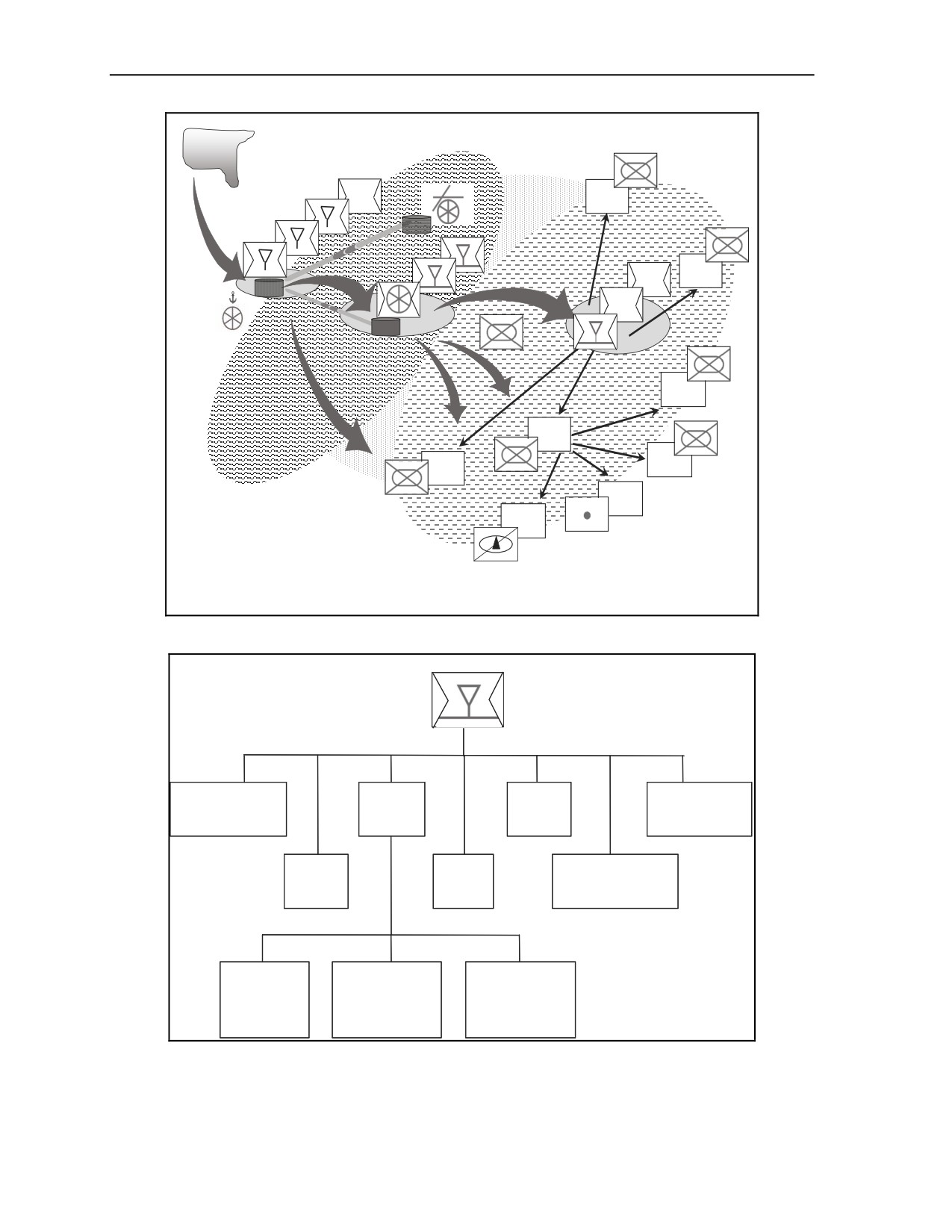
BSBs distribution company (see Figure 4-9). At theater level, POL Support Companies will be assigned to
a POL Supply Battalion in a POL Group. At division/corps level, POL Support Companies will be
assigned to a CSSB in a Sustainment Brigade. Theater opening or theater distribution sustainment brigades
4-12
FMI 4-93.2
4 February 2009
Support to the Operating Forces
may be task organized with a Quartermaster pipeline and terminal operating company. Bulk petroleum will
be distributed to the operational level for forward distribution to supported units. Figure 4-11 depicts the
distribution of fuel from the operational to tactical level. Current force fuel operations are more tailorable
and capable. Fuel is throughput directly to Division locations and fuel support assets have been added to
the maneuver BCTs and Support Brigades. Operational level fuel distribution operations use pipeline/hose
line and large capacity long haul POL transportation. By moving POL capability to the Sustainment
Brigades in the Corps/Division area, they can be more responsive to the BCT off-cycle demands and surge
requirements. The TSC, sustainment brigades, and divisions can all maintain visibility of bulk fuel
quantities on hand in the units and at the supply points via BCS3.
Theater Level Petroleum Operations
4-38. In a developed theater of operations, the Fuel Distribution System includes: the Off-shore Petroleum
Discharge System, inland tank farms Tactical Petroleum Terminals (TPTs), and pipeline systems. With a
theater structure in place, Operational Petroleum Pipeline and Terminal Operating (PPTO) Companies in a
TSC POL Group establish the theater petroleum support base for products received from ocean tankers at
marine petroleum terminals. The petroleum support base serves as a hub for receiving, temporarily storing,
and moving fuels to Petroleum Support Companies (PSC) at the operational and higher tactical levels.
Petroleum Supply Battalions at the operational level provide theater stocks and deliver fuel to the
Sustainment Brigade PSCs at the higher tactical level. PSCs support the area distribution mission and POL
truck companies deliver fuel to the BSBs in the BCTs.
4-39. Pipelines/hose lines (the most efficient mode) will be used to deliver fuel products as much as
possible during initial operations (usually to the Sustainment Brigade supporting the division). Large-scale
combat operations may justify the construction of coupled pipelines/hose lines using the Inland Petroleum
Distribution System or a future more rapidly emplaced pipeline system to move bulk petroleum from
theater storage locations forward. Air bases and tactical airfields are serviced by pipeline when feasible.
When available, pipeline distribution is supplemented by tank type vehicles, railcars, and barges.
POL SUPPLY BATTALION
4-40. The POL supply battalion’s mission is to provide C2, administrative, technical, and operational
supervision over assigned or attached petroleum supply companies and petroleum truck companies. Its
capabilities include C2 of two to five petroleum supply and truck companies; planning for the storage,
distribution, and quality surveillance of bulk petroleum products; maintenance of theater petroleum
reserves; and operation of a mobile petroleum products laboratory. POL supply battalions are typically
assigned to either the TSC or to a petroleum group. However, these battalions may be attached to the
sustainment brigade performing the theater opening mission.
4-41. POL supply battalions at the operational level provide theater stocks and deliver fuel forward to the
petroleum support companies (PSC) attached to sustainment brigades at the higher tactical level. PSCs in
turn support the area distribution mission, while POL truck companies deliver fuel to the BSBs in the
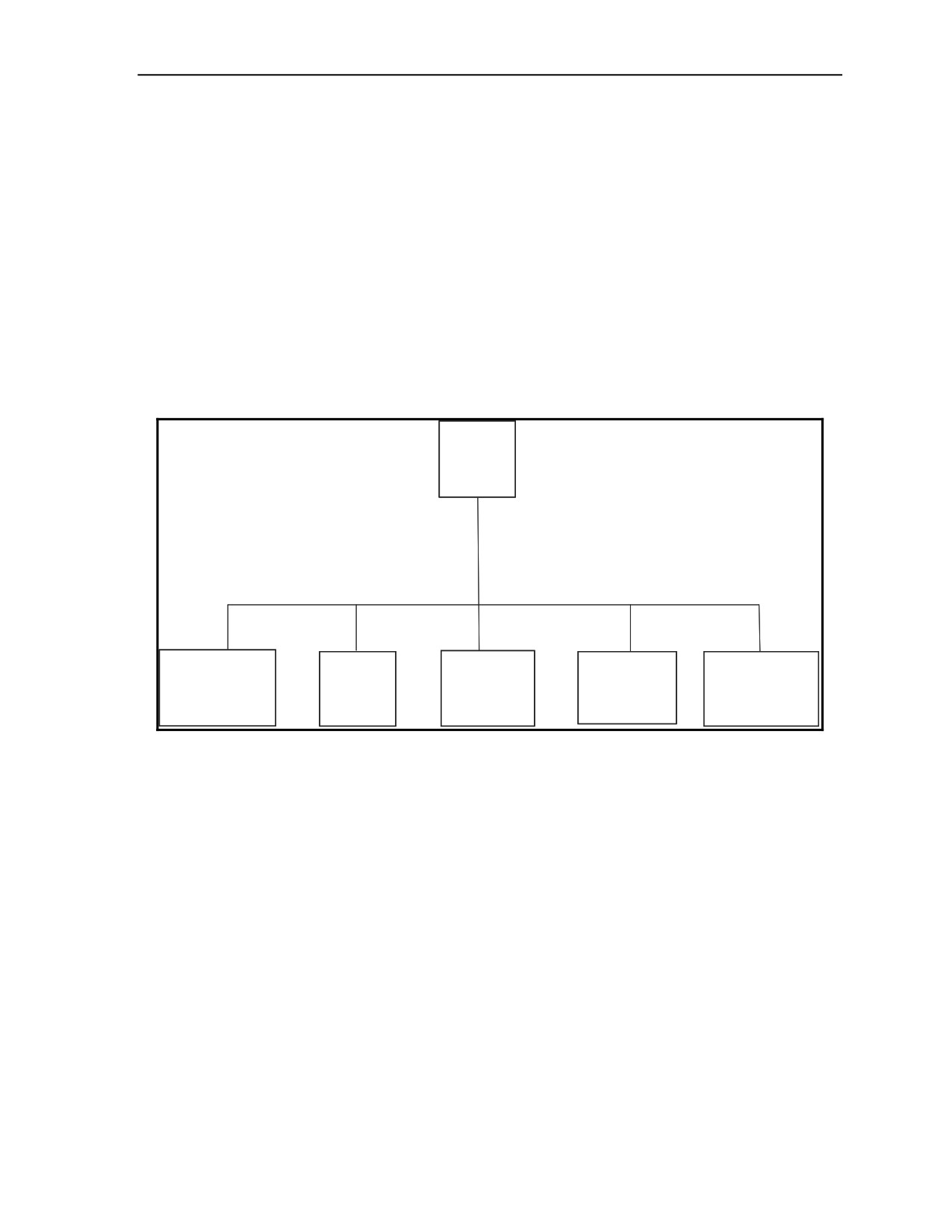
BCTs. The POL supply battalion headquarters is depicted in Figure 4-10.
4 February 2009
FMI 4-93.2
4-13
Chapter 4
CONUS
X
II
++
III
TSC
BSB
II
X
I
II
II
I
X
BSB
I
II
SUST
XX
I
CSSB
Sustainment
Base
II
Distribution
Hub
I
FSC
II
II
X
BSB
II
I
X
FSC
BSB
I
II
I
FSC
BSB - Brigade Support Battalion
CSSB - Combat Sustainment Support Battalion
II
FSC
FSC - Forward Support Company
SUST - Sustainment Brigade
TSC - Theater Sustainment Command
Figure 4-9. Fuel Operations
II
BATTALION
S2/S3
DETACHMENT
UMT
HEADQUARTERS
SECTION
HEADUARTERS
S-1
S-4
COMMUNICATION
SECTION
SECTION
SECTION
SECURITY
POL
POL
AND
OPERATIONS
LABORATORY
PLANS
BRANCH
BRANCH
BRANCH
Figure 4-10. POL Supply Battalion Headquarters
4-14
FMI 4-93.2
4 February 2009
Support to the Operating Forces
Quartermaster Petroleum and Terminal Operations Company
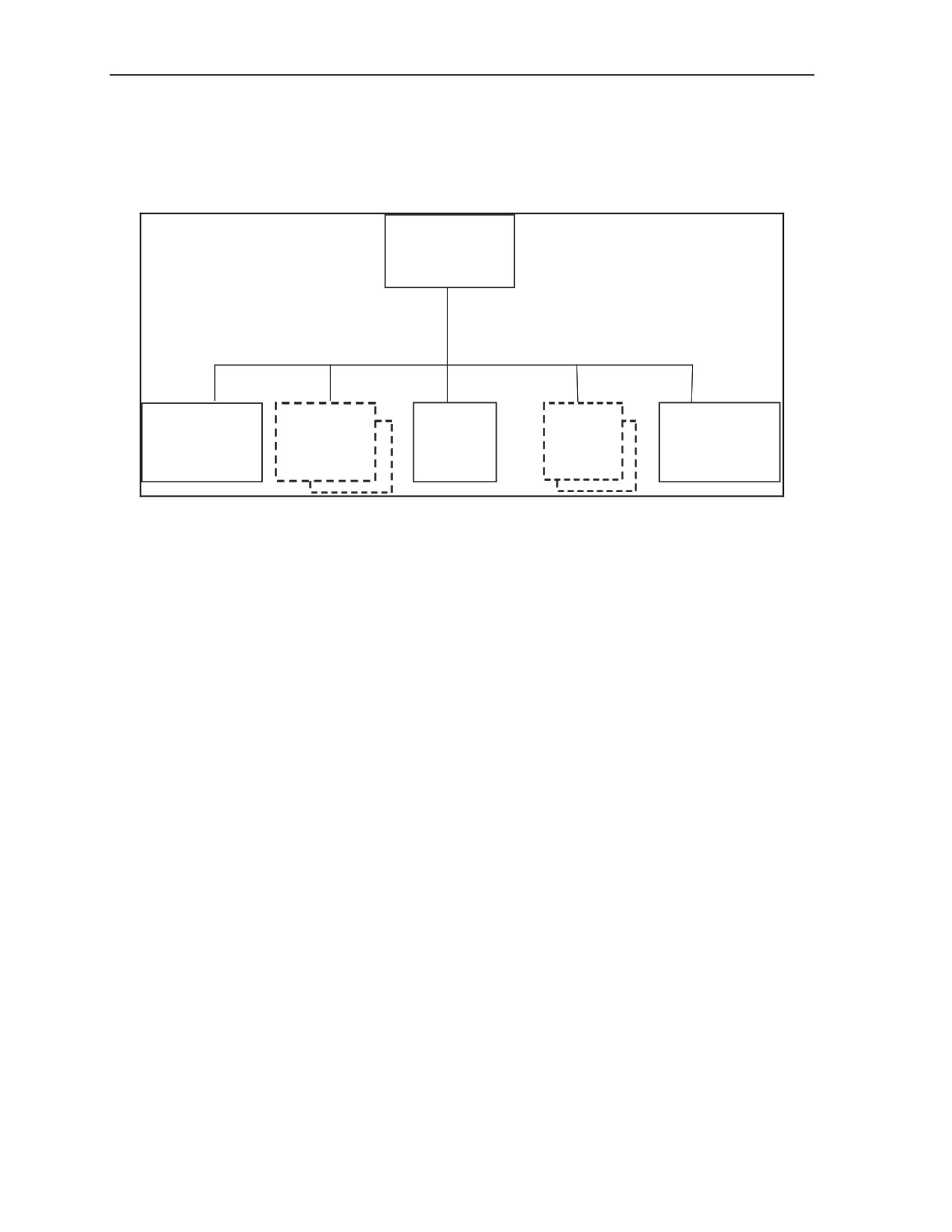
4-42. The Quartermaster petroleum and terminal operations company (PPTO) (see Figure 4-11) has as its
mission to operate petroleum pipeline and terminal facilities for receipt, storage, issue, and distribution of
bulk petroleum products. It is normally assigned to a petroleum pipeline and terminal operating battalion or
a petroleum group. Its capabilities are to:
z
Operate fixed terminal facilities for storage of up to 2,100,000 gallons of bulk petroleum. This
normally consists of two tank farms, each with a capacity of up to 250,000 barrels or a tactical
petroleum terminal (TPT) with a storage capability or up to 90,000 barrels.
z
Operate up to 90 miles of pipeline for distribution of approximately 720,000 gallons per day.
z
Operate six pump stations, 24 hours per day, to deliver bulk product through 6- or 8-inch multi-
product coupled pipeline.
z
Operate facilities for shipment of bulk product by coastal tanker, barge, rail, and tank trucks.
z
Maintain a prescribed reserve of bulk product for the theater of operations.
z
Operate a fuel system supply point for bulk issue operations.
PIPELINE
COMPANY
PETROLEUM
PETROLEUM
HEADQUARTERS
TERMINAL
MAINTENANCE
PRODUCTION
OPERATIONS
PLATOON
PLATOON
SECTION
CONTROL
PLATOON
Figure 4-11. Quartermaster Petroleum and Terminal Operations Company
Quartermaster POL Support Company
4-43. There are two types of POL Support Companies: the POL Support Company (50K) and the POL
Support Company (210K). The POL Support Companies (see Figure 4-12) receive, store, issue, and
provide limited distribution of bulk petroleum products in support of division/corps or theater operations.
Line haul distribution of bulk POL is performed by POL truck companies. The POL Support Company
(210K) is normally located in the theater area and assigned to a POL supply battalion. The POL Support
Company (50K) is normally located in the division area and assigned to a CSSB within a sustainment
brigade. When task organized with three POL Support Platoons they have the following capabilities:
z
Store up to 1,800,000 gallons when organized with three POL Support Platoons or 5,040,000
when organized with three POL Support Platoons (210K).
z
Receive and issue up to 1,200,000 gallons per day when organized with three POL Support
Platoons (50K) or 1,935,000 gallons per day when organized with three POL Support Platoons
(210K).
z
Establish and operate two hot refueling points using two Forward Area Refueling Equipment
systems for transitory aircraft operating in their area.
4 February 2009
FMI 4-93.2
4-15
Chapter 4
4-44. The area support section of each POL platoon can store up to 120,000 gallons of bulk petroleum at
one location and 60,000 gallons at each of two locations. The distribution section of each POL platoon can
distribute 48,750 gallons of fuel daily based on 75 percent availability of fuel dispensing vehicles at two
trips per day.
QUARTERMASTER
POL
SUPPORT
COMPANY
QM POL
QM POL
EQUIPMENT AND
FIELD
SUPPORT
SUPPORT
MAINTENANCE
HEADQUARTERS
FEEDING
PLATOON
PLATOON
SUPPORT
PLATOON
SECTION
(50K)
(21OK)
PLATOON
Figure 4-12. Quartermaster POL Support Company
CLASS V, AMMUNITION SUPPORT
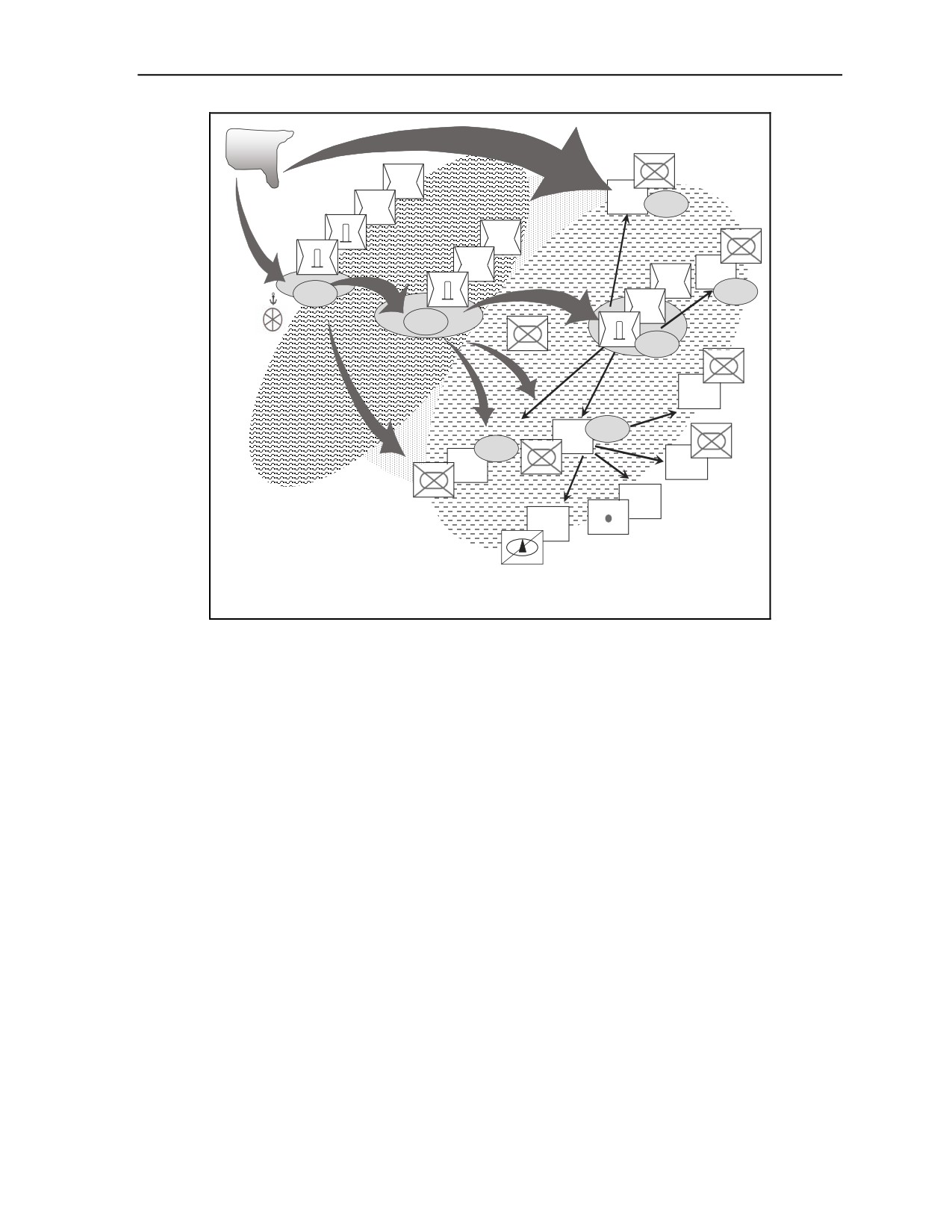
4-45. The sustainment brigade provides ammunition support (see Figure 4-13) with various organizations
and from various locations based upon the maturity of the theater of operations and the mission of the
supported units. Sustainment brigades operate Theater Storage Areas (TSA) at sustainment bases and
ammunition storage points (ASP) at the distribution hub and other forward locations. Sustainment brigades
operate Ammunition Support Activities (ASA) that provide the capability to receive, store, and issue Class
V. Ammunition elements receive, store, and issue ammunition items.
4-46. The ammunition logistics system provides to the force the right type and quantity of ammunition in
any contingency. The challenge is to move required amounts of ammunition into a theater of operations
from CONUS and other prepositioned sources in a timely manner to support an operation. The system must
be flexible enough to meet changing ammunition requirements in simultaneous operations around the
world. The objective of the system is to provide configured Class V support forward to the force as
economically and responsively as possible with minimized handling or reconfiguring and quickly adapt to
changes in user requirements. The unique characteristics of ammunition complicate the system. These
factors include its size, weight, and hazardous nature. It requires special shipping and handling, storage,
accountability, surveillance, and security. Munitions are managed using different methods depending on
the level of command.
4-16
FMI 4-93.2
4 February 2009
Support to the Operating Forces
CONUS
X
++
II
X
TSC
BSB
SUST
ATHP
II
X
X
I
SUST
II
II
X
I
CSSB
BSB
II
SUST
TSA
ATHP
I
CSSB
XX
Sustainment
ASP
Base
ASP
II
Distribution
Hub
I
FSC
II
II
ATHP
X
BSB
II
I
ATHP
X
BSB
FSC
I
ASP - Ammunition Supply Point
II
I
FSC
ATHP - Ammunition Transfer and Holding Point
BSB - Brigade Support Battalion
II
FSC
CSSB - Combat Sustainment Support Battalion
FSC - Forward Support Company
SUST - Sustainment Brigade
TSA - Theater Storage Area
TSC - Theater Sustainment Command
Figure 4-13. Ammunition Support
Theater Storage Area (TSA)
4-47. The TSA encompasses the storage facilities located at the operational level. This is where the bulk of
the theater reserve ammunition stocks are located. Ammunition companies, with a mixture of heavy- and
medium-lift platoons, operate and maintain TSAs. The primary mission of the TSA is to receive munitions
from the national level, conduct the bulk of operational level reconfiguration, and distribute munitions to
forward ASA locations and BCT ATHPs. The TSA will build those configured loads that cannot be
shipped into a theater of operations due to explosive compatibility conflicts for international shipment.
Ammunition will be managed by either an ammunition battalion or CSSB based upon METT-TC
4-48. The sustainment brigade must keep the TSC DMC informed of storage or handling limitations or
shortages in each TSA. When mission analysis indicates more than one TSA or port facility is required, the
GCC should plan for early deployment of an ordnance ammunition battalion to provide mission C2 of
munitions distribution at the TSC level.
Ammunition Supply Points (ASP)
4-49. Ammunition supply points (ASPs) provide the capability to receive, store, issue, and perform limited
inspections and field level munitions maintenance support. The sustainment brigade gains such capability
when it is assigned one or more ammunition ordnance platoons. The CSSBs attached to the sustainment
brigade will contain ammunition ordnance companies and ASP. The number of companies and ASPs varies
based upon the role of the sustainment brigade to which they are attached and the size and mission of the
supported organizations.
4-50. ASPs receive, store, issue, and maintain ammunition based on the capabilities of assigned
ammunition platoons. ASP stockage levels are based on tactical plans, availability of ammunition, and the
4 February 2009
FMI 4-93.2
4-17
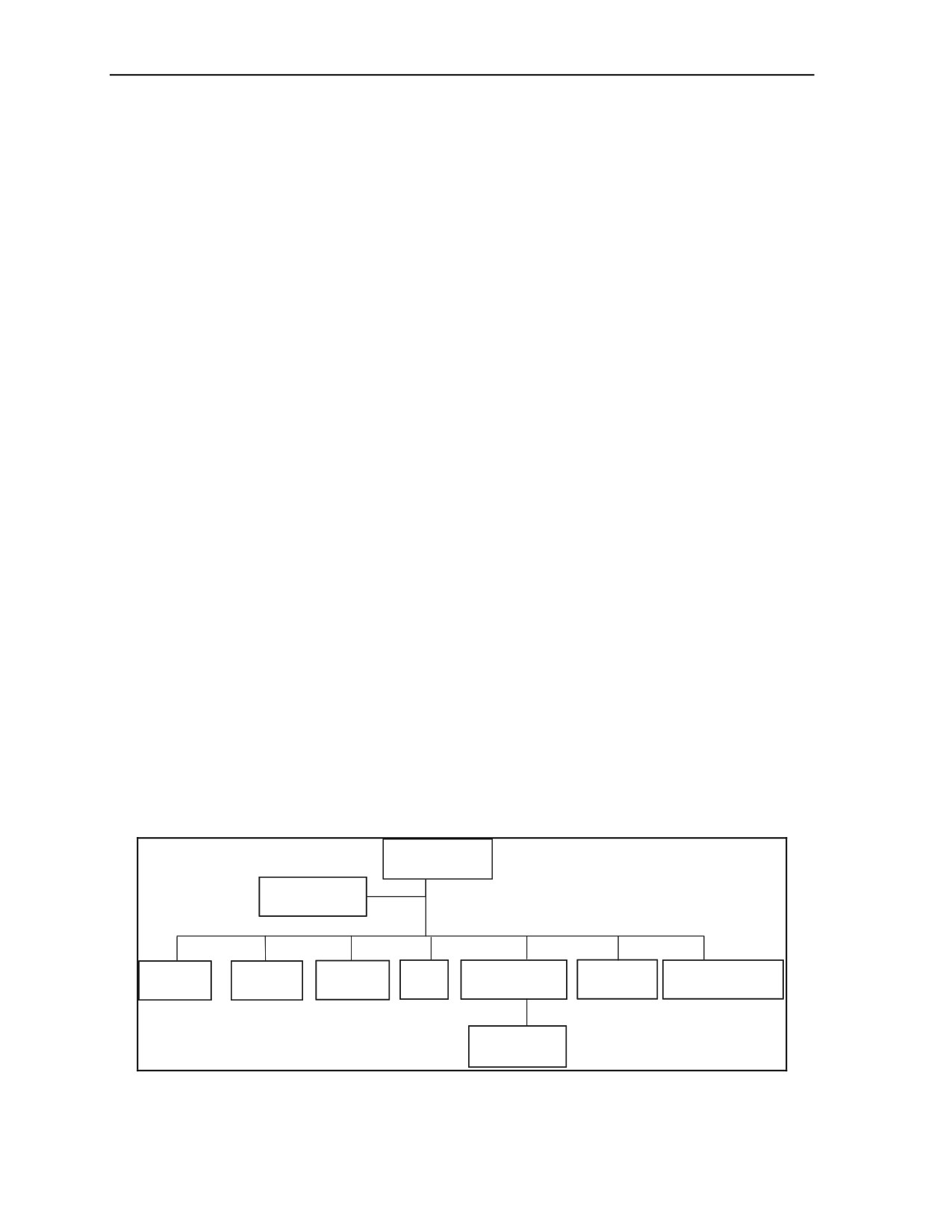
Chapter 4
threat to the resupply operation. Additionally ASPs are the primary source of resupply of ATHP located in
BCTs.
Ammunition Flow
4-51. Ammunition issued to users is replaced by ammunition moved up from theater storage areas. In turn,
ammunition stockage levels at the theater storage areas are maintained by shipments from CONUS or out
of other theater locations. The quantity of ammunition shipped forward is determined by the amount on
hand, current and projected expenditures, and the controlled supply rate (CSR).
4-52. Each battalion S-4 transmits a request for resupply of ammunition for units through the brigade S-4
to the BAO. The BAO coordinates and controls the use of Class V supplies for the brigade, consolidates
the brigade requests, and submits them to the sustainment brigade, ESC/TSC. The TSC, in coordination
with the numbered Army G-4, reviews all requests and balances them against the CSR issued by the theater
storage activity. The numbered Army issues the CSR to support the units. Some ammunition requirements
are prioritized due to scarcity and some may not be issued due to unavailability. The BAO through TSC
coordinate for the shipment of ammunition to the ATHP.
4-53. Captured enemy ammunition (CEA) must be kept separate from US munitions; however, it must be
accounted for, stored, and guarded using the same criteria that applies to US munitions. When an enemy
ammunition cache is found or captured, the commander must assess the combat situation. He/She must
decide whether to destroy the CEA because of the situation or to secure it and request explosive ordnance
disposal support. During retrograde operations, leaders must ensure safety policies and procedures are
carefully observed as these operations can be particularly hazardous and serious injury has occurred in the
handling of CEA. Close control of CEA is required. Positively identified and serviceable CEA may be
compatible for use in US or allied forces weapon systems. These munitions can potentially ease the burden
on the ammunition supply system. CEA can also be used as a substitute for bulk explosives during
demolition operations. See FM 4-30.1 and FM 4-30.13 for more information.
Ammunition Battalion
4-54. The ammunition battalion’s mission is to C2 ammunition companies and other attached units. It also
provides supervision of ammunition support operations. The ammunition battalion is usually assigned to an
operational-level sustainment brigade. For further information see FM 4-30.1. Its core capabilities are:
z
C2 and staff planning for two to five subordinate units (see Figure 4-14 for Ammunition
Battalion HQs organizational structure).
z
Technical direction over ammunition support missions of subordinate units, except inventory
management functions for which the TSC distribution management center
(DMC) is
responsible.
z
Maintaining a consolidated property book for assigned units.
AMMUNITION
BATTALION
COMMAND
SECTION
MUNITIONS
HEADQUARTERS
S-1
UMT
S-2/3
S-4
S-6
MANAGEMENT
DETACHMENT
MATERIEL
SECTION
Figure 4-14. Ammunition Battalion Headquarters
4-18
FMI 4-93.2
4 February 2009
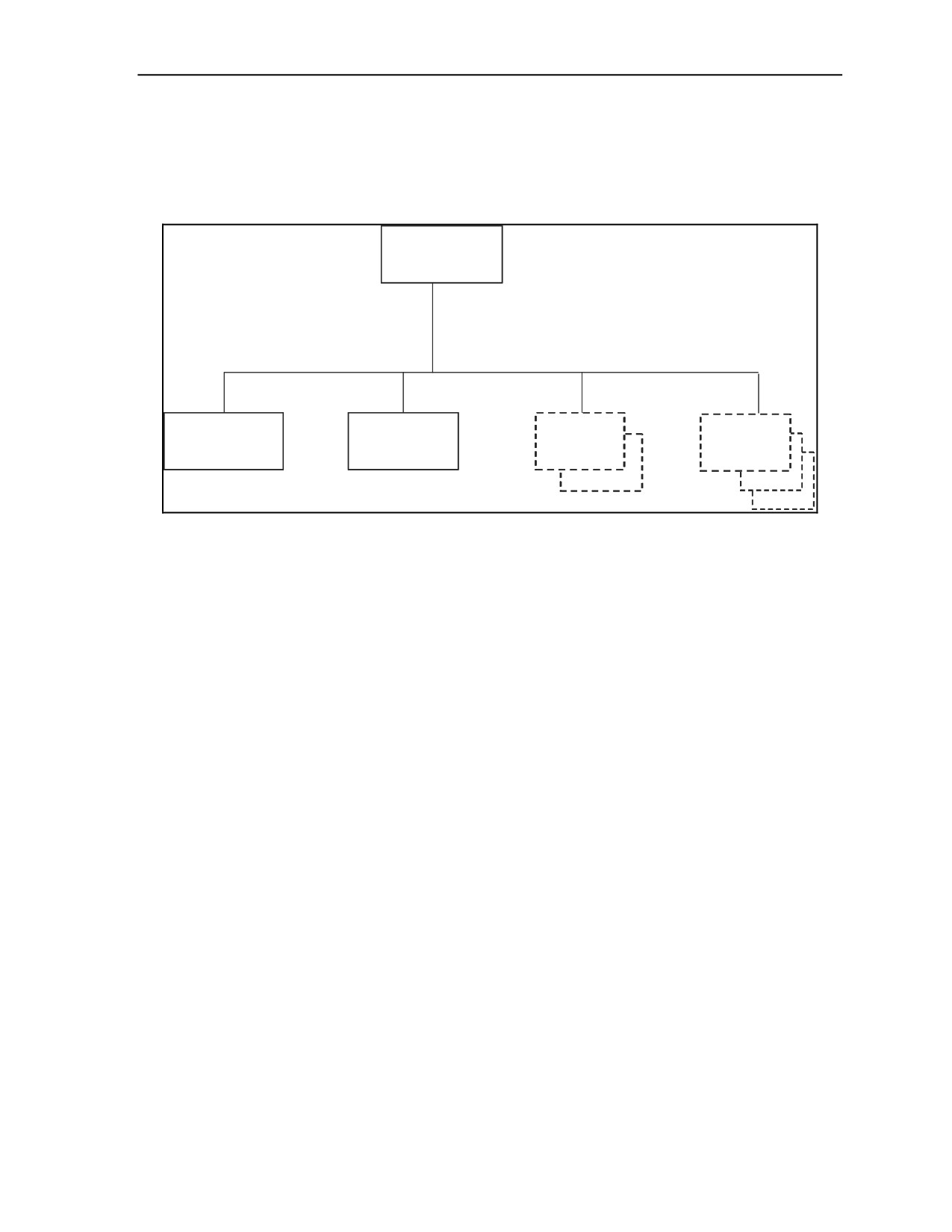
Support to the Operating Forces
Ammunition Ordnance Company
4-55. The mission of the ammunition ordnance company (see Figure 4-15) is to provide command, control,
and administrative, planning, and logistical support for ammunition platoons. It is normally assigned to an
ammunition battalion or a CSSB.
AMMUNITION
COMPANY
FIELD
HEAVY
MEDIUM
HEADQUARTERS
•
FEEDING
LIFT
LIFT
PLATOON
SECTION
PLATOON
PLATOON
Figure 4-15. Ammunition Ordnance Company
CLASS VI
4-56. Soldiers usually deploy with a 60-day supply of health and comfort items. Health and comfort packs
(Class VI) can be supplied through supply channels. Tactical field exchanges provide Class VI supply
support beyond the health and comfort packs. Class VI support can be limited to basic health and hygiene
needs or expanded to include food, beverages, and other items based upon the requirements outlined by the
theater commander. The availability of health and comfort packs and Class VI items can greatly enhance
morale.
CLASS VII (MAJOR END ITEMS)
4-57. Due to their cost and critical importance to combat readiness, major end items (Class VII), are
intensely managed and controlled through command channels. They will be distributed to the brigade
support battalion (BSB) distribution company from the quartermaster support company (QSC) in the
sustainment brigade or from the strategic level as depicted in Figure 4-16.
4 February 2009
FMI 4-93.2
4-19
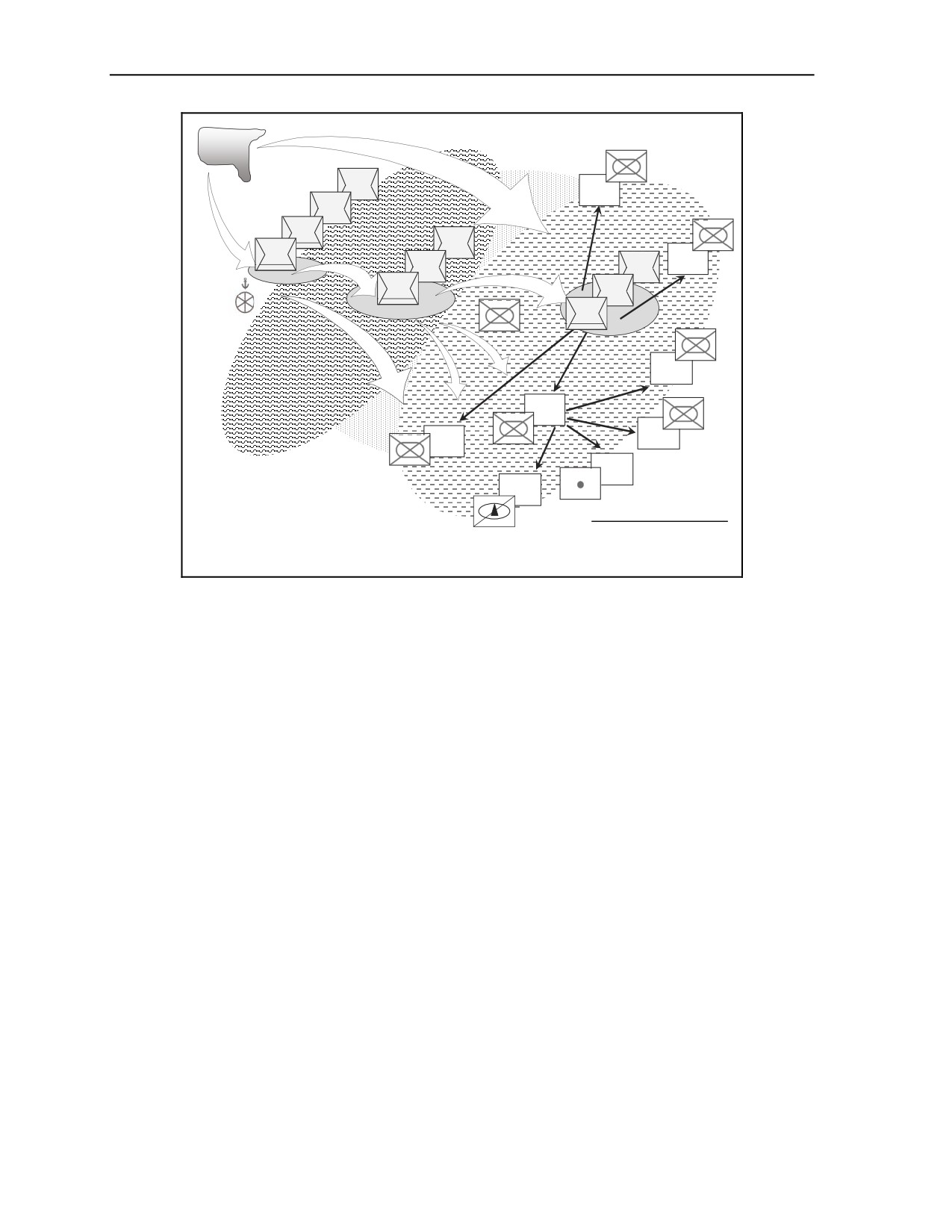
Chapter 4
CONUS
X
X
II
SUST
II
BSB
I
CSSB
X
X
I
QSC
II
II
SUST
X
HMSC
BSB
I
CSSB
II
SUST
QSC
I
CSSB
XX
Sustainment
QSC
Base
II
Distribution
Hub
I
FSC
II
II
X
BSB
II
I
X
FSC
BSB
I
II
I
FSC
BSB - Brigade Support Battalion
CSSB - Combat Sustainment Support Battalion
II
FSC
FSC - Forward Support Company
HMSC - Heavy Materiel Supply Company
Modular Class VII Concept
QSC - Quartermaster Support Company
Modular Units
SUST - Sustainment Brigade
Throughput
Mobile Storage
Figure 4-16. Class VII Operations
CLASS VIII
4-58. Theater-level inventory management of Class VIII (see Figure 4-17) will be accomplished by a team
from the medical logistics management center (MLMC). The medical community performs all supply
functions for Class VIII, but relies on the sustainment brigade and subordinates to transport the supplies
unless they are transported by ambulance. The MLMC support team collocates with the DMC of the
TSC/ESC providing the medical command with visibility and control of all Class VIII inventory. When an
ESC is deployed, an element from the MLMC will also collocate in their DMC. The medical logistics
company (MLC) in the MMB will serve as the consolidated forward distribution point for Class VIII.
4-59. Once supplies are identified and configured for forward movement to the customer, the MLC will
submit transportation movement requests to the sustainment brigade and the MCB for appropriate
transportation assets for forward movement. See FM 4-02.1 for definitive information on the medical
logistics system.
4-20
FMI 4-93.2
4 February 2009
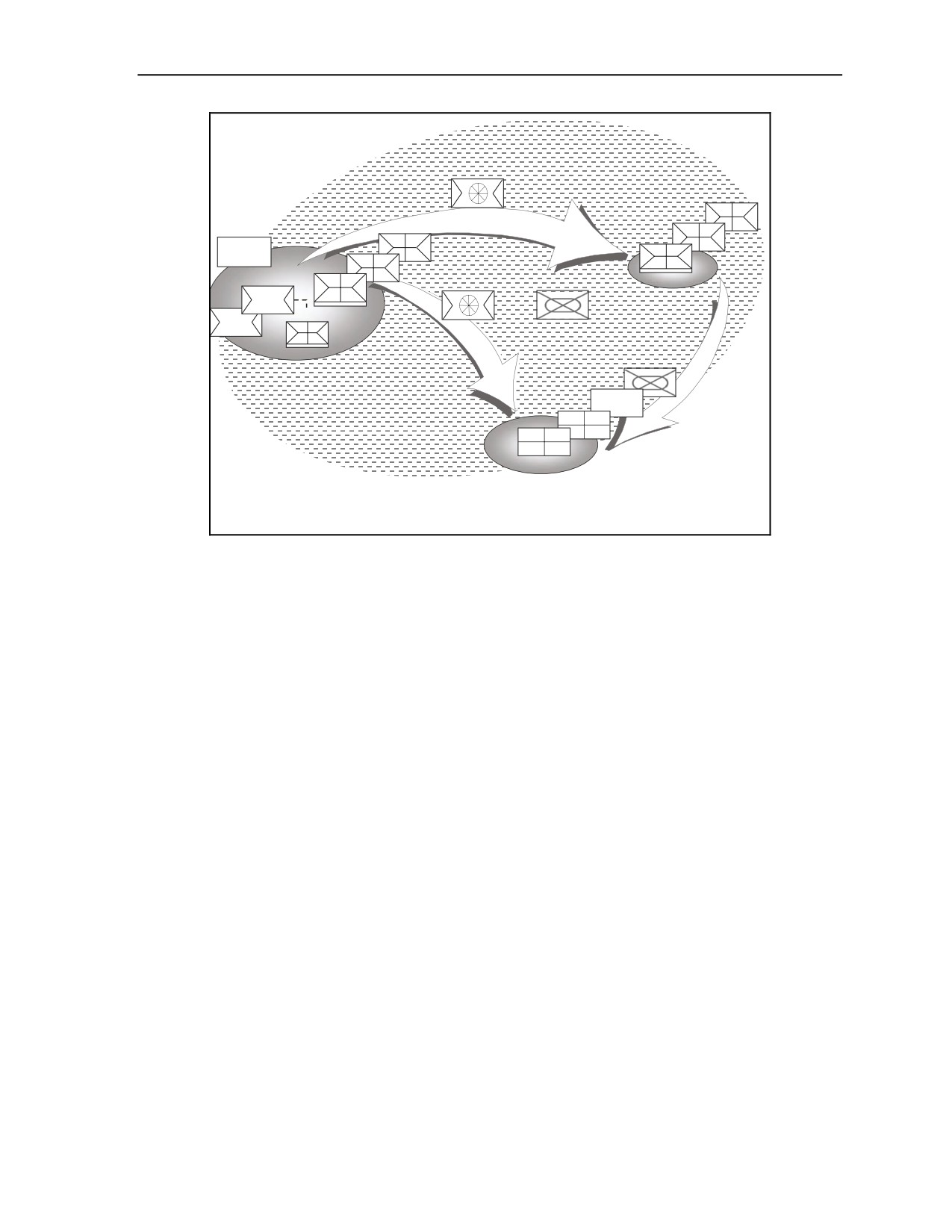
Support to the Operating Forces
I
X
Class VIII
II
XXXX
++
I
X
ARFOR
I
++
I
XX
X
ESC
Ø
SUST
Class VIII
MLMC
X
Sustainment Base
II
I
BSB
●●
ARFOR - Army Forces
BSMC
BMSO -
BMSO
BSB - Brigade Support Battalion
BSMC - Brigade Support Medical Company
ESC - Expeditionary Sustainment Command
MLMC - Medical Logistics Management Center
SUST - Sustainment Brigade
Figure 4-17. Class VIII Distribution
CLASS IX (REPAIR PARTS)
4-60. Figure 4-18 depicts the Class IX flow from the strategic sustainment base to the end user. Class IX
may be throughput from the theater sustainment base to the BSB depending on if the item(s) are critical in
the fight. Other Class IX may be throughput to the sustainment brigade.
4-61. CSSBs receive, store, and issue Class IX items and configure/reconfigure loads, as required, in
support of sustainment operations, to include retrograde and redistribution. The area support platoons
assigned to the QSC, can receive, store, and issue Class IX items at either one or two locations, supporting
8,000 Soldiers at one location or 4,000 Soldiers at each of two locations. The area support platoons
provides field and sustainment support as part of the QSC mission. These functions may be accomplished
separately. The number of QSCs required in the division is METT-TC tailored.
4-62. The QSC in the CSSB of the sustainment brigade receives the Class IX repair parts and configures
loads as required, to include retrograde and redistribution responsibilities. The QSC establishes the CSSA
that will receive, store, and issue the theater stockage levels established by the GCC. The QSC also
provides support to units within the theater base. Since the repair of Class IX reparable items will be
conducted at the sustainment maintenance facilities at the theater base, repaired items will be re-introduced
into the supply system at the QSC CSSA.
4 February 2009
FMI 4-93.2
4-21
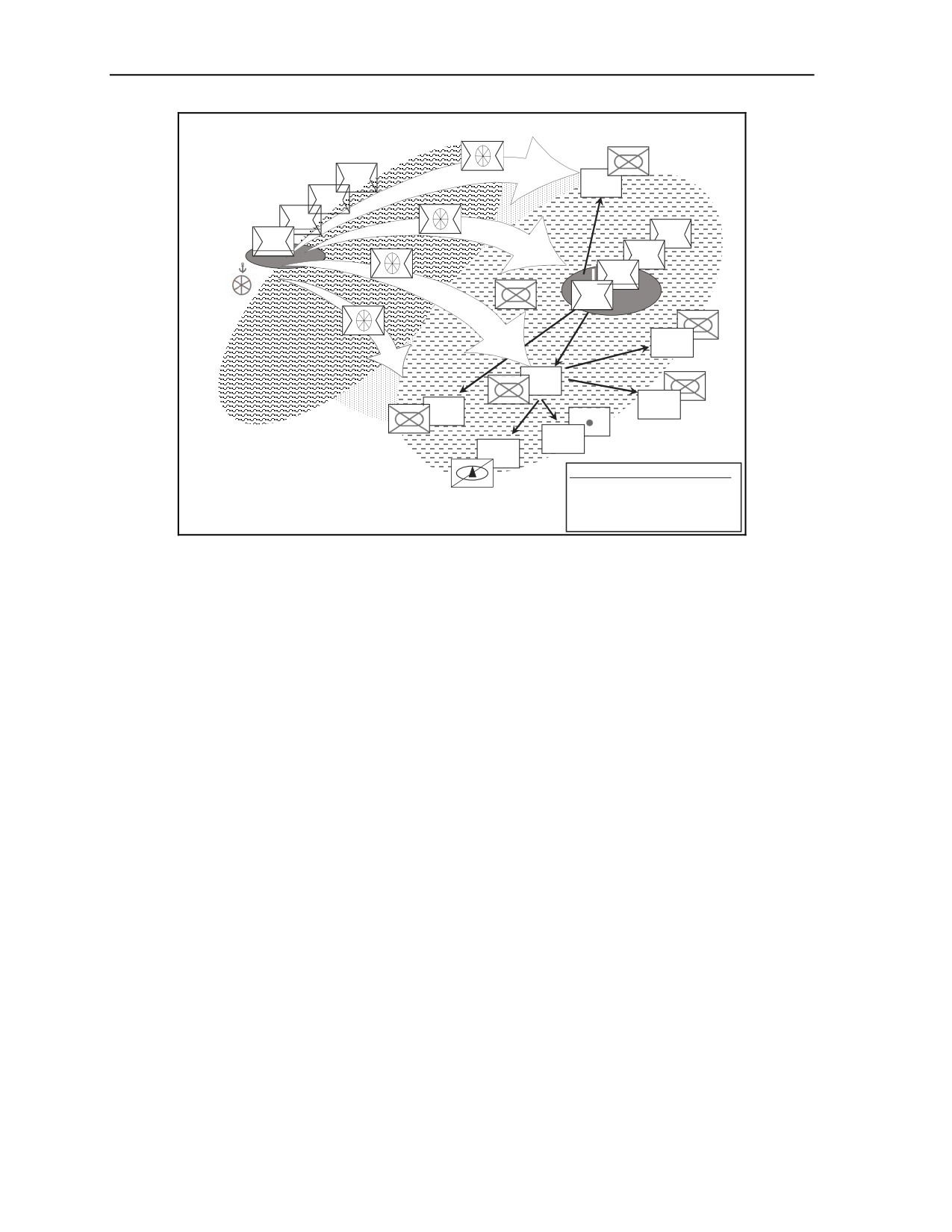
Chapter 4
I
X
X
II
SUST
DRY CARGO
II
BSB
I
CSSB
I
X
I
QSC
II
SUST
HMSC
I
DRY CARGO
I
CSSB
XX
I
QSC
DRY CARGO
Sustainment
CRC
I
Base
II
I
DRY CARGO
FSC
II
X
II
BSB
II
I
X
II
FSC
BSB
I
I
FSC
BSB - Brigade Support Battalion
CSSB - Combat Sustainment Support Battalion
II
FSC
CRC - Component Repair Company
FSC - Forward Support Company
Supply Distribution Management - Class IX
• Modular Units / Capability
HMSC - Heavy Materiel Supply Company
• Throughput, Class IX to BSB
QSC - Quartermaster Support Company
• Mobile Storage
SUST - Sustainment Brigade
• Spares in Combat Repair Teams
• Supports, Replace Forward / Fix Rear
Figure 4-18. Class IX Operations
FIELD SERVICES
MORTUARY AFFAIRS (MA)
4-63. The MA program is designed to support war and stability operations including mass-fatality
situations. For non-contingency situations each Service provides or arranges support for its deceased
personnel. Roles and responsibilities for MA are outlined in the Department of Defense Directive 1300-22,
which designates the Secretary of the Army as the executive agent for MA (see JP 4-06 and FM 4-20.64).
4-64. The Theater Sustainment Command (TSC) is the Army organization responsible for providing CUL
within the theater of operations, to include MA support. The TSC commander, or a designated
representative, determines the responsibility and placement of theater MA assets within the JOA.
Normally, this is accomplished through coordination with the JMAO. The sustainment brigades exercise
tactical/operational control over MA assets while the TSC exerts technical control over the theater-wide
MA mission and executes any required adjustments in mission support in coordination with the
sustainment brigades. If neither the TSC nor the ESC deploys to an AO and the sustainment brigade is the
senior sustainment HQ in the AO, then the sustainment brigade will exert technical control over the MA
mission and would perform all functions/actions listed in the following discussion as being performed by
the TSC.
4-65. The TSC commander, together with the JMAO, must produce a plan that places MA assets where
they can best support both current and future operations within the JOA. This places an inherent
responsibility upon the JMAO and TSC to ensure that MA assets are properly positioned on the time-
phased force deployment data list during the planning process. As part of the planning process, MA
operations must be included in OPLANs, contingency plans, and SOPs. These plans and procedures should
cover unit responsibilities as well as the employment, relocation criteria, and allocation of MA personnel
and equipment throughout the JOA.
4-66. The Army MA Program is divided into three distinct programs: Current Death Program, Concurrent
Return Program, and Graves Registration Program. Theater MA support during major operations is
4-22
FMI 4-93.2
4 February 2009
Support to the Operating Forces
provided through the Concurrent Return and Graves Registration Programs. This support includes the
initial search and recovery, tentative identification, coordinated evacuation, and decontamination
(if
necessary) of remains and personal effects (PE). Each MA program addresses the federal responsibility for
recovery and evacuation of US military personnel, government employees, and US citizens not subject to
military law. Per the Geneva and Hague conventions, commands also have to address the recovery and
evacuation of Multinational, Enemy Prisoners of War, Enemy, and host nation dead.
4-67. Mortuary affairs operations for Army forces rests within the GCC’s theater organization. The Joint
Mortuary Affairs Office (JMAO) has responsibility for the Joint Mortuary Affairs Points (JMAP) within a
JOA. For more information on JMAO responsibilities refer to JP 4-06.
4-68. During multinational operations, MA staff planners must ensure that joint doctrine takes precedence.
Specifically, it is imperative that MA planners and MA personnel process all remains in the same manner
in accordance with JP 4-06 and all applicable international and cooperative agreements in the specific
theater of operations.
MA Concept of Operations
4-69. The MA program starts at the unit level with limited search and recovery operations and continues
until remains are returned to the person authorized to direct disposition and all personal effects (PE) are
returned to the person eligible to receive effects. Unit commanders are responsible for the initial search and
recovery operations within their AO. Every unit is responsible for designating a search and recovery team
to conduct search and recovery operations during the combat phase of operations. Instilled with the MA
motto that all remains are to be treated with the utmost “dignity, reverence, and respect,” these unit teams
must be briefed on local customs and courtesies on dealing with remains. Upon recovering remains, a unit
search and recovery team will evacuate those remains to the closest MA collection point (MACP). MA
personnel set up MACPs, theater mortuary evacuation points (TMEPs), and PE depots throughout the
theater of operations, as is depicted in Figure 4-19. Remains recovered by unit initial search and recovery
operations are evacuated to the nearest MACP. From the receiving MACP, MA personnel evacuate the
remains to the TMEP. The preferred method of evacuation is directly from the initial MACP to the TMEP;
however, the tactical situation may dictate that remains be evacuated through several MACPs before
reaching the TMEP.
4 February 2009
FMI 4-93.2
4-23
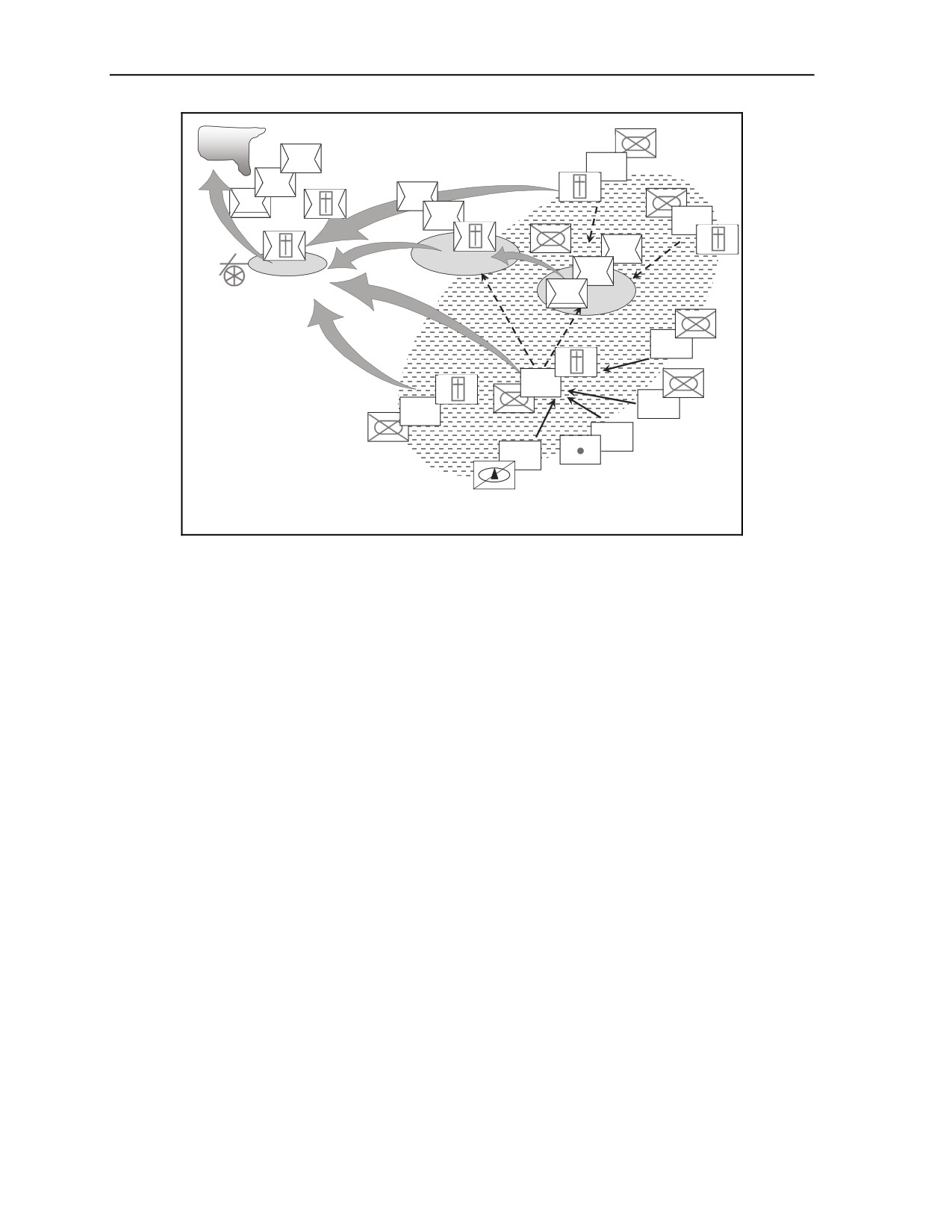
Chapter 4
X
CONUS
X
II
SUST
II
BSB
•
X
I
CSSB
X
•••
SUST
II
II
QSC
MACP
CSSB
•••
XX
BSB
•
•••PE DEPOT
X
II
SUST
MAIN
MACP
TMEP
MACP
I
CSSB
Sustainment
Distribution
Base
Hub
QSC
II
I
•
FSC
II
II
•
X
BSB
MACP
II
I
FSC
X
BSB
MACP
I
II
BSB - Brigade Support Battalion
I
FSC
CSSB - Combat Sustainment Support Battalion
II
FSC
FSC - Forward Support Company
MACP - Mortuary Affairs Collection Point
QSC - Quartermaster Support Company
PE Depot - Personal Effects Depot
SUST - Sustainment Brigade
TMEP - Theater Mortuary Evacuation Point
Figure 4-19. Mortuary Operations
4-70. MA assets are managed as theater assets. MA units are deployed as augmentation elements and do
not have the personnel, equipment, or supplies required for self support. MA augmentation elements are
sustained by the units which they support. A MA Company Support Operations Section is deployed as an
Early Entry Module (EEM) to support operational planning. Upon arrival, it will report to the Theater
Mortuary Affairs Officer (TMAO) or a Sustainment Brigade Mortuary Officer, to plan and coordinate
RSOI of follow-on MA elements.
4-71. Advanced decision support systems will be used to enable the JMAO, TMAO, and MA to more
efficiently develop Operation Plans (OPLANS), Operation Orders (OPORDs), and Fragmentary Orders
(FRAGOs). Decision support tools will provide information to analyze requirements and enable timely
decisions during changing requirements. They will enable publication of matrices and overlays to the
Common Operational Picture depicting MA asset locations throughout the JOA. This will enable units to
expedite remains evacuations. Commanders and authorized personnel at the BCT/direct reporting unit level
and above will have access to the Mobile Integrated Remains Collection System MA reporting and
tracking system to allow them to track evacuation status.
MA Capabilities
4-72. The Quartermaster Collection Company’s (MA) mission (see Figure 4-20) is to establish, operate,
and maintain MACPs. Company personnel receive, tentatively identify, and conduct evacuation operations
for deceased US military and certain US civilian and multinational personnel; and maintain essential
records and reports. The company is designed to be tailorable; maintaining the ability to deploy at the
section level. This is essential to support the full spectrum of Army operations tailored to the operational
environment.
4-73. The five forward collection platoons of the MA Collection Companies are organized into a
headquarters element and four collection sections, each of which establishes a MACP. Each MACP will
generally be assigned to support a BCT-sized element. Upon establishment, the MACPs receive, process,
and coordinate evacuation of remains. Each MACP is able to receive, process, and coordinate evacuation
for 20 remains per day.
4-24
FMI 4-93.2
4 February 2009
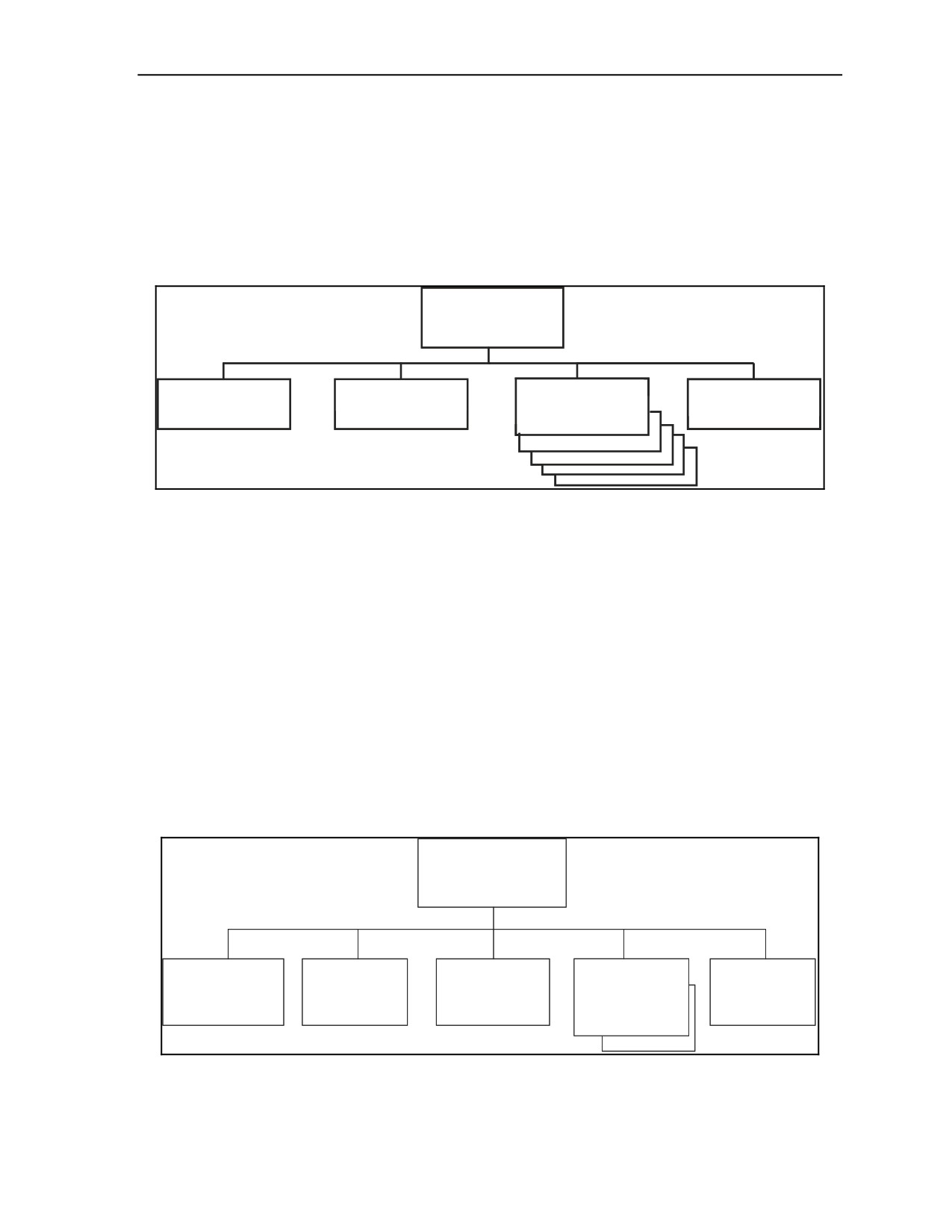
Support to the Operating Forces
4-74. The MA main collection platoon is organized into three sections: headquarters, receiving, and
evacuation. These sections together provide MA DS at the operational level and establish the main
collection platoon that receives remains and PE from the forward MACPs. Additionally, the main
collection point maintains the ability to receive remains and PE directly from surrounding units on an area
support basis. The main collection platoon then coordinates evacuation of received remains and PE to the
TMEP. The main collection platoon may be tasked to act as the Mortuary Affairs Decontamination
Collection Point or the TMEP until a quartermaster (QM) MA Company arrives into the theater of
operations.
COLLECTION
COMPANY
(MA)
SUPPORT
FORWARD
MAIN
PLATOON
OPERATIONS
COLLECTION
COLLECTION
HEADQUARTERS
SECTION
PLATOON (X5)
PLATOON
Figure 4-20. Mortuary Affairs Collection Company
4-75. The QM Collection Company (MA) may also be tasked to operate a TMEP, PE transfer point, and to
inter/disinter remains until the QM MA Company arrives into the theater of operations. Since these are
non-resourced missions, this will reduce the capabilities of the forward collection point operations.
4-76. The Quartermaster Mortuary Affairs Company (see Figure 4-21) mission is to establish, operate, and
maintain up to two TMEPs to move deceased US military, coalition, and civilian personnel to
CONUS/OCONUS military mortuaries or conduct theater interment operations; establish and operate up to
five MACPs; and establish and operate a personal effects depot. The Support Operations Section is
responsible for the proper allocation and placement of the company’s MA assets in the operational area.
Upon arrival, the section reports to the TSC MA officer for integration into the TSC Sustainment
Operations Division. Once integrated, this cell coordinates and controls assigned MACPs; search and
recovery operations; and evacuation operations for deceased US military, certain US civilian, and coalition
personnel. The QM MA Company Support Operations Section must establish communication with the QM
Collection Company (MA) Support Operations Section as soon as logistically possible. This is necessary to
establish a common operational picture (COP) of all MA operations. Additionally, the Support Operations
Section is the primary net control station for the QM MA Company.
QUARTERMASTER
MA
COMPANY
PERSONAL
EVACUATION/
HEADQUARTERS
MORTUARY
COLLECTION
SPO
EFFECTS
COMPANY
PLATOON
PLATOON
PLATOON
(X2)
Figure 4-21. QM Mortuary Affairs Company
4 February 2009
FMI 4-93.2
4-25
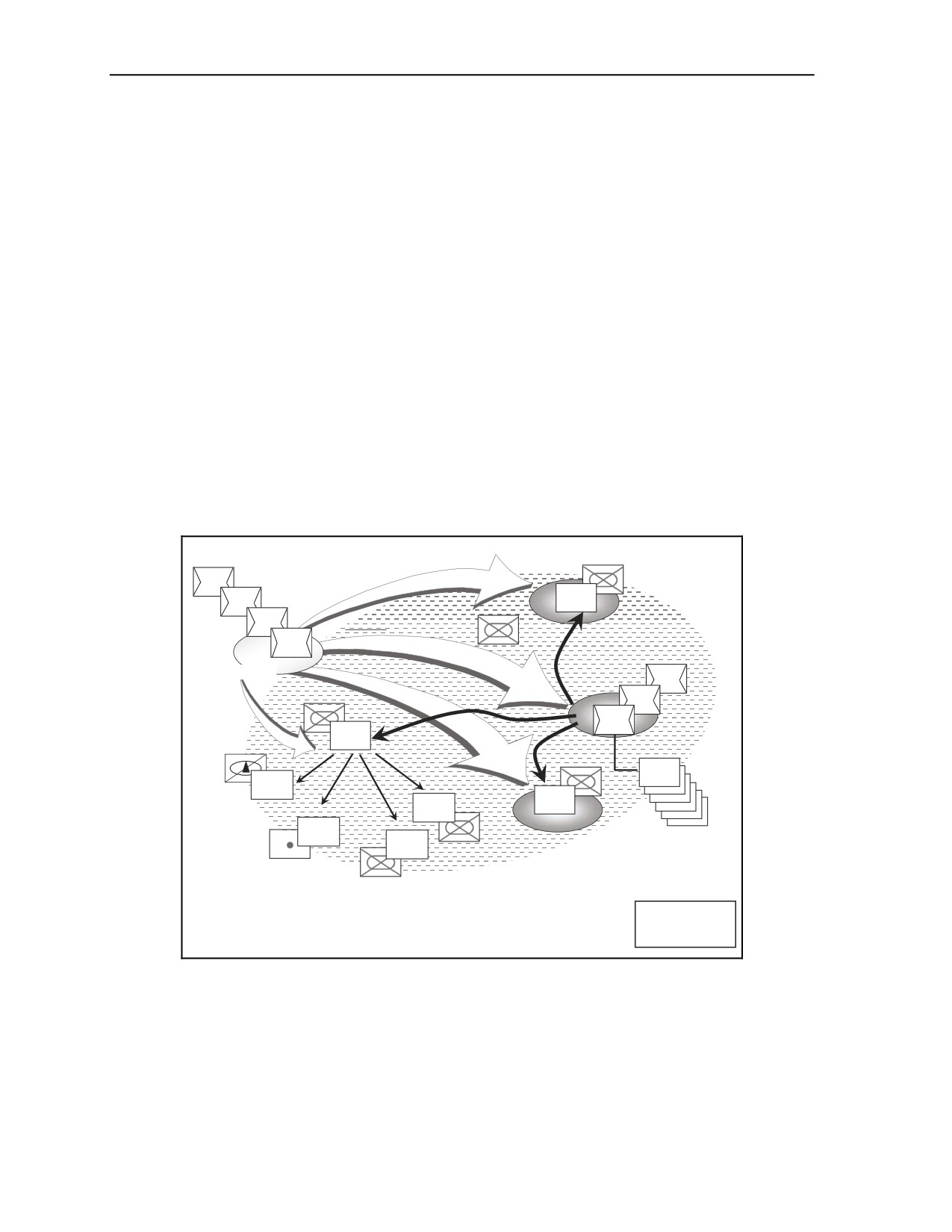
Chapter 4
4-77. The QM MA Company PE Depot Platoon receives, stores, safeguards, and ships personal effects of
remains processed within the theater of operations. The platoon is organized into a headquarters element
and three additional sections: receiving, storage, and disposition. The Evacuation/Mortuary Platoon is
responsible for the operation of a TMEP and/or a temporary interment site. The platoon is organized into a
headquarters element and two additional sections: processing and evacuation/temporary interment. The
Collection Platoon is organized into five sections, each of which establishes a MACP. The MACPs receive,
process, and coordinate evacuation of remains and associated PE. Each MACP is able to receive, process,
and coordinate evacuation for 20 remains.
SHOWER AND LAUNDRY SERVICES
4-78. The current force conducts field hygiene operations through the utilization of field sanitation teams
located at the company level. The Sustainment Brigade, Combat Sustainment Support Battalion’s
Quartermaster Field Service Company supports the field sanitation teams through shower, laundry, and
clothing repair
(SLCR) sections dispatched from echelons above brigade (see Figure 4-22). Shower,
laundry, and clothing renovation (SLCR) capabilities resident within the Quartermaster field services
company (see Figure 4-23) are provided from the sustainment brigades with projection as far forward as
possible. The mission is to provide Soldiers a minimum of a weekly shower and up to 15 pounds of
laundered clothing each week (comprising two uniform sets, undergarments, socks, and two towels). The
Quartermaster Field Service Company will provide SLCR for supported units. The Quartermaster Field
Service Company can be moved forward to provide field services for the BCT. Each SLCR Platoon has 3
SLCR Teams which can each support 500 Soldiers per day/3,500 Soldiers per week.
++
X
ESC
X
II
BSB
SUST
II
XX
CSSB
I
Fld Svc
X
Sustainment
II
SUST
Base
X
I
CSSB
II
Fld Svc
BSB
II
••
I
X
•
SLCR
••
II
SLCR
FSC
I
SLCR
•
SLCR
•••
BSB
SLCR
I
FSC
II
SLCR
II
I
FSC
II
FSC
BSB - Brigade Support Battalion
CSSB - Combat Sustainment Support Battalion
ESC - Expeditionary Sustainment Command
FLD SVC - Field Service
MODULAR
FSC - Forward Support Company
Warrior Hygiene and
SLCR - Shower, Laundry, and Clothing Renovation
Field Services
SUST - Sustainment Brigade
Figure 4-22. Hygiene and Field Services
4-26
FMI 4-93.2
4 February 2009