FM 5-499 Hydraulics (August 1997) - page 3
FM 5-499
A
B
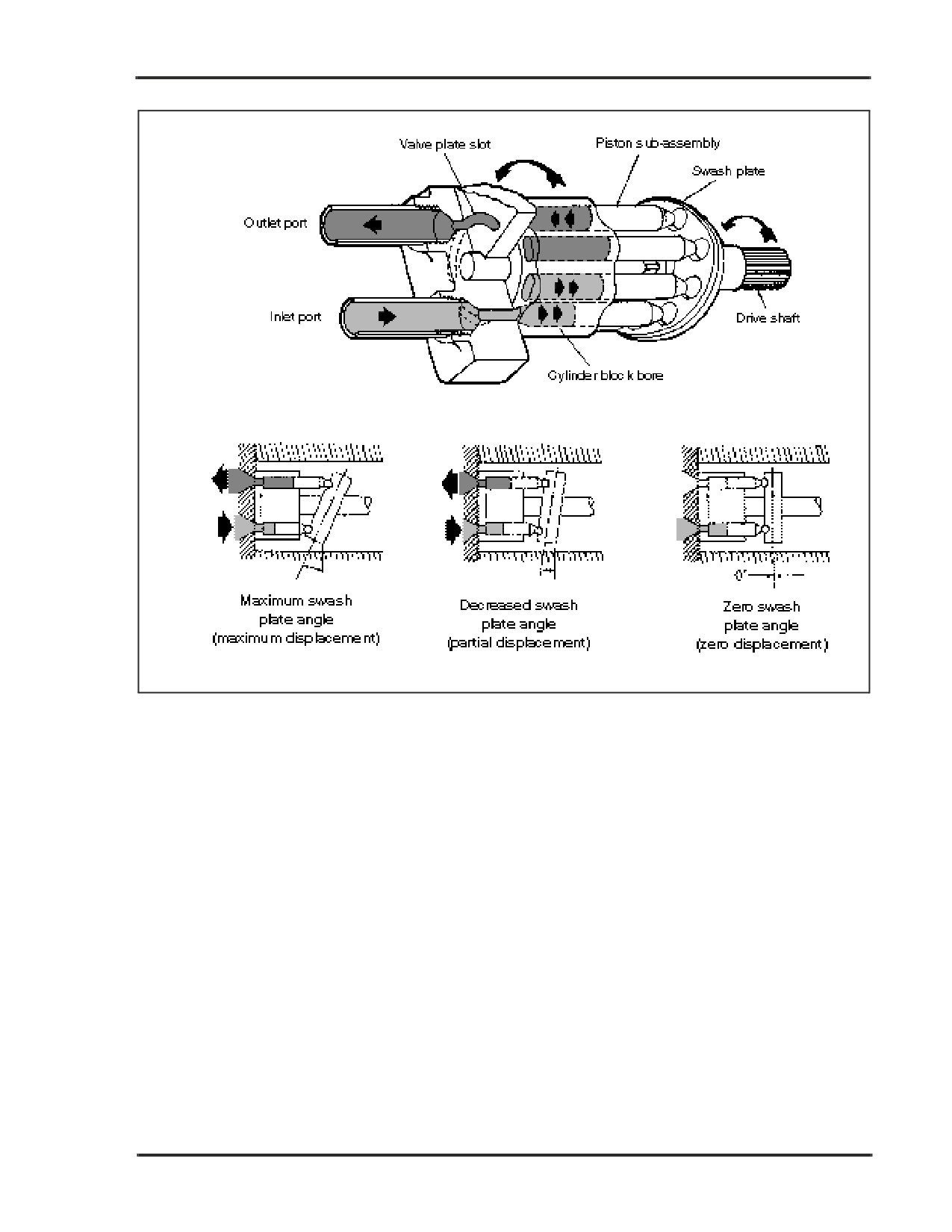
Figure 3-19. In-line piston pump
against a shoe plate. This action holds the piston shoes against a swash plate, ensuring
that the pistons will reciprocate as the cylinder turns. A swash plate is stationary in a fixed-
displacement design.
(c) Operation. A variable-displacement in-line pump operates the same as a fixed angle
except that a swash plate is mounted on a pivoted yoke. A yoke can be swung to change a
plate angle and thus change a pump’s displacement. A yoke can be positioned manually
with a screw or lever or by a compensator control, which positions a yoke automatically to
maintain constant output pressure under variable flow requirements. A compensator con-
trol consists of a valve that is balanced between a spring and system pressure and a spring-
loaded, yoke-actuating piston that is controlled by a valve. A pump’s compensator control
thus reduces its output only to the volume required to maintain a preset pressure. Maxi-
mum delivery is allowed only when pressure is less than a compensator’s setting.
(2) Wobble-Plate In-Line Pump. This is a variation of an in-line piston pump. In this
design, a cylinder barrel does not turn; a plate wobbles as it turns, and the wobbling pushes
the pistons in and out of the pumping chambers in a stationary cylinder barrel. In a wobble-
plate pump, separate inlet and outlet check valves are required for each piston, since the pis-
tons do not move past a port.
Pumps
3-13
FM 5-499
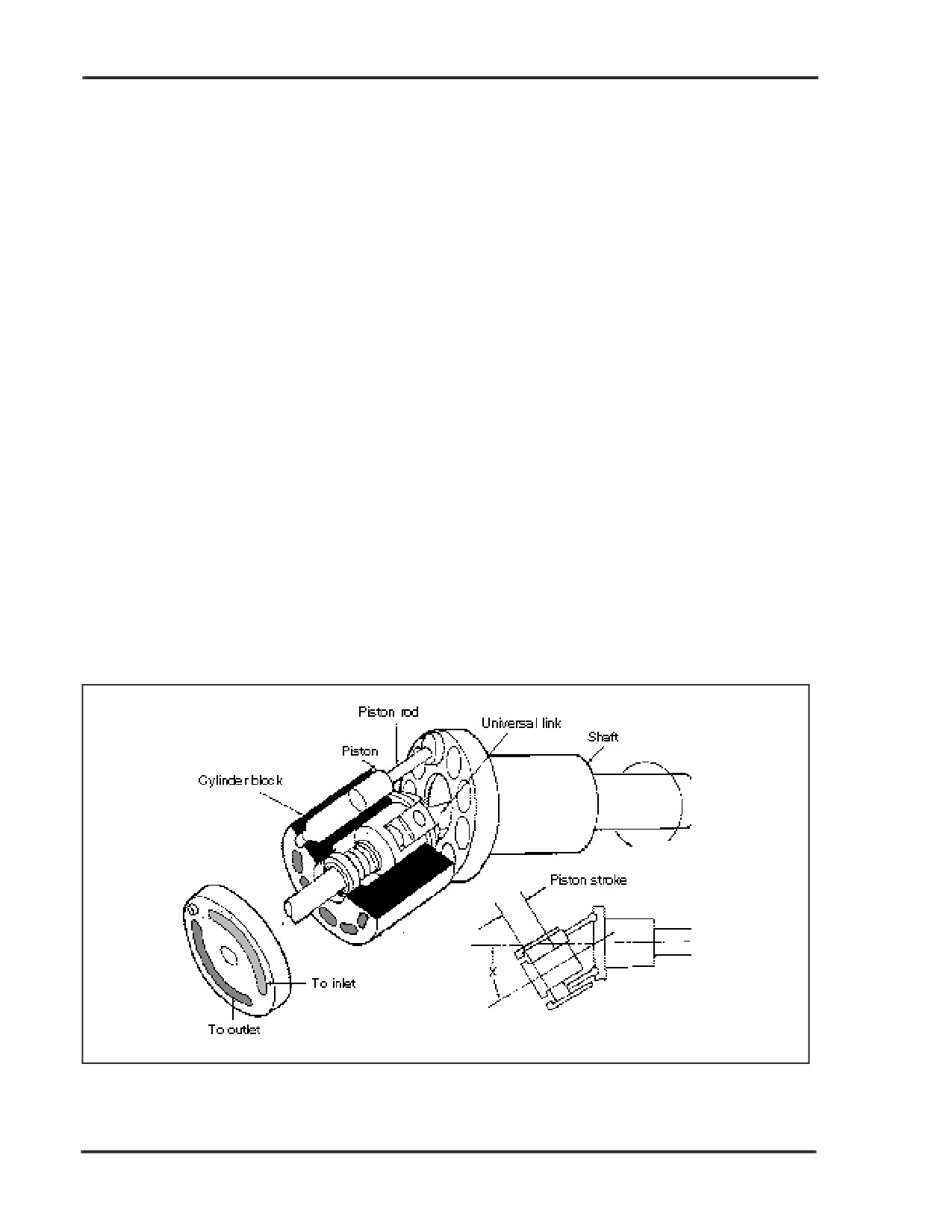
(3) Bent-Axis Axial Piston Pump. In an angle- or a bent-axis-type piston pump (Figure
3-20), the piston rods are attached by ball joints to a drive shaft’s flange. A universal link
keys a cylinder block to a shaft so that they rotate together but at an offset angle. A cylinder
barrel turns against a slotted valve plate to which the ports connect. Pumping action is the
same as an in-line pump. The angle of offset determines a pump’s displacement, just as the
swash plate’s angle determines an in-line pump's displacement. In fixed-delivery pumps,
the angle is constant. In variable models, a yoke mounted on pintles swings a cylinder block
to vary displacement. Flow direction can be reversed with appropriate controls.
3-9. Pump Operation. The following paragraphs address some of the problems that could
occur when a pump is operating:
a. Overloading. One risk of overloading is the danger of excess torque on a drive shaft.
Torque is circular force on an object. An increase in pressure/pump displacement will
increase the torque on a shaft if pump displacement/pressure remains constant. Often in a
given package size, a higher GPM pump will have a lower pressure rating than a lower GPM
pump. Sometimes a field conversion to get more speed out of an actuator will cause a pump
to be overloaded. You may need a larger pump.
b. Excess Speed. Running a pump at too high a speed causes loss of lubrication, which
can cause early failure. If a needed delivery requires a higher drive speed than a pump's rat-
ing, use a higher displacement pump. Excess speed also runs a risk of damage from cavita-
tion.
c. Cavitation. Cavitation occurs where available fluid does not fill an existing space. It
often occurs in a pump’s inlet when conditions are not right to supply enough oil to keep an
inlet flooded. Cavitation causes the metal in an inlet to erode and the hydraulic oil to deteri-
orate quicker. Cavitation can occur if there is too much resistance in an inlet’s line, if a res-
Figure 3-20. Bent-axis axial piston pump
3-14
Pumps
FM 5-499
ervoir’s oil level is too far below the inlet, or if an oil’s viscosity is too high. It can also occur
if there is a vacuum or even a slight positive pressure at the inlet. A badly cavitating pump
has oil bubbles exploding in the void. The only way to be sure a pump is not cavitating is to
check the inlet with a vacuum gauge.
To prevent cavitation, keep the inlet clean and free of obstructions by using the correct
length of an inlet’s line with minimum bends. Another method is to charge an inlet. The eas-
iest way to do this is to flood it by locating the reservoir above the pump’s inlet. If this is not
possible and you cannot create good inlet conditions, use a pressurized reservoir. You can
also use an auxiliary pump to maintain a supply of oil to an inlet at low pressure. You could
use a centrifugal pump, but it is more common to use a positive-displacement gear pump
with a pressure-relief valve that is set to maintain the desired charging pressure.
d. Operating Problems. Pressure loss, slow operation, no delivery, and noise are com-
mon operating problems in a pump.
(1) Pressure Loss. Pressure loss means that there is a high leakage path in a system. A
badly worn pump could cause pressure loss. A pump will lose its efficiency gradually. The
actuator speed slows down as a pump wears. However, pressure loss is more often caused by
leaks somewhere else in a system (relief valve, cylinders, motors).
(2) Slow Operation. This can be caused by a worn pump or by a partial oil leak in a sys-
tem. Pressure will not drop, however, if a load moves at all. Therefore, hp is still being used
and is being converted into heat at a leakage point. To find this point, feel the components
for unusual heat.
(3) No Delivery. If oil is not being pumped, a pump—
• Could be assembled incorrectly.
• Could be driven in the wrong direction.
• Has not been primed. The reasons for no prime are usually improper start-up,
inlet restrictions, or low oil level in a reservoir.
• Has a broken drive shaft.
(4) Noise. If you hear any unusual noise, shut down a pump immediately. Cavitation
noise is caused by a restriction in an inlet line, a dirty inlet filter, or too high a drive speed.
Air in a system also causes noise. Air will severely damage a pump because it will not have
enough lubrication. This can occur from low oil in a reservoir, a loose connection in an inlet,
a leaking shaft seal, or no oil in a pump before starting. Also, noise can be caused by worn
or damaged parts, which will spread harmful particles through a system, causing more dam-
age if an operation continues.
Pumps
3-15
FM 5-499
CHAPTER 4
Hydraulic Actuators
A hydraulic actuator receives pressure energy and converts it to mechanical force and
motion. An actuator can be linear or rotary. A linear actuator gives force and motion outputs
in a straight line. It is more commonly called a cylinder but is also referred to as a ram,
reciprocating motor, or linear motor. A rotary actuator produces torque and rotating motion.
It is more commonly called a hydraulic motor or motor.
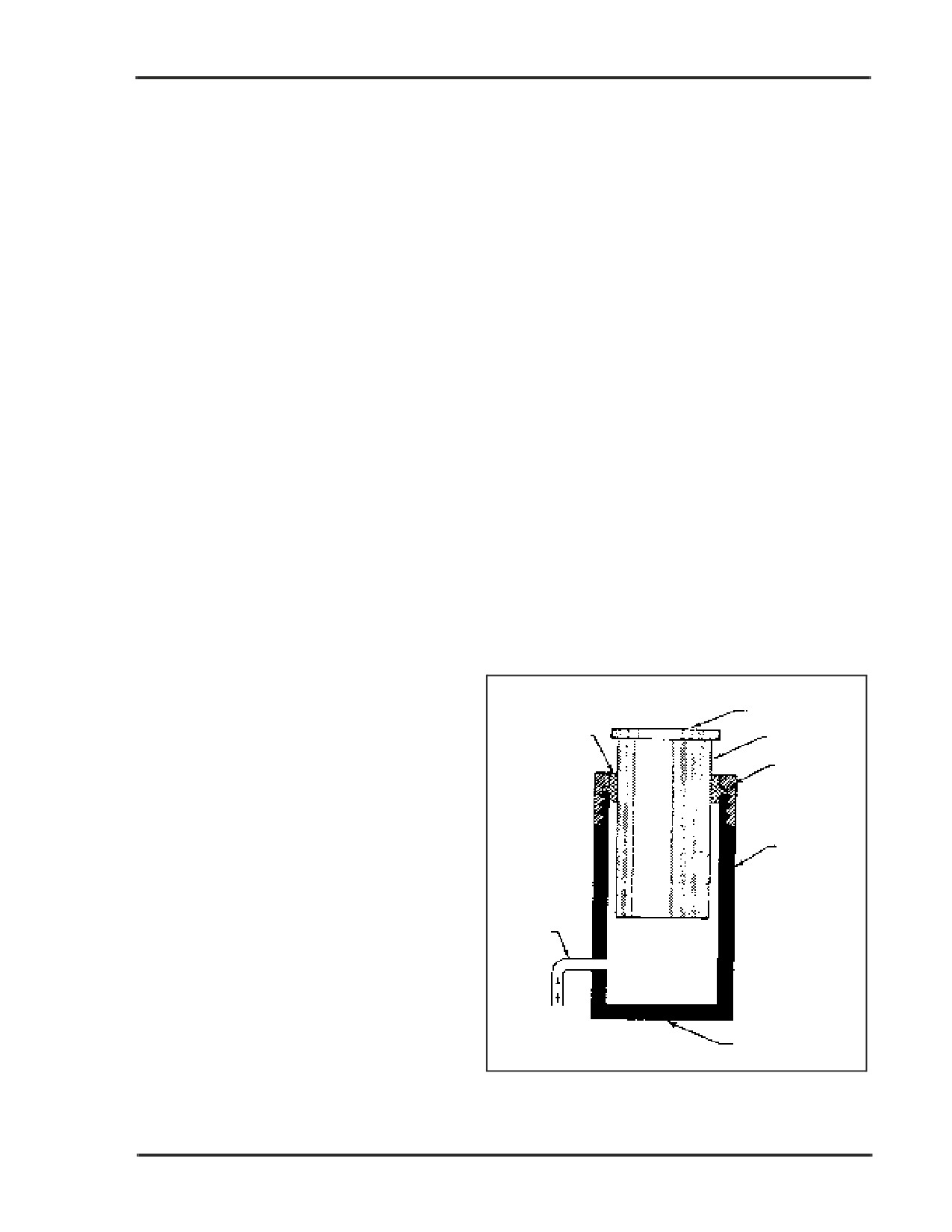
4-1. Cylinders. A cylinder is a hydraulic actuator that is constructed of a piston or plunger
that operates in a cylindrical housing by the action of liquid under pressure. Figure 4-1
shows the basic parts of a cylinder. A cylinder housing is a tube in which a plunger (piston)
operates. In a ram-type cylinder, a ram actuates a load directly. In a piston cylinder, a pis-
ton rod is connected to a piston to actuate a load. An end of a cylinder from which a rod or
plunger protrudes is a rod end. The opposite end is a head end. The hydraulic connections
are a head-end port and a rod-end port (fluid supply).
a. Single-Acting Cylinder. This cylinder (Figure 4-1) only has a head-end port and is
operated hydraulically in one direction. When oil is pumped into a port, it pushes on a
plunger, thus extending it. To return or retract a cylinder, oil must be released to a reser-
voir. A plunger returns either because of the weight of a load or from some mechanical force
such as a spring. In mobile equipment, flow to and from a single-acting cylinder is controlled
by a reversing directional valve of a single-acting type.
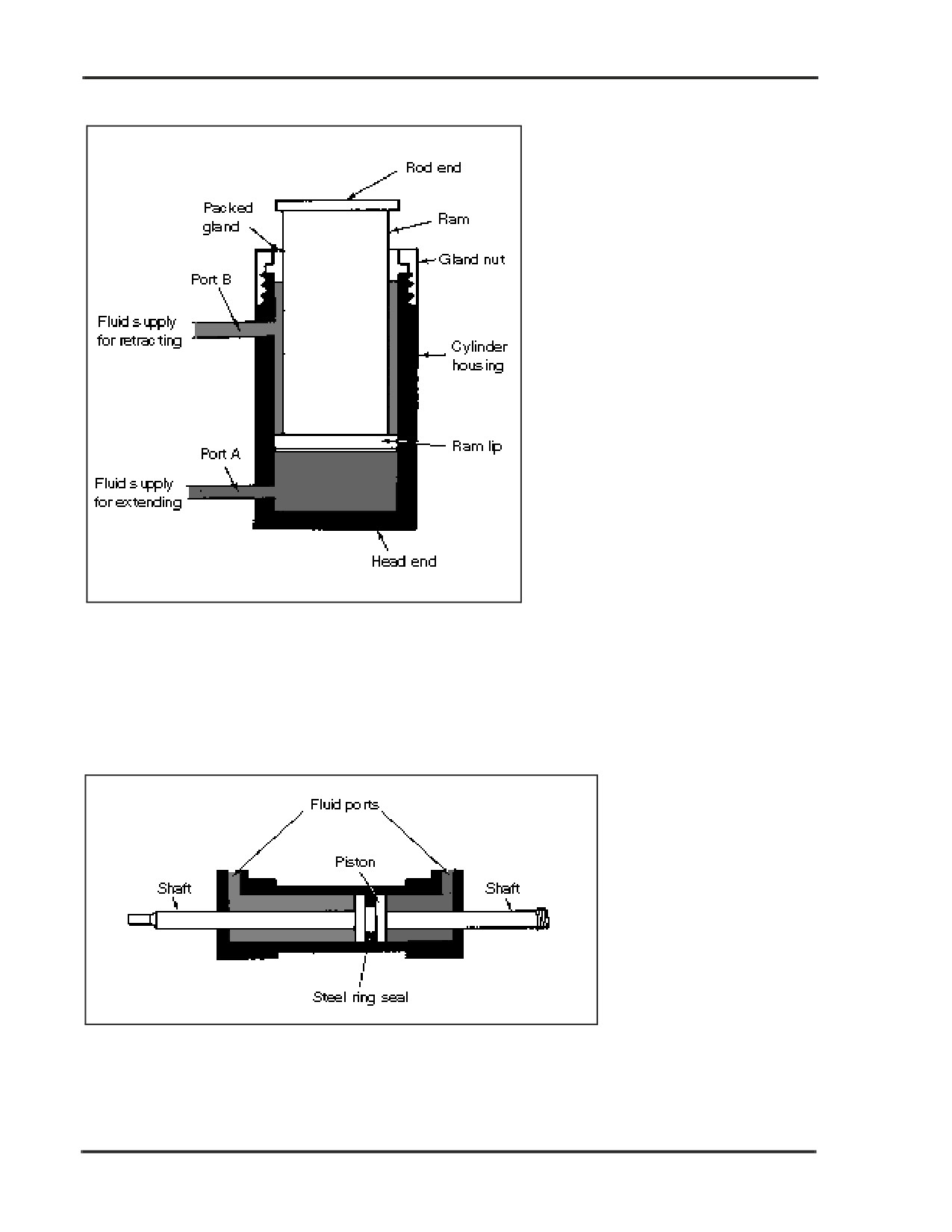
b. Double-Acting Cylinder. This cylin-
der (Figure 4-2, page 4-2) must have ports
Rod end
at the head and rod ends. Pumping oil into
Packed
Ram
the head end moves a piston to extend a
gland
Gland nut
rod while any oil in the rod end is pushed
out and returned to a reservoir. To retract
a rod, flow is reversed. Oil from a pump
goes into a rod end, and a head-end port is
Cylinder
connected to allow return flow. The flow
housing
direction to and from a double-acting cylin-
der can be controlled by a double-acting
directional valve or by actuating a control
Fluid
of a reversible pump.
supply
c. Differential Cylinder. In a differen-
tial cylinder, the areas where pressure is
applied on a piston are not equal. On a
head end, a full piston area is available for
applying pressure. At a rod end, only an
Head end
annular area is available for applying
pressure. A rod’s area is not a factor, and
Figure 4-1. Single-acting cylinder
Hydraulic Actuators
4-1
FM 5-499
what space it does take up reduces
the volume of oil it will hold. Two
general rules about a differential
cylinder are that—
• With an equal GPM
delivery to either end, a
cylinder will move
faster when retracting
because of a reduced vol-
ume capacity.
• With equal pressure at
either end, a cylinder
can exert more force
when extending because
of the greater piston
area. In fact, if equal
pressure is applied to
both ports at the same
time, a cylinder will
extend because of a
higher resulting force
on a head end.
d. Nondifferential Cylinder.
This cylinder (Figure 4-3) has a pis-
Figure 4-2. Double-acting cylinder
ton rod extending from each end. It
has equal thrust and speed either
way, provided that pressure and flow
are unchanged. A nondifferential cylinder is rarely used on mobile equipment.
e. Ram-Type Cylinder. A ram-type cylinder is a cylinder in which a cross-sectional area
of a piston rod is more than one-half a cross-sectional area of a piston head. In many cylin-
ders of this type, the rod and piston heads have equal areas. A ram-type actuating cylinder
is used mainly for push
functions rather than
pull.
Figure 4-1, page 4-1,
shows a single-acting,
ram-type cylinder. A sin-
gle-acting ram applies
force in one direction.
This cylinder is often
used in a hydraulic jack.
In a double-acting, ram-
type cylinder, both
strokes of a ram are pro-
duced by pressurized
Figure 4-3. Nondifferential cylinder
fluid. Figure 4-2 shows
this cylinder.
4-2
Hydraulic Actuators
FM 5-499
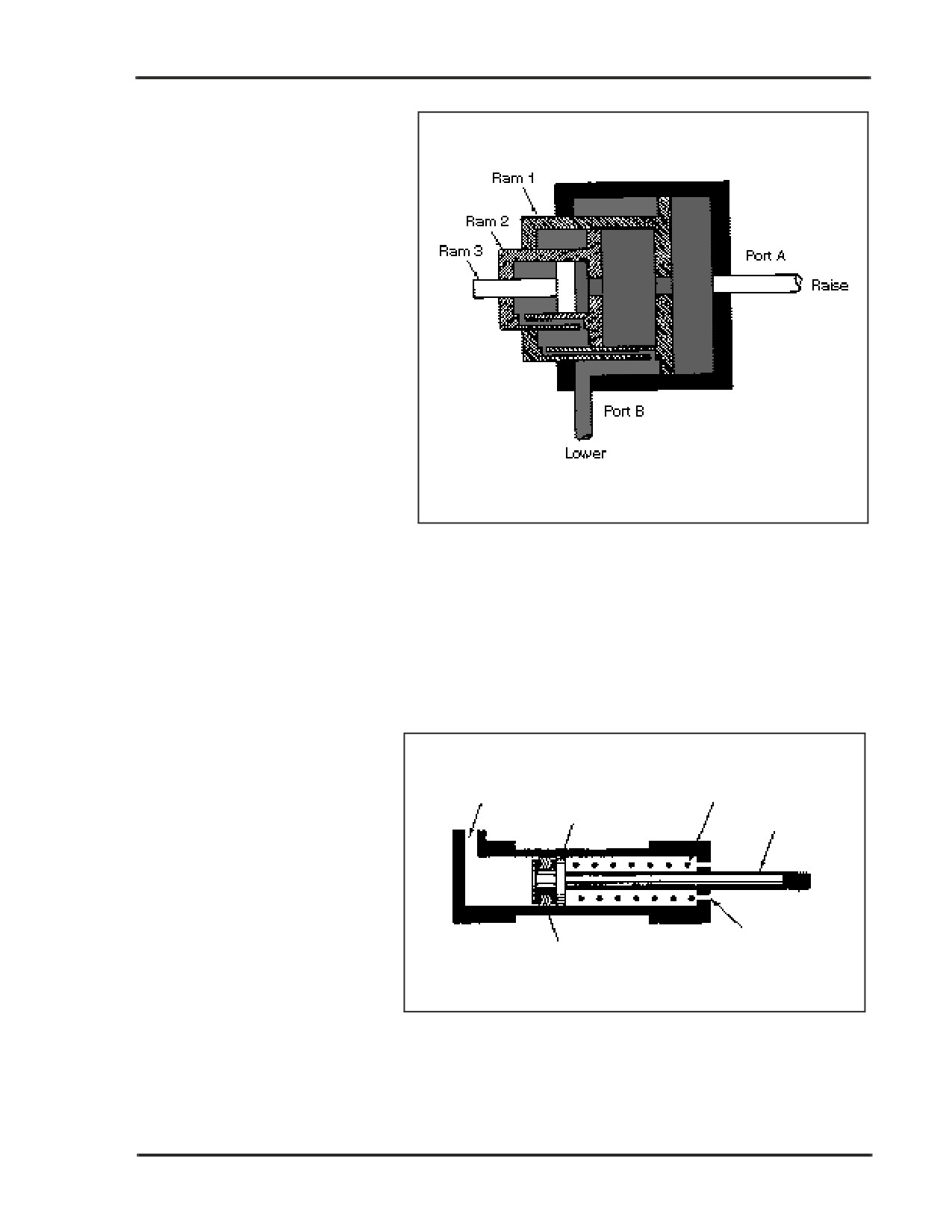
Figure 4-4 shows a telescop-
ing, ram-type, actuating cylinder,
which can be a single- or double-
acting type. In this cylinder, a
series of rams are nested in a tele-
scoping assembly. Except for the
smallest ram, each ram is hollow
and serves as a cylinder housing
for the next smaller ram. A ram
assembly is contained in a main
cylinder housing, which also pro-
vides the fluid ports. Although an
assembly requires a small space
with all of the rams retracted, a
telescoping action of an assembly
provides a relatively long stroke
when the rams are extended.
f. Piston-Type Cylinder. In
this cylinder, a cross-sectional
area of a piston head is referred to
as a piston-type cylinder. A pis-
Figure 4-4. Telescoping, ram-type, actuating
ton-type cylinder is used mainly
cylinder
when the push and pull functions
are needed.
A single-acting, piston-type cylinder uses fluid pressure to apply force in one direction.
In some designs, the force of gravity moves a piston in the opposite direction. However, most
cylinders of this type apply force in both directions. Fluid pressure provides force in one
direction and spring tension provides force in the opposite direction.
Figure 4-5 shows a single-
acting, spring-loaded, piston-
type cylinder. In this cylinder, a
Fluid port
Return spring
spring is located on the rod side
Piston
Piston rod
of a piston. In some spring-
loaded cylinders, a spring is
located on a blank side, and a
fluid port is on a rod end of a cyl-
inder.
Most piston-type cylinders
Air vent
are double-acting, which means
Seals
that fluid under pressure can be
applied to either side of a piston
to provide movement and apply
force in a corresponding direc-
Figure 4-5. Single-acting, spring-loaded, piston-
tion. Figure 4-6 shows a double-
type cylinder
acting piston-type cylinder.
Hydraulic Actuators
4-3
FM 5-499
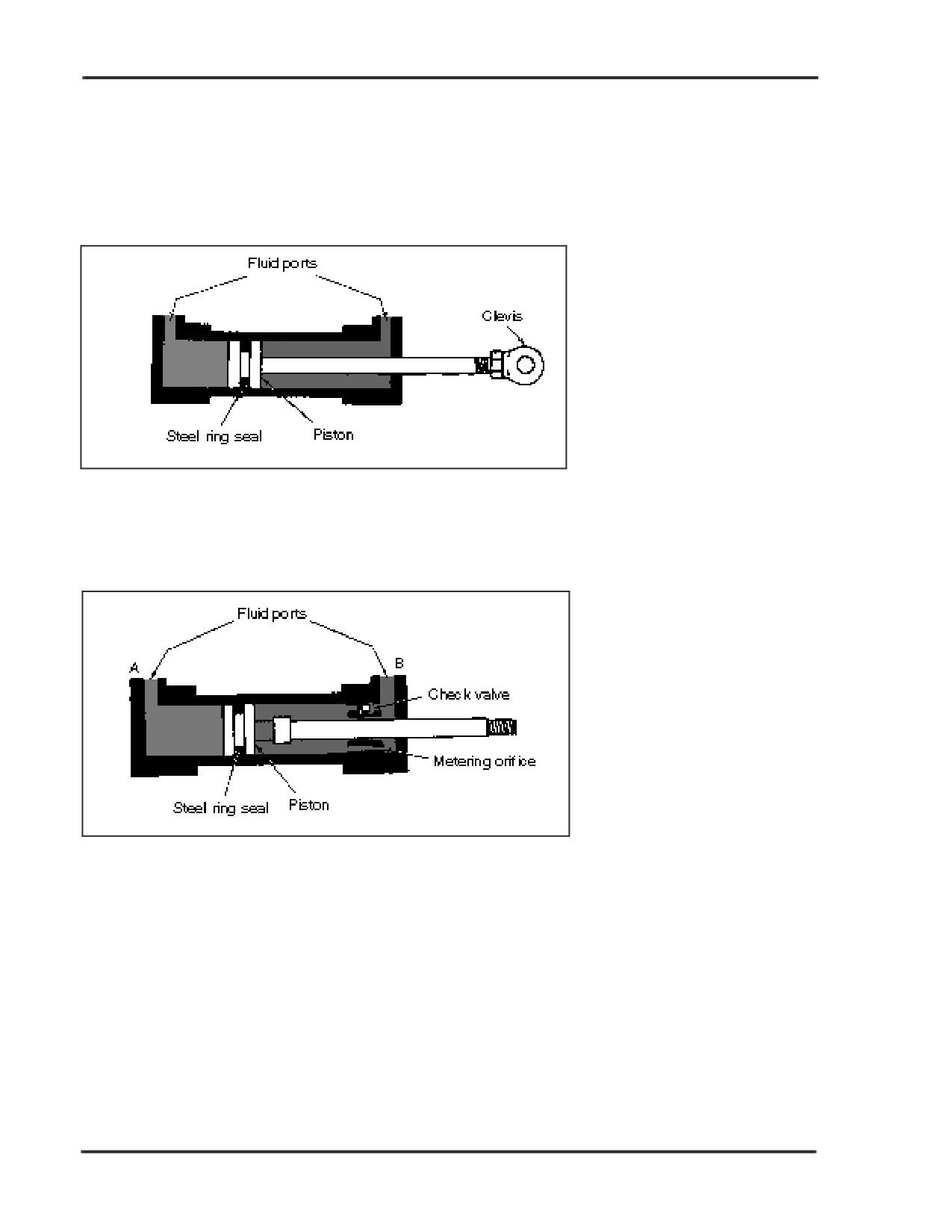
This cylinder contains one piston and piston-rod assembly and operates from fluid flow in
either direction. The two fluid ports, one near each end of a cylinder, alternate as an inlet
and an outlet, depending on the directional-control valve flow direction. This is an unbal-
anced cylinder, which means that there is a difference in the effective working area on the
two sides of a piston. A cylinder is normally installed so that the head end of a piston carries
the greater load; that is, a cylinder carries the greater load during a piston-rod extension
stroke.
Figure 4-6 shows a bal-
anced, double-acting, piston-
type cylinder. The effective
working area on both sides of
a piston is the same, and it
exerts the same force in both
directions.
g. Cushioned Cylinder.
To slow an action and prevent
shock at the end of a piston
Figure 4-6. Double-acting, piston-type cylinder
stroke, some actuating cylin-
ders are constructed with a
cushioning device at either or both ends of a cylinder. This cushion is usually a metering
device built into a cylinder to restrict the flow at an outlet port, thereby slowing down the
motion of a piston. Figure 4-7 shows a cushioned actuating cylinder.
h. Lockout Cylinders. A
lockout cylinder is used to
lock a suspension mechanism
of a tracked vehicle when a
vehicle functions as a stable
platform. A cylinder also
serves as a shock absorber
when a vehicle is moving.
Each lockout cylinder is con-
nected to a road arm by a
control lever. When each
road wheel moves up, a con-
trol lever forces the respec-
Figure 4-7. Cushioned, actuating cylinder
tive cylinder to compress.
Hydraulic fluid is forced
around a piston head through restrictor ports causing a cylinder to act as a shock absorber.
When hydraulic pressure is applied to an inlet port on each cylinder’s connecting eye, an inner
control-valve piston is forced against a spring in each cylinder. This action closes the restric-
tor ports, blocks the main piston’s motion in each cylinder, and locks the suspension system.
4-2. Construction and Application. A cylinder is constructed of a barrel or tube, a piston
and rod (or ram), two end caps, and suitable oil seals. A barrel is usually seamless steel tubing,
or cast, and the interior is finished very true and smoothly. A steel piston rod is highly pol-
ished and usually hard chrome-plated to resist pitting and scoring. It is supported in the
end cap by a bushing or polished surface.
4-4
Hydraulic Actuators
FM 5-499
The cylinder's ports are built into the end caps, which can be screwed on to the tubes,
welded, or attached by tie bolts or bolted flanges. If the cylinder barrel is cast, the head-end
cap may be integral with it. Mounting provisions often are made in the end caps, including
flanges for stationary mounting or clevises for swinging mounts.
Seals and wipers are installed in the rod's end cap to keep the rod clean and to prevent
external leakage around the rod. Other points where seals are used are at the end cap and
joints and between the piston and barrel. Depending on how the rod is attached to the pis-
ton, a seal may be needed. Internal leakage should not occur past a piston. It wastes energy
and can stop a load by a hydrostatic lock (oil trapped behind a piston).
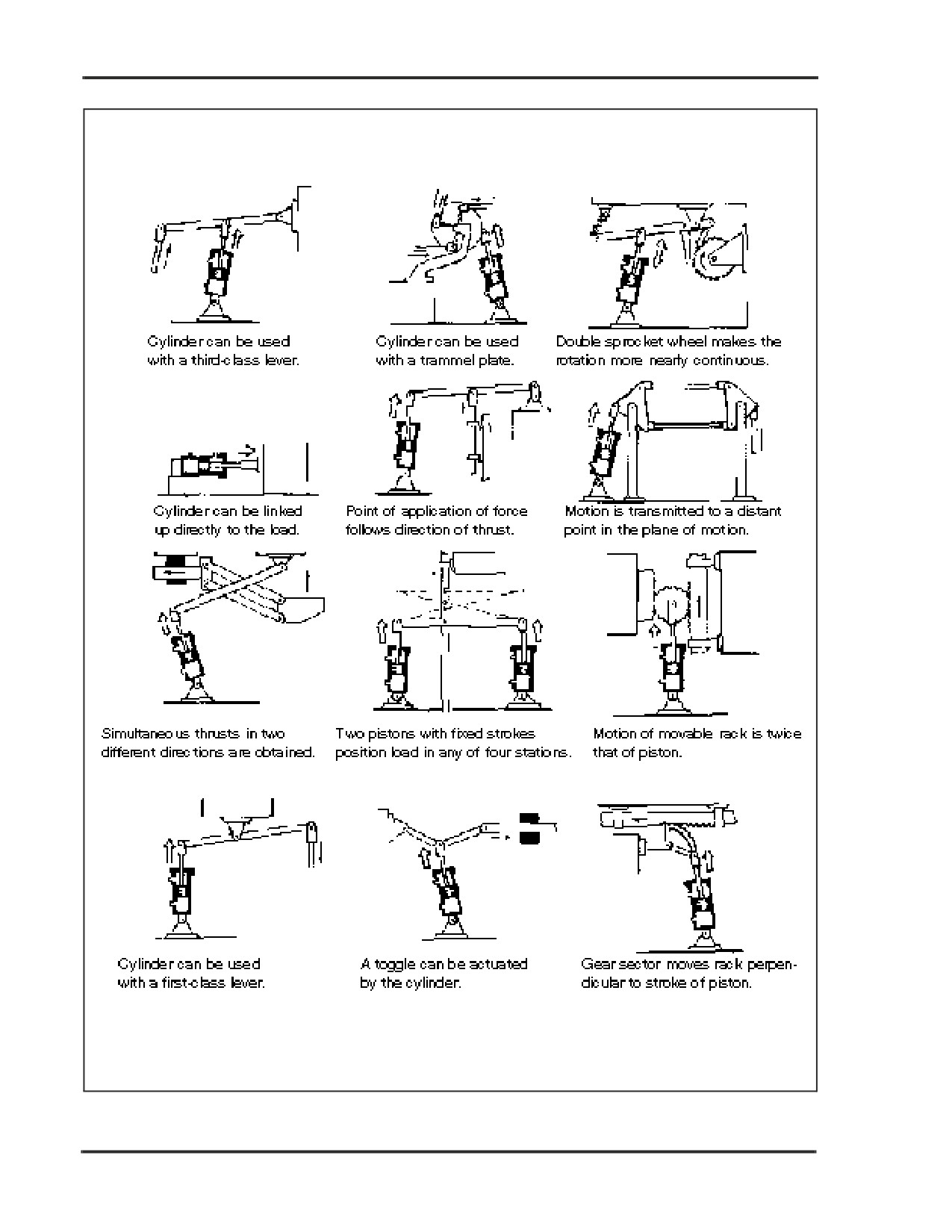
Figure 4-8, page 4-6, shows force-and-motion applications of cylinders. Because fluid
power systems have many requirements, actuating cylinders are available in different
shapes and sizes. A cylinder-type actuator is versatile and may be the most trouble-free
component of fluid-powered systems. A cylinder and a mechanical member of a unit to be
actuated must be aligned correctly. Any misalignment will cause excessive wear of a piston,
a piston rod, and the seals. Also, a piston rod and an actuating unit must stay properly
adjusted. Clean the exposed ends of the piston rods to ensure that foreign matter does not
get into the cylinders.
4-3. Maintenance. Hydraulic cylinders are compact and relatively simple. The key points
to watch are the seals and pivots. The following lists service tips in maintaining cylinders:
a. External Leakage. If a cylinder’s end caps are leaking, tighten them. If the leaks still
do not stop, replace the gasket. If a cylinder leaks around a piston rod, replace the packing.
Make sure that a seal lip faces toward the pressure oil. If a seal continues to leak, check
paragraphs 4-3e through i.
b. Internal Leakage. Leakage past the piston seals inside a cylinder can cause sluggish
movement or settling under load. Piston leakage can be caused by worn piston seals or rings
or scored cylinder walls. The latter may be caused by dirt and grit in the oil.
NOTE: When repairing a cylinder, replace all the seals and packings
before reassembly.
c. Creeping Cylinder. If a cylinder creeps when stopped in midstroke, check for internal
leakage (paragraph 4-3b). Another cause could be a worn control valve.
d. Sluggish Operation. Air in a cylinder is the most common cause of sluggish action.
Internal leakage in a cylinder is another cause. If an action is sluggish when starting up a
system, but speeds up when a system is warm, check for oil of too high a viscosity (see the
machine's operating manual). If a cylinder is still sluggish after these checks, test the whole
circuit for worn components.
e. Loose Mounting. Pivot points and mounts may be loose. The bolts or pins may need
to be tightened, or they may be worn out. Too much slop or float in a cylinder’s mountings
damages the piston-rod seals. Periodically check all the cylinders for loose mountings.
f. Misalignment. Piston rods must work in-line at all times. If they are side-loaded, the
piston rods will be galled and the packings will be damaged, causing leaks. Eventually, the
piston rods may be bent or the welds broken.
Hydraulic Actuators
4-5
FM 5-499
Figure 4-8. Applications of cylinders
4-6
Hydraulic Actuators
FM 5-499
g. Lack of Lubrication. If a piston rod has no lubrication, a rod packing could seize,
which would result in an erratic stroke, especially on single-acting cylinders.
h. Abrasives on a Piston Rod. When a piston rod extends, it can pick up dirt and other
material. When it retracts, it carries the grit into a cylinder, damaging a rod seal. For this
reason, rod wipers are often used at the rod end of a cylinder to clean the rod as it retracts.
Rubber boots are also used over the end of a cylinder in some cases. Piston rods rusting is
another problem. When storing cylinders, always retract the piston rods to protect them. If
you cannot retract them, coat them with grease.
i. Burrs on a Piston Rod. Exposed piston rods can be damaged by impact with hard
objects. If a smooth surface of a rod is marred, a rod seal may be damaged. Clean the burrs
on a rod immediately, using crocus cloth. Some rods are chrome-plated to resist wear.
Replace the seals after restoring a rod surface.
j. Air Vents. Single-acting cylinders (except ram types) must have an air vent in the dry
side of a cylinder. To prevent dirt from getting in, use different filter devices. Most are self-
cleaning, but inspect them periodically to ensure that they operate properly.
4-4. Hydraulic Motors. Hydraulic motors convert hydraulic energy into mechanical
energy. In industrial hydraulic circuits, pumps and motors are normally combined with a
proper valving and piping to form a hydraulic-powered transmission. A pump, which is
mechanically linked to a prime mover, draws fluid from a reservoir and forces it to a motor.
A motor, which is mechanically linked to the workload, is actuated by this flow so that
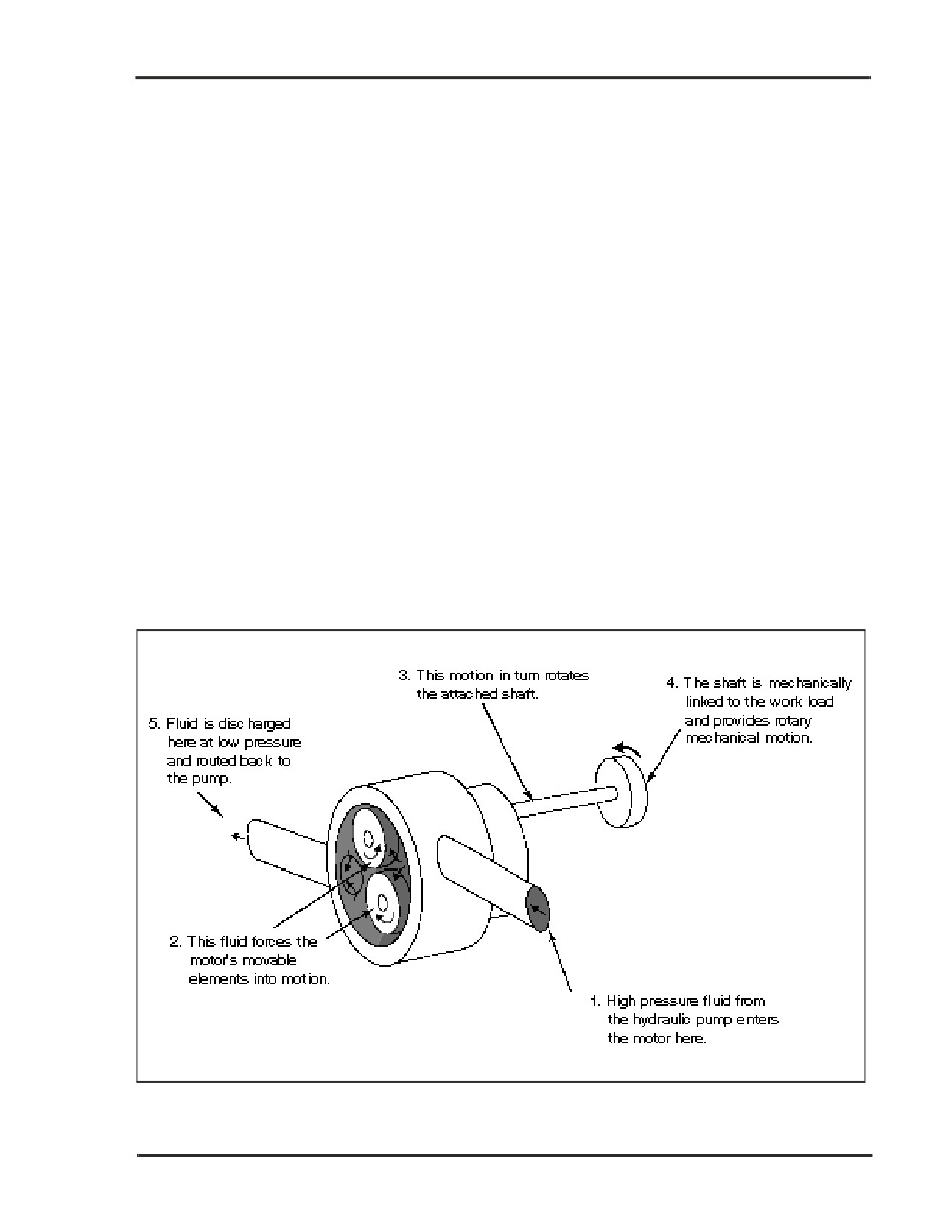
motion or torque, or both, are conveyed to the work. Figure 4-9 shows the basic operations of
a hydraulic motor.
Figure 4-9. Basic operations of a hydraulic motor
Hydraulic Actuators
4-7
FM 5-499
The principal ratings of a motor are torque, pressure, and displacement. Torque and
pressure ratings indicate how much load a motor can handle. Displacement indicates how
much flow is required for a specified drive speed and is expressed in cubic inches per revolu-
tions, the same as pump displacement. Displacement is the amount of oil that must be
pumped into a motor to turn it one revolution. Most motors are fixed-displacement; how-
ever, variable-displacement pis-
ton motors are in use, mainly in
hydrostatic drives. The main
types of motors are gear, vane,
and piston. They can be unidi-
rectional or reversible. (Most
motors designed for mobile
equipment are reversible.)
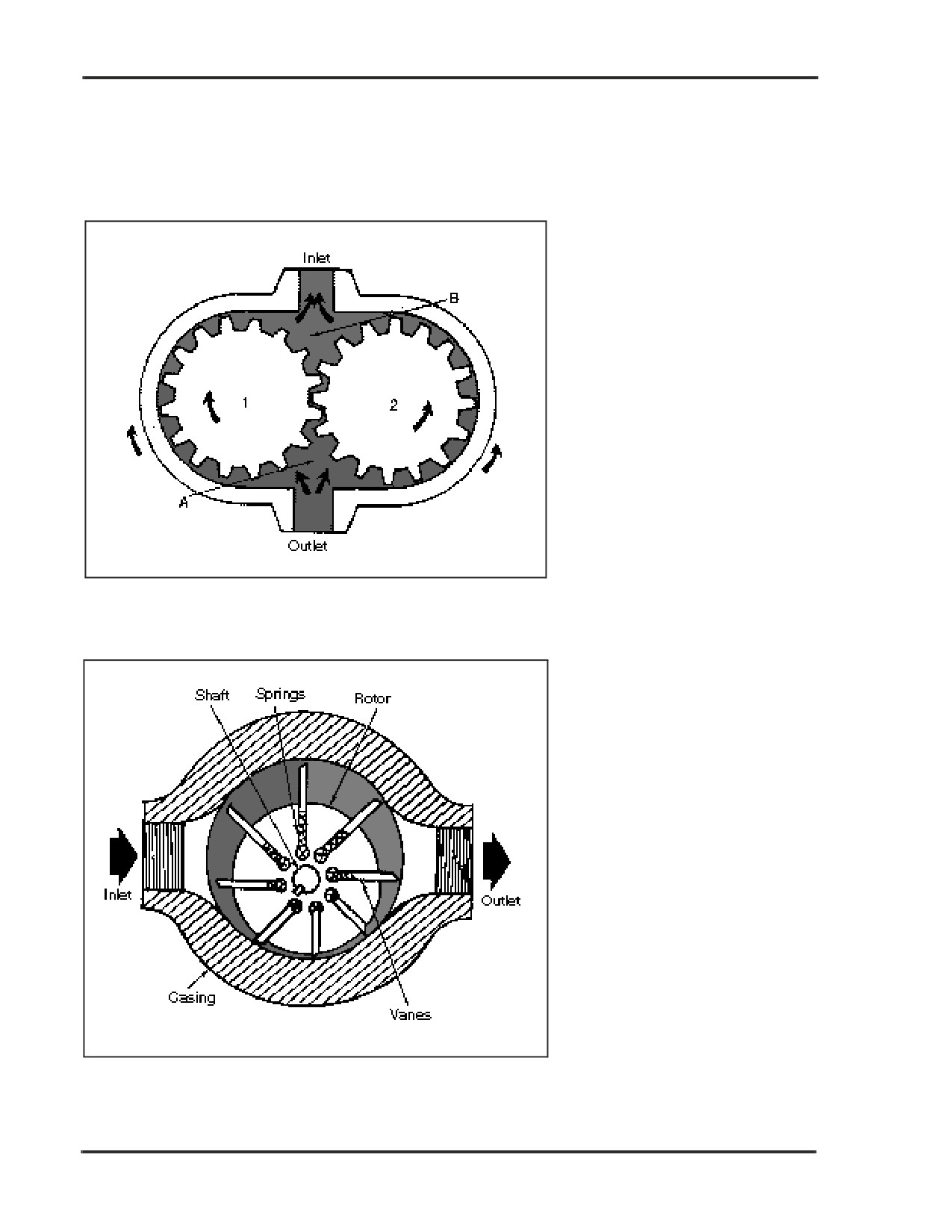
a. Gear-Type Motors. Fig-
ure 4-10 shows a gear-type
motor. Both gears are driven
gears, but only one is connected
to the output shaft. Operation is
essentially the reverse of that of
a gear pump. Flow from the
pump enters chamber A and
flows in either direction around
the inside surface of the casing,
Figure 4-10. Gear-type motor
forcing the gears to rotate as
indicated. This rotary motion is
then available for work at the
output shaft.
b. Vane-Type Motors. Fig-
ure 4-11 shows a vane-type
motor. Flow from the pump
enters the inlet, forces the rotor
and vanes to rotate, and passes
out through the outlet. Motor
rotation causes the output shaft
to rotate. Since no centrifugal
force exists until the motor
begins to rotate, something,
usually springs, must be used to
initially hold the vanes against
the casing contour. However,
springs usually are not neces-
sary in vane-type pumps
because a drive shaft initially
supplies centrifugal force to
ensure vane-to-casing contact.
Figure 4-11. Vane-type motor
4-8
Hydraulic Actuators
FM 5-499
Vane motors are balanced
hydraulically to prevent a rotor
from side-loading a shaft. A
shaft is supported by two ball
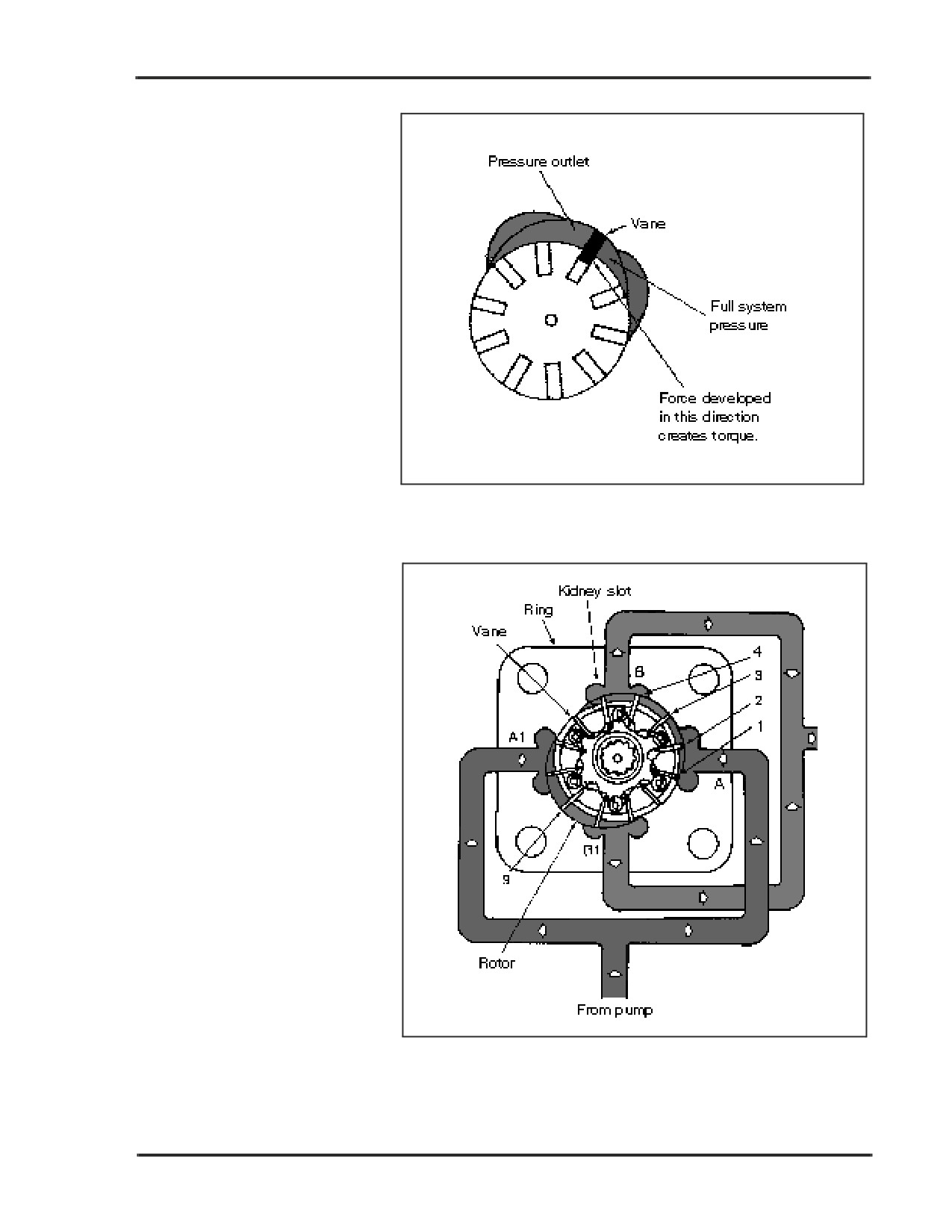
bearings. Torque is developed
by a pressure difference as oil
from a pump is forced through a
motor. Figure 4-12 shows pres-
sure differential on a single
vane as it passes the inlet port.
On the trailing side open to the
inlet port, the vane is subject to
full system pressure. The
chamber leading the vane is
subject to the much lower outlet
pressure. The difference in
pressure exerts the force on the
vane that is, in effect, tangen-
tial to the rotor. This pressure
difference is effective across
Figure 4-12. Pressure differential on a vane-type
vanes 3 and 9 as shown in Fig-
motor
ure 4-13. The other vanes are
subject to essentially equal force
on both sides. Each will develop
torque as the rotor turns. Fig-
ure 4-13 shows the flow condi-
tion for counterclockwise
rotation as viewed from the
cover end. The body port is the
inlet, and the cover port is the
outlet. Reverse the flow, and
the rotation becomes clockwise.
In a vane-type pump, the
vanes are pushed out against a
cam ring by centrifugal force
when a pump is started up. A
design motor uses steel-wire
rocker arms (Figure 4-14, page
4-10) to push the vanes against
the cam ring. The arms pivot on
pins attached to the rotor. The
ends of each arm support two
vanes that are 90 degrees apart.
When the cam ring pushes vane
A into its slot, vane B slides out.
The reverse also happens. Amo-
tor’s pressure plate functions the
Figure 4-13. Flow condition in a vane-type pump
same as a pump's. It seals the
side of a rotor and ring against
Hydraulic Actuators
4-9
FM 5-499
internal leakage, and it feeds system
pressure under the vanes to hold them
out against a ring. This is a simple
operation in a pump because a pres-
sure plate is right by a high-pressure
port in the cover.
c. Piston-Type Motors. Piston-
type motors can be in-line-axis or
bent-axis types.
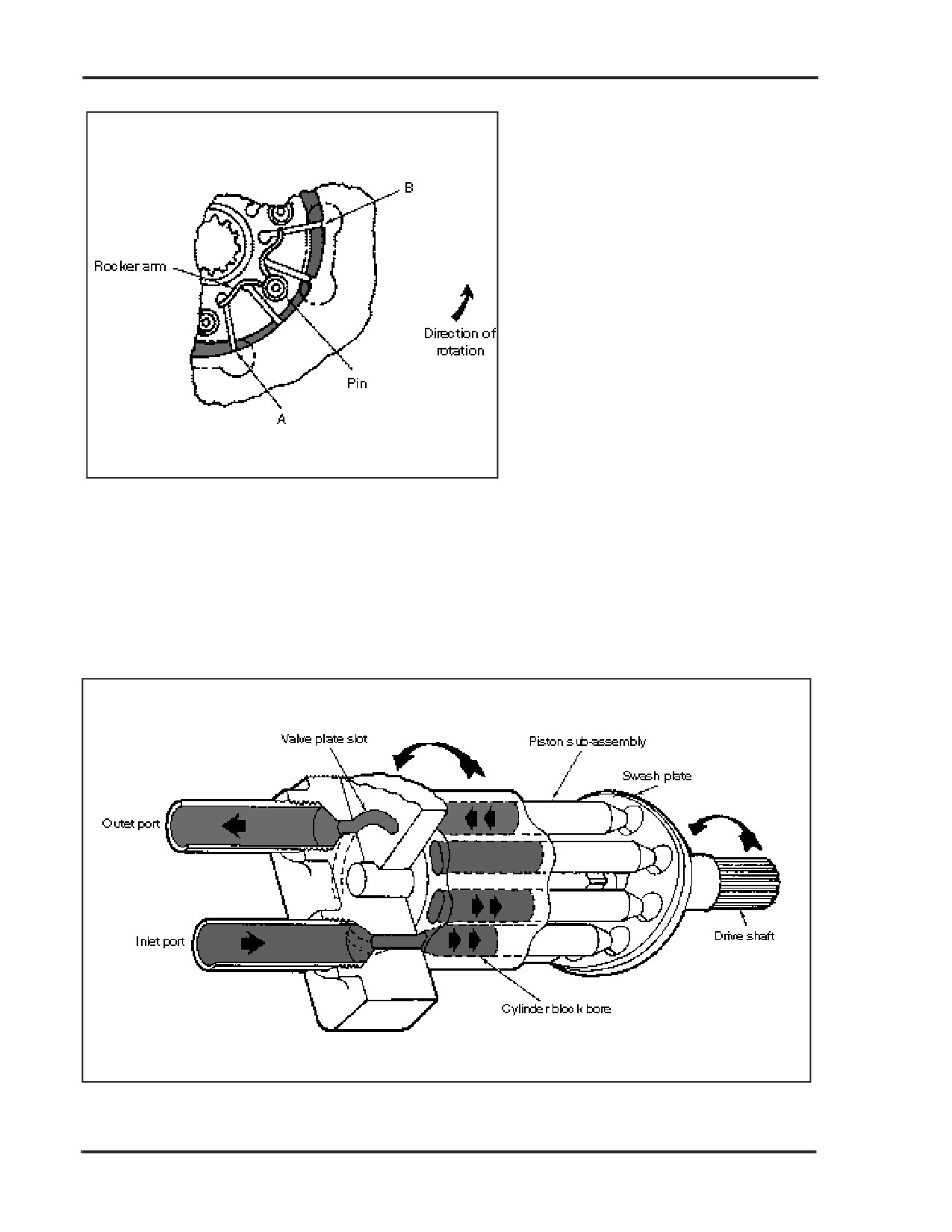
(1) In-Line-Axis, Piston-Type
Motors. These motors (Figure 4-15) are
almost identical to the pumps. They
are built-in, fixed- and variable-dis-
placement models in several sizes.
Torque is developed by a pressure drop
through a motor. Pressure exerts a
force on the ends of the pistons, which
is translated into shaft rotation. Shaft
Figure 4-14. Rocker arms pushing vanes
rotation of most models can be
in a pump
reversed anytime by reversing the flow
direction.
Oil from a pump is forced into the cylinder bores through a motor’s inlet port. Force on
the pistons at this point pushes them against a swash plate. They can move only by sliding
along a swash plate to a point further away from a cylinder’s barrel, which causes it to
rotate. The barrel is then splined to a shaft so that it must turn.
Figure 4-15. In-line-axis, piston-type motor
4-10
Hydraulic Actuators
FM 5-499
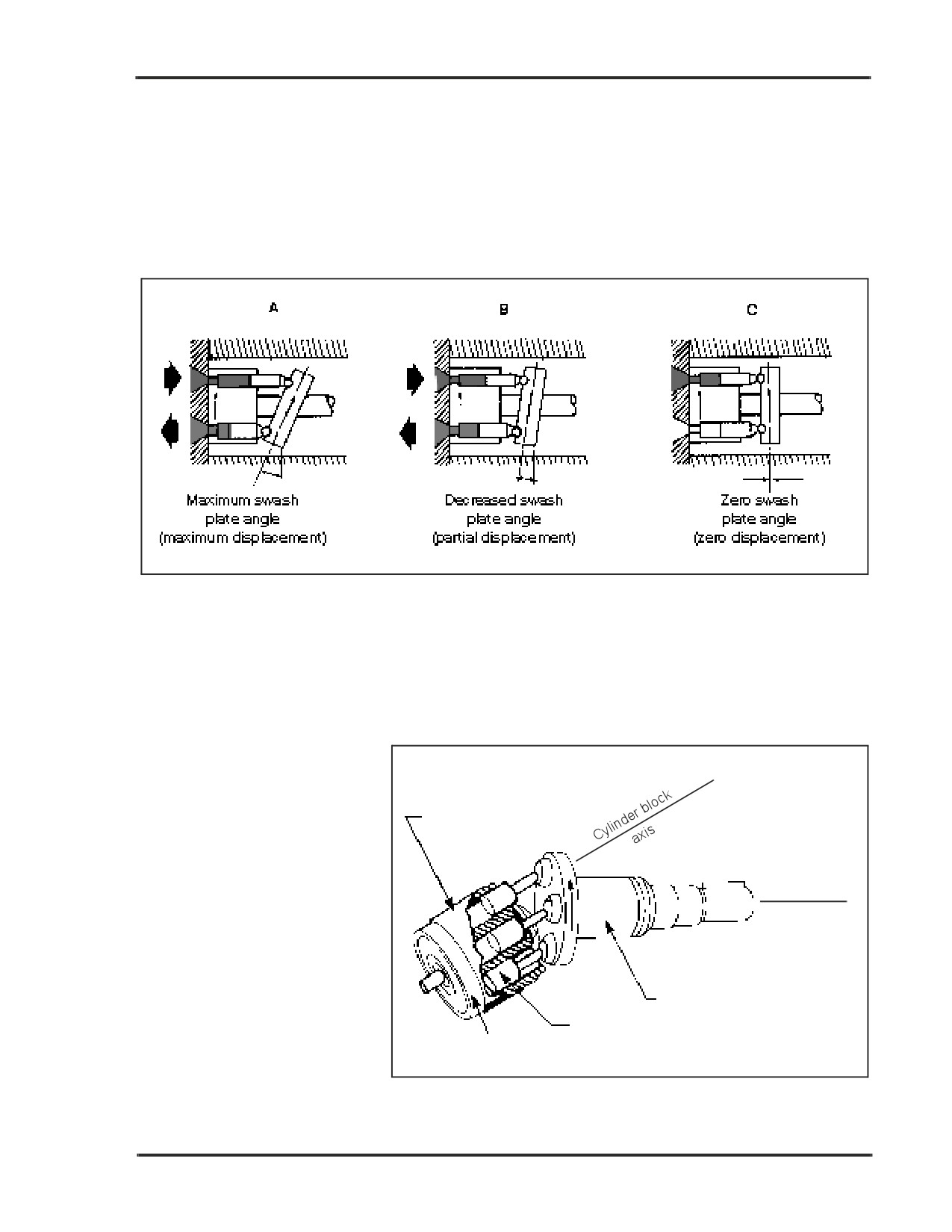
A motor's displacement depends on the angle of a swash plate (Figure 4-16). At maxi-
mum angle, displacement is at its highest because the pistons travel at maximum length.
When the angle is reduced, piston travel shortens, reducing displacement. If flow remains
constant, a motor runs faster, but torque is decreased. Torque is greatest at maximum dis-
placement because the component of piston force parallel to a swash plate is greatest.
(2) Bent-Axis, Piston-Type Motors. These motors are almost identical to the pumps.
They are available in fixed- and variable-displacement models (Figure 4-17), in several sizes.
Figure 4-16. Swash plate
Variable-displacement motors can be controlled mechanically or by pressure compensa-
tion. These motors operate similarly to in-line motors except that piston thrust is against a
drive-shaft flange. A parallel component of thrust causes a flange to turn. Torque is maxi-
mum at maximum displacement; speed is at a minimum. This design piston motor is very
heavy and bulky, particularly the variable-displacement motor. Using these motors on
mobile equipment is limited.
Although some piston-
type motors are controlled by
directional-control valves, they
Cylinder block
are often used in combination
with variable-displacement
pumps. This pump-motor
Output shaft
combination (hydraulic trans-
axis
mission) is used to provide a
transfer of power between a
driving element, such as an
electric motor, and a driven
Output shaft
element. Hydraulic transmis-
sions may be used for applica-
Pistons
tions such as a speed reducer,
Valve plate
variable speed drive, constant
speed or constant torque
Figure 4-17. Bent-axis, piston-type motor
Hydraulic Actuators
4-11
FM 5-499
drive, and torque converter. Some advantages a hydraulic transmission has over a mechan-
ical transmission is that it has—
• Quick, easy speed adjustment over a wide range while the power source is operat-
ing at constant (most efficient) speed.
• Rapid, smooth acceleration or deceleration.
• Control over maximum torque and power.
• A cushioning effect to reduce shock loads.
• A smooth reversal of motion.
Hydraulic Actuators
4-12
FM 5-499
CHAPTER 5
Valves
Valves are used in hydraulic systems to control the operation of the actuators. Valves reg-
ulate pressure by creating special pressure conditions and by controlling how much oil will
flow in portions of a circuit and where it will go. The three categories of hydraulic valves are
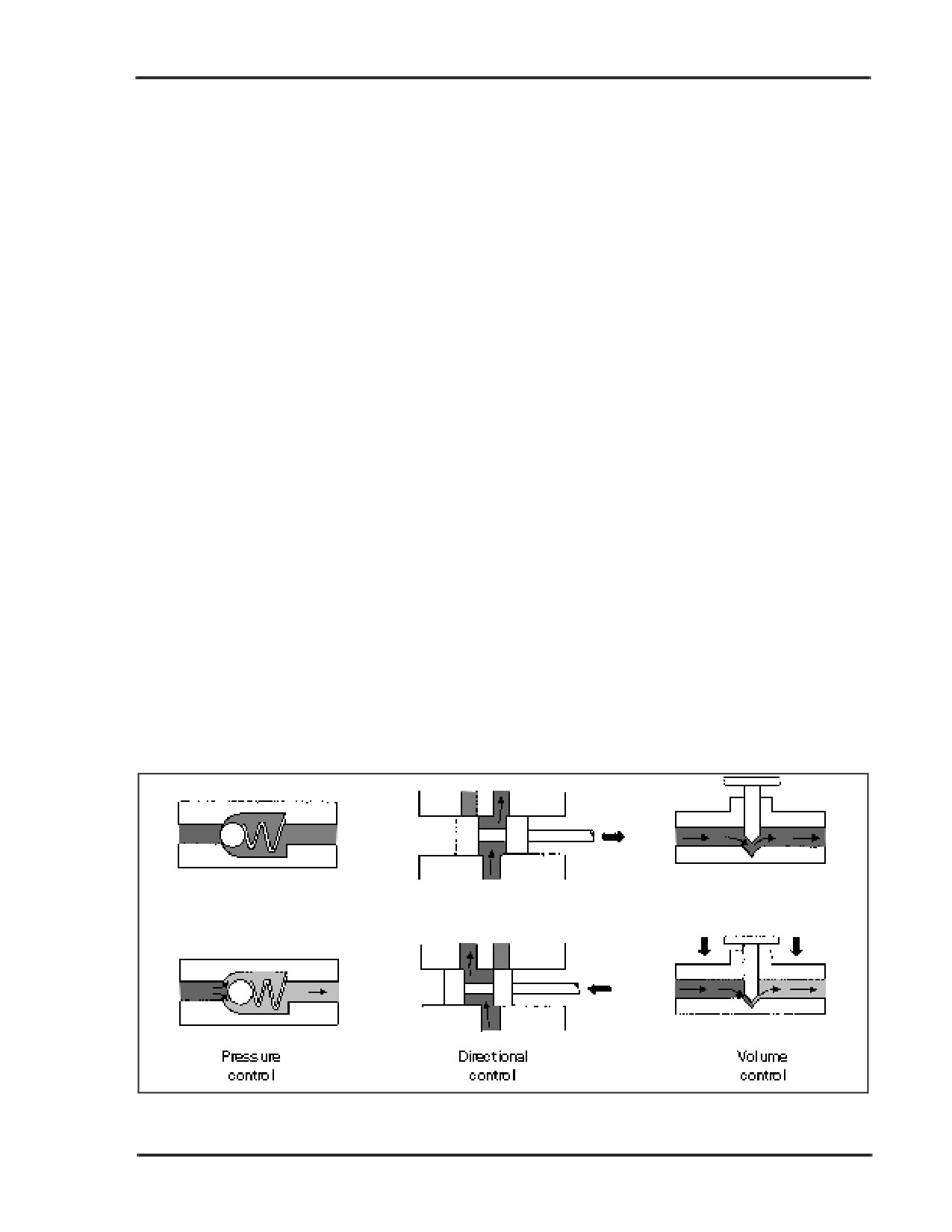
pressure-control, flow- (volume-) control, and directional-control (see Figure 5-1). Some
valves have multiple functions, placing them into more than one category. Valves are rated
by their size, pressure capabilities, and pressure drop/flow.
5-1. Pressure-Control Valves. A pressure-control valve may limit or regulate pressure,
create a particular pressure condition required for control, or cause actuators to operate in a
specific order. All pure pressure-control valves operate in a condition approaching hydraulic
balance. Usually the balance is very simple: pressure is effective on one side or end of a ball,
poppet, or spool and is opposed by a spring. In operation, a valve takes a position where
hydraulic pressure balances a spring force. Since spring force varies with compression, dis-
tance and pressure also can vary. Pressure-control valves are said to be infinite positioning.
This means that they can take a position anywhere between two finite flow conditions,
which changes a large volume of flow to a small volume, or pass no flow.
Most pressure-control valves are classified as normally closed. This means that flow to
a valve's inlet port is blocked from an outlet port until there is enough pressure to cause an
unbalanced operation. In normally open valves, free flow occurs through the valves until
they begin to operate in balance. Flow is partially restricted or cut off. Pressure override is
a characteristic of normally closed-pressure controls when they are operating in balance.
Because the force of a compression spring increases as it lowers, pressure when the valves
first crack is less than when they are passing a large volume or full flow. The difference
between a full flow and cracking pressure is called override.
Figure 5-1. Valves
Valves
5-1
FM 5-499
a. Relief Valves. Relief valves are the most common type of pressure-control valves.
The relief valves’ function may vary, depending on a system's needs. They can provide over-
load protection for circuit components or limit the force or torque exerted by a linear actua-
tor or rotary motor.
The internal design of all relief valves is basically similar. The valves consist of two sec-
tions: a body section containing a piston that is retained on its seat by a spring(s), depend-
ing on the model, and a cover or pilot-valve section that hydraulically controls a body
piston’s movement. The adjusting screw adjusts this control within the range of the valves.
Valves that provide emergency overload protection do not operate as often since other
valve types are used to load and unload a pump. However, relief valves should be cleaned
regularly by reducing their pressure adjustments to flush out any possible sludge deposits
that may accumulate. Operating
under reduced pressure will clean
out sludge deposits and ensure that
the valves operate properly after the
pressure is adjusted to its prescribed
setting.
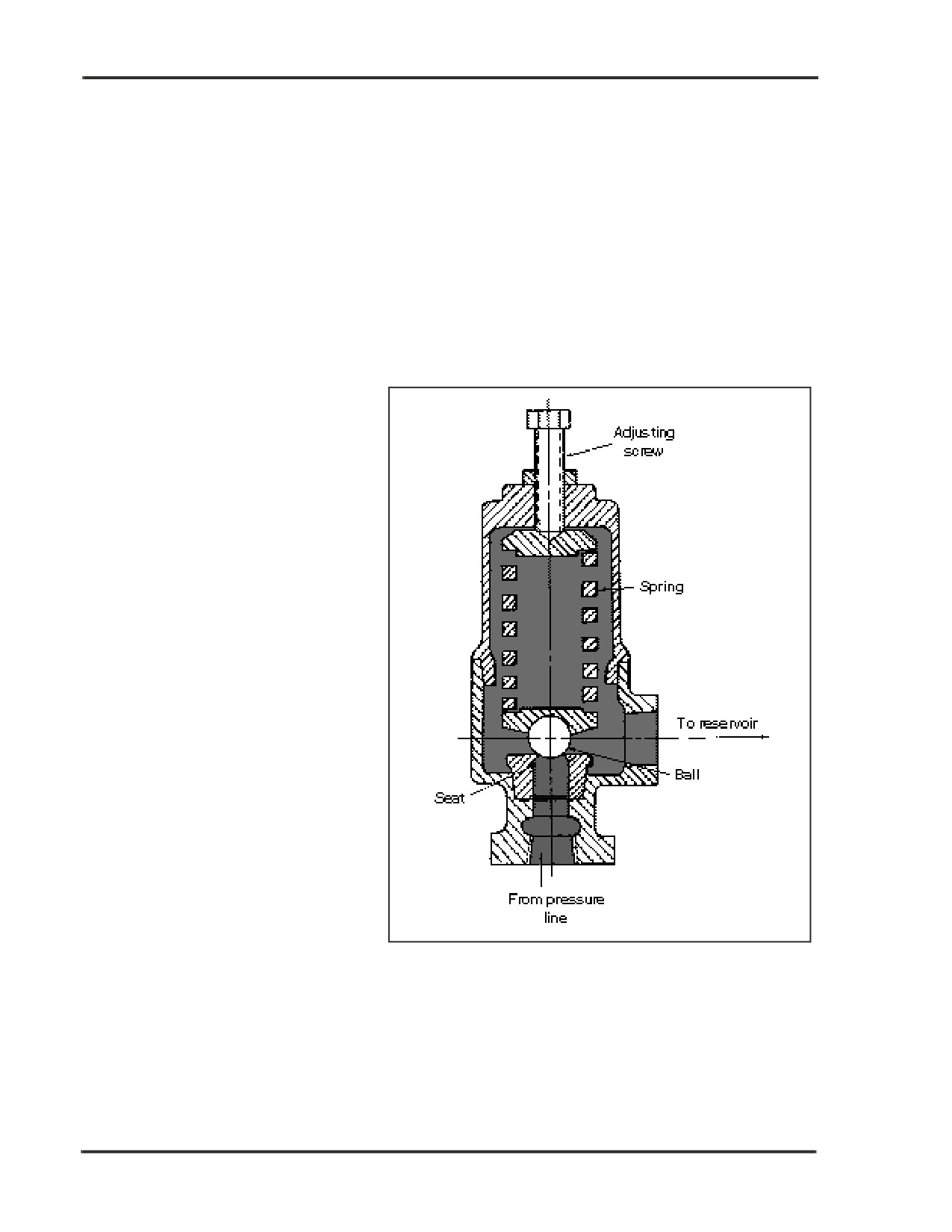
(1) Simple Type. Figure 5-2
shows a simple-type relief valve.
This valve is installed so that one
port is connected to the pressure line
or the inlet and the other port to the
reservoir. The ball is held on its seat
by thrust of the spring, which can be
changed by turning the adjusting
screw. When pressure at the valve’s
inlet is insufficient to overcome
spring force, the ball remains on its
seat and the valve is closed, prevent-
ing flow through it. When pressure
at the valve’s inlet exceeds the
adjusted spring force, the ball is
forced off its seat and the valve is
opened. Liquid flows from the pres-
sure line through the valve to the
reservoir. This diversion of flow pre-
vents further pressure increase in
the pressure line. When pressure
decreases below the valve’s setting,
the spring reseats the ball and the
Figure 5-2. Simple relief valve
valve is again closed.
The pressure at which a valve first begins to pass flow is the cracking pressure of a
valve. The pressure at which a valve passes its full-rated capacity is the full-flow pressure
of a valve. Because of spring rate, a full-flow pressure is higher than a cracking pressure.
This condition is referred to as pressure override. A disadvantage of a simple-type relief
valve is its relatively high-pressure override at its rated capacity.
5-2
Valves
FM 5-499
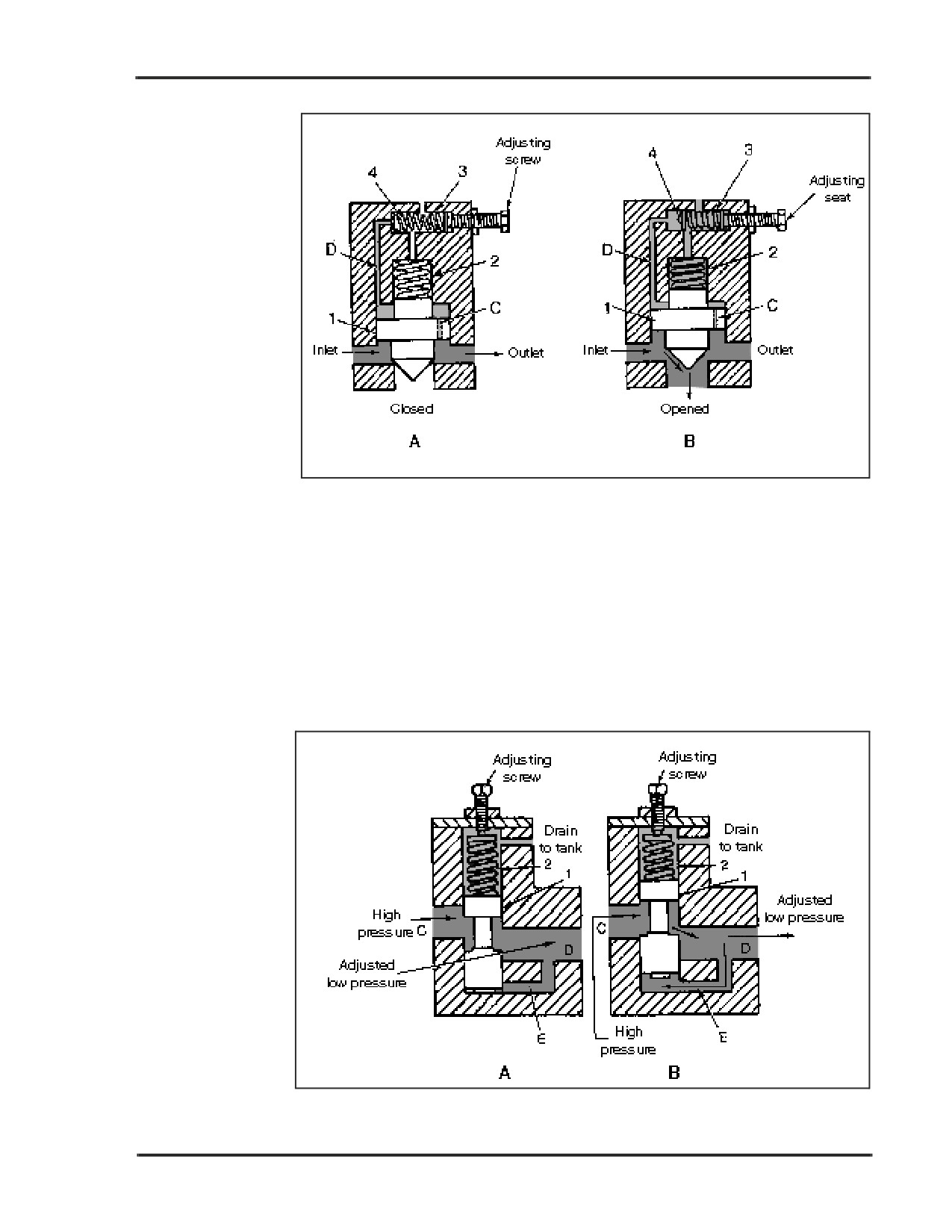
(2) Compound
Type. Figure 5-3
shows a compound-
type relief valve.
Passage C is used
to keep the piston
in hydraulic bal-
ance when the
valve's inlet pres-
sure is less than its
setting (diagram
A). The valve set-
ting is determined
by an adjusted
thrust of spring 3
against poppet 4.
When pressure at
the valve’s inlet
reaches the valve’s
setting, pressure in
Figure 5-3. Compound relief valve
passage D also
rises to overcome the thrust of spring 3. When flow through passage C creates a sufficient
pressure drop to overcome the thrust of spring 2, the piston is raised off its seat (diagram B).
This allows flow to pass through the discharge port to the reservoir and prevents further rise
in pressure.
b. Pressure-Reducing Valves. These valves limit pressure on a branch circuit to a lesser
amount than required in a main circuit. For example, in a system, a branch-circuit pressure
is limited to 300 psi, but a main circuit must operate at 800 psi. A relief valve in a main cir-
cuit is adjusted to a setting above 800 psi to meet a main circuit's requirements. However, it
would surpass a branch-circuit pressure of 300 psi. Therefore, besides a relief valve in a
main circuit, a
pressure-reduc-
ing valve must be
installed in a
branch circuit
and set at 300
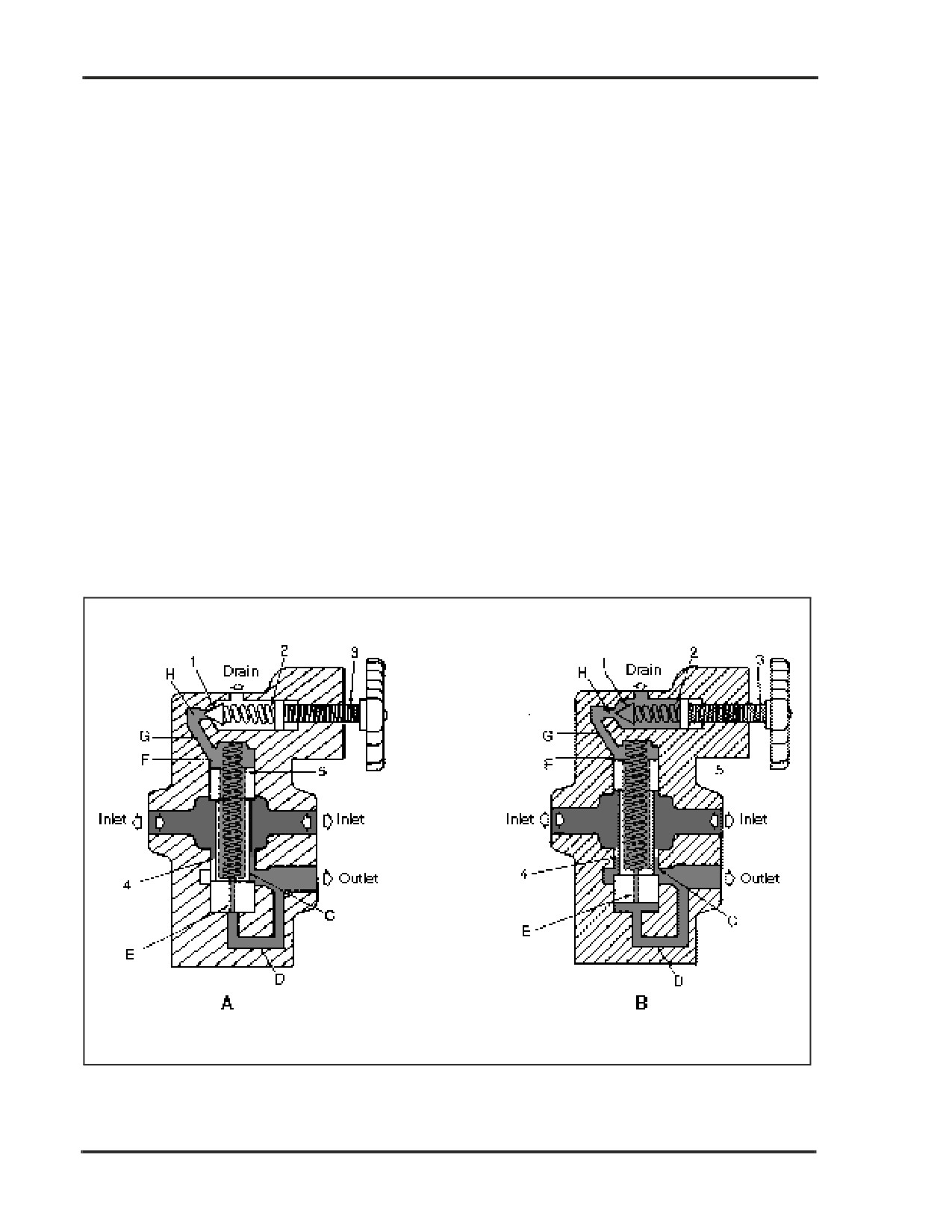
psi. Figure 5-4
shows a pressure-
reducing valve.
In a pressure-
reducing valve
(diagram A),
adjusting the
spring’s compres-
sion obtains the
maximum branch-
circuit pressure.
The spring also
holds spool 1 in
Figure 5-4. Pressure-reducing valve
Valves
5-3
FM 5-499
the open position. Liquid from the main circuit enters the valve at the inlet port C, flows
past the valve spool, and enters the branch circuit through the outlet port D. Pressure at
the outlet port acts through the passage E to the bottom of spool. If the pressure is insuffi-
cient to overcome the thrust of the spring, the valve remains open.
The pressure at the outlet port (diagram B) and under the spool exceeds the equivalent
thrust of the spring. The spool rises and the valve is partially closed. This increases the
valve's resistance to flow, creates a greater pressure drop through the valve, and reduces the
pressure at the outlet port. The spool will position itself to limit maximum pressure at the
outlet port regardless of pressure fluctuations at the inlet port, as long as workload does not
cause back flow at the outlet port. Back flow would close the valve and pressure would
increase.
(1) X-Series Type. Figure 5-5 shows the internal construction of an X-series pressure-
reducing valve. The two major assemblies are an adjustable pilot-valve assembly in the
cover, which determines the operating pressure of the valve, and a spool assembly in the
body, which responds to the action of the pilot valve to limit maximum pressure at the outlet
port.
The pilot-valve assembly consists of a poppet 1, spring 2, and adjusting screw 3. The
position of the adjusting screw sets the spring load on the poppet, which determines the set-
ting of the valve. The spool assembly consists of spool 4 and spring 5. The spring is a low-
rate spring, which tends to force the spool downward and hold the valve open. The position
of the spool determines the size of passage C.
Figure 5-5. X-series, pressure-reducing valve
5-4
Valves
FM 5-499
When pressure at the valve inlet (diagram A) does not exceed the pressure setting, the
valve is completely open. Fluid passes from the inlet to the outlet with minimal resistance
in the rated capacity of the valve. Passage D connects the outlet port to the bottom of the
spool. Passage E connects the chambers at each end of the spool. Fluid pressure at the out-
let port is present on both ends of the spool. When these pressures are equal, the spool is
hydraulically balanced. The only effective force on the spool is the downward thrust of the
spring, which positions the spool and tends to maintain passage C at its maximum size.
When the pressure at the valve’s outlet (diagram B) approaches the pressure setting of
the valve, the liquid's pressure in chamber H is sufficient to overcome the thrust of the
spring and force the poppet off its seat. The pilot valve limits the pressure in chamber F.
More pressure rises as the outlet pushes the spool upward against the combined force of the
spring and the pressure in chamber F.
As the spool moves upward, it restricts the opening to create a pressure drop between
the inlet and outlet ports. Pressure at the outlet is limited to the sum of the equivalent
forces of springs 2 and 5. In normal operation, passage C never closes completely. Flow
must pass through to meet any work requirements on the low-pressure side of the valve plus
the flow required through passage E to maintain the pressure drop needed to hold the spool
at the control position. Flow through restricted passage E is continual when the valve is
controlling the reduced pressure. This flow is out the drain port and should be returned
directly to the tank.
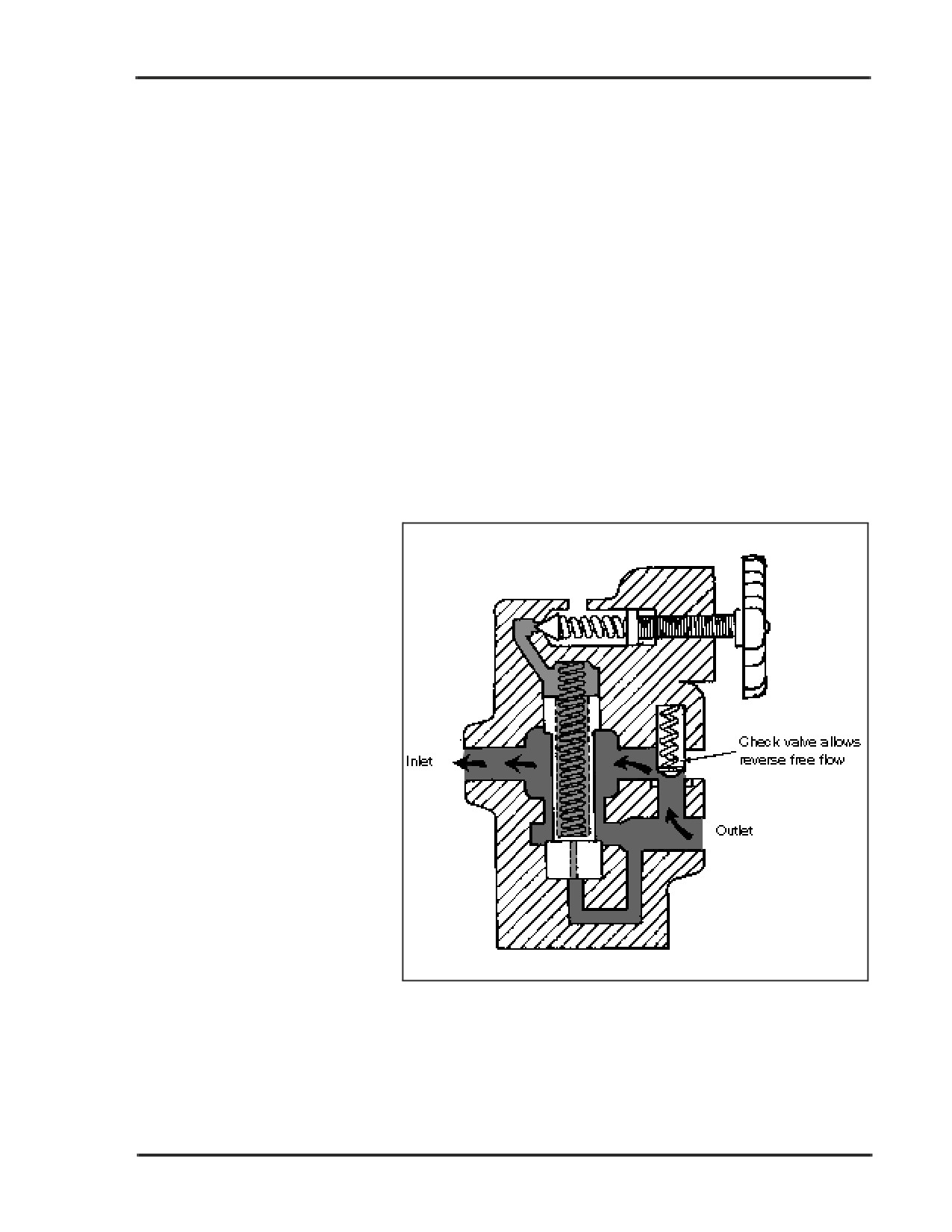
(2) XC-Series Type. An
XC-series pressure-reducing
valve limits pressure at the out-
let in the same way the X-series
does when flow is from its inlet
port to its outlet port. An inte-
gral check valve allows reverse
free flow from outlet to inlet
port even at pressures above the
valve setting. However, the
same pressure-reducing action
is not provided for this direction
of flow. Figure 5-6 shows the
internal construction of an XC-
series valve.
c. Sequence Valves.
Sequence valves control the
operating sequence between two
branches of a circuit. The
valves are commonly used to
regulate an operating sequence
of two separate work cylinders
so that one cylinder begins
Figure 5-6. Internal construction of an XC-series
stroking when the other com-
valve
pletes stroking. Sequence
valves used in this manner ensure that there is minimum pressure equal to its setting on the
first cylinder during the subsequent operations at a lower pressure.
Valves
5-5
FM 5-499
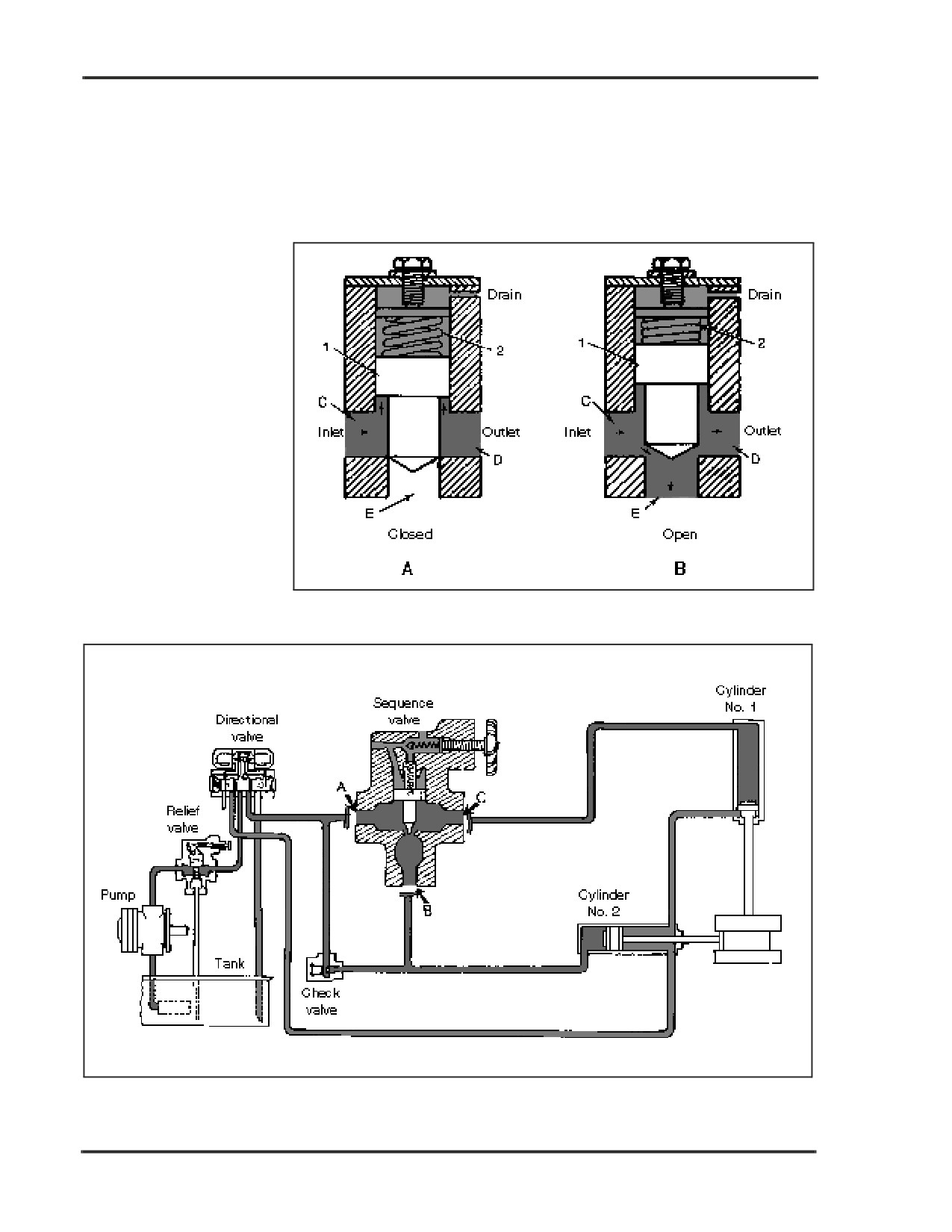
Figure 5-7, diagram A, shows how to obtain the operation of a sequencing pressure by
adjusting a spring's compression, which holds piston 1 in the closed position. Liquid enters
the valve at inlet port C, flows freely past piston 1, and enters the primary circuit through
port D. When pressure of the liquid flowing through the valve is below the valve’s setting,
the force acting upward on piston 1 is less than the downward force of the spring 2. The pis-
ton is held down and the valve is in the closed position.
When resistance in
the primary circuit
causes the pressure to
rise so it overcomes the
force of spring 2, piston 1
rises. The valve is then
open (Figure 5-7, dia-
gram B). Liquid enter-
ing the valve can now
flow through port E to
the secondary circuit.
Figure 5-8 shows an
application of a
sequence valve. The
valve is set at a pressure
in excess of that required
to start cylinder 1 (pri-
mary cylinder). In its
Figure 5-7. Sequence valve
Figure 5-8. Application of sequence valve
5-6
Valves
FM 5-499
first operating sequence, pump flow goes through ports A and C (primary ports) to force cyl-
inder 1 to stroke. The valve stays closed because the pressure of cylinder 1 is below the
valve’s setting. When cylinder 1 finishes stroking, flow is blocked, and the system pressure
instantly increases to the valve setting to open the valve. Pump flow then starts cylinder 2
(secondary cylinder).
During this phase, the flow of pilot oil through the balance orifice governs the position of
the main piston. This piston throttles flow to port B (secondary port) so that pressure equal
to the valve setting is maintained on the primary circuit during movement of cylinder 2 at a
lower pressure. Back pressure created by the resistance of cylinder 2 cannot interfere with
the throttling action because the secondary pressure below the stem of the main piston also
is applied through the drain hole to the top of the stem and thereby canceled out. When cyl-
inder 2 is retracted, the return flow from it bypasses the sequence valve through the check
valve.
d. Counterbalance Valves. A counterbalance valve allows free flow of fluid in one direc-
tion and maintains a resistance to flow in another direction until a certain pressure is
reached. A valve is normally located in a line between a directional-control valve and an out-
let of a vertically mounted actuating cylinder, which supports weight or must be held in posi-
tion for a period of time. A
counterbalance valve serves as a
hydraulic resistance to an actuat-
ing cylinder. For example, a
counterbalance valve is used in
some hydraulically operated fork
lifts. It offers a resistance to the
flow from an actuating cylinder
when a fork is lowered. It also
helps support a fork in the up
position.
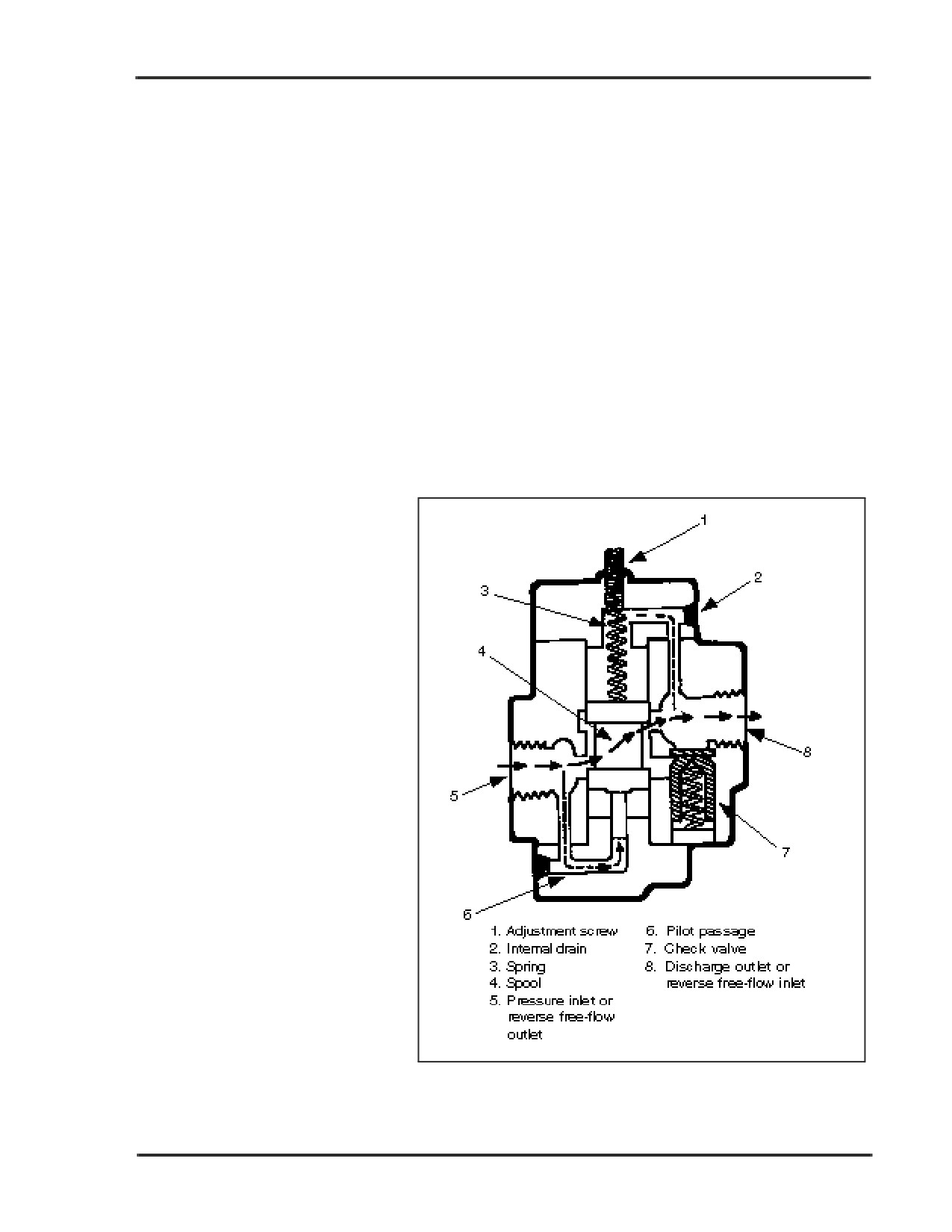
Figure 5-9 shows a counter-
balance valve. The valve element
is balance-spool valve 4 that con-
sists of two pistons which are per-
manently fixed on either end of
the shaft. The inner piston areas
are equal; therefore, pressure acts
equally on both areas regardless
of the position of the valve, and
has no effect on the movement of
the valve, hence, the term bal-
anced. A small pilot piston is
attached to the bottom of the
spool valve.
When the valve is in the
closed position, the top piston of
the spool valve blocks discharge
Figure 5-9. Counterbalance valve
port 8. If fluid from the actuating
Valves
5-7
FM 5-499
unit enters inlet port 5, it cannot flow through the valve because discharge port 8 is blocked.
However, fluid will flow through the pilot passage 6 to the small pilot piston. As the pres-
sure increases, it acts on the pilot piston until it overcomes the preset pressure of spring 3.
This forces the spool up and allows the fluid to flow around the shaft of the spool valve and
out the discharge port 8.
During reverse flow, the fluid enters port 8. Spring 3 forces spool valve 4 to the closed
position. The fluid pressure overcomes the spring tension of check valve 7. It opens and
allows free flow around the shaft of the spool valve and out port 5. The operating pressure of
the valve can be adjusted by turning adjustment screw 1, which increases or decreases the
tension of the spring. This adjustment depends on the weight that the valve must support.
Small amounts of fluid will leak around the top piston of the spool valve and into the
area around spring 3. An accumulation would cause a hydraulic lock on the top of the spool
valve (since a liquid cannot be compressed). Drain 2 provides a passage for this fluid to flow
to port 8.
e. Pressure Switches.
Pressure switches are
used in various applica-
tions that require an adjus-
table, pressure-actuated
electrical switch to make or
break an electrical circuit
at a predetermined pres-
sure. An electrical circuit
may be used to actuate an
electrically controlled valve
or control an electric-
motor starter or a signal
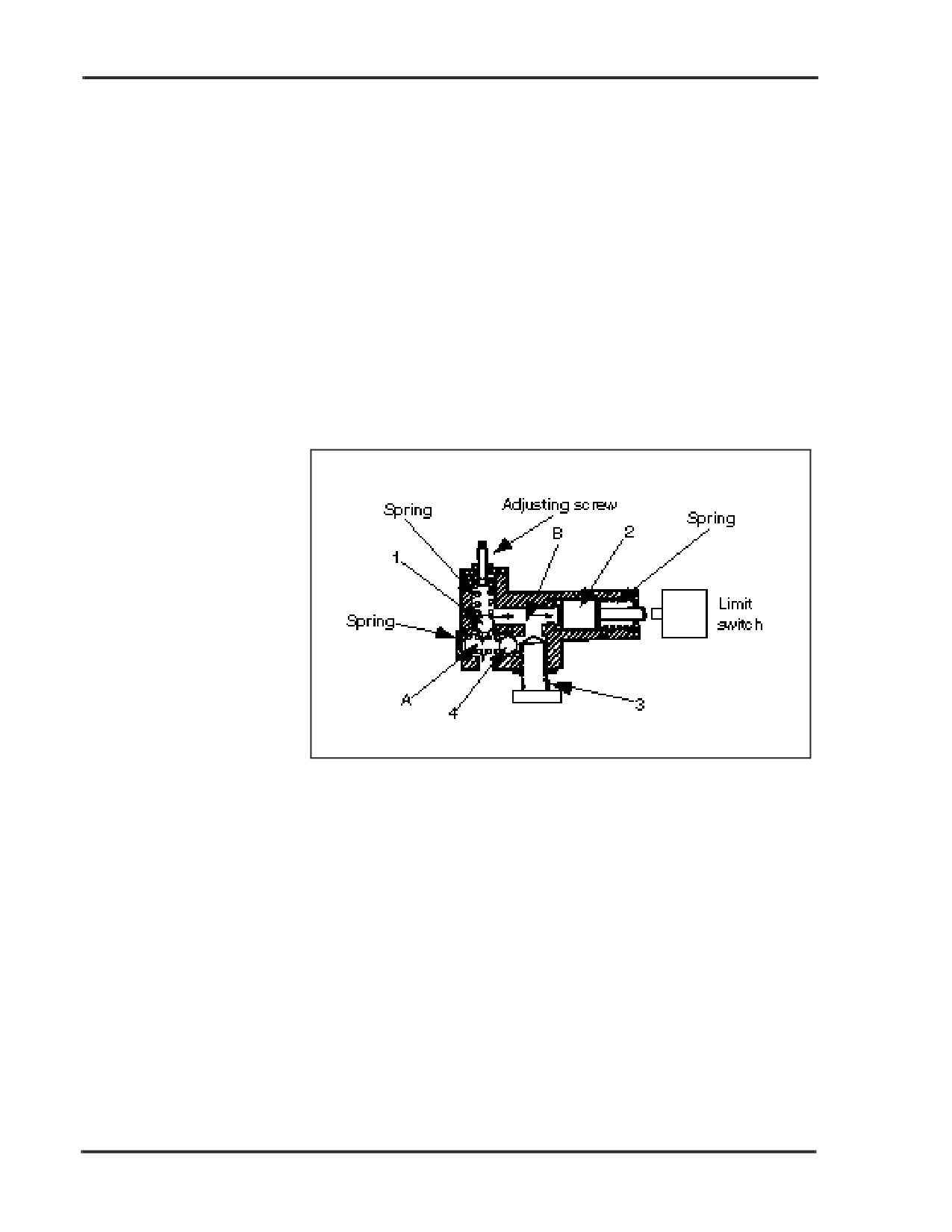
light. Figure 5-10 shows a
pressure switch. Liquid,
under pressure, enters
chamber A. If the pressure
Figure 5-10. Pressure switch
exceeds the adjusted pres-
sure setting of the spring behind ball 1, the ball is unseated. The liquid flows into chamber
B and moves piston 2 to the right, actuating the limit to make or break an electrical circuit.
When pressure in chamber A falls below the setting of the spring behind ball 1, the
spring reseats ball 1. The liquid in chamber B is throttled past valve 3 and ball 4 because of
the action of the spring behind piston 2. The time required for the limit switch to return to
its normal position is determined by valve 3’s setting.
5-2. Directional-Control Valves. Directional-control valves also control flow direction.
However, they vary considerably in physical characteristics and operation. The valves may
be a—
• Poppet type, in which a piston or ball moves on and off a seat.
• Rotary-spool type, in which a spool rotates about its axis.
5-8
Valves
FM 5-499
• Sliding-spool type, in which a spool slides axially in a bore. In this type, a spool is
often classified according to the flow conditions created when it is in the normal or
neutral position. A closed-center spool blocks all valve ports from each other when in
the normal position. In an open-center spool, all valve ports are open to each other
when the spool is in the normal position.
Directional-control valves may also be classified according to the method used to actuate
the valve element. A poppet-type valve is usually hydraulically operated. A rotary-spool
type may be manually (lever or plunger action), mechanically (cam or trip action), or electri-
cally (solenoid action) operated. A sliding-spool type may be manually, mechanically, electri-
cally, or hydraulically operated, or it may be operated in combination.
Directional-control valves may also be classified according to the number of positions of
the valve elements or the total number of flow paths provided in the extreme position. For
example, a three-position, four-way valve has two extreme positions and a center or neutral
position. In each of the two extreme positions, there are two flow paths, making a total of
four flow paths.
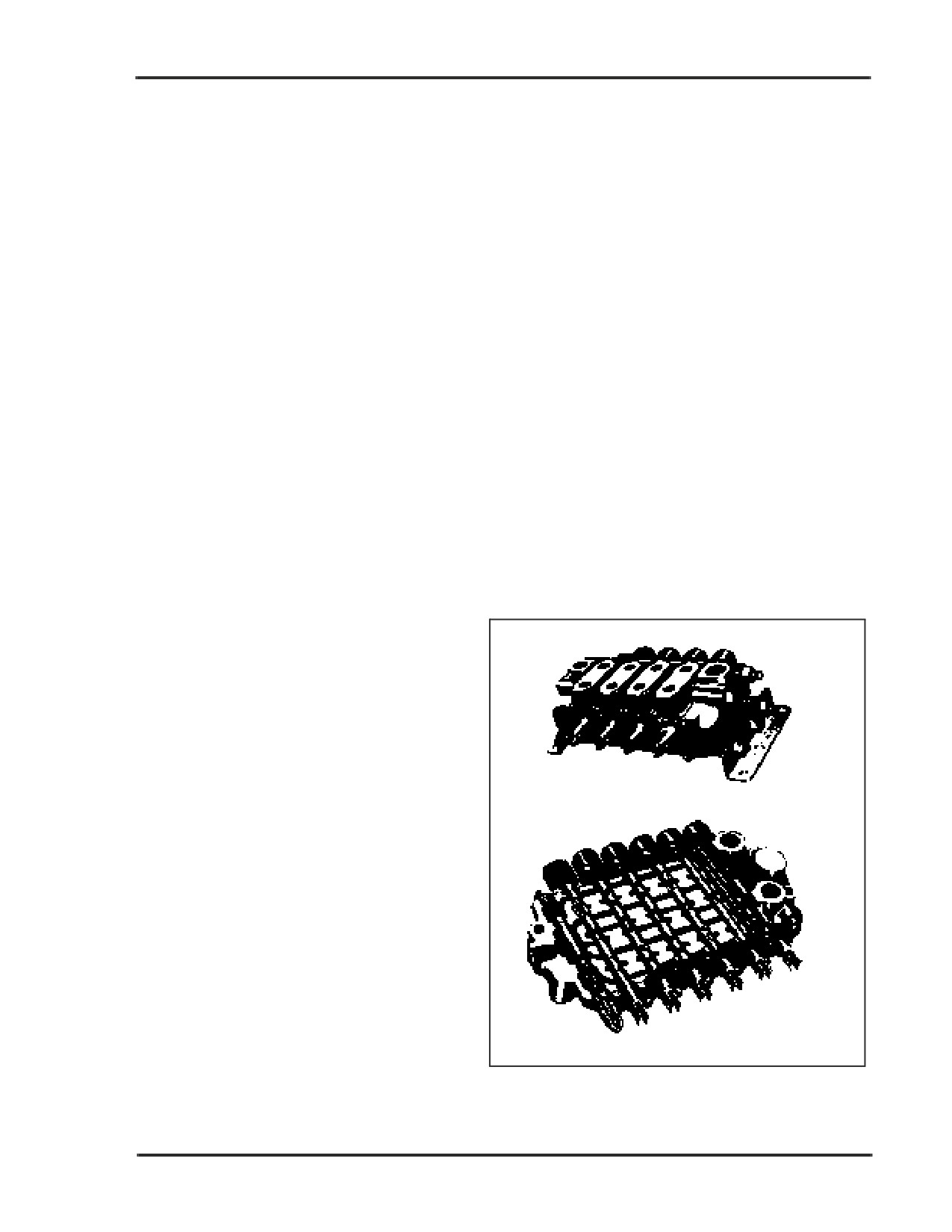
Spool valves (see Figure 5-11) are popular on modern hydraulic systems because they—
• Can be precision-ground for fine-oil metering.
• Can be made to handle flows in many directions by adding extra lands and oil
ports.
• Stack easily into one compact control package, which is important on mobile sys-
tems.
Spool valves, however, require good
maintenance. Dirty oil will damage the
mating surfaces of the valve lands, causing
them to lose their accuracy. Dirt will cause
these valves to stick or work erratically.
Also, spool valves must be accurately
machined and fitted to their bores.
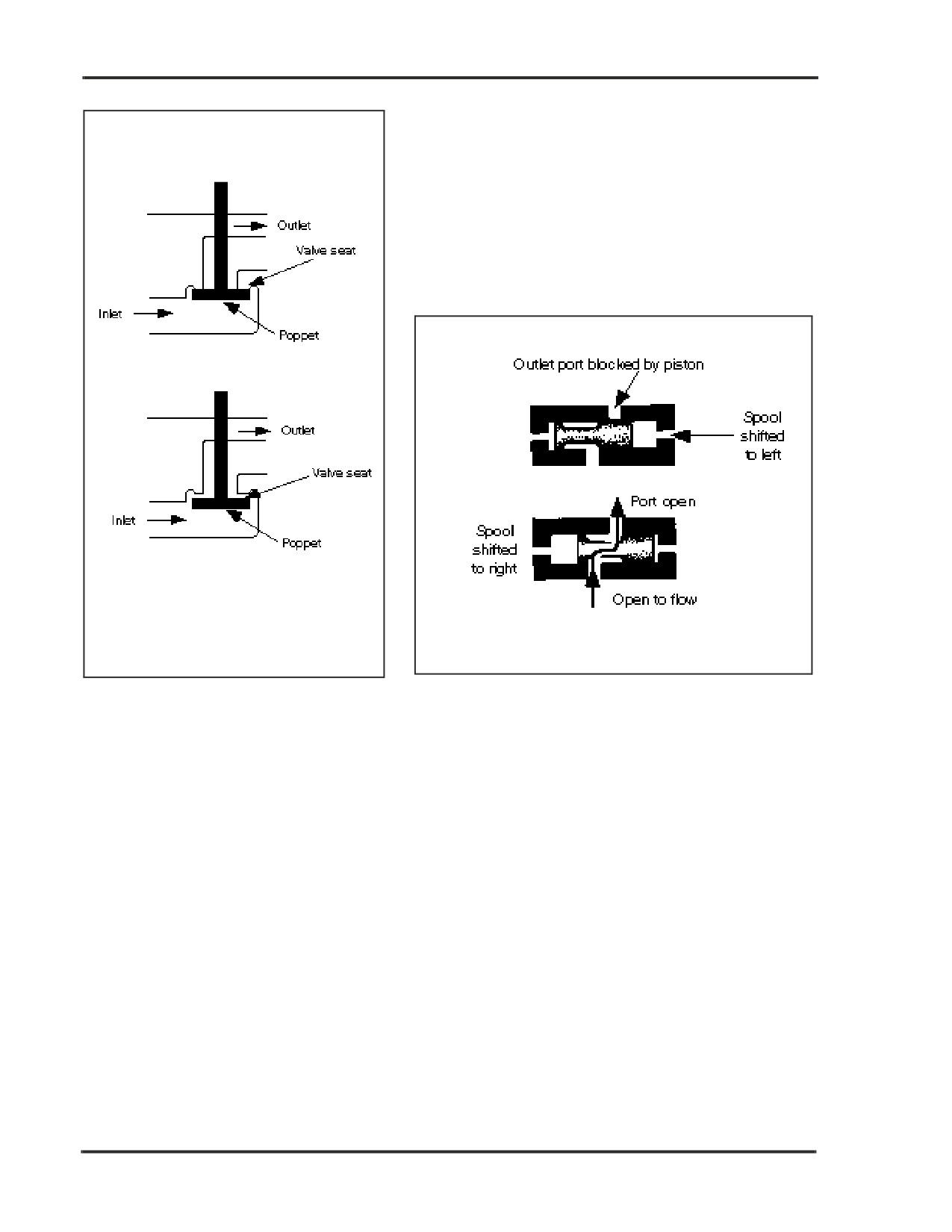
a. Poppet Valve. Figure 5-12, page 5-10,
shows a simple poppet valve. It consists
primarily of a movable poppet that closes
against a valve seat. Pressure from the
inlet tends to hold the valve tightly closed.
A slight force applied to the poppet stem
opens the poppet. The action is similar to
the valves of an automobile engine. The
poppet stem usually has an O-ring seal to
prevent leakage. In some valves, the pop-
pets are held in the seated position by
springs. The number of poppets in a valve
depends on the purpose of the valve.
Figure 5-11. Spool valve
Valves
5-9
FM 5-499
b. Sliding-Spool Valve. Figure 5-13 shows a
sliding-spool valve. The valve element slides back
and forth to block and uncover ports in the housing.
Sometimes called a piston type, the sliding-spool
valve has a piston of which the inner areas are equal.
Pressure from the inlet ports acts equally on both
inner piston areas regardless of the position of the
spool. Sealing is done by a machine fit between the
spool and valve body or sleeve.
Figure 5-12. Operation of a sim-
Figure 5-13. Operation of sliding-spool,
ple poppet valve
directional-control valve
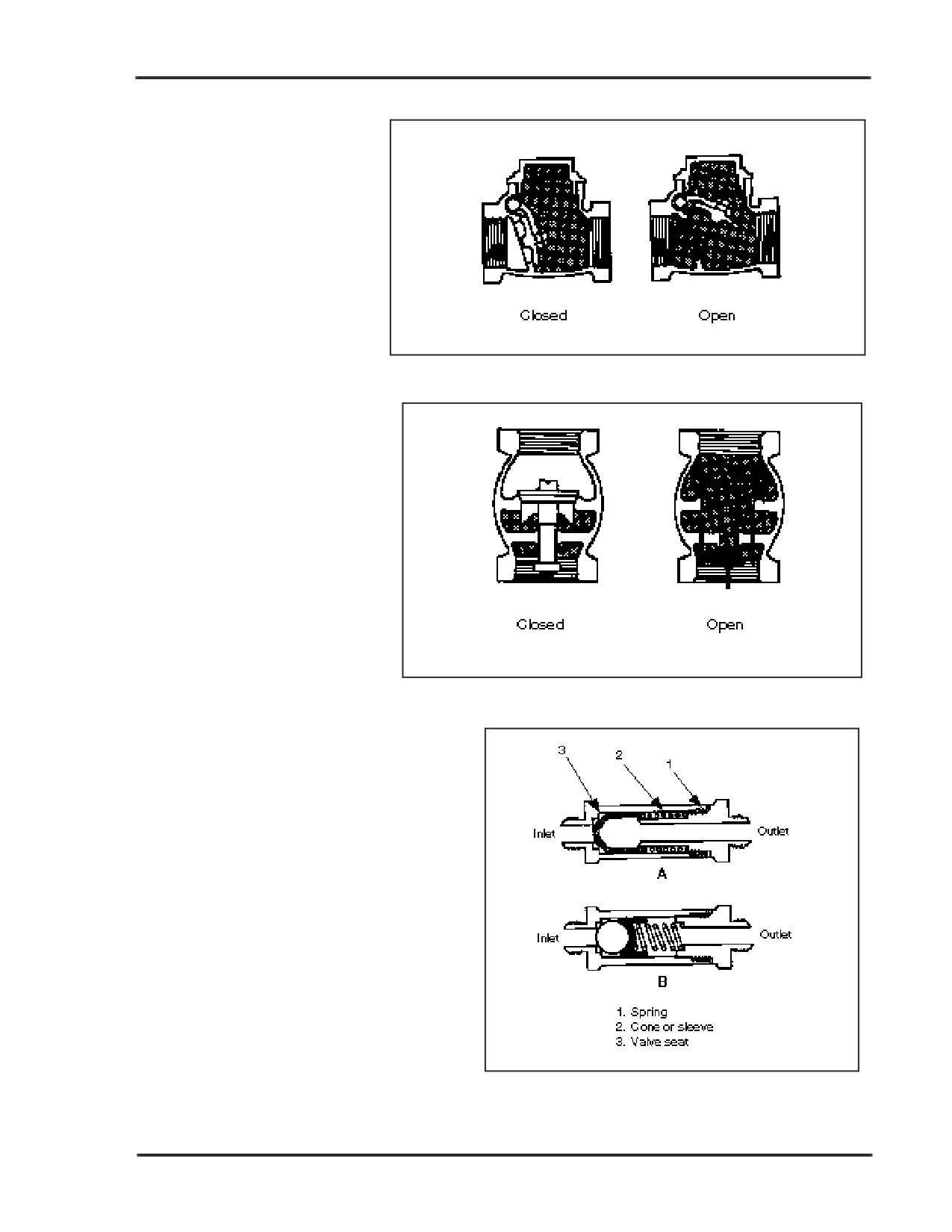
c. Check Valves. Check valves are the most commonly used in fluid-powered systems.
They allow flow in one direction and prevent flow in the other direction. They may be
installed independently in a line, or they may be incorporated as an integral part of a
sequence, counterbalance, or pressure-reducing valve. The valve element may be a sleeve,
cone, ball, poppet, piston, spool, or disc. Force of the moving fluid opens a check valve; back-
flow, a spring, or gravity closes the valve. Figures 5-14, 5-15 and 5-16 show various types of
check valves.
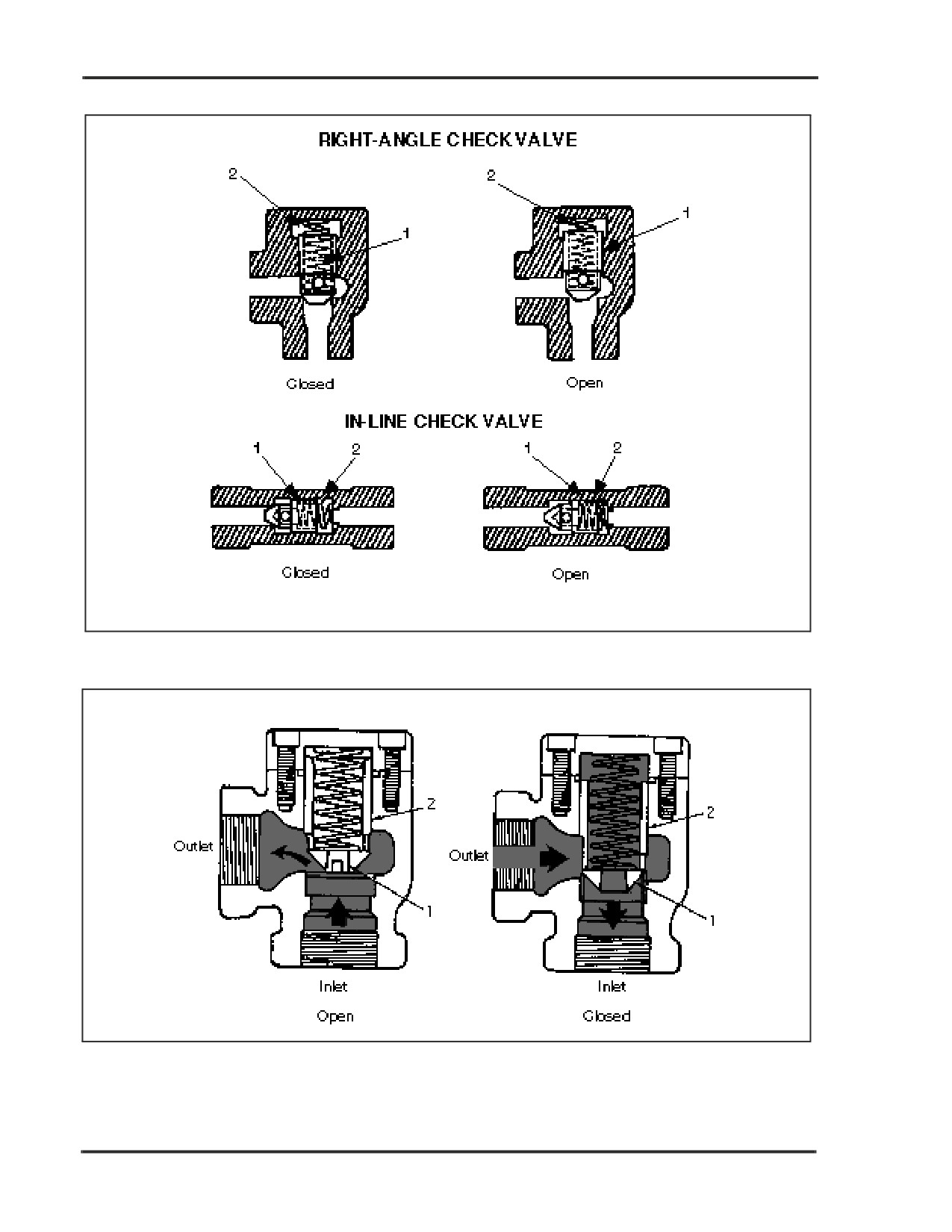
(1) Standard Type (Figure 5-17, page 5-12). This valve may be a right-angle or an in-
line type, depending on the relative location of the ports. Both types operate on the same
principle. The valve consists essentially of a poppet or ball 1 held on a seat by the force of
spring 2. Flow directed to the inlet port acts against spring 2 to unseat poppet 1 and open
the valve for through flow (see Figure 5-17, diagram B, for both valve types). Flow entering
the valve through the outlet port combines with spring action to hold poppet 1 on its seat to
check reverse flow.
These valves are available with various cracking pressures. Conventional applications
usually use the light spring because it ensures reseating the poppet regardless of the valve's
5-10
Valves
FM 5-499
mounting position. Heavy
spring units are generally used
to ensure the availability of at
least the minimum pressure
required for pilot operations.
(2) Restriction Type (Fig-
ure 5-18, page 5-12). This
valve has orifice plug 1 in the
nose of poppet 2, which makes
it different from a conven-
tional, right-angle check valve.
Flow directed to the inlet port
Figure 5-14. Swing-type check valve
opens the valve, allowing free
flow through the valve.
Reverse flow directed in through
the outlet port seats poppet 2.
Flow is restricted to the amount
of oil, which can be altered, to
allow a suitable bleed when the
poppet is closed. Uses of a
restriction check valve can be to
control the lowering speed of a
down-moving piston and the
rate of decompression in large
presses.
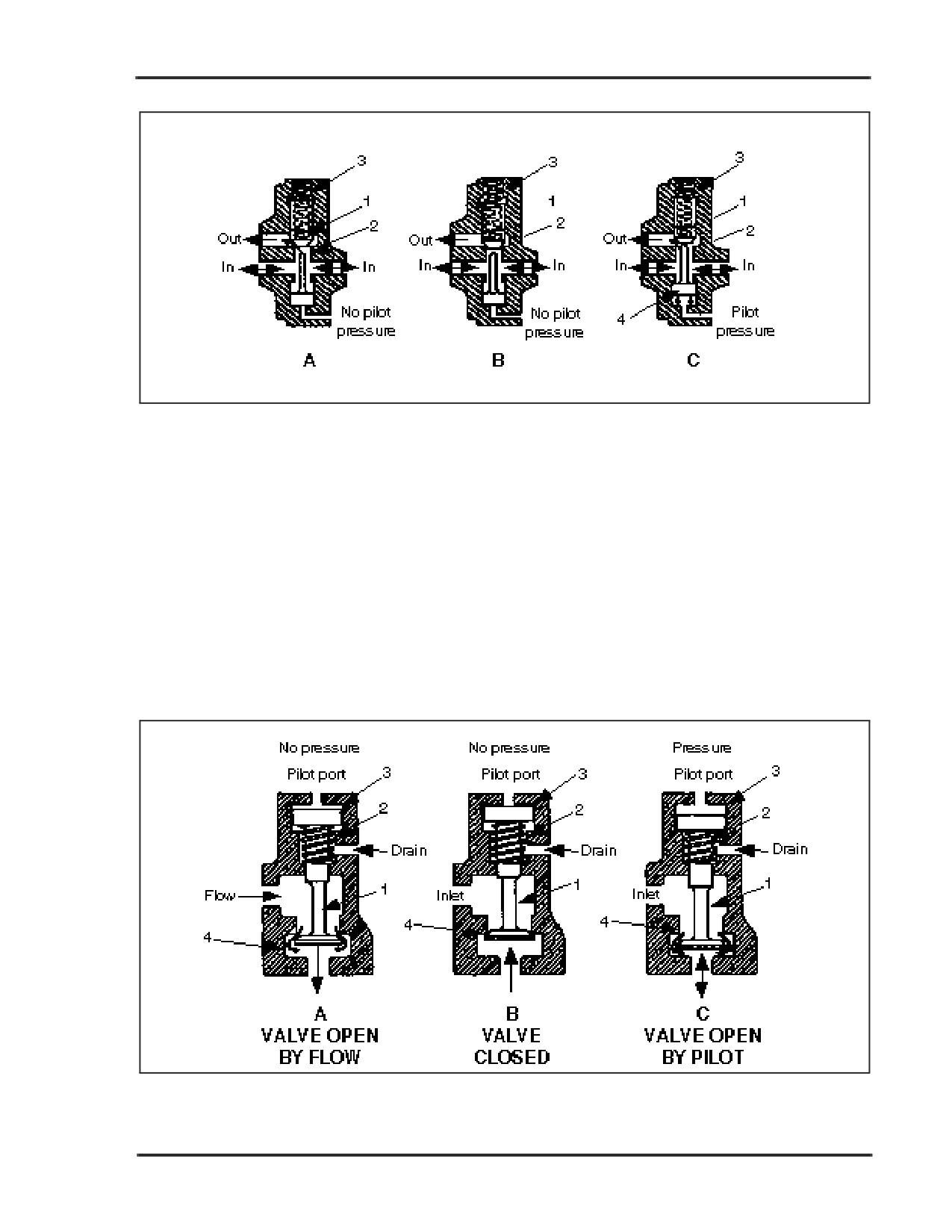
(3) Pilot-Operated Type
(Figure 5-19, page 5-13). In dia-
gram A, the valve has poppet 1
Figure 5-15. Vertical check valve
seated on stationary sleeve 2 by
spring 3. This valve opens the same as a
conventional check valve. Pressure at the
inlet ports must be sufficient to overcome
the combined forces of any pressure at the
outlet port and the light thrust of spring 3
so that poppet 1 raises and allows flow
from the inlet ports through the outlet
port. In this situation, there is no pressure
required at the pilot port.
In diagram B, the valve is closed to
prevent reverse flow. Pressure at the out-
let port and the thrust of spring 3 hold pop-
pet 1 on its seat to block the flow. In this
case, the pilot port has no pressure.
In diagram C, pressure applied at the
pilot port is sufficient to overcome the
thrust of spring 3. The net forces exerted
Figure 5-16. Spring-loaded check valve
Valves
5-11
FM 5-499
B
A
Figure 5-17. Standard check valve
Figure 5-18. Restriction check valve
5-12
Valves
FM 5-499
Figure 5-19. Pilot-operated check valve
by pressures at the other ports raise piston 4 to unseat poppet 1 and allow controlled flow
from the outlet to the inlet ports. With no pressure at the inlet ports, pilot pressure must
exceed 40 percent of that imposed at outlet to open the poppet.
Figure 5-20 shows another pilot-operated check valve. This valve consists of poppet 1
secured to piston 3. Poppet 1 is held against seat 4 by the action of spring 2 on piston 3. In
diagram A, the valve is in the free-flow position. Pressure at the inlet port, acting downward
against poppet 1, is sufficient to overcome the combined forces of spring 2 against piston 3
and the pressure, if any, at the outlet port. (The pressure at the outlet port is exerted over a
greater effective area than that at the inlet because of the poppet stem.) The drain post is
open to the tank, and there is no pressure at the pilot port. Diagram B shows the valve in a
position to prevent reverse flow, with no pressure at the pilot port and the drain opening to
the tank.
Figure 5-20. Pilot-operated check valve, second type
Valves
5-13
FM 5-499
Diagram C shows the pilot operation of the valve. When sufficient pressure is applied at
the pilot port to overcome the thrust of spring 2 plus the net effect of pressure at the other
ports, poppet 1 is unseated to allow reverse flow. Pilot pressure must be equal to about 80
percent of that imposed at the outlet port to open the valve and allow reverse flow.
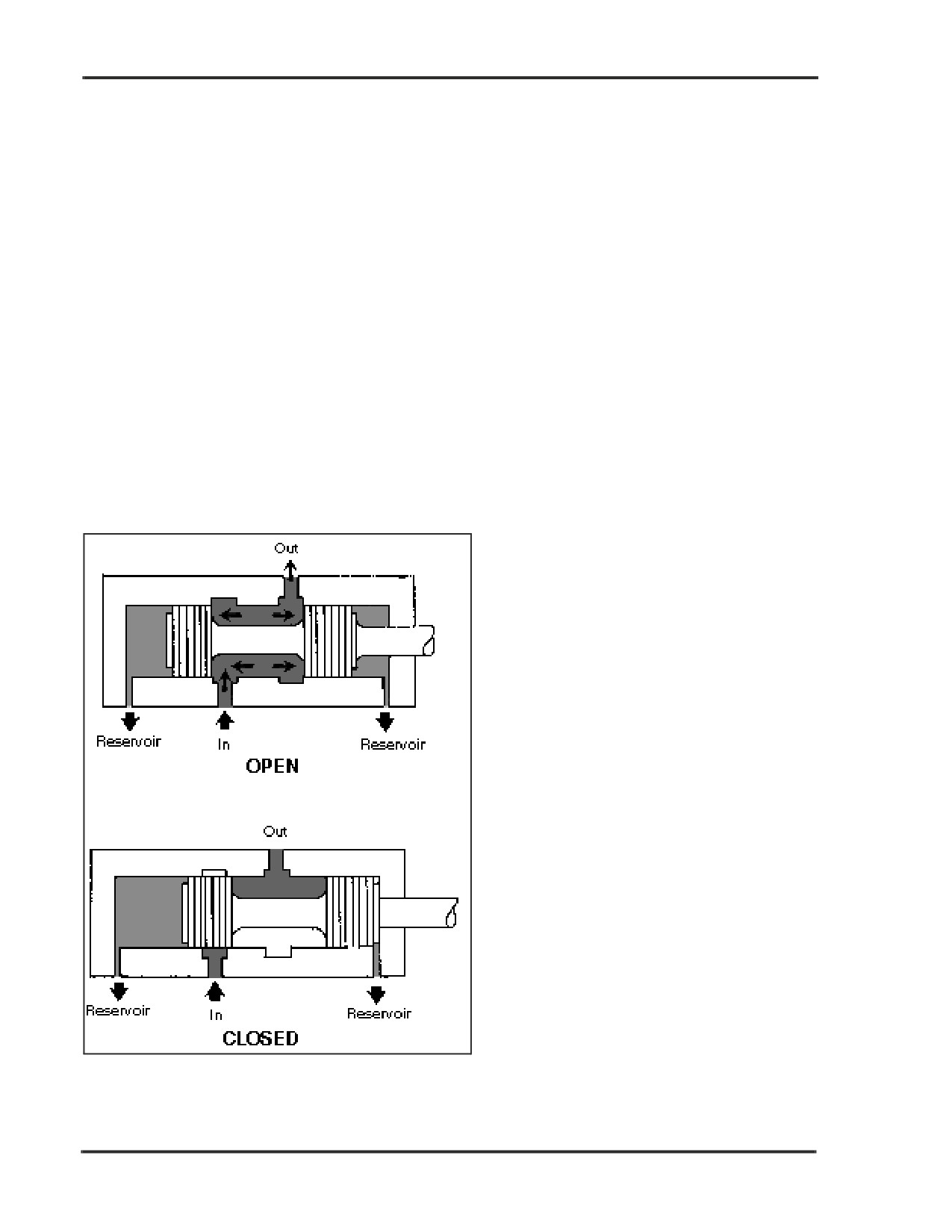
d. Two-Way Valve. A two-way valve is generally used to control the direction of fluid
flow in a hydraulic circuit and is a sliding-spool type. Figure 5-21 shows a two-way, sliding-
spool, directional-control valve. As the spool moves back and forth, it either allows or pre-
vents fluid flow through the valve. In either shifted position in a two-way valve, a pressure
port is open to one cylinder port, but the opposite cylinder port is not open to a tank. A tank
port on this valve is used primarily for draining.
e. Four-Way Valves. Four-way, directional-control valves are used to control the direc-
tion of fluid flow in a hydraulic circuit, which controls the direction of movement of a work
cylinder or the rotation of a fluid motor. These valves are usually the sliding-spool type. A
typical four-way, directional-control valve has four ports:
•
One pressure port is connected to a pressure line.
•
One return or exhaust port is connected to a reservoir.
•
Two working ports are connected, by lines, to an actuating unit.
Four-way valves consist of a rectan-
gular cast body, a sliding spool, and a way
to position a spool. A spool is precision-
fitted to a bore through the longitudinal
axis of a valve’s body. The lands of a spool
divide this bore into a series of separate
chambers. Ports in a valve’s body lead
into a chamber so that a spool's position
determines which ports are open to each
other and which ones are sealed off from
each other. Ports that are sealed off from
each other in one position may be inter-
connected in another position. Spool posi-
tioning is accomplished manually,
mechanically, electrically, or hydrauli-
cally or by combing any of the four.
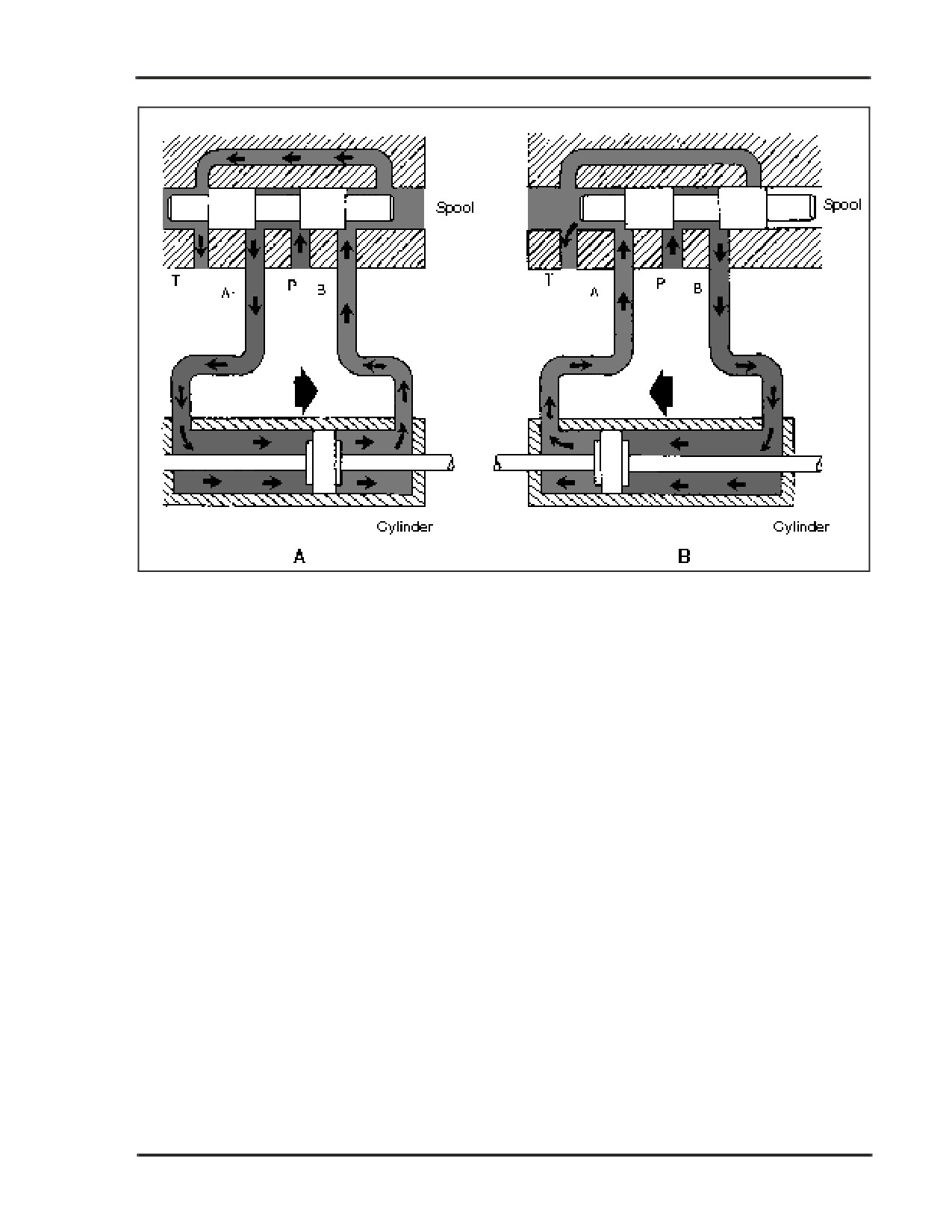
Figure 5-22 shows how the spool posi-
tion determines the possible flow condi-
tions in the circuit. The four ports are
marked P, T, A, and B: P is connected to
the flow source; T to the tank; and A and
B to the respective ports of the work cylin-
der, hydraulic motor, or some other valve
in the circuit. In diagram A, the spool is
in such a position that port P is open to
port A, and port B is open to port T. Ports
Figure 5-21. Two-way valve
A and B are connected to the ports of the
cylinder, flow through port P, and cause
5-14
Valves
FM 5-499
Figure 5-22. Flow conditions in a circuit
the piston of the cylinder to move to the right. Return flow from the cylinder passes through
ports B and T. In diagram B, port P is open to port B, and the piston moves to the left.
Return flow from the cylinder passes through ports A and T.
Table 5-1, page 5-16, lists some of the classifications of directional-control valves. These
valves could be identified according to the—
• Number of spool positions.
• Number of flow paths in the extreme positions.
• Flow pattern in the center or crossover position.
• Method of shifting a spool.
• Method of providing spool return.
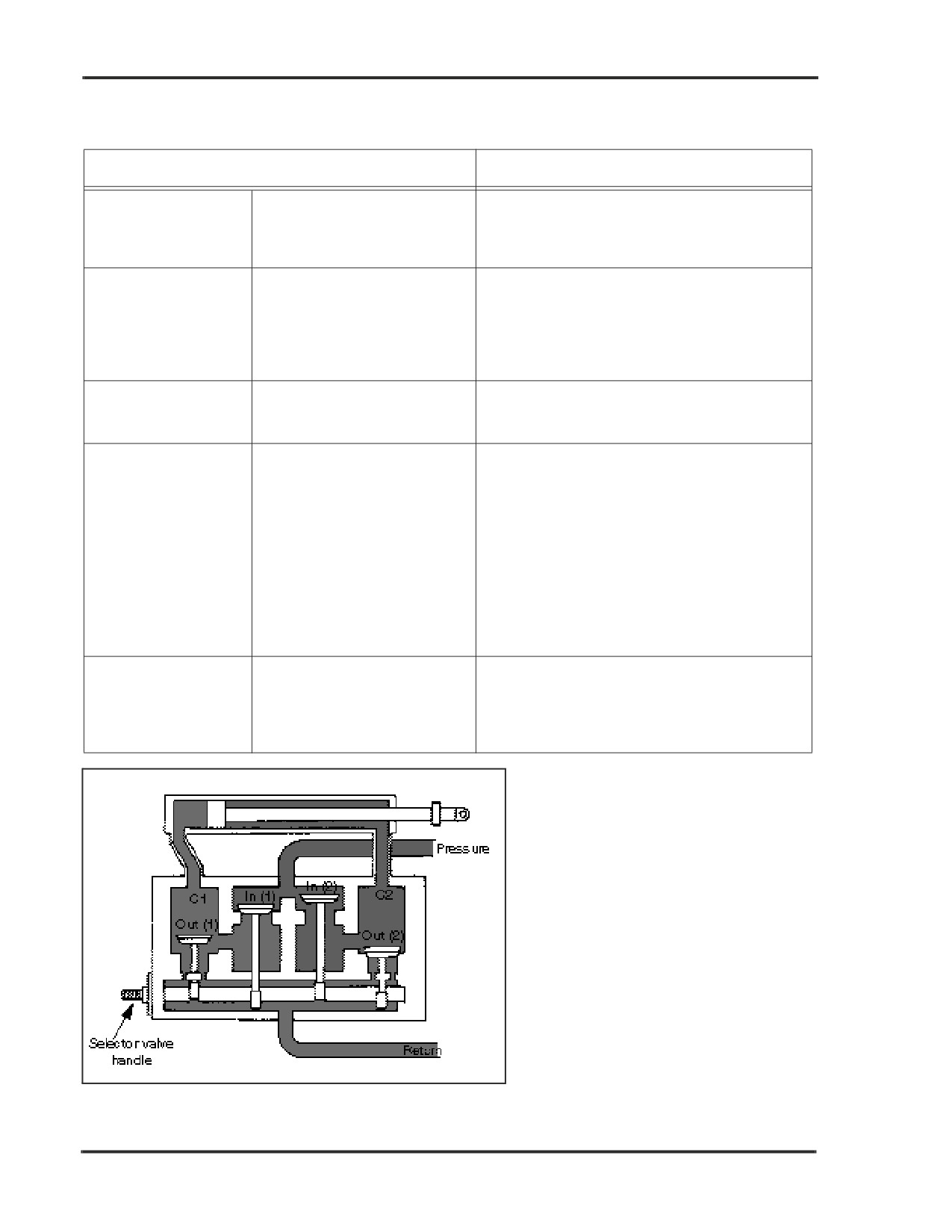
(1) Poppet-Type Valve. Figure 5-23, page 5-16, shows a typical four-way, poppet-type,
directional-control valve. It is a manually operated valve and consists of a group of conven-
tional spring-loaded poppets. The poppets are enclosed in a common housing and are inter-
connected by ducts so as to direct the fluid flow in the desired direction.
The poppets are actuated by cams on the camshaft. They are arranged so that the
shaft, which is rotated by its controlling lever, will open the correct poppet combinations to
direct the fluid flow through the desired line to the actuating unit. At the same time, fluid
will be directed from the opposite line of the actuating unit through the valve and back to the
reservoir or exhausted to the atmosphere.
Valves
5-15
FM 5-499
Table 5-1. Classifications of directional-control valves
Classification
Description
Path-of-flow type
Two way
Allows a total of two possible flow paths in two
extreme spool positions
Four way
Allows a total of four possible flow paths in two
extreme spool positions
Control type
Manual operated
Hand lever is used to shift the spool.
Pilot operated
Hydraulic pressure is used to shift the spool.
Solenoid action is used to shift the spool.
Solenoid operated
Solenoid action is used to shift the integral pilot
Solenoid controlled, pilot oper-
spool, which directs the pilot flow to shift the main
ated
spool.
Position type
Two position
Spool has two extreme positions of dwell.
Spool has two extreme positions plus one interme-
Three position
diate or center position.
Spring type
Spring offset
Spring action automatically returns the spool to the
normal offset position as soon as shifter force is
released.
(Spring offset is always a two-way
No spring
valve.)
Spool is not spring-loaded; it is moved only by
shifter force, and it remains where it is shifted (may
be two- or three-position type, but three-position
Spring centered
type uses detent).
Spring action automatically returns the spool to the
center position as soon as the shifter force is
released.
(Spring-centered is always a three-
position valve.)
Spool type
Open center
These are five of the more common spool types.
Closed center
They refer to the flow pattern allowed when the
Tandem center
spool is in the center position (three-position
Partially closed center
valves) or in the cross-over position (two-position
Semi-open center
valves).
Springs hold the poppets to their
seats. A camshaft unseats them to
allow fluid flow through the valve.
The camshaft is controlled by moving
the handle. The valve is operated by
moving the handle manually or by
connecting the handle, by mechanical
linkage, to a control handle. On the
camshaft are three O-ring packings
to prevent internal and external leak-
age. The camshaft has two lobes
(raised portions). The contour
(shape) of these lobes is such that
when the shaft is placed in the neu-
tral position, the lobes will not touch
any of the poppets.
Figure 5-23. Working view of poppet-type, four-
way valve
5-16
Valves
FM 5-499
One cam lobe operates the two pressure poppets; the other lobe operates the two return/
exhaust poppets. To stop the rotating camshaft at the exact position, a stop pin is secured to
the body and extended through a cutout section of the camshaft flange. This stop pin pre-
vents overtravel by ensuring that the cam lobes stop rotating when the poppets have
unseated as high as they can go.
Figure 5-23 shows a working view of a poppet-type, four-way valve. The camshaft
rotates by moving the control handle in either direction from neutral. The lobes rotate,
unseating one pressure poppet and one return/exhaust poppet. The valve is now in a work-
ing position. Pressure fluid, entering the pressure port, travels through the vertical fluid
passages in both pressure poppet seats. Since only one pressure poppet is unseated by the
cam lobe, the fluid flows past the open poppet to the inside of the poppet seat. It then flows
out one working port and to the actuating unit. Return fluid from the actuating unit enters
the other working port. It then flows through the diagonal fluid passages, past the unseated
return poppet, through the vertical fluid passages, and out the return/exhaust port. By
rotating the camshaft in the opposite direction until the stop pin hits, the opposite pressure
and return poppets are unseated, and the fluid flow is reversed. This causes the actuating
unit to move in the opposite direction.
(2) Sliding-Spool Valve. The four-way, sliding-spool, directional-control valve is simple
in operation principle and is probably the most durable and trouble free of all four-way,
directional-control valves in current use. Figure 5-24 shows a typical four-way, sliding-
spool, directional-control valve. The valve body contains four fluid ports: pressure, return/
exhaust, and two working ports (referred to as cylinder ports). A hollow steel sleeve fits into
the main bore of the body. Around the outside diameter of the sleeve are O-ring gaskets.
These O-rings form a seal between the sleeve and the body.
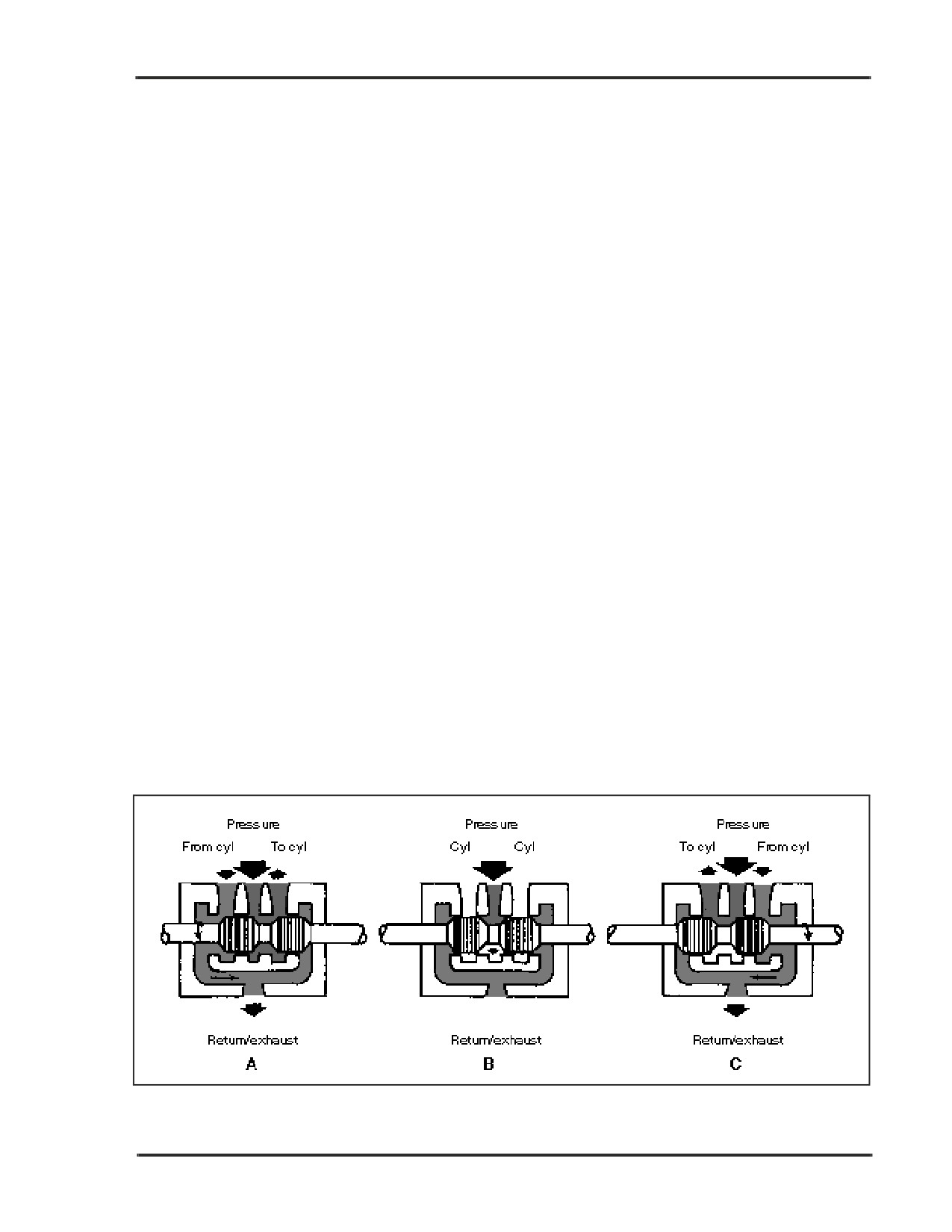
In Figure 5-24, diagram A, the valve is at the far right in its cylinder. Liquid from the
pump flows to the right end of the cylinder port, while liquid from the left end returns to the
reservoir. In diagram C, the situation is reverse. The piston is to the far left in its cylinder.
Liquid from the pump flows to the left end of the cylinder port, while liquid from the right
end returns to the reservoir. In diagram B, the piston is in an intermediate position. Flow
through the valve from the pump is shut off, and both ends of the cylinder can drain to the
Figure 5-24. Schematic of a four-way, directional-control, sliding-spool valve
Valves
5-17
FM 5-499
reservoir unless other valves are set to control the flow.
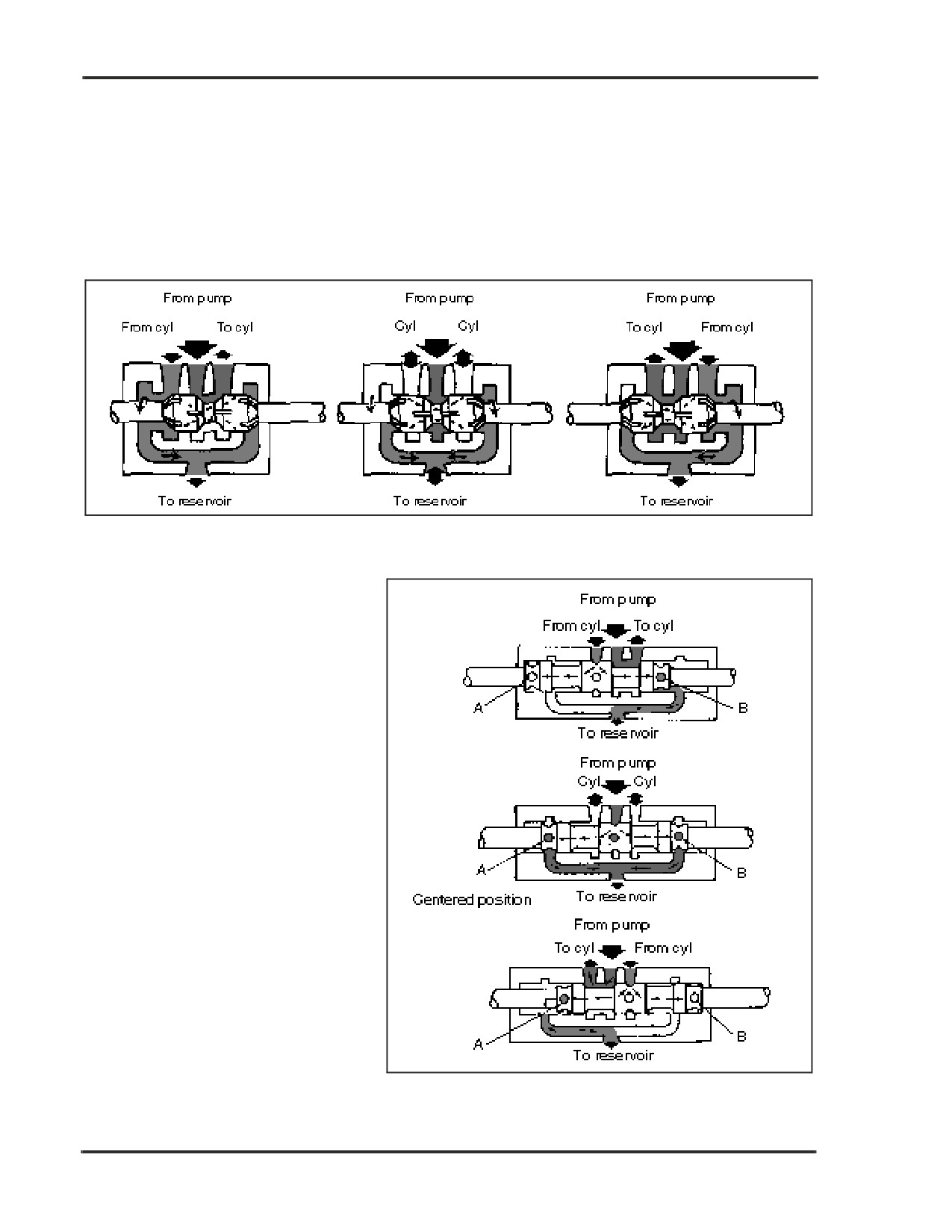
In a closed-center spool valve, a piston is solid, and all passages through a valve are blocked
when a piston is centered in its cylinder (see Figure 5-24, diagram B). A closed-center valve
is used when a single pump or an accumulator performs more than one operation and where
there must be no pressure loss in shifting a stroke direction at a work point.
In an open-center spool valve, the spools on a piston are slotted or channeled so that all
Figure 5-25. Closed-center spool valve
passages are open to each other
when a piston is centered (see Figure
5-25). In some open-center valves,
passages to a cylinder port are
blocked when a valve is centered and
liquid from a pump is carried
through a piston and out the other
side of a valve to a reservoir (see Fig-
ure 5-26). Liquid must be carried to
both ends of a piston of a directional
valve to keep it balanced. Instead of
discharging into a reservoir when a
valve is centered, liquid may be
directed to other valves so that a set
of operations is performed in
sequence.
Open-center valves are used
when a work cylinder does not have
to be held in position by pressure and
where power is used to perform a sin-
gle operation. These valves also
avoid shock to a system when a valve
spool is moved from one position to
another, since in the intermediate
Figure 5-26. Open-center spool valve
5-18
Valves
FM 5-499
position, pressure is temporarily relieved by liquid passing from a pump directly to the res-
ervoir.
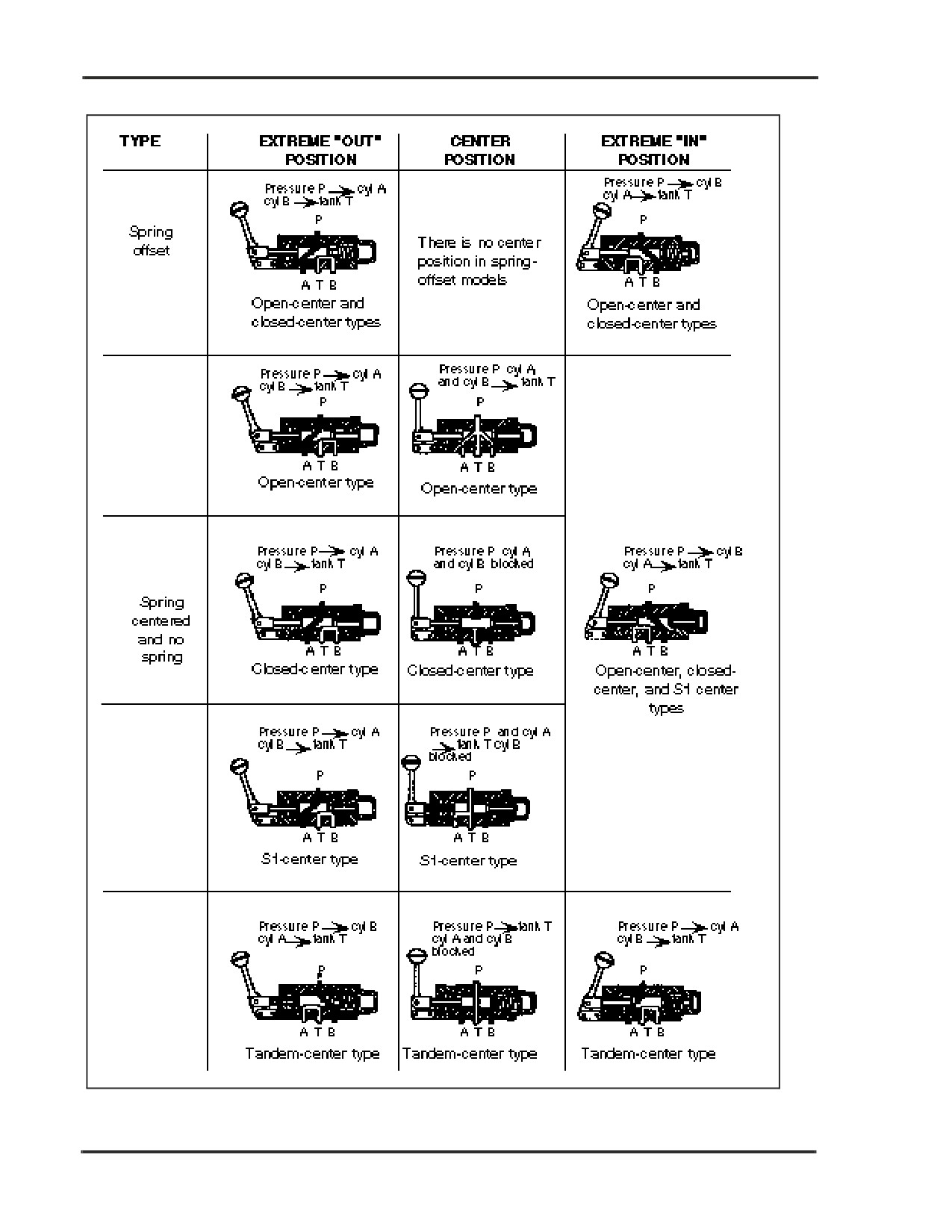
(3). Manually Operated Four-Way Valve. This valve is used to control the flow direction
manually. A spool is shifted by operating a hand lever (Figure 5-27, page 5-20). In a spring-
offset model, a spool is normally in an extreme out position and is shifted to an extreme in
position by moving a lever toward a valve. Spring action automatically returns both spool
and lever to the normal out position when a lever is released. In a two-position, no-spring
model, a spool is shifted back to its original position. (Figure 5-27 does not show this valve.)
In a three-position no-spring model, a detent (a devise which locks the movement) retains a
spool in any one of the three selected positions after lever force is released. In a three-posi-
tion, spring-centered model, a lever is used to shift a spool to either extreme position away
from the center. Spring action automatically returns a spool to the center position when a
lever is released.
(4) Pilot-Operated, Four-Way Valve. This type of valve is used to control the flow direc-
tion by using a pilot pressure. Figure 5-28, page 5-21, shows two units in which the spool is
shifted by applying the pilot pressure at either end of the spool. In the spring-offset model,
the spool is held in its normal offset position by spring thrust and shifted to its other position
by applying pilot pressure to the free end of the spool. Removing pilot pressure shifts the
spool back to its normal offset position. A detent does not hold this valve, so pilot pressure
should be maintained as long as the valve is in the shifted position.
(5) Solenoid-Operated, Two- and Four-Way Valves. These valves are used to control the
direction of hydraulic flow by electrical means. A spool is shifted by energizing a solenoid
that is located at one or both ends of the spool. When a solenoid is energized, it forces a push
rod against the end of a spool. A spool shifts away from the solenoid and toward the opposite
end of the valve body (see Figure 5-29, page 5-21). In a spring-offset model, a single solenoid
shifts a spring-loaded spool. When a solenoid is deenergized, a spring returns a spool to its
original position.
5-3. Flow-Control Valves. Flow-control valves are used to control an actuator’s speed by
metering flow. Metering is measuring or regulating the flow rate to or from an actuator. A
water faucet is an example of a flow-control valve. Flow rate varies as a faucet handle is
turned clockwise or counterclockwise. In a closed position, flow stops. Many flow-control
valves used in fluid-powered systems are similar in design and operation to a water faucet’s.
In hydraulic circuits, flow-control valves are generally used to control the speed of
hydraulic motors and work spindles and the travel rates of tool heads or slides. Flow-control
valves incorporate an integral pressure compensator, which causes the flow rate to remain
substantially uniform regardless of changes in workload. A nonpressure, compensated flow
control, such as a needle valve or fixed restriction, allows changes in the flow rate when
pressure drop through it changes.
Variations of the basic flow-control valves are the flow-control-and-check valves and the
flow-control-and-overload relief valves. Models in the flow-control-and-check-valve series
incorporate an integral check valve to allow reverse free flow. Models in the flow-control-
and-overload-relief-valve series incorporate an integral relief valve to limit system pressure.
Some of these valves are gasket-mounted, and some are panel-mounted.
Valves
5-19
FM 5-499
Figure 5-27. Shifting spool by hand lever
5-20
Valves