FM 5-499 Hydraulics (August 1997) - page 1
FM 5-499
FM 5-499
Field Manual
Headquarters
No. 5-499
Department of the Army
Washington,DC, 1August1997
Hydraulics
Table of Contents
Page
LIST OF FIGURES AND TABLES
vii
Figures
vii
Tables
xiii
PREFACE
xiv
CHAPTER 1. Hydraulic Basics
1-1
1-1. Pressure and Force
1-1
Pressure
1-1
Force
1-3
1-2. Pascal’s Law
1-4
1-3. Flow
1-6
Velocity
1-6
Flow Rate
1-6
1-4. Energy, Work, and Power
1-6
Potential Energy
1-6
Kinetic Energy
1-6
Heat Energy and Friction
1-6
Relationship Between Velocity and Pressure
1-7
Work
1-8
Power
1-8
CHAPTER 2. Hydraulic Systems
2-1
2-1. Basic Systems
2-1
Hydraulic Jack
2-1
Motor-Reversing System
2-1
Open-Center System
2-2
Closed-Center System
2-5
DISTRIBUTION RESTRICTION: Approved for public release; distribution is unlimited.
i
FM 5-499
Page
2-2.
Color Coding
2-9
2-3.
Reservoirs
2-9
Construction
2-9
Shape
2-10
Size
2-10
Location
2-10
Ventilation and Pressurization
2-11
Line Connections
2-11
Maintenance
2-11
2-4.
Strainers and Filters
2-11
Strainers
2-12
Filters
2-12
2-5.
Filtering Material and Elements
2-14
2-6.
Accumulators
2-14
Spring-Loaded Accumulator
2-14
Bag-Type Accumulator
2-15
Piston-Type Accumulator
2-15
Maintenance
2-15
2-7.
Pressure Gauges and Volume Meters
2-17
Pressure Gauges
2-17
Meters
2-17
2-8.
Portable Hydraulic-Circuit Testers
2-18
Testers
2-18
Improper Operation
2-18
2-9.
Circulatory Systems
2-18
Tubing
2-19
Piping
2-19
Flexible Hosing
2-19
Installation
2-21
2-10. Fittings and Connectors
2-21
Threaded Connectors
2-21
Flared Connectors
2-23
Flexible-Hose Couplings
2-25
Reusable Fittings
2-25
2-11. Leakage
2-29
Internal
2-29
External
2-30
Prevention
2-30
2-12. Seals
2-30
Static Seals
2-31
Dynamic Seals
2-31
Packing
2-33
Seal Materials
2-34
ii
FM 5-499
Page
CHAPTER 3. Pumps
3-1
3-1.
Pump Classifications
3-1
Nonpositive-Displacement Pumps
3-1
Positive-Displacement Pumps
3-1
Characteristics
3-2
3-2.
Performance
3-2
3-3.
Displacement
3-2
Fixed-Displacement Pump
3-3
Variable-Displacement Pump
3-3
3-4.
Slippage
3-3
3-5.
Designs
3-3
Centrifugal Pump
3-3
Rotary Pump
3-4
Reciprocating Pump
3-4
3-6.
Gear Pumps
3-4
External
3-4
Internal
3-5
Lobe Pump
3-6
3-7.
Vane Pumps
3-6
Characteristics
3-6
Unbalanced Vane Pumps
3-6
Balanced Vane Pumps
3-7
Double Pumps
3-7
Two-Stage Pumps
3-9
3-8.
Piston Pumps
3-10
Radial
3-10
Axial Piston Pumps
3-11
3-9.
Pump Operation
3-14
Overloading
3-14
Excess Speed
3-14
Cavitation
3-14
Operating Problems
3-15
CHAPTER 4. Hydraulic Actuators
4-1
4-1. Cylinders
4-1
Single-Acting Cylinder
4-1
Double-Acting Cylinder
4-1
Differential Cylinder
4-1
Nondifferential Cylinder
4-2
Ram-Type Cylinder
4-2
Piston-Type Cylinder
4-3
Cushioned Cylinder
4-4
Lockout Cylinders
4-4
4.2
Construction and Application
4-4
iii
FM 5-499
Page
4-3. Maintenance
4-5
External Leakage
4-5
Internal Leakage
4-5
Creeping Cylinder
4-5
Sluggish Operation
4-5
Loose Mounting
4-5
Misalignment
4-5
Lack of Lubrication
4-7
Abrasives on a Piston Rod
4-7
Burrs on a Piston Rod
4-7
Air Vents
4-7
4-4. Hydraulic Motors
4-7
Gear-Type Motors
4-8
Vane-Type Motors
4-8
Piston-Type Motors
4-10
CHAPTER 5. Valves
5-1
5-1.
Pressure-Control Valves
5-1
Relief Valves
5-2
Pressure-Reducing Valves
5-3
Sequence Valves
5-5
Counterbalance Valves
5-7
Pressure Switches
5-8
5-2.
Directional-Control Valves
5-8
Poppet Valve
5-9
Sliding-Spool Valve
5-10
Check Valves
5-10
Two-Way Valve
5-14
Four-Way Valves
5-14
5-3.
Flow-Control Valves
5-19
Gate Valve
5-19
Globe Valve
5-21
Needle Valve
5-22
Restrictor
5-22
Orifice Check Valve
5-23
Flow Equalizer
5-23
5-4.
Valve Installation
5-25
Meter-In Circuit
5-25
Meter-Out Circuit
5-25
Bleed-Off Circuit
5-26
Compensated Flow
5-26
5-5.
Valve Failures and Remedies
5-26
Servicing Valves
5-27
Disassembling Valves
5-27
Repairing Valves
5-28
iv
FM 5-499
Page
5-6. Valve Assembly
5-29
5-7. Troubleshooting Valves
5-30
Pressure-Control Valves
5-30
Directional-Control Valves
5-32
Volume-Control Valves
5-33
CHAPTER 6. Circuit Diagrams and Troubleshooting
6-1
6-1.
Hydraulic-Circuit Diagrams
6-1
6-2.
United States of American Standards Institute (USASI) Graphical
6-1
Symbols
Reservoir
6-4
Lines
6-4
Pump
6-4
Motor
6-5
Cylinder
6-5
Pressure-Control Valves
6-5
Flow-Control Valves
6-7
Directional-Control Valves
6-7
Accessories
6-9
6-3.
Typical Mobile Circuits
6-11
Hydraulic-Lift Circuit
6-11
Power-Steering Circuits
6-12
Road-Patrol-Truck Circuits
6-12
6-4.
Troubleshooting
6-13
Causes of Improper Operations
6-13
Testing a Hydraulic Circuit
6-13
Comparing Test Results with Specifications
6-13
Slippage
6-15
Flow and Pressure
6-15
Other Conditions
6-15
Specific Troubles, Causes, and Solutions
6-16
CHAPTER 7. Electrical Devices: Troubleshooting and Safety
7-1
7-1. Hydraulics and Electricity
7-1
7-2. Troubleshooting Electrical Devices
7-1
Procedure
7-5
Testing Devices
7-6
7-3. Ground
7-8
Earth Ground
7-8
Chassis or Common Ground
7-9
Zero Reference Point
7-9
Isolation Between Earth and Chassis Ground
7-10
7-4. Safety
7-10
Information
7-10
Practices
7-11
v
FM 5-499
Page
APPENDIX A. Metric Conversion Chart
Appendix-1
GLOSSARY
Glossary-1
REFERENCES
References-1
INDEX
Index-1
vi
FM 5-499
List of Figures and Tables
Figures
Page
Figure 1-1. Basic hydraulic device
1-1
Figure 1-2. Compressibility
1-2
Figure 1-3. Water column
1-3
Figure 1-4. Pump pressure
1-4
Figure 1-5. Interaction of hydraulic and atmospheric pressures
1-4
Figure 1-6. Force, pressure, and area
1-5
Figure 1-7. Pascal’s Law apparatus
1-5
Figure 1-8. Laminar and turbulent flow
1-7
Figure 1-9. Effect of friction on pressure
1-7
Figure 1-10. Bernouilli’s Principle
1-8
Figure 1-11. Combined effects of friction and velocity changes
1-9
Figure 2-1. Hydraulic jack
2-2
Figure 2-2. Motor-reversing system
2-3
Figure 2-3. Open-center system
2-4
Figure 2-4. Open-center system with a series connection
2-4
Figure 2-5. Open-center system with a series/parallel connection
2-5
Figure 2-6. Open-center system with a flow divider
2-6
Figure 2-7. Closed-center system
2-6
Figure 2-8. Fixed-displacement pump and accumulator
2-7
Figure 2-9. Variable-displacement pump
2-8
Figure 2-10. Closed-center system with charging pump
2-8
Figure 2-11. Design features of a reservoir
2-10
Figure 2-12. Hydraulic-system stainers
2-12
Figure 2-13. Full-flow hydraulic filter
2-13
vii
FM 5-499
Page
Figure
2-14.
Proportional-flow filter
2-13
Figure
2-15.
Spring-loaded accumulator
2-15
Figure
2-16.
Bag-type accumulator
2-16
Figure
2-17.
Piston-type accumulator
2-16
Figure
2-18.
Pressure gauge
2-17
Figure
2-19.
Nutating-piston-disc flowmeter
2-17
Figure
2-20.
Portable hydraulic-circuit tester
2-18
Figure
2-21.
Method of installing tubing
2-19
Figure
2-22.
Flexible rubber hose
2-20
Figure
2-23.
Installing flexible hose
2-20
Figure
2-24.
Threaded-pipe connectors
2-22
Figure
2-25.
Flared-tube connector
2-23
Figure
2-26.
Flared-tube fittings
2-24
Figure
2-27.
Field-attachable couplings
2-25
Figure
2-28.
Hose-length measurement
2-25
Figure
2-29.
Hose cutting
2-25
Figure
2-30.
Permanently attached couplings
2-26
Figure
2-31.
Skived fitting
2-26
Figure
2-32.
Trimming a hose
2-27
Figure
2-33.
Female portion of a fitting
2-27
Figure
2-34.
Male and female portions of a fitting
2-28
Figure
2-35.
Tightening a fitting
2-28
Figure
2-36.
Nonskived fitting
2-28
Figure
2-37.
Fittings
2-28
Figure
2-38.
Assembly of clamp-type coupling
2-29
Figure
2-39.
Static seals
2-31
Figure
2-40.
O-ring placement
2-31
Figure
2-41.
O-ring removal tool
2-32
Figure
2-42.
Backup ring
2-32
Figure
2-43.
T-ring seal
2-33
Figure
2-44.
Lip seal
2-33
viii
FM 5-499
Page
Figure 2-45. Cup seal
2-33
Figure 2-46. Piston ring
2-33
Figure 2-47. Face seal
2-34
Figure 2-48. Compression packing
2-34
Figure
3-1.
Nonpositive-displacement pump
3-1
Figure
3-2.
Reciprocating-type, positive-displacement pump
3-2
Figure
3-3.
Positive-displacement pump
3-2
Figure
3-4.
Volute pump
3-4
Figure
3-5.
Diffuser pump
3-4
Figure
3-6.
External gear pump
3-5
Figure
3-7.
Internal gear pump
3-5
Figure
3-8.
Lobe pump
3-6
Figure
3-9.
Unbalanced vane pump
3-7
Figure
3-10.
Balanced vane pump
3-7
Figure
3-11.
Vane-type double pump
3-8
Figure
3-12.
Fluid flow from vane-type double pumps
3-8
Figure
3-13.
Vane-type, two-stage pump
3-9
Figure
3-14.
Simplified radial piston pump
3-10
Figure
3-15.
Nine-piston radial piston pump
3-11
Figure
3-16.
Pintle for a radial piston pump
3-11
Figure
3-17.
Cylinder block for a radial piston pump
3-12
Figure
3-18.
Pistons for a radial piston pump
. 3-12
Figure
3-19.
In-line piston pump
3-13
Figure
3-20.
Bent-axial piston pump
3-14
Figure 4-1. Single-acting cylinder
4-1
Figure 4-2. Double-acting cylinder
4-2
Figure 4-3. Nondifferential cylinder
4-2
Figure 4-4. Telescoping, ram-type, actuating cylinder
4-3
Figure 4-5. Single-acting, spring-loaded, piston-type cylinder
4-3
ix
FM 5-499
Page
Figure 4-6. Double-acting, piston-type cylinder
4-4
Figure 4-7. Cushioned, actuating cylinder
4-4
Figure 4-8. Applications of cylinders
4-6
Figure 4-9. Basic operations of a hydraulic motor
4-7
Figure 4-10. Gear-type motor
4-8
Figure 4-11. Vane-type motor
4-8
Figure 4-12. Pressure differential on a vane-type motor
4-9
Figure 4-13. Flow condition in a vane-type pump
4-9
Figure 4-14. Rocker arms pushing vanes in a pump
4-10
Figure 4-15. In-line-axis, piston-type motor
4-10
Figure 4-16. Swash plate
4-11
Figure 4-17. Bent-axis, piston-type motor
4-11
Figure
5-1.
Valves
5-1
Figure
5-2.
Simple relief valve
5-2
Figure
5-3.
Compound relief valve
5-3
Figure
5-4.
Pressure-reducing valve
5-3
Figure
5-5.
X-series, pressure-reducing valve
5-4
Figure
5-6.
Internal construction of an XC-series valve
5-5
Figure
5-7.
Sequence valve
5-6
Figure
5-8.
Application of sequence valve
5-6
Figure
5-9.
Counterbalance valve
5-7
Figure
5-10.
Pressure switch
5-8
Figure
5-11.
Spool valve
5-9
Figure
5-12.
Operation of a simple poppet valve
5-10
Figure
5-13.
Operation of sliding-spool, directional-control valve
5-10
Figure
5-14.
Swing-type check valve
5-11
Figure
5-15.
Vertical check valve
5-11
Figure
5-16.
Spring-loaded check valve
5-11
Figure
5-17.
Standard check valve
5-12
Figure
5-18.
Restriction check valve
5-12
x
FM 5-499
Page
Figure
5-19.
Pilot-operated check valve
5-13
Figure
5-20.
Pilot-operated check valve, second type
5-13
Figure
5-21.
Two-way valve
5-14
Figure
5-22.
Flow conditions in a circuit
5-15
Figure
5-23.
Working view of poppet-type, four-way valve
5-16
Figure
5-24.
Schematic of a four-way, directional-control, sliding-spool valve. . . 5-17
Figure
5-25.
Closed-center spool valve
5-18
Figure
5-26.
Open-center spool valve
5-18
Figure
5-27.
Shifting spool by hand lever
5-20
Figure
5-28.
Spool shifted by pilot pressure
5-21
Figure
5-29.
Solenoid-operated, sliding-spool, directional-control valve
5-21
Figure
5-30.
Cross section of a gate valve
5-22
Figure
5-31.
Operation of a globe valve
5-22
Figure
5-32.
Sectional view of a needle valve
5-22
Figure
5-33.
Fixed restrictor
5-23
Figure
5-34.
Variable restrictor
5-23
Figure
5-35.
Orifice check valve
5-23
Figure
5-36.
Flow equalizer
5-24
Figure
5-37.
Typical meter-in circuit
5-25
Figure
5-38.
Typical meter-out circuit
5-26
Figure
5-39.
Spring tester
5-28
Figure
5-40.
Valve inspection
5-29
Figure
5-41.
Volume-control valve
5-29
Figure
5-42.
Pressure-control valve
5-29
Figure
5-43.
Cartridge-type relief valve
5-30
Figure
5-44.
Readings on a cartridge-type relief valve
5-30
Figure 6-1. Graphical-circuit diagram
6-1
Figure 6-2. USASI graphical symbols
6-2
Figure 6-3. Reservoir symbols
6-4
Figure 6-4. Hydraulic line symbols
6-4
xi
FM 5-499
Page
Figure
6-5.
Crossing lines A and B
6-5
Figure
6-6.
Pump symbols
6-5
Figure
6-7.
Motor symbols
6-6
Figure
6-8.
Cylinder symbols
6-6
Figure
6-9.
Pressure-control-valve symbols
6-6
Figure
6-10.
Relief-valve symbol
6-7
Figure
6-11.
Sequence-valve symbol
6-7
Figure
6-12.
Check-valve symbol
6-8
Figure
6-13.
Counterbalance-valve symbol
6-8
Figure
6-14.
Pressure-reducing-valve symbol
6-9
Figure
6-15.
Flow-control-valve symbol
6-9
Figure
6-16.
Unloading-valve symbol
6-9
Figure
6-17.
Four-way, directional-control-valve symbol
6-10
Figure
6-18.
Mobile directional-control-valve symbol
6-10
Figure
6-19.
Fluid-conditioner symbols
6-11
Figure
6-20.
Accumulator symbol
6-11
Figure
6-21.
Hydraulic-lift circuit in neutral
6-11
Figure
6-22.
Manual-steering-gear layout
6-12
Figure
6-23.
Power-steering layout
6-12
Figure
6-24.
Semi-integral power-steering system
6-13
Figure
6-25.
Hydraulic circuit diagram for a road-patrol truck
6-14
Figure
6-26.
Hydraulic tester connected to a pump’s output
6-15
Figure 7-1. Common electrical schematic symbols
7-2
Figure 7-2. Comparison of electrical and hydraulic components
7-3
Figure 7-3. Comparison of electrical and hydraulic circuits
7-4
Figure 7-4. Schematic diagrams illustrating zero reference point
7-9
Figure 7-5. Battery installed between earth ground and chassis ground
7-11
xii
FM 5-499
Tables
Page
Table 2-1. Figure colors
2-9
Table 5-1. Classifications of directional-control valves
5-16
Table 6-1. Problems and solutions with pump operations
6-17
Table 6-2. Problems and solutions with actuating mechanism
6-19
Table 6-3. Problems and solutions with heating oil
6-20
Table 6-4. Problems and solutions with fluid motors
6-21
Table 6-5. Problems and solutions with accumulator operation
6-21
Table A-1. Metric conversion chart
Appendix-1
xiii
FM 5-499
Preface
This field manual (FM) serves as a guide for personnel who operate and maintain military
equipment using hydraulic-powered control systems. It includes general information cover-
ing basic hydraulics and describes the properties and characteristics of fluids and several
types of pumps, motors, valves, and controls. This manual also deals with piping, tubing,
and hoses used to convey fluid under pressure. It describes the functions and types of reser-
voirs, strainers, filters, and accumulators. It discusses the purposes and types of seals and
packings used in fluid power systems.
The contents of this manual are applicable to both nuclear and nonnuclear warfare.
The Appendix contains an English to metric measurement conversion chart.
ACKNOWLEDGEMENTS
Acknowledgment is gratefully made to the organizations listed below for permitting the use
of copyrighted material in preparing this manual.
Deere & Company
Moline, Illinois
Hydraulics. "Reproduced by permission of Deere & Company. c 1997. Deere & Company. All
rights reserved."
Vickers, Inc.
Rochester Hills, Michigan
Industrial Hydraulics Manual, Third Edition 1993.
The proponent for this publication is Headquarters (HQ), United States Army Training and
Doctrine Command (TRADOC). Submit changes for improving this publication on Depart-
ment of the Army (DA) Form 2028 (Recommended Changes to Publications and Blank
Forms) and forward it to Commandant, USAES, ATTN: ATSE-TD-D-P, Fort Leonard Wood,
MO 65473-6650.
Unless otherwise stated, masculine nouns and pronouns do not refer exclusively to men.
xiv
FM 5-499
CHAPTER 1
Hydraulic Basics
Hydraulics is the science of transmitting force and/or motion through the medium of a
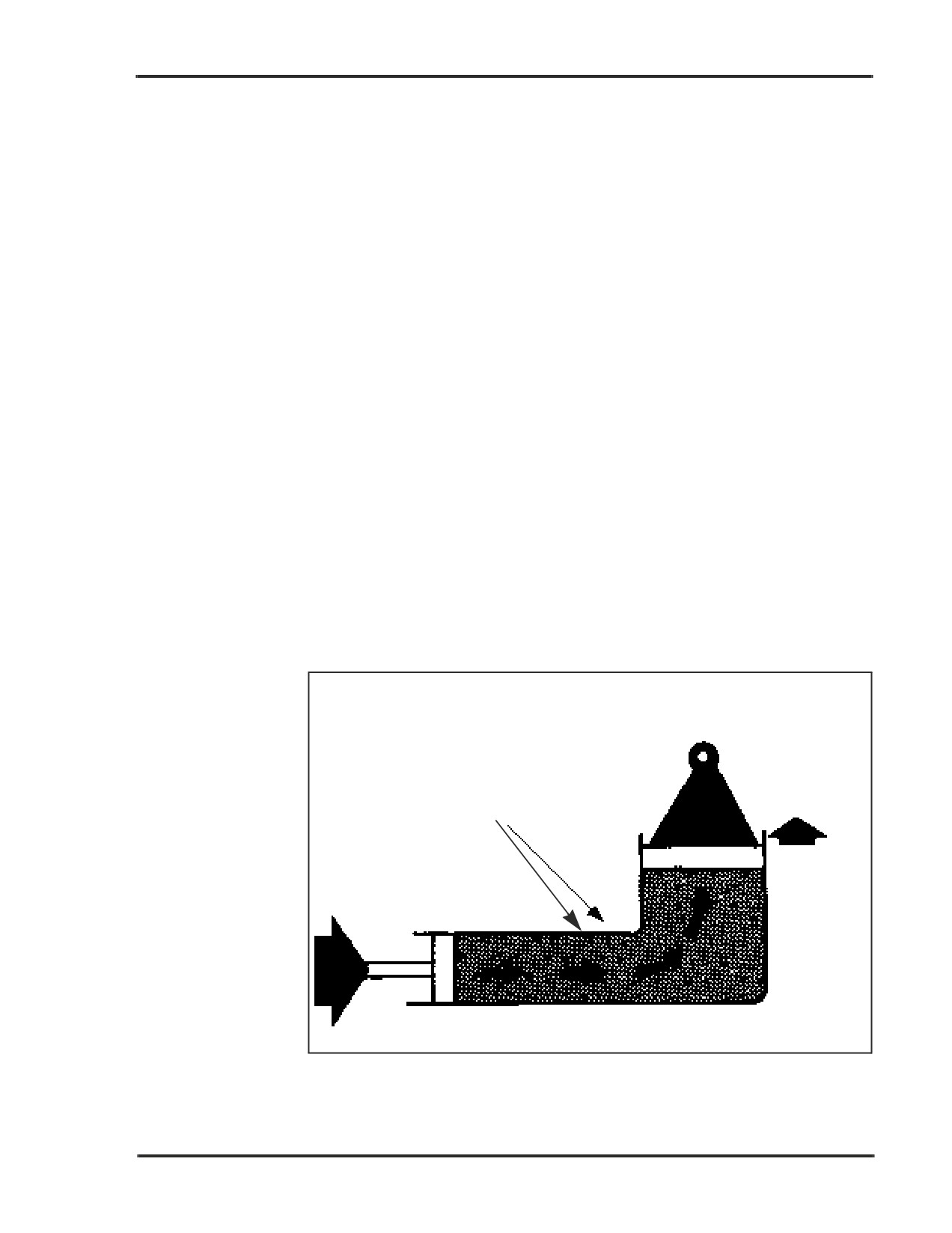
confined liquid. In a hydraulic device, power is transmitted by pushing on a confined liquid.
Figure 1-1 shows a simple hydraulic device. The transfer of energy takes place because a
quantity of liquid is subject to pressure. To operate liquid-powered systems, the operator
should have a knowledge of the basic nature of liquids. This chapter covers the properties of
liquids and how they act under different conditions.
1-1. Pressure and Force. Pressure is force exerted against a specific area (force per unit
area) expressed in pounds per square inch (psi). Pressure can cause an expansion, or resis-
tance to compression, of a fluid that is being squeezed. A fluid is any liquid or gas (vapor).
Force is anything that tends to produce or modify (push or pull) motion and is expressed in
pounds.
a. Pressure. An example of pressure is the air (gas) that fills an automobile tire. As a
tire is inflated, more air is squeezed into it than it can hold. The air inside a tire resists the
squeezing by pushing outward on the casing of the tire. The outward push of the air is pres-
sure. Equal pressure throughout a confined area is a characteristic of any pressurized fluid.
For example, in an inflated tire, the outward push of the air is uniform throughout. If it
were not, a tire would be pushed into odd shapes because of its elasticity.
There is a
major difference
between a gas and a
Weight
liquid. Liquids are
slightly compress-
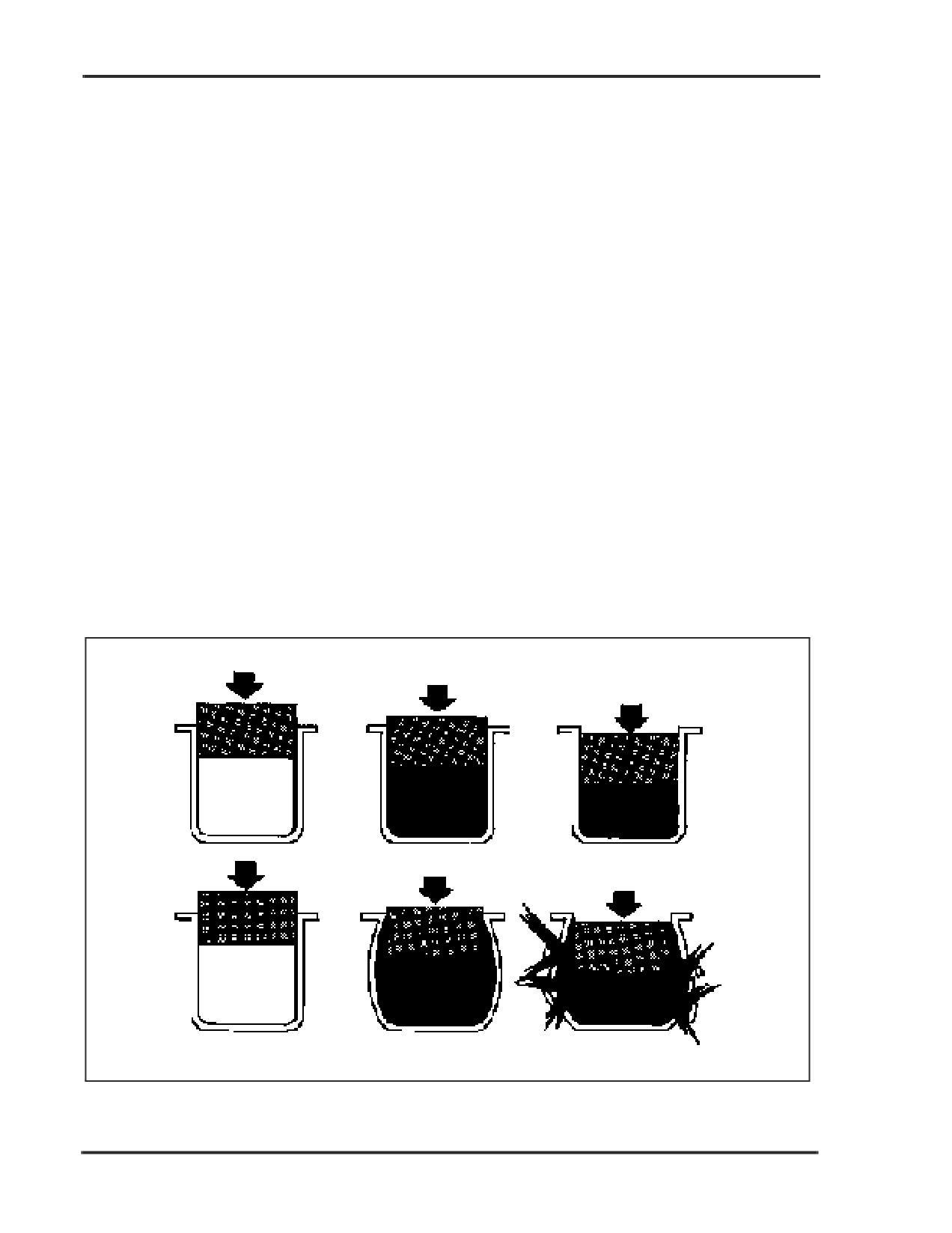
ible (Figure 1-2,
page 1-2). When a
Confined liquid is
confined liquid is
subject to pressure
pushed on, pressure
builds up. The
pressure is still
transmitted
equally throughout
the container. The
fluid's behavior
makes it possible to
transmit a push
through pipes,
around corners, and
up and down. A
hydraulic system
Figure 1-1. Basic hydraulic device
uses a liquid
Hydraulic Basics
1-1
FM 5-499
because its near incompressibility makes the action instantaneous as long as the system is
full of liquid.
Pressure can be created by squeezing or pushing on a confined fluid only if there is a
resistance to flow. The two ways to push on a fluid are by the action of a mechanical pump
or by the weight of the fluid. An example of pressure due to a fluid's weight would be in an
ocean's depths. The water's weight creates the pressure, which increases or decreases,
depending on the depth.
By knowing the weight of a cubic foot of water, you can calculate the pressure at any
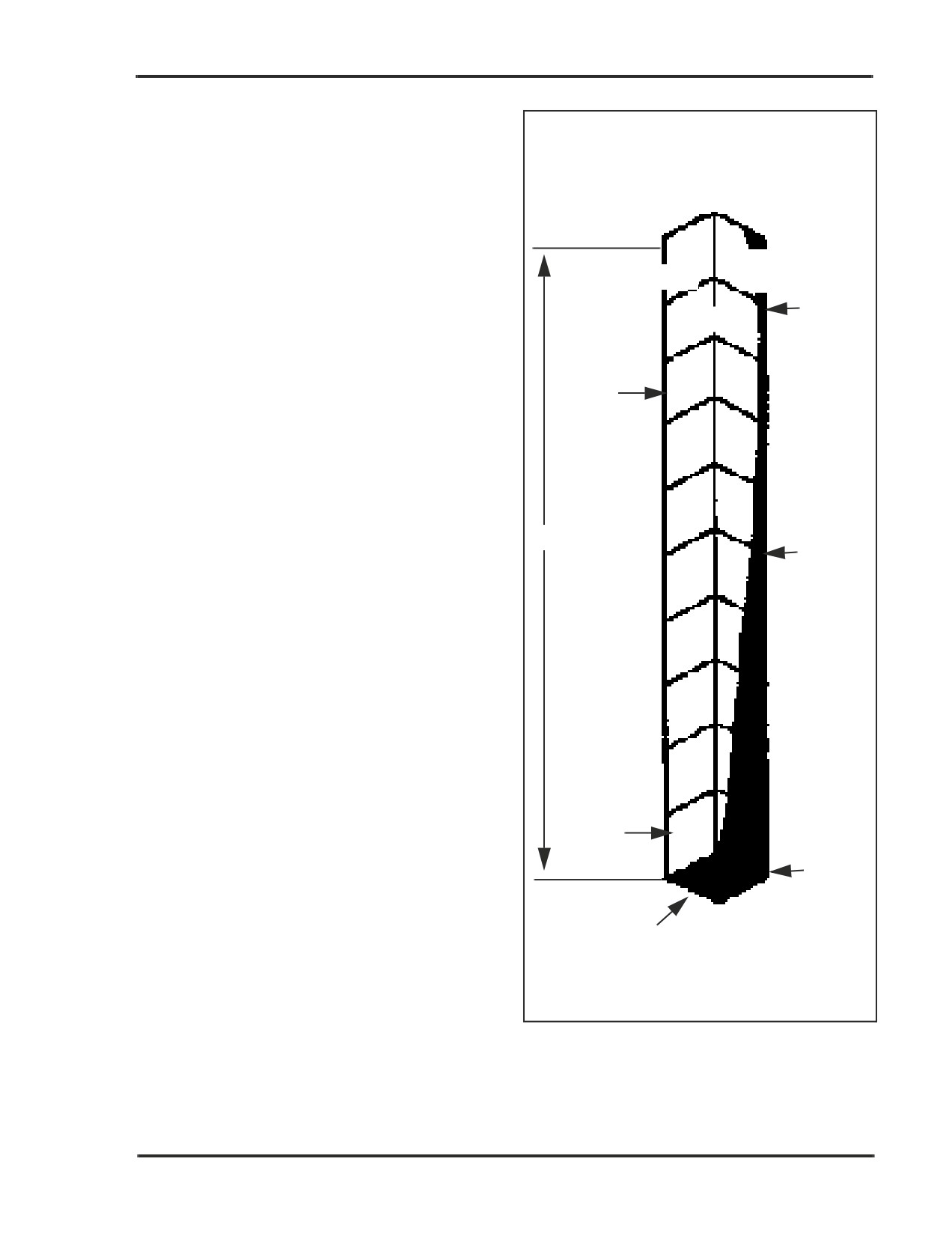
depth. Figure 1-3 shows a column of water 1 foot square and 10 feet high, which equates to
10 cubic feet. (One cubic foot of water weighs 52.4 pounds.) The total weight of water in this
column is 624 pounds. The weight at the bottom covers 1,445 square inches (1 square foot).
Each square inch of the bottom is subject to 1/144 of the total weight, or 4.33 pounds. Thus,
the pressure at this depth is 4.33 psi. You can also create an equal pressure of 4.33 psi in a
liquid using the pump and figures shown in Figure 1-4, page 1-4.
Before pressure, head was the only way to express pressure measurement. It was
expressed as feet of water. Today, head is still the vertical distance between two levels in a
fluid. In Figure 1-3, the head between the top and bottom of the water is 10 feet, which is
equivalent to 4.33 psi. Therefore, each foot of water is equal to 0.433 psi.
The earth has an atmosphere of air extending 50 miles up, and this air has weight. This air
creates a head of pressure that is called atmospheric pressure. A column of air 1 square inch in
cross section and the height of the atmosphere would weigh 14.7 pounds at sea level. Thus,
the earth's atmospheric pressure is 14.7 psi at sea level. The role of atmospheric pressure in
A gas is compressible
A liquid resists compression
Figure 1-2. Compressibility
1-2
Hydraulic Basics
FM 5-499
most hydraulic systems is significant. Fig-
ure 1-5, page 1-4, shows the interaction of
hydraulic and atmospheric pressures under
the three sets of conditions listed below:
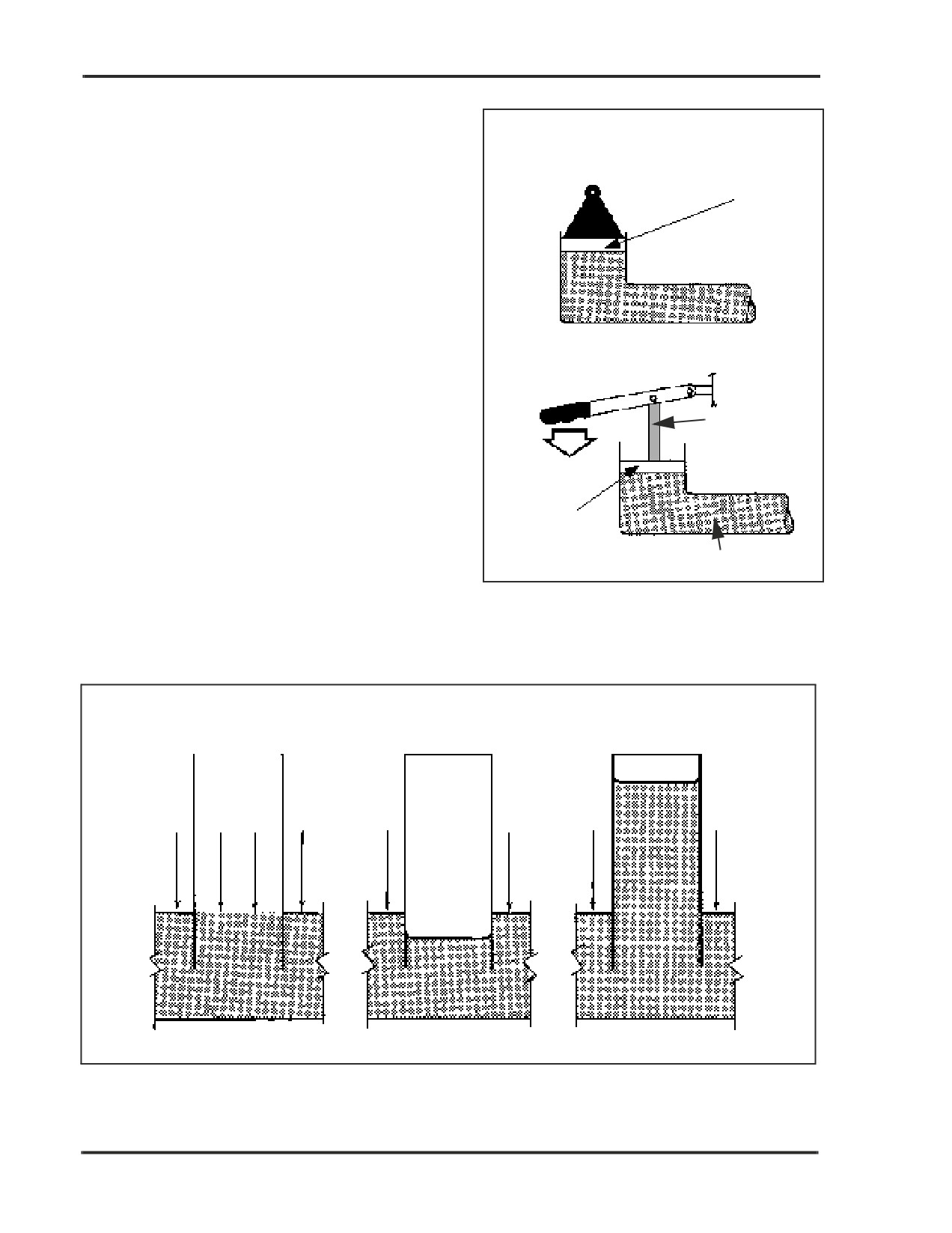
(1) Diagram A. In the diagram, the tube
is open at both ends. When it is placed in a
liquid, the liquid will rise, inside and out-
side, in proportion to the amount of liquid
1 ft
1 ft
displaced by the submerged tube wall.
0.433 psi
1 ft
(2) Diagram B. In the diagram, ends of
the tube are closed. When placed in a liquid,
the liquid level in the tube is forced down
1 cu ft
because the air in the tube must occupy a
weighs
space. Therefore, the liquid is displaced.
62.4 lb
The liquid level outside the tube rises in pro-
portion to the volume of the cylinder wall
and the volume of the trapped air below the
original liquid level. The atmospheric pres-
sure (14.7 psi) on the liquid outside the tube
is not heavy enough to force the liquid inside
10 ft
the tube upward against the pressure of the
2.165 psi
trapped air, which is more than 14.7 psi.
(3) Diagram C. In the diagram, the
upper end of the tube is closed, but some of
the air has been removed from this tube so
that the pressure within the tube is less than
14.7 psi (a partial vacuum). A perfect vac-
uum would exist if all pressure within the
tube could be eliminated, a condition that
never happens. Because the liquid outside
the tube is subject to full atmospheric pres-
sure, the liquid is forced up into the tube to
satisfy the vacuum. How far the liquid rises
Total
depends on the difference in air pressure
weight
624 lb
between the trapped air and the atmosphere.
4.33 psi
b. Force. The relationship of force, pres-
sure, and area is as follows:
F = PA
144 sq in
where—
F = force, in pounds
P = pressure, in psi
Figure 1-3. Water column
A = area, in square inches
Hydraulic Basics
1-3
FM 5-499
Example:
Figure 1-6 shows a pressure of 50 psi being
applied to an area of 100 square inches. The
Area = 10 sq in
total force on the area is—
F = PA
Weight
Pressure = 4.33 psi
F = 50 x 100 = 5,000 pounds
1-2. Pascal's Law. Blaise Pascal formulated
the basic law of hydraulics in the mid 17th cen-
tury. He discovered that pressure exerted on a
fluid acts equally in all directions. His law
states that pressure in a confined fluid is trans-
mitted undiminished in every direction and acts
Pump
with equal force on equal areas and at right
Force = 43.3 lb
angles to a container's walls.
Figure 1-7 shows the apparatus that Pascal
used to develop his law. It consisted of two con-
nected cylinders of different diameters with a
liquid trapped between them. Pascal found that
Area = 10 sq in
the weight of a small piston will balance the
weight of a larger piston as long as the piston’s
Pressure = 4.33 psi
areas are in proportion to the weights. In the
small cylinder, a force of 100 pounds on a 1-square-
Figure 1-4. Pump pressure
inch piston creates a pressure of 100 psi. Accord-
ing to Pascal's Law, this pressure is transmitted
undiminished in every direction. In the larger
A
B
C
Atmospheric
Atmospheric
pressure
pressure
Figure 1-5. Interaction of hydraulic and atmospheric pressures
1-4
Hydraulic Basics
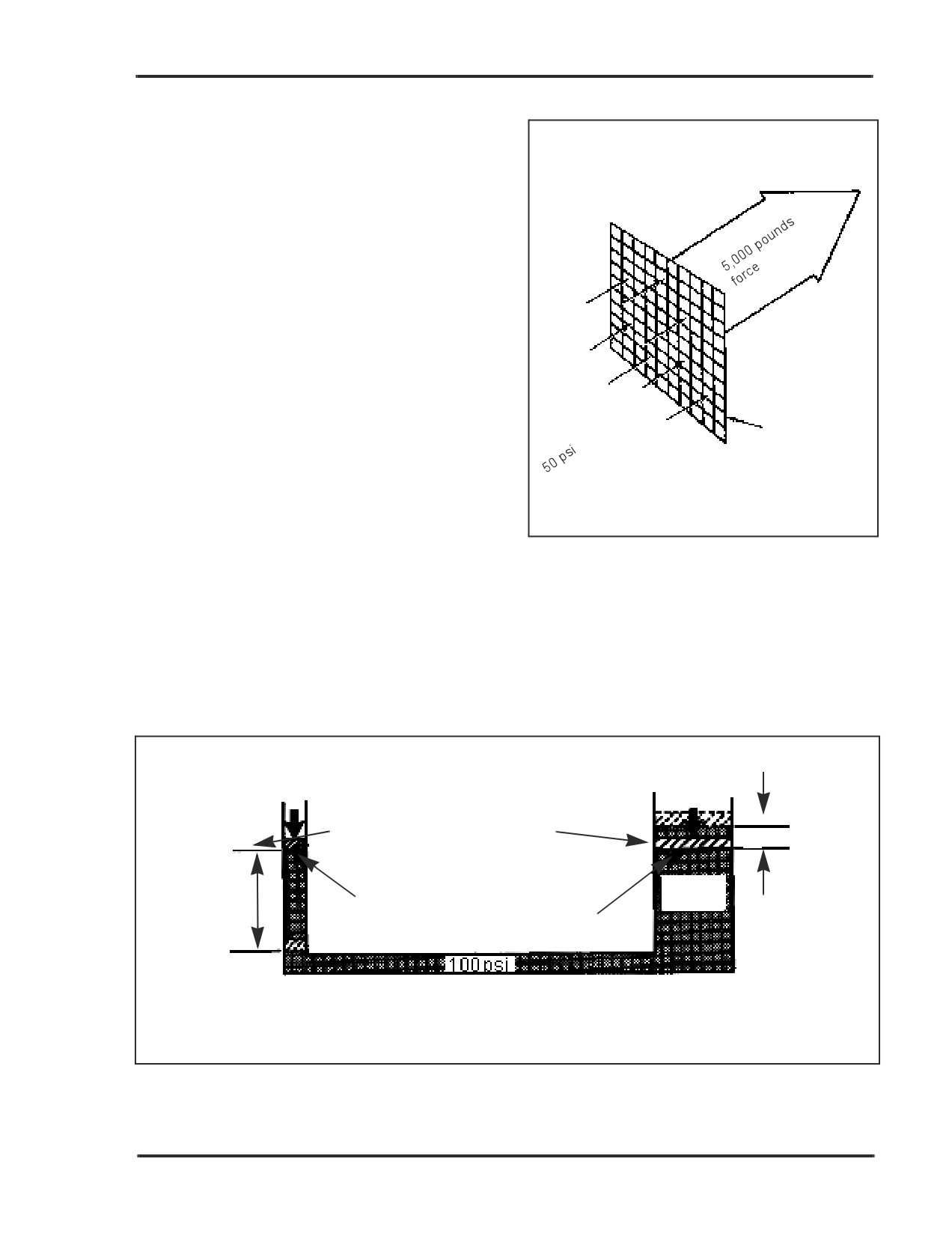
FM 5-499
cylinder, the 100 psi of pressure from the
small cylinder is transmitted to an area of 5
square inches, which results in a force of 500
pounds on the second piston. The force has
been multiplied 5 times—a mechanical advan-
tage of 5 to 1. Using the same factors, you can
determine the distance the pistons move. For
example, if the small piston moves down 10
inches, the larger piston will move up 2
inches. Use the following to determine the
10”
distance:
F1
×
D1
D2
= ------------------
F
2
10”
100 sq in
where—
F1 = force of the small piston, in pounds
D1 = distance the small piston moves, in
inches
D2 = distance the larger piston moves, in
inches
Figure 1-6. Force, pressure, and area
F2 = force of the larger piston, in pounds
Example: Determine D2
F1
×
D1
100 × 10
D2
= ------------------
D2
= --------------------
D2 = 2 in
F2
500
500 lb
100 lb
P
W
2”
100psi
10”
1 sq in
5 sq in
Figure 1-7. Pascal’s Law apparatus
Hydraulic Basics
1-5
FM 5-499
1-3. Flow. Flow is the movement of a hydraulic fluid caused by a difference in the pressure
at two points. In a hydraulic system, flow is usually produced by the action of a hydraulic
pump—a device used to continuously push on a hydraulic fluid. The two ways of measuring
flow are velocity and flow rate.
a. Velocity. Velocity is the average speed at which a fluid's particles move past a given
point, measured in feet per second (fps). Velocity is an important consideration in sizing the
hydraulic lines that carry a fluid between the components.
b. Flow Rate. Flow rate is the measure of how much volume of a liquid passes a point in
a given time, measured in gallons per minute (GPM). Flow rate determines the speed at
which a load moves and, therefore, is important when considering power.
1-4. Energy, Work, and Power. Energy is the ability to do work and is expressed in foot-
pound (ft lb). The three forms of energy are potential, kinetic, and heat. Work measures
accomplishments; it requires motion to make a force do work. Power is the rate of doing
work or the rate of energy transfer.
a. Potential Energy. Potential energy is energy due to position. An object has potential
energy in proportion to its vertical distance above the earth's surface. For example, water
held back by a dam represents potential energy because until it is released, the water does
not work. In hydraulics, potential energy is a static factor. When force is applied to a con-
fined liquid, as shown in Figure 1-4 (page 1-4), potential energy is present because of the
static pressure of the liquid. Potential energy of a moving liquid can be reduced by the heat
energy released. Potential energy can also be reduced in a moving liquid when it transforms
into kinetic energy. A moving liquid can, therefore, perform work as a result of its static
pressure and its momentum.
b. Kinetic Energy. Kinetic energy is the energy a body possesses because of its motion.
The greater the speed, the greater the kinetic energy. When water is released from a dam, it
rushes out at a high velocity jet, representing energy of motion—kinetic energy. The
amount of kinetic energy in a moving liquid is directly proportional to the square of its veloc-
ity. Pressure caused by kinetic energy may be called velocity pressure.
c. Heat Energy and Friction. Heat energy is the energy a body possesses because of its
heat. Kinetic energy and heat energy are dynamic factors. Pascal's Law dealt with static
pressure and did not include the friction factor. Friction is the resistance to relative motion
between two bodies. When liquid flows in a hydraulic circuit, friction produces heat. This
causes some of the kinetic energy to be lost in the form of heat energy.
Although friction cannot be eliminated entirely, it can be controlled to some extent. The
three main causes of excessive friction in hydraulic systems are—
• Extremely long lines.
• Numerous bends and fittings or improper bends.
• Excessive velocity from using undersized lines.
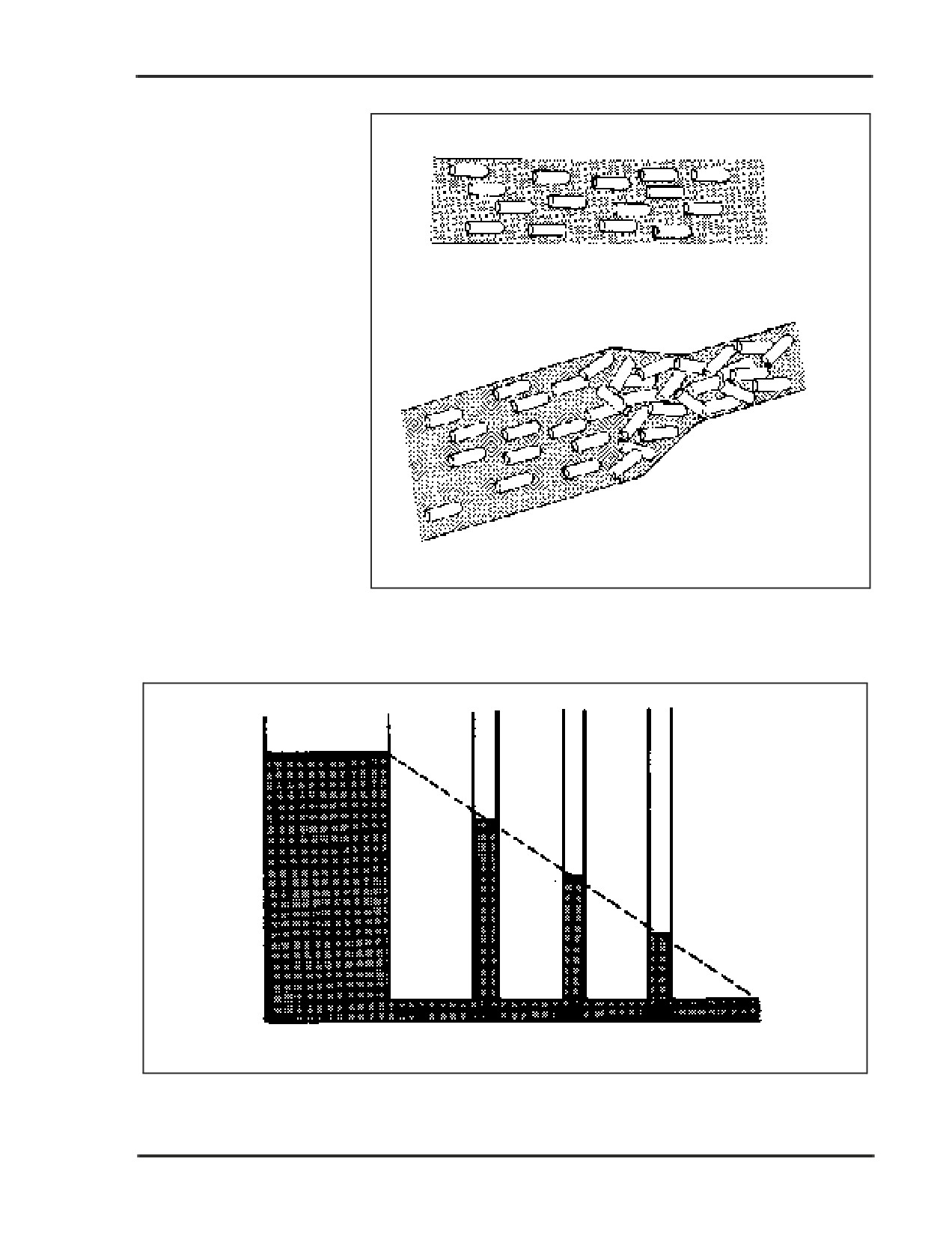
In a liquid flowing through straight piping at a low speed, the particles of the liquid
move in straight lines parallel to the flow direction. Heat loss from friction is minimal. This
kind of flow is called laminar flow. Figure 1-8, diagram A, shows laminar flow. If the speed
1-6
Hydraulic Basics
FM 5-499
increases beyond a given
point, turbulent flow devel-
ops. Figure 1-8, diagram B,
shows turbulent flow.
A
Figure 1-9 shows the
difference in head because
of pressure drop due to fric-
Laminar flow
tion. Point B shows no flow
resistance (free-flow condi-
tion); the pressure at point
B is zero. The pressure at
B
point C is at its maximum
because of the head at
point A. As the liquid flows
from point C to point B,
friction causes a pressure
drop from maximum pres-
sure to zero pressure. This
is reflected in a succeed-
ingly decreased head at
points D, E, and F.
Turbulent flow
d. Relationship
Between Velocity and Pres-
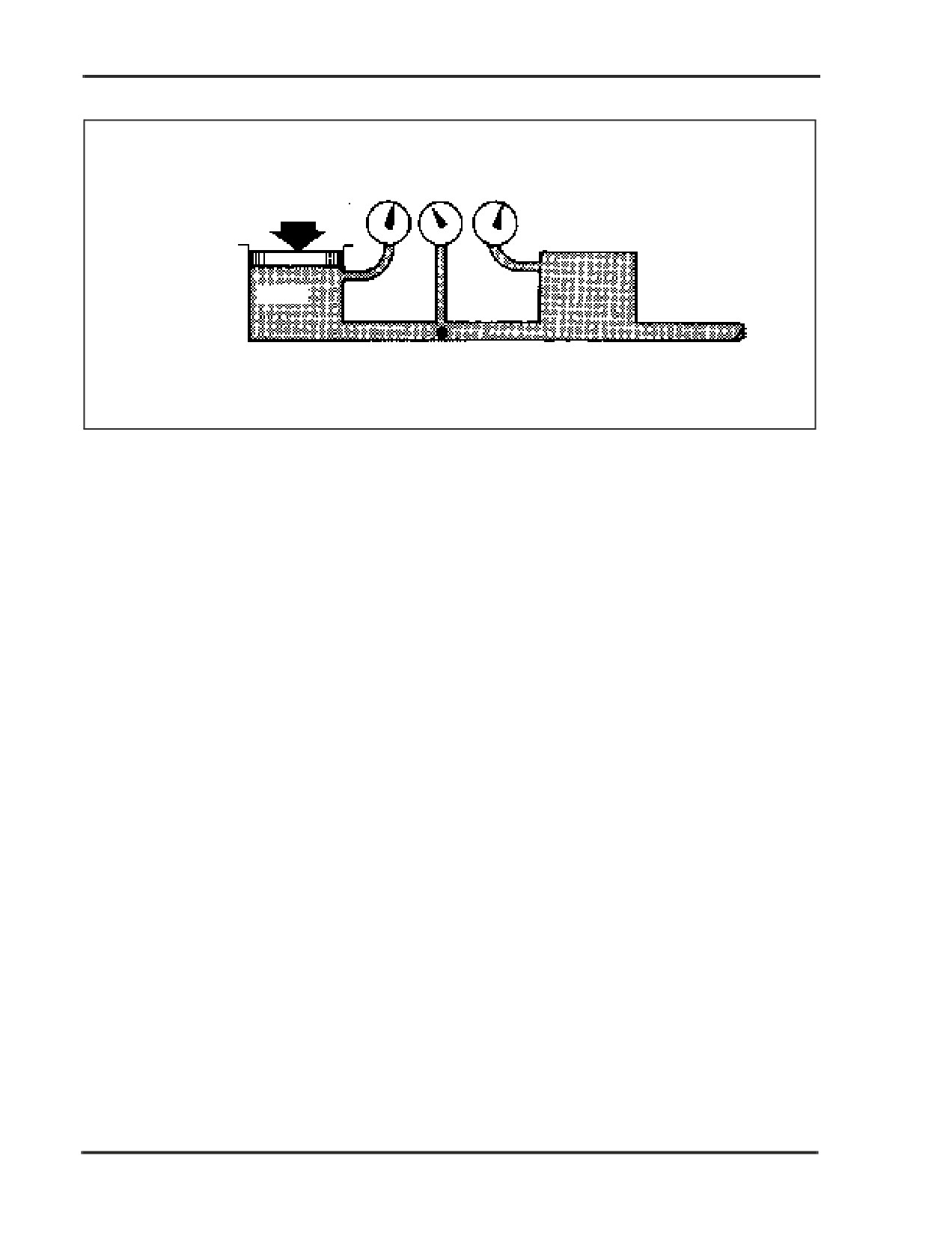
sure. Figure 1-10, page 1-8,
Figure 1-8. Laminar and turbulent flow
explains Bernouilli's Prin-
ciple, which states that the
D
E
F
A
C
B
Figure 1-9. Effect of friction on pressure
Hydraulic Basics
1-7
FM 5-499
90 psi
100 psi
100 psi
X
Chamber A
Chamber B
100 psi
Passage C
Figure 1-10. Bernouilli’s Principle
static pressure of a moving liquid varies inversely with its velocity; that is, as velocity
increases, static pressure decreases. In the figure, the force on piston X is sufficient to create
a pressure of 100 psi on chamber A. As piston X moves down, the liquid that is forced out of
chamber A must pass through passage C to reach chamber B. The velocity increases as it
passes through C because the same quantity of liquid must pass through a narrower area in
the same time. Some of the 100 psi static pressure in chamber A is converted into velocity
energy in passage C so that a pressure gauge at this point registers 90 psi. As the liquid
passes through C and reaches chamber B, velocity decreases to its former rate, as indicated
by the static pressure reading of 100 psi, and some of the kinetic energy is converted to
potential energy.
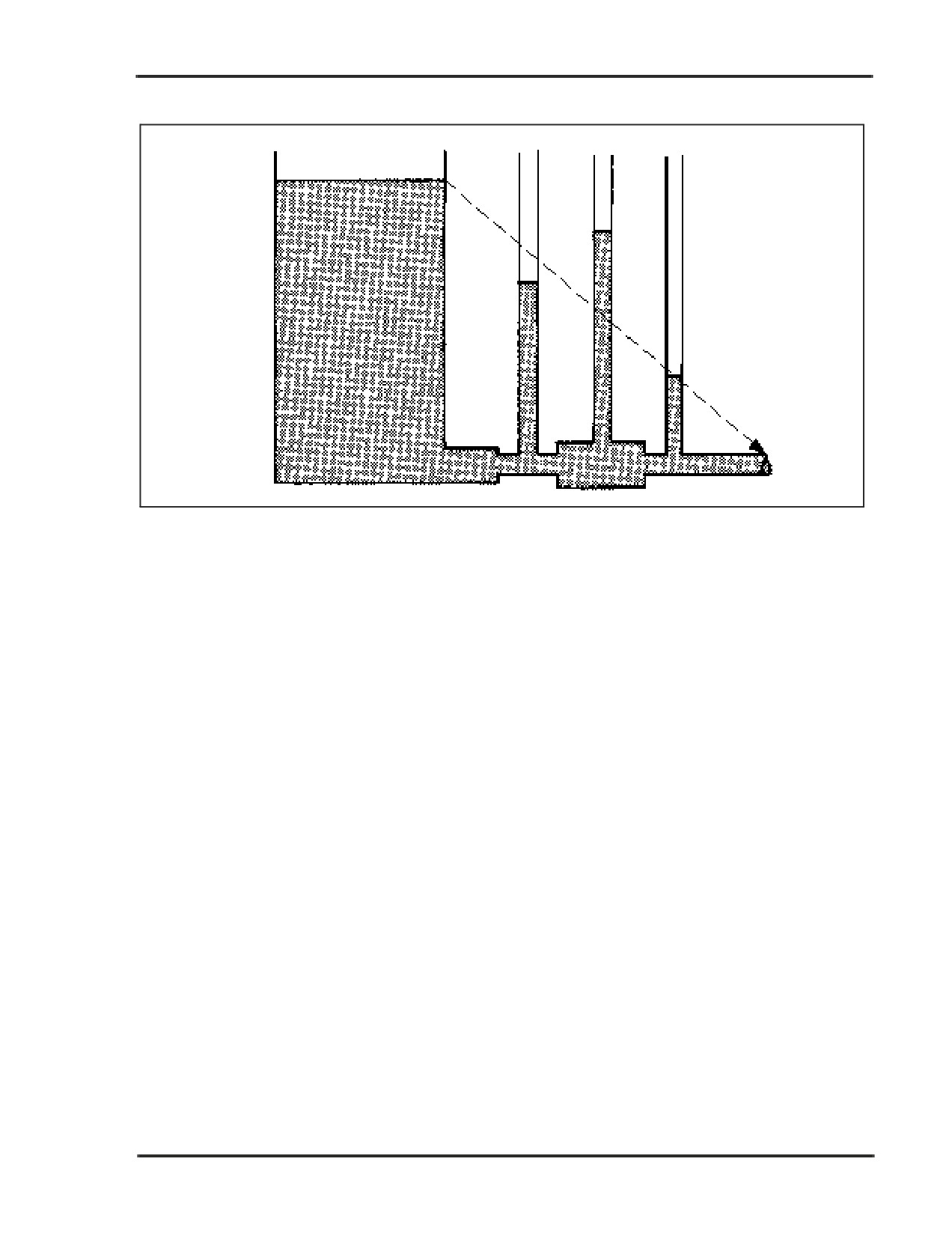
Figure 1-11 shows the combined effects of friction and velocity changes. As in Figure 1-9,
page 1-7, pressure drops from maximum at C to zero at B. At D, velocity is increased, so the
pressure head decreases. At E, the head increases as most of the kinetic energy is given up
to pressure energy because velocity is decreased. At F, the head drops as velocity increases.
e. Work. To do work in a hydraulic system, flow must be present. Work, therefore,
exerts a force over a definite distance. It is a measure of force multiplied by distance.
f. Power. The standard unit of power is horsepower (hp). One hp is equal to 550 ft lb of
work every second. Use the following equation to find power:
P = f x d/t
where—
P = power, in hp
f = force, in GPM
d = distance, in psi
t = time (1,714)
1-8
Hydraulic Basics
FM 5-499
D
E
F
A
B
C
Figure 1-11. Combined effects of friction and velocity changes
Hydraulic Basics
1-9
FM 5-499
CHAPTER 2
Hydraulic Systems
A hydraulic system contains and confines a liquid in such a way that it uses the laws
governing liquids to transmit power and do work. This chapter describes some basic systems
and discusses components of a hydraulic system that store and condition the fluid. The oil
reservoir (sump or tank) usually serves as a storehouse and a fluid conditioner. Filters,
strainers, and magnetic plugs condition the fluid by removing harmful impurities that could
clog passages and damage parts. Heat exchanges or coolers often are used to keep the oil tem-
perature within safe limits and prevent deterioration of the oil. Accumulators, though techni-
cally sources of stored energy, act as fluid storehouses.
2-1. Basic Systems. The advantages of hydraulic systems over other methods of power
transmission are—
• Simpler design. In most cases, a few pre-engineered components will replace compli-
cated mechanical linkages.
• Flexibility. Hydraulic components can be located with considerable flexibility. Pipes
and hoses in place of mechanical elements virtually eliminate location problems.
• Smoothness. Hydraulic systems are smooth and quiet in operation. Vibration is kept
to a minimum.
• Control. Control of a wide range of speed and forces is easily possible.
• Cost. High efficiency with minimum friction loss keeps the cost of a power transmis-
sion at a minimum.
• Overload protection. Automatic valves guard the system against a breakdown from
overloading.
The main disadvantage of a hydraulic system is maintaining the precision parts when
they are exposed to bad climates and dirty atmospheres. Protection against rust, corrosion,
dirt, oil deterioration, and other adverse environment is very important. The following
paragraphs discuss several basic hydraulic systems.
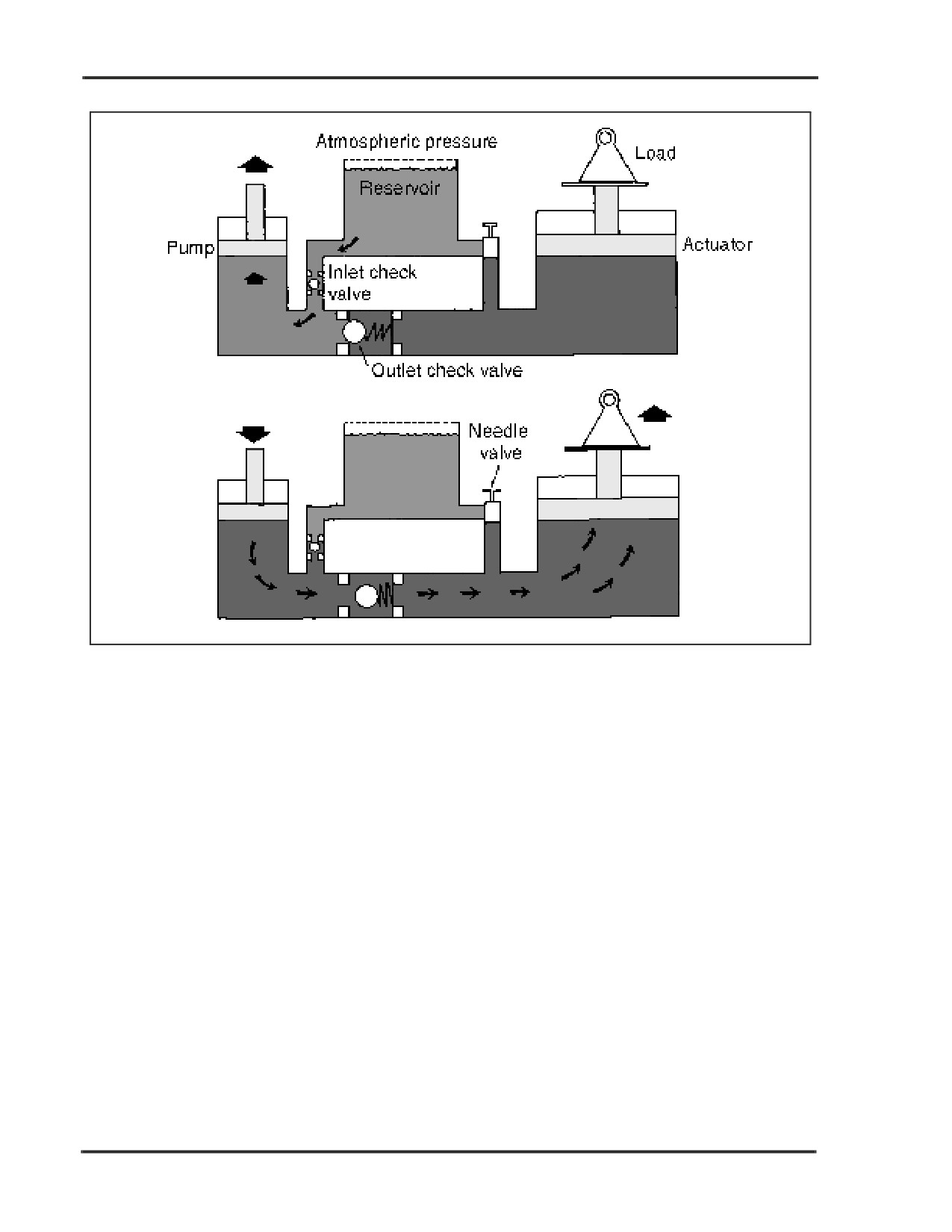
a. Hydraulic Jack. In this system (Figure 2-1, page 2-2), a reservoir and a system of
valves has been added to Pascal's hydraulic lever to stroke a small cylinder or pump contin-
uously and raise a large piston or an actuator a notch with each stroke. Diagram A shows
an intake stroke. An outlet check valve closes by pressure under a load, and an inlet check
valve opens so that liquid from the reservoir fills the pumping chamber. Diagram B shows
the pump stroking downward. An inlet check valve closes by pressure and an outlet valve
opens. More liquid is pumped under a large piston to raise it. To lower a load, a third valve
(needle valve) opens, which opens an area under a large piston to the reservoir. The load
then pushes the piston down and forces the liquid into the reservoir.
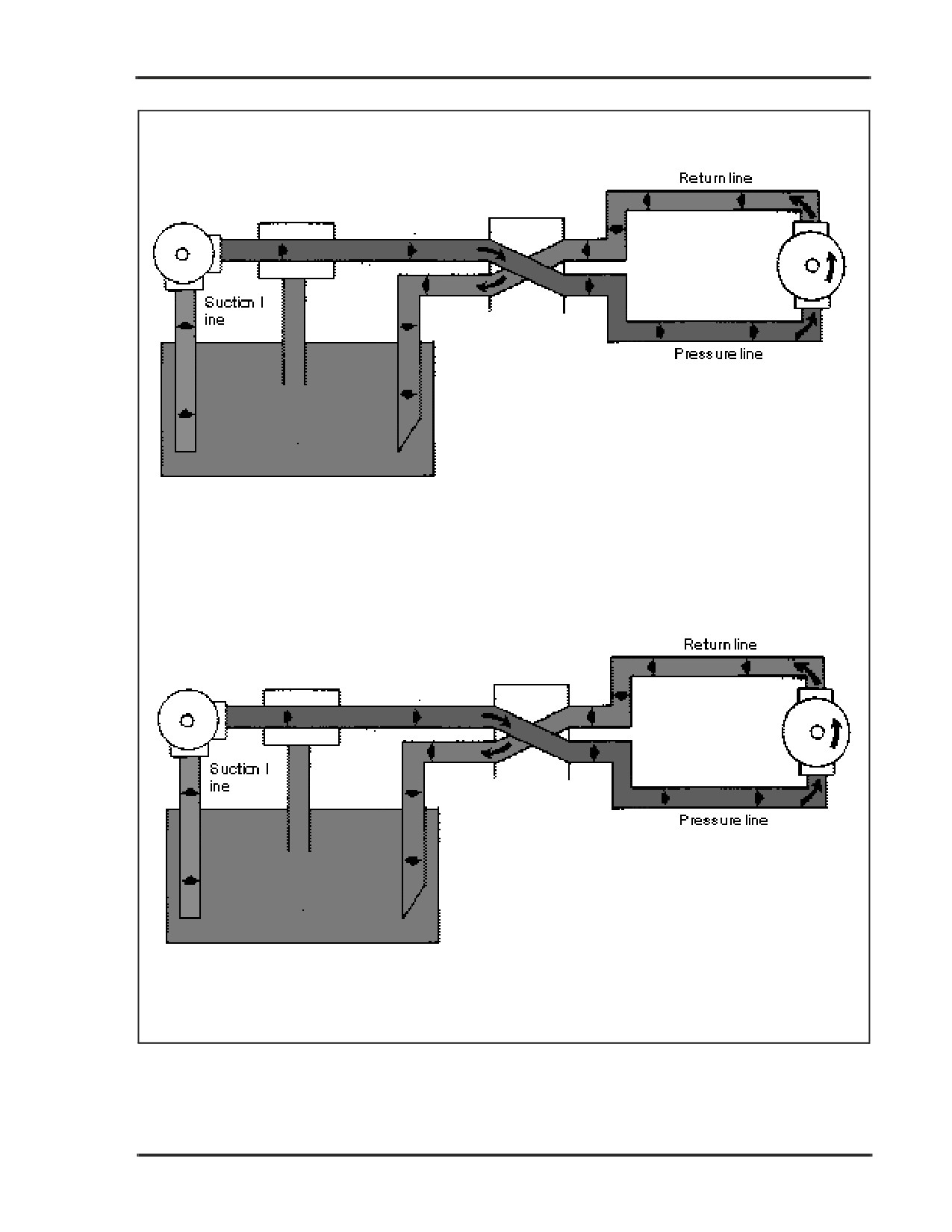
b. Motor-Reversing System. Figure 2-2, page 2-3, shows a power-driven pump operating
a reversible rotary motor. A reversing valve directs fluid to either side of the motor and back
Hydraulic Systems
2-1
FM 5-499
Figure 2-1. Hydraulic jack
to the reservoir. A relief valve protects the system against excess pressure and can bypass
pump output to the reservoir, if pressure rises too high.
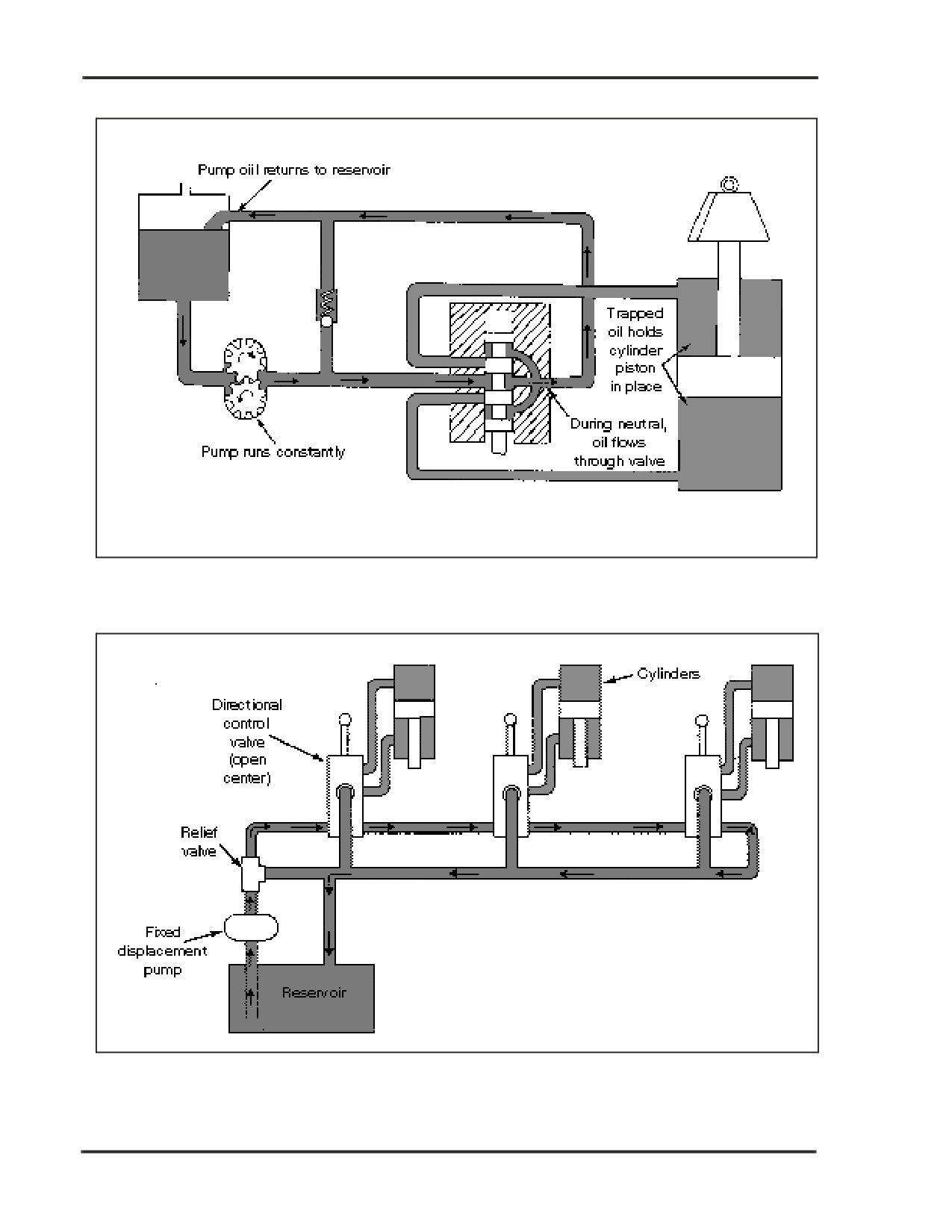
c. Open-Center System. In this system, a control-valve spool must be open in the center
to allow pump flow to pass through the valve and return to the reservoir. Figure 2-3, page
2-4, shows this system in the neutral position. To operate several functions simultaneously,
an open-center system must have the correct connections, which are discussed below. An
open-center system is efficient on single functions but is limited with multiple functions.
(1) Series Connection. Figure 2-4, page 2-4, shows an open-center system with a series
connection. Oil from a pump is routed to the three control valves in series. The return from
the first valve is routed to the inlet of the second, and so on. In neutral, the oil passes
through the valves in series and returns to the reservoir, as the arrows indicate. When a
control valve is operated, the incoming oil is diverted to the cylinder that the valve serves.
Return liquid from the cylinder is directed through the return line and on to the next valve.
This system is satisfactory as long as only one valve is operating at a time. When this
happens, the full output of the pump at full system pressure is available to that function.
However, if more than one valve is operating, the total of the pressures required for each
function cannot exceed the system’s relief setting.
2-2
Hydraulic Systems
FM 5-499
Figure 2-2. Motor-reversing system
Hydraulic Systems
2-3
FM 5-499
Figure 2-3. Open-center system
Figure 2-4. Open-center system with a series connection
2-4
Hydraulic Systems
FM 5-499
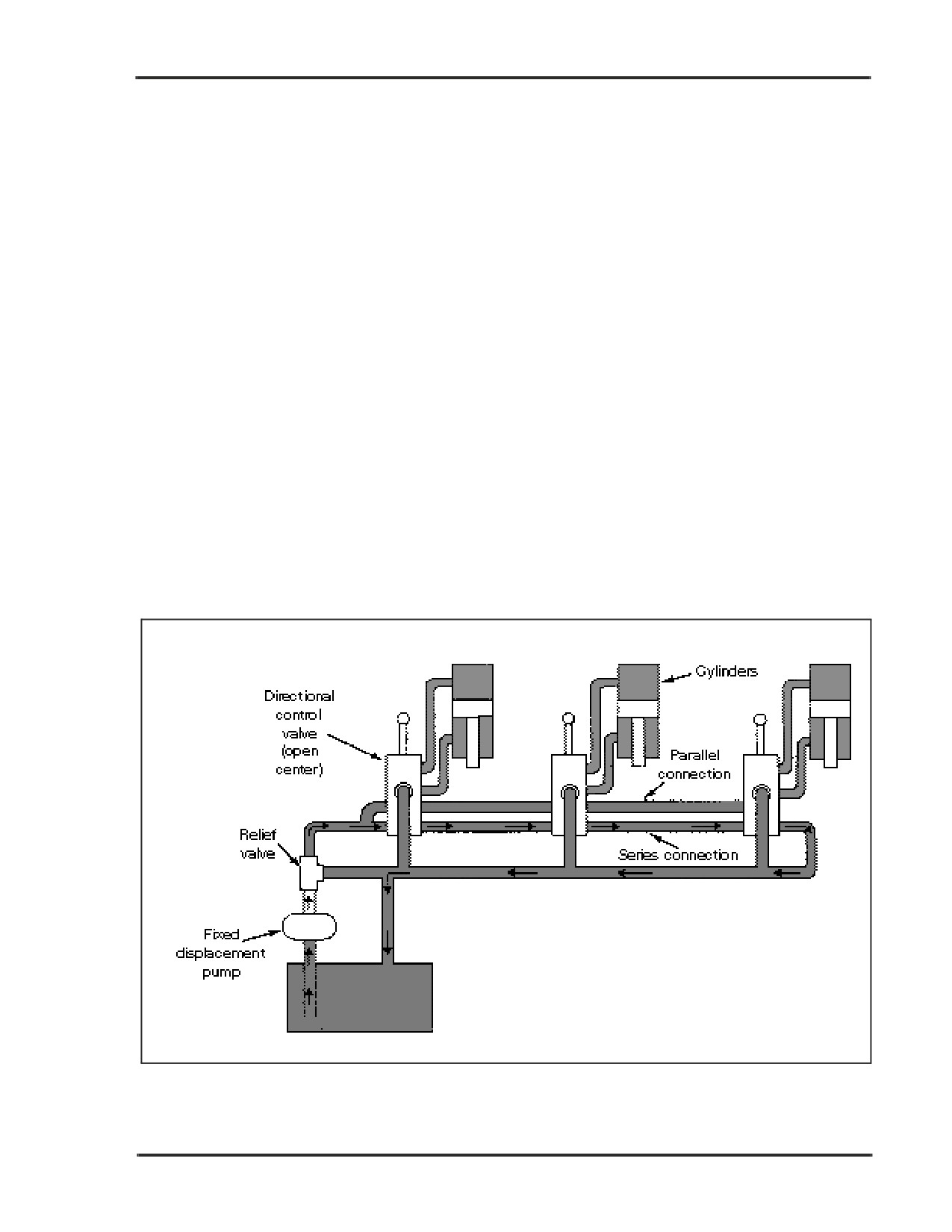
(2) Series/Parallel Connection. Figure 2-5 shows a variation on the series-connected
type. Oil from the pump is routed through the control valves in series, as well as in parallel.
The valves are sometimes stacked to allow for extra passages. In neutral, a liquid passes
through the valves in series, as the arrows indicate. However, when any valve is operating,
the return is closed and the oil is available to all the valves through the parallel connection.
When two or more valves are operated at once, the cylinder that needs the least pressure
will operate first, then the cylinder with the next least, and so on. This ability to operate two
or more valves simultaneously is an advantage over the series connection.
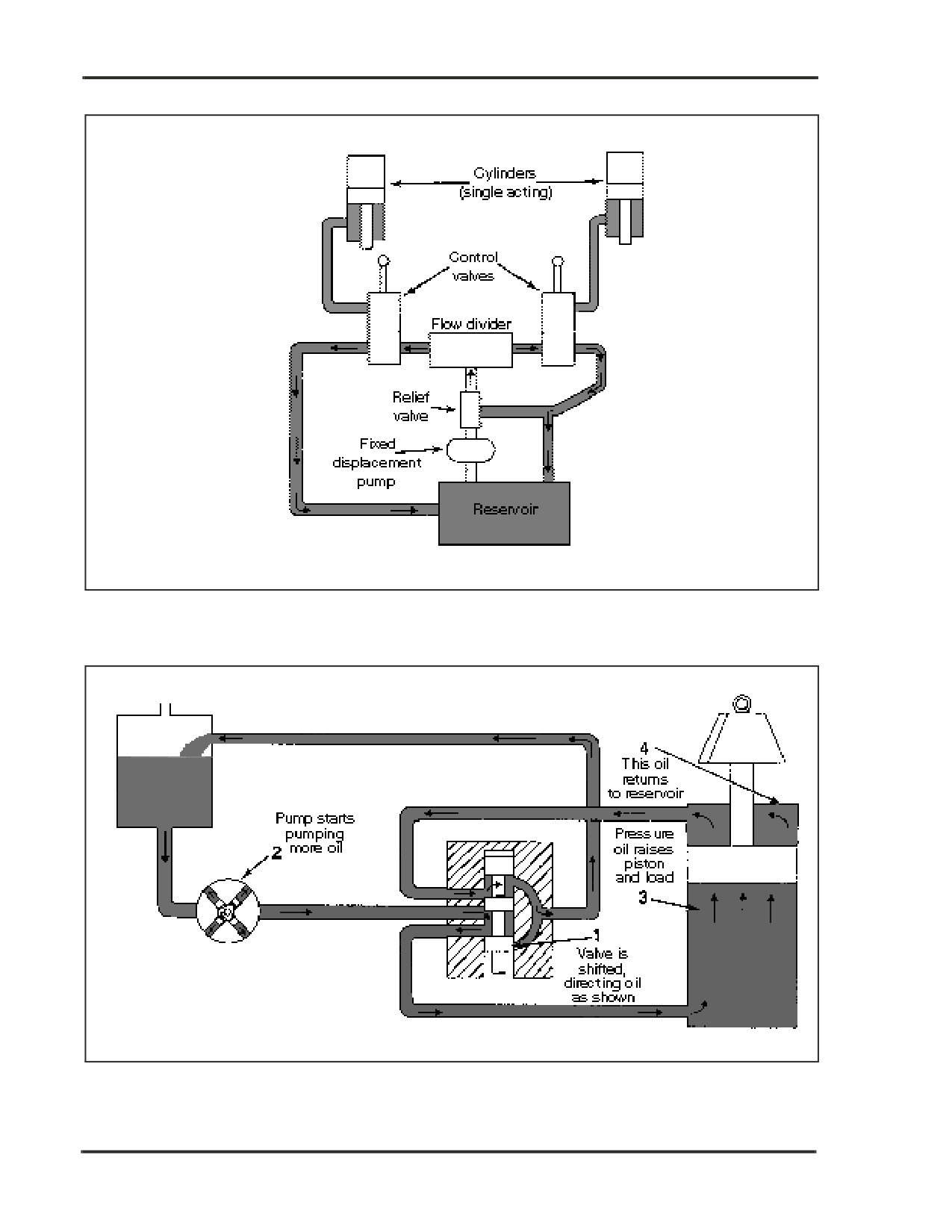
(3) Flow Divider. Figure 2-6, page 2-6, shows an open-center system with a flow divider.
A flow divider takes the volume of oil from a pump and divides it between two functions. For
example, a flow divider might be designed to open the left side first in case both control
valves were actuated simultaneously. Or, it might divide the oil to both sides, equally or by
percentage. With this system, a pump must be large enough to operate all the functions
simultaneously. It must also supply all the liquid at the maximum pressure of the highest
function, meaning large amounts of HP are wasted when operating only one control valve.
d. Closed-Center System. In this system, a pump can rest when the oil is not required to
operate a function. This means that a control valve is closed in the center, stopping the flow
of the oil from the pump. Figure 2-7, page 2-6, shows a closed-center system. To operate sev-
eral functions simultaneously, a closed-center system have the following connections:
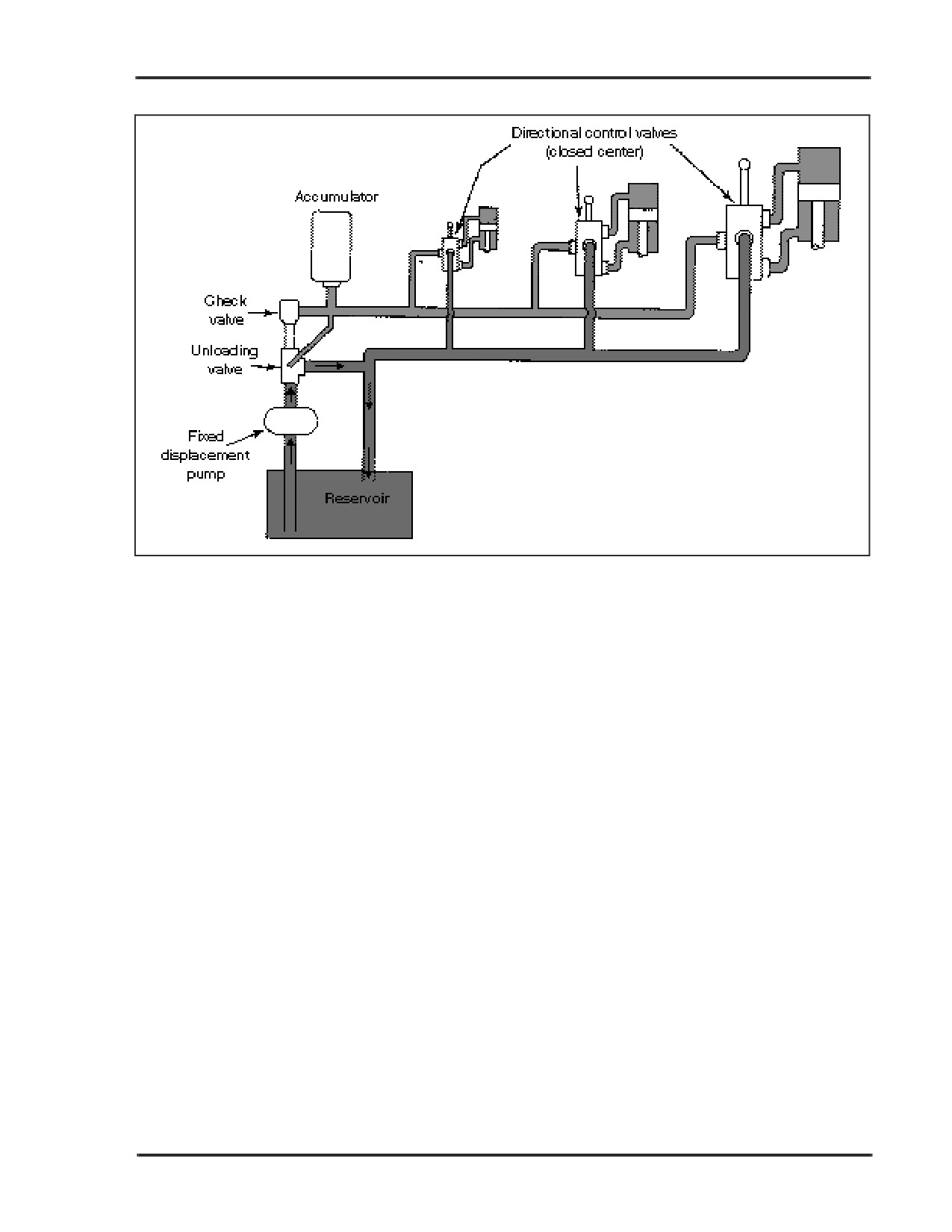
(1) Fixed-Displacement Pump and Accumulator. Figure 2-8, page 2-7, shows a closed-
center system. In this system, a pump of small but constant volume charges an accumulator.
Figure 2-5. Open-center system with a series/parallel connection
Hydraulic Systems
2-5
FM 5-499
Figure 2-6. Open-center system with a flow divider
Figure 2-7. Closed-center system
2-6
Hydraulic Systems
FM 5-499
Figure 2-8. Fixed-displacement pump and accumulator
When an accumulator is charged to full pressure, an unloading valve diverts the pump flow
back to a reservoir. A check valve traps the pressured oil in the circuit.
When a control valve is operated, an accumulator discharges its oil and actuates a cylin-
der. As pressure begins to drop, an unloading valve directs the pump flow to an accumulator
to recharge the flow. This system, using a small capacity pump, is effective when operating
oil is needed only for a short time. However, when the functions need a lot of oil for longer
periods, an accumulator system cannot handle it unless the accumulator is very large.
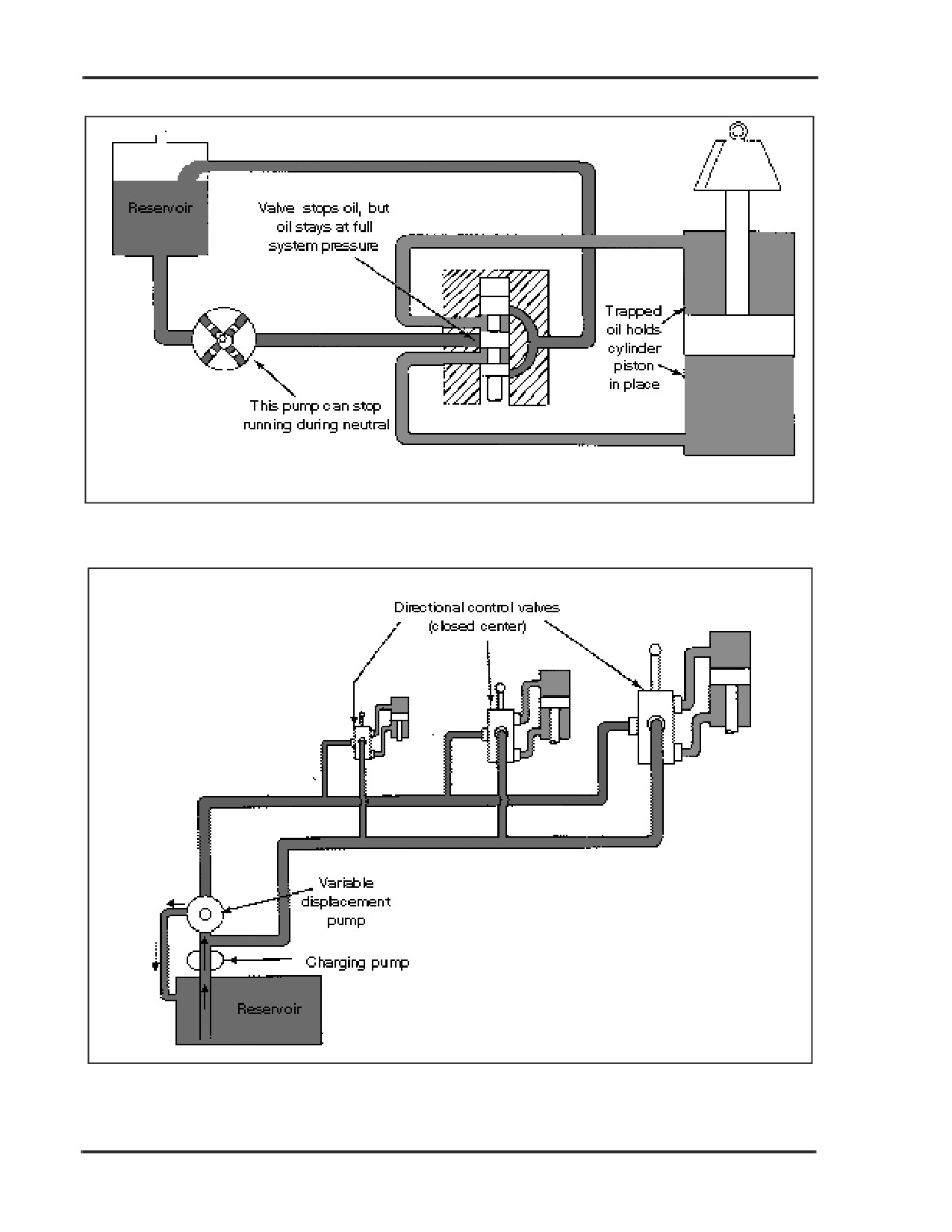
(2) Variable-Displacement Pump. Figure 2-9, page 2-8, shows a closed-center system
with a variable-displacement pump in the neutral mode. When in neutral, oil is pumped
until the pressure rises to a predetermined level. A pressure-regulating valve allows the
pump to shut off by itself and maintain this pressure to the valve. When the control valve is
operating, oil is diverted from the pump to the bottom of a cylinder. The drop in pressure
caused by connecting the pump’s pressure line to the bottom of the cylinder causes the pump
to go back to work, pumping oil to the bottom of the piston and raising the load.
When the valve moves, the top of the piston connects to a return line, which allows the
return oil that was forced from the piston to return to the reservoir or pump. When the valve
returns to neutral, oil is trapped on both sides of the cylinder, and the pressure passage from
the pump is dead-ended. After this sequence, the pump rests. Moving the spool in the down-
ward position directs oil to the top of the piston, moving the load downward. The oil from the
bottom of the piston is sent into the return line.
Figure 2-10, page 2-8, shows this closed-center system with a charging pump, which
pumps oil from the reservoir to the variable-displacement pump. The charging pump supplies
Hydraulic Systems
2-7
FM 5-499
Figure 2-9. Variable-displacement pump
Figure 2-10. Closed-center system with charging pump
2-8
Hydraulic Systems

FM 5-499
only the makeup oil required in a system and provides some inlet pressure to make a variable-
displacement pump more efficient. The return oil from a system's functions is sent directly
to the inlet of a variable-displacement pump.
Because today’s machines need more hydraulic power, a closed-center system is more
advantageous. For example, on a tractor, oil may be required for power steering, power
brakes, remote cylinders, three-point hitches, loaders, and other mounted equipment. In
most cases, each function requires a different quantity of oil. With a closed-center system,
the quantity of oil to each function can be controlled by line or valve size or by orificing with
less heat build up when compared to the flow dividers necessary in a comparable open-center
system. Other advantages of a closed-center system are as follows:
• It does not require relief valves because the pump simply shuts off by itself when
standby pressure is reached. The prevents heat buildup in systems where relief
pressure is frequently reached.
• The size of the lines, valves, and cylinders can be tailored to the flow requirements
of each function.
• Reserve flow is available, by using a larger pump, to ensure full hydraulic speed at
low engine revolutions per minute (rpm). More functions can be served.
• It is more efficient on functions such as brakes, which require force but very little
piston movement. By holding the valve open, standby pressure is constantly
applied to the brake piston with no efficiency loss because the pump has returned
to standby.
2-2. Color Coding. In this manual, the figures that show oil-flow conditions or paths are
prepared with industrial standardized color codes. Table 2-1 lists the colors for the hydrau-
lic lines and passages that are in many of the figures:
Table 2-1: Figure colors
Line/Passage
Color
Operating pressure
Red
Exhaust
Blue
Intake or drain
Green
Metered flow
Yellow
2-3. Reservoirs. A reservoir stores a liquid that is not being used in a hydraulic system. It
also allows gases to expel and foreign matter to settle out from a liquid.
a. Construction. A properly constructed reservoir should be able to dissipate heat from
the oil, separate air from the oil, and settle out contaminates that are in it. Reservoirs range
in construction from small steel stampings to large cast or fabricated units. The large tanks
should be sandblasted after all the welding is completed and then flushed and steam cleaned.
Doing so removes welding scale and scale left from hot-rolling the steel. The inner surface
then should be sealed with a paint compatible with the hydraulic fluid. Nonbleeding red
engine enamel is suitable for petroleum oil and seals in any residual dirt not removed by
flushing and steam-cleaning.
Hydraulic Systems
2-9
FM 5-499
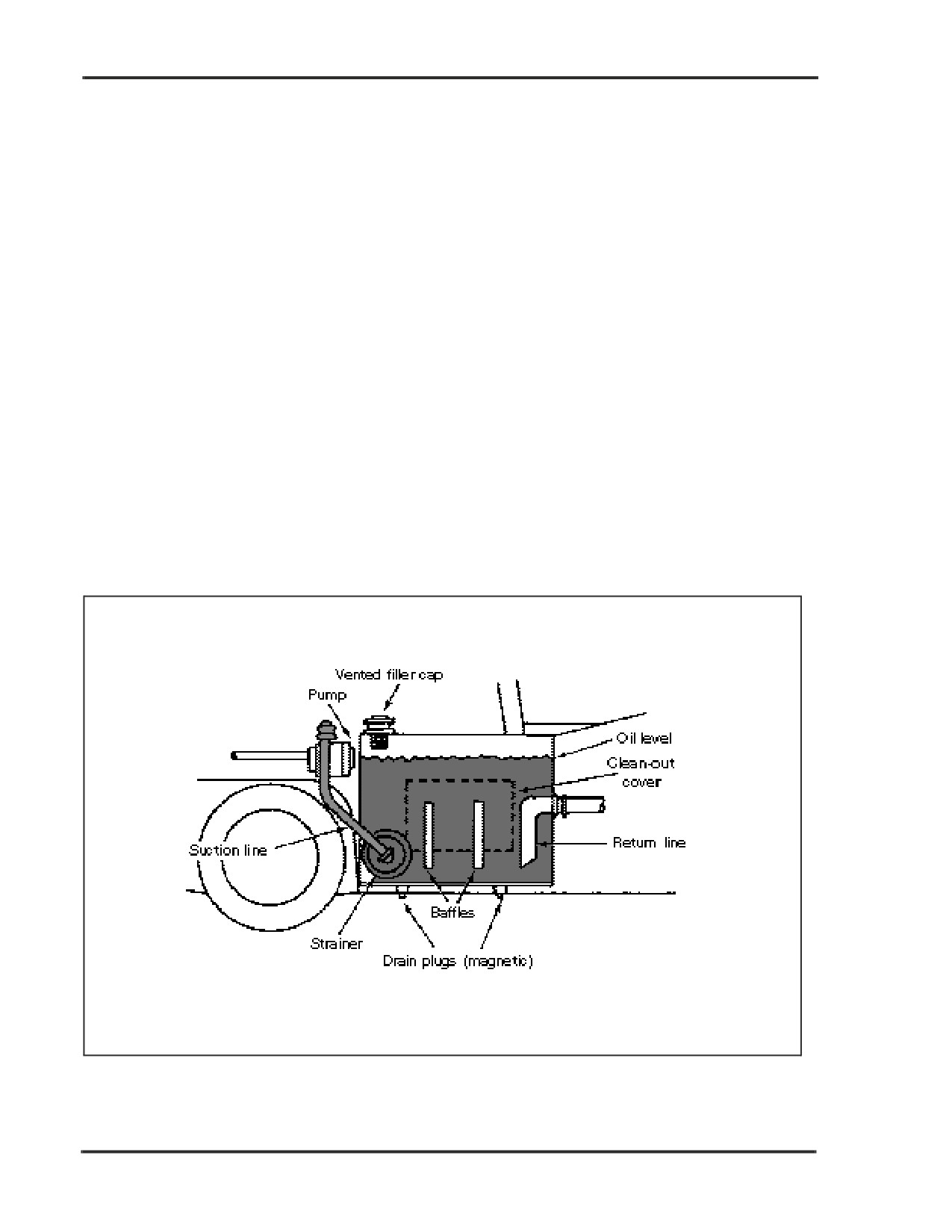
b. Shape. Figure 2-11 shows some of the design features of a reservoir. It should be
high and narrow rather than shallow and broad. The oil level should be as high as possible
above the opening to a pump's suction line. This prevents the vacuum at the line opening
from causing a vortex or whirlpool effect, which would mean that a system is probably tak-
ing in air. Aerated oil will not properly transmit power because air is compressible. Aerated
oil has a tendency to break down and lose its lubricating ability.
c. Size. Reservoir sizes will vary. However, a reservoir must be large enough so that it
has a reserve of oil with all the cylinders in a system fully extended. An oil reserve must be
high enough to prevent a vortex at the suction line's opening. A reservoir must have suffi-
cient space to hold all the oil when the cylinders are retracted, as well as allow space for
expansion when the oil is hot.
A common-size reservoir on a mobile machine is a 20- or 30-gallon tank used with a 100-
GPM system. Many 10-GPM systems operate with 2- or 3-gallon tanks because these mobile
systems operate intermittently, not constantly. For stationary machinery, a rule of thumb is
that a reservoir’s size should be two to three times a pump’s output per minute.
A large size tank is highly desirable for cooling. The large surface areas exposed to the
outside air transfer heat from the oil. Also, a large tank helps settle out the contaminates
and separates the air by reducing recirculation.
d. Location. Most mobile equipment reservoirs are located above the pumps. This
creates a flooded-pump-inlet condition. This condition reduces the possibility of pump
Figure 2-11. Design features of a reservoir
2-10
Hydraulic Systems
FM 5-499
cavitation—a condition where all the available space is not filled and often metal parts will
erode. Flooding the inlet also reduces the vortex tendency at a suction pipe's opening.
The location of a reservoir affects heat dissipation. Ideally, all tank walls should be
exposed to the outside air. Heat moves from a hot substance to a cold substance; heat trans-
fer is greatest when there is a large temperature difference. Reservoirs that are built into
front-end loader arms are very effective in transferring heat.
e. Ventilation and Pressurization. Most reservoirs are vented to the atmosphere. A
vent opening allows air to leave or enter the space above the oil as the level of the oil goes up
or down. This maintains a constant atmospheric pressure above the oil. A reservoir filter
cap, with a filter element, is often used as a vent.
Some reservoirs are pressurized, using a simple pressure-control valve rather than a
vented one. A pressure-control valve automatically lets filtered air into a tank but prevents
air release unless the pressure reaches a preset level. A pressurized reservoir takes place
when the oil and air in a tank expand from heat.
f. Line Connections. A pump suction and a tank's return lines should be attached by
flanges or by welded heavy-duty couplings. Standard couplings usually are not suitable
because they spread when welded. If a suction line is connected at the bottom, a coupling
should extend well above the bottom, inside the tank; residual dirt will not get in a suction
line when a tank or strainer is cleaned. A return line should discharge near a tank's bottom
always below the oil level. A pipe is usually cut at a 45-degree angle and the flow aimed
away from a suction line to improve circulation and cooling.
A baffle plate is used to separate a suction line from a return line. This causes the
return oil to circulate around an outer wall for cooling before it gets to the pump again. A
baffle plate should be about two-thirds the height of a tank. The lower corners are cut diag-
onally to allow circulation. They must be larger in area than a suction line's cross section.
Otherwise the oil level between a return and a suction side might be uneven. Baffling also
prevents oil from sloshing around when a machine is moving. Many large reservoirs are
cross-baffled to provide cooling and prevent sloshing.
g. Maintenance. Maintenance procedures include draining and cleaning a reservoir. A
tank should have a dished bottom that is fitted with a drain plug at its lowest point; a plug
fitting should be flushed with the inside of a tank to allow for full drainage. On large tanks,
access plates may be bolted on the ends for easy removal and servicing. A reservoir should
have a sight gauge or dipstick for checking the oil level to prevent damage from lubrication
loss.
The strainers on a pump's suction line may not require as much maintenance. However,
an element in a filter in a return line will require regular changing. Therefore, that filter
should not be inside a reservoir. When a reservoir is pressurized by compressed air, mois-
ture can become a maintenance problem. A tank should have a water trap for moisture
removal; it should be placed where it can be inspected daily.
2-4. Strainers and Filters. To keep hydraulic components performing correctly, the
hydraulic liquid must be kept as clean as possible. Foreign matter and tiny metal particles
from normal wear of valves, pumps, and other components are going to enter a system.
Strainers, filters, and magnetic plugs are used to remove foreign particles from a hydraulic
Hydraulic Systems
2-11
///////////////////////////////////////