FM 5-499 Hydraulics (August 1997) - page 2
FM 5-499
liquid and are effective as safeguards against contamination. Magnetic plugs, located in a
reservoir, are used to remove the iron or steel particles from a liquid.
a. Strainers. A strainer is the primary filtering system that removes large particles of
foreign matter from a hydraulic liquid. Even though its screening action is not as good as a
filter's, a strainer offer less resistance to flow. A strainer usually consists of a metal frame
wrapped with a fine-mesh wire screen or a screening element made up of varying thickness
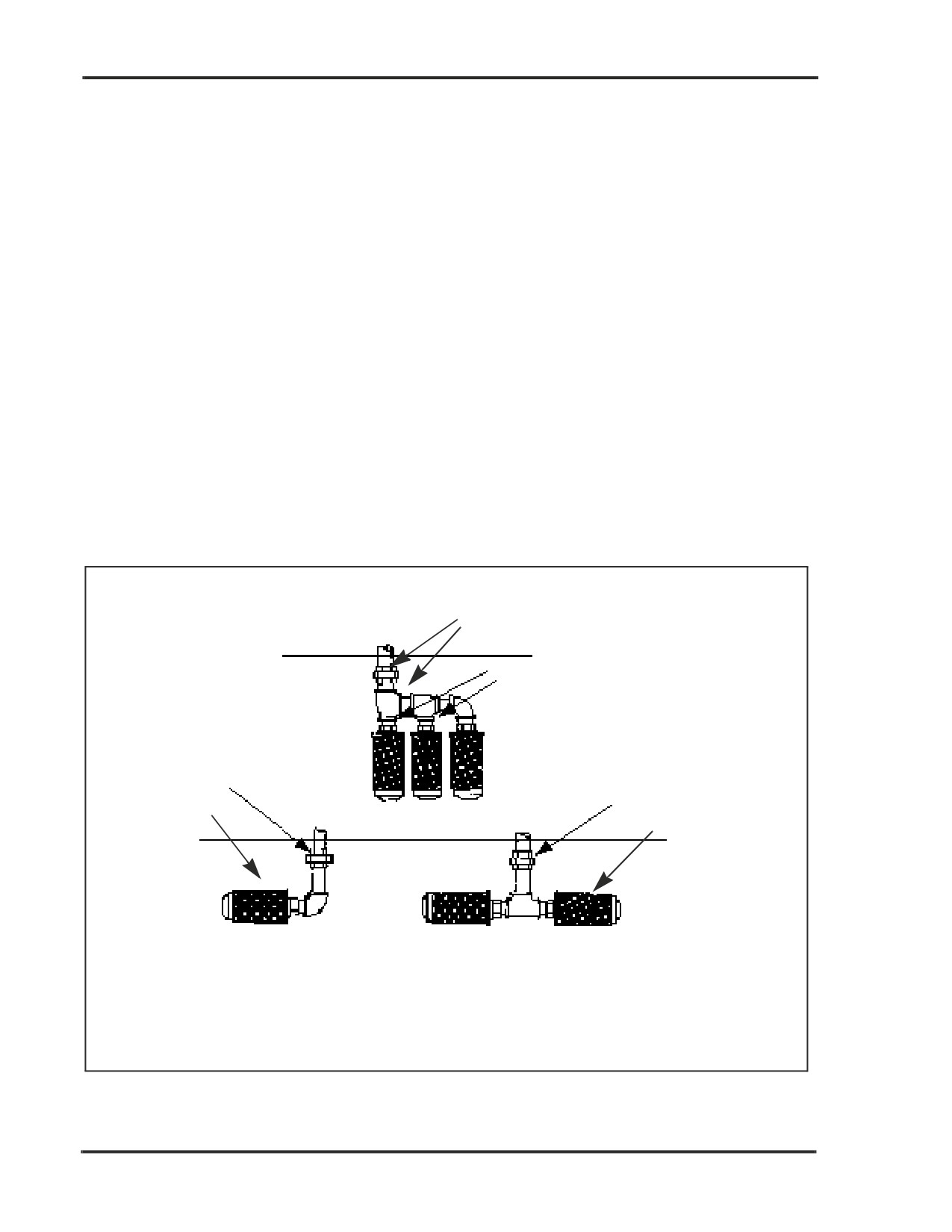
of specially processed wire. Strainers are used to pump inlet lines (Figure 2-11, page 2-10)
where pressure drop must be kept to a minimum.
Figure 2-12 shows a strainer in three possible arrangements for use in a pump inlet
line. If one strainer causes excessive flow friction to a pump, two or more can be used in par-
allel. Strainers and pipe fittings must always be below the liquid level in the tank.
b. Filters. A filter removes small foreign particles from a hydraulic fluid and is most
effective as a safeguard against contaminates. Filters are located in a reservoir, a pressure
line, a return line, or in any other location where necessary. They are classified as full flow
or proportional flow.
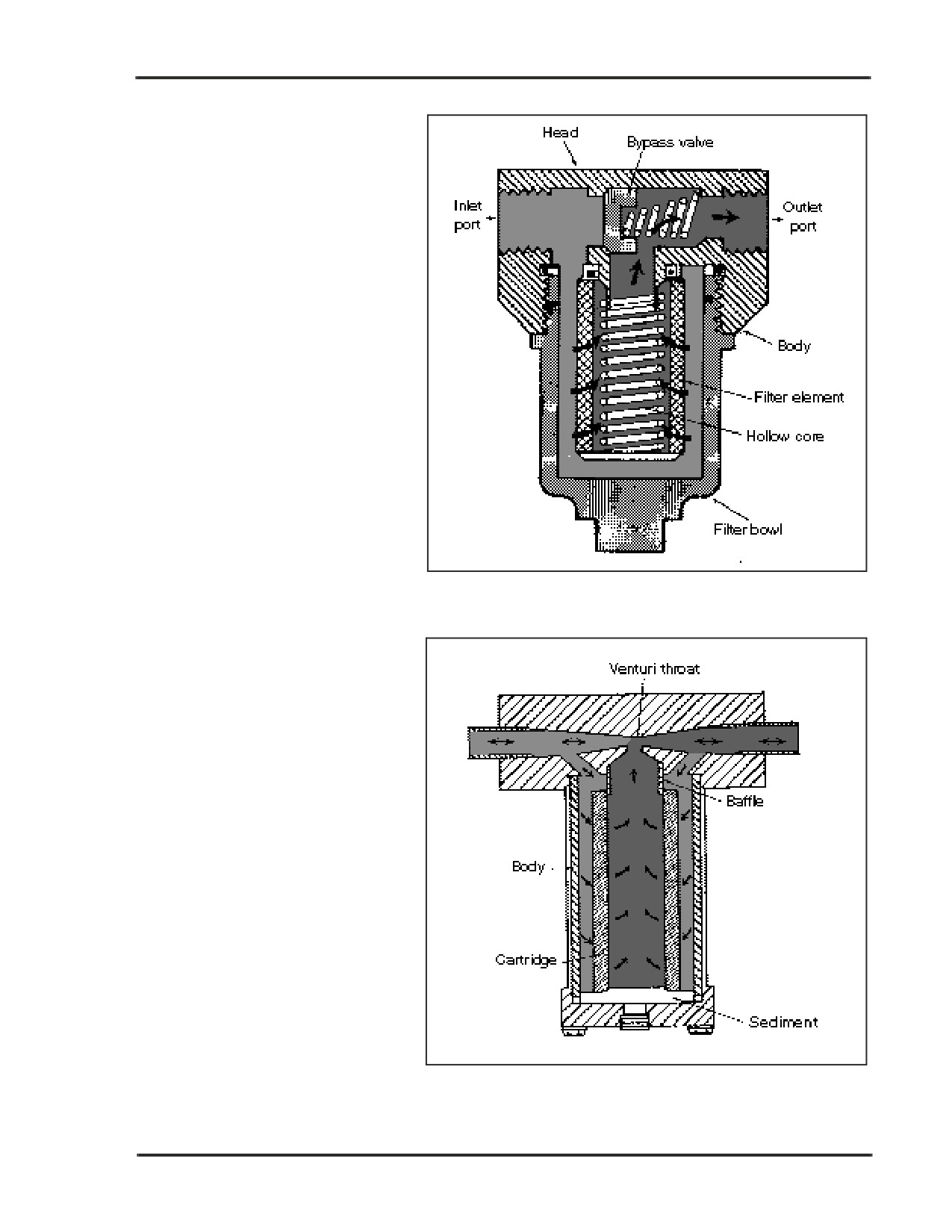
(1) Full-Flow Filter (Figure 2-13). In a full-flow filter, all the fluid entering a unit
passes through a filtering element. Although a full-flow type provides a more positive filter-
ing action, it offers greater resistance to flow, particularly when it becomes dirty. A hydrau-
lic liquid enters a full-flow filter through an inlet port in the body and flows around an
Pipe joints submerged
Oil level
Pump intake
connection
Disconnect union to remove
strainers for cleaning
Oil level
Access opening should be provided so strainers may be
removed for cleaning without draining tank
Figure 2-12. Hydraulic-system strainers
2-12
Hydraulic Systems
FM 5-499
element inside a bowl. Filtering
occurs as a liquid passes through
the element and into a hollow core,
leaving the dirt and impurities on
the outside of the element. A fil-
tered liquid then flows from a hol-
low core to an outlet port and into
the system.
A bypass relief valve in a body
allows a liquid to bypass the ele-
ment and pass directly through an
outlet port when the element
becomes clogged. Filters that do
not have a bypass relief valve have
a contamination indicator. This
indicator works on the principle of
the difference in pressure of a fluid
as it enters a filter and after it
leaves an element. When contami-
nating particles collect on the ele-
ment, the differential pressure
across it increases. When a pres-
sure increase reaches a specific
value, an indicator pops out, signi-
Figure 2-13. Full-flow hydraulic filter
fying that the element must be
cleaned or replaced.
(2) Proportional-Flow Filters
(Figure 2-14). This filter operates
on the venturi principle in which a
tube has a narrowing throat (ven-
turi) to increase the velocity of
fluid flowing through it. Flow
through a venturi throat causes a
pressure drop at the narrowest
point. This pressure decrease
causes a sucking action that draws
a portion of a liquid down around a
cartridge through a filter element
and up into a venturi throat. Fil-
tering occurs for either flow direc-
tion. Although only a portion of a
liquid is filtered during each cycle,
constant recirculation through a
system eventually causes all of a
liquid to pass through the element.
Replace the element according to
applicable regulations and by
doing the following:
Figure 2-14. Proportional-flow filter
Hydraulic Systems
2-13
FM 5-499
• Relieve the pressure.
• Remove the bowl from the filter’s body.
• Remove the filter element from the body, using a slight rocking motion.
• Clean or replace the element, depending on its type.
• Replace all old O-ring packings and backup washers.
• Reinstall the bowl on the body assembly. Do not tighten the bowl excessively;
check the appropriate regulations for specifications, as some filter elements require
a specific torque.
• Pressurize the system and check the filter assembly for leaks.
2-5. Filtering Material and Elements. The general classes of filter materials are mechani-
cal, absorbent inactive, and absorbent active.
• Mechanical filters contain closely woven metal screens or discs. They generally
remove only fairly coarse particles.
• Absorbent inactive filters, such as cotton, wood pulp, yarn, cloth, or resin, remove
much smaller particles; some remove water and water-soluble contaminants. The
elements often are treated to make them sticky to attract the contaminantsfound
in hydraulic oil.
• Absorbent active materials, such as charcoal and Fuller's Earth (a claylike mate-
rial of very fine particles used in the purification of mineral or vegetable-base oils),
are not recommended for hydraulic systems.
The three basic types of filter elements are surface, edge, and depth.
• A surface-type element is made of closely woven fabric or treated paper. Oil flows
through the pores of the filter material, and the contaminants are stopped.
• An edge-type filter is made up of paper or metal discs; oil flows through the spaces
between the discs. The fineness of the filtration is determined by the closeness of
the discs.
• A depth-type element is made up of thick layers of cotton, felt, or other fibers.
2-6. Accumulators. Like an electrical storage battery, a hydraulic accumulator stores
potential power, in this case liquid under pressure for future conversion into useful work.
This work can include operating cylinders and fluid motors, maintaining the required sys-
tem pressure in case of pump or power failure, and compensating for pressure loss due to
leakage. Accumulators can be employed as fluid dispensers and fluid barriers and can pro-
vide a shock-absorbing (cushioning) action.
On military equipment, accumulators are used mainly on the lift equipment to provide
positive clamping action on the heavy loads when a pump’s flow is diverted to lifting or other
operations. An accumulator acts as a safety device to prevent a load from being dropped in
case of an engine or pump failure or fluid leak. On lifts and other equipment, accumulators
absorb shock, which results from a load starting, stopping, or reversal.
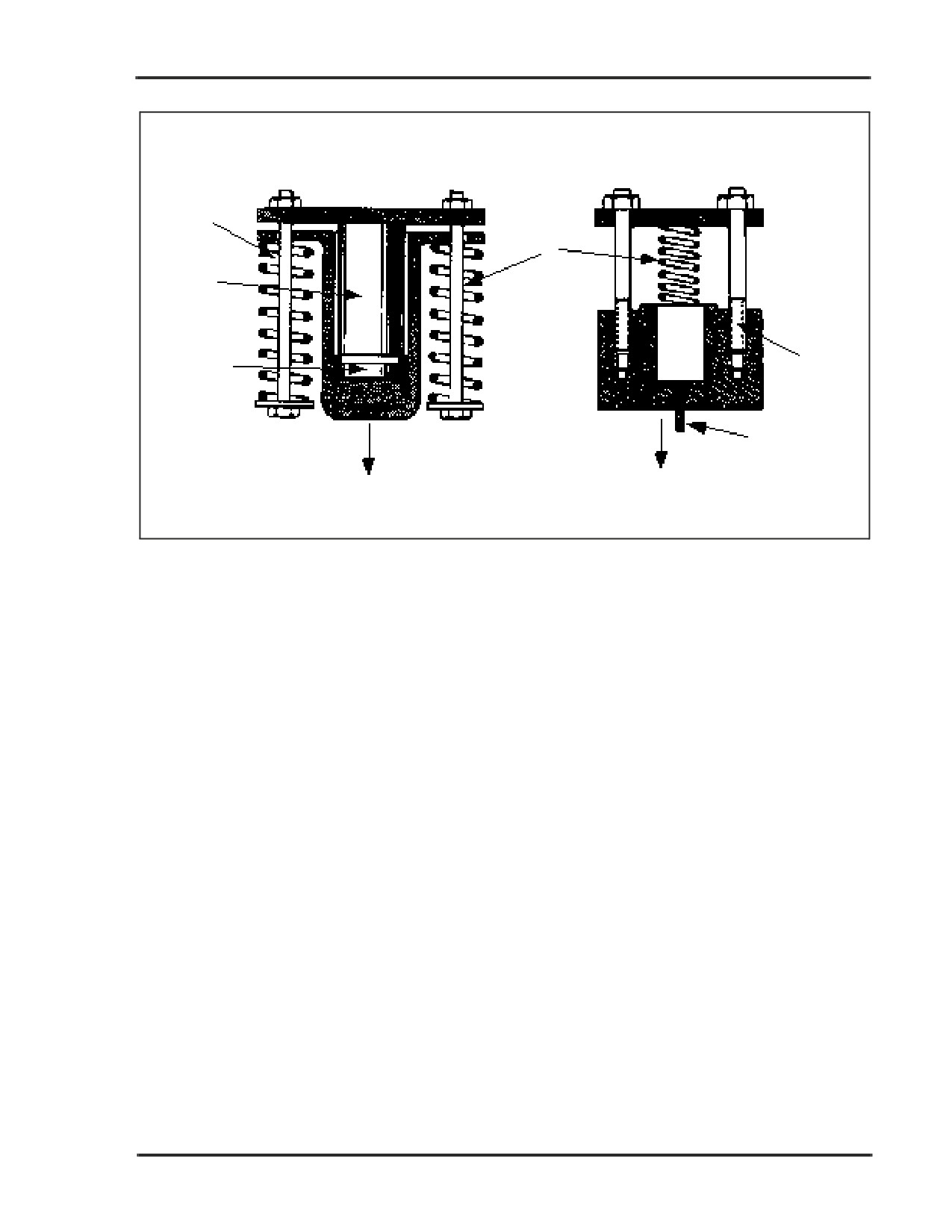
a. Spring-Loaded Accumulator. This accumulator is used in some engineer equipment
hydraulic systems. It uses the energy stored in springs to create a constant force on the liquid
contained in an adjacent ram assembly. Figure 2-15 shows two spring-loaded accumulators.
The load characteristics of a spring are such that the energy storage depends on the
force required to compress s spring. The free (uncompressed) length of a spring represents
2-14
Hydraulic Systems
FM 5-499
MULTIPLE SPRINGS
SINGLE SPRING
Spring
Spring
Piston
Packing
Ram
Ram
assembly
Cylinder
To hydraulic
To hydraulic
system
system
Figure 2-15. Spring-loaded accumulator
zero energy storage. As a spring is compressed to the maximum installed length, a mini-
mum pressure value of the liquid in a ram assembly is established. As liquid under pressure
enters the ram cylinder, causing a spring to compress, the pressure on the liquid will rise
because of the increased loading required to compress the spring.
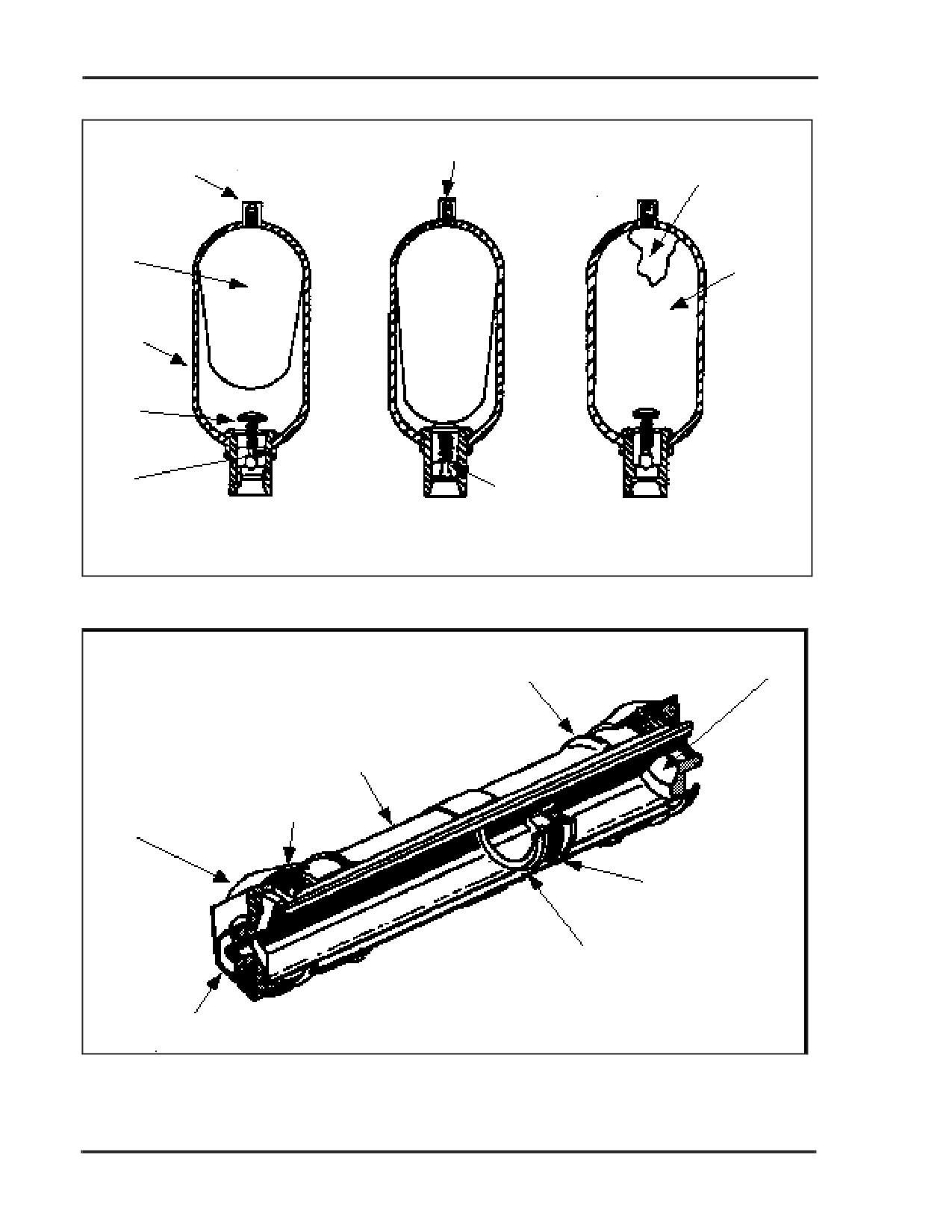
b. Bag-Type Accumulator. This accumulator (Figure 2-16, page 2-16) consists of a
seamless high-pressure shell, cylindrical in shape, with domed ends and a synthetic rubber
bag that separates the liquid and gas (usually nitrogen) within the accumulator. The bag is
fully enclosed in the upper end of a shell. The gas system contains a high-pressure gas
valve. The bottom end of the shell is sealed with a special plug assembly containing a liquid
port and a safety feature that makes it impossible to disassemble the accumulator with
pressure in the system. The bag is larger at the top and tapers to a smaller diameter at the
bottom. As the pump forces liquid into the accumulator shell, the liquid presses against the
bag, reduces its volume, and increases the pressure, which is then available to do work.
c. Piston-Type Accumulator. This accumulator consists of a cylinder assembly, a piston
assembly, and two end-cap assemblies. The cylinder assembly houses a piston assembly and
incorporates provisions for securing the end-cap assemblies. An accumulator contains a
free-floating piston with liquid on one side of the piston and precharged air or nitrogen on
the other side (Figure 2-17, page 2-16). An increase of liquid volume decreases the gas volume
and increases gas pressure, which provides a work potential when the liquid is allowed to dis-
charge.
d. Maintenance. Before removing an accumulator for repairs, relieve the internal pres-
sure: in a spring-loaded type, relieve the spring tension; in a piston or bag type, relieve the
gas or liquid pressure.
Hydraulic Systems
2-15
FM 5-499
Gas charging inlet
Compressed
Gas valve
gas
Gas bag
Liquid
Shell
Plug
assembly
Spring-loaded
Liquid inlet
check valve
(normally open)
STATIC
PRECHARGED
FULLY CHARGED
POSITION
POSITION
POSITION
Figure 2-16. Bag-type accumulator
Hydraulic liquid port
Hydraulic liquid port
Barrell assembly
Packing and
End cap
backup ring
assembly
Lubrication passage
Piston assembly
Gas port
Figure 2-17. Piston-type accumulator
2-16
Hydraulic Systems
FM 5-499
2-7. Pressure Gauges and Volume
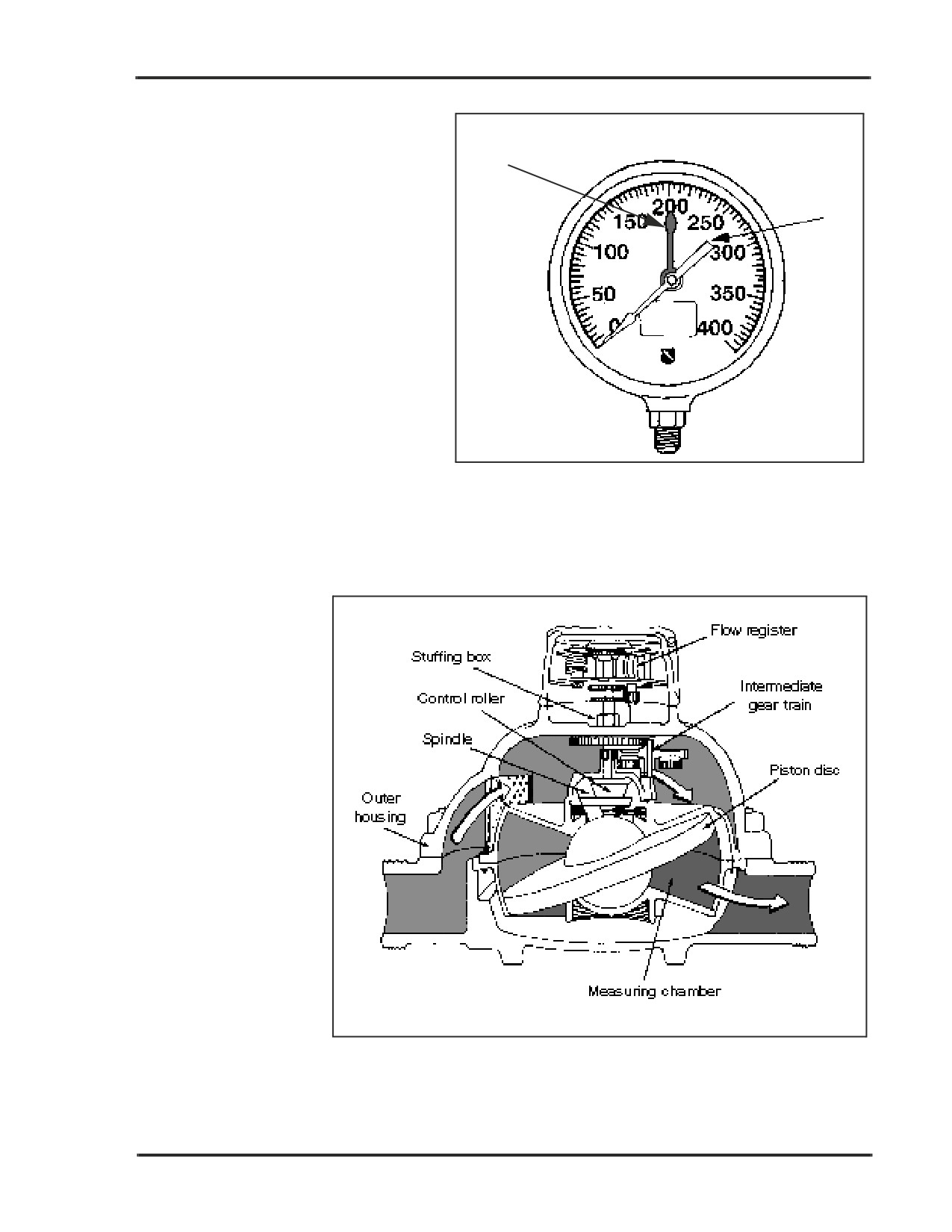
Meters. Pressure gauges are used in
Red hand
liquid-powered systems to measure
pressure to maintain efficient and safe
operating levels. Pressure is mea-
Pointer
sured in psi. Flow measurement may
be expressed in units of rate of flow—
GPM or cubic feet per second (cfs). It
may also be expressed in terms of total
quantity—gallons or cubic feet.
a. Pressure Gauges. Figure 2-18
shows a simple pressure gauge. Gauge
readings indicate the fluid pressure set
up by an opposition of forces within a
system. Atmospheric pressure is neg-
ligible because its action at one place is
balanced by its equal action at another
place in a system.
Figure 2-18. Pressure gauge
b. Meters. Measuring flow
depends on the quantities, flow rates, and types of liquid involved. All liquid meters (flow-
meters) are made to measure specific liquids and must be used only for the purpose for
which they were made. Each meter is tested and calibrated.
In a nutating-pis-
ton-disc flowmeter, liq-
uid passes through a
fixed volume measur-
ing chamber, which is
divided into upper and
lower compartments
by a piston disc (Figure
2-19). During opera-
tion, one compartment
is continually being
filled while the other is
being emptied. As a
liquid passes through
these compartments,
its pressure causes a
piston disc to roll
around in the chamber.
The disc's movements
operate a dial (or
counter) through gear-
ing elements to indi-
cate that a column of
Figure 2-19. Nutating-piston-disc flowmeter
fluid that has passed
through the meter.
Hydraulic Systems
2-17
FM 5-499
2-8. Portable Hydraulic-Circuit Testers. Hydraulic power is an efficient method of
delivering HP by pumping a fluid through a closed system. If the amount of flow or the pres-
sure unknowingly decreases, the amount of HP delivered to a working unit will be reduced,
and a system will not perform as it should.
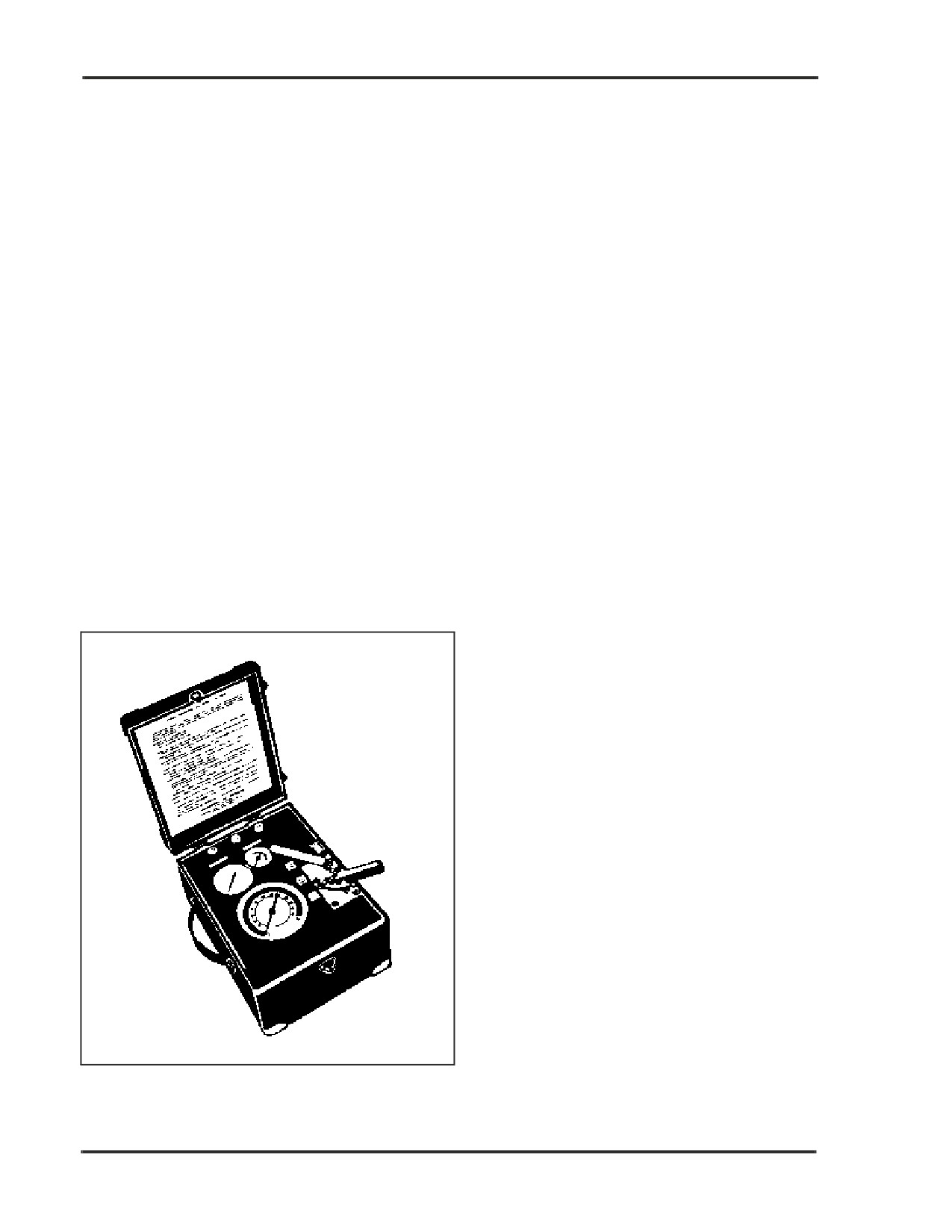
a. Testers. Portable hydraulic-circuit testers (Figure 2-20) are lightweight units you
can use to check or troubleshoot a hydraulic-powered system on the job or in a maintenance
shop. Connect a tester into a system's circuit to determine its efficiency. Currently, sev-
eral hydraulic-circuit testers are on the market. Operating procedures may vary on differ-
ent testers. Therefore, you must follow the operating directions furnished with a tester to
check or troubleshoot a circuit accurately.
b. Improper Operation. When a hydraulic system does not operate properly, the trouble
could be one of the following:
• The pump that propels the fluid may be slipping because of a worn or an improp-
erly set spring in the relief valve.
• The fluid may be leaking around the control valves or past the cylinder packing.
Since hydraulic systems are confined, it is difficult to identify which component in a sys-
tem is not working properly. Measure the flow, pressure, and temperature of a liquid at
given points in a system to isolate the malfunctioning unit. If this does not work, take the
system apart and check each unit for worn parts or bad packing. This type of inspection can
be costly from the standpoint of maintenance time and downtime of the power system.
2-9. Circulatory Systems. Pipes and fittings, with their necessary seals, make up a circu-
latory system of liquid-powered equipment. Properly selecting and installing these compo-
nents are very important. If improperly
selected or installed, the result would be
serious power loss or harmful liquid con-
tamination. The following is a list of some
Portable tester
of the basic requirements of a circulatory
series
system:
• Lines must be strong enough to con-
tain s liquid at s desired working
pressure and the surges in pressure
that may develop in s system.
• Lines must be strong enough to sup-
port the components that are
mounted on them.
• Terminal fittings must be at all junc-
tions where parts must be removed
for repair or replacement.
• Line supports must be capable of
damping the shock caused by pres-
sure surges.
• Lines should have smooth interiors
to reduce turbulent flow.
• Lines must have the correct size for
Figure 2-20. Portable hydraulic-circuit
the required liquid flow.
tester
2-18
Hydraulic Systems
FM 5-499
• Lines must be kept clean by regular flushing or purging.
• Sources of contaminants must be eliminated.
The three common types of lines in liquid-powered systems are pipes, tubing, and flexi-
ble hose, which are also referred to as rigid, semirigid, and flexible line.
a. Tubing. The two types of tubing used
for hydraulic lines are seamless and electric
Right
Wrong
welded. Both are suitable for hydraulic sys-
tems. Seamless tubing is made in larger sizes
than tubing that is electric welded. Seamless
tubing is flared and fitted with threaded com-
pression fittings. Tubing bends easily, so
fewer pieces and fittings are required. Unlike
pipe, tubing can be cut and flared and fitted in
the field. Generally, tubing makes a neater,
less costly, lower-maintenance system with
fewer flow restrictions and less chances of
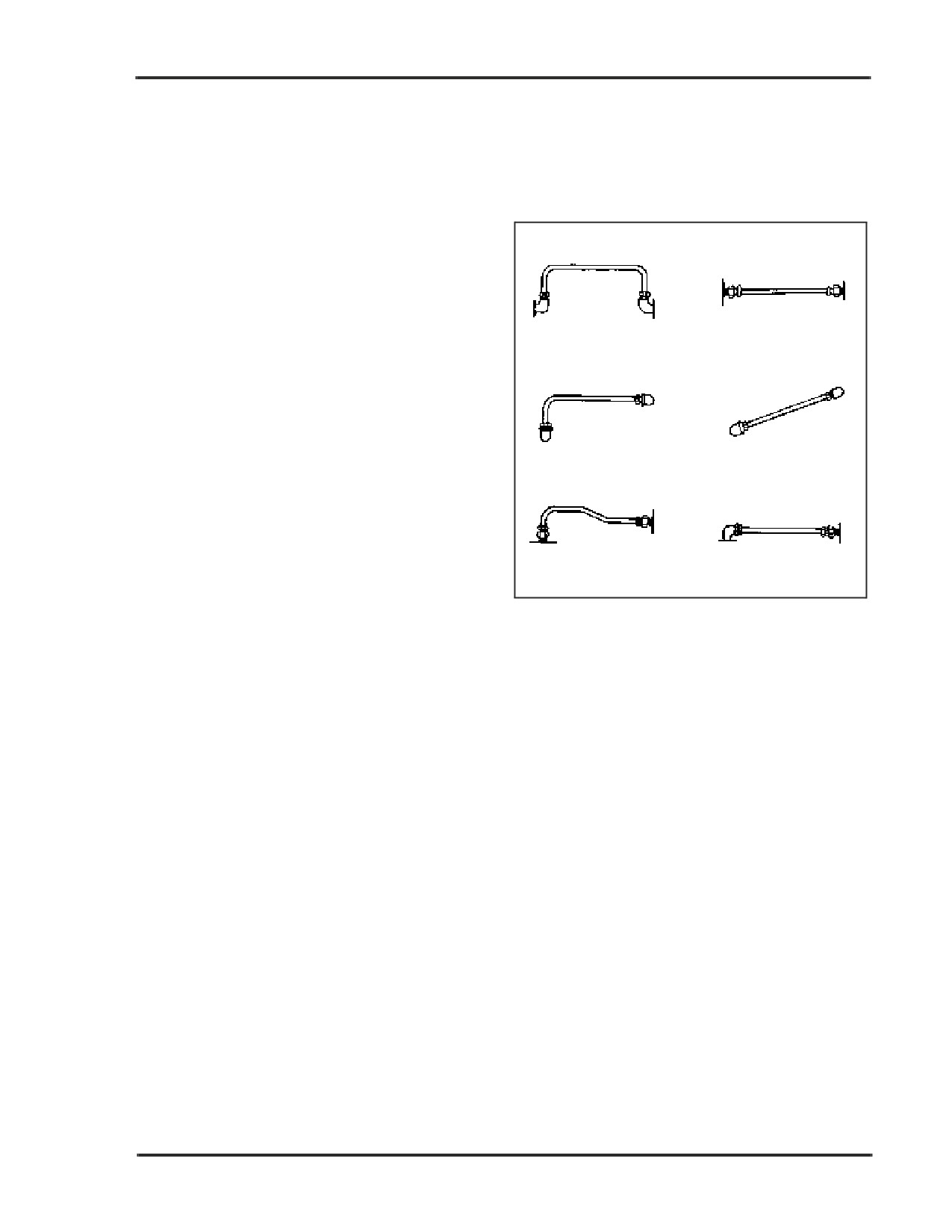
leakage. Figure 2-21 shows the proper
method of installing tubing.
Knowing the flow, type of fluid, fluid
velocity, and system pressure will help deter-
mine the type of tubing to use. (Nominal
dimensions of tubing are given as fractions in
inches or as dash numbers. A dash number
represents a tube’s outside diameter [OD] in
Figure 2-21. Method of installing tubing
sixteenths of an inch.) A system’s pressure
determines the thickness of the various tubing walls. Tubing above 1/2 inch OD usually is
installed with either flange fittings with metal or pressure seals or with welded joints. If
joints are welded, they should be stress-relieved.
b. Piping. You can use piping that is threaded with screwed fittings with diameters up
to 1 1/4 inches and pressures of up to 1,000 psi. Where pressures will exceed 1,000 psi and
required diameters are over 1 1/4 inches, piping with welded, flanged connections and
socket-welded size are specified by nominal inside diameter (ID) dimensions. The thread
remains the same for any given pipe size regardless of wall thickness. Piping is used eco-
nomically in larger-sized hydraulic systems where large flow is carried. It is particularly
suited for long, permanent straight lines. Piping is taper-threaded on its OD into a tapped
hole or fitting. However, it cannot be bent. Instead, fittings are used wherever a joint is
required. This results in additional costs and an increased chance of leakage.
c. Flexible Hosing. When flexibility is necessary in liquid-powered systems, use hose.
Examples would be connections to units that move while in operation to units that are
attached to a hinged portion of the equipment or are in locations that are subjected to severe
vibration. Flexible hose is usually used to connect a pump to a system. The vibration that is
set up by an operating pump would ultimately cause rigid tubing to fail.
(1) Rubber Hose. Rubber hose is a flexible hose that consists of a seamless, synthetic
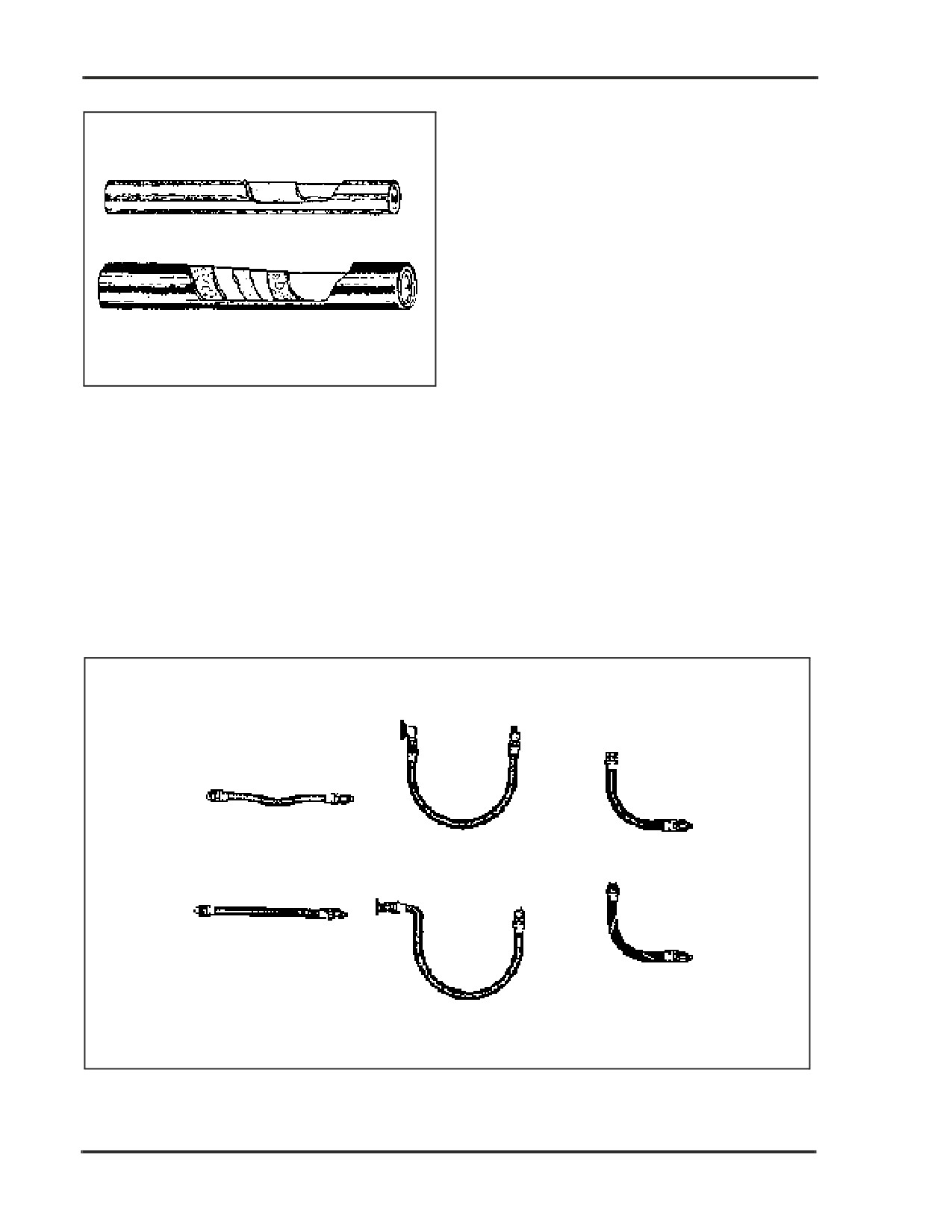
rubber tube covered with layers of cotton braid and wire braid. Figure 2-22, page 2-20,
shows cut-away views of typical rubber hose. An inner tube is designed to withstand material
Hydraulic Systems
2-19
FM 5-499
passing through it. A braid, which may con-
sist of several layers, is the determining factor
in the strength of a hose. A cover is designed
to withstand external abuse.
When installing flexible hose, do not twist
it. Doing so reduces its lift and may cause its
fittings to loosen. An identification stripe that
runs along the hose length should not spiral,
which would indicate twisting (Figure 2-23).
Protect flexible hose from chafing by wrapping
it lightly with tape, when necessary.
The minimum bend radius for flexible
hose varies according to its size and construc-
tion and the pressure under which a system
Figure 2-22. Flexible rubber hose
will operate. Consult the applicable publica-
tions that contain the tables and graphs which show the minimum bend radii for the differ-
ent types of installations. Bends that are too sharp will reduce the bursting pressure of
flexible hose considerably below its rated value.
Do not install flexible hose so that it will be subjected to a minimum of flexing during
operation. Never stretch hose tightly between two fittings. When under pressure, flexible
hose contracts in length and expands in diameter.
(2) Teflon™-Type Hose. This is a flexible hose that is designed to meet the require-
ments of higher operating pressures and temperatures in today's fluid-powered systems.
The hose consists of a chemical resin that is processed and pulled into a desired-size tube
RIGHT
WRONG
Figure 2-23. Installing flexible hose
2-20
Hydraulic Systems
FM 5-499
shape. It is covered with stainless-steel wire that is braided over the tube for strength and
protection. Teflon-type hose will not absorb moisture and is unaffected by all fluids used in
today’s fluid-powered systems. It is nonflammable; however, use an asbestos fire sleeve
where the possibility of an open flame exists.
Carefully handle all Teflon-type hose during removal or installation. Sharp or excessive
bending will kink or damage the hose. Also, the flexible-type hose tends to form itself to the
installed position in a circulatory system.
d. Installation. Flaring and brazing are the most common methods of connecting tub-
ing. Preparing a tube for installation usually involves cutting, flaring, and bending. After
cutting a tube to the correct length, cut it squarely and carefully remove any internal or
external burrs.
If you use flare-type fittings, you must flare the tube. A flare angle should extend 37
degrees on each side of the center line. The area’s outer edge should extend beyond the max-
imum sleeve's ID but not its OD. Flares that are too short are likely to be squeezed thin,
which could result in leaks or breaks. Flares that are too long will stick or jam during
assembly.
Keep the lines as short and free of bends as possible. However, bends are preferred to
elbows or sharp turns. Try not to assemble the tubing in a straight line because a bend
tends to eliminate strain by absorbing vibration and compensating for temperature expan-
sion and contraction.
Install all the lines so you can remove them without dismantling a circuit’s components
or without bending or springing them to a bad angle. Add supports to the lines at frequent
intervals to minimize vibration or movement; never weld the lines to the supports. Since
flexible hose has a tendency to shorten when subjected to pressure, allow enough slack to
compensate for this problem.
Keep all the pipes, tubes, or fittings clean and free from scale and other foreign matter.
Clean iron or steel pipes, tubes, and fittings with a boiler-tube wire brush or with com-
mercial pipe-cleaning equipment. Remove rust and scale from short, straight pieces by
sandblasting them, as long as no sand particles will remain lodged in blind holes or pockets
after you flush a piece. In the case of long pieces or pieces bent to complex shapes, remove
rust and scale by pickling (cleaning metal in a chemical bath). Cap and plug the open ends
of the pipes, tubes, and fittings that will be stored for a long period. Do not use rags or waste
for this purpose because they deposit harmful lint that can cause severe damage in a
hydraulic system.
2-10. Fittings and Connectors. Fittings are used to connect the units of a fluid-powered
system, including the individual sections of a circulatory system. Many different types of
connectors are available for fluid-powered systems. The type that you will use will depend
on the type of circulatory system (pipe, tubing, or flexible hose), the fluid medium, and the
maximum operating pressure of a system. Some of the most common types of connectors are
described below:
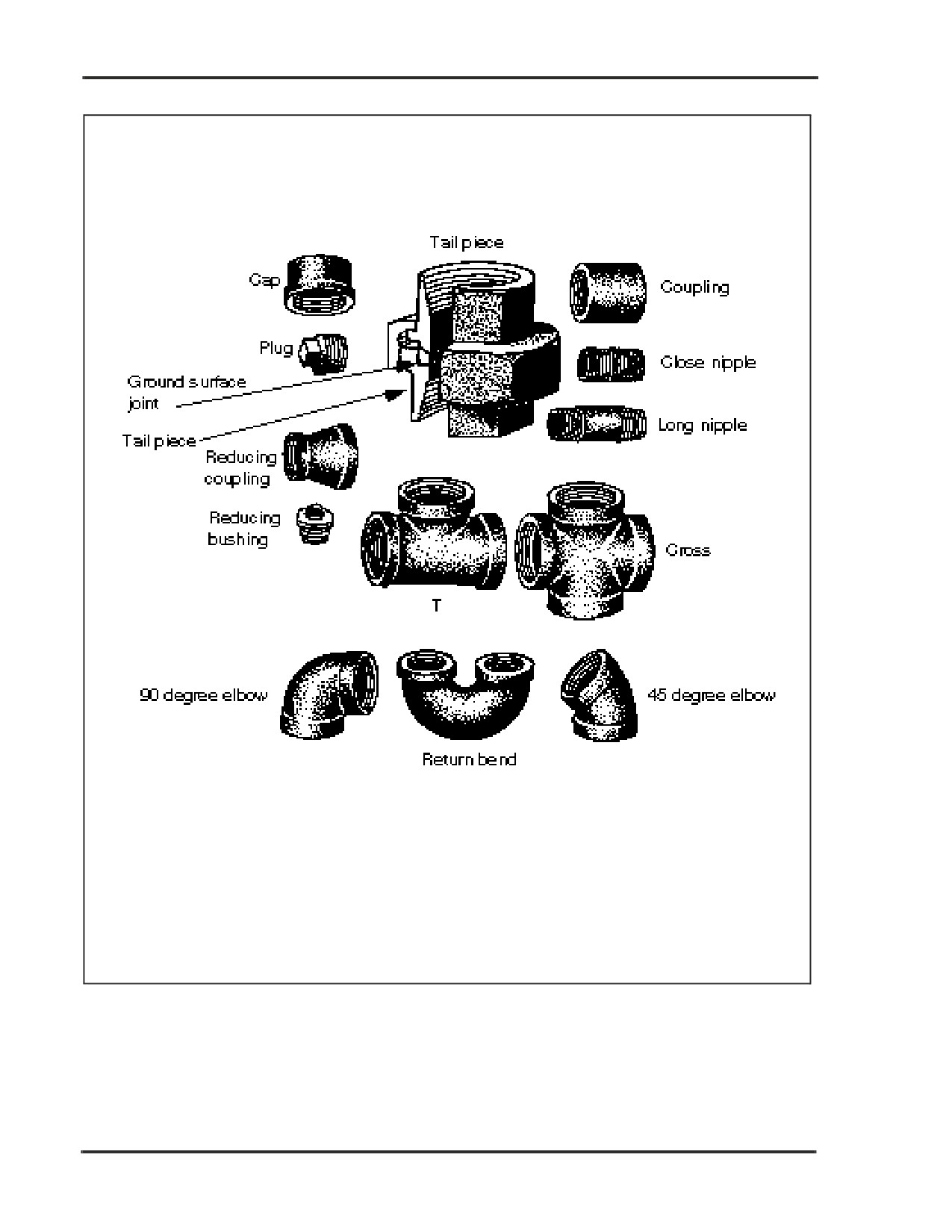
a. Threaded Connectors. Threaded connectors are used in some low-pressure liquid-
powered systems. They are usually made of steel, copper, or brass, in a variety of designs
(Figure 2-24, page 2-22). The connectors are made with standard female threading cut on
the inside surface. The end of the pipe is threaded with outside (male) threads for connecting.
Hydraulic Systems
2-21
FM 5-499
Figure 2-24. Threaded-pipe connectors
2-22
Hydraulic Systems
FM 5-499
Standard pipe threads are tapered slightly
to ensure tight connections.
To prevent seizing (threads sticking),
apply a pipe-thread compound to the
threads. Keep the two end threads free of
the compound so that it will not contaminate
the fluid. Pipe compound, when improperly
applied, may get inside the lines and harm
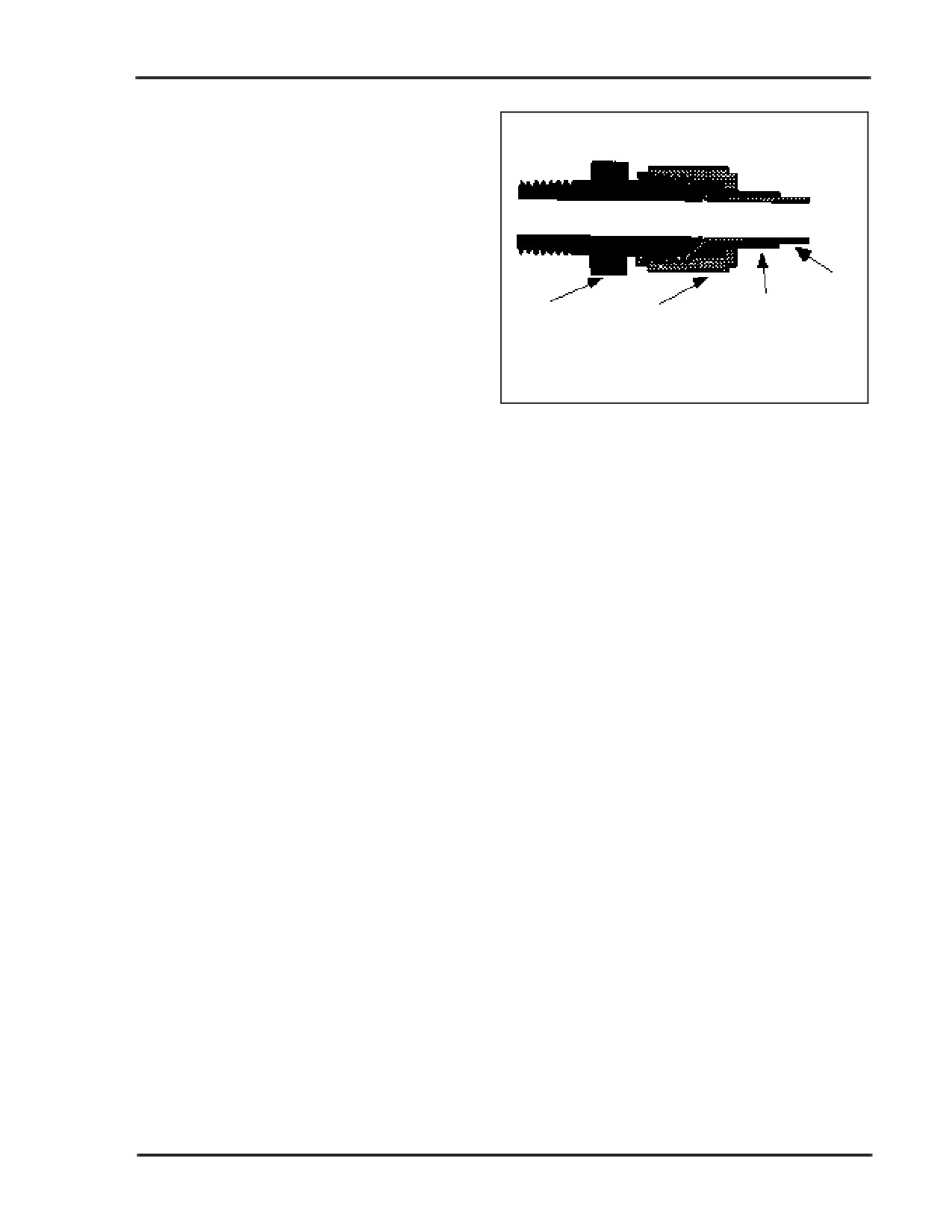
Tubing
the pumps and the control equipment.
Sleeve
Fitting
Nut
b. Flared Connectors. The common con-
nectors used in circulatory systems consist
of tube lines. These connectors provide safe,
strong, dependable connections without hav-
ing to thread, weld, or solder the tubing. A
connector consists of a fitting, a sleeve, and
Figure 2-25. Flared-tube connector
a nut (see Figure 2-25).
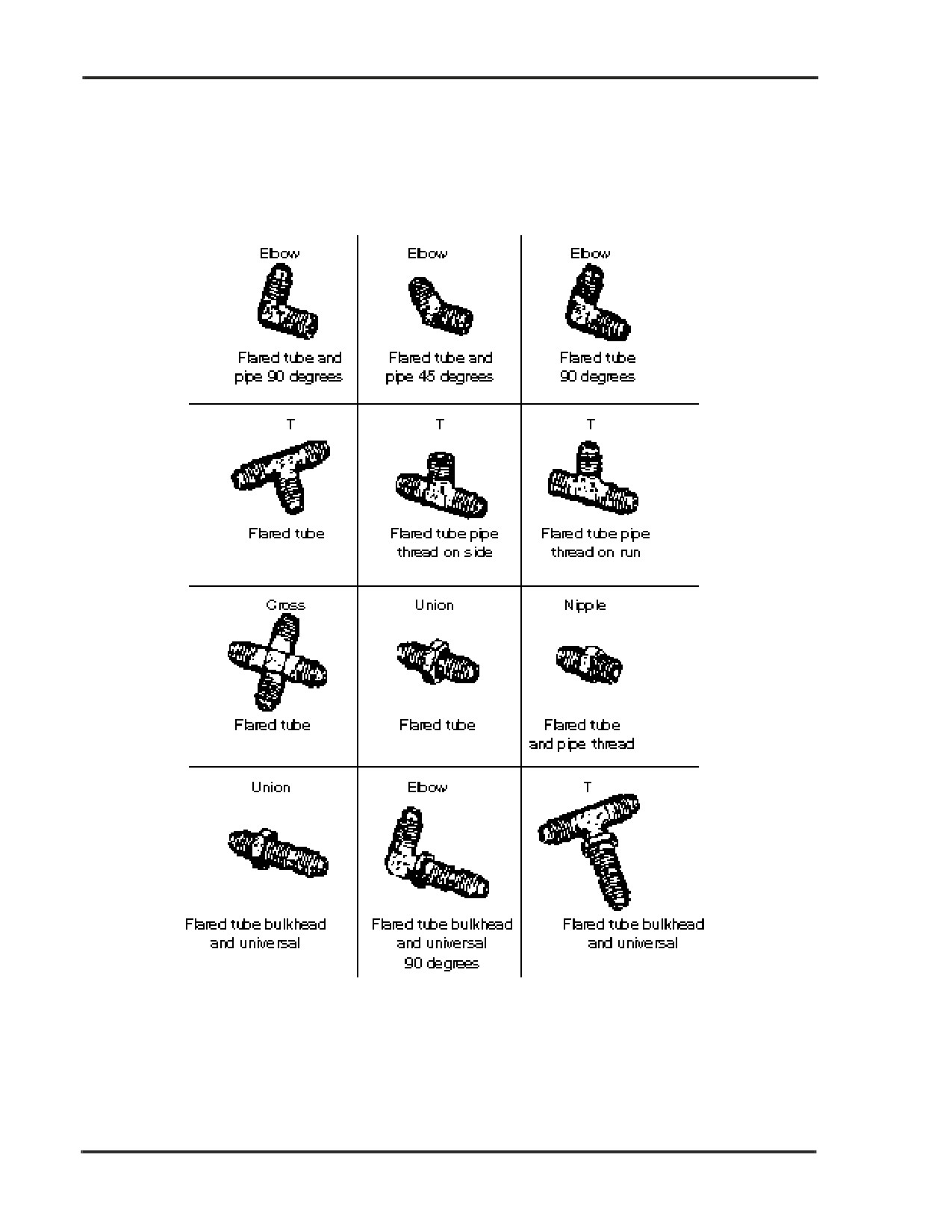
Fittings are made of steel, aluminum alloy, or bronze. The fittings should be of a mate-
rial that is similar to that of a sleeve, nut, and tubing. Fittings are made in unions, 45- and
90-degree elbows, Ts, and various other shapes. Figure 2-26, page 2-24, shows some of the
most common fittings used with flared connectors.
Fittings are available in many different thread combinations. Unions have tube connec-
tions on each end; elbows have tube connections on one end and a male pipe thread, female
pipe thread, or a tube connection on the opposite end; crosses and Ts have several different
combinations.
Tubing used with flared connectors must be flared before being assembled. A nut fits
over a sleeve and, when tightened, draws the sleeve and tubing flare tightly against a male
fitting to form a seal. A male fitting has a cone-shaped surface with the same angle as the
inside of a flare. A sleeve supports the tube so that vibration does not concentrate at the
edge of a flare but that it does distribute the shearing action over a wider area for added
strength. Tighten the tubing nuts with a torque wrench to the value specified in applicable
regulations.
If an aluminum alloy flared connector leaks after tightening to the specified torque, do
not tighten it further. Disassemble the leaking connector and correct the fault. If a steel
connector leaks, you may tighten it 1/6 turn beyond the specified torque in an attempt to
stop the leak. If you are unsuccessful, disassemble it and repair it.
Flared connectors will leak if—
• A flare is distorted into the nut threads.
• A sleeve is cracked.
• A flare is cracked or split.
• A flare is out-of-round.
• A flare is eccentric to the tube’s OD.
• A flare's inside is rough or scratched.
• A fitting cone is rough or scratched.
Hydraulic Systems
2-23
FM 5-499
Figure 2-26. Flared-tube fittings
2-24
Hydraulic Systems
FM 5-499
• The threads of a fitting or
nut are dirty, damaged, or
broken.
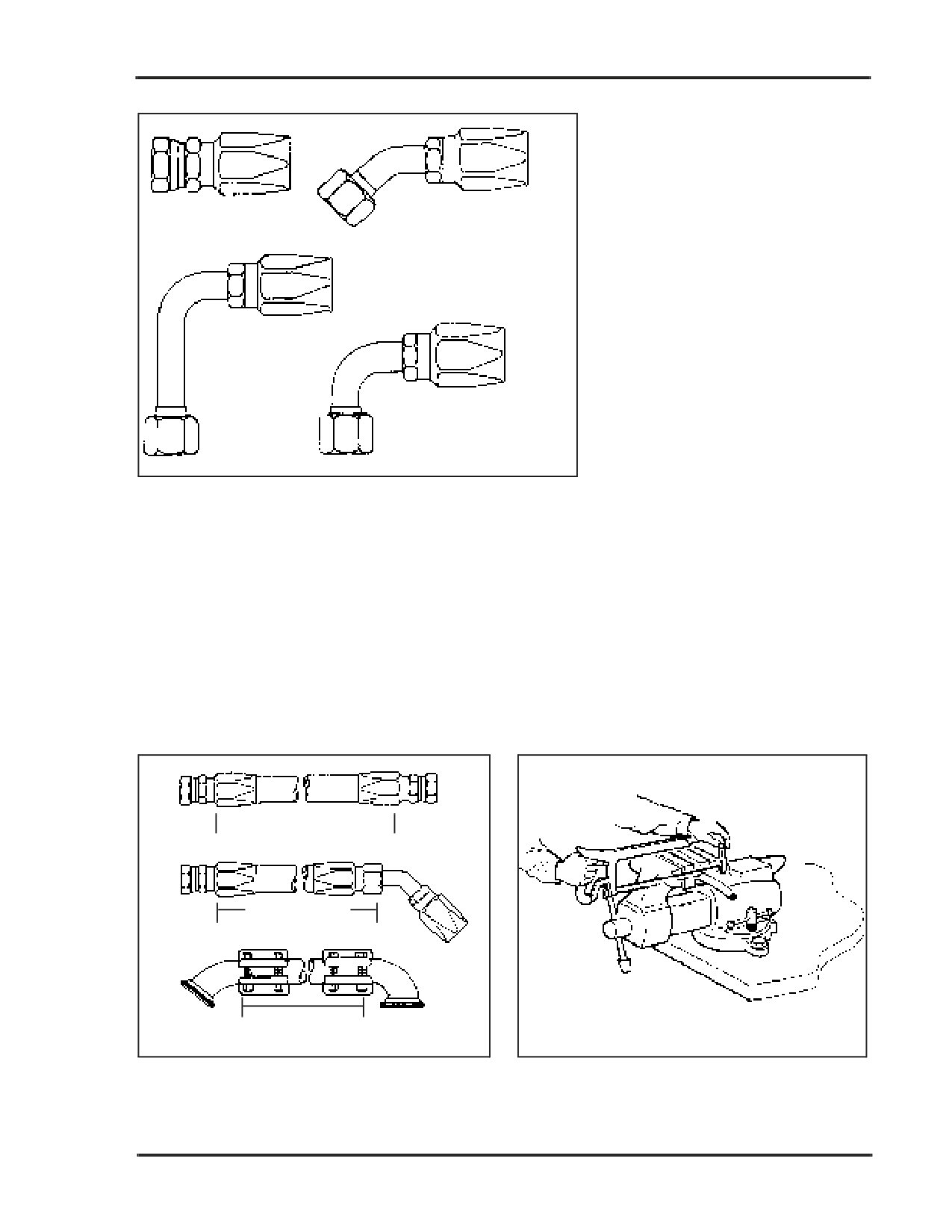
c. Flexible-Hose Couplings. If
a hose assembly is fabricated with
Straight
45° bent tube
field attachable couplings (Figure
2-27), use the same couplings when
fabricating the replacement assem-
bly, as long as the failure (leak or
break) did not occur at a coupling.
If failure occurred at a coupling,
90° bent tube
discard it.
long drop
When measuring a replace-
ment hose assembly for screw-on
90° bent tube
couplings, measure from the edge
short drop
of a retaining bolt (Figure 2-28).
Place the hose in hose blocks and
then in a bench vice (Figure 2-29).
Use the front or rear portion of a
Figure 2-27. Field-attachable couplings
hacksaw blade for cutting. (If you
use the middle portion of a blade, it could twist and break.) For effective cutting, a blade
should have 24 or 32 teeth per inch. To remove an old coupling on a hose assembly that is
fabricated with permanently attached couplings, you just discard the entire assembly (see
Figure 2-30, page 2-26).
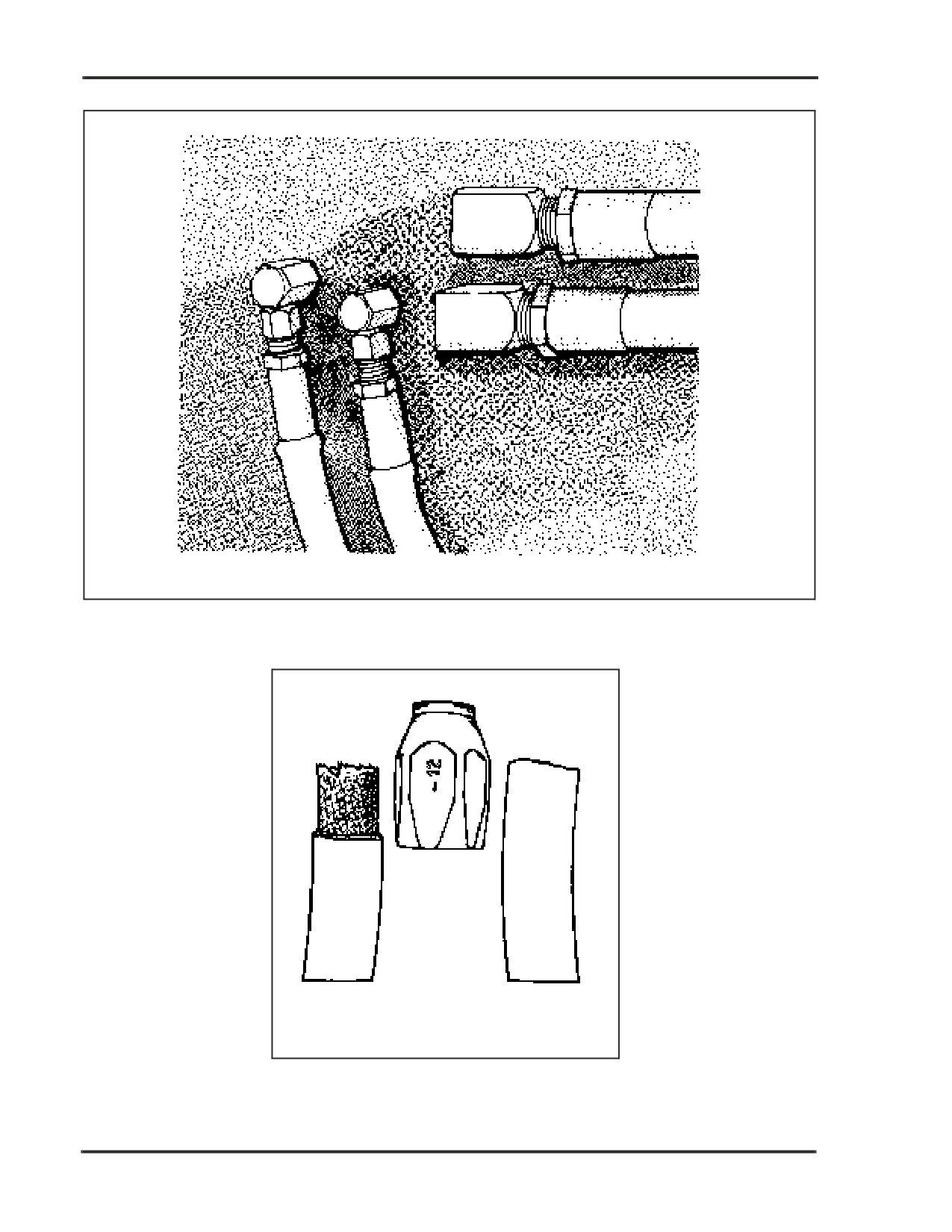
d. Reusable Fittings. To use a skived fitting (Figure 2-31, page 2-26), you must strip
(skive) the hose to a length equal to that from a notch on a fitting to the end of the fitting. (A
notch on a female portion of a fitting in Figure 2-31 indicates it to be a skived fitting.) To
assemble a conductor using skived fittings—
Measure from edge
of hex
Length
measurement
Measure from edge
of retaining bolt
Figure 2-28. Hose-length measurement
Figure 2-29. Hose cutting
Hydraulic Systems
2-25
FM 5-499
Figure 2-30. Permanently attached couplings
Figure 2-31. Skived fitting
2-26
Hydraulic Systems
FM 5-499
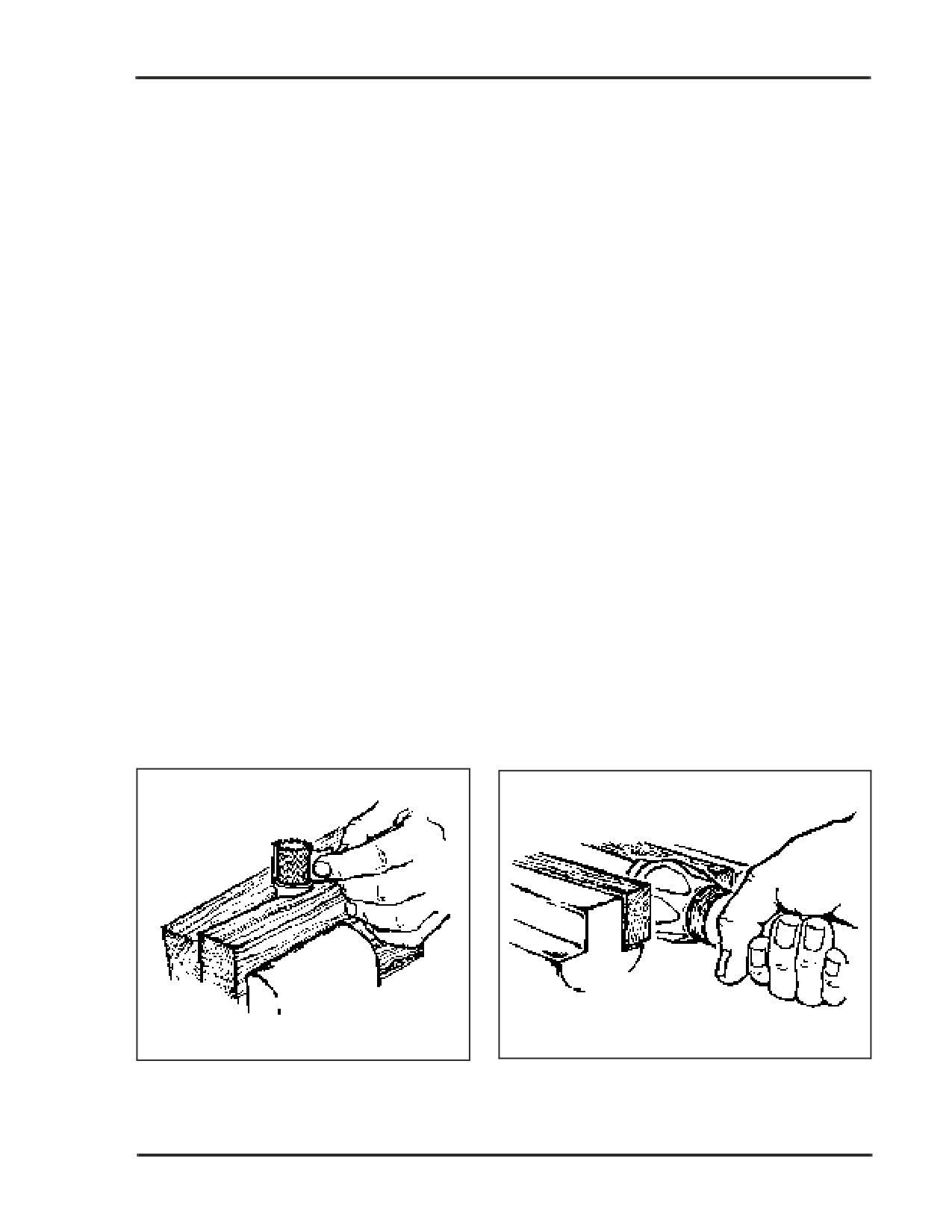
• Determine the length of the skive.
• Make a cut around the hose with a sharp knife. Make sure that you cut completely
through the rubber cover of the hose.
• Cut lengthwise to the end of the hose (Figure 2-32). Lift the hose flap and remove
it with pliers.
• Repeat the process on the opposite end of the hose.
• Place the female portion of the fitting in a bench vice (Figure 2-33) and secure it in
place.
• Lubricate the skived portion of the hose with hose lubricant (hydraulic fluid or
engine oil, if necessary).
• Insert the hose into the female socket and turn the hose counterclockwise until it
bottoms on the shoulder of the female socket, then back off 1/4 turn.
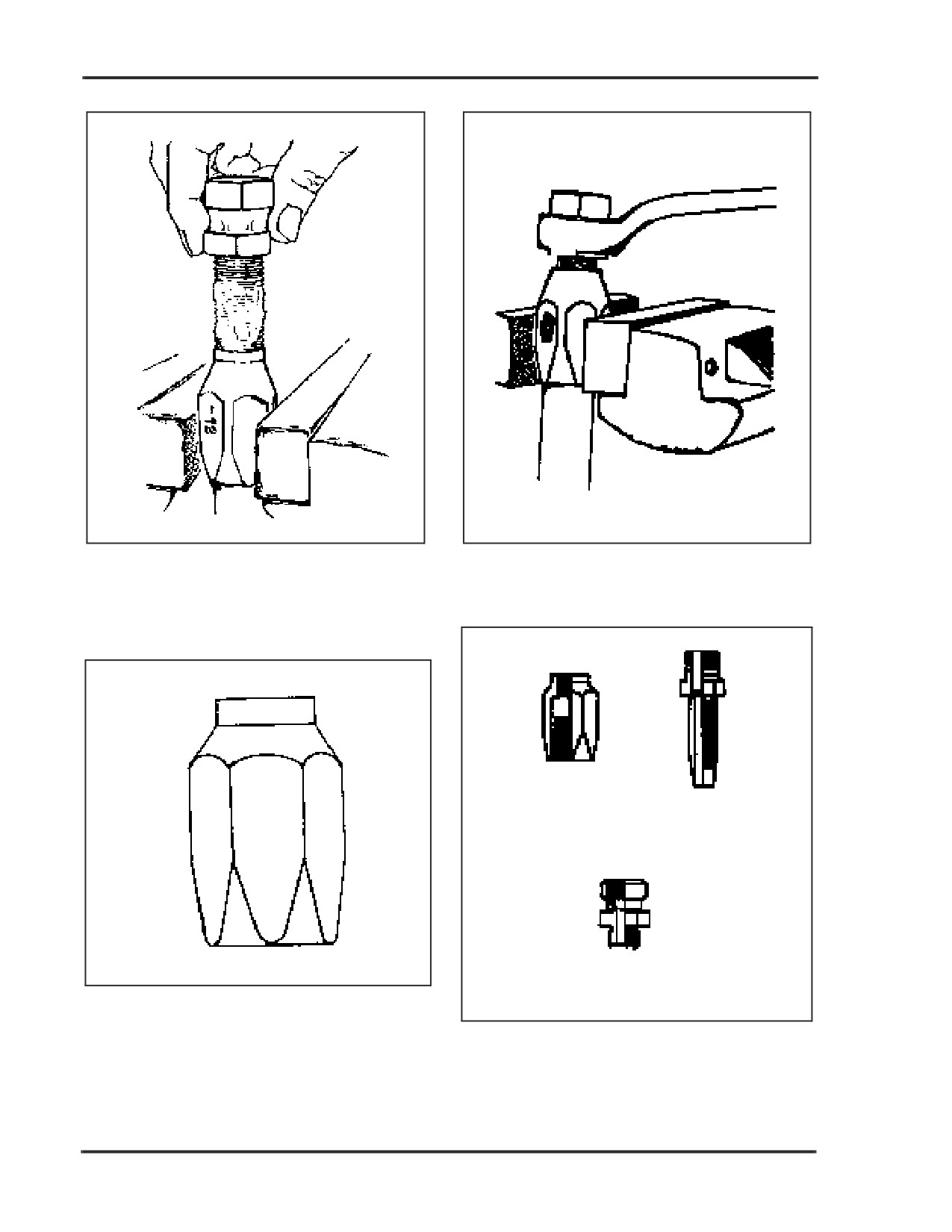
• Place the female socket in an upright position (Figure 2-34, page 3-28) and insert
the male nipple into the female socket.
• Turn the male nipple clockwise (Figure 2-35, page 3-28) until the hex is within 1/32
inch of the female socket.
• Repeat the above process on the opposite end of the hose.
When assembling conductors using nonskived-type fittings, follow the above proce-
dures. However, do not skive a hose. Nonskived fittings do not have a notch on the female
portion of a fitting (Figure 2-36, page 2-28).
Figure 2-37, page 2-28, diagram A, shows a female hose coupling. One end of the hose
has a spiral ridge (course thread) that provides a gripping action on the hose. The other end
(small end) has machine threads into which the male, fixed or swivel nipple, is inserted.
Figure 2-37, diagram B shows the male adapter, and diagram C shows the male and the
female swivel body. These fittings contain a fixed or swivel hex-nut connector on one end.
The opposite end is tapered and has machine threads that mate with the threads in a female
fitting. With a long taper inserted into a hose and screwed into a female coupling, the taper
Figure 2-32. Trimming a hose
Figure 2-33. Female portion of a fitting
Hydraulic Systems
2-27
FM 5-499
Figure 2-34. Male and female portions
Figure 2-35. Tightening a fitting
of a fitting
Female hose
coupling
Male
A
adapter
B
(Male and female)
swivel body
Figure 2-36. Nonskived fitting
C
Figure 2-37. Fittings
2-28
Hydraulic Systems
FM 5-499
tends to expand a hose, forcing it against the
inside diameter of a female fitting.
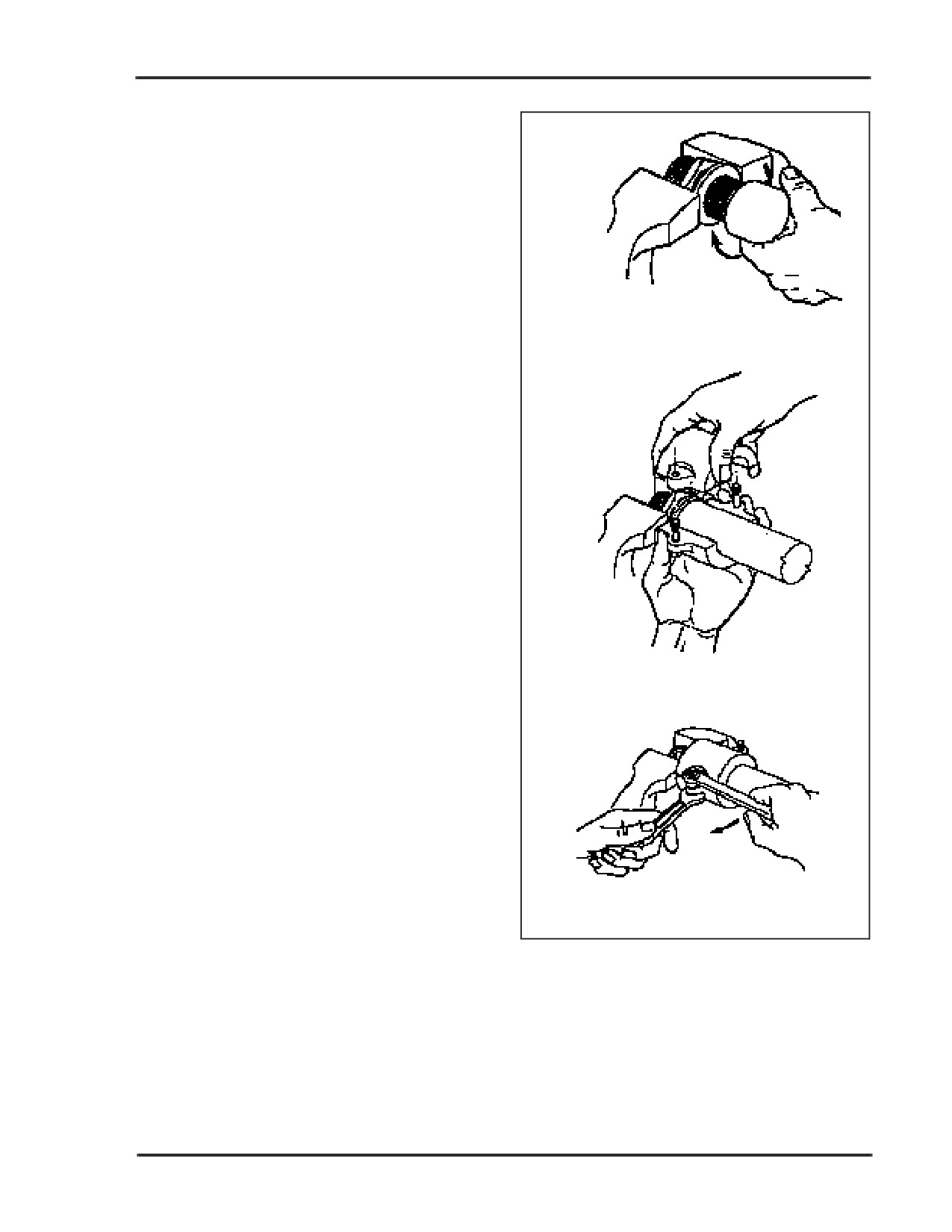
Figure 2-38 shows the assembly of a
clamp-type coupling. If you use this coupling,
do not skive the hose. Lubricate the ID of a
hose and the OD of a stem. Clamp a hose stem
in a bench vice and install a hose. Turn the
hose counterclockwise until it bottoms against
the shoulder of the stem (Figure 2-38, diagram
A
A). If you do not have a vice, force the stem
into the hose by pushing or striking the stem
with a wooden block. Place the clamp halves in
position (Figure 2-38, diagram B) and draw
them together with a vice or with extra long
bolts until the standard bolts protrude far
enough to grip the nuts. Remove the extra long
bolts and place retaining bolts through the
clamp. Tighten the nuts until you get the
required torque (Figure 2-38, diagram C).
NOTE: You may have to
retighten the bolts after the
hose assembly has been operat-
ing about 10 to 20 hours. Use
clamp-type couplings on hose
B
assemblies with diameters of 1
inch or greater. Use reusable
screw-type fittings on hose
assemblies with diameters less
than 1 inch.
2-11. Leakage. Any hydraulic system will
have a certain amount of leakage. Any leakage
will reduce efficiency and cause power loss.
Some leakage is built in (planned), some is not.
Leakage may be internal, external, or both.
a. Internal. This type of leakage (nonposi-
tive) must be built into hydraulic components
C
to lubricate valve spools, shafts, pistons, bear-
ings, pumping mechanisms, and other moving
parts. In some hydraulic valves and pump and
motor compensator controls, leakage paths are
Figure 2-38. Assembly of clamp-type
built in to provide precise control and to avoid
coupling
hunting (oscillation) of spools and pistons. Oil
is not lost in internal leakage; it returns to a reservoir through return lines or specially pro-
vided drain passages.
Too much internal leakage will slow down actuators. The power loss is accompanied by
the heat generated at a leakage path. In some instances, excess leakage in a valve could
cause a cylinder to drift or even creep when a valve is supposedly in neutral. In the case of
Hydraulic Systems
2-29
FM 5-499
flow or pressure-control valves, leakage can often reduce effective control or even cause con-
trol to be lost.
Normal wear increases internal leakage, which provides larger flow paths for the leak-
ing oil. An oil that is low in viscosity leaks more readily than a heavy oil. Therefore an oil’s
viscosity and viscosity index are important considerations in providing or preventing inter-
nal leakage. Internal leakage also increases with pressure, just as higher pressure causes a
greater flow through an orifice. Operating above the recommended pressures adds the dan-
ger of excessive internal leakage and heat generation to other possible harmful effects.
A blown or ruptured internal seal can open a large enough leakage path to divert all of a
pump's delivery. When this happens, everything except the oil flow and heat generation at a
leakage point can stop.
b. External. External leakage can be hazardous, expensive, and unsightly. Faulty
installation and poor maintenance are the prime causes of external leakage. Joints may
leak because they were not put together properly or because shock and vibration in the lines
shook them loose. Adding supports to the lines prevents this. If assembled and installed
correctly, components seldom leak. However, failure to connect drain lines, excessive pres-
sures, or contamination can cause seals to blow or be damaged, resulting in external leakage
from the components.
c. Prevention. Proper installation, control of operating conditions, and proper mainte-
nance help prevent leakage.
(1) Installation. Installing piping and tubing according to a manufacturer's recommen-
dations will promote long life of external seals. Vibration or stresses that result from
improper installation can shake loose connections and create puddles. Avoid pinching, cock-
ing, or incorrectly installing seals when assembling the units. Use any special tools that the
manufacturer recommends for installing the seals.
(2) Operating Conditions. To ensure correct seal life, you must control the operating
conditions of the equipment. A shaft seal or piston-rod seal exposed to moisture, salt, dirt, or
any other abrasive contaminate will have a shortened life span. Also, operators should
always try to keep their loads within the recommended limits to prevent leakage caused by
excessive pressures.
(3) Maintenance. Regular filter and oil changes, using a high-quality hydraulic oil, add
to seal life. Using inferior oil could wear on a seal and interfere with desirable oil properties.
Proper maintenance prevents impurity deposits and circulating ingredients that could wear
on a dynamic seal.
Never use additives without approval from the equipment and oil suppliers. Lubrica-
tion can be critical to a seal's life in dynamic applications. Synthetics do not absorb much oil
and must be lubricated quickly or they will rub. Leather and fiber do absorb oil. Manufac-
turers recommend soaking a seal overnight in oil before installing it. Do not install a seal
dry. Always coat it in clean hydraulic oil before installing it.
2-12. Seals. Seals are packing materials used to prevent leaks in liquid-powered systems.
A seal is any gasket, packing, seal ring, or other part designed specifically for sealing. Seal-
ing applications are usually static or dynamic, depending if the parts being sealed move in
relation to one another. Sealing keeps the hydraulic oil flowing in passages to hold pressure
and keep foreign materials from getting into the hydraulic passages. To prevent leakage,
2-30
Hydraulic Systems
FM 5-499
use a positive sealing method, which
involves using actual sealing parts or
BASIC FLANGE JOINTS
materials. In most hydraulic compo-
nents, you can use nonpositive sealing
(leakage for lubrication) by fitting the
Gasket
parts closely together. The strength
of an oil film that the parts slide
Simple
against provides an effective seal.
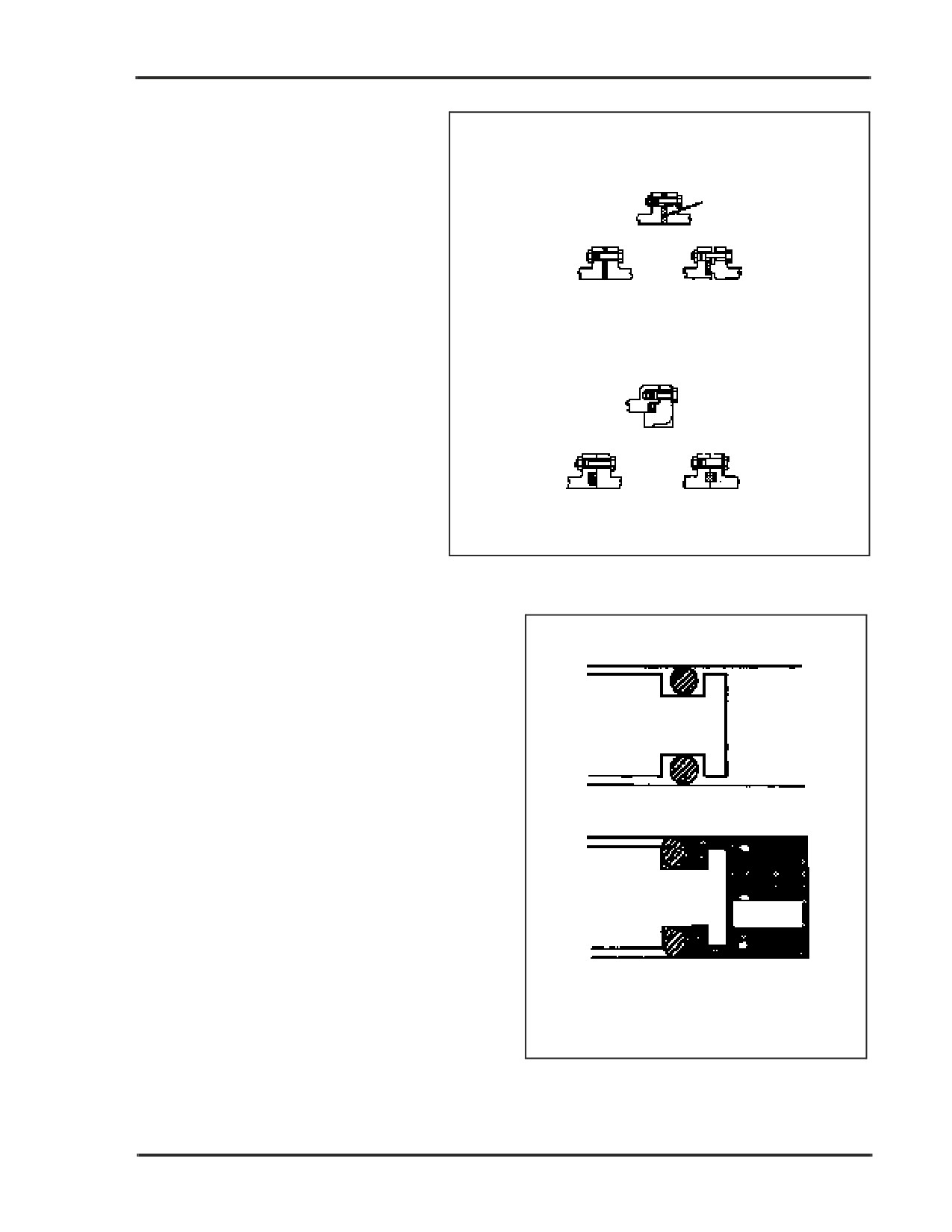
a. Static Seals. Pipe-threaded
Tongue-and groove
Tongue-and groove
seals, seal rings used with tube fit-
tings, valve end-cap seals, and other
seals on nonmoving parts are static
METAL-TO-METAL JOINTS
seals. Mounting gaskets and seals
are static, as are seals used in making
connections between components. A
static seal or gasket is placed between
parts that do not move in relation to
each other. Figure 2-39 shows some
typical static seals in flanged connec-
tions.
b. Dynamic Seals. In a dynamic
sealing application, either a recipro-
Figure 2-39. Static seals
cating or a rotary motion occurs between the two
parts being sealed; for example, a piston-to-bar-
rel seal in a hydraulic cylinder or a drive-shaft
seal in a pump or motor.
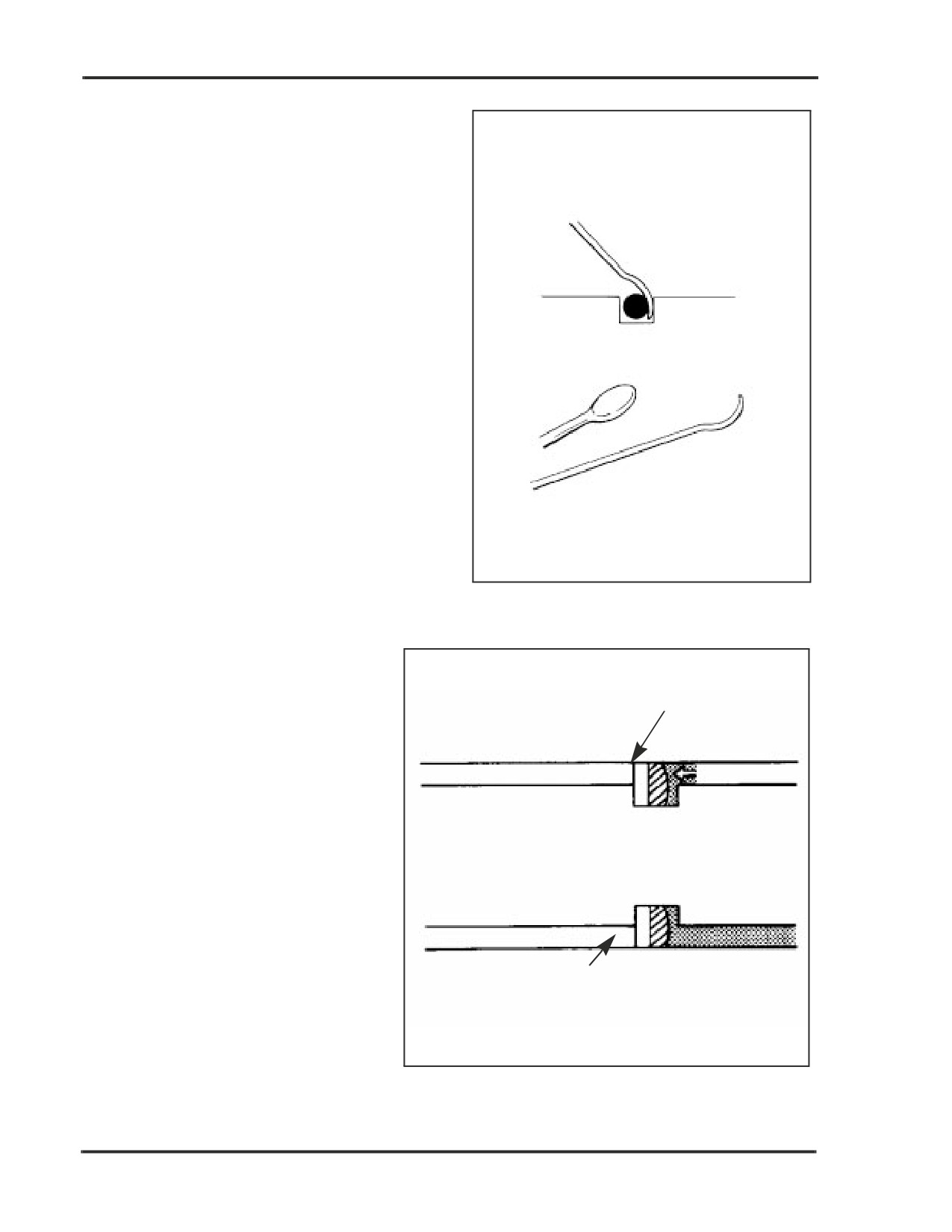
(1) O-Ring (Figure 2-40). An O-ring is a
positive seal that is used in static and dynamic
No
applications. It has replaced the flat gasket on
pressure
hydraulic equipment. When being installed,
an O-ring is squeezed at the top and bottom in
its groove and against the mating part. It is
capable of sealing very high pressure. Pressure
forces the seal against the side of its groove,
and the result is a positive seal on three sides.
Dynamic applications of an O-ring are usually
limited to reciprocating parts that have rela-
tively short motion.
Pressure
To remove an O-ring seal, you need a spe-
cial tool made of soft iron or aluminum or a
brass rod (Figure 2-41, page 2-32). Make sure
that the tool’s edges are flat and that you polish
any burrs and rough surfaces.
(2) Backup Ring (Figure 2-42, page 2-32).
Usually, made of stiff nylon, you can use a
Figure 2-40. O-ring placement
backup ring with an O-ring so that it is not
Hydraulic Systems
2-31
FM 5-499
forced into the space between the mating
Surface must be smooth and
parts. A combination of high pressure and
free from scratches.
clearance between the parts could call for a
backup ring.
Corners must not be dented
or bumped.
(3) Lathe-Cut Seal. This seal is like an O-
0.005 radius desired.
ring but is square in cross-section rather than
round. A lathe-cut ring is cut from extruded
tubes, while an O-ring must be individually
molded. In many static applications, round-
and square-section seals are interchangeable, if
made from the same material.
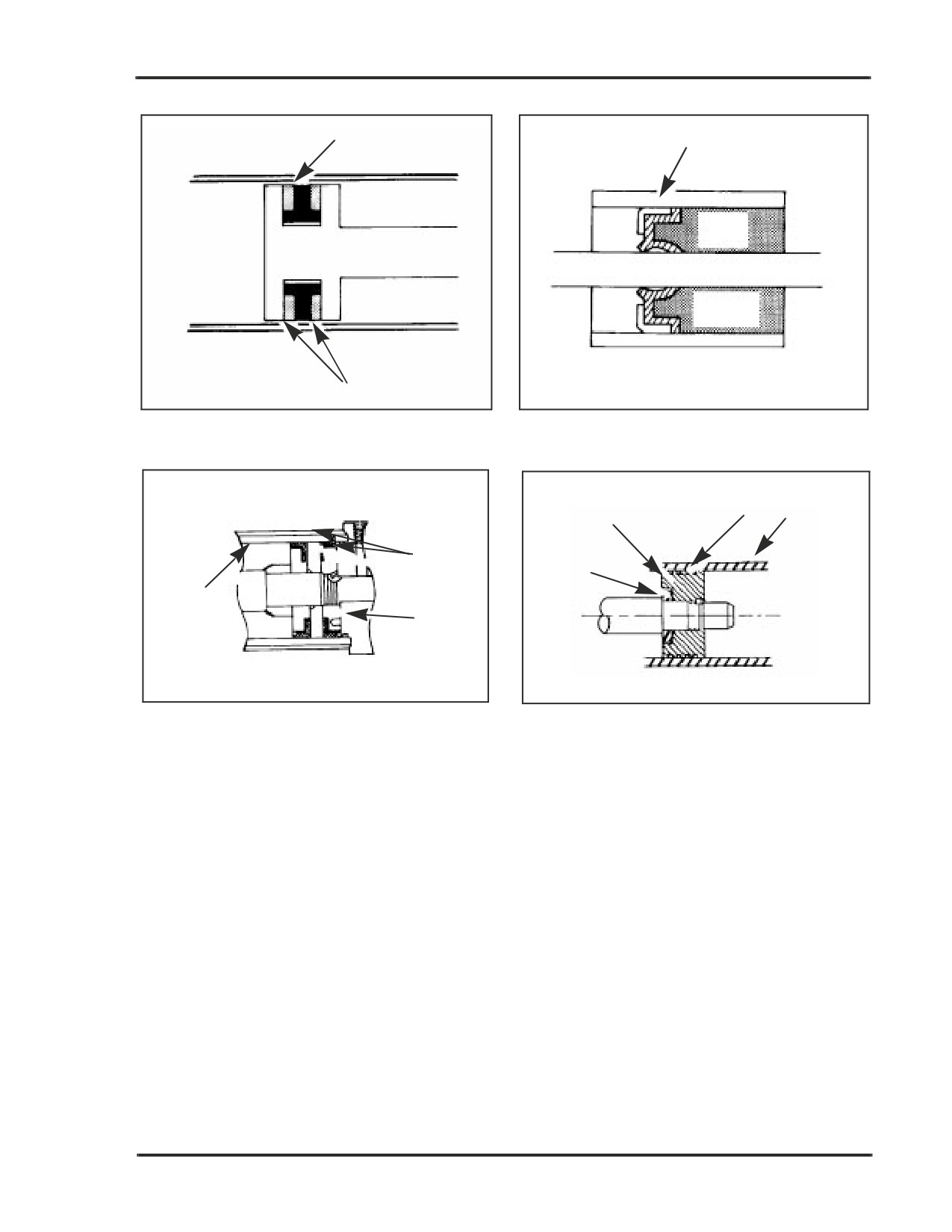
(4) T-Ring Seal (Figure 2-43). This seal is
reinforced with back-up rings on each side. A T-
ring seal is used in reciprocating dynamic appli-
cations, particularly on cylinder pistons and
around piston rods.
(5) Lip Seal (Figure 2-44). This a dynamic
Flatten as shown and polish
seal used mainly on rotating shafts. A sealing
off burrs and edges.
lip provides a positive seal against low pres-
sure. A lip is installed toward the pressure
source. Pressure against a lip balloons it out to
aid in sealing. Very high pressure, however,
Figure 2-41. O-ring removal tool
can get past this kind of seal because it does not
have the backup support that an O-ring has.
Sometimes, double-lip seals are
used on the shafts of reversible pumps
or motors. Reversing a unit can give
O ring
an alternating pressure and vacuum
condition in the chamber adjacent to a
seal. A double-lip seal, therefore, pre-
Pressure
vents oil from getting out or air and
dirt from getting in.
(6) Cup Seal (Figure 2-45). This is
a positive seal that is used on hydraulic
cylinder pistons and seals much like a
lip seal. A cup seal is backed up so that
it can handle very high pressures.
(7) Piston Ring (Figure 2-46). A
piston ring is used to seal pressure at
Back-up ring
the end of a reciprocating piston. It
helps keep friction at a minimum in a
hydraulic cylinder and offers less resis-
tance to movement than a cup seal. A
piston ring is used in many complex
components and systems to seal fluid
Figure 2-42. Backup ring
passages leading from hollow rotating
2-32
Hydraulic Systems
FM 5-499
Seal
Seal housing
Spring
lip
High
pressure
Back-up ring
Figure 2-43. T-ring seal
Figure 2-44. Lip seal
Seal ring
Cylinder
Piston
barrel
Cup seals
O ring
Cylinder
Piston
Figure 2-45. Cup seal
Figure 2-46. Piston ring
shafts. It is fine for high pressures but may not provide a positive seal. A positive seal is
more likely to occur when piston rings are placed side by side. Often, a piston ring is
designed to allow some leakage for lubrication.
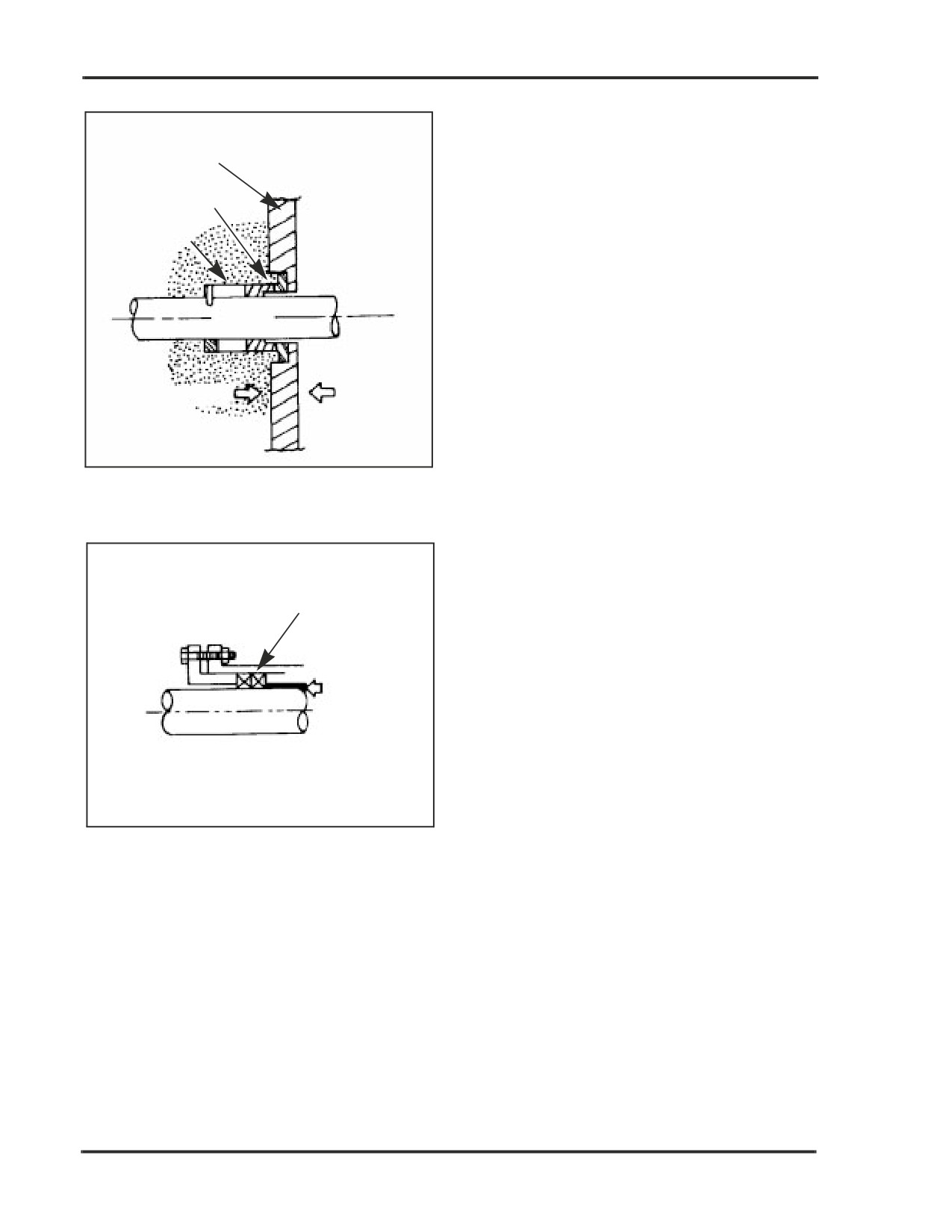
(8) Face Seal (Figure 2-47, page 2-34). This seal has two smooth, flat elements that run
together to seal a rotating shaft. One element is metallic and the other is nonmetallic. The
elements are attached to a shaft and a body so that one face is stationary and the other turns
against it. One element is often spring-loaded to take up wear. A face seal is used primarily
when there is high speed, pressure, and temperature.
c. Packing. Packing is a type of twisted or woven fiber or soft metal strands that are
packed between the two parts being sealed. A packing gland supports and backs up the
packing. Packing (Figure 2-48) can be either static or dynamic. It has been and is used as a
rotating shaft seal, a reciprocating piston-rod seal, and a gasket in many static applications.
In static applications, a seal is replacing a packing. A compression packing is usually
placed in a coil or layered in a bore and compressed by tightening a flanged member. A
molded packing is molded into a precise cross-sectional form, such as a U or V. Several
Hydraulic Systems
2-33
FM 5-499
packings can be used together, with a backup
that is spring-loaded to compensate for wear.
Housing
d. Seal Materials. The earliest sealing
materials for hydraulic components were
Sealing face
mainly leather, cork, and impregnated fibers.
Currently, most sealing materials in a hydrau-
Preloading
lic system are made from synthetic materials
spring
such as nitrile, silicone, and neoprene.
Shaft
(1) Leather Seals. Leather is still a good
sealing material and has not been completely
replaced by elastomers. It is tough, resists
abrasion, and has the ability to hold lubricat-
Low pressure
ing fluids in its fibers. Impregnating leather
High pressure
with synthetic rubber improves the leather's
sealing ability and reduces its friction.
Leather's disadvantages are that it tends to
squeal when it is dry, and it cannot stand high
temperatures.
Figure 2-47. Face seal
(2) Nitrile Seals. Nitrile is a compara-
tively tough material with excellent wearabil-
ity. Its composition varies to be compatible
with petroleum oils, and it can easily be
Compression
molded into different seal shapes. Some
packings
nitrile seals can be used, without difficulty, in
temperatures ranging from -40 degrees Fahr-
enheit to +230° F.
Pressure
(3) Silicone Seals. Silicone is an elas-
tomer that has a much wider temperature
range than some nitrile seals have. Silicone
cannot be used for reciprocating seals because
it is not as tough. It tears, elongates, and
abrades fairly easily. Many lip-type shaft
seals made from silicone are used in extreme
temperature applications. Silicone O-rings are
Figure 2-48. Compression packing
used for static applications. Silicone has a ten-
dency to swell since it absorbs a fair volume of
oil while running hot. This is an advantage, if
the swelling is not objectionable, because a seal can run dry for a longer time at start-up.
(4) Neoprene. At very low temperatures, neoprene is compatible with petroleum oil.
Above 150 degrees, it has a habit of cooking or vulcanizing, making it less useful.
(5) Nylon. Nylon is a plastic (also known as fluoro-elastomer) that combines fluorine
with a synthetic rubber. It is used for backup rings, has sealing materials in special applica-
tions, and has a very high heat resistance.
2-34
Hydraulic Systems
FM 5-499
CHAPTER 3
Pumps
Hydraulic pumps convert mechanical energy from a prime mover (engine or electric
motor) into hydraulic (pressure) energy. The pressure energy is used then to operate an actu-
ator. Pumps push on a hydraulic fluid and create flow.
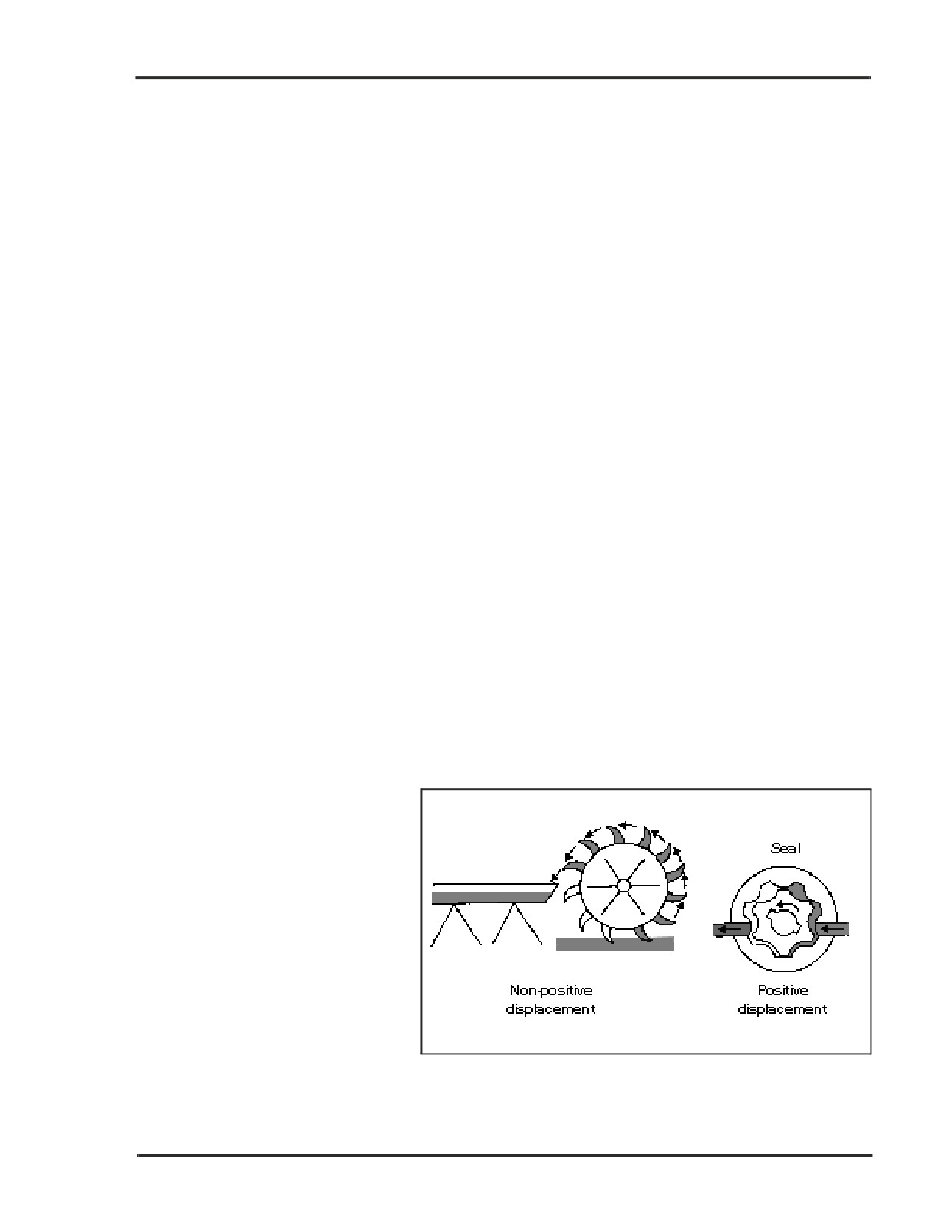
3-1. Pump Classifications. All pumps create flow. They operate on the displacement
principle. Fluid is taken in and displaced to another point. Pumps that discharge liquid in a
continuous flow are nonpositive-displacement type. Pumps that discharge volumes of liquid
separated by periods of no discharge are positive-displacement type.
a. Nonpositive-Displacement Pumps. With this pump, the volume of liquid delivered for
each cycle depends on the resistance offered to flow. A pump produces a force on the liquid
that is constant for each particular speed of the pump. Resistance in a discharge line pro-
duces a force in the opposite direction. When these forces are equal, a liquid is in a state of
equilibrium and does not flow.
If the outlet of a nonpositive-displacement pump is completely closed, the discharge
pressure will rise to the maximum for a pump operating at a maximum speed. A pump will
churn a liquid and produce heat. Figure 3-1 shows a nonpositive-displacement pump. A
water wheel picks up the fluid and moves it.
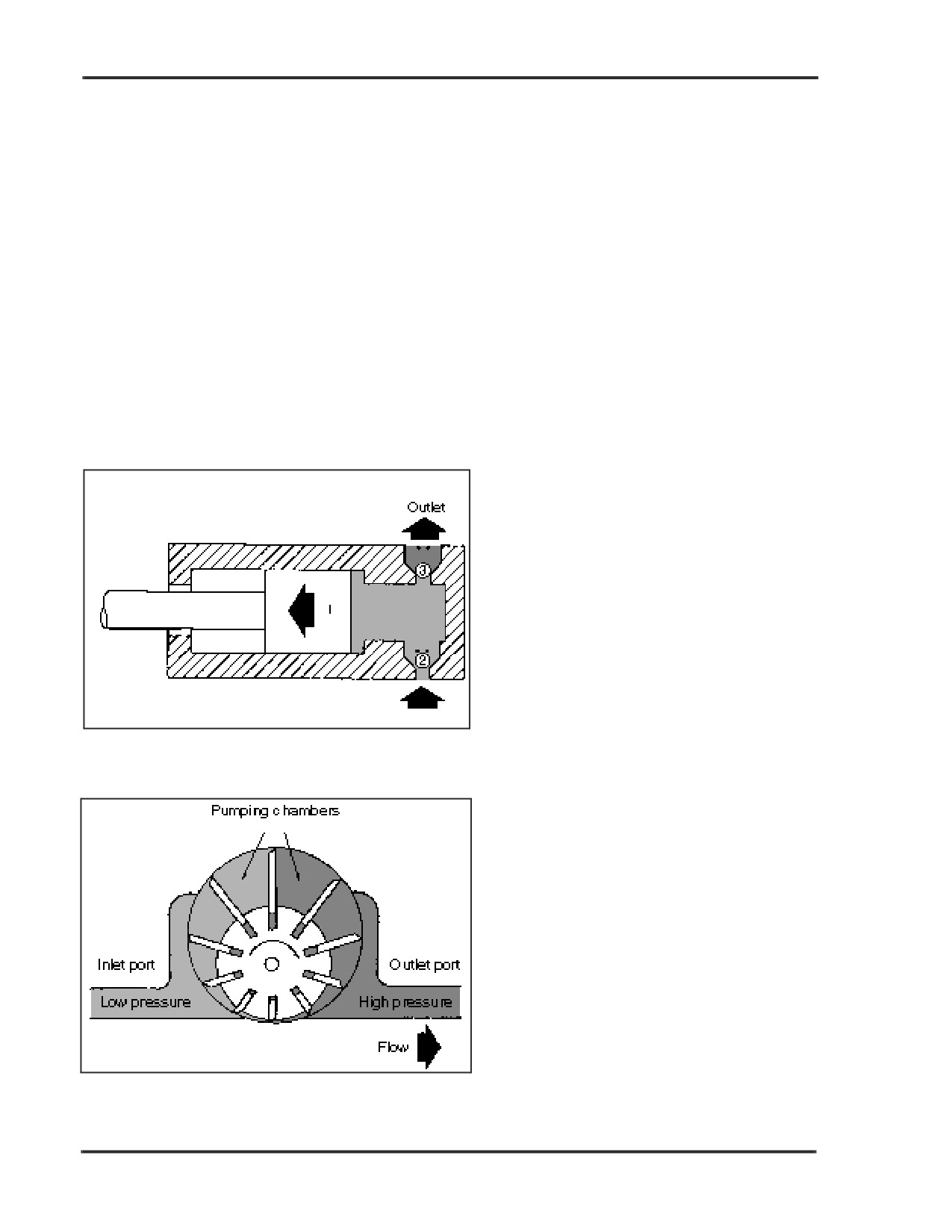
b. Positive-Displacement Pumps. With this pump, a definite volume of liquid is deliv-
ered for each cycle of pump operation, regardless of resistance, as long as the capacity of the
power unit driving a pump is not exceeded. If an outlet is completely closed, either the unit
driving a pump will stall or something will break. Therefore, a positive-displacement-type
pump requires a pressure regulator or pressure-relief valve in the system. Figure 3-2, page
3-2, shows a reciprocating-type, positive-displacement pump.
Figure 3-3, page 3-2, shows
another positive-displacement
pump. This pump not only creates
flow, but it also backs it up. A
sealed case around the gear traps
the fluid and holds it while it
moves. As the fluid flows out of
the other side, it is sealed against
backup. This sealing is the posi-
tive part of displacement. With-
out it, the fluid could never
overcome the resistance of the
other parts in a system.
c. Characteristics. The three
Figure 3-1. Nonpositive-displacement pump
contrasting characteristics in the
Pumps
3-1
FM 5-499
operation of positive- and nonpositive-displacement pumps are as follows:
• Nonpositive-displacement pumps provide a smooth, continuous flow; positive-
displacement pumps have a pulse with each stroke or each time a pumping cham-
ber opens to an outlet port.
• Pressure can reduce a nonpositive pump’s delivery. High outlet pressure can
stop any output; the liquid simply recirculates inside the pump. In a positive-
displacement pump, pressure affects the output only to the extent that it
increases internal leakage.
• Nonpositive-displacement pumps, with the inlets and outlets connected hydrauli-
cally, cannot create a vacuum sufficient for self-priming; they must be started
with the inlet line full of liquid and free of air. Positive-displacement pumps often
are self-priming when started properly.
3-2. Performance. Pumps are usually rated according to their volumetric output and pres-
sure. Volumetric output (delivery rate or capacity) is the amount of liquid that a pump can
deliver at its outlet port per unit of time at a given drive speed, usually expressed in GPM or
cubic inches per minute. Because changes in pump drive affect volumetric output, pumps
are sometimes rated according to displace-
ment, that is the amount of liquid that
they can deliver per cycle or cubic inches
per revolution.
Pressure is the force per unit area of a
liquid, usually expressed in psi. (Most of
the pressure in the hydraulic systems cov-
ered in this manual is created by resis-
tance to flow.) Resistance is usually
caused by a restriction or obstruction in a
path or flow. The pressure developed in a
system has an effect on the volumetric
output of the pump supplying flow to a
system. As pressure increases, volumetric
Figure 3-2. Reciprocating-type, positive-
output decreases. This drop in output is
displacement pump
caused by an increase in internal leakage
(slippage) from a pump's outlet side to its
inlet side. Slippage is a measure of a
pump’s efficiency and usually is expressed
in percent. Some pumps have greater
internal slippage than others; some
pumps are rated in terms of volumetric
output at a given pressure.
3-3. Displacement. Displacement is the
amount of liquid transferred from a
pump’s inlet to its outlet in one revolution
or cycle. In a rotary pump, displacement
is expressed in cubic inches per revolution
and in a reciprocating pump in cubic
inches per cycle. If a pump has more than
Figure 3-3. Positive-displacement pump
3-2
Pumps
FM 5-499
one pumping chamber, its displacement is equal to the displacement of one chamber multi-
plied by the number of chambers. Displacement is either fixed or variable.
a. Fixed-Displacement Pump. In this pump, the GPM output can be changed only by
varying the drive speed. The pump can be used in an open-center system—a pump’s output
has a free-flow path back to a reservoir in the neutral condition of a circuit.
b. Variable-Displacement Pump. In this pump, pumping-chamber sizes can be changed.
The GPM delivery can be changed by moving the displacement control, changing the drive
speed, or doing both. The pump can be used in a closed-center system—a pump continues to
operate against a load in the neutral condition.
3-4. Slippage. Slippage is oil leaking from a pressure outlet to a low-pressure area or back
to an inlet. A drain passage allows leaking oil to return to an inlet or a reservoir. Some slip-
page is designed into pumps for lubrication purposes. Slippage will increase with pressure
and as a pump begins to wear. Oil flow through a given orifice size depends on the pressure
drip. An internal leakage path is the same as an orifice. Therefore, if pressure increases,
more flow will occur through a leakage path and less from an outlet port. Any increase in
slippage is a loss of efficiency.
3-5. Designs. In most rotary hydraulic pumps (Figure 3-3), the design is such that the
pumping chambers increase in size at the inlet, thereby creating a vacuum. The chambers
then decrease in size at the outlet to push fluid into a system. The vacuum at the inlet is
used to create a pressure difference so that fluid will flow from a reservoir to a pump. How-
ever, in many systems, an inlet is charged or supercharged; that is, a positive pressure
rather than a vacuum is created by a pressurized reservoir, a head of fluid above the inlet, or
even a low-pressure-charging pump. The essentials of any hydraulic pump are—
• A low-pressure inlet port, which carrys fluid from the reservoir.
• A high-pressure outlet port connected to the pressure line.
• Pumping chamber(s) to carry a fluid from the inlet to the outlet port.
• A mechanical means for activating the pumping chamber(s).
Pumps may be classified according to the specific design used to create the flow of a liq-
uid. Most hydraulic pumps are either centrifugal, rotary, or reciprocating.
a. Centrifugal Pump. This pump generally is used where a large volume of flow is
required at relatively low pressures. It can be connected in series by feeding an outlet of one
pump into an inlet of another. With this arrangement, the pumps can develop flow against
high pressures. A centrifugal pump is a nonpositive-displacement pump, and the two most
common types are the volute and the diffuser.
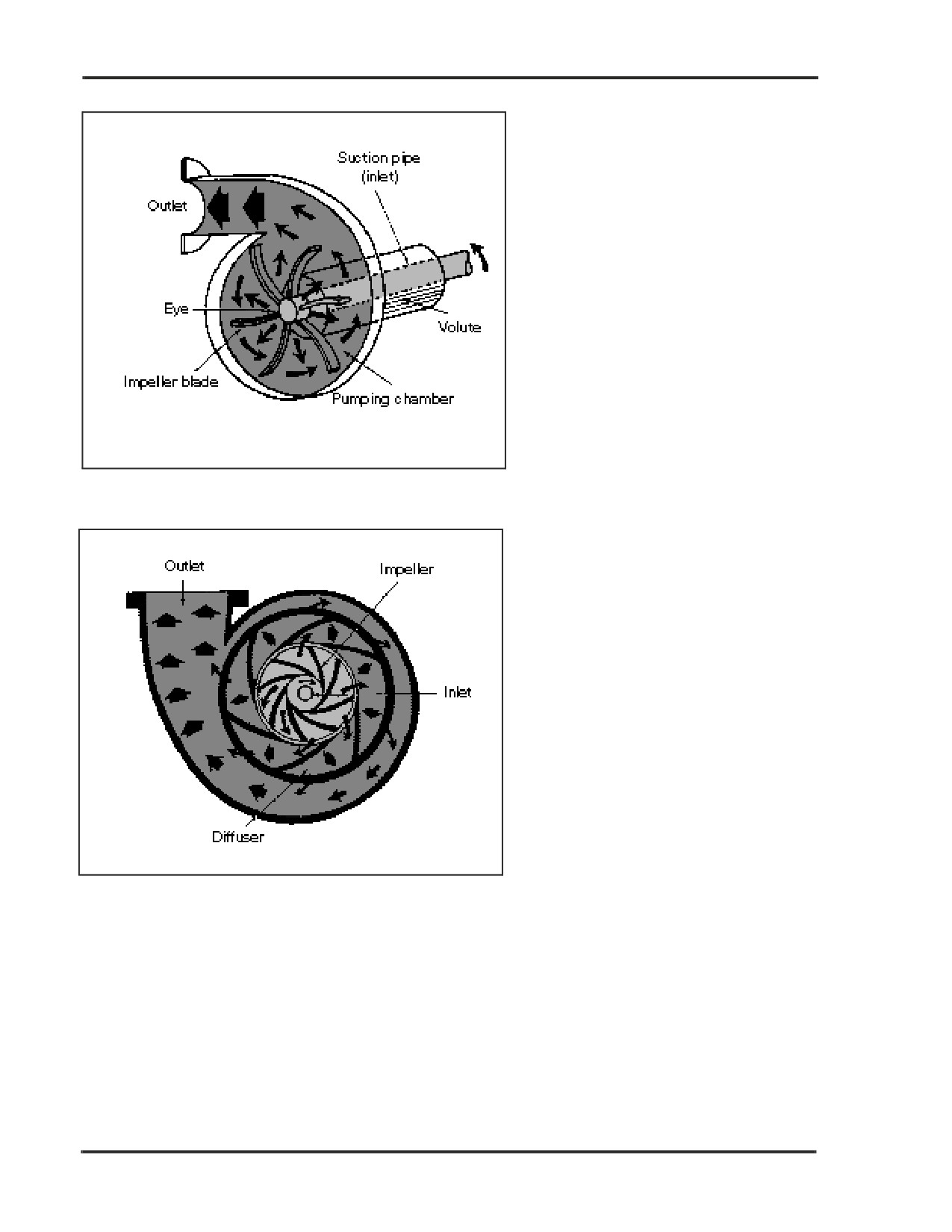
(1) Volute Pump (Figure 3-4, page 3-4). This pump has a circular pumping chamber
with a central inlet port (suction pipe) and an outlet port. A rotating impeller is located in a
pumping chamber. A chamber between the casing and the center hub is the volute. Liquid
enters a pumping chamber through a central inlet (or eye) and is trapped between the whirl-
ing impeller blades. Centrifugal force throws a liquid outward at a high velocity, and a con-
tour of a casing directs a moving liquid through an outlet port.
(2) Diffuser Pump (Figure 3-5). Similar to a volute type, a diffuser pump has a series of
stationary blades (the diffuser) that curve in the opposite direction from whirling impeller
Pumps
3-3
FM 5-499
blades. A diffuser reduces the veloc-
ity of a liquid, decreases slippage, and
increases a pump's ability to develop
flow against resistance.
b. Rotary Pump. In this positive-
displacement-type pump, a rotary
motion carries a liquid from a pump’s
inlet to its outlet. A rotary pump is
usually classified according to the
type of element that actually trans-
mits a liquid, that is, a gear-, vane-,
or piston-type rotary pump.
c. Reciprocating Pump. A recip-
rocating pump depends on a recipro-
cating motion to transmit a liquid
from a pump’s inlet to its outlet. Fig-
ure 3-2, page 3-2, shows a simplified
Figure 3-4. Volute pump
reciprocating pump. It consists of a
cylinder that houses a reciprocating
piston, Figure 3-2, 1; an inlet valve,
Figure 3-2, 2; and an outlet valve, Fig-
ure 3-2, 3, which direct fluid to and
from a cylinder. When a piston moves
to the left, a partial vacuum that is
created draws a ball off its seat, allow-
ing a liquid to be drawn through an
inlet valve into a cylinder. When a
piston moves to the right, a ball
reseats and closes an inlet valve.
However, the force of a flow unseats a
ball, allowing a fluid to be forced out
of a cylinder through an outlet valve.
3-6. Gear Pumps. Gear pumps are
external, internal, or lobe types.
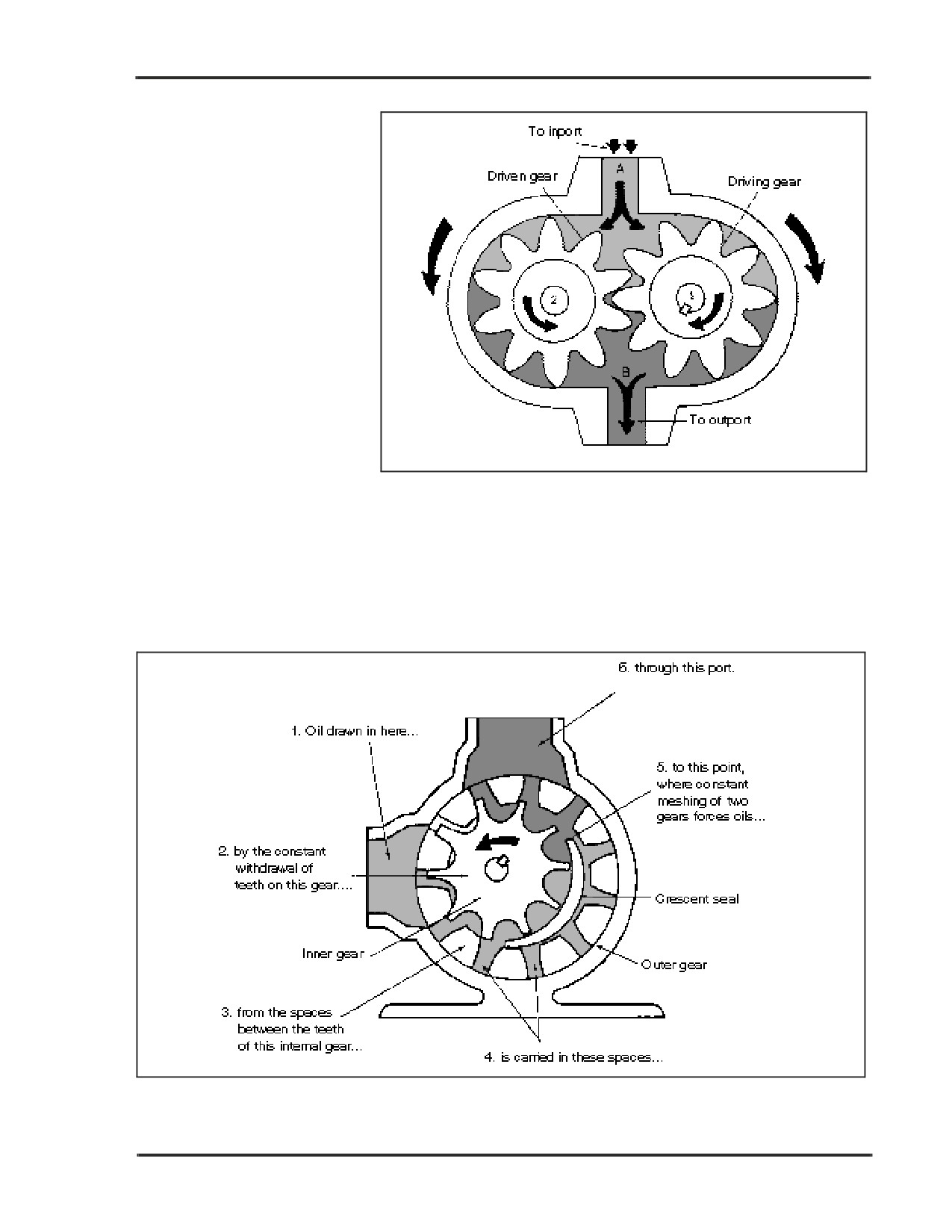
a. External. Figure 3-6 shows
Figure 3-5. Diffuser pump
the operating principle of an external
gear pump. It consists of a driving
gear and a driven gear enclosed in a closely fitted housing. The gears rotate in opposite
directions and mesh at a point in the housing between the inlet and outlet ports. Both sets
of teeth project outward from the center of the gears. As the teeth of the two gears separate,
a partial vacuum forms and draws liquid through an inlet port into chamber A. Liquid in
chamber A is trapped between the teeth of the two gears and the housing so that it is carried
through two separate paths around to chamber B. As the teeth again mesh, they produce a
force that drives a liquid through an outlet port.
3-4
Pumps
FM 5-499
b. Internal. Figure 3-7
shows an internal gear
pump. The teeth of one gear
project outward, while the
teeth of the other gear project
inward toward the center of
the pump. One gear wheel
stands inside the other. This
type of gear can rotate, or be
rotated by, a suitably con-
structed companion gear. An
external gear is directly
attached to the drive shaft of
a pump and is placed off-cen-
ter in relation to an internal
gear. The two gears mesh on
one side of a pump chamber,
between an inlet and the dis-
charge. On the opposite side
Figure 3-6. External gear pump
of the chamber, a crescent-
shaped form stands in the
space between the two gears to provide a close tolerance.
The rotation of the internal gear by a shaft causes the external gear to rotate, since the
two are in mesh. Everything in the chamber rotates except the crescent, causing a liquid to
be trapped in the gear spaces as they pass the crescent. Liquid is carried from an inlet to the
discharge, where it is forced out of a pump by the gears meshing. As liquid is carried away
Figure 3-7. Internal gear pump
Pumps
3-5
FM 5-499
from an inlet side of a pump, the pressure
is diminished, and liquid is forced in from
the supply source. The size of the crescent
that separates the internal and external
gears determines the volume delivery of
this pump. A small crescent allows more
volume of a liquid per revolution than a
larger crescent.
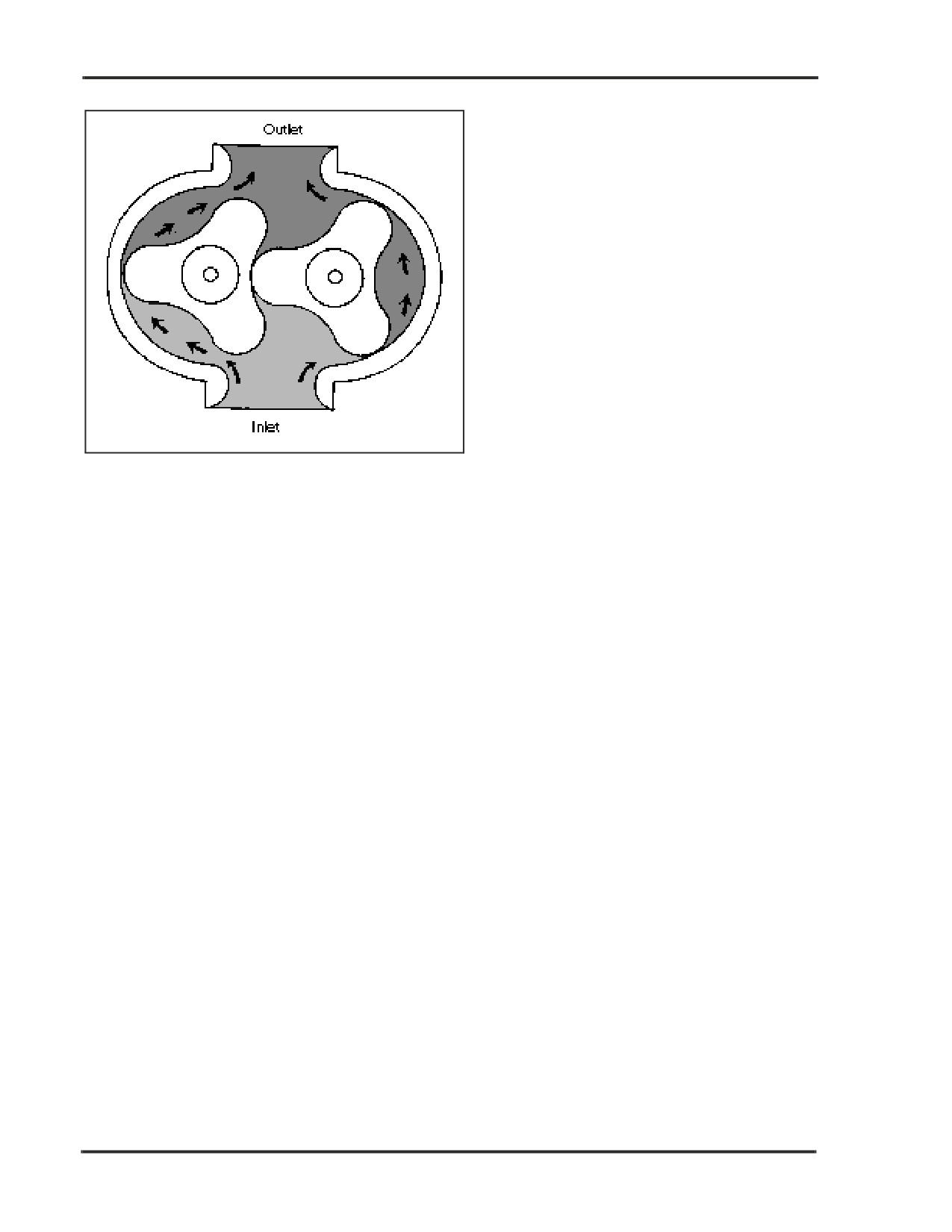
c. Lobe. Figure 3-8 shows a lobe
pump. It differs from other gear pumps
because it uses lobed elements instead of
gears. The element drive also differs in a
lobe pump. In a gear pump, one gear
drives the other. In a lobe pump, both ele-
ments are driven through suitable external
gearing.
3-7. Vane Pumps. In a vane-type pump,
Figure 3-8. Lobe pump
a slotted rotor splined to a drive shaft
rotates between closely fitted side plates
that are inside of an elliptical- or circular-shaped ring. Polished, hardened vanes slide in
and out of the rotor slots and follow the ring contour by centrifugal force. Pumping cham-
bers are formed between succeeding vanes, carrying oil from the inlet to the outlet. A partial
vacuum is created at the inlet as the space between vanes increases. The oil is squeezed out
at the outlet as the pumping chamber’s size decreases.
Because the normal wear points in a vane pump are the vane tips and a ring’s surface,
the vanes and ring are specially hardened and ground. A vane pump is the only design that
has automatic wear compensation built in. As wear occurs, the vanes simply slide farther
out of the rotor slots and continue to follow a ring’s contour. Thus efficiency remains high
throughout the life of the pump.
a. Characteristics. Displacement of a vane-type pump depends on the width of the ring
and rotor and the throw of the cam ring. Interchangeable rings are designed so a basic
pump converts to several displacements. Balanced design vane pumps all are fixed displace-
ment. An unbalanced design can be built in either a fixed- or variable-displacement pump.
Vane pumps have good efficiency and durability if operated in a clean system using the cor-
rect oil. They cover the low to medium-high pressure, capacity, and speed ranges. Package
size in relation to output is small. A vane pump is generally quiet, but will whine at high
speeds.
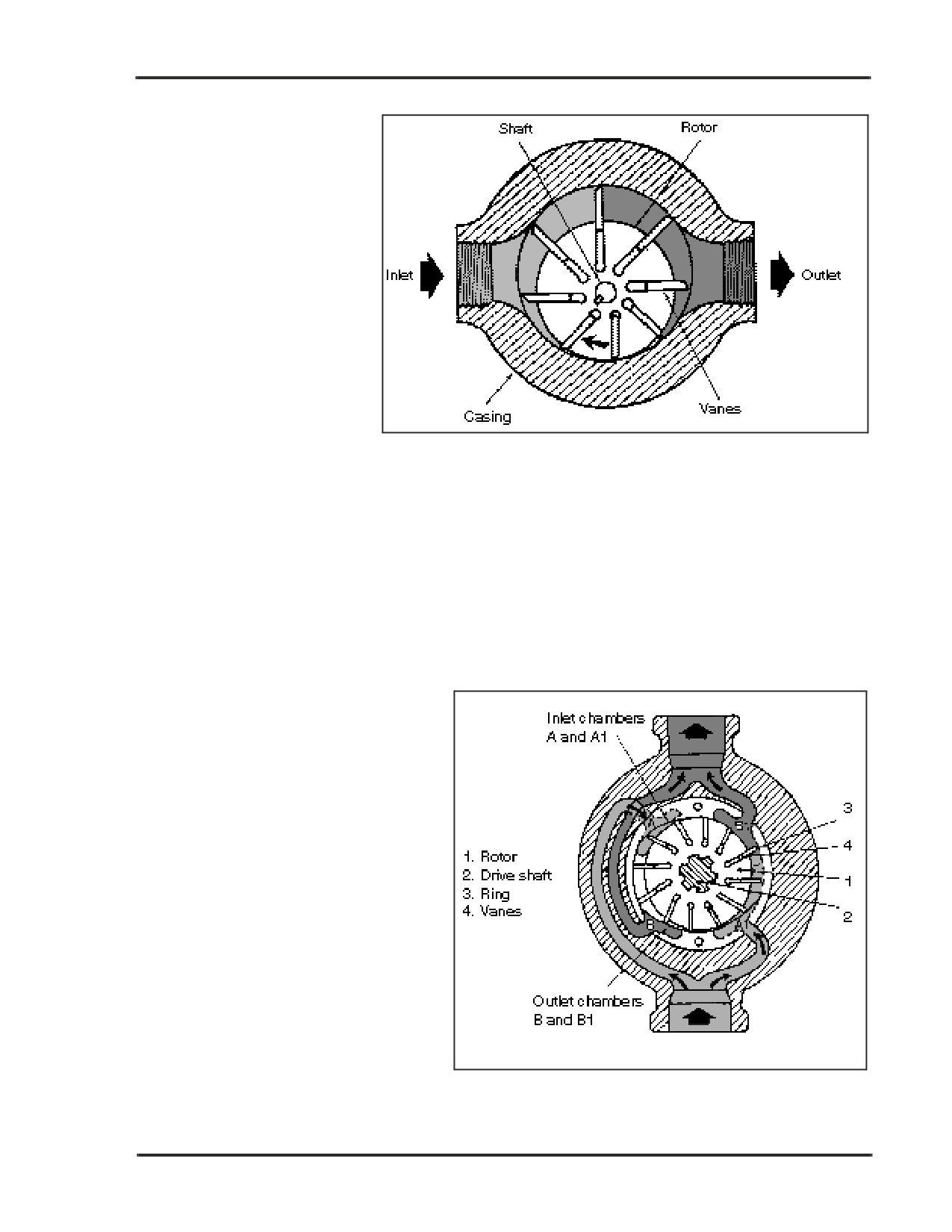
b. Unbalanced Vane Pumps. In the unbalanced design, (Figure 3-9), a cam ring’s shape
is a true circle that is on a different centerline from a rotor’s. Pump displacement depends
on how far a rotor and ring are eccentric. The advantage of a true-circle ring is that control
can be applied to vary the eccentricity and thus vary the displacement. A disadvantage is
that an unbalanced pressure at the outlet is effective against a small area of the rotor’s edge,
imposing side loads on the shaft. Thus there is a limit on a pump’s size unless very large
hearings and heavy supports are used.
c. Balanced Vane Pumps. In the balanced design (Figure 3-10), a pump has a station-
ary, elliptical cam ring and two sets of internal ports. A pumping chamber is formed
3-6
Pumps
FM 5-499
between any two vanes twice
in each revolution. The two
inlets and outlets are 180
degrees apart. Back pres-
sures against the edges of a
rotor cancel each other.
Recent design improvements
that allow high operating
speeds and pressures have
made this pump the most
universal in the mobile-
equipment field.
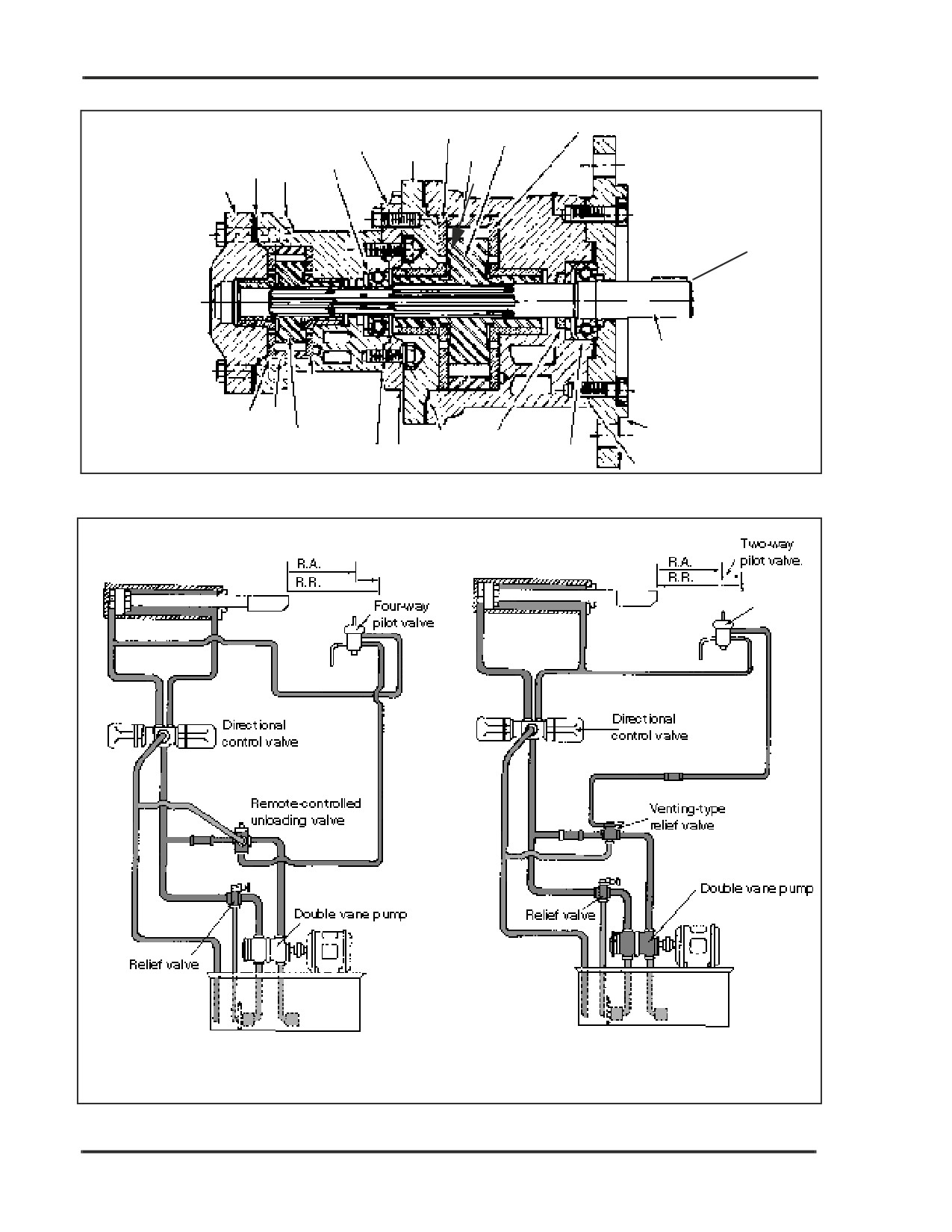
d. Double Pumps. Vane-
type double pumps (Figure 3-
11, page 3-8) consist of two
separate pumping devices.
Each is contained in its own respec-
Figure 3-9. Unbalanced vane pump
tive housing, mounted in tandem, and
driven by a common shaft. Each pump
also has its own inlet and outlet ports, which may be combined by using manifolds or piping.
Design variations are available in which both cartridges are contained within one body. An
additional pump is sometimes attached to the head end to supply auxiliary flow require-
ments.
Double pumps may be used to provide fluid flow for two separate circuits or combined
for flow requirements for a single circuit. Combining pump deliveries does not alter the
maximum pressure rating of either cartridge. Separate circuits require separate pressure
controls to limit maximum pressure in each circuit.
Figure 3-12, page 3-8, shows an
installation in which double pumps
are used to provide fluid flow for oper-
ation of a cylinder in rapid advance
and feed. In circuit B, two relief
valves are used to control pumping
operation. In circuit A, one relief valve
and one unloading valve are used to
control pumping operations. In both
circuits, the deliveries of the pump
cartridges are combined after passing
through the valves. This combined
flow is directed to a four-way valve
and to the rest of the circuit.
In circuit B, an upper relief valve
is vented when a cylinder rod reaches
and trips a pilot valve. A vented relief
valve directs the delivery of a shaft-
end pump cartridge freely back to a
tank. Another relief valve controls the
maximum pressure of a circuit. An
Figure 3-10. Balanced vane pump
Pumps
3-7
FM 5-499
Bushing
RotorBushing
BearingFlange
HeadRing
PackingBody
Head
Shaft
Gasket
Bushing
Bushing Ring Rotor
Flange
Packing
Bearing
Gaskets
Figure 3-11. Vane-type double pump
A
B
CIRCUIT USING REMOTE-
CIRCUIT USING VENTING-
CONTROLLED UNLOADING VALVE
TYPE RELIEF VALVE
Figure 3-12. Fluid flow from vane-type double pumps
3-8
Pumps
FM 5-499
unloading valve and a relief valve in circuit A do the same operation. The output of both
pump cartridges combines to supply fluid for a rapid advance portion of a cycle. When the
output of one circuit returns to the tank, after reaching a certain point in the cycle, the other
circuit completes the advance portion of a cycle. Both pump outputs are then combined for rapid
return.
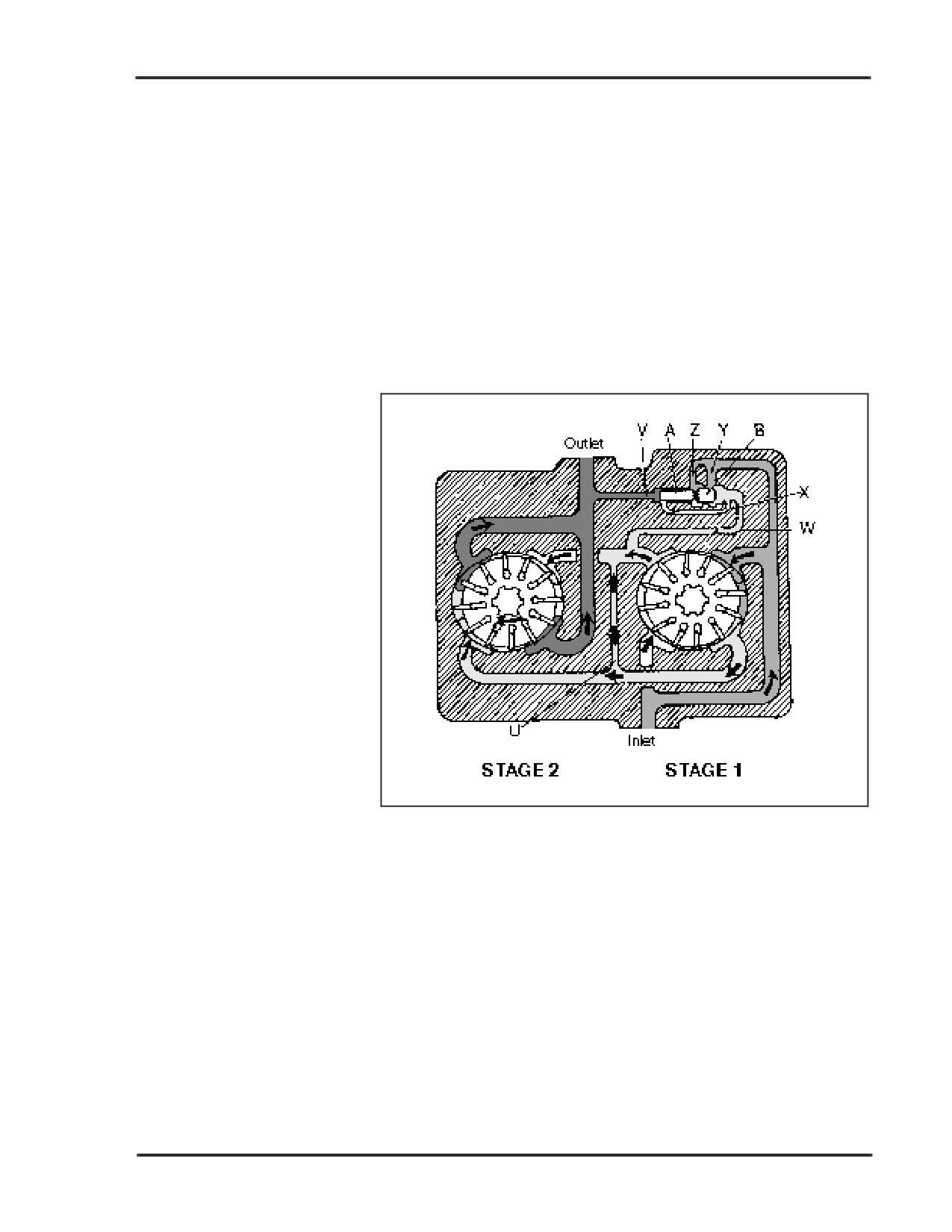
e. Two-Stage Pumps. Two-stage pumps consist of two separate pump assemblies con-
tained in one housing. The pump assemblies are connected so that flow from the outlet of
one is directed internally to the inlet of the other. Single inlet and outlet ports are used for
system connections. In construction, the pumps consist of separate pumping cartridges
driven by a common drive shaft contained in one housing. A dividing valve is used to equal-
ize the pressure load on each stage and correct for minor flow differences from either car-
tridge.
In operation, developing
fluid flow for each cartridge
is the same as for single
pumps. Figure 3-13 shows
fluid flow in a vane-type,
two-stage pump. Oil from a
reservoir enters a pump’s
inlet port and passes to the
outlets of the first-stage
pump cartridge. (Passages in
a pump’s body carry the dis-
charge from this stage to an
inlet of the second stage.)
Outlet passages in the sec-
ond stage direct the oil to an
outlet port of the pump. Pas-
sage U connects both cham-
bers on the inlet side of a
second-stage pump and
assures equal pressure in
both chambers. (Pressures
are those that are imposed on
a pump from external
Figure 3-13. Vane-type, two-stage pump
sources.)
A dividing valve (see Figure 3-13) consists of sliding pistons A and B. Piston A is
exposed to outlet pressure through passage V. Piston B is exposed to the pressure between
stages through passage W. The pistons respond to maintain a pressure load on a first-stage
pump equal to half the outlet pressure at a second-stage pump. If the discharge from the
first stage exceeds the volume that can be accepted at the second stage, a pressure rise
occurs in passage W. The unbalanced force acting on piston B causes the pistons to move in
such a manner that excess oil flows past piston B through passage Y to the inlet chamber of
a first-stage cartridge. Fluid throttling across piston B in this manner maintains pressure
in passage V.
If the discharge from a first-stage pump is less than the volume required at a second-
stage pump, a reduced pressure occurs at piston B. An unbalanced force acting on piston A
Pumps
3-9
FM 5-499
causes the pistons to move so that oil flows past piston A into passages X and W to replenish
a second-stage pump and correct the unbalanced condition. Passages Z and Y provide a
means for leakage around the pistons to return to the inlet chamber of a first-stage pump.
Pistons A and B always seek a position that equally divides the load between the two pump-
ing units.
3-8. Piston Pumps. Piston pumps are either radial or axial.
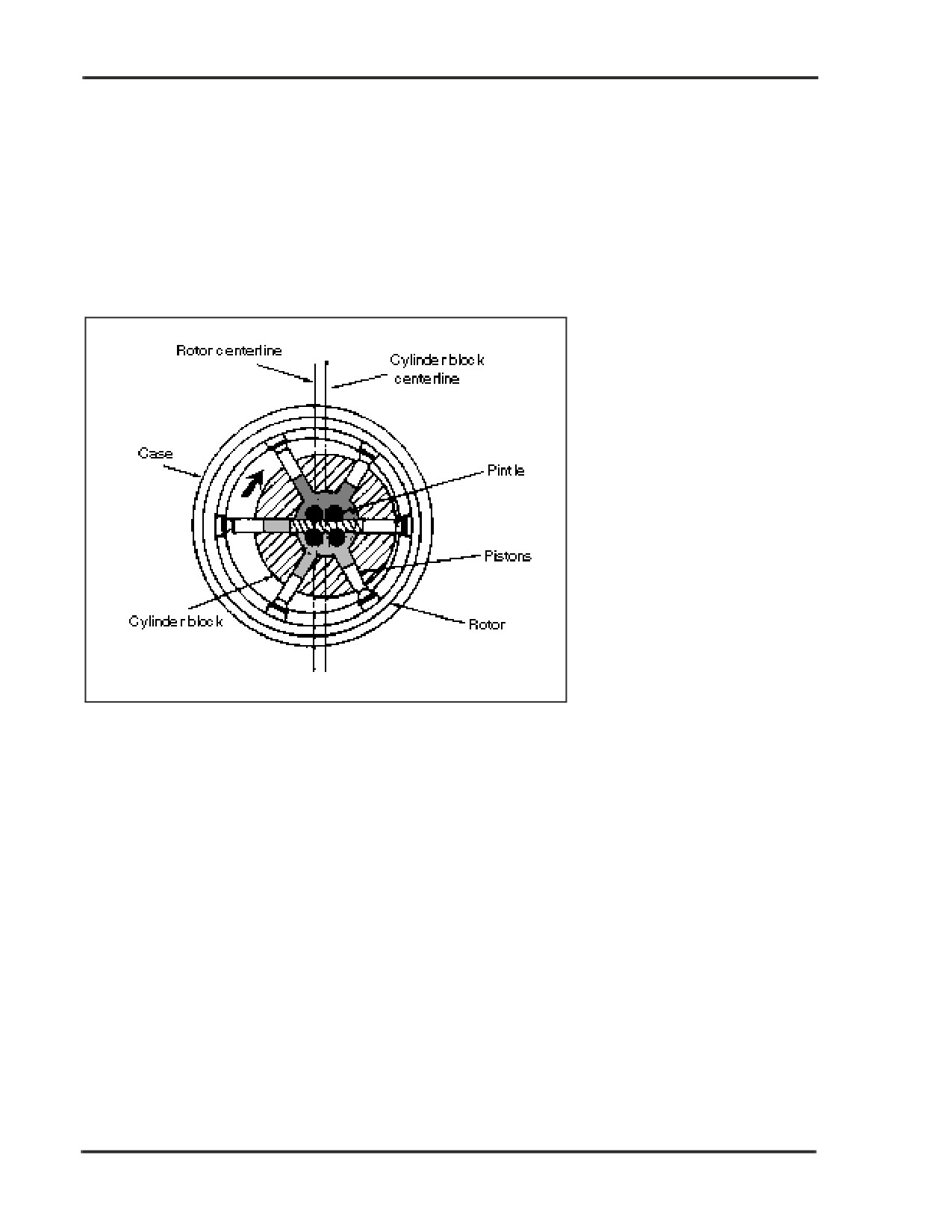
a. Radial. In a radial piston pump (Figure 3-14), the pistons are arranged like wheel
spokes in a short cylindrical block. A drive shaft, which is inside a circular housing, rotates
a cylinder block. The block
turns on a stationary pintle
that contains the inlet and
outlet ports. As a cylinder
block turns, centrifugal force
slings the pistons, which fol-
low a circular housing. A
housing’s centerline is offset
from a cylinder block’s center-
line. The amount of eccentric-
ity between the two
determines a piston stroke
and, therefore, a pump’s dis-
placement. Controls can be
applied to change a housing’s
location and thereby vary a
pump’s delivery from zero to
maximum.
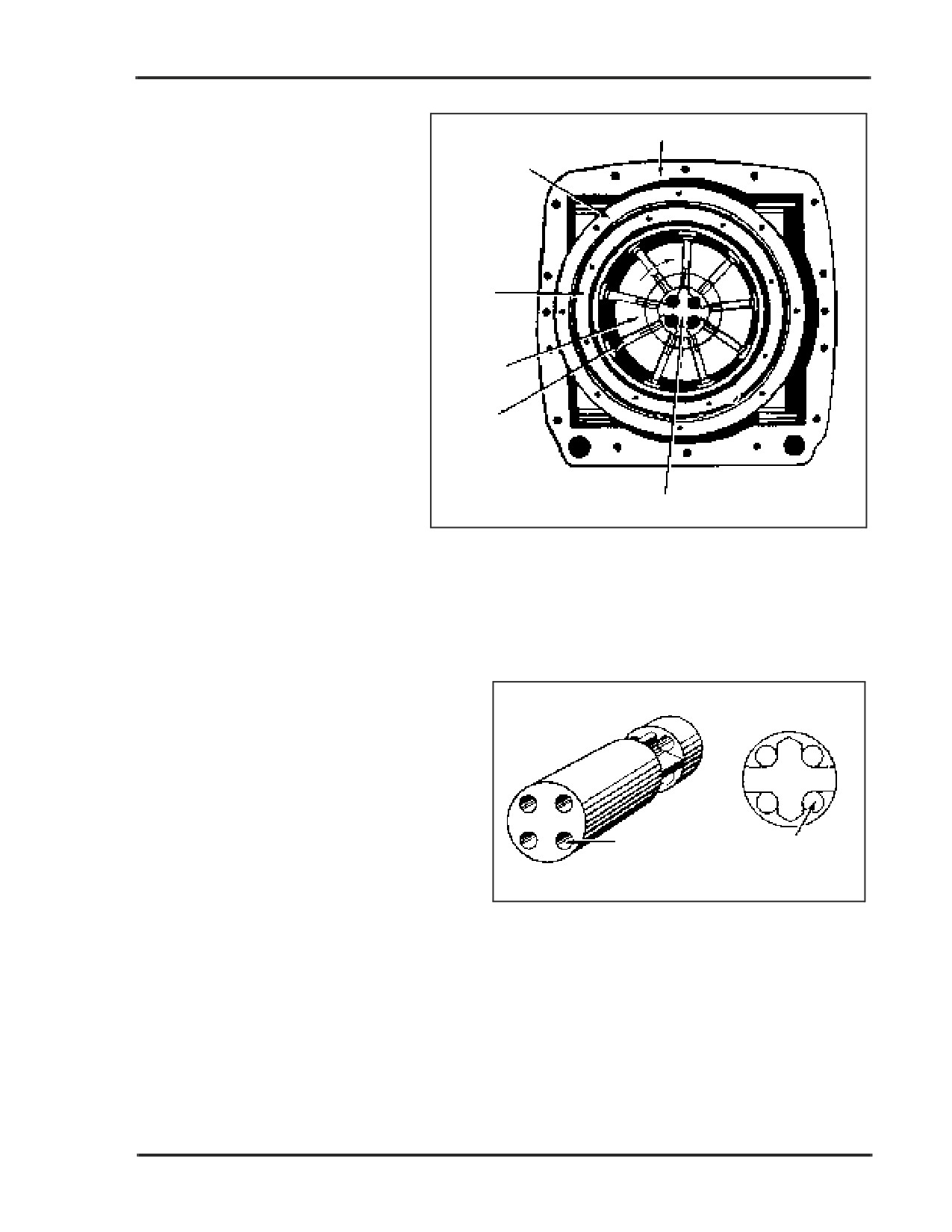
Figure 3-15 shows a nine-
piston, radial piston pump.
Figure 3-14. Simplified radial piston pump
When a pump has an uneven
number of pistons, no more
than one piston is completely blocked by a pintle at one time, which reduces flow pulsations.
With an even number of pistons spaced around a cylinder block, two pistons could be blocked
by a pintle at the same time. If this happens, three pistons would discharge at one time and
four at another time, and pulsations would occur in the flow. A pintle, a cylinder block, the
pistons, a rotor, and a drive shaft constitute the main working parts of a pump.
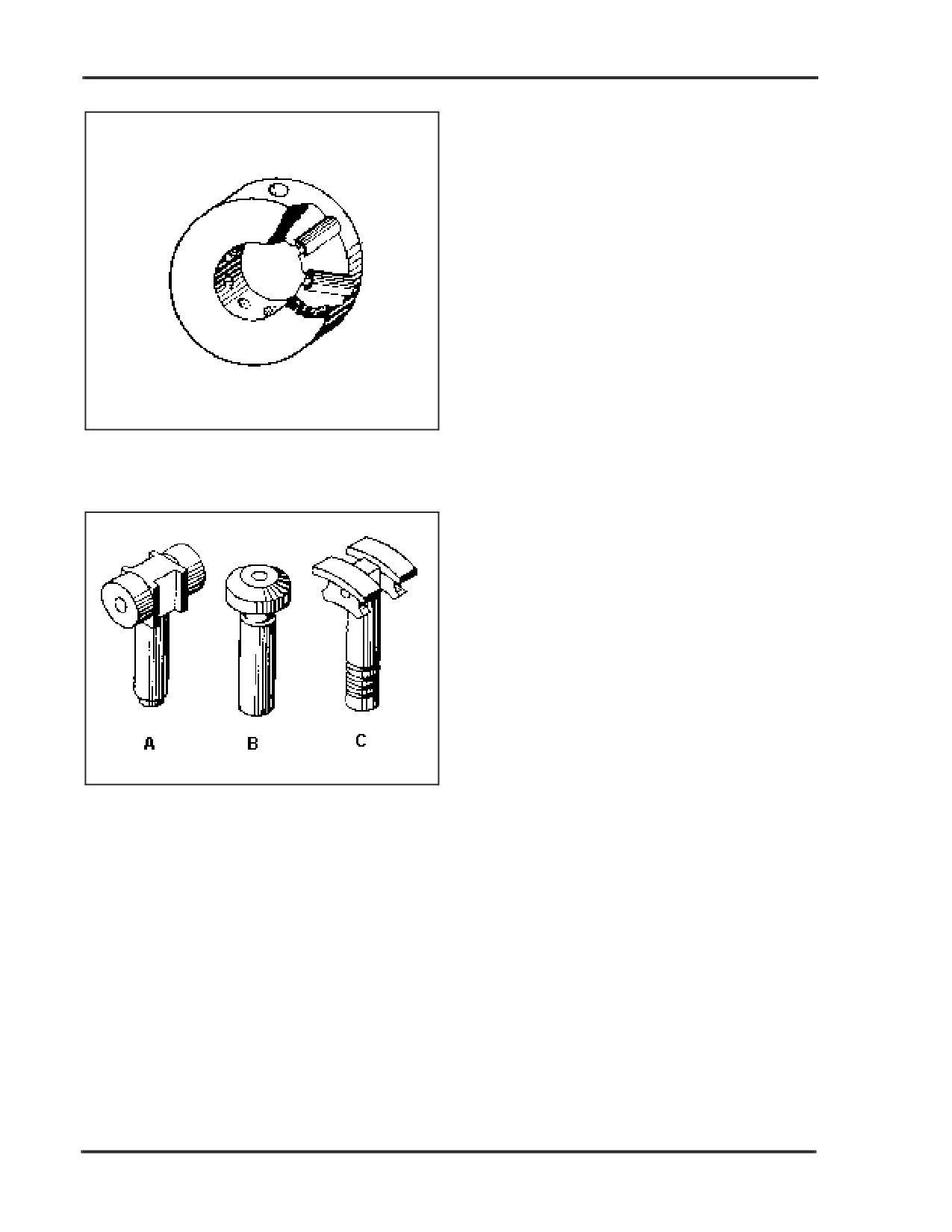
(1) Pintle. A pintle is a round bar that serves as a stationary shaft around which a cyl-
inder block turns. A pintle shaft (Figure 3-16) has four holes bored from one end lengthwise
through part of its length. Two holes serve as an intake and two as a discharge. Two slots
are cut in a side of the shaft so that each slot connects two of the lengthwise holes. The slots
are in-line with the pistons when a cylinder block is assembled on a pintle. One of these
slots provides a path for a liquid to pass from the pistons to the discharge holes bored in a
pintle. Another slot connects the two inlet holes to the pistons when they are drawing in liq-
uid. The discharge holes are connected through appropriate fittings to a discharge line so
that a liquid can be directed into a system. The other pair of holes is connected to an inlet
line.
3-10
Pumps
FM 5-499
(2) Cylinder Block. A cylinder
Case
block (Figure 3-17, page 3-12) is a
block of metal with a hole bored
Slide block
through its center to fit the pintle’s
and cylinder’s holes that are bored
equal distances apart around its
outside edge. The cylinder’s holes
connect with the hole that receives
a pintle. Designs differ; some cylin-
Rotor
ders appear to be almost solid,
while others have spokelike cylin-
ders radiating out from the center.
A cylinder’s and pintle’s holes are
Cylinder
accurately machined so that liquid
loss around a piston is minimal.
Piston
(3) Pistons. Pistons are manu-
factured in different designs (see
Figure 3-18, page 3-12). Diagram A
shows a piston with small wheels
Pintle
that roll around the inside curve of
a rotor. Diagram B shows a piston
in which a conical edge of the top
Figure 3-15. Nine-piston radial piston pump
bears directly against a reaction
ring of the rotor. In this design, a
piston goes back and forth in a cylinder while it rotates about its axis so that the top surface
will wear uniformly. Diagram C shows a piston attached to curved plates. The curved
plates bear against and slide around the inside surface of a rotor. The pistons’ sides are
accurately machined to fit the cylinders so
that there is a minimum loss of liquid
between the walls of a piston and cylinder.
No provision is made for using piston rings
to help seal against piston leakage.
(4) Rotors. Rotor designs may differ
from pump to pump. A rotor consists of a
circular ring, machine finished on the
Port
Port
inside, against which the pistons bear. A
rotor rotates within a slide block, which can
be shifted from side to side to control the
piston’s length of stroke. A slide block has
Figure 3-16. Pintle for a radial piston
two pairs of machined surfaces on the exte-
pump
rior so that it can slide in tracks in the
pump case.
(5) Drive Shaft. A drive shaft is connected to a cylinder block and is driven by an out-
side force such as an electric motor.
b. Axial Piston Pumps. In axial piston pumps, the pistons stroke in the same direction
on a cylinder block’s centerline (axially). Axial piston pumps may be an in-line or angle
Pumps
3-11
FM 5-499
design. In capacity, piston pumps range from
low to very high. Pressures are as high as
5,000 psi, and drive speeds are medium to
high. Efficiency is high, and pumps generally
have excellent durability. Petroleum oil fluids
are usually required. Pulsations in delivery
are small and of medium frequency. The
pumps are quiet in operation but may have a
growl or whine, depending on condition.
Except for in-line pumps, which are compact
in size, piston pumps are heavy and bulky.
(1) In-Line Pump. In an in-line piston
pump (Figure 3-19, diagram A), a drive shaft
and cylinder block are on the same centerline.
Reciprocation of the pistons is caused by a
swash plate that the pistons run against as a
Figure 3-17. Cylinder block for a radial
cylinder block rotates. A drive shaft turns a
piston pump
cylinder block, which carries the pistons
around a shaft. The piston shoes slide against
a swash plate and are held against it by a
shoe plate. A swash plate’s angle causes the
cylinders to reciprocate in their bores. At the
point where a piston begins to retract, an
opening in the end of a bore slides over an
inlet slot in a valve plate, and oil is drawn into
a bore through somewhat less than half a rev-
olution. There is a solid area in a valve plate
as a piston becomes fully retracted. As a pis-
ton begins to extend, an opening in a cylinder
barrel moves over an outlet slot, and oil is
forced out a pressure port.
(a) Displacement. Pump displacement
depends on the bore and stroke of a piston and
Figure 3-18. Pistons for a radial piston
the number of pistons. A swash plate’s angle
pump
(Figure 3-19, diagram B) determines the
stroke, which can vary by changing the angle.
In a fixed angle’s unit, a swash plate is stationary in the housing. In a variable unit’s, it is
mounted on a yoke, which can turn on pintles. Different controls can be attached to the pin-
tles to vary pump delivery from zero to the maximum. With certain controls, the direction of
flow can be reversed by swinging a yoke past center. In the center position, a swash plate is
perpendicular to the cylinder’s, and there is no piston reciprocation; no oil is pumped.
(b) Components. The major components of a typical, fixed-displacement in-line pump
are the housing, a bearing-supported drive shaft, a rotating group, a shaft seal, and a valve
plate. A valve plate contains an inlet and an outlet port and functions as the back cover. A
rotating group consists of a cylinder block that is splined to a drive shaft, a splined spherical
washer, a spring, nine pistons with shoes, a swash plate, and a shoe plate. When a group is
assembled, a spring forces a cylinder block against a valve plate and a spherical washer
3-12
Pumps