FM 3-39 Military Police Operations (August 2013) - page 3
Foundations of Military Police Operations
3-130. Even if police information has no apparent intelligence value, it may still aid intelligence analysts
and staffs and identify trends, patterns, and associations from which enforcement gaps are identified and
policing strategies are developed and focused. Biometric and forensic information can provide the precision
needed for intelligence-driven operations, while vehicle registration and identification programs can track
and inhibit the threat freedom of movement.
3-131. The organization and analysis of police information can help draw conclusions about criminal and
asymmetric threats that often evade traditional center-of-gravity analysis because of their lack of
organizational mass. However, these same criminal and threat actors must move and communicate among
the population and are therefore vulnerable to dedicated processes of trend, pattern, association, and link
analysis. The military police-unique organizational structure and training enable them to rapidly conduct
numerous and frequent police engagements in a given area of operations, resulting in a high volume of
police information that, when effectively assessed and analyzed, can result in predictive strategies and
preemptive operations. When this information answers commander’s critical information requirements, it
can immediately become actionable and result in a focused operation. When police information is matched
against established measures of effectiveness, it can signal a tipping point indicating the success or failure
of a particular strategy or program supporting an effects-based approach to conditions setting or shaping
operations.
Sources
3-132. Police information is derived from a myriad of sources. Military police Soldiers throughout the
area of operations collect police information during deliberate reconnaissance operations, through technical
police assessments, during interactions with the population, during patrol operations, and in the process of
conducting criminal investigations. Military police also gather information from existing police databases
and as databases that store information used for civil control measures, such as vehicle registration and
driver’s license.
Police Engagement
3-133. Police engagement can provide critical information regarding police operations or the operational
environment. As military police patrols, USACIDC special agents, and leaders interacting with the
population, community leaders, and other law enforcement agencies, they continuously obtain and share
critical information relevant to tactical- and operational-level planning and execution. Police intelligence
operations activities analyze this information and produce police intelligence to provide greater clarity and
isolate trends, patterns, and associations that may not be obvious.
3-134. Transnational threats are often criminal-like in nature and may penetrate the seams between
national and international security systems. Military police and USACIDC personnel at the strategic level
engage unified action partners to identify, monitor, and defeat criminal networks capable of moving
resources and contraband across and between national and transnational boundaries. The development of
unified action law enforcement or investigative task forces at the operational or strategic levels may
facilitate the sharing of police information that may result in evidence or relevant information when applied
to criminal proceedings or intelligence supporting military operations. Police intelligence operations
integrated into these activities provides the analysis of information obtained through inform and influence
activities and cooperative efforts to produce police intelligence, enabling more informed and effective
strategic-level decisions.
Criminal Investigations
3-135. Police intelligence operations can glean significant information resulting from criminal
investigations. Criminal investigations include the collation of investigative information from case files that
involve allegations and testimony from witnesses, suspects, and victims. All investigations follow some
type of analytical framework based on facts and evidence that are used to draw conclusions and render
decisions or judgments. The criminal investigative process used by military police investigators and
USACIDC special agents can result in the immediate generation of police intelligence. This police
intelligence can be derived through testimonial evidence or from high-quality information that has been
vetted through the rigor of the criminal investigative process and that can offer significant support to
26 August 2013
FM 3-39
3-29
Chapter 3
ongoing intelligence efforts. Police intelligence that is developed specifically in support of criminal
investigations is typically referred to as criminal intelligence. Police operations can offer flexibility in
gathering, sharing, or confirming facts and information.
Forensic Evidence and Biometric Data
3-136. Identity information collected through biometric enrollment and forensics collection is matched to
correlate known persons to threat activity through forensics analysis and the data stored within databases.
This data is critical to military police operations, criminal investigations, targeting, protection efforts, and
associated security activities. Police intelligence operations can capitalize on data obtained through forensic
examination and analysis and biometric collection by fusing the information with other police information,
police intelligence, and military intelligence during decisive action to fill critical gaps and intelligence
requirements. The resulting police intelligence can significantly enhance policing and security efforts of
military police and other Army elements.
Reconnaissance and Assessments
3-137. Military police units perform deliberate collection missions across the range of military operations
when directed by higher headquarters or to fulfill information requirements of their organic commander or
provost marshal. This deliberate collection effort is usually integrated within ongoing police operations,
detention operations, and security and mobility support missions with the intent to collect information in
support of military police operations and the operations process. Military police units may conduct route,
zone, or area reconnaissance, surveillance, and countersurveillance to gain information to help guard
against unexpected enemy attacks in the area of operations or to gain information critical to understanding,
planning, and executing missions supporting civil security and civil control.
3-138. Commanders and staffs must fully understand the capabilities and limitations of specific military
police assets at their disposal. This ensures that the employment of these assets is within their capabilities
and is on missions for which they have been trained and equipped. Although reconnaissance primarily
relies on the human dynamic rather than technical means, the situation may require the collection of a
higher degree of technical information than nonspecialized units possess. Military police reconnaissance
efforts may be focused on technical assessments of the police and criminal environment, infrastructure,
systems, persons, or specific incidents. These assessments may be in support of any number of police
operations or detention missions that further support civil security and civil control efforts.
Military Police Patrols
3-139. Police information can be collected as a result of passive or active (deliberate) collection efforts
during the course of normal military police patrols. These patrols can be conducted during police
operations, detention operations, and security and mobility support. Passive collection occurs every time
military police Soldiers engage with the people or environment in which they operate. They may discover
information that has not been specifically requested, but recognize that it has value. That information is
provided to commanders and staff, along with the details and circumstances of the discovery. Deliberate
collection occurs when military police are directed to obtain specific information about an area or target.
These requests may be tied to a commander’s priority intelligence requirements, provost marshal
intelligence requirements regarding the area of operations, or specific police investigations. These
intelligence requirements will generally be briefed to military police Soldiers as part of their patrol briefing
before mission execution. Postmission debriefs are critical to ensuring that information gathered by military
police Soldiers on patrol is collected by the appropriate staff elements for timely dissemination and
analysis.
3-140. Within the context of law enforcement focusing on good order and discipline of U.S. military
elements, persons may be motivated to pass information to military police by a sense of duty or justice, in
hopes of leniency by law enforcement personnel, to obtain revenge against an individual, or because of
many other human motivators. Within an operational environment where military police interact with host
nation personnel, these individuals may be influenced by feelings of support for the overall U.S. goals, their
hope for money or other support from multinational forces, or many other motivations of self-interest, such
as fear of or revenge on people or groups who they perceive caused them harm. In all circumstances, it is
3-30
FM 3-39
26 August 2013
Foundations of Military Police Operations
important to understand the motivation, and eventually the level of reliability, of the source of information
about enemy and criminal activities.
Detention Operations
3-141. Military police guard personnel continuously gather information via passive collection techniques.
This passive collection stems from observing the activities, routines, and interactions of U.S. military
prisoners or detainees. This collection can be visual or audible and requires attention to detail and
significant and constant situational understanding on the part of military police Soldiers. Information
collected by guard personnel is passed through the chain of command to the echelon S-2/G-2 as a result of
established debriefing procedures.
3-142. Within an operational environment, interrogations that are not law enforcement-related collection
activities are executed by trained intelligence personnel. Military police are prohibited from interrogating
detainees for purposes other than criminal investigations. Only trained interrogators or investigators are
authorized to interrogate or interview detained or imprisoned individuals. Typically, only trained military
police investigators or USACIDC special agents may interview individuals or conduct law enforcement
interrogations for specific law enforcement investigation purposes.
Analysis and Dissemination
3-143. Analysis is an activity to determine the significance of the information relative to information and
intelligence already known and the development of logical deductions about the probable meaning of the
evaluated information. Analysis is critical in vetting and organizing collected raw information into usable
police information and intelligence. Analysis within police intelligence operations enables military police
to understand police organizations and systems as well as the criminal environment in which military police
and other U.S. forces operate. Within the context of criminal investigations, police intelligence operations
analysis assists investigators in understanding criminal relationships and helps to establish links between
known or suspected criminals or criminal organizations.
3-144. The analysis of police information varies, depending on the specific intelligence requirements to
be fulfilled. Police intelligence operations analysts use common analytic techniques applied to answer
requirements specific to policing organizations and systems, the criminal environment, and criminal
investigative gaps and considerations (see ATTP 3-39.20). Military police staffs should have a trained
police intelligence operations analyst, typically within the operations section, to provide specific analytical
expertise to support police intelligence operations. Military police and USACIDC police intelligence
operations analysts should attend, at a minimum, the Crime and Criminal Intelligence Analyst Course.
3-145. Within a deployed operational environment, military police leaders continuously collect, organize,
and interpret police/criminal information. Military police units continuously update internal tracking
systems and report analyzed information and police intelligence to higher, lower, and other relevant units to
facilitate the operations process. Data that is provided through analysis is used by military police within the
intelligence preparation of the battlefield process to continuously analyze the threat and other aspects of the
operational environment. The military police unit will—
z
Update the previous police/criminal estimates provided to the S-2/G-2.
z
Identify new or potential criminal threats, networks, and trends in the area of operations.
z
Recommend protection level changes to the supported commander.
z
Notify adjacent units of the potential criminal threat, network, or trend that may affect their
forces.
z
Reprioritize military police operations and support to the identified threat area.
z
Share the information with host nation/local police and other agencies as appropriate.
3-146. When reporting tactical information obtained from an operation, the military police unit will—
z
Forward the information to the higher headquarters S-2/G-2.
z
Forward the information to the military police chain of command, which integrates it into the
military police portion of the intelligence preparation of the battlefield process and takes
appropriate action.
z
Notify other relevant units of the potential threat that may affect their forces.
26 August 2013
FM 3-39
3-31
Chapter 3
3-147. Within the context of law enforcement operations in support of U.S. military bases and base
camps, police and criminal information is analyzed by police intelligence operations analysts within the
provost marshal’s office or supporting USACIDC organizations. Crime and Criminal Intelligence Analyst
Course-trained analysts focus their efforts on crime trends, measures of effectiveness, and specific criminal
investigations and threats. Analyzed information and police intelligence are used internally to shape
operations and aid investigators working specific criminal investigations. The data is also shared
throughout the law enforcement community as needed, within applicable legal constraints. ATTP 3-39.20
provides an in-depth discussion of legal restrictions regarding the dissemination of law enforcement
information pertaining to U.S. citizens. Police intelligence operations analysts assigned to military police
battalions and brigades should be tasked to augment provost marshal staffs at home station to support law
enforcement efforts and to develop and maintain analytical skill sets.
3-32
FM 3-39
26 August 2013
Chapter 4
Support to Army Operations
Military police support Army operations through the integration of the military police
disciplines. These disciplines are applied through the elements of combat power to
support combined arms operations. This chapter describes military police combat
power applications that are linked through the mission command, movement and
maneuver, intelligence, fires, sustainment, and protection warfighting functions.
Military police missions that are synchronized through the warfighting functions
contribute significant combat power (lethal and nonlethal) to decisive action tasks.
Decisive action that is conducted simultaneously combines offensive, defensive, and
stability or DSCA tasks. Army forces adapt to the requirements of the operational
environment, conduct operations within it, and operate through ever-changing
combinations of decisive action using synchronized action, joint interdependent
capabilities, and mission command. The Army defeats enemies on land using
offensive and defensive operations and engages the population and civil authorities in
the area of operations through stability or DSCA operations. The effort accorded to
each task is proportional to the mission and varies with the situation.
SUPPORT TO COMBINED ARMS OPERATIONS
4-1. The Army operational concept is unified land operations and commanders achieve success by
integrating the four foundations of unified land operations: mission command, decisive action (offensive,
defensive, and stability or DSCA), the Army corps competencies (combined arms maneuver and wide area
security), and initiative. Army forces combine offensive, defensive, and stability or DSCA simultaneously
as part of an interdependent joint force to seize, retain, and exploit the initiative; to gain and maintain a
position of relative advantage during sustained land operations; and to prevent, deter, prevail in war, and
create for favorable conflict resolution. They employ synchronized action—lethal and nonlethal—
proportional to the mission and stay informed by a thorough understanding of all variables of the
operational environment. (See ADRP 3-0 for additional information on unified land operations.)
4-2. Combat power depends on combined arms to achieve its full destructive, disruptive, informational,
and constructive potential. Combined arms are the synchronized and simultaneous application of arms to
achieve an effect greater than if each arm were used separately or sequentially. (ADRP 3-0) Applying
combat power is the way that Army leaders conceptualize capabilities. Combat power has eight elements—
leadership, information, mission command, movement and maneuver, intelligence, fires, sustainment, and
protection. The Army employs combat power through combined arms operations. Combined arms
operations are organized through tailoring and task-organizing Army forces to optimize the elements of
combat power for a particular mission. Military police operations are synchronized to support combined
arms through the warfighting functions.
4-3. Military police operations contribute significant combat power—lethal and nonlethal—to all decisive
action tasks. Based on an analysis of the mission variables, the BCTs will be task-organized with required
military police capabilities to meet mission requirements. For offensive and defensive tasks, the military
police task organization may consist of a military police company or battalion headquarters to provide the
necessary mission command for military police units and capabilities augmenting the BCT. Other, more
technically specialized military police capabilities provide general support to BCT requirements for
security and mobility support. These same capabilities may be employed at division, corps, and theater
echelons to enable mission command, force mobility, protection, and sustainment. Stability operations
generally require a shift in focus for military police to military police disciplines requiring a greater degree
26 August 2013
FM 3-39
4-1
Chapter 4
of technical capability—police operations and detention operations. As requirements for military police
technical capabilities increase and the uniform application of those capabilities across the entire area of
operations becomes critical (generally as stability operations become dominant), the consolidation of
military police assets and capabilities under the mission command of military police battalions and brigades
within the division, corps, and theater echelon may be required to ensure the integration and
synchronization of military police technical capabilities across the area of operations.
4-4. Lethal force is at the heart of offensive and defensive actions, and its application is critical to success
in these operations. However, the use of nonlethal actions is becoming increasingly important. Today’s
threat operates from populated areas, wary of U.S. combat capabilities and welcoming the potential
collateral damage to noncombatants when combat erupts. The adversary may use information propaganda
effectively to dramatize any harm inflicted on noncombatants by friendly forces. There is an inherent
complementary relationship between the use of lethal force and the application of military nonlethal effects,
actions, and capabilities to achieve results through less coercive means.
4-5. Although each situation requires a different mix of force responses, when used together, lethal and
nonlethal actions complement each other and create new dilemmas for the opponent. The result of
nonlethal actions in situations where the use of lethal force would be counterproductive, or where its use
might result in unintended consequences and/or noncombatant casualties, denies the enemy this propaganda
tool. Military police units from the force pool can provide critical nonlethal capabilities to support the range
of military operations with the employment of a nonlethal capabilities set from pre-positioned theater
stocks. Military police also bring significant capability and experience operating within the restrictive use
of force parameters. Military police are inherently adept at implementing escalation-of-force criteria due to
their law enforcement training and experience.
4-6. Every unit, regardless of type, generates combat power and contributes to the operation. A variety of
military police capabilities and unit types contribute combat power. As discussed earlier, military police
disciplines are military police-interrelated areas of expertise, grouped together to help joint force
commanders integrate, synchronize, and direct military police operations. Tasks within these disciplines are
each aligned with a specific warfighting function (see FM 7-15). Refer to chapter 3 in ADRP 3-0 for a full
discussion of combat power and the warfighting functions.
4-7. Alignment within the warfighting functions provides the framework for military police tasks in the
Army Universal Task List. While these functional relationships reflect the primary task alignments, the
military police disciplines, in reality, have a much broader range of influence and support. The
subordination of a task beneath a specific warfighting function does not negate its relevance within another
warfighting function. The military police disciplines collectively support all of the warfighting functions,
and each military police discipline is applied within one or more of the warfighting functions. An analysis
of tasks within the Army universal task list reflects a primary (not all-inclusive) alignment of each military
police discipline as follows:
z
Police operations are primarily focused on protection.
z
Detention operations is primarily linked to protection.
z
Security and mobility support is primary focused on movement and maneuver and protection.
APPLICATION OF MILITARY POLICE COMBAT POWER
THROUGH THE WARFIGHTING FUNCTIONS
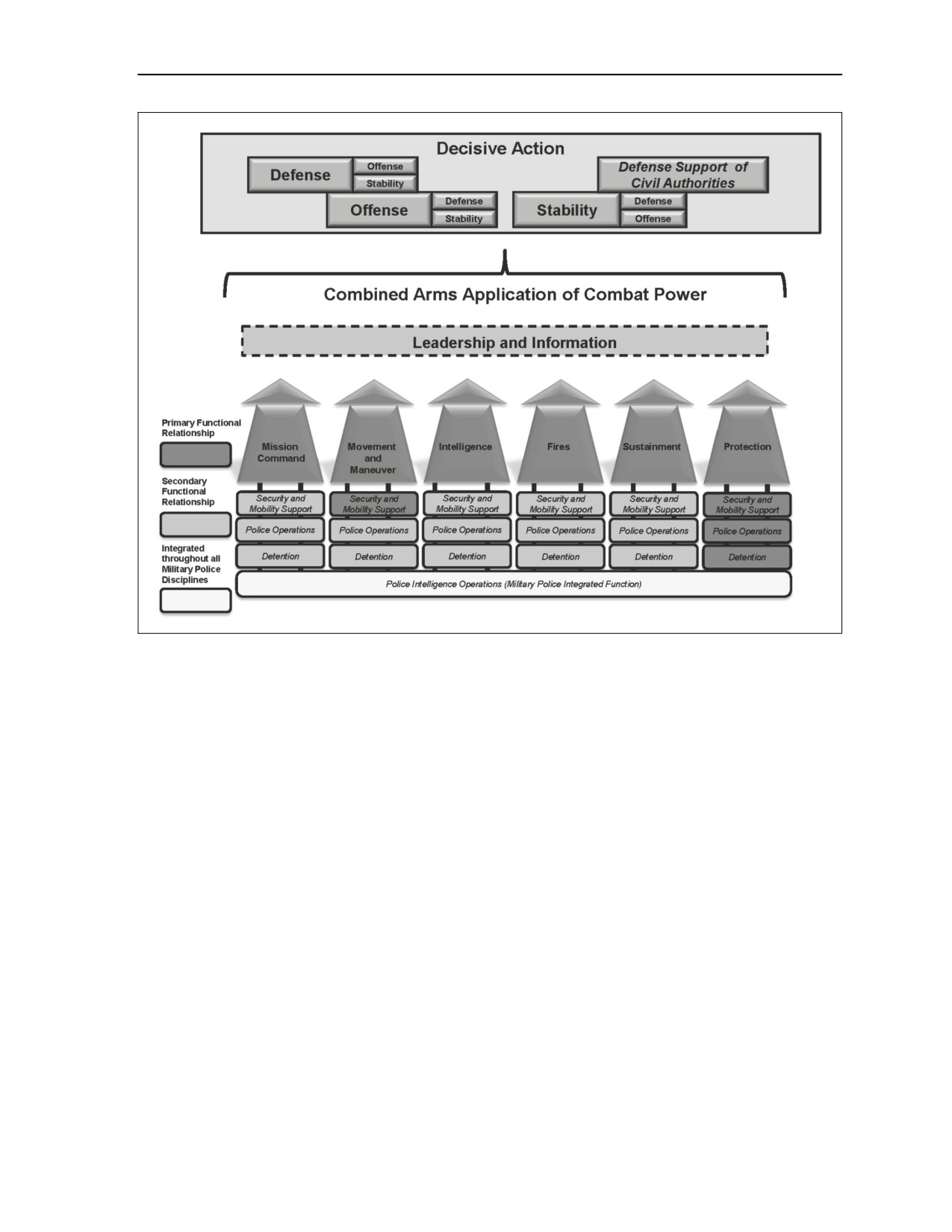
4-8. The warfighting functions provide military police commanders a common framework within which
to link the required military police disciplines and their respective capabilities to the synchronized
application of combined arms. Figure 4-1 highlights the integration of military police combat power across
the warfighting functions and identifies the primary and secondary relationship of each discipline to each
warfighting function. The following text will link the military police disciplines to the warfighting
functions and show how military police disciplines support the geographic combatant commander across
the range of military operations.
4-2
FM 3-39
26 August 2013
Support to Army Operations
Figure 4-1. Application of military police combat power
MISSION COMMAND
4-9.The mission command warfighting function is the related tasks and systems that develop and
integrate those activities enabling a commander to balance the art of command and the science of control
to integrate the other warfighting functions.
(ADRP 3-0) Through mission command, commanders
integrate and synchronize operations. Commanders, supported by their staffs, exercise mission command
throughout the conduct of operations. Mission command is the exercise of authority and direction by the
commander using mission orders to enable disciplined initiative within the commanders’ intent to
empower agile and adaptive leaders in the conduct of unified land operations. This philosophy of
command helps commanders capitalize on the climate of trust and professional judgment of subordinates
to take action to develop the situation and integrate military operations to achieve the commander’s intent
and desired end state. Mission command emphasizes centralized intent and dispersed execution through
disciplined initiative. This precept guides leaders toward mission accomplishment. (See ADRP 6-0 for
information on mission command.)
4-10. Military police plan, integrate, synchronize, and execute missions and activities across all six
warfighting functions, to include those tasks aligned with the mission command warfighting function.
Military police support mission command through a myriad of command- and staff-related tasks. Most of
these tasks are not specific to military police, although they execute these tasks to ensure adequate
support at strategic, operational, and tactical levels throughout the operational environment. Asset
management and prioritization are some of the most critical challenges for commanders and staffs in the
operational environment. A lack of military police resources may be typical in the operational
environment and impede the commander from executing all identified tasks. Careful prioritization must
occur. Even more challenging is that, once in the area of operations, force-tailored military police units
26 August 2013
FM 3-39
4-3
Chapter 4
must be able to rapidly transition among elements of operations. Because the available force-tailored
military police units are designed for more specific types of tasks, military police capabilities must be
shifted within the area of operations to match the operational component requirements and the
capabilities of modular military police units. For military police units, consideration must also be given
to administration and support, to include the control of resources and equipment, personnel management,
unit logistics, individual and unit training, readiness, mobilization, demobilization, discipline, and other
matters not included in the operational missions, but inherent in administrative control responsibilities.
4-11. Military police assets are typically extremely limited, especially when those assets are leveraged
against high-demand, technical policing disciplines, such as detention operations or police operations
support to host nation police for civil security and civil control requirements during stability.
Commanders favor decentralized control wherever possible. It is the doctrinal solution to uncertainty and
increased tempo. However, decentralized control is not appropriate in all cases. Centralized control is
better for managing scarce resources, especially those that can produce effects throughout the area of
operations. It may also be necessary to mass effects decisively in some cases. Centralized control is also
suitable for operations in which greater-than-normal coordination—within the force or with other Service
or nation forces—is involved (see ADRP 6-0).
4-12. The negative impacts of unsynchronized and inconsistent application of detainee operations or
efforts to build host nation policing capability across an area of operations or joint operations area can
have significant strategic implications and cause major delays in operational benchmarks for success.
When extensive and long-term military police technical capabilities and uniform effect are required
across an area of operations or joint operations area, military police brigade mission command of military
police assets is required to ensure the technical oversight, synchronization, coordination, and consistent
application of military police capabilities. This is especially true when stability tasks are dominant within
the area of operations.
4-13. All military police units must execute mission command and the operations process activities for
their own unit and interact with the mission command activities of supported units. This interaction may
be primarily through a military police staff assigned to the supported unit or through staff counterparts. In
some cases, a supported unit may not have assigned military police staff, and the supporting unit will
provide this support as well. This relationship and degree of interaction is determined by many factors,
including the type of unit and echelon being supported and the command or support relationship
established. (See ADRP 5-0 for an in-depth discussion of Army command and support relationships.)
4-14. Military police capabilities are integrated throughout the levels of war by a combination of military
police commands and integrated staff positions. Military police serve in varying levels of command and
staff throughout their career and provide the expertise to integrate functions. Provost marshal sections are
organic within the BCT, MEB, division, and corps staff designs. (Chapter 5 discusses the military police
staff integration into Army staffs and their responsibilities.)
PROVOST MARSHAL
4-15. Commanders exercise control over assigned forces in their area of operations. The staff has the
primary function of assisting the commander, and subordinate commanders exercise control. Control
allows commanders to direct the execution of operations. Unlike command functions, which remain
relatively similar among echelons of command, control functions increase in complexity at each higher
echelon. As the control function becomes increasingly complex, units are typically assigned larger staffs
to ensure integration through the warfighting functions and synchronization of combat power. The staff
assigned to BCT, division, corps, theater Army, and other joint organizations includes a number of
military police personnel in various sections and cells.
4-16. The senior military police officer on the staff is typically designated as the provost marshal and is
responsible for assisting the commander in exercising control over military police forces in the area of
operations. The provost marshal is responsible for coordinating military police assets and operations for
the command. The commander typically designates the provost marshal as a personal staff officer for law
enforcement issues concerning U.S. military forces and U.S. personnel. This ensures appropriate
sensitivity and security regarding criminal investigations and personal information. Each echelon, down
4-4
FM 3-39
26 August 2013
Support to Army Operations
to brigade level, has an organic provost marshal and staff element to integrate military police forces. The
provost marshal office is typically aligned within the operations section (S-3/G-3). In division and higher
staffs, the provost marshal cell may be further assigned to the protection cell. Regardless, the provost
marshal cell has significant coordination requirements with other staff elements to ensure that military
police assets are employed properly and that military police capabilities support the commander’s intent
and stated requirements in an efficient and effective manner.
4-17. A senior military police unit commander may be dual-hatted as a commander and provost marshal
to a maneuver commander, although the echelon commander may choose to designate the military police
unit commander as his provost marshal based on experience, mission, or other variables. Military police
planners are assigned within all BCT, MEB, division, and corps staff designs. Ultimately, the decision on
whether the senior military unit commander will serve in both roles will be made by each supported force
commander based on the specific situation. Some specific considerations for determining the
relationships of the senior military police staff advisor and the senior military police unit commander and
determining which individual will be designated as the echelon provost marshal include—
z
What staff assets are available to support the military police staff advisor versus the military
police unit commander? Are these elements from the same unit, or are separate units resourced
for each role?
z
What experience level is needed for the military police staff advisor? Should this role be
resourced with a current or former commander?
z
How long will the augmenting military police unit, commanded by the senior military police unit
commander, be working for or with the force? Is there enough time for this military police
commander to acclimate and effectively advise the force commander?
z
What working relationship is established between an existing military police staff advisor and
the force commander? Similarly, is there an existing working relationship between the military
police unit commander and the force commander?
Brigade Combat Team Provost Marshal
4-18. Each BCT is organized with an organic military police staff section. The military police staff
section supports the BCT and its subordinate organizations, while focusing on military police operations
within the BCT. It also provides the framework for planning military police augmentation to the BCT.
4-19. The BCT provost marshal is responsible for coordinating military police operations and is the
senior military police officer in the BCT, unless augmented by a more senior military police unit
commander. If a military police battalion is task-organized in support of the BCT, the BCT commander
will determine if a change will occur in provost marshal designation. This decision is based on the
duration of the task organization and the focus of the mission being performed by the supporting military
police battalion. It is important for the military police battalion commander and the BCT provost
marshal to coordinate the planning and execution of military police operations that support the BCT. For
the maneuver battalion level inside the BCT, the provost marshal plans and recommends military police
support. The provost marshal performs the following tasks that support the planning of military police
operations:
z
Provides organizational focus for organic and augmenting military police units.
z
Synchronizes military police support across the entire brigade.
z
Coordinates and prioritizes tasks across the military police disciplines.
z
Integrates specified and implied military police tasks into brigade planning.
z
Coordinates and prioritizes MWD support.
4-20. The BCT provost marshal is normally located in the BCT main. However, if the BCT is located in
some type of sanctuary and the tactical command post is deployed forward, the provost marshal may be
located in the tactical command post. The primary duty of the provost marshal is to plan, coordinate, and
facilitate the execution of military police missions in support of the commander’s scheme of maneuver.
In this role, the provost marshal must—
z
Integrate the military police disciplines into future brigade plans.
z
Develop the necessary input to BCT orders, annexes, and military police unit orders.
26 August 2013
FM 3-39
4-5
Chapter 4
z
Make time-sensitive military police decisions on requests for immediate tactical support
received from BCT tactical commanders.
z
Train the provost marshal cell located at the brigade main command post.
z
Formulate and recommend schemes of military police support to meet the BCT commander’s
intent.
z
Visualize the future state of military police operations in the BCT.
z
Recommend the military police priorities of effort and support, essential tasks, and acceptable
mission risks to the BCT commander.
z
Determine and evaluate critical aspects of the military police situation.
z
Determine what military police missions must be accomplished to support current and future
fights.
z
Integrate the organic military police platoon in the planning process and explain the significant
contributions of military police functions to combat power.
z
Develop a scheme of military police operations concurrent with the BCT maneuver courses of
action.
z
Integrate the necessary orders and instructions into higher headquarters plans and orders.
z
Issue timely instructions and orders to organic and augmenting military police units through the
BCT base order to simplify preparation and integration.
z
Monitor the execution of military police orders and instructions by tracking the current fight.
z
Alter the military police plan using the feedback received from maneuver battalions, the military
police platoon, and any augmenting military police units as required.
z
Identify any BCT requirements for echelons-above-brigade military police and other related
assets to support the brigade.
z
Make the BCT commander aware of the capabilities, limitations, and employment
considerations of organic and augmenting military police and related assets.
z
Recommend the military police organization for combat.
z
Plan, coordinate, and resource military police operations within the BCT staff.
z
Advise the commander on—
Using organic and augmenting military police assets.
Employing police operations capabilities.
Employing detention operations capabilities.
Employing security and mobility support capabilities.
Integrating police intelligence operations.
z
Produce detention operations planning and overlays that show temporary holding areas and the
flow of detainees or dislocated civilians.
z
Assist the S-2 with the intelligence preparation of the battlefield, including information from
police intelligence operations.
z
Participate in appropriate working groups.
z
Provide information on the status of military police assets on hand.
z
Track and report changes to main supply route information.
z
Recommend main supply route regulation enforcement measures.
z
Recommend protection measures for logistics areas.
z
Advise the commander on policing and corrections as they relate to the rule of law and stability
tasks.
z
Recommend when specialized military police support
(such as customs, investigative, or
forensics support) may be required.
Echelons-Above-Brigade Provost Marshal
4-21. Depending on the echelon and type of unit, military police staff members may be assigned under
the provost marshal section or within other staff sections. The provost marshal is typically assigned
4-6
FM 3-39
26 August 2013
Support to Army Operations
within the operations section, although depending on the mission and focus, the provost marshal may be
assigned to the logistics section (more common in joint staffs) or a separate section. Even though the
division or corps headquarters may serve as a joint task force headquarters, the division provost marshal
and corps provost marshal staff duties and responsibilities are similar to those listed previously for the
brigade provost marshal. Regardless of mission, every Army staff has common areas of expertise that
determine how commanders divide duties and responsibilities. Grouping related activities by the area of
expertise gives commanders an effective span of control. It also facilitates unified effort by the staff.
Areas of expertise may vary slightly, depending on the command echelon, the mission, and the
operational environment. For example, at the battalion level there is normally no resource manager, and
certain logistics units combine the intelligence and operations areas of expertise. As previously
mentioned, the section of assignment and grouping of the military police staff varies among echelons and
unit types.
MOVEMENT AND MANEUVER
4-22. The movement and maneuver warfighting function is the related tasks and systems that move and
employ forces to achieve a position of relative advantage over the enemy and other threats. Direct fire
and close combat are inherent in maneuver. (ADRP 3-0) This warfighing function includes those tasks
associated with force projection relegated to gaining position of advantage over the enemy.
4-23. Military police support that is applied through the movement and maneuver warfighting function is
primarily executed through security and mobility support. Military police units are an integral part of a
the ability of the combined arms unit to maneuver. The maneuver warfighing function is focused on
support to close operating forces. Military police units enhance force momentum by controlling the
movement of forces across the area of operations to make the most efficient use of the space and time
necessary to generate mass and speed, while denying enemy maneuver. By enhancing the ability to
maneuver, military police units accelerate the concentration of combat power, increasing the velocity and
tempo of the force necessary to exploit critical enemy vulnerabilities. By executing security and mobility
support, military police units limit enemy ability to generate harassing attacks and help preserve the
combat force for the main effort by preventing the enemy disruption of movement that would cause a
tactical commander to divert combat forces. Police intelligence operations integrated within military
police operations support movement and maneuver through the collection, analysis, and dissemination of
police information and intelligence gathered by military police teams and military police staff. The
results of police intelligence operations can provide critical and timely information regarding criminal
activity or conditions within the operational environment that can threaten friendly operations or impede
the freedom of movement.
4-24. Military police units supporting movement and maneuver include those capabilities organic to, and
task-organized within, the BCTs and MEBs. Functional military police brigade support will be required
when the mission requires more than two military police battalions to support the freedom of maneuver
and protection of the combined arms team.
4-25. Security and mobility support tasks that are performed in support of the movement and maneuver
warfighting function may include—
z
Supporting gap-crossing (wet or dry), breaching, and passage-of-lines operations.
z
Providing straggler movement control.
z
Controlling the movement of dislocated civilians.
z
Conducting route reconnaissance and security.
z
Conducting main supply route regulation enforcement.
z
Conducting population and resource control.
z
Conducting movement corridor operations.
z
Conducting reconnaissance operations.
z
Conducting response force operations and critical site, asset, and high-risk personnel security.
z
Conducting base defense operations.
26 August 2013
FM 3-39
4-7
Chapter 4
z
Provide protection and physical security.
z
Conduct antiterrorism operations.
INTELLIGENCE
4-26. The intelligence warfighting function is the related tasks and systems that facilitate understanding
of the enemy, terrain, and civil considerations. (ADRP 3-0) Police intelligence operations directly
supports the intelligence warfighting function and tasks associated with surveillance and reconnaissance
task. Commanders make decisions and direct actions based on their common operational picture. They
keep their common operational picture current by continuously assessing the situation and stating the
information they need in the commander’s critical information requirements. The required information is
obtained through various detection methods and systematic observation, reconnaissance, and
surveillance. Military police capabilities can be employed during key activities in the operations process
to add to the commander’s common operational picture.
4-27. Tactical and technical police information collected as part of deliberate collection efforts, such as
military police reconnaissance missions conducted during security and mobility support or assessments
during police operations, provide relevant police information regarding the operational environment.
Subsequent analysis and dissemination of police information and police intelligence improve geographic
combatant commander understanding of enemy actions, dislocated civilians in the area of operations and
their movement, and trends within the police and criminal environment that may affect the operational
plan. Military police information generated can also provide data that contributes to answering specific
commander’s critical information requirements. As an integrated function, police intelligence operations
activities pull and push information and police intelligence from all three military police disciplines—
police operations, detention operations, and security and mobility support—to provide input to the
common operational picture. Police intelligence operations activities are an important part of the
surveillance and reconnaissance.
4-28. Military police responsibilities in support of the intelligence effort and the common operational
picture include—
z
Provide military police staff planning and coordination to support intelligence collection in
conjunction with execution of military police operations.
z
Perform route reconnaissance and surveillance to fulfill information requirements and to advise
the commander on primary and alternate route status and potential movement disruptions.
z
Perform military police reconnaissance in conjunction with security and mobility support to
collect threat information and identify conditions affecting the operational plan.
z
Conduct police assessments during police operations and detention operations.
z
Establish police intelligence policies and procedures to be executed during military police
operations.
z
Execute program management for police intelligence collected during military police operations.
z
Serve as a member of the intelligence working groups.
z
Coordinate system requirements, such as communications, technology, hardware, and software.
Contributions to the Intelligence Warfighting Function
4-29. Military police provide a vast array of information as a result of deliberate and passive collection
efforts. Information that results from the execution of military police operations falls into the following
areas:
z
Avenues and routes for joint forces and likely enemy avenues of approach.
z
Unit movement along the main supply route and alternate supply routes.
z
Information threats to airfields and ports.
z
Enemy and criminal network activity in the area of operations.
z
Crime-conducive conditions.
z
Law enforcement gaps and mechanisms.
z
Information on urban operations and other complex terrain.
4-8
FM 3-39
26 August 2013
Support to Army Operations
z
Information on high-payoff targets.
z
Viability of lines of communication and main supply routes and potential protection of base
camps.
z
Identification of potential detention or resettlement sites, enemy landing zones, and
dislocated-civilian evacuation routes.
z
Route reconnaissance that is focused on route choke points, ambush sites, temporary holding
sites, and traffic flow.
z
Area reconnaissance that is focused on criminal intelligence, alternate route identification, and
dislocated-civilian movement.
z
Gap-crossing and passage-of-lines reconnaissance that is focused on determining requirements
for a main supply route, temporary holding sites, traffic control, strong points, and maintenance
rest halts.
z
Area reconnaissance that is focused on establishing protective measures of high-risk facilities.
z
Area reconnaissance that is performed in support of urban combat operations.
z
Reconnaissance that establishes an initial assessment of infrastructure factors for detention or
resettlement missions.
z
Police assessments that determine the capabilities and capacity in specified areas of police and
prison operations.
z
Infrastructure surveys that support policing and corrections operations.
4-30. Military police contributions to the intelligence preparation of the battlefield and intelligence
analysis include the standards, processes, Soldiers, and equipment required to generate, manage, analyze,
and disseminate police information and intelligence necessary to enable optimum situational
understanding for the command. These efforts are included in the police intelligence operations
integrated function. Combined with other intelligence, police information, police intelligence, and
criminal intelligence provide more knowledge of the criminal aspects within the area of operations and
improve and broaden the intelligence available to support the commander in decisionmaking.
4-31. Police intelligence operations include—
z
Identifying gaps in criminal and police data and developing collection plans.
z
Managing police intelligence activities.
z
Establishing intelligence requirements to drive the collection of police information.
z
Inputting field-collected and partner-added information.
z
Validating, extracting, analyzing, fusing, and producing relevant data and products for
intelligence and police intelligence products or operations.
z
Providing police information and intelligence for the common operational picture and battle
command systems.
z
Integrating and synchronizing police information and intelligence information with other staff.
z
Managing databases and disseminating police information and intelligence.
4-32. Technology provides the capability to use and combine police intelligence data in various ways to
create customized products. Analysis software allows the police intelligence analyst (using tools such as
automated link diagrams or association matrices) to quickly make more complex connections between
different types of data and information than previously possible. Police intelligence can now be
combined with a wider variety of data, including that from other intelligence sources (such as signal
intelligence and human intelligence) through collaborative processes to provide more accurate,
comprehensive, and relevant products.
4-33. Police information and intelligence resulting from police operations contribute significantly to the
overall understanding of the operational environment. Police information and intelligence obtained
during the execution of police operations are especially relevant during counterinsurgency and stability
tasks. Military police, day-to-day interaction with the local population, host nation police, and unified
action partners policing organizations results in a significant amount of critical information. This
information may be police-related, relevant to policing and criminal investigative requirements, and/or
valuable to the tactical commander for protection and targeting purposes.
26 August 2013
FM 3-39
4-9
Chapter 4
4-34. The detention operations discipline supports the intelligence warfighting function by providing
tactical and police intelligence information obtained through passive collection by military police
Soldiers as they interact with detainees in the transport or guard phases of detention operations. While
military police do not typically perform interrogations or active collection measures within the context of
the detention operations discipline, observations and information obtained from personnel during the
execution of detention tasks frequently adds critical information to the overall intelligence collection
effort. When conducting criminal investigations, USACIDC and military police investigator personnel
may conduct law enforcement interrogations of detainees within any detention facility.
4-35. Route reconnaissance conducted by military police within the security and mobility support
discipline provides critical information about the condition of main supply routes and alternate supply
routes, friendly troop movement along the routes, possible interference from dislocated civilians, and
tactical information about enemy actions along the supply routes. In the security and mobility support
role, military police units are spread across the area of operations and have the communications
capability to immediately report police information with potential intelligence value.
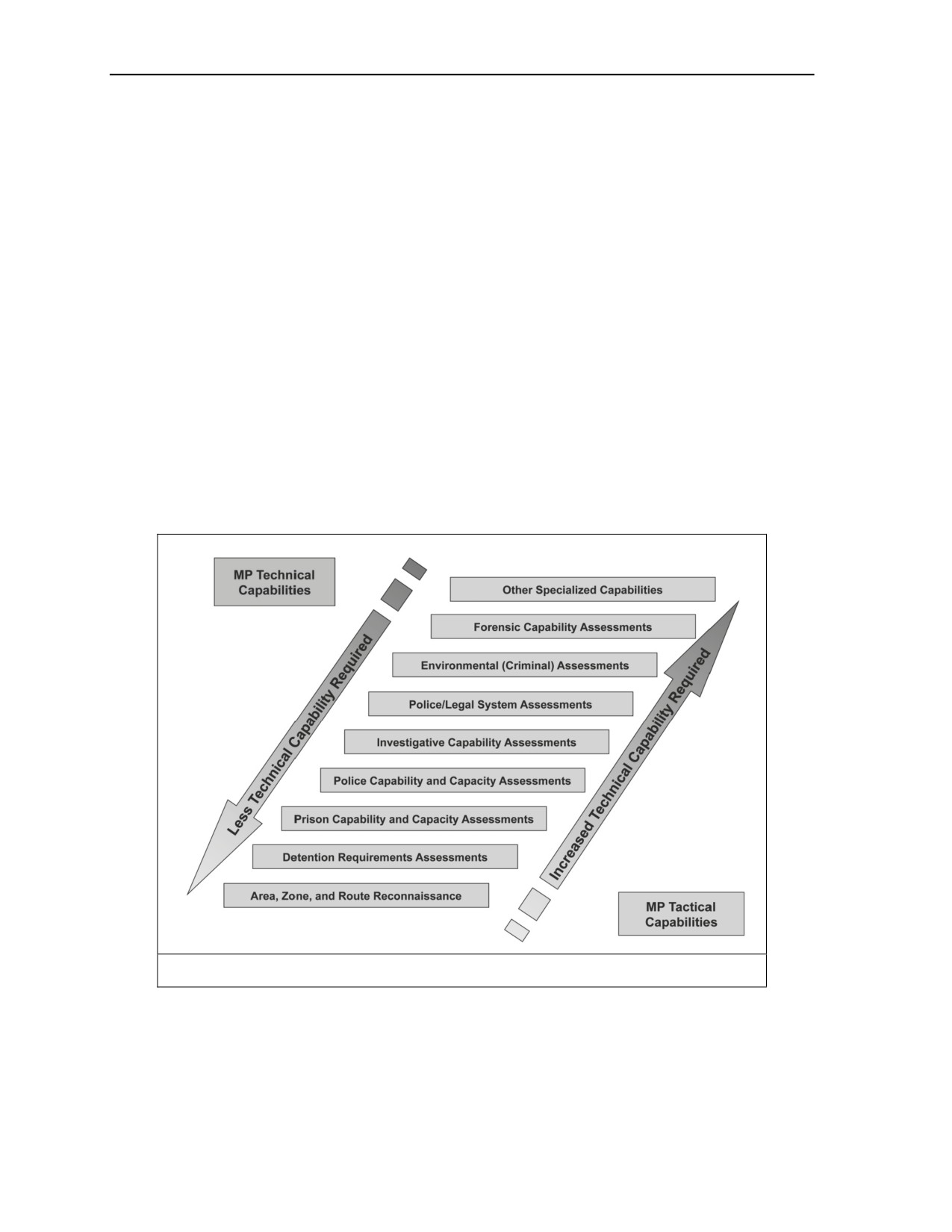
4-36. Military police reconnaissance capabilities range from these tactical reconnaissance tasks, to
highly technical assessments regarding investigative and forensic capabilities (see figure 4-2). During
stability tasks reconnaissance conducted by military police is normally conducted with a specialized,
technical focus on policing and investigative aspects of the environment. As requirements for technical
capabilities provided by military police increase (generally as stability tasks become dominant), the
consolidation of military police assets and capabilities under the mission command of military police
battalions and brigades within the division, corps, and theater echelon may be required to ensure the
integration and synchronization of military police technical capabilities across the area of operations.
Legend:
MP
military police
Figure 4-2. Military police reconnaissance capabilities
4-37. Military police reconnaissance is a deliberate information collection mission. Military police units
may conduct route, zone, or area reconnaissance, surveillance, and countersurveillance to gain information
to help guard against unexpected enemy attacks in the area of operations or to gain information critical to
understanding, planning, and executing missions supporting civil security and civil control.
4-10
FM 3-39
26 August 2013
Support to Army Operations
4-38. Military police reconnaissance efforts may also be focused on technical assessments of the police
and criminal environment. These assessments may be in support of any number of police operations or
detention operations that further support civil security and civil control efforts. They may be focused on
infrastructure, systems, or persons. These technical assessments will generally attempt to provide
information regarding POLICE.
4-39. The resulting information collected during military police reconnaissance missions are assessed,
analyzed, and disseminated as police intelligence as appropriate. The police intelligence and unanalyzed
police information identified as exceptional information and time-sensitive are continually fed into the
operations process for use in military police planning and execution and fusion within Army operations
at large.
4-40. The security and mobility support discipline also provides military police units executing patrol
operations across the area of operations. These patrols bring military police Soldiers into contact with a
host of friendly units, civilians on the battlefield, and other nongovernmental organizations. These contacts
produce a significant amount of information that is collected and added to the tactical and police
intelligence products through passive and deliberate collection. Military police perform reconnaissance to
fulfill general and specific information requirements in support of the overall intelligence collection effort.
Military police units play a major role in the process by anticipating and providing route reconnaissance
information for main and alternate supply routes, airfields, seaports, and likely landing zones within the
area of operations.
SUSTAINMENT
4-41. The sustainment warfighting function is the related tasks and systems that provide support and
services to ensure freedom of action, extend operational reach, and prolong endurance. (ADRP 3-0)
Military police operations missions that support sustainment operations may include—
z
Collecting and disseminating police information and intelligence relevant to criminal and
conventional threats against the sustainment base and logistics efforts.
z
Executing law enforcement activities to prevent or deter criminal elements from disrupting
logistics operations.
z
Assessing and reporting battle damage along main supply routes and within movement corridors.
z
Patrolling and maintaining security along main supply routes and adjacent terrain. This operation
includes―
Conducting reconnaissance on roads and highways.
Providing security along and adjacent to main supply routes.
Enforcing traffic flow along main supply routes.
Protecting critical airfield facilities.
Protecting pipelines and tank farms.
Protecting fixed bridges.
z
Providing military police convoy escort for designated critical supplies.
z
Conducting area and base and base camp security.
z
Conducting reconnaissance in support of operational area security of sustainment areas and other
assigned areas.
z
Conducting response force operations.
PROTECTION
4-42. The protection warfighting function is the related tasks and systems that preserve the force so that the
commander can apply maximum combat power. (ADRP 3-0) The protection concept in today’s operational
environment includes protecting personnel (combatants and noncombatants) and physical aspects. In
addition to safeguarding bases and base camps, securing routes, and protecting forces within sustainment
areas, protection considerations are applied in support of battle positions, combat outposts, forward
operating bases, and the host nation and other infrastructure support. Today’s battlefield requires that
26 August 2013
FM 3-39
4-11
Chapter 4
commanders know survivability tactics and techniques that provide this protection. (See ADRP 3-37 for
additional information on the protection warfighting function.)
4-43. Military police units have organic equipment and personnel capabilities that are used to support
protection efforts. Military police units provide support to the protection warfighting function through
police operations, detention operations, and security and mobility support. Security and mobility support
operations provides a distribution of military police forces throughout the area of operations that conduct
aggressive patrolling and military police reconnaissance to protect units, critical facilities, and high-risk
personnel and to control civilian populations.
4-44. Police operations support the protection warfighting function by providing policing and the
associated law enforcement activities to control and protect populations and resources and to facilitate the
existence of a lawful and orderly environment. Police operations and the associated skills and capabilities
inherent in that function provide the fundamental base upon which military police functions are framed and
conducted. The following tasks support the protection warfighting function:
z
Performing law enforcement.
z
Conducting criminal investigations.
z
Conducting traffic management and enforcement.
z
Employing forensics capabilities.
z
Conducting police engagement.
z
Providing customs support.
z
Providing host nation police development.
z
Supporting civil law enforcement.
z
Supporting border control, boundary security, and the freedom of movement.
4-45. The detention operations discipline supports the protection warfighting function by providing shelter,
sustaining, guarding, protecting, and accounting for populations (detainees and U.S. military prisoners) as a
result of military or civil conflict or to facilitate criminal prosecution. These operations inherently control
the movement and activities of the population for security, safety, or intelligence gathering. The Army is
the DOD executive agent for detainee operations and for the long-term confinement of U.S. military
prisoners. The following support protection:
z
Detainee operations.
z
Internment of U.S. military prisoners.
z
Host nation corrections training and support.
4-46. The security and mobility support discipline supports protection efforts by securing the main and
alternate supply routes through aggressive patrolling and route reconnaissance to identify potential threats
and hazards that could endanger U.S. forces or equipment. Military police may also be tasked to secure
critical convoys to ensure safe transit. Functions in support of protection operations include the following
military police tasks:
z
Protecting against enemy activities within movement corridors and along main supply routes.
z
Securing supply routes and critical convoys.
z
Conducting reconnaissance and surveillance.
z
Evaluating and recommending protective measures for high-risk facilities.
z
Employing protective measures for high-risk individuals.
z
Employing protective measures for designated supplies.
z
Conducting operational area security.
z
Conducting actions to control populations.
z
Conducting response force operations.
z
Applying antiterrorism measures.
z
Conducting the resettlement of dislocated civilians.
z
Implementing physical security measures.
4-12
FM 3-39
26 August 2013
Support to Army Operations
4-47. When military police units perform protection tasks, survivability remains a key commander
concern. Although the likelihood of major combat is reduced, key resources and personnel remain
vulnerable to other types of hostile action or attack. Commanders must consider protecting vital resources
(such as fuel sites, logistics convoys, base and base camps, and logistics support areas) since the entire area
of operations has an equal potential for enemy attack; therefore, the priority of work will be more focused
on protecting these types of resources. Vital resources requiring protection may also include facilities that
are critical to the civilian infrastructure, such as key industrial sites, pipelines, water treatment plants, and
government buildings.
4-48. The police intelligence operations function is integrated within police operations, detention
operations, and security and mobility support missions supporting the protection warfighting function. The
deliberate and passive collection of information obtained during ongoing interactions with host nation
police/security personnel and the civilian population provides valuable police information and police
intelligence critical to the protection of U.S. military personnel, equipment, and bases. ADRP 3-37 provides
an in-depth discussion of the protection warfighting function.
OTHER CONSIDERATIONS
4-49. There are additional considerations for the employment of military police that may apply in special
situations. This section discusses some of those considerations, to include participation in multinational
security forces, transition to the rule of law, and other special situations.
MULTINATIONAL SECURITY FORCES
4-50. In addition to the joint security forces discussed earlier in the chapter, multinational and partner
nations contributing forces to the operational area may bring in security forces that can contribute to the
overall security and protection provided to facilities, personnel, and equipment. Joint security forces and
multinational security forces do not possess identical capabilities. It is important to understand what
functions each of these security forces bring with them so that they can be used to maximize the efficiency
of their capability and to provide the right level of expertise to the missions and tasks assigned. One of the
defining factors that can determine capability to perform certain functions and tasks is the manning and
equipment of the unit. Their ability to shoot, move, and communicate is critical to selecting and assigning
missions within their manning and equipment capabilities. Security forces without vehicles can best be
used on static security posts, while vehicle- and communications-equipped security forces can better be
used in a security and mobility support role. Army military police forces are best suited for direct and
general support to maneuver forces. Other determining factors for multinational security forces are political
considerations and sensitivities. Also, some units may be under a multinational agreement to participate
only if used in certain locations or roles. It is important to honor those commitments.
TRANSITION TO THE RULE OF LAW
4-51. Planning for follow-on to major combat operations should begin in the early planning stages for war.
Efforts to transition to the rule of law must start as soon as stability tasks begin, often simultaneously with
major combat operations. First, the security conditions must be established and political conditions initiated
that support policing, judicial and corrections systems for fair and equitable treatment of citizens by the
host nation government. This is often easier said than accomplished. Many nations simply do not have the
underpinnings of the rule of law to understand and implement the system and will require coaching,
mentoring, training, and support along a continuum toward peaceful existence. Additionally, if efforts in
combat operations do not include shaping the area for stability, criminals, insurgents, and organized crime
will control the population and developing government, making the rule-of-law plan efforts exponentially
more difficult. Citizens must have the right to ownership, fair treatment by policing and judicial systems,
and corrections systems that enforce compliance with the law in a manner that is equitable and uniformly
fair to everyone. Military police forces are well suited for providing host nation assistance and training for
principally two of the three legs of the rule of law—the policing and corrections aspects. Military police
units must cultivate relationships with host nation police and local officials in the operational area, if they
exist, early in the operation to maximize efficiencies later during the transition period. This process will
provide valuable police intelligence that will aid the unit in planning and recommending courses of action
to assist in establishing the rule of law.
26 August 2013
FM 3-39
4-13
Chapter 4
4-52. Military police support to transition to the rule of law can include helping establish and train local
police officers in basic to advanced law enforcement skills and operating police stations. Military police
units can assist with developing requests for law enforcement equipment and sustainment items
necessary for local law enforcement. Our military police units can provide joint patrolling and the
operation of the police station, mentoring host nation personnel until the host nation is capable of
independent operations. Military police detention units can assist with establishing corrections operations
in a reopened or temporary facility. They can also train the guard forces and prison operations staffs to
properly operate a facility. All of these activities build confidence in the local population that
law-abiding citizens will be treated fairly and equitably and that laws will be applied equally and
uniformly to every citizen. Citizens must know they will not be unlawfully detained or imprisoned. They
must also be confident that the unlawful activity of others will be policed and punished.
4-53. Military police capabilities that are relevant to the rule-of-law mission to support the training of
host nation police and security personnel in police and corrections tasks include—
z
Arrest and interrogation techniques.
z
Prison and jail security and procedures.
z
Tactical doctrine.
z
Crowd control.
z
Organized crime combating.
z
Forensics and evidence collection.
z
Protection of sensitive facilities.
z
Election security.
z
High-risk personnel security.
BORDER OPERATIONS
4-54. Military police Soldiers are periodically tasked to support border operations along the U.S.
borders. The support provided includes technical equipment (such as thermal imagery, night vision, and
infrared detection) and the operation of the equipment to help with the detection of personnel illegally
entering into the United States. The Posse Comitatus Act prohibits Regular Army or Army Reserve
Soldiers from enforcing civil law; they may only respond to defend themselves or law enforcement
officials from imminent danger. Nonfederalized National Guard military police performing missions
under the control of their respective state governors are not prohibited by the Posse Comitatus Act. On
mobilization (federalization), National Guard Soldiers are restricted under the Posse Comitatus Act.
4-55. Borders outside of our own national borders may also require support from military police units.
Military police may be required to operate control posts, conduct border patrols, and supervise crossing
points at international borders. Many countries control the movement of military personnel and civilians
at their borders. Border control is maintained for reasons of security; customs, and tariff enforcement;
protection of the civilian economy; and apprehension of criminals, absentees, and persons of intelligence
interest. Control is maintained through the establishment of authorized road or rail crossing points,
border patrols, control posts, and liaison with authorities of neighboring countries (if feasible). Prohibited
or restricted zones are often used to help control circulation at the borders.
4-56. In conducting border control, military police normally coordinate with indigenous police,
counterintelligence units, and civil affairs units. They watch for individuals or items that may be involved
in criminal and customs offenses. They also establish the identity and purpose of U.S. forces crossing
borders and examine vehicles and travel documents. Support to border control may be paramount to
prevent adversaries from moving weapons, supplies, and personnel across borders to attack or disrupt
friendly forces.
4-57. Military police may also be tasked to enforce customs laws and regulations in support of local
government or host nation officials. The U.S. military enforcement of customs laws of countries in which
U.S. forces are stationed is often part of agreements like the North Atlantic Treaty Organization (NATO)
status-of-forces agreement between the United States and the respective host nation.
4-14
FM 3-39
26 August 2013
Support to Army Operations
CIVIL SECURITY AND CIVIL CONTROL
4-58. Civil security and civil control deny adversaries or insurgents access to the general population and
resources and prevent incidental civilian activity from interfering with military operations. Military
police units support local commanders and often assist civil affairs personnel in planning and conducting
population and resource control programs employed during all military operations. These programs may
consist of training host nation police and corrections agencies and staffs, conducting police operations,
enforcing curfews and movement restrictions, resettling dislocated civilians, conducting licensing
operations, controlling rations, enforcing regulations, implementing amnesty programs, inspecting
facilities, and guarding humanitarian assistance distributions. Military police units also assist, direct, or
deny dislocated civilians the use of main supply routes as they move to resettlement camps where they
are cared for and while nongovernmental organizations work to coordinate their relocation.
4-59. Military police forces are internationally recognized as law enforcement personnel and not combat
troops. Military police capabilities, coupled with their acceptability and their ability to interface with the
population, make military police units well suited for civil security or civil control in a primary or
economy-of-force role.
TERRORISM
4-60. Combating terrorism is actions, including antiterrorism
(defensive measures taken to reduce
vulnerability to terrorist acts) and counterterrorism (offensive measures taken to prevent, deter, and
respond to terrorism), taken to oppose terrorism throughout the entire threat spectrum. (JP 3-07.2) Within
the context of combating terrorism, military police actions generally fall within the included subcategory
of antiterrorism. Military police and USACIDC elements coordinate with installation law enforcement,
counterintelligence special agents, and local and federal law enforcement agencies to combat terrorism at
local levels. The protection working group and the antiterrorism working group are two of the primary
places where coordination and the sharing of information takes place. Military police and USACIDC
Soldiers share the police intelligence report and gain valuable information from other intelligence efforts
of military and civilian agencies tied together at the local level. Each of these organizations ties that
information back to regional and federal levels. The OPMG provides the military police policy on
combating terrorism and coordinates the Army program at the departmental level. USAMPS provides
functional courses to train Soldiers in antiterrorism.
CONTRACTORS
4-61. There is a proliferation of contractors on the modern battlefield. Some of these contractors are
providing security and protection functions; others are providing technical or sustainment functions.
Military police units must be aware of their presence and coordinate as required to integrate any actions
that may conflict. Military police units may be inundated with requests from contractors for protection,
convoy security as they move around the battlefield, or specific assistance to their missions. Military
police units will not be able to divert from their tactical mission to support these types of requests
without proper command approval. Normally, the contract statement of work will specify that the
supported command is responsible for providing protection and security to contractor personnel. When
that information is missing from the contract, the J-3/G-3 of the command area in which the contractor is
required to operate must designate units responsible for contractor protection and security. Contractors
will have to integrate into the units they are supporting for their support.
4-62. In some circumstances, civilian contractors accompanying the force may be subject to the UCMJ
and administrative action by the United States or contractor employers. There are several ways that
jurisdiction may be exercised over contractors. Determining whether criminal jurisdiction exists over
contractors may depend on the “type” of contractor and any applicable written provisions within the
contract itself. Furthermore, civilians may be subject to the Military Extraterritorial Jurisdiction Act of
2000. This act establishes federal jurisdiction over offenses committed OCONUS by persons employed
by or accompanying armed forces or by members of the armed forces who are released or separated from
active duty before being identified and prosecuted for committing such offenses. Government contractors
may be held liable for their employee’s misconduct. Contract employees may also be held personally
liable. In all cases involving suspected contractor misconduct, commanders should immediately consult
26 August 2013
FM 3-39
4-15
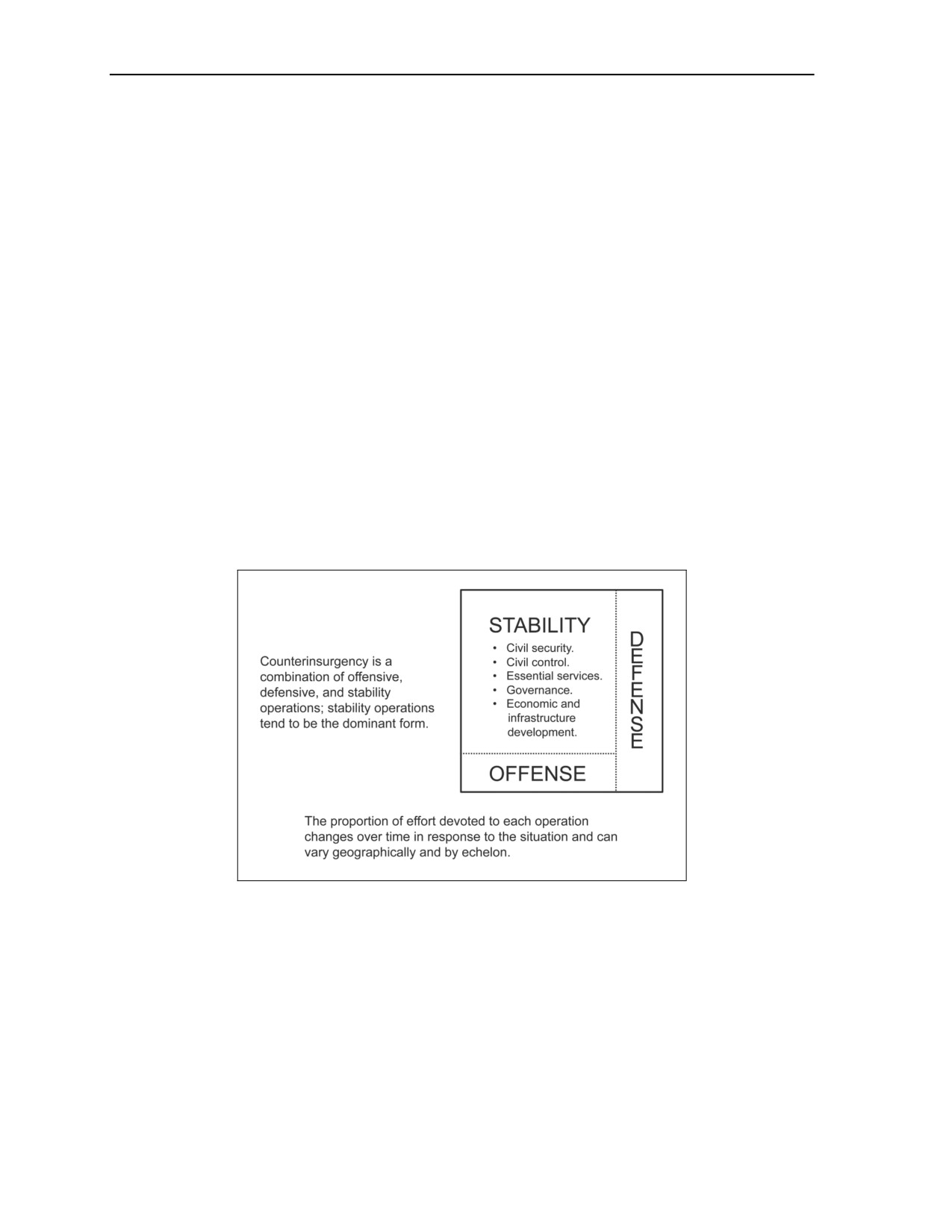
Chapter 4
their staff judge advocate for specific legal advice. (See FM 1-04 for additional information regarding
contractors in support military operations.)
NONCOMBATANT EVACUATIONS
4-63. Military police units can provide support to noncombatant evacuations. Military police units are
capable of providing security at departure locations and extraction sites and for convoys carrying
evacuees. Military police are skilled in interpersonal communications and the graduated use of force
from their law enforcement experiences. This skill set transfers well to working in direct contact with the
evacuees.
COUNTERINSURGENCY
4-64. Counterinsurgency is those military, paramilitary, political, economic, psychological, and civic
actions taken by a government to defeat insurgency. (JP 1-02) In counterinsurgency, host nation forces
and their partners operate to defeat armed resistance, reduce passive opposition, and establish or
reestablish the legitimacy of the host nation government. (Refer to FM 3-24 for additional information on
counterinsurgency.) Counterinsurgency is a joint operation within the operational theme of irregular
warfare where stability tasks are generally dominant. Military police units and Soldiers play a key role in
counterinsurgency.
4-65. A successful counterinsurgency by nature requires a weighted stability effort (see figure 4-3).
Many considerations applicable to counterinsurgency are equally applicable to stability tasks in general.
This is especially true following major combat operations or severe disasters, whether natural or
man-made, in which the infrastructure and the host nation government have been decimated or rendered
ineffective and civil security and control are at risk.
Figure 4-3. Aspects of counterinsurgency
Police Operations Considerations
4-66. Demanding and complex counterinsurgency draws heavily on a broad range of capabilities and
typically requires a different mix and application of offensive, defensive, and stability tasks from what is
expected in major combat operations. The balance between these tasks and the nature of their application
depends on the local situation. A successful counterinsurgency effort, especially during stability,
establishes host nation institutions that can sustain government legitimacy. Security under the rule of law
is essential to success in any stability operation. Without a secure environment, permanent reforms
cannot be implemented and disorder spreads. To establish legitimacy, commanders transition security
activities from combat operations to law enforcement as quickly as possible.
4-16
FM 3-39
26 August 2013
Support to Army Operations
4-67. As the transition of security activities occur, commanders must remember that there is a clear
separation of police authority and roles from those of the military. The primacy of civil police
organizations is not to augment the offensive capability of the military, but to assist in the establishment
of the rule of law. The establishment of a legitimate and effective police force is critical to
counterinsurgency. When insurgents are seen as criminals, they lose public support. Using a legal system
established in line with local culture and practices to deal with such criminals enhances the legitimacy of
the host nation government. The establishment of courts, police, and corrections institutions operating
within the rule of law is paramount; nowhere is this more evident than in the counterinsurgency fight.
4-68. Military police can be an effective force for countering small insurgent and criminal groups
supported by the local community due to their frequent contact with the population. Developing effective
host nation security forces—including military police, community police, and paramilitary forces—is one
of the highest priority stability tasks for military police. This mission is supported by Army and joint
military police elements as they provide training and the development of requisite skills for host nation
police. When supporting host nation police, the military police presence not only provides security to
communities but also aids in building support for the host nation government. Military police experience
in identifying and countering organized criminal networks is especially relevant to stability and
counterinsurgency efforts. The operational environment in any stability operation may be filled with
hardened criminals and opportunists conducting criminal activity that jeopardizes civil security and the
strategic and operational plan. The methods, structure, and local relationships of many insurgent groups
has more in common with organized criminals than with conventional military threat forces.
4-69. The nature of the threat can often inhibit the ability of friendly forces to differentiate between a
hostile act and a hostile intent or between insurgents and innocents within the civilian community.
Military police clarify and verify facts, assumptions, and events in the operational environment through
frequent and continuous engagement with the local population. For this reason, military commanders and
forces must have the authority to detain civilians and an acceptable framework to confine and eventually
release them back into the operational environment. This authority has the most legitimacy when
sanctioned by international mandate or when it is bestowed or conveyed from the local or regional
governmental power. The initial or baseline authority granted to military forces to use force and detain
civilians will ultimately determine the status of the persons they detain. The status of detained persons
will further determine the manner in which they are processed, the degree of due process they are
afforded, and whether their offense is military or criminal in nature. Detainee status and identification
will also help develop and determine eventual rehabilitative, reconciliatory, and release strategies.
Detention Operations Considerations
4-70. The need for information is so crucial in counterinsurgency operations that it typically leads to
increased numbers of detained and interned persons. The time-sensitive nature of information and
intelligence in counterinsurgency operations often leads to detentions based on incomplete or inaccurate
information that makes determining detainee status and identification difficult and complex. The process
of detainee identification and assessment is continuous and begins at the point of capture; is actively
monitored during the period of detainee detention; and significantly impacts custody, control, and release
decisions and strategies.
4-71. Detainee operations play a significant role in stability and counterinsurgency efforts because large
detainee populations can become fertile ground for insurgent, extremist, and criminal recruitment if
individuals are not processed quickly, ethically, humanely, and effectively. The development and growth
of insurgent and/or criminal networks, if not identified and mitigated, can pose significant threats to the
detention cadre and the detainee population.
4-72. In stability, especially protracted counterinsurgency environments, detainee populations will likely
grow steadily as the operation endures. Offensive surge operations can increase detainee growth very
rapidly. This is especially characteristic of counterinsurgency-focused operations. Insurgents may also
attempt to infiltrate detention facilities to intimidate or assassinate political opponents or their supporters.
Captured insurgents display a propensity to continue recruitment, assassination, and intimidation inside
theater detention facilities, making it incumbent upon forces supporting detainee operations to focus their
26 August 2013
FM 3-39
4-17
Chapter 4
efforts on countering insurgency within the facility while synchronizing their efforts with military
operations outside the detention facility.
4-73. The theater of operations must have an effective plan to detain, assess, reconcile, transition, and
eventually release detained or interned persons in a manner that is integrated with, and responsive to, the
overall strategic and operational effort. Theater detention facility commanders often support larger
coordinated approaches to deliberately shaping the information environment and reconciliatory efforts
involving detainees. The capture, detention, rehabilitation/reconciliation, and repatriation of members of
armed groups must be conducted in a manner that is not only consistent with the strategic end state,
operational goals, and tactical realities, but is also fully compliant with the rule of law to ensure
legitimacy with the population.
4-74. During conflict with a conventional force, the segregation of officers, enlisted personnel, civilians,
and females is required when conducting detainee operations and is relatively clear in application. In
contrast, due to the unconventional nature of the threat, many operations may require segregation by
categories according to requirements for conventional military as well as segregation (or typology) by
ethnic, tribal, or religious affiliation; human behavior traits and characteristics; and age groups. The facts
and circumstances resulting in an apprehension may also determine detainee custody and control status.
The goal is to isolate insurgents, extremists, and hardened criminals from moderate and circumstantial
detainees. Inaccurate assessments can have immediate and significant effects within the theater detention
facility that can result in injury or death to detainees, contribute to insurgent recruitment, or cause
custody and control problems for the guard force.
4-75. While the theater detention facility commander develops procedures within the theater detention
facility designed to identify and defeat insurgent or criminal efforts to organize escape, harm the guard
force and other detainees, or degrade the effectiveness of the theater detention facility operation in
general, an external operational headquarters typically provides the linkage to the overarching strategic
and operational effort in the theater. This could be accomplished by a multifunctional headquarters, such
as the military police command or a joint detainee task force involving military police, in concert with
MI, linguists, medical and legal personnel, civil affairs, psychological operations, host nation forces,
interagency partners, and local leaders in a coordinated and synchronized approach. Procedures could
also include tactics, techniques, and procedures to defeat the insurgent networks and efforts within the
theater detention facility that may include—
z
Developing deliberate procedures for detainee identification, categorization, and continual
assessment.
z
Using multifunctional boards to assess detainees and develop reconciliation plans.
z
Designating dedicated teams for each major compound that is composed of bicultural advisors,
intelligence, and counterintelligence representatives.
z
Allowing detainee participation in their adjudication and rehabilitation future.
z
Empowering detainee leaders to leverage their support through incentives.
z
Ensuring that the informational needs of detainees are met and that rules and disciplinary actions
are understood.
4-76. Detainee operations in support of stability tasks may become enduring and assume many of the
characteristics of large-scale, maximum-security prison operations typically found in the international
civilian sector. Long-term custody and control requirements are often augmented with structured
rehabilitative and reconciliation programs, increased access to medical treatment, and visitation
opportunities concluding with some form of guarantor or sponsor-based release or parole system. These
operations are resource-intensive and must receive a priority commensurate with their strategic
significance. As stability tasks progress, military police or corrections personnel must be prepared to
provide training for host nation detainee and corrections tasks with a goal of transitioning these activities to
full host nation control. Host nation personnel should be trained to handle and interrogate detainees and
prisoners according to internationally recognized human rights modalities. Prisoner and detainee
management procedures should provide for the security and fair and efficient processing of those detained.
4-77. Generally, the military does not lead the planning and execution of detainee release programs;
however, the military may be task with establishing and operating theater detention facility reconciliation
4-18
FM 3-39
26 August 2013
Support to Army Operations
centers to ensure the continuity of detainee programs established in detention centers and with reintegration
efforts that conclude at the points of release back into society. The individual or large-scale release or
reintegration of detainees back into the civilian community is a significant event in stability tasks.
Reintegration efforts must be widely understood and visible. This is generally achieved by a deliberate
information and public affairs effort. Former combatants may participate in the process when offered some
level of due process involvement linked to corrective behavior modification. Commanders must seek legal
assistance and ethical guidance as they balance regulatory operations security and detainee privacy
entitlements with the transparency necessary for supporting national values. Military police may provide
the security, custody, and control of detainees at theater detention facility reconciliation centers and may
actively conduct rehabilitative and reconciliatory programs in a command or support relationship with the
headquarters responsible for an area of operations containing a theater detention facility reconciliation
center.
4-78. The military police role during detainee operations in stability environments is central to
transitioning the strategic risk of interning large numbers of civilian detainees to a strategic advantage that
is gained from the reintegration of informed and productive citizens at peace with their community and
government. This is not possible if detainees have not been treated humanely and with respect and dignity.
SITE EXPLOITATION
4-79. Site exploitation is systematically searching for and collecting information, material, and persons
from a designated location and analyzing them to answer information requirements, facilitate subsequent
operations, or support criminal prosecution. (ATTP 3-90.15) Some sites hold significant strategic value.
These sensitive sites will, therefore, receive added scrutiny. ATTP 3-90.15 provides an in-depth discussion
of site exploitation and sensitive sites. Examples of sensitive sites requiring military police technical
capability may include—
z
CBRN facilities related to weapons of mass destruction.
z
War crime sites (mass grave sites, illegal detainment facilities, clandestine mission command
facilities).
z
Terrorist training camps.
z
Prisoner of war locations.
z
Research and production facilities involving breakthrough technologies.
z
Government buildings and infrastructure.
z
Official government residences.
4-80. Requirements for military police support are generally based on the type of site, the duration of the
exploitation mission, and the anticipated conditions in the area of operations. Military police support may
be required once the site has been seized; mission planners should coordinate and allocate support from
military police and CID agents as required. Military police have many potential roles in operations
involving site exploitation. Military police and/or CID agents may be required to—
z
Isolate and secure the exploited site by establishing a restricted perimeter, providing access
control, and preventing evidence destruction.
z
Conduct exploited-site searches, evidence collection, and management activities, to include
establishing the proper chain of custody for material collected at the site. Establishing a proper
chain of custody for evidentiary purposes will be required if the material is expected to be used
in legal proceedings.
z
Conduct the initial assessment and characterization of suspected mass graves, torture chambers,
and war crime sites.
z
Assist with handling and processing detainees, cataloging biometric data for individual
detainees, and segregating and controlling personnel detained at the site to enable evaluation for
further detention, interview, or interrogation. In cases where criminal prosecution is expected,
military police or CID agents may be required to interview suspects or collect witness
statements.
z
Process detainees, captured documents, and equipment.
26 August 2013
FM 3-39
4-19
Chapter 4
z
Conduct police intelligence operations through the collection of police information, police
engagement, and biometrics. Provide applicable police information and intelligence regarding
facilities, security, emergency response personnel and organizations, and key personnel in the
area.
z
Conduct crowd control and civil disturbance operations.
z
Provide MWD support for security, explosives or narcotic detection.
SPECIAL OPERATIONS FORCES
4-81. Commanders employ special operations forces to help attain strategic and operational objectives.
Special operations forces are well suited to operate in a joint, multinational, or interagency environment
and can operate independently for extended periods of time in isolated areas. Special operations forces may
advise, train, or assist indigenous personnel in conventional reconnaissance, surveillance, and small-unit
tactics to accomplish tactical objectives. Military police can serve as a force enabler to special operations
forces across the range of military operations. This support is not limited to any one point on the range of
military operations. (See ADP 3-05 and ADRP 3-05.)
4-82. Military police possess unique technical capabilities that support the special operations forces core
operations
(unconventional warfare, foreign internal defense, counterinsurgency, counterterrorism,
weapons of mass destruction, combat stability operations, and support to major operations). Military police
support to special operations is conducted at the company, platoon, squad, and Soldier level. Military police
technical support includes—
• Forensics analysis and/or biometrics identification capabilities.
• Host nation police training and support.
• Detainee operations.
• Physical security procedures.
• MWD.
• Logistics security.
• Antiterrorism measures.
• Resettlement operations.
• Protective services.
• Host nation corrections training and support.
• Police/criminal information analysis.
4-20
FM 3-39
26 August 2013
Chapter 5
Planning, Preparation, Execution, and Assessment
Military police planners and staff members that are in combined arms or non-military
police headquarters must integrate themselves into planning and operational process
activities. Military police must understand joint planning processes when supporting
joint operations. Military police use other problem-solving activities that address
specific military police functional requirements. The operations process is the context
within which military police capabilities are integrated into the combined arms
application. This chapter describes planning responsibilities, integration, and
processes for military police units and for military police planners in non-military
police units and continues in that context by discussing preparation, execution, and
continuous assessment of military police operations.
PLANNING
5-1. Planning is part of mission command. Planning is the means by which the commander envisions a
desired future; lays out effective ways of achieving it; and communicates the vision, intent, and decisions
between commanders, their staffs, subordinate commanders, and unified action partners. Planning is
continuous and a cyclic activity of the operations process. The product of planning is a plan or an order that
directs future action.
5-2. All planning is based on imperfect knowledge and assumption about the future. Planning and plans
assist military police commanders and staffs—
z
Understand and develop the situation.
z
Anticipate events and adapt to changing circumstances.
z
Task-organize the force and prioritize efforts.
5-3. Planning provides an informed forecast of how future events may unfold and how military police
forces may be employed to support future operations. This entails identifying and evaluating potential
decisions and actions in advance to include thinking through consequences of certain actions. Planning
involves thinking about ways to influence the future as well as how to respond to potential events. Put
simply, planning is thinking critically and creatively about what to do and how to do it, while anticipating
changes along the way.
5-4. A key aspect of planning is organizing military police forces for operations. Task-organizing is the
act of configuring the operational Army, support staff, or sustainment package of specific size and
composition to meet a unique task or mission (ADRP 3-0). Through task organization, commanders
establish command and support relationships and allocate resources to weight the decisive operation or
main effort. Command and support relationships provide the basis for a unity of command and unity of
effort in operations. (See ADRP 5-0 for discussion on Army command and support relationships.)
5-5. Commanders integrate input from subordinate commanders into their planning processes. Military
police leaders must understand and be integral participants in the planning processes impacting military
police operations at their echelon of employment. Supporting military police unit commanders and leaders
conduct parallel planning processes that provide effective outcomes for the military police units employed
and appropriate input to the higher commander’s process. The provost marshal and other military police
staff planners coordinate military police planning activities with their counterparts at higher, adjacent, and
subordinate headquarters.
5-6. Military police operations are complex; and resource-intensive with regard to time, manpower,
equipment, and sustainment resources; and require extensive and proactive coordination. Successful
26 August 2013
FM 3-39
5-1
Chapter 5
military police planning requires an understanding of all military police capabilities and requirements
(tactical and technical) and their impacts on the concept of operations. Military police operations must be
identified and synchronized during the planning activities of the operations process, requiring the critical
reasoning skills and problem-solving techniques inherent in established Army planning
(see
ADRP 5-0). Military police operations will require the use of military police-specific technical skill sets to
plan, manage, and execute the military police-specific disciplines on the battlefield.
5-7. Military police planners provide for the integration of military police-focused considerations on the
supported commander’s staff at each echelon. Throughout the planning process, the military police staff
must advise supported commanders and their staffs about military police capabilities, methods of
employment, and additional capabilities and depth of the military police force pool. In those units without
organic military police staff support, including support type organizations, it may be important for the
supporting military police organization to provide planning support. Liaison may be needed in certain
situations to ensure proper and complete staff planning.
5-8. Relevant information includes information that is important to the commander in his duty of
commanding the mission. In the context of information management, the mission variables make up the
major subject categories into which relevant information is grouped for military operations. (See chapter 1
for a complete discussion of the mission variables.) The commander and staff consider relevant information
for each variable in all military operations. The relative impact of each variable may vary, but the
commanders and staffs must consider them all.
5-9. The analysis of the operational environment in terms of the operational variables begins as early as
possible in the planning process. Analysis in terms of mission variables begins during mission analysis.
Staff sections analyze the situation and its effects on their areas of expertise in terms of the mission
variables to maintain their running estimates. A running estimate is the continuous assessment of the
current situation used to determine if the current operation is proceeding according to the commander’s
intent and if planned future operations are supportable (ADP 5-0). Running estimates provide the relevant
information that commanders need to understand the situation. Military police planners and staffs at all
levels must continually assess and identify information gaps and develop information requirements that
support further planning, assessment, and decision points. The development of a collection plan satisfies
these information requirements and drives police intelligence operations.
5-10. Communications support military police operations by contributing to the collection, processing, and
dissemination of an uninterrupted flow of police information via wired and wireless networks. Support to
military police operations consists of the network management functions that build and manage
communication networks. All communications support requirements must be coordinated through the
signal staff officer during the integrated planning phase.
OPERATIONAL CONSIDERATIONS
5-11. When planning for military police operations, there are operational considerations that apply. While
the process is the same at all echelons, there are differences that apply to each level of war. Specific
planning for the military police disciplines and their associated tasks will vary by echelon and across the
Service components in which that planning occurs. Although many of the tasks performed by military
police are relevant for each of the operational components, each of those components will tend to drive the
type of task that is typically performed in support of them. Parallel planning will be critical, and the degree
of unified action partner participation will also affect planning. The condition of the host nation and its
receptivity to our presence may dynamically affect planning.
STAFF PLANNING AT EACH LEVEL OF WAR
5-12. It is important to understand planning within the context of the levels of war (see figure 5-1).
Operational-level planning involves broader dimensions of time and space than tactical-level planning. It is
often more complex and less defined. Operational-level planners are often required to define an area of
operations, estimate forces required, and evaluate the requirements for the operation. In contrast,
tactical-level planners proceed from an existing operational design. Normally, areas of operations are
prescribed, objectives and available forces are identified, and sequences of activities are specified for
5-2
FM 3-39
26 August 2013
Planning, Preparation, Execution, and Assessment
tactical-level commanders. Neither operational- nor tactical-level planning is limited to particular echelons.
As echelons of responsibilities have blurred, essentially any military police unit is capable of supporting a
maneuver unit at any level of war. For example, a military police battalion may deploy to support a joint
task force or an Army corps at the operational level or a corps, division, MEB, or BCT at the tactical level.
Military police planning is conducted at the strategic, operational, and tactical levels and includes all of the
military police disciplines.
STRATEGIC
Military police strategic planners must determine
the mobilization, deployment, employment, and
Parallel planning
sustainment requirements of the military police
force in relation to joint planning and the combatant
effort
commander’s concept of operations.
OPERATIONAL
Military police operational planners take the joint operations plan
and develop the supporting operational plan, assigning specific
Military Police missions to available military police forces at the
operational and tactical level.
TACTICAL
Military police tactical planners take operational plans and develop tactical operation orders
to employ the best methods to accomplish assigned missions or tasks. These missions or
tasks are specifically assigned to military police units or headquarters containing military
police units (the maneuver enhancement brigade might be one example) at the tactical
level.
Figure 5-1. Military police planning at each level of war
5-13. Understanding the theater structure commonly used to array military capabilities enables an
understanding of military police capabilities within the context of the operational environment. A theater is
a geographic area for which a geographic combatant commander is assigned military responsibility. The
command views a theater from a strategic perspective and assesses the level of international military
cooperation available with the degree of dedicated U.S. military resources necessary. These factors
influence prospective Army operations in each theater or geographic combatant commander area of
responsibility.
5-14. The geographic combatant commander or senior Army commander’s planning concepts, when
conducted concurrently with a major combat effort and synchronized to the overall concept of operations,
focus military police planners on the relationship of protection, support to movement and maneuver,
detention, and support to stability tasks. Military police planners must determine the basic, yet broad,
mobilization, deployment, employment, and sustainment requirements of the combatant commander’s
concept of operations. At all levels of planning, the senior military police commander or staff planner at
each echelon must support the development of the supported commander’s operation plan or operation
order and an internal operation plan or operation order for the military police organization.
ARMY PLANNING METHODOLOGIES
5-15. Successful planning requires the integration of conceptual and detailed thinking. Army leaders
employ three methodologies for planning, and determining the appropriate mix based on the scope of the
problem, their familiarity with it, the time available, and the availability of a staff. Methodologies that
assist commanders and staffs with planning include—
z
Army design methodology.
z
Troop leading procedures.
z
The military decisionmaking process.
26 August 2013
FM 3-39
5-3

Chapter 5
5-16. Army design methodology is a methodology for applying critical and creative thinking to understand,
visualize, and describe problems and approaches to solving them. (ADP 5-0) Army design methodology is
particularly useful as an aid for commanders conducting conceptual planning, but must be integrated with
the detailed planning typically associated with the military decisionmaking process to produce executable
plans. (See ADRP 5-0 for additional information on Army design methodology.)
5-17. Army design methodology entails framing an operational environment, framing a problem, and
developing an operational approach to solve the problem. Army design methodology results in an improved
understanding of the operational environment, a problem statement, the initial commander’s intent, and an
operational approach that serves as the link between conceptual and detailed planning. Based on their
understanding and learning gained during Army design methodology, commanders issue planning
guidance, to include an operational approach, to guide more detailed planning using the military
decisionmaking process.
5-18. Troop-leading procedures are a dynamic process used by small-unit leaders to analyze a mission,
develop a plan, and prepare for an operation (ADP 5-0). Troop leading procedures extend the military
decisionmaking process to the small-unit level. The military decisionmaking process and troop-leading
procedures are similar, but not identical. Commanders with a coordinating staff use the military
decisionmaking process as their primary planning process. Military police company level and smaller units
lack formal staffs and use troop-leading procedures to plan and prepare for operations. This places the
responsibility for planning primarily on the commander or small-unit leader. Troop leading procedures
enable military police leaders to maximize available planning time while developing effective plans and
preparing their units to conduct military police operations.
MILITARY DECISIONMAKING PROCESS
5-19. The military decisionmaking process is an iterative planning methodology to understand the situation
and mission, develop a course of action, and produce an operation plan or order. (ADP 5-0) Not all
decisions require the same level of planning. Commanders and staff make hundreds of decisions during
operations in an environment of great uncertainty, unpredictability, and constant change. The commander
makes some decisions very quickly. Other decisions are deliberate, using the military decisionmaking
process and a complete staff to create a fully developed and written order. The military decisionmaking
process is defined in detail in ADRP 5-0. JP 5-0 provides the planning construct in a joint environment in
much the same manner.
5-20. Military police planning will include considerations unique to military police operations, the
particular situation, and the specific mission. Some considerations are more generic and can be summarized
for broad reference in any application of the military decisionmaking process. Focused primarily at
operational-level planning, table 5-1 lists some of the generic military police planning considerations as
they pertain to the operations process and each step of the military decisionmaking process,.
Table 5-1. Military police considerations in the military decisionmaking planning, preparation,
execution, and assessment processes
Operations
MDMP Steps
Military Police Considerations
Process
Receive higher headquarters plans, orders, and planning
directives.
Understand commander’s intent and time constraints.
Request map, satellite photographs, and intelligence
information about the AO.
Plan
Step 1. Mission receipt
Request detainee capture estimates.
Request estimates of DCs in the AO.
Participate in planning boards and working groups that
impact military police operations or where military police
operations may impact Army operations.
5-4
FM 3-39
26 August 2013

Planning, Preparation, Execution, and Assessment
Table 5-1. Military police considerations in the military decisionmaking planning, preparation,
execution, and assessment process (continued)
Operations
Steps of the MDMP
Military Police Considerations
Process
Analyze available military and police intelligence products.
Evaluate terrain, climate, and threat capabilities to determine
the potential impact on movement, protection, and
survivability.
Develop essential military police unit and task requirements
to support the higher headquarters intent.
Identify available information on routes and key facilities.
Evaluate LOC, APOD, and SPOD protection requirements.
Determine the availability of military police headquarters,
units, and detention and resettlement facilities.
Review the availability of military police capabilities to Army,
joint, multinational, HN, and contract.
Determine military police unit requirements to the supported
force.
Determine detention or resettlement support requirements
Step 2.
based on capture projections.
Mission analysis
Determine military police specialized technical requirements,
such as customs operations, forensics support, or
investigative needs.
Review base camp master planning documentation to
determine the adequacy of necessary facilities and security-
related construction.
Plan
Review existing MSR and critical site information. Conduct
(continued)
site reconnaissance (if possible), and determine the potential
threat and mitigations.
Determine the level of interagency cooperation required
among security forces.
Determine funding sources as required.
Determine supply (Class I through X) requirements, and
establish support links.
Determine threat capabilities to interdict MSR and high-risk
facilities.
Develop detention and resettlement, and recommend CCIR.
Integrate military police reconnaissance efforts.
Integrate police information and police intelligence products.
Identify priority military police requirements, including
essential tasks developed during mission analysis.
Integrate military police support into COA development.
Recommend an appropriate level of protection for each COA
based on the expected threat.
Step 3.
Recommend detention or resettlement facility and temporary
COA development
holding locations, construction or improvement of facilities
and security-related structures, and sustainment support
requirements.
Recommend the prioritization of military police disciplines
that are linked to each operation phase.
26 August 2013
FM 3-39
5-5

Chapter 5
Table 5-1. Military police considerations in the military decisionmaking planning,
preparation, execution, and assessment process (continued)
Operations
MDMP Steps
Military Police Considerations
Process
Step 4.
War-game and refine each COA of the military police plan.
COA analysis
Develop pros and cons for each COA.
(war game)
Determine the most feasible, acceptable, and suitable
Step 5.
methods of completing the military police effort.
COA comparison
Determine and compare the risks of each military police
COA.
Refine the commander’s intent, CCIR and EEFI.
Step 6.
Gain approval of the essential military police tasks and
COA approval
Plan
priorities as required.
Produce/approve military police OPLAN/OPORD; or integrate
critical military police-related information, missions, and
coordination within the OPORD and produce
Step 7.
annexes/appendices as required.
Orders production,
Review and provide input to the appropriate plans and
dissemination, and
orders.
transition
Ensure that resources are properly allocated.
Ensure that subordinates understand the OPLAN/OPORD
Coordinate mission rehearsal exercises as appropriate.
Conduct OPLAN/OPORD prebriefings.
Conduct TLP and precombat checks as required.
Prepare
Continue the integration and synchronization of the military
police plan with higher, adjacent, and subordinate units.
Conduct plans to operations transition.
Establish liaison where required.
Execute military police task as prioritized for each phase to
support movement and protection as required.
Conduct TLP and precombat checks as required.
Participate in military police-related boards and working
groups.
Execute
Coordinate detention operations according to international
law and treaties.
Monitor operations, change indicators, and decision points;
make required decisions.
Maintain situational understanding.
5-6
FM 3-39
26 August 2013

Planning, Preparation, Execution, and Assessment
Table 5-1. Military police considerations in the military decisionmaking planning,
preparation, execution, and assessment process (continued)
Operations
MDMP Steps
Military Police Considerations
Process
Determine if forces (to include resources) are ready and if
appropriate capabilities exist.
Develop viable MOE and MOP.
Monitor and evaluate operations, from planning through
execution.
Continuously assess military police operations against MOE
Assess
to ensure the desired effect is achieved.
Continuously assess military police operations against MOP
to ensure that proper execution.
Revise MOE and MOP as needed.
Apply corrective planning and execution measures as
needed.
Legend:
AO
area of operations
APOD
aerial port of debarkation
CCIR
commander’s critical information requirements
COA
course of action
DC
dislocated civilian
EEFI
essential elements of friendly information
HN
host nation
LOC
lines of communication
MDMP
military decisionmaking process
MOE
measure of effectiveness
MOP
measure of performance
MSR
main supply route
OPLAN operation plan
OPORD operation order
SPOD seaport of debarkation
TLP
troop-leading procedures
5-21. The battlefield
workload analysis worksheet, which can be downloaded
at
<https://www.us.army.mil/suite/doc/30602702 >is a tool used to help determine the number of military
police units required to perform multiple missions in an area of operations. A detailed workload analysis
attempts to eliminate over-tasked and stressed military police personnel and ensure that adequate military
police resources are applied to a mission. The battlefield workload analysis interconnected formulas
determine the required military police structure. There are individual tabs for military police baseline,
MWD, detention operations, resettlement, police operations, security and mobility support, and CID
requirements. The battlefield workload analysis directly supports the military police staff running estimate
and requires continuous maintenance throughout the planning, preparation, and execution of a mission to
remain relevant as a staff planning tool. To provide comments or ask questions regarding the battlefield
workload
analysis,
contact
the
Military
Police
Doctrine
office
at
<usarmy.leonardwood.mscoe.mbx.cdidcodddmpdoc@mail.mil>.
RUNNING ESTIMATE
5-22. A running estimate is the continuous assessment of the current situation used to determine if the
current operation is proceeding according to the commander’s intent and if planned future operations are
supportable. (ADP 5-0) Commanders and each staff section maintain their running estimates continuously
throughout planning, preparation, and execution. During the development or maintenance of the running
estimate, military police leaders use the battlefield workload analysis worksheet as a tool to help determine
the number of military police units required to perform multiple missions in an area of operations. A
26 August 2013
FM 3-39
5-7
Chapter 5
detailed workload analysis attempts to eliminate over tasked and stressed military police personnel and
ensure adequate military police resources are applied to a mission.
5-23. Military police commanders, provost marshals, and staff planners use the running estimate as a tool
to facilitate accurate and current situational understanding and predictive analysis. The running estimate—
an extension of the military decisionmaking process—is conducted concurrently with the planning process
of the supported force commander and is continually refined. This estimate allows for the early integration
and synchronization of military police considerations into combined arms planning processes. In their
running estimates, staff sections continuously consider the effect of new information and update the
following: facts, assumptions, friendly force status, effects of enemy activity, civil considerations, and
conclusions and recommendations. Military police closely examine civil considerations that can affect
military operations and social order. The factors of POLICE (see ATTP 3-39.20) provide a framework for
assessing the police and criminal environment and serve as a tool for organizing information and
developing information requirements, some of which may become commander’s critical information
requirements. This assessment helps shape military police planning and the execution of military police
operations. A military police staff running estimate assesses the following as it relates to military police
support and planning:
z
Friendly-force capabilities (ongoing and planned operations).
z
Enemy capabilities (area of operations of the unit for current operations and future plans).
z
Civil considerations (area of expertise of the section for current operations and future plans,
especially crime and criminal networks; police and prison capability and capacity; and
enforcement gaps and mechanisms with respect to police infrastructure and systems).
z
Operational environment effects on current and future operations from the military police
perspective.
5-24. The development and continuous maintenance of the running estimate drives the coordination
required between military police units, provost marshals, military police staff planners, supported
commanders, and other staff officers (to include joint staff) in the development of plans, orders, and
supporting annexes. Additionally, the allocation of military police assets and resources assists in
determining command and support relationships that will be used. Table 5-2 shows the relationship
between the military decisionmaking process and the military police staff running estimate. Within a
functional military police brigade or battalion, the staff is responsible for all aspects of the process; within a
multifunctional headquarters, the military police staff within the provost marshal section must ensure that
military police considerations are integrated within the process and are published in the resulting order.
Table 5-2. Military decisionmaking process and military police running estimate
MDMP
Military Police Running Estimate
Mission analysis:
Mission analysis:
• Analyze higher headquarters order.
• Analyze the higher headquarters orders, to
• Conduct IPB.
include—
Commander’s intent.
• Determine specified, implied, and essential
tasks.
Mission.
• Review available assets.
Concept of operation.
Timeline.
• Determine constraints.
Area of operations.
• Identify critical facts and assumptions.
• Conduct a risk assessment.
5-8
FM 3-39
26 August 2013

Planning, Preparation, Execution, and Assessment
Table 5-2. Military decisionmaking process and the military police running estimate
(continued)
MDMP
Military Police Running Estimate
•
Determine CCIR.
• Conduct IPB and develop military police staff
•
Develop an intelligence and surveillance plan.
running estimate, to include—
Terrain and weather analysis
•
Plan the use of available time.
Enemy mission and capabilities
•
Write the restated mission.
Friendly mission and capabilities
•
Conduct a mission analysis briefing.
Note. Focus on factors of POLICE to frame the
•
Approve the restated mission.
IPB of the area of operations relevant to military
•
Develop the commander’s intent.
police operations.
•
Issue commander’s guidance.
•
Analyze the military police mission, to
•
Issue a warning order.
include—
•
Review facts and assumptions.
Specified military police tasks.
Implied military police tasks.
Assets available.
Limitations.
Risk as applied to military police
capabilities.
Time analysis.
Essential tasks for critical military police
disciplines.
Restated mission.
•
Conduct risk assessment, to include—
Safety.
Police operations.
Police intelligence.
Detention operations.
Security and mobility support.
Protection.
•
Recommend changes to CCIR.
•
Integrate the military police reconnaissance
effort.
COA development
•
Develop scheme of military police operations.
•
Analyze relative combat power.
•
Refine essential tasks for military police
disciplines.
•
Identify military police missions and the
allocation of forces and assets.
•
Determine military police priority of effort and
support.
•
Refine the commander’s guidance for military
police operations.
•
Apply military police employment
considerations.
•
Integrate military police operations into each
COA.
COA analysis
•
War-game and refine the military police plan.
COA comparison
•
Recommend a COA.
COA approval
•
Finalize the military police plan.
26 August 2013
FM 3-39
5-9
Chapter 5
Table 5-2. Military decisionmaking process and the military police running estimate
(continued)
MDMP
Military Police Running Estimate
Order production
• Provide input to basic OPORD, to include—
Scheme of military police operations.
Essential tasks for military police support.
Subunit instructions.
Coordinating instructions.
• Include military police information in annexes
and appendixes.
Legend:
CCIR commander’s critical information requirements
COA course of action
IPB
intelligence preparation of the battlefield
MDMP
military decisionmaking process
OPORD operation order
POLICE police and prison structures, organized criminal elements, legal systems, investigations and
interviews, crime-conducive conditions, and enforcement gaps and mechanisms
PLANS AND ORDERS
5-25. The staff prepares the order or plan by turning the selected course of action into a clear, concise
concept of operations and the required supporting information. The concept of operations for the approved
course of action becomes the concept of operations for the plan. The course-of-action sketch becomes the
basis for the operation overlay. Orders and plans provide all information that subordinates need for
execution. Mission orders avoid unnecessary constraints that inhibit subordinate initiative. The staff assists
subordinate unit staffs with planning and coordination.
(See ADRP 5-0 and ATTP 5-0.1 for more
information regarding plans and orders.)
5-26. The military police staff planner provides input for the appropriate paragraphs in the base plan and
annexes and appendixes of the plan. Chairman of the Joint Chiefs of Staff Manual (CJCSM) 3122.03C is
used for joint planning and resulting joint plans and orders. In addition to developing input for the
functionally specific paragraphs in the base plan and annexes and appendixes of the plan, military police
planners must also review other sections. Military police commanders, provost marshals, and military
police staff planners ensure the integration of military police support in appropriate sections and annexes.
Military police review the task organization to ensure sufficient capability to meet identified requirements.
The military police staff planners recommend appropriate command or support relationships.
Considerations for command or support relationships are discussed later in this chapter. Additionally,
planners provide input to the flow of the military police force as detailed in the time-phased force and
deployment data. Military police review operations sections, annexes, and overlays to ensure the inclusion
of any military police graphics that would assist in conveying military police operations.
5-27. Military police information in annexes to the joint force commander, corps, or division operation
plan is the principal means through which military police define military police support to the maneuver
commander’s intent, essential tasks, and coordinating instructions to subordinate commanders. It is not
intended to function as the internal order for a military police organization, where the military police
commander will articulate intent; the concept of operations; and coordinating instructions to subordinate,
supporting, and supported commanders. The preparation of the annex seeks to clarify military police
support to the operation plan or operation order and includes—
z
The overall description of the concept for military police operations, including approved
essential tasks.
z
The prioritization of military police disciplines and tasks synchronized with phases of the
operation.
z
Specialized military police support considerations and coordination for detention operations,
customs, forensics, and investigations.
5-10
FM 3-39
26 August 2013
Planning, Preparation, Execution, and Assessment
z
Military police organizations in the force pool.
z
Essential tasks for subordinate military police units.
z
Allocations of resources to support military police operations.
5-28. The military police commander, provost marshal, or staff planner may produce a military police
overlay in conjunction with the operations overlay to highlight specific military police support to critical
operations like a gap-crossing mission, main supply route regulation, enforcement during critical
movement periods or detainee dislocated-civilians collection, holding areas, and facilities to show critical
flow and holding locations.
COMMAND AND SUPPORT RELATIONSHIPS
5-29. Military police staff planners recommend appropriate command or support relationships based on
mission, available assets, and command priorities. Military police assets are extremely limited, especially
when those assets are leveraged against high-demand technical policing disciplines, such as detention
operations or support to host nation police associated with civil security and civil control requirements
during stability tasks. Commanders typically prefer decentralized execution when possible. Major combat
operations characterized by offensive operations conducted at a high operational tempo and potential for
uncertainty are typically best supported by the decentralized control of functional assets, such as military
police or engineers. Commanders and planners must understand when the centralization of military police
capabilities are required under the mission command of a military police brigade.
5-30. Centralized control is often the most effective method for managing scarce capabilities or resources
required to produce consistent and uniform effects across the entire area of operations. The implementation
of initiatives to build host nation policing capability synchronized and coordinated across a theater or area
of operations and the consistent conduct of detainee operations are two examples where the centralized
control of military police under a military police brigade are warranted. The negative impacts of
unsynchronized and inconsistent application of detainee operations or efforts to build host nation policing
capability across an area of operations or joint area of operations can have significant strategic implications
and cause major delays in operational benchmarks for success. When extensive and long-term military
police technical capabilities are required across an area of operations or joint operations area, the military
police brigade mission command of military police assets is required to ensure technical oversight,
synchronization, coordination, and the consistent application of military police capabilities. This is
especially true when stability tasks are dominant within the area of operations.
5-31. The military police platoon organic to a BCT formation has very limited capability to integrate and
provide mission command augmenting military police capabilities. When two or more military police
platoon equivalents are present in a BCT, a military police company headquarters is required to provide for
basic mission command of military police forces. In most cases, a military police company headquarters is
capable of providing the necessary additional mission command to orchestrate military police operations
and support within the BCT area of operations. A military police company task-organized within a BCT
will typically be aligned under the mission command of the BSTB, and the organic military police platoon
will be organized under the military police company. These organic military police platoons and other task-
organized units may be further task-organized to maneuver task forces when required. In situations where a
military police battalion augments a BCT, all military police units will typically be placed under the
mission command of the battalion for the synchronization of military police tasks and missions. Military
police units augmenting a BCT (and a support or functional brigade) can be task-organized in a command
relationship or a support relationship.
(See ATTP 5-0.1 for the discussion of command and support
relationships.)
5-32. Army command and support relationships allow for flexibility in allocating Army capabilities among
various echelons above brigade. Command and support relationships are the basis for building task
organizations. Command relationships define command responsibility and authority. The type of command
relationship often relates to the expected longevity of the relationship between the headquarters involved.
26 August 2013
FM 3-39
5-11