FM 3-39 Military Police Operations (August 2013) - page 1
*FM 3-39
Field Manual
Headquarters
Department of the Army
No. 3-39
Washington, DC, 26 August 2013
Military Police Operations
Contents
Page
PREFACE
iv
INTRODUCTION
v
Chapter 1
MILITARY POLICE AND THE OPERATIONAL ENVIRONMENT
1-1
Military Police View
1-1
Operational Variables
1-3
Policing Principles
1-5
Capabilities Across the Range of Military Operations
1-6
Support Spanning the Levels of War
1-8
Escalation of Force
1-10
Chapter 2
ORGANIZATIONS AND CAPABILITIES
2-1
Section I - Military Police Corps Regiment
2-1
Office of the Provost Marshal General
2-3
U.S. Army Military Police School
2-4
U.S. Army Criminal Investigation Command
2-5
U.S. Army Corrections Command
2-6
Military Police Operational Force Capabilities
2-6
Section II - Unified Action: Joint/Interagency/Multinational
2-13
Joint/Interagency/Multinational Capabilities
2-14
Integration of Capabilities
2-15
Section III - Military Police Force Tailoring
2-16
Force Organization
2-16
Multifunctional Organizations
2-17
Chapter 3
FOUNDATIONS OF MILITARY POLICE OPERATIONS
3-1
Military Police Functional Organizations
3-1
Military Police Disciplines
3-3
Police Intelligence Operations
3-24
Chapter 4
MILITARY POLICE SUPPORT TO ARMY OPERATIONS
4-1
Support to Combined Arms Operations
4-1
Distribution Restriction: Approved for public release; distribution is unlimited.
*This publication supersedes FM 3-39, 16 February 2010.
i
Contents
Application of Military Police Combat Power Through the Warfighting
Functions
4-2
Other Considerations
4-13
Chapter 5
PLANNING, PREPARING, EXECUTING, AND ASSESSING MILITARY POLICE
OPERATIONS
5-1
Planning
5-1
Operational Considerations
5-2
Staff Planning at Each Level of War
5-2
Army Planning Methodologies
5-3
Command and Support Relationships
5-11
Other Responsibilities
5-12
Operations Process
5-14
Military Police Support to Decisive Action
5-15
Chapter 6
SUSTAINMENT PLANNING FOR MILITARY POLICE OPERATIONS
6-1
Responsibilities
6-1
Considerations
6-3
Chapter 7
U.S. ARMY CRIMINAL INVESTIGATION COMMAND
7-1
Organization
7-1
Investigative Mission and Specialized Capabilities
7-4
Other Operational Capabilities
7-6
Chapter 8
U.S. ARMY CORRECTIONS COMMAND
8-1
Mission
8-1
Support to Unified Land Operations
8-3
Emergency Planning and Investigations
8-13
Rules of Interaction
8-13
Use of Force
8-14
Escape
8-14
Transportation
8-14
Transfer and Disposition of U.S. Military Prisoners
8-15
GLOSSARY
Glossary-1
REFERENCES
References-1
INDEX
Index-1
Figures
Figure 1-1. Military police support to decisive action
1-2
Figure 2-1. Notional examples of tailored divisions
2-18
Figure 2-2. Notional military police support to a division
2-19
Figure 2-3. Corps as an intermediate land force headquarters
2-20
Figure 2-4. Notional military police support to a corps
2-21
Figure 2-5. Notional theater military police command
2-22
Figure 3-1. Police intelligence operations and the operations process
3-25
Figure 4-1. Application of military police combat power
4-3
ii
FM 3-39
26 August 2013
Contents
Figure 4-2. Military police reconnaissance capabilities
4-10
Figure 4-3. Aspects of counterinsurgency
4-16
Figure 5-1. Military police planning at each level of war
5-3
Figure 5-2. Notional military police operations in the offense
5-17
Figure 5-3. Notional military police operations in the defense
5-19
Figure 5-4. Notional military police operations supporting stability
5-21
Figure 5-5. Notional military police operations during DSCA
5-23
Figure 6-1. Force beddown and basing continuum
6-6
Figure 7-1. USACIDC chain of command and coordination
7-2
Figure 7-2. Sample CID element organization and capabilities
7-3
Tables
Introductory table-1. Rescinded Army terms
vi
Introductory table-2. Modified Army term
vi
Table 2-1. Military Police Corps Regiment across the components
2-2
Table 3-2. Military police integrated function
3-2
Table 5-1. Military police considerations in the military decisionmaking planning,
preparation, execution, and assessment processes
5-4
Table 5-2. Military decisionmaking process and military police running estimate
5-8
Table 8-1. Facility guards duties and actions
8-10
26 August 2013
FM 3-39
iii
Preface
Field Manual (FM) 3-39 describes the operational doctrine of the Military Police Corps Regiment. The manual
is linked to joint and Army doctrine to ensure that it is useful for joint and Army. Other military police FMs will
be based on the foundations established in this manual and will be synchronized with their respective joint and
Army publications.
To comprehend the doctrine contained in this manual, readers must first understand the nature of unified land
operations as described in Army Doctrine Publication (ADP) 3-0 and Army Doctrine Reference Publication
(ADRP) 3-0. Readers of this manual must also fully understand the fundamentals of the operations process
found in ADP 5-0 and ADRP 5-0, the principles of mission command as described in ADP 6-0 and ADRP 6-0,
and the protection principles discussed in ADP 3-37 and ADRP 3-37.
The principal audience for this manual is all commanders and staff elements at all echelons and military police
personnel who are tasked with planning, directing, and executing military police missions. Training developers
and educators throughout the Army will also use this manual.
Commanders, staffs, and subordinates will ensure that their decisions and actions comply with applicable U.S.,
international, and (in some cases) host nation laws and regulations. Commanders at all levels will ensure that
Soldiers operate according to the law of war and the rules of engagement (see FM 27-10).
FM 3-39 uses joint terms where applicable. Selected joint and Army terms and definitions appear in the
glossary and the text. Terms for which this manual is the proponent (the authority) are marked with an asterisk
(*) in the glossary. Definitions for which this manual is the proponent publication are boldfaced in the text. For
other definitions shown in the text, the term is italicized and the number of the proponent publication follows
the definition.
FM 3-39 applies to the Active Army, Army National Guard/Army National Guard of the United States, and
U.S. Army Reserve unless otherwise stated.
The proponent for this manual is the U.S. Army Maneuver Support Center of Excellence (MSCoE), and the
preparing agency is the U.S. Army Military Police School (USAMPS). Send comments and recommendations
on Department of the Army (DA) Form 2028 (Recommended Changes to Publications and Blank Forms) to
Commandant, USAMPS, ATTN: ATZT-CDC, 14000 MSCoE Loop, Suite 270, Fort Leonard Wood, Missouri
65473-8929, e-mail to <usarmy.leonardwood.mscoe.mbx.cdidcodddmpdoc@mail.mil>, or submit an electronic
DA Form 2028.
Unless this publication states otherwise, masculine nouns and pronouns do not refer exclusively to men.
iv
FM 3-39
26 August 2013
Introduction
The foundations of military police operations are based on the successful employment of military police
Soldiers, past and present. This manual describes the military police support provided to Army forces that
are conducting unified land operations within the framework of joint operations and increases the emphasis
on simultaneous offensive, defensive, and stability tasks and the critical discussion of defense support of
civil authorities (DSCA).
Military police enable commanders to achieve their objectives by providing a unique set of capabilities that
support joint functions and the Army warfighting functions through the military police disciplines of police
operations, detention operations, and security and mobility support. This manual also addresses the military
police role within multinational operations that are under potential multinational or interagency leadership
and within diverse command relationships.
This manual builds on the collective knowledge and wisdom that is gained through recent operations,
numerous lessons learned, and doctrine revisions, throughout the Army. It is rooted in time-tested
principles and fundamentals, while accommodating new technologies and organizational changes.
The following are brief chapter summaries:
z
Chapter 1. Chapter 1 addresses the conceptual frameworks that leaders will use to understand
the operational environment. Chapter 1 also provides a conceptual view of the operational
environment through a military police perspective and introduces the military police
competencies
(soldiering, policing, investigations, and corrections) and disciplines
(police
operations, detention operations, and security and mobility support).
z
Chapter 2. Chapter 2 describes the military police organizations, the capabilities that military
police organizations have available to the commander, and the framework for generating and
organizing these capabilities.
z
Chapter 3. Chapter 3 describes the military police disciplines and military police technical
capabilities and tactical tasks that enable the elements of combat power and support the
generating force and the operational Army across the range of military operations.
z
Chapter 4. Chapter 4 describes how military police support Army operations by integrating
military police disciplines. These disciplines are applied through the elements of combat power
to support combined arms operations.
z
Chapter 5. Chapter 5 identifies planning responsibilities, integration, and processes for military
police units and planners in non-military police units and continues in that context by discussing
the preparation, execution, and continuous assessment of military police operations.
z
Chapter 6. Chapter 6 focuses on sustainment support for military police capabilities and
highlights the sustainment considerations that will affect military police operations.
z
Chapter 7. Chapter 7 discusses the specific investigative, police intelligence, and forensic
capabilities resident within the U.S. Army Criminal Investigation Command
(USACIDC)
structure and available for support to the range of military operations.
z
Chapter
8. Chapter
8 describes the foundations necessary for efficient military police
corrections operations and discusses the U.S. Army Corrections Command (ACC) technical
oversight of military occupational specialty 31E corrections and detention specialists and their
integration into combined arms applications and detention operations at every echelon.
The foundations of military police operations that are provided in this manual, with related military police
doctrine, will support the actions and decisions of commanders at all levels. This manual is not meant to be
a substitute for thought and initiative among military police leaders and Soldiers. No matter how robust the
doctrine or how advanced the military police capabilities and systems, it is the military police Soldier who
26 August 2013
FM 3-39
iv

Introduction
must understand the operational environment, recognize shortfalls, and use professional judgment to adapt
to the situation on the ground. It is the adaptable and professional military police Soldiers of the Military
Police Corps Regiment who are most important to our future and who must successfully and ethically
perform their duty to accomplish the mission—with or without technological assistance.
Based on current doctrinal changes, certain terms for which FM 3-39 is the proponent have been added,
rescinded, or modified for the purposes of this manual (see introductory table-1 and introductory table-2).
The glossary contains acronyms and defined terms.
Introductory table-1. Rescinded Army terms
Term
Remarks
internment
rescinded
law and order
rescinded
maneuver mobility support
rescinded
Introductory table-2. Modified Army term
Term
Remarks
traffic control
modified definition
post
holding area
retained based on common English usage, but no longer formally
defined
defile
retained based on common English usage, but no longer formally
defined
law enforcement
retained based on common English usage, but no longer formally
defined
police
retained based on common English usage, but no longer formally
intelligence
defined
operations
straggler control
retained based on common English usage, but no longer formally
defined
vi
FM 3-39
26 August 2013
Chapter 1
Operational Environment
This chapter addresses the conceptual frameworks that leaders use to understand the
operational environment. This chapter provides a conceptual view of the operational
environment through a military police perspective. It provides the basis for relevant
military police operations that support unified land operations in an operational
environment that is uncertain and often changes rapidly. This chapter also provides
linkage to joint interagency considerations and adds a discussion of military police
aspects of the operational environment that span the range of military operations.
Combined arms and the joint nature of land operations involve the interaction and
mutual support of different arms and Services that add to the complexity of land
operations. Uncertainty and chaos characterize operations on land. This uncertainty is
increased by the impact of hybrid, criminal, and terrorist threats that operate in and
transit the area of operations and by the effects of damaged infrastructure.
Technology, intelligence, and the operations structure can reduce uncertainty. It is key
to note that regardless of the effort allocated to intelligence, commanders still have to
make prudent and ethical decisions based on information that may be incomplete,
inaccurate, or contradictory. An understanding of the operational environment
underpins the commander’s ability to make these decisions. The operational
environment is a composite of the conditions, circumstances, and influences that
affect the employment of military capabilities and bear on the decisions of the
commander. (JP 3-0) The operational environment encompasses physical areas and
factors (air, land, maritime, and space domains) and the information environment,
which includes cyberspace; adversarial, friendly, and neutral forces; and other
variables that may be relevant to a specific operation. Understanding the operational
environment is essential to the successful execution of operations. To gain a broad
understanding of these influences, commanders normally consult with specialists in
each area. Military police are specialists that add breadth and depth to the
understanding of the operational environment. (See ADP 3-0 and ADRP 3-0 for
additional information on the operational environment.)
MILITARY POLICE VIEW
1-1. The competencies of the Military Police Corps Regiment are soldiering, policing, investigations, and
corrections. These competencies serve as the foundation for the military police profession within the Army
and represent the strengths and unique capabilities of the military police corps. The military police
competencies are developed through professional training, education, and experiential learning. These
competencies define military police as professionals. Military Police are Soldiers first, and they are
disciplined, physically and mentally tough, trained, and proficient in combat tasks and battle drills. Military
police support commanders by policing, safeguarding communities, maintaining good order and discipline,
reducing crime, protecting individual rights and liberties, and enabling the rule of law. Military police
investigations expertise is employed in many forms—from traffic accidents and common investigations to
investigations across the range of military operations. Corrections experience combined with core
soldiering and interpersonal communication skills provides military police with the technical ability to
shelter, sustain, guard, protect, and account for populations (detainees or U.S. military prisoners).
26 August 2013
FM 3-39
1-1
Chapter 1
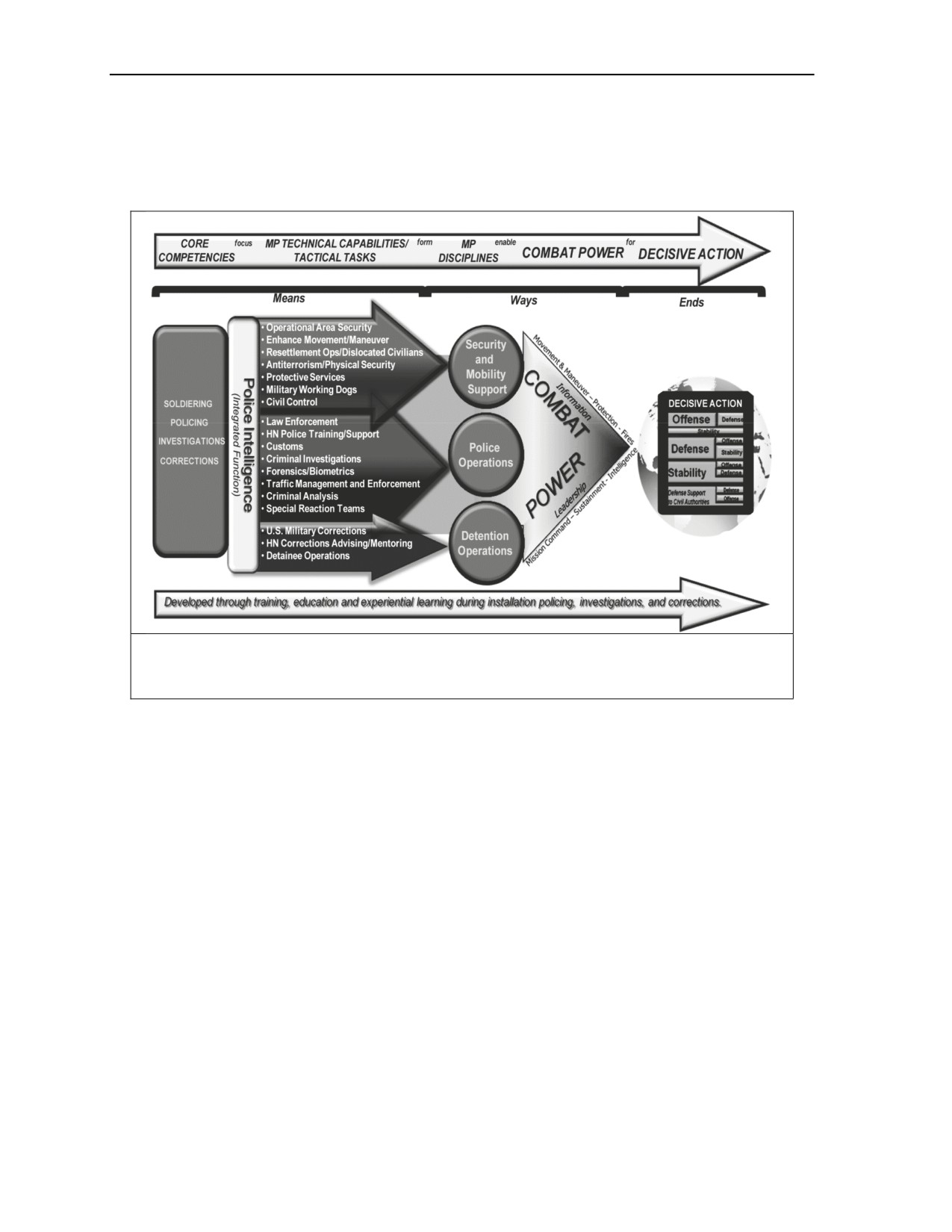
1-2. Military police demonstrate their competencies through the performance of unique technical
capabilities and tactical tasks. These technical capabilities and tactical tasks combine to form the military
police disciplines (police operations, detention operations, and security and mobility support), which enable
the elements of combat power, support the generating force and operational Army across the range of
military operations. (See figure 1-1.)
Legend:
HN
host nation
MP
military police
ops
operations
Figure 1-1. Military police support to decisive action
1-3. Military police disciplines are interdependent areas of expertise within the Military Police Corps
Regiment. Military police operations are viewed through a policing and corrections lens that focuses efforts
on civil order maintenance, threat mitigation, and personnel and asset protection, regardless of the
operational environment. The execution of military police operations and the manner in which they are
conducted are all policing in nature. Military police operate in support of commanders to establish and
maintain an orderly environment in which commanders and their forces can operate with minimal threat
interference. This is true whether conducting operations abroad or at home.
1-4. At home stations, military police perform their technical capabilities to maintain safe and secure
environments that enable commanders to protect and generate combat power during training, deployment,
and redeployment tasks that are associated with the Army force generation requirements that are in support
of unified land operations. Military police also provide a safe and secure environment for Army assets and
personnel who reside or work on U.S. bases.
1-5. The ultimate goal is to maintain order while protecting personnel and assets. The military police view
shares a common general understanding of the operational environment, while adding a degree of focus on
the aspects that are necessary to maintain order and enforce laws. Guided by the common understanding
and complemented by a policing mind-set, the military police approach seeks to identify potential
challenges and opportunities that are associated with the operational and mission variables of the
operational environment.
1-2
FM 3-39
26 August 2013
Operational Environment
OPERATIONAL VARIABLES
1-6. The operational environment is described in the operational variables of political, military, economic,
social, information, infrastructure, physical environment, and time (PMESII-PT). Operational variables
describe not only the military aspects of an operational environment, but also the influence of the
population. The following are examples of a military police approach to the operational environment:
z
Political. Understanding the cultural, social, and political power relationships within an area of
operations will help commanders recognize key actors, visualize their explicit and implicit aims,
and identify their capabilities to achieve their goals. Military police assess challenges that are
associated with governance as they pertain to the transition of political power, legitimacy, the
rule of law, social justice, and punishment. They assess indigenous police capability and
capacity and their relationship to local and regional political power brokers. Military police
identify and track election cycles to help protect applicable democratic processes and determine
events that may expose friendly forces and host nation personnel to unlawful or threatening
activities that may affect the transition of power. They examine the effect of laws, agreements,
and mandates that might influence military police capabilities. These laws, agreements, and
mandates may involve locals, belligerents, or allies. Military police leaders must understand
laws, policies, and military or political directives that guide their relationship with contract
companies, personnel, and commercial operations in the area of operations and must understand
how they can affect law, regulation, and agreement enforcement.
z
Military. The military variable explores the military capabilities of relevant actors in a given
operational environment. Military police focus on conventional and unconventional threat
capabilities that can attack high-risk personnel, critical nodes, and other facilities that are
essential to friendly operations. The military variable also addresses risk mitigation and how to
protect critical assets. Military police plan to engage unified-action partners early in the
operation to determine the best use of commensurate assets and capabilities in a joint,
interagency, and multinational context. Military police capabilities are typically a significant and
relevant component within the military variable. (Chapter 2 provides additional discussion of
military police capabilities, including Army, joint, interagency, and multinational capabilities.)
Recent significant changes that impact the military variable include—
A complex, noncontiguous battlefield.
A threat scenario in which potential adversaries are not readily identifiable.
Simultaneous, geographically dispersed operations that result in extremely long and
potentially unsecured lines of communication.
Increased coordination of organizations and functions to achieve appreciable gains.
The significance of long-term detainee operations.
The capabilities and limitations of multinational operations.
A significant degree of interaction with unified-action partners.
The creation of multifunctional Army units.
z
Economic. The economic variable encompasses individual behaviors and aggregate phenomena
that are related to the production, distribution, and consumption of resources. Military police
identify predictable events and activities in the local and regional business cycles (harvests,
holidays) that can lead to identifiable commodity and currency movement. These activities can
be influenced or manipulated to control populations or create wealth for illicit, unlawful, or
threat purposes. Military police conduct police engagement operations to collect police
information that, in turn, protects essential economic activities or areas. Police information
obtained through police engagement may also enable the protection of assessment teams as they
assess economic indicators in a specific area of operations. Military police also examine
economic influences that affect hiring, training, equipping, and sustaining civilian police and
corrections agencies that are required to support the rule of law.
z
Social. The social variable describes the cultural, religious, ethnic, and social elements within an
operational environment. Military police identify and analyze enforcement gaps that can create
crime-conducive conditions with the potential of affecting military operations or political
success. Education cycles, school vacations, and ethnic and religious observances are predictable
26 August 2013
FM 3-39
1-3
Chapter 1
events and activities in the social domain that lead to fluctuations in social activity and stress
enforcement mechanisms in an area. Military police examine the relationship between the
population and the police and identify hybrid, criminal, terrorist threats, and patterns within a
society.
z
Information. This variable describes the nature, scope, characteristics, and effects of
individuals, organizations, and systems that collect, process, disseminate, or act on information.
Military police identify and track predictable news and media cycles for their relationship to
threat or criminal activity in an area of operations and remain cognizant of internet media that
may incite unrest or potential flash points. They conduct police engagement to deliver messages
and support informational themes that are consistent with friendly military goals and actions.
Deliberate and frequent interaction with the population allows military police to quickly gather
large quantities of information that can support situational understanding, protection efforts, and
the police activities.
z
Infrastructure. Infrastructure comprises the basic facilities, services, and installations that are
needed for the functioning of a community or society. The military police assessment identifies
the existence or shortfalls of basic infrastructure to support civilian or military policing and
corrections institution efforts, such as police stations and jails. It might also address the facility
requirements that are needed to support detention or resettlement operations in the area of
operations. Military police assess the quality and trafficability of roadway infrastructure that is
necessary to support tactical movements along main and alternate supply routes or dislocated
civilian flow along designated tertiary routes without interfering with operations. They track and
monitor civilian traffic patterns to identify predictable criminal or threat movement patterns.
z
Physical environment. The defining physical environment factors are urban settings
(supersurface, surface, and subsurface features), other complex terrain, weather, topography,
hydrology, and environmental conditions. The military police assessment provides additional
information on how the physical environment, especially weather, might impact the execution of
military police operations. It might also address environmental factors as they relate to the
protection of high-risk targets and personnel.
z
Time. The variable of time influences military operations within an operational environment in
terms of the decision cycles, operational tempo, and planning horizons. The military police
assessment includes the examination of periodic and predictable cycles of activity that can reveal
trends, patterns, and associations that are necessary for predictive analysis and focused policing
models and strategies. As a resource, time is one common variable in synchronizing operations.
Military police examine each particular phase of an operation to anticipate when and where a
particular military police capability will be most needed. Traffic circulation enforcement, control
plans, and movement tables often require strict adherence to deliberate timelines.
1-7.
Military police review the operational environment using operational variables to add to the shared
common understanding by identifying potential challenges to, and opportunities within, the operation
before and during mission execution. The resulting understanding of the operational environment and the
military police view of the operational environment is not intended to be limited to considerations within
the operational environment that may result in military police missions. However, the military police view
of the operational environment is analyzed across the military police disciplines and linked to the common
overall understanding through the warfighting functions.
1-8. An analysis of the operational environment, in terms of operational variables, provides relevant
information that commanders and staffs use to improve situational understanding. The examples above
illustrate the added focus that is sought within each of the operational variables by the military police view
of the operational environment. The added technical view contributes relevant information to the shared
common understanding of the operational environment for a particular operation. Additional mission
analysis of the operational variables will support information and planning requirements for mission,
enemy, terrain and weather, troops and support available, time available, and civil considerations
(METT-TC). (Chapter 5 provides a complete discussion of analysis using the mission variables in terms of
planning military police operations.)
1-4
FM 3-39
26 August 2013
Operational Environment
POLICING PRINCIPLES
1-9. The police operations discipline and policing methodologies shape the military police approach to
the operational environment and provide the foundation upon which military police operations are
conducted. Military police operations are guided by six principles. These principles are not a rigid
checklist; however, they represent dominant characteristics of police activities that are generally found in
societies which are influenced by western culture. Military police Soldiers and leaders use these principles
to develop operational concepts and guide the employment of police formations as they shape the
operational environment. The military police principles are—
z
Prevention.
z
Public support.
z
Restraint.
z
Legitimacy.
z
Transparency.
z
Assessment.
PREVENTION
1-10. Military police conduct policing operations in a manner that emphasizes proactive actions to prevent
and deter crime and stop the disruption of civil order. The objective is to be proactive and to prevent crime
and potential disruptions to military operations that threaten lines of operation. Fundamental to this
approach is the identification of criminal activity and crime-conducive conditions from which trends,
patterns, or associations emerge and for which policing strategies are developed. Predictive analysis,
performed formally or informally, is essential to prevention strategies and programs. Military police often
use proven police strategies, models, and surveys to focus the collection of police information through
police activities. Proactive policing activities are enabled through the deliberate application of integrated
police intelligence activities by military police and USACIDC elements. If prevention efforts fail, military
police are trained for rapid response to resolve problems resulting from incidents occurring within their
area of operations or sphere of influence.
PUBLIC SUPPORT
1-11. Police forces should not be detached from the public that they are policing, as successful police
forces are nested with the public that they are charged to protect. Police activities and strategies are
generally enhanced through the efforts of an involved citizenry that is supportive of the police. In many
societies, the public will support police efforts that provide a security, safety, or service benefit to the
community if the police force is trustworthy or reasonable. Military police are organized and employed in a
manner that facilitates building public support through frequent and continuous interaction with a
population. Military police can successfully garner public support as they collect and disseminate
information to a community or population through Soldier and leader engagement. Police engagement
provides a connection to the public and other police entities. This is conducted in traditional law
enforcement activities and police and protection activities within an operational environment.
RESTRAINT
1-12. Lethal capability often differentiates police forces from security, paramilitary, or conventional
military forces. The perceived threat of significant violence that is associated with conventional military
forces can often prevent conflict, but may also result in tensions in a civilian community. These tensions
may lead to disorder and confrontation. Introducing police forces with the appropriate level of lethality
often signals a return to normalcy and may reduce community tensions. These forces present a
less-threatening force signature that may be more acceptable to the local inhabitants.
1-13. Police activities often complement other graduated-response mechanisms that are intended to reduce
violence and disorder within an area by mitigating the unnecessary escalation of force. Military police and
other forces that are engaged in police activities among local populations must be capable of exercising
restraint in the application of force to compel compliance from civilians and others. Military police are
26 August 2013
FM 3-39
1-5
Chapter 1
specifically trained to engage the public and the community within established rules for the use of force and
rules of engagement, applying only the required level of force to accomplish their mission. The prudent and
measured application of force is often critical to gaining and maintaining public support. Excessive force
can alienate the population, undermine police efforts, and pose a threat to friendly forces.
LEGITIMACY
1-14. Police authority is generally accepted as legitimate when it is sanctioned by competent authority and
when it applies laws or mandates in a fair and impartial manner. This includes maintaining consistency in
applying police activities within a community or across an area of operations. Police actions that appear to
be based on ethnic, religious, personal, or political bias or affiliation generally lack legitimacy, lose public
support, and often lead to confrontation or reprisal. Military police and other police personnel maintain a
professional bearing and deal with the public in a firm and impartial manner. Law enforcement activities or
programs that lead to justice and the effective resolution of problems, conditions, or incidents within the
area of operations ensure a professional police image and are critical to maintaining legitimacy in the eyes
of the public and other police organizations. Through professional conduct, military police and security
forces build trust within the population.
TRANSPARENCY
1-15. Policies, established principles, leadership intent, and corrective actions that affect police and
detention operations should be open and accessible. This does not mean allowing public access to police
files and information regarding ongoing investigations; rather, transparency ensures that personnel,
policies, and procedural aspects of police organizations are known and reasonably accessible to the public.
This allows for public awareness, scrutiny, and accountability. Military police and USACIDC elements
who are conducting police and detention operations must always operate in a manner that can withstand
public scrutiny. Leaders continuously balance the need for transparency with the operational security
requirements necessary for protection.
ASSESSMENT
1-16. Police activities and operations are continually assessed through cause and effect and cost versus
benefit. Using trend, pattern, and association data, police personnel focus police efforts to develop or adjust
police strategies, identify where criminals or crime-conducive conditions exist, and predict where problems
may emerge. Military police and USACIDC elements continuously assess their activities in support of
establishing order and determining the progress measured against established measures of effectiveness.
This allows leaders to adjust the application police resource. These assessments develop awareness and
intuitive judgment in police personnel and organizations and identify the subtle changes or variations in
societal behavior toward disorder or changes that may signal a deteriorating security environment.
CAPABILITIES ACROSS THE RANGE OF MILITARY OPERATIONS
1-17. The United States employs joint military capabilities in operations at home and abroad in support of
national security goals. These operations vary in size, purpose, and combat intensity within the range of
military operations that extend from military engagement, security cooperation, and deterrence activities to
crisis response, limited contingency operations, and major operations. The nature of today’s operational
environment is such that the U.S. military will often be engaged in several types of joint operations that
occur simultaneously across the range of military operations. The range of military operations is a scale of
graduated violence that ranges from stable peace to major operations and campaigns. The conflict levels
and corresponding politically motivated violence may vary in different areas of the world and in-theater. It
is common to conduct operations at different points along the range simultaneously in-theater or even
within an area of operations.
1-18. The military police view of the operational environment is not limited to one point on the range of
military operations. Military police share a general understanding of the operational environment with a
heightened degree of focus on conducting police operations, maintaining order, and enforcing laws that
enable them to identify and react to potential challenges and opportunities. The military police ability of
1-6
FM 3-39
26 August 2013
Operational Environment
measuring increasing tensions in an operational environment and countering the effects of those tensions
with a graduated and appropriate response makes them a useful asset for identifying indicators of a
changing or transitioning environment. The demand for military police capabilities remains high across the
entire range of military operations, even though the violence level varies significantly from stable peace to
general war. Military police forces will remain in high demand across the range of military operations
because of their agility, flexibility, and ability to quickly apply necessary capabilities anywhere along the
spectrum.
1-19. At one end of the range is stable peace, an ideal situation characterized by relative order and little or
no violence. Peaceful interaction may include friendly competition, cooperation, and assistance. Military
police activities may include police activities
(to include training host nation police), host nation
corrections training and support activities, the protection of critical personnel and facilities, and assistance
to dislocated civilians. Military engagement, security cooperation, and deterrence activities sometimes
require large numbers of military forces. Forces performing these operations will need infrastructure,
facilities, lines of communication, and base camps to support their sustainment. Military police will be
engaged in the protection of Soldiers and facilities across the area of operations. Where one or more
factions threaten or use violence to achieve their objectives, stable peace may transition into unstable peace.
In some cases, external powers may intervene to limit conflict. Unstable peace may also result when
violence levels decrease after conflict. Preventing a return to violence may require peace operations. Peace
operations may be necessary when stable peace is not immediately achievable. At those times, a goal of
conflict termination can establish conditions in which peace operations and diplomacy may prevent conflict
from recurring. (See JP 3-07.3 for information on peace operations.) This allows the other instruments of
national power to work toward stable peace. Military police may support these efforts by conducting police
operations, detention operations, or other technical support as required.
1-20. Continuing along the range, the next category is insurgency (may include the widespread use of
terrorist tactics). Insurgency is defined as the organized use of subversion and violence by a group or
movement that seeks to overthrow or force change of a governing authority. Insurgency can also refer to
the group itself. (JP 3-24) Insurgency is an occurrence of ongoing conflict that involves significant intra- or
interstate violence, but short of large-scale operations by conventional forces. Most common military
operations conducted here are counterinsurgency or support to insurgencies (typically conducted by special
operations forces and termed unconventional warfare). Military police support counterinsurgency
operations along the range of military operations predominantly through police operations and detention
operations that support civil control efforts, enhance the commander’s freedom of action by enabling
freedom of movement, provide full-dimensional protection in designated areas, conduct detainee
operations, and support reconciliation efforts. Police information networks are established through police
engagement by providing police information for the conduct of police intelligence operations that enables
focused police efforts. Military police can help control, limit, or restrict the freedom of movement of
insurgents in specific areas, while supporting host nation police and security strategies. They identify
crime-conducive conditions that can be exploited by insurgents, terrorists, or criminals.
1-21. In general war, conventional and unconventional military forces conduct operations to achieve
political goals. Major combat aims to defeat or severely limit the armed forces of an enemy and eliminate
the military threat. Commanders seek to reduce the violence level to fewer, uncoordinated actions and
decrease the number of affected parties. This is achieved in synchronization with combat operations by
shaping the operational environment through the civil security restoration and civil control in areas
controlled by friendly forces to prepare for postconflict operations. If successful, these actions transition the
violence level along the range of military operations toward stable peace. Major combat operations are
typically accompanied by simultaneous unconventional efforts.
1-22. Major operations, crisis response, and contingency operations have the potential for close combat.
These operations require integrating military police and other enablers to ensure the movement and
maneuver of friendly forces, while denying freedom of action to adversaries. A military police view also
includes identifying and meeting the challenges associated with overall police operations; the protection of
high-risk personnel, facilities, assets, and dislocated civilians; detention; and other aspects not typically
associated with close combat.
26 August 2013
FM 3-39
1-7
Chapter 1
1-23. Military police must understand the complex environments in which they will be operating and the
changing nature of warfare as it transitions along the range of military operations. At every level, military
police use tools and systems to analyze and examine the operational environment, including the operational
and mission variables and analysis of civil considerations categorized by area, structures, capabilities,
organizations, people, and events. Military police also employ an analytical assessment tool that is focused
on policing considerations and impacts. This tool considers systems and infrastructure that pertains to
police and prison structures, organized criminal networks, legal systems, investigations and interviews,
crime-conducive conditions, and enforcement gaps and mechanisms (POLICE). They must ensure that their
functional efforts are consistent, nested, and conducted within a shared framework as they provide support
across the range of military of operations. Military police are organized, equipped, and trained to conduct
operations at any point along the range of military operations. Their mix of lethal and nonlethal capabilities
makes them relevant anywhere a flexible force option is required.
SUPPORT SPANNING THE LEVELS OF WAR
1-24. The levels of war are doctrinal perspectives that clarify the relationship between strategic objectives
(ends), operational approaches (ways), and tactical actions (means). No finite limits or boundaries exist
between the levels of war; they correlate to specific levels of responsibility and planning that help to
organize thought and approaches to a problem. The challenges of planning, preparing, executing, and
continuously assessing operations within diverse theaters are numerous and varied. Military police
commanders and staffs must remain involved in the operations process at each level of war—strategic,
operational, and tactical. Military police leaders identify challenges and opportunities that equip the staff
with relevant information to form a more comprehensive understanding that leads to the most effective use
of military police assets and capabilities in mission execution. Military police staff members must ensure
that they are an integral part of the planning process at all levels. The following paragraphs briefly describe
some of the military police considerations at each level of war.
1-25. Military police activities at the strategic level include force planning, military police-related policy
and doctrine development, and execution operations that primarily focus on the means and capabilities to
generate, employ, sustain, and recover military police forces. Additionally, protection tasks; host nation
police training and support and development; detention, and resettlement operations place a heavy demand
on military police planning requirements. Military police staff and commanders at the strategic level advise
on—
z
Detainee and dislocated civilian missions.
z
Protection of strategic-level infrastructure, to include seaports of debarkation and aerial ports of
debarkation.
z
Line-of-communication security.
z
Military police force generation priorities.
z
Joint targeting against criminal actors.
z
Foreign humanitarian assistance.
z
Service policing interoperability.
z
Rules of engagement and rules for the use of force.
z
The rule of law.
z
Engagement of joint, interagency, intergovernmental, and multinational law enforcement
agencies to identify, monitor, and defeat criminal networks.
z
Employment of biometric and forensic capabilities.
z
Host nation police training and support.
z
Synchronization and integration of operational efforts with host nation policing and corrections
capabilities.
z
Protection or security of natural resources, historic or holy sites, economic centers, and weapons
stockpiles.
1-26. Military police activities at the operational level focus on the impact of geography and force
projection infrastructure on the commander’s operational design. Military police planners must determine
1-8
FM 3-39
26 August 2013
Operational Environment
the basic, yet broad, mobilization, deployment, employment, and sustaining requirements of the geographic
combatant commander’s concept of operations. Joint force commander military police planners also need
to understand the capabilities and limitations of the military police of joint and multinational forces. Many
of the military police activities that are conducted for strategic operations are also performed at the
operational level. At the operational level, military police—
z
Prioritize limited assets and mitigate risks.
z
Conduct operational assessments and police intelligence operations, working with intelligence
officers to analyze the criminal and hybrid threat.
z
Plan for the protection of high-risk personnel and facilities.
z
Prepare for the employment of lethal and nonlethal military police capabilities, anticipate other
requirements, and request capabilities to meet them.
z
Develop products and services and make recommendations on force protection and the rule of law.
z
Operate expeditionary forensics teams and laboratories to establish criminal and hybrid threat
identities and build host nation capacity and capability.
1-27. As the link to tactical military police integration, operational planning ensures that adequate military
police capabilities are provided to ensure mission success at each phase of the tactical operation. Military
police activities at the tactical level focus on support to the ordered arrangement and maneuver of combat
elements. Military police considerations at the tactical level must include their relationship to each other
and to the enemy, critical priority tasks required to achieve combat objectives, unit mobility, and the ability
to execute mutual support with maneuver elements. While tactical planning may be conducted within each
of the Services, in the context of military police operations, this translates to a primary focus on military
police disciplines
(see chapter 3) and planning done within tactical organizations. Operational planners set
the conditions for success at the tactical level by anticipating requirements and ensuring that capabilities are
available. Military police tactical planning is typically focused on support to designated critical priority
tasks, to include police operations tasks in support of civil security and civil control efforts, detention tasks
which ensure that detainees do not interfere with combat operations, and security and mobility support task
that enable critical protection and mobility priorities. Military police tactical planners use the military
police assets that are provided by operational planners to support the tactical mission tasks assigned to the
combat maneuver units that they support. With military police support, the subordinate joint force
commander ensures that military police capabilities are effectively integrated into the tactical operation
order and that military police are leveraged to perform identified priority tasks.
1-28. Tactical tasks are complex, and planning must consider symmetric and asymmetric threat
capabilities. Support to policing and a corrections institution (which may include training, development, or
mentorship) is a critical capability to enable the maneuver commander at the tactical level during stability
operations. Military police facilitate the ability to discern and identify patterns, plan specific strategies
based on the criminal threat, and provide specific threat information in the form of police intelligence. The
proliferation of mines and improvised explosive devices requires military police security elements to
continuously develop new procedures to counter the threat. The tactical integration of newly developed
technology; engineer; explosive ordnance disposal; and chemical, biological, radiological, and nuclear
(CBRN) capabilities becomes part of an increasing requirement to remain adaptive.
1-29. The military police approach to the operational environment facilitates the synchronization of
military police operations in support of combined arms through the framework of the warfighting functions.
The understanding of the operational environment is nested within a holistic Army understanding of the
operational environment. (Chapter 4 includes a detailed discussion of military police support to combined
arms and the linkages to the warfighting functions.) While there are significant linkages to each of the
warfighting functions, planning support at the strategic to operational level is focused primarily within the
protection, movement and maneuver, and intelligence functions. At the operational to tactical level,
planning support focuses primarily on the protection, movement and maneuver, intelligence, and mission
command functions. While the primary focus and staff organization for military police considerations vary
among levels of war, the military police Soldier remains central to the integration of policing activities and
shaping of the operational environment.
26 August 2013
FM 3-39
1-9
Chapter 1
ESCALATION OF FORCE
1-30. Soldiers are regularly placed in situations where they must balance protection requirements and the
need for restraint in dealing with the population, especially during stability tasks. Escalation-of-force
incidents in which unwarranted, or perceived unwarranted, lethal action is used can negatively affect short-
and long-term military objectives and impede the ability to foster productive partnerships with the local
population. These negative impacts can adversely affect or halt progress in establishing and maintaining
civil security, civil control, and a sense of normalcy. The failure to act when lethal force is warranted may
lead to friendly casualties. Demonstrating appropriate escalation-of-force procedures begins with a mind-
set that balances the use of nonlethal methods and systems with the necessary application of lethal force.
1-31. Military police Soldiers are trained on graduated-response measures when dealing with the public
during potentially volatile situations. This training includes integration of nonlethal and lethal tactics,
techniques, procedures, and equipment. It is imperative that military police and Soldiers, regardless of
military occupational specialty, understand and correctly apply escalation-of-force procedures. Escalation-
of-force procedures enable alternatives to the use of lethal force.
RULES OF ENGAGEMENT
1-32. Rules of engagement are directives issued by competent military authority that delineate the
circumstances and limitations under which U.S. forces will initiate and/or continue combat engagement
with other forces encountered. (JP 1-04) Rules of engagement are derived from the standing rules of
engagement that were published by the Joint Chiefs of Staff and are based on international law and moral
principles. The rules of engagement are specific to the decisive action conducted outside the United States
and its territories. The standing rules of engagement and rules of engagement differ from the standing rules
for the use of force and rules for the use of force. The standing rules of engagement and rules of
engagement are, by nature, permissive measures that are intended to allow for the maximum use of
destructive combat power that is appropriate for the mission. Generally, the standing rules of engagement
and rules of engagement are implemented in situations where host nation law enforcement and civil
authorities do not exist, are not functional, or are not accepting of a U.S. presence. In contrast, the standing
rules for the use of force and rules for the use of force are restrictive measures that are intended to allow
only the minimum force necessary to accomplish the mission. The standing rules for the use of force and
rules for the use of force are generally implemented in situations where there is a functional civil
government capable of enforcing the rule of law (such as DSCA).
1-33. The escalation of force is the sequential actions that begin with nonlethal force measures (visual
signals)
(flags, spotlights, lasers, pyrotechnics) and may graduate to lethal measures
(direct action)
(warning, disabling, deadly shots) to defeat a threat and protect the force. The escalation of force does not
replace the rules of engagement; escalation-of-force measures complement and are implemented within the
rules of engagement. While the conditions and environment under which the escalation of force is
implemented, the rules of engagement differ from graduated-response applications within the law
enforcement environment under the rules for use of force; however, they are similar in concept. This
similarity gives military police an advantage in understanding and implementing escalation-of-force
directives.
1-34. The presence of perceived hostile action or demonstrated hostile intent creates the necessity to
respond to that threat. The guidelines for proportionality require the response to be reasonable in intensity,
duration, and magnitude, based on the totality of circumstances. Lethal force cannot be the default option.
Other options, including military, nonlethal weapons and capabilities, must be available and used when
appropriate. Escalation-of-force guidelines direct the application of lower levels of force when they can
achieve the desired effects without endangering the lives of Soldiers or innocent personnel. Escalation-of-
force procedures may be applied at static locations (such as checkpoints and entry control points) or while
moving and engaging with populations and potential threats mounted or dismounted. Escalation-of-force
procedures do not limit the right of self-defense, including the use of deadly force when such force is
necessary to defend against a hostile act or demonstrated hostile intent. Commanders must ensure that
personnel are properly trained in escalation-of-force procedures and scenarios and in methods of shaping
the environment to gain time and space when applicable and to reduce the requirement for split-second,
life-or-death decisions.
1-10
FM 3-39
26 August 2013
Operational Environment
1-35. The application of escalation-of-force criteria is critical across the range of military operations, but
probably more so during stability tasks. The ability to leverage well-trained, well-equipped, and well-led
forces with the capability of delivering a combination of lethal and nonlethal applications can greatly
enhance a commander’s influence on the population and potential threats. Even though stability tasks
emphasize nonlethal actions, the ability to engage potential enemies with decisive lethal force remains a
sound deterrent and is often a key to success. The successful application of lethal capabilities in stability
tasks requires a thorough understanding of when the escalation of force is necessary and when it might be
counterproductive. Threat elements may limit their activities if they perceive that those forces are capable
and willing to use lethal force. This provides military forces with the opportunity to extend the scope and
tempo of nonlethal actions.
HOST NATION COORDINATION AND COOPERATION
1-36. The host nation awareness of escalation-of-force measures and procedures for approaching U.S.
military personnel (mobile and static) is necessary to reduce the probability of lethal or nonlethal force on
the host nation population. Soldiers must be aware of the local environment and culture in an effort to
understand activity and accurately discern threat activity from innocent activity. Unit leaders should—
z
Meet with local leaders to make them aware of escalation-of-force procedures and encourage
them to pass this information on to the local population. This can increase situational
understanding and reduce the probability of escalation-of-force incidents.
z
Encourage direct interaction with the local population by patrols as they move among the local
population.
z
Take steps to learn the culture, local norms, and cyclical activities; ensure that Soldiers are made
aware of these activities; and ensure that Soldiers and are given guidance and intent on how to
react. These activities and events may include—
Calendar events that may significantly increase pedestrian and vehicular traffic.
Events, cultural celebrations, or religious holidays which may result in large crowds that
congregate in specific locations or move along traditional routes.
Other activities that may seem out of the ordinary or that may appear threatening to Soldiers
not familiar with the culture and norms.
z
Be cognizant of local business locations and their operating hours and the impact that military
operations have on these businesses. While missions that affect the businesses may not be
avoidable efforts to reduce the effects, coupled with communication with local merchants, may
diffuse tensions and increase understanding.
z
Ensure that Soldiers exercise positive muzzle control and situational understanding regarding the
direction in which weapons are trained. The inadvertent pointing of weapons at local citizens
may raise tensions and incite an incident, resulting in an escalation-of-force incident.
1-37. Units that have a good understanding of how to positively shape the operational environment (using
information and related capabilities and actively planning for consequence management) can achieve
greater long-term protection for U.S. and multinational forces and civilians alike. The resulting mitigation
and reduction of escalation-of-force-related incidents can greatly enhance protection efforts and reduce the
threat to civilian life and property. Secondary benefits of increased Soldier and leader engagement with the
local population are unintended consequences, counteradversary information activities, and increases in
local support for friendly forces and their collective mission.
INCIDENTS
1-38. In the event that an escalation-of-force incident occurs, it is critical that Soldiers and leaders are
trained and capable of executing appropriate actions at the incident site. Appropriate actions at the incident
site can provide valuable information and evidence that can be critical in determining the facts that
surround the incident, validating or revising escalation-of-force procedures and preventing future incidents.
Commanders and leaders should ensure that—
z
Immediate actions at an incident site are prescribed and understood by Soldiers and leaders. This
includes securing the site to protect evidence when the security situation permits.
26 August 2013
FM 3-39
1-11
Chapter 1
z
Soldiers understand reporting procedures. All escalation-of-force incidents are reported
immediately, and follow-up reports are sent as updated information is available. This ensures
that technical personnel
(explosive ordnance disposal, medical, military police, staff judge
advocate) are alerted and mobilized as necessary.
z
Evidence collection procedures are followed
(when the security environment permits) to
preserve evidence that is pertinent to follow-on investigations. Military police and USACIDC
personnel should be notified in cases where escalation-of-force incidents result in the death of
any individual.
z
Escalation-of-force incidents are investigated thoroughly to—
Determine incident facts.
Identify gaps in security or failure to follow established rules of engagement and escalation-
of-force procedures.
Provide lessons learned for validation or revision of escalation-of-force tactics, techniques,
and procedures.
z
Leaders and Soldiers are familiar with the compensation and claims process for
escalation-of-force incidents. The staff judge advocate should be notified when claims against
the United States are likely following an escalation-of-force incident.
z
Local leaders are appropriately engaged to mitigate potentially damaged relations with the local
population and reduce the likelihood of retaliation. These activities can also educate the
population on escalation-of-force procedures.
1-12
FM 3-39
26 August 2013
Chapter 2
Organizations and Capabilities
Military police Soldiers are the centerpiece of the Military Police Corps Regiment.
They are the foundation of military police forces and the repository of policing and
corrections technical capabilities and expertise that is required to provide military
police support to the combined arms team. Perhaps the most significant contribution
by the military police Soldier is reduced force signature and their almost universal
acceptance by civilians in an area of operations. Military police forces are viewed as
policing organizations with a focus on protection roles and only limited roles as an
operating force. Although military police can provide commanders with several lethal
capabilities, they are not generally perceived as operating forces. This view allows
military police to operate and interface with local nationals in a positive way that
operating forces cannot. This chapter describes the military police organizations, the
capabilities available to the combatant commander, and the framework for generating
and organizing these capabilities.
SECTION I - MILITARY POLICE CORPS REGIMENT
2-1. The police skills and mind-set of the military police Soldier form the basic building block for the
Military Police Corps Regiment. Forming three of these uniquely trained Soldiers into a team forms the
basic military police team that is the foundation and centerpiece of tactical military police organizations.
Four teams form a squad, three squads build a platoon, and three platoons create a military police company.
These units become the tailored forces and repository of the expertise and technical skills required to
provide military police support to the maneuver commander. Regardless of the importance of equipment or
the expansion of technological capabilities, military police Soldiers are key human components that
accomplish missions and enable successful military police operations.
2-2. The rigors of service and combat bind Soldiers together. Their character comes from professional
standards and experiences that are honed in home station law enforcement activities and training and is
further forged on the battlefields of the modern era. The military police Soldier holds fast to the
professional standards embodied in the Army. With high moral and ethical values and proven warrior
ethos, military police Soldiers are trained and capable of transitioning through the use-of-force continuum.
At any given moment, today’s Soldier will be conversing in an authoritative, friendly manner. In the next
moment, he will be making split-second decisions to defend with deadly force, depending on the escalation
of the situation. The military police Soldier brings this focused and trained response to tactical missions.
Additionally, the military police Soldier has international recognition as a trained police officer. That
recognition allows military police Soldiers to accomplish tasks on the battlefield when other units may be
unacceptable to local populations due to their perceived combat role.
2-3. The military police Soldier is highly suited for unique interaction with local populations. He and
must be technically and tactically proficient and must know how to effectively use interpersonal
communications skills. His competence, character, and commitment represent the foundation of a trained
and ready Army military police force. The military police Soldier’s competence is measured through their
certification. For advancement, military police professionals must demonstrate competence (the mastery of
specific technical capabilities and tactical tasks). The character of military police professionals ensures that
they use their expertise on behalf of the American people and only according to the law. The commitment
of military police reflects each Soldier’s willingness to put the requirements of the Army and Nation above
their personal goals.
26 August 2013
FM 3-39
2-1

Chapter 2
2-4. Military police Soldiers must be able to accomplish tasks while operating alone or in groups. The
operational environment requires military police Soldiers to have a fundamental understanding of the
operational variables used to frame the analysis of the operational environment. Military police Soldiers
and leaders must exercise mature judgment and innovation under stressful circumstances and be capable of
learning and adapting to meet the demands of an adaptive and changing enemy and criminal threat.
Leadership links the technical and tactical competence of Soldiers to operational success by employing and
maintaining increasingly complex and sophisticated equipment and executing a variety of offensive,
defensive, stability, and DSCA tasks.
2-5. Military police disciplines are key enablers for success during decisive action. The Military Police
Corps Regiment provides enhanced focus and support for joint requirements. This extends across the
Military Police Corps Regiment in the areas of organization, training, equipment, and mission command. It
also promotes joint and multinational interoperability and an expeditionary force mind-set. This mind-set is
inculcated in military police leaders and organizations in the operational Army and the generating force.
The Military Police Corps Regiment consists of Regular Army, Army National Guard, and Army Reserve
military police organizations (and Army civilians and affiliated contractors and agencies within the civilian
community) with a diverse range of capabilities that are focused toward supporting the Army and the
mission. The Regular Army component of the Military Police Corps Regiment consists of the Office of the
Provost Marshal General (OPMG), USAMPS, USACIDC, ACC, and Regular Army military police units
within the geographic combatant commands and Army commands. The National Guard and Reserve
military police structures consist of two military police commands and Reserve Component military police,
criminal investigative organizations, and detention organizations at the brigade level and below. The
Reserve Component military police force constitutes approximately 60 percent of the Army military police
force structure and includes a wide range of specialized capabilities. The Military Police Corps Regiment
has the capability to integrate with other forces and supports the planning, preparation, and execution of
joint operations. The Regiment is experienced at interagency support and leverage of non-military and
nongovernmental policing and security assets to support combined and joint operations to achieve mission
accomplishment.
2-6. The generating force of the Military Police Corps Regiment includes the OPMG, USAMPS,
USACIDC, ACC, and the human resource managers in the U.S. Army Human Resources Command.
Together, these components generate and manage the centerpiece of those forces that conduct military
police operations. The Military Police Corps Regiment trains, educates, and manages military police
Soldiers in a variety of military police-related occupational specialties. The military police branch
proponent is USAMPS, which is collocated with the U.S. Army Engineer School and the U.S. Army CBRN
School at MSCoE. Colocation at MSCoE complements the efforts of these three branch proponent schools
to synchronize their doctrine, organization, training, materiel, leadership and education, personnel, and
facilities domains and other support capabilities across the warfighting functions. The Military Police
Corps Regiment is represented by various military police organizations and capabilities that are at the
tactical to operational levels (table 2-1).
Table 2-1. Military Police Corps Regiment across the components
Force Provider
Military Police Capabilities
RA
USAR
ARNG
Military police command
x
x
Military police brigade
x
x
x
Military police mission
CID group
x
command headquarters
Military police battalion
x
x
x
units
Military police detention battalion
x
x
x
CID battalion
x
x
x
2-2
FM 3-39
26 August 2013

Organizations and Capabilities
Table 2-1. Military Police Corps Regiment across the components (continued)
Force Provider
Military Police Capabilities
RA
USAR
ARNG
Corps PM section
x
Division PM section
x
x
Organic military police
MEB military police operations
x
x
x
staff elements and
cell
platoons
ABCT PM section
x
x
IBCT PM section
x
x
SBCT PM section
x
x
Military police company
x
x
x
Military police detention
Baseline companies
x
x
x
company
Guard company
x
x
GBI security company
x
Military police law enforcement
x
x
x
detachment
Detention camp liaison
x
detachment
Specialized military police
Theater detainee reporting
units, teams, and
x
center
individuals
CID element
x
x
x
MWD headquarters team
x
x
MWD squad
x
x
MWD patrol drug detection dog
x
x
team
Legend:
ABCT
armor brigade combat team
ARNG
Army National Guard
CID
criminal investigation division
GBI
ground-based interceptor
IBCT
infantry brigade combat team
MEB
maneuver enhancement brigade
MWD
military working dog
PM
provost marshal
SBCT
Stryker brigade combat team
RA
Regular Army
USAR
U.S. Army Reserve
OFFICE OF THE PROVOST MARSHAL GENERAL
2-7. The Provost Marshal General is the senior Active Army leader within the Military Police Corps
Regiment. He serves as the Department of Defense (DOD) executive agent for forensics and biometrics and
as the commander for USACIDC and ACC. As a special staff officer on the Army staff, the Provost
Marshal General advises the Chief of Staff, U.S. Army; the Vice Chief of Staff, U.S. Army; the Director of
the Army Staff; and departmental heads of the Army staff on matters that are related to military police
operations. The OPMG Staff is the policy arm of the Military Police Corps Regiment.
26 August 2013
FM 3-39
2-3
Chapter 2
2-8. The OPMG provides a comprehensive Army policing strategy to reduce crime, increase safety, and
enhance security within military communities. The OPMG leads and directs policy for matters that relate to
Army law enforcement, police intelligence, physical security, forensics, biometrics, corrections, and
detention, criminal investigations, provost marshal activities, and military police support throughout the
range of military operations. Additionally, the OPMG provides direct support to the Army Deputy Chief of
Staff, G-3/5/7 management and execution of the Army Force Protection mission by providing antiterrorism
operation and intelligence cell capabilities. The OPMG supports the Army by developing policies, plans,
and programs; establishing requirements; and providing resources to support manning, training, and
equipment requirements to meet current and future operations as defined by the Secretary of the Army. The
OPMG is also responsible for establishing enduring expeditionary forensic and biometrics capabilities.
2-9. Personnel may obtain information from OPMG through the—
z
OPMG Web site at <https://www.us.army.mil/suite/page/409448>.
z
OPMG points of contact information:
Antiterrorism Section, (703) 695-4912.
Antiterrorism Operations and Intelligence Cell, (703) 697-9529.
Operations, (703) 693-5488.
National Detainee Reporting Center, (703) 325-9810 or 2869.
Law Enforcement, (703) 695-4210.
Physical Security, (703) 695-4210.
Corrections and Detention, (703) 325-9157.
U.S. ARMY MILITARY POLICE SCHOOL
2-10. The USAMPS provides military police Soldiers with military education, including core, tactical,
technical, and leader education for officers, noncommissioned officers, and junior enlisted Soldiers.
Additionally, specialized functional course training is provided to include physical security, criminal
investigation, advanced law enforcement training skills, police intelligence/crime analysis, and military
working dog (MWD) handling. More than 42 functional courses are offered beyond initial-entry military
police training and professional military police education courses.
2-11. The USAMPS also hosts and manages several boards, centers, conferences, and cells (standing and
ad hoc) as a means to support the doctrine, organization, training, materiel, leadership and education,
personnel, and facilities domains of the Army staff, generating force, and Army Service component
commanders. They gather lessons learned from military police units in operations and integrate those
lessons into the institutional training base. Operational support is provided to combatant commanders and
military police forces and staffs through reachback, mobile training teams, and other mechanisms.
2-12. USAMPS produces tactically and technically competent military police Soldiers capable of
contributing to their first unit of assignment. Professional military education for officers, warrant officers,
and noncommissioned officers enables them to immediately contribute as military police leaders on their
return to their units or as military police staff of a joint force assisting the joint force commander by giving
advice and recommendations to the commander and other officers. (Chapter 5 discusses military police
staff roles and responsibilities in greater detail.) The military police branch proponent works closely with
OPMG to leverage a vast pool of additional technical competencies provided by DOD civilians and
affiliated contractors and agencies within the civilian community who are working with USAMPS and
OPMG. Technical support is available in the direct support of military police staff and forces through
reachback capabilities.
2-13. Personnel may obtain information from USAMPS through the—
z
z
USAMPS points of contact:
Antiterrorism Branch, (573) 596-2097.
Law Enforcement Branch, (573) 596-2999.
Crime Scene Investigations Branch, (573) 563-8136.
2-4
FM 3-39
26 August 2013
Organizations and Capabilities
Critical Incident Peer Support, (573) 563-7868.
Physical Security Branch, (573) 563-5585.
Family Advocacy Law Enforcement Training Division, (573) 563-7865.
Law Division, (573) 563-7871.
Inter-Service Nonlethal Individual Weapons Instructor Course, (573) 596-2789.
Protective Service Training Branch, (573) 596-1970.
MSCoE Military Police Lessons Learned Cell, (573) 563-2740.
Military Police Warfighter Forum Analyst, (573) 563-2743.
Corrections, (573) 596-2652.
Detainee Operations, (573) 596-2654.
Directorate of Training, (573) 563-8098.
Directorate of Plans and Operations, (573) 563-7802.
Military Police Doctrine, (573) 563-4074.
Individual Training Development Division, (573) 563-8119.
Special Tactics Training Division, (573) 596-0730.
Antiterrorism Evasive Driving Branch, (573) 596-1555.
Personnel Proponency, Initiatives, and Integration, (573) 563-3014.
Army Nonlethal Scalable Effects Center, (573) 563-7092.
MWD Handler Course at Lackland Air Force Base, Texas, (201) 671-3406.
MWD Supervisor/Training Course at Lackland Air Force Base, Texas, (201) 671-2461.
Traffic Management and Accident Investigations Course at Lackland Air Force Base,
Texas, (201) 671-3211.
z
Army Training Support Center Web site at <www.atsc.army.mil>.
z
Army Training Information Architecture Web site at
<www.adtdl.army.mil> or
z
U.S. ARMY CRIMINAL INVESTIGATION COMMAND
2-14. The history of USACIDC goes back to World War I when General John J. Pershing directed the
Provost Marshal General of his American Expeditionary Forces to organize a criminal investigation
division (CID) within the Military Police Corps for the purpose of detecting and preventing crimes within
the territory occupied by the American Expeditionary Forces. Today, USACIDC is the sole Army agency
that is responsible for investigating felony crimes. USACIDC provides investigative support to
commanders at all echelons. The headquarters, USACIDC; and the U.S. Army Crime Records Center
(USACRC) are generating force elements. USACIDC groups and battalions are elements of the operational
Army. USACIDC elements, while categorized as operational or generating force elements, have
generating-force and operational missions (see FM 1-01). The USACIDC mission includes—
z
Investigating and deterring serious crimes.
z
Conducting sensitive or serious investigations.
z
Collecting, analyzing, processing, and disseminating police intelligence.
z
Providing forensic laboratory support.
z
Maintaining Army criminal records.
z
Providing protective services to key Army and DOD leadership.
z
Enhancing the commander’s crime prevention and protection programs.
z
Performing logistics security operations.
2-15. USACIDC operations support the senior mission commander or geographic combatant commander
in maintaining discipline and order by preventing and investigating felony crimes, which reduce unit ability
to train and fight. During investigations, USACIDC concentrates efforts on serious crimes, such as
wrongful deaths, controlled substance offenses, theft (based on the amount limit identified in AR 195-2),
26 August 2013
FM 3-39
2-5
Chapter 2
fraud, sexual misconduct, assaults, cyber crimes, and other national security offenses. The USACIDC also
conducts sensitive and special investigations involving senior Army officials and those associated with
classified programs. (See chapter 7 for a detailed discussion of USACIDC.)
2-16. The USACIDC provides technical investigative support, integrating its organic capabilities with
those of other federal investigative agencies, joint and combined police activities, Army military police
activities, and other sources of military police-related reachback support.
U.S. ARMY CORRECTIONS COMMAND
2-17. The ACC is a field-operating agency under the OPMG. The ACC provides a single headquarters that
exercises mission command, operational oversight, and policy support for the Army Corrections System.
The ACC provides mission command for civilian and military personnel, and manages military prisoners in
military and Federal Bureau of Prisons facilities or on mandatory supervised release or parole. The ACC is
primarily a generating force headquarters, but it does have selected operational Army units.
2-18. The ACC provides efficiencies and a unified and consistent application of policy and best industrial
practices to provide U.S. military prisoners with treatment, educational, and vocational programs in a safe
and secure corrections environment. The ACC prepares military prisoners to be productive and law-abiding
members of society after release.
2-19. The ACC provides wartime support to senior mission commanders and geographic combatant
commanders by the overseeing of the corrections and detention specialists’ skill field and by assigning
corrections and detention specialists to warfighting commands as technical advisors on detainee operations.
Corrections and detention specialists are also assigned to the BCT, military police brigade, and division and
corps staffs, providing immediate and improved detention operations planning and execution during
combat operations.
MILITARY POLICE OPERATIONAL FORCE CAPABILITIES
2-20. Army military police forces of the operational force operate at the strategic, operational, and tactical
levels across the range of military operations. Units are organized in an adaptable manner to support
military police peacetime, combat, investigative, and detention operational requirements. Military police
forces operate as an integral member of the combined arms team during peace and war to provide a full
range of military police capabilities. They execute military police tasks at the tactical and operational levels
of war in support of combat maneuver forces and provide technical policing expertise throughout the range
of military operations.
2-21. The Army military police provide a complementary and interdependent relationship between four
major categories of units. The four categories include military police (to include staff elements) organic to
non-military police organizations and three categories of military police held in a military police force pool.
These three categories within the force pool include all operational Army military police units not organic
to a BCT or a headquarters staff. The assets in the force pool exist to augment or be task-organized to BCTs
with organic military police assets and BCTs without any organic military police and to provide necessary
military police capabilities to echelons above the BCT. The force pool consists of military police
headquarters units, baseline units, and specialized military police units.
2-22. Military police headquarters units provide mission command for military police operations. They
consist of the theater military police command, the military police brigade, the CID group, and three types
of military police battalions. Each has a staff that allows the commander to provide mission command for
assorted and various military police organizations. Most of them are capable of the providing mission
command for other selected non-military police units to support multifunctional missions, such as
operational area security and detention operations or resettlement operations, or some aspects of gap-
crossing operations.
2-23. Baseline military police units consist primarily of tactically to operationally focused military police
and military police detention companies. These units may be task-organized to BCTs or tasked to perform
other supporting missions, to include those typically performed under the mission command of a maneuver
enhancement brigade (MEB), a military police battalion, or a military police brigade at the division or
2-6
FM 3-39
26 August 2013
Organizations and Capabilities
corps level. All of these units may perform roles and missions under the mission command of a
functionally focused military police battalion or brigade or the multifunctional MEB.
2-24. Specialized military police units are a variety of typically low-density, or otherwise unique, military
police forces that provide the remaining category of military police support. These units are generally more
technically focused units that, while providing selected support at the tactical level, are focused on
providing their specialized military police capabilities in support of the operational to strategic levels in
unified land operations. These specialized forces include modules for MWD support, detention camp
liaison, detainee reporting center functions, police operations, and USACIDC support. (See table 2-1, page
2-2, for a general listing of these forces by component.) While special in their own right, other elements,
created and trained for special missions such as special reaction teams, police transition teams, or similar
teams (such as evidence response teams) are not included in this category.
ORGANIC MILITARY POLICE
2-25. Each BCT has an organic military police platoon. Each BCT is organized with an organic military
police planning cell that includes an investigative agent (as an advisor on police intelligence). The BCT
military police platoon is organic to the multifunctional brigade special troops battalion
(BSTB)
headquarters to facilitate support across the BCT. These organic military police platoons and staff planners
provide the minimum-essential military police capabilities to support BCT operations. The military police
platoon is capable of performing prioritized tasks from within any of the military police disciplines. The
supported commander must prioritize the efforts of the platoon and optimize its unique capabilities to
support and nest within the overall main effort or decisive operation. Sometimes, this may be in an
economy-of-force, shaping, or sustaining role. During offensive, defensive, or stability tasks, the BCT
should plan for the task organization of additional baseline military police elements, to include a military
police company and, in special cases, a battalion for necessary mission command military police
operations. Other specialized military police units and equipment may support tailored military police
operations when their advanced military police skill sets are required. Organic military police personnel
train with, and remain an integral part of their parent BCT force pool capabilities.
2-26. The military police staff cells in echelons above the BCT ensure the integration of military police
capabilities within their echelon. Military police staff members may be split among the various command
posts of a given echelon, but the senior military police officer typically functions as the provost marshal for
that echelon and headquarters. The military police staff representation within the MEB is designed to be
especially robust to support the typical roles performed by the MEB. (For more information on the MEB,
see FM 3-90.31.)
FORCE POOL CAPABILITIES
2-27. The Military Police Corps Regiment is designed to provide mission support to the Army from home
station and throughout the deployment process. The following organizational descriptions identify the
architecture that the Military Police Corps Regiment uses to provide the capabilities required to support the
Army and other Services as part of a joint operation. These descriptions illustrate military police unit
missions, capabilities, dependencies, and basis of allocation. Up-to-date standard requirement codes and
unit authorizations may be found at the Army Force Management System Web site at
Military Police Headquarters Units
2-28. The mission command of military police forces is provided by three primary echelons of military
police headquarters units―the command, brigade, and battalion. Multifunctional units (MEB and BSTB),
at brigade and battalion echelons, discussed later in this chapter, may also provide mission command for
military police forces in cases where military police support is integral to the mission. Mission command
for military police technical capabilities and missions is provided by the theater military police command,
the military police brigade (or CID group), and the battalion (three varieties).
26 August 2013
FM 3-39
2-7
Chapter 2
Theater Military Police Command
2-29. The theater military police command is the only organization designed for operational command
without the augmentation of military police capabilities at echelons above corps level. It will often provide
mission command for the joint force commander if an operational military police headquarters is required.
The theater military police command is focused on the operational mission command of military police
operations across all three military police disciplines and typically serves as the senior theater or land
component military police headquarters. It provides mission command for all assigned or attached Army
military police brigades and other military police units and missions for the combatant or joint task force
commander. While not providing mission command over CID groups, it does provide required sustainment.
When directed, it may also provide mission command for policing elements from other Service,
multinational, and contract security personnel.
2-30. Tasks performed by the theater military police command include providing support for all
operational planning for the theater across all of the military police disciplines and the integration of police
intelligence operations throughout all missions. The theater military police command synchronizes all
military police planning and support for the combatant or joint task force commander, providing peacetime
training and support of building partner capacity for their supported respective combatant commanders.
The command plans and operates in close coordination with the senior contract construction agents in the
area of operations. When deployed, the commander of the theater military police command will be
designated as the theater provost marshal and will also serve as the commander, detainee operations.
2-31. The theater military police command is capable of rapid deployment of deployable staff elements and
organizations to support the needs of the operational commander. It is capable of providing a wide range of
technical military police expertise and support. The theater military police command is also capable of
integrating policing expertise and support operationally and tactically with unified action partners. The
command is enabled by global reachback capabilities to include potential sources of expertise in the
civilian community.
Military Police Brigade
2-32. The military police brigade is one of the functional brigades of the Army and is capable of planning,
integrating, and directing the execution of military police missions conducted by up to five mission-tailored
military police battalions; integrating capabilities from all three military police disciplines; and integrating
police intelligence operations. It may also provide mission command for other non-the military police units
that are focused on performing area support, detention, or resettlement tasks and synchronizing military
police support across multiple organizations that control an area of operations in support of stability tasks.
A functional military police brigade is not designed to control terrain; significant augmentation and task
organization would be required to accomplish a terrain management mission.
2-33. One or more military police brigades are required in the division or corps when the number of
military police units or the functional nature of military police missions (such as the synchronization of
technical military police capabilities across an area of operations) requires functional brigade level mission
command capability. A military police brigade is also required when military police missions exceed the
mission command capability of the multifunctional MEB. A corps is typically allocated a military police
brigade headquarters for providing mission command of military police units. Once deployed, military
police brigades become the focal point for apportioning and allocating mission-tailored military police
forces across the area of operation.
2-34. The military police brigade is capable of supporting a joint task force commander or component
commander (land, air, or sea) and providing mission command of all U.S. military policing units, host
nation security forces and the management of contracted civilians within an area of operations. The military
police brigade has the ability to provide a deployable command post and staff expertise for providing
mission command of military police operations as required. With augmentation, the military police brigade
may serve as a joint military police headquarters and may be the senior military police headquarters, that
provide the synchronization, coordination, and mission command of technical policing and detention
operations when deployed in a joint operations area if full-theater military police command deployment is
not required.
2-8
FM 3-39
26 August 2013
Organizations and Capabilities
2-35. Based on the tactical situation, a military police brigade commander may be designated as the theater
provost marshal and the commander of detainee operations when a military police command is not
required. In this situation, the brigade commander and staff will provide the overall mission command of
deployed military police units. When the theater military police command is not available, the military
police brigade is also capable of integrating policing expertise and support (operationally and tactically)
with unified-action partners. It may also provide the mission command of task-organized forces that
include units from other functional brigades or specialty units.
Criminal Investigation Division Group
2-36. The CID group ensures the connectivity among all CID units within and external to the theater. It
establishes and maintains links with supported units and unified-action partners on matters pertaining to
CID operations. The CID group is investigative-focused and provides the functional mission command of
USACIDC regionally focused battalions. CID units are not typically in the chain of command of other non-
CID military police units, but they generally receive support from military police units as they are dispersed
across the battlefield to perform their mission. Whenever possible, CID units colocate with other military
police units. This provides unified military police support and facilitates sustainment. A CID group will
typically colocate with the senior military police organization in-theater if it is deployed and will provide
mission command for all CID battalions in-theater.
Military Police Battalions
2-37. Each military police battalion is designed to perform a different collection of military police tasks,
although there are overlapping abilities among the three and each support the detention operations
discipline and the police intelligence operations integrating function. There are three types of military
police battalions in the force pool:
z
Military police battalion. The military police battalion has the largest number of units in the
military police force pool. The military police battalion is the most versatile of the battalion
headquarters, conducting all three military police disciplines, and is the only military police
battalion level element optimized to conduct those military police tasks that comprise the
security and mobility support discipline. While selected military police companies may conduct
detention operations, the military police battalion is typically focused on other missions. It is the
most likely of the three military police battalions to perform as a task force and in support of
close combat operations.
z
Military police detention battalion. The military police detention battalion has the second
largest number of units in the military police force pool and is designed with a focus on the
military police tasks that comprise the detention operations discipline. When fully operational,
the military police detention battalion may operate a detainee facility capable of interning 4,000
detainees.
z
CID battalion. The CID battalion is not a tactical battalion but rather a headquarters that is
focused solely on CID activities. Like the CID group, it is investigative-focused and provides
functional mission command of USACIDC regionally focused elements. (For more information
on CID, see chapter 7.)
2-38. Battalions are structured to provide the mission command of two to five companies or elements. The
military police detention battalions are capable of planning, integrating, and directing the execution of
military police missions conducted by a mix of military police companies. These two tactical-type
battalions are typically found within a military police brigade, a MEB, or in support of a BCT. CID
battalions are more typically found at the corps or theater level. The military police battalion headquarters
is capable of providing mission command for tactical military police missions or a multifunctional task
force organized for specific missions. Military police detention battalions conducting detention operations
may provide mission command a task-organized force consisting of military police, military intelligence
(MI), legal, medical, and other specialties.
2-39. Military police or military police detention battalions may be assigned or attached to a MEB as a
mission command headquarters to effectively synchronize and integrate all military police capabilities
when required to support a division or higher headquarters. When task-organized to a MEB, a military
26 August 2013
FM 3-39
2-9
Chapter 2
police battalion may be further task-organized with subordinate CBRN, engineer, explosive ordnance
disposal, and other elements. When operating at the theater level or as part of a military police brigade, the
military police detention battalions will typically perform tasks related to their structural specialty.
2-40. When placed in support of a BCT, a military police battalion provides mission command for the
integration of military police operations. The battalion may be focused on a single military police discipline
or several disciplines at once. The military police battalion may be organized to perform as a task force
when the BCT is conducting combined arms operations. The battalion may be given responsibility for a
main supply route reconnaissance or clearing operation and may be designated as a task force. The military
police battalion headquarters is a likely mission command element for a movement corridor.
2-41. CID battalions are operational units that are subordinate to a CID group. These battalion
headquarters provide mission command, staff supervision, and administrative oversight to the subordinate
CID elements. Generally, one CID battalion will support a corps or division area of operations and provide
mission command for two to five CID elements or expeditionary forensic laboratories operating within the
area of operations. These battalions perform the technical supervision and coordination of criminal
investigations, criminal intelligence programs, drug suppression activities, and polygraph support and
manage logistics security. (For more information on CID capabilities, see chapter 7.)
Baseline Companies
2-42. There are three types of baseline companies in the military police force pool—military police,
detention, and guard. They are the primary building blocks from the military police force pool and the main
components of the military police detention battalions. Each is designed to perform a different collection of
military police tasks. These units are task-organized to BCTs or may be task-organized to a military police
battalion headquarters to provide the specific, tailored capabilities needed to support mission requirements.
Within the MEB or when in support of BCT operations, the military police company may also find itself
part of a CBRN- or engineer-led task force supporting MEB operations or providing multifunctional
support outside of the MEB area of operations, to include operations in support of a movement corridor.
Like the military police battalion, the military police company is optimized for those military police tasks
that comprise the security and mobility support discipline. The only company designed to support close
combat is the military police company. Selected military police companies may be required to perform a
detention mission. Military police companies are focused on support to maneuver organizations at the
tactical level. Military police companies contribute to the maneuver and mobility of the operational Army
by—
z
Preserving the freedom of movement over main supply routes,
z
Improving the protection of high-risk personnel and facilities during security and mobility,
z
Providing temporary detention operations for detained individuals.
z
Integrating police intelligence through operations to enhance situational understanding,
protection, civil control, and law enforcement efforts.
2-43. Guard companies and detention detachments contribute temporary or long-term support to theater
detention operations. They can contribute training and expertise to establish or improve corrections
operations for the local government. These Soldiers can also assist with establishing a model prison
operating system in a new or reused facility managed by the local government. Guard companies can
contribute to the corrections operations of a nation by assisting with the temporary holding and security and
transport of detainees to and from court proceedings and medical treatment facilities.
2-44. Military police units and Soldiers may contribute law enforcement technical capabilities to assist
with policing, corrections, and judicial support for the host nation government and stability tasks in the area
of operations. Military police units are ideally suited to conduct police missions with Army and joint
policing elements. Military police units are also well suited to work jointly with host nation police patrols
to restore or maintain civil order. Military police units can also assist with training local police and
establishing police station operations for local police forces. They can work side by side in joint shifts or
provide staff assistance through embedded relationships or by frequent or one-time assistance visits.
Military police units also maintain safe and secure environments that enable commanders to protect and
generate combat power during training, deployment, and redeployment tasks that are associated with Army
2-10
FM 3-39
26 August 2013
Organizations and Capabilities
generation force requirements in support of unified land operations. Military police also provide a safe and
secure environment for Army assets, DA civilians, and military family members who reside on U.S.
military bases.
Specialized Military Police Units, Teams, and Individuals and Their Capabilities
2-45. Specialized military police units, teams, and individuals and their associated capabilities are available
to support commanders. The Military Police Corps Regiment possesses many unique capabilities at the
operational and strategic levels designed for specific augmentation and use at the tactical level. These key
capabilities are organized within units that are of limited availability and lower density within the military
police force pool than the core military police units. These smaller, more specialized units are designed to
support larger military police-related missions and tasks, provide specialized skills augmentation to
selected headquarters elements, or provide theater-unique mission sets. This section highlights some of the
specialized units and capabilities provided by military police.
Ground-Based Interceptor Security Company
2-46. The ground-based interceptor security company provides fixed-site security for a ground-based
interceptor site. The company provides the operational Army with the capability to detect, identify, and
eliminate hostile threats to a critical facility― “Level A” site of strategic importance. The sole mission of
the ground-based interceptor security company is to secure the ground-based interceptor missile site. This
mission focus allows the company to dedicate its tactical assets to the security and defense of the critical
site with the minimal diversion of combat power to collateral or other economy-of-force efforts. The
ground-based interceptor security company provides a fully functioning, properly resourced guard force
capable of conducting sustained and continuous operations necessary for securing critical assets within the
expanded perimeter of the ground-based interceptor missile site.
2-47. The ground-based interceptor security company consists of a headquarters section that provides
mission command, services, and support for three security platoons. Its headquarters section provides
planning and execution guidance, allocating and task-organizing units based on requirements and mission
variables; prioritizes support efforts through risk analysis; and cross-levels support between elements as
needed. The security platoons are primarily responsible for the execution and performance of the guard and
quick-reaction force mission at the ground-based interceptor missile site. A security platoon is capable of
securing and defending the ground-based interceptor missile site from Level I and Level II threats.
Military Police Law Enforcement Detachments
2-48. Military police law enforcement detachments are built as “table of organization and equipment” units
to be employed in a team concept. These specialized teams provide advanced skills that can be deployed to
support specific law enforcement requirements in an area of operations. Modules that comprise an
operational military police law enforcement detachment may be deployed as an entire detachment,
providing comprehensive policing capabilities; as individual teams to augment existing capabilities; or to
meet specific capability requirements.
2-49. When at home station, the teams that comprise the military police law enforcement detachment are
assigned to law enforcement duties within the provost marshal’s office and are the dedicated technical
police expertise that supports U.S. Army installations. Deployed military police law enforcement
detachments are normally assigned to a military police brigade and are specifically trained and equipped to
provide the technical supervision, planning, employment, and coordination of support for police operations.
Like at home station, law enforcement detachments form the core of policing capabilities on U.S. military
bases and base camps within mature theaters of operation, providing the administrative and technical
expertise to operate forward military police law enforcement activities in support of a geographic
combatant commander’s effort to maintain good order and discipline.
2-50. Police teams have the capability to train and mentor the newly appointed police leadership and other
experienced indigenous or host nation police personnel. These individuals can then assist with training the
rest of the host nation force. Another function of the military police law enforcement detachment is to plan,
train, and monitor the military police support of host nation police development and support, such as law
26 August 2013
FM 3-39
2-11
Chapter 2
enforcement raids, high-risk apprehensions, cordons and searches, and police intelligence operations. A
military police law enforcement detachment consists of—
z
A headquarters team to provide personnel, logistics, and administrative support.
z
An operations team to provide the planning, employment, and coordination of law enforcement
support and the technical supervision of police teams.
z
A desk team to establish and maintain police desk operations, to include receiving calls and
complaints; prioritizing and tasking patrols and investigative personnel as required; and ensuring
the completion of initial reports.
z
A force protection and physical security team to assist in risk and threat identification and
mitigation, crisis planning, and the safeguarding of personnel and equipment at a fixed site.
z
A traffic management and enforcement team to investigate traffic accidents and provide
expertise regarding trafficability, traffic flow, and enforcement regulation.
z
A military police investigations team to investigate criminal incidents; conduct surveillance
operations; and collect and maintain evidence and operational information, to include personal
identification (biometric) and police information. Military police investigators maintain liaison
with CID elements regarding criminal investigations and information.
Military Working Dogs
2-51. The Military Police Corps Regiment is the Army proponent for MWD training. Training for dogs and
dog handlers is conducted at Lackland Air Force Base. There are two types of MWDs in the Military Police
Corps Regiment:
z
Patrol explosive detection dogs. Patrol explosive detection dogs are trained to passively
respond to explosive material and components.
z
Patrol drug detection dogs. Patrol drug detection dogs are trained to passively respond to drug
paraphernalia and narcotics.
2-52. Patrol explosive detection dogs and patrol drug detection dogs are also trained as patrol dogs. Patrol
dogs are used in routine military police law enforcement patrol operations at bases and base camps. The
patrol explosive detection dog can provide support to maneuver commanders in tactical search missions
against hostile forces by detecting firearms, ammunition, and explosives. All dogs train and certify with a
specific handler and must be employed as a team. (See ATTP 3-39.34 for additional discussion of MWD
capabilities.)
2-53. MWD squads and teams deploy based on specific requirements within an area of operations. Military
police MWD elements consist of—
z
A kennel master to coordinate the logistics support, operational integration, and technical
supervision of MWD teams.
z
An MWD squad (six MWDs and six MWD handlers) to provide the detection of explosives and
explosive residue in support of police operations and protection efforts, such as building or area
clearing operations, entry control points or access control points, and traffic and border
checkpoints. Patrol explosive detection dog teams are dual-trained for the police patrol activities
and explosive detection.
z
An MWD patrol drug detection dog team to provide the detection of narcotics and narcotics
residue in support of the commander’s health and welfare inspections, police operations,
customs operations, and maneuver commanders in support of tactical search missions. The patrol
drug detection dog teams are dual-trained for police patrol activities and drug detection, and
maneuver commanders in support of tactical search missions.
High-Risk Personnel Protection
2-54. The USACIDC provides protective service details to Army high-risk personnel serving in designated
positions based on rank, position, and geographical location. The USACIDC trains agents in protective
services tasks and assigns teams to individuals as required. The USAMPS provides the Protective Services
Training and Antiterrorism Evasive Driving Course (Staff Driver), Antiterrorism General Officer Driving
Course (General Officer), and High-Risk Personnel Security Course to train for high-risk personnel
2-12
FM 3-39
26 August 2013
Organizations and Capabilities
protection. The Protective Services Training and Antiterrorism Evasive Driving Course (Staff Driver) and
the Antiterrorism General Officer Driving Course
(General Officer) provide specialized training to
personnel who will conduct protective service operations for executive level DOD leaders who are
potential targets of terrorism and criminal acts. Emphasis is placed on the spectrum of protective service
tasks that Soldiers may perform to protect senior leaders. The High-Risk Personnel Security Course
provides specialized training to personnel, regardless of military occupational specialty, who are assigned
to conduct high-risk personnel security operations in combat environments and are responsible for
protecting commanders in key leadership positions, as designated by the combatant commander or
identified through a personal security vulnerability assessment. (See ATP 3-39.35 for additional discussion
of protective services).
Customs
2-55. The Military Police Corps Regiment provides military police Soldiers with trained customs skills to
support unit deployment and redeployment operations. Customs support is executed with U.S. Customs and
Border Protection approval and oversight. Military police Soldiers inspect and examine all DOD cargo,
equipment, aircraft, vehicles, and people leaving from outside the continental United States (OCONUS)
through their forward-deployed location. Inspectors ensure that returning military equipment conforms to
U.S. Department of Agriculture standards and that all gear returning with personnel serving abroad
complies with U.S. customs regulations for reentry into the United States. Army customs inspectors have
jurisdiction over all customs and operational wash down sites in their area of operations.
Police Development and Support Teams
2-56. The Military Police Corps Regiment provides military police Soldiers to teach and train host nation
police operations to maintain order and to enable the rule of law. This training specialty can include
standing up and running an initial law enforcement training academy for host nation police and establishing
and running police infrastructure and police station operations. The training can include many levels of
assistance visits, from being embedded, to frequent or infrequent visits based on the needs of the supported
host nation (See ATTP 3-39.10 for additional discussion of host nation police development.)
Detention Units
2-57. The Military Police Corps Regiment conducts detention operations using military police brigades and
military police detention battalions. These units require specialized augmentation by several specialty units
for the operation to be fully in compliance with international laws, treaties, and DOD and Army policy. The
specialty units that provide unique services are the military police detention company, the detention liaison
detachment, the guard company, MWD teams, and the theater detainee reporting center.
Airborne and Air Assault Operations
2-58. The Military Police Corps Regiment has specialized airborne- and air assault-qualified forces to
support organizations conducting airborne and air assault operations. Military police Soldiers attend
qualifying, badge-producing airborne and air assault schools before assignment to airborne- and air assault-
qualified units. These military police units are capable of employment from an air plane or helicopter,
including such specialized skills as rappel master, jump master, and air drop and sling load riggers for
equipment delivery by air.
SECTION II - UNIFIED ACTION: JOINT/INTERAGENCY/MULTINATIONAL
2-59. Unified action is the synchronization, coordination, and/or integration of the activities of the
governmental and nongovernmental entities with military operations to achieve unity of effort (JP 1). It
describes the wide scope of actions taking place within combatant commands, subordinate commands, or
joint task forces under the overall direction of the commanders of those commands. Public law charges
combatant commanders with employing military forces through unified action. Under unified action,
commanders integrate joint, single Service, special, and supporting operations with interagency,
nongovernmental, and multinational (to include the United Nations) operations (see JP 0-2).
26 August 2013
FM 3-39
2-13
Chapter 2
2-60. In unified land operations, Army military police forces operate as part of a joint force and often
within a multinational and interagency environment across the range of military operations. Operations are
grouped in to three areas that compose the range of military operations (see JP 3-0):
z
Military engagement, security cooperation, and deterrence operations.
z
Crises response and limited contingency operations.
z
Major operations and campaigns.
2-61. Each Service has police organizations and capabilities that reflect their own Service traditions, roles,
and approaches to maintaining order and discipline. An understanding of the police capabilities and
limitations of each Service may assist the joint operations staff in tailoring police organizations into
effective and efficient multi-Services or joint police elements to accomplish the mission. The senior police
leader serving on the joint staff is responsible for providing comprehensive recommendations to the joint
force commander on the effective employment of all joint and combined military and civilian police
capabilities in support of joint operations. The police organizations of each Service component can be
called on to provide support to the other Service to meet joint force requirements. (See JP 3-08, JP 3-63,
NATO Standardization Agreement
[STANAG] 2085, and NATO STANAG
2226 for additional
information.)
JOINT/INTERAGENCY/MULTINATIONAL CAPABILITIES
2-62. Service component police capabilities are not fully interoperable. All Services do not currently
conduct military policing activities using the three military police disciplines, but there are similarities that
facilitate the alignment of capabilities and missions. Planners must be careful to accurately identify the
police capabilities required for an operation and then match that requirement with the proper Service
component police element. The Navy master-at-arms and Naval Criminal Investigative Service, the U.S.
Air Force Security Forces and Office of Special Investigations, and the Marine Corps Military Police and
CID provide police and security capabilities specific to their respective Services. Some of their capabilities
may be similar to Army military police; however, their unique mission sets inevitably produce different
capabilities that may complement or enhance Army military police capabilities in a joint construct.
OTHER MILITARY POLICE CAPABILITIES
2-63. In addition to U.S. military police forces, multinational partner military police can provide valuable
capabilities. Host nation, multinational, and U.S. civilian contractors provide labor, materiel, infrastructure,
and services and may possess certain policing capabilities and expertise that are specifically adapted to the
local environment. There are other benefits to using multinational, host nation, and U.S. contractors, but
their use must be weighed against their potential limitations. The mixture of capabilities may change during
the phases of an operation and may require management across Service lines to ensure that the joint force
commander has appropriate forces in place.
2-64. Host nation police capabilities may be available if an adequate infrastructure exists. Potentially, this
could include a wide array of civil, military, or public works organizations. Sometimes, it is also possible to
contract a limited range of security services with U.S., local, or third world country national organizations
and civilian contractors. There are also differences in their applications during stability tasks and DSCA.
These assets are typically used to free up military assets, minimizing the military footprint in a theater,
when requirements exceed military capabilities or when the military police operations and requirements are
to be conducted in areas that are relatively safe from active combat.
CONTINGENCY CONTRACTS
2-65. Security activities may be provided through several contracting agencies and contract vehicles.
Contract police and security can be critical to preserving military police units for higher-priority missions.
The Army or joint community may contract security and specific technical law enforcement support
capabilities where the military police and USACIDC force structure lacks the required capacity or the
specific capability does not exist within the Army inventory. Contract assets may also play a significant
role in mission accomplishment by providing the joint force commander and joint force military police with
additional options and flexibility in general military police and security support.
2-14
FM 3-39
26 August 2013
Organizations and Capabilities
2-66. Whenever contingency or expeditionary contracts for police or security augmentation or the
sustainment of military police capabilities are awarded by a U.S. contracting authority, the contracting
officer or the supported force is responsible for quality assurance to ensure the contractor and their
employees are providing services and supplies in compliance with the terms and conditions of the contract.
Military police commanders must inform their staffs and subordinates of the extent of contracted support
and ensure that tasks assigned to the contractor are within the scope of the contract.
INTEGRATION OF CAPABILITIES
2-67. Joint integration does not require joint commands at all echelons, but it does require understanding
joint synergy at all levels of command. Joint synergy extends the principles of combined arms to operations
conducted by two or more Service components (for more information, see JP 1 and JP 0-2). The strengths
of each Service or functional component combine to overcome the limitations or reinforce the effects of the
other components. The combination of multiple and diverse joint force capabilities generates combat power
more potent than the sum of its parts. Integrating the varied and special capabilities of military police
organizations requires an understanding of the various capabilities and limitations of the military police
assets available for any given mission. Integration also requires a common understanding of the mission
command structure and processes in place to employ military police capabilities in support of unified
action.
INTERAGENCY COORDINATION
2-68. Because of the leverage of their wide range of expertise and funding resources, U.S. government
agencies can support the joint force commander’s mission objectives and greatly expand the capabilities of
the joint force. This is true whether the response is international in nature or within the United States.
Coordination and a clear understanding of the commander’s intent is critical when synchronizing
operational efforts involving multiple government agencies. The joint force commander will be required to
coordinate with U.S. government agencies to achieve overall U.S. objectives. Joint force military police
should have an understanding of the capabilities of these agencies and their support functions. While
government agencies may increase the resources engaged in a given operation, they may also increase and
complicate the coordination efforts. Military police personnel must be prepared to conduct or support
stability tasks by working closely with U.S. departments and agencies, foreign governments and security
forces, global and regional international organizations, U.S. and foreign nongovernmental organizations,
and private sector individuals and for-profit companies. (See JP 3-27 and JP 3-28 for a discussion of
homeland defense, DSCA, and associated interagency coordination.)
2-69. The intricate linkages among the instruments of national power (diplomatic, informational, military,
and economic) demand that commanders consider all capabilities and agencies to help achieve the common
end state. Interagency coordination forges a vital link between military operations and activities conducted
by U.S. government agencies; nongovernmental organizations; and regional, international, and United
Nations organizations. Other potential partners include host nation agencies, the U.S. interagency
community, and other partners inside and outside of the federal government. Because military police are
likely to operate with interagency, foreign, nongovernmental, and intergovernmental organizations in a
variety of circumstances, their participation in the joint force commander’s interagency process is critical.
Two methods for facilitating such coordination are the civil-military operations center and the joint
interagency coordination group. (Additional discussion of the civil-military operations center and joint
interagency coordination group is provided in the discussion of boards, workgroups, and cells in JP 3-08.)
MULTINATIONAL OPERATIONS
2-70. During multinational operations, U.S. forces establish liaison with assigned multinational forces
early in the process. Army forces exchange specialized liaison personnel in fields such as aviation, fire
support, military police, intelligence, public affairs, and civil affairs based on mission requirements.
Missions to multinational units should reflect the capabilities and limitations of each national contingent.
Commanders should give special consideration to “niche” capabilities that multinational police forces may
possess. Multinational police forces may possess other policing specialties that exceed or enhance U.S.
Service capabilities, such as constabulary capability or increased criminal investigation capacity. Army
26 August 2013
FM 3-39
2-15
Chapter 2
military police forces will typically have more mobility, firepower, and communications capability than
other military police multinational partners and, in some cases, more than other Services. Aligning
capabilities to the missions is an important consideration in multinational operations. Political
considerations may make these alignments more difficult to achieve. (See JP 3-16 for additional discussion
of multinational operations.)
SECTION III - MILITARY POLICE FORCE TAILORING
2-71. Within the Army, the organization of forces is dynamic at all levels. Army forces are organized and
reorganized continuously to meet mission requirements. Actual requirements for forces in an operation are
seldom identical to planning estimates. As a consequence, the theater Army commander recommends the
appropriate mix of forces and the deployment sequence for forces to meet the geographic combatant
commander’s actual requirements. This is force tailoring
(selecting forces based on a mission and
recommending their deployment sequence) and may include operational Army and force generating
elements.
2-72. Tailoring the military police force requires an adjusted mind-set—one that thinks in terms
completely divested from how the force is organized in garrison. It requires a leader’s mind-set that thinks
beyond home station structures to embrace combinations of military police capabilities and mission
command to provide each echelon of the force with the right support. While the Military Police Corps
Regiment is organized and equipped to support unified land operations, military police can expect serious
challenges in the operational environment when trying to execute the broad range of potential tasks.
Careful prioritization must occur for the limited military police resources typical in the operational
environment to be effective. To accomplish all identified tasks in the desired timeframes, commanders
must consider augmentation requirements and recognize which mission requirements can be supported
through reachback rather than enlarging the military police footprint in the area of operations. Within the
operational framework, military police units are more narrowly designed to accomplish specific types of
tasks. Therefore, it is imperative that when tailoring the military police force, the broad range of needed
capabilities is allocated from the military police force pool.
2-73. Military police force packages must contain the right mix of capabilities to ensure timely and
relevant military police support to the joint force commander. This mix will need to change during
transitions, and the joint force military police must anticipate and plan for these changes. For example,
military police battalions and companies often make up the majority of military police forces in-theater
during sustained combat operations; however, as a larger percentage of the mission set transitions to
stability, military police battalions and companies typically need augmentation to provide the required
capabilities to accomplish tasks associated with extensive stability. Force mix analysis must take into
consideration detention operations requirements, criminal investigation needs, assets to confine U.S.
military prisoners accused of Uniform Code of Military Justice (UCMJ) violations, and other military
police tasks that receive less visibility under combat operations.
2-74. Tailoring the military police force should not be confused with task organizing. Tactical and
operational commanders organize groups of units for specific missions and reorganize for subsequent
missions when necessary. This process of allocating available assets to subordinate commanders and
establishing their command and support relationships is called task organizing. Following the specific
mission, the task-organized units revert back to the original mission command relationships or are again
task-organized for a follow-on mission or period. Considerations for task-organizing military police units
are discussed in chapter 4.
FORCE ORGANIZATION
2-75. The joint force commander is able to draw from a force pool of military police units available for
integration into joint forces at various echelons. This structure enables expeditionary action and the flexible
tailoring of military police forces to meet changing situations.
2-16
FM 3-39
26 August 2013
///////////////////////////////////////