FM 7-100 Opposing Force Doctrinal Framework and Strategy (MAY 2003) - page 3
FM 7-100 _________________________________________________________________________________
3-75. Access Limitation. Access limitation seeks to affect an extraregional
enemy’s ability to introduce forces into the theater. Access-control operations
do not necessarily have to deny the enemy access entirely. A more realistic
goal is to limit or interrupt access into the theater in such a way that the
State’s forces are capable of dealing with them. By controlling the amount of
force or limiting the options for force introduction, the State can create condi-
tions that place its conventional capabilities on a par with those of an ex-
traregional force. Capability is measured in terms of what the enemy can
bring to bear in the theater, rather than what the enemy possesses.
3-76. The State’s goal is to limit the enemy’s accumulation of applicable combat
power to a level and to locations that do not threaten the accomplishment of a
strategic campaign. This may occur through many methods. For example, the
State may be able to limit or interrupt the enemy’s deployment through actions
against his APODs and SPODs in the region. Hitting such targets also has po-
litical and psychological value. The State will try to disrupt and isolate enemy
forces that are in the region or coming into it, so that it can destroy them piece-
meal. It might exploit and manipulate international media to paint foreign in-
tervention in a poor light, decrease international resolve, and affect the force
mix and rules of engagement (ROE) of the deploying extraregional forces.
Employ Operational Shielding
3-77. The State will use any means necessary to protect key elements of its
combat power from destruction by an extraregional forceparticularly by air
and missile forces. This protection may come from use of any or all of the fol-
lowing:
• Complex terrain.
• Noncombatants.
• Risk of unacceptable collateral damage.
• Countermeasure systems.
• Dispersion.
• Fortifications.
• Information warfare (IW).
3-78. Operational shielding generally cannot protect the entire force for an
extended time period. Rather, the State will seek to protect selected elements
of its forces for enough time to gain the freedom of action necessary to prose-
cute important elements of a strategic campaign.
Control Tempo
3-79. The State initially employs rapid tempo to conclude regional operations
before an extraregional force can be introduced. It will also use rapid tempo
to set conditions for access-control operations before the extraregional force
can establish a foothold in the region. Once it has done that, it needs to be
able to control the tempoto ratchet it up or down, as is advantageous to its
own operational or tactical plans.
3-80. During the initial phases of an extraregional enemy’s entry into the re-
gion, the State’s Armed Forces may employ a high operational tempo to take
3-18
_________________________________________________________________________________Chapter 3
advantage of the weaknesses inherent in enemy power projection (lightly
equipped forces are usually the first to enter the region). This may take the
form of attack by the Armed Forces against enemy early-entry forces, linked
with diplomatic, economic, and informational efforts to terminate the conflict
quickly before main enemy forces can be brought to bear. Thus, the State
may be able to force the enemy to conventional closure, rather than needing
to conduct adaptive operations later, when overmatched by the enemy.
3-81. An extraregional enemy normally tries to slow the tempo while it is de-
ploying into the region and to speed it up again once it has built up over-
whelming force superiority. The State’s forces will try to increase the tempo
when the enemy wants to slow it and to slow the tempo at the time when the
enemy wants to accelerate it.
3-82. By their nature, offensive operations tend to control time or tempo and
defensive operations tend to determine space or location. Through a combina-
tion of defensive and offensive actions, the State’s adaptive operations seek to
control both location and tempo.
3-83. If the State cannot end the conflict quickly, it may take steps to slow
the tempo and prolong the conflict, taking advantage of enemy lack of com-
mitment over time. The preferred Armed Forces tactics during this period
would be the ambush and raid as a means of avoiding decisive combat with
superior forces. These activities may not be linked to maneuver or ground ob-
jectives, but intended instead to inflict mass casualties or destroy flagship
systems, both of which will reduce the enemy’s will to continue the fight.
Cause Politically Unacceptable Casualties
3-84. The State will try to inflict highly visible and embarrassing losses on
enemy forces to weaken the enemy’s domestic resolve and national will to
sustain the deployment or conflict. Modern wealthy nations have shown an
apparent lack of commitment over time, and sensitivity to domestic and
world opinion in relation to conflict and seemingly needless casualties. The
State believes it can have a comparative advantage against superior forces
because of the collective psyche and will of the people of the State to endure
hardship or casualties, while the enemy may not be willing to do the same.
3-85. The State also has the advantage of disproportionate interests: the ex-
traregional force may have limited objectives and only casual interest in the
conflict, while the State approaches it from the perspective of total war and
the threat to its aspirations or even its national survival. The State is willing
to commit all means necessary, for as long as necessary, to achieve its strate-
gic goals. Compared to the extraregional enemy, the State stands more will-
ing to absorb higher military and civilian casualties in order to achieve vic-
tory. It will try to influence public opinion in the enemy’s homeland to the ef-
fect that the goal of intervention is not worth the cost.
3-86. Battlefield victory does not always go to the best-trained, best-equipped
and most technologically advanced force. National will encompasses a unifi-
cation of values, morals, and effort among the population, the government
leadership, and their forces. Through this unification, all parties are willing
to individually sacrifice for the achievement of the unified goal. The interac-
tion of military actions and political judgements, conditioned by national will,
3-19
FM 7-100 _________________________________________________________________________________
serves to further define and limit the achievable objectives of a conflict for all
parties involved, and to determine its duration and conditions of termination.
Neutralize Technological Overmatch
3-87. Against an extraregional force, the State’s Armed Forces will forego
massed formations, patterned echelonment, and linear operations that would
present easy targets for such an enemy. It will hide and disperse its forces in
areas of sanctuary that limit the enemy’s ability to apply his full range of
technological capabilities. However, the State can rapidly mass forces and
fires from those dispersed locations for decisive combat at the time and place
of its own choosing.
3-88. The State will attempt to use the physical environment and natural
conditions to neutralize or offset the technological advantages of a modern
extraregional force. It trains its forces to operate in adverse weather, limited
visibility, rugged terrain, and urban environments that shield them from the
effects of the enemy’s high-technology weapons and deny the enemy the full
benefits of his advanced C2 and RISTA systems.
3-89. The State can also use the enemy’s robust array of RISTA systems
against him. His large numbers of sensors can overwhelm his units’ ability to
receive, process, and analyze raw intelligence data and to provide timely and
accurate intelligence analysis. The State can add to this saturation problem
by using deception to flood enemy sensors with masses of conflicting informa-
tion. Conflicting data from different sensors at different levels (such as satel-
lite imagery conflicting with data from unmanned aerial vehicles) can con-
fuse the enemy and degrade his situational awareness.
3-90. The destruction of high-visibility or unique systems employed by en-
emy forces offers exponential value in terms of increasing the relative combat
power of the State’s Armed Forces and maximizes effects in the information
and psychological arenas. These actions are not always linked to military ob-
jectives. High-visibility systems that could be identified for destruction could
include stealth aircraft, attack helicopters, counterbattery artillery radars,
aerial surveillance platforms, or rocket launcher systems. Losses among
these premier systems may undermine enemy morale, degrade operational
capability, and inhibit employment of these weapon systems. The destruction
or degradation of these systems may be achieved through the use of persistent
chemical strikes, unconventional forces, or conventional raids and ambushes.
3-91. When conducting actions against a superior foe, State forces must seek
to operate on the margins of enemy technology and maneuver during periods
of reduced exposure, those periods identified by a detailed study of enemy ca-
pabilities. If available, precision munitions can degrade or eliminate high-
technology weaponry, and sophisticated camouflage, deception, decoy, or
mockup systems can degrade the effects of enemy systems. Also, State forces
can employ low-cost GPS jammers to disrupt enemy precision munitions tar-
geting, sensor-to-shooter links, and navigation.
3-92. Modern militaries rely upon information and information systems to
plan and conduct operations. For this reason, the State will conduct extensive
information attacks and other offensive IW actions. It could physically attack
enemy systems and critical C2 nodes, or conduct “soft” attacks by utilizing
3-20
_________________________________________________________________________________Chapter 3
computer viruses or denial-of-service activities. Attacks should target enemy
military and civilian decision makers and key information nodes such as in-
formation network switching centers, transportation centers, and aerial plat-
form ground stations. Conversely, State information systems and procedures
should be designed to deny information to the enemy and protect friendly
forces and systems with a well-developed defensive IW plan.
3-93. The State may have access to commercial products to support precision
targeting and intelligence analysis. This proliferation of advanced technolo-
gies permits organizations to achieve a situational awareness of enemy de-
ployments and force dispositions formerly reserved for selected militaries. In-
telligence can also be obtained through greater use of human intelligence
(HUMINT) assets that gain intelligence through civilians or local workers
contracted by the enemy for base operation purposes. Similarly, technologies
such as cellular telephones are becoming more reliable and inexpensive. It is
becoming harder to discriminate between use of such systems by civilian and
military actors. Therefore, they could act as a primary communications sys-
tem or a redundant measure of communication, and there is little the enemy
can do to prevent the use of these assets.
Change the Nature of Conflict
3-94. The State will try to change the nature of conflict to exploit the differ-
ences between friendly and enemy capabilities. Following an initial period of
regionally-focused conventional operations and utilizing the opportunity af-
forded by phased enemy deployment, the State will change its operations to
focus on preserving combat power and exploiting enemy ROE. This change of
operations will present the fewest targets possible to the rapidly growing
combat power of the enemy. It is possible that power-projection forces, opti-
mized for a certain type of maneuver warfare, would be ill suited to continue
operations (for example, a heavy-based projection force confronted with com-
bat in complex terrain).
3-95. Against early-entry forces, the State may still be able to use the design
it employed in previous operations against regional opponents. However, as
the extraregional force builds up to the point where it threatens to overmatch
State forces, the State is prepared to disperse its forces and employ them in
patternless operations that present a battlefield that is difficult for the enemy
to analyze and predict.
3-96. The State may hide and disperse its forces in areas of sanctuary. The
sanctuary may be physical, often located in urban areas or other complex terrain
that limits or degrades the capabilities of enemy systems. However, the State
may also use moral sanctuary by placing its forces in areas shielded by civilians
or close to sites that are culturally, politically, economically, or ecologically sen-
sitive. The State’s forces will defend in sanctuaries, when necessary. However,
elements of those forces will move out of sanctuaries and attack when they can
create a window of opportunity or when opportunity is presented by physical or
natural conditions that limit or degrade the enemy’s systems.
3-97. The State’s forces do not avoid contact; rather, they often seek contact,
but on their own terms. Their preferred tactics under these conditions would
be the ambush and raid as a means of avoiding decisive combat with superior
3-21
FM 7-100 _________________________________________________________________________________
forces. They will also try to mass fires from dispersed locations to destroy key
enemy systems and formations. However, when an opportunity presents it-
self, the State can rapidly mass forces and adopt more patterned operations
for decisive combat.
3-98. The strengths and weaknesses of an adversary may require other ad-
justments. The State will capitalize on interoperability issues among the en-
emy forces and their allies by conducting rapid actions before the enemy can
respond with overwhelming force. If the State borders another country with a
sympathetic population, it can use border areas to provide refuge or a base of
attack for insurgent forces. Also, the State can use terror tactics against enemy
civilians or soldiers not directly connected to the intervention as a device to
change the fundamental nature of the conflict.
3-99. The State may have different criteria for victory than the extraregional
forcea stalemate may be good enough. Similarly, its definition of victory
may not require a convincing military performance. For example, it may call
for inflicting numerous casualties to the enemy. The State’s perception of vic-
tory may equate to national survival. So the nature of the conflict may be
perceived differently in the eyes of the State versus those of the enemy.
Allow No Sanctuary
3-100. Along with dispersion, decoys, and deception, the State uses urban ar-
eas and other complex terrain as sanctuary from the effects of enemy forces.
Meanwhile, its intent is to deny enemy forces the use of such terrain. This
forces the enemy to operate in areas where the State’s long-range fires and
strikes can be more effective.
3-101. The State seeks to deny enemy forces safe haven during every phase
of a deployment and as long as they are in the region. The resultant drain on
manpower and resources to provide adequate force-protection measures can
reduce the enemy’s strategic, operational, and tactical means to conduct war
and erode his national will to sustain conflict. Terror tactics are one of the ef-
fective means to deny sanctuary to enemy forces. Terrorism has a purpose
that goes well beyond the act itself; the goal is to generate fear. For the State,
these acts are part of the concept of total war. State-sponsored or independ-
ent terrorists can attack the enemy anywhere and everywhere. The State’s
SPF can also use terror tactics and are well equipped, armed, and motivated
for such missions.
3-102. The State is prepared to attack enemy forces anywhere on the battle-
field, at overseas bases, at home stations, and even in military communities.
It will attack his airfields, seaports, transportation infrastructures, and
LOCs. These attacks feature coordinated operations by all available forces,
using not just terror tactics, but possibly long-range missiles and WMD. Tar-
gets include not only enemy military forces, but also contractors and private
firms involved in transporting troops and materiel into the region. The goal
is to present the enemy with a nonlinear, simultaneous battlefield. Striking
such targets will not only deny the enemy sanctuary, but also weaken his na-
tional will, particularly if the State can strike targets in the enemy’s homeland.
3-22
_________________________________________________________________________________Chapter 3
STRATEGIC OPERATIONS
3-103. What the State calls “strategic operations” is actually a universal stra-
tegic course of action the State would use to deal with all situationsin
peacetime and war, against all kinds of opponents, potential opponents, or
neutral parties. Strategic operations involve the State’s use of any and all of
its instruments of national power to affect the enemy’s strategic centers of
gravity. In relation to an extraregional power, the first aim of strategic op-
erations is to preclude such a power from intervening in the State’s region. If
preclusion is not possible, the aim becomes that of getting the extraregional
force to leave before it can achieve the goals of its intervention.
MEANS
3-104. Strategic operations apply all four instruments of power, in varying
combinations depending on the conditions. In most cases, the diplomatic-
political, informational, and economic means tend to dominate. During stra-
tegic operations, military means are most often used to complement those
other instruments of power to achieve State goals. For example, the military
means are likely to be used against key political or economic centers or tan-
gible targets whose destruction affects intangible centers of gravity, rather
than against military targets for purely military objectives.
3-105. Against such targets, the State will employ all means available: dip-
lomatic initiatives, IW, economic pressure, terrorist attacks, State-sponsored
insurgency, direct action by SPF, long-range precision fires, and even WMD
against selected targets. These efforts often place noncombatants at risk and
aim to apply diplomatic-political, economic, and psychological pressure by al-
lowing the enemy no sanctuary.
3-106. The use of diplomatic-political or economic means or pressure is al-
ways orchestrated at the national level, as is strategic IW. Even with the
military instrument of power, actions considered part of strategic operations
require a conscious, calculated decision and direction or authorization by the
NCA, which is not entirely military in its makeup.
TARGETS
3-107. Strategic operations target the enemy’s strategic centers of gravity.
They attack the intangible components of the enemy’s efforts against the
State. They primarily target those elements that can most affect factors such
as enemy soldiers’ and leaders’ confidence, political and diplomatic decisions,
public opinion, the interests of private institutions, national will, and the col-
lective will and commitment of alliances and coalitions. National will is not
just the will to fight, but also the will to intervene by other than military means.
3-108. It may not be readily apparent to outside parties whether specific ac-
tions by the State’s various instruments of power are part of strategic opera-
tions or part of another strategic-level course of action occurring simultane-
ously. In fact, one action could conceivably fulfill both purposes. For example,
a demoralizing defeat that could affect the enemy’s strategic centers of grav-
ity could also be a defeat from an operational or tactical viewpoint. In other
cases, a particular action on the battlefield might not make sense from a tac-
tical or operational viewpoint, but could achieve a strategic purpose. Its purpose
3-23
FM 7-100 _________________________________________________________________________________
may be to inflict mass casualties or destroy high-visibility enemy systems in or-
der to weaken the enemy’s national will to continue the intervention.
3-109. Likewise, victims of terror tactics may not be able to tell whether they
were attacked by actual terrorists (independent or State-sponsored) or by in-
surgents, drug or criminal organizations, or SPF using terror tacticsbut the
results are the same. From the State’s point of view, it can exploit the effects
such attacks have on the enemy’s tangible capabilities and/or his intangible
centers of gravity, regardless of whether the State planned and carried out
the attack or was merely able to capitalize on it and reap the benefits of
someone else’s action. Even when the State is responsible, there is opportu-
nity for plausible deniability.
TIMEFRAME
3-110. Strategic operations occur continuously, from prior to the outbreak of
war to the post-war period. They can precede war, with the aim of deterring
other regional actors from actions hostile to the State’s interests or compel-
ling such actors to yield to the State’s will. Once war begins, they are gener-
ally conducted concurrently with the other components of the strategic cam-
paign (regional, transition, and adaptive operations). What the various in-
struments of power do and which ones dominate in strategic operations at a
given time depends on the same circumstances that dictate shifts from re-
gional through transition to adaptive operations. Therefore, Chapters
4
through 6 will further discuss strategic operations in conjunction with the
three other strategic-level courses of action.
3-111. The State is always applying its diplomatic-political, informational,
and economic instruments of power. Even in peacetime, the military plays an
important role. The very presence of the State’s military power, which over-
matches that of its regional neighbors, gives the State leverage and influence
in regional affairs. Peacetime military engagement (PME) is another tool for
expanding the State’s influence. PME encompasses all peacetime programs
and training exercises that the State’s Armed Forces conduct to shape the in-
ternational environment, open communications and improve mutual under-
standing with other countries, and improve interoperability with allies and
potential allies. The State can also foster military or economic cooperation
based on historical relationships. Thus, it may be possible for the State to
achieve its strategic goals without ever resorting to armed conflict.
3-112. In wartime, strategic operations become an important, powerful com-
ponent of the State’s strategy for total war. They occur concurrently with re-
gional, transition, and adaptive operations and can change the course of
other strategic-level courses of action or even bring the war to an end.
3-113. Strategic operations may continue even after termination of the
armed conflict. If the State succeeds in defeating the extraregional force or at
least forces it to withdraw from the region, this victory enhances the State’s
status both regionally and globally. It will take advantage of this status to
pursue its strategic goals. Should the State lose this war as judged from con-
ventional political or military standards, but still survive as a nation and re-
gime, it may be able to claim victory.
3-24
_________________________________________________________________________________Chapter 3
STRATEGIC INFORMATION WARFARE
3-114. An important component the State’s strategy for total war is the con-
duct of information warfare (IW), which the State defines as specifically
planned and integrated actions taken to achieve an information advantage at
critical points and times. The goal is to influence an enemy’s decision making
through his collected and available information, information systems, and
information-based processes, while retaining the ability to employ friendly
information, information-based processes, and systems.
3-115. Despite the fact that the State refers to it as “warfare,” IW exists in
peacetime as well as during war, and it is not just a military function and
concept. In the context of total war, IW encompasses all instruments of na-
tional power. In peacetime, IW involves struggle and competition, rather
than actual “warfare,” as states and non-state actors maneuver and posture
to protect their own interests, gain an advantage, or influence others. During
times of crisis and war, IW activities continue and intensify. Defensive IW
measures are more strictly enforced, while some of the more offensive ele-
ments of IW come to the fore. Even the subtler elements may become more
aggressive and assertive.
3-116. Thus, the State applies IW across all levels of government activity, at
every level of conflict, and in peacetime interactions with other actors. Be-
cause of its significance to the overall achievement of the State’s national se-
curity strategy, IW at the strategic level receives special attention.
THE STRATEGIC DIMENSION
3-117. Strategic information warfare (SIW) is the synergistic effort of the
State to control or manipulate information events in the strategic environ-
ment, be they political, economic, military, or diplomatic in nature. Specifi-
cally, the State defines SIW as any attack (digital, physical, or cognitive)
against the information base of an adversarial nation’s critical infrastructures.
3-118. The ultimate goal of SIW is strategic disruption and damage to the
overall strength of an opponent. This disruption also focuses on the shaping
of foreign decision makers’ actions to support the State’s strategic objectives
and goals. Perception management activities are critical to SIW. The State
attempts to use all forms of persuasion and global media to win the “battle of
the story.”
3-119. SIW can undermine an extraregional power’s traditional geographic
sanctuary from strategic attack. SIW is not confined to a simple zone of terri-
tory, but can extend globally to encompass attacks on an opponent’s home-
land or the homelands of various military coalition members.
3-120. In addition to using all its own assets, the State will seek third-party
actors or outside resources to support its overall information strategy. The
range of actors can include digital mercenaries, individuals sympathetic to
the State, terrorist organizations or individual terrorists, and criminal or-
ganizations. The State facilitates these shadow networks as necessary and
continuously cultivates and maintains them during peacetime.
3-25
FM 7-100 _________________________________________________________________________________
ELEMENTS OF IW
3-121. Integrated within IW doctrine are the following elements:
•
Electronic warfare (EW). Measures conducted to control or deny the
enemy’s use of the electromagnetic spectrum, while ensuring its use by
the State.
•
Computer warfare. Measures ranging from unauthorized access
(hacking) of information systems for intelligence collection purposes to
the insertion of destructive viruses and deceptive information into en-
emy computer systems. Such attacks focus on the denial, disruption, or
manipulation of the infrastructure’s integrity. SIW typically targets
critical nodes or hubs, rather than targeting the entire network or in-
frastructure.
•
Deception. Measures designed to mislead the enemy by manipulation,
distortion, or falsification of information to induce him to act in a man-
ner prejudicial to his interests.
•
Physical destruction. Measures to destroy critical components of the
enemy’s information infrastructure.
•
Protection and security measures. Measures to protect the State’s
information infrastructure and to deny protected information to other
actors.
•
Perception management. Measures aimed at creating a perception
of truth that best suits State objectives, using a combination of true,
false, and misleading information targeted at the State’s own citizens
and/or external actors. This element is crucial to successful SIW. The
State is continuously looking for ways to sway international opinion in
its favor or impact critical foreign strategic decision makers.
•
Information attack (IA). Measures focused on the intentional dis-
ruption of digital information in a manner that supports a comprehen-
sive SIW campaign. Information attacks focus exclusively on the ma-
nipulation or degradation of the information moving throughout the in-
formation environment.
3-122. The seven elements of IW do not exist in isolation from one another
and are not mutually exclusive. The overlapping of functions, means, and
targets makes it necessary that they all be integrated into a single IW plan.
At the national level, this is known as the strategic information warfare plan
(SIWP). However, effective execution of SIW does not necessary involve the
use of all elements in conjunction. One element may be all that is required to
successfully execute as SIW action or a supporting action at the operational
or tactical level. The use of each element or a combination of elements is de-
termined by the overall situation and specific strategic goals.
INFORMATION ENVIRONMENT AND INFRASTRUCTURE
3-123. Most of today’s information environment is outside of military control,
making it harder to regulate, dominate, or protect. While neither the State
nor its opponents can control the global information environment or global
information infrastructure (GII), they must prepare to operate within it. The
GII is defined as the worldwide interconnection of communications networks,
3-26
_________________________________________________________________________________Chapter 3
computers, databases, and consumer electronics that make vast amounts of
information available to users. The GII encompasses a wide range of equip-
ment, including cameras, scanners, keyboards, facsimile machines, com-
puters, switches, compact disks, video and audio tape, cable, wire, satellites,
fiber-optic transmission lines, networks of all types, televisions, monitors,
printers, and much more. The personnel who make decisions and handle the
transmitted information constitute a critical component of the GII. Within
the GII, various countries have their own the national information infra-
structures (NIIs) and defense information infrastructures (DIIs). The GII
provides global communications among NIIs and DIIs.
3-124. The NII is the physical and virtual backbone of a nation. It is com-
posed of multiple critical infrastructures which support the following:
• Transportation and energy systems.
• Defense installations.
• Banking and financial assets.
• Water supplies.
• Chemical plants.
• Food and agricultural resources.
• Police and fire departments.
• Hospitals and public health systems.
• Government offices.
Critical infrastructures are those information and communication assets,
systems, and functions so vital to a nation that their disruption or destruc-
tion would have a debilitating effect on national security, economy, govern-
ance, public health and safety, and morale.
3-125. Thus, an adversary’s NII is the primary target for SIW. All critical in-
formation infrastructures that support the integrity of an adversary’s social,
political, economic, and military domains can be potential targets for disrup-
tion or entry points for perception management activities. The potential
weaknesses in a technology-based society are numerous and complex because
of the size and interconnectivity of such infrastructures. The State would at-
tempt to take full advantage of such vulnerabilities and use the complexity of
such infrastructures to hide or disguise its own involvement in SIW targeted
against them.
3-126. The DII is defined as the shared or interconnected system of com-
puters, communications, data applications, security, people, training, and
other support structures serving an actor’s defense needs. The DII connects
computers used for mission support, command and control, and intelligence
through voice, telecommunications, imagery, video, and multimedia services.
3-127. The interaction of the GII, NIIs, and DIIs introduces multiple actors
into the information environment, increases vulnerabilities and dependen-
cies, and creates many legal issues. This interaction compresses and blurs
the distinctions among tactics, operations, and strategy. For example, images
of tactical military actions, disseminated by the media, are likely to influence
strategic decision makers or the populace. The State would constantly at-
tempt to “spin” any conflict or situation to its advantage. Thus, perception
3-27
FM 7-100 _________________________________________________________________________________
management is a critical piece of SIW. The planning and implementation of
SIW emphasizes increased use of psychological warfare and deception de-
signed to manipulate public opinion, coupled with attacks against an oppo-
nent’s centers of gravity.
NCA STAFF RESPONSIBILITY
3-128. The NCA is responsible for the determination and articulation of the
State’s strategic goals. The Strategic Integration Department (SID) then de-
velops a strategic information warfare plan (SIWP) to support the national
security strategy. The SIWP establishes the overarching information strategy
for achieving the State’s strategic goals. Once approved by the NCA, the
SIWP becomes a vital part of the national strategic campaign plan.
3-129. The SID is responsible for integrating all instruments of power—
including the informational—across ministry lines. Indeed, the informational
element is the instrument of power that most affects all State ministries and
therefore requires the greatest integration effort. Because of this, the SID
has a special Strategic Information Warfare Planning Office (SIWPO) dedi-
cated to reviewing and integrating information-related plans of all State min-
istries, both military and civilian. The SIWPO can directly task information-
or IW-related elements of any ministry to support the SIWP.
3-130. In the planning and execution of the SIWP, the SIWPO establishes
priorities and assigns responsibilities for all State ministries and coordinates
the information- or IW-related plans of all State ministries. It particularly
coordinates the plans and actions of the Ministry of Foreign Affairs, Ministry
of Public Information, Ministry of Finance and Economic Affairs, Ministry of
the Interior, and MOD. Each of these key ministries has primary responsibil-
ity for one of the four instruments of power and develops its own campaign
plan as part of the unified national SCP. Thus, there is a diplomatic SCP, a
public information SCP, an economic SCP, and a military SCP. However, be-
cause the informational instrument of power cuts across the other three
instruments of power and all government ministries, overall responsibility
for SIW does not reside just within the Ministry of Public Information.
Rather, the SIWPO maintains control of the collective IW activities of the
various ministries and integrates the information-related plans of all those
ministries into a unified, comprehensive, national-level SIWP.
3-131. The SID maintains liaison offices in all important State ministries to
coordinate civilian and military activities during peacetime, mobilization,
and war. Each SID liaison office has a section focusing on activities related to
information and IW within the respective ministry. This liaison ensures that
information and IW activities within all ministries are in concert with the
SIWP and are integrated with related activities of other ministries in order
to produce a cohesive, synergistic effect.
3-132. In times of war, the SIWPO continues to coordinate with all govern-
ment ministries for further development and modification of the SIWP. How-
ever, it works most closely with the MOD, specifically the General Staff, to
ensure the development of the SIWP in concert with the military IW plan.
3-28
_________________________________________________________________________________Chapter 3
MINISTRY RESPONSIBILITIES
3-133. All State agencies take measures to ensure effective control of infor-
mation and the appropriate dissemination of information within the State
government, to the State’s populace, and to other actors in the international
environment. Each State ministry is responsible for the political indoctrina-
tion of its personnel and the dissemination of government policy information
among its subordinate elements. Information security is also a function
within each ministry. Each of the four key ministries associated with the four
instruments of national power has its own campaign plan, which includes an
IW plan.
Ministry of Defense (General Staff)
3-134. The MOD has a military IW plan that integrates the IW plans and ac-
tivities of all service components and major force groupings. Within the mili-
tary structure under the MOD, the General Staff acts as the executive agent
for the NCA. There is a Chief of IW under the Intelligence Officer in the In-
telligence Directorate of the General Staff—just as there is a chief of IW un-
der the intelligence officer in all military staffs down to brigade level. Within
those operational- and tactical-level staffs, the intelligence officer and chief of
IW are responsible for ensuring that all IW actions undertaken at their levels
are in concert with the overall military IW plan and the SIWP. As necessary, the
Chief of IW in the General Staff can directly task each operational- or tactical-
level chief of IW to support the SIW campaign.
3-135. In the General Staff, the Chief of IW handles IW functions that tran-
scend service component boundaries. He reviews and approves the IW plans
of all operational-level commands as well as any separate theater headquar-
ters that might be established. He drafts the overall military IW plan that,
upon approval by the Intelligence Officer, is forwarded to the Operations Di-
rectorate of the General Staff for inclusion in the military SCP. Once ap-
proved by the CGS, the military IW plan and the rest of the military SCP are
forwarded to the SID for incorporation into national-level SIWP and the na-
tional SCP, respectively. During peacetime and preparation for war, the
Chief of IW continues to review and refine the military IW plan, and the
SIWPO does the same with the SIWP.
3-136. The Operations Directorate of the General Staff assigns liaison offi-
cers to all important government ministries. The Chief of IW may also assign
liaison officers to such ministries in order to keep abreast of information- and
IW-related activities there. These officers often colocate with the SID liaison
offices in those same ministries.
Ministry of Foreign Affairs
3-137. The Ministry of Foreign Affairs has its own internationally oriented
IW plan that includes diplomatic information campaigns and public relations
campaigns directed at other countries (both within the region and external to
it). The purpose of such campaigns is to explain, promote, and gain external
support for the State’s foreign policy objectives. At the government-to-
government level, the ministry’s Diplomatic Activities Directorate conducts
diplomatic information campaigns to promote and protect the State’s goals
3-29
FM 7-100 _________________________________________________________________________________
and national interests and to extend the political influence of the State. The
State consciously uses diplomatic channels of communication to inform for-
eign nations about its policies and create a favorable response. The ministry’s
Public Relations Directorate also conducts information campaigns (in this
case called public relations campaigns) within the region and external to the
region. The directorate produces public relations films and articles and coor-
dinates events that extol the virtues of the State.
Ministry of Public Information
3-138. The Ministry of Public Information has a public information SCP pri-
marily targeting the State’s own population or regional actors. This ministry
is responsible for the control and appropriate dissemination of all political,
diplomatic, economic, and military information to the public and the interna-
tional audience.
3-139. The State Information Directorate is responsible for the control and
dissemination of information within the State. This directorate coordinates
with the SIWPO to encourage constructive public support for the State’s pol-
icy objectives and to counter hostile attempts to distort and frustrate the
State’s policies and programs. The wide range of public information cam-
paigns involves all of the internal media sources, which this directorate
monitors and controls. Its reviews and censors all information prior to au-
thorizing its public release.
3-140. The Political and Cultural Information Directorate directs an informa-
tion campaign aimed at producing government-approved information for dis-
semination to the all the State’s residents. It disseminates this information
through schools, social organizations, and private and government workplaces.
3-141. The International Information Directorate plays a major role in per-
ception management activities to influence international political and public
opinion regarding the State and its actions. This directorate maintains tight
control of information released to the international world. It attempts to in-
fluence the international media and the consumers of this information to en-
sure that they will actively support the policies and goals of the State.
Ministry of Finance and Economic Affairs
3-142. The Ministry of Finance and Economic Affairs has an economic infor-
mation campaign plan for the appropriate protection and effective dissemina-
tion of information on the economic situation and economic policy, both in-
ternally and externally. The strength and vitality of the State’s economy pro-
vide the capacity to influence the economic behavior of other nations and can
also influence those nations’ foreign policy and military behavior in ways
that would benefit the State.
Ministry of the Interior
3-143. The Ministry of the Interior also has IW-related functions among its
internal security forces, some or all of which are resubordinated to the SHC
(MOD and General Staff) in wartime. The primary imperative for the inter-
nal security forces is preservation of the regime and all four instruments of
national power. This includes protection and control of information.
3-30
_________________________________________________________________________________Chapter 3
3-144. As a nondemocratic nation, the State suppresses and manipulates its
people’s ideas and values to rally support for State policies and deter dissi-
dence. When internal security forces crack down on dissidents, government-
controlled media either do not report the incidents or manage public percep-
tion to put the blame on the anti-government group. Monitoring of subversive
groups includes eavesdropping on communications of such groups and their
known leaders. Internal security forces also monitor foreign organizations
operating within the State to detect negative influences or find ways for
State agencies to manipulate these organizations to support the State’s na-
tional security objectives.
3-31
Chapter 4
Regional Operations
Regional operations are a strategic-level course of action against oppo-
nents the State overmatches in conventional power, including regional
adversaries and internal threats. They include conventional, force-on-
force military operations, along with the application of the State’s other
instruments of national power.
Chapter 3 discusses regional operations in general terms within the con-
text of the State’s overall framework for implementing its national secu-
rity strategy. This chapter outlines in more detail the goals of regional op-
erations and how the State employs its diplomatic-political, informational,
economic, and military instruments of national power in pursuit of those
goals. It also describes how the State’s strategic operations complement
regional operations.
STRATEGIC GOALS
4-1. The national security strategy is designed to achieve one or more specific
strategic goals within the State’s region. Therefore, it typically starts with ac-
tions directed at an opponent within the regionan opponent that the State
overmatches in conventional military power, as well as other instruments of
power.
4-2. The State’s primary strategic goal in conducting regional operations is to
expand its sphere of influence within the region. The specific goal might be
territorial expansion, economic expansion, acquisition of natural resources, or
the protection of a related minority population in a neighboring country.
When the State no longer believes that the status quo offers a means to
achieve its goal, it conducts regional operations.
4-3. To seize territory and otherwise expand its influence in the region, the
State must destroy a regional enemy’s will and capability to continue the
fight. It will attempt to achieve strategic decision or achieve specific regional
goals rapidly, in order to preclude outside intervention. In conjunction with
military means, it can use political-diplomatic, informational, and economic
instruments of power against regional threats and to prevent or preclude ex-
traregional intervention.
4-4. During regional operations, the State must still contend with internal
opponents, as well as the looming possibility of extraregional intervention. It
will try to predict what extraregional actors may try to do to thwart its ef-
forts, when they will do so, and how. It will try to prevent deployment of ex-
traregional forces or an extraregional actor’s intervention by other than mili-
tary means. The State will also start planning for potential transition opera-
tions and even adaptive operations, in case these become necessary.
4-1
FM 7-100 _________________________________________________________________________________
DIPLOMATIC-POLITICAL MEANS
4-5. The State uses political means to maintain internal stability, while us-
ing diplomatic means to counter regional and extraregional threats. During
regional operations, the State must control not only its own population, but
also that of any conquered territory. It must continue to identify and neutral-
ize internal dissident groups, paying particular attention to groups within
the State that have ethnic, religious, and cultural backgrounds similar to
those of the people of the country the State is fighting. The State closely
monitors these groups to ensure that the groups’ dissidents do not negatively
affect the State’s operations. It must also keep dissident groups from exploit-
ing the state of total war or specific events for their own purposes.
4-6. In general, the State increases surveillance of its own citizens, monitor-
ing their attitudes and activities. For example, soldiers who were conscripted
into a peacetime army may now find themselves fighting a war they do not
support. Particularly if they are fighting a people demographically related to
them, such soldiers’ questionable loyalty may threaten the State and its mili-
tary operations. Families of soldiers killed in a war these families do not sup-
port may stage demonstrations against the State. Riots, sabotage, internal
terrorism, work stoppages, and factory shutdowns can also threaten the
State. Should regional operations negatively affect the supply of food and
manufactured goods within the State, citizens who would normally remain
loyal to the State may turn against it.
4-7. When necessary, the State uses internal security forces to control the lo-
cal populace.1 By monitoring known resident dissident leaders, the State
hopes to determine what role, if any, they play in anti-State demonstrations
and activities. The State will round up well-known dissident leaders and jail
them to prevent them from agitating the masses and recruiting additional
support. The State can establish curfews and use roadblocks, checkpoints,
and sentries at borders to prevent other dissidents from entering the State
from neighboring countries. The State can infiltrate groups that advocate the
overthrow of the State government or do not support the State’s goals. The
State can extend the duration of conscripted military service indefinitely and
not allow men to leave military service until a date to be determined by the
State. The State actively seeks and rounds up those who disobey conscription
notices. When necessary, the State can also use regular units of its Armed
Forces against disloyal elements of its own population.
4-8. The State’s internal security forces are responsible for identifying and
neutralizing subversive elements regarded as threats to the regime. Both vio-
lent and peaceful groups are included in this category. Plainclothes agents
investigate and monitor such groups and infiltrate their ranks. The internal
security forces are engaged in intelligence-gathering and counterintelligence
activities, employing an extensive human intelligence (HUMINT) network.
Its agents are recruited from the most politically reliable segments of the
State population. These agents not only gather information, but also focus
1
When subordinate to the Ministry of the Interior in peacetime, the internal security forces have a primarily political
role, although many of these forces are organized and equipped along military lines. Among dissident groups,
these forces are sometimes called the “secret police.” In wartime, they take on more of a military role, but at least
some of them retain their politically-oriented mission.
4-2
_________________________________________________________________________________Chapter 4
the subversive element in a direction that the regime can control. The inter-
nal security forces also eavesdrop on all important telephone lines and instal-
lations dangerous to the regime. Through tapping mobile-phone connections,
and especially through private radio stations, the internal security forces
monitor the activities of dissident and subversive groups.
4-9. During regional operations, the internal security forces continue to op-
erate their HUMINT network within the State and expand this network into
enemy territory as the cornerstone of its reconnaissance, intelligence, surveil-
lance, and target acquisition (RISTA) capability. This HUMINT network
monitors and collects information on foreign organizations operating within
the State’s sphere of influence. These include not only foreign spies, but also
foreign-based corporations doing business in the region, as well as nongov-
ernmental and private volunteer organizations (NGOs and PVOs) that offer
humanitarian assistance. Government agents infiltrate NGOs and PVOs to
determine these organizations’ agendas and how it can manipulate these or-
ganizations to support the State’s goals and objectives.
4-10. During regional operations, the State uses diplomatic means with the
primary purpose of preventing other actors from entering conflicts against
the State. Diplomats will be active outside the country, forming alliances and
seeking promises of neutrality or active support from neighboring states. This
support may be political, military, or economic, and may be either overt or covert.
4-11. The State will seek permission to use forward staging areas, airfields,
ports, and lines of communication (LOCs) located within regional countries,
as well as to use regional airspace for hostile action or overflight. At the same
time, it will deny ground transit and landing rights within the State to those
countries that do not support its activities. It will also deny overflight within
its borders by nations hostile to State goals. The State will ask neighboring
countries to monitor their own internal dissident groups that may assist the
State’s dissidents in negatively affecting State operations.
4-12. At the conclusion of successful regional operations, the State would try
to consolidate its regional power and stabilize the regional balance of power
in its favor. It would also strive to gain global recognition of its expanded
power status.
INFORMATIONAL MEANS
4-13. The State conducts an internal information campaign aimed at main-
taining and strengthening the national will. This campaign tries to give the
State’s people the impression that the government is keeping them informed,
give them a positive attitude about the national leadership, and paint a pic-
ture of a common foe they can universally hate. The overall goal is to give the
entire country a common focus.
4-14. The State’s Ministry of Public Information continues to maintain tight
control of national and local communications and internal media. It can ma-
nipulate the media to undermine support of internal adversaries and to
strengthen the general population’s support of State policy in internal and
external matters. It ensures that newspaper editorials always support State
actions. It can stage rallies by the local populace for the purpose of showing
4-3
FM 7-100 _________________________________________________________________________________
public support for State’s actions. It would mandate heavy media coverage of
such rallies and other positive events. It can crush negative rallies organized
by the local populace and not allow the media to cover these rallies. The State
attempts to focus subversive elements in a direction that the State can control.
4-15. The State conducts political education sessions at local factories and
throughout the industrial base. It also continues indoctrination of youths
within the Youth Corps. Children too young to join the Youth Corps receive
indoctrination at school.
4-16. State-controlled media can project an image of the President as a na-
tional hero. His heroic status may be the result of past military victories or
success in the ongoing strategic campaign. To those who share a common
ethnic, cultural, or religious background with the President, the media may
portray him as a champion of those causes. To all, he will be portrayed as a
champion of State nationalism and expansionary goals.
4-17. In an attempt to show that volunteering for military duty is honorable
and widespread, the State-controlled media can highlight stories about youth
who voluntarily enlist. The State rewards families whose sons volunteer for
military service. Presentations of these rewards to families are nationally
publicized. Military retirees and others who had finished mandatory military
service and returned to the civilian workforce, receive special recognition
from the State when they volunteer for additional military service.
4-18. During regional operations, the Ministry of Public Information also
continues to maintain tight control over access to international communica-
tions and international media. The State can confiscate radios owned by
amateur radio operators communicating with and sharing news information
with outside sources. Internet dial-up capability will be restricted to State of-
ficials only. Libraries and public places that allow the public to use the Inter-
net will no longer be allowed to do so. The intent is to ensure that the populace
is receiving positive messages about the State and its regional operations.
4-19. The State intensifies its efforts to control and manipulate international
media. It will attempt to get foreign media to print favorable articles and run
favorable television news spots about State activities. It can block access to
international media’s satellite transmissions critical of State operations; it
controls the infrastructure (satellite downlink and hub) within the State and
occupied territory and thus can deny distribution to the public by simply not
broadcasting media received from the satellite. It can censor all newspapers
imported into the State. Only newscasts and stories expressing favorable
views of State operations are allowed to circulate.
4-20. State-controlled media will interview citizens of invaded territories and
coerce them into discussing how much better off they are since State occupa-
tion, and the State will use these interviews as part of an information cam-
paign. The State will take over radio and television stations, as well as print
media, in the invaded territory and will use these media sources to present
State political views to invaded peoples. It will identify, locate, and destroy
underground newspaper sources in the invaded territory.
4-4
_________________________________________________________________________________Chapter 4
ECONOMIC MEANS
4-21. The economic impact of regional conflict on the State depends on the
level of resistance from the State’s regional opponents and reaction from other
countries. Even if a regional adversary has the military capability to conduct re-
taliatory strikes onto State territory, including economic targets, the State can
avoid or degrade that capability by having civilians at such sites or by
making it known that strikes would also destroy production of civilian
goods. If the regional opponent causes some damage or outside actors im-
pose economic sanctions, the impact on the State’s economy may be
greater.
4-22. In the best case, the State’s economy and industrial base may suffer lit-
tle or no damage from the war. The State may actually increase production in
a rush to increase national wartime stockpiles of key military and civilian
supplies and material prior to any extraregional intervention that could de-
stroy production facilities or disrupt imports. Whether the State suffers dam-
age to its domestic production capability or not, it may increase production at
factories that the State or its ruling elite own in foreign countries. This can
facilitate further stockpiling before extraregional intervention can close down
those factories or the LOCs to them.
4-23. The State may use its economic leverage within the region in order to
force neighboring countries to become its allies or at least to remain neutral
in the conflict. It actively seeks economic support from regional actors and
also searches for new sources of arms and other goods required to conduct
sustained operations. It can boycott all goods and services exported from the
country whose territory it has invaded, and it will attempt to convince
other regional actors to do the same. Likewise, it will boycott economic
goods and services from regional and extraregional actors not supporting
State goals.
4-24. Once the State has totally subjugated the invaded territory, it will take
over local factories and all means of industrial output within the territorial
boundaries. It may also confiscate foreign-owned industries and assets within
the State or the occupied territory.
4-25. In a worst-case situation, the State’s internal resources might be
strained, particularly if the State becomes subject to regional or interna-
tional boycotts on its own imports and exports. The production of war
goods might be at the expense of goods normally produced for civilian con-
sumption. If necessary, the State is prepared to ration goods, including
food and gasoline. It can appropriate large vehicles necessary for trans-
port of military supplies and equipment. It can also appropriate privately-
owned sea and inland-water transport capabilities. In order to increase
industrial production to support the total war effort, the State may estab-
lish mandatory production quotas and extend workdays in factories. If
necessary, factories may bring back retired workers to assist with factory
operations.
4-5
FM 7-100 _________________________________________________________________________________
MILITARY MEANS
4-26. The State’s choice to use military power indicates that the use of other
means alone proved insufficient to reach the strategic goal, or that the State
has elected to seize an opportunity that it can exploit militarily. Even in the
context of regional operations, a strategic campaign may include several
combined arms, joint, and/or interagency operations. If the State succeeds in
forming a regional alliance or coalition, operations may also be multinational.
Due to its military superiority over the regional adversary, the State is able
to pursue primarily offensive military operations. It is also prepared to use
military means against internal and possible extraregional threats.
4-27. The State’s investment strategy for its Armed Forces focuses on re-
gional dominance, so that regional objectives are achievable with existing
military capabilities. Thus, it maintains large forces, in comparison to its re-
gional neighbors, and pursues a program of selective modernization, insertion
of new technology into older systems, and investment in a few high-cost,
high-payoff systems that provide it a technological niche.
4-28. The State’s military forces are sufficient to overmatch any single re-
gional neighbor, but not necessarily an alliance or coalition of neighboring
countries. They are certainly no match for the forces an extraregional power
can bring to bear. Thus, the State seeks to exploit its numerical and techno-
logical overmatch against one regional opponent rapidly, before other re-
gional neighbors or an extraregional power can enter the fight.
4-29. Regional operations are multiservice operations that include Army,
Navy, Air Force, Strategic Forces, Special-Purpose Forces (SPF), and Internal
Security Forces. Therefore, the State fields a large Army ground combat
forcesupported by the Air Force, Navy, and SPFto seize territory or de-
feat a regional opponent. Strategic Forces may support these operations by
delivering conventional weapons or nuclear, biological, or chemical (NBC)
weapons, depending on the degree of escalation. In addition to their peace-
time missions, the paramilitary Internal Security Forces can help control the
population in territory the State seizes or engage enemy forces that invade
State territory.
4-30. The State’s military goal during regional operations is to destroy its re-
gional opponents’ military power in order to achieve specific ends. The State
plans regional operations well in advance and executes them as rapidly as is
feasible in order to preclude intervention by outside forces. Still, at the very
outset of these operations, it lays plans and positions forces to conduct access-
control operations in the event of outside intervention. Extraregional forces
may also be vulnerable to conventional operations during the time they re-
quire to build combat power and create support at home for their intervention.
4-31. Plans and preparations for regional operations typically include efforts
to ensure—
• The successful penetration of enemy defenses.
• Dependable fire support.
• Simultaneous deep operations throughout the region or theater that
conform to the strategic campaign plan.
4-6
_________________________________________________________________________________Chapter 4
• Rapid exploitation.
• Countermeasures against enemy strike and reconnaissance systems.
• Preparation for access-control operations.
COMMAND AND CONTROL
4-32. The State’s overall command and control (C2) concept is that of central-
ized planning and decentralized execution. Planning occurs from the top
down. Accordingly, the higher commander’s decision for the base course of action
includes four essential elements: objective, opportunity, method, and end state.
4-33. Clearly stating objectives from the strategic level to the tactical level
assures that all units understand the purpose for missions and the desired
outcome. Objectives are linked at each level to achieve the State’s purposes.
4-34. Opportunity stems from a common understanding of the conditions. In
the State Armed Forces, plans identify branches and sequels that may take
advantage of opportunity at all levels. Strategic-level actions create opportu-
nity for operational action, and operational-level actions create opportunity
for tactical action. The essence of the element of opportunity is that the State
Armed Forces encourage initiative by subordinate commanders consistent
with the objectives and end states identified during planning. Confronted by
the possibility of intervention by more capable forces, the State relies on its
commanders to act in the absence of orders, if required, to mitigate State
limitations and vulnerabilities in its C2 architecture.
4-35. Specifying method assures an effective allocation of resources and sup-
ports coordination in the absence of orders from higher headquarters. Finally,
clearly articulating the desired end state assures that all State Armed Forces
elements will execute toward a common goal, whether or not their communi-
cations systems are fully functional.
4-36. Detailed planning starts from the top down. The higher commander
states the mission of subordinates in broad terms, accompanied by his con-
cept of operations, which contains the essential elements of his plan. Thus, in the
event circumstances change, a subordinate who is familiar with his superior’s
concept can adapt his efforts to ensure his unit contributes to the overall goal.
4-37. Initiative and creative approaches are the main criteria. In the State
view, initiative consists of intelligent anticipation, or at least correct inter-
pretation, of the higher commander’s intent and the effective implementation
of it without detailed guidance. It involves the flexible organization and em-
ployment of forces to react speedily, without waiting for direction, to meet
unexpected changes in the operational and/or tactical situation. This enables
the State to accelerate the pace of its operations and decision making so that
it is able to function effectively at a higher tempo than its regional opponents
can undertake.
4-38. Centralization of control gives the Armed Forces flexibility in the em-
ployment of resources to meet the overall goal of the strategic campaign. It
ensures unity of views on the management of forces. Above all, it is essential
to the control of weapons of mass destruction (WMD) and precision weapons.
It is also important in the management of long-range fires and air defense
operations.
4-7
FM 7-100 _________________________________________________________________________________
INTERNAL SECURITY FORCES
4-39. In wartime, the internal security forces of the Ministry of the Interior
are resubordinated to the Supreme High Command (SHC) and act as a sixth
service component of the Armed Forces. At that time, the formal name Inter-
nal Security Forces applies to all forces resubordinated from the Ministry of
the Interior to the SHC, and the General Staff controls and supervises their
activities. Especially during wartime, dissidents must be neutralized by all
means necessary in order for the State to maintain firm control of its popula-
tion. When the State occupies enemy territory during war with a regional
neighbor, it can deploy some of these forces into the occupied territory to es-
tablish similar control over the local population. In addition to the paramili-
tary Internal Security Forces, the State may employ other elements of the
Armed Forces to deal with internal threats, when necessary.
4-40. In turn, the State may use any or all of its Internal Security Forces to
deal with enemy military forces. They can engage enemy special operations
forces operating in denied areas or even enemy conventional forces, when op-
erating in cooperation with another organization from the State’s Armed
Forces. Many elements of the Internal Security Forces are organized along
military lines and equipped for combat. For instance, the National Security
Forces have light weapons, some heavy weapons, and armored vehicles.
Thus, the State can use these forces against regional or extraregional forces
that invade State territory. Because some special police units are equipped
with heavy weapons and armored vehicles, they have the combat power to
conduct defensive operations if required. The State Security Directorate has
its own highly-trained SPF teams, equipped to conduct direct-action missions
in the enemy’s rear. Other paramilitary organizations with somewhat lesser
capabilities include constabulary forces, territorial militias, and home guards.
Within the State, there are also private security organizations belonging to
business enterprises, industry, or local ad hoc groups.
ARMY
4-41. The Army is large and modern, in comparison to the ground forces of
the State’s regional neighbors. Therefore, it is capable of offensive operations
against such opponents, relying heavily on its armor, mechanized infantry,
and airborne forces. However, it also has large infantry forces suitable for op-
erating in the urban environments and other complex terrain that dominate
portions of the region. Its fire support is adequate to dominate regional ad-
versaries. Army SPF can support the ground forces at the operational level
and conduct reconnaissance and direct action to the opponent’s operational
depth.
4-42. Army ground forces have two purposes: to destroy other military forces
or to seize terrain. For these purposes, Army forces may attack along a sub-
optimal approach to exploit an enemy vulnerability or to achieve surprise. To
maintain a high tempo of operations and reach key targets, Army forces often
accept the risk of bypassing pockets of resistance.
4-43. Offensive operations during the course of regional operations attempt
to achieve strategic political or military decision by destroying the enemy’s
4-8
_________________________________________________________________________________Chapter 4
will and capability to fight. The Army may try to bring this about by destroy-
ing the C2 and logistics systems the enemy needs for continued operations.
NAVY
4-44. The Navy is more than adequate to operate against navies of regional
opponents and overwhelm them. Its primary means of dominating regional
navies are small fast-attack craft armed with antiship missiles. These craft,
along with ground-based antiship missile units, submarines, and mines, also
give the Navy the ability to challenge or control access to the region by sea.
4-45. The Navy enables the State to project power within the region. It can
project ground forces or naval infantry up to brigade size within the region. If
necessary, the State can appropriate privately-owned ships to supplement its
transport capability. Naval infantry forces can operate independently for up
to 30 days pending linkup with ground forces. Naval SPF can carry out re-
connaissance in support of landings or conduct raids against critical targets.
AIR FORCE
4-46. The State takes great pride in its Air Force, which is numerically and
technologically superior to other air forces in its region. It invests in a few
high-payoff systems and larger numbers of other aircraft that are less than
state-of-the-art but still sufficient to dominate the regional airspace. It has
transport aircraft capable of projecting airborne troops regionally. It can also
insert its own SPF and those of other service components.
4-47. The Air Force also includes Air Defense Forces with which the State
can successfully defend its airspace against regional opponents. Against such
adversaries, the State may be able to use an integrated air defense system
(IADS) that is centrally directed at the national level. The State’s air de-
fenses also provide the capability to challenge or deny air access into the re-
gion by outside forces, at least initially.
STRATEGIC FORCES
4-48. The long-range missiles and rockets of State’s Strategic Forces are pri-
marily political tools for exerting influence in the region. When necessary, the
State can use these systems with conventional warheads to strike key targets
and affect the national will of a regional opponent. The threat of using these
systems to deliver WMD is also an intimidating factor. Should any regional
opponent use its own WMD capability against the State, the State is pre-
pared to retaliate in kind. It is also possible that the State could use WMD
against a regional neighbor as a warning to any potential extraregional en-
emy that it is willing to use such weapons.
4-49. Strategic Forces can use long-range missiles and even WMD to deny a
regional opponent the use of urban and other complex terrain. This creates
opportunities for operational forces to engage the enemy with fires and ma-
neuver.
4-9
FM 7-100 _________________________________________________________________________________
SPECIAL-PURPOSE FORCES COMMAND
4-50. The State typically inserts SPF teams in advance of regional operations
to conduct reconnaissance and direct action. The SPF can also support terror-
ism and insurgent operations in the region.
AFFILIATED FORCES
4-51. The State may also have overt or covert affiliations with other forces
that act in concert with the Armed Forces but are not actually part of them.
These affiliated forces may be mercenaries, insurgents, terrorists, and drug
or criminal organizations. Thus, regional operations could include State-
sponsored terrorism or insurgency against a regional neighbor. Other affili-
ated forces may include cyber terrorists or hackers.
STRATEGIC OPERATIONS
4-52. During the course of regional operations, the State uses strategic op-
erations primarily in defensive ways, in order to prevent other parties from
becoming involved in what it regards as purely regional affairs. At this point,
use of any military means against parties not currently involved in the con-
flict would most likely have the opposite effect, causing them to become in-
volved. Therefore, the State relies primarily on the diplomatic-political, in-
formational, and economic means in a peacetime mode in relation to parties
with whom it is not at war. For example, it may try to deny the rest of the
world information on events in the region or to portray those events in a
manner favorable to the State.
4-10
Chapter 5
Transition Operations
Transition operations are a strategic-level course of action that bridges
the gap between regional and adaptive operations and contains some ele-
ments of both. The State continues to pursue its regional goals while deal-
ing with the development of outside intervention that has the potential
for overmatching the State.
Chapter 3 discusses transition operations in general terms within the
context of the State’s overall framework for implementing its national se-
curity strategy. This chapter outlines in more detail the goals of transi-
tion operations, the nature of the transition, and how the State employs
its diplomatic-political, informational, economic, and military instruments
of national power in pursuit of its strategic goals. It also describes how
the State’s strategic operations complement transition operations.
STRATEGIC GOALS
5-1. The State conducts transition operations when other regional and/or ex-
traregional forces threaten the State’s ability to continue regional operations
in a conventional design against the original regional enemy. Transition opera-
tions serve as a means for the State to adapt to the new situation and still pur-
sue its overall strategic goal of regional expansion. At this point, another emerg-
ing strategic goal is to defeat outside intervention or perhaps still prevent it.
5-2. Transition operations serve as a bridge between regional and adaptive
operations. The transition may go in either direction. The fact that the State
begins transition operations does not necessarily mean that it must complete
the transition from regional to adaptive operations (or vice versa). As condi-
tions allow or dictate, the “transition” could end with the State conducting
the same type of operations as before the shift to transition operations.
5-3.Usually, the State does not shift directly from regional to adaptive opera-
tions. The transition is incremental and does not occur at a single, easily
identifiable point. Thus, a period of transition operations overlaps both re-
gional and adaptive operations. The State plans and prepares for transition
operations prior to being forced into adaptive operations; so, the transition
can begin concurrently with regional operations. As the term “transition” im-
plies, actions defy clear categorization and the progression is not easily dis-
cernable. Transition operations allow the State to shift gradually to adaptive
operations or back to regional operations. In this fluid situation, transition
operations serve as a pivotal point in a strategic campaign that could go ei-
ther way. (See Figure 5-1.) At some point, the State seizes an opportunity to
return to regional operations or it reaches a point where it must complete the
shift to adaptive operations.
5-1
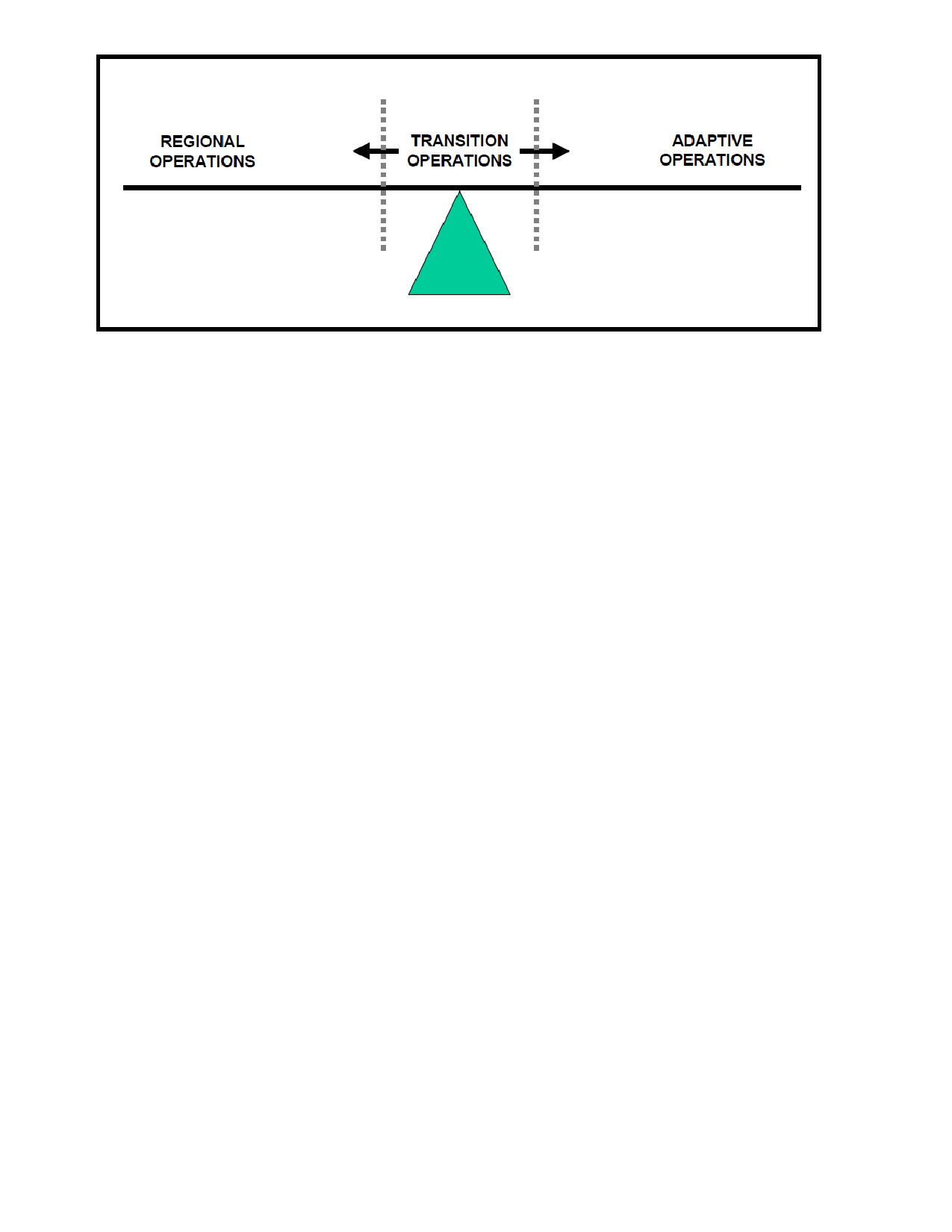
Figure 5-1. Transition Operations
5-4.Mostly defensive in nature, transition operations may include some of-
fensive operations. If this combination of offensive and defensive actions is
successful and the extraregional force is no longer a factor, the State may be
able to transition back to regional operations without having to complete the
shift to adaptive operations.
5-5.During transition operations, the State must decide whether to keep its
forces in any territory it has occupied in a neighboring country or to with-
draw them back to its home territory. The decision to stay or withdraw at
this point may be based on the presence or absence of urban areas and/or
other complex terrain suitable for sanctuaries and other adaptive measures
in the occupied territory against an extraregional power with overmatch in
technology and conventional forces. Sanctuary requires not only suitable ter-
rain, but also a sympathetic or intimidated local populace. The State is also
more likely to remain in the occupied territory if it has already achieved its
strategic goal in regional operations or at least achieved major intermediate
objectives leading toward that goal.
5-6.At the point of shifting to transition operations, the State still has the
ability to exert all instruments of national power against an overmatched re-
gional enemy and, indeed, may have defeated its original regional adversary.
However, its successful actions in regional operations have prompted ether
other regional actors or an extraregional actor to threaten to become involved
in the conflict. The State will use all means necessary to preclude or put a
quick end to such possible expansion of the conflict and to either consolidate
its previous gains or conduct further operations against the original regional
enemy using a more conventional design.
5-7. Transition operations can also buy time for the State’s strategic opera-
tions to succeed. Meanwhile, strategic operations against the impending ex-
traregional threat may resort to more offensive actions against intangibles
and even carefully selected attacks on the enemy’s tangible assets in order to
target his strategic centers of gravity. For example, the State or its affiliated
forces can attack staging areas and economic targets in the region or even in
the enemy’s homeland.
5-2
_________________________________________________________________________________Chapter 5
DIPLOMATIC-POLITICAL MEANS
5-8.Because of the lack of a clear-cut division between regional and transi-
tion operations, political means of maintaining internal stability during tran-
sition operations are similar to the means used during regional operations.
The types of internal threats remain the same, but are intensified by chang-
ing conditions. When conducting regional operations, the State was making
progress toward a longstanding goal of regional hegemony and enjoyed a
high level of public support. When extraregional intervention threatens to
halt or reverse this progress, it also threatens internal stability. Faced with
increasing unrest among local civilians, the State must be more concerned
about internal dissidents and use its control mechanisms to crack down on
them. However, the State’s ability to deal with increased internal unrest is
impacted by diversion of resources and instruments of national power to deal
with external threats from regional and extraregional forces. When the tran-
sition is from adaptive back toward regional operations, there will also be a
lack of clear distinction in the use of political means against internal threats.
5-9. As it does during regional operations, the State will continue to use diplo-
matic means to negotiate alliances and attempt to increase support internally
and externally to the region. However, these negotiations take on more of a
sense of urgency for the State. It may enlist the services and expertise of former
or retired diplomats and politicians who have had experience working with vari-
ous regional and extraregional actors and have established a rapport with the
officials in these countries. During these negotiations, the State may use bribes
or make promises that it has no intention of keeping. Against extraregional ac-
tors, it will initiate diplomatic actions to postpone, delay, or disrupt the mobili-
zation and deployment of extraregional forces. Even after actual intervention be-
gins, the State will seek diplomatic ways to prevent deployment of further forces.
INFORMATIONAL MEANS
5-10. The State continues to exercise the informational instrument of power
during transition operations in the same manner it uses during regional op-
erations. In its internal information campaign, it will exaggerate enemy com-
bat losses as compared to State combat losses. The State will not admit that
it is overmatched by regional and/or extraregional adversaries, that it is in
danger of losing the war, or that it is failing to make progress in achieving its
strategic goal. The State will accentuate success and will put a positive spin
on all news releases. The State’s informational goal will be to convince its
citizens that transition operations are necessary in order for the State to ex-
ploit the many gains it has already made.
5-11. In information campaigns targeting the international community, the
State increases its emphasis on popularizing the State and its actions. Not
wishing to appear as an aggressor, it attempts to convince the international
community that it is conducting its primarily military campaign in order to
help regional neighbors increase their standard of living and improve their
way of life. If it is obvious that the State will be overmatched by the extrare-
gional force that is about to intervene, the State may depict the intervening
force as an unwanted aggressor involving itself in regional affairs in order to
support its own selfish interests.
5-3
FM 7-100 _________________________________________________________________________________
5-12. Against extraregional threats, the State begins to use more offensive
forms of information warfare (IW). These include not only more aggressive
information campaigns, but also information attack and perhaps physical at-
tack, as long as there is opportunity for plausible deniability. As extrare-
gional forces begin to deploy into the region, the State can use information
attacks on enemy command and control (C2) systems. The State continues to
leverage international media to influence world perception and public opin-
ion within the extraregional power’s own populace. It can influence the ex-
traregional force’s operations by playing up in the media the fact that the en-
emy’s standoff weapons sometimes strike innocent civilians.
ECONOMIC MEANS
5-13. By the time the State enters transition operations, it should already
have sufficient stockpiles of key military supplies and materiel to support
sustained operations. Faced with economic sanctions and boycotts of imports,
it now focuses on further stockpiling of critical civilian goods such as fuel,
food, and clothing to satisfy the basic needs of the populace. Even with these
stockpiles, the State may gradually begin rationing of civilian supplies and
services as a hedge against future shortages. It assumes that the intervening
extraregional force will be capable of striking its fixed production facilities.
The State will seek to keep the enemy from using this capability by publiciz-
ing that there are large numbers of civilians at these sites or that such
strikes would also destroy production of civilian goods.
5-14. During transition operations, if not before, the State begins to national-
ize the industrial base. Since the wealthy families who control the State gov-
ernment also own most of the large factories and major business enterprises,
the step of nationalizing these parts of the State’s economy is a short one.
The State may ask workers to work longer hours for lower wages, and use the
money saved to further State goals. The State may increase production quotas
and reward factories or workers who meet them while severely punishing those
who do not. The State will increase interest rates on government-funded loans.
5-15. Prior to transition operations, the State monitored railway and port-of-
entry operations closely. During transition operations, it may nationalize
these assets. Thus it can dictate and control all railway schedules. By limit-
ing passenger travel to official travel only, the State can use the railway lines
to transport more goods to areas where they are needed to support the war
effort. It can confiscate privately-owned container cars and use them for offi-
cial business. The State will limit transfer of goods at all ports of entry to
those goods necessary for the sustainment and conduct of the war effort.
5-16. The State will attempt to negotiate future payment for imported goods
in order to decrease the cash flow out of the country. By calling in interna-
tional debt and demanding debt payments from regional and extraregional
actors, the State will also increase the cash flow into the State. In turn, the
State may cease payments on national debt owed to other countries.
5-17. The State will use economic sanctions and pressure to prevent its re-
gional neighbors from lending support or sanctuary for deployment of ex-
traregional forces. It will also use the possibility of collateral damage to
5-4
_________________________________________________________________________________Chapter 5
foreign-owned assets within the State as a means of deterring the extraregional
power from using air campaigns or long-range weapons against the State.
MILITARY MEANS
5-18. It is possible for transition operations to be hasty in natureagainst an
unexpected regional coalition or unexpected extraregional intervention. In
this rather unlikely case, the short-term goal is preservation of military ca-
pability while seeking transition back to regional operations.
5-19. In most cases, the State will have anticipated extraterritorial interven-
tion and will have thoroughly planned transition operations, as well as possi-
ble adaptive operations. The Armed Forces operate human intelligence
(HUMINT) agents throughout the region and have some global intelligence-
gathering capability against those nations the State perceives as the most
likely potential enemies. When the transition is planned and deliberate, the
long-term goal is preservation and application of military capability support-
ing the transition from regional to adaptive operations and eventually back
to regional operations, if conditions support doing so.
5-20. During transition operations, military forces solidify gains made during
regional operations. However, the central aim is to prevent or defeat outside
intervention. Although military operations are primarily defensive in nature,
limited attacks may continue. A combination of operational and tactical of-
fensive and defensive actions help the State to control tempo. In some cases,
the objective is to get inside the enemy decision cycle.
5-21. The State will use the time it takes the extraregional force to prepare
and deploy into the region to change the nature of the conflict into something
for which the intervening force is unprepared. The State tries to establish condi-
tions that force the new enemy to fight at less than full strength and on terrain
for which his forces are not optimized. It seeks to take advantage of urban areas
or other complex terrain whenever possible, while controlling the enemy’s access
to such terrain. It plans operations to exploit the opportunities created by the
presence of NGOs, PVOs, media, and other civilians on the battlefield.
5-22. Military forces in the immediate vicinity of the point of intervention
move into sanctuary as opportunity allows, making use of existing C2 and lo-
gistics. They conduct limited attacks to secure positions, protect flanks, and
control access. They may attack vulnerable early-entry forces before the en-
emy can bring his technological overmatch to bear. Even at this stage, the
State may be able to inflict politically unacceptable casualties that could
cause the extraregional power to terminate its intervention.
5-23.During transition operations, State forces will plan and conduct sophis-
ticated ambushes to destroy high-visibility enemy systems or cause mass
casualties. These ambushes are not always linked to maneuver or ground ob-
jectives, but may have huge psychological and political impact by demonstrat-
ing the vulnerability. The State may use niche technology it has acquired to
achieve technological surprise and limited-duration overmatch in specific areas.
5-24. The State can use long-range missiles to deny an extraregional oppo-
nent the use of urban areas or other complex terrain. This creates opportunities
5-5
FM 7-100 _________________________________________________________________________________
for operational forces to destroy key enemy systems with precision fires or to
engage the enemy forces with fires and maneuver.
5-25. If access-control efforts are successful, in conjunction with transition
operations, the State wants to stay in the regional operations mode. If at-
tacks against enemy early-entry forces are successful, the State may go back
to regional operations. If not, it moves toward adaptive operations. It wants
to be able to go either direction.
5-26. Meanwhile, transition operations permit other key forces the time,
space, and freedom of action necessary to move into sanctuary in preparation
for a shift to adaptive operations. These forces preserve combat power and
prepare to defend the State homeland, if necessary. Transition operations usu-
ally include mobilization of reserve and militia to assist in defending the State.
5-27. Transition operations may include several combined arms, joint, and/or
interagency operations and, if the State is part of an alliance or coalition,
may also be multinational. Even when operations are joint, the air and naval
forces increasingly revert to defensive measures to preserve their capability.
Ground forces or, more often, Special-Purpose Forces (SPF) conduct raids
against logistics sites, lines of communication (LOCs), and vulnerable mili-
tary targets in the region, along the routes to the region, and to the enemy’s
strategic depth. Occasionally, if the risks are worth the costs, the State at-
tacks such targets by air and sea. It may also use long-range missiles or
rockets to deliver conventional warheads or weapons of mass destruction
(WMD) against these kinds of targets. Paramilitary forces, air defense forces,
and precision attack can also play important roles. The State may also use
long-range weapons or SPF to conduct attacks outside the theater, to divert
enemy resources to protect politically or ecologically sensitive targets. Al-
though these attacks are characteristically part of transition operations, they
are also conducted during regional and adaptive operations if required. The
purpose is to allow the enemy no sanctuary.
5-28. At some point, the State may conclude that it cannot deny entry or de-
feat the extraregional force by destroying his early-entry forces. The State
then shifts its emphasis to completing the transition to adaptive operations
as soon as possible, before the enemy can deploy overwhelming forces into
the region.
COMMAND AND CONTROL
5-29. During transition operations, the C2 process becomes more complicated.
Commanders must try to ensure that State forces prepare for three basically
different functions on the battlefield. They must
• Disperse forces and prepare sanctuaries for adaptive operations.
• Control operational forces as they either disengage from regional en-
emy forces or plan to engage extraregional forces in continuing transi-
tion operations.
• Plan for a return to regional operations.
The requirements for C2 are different for delay actions or sanctuary-based
operations than for offensive operations, which are much more mobile.
5-6
_________________________________________________________________________________Chapter 5
5-30. The principle of centralized planning and decentralized execution con-
tinues to apply in transition operations and becomes even more important.
Planning at the highest levels, even during regional operations, has ac-
counted for the possibility of intervention by an extraregional power. Now,
decentralized execution allows subordinate commanders to react rapidly to
this critical, but not unanticipated, change in the strategic situation without
waiting for direction from higher headquarters. Thus, transition operations,
although increasingly decentralized in their execution, proceed toward the
overall goal of the strategic campaign.
5-31. As in regional operations, planning for transition operations includes
objective, opportunity, method, and end state. In this case, the objectives are
to preclude, delay, disrupt, or destroy outside intervention. State forces con-
ducting the transition operations can either seize the opportunity to return to
regional operations or provide other forces the opportunity to prepare for
adaptive operations. Planned methods for transition operations are to
• Provide adequate logistics support.
• Delay enemy deployment.
• Attack early-entry forces.
• Attack LOCs into the region and in the region.
• Develop air defense ambushes and pre-position forces to do so.
• Set the conditions to conduct regional or adaptive operations.
• Attack intervening forces to their strategic depth.
5-32. Transition operations do not lead to a single end state. The end state
against a regional opponent may be consolidation and/or disengagement. If
transition operations prevent intervention or destroy the intervening force,
the result can set the conditions for a return to regional operations. If they
merely delay or temporarily disrupt the intervention and the extraregional
force is able to get sufficient force in the region to threaten eventual over-
match against the State, the desired end state is to permit other State forces
to prepare for a shift to adaptive operations.
INTERNAL SECURITY FORCES
5-33. The State becomes even less tolerant of internal dissent and unrest,
since sanctuary requires cooperation of the local populace. Thus, it is more
likely to use paramilitary or military force to neutralize such threats.
5-34. As during regional operations, the State may deploy Internal Security
Forces into territory it has seized in a neighboring country. If the State can-
not control the entire occupied area with regular military forces, it may use
Internal Security Forces to control the local population.
5-35. The State may use any or all of its Internal Security Forces to engage
enemy special operations forces operating in denied areas. The more heav-
ily armed of these forces can engage enemy conventional forces, but usu-
ally in cooperation with another organization from the State’s Armed
Forces.
5-7
FM 7-100 _________________________________________________________________________________
ARMY
5-36. During transition operations, if not before, the State begins mobiliza-
tion of militia for defense of the homeland. The militia forces belong exclu-
sively to the Army and consist primarily of infantry. Thus, they are suited for
securing LOCs and defending the State in sanctuary-based operations, but
they are generally not capable of large offensive operations.
5-37. Regular Army ground forces or Army SPF conduct raids against enemy
logistics sites, LOCs, and vulnerable military targets. Army forces may still
be able to conduct operations in a conventional design against enemy early-
entry forces. However, Army operations generally begin to move toward the
less conventional applications associated with adaptive operations.
NAVY
5-38. The Navy possesses the capability to challenge or control access to the
region by the most modern navies at maritime choke points, using a combi-
nation of mines, shore- and sea-based antiship missiles, and submarines. The
Navy can also insert naval infantry or Naval SPF to conduct raids against
critical installations within the region. If necessary, the State can appropri-
ate privately-owned ships or inland-water craft to supplement its capability
to transport troops or supplies.
AIR FORCE
5-39. At least during the early stages of intervention, the Air Force and its
Air Defense Forces are sufficient to challenge extraregional air forces and
prevent them from attaining air supremacy for a time. Thus, the State’s air
and air defense forces may prove effective in supporting access-control efforts
during transition operations.
5-40. Within the region, Air Force transport aircraft may deliver airborne
troops, Air Force SPF, and SPF belonging to other components. The State
may also use privately-owned and commercial aircraft for this purpose. Air
Force SPF can conduct raids against enemy air bases and other installations.
STRATEGIC FORCES
5-41. The State can use the long-range missiles of its Strategic Forces to
strike intermodal transportation nodes, and air and sea ports along the LOCs
that any extraregional force might require for its deployment into the region.
It may also use them to extend the conflict beyond the region, to affect the
national will of potential opponents or members of enemy coalitions.
5-42. The Strategic Forces can strike enemy logistics sites, LOCs, and vul-
nerable military targets using missiles with conventional or WMD warheads.
However, it is unlikely that the State would use those delivery means to em-
ploy NBC weapons inside or outside the region or theater prior to using the
same units to deliver long-range conventional weapons. It also could use
WMD tactically or operationally against troops in the field prior to using
them strategically. However, once having crossed the threshold of using
WMD, the State may use them against any high-payoff target within the
range of its delivery systems. Positioning of the State’s Strategic Forces units
5-8
_________________________________________________________________________________Chapter 5
and supporting C2 nodes could, if detected, serve as indicators of the State’s
intentions. Therefore, the State will seek to conceal the location of these
forces and C2 nodes.
SPECIAL-PURPOSE FORCES COMMAND
5-43. During transition operations, the SPF Command can use its regional
and global intelligence-gathering capabilities to the enemy’s strategic depth.
It can use SPF teams to conduct direct action attacks against ports, LOCs,
and early-entry forces. The SPF can also support insurgent and terrorist opera-
tions to delay or disrupt the extraregional force’s mobilization and deployment.
AFFILIATED FORCES
5-44. During transition operations, the State can count on most of the same
affiliated forces that aided it in regional operations. It may be able to form
further affiliations with groups that were not originally sympathetic to the
State’s goals, but are willing to unite with the State against an extraregional
power perceived as a common enemy. Affiliated forces can attack aerial and
sea ports of debarkation (APODs and SPODs), staging areas, or economic
targets in the region. Terrorists with global reach can even strike the home-
land of the extraregional force.
STRATEGIC OPERATIONS
5-45. The State will use strategic operations to limit or shape enemy coali-
tions. During transition operations, the military aspects of strategic opera-
tions become more aggressive. The State can try to slow down enemy mobili-
zation by information attack. During deployment, it can disrupt the flow of
enemy movement at his aerial and sea ports of embarkation (APOEs and
SPOEs), as well as APODs and SPODs, by SPF direct action and information
attack. It can physically attack enemy early-entry forces and their LOCs. It
can also attack high-payoff targets such as high-technology communications
nodes and other information systems.
5-46. Enemy force projection from a distant homeland affords the State the
opportunity to mine nautical choke points and to establish antishipping am-
bushes. Air and sea ports, both in the enemy homeland and in the region, are
vulnerable and convenient targets for terror tactics or sabotage in support of
transition and adaptive operations. The State can also exploit local nationals
employed as contractors and host-nation support for the extraregional force;
the State can use them to collect intelligence or conduct sabotage.
5-9
Chapter 6
Adaptive Operations
Adaptive operations are a strategic-level course of action to preserve the
State’s power and apply it in adaptive ways against opponents that over-
match the State. Theoretically, this overmatch could be the result of an
alliance among the State’s regional neighbors, but it will more likely come
from the intervention of an extraregional power.
Chapter 3 discusses adaptive operations in general terms within the con-
text of the State’s overall framework for implementing its national secu-
rity strategy. This chapter outlines in more detail the goals of adaptive
operations and how the State employs its diplomatic-political, informa-
tional, economic, and military instruments of national power in pursuit of
those goals. It also describes how the State’s strategic operations comple-
ment adaptive operations.
STRATEGIC GOALS
6-1. Generally, the State conducts adaptive operations during the strategic
campaign as a consequence of intervention from outside the region. If it can-
not control the extraregional enemy’s access into the region or defeat his
forces before his combat potential in the region equals or exceeds its own, the
State must resort to adaptive operations. The primary objectives are to pre-
serve combat power, to degrade the enemy’s will and capability to fight, and to
gain time for aggressive strategic operations to succeed. However, the State will
not cede the initiative. Even with the intervention of an advanced extraregional
power, the State will employ military means so long as this does not either place
the regime at risk or risk depriving it of sufficient force to remain a regional he-
gemon. Adaptive operations generally include the State’s home territory, as well
as the regional theater(s) in which the State has conducted regional operations.
6-2. Once an extraregional force intervenes with sufficient power to over-
match the State, the State’s immediate goal is survivalas a regime and as a
nation. However, its long-term goal is still the expansion of influence within
its region. In the State’s view, this goal is only temporarily thwarted by the
extraregional intervention. Accordingly, planning for adaptive operations fo-
cuses on effects over time. The State believes that patience is its ally and an
enemy of the extraregional force and its intervention in regional affairs.
6-3. It is the combination of the State’s capabilities and strategy that make it
believe it can take on the extraregional force and win. The State must make
creative and adaptive use of existing technologies and forces. At the strategic,
operational, and/or tactical levels, it employs conventional and unconven-
tional forces in an adaptive manner, in close coordination with the strategic
6-1
FM 7-100 _________________________________________________________________________________
operations, to wrest the initiative from the opposition and achieve decisive
operational and strategic results.
6-4. Internal threats remain much the same as in regional and transition
operations, but are further intensified by the conditions that led to adaptive
operations. As in transition operations, the State’s ability to deal with increased
internal unrest is impacted by diversion of resources and instruments of national
power to deal with external threats from regional and extraregional forces.
6-5. The State believes that adaptive operations can lead to several possible
outcomes. If the results do not completely resolve the conflict in the State’s
favor, they may at least allow the State to return to regional operations. Even
a stalemate may be a victory for the State, as long as it preserves enough of
its instruments of power to preserve the regime and lives to fight another day.
DIPLOMATIC-POLITICAL MEANS
6-6. The State will conduct diplomatic and political activities similar to those
during regional and transition operations. It becomes very difficult for the
State to use political means to counter internal threats during adaptive op-
erations. By the time the State has shifted to adaptive operations, it has suf-
fered casualties and may not have reached its goal. The State’s citizens may
be rebellious and more difficult for the State to control during adaptive op-
erations than during regional operations.
6-7. The State will expand and step up internal control measures imple-
mented during regional operations. For example, it may make travel passes
mandatory for travel inside and outside urban areas and around key strategic lo-
cations. It may establish curfews and close places of entertainment such as bars,
theaters, and other gathering places where citizens could meet to form dissident
organizations. It may even abolish all religious services and related activities.
6-8. By rewarding those citizens who continue to support the war effort, the
State hopes to increase support from other citizens. It will fill jails with those
who do not support it, and even provide monetary incentive for citizens turn-
ing in other citizens for unpatriotic activities.
6-9. The State continues to seek new diplomatic agreements and alliances
that will allow it to expel the extraregional force that caused it to transition
to adaptive operations. Unexpected alliances with the State can affect the ex-
traregional force’s dominance. The State also attempts to exploit the vulner-
abilities of an enemy coalition.
INFORMATIONAL MEANS
6-10. The State continues to censor and manipulate the media. It may
change and modify its basic themes, but the final essence of the information
campaign remains the same: to maintain or expand internal, regional, and
international support for State operations.
6-11. During adaptive operations against an extraregional enemy, State-
controlled media continue to project an image of the President as a national
hero. The media seek to add to his heroic status. This image is important to
impress on the general populace, so that it will continue to follow the President
6-2