FM 7-100 Opposing Force Doctrinal Framework and Strategy (MAY 2003) - page 1
FM 7-100
Field Manual
Headquarters
No. 7-100
Department of the Army
Washington, DC,1 May 2003
Opposing Force
Doctrinal Framework and Strategy
Contents
Page
PREFACE
iii
INTRODUCTION
iv
Chapter 1
THE STATE
1-1
Characteristics of the State
1-1
Perceived Threats
1-5
Views of the United States
1-7
Chapter 2
STRUCTURE OF THE STATE
2-1
Elements of National Power
2-1
National Command Authority
2-5
Ministry of Foreign Affairs
2-5
Ministry of Public Information
2-7
Ministry of Finance and Economic Affairs
2-8
Ministry of Interior
2-10
Ministry of Defense
2-12
Supreme High Command
2-14
Chapter 3
STRATEGY FOR TOTAL WAR
3-1
National Security Strategy
3-1
Strategic Campaign
3-10
Strategic Operations
3-23
Strategic IW
3-25
Distribution Restriction: Approved for public release; distribution is unlimited.
i
FM 7-100 _________________________________________________________________________________
Chapter 4
REGIONAL OPERATIONS
4-1
Strategic Goals
4-1
Diplomatic-Political Means
4-2
Informational Means
4-3
Economic Means
4-5
Military Means
4-6
Strategic Operations
4-10
Chapter 5
TRANSITION OPERATIONS
5-1
Strategic Goals
5-1
Diplomatic-Political Means
5-3
Informational Means
5-3
Economic Means
5-4
Military Means
5-5
Strategic Operations
5-9
Chapter 6
ADAPTIVE OPERATIONS
6-1
Strategic Goals
6-1
Diplomatic-Political Means
6-2
Informational Means
6-2
Economic Means
6-3
Military Means
6-4
Strategic Operations
6-12
Chapter 7
FORCE DESIGN, MOBILIZATION, AND SUSTAINMENT
7-1
Strategic Integration Department
7-1
Force Development and Investment Strategy
7-2
Acquisition and Procurement
7-4
Mobilization
7-7
Sustainment
7-8
Material Support
7-11
Maintenance
7-12
Depot Facilities and Operation
7-12
Transportation
7-14
Personnel
7-16
Medical Support
7-18
Civil Defense, Engineering, and Construction
7-21
Legal Affairs
7-21
GLOSSARY
Glossary-1
BIBLIOGRAPHY
Bibliography-0
INDEX
Index-1
ii
Preface
This manual is one of a series that describes a contemporary Opposing Force
(OPFOR) for training U.S. Army commanders, staffs, and units. See the Refer-
ence section for a list of the manuals in this series. Together, these manuals out-
line an OPFOR than can cover the entire spectrum of military and paramilitary
capabilities against which the Army must train to ensure success in any future
conflict.
Applications for this series of manuals include field training, training simula-
tions, and classroom instruction throughout the Army. All Army training venues
should use an OPFOR based on these manuals, except when mission rehearsal or
contingency training requires maximum fidelity to a specific country-based
threat. Even in the latter case, trainers should use appropriate parts of the
OPFOR manuals to fill information gaps in a manner consistent with what they
do know about a specific threat.
The proponent for this publication is HQ TRADOC. Send comments and recom-
mendations on DA Form 2028 directly to the OPFOR and Threat Integration Di-
rectorate of the TRADOC Office of Deputy Chief of Staff for Intelligence at the
following address: Director, OPFOR and Threat Integration Directorate, ATTN:
ATIN-T (Bldg 53), 700 Scott Avenue, Fort Leavenworth, KS 66027-1323.
This publication is available on the Reimer Digital Library at
http://www.adtdl.army.mil. Readers should monitor that site and also the
TRADOC DCSINT-Threats World Wide Web
(WWW) site at
information regarding updates. Periodic updates, subject to the normal approval
process, will occur as a result of the normal production cycle in accordance with
TRADOC regulation 25-36, paragraphs 2-17 and 4-7. The date on the cover and
title page of the electronic version will reflect the latest update.
Unless this publication states otherwise, masculine nouns or pronouns do not re-
fer exclusively to men.
iii
Introduction
This manual is the capstone document for the FM 7-100 series, which describes a
contemporary Opposing Force (OPFOR) that exists for the purpose of
training U.S. forces for potential combat operations. This OPFOR reflects the
characteristics of military and paramilitary forces that may be present in the
contemporary operational environment (COE). Like those real-world
threats, the OPFOR will continue to present new and different challenges for
U.S. forces. The COE is constantly changing, and it is important for U.S. Army
training environments to keep pace with real-world developments.
CONTEMPORARY OPERATIONAL ENVIRONMENT
The DOD officially defines an operational
Contemporary Operational
environment
(OE) as
“a composite of the
Environment (COE)
conditions, circumstances, and influences
that affect the employment of military forces
The operational environment
and bear on the decisions of the unit
that exists today and for the
commander”
(JP
1-02). The contemporary
clearly foreseeable future.
operational
environment
(COE) is the
operational environment that exists today
and for the clearly foreseeable future. There are some “constants” or common
threads that define the general nature of this COE:
• The United States in not likely to have a peer competitor until 2020 or beyond.
• However, nations will continue to field armed forces and use these forces
as a tool to pursue national interests.
• As nations use their armed forces (or other instruments of national power)
in pursuit of national interests, their actions may cause U.S. intervention,
either unilaterally or as a coalition partner, with or without United Na-
tions mandate.
• Nations that believe the United States may act to counter their national
interests will develop diplomatic, informational, economic, and military
plans for managing U.S. intervention.
• Nations will continue to modernize their armed forces within the con-
straints of their economies, but in ways that may negate U.S. overmatch.
• Advanced technology will be available on the world market for a wide va-
riety of nation-state and non-state actors.
• Non-state actors will play an important role in any regional conflictas
combatants or noncombatants.
• All combat operations will be significantly affected by a number of vari-
ables in the environment beyond simple military forces.
Thus, one of the constants is that there are variables. Those “variables” in the
COE result in a number of different OEs that can occur in specific circumstances
or scenarios.
iv
______________________________________________________________________________ Introduction
CRITICAL VARIABLES
Any OE, in the real world or in the
training environment, can be defined in
Critical Variables of COE
terms of eleven critical variables. While
• Nature and Stability of the State.
these variables can be useful in
• Regional and Global Relationships.
describing the overall
(strategic)
• Economics.
environment, they are most useful in
• Sociological Demographics.
defining the nature of specific OEs.
• Information.
Each of these “conditions, circumstances,
• Physical Environment.
and influences” and their possible
• Technology.
combinations will vary according to
• External Organizations.
the specific situation. In this sense,
• National Will.
they are
“variables.” These variables
• Time.
are interrelated and sometimes
• Military Capabilities.
overlap. Different variables will be
more or less important in different
situations. Each OE is different, because the content of the variables is different.
Only by studying and understanding these variablesand incorporating them
into its trainingwill the U.S. Army be able to keep adversaries from using them
against it or to find ways to use them to its own advantage.
Nature and Stability of the State
It is important to understand the nature and stability of the state (or states) with
which or in which the conflict takes place. Study of this variable measures how
strong or weak a country is and determines where the real strength of the state
lies; it may be in the political leadership, the military, the police, or some other
element of the population. Understanding this variable will allow U.S. forces to
better understand the nature of the military campaign and the true aims of an
enemy campaign, operation, or action. It also helps determine what kinds of
threats may be present in a particular country. The real threat to U.S. forces
may come from elements other than the military.
Regional and Global Relationships
Nation-states and/or non-state actors often enter into relationships, which can be
regional or global. These partnerships support common objectives, which can be
political, economic, military, or cultural. An actor’s membership or allegiance to
such a relationship can determine its actions of support and motivation. Virtu-
ally all conflict will occur with alliances and coalitions, some involving the
United States and some involving its adversaries. When actors create regional or
global alliances, it can add to their collective capability and broaden the scale of
operations and actions.
As the world moves away from the traditional long-term, fixed alliances of the
past, regional and global relationships are much more fluid and unpredictable.
The choice of a state to be nonaligned does not mean that it will not become in-
volved in a conflict or crisis. It simply means that the state does not make a
commitment to another state, alliance, or cause before a situation arises. This
lack of precommitment makes it difficult to predict how actors and forces may
align when a situation does arise. Alliances can form or change rapidly, even dur-
ing the course of an operation or campaign.
v
FM 7-100 _________________________________________________________________________________
Economics
The economic variable establishes the boundaries between the “haves” and the
“have-nots.” This gap of economic differences among nation-states and other ac-
tors can cause conflict. Economic superiority, rather than military superiority,
may be the key to power or dominance within a region. However, economic posi-
tion often represents a nation or non-state actor’s ability to buy military technol-
ogy or to conduct prolonged operations.
Economics help define the relationship between a nation or non-state actor and
other actors at the regional or global level. These regional or global economic re-
lationships could result in military or political assistance.
Sociological Demographics
The demographics variable includes the cultural, religious, and ethnic makeup of
a given region, nation, or non-state actor. Extreme devotion to a particular cause
or significant hatred of a particular group may provide an enemy with an un-
shakable will and a willingness to die for the cause. U.S. forces may also find
that large segments of the population around them are sympathetic to the same
cause as the enemy force. The needs of the local population can create heavy de-
mands on U.S. military units, particularly their supply and medical systems.
Refugees and internally displaced persons may increase the complexity of the
environment. The enemy may use civilians as shields or obstacles or as cover for
hostile intelligence services.
Information
Media and other information means can make combat operations transparent to
the world, visible to all who have access to data. Various actors seek to use per-
ception management to control and manipulate how the public sees things. They
will exploit U.S. mistakes and failures and use propaganda to sway the local
population to support their cause. Media coverage can impact on U.S. political
decision making, international opinion, or the sensitivities of coalition members.
Even without sophisticated sensors and information systems, actors native to the
area or region often have greater situational awareness than U.S. forces. Various
actors are able to access commercial systems (such as satellite communications
and imagery) for the larger picture. For a more detailed view, they can use hu-
man networks operating over normal telephone lines or with cellular telephones
to maintain situational awareness.
Physical Environment
The main elements in the physical environment are terrain and weather. Poten-
tial enemies clearly understand that less complex and open environments favor a
U.S. force with its long-range, precision-guided weapons and sophisticated re-
connaissance capability. So they will try to avoid the types of operations and en-
vironments for which such U.S. forces are optimized. They will try to operate in
urban areas and other complex terrain and in weather conditions that may ad-
versely affect U.S. military operations and mitigate technological advantages.
vi
______________________________________________________________________________ Introduction
Technology
The technology that nations or non-state actors can bring to the OE includes
what they can develop and produce, as well as what they could import. Access to
technological advances available on the global market is slowly eating away at
the technological advantage the United States has enjoyed in the past.
It is likely that some high-end forces in a particular region of the world could
field a few systems that are more advanced than those of the U.S. force deployed
there. Easy access to new technology allows potential adversaries to achieve
equality or even overmatch U.S. systems in selected niche areas. Many countries
are trying to acquire relatively low-cost, high-payoff, new technologies. In addi-
tion, upgrades and hybridization allow older systems to compete with more mod-
ern capabilities, thus neutralizing the technical advantage of many modern
forces. In urban areas or other complex terrain, less advanced systems may still
find effective uses. Various actors may find adaptive and innovative ways of us-
ing systems for other than their originally intended applications.
External Organizations
When the U.S. Army goes into a failed state or into areas torn by conflict, it is
likely to find international humanitarian relief organizations at work there.
These external organizations continue to grow in influence and power, as well as in
willingness to become involved in crisis situations that were previously purely mili-
tary operations. These external organizations can have both stated and hidden in-
terests and objectives that can either assist or hinder U.S. mission accomplishment.
The presence of transnational corporations operating in a country or region can also
place added pressure on U.S. forces to avoid collateral damage to civilian life and
property. U.S. forces may have to divert troops and resources from their assigned
missions to conduct rescues or provide security for various external organizations.
National Will
The variable of national will reflects how much each country’s people and gov-
ernment are behind what the military or paramilitary forces are doing. This can
influence the objectives of a conflict, its duration, and the conditions for ending it.
A country will try to attack its opponent’s national will and still preserve its own.
Clearly, most foreign countries view U.S. national will as a point of vulnerability.
Thus, a potential adversary may perceive the collective will of his people as a
comparative advantage against the United States.
History has proven that battlefield victory does not always go to the best-trained,
best-equipped, and most technologically advanced force. Victory often goes to the
side that most wants to win, needs to win, and is willing to sacrifice to do so.
Time
In most cases, potential opponents of the United States view time as being in
their advantage. When U.S. forces have to deploy into the area over long time
and distance, the opponent can use this time to adjust the nature of the conflict
to something for which the U.S. forces are not prepared.
First, the opponent will try to control the entry of U.S. forces into the area. If ac-
cess control fails, the enemy still has the opportunity to oppose lightly equipped
vii
FM 7-100 _________________________________________________________________________________
U.S. early-entry units and try to prevent full deployment of the rest of the force.
The opponent will try to speed up the tempo, to rapidly defeat its local or re-
gional enemy or to defeat U.S. early-entry forces before the United States can
deploy overwhelming military power. If that fails, the opponent will try to pro-
long the conflict and to outlast the U.S. will to continue.
Military Capabilities
Military capabilities of a nation-state or non-state actor are measured in relative
terms, in comparison to the capabilities of other actors against which they might
be applied. Most of the military forces in the world continue to operate in conven-
tional ways, which remain sufficient against other local and regional actors.
However, once the United States becomes involved, these same military forces
may have to use adaptive or asymmetric approaches. Various nations and
other foreign entities around the world study the United States and its military
forces. They generally view the United States as a major power—the world’s only
superpower—with an overall advantage in technology and warfighting capabil-
ity. Despite these strengths, other actors see some weaknesses that they may be
able to exploit. They can use these perceptions as a guide to optimizing the effec-
tiveness of their own forces and to find ways to negate current U.S. advantages.
Military capabilities may be the most critical and the most complex variable that
affects military operations. However, the military variable does not exist in isolation
from the other variables that help determine the overall OE. It interacts with the
other variables, and all the other variables can affect military capabilities. Potential
enemies can use any or all of these factors against the Army as it tries to accomplish
its missions in various parts of the world or in various training environments.
REAL WORLD
In the real world, the COE is the entire set of conditions, circumstances, and influ-
ences that U.S. Armed Forces can expect to face when conducting military opera-
tions to further the national interests of the United States, its friends, and allies.
The COE is “contemporary” in the sense that it does not represent conditions that
existed only in the past or that might exist only in the remote future, but rather
those conditions that exist today and in the clearly foreseeable, near future. This
COE consists not only of the military and/or paramilitary capabilities of potential
real-world adversaries, but also of the manifestations of the ten other variables that
help define any OE.
TRAINING
In training environments, the COE is the OE created to approximate the demands
of the real-world COE and to set the conditions for desired training outcomes. This
involves the appropriate combination of an OPFOR (with military and/or paramili-
tary capabilities representing a composite of a number of potential adversaries) and
other OE variables in a realistic, feasible, and plausible manner. The purpose of the
COE in training simulations is to produce the necessary training outcomes.1
1 The same type of COE conditions can be created to support some combat development activities that do not re-
quire simulation of a specific real-world potential adversary. However, some combat development activities may
require portrayal of an OE that extends further into the future than is typical for the COE.
viii
______________________________________________________________________________ Introduction
Even in the COE for training, it is possible to speak of an overall COE that ad-
dresses the qualities of virtually any OE in which the units or individuals being
trained might be called upon to operate. In this sense, there are the same
“constants” as in the real-world COE.
INTERACTION AND LINKAGE OF VARIABLES
The variables of the COE do not exist in isolation from one another. The linkages
of the variables cause the complex and often simultaneous dilemmas that a military
force might face. In order to provide realistic training, training scenarios must try to
simulate this synergistic effect to the maximum degree that is feasible.
The COE is not just about the OPFOR. The COE variables and their interaction
provide the robust environment and context for OPFOR operations. The complex-
ity of the specific OE in training can be adjusted to keep it appropriate for the
required training objectives and the training state of various U.S. Army units.
ADAPTIVE AND CHANGING
The nature of the COE is adaptive and constantly changing. As the United States
and its military forces interact with the COE in a real-world sense, the OE
changes. As the Army applies the lessons learned from training in a COE setting,
the OPFOR and potential real-world adversaries will also learn and adapt.
The development of the COE for training started with research to develop an un-
derstanding of the real-world COE and trends that affect military operations.
Then, taking into consideration the desired training outcomes and leader devel-
opment goals, the authors of the FM 7-100 series proceeded to document an
OPFOR doctrine and structure that reflect the real-world COE, and the Army
began integrating this OPFOR and other COE variables into training scenarios.
Meanwhile, the authors of the FM 7-100 series are continuing to research the
real-world COE and to mature the OPFOR and the COE in training in order to
provide a richer, appropriately challenging training environment and keep the
OPFOR and the COE truly “contemporary.”
ENEMY, THREAT, AND OPFOR
Before going further into the COE, the contemporary OPFOR, and the intended
uses of this manual, it may be useful to define some key terms and the distinc-
tions among them. It is important to distinguish among the terms enemy, threat,
and OPFOR and to use them correctly.
ENEMY
The U.S. Army defines enemy as “the individual, group of individuals (organized
or not organized), paramilitary or military force, national entity, or national alli-
ance that is in opposition to the United States, its allies, or multinational partners.”
In other words, the enemy is whoever is actually opposing the United States in a
particular conflict.2 Thus, this term is synonymous with adversary or opponent.
2 This definition of enemy is from the U.S. point of view. After this Introduction, the chapters of this manual address
their topics from the OPFOR point of view. So, friendly refers to the OPFOR and its allies, and enemy refers to the
enemy of the OPFOR, which may be an opponent within its own country or region or an extraregional opponent
(normally the United States or a U.S.-led coalition).
ix
FM 7-100 _________________________________________________________________________________
THREAT
A potential adversary is sometimes designated as a threat. In this sense, the
Army defines threat as “any specific foreign nation or organization with inten-
tions and military capabilities that suggest it could become an adversary or chal-
lenge the national security interests of the United States or its allies.” Once hos-
tilities actually begin, the threat becomes the enemy.
OPPOSING FORCE
An Opposing Force (OPFOR) is a training tool that should allow the U.S. Army to
train against a challenging and plausible sparring partner that represents the wide
range of possible opponents the Army could face in actual conflict. It enables train-
ing of all arms of the Army and prepares the Army for potential combat operations.3
During the road to war leading up to events in a training scenario, the OPFOR
may play the role of a “threat” (potential enemy) that is on the verge of becoming
an enemy. However, the actual training event usually deals with a state of hos-
tilities. Thus, once hostilities begin in the training event, the OPFOR acts as the
“enemy” of the U.S. force in the training environment.4
During the Cold War period, the Army employed OPFORs based on specific real-
world threats. However, the Army needs a different type of OPFOR to meet its
training requirements for the COE.
Cold War OPFOR
When the Army established its OPFOR program in 1976 with Army Regulation
350-2, it could hardly have envisioned today’s computerized constructive and vir-
tual simulations, or even the evolving requirements of live simulations. It de-
fined an OPFOR simply as “an organized force created by and from U.S. Army
units to portray a unit of a potential adversary armed force.” Thus, all OPFORs
were originally threat-based, in the sense that they replicated the forces, capa-
bilities, and doctrine of a particular country officially recognized as a threat or
potential adversary. In the midst of the Cold War, the 1976 regulation identified
only one potential adversary against which to train: the Soviet Union; by 1983, a
revision of the regulation added North Korea as a second threat for replication by
an OPFOR. Over time, the Army developed other OPFORs to replicate other
threats emerging in places ranging from Latin America and Southwest Asia.
In its time, the threat-based OPFOR served the Army very well, particularly for
units targeted against specific threats. The benefits of this training were borne out,
for example, in Operation Desert Storm. Techniques and doctrine, including deep at-
tack and the intelligence preparation of the battlefield, developed to cope with spe-
cific threats and honed against the OPFOR, enabled the Army to achieve decisive
results on the battlefield. However, the OE is dynamic, and the pace of that dynamism
has increased with the end of the Cold War and the rapid advancement of informa-
tion technology.
3 Although the OPFOR is primarily a training tool, it may be used for other purposes. For example, some combat de-
velopment activities that do not require simulation of a specific real-world potential adversary may use an OPFOR to
portray the “threat” or “enemy.”
4 From the OPFOR point of view, its leadership plans and develops forces and methods to deal with one or more
threats to its own interests, goals, or survival.
x
______________________________________________________________________________ Introduction
Contemporary OPFOR
Training U.S. forces for the COE
Contemporary OPFOR
requires a different kind of OPFOR
from that of the past. The contemporary
A plausible, flexible military and/or
OPFOR must be less predictable and
paramilitary force representing a
not based on the armed forces of a par-
composite of varying capabilities of
ticular country. In today’s world, the
actual worldwide forces, used in
U.S. Army must be prepared to go into
lieu of a specific threat force, for
any OE and perform its full range of
training and developing U.S. forces.
missions. It must be ready to do so in
the face of a wide variety of possible
threats and at the same time be prepared to deal with third-party actors that
may have other interests. Not all threats are purely military in nature. There-
fore, the U.S. Army now defines an OPFOR as “a plausible, flexible military
and/or paramilitary force representing a composite of varying capabilities of ac-
tual worldwide forces, used in lieu of a specific threat force, for training and de-
veloping U.S. forces.”
Thus, in some training environments, a military force alone may be the OPFOR.
In other cases, military forces may have paramilitary forces acting in loose af-
filiation with them, or acting separately from them within the same training en-
vironment. These relationships depend on the scenario, which is driven by train-
ing requirements.
Various agencies and experts have different lists of real-world threats the United
States might have to face. If the U.S. Army were to pick any one of these threats
as the threat against which to train, that threat would almost certainly not be
the one it would actually fight. What is needed is a composite that is representa-
tive of the full range and variety of possible threats and OEs. It must have a bit
of everythingit could be virtually anybody, anywhere. Therefore, this manual
defines this representative composite in a way that is flexible enough to fit the
most demanding U.S. Army training requirements and provides a framework for
training that creates the leaders, soldiers, and unit skills necessary for success
on the next battlefield.
CONTEMPORARY THREATS AND OTHER ACTORS
There are many types of actors or participants in today’s complex world envi-
ronment. Some of the actors are countries (also called nation-states) and some
are not. Nation-states are still dominant actors. However, some power is shifting
to nontraditional actors and transnational concerns. There are many potential
challenges to traditional concepts like balance of power, sovereignty, national in-
terest, and roles of nation-state and non-state actors.
Of course, not all actors are threats. To be a threat, a nation or organization must
have both the capabilities and the intention to challenge the United States. The
capabilities in question are not necessarily purely military, but encompass all the
elements of power available to the nation or organization.
xi
FM 7-100 _________________________________________________________________________________
NATION-STATE ACTORS
Nation-states fall into four basic categories according to their roles in the inter-
national community. The categories are core states, transition states, rogue
states, and failed or failing states.
The category of core states includes more than half of the nearly 200 countries in
the world today. These are basically democratic (although to varying degrees)
and share common values and interests. Within this larger group, there is an
“inner core” of major powers. These are the advanced countries, including the
United States, that generally dominate world politics. Most conflict with global
consequences will involve the core states in some fashion or another.
Transition states are other larger, industrial-based countriesmostly emerging
regional powersthat are striving to become major powers. High-end transition
states are moving from an industrial-based society to an information-based soci-
ety. Low-end transition states are seeking to move from an agricultural-based so-
ciety to an industrial base. As states try to make this transition, there are cycles
of political stability and instability, and the outcome of the transition is uncer-
tain. Some transition states may successfully join the ranks of core states and
even become major powers within that context; others may become competitors.
Rogue states are those that are hostile to their neighbors or to core states’ inter-
ests. These countries can sponsor international terrorism or even confront U.S.
military forces operating in the region. Failed or failing states are fragmented in
such a way that a rule of law is absent; their instability is a threat to their neigh-
bors and the core states.
Countries can move from one category to another, as conditions change. Some-
times countries join together in multinational alliances and coalitions. Together,
they have more strength and can become a power to be reckoned with.
NON-STATE ACTORS
Non-state actors are those that do not represent the forces of a particular nation-
state. Such non-state elements include rogue actors as well as third-party actors.
Like rogue states, rogue actors are hostile to other actors; however, they may be
present in one country or extend across several countries. Examples include in-
surgents, guerrillas, mercenaries, and transnational or subnational political
movements. Particular sources of danger are terrorists and drug-trafficking or
criminal organizations, since they may have the best technology, equipment, and
weapons available, simply because they have the money to buy them. These non-
state rogue actors may use terror tactics and militarily unconventional methods
to achieve their goals.
Third-party actors may not be hostile to other actors. However, their presence,
activities, and interests can affect the ability of military forces to accomplish
their mission when operating in a foreign country. These third-party actors can
be refugees, internally displaced persons, and other civilians on the battlefield,
including international humanitarian relief agencies, transnational corporations,
and the news media. These individuals and groups bring multiple sources of mo-
tivation, ideology, interests, beliefs, or political affiliations into consideration.
They may be sources of civil unrest. Their presence may require military forces to
xii
______________________________________________________________________________ Introduction
consider the potential impacts of traffic congestion, demonstrations, sabotage,
and information manipulation.
REAL-WORLD AND TRAINING CONSIDERATIONS
When U.S. forces become involved in a particular country or region, they must take
into account the presence and influence of these various types of threats and other
actors. In a training environment, an OPFOR can represent a composite of those
nation-state or non-state actors that constitute military and/or paramilitary forces
that could present a threat to the United States, its friends, or its allies. Other, non-
state actors that fall in the category of nonmilitary forces or elements are not part of
the OPFOR, but could be part of the COE used in the training environment.
CONTEMPORARY OPFOR
This manual describes the doctrinal framework and strategy of a flexible, think-
ing, adaptive, contemporary OPFOR that applies its doctrine with considerable
initiative. (See the definition of contemporary OPFOR above.) It is applicable to
the entire training community, including the OPFORs at all of the combat train-
ing centers (CTCs), the TRADOC schools, and units in the field. It provides an
OPFOR that believes that, through adaptive use of all available forces and capa-
bilities, it can create opportunities that, properly leveraged, can allow it to fight
and win, even against a technologically superior opponent such as the United
States.
BASELINE
As a baseline for developing specific OPFORs for specific training environments,
this manual describes an OPFOR that is representative of contemporary nation-
states. This composite of the characteristics of real-world military and paramili-
tary forces provides a framework for the realistic and relevant portrayal of capa-
bilities and actions that U.S. armed forces might face in the COE.
For this composite of real-world threats, the manual refers to the country in
question as “the State.”5 It describes this artificial country in terms of the eleven
critical variables of the COE. As the baseline for the contemporary OPFOR that
is representative of real-world forces, the State is not a peer competitor of the
United States. However, it is a dominant power in its region of the world and is
capable of challenging U.S. interests there. The general characteristics of the
State could fit a number of different types of potential adversaries in a number of
different scenarios.
Like most countries in the world, the State does not design its forces just to fight
the United States. It designs them principally to deal with regional threats and
to take advantage of regional opportunities. Therefore, the State’s national secu-
rity strategy (including its doctrine, force design, and investment strategy) fo-
cuses primarily on maintaining and expanding its position as a regional power. It
develops its military forces in a way that ensures conventional power superiority
over any of its regional neighbors. These forces, together with the State’s other
instruments of power, make it a dominant force in its region.
5 In specific U.S. Army training environments, the generic name of the State may give way to other (fictitious)
country names such as Atlantis, Upper Flambokia, or Westland.
xiii
FM 7-100 _________________________________________________________________________________
At the same time, the State is aware that aggressive pursuit of its regional goals
might lead to intervention by a major power, such as the United States, from out-
side the region. To the extent possible, therefore, it invests in technologies and
capabilities that have utility against both regional and extraregional opponents.
The basic force structure of the OPFOR is the same for either type of threat. The
State must go to waror continue the war after extraregional inter-
ventionwith whatever it had going into the war.
When an extraregional power intervenes with sufficient force to overmatch the
State’s, the State has to adapt its patterns of operation. It realizes that the forces
and technology that allow it to dominate its neighbors may not be a match for the
modern, high-technology forces of a wealthy extraregional power like the United
Statesat least not in a head-to-head conventional confrontation. However, it
can use those means in creative and adaptive ways. To the maximum extent pos-
sible, the State plans and trains for adaptive operations and how it will make the
transition to them. It is the combination of the State’s capabilities and its adap-
tive strategy, operations, and tactics that make it believe it can take on such an
extraregional force and win.
At the strategic level, the State’s ability to challenge U.S. interests includes
not only the military and paramilitary forces of the State, but also the State’s
diplomatic-political, informational, and economic instruments of power. Rarely
would any country engage the United States or a U.S.-led coalition with purely
military means. It is also possible that the State could be part of an alliance or
coalition, in which case the OPFOR could include allied forces. These nation-
state forces may also operate in conjunction with non-state actors such as insur-
gents, terrorists, and drug or criminal organizations.
The FM 7-100 series, as a whole, covers not only the military and paramilitary
forces of the State, but also other, non-state paramilitary and nonmilitary organiza-
tions present in the State’s region of the world. An extraregional power becoming in-
volved in that region may have to deal with any or all of these types of military, pa-
ramilitary, and nonmilitary elements. It might encounter these elements individu-
ally or, more likely, in combination with other such elements. Whether these ele-
ments operate in concert or independently, they are an important part of the COE.
Trainers need to consider the total OE and all instruments of power at the disposal
of the State and the OPFORnot just the military element, but also diplomatic-
political, informational, and economic means. For a nation-state, these are in-
struments of national power. For non-state actors whose forces are paramilitary
in nature, the other three instruments of power are generally present to one de-
gree or another. Together, these instruments represent the power that actors can
bring to bear against the United States.
FLEXIBILITY
As a training tool, the OPFOR must be a challenging, uncooperative sparring
partner, capable of stressing any or all battlefield operating systems of the U.S.
force. However, it also must be tailored to meet training requirements.
In the OPFOR baseline presented in this manual, the FM authors often say that
the State or the OPFOR “may” be able to do something or “might” or “could” do
something. They often use the progressive forms of verbs to say that the State
xiv
______________________________________________________________________________ Introduction
has a “growing” economy or “is developing” a capability or “is continually mod-
ernizing.” The State participates in the global market, which can allow it to acquire
things it cannot produce domestically. Such descriptions give scenario writers con-
siderable flexibility in determining what the State or the OPFOR actually has at a
given point in time or a given place on the battlefieldin a particular scenario.
The composite example of this baseline may meet the OPFOR requirements for
many U.S. Army training environments. For cases that require an OPFOR based
on a type of nation-state with characteristics different from those of the State de-
scribed in this manual, this baseline provides a framework from which trainers
can develop an OPFOR appropriate for their particular training requirements.
The OPFOR must be flexible enough to fit various training requirements. It must
be scalable and tunable. Depending on the training requirement, the OPFOR
may be a large, medium, or small force. Its technology may be state-of-the-art,
relatively modern, obsolescent, obsolete, or an uneven combination of those cate-
gories. Its ability to sustain operations may be limited or robust.
THINKING
This manual describes how the OPFOR thinks, especially how it thinks about
fighting its regional neighbors and/or the United States. This thinking deter-
mines basic OPFOR strategyas well as operations and tactics, which are the
subjects of other manuals in this series. It drives OPFOR organizational struc-
tures and equipment acquisition or adaptation. It also determines how the na-
tion-state OPFOR that represents the armed forces of the State would interact
with other, non-state actors that may be present in the COE.
Just because the U.S. force knows something about how the OPFOR has fought
in the past does not mean that the OPFOR will always continue to fight that
way. A thinking OPFOR will learn from its own successes and failures, as well as
those of its potential enemies. It will adapt its thinking, its makeup, and its way
of fighting to accommodate these lessons learned. It will continuously look for
innovative ways to deal with the United States and its armed forces.
ADAPTABILITY
Like all military forces, the OPFOR has a basic, conventional design for dealing
with forces with capabilities equal to or inferior to its own. Prior to a U.S. force
becoming involved, therefore, the OPFOR can use the application or threat of ap-
plication of that conventional design to dominate or influence its regional
neighbors. The OPFOR plans these operations well in advance and tries to exe-
cute them as rapidly as possible, in order to preclude regional alliances or outside
intervention.
The OPFOR has developed its doctrine, force structure, and capabilities with an
eye toward employing them against both regional and extraregional opponents, if
necessary. It has thought about and trained for how to adapt once an extrare-
gional force becomes engaged. It has included this adaptability in its doctrine in
the form of general principles, based on its perceptions of the United States and
other threats to its goals and aspirations. It will seek to avoid types of operations
and environments for which U.S. forces are optimized. During the course of con-
flict, it will make further adaptations, based on experience and opportunity.
xv
FM 7-100 _________________________________________________________________________________
When a U.S. force or a U.S.-led coalition first begins to deploy into theater, the
OPFOR will seek to disrupt the deployment and thus create opportunity. In such
cases, the conventional design the OPFOR used in regionally-focused operations
may still provide the framework for military operations against an advanced ex-
traregional force. The OPFOR will not shy away from the use of military means
against such an opponent, so long as the risk is commensurate with potential
gains. As a U.S. or coalition force builds up power in the region, the OPFOR must
rely on adaptive applications of its basic design in order to mitigate its disadvan-
tages and exploit its advantages compared to this new opponent.
In general, the contemporary OPFOR will be less predictable than OPFORs in
the past. It will be difficult to template as it adapts and attempts to create oppor-
tunity. Its patterns of operation will change as it achieves success or experiences
failure. OPFOR doctrine might not change, but its way of operating will.
INITIATIVE
Like U.S. Army doctrine, OPFOR doctrine must allow sufficient freedom for bold,
creative initiative in any situation. OPFOR doctrine is descriptive, but not pre-
scriptive; authoritative, but not authoritarian; definitive, but not dogmatic. The
OPFOR that U.S. units encounter in various training venues will not apply this
doctrine blindly or unthinkingly, but will use its experience and assessments to
interpolate from this baseline in light of specific situations. Thus, U.S. units can
no longer say that the OPFOR has to do certain things and cannot do anything
that is not expressly prescribed in established OPFOR doctrine. Doctrine guides
OPFOR actions in support of the State’s objectives; OPFOR leaders apply it with
judgment and initiative.
KEEPING THE COE AND THE OPFOR CONTEMPORARY
The COE is extremely fluid, with rapidly changing regional and global relation-
ships. New actorsboth nations and non-state actorsare constantly appearing
and disappearing from the scene. The OPFOR doctrinal framework and strategy
provided in this manual should meet most of the U.S. Army’s training needs for
the foreseeable future. During the period covered by the COE, almost anyone
who fights the United States would probably have to do it within the general
framework described here. As the geopolitical situation, forces, or capabilities
change over time, OPFOR doctrine and its applications will evolve along with
them, to continue to provide the Army a “contemporary” OPFOR. Thus, the
OPFOR will remain capable of presenting a challenge that is appropriate to meet
evolving training requirements at any given point in time.
xvi
Chapter 1
The State
The purpose of this chapter is to introduce the reader to the State. This
country is a dominant power in its region of the world. However, it has
ambitions of increasing its status in the region and in the global arena.
Given the right conditions, the State could challenge the national inter-
ests of the United States and its allies. However, the diplomatic-political,
informational, economic, and military strengths of the State could be ad-
versely affected by circumstances such as internal strife, economic down-
turn, or natural disaster. These internal struggles and potential weak-
nesses within the State could thwart its expansionary goals or even lead
to its becoming a failing or failed state in which the government ceases to
meet all the needs of the people and at least parts of the country become
virtually ungovernable.
Thus, the State is a country in transition. The outcome of that transition
is uncertain, and there are a number of possible outcomes that could lead
to a number of different scenarios for crisis and conflict. If the State suc-
ceeds in its grand ambitions, it could become a major center of global
powereither joining the United States and other core states or becoming
a competitor. If it maintains the status quo or expands its influence in its
region, it could still challenge U.S. interests in that region. If it were to
become a failed state, it could present an environment in which the
United States and/or other extraregional powers might need to intervene
to restore order and deal with humanitarian issues.
This chapter first describes the general characteristics of the State, then
the perceived threats to the State’s security and national interests. The
State regards the United States (or any other wealthy extraregional
power) as a potential threat to its regional and global aspirations. There-
fore, this chapter also outlines the State’s perceptions of the United
States, including the State’s views of U.S. strengths and vulnerabilities.
CHARACTERISTICS OF THE STATE
1-1. The State is a nation with a significant geographical area, a growing
population, and an emerging economy. Within its region, it is a pivotal nation
whose fate or future could affect both regional and international stability. It
is not a nation that seeks or maintains close relations with the United States.
In fact, the State views the United States as an economic competitor within
the region and therefore continually seeks to undermine U.S. relations with
other regional nations and members of the international community. The
State enjoys great influence within its region, primarily due to its significant
military capability and its growing economic base. It is a very aggressive na-
tion and continually analyzes regional and global settings for opportunities
1-1
FM 7-100 _________________________________________________________________________________
that would support its economic expansion and growing diplomatic-political
influence. Its Armed Forces are continually modernizing and receive as much
as 20 percent of its gross national product (GNP). The State recognizes the dy-
namic nature of the world environment with its continually changing coalitions,
alliances, and partnerships. New actors—both national and transnational—are
constantly appearing and disappearing from the scene. The State believes
this fluid environment contains many more opportunities than the former
Cold-War static international climate afforded. Its long-term goal is to change
its position within the global community to one of leadership with a status
equal to that of the United States.
NATURE OF THE GOVERNMENT
1-2. The State is a very powerful, nondemocratic nation that seeks hegemony
within its region and the ability to influence the strategic environment in
a way that creates conditions favorable to its objectives and economic well
being. It is ruled by an elite group of former military officers and wealthy
families from a common tribal and cultural background. The President of the
State, the nation’s senior military leaders, the Minister of Defense, and the
Chief of Internal Security are from the same family. The Minister of Foreign
Affairs, Minister of Public Information, and Minister of Finance and Eco-
nomic Affairs are all from the same tribe or cultural group as that family.
Each of the State’s several district governors is from the ruling class elite and
has family or tribal ties to the President. Almost all members of the ruling
class have been educated abroad and most have advanced degrees. While
there is an elected National Assembly, it has no real power and serves mainly
to validate presidential decrees. The State has a legal system and laws based
on the religious and cultural standards of the ruling elite.
REGIONAL AND GLOBAL RELATIONSHIPS
1-3. The State has entered into several strategic partnerships with influen-
tial nations, transnational corporations, and transnational organizations.
These partnerships serve not only as a means to enhance its security, but
also to increase its world economic position. Even though the State is not a
democratic nation, its emerging regional influence and increasing economic
position have caused several developed and developing states to foster close
ties with it. Within its region, its neighbors view the State with concern,
primarily because of its aggressive nature and growing military capabil-
ity. Neighboring states are heavily influenced and intimidated by it. There
is also concern because of minority enclaves in neighboring states that
share the same cultural, religious, and ethnic background as the State’s
ruling class and the propensity for these enclaves to look to the State for
leadership.
ECONOMICS
1-4. While not among the world’s leading nations economically, the State
does maintain a favorable trade balance and possesses a strong industrial
base that continues to expand. The State participates in the global market
and has been developing an information-age technical base to further its
ability to interface with the more developed nations and gain benefit from
1-2
_________________________________________________________________________________Chapter 1
increased economic globalization. It is the leading economic influence in
its region.
DEMOGRAPHICS
1-5. The population of the State comprises an upper class, a growing middle
class, and a very large lower class. The upper or ruling class, as well as the
growing middle class, possesses the same ethnic, cultural, and religious foun-
dations. However, the lower class consists of several large minority groups of
different ethnic, religious, and cultural backgrounds. The lower-class minori-
ties do not mix and maintain a strong dislike for each other. While they also
dislike the ruling class, they are generally supportive of the national govern-
ment. Most members of the upper class possess university degrees, while
most members of the lower class receive vocational training at the high
school level. Over 80 percent of the population is literate. Focused public edu-
cation is directed by the Ministry of Education, in coordination with the Min-
istry of Finance and Economic Affairs that is charged with ensuring the right
work force for future national needs. Even though the population is trained
and employed, it is still exploited in order to gain overall economic advantage
within the world industrial sector. This leads to lower-class tension and some
tension in the middle and upper classes.
INFORMATION
1-6. The State enjoys tight control over broadcast and print media, and
Internet access. The Ministry of Public Information is keenly aware of the
role media and information play in international events, diplomatic actions,
and military operations. The public has a moderate level of access to open in-
formation (radio, television, and news services). The State is an industrial-
based society, but it is striving to become an information-based society. It
recognizes the value of military and civilian applications of information tech-
nology and strives to continuously upgrade its capabilities. Typically, per-
sonal computer use has been limited to the elites and members of the mili-
tary. However, the access to information technology is spreading to the mid-
dle class and may present a challenge to the State control of information and its
control over Internet access.
PHYSICAL ENVIRONMENT
1-7. The State has a wide range of topographical features ranging from vast,
barren plains to rugged mountains and dense forests. It has several areas
that contain large urban centers, and in these areas it has a well established
and very robust infrastructure. It also has several wilderness areas that have
a very scattered population with an immature road and communications
network. The State has several large ports, numerous inland waterways, and
a very robust rail network supporting its industrial centers. The climate has
extremes of both heat and cold, depending upon the geographic area.
TECHNOLOGY
1-8. The State’s first priority for development or acquisition of technology is
to support infrastructure, economic development, and information architecture.
1-3
FM 7-100 _________________________________________________________________________________
The second priority is for dual-use technology that can serve both the civilian
and military sectors. The third priority is uniquely military technologies.
1-9. The State is aggressively developing the industrial and technological
base necessary to support indigenous technological research, development,
and growth. Meanwhile, it is dependent on foreign resources and imports to
sustain many critical research efforts. It invites transnational corporations to
establish research and manufacturing facilities in the State as a means of
building infrastructure. The State and its wealthy families also own busi-
nesses located abroad that can use human and natural resources of other
countries to produce desired technology or generate revenues with which the
State can buy the technology. The State aggressively seeks to acquire high-
technology weapon systems and system upgrades. However, it is aware that
it cannot match a technologically advanced opponent and is focusing its ef-
forts on more adaptive and creative uses of technology.
EXTERNAL ORGANIZATIONS
1-10. The State recognizes that the international environment is a dynamic,
changing entity including many types of external organizations that may be-
come involved in regional affairs. For example, humanitarian relief organiza-
tions come into the region and the State to deal with natural disasters or the
results of civil unrest or armed conflict. These nongovernmental organiza-
tions (NGOs) and private volunteer organizations (PVOs) each have their
own agendas, which may positively or negatively impact the State. The State
attempts to keep out of its territory those external organizations whose inter-
ests do not agree with its own. Those that are allowed in are heavily infil-
trated and controlled by the State. The State constantly seeks ways to exploit
such groups for its own benefit.
1-11. With globalization of economies, the State must also take into account
transnational corporations conducting business in the State or its region. If
the State’s actions adversely affect these foreign enterprises, it could invite
outside intervention. However, the presence of foreign business interests and
assets in the State may also put additional pressure on an extraregional en-
emy to avoid collateral damage to civilian life and property if it intervenes
there.
1-12. Various transnational groups exist within the State and its region.
These groups are often based on demographic, economic, or political issues
that transcend national boundaries. Some of these groups are overtly or cov-
ertly sponsored by the State. Others the State attempts to infiltrate and ma-
nipulate to support its own interests or minimize their negative impact on
those interests.
NATIONAL WILL
1-13. The State projects and promotes a sense of strong unified support for
its political leadership, government entities, and its military. It expects and
demands such support from its military leaders, elected officials, and general
population. The State continuously works to solidify national determination
and resolve. Overall, the State’s populace possesses a strong willingness to
accept hardship and prolonged demands in order to support the agenda of the
1-4
_________________________________________________________________________________Chapter 1
State. However, there are factions and groups within the State that do not
support this unified position and might, at times, challenge the goals and
policies of the State.
1-14. Despite internal differences, the State leadership remains confident
that the collective will of the State and its people can give it an advantage
over a regional or extraregional enemy. When necessary, it believes it can
outlast the opponent’s will to continue the conflict. Thus, it is willing and
prepared to accept long timelines for strategic campaigns and would seek to
use this willingness against a potential opponent.
TIME
1-15. The State’s goals of expanding its influence within the region and the
global community are long-term goals. The State is aggressive, but patient. It
is willing to spend however much time is necessary to achieve its goals and is
satisfied as long as it continues to make progress toward them.
1-16. In the State’s view, its long-term goals would be only temporarily
thwarted by intervention by an outside force in regional affairs. Accordingly,
its planning for dealing with such intervention focuses on effects over time.
The State believes that patience is its ally and an enemy of the extraregional
force. This gives the State an advantage over an enemy with a short timeta-
ble for achieving the goals of his intervention.
MILITARY CAPABILITIES
1-17. Overall, the State’s Armed Forces are well-trained and capable of con-
ducting combined arms and joint operations. Limited to regional power-
projection capabilities, the Armed Forces have well-defined acquisition proc-
esses and logistics methodologies. The State generally organizes its forces
into six service components: the Army, Navy, Air Force, Strategic Forces,
Special-Purpose Forces (SPF) Command, and Internal Security Forces. The
Army is the dominant partner among the services, but relies on the mobi-
lization of reserve and militia forces to conduct sustained operations.
These additional forces are not as well-trained and
-equipped as the
standing Army.
1-18. The State is beginning to recognize and develop capabilities for the
military dimensions of space and information warfare (IW). At this point,
however, it has only limited indigenous space capabilities and relies on lever-
aging commercially available capabilities, while investigating technologies for
possible future development.
PERCEIVED THREATS
1-19. The State faces serious challenges from internal friction, its regional
neighbors, and possible intervention by an extraregional power. These
threats drive the State’s force design and investment strategies.
INTERNAL
1-20. The State does not have a homogeneous society, but has a variety of re-
ligious, ethnic, and cultural factions. Even within the dominating upper class,
1-5
FM 7-100 _________________________________________________________________________________
there can be friction between the State government and the wealthy families.
The State may have to deal with terrorist activities, from either internal fac-
tions, transnational groups, or international terrorist groups. Drug and
criminal organizations within the State or extending into the State can be
threats or, under certain circumstances, may become allied with the State’s
ruling elite.
1-21. As a result of the State’s developing a strong industrial base, there is a
growing economic gap between “haves” and “have nots” in the State popula-
tion. The “have nots” of the lower class do not have the same ethnic, cultural,
and religious background as the ruling elite or the growing middle class.
While the middle class generally supports the State government, some of
its members advocate a more democratic form of government, not domi-
nated by the elite of the upper class. Members of the lower class also gen-
erally support the State government, partly because most of them work in
the factories owned by a few wealthy families, who also control the State
government.
1-22. However, many in the lower and middle classes have some mistrust of
the government because of the ruling class’s alliances with other nations and
transnational organizations. In particular, they feel betrayed by this outside
influence, from which primarily the upper class profits. Without real voting
power, the lower and middle classes believe that the primary tools they can
use to influence the government are street riots, demonstrations, and work
stoppages.
1-23. The more disaffected members of the middle and lower classes have
from time to time attempted to launch insurgent movements. However, these
antigovernment groups are fragmented due to ethnic, cultural, and religious
differences between the middle and lower classes and the mutual dislike
among the various large minority groups in the lower class. The most suc-
cessful insurgent groups receive backing from populations of neighboring
countries with similar ethnic, religious, or cultural heritage.
1-24. There is a growing trade in illegal narcotics. While the State govern-
ment officially condemns the drug trafficking, the wealthy families of the rul-
ing elite actually control and profit from the narcotics business. Members of
the lower class (particularly in rural areas lacking factory jobs) rely on the
drug organizations for their livelihoods. The drug organizations’ operations
are not confined to the State, where some such organizations enjoy unofficial
government protection. A drug organization can protect its personnel and as-
sets by maintaining its own paramilitary and security forces, outfitted with
modern arms purchased with drug money.
REGIONAL
1-25. The State develops all its instruments of national power with the
goal of regional dominance. For example, it designs its military forces and
employs an investment strategy in military materiel that ensures its
Armed Forces conventional power superiority over any of its regional
neighborsindividually, if not collectively.
1-26. Rarely are only two sides involved in conflict. It is far more likely that
a coalition of actors with similar interests opposes another coalition or
1-6
_________________________________________________________________________________Chapter 1
other actors. The regional environment can also include neutral parties and
subnational or transnational actors with interests that support or conflict
with those of the State.
1-27. The State can deter other regional actors from actions hostile to the
State’s interests by maintaining a trained and ready military force. When
necessary, the State conducts conventional operations that form the core of
its ability to dominate regional adversaries or to compel such adversaries to
yield to the State’s will. Military force, or its threatened use, is a key element
of the State’s status as a power within the region. However, the State sel-
dom applies military power alone; such power is most effective when ap-
plied in combination with informational, economic, and diplomatic-
political means.
EXTRAREGIONAL
1-28. The State sees intervention by an extraregional power (such as the
United States) as a threat to its aspirations and influence within the region.
It fears that international sanctions may set back its economic growth and
regional influence. Therefore, it attempts to keep any regional conflict be-
low the threshold that would invite outside intervention. Nevertheless, an
extraregional power may find it necessary to intervene in regional affairs.
It may do so unilaterally or, more likely, as part of a coalition under
United Nations mandate.
1-29. In order to deal with extraregional intervention, the State will use all
means necessary (diplomatic-political, informational, economic, and military).
The same investment strategy that gives the State military superiority over
its regional neighbors can assist it in deterring an extraregional power from
entering the region or dealing with that power if intervention does occur. The
State must go to war or continue the war after extraregional intervention
with whatever means it has. However, it must use those means in adaptive
ways.
1-30. Realizing that its regional aspirations and actions may trigger extrare-
gional intervention, the State may invest in certain high-payoff technological
niches that offset the advantages of an extraregional power. Examples
could be investment in a more robust air defense capability than would be
necessary to deal with air threats from regional adversaries or in GPS
jammers that are effective only against a force relying on GPS. However,
most investments will address both regional and extraregional threats.
The basic force structure of the Armed Forces is the same for either type
of threat.
1-31. Once an extraregional force deploys into the region, the State uses an
integrated aggregate of all the forces and means that were already available
to it for internal and regional threats. For example, Internal Security Forces
take firmer control of the population because of the impending attack on the
homeland. These security forces may also be called upon to fight enemy forces
while simultaneously trying to preserve the regime and the instruments of
national power.
1-7
FM 7-100 _________________________________________________________________________________
VIEWS OF THE UNITED STATES
1-32. The State constructs its military capabilities in accordance with its
assessments of internal, regional, and extraregional threats or opportunities.
In evaluating extraregional threats, the State bases its estimates upon its
perceptions of the United States and other modern wealthy nations.
OVERALL ADVANTAGE IN WARFIGHTING CAPABILITY
1-33. The State generally sees the United States as the sole superpower, with
an overall advantage in technology and warfighting capability. Today’s per-
ceptions of combat operations have been filtered through the lens of the Gulf
War, Bosnia, and Kosovo. These perceptions include U.S. forces conducting
deliberate actions at a tempo decided by them. Such operations are character-
ized by the application of technology and advanced systems that leave oppo-
nents virtually helpless to respond or retaliate by traditional means. Despite
these strengths, however, the State sees some weaknesses that adversaries of
the United States may be able to exploit.
VULNERABILITY OF COALITIONS
1-34. In extraregional intervention, the United States usually acts within the
confines of a political and/or military coalition. This is particularly true in to-
day’s world of economic interdependence and political interaction that require
a nation’s military forces to coordinate and work with allies, NGOs, and other
governmental agencies and services during the conduct of operations. Estab-
lishing and maintaining command and control (C2) of all the players may
prove difficult. Compared to a long-term alliance, a coalition formed for a spe-
cific purpose is likely to have problems with interoperability, language, and
lack of a common operational framework. There may also be mistrust and
problems in sharing classified information.
1-35. A coalition is normally only as strong as its weakest member. The State
understands the weakness of coalitions and alliances and will seek to force its
regional neighbors or the United States to create alliances with nations who
are more sympathetic to its own cause. It will try to create or highlight differ-
ences among coalition members and use this to cause a split or to hamper
coalition objectives.
UNWILLINGNESS TO ACCEPT HEAVY LOSSES
1-36. The United States is unwilling to accept heavy losses and is risk-
averse. The American people do not like to see their soldiers getting killed in
other countries, especially if they do not think it is vital to U.S. interests.
During the war in Vietnam, television brought the war home, into American
living rooms, and the U.S. public did not like what it saw. More recently, in
Somalia, U.S. opponents dragged the body a downed U.S. helicopter pilot
through the streets and were thus able to destroy U.S. public support for a
continued military presence there. The State will try to inflict highly visible
and embarrassing losses on U.S. forces to weaken U.S. domestic resolve and
political will to continue a conflict. National will is universally perceived as a
strategic center of gravity for the United States.
1-8
_________________________________________________________________________________Chapter 1
1-37. Technologically advanced societies count on quick, easy victory. They
are generally hard-pressed to conduct a protracted, high-casualty war of at-
trition. Thus, the U.S. Armed Forces seek a quick war of annihilation with an
overmatched foe. U.S. public perception of current combat operations is based
on a premise of low casualties, a secure homeland, precision attacks, and
relatively short duration of conflict.
SENSITIVITY TO PUBLIC OPINION AND LACK OF COMMITMENT
1-38. The U.S. political leadership is very sensitive to the opinion of its own
people and to world opinion. Since the Vietnam War, other nations have per-
ceived that the United States lacks commitment over time. Public opinion can
prevent or delay U.S. involvement in a crisis, cause loss of effectiveness dur-
ing involvement, or cause U.S. withdrawal from previous commitments. This
perception impacts U.S. relations with its allies, and the State will try to use
it against the United States.
PREFERENCE FOR STANDOFF COMBAT
1-39. The United States avoids close combat and relies on air campaigns and
standoff technology with long-range, precision weapons. It demonstrated this
tendency in Desert Storm, Bosnia, and Kosovo. Often, U.S. ground forces are
used to support their air forces by guarding their airfields and holding an op-
ponent at bay while the U.S. Air Force attacks targets. The United States
prefers to use prolonged air campaigns, missile attacks, and information at-
tacks before committing ground forces to ensure a quick victory.
LACK OF OPTIMIZATION FOR CLOSE, DISMOUNTED COMBAT
1-40. U.S. ground forces prefer to fight the long-range battle and are reluc-
tant to engage in close combat. The U.S. Army lacks sufficient dismounted in-
fantry forces for combat in complex terrain (cities, forest, mountains, jungle,
or swamp), where close combat is likely to predominate. Combat in such ter-
rain swings the advantage from the side with the more advanced technology
to the side that has the most trained infantry and is willing to fight a pro-
tracted war. The best places to counter U. S. forces are in cities and other
complex terrain, as well as in other locations where the U.S. must conduct
close combat operations.
1-41. U.S. mechanized forces are reluctant to fight separated from their vehi-
cles. Personnel carriers are left in a “follow and support” mode and are sel-
dom consolidated to form a mobile, armored reserve. This reluctance keeps
U.S. mechanized forces rather “road bound.”
DEPENDENCE ON HIGH TECHNOLOGY
1-42. U.S. military operations depend on high-technology equipment working
flawlessly. However, it is possible for any technology to be defeated by match-
ing or lesser technology. For every system there is a counteroften a simpler
and less expensive counter. High-technology equipment cannot perform opti-
mally over time without extensive down time for maintenance. A system’s
technological advantage drops off dramatically with the onset of combat.
Over time, older, simpler, and more rugged systems often outperform
1-9
FM 7-100 _________________________________________________________________________________
complicated, high-technology systems that are less field-worthy and re-
quire extensive maintenance.
1-43. Key components of U.S. military thinking include precision strike mis-
sions, automated C2, information operations, and electronic strike missions.
The Gulf War provided indications as to how high-technology permeated U.S.
mission planning and execution. Subsequent conflicts have highlighted ways
that State forces can adapt to offset U.S. technological advantages.
DEPENDENCE ON INFORMATION DOMINANCE
1-44. The United States is trying to build forces that use information domi-
nance in order to execute precision strikes and maneuver. In particular, U.S.
forces are coming to rely on advanced C2; computers; and reconnaissance, in-
telligence, surveillance, and target acquisition (RISTA) technology interfaced
with higher headquarters and outside agencies. This technology and the nec-
essary communications and data links are critical to maintaining enhanced
situational awareness. However, forces relying on such capabilities can suffer
from information denial or information overload.
1-45. The very systems and links upon which U.S. forces rely are also high-
payoff targets for computer warfare, information attack (IA), or physical de-
struction. Denial of these resources at critical times can deny U.S. forces
complete situational awareness. The State can deny U.S. forces situational
awareness with little investment in terms of time, assets, or infrastructure by us-
ing common jamming systems and other off-the-shelf technologies.
1-46. U.S. units are very susceptible to media influence and information
manipulation due to their robust array of sophisticated RISTA systems and
widespread access to information. Large numbers of U.S. sensors can over-
whelm their own units’ ability to receive, process, and analyze raw intelli-
gence data and to provide timely and accurate intelligence analysis. Thus, it
is not necessary to destroy or disrupt the U.S. collection capability. The State
can also overload U.S. analysis capability by saturating U.S. sensors with
real and/or deceptive data.
1-47. Another perception is that U.S. ground forces do poorly in counterre-
connaissance planning and execution. The State typically places high priority
on the identification, location, destruction, disruption, or deception of U.S.
reconnaissance elements. It can use a high volume of counterreconnaissance,
sentries, and observers, as well as the indigenous population, to report on the
presence and activities of U.S. elements. It can also use urban areas and
other complex terrain to limit the effectiveness of sophisticated RISTA assets
and deny the U.S. an advantage in situational awareness.
PREDICTABLE OPERATIONS
1-48. The U.S. military conducts operations that are rather predictable and
templatable. This can allow the State to avoid the intended effects of U.S. op-
erations and to maximize the effectiveness of its own forces and weapons
against U.S. forces. U.S. planners often apply templates from one region or
area to another without considering the differences in terrain, economic de-
velopment, or social culture. To a certain extent, U.S. reliance on technology
contributes to predictability of U.S. operations.
1-10
_________________________________________________________________________________Chapter 1
1-49. U.S. soldiers and noncommissioned officers (NCOs) are well trained
and show a great deal of initiative, aggressiveness, and self-reliance. U.S.
officers, however, may be less aggressive and are tied to a chain of command
that often takes over the fight from its company- and field-grade officers. U.S.
field-grade officers have difficulty coordinating their diverse combat elements
in order to apply maximum combat power in a timely manner.
LACK OF CULTURAL AWARENESS
1-50. The U.S. armed forces generally are culturally unaware of many of the
regions of the world in which they may be committed and fail to under-
stand fully the issues and peoples that confront them. U.S. planners do
not give adequate consideration to cultural differences in various opera-
tional environments.
VULNERABILITY OF FORCE PROJECTION
1-51. U.S. ground forces require a long time to deploy into a theater and de-
velop it before they can conduct effective combat. The United States has
failed to develop sufficient transport for force projection of a potent combat
force. Therefore, the U.S. Army initial-deployment forces are lightly armed
and equipped with limited firepower, limited logistics support, and limited
communications. They can land only at ports, harbors, and airfields. U.S.
forces are not designed for forced entry, but do have some forced-entry capa-
bility. However, they have limited staying power.
DEPENDENCE ON ROBUST LOGISTICS
1-52. U.S. forces are dependent on an extraordinarily complex and compre-
hensive logistics system. A large percentage of U.S. forces is tied up in logis-
tics, since the U.S. military personnel require far more supplies and creature
comforts than other armies do. The U.S. forces usually prefer to deploy into
prepared theaters backed by forward-deployed forces and logistics bases. The
operational environment may not always permit such preparation or possess
local infrastructure that can support U.S. operations. The United States is
trying to address this problem with the use of high technology, just-in-time
logistics, and contractor support, which lead to vulnerabilities of their own.
1-53. U.S. forces may have insufficient organic logistics force structure to
adequately sustain resource-intensive operations in urban areas and/or other
complex terrain. Thus, it may be easy for the State to destroy or disrupt U.S.
sustainment operations. The State’s bypassed forces can isolate U.S. units
from their combat service support. The State can increase the strain on U.S.
logistics by temporarily closing air or seaports. It can orchestrate displaced
civilians or instigate riots and demonstrations to block or congest U.S. resup-
ply routes. If the State can intimidate local nationals or turn them against
the U.S. force, loss of host nation support could place a greater strain on the
already limited U.S. sustainment assets.
RELIANCE ON CONTRACTOR SUPPORT
1-54. Once in a theater, the U.S. forces are dependent on a large number of
civilian contractors, both U.S. and local, to maintain their equipment and
perform a number of essential tasks. Such contractors are vulnerable targets
1-11
FM 7-100 _________________________________________________________________________________
for hostile forces. U.S. forces may have to provide force protection for contrac-
tor personnel, thus decreasing combat power. Threat conditions may increase
to a level where contractors can no longer be used, placing greater strain on
limited U.S. organic sustainment assets. Contractors and the host nation
network through which they must work increase the vulnerability for infor-
mation exploitation and sabotage.
DOWNSIZING AFTER CONFLICT
1-55. Historically, the United States has often downsized its military forces
after conflicts (WWI, WWII, Vietnam, and the Cold War) to the extent that
remaining forces were ill-prepared and -equipped to conduct their missions.
The United States usually loses its first ground battle following severe cuts.
Although its resources are stretched, the United States still pursues a policy
of increasing involvement worldwide. Therefore, it may not be able to bring
sufficient forces to bear in a timely manner to exploit its technological over-
match against the State in the State’s region of the world.
1-12
Chapter 2
Structure of the State
The State’s ruling elite understands that the power the State derives from
maximizing its strengths in order to compensate for its weaknesses. The
State judiciously uses its elements of power to influence the behavior of
other states and to exercise control over them. The State is the dominant
actor in the region, and it intends to remain so and continue to expand its
influence over neighboring states. In order to assist it in achieving its ex-
pansionary goal, it has established a solid infrastructure that allows it to
develop and implement a policy designed to maximize the benefits it may
gain from its tangible and intangible resources. This chapter introduces
the reader to the elements of power and explains how the State can and
will use these elements to its advantage. Then, this chapter outlines the
State’s organizational structure which, combined with the State’s use of
the elements of power, allows it to be the most powerful nation in the region.
ELEMENTS OF NATIONAL POWER
2-1. The State defines national power as one nation’s capacity to influence
the behavior of other nations or non-state actors or exercise control over
them. Power may be real or perceived, tangible or intangible. The distinction
between perceived and real power is the art of statecraft. When states per-
ceive that a certain state is powerful, that perception becomes reality. The
“powerful” state exerts control and influence over the states that hold the
perception. The elements of national power are divided into two interrelated
categories: sources and instruments of power.
SOURCES OF NATIONAL POWER
2-2. Many of the characteristics of the State described in Chapter 1 are
sources of power. The State strives to transform its tangible and intangible
resources into useable instruments that can increase its status in the inter-
national community. Sources of power include
• Geography.
• Population.
• Economy.
• National will.
• National direction.
These sources of power are not directly employable, but they provide condi-
tions for generating and employing the State’s instruments of power.
2-1
FM 7-100 _________________________________________________________________________________
Geography
2-3. Geography sets the conditions and provides the resources for the gen-
eration of power. The State uses its geography and physical infrastructure to
its advantage. Its natural ports and inland waterways, coupled with its ex-
tensive rail network, allow it to import those goods and services that it does
not produce in its industrial centers but are necessary for the conduct and
sustainment of wars. The State can nationalize all public and private
transportation networks in order to exert the maximum amount of control
over them.
Population
2-4. As the State grows in population, it may have a manpower advantage
over a less populous neighboring country. Its people are industrious and
creative and generally support the State government. Support of the popu-
lace enables the State to exert its power, influence, and control within its
own boundaries and within its region. The State believes that collective
will of the people can give it an advantage over a regional or extraregional
opponent.
Economy
2-5. A nation’s economic level directly affects that nation’s ability to operate
competitively in an international environment. The State takes advantage of
its strong economic base to develop a favorable balance of trade. Its strong,
expanding industrial base allows it to conduct sustained military operations.
By participating in the global market and fostering transnational ties, the
State has developed favorable relationships with critical trading partners
who can help support it during peacetime and during times of war.
National Will
2-6. National will is an intangible but very important source of national
power. As a nondemocratic nation, the State demands hegemony within its
borders. An elite group of former military officers and wealthy families who
share the same tribal or cultural background control the State’s government.
The State manipulates its people’s ideas and values, promoting those that
agree with the government’s and suppressing those that do not. It demands
total support from its populace and will not tolerate antigovernment senti-
ment. The populace is forced to support State policies.
National Direction
2-7. The State’s government and military provide unity of effort and develop
a clear vision for the State’s future policy goals, commitments, and programs.
The degree of centralized government control, coupled with the small size of
the ruling elite, allows the State to unite all organizations and bureaucracies
to support its common aims. In times of war or crisis, the State can task its
Internal Security Forces to monitor potentially troublesome groups or fac-
tions and to rally the political support of the general population.
2-2
_________________________________________________________________________________Chapter 2
INSTRUMENTS OF NATIONAL POWER
2-8. Instruments of national power represent tangible resources that can be
manipulated, altered, and balanced. The State recognizes the following in-
struments of national power, which are interrelated:
• Diplomatic-political.
• Informational.
• Economic.
• Military.
These instruments of power are complementary, and the State employs them
in varying combinations as components of its overall national security
strategy.
2-9. The State clearly understands the importance of meeting the objectives
of its national security strategy. It intends to achieve these objectives
through the integration and use of diplomatic-political, informational, eco-
nomic, and military instruments of power. A particular instrument of power
may be more dominant or visible given the situation; however, the State will
use all instruments to support its strategy and goals and achieve victory.
2-10. The State believes that a purely military strategy for a nation is no
longer possible. A clear-cut line of demarcation between military, economic,
and political matters does not exist. The informational element cuts across
the other three. Power is a combination of many elements.
Diplomatic-Political
2-11. The State has a diplomatic corps that promotes its goals and protects
its national interests within the international environment. These diplomatic
means support its national security strategy regionally and internationally.
The State utilizes all possible international or diplomatic channels to imple-
ment its foreign policy or to support any conflicts. When possible, it estab-
lishes alliances and coalitions to assist it in meeting its goals. It maximizes
its use of negotiations, recognition of new governments, treaties, and alliances.
2-12. While diplomatic power applies to external relations, the political as-
pect is internal to the State. The State tasks all internal government agen-
cies to support the national security strategy. In times of war or crisis, it uses
these agencies to convince the population to follow its policies.
Informational
2-13. The State communicates and controls information in order to inform its
own population and foreign nations about its policies and actions and to cre-
ate a favorable response. By implementing a well-organized internal media
campaign and information warfare (IW) effort, the State can control dissemi-
nation of all information within its borders. It can control and manipulate
the content and flow of international information as well as domestic infor-
mation. Since the control of all information is critical to the State, all State
agencies and departments follow strict guidelines to ensure the total control
and appropriate dissemination of information.
2-3
FM 7-100 _________________________________________________________________________________
2-14. The State can wage offensive IW against another nation's computer
systems and can target assets ranging from telecommunications and power
to safety and banking. Such attacks undermine the more advanced aspects of
an adversary's economy, interrupt his mobilization of military power and, by
affecting the integrity of highly visible services to the population, create al-
most immediate pressure on all levels of government.
Economic
2-15. The State promotes an aggressive use of economic means to achieve its
national objectives. Such means may include regional or international economic
aid, trade agreements, or economic sanctions that aid or support the State’s
goals. The State can employ well-orchestrated plans of economic action to impair
or cripple the war-making potential of an adversary or to generate economic
support from a friendly power. The State is prepared to carry out any necessary
internal changes in the organization and functioning of the national economy to
provide for the most effective use of resources in a national emergency.
2-16. Economic superiority, rather than military superiority, may be the key
to the State’s dominance over some regional neighbors. Gaining economic
power is also a key to international recognition. The strength and vitality of
its economy provide the State the capacity to influence the foreign policy be-
havior of other nations.
Military
2-17. The military is the State’s most powerful and most effective instrument
of power. Governmental control over military leadership, demanding and rig-
orous training, a well-defined acquisition concept, an excellent logistics infra-
structure, and clearly defined goals and missions all contribute to the mili-
tary’s effectiveness. The State can use its military to support and attain its
tactical, operational, and strategic goals and, thus, support its national secu-
rity strategy.
2-18. Never hesitating to use force, the State intends to meet every threat to
its national interests with a show of force or actual military aggression. It
will not hesitate to use its military forces to maintain internal order. The
State may respond to other nations’ acts against it or may be the aggressor
against nations it perceives as threatening its own self-interests.
2-19. By controlling civilian industry and infrastructure, the State ensures
that its industrial base directly supports its military operations. It continues
to prioritize its military modernization efforts and spends up to 20 percent of
its gross national product on its Armed Forces. Mandatory conscription en-
sures that high-priority units are manned at 100 percent. Maintaining large
reserve and militia forces ensures manning of the remaining units after mo-
bilization. The threat of mass casualties does not deter the State from
embarking on a military operation. Should a soldier lose his life in support of
the State’s goals, the State will bestow honor and financial remuneration upon
his family.
2-4
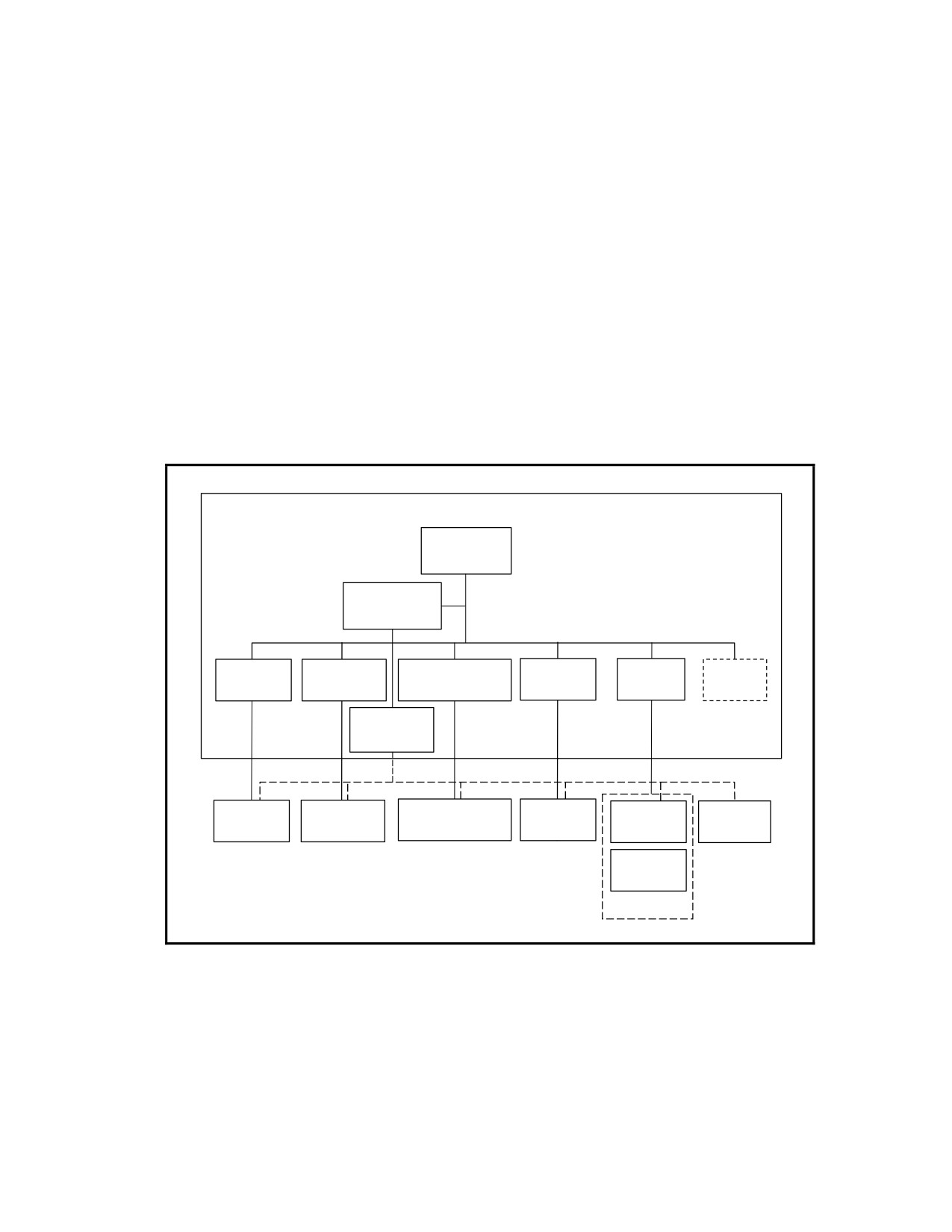
_________________________________________________________________________________Chapter 2
NATIONAL COMMAND AUTHORITY
2-20. The National Command Authority (NCA) consists of the State’s Presi-
dent, the Minister of Foreign Affairs, Minister of Public Information, Minis-
ter of Finance and Economic Affairs, Minister of the Interior, Minister of De-
fense, and other members selected by the President. Thus, the NCA exercises
overall control of the application of all instruments of national power in
planning and carrying out the national security strategy.
2-21. The President also appoints a Minister of National Security, who heads
the Strategic Integration Department (SID) within the NCA. The SID is the
overarching agency responsible for integrating all the instruments of na-
tional power under one cohesive national security strategy. The SID particu-
larly coordinates the plans and actions of the Ministry of Foreign Affairs,
Ministry of Public Information, Ministry of Finance and Economic Affairs,
Ministry of the Interior, and Ministry of Defense. (See Figure 2-1.)
NATIONAL COMMAND AUTHORITY
PRESIDENT
MINISTER OF
NATIONAL
SECURITY
MINISTER
MINISTER OF
MINISTER OF
MINISTER
MINISTER
OTHER
OF FOREIGN
PUBLIC
FINANCE AND
OF THE
OF
MEMBERS
AFFAIRS
INFORMATION
ECONOMIC AFFAIRS
INTERIOR
DEFENSE
STRATEGIC
INTEGRATION
DEPARTMENT
MINISTRY
MINISTRY OF
MINISTRY OF
MINISTRY
MINISTRY
FINANCE AND
OF THE
OTHER
OF FOREIGN
PUBLIC
OF
MINISTRIES
AFFAIRS
INFORMATION
ECONOMIC AFFAIRS
INTERIOR
DEFENSE
GENERAL
STAFF
SUPREME
HIGH COMMAND
Figure 2-1. National Command Authority
MINISTRY OF FOREIGN AFFAIRS
2-22. The Ministry of Foreign Affairs formulates, implements, and promotes
the foreign policy objectives of the State. It represents the State vis-à-vis for-
eign governments and international organizations; explains the State’s position
and problems throughout the world; endeavors to promote economic, cultural,
2-5
FM 7-100 _________________________________________________________________________________
and military relations; and attempts to foster support and cooperation from
other nations. In particular, the Ministry of Foreign Affairs cultivates useful
relationships with other nations in the region. It also strives for recognition
of the State as a participant in global affairs. (See Figure 2-2).
MINISTRY OF
FOREIGN
AFFAIRS
INTERNATIONAL
REGIONAL
DIPLOMATIC
PUBLIC
ECONOMIC
RELATIONS
AFFAIRS
ACTIVITIES
RELATIONS
RELATIONS
DIRECTORATE
DIRECTORATE
DIRECTORATE
DIRECTORATE
DIRECTORATE
Figure 2-2. Ministry of Foreign Affairs
INTERNATIONAL RELATIONS DIRECTORATE
2-23. The International Relations Directorate is responsible for fostering
positive relations with regional and extraregional countries. It establishes
cultural and educational exchanges with these countries in order to promote
these positive relationships. Exchanges may include but are not limited to
sporting events, educational aid to international students, traveling lecture
series, and performing arts shows. The International Relations Directorate is
not responsible for formulating diplomatic policy.
REGIONAL AFFAIRS DIRECTORATE
2-24. The Regional Affairs Directorate represents the State at regional con-
ferences, meetings, and political events. It attempts to foster support for the
State and cooperation from other regional actors.
DIPLOMATIC ACTIVITIES DIRECTORATE
2-25. The Diplomatic Activities Directorate is responsible for promoting dip-
lomatic relations within the region as well as external to the region. The di-
rectorate establishes diplomatic ties, negotiates treaties, and attempts to ex-
tend the political influence of the State.
PUBLIC RELATIONS DIRECTORATE
2-26. The Public Relations Directorate conducts information campaigns
(called public relations campaigns) within the region and external to the re-
gion. It produces public relations films and articles and coordinates events
that extol the virtues of the State.
ECOMONIC RELATIONS DIRECTORATE
2-27. The Economic Relations Directorate promotes the economic policy of
the State. Constantly looking for ways to improve the economic base of the
State, this directorate attempts to expand State markets and find procure-
ment sources for those materials the State cannot or does not produce. The
2-6
///////////////////////////////////////