FM 3-09 FIELD ARTILLERY OPERATIONS AND FIRE SUPPORT (APRIL 2014) - page 4
Chapter 3
SECTION III - FIRE SUPPORT EXECUTION
GENERAL CONSIDERATIONS
3-35. Execution is putting a plan into action by applying combat power to accomplish the mission (ADP 5-0).
Execution involves the performance of task necessary to effectively deliver fires. Success requires detailed
situational understanding necessary to assess progress and adapt the plan as necessary.
3-36. Strikes by fire support assets support maneuver forces in contact with the enemy and ensure the freedom
of other forces to maneuver throughout the supported commander’s area of operations. Fire support planners
must also retain sufficient assets to mass the effects of fires at critical times and places.
3-37. Fires typically produce destructive effects but nonlethal capabilities such as electronic attack can be
employed with little or no associated physical destruction. Electronic attack performs several functions to
support the commander’s operation. For example, during offensive tasks electronic attack resources may
concentrate on neutralizing enemy fire control, target acquisition, and intelligence-gathering systems.
CLEARANCE OF FIRES
3-38. The supported ground commander is responsible for the clearance of fires in his area of operations,
including the integration of fires with other airspace users. The commander establishes, or requests higher
headquarters establishment of control measures (such as graphic control measures, direct fire control measures,
airspace coordinating measures, and fire support coordination measures) that serve as a means of separating
units, synchronizing fires and maneuver, facilitating clearance of fires, and preventing fratricide. A graphic
control measure is a symbol used on maps and displays to regulate forces and warfighting functions (ADRP 6-
0). The commander may not employ indirect fires across boundaries without receiving clearance from the unit
into whose area of operations the fires will impact. He may employ direct fires across boundaries without
clearance at specific point targets that are clearly and positively identified as enemy. Commanders may consider
early coordination to also grant clearance for indirect fires against targets that are clearly and positively
identified as enemy. Airspace clearance remains necessary in any situation.
FIRE SUPPORT FOR OFFENSIVE TASKS
3-39. Fire support for offensive tasks involves attacking the enemy throughout the supported friendly
commander’s area of operations with massed area or precision indirect fires, rotary-and fixed-wing aircraft, and
electronic attack assets. The critical characteristics of offensive actions are the surprise, concentration, tempo,
and audacity needed to gain and maintain the initiative (see FM 3-90-1). Fire support execution must support
these characteristics and support the maneuver force in seizing and maintaining the initiative. Often, fire support
planners can support several characteristics of the offense with one fire support tactic or technique.
SURPRISE
3-40. Commanders can use fire support to achieve surprise by—
z
Rapidly and discreetly shifting fire support assets and/or shifting and massing the effects of fire
support. Shifting fire is fire delivered at constant range at varying deflections; used to cover the width
of a target that is too great to be covered by an open sheaf (JP 1-02).
z
Using fires to deceive the enemy as to the location of the main effort.
z
Using short duration, intense fires against key enemy functions at critical times.
z
Using military deception techniques to deceive the enemy as to the types, numbers, locations, and
capabilities of friendly fire support and target acquisition assets.
z
Changing fire support tactics.
z
Foregoing a preparation to achieve surprise in initiating an attack.
z
Achieving first round effects on the target.
3-12
FM 3-09
4 April 2014
Fire Support and the Operations Process
CONCENTRATION
3-41. Commanders can use fire support to support achieve concentration by—
z
Allocating fire support assets to support the decisive operation. This includes weapon systems, target
acquisition assets, observers, liaison teams, priority targets, and munitions.
z
Assigning priorities of fires and quick-fire channels.
z
Focusing information collection and target acquisition assets.
z
Concentrating fire support assets in support of one aspect of supported unit decisive or shaping
operations for brief periods.
z
Massing fires on choke points and key terrain to canalize, slow, and block the enemy’s movements.
TEMPO
3-42. Commanders can use fire support to support enhance/maintain the tempo of the offense—
z
Using a decentralized organization for combat and decentralized fire support planning and fire
control methods to facilitate rapid, flexible execution of fires and immediately available dedicated
fires to a designated ground force.
z
Providing fires to slow the enemy’s retreat during the pursuit.
z
Using on-order missions to facilitate transition to subsequent phases and branches or a new
operation.
z
Providing fires in support of shaping operations that complement the decisive operation, set the stage
for rapid transition to the next phase or new operation, and create new opportunities for maneuver.
z
Developing a thorough sustainment plan that properly anticipates potential culminating points for the
fire support structure.
z
Ensuring fire support coordination measures are planned to enhance the speed of the operation.
z
Providing fires to stop reinforcements; use smoke to delay and disrupt the enemy retreat.
AUDACITY
3-43. Commanders can use fire support to support the concept of audacity by—
z
Aggressively applying firepower.
z
Making well thought-out, risk-taking decisions in the use of fire support assets.
z
Planning fires on the flanks of the supported unit’s advance to prevent counterattack; consider use of
scatterable mines to seal flank avenues of approach.
z
Limiting the firepower allocated to shaping operations to weight the decisive operation.
z
Placing fire support assets well forward and moving them closely behind lead maneuver units.
z
Using field artillery raids to strike high-payoff targets.
FIRE SUPPORT FOR DEFENSIVE TASKS
3-44. Successful defenses are aggressive. They maximize firepower, protection, and maneuver to defeat enemy
forces and regain the initiative. Successful defensive operations share the following characteristics: preparation,
security, disruption, massing effects, flexibility, maneuver, and operations in depth (see FM 3-90-1).
PREPARATION
3-45. The defender often has the opportunity to select the defensive terrain, and has time to prepare his
defenses. Fire support planners must make maximum use of any preparation time available to plan and
coordinate supporting fires by—
z
Developing the fire support plan to include:
Planning indirect fires in support of the barrier and/or obstacle plan.
Planning defensive fires in support of patrols, convoys, or quick reaction forces.
4 April 2014
FM 3-09
3-13
Chapter 3
Planning targets, observer positioning, triggers, and fires in support of all engagement areas for
all phases of the defensive operation, to include each counterattack option of the striking force.
Recommending fire support coordination measures to support each phase of the defensive
operation, to include all planned counterattack options.
Planning targets on avenues of approach to disrupt enemy attacks by striking the enemy on his
approach and during his assault.
Coordinating with the supported command’s fires cell for close air support and Army aviation
close combat attacks.
z
Preparing observation posts, marking triggers, and studying the terrain on which the battle will be
fought by forward observers and fire support teams.
Ensuring that forward positioned observers are resourced with adequate security, mobility, and
situational understanding.
z
Integrating information sources to identify potential targets.
z
Preparing engagement areas to facilitate fires.
z
Preparing and hardening artillery and target acquisition positions.
z
Conducting rehearsals on the actual terrain.
SECURITY
3-46. Fire support must complement and support all security forces and unit protection plans by—
z
Fires to:
Support security forces and actions in the brigade support area.
Engage enemy indirect fire systems.
Support deception operations.
Suppress and obscure enemy overwatch positions.
Support friendly strong points.
z
Target acquisition coverage of critical friendly zones.
z
Direct observation of obstacles and engagement areas.
DISRUPTION
3-47. Fire support plays a key role in disrupting an attacker’s tempo and synchronization by—
z
Planning, identifying, defining, and engaging high-payoff targets as they are located.
z
Employing fires to neutralize and destroy enemy artillery and mortar, target acquisition, command
and control nodes, and logistics systems.
z
Disrupting enemy sustainment efforts and troop movements.
z
Ensuring integration of fires in support of obstacles.
z
Assisting in defeating enemy reconnaissance forces, separating enemy forces, isolating enemy units,
and attacking or disrupting enemy systems.
z
Employing indirect fires and obscurants in support of counterattacks designed to defeat the enemy
before he can consolidate any gains.
z
Conducting integrated fire support (including electronic attack) in synchronization with maneuver.
z
Employing indirect fires and coordinating for electronic attack to disrupt enemy’s ability to control
his forces such as to reorganize for another attack or prepare a coordinated defense.
MASSING EFFECTS
3-48. Fire support plays an essential role in a unit’s ability to mass overwhelming combat power at critical
places and times. Massed fires—
z
Gain maximum efficiency and effectiveness including fires to suppress enemy direct and indirect fire
systems.
3-14
FM 3-09
4 April 2014
Fire Support and the Operations Process
z
Assist a defender to repel an assault.
z
Support the rapid destruction of an enemy force when it is most vulnerable or when it is on the verge
of gaining a significant advantage.
z
Allow a commander to accept risks by using minimal maneuver forces in one area in order to weight
another area.
z
Create an important demoralizing psychological effect that is not achieved from smaller-scale fires.
z
When used in depth, create gaps or separations in attacking units, disrupt enemy movement tempo,
and result in significant attrition of enemy forces before they close with friendly forces.
FLEXIBILITY
3-49. Fire support planning and execution must address the need for flexibility in defensive operations by—
z
Allocating initial priority of cannon field artillery fires to forward security forces.
z
Quickly shifting fires to critical points throughout the area of operations.
z
Executing successive or concurrent programs or fire plans.
z
Shifting fires from support of the defense to support the counterattack and offense.
z
Coordinating and synchronizing air support on known, suspected, and likely enemy locations.
MANEUVER
3-50. Fire support planning and execution supports maneuver in defensive operations by—
z
Conducting fires on known enemy assembly areas.
z
Delaying the movement of enemy reserves.
z
Providing fires to assist friendly maneuver forces in moving and disengaging.
z
Separating the enemy dismounted infantry from his armor.
z
Transitioning cannon field artillery fires to support the main effort.
z
Coordinating all means of available fire support to delay, destroy, or limit the enemy’s advance, and
to weight the attack(s) of the striking force in a mobile defense.
z
Supporting the obstacle plan by placing fires in front of, on top of, to the side of, and behind
obstacles to maximize their effect as combat multipliers.
z
Providing fires to support disengagement of maneuver elements and their repositioning to subsequent
battle positions.
z
Channelizing enemy movement into engagement areas.
OPERATIONS IN DEPTH
3-51. Fires attack the enemy before he enters close combat. These fires are planned to -
z
Disorganize, delay, and attrit the enemy.
z
Disrupt the enemy reconnaissance elements.
z
Impair the enemy vision by causing him to button up in his armored vehicles.
z
Support scouts by screening their movement with smoke and suppressing enemy units engaging the
scouts.
z
Conduct fires on known enemy assembly areas.
z
Coordinate for electronic attack to degrade the enemy’s ability to control forces.
FIRE SUPPORT FOR STABILITY TASKS
3-52. Offensive, defensive, and stability tasks often occur in the same operational area. This requires close
coordination to both coordinate ongoing activities to create desired effects and avoid undesired effects. There is
also a requirement for a thorough understanding of when the escalation of force is necessary and when it might
be counterproductive.
4 April 2014
FM 3-09
3-15
Chapter 3
3-53. Though highly effective for their intended purpose, lethal capabilities may not always be suitable. For
example, during stability tasks, the application of lethal fires is normally greatly restricted, making the use of
nonlethal capabilities the dominant feasible option. The considerations for use of nonlethal capabilities in
targeting should not pertain to only specific phases or missions, but should be integrated throughout the
operation. Escalation of force measures can be established in order to identify hostile intent and deter potential
threats at checkpoints, entry control points and in convoys. Such measures remain distinct from other use of
force guidance such as fire support coordination measures and are intended to protect the force, minimize the
use of force against civilians while not interfering with self-defense if attacked by adversaries.
3-54. For more on stability tasks see FM 3-07 and ADP/ADRP 3-07/3-09.
FIRE SUPPORT IN DEFENSE SUPPORT OF CIVIL AUTHORITIES
GENERAL CONSIDERATIONS
3-55. Defense Support of Civil Authorities is support provided by U.S. Federal military forces, Department of
Defense civilians, Department of Defense contract personnel, Department of Defense component assets, and
National Guard forces (when the Secretary of Defense, in coordination with the governors of the affected States,
elects and requests to use those forces in Title 32, United States Code, status) in response to requests for
assistance from civil authorities for domestic emergencies, law enforcement support, and other domestic
activities, or from qualifying entities for special events. Also called DSCA. Also known as civil support. (DOD
Directive 3025.18). Defense Support of Civil Authorities tasks stress the employment of nondestructive means
to save lives, alleviate suffering, and protect property. Domestic operations are operations in the homeland - the
physical region that includes the continental United States, Alaska, Hawaii, United States possessions and
territories, and surrounding territorial waters and airspace (JP 3-28). Domestic operations are constrained by
various laws to a greater degree, in comparison to the Law of Land Warfare and the Hague and Geneva
Conventions.
3-56. Commanders gauge unit readiness for Defense Support of Civil Authorities missions by assessing
proficiency in 3 warfighting functions: mission command, sustainment, and protection. The requirement to
deploy into a domestic operational environment—often with little warning—and to operate with joint and
interagency partners requires mission command that can adapt systems and techniques for a noncombat,
civilian-led structure.
SPECIAL CONSIDERATIONS FOR FIRE SUPPORT
SIMULTANEOUS OPERATIONS AND DEPTH
3-57. Simultaneous operations conducted throughout the area of operations disrupt enemy decision cycles and
overload the enemy. The purpose of simultaneous attack in depth is to achieve a synergy that paralyzes enemy
forces, confuses their decision making cycle, preventing them from reacting appropriately and inducing their
early culmination.
SYNCHRONIZATION
3-58. Synchronization is the arrangement of military actions in time, space, and purpose to produce maximum
relative combat power at a decisive place and time (JP 2-0). It is the ability to execute multiple related and
mutually supporting tasks in different locations at the same time, producing greater effects than executing each
in isolation. For example, synchronization of information collection, obstacles, direct fires, and indirect fires
results in the destruction of an enemy formation. When conducting offensive tasks, synchronizing forces along
multiple lines of operations temporarily disrupts the enemy organization and allows for exploitation.
3-59. Mission command networks greatly enhance the potential for synchronization. They do this by allowing
commanders to quickly understand an operational environment and communicate their commander’s intent.
Subordinate and adjacent units use that common understanding to synchronize their actions with those of other
3-16
FM 3-09
4 April 2014
Fire Support and the Operations Process
units without direct control from the higher headquarters. Mission command networks do not guarantee
synchronization; however, they provide a powerful tool for leaders to use in synchronizing their efforts.
3-60. Commanders determine the degree of control necessary to synchronize their operations. They balance
synchronization with agility and initiative, never surrendering the initiative for the sake of synchronization.
Rather, they synchronize activities to best facilitate mission accomplishment. Too much control can limit the
initiative of subordinates and undermine mission command.
FIRES IN SUPPORT OF THE DECISIVE OPERATION
3-61. The decisive operation is the operation that directly accomplishes the mission (ADRP 3-0). Fires
normally contribute to the overall effect of maneuver but the decisive operation need not be a close operation.
Examples of fires as the decisive operation might include destroying a particular target through the use of
cannon or rocket/missile-delivered precision munitions or air strikes by manned or unmanned aircraft.
FIRES IN SUPPORT OF SHAPING OPERATIONS
3-62. A shaping operation is an operation at any echelon that creates and preserves conditions for the success
of the decisive operation through effects on the enemy, other actors, and the terrain (ADRP 3-0). Simultaneous
attacks in depth, executed at increasingly longer ranges and with terminally guided munitions, are key elements
for BCTs, divisions, and corps in shaping the operational environment and accelerating the enemy’s defeat. In
both offense and defense, shaping operations are conducted to isolate, immobilize, and weaken the enemy in
depth, using fire, maneuver, or a combination of the two. Fires in support of shaping operations may be used to
limit the enemy’s ability to shift forces to meet attacking friendly maneuver forces and to sustain the
momentum of the attack. Fires in support of shaping operations disrupt or destroy the enemy’s attacking
echelons and fire support, mission command, and logistic infrastructure. They are intended to reduce the
enemy’s combat strength and rate of arrival in the close combat area to a level manageable by BCT and
battalion task force commanders.
3-63. As part of shaping operations, fire support can improve friendly force ratios, protect the force, and
provide for successful maneuver. Commanders use fire support to strike enemy maneuver units, indirect fire
systems, observation units, control and communications facilities, target acquisition assets, and
ammunition/logistics sites. Similarly, fire support in shaping operations can interdict enemy maneuver forces,
indirect fire systems, surface-to-surface missile systems, and logistic units/facilities; and limit an opponent’s
freedom of action while simultaneously enhancing friendly options.
3-64. Field artillery systems are fully capable of conducting long-range strikes with fires throughout the
supported force area of operations and massing their effects under all weather conditions, day or night. They
provide joint and land component commanders the capability to attack high-payoff targets out to the maximum
range of the respective weapons system, when and where required.
FIRE SUPPORT FOR CLOSE COMBAT
3-65. Close combat is warfare carried out on land in a direct-fire fight, supported by direct and indirect fires,
and other assets (ADRP 3-0). Distances between combatants may vary from several thousand meters to hand-to-
hand fighting. Fire support for close combat is undertaken to win the current battle or engagement. Close
combat is frequent during urban operations. Particularly during counterinsurgency and/or stability operations
these attacks may be ambushes of convoys, patrols or quick reaction forces that occur in built up areas. The use
of precision munitions can increase the likelihood of effective fires while reducing the risk of fratricide and
limiting collateral damage. Counterfire is used against enemy indirect fire systems to preserve friendly fighting
forces and their combat capabilities. Counterfire gives supported elements the freedom to maneuver, while
obscurants screen friendly movements and illuminating fires expose enemy formations at night. At BCT level,
close support fires in close combat are normally the main concern of unit mortars, close air support, and organic
and reinforcing field artillery battalions whose fires may be further augmented by fires from a FAB. Close
support is that action of the supporting force against targets or objectives which are sufficiently near the
supported force as to require detailed integration or coordination of the supporting action with the fire,
movement, or other actions of the supported force (JP 3-31). Commanders and planners must ensure that
4 April 2014
FM 3-09
3-17
Chapter 3
supported forces engaged in close combat receive an appropriate share of available fire support. Plans must also
include provision of fire support for security forces and reserves upon commitment.
FIRES IN SUPPORT OF SUSTAINING OPERATIONS
3-66. A sustaining operation is an operation at any echelon that enables the decisive operation or shaping
operation by generating or maintaining combat power (ADRP 3-0). Fire support for sustaining operations is
conducted to ensure that friendly forces retain freedom of action to sustain combat forces. Fire support must be
responsive to any threat. Close air support, field artillery, and mortars are normally the fire support assets
available for support of sustaining operations. Army attack aviation may also be available.
3-67. Usually, fire support will be provided to sustainment units on a contingency basis. There may, however,
be times when field artillery is positioned in a supported command’s sustainment area to prepare against a
pending threat. Fire support assets located in such sustainment areas do not constitute fire support in reserve but
are committed field artillery. Considerations concerning fire support for sustainment operations—
z
Army aviation or close air support may be the most responsive fire support asset for use in
sustainment areas when units are widely separated and range to target is a factor.
z
Fire support coordination measures must be used to protect friendly units.
z
When a BCT is committed against Level III threats, fire support will usually consist of that brigade’s
field artillery battalion.
z
Target acquisition and sensor management assets should be an integral part of the fire support plan
for sustainment area defense.
z
Consider the use of critical friendly zones.
FIRE SUPPORT CONSIDERATIONS FOR MULTINATIONAL OPERATIONS
3-68. Multinational operations is a collective term to describe military actions conducted by forces of two or
more nations, usually undertaken within the structure of a coalition or alliance (JP 3-16). To maximize fire
support, the multinational force must integrate joint and multinational systems and procedures. Special
arrangements can include communications, language requirements, liaison personnel, multinational transition
teams, and interoperability procedures.
SECTION IV- FIRE SUPPORT ASSESSMENT
MEASURES OF PERFORMANCE AND EFFECTIVENESS
3-69. Assessment involves a comparison of forecasted outcomes to actual events using measures of
performance and measures of effectiveness. They often require readjustment as the situation changes and
objectives evolve. The commander, FSCOORD, chief of fires/fire support officer, and fires cell at each echelon
determine fire support related measures of performance and measures of effectiveness during planning. They
consider them as early as mission analysis, and include them and related guidance in commander and running
estimates. Assessment helps the commander determine progress toward accomplishing tasks and achieving
objectives and the end state. It includes evaluating the operation against measures of performance and measures
of effectiveness.
3-70. A measure of performance is a criterion used to assess friendly actions that is tied to measuring task
accomplishment (JP 3-0). Measures of performance are criteria that determine whether the fire support tasks or
actions were performed as the commander intended. They confirm or deny that the fire support structure and its
subordinate elements are doing things right. For instance a measure of performance might ask, “Were fire
support weapons systems employed as the commander intended on the planned target?” A planned target is a
target that is known to exist in the operational environment, upon which actions are planned using deliberate
targeting, creating effects which support the commander’s objectives. There are two types of planned targets:
scheduled and on-call (JP 3-60).
3-18
FM 3-09
4 April 2014
Fire Support and the Operations Process
3-71. A measure of effectiveness is a criterion used to assess changes in system behavior, capability, or
operational environment that is tied to measuring the attainment of an end state, achievement of an objective, or
creation of an effect (JP 3-0). Measures of effectiveness focus on the results or consequences of friendly fire
support action taken. For the commander, FSCOORD, and chief of fires, they answer the question: “Is the fire
support structure doing the right things? Or are additional or alternative actions required?” The primary purpose
of a measure of effectiveness is to assess progress. For instance a measure of effectiveness might ask, “Did the
expected physical or functional damage to the target occur or did the enemy change his behavior?”
FIRES RUNNING ESTIMATE
3-72. A running estimate is the continuous assessment of the current situation used to determine if the current
operation is proceeding according to the commander’s intent and if planned future operations are supportable
(ADP 5-0). The fires cell at each echelon analyzes the current situation in terms of the mission variables and
prepares the fires running estimate. The fires cell continuously conducts assessment of the impact of new
information on the conduct of fire support for the operation, updating the estimate and determining if
adjustments to fire support for the operation are required. Examples of the factors that may be considered in the
fires running estimate include—
z
The task organization of subordinate forces and their missions.
z
The status of field artillery resources, including cannons and MLRS launchers, ammunition, and
target acquisition assets.
z
The availability of other fire support resources, including mortars, naval gunfire, and tactical air
support.
z
In the attack, the enemy dispositions, the degree of protection afforded the enemy, and the number of
phases. These will affect the allocation of fire support resources to subordinate units.
z
In the defense, the mission of the covering force, the location of the main battle area, the plans for a
counterattack.
z
Courses open to the enemy artillery commander, especially his most probable course of action. These
are derived from the intelligence estimate and knowledge of enemy artillery doctrine. Consideration
of this factor results in—
The probable enemy artillery plan.
Enemy artillery vulnerabilities.
Any information requirements on enemy artillery that may have significant influence on the
tasking of weapons locating sensors.
The allocation of resources, weapons, and munitions for counterfire.
The recommended counterfire priorities for each phase of the battle.
The identification of new high-payoff targets.
The availability and condition of roads, trails, and likely position areas. This leads to the
coordination of movement and position areas with the operations staff.
Ammunition consumption and resupply rates, re-positioning requirements, and priority of
sustainment.
Changes to survey and meteorological conditions.
3-73. Commanders typically empower their FSCOORD, chief of fires/fire support officer and fires cell to make
adjustments to fire support for the operation as needed. The commander, FSCOORD, and chief of fires/fire
support officer and fires cell monitor the current situation for unexpected fire support successes, failures, or
enemy actions that can prevent the operation from progressing toward the desired end state. As they assess
progress they look for opportunities, threats and acceptable progress. They also accept risks, seize opportunities,
and mitigate threats. Throughout the operation the commander, advised by the FSCOORD/chief of fires/fire
support officer, visualizes, describes, and directs changes to fire support for the operation.
3-74. The chief of fires at the division and corps, and the senior fire support officer at the brigade and battalion
level, is responsible for integrating targeting beginning with the MDMP and maintaining that responsibility
throughout the operations process for the fires warfighting function. This analysis includes—
4 April 2014
FM 3-09
3-19
Chapter 3
z
Higher headquarters mission specified and implied tasks.
z
Fires running estimate to identify capabilities and limitations including the status of—
Field artillery weapons.
Field artillery ammunition.
Field artillery target acquisition radars.
Close air support and other related fixed wing support.
Other assets allocated from higher headquarters.
z
Field artillery and mortar survey support requirements.
z
Established/recommended fire support coordination measures.
z
Impact of rules of engagement on fire support.
z
Area of operations geometry, terrain, and weather’s impact on fires (such as smoke, close air support,
air interdiction, naval surface fire support, laser designation and range finding), both friendly and
enemy.
z
Reconnaissance and surveillance support and requirements.
z
Initial high-payoff target list.
z
Fire support input to the intelligence preparation of the battlefield analysis.
3-20
FM 3-09
4 April 2014
Chapter 4
Fire Support Coordination and Other Control Measures
Commanders are responsible for the clearance of fires. Clearance of fires is the process
by which the supported commander ensures that fires or their effects will have no
unintended consequences on friendly units or the scheme of maneuver. The center of
this process is in the current operations cell. Clearance of fires may be assisted through a
staff process, control measures, embedded in automation control systems, or through
active or passive recognition systems. The FSCOORD, chief of fires, fire support officer,
and fires cell plan and coordinate all fire support impacting in the supported
commander’s area of operations, including that fire support requested by the supported
unit. Airspace coordination, while not specifically a part of the clearance of fires, is
assisted through the staff process. Fire support planners ensure that fire support will not
jeopardize troop safety, will interface with other fire support means, will ensure the most
responsive fires possible, and/or will not disrupt adjacent unit operations. Control
measures are vital to the successful clearance of fires by the supported commander,
FSCOORD, chief of fires, fire support officer and fire cell planners. Section I begins the
chapter by describing fire support coordination measures. Section II describes boundary,
phase line and other key considerations for fire support. Section III closes the chapter
with a discussion of target acquisition control and airspace coordinating measures.
Note: The airspace coordinating and fire support coordination measure graphics depicted in this
chapter are examples for illustrative purposes only. The authority for constructing such graphics is
Army doctrine reference publication (ADRP) 1-02, JP 3-09, JP 3-52 and Military Standard (MIL-
STD) 2525C.
SECTION I - FIRE SUPPORT COORDINATION MEASURES
4-1. A fire support coordination measure is a measure employed by commanders to facilitate the rapid
engagement of targets and simultaneously provide safeguards for friendly forces
(JP
3-0). Fire support
coordination measures govern the employment of artillery and mortars, close combat attack and interdiction
attack by Army aviation rotary-wing aircraft, fires from unmanned aircraft, and close air support and air
interdiction by fixed-wing aircraft. Locations and implementing instructions for fire support coordination
measures are disseminated electronically by message, database update, and/or overlay through command and
fire support channels, to higher, lower, and adjacent maneuver and supporting units.
4-2. The establishment or change of a fire support coordination measure is typically initiated through the
operations cell and ultimately approved by the establishing commander. Fire support coordination measures
enhance the expeditious engagement of targets; protect forces, populations, critical infrastructure, and sites of
religious or cultural significance; and set the stage for future operations. Commanders position and adjust fire
support coordination measures consistent with the operational situation and in consultation with superior,
subordinate, supporting, and affected commanders. The operations cell informs coordination elements of the
change and effective time. Conditions that dictate the change of fire support coordination measures are also
coordinated with the other agencies and components as appropriate. As conditions are met, the new fire support
coordination measure effective time can be projected and announced. Following direction to execute the
change, the current operations cell should confirm with all liaison elements that the fire support coordination
measure changes have been disseminated. This ensures that affected units are aware of new fire support
4 April 2014
FM 3-09
4-1
Chapter 4
coordination measure locations and associated positive control measures are being followed, thus reducing the
risk of fratricide.
PERMISSIVE FIRE SUPPORT COORDINATION MEASURES
4-3. Permissive fire support coordination measures facilitate the attack of targets by reducing the coordination
necessary for the clearance of fires. Fires must be cleared with both terrain owners and other airspace users. By
establishing a fire support coordination line close-in, yet at sufficient depth so as to not limit high-tempo
maneuver, commanders ease the coordination requirements for engagement of targets within their areas of
operations by forces that may not be under their direct control such as during the conduct of Army aviation
interdiction attack by rotary-wing aircraft, or air interdiction by fixed wing aircraft. The commander adjusts the
location of the fire support coordination line as required to keep pace with operations. In high-tempo maneuver
operations, the fire support coordination line may change frequently.
COORDINATED FIRE LINE
4-4. A coordinated fire line is a line beyond which conventional and indirect surface fire support means may
fire at any time within the boundaries of the establishing headquarters without additional coordination. The
purpose of the coordinated fire line is to expedite the surface-to-surface attack of targets beyond the coordinated
fire line without coordination with the ground commander in whose area the targets are located (JP 3-09). A
brigade or division commander or equivalent, usually establishes the coordinated fire line but it can also be
established, especially in amphibious operations, by a maneuver battalion. It is located as close to the
establishing unit as possible without interfering with the maneuver forces. There is no requirement for the
coordinated fire line to be placed on identifiable terrain. However, additional considerations include the limits
of ground observation, the location of the initial objectives in the offense, and the requirement for maximum
flexibility in both maneuver and the delivery of supporting fires. A higher headquarters may consolidate
subordinate coordinated fire lines.
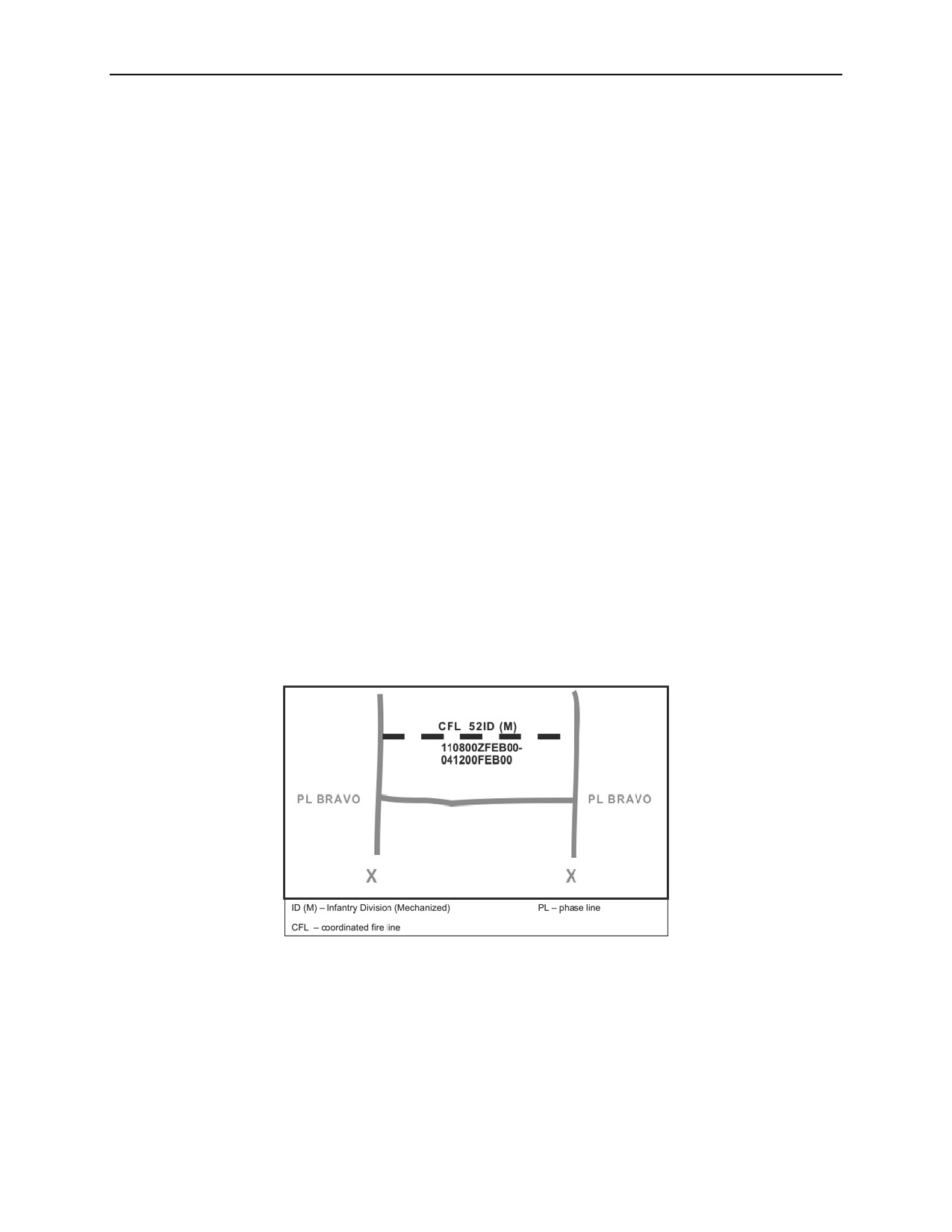
4-5. A dashed black line, with “CFL” followed by the establishing headquarters above the line and the effective
date-time group below the line provides graphic portrayal of the coordinated fire line (figure 4-1). Locations for
coordinated fire lines are disseminated by message and/or overlay through maneuver and fire support channels
to higher, lower, adjacent maneuver, and supporting units.
Figure 4-1. Coordinated fire line example
FIRE SUPPORT COORDINATION LINE
4-6. A fire support coordination line is a fire support coordination measure that is established and adjusted by
appropriate land or amphibious force commanders within their boundaries in consultation with superior,
subordinate, supporting, and affected commanders. Fire support coordination lines facilitate the expeditious
attack of surface targets of opportunity beyond the coordinating measure. A fire support coordination line does
4-2
FM 3-09
4 April 2014
Fire Support Coordination and Other Control Measures
not divide an area of operations by defining a boundary between close and deep operations or a zone for close
air support. The fire support coordination line applies to all fires of air, land, and sea-based weapon systems
using any type of ammunition. Forces attacking targets beyond a fire support coordination line must inform all
affected commanders in sufficient time to allow necessary reaction to avoid fratricide. Supporting elements
attacking targets beyond the fire support coordination line must ensure that the attack will not produce adverse
effects on, or to the rear of, the line. The appropriate land or amphibious force commander controls all air-to-
ground and surface-to-surface attack operations short of a fire support coordination line. This control is
exercised through the operations staff or with pre-designated procedures. The fire support coordination line
should follow well-defined terrain features. Coordination of attacks beyond the fire support coordination line is
especially critical to commanders of air, land, and special operations forces. In exceptional circumstances, the
inability to conduct this coordination will not preclude the attack of targets beyond the fire support coordination
line. However, failure to do so may increase the risk of fratricide and could waste limited resources (JP 3-09).
4-7. By establishing a fire support coordination line close-in, yet at sufficient depth so as to not limit high-
tempo maneuver, commanders ease the coordination requirements for engagement of targets within their areas
of operations by forces that may not be under their direct control such as during the conduct of Army aviation
interdiction attack by rotary-wing aircraft, or air interdiction by fixed wing aircraft. The commander adjusts the
location of the fire support coordination line as required to keep pace with operations. In high-tempo maneuver
operations, the fire support coordination line may change frequently. Current technology and collaboration tools
between the elements of the joint force determine the times required for changing the fire support coordination
line. The joint force commander should establish a time standard in his guidance for shifting fire support
coordination lines.
4-8. The fire support coordination line is a term oriented to air-land operations and is normally located only on
land, however in certain situations, such as littoral areas, the fire support coordination line may affect both land
and sea areas. If possible, the fire support coordination line should follow well-defined terrain features to assist
identification from the air. The commander, landing force after coordination with the commander, amphibious
task force normally establishes the fire support coordination line for amphibious operations. Changes to the fire
support coordination line require notification of all affected forces within the area of operations and must allow
sufficient time for these forces and/or components to incorporate the fire support coordination line change.
Current technology and collaboration tools between the elements of the joint force determine the times required
for changing the fire support coordination line. The joint force commander should establish a time standard in
his guidance for shifting fire support coordination lines. Whenever possible; restrictive measures are employed
by commanders to enhance the protection of friendly forces operating beyond the fire support coordination
line—measures such as restrictive fire areas and no-fire areas.
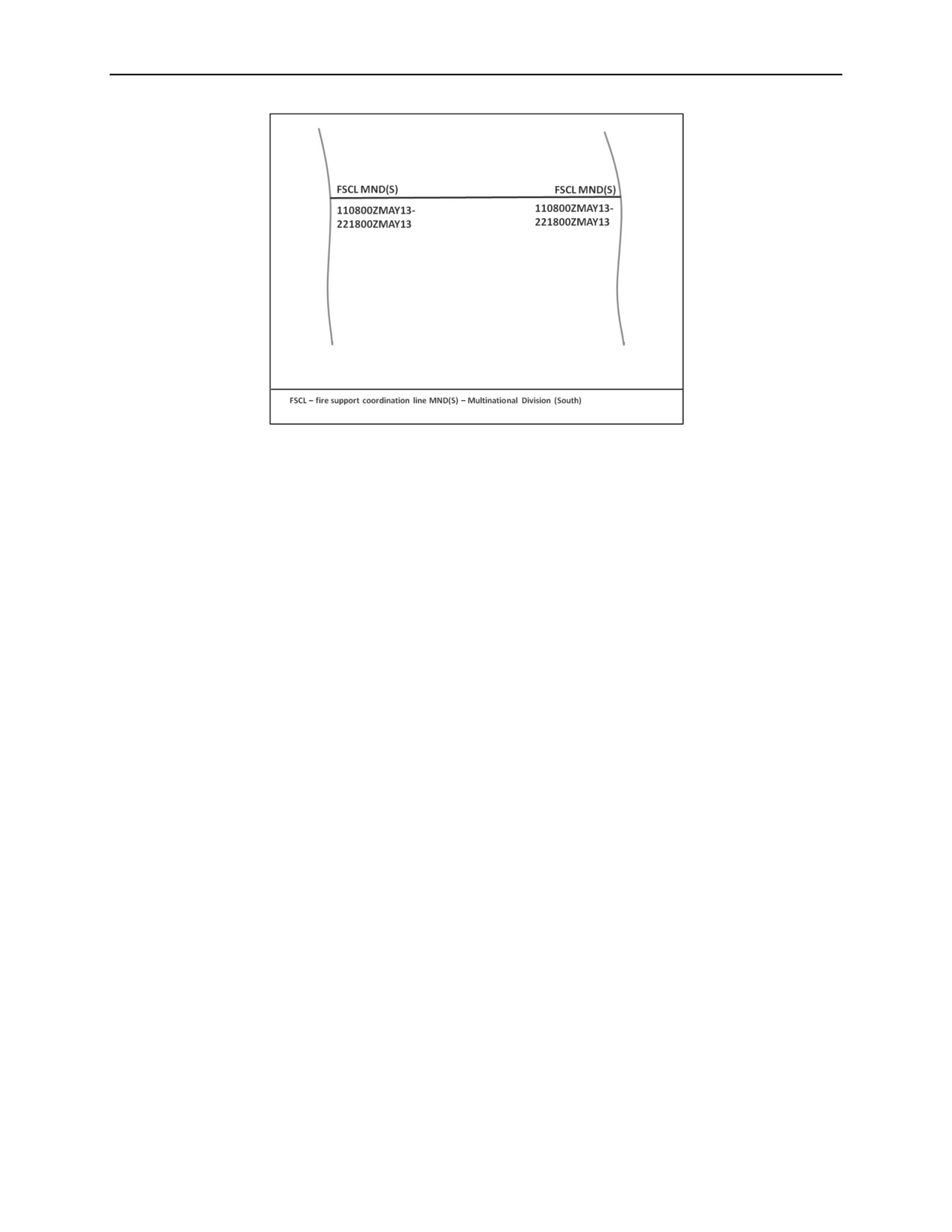
4-9. A solid black line extending across the assigned areas of the establishing headquarters provides the
graphic portrayal of the fire support coordination line (see figure 4-2 on page 4-4). The letters “FSCL” followed
by the establishing headquarters are annotated above the line, and the effective date-time-group below the line.
Fire support coordination lines do not have to follow traditional straight-line paths. Positioning the fire support
coordination line on terrain identifiable from the air is a technique that may further assist in fratricide
prevention. Curved and/or enclosed fire support coordination lines have applications in joint operations
conducted in non-contiguous areas of operation.
4 April 2014
FM 3-09
4-3
Chapter 4
Figure 4-2. Fire support coordination line example
4-10. The decision on where to place or even whether to use a fire support coordination line requires careful
consideration. If used, its location is based on estimates of the situation and concept of operations. The
establishment of a fire support coordination line does not create a free-fire area beyond the fire support
coordination line. Engagements beyond the fire support coordination line must be consistent with the
establishing commander’s priorities, timing, and desired effects and deconflicted whenever possible with the
supported headquarters. Location of enemy forces, anticipated rates of movement, concept and tempo of the
operation, organic weapon capabilities such as wide-area munitions, or those with delayed effects, and other
factors are all considered by the commander. The fire support coordination line is normally positioned closer to
the forward line of own troops in the defense than in the offense; however, the exact positioning depends on the
situation. Placing the fire support coordination line at greater depths will typically require support from higher
organic headquarters and other supporting commanders. Also, when the fire support coordination line is
positioned at greater depth, there is greater requirement for detailed coordination with the establishing
commander and can slow the expeditious clearance of fires short of the fire support coordination line.
4-11. Air strikes short of the fire support coordination line, both close air support and air interdiction, must be
under positive or procedural control to ensure proper clearance of joint fires—for example, joint terminal attack
controllers or forward air controllers (airborne). Land commanders must consider the need for extra control
measures.
4-12. The establishing commander adjusts the location of the fire support coordination line as required to keep
pace with operations. In high-tempo maneuver operations, the fire support coordination line may change
frequently. A series of disseminated
“on-order” fire support coordination lines will help accelerate the
coordination required. The establishing commander quickly transmits the change to higher, lower, adjacent, and
supporting headquarters to ensure that appropriate controlling agencies coordinate engagement operations.
4-13. Varying capabilities for acquisition and engagement may exist among adjacent commanders in a
multinational operation. Corps and division level commanders may establish a fire support coordination line to
support their operations. Layered fire support coordination lines and multiple, separate, noncontiguous corps
and/or Marine Expeditionary Force fire support coordination lines positioned at varying depths create a
coordination and execution challenge for supporting commanders (for example, tracking effective times, lateral
boundaries, and multiple command guidance). In cases such as these, when the components share a mutual
boundary, the joint force commander or joint force land component commander may consolidate the operational
requirements of subordinates to establish a single fire support coordination line. This fire support coordination
line may be noncontiguous to reflect the varying capabilities of subordinate commands. When possible a single
fire support coordination line best facilitates air ground operations synchronization.
4-4
FM 3-09
4 April 2014
Fire Support Coordination and Other Control Measures
FREE-FIRE AREA
4-14. A free-fire area is a specific area into which any weapon system may fire without additional
coordination with the establishing headquarters (JP 3-09). Where both surface-to-surface fires and aircraft
emergency munitions jettison share a free-fire area, consider establishing an airspace coordination area to assist
in deconfliction. Only the military commander with jurisdiction over the area (usually, a division or higher
commander) may establish a free-fire area. Preferably, the free-fire area should be located on identifiable
terrain; however, grid coordinates or the Global Area Reference System may be used to designate the free-fire
area.
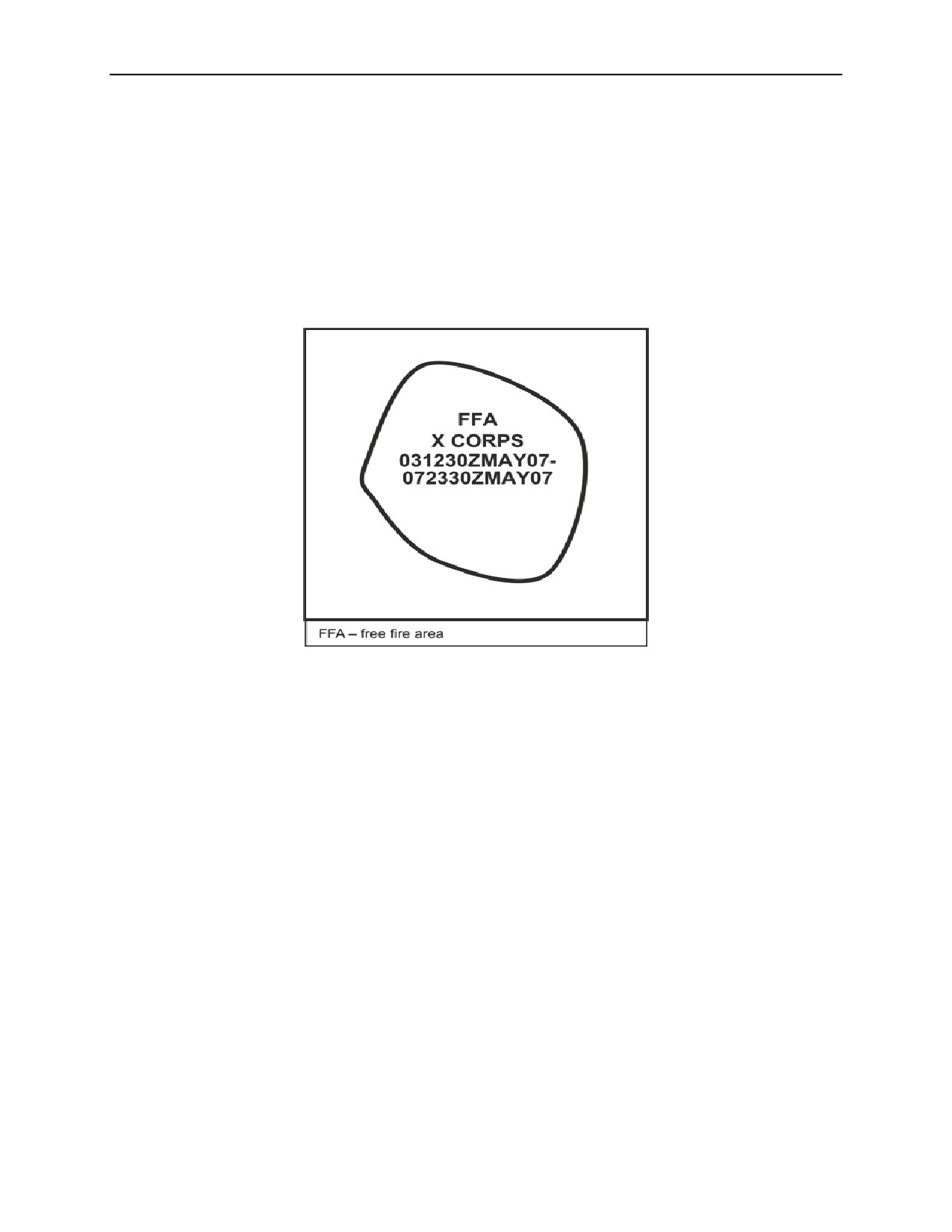
4-15. The free-fire area is graphically portrayed (figure 4-3) by a solid black line defining the area and the
letters “FFA” within, followed by the establishing headquarters and the effective date-time-group (ADRP 1-02).
Figure 4-3. Free-fire area example
KILL BOX
4-16. A kill box is a three-dimensional area used to facilitate the integration of joint fires. (JP 3-09).
4-17. When established, the primary purpose of a kill box is to allow lethal attack against surface targets
without further coordination with the establishing commander and without terminal attack control. When used
to integrate air-to-surface and surface-to-surface indirect fires, the kill box will have appropriate restrictions.
The goal is to reduce the coordination required to fulfill support requirements with maximum flexibility, while
preventing fratricide. A kill box will not be established for close air support missions. If a close air support
mission is required within an established kill box, the portion of the kill box requiring detailed integration
should be closed.
4-18. A kill box facilitates the expeditious air-to-surface lethal attack of targets (such attacks can be augmented
with surface-to-surface indirect fires). A “blue” kill box permits air-to-surface fires within its boundaries and
typically extends from the ground to a maximum altitude; a “purple” kill box within its boundaries typically
specifies a minimum and maximum altitude. The “purple” kill box allows indirect fire trajectories to pass above
the maximum altitude or below the minimum altitude. Altitude is the vertical distance of a level, a point or an
object considered as a point, measured from mean sea level (ATP 3-09.30).
4-19. Kill boxes can augment traditional fire support coordination measures such as fire support coordination
lines and coordinated fire lines. They help the commander focus the effort of air interdiction and indirect fire
assets. Fire support coordination measures are not mutually exclusive, so a kill box could contain other
measures within its boundaries to include no-fire areas, restriction operations areas, or airspace coordination
4 April 2014
FM 3-09
4-5
Chapter 4
areas. Restrictive fire support coordination measures and airspace coordinating measures will always have
priority when established in a kill box.
4-20. Optimally, there should be no friendly ground forces within or maneuvering into an established kill box.
If circumstances require otherwise, then no-fire areas must be established to cover those forces or the kill box
must be cancelled. The establishing commander must maintain awareness on locations of friendly ground forces
and the status of kill boxes within the area of operations and maintain timely kill box management to prevent
fratricide. All aircraft not assigned to an active kill box are restricted from flying through or delivering air-to-
surface munitions into the kill box unless coordinated with the kill box coordinator. Effects and trajectories of
surface-to-surface indirect fires also are not allowed, without coordination, to pass through the airspace of an
active kill box.
4-21. Commanders facilitate coordination through their appropriate fire support personnel and airspace
organization to deliver surface-to-surface indirect fires into or through an established kill box. Authority to
engage is not automatically granted by the establishment of a kill box; the kill box reduces coordination with the
establishing headquarters for mission accomplishment because all requirements for targeting guidance,
clearance of fires, and deconfliction with other ground assets are accomplished in the process of establishing the
kill box.
4-22. Engagement authority is granted through standard mission orders but does not relieve aircrew of the
responsibility for complying with mission requirements such as designated target priority, effects, and timing of
fires; positive identification, collateral damage estimation and rules of engagement. Integration of air-to-surface
fires and surface-to-surface fires requires application of appropriate restrictions: altitude, time, or lateral
separation. The establishing commander will determine which restrictions are appropriate for the mission and
ensure dissemination through appropriate control nodes. Although the establishment of a kill box does not
restrict surface-to-surface direct fires, it is important to recognize that in certain terrain, Army direct fire guns,
missiles, and rockets may be employed from high terrain and the gun-target line of these weapons should be
considered by aircraft operating in the kill box.
4-23. A kill box is established and adjusted by supported component commanders in consultation with superior,
subordinate, supporting, and affected commanders, and is an extension of an existing support relationship
established by the joint force commander. Requirements for kill boxes and other control measures are
determined using normal component targeting and planning processes and are established and approved by
commanders or their designated staff. The location and size of the kill box are determined by the expected or
known location of targets in a specified area. Both blue and purple kill boxes permit air interdiction in the kill
box without further coordination with the establishing headquarters; however the purple kill box also allows
land and maritime component commanders to employ surface-to-surface indirect fires—enabling maximum use
of joint fires within the kill box to achieve synergistic effects with maximum potential for engaging targets.
4-24. The dimensions of a kill box are normally defined using an area reference system such as the Global Area
Reference System but could follow well defined terrain features or be located by grid coordinates or by a radius
from a center point. The airspace block located above the kill box target area is protected and extends from the
surface (or coordinating altitude if established) up to a ceiling established by the airspace control authority. The
airspace for a purple kill box includes a floor and a ceiling to enable separation between aircraft delivering air-
to-surface fires, trajectories of surface-to-surface fires, and other aircraft. The height of the ceiling should be
established in the airspace control plan, airspace control order and special instructions for air interdiction. These
parameters are developed by coordination between fire support and airspace organizations.
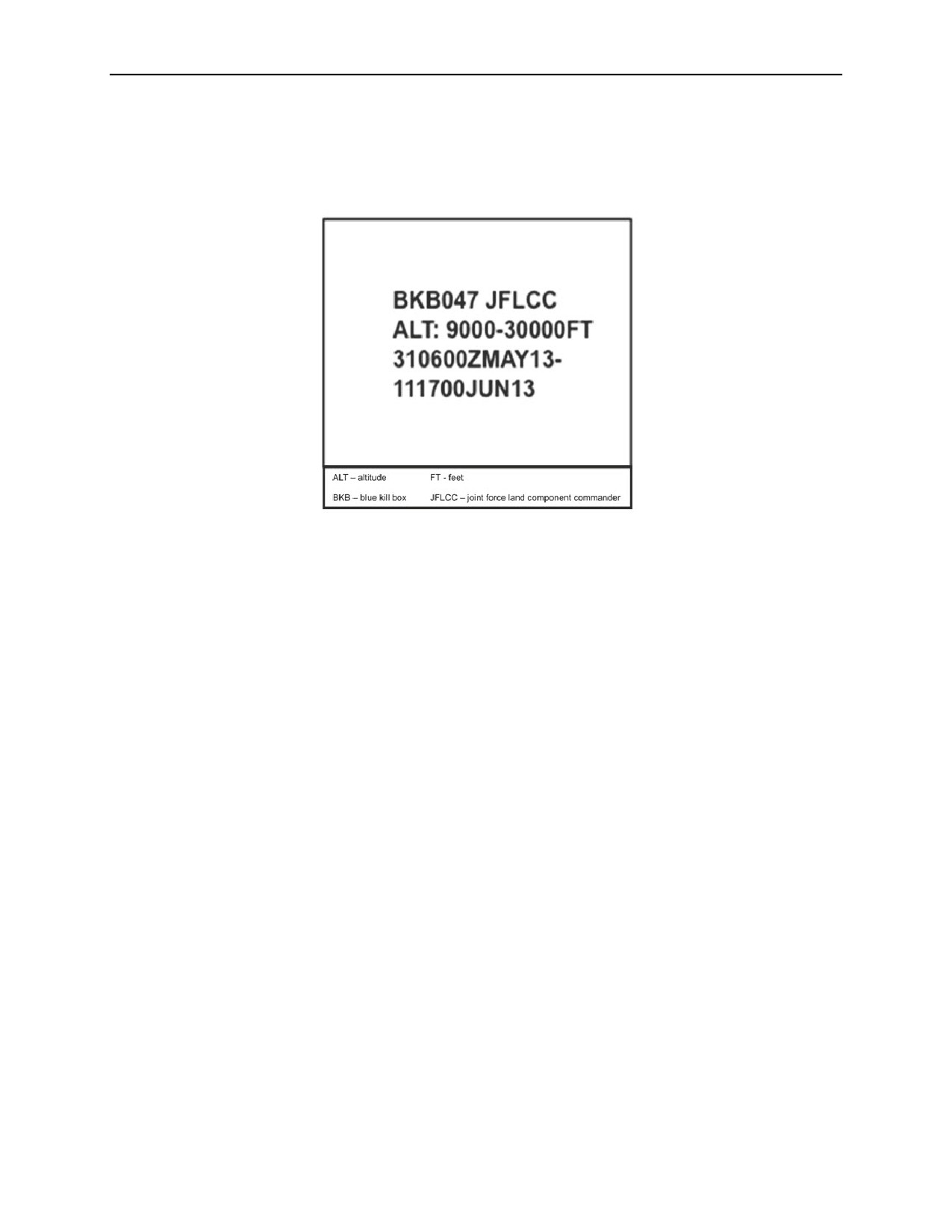
4-25. Graphically portray a kill box (figure 4-4) by the use of a solid black line defining the area borders. The
kill box will be listed as either a “BKB” (blue kill box) or a “PKB” (purple kill box) and the commander will
assign a measure number (001-999), establishing headquarters, and affected altitudes. In addition to the kill box
name, a date-time group depicting the “established” and “cancelled” times for the kill box must be included.
The “established” and “cancelled” times by be written as on-order. The unit identifier for the establishing
headquarters will be consistent with designations in operation plans
(OPLANs) and operation orders
(OPORDs). Units and/or automation systems may add color to the boxes for visual recognition; however, the
basic graphic follows the standards of a fire support coordination measure. Kill box names will not be used
more than once (FM 3-09.34).
4-6
FM 3-09
4 April 2014
Fire Support Coordination and Other Control Measures
4-26. Depiction of a kill box may vary among automation systems. Until the system displays are synchronized,
fire support personnel must be aware of the meanings of the system’s visual display. Figure 4-4 depicts an
example kill box depiction on a paper map. For more information on establishment and employment of the kill
box, see JP 3-09 and FM 3-09.34. For a more detailed description of the Global Area Reference System, see JP
2-03.
Figure 4-4. Kill box example
RESTRICTIVE FIRE SUPPORT COORDINATION MEASURES
4-27. Restrictive fire support coordination measures are those that provide safeguards for friendly forces and
noncombatants, facilities, or terrain.
NO-FIRE AREA
4-28. A no-fire area is an area designated by the appropriate commander into which fires or their effects are
prohibited (JP 3-09.3). There are two exceptions⎯
z
When the establishing headquarters approves joint fires within the no-fire area on a mission-by-
mission basis.
z
When an enemy force within the no-fire area engages a friendly force and the engaged commander
determines there is a requirement for immediate protection and responds with the minimal force
needed to defend the force.
4-29. Any size unit may establish no-fire areas. If possible, the no-fire area is established on identifiable
terrain. It may also be located by a series of grids or by a radius from a center point.
4-30. The no-fire area is graphically portrayed (see figure 4-5 on page 4-8) as an area outlined with a solid
black line with black diagonal lines inside. The letters
“NFA” are within, followed by the establishing
headquarters and the effective date-time group.
4 April 2014
FM 3-09
4-7

Chapter 4
Figure 4-5. No-fire area example
RESTRICTIVE FIRE AREA
4-31. A restrictive fire area is an area in which specific restrictions are imposed and into which fires that
exceed those restrictions will not be delivered without coordination with the establishing headquarters (JP 3-
09).
4-32. A maneuver battalion or higher echelon normally establishes a restrictive fire area. Usually, the restrictive
fire area is located on identifiable terrain, by grid, or by a radius from a center point. To facilitate rapidly
changing operations, on-call restrictive fire areas may be used. The dimensions, locations, and restrictions of the
on-call restrictive fire areas are prearranged.
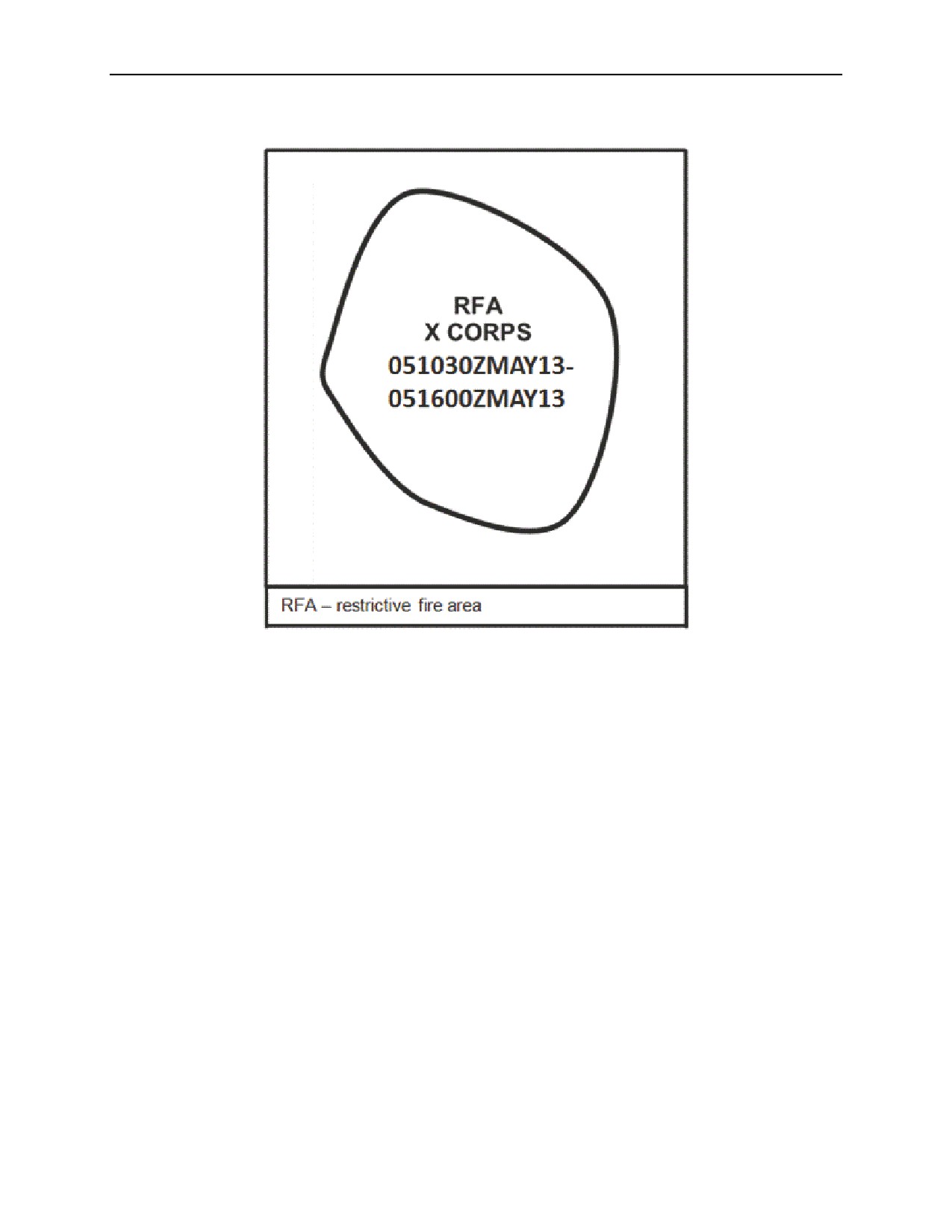
4-33. A restrictive fire area is graphically portrayed with solid black line defining the area and the letters “RFA”
within, followed by the establishing headquarters and the effective date-time group provides graphic portrayal
of the restrictive fire area. See figure 4-6 on page 4-9. The restrictions may be included within the graphic if
space allows, or reference may be made to a specific OPORD or OPLAN (ADRP 1-02). For example, a
commander may identify a particular type of ammunition, such as dual-purpose improved conventional
munitions, to preclude its firing within the RFA.
4-8
FM 3-09
4 April 2014
Fire Support Coordination and Other Control Measures
Figure 4-6. Restrictive fire area example
RESTRICTIVE FIRE LINE
4-34. A restrictive fire line is a line established between converging friendly surface forces that prohibits fires
or their effects across that line (JP 3-09).
4-35. The purpose of the restrictive fire line is to prevent fratricide and duplication of engagements by
converging friendly forces.
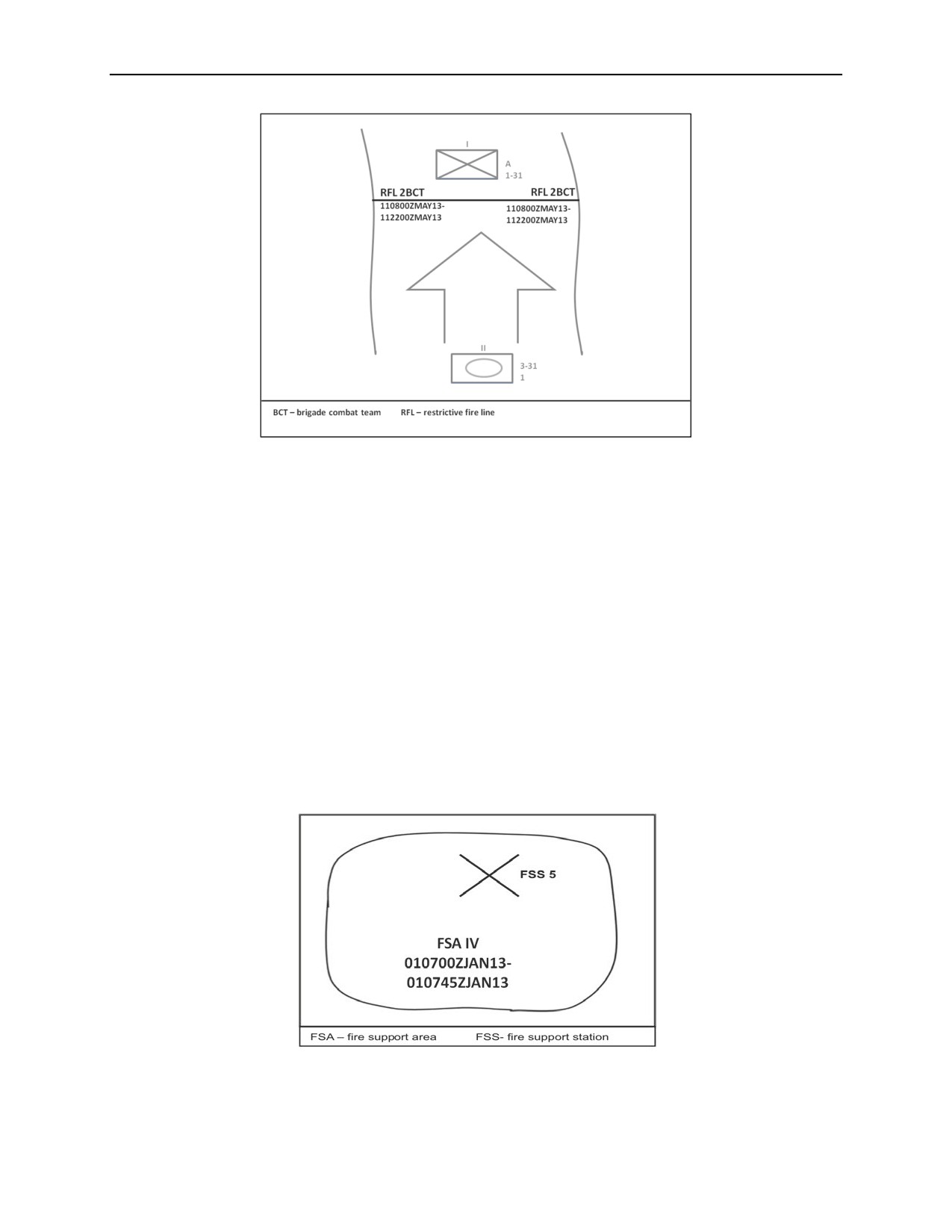
4-36. A restrictive fire line (see figure 4-7 on page 4-10) is graphically portrayed by a solid black line, with
“RFL” followed by the establishing headquarters above the line and the effective date-time group below the line
provides graphic portrayal of the restrictive fire line.
4-37. The commander common to the converging forces establishes the restrictive fire line. It is located on
identifiable terrain when possible. In link-up operations, it is usually closer to the stationary force to allow
maximum freedom of action for the maneuver and fire support of the linkup force.
4 April 2014
FM 3-09
4-9
Chapter 4
Figure 4-7. Restrictive fire line example
FIRE SUPPORT AREA AND A FIRE SUPPORT STATION
4-38. In amphibious operations when engagement groups are formed and separate landing areas are designated,
the commander, amphibious task force may assign each engagement group commander the responsibility for
control of naval gunfire support within the area. The officer in tactical command, typically the commander,
amphibious task force, establishes fire support areas and fire support stations. A fire support area is an
appropriate maneuver area assigned to fire support ships by the naval force commander from which they can
deliver gunfire support to an amphibious operation (JP 3-09). A fire support area is normally associated with
amphibious operations but can be used whenever it is desirable to have a fire support ship occupy a certain
geographic position. The fire support station designation is used to station ships within boat lanes of the
assaulting force, or in areas where maneuvering room is restricted by other considerations. A fire support
station is an exact location at sea within a fire support area from which a fire support ship delivers fire (JP 3-
02).
4-39. Fire support areas are designed with Roman numerals (for example “FSA I, II, or III”) and are graphically
portrayed on the naval surface fire support operations overlay. Fire support stations are designated by numbers
(for example “FSS 1, 2, or 3”) and are shown on the naval surface fire support operations overlay as an “X”
indicating the exact position of the ship. (MIL-STD 2525C). Figure 4-8 provides examples of a graphic
representation of the fire support area and fire support station.
Figure 4-8. Fire support area and fire support station examples
4-10
FM 3-09
4 April 2014
Fire Support Coordination and Other Control Measures
ZONE OF FIRE
4-40. A zone of fire is an area within which a designated ground unit or fire support ship delivers, or is
prepared to deliver, fire support. Fire may or may not be observed (JP 3-09). Gunfire support ships and units are
assigned land divided into zones of fire as a means to coordinate their efforts with each other and with the
scheme of maneuver of the supported ground unit. Units and ships assigned zones of fire are responsible for
engaging known targets and targets of opportunity according to their mission and the guidance of the supported
commander.
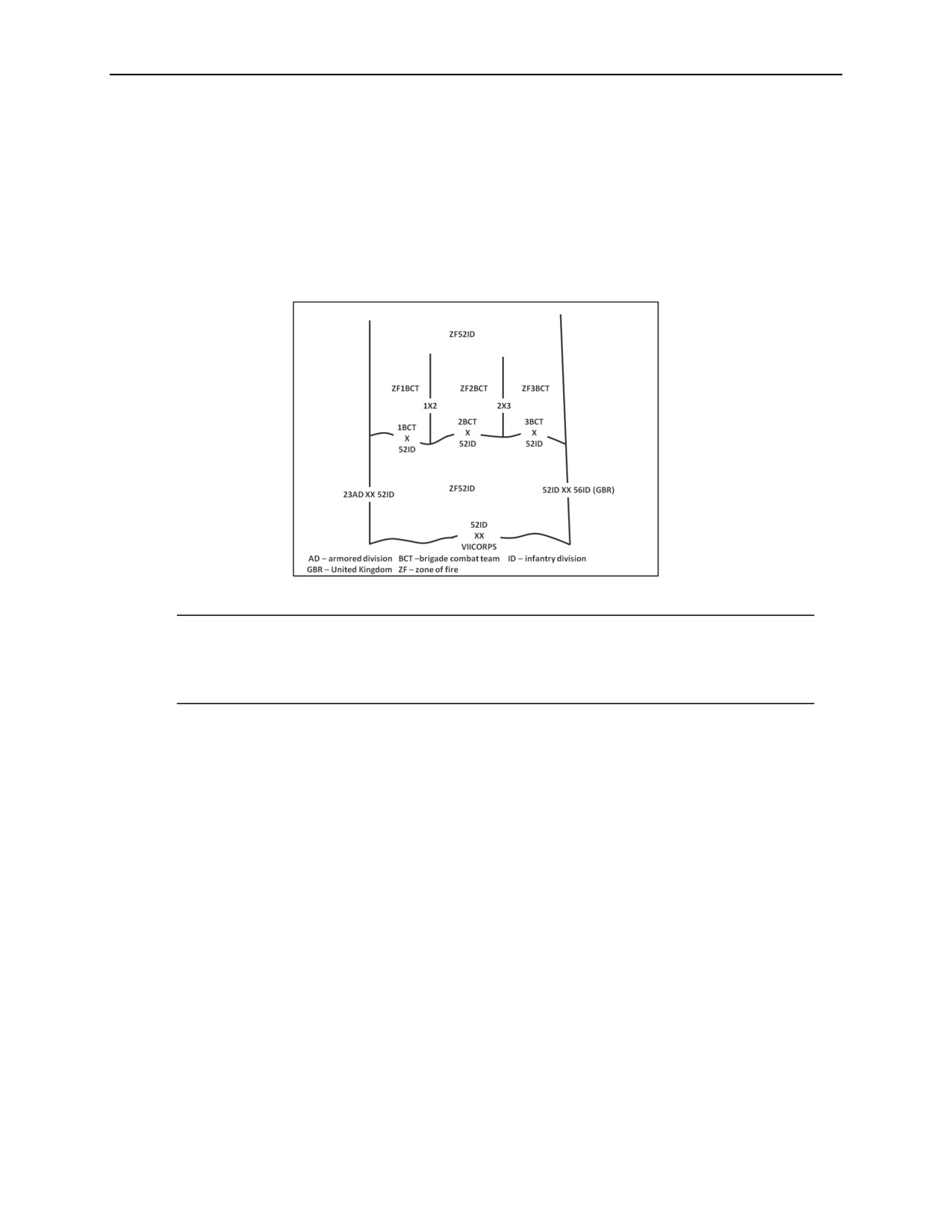
4-41. Graphically portray a zone of fire (figure 4-9) by the use of broken lines (solid lines if unit boundaries are
used as depicted), with designating Arabic numerals, for example “ZF3” (JP 3-09).
Figure 4-9. Zone of fire example
Note: JP 3-09 directs the use of only Arabic numerals to identify a zone of fire. The AFATDS
software uses the zone of responsibility graphic to implement a zone of fire. The zone of
responsibility line or area name field allows the use of uppercase alphabetic characters (A-Z),
numeric characters (0-9), and blank spaces to identify that graphic.
4-42. The commander of the maritime force providing naval surface fire support establishes and assigns zones
of fire for the forces. The zone of fire for an artillery battalion or a ship assigned the support relationship or
mission of direct support (DS) normally corresponds to the area of operations of the supported unit. The zone of
fire for an artillery battalion or a ship assigned the support relationship or mission of general support (GS)
should be within the boundaries of the supported unit. When used in conjunction with naval gunfire, the size
and shape of a zone of fire will depend on the following⎯
z
Boundaries. In order to permit ready identification by the spotter and the individual fire support ship,
the boundaries of the zones of fire should be recognizable both on the terrain and on a map. It may be
necessary to divide a large zone of fire into two or more smaller zones due to considerations
discussed in subsequent paragraphs. The boundaries of zones of fire of DS ships should correspond
to the zones of action of the landing force units supported.
z
Size. The size of each zone of fire should be such that the fire support ships, or ships assigned to
observe and/or destroy targets, will be able to accomplish the mission in the time allocated. When
zones of fire are delineated, known or suspected targets scheduled for destruction in each zone are
plotted, and then the number and type of targets are compared to the capability of the ship.
z
Visibility. Observation from seaward is a desirable feature for zones of fire, since it permits a ship to
deliver more accurate and rapid fire.
z
Accessibility to Fire. The zones of fire must be accessible to the trajectory of the fire support ship(s)
assigned to the zone.
4 April 2014
FM 3-09
4-11
Chapter 4
4-43. A field artillery unit’s higher headquarters may also assign a field artillery unit a zone of fire. The zone of
fire for artillery units assigned to a maneuver unit or assigned the DS support relationship corresponds to the
area of operations of the parent or supported unit. The zone of fire for an artillery unit assigned the reinforcing
(R) support relationship corresponds to the zone of fire of the reinforced artillery unit. The zone of fire for an
artillery unit assigned the general support-reinforcing (GSR) support relationship corresponds to the area of
operations of the supported unit including the zones of fire of the reinforced artillery unit. The zone of fire for
an artillery unit assigned the GS relationship corresponds to the area of operations of the supported unit.
4-44. See JP 3-02 for more information on amphibious operations.
TARGET CONTROL MEASURES
FINAL PROTECTIVE FIRE
4-45. Final protective fire is an immediately available preplanned barrier of fires designed to impede enemy
movement across defensive line or areas (JP 1-02). Both direct- and indirect-fire weapons can provide final
protective fires. The commander normally places final protective fire along the topographical crest and employs
them as the enemy reaches the first row of defiladed obstacles. The commander uses the reserve to
counterattack and expel the enemy from the topographical crest, if massed indirect fires do not defeat the attack.
The commander can only assign each firing battery or platoon a single final protective fire. A final protective
fire is a priority target for an element or system, and those fire units are laid on that target when they are not
engaged in other fire missions. When the enemy force initiates its final assault into a defensive position, the
defending unit initiates its final protective fires to kill enemy infantry soldiers and suppress enemy armored
vehicles.
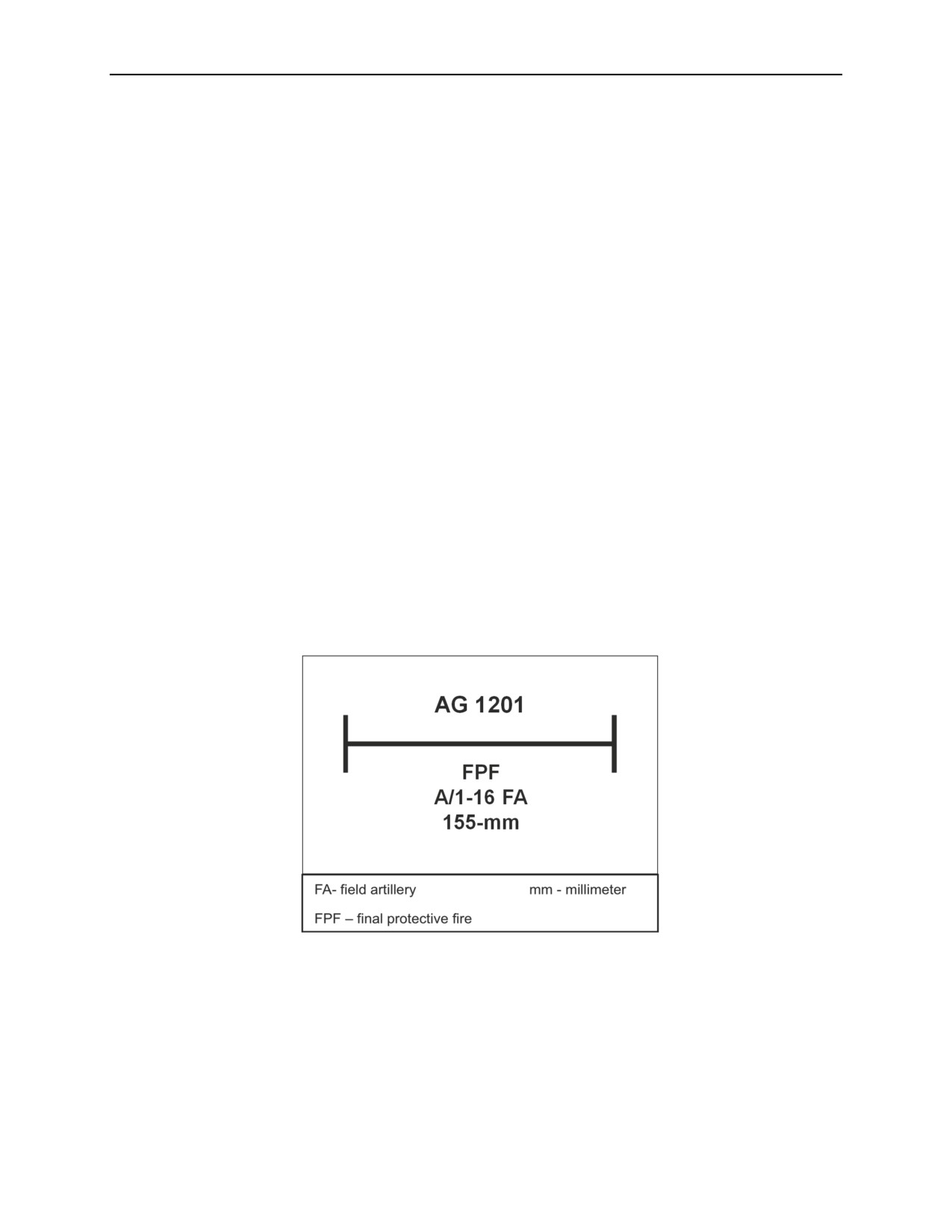
4-46. Graphical portrayal of the final protective fire consists of a single black line. Two anchor points, one at
each end of the line, determine the line’s length and orientation. The final protective fire is designated by two
letters followed by four numerals above the line, and the letters “FPF,” followed by the firing unit responsible
and the caliber of that unit’s weapons below the line. Figure 4-10 portrays the assigned final protective fires of
A Battery, 1st Battalion 16th Field Artillery (155-mm), a priority target for that unit.
Figure 4-10. Final protective fire example
OTHER TARGET CONTROL MEASURES
4-47. Other target control measures and their symbols are found in FM 3-60 and MIL-STD 2525C.
4-12
FM 3-09
4 April 2014
Fire Support Coordination and Other Control Measures
SECTION II - BOUNDARY, PHASE LINE, AND OTHER KEY CONSIDERATIONS
FOR FIRE SUPPORT
BOUNDARIES
4-48. A boundary is a line that delineates surface areas for the purpose of facilitating coordination and
deconfliction of operations between adjacent units, formations, or areas (JP 3-0). Boundaries divide up areas of
operation and define responsibility for clearance of fires. Boundaries are both permissive and restrictive in
nature⎯
z
They are permissive in that a maneuver commander, unless otherwise restricted, enjoys complete
freedom of fire and maneuver within his own boundaries. Thus units may execute joint fires without
close coordination with neighboring units unless otherwise restricted.
z
They are restrictive in that normally units do not fire across boundaries unless the fires are
coordinated with the adjacent unit or the fires are allowed by a permissive fire support coordination
measure, such as a coordinated fire line. These restrictions apply to conventional and special
munitions and their effects. When fires such as obscuration and illumination affect an adjacent unit,
coordination with that unit is normally required. A commander may employ direct fires without
clearance at specific point targets that are clearly and positively identified as enemy. Targets and
their triggers should be kept within the same unit’s boundary without overriding other tactical or
doctrinal considerations.
4-49. For more on boundaries, see FM 3-90-1.
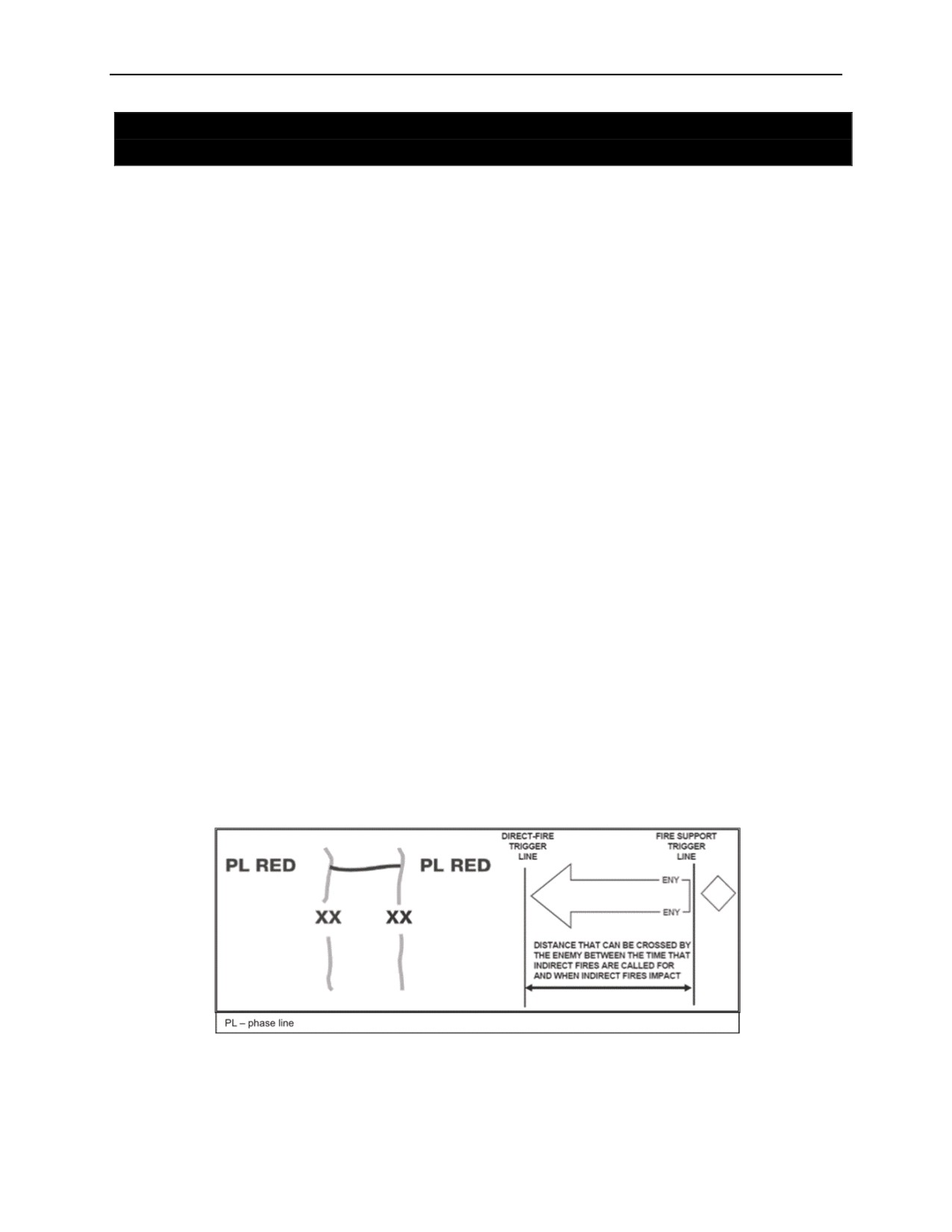
PHASE LINE AND TRIGGER LINE
4-50. A phase line is a line utilized for control and coordination of military operations, usually an easily
identified feature in the operational area (JP 3-09). Phase lines (figure 4-11) are usually easily identifiable from
a ground or air vantage point and may include features such as ridgelines, tree lines, hilltops, roads and rivers.
Phase lines can be used to identify limits of advance and to coordinate fires.
4-51. A trigger line is a phase line located on identifiable terrain that crosses the engagement area—used to
initiate and mass fires into an engagement area at a predetermined range for all or like weapon systems (ADRP
1-02). The commander designates a phase line as the trigger line for his fire support attack assets. He bases the
trigger line’s location on such variables as the time of flight for artillery shells, positioning of the guns, and the
existence of quick-fire links. A trigger line’s location varies from situation to situation. Its position reflects the
distance that the enemy force is likely to traverse in the time it takes from when fires are requested to when
artillery rounds impact (figure 4-11). This gives time for the fire support delivery systems to respond to the
initial call for fire. Fires unit commanders must determine the appropriate planning response time for their unit
based on their weapon system and training proficiency to recommend the placement of a trigger line.
Figure 4-11. Phase line and trigger line examples
4 April 2014
FM 3-09
4-13
Chapter 4
4-52. The commander can establish another trigger line for his most accurate long-range weapon system in the
vicinity of the area where the fire support impacts to capitalize on the asymmetric attack. However, dust and
debris resulting from the artillery fire may prevent his direct fire systems from engaging the enemy. He
establishes other trigger lines for shorter-range systems. He may give guidance to extremely proficient crews to
engage the enemy at longer than normal ranges or give them different engagement priorities than the rest of the
force, such as giving priority to engaging air defense or engineer-breaching systems. This could result in losing
the effect that the sudden application of massed fires has on an enemy.
4-53. When the enemy reaches these closer trigger lines, the commander establishes a decision point to help
him determine if he wants his longer-range systems to continue to fire in depth or to concentrate his fires on a
single point. Many factors impact his decision, most of which concern the enemy and how he maneuvers and
the effects of the defending force’s fires.
4-54. The purpose of each phase line and any actions required by forces affected by the phase line will be
specified on the OPORD of the establishing headquarters. Any commander given an area of operations can
establish a phase line. For more on phase lines see FM 3-90-1.
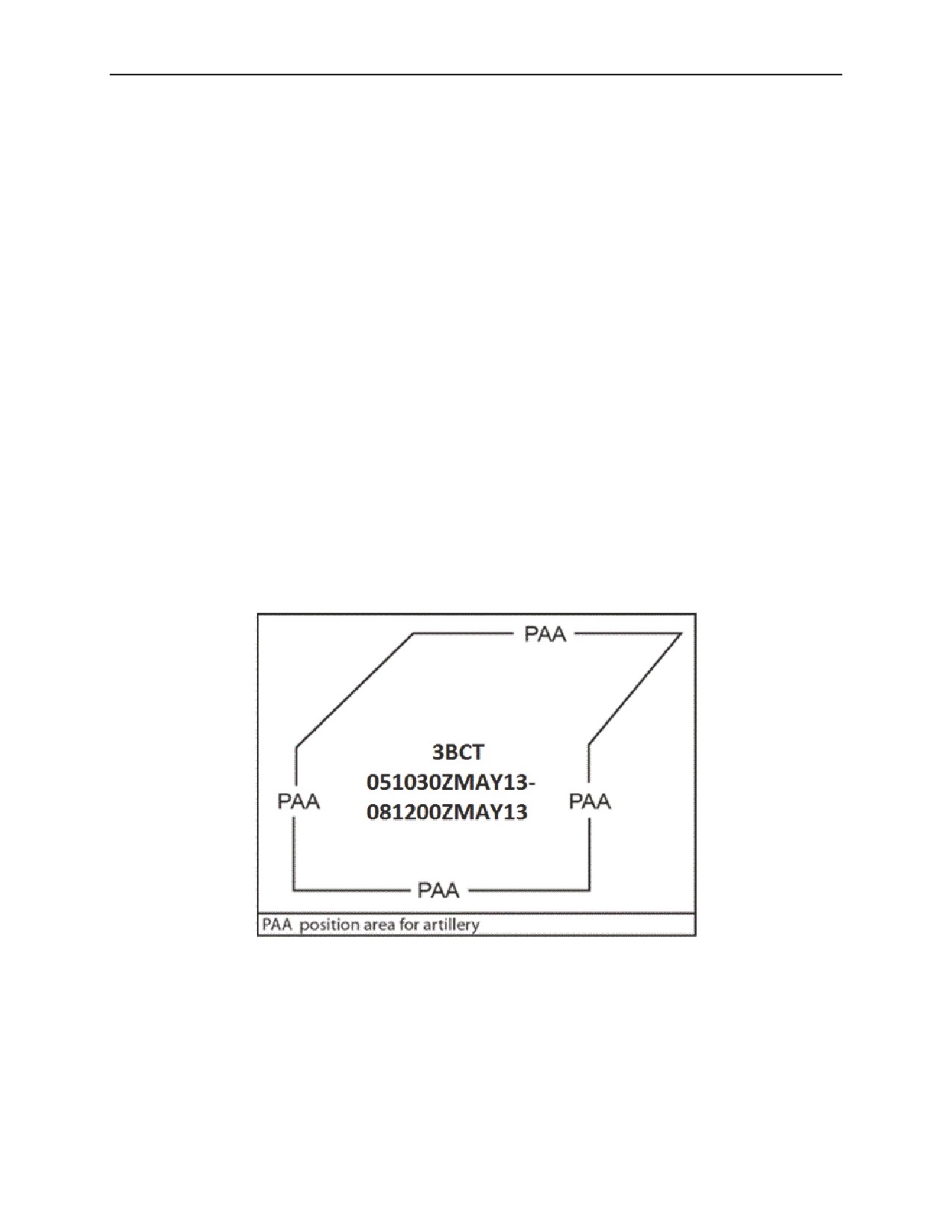
POSITION AREA FOR ARTILLERY
4-55. A position area for artillery is an area assigned to an artillery unit where individual artillery systems can
maneuver to increase their survivability. A position area for artillery is not an area of operations for the artillery
unit occupying it (FM 3-90-1) (figure 4-12). The maneuver commander assigns position areas for artillery as a
terrain management technique. A position area for artillery potentially attracts enemy counterfire so other units
should stay away from that area to avoid enemy artillery attacks. The exact size of a position area for artillery
depends on the mission variables of mission, enemy, terrain and weather, troops and support available, time
available, civil considerations (METT-TC). As a rule of thumb, a Paladin platoon normally requires a position
area for artillery encompassing over 4 square kilometers, and a multiple launch rocket system (MLRS) platoon
requires 12 square kilometers.
Figure 4-12. Position area for artillery example
4-56. The position area for artillery is graphically portrayed by a solid black line defining the area and the
letters “PAA” within, followed by the establishing headquarters and the effective date-time-group (ADRP 1-02).
4-57. The maneuver echelon operations officer (G-3 or S-3) establishes position areas for artillery within the
unit area of operations. The artillery unit occupies but does not control the position area for artillery and has
neither the authority nor responsibilities that are associated with a unit assigned an area of operations. For
example, other units can move through a position area for artillery without clearing that movement with the
4-14
FM 3-09
4 April 2014
Fire Support Coordination and Other Control Measures
occupying artillery unit. The artillery unit occupying a position area for artillery establishes liaison with the unit
with authority for the area of operations where the position area for artillery is located. The echelon fire support
officer is usually responsible for liaison in accordance with standard command and support relationships.
4-58. The decision to establish a position area for artillery affects airspace control and coordination for rotary-,
fixed-wing, and tilt-rotor aircraft integration. A position area for artillery is a base upon which to establish
future gun-target lines for lateral deconfliction and areas for rotary-, fixed-wing, and tilt rotor aircraft to avoid,
depending on high- or low-angle artillery fires. For more on position areas for artillery see FM 3-90-1.
SECTION III - TARGET ACQUISITION CONTROL AND AIRSPACE
COORDINATING MEASURES
RADAR ZONES
4-59. The designation of radar zones provides a means of prioritizing radar sectors of search into areas of
greater or lesser importance. Zones focus radar coverage on the combined arms commander’s battlefield
priorities. A radar zone is a geometric figure placed around an area that designates the area as more, or less,
important. Four types of zones can be entered into radars. Radars can store up to nine different zones. There are
four different types of zones used with the radar.
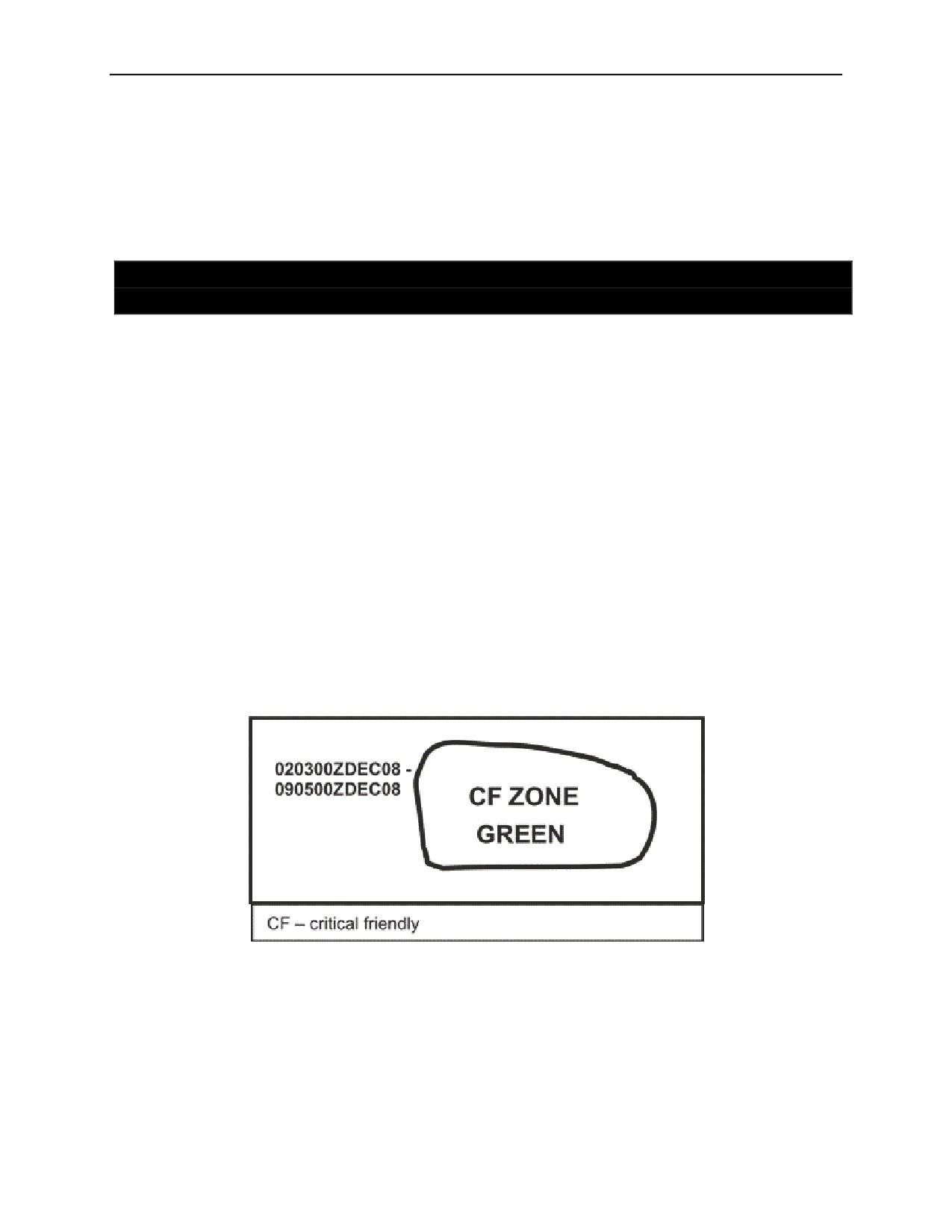
CRITICAL FRIENDLY ZONE
4-60. A critical friendly zone is an area, usually a friendly unit or location which the maneuver commander
designates as critical to the protection of an asset whose loss would seriously jeopardize the mission (ADRP 1-
02).
4-61. A critical friendly zone is graphically portrayed (figure 4-13) by a solid black line defining the area and
the letters “CF ZONE,” followed by the identifying name within, plus the effective date-time-group. The critical
friendly zone requires a minimum of 3 and a maximum of 6 anchor points to define the boundary of the area.
The size and shape of the critical friendly zone is determined by the anchor points and may be circular,
rectangular, or irregular. When possible, the effective date-time-group (moveable and scalable) should be
placed within the graphic boundary but it may be placed outside the graphic or within a computer drop box if
necessary.
Figure 4-13. Critical friendly zone example
4-62. Critical friendly zones may be phased along the maneuver axis of advance and activated when entered by
friendly forces. This is particularly important in those areas where friendly forces are most vulnerable (for
example, river-crossing sites and areas open to easy visual observation). Typical critical friendly zones include
maneuver assembly areas, command posts, forward arming and refueling points, friendly breaching sites and
other troop concentrations. The maneuver commander may also designate critical civilian infrastructure as a
critical friendly zone.
4 April 2014
FM 3-09
4-15
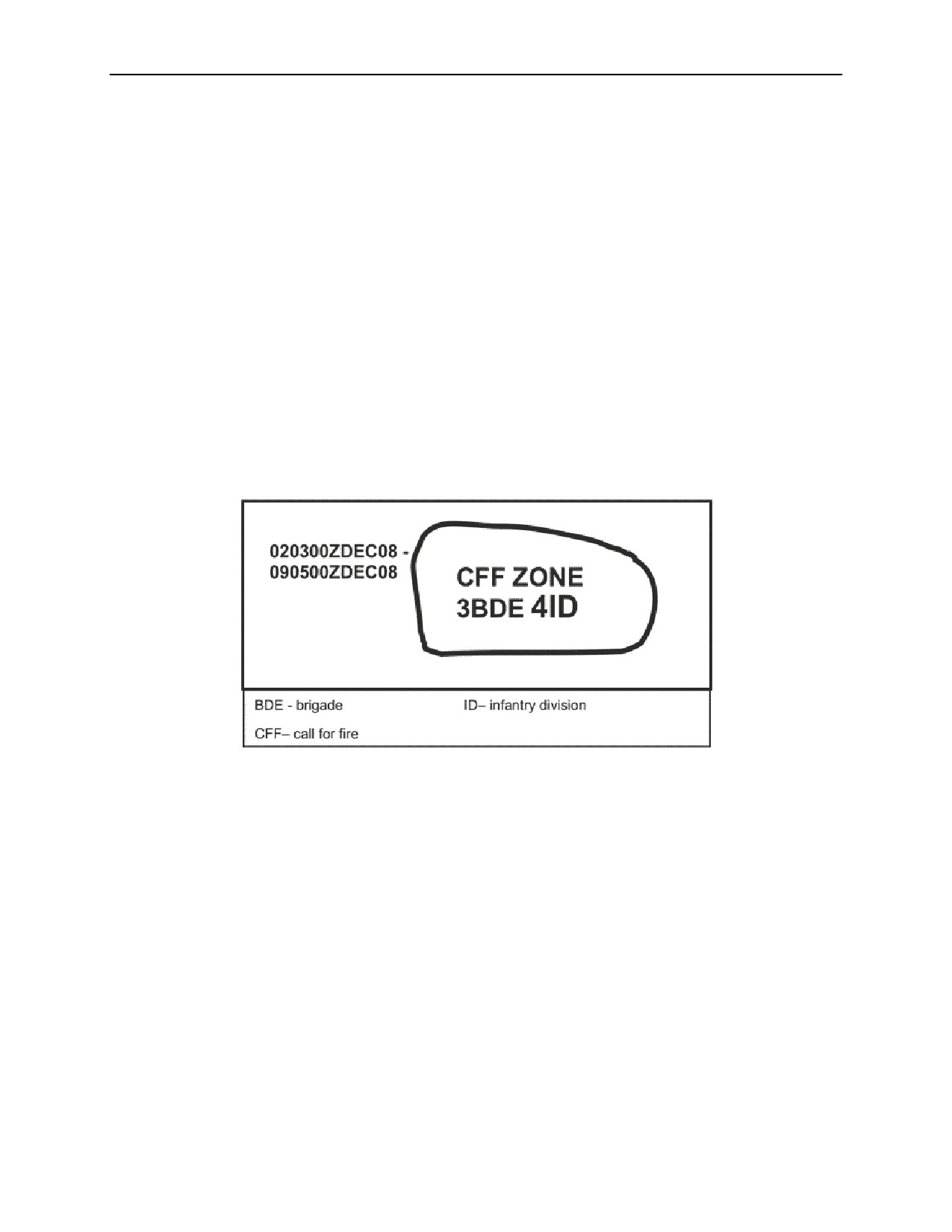
Chapter 4
4-63. Designation of a critical friendly zone requires radar coverage of the designated area and weapons
platforms to provide counterfire. The supporting field artillery unit’s automated fire support system places any
radar-located enemy weapon system firing into a critical friendly zone in priority ahead of all other counterfire
targets with an immediate call for fire generated unless the system operator manually overrides the automated
call for fire.
CALL FOR FIRE ZONE
4-64. A call for fire zone is a radar search area from which the commander wants to attack hostile firing
systems. A call for fire zone would be placed around an enemy fire support position identified as a high-payoff
target. The call for fire zone provides the second most responsive priority for fires from the radars.
4-65. On the basis of intelligence preparation of the battlefield and other target indicators, call for fire zones are
used to monitor suspect areas from which threat indirect fires may jeopardize the mission. Establishing a call for
fire zone will facilitate immediate counterfire of enemy artillery disrupting the friendly scheme of maneuver.
4-66. A call for fire zone is graphically portrayed (figure 4-14) by a solid black line defining the area and the
letters “CFF ZONE,” followed by the establishing headquarters within, plus the effective date-time-group. The
call for fire zone requires a minimum of 3 and a maximum of 6 anchor points to define the boundary of the area.
The size and shape of the call for fire zone is determined by the anchor points and may be circular, rectangular,
or irregular. When possible, the effective date-time-group (moveable and scalable) should be placed within the
graphic boundary but it may be placed outside the graphic if necessary.
Figure 4-14. Call for fire zone example
ARTILLERY TARGET INTELLIGENCE ZONE
4-67. An artillery target intelligence zone is an area in enemy territory that the commander wishes to
monitor closely. Any weapon detected in the artillery target intelligence zone will be reported ahead of all
acquisitions other than those from critical friendly zones or call for fire zones.
4-68. Artillery target intelligence zones may be established in areas where we are not sure about threat indirect
fires and need to develop the situation. They can also be used in areas of suspect threat indirect fires that the
commander wishes to monitor closely but are out of friendly indirect fire range. When possible, the effective
date-time-group (moveable and scalable) should be placed within the graphic boundary but it may be placed
outside the graphic if necessary.
4-69. An artillery target intelligence zone is graphically portrayed (see figure 4-15 on page 4-17) by a solid
black line defining the area and the letters “ATI,” followed by the establishing headquarters within plus the
effective date-time-group. The artillery target intelligence zone requires a minimum of 3 and a maximum of 6
anchor points to define the boundary of the area. The size and shape of the call for fire zone is determined by
the anchor points and may be circular, rectangular, or irregular.
4-16
FM 3-09
4 April 2014
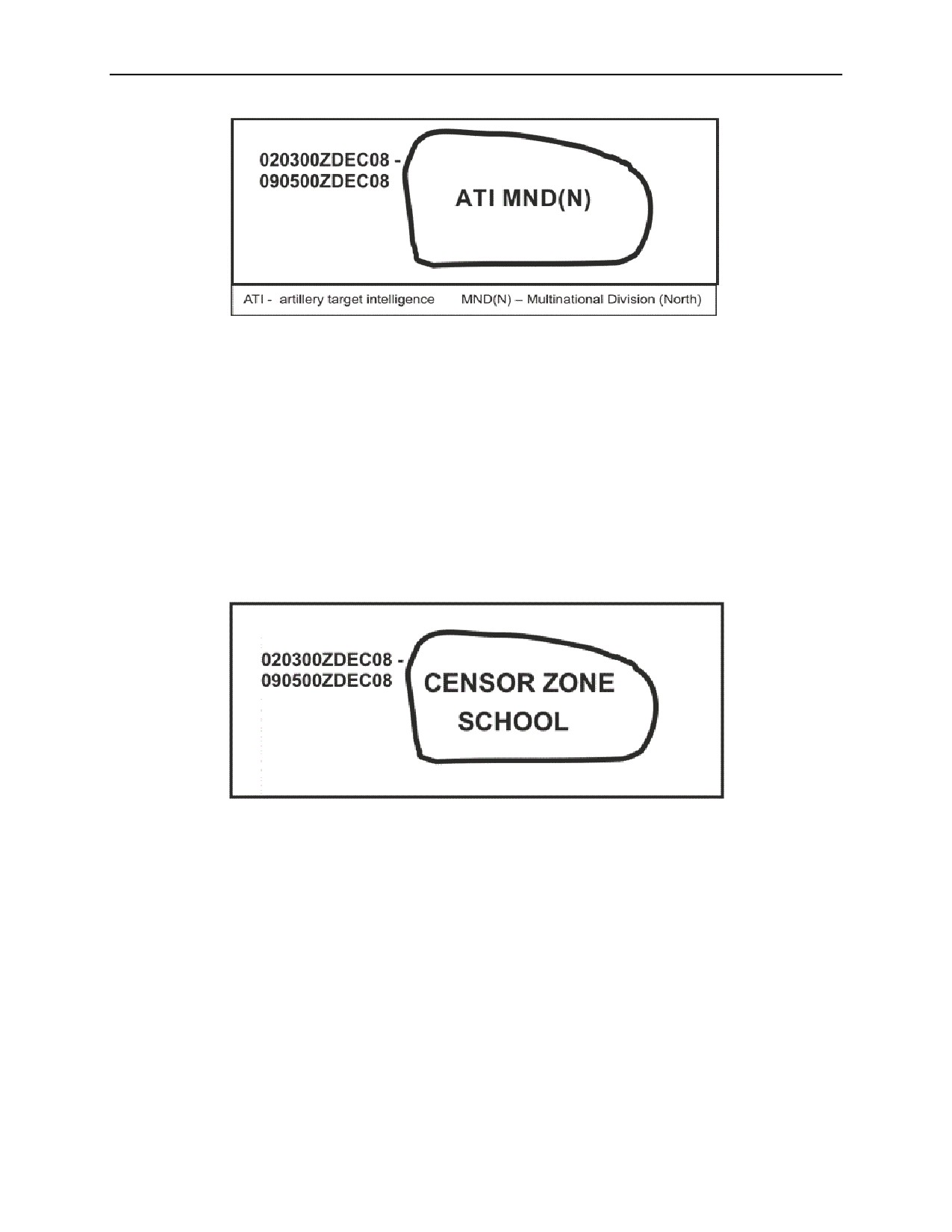
Fire Support Coordination and Other Control Measures
Figure 4-15. Artillery target intelligence zone example
CENSOR ZONE
4-70. A censor zone is an area from which radar is prohibited from reporting acquisitions. Normally
placed around friendly weapon systems to prevent them from being acquired by friendly radars (FM 3-
09.12). The censor zone can be used to prevent radars from reporting acquisitions from other sensitive areas as
well.
4-71. A censor zone is graphically portrayed (figure 4-16) by a solid black line defining the area and the words
“CENSOR ZONE,” followed by the defining characteristic within, plus the effective date-time-group. The artillery
target intelligence zone requires a minimum of 3 and a maximum of 6 anchor points to define the boundary of
the area. The size and shape of the call for fire zone is determined by the anchor points and may be circular,
rectangular, or irregular. When possible, the effective date-time-group (moveable and scalable) should be
placed within the graphic boundary but it may be placed outside the graphic if necessary.
Figure 4-16. Censor zone example
COMMON SENSOR BOUNDARY
4-72. Target duplication between radars is likely during combat operations. In addition, the sheer volume of
targets being passed from the radars will overwhelm the targeting element, especially if the radars are under
centralized control.
4-73. An effective method of reducing the duplication of these targets for attack is to establish a common
sensor boundary (see figure 4-17 on page 4-18). A common sensor boundary is a line (depicted by a series of
grid coordinates, grid line, phase line, or major terrain feature) established by the force counterfire
headquarters that divides target acquisition search areas into radar acquisition management areas.
4 April 2014
FM 3-09
4-17
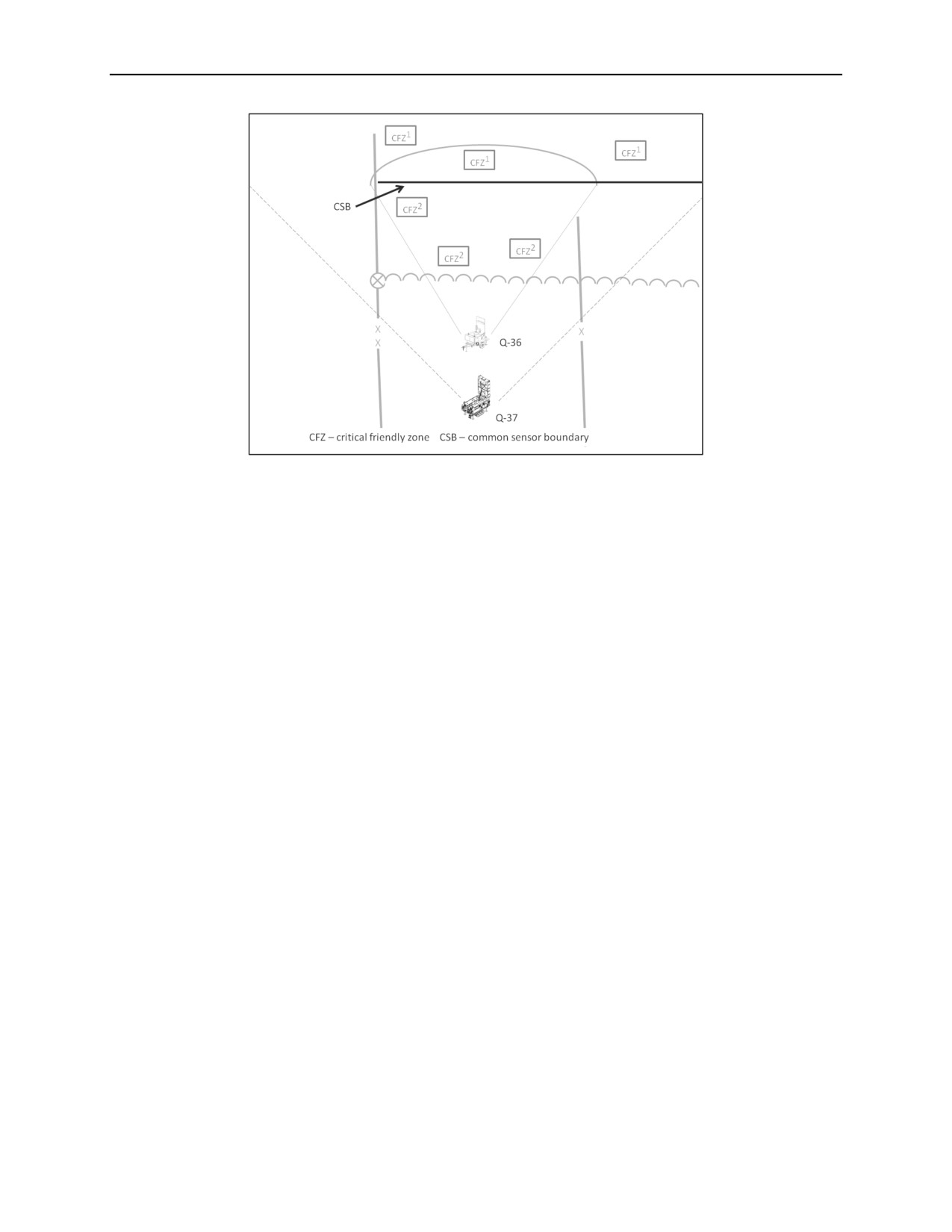
Chapter 4
Figure 4-17. Common sensor boundary example
AIRSPACE COORDINATING MEASURES
4-74. A key to effectively coordinating joint fires is to constantly view the operational area as a three
dimensional area. Airspace coordinating measures are nominated from subordinate headquarters through
component command headquarters, and forwarded to the airspace control authority in accordance with the
airspace control plan. Airspace coordinating measures are measures employed to facilitate the efficient use of
airspace to accomplish missions and simultaneously provide safeguards for friendly forces (JP 3-52).
4-75. Most airspace coordinating measures affect direct and indirect joint fires trajectories and unmanned
aircraft systems because of their airspace use. The establishment of airspace coordinating measures in
coordination with fire support coordination measures results in the most efficient use of airspace for all friendly
airspace users. Some airspace coordinating measures may be established to permit surface joint fires or
unmanned aircraft system operations. The component commanders ensure that airspace coordinating measures
nominations support and do not conflict with joint operations prior to forwarding the nominations to the joint air
operations center. The airspace control authority approves formal airspace coordinating measure nominations
and includes them in the airspace control order. The airspace control authority is the commander designated to
assume overall responsibility for the operation of the airspace control system in the airspace control area. (JP 3-
52).
4-76. The airspace control authority consolidates, coordinates, and deconflicts the airspace requirements of the
components and publishes the airspace coordinating measures in the airspace control order. The airspace control
order is normally published at least daily and is often distributed both separately and as a section of the air
tasking order.
z
An airspace control order is an order implementing the airspace control plan that provides the details
of the approved requests for airspace coordinating measures. It is published either as part of the air
tasking order or as a separate document (JP 3-52).
z
An air tasking order is a method used to task and disseminate to components, subordinate units, and
command and control agencies projected sorties, capabilities, and/or forces to targets and specific
missions. Normally provides specific instructions to include call signs, targets, controlling agencies,
etc., as well as general instructions (JP 3-30).
4-77. See JP 3-52 and JP 3-30 for further information on the conduct and control of air operations.
4-18
FM 3-09
4 April 2014
Fire Support Coordination and Other Control Measures
Note: Altitude typically refers to the height above sea level of a given point. Personnel must ensure
the altitude is correctly displayed in accordance with their system requirements. Some systems may
require altitude to be expressed as height above ellipsoid while others may require expression in
relation to mean sea level. Some systems may require conversion from feet to meters to permit
system entry. Fire support personnel must also be aware that altitude is sometimes expressed as
measured from ground level rather than mean sea level.
4-78. Army commanders use airspace coordinating measures to facilitate the efficient use of airspace and
simultaneously provide safeguards for friendly forces. Procedural control airspace coordinating measures are
used to delineate an airspace boundary or define airspace dimensions for enabling other systems (such as fire
support systems) to discriminate friendly coordination joint engagement measures from enemy, employ fires
across boundaries, and coordinate joint attack of targets for a particular operation. Restricted operations zones
denote airspace reserved for specific activities in which the operation of one or more airspace uses is restricted.
The airspace coordinating measures that frequently affect fire support include the airspace coordination area,
the coordinating altitude, and the restricted operations zone. Those are discussed here. See FM 3-52 and JP 3-52
for other airspace coordinating measures.
AIRSPACE COORDINATION AREA
4-79. An airspace coordination area is a three-dimensional block of airspace in a target area, established by the
appropriate ground commander, in which friendly aircraft are reasonably safe from friendly surface fires. The
airspace coordination area may be formal or informal (JP 3-09.3).
4-80. A formal airspace coordination area requires detailed planning. Vital information defining the formal
airspace coordination area includes minimum and maximum altitudes, a baseline designated by grid coordinates
at each end, the width (on either side of the baseline), and the effective times. When time for coordination is
limited, an informal airspace coordination area is used. In an informal airspace coordination area, aircraft and
surface joint fires may be separated by time or distance (lateral, altitude, or a combination of the two). The
maneuver commander requesting close air support or employing helicopters can request an informal airspace
coordination area; the informal airspace coordination area is approved at battalion or higher level. Both types of
airspace coordination areas are constructed with the assistance of the air liaison officer to ensure they meet the
technical requirements of the aircraft and weapon systems.
4-81. Army aviation, air defense artillery, military intelligence, maneuver, unmanned aircraft systems,
electronic warfare assets, fire support, and joint and multinational air and ground forces all use airspace.
Maneuver commanders at all levels exercise airspace control within their assigned areas through the integration
of positive and procedural control. Airspace control maximizes the simultaneous use of airspace. At decisive
moments, commanders are able to exploit all available combat power—synchronized in time, space, and
purpose.
4-82. Fires are airspace users. Clearance of fires maximizes damage to enemy capabilities while minimizing the
risk of damage to friendly forces and non-combatants. Clearance of fires may be accomplished through a staff
process, control measures, embedded in automation systems, active or passive recognition systems, or a
combination thereof.
4-83. A formal airspace coordination area is graphically shown (see figure 4-18 on page 4-20) as an area
enclosed by a solid black line. Depicted inside the enclosed area are “ACA,” the establishing headquarters, the
minimum and maximum altitudes, the grid coordinates for each end of the baseline and the width of the
airspace coordination area, the grid coordinates for each point of an irregularly shaped airspace coordination
area, and the effective date-time group or the words “on-order.” Informal airspace coordination areas are not
normally displayed on maps, charts, or overlays.
4 April 2014
FM 3-09
4-19
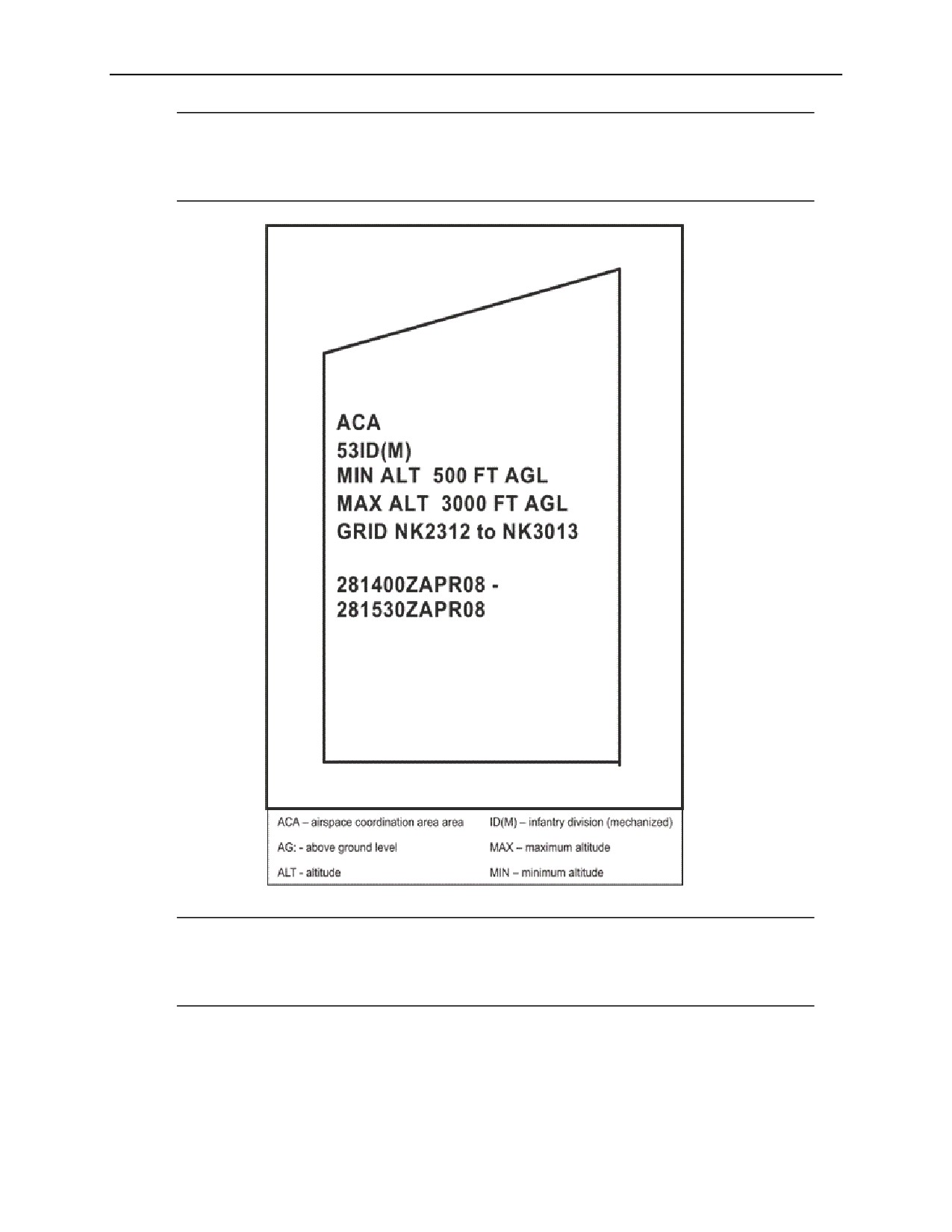
Chapter 4
Note: In North Atlantic Treaty Organization (NATO) field artillery tactical doctrine the airspace
coordination area is a fire support coordination measure and is defined as “a restricted area or route
of travel specified for use by friendly aircraft and established for the purpose of preventing friendly
aircraft from being fired on by friendly forces” (Allied Artillery Publication-5).
Figure 4-18. Formal airspace coordination area example
Note: The depiction of airspace coordination area on a two-dimensional surface such as on a map
does not display the possibly irregularly shaped airspace coordination area dimensions (such as
Army Tactical Missile System [ATACMS] missile or Excalibur flight paths) that may be constructed
within automation systems, which can provide information for airspace clearance.
Coordinating altitude
4-84. The coordinating altitude is an airspace coordinating measure that uses altitude to separate users and as
the transition between different airspace coordinating entities (JP 3-52). It uses altitude to separate users and as
4-20
FM 3-09
4 April 2014
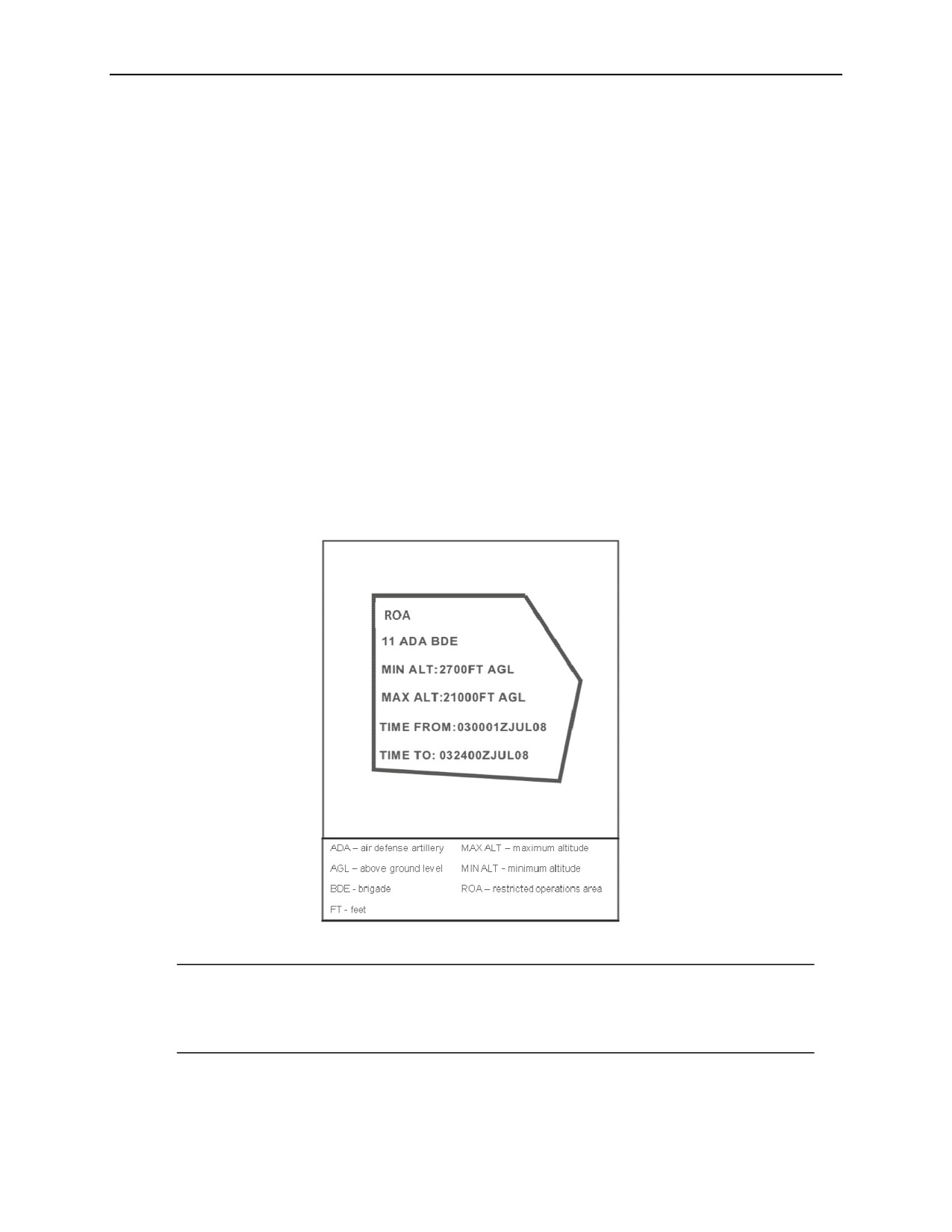
Fire Support Coordination and Other Control Measures
the transition between different airspace coordinating entities. Examples of Army airspace coordinating entities
include air defense artillery and Army corps/division airspace control elements. Army echelons incorporate
airspace control plan guidance and integrate the airspace control order, area air defense plan, special
instructions, and the air tasking order via operation orders. All airspace users should coordinate with the
appropriate airspace coordinating entities when transitioning through or firing through the coordinating altitude.
4-85. The requirement to integrate airspace use in support of ground fire missions requires the determination of
the firing locations, the impact location, and the airspace that will be transited by the projectile during flight.
Those projectile parameters are integrated with other airspace users. Service liaisons and airspace control
agencies work closely to ensure that appropriate ACMs and FSCMs integrate surface operations and airspace
operations.
Restricted Operations Area
4-86. A restricted operations area is airspace of defined dimensions, designated by the airspace control
authority, in response to specific operational situations/requirements within which the operation of one or more
airspace uses is restricted (JP 3-52). Some typical uses are to restrict air operations over artillery launch and
target areas, unmanned aircraft system launch and recovery areas and areas identified by the area air defense
commander as “weapon free” zones.
4-87. A restricted operations area (figure 4-19) is graphically shown as an area enclosed by a solid black line.
Depicted inside the enclosed area are “ROA,” the establishing headquarters, the minimum and maximum
altitudes, the grid coordinates for each end of the baseline, figure outline grid coordinates, or the center point
grid coordinate and radius in meters, and the effective date-time group or the words “on-order.”
Figure 4-19. Restricted operations area example
Note: The depiction of restricted operations zones on a two-dimensional surface such as on a map
does not depict the possibly cylindrical, rectangular, or irregularly shaped three-dimensional
restricted operations zones that may be constructed within automation systems, such as the Advanced
Field Artillery Tactical Data System (AFATDS), that can provide information for airspace clearance.
4-88. For additional information on the airspace coordination area, coordinating altitude, restricted operations
zone, and other airspace coordinating measures, see FM 3-52, FM 3-52.1, JP 3-09.3, and JP 3-52.
4 April 2014
FM 3-09
4-21
Glossary
SECTION I - ACRONYMS AND ABBREVIATIONS
ADAM
air defense airspace management
ADP
Army doctrine publication
ADRP
Army doctrine reference publication
AN/TPQ
Army/Navy (Marine) transportable radar special purpose (multipurpose)
ATACMS
Army Tactical Missile System
ATP
Army techniques publication
ATTP
Army tactics, techniques, and procedures
BAE
brigade aviation element
BCT
brigade combat team
BSB
brigade support battalion
CEP
circular error probable
DA
Department of the Army
DASC
direct air support center
DOD
Department of Defense
DPPDB
Digital Point Positioning Database
DS
direct support
FFCC
force fires coordination center (U.S. Marine Corps)
FAB
field artillery brigade
FM
field manual
FSCC
fire support coordination center (U.S. Marine Corps)
FSCOORD
fire support coordinator
G-2
assistant chief of staff, intelligence
G-3
assistant chief of staff, operations
GS
general support
GSR
general support-reinforcing
HIMARS
high mobility artillery rocket system
JAGIC
Joint Air-Ground Integration Center
JP
joint publication
MACCS
Marine air command and control system (U.S. Marine Corps)
MAGTF
Marine air-ground task force (U.S. Marine Corps)
MCWP
Marine Corps warfighting publication
MDMP
military decision making process
METT-TC
mission, enemy, terrain and weather, troops and support available, time
available, civil considerations (mission variables)
MIL-STD
military standard
MK
Mark (naval gunfire mount platform or munition designator)
MLRS
multiple launch rocket system
4 April 2014
FM 3-09
Glossary-1
Glossary
NATO
North Atlantic Treaty Organization
OPCON
operational control
OPLAN
operation plan
OPORD
operation order
R
reinforcing
S-2
battalion or brigade intelligence staff officer
S-3
battalion or brigade operations staff officer
SACC
supporting arms coordination center (U.S. Navy)
STANAG
standardization agreement (NATO)
TACC
tactical air control center (U.S. Navy)
TACON
tactical control
TACP
tactical air control party (U.S. Air Force/U.S. Marine Corps)
U.S.
United States
SECTION II - TERMS
air interdiction
(joint) Air operations conducted to divert, disrupt, delay, or destroy the enemy’s military surface
capabilities before it can be brought to bear effectively against friendly forces, or to otherwise achieve
objectives that are conducted at such distances from friendly forces that detailed integration of each air
mission with the fire and movement of friendly forces is not required. (JP 3-03)
air tasking order
(joint) A method used to task and disseminate to components, subordinate units, and command and control
agencies projected sorties, capabilities, and/or forces to targets and specific missions. Normally provides
specific instructions to include call signs, targets, controlling agencies, etc., as well as general instructions. (JP
3-30)
airspace control authority
(joint) The commander designated to assume overall responsibility for the operation of the airspace control
system in the airspace control area. (JP 3-52)
airspace control order
(joint) An order implementing the airspace control plan that provides the details of the approved requests
for airspace coordinating measures. It is published either as part of the air tasking order or as a separate
document. (JP 3-52)
airspace coordinating measures
(joint) Measures employed to facilitate the efficient use of airspace to accomplish missions and
simultaneously provide safeguards for friendly forces. (JP 3-52)
airspace coordination area
(joint) A three-dimensional block of airspace in a target area, established by the appropriate ground
commander, in which friendly aircraft are reasonably safe from friendly surface fires. The airspace
coordination area may be formal or informal. (JP 3-09.3)
allocation
(joint) Distribution of limited forces and resources for employment among competing requirements. (JP 5-
0)
Glossary-2
FM 3-09
4 April 2014
Glossary
altitude
(joint) The vertical distance of a level, a point or an object considered as a point, measured from mean sea
level. (ATP 3-09.30)
apportionment
(joint) In the general sense, distribution of forces and capabilities as the starting point for planning (JP 5-0)
area defense
A defensive task that concentrates on denying enemy forces access to designated terrain for a specific time
rather than destroying the enemy outright. (ADRP 3-90)
artillery target intelligence zone
An area in enemy territory that the commander wishes to monitor closely. (FM 3-09.12)
assign
(joint) To place units or personnel in an organization where such placement is relatively permanent, and/or
where such organization controls and administers the units or personnel for the primary function, or greater
portion of the functions, of the unit or personnel. (JP 3-0)
attach
(joint) The placement of units or personnel in an organization where such placement is relatively
temporary. (JP 3-0)
attack
An offensive task that destroys or defeats enemy forces, seizes and secures terrain, or both. (ADRP 3-90)
azimuth of fire
The direction, expressed in mils, that a fire unit is laid (oriented) on when it occupies a position. (FM 6-50)
ballistic impact point
The projected impact location of a round following an unguided ballistic path. (ATP 3-09.30)
boundary
(joint) A line that delineates surface areas for the purpose of facilitating coordination and deconfliction of
operations between adjacent units, formations, or areas. (JP 3-0)
breach
A tactical mission task in which the unit employs all available means to break through or establish a
passage through an enemy defense, obstacle, minefield or fortification. (FM 3-90-1)
breakout
An operation conducted by an encircled force to regain freedom of movement or contact with friendly
units. It differs from other attacks only in that a simultaneous defense in other areas of the perimeter must
be maintained. (ADRP 3-90)
*call for fire
A request for fire containing data necessary for obtaining the required fire on a target.
*call for fire zone
A radar search area from which the commander wants to attack hostile firing systems.
*censor zone
An area from which radar is prohibited from reporting acquisitions. Normally placed around friendly
weapon systems to prevent them from being acquired by friendly radars.
chief of fires
The senior fires officer at division and higher headquarters level who is responsible for advising the
commander on the best use of available fire support resources, providing input to necessary orders,
developing and implementing the fire support plan. (ADRP 3-09.)
4 April 2014
FM 3-09
Glossary-3
Glossary
*clearance of fires
The process by which the supported commander ensures that fires or their effects will have no unintended
consequences on friendly units or the scheme of maneuver.
close air support
(joint) Air action by fixed- and rotary-wing aircraft against hostile targets that are in close proximity to
friendly forces and that require detailed integration of each air mission with the fire and movement of those
forces. (JP 3-0)
close combat
Warfare carried out on land in a direct-fire fight, supported by direct and indirect fires and other assets.
(ADRP 3-0)
close support
(joint) That action of the supporting force against targets or objectives which are sufficiently near the
supported force as to require detailed integration or coordination of the supporting action with the fire,
movement, or other actions of the supported force. (JP 3-31)
collateral damage
(joint) Unintentional or incidental injury or damage to persons or objects that would not be lawful military
targets in the circumstances ruling at the time (JP 3-60).
commander’s intent
A clear and concise expression of the purpose of the operation and the desired military end state that
supports mission command, provides focus to the staff, and helps subordinate and supporting commanders
act to achieve the commander’s desired results without further orders, even when the operation does not
unfold as planned (JP 3-0).
*common grid
Refers to all firing and target-locating elements within a unified command located and oriented, to
prescribed accuracies, with respect to a single three-dimensional datum.
*common sensor boundary
A line (depicted by a series of grid coordinates, grid line, phase line or major terrain feature) established by
the force counterfire headquarters that divides target acquisition search areas into radar acquisition
management areas.
concept of operations
A statement that directs the manner in which subordinate units cooperate to accomplish the mission and
establish the sequence of actions the force will use to achieve the end state. (ADRP 5-0)
coordinated fire line
(joint) A line beyond which conventional and indirect surface fire support means may fire at any time
within the boundaries of the establishing headquarters without additional coordination. The purpose of the
coordinated fire line is to expedite the surface-to-surface attack of targets beyond the coordinated fire line
without coordination with the ground commander in whose area the targets are located. (JP 3-09)
coordinating altitude
An airspace coordinating measure that uses altitude to separate users and as the transition between different
airspace coordinating entities. (JP 3-52)
counterair
(joint) A mission that integrates offensive and defensive operations to attain and maintain a desired degree
of air superiority. Counterair missions are designed to destroy or negate enemy aircraft and missiles, both
before and after launch. (JP 3-01)
counterfire
(joint) Counterfire is fire intended to destroy or neutralize enemy weapons. Includes counterbattery and
countermortar fire. (JP 3-09)
Glossary-4
FM 3-09
4 April 2014
Glossary
*counterpreparation fire
Intensive prearranged fire delivered when the imminence of the enemy attack is discovered.
danger close
(joint) In close air support, artillery, mortar, and naval gunfire support fires, is the term included in the
method of engagement segment of a call for fire which indicates that friendly forces are within close
proximity of the target. The close proximity distance is determined by the weapon and munition fired. (JP
3-09.3)
decisive operation
The operation that directly accomplishes the mission. (ADRP 3-0)
defeat
A tactical mission task that occurs when an enemy force has temporarily or permanently lost the physical
means or the will to fight. The defeated force’s commander is unwilling or unable to pursue that
individual’s adopted course of action, thereby yielding to the friendly commander’s will and can no longer
interfere to a significant degree with the actions of friendly forces. Defeat can result from the use of force
or the threat of its use. (FM 3-90-1)
Defense Support of Civil Authorities
(DOD) Support provided by U.S. Federal military forces, Department of Defense civilians, Department of
Defense contract personnel, Department of Defense component assets, and National Guard forces (when
the Secretary of Defense, in coordination with the governors of the affected States, elects and requests to
use those forces in Title 32, United States Code, status) in response to requests for assistance from civil
authorities for domestic emergencies, law enforcement support, and other domestic activities, or from
qualifying entities for special events. Also called DSCA. Also known as civil support. (DOD Directive
3025.18))
*delay
To slow the time of arrival of enemy forces or capabilities or alter the ability of the enemy or adversary to
project forces or capabilities.
destroy
A tactical mission task that physically renders an enemy force combat-ineffective until it is reconstituted.
Alternatively, to destroy a combat system is to damage it so badly that it cannot perform any function or be
restored to a usable condition without being entirely rebuilt. (FM 3-90-1)
*destruction
1. In the context of the computed effects of field artillery fires, destruction renders a target out of action
permanently or ineffective for a long period of time, producing at least 30-percent casualties or materiel
damage. 2. A type of adjustment for destroying a given target.
destruction fire
1. An element of the method of engagement portion of the call for fire requesting destruction fire. 2. Fire
delivered for the sole purpose of destroying materiel. (FM 6-40)
direct support
(Army) A support relationship requiring a force to support another specific force and authorizing it to
answer directly to the supported force’s request for assistance. (ADRP 5-0)
disrupt
A tactical mission task in which a commander integrates direct and indirect fires, terrain, and obstacles to
upset an enemy’s formation or tempo, interrupt his timetable, or cause enemy forces to commit prematurely
or attack in a piecemeal fashion (FM 3-90-1) 2. An obstacle effect that focuses fire planning and obstacle
effort to cause the enemy force to break up its formation and tempo, interrupt its timetable, commit
breaching assets prematurely, and attack in a piecemeal effort. (FM 90-7)
4 April 2014
FM 3-09
Glossary-5