FM 3-09 FIELD ARTILLERY OPERATIONS AND FIRE SUPPORT (APRIL 2014) - page 2
Field Artillery Operations
MOBILITY OPERATIONS
1-108. Mobility is a quality or capability of military forces, which permits them to move from place to place
while retaining the ability to fulfill their primary mission (JP 3-17). Field artillery must be positioned to provide
continuous fires for the supported force.
1-109. Mobility operations are those combined arms activities that mitigate the effects of natural and man-
made obstacles to enable freedom of movement and maneuver (Army tactics, techniques and procedures
[ATTP] 3-90.4). When attacking, the commander concentrates the effects of combat power at selected
locations. This may require the unit to improve or construct combat trails through areas where routes do not
exist. The surprise achieved by attacking through an area believed to be impassable may justify the effort and
time expended in constructing these trails. The force bypasses existing obstacles and minefields before starting
the offensive task instead of breaching them whenever possible. Units mark bypassed minefields whenever the
mission variables of METT-TC allow (FM 3-90-1).
Breaching Operations
1-110. Breach is a tactical mission task in which the unit employs all available means to break through or
establish a passage through an enemy defense, obstacle, minefield or fortification (FM 3-90-1). Breaching is a
synchronized combined-arms operation conducted under the control of a maneuver commander. Breaching
operations begin when friendly forces encounter an obstacle and begin to pass around or through it, and they
end when the obstacle has been penetrated. At this point battle handover may occur with a follow-on force
assuming the lead role. The primary task for the supporting field artillery elements is to protect the breaching
force from direct and indirect enemy fires positioned to reinforce the obstacle. Unplanned breaching operations
may require that the field artillery battalion S-3 quickly review ammunition status for impact on other tasks.
1-111. Considerations for field artillery during breaching operations, may include—
z
Organizing, positioning, and synchronizing indirect suppressive fires. Anticipate high volumes of
suppressive fires to include high explosive/variable time and smoke ammunition.
z
Developing combat configured ammunition loads to support breaching tasks.
z
Creating backup plans which are especially critical to maintaining suppressive and obscuration fires
while the breaching team is exposed.
z
Providing screening or obscuration smoke.
z
Anticipating suppression of enemy air defenses fires if air assets participate in the operation.
z
Planning for critical friendly zones over the breach site.
z
Considering the use of infrared illumination during night breaches.
z
Positioning artillery forward, but clear of avenues of approach.
z
Preparing to quickly move firing units through the breach.
Gap Crossing Operations
1-112. Gap crossing is the projection of combat power across a linear obstacle (wet or dry gap) (ATTP 3-
90.4). Rivers and other gaps remain major obstacles despite advances in high-mobility weapon systems and
extensive aviation support (ADRP 3-90). Field artillery units displace to far bank positions, to extend the depth
of the battle area on the far side as soon as maneuver units seize first-phase objectives and secure field artillery
positions are available. Other field artillery units cross the gap to expand the pocket and ensure continuous
coverage of their supported maneuver units. Field artillery crossings require detailed coordination to ensure
integration into the breaching force’s movement plan.
1-113. Considerations for field artillery fires in support of a gap crossing (deliberate, hasty, or covert), may
include—
z
Establishing quick fire channels to aerial observers to provide surveillance beyond the gap.
z
Planning for critical friendly zones, on the gap-crossing site, associated assembly areas, and air
defenses.
z
Firing series and groups of targets to neutralize the bridgehead area.
4 April 2014
FM 3-09
1-27
Chapter 1
z
Firing in depth to prevent or delay reinforcements.
z
Planning for high ammunition expenditures, especially smoke and illuminating projectiles during a
deliberate crossing.
z
Planning fires to the flanks on enemy crossing sites and infiltrating forces involved in enemy
flanking efforts.
z
Planning call for fire zone placement on probable locations of enemy field artillery that may attempt
to interdict friendly routes of withdrawal, reinforcement, and resupply based on threat templates.
z
Planning final protective fires, smoke, scatterable mines, and massed fire missions to assist
disengagement and withdrawal of the last maneuver elements across the gap.
z
Positioning field artillery units across the gap as soon as possible, while maintaining continuous fire
support.
z
Considering engineer support to harden the field artillery and forward observer/fire support team
positions, if the maneuver force plans to establish defensive positions across the gap, and stabilize
the forward line of own troops.
z
Planning for the possibility that field artillery units may occupy vacated hardened positions.
However, consider the risks that the previous fires may have compromised the positions.
URBAN OPERATIONS
1-114. Urban operations are operations across the range of military operations planned and conducted on, or
against objectives on a topographical complex and its adjacent natural terrain, where man-made construction or
the density of population are the dominant features (FM 3-06). Commanders conducting major urban operations
use their ability to visualize how doctrine and military capabilities are applied within the context of the urban
environment (ADRP 3-90). For example during urban operations the supported command’s G-3/S-3, G-2/S-2,
chief of fires, fire support officer and FSCOORD should identify size and location of dead space where indirect
fires cannot reach. Indirect fire dead space is that area along either the observer-target line or the gun-target line
beyond an object such as a crest or building where the rounds either cannot be observed or cannot impact. Dead
space is generally five times the height of buildings for low-angle fire and one-half the height of buildings for
high-angle fire for area munitions. Because of its steep angle of descent, high-angle fire can achieve greater
effects and is usually the preferred method in urban operations. High-angle fire is fire delivered at elevations
greater than the elevation of maximum range of the gun and ammunition concerned. Range decreases as the
angle of elevation increases (FM 6-40). High-angle fire is achieved by a weapon system firing at an elevation
(angle) greater than is required for its maximum range.
1-115. Fires in urban areas must be closely coordinated and planned in detail to include considerations of
munitions effects, psychological effects on the populace, and potential collateral damage. During urban
operations expect more detailed and restrictive rules of engagement and a greater number of protected or
restricted sites with associated restrictive fire support coordination measures. Effective airspace coordinating
measures can ensure that other missions (for example air reconnaissance, strike) can transit or operate in the
airspace above and around the urban area. For air-delivered munitions, terminal control and guidance can help
ensure the delivering platform has acquired the correct target, thus reducing the risk of fratricide.
1-116. Target coordinates and associated target location error need to be of sufficient accuracy to enable
desired effects on the target. For more on target location error and its significance, see the discussion in chapter
2, FM 3-09.12, ATP 3-09.32, and JP 3-09.3.
FIELD ARTILLERY IN SUPPORT OF STABILITY TASKS
1-117. Stability tasks are tasks conducted as part of operations outside the United States in coordination with
other instruments of national power to maintain or reestablish a safe and secure environment, and provide
essential governmental services, emergency infrastructure reconstruction, and humanitarian relief (ADP 3-07).
Stability tasks focus on identifying, targeting, and mitigating the root causes of instability to set the conditions
for long-term development by building the capacity of local institutions. Any integrated approach to operations
characterized by stability tasks requires a framework that applies across the range of military operations (ADRP
3-07).
1-28
FM 3-09
4 April 2014
Field Artillery Operations
1-118. Field artillery tasks conducted in support of stability are essentially the same as those for offensive and
defensive tasks. Restraint is vital in the employment of fires during stability tasks. Such restraint typically
concerns the munitions employed and the targets engaged to obtain desired effects. Having the ability to employ
a weapon does not mean it should be employed. In addition to collateral damage considerations, the
employment of fires could have second and third order negative effects. Collateral damage could adversely
affect efforts to gain or maintain legitimacy and impede the attainment of both short- and long-term goals. The
use of nonlethal capabilities should be considered to fill the gap between verbal warnings and deadly force to
avoid unnecessarily raising the level of conflict. Excessive force antagonizes those friendly and neutral parties
involved. Restraint increases the legitimacy of the organization that uses it while potentially damaging the
legitimacy of an opponent.
1-119. The actions of field artillery personnel and units are framed by the disciplined application of force
including specific rules of engagement. Successful employment of field artillery weapons and munitions
requires a common understanding by commanders and their field artillery personnel. Commanders must limit
collateral damage and apply force precisely to accomplish the mission without causing unnecessary loss of life,
suffering, or damage to infrastructure. Field artillery units must be properly trained in the rules of engagement
and quickly informed of any changes. Rules of engagement may vary, but should always be consistent with the
inherent right of self-defense. Given timely and accurate intelligence to determine targets and their locations,
precision munitions may achieve the desired effects while mitigating adverse effects. Key considerations for
employment of field artillery fires during stability operations include—
z
Stability operations are often conducted in noncontiguous areas of operation. This can complicate the
use of fire support coordination measures, the ability to mass and shift fires, and clearance of fires
procedures.
z
What constitutes key terrain may be based more on political, cultural and/or social considerations
than physical features of the landscape; fires may be used more frequently to defend key sites than to
seize them.
z
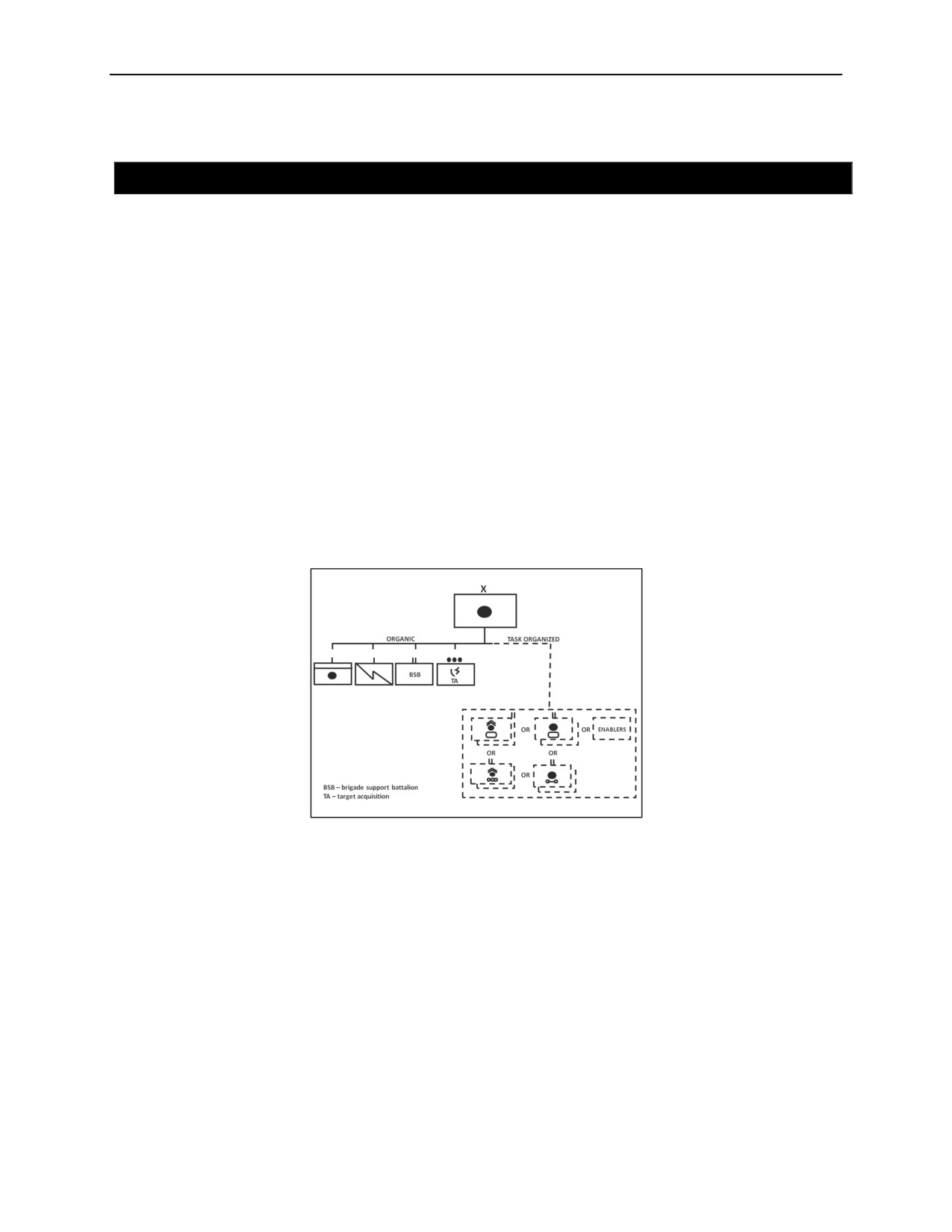
Rules of engagement are often more restrictive than in major combat operations; commander
guidance for fires requires careful consideration during development and wide dissemination to all
levels.
z
Planning for the use of precision-guided munitions and/or employment of nonlethal capabilities may
be necessary to limit collateral damage.
z
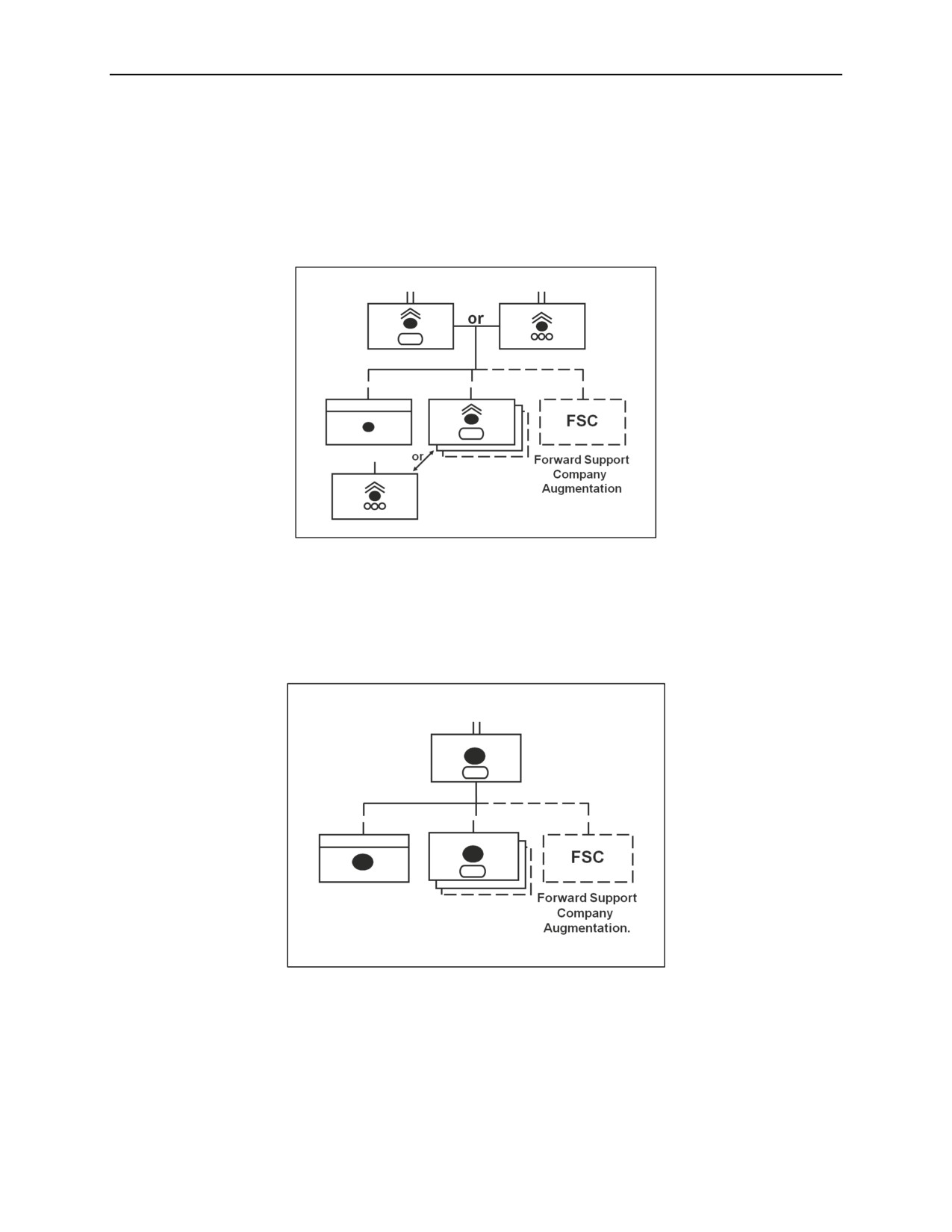
Planning the use of field artillery fires to demonstrate capabilities, show of force or area denial.
1-120. As during offensive and defensive tasks, fire support coordination measures are established for stability
tasks to facilitate the attack of high-payoff targets throughout the area of operations. Restrictive fire support
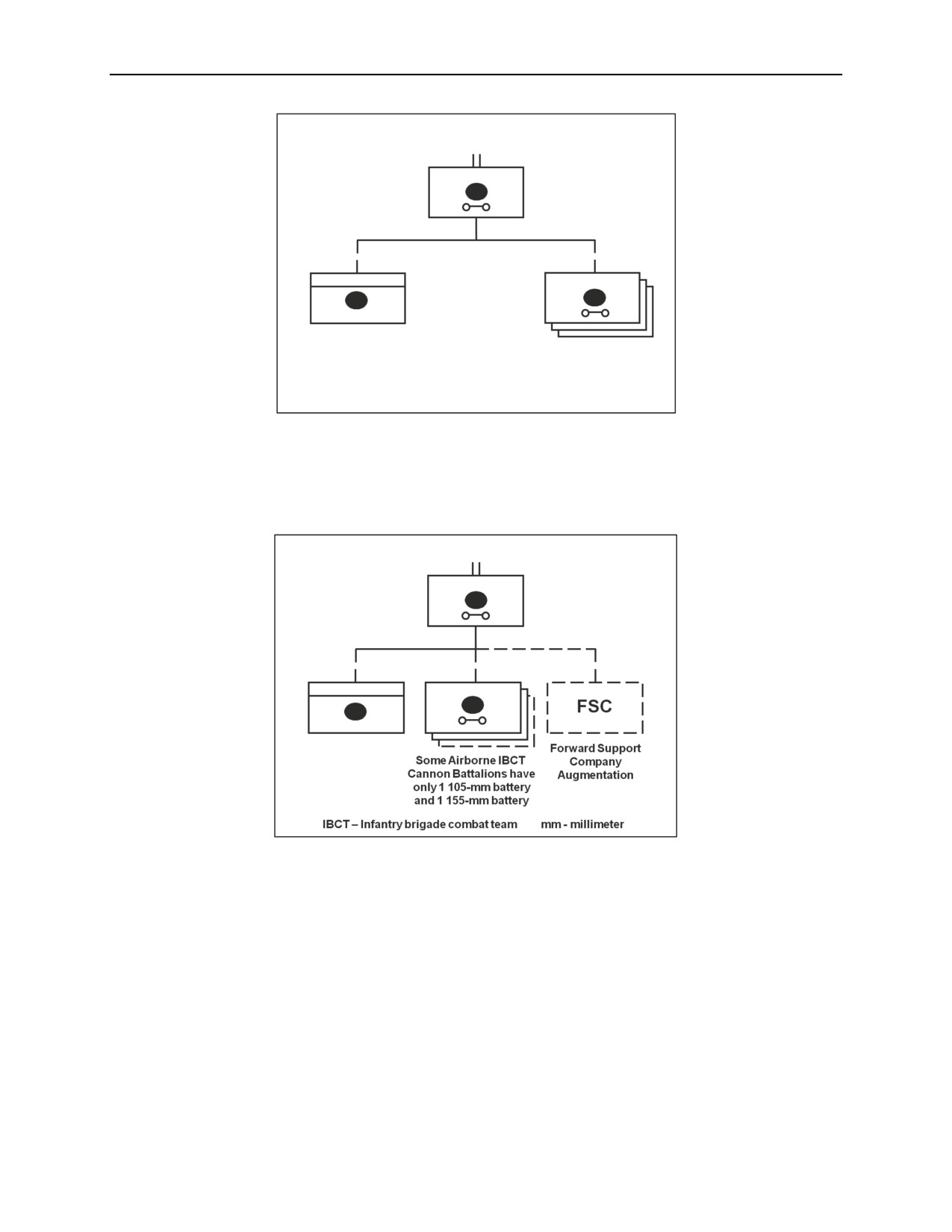
coordination measures are those that provide safeguards for friendly forces and noncombatants, facilities, or
terrain. For example, no-fire areas and restrictive fire areas may be used not only to protect forces, but also to
protect populations, critical infrastructure, and sites of religious or cultural significance.
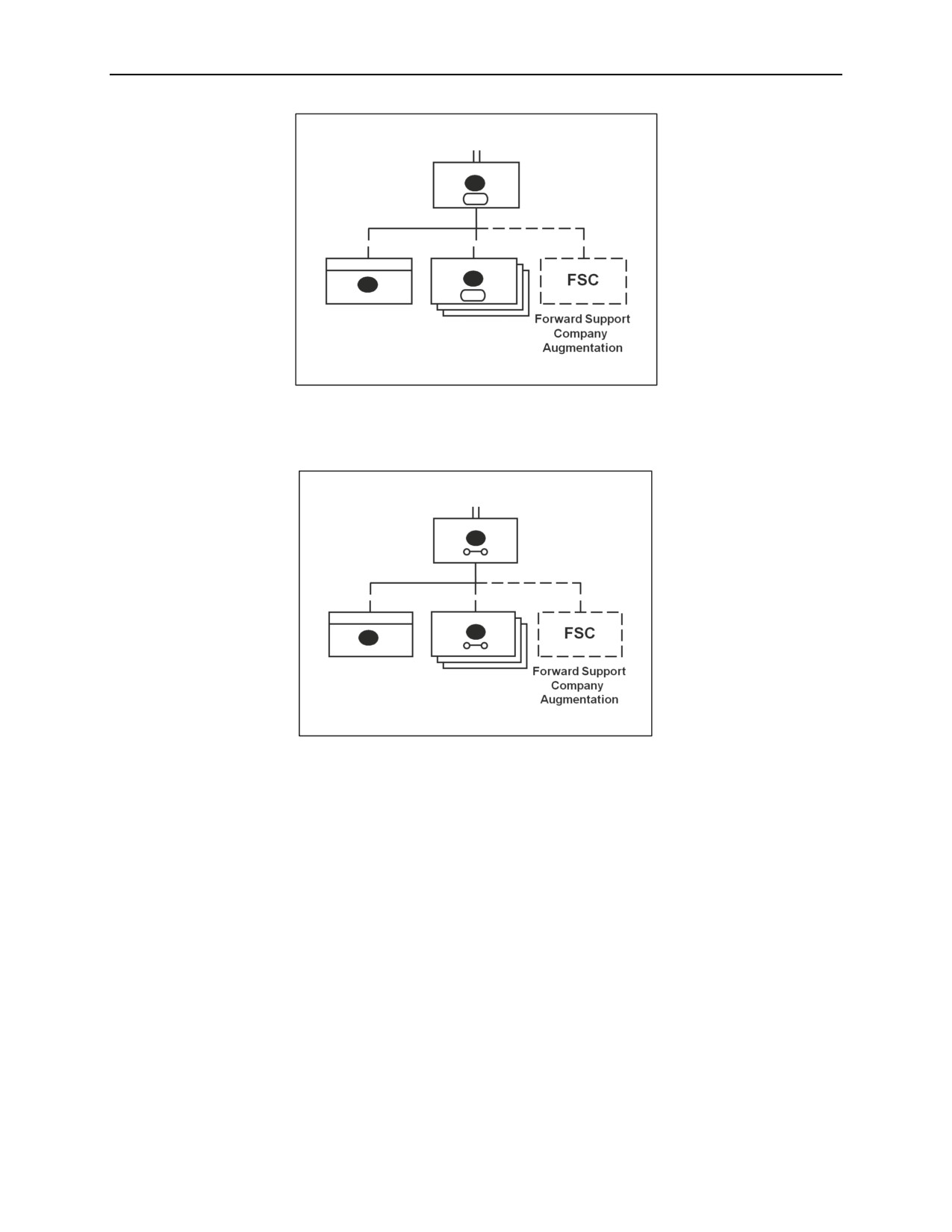
FIELD ARTILLERY IN DEFENSE SUPPORT OF CIVIL AUTHORITIES
1-121. Field artillery units usually contribute in nontraditional ways during tasks involving defense support of
civil authorities. The equipment and organizations available to the units can not only provide effective mission
command but observation posts, convoy operations, local security, sustainment operations, and liaison to assist
inform activities as well.
1-122. For discussion of Defense Support of Civil Authorities, see ADRP 3-09, ADP/ADRP 3-28, and ATP 3-
28.1.
4 April 2014
FM 3-09
1-29
Chapter 1
SECTION III - ORGANIZATION FOR COMBAT AND COMMAND OR SUPPORT
RELATIONSHIPS
ORGANIZATION FOR COMBAT
1-123. Task-organizing is the act of designing an operating force, support staff, or sustainment package of
specific size and composition to meet a unique task or mission (ADRP 3-0). Characteristics to examine when
task-organizing the force include, but are not limited to, training, experience, equipment, sustainability,
operating environment, enemy threat, and mobility. For Army forces, task-organizing includes allocating
available assets to subordinate commanders and establishing their command and support relationships. The
objective of field artillery task-organization is to ensure that each field artillery unit has an established
command relationship or support relationship.
1-124. Commanders should not place artillery in reserve. When the tactical situation dictates, field artillery
units can be given a different command or support relationship.
1-125. The FSCOORD, chief of fires and brigade fire support officer analyze the mission variables of METT-
TC, evaluate the field artillery assets available and recommend a command or support relationship for each field
artillery unit to the supported commander. The supported commander approves the field artillery task-
organization, which is subsequently reflected in the operation plan (OPLAN)/operation order (OPORD) and fire
support plan.
1-126. Commanders consider mutual support when task-organizing field artillery. Mutual support is that
support which units render each other against an enemy, because of their assigned tasks, their position relative
to each other and to the enemy, and their inherent capabilities. (JP 3-31). Mutual support exists when positions
and units support each other by direct and/or indirect fire and/or nonlethal activities. Mutual support increases
the strength of all defensive positions, prevents defeat in detail, and helps prevent infiltration between positions.
Supporting range is the distance one unit may be geographically separated from a second unit yet remain within
the maximum range of the second unit’s weapons systems (ADRP 3-0). Although a field artillery unit may be in
supporting range of a supported unit, the communications capability must also be considered. If the unit needing
support cannot communicate with the supporting unit, the range capability of a weapon system or its proximity
to the supported force has no effect on the outcome of an operation. For more on mutual support see ADRP 3-
90 and FM 3-90-1.
FIELD ARTILLERY EMPLOYMENT
1-127. When planning the integration of fires into an operation, commanders and staffs should consider the
memory aid AWIFM.
Adequate Fire Support for the Committed Units
1-128. The minimum adequate fire support for committed units is considered to be 1 field artillery battalion
for each committed brigade.
Weight to the Main Effort
1-129. The main effort can be weighted by a variety of ways:
z
Reinforcing or general support-reinforcing support relationships can be assigned to provide
additional responsive fires to the maneuver forces in contact.
z
Field artillery units can be positioned and assigned directions of fire to concentrate their fires in the
appropriate operational area. In this manner, units in GS can add weight to the main attack or
strength to the most vulnerable area.
z
Ammunition may be allocated to provide for more support in the affected area.
z
Priority of fires may be given to the main effort (decisive operation).
1-30
FM 3-09
4 April 2014
Field Artillery Operations
1-130. Support relationships from GS to direct support (DS) provide increasing responsiveness to the main
effort’s commander. Minimal essential fire support can be allocated to shaping operations. Consider weighting
the main effort with close air support sortie distribution. Consider suppression of enemy air defenses to enable
friendly close air support and attack helicopter operations supporting the main effort.
Immediately Responsive Fires
1-131. The force commander should establish command or support relationships for available artillery with
which he can immediately influence the operation. The practice of establishing field artillery support
relationships of GS and GSR enhances flexibility and facilitates ability to provide immediately responsive fires
for the force as a whole. The artillery commander maintains the capability to shift fires rapidly and add weight
when enemy vulnerabilities are detected or the force is threatened. As the engagement unfolds, the maneuver
commander may shift the priority of fires to exploit opportunities as they are presented.
Facilitate Future Operations
1-132. Future operations can be facilitated by the assignment of a command or support relationship, the
positioning of field artillery, and the allocation of ammunition. The assignment of GS and GSR support
relationships, as well as on-order command or support relationships enables the transition to a future mission.
Another way to facilitate future operations is to modify the current command or support relationship in
accordance with anticipated requirements.
Maximum Feasible Centralized Control
1-133. The optimum degree of centralized control varies with each tactical situation. A high degree of
centralized control is desired in a defensive situation. Since the enemy has the initiative, it is difficult to
accurately predict where and when he will attack. A lesser degree of centralized control is required in an
offensive situation, because the supported force has the initiative.
FIELD ARTILLERY INHERENT RESPONSIBILITIES IN ARMY
COMMAND RELATIONSHIPS
1-134. Command relationships provide the basis for ensuring unity of command and unity of effort in
operations. Command relationships are used in Army force generation, force tailoring, and task-organizing.
1-135. Command relationships define superior and subordinate relationships between unit commanders. By
specifying a chain of command, command relationships unify effort and enable commanders to use subordinate
forces with maximum flexibility. Army command relationships identify the degree of control of the gaining
commander. The type of command relationship often relates to the expected longevity of the relationship
between the headquarters involved and quickly identifies the degree of support that the gaining and losing Army
commanders provide (ATTP 5-0.1).
1-136. Organic is assigned to and forming an essential part of a military organization as listed in its table of
organization for the Army, Air Force, and Marine Corps, and are assigned to the operating forces for the Navy.
(JP 1).
1-137. Assign is to place units or personnel in an organization where such placement is relatively permanent,
and/or where such organization controls and administers the units or personnel for the primary function, or
greater portion of the functions, of the unit or personnel (JP 3-0).
1-138. Attach is the placement of units or personnel in an organization where such placement is relatively
temporary (JP 3-0).
1-139. Operational control is the authority to perform those functions of command over subordinate forces
involving organizing and employing commands and forces, assigning tasks, designating objectives, and giving
authoritative direction necessary to accomplish the mission (JP 1).
1-140. Tactical control is the authority over forces that is limited to the detailed direction and control of
movements or maneuvers within the operational area necessary to accomplish missions or tasks assigned (JP 1).
4 April 2014
FM 3-09
1-31

Chapter 1
1-141. Field artillery cannon, rocket, and missile systems that are organic, assigned, attached to, or under the
OPCON of FABs and BCTs provide commanders with continuously available, adjustable, and tailored fires
under all weather conditions and in all types of terrain. These organizations can be task-organized with
maneuver to provide the right combination of indirect fires capabilities for a given situation. Task-organizing is
the act of designing an operating force, support staff, or sustainment package of specific size and composition to
meet a unique task or mission (ADRP 3-0).
1-142. The 4 Army field artillery inherent responsibilities (see table 1-1) supplement the inherent
responsibilities of an Army command relationship.
Table 1-1. Field artillery inherent responsibilities in army command relationships
If Army Command
Then Field Artillery Inherent Responsibilities are-
Relationship is-
Answers Calls for Fire
Has as Its
Is Positioned
Has Its Fires
in Priority From:
Zone of Fire:
By:
Planned By:
Organic
1. Parent unit.
Area of
2. Own observers.1
Organic
operations of
Parent unit.
3. Force field artillery
headquarters
parent unit.
headquarters2
1. Parent unit.
Area of
2. Own observers.1
Assigned
Assigned
operations of
Parent unit.
headquarters
3. Force field artillery
parent unit.
headquarters.2
1. Gaining unit.
Area of
2. Own observers.1
Attached
operations of
Gaining unit
Gaining unit.
3. Force field artillery
gaining unit.
headquarters.2
1. Gaining unit.
1. Supported unit
1. Supported unit
Area of
2. Own observers.1
2. Force field
2. Force field
OPCON
operations of
3. Force field artillery
artillery
artillery
supported unit.
headquarters.2
headquarters2
headquarters2
1. Gaining unit.
1. Supported unit
1. Supported unit
Area of
2. Own observers.1
2. Force field
2. Force field
TACON
operations of
3. Force field artillery
artillery
artillery
supported unit.
headquarters.2
headquarters2
headquarters2
Note: (1) Includes all target acquisition means not deployed with the supported unit (such as radars or unmanned aircraft
systems), vehicles, air observers, survey parties. In the NATO, the gaining unit may not task-organize a multinational unit
(see TACON).
Note: (2) If designated by the supported commander.
OPCON - operational control NATO - North Atlantic Treaty Organization TACON - tactical control
FIELD ARTILLERY INHERENT RESPONSIBILITIES IN ARMY
SUPPORT RELATIONSHIPS
1-143. In the past, DS, R, GSR, and GS were referred to as field artillery tactical missions. These tactical
missions are now referred to as support relationships and are used by the rest of the Army to task-organize
forces.
1-144. Army support relationships are not a command authority and are more specific than the joint support
relationships. Commanders establish support relationships when subordination of one unit to another is
inappropriate. Commanders assign support relationships when: the support is more effective if a commander
with the requisite technical and tactical expertise controls the supporting unit rather than the supported
commander; the echelon of the supporting unit is the same as or higher than that of the supported unit; or the
supporting unit supports several units simultaneously (ATTP 5-0.1). Organic field artillery battalions can be
assigned a support relationship by the force field artillery headquarters of the supported command.
1-145. Support relationships allow commanders to employ their units’ capabilities to achieve the desired
results required by supported commanders. Support relationships are graduated from an exclusive supported and
supporting relationship between two units—as in DS—to a broad level of support extended to all units under
the control of the higher headquarters—as in GS. Support relationships do not normally alter administrative
1-32
FM 3-09
4 April 2014
Field Artillery Operations
control. Support relationships are used to task-organize for a mission. Field artillery units may be assigned a
support relationship of DS, R, GSR, or GS.
1-146. The 4 Army field artillery inherent responsibilities (see table 1-2 on page 1-34) supplement the inherent
responsibilities of an Army support relationship.
Direct Support
1-147. Direct support is a support relationship requiring a force to support another specific force and
authorizing it to answer directly to the supported force’s request for assistance (ADRP 5-0). A field artillery unit
in DS of a maneuver unit is concerned primarily with the fire support needs of only that unit. The fires cell of
the supported maneuver unit plans and coordinates fires to support the maneuver commander’s intent. The
commander of a unit in DS recommends position areas and coordinates for movement clearances where his unit
can best support the maneuver commander’s concept of the operation. When field artillery units are able to
habitually support the same maneuver force, coordination and training are enhanced. DS is the most
decentralized support relationship.
Reinforcing
1-148. Reinforcing is a support relationship requiring a force to support another supporting unit (ADRP 5-0).
Only like units (for example artillery to artillery) can be given a reinforcing mission. An R support relationship
requires one field artillery unit to augment the fires of another field artillery unit. When an organic or DS field
artillery battalion requires more fires to meet maneuver force requirements, another field artillery battalion may
be directed to reinforce it. An organic or DS field artillery battalion may be supported by up to 2 reinforcing
battalions. A field artillery unit assigned an R support relationship retains its command relationship with its
parent unit, but is positioned by the reinforced field artillery unit and has priorities of support established by the
reinforced field artillery unit, then the parent unit.
General Support-Reinforcing
1-149. General support-reinforcing is a support relationship assigned to a unit to support the force as a whole
and to reinforce another similar-type unit (ADRP 5-0). The first priority of a field artillery unit assigned a GSR
support relationship is to furnish artillery fires for the maneuver force as a whole; the second priority is to
reinforce the fires of another field artillery unit. A GSR unit remains under the control of the supported
maneuver commander or his force field artillery headquarters. The GSR support relationship offers the
commander the flexibility to meet the requirements of a variety of tactical tasks.
General Support
1-150. General support is that support which is given to the supported force as a whole and not to any
particular subdivision thereof (JP 3-09.3). A field artillery unit assigned in GS of a force has all of its fires under
the immediate control of the supported commander or his designated force field artillery headquarters. Among
Army support relationships, GS provides the highest degree of centralized control of fires.
4 April 2014
FM 3-09
1-33

Chapter 1
Table 1-2. Field artillery inherent responsibilities in army support relationships
If Army Support Relationship
Then Field Artillery Inherent Responsibilities Are -
is -
Answers Calls
Has as Its
Is Positioned
Has Its Fires
for Fire in
Zone of Fire:
By:
Planned By:
Priority From:
1. Supported unit.
Area of
Supported unit.
Supported unit.
2. Own
operations of
observers.1
supported unit.
Direct Support
3. Force field
artillery
headquarters.2
1. Reinforced field
Zone of fire of
Reinforced field
Reinforced field
artillery.
reinforced field
artillery unit HQ.
artillery unit HQ.
2. Own
artillery unit.
Reinforcing
observers.1
3. Force field
artillery
headquarters.2
1. Supported unit.
Area of
1. Supported unit.
1. Supported unit.
2. Force field
operations of
2. Force field
2. Force field
General
artillery
supported unit to
artillery
artillery
Support-
headquarters.2
include zone of
headquarters.2
headquarters.2
Reinforcing
3. Reinforced unit.
fire of reinforced
4. Own
field artillery unit.
observers.1
1. Supported unit.
Area of
1. Supported unit.
1. Supported unit.
2. Force field
operations of
2. Force field
2. Force field
General
artillery
supported unit.
artillery
artillery
Support
headquarters.2
headquarters.2
headquarters.2
3. Own
observers.1
Note: (1). Includes all target acquisition means not deployed with the supported unit (radar, unmanned aircraft systems),
vehicles, air observers, survey parties. In the NATO, the gaining unit may not task-organize.
Note: (2). If designated by the supported commander.
NATO - North Atlantic Treaty Organization
Note: When working with United States
(U.S.) Marine Corps and North Atlantic Treaty
Organization (NATO) units see Marine Corps warfighting publication (MCWP) 3-16/STANAG
2484 for inherent responsibilities for artillery tactical tasks.
NONSTANDARD FIELD ARTILLERY SUPPORT RELATIONSHIPS
1-151. Commanders sometimes use a nonstandard support relationship. In many cases, this is simply a
variation of a standard support relationship (DS, R, GSR, or GS) when there are not sufficient field artillery
assets to cover all the contingencies, or if a field artillery unit is assigned more than one support relationship
over a time period. A nonstandard support relationship is also a means by which the commander can tailor his
field artillery assets in anticipation of future operations. A nonstandard support relationship may involve
limitations or guidance concerning ammunition, positioning, or other critical factors. Examples of nonstandard
field artillery support relationships include—
z
110 FAB: GSR 7 FAB; do not exceed 25 percent of the controlled supply rate in support of 7 FAB.
z
1-89 Field Artillery (MLRS, M270A1): GS; provide liaison officer to the corps fires cell.
1-152. Commanders should not place artillery in reserve but may give a change to its support relationship
ensuring artillery is not held in reserve and adequate support is provided to the main effort. These changes in
1-34
FM 3-09
4 April 2014
Field Artillery Operations
support relationships can be identified by an on-order mission. An example of an on-order mission is “1-52 FA:
GSR 1-50 Field Artillery; on-order R 1-50 Field Artillery.”
SECTION IV - FIELD ARTILLERY ORGANIZATION
FIELD ARTILLERY BRIGADE
1-153. Organic FAB assets include a BSB, a signal network support company, a target acquisition battery, and
a headquarters and headquarters battery—
z
The FAB BSB is organized to provide sustainment support (supply, maintenance, field services, and
transportation) to the organic units of the FAB.
z
The signal network support company deploys, installs, operates and maintains the mission command
information systems networks that support FAB operations and integrate with the division or corps
networks.
z
The target acquisition battery is organized with meteorological, survey, and target acquisition
capabilities including the Army/Navy (Marine) transportable radar special purpose (multipurpose)
(AN/TPQ)-37 (being replaced by the AN/TPQ-53) and AN/TPQ-50-series radars.
1-154. The FAB headquarters and headquarters battery and its assigned staff provide expertise across a broad
range of functional areas. The FAB and each of the subordinate elements can be task-organized as required.
This may include a combination of one to five rocket/missile (MLRS or HIMARS) and/or cannon field artillery
battalions, as well as other enablers. See figure
1-4. For example, executing strike may require placing
surveillance, reconnaissance and electronic attack assets under the OPCON or TACON of the FAB commander.
Figure 1-4. Field artillery brigade organization example
1-155. The FAB is the only Army field artillery organization that typically serves at echelons above the BCT
and can be directed to execute tasks for any joint, Service, or functional headquarters. The FAB is not organic to
any Army organization or echelon. A division, corps, joint force land component command, or joint task force
may have a FAB attached or placed under its OPCON. However, the FAB is normally attached to a division.
When operating under the control of the joint force commander or another Service, the senior Army
headquarters exercises administrative control over the FAB.
1-156. A FAB gives the supported maneuver commander a headquarters that plans, prepares, executes, and
assesses fires in support of operations, and provides the capability to execute strike and counterfire throughout
the area of operations. Depending on the size of the supported commander’s area of operations, the FAB may
not have the resources to provide fire support in all areas simultaneously such as during forced entry or
airborne/air assault operations. The FAB focuses its assets in the supported command’s area of operations based
on the fire support requirements and priorities established by the supported commander.
4 April 2014
FM 3-09
1-35
Chapter 1
1-157. FABs are task-organized to accomplish assigned tasks. Strike is an optimal task for the FAB. The
FAB’s supported maneuver commander assigns the FAB its mission and provides guidance for coordinating the
FAB’s actions with BCTs and other supporting brigades. The supported commander also provides supporting
units to the FAB as necessary. Subordinate units may include augmenting surveillance, reconnaissance, target
acquisition, and/or other fire support assets. The FAB’s supporting assets also may include ground
reconnaissance and surveillance, manned aviation, and unmanned aircraft assets from division or higher
echelons. These assets augment the FAB based on the higher headquarters or supported commander’s mission
analysis task organization and the requirements of a particular mission. The BCT, battlefield surveillance
brigade, maneuver enhancement brigade, combat aviation brigade, and sustainment brigade can all support FAB
operations. The FAB might be required to detach some of its subordinate elements to BCTs or other supporting
brigades of the command.
1-158. Training and readiness authority is the authority for matters affecting the training and readiness of
specified units. This authority is inherent in command authority and may be delegated in whole or in part to
subordinate commanders. Unless specified otherwise by the senior commander, it includes authority to give
direction to an assigned or attached unit concerning unit readiness and organizational training. For example,
when a FAB is attached to a division, the FAB participates in the training events, readiness exercises, and the
deployments of the division. The division commander may also direct the FAB commander to assist BCT
commanders training and preparing their organic field artillery battalions. These functions, in conjunction with
the BCT commander, may include—
z
Providing guidance and oversight for training standardization and certification including
development of the mission training brief.
z
Assessing the state of training and provide training direction for the 13-series military occupational
specialty, including advising on the management and leader development of career military field 13
personnel and management of artillery/fire support equipment, including the cross-leveling between
attached units on the same installation.
z
Assisting the division commander in planning, preparing and executing cannon field artillery
battalion external evaluations and major training exercises.
Note: Units organic to the FAB may control other augmenting units based on task organization for a
specific contingency or operation.
1-159. A force field artillery headquarters, if designated by the supported commander, is normally the senior
field artillery headquarters organic, assigned, attached, or placed under the operational control of that command.
The supported commander specifies the commensurate responsibilities of the force field artillery headquarters
and the duration of those responsibilities
(ADRP 3-09). When designated as the force field artillery
headquarters by a supported division, corps joint task force, or Joint Force Land Component Command
commander, the FAB commander is the FSCOORD for the supported command. The division, corps or joint
task force chief of fires serves as the deputy FSCOORD and takes direction and guidance from the FSCOORD.
If the FAB is designated as force field artillery headquarters, the FAB’s fires cell may require augmentation.
1-160. The FAB staff performs mission planning, determines what assets can best fulfill the supported
commander’s fire support requirements, and tasks its subordinate units. The FAB staff can plan for and employ
those fire support assets it receives as assigned, attached, or which are placed under its OPCON or tactical
control (TACON). It may provide these units a mission, tasks, and establish support relationships as part of field
artillery organization for combat and provides tasks to subordinate units in FAB plans and orders.
MLRS/HIMARS BATTALION
1-161. The MLRS/HIMARS battalion (see figure 1-5 on page 1-37) is composed of a headquarters and
headquarters battery, and 2 or 3 MLRS/HIMARS firing batteries with 8 or 6 launchers each. A forward support
company from the BSB is typically given an augmenting command or support relationship—
z
The headquarters and headquarters battery is organic to the MLRS/HIMARS battalion and is
organized and equipped to coordinate administrative, logistical, maintenance and communications
support for the battalion headquarters and the firing batteries.
1-36
FM 3-09
4 April 2014
Field Artillery Operations
z
The MLRS/HIMARS firing battery consists of a battery headquarters, a battery operations center, a
support platoon, and 2 firing platoons. The battery headquarters has personnel and equipment to
perform administration and limited sustainment for the firing platoons.
1-162. MLRS/HIMARS units are employed to provide field artillery medium-range rocket and long-range
missile fires in support of the BCT, division, corps, joint or multinational forces. The battalion can operate as a
single unit or it can detach batteries or platoons to operate for limited periods.
1-163. For more on the MLRS/HIMARS field artillery battalion see ATP 3-09.60.
Figure 1-5. MLRS/HIMARS battalion organization example
CANNON FIELD ARTILLERY BATTALION
1-164. The armored brigade combat team field artillery battalion is 3 batteries of 6 M109A6 Paladin self-
propelled 155-mm howitzers. The batteries are manned and equipped to operate as 2 separate firing platoons of
either 4 or 3 guns. See figure 1-6.
Figure 1-6. ABCT cannon battalion example
1-165. The Stryker brigade combat team field artillery battalion has 3 6-gun lightweight M777-series 155-mm
towed howitzer batteries; this permits each battery to be organized with 2 firing platoons of 3 guns each. See
figure 1-7 on page 1-38. The Stryker BSB task-organizes its field maintenance company to provide combat
repair team support to the battalion.
4 April 2014
FM 3-09
1-37
Chapter 1
Figure 1-7. SBCT cannon battalion example
1-166. The infantry brigade combat team field artillery battalion is 2 platoons of 4 guns each to a composite
battalion of 1 or 2 6-gun M119-series 105-mm towed howitzer batteries, and 1 6-gun M777-series 155-mm
towed howitzer battery. The 6-gun firing batteries in a battalion are organized into 2 3-gun firing platoons. See
figure 1-8.
Figure 1-8. IBCT cannon battalion example
1-167. The FAB cannon field artillery battalion may be either self-propelled or towed—
z
The self-propelled cannon field artillery battalion is 3 batteries of 4 howitzers each. See figure 1-9 on
page 1-39.
1-38
FM 3-09
4 April 2014
Field Artillery Operations
Figure 1-9. FAB self-propelled cannon battalion example
z
The towed cannon field artillery battalion has 3 batteries composed of 4 M777-series 155-mm towed
howitzer each. See figure 1-10.
Figure 1-10. FAB towed cannon battalion example
1-168. Cannon field artillery battalions are organized with a headquarters and headquarters battery and 2 or 3
firing batteries; a forward support company from the BSB augments the BCT organic field artillery battalion.
z
The BCT field artillery battalion typically includes a target acquisition platoon headquarters team,
weapons locating radar sections (radar types and numbers vary), a meteorological team, 2 survey
teams, a counterfire operations section, 1 or more fire support platoons, and a lightweight counter
mortar radar section. The number and composition of fire support platoons and fires cells vary based
upon the type of unit supported.
z
The FAB field artillery battalion has the same basic organization as the BCT field artillery battalion
less the target acquisition platoons and the fire support platoons. Target acquisition support for the
FAB field artillery typically comes from the FAB target acquisition battery.
z
The headquarters and headquarters battery typically consists of a battery headquarters, battalion
command section, S-1 personnel, S-2 intelligence, S-3 operations, S-4 supply, S-6 communications, a
medical platoon and unit ministry team.
z
The cannon field artillery batteries typically consist of a battery headquarters, supply section, 2 fire
platoon headquarters with fire direction center, 6 firing sections, and 2 ammunition sections (1 per
platoon) —
4 April 2014
FM 3-09
1-39
Chapter 1
The firing platoon is the basic firing unit of the cannon field artillery battery and has personnel
and equipment to determine firing data and conduct fire missions. Each fire platoon consists of a
platoon headquarters, a fire direction center, 3 howitzer sections, and an ammunition section.
The battery headquarters has personnel and equipment to perform administration, sustainment,
and limited chemical, biological, radiological, and nuclear functions—the supply section provides
limited sustainment support; each ammunition section has personnel and equipment to provide
limited ammunition support.
z
The forward support company is organized to provide subsistence, field maintenance, subsistence,
and supply distribution for the battalion; the company consists of a company headquarters, a field
feeding section, a distribution platoon, and a field maintenance platoon.
1-169. The cannon field artillery battalion provides responsive and accurate field artillery fires to the
supported command and its subordinate units according to the commander’s priority of fires. Cannon field
artillery battalions typically have a command or support relationship with a BCT or a FAB. The BCT’s field
artillery battalion has an organic command relationship, but the BCT commander may assign a support
relationship directly to subordinate units of the BCT. A FAB, U.S. Marine Corps, or multinational artillery units
may reinforce a BCT field artillery battalion. A cannon field artillery battalion assigned or attached to a FAB is
typically given a command or support relationship to support the whole force or to augment the fires of a
specified field artillery unit.
1-170. The BCT’s field artillery battalion coordinates with fires cells at BCT and battalion level; and fire
support teams and forward observers at company level. This cannon field artillery battalion is also able to
operate over a widely dispersed area due to its communications capability, organic radars, and support from the
BCT’s sustainment and surveillance and reconnaissance capabilities. The cannon field artillery battery’s fire
direction center controls the battery’s firing and is required to maintain the current tactical situation and respond
to the supported unit and higher headquarters. Each firing platoon has personnel and equipment to determine
firing data and conduct fire missions. A fire mission is 1. The specific assignment given to a fire unit as part of a
definite plan. 2. An order used to alert the weapon/battery area and indicate that the message following is a call
for fire (FM 6-40). The primary control facility for the cannon field artillery battery is the fire direction center.
1-171. Platoon operations are normally 2 firing platoons operating independently in separate platoon locations
with a fire direction center controlling the howitzers. The platoon fire direction centers are equipped with the
Advanced Field Artillery Tactical Data System (AFATDS) computer as the primary digital interface between
the battalion command post and the howitzers. In a platoon-based unit, the platoon leader and platoon
operations center execute mission command. The functions of the platoon operations center include technical
and tactical fire direction. The platoon operations center is a fire direction center with added responsibilities.
The platoon operations center is not a separate element and does not require a separate vehicle. Additional
functions of the platoon operations center are executing orders from higher headquarters, coordinating logistics,
and all the other operational functions normally performed by a headquarters based on guidance from the
battery commander/platoon leader. The numbers of howitzers in each platoon and employment method may
vary based on the tactical situation or mission requirements. Howitzers normally position individually and work
together under the lead of the senior section chief. If the platoon divides into pairs or groups, a designated
senior section chief acts as team leader.
1-172. Section operations are the least preferred method because the section is isolated and must provide for
its own defense. This method requires the highest degree of crew training and does not provide for mutual
support against air or ground threats.
SECTION V - KEY CONSIDERATIONS FOR FIELD ARTILLERY EMPLOYMENT
FIVE REQUIREMENTS FOR ACCURATE FIRE
1-173. To employ fires is to use available weapons and other systems to create a specific lethal or nonlethal
effect on a target. To be effective, fires must be planned, coordinated, accurate and timely. Predicted fire is the
delivery technique of applying accurately computed corrections (not determined by firing) to standard firing
data for all nonstandard conditions (weather, weapon, ammunition, rotation of the earth) to deliver accurate
1-40
FM 3-09
4 April 2014
Field Artillery Operations
surprise, nuclear, or nonnuclear fire on any known target in any direction from any weapon limited only by the
characteristics of the weapon and ammunition used (FM 6-40).
1-174. Providing responsive fires in support of maneuver is dependent on the ability to achieve accurate first-
round fire for effect on targets. Fire for effect is 1. A command to indicate that fire for effect is desired. 2. Fire
that is intended to achieve the desired result on target (FM 6-40). To achieve responsive fires, field artillery and
other units providing indirect fires must conduct thorough and effective fire planning, and maximize the
capabilities and the versatility of automated systems used for tactical and technical fire control. To achieve
accurate first-round fire for effect on a target, an artillery unit or other unit providing indirect fires must
compensate for nonstandard conditions as completely as time and the tactical situation permit. If these
requirements are met, the firing unit will be able to deliver accurate and timely fires. If the requirements for
accurate fire cannot be met completely, the firing unit may be required to use adjust-fire missions to engage
targets. Adjust-fire missions, because the target is alerted by rounds that miss, can result in less effect on the
target, increased ammunition expenditure, increased possibility the firing unit will be detected by hostile target
acquisition assets, and collateral damage. There are 5 requirements for accurate fire—
z
Accurate target location and size.
z
Accurate firing unit location
z
Accurate weapons and munitions information.
z
Accurate meteorological information.
z
Accurate computational procedures.
ACCURATE TARGET LOCATION AND SIZE
1-175. Accurate target location is the first of the five requirements for predicted fire’s accuracy. Errors in self-
location, direction and range combine to determine target location error as measured on X (deviation), Y
(vertical) or Z (range) axes (self-location error includes all three axes). Target coordinates and target location
error need to be of sufficient accuracy to enable the desired effects to be created on the target. Determining the
size and disposition of the target on the ground is also necessary so that accurate firing data can be computed.
Determining the appropriate time and type of attack requires that the target size (radius or other dimensions)
and the direction and speed of movement are considered.
1-176. The observer must locate targets using the most accurate means available. Precision munitions offer
both an increased probability of achieving first-round effects on a target and a reduced probability of collateral
damage. Because precision munitions are more accurate, target location error must be minimized to achieve
effects on a target. The method of target location is normally a grid location, as both polar and shift from known
point imply a large target location error. Grid locations are transmitted using the military grid reference system
with the 100,000 meter grid square designators and a 10-digit or better grid using a target mensuration system,
if available, or an 8-digit grid, if using a less accurate means of target location. Target elevation should be in
meters in relation to mean sea level or the ellipsoid using the most current datum available. The observer must
specify the datum used, so that the fire direction center can make any necessary conversions.
1-177. Point mensuration has always been an important part of targeting, since the points measured represent
the desired points of impact for the munitions employed. As the accuracy of weapons delivery has improved,
the importance of mensuration has grown in proportion and is a vital part of targeting—
z
Mensuration is the process of measurement of a feature or location on the earth to determine an
absolute latitude, longitude, and elevation. (JP 3-60).
z
Target coordinate mensuration is the process of measurement of a feature or location on Earth to
determine an absolute latitude, longitude, and height. For targeting applications, the errors inherent in
both the source for measurement and the measurement processes must be understood and reported.
Mensuration tools can employ a variety of techniques to derive coordinates. These may include, but
are not limited to, direct read from DPPDB [Digital Point Positioning Database] stereo-pairs in stereo
or dual mono mode, multi-image geopositioning, or indirect imagery correlation to DPPDB.
(Chairman of the Joint Chiefs of Staff instruction 3505.01B)
1-178. Target acquisition assets provide the means to successfully detect, locate, identify, track, and classify
targets. Field artillery target acquisition assets include field artillery observers, radar, and target processing
4 April 2014
FM 3-09
1-41
Chapter 1
sections. Field artillery observers are assigned to the field artillery battalion in infantry, armor, and Stryker
BCTs. These fire support personnel have a habitual relationship with the supported maneuver unit. Field
artillery radars and target processing sections are found in both the target acquisition battery of the FAB and the
target acquisition platoon of the BCT’s organic field artillery battalion. Other potential target acquisition assets
include—
z
Information collection assets.
z
Other ground sources (maneuver units, support brigades, civil affairs units).
z
Air sources (manned and unmanned).
z
Special operations forces.
z
Military space systems.
z
National systems.
z
Multinational forces’ assets
1-179. With an accurate target location, field artillery and other fire support personnel are able to match
required assets to a target, and increase the effectiveness of all fire support resources available to the maneuver
commander. The ability to quickly shift highly effective fires throughout the area of operations and beyond
enables field artillery and other fire support personnel to add weight at the time and place needed to support
decisive operations.
ACCURATE FIRING UNIT LOCATION
1-180. The field artillery commander is responsible for accurate firing unit location for all indirect fire weapon
systems. The components of accurate firing unit location are position, direction, and altitude. Accuracy
standards of 7.0 meters horizontal circular error probable (CEP), 3.0 meters vertical probable error and no more
than 0.6 mil azimuth probable error are considered the minimums for firing and target acquisition assets to
achieve accurate unit location. The improved position and azimuth determining system - global positioning
system and on-board navigation systems are the primary means to achieve these levels of accuracy. The fire
direction center can also determine the grid location of each piece by using the reported direction, distance, and
vertical angle for each piece from the aiming circle used to lay the battery. The field artillery commander and
his S-3, advised by the survey section chief, identify survey requirements and develop the survey plan using
available assets and techniques to best meet the guidance given by the commander which may include—
z
Priorities for survey to include survey methods.
z
Accuracies required if other than tactical standard operating procedures. Modified survey techniques
may be needed as the result of the mission variables of METT-TC.
z
Times that critical tasks in the survey plan must be completed.
z
Position requirements to include primary, alternate and supplementary.
z
Future plans.
z
Initialization and confidence checks for digitized platforms.
1-181. Common grid refers to all firing and target-locating elements within a unified command located
and oriented, to prescribed accuracies, with respect to a single three-dimensional datum. Common grid is
the extension of survey control (direction, location, and altitude) from a base datum to all fire support assets
requiring orientation and positioning data within a command. Common grid enables accurate locations for
targets and the friendly firing platforms used to attack them. Without a common grid, the fire support assets
cannot provide desired effects on targets. Common grid is required for the massing of fires; to achieve first
round fire for effect; and transmission of target data from one unit to another in order to aggressively attack
enemy targets. Common grid is often referred to as common survey.
1-182. Common grid is provided by field artillery survey sections (found in the target acquisition batteries of
field artillery brigades and target acquisition platoons of the BCT’s organic cannon field artillery battalion)
using the Improved Position and Azimuth Determining System, or in the case of the U.S. Marine Corps, the
Improved Position and Azimuth Determining System; Survey System, Navigation, or survey equipment from
the Marine Artillery Survey Set. Survey operations must be started as soon as the requirement for survey has
been identified. The goal is to establish survey control before occupation by the firing or acquisition elements.
1-42
FM 3-09
4 April 2014
Field Artillery Operations
1-183. When survey control is not immediately available, efforts should be directed toward establishing
common directional control in the position area. When using an azimuth, the point from which the azimuth
originates is the center of an imaginary circle.
1-184. In order for two locations to be considered on common grid they must be referenced to the same datum
(for example the World Geodetic System of 1984) ellipsoid (there are more than five ellipsoids used around the
world), and grid system (for example, the military grid reference system), and must meet the prescribed survey
accuracies or be converted to them. Common grid facilitates all fire support assets being oriented the same with
respect to azimuth, position, and elevation to a prescribed accuracy. Common grid/map datum is essential for
accurate navigation, target acquisition, target engagement, and for the prevention of fratricide.
1-185. Establishment of the map datum to be used and common grid is a critical command responsibility.
Common grid for a field artillery-supported command is provided by the FAB’s target acquisition battery
and/or the target acquisition platoon found in the BCT’s organic cannon field artillery battalion using the
improved position and azimuth determining system or improved position and azimuth determining system-
global positioning system. Survey planning begins with understanding the field artillery-supported commander's
intent and concept of the operation and the FSCOORD/chief of fires/brigade fire support officer's guidance for
survey. During planning, full consideration must be given to the field artillery-supported commander's concept
of the operation, priorities, tactical situation, survey control available, desired accuracy, and mission variables
of METT-TC. This information can be translated into survey requirements for the target acquisition sensors and
the designated attack systems, which must be on a common grid by the time required. Aggressive survey
planning is essential to ensure mission success.
ACCURATE WEAPONS AND MUNITIONS INFORMATION
1-186. Accurate weapons and munitions information is developed and provided by firing units, fire direction
centers, and sustainment cells. Firing tables and technical gunnery procedures allow the unit to consider specific
ammunition information (weight, fuze type, muzzle velocity variations, and propellant temperature); and firing
unit specifics (for example individual howitzer muzzle velocity); thus, accurate firing data are possible. The
exact procedures to apply weapons information to obtain accurate technical solution can be found in the
applicable technical manuals and tabular firing tables.
ACCURATE METEOROLOGICAL INFORMATION
1-187. With today's emphasis on first round fire for effect and trends toward longer distances, accurate
meteorological corrections for artillery fires are crucial. Atmospheric conditions that include wind, air
temperature and air density along the trajectory of a projectile or rocket directly affect its accuracy and may
cause the projectile or rocket to miss the desired point of impact. For example, tests in Southwest Asia have
shown that firing artillery at maximum ranges in extreme heat and low air density resulted in meteorology
corrections up to 4,700 meters. Accurate meteorological data is one of the prerequisites for accurate fire.
1-188. Meteorological conditions at the target location affect the accuracy of precision-guided munitions and
submunitions that are subject to the same effects of wind, temperature, and humidity as area munitions. These
effects are moderated by the ability of precision-guided munitions to make in-flight corrections using various
guidance methods. The greatest effect of meteorology conditions on precision-guided munitions is their ability
to acquire targets. Precision-guided munitions that acquire targets by reflected laser energy or visual means can
have difficulty locating targets when the target area is obscured by clouds, blowing sand, or other adverse
conditions. Newer precision munitions are less affected by these low-visibility conditions. The
155-mm
Excalibur projectile, the guided-MLRS rocket, or the Accelerated Precision Mortar Initiative 120-mm mortar
round are global positioning system-aided and/or rely on inertial measurement units to home in on the target
coordinates.
1-189. Profiler is a system that provides U.S. Army and U.S. Marine Corps field artillery units with critical
meteorological information to increase first round hits, conserve ammunition, achieve surprise and reduce the
chances for fratricide and collateral damage. Two versions of the Profiler currently exist; the Meteorological
Measuring Set - Profiler in use by Army units and the Computer, Meteorological Data - Profiler in use by both
Army and Marine Corps. Both systems rely on the Meteorological Model Fifth Generation to provide gridded
4 April 2014
FM 3-09
1-43
Chapter 1
meteorological data that in turn are used to generate meteorological messages for the field artillery. Profiler
measures and transmits meteorological conditions to indirect fire direction centers, such as wind direction,
temperature, pressure and humidity, rate of precipitation, visibility, cloud height and cloud ceiling. Profiler uses
this information to create a 4-dimensional meteorological model (height, width, depth, and time) that includes
terrain effects. The Air Force Weather Agency transmits large scale global or regional model output to both
versions via the Global Broadcast System, which is used to initialize the on board Meteorological Model Fifth
Generation. Those systems were designed to use the Navy Operational Global Atmospheric Prediction System
for initialization, which was relayed to the field via the Air Force Weather Agency.
ACCURATE COMPUTATIONAL PROCEDURES
1-190. The computation of firing data similarly affects all indirect fire systems, to include mortars, and must
be accurate. Accurate computational procedures are provided by all fire direction centers. Automated and
manual techniques are designed to achieve accurate and timely delivery of fire. The balance between accuracy,
speed, and the other requirements for accurate fire should be included in the computational procedures.
1-191. FM 6-40 and ATTP 3-21.90 provide a comprehensive discussion of firing data computational
procedures for cannon field artillery and mortars.
FIRE DIRECTION
GENERAL CONSIDERATIONS
1-192. Fire direction is 1. The tactical employment of firepower exercising the tactical command of one or
more units in the selection of targets, the concentration and distribution of fire, and the allocation of
ammunition for each mission. 2. The methods and techniques used to convert target information into the
appropriate fire commands (FM 6-40).
1-193. A fire direction center is that element of a command post, consisting of gunnery and communications
personnel and equipment, by means of which the commander exercises fire direction and/or fire control. The
fire direction center receives target intelligence and requests for fire, and translates them into appropriate fire
direction. The fire direction center provides timely and effective tactical and technical fire control in support of
current operations (JP 3-09.3). Fire control is all operations connected with the planning, preparation, and
actual application of fire on a target (FM 6-40). The fire direction center is the control center for the gunnery
team. The fire direction center personnel receive calls for fire through the AFATDS, or by voice. The fire
direction center will then process that information by using tactical and technical fire direction procedures.
Tactical Fire Direction
1-194. Tactical fire direction is primarily performed at the field artillery battalion fire direction center. Tactical
fire direction includes processing calls for fire and determining appropriate method of fire, ammunition type and
quantity, unit(s) to fire, and time of attack. The fire direction officer’s decision on how to engage the target is
concisely stated as a fire order. A fire order is the fire direction officer’s decision on what unit(s) will fire and
how much and what type of ammunition will be fired. It is based on the fire direction officer’s analysis of the
target. The objectives of tactical fire direction include⎯
z
Providing continuous, accurate, and responsive fires in all conditions.
z
Maintaining the flexibility to engage various target types over wide frontages.
z
Massing the fires of available units.
z
Engaging a number and variety of targets simultaneously.
Technical Fire Direction
1-195. Technical fire direction is the process of converting weapon and ammunition characteristics (such as
muzzle velocity, propellant temperature, and projectile weight), weapon and target locations, and
meteorological information into firing data. Firing data is all data necessary for firing a weapon at a given
1-44
FM 3-09
4 April 2014
Field Artillery Operations
target. Field artillery firing data are determined by use of various firing tables and equipment. These tables
contain the fire control information under standard conditions and data correcting for nonstandard conditions.
1-196. Firing data provided to both cannon and MLRS units includes the number and type of munitions/shell,
fuze setting and aim point(s), allowing the platform to compute its own firing data (deflection and quadrant
elevation). Deflection is the setting on the weapon sight to place the line of fire in the desired direction. The
azimuth of fire is the direction, expressed in mils, that a fire unit is laid (oriented) on when it occupies a position
(FM 6-50). Cannon units are usually also provided the charge and type of fuze, although this too can be
calculated at the firing platform. For firing units without an on-board technical computation capability, or
operating in a degraded mode, the fire direction center transmits firing data to the firing unit as fire commands.
1-197. Fire commands are commands used by the fire direction center to give firing units all the information
needed to conduct a fire mission. Initial fire commands include all elements needed for orienting, loading, and
firing the weapon. Subsequent fire commands include only those elements that have changed from the previous
commands, except quadrant elevation. Quadrant elevation is announced in every set of fire commands and
allows the firing unit to fire in a weapons release status. FM 6-40 provides details on fire commands.
1-198. The surface-to-surface attack by field artillery depends on a number of factors including⎯
z
Meeting the five requirements of accurate fire.
z
Identifying an appropriate target (target acquisition process).
z
Initiating a call for fire into the fire support system (the fire request).
z
Analyzing the fire mission to determine the proper method of attack.
z
Conducting clearance of fires.
z
Coordinating airspace.
z
Transmitting the call for fire to the selected fire direction center(s) or firing element(s).
z
Conducting technical fire direction.
z
Giving fire orders to the firing element if necessary.
z
Delivering the required ordnance on the target to create the desired effect on target (deliver fires).
z
Determining and reporting effects on the engaged target.
1-199. Whether this process is done through an automated system or manually, the process is the same.
1-200. A fire mission is 1. A specific assignment given to a fire unit as part of a definite plan. 2. An order used
to alert the weapon/battery area and indicate that the message following is a call for fire (FM 6-40). A call for
fire is a request for fire containing data necessary for obtaining the required fire on a target. Field
artillery battalion functions directly associated with surface-to-surface attack are encompassed in the fire
mission process. The fires cell or any sensor can initiate a fire mission (for example, forward observers, aerial
observers, radars). Quick-fire channels can be established for any observer or sensor. Any brigade or battalion
fires cell or field artillery command post that is normally in the fire mission flow, but is bypassed during quick-
fire operations, should receive a notification of each fire mission through message of interest processing. To
expedite fires, the unit can coordinate the use of various quick-fire linkages, designed to facilitate rapid mission
execution, while achieving desired control. For example, a quick-fire channel could be established from a fire
support team, through the battalion fires cell, and then directly to the field artillery battalion fire direction
center. For even faster response and more decentralized control, the fire support team may send the mission
directly to the fire direction center that will execute the mission. This is often used for priority targets and final
protective fires.
1-201. A priority target is a target, based on either time or importance, on which the delivery of fires
takes precedence over all the fires for the designated firing unit or element. An artillery firing unit prepares
to engage its priority target by laying its weapon(s) on the assigned target whenever the firing unit is not
engaged in a fire mission in order to reduce the time required to fire the target. For example, a final protective
fire is a priority target. The maneuver commander, after consultation with his fire support officer, designates
priority targets. He also gives specific guidance as to when the targets will become priority, the munitions to
use, the accuracy required, and the desired effects. The supported maneuver commander designates a priority
target based on time requirements or target importance. When not engaged in fire missions, firing units lay on
4 April 2014
FM 3-09
1-45
Chapter 1
priority targets. Lay is 1. To direct or adjust the aim of a weapon. 2. The setting of a weapon for a given range,
deflection, or both (FM 6-40).
1-202. Field artillery battalions normally do not perform airspace deconfliction; instead, the brigade fires cell
with its air defense airspace management element (ADAM) in coordination with the brigade aviation element
(BAE) executes this process for the maneuver commander. Airspace control is a mission command function.
1-203. The field artillery battalion primarily uses digital means to plan and execute fires. However, the
battalion may receive planned and immediate fire missions from a wide variety of sources, in both voice and
digital formats. These requests may have been generated by lower or higher echelon maneuver fires cells and by
trained field artillery observers and untrained observers. Unmanned aircraft systems may send calls for fire
directly to the brigade fires cell as the aircraft may be considered a brigade asset.
DIGITAL FIRE REQUESTS
1-204. Digital fire missions may be received from field artillery and non-field artillery digital systems.
Procedures and capabilities may vary depending on which digital systems are interfacing with one another.
Training opportunities should be aggressively sought out. Field artillery technical rehearsals should thoroughly
address digital interface issues. Whenever possible, digital fire missions should be rehearsed along the entire
data link, under the same digital conditions anticipated for the actual operation
(for example, extended
communications distances, surge digital traffic capacity, degraded operations, and alternate routes).
VOICE FIRE REQUESTS
1-205. Use of voice may be necessary for unplanned, immediate fire requests or during adverse
communications conditions. Fire direction centers must anticipate the circumstances and the types of voice
missions they may encounter. The tactical solution and effects on the target should be essentially the same
regardless of whether the mission is processed voice or digital. However, missions from untrained observers
must be rehearsed during training to establish proper unit techniques.
COUNTERFIRE
GENERAL CONSIDERATIONS
1-206. Counterfire is fire intended to destroy or neutralize enemy weapons. Includes counterbattery and
countermortar fire (JP 3-09). The counterfire battle is not a separate battle, but one aspect of the overall
combined arms fight. Counterfire contributes by providing fires against the enemy indirect fire system; it
protects friendly forces, combat functions, and facilities from enemy indirect fires by suppressing, neutralizing,
or destroying enemy indirect fire weapons systems. Counterfire gains freedom of maneuver for all friendly
forces. Counterfire is inseparably tied to current and future operations and is part of the overall combined arms
fight to achieve fire superiority. Counterfire is both proactive and reactive.
Proactive Counterfire
1-207. Proactive counterfire is the specific targeting of enemy indirect fire systems including their command
and control, sensors, platforms, and logistics before they engage friendly forces. The proactive measures
consists of zone management, site analysis, and position survivability considerations. Proactive counterfire
process begins with targeting during the military decision making process and continues throughout the
operation. The brigade combat team intelligence officer and the targeting officer develop named areas of
interest and target areas of interest where the enemy indirect fire assets are expected. The objective of proactive
counterfire is to identify, locate, and attack to eliminate the enemy’s strike capability before it can impact
friendly operations. The FAB normally performs the bulk of proactive counterfire in support of division
operations, using organic target acquisition and fires as well as allocated division, corps, joint or multinational
assets to acquire and disable attack components of the enemy’s strike capability. Examples of target sets
include: cannon, rocket, and missile delivery units, prepared launch sites, artillery ammunition storage facilities,
fire direction centers, counterfire radars, forward observers, fixed or rotary wing airfields and fire support
1-46
FM 3-09
4 April 2014
Field Artillery Operations
communication infrastructure. Intelligence assets must be synchronized and integrated to accurately locate
targets; and attack assets (such as artillery, mortars, close air support, attack helicopters, naval surface fire
support, and electronic attack) must be dedicated against the threat total fire support system. Considerations for
conducting proactive counterfire include⎯
z
All available artillery units participate.
z
Requires augmentation by Army and joint intelligence assets to locate and accurately target the
enemy indirect fire systems.
z
The G-2/S-2 typically has a leading role in managing this effort; intelligence feeds into common
ground station and cross-cueing radars and unmanned aircraft systems are critical.
z
Establishing digital interface between the MLRS/HIMARS and cannon field artillery battalion S-2s
and the S-2/liaisons is critical.
z
Making maximum use of permissive fire support coordination measures to facilitate the clearance of
fires; for example, in defense the coordinated fire line may be positioned close to friendly troops to
facilitate quick engagements.
z
Managing no-fire areas that protect special operations forces, long-range surveillance detachments,
reconnaissance troops, and scouts is critical.
z
Use of AFATDS to clear fires should be maximized.
z
Establishing radar call for fire zones.
Reactive Counterfire
1-208. Reactive counterfire provides immediate indirect fires to neutralize, destroy, and suppress enemy
indirect fire weapons once acquired. The fire support systems respond primarily to enemy mortar and artillery
fires during or immediately following enemy engagement of friendly forces. Reactive counterfire usually
requires quick response capabilities for optimum effectiveness and can benefit from the establishment of quick
fire channels. The FAB or the BCT organic field artillery battalion serve as the counterfire headquarters for the
supported maneuver command: planning, coordinating, and delivering fires in reaction to enemy indirect fire
activity. FAB MLRS/HIMARS and cannon field artillery battalions and BCT organic cannon field artillery
battalions employ a variety of counterfire acquisition assets to accurately locate enemy indirect fire assets as
they are engaging friendly forces and establish necessary sensor-to-shooter links to rapidly attack the enemy
systems. Ensure that the mission fired report and artillery target intelligence is sent to the analysis and control
element. Other key considerations for conducting reactive counterfire include airspace clearance, the use of both
permissive fire support coordination measures that facilitate quick engagements and restrictive measures such
as no-fire areas to protect critical assets, establishing quick-fire channels with sensor-to-shooter links, and
designating radar zone managers.
INTEGRATING COUNTERFIRE WITH THE SCHEME OF MANEUVER
1-209. The combination of the AFATDS, MLRS/HIMARS, and cannon weapons systems and an array of
sensors that include highly responsive radars enable proactive and reactive counterfire. Sensors, including
radars and unmanned aircraft systems, provide accurate near real-time targeting information. The AFATDS at
all levels can interface directly with weapons locating radars. This link gives the commander an extremely fast,
responsive, and effective counterfire capability. Sensor-to-shooter pairings can orient on the force commander's
priorities while still providing counterfire to the force as a whole. Use of zone management and common sensor
boundaries, based on specific commander's guidance, is essential for providing targeting, zone, and report
criteria for the radar section and engagement and effects criteria for the firing unit.
1-210. As part of the combined arms battle, counterfire must be effectively planned and integrated into the
supported maneuver commander’s scheme of maneuver. The commander receives input and recommendations
from his FSCOORD, chief of fires, fire support officer, G-3/S-3 and G-2/S-2 and other staff officers involved in
counterfire operations. He issues decisions and guidance as necessary to direct counterfire efforts, to ensure
effective coordination occurs, and to ensure that counterfire is synchronized with all other aspects of field
artillery supported-unit operations. Field artillery units receive counterfire guidance through the force field
artillery headquarters (if designated) or the chain of command. Counterfire responsibilities for the supported
maneuver unit staff and fire support planners include—
4 April 2014
FM 3-09
1-47
Chapter 1
z
Supporting the maneuver commander’s critical assets.
z
Developing, disseminating, and managing intelligence and order of battle information on the
enemy’s indirect fire system.
z
Advising the maneuver commander in the establishment of attack guidance for counterfire targets.
z
Coordinating counterfire operations with higher echelon counterfire operations.
z
Integrating counterfire into the operation plan in a complementary manner to enable maneuver
operations.
z
Achieving indirect fire superiority within the supported maneuver commander’s area of operations.
PLANNING FOR COUNTERFIRE AND POSITIONING RADARS
1-211. Planning for counterfire begins with supported maneuver commander’s guidance, intelligence
preparation of the battlefield and identification of high-payoff targets early in the military decision making
process (MDMP). Planning for counterfire continues throughout the operation. Products of the MDMP may
include Annex D (FIRES) to the supported commander’s OPORD, the supporting FAB/field artillery battalion
OPORD, and its supporting target acquisition tab/annex that identify the requirements for the counterfire radars.
The field artillery battalion S-2 and targeting officer, with S-3 guidance, develop the radar deployment order for
the commander’s approval. The radar deployment order details positioning, coverage, and zones for the radars.
The radar deployment order is normally part of the target acquisition tab/annex to the field artillery battalion
OPORD.
1-212. If the enemy indirect fire threat is significant, the supported maneuver commander may direct his air,
ground, and electronic information collection and target acquisition assets to find and target the threat. The
supported commander’s G-2/S-2 and fires cell planners and targeting officers develop named areas of interest
and target areas of interests where the enemy indirect fire assets are expected. The supported unit commander’s
G-3/S-3 assigns units to detect enemy activities in the selected named areas of interest. Tasks that are given to
the reconnaissance squadron, the military intelligence company, and maneuver units form the basis of the
brigade’s information collection plan. Information on the enemy indirect fire system includes all systems in the
supported commander’s area of operations, as well as any outside the area of operations that can impact the
supported commander’s mission including—
z
Indirect fire weapon systems—mortars, cannons, rocket, and missile launchers.
z
Target acquisition assets—observers, radars, sound/flash systems, and electronic intelligence.
z
Command and control elements relevant to counterfire operations.
z
Enemy indirect fire tactics.
z
Enemy counterfire tactics—to include use of lethal and nonlethal ground and air assets against
friendly field artillery.
1-213. Information feeds from the Joint Surveillance and Target Attack Radar System, unmanned aircraft
systems, and electronic, communications, and human intelligence sources populate the Distributed Common
Ground System-Army database in the supported maneuver commander’s intelligence cell. The Distributed
Common Ground System-Army generates target nominations that are digitally transmitted to the AFATDS in
the fires cell for mission processing. Sensors providing information on targets not meeting the target selection
standards are used to cue other sensors to validate the target.
1-214. The flexibility of unmanned aircraft systems makes them a key resource to be cross-cued to locate
enemy indirect fire targets. Once located, field artillery, close air support, or maneuver assets may engage the
targets. Unmanned aircraft systems may provide near real time battle damage assessment.
1-215. The fire support planners must coordinate the use of the terrain for the radar and recommend radar
zones. Radar positioning is coordinated between the FAB’s operations and counterfire officers and the
supported unit’s S-3. Likewise, the BCT field artillery battalion S-3 coordinates positioning of the battalion
target acquisition platoon’s radars with both its higher headquarters or other supported fires cell, S-3, and the
FAB (if one has been designated as force field artillery headquarters). The targeting officer or radar section
leader recommends radar positioning based on the mission variables of METT-TC and the radar’s accumulated
cueing times. When possible, the FAB target acquisition battery’s target acquisition platoon leader and/or radar
1-48
FM 3-09
4 April 2014
Field Artillery Operations
section leader should reconnoiter the sites. If the radar moves or becomes inoperable, the radar coverage area
should be tasked to another target acquisition asset. The radar section chief selects the final radar site based on
the Radar Position Analysis System and visual sighting. Often, radars require a position that permits 6400-
mil/360-degree coverage.
1-216. The supported unit commander should indicate the assets that are deemed essential to ensure mission
accomplishment. If the commander does not identify these assets, the targeting officer must query the
commander for the necessary guidance. Once the guidance is obtained, the information is passed to the fires cell
for designation as radar critical friendly zones.
1-217. Radar zones are a means of prioritizing radar sectors of search into areas of greater or lesser
importance. Zones focus radar coverage on the combined arms commander’s battlefield priorities. A radar zone
is a geometric figure placed on a tactical graphic around an area that designates the area as more, or less,
important. Four types of zones can be entered into radars: critical friendly, call for fire, artillery target
intelligence and censor zones. A common sensor boundary is useful in reducing duplication of acquired targets
among radars. Activities essential for successful radar zone management planning include⎯
z
Prioritizing operational sector and scheme of maneuver events for zone planning based on the
commander’s intent/guidance.
z
Developing zones during the course of action development and the wargaming process.
z
Approving and allocating zones to subordinate fires cells that support the scheme of maneuver and
facilitate the engagement of high-payoff targets.
z
Developing and assigning triggers for the execution of planned zones.
z
Incorporating triggers for planned zones and radar movement into the appropriate decision support
template, synchronization/execution matrices, and information collection plan.
z
Rehearsing planned zones during combined arms, field artillery technical, and fire support rehearsals.
z
Refining zones during execution as the intelligence preparation of the battlefield develops or the
scheme of maneuver changes.
z
Developing positioning guidance for the radar that optimizes the probability of acquisition and
supports the coverage of planned zones.
FAB/FIELD ARTILLERY BATTALION ROLE IN COUNTERFIRE OPERATIONS
1-218. The FAB or the BCT’s cannon battalion normally has primary responsibility for the reactive
component of the maneuver commander’s counterfire operations.
1-219. In the FAB, the key counterfire personnel are the FSCOORD/FAB commander, S-3, S-2, target
acquisition battery commander, counterfire officer, assistant counterfire officer, targeting officer, and the radar
section leader. The FAB S-3, based on the supported maneuver commander’s guidance, considers counterfire in
all phases of the operation. The FAB commander directs measures to decrease the FAB’s vulnerability to
detection and minimize exposure to enemy fires. Counterfire attempts to locate and destroy enemy indirect fire
systems that pose the greatest threat before they can attack.
1-220. In the BCT field artillery battalions, the key counterfire personnel are the FSCOORD/field artillery
battalion commander, S-3, fire direction officer, S-2, targeting officer, target acquisition platoon leader, and the
radar section leader. The field artillery battalion S-3, based on the supported maneuver commander’s guidance,
considers counterfire in all phases of operations. The FSCOORD directs measures to decrease the field artillery
battalion’s vulnerability to detection and minimize exposure to enemy fires.
1-221. Counterfire radars organic to the target acquisition battery of the FAB and target acquisition platoon of
the BCT’s cannon field artillery battalion normally send fire missions generated acquired by the radar to the fire
direction center at the designated field artillery battalion tactical operations center. Counterfire targets are
usually generated from critical friendly zones or call for fire zones. If the situation warrants, a quick-fire
channel can be established from a radar directly to a firing battery or platoon. Quick-fire channels, when
directed, are established for a specified period to achieve specific mission requirements. Pre-clearance of such
targets needs to be defined in precise terms that identify the conditions under which the target is pre-cleared for
engagement.
4 April 2014
FM 3-09
1-49
Chapter 1
1-222. Acquired counterfire targets may be fired by the designated field artillery battalion or forwarded
through field artillery and fire support channels for attack by other assets. When a field artillery battalion is
assigned a reinforcing support relationship, the supported field artillery battalion commander has additional
options for executing counterfire operations—
z
The supported maneuver commander’s fires cell passes all counterfire missions to the reinforcing
field artillery battalion; this allows the BCT’s field artillery battalion to concentrate on providing
close fires.
z
The radars send all acquisitions directly to the reinforcing field artillery battalion; this normally
lowers mission-processing time.
SPECIAL CONSIDERATIONS FOR THE CONTROL OF WEAPONS LOCATING RADARS
1-223. The FSCOORD, chief of fires, brigade fire support officer, and fires cell planners recommend an
organization for combat for the radar assets to best meet the supported commanders' requirements and the
mission. The FAB or the BCT field artillery battalion coordinates radar management with supported G-2/S-2s,
G-3/S-3s and fires cells. Control options for weapons locating radars include centralized control at the FAB,
decentralized control, and a combination of centralized and decentralized control.
Centralized Control
1-224. When directed by the supported maneuver commander, the FAB may assume control of all weapons
locating radars in the supported force. Centralized control optimizes coverage to support the commander's
intent. The FAB’s S-2, S-3, counterfire, target processing, and fire control elements work with both FAB-
subordinate and BCT organic field artillery battalion counterfire personnel by—
z
Designating a general position area, sector of search, and zones for each of the radars.
z
Designating cueing agents
z
Establishing cueing guidance.
z
Establishing sensor-to-shooter linkages
z
Controlling radar movement.
1-225. Deconfliction of coverage in autonomous operations is simple since the fires cell controls all weapons
locating radars. Even so, a common sensor boundary might be established to segregate coverage areas
according to capabilities of individual radar. If established, the common sensor boundary should be placed in
conjunction with the brigade’s coordinated fire line when possible. This eliminates the need to deconflict
acquisitions before engaging targets. The call for fire zone may be cleared to engage targets immediately based
on intelligence preparation of the battlefield and commander’s intent.
1-226. BCT organic target acquisition assets may be held either under the centralized control of the BCT fires
cell or the BCT’s field artillery battalion. Centralized control optimizes coverage to both support the scheme of
maneuver and to provide radar coverage for call for fire and critical friendly zones. Under centralized control,
the BCT S-2, brigade fire support officer, and fires cell planners work with the organic field artillery battalion
S-2 and targeting officer and organic field artillery battalion personnel to accomplish the same tasks as do their
FAB counterparts.
Decentralized Control
1-227. Decentralized control can be accomplished by establishing a command or support relationship for the
radar. Under decentralized control, target acquisition assets are provided to subordinate units for their direct
control and employment. To facilitate autonomous operations, radar sections may be attached to battalions or
even batteries. Units with attached radars plan the employment of attached radars. The battalion S-3 controls the
radar, based on recommendations from the battalion S-2 and targeting officer, to meet the commander’s
guidance. Weapons locating radar sections are responsible for covering the supported maneuver battalion or
reconnaissance squadron zone of responsibility or area of operations. The FSCOORD, brigade fire support
officer and fires cell direct requirements and priorities based on the BCT commander’s guidance and tactical
situation. The field artillery battalion S-3 directs radar employment to execute those requirements. Weapons
1-50
FM 3-09
4 April 2014
Field Artillery Operations
locating radars may be placed under the control of a FAB MLRS/HIMARS battalion or other field artillery unit
from the division or corps based on METT-TC.
A Combination of Centralized and Decentralized Control
1-228. Any combination of centralized and decentralized control of radars may be used according to the
situation. For example, one of the weapons locating radars and a howitzer battery may be in DS of a BCT
subordinate maneuver battalion, while the remaining weapons locating radar is kept under control of the BCT
field artillery battalion.
Considerations for Supporting Augmenting Field Artilery Units
1-229. Augmenting units may or may not require both target acquisition assets and additional processing
capability to effectively perform counterfire. In either case, the BCT organic field artillery battalion must ensure
the augmenting unit is capable of accomplishing any assigned fire mission. Closely linked to BCT maneuver
through the fires cell, the fire support coordinator, brigade fire support officer, and BCT organic field artillery
battalion S-3 must provide and coordinate the following for the R unit—
z
Commander’s guidance for counterfire, to include required search azimuth, zones, and cueing
guidance.
z
Provide intelligence support.
z
Coordinate terrain, to include position areas for augmenting field artillery and acquisition assets.
z
Traffic and movement priorities for units and ammunition.
z
Ammunition forecast and other sustainment requirements.
z
Survey and meteorological support, if needed.
1-230. An automated (digital) capability must be provided to non-automated multinational field artillery units
to maximize communications. The supported FA battalion may have to provide liaison with multinational units.
TACTICAL MOVEMENT AND POSITIONING
1-231. Artillery units should not be positioned on major avenues of approach. Enemy breakthroughs may
jeopardize the unit or force it to displace prematurely. Supported commanders typically give artillery units a
position area for artillery where individual artillery systems can maneuver to increase their survivability. A
position area for artillery is not an area of operations for the artillery unit occupying it. Coordinating positions
for field artillery is a collaborative effort among the maneuver headquarters, fires cells, and field artillery
headquarters to ensure continuously available field artillery (indirect fires, radar, survey and meteorology)
support to the force. Early in the operations process the personnel identify the possible field artillery units
involved, the general position areas required and their suitability in the supported unit areas of operation, the
general times when these locations will be required, and the possible routes needed for movement.
Reconnaissance, selection, and occupation of position is the rapid, orderly movement to and occupation of an
artillery firing position.
1-232. This information is used by the supported command and supporting fires cell and field artillery
battalion staffs to begin the detailed planning and information gathering necessary to identify specific issues or
requirements, the feasibility of the general positioning and movement plan, and the detailed coordination
requirements necessary for terrain management. As the scheme of maneuver develops, field artillery positioning
and movement plans and information become more detailed, and the maneuver headquarters G-3/S-3, fires cells
and FAB/field artillery battalion S-3s conduct lateral coordination. The supported command’s chief of fires/fire
support officer can assist supporting FABs/field artillery battalions with terrain management issues. Level III
threats (requires commitment of tactical combat force) may cause significant traffic as sustainment units and
civilians move away from the threat. In such cases field artillery units may need to request priority for
movement. Aerial reconnaissance may facilitate movement planning, helicopters can quickly emplace advance
party teams and unmanned aircraft systems can be used to scout ahead of moving field artillery units.
4 April 2014
FM 3-09
1-51
Chapter 1
1-233. The positioning of field artillery in the security area to maximize range is appropriate and must be
carefully considered and planned. Positioning considerations include security risks, communications
requirements and logistical support.
1-234. During an area defense, field artillery units may have to move more often than maneuver forces,
particularly where there is significant enemy counterfire. Field artillery should position well forward in the
supported command’s defensive formation; coordination for subsequent positions is essential. Terrain analysis
includes its effects on not only weapons systems but also for ammunition carriers and towed-artillery prime
movers as well. During airborne or air assault tasks, conduct initial reconnaissance by map or air. Plan for air or
ground displacement.
1-235. When in urban areas, identify position areas with dirt surfaces that will support emplacement of spades
and firing platforms. Anticipate the possibility that street rubble may hamper movement. Anticipate increased
movements to overcome obstruction/dead space. Ensure howitzer positions allow for high-angle firing. Position
fire units on the edge of the urban area, if possible. Provide multiple exits from the position. Consider the need
for multiple survey control points. Anticipate survey difficulties due to obstructions, collateral damage, and
electro-magnetic interference, for example, metal, power lines, and transformers.
1-236. FAB/field artillery battalion sustainment organizations should be located so that support can be
maintained, but does not interfere with the tactical movement of FAB/field artillery battalion units, or with units
that must pass through the area. The size of the area dedicated to sustainment activity varies with terrain; that
for a FAB may be up to 4 to 7 kilometers in diameter with that for a field artillery battalion proportionately
smaller. Usually the FAB/field artillery battalion sustainment organizations are on a main supply route located
in the brigade, division, corps, joint task force, or other supported command’s sustainment area. Ideally the
areas are out of the range of the enemy’s medium artillery.
SURVIVABILITY AND SECURITY
1-237. Field artillery units and their elements are often high-value targets for the enemy, can be detected by
multiple means, and are vulnerable to enemy air attack, ground forces, and electronic warfare. Many field
artillery units have very limited self-protection capability. Elements that need to be secured include
headquarters elements, command posts and mobile command groups, isolated elements, and field artillery firing
platoons. Survivability of these units is critical to the success of the field artillery-supported command.
1-238. The ability to disperse, hide, fire, and then displace quickly helps negate the vulnerability of firing units
to detection based on their firing signature. Keep in mind that this firing signature may also endanger any
nearby units. The battery commander will issue movement criteria to the platoon leader for displacement and
survivability moves. Base movement criteria on mission variables of METT-TC and tactical standard operating
procedures. Some triggers for movement may include the number of rounds fired in current location, duration of
firing, and time in position.
1-239. Radar systems are susceptible to enemy ground attack, air attack, indirect fires, and electronic warfare.
When possible, radar section equipment should be placed in a hardened position to protect the antenna and
crew. Even so, the antenna cannot be completely covered. Placing the radar in a hardened position also helps
dissipate noise from the antenna transceiver group and equipment trailer, lowers susceptibility to direct
observation, and reduces the radar’s thermal and infrared signatures.
1-240. Field artillery units must always plan for self-defense. The key to survival for less mobile elements of
field artillery units such as command posts and fire direction centers is to avoid detection; concealment using
natural and manmade camouflage, noise and light discipline, and positioning these unit elements within natural
terrain features to reduce the risk of detection from the ground or air greatly enhance survivability. Other
considerations include—
z
Positioning units to protect them from potential enemy indirect and direct fire:
Positioning on reverse slopes.
Positioning away from high speed avenues of approach.
Establishing a track plan within the position area.
Using terrain-gun positioning.
1-52
FM 3-09
4 April 2014
Field Artillery Operations
Using natural and man-made camouflage.
z
Positioning units to enable mutually supporting fires.
z
Coordinating support from maneuver units, military police, nearby units, and host nation
civil/military elements to assist in defending field artillery battalion assets from attack and in
repelling attacks.
z
Using supplementary positions for lengthy planned missions, especially when the counterfire threat
is high.
z
Making maximum use of mask to shield fires and communication from enemy acquisition.
z
Hardening positions whenever possible.
z
Covering likely avenues of approach with machine guns, antitank weapons, and grenade launchers.
z
Planning for howitzer direct fire.
z
Positioning listening posts and observation posts to provide sufficient early warning to the battery.
z
Using roving patrols throughout the position area.
z
Training Soldiers on improvised explosive devices and mine identification, likely locations, and
marking procedures.
z
Ensuring an advanced party detects or clears the position of any enemy forces, civilians; chemical,
biological, radiological, and nuclear threats, improvised explosive devices, and mines prior to the
main body arriving.
z
Initially clearing lanes for critical vehicles to move into position, for example, fire direction center
and howitzers; clear noncritical areas as time permits.
z
Establishing a secure perimeter to guard against ground attacks, displaced civilians entering the
perimeter, and thieves.
z
Ensuring vehicles never travel alone.
1-241. Planning and requesting fire support, situational understanding, appropriate positioning, and movement
all contribute to self-defense. The key to acquiring external protection is to work with the force commander to
reach an agreement that matches the threat level of the operational environment. Procedures for using such a
package should be included in all battalion and battery tactical standard operating procedures. The supported
commander may consider including forces to provide security and protection for field artillery elements as
specified tasks in OPLANs/OPORDs. FAB/field artillery battalion sustainment elements must organize and
prepare to defend themselves against ground or air attacks. Often, they occupy areas that have been secured by
maneuver units. The security of the trains at each echelon is the responsibility of the individual in charge of the
trains.
SUSTAINMENT
THE ROLE OF ECHELONS ABOVE BRIGADE SUSTAINMENT ORGANIZATIONS
1-242. Sustainment brigades are subordinate commands of the theater sustainment command which
consolidate selected functions. The theater sustainment command uses sustainment brigades to provide support
to the joint task force, corps, divisions’ BCTs and other support brigades (for example FAB, battlefield
surveillance brigade, maneuver enhancement brigade). The sustainment brigades are assigned multifunctional
and/or single function battalions, and companies tailored and task organized to the specific mission. All
sustainment brigades provide area support, although the specific tasks they are assigned may differ.
THE ROLE OF BCT AND FAB BRIGADE SUPPORT BATTALIONS
1-243. The BSB organic to BCTs and FABs perform selected consolidated functions. The BSBs in the BCTs
generally have an organic distribution, maintenance, and medical company and a number of forward support
companies. The forward support companies are assigned to the BSB and can be in direct support DS, or under
OPCON or TACON of supported maneuver or field artillery battalions of the brigade.
1-244. The FAB’s BSB have distribution and maintenance platoons but does not have an organic medical
company. A medical treatment team and an ambulance team are organic to the FAB headquarters and
4 April 2014
FM 3-09
1-53
Chapter 1
headquarters battery to provide health service support Role 1 medical care. The area support medical company
from the multifunctional medical battalion provides Role 2 health service support and force health protection
support for the FAB. The BSB provides a material carrying capability that enables the brigades to conduct
sustained operations for a finite period of time. For example the BCT and the FAB are organized with self-
sustainment capability for up to 48 hours of combat. Beyond 48 hours, echelons above brigade sustainment
organizations, such as the sustainment brigade, are required to conduct replenishment of BCT and FAB combat
loads.
SUSTAINMENT WITHIN FIELD ARTILLERY ORGANIZATIONS
Field Artillery Brigade
1-245. The BSB is the core sustainment organization for the FAB. The BSB is organic to the FAB and
consists of functional support platoons and functional and multifunctional forward support companies that
provide support to the FAB HHB/separate companies and to the FAB’s organic and assigned battalions. The
BSB plans, coordinates, synchronizes, and executes sustainment operations in support of brigade operations. It
maintains visibility of the theater distribution system, synchronizing the flow of throughput into the brigade’s
operational area. The BSB also operates an ammunition transfer holding point in the brigade support area.
Additional sustainment support beyond that which can be provided by the BSB is provided by a sustainment
brigade on an area basis. External support is requested by the BSB support operations officer in coordination
with the corps, division or other supported command G-4 to which the FAB has a command or support
relationship.
1-246. The FAB BSB has forward support companies that are given a command or habitual support
relationship to individual FAB battalions to provide logistical support. There is one forward support company
for each field artillery battalion in the FAB. Each forward support company has a distribution and a
maintenance platoon that provide—
z
Food and water (Class I).
z
Fuel (Class III).
z
Ammunition (Class V).
z
Repair parts (Class IX).
1-247. The forward support company provides dedicated sustainment assets organized specifically to meet
each FAB subordinate battalion commander’s requirements. The forward support company commander receives
technical sustainment oversight from the BSB commander.
BCT Field Artillery Battalion
1-248. BCTs have a significant organic capability to sustain their own operations, which serves to ensure
freedom of action, extend operational reach, and prolong endurance. Although BSB capabilities and structure
differ somewhat depending upon the type of BCT (armored, infantry, or Stryker), core capabilities include
maintenance, medical, supply, and distribution. Direct throughput of supplies to the field artillery battalion is
the rule rather than the exception. The BSB commander, as the senior logistics commander and single logistics
operator for the BCT, plans, coordinates, synchronizes, and executes sustainment operations in support of
brigade operations. The forward support company commander in the armored BCT and infantry BCT field
artillery battalion is the key sustainment operator at the battalion level and provides maintenance, supply, and
distribution support. The Stryker BCT BSB task-organizes support to the Stryker BCT’s field artillery battalion
given the battalion does not an assigned forward support company.
1-249. The principal sources of support to the field artillery battalion are the forward support company and the
BSB, which provides responsive logistical support to the BCT by positioning forward support companies with
maneuver and field artillery battalions. Additional sustainment support beyond that which can be provided by
the BSB must be requested by the BSB support operations officer responsible for communicating sustainment
requirements to the sustainment brigade assigned to support the BCT. The support operations staff officer
determines requirements in coordination with the brigade manpower and personnel staff officer, the brigade
logistics staff officer, and the BSB S-2/3.
1-54
FM 3-09
4 April 2014
Field Artillery Operations
1-250. The firing platoon can provide fires without its parent battery or battalion. Logistical support of the
detached platoon can be a significant challenge. Split operations must be carefully planned and specific
resources identified and allocated to support the platoon during mission execution. The extensive requirement
for artillery ammunition resupply may require supplemental transport to be provided by the supported
commander. Support considerations may include—
z
Stockpiling ammunition.
z
Throughput deliveries.
z
Aerial resupply.
z
Supply point distribution.
4 April 2014
FM 3-09
1-55
Chapter 2
Fire Support
Field artillery operations are actually two distinct functions; field artillery, and fire
support (Army doctrine reference publication [ADRP] 3-09). Fire support is fires that
directly support land, maritime, amphibious and special operations forces to engage
enemy forces, combat formations, and facilities in support of tactical and operational
objectives (joint publication [JP] 3-09). Section I begins this chapter by describing the
role of fire support in unified land operations Section II describes fire support
coordination organizations and key personnel. Section III describes information
collection and target acquisition for fire support. Section IV concludes the chapter with a
discussion of fire support attack resources.
SECTION I - FIRE SUPPORT IN UNIFIED LAND OPERATIONS
GENERAL CONSIDERATIONS FOR FIRE SUPPORT
2-1. The fires warfighting function is the related tasks and systems that provide collective and coordinated use
of Army indirect fires, air and missile defense, and joint fires through the targeting process (Army doctrine
publication [ADP] 3-0). Fires contribute to the overall effect of maneuver, but commanders may also use fires
separately for decisive and shaping operations. The fires warfighting function includes tasks associated with
integrating and synchronizing the effects of Army indirect fires, air and missile defense, and joint fires with the
effects of other warfighting functions. It includes planning for targeting; providing fire support; countering air,
ballistic missile, cruise missile, rocket, artillery, mortars, and unmanned aircraft systems threats; and integrating
joint and multinational fires (ADP 3-09).
2-2. Fire support planning is normally developed by the higher headquarters and further refined by subordinate
headquarters. This is sometimes referred to as “top down planning, bottom up refinement”. For example, there is
usually not enough time during preparation for combat for the brigade FSO to wait for platoon forward observers
and company/battalion FSOs to identify, consolidate, and forward targets for inclusion into the brigade fire
support plan. Fire support plans developed by the brigade FSO include the commander’s intent and can be refined
by the subordinate battalion and company FSOs.
2-3.
Fire support agencies should disseminate the fire support plan to subordinate levels using a digital
formatted message (as opposed to plain text message) to reduce the probability of errors in transmission. FOs and
FSOs at lower levels must verify and refine the plan, their assigned targets, and positioning to ensure they can
execute fires needed to support the commander’s intent.
2-4.
Commanders integrate fire support into the concept of operations during planning. Field artillery
commanders, assisted by fire support personnel and organizations at all echelons integrate Army, joint,
interagency and multinational fires capabilities during the operations process. These leaders will perform the fires
integration function (including electronic attack) for the commanders of both maneuver and special operations
forces; providing access to Army, joint, interagency, and multinational fires capabilities. Joint fire support is
defined as joint fires that assist air, land, maritime, and special operations forces to move, maneuver, and control
territory, populations, airspace, and key waters (JP 3-0). Joint fires are fires delivered during the employment of
forces from two or more components in coordinated action to produce desired effects in support of a common
objective (JP 3-0).
4 April 2014
FM 3-09
2-1
Chapter 2
EMPLOY VERSATILE ARMY INDIRECT FIRES CAPABILITIES
2-5.
The fires community is a versatile force that operates across the range of military operations and does so
with competence and professionalism. Our foundation is our leaders and Soldiers. Through training, education,
leader development programs, and operational experience we give our leaders and Soldiers the skills necessary to
perform a broad range of missions and tasks. By combining this foundation and collective training, fires
organizations will be able to employ indirect fire capabilities which are versatile and responsive, and achieve
desired precision, as well as, area effects. In order to attain these effects on the battlefield we will use cannons,
rockets, missiles, mortars, and target acquisition assets. Fire support personnel understand how to access and
integrate joint, Army, and multinational fires in a timely and responsive manner. Fires forces are as mobile and
deployable as the maneuver forces they support. Indirect fires may include anything from a single precision
munition round to a multiple battalion mass mission.
PROVIDE RESPONSIVE FIRES THAT ACHIEVE DESIRED EFFECTS
2-6.
Effective gunnery, target acquisition, weapons, munitions, and mission command are essential for field
artillery fires to be responsive to maneuver forces. Procedures must be streamlined to minimize the time lag
between the acquisition of a target and the delivery of fires. Unnecessary delay can result in a failure to have
desired effects on the target. Responsiveness can be achieved by⎯
z
Streamlining the call for fire through use of digital systems.
z
Training.
z
Rehearsals.
z
Planning fire support requirements in advance.
z
Limiting radio transmissions on fire nets to time-sensitive, mission-essential traffic only.
z
Continually training observers in all aspects of fire support.
2-7.
The effectiveness of fires on a target will depend, in part, on the method of fire and type of ammunition
selected to attack the target. The desired effect can be achieved through proper weaponeering, accurate initial
fires, and massed fires. Weaponeering is the process of determining the quantity of a specific type of lethal or
nonlethal weapons required to achieve a specific level of damage to a given target considering target vulnerability,
weapons characteristics and effects, and delivery parameters. (JP 3-60)
Accurate Initial Fires
2-8.
The goal of the Field Artillery is to achieve first-round fire for effect. This enables greater effectiveness
and a reduced logistical footprint. First-round fire for effect requires that all five of the requirements for accurate
fire are consistently being met.
Massed Fires
2-9.
Massed fire is 1. The fire of the batteries of two or more ships directed against a single target. 2. Fire
from a number of weapons directed at a single point or small area (JP 3-02). Massed fires seek to maximize
effectiveness of the initial volley on the intended target. For example massed fires can be anything from a
battalion 1 high explosive on the target to a platoon firing precision munitions on separate aim points. Massing all
available fires enables the maneuver commander to maximize the effects of fires on a target or targets. Fires can
also be massed in time (striking multiple targets at the same time) to overwhelm the enemy’s ability to react. The
desired effect is achieved through fires delivered in an instant; since these fires limit the enemy’s time to react and
seek protection. Massed fires ensure maximum effect in attacking targets that can easily change their posture; for
example, a soft target (personnel in the open) can easily become a hard target (personnel with overhead cover).
IDENTIFY, LOCATE, TARGET, AND ENGAGE THREATS WITH INCREASED DISCRIMINATION
2-10. Success on the battlefield requires precision and the use of force. The Army must be able to provide the
means for Soldiers to rapidly discriminate friend from foe on the battlefield and provide units with the multi-
2-2
FM 3-09
4 April 2014
Fire Support
echelon common operational picture. Due to the urbanization of the combat zones our enemies operate in, this
requirement is unlikely to change any time soon.
2-11. Army fires combine with joint and multinational assets via an integrated fire control capability to
recommend the best weapon to counter evolving threats from land, sea, air and space. Advanced target location
tools assist in reducing target location error. A range of capabilities in our munitions and task-organized
composite units assist to achieve the desired effects.
2-12. Electronic attack capabilities provide discrete effects to minimize collateral damage and prevent
disruption of friendly force operations. Electronic attack provides commanders with another option to engage
targets in environments with the high potential for fratricide and/or collateral damage.
INTEGRATE JOINT, ARMY, AND MULTINATIONAL CAPABILITIES
2-13. Fires capabilities must be integrated with the capabilities of the other Army warfighting functions, special
operation forces, joint services, interagency, and multinational partners. Although this will create some
redundancy, overall it will create an optimal environment because it will mitigate restrictions and resource
shortfalls. Indirect fires - artillery, mortar, and naval surface fire support - provide an all-weather, 24/7 fires
capability for the warfighter. Interoperability will also be key, as well as the ability to attack targets and threats
identified and located by organic and nonorganic sensors. This interoperability includes the ability to successfully
hand targets off to other organizations throughout the area of operations.
DISTRIBUTE FIRES CAPABILITIES FOR DECENTRALIZED CONTROL OF OPERATIONS
2-14. The goal of distributed fires is to ensure joint, Army, and multinational forces always have timely and
responsive fires for decisive action. To increase operations for commanders at all echelons, the fires command
network must enable centralized as well as decentralized control of operations. Fires capabilities, from precision
fires to the ability to mass the effects of multiple systems against single or multiple targets, will be distributed
throughout the area of operations.
SECTION II - FIRE SUPPORT COORDINATION ORGANIZATIONS AND KEY
PERSONNEL
COMMAND POST CELLS AND LIAISON
2-15. A fires cell is the command post cell responsible for integrating and coordinating Army indirect fires, air
and missile defense, and joint fires through the targeting process. There are fires cells within the command post of
every Army echelon from corps through brigade as well within those of the maneuver battalions, reconnaissance
squadrons and the brigade special troops battalion of the brigade combat team (BCT). The theater army
commander plans and requests tailored Army force packages. The theater army determines the composition of the
force (how many and what types of units); its optimum deployment sequence given combatant commander
priorities and available lift; and the initial command and support relationships. The capability to use the theater
army as a field army commanding multiple army corps disappeared when the Army deleted the operational
command post module built into the design. The role of the small theater fires cell at theater army level is beyond
the scope of this manual. See FM 3-93 for additional information on theater army operations. The FSCOORD,
chief of fires, or fire support officer leads the fires cell. Coordination among fires cells at each echelon facilitates
the effective support of the maneuver unit and the use of fire support coordination measures to ensure effective
massing of fires and the prevention of fratricide.
JOINT FORCE LAND COMPONENT/JOINT TASK FORCE
Fires Cell
2-16. When designated by the joint force commander, a corps or division commander serves as the commander
of the joint force land component or a joint task force. The corresponding fires cell functions at the designated
headquarters include—
4 April 2014
FM 3-09
2-3
Chapter 2
z
Advising on the application of fires to achieve the desired effects.
z
Identifying requirements for the supported commander’s desired effects from fires provided by other
components (air interdiction/naval surface fires).
z
Reviewing the joint force air component commander’s apportionment recommendation.
z
Recommending joint force land component commander assets for joint force commander allocation.
z
Advising on fires asset distribution (priority) to land forces.
z
Recommending joint force land component commander priorities, timing, and effects for air
interdiction within the joint force land component commander area of operations.
z
Recommending joint force land component commander targeting guidance and priorities to include
information from space-based assets that will aid in targeting.
z
Recommending joint force land component commander’s target lists and fire support coordination
measures.
z
Leading the joint targeting coordination working group; participating in the Joint Targeting
Coordination Board.
Battlefield Coordination Detachment
2-17. The battlefield coordination detachment is an Army coordination organization that provides selected
operational functions between the Army and the air component commander. Its mission is to provide Army forces
liaison at the joint air operations center. The battlefield coordination detachment provides the critical and
continuous coordination between the air and land commanders. The battlefield coordination detachment staff
clearly articulates the Army forces or land component commander’s requests for air operations support for the
ground operations to complement the joint forces commander’s end state. The BCD performs its mission by—
z
Exchanging operational and intelligence data between the joint forces air component commander and
Army forces.
z
Relaying and clarifying the actions of the land battle for the air component commander.
z
Managing information to render a comprehensive common operational picture.
z
Processing the Army forces prioritized air support requests.
z
Submitting the commander’s air interdiction targets and advocating for their support.
z
Coordinating requirements for airspace coordinating measures, fire support coordination measures,
and theater airlift.
2-18. For additional information on the battlefield coordination detachment see ATTP 3-09.13.
Ground Liaison Officer
2-19. The ground liaison officer advises Air Force commanders on Army organization, operations, tactics and
equipment and assists them by coordinating Army units during joint operations. He supports Air Force tactical
fighter, tactical air control and airlift units. The ground liaison officer’s functions include—
z
Serving as an information conduit between the Army and supporting Air Force Wing.
z
Providing Air Force Wing flight crews with scheme of ground component maneuver, ground fires
integration considerations, special munitions instructions and ground component desired effects.
z
Providing situational understanding and battle damage assessment to the battlefield coordination
detachment ensuring information flow between the battlefield coordination detachment and the Air
Force Wing.
ARMY ECHELONS ABOVE BRIGADE
Corps and Division Fires Cells
2-20. The corps and division fires cells develop, recommend, and brief the scheme of fires, including both
lethal fires and nonlethal actions, recommend targeting guidance to the commander, develop high-payoff targets,
2-4
FM 3-09
4 April 2014
Fire Support
select targets for attack, and coordinate, integrate and assign allocated joint, interagency and multinational fires to
specific targets/target systems.
2-21. Corps and division fires cells synchronize all fire support for the command to include Army, joint and
unified action partners. Through targeting, cyber electromagnetic activities are integrated and synchronized by the
electronic warfare officer. Corps and division fires cells also participate in assessment (battle damage, munitions
effectiveness, re-attack recommendations); develop planning guidance; provide target intelligence for planning
and execution and coordinate with the battlefield coordination detachment collocated with the respective air
support operations center.
2-22. At the division level, air support operations centers are aligned with the division headquarters. Integrating
air support operations centers and tactical air control parties with division fires cell personnel, Army airspace
personnel give the division a powerful joint collaborative team maximizing the use of fires with airspace. This
team comes together within the division current operations integrating cell referred to as the Joint Air-Ground
Integration Center (JAGIC). Although the JAGIC takes direction from the G-3 or chief of current operations, the
division chief of fires maintains executive oversight of the JAGIC. The assistant FSCOORD serves as the senior
Army representative in the JAGIC and works closely with the senior air director for the air support operations
center.
2-23. Fires cell general functions at this level include—
z
Planning, integrating, coordinating, and synchronizing Army indirect fires, air and missile defense,
and joint fires.
z
Providing access to joint fires for interagency and multinational forces.
z
Interfacing with the battlefield coordination detachment, joint air operations centers, and lower and
adjacent fires cells.
z
Providing input to the air tasking order, airspace control plan, and airspace control order which
includes fire support coordination measures and airspace coordinating measures.
z
Reviewing target nominations for inclusion into the joint integrated prioritized target list.
z
Providing input to the joint force air component commander’s apportionment recommendation.
z
Conducting target management including recommendations, receipt, and distribution to subordinate
fires units for rules of engagement, high-priority target list/time sensitive targets, and restricted
target/no-strike lists.
z
Leading the targeting working group and participating in the targeting board.
z
Conducting airspace coordination.
z
Providing input to the information collection plan to synchronize surveillance and reconnaissance
assets with named areas of interest and designated targets in coordination with the analysis and
control element.
z
Requesting and coordinating close air support and air interdiction.
z
Coordinating position areas for fires units under corps control with maneuver and airspace control
agencies.
2-24. The fires cell works closely with the force field artillery headquarters if one is established. The fire cell’s
responsibilities are based on the situation and may include coordination and technical oversight. The force field
artillery headquarters may provide the corps or division fires cell with operational control of all corps or division
fires.
2-25. When the corps serves as the headquarters for a joint task force or joint land component commander, the
fires cell performs additional functions (see JP 3-09 and JP 3-31). To further facilitate fires when the corps is
serving as the senior Army tactical headquarters, the air support operations center collocates with the fires cell.
The fires cell provides representatives to the current operations integration cell.
United States Air Force Elements at Corps and Division
2-26. Air Force support to the corps headquarters consists of a corps tactical air control party (TACP), a staff
weather officer, and the air mobility liaison officer. These Air Force elements function as a single entity in
4 April 2014
FM 3-09
2-5
Chapter 2
planning, coordinating, deconflicting, and integrating the air support elements with ground elements. Air mobility
liaison officers advise ground commanders and staffs on the capabilities and limitations of air mobility assets.
2-27. The air support operations center is the principal air control agency of the theater air control system
responsible for the direction and control of air operations directly supporting the ground forces. It processes and
coordinates requests for immediate air support and coordinates air, space, and cyberspace missions requiring
integration with other supporting arms and ground forces. The air support operations center normally collocates
with the Army senior tactical headquarters, normally at corps or division level. When employed, the air support
operations center and tactical air control party merge to form one combat organization, under the command of a
single leader, but they remain equipped and manned to perform distinct functions in support of brigade combat
teams (BCTs).
BRIGADE FIRES CELL
2-28. The brigade fires cell plans, coordinates, integrates, synchronizes and deconflicts the employment and
assessment of fires for both current and future operations. The brigade fires cell is generally organized with a fire
support officer and assistants, an air defense airspace management element (ADAM), an electronic warfare
element, a targeting element, and digital systems operators. The brigade aviation element typically collocates with
the ADAM. The fires cell plans, prepares, coordinates and integrates the execution and assessment of fires
including artillery, mortar, radar, electronic attack, air support, naval surface fire support, and other joint assets.
2-29. The fires cell is the centerpiece of the brigade targeting architecture. The cell plans, synchronizes,
coordinates, and integrates fires matched to a wide range of targets/target systems. Along with the brigade S-3 and
S-2 the fires cell plans, coordinates and synchronizes the use of fires with the scheme of maneuver. The fires cell
recommends targeting guidance to the commander, develops high-payoff targets, and selects targets for attack.
The brigade’s targeting working group brings together representatives of all staff sections concerned with
targeting. The brigade legal section can assist the fires cell by providing legal review of plans, targeting and
orders. The fires cell coordinates target acquisition, target dissemination and target engagement functions for the
commander. Primary functions of brigade fires cell include—
z
Planning, integrating, coordinating, and synchronizing fire support for brigade operations.
z
Providing input to the information collection plan.
z
Coordinating the tasking of sensors during development of the information collection plan with the
BCT S-2, the military intelligence company commander, and the reconnaissance squadron to acquire
targets.
z
Leading the brigade targeting process.
z
Interfacing with all boards/cells.
z
Managing and tracking target nominations.
z
Producing and executing the fire support plan.
z
Briefing the brigade commander on the fire support plan.
z
Disseminating the approved fire support plan to subordinate and supporting fire support
organizations.
z
Preparing the fires portion to include annex D of the brigade operation plan (OPLAN)/operation
order (OPORD).
z
Working with the S-7, S-9, public affairs officer, electronic warfare officer, ADAM officer, air
liaison officer, and brigade judge advocate to integrate fires and appropriate aspects of inform and
influence activities into the brigade targeting process.
z
Coordinating airspace requirements.
z
Recommending and managing fire support and airspace coordination measures.
z
Coordinating position areas for fires units with maneuver and airspace control agencies.
z
Requesting and coordinating close air support and air interdiction.
z
Conducting fires assessment and recommending re-attack.
z
Coordinating clearance for attacks against targets (clearance of fires).
z
Coordinating requests for additional fire support to include joint fires.
2-6
FM 3-09
4 April 2014