FM 3-23.30 Grenades and Pyrotechnic Signals (October 2009) - page 3
Hand Grenades
CAUTION
Do not lift the head or body when attempting to throw the grenade as this
may cause exposure to direct enemy fire.
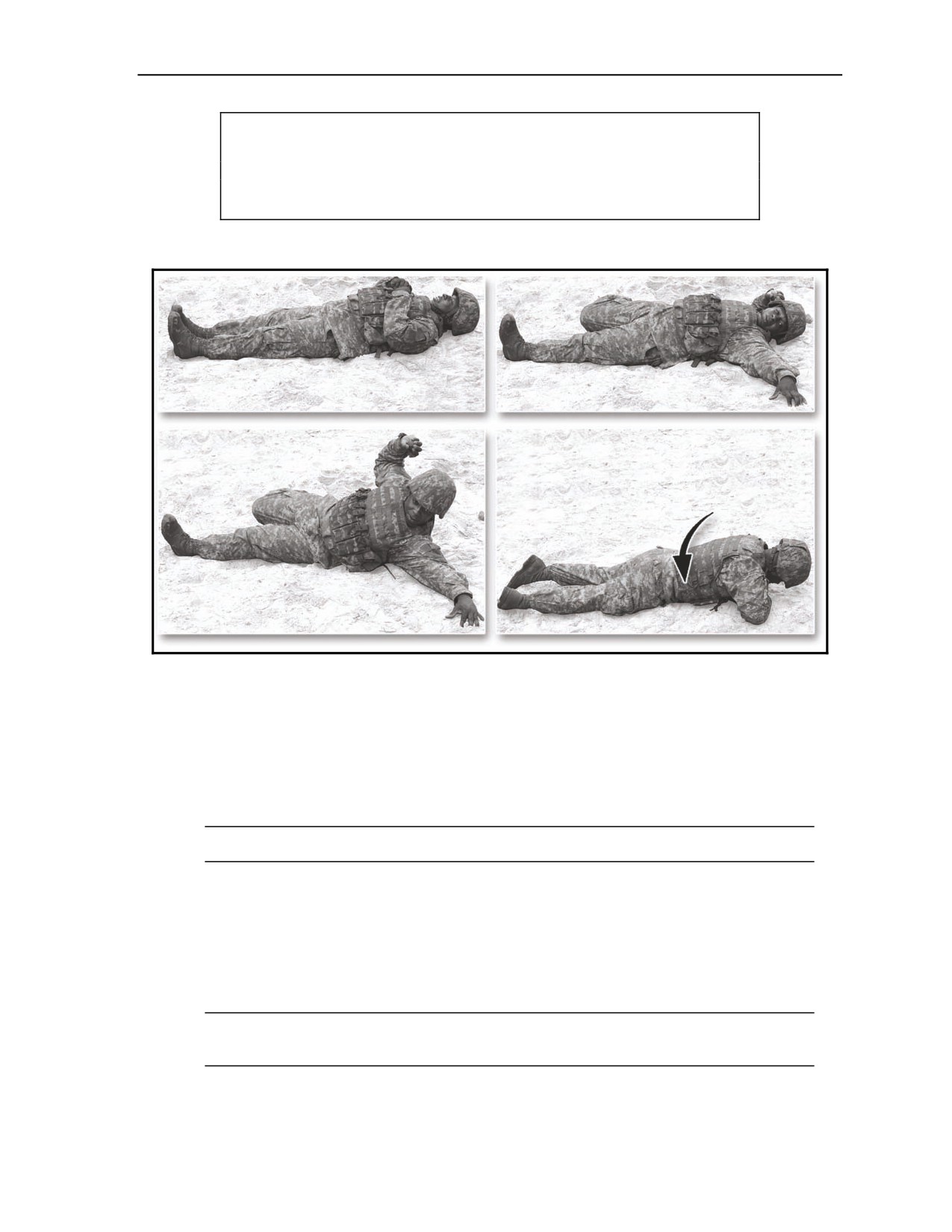
(8) After throwing the grenade, roll over onto the stomach and press flat against the ground.
Figure 3-22. Alternate prone position.
MAINTENANCE
3-33. When exposed to the environment, hand grenades require just as many preventive maintenance checks
and services (PMCS) as a Soldier’s personal weapon. The body of the hand grenade is made of metal, which
rusts when it is exposed to moisture or submerged in water. If not removed, dirt or rust can cause the hand
grenade to malfunction.
NOTE: See TM 9-1330-200-12 for more information about required grenade maintenance.
3-34. For most hand grenades, keeping them clean and lubricated is sufficient maintenance. With the M69
practice grenade, however, maintenance is more difficult because the grenade bodies are used repeatedly. To
maintain the M69 practice grenade—
z
Paint the grenade body at least quarterly.
z
Clean the threads with a wire brush on a monthly basis.
z
Remove fuze residue from the body immediately after each use.
NOTE: Cleaning the threads and removing the residue from the hand grenade body make replacement of
the fuzes easier. The grenade body lasts longer if these preventive maintenance procedures are performed.
15 October 2009
FM 3-23.30
3-19
Chapter 3
CLEANING
3-35. To clean the grenade—
z
Wipe the dirt off the body of the hand grenade using a slightly damp cloth or a light brush.
z
Use a light brush to clean the fuze head, as it can reach into the crevices.
CAUTION
Vigorous cleaning of a grenade with a heavy bristled brush or cleaning rag
may loosen or dislodge the pull ring.
LUBRICATING
3-36. Depending on weather conditions, a light coat of CLP may be needed.
DESTRUCTION PROCEDURES
3-37. Destruction of any military weapon is authorized only as a last resort to prevent the enemy from capturing
or using it. In combat, the commander has the authority to destroy weapons, but he must report doing so through
the proper channels.
NOTE: See TM 9-1330-200-12 for more information.
3-38. The conditions under which destruction will be effected are command decisions and may vary depending
upon a number of factors, such as—
z
Tactical situation.
z
Security classification.
z
Quantity and location of grenades.
z
Facilities for accomplishing destruction.
z
Time.
METHODS OF DESTRUCTION
3-39. Selection of the method of destruction requires imagination and resourcefulness in the utilization of the
facilities at hand under the existing conditions. In general, destruction of grenades can be accomplished most
effectively by burning or detonation, or a combination of these methods.
NOTE: For the successful execution of methods of destruction involving the use of demolition
materials, all personnel concerned must be thoroughly familiar with the provision of
FM 3-34.214. Training and careful planning are essential.
3-40. If destruction of grenades is directed, due consideration should be given to the following:
(1) Selection of a site (for the destruction operation) that will cause greatest obstruction to enemy
movement and also prevent hazard to friendly troops from fragments incidental to the destruction.
(2) Observance of appropriate safety precautions.
Detonating
3-41. Packed and unpacked high-explosive (HE) grenades, fuzes, and accessories may be destroyed by placing
them in piles and detonating them with demolition charges.
3-20
FM 3-23.30
15 October 2009
Hand Grenades
3-42. To use this method—
(1) Prepare the demolition charge (using one-pound TNT blocks [or equivalent] and the necessary
detonating cord to make up each charge).
NOTE: One hundred pounds of packed HE grenades require a two-pound demolition charge to
ensure complete detonation of the pile. For unpacked HE grenades, a one-pound demolition charge
is sufficient.
(2) Place the charges on the pile to be detonated.
(3) Provide for dual priming to minimize the possibility of a misfire. For priming, use a non-electric
blasting cap crimped to at least 5 feet of time blasting fuze or an electric blasting cap and firing
wire).
NOTE: Time blasting fuzes contain black powder and a blasting cap. They must be protected from
moisture at all times.
WARNING
Each roll of fuze must be tested shortly before use. The burning
rate of a safety fuze varies under different atmospheric and/or
climatic conditions (from a burning time of 30 seconds or less per
foot to 45 seconds or more per foot).
WARNING
Blasting caps, detonating cord, and time blasting fuzes must be
kept separated from the charges until required for use.
(4) If primed with non-electric blasting cap and time blasting fuze, ignite and take cover; if primed with
electric blasting cap, take cover before firing the charge.
NOTE: Time blasting fuzes may be ignited by a blasting fuze igniter or an ordinary match; the
electric blasting cap requires a blasting machine or equivalent source of electricity.
3-43. The danger area for piles detonated in the open is a circular area which varies according to the quantity of
explosive items to be destroyed.
NOTE: Quantity/distance data
(inhabited building distance) is given in Chapter
4 of
TM 9-1330-200-12.
Burning
3-44. Packed and unpacked HE grenades, smoke grenades, and illuminating grenades may be destroyed quickly
and effectively by burning.
3-45. To destroy hand grenades by fire—
(1) Stack the ammunition into a pile.
(2) Place flammable materials (e.g., rags, scrap wood, or brush) on and about the pile.
(3) Pour gasoline and oil over the entire pile.
15 October 2009
FM 3-23.30
3-21
Chapter 3
WARNING
Consideration should be given to the highly flammable nature of
gasoline and its vapor. Carelessness in its use may result in
painful burns.
(4) Ignite the pile using an incendiary grenade fired from a safe distance, a combustible train of suitable
length, or other appropriate means.
(5) Take cover immediately.
WARNING
Cover must be taken without delay, since an early explosion of
ammunition may be caused by the fire.
3-46. The danger area for piles being burned in the open is 600 meters.
DEGREE OF DAMAGE
3-47. The method of destruction used must damage the grenades and their components to such an extent that
they cannot be restored to usable condition in the combat zone. Further, the same essential components of all
grenades must be destroyed so that the enemy cannot assemble complete rounds from undamaged components
of several damaged complete rounds.
3-22
FM 3-23.30
15 October 2009
Chapter 4
Pyrotechnic Signals and Simulators
Pyrotechnic signals can be used as a means of communication and signals, obscuration,
warning of an intruder, and for simulating enemy fires.
SECTION I. COMMUNICATION SIGNALS
There are two classifications of pyrotechnic communication signals: handheld signals and ground smoke signals.
Both types of signals come in varied color patterns. Soldiers can use these patterns to coordinate troop movements
and, in the case of an emergency, designate pick-up points.
NOTE: The signals are usually prescribed at command level and prearranged in accordance with
signal operating/operation instructions (SOI).
HANDHELD SIGNALS
4-1. Star clusters, star parachutes, and smoke parachutes are issued in an expendable launcher that consists of
a launching tube and firing cap (Figure 4-1).
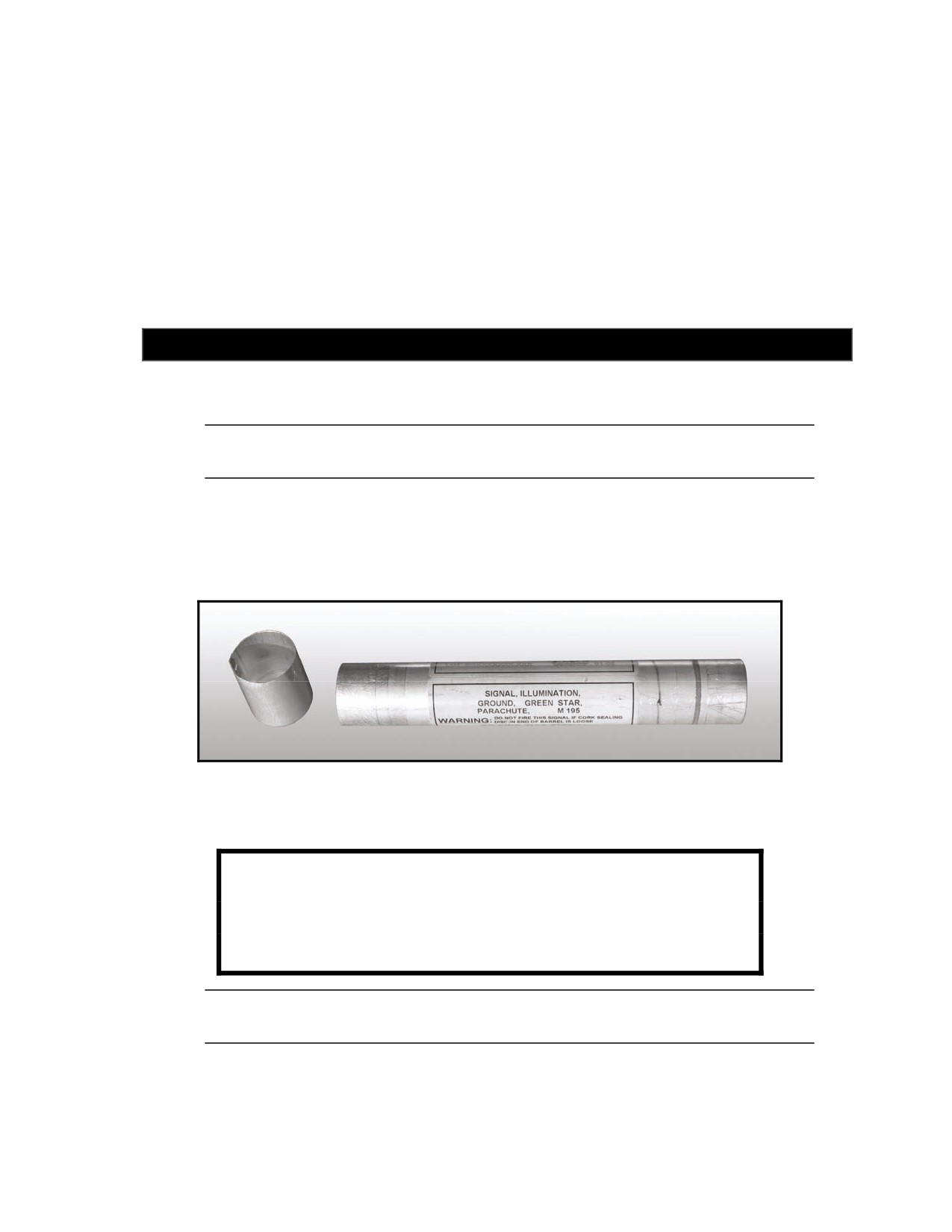
Figure 4-1. Handheld pyrotechnic signal.
INSPECTION
WARNING
Handheld communication signals must be inspected before use
and properly secured to avoid serious injury.
NOTE: See TM 9-1370-206-10 for more information about handheld communication signal
inspection.
15 October 2009
FM 3-23.30
4-1
Chapter 4
Initial Inspection
CAUTION
During storage, keep boxes sealed. Duds or improper functioning could
occur if exposed to moisture for long periods of time. Open just before
use.
4-2. When in bulk, communication signals are secured in shipping containers (Figure 4-2). Personnel should
inspect the shipping container upon receipt. Shipping containers that are damaged should not be opened; they
should be returned to the ASP or disposed of using the methods outlined in the unit SOP.
4-3. There are two types of communication signal shipping containers: the M548 metal container and wood
ammunition box containers.
M548 metal container
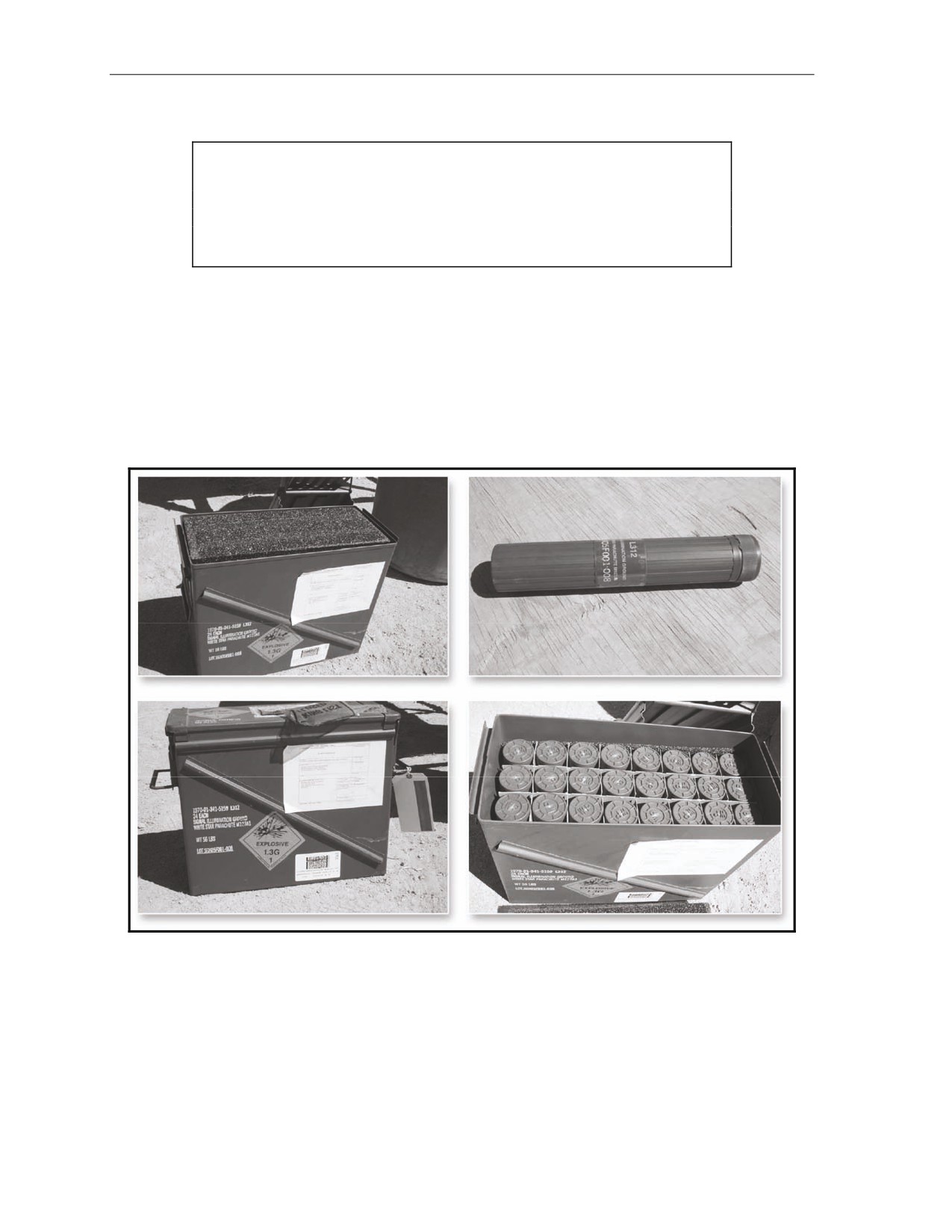
4-4. This container contains 24-handheld signals, individually secured in plastic containers (Figure 4-2).
Figure 4-2. Handheld signal shipping container.
Wood AmmunitionBox Container
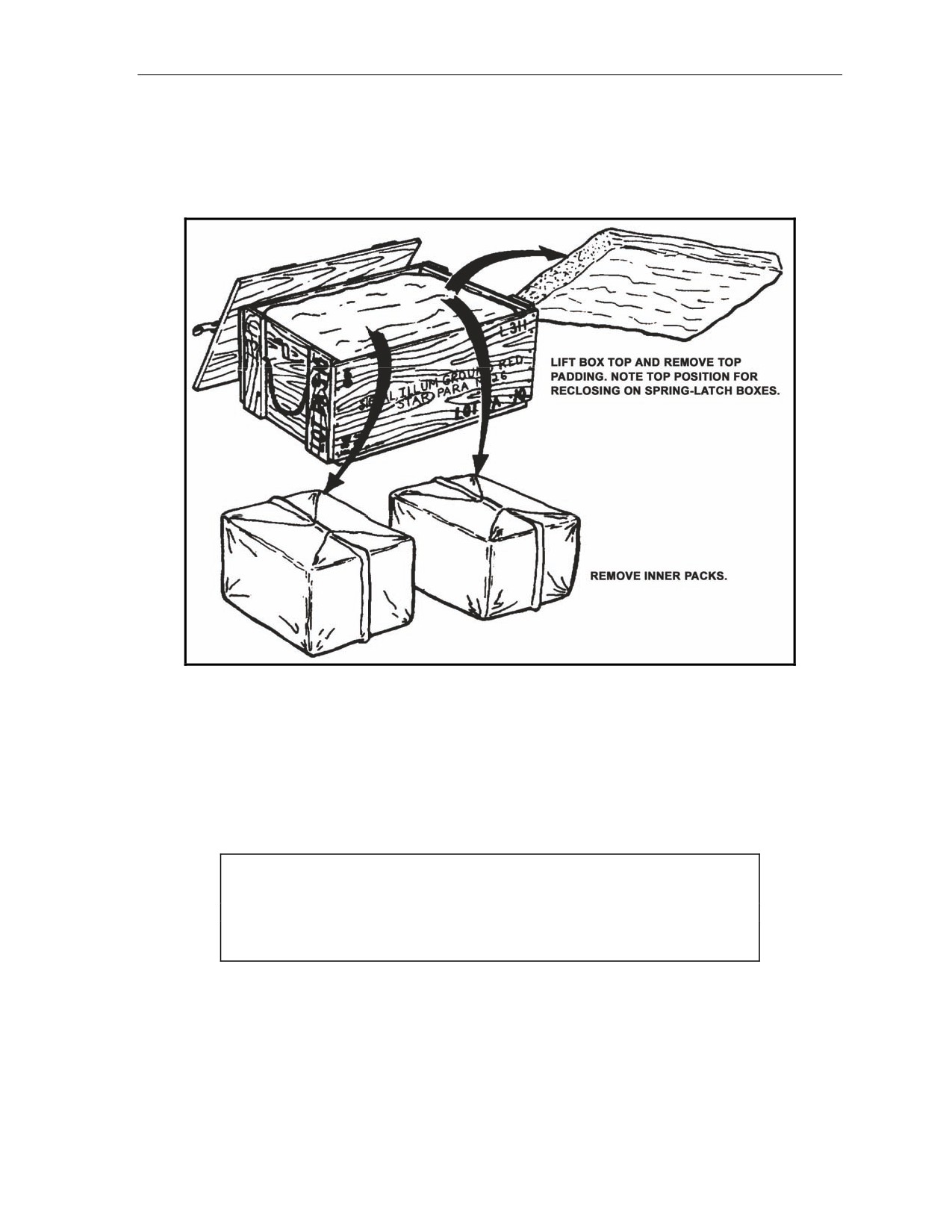
4-5. This container contains 36-handheld signals, sealed in plastic barrier bags (Figure 4-3). Each barrier bag
contains 18-hermetically sealed metal containers. Each sealed container contains one handheld signal.
4-2
FM 3-23.30
15 October 2009
Pyrotechnic Signals
4-6. Upon removing the sealed barrier bags from the shipping container (Figure 4-3), personnel should inspect
each barrier bag and identify any of the following discrepancies:
z
The barrier bag has been damaged.
z
The seal on the barrier bag show signs of tampering.
Figure 4-3. Handheld signal barrier bag.
4-7. Each signal within the barrier bag is housed in a hermetically sealed steel container (Figure 4-4) or plastic
container (Figure 4-5). Handheld communication signals may be issued while still in their individual containers
or unpacked and issued by someone within the chain of command. Upon removing the sealed individual
containers from the barrier bag (Figure 4-4), personnel should inspect the containers and identify any of the
following discrepancies:
z
The container has been damaged.
z
The seal on the container has been tampered with or is missing.
CAUTION
Do not open hermetically sealed (air tight) containers until ready for use. A
signal exposed to moisture may not function.
4-8. Then, personnel should remove the handheld signal from the container.
15 October 2009
FM 3-23.30
4-3
Chapter 4
Figure 4-4. Handheld signal individual sealed steel container.
Handheld Signal Sealed Steel Container
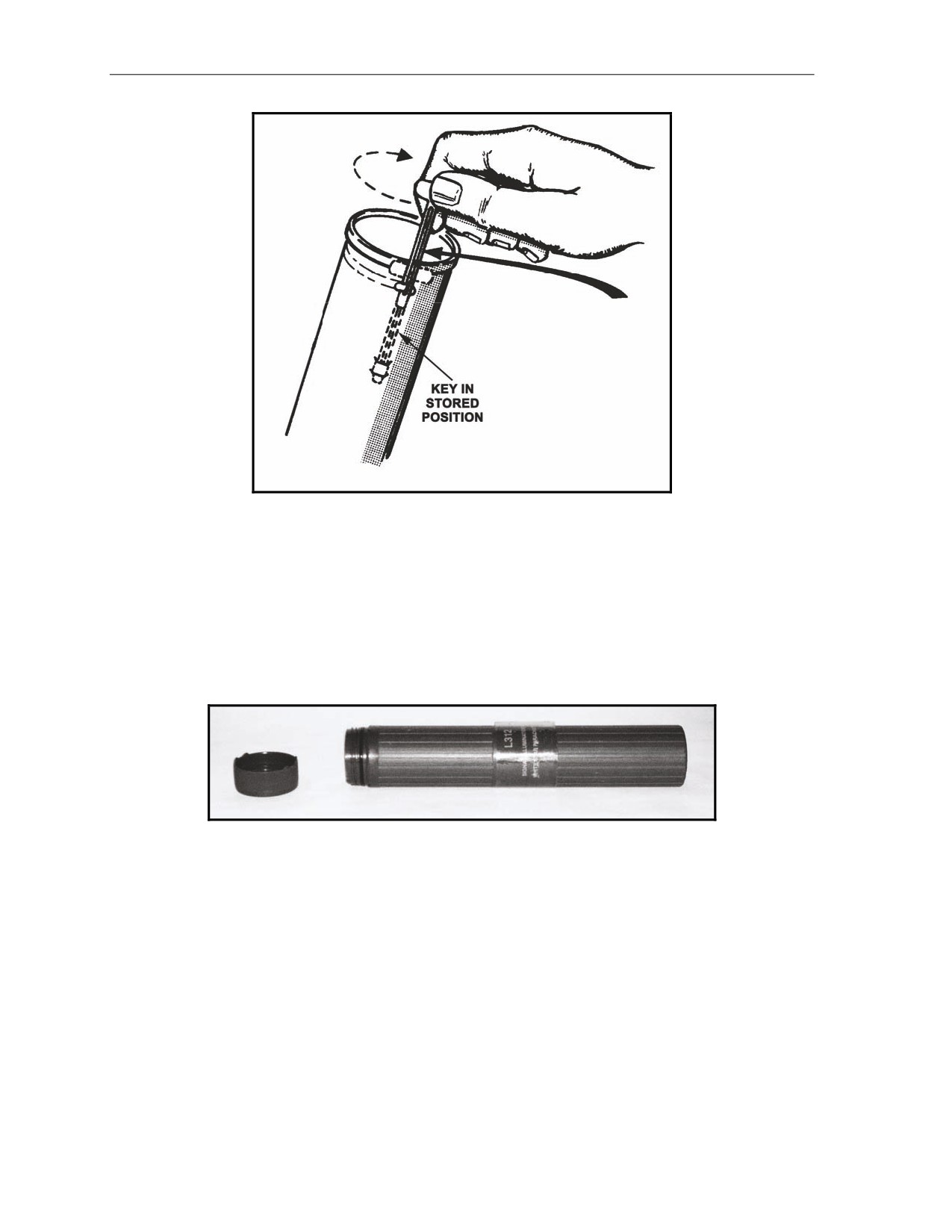
4-9. To open the handheld signal from a hermetically sealed steel container, by using the key attached to the
container (Figure 4-4)—
(1) Remove the sealing strip.
(2) Remove the top of container.
(3) Remove any padding pieces from the container.
(4) Remove the signal.
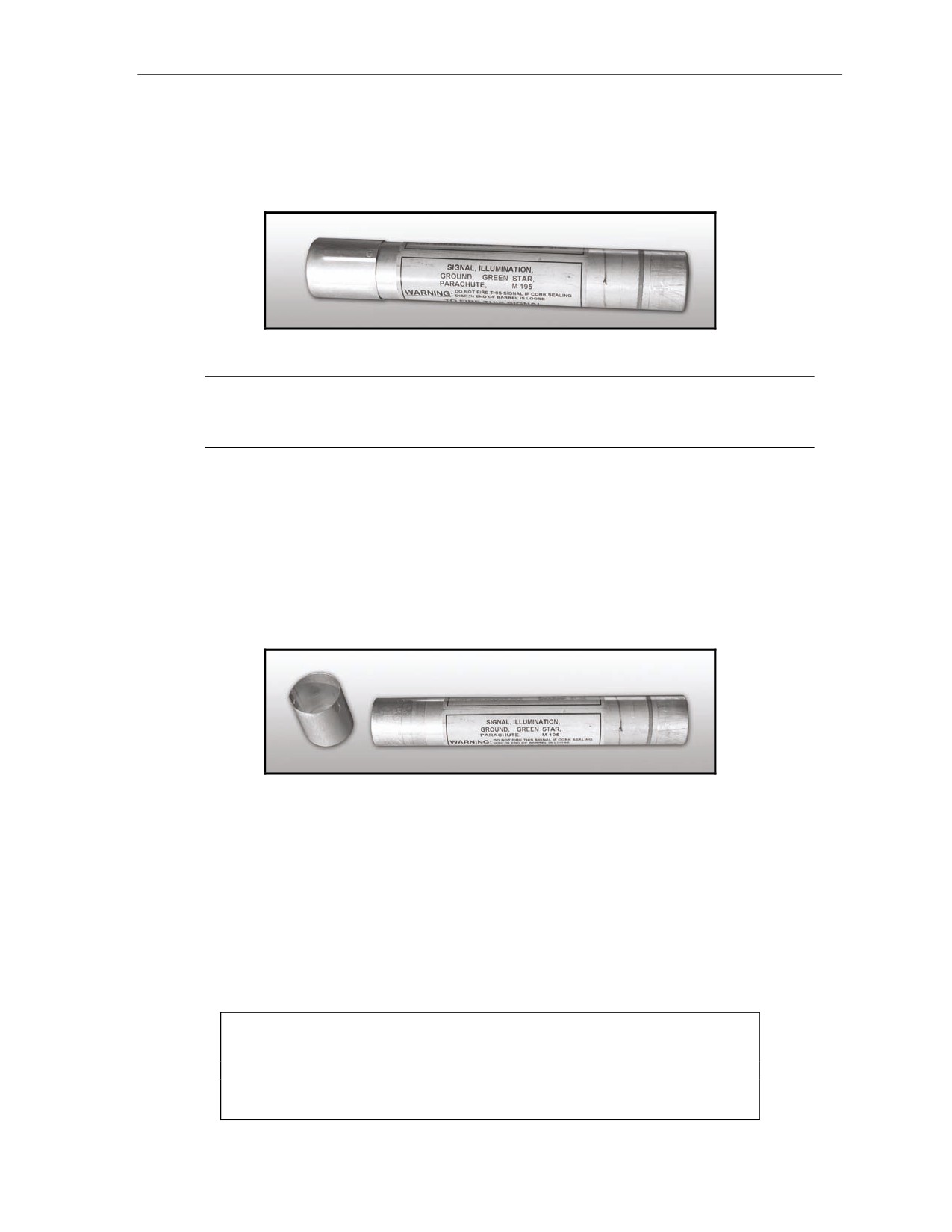
Figure 4-5. Handheld signal individual container.
Handheld Signal Plastic Sealed Container
4-10. To open the handheld signal plastic sealed container (Figure 4-5)—
(1) Hold the container in one hand.
(2) Twist the end-cap counterclockwise with the other hand.
(3) Remove the signal.
Inspect a Handheld Signal
4-11. Once the signal has been removed from the container (Figure 4-6), personnel should inspect the signal
and identify any of the following discrepancies:
z
Corrosion is on the launcher tube.
z
Holes are visible in the launcher tube.
4-4
FM 3-23.30
15 October 2009
Pyrotechnic Signals
z
The forward-end seal is broken or damaged.
z
The firing pin is not present.
z
The primer is not intact (is dented).
z
The color-coded forward-end seal does not match the color listed on the data plate.
Figure 4-6. Handheld signal removed from the individual container.
NOTE: If any of the discrepancies are found upon receipt of newly issued handheld signals,
personnel should return the signal and individual container to the issuing person or dispose of it in
accordance with the unit SOP.
Before Storing
4-12. Before securing handheld communication signals, personnel should take the following safety precautions
(Figure 4-7):
z
Ensure the launcher tube is not bent or punctured.
z
Check the launcher tube for corrosion or dirt.
z
Ensure that the forward-end seal is not broken or damaged.
z
Ensure that the firing pin is present and the primer is intact (not dented).
Figure 4-7. Safety inspection points—before storage.
Daily Checks
4-13. Personnel should check handheld communication signals daily to ensure that they are free of foreign
material and that they are not damaged.
STORAGE
4-14. Personnel should carry handheld communication signals in accordance with the unit SOP. When carrying
handheld communication signals, personnel should adhere to the following guidelines:
z
Ensure that the communication signal is placed in a secure, dry area.
CAUTION
Duds or improper functioning could occur if exposed to moisture for long
periods of time. Open just before use.
15 October 2009
FM 3-23.30
4-5
Chapter 4
z
Do not put adhesive tape around any portion of the handheld communication signal.
WARNING
Do not bend, tamper, modify or otherwise alter a handheld
communication signal. Do not tape any portion of the launcher or
firing mechanism.
USE
4-15. To safely use handheld signals, Soldiers must properly determine the type and color of the pyrotechnic
signal to be used, and safely launch the signal.
Determining the Type and Color
4-16. When choosing a pyrotechnic signal, Soldiers must consider the signal’s intensity and color.
Intensity
4-17. Handheld colored pyrotechnic signal flares burn at different intensities.
Color
4-18. Determining specific colors at night is not difficult. However, Soldiers should avoid using red and green
star clusters near aircraft.
CAUTION
Avoid signaling aircraft at night with star clusters. Red and green star
clusters can be mistaken for tracers causing the aircraft to open fire on the
friendly ground element or to withdraw.
4-19. In daylight, Soldiers should adhere to the following considerations:
z
It can be difficult to differentiate between white and green depending on lighting conditions.
Green is very pale in daylight and is especially difficult to detect in fog, haze, or smoke-filled
skies. In fact, white flares are easier to detect in daylight than green.
White flares can be mistaken for illumination flares.
z
Red may be difficult to detect when launched in a position that forces the observer to see it near a
vivid sunrise or sunset.
Launching Handheld Signals
NOTE: See TM 9-1370-206-10 for more detailed information on safety precautions.
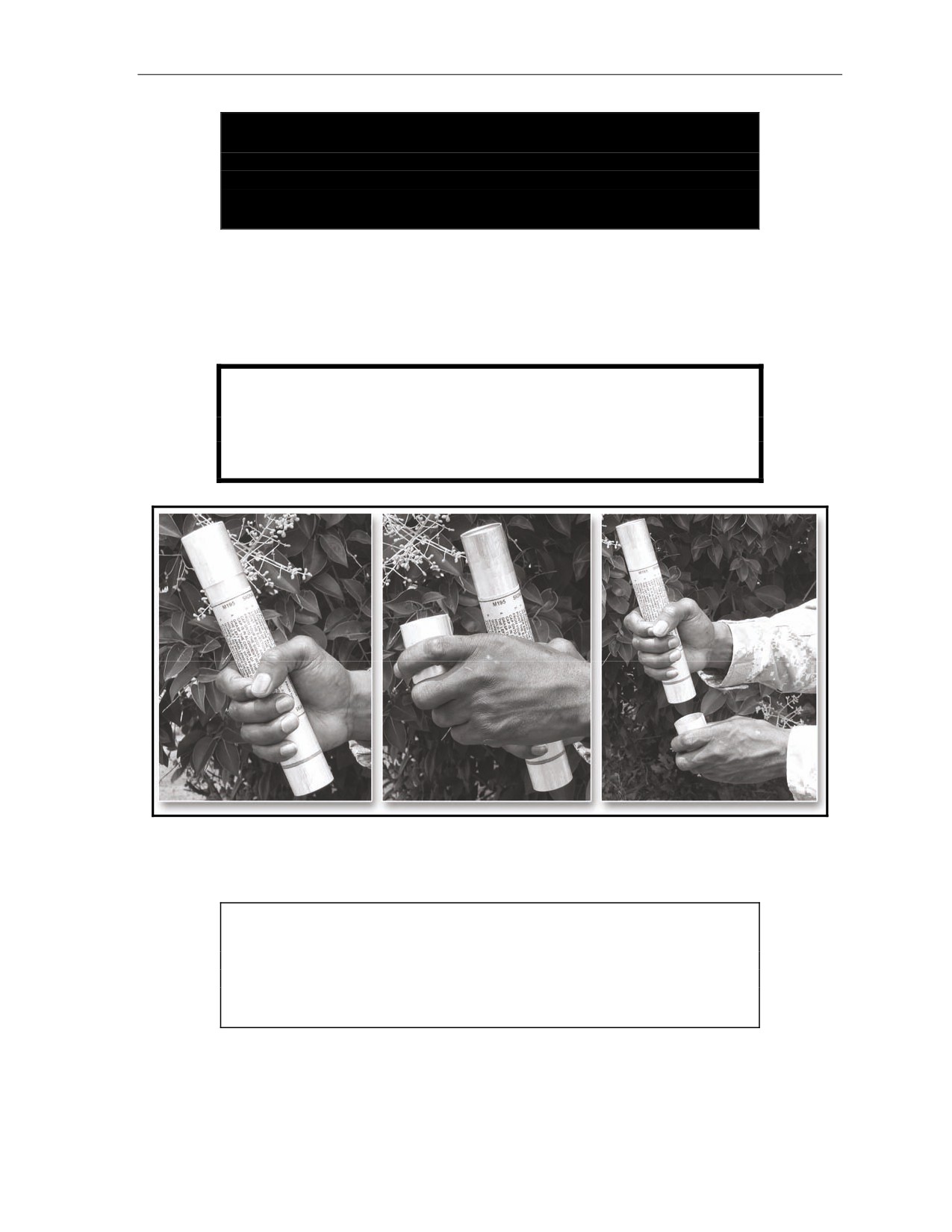
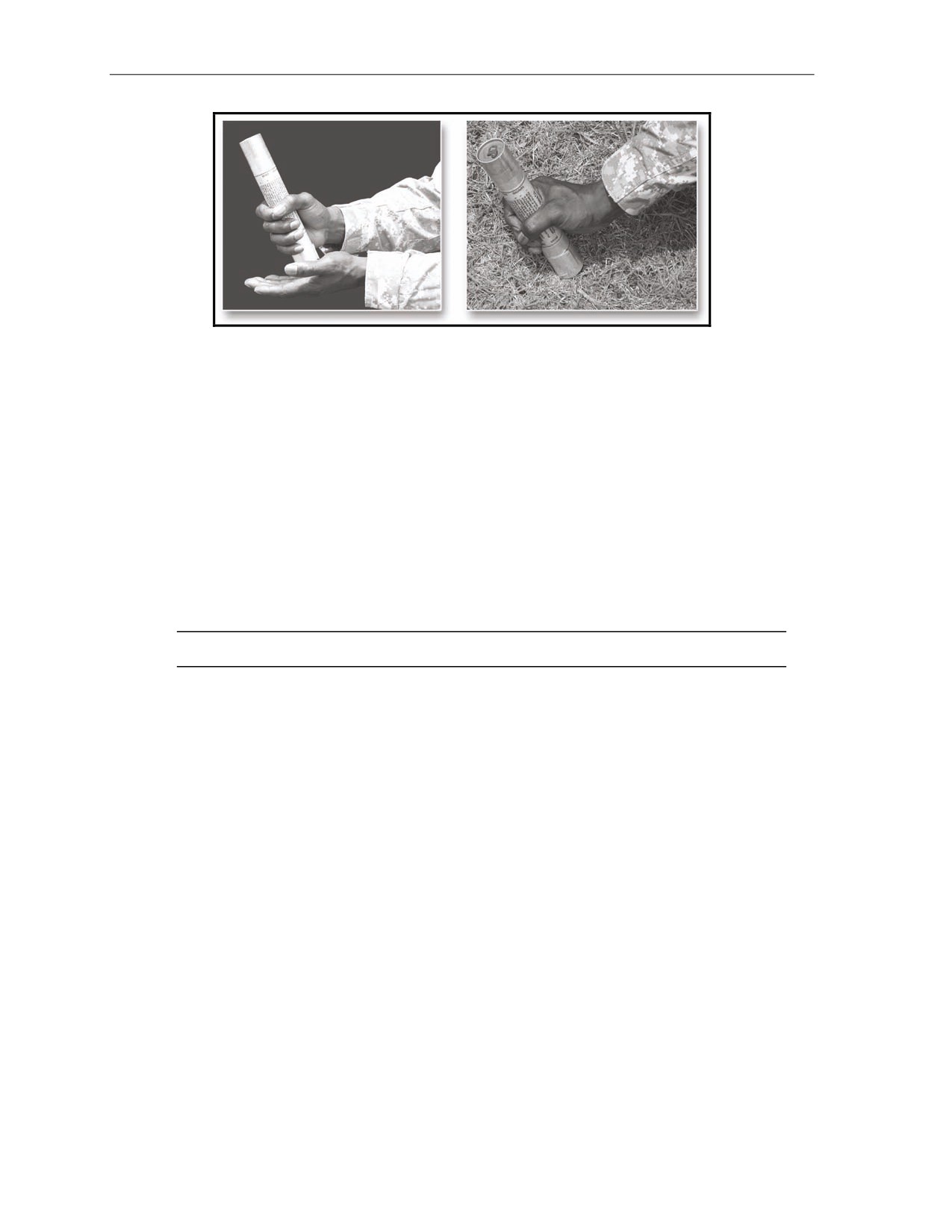
4-20. To fire handheld signals (Figure 4-8)—
(1) Observe the surrounding area to ensure that you have overhead clearance.
DANGER
4-6
FM 3-23.30
15 October 2009
Pyrotechnic Signals
DO NOT FIRE A HANDHELD SIGNAL IN AN AREA WITHOUT
OVERHEAD CLEARANCE. WHEN FIRED IN AN AREA WITHOUT
OVERHEAD CLEARANCE, THE SIGNAL CAN CAUSE FIRE, INJURY,
OR DEATH.
(2) Grasp the signal firmly with your nonfiring hand, red-knurled band down, with your little finger
above the red band.
(3) With your firing hand, withdraw the firing cap from the upper end of the signal.
(4) Point the ejection end of the signal up and away from your body, and push the firing cap onto the
signal until the open end of the cap is aligned with the red band.
(5) Hold the signal away from your body and at the desired trajectory angle.
WARNING
Turn your head away from the signal to avoid injury to your face
and eyes from particles ejected by the small rockets.
Figure 4-8. Firing a handheld signal.
(6) Strike the bottom of the cap using a sharp blow with the palm of your firing hand or strike it on a
hard surface, keeping your nonfiring arm rigid.
CAUTION
When firing handheld signals by hand, avoid contact with the bones of the
hand. This can result in injury to the hand. Instead, use the meaty portion
of the hand.
15 October 2009
FM 3-23.30
4-7
Chapter 4
Figure 4-8. Firing a handheld signal (continued).
Misfire
4-21. In the event of a misfire—
(1) While keeping the signal aimed, pull the cap back to the red knurled band, and rotate 90 degrees.
(2) Make two more attempts to fire.
(3) If it still does not fire, wait 30 seconds keeping the arm rigid and the signal aimed overhead.
(4) Return the cap to the ejection end of the signal and dispose of it in accordance with unit SOP.
MAINTENANCE
4-22. When exposed to the environment, handheld signals require PMCS. The color-coded forward end seal
can deteriorate if exposed to moisture for long periods of time or submerged in water. If not removed, dirt or
sand can cause the handheld signal to malfunction.
NOTE: See TM 9-1370-206-10 for more information about required maintenance.
CLEANING
4-23. To clean the handheld signal—
z
Wipe the dirt off the launcher tube and the firing cap using a clean, dry, lint-free cloth.
z
Use a fine-bristled camel hair brush to remove any foreign matter or debris.
DESTRUCTION PROCEDURES
4-24. Destruction of any military weapon is authorized only as a last resort to prevent the enemy from capturing
or using it. In combat, the commander has the authority to destroy weapons, but he must report doing so through
the proper channels.
4-25. The conditions under which destruction will be effected are command decisions and may vary depending
upon a number of factors, such as—
z
Tactical situation.
z
Security classification.
z
Quantity and location of grenades.
z
Facilities for accomplishing destruction.
z
Time.
4-8
FM 3-23.30
15 October 2009
Pyrotechnic Signals
METHODS OF DESTRUCTION
4-26. Selection of the method of destruction requires imagination and resourcefulness in the utilization of the
facilities at hand under the existing conditions. In general, destruction of handheld signals can be accomplished
most effectively by burning or firing, or a combination of these methods.
DEGREE OF DAMAGE
4-27. The method of destruction used must damage the handheld signals and their components to such an extent
that they cannot be restored to usable condition in the combat zone. Further, the same essential components of
all handheld signals must be destroyed so that the enemy cannot assemble complete rounds from undamaged
components of several damaged complete signals.
GROUND SMOKE SIGNALS
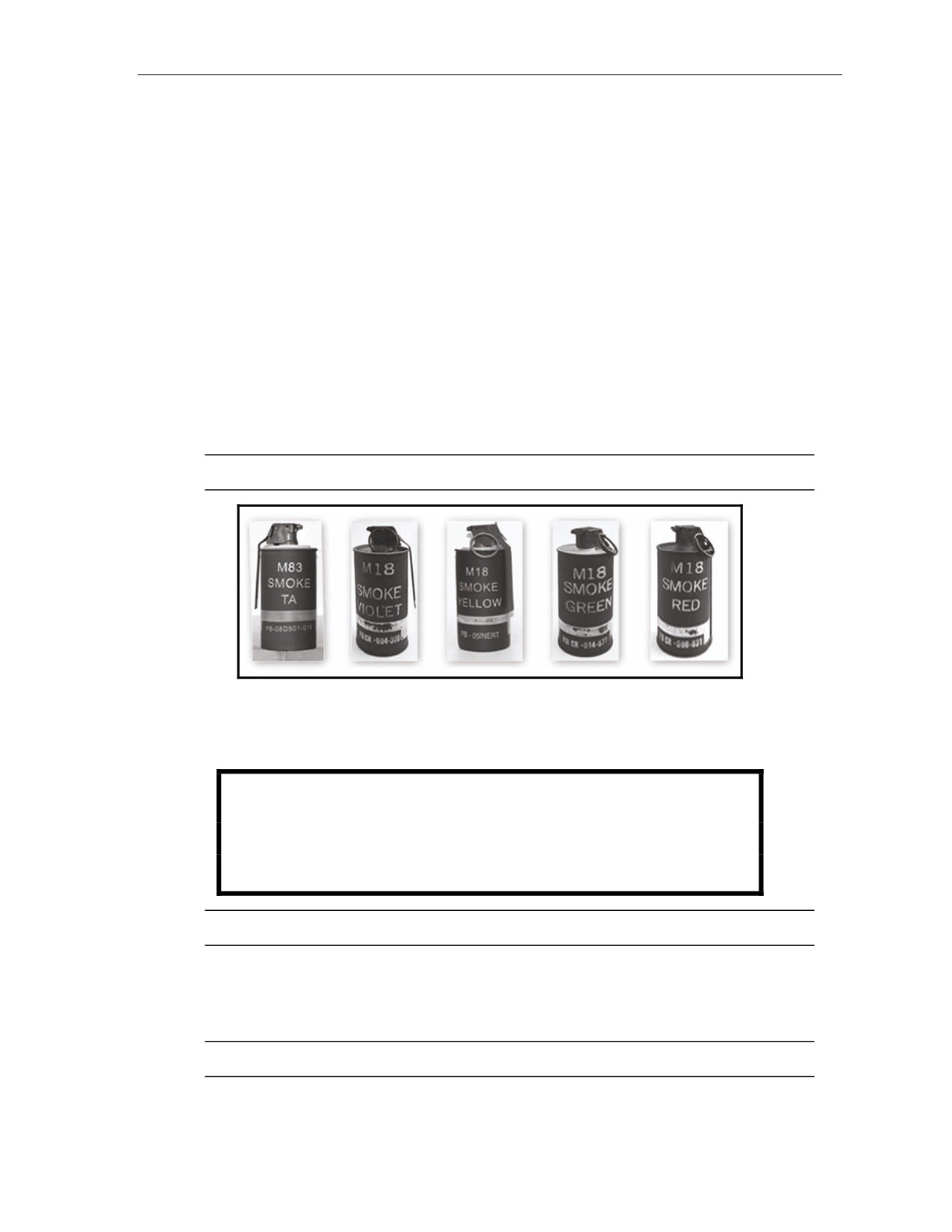
4-28. Ground smoke signals, or smoke grenades, come in various colors (Figure 4-9). They can be used as a
ground-to-ground or ground-to-air signaling device, to convey information through a prearranged signal, or for
screening unit movements. These smoke grenades have a 0.7- to 2.0-second time delay and produce a smoke
cloud that lasts approximately 13 to 30 seconds.
NOTE: See TM 9-1330-200-12 for more information about smoke grenades.
Figure 4-9. Smoke grenades.
INSPECTION
WARNING
Smoke grenades must be inspected before use and properly
secured to avoid serious injury.
NOTE: See Chapter 3 for inspection procedures.
STORAGE
4-29. Personnel should secure smoke grenades using a similar method to the carrying of hand grenades.
NOTE: See Chapter 3 for storage procedures.
15 October 2009
FM 3-23.30
4-9
Chapter 4
USE
4-30. Before employing smoke grenades, Soldiers must understand the effects of environmental conditions on
obscuration.
CONSIDERATIONS
4-31. Soldiers should consider wind direction and speed before employing smoke grenades:
z
Throw grenades upwind of the desired location.
z
Lack of wind and heavy humidity can cause smoke to linger. Heavy concentrations of smoke can
obscure obstacles, restrict friendly movements, and hide an enemy’s location.
z
Do not throw smoke grenades on dry tender.
CAUTION
M18, M83, and AN-M8 HC have the potential to start fires when thrown on
dry tender.
EMPLOYMENT
4-32. To safely throw smoke grenades, Soldiers must demonstrate and execute the proper techniques of
gripping, preparing, and throwing the grenade.
NOTE: Smoke grenades have a pull ring, safety pin, and safety lever. At some time, the confidence
clip will be added to all smoke grenades. Refer to Chapter 3 for the technique used to remove the
pull ring secured by a confidence clip.
Gripping
4-33. Gripping procedures for the smoke grenade are the same as those for the M67 fragmentation grenade.
NOTE: See Chapter 3 for gripping procedures.
Preparing
4-34. Preparing procedures for the smoke grenade are the same as those for the M67 fragmentation grenade.
NOTE: See Chapter 3 for preparing procedures.
Throwing
4-35. Many of the same throwing positions that are used to employ hand grenades can also be used to employ
smoke.
NOTE: See Chapter 3 for more information about hand grenade throwing positions.
4-10
FM 3-23.30
15 October 2009
Pyrotechnic Signals
SECTION II. TRIP FLARES
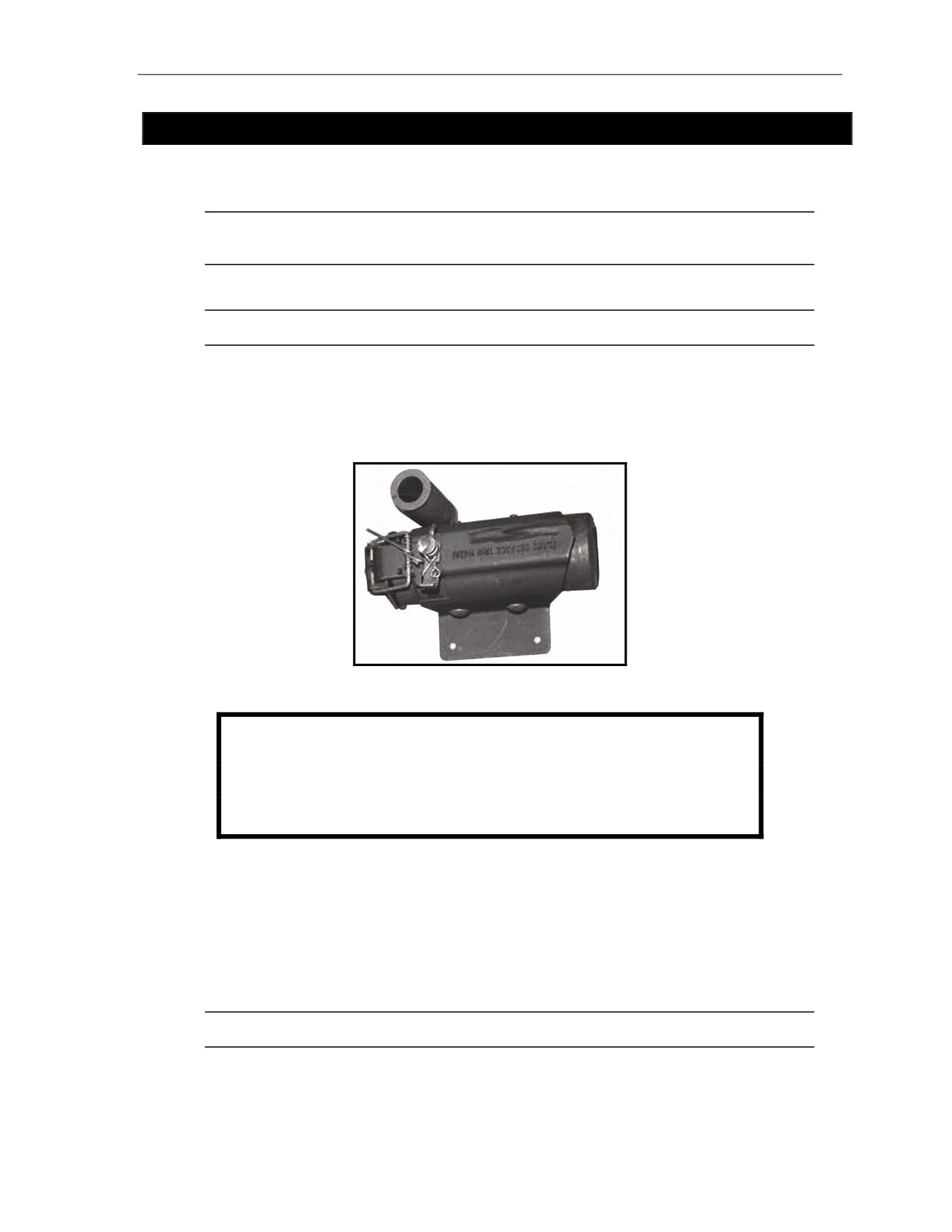
The M49 trip flare resembles a hand grenade in size and shape, except that it is provided with a bracket for attachment
to a tree or post and a trigger mechanism for firing. Surface trip flares (Figure 4-10) can be used to—
z
Provide early warning of infiltration of enemy troops or signaling.
NOTE: To use the surface trip flare as an early warning device, Soldiers should attach a trip wire to
the trigger or pull pin. This arms the flare.
z
Illuminate an immediate area.
NOTE: Trip flares are not suitable for producing continuous illumination.
z
Ignite fires.
z
Identify firing ports.
z
Force the enemy to withdraw.
z
Destroy small, sensitive pieces of equipment (in the same manner as an incendiary grenade).
Figure 4-10. M49A1 surface trip flare.
WARNING
Trip flares must be inspected before use and properly secured to
avoid serious injury.
4-36. Several portions of the trip flare must be inspected:
z
Body.
z
Mounting bracket.
z
Other components.
BODY
4-37. The body of the trip flare should be inspected in the same way as that of a hand grenade.
NOTE: See Chapter 3 for inspection procedures.
15 October 2009
FM 3-23.30
4-11
Chapter 4
MOUNTING BRACKET
4-38. Personnel should inspect the mounting bracket to ensure that—
z
The mounting bracket is present and firmly affixed to the grenade.
z
The mounting bracket shows no signs of damage.
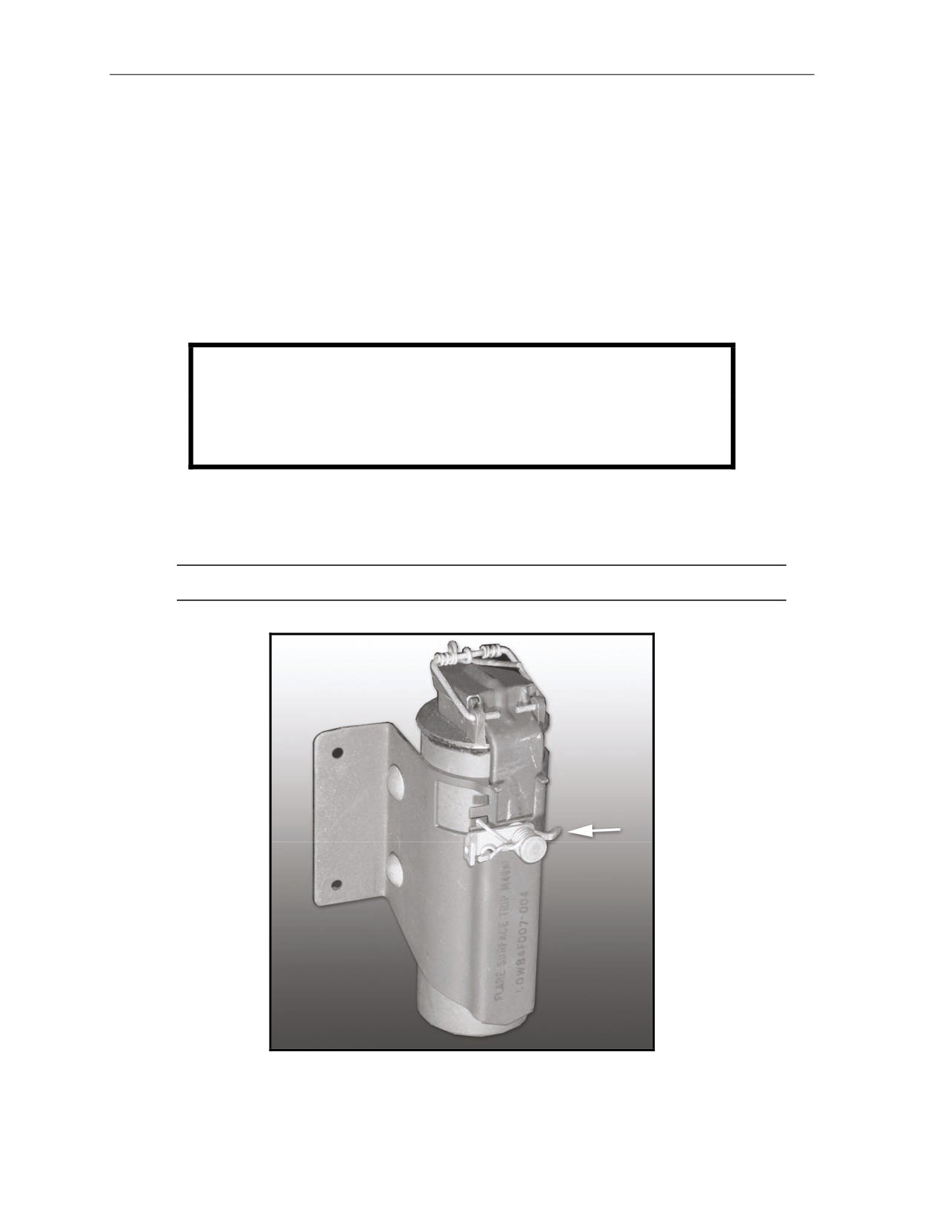
4-39. To inspect the flare and mounting bracket for proper operation (Figure 4-11), press lever against the flare
body and check for:
z
Straightness of the pull pin.
z
Alignment of the safety clip and holes in the cover loading assembly.
z
Corrosion and looseness of the cover loading assembly.
z
Alignment of the hinge pins in the cover loading assembly.
WARNING
Turn in immediately to the supervisor if the cover assembly is
corroded or loose, or if the hinge pins are misaligned.
z
Deformed flare and bracket.
z
Tension and position of the trigger spring. The trigger should rotate counterclockwise to the extreme
position as shown in Figure 4-11, and return to the original position when released.
z
Legibility of ammunition lot number.
NOTE: Flares unable to pass the above inspection should be disposed of in accordance with unit SOP.
Figure 4-11. M49A1 surface trip flare trigger spring position.
4-12
FM 3-23.30
15 October 2009
Pyrotechnic Signals
OTHER COMPONENTS
4-40. The trip flare is issued with a spool of trip wire and nails. Personnel should inspect these components and
ensure that they are present.
STORAGE
4-41. Personnel should carry trip flares in accordance with the unit SOP. When carrying trip flares, personnel
should adhere to the following guidelines:
z
Ensure that the trip flare is placed in a secure, dry area.
CAUTION
Duds or improper functioning could occur if exposed to moisture for long
periods of time. Open just before use.
z
Do not put adhesive tape around any portion of the trip flare during storage.
WARNING
Do not bend, tamper, modify or otherwise alter a trip flare. Do not
tape any portion of the trip flare during storage.
USE
NOTE: There is a graphic training aid (GTA) included in the trip flare’s shipping box that gives
detailed instructions for installing the flare.
4-42. While trip flares are primarily mounted, they can also be hand-thrown.
MOUNTED
4-43. Soldiers should mount the trip flare using the following procedures:
(1) Choose a location.
NOTE: The location chosen for the flare should be to the right (looking toward the enemy) of the
field to be illuminated, so the trip wire, when attached, runs to the right of the flare (when facing the
trigger).
WARNING
Surface trip flares can cause fires when mounted on dry tender.
(2) Using two of the nails supplied, nail the mounting bracket (with ends of the two tabs upward) to a
stake, post, or suitable support at the height desired for the trip wire (usually 15 to 18 inches above
the ground).
15 October 2009
FM 3-23.30
4-13
Chapter 4
WARNING
Never mount a surface trip flare above knee level.
(3) Mount the flare by sliding the two square holes of the anchor clip over the mating tabs on the holder,
and press the flare down until it is locked in position.
NOTE: If desired, a third nail may be driven through the hole in the lower end of the anchor clip.
(4) Fasten one end of the trip wire to the post, stake, or other rigid object at the desired distance from the
flare (usually about 40 feet) and at the right of the flare (when facing the flare trigger).
(5) Press the fuze safety lever down with one hand, and rotate the trigger one-quarter turn
counterclockwise against the spring pressure with the other hand to the vertical position, so the
lower end of the safety lever is behind the upper end of the trigger.
(6) Pull the loose end of the trip wire taut, and fasten it to the hole in the lower end of the trigger.
(7) Check to see that the trip wire is taut and fastened at both ends, and that the trigger is vertical with
the fuze safety lever (behind the upper end of the trigger) so when the pull ring and safety pin are
withdrawn, the safety lever is still held by the trigger.
DANGER
ENSURE THAT THE TRIGGER IS VERTICAL WITH THE FUZE SAFETY
LEVER (BEHIND THE UPPER END OF THE TRIGGER) SO WHEN THE
PULL RING AND SAFETY PIN ARE WITHDRAWN, THE SAFETY LEVER
IS STILL HELD BY THE TRIGGER. FAILURE TO DO SO CAN RESULT
IN ACCIDENTAL IGNITION OF THE TRIP FLARE.
(8) Hold the lever with one hand, while carefully withdrawing the pull ring and safety pin from the flare.
(9) Carefully release the hold on the safety lever, while making sure the lever is held in place by the
upper end of the trigger.
(10) Move to a safe location.
WARNINGS
The minimum safe distance from an ignited surface trip flare is 2
meters because of sparks and the popping of burning magnesium.
Never look directly at a burning surface trip flare. The intense
flame can injure your eyes.
At close ranges, surface trip flares may damage night vision
devices and sights.
HAND-THROWN
4-44. To throw a trip flare by hand—
(1) Remove the flare from the mounting bracket.
4-14
FM 3-23.30
15 October 2009
Pyrotechnic Signals
(2) Follow the same preparation, gripping, and throwing procedures as those for a grenade.
NOTE: See Chapter 3 for more information about grenade preparation, gripping, and throwing
procedures.
WARNINGS
Surface trip flares can cause fires when thrown on dry tender.
The minimum safe distance from an ignited surface trip flare is 2
meters because of sparks and the popping of burning magnesium.
Never look directly at a burning surface trip flare. The intense
flame can injure your eyes.
At close ranges, surface trip flares may damage night vision
devices and sights.
DO NOT attempt to cook off a trip flare. The fuze has a .0-second
time delay.
MAINTENANCE
4-45. When exposed to the environment, trip flares require PMCS. If not removed, dirt or sand can cause the
trip flare to malfunction.
CLEANING
4-46. To clean the trip flare—
z
Wipe the dirt off the flare using a clean, dry, lint-free cloth.
z
Use a fine-bristled camel hair brush to remove any foreign matter or debris.
REMOVAL
4-47. To remove a trip flare—
(1) Carefully depress the safety lever to align the holes in the lever and the fuze.
(2) Insert the safety pin.
(3) Detach the trip wire from the trigger, while holding the safety lever against the flare.
(4) Rotate the trigger to its original position.
(5) Remove the nails from the mounting bracket and the anchor clip.
(6) Return the flare to its original position and packing.
SECTION III. SIMULATED SIGNALS
Some pyrotechnic simulators can be used to provide early warning signals and to illuminate the immediate area; however,
they are primarily designed to imitate the sounds and effects of combat detonations during field training exercises.
15 October 2009
FM 3-23.30
4-15
Chapter 4
EARLY WARNING SIMULATORS
4-48. Early warning simulators generate different effects upon initiation, but are used the same way; they are
activated by triggering trip wires attached to the igniter cords.
INSPECTION
WARNING
Handheld communication signals must be inspected before use and
properly secured to avoid serious injury.
Initial Inspection
CAUTION
During storage, keep boxes sealed. Duds or improper functioning could occur if
exposed to moisture for long periods of time. Open just before use.
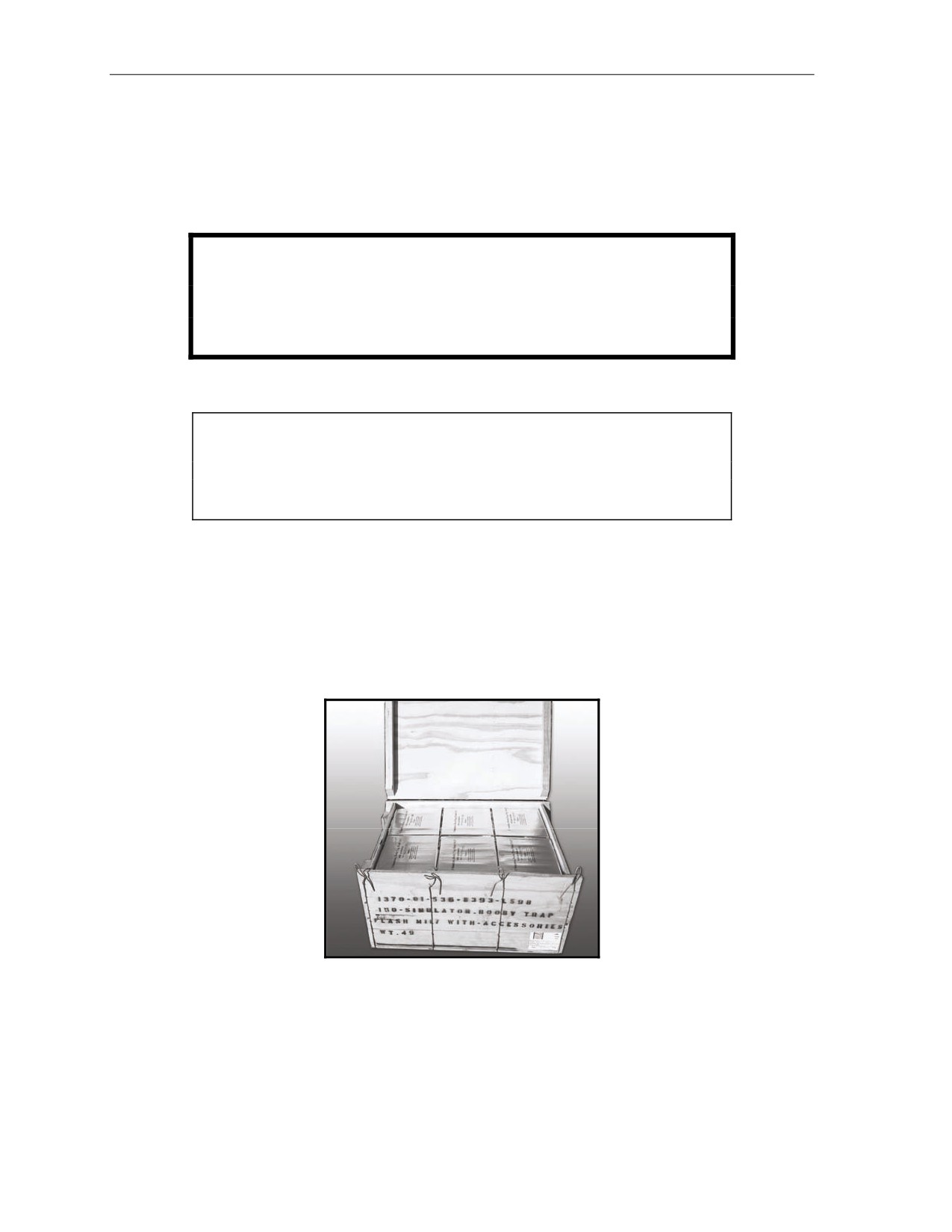
4-49. When in bulk, communication signals are secured in shipping containers (Figure 4-11). Personnel should inspect
the shipping container upon receipt. Shipping containers that are damaged should not be opened; they should be returned
to the ASP or disposed of using the methods outlined in the unit SOP.
4-50. Within the shipping container are barrier bags. Upon removing the sealed barrier bags from the shipping
container (Figure 4-12), personnel should inspect each barrier bag and identify any of the following discrepancies:
z
The barrier bag has been damaged.
z
The seal on the barrier bag shows signs of tampering.
Figure 4-12. Early warning simulator shipping container and barrier bags.
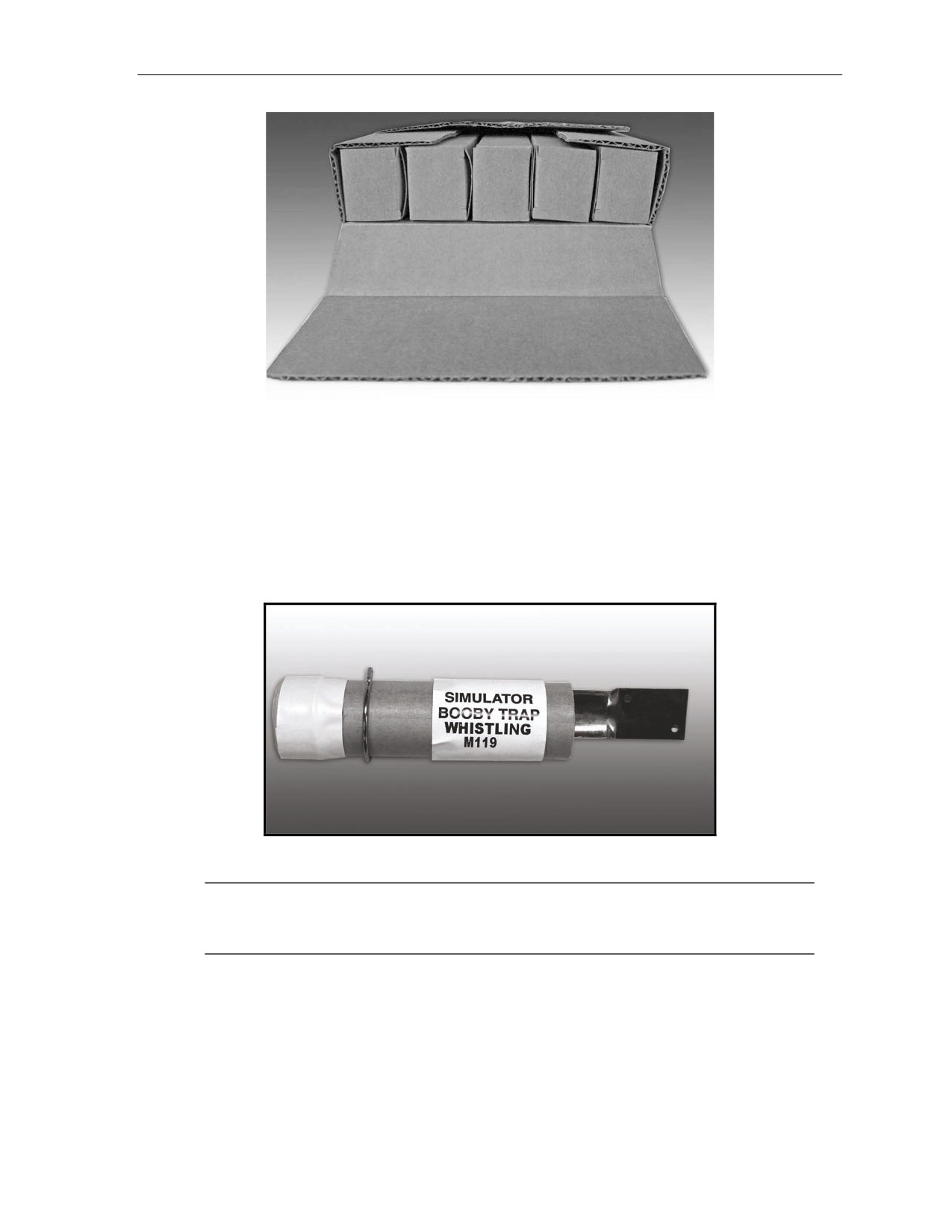
4-51. Inside the barrier bags are cardboard shipping boxes. Upon removing the cardboard shipping boxes from
the sealed barrier bags (Figure 4-13), personnel should inspect each shipping box and identify any of the
following discrepancies:
z
The shipping box has been damaged.
z
The shipping box shows signs of tampering.
4-16
FM 3-23.30
15 October 2009
Pyrotechnic Signals
Figure 4-13. Early warning simulator cardboard shipping box.
4-52. Then, personnel should remove the early warning simulator from the container. Once the signal has been
removed from the container (Figure 4-14), personnel should inspect the signal and identify any of the following
discrepancies:
z
Holes are visible in the body.
z
The seal securing the cap is broken.
z
The mounting bracket is damaged.
z
The safety clip is damaged or not present.
Figure 4-14. Early warning simulator removed from the cardboard shipping box.
NOTE: If any of the discrepancies are found upon receipt of newly issued early warning simulators,
personnel should return the simulator and shipping containers to the issuing person or dispose of it in
accordance with the unit SOP.
Before Storing
4-53. Before securing early warning simulators, personnel should take the following safety precautions:
z
Ensure the body is not bent or punctured.
z
The seal securing the cap is not broken.
z
The safety clip is present and not damaged.
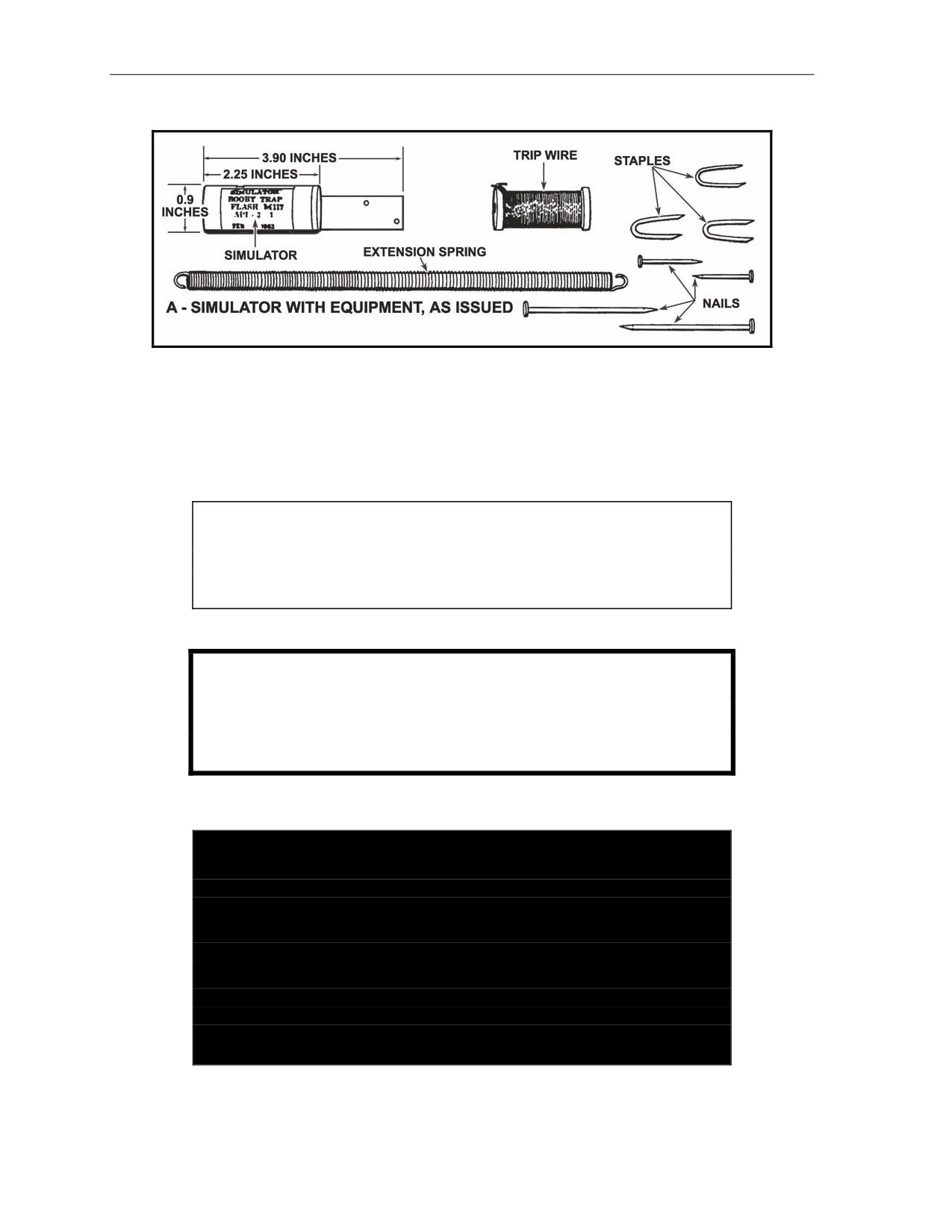
z
All other kit components (Figure 4-15) are present.
15 October 2009
FM 3-23.30
4-17
Chapter 4
Figure 4-15. Kit components.
STORAGE
4-54. Personnel should carry early warning simulators in accordance with the unit SOP. When carrying early
warning simulators, personnel should adhere to the following guidelines:
z
Ensure that the early warning simulator is placed in a secure, dry area.
CAUTION
Duds or improper functioning could occur if exposed to moisture for long
periods of time. Open just before use.
z
Do not put adhesive tape around any portion of the early warning simulator during storage.
WARNING
Do not bend, tamper, modify or otherwise alter a trip flare. Do not
tape any portion of the trip flare during storage.
USE
DANGER
EARLY WARNING SIMULATORS MUST BE MOUNTED; DO NOT
ACTIVATE THEM BY HAND. EARLY WARNING SIMULATORS WILL
IMMEDIATELY ACTIVATE.
EARLY WARNING SIMULATORS WILL SERIOUSLY INJURE
PERSONNEL WITHIN 2 FEET.
NEVER OPEN A SIMULATOR; THE PHOTOFLASH POWDER IS
EXTREMELY SUSCEPTIBLE TO FLASH IGNITION BY EVEN A
SLIGHT AMOUNT OF FRICTION.
4-18
FM 3-23.30
15 October 2009
Pyrotechnic Signals
WARNINGS
Early warning simulators must not be activated in loose gravel,
sticks, or other materials that could become projectiles, nor
should they be thrown into dry leaves, grass, or other flammable
materials. Dry grass or leaves within 3 feet may become ignited.
DO NOT tape or wire early warning simulators to any surface. Use
nails.
DO NOT remove the simulator cap before use.
NOTE: There is a GTA included in the early warning simulator’s cardboard shipping box that gives
detailed instructions for installing the simulator. The same illustrative instructions may also be found
in TM 9-1370-207-10.
4-55. The instructions included with the early warning simulator show how to install the simulator on a tree.
This is just one technique of installing the early warning simulator.
4-56. To install an early warning simulator—
(1) Select two objects, such as trees or stakes, not more than 20 feet apart.
(2) About 6 inches above the ground, drive a large nail into one object.
(3) Drive a staple about 2 inches above and to the right of the nail.
(4) Drive a second staple into the object about 20 inches above the first staple.
(5) Drive a large nail 1 inch below the top staple.
NOTE: This will be used to temporarily hold the spring on the lower staple.
(6) Extend the spring to the nail driven in during Step 5.
(7) Make a 6-inch loop in one end of the tripwire, and tie it with a double-knot. Thread the loop down
through the top staple, and attach to the upper end of the spring only.
(8) Maintain tension on the tripwire, and run it down the object, under the bottom nail, and toward the
second object.
(9) Drive a staple into the second object at the lowest point that will allow free travel of the tripwire.
(10) Maintain tension on the tripwire, and tie the wire to a large nail, just below its head. Wedge the nail
between the staple and the object to ensure a taut and secure tripwire.
(11) Carefully unhook the extended spring from the temporary nail. The spring should keep the wire taut.
(12) Remove the tape securing the cap. Remove the cap from the simulator, and allow the pull cord to
hand freely.
(13) Nail the simulator about 4 inches above the top of the spring.
(14) Leave 1 or 2 inches of slack in dangling cord, and tie the cord to the end of the spring that is fastened
to the tripwire.
MAINTENANCE
4-57. There is no unit level maintenance for the early warning simulators. Turn in unused items to ammunition
support area as soon as possible, or dispose of in accordance with unit SOP. Provide as much protection for
these items by repacking in original containers, if available, or equivalent improvised packaging.
z
All repacking should be tightly wrapped, clearly marked and waterproof.
z
Avoid exposure to moisture and rough physical contact.
15 October 2009
FM 3-23.30
4-19
Chapter 4
DESTRUCTION PROCEDURES
4-58. Selection of the method of destruction requires imagination and resourcefulness in the utilization of the
facilities at hand under the existing conditions. In general, destruction of handheld signals can be accomplished
most effectively by burning or firing, or a combination of these methods.
GROUND-BURST SIMULATOR
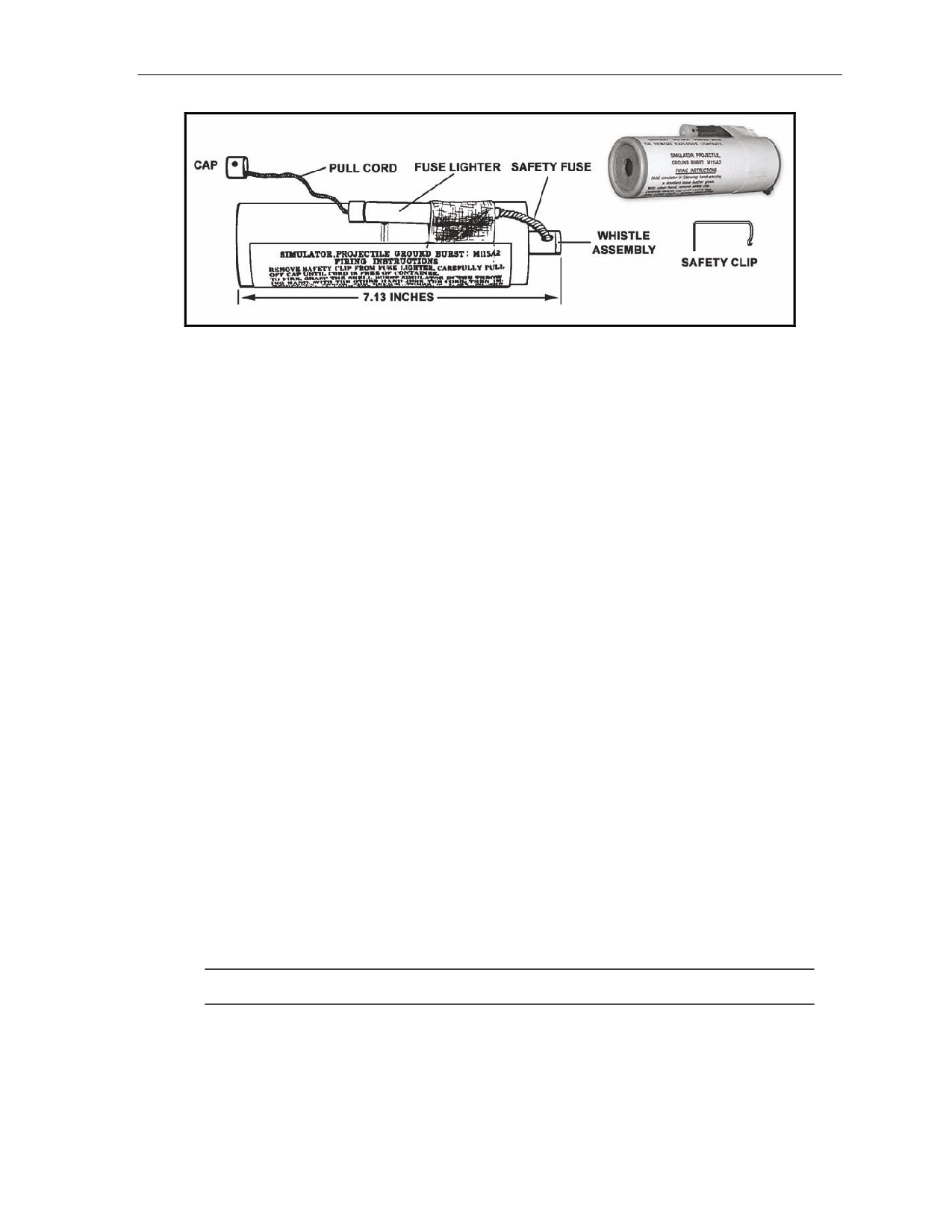
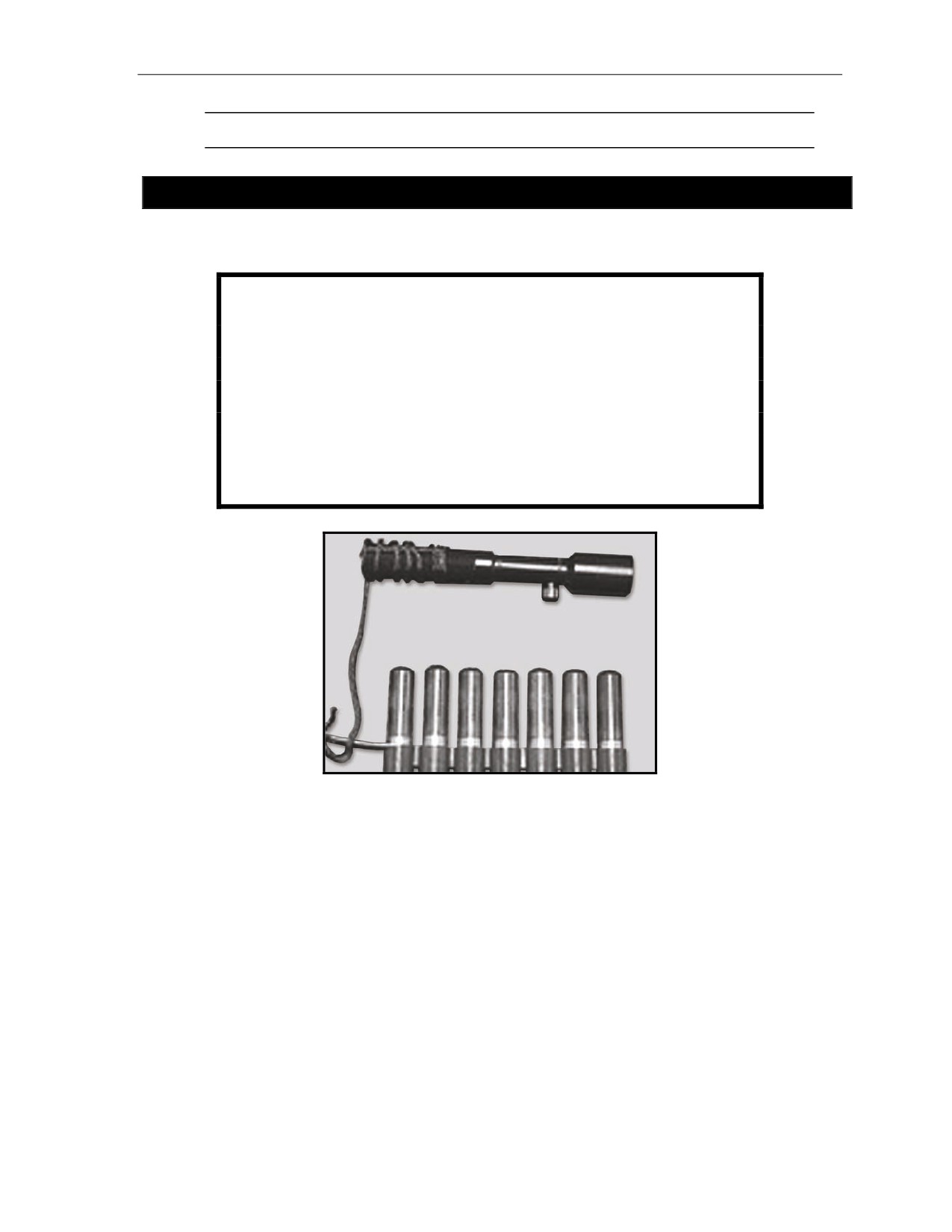
4-59. The M115A2, projectile ground-burst simulator replicates the detonation of artillery and mortar
projectiles or artillery-type rockets (Figure 4-16). It is activated by pulling its M3A1 friction delay igniter cord
and immediately thrown into a cleared area. After a 6- to 10-second delay, it produces a high-pitched whistle
that lasts 2 to 4 seconds and then detonates with a loud report and brilliant flash.
NOTE: Instructions for the ground-burst simulator are printed directly on the simulators.
WARNING
The M115A2 projectile ground-burst simulator must not be used
near personnel due to potential hazard from fragmentation.
Ensure the simulator is not thrown to any point within 35 meters
of unprotected personnel. When using the M115A2 ground-burst
simulator, the thrower should turn away from the simulator after
throwing.
WARNING
For protection, personnel throwing the M115A2 simulator must
wear the following items: ear protection, safety eyewear, and a
protective helmet and vest. The user must wear a standard-issue
leather glove on the throwing hand.
WARNING
The M115A2 must not be activated in loose gravel, sticks, or other
materials that could become projectiles, nor should they be
thrown into dry leaves, grass, or other flammable materials.
4-20
FM 3-23.30
15 October 2009
Pyrotechnic Signals
Figure 4-16. M115A2 ground-burst simulator.
INSPECTION
4-60. Inspection at unit level consists of a visual check of packaging materials. Do not open any moisture-proof
container or barrier bag because the item must be protected from moisture just prior to use.
4-61. The most commonly encountered packaging defects are listed below:
z
Outer containers (boxes) damaged, weathered, or rotted to the extent that contents are not protected.
z
Inner container damaged to the extent that contents are not protected or cannot be readily removed.
z
Container cap or closure not secured to the extent that contents are not protected.
z
Inner containers wet (except metal), rusted, moldy, or mildewed.
z
Hardware or banding loose, missing, broken, or ineffective.
z
Handle or cleat missing or broken.
z
Contents loose to the extent that item may be damaged in handling.
STORAGE
4-62. Take the following precautions when storing M115A2 ground-burst simulators—
z
Select level, well-drained sites free from readily ignitable and flammable materials.
z
Provide nonflammable or fire-resistant overhead covers (e.g., tarpaulin) for all items. Maintain
overhead space of approximately 18 inches (46 centimeters) between cover and items. Keep cover at
least 6 inches (15.5 centimeters) from pile on the ends and at sides to permit circulation of air.
z
Temporarily store unserviceable items in a segregated area.
USE
4-63. To prepare and throw a ground-burst simulator by hand—
z
Remove safety clip from fuze lighter.
z
Grasp simulator in throwing hand. Carefully remove cap until free end of igniter and cord is partially
extended.
z
Assume throwing position (standing, kneeling, or prone). Jerk the pull-cord once, and throw
immediately.
NOTE: See Chapter 3 for throwing positions.
15 October 2009
FM 3-23.30
4-21
Chapter 4
MAINTENANCE
4-64. There is no unit level maintenance for the ground-burst simulators. Turn in unused items to ammunition
support area as soon as possible. Provide as much protection for these items by repacking in original containers,
if available, or equivalent improvised packaging.
z
All repacking should be tightly wrapped, clearly marked and waterproof.
z
Avoid exposure to moisture and rough physical contact.
DESTRUCTION PROCEDURES
4-65. Selection of the method of destruction requires imagination and resourcefulness in the utilization of the
facilities at hand under the existing conditions. In general, destruction of handheld signals can be accomplished
most effectively by burning or firing, or a combination of these methods.
HAND GRENADE SIMULATOR
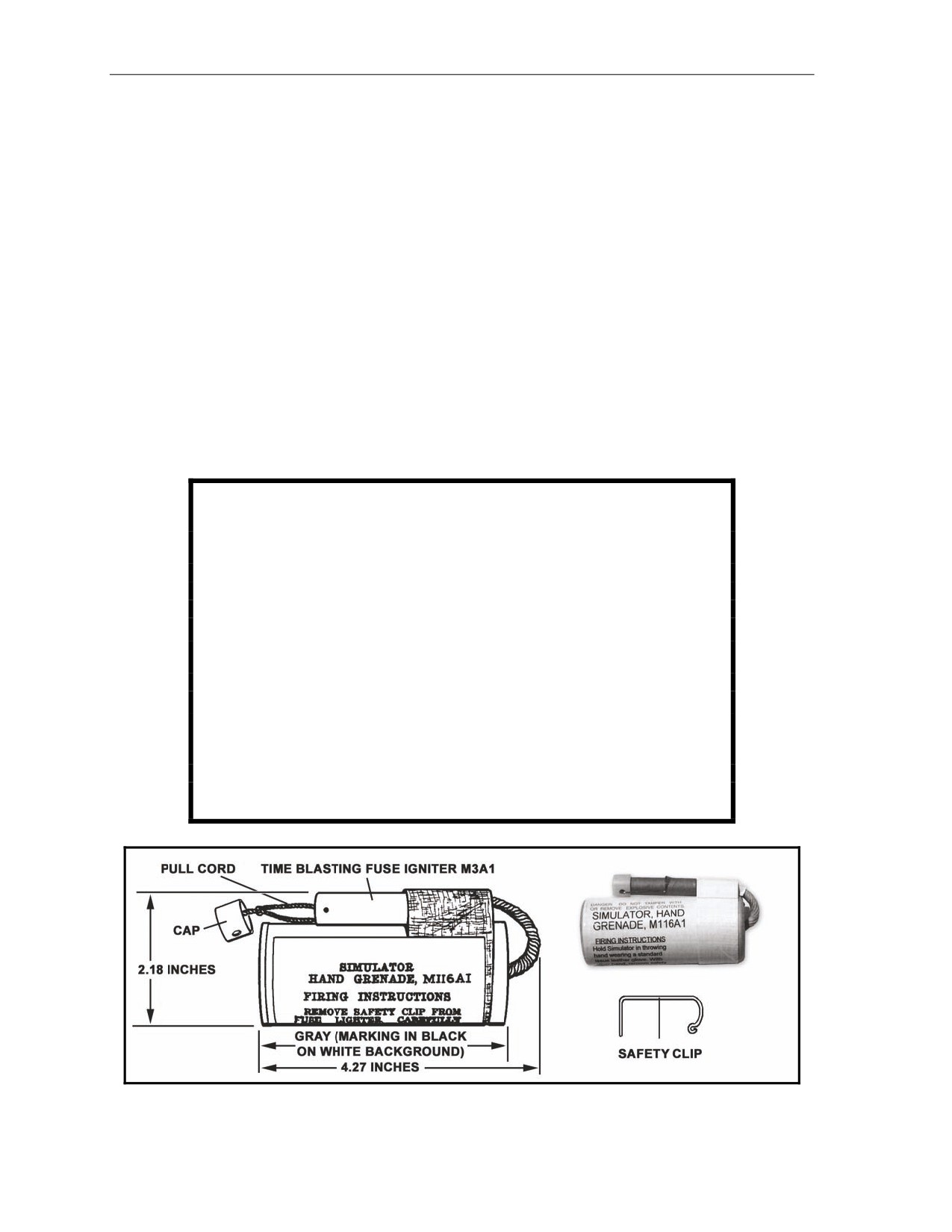
4-66. The M116A1 hand grenade simulator (Figure 4-17) is used to create battle noises and flashes during
training. It differs from the ground-burst simulator in that it is shorter and does not emit a high-pitched whistle
before detonation. The hand grenade simulator is thrown in the same manner as a live grenade. It creates a flash
and loud report 5 to 10 seconds after ignition.
WARNINGS
The safety radius for the M116A1 simulator is 15 meters. If this
distance is not observed, hearing damage and possible
fragmentation injury could result. The M116A1 projectile ground-
burst simulator must not be used near personnel due to potential
hazard from fragmentation.
The M116A1 must not be activated in loose gravel, sticks, or other
materials that could become projectiles, nor should they be
thrown into dry leaves, grass, or other flammable materials.
For protection, personnel throwing the M116A1 simulator must
wear the following items: ear protection, safety eyewear, and a
protective helmet and vest. The user must wear a standard-issue
leather glove on the throwing hand.
Figure 4-17. M116A1 hand grenade simulator.
4-22
FM 3-23.30
15 October 2009
Pyrotechnic Signals
NOTE: Instructions for the hand grenade simulator are printed directly on the simulators.
SECTION IV. ILLUMINATION GROUND SIGNAL KITS
The pen gun flare supports the small-unit leader in fire control, maneuver, and initiating operations such as
ambushes. These signals are also a component of air crewmen’s survival vest and are used for distress signaling or to
identify ground locations for aircraft (Figure 4-18).
WARNINGS
At close-range, these signals can injure or kill if they strike a
person.
When signaling an aircraft, do not aim directly at the aircraft; the
signals, regardless of color, may appear to be small arms fire.
While the flares are small and usually burn out before reaching the
ground, they can ignite fires.
Figure 4-18. M260 illumination ground signal kit.
INSPECTION
4-67. Inspection at unit level consists of a visual check of packaging materials. Do not open any moisture-proof
container or barrier bag because the item must be protected from moisture just prior to use.
4-68. The most commonly encountered packaging defects are listed below:
z
Outer containers (boxes) damaged, weathered, or rotted to the extent that contents are not protected.
z
Inner container damaged to the extent that contents are not protected or cannot be readily removed.
z
Container cap or closure not secured to the extent that contents are not protected.
z
Inner containers wet (except metal), rusted, moldy, or mildewed.
z
Hardware or banding loose, missing, broken, or ineffective.
z
Handle or cleat missing or broken.
z
Contents loose to the extent that item may be damaged in handling.
15 October 2009
FM 3-23.30
4-23
Chapter 4
STORAGE
Take the following precautions when storing the illumination ground signal kit—
z
Select level, well-drained sites free from readily ignitable and flammable materials.
z
Provide nonflammable or fire-resistant overhead covers (e.g., tarpaulin) for all items. Keep cover at
least 6 inches (15.5 centimeters) from pile on the ends and at sides to permit circulation of air.
z
Temporarily store unserviceable items in a segregated area.
USE
4-69. To operate an illumination ground signal kit—
(1) Select the signal to be fired by color (if using the M186 pen flare kit). If the bandoleer contains more
than one signal of the chosen color, use the one farthest from the lanyard.
(2) Remove and discard the plastic cap (M185 and M186 only).
(3) Cock the projector by moving the trigger to the safety slot (M185 and M186 only).
(4) Carefully thread the projector onto the signal. Take care not to dislodge the trigger from the safety
slot (M185 and M186 only).
(5) Aim in the chosen direction.
(6) Fire by moving the trigger to the bottom of the slot and releasing it with a snap.
(7) If the expended signal is on the end of the bandoleer or if the signals between the expended signal
and the end have been used, cut the bandoleer and discard the waste.
(8) Return the partly used kit to the carrier bag, and seal with tape.
MAINTENANCE
4-70. There is no unit level maintenance for the illumination ground signal kit. Turn in unused items to
ammunition support area as soon as possible. Provide as much protection for these items by repacking in
original containers, if available, or equivalent improvised packaging.
z
All repacking should be tightly wrapped, clearly marked and waterproof.
z
Avoid exposure to moisture and rough physical contact.
DESTRUCTION PROCEDURES
4-71. Selection of the method of destruction requires imagination and resourcefulness in the utilization of the
facilities at hand under the existing conditions. In general, destruction of handheld signals can be accomplished
most effectively by burning or firing, or a combination of these methods.
4-24
FM 3-23.30
15 October 2009
Chapter 5
Employment Considerations
Soldiers employ hand grenades and pyrotechnics throughout the spectrum of warfare to
conceal positions and to inflict greater casualties.
APPLICATION
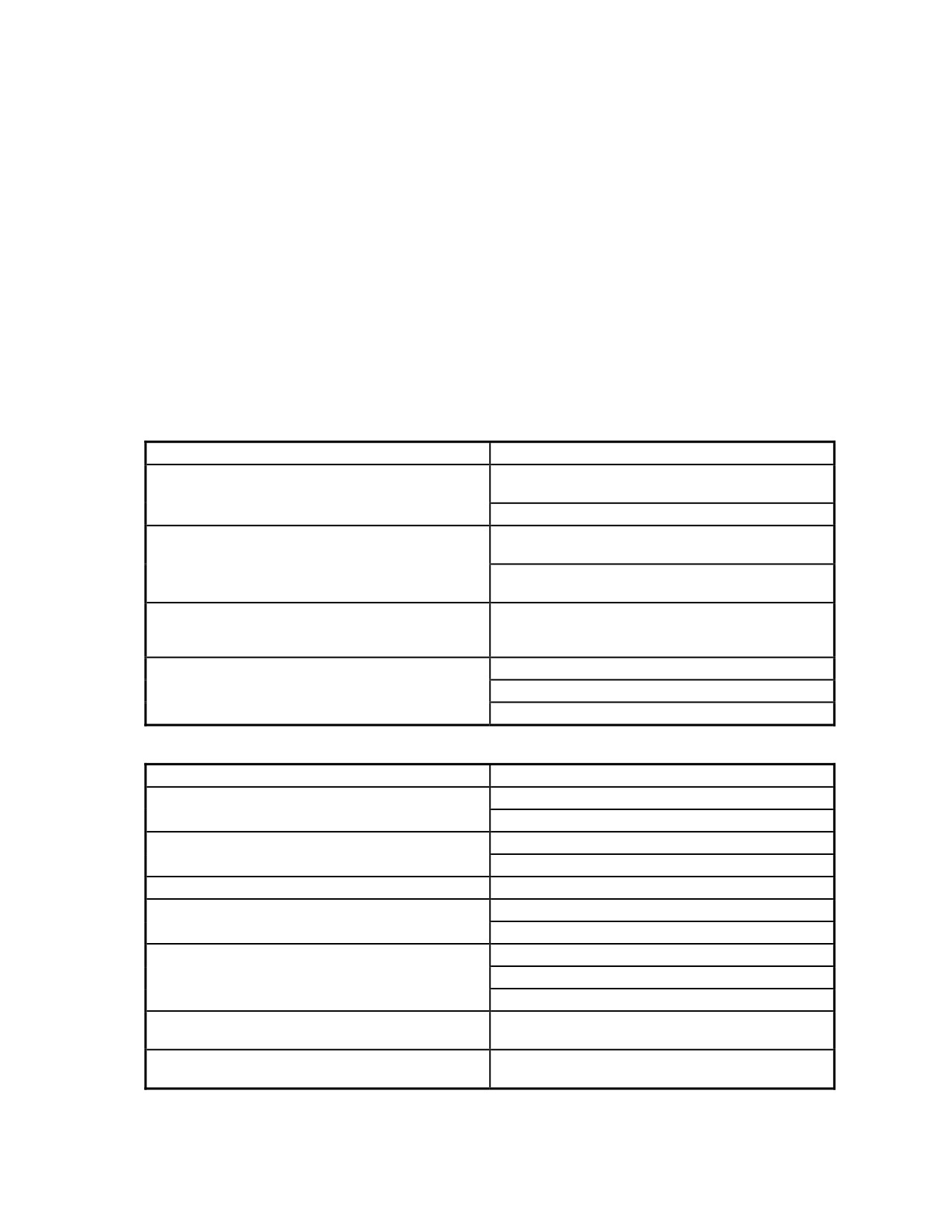
5-1. Hand grenades and pyrotechnics provide the individual Soldier with a number of highly versatile and
effective weapon and signaling systems. Each system is designed for a specific application (Tables 5-1 and 5-2).
Table 5-1. Types of hand grenades and their applications.
TYPE
APPLICATION
Supplement small arms fire against enemies in close
Fragmentation hand grenades
combat
Destroy or disable equipment
Destroy above and below ground manmade
structures
Offensive hand grenades (concussion grenades)
Kill or stun enemy divers during waterborne
operations
Confuse, disorient, or momentarily distract a
Stun hand grenades
potential threat in forced entry scenarios, selected
urban operations, or crowd control operations
Immobilize vehicles
Incendiary hand grenades
Destroy equipment and weapon systems
Destroy munitions and start fires
Table 5-2. Types of pyrotechnic signals and their applications.
TYPE
APPLICATION
Identify places or objects
Colored smoke grenades
Mark positions
Conceal
White smoke grenades
Conceal or create a smoke screen
Riot-control hand grenades
Control crowds or riots
Star clusters, star parachutes, and smoke
Signal
parachutes
Illuminate
Destroy equipment
Surface trip flares
Provide early warning
Illuminate an immediate area
Booby trap simulators (flash, illuminating, and
Early warning signals
whistling)
Simulate battle noises and battlefield effects (i.e.,
Ground-burst simulators and grenade simulators
shells in flight and ground-burst explosions)
15 October 2009
FM 3-23.30
5-1
Chapter 5
RULES OF ENGAGEMENT
5-2. To properly employ any type of hand grenade or pyrotechnic signal, Soldiers must know the—
z
Characteristics and capabilities of the chosen grenade or pyrotechnic.
z
Location of all friendly forces.
z
Sector of fire.
z
Projected arc or path of the grenade or pyrotechnic, ensuring that it is free of obstacles.
z
Direction of the wind (when employing handheld and ground smoke signals).
5-3. Further, Soldiers should use the buddy or team system when employing grenades and pyrotechnics. For
example, one Soldier can provide covering fire, or as a combined team, Soldiers can employ grenades on the
target and ground smoke within the target area.
CONSIDERATIONS
5-4. When employing any type of hand grenade or pyrotechnic signal, Soldiers must ask themselves the
following questions:
z
What types of grenades do the rules of engagement (ROE) permit and restrict?
z
What effect is desired (e.g., kill, stun, obscure, destroy equipment, mark a location, etc.)?
z
Does the structural integrity of the room and building permit the types of grenades selected for use?
WARNING
DO NOT use fragmentation or concussion grenades in buildings
that have walls of thin veneer material. Fragmentation grenade
particles can penetrate partitioned walls, and concussion grenades
can weaken the structure of the building or cause portions of the
building to collapse inward.
z
Will the scheme of maneuver permit the use of fragmentation grenades and not cause fratricide?
z
Will the type of grenade used cause a fire in an undesired location?
OFFENSIVE OPERATIONS
5-5. The fragmentation hand grenade is the primary type of grenade used during offensive operations;
however, offensive operations can also involve the use of offensive and stun hand grenades. These operations
include clearing—
z
Confined spaces.
z
Trenches.
z
Bunkers.
z
Rooms.
z
Entrenched positions.
CONFINED SPACES
5-6. If the enemy is located in a confined space, such as a bunker, building, or fortified area, the offensive
grenade or stun grenade may be more appropriate than the fragmentation hand grenade. These types of grenades
are much less lethal than fragmentation grenades on an enemy in the open, but they are very effective against an
enemy within a confined space and are safer to employ in the confines of a smaller space. Selection of a
grenade, however, depends upon availability and mission analysis.
5-2
FM 3-23.30
15 October 2009
Employment Considerations
WARNING
The concussion produced by offensive grenades in enclosed
areas is greater than those produced by the fragmentation
grenade. This may weaken or cause collapse of a structured
foundation.
TRENCHES
5-7. A mix of fragmentation grenades and offensive grenades should be used to clear enemy fortified trenches:
fragmentation grenades to gain and clear the enemy’s trench lines, and offensive grenades to clear and destroy
any fortified positions.
NOTE: See FM 3-21.8 and Battle Drill 07-8-1 for detailed instruction on how a squad enters and
clears a trench with the use of grenades.
WARNING
To ensure the safety of squad members during tactical operations,
Soldiers employing fragmentation grenades must shout “FRAG
OUT” before throwing the grenade.
CLEARING BUNKERS
5-8. A mix of fragmentation and offensive grenades can be used to clear bunkers: fragmentation grenades to
suppress enemy fires during movement, and a mix of fragmentation and offensive grenades to destroy fortified
positions.
NOTE: See FM 3-21.8 and Battle Drill 07-8-1 for detailed instruction on how a squad clears a
bunker with the use of grenades.
WARNING
To ensure the safety of squad members during tactical operations,
Soldiers employing fragmentation grenades must shout “FRAG
OUT” before throwing the grenade.
CLEARING A ROOM
5-9. The following is an example of how a squad clears a room using hand grenades:
15 October 2009
FM 3-23.30
5-3
Chapter 5
WARNING
Conduct a structural analysis before using fragmentation or
concussion grenades to clear rooms of a building. Grenade
fragments can penetrate walls and cause injury to the clearing
team. Concussion grenades may weaken the structure, causing
part or all of the building to collapse on the clearing team.
(1) The squad leader and assaulting fire team approach the room and position themselves at either side
of the entrance.
(2) A Soldier of the assaulting fire team cooks off a fragmentation or concussion grenade (2 seconds
maximum), shouts "FRAG OUT" or "CONCUSSION OUT" to alert friendly personnel, and then
throws the grenade into the room.
CAUTION
If a stun grenade is chosen for room clearing, do not cook off the grenade.
The stun grenade has a short time fuze; the thrower will not have
adequate time to dispose of the grenade before it explodes. This can
cause serious injury to the thrower and friendly personnel nearby.
NOTE: If stealth is a factor, the thrower alerts the team/squad of the type of grenade by holding it
up so that each member can see the grenade and take appropriate safeguard actions.
DANGER
SOLDIERS MUST BE CONSCIOUS OF FEATURES WITHIN THE
ROOM TO BE CLEARED. GRENADES TEND TO ROLL DOWN
STAIRS. THIS CAN NULLIFY THE DESIRED EFFECT(S) OR CAUSE
FRIENDLY CASUALTIES.
(3) After the grenade explodes, the lead man in the clearing team enters the room, eliminates any
immediate threat, and moves to his point of domination.
(4) The remainder of the clearing team enters the room and moves to their points of domination,
eliminating any threat.
(5) Once cleared, the team marks the room in accordance with the unit SOP.
NOTE: See FM 3-21.8 and Battle Drill 07-8-1 for detailed instruction on how a squad clears a room
with the use of grenades.
ENTRENCHED POSITIONS
5-10. Against Soldiers in open trenches or fighting positions, Soldiers should throw a fragmentation grenade or
an offensive concussion grenade so that it bursts over the target. If the targets are on sloping ground, Soldiers
should use above-ground detonation to prevent the grenade from rolling away from the target before detonating.
Above-ground detonation also prevents the enemy from securing the grenade and throwing it back within the 4-
to 5-second fuze delay.
5-4
FM 3-23.30
15 October 2009
Employment Considerations
NOTE: See Chapter 3 for more information about above-ground detonation (cooking off).
DEFENSIVE OPERATIONS
5-11. The fragmentation grenade is the primary hand grenade used in defensive operations. It can be used in
conjunction with other weapons to destroy remnants of an attacking enemy force that may succeed in
penetrating the more distant barriers and final protective fires. The fragmentation hand grenade further disrupts
the continuity of the enemy attack, demoralizes the enemy soldier, and forces the enemy into areas covered by
direct-fire weapons such as rifle and machine gun fire and Claymore mines. Using fragmentation hand grenades
on dismounted enemy forces at a critical moment in the assault can be the final blow in taking the initiative
away from the enemy.
NOTE: See FM 3-21.8 for more information regarding the use of grenades in defensive operations.
DEFENSE FROM INDIVIDUAL FIGHTING POSITIONS
5-12. From individual fighting positions, fragmentation hand grenades can be used to cover close-in dead
space. Soldiers should use these grenades in conjunction with ground flares along the front of their defensive
positions. Potential avenues of approach through the unit’s perimeter should be marked with a reference to
identify them as primary hand grenade targets.
5-13. The following rules apply when employing fragmentation hand grenades from fighting positions:
z
Clear overhead obstructions that may interfere with the path of the thrown grenade. Do this at the
same time direct-fire fields of fire are cleared.
z
Rehearse grenade employment; know where the primary target is located.
z
Keep 50 percent of the fragmentation grenades at the ready in the fighting position, leaving the
remaining fragmentation grenades on the LCE/ETLBV.
z
Rehearse actions needed if an enemy grenade lands in the fighting position.
z
Employ fragmentation hand grenades against enemy soldiers located in defilade positions as first
priority. This lessens the danger to friendly Soldiers and helps cover terrain not covered by direct-
fire weapons.
z
Reconnoiter the alternate and supplementary positions, and determine the priority for the
fragmentation hand grenade target.
WARNING
Grenade fuze time delays can vary. If an enemy grenade lands in
the position, immediately evacuate the fighting position, or if
nearby, quickly lay flat on the ground.
RETROGRADE OPERATIONS
5-14. Most of the employment considerations applicable to the use of hand grenades and pyrotechnics in the
defense are equally applicable to retrograde operations. Considerations unique to retrograde operations relate to
creating obstacles, marking friendly force locations, breaking contact, and communicating.
CREATE OBSTACLES
5-15. When terrain conditions permit, Soldiers can use incendiary grenades to impede and disrupt enemy
movement by initiating fires in specific areas.
15 October 2009
FM 3-23.30
5-5
Chapter 5
MARK LOCATIONS
5-16. Soldiers can use prearranged smoke colors to mark friendly force positions and identify friendly forces.
BREAK CONTACT
5-17. During retrograde operations, some elements of the friendly force may become decisively engaged.
Soldiers can use fragmentation, white smoke, and CS grenades to break contact and regain flexibility of
maneuver. Use of hand grenades in volley fire following the employment of white smoke is especially effective;
the smoke obscures enemy observation of friendly force movement from covered positions, and the
fragmentation grenades force the enemy to cover.
COMMUNICATIONS
5-18. Soldiers can use prearranged handheld pyrotechnic signals to communicate friendly force movements.
URBAN OPERATIONS
5-19. By definition, urban areas house large quantities of people and contain large numbers of buildings. The
enemy may be intermingled with noncombatants, and collateral damage must be limited. Because of these
factors, the ROE may be more restrictive than under other combat conditions. Table 5-3 outlines the guidelines
for hand grenade employment.
NOTE: See FM 3-06.11 for use of grenades and pyrotechnics in urban areas.
Table 5-3. Hand grenade employment during urban operations.
TYPE OF HAND GRENADE
EMPLOYMENT
Use when noncombatants and friendly forces may be intermingled with
threat forces. Throw into rooms prior to entering to cause confusion and
Stun-type grenades
hesitation (especially useful if the structural integrity of the building does
not permit the use of fragmentation or concussion grenades).
Use during urban operations to maintain control. Should be employed
Riot-control grenades
only when command-directed.
Throw at assaulting enemy troops between buildings or on streets from
Fragmentation grenades
windows, doors, or manmade apertures (mouseholes). Should be
employed only when command-directed.
The M106 provides a near instantaneous screen of dense smoke and is
safe to use inside of urban structures, subterranean locations, and
Smoke grenades
caves. The M106 should be used in lieu of the AN-M8 HC and the M83
TA white smoke hand grenade when inside of confined spaces, and
when encountering enemy in close quarters.
WARNING
Use of the AN-M8 HC and the M83 TA white smoke hand grenade
are harmful to personnel and may cause fires inside of confined
spaces. These smoke grenades inside buildings may displace
oxygen in poorly ventilated rooms and make breathing difficult
while also rendering protective masks ineffective.
5-6
FM 3-23.30
15 October 2009
Employment Considerations
AIR OPERATIONS
WARNING
Do not throw fragmentation grenades from low-flying or hovering
helicopters. The fragments present a hazard to the aircraft and its
passengers.
5-20. Generally, throwing hand grenades from medium or high-flying helicopters is limited to mission-critical
situations.
USE UNDER ADVERSE CONDITIONS
5-21. While hand grenade procedures do not change when employed under adverse conditions, special
precautions must be taken.
MOPP4
5-22. Wearing gloves, especially gloves used during MOPP, inhibits the thrower’s feel and could decrease his
throwing ability and range. The thrower should execute arming and throwing procedures carefully and
concentrate on using the proper grip. Observing each arming action (removal of safety clip and safety pin) is
also recommended in MOPP.
LIMITED VISIBILITY
5-23. Depth perception is generally impaired under limited visibility conditions. Throwers must have clear
fields of fire with no overhead obstructions.
15 October 2009
FM 3-23.30
5-7