FM 3-23.30 Grenades and Pyrotechnic Signals (October 2009) - page 4
Appendix A
Characteristics of Grenades
There are five types of hand grenades: fragmentation, chemical, offensive, nonlethal, and
practice. This appendix outlines the characteristics of these hand grenades.
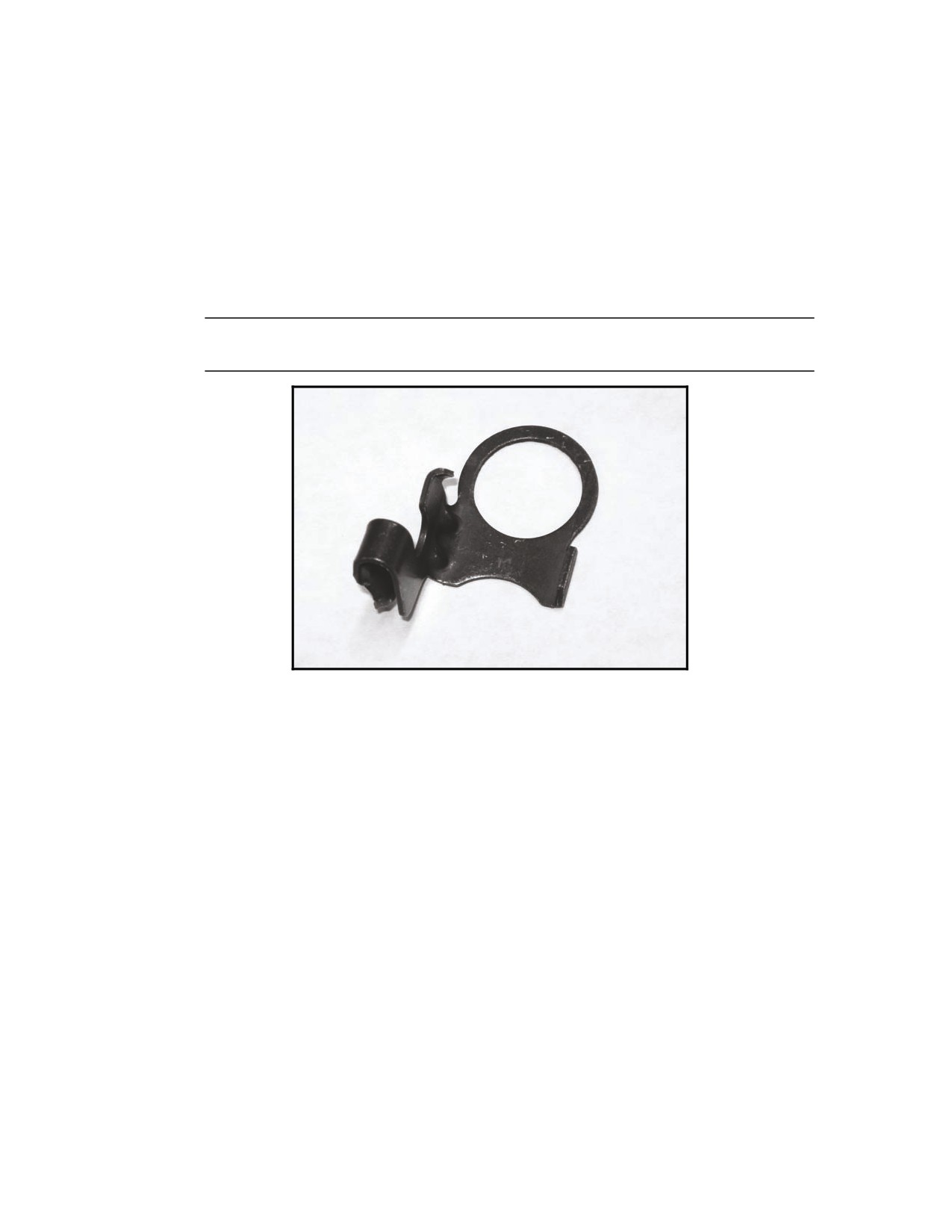
NOTE: A confidence clip (Figure A-1) has been introduced to hand grenades equipped with a safety
pin and pull ring.
Figure A-1. Confidence clip.
FRAGMENTATION HAND GRENADES
A-1. Fragmentation hand grenades produce high-velocity projection of fragments.
M67 FRAGMENTATION HAND GRENADE
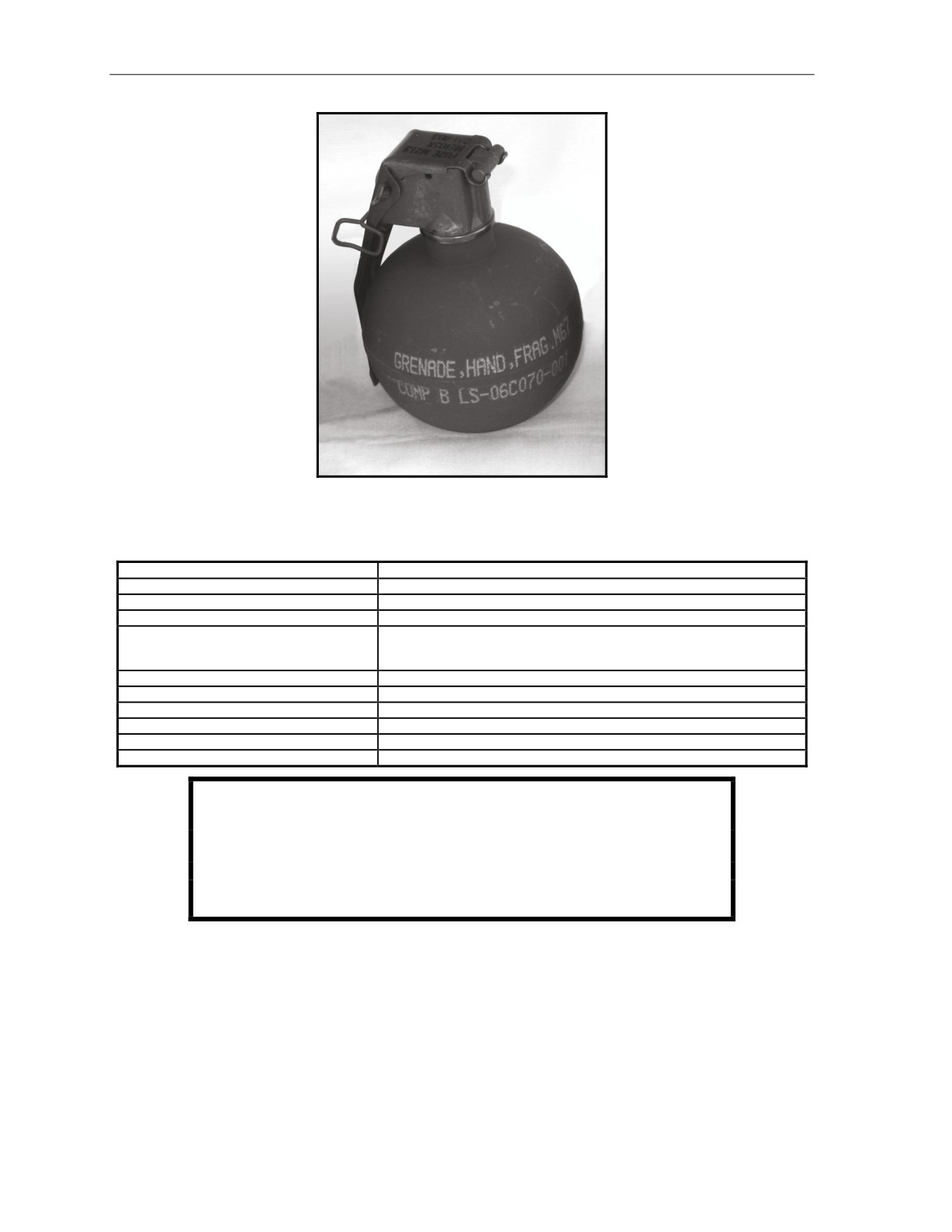
A-2. The M67 (Figure A-2) is the most commonly used fragmentation hand grenade. Table A-1 outlines the
grenade’s components and characteristics in accordance with TM 9-1330-200-12.
15 October 2009
FM 3-23.30
A-1
Appendix A
Figure A-2. M67 fragmentation hand grenade.
Table A-1. Components and characteristics of M67 fragmentation grenade.
COMPONENTS AND CHARACTERISTICS
DETAILS
Body
Steel sphere with a scored steel spring for fragmentation
Filler
6.5 ounces of Composition B
Fuze
M213
Safety clip
Safety Features
Safety pin and pull ring with confidence clip
Safety lever
Fuze Delay
4 to 5.5 seconds
Total Weight
14 ounces
Throwing Distance of Average Soldier
35 meters
Effective Casualty-Producing Radius
15 meters
Killing Radius
5 meters
Colors and Markings
Olive drab body with yellow markings
WARNING
Although the killing radius of the M67 grenade is 5 meters and the
casualty-producing radius is 15 meters, fragments can disperse
as far as 230 meters.
PRACTICE HAND GRENADES
A-3. Practice hand grenades simulate the effects of other hand grenades so that training can be conducted with
a reduced chance of injury to personnel or damage to property.
M69 PRACTICE HAND GRENADE
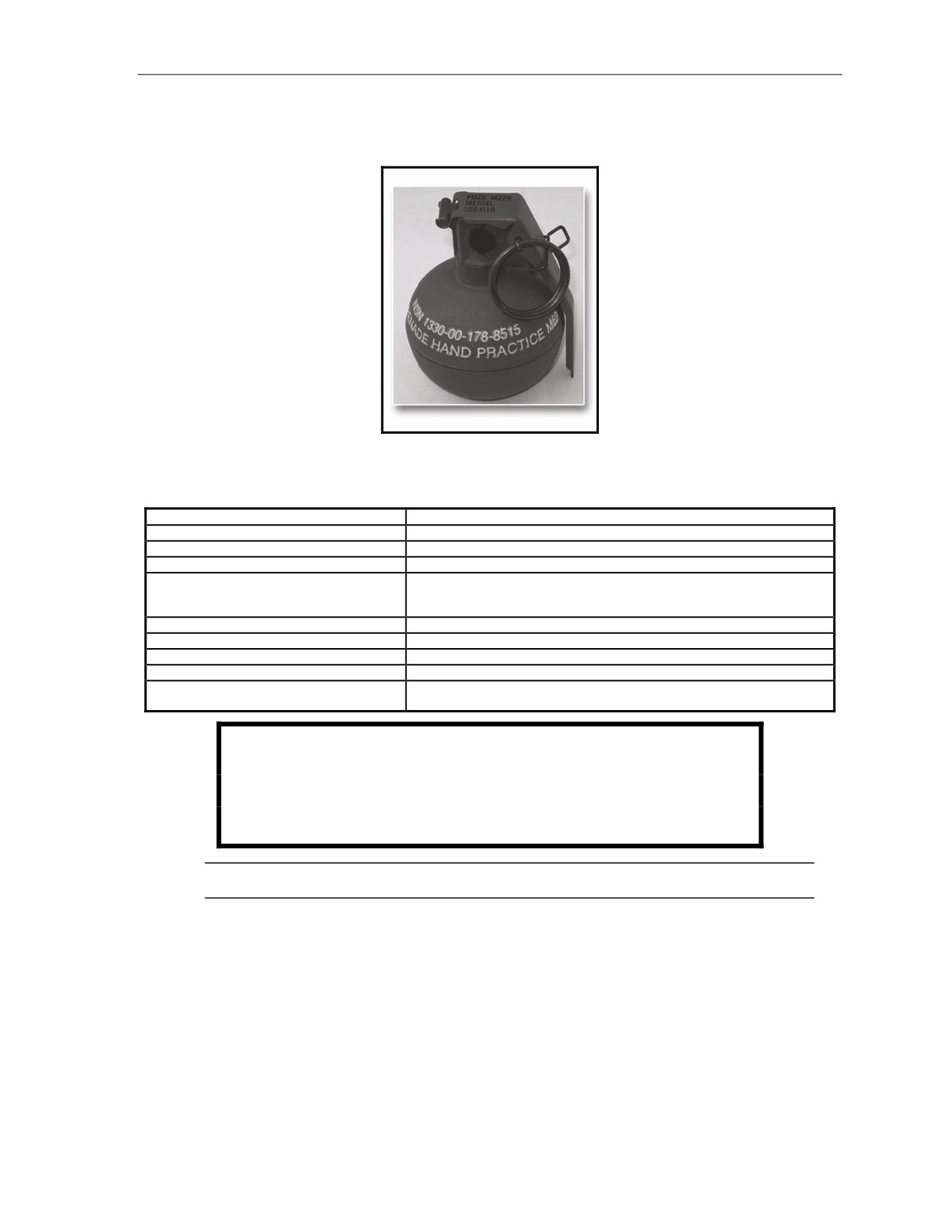
A-4. The M69 practice hand grenade is used for all individual and collective training tasks. The M69 practice
hand grenade (Figure A-3) provides realistic training and familiarizes the Soldier with the functioning and
A-2
FM 3-23.30
15 October 2009
Characteristics of Grenades
characteristics of the M67 fragmentation hand grenade. Table A-2 outlines the grenade’s components and
characteristics.
Figure A-3. M69 practice hand grenade.
Table A-2. Components and characteristics of M69 practice grenade.
COMPONENTS AND CHARACTERISTICS
DETAILS
Body
Hollow steel sphere
Filler
None
Fuze
M228, which is inserted into the grenade body
Safety clip
Safety Features
Safety pin and pull ring with confidence clip
Safety lever
Total Weight
14 ounces
Throwing Distance of Average Soldier
40 meters
Fuze Delay
4 to 5.5 seconds
Effects
Small puff of white smoke and a loud popping noise
Light blue with white markings; the safety lever of the fuze is light blue with
Colors and Markings
black markings and a brown tip
WARNING
Fuze fragments may exit the hole in the base of the grenade body
and cause injuries.
NOTE: The grenade body can be used repeatedly by replacing the fuze assembly.
M228 Detonating Fuze
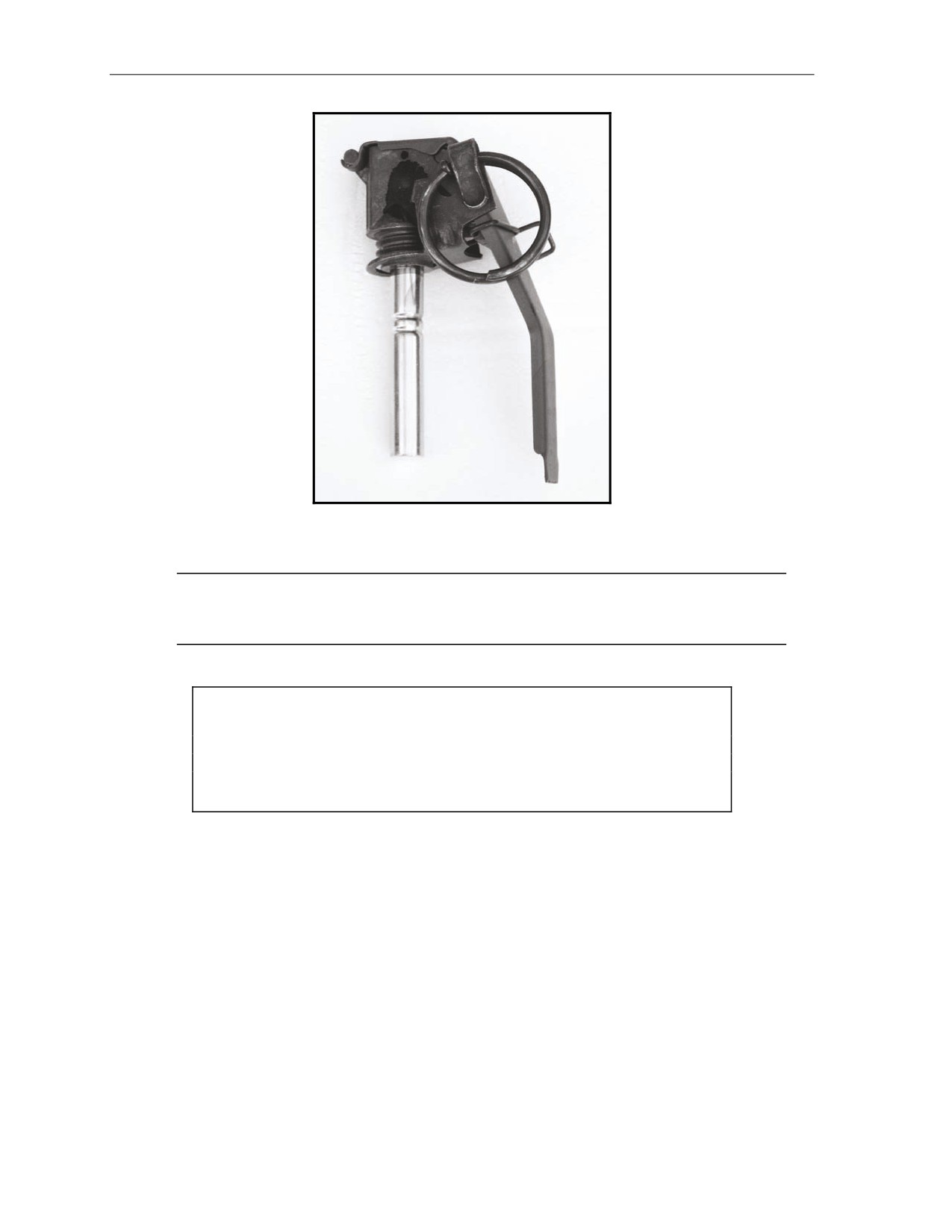
A-5. During practice events and for qualification, each Soldier is required to throw several M69 practice hand
grenades armed with the M228 detonating fuze (Figure A-4). Although it takes only about a minute or less to
install or replace a used fuze, a company-size element will use several hundred; preparing practice grenades for
all participants is not feasible. Soldiers should be given instruction on installing and removing a fired M228
fuze.
15 October 2009
FM 3-23.30
A-3
Appendix A
Figure A-4. M228 detonating fuze.
Install
NOTE: The M228 fuze for the M69 practice grenade will come with the confidence clip attached.
However, the confidence clip can be issued separately and then installed on the M228 fuze before
connecting the fuze to the M69 practice grenade.
A-6. To install the M228 fuze with confidence clip in the M69 grenade—
CAUTION
Do not hold or touch the fuze igniter. The igniter, made of light aluminum,
has an explosive charge that could be damaged if twisted, and could
cause injury to the hand.
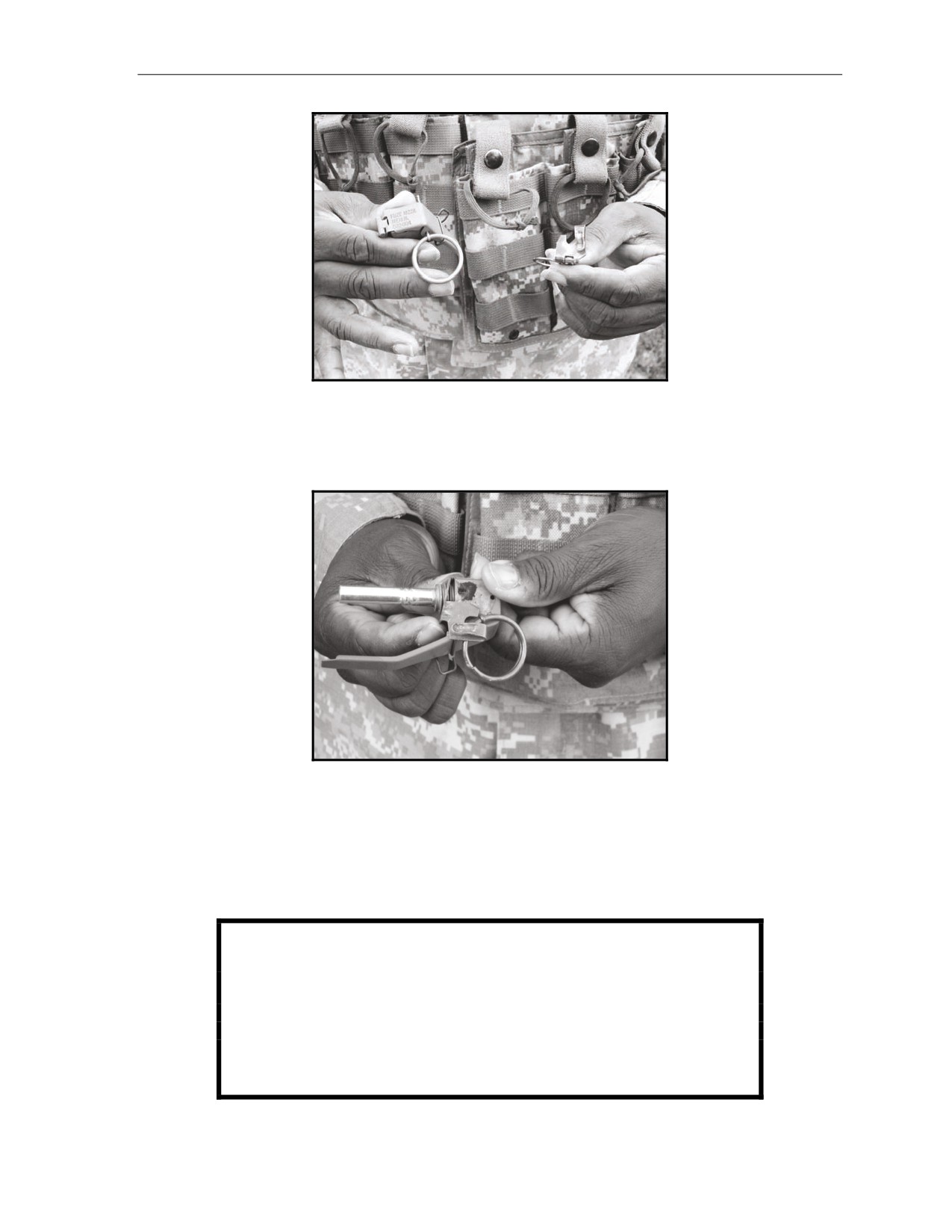
(1) Hold the head of the M228 fuze with the fingers of the throwing hand and the confidence clip in the
opposite hand (Figure A-5).
A-4
FM 3-23.30
15 October 2009
Characteristics of Grenades
Figure A-5. Gripping the M228 detonating fuze.
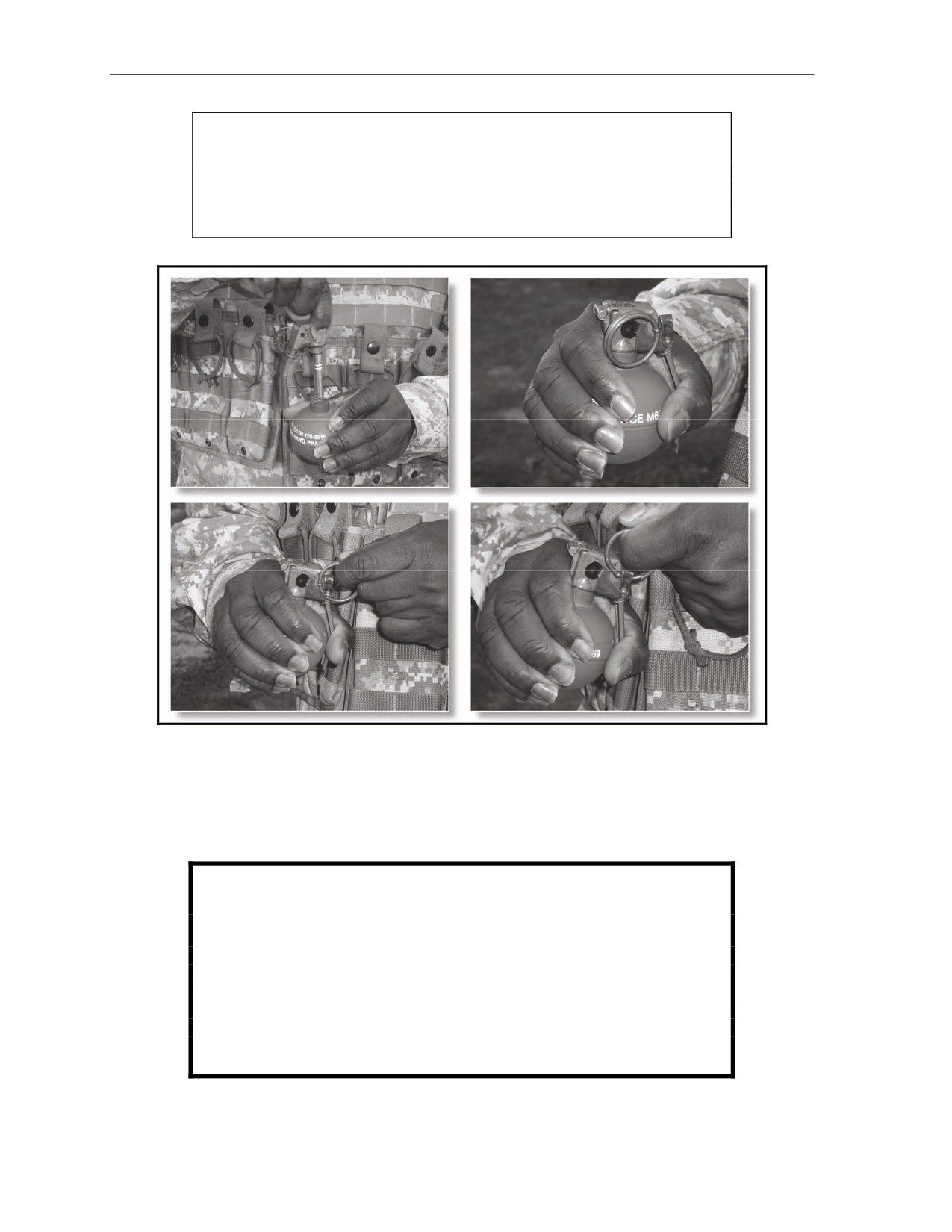
(2) Place the circular opening of the confidence clip over the threaded end of the M228 fuze with the
fingers of the opposite hand, ensuring the clip end is up and on the same side as the safety pin and
pull ring (Figure A-6).
Figure A-6. Placing the confidence clip over the threaded end of the M228 fuze.
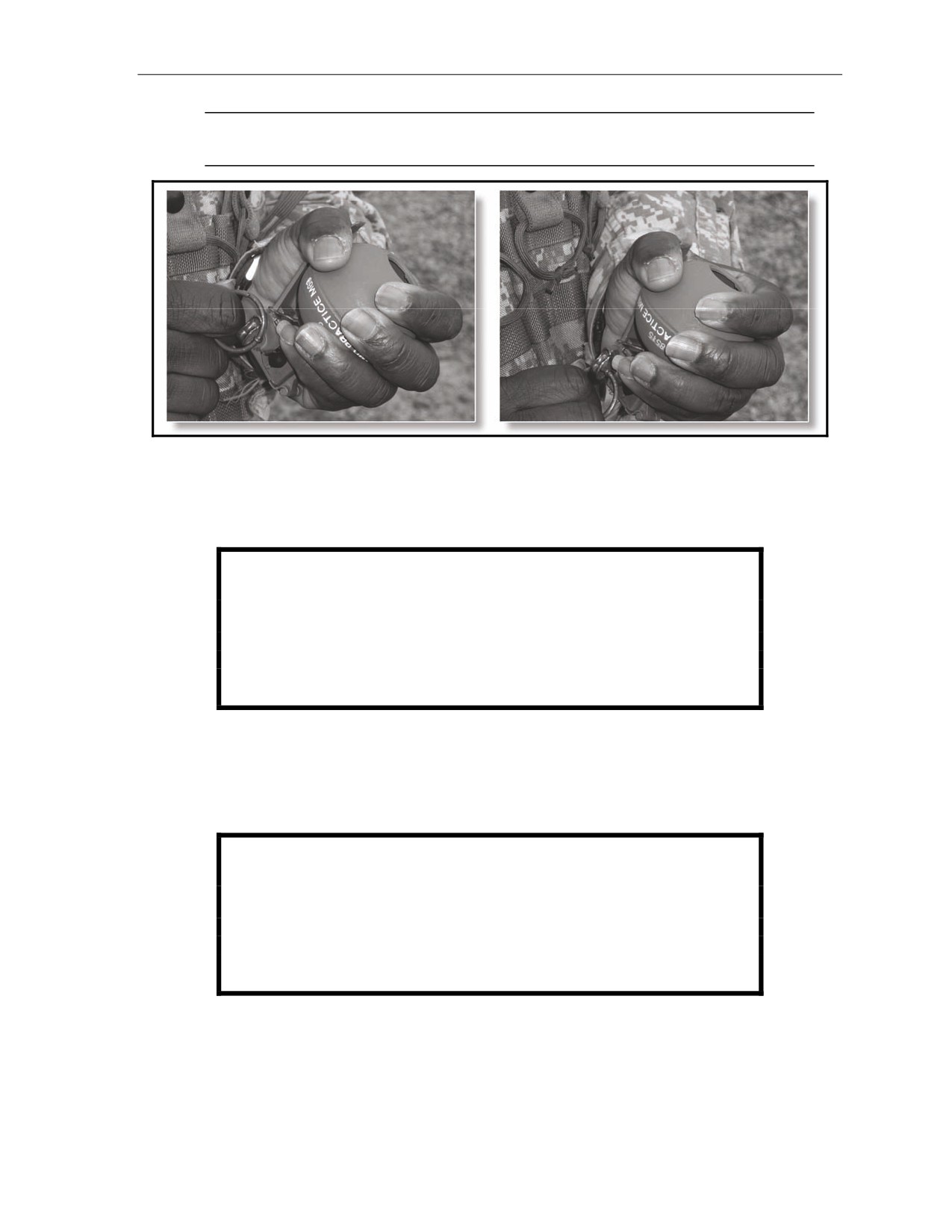
(3) Grip the M69 body with the non-throwing hand, taking care to keep any part of the hand away from
the firing port (non-threaded end) of the grenade (Figure A-7). While holding the body of the M69,
turn the grenade so that the threaded end is facing inward and the firing port of the grenade is facing
away from your body.
(4) Insert the M228 fuze into the threaded end of the M69, and turn the fuze or grenade body clockwise
until the fuze and confidence clip is secure.
WARNING
Keep all portions of the hand away from the M69 practice grenade
firing port (non-threaded end) when installing the M228 detonating
fuze and when throwing the grenade. The fuze explosive charge
can cause injury to the hand and fingers when it exits through the
firing port.
15 October 2009
FM 3-23.30
A-5
Appendix A
CAUTION
The M228 practice fuze should be only finger-tight. Do not over-tighten the
fuze. This could damage threads in the M69 body and the threaded end of
the fuze.
Figure A-7. Insert the M228 fuze into the M69 practice hand grenade body
and secure pull ring to the confidence clip (right hand).
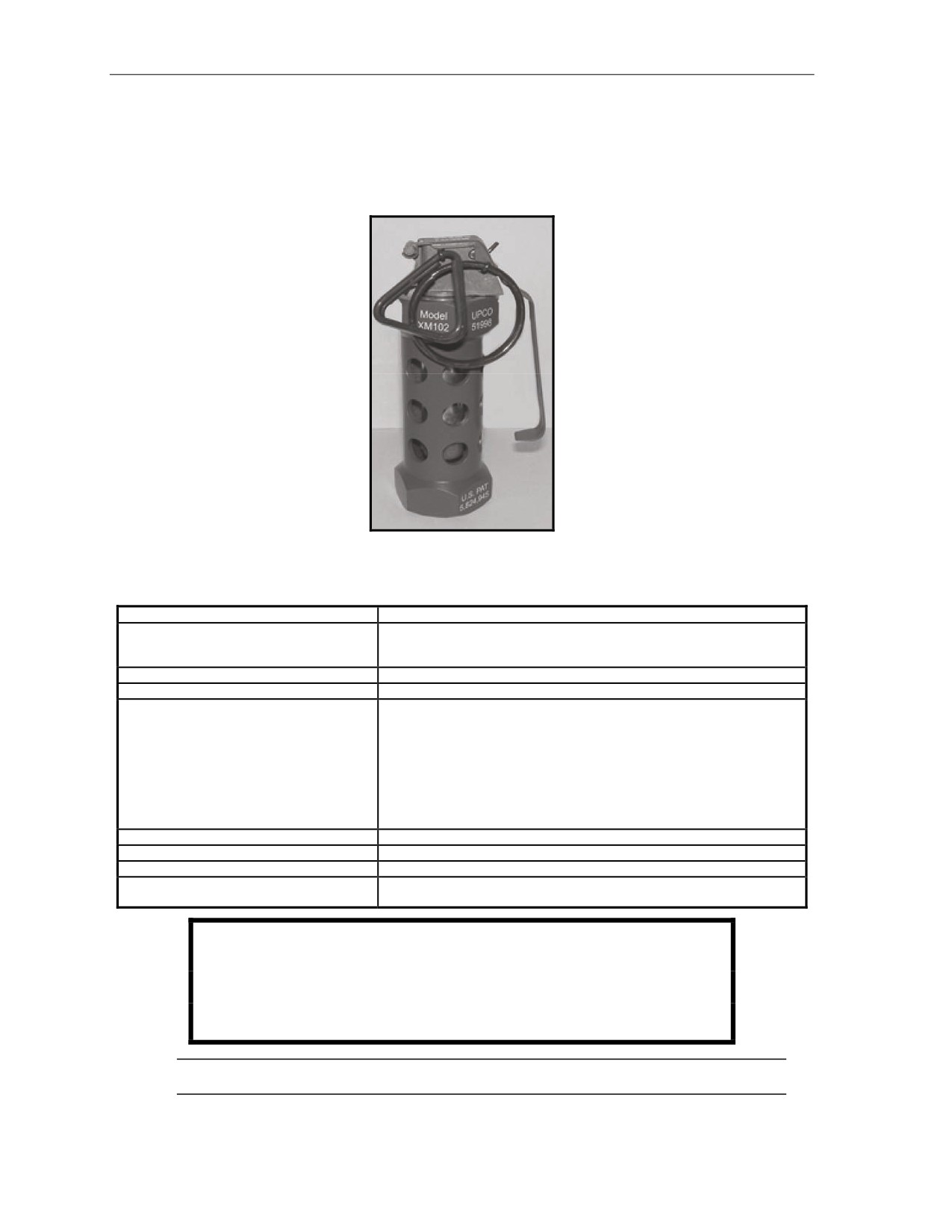
(5) With the index finger inserted in the pull ring, rotate the pull ring around until the single loop portion
is within the confidence clip area. Align the pull ring under the confidence clip (Figure A-8).
(6) Pull up on the pull ring until it snaps under the confidence clip (Figure A-8).
WARNING
When attaching a confidence clip to a M228 detonating fuze pull
ring, do not remove or dislodge the safety pin. Ensure the safety
pin is spread open in a duckbill shape to prevent the safety pin
from falling out. If the safety pin comes out, do not attempt to put
the safety pin back in. Immediately alert any personnel in the area,
throw the fuze in a safe area, and take the same actions as you
would for a live hand grenade.
A-6
FM 3-23.30
15 October 2009
Characteristics of Grenades
NOTE: If Soldier is a left-hand thrower, he will insert the fuze in the same manner as described
above. See Figure A-7 for clarification.
Figure A-8. Securing the pull ring to the confidence clip (left hand).
Remove
A-7. To remove a fired M228 detonating fuze—
WARNING
Keep all portions of the hand away from the M69 practice grenade
firing port (non-threaded end) when removing a fired M228
detonating fuze. Residue from an exploded fuze can cause
lacerations to the hand and fingers.
(1) Grip the M69 body with the non-throwing hand, taking care to keep any part of the hand away from
the firing port (non-threaded end) of the grenade. While holding the M69 grenade body, turn the
grenade so that the head of the fuze is facing inward and the firing port of the grenade is facing away
from your body.
(2) Grip the head of the M228 fuze with the fingers of the throwing hand.
WARNING
Keep all portions of the hand and fingers away from the lower end
of the M228 detonating fuze after removing a fired fuze. Jagged
edges of the exploded fuze end can cause lacerations to the hand
and fingers.
(3) Turn the M228 fuze or grenade body counterclockwise until the fuze comes out.
(4) Dispose of the fuze in accordance with unit SOP.
15 October 2009
FM 3-23.30
A-7
Appendix A
M102 PRACTICE STUN HAND GRENADE
A-8. The M102 (Figure A-9) is the reloadable trainer for the M84 stun hand grenade. It offers realistic
characteristics of the M84 to assist in the training of missions, such as hostage rescue or capture of criminals,
terrorists, or other adversaries. Table A-3 outlines the grenade’s components and characteristics.
Figure A-9. M102 practice stun hand grenade.
Table A-3. Components and characteristics of M102 practice stun grenade.
COMPONENTS AND CHARACTERISTICS
DETAILS
5.25 inches in length and 1.73 inches at the corner of the hexagon location;
Body
steel hexagon tube with 12 blast and flash release holes along the sides with
a heavy steel, hexagon-shaped top and bottom portion
Filler
None
Fuze
M240, which is inserted into the grenade body
Safety pin and primary circular pull ring
Safety pin and secondary triangular pull ring
NOTE: The secondary triangular pull ring and safety pin will eventually be
Safety Features
removed and a confidence clip added to the primary circular pull ring and
safety pin.
Safety clip (may be issued with or without a safety clip)
Safety lever
Fuze Delay
1 to 2.3 seconds
Total Weight
13.3 ounces
Effects
Small puff of white smoke and a loud popping noise
Light blue with white markings; the safety lever of the fuze is light blue with
Colors and Markings
black markings and a brown tip
WARNING
Fuze fragments may exit the hole in the base of the grenade body
and cause injuries.
NOTE: The grenade body can be used repeatedly by replacing the fuze assembly.
A-8
FM 3-23.30
15 October 2009
Characteristics of Grenades
M240 Detonating Fuze
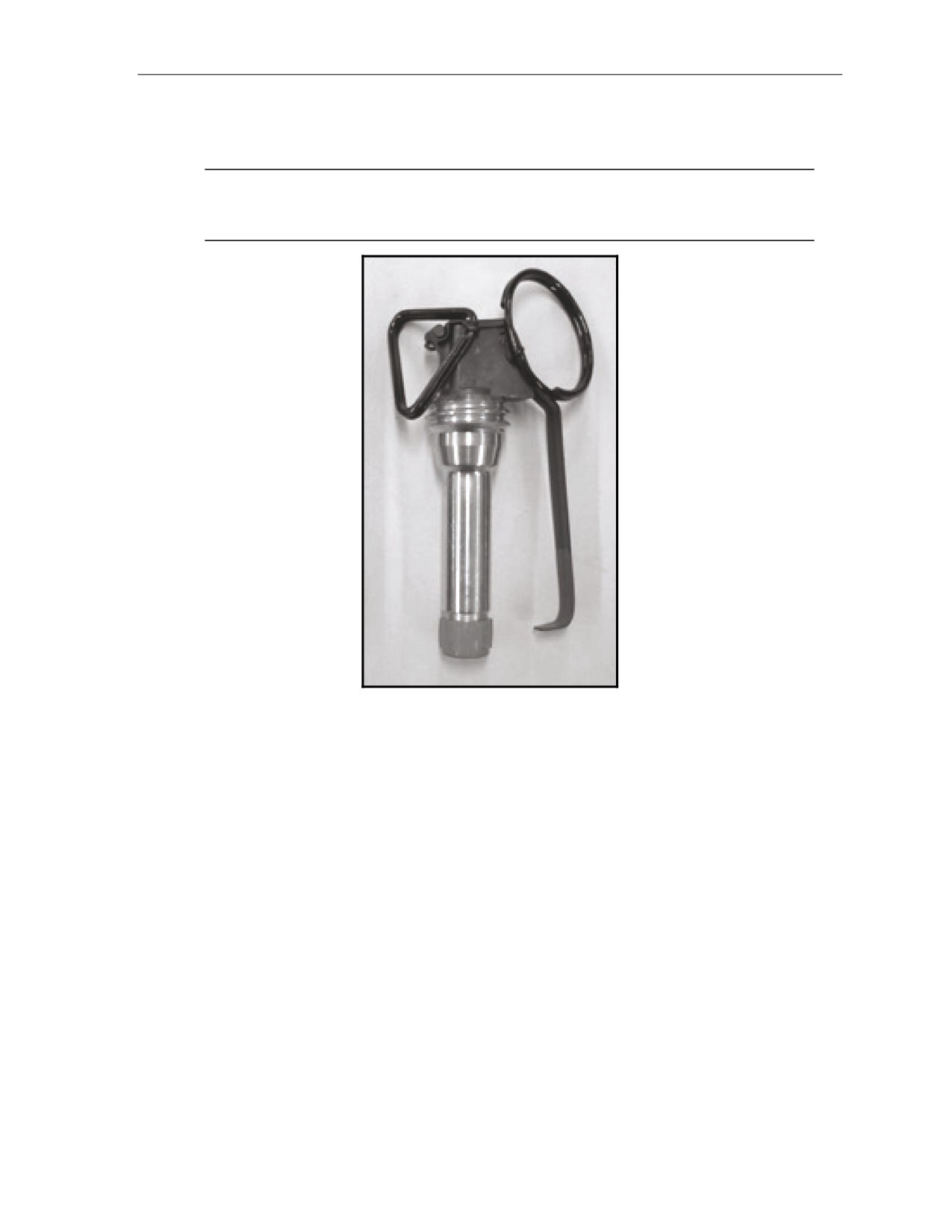
A-9. Soldiers should be given instruction on installing and removing a fired M240 fuze (Figure A-10).
NOTE: Procedures for installing and removing the M240 fuze are the same as those used for the
M228 fuze. For more information about these procedures, see the M228 detonating fuze section of
this chapter.
Figure A-10. M240 detonating fuze.
OFFENSIVE HAND GRENADES
A-10. Offensive hand grenades (e.g., concussion grenades) are much less lethal than fragmentation grenades on
an enemy in the open, but they are very effective against an enemy within a confined space.
MK3A2 OFFENSIVE HAND GRENADE
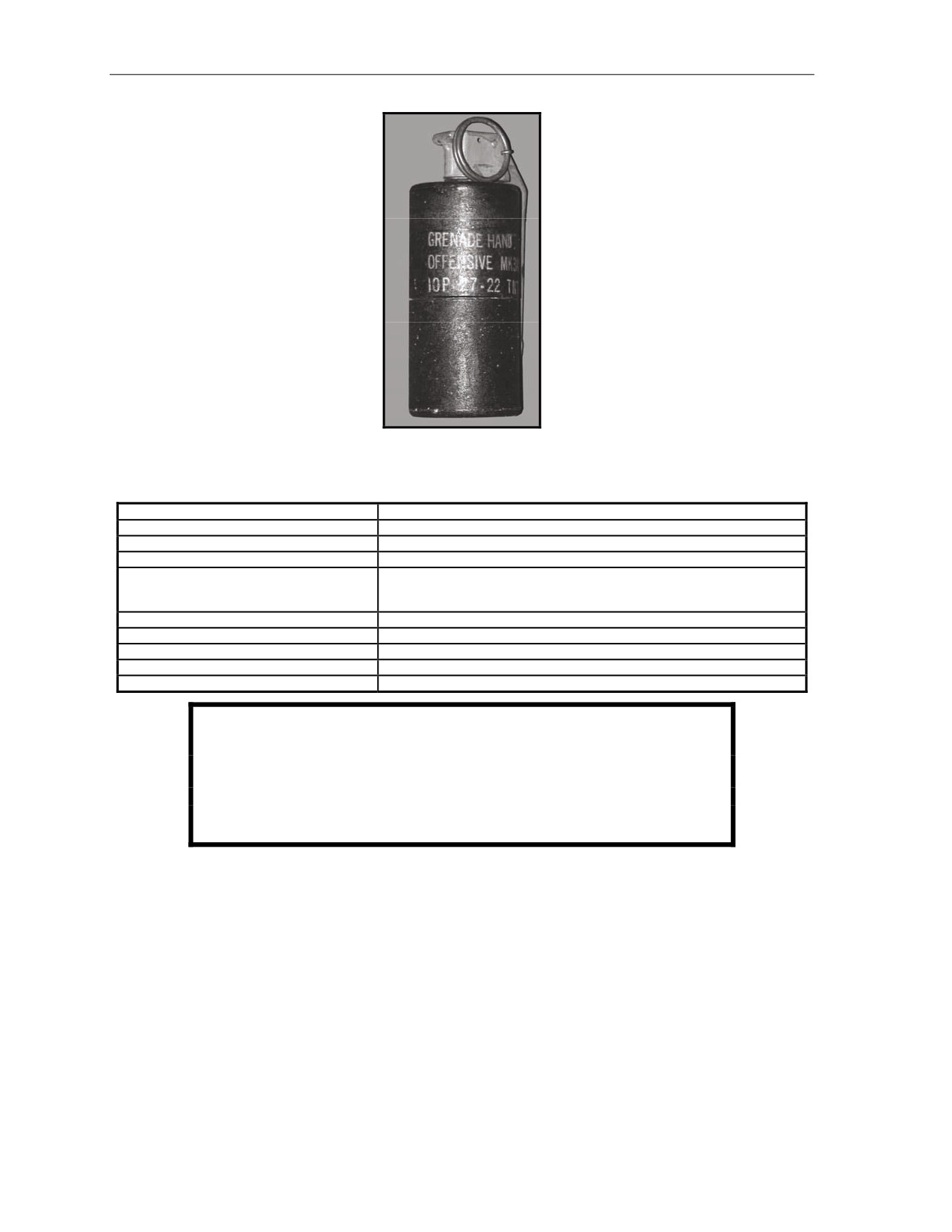
A-11. The MK3A2 offensive hand grenade (Figure A-11) is used for concussion effects in enclosed areas, for
blasting, and for demolition tasks. When used in enclosed areas, the shock waves (overpressure) produced by
this grenade are greater than those produced by the fragmentation grenade. It is, therefore, more effective
against enemy soldiers located in bunkers, buildings, and fortified areas. Table A-4 outlines the grenade’s
components and characteristics.
15 October 2009
FM 3-23.30
A-9
Appendix A
Figure A-11. MK3A2 offensive grenade.
Table A-4. Components and characteristics of MK3A2 offensive grenade.
COMPONENTS AND CHARACTERISTICS
DETAILS
Body
Fiber (similar to the packing container for the fragmentation grenade)
Filler
8 ounces of TNT
Fuze
M206A2
Safety clip (may be issued with or without a safety clip)
Safety Features
Safety pin and pull ring with confidence clip
Safety lever
Fuze Delay
4 to 5.5 seconds
Total Weight
15.6 ounces
Throwing Distance of Average Soldier
40 meters
Effective Casualty-Producing Radius
2 meters (in open areas)
Colors and Markings
Black with yellow markings around the middle
WARNING
The MK3A2 grenade has an effective casualty radius of 2 meters
in open areas, but fragments and bits of fuze may be projected as
far as 200 meters from the detonation point.
NONLETHAL HAND GRENADES
A-12. Nonlethal grenades are used for diversionary purposes or when lethal force is not desired. Nonlethal
munitions are designed to incapacitate personnel while minimizing fatalities, permanent injury to personnel, and
collateral damage to property and the environment.
M84 STUN GRENADE
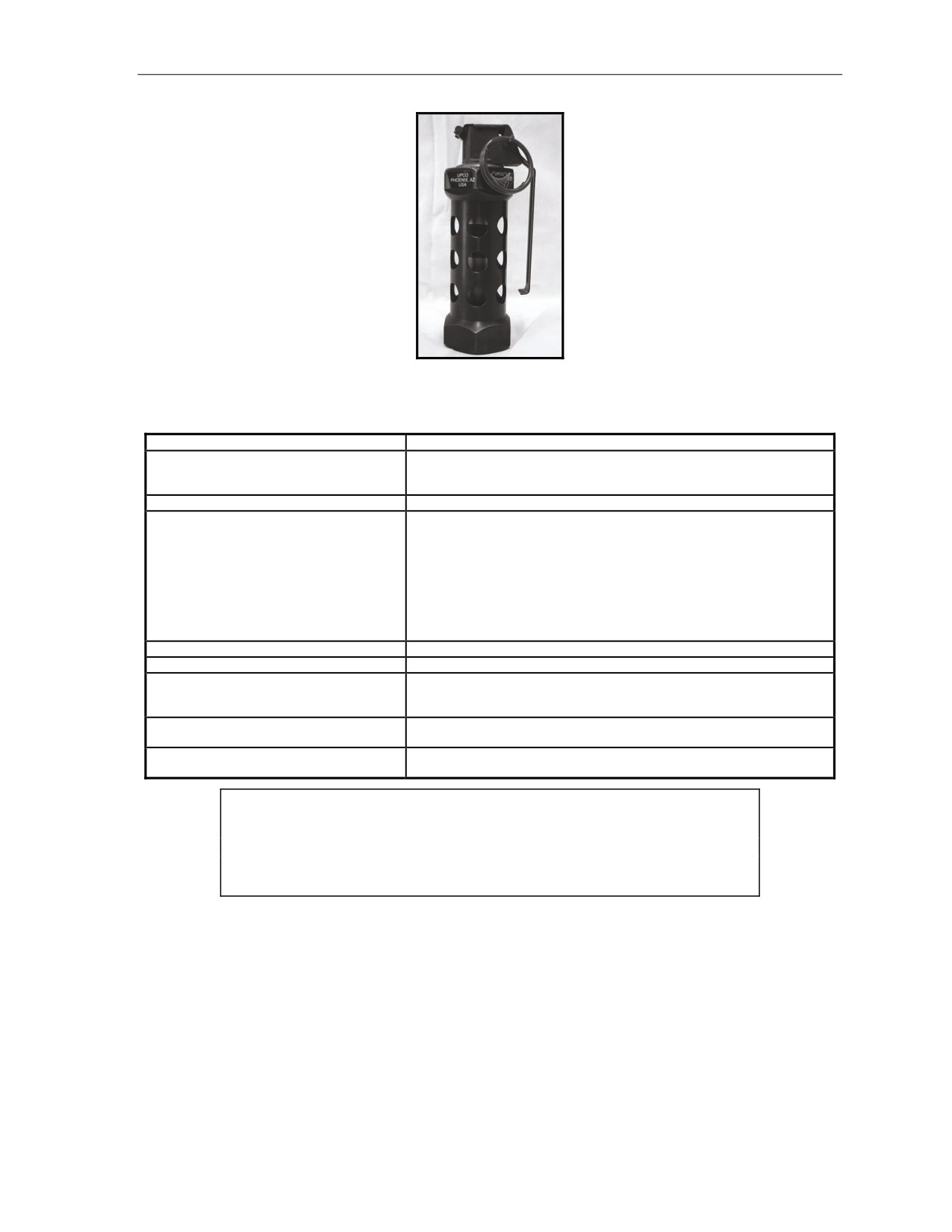
A-13. The M84 stun grenade (Figure A-12) is a nonlethal grenade that is used for diversionary or distraction
purposes when lethal force is not desired. Table A-5 outlines the grenade’s components and characteristics.
A-10
FM 3-23.30
15 October 2009
Characteristics of Grenades
Figure A-12. M84 stun grenade.
Table A-5. Components and characteristics of M84 stun grenade.
COMPONENTS AND CHARACTERISTICS
DETAILS
5.25 inches in length and 1.73 inches at the corner of the hexagon location;
Body
steel hexagon tube with 12 blast and flash release holes along the sides with
a heavy steel, hexagon-shaped top and bottom portion
Fuze
M201A1 MOD 2 (designed to be non-fragmenting)
Safety pin and primary circular pull ring
Safety pin and secondary triangular pull ring
NOTE: The secondary triangular pull ring and safety pin will eventually be
Safety Features
removed and a confidence clip added to the primary circular pull ring and
safety pin.
Safety clip (may be issued with or without a safety clip)
Safety lever
Fuze Delay
1 to 2.3 seconds
Total Weight
13.3 ounces
Upon detonation, the M84 generates an intensive heat, a flash of over one
Effects
million candlepower, and a bang that is 170 to 180 decibels at 5 feet. The
flash may damage eyesight and night vision.
The grenade can cause disorientation, confusion, ear injuries, and temporary
Effective Casualty-Producing Radius
loss of hearing within 9 meters.
Olive drab with white markings, a pastel green band around the middle of the
Colors and Markings
body, and a brown band on the tip end of the safety lever
CAUTION
Use stun grenades as field-expedient early warning devices only when in
a combat environment.
CHEMICAL GRENADES
A-14. Chemical grenades are used for incendiary purposes or riot control.
AN-M14TH3 INCENDIARY HAND GRENADES
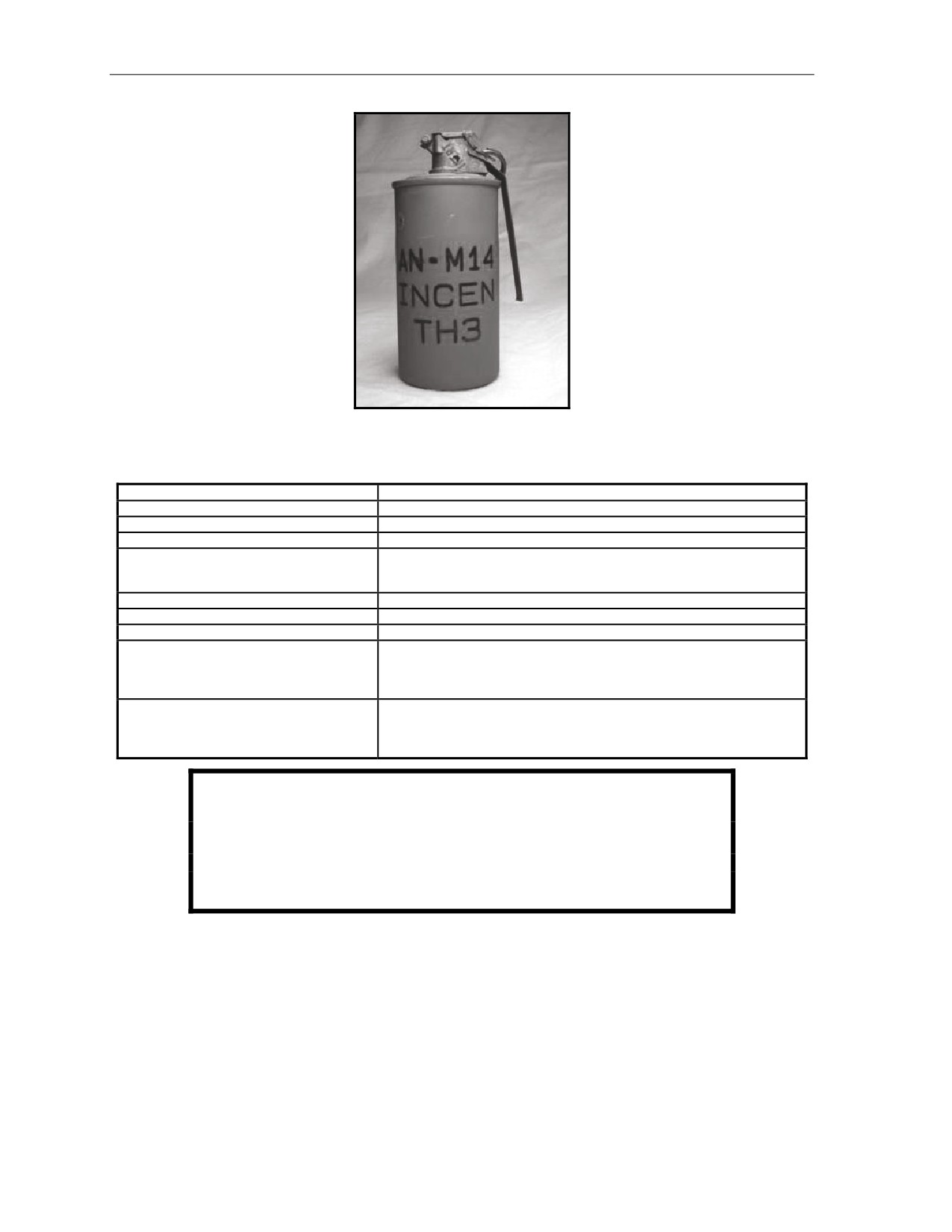
A-15. The AN-M14 TH3 incendiary hand grenade (Figure A-13) is used to destroy equipment or start fires. It
can also damage, immobilize, or destroy vehicles, weapons systems, shelters, or munitions. Table A-6 outlines
the grenade’s components and characteristics.
15 October 2009
FM 3-23.30
A-11
Appendix A
Figure A-13. AN-M14 TH3 incendiary hand grenade.
Table A-6. Components and characteristics of AN-M14 TH3 incendiary hand grenade.
COMPONENTS AND CHARACTERISTICS
DETAILS
Body
Sheet metal
Filler
26.5 ounces of thermite (TH3) mixture
Fuze
M201A1
Safety clip (may be issued with or without a safety clip)
Safety Features
Safety pin and pull ring with confidence clip
Safety lever
Fuze Delay
0.7 to 2.0 seconds
Total Weight
32 ounces
Throwing Distance of Average Soldier
25 meters
Effects
A portion of thermite mixture is converted to molten iron, which burns at 4,330
degrees Fahrenheit. The mixture fuzes together the metallic parts of any
object that it contacts. The thermite filler can burn through a 1/2-inch
homogenous steel plate. It produces its own oxygen and burns under water.
Colors and Markings
Gray with purple markings, has a single purple band (current grenades)
Under the standard color-coding system, incendiary grenades are light red
with black markings.
WARNING
Avoid looking directly at the incendiary hand grenade as it burns.
The intensity of the light is hazardous to the retina and can cause
permanent eye damage.
RIOT-CONTROL HAND GRENADES
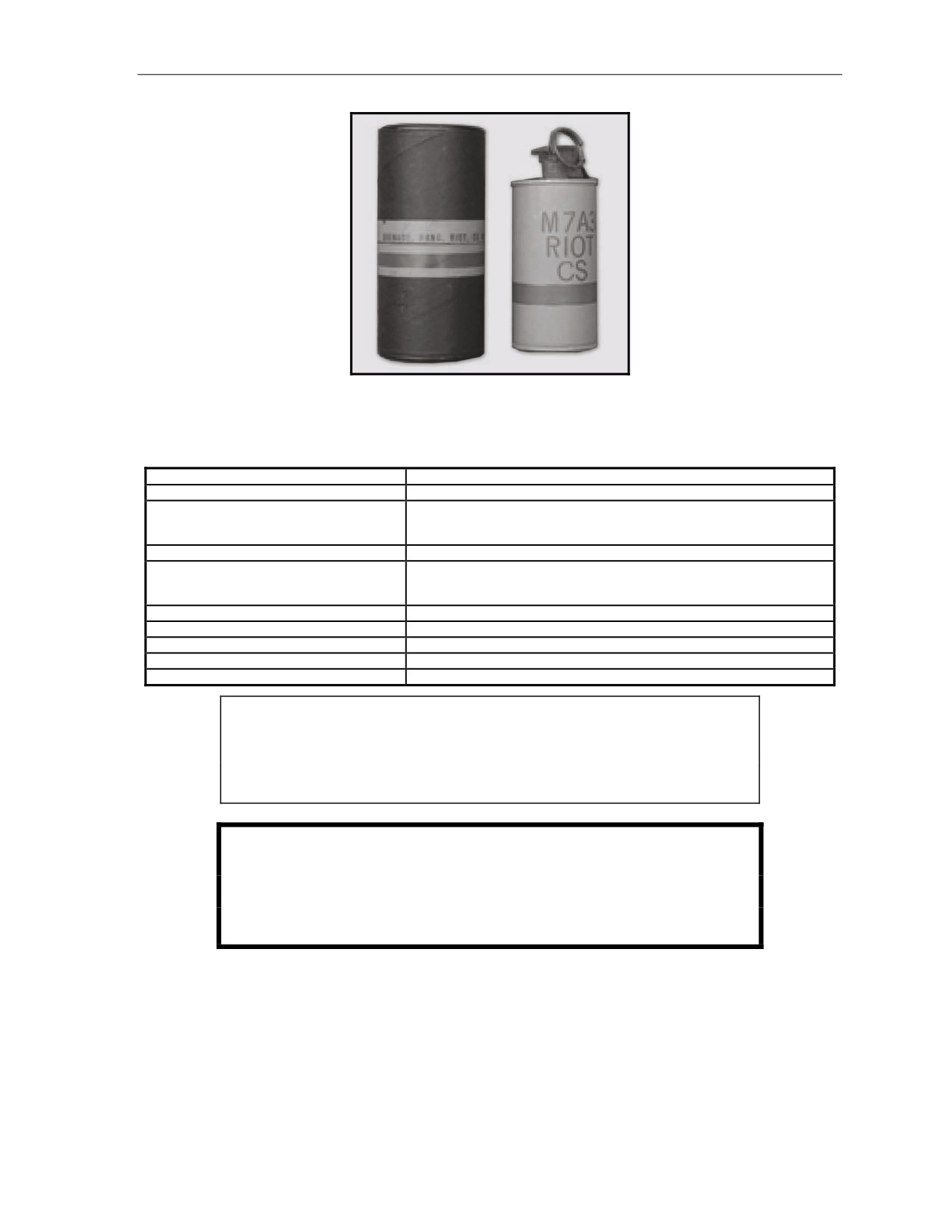
A-16. Riot-control hand grenades include the ABC-M7A2, ABC-M7A3, and the M47 CS.
ABC-M7A2 and ABC-M7A3
A-17. These riot-control hand grenades (Figure A-14) contain only CS fillers. The grenades differ only in the amount
and form of the CS they contain. Table A-7 outlines the grenades’ components and characteristics.
A-12
FM 3-23.30
15 October 2009
Characteristics of Grenades
Figure A-14. ABC-M7A2 and ABC-M7A3 riot-control hand grenades.
Table A-7. Components and characteristics of ABC-M7A2 and ABC-M7A3
riot-control hand grenades.
COMPONENTS AND CHARACTERISTICS
DETAILS
Body
Sheet metal with four emission holes at the top and one at the bottom
ABC-M7A2: 5.5 ounces of burning mixture and 3.5 ounces of CS in gelatin
Filler
capsules.
ABC-M7A3: 7.5 ounces of burning mixture and 4.5 ounces of CS pellets
Fuze
M201A1 MOD2
Safety clip (may be issued with or without a safety clip)
Safety Features
Safety pin and pull ring with confidence clip
Safety lever
Fuze Delay
0.7 to 2.0 seconds
Total Weight
15.5 ounces
Throwing Distance of Average Soldier
40 meters
Effects
Both grenades produce a cloud of irritant agent for 15 to 35 seconds.
Colors and Markings
Gray bodies with red bands and markings
CAUTION
Riot-control grenades throw sparks up to 1 meter from emission, which
can ignite vegetation and other flammable materials.
WARNING
Do not use a riot-control grenade in an enclosed area. If you must
remain in the area, always wear a protective mask.
15 October 2009
FM 3-23.30
A-13
Appendix B
Characteristics of Pyrotechnic Signals and Simulators
Pyrotechnic signals can be used for communication, obscuration, warning, and for
simulating enemy fires. This appendix outlines the characteristics of these signals and
simulators.
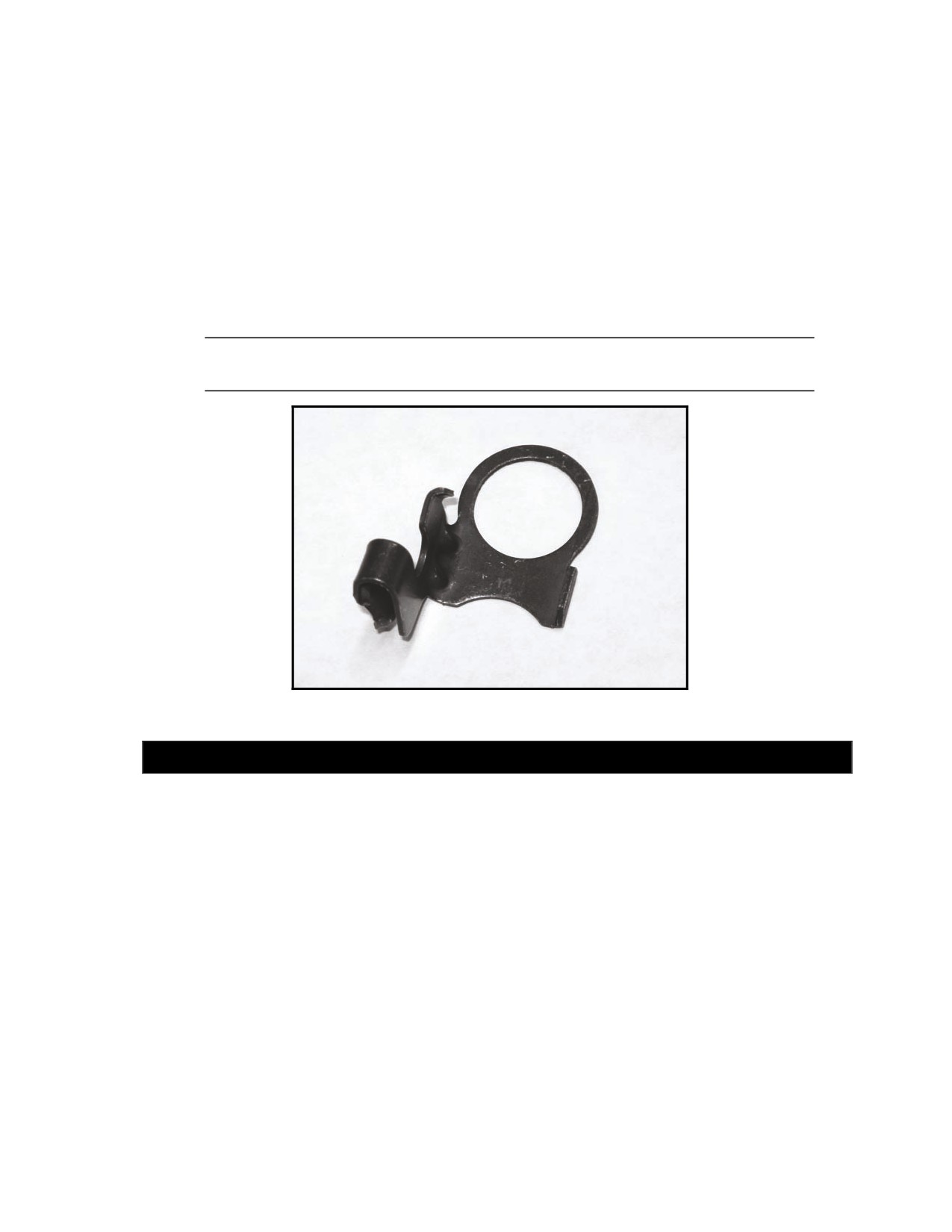
NOTE: A confidence clip (Figure B-1) has been introduced to pyrotechnics equipped with a safety
pin and pull ring.
Figure B-1. Confidence clip.
SECTION I. COMMUNICATION SIGNALS
There are two classifications of pyrotechnic communication signals: handheld signals and ground smoke signals.
Both type of signals come in varied color patterns. Soldiers can use these patterns to coordinate troop movements
and, in the case of an emergency, designate pick-up points.
HANDHELD SIGNALS
B-1. Handheld signals include:
z
Star clusters.
z
Star parachutes.
z
Smoke parachutes.
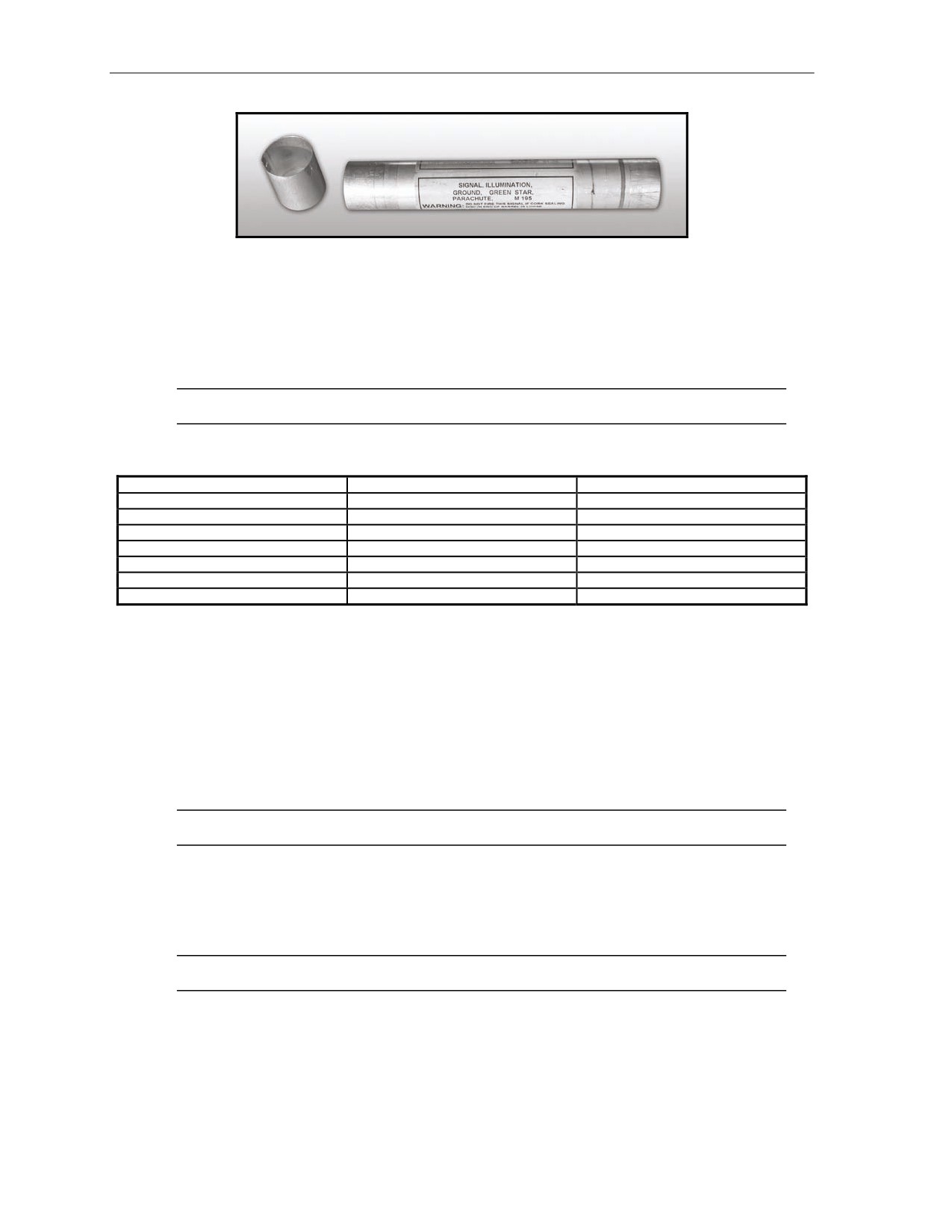
B-2. Star clusters, star parachutes, and smoke parachutes are issued in an expendable launcher that consists of
a launching tube and firing cap (Figure B-2).
15 October 2009
FM 3-23.30
B-1
Appendix B
Figure B-2. Handheld pyrotechnic signal.
IDENTIFICATION
B-3. The label and muzzle cap of a handheld ground signal identifies its color and type. The star clusters and
parachutes also have two raised letters on the muzzle cap allowing the color and type to be identified at night by
feel. Table B-1 provides information about handheld signal identification.
NOTE: Identification of handheld ground signals should be practiced in the dark or blindfolded.
Table B-1. Handheld signal identification.
TYPE
LETTERS ON MUZZLE CAP
COLOR OF MUZZLE CAP
Green star cluster
GS
Green
Red star cluster
RS
Red
White star cluster
WS
White
Green star parachute
GP
Green
Red star parachute
RP
Red
White star parachute
WP
White
Smoke cluster
None
Plain
STAR CLUSTERS
B-4. Star clusters are used for signaling and illuminating. These signals produce a cluster of five free-falling
pyrotechnic stars. When fired, the star cluster will rise to an approximate height of 200 to 215 meters, and burn
about 6 to 10 seconds.
B-5. Types include:
z
M125 and M125A1 (green star).
z
M158 (red star).
z
M159 (white star).
NOTE: The white star cluster provides the most effective illumination.
STAR PARACHUTES
B-6. Star parachutes are also used for signaling and illuminating. These signals produce a single illuminant
star suspended from a parachute.
NOTE: These signals are fired in the same manner as the star clusters.
B-7. Types include:
z
M126A1 (red star).
z
M127A1 (white star).
z
M195 (green star).
B-2
FM 3-23.30
15 October 2009
Characteristics of Pyrotechnic Signals and Simulators
B-8. The M126 and M127-series star parachutes rise to a height of 200 to 215 meters. The M126 burns for 50
seconds, and the M127 burns for 25 seconds. The average rate of descent for both is 2.1 meters per second. The
signals can be seen for 50 to 58 kilometers at night.
SMOKE PARACHUTES
B-9. Smoke parachutes are for signaling only. These signals produce a single, perforated, colored smoke
canister suspended from a parachute.
B-10. Types include:
z
M128A1 (green smoke).
z
M129A1 (red smoke).
z
M194 (yellow smoke).
B-11. Smoke parachutes rise to an approximate height of 200 to 215 meters. The signals emit smoke for 12
seconds during the day, forming a smoke cloud that persists for about 60 seconds. Their rate of descent is 4
meters per second. At night, the M126A1 emits smoke for 50 seconds, the M129A1 for 25 seconds, and the
M194 for 50 seconds.
GROUND SMOKE SIGNALS
B-12. These signals are self-contained units used by ground Soldiers to signal aircraft or to convey information
through a prearranged signal. There are various colors of ground smoke signals.
M18 COLORED SMOKE HAND GRENADE
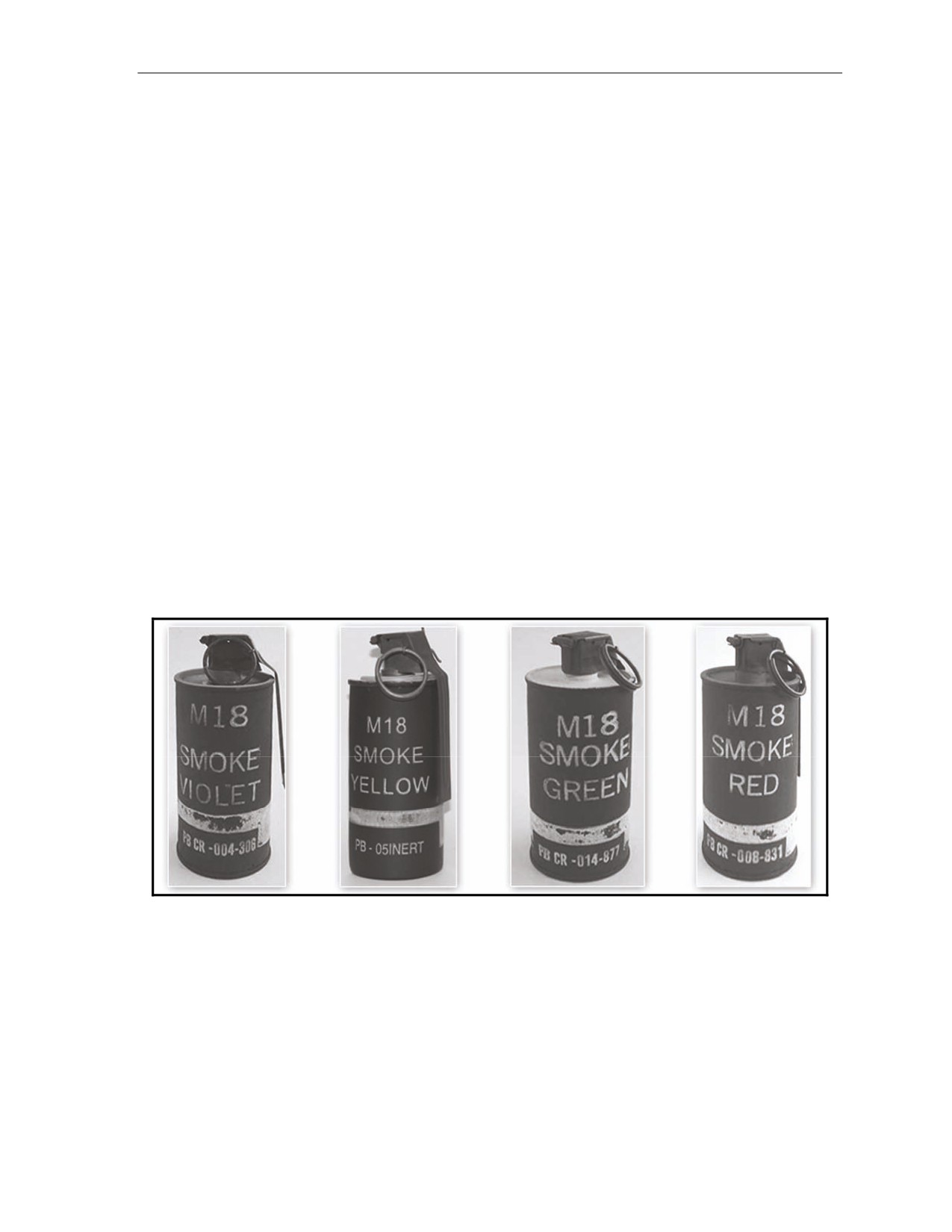
B-13. The M18 colored smoke hand grenade (Figure B-3) is used as a means of communication. Table B-2
outlines its components and characteristics.
Figure B-3. M18 colored smoke hand grenades.
15 October 2009
FM 3-23.30
B-3
Appendix B
Table B-2. Components and characteristics of M18 colored smoke hand grenade.
COMPONENTS AND CHARACTERISTICS
DETAILS
Sheet steel cylinder with four emission holes at the top and one at the bottom,
which allow smoke to escape when the grenade is ignited
Body
NOTE: Recently manufactured grenades do not have bottom holes.
Filler
11.5 ounces of colored smoke mixture (red, yellow, green, or violet)
Fuze
M201A1
Safety clip (may be issued with or without a safety clip)
Safety Features
Safety pin and pull ring with confidence clip
Safety lever
Fuze Delay
0.7 to 2.0 seconds
Total Weight
19 ounces
Throwing Distance of Average Soldier
35 meters
The grenade burns for 50 to 90 seconds with an average burn time of 60
Effects
seconds.
Light green body with black markings
Colors and Markings
NOTE: The top of the grenade indicates the smoke color.
WARNING
Burning-type grenades burn oxygen. Standard protective masks
filter particles but will not supply oxygen. Therefore, burning
grenades must not be used in enclosed or confined spaces.
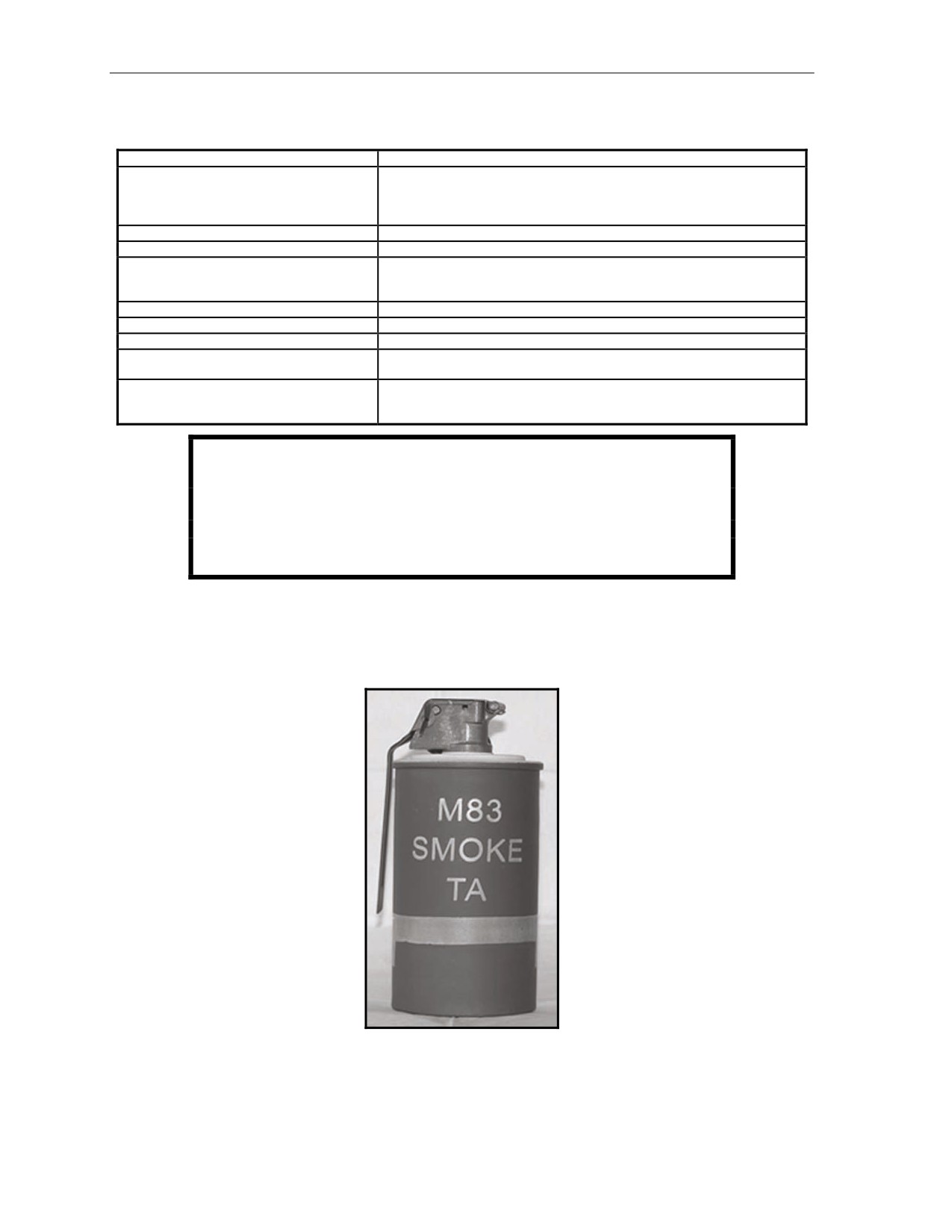
M83 TA WHITE SMOKE HAND GRENADE
B-14. The M83 TA white smoke hand grenade (Figure B-4) is used for screening the activities of small units
and for ground-to-air signaling. Table B-3 outlines its components and characteristics.
Figure B-4. M83 TA white smoke hand grenade.
B-4
FM 3-23.30
15 October 2009
Characteristics of Pyrotechnic Signals and Simulators
Table B-3. Components and characteristics of M83 TA white smoke hand grenade.
COMPONENTS AND CHARACTERISTICS
DETAILS
Body
A cylinder of thin sheet metal, 2.5 inches in diameter and 5.7 inches long
Filler
11 ounces of terephthalic acid (TA)
Fuze
M201A1
Safety clip (may be issued with or without a safety clip)
Safety Features
Safety pin and pull ring with confidence clip
Safety lever
Fuze Delay
0.7 to 2.0 seconds
Total Weight
16 ounces
Effects
The M83 TA produces a cloud of white smoke for 25 to 70 seconds.
Forest green body with light green markings, a light blue band, and a white
Colors and Markings
top
WARNING
Burning-type grenades burn oxygen. Standard protective masks
filter particles but will not supply oxygen. Therefore, burning
grenades must not be used in enclosed or confined spaces.
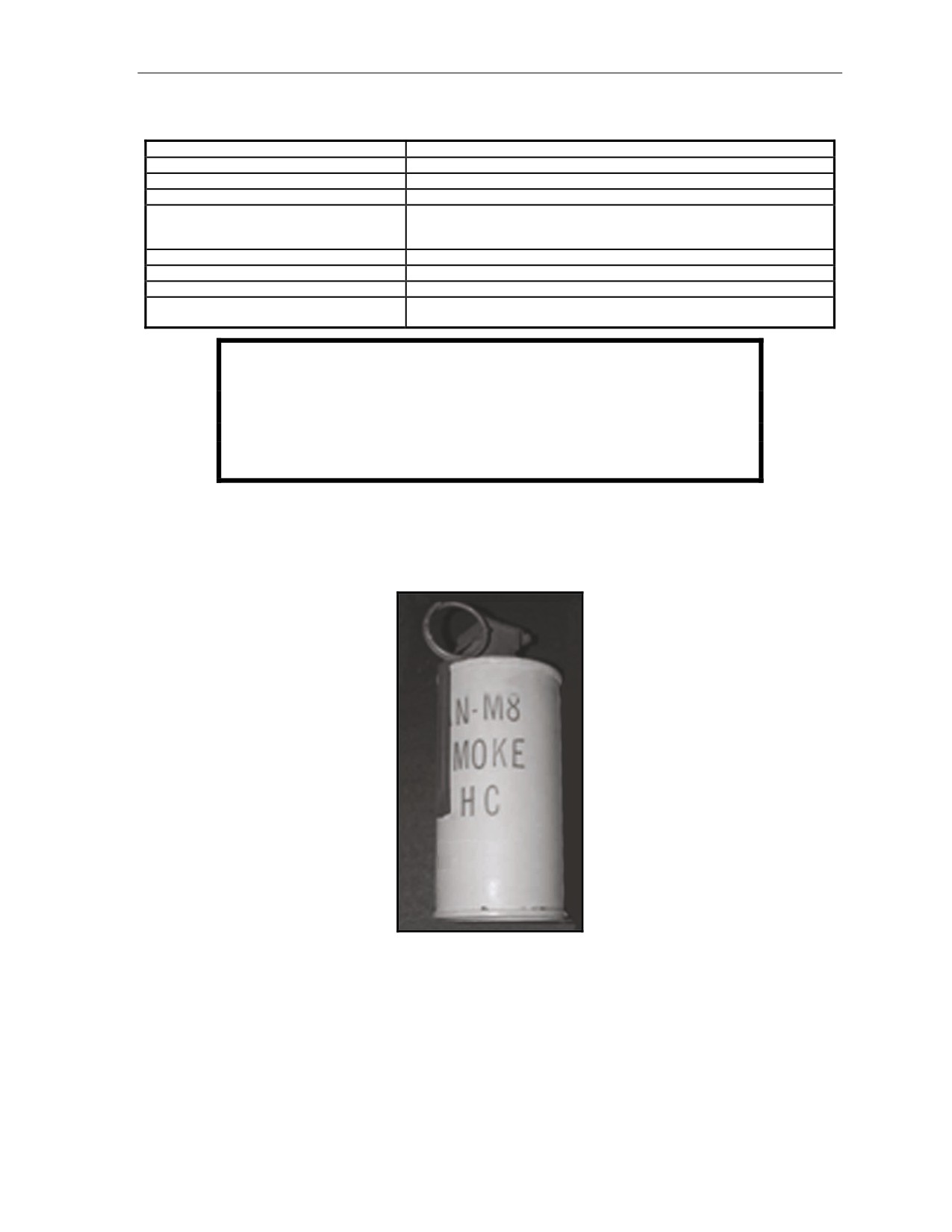
AN-M8 HC WHITE SMOKE HAND GRENADE
B-15. The AN-M8 HC white smoke hand grenade (Figure B-5) produces dense clouds of white smoke for
signaling and screening. Table B-4 outlines its components and characteristics.
Figure B-5. AN-M8 HC white smoke hand grenade.
15 October 2009
FM 3-23.30
B-5
Appendix B
Table B-4. Components and characteristics of AN-M8 HC white smoke hand grenade.
COMPONENTS AND CHARACTERISTICS
DETAILS
Body
Sheet steel cylinder
Filler
19 ounces of Type C, HC smoke mixture
Fuze
M201A1
Safety clip (may be issued with or without a safety clip)
Safety Features
Safety pin and pull ring with confidence clip
Safety lever
Fuze Delay
0.7 to 2.0 seconds
Total Weight
24 ounces
Throwing Distance of Average Soldier
30 meters
Effects
The grenade emits a dense cloud of white smoke for 105 to 150 seconds.
Colors and Markings
Light green body with black markings and a white top
WARNING
The AN-M8 HC hand grenade produces harmful hydrochloric
fumes that irritate the eyes, throat, and lungs. It should not be
used in enclosed or confined spaces unless Soldiers are wearing
protective masks.
Damaged AN-M8 HC grenades that expose the filler are
hazardous. Exposure of the filler to moisture and air could result
in a chemical reaction that will ignite the grenade.
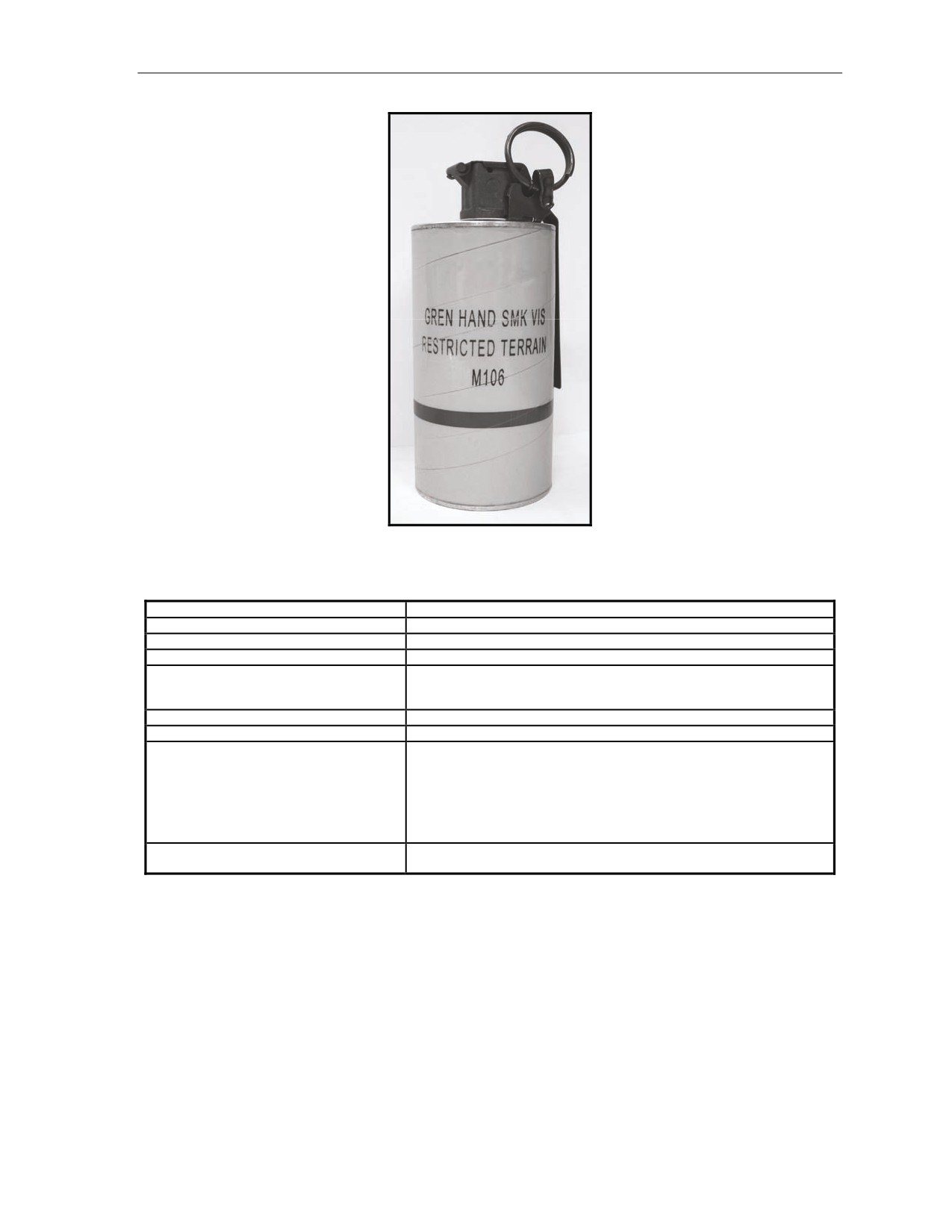
M106 WHITE SMOKE HAND GRENADE
B-16. The M106 white smoke hand grenade (Figure B-6) provides a near instantaneous screen of dense smoke
and is safe to use inside of urban structures, subterranean locations, and caves. Table B-5 outlines its
components and characteristics.
NOTE: The M106 should be used in lieu of AN-M8 HC and M83 TA white smoke hand grenades
when inside of confined spaces and when encountering enemy in close quarters.
B-6
FM 3-23.30
15 October 2009
Characteristics of Pyrotechnic Signals and Simulators
Figure B-6. M106 white smoke hand grenade.
Table B-5. Components and characteristics of M106 white smoke hand grenade.
COMPONENTS AND CHARACTERISTICS
DETAILS
Body
Fiberboard/aluminum
Filler
Non-toxic, non-combustible titanium dioxide
Fuze
M201A1 MOD 3
Safety clip (may be issued with or without a safety clip)
Safety Features
Safety pin and pull ring with confidence clip
Safety lever
Total Weight
20 ounces
Fuze Delay
0.7 to 2.0 seconds
The filler forms a dense, obscurant cloud within 1 to 2.3 seconds after
employment. Weather effects may cause the M106 to dissipate quickly. For
long-lasting smoke screens (external use only), other white smoke should be
Effects
deployed in conjunction with the M106.
NOTE: Inside of a building the heavy particles of the M106 may linger in the
air for 2 to 4 minutes.
Light green body with black markings and a brown band, fuze is gray or olive
Colors and Markings
drab with black markings
15 October 2009
FM 3-23.30
B-7
Appendix B
WARNING
The M106 smoke grenade and the M84 stun hand grenade are
similar in time delay and blast effects. Both grenades can cause
serious personal injury to hands, eyes, and hearing. All users
must wear appropriate hearing protection and exposure should be
limited to two detonations per day.
Do not attempt to cook off the M106 smoke grenade prior to
throwing.
WARNINGS
Once the primary pin is pulled from the M106 smoke grenade, do
not attempt to switch hands. Do not attempt to reinsert the
primary safety pin of the M106 smoke grenade.
In the event of an accidental detonation, users must wear gloves
when handling the M106 smoke grenade.
After releasing the safety lever on the M18, M83, and the AN-M8
HC smoke grenade, the firer should quickly move at least 10
meters away to avoid contact with incendiary particles and fumes
emitted during burning.
CAUTION
The M106 has been tested and found to be non-toxic; however, exposure
to heavy concentrations should be limited to less than 15 minutes.
SECTION II. TRIP FLARES
Surface trip flares can be used to—
z
Provide early warning of infiltration of enemy troops or signaling.
z
Illuminate an immediate area.
z
Ignite fires.
z
Identify firing ports.
z
Force the enemy to withdraw.
z
Destroy small, sensitive pieces of equipment (in the same manner as an incendiary grenade).
M49A1 SURFACE TRIP FLARE
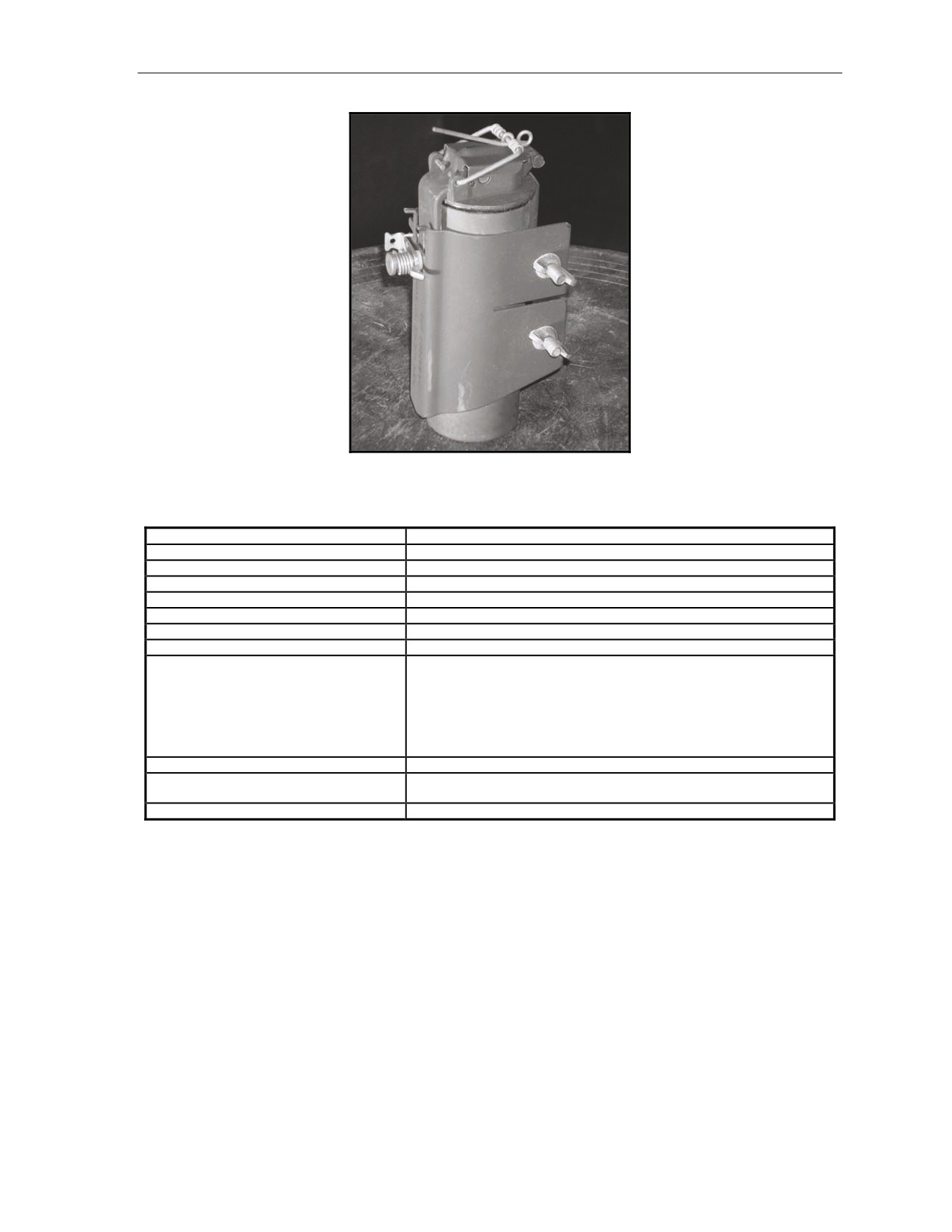
B-17. Table B-6 outlines the components and characteristics of the M49A1 surface trip flare (Figure B-7).
B-8
FM 3-23.30
15 October 2009
Characteristics of Pyrotechnic Signals and Simulators
Figure B-7. M49A1 surface trip flare.
Table B-6. Components and characteristics of M49A1 surface trip flare.
COMPONENTS AND CHARACTERISTICS
DETAILS
Body
Aluminum
Weight
0.75 pounds
Length
4.85 inches
Diameter
3.10 inches
Method of activation
Trip wire (50 feet)
Filler
Illumination composition
Primer
Percussion M42
The trigger is attached to the exterior of the mounting bracket. The lever is
hinged to the cover and is held in position by the safety clip when unarmed.
Safety Features
A pull on the trip wire causes either the trigger tongue or pull pin to release
the lever, which in turn permits the firing pin to strike the primer. The primer
sets off the intermediate charge, and the intermediate charge ignites the first-
fire composition on the ignition increment of the flare.
Delay
0 seconds
The trip flare produces 35,000 candlepower illumination for 55 seconds
Effects
(minimum). The area of illumination is an approximately 300-meter radius.
Colors and Markings
Olive drab body with black markings
15 October 2009
FM 3-23.30
B-9
Appendix B
WARNINGS
Surface trip flares can cause fires when thrown on dry tender.
The minimum safe distance from an ignited surface trip flare is 2
meters because of sparks and the popping of burning magnesium.
Never look directly at a burning surface trip flare. The intense
flame can injure your eyes. At close ranges, surface trip flares
may damage night vision devices and sights.
DO NOT attempt to cook off a trip flare. The fuze has a .0-second
time delay.
SECTION III. SIMULATED SIGNALS
Some pyrotechnic simulators can be used to provide early warning signals and to illuminate the immediate area;
however, they are primarily designed to imitate the sounds and effects of combat detonations during field training
exercises.
EARLY WARNING SIMULATORS
B-18. Simulators are used in training to imitate the sounds and effects of combat detonations and the initiations
of early warning devices. Booby trap simulators are activated by trip wires attached to the igniter cords, which
instantaneously activate when pulled. The three types of booby trap simulators each generate a different effect
upon initiation.
WARNING
Simulators are potentially dangerous if activated close to
personnel or if improperly handled.
M117 FLASH EXPLOSIVE BOOBY TRAP SIMULATOR
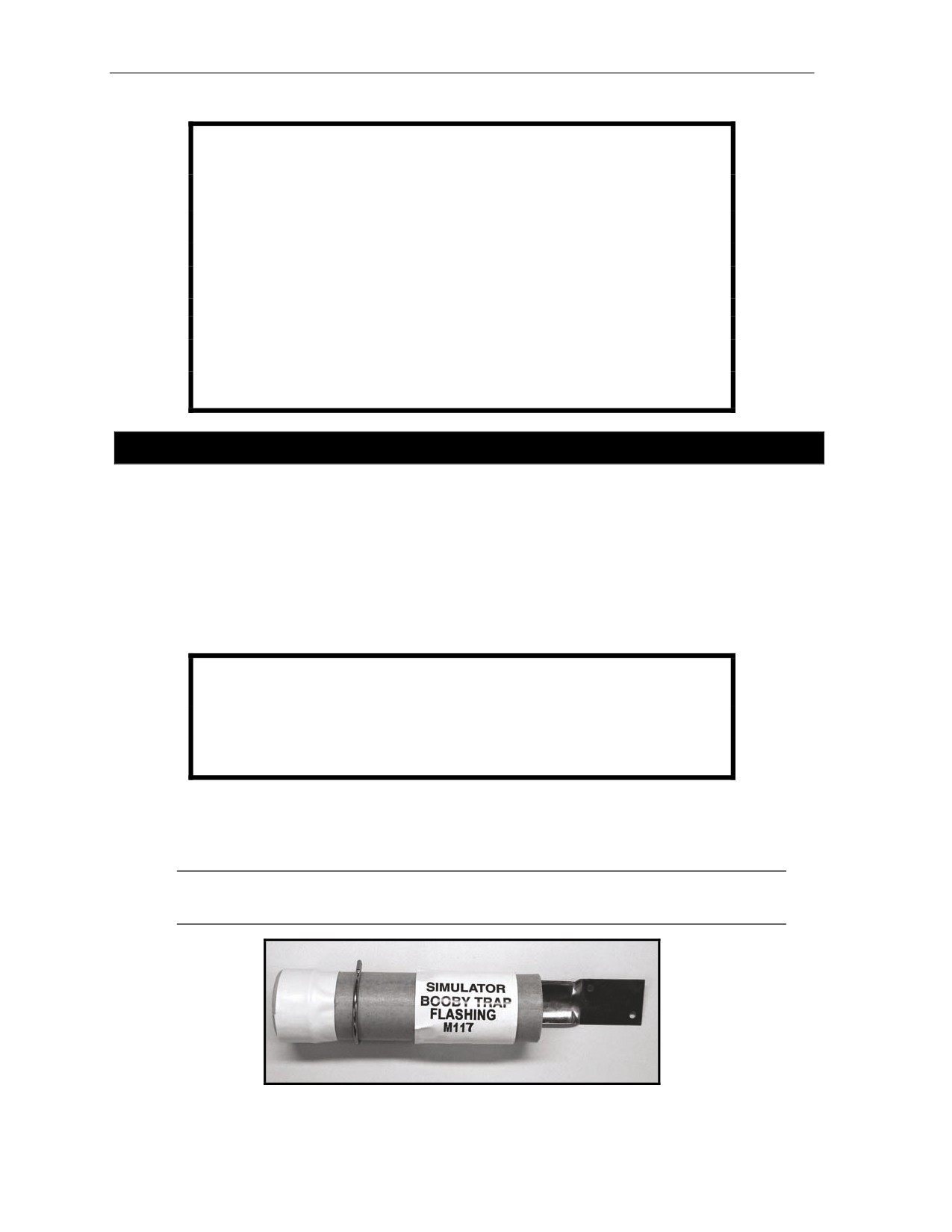
B-19. The M117 flash booby trap simulator (Figure B-8) produces an explosion, flash, and sound.
Table B-7 outlines its components and characteristics.
NOTE: The M117 simulator has a dimple in the mounting bracket for additional identification at
night.
Figure B-8. M117 flash explosive booby trap simulator.
B-10
FM 3-23.30
15 October 2009
Characteristics of Pyrotechnic Signals and Simulators
Table B-7. Components and characteristics of M117 flash explosive booby trap simulator.
COMPONENTS AND CHARACTERISTICS
DETAILS
NSN
1370-00-028-5256
Weight loaded
0.09 ounces
Length
3.9 inches
Diameter
0.98 inches
Method of activation
Tripwire
Body
Kraft paper
Color
White label with black markings
Effects
Explosion, flash, and sound
Functioning time
Instantaneous
WARNING
Do not pull the igniter cord on the M117 booby trap simulator by
hand as it will immediately activate. Booby trap simulators may
cause ear damage or burns if activated within 2 meters of
personnel. Never open a simulator; the photoflash powder is
extremely susceptible to flash ignition by even a slight amount of
friction.
M118 ILLUMINATING EXPLOSIVE BOOBY TRAP SIMULATOR
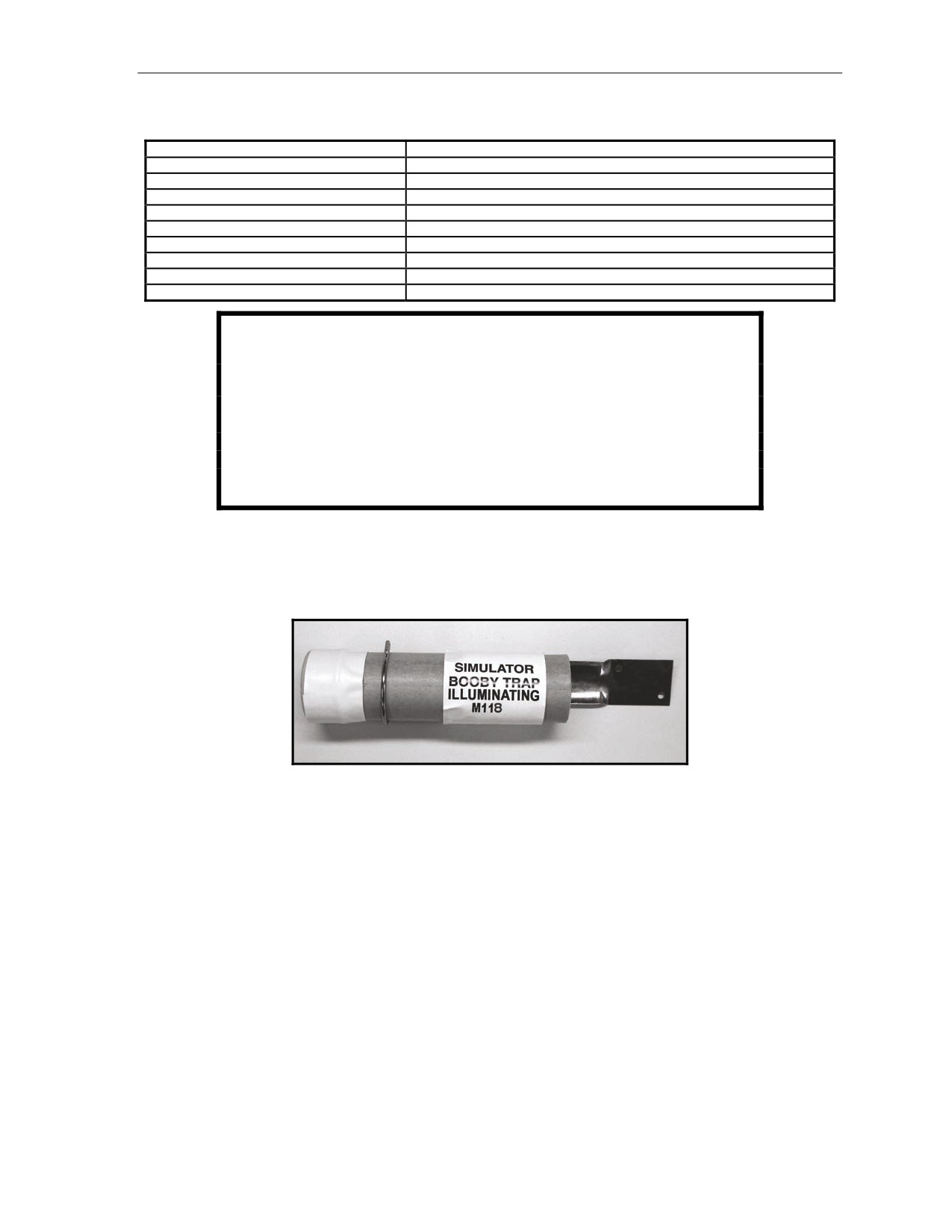
B-20. The M118 illuminating booby trap simulator (Figure B-9) produces illumination. Table B-8 outlines its
components and characteristics.
Figure B-9. M118 illuminating explosive booby trap simulator.
15 October 2009
FM 3-23.30
B-11
Appendix B
Table B-8. Components and characteristics of
M118 illuminating explosive booby trap simulator.
COMPONENTS AND CHARACTERISTICS
DETAILS
NSN
1370-00-028-5257
Weight loaded
0.18 ounces
Length
3.9 inches
Diameter
0.98 inches
Method of activation
Trip wire
Body
Kraft paper
Color
White label with black markings
Effects
Illumination
Functioning time
28 seconds minimum flame
WARNING
Do not pull the igniter cord on the M118 booby trap simulator by
hand as it will immediately activate. Booby trap simulators may
cause ear damage or burns if activated within 2 meters of
personnel. Never open a simulator; the photoflash powder is
extremely susceptible to flash ignition by even a slight amount of
friction.
M119 WHISTLING EXPLOSIVE BOOBY TRAP SIMULATOR
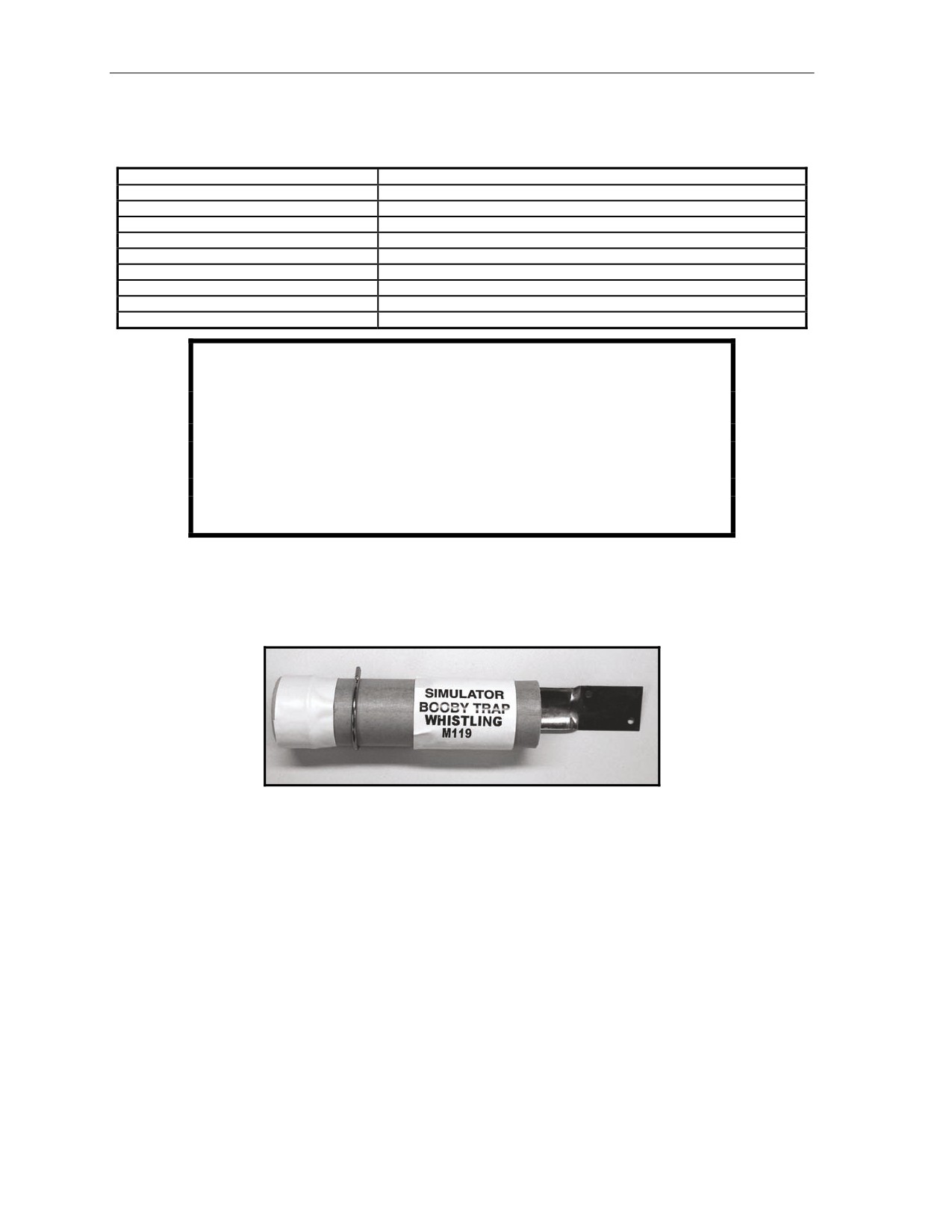
B-21. The M119 whistling booby trap simulator (Figure B-10) produces a whistling sound. Table B-9 outlines
its components and characteristics.
Figure B-10. M119 whistling booby trap simulator.
B-12
FM 3-23.30
15 October 2009
Characteristics of Pyrotechnic Signals and Simulators
Table B-9. Components and characteristics of
M119 whistling booby trap simulator.
COMPONENTS AND CHARACTERISTICS
DETAILS
NSN
1370-00-028-5255
Weight loaded
0.12 ounces
Length
4.4 inches
Diameter
0.98 inches
Method of activation
Trip wire
Body
Kraft paper
Color
White label with black markings
Effects
Whistle sound
Functioning time
2.5 to 5 seconds
WARNING
Do not pull the igniter cord on the M119 booby trap simulator by
hand as it will immediately activate. Booby trap simulators may
cause ear damage or burns if activated within 2 meters of
personnel. Never open a simulator; the photoflash powder is
extremely susceptible to flash ignition by even a slight amount of
friction.
GROUND-BURST SIMULATOR
B-22. Ground-burst simulators replicate the detonation of artillery and mortar projectiles or artillery-type rockets.
M115A2 GROUND-BURST SIMULATOR
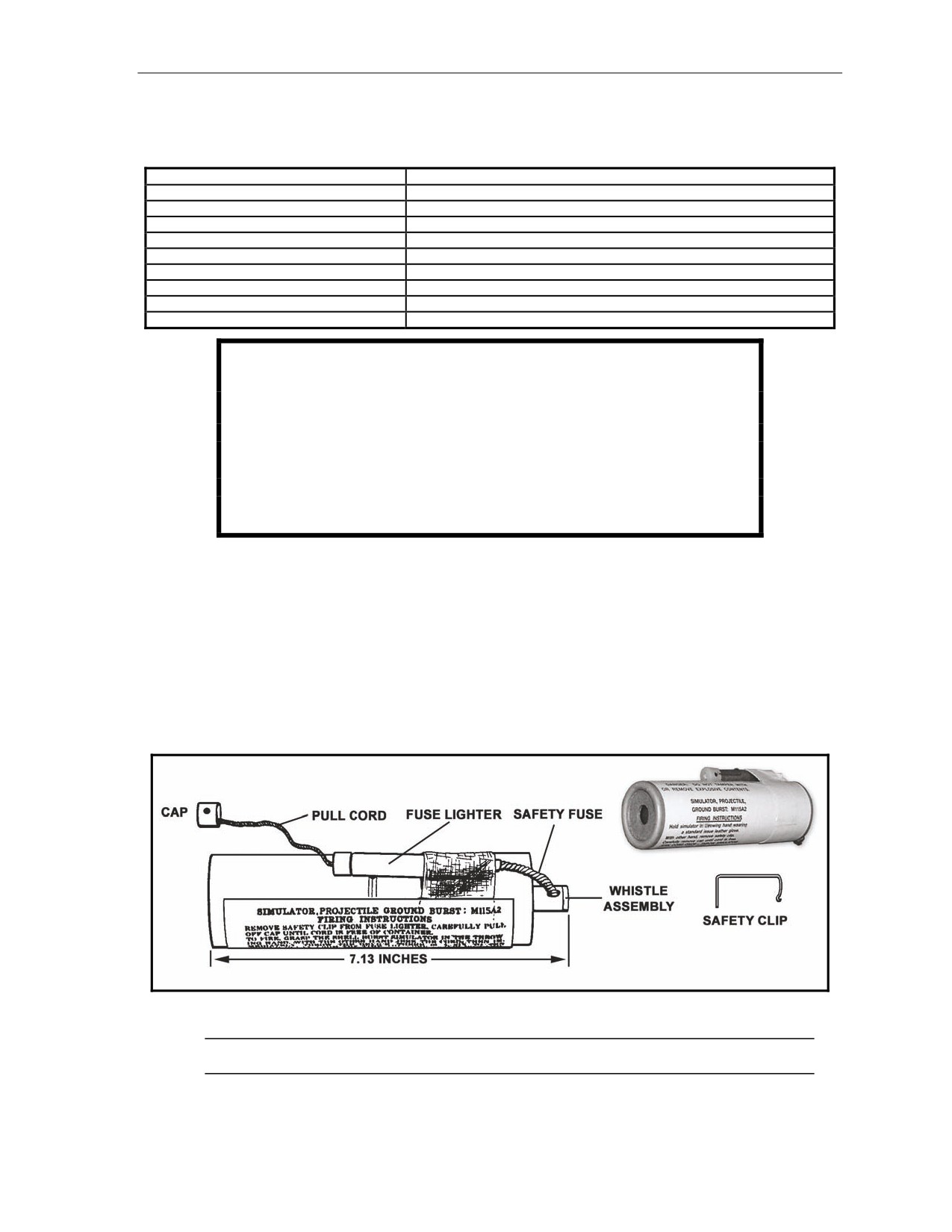
B-23. The M115A2 ground-burst simulator (Figure B-11) is activated by pulling its M3A1 friction delay igniter
cord and immediately thrown into a cleared area. After a 6- to 10-second delay, it produces a high-pitched
whistle that lasts 2 to 4 seconds and then detonates with a loud report and brilliant flash. Burning pyrotechnic
compound generates the whistle.
Figure B-11. M115A2 ground-burst simulator.
NOTE: Instructions for the hand grenade simulator are printed directly on the simulator.
15 October 2009
FM 3-23.30
B-13
Appendix B
Table B-10. Components and characteristics of
M115A2 ground-burst simulator.
COMPONENTS AND CHARACTERISTICS
DETAILS
NSN
1370-00-752-8126
Weight loaded
2.2 pounds
Length
7.13 inches
Diameter
2.38 inches overall
Method of activation
Hand pull cord
Body
Kraft paper
Color
White overall with white label with black markings
Effects
Whistle sound and explosive blast
Whistle 6 to10 seconds after ignition
Functioning time
Burst 8 to14 seconds after ignition
WARNINGS
The M115A2 projectile ground-burst simulator must not be used near
personnel due to potential hazard from fragmentation. Ensure the
simulator is not thrown to any point within 35 meters of unprotected
personnel.
When using the M115A2 ground-burst simulator, the thrower should
turn away from the simulator after throwing and assume a protective
stance.
The M115A2 must not be activated in loose gravel, sticks, or other
materials that could become projectiles, nor should it be thrown into
dry leaves, grass, or other flammable materials.
HAND GRENADE SIMULATOR
B-24. Hand grenade simulators are used to create battle noises and flashes during training.
M116A1 HAND GRENADE SIMULATOR
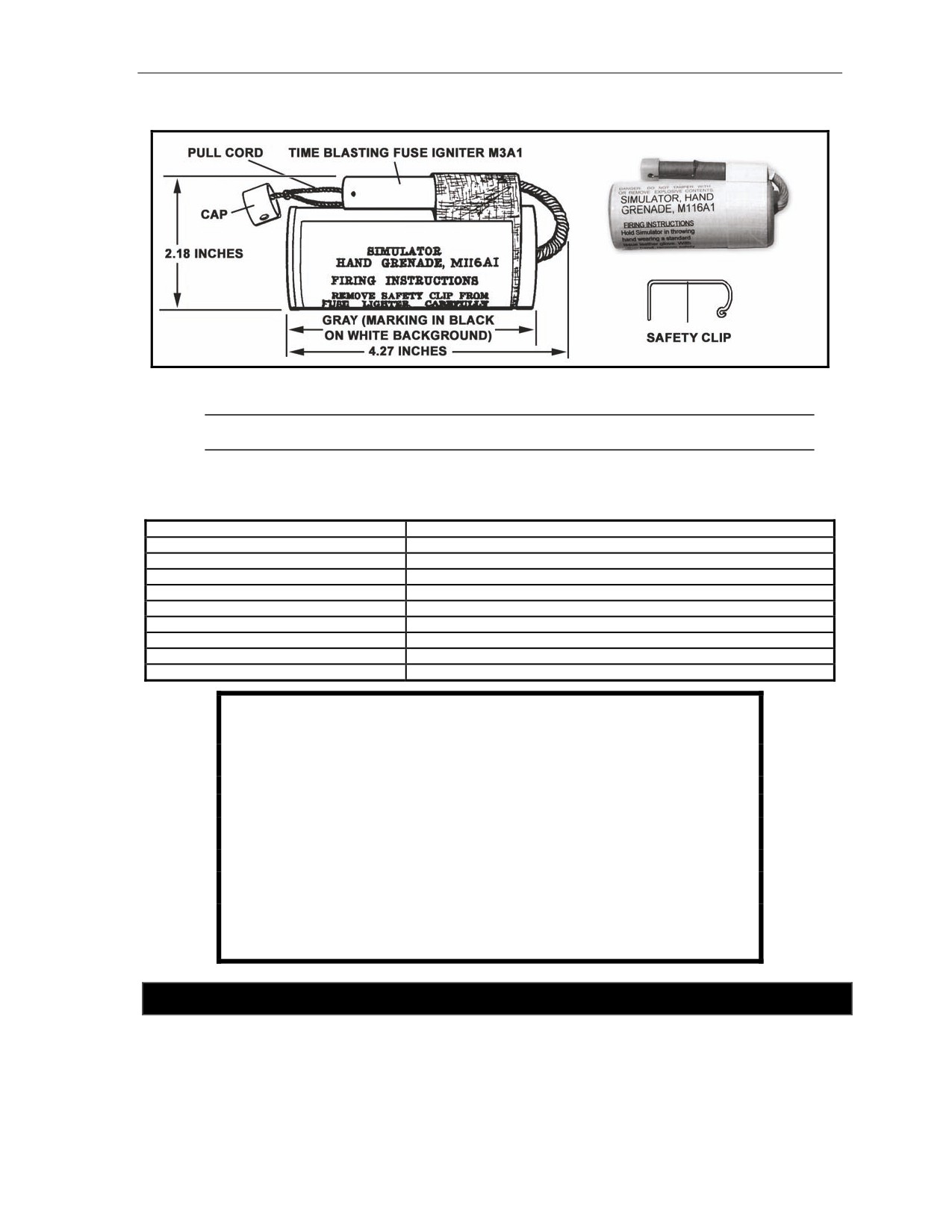
B-25. The M116A1 hand grenade simulator (Figure B-12) differs from the ground-burst simulator in that it is
shorter and does not emit a high-pitched whistle before detonation. The hand grenade simulator is thrown in the
same manner as a live grenade. It creates a flash and loud report 5 to 10 seconds after ignition.
B-14
FM 3-23.30
15 October 2009
Characteristics of Pyrotechnic Signals and Simulators
Figure B-12. M116A1 hand grenade simulator.
NOTE: Instructions for the hand grenade simulator are printed directly on the simulator.
Table B-11. Components and characteristics of
M116A1 ground-burst simulator.
COMPONENTS AND CHARACTERISTICS
DETAILS
NSN
1370-00-752-8124
Weight loaded
0.2 pounds
Length
4.30 inches
Diameter
2.18 inches overall
Method of activation
Hand pull cord
Body
Kraft paper
Color
White overall with white label with black markings
Effects
Explosive blast
Functioning time
Burst 5-to 10 seconds after ignition
WARNINGS
The safety radius for the M116A1 simulator is 15 meters. If this
distance is not observed, hearing damage and possible
fragmentation injury could result.
The M116A1 projectile ground-burst simulator must not be used
near personnel due to potential hazard from fragmentation.
The M116A1 must not be activated in loose gravel, sticks, or other
materials that could become projectiles, nor should it be thrown
into dry leaves, grass, or other flammable materials.
SECTION IV. ILLUMINATION GROUND SIGNAL KITS
The pen gun flare supports the small-unit leader in fire control, maneuver, and initiating operations such as
ambushes. These signals are also a component of air crewmen’s survival vest and are used for distress signaling or to
identify ground locations for aircraft. The pen gun flare comes in two kits, the M185 (red personnel signal kit) and
the A/P255-5A (red personnel distress signal kit).
15 October 2009
FM 3-23.30
B-15
Appendix B
WARNINGS
At close-range, these signals can injure or kill if they strike a
person.
When signaling an aircraft, do not aim directly at the aircraft; the
signals, regardless of color, may appear to be small arms fire.
While the flares are small and usually burn out before reaching the
ground, they can ignite fires.
M185 AND M186 PERSONNEL SIGNAL KITS
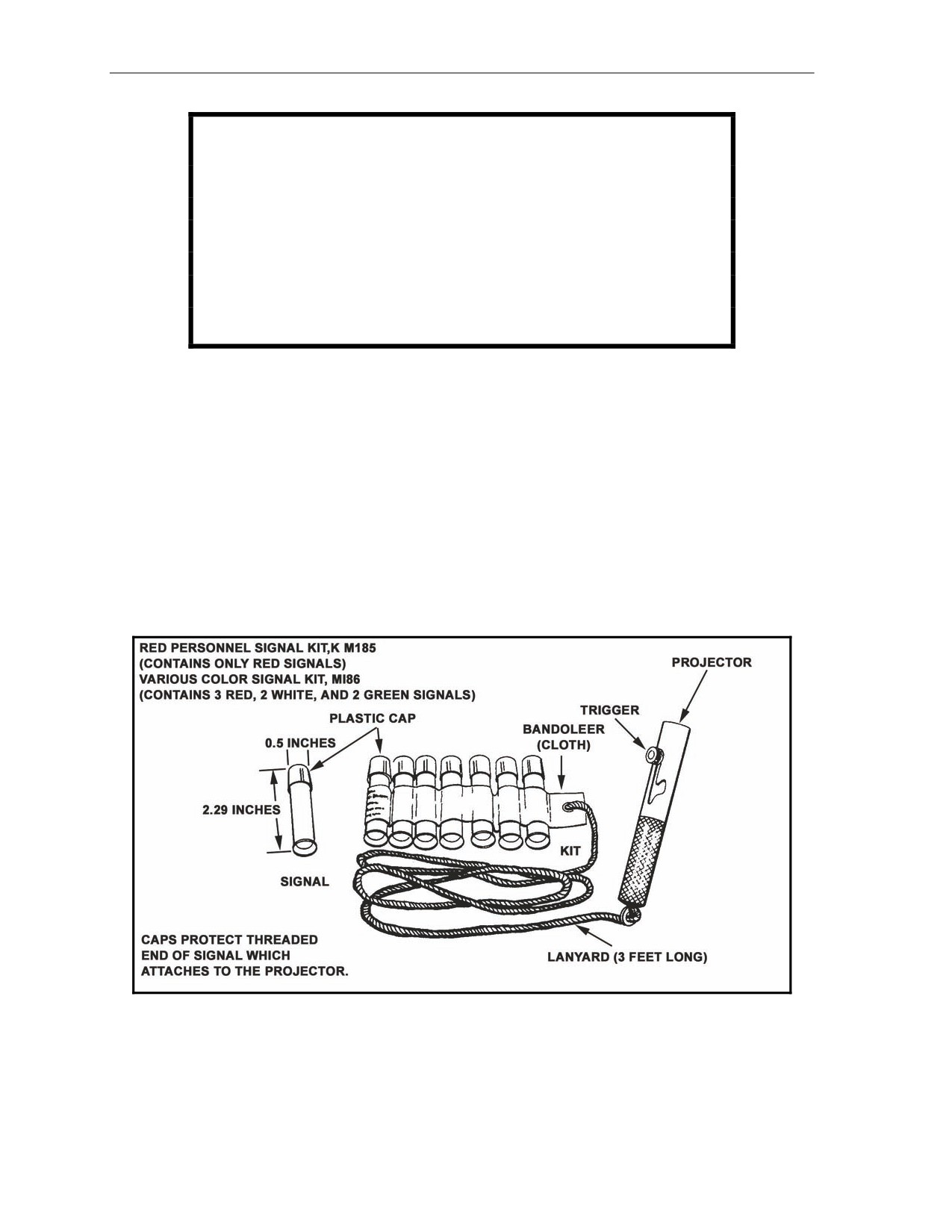
B-26. This pen gun flare has a threaded projector with the projectiles contained in a cloth bandoleer. The
projector, the bandoleer, and seven projectiles or signals make up the signal kit (Figure B-13). All signals may
be obtained and fired separately.
B-27. Four signals may be fired from a handheld projector while in a bandoleer:
z
M187 red illumination ground signal.
z
M188 white illumination ground signal.
z
M189 green illumination ground signal.
z
M190 amber illumination ground signal.
B-28. The M185 red signal kit contains seven red ground illumination signals (M187). The M186 signal kit
contains three red ground illumination signals (M187), two green, and two white signals.
Figure B-13. M185-red/M186-various color personnel signal kit.
B-16
FM 3-23.30
15 October 2009
Characteristics of Pyrotechnic Signals and Simulators
Table B-12. Components and characteristics of
M185-red/M186-various color personnel signal kit.
COMPONENTS AND CHARACTERISTICS
DETAILS
M185: 1370-00-921-6172
NSN
M186: 1370-00-926-9387
Weight loaded
0.39 pounds
Projector: 4 inches
Length
Lanyard: 36 inches
Signal: 2.29 inches
Projector: 0.59 inches
Diameter
Signal: 0.5 inches
Method of activation
From projector
Body
Aluminum
Color
Black projector: anodized color coding on signals
Effects
Illuminant composition with 3200 candlepower
Functioning time
5-seconds
M260 RED PERSONNEL DISTRESS SIGNAL KIT
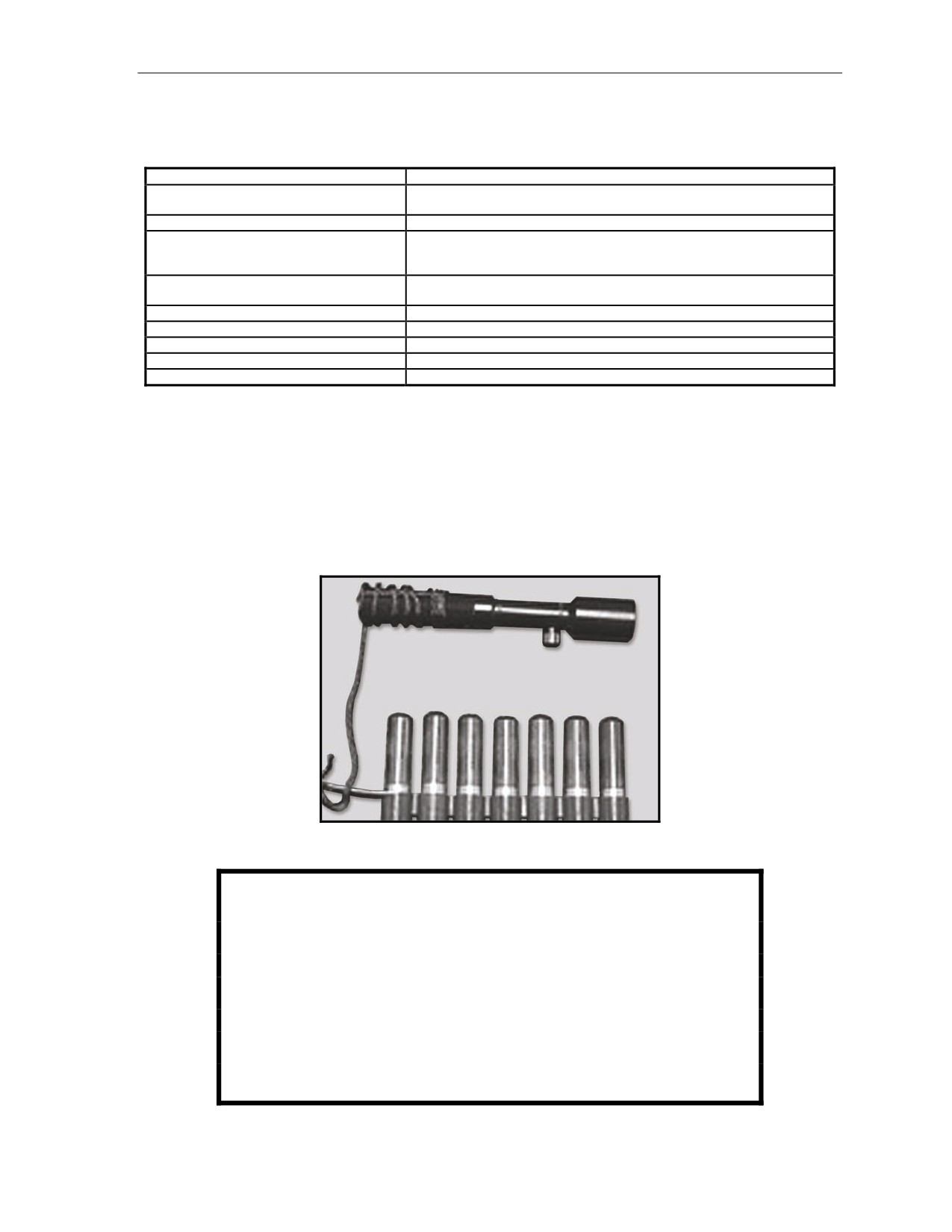
B-29. This pen gun flare has a force-fitted projector and a plastic bandoleer. The projector, the bandoleer, and
seven signals make up this kit (Figure B-14).
B-30. This kit contains only red illumination ground signals. The signals in this kit are more powerful than
those in the M185 and M186 personnel signal kits; they have a more powerful propellant allowing a higher
probability of penetration through overhead foliage. The burning time for these signals is 10 seconds at 10,000
candlepower.
Figure B-14. M260 red personnel distress signal kit.
WARNINGS
At close-range, these signals can injure or kill if they strike a
person.
When signaling an aircraft, do not aim directly at the aircraft; the
signals, regardless of color, may appear to be small arms fire.
While the flares are small and usually burn out before reaching the
ground, they can ignite fires.
15 October 2009
FM 3-23.30
B-17
Appendix B
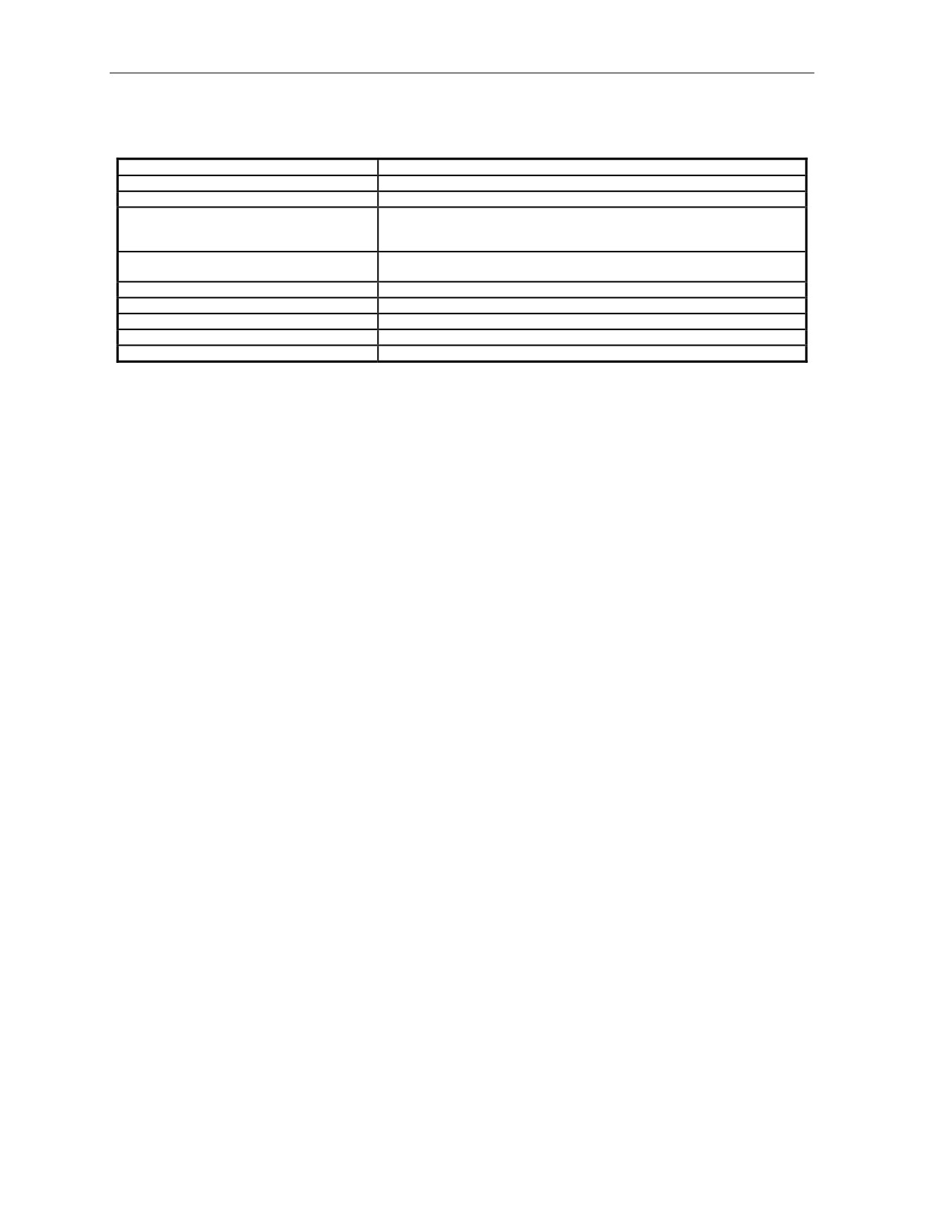
Table B-13. Components and characteristics of
M260 red personnel distress signal kit.
COMPONENTS AND CHARACTERISTICS
DETAILS
NSN
1370-00-490-7362
Weight loaded
3.2 ounces
Projector: 5.5 inches
Length
Lanyard: 30 inches
Signal: 2 inches
Projector: 0.8 inches
Diameter
Signal: 0.5 inches
Method of activation
From projector
Body
Aluminum
Color
Black projector: anodized color coding on signals
Effects
Illuminant composition with 10,000 candlepower
Functioning time
10-seconds
B-18
FM 3-23.30
15 October 2009
Glossary
ACRONYMS AND ABBREVIATIONS
ABC
atomic, biological, and chemical
AR
army regulation
ARNG
Army National Guard
ARNGUS
Army National Guard of the United States
ASP
ammunition supply point
CALFEX
combined arms live-fire exercise
CBRN
chemical, biological, radiological, nuclear
CLP
cleaning, lubricant, and preservative
CRM
composite risk management
CS
ortho-cholorobenzalmalomonitril (irritant agent or tear gas)
DA
Department of the Army
EOD
explosive ordnance disposal
ETLBV
enhanced tactical load-bearing vest
FM
field manual
GP
general purpose
GTA
graphic training aid
HC
hexacholorethane-zinc (burning type white smoke compound)
HE
high-explosive
IET
initial entry training
LCE
load-carrying equipment
LFX
live-fire exercise
METL
mission-essential task list
METT-TC
mission, enemy, terrain (and weather), troops, time available, civil considerations
mm
millimeter
MOPP
mission-oriented protective posture
NCO
noncommissioned officer
NCOIC
noncommissioned officer in charge
NSN
national stock number
NVD
night vision device
OIC
officer in charge
PA
public address
PMCS
preventive maintenance checks and services
ROE
rules of engagement
RP
red phosphorous (casualty producing, burning-type red smoke compound)
RSO
range safety officer
15 October 2009
FM 3-23.30
Glossary-1
Glossary
SDZ
surface danger zone
SOI
signal operating/operations instructions
SOP
standing operating procedure
STX
situational training exercise
TA
teraphthalic acid (burning-type white smoke compound)
TC
training circular
TH3
thermite (burning-type incendiary compound)
TM
technical manual
TNT
trinitrotoluene
TRADOC
Training and Doctrine Command
USAIS
US Army Infantry School
USAR
US Army Reserve
WP
white phosphorous (casualty-producing, bursting-type white smoke compound)
Glossary-2
FM 3-23.30
15 October 2009
References
DOCUMENTS NEEDED
These documents must be available to the intended users of this publication.
ARMY PUBLICATIONS
AR 385-63, Range Safety. 19 May 2003.
DA Pam 385-63, Range Safety. 4 August 2009.
FM 3-06.11, Combined Arms Operations In Urban Terrain. 28 February 2002.
FM 3-21.8, The Infantry Platoon and Squad. 28 March 2007.
FM 3-34.214, Explosives and Demolitions. 11 July 2007.
FM 7-0, Training for Full Spectrum Operations. 12 December 2008.
TC 25-8, Training Ranges. 5 April 2004.
TM 9-1330-200-12, Operator's and Organizational Maintenance Manual for Grenades. 17 September 1971.
TM 9-1370-206-10, Operator's Manual for Pyrotechnic Signals. 31 March 1991.
TM 9-1370-207-10, Operator's Manual for Pyrotechnic Simulators. 31 March 1991.
ARMY FORMS
DA Form 2028, Recommended Changes to Publications and Blank Forms.
DA Form 3517-R, Hand Grenade Qualification Scorecard
INTERNET WEBSITES
US Army Publishing Agency, http://www.army.mil/usapa
Reimer Doctrine and Training Digital Library, http://www.adtdl.army.mil
15 October 2009
FM 3-23.30
References-1