FM 3-23.30 Grenades and Pyrotechnic Signals (October 2009) - page 2
Training
2-91. If the hand grenade is dropped to the rear of the throwing pit, the pit safety NCO uses the following
procedures:
(1) Yell “GRENADE”.
(2) Force the thrower over the front of the throwing pit.
(3) Follow the thrower.
WARNING
Do not kick or throw grenades into sumps. In response to a
dropped grenade, Soldiers must move immediately from the
danger area and drop to the prone position with the Kevlar helmet
facing the direction of the grenade. This reduces the Soldier’s
exposure.
Soldier Fails to Take Commands
2-92. When a Soldier fails to take commands from the pit safety NCO, the pit safety NCO performs the
following procedures:
(1) Repeat the command of prepare to throw.
NOTE: If the Soldier does not make an attempt to arm the grenade, perform the following actions.
(2) Place your hand over the Soldier’s throwing hand (left hand for right-handed Soldiers, right hand for
left-handed Soldiers), covering the fuze head.
(3) Place your other hand on the Soldier’s helmet, and tell him to kneel in the throwing pit.
(4) Explain to the Soldier what he must do to throw the grenade downrange.
Ammunition Personnel
2-93. The ammunition personnel are in charge of accountability and handing out grenades.
NOTE: The ammunition NCO must attend an ammunition handler’s class provided by the local
ammunition supply point (ASP).
Tower Operator
2-94. The tower operator controls Soldier movements during range operations and maintains communications
with range control.
Guards
2-95. Guards control traffic during range operations.
Medical Personnel
2-96. Medical support (with required medical supplies) must be present before and during range operations.
Truck Driver
2-97. The truck driver transports personnel to and from the range and provides support as needed (e.g., water,
food, guard, etc.).
15 October 2009
FM 3-23.30
2-25
Chapter 2
SURFACE DANGER ZONE
WARNING
Observe caution when using hand grenades or pyrotechnic
signals with igniting type fuzes. These grenades and pyrotechnic
signals ignite with a flash and should be thrown at least 10 meters
from all friendly personnel to avoid hazardous conditions.
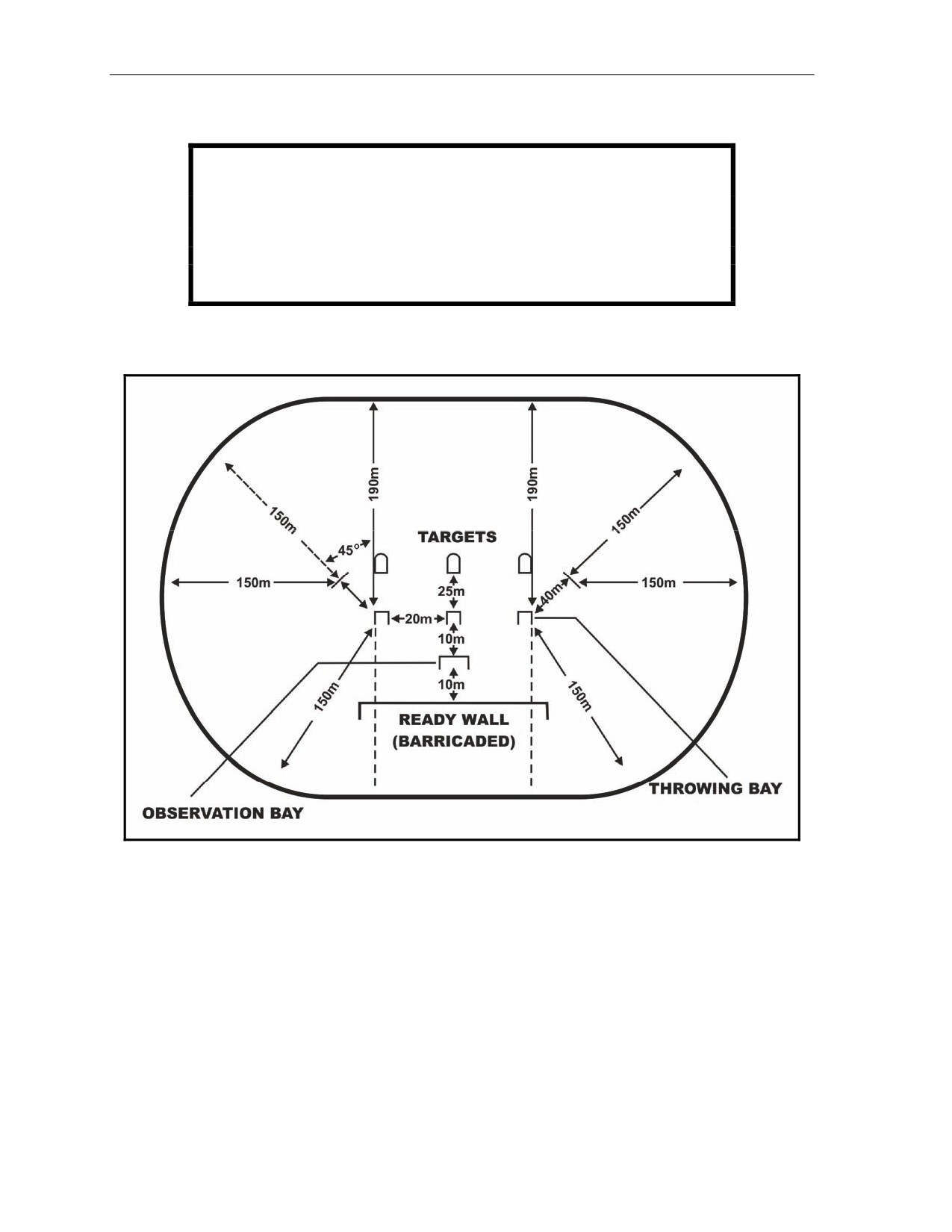
2-98. The surface danger zone (SDZ, shown in Figure 2-18) should be clear of all nonessential personnel before
conducting LFXs. The impact area should also be level and free of debris.
Figure 2-18. Surface danger zone for live-bay.
DUDS
2-99. Soldiers should treat any thrown grenade that fails to detonate as a dud, regardless of safety pin, safety
clip, or safety lever status. Duds must be regarded as dangerous. During training, the pit safety NCO determines
a dropped grenade’s status (Table 2-2).
2-26
FM 3-23.30
15 October 2009
Training
Table 2-2. Status of dropped grenade.
STATUS
DESCRIPTION
SAFE
A grenade with all safety devices intact
LIVE
A thrown grenade from the instant it is released until the expected fuze time has elapsed
DUD
A thrown grenade that failed to detonate after the expected fuze time has elapsed
CAUTION
Do not handle, approach, recover, or otherwise tamper with dud
grenades. Let explosive ordnance disposal (EOD) personnel handle dud
grenades.
Practice Grenade
2-100. If a practice grenade does not detonate—
(1) Wait 5 minutes before defuzing the M69 practice grenade.
(2) Keep the bottom of the grenade oriented away from your body and pointed directly at the ground.
(3) Place the dud fuze in a sand-filled container, and return it to the issuing facility or dispose of it in
accordance with unit SOP.
Fragmentation Grenade
2-101. If a fragmentation grenade does not detonate in training—
(1) The thrower and pit safety NCO wait in the throwing pit for 5 minutes before returning to a covered
area.
(2) The OIC or NCOIC notifies EOD immediately.
2-102. No other grenades should be thrown in the area of the dud until it has been neutralized.
NOTE: If range facilities provide, continue training on an adjacent impact area that is separated by
protective berms.
SECTION IV. TRAINING CONDUCT
Training conduct involves four steps:
(1) Occupy, inspect, and set up the range.
(2) Prepare for training.
(3) Conduct the training.
(4) Complete the training mission.
OCCUPY, INSPECT, AND SET UP RANGE
2-103. The OIC must establish communication with the installation’s range control and request permission to
occupy the range before personnel, materiel, or supplies arrive. Once this has been accomplished, the OIC and
NCOIC should—
z
Set up ammunition points and post guards.
z
Establish locations for medical station.
z
Designate Soldier holding areas.
15 October 2009
FM 3-23.30
2-27
Chapter 2
z
Establish water points.
z
Designate parking areas.
z
Inspect the range for operational conditions.
Check all throwing pits for sharp edges or unleveled throwing surfaces.
Ensure throwing pits meet standards.
Check the tower and tower public address (PA) system, if applicable.
z
Request an opening code from range control, if applicable.
z
Raise the range flag.
PREPARATION FOR TRAINING
2-104. The OIC and NCOIC should greet unit leaders and Soldiers as they arrive and direct them to the
holding area. Actions at the holding area include—
z
Ensuring all Soldiers attending training have a helmet, a body armor vest, LCE/ETLBV, ear
protection, and a protective mask.
z
Identifying Soldiers to be trained.
z
Conducting a safety briefing (to include administrative personnel).
CONDUCT THE TRAINING
NOTE: The OIC should monitor all training activities.
2-105. There are two types of training: initial training for introducing Soldiers to hand grenades and
pyrotechnic signals, and sustainment training of learned skills. The level of instruction will dictate the length
and pace of training.
INITIAL TRAINING
2-106. Initial training involves the completion of six tasks:
z
Participate in initial hand grenade training.
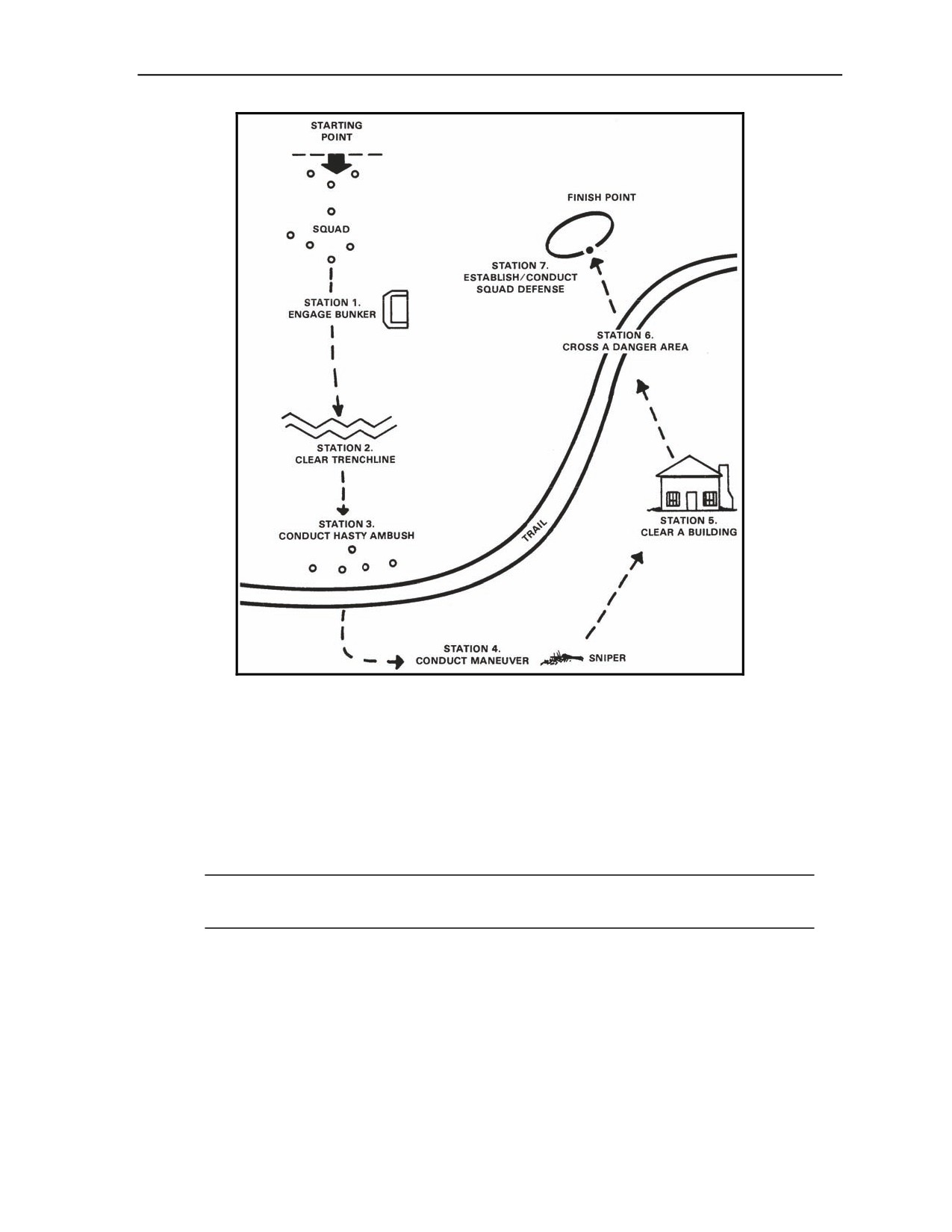
z
Participate in distance and accuracy training.
z
Participate in mock-bay training.
z
Participate in live-bay training.
z
Complete the hand grenade qualification course.
Participate in Initial Hand Grenade Training
2-107. The safety NCOs should take charge of the Soldiers to be trained and move them to the practice
grenade training site. During the initial hand grenade training, the safety NCOs will demonstrate the proper
techniques for employing hand grenades. Training includes—
z
Hand grenade safety, inspection, and maintenance procedures.
z
Proper hand grenade storage on Soldier equipment.
z
Proper hand grenade throwing grip (left/right-hand grips).
z
Proper hand grenade safety device removal.
z
Proper hand grenade throwing positions and techniques.
z
Demonstrations of pyrotechnic signals.
2-28
FM 3-23.30
15 October 2009
Training
Participate in Distance and Accuracy Training
WARNING
Do not use live grenades for practicing distance and accuracy.
NOTES:
1.
During the practice events and for qualification, each Soldier is required to throw
several M69 practice hand grenades armed with the M228 detonating fuze.
Although it takes only about a minute or less to install or replace a used M228 fuze,
a company-size element will use several hundred. Preparing practice grenades for
all participants is not feasible. Therefore, Soldiers should be given instruction on
installing and removing a fired M228 fuze. See Appendix A for more information.
2.
A confidence clip has been introduced to hand grenades and pyrotechnics equipped
with a safety pin and pull ring. All hand grenades and the M228 fuze for the M69
practice grenade will come with the confidence clip attached. However, the
confidence clip can be issued separately and then installed on the M228 fuze before
connecting the fuze to the M69 practice grenade. See Appendix A for more
information.
2-108. The distance and accuracy course is designed to develop the Soldier’s proficiency in gripping and
throwing hand grenades. When conducting the training, instructors should clarify the task, conditions, and
standards for the course (Table 2-3), and demonstrate the task.
Table 2-3. Distance and accuracy course—task, condition, and standard.
TASK
Engage a variety of targets at varying ranges up to 40 meters.
Given 10 practice grenades, individual equipment, and a four-station course with
CONDITION
a variety of targets at distances of 20, 30, and 40 meters.
The Soldier must successfully engage targets at each station with two out of
three grenades. The Soldier must throw from the alternate prone, prone-to-
STANDARD
kneeling, and prone-to-standing positions. A target is successfully engaged when
the grenade detonates within 5 meters of the target.
2-109. To develop good safety habits, supervisors and instructors must ensure the Soldiers use proper
throwing techniques.
NOTE: During the initial practical exercise, Soldiers should be allowed to observe the strike of the
grenade so they can gain an appreciation for the weight of the grenade and the amount of force
required to throw it accurately. After initial training, however, Soldiers should follow the proper
procedures for seeking cover after throwing a grenade.
Participate in Mock-Bay Training
WARNING
Do not use live grenades for mock-bay training.
15 October 2009
FM 3-23.30
2-29
Chapter 2
NOTE: Soldiers must attend mock-bay training before moving to live-bay training.
2-110. Mock-bay training enables Soldiers to learn the proper techniques of throwing a hand grenade before
moving to a live-bay, where Soldiers will experience realistic blast effects.
NOTE: Cadre/trainers use mock-bay training to identify Soldiers who require additional training
and exhibit techniques that may be dangerous (to the Soldier and other personnel) in the live-bay
environment.
Safety Precautions
2-111. For the safe and effective conduct of mock-bay training, Soldiers must—
z
Wear LCE, body armor, ear protection, helmets, and eye protection, if available.
z
Receive a safety briefing before throwing training grenades.
z
Carry the hand grenades to the throwing pits using proper right- or left-hand grips.
z
Exhibit proper gripping procedures, throwing techniques, and throwing positions.
z
Be properly supervised by a mock-bay safety NCO.
Conduct
2-112. At the mock-bay, cadre/trainers must—
z
Reinforce hand grenade safety.
z
Explain live-bay conduct.
Safety precautions.
Throwing order.
Issue of hand grenades.
Commands to prepare, throw, and take cover.
Throwing position.
NOTE: Soldiers will throw from the standing position during mock-bay and live-bay training.
Precautions taken in the event a Soldier drops a hand grenade after pulling the safety pin.
NOTE: The pit safety NCO is responsible for the safety of the thrower. The cadre/trainer will
demonstrate the techniques he will use to protect the Soldier in the event a Soldier fails to take
immediate cover behind the knee wall.
Precautions taken in the event a Soldier refuses to throw a live hand grenade.
NOTE: If a Soldier refuses to throw a live hand grenade while in the live-bay pit, the pit safety
NCO directs the Soldier to remain behind cover and throws the grenades. The Soldier is then
removed from the remainder of training, and the Soldier’s name is given to the chain of command.
2-113. Then, training conduct proceeds as follows:
(1) Each Soldier is issued four M69 hand grenades with the M228 fuze. The Soldiers install the M228
fuze prior to entering the mock-bay.
(2) Soldiers are rotated twice through mock-bay:
The first rotation is for observing Soldier actions and correcting throwing deficiencies.
2-30
FM 3-23.30
15 October 2009
Training
NOTE: Soldiers are not allowed to stand and observe a thrown hand grenade. They are directed to
drop to a kneeling position behind cover after throwing the second hand grenade.
The second rotation ensures Soldiers are performing as taught and serves to identify Soldiers
who demonstrate weak or dangerous technique.
NOTE: Soldiers identified as high-risk should be tagged (with something that can be seen from a
distance) and sent back for reinforcement training. These Soldiers should be placed at the end of the
throwing order to ensure that training is not hindered and to minimize exposing other Soldiers to
potential risks.
Participate in Live-Bay Training
NOTE: Soldiers going to the live-bay must have first practiced all the procedures in the mock-bay.
2-114. After all grenades have been inspected, the NCOIC should take charge and move the Soldiers to the
live-bay throwing site. Live-bay training gives Soldiers the opportunity to experience throwing a live
fragmentation hand grenade.
Safety Precautions
2-115. Throwing of live hand grenades can be done in a safe manner if the range safety procedures are
followed. These procedures include identification of high-risk Soldiers who had problems throwing grenades
during the initial training block of instruction.
NOTE: Live-bay range personnel must be completely alert at all times and prepared to take
appropriate actions for any given situation. The range OIC and NCOIC must be positioned to
observe the throw phase and count grenade explosions for purposes of grenade accountability and
duds.
2-116. For the safe conduct of live-bay training, Soldiers must—
z
Complete mock-bay training before throwing live grenades.
z
Wear LCE, body armor, ear protection, helmets, and eye protection, if available.
z
Receive a safety briefing before throwing live grenades.
z
Carry the hand grenades to the throwing pits using proper right- or left-hand grips.
z
Be properly supervised by a live-bay safety NCO.
z
Be behind protective barriers, where they will stay until called forward.
CAUTION
All Soldiers, including range personnel, and visitors to the range must be
behind protective barriers and wear appropriate safety gear.
15 October 2009
FM 3-23.30
2-31
Chapter 2
2-117. The OIC and NCOIC must take the appropriate safety precautions before conduct of live-bay training.
This includes—
z
Ensure all guards are posted and roadblock barriers are in place before moving Soldiers to the live-bay.
z
Ensure communication between roadblocks, the RSO, and the tower is confirmed before live
throwing.
z
Ensure Soldiers are shown the live-bay training area and a safety briefing is given on the operating
procedures of the live-bay.
NOTE: Range safety personnel must reinforce the fact that cooking off hand grenades is not allowed in
the live-bay. Soldiers must also be briefed on the actions to take for a dropped grenade.
z
Request an opening code to go HOT.
Conduct
2-118. During conduct of live-bay training—
(1) After the live-bay safety briefing, the RSO moves the Soldiers to the ready line.
(2) The ammunition NCO issues grenades to the Soldiers, making sure they are holding the grenades
properly.
NOTE: Grenades are issued only to those Soldiers who are in line to go to the throwing pit. Pit safety NCOs
will make sure the Soldiers are holding the grenades properly and at the chin/chest level. The pit safety
NCOs will direct Soldiers to sound off, each indicating with which hand he will throw the grenade.
(3) The pit safety NCOs will direct Soldiers to specific throwing pits.
NOTE: A pit safety NCO is assigned to each throwing pit.
(4) The pit safety NCO observes the movement of Soldiers to the pit.
(5) The Soldier going into the live-bay identifies the throwing arm to the pit safety NCO. The pit safety NCO
directs the Soldier to the appropriate position of the pit, based on left or right throwing arm. The pit safety
NCO directs the Soldier to hand over the grenade in his nonthrowing hand.
(6) The pit safety NCO directs the Soldier to remove the safety clip and safety pin, and to prepare to throw.
NOTE: From this point on, the pit safety NCO does not divert his eyes from the throwing hand until
completion of the throw.
WARNING
If a grenade is dropped in the pit, the pit safety NCO forces the
Soldier out of the pit and into the designated safe area and follows
him.
(7) The pit safety NCO signals the tower that the Soldier is prepared to throw by holding up his left or
right arm.
(8) When all throwing pits are ready, the tower operator commands “THROW”, and the pit safety NCO
repeats the “THROW” command to the Soldier in the pit.
NOTE: All pits throw at the same time.
2-32
FM 3-23.30
15 October 2009
Training
WARNING
If a Soldier releases the safety lever but fails to throw the grenade,
the pit safety NCO forcefully repeats the command to throw; if
necessary, the pit safety NCO grabs and throws the grenade
himself.
(9) The Soldier throws the grenade, and then drops to cover.
WARNING
If a Soldier does not take cover, the pit NCO forces the Soldier to
take cover.
(10) The tower operator commands “CLEAR” after observing each grenade detonation. The pit safety
NCO hands the thrower the second grenade.
(11) The Soldiers prepare to throw a second grenade, repeating the required steps.
Complete the Hand Grenade Qualification Course
NOTE: This course should not be attempted until all initial training has been completed.
2-119. The purpose of the qualification course is to measure and evaluate the Soldier’s ability to engage a
variety of targets in natural terrain under simulated combat conditions. The qualification course allows the
Soldier to gain confidence in arming and throwing hand grenades in a simulated tactical scenario.
Stations
NOTE: Active duty Soldiers in Infantry and reconnaissance units must qualify on the hand grenade
qualification course every six months. All other active duty Soldiers and those in Army Reserve and
National Guard units must qualify once a year.
2-120. The hand grenade qualification course (Figures 2-10 through 2-17) is standardized throughout the
Army. It consists of seven stations (Table 2-4), with a minimum of one grader at each station. The course is
conducted in two-man teams, but Soldiers are evaluated individually. Each participant is issued ten hand
grenades and must successfully engage seven targets.
NOTE: See TC 25-8 for more information about the hand grenade qualification course.
15 October 2009
FM 3-23.30
2-33
Chapter 2
Table 2-4. Hand grenade qualification course stations.
STATION
TASK
CONDITION
STANDARD
Engage a group of
The targets are located 35 meters to
F-type silhouette
the front of the fighting position,
1
targets in the open
simulating enemy movement through
from a two-man
and beyond the squad’s protective
fighting position.
wire.
Engage a bunker
The bunker can have one or two firing
using available
portholes oriented toward the
2
cover and
direction of the buddy team’s
concealment.
movement and a rear exit.
No more than two
grenades should be
Engage a fortified
The fortified enemy mortar position
used on any target.
3
enemy mortar
must be located 20 meters away.
Only one is used if the
position.
first grenade is on
The group of enemy targets must be
Engage a group of
target.
4
behind cover and located 20 meters
enemy targets.
away.
Clear an entry point
The trench line must be located 25
5
to a trench line.
meters away.
Engage enemy
The halted, open-type wheeled
troops in a halted,
6
vehicle must be located 25 meters
open-type wheeled
away.
vehicle.
Soldiers must be able to
Identify hand
identify grenades and
All grenades must present proper
7
grenades and
pyrotechnic signals by
shape, color, and markings.
pyrotechnic signals.
shape, color, markings,
and capabilities.
Scoring
2-121. Although no two hand grenade qualification courses are alike, the standards must be consistent.
Qualification must be awarded only to those Soldiers who meet these standards. The minimum course standards
should include live-bay training and the hand grenade qualification course.
NOTE: The evaluator at each station determines scoring in accordance with DA Form 3517-R
(Hand Grenade Qualification Scorecard, shown in Figures 2-19 and 2-20).
2-34
FM 3-23.30
15 October 2009
Training
SUSTAINMENT TRAINING
2-122. Units should integrate the use of grenades into collective tasks, rather than training these skills as a
separate event. Leaders at all levels should study the employment of grenades in conjunction with the unit
mission and implement a training program that supports that mission.
2-123. The following generic tasks can assist units in training and evaluating hand grenade proficiency:
z
Identify hand grenades and pyrotechnic signals.
z
Inspect and maintain hand grenades and pyrotechnic signals.
z
Employ a pyrotechnic signal.
z
Complete the distance and accuracy course.
z
Complete the bunker complex course.
z
Complete the trench complex course.
z
Complete the building complex course.
z
Participate in mock-bay training.
Identify Hand Grenades and Pyrotechnic Signals
2-124. The purpose of this training is to develop and—at a later time—test the Soldier’s knowledge in
identifying and explaining the use of hand grenades and pyrotechnic signals. When conducting the training,
instructors should clarify the task, conditions, and standards (Table 2-5).
Table 2-5. Identify hand grenade and pyrotechnic signals—task, condition, and standard.
TASK
Identify a variety of hand grenades and pyrotechnic signals.
Given individual equipment, and a variety of hand grenade and pyrotechnic signal
CONDITION
pictures or mock-up training aids, and a mix of 3x5 cards with the name of each
grenade and pyrotechnic signal.
The Soldier must successfully align the correct 3x5 card with the picture or mockup
STANDARD
training aid of a grenade and pyrotechnic written on the card, and explain the
characteristics, capability, and purpose of each.
Inspect and Maintain Hand Grenades and Pyrotechnic Signals
2-125. Hand grenades and pyrotechnic signals must be inspected on a regular basis to ensure serviceability
due to prolonged exposure to environmental conditions, damage in shipping or in storage, or missing safety
devices. Maintenance requirements are minimal (Table 2-6).
NOTE: See TM 9-1330-200-12 and TM 9-1370-206-10 for more information.
Table 2-6. Inspect and maintain hand grenades and pyrotechnic signals—
task, condition, and standard.
Perform preventive maintenance checks and services (PMCS) of hand grenades
TASK
and pyrotechnic signals.
Given individual protective equipment; a clean lint free cloth; an oil-free camel
CONDITION
hair brush; cleaner, lubricant, and preservative (CLP); and an M67 or M69 hand
grenade, a smoke grenade, and a signal flare.
The Soldier must inspect, clean, and store M67 or M69 hand grenades and
pyrotechnic signals without causing damage to the hand grenade or pyrotechnic
STANDARD
signal or cause injury to friendly personnel, in accordance with TM 9-1330-200-12
and TM 9-1370-206-10.
15 October 2009
FM 3-23.30
2-37
Chapter 2
Employ a Pyrotechnic Signal
2-126. To successfully employ pyrotechnic signals, Soldiers must (Table 2-7)—
z
Be familiar with the type of pyrotechnic signal used.
z
Know how to properly hold, prepare, and throw or launch the pyrotechnic signal from various
positions.
NOTE: See Chapter 4 for employment and safety considerations.
Table 2-7. Employ a pyrotechnic signal—task, condition, and standard.
TASK
Employ a pyrotechnic signal.
Given individual protective equipment, an M106 and M18 smoke grenade, a
CONDITION
handheld flare, and a 20-meter target.
The Soldier must provide a complete smoke screen that cannot be observed from
STANDARD
the target area, and successfully launch a handheld flare (by hand or from the
ground) to communicate withdrawal or shifting of friendly fires.
Complete the Distance and Accuracy Course
WARNING
Do not use live grenades for practicing distance and accuracy.
2-127. The distance and accuracy course is designed to develop the Soldier’s proficiency in gripping and
throwing hand grenades. When conducting the training, instructors should clarify the task, conditions, and
standards for the course (Table 2-8), and demonstrate the task.
Table 2-8. Distance and accuracy course—task, condition, and standard.
TASK
Engage a variety of targets at varying ranges up to 40 meters.
Given 10 practice grenades, individual equipment, and a four-station course with
CONDITION
a variety of targets at distances of 20, 30, and 40 meters.
The Soldier must successfully engage targets at each station with two out of
three grenades. The Soldier must throw from the alternate prone, prone-to-
STANDARD
kneeling, and prone-to-standing positions. A target is successfully engaged when
the grenade detonates within 5 meters of the target.
2-128. To develop good safety habits, supervisors and instructors must ensure the Soldiers use proper
throwing techniques.
NOTE: During the initial practical exercise, Soldiers should be allowed to observe the strike of the
grenade so they can gain an appreciation for the weight of the grenade and the amount of force
required to throw it accurately. After initial training, however, Soldiers should follow the proper
procedures for seeking cover after throwing a grenade.
2-38
FM 3-23.30
15 October 2009
Training
Complete the Bunker Complex Course
WARNING
When using M106 smoke grenades, DO NOT cook off the grenade.
These smoke grenades have a flash-bang grenade fuze with a 0.7-
to 2-second time delay.
WARNING
Do not use live grenades for practicing the bunker complex course.
2-129. The bunker complex course exercise develops the Soldier’s proficiency in properly attacking a bunker
complex from a covered and concealed location while using obscuration and proper movement techniques.
When conducting the training, instructors should clarify the task, conditions, and standards for the course
(Table 2-9), and demonstrate the task.
NOTE: See Chapter 3 for proper cook-off technique.
Table 2-9. Bunker complex course—task, condition, and standard.
TASK
Engage an enemy bunker complex.
Given an individual weapon, helmet, LCE and body armor, cover and
CONDITION
concealment, and two M69 hand grenades with M228 fuze, or M84 flash-bang
grenades, and one M106 or M83 smoke grenade.
The Soldier must successfully engage and disable a bunker. The Soldier must
provide a smoke screen (M106 or M83) to cover the approach to the bunker from
STANDARD
the blind side, properly cook off a M69 grenade, put the grenade into the firing port of
the bunker, roll away from the bunker, and turn 180 degrees to cover the rear exit of
the bunker. The grenade must detonate in the bunker.
NOTE: See Chapter 3 for proper M69 cook-off technique.
Complete the Trench Complex Course
WARNING
When using M106 smoke grenades, DO NOT cook off the grenade.
These smoke grenades have a flash-bang grenade fuze with a 0.7-
to 2-second time delay.
15 October 2009
FM 3-23.30
2-39
Chapter 2
WARNING
Do not use live grenades for practicing the trench complex
course.
2-130. The trench complex course exercise develops the Soldier’s proficiency on how to properly attack a
trench complex from a covered and concealed location while using obscuration and proper movement
techniques. When conducting the training, instructors should clarify the task, conditions, and standards for the
course (Table 2-10), and demonstrate the task.
Table 2-10. Trench complex course—task, condition, and standard.
TASK
Engage an enemy trench complex.
Given an individual weapon, helmet, LCE and body armor, cover and
CONDITION
concealment, and two M69 hand grenades with M228 fuze, and one M106 or
M83 smoke grenade.
The Soldier must successfully enter a trench and engage enemy personnel. The
Soldier must provide a smoke screen (M106 or M83) to cover the approach to the
STANDARD
trench from the blind side, properly cook off a M69 grenade, throw or roll the grenade
into the trench, roll away from the mouth of the trench, wait for the explosion, and enter
and clear the trench. The grenade must detonate in the trench.
NOTE: See Chapter 3 for proper M69 cook-off technique.
Complete the Building Complex Course
2-131. The building complex course exercise develops the Soldier’s proficiency on how to properly attack and
clear a building from a covered and concealed location while using obscuration and proper movement
techniques. When conducting the training, instructors should clarify the task, conditions, and standards for the
course (Table 2-11), and demonstrate the task.
WARNINGS
When using M84 grenades or other forms of flash-bang grenades,
DO NOT cook off the grenade. These grenades have a 1- to 2.3-
second time delay.
When using M106 smoke grenades, DO NOT cook off the grenade.
These smoke grenades have a flash-bang grenade fuze with a 0.7-
to 2-second time delay.
DO NOT use M18, M83, and AN-M8 HC smoke grenades in
enclosed or confined spaces. Burning-type grenades burn
oxygen. Standard protective masks filter particles but will not
supply oxygen.
2-40
FM 3-23.30
15 October 2009
Training
CAUTION
M18, M83, and AN-M8 HC have the potential to start fires when thrown on
dry tender.
Table 2-11. Building complex course—task, condition, and standard.
TASK
Enter and clear a building complex.
As a member of a clearing team. Given an individual weapon, helmet, LCE and
CONDITION
body armor, cover and concealment, and two M69 hand grenades with M228
fuze, or M84 flash-bang grenades, and one M106 or M83 smoke grenade.
The Soldier must successfully enter a building and engage enemy personnel. The
Soldier must provide a smoke screen (M106 or M83) to cover the approach to the
building from a covered and concealed position, properly prepare the grenade
STANDARD
(cook off a M69 or use a M84 flash-bang), throw the grenade into a designated
building entry point, take cover, wait for the explosion, and enter and clear the
entry point. The grenade must detonate in the building/room.
NOTE: See Chapter 3 for proper M69 cook-off technique.
Participate in Mock-Bay Training
WARNING
Do not use live grenades for mock-bay training.
2-132. In mock-bay training, Soldiers practice throwing grenades before moving to live-bay training. This training
introduces the Soldier to throwing commands and provides additional throwing practice. Instructors should orient
the Soldiers to the mock-bay training pit and explain the commands that are used during actual throwing. When
conducting the training, instructors should clarify the task, conditions, and standards for the training (Table 2-12),
and demonstrate the task. Soldiers should also practice the procedures used during live-bay training.
NOTE: The instructor must reinforce correct throwing and safety procedures.
Table 2-12. Mock-bay training—task, condition, and standard.
TASK
Engage targets in the open with hand grenades.
Given individual equipment, to include helmet, body armor, and two M69 hand
CONDITION
grenades with M228 fuze, a mock-bay pit that replicates a live-bay pit, ear protection,
and an orientation and safety briefing.
Soldiers must safely carry, arm, and throw two practice hand grenades from the mock-
STANDARD
bay pit while following the commands from the instructor or NCOIC. Soldiers must not
move from the cover of the pit until the command “CLEAR”, “ALL CLEAR” is given.
NOTE: Be sure the physical layout of the mock-bay pit replicates the live-bay pit. This not only gives
the Soldier the sensation of throwing a live fragmentation hand grenade, but also instills confidence in his
ability to throw the hand grenade.
15 October 2009
FM 3-23.30
2-41
Chapter 2
Participate in Live-Bay Training
NOTE: Soldiers going to the live-bay must have first practiced all the procedures in the mock-bay.
2-133. After all grenades have been inspected, the NCOIC should take charge and move the Soldiers to the
live-bay throwing site. Live-bay training gives Soldiers the opportunity to experience throwing a live
fragmentation hand grenade (Table 2-13).
Table 2-13. Live-bay training—task, condition, and standard.
TASK
Engage targets in the open with hand grenades.
Given individual equipment, to include helmet, body armor, and two M67 fragmentation
CONDITION
hand grenades, a live-bay pit, ear protection, and an orientation and safety briefing.
Soldiers must safely carry, arm, and throw two M67 fragmentation hand grenades from
the live-bay pit while following the commands from the instructor or NCOIC. Soldiers
STANDARD
must not move from the cover of the pit until the command “CLEAR”, “ALL CLEAR” is
given.
NOTE: For more information about live-bay training, see the initial training segment of this chapter.
COLLECTIVE TRAINING
2-134. Once Soldiers can identify grenades and pyrotechnics, have an understanding of their purposes, and
can safely arm and throw live hand grenades and pyrotechnics, units should integrate their use into collective
tasks. The hand grenade qualification course is optional; commanders can modify the stations or design training
that supports unit METLs.
NOTE: Soldiers should use the M69 practice hand grenades against realistic targets while practicing
the collective tasks. Use the M84 or other types of flash-bang hand grenades during urban
operations, if available. However, the M69 can be used in lieu of the M84.
Squad Situational Training Exercise
2-135. Leaders should present Soldiers with tactical situations in a realistic squad STX integrating the use of
hand grenades and pyrotechnics with other fire team or squad weapons to force Soldiers to make sound tactical
decisions and improve their skills.
2-136. Leaders should consider integrating hand grenade tasks that are best suited to the unit’s METL into the
tactical scenario. Figure 2-21 is an example squad STX that tests the squad’s weapon proficiency.
2-42
FM 3-23.30
15 October 2009
Training
Figure 2-21. Example of squad situational training exercise with hand grenades.
COMPLETE THE TRAINING MISSION
2-137. At the completion of training, all equipment, range material, and ammunition should be accounted for,
to include the completion of range maintenance, the OIC and RSO can close the range. This includes—
z
Request a closing code from range control.
z
Release unit Soldiers.
z
Remove all equipment and ammunition from the range.
NOTE: Turn in all unexpended grenades in original grenade containers to the ASP, along with all
safety pins and packing residue from all detonated grenades.
z
Have EOD find and clear any duds or grenades thrown without the safety pin pulled.
z
Police the range, fill in all holes with sand, rake the impact area, and perform other range
maintenance as required by local SOP.
z
Request a range inspection from range control when ready to clear.
z
Turn in paperwork and equipment.
z
Submit after action report to headquarters.
z
Report any noted safety hazards to proper authorities.
15 October 2009
FM 3-23.30
2-43
Chapter 3
Hand Grenades
Hand grenades are used to supplement small arms against an enemy in close
combat, and for non-lethal operations to temporarily stun enemy personnel.
Proper control and safety procedures allow for safe employment of hand grenades.
INSPECTION
WARNING
Hand grenades—like any other weapon—must be inspected
before use and properly secured to avoid serious injury or death.
3-1. Soldiers should perform three types of inspections:
z
Initial inspection.
z
Before storing.
z
Daily checks.
CAUTION
Observe precautions generally applicable to use of ammunition.
NOTE: See TM 9-1330-200-12 for more information about hand grenade inspection. These
inspections focus on the M67 fragmentation grenade; however, all grenades with fuzes must be
inspected.
INITIAL INSPECTION
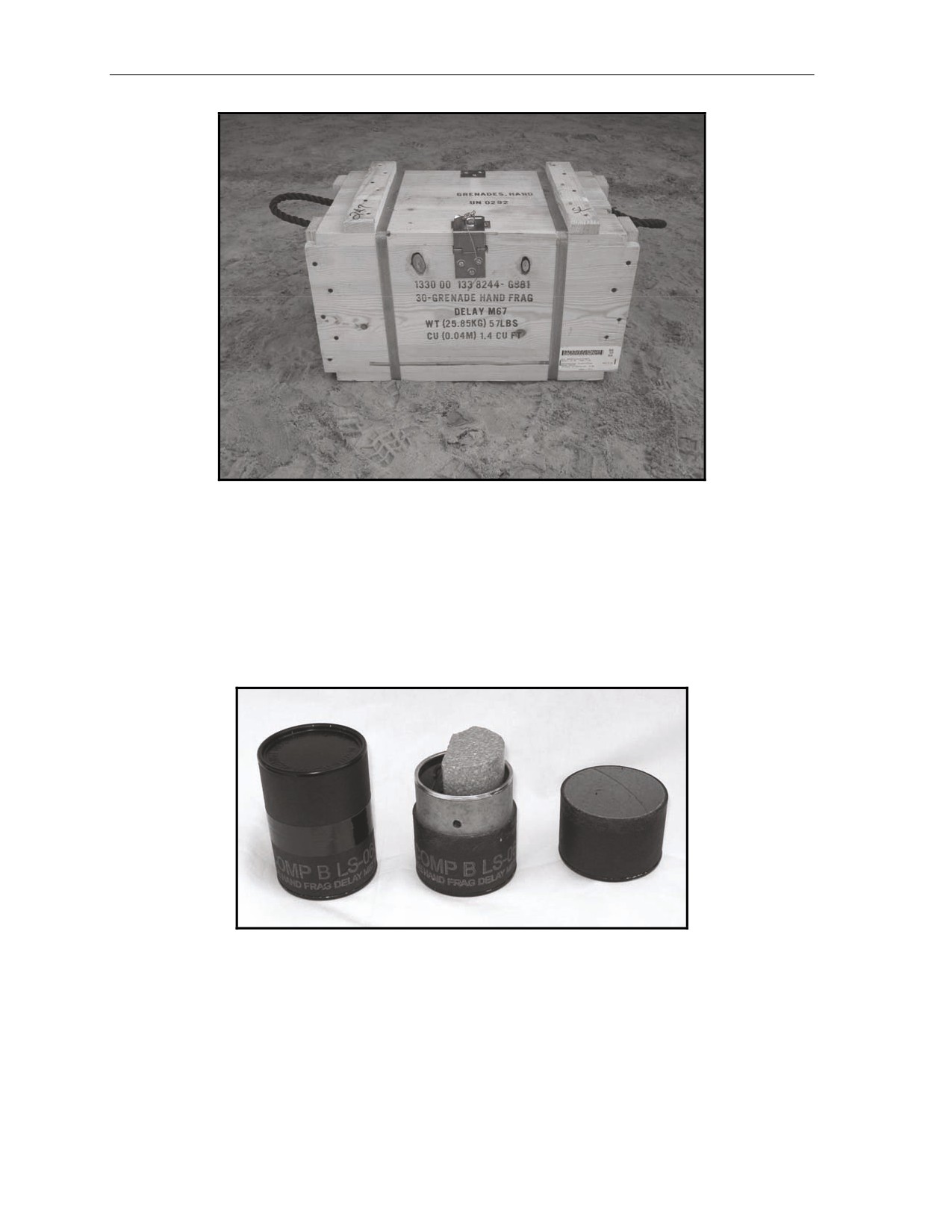
3-2. When in bulk, hand grenades are secured in shipping containers (Figure 3-1). Personnel should inspect
the shipping container upon receipt. Shipping containers that are damaged should not be opened; they should
be returned to the ASP or disposed of using the methods outlined in the unit SOP.
15 October 2009
FM 3-23.30
3-1
Chapter 3
Figure 3-1. Hand grenade shipping container.
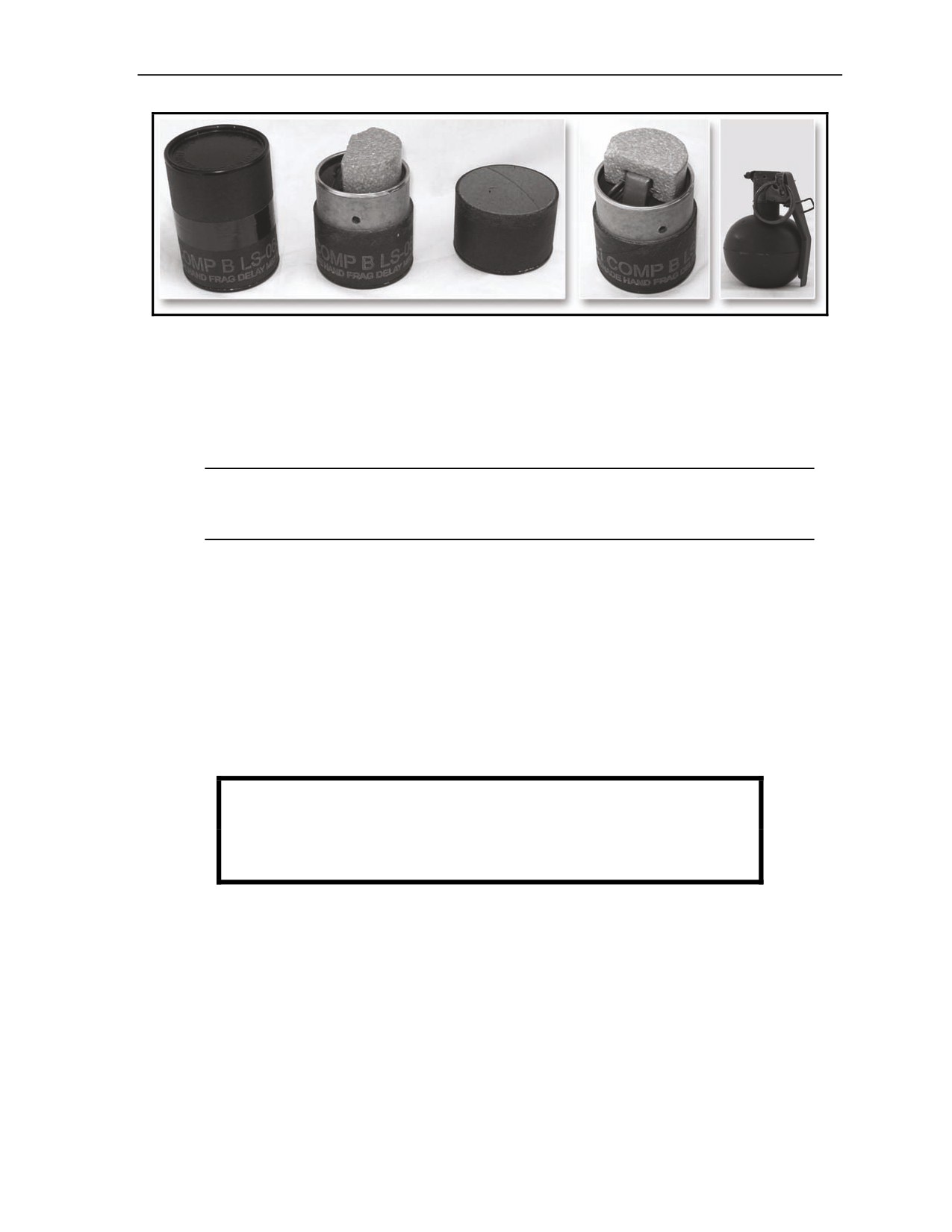
3-3. Each grenade within the shipping container is housed in sealed individual canisters
(Figure 3-2). Hand grenades may be issued while still in their individual shipping canisters or unpacked and
issued by someone within the chain of command.
3-4. Upon removing the sealed individual canisters from the shipping container, personnel should inspect the
canisters and identify any of the following discrepancies:
z
The canister has been damaged.
z
The seal on the canister has been tampered with or is missing.
Figure 3-2. Hand grenade shipping canister.
3-5. Personnel should open the canister. Once the canister has been opened but before removing the packing
material (Figure 3-3), personnel should inspect the grenade and identify any of the following discrepancies:
z
The hand grenade is upside down inside of the shipping canister.
z
The safety pin is not properly attached or is missing.
3-2
FM 3-23.30
15 October 2009
Hand Grenades
Figure 3-3. Hand grenade shipping canister with packing material.
3-6. Then, personnel should remove the packing material and the grenade from the canister. Once the packing
material and the grenade has been removed from the canister (Figure 3-3), personnel should inspect the grenade
and identify any of the following discrepancies:
z
Rust is on the body or the fuze.
z
Holes are visible in the body or the fuze.
NOTE: If any of the discrepancies are found upon receipt of newly issued hand grenades, personnel
should return the grenade and shipping canister to the issuing person or dispose of it in accordance
with the unit SOP.
BEFORE STORING
3-7. Before securing the hand grenades in ammunition pouches, personnel should take the following safety
precautions:
z
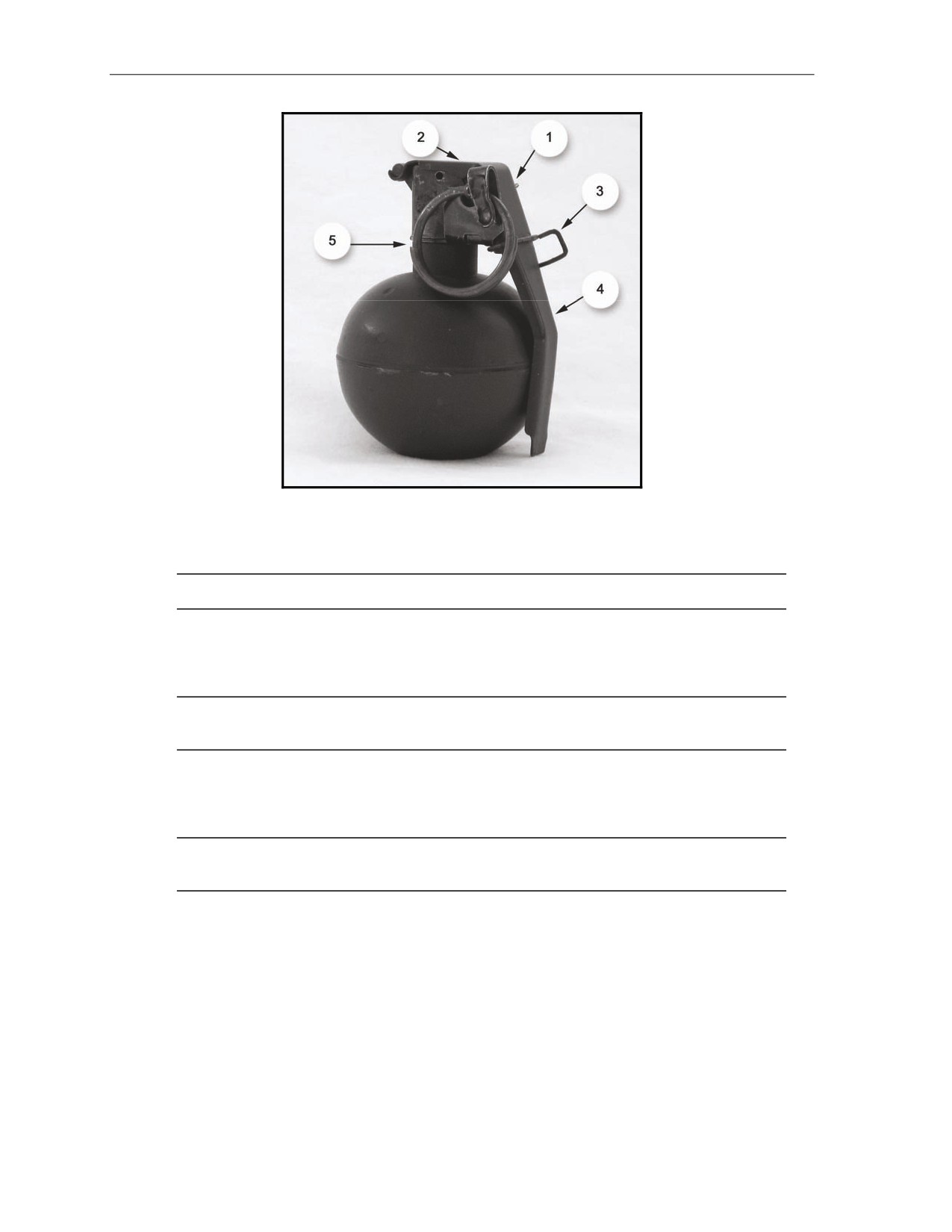
Inspect grenades to ensure all safety devices are present (Figure 3-4):
Safety pin (1) with pull ring and confidence clip (2).
Safety clip (3).
Safety lever (4).
z
Ensure all the safety devices are intact and serviceable.
z
Check the grenade fuze for tightness. It must be tightly fitted within the grenade body (5).
WARNING
Never remove the fuze from a live grenade.
z
Ensure the lever is not bent or broken.
z
Check the body for rust or dirt.
15 October 2009
FM 3-23.30
3-3
Chapter 3
Figure 3-4. Hand grenade with safety clip installed.
Safety Clip Installation
NOTE: A safety clip can be removed and reattached to a hand grenade if the safety pin is still in place.
3-8. Hand grenades equipped with a safety clip, which prevents the fuze safety lever from springing loose, may
come loose during shipping or when stowing or removing from the grenade carrying pouch. When installed
correctly, the safety clip secures the grenade fuze lever even if the safety pin assembly is accidentally removed.
NOTE: Not all hand grenades have safety clips. See TM 9-1330-200-12 for more information about
the types of grenades that do require and do not require a safety clip.
3-9. Once hand grenades have been removed from their shipping canister, personnel must ensure that the
safety clip is present and install a safety clip, if required. The safety clip is adaptable to M26 and M67-series
grenades, the MK2 grenade, and the M69 practice grenade.
NOTE: If lost or broken, safety clips for some types of grenades can be procured through
Class V ammunition supply channels (NSN 1330-00-183-5996).
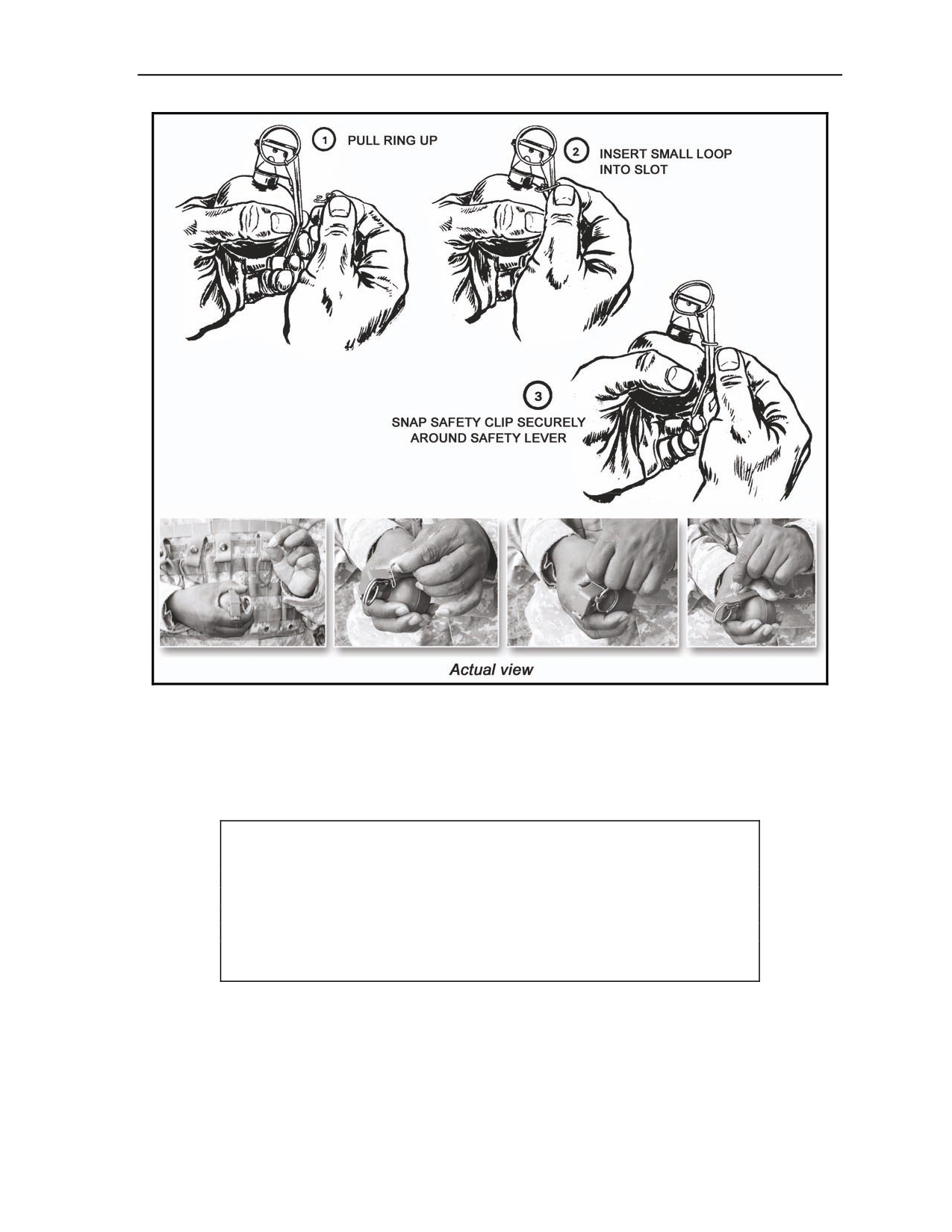
3-10. To install a safety clip (Figure 3-5)—
(1) Hold the fuzed grenade in the palm of your hand with the pull ring up.
(2) Insert the small loop at the open end of the safety clip into the slot of the fuze body beneath the
safety lever.
(3) Press the clip across the safety lever until the closed end of the clip touches the safety lever and
snaps securely into place around it.
3-4
FM 3-23.30
15 October 2009
Hand Grenades
Figure 3-5. Safety clip installation.
DAILY CHECKS
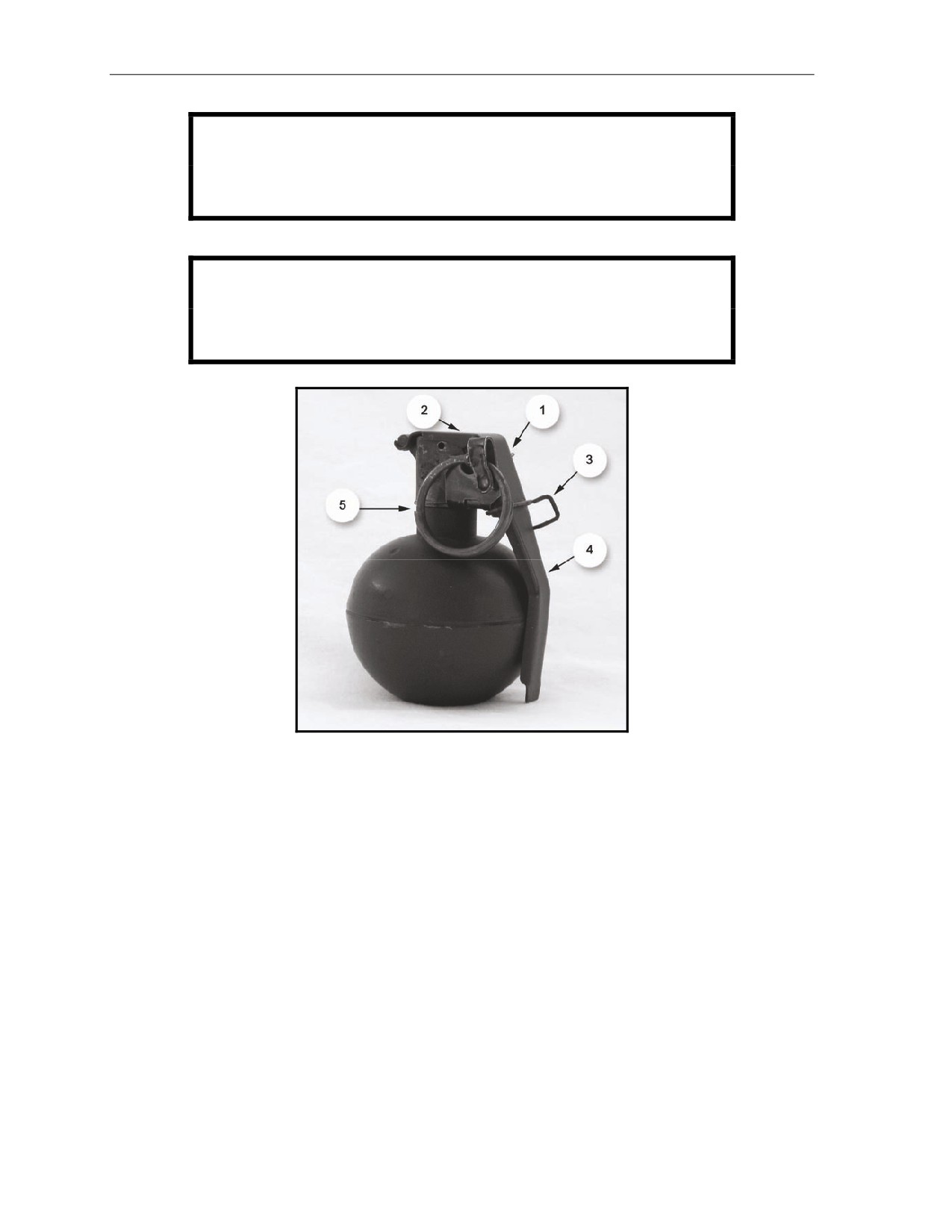
3-11. Personnel should check hand grenades daily. To perform daily checks (Figure 3-6)—
(1) Ensure the safety pin (1) is present.
CAUTION
Do not bend the ends of the pull ring safety pin back flush against the fuze
body. This practice, intended to preclude the accidental pulling of the pin,
makes the removal of the safety pin difficult. Repeated working of the
safety pin in this manner causes the pin to break, creating a hazardous
condition.
(2) Ensure the confidence clip (2) is present and properly secured to the pull ring.
(3) Ensure the safety clip (3) is present and properly secured to the safety lever (4).
(4) Check the grenade fuze assembly (5) for tightness.
15 October 2009
FM 3-23.30
3-5
Chapter 3
WARNING
Never remove the fuze from a live grenade.
(5) Ensure that the safety lever (4) is not broken.
WARNING
If the grenade safety lever is broken, do not use the grenade.
Figure 3-6. Hand grenade safety inspection points.
STORAGE
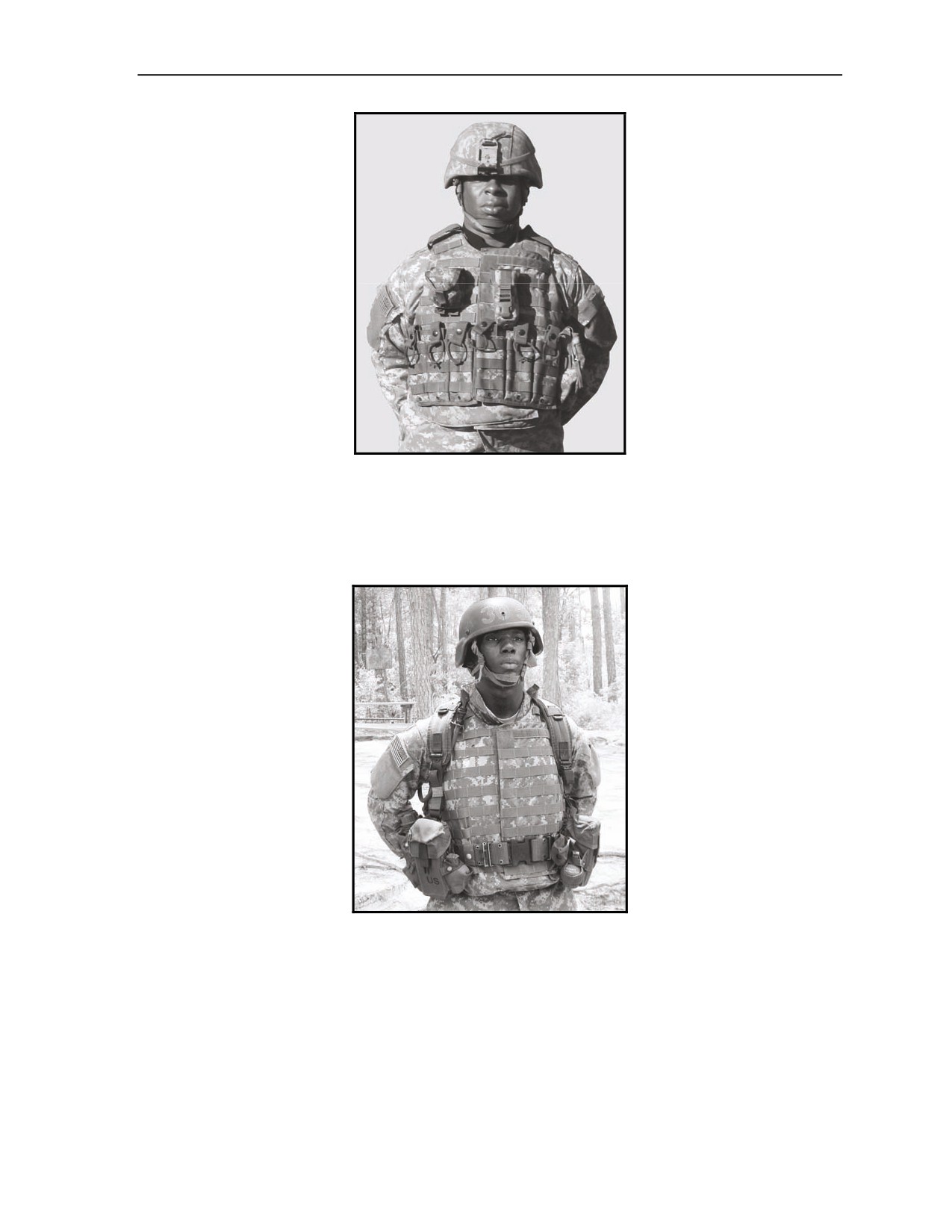
3-12. Personnel should carry hand grenades on the ammunition pouch using the carrying safety straps
designed specifically for this purpose or in the grenade pockets of the ETLBV. When storing grenades in the
ammunition pouch or on the ETLBV, personnel should adhere to the following guidelines:
z
Ensure that the grenade is fully inside of the carrying pouch and that the pocket flap is fully secured
(ETLBV or tactical vest only, shown in Figure 3-7).
3-6
FM 3-23.30
15 October 2009
Hand Grenades
Figure 3-7. Grenade carrying pouch
(attached to enhanced tactical load-bearing vest).
z
Ensure the safety lever is inside of the carrying pouch, and the pull ring is in the downward position.
Then, wrap the restraining strap around the neck of the fuze, and secure to the LCE only
(Figure 3-8).
Figure 3-8. Grenade carrying pouch (attached to load-carrying equipment).
z
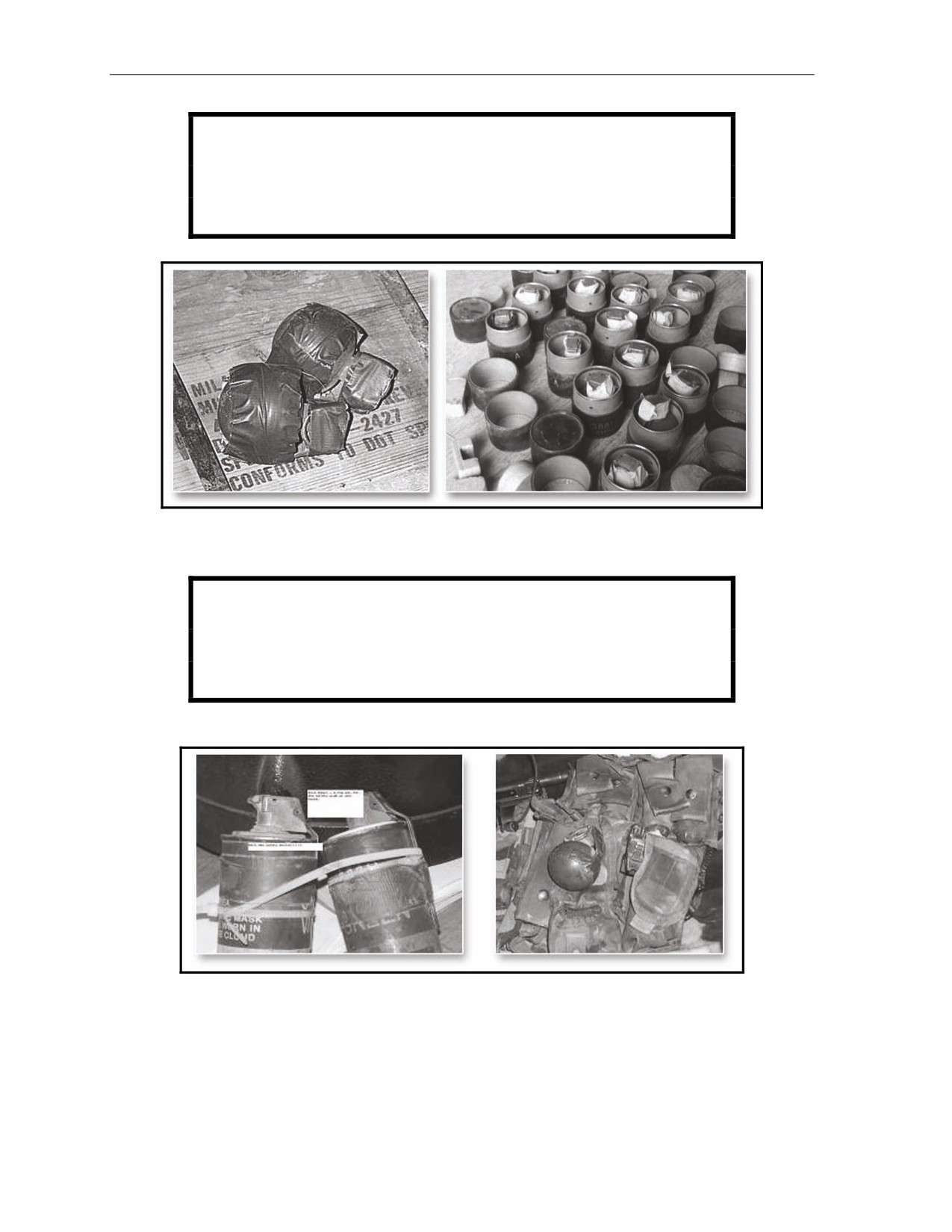
DO NOT put adhesive tape around a grenade fuze, the pull ring, or safety lever as is shown below
(Figure 3-9).
15 October 2009
FM 3-23.30
3-7
Chapter 3
WARNING
Do not tape a hand grenade safety lever or safety pin. The safety
pin can come off with the tape, causing the grenade to explode.
Figure 3-9. Taping and storing hand grenades.
z
Carry hand grenades using the proper procedures.
WARNING
Never carry the grenades suspended by the safety pull ring or
safety lever.
z
DO NOT tape hand grenades to Soldier gear (Figure 3-10).
Figure 3-10. Taping hand grenades to Soldier gear.
3-8
FM 3-23.30
15 October 2009
Hand Grenades
z
Never make unauthorized modifications to hand grenades.
WARNING
Grenade safety devices are designed so that the grenade remains
safe in storage. Do not bend, tamper, modify or otherwise alter a
hand grenade safety pin or safety lever.
z
During air operations in wartime conditions, Soldiers must be prepared to engage the enemy as soon
as they land; therefore, Soldiers must carry their grenades in their ammunition pouches.
CAUTION
During training missions, do not carry hand grenades in ammunition
pouches during airborne operations. Carry the grenades in the main body
of the rucksack instead.
USE
3-13. To safely throw hand grenades, Soldiers must demonstrate and execute the proper techniques of gripping,
preparing, and throwing the grenade.
NOTE: The M69 practice hand grenade is used for all individual and collective training tasks.
GRIPPING
3-14. A grenade not held properly is difficult to arm. Gripping procedures differ slightly for right- and
left-handed Soldiers; however, proper hold remains constant. Holding the grenade in the throwing hand with the
safety lever placed between the first and second joints of the thumb provides safety and throwing efficiency.
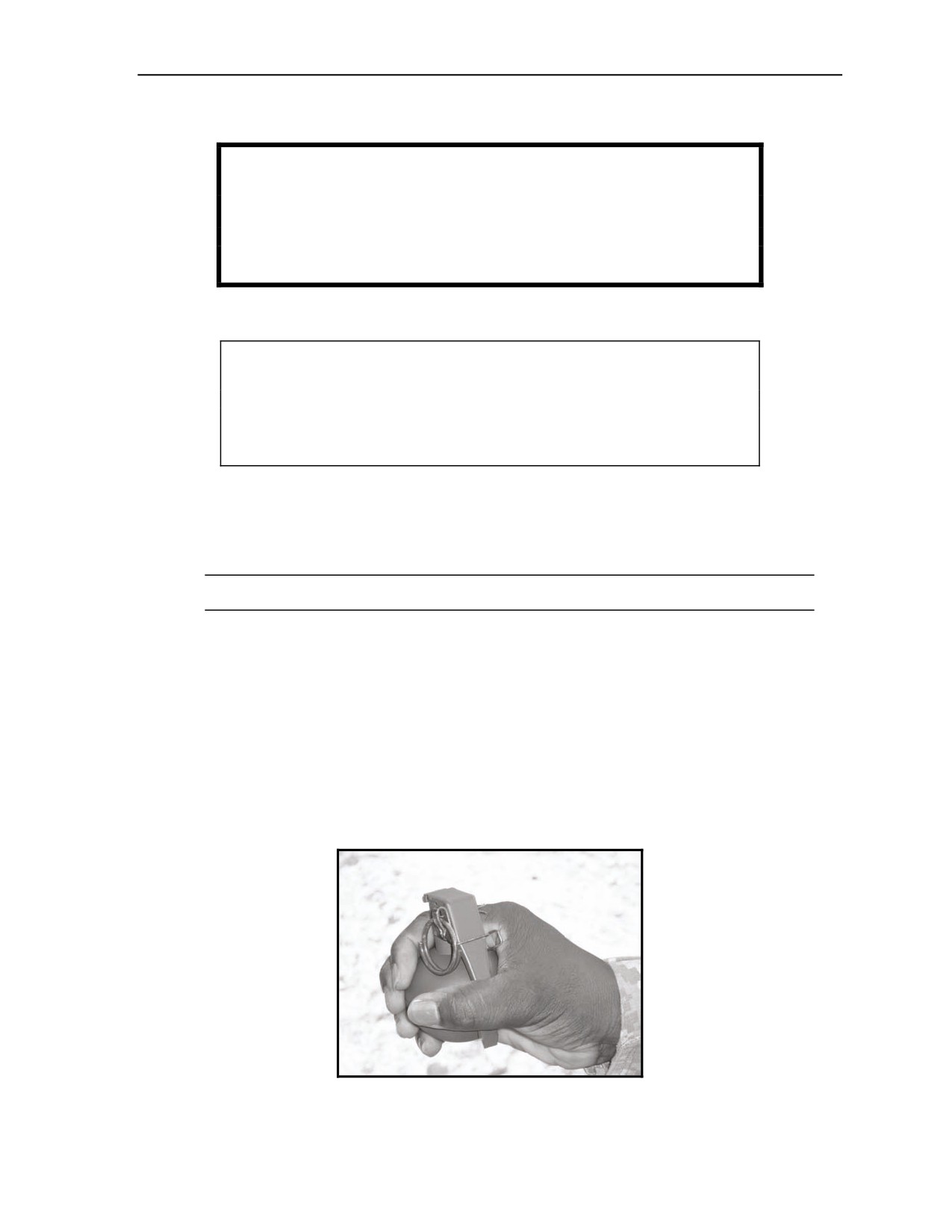
Right-Hand Grip
3-15. To throw the grenade with the right hand, Soldiers should use the right-hand grip (Figure 3-11). To use
the right-hand grip, hold the grenade upright, with the pull ring away from the palm of the throwing hand so
that the pull ring can be easily removed by the index or middle finger of the free hand.
Figure 3-11. Right-hand grip.
15 October 2009
FM 3-23.30
3-9
Chapter 3
Left-Hand Grip
3-16. To throw the grenade with the left hand, Soldiers should use the left-hand grip (Figure 3-12). To use
the left-hand grip, invert the grenade, with the pull ring away from the palm of the throwing hand so that the
pull ring can be easily removed by the index or middle finger of the free hand.
Figure 3-12. Left-hand grip.
PREPARING
NOTE: Do not remove the safety clip or the safety pin until the grenade is about to be thrown.
CAUTION
Never attempt to reinsert a safety pin into a hand grenade during training. In
combat, however, it may be necessary to reinsert a safety pin into a grenade.
Take special care to replace the pin properly. If the tactical situation allows, it
is safer to throw the grenade rather than to trust the reinserted pin.
3-17. The method of grenade preparation is determined by the thrower’s grip. To prepare the grenade—
z
Tilt the grenade forward to observe the safety clip.
z
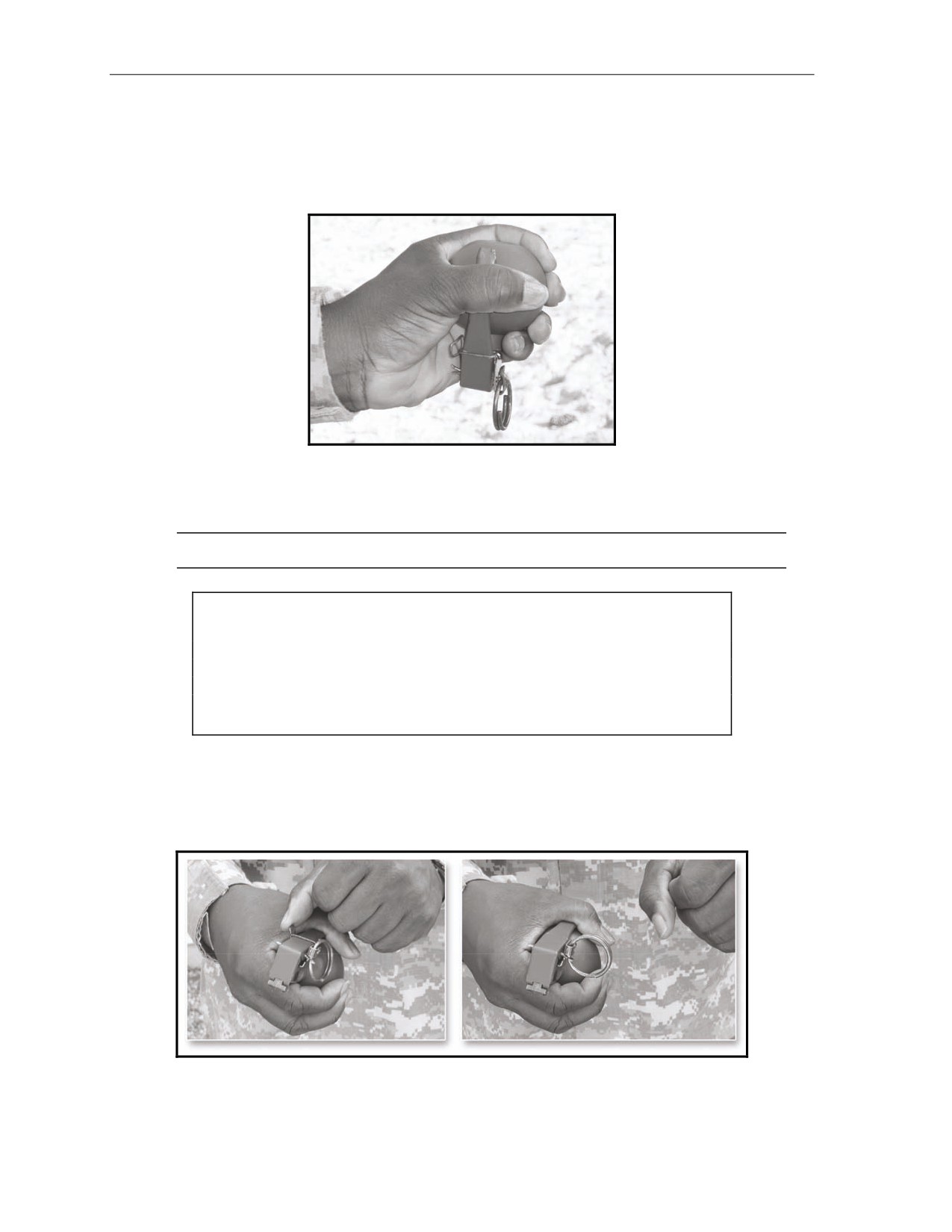
Remove the safety clip by sweeping it away from the grenade with the thumb of the opposite hand
(Figure 3-13 and Figure 3-14).
Figure 3-13. Right-hand grip, removing the safety clip.
3-10
FM 3-23.30
15 October 2009
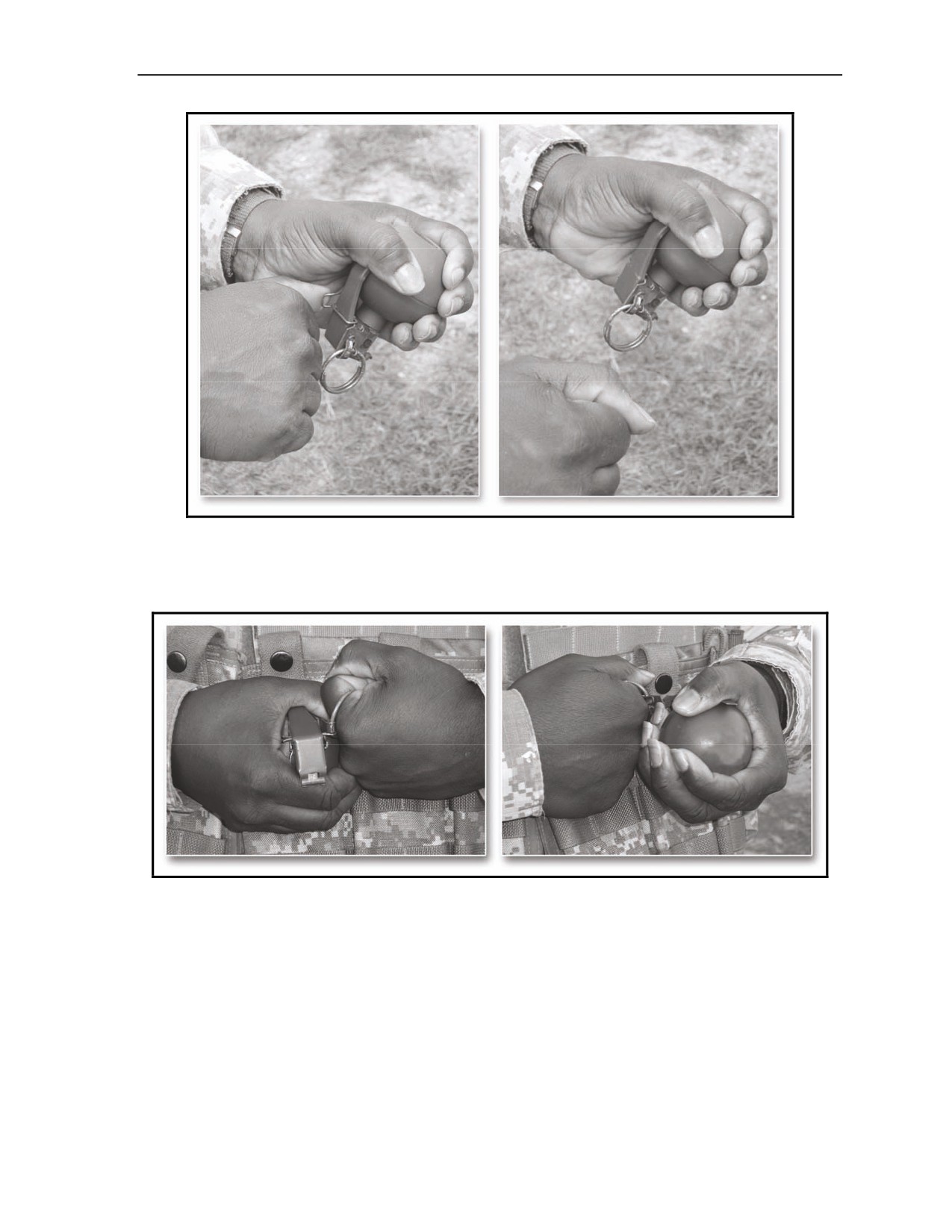
Hand Grenades
Figure 3-14. Left-hand grip, removing the safety clip.
z
Insert the index or middle finger of the nonthrowing hand in the pull ring until it reaches the knuckle
of the finger (Figure 3-15).
Figure 3-15. Pull ring grip, right-/left-hand thrower.
(1) Remove the safety pin from the confidence clip. For a right-handed thrower
(Figure 3-16)—
15 October 2009
FM 3-23.30
3-11
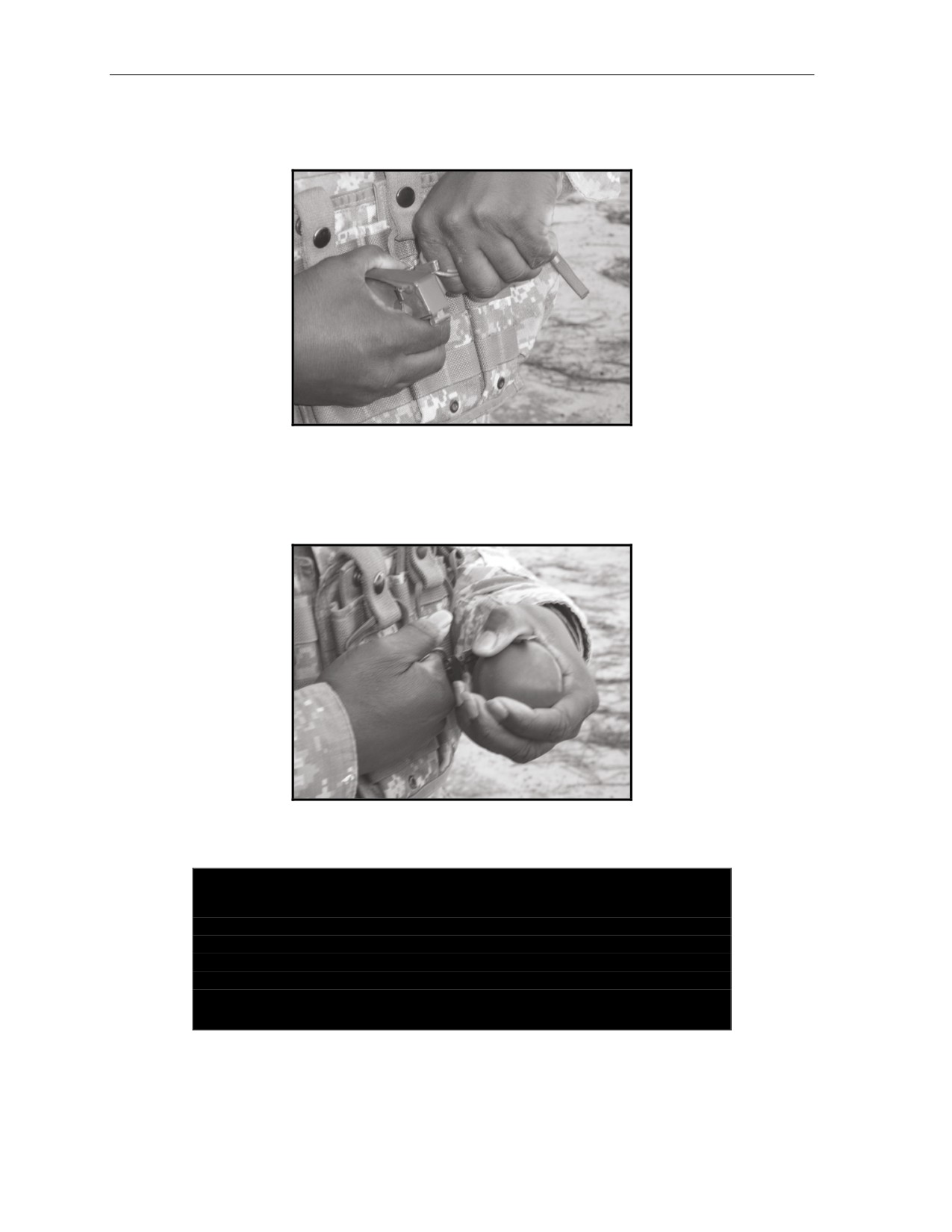
Chapter 3
Twist the pull ring toward the body to release the pull ring from the confidence clip.
Pull the safety pin from the grenade.
Figure 3-16. Right-hand grip, pulling the safety pin.
For a left-handed thrower (Figure 3-17)—
Twist the pull ring away the body to release the pull ring from the confidence clip.
Pull the safety pin from the grenade.
Figure 3-17. Left-hand grip, pulling the safety pin.
(2) Ensure that you are holding the safety lever down firmly.
DANGER
IF PRESSURE ON THE SAFETY LEVER IS RELAXED AFTER THE
SAFETY CLIP AND SAFETY PIN ARE REMOVED, THE STRIKER CAN
ROTATE AND STRIKE THE PRIMER WHILE THE THROWER IS STILL
HOLDING THE GRENADE. CONTINUING TO HOLD THE GRENADE
BEYOND THIS POINT CAN RESULT IN INJURY OR DEATH.
(3) Remove the safety pin by pulling on the pull ring.
3-12
FM 3-23.30
15 October 2009
Hand Grenades
COOKING OFF
WARNINGS
In training, never cook off live fragmentation hand grenades or
offensive concussion grenades. Use cook-off procedures only in a
combat environment.
Never cook off the M84, stun grenade, or smoke grenades. These
grenades have short fuze delays (1 to 2.3 seconds) and will cause
serious personal injury if cook-off procedures are performed.
3-18. To achieve above-ground detonation or near-impact detonation—
(1) Remove the grenade’s safety pin.
(2) Release the safety lever.
(3) Count “One thousand one, one thousand two.”
(4) Throw the grenade.
3-19. This is called cooking off. Cooking off uses enough of the grenade’s 4- to 5-second delay (about 2
seconds) to cause the grenade to detonate above ground or shortly after impact with the target.
THROWING
WARNING
Throwers must consider the flight path of the grenade to make
sure no obstacles alter the flight of the grenade or cause it to
bounce back toward them.
3-20. Soldiers can use five positions to throw grenades:
z
Standing.
z
Prone-to-standing.
z
Kneeling.
z
Prone-to-kneeling.
z
Alternate prone.
3-21. Tactical employment of the hand grenade is METT-TC dependant. The situation will usually dictate
the position best suited for delivering a grenade on target.
3-22. If a Soldier can achieve more distance and accuracy using his own personal style, he should be allowed
to do so as long as his body is facing sideways and toward the enemy’s position, and he throws the grenade
overhand. There are, however, general steps that the Soldier must follow:
(1) Observe the target to estimate the distance between the throwing position and the target area.
NOTE: In observing the target, minimize exposure time to the enemy (no more than 3 seconds).
(2) Grip the hand grenade in the right or left throwing hand.
(3) Look at the target.
(4) Throw the grenade overhand so that the grenade arcs, landing on or near the target.
15 October 2009
FM 3-23.30
3-13
Chapter 3
(5) Allow the motion of the throwing arm to continue naturally once the grenade is released.
NOTE: This follow-through improves distance and accuracy and lessens the strain on the throwing
arm.
(6) Seek cover to avoid being hit by fragments or direct enemy fire. If no cover is available, drop to the
prone position with your protective head gear facing the direction of the grenade’s detonation.
NOTE: Soldiers should practice throws that are used in combat, such as the underhand and sidearm
throws. Soldiers can practice these throws with practice grenades, but they must throw live
fragmentation grenades overhand in a training environment.
Standing Position
3-23. The standing position is the most desirable and natural position from which to throw grenades. It
allows the Soldier to obtain the greatest possible throwing distance. However, this position should only be
used when cover and concealment is readily available.
3-24. To throw a grenade from the standing position (Figure 3-18)—
(1) Observe the target to estimate the distance between the throwing position and the target area.
(2) Assume a natural stance, with your weight balanced equally on both feet.
(3) Prepare the grenade.
(4) Hold the grenade shoulder high and the nonthrowing hand at a 45-degree angle with the fingers and
thumb extended, joined, and pointing toward the intended target.
(5) Throw the grenade overhand so that the grenade arcs, landing on or near the target.
(6) Allow the motion of the throwing arm to continue naturally once the grenade is released.
(7) Seek cover to avoid being hit by fragments or direct enemy fire. If no cover is available, drop to the
prone position facing the direction of the grenade’s detonation.
3-14
FM 3-23.30
15 October 2009
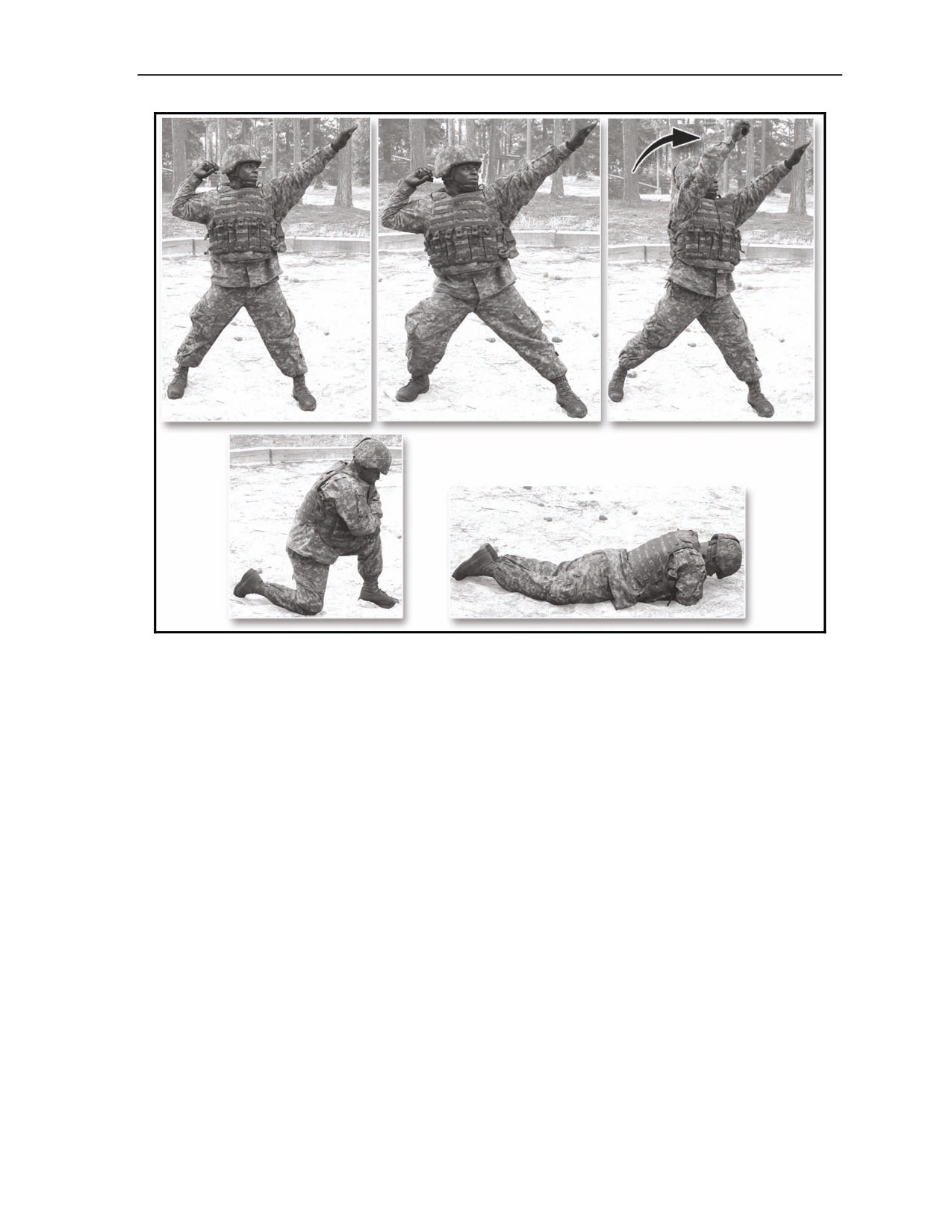
Hand Grenades
Figure 3-18. Standing position.
Prone-To-Standing Position
3-25. When exposure time is more important than accuracy and cover and concealment is not readily
available, the prone-to-standing position can be used to immediately suppress an area.
3-26. To throw a grenade from the prone-to-standing position (Figure 3-19)—
(1) Lie down on the stomach with the body parallel to the grenade’s intended line of flight.
(2) Hold the grenade at chest level.
(3) Place the hands in a push-up position, and stand up while holding the grenade in the throwing hand.
Assume a good standing position, if the situation permits.
(4) Prepare the grenade.
(5) Hold the grenade shoulder high and the nonthrowing hand at a 45-degree angle with the fingers and
thumb extended, joined, and pointing toward the intended target.
(6) Throw the grenade overhand so that the grenade arcs, landing on or near the target.
(7) Allow the motion of the throwing arm to continue naturally once the grenade is released.
(8) After throwing the grenade, drop to the ground on the stomach and press flat against the ground.
15 October 2009
FM 3-23.30
3-15
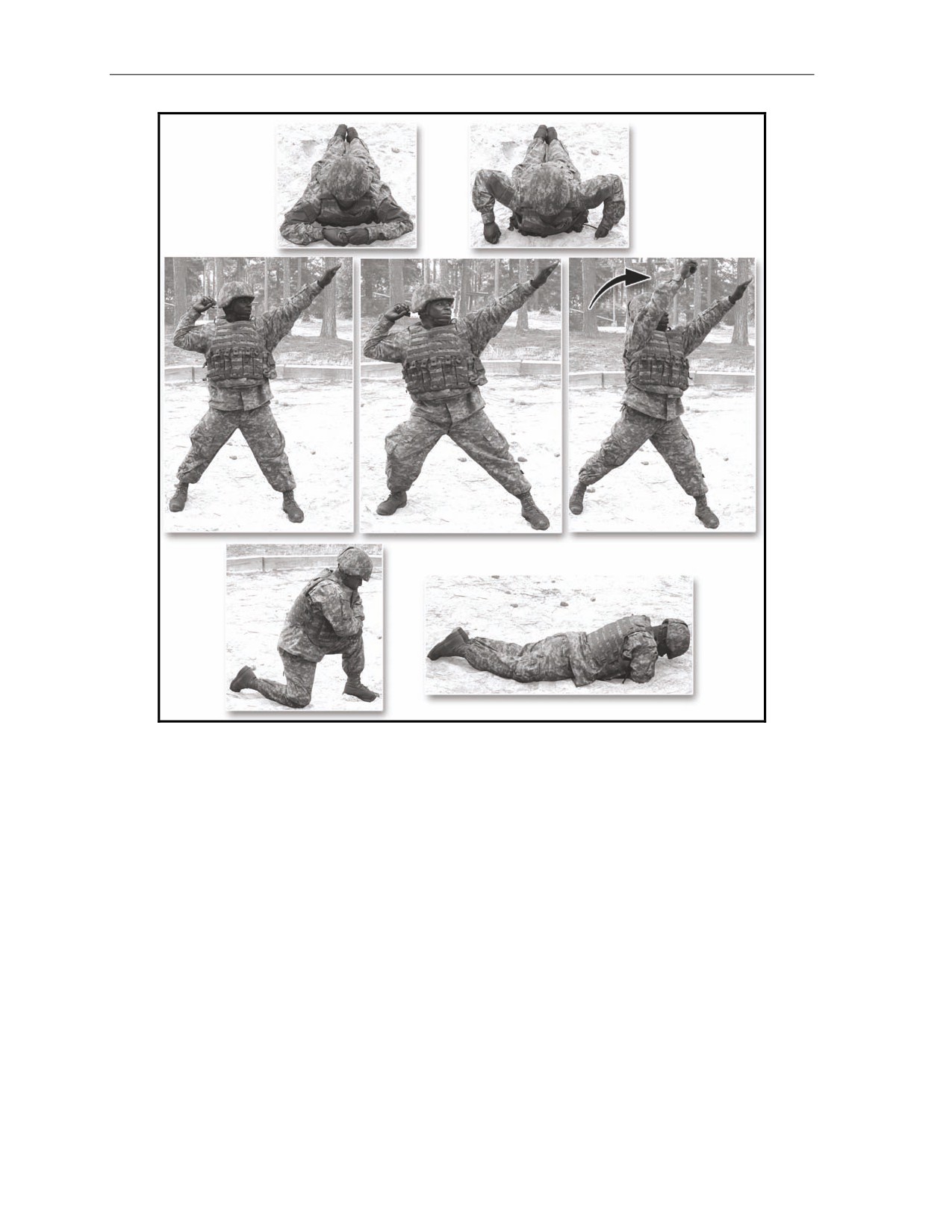
Chapter 3
Figure 3-19. Prone-to-standing position.
Kneeling Position
3-27. The kneeling position reduces the distance a Soldier can throw a grenade. It is used primarily from
behind low-level ground cover.
3-28. To throw a grenade from the kneeling position (Figure 3-20)—
(1) Observe the target to mentally estimate the throwing distance.
(2) Prepare the grenade while behind cover.
(3) Bend the nonthrowing knee at a 90-degree angle, placing that knee on the ground. Keep the
throwing leg straight and locked, with the side of the boot firmly on the ground.
(4) Move the body to face sideways, toward the target position.
(5) Hold the grenade shoulder high and the nonthrowing hand at a 45-degree angle with the fingers and
thumb extended, joined, and pointing toward the intended target.
(6) Throw the grenade overhand so that the grenade arcs, landing on or near the target. Push off with the
throwing foot to give added force to the throw.
(7) Allow the motion of the throwing arm to continue naturally once the grenade is released.
(8) Drop to the prone position or behind available cover to reduce exposure to fragmentation and direct
enemy fire.
3-16
FM 3-23.30
15 October 2009
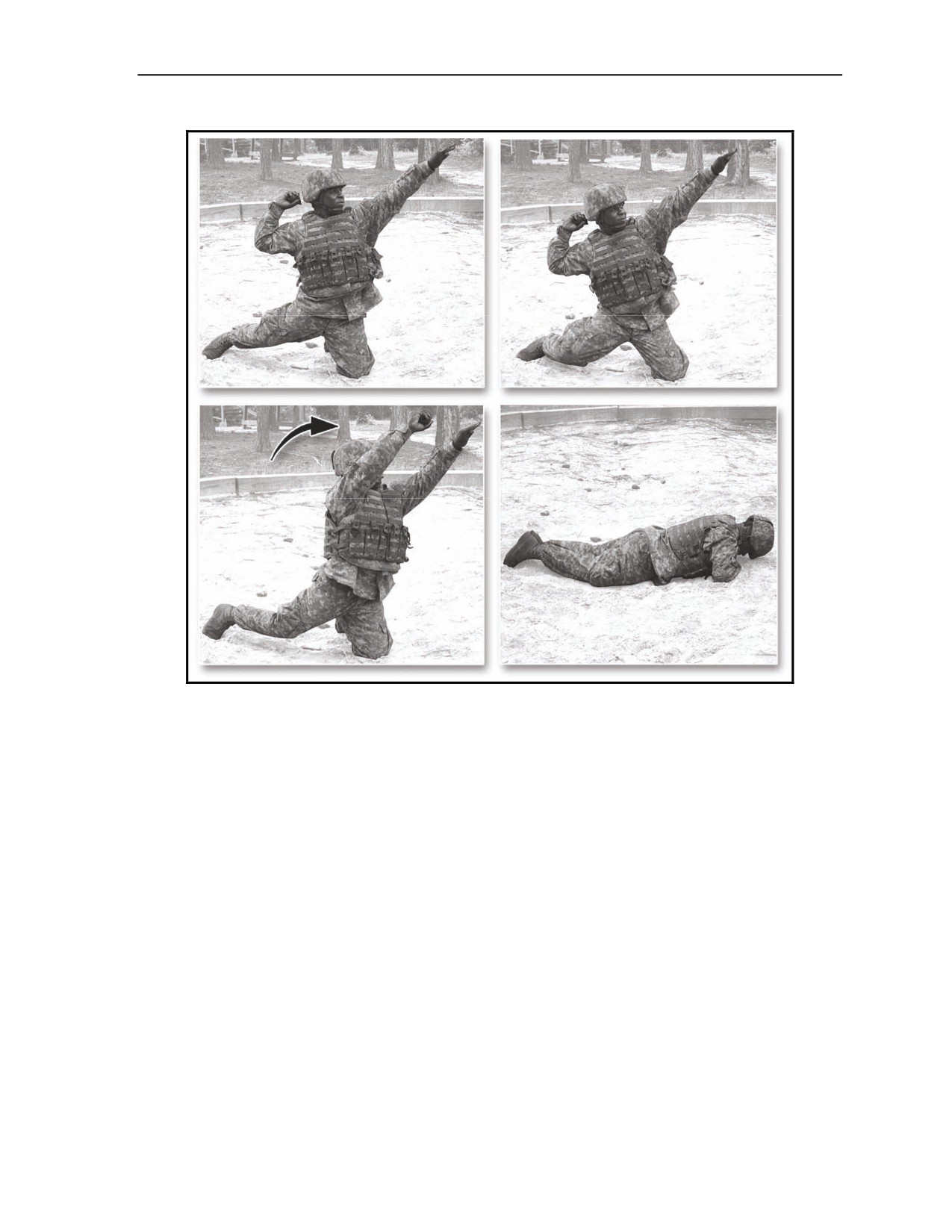
Hand Grenades
Figure 3-20. Kneeling position.
Prone-To-Kneeling Position
3-29. The prone-to-kneeling position enables the Soldier to throw the grenade farther and is performed for
the same reason as the prone-to-standing position; time to throw is more important than accuracy.
3-30. To throw a grenade from the prone-to-kneeling position (Figure 3-21)—
(1) Lie down on the stomach, with the body parallel to the grenade’s intended line of flight.
(2) Hold the grenade at chest level.
(3) Place the hands in a push-up position, and assume the kneeling position while holding the grenade in
the throwing hand. Assume a good kneeling position, if the situation permits.
(4) Prepare the grenade.
(5) Hold the grenade shoulder high and the nonthrowing hand at a 45-degree angle with the fingers and
thumb extended, joined, and pointing toward the intended target.
(6) Throw the grenade overhand so that the grenade arcs, landing on or near the target.
(7) Allow the motion of the throwing arm to continue naturally once the grenade is released.
(8) After throwing the grenade, drop to the ground on the stomach and press flat against the ground.
15 October 2009
FM 3-23.30
3-17
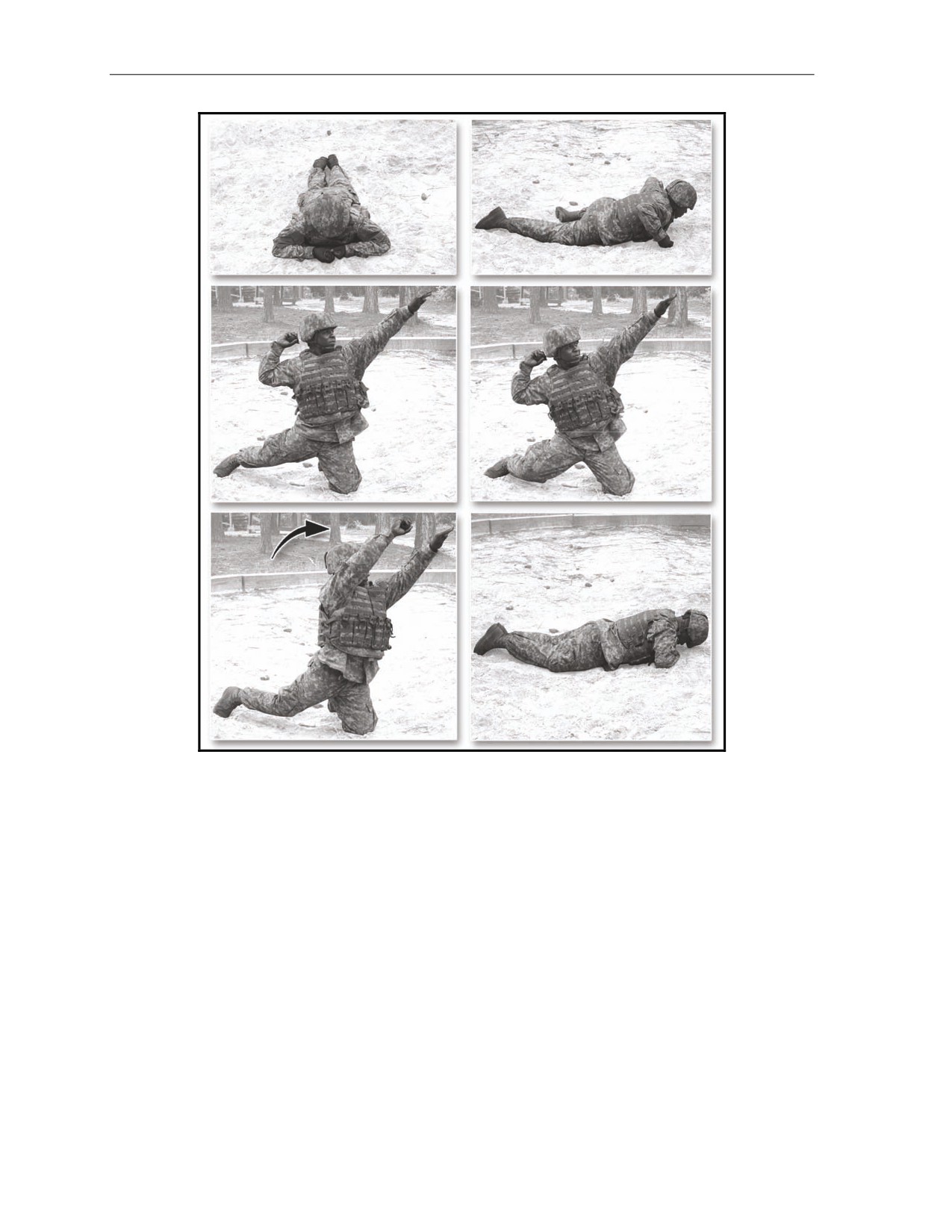
Chapter 3
Figure 3-21. Prone-to-kneeling position.
Alternate Prone Position
3-31. The alternate prone position reduces both distance and accuracy and is used when rising to engage a
target is not safe.
3-32. To throw a grenade from the alternate prone position (Figure 3-22)—
(1) Lie down on the back, with the body parallel to the grenade’s intended line of flight.
(2) Hold the grenade at chin/chest level.
(3) Prepare the grenade.
(4) Cock the throwing leg at a 45-degree angle, maintaining knee-to-knee contact and bracing the side of
the boot firmly on the ground.
(5) Hold the grenade 4 to 6 inches behind the ear with the arm cocked for throwing.
(6) With the free hand, grasp any object that will provide additional leverage to increase the throwing
distance.
(7) Throw the grenade, and push off with the rearward foot to give added force to the throw.
3-18
FM 3-23.30
15 October 2009