FM 3-23.30 Grenades and Pyrotechnic Signals (October 2009) - page 1
* FM 3-23.30
Field Manual
Headquarters
No. 3-23.30
Department of the Army
Washington, DC, 15 October 2009
Grenades and Pyrotechnic Signals
Contents
Page
Chapter 1
INTRODUCTION
1-1
Hand Grenades
1-1
Pyrotechnic Signals
1-2
Plans and Preparations for Training and Combat
1-3
Employment Rules
1-3
Chapter 2
TRAINING
2-1
Section I. Training Strategy
2-1
Objectives
2-1
Initial and Sustainment Training
2-1
Section II. Training Program
2-3
Mission-Essential Tasks
2-3
Training Assessment
2-3
Trainers
2-5
Trainer Certification Program
2-7
Section III. Training Preparation
2-8
Conduct a Training Risk Assessment
2-8
Conduct an Environmental Risk Assessment
2-10
Make Range Coordinations
2-10
Section IV. Training Conduct
2-27
Occupy, Inspect, and Set Up Range
2-27
Preparation for Training
2-28
Conduct the Training
2-28
Complete the Training Mission
2-43
Chapter 3
HAND GRENADES
3-1
Inspection
3-1
Storage
3-6
Use
3-9
Maintenance
3-19
Destruction Procedures
3-20
DISTRIBUTION RESTRICTION: Approved for public release; distribution is unlimited.
*This publication supersedes FM 3-23.30, 7 June 2005, and FM 3-23.30, Change 1, 27 November 2006.
i
Contents
Chapter 4
PYROTECHNIC SIGNALS AND SIMULATORS
4-1
Section I. Communication Signals
4-1
Handheld Signals
4-1
Maintenance
4-8
Destruction Procedures
4-8
Ground Smoke Signals
4-9
Inspection
4-9
Storage
4-9
Use
4-10
Section II. Trip Flares
4-11
Storage
4-13
Use
4-13
Maintenance
4-15
Removal
4-15
Section III. Simulated Signals
4-15
Early Warning Simulators
4-16
Ground-Burst Simulator
4-20
Hand Grenade Simulator
4-22
Section IV. Illumination Ground Signal Kits
4-23
Inspection
4-23
Storage
4-24
Use
4-24
Maintenance
4-24
Destruction Procedures
4-24
Chapter 5
EMPLOYMENT CONSIDERATIONS
5-1
Application
5-1
Rules of Engagement
5-2
Considerations
5-2
Offensive Operations
5-2
Defensive Operations
5-5
Retrograde Operations
5-5
Urban Operations
5-6
Air Operations
5-7
Use Under Adverse Conditions
5-7
Appendix A
CHARACTERISTICS OF GRENADES
A-1
Fragmentation Hand Grenades
A-1
Practice Hand Grenades
A-2
Offensive Hand Grenades
A-9
Nonlethal Hand Grenades
A-10
Chemical Grenades
A-11
ii
FM 3-23.30
15 October 2009
Contents
Appendix B CHARACTERISTICS OF PYROTECHNIC SIGNALS AND SIMULATORS
B-1
Section I. Communication Signals
B-1
Handheld Signals
B-1
Ground Smoke Signals
B-3
Section II. Trip Flares
B-8
Section III. Simulated Signals
B-10
Early Warning Simulators
B-10
Ground-Burst Simulator
B-13
Hand Grenade Simulator
B-14
Section IV. Illumination Ground Signal Kits
B-15
M185 and M186 Personnel Signal Kits
B-16
M260 Red Personnel Distress Signal Kit
B-17
Figures
Figure 2-1. Initial entry training hand grenade training strategy
2-2
Figure 2-2. Distance and accuracy layout
2-11
Figure 2-3. Hand grenade mock-bay layout
2-12
Figure 2-4. Throwing pit with knee wall
2-13
Figure 2-5. Throwing pit with safety pits
2-14
Figure 2-6. Suggested live-bay layout
2-15
Figure 2-7. Hand grenade range requirements
2-15
Figure 2-8. Hand grenade live-bay layout
2-16
Figure 2-9. Hand grenade live-bay layout, observation window
2-16
Figure 2-10. Hand grenade qualification course layout
2-17
Figure 2-11. Station 1, engage enemy from fighting position (standing)
2-18
Figure 2-12. Station 2, engage bunker (prone)
2-18
Figure 2-13. Station 3, engage enemy mortar position (kneeling)
2-18
Figure 2-14. Station 4, engage enemy from behind cover (prone)
2-19
Figure 2-15. Station 5, engage trench (standing)
2-20
Figure 2-16. Station 6, engage wheeled vehicle (kneeling)
2-20
Figure 2-17. Station 7, identify hand grenades and pyrotechnic signals
2-21
Figure 2-18. Surface danger zone for live-bay
2-26
Figure 2-19. Example of a completed DA Form 3517-R (Hand Grenade Qualification
Scorecard) (front)
2-35
Figure 2-20. Example of a completed DA Form 3517-R (Hand Grenade Qualification
Scorecard) (back)
2-36
Figure 2-21. Example of squad situational training exercise with hand grenades
2-43
Figure 3-1. Hand grenade shipping container
3-2
Figure 3-2. Hand grenade shipping canister
3-2
Figure 3-3. Hand grenade shipping canister with packing material
3-3
Figure 3-4. Hand grenade with safety clip installed
3-4
Figure 3-5. Safety clip installation
3-5
15 October 2009
FM 3-23.30
iii
Contents
Figure
3-6. Hand grenade safety inspection points
3-6
Figure
3-7. Grenade carrying pouch (attached to enhanced tactical load-bearing vest)
3-7
Figure
3-8. Grenade carrying pouch (attached to load-carrying equipment)
3-7
Figure
3-9. Taping and storing hand grenades
3-8
Figure
3-10. Taping hand grenades to Soldier gear
3-8
Figure
3-11. Right-hand grip
3-9
Figure
3-12. Left-hand grip
3-10
Figure
3-13. Right-hand grip, removing the safety clip
3-10
Figure
3-14. Left-hand grip, removing the safety clip
3-11
Figure
3-15. Pull ring grip, right-/left-hand thrower
3-11
Figure
3-16. Right-hand grip, pulling the safety pin
3-12
Figure
3-17. Left-hand grip, pulling the safety pin
3-12
Figure
3-18. Standing position
3-15
Figure
3-19. Prone-to-standing position
3-16
Figure
3-20. Kneeling position
3-17
Figure
3-21. Prone-to-kneeling position
3-18
Figure
3-22. Alternate prone position
3-19
Figure
4-1. Handheld pyrotechnic signal
4-1
Figure
4-2. Handheld signal shipping container
4-2
Figure
4-3. Handheld signal barrier bag
4-3
Figure
4-4. Handheld signal individual sealed steel container
4-4
Figure
4-5. Handheld signal individual container
4-4
Figure
4-6. Handheld signal removed from the individual container
4-5
Figure
4-7. Safety inspection points—before storage
4-5
Figure
4-8. Firing a handheld signal
4-7
Figure
4-8. Firing a handheld signal (continued)
4-8
Figure
4-9. Smoke grenades
4-9
Figure
4-10. M49A1 surface trip flare
4-11
Figure
4-11. M49A1 surface trip flare trigger spring position
4-12
Figure
4-12. Early warning simulator shipping container and barrier bags
4-16
Figure
4-13. Early warning simulator cardboard shipping box
4-17
Figure
4-14. Early warning simulator removed from the cardboard shipping box
4-17
Figure
4-15. Kit components
4-18
Figure
4-16. M115A2 ground-burst simulator
4-21
Figure
4-17. M116A1 hand grenade simulator
4-22
Figure
4-18. M260 illumination ground signal kit
4-23
Figure A-1. Confidence clip
A-1
Figure A-2. M67 fragmentation hand grenade
A-2
Figure A-3. M69 practice hand grenade
A-3
Figure A-4. M228 detonating fuze
A-4
Figure A-5. Gripping the M228 detonating fuze
A-5
iv
FM 3-23.30
15 October 2009
Contents
Figure A-6. Placing the confidence clip over the threaded end of the M228 fuze
A-5
Figure A-7. Insert the M228 fuze into the M69 practice hand grenade body and
secure pull ring to the confidence clip (right hand)
A-6
Figure A-8. Securing the pull ring to the confidence clip (left hand)
A-7
Figure A-9. M102 practice stun hand grenade
A-8
Figure A-10. M240 detonating fuze
A-9
Figure A-11. MK3A2 offensive grenade
A-10
Figure A-12. M84 stun grenade
A-11
Figure A-13. AN-M14 TH3 incendiary hand grenade
A-12
Figure A-14. ABC-M7A2 and ABC-M7A3 riot-control hand grenades
A-13
Figure B-1. Confidence clip
B-1
Figure B-2. Handheld pyrotechnic signal
B-2
Figure B-3. M18 colored smoke hand grenades
B-3
Figure B-4. M83 TA white smoke hand grenade
B-4
Figure B-5. AN-M8 HC white smoke hand grenade
B-5
Figure B-6. M106 white smoke hand grenade
B-7
Figure B-7. M49A1 surface trip flare
B-9
Figure B-8. M117 flash explosive booby trap simulator
B-10
Figure B-9. M118 illuminating explosive booby trap simulator
B-11
Figure B-10. M119 whistling booby trap simulator
B-12
Figure B-11. M115A2 ground-burst simulator
B-13
Figure B-12. M116A1 hand grenade simulator
B-15
Figure B-13. M185-red/M186-various color personnel signal kit
B-16
Figure B-14. M260 red personnel distress signal kit
B-17
Tables
Table 2-1. Officer in charge/range safety officer requirements
2-22
Table 2-2. Status of dropped grenade
2-27
Table 2-3. Distance and accuracy course—task, condition, and standard
2-29
Table 2-4. Hand grenade qualification course stations
2-34
Table 2-5. Identify hand grenade and pyrotechnic signals—task, condition, and standard
2-37
Table 2-6. Inspect and maintain hand grenades and pyrotechnic signals— task,
condition, and standard
2-37
Table 2-7. Employ a pyrotechnic signal—task, condition, and standard
2-38
Table 2-8. Distance and accuracy course—task, condition, and standard
2-38
Table 2-9. Bunker complex course—task, condition, and standard
2-39
Table 2-10. Trench complex course—task, condition, and standard
2-40
Table 2-11. Building complex course—task, condition, and standard
2-41
Table 2-12. Mock-bay training—task, condition, and standard
2-41
Table 2-13. Live-bay training—task, condition, and standard
2-42
Table 5-1. Types of hand grenades and their applications
5-1
15 October 2009
FM 3-23.30
v
Contents
Table 5-2. Types of pyrotechnic signals and their applications
5-1
Table 5-3. Hand grenade employment during urban operations
5-6
Table A-1. Components and characteristics of M67 fragmentation grenade
A-2
Table A-2. Components and characteristics of M69 practice grenade
A-3
Table A-3. Components and characteristics of M102 practice stun grenade
A-8
Table A-4. Components and characteristics of MK3A2 offensive grenade
A-10
Table A-5. Components and characteristics of M84 stun grenade
A-11
Table A-6. Components and characteristics of AN-M14 TH3 incendiary hand grenade
A-12
Table A-7. Components and characteristics of ABC-M7A2 and ABC-M7A3
riot-control hand grenades
A-13
Table B-1. Handheld signal identification
B-2
Table B-2. Components and characteristics of M18 colored smoke hand grenade
B-4
Table B-3. Components and characteristics of M83 TA white smoke hand grenade
B-5
Table B-4. Components and characteristics of AN-M8 HC white smoke hand grenade
B-6
Table B-5. Components and characteristics of M106 white smoke hand grenade
B-7
Table B-6. Components and characteristics of M49A1 surface trip flare
B-9
Table B-7. Components and characteristics of M117 flash explosive booby trap
simulator
B-11
Table B-8. Components and characteristics of M118 illuminating explosive booby
trap simulator
B-12
Table B-9. Components and characteristics of M119 whistling booby trap simulator
B-13
Table B-10. Components and characteristics of M115A2 ground-burst simulator
B-14
Table B-11. Components and characteristics of M116A1 ground-burst simulator
B-15
Table B-12. Components and characteristics of M185-red/M186-various color
personnel signal kit
B-17
Table B-13. Components and characteristics of M260 red personnel distress signal kit
B-18
vi
FM 3-23.30
15 October 2009
Preface
The purpose of this manual is to orient Soldiers to the functions and descriptions of hand grenades and pyrotechnic
signals. It also provides a guide for the proper handling and throwing of hand grenades and pyrotechnic signals,
suggests methods and techniques for the tactical employment of hand grenades and pyrotechnic signals, and
provides a guide for leaders conducting hand grenade and pyrotechnic signal training.
This manual is organized to lead the trainer through the material needed to conduct training during initial entry
training (IET) and unit sustainment training. Preliminary subjects include discussion on the hand grenade and
pyrotechnic signal’s capabilities, mechanical training, and the fundamentals and principles of employing hand
grenades and pyrotechnic signals. Live-fire applications are scheduled after the Soldier has demonstrated
preliminary skills.
This manual was revised to include references to new materiel. This revision includes—
z
Improvements that were made to hand grenades (addition of the confidence clip) and the M106
white smoke hand grenade.
z
Warnings against taping grenades to Soldier’s gear.
z
Removal of the M8 smoke.
z
Removal of the word “training” from the M83 white smoke, which will replace the M8 for tactical
and training use.
z
Changes to the hand grenade qualification scorecard.
This publication prescribes DA Form 3517-R (Hand Grenade Qualification Scorecard).
This publication applies to the Active Army, the Army National Guard (ARNG), National Guard of the United
States (ARNGUS), and the US Army Reserve (USAR) unless otherwise stated.
Terms that have joint or Army definitions are identified in both the glossary and the text. Terms for which
FM 3-23.30 is the proponent FM are indicated with an asterisk in the glossary.
Uniforms depicted in this manual were drawn without camouflage for clarity of the illustration. Unless this
publication states otherwise, masculine nouns and pronouns refer to both men and women.
The proponent for this publication is the US Army Training and Doctrine Command (TRADOC). The preparing
agency is the United States Army Infantry School (USAIS). You may send comments and recommendations by any
means (US mail, e-mail, fax, or telephone) as long as you use DA Form 2028 (Recommended Changes to
Publications and Blank Forms) or follow its format. Point of contact information is as follows:
E-mail:
benn.29IN.229-S3-DOC-LIT@conus.army.mil
Phone:
Commercial: 706-545-8623
DSN: 835-8623
Fax:
Commercial: 706-545-8600
DSN: 835-8600
US Mail: Commandant, USAIS
ATTN: ATSH-INB
6650 Wilkin Drive, Bldg 74, Rm 102
Fort Benning, GA 31905-5593
15 October 2009
FM 3-23.30
vii
Chapter 1
Introduction
Hand grenades and pyrotechnic signals rapidly degrade the enemy’s detection,
observation, and engagement capabilities, enhancing the maneuver and firepower
capabilities of ground forces conducting dismounted operations inside restrictive terrain.
They also provide the commander a non-lethal capability that contributes to increased
protection.
This manual covers general purpose (GP) grenades and pyrotechnic signals. Soldiers
employing hand grenades and pyrotechnic signals not covered in this manual should
adhere to the storage, handling, and employment considerations set forth in this manual
and in all associated technical manuals (TMs).
HAND GRENADES
1-1. Hand grenades play an instrumental role in increasing combat effectiveness and survivability. They can
be used in all types of terrain and employed in most combat situations to—
z
Eliminate the threat of enemy soldiers in the open and entrenched within fortified positions.
z
Mark positions.
z
Conceal operations.
z
Surprise the enemy.
z
Equalize the threat.
z
Destroy or disable enemy equipment, when other weapons or munitions are not available or are in
short supply.
1-2. There are five types of hand grenades:
z
Fragmentation.
z
Chemical.
z
Offensive.
z
Nonlethal.
z
Practice and training.
1-3. Each grenade offers a unique capability that provides the Soldier with various options to successfully
complete any given mission.
FRAGMENTATION GRENADES
1-4. Historically, the most important type of hand grenade is the fragmentation grenade. These grenades are
used to produce casualties by the high-velocity projection of fragments.
CHEMICAL GRENADES
1-5. Chemical grenades are used for incendiary purposes, screening, signaling, training, or riot control.
OFFENSIVE GRENADES
1-6. Offensive hand grenades (e.g., concussion grenades) are much less lethal than fragmentation grenades on
an enemy in the open, but they are very effective against an enemy within a confined space.
15 October 2009
FM 3-23.30
1-1
Chapter 1
NONLETHAL GRENADES
1-7. Nonlethal grenades are used for diversionary purposes or when lethal force is not desired. Nonlethal
munitions are designed to incapacitate personnel while minimizing fatalities, permanent injury to personnel, and
collateral damage to property and the environment.
PRACTICE AND TRAINING GRENADES
1-8. Practice and training grenades are for training personnel in use, care, and handling of service grenades.
PYROTECHNIC SIGNALS
1-9. Pyrotechnics range from flares to signals to simulators. Pyrotechnic signals supplement or replace normal
communication means, mark locations, chart enemy courses, and provide illumination for search and rescue
missions.
1-10. There are four types of pyrotechnic signals:
z
Communication signals.
z
Trip flares.
z
Simulated signals.
z
Illumination ground signal kits.
COMMUNICATION SIGNALS
1-11. There are two classifications of pyrotechnic communication signals: handheld signals and ground smoke
signals. Both type of signals come in varied color patterns. Soldiers can use these patterns to coordinate troop
movements and, in the case of an emergency, designate pick-up points.
TRIP FLARES
1-12. Surface trip flares can be used to—
z
Provide early warning of infiltration of enemy troops or signaling.
z
Illuminate an immediate area.
z
Ignite fires.
z
Identify firing ports.
z
Force the enemy to withdraw.
z
Destroy small, sensitive pieces of equipment (in the same manner as an incendiary grenade).
SIMULATED SIGNALS
1-13. Some pyrotechnic simulators can be used to provide early warning signals and to illuminate the
immediate area; however, they are primarily designed to imitate the sounds and effects of combat detonations
during field training exercises.
ILLUMINATION GROUND SIGNAL KITS
1-14. The pen gun flare supports the small-unit leader in fire control, maneuver, and initiating operations such
as ambushes. These signals are also a component of air crewmen’s survival vest and are used for distress
signaling or to identify ground locations for aircraft.
PLANS AND PREPARATIONS FOR TRAINING AND COMBAT
1-15. The commander establishes basic and combat loads of hand grenades and pyrotechnic signals. The
combat load is not a fixed quantity; it can be altered as the situation dictates. Units vary the combat load
depending upon the commander’s analysis of the mission, enemy, terrain and weather, troops and support
available, time available, civil considerations (METT-TC).
1-2
FM 3-23.30
15 October 2009
Introduction
1-16. The factors for determining the combat load are—
z
Unit’s mission.
z
Weight.
z
Weapons tradeoff.
z
Distribution.
UNIT’S MISSION
1-17. The most important factor in determining the combat load is the unit’s mission, which influences the type
and quantity of hand grenades or pyrotechnic signals needed.
WEIGHT
1-18. A hand grenade, for example, weighs close to one pound. Consequently, each grenade the Soldier carries
adds a pound to his total load.
WEAPONS TRADEOFF
1-19. Soldiers cannot carry everything commanders would like them to take into battle. Commanders must
consider the value of various weapons and munitions to determine which contribute the most to mission
accomplishment.
DISTRIBUTION
1-20. Different types of hand grenades or pyrotechnic signals are required on all missions. Leaders should
distribute the hand grenades and pyrotechnic signals selected for a mission among several Soldiers, if not
among all of them. Further, leaders should distribute to each Soldier the hand grenades or pyrotechnic signals
that are required for his assigned tasks.
EMPLOYMENT RULES
1-21. Before employing hand grenades or pyrotechnic signals, or when in areas where they are in use—
z
Know where all friendly forces are located.
z
Know the sector of fire.
z
Use the buddy or team system.
z
Ensure the projected arc of the grenade and pyrotechnic signal is clear of obstacles.
15 October 2006
FM 3-23.30
1-3
Chapter 2
Training
This chapter outlines the hand grenade and pyrotechnic signal training program. This
training program progresses from fundamentals to advanced training, culminating with
the integration of hand grenades and pyrotechnics into situational and field training
exercises.
SECTION I. TRAINING STRATEGY
The goal of the hand grenade and pyrotechnic signal training program is to produce Soldiers who are proficient in
using hand grenades and pyrotechnic signals for any tactical situation. The primary focus of the training program is
making Soldiers aware of the types of hand grenades and pyrotechnic signals available, and their purposes,
capabilities, and target applications. Throughout this training, safe handling and employment practices must be
incorporated in all instructions and task execution to reduce injuries.
OBJECTIVES
2-1. The hand grenade training program progresses using the crawl—walk—run methodology. The program
advances from fundamental to advanced training, culminating with the integration of hand grenades into
situational and field training exercises.
2-2. Once Soldiers achieve proficiency, a sustainment program is implemented to maintain the high
proficiency level. The following progressive training outline can be used or modified as needed:
z
Instruction on—
Safety inspection and maintenance of hand grenades and pyrotechnic signals.
Visual identification of hand grenades and pyrotechnic signals, and classification by their
purposes and capabilities.
z
Instruction and practical exercises on—
Fundamentals of hand grenade gripping procedures, throwing techniques, and throwing
positions.
Fundamentals of pyrotechnic signal procedures, and employment techniques.
z
Practical exercises emphasizing—
Distance and accuracy of hand grenades using targets of different types at various ranges.
Placement of smoke and incendiary grenades, and early warning devices; communication signal
launching procedures; and use of ground-burst simulators.
Negotiation of training courses that integrate hand grenades and pyrotechnic signals into buddy
team movement techniques and multiple target engagements at various ranges.
INITIAL AND SUSTAINMENT TRAINING
2-3. The training strategy for hand grenades begins in initial entry training (IET) and continues in the unit.
INITIAL TRAINING
2-4. In IET, Soldiers learn how to inspect and maintain hand grenades, prepare for throwing, and throw from
three positions (standing, kneeling, and prone). Soldiers are given instruction on M67 and M69 hand grenades,
and receive a demonstration of the AN-M14 TH3 incendiary hand grenade and M18 and M83 smoke grenades.
15 October 2009
FM 3-23.30
2-1
Chapter 2
Then, Soldiers demonstrate skill in preparing and throwing practice grenades. Once proficiency is achieved,
they progress to throwing live hand grenades.
2-5. IET training culminates in the Soldier’s proficiency assessment, which is conducted on the hand grenade
qualification course (consisting of seven stations). During this training, Soldiers master the art of using cover
and concealment to assault enemy soldiers in the open, in trenches, in fighting positions, in bunkers, and against
enemy vehicles. At the last station, Soldiers must identify the hand grenades and pyrotechnics shown and
demonstrated throughout the course.
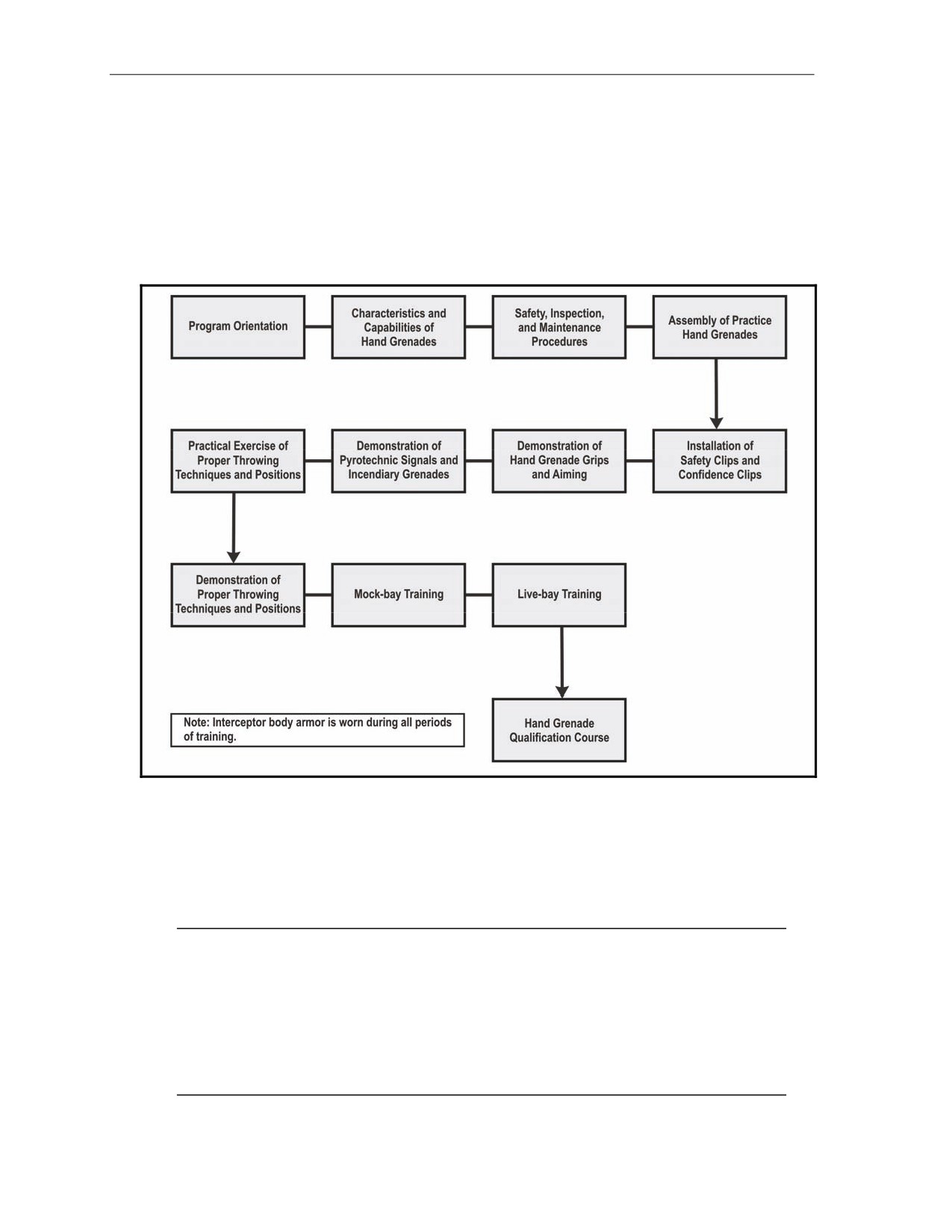
2-6. Figure 2-1 shows the IET training strategy.
Figure 2-1. Initial entry training hand grenade training strategy.
SUSTAINMENT TRAINING
2-7. Training continues in active Army, National Guard, and Army Reserve units using the same basic skills
taught in IET, but at a higher level of skill. Units should set up a year-round program to sustain skills and have a
plan for when they are at their home station and deployed.
NOTES:
1.
Hand grenade training is a high-risk form of individual training. Not only must units
reinforce training Soldiers received during IET, they must add training on hand
grenades used at the unit level (not covered in IET).
2.
Pyrotechnic signals are used throughout IET; however, IET Soldiers only view
demonstrations provided by range instructors and training cadre. Unit leaders must
ensure Soldiers are aware of the capabilities of pyrotechnic signals and are trained
on their use before issuing them.
2-2
FM 3-23.30
15 October 2009
Training
2-8. To sustain the basic hand grenade skills taught in IET, periodic preliminary instruction is conducted,
followed by the hand grenade instructional and qualification course. Key elements include—
z
Training the trainer.
z
Refresher training of hand grenade skills using the M69 practice grenade.
z
Sustainment training using live hand grenades.
z
Remedial training.
NOTE: Not all Soldiers are proficient in throwing grenades. A Soldier who demonstrates
high-risk tendencies during practice events must be identified and receive training reinforcement
before throwing live hand grenades. Soldiers who continually demonstrate high-risk tendencies
during reinforcement training should not be allowed to throw live hand grenades or use pyrotechnic
signals.
2-9. Additional skills trained in the unit include—
z
Hand grenades other than the M67.
z
Pyrotechnic signal employment considerations.
z
Mission-oriented protective posture (MOPP) with hand grenades and pyrotechnic signals.
z
Employment of hand grenades (bursting and smoke) as a member of a fire team.
2-10. These skills are trained and integrated into collective training exercises, such as platoon and squad live-
fire situational training exercises (STXs).
CAUTION
Fragmentation and concussion grenade training is considered high-risk
training; these grenades should be thrown on designated hand grenade
ranges only. Units must use the M69 with a M228 practice fuze and
nonlethal hand grenades for reinforcement training and collective training
scenarios.
SECTION II. TRAINING PROGRAM
The training listed in this chapter, except for the standard Army hand grenade qualification course, is offered as a
model to assist units in meeting their training objectives. This training can be modified to support the unit mission-
essential task list (METL), the terrain, and the commander’s intent.
MISSION-ESSENTIAL TASKS
2-11. Hand grenade proficiency is critical to Soldiering and is required for any unit deployed to a wartime
theater. All commanders should develop a METL and organize a training program that devotes adequate time to
hand grenade and pyrotechnic signals. The unit’s combat mission must be considered when establishing training
priorities. This not only applies to the tasks selected for the unit’s METL, but also to the conditions under which
the tasks are to be performed, especially in an urban environment, where the effects of blast, burning, and/or
vapor hazards, and wind cause adverse effects.
TRAINING ASSESSMENT
2-12. To conduct an effective hand grenade program, the unit commander must determine the current level of
proficiency of all assigned personnel. Constant evaluation provides commanders understanding of where
training emphasis is needed. All results are reviewed to determine any areas that need strengthening, along with
any individuals that require special attention. Based on this evaluation, hand grenade and pyrotechnic signal
training programs are developed and executed. Commanders continually assess the program and modify it as
15 October 2009
FM 3-23.30
2-3
Chapter 2
required. To develop a training plan and assess the training program, commanders should use the following
tools:
z
Direct observation of training.
z
Spot checks.
z
Review of past training.
2-13. Based on the commander’s evaluation, goals, and missions, semiannual or annual training events are
identified. Training programs must be continuous, and to sustain an effective program, resources are required.
While the unit may only qualify its Soldiers annually, test results show that sustainment training is required at
least semiannually to maintain Soldier skills.
DIRECT OBSERVATION OF TRAINING
2-14. Observing and accurately recording Soldier performance reveals the status of qualification results, and
each Soldier's ability to identify the threat and successfully engage a target with the correct hand grenade. This
also allows the commander to identify Soldiers who need special assistance to reach required standards and
those who exceed these standards.
NOTE: Soldiers should also be certified on pyrotechnic signals.
SPOT CHECKS
2-15. Spot checks of individual training performance, such as interviews and evaluations of Soldiers, provide
commanders with valuable information about Soldier proficiency and knowledge of the training tasks.
REVIEW OF PAST TRAINING
2-16. Commanders review past training to gain valuable information for developing a training plan. The
assessment should include—
z
The training program task.
z
The frequency and results of training.
COMMANDER’S EVALUATION GUIDE
2-17. The commander's evaluation guide contains three sections:
z
Commander's priorities and intent.
z
Soldier assessment.
z
Trainer assessment.
2-18. The following is an example of a commander’s evaluation guide. Commanders can use this guide not
only to assess their unit’s training proficiency, but to assess the unit leaders and their ability to effectively
implement a training program. They can also use it to develop noncommissioned officers (NCOs) into subject
matter experts.
Commander’s Priorities and Intent
2-19. When considering their priorities and intent, commanders answer the following questions:
z
Have you clearly stated the priority of hand grenades and pyrotechnic signals in your unit? What is
it? Do the staff and subordinates support this priority? Is it based on your METL and an
understanding of FM 7-0?
z
Have you clearly stated the intent of hand grenade and pyrotechnic signal training and qualification?
Are leaders evaluating Soldier performance based on accurately recorded data and results?
z
Have you clearly stated that hand grenade training and qualification is one of the commander’s
opportunities to assess several skills relating to team and squad readiness?
2-4
FM 3-23.30
15 October 2009
Training
z
What training and qualification course will be used to evaluate your unit’s readiness?
How will it be conducted? Will the prescribed procedures be followed?
Who will collect the data?
z
Have you clearly stated the purpose and intent of preliminary instruction?
What skills will preliminary instruction address?
Will preliminary instruction be performance-oriented? Are tasks integrated?
Soldier Assessment
2-20. During Soldier assessment, commanders answer the following questions:
z
Do Soldiers know how to maintain, inspect, and stow their assigned hand grenades and pyrotechnic
signals in accordance with the TM? Do they have a manual?
z
Do Soldiers conduct serviceability checks of assigned hand grenades and pyrotechnic signals before
training? Were maintenance deficiencies corrected?
z
Do Soldiers demonstrate an understanding of the operation, functioning, and capabilities of hand
grenades and pyrotechnic signals?
z
Do Soldiers demonstrate their knowledge of the effects of wind when employing smoke grenades?
z
During individual and collective training, do Soldiers demonstrate their ability to manage allocated
hand grenades to engage all targets? Do they throw several hand grenades at one target?
z
Do Soldiers demonstrate proficiency during night operations? When using night vision devices
(NVDs)?
z
Do Soldiers demonstrate individual proficiency during MOPP conditions? During collective exercises?
z
Are hand grenade skills and pyrotechnic signals integrated into tactical exercises and unit live-fire
exercises (LFXs)?
z
Based on onsite observations and analysis of training performance, what skills or tasks show a
readiness deficiency?
What skills need training emphasis? Individual emphasis? Leader emphasis?
What are the performance goals?
Trainer Assessment
2-21. During trainer assessment, commanders answer the following questions:
z
Who has trained or will train the trainers?
What is the subject matter expertise of the cadre?
Are they actually training the critical skills?
Have they addressed the basic skills first?
What aids and devices are being used?
z
What administrative constraints or training distracters can you overcome for the junior officer and
NCO? Do the sergeants do the job they are charged with?
z
At what level are the resources necessary to train hand grenades and pyrotechnic signals (time,
training aids, ammunition, and ranges) controlled?
TRAINERS
2-22. Knowledgeable cadre/trainers are the key to hand grenade training performance. All commanders must be
aware of maintaining expertise in hand grenade instruction/training.
CADRE/TRAINER
2-23. Cadre/trainer refers to a weapons instructor/trainer that has more experience and expertise than the
Soldier who is provided the instruction. He trains Soldiers in the safe and effective use of hand grenades, and if
15 October 2009
FM 3-23.30
2-5
Chapter 2
required, pyrotechnic signals. The cadre/trainer maintains strict discipline during training, insists on compliance
with range procedures and program objectives, and enforces safety regulations.
Selection
2-24. Institutional and unit cadre/trainers should be selected and assigned from the most highly qualified
Soldiers. These Soldiers must demonstrate proficiency in all aspects of hand grenade and pyrotechnic signal
employment, know the importance of training, and have a competent and professional attitude. The commander
must ensure that selected unit cadre/trainers can effectively train other Soldiers. Local cadre/trainer training
courses and weapons certification programs must be established to ensure that instructor/trainer skills are
developed.
Duties
2-25. The cadre/trainer helps the Soldier master the fundamentals of hand grenade and pyrotechnic signal
employment. He ensures that the Soldier consistently applies what he has learned. When training the beginner,
the cadre/trainer confronts problems, such as fear, nervousness, forgetfulness, failure to understand, and a lack
of coordination or determination, which may be compounded by arrogance or carelessness. With all types of
Soldiers, the cadre/trainer must ensure that Soldiers are aware of their errors, understand the causes, and apply
remedies. To perform these duties, cadre/trainers—
z
Observe Soldier actions.
z
Question the Soldier.
z
Analyze Soldier actions.
Observing Soldier Actions
2-26. To pinpoint errors, the cadre/trainer observes the Soldier during drills, when preparing and throwing hand
grenades, and when using pyrotechnic signals. If there is no indication of probable error, the Soldier’s grip,
preparation (removing safety devices or placement), launching/throwing position, release, and safe covering
position are closely observed.
Questioning the Soldier
2-27. The Soldier is asked to state his throwing hand and to explain his throwing procedures.
Analyzing Soldier Actions
2-28. Analyzing Soldier actions is an important step in detecting and correcting errors. When analyzing Soldier
actions, the cadre/trainer correlates observations of the Soldier to probable errors in performance, according to
the type of hand grenade used and the target. A poor performance is usually caused by more than one
observable error.
TRAINING THE TRAINER
2-29. Knowledgeable small-unit leaders are key to weapons training. This manual and other training
publications provide the unit commander with the required information for developing a good train-the-trainer
program.
2-30. The goal of a progressive train-the-trainer program is to achieve a high state of combat readiness.
Through the active and aggressive leadership of the chain of command, a perpetual base of expertise is
established and maintained.
2-31. The commander should identify unit personnel who have had assignments as weapons instructors. These
individuals should be used to train other unit cadre by conducting preliminary instruction and LFXs for their
Soldiers.
2-6
FM 3-23.30
15 October 2009
Training
2-32. A suggested train-the-trainer program is outlined below:
z
Conduct a diagnostic test to determine what training is needed.
z
Conduct practice/live hand grenade range operations.
z
Conduct hand grenade qualification course.
TRAINER CERTIFICATION PROGRAM
2-33. The certification program sustains the cadre/trainers’ expertise and develops methods of training. The
program standardizes procedures for certifying hand grenade and pyrotechnic signal trainers. Cadre/trainers’
technical expertise must be continuously refreshed, updated, and closely managed.
TRAINING BASE
2-34. The training base can expect the same personnel changes as any other organization. Soldiers assigned as
cadre/trainers will have varying degrees of experience and knowledge of training procedures and methods.
Therefore, the trainer certification program must be an ongoing process that is tailored to address these
variables. At a minimum, formal records should document program progression for each trainer. All
cadre/trainers must complete the four phases of training using the progression steps, and the records should be
updated on a quarterly basis.
CERTIFICATION PROGRAM OUTLINE
2-35. Before certification, all trainers must attend all phases of the train-the-trainer program in the following
order:
z
Phase I—Program Orientation.
z
Phase II—Preliminary Hand Grenade and Pyrotechnic Signal Training.
z
Phase III—Basic Hand Grenade Pyrotechnic Signal Training.
z
Phase IV—Advanced Hand Grenade Pyrotechnic Signal Training.
2-36. Then, they conduct all phases to demonstrate their ability to train Soldiers and to diagnose and correct
problems. Cadre/trainers who fail to attend or do not pass any phase of the diagnostic examination should be
assigned to subsequent training.
Phase I—Program Orientation
2-37. During this phase, the cadre/trainer must accomplish the following tasks and be certified by the chain of
command:
z
Be briefed on the concept of the certification program.
z
Be briefed on the unit weapons training strategy.
z
Review the unit weapons training outlines.
z
Review issued reference material.
z
Visit training sites and firing ranges.
Phase II—Preliminary Hand Grenade and Pyrotechnic Signal Training
2-38. Phase II should be completed no more than two weeks following the conclusion of Phase I. During Phase
II, the cadre/trainer demonstrates his ability to master hand grenade and pyrotechnic signal fundamentals, and
his performance is reviewed by the chain of command. The results of this review are recorded and maintained
on the trainer’s progression sheet in accordance with the unit standing operating procedure (SOP). The
cadre/trainer explains—
z
Characteristics.
z
Capabilities.
z
Safety, inspection, and maintenance procedures.
z
Assembly of practice hand grenades.
15 October 2009
FM 3-23.30
2-7
Chapter 2
z
Installation of safety clips and confidence clips (M228 practice fuze only).
NOTE: For hand grenades that come with a safety clip, the safety clip may detach during shipping
and storage. See Chapter 3 for information about safety clip installation.
z
Demonstration of pyrotechnic signals and incendiary grenades.
z
Preparation (safety devices, right- and left-hand grips).
z
Throwing positions and techniques.
z
Mock-bay training.
z
Live-bay training.
z
Hand Grenade Qualification Course.
Phase III—Basic Hand Grenade and Pyrotechnic Signal Training
2-39. During this phase, the cadre/trainer demonstrates and reinforces what he has learned during Phase II. The
cadre/trainer explains—
z
Coordination requirements and range duties for conducting a hand grenade training course.
z
The range layout and the conduct of training.
2-40. The commander determines when the cadre/trainer is ready to move to the next phase of certification. He
will only do this when satisfied the cadre/trainer has successfully demonstrated expertise in setting up and
conducting hand grenade and pyrotechnic signal training and qualification. At the completion of Phase III, the
commander should schedule Phase IV certification and direct the cadre/trainer to begin coordinations. The
results of this review should be recorded and maintained on the cadre/trainer’s progression sheet.
NOTE: The commander should select a unit range control certified officer in charge (OIC) and
range safety officer (RSO) to open and run the range so that he can view the cadre/trainer being
certified.
Phase IV—Advanced Hand Grenade and Pyrotechnic Signal Training
2-41. The final phase of the train-the-trainer program tests the cadre/trainer. During this phase, the cadre/trainer
sets up a hand grenade range and hand grenade qualification course, and conducts training for at least one
person. If M69 hand grenades (with the M228 training fuze), M67 hand grenades, and pyrotechnic signals are
available, the cadre/trainer conducts a firing exercise. If training ammunition and pyrotechnic signals are not
available, the evaluation is based on the quality of training given.
SECTION III. TRAINING PREPARATION
Training preparation involves three steps:
(1) Conduct a training risk assessment.
(2) Conduct an environmental risk assessment.
(3) Make range coordinations.
CONDUCT A TRAINING RISK ASSESSMENT
2-42. The OIC or noncommissioned officer in charge (NCOIC) conducts a training risk assessment. It is vital to
identify unnecessary risks by comparing potential benefit to potential loss. The composite risk management
(CRM) process allows units to identify and control hazards, conserve combat power and resources, and
complete the mission. This process is cyclic and continuous; it must be integrated into all phases of operations
and training.
2-8
FM 3-23.30
15 October 2009
Training
Application of the risk management process will not detract from this training goal, but will
enhance execution of highly effective, realistic training.
FM 7-0, TRAINING THE FORCE
2-43. There are five steps to the CRM process:
(1) Identify hazards.
(2) Assess hazards to determine risk.
(3) Develop controls and make risk decisions.
(4) Implement controls.
(5) Supervise and evaluate.
NOTE: Risk decisions must be made at the appropriate level.
IDENTIFY HAZARDS
2-44. When identifying hazards, leaders should consider—
z
The lethality of the hand grenades and pyrotechnic signals used.
z
The area in which training is to be conducted.
z
How the addition of new elements impacts known hazards.
z
Any environmental impact.
ASSESS HAZARDS TO DETERMINE RISK
2-45. Once identified, hazards are assessed by considering the likelihood of its occurrence and the potential
severity of injury without considering any control measures. When assessing hazards, leaders should consider
the Soldiers' current state of training.
DEVELOP CONTROLS AND MAKE RISK DECISIONS
2-46. Leaders must apply two types of control measures to hand grenade risk assessments:
z
Educational controls.
z
Physical controls.
2-47. The unit commander's controls should be clear, concise, executable orders.
NOTE: Most vital to developing CRM controls is mature, educated leadership.
Educational Controls
2-48. Educational controls occur when adequate training takes place. They require the largest amount of
planning and training time. Leaders implement educational controls using two sequential steps:
(1) Supervisors and instructors must be certified.
(2) Soldier training must be executed.
NOTE: Hand grenade and pyrotechnics training requires extensive direct supervision, but the
amount of supervision required decreases as the Soldier’s proficiency increases.
15 October 2009
FM 3-23.30
2-9
Chapter 2
Physical Controls
2-49. Physical controls are the measures emplaced to reduce injuries. This includes not only protective
equipment, but also certified personnel to supervise the training. Unrestrained physical controls are, in
themselves, a hazard.
IMPLEMENT CONTROLS
2-50. When leaders implement the controls, they must match the controls to the Soldier’s skill level. They must
also enforce every control measure as a means of validating its adequacy.
SUPERVISE AND EVALUATE
2-51. This step allows leaders to eliminate unnecessary risk and ineffective controls by identifying unexpected
hazards and determining if the implemented controls reduced the residual risk without interfering with the
training.
CONDUCT AN ENVIRONMENTAL RISK ASSESSMENT
2-52. All leaders, trainers, and Soldiers must comply with environmental laws and regulations. The leader must
identify the environmental risks associated with training individual and collective tasks, and implement
environmental protection measures by integrating them into plans, orders, SOPs, training performance
standards, and rehearsals.
2-53. Environmental risk management parallels safety risk management and is based on the same philosophy.
Environmental risk management consists of identifying hazards before they happen and assessing hazards
caused during training.
NOTE: See FM 7-0 for more information.
IDENTIFY HAZARDS
2-54. Leaders should identify the potential sources for environmental degradation during the analysis of
METT-TC factors. An environmental hazard is a condition with the potential for polluting air, soil, or water or
destroying cultural or historical artifacts.
ASSESS HAZARDS
2-55. Leaders should analyze the potential severity of environmental degradation by using the environmental
risk assessment matrixes in FM 7-0. The risk effect value is defined as an indicator of the severity of
environmental degradation. Leaders quantify the risk to the environment resulting from the operation as
extremely high, medium, or low using the environmental assessment matrixes.
MAKE RANGE COORDINATIONS
2-56. Once the risks assessment is completed, viewed, and command approved, then the OIC or NCOIC should
check out the range and coordinate for range use.
NOTE: The OIC or NCOIC should coordinate at least one day ahead of actual use to rehearse range
setup and conduct.
RANGES
2-57. Ranges include distance and accuracy ranges, mock-bay throwing pits, and live-bay throwing pits.
2-10
FM 3-23.30
15 October 2009
Training
Distance and Accuracy Ranges
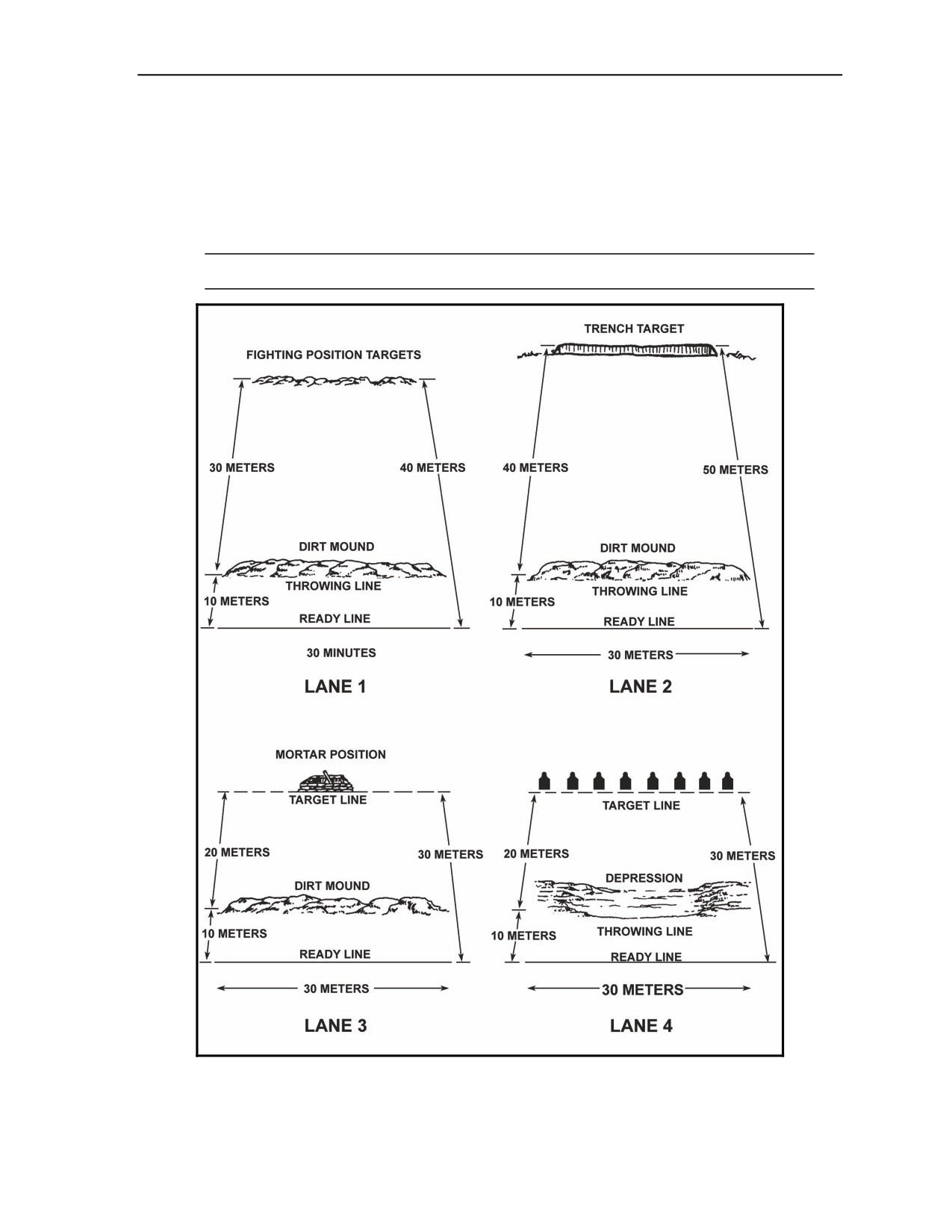
2-58. A four-lane layout (Figure 2-2) is recommended. These lanes should enable Soldiers to engage—
z
A fighting position at 30 meters.
z
A trench target at 40 meters.
z
A fortified mortar pit at 20 meters.
z
Soldiers in the open at 20 meters.
NOTE: The four lanes may be combined if the terrain does not allow four stations.
Figure 2-2. Distance and accuracy layout.
15 October 2009
FM 3-23.30
2-11
Chapter 2
Mock-Bay Throwing Pits
2-59. The hand grenade mock-bay must replicate the dimensions and safety areas found at live-bay. At this
station of hand grenade training, Soldiers are instructed on live-bay procedures. Each Soldier attending this
training will have to identify his throwing hand and demonstrate the correct throwing procedures.
NOTE: Soldiers will throw from the standing position during mock-bay and live-bay training.
Throwing Pit and Knee Wall
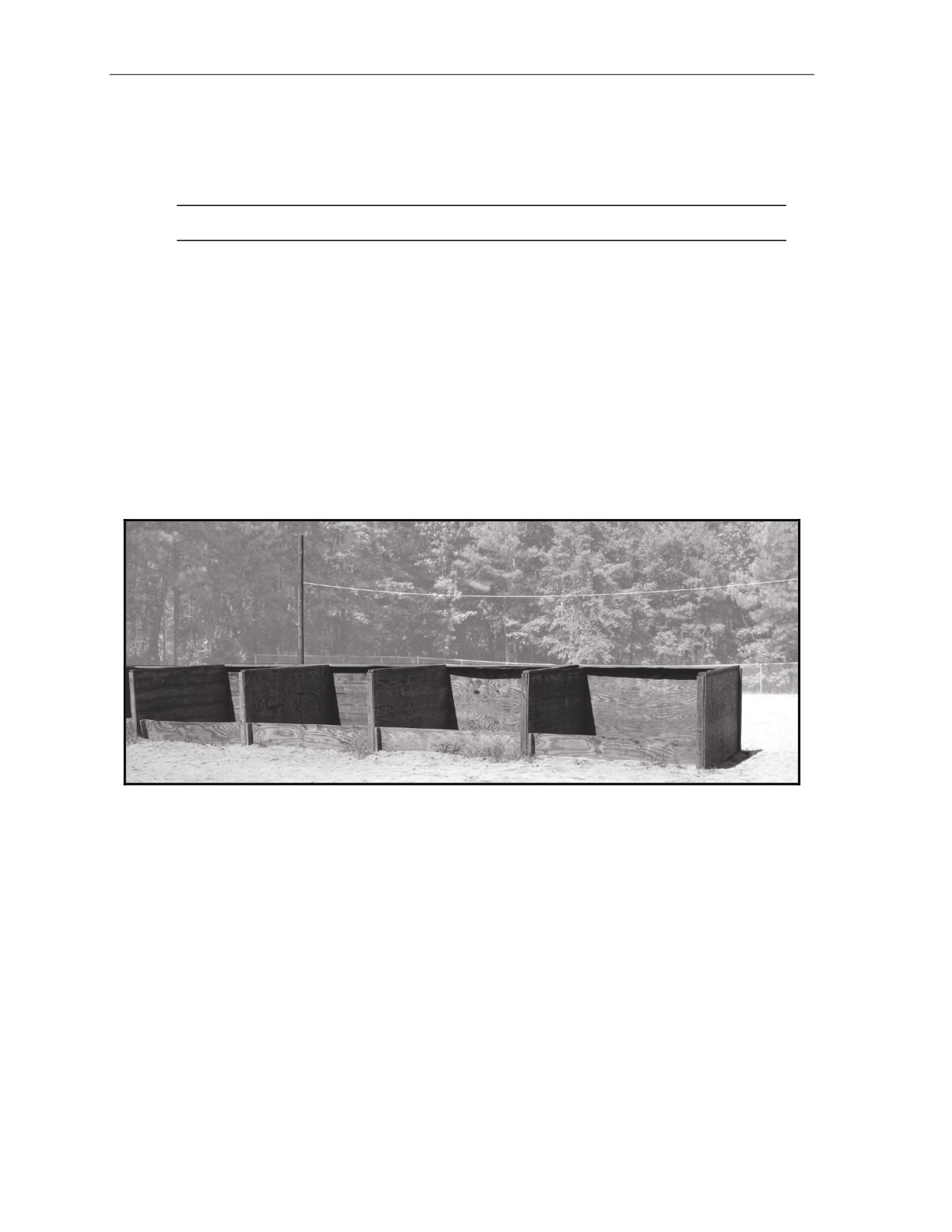
2-60. A mock-bay training pit can be made from treated plywood (Figure 2-3). Protective reinforcement
materials used in a live-bay throwing pit are not necessary.
Suspended Guide Wire
2-61. Place an approximately 6-meter (20-feet) high suspended guide wire approximately 28 meters (92 feet) in
front of the mock-bay pit will assist Soldiers in achieving throwing distance.
E-Type Silhouettes
2-62. Placing E-type silhouettes at 40 meters from the mock-bay pit will provide targets for throwing accuracy
and distance.
Figure 2-3. Hand grenade mock-bay layout.
Live-Bay Throwing Pits
2-63. Figures 2-4 through 2-9 depict a suggested hand grenade live-bay design. Live-bay throwing pits should
incorporate the following elements:
z
Observation pits or tower.
z
Throwing pit.
z
Knee wall.
z
Sand/sawdust pit.
z
Revetments and berms.
z
Separation distance.
z
Observation windows.
2-12
FM 3-23.30
15 October 2009
Training
Observation Pits or Tower
2-64. Observation pits or towers should be a sufficient height to enable range personnel to observe and control
all throwing pits. Laminated 35-millimeter (about 1 3/8 inches) windowpanes (constructed as described below)
provide the necessary degree of safety:
z
10-mm glass (outside).
z
7-mm polycarbonate resin sheet.
z
6-mm glass.
z
6-mm polycarbonate resin sheet.
z
6-mm glass.
ThrowingPit
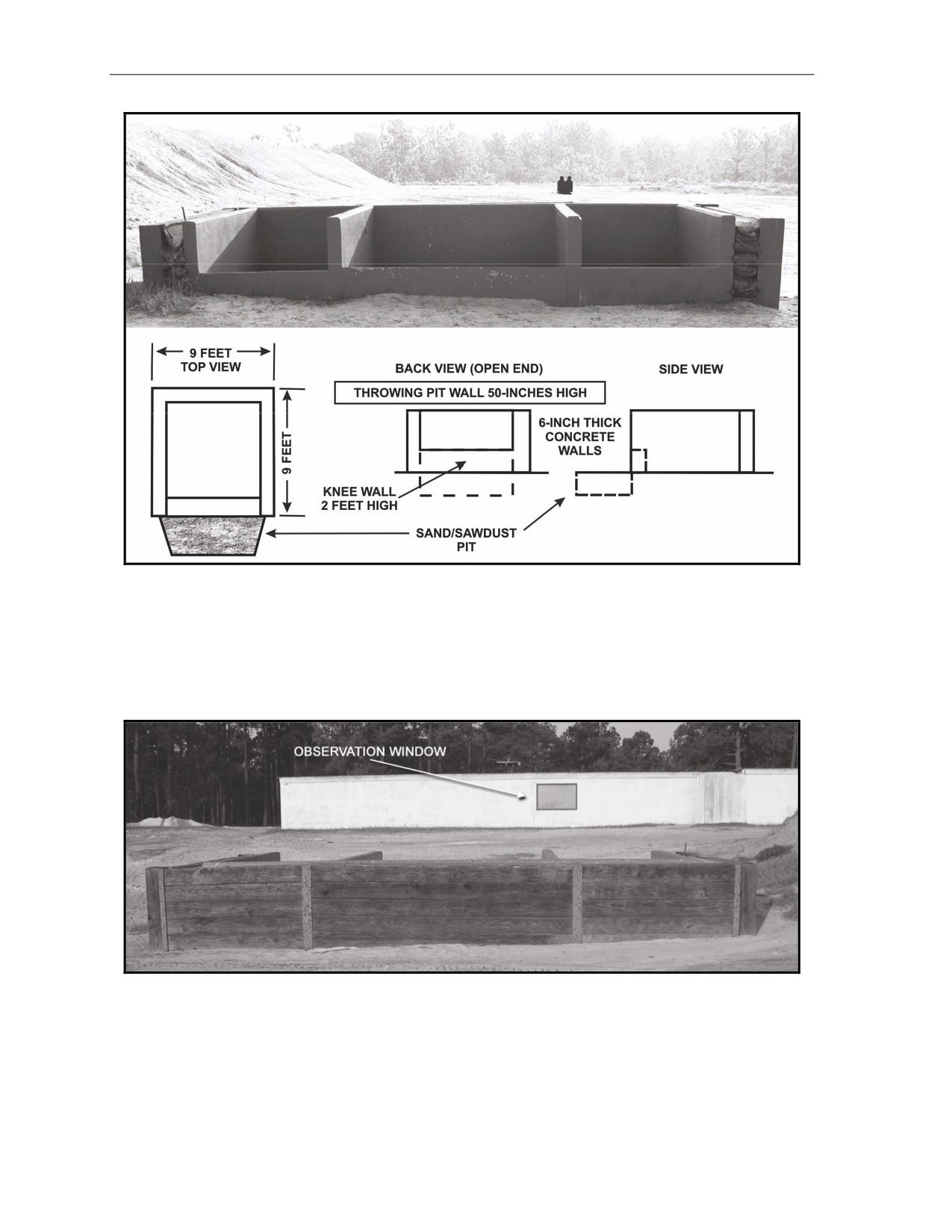
2-65. The throwing pit design is based on the average depth of the two-man foxhole (approximately 50 inches
tall). Approximately armpit high. This height allows the Soldier to stand, see the target, and safely throw the
hand grenade. The height of the wall, will also provide cover when in a kneel position.
Knee Wall
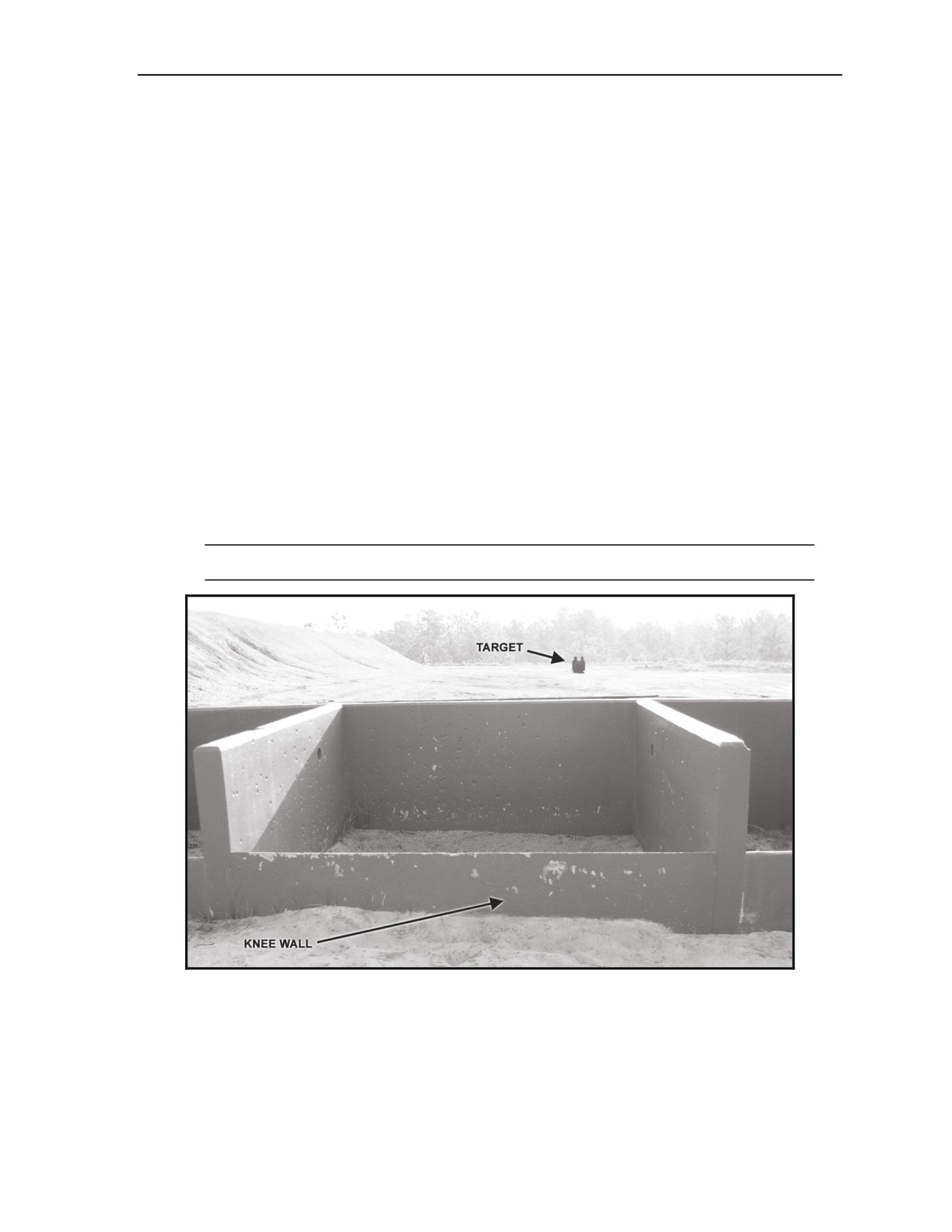
2-66. The throwing pit should have a rear wall (knee wall) no more than 0.6 meter (2 feet) high and 0.15 meter (6
inches) thick (Figure 2-4). The knee wall should extend the width of the throwing pit, connecting both ends of the
enclosure. The top of the knee wall should slope inward to allow any grenade dropped on the wall to roll into the
throwing pit. The knee wall should have drain pipes (no more than 2 inches in diameter) to allow throwing pit
drainage. The floor of the pits should slope in the direction of the drainage pipes.
NOTE: DO NOT construct grenade sumps or ditches inside the throwing pits.
Figure 2-4. Throwing pit with knee wall.
15 October 2009
FM 3-23.30
2-13
Chapter 2
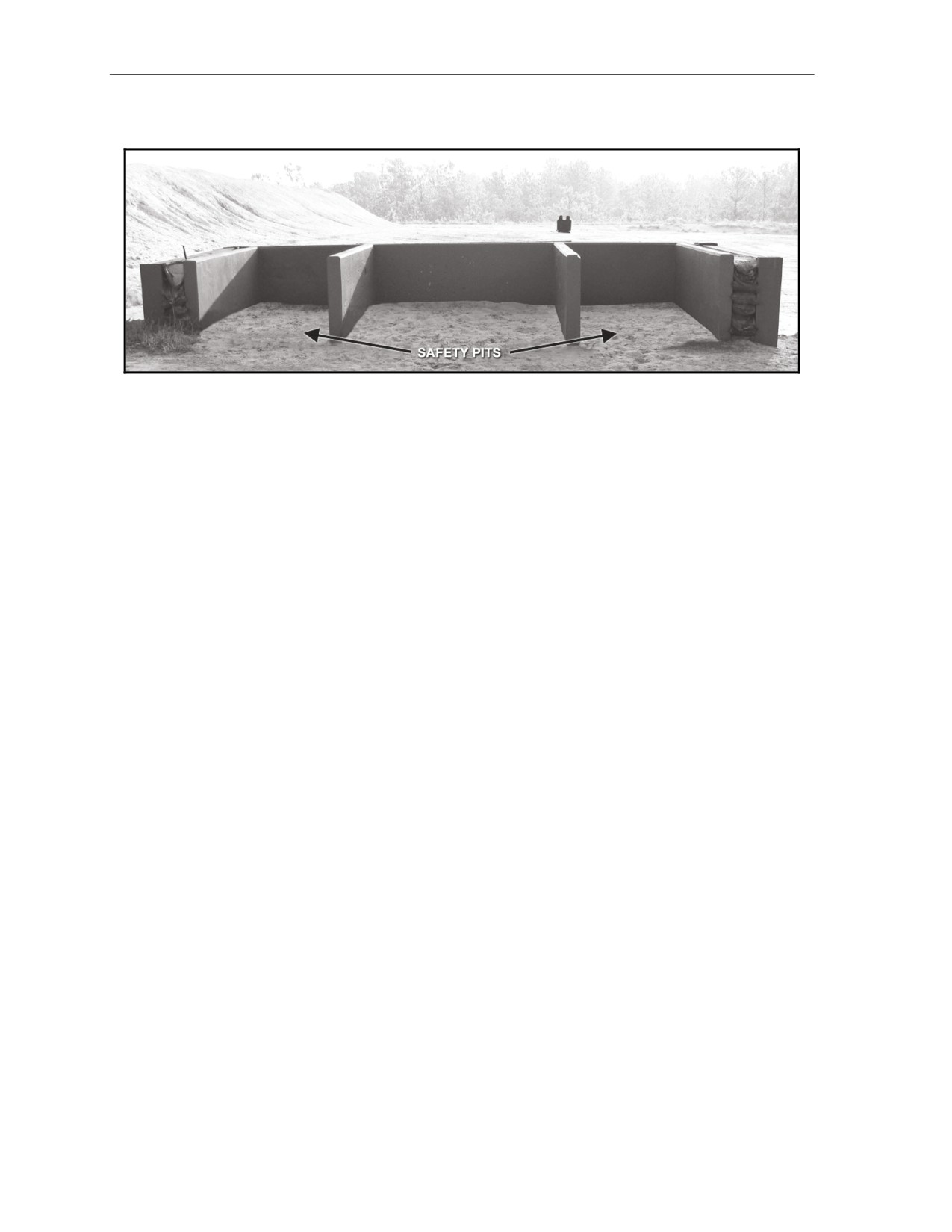
2-67. Throwing pits that do not have knee walls must have safety pits attached to both sides (Figure 2-5).
Figure 2-5. Throwing pit with safety pits.
Sand/Sawdust Pit
2-68. A sand/sawdust pit is placed outside of the knee wall to cushion the fall of personnel diving over the wall
in the event a grenade is dropped in the throwing pit.
Revetments and Berms
2-69. Where possible, the throwing pits should be separated using steel, concrete, or wooden revetments or
earthen berms of a length and height to lessen the effect of high velocity, low-angle fragments (e.g., 50 meters
long and 1.8 meters high). The thickness varies according to the type of construction used. This permits grenade
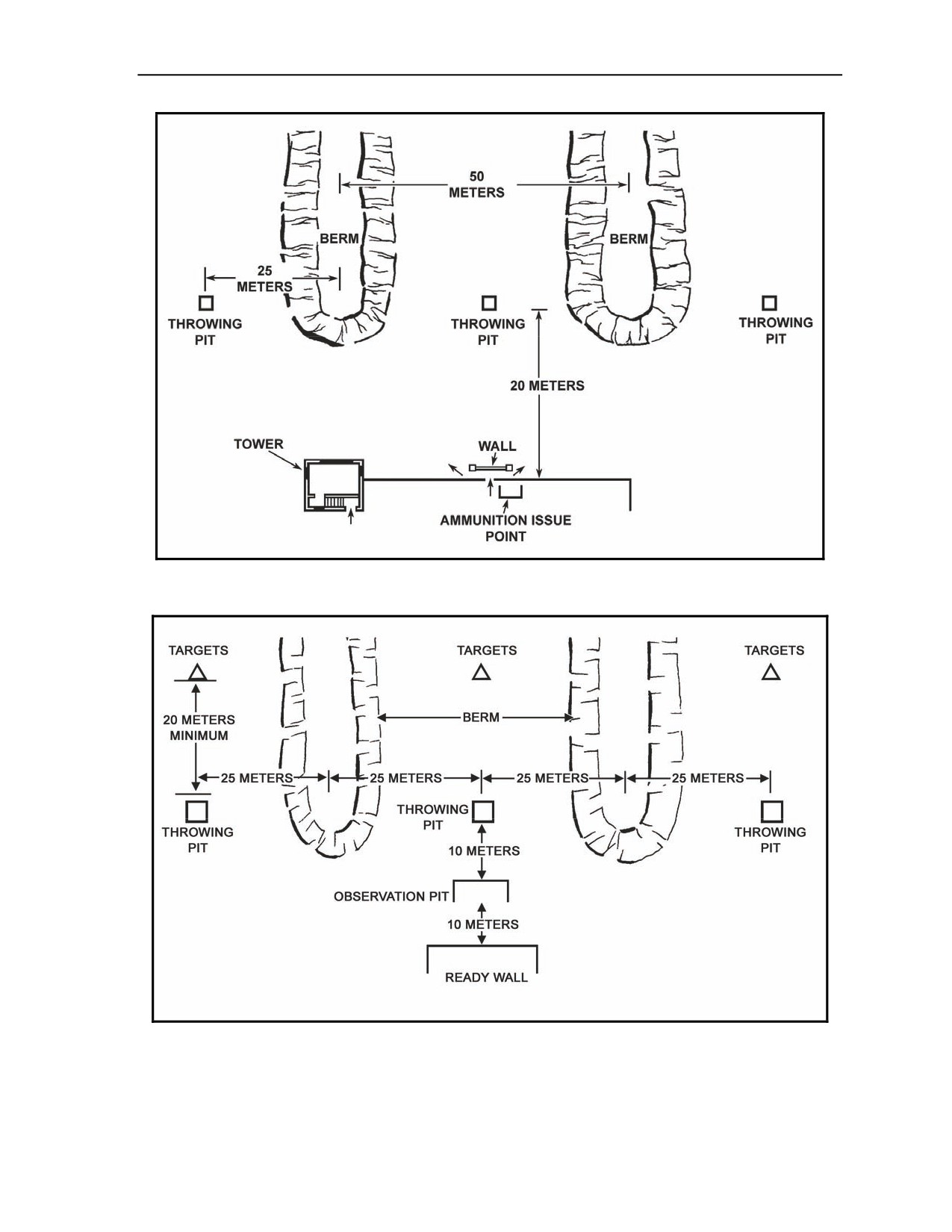
throwing to continue from the adjacent pit when a dud grenade requires closure of a specific pit pending dud
disposal.
Separation Distance
2-70. Live-bay throwing pits should have a separation distance of 25 meters between each lane. This places
adjacent pits outside the effective casualty-producing radius of 15 meters for the M67 fragmentation grenade.
2-14
FM 3-23.30
15 October 2009
Training
Figure 2-6. Suggested live-bay layout.
Figure 2-7. Hand grenade range requirements.
15 October 2009
FM 3-23.30
2-15
Chapter 2
Figure 2-8. Hand grenade live-bay layout.
Observation Windows
2-71. If facilities permit, an observation window should be constructed to allow Soldiers to observe the live-bay
throwing procedures before and after throwing the hand grenades (Figure 2-9). The observation window must
be of the same construction used for observation pits and towers.
Figure 2-9. Hand grenade live-bay layout, observation window.
2-16
FM 3-23.30
15 October 2009
Training
Hand Grenade Qualification Course
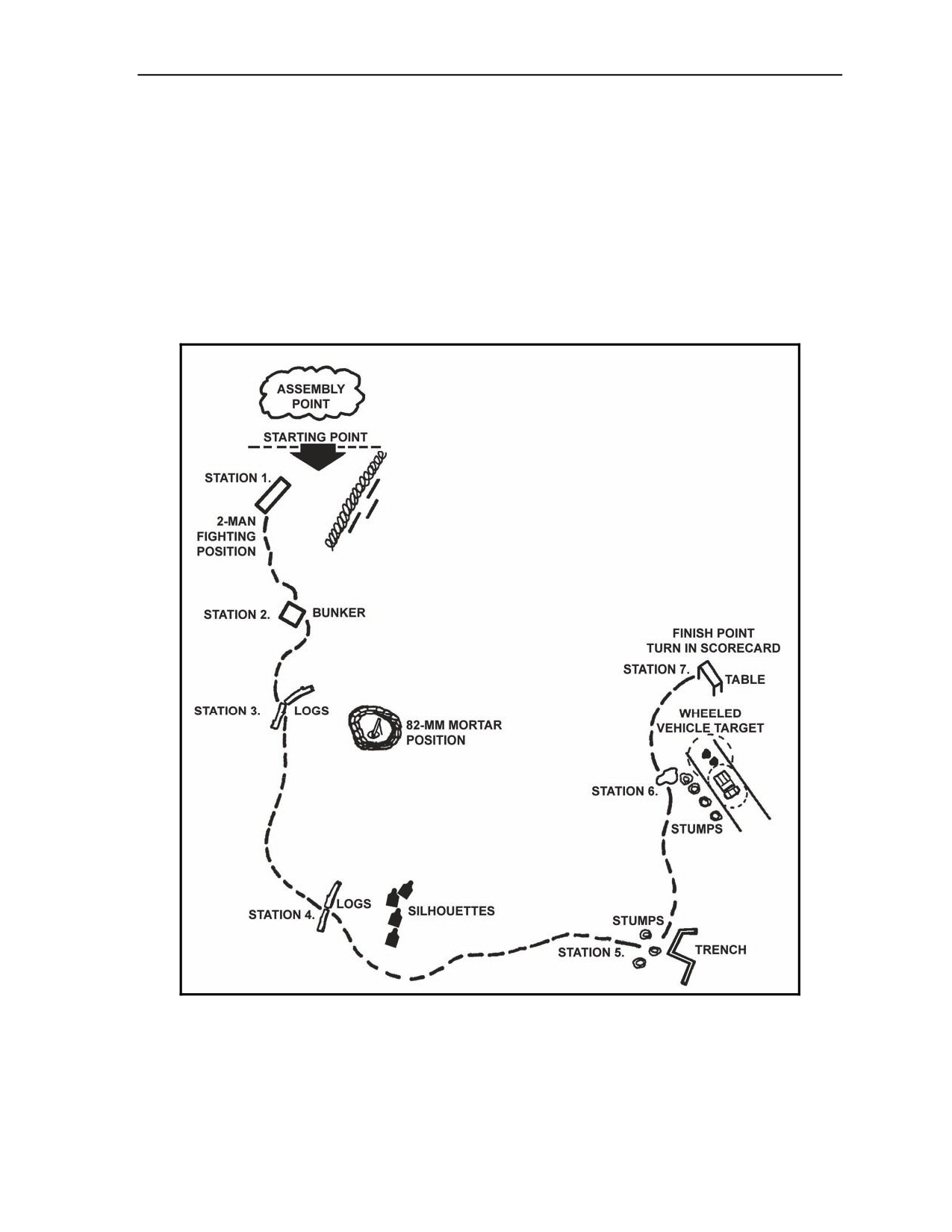
2-72. A seven-station layout (Figures 2-10 through 2-17) is recommended. These stations should enable
Soldiers to perform the following tasks:
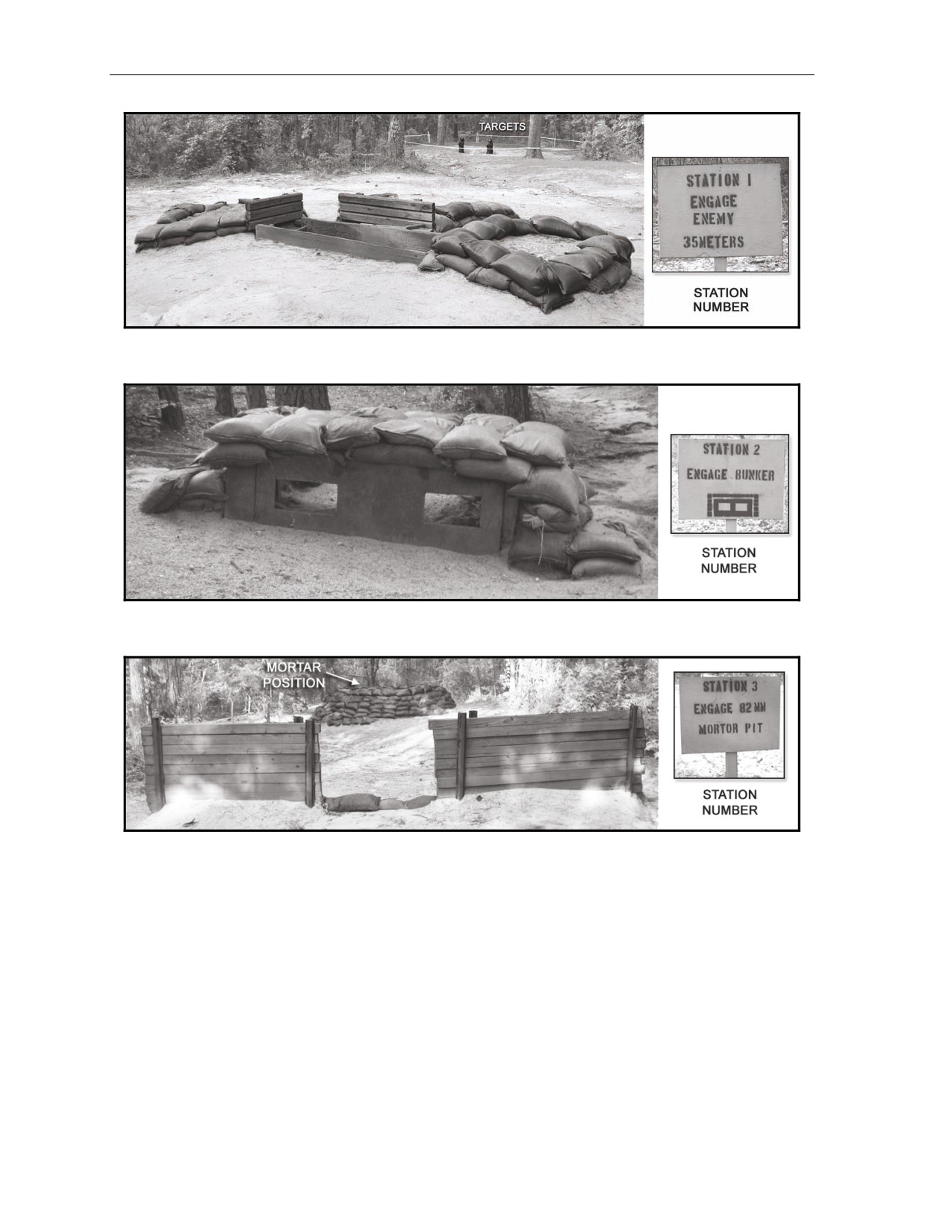
z
Engage the enemy from a fighting position at 35 meters (standing).
z
Engage bunker (prone).
z
Engage enemy mortar position at 25 meters (kneeling).
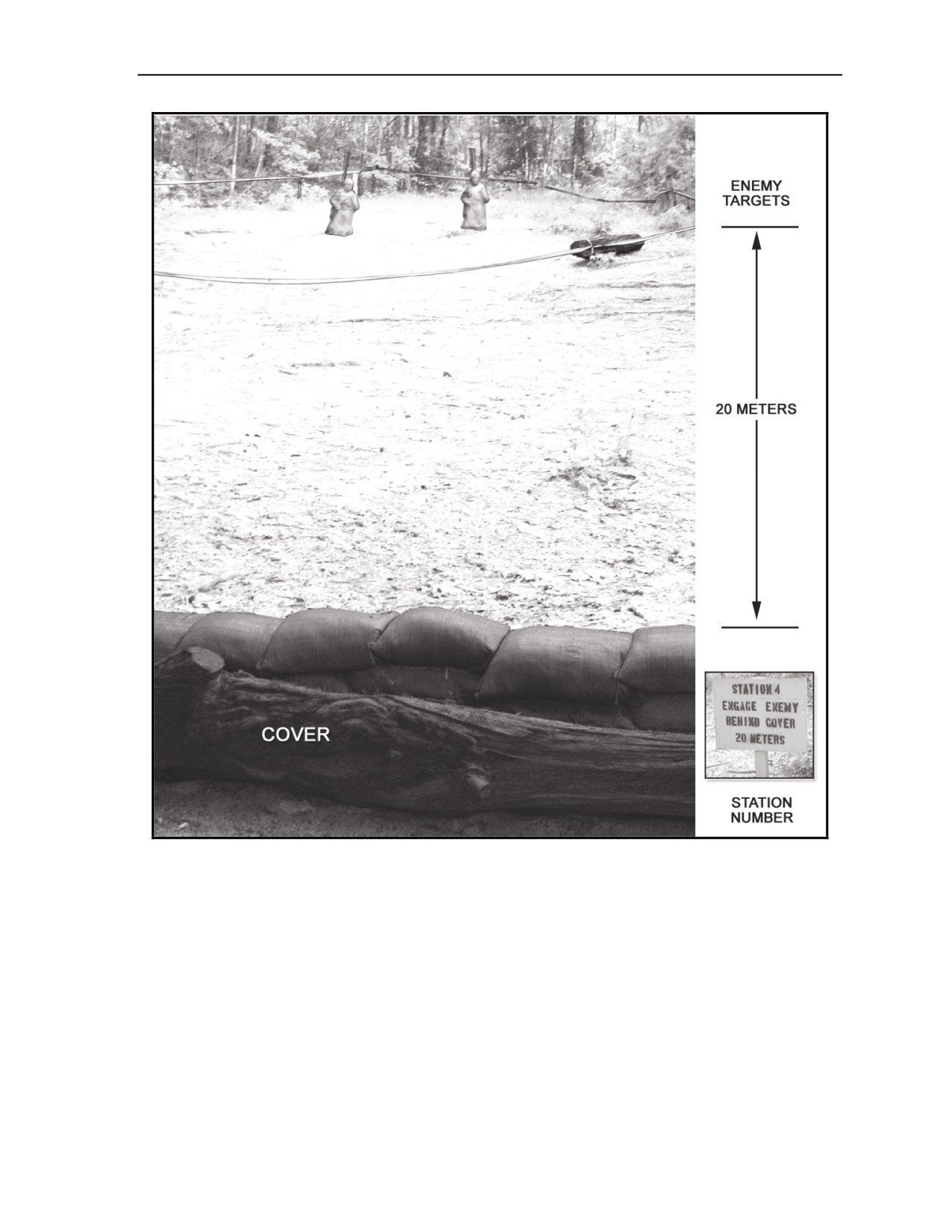
z
Engage enemy behind cover at 20 meters (prone).
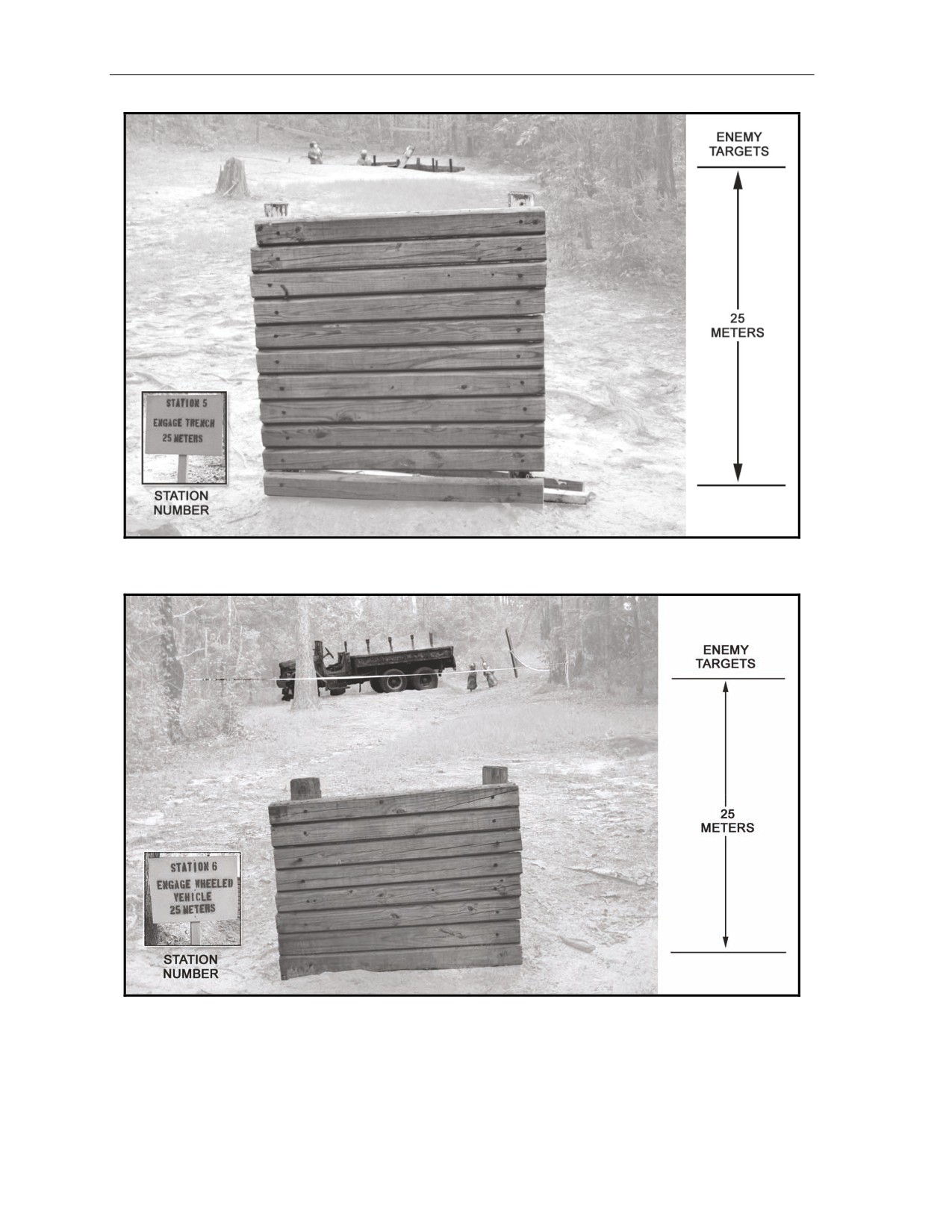
z
Engage trench at 25 meters (standing).
z
Engage wheeled vehicle at 25 meters (kneeling).
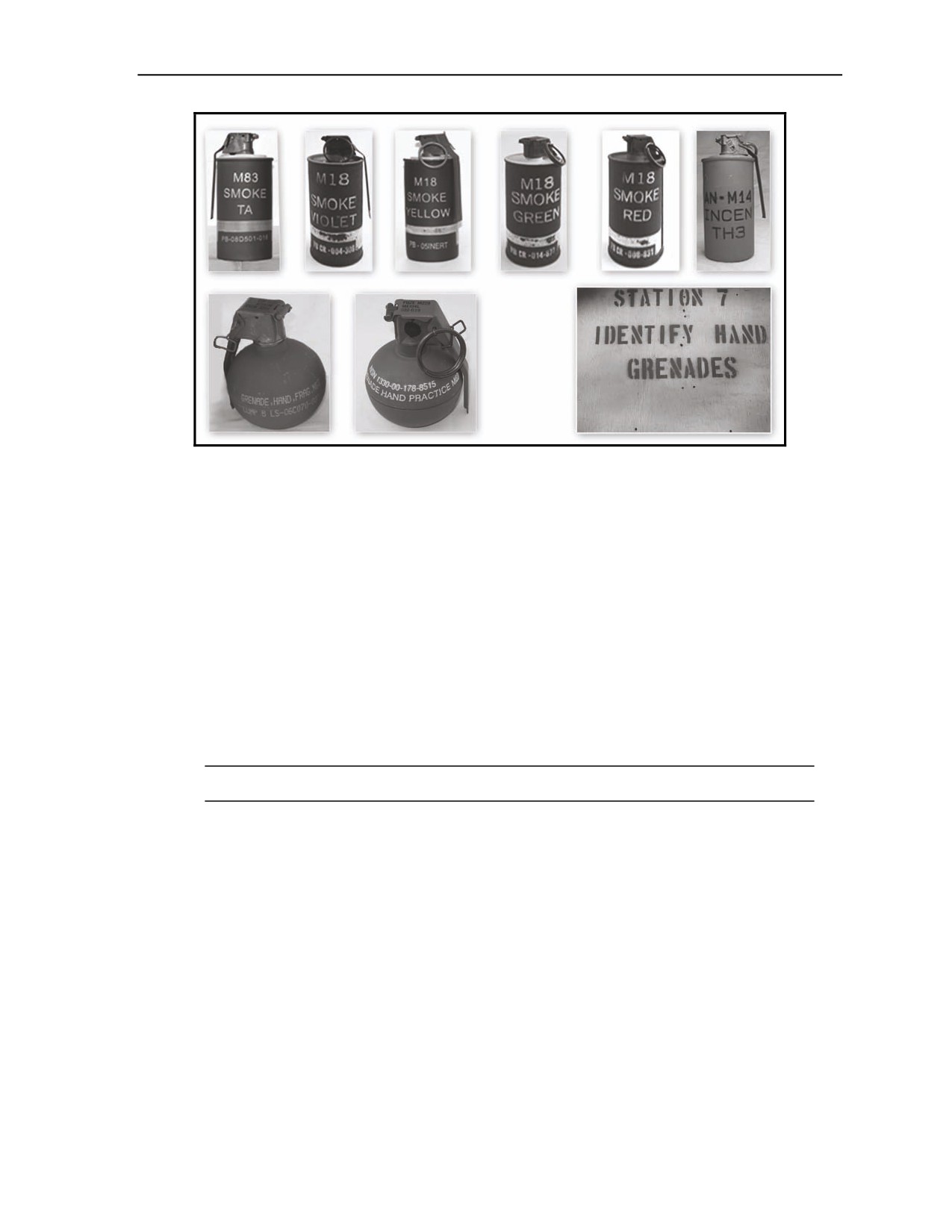
z
Identify hand grenades and pyrotechnic signals.
Figure 2-10. Hand grenade qualification course layout.
15 October 2009
FM 3-23.30
2-17
Chapter 2
Figure 2-11. Station 1, engage enemy from fighting position (standing).
Figure 2-12. Station 2, engage bunker (prone).
Figure 2-13. Station 3, engage enemy mortar position (kneeling).
2-18
FM 3-23.30
15 October 2009
Training
Figure 2-14. Station 4, engage enemy from behind cover (prone).
15 October 2009
FM 3-23.30
2-19
Chapter 2
Figure 2-15. Station 5, engage trench (standing).
Figure 2-16. Station 6, engage wheeled vehicle (kneeling).
2-20
FM 3-23.30
15 October 2009
Training
Figure 2-17. Station 7, identify hand grenades and pyrotechnic signals.
EQUIPMENT
2-73. The following is a minimum amount of range material and supplies needed to operate a practice and live
hand grenade range.
z
A helmet, a body armor vest, load-carrying equipment/enhanced tactical load-bearing vest
(LCE/ETLBV), and ear protection for all range personnel and Soldiers attending training.
z
Appropriate publications pertaining to training (FMs, TMs, ARs, SOPs).
z
Range flag.
z
Communications equipment.
z
Targets in accordance with this manual.
z
Grenades (live/practice) and pyrotechnics, as needed.
z
Training aids, as needed.
z
Ambulance or required dedicated evacuation vehicle.
NOTE: The driver must have knowledge of the route to the hospital.
z
Potable water.
z
Qualification scorecards in accordance with this manual.
PERSONNEL
2-74. In accordance with DA Pam 385-63, the following safety personnel are required for hand grenade training
(Table 2-1):
z
OIC.
z
RSO.
2-75. Safe and successful performance of training also requires experienced support personnel. Support
personnel required for training include—
z
Pit safety NCOs.
z
Ammunition personnel.
z
Tower operator.
z
Guards, as required.
15 October 2009
FM 3-23.30
2-21
Chapter 2
z
Medical personnel.
z
Truck driver, if applicable.
Table 2-1. Officer in charge/range safety officer requirements.
PERSONNEL
WEAPON SYSTEMS
REQUIREMENTS
OIC
RSO
Practice hand grenade, firing devices, simulators, or trip flares
SSG
SSG
Chemical agents and smoke1
SSG
NONE
Live grenades
SFC
SSG
Live-fire exercises, using organic weapons (squad through company, battery, and troop)
SFC
SSG
Combined arms live-fire exercises (CALFEXs) using outside fire support (section, platoon,
SFC
SSG
squad, company, battery, troop, battalion, and squadron or larger)2
1 When chemical, biological, radiological, nuclear (CBRN) training is being conducted, the OIC/RSO must be CBRN-qualified.
2 The OIC will be a field-grade officer for battalion and larger-size units. The RSO on CALFEXs will be of the ranks listed above
based on the complexity of the exercise and number of participants (i.e., squad, section, platoon, company, troop, squadron,
battalion, and larger).
NOTE: Ranks of other services, DA civilians, and contractors must be equivalent to US Army ranks.
NOTE: OICs and RSOs involved in serious range incidents may lose their certification if
determined to be in violation of AR 385-63 or DA Pam 385-63. While an incident is under
investigation, their certificate may be suspended for as long as deemed necessary or revoked by the
installation commander.
Officer in Charge and Noncommissioned Officer in Charge
2-76. The OIC or NCOIC is responsible for the overall conduct of the training, range orientation, range safety
briefing, and briefing unit leaders. The OIC must have satisfactorily completed a standard program of
instruction in the duties of the OIC (developed by the unit to which he is assigned) and attended a range safety
briefing conducted by the installation range control. The OIC or NCOIC must—
z
Be an E7 or above (NCOIC only).
z
Be knowledgeable in the weapon systems involved and the duties required.
z
Be certified by the commander.
z
Receive instruction by range control.
z
Have current safety cards.
NOTE: The rank of the OIC is determined by unit polices and regulations.
2-77. Once selected by the commander, the OIC should select the right personnel to conduct the training. Next,
he should appoint an NCOIC who has current experience in the use of grenades and pyrotechnic signals.
Together, the OIC and NCOIC should coordinate with adjacent units that are conducting or have conducted live
grenade training for key personnel train-up and certification. The OIC and NCOIC should—
z
Select and brief range support personnel on expected duties.
z
Schedule for range certification with range control. If currently certified, review installation range
instructions.
z
Certify selected range personnel on their range duties.
NOTE: Before conducting training, the OIC and NCOIC should review FM 3-23.30, TM 9-1330-
200-12, TM 9-1370-206-10, unit SOPs, AR 385-63, and DA Pam 385-63.
2-22
FM 3-23.30
15 October 2009
Training
Range Safety Officer
2-78. The RSO should be the senior hand grenade instructor. The RSO must have satisfactorily completed a
standard program of instruction in the duties of RSO (developed by the unit to which he is assigned) and
attended a range safety briefing conducted by the installation range control. The RSO must—
z
Be an E6 or above.
z
Be knowledgeable in the weapon systems involved and the duties required.
z
Ensure that the OIC has current safety cards.
z
Perform no duties other than those of safety officer.
Pit Safety Noncommissioned Officers
2-79. Pit safety NCOs provide instruction, prepare practice grenades, and conduct practice and live hand
grenade training safety. Range safety pit NCOs should—
z
Be an E5 or above.
z
Be knowledgeable in the weapon systems involved and the duties required.
z
Be selected and certified on all hand grenade and pyrotechnic tasks by the OIC and NCOIC.
NOTE: These personnel require no safety cards, but must be task-certified by their unit on all
grenade and pyrotechnic signals.
2-80. Pit safety NCOs also performs the five drop procedures in case of an emergency. These drop procedures
are contingent on Soldier actions:
z
Soldier milks the hand grenade.
z
Soldier freezes after arming the hand grenade.
z
Soldier remains standing after he throws the hand grenade downrange (attempting to observe the
impact).
z
Soldier drops the hand grenade.
z
Soldier fails to take commands from the pit safety NCO.
Soldier Milks the Hand Grenade
2-81. Soldiers can milk the hand grenade in two ways; they can move their fingers or their thumb.
Moving the Fingers
2-82. When a Soldier milks the hand grenade by moving his fingers, the pit safety NCO performs the following
procedures:
(1) Tell the Soldier to cease all action (“FREEZE”). The Soldier will close his hand.
(2) Decide if the grenade is armed or safe.
(3) Tell the Soldier to “THROW” if you determine that the grenade is armed or unsafe.
Moving the Thumb
2-83. When a Soldier milks the hand grenade by moving his thumb, the pit safety NCO performs the following
procedures:
(1) Tell the Soldier to “THROW”.
NOTE: If the Soldier does not throw, perform the following actions.
(2) Place your thumb across the Soldier’s thumb and your fingers across your Soldier’s fingers, securing
the Soldier’s throwing hand (right hand for right-handed Soldiers, left hand for left-handed Soldiers).
(3) Use your free hand to force the Soldier to the front wall.
15 October 2009
FM 3-23.30
2-23
Chapter 2
(4) Force the Soldier to drop the grenade over the front wall.
(5) Pull the Soldier into the pit, and protect him from the blast.
Soldier Freezes After Arming the Hand Grenade
2-84. When a Soldier freezes after arming the hand grenade, the pit safety NCO performs the following
procedures:
(1) Tell the Soldier to “THROW”.
NOTE: If the Soldier does not throw, perform the following actions.
(2) Place your thumb across the Soldier’s thumb and your fingers across your Soldier’s fingers, securing
the Soldier’s throwing hand (right hand for right-handed Soldiers, left hand for left-handed Soldiers).
(3) Use your free hand to force the Soldier to the front wall.
(4) Force the Soldier to drop the grenade over the front wall.
(5) Pull the Soldier into the pit, and protect him from the blast.
Soldier Remains Standing After He Throws the Hand Grenade Downrange
2-85. Once the pit safety NCO sees the hand grenade leave the throwing pit, he ensures that the Soldier is
kneeling. If the Soldier continues to stand, the pit safety NCO physically forces the Soldier to kneel.
Soldier Drops the Hand Grenade
2-86. If a live hand grenade is dropped accidentally after the safety pin has been removed, the pit safety NCO is
responsible for reacting accordingly. He is responsible for the safety of the thrower and must decide what
actions are the most appropriate. The pit safety NCO’s actions are dependent upon the following factors:
z
The location of the dropped grenade.
z
The location of the thrower.
z
The ability to physically move the thrower out of harm’s way.
NOTE: All of these factors need to be considered before the safety pin is pulled.
2-87. Often, a pit safety NCO’s actions depend upon the location of the designated safe area (dependant on the
presence or absence of a knee wall).
Throwing Pit with Knee Wall
2-88. Knee walls provide a fast and safe means of reacting to a dropped grenade. In most instances, the pit
safety NCO reacts to a dropped live grenade using the following procedures:
(1) Yell “GRENADE” to alert all other personnel in the area of the dropped grenade.
(2) Physically push the thrower over the knee wall.
(3) Fall on top of the thrower.
2-89. If a hand grenade is dropped over the knee wall, the pit safety NCO uses the following procedures:
(1) Yell “GRENADE”.
(2) Force the thrower to the ground inside the throwing pit.
Throwing Pit without Knee Wall
2-90. When using throwing pits that do not have knee walls, the pit safety NCO reacts to a dropped live
grenade using the following procedures:
(1) Yell “GRENADE” to alert other personnel in the area.
(2) Physically move the thrower out of the throwing pit and into a safety pit.
2-24
FM 3-23.30
15 October 2009
///////////////////////////////////////