FM 7-15, C4 The Army Universal Task List (October 2010) - page 4

ART 6.0: The Protection Warfighting Function
through processing and storage, to transport from the joint operations area or the conduct of final
disposition action in the joint operations area. Encompass requirements addressing the safety of personnel,
protection of resources, and the safe containment of remains. (FM 3-11.21) (USACRBNS)
Note: For information concerning decontamination of human remains, refer to JP 4-06.
No
Scale
Measure
Unit established mass mortuary operations in a weapons of mass destruction
01
Yes/No
environment.
02
Yes/No
Unit collected contaminated human remains.
Procedures existed for chain of actions associated with contaminated human remains
03
Yes/No
processing.
Procedures adequately addressed the safe recovery and handling, packaging, marking,
04
Yes/No
decontamination, processing, storage, and preparation for transport of remains and
personal effects.
Personnel were capable of safely handling, processing, storing, and transporting human
05
Yes/No
remains contaminated with chemical, biological, radiological, and nuclear materials.
06
Yes/No
Personnel were qualified to wear personal protective equipment.
07
Yes/No
Personnel wore appropriate personal protective equipment.
08
Yes/No
Unit could decontaminate human remains.
ART 6.9.5.4 PROTECT AGAINST EXPOSURE AND EFFECTS OF HIGH-YIELD EXPLOSIVES
6-128. Protecting forces and population from exposure and effects related to high-yield explosives. ART
6.9.5.4 includes the application of guidelines for operations involving possible high-yield explosives and
their residues, implementation and maintenance of safety requirements, the application of personal
protective equipment, marking of explosives materiel and hazard locations, issuance of appropriate
protective material, and the implementation of movement controls. Involves ensuring all personnel
operating in the hazardous zone are qualified to conduct operations involving high-yield explosives and are
equipped with protective equipment. Includes protection against secondary hazards.
(FM
3-11)
(USACRBNS)
No.
Scale
Measure
01
Yes/No
The high-yield explosives hazardous condition was continually reassessed.
02
Yes/No
Processes existed to designate the required level of protection.
03
Yes/No
Shelter-in-place plans were implemented for appropriate affected populations.
04
Yes/No
Evacuation plans were implemented for appropriate affected populations.
05
Yes/No
Protective equipment was available for identified secondary hazards.
Guidance was implemented regarding the provisioning of Department of Defense (DOD)
06
Yes/No
protective materiel to non-DOD entities.
07
Yes/No
Explosive environment safe personal protective equipment was available.
08
Yes/No
Radio frequency exclusion zone was established.
09
Yes/No
Bomb suit protected personnel from chemical, biological, and radiological threat.
10
Yes/No
Robotics were available to reduce human exposure to hazards.
11
Yes/No
Stand-off distances were established.
12
Yes/No
Capability existed to execute radio frequency jamming.
13
Yes/No
Worker safety and health risk assessments were performed.
14
Time
That on-hand protective resources can sustain operations.
Of forces and responders in hazardous areas equipped with appropriate personal
15
Percent
protective equipment.
16
Percent
Of military working animals issued personal protective equipment.
20 October 2010
FM 7-15, C4
6-77

Chapter 6
No.
Scale
Measure
17
Percent
Of population in the hazardous zone successfully evacuated.
18
Percent
Of potentially affected population protected.
ART 6.9.5.5 CONDUCT TACTICAL CHEMICAL, BIOLOGICAL, RADIOLOGICAL, AND
NUCLEAR CONSEQUENCE MANAGEMENT CRISIS ACTION PLANNING
6-129. Applies and adapts contingency plans and procedures to determine forces and capabilities that are
required to conduct tasked activities and operations in support of chemical, biological, radiological, and
nuclear consequence management. Integrates attached forces, both Department of Defense (DOD) and
non-DOD, and defines responsibilities and roles. Specifies subordinate unit tasks and activities to
accomplish the mission. Includes contingency planning for potential circumstances. Also includes
intelligence information and data provided by intelligence agencies, the meteorological and oceanographic
community, other resources, and collaborating with partner entities. (FM 3-11.21) (USACRBNS)
No.
Scale
Measure
Procedures adequately addressed weapons of mass destruction (WMD) consequence
01
Yes/No
management crisis action planning at the tactical level.
Procedures adequately addressed planning considerations for use of dual-purpose units
02
Yes/No
during WMD consequence management.
Procedures adequately addressed planning considerations for use of total-force units
03
Yes/No
during WMD consequence management.
Unit provided planning guidance in areas of noninteroperability between participating
04
Yes/No
responding units and activities.
05
Yes/No
Units integrated local incident response planners.
Planning procedures were consistent with the National Response Plan; National Incident
06
Yes/No
Management System; and appropriate state, local, and tribal procedures for domestic
incidents.
Staff met National Incident Management System incident command structure
07
Yes/No
requirements to perform core planning functions.
Staff effectively anticipated resource and operational requirements to support anticipated
08
Yes/No
taskings.
Unit tracked activities and conducted contingency planning for potential WMD
09
Yes/No
consequence management circumstances.
Staffs effectively tracked activities and planned for multiple WMD decontamination
10
Yes/No
operations.
Staffs effectively tracked activities and planned for multiple WMD victim and casualty
11
Yes/No
search, rescue, and extraction operations.
Staffs effectively tracked activities and planned for temporary housing, processing
12
Yes/No
operations, and evacuation of the affected population.
Staffs effectively tracked activities and planned for multiple WMD reconnaissance
13
Yes/No
operations.
14
Yes/No
All planning staffs had adequate WMD subject matter expertise.
ART 6.9.5.6 ASSESS THE CHEMICAL, BIOLOGICAL, RADIOLOGICAL, NUCLEAR, AND HIGH-
YIELD EXPLOSIVES OPERATIONAL ENVIRONMENT
6-130. Assess and characterize the operational area, including the integration of information and data, to
determine the location and source of chemical, biological, radiological, nuclear, and high-yield explosives
and secondary hazards associated with the task. Includes the application of intelligence, surveillance, and
reconnaissance (ISR) assets to determine the incident zone and to perform hazard detection, identification,
and quantification. (FM 3-11.21) (USACRBNS)
6-78
FM 7-15, C4
20 October 2010

ART 6.0: The Protection Warfighting Function
No.
Scale
Measure
Unit assessed and characterized the weapons of mass destruction (WMD) threat in the
01
Yes/No
operational area.
Unit assessed potential implications and impacts to support of WMD consequence
02
Yes/No
management in the operational area.
03
Yes/No
Tactical intelligence collection, analysis, and dissemination processes were in place.
04
Yes/No
Unit collaborated and shared tactical situational awareness.
05
Yes/No
Unit disseminated information in near-real time.
06
Yes/No
Unit assessed support levels of selected tactical activities.
07
Yes/No
Tactical WMD intelligence guidance identified information requirements and processes.
08
Yes/No
Staff assessed the WMD operations environment.
09
Yes/No
WMD hazard predictive modeling information was available to the commander.
Staffs assessed and characterized the impact of WMD hazard on tactical consequence
10
Yes/No
management operations.
11
Yes/No
Staff ISR asset assessed WMD and secondary hazards.
12
Yes/No
Unit processed WMD threat intelligence rapidly to meet needs of commanders.
13
Yes/No
WMD information was disseminated in near-real time.
14
Yes/No
WMD information was available to all units and teams in the operational area.
15
Yes/No
Unit checked the atmosphere for WMD hazards.
16
Yes/No
Unit checked surfaces for WMD hazards.
17
Yes/No
Unit checked water for WMD hazards.
18
Yes/No
Unit checked the presence WMD hazards on humans, animals, and human remains.
19
Yes/No
Dual-purpose units were trained and prepared to conduct WMD reconnaissance missions.
ART 6.9.5.7 CONDUCT TACTICAL COMMAND AND CONTROL OF CHEMICAL, BIOLOGICAL,
RADIOLOGICAL, NUCLEAR, AND HIGH-YIELD EXPLOSIVES CONSEQUENCE MANAGEMENT
6-131. Providing incident zone command and control (C2) of chemical, biological, radiological, nuclear,
and high-yield explosives consequence management support operations and activities includes providing
direction, guidance, oversight, and management of forces executing the mission. Includes the integration of
networked detectors to monitor the weapons of mass destruction (WMD) incident zone. Encompasses the
establishment and operation of a WMD consequence management response C2 structure that facilitates
WMD consequence management operations and activities and is interoperable with participating forces.
(FM 3-11.21) (USACRBNS)
No.
Scale
Measure
Unit provided C2 of WMD consequence management operations for Department of
01
Yes/No
Defense (DOD) and non-DOD forces.
02
Yes/No
Procedures existed to provide guidance for WMD consequence management operations.
Unit synchronized C2 activities with other WMD C2 operations and higher headquarters
03
Yes/No
for information sharing and decision support.
04
Yes/No
Processes existed to integrate networked detectors to monitor the WMD incident zone.
Procedures existed to establish and operate a WMD consequence management
05
Yes/No
response C2 structure.
WMD consequence management C2 operations and activities were interoperable with
06
Yes/No
participating forces.
07
Yes/No
C2 structure was established for WMD consequence management response.
08
Yes/No
Staff provided accurate WMD consequence management information to decisionmakers.
Staff provided appropriate WMD consequence management recommendations to
09
Yes/No
decisionmakers.
10
Yes/No
Mechanism existed to capture lessons learned.
20 October 2010
FM 7-15, C4
6-79

Chapter 6
ART 6.9.5.8 PERFORM CHEMICAL, BIOLOGICAL, RADIOLOGICAL, NUCLEAR, AND HIGH-
YIELD EXPLOSIVES INCIDENT AND HAZARD RISK COMMUNICATIONS
6-132. Conduct and maintain communications regarding the weapons of mass destruction
(WMD)
incident and all identified or projected hazards. Includes establishing a mutually supporting tactical and
field-level WMD warning and reporting system to collect and disseminate prompt, accurate WMD
information. This information goes to the public, joint forces, host nations, and intergovernmental,
nongovernmental, and private volunteer organizations. Disseminate appropriate intelligence information
regarding continuing or potential WMD and secondary hazards. (FM 3-11.21) (USACRBNS)
No.
Scale
Measure
01
Yes/No
Unit effectively managed the WMD incident information at the tactical level.
Standardized WMD hazard alarm, warning, and reporting formats and procedures were
02
Yes/No
interoperable with interagency partners.
03
Yes/No
WMD incident data were integrated into the common operational picture.
04
Yes/No
Integrated detection network provided automated warning and reporting of the WMD hazard.
05
Yes/No
Mechanism existed to rapidly disseminate WMD incident threat intelligence.
Information on the operational impact of WMD events was integrated into the common
06
Yes/No
operational picture.
07
Yes/No
Staff operated a mutually supporting tactical- and field-level warning and reporting system.
08
Yes/No
Staff briefed participating forces on risks, hazards, and appropriate safety measures.
Staff debriefed participants upon leaving the hazard zone to collect information and
09
Yes/No
identify potential secondary hazards.
Procedures existed to conduct communications regarding the WMD incident and
10
Yes/No
identified and projected hazards.
Procedures existed to establish mutually supporting tactical- and field-level WMD
11
Yes/No
reporting system that disseminates appropriate WMD consequence management
intelligence and information, including potential and secondary hazards.
12
Yes/No
Unit promptly disseminated hazard information to the affected population.
13
Yes/No
Unit communicated hazards at daily briefs, situation reports, and debriefs.
Unit communicated hazards that developed during the operational cycle to all key
14
Yes/No
personnel at the hazard site.
15
Yes/No
Process existed to establish nuclear, biological, and chemical warning and reporting.
ART 6.9.5.9 ESTABLISH AND MAINTAIN ACCESS AND EGRESS CONTROLS AND HAZARD
ZONE PERIMETER
6-133. Implement measures to contain and control contamination, include marking and identifying hazard
areas, maintaining clear access to the incident site, and controlling access to and from hazard areas.
Encompass the application of directed movement controls of the affected population and the enforcement
of required isolation or quarantine restrictions. (FM 3-11.21) (USACRBNS)
No.
Scale
Measure
01
Yes/No
Procedures existed to contain and control contamination.
02
Yes/No
Procedures existed to standardize the marking of hazard areas.
03
Yes/No
Procedures existed to direct the identifying of hazard areas.
04
Yes/No
Procedures existed to direct uncontaminated access to the incident site.
05
Yes/No
Procedures existed to control access to and from the hazard areas.
06
Yes/No
Procedures existed to provide movement control of the affected population.
07
Yes/No
Measures existed to enforce isolation and quarantine events.
08
Yes/No
Unit conducted crowd control.
6-80
FM 7-15, C4
20 October 2010

ART 6.0: The Protection Warfighting Function
ART 6.9.5.10 CONDUCT CHEMICAL, BIOLOGICAL, RADIOLOGICAL, NUCLEAR, AND HIGH-
YIELD EXPLOSIVES VICTIM AND CASUALTY SEARCH, RESCUE, AND EXTRACTION
6-134. Find, rescue, and extract victims and casualties from the hazardous environment. Includes support
for people with special needs (physical or mental disabilities) requiring medical attention or personal care
beyond basic first aid, managing and conducting immediate lifesaving measures, evacuating casualties to
hot-zone egress points and into decontamination site, and evacuating noncontaminated victims to
appropriate medical or mass care facilities. (FM 3-11.21) (USACRBNS)
No.
Scale
Measure
Procedures existed to locate, rescue, and extract victims and casualties in a hazardous
01
Yes/No
environment.
Procedures adequately addressed weapons of mass destruction victim and casualty
02
Yes/No
search, rescue, and extraction operations.
03
Yes/No
Procedures coordinated pet rescue, care, and handling.
04
Yes/No
Search and rescue centers were established and operational.
05
Yes/No
Support requirements for special-needs individuals were addressed.
Measures existed to protect weapons of mass destruction victims and casualties from
06
Yes/No
the effects of weapons of mass destruction and secondary hazards while in the
hazardous zone.
07
Yes/No
Procedures and guidance on animal rescue were disseminated to operating personnel.
Personnel protected victims and casualties from further contamination, exposure, or
08
Yes/No
injury.
09
Yes/No
Personnel provided medical treatment en route.
ART 6.9.5.11 PROVIDE TEMPORARY HOUSING, CONDUCT PROCESSING OPERATIONS, AND
EVACUATE AFFECTED POPULATION
6-135. Conduct operations to temporarily house, clothe, feed, and care for affected populations until
evacuation or release; process affected populations for evacuation; and manage evacuation operations.
Encompasses separate operations for potentially contaminated or infectious populations. Apply quarantine
and isolation measures. ART 6.9.5.11 includes activities identifying support requirements, including
supporting transport capabilities. Includes coordination with medical authorities for the screening of
incoming persons, the provision of medical care, and the conduct of evaluations for the safety and health of
the housed population. Addresses the establishment and operation of processing centers to receive and
process the affected population, including screening for medical needs; collect relevant information; and
facilitate evacuation. (FM 3-11.21) (USACBRNS)
No.
Scale
Measure
Unit could temporarily house, clothe, and feed affected populations until evacuation or
01
Yes/No
release.
02
Yes/No
Unit processed affected populations for evacuation (including special-needs populations).
03
Yes/No
Processes existed to manage evacuation operations.
04
Yes/No
Unit operated evacuee processing centers in support of evacuation operations.
Procedures supported evacuation of affected population from incident site to reception
05
Yes/No
and processing centers.
06
Yes/No
Quarantine and isolation measures were disseminated to operating personnel.
07
Yes/No
Unit could support operations with temporary utilities.
08
Yes/No
Unit could support establishment with temporary feeding operations.
09
Yes/No
Unit coordinated with medical authorities to evaluate the health of the housed population.
10
Yes/No
Unit collected relevant information from evacuee population.
11
Yes/No
Unit processed affected population for relocation.
12
Yes/No
Unit identified and tracked members of the affected population.
20 October 2010
FM 7-15, C4
6-81

Chapter 6
No.
Scale
Measure
13
Yes/No
Unit allocated evacuation transportation.
14
Yes/No
Unit identified and reunited family members and caretakers.
15
Yes/No
Unit retained a record of activities associated with affected individuals.
Unit provided temporary housing and conducted processing and evacuation operations
16
Yes/No
of affected populations.
17
Yes/No
Unit conducted crowd control.
ART 6.9.5.12 CONDUCT DECONTAMINATION OPERATIONS
6-136. Conduct decontamination operations associated with chemical, biological, radiological, nuclear,
and high-yield explosives consequence management. It includes the performance of decontamination
operations of civilian and military personnel, equipment, and assets. Encompasses both ambulatory and
nonambulatory personnel, including casualties. Decontamination may include a range of activities such as
removal, sealing, weathering, neutralization, and other means of mitigation or eliminating contamination.
(FM 3-11) (USACRBNS)
No.
Scale
Measure
Unit could conduct weapons of mass destruction consequence management
01
Yes/No
decontamination operations.
02
Yes/No
Unit could decontaminate personnel and military working animals.
03
Yes/No
Unit could decontaminate equipment and assets.
04
Yes/No
Unit could decontaminate critical and key infrastructure.
05
Yes/No
Unit could decontaminate local hospitals.
06
Yes/No
Unit could decontaminate operational terrain.
07
Yes/No
Unit could establish joint decontamination and egress sites.
08
Yes/No
Unit could control contaminated waste and runoff.
ART 6.9.5.13 ISOLATE, QUARANTINE, AND MANAGE POTENTIALLY CONTAMINATED OR
INFECTIOUS HUMANS AND ANIMALS
6-137. Contain the spread of disease by isolating or quarantining potentially contagious humans and
animals. Includes screening individuals and animals for exposure patterns and symptoms, establishing
isolation and quarantine enforcement requirements, and implementing movement controls from isolation
and quarantine areas. Includes feeding, clothing, and providing shelter to isolated and quarantined
individuals. Includes providing response personnel working in isolation areas with personal protection to
prevent disease transmission. (FM 3-11.21) (USACRBNS)
No.
Scale
Measure
01
Yes/No
Isolation and quarantine plans and procedures were implemented.
02
Yes/No
Quarantine and isolation guidelines were strictly enforced.
03
Yes/No
Unit enforced isolation and quarantine operations.
04
Yes/No
Unit conducted crowd control.
Of units capable of conducting operations requiring the isolation and quarantining of
05
Percent
contaminated or infectious human populations.
Of units capable of conducting operations requiring the isolation and quarantining of
06
Percent
contaminated or infectious animal populations.
6-82
FM 7-15, C4
20 October 2010

ART 6.0: The Protection Warfighting Function
ART 6.9.6 CONDUCT CHEMICAL, BIOLOGICAL, RADIOLOGICAL,
AND NUCLEAR INTERDICTION OPERATIONS
6-138. Integrate intelligence, surveillance, and reconnaissance
(ISR) with chemical, biological,
radiological, and nuclear (CBRN) situation. Integrate the CBRN weapons situation into the command,
control, communications, and computer for ISR systems in the area of operations (AO). Include processing
information from strategic, operational, and tactical sources on CBRN weapon delivery systems, enemy
intent, and possible courses of action. Also include the characterization of any toxic industrial materials in
the AO, tracking the operational situation for CBRN weapon hazards, directing counterforce responses,
alerting active defenses, activating CBRN defense procedures, or initiating consequence management
activities. Exploit captured technical data on CBRN weapons and assesses enemy capabilities, intent, and
probable courses of action. Recommend friendly actions. Provide links between proactive and passive
defenses. This task also includes medical surveillance. (FM 3-11.19) (USACRBNS)
No.
Scale
Measure
01
Yes/No
CBRN warning system was established with all forces in the AO.
CBRN warning system was established with all necessary non-Department of Defense
02
Yes/No
organizations in the AO.
03
Time
To provide unambiguous attack warning.
04
Time
To provide accurate attack assessment.
Of friendly or neutral forces or noncombatants influenced by collateral effects from
05
Time
friendly attacks on CBRN weapon targets.
06
Time
To establish plan to distribute medicines and medical supplies.
07
Time
To send or receive messages.
08
Percent
Of CBRN weapon capabilities that are detected and identified.
09
Percent
Of intelligence on enemy CBRN weapon systems that prove to be accurate.
10
Percent
Of command and control nodes surviving a CBRN weapons attack.
Of in-place plans and policies for consequence management operations in continental
11
Percent
United States (CONUS) and outside CONUS locations.
ART 6.9.7 CONDUCT CHEMICAL, BIOLOGICAL, RADIOLOGICAL,
AND NUCLEAR ELIMINATION OPERATIONS
6-139. Combine, sequence, and integrate operations of the unit’s assigned, attached, or supporting forces
to eliminate weapons of mass destruction (WMD), WMD-related materiel, delivery systems, and related
materiel, technologies, and expertise. Conducting elimination operations may include multiple sites of
varying sizes with different kinds of WMD. This task therefore involves vertical and horizontal integration
of tasks in time and space to include supporting operations. Preparatory activities are coordinated with
affected joint, interagency, and multinational organizations. This task may require facilitating the reception
of site assessment and exploitation teams and integrating them with tactical units.
(FMI 3-90.10)
(USACRBNS)
No.
Scale
Measure
Forces were properly trained, equipped, and available to conduct WMD elimination
01
Yes/No
missions.
Staff processes and expertise were in place to coordinate WMD elimination mission
02
Yes/No
elements.
ART 6.9.7.1 PLAN FOR THE ISOLATION PHASE OF ELIMINATION OPERATIONS
6-140. Develop a plan to isolate a weapons of mass destruction
(WMD) site. Isolation involves
preventing interaction with and movement of tangible components, as well as physical access to the site. It
also means establishing conditions that allow site assessment teams to enter and inspect the site. Plans for
20 October 2010
FM 7-15, C4
6-83

Chapter 6
the isolation of a WMD site may include coordinating maneuver forces, special operations forces, and
intelligence; identifying and locating the site; erecting barriers and establishing perimeters; identifying and
using personnel to prevent unwanted use or interference with systems located at a WMD site (such as
unauthorized access to computers and networks); using security forces; and transitioning the exploitation
phase. (FMI 3-90.10) (USACRBNS)
No.
Scale
Measure
01
Yes/No
Doctrine existed to plan the isolation phase of tactical-level WMD elimination operations.
02
Yes/No
Doctrine existed to plan physical security of sensitive WMD sites.
03
Yes/No
Training and exercises provided feedback on efficacy of the planning process.
Security plan provided site security assets, augmentation, communication,
04
Yes/No
reinforcement, and logistics.
Security plan defined mission, equipment, time, troops, terrain, movement, stability, and
05
Yes/No
support requirements and also contained an exit strategy.
Required WMD intelligence, operational, and technical expertise was available during
06
Yes/No
the synchronization planning process.
ART 6.9.7.2 PLAN FOR THE EXPLOITATION PHASE OF ELIMINATION OPERATIONS
6-141. Develop a plan to exploit a weapons of mass destruction (WMD) site. This task includes plans for
collection and initial characterization of a site’s WMD materiel, weapons, equipment, personnel, data, and
infrastructure. This task also includes planning for the limited destruction, rendering safe, and dismantling
of WMD materiel or weapons that may be required to facilitate exploitation. Plans include the possibility
for more explicit and detailed exploitation such as the enhanced security of documents, electronic media,
personnel, materials, weapons, and equipment. Furthermore, plans should provide for the gathering of
forensic evidence leading to attribution and prosecution. (FMI 3-90.10) (USACRBNS)
No.
Scale
Measure
Doctrine existed for the planning of the exploitation phase of tactical-level WMD
01
Yes/No
elimination operations.
02
Yes/No
Required information was available to aid in developing all parts of the exploitation.
03
Yes/No
A process existed to assess potential tactical WMD elimination effects.
Required personnel with WMD intelligence, operational, and technical expertise was
04
Yes/No
available during the planning process.
Training and exercises provided feedback on efficacy of tactical planning for the
05
Yes/No
mitigation of WMD hazards.
ART 6.9.7.3 PLAN FOR THE DISPOSITION PHASE OF ELIMINATION OPERATIONS
6-142. Develop a plan for the disposition of weapons of mass destruction (WMD) materiel and weapons.
This task includes planning for the employment of engineers, explosive ordnance disposal units, and
personnel with requisite WMD-related skills. Plans may include not only physical destruction of WMD
materiel and weapons, but also means to package items for the secure transportation and the transfer of
formal custody to permanent storage or other sites for final disposition. (FMI 3-90.10) (USACRBNS)
No.
Scale
Measure
Doctrine existed to plan the exploitation phase of tactical-level WMD elimination
01
Yes/No
operations.
Training and exercises provided feedback on efficacy of tactical planning for the
02
Yes/No
disposition of WMD-related materiel.
03
Yes/No
Doctrine existed to plan for physical security of sensitive WMD sites.
Required personnel with WMD intelligence, operational, and technical expertise was
04
Yes/No
available during the planning process.
05
Yes/No
A process existed to assess potential tactical WMD elimination effects.
6-84
FM 7-15, C4
20 October 2010

ART 6.0: The Protection Warfighting Function
ART 6.9.7.4 PLAN FOR THE MONITORING AND REDIRECTION PHASE OF ELIMINATION
OPERATIONS
6-143. Develop a plan for the monitoring or redirection phase of elimination operations. This task focuses
on establishing and maintaining a permissive tactical environment in which monitoring and redirection can
be carried out. Therefore, this task includes the following subtasks: planning to facilitate and maintain
positive surveillance of former or potential weapons of mass destruction (WMD) programs, planning to
facilitate the receiving and sustaining of specialist or expert personnel, and planning for the continued
maintenance of perimeters and barriers by means of which interaction with the WMD site can be
controlled. (FMI 3-90.10) (USACRBNS)
No.
Scale
Measure
Doctrine existed for the planning of the monitoring or redirection phase of tactical-level
01
Yes/No
WMD elimination operations.
02
Yes/No
Training and exercises provided feedback on efficacy of the planning process.
Appropriate personnel were available for the planning of redirection and monitoring of
03
Yes/No
WMD personnel, sites, and facilities.
Appropriate legal means were in place to allow for redirection and monitoring of WMD
04
Yes/No
personnel, sites, and facilities.
ART 6.9.7.5 PLAN FOR MITIGATION OF POTENTIAL TACTICAL WEAPONS OF MASS
DESTRUCTION ELIMINATION COLLATERAL EFFECTS
6-144. Plan for the mitigation of potential collateral damage and effects during tactical weapons of mass
destruction
(WMD) elimination operations. Probable WMD sites are reviewed for the possibility of
collateral damage, personnel and civilian casualties, environmental impact, and political sensitivity. It is
important that planners have access to accurate data that provide the range of potential WMD collateral
effects that might be encountered in the WMD elimination mission. Additionally, this task includes
consideration of individual protective equipment requirements and responses (in accordance with doctrine
and standing operating procedures) to possible contingencies. Planners must also ensure a methodology is
in place to allow recommendations and options of appropriate resources and techniques—to include all
available WMD intelligence, operational, and technical expertise—are available during the planning
process. (FMI 3-90.10) (USACRBNS)
No.
Scale
Measure
01
Yes/No
A process existed to assess potential tactical WMD elimination collateral effects.
Required WMD intelligence, operational, and technical expertise was available during
02
Yes/No
the planning process.
Training and exercises provided feedback on efficacy of tactical planning for the
03
Yes/No
mitigation of WMD hazards.
ART 6.9.7.6 EXPLOIT DATA, INFORMATION, AND MATERIALS OBTAINED DURING
WEAPONS OF MASS DESTRUCTION ELIMINATION OPERATIONS
6-145. Unit personnel must be prepared to identify and report critical intelligence from the information
gained during weapons of mass destruction (WMD) elimination operations. The goal is to rapidly collect,
identify, and report intelligence related to identified intelligence priorities. This task may include a wide
range of WMD proliferation information related to technical expertise and personnel, programs, facilities,
infrastructure, materials, agents, delivery means, and the procurement, transfer of WMD-related materiel.
ART 6.9.7.6 involves collecting and filtering relevant information and reporting or forwarding raw
intelligence to higher headquarters in accordance with established intelligence priorities and reporting
procedures. This task also includes obtaining information and data from all sources that provide
information about the WMD threat situation in the joint operations area. This task requires guidance on
priority intelligence requirements from higher headquarters, as well as personnel at the tactical level with
20 October 2010
FM 7-15, C4
6-85

Chapter 6
the ability to identify critical information and data quickly that support these requirements. (FMI 3-90.10)
(USACRBNS)
No.
Scale
Measure
WMD elimination tactical units were aware of and understood all established priority
01
Yes/No
intelligence requirements.
Sufficient qualified personnel were available to collect and filter information and data to
02
Yes/No
allow rapid reporting of time-sensitive priority intelligence.
WMD elimination tactical units were capable of rapidly converting captured documents
03
Yes/No
to electronic files suitable for transmission to the joint task force and the intelligence
community.
Procedures and communications channels were available to report intelligence gained
04
Yes/No
during WMD elimination operations quickly.
ART 6.9.7.7 EXERCISE COMMAND AND CONTROL IN THE PREPARATION FOR AND
CONDUCT OF WEAPONS OF MASS DESTRUCTION ELIMINATION OPERATIONS
6-146. Provide tactical command and control (C2) of assigned forces for weapons of mass destruction
(WMD) elimination operations as directed by the joint task force. Tactical units must be capable of
exercising C2 with or over multinational forces supporting WMD elimination operations. C2 requires
direct communication and coordination with assigned, supporting, and supported forces and other friendly
forces operating in and around the area of operations. Command and control includes maintaining
situational awareness of the operational environment and situation, mission taskings, and status of
assigned, supporting, and supported forces during the planning, execution, and redeployment phases of
WMD elimination operations. (FMI 3-90.10) (USACRBNS)
No.
Scale
Measure
Command and support relationships and reporting requirements between tactical
01
Yes/No
commands, multinational forces, and supporting agencies were clearly defined.
Procedures were established to ensure the timely dissemination of intelligence to lower,
02
Yes/No
lateral, and higher echelons, including multinational forces.
Communication channels and capabilities can support timely coordination and
03
Yes/No
execution of WMD elimination operations.
Tactical elimination units can maintain situational awareness via access to the common
04
Yes/No
operational picture.
ART 6.9.7.8 CONDUCT TACTICAL-LEVEL RISK MANAGEMENT FOR WEAPONS OF MASS
DESTRUCTION ELIMINATION OPERATIONS
6-147. Tactical commanders and leaders apply applicable risk management tools and procedures to
continuously identify and assess operational risks associated with weapons of mass destruction (WMD)
elimination operations and develop appropriate countermeasures, direct appropriate courses of action for
assigned forces, and monitor and adjust those courses of action. (FMI 3-90.10) (USACRBNS)
No.
Scale
Measure
WMD elimination tactical unit leaders had sufficient training and experience to manage
01
Yes/No
the risks associated with WMD elimination operations.
Risk management for units tasked to isolate WMD elimination sites was supported by
02
Yes/No
WMD elimination forces.
Unit risk mitigation procedures addressed the risks associated with WMD elimination
03
Yes/No
operations.
WMD elimination tactical command staffs continuously applied the risk management
04
Yes/No
process during WMD elimination operations.
6-86
FM 7-15, C4
20 October 2010

ART 6.0: The Protection Warfighting Function
ART 6.9.7.9 MANAGE ASSIGNED PERSONNEL AND RESOURCES TO ENSURE EFFECTIVE AND
EFFICIENT WEAPONS OF MASS DESTRUCTION ELIMINATION MISSION ACCOMPLISHMENT
6-148. Determine best use of assigned resources to complete required elimination mission tasks. This task
involves allocating unit resources to perform weapons of mass destruction (WMD) elimination tasks at
preidentified (potential) WMD sites and reallocate as needed to address changes in the mission, including
discovery of new (potential) WMD sites during the course of operations. This task includes providing and
coordinating support to assigned forces during all phases of elimination operations, from isolation through
exploitation and disposition. (FMI 3-90.10) (USACRBNS)
No.
Scale
Measure
Tactical command staffs were trained to determine best use of available resources to
01
Yes/No
complete assigned elimination mission tasks.
Tactical command staffs were organized and manned to manage and support assigned
02
Yes/No
units and forces during all phases of elimination operations.
Tactical command staffs could rapidly adjust allocation of assigned forces and unit
03
Yes/No
resources to address changes effectively in the mission and the operational environment.
ART 6.9.7.10 CONDUCT WEAPONS OF MASS DESTRUCTION ELIMINATION MISSION
TRAINING AND REHEARSAL
6-149. Train units, staffs, leaders, and personnel for tactical weapons of mass destruction
(WMD)
elimination operations. In stability operations, this activity includes training assistance for friendly nations
and groups. This task includes conducting rehearsals for tactical-level operations or commander and staff
rehearsals within the headquarters. It also includes making sure dedicated information technology and
learning tools are available. Conduct training and rehearsals by unit staff cells under conditions that
simulate those expected in actual operations. Standards and doctrine should exist to facilitate the conduct
of training. Feedback will be obtained to ensure continued improvement and development. (FMI 3-90.10)
(USACRBNS)
No.
Scale
Measure
01
Yes/No
WMD elimination organization was tasked to conduct training and rehearsals.
02
Yes/No
Unit training and rehearsals were conducted under simulated WMD-related conditions.
03
Yes/No
Adequate training support such as dedicated information technology was available.
Personnel task organized to support the operation were trained to perform their specific
04
Yes/No
WMD elimination task.
ART 6.9.7.11 CONDUCT IMMEDIATE WEAPONS OF MASS DESTRUCTION INCIDENT
ASSESSMENT FOR WEAPONS OF MASS DESTRUCTION ELIMINATION MISSION FORCE
6-150. Conduct, for purposes of determining the safe and responsible mitigation of any possible effects,
an immediate incident assessment of damage to or effects on the elimination force from released weapons
of mass destruction (WMD)-related hazards. This task requires that personnel participating in tactical
WMD elimination operations be trained to conduct an assessment and to be well versed in standing
operating procedures. Organizations tasked to support elimination operations require good external
communications; therefore, units need to have good contact with leaders and may require access to
situation-critical data such as local meteorological data. (FMI 3-90.10) (USACRBNS)
No.
Scale
Measure
01
Yes/No
Capabilities and procedures existed to conduct an immediate assessment.
02
Yes/No
There were sufficient doctrine for effective assessments.
03
Yes/No
All necessary communication was available for units to communicate with leaders.
04
Yes/No
Accurate local meteorological data were available.
Training and exercises provided feedback on the efficacy of immediate WMD incident
05
Yes/No
assessments.
20 October 2010
FM 7-15, C4
6-87

Chapter 6
ART 6.9.7.12 CONDUCT SECURITY SUPPORT FOR WEAPONS OF MASS DESTRUCTION
ELIMINATION MISSION
6-151. Conduct security support for weapons of mass destruction (WMD) elimination operations. This
task addresses the physical security of a WMD site. Physical security involves preventing both penetration
of the site and the theft or smuggling of materials from the site. Security support includes preservation of
the site to prevent accidental release of WMD or WMD materiel. It also includes maintaining an
environment that allows safely carrying out assessment and collection activities. Security support may
include both maneuver and nonmaneuver forces such as military police. (FMI 3-90.10) (USACRBNS)
No.
Scale
Measure
01
Yes/No
Security forces were available and effectively provided force protection.
Forces were trained and equipped to provide strict access control to suspected WMD
02
Yes/No
facilities and spaces.
03
Yes/No
Security forces had necessary individual protective equipment.
04
Time
For security forces to set up strict access control to suspected WMD facilities and spaces.
ART 6.9.7.13 SEARCH FACILITIES AND SPACES FOR WEAPONS OF MASS DESTRUCTION
MATERIEL
6-152. Thoroughly search and inspect facilities at a weapons of mass destruction (WMD) site. This task
includes the designation, description, and collection of WMD materiel for later assessment and disposition.
Also included in this task is the interrogation of personnel found at the site. Designation, description,
collection, and interrogation are done to facilitate exploitation and to ensure that no WMD materiel or
intelligence is overlooked. This task therefore requires adequate time and personnel trained to identify
items and facilities that are found at a site. It also requires personnel who can interrogate site personnel.
The legal facets of searching facilities must be determined as a prerequisite to this task. (FMI 3-90.10)
(USACRBNS)
No.
Scale
Measure
01
Yes/No
Personnel searched all types of facilities and spaces successfully.
02
Yes/No
Plans existed for searching facilities and spaces during WMD elimination mission.
Legal facets of searching facilities and spaces during WMD elimination existed at
03
Yes/No
mission outset.
Operational tempo degradation and conflict existed due to time necessary to search
04
Yes/No
facilities and spaces.
Adequate number of personnel was trained to search and inspect a WMD site and
05
Yes/No
interrogate personnel.
ART 6.9.7.14 DETECT WEAPONS OF MASS DESTRUCTION (WMD), WMD-RELATED
MATERIEL, AND DELIVERY SYSTEMS OR TECHNOLOGIES DURING ELIMINATION MISSION
6-153. Detect suspected WMD or WMD-related materiel for the purposes of further identification and
characterization. This task will involve both organic and specialized personnel who have experience in
explosive ordnance disposal, use of bomb dogs, determination of sample areas, sample collecting
procedures, use of radiological detection equipment, and use of chemical, biological, and radiological
detection equipment. This task may also require reachback capability to technical experts to assist in
detection. (FMI 3-90.10) (USACRBNS)
No.
Scale
Measure
01
Yes/No
Unit detected all chemical warfare agents.
02
Yes/No
Unit detected all high-priority toxic industrial chemicals.
03
Yes/No
Unit detected all biological warfare agents.
04
Yes/No
Unit detected all types of radiation.
6-88
FM 7-15, C4
20 October 2010

ART 6.0: The Protection Warfighting Function
No.
Scale
Measure
Unit detected all types and components of WMD-related materiel, delivery systems, and
05
Yes/No
technologies.
06
Yes/No
Personnel with appropriate detection skills were available.
07
Yes/No
Reachback communications and procedures were coordinated, in place, and exercised.
ART 6.9.7.15 CHARACTERIZE WEAPONS OF MASS DESTRUCTION-RELATED MATERIEL,
DELIVERY SYSTEMS, OR TECHNOLOGIES DURING ELIMINATION MISSION
6-154. Identify and characterize weapons of mass destruction (WMD), WMD-related materiel, delivery
systems, and related materiel and technologies discovered or detected during search. After establishing the
general type of site (such as a production, storage, or research site), characterization begins by determining
the specific kinds of WMD materiel present. Such characterization also determines whether the site and
material can be useful for non-WMD purposes. Characterization will also include collecting forensic
evidence. This task will require the presence of personnel trained in characterization of different types of
WMD materiel and their delivery systems and evidence collection. It will require the intelligence
community, commercial, and private-sector nonprofit support. It may also require the support and
cooperation of foreign nations. (FMI 3-90.10) (USACRBNS)
No.
Scale
Measure
01
Yes/No
Unit identified and characterized all chemical warfare agents.
02
Yes/No
Unit identified and characterized all radiological materials.
03
Yes/No
Unit detected all biological warfare agents.
Unit identified and characterized all types and components of WMD-related material,
04
Yes/No
delivery systems, and technologies.
Reachback existed for characterization of suspected WMD-related materiel, delivery
05
Yes/No
systems, and technologies.
06
Yes/No
Personnel with appropriate detection skills were available.
ART 6.9.7.16 DEFEAT WEAPONS OF MASS DESTRUCTION SYSTEMS
6-155. Defeat a weapons of mass destruction (WMD) system by rendering safe or inoperable explosives,
triggering systems, guidance systems, and other WMD-related materiel. This task presupposes previous
identification and characterization of WMD sites and materiel. All types of WMD-related systems on the
site must be capable of being defeated. This task includes providing means and procedures to report
chemical, biological, radiological, nuclear, and high-yield explosives (CBRNE) incidents over a specified
period. Also included are means and procedures to ensure collateral forwarding to intelligence agencies.
This task requires enough time to identify safety requirements, coordinate with the reporting agency for
site support assistance
(engineer, medical, security, and transportation), and clear munitions and
improvised devices. (FMI 3-90.10) (USACRBNS)
No.
Scale
Measure
All types of WMD-related delivery systems or weapon triggering mechanisms were
01
Yes/No
defeated.
Personnel identified CBRNE and conventional ordnance incidents that can be
02
Yes/No
responded to within a given period.
Personnel determined munitions for which intelligence information (what, when, where,
03
Yes/No
how delivered, and type).
04
Yes/No
Personnel identified safety requirements and considerations.
Site support assistance—such as engineer, medical, security, and transportation—was
05
Yes/No
coordinated with reporting agency.
06
Yes/No
Unit cleared munitions and improvised devices.
20 October 2010
FM 7-15, C4
6-89

Chapter 6
No.
Scale
Measure
Facilities and delivery systems were disabled or eliminated. Includes production
facilities and equipment, research and development facilities and equipment, parts
07
Yes/No
fabrication and equipment, chemical processing equipment and materials, weapons
delivery systems and facilities to build delivery systems, and biological agent material
development and equipment.
Explosive ordnance disposal support was identified (including contact procedures) and
08
Yes/No
practiced.
09
Yes/No
Reporting requirements and formats were identified and in place.
ART 6.9.7.17 CONTAIN WEAPONS OF MASS DESTRUCTION-RELATED MATERIEL FOR
FINAL DISPOSITION TO INCLUDE DEFEAT, NEUTRALIZATION, STORAGE, OR TRANSPORT
6-156. Contain weapons of mass destruction (WMD)-related material for final disposition. This task
requires the use of protective packaging for the safe containment and transportation of WMD-related
materiel. This task requires accessible storage facilities to safely store materiel awaiting final disposition.
Arrangements and agreements must be made for transportation and maintaining control of WMD-related
materiel across various regions. This task should include, where necessary, interagency, contractor, and
foreign nation approvals, and technical advice and skills. Finally, this task requires obtaining trained
personnel who can perform the functions listed above. (FMI 3-90.10) (USACRBNS)
No.
Scale
Measure
01
Yes/No
All chemical warfare agents were safely contained for further disposition.
02
Yes/No
All biological warfare agents were safely contained for further disposition.
03
Yes/No
Radiological materials were safely contained for further disposition.
All types and components of WMD-related materiel, delivery systems, and technologies
04
Yes/No
were contained for further disposition.
05
Yes/No
Interagency, contractor, and foreign nation support were available.
06
Yes/No
Personnel required to perform containment and storage functions were trained and available.
07
Yes/No
Labeling and tracking requirements were identified and in place.
ART 6.9.7.18 CONDUCT NEUTRALIZATION OF SUSPECT WEAPONS OF MASS DESTRUCTION-
RELATED AGENT OR MATERIEL
6-157. Render weapons of mass destruction (WMD)-related agents, materials, precursors, and residual
products ineffective, unusable, or harmless. This task presupposes previous identification and
characterization of WMD sites and materials, and can include safe storage. All types of chemical and
biological agents determined to be at the site must be capable of being neutralized. Part of this task is to
carry out the neutralization process in a way that minimizes the release of WMD-related hazards into the
environment as well as to minimize exposure to personnel, particularly exposure to or release that can
cause casualties or fatalities. Adequate time must be available for safe neutralization. (FMI 3-90.10)
(USACRBNS)
No.
Scale
Measure
01
Yes/No
Unit neutralized all types of chemical and biological agents and materials.
Available neutralization processes minimized release of WMD-related hazards into the
02
Yes/No
environment.
Available neutralization processes were conducted safely to prevent personnel
03
Yes/No
casualties and fatalities.
There was time to safely neutralize WMD agent without degrading or conflicting with
04
Yes/No
operational tempo.
05
Percent
Of found WMD agents that are safely neutralized.
6-90
FM 7-15, C4
20 October 2010

ART 6.0: The Protection Warfighting Function
ART 6.9.7.19 STORE WEAPONS OF MASS DESTRUCTION-RELATED MATERIEL FOR FINAL
DISPOSITION
6-158. Provide safe storage for weapons of mass destruction (WMD)-related materiel. This task includes
WMD-related agents, materials, precursors, and residual products. This task presupposes previous
identification and characterization of WMD sites and materials. All types of WMD-related materials on the
site must be capable of being safely stored. Trained personnel must be available for controlling stored
materials. The task should include, where necessary, interagency, contractor, and foreign nation approvals
and technical advice and skills. (FMI 3-90.10) (USACRBNS)
No.
Scale
Measure
Chemical agents and high-priority toxic industrial chemicals were stored for further
01
Yes/No
disposition.
02
Yes/No
Biological warfare agents were stored for further disposition.
03
Yes/No
Radiological materials were stored for further disposition.
04
Yes/No
Trained personnel for storing materials were available.
05
Yes/No
Interagency, contractor, and foreign nation support were available.
06
Yes/No
Labeling and tracking requirements and formats were identified and in place.
ART 6.9.7.20 TRANSPORT WEAPONS OF MASS DESTRUCTION-RELATED MATERIEL FOR
FINAL DISPOSITION
6-159. Provide safe transportation for weapons of mass destruction (WMD)-related agents, materials,
precursors, and residual products while awaiting final disposition. (FMI 3-90.10) (USACRBNS)
No.
Scale
Measure
Protective packages and containers were available to transport contained WMD-related
01
Yes/No
materials safely.
National support and agreements were in place for transporting across spaces and
02
Yes/No
maintaining control of materials.
03
Yes/No
Platforms certified for transportation of hazardous materials were available.
04
Yes/No
Trained personnel for transporting materials were available.
05
Yes/No
Labeling and tracking requirements and formats were identified and in place.
ART 6.9.7.21 GATHER FORENSIC EVIDENCE IN SUPPORT OF ELIMINATION MISSION
6-160. Provide safe, efficient, and consistent collection and handling of evidence in support of the
weapons of mass destruction elimination mission. Evidence will be used to attribute proliferation activities
to culpable state or nonstate actors. This task includes accurately identifying, marking, and transporting
samples with care to ensure no contamination is inadvertently spread. (FMI 3-90.10) (USACRBNS)
No.
Scale
Measure
01
Yes/No
Appropriate collection and handling procedures existed.
02
Yes/No
Elimination force included personnel trained in collection and handling procedures.
Protective packages and containers were available to safely package and transport
03
Yes/No
materials.
ART 6.9.7.22 MAINTAIN CONTROL OF MATERIEL RELATED TO WEAPONS OF MASS
DESTRUCTION ELIMINATION MISSION
6-161. Maintain control of hazardous materials used in defeat and neutralization processes and maintain
control of hazardous by-products of defeat and neutralization processes. (FMI 3-90.10) (USACRBNS)
20 October 2010
FM 7-15, C4
6-91
Chapter 6
No.
Scale
Measure
National support and agreements were in place for transporting across spaces and
01
Yes/No
maintaining control of materials.
02
Yes/No
Platforms certified for transportation of hazardous materials were available.
03
Yes/No
Trained personnel for transporting and controlling hazardous materials were available.
ART 6.9.7.23 ESTABLISH TACTICAL CONTAINMENT AND TEMPORARY SAFE STORAGE OF
SUSPECT MATERIEL
6-162. Assess the ability to collect, control, and monitor all weapons of mass destruction (WMD)-related
agents, precursors, materiel, and by-products retrieved during or resulting from elimination operations.
This task includes the ability to oversee and manage temporarily stored agents or materials per theater
requirements and guidelines. (FMI 3-90.10) (USACRBNS)
No.
Scale
Measure
Units had trained personnel to establish and operate temporary storage sites for
01
Yes/No
captured WMD-related materials.
Devices capable of monitoring hazardous WMD-related materials in temporary storage
02
Yes/No
sites were available.
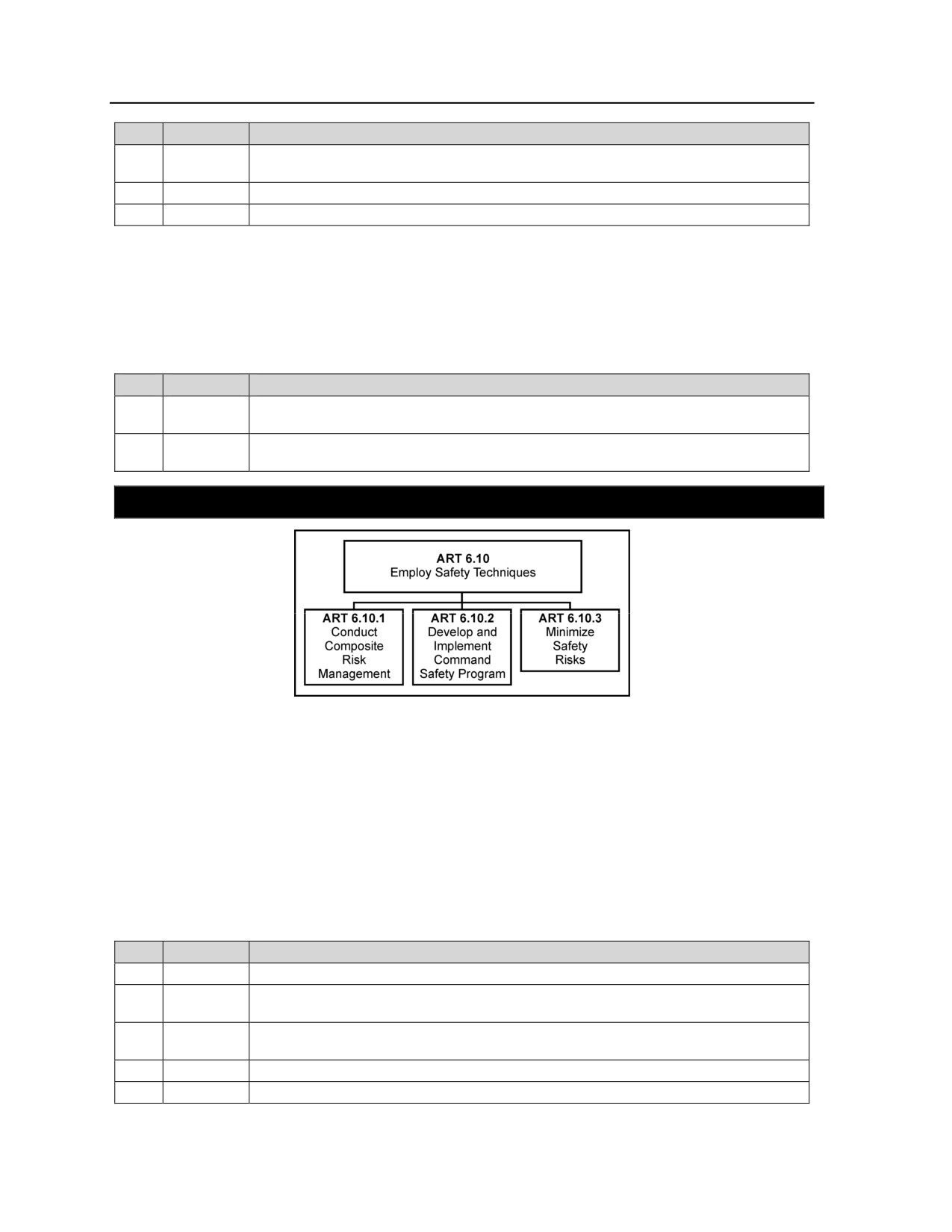
SECTION X - ART 6.10: EMPLOY SAFETY TECHNIQUES
6-163. Safety in the protection warfighting function identifies and assesses hazards to the force and
makes recommendations on ways to mitigate those hazards. Responsibility for safety starts with the
commander and continues through the chain of command to individuals. All staffs understand and factor
into their analysis how their execution recommendations could adversely affect Soldiers. (FM 5-19) (CRC)
ART 6.10.1 CONDUCT COMPOSITE RISK MANAGEMENT
6-164. Identify and control hazards to protect the force and increase the chance of mission
accomplishment. Use risk management throughout the conduct (planning, preparing, executing, and
assessing) of missions to recommend how to reduce tactical and accidental risk. ART 6.10.1 includes the
requirement to establish, communicate, and enforce controls that reduce the risk of tactical and accident
hazards. (FM 5-19) (CRC)
No.
Scale
Measure
01
Yes/No
Unit established, communicated, and enforced tactical and accident hazard controls.
Probability of successful mission accomplishment increased because of risk
02
Yes/No
management.
Casualties and vehicle or building damage reduced because of the use of risk
03
Yes/No
management techniques.
04
Yes/No
Environmental considerations planning and procedures were present and being followed.
05
Time
To employ risk management.
6-92
FM 7-15, C4
20 October 2010

ART 6.0: The Protection Warfighting Function
No.
Scale
Measure
06
Time
To communicate controls or changes to force.
07
Percent
Of identified significant risks to mission accomplishment and force protection.
08
Percent
Of identified risks that are determined to be acceptable by the commander.
09
Percent
Of force affected by identified accident hazards.
10
Percent
Of hazards identified and mitigated to include environmental hazards.
11
Percent
Of residual risk accepted.
12
Percent
Of force affected by unidentified accident hazards.
13
Number
And types of hazards not identified affecting operation or casualties.
14
Number
Of controls averting identified accident hazards.
15
Number
Of controls averting unidentified accident hazards.
ART 6.10.2 DEVELOP AND IMPLEMENT COMMAND SAFETY
PROGRAM
6-165. Develop and implement command safety and occupational health, risk management, and accident
prevention programs. (FM 5-19) (CRC)
No.
Scale
Measure
The command’s published safety program incorporated the commander’s safety
01
Yes/No
philosophy and had realistic safety goals, objectives, and priorities.
02
Time
To modify command safety program to include new safety hazards.
03
Number
Of measures introduced to mitigate risk as a result of the risk assessment.
04
Number
Of violations of command safety program occurring within a given time.
05
Number
Of safety hazards not covered initially by command safety program.
ART 6.10.3 MINIMIZE SAFETY RISKS
6-166. Ensure that programs are in place to identify potential safety threats, to apply risk management,
and to take action to abate such risks. (FM 5-19) (CRC)
No.
Scale
Measure
01
Time
To complete accident investigation and report.
02
Percent
Of accidents attributed to human error in last 12 months.
03
Number
Of fatalities in last 12 months.
04
Number
Of man-hours lost because of accidents in last 6 months.
05
Number
Of people with lost time because of contact with hazardous materials.
06
Number
Of people with lost time because of nonwork-related accidents.
07
Number
Of people with lost time because of work-related accidents
20 October 2010
FM 7-15, C4
6-93
Chapter 6
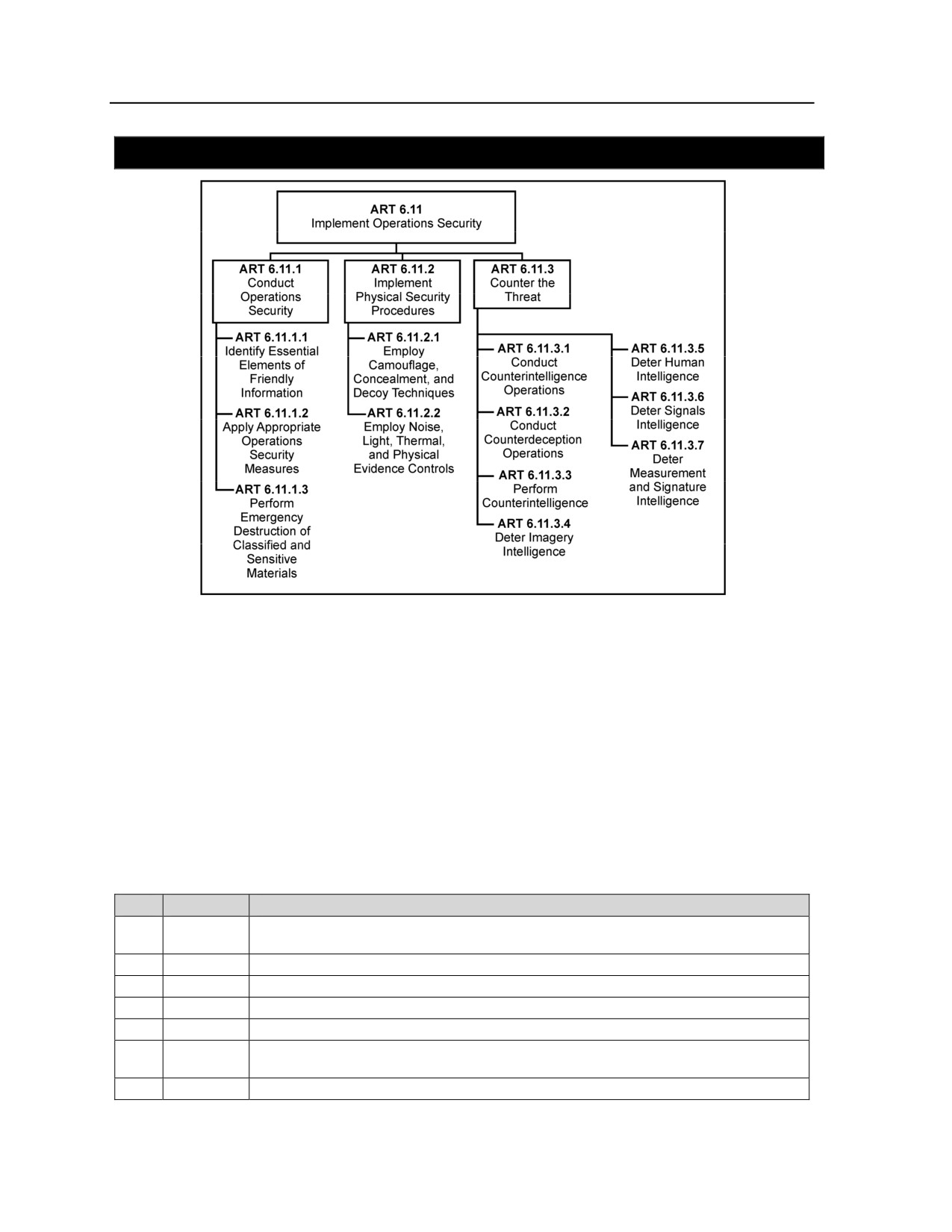
SECTION XI - ART 6.11: IMPLEMENT OPERATIONS SECURITY
6-167. Operations security is a process of identifying essential elements of friendly information and
subsequently analyzing friendly actions attendant to military operations and other activities to identify
those actions that can be ob-served by adversary intelligence systems; determine indicators that hostile
intelligence systems might obtain that could be interpreted or pieced together to derive critical information
in time to be useful to adversaries; and select and execute measures that eliminate or reduce to an
acceptable level the vulnerabilities of friendly actions to adversary exploitation. (FM 3-13) (USACAC)
ART 6.11.1 CONDUCT OPERATIONS SECURITY
6-168. Identify essential elements of friendly information (EEFI) and subsequently analyze friendly
actions attendant to military operations and other activities. ART 6.11.1 identifies actions that can be
observed by adversary intelligence systems and determines indicators adversary intelligence systems might
obtain that could be interpreted or pieced together to derive EEFI in time to be useful to adversaries.
ART 6.11.1 also involves selecting and executing measures that eliminate or reduce to an acceptable level
the vulnerabilities of friendly actions to adversary exploitation. (FM 3-13) (USACAC)
No.
Scale
Measure
Operations security (OPSEC) compromised degraded, delayed, or modified unit
01
Yes/No
operation.
02
Time
To refine OPSEC appendix to the operation order.
03
Time
To complete OPSEC assessment in the area of operations (AO).
04
Time
To identify possible compromises of EEFI in AO.
05
Time
To identify EEFI for an operation.
Of increased or decreased number of security violations on combat net radios in the AO
06
Percent
within a given period.
07
Percent
Of enemy sensor coverage in AO known to friendly forces.
6-94
FM 7-15, C4
20 October 2010

ART 6.0: The Protection Warfighting Function
No.
Scale
Measure
08
Percent
Of successful enemy attempted penetration of friendly information systems.
09
Percent
Of information systems administrators and operators who have current OPSEC training.
10
Percent
Of identified friendly vulnerabilities in AO exploited by enemy actions.
Of friendly troop movements conducted without the possibility of enemy overhead
11
Percent
surveillance (satellite and manned and unmanned aerial reconnaissance platforms).
12
Percent
Of units, facilities, and installations protected from enemy observation or surveillance.
13
Percent
Of electronic communications in AO encrypted or secured.
14
Percent
Of message traffic in AO exploited by enemy.
15
Percent
Of friendly emitters in AO exploited by enemy.
16
Percent
Of EEFI items covered by two or more measures.
Of enemy capabilities not covered by OPSEC measures covered by other elements
17
Percent
such as deception, and electronic warfare.
18
Percent
Of friendly plan determined from self-monitoring of EEFI.
Of OPSEC measures previously assessed unsatisfactory that have improved based on
19
Percent
assessment.
20
Percent
Of OPSEC measures selected tied to vulnerability analysis.
Of OPSEC planners who accommodate measures required to protect trusted agent
21
Percent
planning such as given access.
22
Percent
Of OPSEC planners who have access to compartmented planning efforts.
Of OPSEC planners who have input to and receive guidance and results from higher
23
Percent
headquarters OPSEC plans and surveys.
24
Percent
Of OPSEC surveys reflected in OPSEC plans.
25
Percent
Of routine actions with timing or location changed at least weekly.
26
Percent
Of units equipped with antisurveillance sensor and sensor jamming devices.
27
Percent
Of vulnerabilities tied to specific enemy capabilities by planners.
28
Number
And types of information needed by the commander to make decisions listed as EEFI.
29
Number
Of security violations on combat net radios in the AO.
30
Number
Of instances of friendly force operational patterns repeated in the AO.
ART 6.11.1.1 IDENTIFY ESSENTIAL ELEMENTS OF FRIENDLY INFORMATION
6-169. Identify friendly vulnerabilities that are exploitable by enemies and potential adversaries. Include
recommendations concerning countermeasures and corrective action. (FM 3-13) (USACAC)
No.
Scale
Measure
01
Yes/No
Commander and staff identified friendly vulnerabilities that can be exploited by an enemy.
02
Time
To develop essential elements of friendly information (EEFI).
To disseminate initial and subsequent EEFI requirements to subordinate elements of
03
Time
the force.
04
Time
Between updates of priority information requirements.
To disseminate to all force elements and agencies information obtained due to the
05
Time
answering of EEFI.
06
Time
In advance of collection that EEFI are identified.
07
Time
Since most current information regarding EEFI was last collected.
08
Time
Of turnaround to process new EEFI.
Of friendly activities and resource expenditures accurately predicted by friendly reference
09
Percent
materials, checklists, and other previously prepared documents and databases.
10
Percent
Of total EEFI identified only during execution.
11
Percent
Of EEFI collected in time to meet current operational needs.
20 October 2010
FM 7-15, C4
6-95

Chapter 6
No.
Scale
Measure
12
Percent
Of EEFI included in collection plan.
13
Number
Of EEFI not identified during planning.
ART 6.11.1.2 APPLY APPROPRIATE OPERATIONS SECURITY MEASURES
6-170. Deny adversaries information about friendly capabilities and intentions by identifying, controlling,
and protecting indicators associated with planning and conducting military operations.
(FM 3-13)
(USACAC)
No.
Scale
Measure
Unit application of operations security (OPSEC) measures prevented the enemy from
01
Yes/No
detecting the correct indicators of friendly operations until it was too late for the enemy
to react.
02
Yes/No
Units changed patterns of operation on an irregular basis.
03
Time
To apply appropriate OPSEC measures.
04
Time
To brief unit information engagement cell and unit plans cell on OPSEC requirements.
05
Time
To identify target sets and desired effect, by priority.
06
Percent
Of OPSEC surveys reflected in OPSEC plans.
07
Percent
Of routine actions with timing or location changed at least weekly.
08
Percent
Of favorable signal security assessments.
09
Number
Of public media disclosures.
Of critical essential elements of friendly information that must be concealed from the
10
Number
enemy.
ART 6.11.1.3 PERFORM EMERGENCY DESTRUCTION OF CLASSIFIED AND SENSITIVE
MATERIALS
6-171. Establish and execute procedures for the emergency destruction of classified materials.
(AR 380-5) (USAIC&FH)
No.
Scale
Measure
Emergency destruction of classified and sensitive documents and other materials was
01
Yes/No
accomplished without compromising classified and sensitive information.
02
Time
To identify classified and sensitive materials for destruction.
03
Time
To destroy classified and sensitive materials.
04
Time
To develop and rehearse emergency destruction procedures.
05
Percent
Of identified classified and sensitive s identified for destruction that is actually destroyed.
Of classified and sensitive materials accountability procedures followed during the
06
Percent
emergency destruction process.
Of mission-capable, on-hand equipment to perform emergency destruction of classified
07
Percent
and sensitive materials.
And types of paper shredders, thermal grenades, burn barrels, and magnets used to
08
Number
perform emergency destruction of classified and sensitive materials.
09
Number
And types of classified and sensitive documents and other materials destroyed.
ART 6.11.2 IMPLEMENT PHYSICAL SECURITY PROCEDURES
6-172. Protect personnel, information, and critical resources in all locations and situations against various
threats by developing and implementing effective security policies and procedures. This total system
approach is based on the continuing analysis and employment of protective measures, to include physical
barriers, clear zones, lighting, access and key control, intrusion detection devices, defensive positions, and
nonlethal capabilities. (FM 3-19.30) (USAMPS)
6-96
FM 7-15, C4
20 October 2010

ART 6.0: The Protection Warfighting Function
No.
Scale
Measure
Unit, base, and installation physical security program protected personnel, information,
01
Yes/No
and critical resources from unauthorized access.
To review and refine unit physical security standing operating procedures in accordance
02
Time
with the factors of mission, enemy, terrain and weather, troops and support available,
time available, civil considerations.
To refine physical security regulations for installations and major combat formation in an
03
Time
area of operations.
04
Time
To complete a threat analysis.
To design, procure, emplace and activate protective measures, such as physical
05
Time
barriers, clear zones, exterior lighting, access and key control, intrusion detection
devices, defensive positions, and nonlethal capabilities.
Of units, bases, and installations in the area of operations that have active integrated
06
Percent
physical security programs.
07
Percent
Of guidance in unit and base physical security programs actually followed.
08
Percent
Of decreased crime rate.
09
Percent
Of increased reported crimes cleared.
10
Percent
Of perpetrators arrested or killed.
11
Percent
Of decreased serious crimes reported.
12
Percent
Of decreased fear of crime by unit personnel.
Of planned physical barriers, clear zones, exterior lighting, access and key control,
13
Percent
intrusion detection devices, defensive positions and nonlethal capabilities operational.
Of successful attempts to gain unauthorized access to friendly forces, installations,
14
Number
information, equipment, and supplies.
ART 6.11.2.1 EMPLOY CAMOUFLAGE, CONCEALMENT, AND DECOY TECHNIQUES
6-173. Protect friendly forces, personnel, materiel, equipment, and information system nodes from
observation and surveillance by using natural or artificial materials. Employ an imitation in any sense of a
person, object, or phenomenon with the intentions of deceiving enemy surveillance devices or misleading
enemy evaluation. (FM 20-3) (USAES)
No.
Scale
Measure
The unit’s use of camouflage, concealment, and decoy techniques enhanced unit
01
Yes/No
survivability.
02
Time
To employ camouflage, concealment, and decoy techniques.
To conduct a preliminary assessment of camouflage, concealment, and decoy effort in
03
Time
the area of operations.
To obtain additional operational camouflage and decoy systems as required by the
04
Time
factors of mission, enemy, terrain and weather, troops and support available, time
available, civil considerations.
05
Percent
Of unit concealed from enemy observation and sensor detection.
Of unit personnel trained to correctly employ camouflage and concealment and to use
06
Percent
decoys.
07
Percent
Of casualties due to improper use of camouflage and concealment and decoys.
Of on-hand camouflage and decoy systems that are serviceable against enemy
08
Percent
observation and sensors.
09
Number
And types of on-hand, serviceable camouflage and decoy systems.
ART 6.11.2.2 EMPLOY NOISE, LIGHT, THERMAL, AND PHYSICAL EVIDENCE CONTROLS
6-174. Reduce friendly indicators by controlling personnel and equipment sounds, light emissions, and
physical evidence of occupying a position. (FM 3-21.75) (USAIS)
20 October 2010
FM 7-15, C4
6-97

Chapter 6
No.
Scale
Measure
Unit personnel did not compromise unit course of action by violations of noise, light,
01
Yes/No
thermal, and physical evidence controls.
02
Time
To assess unit noise, light, thermal, and physical evidence controls.
03
Time
To employ noise, light, thermal, and physical evidence controls.
Of increased time to conduct operations required by the need to maintain noise, light,
04
Percent
thermal, and physical evidence controls.
05
Percent
Of unit maintaining noise, light, thermal, and physical evidence controls.
06
Percent
Of unit personnel trained in noise, light, thermal, and physical evidence controls.
Of units, installations, and facilities that have recorded violations of noise, light, thermal,
07
Percent
and physical evidence controls.
Of friendly casualties due to violations of unit noise, light, thermal, and physical
08
Number
evidence controls.
ART 6.11.3 COUNTER THE THREAT
6-175. The task of providing the commander information and intelligence support for targeting the threat
forces through lethal and nonlethal fires including electronic warfare and information engagement.
Intelligence support to force protection and counterintelligence including the tactics, techniques, and
procedures to deny or degrade threat intelligence, surveillance, and reconnaissance capabilities to access
and collect information and intelligence on friendly forces. (FM 2-0) (USAIC&FH)
No.
Scale
Measure
01
Yes/No
Unit identified threat capabilities and limitations.
02
Yes/No
Unit identified friendly force vulnerabilities to threat forces.
03
Yes/No
Unit developed countermeasures to deny or degrade threat capabilities.
04
Yes/No
Unit developed countermeasures to mitigate friendly force vulnerability.
Unit identified threat capabilities and friendly forces countermeasures in sufficient time
05
Yes/No
to integrate into the plan, prepare, execute, and assess operations process.
06
Yes/No
Unit disseminated countermeasures to friendly forces.
07
Time
To develop threat databases and templates.
08
Time
To develop countermeasures.
09
Percent
Of threat capabilities correctly identified.
10
Percent
Of countermeasures that effectively denied or degraded threat’s ability.
ART 6.11.3.1 CONDUCT COUNTERINTELLIGENCE OPERATIONS
6-176. Counterintelligence is designed to defeat or degrade threat intelligence collection capabilities. The
intelligence staff provides counterintelligence to the commander outlining the capabilities and limitations
of threat intelligence services to limit or eliminate these capabilities. (FM 34-60) (USAIC&FH)
No.
Scale
Measure
Enemy intelligence operations directed against the unit and its personnel degraded,
01
Yes/No
delayed, or modified unit operations.
02
Yes/No
Control element provided counterintelligence guidance.
03
Time
To conduct an area reconnaissance to identify hazards.
To review counterintelligence plans for major tactical formations in the area of
04
Time
operations (AO).
To conduct counterintelligence collection, operations, and investigations; create and
maintain counterintelligence databases; analyze, assess counterintelligence
05
Time
information; and publish, disseminate, and technically support counterintelligence
products and reports.
6-98
FM 7-15, C4
20 October 2010

ART 6.0: The Protection Warfighting Function
No.
Scale
Measure
To conduct counterintelligence screening and collection at enemy prisoner of war
06
Time
collection points or dislocated civilian checkpoints.
To conduct counterintelligence liaison with host-nation agencies and multinational
07
Time
forces.
To conduct the counterintelligence portion of a vulnerability assessment and
08
Time
recommend countermeasures.
Of friendly force operations in the AO degraded, delayed, or modified due to successful
09
Percent
enemy intelligence activities.
10
Percent
Of friendly force units in the AO that have current counterintelligence training.
11
Percent
Of friendly force action designed to mislead or prevent enemy intelligence efforts.
12
Percent
Of units in the AO that have active counterintelligence plans.
13
Number
Of enemy intelligence efforts detected by counterintelligence activities.
14
Number
Of counterintelligence teams available for use in the AO.
15
Number
And quality of sources developed in the AO.
ART 6.11.3.2 CONDUCT COUNTERDECEPTION OPERATIONS
6-177. Conduct activities that preclude the commander from being deceived by enemy deception
operations. (FM 3-13) (USACAC)
No.
Scale
Measure
Friendly course of action was not affected by enemy deception except as desired to
01
Yes/No
deceive the enemy when the friendly force accepted the enemy deception story.
02
Time
To identify adversary attempts to deceive friendly forces.
03
Time
To develop counterdeception operations options as required.
04
Percent
Of enemy deception activities detected.
05
Percent
Of enemy deception activities using multiple sources to transmit deception story.
ART 6.11.3.3 PERFORM COUNTERINTELLIGENCE
6-178. Gather information and conduct activities to protect against espionage, other intelligence activities,
sabotage, or assassinations conducted by or on behalf of foreign governments or elements thereof, foreign
organizations, or foreign persons, or international terrorist activities. (FM 34-60) (USAIC&FH)
No.
Scale
Measure
01
Yes/No
Unit identified threat intelligence collection capabilities and limitations.
02
Yes/No
Unit identified friendly forces vulnerabilities to threat intelligence collection.
Unit developed countermeasures to deny or degrade threat’s ability to collect on friendly
03
Yes/No
forces.
Unit developed countermeasures to mitigate friendly forces vulnerability to threat
04
Yes/No
collection.
Unit identified threat capabilities and friendly forces countermeasures in sufficient time
05
Yes/No
for implementation.
06
Time
To develop threat databases and templates.
07
Time
To develop countermeasures.
08
Percent
Of threat intelligence collection capabilities correctly identified.
Of countermeasures that effectively denied or degraded threat’s ability to collect on
09
Percent
friendly forces.
20 October 2010
FM 7-15, C4
6-99

Chapter 6
ART 6.11.3.4 DETER IMAGERY INTELLIGENCE
6-179. Defeat or degrade threat imagery intelligence collection capabilities. The intelligence staff will
provide counterintelligence to the commander outlining the capabilities and limitation of threat imagery
intelligence services to limit or eliminate these imagery capabilities. (FM 2-0) (USAIC&FH)
No.
Scale
Measure
01
Yes/No
Unit identified threat imagery intelligence collection capabilities and limitations.
02
Yes/No
Unit identified friendly forces vulnerabilities to threat imagery intelligence collection.
Unit developed countermeasures to deny or degrade threat’s ability to collect on friendly
03
Yes/No
forces with imagery assets.
Unit developed countermeasures to mitigate friendly forces vulnerability to threat
04
Yes/No
collection.
Unit identified threat capabilities and friendly forces countermeasures in sufficient time
05
Yes/No
for implementation.
06
Time
To develop threat databases and templates.
07
Time
To develop countermeasures.
08
Percent
Of threat imagery intelligence collection capabilities correctly identified.
Of countermeasures that effectively denied or degraded threat’s ability to collect on
09
Percent
friendly forces with imagery assets.
ART 6.11.3.5 DETER HUMAN INTELLIGENCE
6-180. Defeat or degrade threat human intelligence collection capabilities. The intelligence staff will
provide counterintelligence to the commander outlining the capabilities and limitation of threat human
intelligence services to limit or eliminate these human intelligence capabilities. (FM 2-0) (USAIC&FH)
No.
Scale
Measure
01
Yes/No
Unit identified threat human intelligence collection capabilities and limitations.
02
Yes/No
Unit identified friendly force vulnerabilities to threat human intelligence collection.
Unit developed countermeasures to deny or degrade threat’s ability to collect on friendly
03
Yes/No
forces.
Unit developed countermeasures to mitigate friendly forces vulnerability to threat human
04
Yes/No
collection.
Unit identified threat capabilities and friendly forces countermeasures in sufficient time
05
Yes/No
for implementation.
06
Time
To develop threat databases and templates.
07
Time
To develop countermeasures.
08
Percent
Of threat human intelligence collection capabilities correctly identified.
Of countermeasures that effectively denied or degraded threat’s ability to collect on
09
Percent
friendly forces using human intelligence.
ART 6.11.3.6 DETER SIGNALS INTELLIGENCE
6-181. Defeat or degrade threat signal intelligence collection capabilities. The intelligence staff will
provide counterintelligence to the commander outlining the capabilities and limitation of threat signal
intelligence services to limit or eliminate these signal intelligence capabilities. (FM 2-0) (USAIC&FH)
No.
Scale
Measure
01
Yes/No
Unit identified threat signal intelligence collection capabilities and limitations.
02
Yes/No
Unit identified friendly forces vulnerabilities to threat signal intelligence collection.
6-100
FM 7-15, C4
20 October 2010

ART 6.0: The Protection Warfighting Function
No.
Scale
Measure
Unit developed countermeasures to deny or degrade threat’s ability to collect on friendly
03
Yes/No
force use of the electromagnetic spectrum.
Unit developed countermeasures to mitigate friendly force vulnerability to threat signal
04
Yes/No
collection.
Unit identified threat capabilities and friendly force countermeasures in sufficient time
05
Yes/No
for implementation.
06
Time
To develop threat databases and templates.
07
Time
To develop counter measures.
08
Percent
Of threat signals intelligence collection capabilities correctly identified.
Of countermeasures that effectively denied or degraded threat’s ability to collect on
09
Percent
friendly force using signals intelligence.
ART 6.11.3.7 DETER MEASUREMENT AND SIGNATURE INTELLIGENCE
6-182. Defeat or degrade threat measurement and signature intelligence collection capabilities. The
intelligence staff will provide counterintelligence to the commander outlining the capabilities and
limitation of threat measurement and signature intelligence services to limit or eliminate these measurement
and signature intelligence capabilities. (FM 2-0) (USAIC&FH)
No.
Scale
Measure
Unit identified threat measurement and signature intelligence collection capabilities and
01
Yes/No
limitations.
Unit identified friendly force vulnerabilities to threat measurement and signature
02
Yes/No
intelligence collection.
Unit developed countermeasures to deny or degrade threat’s ability to collect on friendly
03
Yes/No
force.
Unit developed countermeasures to mitigate friendly force vulnerability to threat
04
Yes/No
measurement and signature collection.
Unit identified threat capabilities and friendly force countermeasures in sufficient time
05
Yes/No
for implementation.
06
Time
To develop threat databases and templates.
07
Time
To develop countermeasures.
Of threat measurement and signature intelligence collection capabilities correctly
08
Percent
identified.
Of countermeasures that effectively denied or degraded threat’s ability to collect on
09
Percent
friendly forces using measurement and signature intelligence.
20 October 2010
FM 7-15, C4
6-101
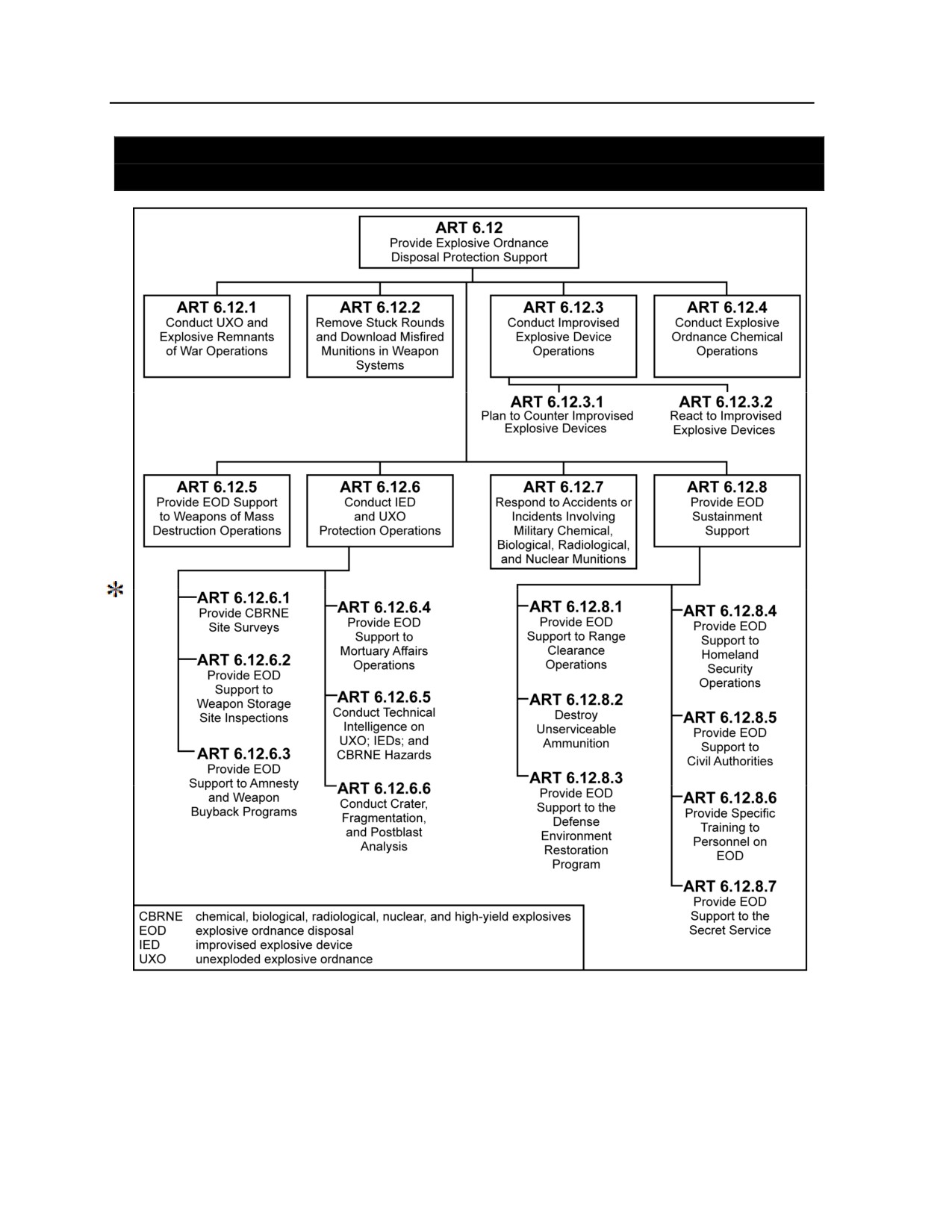
Chapter 6
*SECTION XII - ART 6.12: PROVIDE EXPLOSIVE ORDNANCE DISPOSAL
PROTECTION SUPPORT
6-183. Eliminate or reduce the effects of unexploded explosive ordnance (UXO), improvised explosive
devices
(IEDs), and chemical, biological, radiological, and nuclear
(CBRN) hazards to protect the
commander’s combat power. Explosive ordnance hazards limit battlefield mobility, deny use of critical
assets, and threaten to reduce the commander’s combat power significantly. Neutralize domestic or foreign
conventional, chemical, biological, and nuclear munitions; enhanced explosive devices; and IEDs that
present a threat to civilian facilities, materiel, and personnel, regardless of location. The Departments of
6-102
FM 7-15, C4
20 October 2010

ART 6.0: The Protection Warfighting Function
Justice, State, and Energy may receive this support per current agreements and directives. (FM 3-34.214)
(CASCOM)
Note: ART 6.12.8.6 includes conducting bomb and sabotage device recognition and safety
precaution training. ART
6.12.8.7 includes providing explosive ordnance disposal
(EOD)
support to the U.S. Secret Service, Department of State, and the Department of Defense to
protect the President and other designated persons.
Tasks identified in ART 6.12 are tasks that can be provided in support of stability operations as
well as in civil support operations.
No.
Scale
Measure
01
Yes/No
EOD support allowed the unit to accomplish its mission.
02
Yes/No
Collateral damage incurred during the EOD operation was within acceptable limits.
03
Yes/No
Unit safeguarded classified materials and publications during the EOD operation.
Unit forwarded items and components of technical intelligence value to appropriate
04
Yes/No
headquarters or agency.
05
Time
To provide EOD input to annex I to the operation plan or order.
06
Time
To respond to a request for EOD support.
07
Time
Delay in executing the concept of operations due to the presence of UXOs and IEDs.
To gather intelligence information (what, when, where, how delivered, and type)
08
Time
regarding munitions.
09
Time
To identify safety requirements and considerations.
10
Time
To identify personnel, equipment, procedures, and additional support requirements.
To coordinate with reporting agency for site support assistance, such as engineer,
11
Time
medical, security, and transportation.
12
Time
To clear munitions and improvised devices.
To document render-safe procedures, as conducted, for unknown ordnance, if technical
13
Time
intelligence data does not exist.
14
Percent
Of safety precautions enforced during EOD operations.
15
Percent
Of reported munitions and improvised devices rendered safe.
16
Percent
Of reported munitions and improvised devices rendered safe per commander’s intent.
Of available EOD support expended on conducting bomb and sabotage device
17
Percent
recognition and safety training.
18
Percent
Of patients received at medical treatment facilities with UXO in their wounds.
19
Number
Of casualties during the EOD operation.
20
Number
And types of ordnance located and destroyed by EOD personnel.
Of chemical, biological, radiological, nuclear, and high-yield explosives incidents
21
Number
responded to within a given period.
ART 6.12.1 CONDUCT UNEXPLODED EXPLOSIVE ORDNANCE AND
EXPLOSIVE REMNANTS OF WAR OPERATIONS
6-184. Explosive ordnance disposal (EOD) units identify, render safe, recover, evaluate, dispose of,
mitigate the threat of, and report (EOD and intelligence) U.S. and foreign unexploded explosive ordnance
(UXO) to eliminate or reduce hazards and to protect the commander’s combat power. EOD units maintain
the capability to render safe, identify, destroy, and move UXO hazards to safe holding or disposal areas
within the limitations of their organic transportation assets, perform technical intelligence on new or first
seen ordnance items, and perform postblast forensic analysis. EOD performs initial assessment of
explosive remnants of war sites, eliminates immediate hazards, conducts technical intelligence procedures,
and recommends disposition to capturing unit. (FM 3-34.214) (CASCOM)
20 October 2010
FM 7-15, C4
6-103

Chapter 6
No.
Scale
Measure
01
Yes/No
EOD support allowed the requesting unit to accomplish its mission.
Collateral damage incurred during the conduct of the EOD operation was in acceptable
02
Yes/No
limits.
03
Yes/No
Unit safeguarded classified materials and publications during EOD operations.
Unit forwarded items and components of technical intelligence value to appropriate
04
Yes/No
headquarters or agency.
To respond to a request for EOD support to conduct UXO and explosive remnants of
05
Time
war operations.
06
Time
Delay to execute operations due to the presence of UXO and explosive remnants of war.
To gather intelligence information (what, when, where, how delivered, and type)
07
Time
regarding UXO and explosive remnants of war.
To identify safety requirements and considerations concerned with the destruction or
08
Time
elimination of UXO or rendering safe explosive remnants of war.
09
Time
To identify personnel, equipment, procedures, and additional support requirements.
To coordinate with the reporting agency for site support assistance such as engineer,
10
Time
medical, security, and transportation.
11
Time
To clear UXO and explosive remnants of war.
12
Time
Time to move UXOs to safe holding or dispersal areas.
To document render-safe procedures, as conducted, for unknown UXO or explosive
13
Time
remnants of war if technical intelligence data does not exist.
14
Time
To provide disposition instructions of explosive remnants of war to capturing unit.
15
Percent
Of safety precautions enforced during the EOD operation.
16
Percent
Of reported UXO and explosive remnants of war rendered safe.
Of reported UXO and explosive remnants of war destroyed or rendered safe per the
17
Percent
commander’s priorities.
18
Number
Of casualties during the conduct of the EOD operation.
19
Number
And types of UXO and explosive remnants of war destroyed by EOD personnel.
ART 6.12.2 REMOVE STUCK ROUNDS AND DOWNLOAD MISFIRED
MUNITIONS IN WEAPON SYSTEMS
6-185. Removal of stuck rounds is a routine explosive ordnance disposal (EOD) operation. In a removal
of stuck rounds mission, the EOD unit removes stuck rounds in mortars, artillery tubes, and other weapon
systems; inspects possible unsafe ammunition removed during EOD or operator procedures to determine if
it is safe for storage or transport; and destroys ammunition that EOD personnel determine to be unsafe for
storage or transport. A battle damaged vehicle with ammunition on board requires EOD to download
munitions and clear the vehicle before it can be repaired. EOD also supports the postblast investigation and
performs technical intelligence on enemy weapons effects on U.S. vehicles through appropriate channels.
(FM 3-34.214) (CASCOM)
No.
Scale
Measure
01
Yes/No
EOD support allowed the unit to accomplish its mission.
Collateral damage incurred during the conduct of the EOD operation was in acceptable
02
Yes/No
limits.
03
Yes/No
Unit safeguarded classified materials and publications during EOD operations.
Unit forwarded items and components of technical intelligence value to appropriate
04
Yes/No
headquarters or agency.
To identify safety requirements and considerations concerned with removal of stuck
05
Time
rounds or download misfired munitions.
06
Time
To identify personnel, equipment, procedures, and additional support requirements.
6-104
FM 7-15, C4
20 October 2010

ART 6.0: The Protection Warfighting Function
No.
Scale
Measure
07
Time
To move from the current location to the work site.
To coordinate with the requesting agency for site support assistance in areas such as
08
Time
engineer, medical, security, and transportation.
09
Time
To remove the stuck rounds or download misfired munitions.
To gather intelligence information (what, when, where, how delivered, and type)
10
Time
regarding munitions.
To coordinate with reporting agency for site support assistance such as engineer,
11
Time
medical, security, and transportation.
To develop and attempt render-safe procedures or conduct analysis for forensic
12
Time
evidence.
Of available EOD support assets expended on developing render-safe procedures or
13
Percent
conducting postblast analysis.
14
Percent
Of safety precautions enforced during the EOD operation.
15
Percent
Of stuck rounds or misfired munitions identified as safe for storage or transport.
Of stuck rounds or misfired munitions identified as unsafe for storage or transport and
16
Percent
destroyed.
17
Number
Of casualties during the conduct of the EOD operation.
18
Number
And types of stuck rounds removed or misfired munitions downloaded.
19
Number
And types of appropriate intelligence reports prepared within a given period.
*ART 6.12.3 CONDUCT IMPROVISED EXPLOSIVE DEVICE
OPERATIONS
6-186. Explosive ordnance disposal
(EOD) teams identify, render safe, and dispose of improvised
explosive devices (IEDs) and conduct postblast analysis and intelligence reporting. EOD teams maintain
capabilities for remote investigation, identification, and movement of IEDs and emplacement or operation
of disruption tools and disposal methods. IEDs with potential chemical, biological, radiological, nuclear,
and high-yield explosives may require additional EOD personnel and equipment to augment the initial
EOD response team. (FM 3-34.214) (CASCOM)
No.
Scale
Measure
01
Yes/No
EOD support allowed the requesting unit to accomplish its mission.
Collateral damage incurred during the conduct of the EOD operation was in acceptable
02
Yes/No
limits.
03
Yes/No
Unit safeguarded classified materials and publications during EOD operations.
Unit forwarded items and components of technical intelligence value to appropriate
04
Yes/No
headquarters or agency.
05
Time
To respond to a request for EOD support to conduct counter-IED operations.
06
Time
Delay in executing the concept of operations due to the presence of IEDs.
To gather intelligence information (what, when, where, how delivered, and type)
07
Time
regarding IEDs.
To identify safety requirements and considerations concerned with the destruction or
08
Time
elimination of IEDs.
09
Time
To identify personnel, equipment, procedures, and additional support requirements.
To coordinate with the reporting agency for site support assistance such as engineer,
10
Time
medical, security, decontamination, and transportation.
11
Time
To gain access to and identify IEDs.
12
Time
To emplace or operate disruption tools.
13
Time
To render safe and or dispose of IEDs.
14
Time
To conduct postblast analysis
20 October 2010
FM 7-15, C4
6-105

Chapter 6
No.
Scale
Measure
15
Percent
Of safety precautions enforced during the EOD operation.
16
Percent
Of IEDs destroyed or rendered safe.
17
Number
Of casualties while disposing of explosive ordnance.
18
Number
And types of IEDs destroyed by EOD personnel.
19
Number
Of IED components retrieved by EOD personnel for exploitation.
*ART 6.12.3.1 PLAN TO COUNTER IMPROVISED EXPLOSIVE DEVICES
6-187. Conduct improvised explosive device (IED) defeat operations to defeat asymmetric attacks against
U.S. forces. (FM 3-90.119) (USAES)
No.
Scale
Measure
01
Yes/No
Unit planned for possible IED threats in a counterinsurgency environment.
Unit prepared for IED defeat using the tenets of IED defeat (predict, detect, prevent,
02
Yes/No
neutralize, and mitigate).
Element prepared for a suspected vehicle borne, suicide vehicle borne, and person
03
Yes/No
borne IED attack against static positions.
Element reacted to a possible IED, vehicle borne, suicide vehicle borne or person borne
04
Yes/No
IED by using the 5Cs (confirm, clear, cordon, check, and control).
*ART 6.12.3.2 REACT TO IMPROVISED EXPLOSIVE DEVICES
6-188. Planning elements are proactive actions taken by friendly forces to predict, detect, prevent, avoid,
neutralize, and protect against improvised explosive device events. The process and the products of
mission analysis help the commander and staffs develop and refine their situational understanding and
develop effective plans. By having a thorough understanding of the mission, enemy, terrain and weather,
troops and support available, time available, civil considerations factors, the commander and staff are
better equipped to develop effective plans to accomplish the mission. (FM 3-90.119) (USAES)
No.
Scale
Measure
Unit predicted actions and circumstances that could affect the ability of the force to
01
Yes/No
maintain movement and maneuver.
Unit prevented potential impediments to movement and maneuver from affecting the
02
Yes/No
mobility of the force by acting early.
Unit detected early indicators of impediments to battlefield mobility and identify solutions
03
Yes/No
through the use of intelligence, surveillance, and reconnaissance assets.
04
Yes/No
Unit avoided detected impediments to movement and maneuver if prevention fails.
Unit neutralized, reduced, or overcame impediments to movement and maneuver that
05
Yes/No
could not be prevented or avoided.
06
Yes/No
Unit protected against enemy countermobility efforts.
ART 6.12.4 CONDUCT EXPLOSIVE ORDNANCE DISPOSAL
CHEMICAL OPERATIONS
6-189. Explosive ordnance disposal (EOD) units respond to U.S. and foreign chemical weapons incidents
to identify, render safe, perform preliminary packaging, and limit the spread of chemical contamination.
EOD units maintain the capability to presume identification of chemical agents, perform preliminary
packaging of chemical munitions, perform emergency personnel decontamination station operations (EOD
personnel and limited equipment only), mark and perform hasty decontamination of the immediate
chemical incident site, perform render-safe procedures, collect samples for additional identification and
testing, and dispose of chemical munitions. (FM 3-34.214) (CASCOM)
6-106
FM 7-15, C4
20 October 2010

ART 6.0: The Protection Warfighting Function
No.
Scale
Measure
01
Yes/No
EOD support allowed the unit to accomplish its mission.
02
Yes/No
Collateral damage incurred during EOD operation was within acceptable limits.
03
Yes/No
Unit safeguarded classified materials and publications during the EOD operation.
Unit forwarded items and components of technical intelligence value to appropriate
04
Yes/No
headquarters or agency.
05
Time
To provide EOD input to annex I to the operation plan or order.
06
Time
To respond to a request for EOD support.
Delay in executing the concept of operations due to the presence of unexploded
07
Time
explosive ordnance and improvised explosive device.
To gather intelligence information (what, when, where, how delivered, and type)
08
Time
regarding munitions.
09
Time
To identify safety requirements and considerations.
10
Time
To identify personnel, equipment, procedures, and additional support requirements.
To coordinate with reporting agency for site support assistance, such as engineer,
11
Time
medical, security, and transportation.
12
Time
To clear munitions and improvised devices.
To document render-safe procedures, as conducted, for unknown ordnance, if technical
13
Time
intelligence data does not exist.
14
Percent
Of safety precautions enforced during EOD operations.
15
Percent
Of reported munitions and improvised devices rendered safe.
16
Percent
Of reported munitions and improvised devices rendered safe per commander’s intent.
Of available EOD support expended on conducting bomb and sabotage device
17
Percent
recognition and safety training.
Of patients received at medical treatment facilities with unexploded explosive ordnance
18
Percent
in their wounds.
19
Percent
Of casualties during the EOD operation.
20
Number
And types of ordnance located and destroyed by EOD personnel.
Of chemical, biological, radiological, nuclear, and high-yield explosives incidents
21
Number
responded to within a given period.
ART 6.12.5 PROVIDE EXPLOSIVE ORDNANCE DISPOSAL SUPPORT
TO WEAPONS OF MASS DESTRUCTION OPERATIONS
6-190. Reduce the threat of arms and weapons of mass destruction to regional security; conduct disposal
operations of hazardous U.S. and foreign munitions; conduct clearance and destruction operations of
ammunition storage areas and caches that may have hazardous munitions or booby traps; assist with
weapons or ammunition storage site inspections to satisfy treaty obligations or agreements and policies
enforcement; and detect, identify, and respond to chemical, biological, radiological, nuclear, and high-yield
explosives threat. Explosive ordnance disposal (EOD) units have the capability to presume identification of
biological agents, perform preliminary packaging of biological munitions and agents, perform emergency
personnel decontamination station operations
(EOD personnel only), mark and perform limited
decontamination of incident site, perform render-safe procedures, and collect samples for additional
identification and testing. (FM 3-34.214) (CASCOM)
No.
Scale
Measure
01
Yes/No
EOD support allowed the requesting unit to accomplish its mission.
Collateral damage incurred during the conduct of the EOD operation was in acceptable
02
Yes/No
limits.
03
Yes/No
Unit safeguarded classified materials and publications during EOD operations.
20 October 2010
FM 7-15, C4
6-107

Chapter 6
No.
Scale
Measure
Unit forwarded items and components of technical intelligence value to appropriate
04
Yes/No
headquarters or agency.
05
Time
To move from current location to the weapons of mass destruction (WMD) site.
06
Time
To locate WMD.
07
Time
To gain access to WMD
08
Time
To conduct advanced diagnostics on WMD.
To gather intelligence information (what, when, where, how delivered, and type)
09
Time
regarding WMD.
To identify safety requirements and considerations concerned with the destruction or
10
Time
elimination of WMD.
11
Time
To identify personnel, equipment, procedures, and additional support requirements.
To coordinate with the reporting agency for site support assistance such as engineer,
12
Time
medical, security, decontamination, and transportation.
To conduct clearance and destruction operations of ammunition storage areas and
13
Time
caches that may contain WMD.
To document render-safe procedures, as conducted, for unknown ordnance, if technical
14
Time
intelligence data does not exist.
15
Percent
Of safety precautions enforced during the EOD operation.
16
Percent
Of reported munitions rendered safe.
17
Number
Of casualties during the conduct of the EOD operation.
18
Number
And types of ordnance or WMD destroyed by EOD personnel.
ART 6.12.6 CONDUCT IMPROVED EXPLOSIVE DEVICE AND
UNEXPLODED EXPLOSIVE ORDNANCE PROTECTION
OPERATIONS
6-191. Assist commanders with protection of the force. This includes reviewing base defense plans and
bomb threat or search procedures, assisting in facility explosive hazard site surveys, and developing and
implementing explosive ordnance disposal (EOD) emergency response plans and the antiterrorism or force
protection plan. Provide training to emergency preparedness personnel on bomb threat search, improvised
explosive device (IED) defeat techniques, unexploded explosive ordnance (UXO) identification, and
marking procedures. Provide chemical, biological, radiological, nuclear, and high-yield explosives
emergency response plans and facility site surveys to commanders. Provide EOD support to weapon
storage site inspections. Provide EOD support to amnesty and weapon buyback programs. (FM 3-34.214)
(CASCOM)
No.
Scale
Measure
01
Yes/No
EOD support allowed the requesting unit to accomplish its mission.
Collateral damage incurred during the conduct of the EOD operation was in acceptable
02
Yes/No
limits.
03
Yes/No
Unit safeguarded classified materials and publications during EOD operations.
Unit forwarded items and components of technical intelligence value to appropriate
04
Yes/No
headquarters or agency.
05
Time
To move from current location to the work site.
To gather intelligence information (what, when, where, how delivered, and type)
06
Time
regarding munitions.
To identify safety requirements and considerations concerned with force protection
07
Time
operations.
08
Time
To identify personnel, equipment, procedures, and additional support requirements.
6-108
FM 7-15, C4
20 October 2010

ART 6.0: The Protection Warfighting Function
No.
Scale
Measure
To coordinate with the reporting agency for site support assistance such as engineer,
09
Time
medical, security, and transportation.
To document training, response preparedness, and review of defense plans, UXO
10
Time
identification and marking procedures, site surveys, and bomb threat or search
procedures conducted to assist commanders with force protection.
To clear munitions and improvised devices found during the conduct of force protection
11
Time
operations.
12
Percent
Of safety precautions enforced during the EOD operation.
13
Percent
Of reported munitions and IEDs rendered safe.
Of available EOD support expended on conducting bomb threat or search procedures,
14
Percent
device recognition, and safety training.
15
Number
Of casualties during EOD operations.
16
Number
And types of ordnance located and destroyed by EOD personnel.
17
Number
Of force protection requests responded to within a given period.
ART 6.12.6.1 PROVIDE CHEMICAL, BIOLOGICAL, RADIOLOGICAL, NUCLEAR, AND HIGH-
YIELD EXPLOSIVES SITE SURVEYS
6-192. Assist commanders with protection of the force by providing explosive ordnance disposal (EOD)
support to review base defense plans and bomb threat or search procedures, develop and implement base
defense plans, and assist in facility site surveys. (FM 3-34.214) (CASCOM)
No.
Scale
Measure
01
Yes/No
EOD support allowed the unit to accomplish its mission.
Collateral damage incurred during the conduct of the EOD operation was in acceptable
02
Yes/No
limits.
03
Yes/No
Unit safeguarded classified materials and publications during EOD operations.
To identify safety requirements and considerations concerned with emergency
04
Time
response plans and facility explosive hazard site surveys.
05
Time
To identify personnel, equipment, procedures, and additional support requirements.
06
Time
To move from the current location to the work site.
To coordinate with the requesting agency for site support assistance in areas such as
07
Time
engineer, medical, security, and transportation.
To document render-safe procedures that relate to emergency response plans and
08
Time
facility site surveys.
09
Percent
Of safety precautions enforced during the EOD operation.
10
Percent
Of reported munitions rendered safe.
11
Percent
Of reported munitions rendered safe per the requesting agency’s priorities.
12
Number
Of casualties during the conduct of the EOD operation.
13
Number
Of requests for assistance responded to in a given period.
ART 6.12.6.2 PROVIDE EXPLOSIVE ORDNANCE DISPOSAL SUPPORT TO WEAPON STORAGE
SITE INSPECTIONS
6-193. Sensitive site exploitation operations focus on locating, characterizing, seizing, securing, and
searching facilities, supplies, weapons, equipment, personnel, and infrastructures. Exploitation operations
may additionally include disablement operations to render chemical, biological, radiological, nuclear, and
high-yield explosives (CBRNE) materiel, systems, and equipment ineffective for use against the joint,
interagency, and multinational forces. Disablement operations include neutralization, incineration,
destruction, confiscation, and evacuation of CBRNE and associated materials. (FM 3-34.214) (CASCOM)
20 October 2010
FM 7-15, C4
6-109

Chapter 6
No.
Scale
Measure
01
Yes/No
Explosive ordnance disposal (EOD) support allowed the unit to accomplish its mission.
Collateral damage incurred during the conduct of the EOD operation was in acceptable
02
Yes/No
limits.
03
Yes/No
Unit safeguarded classified materials and publications during EOD operations.
To identify safety requirements and considerations concerned with weapon storage site
04
Time
inspections.
05
Time
To identify personnel, equipment, procedures, and additional support requirements.
06
Time
To move from the current location to the work site.
To coordinate with the requesting agency for site support assistance in areas such as
07
Time
engineer, medical, security, decontamination, and transportation.
08
Time
To document render-safe procedures related to weapon storage site inspections.
09
Percent
Of safety precautions enforced during the EOD operation.
10
Percent
Of reported munitions rendered harmless.
11
Percent
Of reported munitions cleared per the requesting agency’s priorities.
12
Number
Of casualties during the conduct of the EOD operation.
13
Number
Of requests for assistance responded to in a given period.
ART 6.12.6.3 PROVIDE EXPLOSIVE ORDNANCE DISPOSAL SUPPORT TO AMNESTY AND
WEAPON BUYBACK PROGRAMS
6-194. Assist with and respond to amnesty collection points to ensure armed or unsafe ordnance items are
disposed of properly. (FM 3-34.214) (CASCOM)
No.
Scale
Measure
01
Yes/No
Explosive ordnance disposal (EOD) support allowed the unit to accomplish its mission.
Collateral damage incurred during the conduct of the EOD operation was in acceptable
02
Yes/No
limits.
03
Yes/No
Unit safeguarded classified materials and publications during EOD operations.
To identify safety requirements and considerations concerned with amnesty and
04
Time
weapon buyback programs.
05
Time
To identify personnel, equipment, procedures, and additional support requirements.
06
Time
To move from the current location to the work site.
To coordinate with the requesting agency for site support assistance in areas such as
07
Time
engineer, medical, security, and transportation.
To document render-safe procedures related to amnesty and weapon buyback
08
Time
programs.
09
Percent
Of safety precautions enforced during the EOD operation.
10
Percent
Of reported munitions rendered harmless.
11
Percent
Of reported munitions cleared per the requesting agency’s priorities.
12
Percent
Of munitions destroyed.
13
Number
Of casualties during the conduct of the EOD operation.
14
Number
Of requests for assistance responded to in a given period.
ART 6.12.6.4 PROVIDE EXPLOSIVE ORDNANCE DISPOSAL SUPPORT TO MORTUARY
AFFAIRS OPERATIONS
6-195. Explosive ordnance disposal
(EOD) involvement in recovery and processing of deceased
personnel supports the immediate recovery and clearance of deceased persons, an Army priority.
(FM 3-34.214) (CASCOM)
6-110
FM 7-15, C4
20 October 2010

ART 6.0: The Protection Warfighting Function
No.
Scale
Measure
01
Yes/No
EOD support allowed the unit to accomplish its mission.
Collateral damage incurred during the conduct of the EOD operation was in acceptable
02
Yes/No
limits.
03
Yes/No
Unit safeguarded classified materials and publications during EOD operations.
To identify safety requirements and considerations concerned with recovery and
04
Time
clearance of deceased persons.
05
Time
To identify personnel, equipment, procedures, and additional support requirements.
06
Time
To move from the current location to the work site.
To coordinate with the requesting agency for site support assistance in areas such as
07
Time
engineer, medical, security, and transportation.
To document render-safe procedures related to recovery and clearance of deceased
08
Time
persons.
09
Percent
Of safety precautions enforced during the EOD operation.
10
Percent
Of reported munitions rendered safe.
11
Percent
Of reported munitions rendered safe per the requesting agency’s priorities.
12
Number
Of casualties during the conduct of the EOD operation.
13
Number
Of requests for assistance responded to in a given period.
ART 6.12.6.5 CONDUCT TECHNICAL INTELLIGENCE ON UNEXPLODED EXPLOSIVE
ORDNANCE; IMPROVISED EXPLOSIVE DEVICES; AND CHEMICAL, BIOLOGICAL,
RADIOLOGICAL, NUCLEAR, AND HIGH-YIELD EXPLOSIVES HAZARDS
6-196. Explosive ordnance disposal (EOD) personnel provide technical intelligence support to maneuver
units by identifying and requesting disposition of first seen ordnance and explosive remnants of war,
improvised explosive devices
(IEDs), and chemical, biological, radiological, nuclear, and high-yield
explosives (CBRNE) hazards of intelligence value. EOD personnel also prepare and submit an appropriate
intelligence report based upon type of ordnance and type of function. They determine if items are safe for
shipment and storage. EOD personnel develop and attempt render-safe procedures. EOD personnel
conduct postblast analysis for forensic evidence, and if the need exists, EOD personnel can collect
chemical and biological samples for analysis. EOD personnel can recognize and test for CBRNE hazards.
(FM 3-34.214) (CASCOM)
No.
Scale
Measure
01
Yes/No
EOD support allowed the unit to accomplish its mission.
02
Yes/No
Collateral damage incurred during EOD operation was within acceptable limits.
03
Yes/No
Unit safeguarded classified materials and publications during the EOD operation.
Unit forwarded items and components of technical intelligence value to appropriate
04
Yes/No
headquarters or agency.
05
Time
To respond to a request for EOD support.
Delay to execute operations due to the conduct of technical intelligence procedures on
06
Time
unexploded explosive ordnance, IEDs, and CBRNE hazards.
To gather intelligence information (what, when, where, how delivered, and type)
07
Time
regarding munitions.
08
Time
To identify personnel, equipment, procedures, and additional support requirements.
To coordinate with reporting agency for site support assistance such as engineer,
09
Time
medical, security, and transportation.
To develop and attempt render-safe procedures or conduct postblast analysis for
10
Time
forensic evidence.
To document render-safe procedures, as conducted, for unknown ordnance if technical
11
Time
intelligence data does not exist.
20 October 2010
FM 7-15, C4
6-111