FM 7-15, C4 The Army Universal Task List (October 2010) - page 3

Chapter 6
No.
Scale
Measure
01
Yes/No
PR capability transitioned through the RSOI process.
Early deployment of PR capability was planned for in the time-phased force and
02
Yes/No
deployment data.
03
Yes/No
Procedures for relief in place of the PR capability were developed.
PR capabilities were available until all forces, including contractors deploying with the
04
Yes/No
force and Army civilians, redeployed.
05
Yes/No
Integrated rehearsals were planned and conducted.
06
Yes/No
PR cells capabilities to monitor PR asset status were established and maintained.
Unit implemented accountability procedures to identify actual IMDC events and
07
Yes/No
preclude false reports.
Unit developed plans to identify personnel and equipment to maintain accountability and
08
Yes/No
communications with movement serials.
09
Yes/No
Requirements to support command were implemented as required.
10
Yes/No
Unit built combat power and PR capability as planned.
11
Yes/No
Unit established training and rehearsal areas and ranges as planned.
Unit identified capabilities and shortfalls to provide recovery en route and during RSOI
12
Yes/No
to supported command.
ART 6.2.2.3 SUSTAIN PERSONNEL RECOVERY CAPABILITIES
6-30. Sustain personnel recovery (PR) capabilities during the conduct of operations by having commander,
staffs, units, and individuals refine their skills. Conduct rehearsals to exercise battle drills to ensure
proficiency. New and replacement personnel will require training and equipment. Personnel recovery
coordinating messages are prepared and disseminated per unit standing operating procedures. Commanders
establish and maintain personnel accountability procedures. Communications architectures are established
and maintained to ensure operational capabilities. (FM 3-50.1) (USACAC)
No.
Scale
Measure
01
Yes/No
Unit conducted rehearsals to exercise battle drills.
02
Yes/No
Battle drills were refined as changing battlefield conditions changed.
03
Yes/No
Unit established and maintained PR cell capability to monitor PR asset status.
04
Yes/No
Unit enforced accountability procedures.
05
Yes/No
Unit exercised reporting procedures within theater communications architecture.
06
Yes/No
Unit PR cells prepared and disseminated PR coordinating messages as required.
07
Yes/No
New personnel were trained in the PR procedures and provided equipment as necessary.
ART 6.2.2.4 REDEPLOY PERSONNEL RECOVERY CAPABILITIES
6-31. As units redeploy, either back to continental United States (CONUS) or to another area of operations
(AO), actions accomplished for personnel recovery
(PR) are similar to those undertaken during
deployment. An important task is the transfer of PR responsibility, including the key task of transferring
lessons learned gathered during after action reviews. When units redeploy to CONUS, PR responsibility
for the AO transfers to incoming forces. If redeploying to another AO, units integrate into that AO’s
established PR architecture or build one if it does not exist. (FM 3-50.1) (USACAC)
No.
Scale
Measure
Unit ensured PR capabilities were available until all forces, including contractors and
01
Yes/No
Army civilians, have redeployed.
02
Yes/No
Unit ensured counterintelligence debriefing of recovered personnel.
6-16
FM 7-15, C4
20 October 2010

ART 6.0: The Protection Warfighting Function
ART 6.2.3 PLAN PERSONNEL RECOVERY OPERATIONS
6-32. Preparation does not stop when employment begins. Rehearsals and battle drills continue and should
become more demanding as skills increase. Unit plans are refined as after action reviews from personnel
recovery (PR) operations identify changes required in task organization, command relationships, and
recovery doctrine. New and replacement personnel will require training and equipment. Commanders and
staffs, units, and individuals continue to refine their skills throughout the employment phase of operations.
(FM 3-50.1) (USACAC)
No.
Scale
Measure
Unit enforced planning system to provide timely reporting; accurately reported validation
01
Yes/No
and determined location; and rapidly disseminated the information to the entire PR
architecture for coordinated response.
02
Yes/No
The system provided for accurate record keeping without degrading the PR effort.
03
Yes/No
The primary mission continued parallel to the recovery effort.
04
Yes/No
The goal was recovery of the isolated, missing, detained, or captured person.
Unit planned counterintelligence support to identify intelligence and security threats to
05
Yes/No
PR in the area of operations.
ART 6.2.3.1 CONDUCT UNASSISTED PERSONNEL RECOVERY
6-33. Conduct unassisted personnel recovery (PR) to achieve own recovery without outside assistance. An
unassisted recovery typically involves an evasion effort by isolated, missing, detained, or captured (IMDC)
personnel to get back to friendly forces, or to a point where they can be recovered via another method.
While the code of conduct requires IMDC personnel to make every effort to evade or escape, commanders
must strive to recover these personnel via one or a combination of the other methods. (FM 3-50.1)
(USACAC)
No.
Scale
Measure
Unit enforced planning system to provide timely reporting; accurately reported validation
01
Yes/No
and determined location; and rapidly disseminated the information to the entire PR
architecture for coordinated response.
02
Yes/No
The system provided for accurate record keeping without degrading the PR effort.
03
Yes/No
The primary mission continued parallel to the recovery effort.
ART 6.2.3.2 CONDUCT IMMEDIATE PERSONNEL RECOVERY
6-34. Conduct immediate personnel recovery (PR) operations to locate and recover isolated, missing,
detained, or captured (IMDC) personnel by forces directly observing the isolating event or through the
reporting process it is determined that IMDC personnel are close enough for forces to conduct a rapid
recovery. Immediate recovery assumes that the tactical situation permits a recovery with the forces at hand
without detailed planning or coordination. (FM 3-50.1) (USACAC)
No.
Scale
Measure
Unit enforced planning system to provide timely reporting; accurately reported validation
01
Yes/No
and determined location; and rapidly disseminated the information to the entire PR
architecture for coordinated response.
02
Yes/No
The system provided for accurate record keeping without degrading the PR effort.
03
Yes/No
The primary mission continued parallel to the recovery effort.
ART 6.2.3.3 CONDUCT DELIBERATE PERSONNEL RECOVERY
6-35. Conduct deliberate personnel recovery (PR) when an incident is reported and an immediate recovery
is not feasible or was not successful. Weather, enemy actions, location of isolated, missing, detained, or
20 October 2010
FM 7-15, C4
6-17

Chapter 6
captured personnel, and recovery force capabilities are examples of factors that may require the detailed
planning and coordination of a deliberate recovery. (FM 3-50.1) (USACAC)
No.
Scale
Measure
Unit enforced planning system to provide timely reporting; accurately reported validation
01
Yes/No
and determined location; and rapidly disseminated the information to the entire PR
architecture for coordinated response.
02
Yes/No
The system provided for accurate record keeping without degrading the PR effort.
03
Yes/No
The primary mission continued parallel to the recovery effort.
ART 6.2.3.4 CONDUCT EXTERNAL SUPPORTED PERSONNEL RECOVERY
6-36. Conduct external supported personnel recovery (PR) when immediate or deliberate recovery is not
feasible or was not successful. External supported personnel recovery is either the support provided by the
Army to other joint task force components, interagency organizations, or multinational forces or the
support provided by these entities to the Army. Close air support; intelligence, surveillance, and
reconnaissance; and airborne command and control are examples of capabilities that may be required from
different components to execute an external supported recovery. (FM 3-50.1) (USACAC)
No.
Scale
Measure
Unit enforced planning system to provide timely reporting; accurately reported validation
01
Yes/No
and determined location; and rapidly disseminated the information to the entire PR
architecture for coordinated response.
02
Yes/No
The system provided for accurate record keeping without degrading the PR effort.
03
Yes/No
The primary mission continued parallel to the recovery effort.
04
Yes/No
Unit provided the support required to support an external support requirement.
05
Yes/No
Unit transmitted a request for external support as necessary.
ART 6.2.3.5 CONDUCT ARMY SPECIAL OPERATIONS FORCES PERSONNEL RECOVERY
6-37. Conduct Army special operations force (ARSOF) personnel recovery (PR) missions to achieve
specific, well-defined, and often sensitive results of strategic or operational significance. ARSOF PR
missions are conducted in support of their own operations, when directed by the joint task force
commander to support a PR operation, when the threat to the recovery force is high enough to warrant the
conduct of a special operation, and when ARSOF is the only force available. Detailed planning, rehearsals,
and in-depth intelligence analysis characterize ARSOF PR missions. This ART includes unassisted evasion
and nonconventional assisted recovery. (FM 3-05.231) (USAJFKSWCS)
No.
Scale
Measure
Unit enforced planning system to provide timely reporting; accurately reported validation
01
Yes/No
and determined location; and rapidly disseminated the information to the entire PR
architecture for coordinated response.
02
Yes/No
The primary mission continued parallel to the recovery effort.
03
Yes/No
The isolated, missing, detained, or captured person was recovered.
ART 6.2.4 PROVIDE PERSONNEL RECOVERY SUPPORT TO CIVIL
SEARCH AND RESCUE AUTHORITIES ON A NONINTERFERENCE
BASIS
6-38. Department of the Army (DA) provides support to civil search and rescue (SAR), only when
directed. The National Search and Rescue Plan, International Aeronautical and Maritime Search and
Rescue manual, various international agreements, and Department of Defense and DA policies all provide
the authoritative basis for military participation in civil SAR efforts. Military commanders, regardless of
Service, may be requested to support civil SAR operations when they have the capability to do so.
(FM 3-50.1) (USACAC)
6-18
FM 7-15, C4
20 October 2010
ART 6.0: The Protection Warfighting Function
No.
Scale
Measure
Unit identified critical command, control, and communications requirements with
01
Yes/No
appropriate civil authorities and agencies.
Unit coordinated procedures to report, locate, support, and recover with appropriate civil
02
Yes/No
authorities and agencies.
03
Yes/No
Unit coordinated equipment requirements with appropriate civil authorities and agencies.
ART 6.2.5 SUPPORT HOMELAND SECURITY PERSONNEL
RECOVERY OPERATIONS
6-39. In cases where the President declares a “major disaster or emergency,” a number of possible
mechanisms are activated to support homeland security personnel recovery operations resulting from a
major disaster or emergency. The Federal Emergency Management Agency of the Department of
Homeland Security becomes the lead response agency in such cases as provided in the National Response
Plan. The Department of Defense is signatory to the National Response Framework. The circumstances
that exist before and after a disaster declaration may involve civil search and rescue operations carried out
under the National Search and Rescue Plan, and may even involve mass rescue operations as discussed
below. (FM 3-50.1) (USACAC)
No.
Scale
Measure
Unit identified critical command, control, and communications support requirements
01
Yes/No
with appropriate civil authorities and agencies.
Unit coordinated procedures to report, locate, support, and recover with appropriate civil
02
Yes/No
authorities and agencies.
03
Yes/No
Unit coordinated equipment requirements with appropriate civil authorities and agencies.
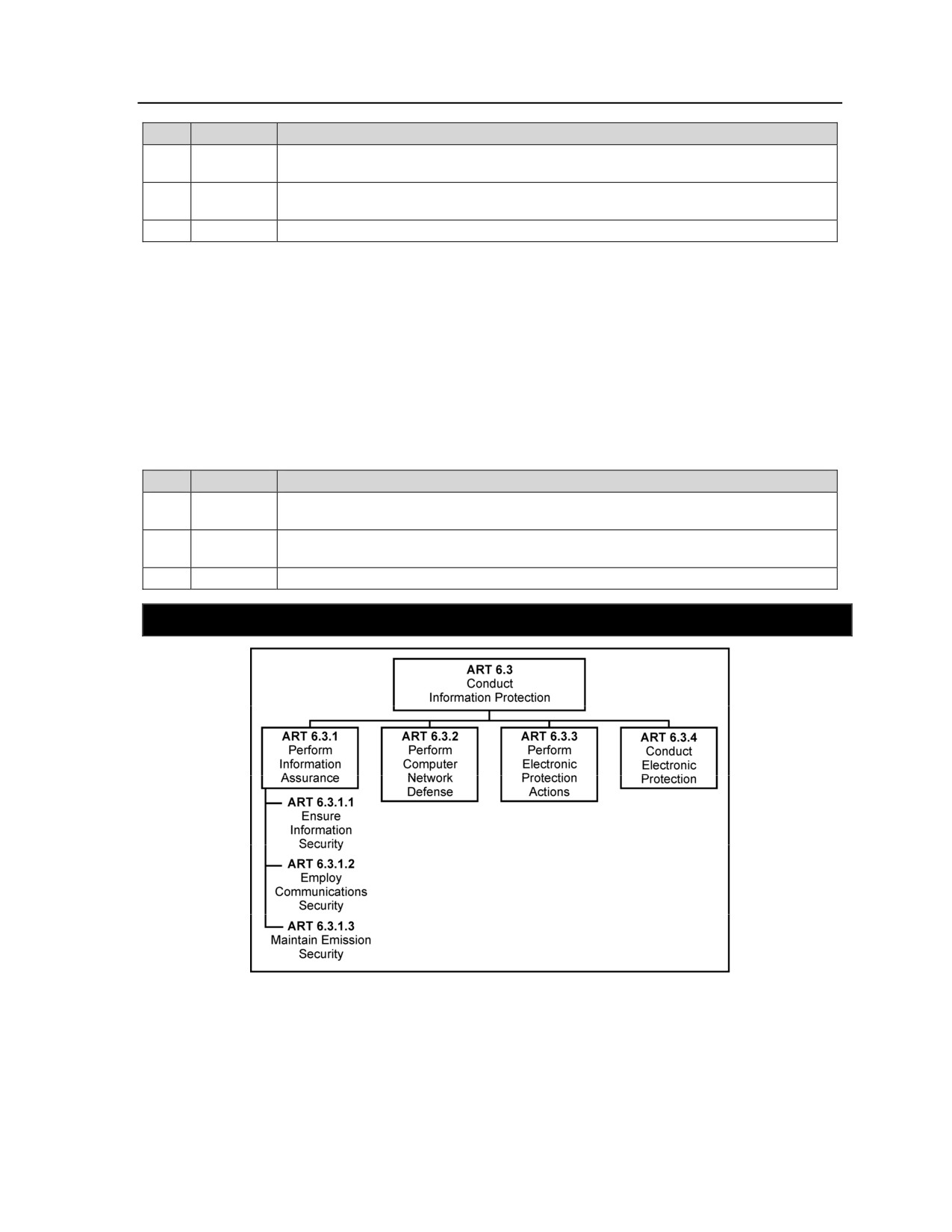
SECTION III - ART 6.3: CONDUCT INFORMATION PROTECTION
6-40. Information protection is active or passive measures that protect and defend friendly information and
information systems to ensure timely, accurate, and relevant friendly information. It denies enemies,
adversaries, and others the opportunity to exploit friendly information and information systems for their
own purposes. Information protection comprises information assurance, computer network defense, and
electronic protection. (FM 3-0) (USACAC)
20 October 2010
FM 7-15, C4
6-19

Chapter 6
No.
Scale
Measure
01
Yes/No
Unit course of action was not compromised by enemy information operations (IO).
02
Time
To develop and refine IO annex to operation order.
To identify, determine appropriate response, and implement changes in response to a
03
Time
possible threat to friendly information systems.
For friendly information and intelligence collection sensor system managers, operators,
04
Time
and emergency response teams and contact teams to respond, identify, and correct
system failures attributed to enemy IO.
05
Percent
Of time units in area of operations (AO) are in restrictive information operations condition.
06
Percent
Of friendly emitters in AO known to have been exploited by an enemy.
Of information systems hardware, software components, and databases backed up by
07
Percent
replacement components or backup files in case of failure or compromise.
Of information system software components and databases protected by firewalls and
08
Percent
virus detection software.
09
Number
Of times to reprogram information system software in response to identified threats.
Of instances of enemy IO disabling, corrupting, or compromising friendly information
10
Number
systems and intelligence collection sensors.
11
Number
Of instances of electronic fratricide in the AO.
ART 6.3.1 PROVIDE INFORMATION ASSURANCE
6-41. Plan, establish, and conduct programs and procedures to protect information and information
systems. Implement safeguards and controls on data networks and computer systems. Ensure availability,
integrity, authenticity, and security of information networks, systems, and data. Detect and react to
compromises. Restore networks, systems, and data. (FM 3-13) (USACAC)
No.
Scale
Measure
Systems administrators and operators performed risk assessment of potential threats to
01
Yes/No
friendly information systems and took appropriate action to respond to those risks.
For information system emergency response teams to identify, respond, and correct
02
Time
information system failures attributed to adversary information operations or criminal mischief.
Of information systems not protected by firewalls, virus detection software, and other
03
Percent
appropriate information protection measures.
Of information systems hardware components, software programs, and databases that
04
Percent
have backups to replace or duplicate them in case of failure or corruption.
Of enemy or criminal attempts to disable, corrupt, or compromise friendly information
05
Percent
system components, software, and databases that are successful.
Of enemy or criminal attempts to disable, corrupt, or compromise friendly information
06
Percent
system components, software, and databases detected by system administrators and
operators and automated protective systems, such as firewalls.
07
Percent
Of friendly information systems linked to the Internet.
08
Number
Of redundant communications paths available to connect information systems.
Of attempts to disable, corrupt, or compromise friendly information system components,
09
Number
software, and databases.
10
Number
And types of friendly information systems linked to unsecured and secured Internet.
ART 6.3.1.1 ENSURE INFORMATION SECURITY
6-42. Deny the enemy access to electronic information (both communications and noncommunications)
that could be used to identify friendly capabilities and intentions. (FM 3-13) (USACAC)
6-20
FM 7-15, C4
20 October 2010

ART 6.0: The Protection Warfighting Function
No.
Scale
Measure
01
Yes/No
Signal security compromises degraded, delayed, or modified unit operations.
Firewalls, virus protection software, or other information protection measures protected
02
Yes/No
unit information systems.
03
Time
To refine and synchronize signal and information operations (IO) annexes to operation order.
04
Time
To complete operations security (OPSEC) assessment in the area of operations (AO).
05
Time
To identify improper occurrence of signal security.
For appropriate information response teams to respond, identify, and correct
06
Time
information system failures attributed to enemy offensive IO or criminal activity.
Of increased or decreased number of security violations on combat net radios in the AO
07
Percent
within a given time.
08
Percent
Of successful enemy attempted penetration of friendly information systems.
09
Percent
Of emitter system administrators and operators who have current OPSEC training.
10
Percent
Of enemy sensor coverage in AO known to friendly force.
11
Percent
Of identified friendly vulnerabilities in AO exploited by enemy actions.
12
Percent
Of electronic communications in AO encrypted or secured.
13
Percent
Of message traffic in AO exploited by enemy.
14
Percent
Of friendly emitters in AO exploited by enemy.
Of signal security measures previously assessed unsatisfactory that have improved
15
Percent
based on assessment.
16
Percent
Of friendly operations conducted in a restrictive emission control environment.
Of units, installations, and agencies in AO operating from a common signal operation
17
Percent
instruction.
18
Percent
Of unit communications systems required to maintain more than one encryption system.
19
Number
Of security violations on combat net radios in the AO.
20
Number
Of teams fielded to monitor friendly emitters.
21
Number
Of interceptions of friendly communications during planning and execution.
Of instances when frequency allocation or frequency management fails to prevent
22
Number
signal fratricide.
ART 6.3.1.2 EMPLOY COMMUNICATIONS SECURITY
6-43. Deny the enemy information of value that might be derived from the possession and study of
telecommunications. (FM 6-02.72) (USASC&FG)
No.
Scale
Measure
01
Yes/No
Communications security compromises degraded, delayed, or modified unit operations.
02
Yes/No
Unit executed controlling authority functions.
03
Time
To refine and synchronize signal annex to operation order.
04
Time
To complete communications security assessment in the area of operations (AO).
05
Time
To identify improper occurrences of communications security.
Of increased or decreased number of security violations on combat net radios in the AO
06
Percent
within a given time.
07
Percent
Of enemy sensor coverage in AO known to friendly force.
08
Percent
Of successful enemy attempted penetration of friendly information systems.
Of information system administrators and operators who have current operations
09
Percent
security training.
10
Percent
Of identified friendly communications vulnerabilities in AO exploited by enemy actions.
11
Percent
Of electronic communications in AO encrypted or secured.
12
Percent
Of message traffic in AO exploited by enemy.
20 October 2010
FM 7-15, C4
6-21

Chapter 6
No.
Scale
Measure
13
Percent
Of friendly information systems in AO exploited by enemy.
Of communications security measures previously assessed unsatisfactory that have
14
Percent
improved based on assessment.
15
Percent
Of friendly operations conducted in a restrictive emission control environment.
Of units, installations, and agencies in AO operating from a common signal operation
16
Percent
instructions.
17
Percent
Of unit communications systems requiring more than one encryption system.
18
Percent
Of communications systems using encryption.
19
Percent
Of systems that include communications security in communications network planning.
20
Number
Of communications security incidents reported.
21
Number
Of security violations on combat net radios in the AO.
22
Number
Of teams fielded to monitor friendly communications systems.
23
Number
Of interceptions of friendly communications during planning and execution.
24
Number
Of redundant communications paths available to connect operational information systems.
ART 6.3.1.3 MAINTAIN EMISSION SECURITY
6-44. Plan and implement measures to deny unauthorized persons information of value that might be
derived from their interception and study of electromagnetic radiation. Select and control the use of
electromagnetic, acoustic, or other emitters to optimize friendly operations and capabilities while
minimizing detection by enemy sensors and mutual interference among friendly systems. (FM 6-02.72)
(USASC&FG)
No.
Scale
Measure
01
Yes/No
Signal emission security compromises degraded, delayed, or modified unit operations.
02
Time
To refine and synchronize signal and IO annexes to operation order.
03
Time
To complete operations security (OPSEC) assessment in the area of operations (AO).
04
Time
To identify improper maintenance of emission security.
05
Percent
Of emitter system administrators and operators who have current OPSEC training.
06
Percent
Of enemy sensor coverage in AO known to friendly force.
07
Percent
Of identified friendly vulnerabilities in AO exploited by enemy actions.
08
Percent
Of electronic communications in AO encrypted or secured.
09
Percent
Of friendly emitters in AO exploited by enemy.
Of emission security measures previously assessed unsatisfactory that have improved
10
Percent
based on new assessment.
11
Percent
Of friendly operations conducted in a restrictive emission control environment.
Of friendly courses of action that the enemy can determine by observing friendly
12
Percent
emitters.
13
Number
Of emission security violations in the AO in a given time.
14
Number
Of teams fielded to monitor friendly emitters.
15
Number
Of interceptions of friendly emitters during planning and execution.
Of instances when frequency allocation or frequency management fails to prevent
16
Number
signal fratricide.
ART 6.3.2 PERFORM COMPUTER NETWORK DEFENSE
6-45. Computer network defense is actions to defend against unauthorized activity within computer
networks. Computer network defense includes monitoring, detection, analysis, response, and restoration
activities. These activities are performed by multiple disciplines, such as operations, network
administrators, intelligence, counterintelligence, and law enforcement. (FM 3-13) (USACAC)
6-22
FM 7-15, C4
20 October 2010

ART 6.0: The Protection Warfighting Function
No.
Scale
Measure
01
Yes/No
Enemy offensive information operations (IO) compromised unit course of action.
02
Time
To develop and refine IO annex to operation order.
To identify, determine appropriate response, and implement changes in response to a
03
Time
possible threat to information systems.
For friendly information and intelligence collection sensor system managers, operators,
04
Time
and emergency response teams or contact teams to respond, identify, and correct
system failures attributed to enemy offensive IO.
05
Percent
Of time units in the area of operations (AO) are in restrictive emission control condition.
06
Percent
Of friendly emitters in the AO known to have been exploited by an enemy.
Of information systems hardware, software components, and databases backed up by
07
Percent
replacement components or backup files in case of failure or compromise.
08
Number
Of times to reprogram information system software in response to identified threats.
Of instances of enemy offensive IO disabling, corrupting, or compromising friendly
09
Number
information systems and intelligence collection sensors.
10
Number
Of instances of electronic fratricide in the AO.
ART 6.3.3 PERFORM ELECTRONIC PROTECTION ACTIONS
6-46. Plan and implement active and passive means to protect personnel, facilities, and equipment from
any effects of friendly or enemy employment of electronic warfare (EW) that may degrade, neutralize, or
destroy friendly combat capability. Electronic protection includes the hardening of equipment and facilities
from the effects of EW; emission control procedures and measures as outlined in ART 6.3.1.3 (Maintain
Emission Security); and the efficient management of the electromagnetic spectrum as outlined in ART
5.3.6 (Conduct Electromagnetic Spectrum Management Operations). (JP 6-0) (USJFCOM JWFC)
No.
Scale
Measure
01
Yes/No
EW mission spectrum requirements were de-conflicted with the unit spectrum manager.
02
Yes/No
All EW systems operated without interference.
03
Yes/No
EW system emission security compromises degraded, delayed, or modified unit operations.
04
Time
To evaluate EW-related frequency interference issues.
05
Time
To coordinate EW-related frequency interference issues.
06
Time
To resolve EW-related frequency interference issues.
07
Time
To identify improper maintenance of emission security.
08
Time
To respond to new threats through reprogramming of systems.
09
Time
To take appropriate measure against friendly or enemy EW system interference.
10
Percent
Of identified friendly vulnerabilities in the area of operations (AO) exploited by enemy actions.
11
Percent
Of friendly emitters in the AO exploited by enemy.
12
Percent
Of friendly operations conducted in a restrictive emission control environment.
13
Percent
Of emission control procedures that have improved from previous assessments
14
Percent
Of successful EW system reprogramming events.
15
Percent
Of friendly systems affected by friendly EW systems.
16
Percent
Of friendly systems affected by enemy EW systems.
17
Number
Of frequency interference issues.
18
Number
Of EW systems operating on assigned frequencies.
19
Number
Of EW systems detected by enemy sensors.
20
Number
Of emission security violations in the AO in a given time.
Of instances when frequency allocation or frequency management fails to prevent
21
Number
signal fratricide.
22
Number
Of EW system reprogramming events.
20 October 2010
FM 7-15, C4
6-23
Chapter 6
No.
Scale
Measure
23
Number
Of instances when EW system reprogramming is unsuccessful.
24
Number
Of friendly systems affected by friendly or enemy EW systems.
ART 6.3.4 CONDUCT ELECTRONIC PROTECTION
6-47. Plan and implement actions such as communications avoidance or communications antijamming
measures to protect personnel, facilities, and equipment from friendly and enemy employment of electronic
warfare that degrade, neutralize, or destroy friendly combat capability. (FM 3-13) (USACAC)
No.
Scale
Measure
Unit course of action was not compromised by enemy offensive information operations
01
Yes/No
(IO).
02
Time
To develop and refine IO annex to operation order.
For friendly information and intelligence collection sensor system managers, operators,
03
Time
and emergency response teams or contact teams to respond, identify, and correct
system failures attributed to enemy offensive IO.
To identify, determine appropriate response, and implement changes in response to a
04
Time
possible threat to information systems.
Of time units in the area of operations (AO) are in restrictive information operations
05
Percent
condition.
06
Percent
Of friendly emitters in the AO known to have been exploited by an enemy.
Of information systems hardware, software components, and databases backed up by
07
Percent
replacement components or backup files in case of failure or compromise.
08
Number
Of times to reprogram information system software in response to identified threats.
Of instances of enemy offensive IO disabling, corrupting, or compromising friendly
09
Number
information systems and intelligence collection sensors.
10
Number
Of instances of electronic fratricide in the AO.
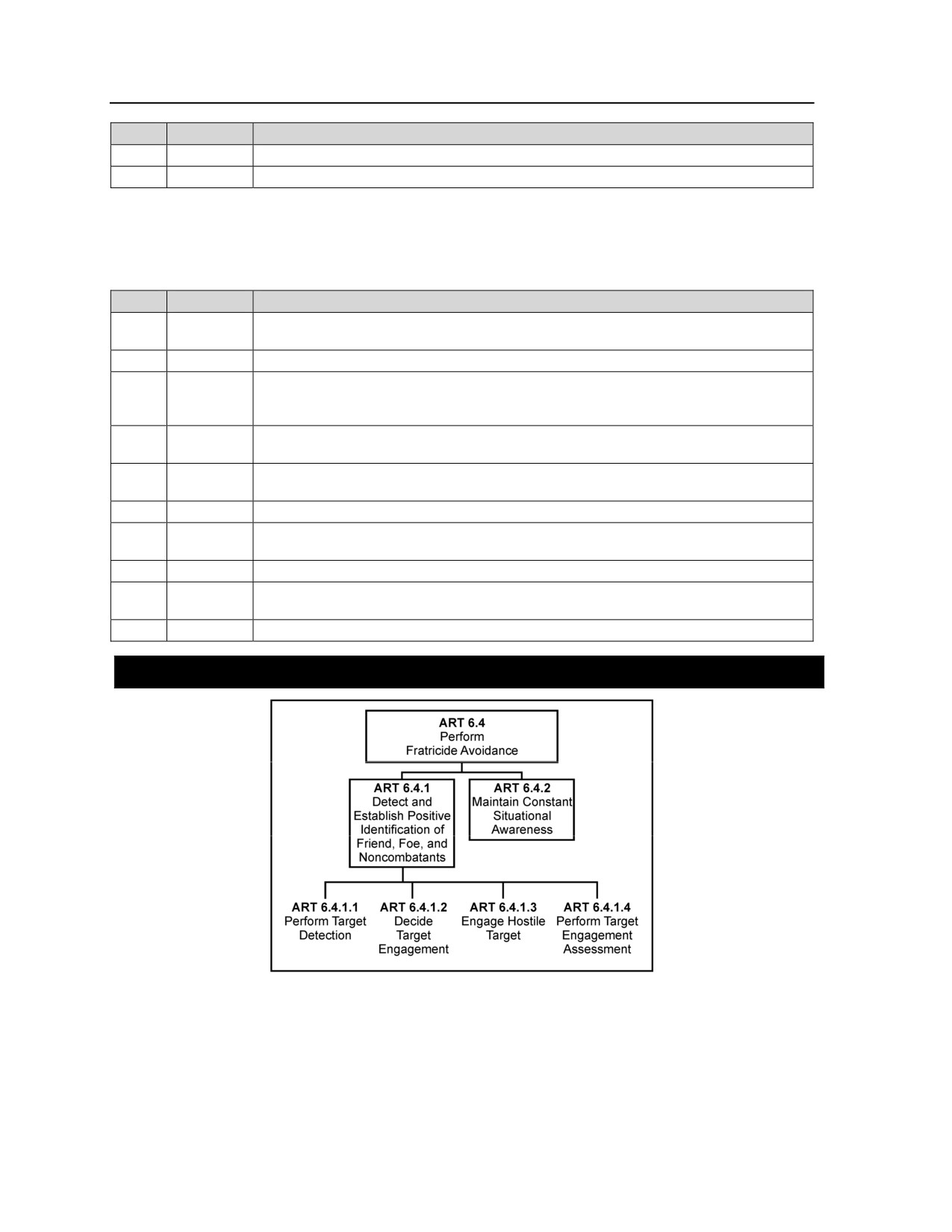
SECTION IV - ART 6.4: PERFORM FRATRICIDE AVOIDANCE
6-48. Fratricide is the unintentional killing of friendly personnel by friendly firepower. Responsibility for
preventing fratricide is the responsibility of the commander, yet all Soldiers must avoid the reluctance to
employ, integrate, and synchronize all the combat power at the critical time and place. (FM 3-20.15)
(USAARMC)
6-24
FM 7-15, C4
20 October 2010

ART 6.0: The Protection Warfighting Function
ART 6.6.2 REDUCE VULNERABILITIES TO TERRORIST ACTS AND
ATTACKS
6-75. Reduce personnel vulnerability to terrorism by understanding the nature of terrorism, knowing
current threats, identifying vulnerabilities to terrorist acts, and by implementing protective measures
against terrorist acts and attacks. (FM 3-19.30) (USAMPS)
No.
Scale
Measure
Actions deterred hostile actions against Soldiers, Army civilians, family members,
01
Yes/No
facilities, information, and equipment; when deterrence failed, actions mitigated the
consequences of terrorist attacks against these potential targets.
Commander applied judgment to every situation and combined it with available
02
Yes/No
technologies to manage risk.
Commander retained freedom of action by reducing friendly force vulnerability to
03
Yes/No
terrorist actions.
Unit or installation antiterrorism program included planned and integrated antiterrorism
04
Yes/No
measures, counterterrorism, physical security, operations security, and personal
protective services supported by counterintelligence and other security programs.
05
Yes/No
Force protection planning was a continuous process.
06
Yes/No
Force protection assets focused on protecting the most critical assets.
07
Time
To understand how potential terrorists operate.
08
Time
To prioritize unit force protection efforts based upon criticality and vulnerability assessments.
09
Time
In advance that a force is warned of attack.
10
Percent
Of unit force protection activities integrated with those of other Services and nations.
Of reduced enemy targeting effectiveness due to the implementation of force protection
11
Percent
measures.
Of reduced the effectiveness of enemy action due to friendly measures to harden units
12
Percent
and facilities from enemy attack.
Of enhanced personnel, equipment, and facility survivability because of measures taken
13
Percent
to harden them from enemy attack.
14
Number
Of friendly and noncombatant casualties due to terrorist attack.
15
Cost
Of measures to protect the unit or installation from terrorist attack.
ART 6.6.3 REACT TO A TERRORIST INCIDENT
6-76. Implement measures to treat casualties, minimize property damage, restore operations, and expedite
the criminal investigation and collection of lessons learned from a terrorist incident.
(FM 19-10)
(USAMPS)
Note: ART 5.5.1.2.3 (Conduct Criminal Investigations) addresses the conduct of crime analysis.
ART 5.3.5.2 (Collect Relevant Information) addresses the collection of lessons learned.
No.
Scale
Measure
Response to terrorist incident did not prevent unit or installation from accomplishing the
01
Yes/No
missions.
To conduct reconnaissance or criminal investigation of site where terrorist incident
02
Time
occurred.
03
Time
To establish or restore security around site where terrorist incident occurred.
To conduct area damage control activities, such as firefighting, power restoration and
04
Time
production, rubble clearance, removal of downed trees, and repair of critical damaged
facilities and installations.
20 October 2010
FM 7-15, C4
6-43
Chapter 6
No.
Scale
Measure
05
Time
To report the occurrence of terrorist incident to appropriate headquarters and agencies.
06
Time
For response forces or teams to arrive at site of terrorist incident.
07
Time
To search for, collect, identify, and treat injured survivors of terrorist incident.
To search for, collect, identify, and process the remains of individuals killed in terrorist
08
Time
incident.
09
Time
To restore damaged facilities to desired level of functionality.
10
Percent
Of decreased attacked facilities capabilities to perform designed function.
Of response forces or teams arriving at terrorist incident site within desired response
11
Percent
times.
12
Number
Of friendly force and noncombatant casualties due to terrorist incident.
To provide forces and supplies to provide local security and humanitarian aid and
13
Cost
comfort, conduct area damage control, and restore damaged facility in response to a
given terrorist incident.
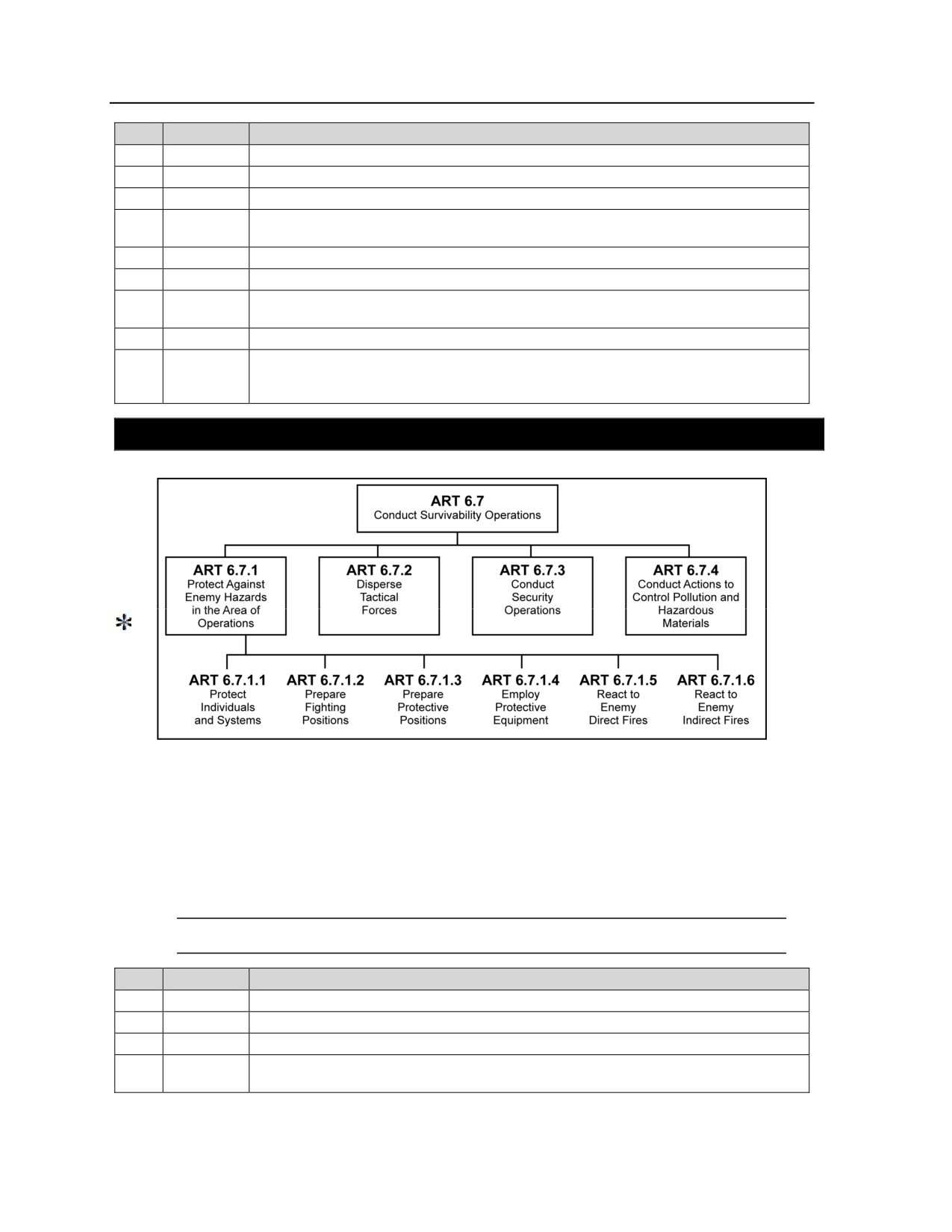
SECTION VII - ART 6.7: CONDUCT SURVIVABILITY OPERATIONS
6-77. ART 6.7 is a concept that includes all aspects of protecting personnel, weapons, and supplies while
simultaneously deceiving the enemy. Survivability tactics include building a good defense; employing
frequent movement; using concealment, deception, and camouflage; and constructing fighting and
protective positions for both individuals and equipment. Included are those assessments and surveys
completed as a part of focused engineer reconnaissance support that includes infrastructure reconnaissance.
(See FM 3-34.170.) Survivability operations are the development and construction of protective positions,
such as earth berms, dug-in positions, overhead protection, and countersurveillance means, to reduce the
effectiveness of enemy weapon systems. (FM 5-103) (USAES)
Note: This task branch is supported by ART 2.2.3 (Provide Intelligence Support to Protection).
No.
Scale
Measure
01
Yes/No
Unit could continue to conduct operations.
02
Yes/No
Unit losses from hazards were at acceptable levels.
03
Yes/No
Unit could determine when contaminated area was at a level with acceptable risk.
Unit performed risk assessment of all areas in the area of operations (AO) that
04
Yes/No
underwent chemical, biological, radiological, and nuclear (CBRN) weapons attack.
6-44
FM 7-15, C4
20 October 2010

ART 6.0: The Protection Warfighting Function
No.
Scale
Measure
To establish the degree of local security necessary for installation or construction of the
05
Time
protective obstacles.
To install or remove protective obstacles to include proper marking with engineer
06
Time
support.
To install or remove protective obstacles to include proper marking without engineer
07
Time
support.
08
Time
To turn over protective obstacles.
09
Time
To properly record and report protective obstacles.
To obtain obstacle emplacing equipment and class IV and class V to install protective
10
Time
obstacles.
11
Percent
Of personnel, systems, unit positions, and facilities protected by protective obstacles.
12
Percent
Of personnel trained to install, maintain, and remove protective obstacles.
Of on-hand protective obstacle installation and removal equipment and class IV and
13
Percent
class V.
14
Percent
Of protective obstacles installed and removed to standard.
15
Percent
Of protective obstacles properly turned over.
Of friendly casualties due to improperly installed, marked, and removed protective
16
Percent
obstacles.
17
Number
Of mission-capable protective obstacle installation and removal systems.
Of friendly casualties due to improperly installed, marked, and removed protective
18
Number
obstacles.
ART 6.7.1.5 REACT TO ENEMY DIRECT FIRES
6-90. Return fire at known or suspected enemy positions and take evasive action upon detecting enemy
direct fires. (FM 3-21.75) (USAIS)
No.
Scale
Measure
01
Yes/No
Unit reaction to enemy direct fire allowed the unit to complete its mission.
02
Yes/No
Unit retained its cohesion.
Collateral damage due to friendly response to enemy direct fires did not result from
03
Yes/No
violations of the law of war or rules of engagement.
04
Time
That unit was delayed from accomplishing its mission due to enemy direct fire.
That unit stayed within the enemy’s engagement area before it can suppress the
05
Time
enemy’s weapon systems, find cover from which to engage the enemy, or extract itself
from the engagement area.
06
Percent
Of enemy casualties inflicted.
07
Percent
Of friendly casualties.
08
Number
Of friendly and noncombatant casualties.
09
Number
And types of friendly systems rendered non-mission capable by enemy direct fires.
ART 6.7.1.6 REACT TO ENEMY INDIRECT FIRES
6-91. Seek protection under the overhead cover of fighting or protective positions or move rapidly out of
the impact area in the direction the unit commander orders. If armored vehicles are available, personnel
mount, and the vehicles move out of the impact area in the direction and designated distance ordered by the
unit commander. (FM 3-21.75) (USAIS)
No.
Scale
Measure
01
Yes/No
Unit reaction to enemy indirect fires allowed the unit to complete its mission.
02
Yes/No
Unit retained its cohesion.
20 October 2010
FM 7-15, C4
6-53

Chapter 6
No.
Scale
Measure
Collateral damage due to the friendly response to enemy direct fires did not result from
03
Yes/No
violations of the law of war or rules of engagement.
04
Time
To report contact to the higher commander.
For personnel to either close hatches on the combat vehicles in which they are riding,
05
Time
seek shelter in positions with suitable overhead cover, or seek shelter offered by the
terrain immediately around them.
06
Time
For vehicles to move out of the impact area.
For dismounted individuals caught without suitable shelter in the impact area to improve
07
Time
their chances of surviving by digging in using resources immediately available to them.
08
Time
To conduct counterbattery or countermortar fires.
09
Percent
Of Soldiers performing immediate action drill correctly.
10
Percent
Of enemy casualties due to friendly counterbattery or countermortar fires.
11
Percent
Of friendly casualties.
12
Number
Of friendly and noncombatant casualties.
13
Number
And types of friendly systems rendered non-mission capable by enemy indirect fires.
*ART 6.7.1.7 CONDUCT IMPROVISED EXPLOSIVE DEVICE DEFEAT OPERATIONS
6-92. ART 6.7.1.7 (Conduct Improvised Explosive Device Defeat Operations) and ART 6.7.1.7.1 (Plan for
Possible Improvised Explosive Devise Threats) has moved to ART 6.12.3.1 and ART 6.12.3.2. ARTs
6.7.1.7.2, 6.7.1.7.3, and 6.7.1.7.4 are rescinded.
*ART 6.7.1.7 PROVIDE FIRE AND EMERGENCY SERVICES
6-93. Provide fire and emergency services (F&ES) in an area of operations (AO) including fire prevention
and fire suppression of facilities, equipment, munitions and aviation firefighting/aircraft crash rescue
services. Specific capabilities include provide fire prevention programs, inspections, tactical firefighting,
technical rescue and first aid capabilities. A fire protection program can protect logistics support areas,
intermediate staging bases, forward operating bases, and major facilities. Facilities can include petroleum
tank farms, petroleum distribution sites, open and closed warehouse facilities, general warehouses, detainee
facilities, and civilian resettlement sites. ART 6.7.1.7 includes initial hazardous material response, aviation
firefighting, extrication of personnel and equipment from crashed aircraft, rescuing sick or entrapped
personnel from buildings, equipment, vehicles, water, ice, confined space, and high angles. This also
includes firefighting protection against grass or brush fires within assigned area when augmented with
combat or construction engineer Soldiers or units. (FM 5-415) (USAES)
No.
Scale
Measure
F&ES limited the damage caused by fires in the area of operations (AO) so that fires do
01
Yes/No
not disrupt, cancel, or require the modification of the unit's course of action.
02
Yes/No
F&ES provided first-responder level medical response and assistance to victims.
F&ES provided an initial response to hazardous material incidents with environmental
03
Yes/No
considerations.
F&ES used command and control of nonfirefighting assets when supporting brush
04
Yes/No
firefighting operations.
Environmental considerations planning and procedures were present and being
05
Yes/No
followed.
F&ES limited the damage caused by aircraft fires and provided aircraft crash rescue
06
Yes/No
services to protect the lives of aviation crewmembers.
07
Yes/No
Assist in training of host nation firefighting assets.
08
Time
To develop a firefighting plan for the AO.
09
Time
To develop mutual aid agreements.
6-54
FM 7-15, C4
20 October 2010

ART 6.0: The Protection Warfighting Function
No.
Scale
Measure
10
Time
To respond to reports of fires, medical emergencies, and hazardous material incidents.
11
Time
To establish and maintain 24/7 fire department communications network.
1 2
Time
To reconnoiter water-supply points.
13
Time
To provide water resupply to firefighting teams.
14
Time
To establish local security from external assets for firefighting operations.
15
Time
To provide additional manpower support to firefighting teams from supported units.
To train personnel so they remain qualified to fight fires and respond to medical
16
Time
emergencies and hazardous materials incidents.
17
Time
To practice fire drills by units in the AO.
To complete fire prevention measures, such as inspections and preventive
18
Time
maintenance checks and services on firefighting equipment.
To procure necessary personal protective equipment, firefighting equipment, and fire
19
Time
trucks to protect the AO.
20
Time
To investigate fires.
21
Time
To implement aircraft crash rescue services and to respond to aircraft emergencies.
22
Percent
Of firefighting operations that are petroleum, oils, and lubricants fires.
23
Percent
Of high-value assets protected by firefighting teams.
24
Percent
Of difference between planned level of firefighting support and the required level.
25
Percent
Of qualified personnel assigned to firefighting teams in the AO.
26
Percent
Of firefighting support provided by host nation.
27
Number
Of firefighting teams found in the AO.
28
Number
And types of mission capable fire trucks in the AO.
29
Number
Of crash or rescue operations conducted within a given time.
30
Number
Of normal flight and maintenance operations supported within a given time.
31
Number
Of medical evacuation operations supported within a given time.
32
Number
Of fire prevention inspections performed in a given time.
33
Number
Of emergency water-supply points maintained.
*ART 6.7.1.7.1 Provide General Firefighting
6-94. Provide response to fires with the AO. Provide crash rescue support to medical evacuation
(MEDEVAC) and normal flight operations. Provide initial response for hazardous material (HAZMAT)
and medical assistance. Provide fire prevention measures, such as, inspections, fire drills, and training.
(FM 5-415) (USAES)
No.
Scale
Measure
1
Yes/No
Provide crash-rescue support for MEDEVAC and normal flight or stand-by operations
2
Yes/No
Firefighting team provided first-responder level medical response and assistance to victims.
Firefighting team provided an initial response to HAZMAT incidents with environmental
3
Yes/No
considerations.
4
Time
To respond to reports of fires, medical emergencies, and HAZMAT incidents.
5
Time
To reconnoiter water-supply points.
6
Time
To provide water resupply to firefighting teams.
7
Time
To provide additional manpower support to firefighting teams from supported units.
8
Time
To practice fire drills with other units in the AO.
To complete fire prevention measures, such as inspections and preventive
9
Time
maintenance checks and services on firefighting equipment.
20 October 2010
FM 7-15, C4
6-55

Chapter 6
No.
Scale
Measure
10
Time
To investigate fires.
11
Number
Of emergency water-supply points maintained.
*ART 6.7.1.7.2 Provide Technical Rescue Services
6-95. Provide technical rescue support and extrication of personnel and equipment from crashed aircraft,
rescuing sick or entrapped personnel from buildings, equipment, vehicles, water, ice, confined space, and
high angles. Provide emergency lifesaving care for victims of accident or sudden illness. (FM 5-415)
(USAES)
No.
Scale
Measure
1
Yes/No
Provide initial first aid.
2
Yes/No
Provide initial response to hazardous material.
3
Yes/No
Rescue entrapped, sick, and injured personnel from buildings.
4
Yes/No
Rescue entrapped, sick, and injured personnel from equipment.
5
Yes/No
Rescue entrapped, sick, and injured personnel from vehicles.
6
Yes/No
Rescue entrapped, sick, and injured personnel from water.
7
Yes/No
Rescue entrapped, sick, and injured personnel from confined space.
8
Yes/No
Rescue entrapped, sick, and injured personnel from high angles.
ART 6.7.2 DISPERSE TACTICAL FORCES
6-96. Relocate forces and spread or separate troops, materiel, or activities following concentration and
maneuver to enhance survivability. The lethality of modern weaponry significantly increases the threat to
concentrated formations. Attacking commanders manipulate their own and the enemy’s concentration of
forces by a combination of dispersion, concentration, deception, and attack. Dispersion stretches the
enemy’s defenses and denies lucrative targets to enemy long-range fires. (FM 3-90) (USACAC)
No.
Scale
Measure
01
Yes/No
Unit accomplished mission while tactically dispersed.
02
Time
To refine operation plan or order to reflect risk management assessment.
03
Time
To relocate friendly forces to minimize risks from battlefield hazards.
04
Percent
Of friendly casualties due to failure to disperse.
Of friendly casualties due to an enemy inability to mass combat power because assets
05
Percent
are too dispersed.
ART 6.7.3 CONDUCT SECURITY OPERATIONS
6-97. Security operations are those operations undertaken by a commander to provide early and accurate
warning of enemy operations, to provide the force being protected with time and maneuver space within
which to react to the enemy, and to develop the situation to allow the commander to effectively use the
protected forces. Commanders continually conduct some form of security operations.
(FM 3-90)
(USACAC)
Note: The information obtained on the enemy in conducting this task also pertains to ART 2.0
(The Intelligence Warfighting Function).
6-56
FM 7-15, C4
20 October 2010

ART 6.0: The Protection Warfighting Function
No.
Scale
Measure
The operations of the security force provided the protected force or installation with
01
Yes/No
sufficient reaction time and maneuver space to conduct defensive operations.
02
Yes/No
Security force was in place not later than time specified in operation order.
03
Yes/No
Security force prevented enemy ground observation of protected force or installation.
04
Yes/No
Collateral damage from security operation was within acceptable limits.
05
Yes/No
Security force provided early and accurate warning of enemy approach.
06
Yes/No
Security force oriented its operations of the force or facility to be secured.
07
Yes/No
Security force performed continuous reconnaissance.
08
Yes/No
Security force maintained contact with enemy forces.
09
Yes/No
Commander developed criteria for ending the security operation.
10
Yes/No
Commander directed that contingency plans be developed for security operations.
11
Time
To conduct reconnaissance of the area surrounding the secured force or installation.
12
Time
To plan security operations.
13
Time
To prepare for the security operations including movement into security area.
14
Time
To execute security operations.
15
Time
To report enemy activities to appropriate headquarters.
16
Time
That the secured force or installation has to prepare prior to its encounter with the enemy.
To integrate host-nation or third-nation security forces and means into friendly security
17
Time
operations.
18
Percent
Of security force casualties during the security operation.
19
Percent
Of secured force or installation casualties during the security operation.
20
Percent
Of unit combat power used to provide desired degree of security.
O f decreased support capability of sustainment units due to the requirement to provide
21
Percent
security forces from internal assets.
Of increased availability of combat forces through use of host-nation or third-nation
22
Percent
security forces.
23
Percent
Of enemy reconnaissance elements within security force capabilities destroyed or repelled.
24
Percent
Of friendly operations judged as not compromised prior to or during execution.
Of operations not compromised (based on enemy prisoner of war interrogations or
25
Percent
captured documents).
26
Percent
Of critical facilities hardened or protected by security forces.
Of the AO or security area that can be observed by visual observation or covered by
27
Percent
sensors at any given time.
28
Number
Of incidents where enemy forces affect the security of friendly units and facilities.
Of incidents where enemy reconnaissance forces compromise friendly course of action
29
Number
causing them to be delayed, disrupted, canceled, or modified.
30
Number
Of security force casualties during the security operation.
31
Number
Of secured force or installation casualties during the security operation.
32
Number
Of mobility corridors or avenues of approach that can be observed by the security force.
33
Number
Of observation posts that can be established by the security force.
34
Number
Of enemy reconnaissance elements destroyed during security operation.
Square
35
Size of security area or area of operation.
Kilometers
20 October 2010
FM 7-15, C4
6-57

Chapter 6
ART 6.7.4 CONDUCT ACTIONS TO CONTROL POLLUTION AND
HAZARDOUS MATERIALS
6-98. Develop actions to prevent pollution generation and hazardous substance releases to avoid exposing
friendly personnel to human health hazards, disrupting operations, adversely affecting indigenous or
refugee populations and local economies; and to avoid damaging the natural or cultural environment.
Conduct the environmental compliance program while appropriately considering the effect on the
environment per applicable U.S. and host-nation agreements, environmental laws, policies, and regulations.
Promptly report and clean up hazardous substance releases while avoiding tactical interference and
ensuring adequate protection of the environment. Manage hazardous wastes correctly prior to transporting
them to a permitted treatment, storage, or disposal facility. (FM 3-100.4) (USAES)
No.
Scale
Measure
To provide the commander with the technical expertise relating to releases of
01
Time
hazardous materials or petroleum, oils, and lubricants.
02
Time
Of delay in the operation.
03
Time
River closed as a source of drinking water.
04
Time
River closed to traffic.
05
Time
To provide training guidance to the field as required.
06
Time
Of training lost due to release.
07
Percent
Of operations cancelled or delayed.
08
Percent
Of population with newly polluted drinking water.
09
Percent
Of wildlife killed as a result of pollution or a release.
10
Number
Of people with newly polluted drinking water.
11
Number
Of spills reported per week.
12
Number
Of wildlife killed as a result of pollution or a release.
13
Number
Of personnel injured or sickened as a result of pollution or a release.
14
Cost
For hazardous material removal or disposal.
15
Cost
To complete release recovery.
16
Cubic Yards
Of earth cleaned, removed, or replaced.
17
Pounds
Of hazardous materials released.
6-58
FM 7-15, C4
20 October 2010
ART 6.0: The Protection Warfighting Function
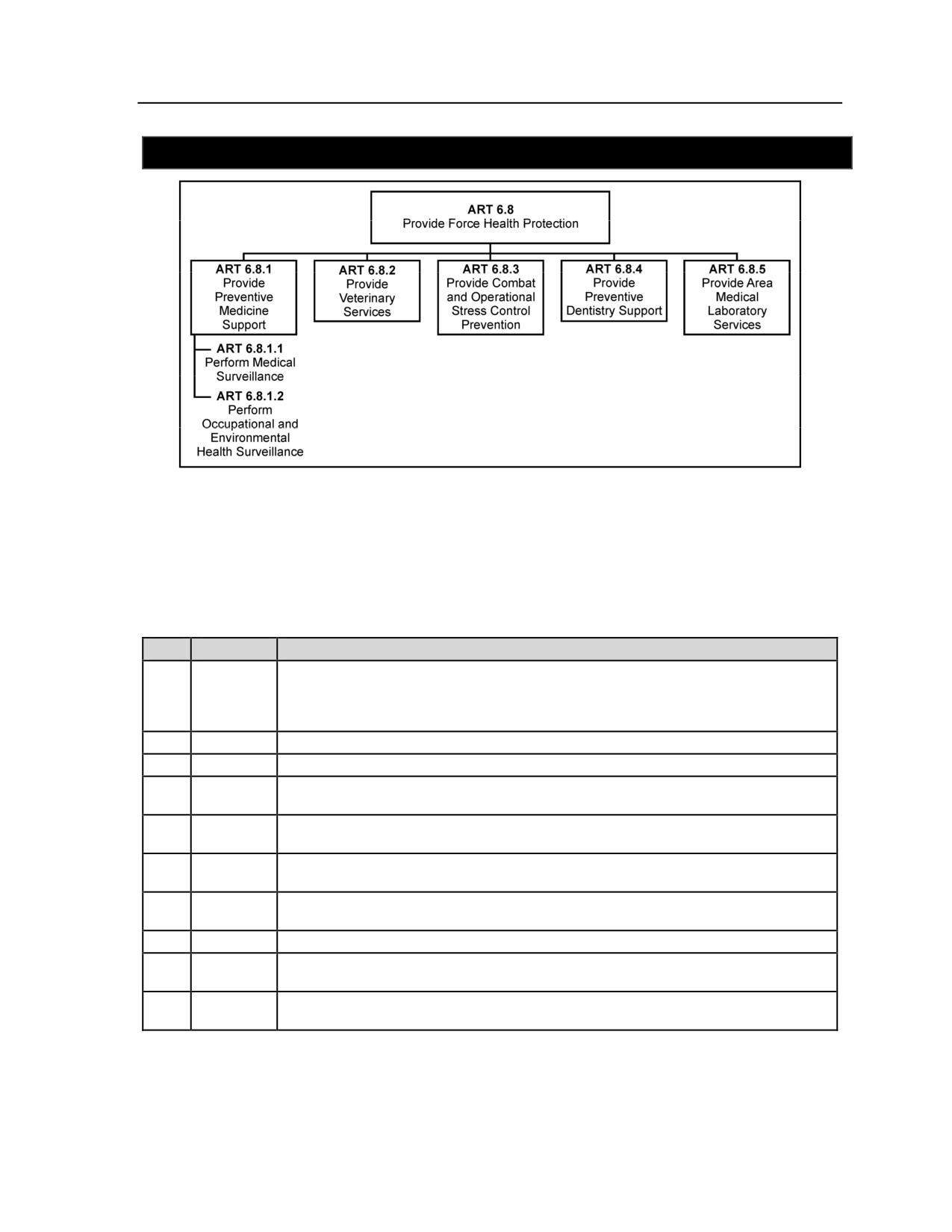
*SECTION VIII - ART 6.8: PROVIDE FORCE HEALTH PROTECTION
6-99. Force health protection encompasses measures to promote, improve, or conserve the mental and
physical well-being of Soldiers. These measures enable a healthy and fit force, prevent injury and illness,
and protect the force from health hazards and include the prevention aspects of a number of Army Medical
Department functions such as preventive medicine, including medical surveillance and occupational and
environmental health (OEH) surveillance; veterinary, services, including the food inspection and animal
care missions, and the prevention of zoonotic disease transmissible to man; combat and operational stress
control (COSC); dental services (preventive dentistry); and laboratory services (area medical laboratory
support). (FM 4-02) (USAMEDDC&S)
No.
Scale
Measure
Force health protection programs established in the area of operations (AO) kept
casualty rates from disease and nonbattle injuries; chemical, biological, radiological,
01
Yes/No
and nuclear exposures; OEH hazards; and combat operational stress below established
thresholds.
02
Time
To refine force health protection in the AO after receipt of warning order.
03
Time
To establish force health protection on activation of the AO.
Of difference between force health protection requirements and actual requirements in
04
Percent
the AO.
Of difference between planned area medical laboratory support requirements and
05
Percent
actual requirements in the AO.
Of difference between planned preventive medicine services requirements and actual
06
Percent
requirements in the AO.
Of difference between planned veterinary services requirements and actual
07
Percent
requirements in the AO.
08
Percent
Of planned force health protection support achieved in the AO.
Of difference between planned COSC prevention support requirements and actual
09
Percent
requirements in the AO.
Of difference between planned preventive dentistry support requirements and actual
10
Percent
requirements in the AO.
20 October 2010
FM 7-15, C4
6-59

Chapter 6
*ART 6.8.1 PROVIDE PREVENTIVE MEDICINE SUPPORT
6-100. Prevent disease and nonbattle injuries by establishing preventive medicine programs such as, field
hygiene and sanitation, disease surveillance, immunizations, chemoprophylaxis, and education in personal
protective measures. (FM 4-02.17) (USAMEDDC&S)
No.
Scale
Measure
Preventive medicine programs established in the area of operations (AO) kept disease
01
Yes/No
and nonbattle injury rates below established thresholds.
02
Yes/No
Units communicated the health risks to the at risk population.
03
Yes/No
Units conducted health hazard assessments.
04
Yes/No
Unit implemented the Vision Conservation Program.
05
Time
To refine preventive medicine program for AO after receipt of warning order.
To establish preventive medicine plan (to include immunizations, pretreatment,
06
Time
chemoprophylaxis, and barrier creams) in the AO.
07
Time
Required to provide 100-percent immunizations to all Soldiers in the AO.
08
Percent
Of Soldiers who have all of the prescribed predeployment immunizations.
09
Percent
Of planned preventive medicine support achieved in AO.
10
Percent
Of personnel who received all required immunizations.
11
Percent
Of personnel who received required chemoprophylaxis.
Of personnel in AO briefed on health threats and trained in personal and unit-level
12
Percent
protective measures and preventive medicine measures.
13
Percent
Of water points inspected for potability.
14
Percent
Of unit field sanitation teams trained.
Of personnel in the AO who have required and serviceable optical devices (such as
15
Percent
spectacles, mask inserts, and protective devices).
16
Percent
Of bivouac sites inspected for disease and occupational and environmental health hazards.
17
Number
Of units with all required field sanitation team equipment and supplies.
18
Number
Of aerial spray missions conducted.
19
Number
Of Soldiers not available for duty due to hearing loss.
20
Number
Of consultations provided on preventive medicine measures.
21
Number
Of food service facilities inspected requiring immediate corrective actions.
*ART 6.8.1.1 PERFORM MEDICAL SURVEILLANCE
6-101. Perform medical surveillance, to include the collection and analysis of health status and health
threat information before, during, and following deployment. Ensure common awareness of potential
health threats and monitor implementation of preventive medicine measures.
(FM
4-02.17)
(USAMEDDC&S)
No.
Scale
Measure
Unit performed health threat assessment was for all areas of the area of operations
01
Yes/No
(AO) and briefed to all personnel.
Unit conducted all required epidemiological investigations appropriately and completed
02
Yes/No
them in a timely manner.
Unit collected disease and nonbattle injury data daily and categorized it correctly per
03
Yes/No
Joint Chiefs of Staff and theater-specific standards.
All personnel completed pre- and postdeployment health assessments within required
04
Yes/No
timeframes.
05
Yes/No
Unit analyzed disease and nonbattle injury data weekly for trends.
6-60
FM 7-15, C4
20 October 2010

ART 6.0: The Protection Warfighting Function
No.
Scale
Measure
06
Time
To refine medical surveillance programs for AO after receipt of warning order.
To survey operational environment to detect and identify health threats and formulate
07
Time
means for minimizing effects.
Of difference between planned medical surveillance requirements and actual
08
Percent
requirements in AO.
09
Percent
Of planned medical surveillance support achieved in AO.
Of Soldiers identified with a measured environmental or occupational exposure that
10
Percent
have the exposure noted in their individual health records.
Of recorded medical treatment episodes in individual health records and/or electronic
11
Percent
medical records.
12
Percent
Of disease and nonbattle injury reports submitted on time per theater policy.
13
Percent
Of personnel compliant with required personal protective measures.
14
Number
Of epidemiological investigations conducted in AO.
Of health threats to the deployed force not identified in the predeployment medical
15
Number
threat assessment.
*ART 6.8.1.2 PERFORM OCCUPATIONAL AND ENVIRONMENTAL HEALTH SURVEILLANCE
6-102. Perform occupational and environmental health (OEH) surveillance. Develop and update the
environmental health site assessment. (FM 4-02.17) (USAMEDDC&S)
No.
Scale
Measure
Occupational and environmental health surveillance established in the area of
01
Yes/No
operations (AO) prevented or reduced the number and percent of personnel who
became exposed to OEH hazards.
02
Yes/No
Significant OEH hazards were identified in the AO.
03
Time
To refine OEH hazard surveillance program for AO after receipt of warning order.
To detect, identify, quantify, and evaluate OEH hazards; develop controls and
04
Time
communicate risk to minimize health risks.
Of difference between planned OEH surveillance requirements and actual requirements
05
Percent
in the AO.
06
Percent
Of personnel in AO without health threat education and training provided.
Of personnel in AO without appropriate personal protective equipment or engineering
07
Percent
controls to minimize health risks of identified OEH hazards.
08
Percent
Of identified OEH hazards in the AO evaluated using risk assessment.
Of identified OEH exposures recorded in individual health records and/or electronic
09
Number
medical records.
*ART 6.8.2 PROVIDE VETERINARY SERVICES
6-103. Serve as the Department of Defense (DOD) executive agent for veterinary services for all services
with the exception of the food inspection mission on U.S. Air Force installations. Perform food safety and
bottled water surveillance—which includes food hygiene and quality assurance, inspection of class I
sources, microbial analysis of food, and temperature monitoring of transported and stored food supplies—
and assess potential health hazards in the area of operations (AO); identify, evaluate, and assess animal
diseases of military significance; and provide complete veterinary health care to DOD military working
dogs and any other government-owned animals in the AO. (FM 4-02.18) (USAMEDDC&S)
No.
Scale
Measure
01
Yes/No
Nonavailability of veterinary services did not degrade, delay, or disrupt unit operations.
02
Time
To refine veterinary services program for AO after receipt of warning order.
20 October 2010
FM 7-15, C4
6-61

Chapter 6
No.
Scale
Measure
03
Time
To establish comprehensive veterinary plan on activation of the AO.
Of difference between planned veterinary service requirements and actual requirements
04
Percent
in AO.
05
Percent
Of planned veterinary support achieved in AO.
06
Percent
Of required food inspections meeting food safety standards in the AO.
07
Percent
Of government-owned animals treated and returned to duty in the AO.
08
Percent
Of veterinary capacity in use per day in AO.
09
Number
Of local food procurement establishment inspections performed in AO per month.
10
Number
Of animal diseases of military significance in the AO.
Of military working dogs and other government-owned animals in AO requiring periodic
11
Number
veterinary support.
12
Number
Of approved bottled water and ice plants.
Of animals exposed to chemical, biological, radiological, and nuclear or toxic industrial
13
Percent
materials.
14
Yes/No
Published food and beverage procurement source list.
15
Number
Of animals requiring evacuation for additional treatment in theater.
*ART 6.8.3 PROVIDE COMBAT AND OPERATIONAL STRESS
CONTROL PREVENTION
6-104. Provide combat and operational stress control (COSC) prevention by establishing behavioral
health prevention programs, conducting traumatic event management, and providing consultation and
educational services. (FM 4-02.51) (USAMEDDC&S)
No.
Scale
Measure
Absence of command personnel from stress-related causes did not degrade, delay, or
01
Yes/No
disrupt unit operations.
To refine COSC prevention program for the area of operations (AO) after receipt of
02
Time
warning order.
03
Percent
Of critical incident debriefings planned and actual requirements.
04
Percent
Of required COSC personnel at activation in AO.
Of decrease in number of stress-related casualties after establishing and implementing
05
Percent
COSC prevention plan or program in AO.
06
Number
Of consultations on COSC prevention techniques with Soldiers or groups.
07
Number
Of consultations on COSC prevention techniques with unit leaders.
08
Number
Of education and training events on COSC prevention techniques.
09
Number
Of combat and operational stress control cases requiring evacuation from AO.
10
Percent
Of personnel that have received Warrior resilience training.
*ART 6.8.4 PROVIDE PREVENTIVE DENTISTRY SUPPORT
6-105. Military preventive dentistry incorporates primary, secondary, and tertiary preventive measures
taken to reduce or eliminate oral conditions that decrease a Soldier’s fitness to perform the mission and
cause absence from duty. (FM 4-02.19) (USAMEDDC&S)
6-62
FM 7-15, C4
20 October 2010

ART 6.0: The Protection Warfighting Function
No.
Scale
Measure
Preventive dentistry programs established in the area of operations (AO) prevented or
01
Yes/No
reduced the number and percent of command personnel who became casualties as a
result of dental disease and injury.
02
Time
To establish dental combat effectiveness program upon activation of the AO.
03
Time
To refine preventive dentistry plan after receipt of warning order.
Of difference between planned preventive dentistry requirements and actual
04
Percent
requirements within the AO.
05
Percent
Of Soldiers receiving prophylaxis treatment.
06
Percent
Of Soldiers receiving fluoride varnish treatments.
07
Percent
Of Soldiers receiving prescriptions for fluoride supplement tablets.
08
Percent
Of Soldiers receiving training or education in field oral hygiene information program.
*ART 6.8.5 PROVIDE AREA MEDICAL LABORATORY SERVICES
6-106. Identify, evaluate, and assess health hazards in the area of operations (AO). This task includes
providing chemical, biological, radiological, and nuclear (CBRN) laboratory services, endemic disease
laboratory services, and environmental laboratory services. (FM 4-02) (USAMEDDC&S)
No.
Scale
Measure
Nonavailability of laboratory services did not degrade, delay, or disrupt unit operations
01
Yes/No
or endanger the health of unit personnel.
02
Time
To refine area medical laboratory services program for AO after receipt of warning order.
03
Time
To establish comprehensive area medical laboratory service plan on activation of the AO.
04
Time
Of turnaround for technical labaratory testing results.
Of difference between planned area medical laboratory requirements and actual
05
Percent
requirements in AO.
06
Percent
Of planned laboratory support achieved in AO.
07
Percent
Of required laboratories at activation of AO.
08
Percent
Of required laboratory personnel available at activation of AO.
09
Percent
Of laboratory capacity in use per day in AO.
10
Number
Of toxic industrial materials identified or confirmed through laboratory testing in the AO.
11
Number
Of CBRN warfare agents identified or confirmed through laboratory testing in the AO.
Of endemic diseases identified through labaratory testing in AO in support of diagnostic
12
Number
treatment at medical treatment facilities .
20 October 2010
FM 7-15, C4
6-63
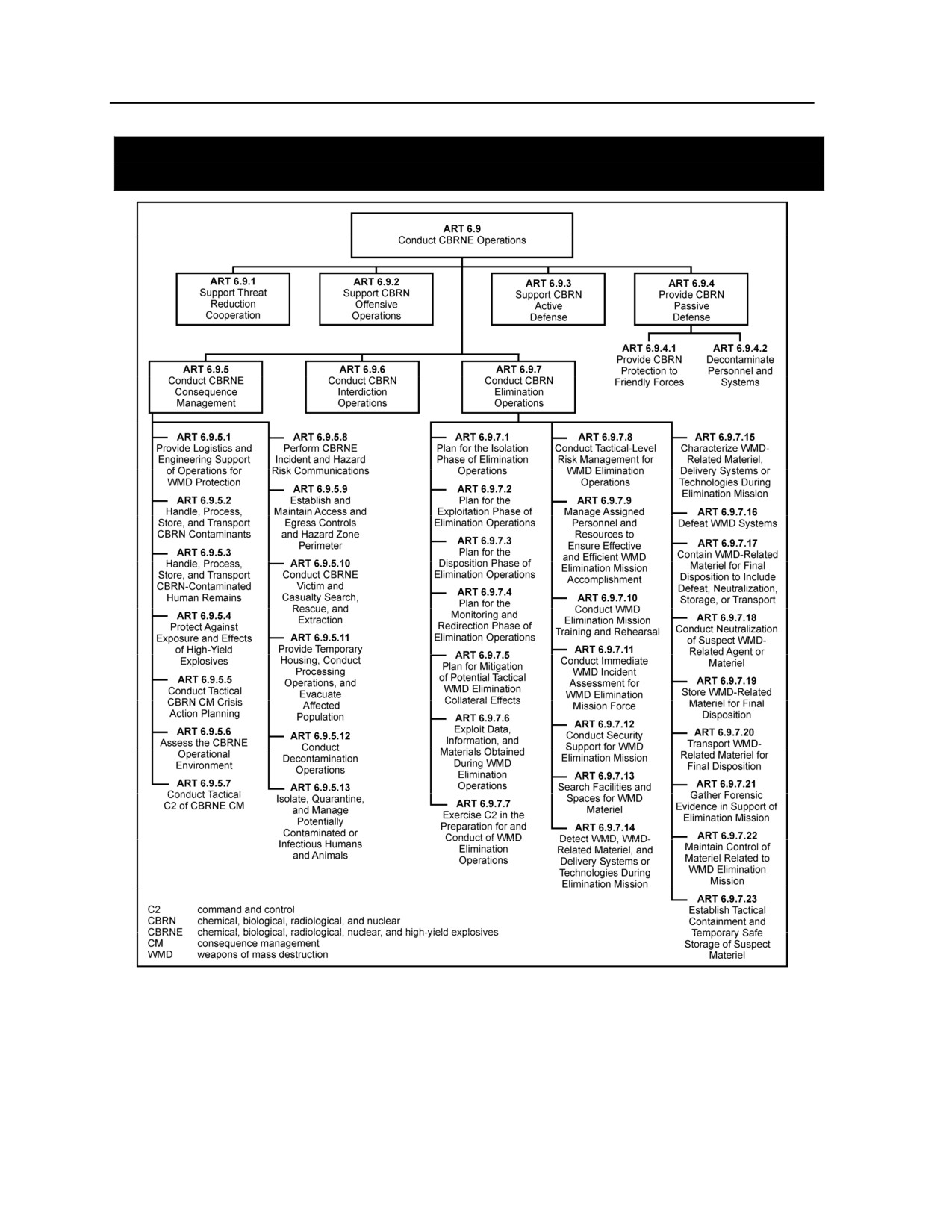
Chapter 6
SECTION IX - ART 6.9: CONDUCT CHEMICAL, BIOLOGICAL,
RADIOLOGICAL, NUCLEAR, AND HIGH-YIELD EXPLOSIVES OPERATIONS
6-107. Defend against chemical, biological, radiological, nuclear, and high-yield explosives (CBRNE)
weapons using the principles of avoidance, protection, and decontamination. ART 6.9 includes protection
from agents deliberately or accidentally released. An example of an accidentally released agent is toxic
chemicals leaking from factory storage containers due to collateral damage. (FM 3-11) (USACRBNS)
6-64
FM 7-15, C4
20 October 2010

ART 6.0: The Protection Warfighting Function
No.
Scale
Measure
01
Yes/No
Unit could continue its mission when attacked by enemy CBRNE weapons.
To conduct area or route reconnaissance to identify the limits of CBRNE weapons
02
Time
effects.
03
Time
To refine annex J to the operation order.
04
Time
To deploy and employ CBRNE monitoring equipment.
05
Time
To identify the CBRNE hazard.
06
Time
To detect the use of CBRNE weapons in the area of operations (AO).
07
Time
To issue downwind hazard warnings of a CBRNE attack in the AO.
08
Time
To conduct area damage control after using CBRNE weapons.
09
Time
To recover unit operational capability after a CBRNE attack.
10
Time
To give and understand CBRNE contamination alarms and signals.
To assume appropriate mission-oriented protective posture after warning of the use of
11
Time
CBRNE weapons in the AO.
To reconstitute unit to designated level of combat power after exposure to the effects of
12
Time
CBRNE weapons.
To coordinate for additional CBRNE reconnaissance, monitoring, and decontamination
13
Time
assets.
To administer chemoprophylaxis, immunizations, pretreatments, and barrier creams for
14
Time
protection against CBRNE warfare agents.
15
Percent
Of incidents of the use of CBRNE weapons detected.
Of enemy delivery systems for CBRNE weapons in AO identified, targeted, and
16
Percent
destroyed.
Of CBRNE contaminated sites in the AO that have decontamination operations initiated
17
Percent
or completed.
Of friendly units in the AO that have CBRNE monitoring, protective, and
18
Percent
decontamination equipment.
Of on-hand CBRNE equipment, necessary to protect the unit against hazards, that is
19
Percent
mission-capable.
Of CBRNE monitoring, protective and decontamination equipment positioned and
20
Percent
operated correctly.
21
Percent
Of CBRNE hazards correctly identified.
Of friendly units in the AO without adequate supplies of individual and collective
22
Percent
monitoring and protective equipment, and decontamination materials.
Of reduced unit combat power from the need to defend against the use of CBRNE
23
Percent
weapons.
24
Percent
Of friendly and civilian casualties in AO from the use of CBRNE weapons.
25
Number
Of instances where CBRNE weapons are employed.
26
Number
And types of on-hand CBRNE monitoring, protective, and decontamination equipment.
And types of friendly systems destroyed, damaged, or rendered inoperable resulting
27
Number
from the use of CBRNE weapons.
Of instances where units and facilities are affected by using CBRNE weapons without
28
Number
warning of their use.
29
Number
Of false alarms relating to using CBRNE weapons.
ART 6.9.1 SUPPORT THREAT REDUCTION COOPERATION
6-108. Take action that allows Soldiers to survive and continue the mission under chemical, biological,
radiological, and nuclear (CBRN) conditions. (FM 3-11.4) (USACRBNS)
20 October 2010
FM 7-15, C4
6-65

Chapter 6
No.
Scale
Measure
The use of CBRN protective equipment preserved unit personnel, equipment, and
01
Yes/No
supplies for future missions.
02
Time
To conduct area reconnaissance to detect the use of CBRN weapons.
To plan or revise the plan to employ protective equipment to take into account existing
03
Time
factors of mission, enemy, terrain and weather, troops and support available, time
available, and civil considerations.
04
Time
To establish the degree of local security for installing collective CBRN protective equipment.
To employ additional CBRN protective equipment to harden individuals and facilities
05
Time
from effects of CBRN weapons.
To assume mission-oriented protective posture in response to the employment of
06
Time
CBRN weapons given previous mission-oriented protective posture.
07
Time
To employ CBRN protective equipment to harden supply stocks with engineer support.
08
Time
To employ CBRN protective equipment to harden supply stocks without engineer support.
09
Time
To emplace warning signs marking edges of areas contaminated by CBRN weapons.
To obtain the CBRN protective equipment and systems needed to complete hardening
10
Time
process.
Of personnel, systems, and facilities hardened with CBRN protective equipment and
11
Percent
systems.
12
Percent
Of personnel trained to use CBRN protective equipment.
13
Percent
Of required CBRN protective equipment and supplies available.
14
Percent
Of CBRN individual and collective protective equipment employed to standard.
Of on-hand CBRN equipment, necessary to protect the unit against hazards, that is
15
Percent
mission-capable.
16
Percent
Of friendly casualties due to improperly used CBRN protective equipment.
Of casualties or equipment and supplies lost to enemy attack due to the nonavailability
17
Percent
of CBRN protective equipment.
18
Number
Of mission-capable individual and collective CBRN protective equipment systems.
Of friendly casualties due to improperly used CBRN protective equipment or slow
19
Number
reaction to the use of CBRN weapons.
Of casualties or equipment and supplies lost due to the nonavailability of CBRN
20
Number
protective equipment.
ART 6.9.2 SUPPORT CHEMICAL, BIOLOGICAL, RADIOLOGICAL,
AND NUCLEAR OFFENSIVE OPERATIONS
6-109. Deter and respond to the acquisition, facility preparation, production, weaponization, exportation,
deployment, threat, and use of chemical, biological, radiological, and nuclear
(CBRN) weapons.
Counterforce capabilities include conventional, unconventional (such as special operations forces), and
nuclear. For deterrence to succeed and for Secretary of Defense to possess flexible response options,
counterforce must include highly destructive and lethal options, as well as nonlethal options that
discriminate or minimize collateral damage and loss of life. (FM 3-11) (USACRBNS)
No.
Scale
Measure
Units had available weapon systems designed to destroy, disrupt, or deny access to
01
Yes/No
CBRN weapon targets while minimizing negative collateral effects.
Capability to model and predict collateral effects was prior to a strike on CBRN weapon
02
Yes/No
targets.
To acquire, positively identify, select, and prioritize CBRN weapon targets as well as
03
Time
other high-value targets.
To apportion resources to attack CBRN weapon targets as well as other high-value
04
Time
targets in either a deliberate or adaptive planning mode.
6-66
FM 7-15, C4
20 October 2010

ART 6.0: The Protection Warfighting Function
No.
Scale
Measure
Of targets reviewed for collateral damage or effects, damage expectancy, casualties,
05
Percent
and political ramifications or sensitivities.
06
Percent
Of targets exceeding guidance.
07
Percent
Of planned targets hit on time.
Of friendly or neutral forces or noncombatants influenced by collateral effects from
08
Percent
friendly attacks on CBRN-weapon targets.
Of known or suspected enemy CBRN targets that have been preplanned with the joint
09
Percent
targeting cycle process.
ART 6.9.3 SUPPORT CHEMICAL, BIOLOGICAL, RADIOLOGICAL,
AND NUCLEAR ACTIVE DEFENSE
6-110. Protect all assets from attack by chemical, biological, radiological, and nuclear (CBRN) weapons
by using assets to detect, divert or intercept, and counter or destroy delivery systems. Integrate
surveillance, detection, identification, tracking, and interception systems. Includes use of aircraft, air
defense missiles, air defense artillery, and nonair defense systems. Protects critical nodes and facilities.
(FM 3-11) (USACRBNS)
No.
Scale
Measure
01
Time
To issue threat warning after launch of ballistic missile.
02
Percent
Of enemy CBRN-weapon attacks reached target.
03
Percent
Of enemy CBRN attacks intercepted.
04
Number
Of U.S. casualties both combatant and noncombatant.
05
Number
Of false alarms.
ART 6.9.4 PROVIDE CHEMICAL, BIOLOGICAL, RADIOLOGICAL,
AND NUCLEAR PASSIVE DEFENSE
6-111. Passive defense seeks to deter and deny the use of chemical, biological, radiological, and nuclear
(CBRN) weapons by ensuring that U.S. forces succeed in a CBRN environment. The highest priorities for
passive defense are force survivability and successful mission accomplishment. Passive-defense operations
focus on protecting assets, sustaining mission operations, and minimizing casualties. The elements of
passive defense against a CBRN attack consist of contamination avoidance, protection, and
decontamination. Actions undertaken include measures to provide essential individual and collective
protection for friendly forces and critical assets. Passive-defense measures are planned whenever U.S.
forces could face a threat with a CBRN capability. (FM 3-11) (USACRBNS)
ART 6.9.4.1 PROVIDE CHEMICAL, BIOLOGICAL, RADIOLOGICAL, AND NUCLEAR
PROTECTION TO FRIENDLY FORCES
6-112. Employ detecting, identifying, marking, warning, and reporting methods and equipment to protect
personnel, units, and equipment from chemical, biological, radiological, and nuclear (CBRN) hazards.
(FM 3-11.4) (USACRBNS)
No.
Scale
Measure
01
Yes/No
Unit could continue its mission when attacked by enemy CBRN weapons.
To conduct area reconnaissance to determine limits of the effects of the use of CBRN
02
Time
weapons.
03
Time
To refine annex J to the operation order.
04
Time
To detect the use of CBRN weapons in the area of operations (AO).
05
Time
To issue downwind hazard warnings of a CBRN attack in the AO.
20 October 2010
FM 7-15, C4
6-67

Chapter 6
No.
Scale
Measure
06
Time
To conduct area damage control after the use of CBRN weapons.
07
Time
To recover unit operational capability after a CBRN attack.
To assume appropriate mission-oriented protective posture after warning of use of
08
Time
CBRN weapons in the AO.
09
Percent
Of enemy delivery systems for CBRN weapons in AO identified, targeted, and destroyed.
Of CBRN-contaminated sites in the AO that have decontamination operations initiated
10
Percent
or completed.
11
Percent
Of units in the AO that have CBRN monitoring equipment.
Of on-hand CBRN equipment, necessary to protect the unit against hazards, that is
12
Percent
mission-capable.
13
Percent
Of CBRN monitoring equipment positioned and operated correctly.
Of friendly units in the AO lacking supplies of individual and collective protective
14
Percent
equipment and decontamination materials.
15
Percent
Of friendly and civilian casualties in AO as a result of the use of CBRN weapons.
And types of friendly systems destroyed, damaged, or rendered inoperable as a result
16
Number
of the use of CBRN weapons.
ART 6.9.4.1.1 Employ Contamination Avoidance
6-113. Take measures to avoid or minimize the effects of chemical, biological, radiological, and nuclear
(CBRN) attacks and reduce the effects of CBRN hazards. By taking measures to avoid the effects of
CBRN attacks, units can reduce their protective posture and decrease the likelihood and extent of
decontamination required. (FM 3-11.3) (USACRBNS)
No.
Scale
Measure
01
Yes/No
Unit could continue its mission when attacked by enemy CBRN weapons.
02
Time
To detect the use of CBRN weapons in the area of operations (AO).
To conduct route reconnaissance to determine locations where effects of CBRN
03
Time
weapons are present and the degree of contamination along selected routes.
04
Time
To conduct area reconnaissance to determine limits of the effects of CBRN weapons.
05
Time
To refine the operation order to avoid or limit contact with contaminated areas.
To use the CBRN warning and reporting system to send reports of CBRN attacks, such
06
Time
as to issue downwind hazard warnings.
07
Time
To employ CBRN monitoring equipment.
08
Time
To identify CBRN hazards.
09
Time
To mark likely entry points into contaminated areas.
To conduct contamination control—bypassing, exposing only the absolute minimum
10
Time
number of personnel and equipment, encapsulating personnel and equipment, covering
equipment and supplies, and relocating.
11
Percent
Of CBRN contamination in the AO detected and correctly identified.
12
Percent
Of friendly units in the AO that have CBRN monitoring equipment.
Of on-hand CBRN equipment, necessary to protect the unit against hazards, that is
13
Percent
mission-capable.
14
Percent
Of CBRN monitoring equipment positioned and operated correctly.
15
Percent
Of unit courses of action modified due to the presence of CBRN contamination.
16
Number
And types of on-hand CBRN monitoring equipment.
And types of friendly systems destroyed, damaged, or rendered inoperable resulting
17
Number
from contact with CBRN contamination.
18
Number
Of friendly or civilian casualties in AO resulting from contact with CBRN contamination.
6-68
FM 7-15, C4
20 October 2010

ART 6.0: The Protection Warfighting Function
ART 6.9.4.1.2 Identify Chemical, Biological, Radiological, and Nuclear Hazards
6-114. Obtain information about the chemical, biological, radiological, and nuclear (CBRN) activities and
resources of an enemy by visual observation or other detection methods. Detect and identify CBRN
hazards, to include finding gaps and detours around CBRN-contaminated areas. CBRN reconnaissance,
which provides the information for identifying CBRN hazards, is part of the overall intelligence collection
effort. (FM 3-11.19) (USACRBNS)
Note: This task branch is supported by ART 2.3.3 (Conduct Reconnaissance).
No.
Scale
Measure
01
Yes/No
Unit continued its mission when attacked by enemy CBRN weapons.
02
Time
To collect CBRN hazard samples.
03
Time
To identify CBRN hazard samples.
04
Time
Required to obtain medical specimens for suspected biological or chemical hazards.
05
Time
Required to identify CBRN warfare agents from medical specimens.
06
Percent
Of instances in which a CBRN hazard is correctly identified.
07
Percent
Of instances in which a CBRN hazard is incorrectly identified as harmless.
08
Percent
Of instances in which a harmless sample is incorrectly identified as a CBRN hazard.
09
Number
Of casualties due to incorrect identification of CBRN hazards.
ART 6.9.4.1.3 Warn Personnel and Units of Contaminated Areas
6-115. Alert units and personnel concerning contaminated areas so they can retain freedom of maneuver,
orient on the threat, report all information rapidly and accurately, and develop the situation rapidly.
(FM 3-11.4) (USACRBNS)
No.
Scale
Measure
Personnel and units were warned of the presence and limits of contaminated areas in
01
Yes/No
their area of operations (AO) so they could retain freedom of maneuver.
To detect the use of chemical, biological, radiological, and nuclear (CBRN) weapons in
02
Time
the AO.
03
Time
To conduct area reconnaissance to determine limits of the effects of CBRN weapons.
To conduct route reconnaissance to determine locations where effects of CBRN
04
Time
weapons are and the degree of contamination.
05
Time
To refine operation order to avoid or limit contact with contaminated areas.
To use the CBRN warning and reporting system to send reports of CBRN attacks, such
06
Time
as to issue downwind hazard warnings.
07
Time
To employ CBRN monitoring equipment.
08
Time
To identify CBRN hazards.
09
Time
To mark likely entry points into contaminated areas.
10
Time
To give and understand CBRN contamination alarms and signals.
11
Percent
Of CBRN contamination in the AO detected and correctly identified.
12
Percent
Of friendly units in the AO that have CBRN monitoring equipment.
Of on-hand chemical, biological, radiological, nuclear, and high-yield explosives
13
Percent
equipment, necessary to protect the unit against hazards, that is mission-capable.
14
Percent
Of CBRN monitoring equipment positioned and operated correctly.
15
Percent
Of personnel trained to operate in a CBRN environment.
16
Number
And types of on-hand CBRN monitoring equipment.
20 October 2010
FM 7-15, C4
6-69

Chapter 6
No.
Scale
Measure
And types of friendly systems destroyed, damaged, or rendered inoperable due to
17
Number
unanticipated contact with CBRN contamination.
Of friendly and civilian casualties in the AO due to unanticipated contact with CBRN
18
Number
contamination.
ART 6.9.4.1.4 Report Chemical, Biological, Radiological, and Nuclear Hazards Throughout the
Area of Operations
6-116. Provide chemical, biological, radiological, and nuclear (CBRN) hazards information to support
decisionmaking and permit units and individuals to avoid contaminated areas. (FM 3-11.4) (USACRBNS)
No.
Scale
Measure
01
Yes/No
Unit accomplished its mission.
02
Time
To detect the use of CBRN weapons in the area of operations (AO).
To conduct area reconnaissance to determine contaminated locations and the degree
03
Time
of that contamination resulting from the use of CBRN weapons.
To conduct route reconnaissance to determine contaminated locations and the degree
04
Time
of that contamination resulting from the use of CBRN weapons.
05
Time
To refine the operation order to avoid or limit contact with contaminated areas.
To use the CBRN warning and reporting system to send reports of CBRN attacks, such
06
Time
as to issue downwind hazard warnings.
07
Time
To identify CBRN hazards.
08
Time
To give and understand CBRN contamination alarms and signals.
Of friendly units in the AO that have information systems capable of receiving CBRN
09
Percent
warnings.
Of unit courses of action that must be abandoned, changed, or modified due to the
10
Percent
warning of the presence of contaminated areas.
11
Number
Of locations contaminated by CBRN detected, correctly identified, and reported in the AO.
And types of friendly systems destroyed, damaged, or rendered inoperable due to
12
Number
contact with CBRN contamination.
13
Number
Of friendly or civilian casualties in the AO due to contact with CBRN contamination.
ART 6.9.4.1.5 Prepare for a Nuclear Strike
6-117. Take preparatory actions to warn personnel, harden positions, protect equipment, and conduct
periodic monitoring when warned that a nuclear strike is imminent. (FM 3-11) (USACRBNS)
No.
Scale
Measure
01
Yes/No
Unit continued its mission after the nuclear strike.
To prepare for the nuclear strike. This includes the time it takes to cover and secure
loose, flammable, and explosive items, zero radiation-monitoring equipment, close
sights and optics, shut down information systems, disconnect power and antenna leads,
02
Time
and take protective measures to prevent dazzle. The time will also vary with the need to
take additional preparatory measures, depending on the unit, installation, or facility’s
closeness to the predicted detonation point.
To move the unit or system to the minimum safe distance (MSD) from the predicted
03
Time
ground zero.
04
Time
To prepare and transmit effective downwind messages (USMTF #C503).
05
Time
To transmit, receive, and understand a nuclear strike warning (USMTF #C505).
To conduct surveillance and reconnaissance to detect a nuclear strike and determine
06
Time
ground zero.
Of unit casualties due to the effects—blast, thermal radiation, residual radiation, and
07
Percent
electromagnetic pulse—of a nuclear strike.
6-70
FM 7-15, C4
20 October 2010

ART 6.0: The Protection Warfighting Function
No.
Scale
Measure
08
Percent
Of nuclear strike preparatory measures completed before a nuclear strike.
09
Percent
Of unit caught within MSD 1, MSD 2, and MSD 3 of ground zero.
10
Percent
Of systems redundancy existing before a nuclear strike.
Of systems in the unit designed to survive the thermal, radiation, and electromagnetic
11
Percent
effects of a nuclear strike.
12
Percent
Of unit personnel and equipment not prepared for the nuclear strike.
13
Percent
Of reduced unit combat power due to the need to prepare for a nuclear strike.
14
Percent
Of personnel trained to prepare for a nuclear strike.
15
Number
And types of systems inoperable due to effects of the nuclear strike.
16
Number
Of casualties due to effects of the nuclear strike.
Of casualties due to improperly used chemical, biological, radiological, and nuclear
17
Number
(CBRN) protective equipment.
Of casualties or equipment and supplies lost due to the nonavailability of CBRN
18
Number
protective equipment.
19
Number
Of casualties attributed to slow reaction to effects of the nuclear strike.
ART 6.9.4.2 DECONTAMINATE PERSONNEL AND SYSTEMS
6-118. Make any person, object, or area safe by absorbing, destroying, neutralizing, making harmless, or
removing chemical, biological, radiological, and nuclear materials or agents clinging to or around it. This
task encompasses environmental considerations. (FM 3-11.5) (USACRBNS)
Note: ART 6.9.4.2.1 (Perform Immediate Decontamination) addresses immediate
decontamination.
ART 6.9.4.2.2 (Perform Operational Decontamination) addresses operational decontamination.
ART 6.9.4.2.3 (Perform Thorough Decontamination) addresses thorough decontamination.
No.
Scale
Measure
01
Yes/No
Unit continued its mission after decontaminating its personnel and systems.
02
Time
That execution of the unit concept of operations is delayed by decontamination procedures.
To determine an appropriate decontamination site incorporating environmental
03
Time
considerations.
04
Time
To determine the extent of contamination.
To move the required decontamination equipment to the decontamination site and
05
Time
obtain the necessary decontamination supplies.
06
Time
To decontaminate individuals.
07
Time
To decontaminate vehicles and systems.
08
Percent
Of unit personnel and equipment requiring decontamination.
09
Percent
Of unit personnel proficient in conducting decontamination operations.
10
Percent
Of on-hand decontamination equipment and supplies.
11
Percent
Of mission-capable, on-hand decontamination equipment.
12
Number
Of personnel and equipment requiring decontamination.
13
Number
And types of mission-capable, on-hand decontamination equipment.
14
Number
Of casualties due to improper and incomplete decontamination.
20 October 2010
FM 7-15, C4
6-71

Chapter 6
ART 6.9.4.2.1 Perform Immediate Decontamination
6-119. Minimize casualties, save lives, and limit the spread of contamination by contaminated
individuals. Individuals or crews conduct immediate decontamination by skin decontamination, personal
wipe down, and operator’s spray down to stop agent from penetrating the equipment. (FM 3-11.5)
(USACRBNS)
No.
Scale
Measure
01
Yes/No
Unit continued its mission after conducting immediate decontamination.
02
Time
To complete skin decontamination.
03
Time
To conduct personal equipment wipe down.
04
Time
For equipment spray down.
05
Time
For unit personnel to exchange mission-oriented protective posture gear.
06
Time
To conduct unmasking procedures.
07
Time
To discard contaminated articles incorporating environmental considerations.
08
Percent
Of personnel and equipment requiring immediate decontamination.
09
Percent
Of personnel proficient in conducting immediate decontamination operations.
10
Percent
Of on-hand immediate decontamination equipment and supplies.
11
Percent
Of mission-capable, on-hand immediate decontamination equipment.
12
Number
Of personnel and equipment requiring immediate decontamination.
And types of mission-capable, on-hand immediate decontamination equipment and
13
Number
supplies.
14
Number
Of casualties due to improper or incomplete immediate decontamination.
ART 6.9.4.2.2 Perform Operational Decontamination
6-120. Sustain operations, reduce the contact hazard, and limit the spread of contamination to eliminate
the necessity for, or reduce the duration of, wearing mission-oriented protective posture (MOPP) gear.
Affected units and battalion, crew, or chemical corps decontamination platoons perform operational
decontamination. (FM 3-11.5) (USACRBNS)
No.
Scale
Measure
01
Yes/No
Unit continued its mission after conducting operational decontamination.
02
Time
To find a site to perform operational decontamination.
03
Time
To initiate operational decontamination after exposure.
04
Time
To obtain equipment and supplies to conduct operational decontamination.
05
Time
To complete operational decontamination of unit equipment.
06
Time
For unit personnel to exchange MOPP gear.
07
Time
To conduct unmasking procedures.
08
Time
To discard contaminated articles incorporating environmental considerations.
09
Percent
Of unit equipment requiring operational decontamination.
10
Percent
Of unit personnel proficient in conducting operational decontamination operations.
11
Percent
Of on-hand operational decontamination equipment and supplies.
12
Percent
Of mission-capable, on-hand operational decontamination equipment.
Of operations degraded, delayed, or modified due to the inability to perform operational
13
Percent
decontamination.
14
Number
And types of equipment requiring operational decontamination.
And types of mission-capable, on-hand operational decontamination equipment and
15
Number
supplies.
16
Number
Of casualties due to improper or incomplete operational decontamination.
6-72
FM 7-15, C4
20 October 2010

ART 6.0: The Protection Warfighting Function
ART 6.9.4.2.3 Perform Thorough Decontamination
6-121. Reduce contamination on personnel, equipment or materiel, and working areas to the lowest
possible level (negligible risk) to permit reducing or removing individual protective equipment and to
maintain operations with minimal degradation. There are three thorough decontamination techniques:
detailed troop decontamination, detailed equipment decontamination, and detailed aircraft
decontamination. To reduce or eliminate the need of individual protective clothing, units can carry out
decontamination with assistance from chemical units. (FM 3-11.5) (USACRBNS)
No.
Scale
Measure
01
Yes/No
Unit continued its mission after conducting a thorough decontamination.
To find a site to perform thorough decontamination incorporating environmental
02
Time
considerations.
To plan and coordinate a thorough decontamination operation, including the time to
03
Time
prioritize decontamination efforts.
04
Time
To obtain equipment and supplies to conduct a thorough decontamination.
05
Time
To move to the decontamination site.
06
Time
To initiate a thorough decontamination.
07
Time
To complete thorough decontamination of unit equipment.
08
Time
For unit personnel to exchange mission-oriented protective posture gear.
09
Time
To conduct unmasking procedures.
10
Time
To discard contaminated articles.
11
Percent
Of unit equipment requiring thorough decontamination.
12
Percent
Of unit personnel proficient in conducting thorough decontamination operations.
Of personnel and equipment completing immediate decontamination before leaving the
13
Percent
site of initial contamination.
14
Percent
Of on-hand necessary thorough decontamination equipment and supplies.
15
Percent
Of mission-capable, on-hand thorough decontamination equipment.
Of operations degraded, delayed, or modified due to the inability to perform thorough
16
Percent
decontamination.
17
Number
And types of equipment requiring thorough decontamination.
And types of mission-capable, on-hand thorough decontamination equipment and
18
Number
supplies.
19
Number
Of casualties due to improper or incomplete decontamination.
ART 6.9.4.2.4 Perform Area Decontamination
6-122. Decontaminate fixed sites and terrain to restore the area to an acceptable level of readiness and
effectiveness while conducting the mission. Limit the spread and transfer of contamination, restore mission
essential functioning, and open accessibility for entry and exit to key facilities. Fixed sites include
command posts, signal facilities, supply installations and points, depots, pre-positioned materiel, airfields,
and port facilities. (FM 3-11.5) (USACRBNS)
No.
Scale
Measure
Units and unprotected personnel maneuvered through or used the decontaminated
01
Yes/No
area without hindrance from contamination after area decontamination procedures were
completed.
To perform reconnaissance of the area designated for decontamination in conjunction
02
Time
with environmental considerations.
To plan and coordinate the area decontamination, including the time to prioritize
03
Time
decontamination efforts.
04
Time
To obtain equipment and supplies to conduct area decontamination.
05
Time
To move to the decontamination area.
20 October 2010
FM 7-15, C4
6-73

Chapter 6
No.
Scale
Measure
06
Time
To initiate the area decontamination after exposure to contaminates.
07
Time
To complete area decontamination of fixed sites and key terrain.
To move contaminated soil and hazardous waste generated by the area
08
Time
decontamination to hazardous waste dumps.
09
Percent
Of fixed sites and key terrain requiring area decontamination.
10
Percent
Of unit personnel proficient in conducting area decontamination operations.
11
Percent
Of on-hand area decontamination equipment and supplies.
12
Percent
Of mission-capable, on-hand area decontamination equipment.
Of operations degraded, delayed, or modified due to the inability to perform area
13
Percent
decontamination of fixed sites and key terrain.
14
Number
Of fixed sites requiring area decontamination.
15
Number
And types of mission-capable, on-hand area decontamination equipment and supplies.
16
Number
Of casualties due to improper or incomplete area decontamination.
ART 6.9.4.2.5 Perform Patient Decontamination
6-123. Decontaminate patients who are unable to decontaminate themselves through the systematic
removal of clothing and contaminants. A patient decontamination team consisting of nonmedical personnel
from the supported unit performs patient decontamination. The patient decontamination team operates
under the supervision of medical personnel to ensure the decontamination process causes no further injury
to the patient. (FM 4-02.7) (USAMEDDC&S)
No.
Scale
Measure
01
Yes/No
Patient decontamination did not result in detrimental effects on the patient.
To prepare patient chemical, biological, radiological, and nuclear decontamination
02
Time
equipment and supplies.
To decontaminate a litter patient. This includes decontaminating the patient’s mask and
hood; removing the field medical card; removing gross contamination; removing the
03
Time
patient’s protective overgarment, uniform, and personal effects; transferring the patient
to a decontamination litter; conducting spot skin decontamination; and transferring the
patient through the shuffle pit to the clean treatment area.
To decontaminate an ambulatory patient. This includes removing load-bearing
equipment, decontaminating the patient’s mask and hood, removing the field medical
card, removing all gross contamination, removing the patient’s protective overgarment
04
Time
and personal effects, checking the patient for contamination, conducting spot skin
decontamination, removing bandages and tourniquets (medical personnel perform this
action), and moving the patient through the shuffle pit to the clean treatment area.
05
Time
To train the patient decontamination team.
06
Time
To establish clean and dirty patient treatment facilities.
07
Time
To obtain equipment and supplies needed to conduct patient decontamination.
08
Time
To initiate patient decontamination.
09
Time
To discard contaminated articles in conjunction with environmental considerations.
10
Percent
Of patients requiring decontamination before receiving medical treatment.
11
Percent
Of on-hand patient decontamination equipment and supplies.
12
Percent
Of mission-capable, on-hand patient decontamination equipment.
Of medical treatments degraded, delayed, or modified due to the inability to perform
13
Percent
patient decontamination.
14
Number
Of patients decontaminated.
6-74
FM 7-15, C4
20 October 2010

ART 6.0: The Protection Warfighting Function
ART 6.9.5 CONDUCT CHEMICAL, BIOLIGICAL, RADIOLOGICAL,
NUCLEAR, AND HIGH-YIELD EXPLOSIVES CONSEQUENCE
MANAGEMENT
6-124. Coordinate support for essential services and activities required to manage and mitigate damage
resulting from the use of chemical, biological, radiological, nuclear, and high-yield explosives (CBRNE)
weapons or the release of toxic industrial materials or contaminants. Services and activities can include
population evacuation, decontamination, transportation, communications, public works and engineering,
firefighting, information and planning, mass care, resource support, health and medical services, urban
search and rescue, hazardous materials, and food and energy. This task addresses processes for sharing
information on stockpiles and local or referral surge capacities. In addition, establishment of alert and
notification mechanisms, media management plans, and coordination of a public awareness and education
effort are included. Population at risk and CBRNE casualties are estimated. If required, organizations are
requested and military units are deployed to support consequence management.
(FM
3-11.21)
(USACRBNS)
No.
Scale
Measure
Department of Defense plans and policies for consequence management operations
01
Yes/No
were in place.
02
Time
To coordinate emergency response plan with civil authorities.
To identify relevant participants and determine roles and responsibilities via approved
03
Time
exercise.
04
Time
To develop options for decision makers.
05
Time
To assess consequences and facilitate follow-on support.
06
Time
To deploy reaction teams.
To establish plan to distribute medicines and medical supplies when protectively
07
Time
isolation, fearful of the public, and concerned for security.
To develop specific entry and exit plans in concert with local, state, and federal
08
Time
response plans.
To establish coordination, communication, and contingency plans for joint and
09
Time
government or industry via approved exercises.
To establish mechanisms and processes for sharing information on stockpiles and
10
Time
surge capacities via approved exercises.
11
Time
To establish alert and notification mechanisms via approved exercises.
12
Percent
Of actions forwarded with developed protections against failure.
13
Percent
Of medical consequence management teams available.
ART 6.9.5.1 PROVIDE LOGISTICS AND ENGINEERING SUPPORT OF OPERATIONS FOR
WEAPONS OF MASS DESTRUCTION PROTECTION
6-125. Provide and use logistics and engineering operations to support weapons of mass destruction
(WMD) protection. This involves identifying, allocating, and providing resources necessary to protect
people, critical infrastructure, and equipment. Includes engineering activities for protection operations.
ART 6.9.5.1 includes logistics activities including the application of critical resources within the
prioritization framework. It also encompasses the dissemination of consequence management guidance and
program materials. Involves the use of engineering capabilities to clear routes of entry and to remove
secondary hazards. (FM 3-11.21) (USACRBNS)
No.
Scale
Measure
01
Yes/No
Unit identified resources to protect personnel.
02
Yes/No
Unit allocated resources to protect personnel.
03
Yes/No
Unit provided resources to protect personnel.
20 October 2010
FM 7-15, C4
6-75

Chapter 6
No.
Scale
Measure
04
Yes/No
Unit provided resources to protect critical infrastructure and equipment.
05
Yes/No
Unit identified resources to protect critical infrastructure and equipment.
06
Yes/No
Unit allocated resources to protect critical infrastructure and equipment.
Unit conducted engineering activities in support of WMD consequence management
07
Yes/No
activities.
08
Yes/No
Unit supported emplacement of collective protection systems.
Consequence management guidance and program materials were provided to non-
09
Yes/No
English-speaking populations.
10
Yes/No
Engineering capabilities were available to clear routes of entry.
11
Yes/No
Engineering capabilities were available to remove secondary hazards.
Procedures adequately addressed use of logistics and engineering operations
12
Yes/No
supporting WMD protection.
ART 6.9.5.2 HANDLE, PROCESS, STORE, AND TRANSPORT CHEMICAL, BIOLOGICAL,
RADIOLOGICAL, AND NUCLEAR CONTAMINANTS
6-126. The handling, processing, storage, and transport of contaminated equipment, materials, samples,
residues, animal remains, and waste. It involves the chain of actions from collection or identification,
through processing and storage, to disposition actions as outlined in procedures and higher authority
guidance. It includes gathering samples, adhering to chain of evidence procedures, and recovering animal
remains. Includes the collection and processing of personal effects of deceased, missing, and medically
evacuated personnel. (FM 3-11.21) (USACRBNS)
No
Scale
Measure
Unit handled and processed contaminated and infectious equipment, samples, residues,
01
Yes/No
animal remains, and waste.
Unit contained contaminated and infectious equipment, samples, residues, animal
02
Yes/No
remains, and waste.
Unit safely stored contaminated and infectious equipment, samples, residues, animal
03
Yes/No
remains, and waste.
Unit safely transported contaminated and infectious equipment, samples, residues,
04
Yes/No
animal remains, and waste.
Procedures outlined the chain of actions and associated processes from collection or
05
Yes/No
identification, through processing and storage, to disposition actions.
Procedures outlined how to gather samples and adhere to chain of custody of
06
Yes/No
contaminated and infectious evidence.
07
Yes/No
Procedures addressed how to transfer custody of contaminated and infectious evidence.
08
Yes/No
Personnel were qualified to wear personal protective equipment.
09
Yes/No
Personnel wore appropriate personal protective equipment.
A safety officer was appointed to monitor operations in weapons of mass destruction
10
Yes/No
(WMD) environments.
Unit identified and used appropriately contaminated and noncontaminated transportation
11
Yes/No
routes.
12
Yes/No
Unit followed procedures to prevent secondary exposure and threat of WMD.
ART 6.9.5.3 HANDLE, PROCESS, STORE, AND TRANSPORT CHEMICAL, BIOLOGICAL,
RADIOLOGICAL, AND NUCLEAR-CONTAMINATED HUMAN REMAINS
6-127. Establish mass mortuary operations and collect human remains. Address the performance of
marking, handling, decontamination, processing, temporary storage, and preparation for transport of
contaminated human remains. This task involves the chain of actions from collection and identification,
6-76
FM 7-15, C4
20 October 2010