FM 7-15, C4 The Army Universal Task List (October 2010) - page 1
FM 7-15, C4
Change No. 4
Headquarters
Department of the Army
Washington, DC, 20 October 2010
The Army Universal Task List
1. Change 4 to FM 7-15, 27 February 2009, enables units to better link collective tasks in concert with
development of the mission-essential task list for full spectrum operations and facilitate changes from
periodic collective tasks review by respective doctrine centers of excellence.
2. Completely replace ART 4.2.1 (Provide Human Resources Support) tasks based on the revised doctrine in
FM 1-0.
3. Completely replace ART 4.3 (Provide Health Service Support) tasks based on the revised doctrine in
FM 4-02.
4. Add a new ART 4.5 (Provide General Engineering Support).
5. Add ART 6.2.2.
6. Modify ART 6.7, ART 6.12.3, and ART 7.3.3.3.
7. An asterisk (*) marks new material.
8. FM 7-15, 27 February 2009, is changed as follows:
Remove Old Pages
Insert New Pages
pages i through viii
pages i through viii
pages 4-1 and 4-2
pages 4-1 and 4-2
pages 4-43 through 4-97
pages 4-43 through 4-96
pages 6-13 through 6-24
pages 6-13 through 6-24
pages 6-43 and 6-44
pages 6-43 and 6-44
pages 6-53 through 6-116
pages 6-53 through 6-118
pages 7-17 through 7-22
pages 7-17 through 7-22
9. File this transmittal sheet in front of the publication for reference purposes.
DISTRUBUTION RESTRICTION: Approved for public release; distribution is unlimited.
*FM 7-15
Field Manual
Headquarters
Department of the Army
No. 7-15
Washington, DC, 27 February 2009
The Army Universal Task List
Contents
Page
PREFACE
ix
INTRODUCTION
xii
Chapter 1
ART 1.0: THE MOVEMENT AND MANEUVER WARFIGHTING FUNCTION . 1-1
Section I - ART 1.1: Perform Tactical Actions Associated with Force
Projection and Deployment
1-2
ART 1.1.1 Conduct Mobilization of Tactical Units
1-2
ART 1.1.2 Conduct Tactical Deployment/Redeployment Activities
1-4
ART 1.1.3 Conduct Demobilization of Tactical Units
1-7
ART 1.1.4 Conduct Rear Detachment Activities
1-7
Section II - ART 1.2: Conduct Tactical Maneuver
1-8
ART 1.2.1 Conduct One of the Five Forms of Maneuver
1-9
ART 1.2.2 Employ Combat Formations
1-11
ART 1.2.3 Employ Combat Patrols
1-17
ART 1.2.4 Conduct Counterambush Actions
1-17
ART 1.2.5 Exploit Terrain to Expedite Tactical Movements
1-18
ART 1.2.6 Cross a Danger Area
1-18
ART 1.2.7 Link Up with Other Tactical Forces
1-18
ART 1.2.8 Conduct Passage of Lines
1-19
ART 1.2.9 Conduct a Relief in Place
1-20
ART 1.2.10 Navigate from One Point to Another
1-21
ART 1.2.11 Conduct a Survivability Move
1-21
ART 1.2.12 Conduct Sniper Active Countermeasures
1-22
ART 1.2.13 Conduct Sniper Passive Countermeasures
1-22
Section III - ART 1.3: Conduct Tactical Troop Movements
1-23
ART 1.3.1 Prepare Forces for Movement
1-23
ART 1.3.2 Conduct Tactical Road March
1-25
Distribution Restriction: Distribution Restriction: This manual is approved for public release; distribution is
unlimited.
*This publication supersedes FM 7-15, 31 August 2003.
20 October 2010
FM 7-15, C4
i
Contents
ART 1.3.3 Conduct Tactical Convoy
1-25
ART 1.3.4 Conduct an Approach March
1-26
Section IV - ART 1.4: Conduct Direct Fires
1-27
ART 1.4.1 Conduct Lethal Direct Fire Against a Surface Target
1-27
ART 1.4.2 Conduct Nonlethal Direct Fire Against a Surface Target
1-28
Section V - ART 1.5: Occupy an Area
1-29
ART 1.5.1 Occupy an Assembly Area
1-29
ART 1.5.2 Occupy an Attack and Assault Position
1-29
ART 1.5.3 Occupy and Establish a Battle or Defensive Position
1-30
ART 1.5.4 Conduct Drop Zone Operations
1-30
ART 1.5.5 Conduct Landing Zone Operations
1-31
Section VI - ART 1.6: Conduct Mobility Operations
1-32
ART 1.6.1 Overcome Barriers, Obstacles, and Mines
1-33
ART 1.6.2 Enhance Movement and Maneuver
1-38
ART 1.6.3 Negotiate a Tactical Area of Operations
1-41
ART 1.6.4 Provide Diver Support
1-41
ART 1.6.5 Conduct Nontactical Movements
1-42
Section VII - ART 1.7: Conduct Countermobility Operations
1-43
ART 1.7.1 Site Obstacles
1-44
ART 1.7.2 Construct, Emplace, or Detonate Obstacles
1-45
ART 1.7.3 Mark, Report, and Record Obstacles
1-45
ART 1.7.4 Maintain Obstacle Integration
1-46
Section VIII - ART 1.8: Employ Obscurants
1-46
Chapter 2
ART 2.0: THE INTELLIGENCE WARFIGHTING FUNCTION
2-1
Section I - ART 2.1: Intelligence Support to Force Generation
2-2
ART 2.1.1 Provide Intelligence Readiness
2-2
ART 2.1.2 Establish Intelligence Architecture
2-4
ART 2.1.3 Provide Intelligence Overwatch
2-8
ART 2.1.4 Generate Intelligence Knowledge
2-8
ART 2.1.5 Tailor the Intelligence Force
2-13
Section II - ART 2.2: Support to Situational Understanding
2-15
ART 2.2.1 Perform Intelligence Preparation of the Battlefield
2-16
ART 2.2.2 Perform Situation Development
2-20
ART 2.2.3 Provide Intelligence Support to Protection
2-20
ART 2.2.4 Provide Tactical Intelligence Overwatch
2-21
ART 2.2.5 Conduct Police Intelligence Operations
2-21
ART 2.2.6 Provide Intelligence Support to Civil Affairs Activities
2-26
Section III - ART 2.3: Perform Intelligence, Surveillance, and
Reconnaissance
2-27
ART 2.3.1 Perform Intelligence, Surveillance, and Reconnaissance
Synchronization
2-28
ART 2.3.2 Perform Intelligence, Surveillance, and Reconnaissance
Integration
2-30
ART 2.3.3 Conduct Reconnaissance
2-33
ART 2.3.4 Conduct Surveillance
2-38
ART 2.3.5 Conduct Intelligence Related Missions and Operations
2-38
ii
FM 7-15, C4
20 October 2010
Contents
Section IV - ART 2.4: Support to Targeting and Information Superiority 2-46
ART 2.4.1 Provide Intelligence Support to Targeting
2-47
ART 2.4.2 Provide Intelligence Support to Army Information Tasks
2-48
ART 2.4.3 Provide Intelligence Support to Combat Assessment
2-53
Chapter 3
ART 3.0: THE FIRES WARFIGHTING FUNCTION
3-1
Section I - ART 3.1: Decide Surface Targets
3-1
Section II - ART 3.2: Detect and Locate Surface Targets
3-2
Section III - ART 3.3: Provide Fire Support
3-2
ART 3.3.1 Conduct Fires
3-3
ART 3.3.2 Provide Illumination
3-7
ART 3.3.3 Conduct Survey Operations in Support of Fires Systems
3-8
ART 3.3.4 Perform Meteorological Operations in Support of Fires Systems
3-8
ART 3.3.5 Conduct Suppression of Enemy Air Defenses
3-9
Section IV - ART 3.4: Integrate Command and Control Warfare
3-10
ART 3.4.1 Conduct Electronic Attack
3-10
ART 3.4.2 Nominate Computer Network Attack Targets
3-11
ART 3.4.3 Nominate Electronic Attack Targets
3-11
Chapter 4
ART 4.0: THE SUSTAINMENT WARFIGHTING FUNCTION
4-1
Section I - ART 4.1: Provide Logistics Support
4-2
ART 4.1.1 Provide Maintenance Support
4-3
ART 4.1.2 Provide Transportation Support
4-7
ART 4.1.3 Provide Supplies
4-15
ART 4.1.4 Provide Field Services
4-32
ART 4.1.5 Provide Contracting Support
4-38
ART 4.1.6 Provide Distribution
4-39
*ART 4.1.7 Provide General Engineer Support
4-44
Section II - ART 4.2: Provide Personnel Services Support
4-45
*ART 4.2.1 Provide Human Resources Support
4-46
ART 4.2.2 Provide Financial Management Support
4-52
ART 4.2.3 Provide Legal Support
4-56
ART 4.2.4 Plan Religious Support Operations
4-61
ART 4.2.5 Provide Band Support
4-64
*Section III - ART 4.3: Provide Health Service Support
4-65
*ART 4.3.1 Provide Combat Casualty Care
4-66
*ART 4.3.2 Provide Medical Evacuation (Air and Ground)
4-69
*ART 4.3.3 Provide Medical Regulating Support
4-70
*ART 4.3.4 Provide Medical Logistics
4-71
+ Section IV - ART 4.4: Conduct Internment/Resettlement Operations ... 4-73
ART 4.4.1 Perform Internment Operations
4-74
ART 4.4.2 Conduct Resettlement Operations
4-76
*Section V - ART 4.5: Provide General Engineering Support
4-77
*ART 4.5.1 Restore Damaged Areas
4-78
*ART 4.5.2 Construct Sustainment Lines of Communications
4-79
*ART 4.5.3 Provide Engineer Construction Support
4-90
*ART 4.5.4 Supply Mobile Electric Power
4-91
20 October 2010
FM 7-15, C4
iii
Contents
*ART 4.5.5 Provide Facilities Engineer Support
4-92
*ART 4.5.6 Conduct Technical Engineer Operations
4-96
*ART 4.5.7 Produce Construction Materials
4-97
Chapter 5
ART 5.0: CONDUCT COMMAND AND CONTROL
5-1
Section I - ART 5.1: Execute the Operations Process
5-2
ART 5.1.1 Plan Operations
5-2
ART 5.1.2 Prepare for Tactical Operations
5-8
ART 5.1.3 Execute Tactical Operations
5-11
ART 5.1.4 Assess Tactical Situations and Operations
5-17
Section II - ART 5.2: Conduct Command Post Operations
5-21
ART 5.2.1 Conduct Command Post Operations to Support Tactical
Operations
5-22
ART 5.2.2 Displace the Command Post
5-23
ART 5.2.3 Execute Sleep Plans
5-24
ART 5.2.4 Manage Stress
5-25
ART 5.2.5 Maintain Continuity of Command and Control
5-25
Section III - ART 5.3: Integrate Information Superiority Contributors
5-26
ART 5.3.1 Integrate Information Engagement Capabilities
5-26
ART 5.3.2 Conduct Military Deception
5-29
ART 5.3.3 Facilitate Situational Understanding Through Knowledge
Management
5-30
+ ART 5.3.4 Manage Information and Data
5-30
+ ART 5.3.5 Establish the Information Network and System
5-30
ART 5.3.6 Conduct Electromagnetic Spectrum Management Operations
5-35
Section IV - ART 5.4: Conduct Civil-Military Operations
5-37
ART 5.4.1 Provide Interface or Liaison Among Military and Civilian
Organizations
5-38
ART 5.4.2 Locate and Identify Population Centers
5-39
ART 5.4.3 Identify Local Resources, Facilities, and Support
5-39
ART 5.4.4 Advise Commanders of Obligations to Civilian Population
5-40
ART 5.4.5 Conduct Negotiations With and Between Other Government
Agencies and Nongovernmental Organizations
5-41
ART 5.4.6 Conduct Civil Affairs Operations
5-42
Section V - ART 5.5: Execute Command Programs
5-59
ART 5.5.1 Support the Commander’s Leadership Responsibilities for Morale,
Welfare, and Discipline
5-59
ART 5.5.2 Preserve Historical Documentation and Artifacts
5-63
ART 5.5.3 Conduct Official Ceremonial, Musical, Public, and Special Events. 5-68
ART 5.5.4 Develop a Command Environmental Program
5-68
Section VI - ART 5.6: Integrate Space Operations
5-69
ART 5.6.1 Provide Space Force Enhancement
5-69
ART 5.6.2 Provide Space Control
5-72
ART 5.6.3 Provide Army Space Support
5-72
ART 5.6.4 Provide Space Situational Awareness
5-73
ART 5.6.5 Coordinate Army Space Capabilities
5-74
iv
FM 7-15, C4
20 October 2010
Contents
Section VII - ART 5.7: Conduct Public Affairs Operations
5-74
ART 5.7.1 Plan Public Affairs Operations
5-74
ART 5.7.2 Execute Information Strategies
5-75
ART 5.7.3 Facilitate Media Operations
5-75
ART 5.7.4 Maintain Community Relations
5-76
ART 5.7.5 Conduct Internal Information Program
5-76
ART 5.7.6 Implement Higher Headquarters Public Affairs Themes
5-76
+ Section VIII - ART 5.8 Establish and Maintain Discipline
5-77
ART 5.8.1 Conduct Law and Order Operations
5-77
ART 5.8.2 Intern U.S. Military Prisoners
5-82
Chapter 6
ART 6.0: THE PROTECTION WARFIGHTING FUNCTION
6-1
Section I - ART 6.1: Employ Air and Missile Defense
6-2
ART 6.1.1 Process Tactical Aerial Platforms
6-2
ART 6.1.2 Destroy Aerial Platforms
6-4
ART 6.1.3 Deny Enemy Use of Airspace
6-8
ART 6.1.4 React to Enemy Aerial Attack
6-9
ART 6.1.5 Plan Ballistic Missile Defense
6-9
ART 6.1.6 Conduct Ballistic Missile Defense
6-10
ART 6.1.7 Manage System Configuration
6-10
ART 6.1.8 Plan Rocket, Artillery, and Mortar Defense
6-12
ART 6.1.9 Conduct Rocket, Artillery, and Mortar Defense
6-12
Section II - ART 6.2: Conduct Personnel Recovery Operations
6-13
ART 6.2.1 Ensure Personnel Recovery Readiness During Premobilization
6-13
*ART 6.2.2 Perform Personnel Recovery-Related Force Protection Tasks
6-15
ART 6.2.3 Plan Personnel Recovery Operations
6-17
ART 6.2.4 Provide Personnel Recovery Support to Civil Search and Rescue
Authorities on a Noninterference Basis
6-18
ART 6.2.5 Support Homeland Security Personnel Recovery Operations
6-19
Section III - ART 6.3: Conduct Information Protection
6-19
ART 6.3.1 Provide Information Assurance
6-20
ART 6.3.2 Perform Computer Network Defense
6-22
ART 6.3.3 Perform Electronic Protection Actions
6-23
ART 6.3.4 Conduct Electronic Protection
6-24
Section IV - ART 6.4: Perform Fratricide Avoidance
6-24
ART 6.4.1 Detect and Establish Positive Identification of Friend, Foe, and
Noncombatants
6-25
ART 6.4.2 Maintain Constant Situational Awareness
6-26
Section V - ART 6.5: Conduct Operational Area Security
6-27
ART 6.5.1 Conduct Area and Base Security Operations
6-29
ART 6.5.2 Conduct Critical Installations and Facilities Security
6-30
ART 6.5.3 Establish Local Security
6-31
ART 6.5.4 Provide Protective Services for Selected Individuals
6-37
ART 6.5.5 Conduct Response Force Operations
6-38
ART 6.5.6 Secure Supply Routes and Convoys
6-39
20 October 2010
FM 7-15, C4
v
Contents
Section VI - ART 6.6: Apply Antiterrorism Measures
6-41
ART 6.6.1 Identify Potential Terrorist Threats and Other Threat Activities
6-42
ART 6.6.2 Reduce Vulnerabilities to Terrorist Acts and Attacks
6-43
ART 6.6.3 React to a Terrorist Incident
6-43
Section VII - ART 6.7: Conduct Survivability Operations
6-44
ART 6.7.1 Protect Against Enemy Hazards in the Area of Operations
6-45
ART 6.7.2 Disperse Tactical Forces
6-56
ART 6.7.3 Conduct Security Operations
6-56
ART 6.7.4 Conduct Actions to Control Pollution and Hazardous Materials
6-58
*Section VIII - ART 6.8: Provide Force Health Protection
6-59
*ART 6.8.1 Provide Preventive Medicine Support
6-60
*ART 6.8.2 Provide Veterinary Services
6-61
*ART 6.8.3 Provide Combat and Operational Stress Control Prevention
6-62
*ART 6.8.4 Provide Preventive Dentistry Support
6-62
*ART 6.8.5 Provide Area Medical Laboratory Services
6-63
Section IX - ART 6.9: Conduct Chemical, Biological, Radiological,
Nuclear, and High-Yield Explosives Operations
6-64
ART 6.9.1 Support Threat Reduction Cooperation
6-65
ART 6.9.2 Support Chemical, Biological, Radiological, and Nuclear Offensive
Operations
6-66
ART 6.9.3 Support Chemical, Biological, Radiological, and Nuclear Active
Defense
6-67
ART 6.9.4 Provide Chemical, Biological, Radiological, and Nuclear Passive
Defense
6-67
ART 6.9.5 Conduct Chemical, Bioligical, Radiological, Nuclear, and High-
Yield Explosives Consequence Management
6-75
ART 6.9.6 Conduct Chemical, Biological, Radiological, and Nuclear
Interdiction Operations
6-83
ART 6.9.7 Conduct Chemical, Biological, Radiological, and Nuclear
Elimination Operations
6-83
Section X - ART 6.10: Employ Safety Techniques
6-92
ART 6.10.1 Conduct Composite Risk Management
6-92
ART 6.10.2 Develop and Implement Command Safety Program
6-93
ART 6.10.3 Minimize Safety Risks
6-93
Section XI - ART 6.11: Implement Operations Security
6-94
ART 6.11.1 Conduct Operations Security
6-94
ART 6.11.2 Implement Physical Security Procedures
6-96
ART 6.11.3 Counter the Threat
6-98
*Section XII - ART 6.12: Provide Explosive Ordnance Disposal
Protection Support
6-102
ART 6.12.1 Conduct Unexploded Explosive Ordnance and Explosive
Remnants of War Operations
6-103
ART 6.12.2 Remove Stuck Rounds and Download Misfired Munitions in
Weapon Systems
6-104
*ART 6.12.3 Conduct Improvised Explosive Device Operations
6-105
ART 6.12.4 Conduct Explosive Ordnance Disposal Chemical Operations
6-106
vi
FM 7-15, C4
20 October 2010
Contents
ART 6.12.5 Provide Explosive Ordnance Disposal Support to Weapons of
Mass Destruction Operations
6-107
ART 6.12.6 Conduct Improved Explosive Device and Unexploded Explosive
Ordnance Protection Operations
6-108
ART 6.12.7 Respond to Accidents or Incidents Involving Military Chemical,
Biological, Radiological, and Nuclear Munitions
6-112
ART 6.12.8 Provide Explosive Ordnance Disposal Sustainment Support
6-113
Chapter 7
ART 7.0: FULL SPECTRUM OPERATIONS, TACTICAL MISSION TASKS, AND
OPERATIONAL THEMES
7-1
Section I - ART 7.1: Conduct Offensive Operations
7-2
ART 7.1.1 Conduct a Movement to Contact
7-2
ART 7.1.2 Conduct an Attack
7-3
ART 7.1.3 Conduct an Exploitation
7-4
ART 7.1.4 Conduct a Pursuit
7-4
Section II - ART 7.2: Conduct Defensive Operations
7-5
ART 7.2.1 Conduct a Mobile Defense
7-5
ART 7.2.2 Conduct an Area Defense
7-5
ART 7.2.3 Conduct a Retrograde
7-6
Section III - ART 7.3: Conduct Stability Operations
7-7
ART 7.3.1 Establish Civil Security
7-8
ART 7.3.2 Establish Civil Control
7-12
ART 7.3.3 Restore Essential Services
7-16
ART 7.3.4 Support Governance
7-19
ART 7.3.5 Support Economic and Infrastructure Development
7-21
Section IV - ART 7.4: Conduct Civil Support Operations
7-24
ART 7.4.1 Provide Support in Response to Disaster or Terrorist Attack
7-25
ART 7.4.2 Provide Support to Civil Law Enforcement
7-25
ART 7.4.3 Provide Other Support as Required
7-26
Section V - ART 7.5: Conduct Tactical Mission Tasks
7-27
ART 7.5.1 Attack by Fire an Enemy Force or Position
7-27
ART 7.5.2 Block an Enemy Force
7-27
ART 7.5.3 Breach Enemy Defensive Positions
7-27
ART 7.5.4 Bypass Enemy Obstacles, Forces, or Positions
7-28
ART 7.5.5 Canalize Enemy Movement
7-28
ART 7.5.6 Clear Enemy Forces
7-28
ART 7.5.7 Conduct Counterreconnaissance
7-28
ART 7.5.8 Contain an Enemy Force
7-28
ART 7.5.9 Control an Area
7-28
ART 7.5.10 Defeat an Enemy Force
7-28
ART 7.5.11 Destroy a Designated Enemy Force or Position
7-28
ART 7.5.12 Disengage from a Designated Enemy Force
7-28
ART 7.5.13 Disrupt a Designated Enemy Force’s Formation, Tempo, or
Timetable
7-29
ART 7.5.14 Conduct an Exfiltration
7-29
ART 7.5.15 Fix an Enemy Force
7-29
ART 7.5.16 Follow and Assume the Missions of a Friendly Force
7-29
ART 7.5.17 Follow and Support the Actions of a Friendly Force
7-29
20 October 2010
FM 7-15, C4
vii
Contents
ART 7.5.18 Interdict an Area or Route to Prevent, Disrupt, or Delay Its Use
by an Enemy Force
7-29
ART 7.5.19 Isolate an Enemy Force
7-29
ART 7.5.20 Neutralize an Enemy Force
7-29
ART 7.5.21 Occupy an Area
7-29
ART 7.5.22 Reduce an Encircled or Bypassed Enemy Force
7-30
ART 7.5.23 Retain a Terrain Feature
7-30
ART 7.5.24 Secure a Unit, Facility, or Location
7-30
ART 7.5.25 Seize an Area
7-30
ART 7.5.26 Support by Fire the Maneuver of Another Friendly Force
7-30
ART 7.5.27 Suppress a Force or Weapon System
7-30
ART 7.5.28 Turn an Enemy Force
7-30
ART 7.5.29 Conduct Soldier Surveillance and Reconnaissance
7-30
Section VI - ART 7.6: Operational Themes
7-31
ART 7.6.1 Conduct Military Engagements
7-31
ART 7.6.2 Conduct Limited Interventions
7-34
ART 7.6.3 Conduct Peace Operations
7-36
ART 7.6.4 Conduct Irregular Warfare
7-38
GLOSSARY
Glossary-1
REFERENCES
References-1
Figures
Introductory figure. Links between Army warfighting functions and UJTL task areas
xiii
Tables
Introductory table. Basic terms, their definitions, and their proponents
xiv
viii
FM 7-15, C4
20 October 2010
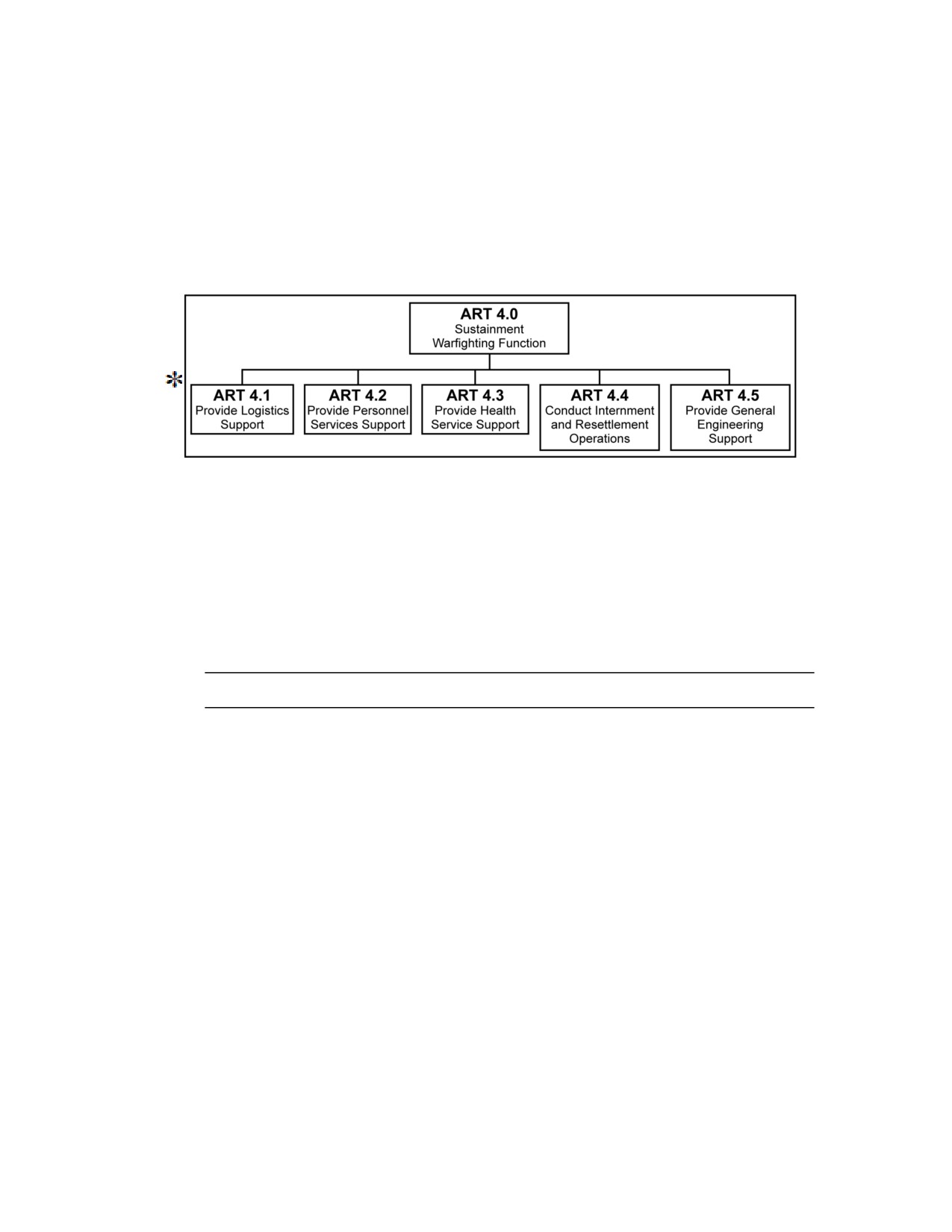
Chapter 4
ART 4.0: The Sustainment Warfighting Function
The sustainment warfighting function is the related tasks and systems that provide
support and services to ensure freedom of action, extend operational reach, and
prolong endurance. The endurance of Army forces is primarily a function of their
sustainment. Sustainment determines the depth and duration of Army operations. It is
essential to retaining and exploiting the initiative. Sustainment is the provision of the
logistics, personnel services, and health service support necessary to maintain
operations until mission accomplishment. Internment, resettlement, and detainee
operations fall under the sustainment warfighting function and include elements of all
three major subfunctions. (FM 3-0) (USACAC)
Note: This task and many of its subordinate tasks encompass environmental considerations.
+ Logistics is the science of planning, preparing, executing, and assessing the
movement and maintenance of forces. In its broadest sense, logistics includes the
design, development, acquisition, fielding, and maintenance of equipment and
systems. Logistics integrates strategic, operational, and tactical support efforts within
the joint operations area and schedules the mobilization and deployment of forces
and materiel. (FM 4-0) (CASCOM)
20 October 2010
FM 7-15, C4
4-1
Chapter 4
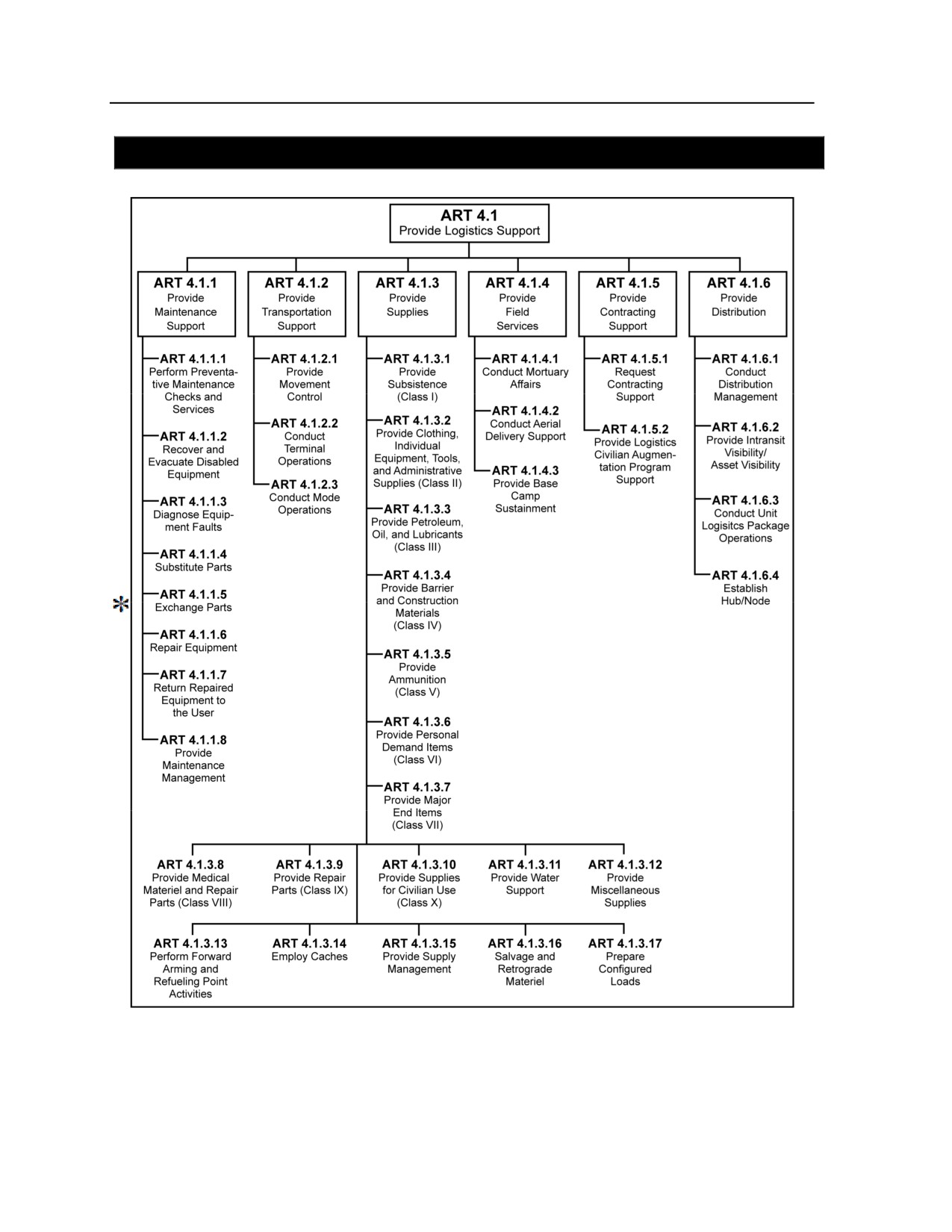
SECTION I - ART 4.1: PROVIDE LOGISTICS SUPPORT
4-1 Logistics is the science of planning, preparing, executing, and assessing the movement and
maintenance of forces. In its broadest sense, logistics includes the design, development, acquisition,
4-2
FM 7-15, C4
20 October 2010

ART 4.0: The Sustainment Warfighting Function
No.
Scale
Measure
To refine theater distribution plan for aerial port of debarkation operations after receipt
03
Time
of warning order.
04
Time
To establish aerial port of debarkation operations support plan after AO is assigned.
For aerial port if debarkation movement control team to begin operation after AO is
05
Time
assigned.
Of difference between the theater distribution plan requirements and actual
06
Percent
requirements in AO.
07
Percent
Of planned movement services support conducted by aerial port of debarkation.
08
Percent
Of scheduled transport movements completed on schedule.
Of operations degraded, delayed, or modified due to delays in moving or evacuating
09
Percent
personnel, supplies, and equipment.
Of personnel, supplies, and equipment in aerial port of debarkation that arrive on
10
Percent
schedule.
11
Percent
Of passengers stranded in transit for more than one day.
12
Number
Of tons per day of supplies and equipment arrived in aerial port of debarkation.
13
Number
Of passengers per day transported from aerial port of debarkation.
ART 4.1.6.4.2 Conduct Seaport of Debarkation Operations
4-74. Receive and offload cargo and equipment from arriving vessels. Process cargo and equipment and
begin transport to final destination within the area of operations (AO). (FM 4-01.30) (CASCOM)
No.
Scale
Measure
01
Yes/No
Delay in seaport clearance operations degraded, delayed, or modified unit operations.
Environmental considerations planning and procedures were present and being
02
Yes/No
followed.
To refine theater distribution plan for seaport of debarkation operations after receipt of
03
Time
warning order.
04
Time
To establish seaport of debarkation operations support plan after AO is assigned.
For seaport of debarkation movement control team to begin operation after AO is
05
Time
assigned.
Of difference between the theater distribution plan requirements and actual
06
Percent
requirements in AO.
07
Percent
Of planned movement services support conducted by seaport of debarkation.
08
Percent
Of scheduled transport movements completed on schedule.
Of operations degraded, delayed, or modified due to delays in moving or evacuating
09
Percent
personnel, supplies, and equipment.
10
Percent
Of supplies and equipment in seaport of debarkation that arrive on schedule.
Of tons per day of supplies and equipment moved by transport means from seaport of
11
Number
debarkation.
12
Number
Of tons per day of supplies and equipment arrived in seaport of debarkation.
ART 4.1.6.4.3 Conduct Hub Operations
4-75. Sort and distribute inbound cargo from wholesale supply sources (airlifted, sealifted, and ground
transportable) from within the theater. (FM 4-01.30) (CASCOM)
No.
Scale
Measure
01
Yes/No
Delay in hub operations degraded, delayed, or modified unit operations.
Environmental considerations planning and procedures were present and being
02
Yes/No
followed.
03
Time
To refine theater distribution plan for hub operations after receipt of warning order.
20 October 2010
FM 7-15, C4
4-43

Chapter 4
No.
Scale
Measure
04
Time
To establish distribution hub plan after the area of operations (AO) is assigned.
05
Time
For distribution hub to begin operation after AO is assigned.
Of difference between the theater distribution hub planned requirements and actual
06
Percent
requirements in AO.
07
Percent
Of planned movement services support conducted by distribution hub.
08
Percent
Of scheduled transport movements completed on schedule.
Of operations degraded, delayed, or modified due to delays in moving or evacuating
09
Percent
personnel, supplies, and equipment.
10
Percent
Of supplies and equipment that arrive on schedule.
Of tons per day of supplies and equipment moved by transport means from distribution
11
Number
hub.
12
Number
Of tons per day of supplies and equipment arrived in distribution hub.
*ART 4.1.7 PROVIDE GENERAL ENGINEER SUPPORT
4-76. ART 4.1.7 has been modified and moved to ART 4.5.1.
4-44
FM 7-15, C4
20 October 2010
ART 4.0: The Sustainment Warfighting Function
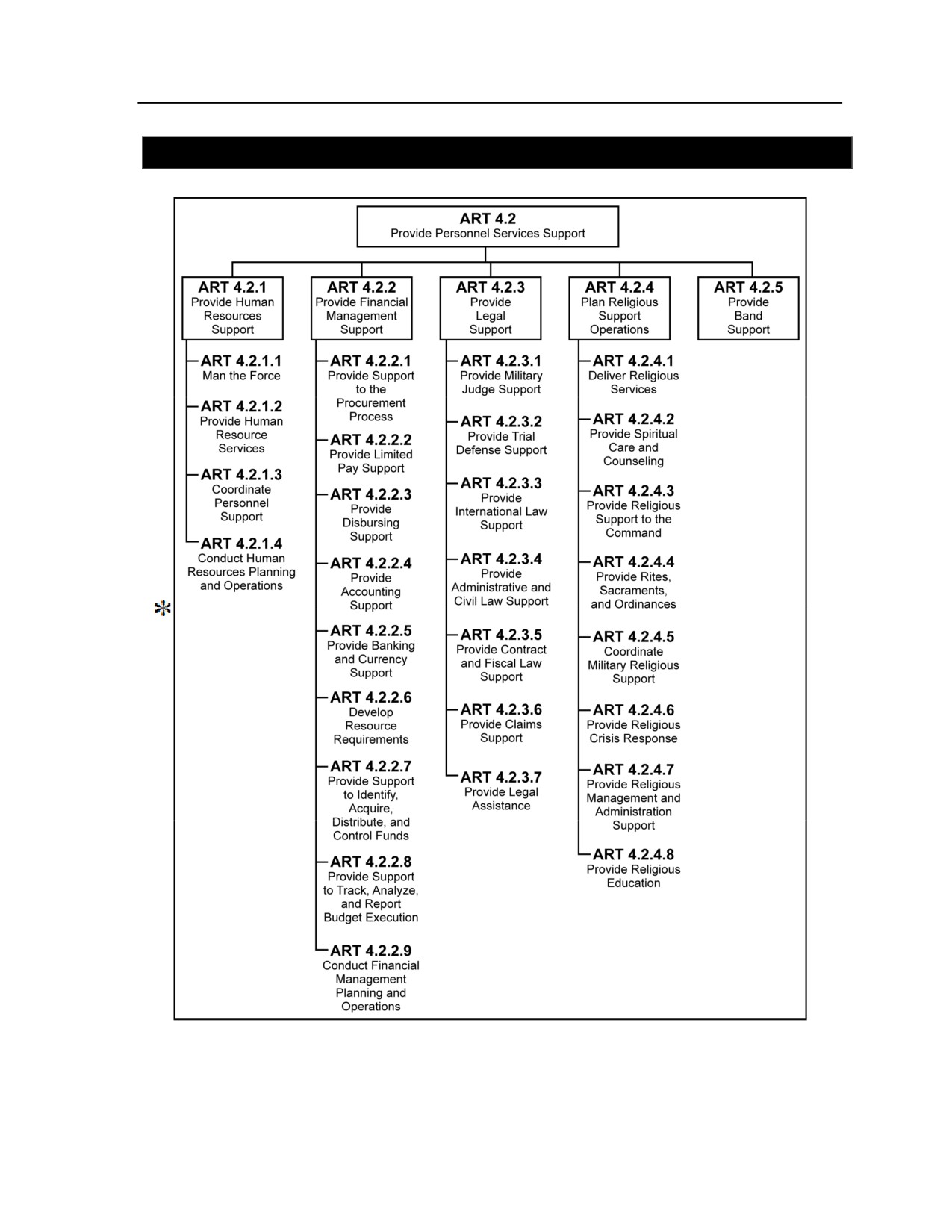
SECTION II - ART 4.2: PROVIDE PERSONNEL SERVICES SUPPORT
4-77. Personnel services are those sustainment functions related to Soldiers‘ welfare, readiness, and quality
of life. Personnel services complement logistics by planning for and coordinating efforts that provide and
sustain personnel. (FM 3-0) (USACAC)
20 October 2010
FM 7-15, C4
4-45

Chapter 4
*ART 4.2.1 PROVIDE HUMAN RESOURCES SUPPORT
4-78. Perform activities and tasks to sustain human resources (HR) functions of manning the force; HR
services; personnel support; and HR planning and operations in support of deployed forces. HR support
maximizes operational effectiveness and facilitates support to Soldiers, their families, DOD civilians, and
contractors authorized to accompany the force. (FM 1-0) (USAAGS)
No.
Scale
Measure
01
Yes/No
HR support and procedures assisted the supported unit to accomplish its mission.
02
Yes/No
Developed a comprehensive plan to provide HR support.
Unit identified adequate resources and deployed the resources as part of the early entry
03
Yes/No
element.
04
Yes/No
Unit identified location and support requirements for HR operations.
05
Yes/No
Adequate personnel information management was available.
Unit maintained personnel accountability and tracking of personnel entering or
06
Yes/No
departing the organization or theater.
07
Time
To complete required coordination.
08
Time
To establish postal operations.
09
Time
To establish morale, welfare, and recreation programs and services.
10
Time
To establish HR communications nodes
To deploy casualty liaison teams, personnel accountability teams and Theater Gateway
11
Time
Personnel Accountability Team.
To perform personnel accounting functions associated with theater gateways and other
12
Time
inter/intra theater ports.
13
Time
To provide/receive HR support on request.
14
Time
To produce strength reports that accurately reflects the strength of the unit.
15
Percent
Of personnel meeting personnel readiness requirements.
16
Percent
Of HR resources in place and operational.
17
Percent
Of casualty reports processed in accordance with established timeframes.
*ART 4.2.1.1 MAN THE FORCE
4-79. Manning combines anticipation, movement, and skillful positioning of personnel so that the
commander has the personnel required to accomplish the mission. ART 4.2.1.1 involves personnel
readiness management, personnel accountability, strength reporting, retention, and management of
personnel information. (FM 1-0) (USAAGS)
No.
Scale
Measure
01
Yes/No
The supported unit had sufficient personnel to accomplish its mission.
02
Yes/No
Unit maintained accountability of personnel transiting the organization or theater.
03
Time
To establish HR organizations as required.
To access HR systems enablers and accurately post changes to the personnel
04
Time
database of record.
05
Time
To coordinate transportation and life support of transiting personnel.
Of unit and nonunit personnel scheduled to deploy or redeploy per scheduled dates or
06
Percent
times.
07
Percent
Of unit personnel requirements met by Deployment-Day.
08
Percent
Of individuals, teams, platoons, and companies resourced for operations.
Of transiting personnel processed on a daily basis or in accordance with the distribution
09
Percent
plan.
4-46
FM 7-15, C4
20 October 2010

ART 4.0: The Sustainment Warfighting Function
No.
Scale
Measure
10
Percent
Of reports submitted in accordance with established time lines.
11
Number
Of operations degraded, delayed, or modified due to personnel shortages.
*ART 4.2.1.1.1 Perform Personnel Readiness Management
4-80. Distribute Soldiers and Army civilians to subordinate commands based on documented manpower
requirements, authorizations, and predictive analysis in support of the commander’s plans and priorities.
(FM 1-0) (USAAGS)
No.
Scale
Measure
Soldiers/individuals distributed per commander’s priorities and documented manpower
01
Yes/No
authorizations.
02
Yes/No
Strength management numbers were accurately maintained.
Accurate individual personnel readiness data was available in a timely manner to make
02
Yes/No
personnel readiness decisions.
03
Time
On average for managing unit/individual readiness.
04
Time
Delay in providing replacements due to operational priorities.
05
Time
Delay in providing replacements due to transportation shortfalls.
Of reception, replacement, rest and recuperations, redeployment, and return to duty
06
Percent
personnel record transactions completed correctly for individuals transiting the
organization/theater.
07
Percent
Of military personnel files that have incorrect data entered (based on sample survey)
08
Number
Of operations degraded, delayed, or modified due to personnel shortages.
09
Number
Of replacement personnel provided by the national provider.
*ART 4.2.1.1.2 Conduct Personnel Accounting
4-81. Personnel accounting is the by-name recording of specific data on individuals’ as they arrival and
departure from units, duty status changes, change in location, MOS or specialty codes, grade changes, and
so on. (FM 1-0) (USAAGS)
No.
Scale
Measure
01
Yes/No
Personnel accounting enhanced the unit’s ability to accomplish its mission.
02
Yes/No
All transiting personnel are tracked and accountability maintained.
To perform personnel accounting of transiting individuals/units into or out of the
03
Time
organization or theater.
To integrate transiting Soldiers/individuals personnel accounting data into the theater
04
Time
database.
05
Percent
Of personnel data transactions completed.
*ART 4.2.1.1.3 Conduct Strength Reporting
4-82. Strength reporting is the numerical end product of the personnel accountability process, it is based
on fill versus authorizations, and drives Army readiness and personnel readiness management. Strength
reporting reflects the combat power of a unit and is used to monitor unit strength, prioritize replacements,
execute strength distribution, and make tactical and human resources (HR) support decisions. (FM 1-0)
(USAAGS)
No.
Scale
Measure
01
Yes/No
Strength reporting enhanced the unit’s ability to accomplish its mission.
02
Yes/No
Strength reports for subordinate organizations are consolidated and reported to higher.
03
Yes/No
Strength reports have been reconciled to match database of record.
20 October 2010
FM 7-15, C4
4-47

Chapter 4
No.
Scale
Measure
04
Time
To consolidate subordinate personnel summaries.
To integrate transiting Soldiers and other personnel accounting data into the theater
05
Time
database.
06
Percent
Of personnel data transactions completed meeting established submission guidelines.
07
Percent
Of reports submitted on a timely basis.
*ART 4.2.1.1.4 Provide Personnel Information Management
4-83. Collecting, processing, storing, displaying, and disseminating of relevant human resources (HR)
information about units and personnel. This HR information includes Soldiers, attached joint, international
and multinational military personnel and civilians (Department of Defense, interagency, and contractor
employees) authorized to accompany the force. (FM 1-0) (USAAGS)
No.
Scale
Measure
The conduct of reception, replacement, rest and recuperation, redeployment, and return
01
Yes/No
to duty (R5) operations supported unit mission accomplishment.
02
Time
To perform personnel accounting of transiting individuals or units in theater.
To deploy and operate theater human resources teams such as theater gateway, R5,
03
Time
and casualty liaison teams.
04
Time
To integrate transiting personnel accounting data into the theater database.
05
Time
To coordinate transportation requirements.
06
Time
To coordinate life support for transiting personnel.
07
Percent
Of individuals or units processed daily.
*ART 4.2.1.1.5 Conduct Retention Operations
4-84. Retention improves readiness, aligns forces, and maintains Army end strength. Employ the four
phases of the Army Career Counseling System to increase retention and reduce unit level attrition by
advising leaders and developing and counseling Soldiers. (FM 1-0) (USAAGS)
No.
Scale
Measure
01
Yes/No
Retention supported unit mission accomplishment.
02
Time
To provide retention information (on average).
03
Time
To provide retention services (on average).
04
Time
To retain personnel to fill current positions (on average).
05
Percent
Of reenlistment actions processed correctly.
06
Percent
Of eligible personnel retained.
07
Percent
Of reenlistments occurring during a designated time.
08
Number
Of retention actions processed correctly.
09
Number
Of military personnel supported (given in an average).
*ART 4.2.1.2 PROVIDE HUMAN RESOURCES SERVICES
4-85. Human resources (HR) services are functions which directly impact a Soldier’s status, assignment,
qualifications, financial status, career progression, and quality of life which allows the Army leadership to
effectively manage the force. HR services include the functions of essential personnel services (EPS),
Postal, and Casualty operations. HR services include essential personnel services, casualty operations, and
postal operations. (FM 1-0) (USAAGS)
4-48
FM 7-15, C4
20 October 2010

ART 4.0: The Sustainment Warfighting Function
No.
Scale
Measure
The unit’s ability to accomplish its mission was enhanced because of the quality or
01
Yes/No
quantity of personnel service support provided.
02
Time
To process an individual action.
03
Time
To coordinate or collect essential personnel services information.
04
Percent
Of total actions processed in specified time.
05
Percent
Of actions processed incorrectly.
06
Percent
Of actions returned for additional information.
Of HR services capabilities in place and operational after area of operations is
07
Percent
assigned.
08
Percent
Of casualty and postal reports submitted in a specified time.
*ART 4.2.1.2.1 Conduct Casualty Operations
4-86. Collect, record, process, verify, and report casualty information from unit level to Department of the
Army. (FM 1-0) (USAAGS)
No.
Scale
Measure
Families of personnel in the area of operations who become casualties were accurately
01
Yes/No
notified in a timely and compassionate manner.
02
Time
To establish casualty liaison team at medical facilities and other required locations.
03
Time
To accurately record and report casualty information.
04
Time
To obtain evacuation reports from medical facilities.
05
Time
Of average delay in reporting and processing casualties reports.
06
Time
To provide casualty information to commanders.
07
Time
To appoint Summary Court Martial Officer and AR 15-6 Investigating officer.
08
Time
To prepare Next of Kin letters and process personnel actions.
09
Time
To complete a line of duty investigation.
Of total number of casualties not reported to Department of the Army within 12 hours of
09
Percent
incident.
*ART 4.2.1.2.2 Perform Essential Personnel Services
4-87. Essential personnel services include customer service, awards and decorations, evaluation reports,
promotions and reductions, transfers and discharges, , leaves and passes, military pay, personnel action
request and other S-1 support (officer procurement, line-of-duty investigations, AR 15-6 investigations,
suspension of favorable actions/Bars to reenlistment, citizenship/naturalization, congressional inquiries,
identification card and tags). (FM 1-0) (USAAGS)
No.
Scale
Measure
01
Yes/No
Personnel actions let Soldiers know their contributions were valued by that organization.
Every Soldier, Army civilian or authorized contractor in the area of operations has
02
Yes/No
required identification documents.
Unit recognition program fairly, equitably, and accurately recognized contributions made
03
Yes/No
by unit or individual.
04
Yes/No
Unit personnel promotions and reductions occurred on a timely, fair and equitable basis.
05
Time
To process action (on average).
06
Time
To verify eligibility for ID documents (on average).
07
Time
To process award or decoration (on average)
08
Time
To process evaluation reports (on average).
20 October 2010
FM 7-15, C4
4-49

Chapter 4
No.
Scale
Measure
09
Time
To process promotion or reduction (on average).
10
Time
To process leave or pass (on average)
11
Time
To initiate and process line of duty investigations (on average).
12
Percent
Of number of actions returned for incompleteness.
13
Percent
Of personnel actions processed correctly.
14
Percent
Of line of duty investigations completed in a timeline prescribed by Army regulation.
15
Percent
Of pay inquiries successfully completed.
16
Percent
Of evaluation reports submitted after timelines prescribed by Army regulation.
17
Percent
Of accuracy in the preparation of ID documents.
18
Number
Of promotions per grade in a given period.
19
Number
Of identification documents processed and issued.
20
Number
Of pay inquiries resolved during a specific period.
*ART 4.2.1.2.3 Conduct Postal Operations
4-88. Postal operations provide a network to process mail and provide postal services. Processing mail
involves receiving, separating, sorting, dispatching, and redirecting ordinary and accountable mail;
completing international mail exchange; handling casualty and enemy prisoner of war mail; and screening
for contaminated or suspicious mail. Postal services involve selling stamps; cashing and selling money
orders; providing registered (including classified up to secret), insured, and certified mail services; and
processing postal claims and inquiries. (FM 1-0) (USAAGS)
No.
Scale
Measure
01
Yes/No
Military Mail Terminal was established and effective.
02
Yes/No
Adequate personnel and equipment was available to support postal operations.
03
Yes/No
Unit members can send and receive mail.
04
Yes/No
Postal operations established in a timely manner that enhances force morale.
05
Time
To process and distribute mail, after receipt.
06
Time
For mail to transit from CONUS to overseas addressee (on average).
07
Percent
Of required military mail terminals and post offices established within planned timelines.
08
Percent
Of routes that have alternative routing sites.
09
Percent
Of routes that have daily delivery.
10
Percent
Of processed mail undeliverable.
11
Number
Of tons of backlogged mail, by class per day.
*ART 4.2.1.3 COORDINATE PERSONNEL SUPPORT
4-89. Personnel support activities encompass those functions and activities which contribute to unit
readiness by promoting fitness, building morale and cohesion, enhancing quality of life, and by providing
recreational, social, and other support services for Soldiers, Department of Defense civilians, and other
personnel who deploy with the force. Personnel support encompasses the following functions: morale,
welfare, and recreation (MWR), command interest programs, community support activities and band
operations. (FM 1-0) (USAAGS)
Note: ART 4.2.5 Provide Band Support provides additional support to ART 4.2.1.3.
4-50
FM 7-15, C4
20 October 2010

ART 4.0: The Sustainment Warfighting Function
No.
Scale
Measure
01
Yes/No
Command interest programs supported unit readiness and morale activities.
02
Yes/No
All deployed unit members have access to human resource and community activity programs.
03
Time
To routinely establish command interest programs.
04
Percent
Of planned command interest resource programs in place and operational.
Of personnel who have access to command interest programs, MWR and community
05
Number
activity programs.
*ART 4.2.1.3.1 Conduct Command Interest Programs
4-90. Army human resource programs are critical to sustain individual and unit readiness. These include
the equal opportunity program, sexual harassment program, substance abuse prevention program, and
weight control program. (FM 1-0) (USAAGS)
No.
Scale
Measure
01
Yes/No
All unit members felt they are valued members of the unit.
Community interest programs are fully established and enhance individual and unit
02
Yes/No
readiness.
03
Time
Necessary to implement community interest programs or resolve an individual case.
04
Percent
Of planned community interest programs in place and operational.
05
Percent
Of community interest program cases successfully closed or completed.
06
Number
Of command interest programs required.
07
Number
Of personnel required to support community interest programs.
08
Number
Of cases successfully closed or completed.
*ART 4.2.1.3.2 Provide Morale, Welfare, and Recreation and Community Support Activities
4-91. Provide Soldiers, Army civilians, and other authorized personnel with recreational and fitness
activities, goods, and services. The morale, welfare, and recreation network provides unit recreation and
sports programs and rest areas for brigade-sized and larger units. Community support programs include the
American Red Cross and family support. (FM 1-0) (USAAGS)
No.
Scale
Measure
Unit personnel and other authorized individuals had safe means to release some of the
01
Yes/No
stress imposed on them as a result of their participation in full spectrum operations.
02
Yes/No
Quality of morale, welfare, and recreation program met unit and individual needs.
03
Time
To coordinate for the establishment of adequate recreation or fitness facilities in AO.
04
Percent
Of deployed units that have access to American Red Cross programs.
05
Percent
Of personnel with access to adequate recreational or fitness facilities.
06
Percent
Of deployed personnel who have access to rest and recuperation facilities.
07
Percent
Of units that have active family and community support programs.
08
Number
Of hours per day allotted to personal leisure, recreational, and fitness activities.
*ART 4.2.1.4 CONDUCT HUMAN RESOURCES PLANNING AND OPERATIONS
4-92. Performs and coordinates functions and activities needed to conduct and sustain human resources
(HR) support operations. ART 4.2.1.4 includes planning and mission preparations, staff coordination, and
establishment and operations of HR data nodes. (FM 1-0) (USAAGS)
20 October 2010
FM 7-15, C4
4-51

Chapter 4
No.
Scale
Measure
01
Yes/No
Human resource support was included as part of the planning process
02
Yes/No
Human resource support was coordinated and supports operations
03
Yes/No
HR connectivity to data and voice communications nodes was established.
04
Time
To establish HR connectivity to data and voice nodes.
*ART 4.2.1.4.1 Perform Human Resources Planning
4-93. Human resources (HR) planning support the commander’s mission requirements. HR planners
conducts mission and planning analysis, creates possible courses of action, analyze and compare courses of
action, recommends a solution, and produce an operation plan or order annex. (FM 1-0) (USAAGS)
No.
Scale
Measure
01
Yes/No
Human resource support was integrated into the staff process.
02
Yes/No
Human resource support was integrated into the command budget cycle.
03
Yes/No
Human resource element conducted mission analysis.
04
Yes/No
Human resource element produced a human resource support plan to support mission.
05
Time
To coordinate and plan human resource support for mission.
06
Time
To integrate written plan into mission operation order or fragmentary order.
07
Time
Needed to plan for resources.
08
Number
Of days required to determine requirements.
09
Number
Of days required to determine support requirements.
Operational communications nodes provided the ability to maintain the common
10
Yes/No
operational picture (COP).
11
Percent
Of coordinating operations occurring during a designated time.
12
Number
Of coordinating actions processed correctly.
*ART 4.2.1.4.2 Operate Human Resources Command and Control Nodes
4-94. Establish, operate, and maintain connectivity to human resources
(HR) data and voice
communications nodes for HR operations. HR command and control nodes include those required for all
HR operations, across commands and echelons, and to higher and lower elements. (FM 1-0) (USAAGS)
No.
Scale
Measure
Established connectivity to data communications nodes and procedures supported unit
01
Yes/No
mission accomplishment.
Adequate equipment and personnel were available to establish required connectivity to
02
Yes/No
data and voice communications nodes.
Operational communications nodes provided the ability to maintain common operational
03
Yes/No
picture.
04
Time
To establish required connectivity to communications nodes for HR operations.
To coordinate and establish connectivity to communications and sustainment
05
Time
operations.
06
Number
Of HR nodes established in a specified time.
07
Number
Of critical HR data and voice communications nodes required for operations.
ART 4.2.2 PROVIDE FINANCIAL MANAGEMENT SUPPORT
4-95. Provide financial management support to commanders. Financial management is composed of two
mutually supporting core functions: finance operations and resource management operations. Finance
operations include developing policy and guidance; providing advice to commanders; disbursing support to
4-52
FM 7-15, C4
20 October 2010

ART 4.0: The Sustainment Warfighting Function
the procurement process, banking and currency; accounting; and providing limited pay support. Resource
management operations include providing advice to commanders; maintaining accounting records;
establishing a management control process; developing resource requirements; identifying, acquiring,
distributing, and controlling funds; and tracking, analyzing, and reporting budget execution. (FM 1-06)
(USAFMS)
No.
Scale
Measure
Finance and resource management support enhanced the supported units’ ability to
01
Yes/No
accomplish its mission.
02
Yes/No
Operations were funded and reimbursed properly per policy guidance.
03
Yes/No
Unit developed a comprehensive plan to provide financial management support.
04
Yes/No
Access to requisite financial management systems was available.
05
Time
To refine finance support plan after receipt of warning order.
06
Time
To refine the resource management support plan after receipt of warning order.
07
Time
To establish financial management procurement support policies and guidance.
08
Time
To establish pay support policies and guidance.
09
Time
To establish disbursing operations.
10
Time
To establish accounting support policies and guidance.
11
Time
To establish banking and currency support.
12
Time
To identify, acquire, distribute, and control funding sources.
13
Time
To develop resource requirements.
14
Time
To track, analyze, and report budget execution.
15
Time
To establish finance operations management internal control process.
Of disbursing transactions, accounting actions, and pay actions processed in an
16
Percent
accurate and timely manner.
17
Percent
Of contracts paid per the Prompt Payment Act per month.
18
Number
Of accounts maintained per month.
19
Number
Of accounts audited per month.
20
Cost
In dollars per month held in local depository accounts.
21
Cost
In dollars per month for contracted services in the area of operations.
22
Cost
In dollars per month for foreign national labor in the area of operations.
23
Cost
In dollars per month transacted in foreign currency.
24
Cost
In dollars per month disbursed in Department of the Treasury checks.
25
Cost
In dollars per month obligated.
ART 4.2.2.1 PROVIDE SUPPORT TO THE PROCUREMENT PROCESS
4-96. Providing support to the procurement process encompasses support to the logistics system and
contingency contracting efforts. This support includes two areas: contracting support and commercial
vendor services support. (FM 1-06) (USAFMS)
No.
Scale
Measure
Support to the procurement process enhanced the supported units’ ability to accomplish
01
Yes/No
their mission.
02
Yes/No
Accuracy of payments to vendors was within acceptable limits.
03
Yes/No
Payments occurred within established timelines.
04
Time
To refine finance support plan after receipt of warning order.
05
Time
To coordinate with legal and contracting.
06
Number
Of contracts paid per month.
07
Number
Of contracts paid per month by currency type and method of payment.
08
Cost
In dollars per month of contracts paid by currency type and method of payment.
20 October 2010
FM 7-15, C4
4-53

Chapter 4
ART 4.2.2.2 PROVIDE LIMITED PAY SUPPORT
4-97. Provide limited U.S. and non-U.S. pay support. Limited U.S. pay support ensures personnel from all
Services are receiving financial support. This support includes making casual payments; cashing checks;
processing travel pay; converting local currency; receiving manual savings deposit program payments; and
support to noncombatant evacuation operations. Non-U.S. pay support includes payments to enemy
prisoners of war, civilian internees, host-nation employees, and day laborers. (FM 1-06) (USAFMS)
No.
Scale
Measure
01
Yes/No
Limited pay support enhanced the supported units’ ability to accomplish their mission.
02
Time
To refine finance support plan after receipt of warning order.
03
Time
To process transactions by type on average.
04
Percent
Of transactions accurately paid.
05
Percent
Of transactions audited per month.
06
Number
Of transactions performed per month.
07
Cost
In dollars per month for foreign national labor in the area of operations.
ART 4.2.2.3 PROVIDE DISBURSING SUPPORT
4-98. Provide disbursing support. Make payments on prepared and certified vouchers; receive collections;
receive and control all currencies and precious metals; cash negotiable instruments; train and clear paying
agents; support the rewards program; make claims and solatium payments; administer the stored value card
program; support paper check conversions; fund financial management units; determine the need for
currency (U.S. and foreign); and make foreign currency conversions. (FM 1-06) (USAFMS)
No.
Scale
Measure
01
Yes/No
Disbursement support enhanced the supported unit’s ability to accomplish its mission.
02
Time
To refine finance support plan after receipt of warning order.
03
Time
To train, fund, and clear paying agents.
04
Time
To determine amount of foreign currency needed to support operation.
05
Percent
Of transactions by type audited per month.
06
Percent
Of disbursing transactions without errors.
07
Number
Of transactions performed per month by type.
08
Number
Of paying agents trained, funded, and cleared per month.
09
Number
Of currency conversions transacted per month.
10
Cost
In dollars per month of foreign currency on hand.
ART 4.2.2.4 PROVIDE ACCOUNTING SUPPORT
4-99. Maintain appropriated and nonappropriated funds accounting records and report the status of funds
disbursed or collected. (FM 1-06) (USAFMS)
No.
Scale
Measure
01
Yes/No
Accounting support enhanced the supported unit’s ability to accomplish its mission.
02
Time
To refine finance support plan after receipt of warning order.
To establish, coordinate, and maintain nonappropriated fund accounting after
03
Time
establishing the area of operations.
04
Time
To coordinate and maintain appropriated fund accounting.
05
Percent
Of audit samples without accounting errors.
06
Number
Of reports reconciled per month.
07
Number
Of accounts maintained per month.
08
Number
Of accounts audited per month.
4-54
FM 7-15, C4
20 October 2010

ART 4.0: The Sustainment Warfighting Function
ART 4.2.2.5 PROVIDE BANKING AND CURRENCY SUPPORT
4-100. Provide banking and currency support to include supplying U.S. currency, foreign currencies,
Treasury checks, and precious metals. Coordinate with host-nation banking industry to establish local
depository accounts and banking procedures. (FM 1-06) (USAFMS)
No.
Scale
Measure
Banking and currency support enhanced the supported unit’s ability to accomplish its
01
Yes/No
mission.
02
Time
To refine the finance support plan after receipt of warning order.
To establish and maintain central funding support after establishing the area of
03
Time
operations.
04
Time
To establish required electronic funds transfer accounts.
05
Time
To coordinate or establish host-nation banking.
06
Number
Of local depository accounts established.
07
Number
Of transactions per month by type of foreign currency.
08
Number
Of U.S. currency transactions per month by payment method.
09
Cost
In dollars per month transacted in foreign currency by type.
10
Cost
In dollars per month disbursed in U.S. currency by payment method.
4-101. Provide advice to commanders on development of resource requirements. Determine and validate
costs for mission support; provide accurate and detailed determination of costs; determine what resources
are available; determine when resources are needed throughout the fiscal years; make resources available at
the time and amount needed; develop budgets; address fiscal issues in the area of operations; complete
manpower assessments; and determine phasing and supporting schedules. (FM 1-06) (USAFMS)
No.
Scale
Measure
Developed resource requirements enhanced the supported unit’s ability to accomplish
01
Yes/No
its mission.
02
Time
To refine the resource management plan after receipt of warning order.
03
Time
To identify resource requirements.
04
Time
To determine and validate mission costs.
05
Time
To estimate cost of future operations.
06
Percent
Of operations funded and reimbursed properly per policy guidance.
ART 4.2.2.7 PROVIDE SUPPORT TO IDENTIFY, ACQUIRE, DISTRIBUTE, AND CONTROL
FUNDS
4-102. Provide advice to commanders on resource management implications; identify correct funds to
support commander’s requirements; acquire funds to support those requirements; and distribute in
accordance with commander’s priorities. Establish controls to monitor and track expenditure of funds.
Participate in the planning, programming, budgeting, and execution process. (FM 1-06) (USAFMS)
No.
Scale
Measure
Identification, acquisition, distribution, and control of funds enhanced the supported
01
Yes/No
unit’s ability to accomplish its mission.
02
Yes/No
Operations were funded or reimbursed properly per policy guidance.
03
Yes/No
Identification, acquisition, distribution, and control of funds complied with fiscal law.
04
Time
To refine the resource management plan after receipt of warning order.
To provide guidance to commands on funding procedures for operations after
05
Time
establishment of the area of operations.
20 October 2010
FM 7-15, C4
4-55

Chapter 4
No.
Scale
Measure
06
Time
To establish management internal control process.
07
Time
To complete required legal and contracting coordination.
08
Number
Of distribution documents and resource allocation documents provided per month.
ART 4.2.2.8 PROVIDE SUPPORT TO TRACK, ANALYZE, AND REPORT BUDGET EXECUTION
4-103. Track and analyze budget execution to provide commanders with reports and recommendations
that facilitate decisionmaking. Determine phasing and supporting schedules; establish cost-capturing
procedures; establish reporting procedures; and develop measures of effectiveness. (FM 1-06) (USAFMS)
No.
Scale
Measure
Tracking, analyzing and reporting budget execution support enhanced the supported
01
Yes/No
unit’s ability to accomplish its mission.
02
Yes/No
Unit had access to requisite financial management systems.
03
Time
To establish cost capturing procedures.
04
Time
To establish reporting procedures.
05
Number
Of cost reports provided per month.
06
Number
Of obligating documents per month.
ART 4.2.2.9 CONDUCT FINANCIAL MANAGEMENT PLANNING AND OPERATIONS
4-104. Performs and coordinates functions and activities needed to conduct and sustain financial
management support operations. ART
4.2.2.9 includes planning and mission preparations, staff
coordination, establishment and operations of Financial Management data nodes. (FM 1-06) (USAFMS)
No.
Scale
Measure
01
Yes/No
Financial management support was included as part of the planning process.
02
Yes/No
Financial management support was coordinated and supports operations.
03
Yes/No
Finance management element produced financial management plan to support mission.
Financial management connectivity to data and voice communications nodes was
04
Yes/No
established.
05
Time
To coordinate and plan financial management support for mission.
06
Time
Needed to plan and coordinate for funding and special programs.
07
Time
To establish financial management connectivity to data and voice nodes.
08
Number
Of units in place and operational to support mission.
ART 4.2.3 PROVIDE LEGAL SUPPORT
4-105. Provide operational law support in all legal disciplines (including military justice, administrative
and civil law, international and operational law, contract and fiscal law, claims, and legal assistance) in
support of the command, control, and sustainment of operations. (FM 27-100) (TJAGLCS)
Note: ART 5.5.1.2.1 (Provide Law and Order) and ART 5.5.1.3 (Provide Military Justice
Support) are included in ART 5.0 (The Command and Control Warfighting Function).
No.
Scale
Measure
01
Yes/No
Legal support services enhanced the supported unit’s ability to accomplish its mission.
To refine the legal services program for the area of operations (AO) after receipt of
02
Time
warning order.
03
Time
Between commander’s requests for and receipt of legal advice or support.
04
Time
To prepare legal estimates.
4-56
FM 7-15, C4
20 October 2010

ART 4.0: The Sustainment Warfighting Function
No.
Scale
Measure
Between requests for briefings on rules of engagement or law of war and actual
05
Time
presentation of the briefing.
06
Time
To review existing interagency or multinational agreements.
Of issues correctly identified, analyzed, and resolved to support command and control
07
Percent
missions.
08
Percent
Of legal opinions that reflect an accurate view of law.
09
Percent
Of legal opinions that answer the client’s questions clearly and concisely.
10
Percent
Of legal opinions in a form that is useful to the client.
11
Percent
Of opinions formatted in compliance with regulatory requirements.
12
Percent
Of opinions that are reviewed by a supervisor before release.
13
Percent
Of deployments requiring augmentation of legal personnel.
Of judge advocates and support personnel with working knowledge of current
14
Percent
automated Army information systems.
15
Percent
Of judge advocates with access to automated Army information systems.
Of judge advocates and support personnel with access to Legal Automation Army-Wide
16
Percent
System.
17
Percent
Of operationally ready vehicles dedicated to legal support.
18
Percent
Of core legal disciplines provided in support of unit.
19
Percent
Of operational cells with a judge advocate detailed.
20
Percent
Of missions where judge advocate participates in mission analysis.
21
Percent
Of targets reviewed by a judge advocate.
22
Percent
Of entities requiring legal liaison having a designated judge advocate liaison.
23
Percent
Of crisis management team meetings attended by a judge advocate.
Of units or Soldiers that receive legal briefings on rules of engagement or law of war,
24
Percent
status-of-forces agreements, and host-nation law before deployment.
25
Number
Of judge advocates required to provide support in more than one core legal discipline.
26
Number
Of judge advocates required to provide support both in AO and at home station.
27
Number
Of vehicles dedicated for legal support.
ART 4.2.3.1 PROVIDE MILITARY JUDGE SUPPORT
4-106. Preside over courts-martial, supervise military judges, promulgate rules of court, and supervise the
military magistrate program to include the review of pretrial confinement, confinement pending the
outcome of foreign criminal charges, and the issuance of search, seizure, or apprehension authorizations.
(FM 27-100) (TJAGLCS)
No.
Scale
Measure
01
Yes/No
Military judges supported the accomplishment of the supported unit’s mission.
02
Time
Between referral of a case for trial by courts-martial and detailing of the military judge.
03
Time
Between referral of a case for trial by courts-martial and the arraignment.
04
Time
From pretrial confinement to military magistrate review.
05
Time
Between completion of the record of trial and the military judge’s authentication.
06
Percent
Of trials in which the military judge leads “bridging the gap” mentoring sessions.
07
Percent
Of pretrial confinement cases overruled by the military judge.
08
Percent
Of search and seizure authorization later suppressed by the military judge.
09
Percent
Of the unit covered by military judge support.
10
Number
Of counsel having a copy of the rules of court.
20 October 2010
FM 7-15, C4
4-57

Chapter 4
ART 4.2.3.2 PROVIDE TRIAL DEFENSE SUPPORT
4-107. Provide personal legal advice to Soldiers related to criminal allegations; represent Soldiers in
courts-martial and adverse administrative proceedings. (FM 27-100) (TJAGLCS)
No.
Scale
Measure
01
Yes/No
Accused Soldiers’ legal rights were protected.
02
Time
Between a Soldier’s request for and the scheduling of an appointment for legal advice.
03
Time
Between the scheduling of an appointment and the actual appointment date.
04
Percent
Of Soldiers electing to retain their detailed or individually requested military counsel.
05
Percent
Of Soldiers appearing before administrative boards represented by military counsel.
06
Percent
Of legal issues correctly identified and analyzed.
07
Percent
Of legal opinions that answer clients’ questions clearly and concisely.
Of Soldiers receiving advice on adverse administrative actions from legal assistance
08
Percent
instead of trial defense services.
09
Percent
Of units covered by trial defense service support.
ART 4.2.3.3 PROVIDE INTERNATIONAL LAW SUPPORT
4-108. Implement the Department of Defense law of war program. Assist with international legal issues
relating to U.S. forces overseas. Advise concerning the legal basis for conducting operations and the use of
force; advise concerning the legal status of forces; monitor foreign trials and confinement of Army
personnel and their family members; perform legal liaison with the International Committee of the Red
Cross and host-nation legal authorities; and advise concerning legal issues in intelligence operations,
security assistance, counterdrug operations, stability operations, and civil assistance activities. (FM 27-100)
(TJAGLCS)
No.
Scale
Measure
International law support services enhanced the supported unit’s ability to accomplish
01
Yes/No
its mission.
02
Time
Between discovery of possible law of war violations and report to higher headquarters.
Between foreign confinement of Army personnel and notification to the U.S. legal
03
Time
liaison.
Between reporting of a potential law of war violation and the decision whether to
04
Time
investigate.
Between capture of an individual and determination of status under Article 5, Geneva
05
Time
Convention of 1949.
06
Percent
Of required international agreements on hand.
Of commanders or Soldiers who receive legal briefings on rules of engagement or law
07
Percent
of war, status-of-forces agreement, and host-nation law before deployment.
08
Percent
Of targets reviewed by a judge advocate.
09
Percent
Of law of war allegations that are reported.
Of foreign trials and confinement of Army personnel and family members that comply
10
Percent
with status-of-forces agreement requirements.
11
Percent
Of international law issues correctly identified, analyzed, and resolved.
12
Percent
Of legal opinions that answer the client’s questions clearly and concisely.
13
Percent
Of legal opinions that are reviewed by a supervisor before release.
14
Percent
Of entities requiring legal liaison having a designated judge advocate liaison.
Of orders, plans, and policies reviewed for compliance with international legal
15
Percent
obligations.
16
Percent
Of foreign trials observed by a qualified U.S. trial observer.
17
Number
Of U.S. law of war violations.
4-58
FM 7-15, C4
20 October 2010

ART 4.0: The Sustainment Warfighting Function
ART 4.2.3.4 PROVIDE ADMINISTRATIVE AND CIVIL LAW SUPPORT
4-109. Advise commanders and litigate on behalf of the Army. Provide legal advice and representation
for the command. The practice of civil law includes environmental law, military installations law,
regulatory law, intellectual property law, and cases within the U.S. magistrate program and felony
prosecution program, as applicable. (FM 27-100) (TJAGLCS)
No.
Scale
Measure
Administrative law support services enhanced the supported unit’s ability to accomplish
01
Yes/No
its mission.
Civil law support services enhanced the supported unit’s ability to accomplish its
02
Yes/No
mission.
03
Time
Between a request for legal review and completion of the review.
Between requests for briefings on environmental law and actual presentation of the
04
Time
briefings.
05
Time
To review environmental orders.
To review environmental consent agreements and settlements with federal, state, and
06
Time
local officials.
07
Percent
Of financial disclosure forms completed and filed on time.
08
Percent
Of request for opinions that are received before the legally significant decisions.
Of financial liability investigations of property loss that are not legally sufficient at the
09
Percent
second review.
10
Percent
Of conscientious objection issues identified before deployment.
11
Percent
Of family care plan failure issues identified before deployment.
12
Percent
Of personnel requiring ethics training who receive the training.
13
Percent
Of family advocacy case review committee meetings attended by a judge advocate.
14
Percent
Of issues correctly identified, analyzed, and resolved.
15
Percent
Of legal opinions that answer the client’s questions clearly and concisely.
16
Percent
Of legal opinions in a form that is useful to the client.
17
Percent
Of opinions formatted in compliance with regulatory requirements.
18
Percent
Of legal opinions that are reviewed by a supervisor before release.
19
Percent
Of plans reviewed to ensure environmental laws are followed.
20
Percent
Of environmental baseline studies conducted within a given timeframe.
Of units coordinating with the staff judge advocate on environmental enforcement
21
Percent
activities.
Of litigation cases arising from employee grievances, discrimination complaints, and
22
Number
unfair labor practices.
ART 4.2.3.5 PROVIDE CONTRACT AND FISCAL LAW SUPPORT
4-110. Provide legal advice and assistance to procurement officials during all phases of the contracting
process, overseeing an effective procurement fraud abatement program; and providing legal advice to the
commander concerning battlefield acquisition, contingency contracting, use of the Logistics Civil
Augmentation Program, acquisition and cross-servicing agreements, the commercial activities program,
and overseas real estate and construction. Provide legal advice on the proper use and expenditure of funds,
interagency agreements for logistics support, security assistance, and support to nonfederal agencies and
organizations. (FM 27-100) (TJAGLCS)
No.
Scale
Measure
Contract law support services enhanced the supported unit’s ability to accomplish its
01
Yes/No
mission
Fiscal law support services enhanced the supported unit’s ability to accomplish its
02
Yes/No
mission
20 October 2010
FM 7-15, C4
4-59

Chapter 4
No.
Scale
Measure
03
Time
Between requests for procurement legal advice and actual opinion rendered.
04
Time
To review international acquisition agreements and contingency contracting matters.
05
Time
To draft legal opinions on foreign military sales cases.
06
Time
To provide legal opinions on proper use and expenditure of funds.
07
Time
To review contract for legal sufficiency.
08
Percent
Of issues correctly identified, analyzed, and resolved.
09
Percent
Of legal opinions that answer the client’s questions clearly and concisely.
10
Percent
Of legal opinions in a form that is useful to the client.
11
Percent
Of opinions formatted in compliance with regulatory requirements.
12
Percent
Of legal opinions that are reviewed by a supervisor before release.
13
Percent
Of civil law judge advocates with immediate access to fiscal law codes and regulations.
14
Percent
Of contracts reviewed by a judge advocate.
15
Number
Of contracts reviewed by a judge advocate.
ART 4.2.3.6 PROVIDE CLAIMS SUPPORT
4-111. Investigate, process, adjudicate, and settle claims on behalf of and against the United States per
statute, regulation, Department of Defense directives, and international or interagency agreements.
Categories of claims include claims for property damage of Soldiers and employees arising incident to
service, torts alleged against Army civilians or military personnel acting within the scope of employment,
and claims by the United States against individuals who injure Army personnel or damage Army property.
(FM 27-100) (TJAGLCS)
No.
Scale
Measure
01
Yes/No
Claims services enhanced the supported unit’s ability to accomplish its mission.
02
Time
To adjudicate a small claim.
03
Time
To adjudicate a large claim.
04
Time
Between a claimant’s request for forms and actual receipt of forms.
05
Time
To investigate personal property claims.
06
Time
To investigate medical malpractice claims.
07
Time
To investigate federal tort claims.
08
Time
Between identification of and approval for payment of ex gratia claims.
09
Time
Between requests for briefings on claims procedures and actual presentations.
Between entry into a foreign area and obtaining translation service and local legal
10
Time
advice.
11
Percent
Of claims received with all substantiation included.
12
Percent
Of claims investigated and paid in the area of operations.
Of claims offices missing equipment necessary to investigate claims (for example,
13
Percent
digital cameras).
Of personnel in claims office proficient in the use of all equipment necessary to
14
Percent
investigate claims (for example, digital cameras).
15
Percent
Of claims received for reconsideration.
Of claims adjudicated consistent with law, regulation, and U.S. Army claims services
16
Percent
policies.
17
Percent
Of units that have appointed unit claims officers.
18
Percent
Of base camps with documentation of preexisting conditions.
19
Percent
Of filed claims paid or transferred before redeployment.
20
Percent
Of large personal property claims that are inspected by claims personnel.
4-60
FM 7-15, C4
20 October 2010

ART 4.0: The Sustainment Warfighting Function
No.
Scale
Measure
21
Number
Of judge advocates in staff judge advocate offices on orders as claims officers.
22
Number
Of claims briefings given before deployment.
23
Cost
Of claims resolved in area of operations within a given time.
ART 4.2.3.7 PROVIDE LEGAL ASSISTANCE
4-112. Provide personal civil legal services to Soldiers, their family members, and other eligible
personnel. Provide support to combat readiness exercises, premobilization legal preparation, Soldier
readiness program processing, demobilization briefings, and noncombatant evacuation operations. Provide
federal and state income tax assistance, ministerial and notary services, legal counseling, legal
correspondence, negotiation, legal document preparation and filing, limited in-court representation, legal
referrals, and mediation. Operate preventive law programs. (FM 27-100) (TJAGLCS)
No.
Scale
Measure
Legal assistance support services enhanced the supported unit’s ability to accomplish
01
Yes/No
its mission.
02
Time
Between a request for an appointment and the actual appointment.
03
Time
Between submitting a completed will worksheet and the client’s review of the will.
04
Time
Between the client’s review of the draft will and the final will signing.
05
Time
Between requests for briefings and actual presentations.
06
Time
Before deployment that Soldiers receive Soldier readiness program packets.
07
Time
To provide client with notary services.
08
Percent
Of clients whose problems are resolved in one visit.
Of Soldiers who use the tax assistance program versus commercial tax preparation
09
Percent
services.
10
Percent
Of attorneys trained to provide trust and estate planning.
11
Percent
Of nonattorneys in staff judge advocate offices authorized to perform notary duties.
12
Percent
Of attorneys authorized to represent clients in civilian court.
13
Percent
Of legal assistance personnel trained on drafting library will programs.
14
Percent
Of units having income tax assistance available.
15
Percent
Of wills prepared to include trust and estate planning.
16
Percent
Of legal assistance services that are provided to family members and retirees.
17
Percent
Of client issues correctly identified and resolved.
18
Percent
Of documents written in simple format so that clients can readily understand them.
ART 4.2.4 PLAN RELIGIOUS SUPPORT OPERATIONS
4-113. Religious support operations undergird and fortify the Warrior Ethos, especially in operations
overseas. The comprehensive integration of religious support operations is the means by which the free
exercise of religion for Soldiers and their families occurs in the future force. Religious support operations
provide for the spiritual, ethical, and moral needs of Soldiers, family members, and authorized Army
civilians (to include contractors deploying with the force) at all levels. Religious support operations also
support command and staff’s conduct of information engagement operations by advising commanders and
staff on religious aspects of the local environment. (FM 1-05) (USACHCS)
No.
Scale
Measure
01
Yes/No
Religious support operations supported the unit’s ability to accomplish its mission.
Unit developed a comprehensive religious support plan for the operational environment
02
Yes/No
addressing both core capabilities of religious leader and principal religious advisor.
Unit planned for faith group coverage to include general Protestant, Roman Catholic,
03
Yes/No
Orthodox, Jewish, Buddhist, Islamic, and others.
20 October 2010
FM 7-15, C4
4-61

Chapter 4
No.
Scale
Measure
04
Yes/No
Unit developed training program for lay leaders to perform worship services.
Unit assessed the spiritual readiness of Soldiers and units to include the moral and
05
Yes/No
ethical climate.
06
Yes/No
Unit planned for religious support for multinational forces.
Unit developed standing operating procedures for religious support to the caregiver and
07
Yes/No
mass casualties.
08
Number
Of unit ministry teams in the area of operations.
ART 4.2.4.1 DELIVER RELIGIOUS SERVICES
4-114. Provide or perform collective and denominational religious worship services and religious
coverage in the operational environment. Deliver or provide for memorial ceremonies, memorial services,
and funerals. (FM 1-05) (USACHCS)
No.
Scale
Measure
01
Yes/No
Religious services met the needs of the supported unit’s personnel.
Unit provided for faith group services to include general Protestant, Roman Catholic,
02
Yes/No
Orthodox, Jewish, Buddhist, Islamic, and others.
03
Yes/No
Lay leaders were identified to perform worship services, as needed.
04
Yes/No
Unit identified location for services.
05
Yes/No
Unit identified and executed force protection plan for services.
Unit identified and planned transportation requirements to enable unit ministry teams to
06
Yes/No
get to identified locations.
07
Yes/No
Unit planned for seasonal religious celebrations.
08
Number
Of hours per week spent delivering worship services.
09
Number
Of memorial ceremonies or services and funerals completed.
ART 4.2.4.2 PROVIDE SPIRITUAL CARE AND COUNSELING
4-115. Provide spiritual care and counseling to Soldiers, family members, and authorized Army civilians
(to include contractors deploying with the force) with spiritual comfort, moral support, encouragement.
(FM 1-05) (USACHCS)
No.
Scale
Measure
Unit ministry team completed the military decisionmaking process to identify religious
01
Yes/No
care and counseling needs for the unit.
02
Yes/No
Religious care and counseling supported the mission of the unit’s personnel.
03
Time
Between the unit ministry team receiving a request for counseling and the counseling.
04
Time
For individual to be seen by a chaplain.
05
Time
To move in the operational environment to provide religious care and counseling.
06
Time
To develop resources and supporting agencies to refer individual for additional care.
07
Percent
Of Soldiers seen who require follow-up counseling.
08
Number
Of Soldiers seen who require referral services.
09
Number
Of hours per week spent providing religious care and counseling.
Of hours per week planning and analyzing needs and trends for spiritual care and
10
Number
counseling that impact mission readiness.
ART 4.2.4.3 PROVIDE RELIGIOUS SUPPORT TO THE COMMAND
4-116. Advise the commander on issues of religion, ethics, and morale (as affected by religion), including
the religious needs of all personnel for whom the commander is responsible. (FM 1-05) (USACHCS)
4-62
FM 7-15, C4
20 October 2010

ART 4.0: The Sustainment Warfighting Function
No.
Scale
Measure
Unit performed unit analysis to determine the current religious, moral, and ethical
01
Yes/No
climate within the unit and the area of operations.
Unit performed mission analysis to determine the impact on the religious, moral, and
02
Yes/No
ethical climate within the unit and the area of operations.
Unit performed a religious area analysis to determine the impact of religion on the unit’s
03
Yes/No
mission.
Unit completed a religious intelligence preparation of the battlefield to determine trigger
04
Yes/No
points that would affect the mission.
05
Yes/No
Unit participated in the information engagement working group as a sitting member.
06
Time
To prepare a religious area analysis.
07
Time
To complete unit analysis.
08
Time
To prepare a religious intelligence preparation of the battlefield.
09
Time
To advise the commander on enemy prisoners of war, civilian detainees, and refugees.
10
Time
To advise the commander on issues concerning subordinate unit ministry teams.
ART 4.2.4.4 PROVIDE RITES, SACRAMENTS, AND ORDINANCES
4-117. Provide for sacraments, rites, and ordinances per the tenets of the denomination or faith group.
Army chaplains meet all faith group and denominational nonworship religious support requirements.
Chaplains support the religious diversity to guarantee the Constitutional rights of Soldiers. (FM 1-05)
(USACHCS)
Note: Rites, sacraments, and ordnances include marriages, burials, baptisms, confirmations, and
blessings.
No.
Scale
Measure
01
Yes/No
Unit identified faith group requirements for sacraments, rites, and ordinances.
02
Yes/No
Unit developed service matrix for sacramental requirements.
03
Yes/No
Unit developed lay leader coverage plan to provide sacraments, rites, and ordinances.
ART 4.2.4.5 COORDINATE MILITARY RELIGIOUS SUPPORT
4-118. The unit ministry team plans, coordinates, and resources precise religious support per the factors
of mission, enemy, terrain and weather, troops and support available, time available, civil considerations.
Unit ministry teams respond to crises across the spectrum of conflict. (FM 1-05) (USACHCS)
No.
Scale
Measure
01
Yes/No
Unit ministry team was integrated into staff planning and mission.
02
Yes/No
Unit ministry team was integrated into the command budget cycle.
03
Yes/No
Unit ministry team completed mission analysis.
04
Yes/No
Unit ministry team produced religious support plan to support mission.
05
Time
To plan for resources.
06
Time
To write religious support plan.
07
Time
To collaborate with staff elements.
ART 4.2.4.6 PROVIDE RELIGIOUS CRISIS RESPONSE
4-119. The unit ministry team assists the command through prevention, intervention, mitigation, and
normalization of crisis events. It integrates all crisis-helping agencies to support the needs of the combatant
commander. Unit ministry team responds to crises operating across the spectrum of conflict from homeland
security to humanitarian and civic assistance. (FM 1-05) (USACHCS)
20 October 2010
FM 7-15, C4
4-63

Chapter 4
No.
Scale
Measure
01
Yes/No
Unit developed plan and resources for crisis intervention.
02
Yes/No
Unit identified symptoms of combat trauma.
03
Yes/No
Unit developed pastoral self-care resources for trauma.
04
Yes/No
Unit completed training to harden Soldiers spiritually for deployment.
05
Time
To perform critical stress defusing.
06
Time
To perform critical stress debriefings.
07
Time
To refer individuals for follow-up care.
08
Percent
Of Soldiers with symptoms of combat trauma.
ART 4.2.4.7 PROVIDE RELIGIOUS MANAGEMENT AND ADMINISTRATION SUPPORT
4-120. Manage and administer chaplaincy personnel, facilities, equipment, materiel, funds, and logistics.
(FM 1-05) (USACHCS)
No.
Scale
Measure
01
Yes/No
Unit ministry team understood chaplain life cycle.
Unit ministry team updated table of organization and equipment and table of distribution
02
Yes/No
and allowances requirements.
Unit ministry team developed quarterly training guidance for the command training
03
Yes/No
guidance.
04
Yes/No
Unit ministry team maintained hand receipts for all facilities and equipment.
Unit ministry team planned for resupply and distribution of essential ecclesiastical
05
Yes/No
supplies.
06
Time
To spend on personnel management.
07
Time
To spend on internal management and administrative activities.
ART 4.2.4.8 PROVIDE RELIGIOUS EDUCATION
4-121. The unit ministry team provides, performs, and integrates religious education and faith sustaining
activities to meet the military religious support needs of Soldiers and their families. The unit ministry team
enables religious education and spiritual formation through classes, studies, groups, meetings, retreats, and
discussion groups and by providing religious educational material and curriculum. (FM 1-05) (USACHCS)
No.
Scale
Measure
Unit ministry team performed the military decisionmaking process to determine religious
01
Yes/No
educational needs and faith specific requirements.
02
Yes/No
Religious educational programs supported the mission readiness of the unit.
Religious educational materials were appropriate for the faith specific and educational
03
Yes/No
program.
04
Yes/No
Unit determined needs requirements for director of religious education.
05
Time
To supervise the director of religious education.
06
Time
To assess the effectiveness of the religious educational program on mission readiness.
To plan and identify the resource requirements to support religious educational
07
Time
program.
08
Number
Of personnel who attend religious educational programs.
09
Number
Of hours per week holding and supervising religious educational programs.
ART 4.2.5 PROVIDE BAND SUPPORT
4-122. Provide music for all operations to instill in our Soldiers the will to fight and win, foster the
support of our citizens, and promote our national interests at home and abroad. (FM 1-0) (USAAGS)
4-64
FM 7-15, C4
20 October 2010
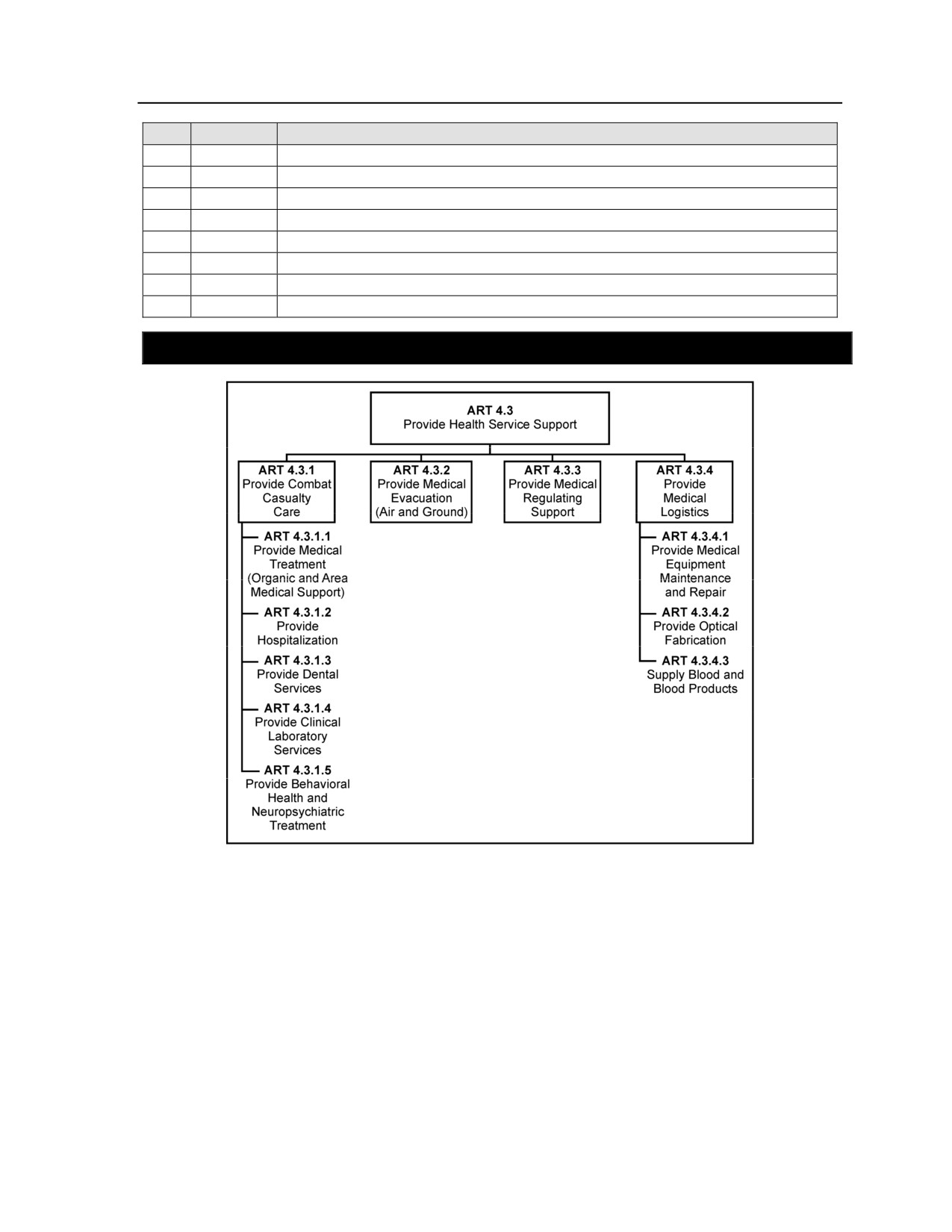
ART 4.0: The Sustainment Warfighting Function
No.
Scale
Measure
01
Yes/No
Band support contributed to mission accomplishment.
02
Time
To rehearse the music required for the mission.
03
Time
To rehearse drill and ceremony required for the mission.
04
Time
To coordinate the performance of a mission.
05
Time
To arrange logistic and administrative support for the band.
06
Time
To obtain recommendations and legal advice from the staff judge advocate.
07
Percent
Of authorized personnel required to perform the specific mission.
08
Percent
Of authorized musical equipment on hand and serviceable.
*SECTION III - ART 4.3: PROVIDE HEALTH SERVICE SUPPORT
4-123. The Army Health System is a component of the Military Health System that is responsible for
operational management of the health service support (HSS) and force health protection (FHP) missions.
The Army Health System includes all mission support services performed, provided, and arranged by the
Army Medical Department to support HSS and FHP mission requirements for the Army. The HSS mission
promotes, improves, conserves, or restores the mental and physical wellbeing of Soldiers and, as directed
other personnel and is comprised of three elements: casualty care, medical evacuation, and medical
logistics: casualty care encompasses the treatment aspects of organic and area medical support,
hospitalization (to include treatment of chemical, biological, radiological, and nuclear patients), dental
treatment, behavioral health/neuropsychiatric treatment, and clinical laboratory services; medical
evacuation (to include en route care and medical regulating); and medical logistics(to include blood and
blood products). (FM 4-02.2) (USAMEDDC&S)
20 October 2010
FM 7-15, C4
4-65
///////////////////////////////////////