FM 7-15, C4 The Army Universal Task List (October 2010) - page 2

Chapter 4
Note: Health service support is closely related to force health protection. Health service support
includes the requirement to ensure adequate health, safety, quality assurance, food provisions,
and sanitation for belligerents.
*ART 4.3.1 PROVIDE COMBAT CASUALTY CARE
4-124. Casualty care encompasses a number of Army Medical Department functions. It groups organic
and area medical treatment, hospitalization, dental services, clinical laboratory services, and behavioral
health and neuropsychiatry. (FM 4-02) (USAMEDDC&S)
Note: The preventive aspects of dentistry and combat and operational stress control are
addressed under ART 6.8 (Provide Force Health Protection).
No.
Scale
Measure
01
Yes/No
Comprehensive casualty care provided in AO conserved the fighting strength.
02
Yes/No
Combat medics were proficient in clinical skills.
03
Percent
Of units supported with organic health service support resources.
04
Percent
Of units supported requiring medical support on an area basis.
05
Percent
Of difference between planned hospital resources and actual requirements in the AO.
06
Percent
Of supported forces requiring behavioral health and neuropsychiatric treatment.
07
Percent
Of supported forces requiring dental treatment.
08
Percent
Of patients requiring clinical laboratory support.
Of patients requiring treatment for injuries related to chemical, biological, radiological,
09
Percent
and nuclear munitions.
*ART 4.3.1.1 PROVIDE MEDICAL TREATMENT (ORGANIC AND AREA MEDICAL SUPPORT)
4-125. Provide medical treatment (organic and area support) for all units in the AO. Examine and
stabilize patients. Evaluate wounded and disease and nonbattle injuries. Examine the general medical status
to determine treatment and medical evacuation precedence. (FM 4-02) (USAMEDDC&S)
No.
Scale
Measure
01
Yes/No
Area medical support and treatment met the unit’s health services needs.
02
Yes/No
Organic medical support and treatment met unit’s health service needs.
To refine medical treatment (organic and area medical support) program for AO after
03
Time
receipt of warning order.
04
Time
To publish estimates of medical sustainment and anticipated resupply.
05
Time
To expand medical treatment facilities to full capacity and full functionality.
06
Time
To deploy required additional medical specialists after AO is assigned.
Of difference between planned medical treatment (organic and area medical support)
07
Percent
requirements and actual requirements in AO.
Of planned capacity of medical treatment (organic and area medical support) support
08
Percent
performed in AO.
09
Percent
Of patient encounters recorded in individual health and/or electronic medical record.
10
Percent
Of personnel treated who are from other Services.
11
Percent
Of personnel treated who are from multinational or host-nation forces.
Of total of medically treated persons that are enemy prisoners of war and detained or
12
Percent
retained personnel.
13
Percent
Of total casualties treated per day in AO who are noncombatants.
4-66
FM 7-15, C4
20 October 2010

ART 4.0: The Sustainment Warfighting Function
No.
Scale
Measure
14
Percent
Of total casualties per time treated in AO who returned to duty.
Of total casualties per time treated in AO who are evacuated per the stated theater
15
Percent
evacuation policy.
16
Percent
Of personnel in AO who have access to optometry services.
17
Number
Of patients treated by a forward surgical team.
18
Number
Of patients treated for traumatic brain injury.
19
Number
If physical therapists available to provide Role 1 and 2 care.
*ART 4.3.1.2 PROVIDE HOSPITALIZATION
4-126. Hospitalization resources are medical treatment facilities capable of providing inpatient care and
services. Hospitalization continues the medical care provided at Roles 1 and 2 of the Army Health System.
It also provides a far forward surgical capability that provides essential care in theater, outpatient services,
and ancillary support (pharmacy, clinical laboratory, radiology services, and nutrition care). Within theater,
the hospitalization capability includes returning those patients to duty within the limits of the theater
evacuation policy. This conserves the fighting strength by returning trained manpower to the tactical
commander. It also provides stabilizing care to facilitate the evacuation of those patients who will not
recover from their injuries or illnesses within the stated theater evacuation policy to facilities capable of
providing required care. Theater hospitals may be augmented with hospital augmentation teams to provide
specific specialty care. (FM 4-02.10) (USAMEDDC&S)
No.
Scale
Measure
Number of beds and services available in the AO was equal to or greater than the peak
01
Yes/No
demand for these services.
02
Time
To refine hospital operations program for AO after receipt of warning order.
03
Time
To reach full functionality after activation of AO.
Of difference between planned hospitalization requirements and actual requirements in
04
Percent
AO.
Of difference between hospitalization capacity realized and planned hospitalized
05
Percent
capacity.
06
Percent
Of casualties per day in AO that require hospitalization.
07
Percent
Of hospital beds in AO utilized per month.
08
Percent
Of hospitalized patients who require further medical care outside the AO or in CONUS.
09
Percent
Of patients returning to duty from the hospital within the theater evacuation policy.
10
Percent
Of patients requiring radiology services.
11
Percent
Of patients requiring routine pharmacy support.
12
Percent
Of patients requiring specialized formulary pharmacy support.
13
Percent
Of patients requiring surgical care.
14
Percent
Of patients requiring inpatient medical care.
15
Percent
Of patients requiring renal hemodialysis (when augmented).
Of patients requiring support from special care team (when augmented to provide
16
Percent
humanitarian assistance, disaster relief, or support to other stability or civil support
operations).
Of hospital minimal care patients exceeding organic minimal care capabilities (minimal
17
Percent
care capability augmentation required).
18
Percent
Of patients requiring head and neck surgical support (when augmented).
Of patients requiring infectious disease investigative and consultation services (when
19
Percent
augmented).
20 October 2010
FM 7-15, C4
4-67

Chapter 4
No.
Scale
Measure
Of patients requiring enhanced anatomic pathology, chemistry, and microbiology
20
Percent
support (when augmented).
Of difference between actual nutrition care support requirements in AO and planned
21
Percent
nutrition care support.
22
Number
Of outpatient visits completed in a month.
23
Number
Of casualties per day in AO who require hospitalization.
24
Number
Of patients requiring special diets.
Of supported units or personnel provided training in the Army health promotion
25
Number
program.
26
Number
Of cases requiring telemedicine support (when augmented).
Of totally of medically treated persons that are enemy prisoners of war and detained
27
Percent
and retained personnel.
28
Percent
Of patients treated for mild traumatic brain injury.
29
Percent
Of patient encounters recorded in individual health and/or electronic medical record.
30
Percent
Of patients treated by a forward surgical team
*ART 4.3.1.3 PROVIDE DENTAL SERVICES
4-127. Prevent and treat dental disease and injury. ART 4.3.1.3 includes providing operational dental
care, which consists of emergency dental care and essential dental care, and comprehensive care that
normally is performed only in fixed facilities in CONUS or in at least a Role 3 facility. (FM 4-02.19)
(USAMEDDC&S)
No.
Scale
Measure
Nonavailability of unit personnel because of dental problems did not degrade, delay, or
01
Yes/No
disrupt unit operations.
02
Time
To refine dental service support program for AO after receipt of warning order.
03
Time
To establish comprehensive dental plan after AO is assigned.
04
Time
In advance required to schedule routine dental appointments in AO.
Of difference between planned dental service support requirements and actual
05
Percent
requirements in AO.
06
Percent
Of planned dental support performed in AO.
07
Percent
Of personnel in AO rated as class I or class II dental.
08
Percent
Of personnel in AO rated as class III or class IV dental.
09
Percent
Of personnel in AO with no dental rating.
10
Percent
Of units with effective dental health care programs in AO.
11
Percent
Of dental capacity in use per day in AO.
12
Percent
Of dental patients requiring evacuation to role 3 dental care facilities.
13
Percent
Of dental patients requiring evacuation out of theater.
14
Percent
Of dental patients requiring oral or maxillofacial surgery.
15
Number
Of emergency dental cases per quarter in AO.
16
Percent
Of enemy prisoners of war/detainees requiring dental treatment.
*ART 4.3.1.4 PROVIDE CLINICAL LABORATORY SERVICES
4-128. Perform clinical laboratory diagnostic procedures in support of medical treatment
activities.
(FM 4-02.10) (USAMEDDC&S)
4-68
FM 7-15, C4
20 October 2010

ART 4.0: The Sustainment Warfighting Function
No.
Scale
Measure
Unit operations were not degraded, delayed, or disrupted nor was the health of unit
01
Yes/No
personnel endangered by the nonavailability of clinical diagnostic laboratory services.
02
Time
To refine clinical diagnostic laboratory service plans for AO after receipt of warning order.
03
Time
To establish required clinical diagnostic laboratory services plan after AO is assigned.
04
Time
Of turnaround for clinical diagnostic laboratory testing results.
Of difference between planned clinical diagnostic laboratory requirements and actual
05
Percent
requirements of the AO.
06
Percent
Of planned clinical diagnostic laboratory support performed in the AO.
07
Percent
Of required laboratory functionality in place and fully functional at activation of the AO.
08
Percent
Of laboratory capacity in use per day in AO.
09
Number
Of clinical laboratory procedures performed in AO per month.
*ART 4.3.1.5 PROVIDE BEHAVIORAL HEALTH AND NEUROPSYCHIATRIC TREATMENT
4-129. Provide medical treatment for behavioral health and neuropsychiatric medical conditions.
(FM 4-02.51) (USAMEDDC&S)
No.
Scale
Measure
Absence of command personnel due to behavioral health and neuropsychiatric
01
Yes/No
treatment in a medical treatment facility did not degrade, delay, or disrupt unit
operations.
To refine behavioral health and neuropsychiatric treatment program for AO after receipt
02
Time
of warning order.
To establish comprehensive behavioral health and neuropsychiatric treatment plan after
03
Time
AO is assigned.
Of difference between planned behavioral health and neuropsychiatric treatment
04
Percent
requirements and actual requirements in the AO.
05
Percent
Of psychiatric support completed in the AO versus planned psychiatric support.
06
Percent
Of required psychiatrists at activation of AO.
Of other required behavioral health and neuropsychiatric treatment personnel at
07
Percent
activation of AO.
Of personnel in AO requiring behavioral health and neuropsychiatric treatment per
08
Percent
quarter.
09
Percent
Of behavioral health and neuropsychiatric patients returned to duty in the AO.
Of behavioral health and neuropsychiatric patients requiring medical evacuation from
10
Number
the AO.
11
Number
Of available occupational therapists.
*ART 4.3.2 PROVIDE MEDICAL EVACUATION (AIR AND GROUND)
4-130. Provide direct and area air and ground medical evacuation (MEDEVAC) support to; evacuate sick,
injured, or wounded personnel (U.S. joint, interagency, intergovernmental and multinational forces; enemy
prisoners of war; detained or retained personnel; and when authorized civilian personnel) from the point of
injury or wounding, casualty collection points, battalion aid stations, ambulance exchange points, or any
other designated points where casualties have been located to be evacuated to a higher role medical
treatment facility (MTF) in the area of operations (AO). Provide medical care en route while transporting
patients to, between, and from treatment facilities in the AO. Provide transport of patients from MTF to
ports of debarkation for evacuation out of theater. Support personnel recovery operations. Provide
emergency pickup, transport, and delivery of medical equipment, medications, blood products, class VIII
20 October 2010
FM 7-15, C4
4-69

Chapter 4
supplies, medical personnel and military working dogs to, between, and from MTFs in the AO as required.
(FM 4-02.2) (USAMEDDC&S)
Note: All pickup, transport, and delivery support missions must be conducted in a timely and
efficient manner to conserve the fighting force and prevent the loss, damage, or spoilage of
medical equipment, medications, blood products, and class VIII supplies.
No.
Scale
Measure
Unit medically evacuated and provided medical care en route for wounded, sick, and
01
Yes/No
injured personnel to, between, and from MTFs without their medical condition declining
due to the mode of evacuation or the time required to evacuate.
Unit provided medical care en route for wounded, sick, and injured personnel to,
02
Yes/No
between, and from MTFs without their medical condition declining due to the time
required to evacuate.
Unit executed a property exchange (for litters, blankets, and litter straps and patient
03
Yes/No
movement items to prevent degraded, delayed, or disrupted medical evacuation
operations.
To refine response times for MEDEVAC, emergency pickup, transport, and delivery
04
Time
missions in the AO after receipt of a warning order.
Of difference between planned and actual requirements for medical evacuations,
05
Percent
emergency pickup, transport, and delivery missions in the AO.
Of planned support capacity of MEDEVAC, emergency pickup, transport, and delivery
06
Percent
missions in the AO.
07
Percent
Of wounded, sick, and injured personnel requiring patient movement items.
Of wounded, sick, and injured personnel per day in AO evacuated from battlefield by
08
Number
evacuation precedence: urgent, urgent-surgery, priority, routine, and convenience.
09
Number
Of wounded, sick, and injured personnel per day evacuated from the AO.
Of wounded, sick, and injured personnel evacuated to MTFs by nonstandard
10
Number
evacuation platforms in the AO.
11
Number
Of patients hospitalized in the AO that exceeds the theater evacuation policy.
12
Number
Of wounded, sick, and injured military working dogs requiring evacuation.
*ART 4.3.3 PROVIDE MEDICAL REGULATING SUPPORT
4-131. Medical regulating entails identifying the patients awaiting evacuation, locating the available
hospital beds, and coordinating the transportation means for movement. The formal medical regulating
system begins at Role 3 hospitals. (FM 4-02.2) (USAMEDDC&S)
No.
Scale
Measure
Unit regulated the evacuation of wounded, sick, and injured personnel to appropriate
01
Yes/No
medical treatment facilities.
02
Yes/No
Unit required patient movement items available when and where needed.
03
Yes/No
Lack of patient movement items degraded, delayed, or disrupted medical treatments.
04
Percent
Of patients requiring medical regulating in the AO.
05
Percent
Of patients requiring medical regulating out of the AO.
06
Percent
Of patients requiring patient movement items.
Of medical regulating requests coordinated through the joint patient movement
07
Number
requirements center, theater patient movement requirements center, or global patient
movement requirements center.
08
Number
Of patients hospitalized in AO that exceeds the theater evacuation policy.
09
Number
Of neuropsychiatric patients requiring evacuation.
4-70
FM 7-15, C4
20 October 2010

ART 4.0: The Sustainment Warfighting Function
*ART 4.3.4 PROVIDE MEDICAL LOGISTICS
4-132. Provide class VIII medical materiel, medical equipment maintenance and repair, production of
medical gases, medical contracting support, health facilities planning and management, and blood
management for all U.S. forces. When serving as the area of operations (AO) single integrated medical
logistics manager/theater lead agent for medical materiel, supply of medical materiel will be extended to
other Services. (FM 4-02.1) (USAMEDDC&S)
Note: This task is related to ART 4.1.3.8 (Provide Medical Materiel and Repair Parts [Class
VIII]).
No.
Scale
Measure
Medical logistics and blood management in the AO did not degrade, delay, or disrupt
01
Yes/No
unit operations and medical treatment of wounded, injured, and sick Soldiers.
02
Yes/No
Distribution system got the right supplies to the right unit at the right time.
Unit maintained in-transit visibility of distribution systems and assets flowing through the
03
Yes/No
system.
04
Time
To refine medical logistics operations for AO after receipt of warning order.
05
Time
To transship class VIII supplies and medical equipment after AO is assigned.
06
Time
To provide emergency shipment of class VIII materiel within AO.
07
Time
To transship class VIII supplies and medical equipment on AO activation.
08
Time
To set up medical supply transportation modes within theater.
09
Percent
Of planned medical logistics capacity completed in AO.
Of difference between planned medical logistics operations requirements and actual
10
Percent
requirements in AO.
11
Percent
Of planned Class VIII materiel support delivered in AO.
12
Percent
Of Class VIII supplies that require replenishment per month.
13
Percent
Of required items of supply transiting the distribution system.
Of unit operations delayed, degraded, or modified due to lack of medical supplies,
14
Percent
equipment, repair parts, or blood.
Of necessary or required Class VIII resources (meeting regulatory requirements)
15
Percent
obtained from host nation or other agencies.
Of blood products in the system required to be disposed of in accordance with
16
Percent
environmental considerations.
Of instances that medical capability unavailable due to shortage or lack of Class VIII
17
Number
supplies.
*ART 4.3.4.1 PROVIDE MEDICAL EQUIPMENT MAINTENANCE AND REPAIR
4-133. Provide medical equipment maintenance and repair of deployed medical equipment. (FM 4-02.1)
(USAMEDDC&S)
No.
Scale
Measure
Nonavailability of medical equipment did not degrade, delay, or disrupt unit operations
01
Yes/No
and medical treatment of wounded, injured, and sick Soldiers.
02
Time
To provide emergency repair of medical equipment in AO.
To refine medical equipment maintenance and repair operations program for AO after
03
Time
receipt of warning order.
Of medical equipment (each type) with remote prognosis or diagnostics capability in the
04
Number
AO.
20 October 2010
FM 7-15, C4
4-71

Chapter 4
No.
Scale
Measure
Of difference between planned medical equipment maintenance and repair operations
05
Number
requirements and actual requirements in AO.Of repairs completed using remote
prognostics or diagnostics in AO.
Of medical equipment (each type) in AO with original equipment manufacturer training
06
Number
required.
07
Number
Of medical equipment that requires repair per month.
Of instances when medical capability was unavailable due to inability to repair medical
08
Number
equipment in AO.
Of incidents involving medical equipment suspected of malfunctioning and causing
09
Number
further injury or death of a Soldier in the AO.
Of incidents involving medical equipment that actually caused further injury or death of
10
Number
a Soldier in the AO.
Of repairs with remote prognostic or diagnostic capability which could not be remedied
11
Number
in the AO.
*ART 4.3.4.2 PROVIDE OPTICAL FABRICATION
4-134. Provide manufacturing of single and multivision lens, protective mask inserts, and eyewear repair.
(FM 4-02.1) (USAMEDDC&S)
No.
Scale
Measure
Nonavailability of single and multivision lens and eyewear for unit personnel did not
01
Yes/No
degrade, delay, or disrupt unit operations.
To refine optical fabrication and repair operations program for AO after receipt of
02
Time
warning order.
03
Time
To transship optometry equipment after AO is assigned.
04
Time
Required in advance to schedule optometry appointment in AO.
Of difference between planned optical fabrication and repair requirements and actual
05
Percent
requirements in AO.
06
Percent
Of planned optometry support performed in AO.
07
Percent
Of personnel in AO requiring optometry facilities.
08
Number
Of optical devices in AO per quarter.
*ART 4.3.4.3 SUPPLY BLOOD AND BLOOD PRODUCTS
4-135. Supply whole blood and blood products, such as packed red blood cells, with a varying of blood
groups and types. (FM 4-02.1) (USAMEDDC&S)
No.
Scale
Measure
Nonavailability of blood and blood products did not degrade, delay, or disrupt medical
01
Yes/No
treatment of wounded, injured, and sick Soldiers.
02
Time
To refine blood management program for AO after receipt of warning order.
03
Time
To establish system for collection, storage, and distribution of blood products in AO.
To initially coordinate blood requirements and distribution of blood and blood products
04
Time
to support medical treatment facilities in AO.
Of difference between planned blood management requirements and actual
05
Percent
requirements in AO.
06
Percent
Of planned blood and blood products support attained in AO.
07
Percent
Of personnel in AO requiring blood or blood products per quarter.
08
Percent
Of required blood and blood products on hand in AO.
4-72
FM 7-15, C4
20 October 2010
ART 4.0: The Sustainment Warfighting Function
No.
Scale
Measure
09
Percent
Of daily blood reports submitted on time to joint blood program office.
Of blood products in AO required to be disposed of in accordance with applicable
10
Percent
environmental regulations.
11
Number
Of units of required blood products per initial admission maintained in AO.
12
Time
To establish for collection, storage, and distribution of blood products in the AO.
To initially coordinate blood requirements and distribution of blood and blood products
13
Time
with medical treatment facilities in the AO and with the Joint Blood Program Office.
14
Percent
Of planned blood management capacity produced in the AO.
15
Percent
Of required blood products on hand.
16
Percent
Of blood products in the system that must be disposed.
Of daily blood reports submitted to the Joint Blood Program office within the prescribed
17
Percent
time limit.
Of blood products in the system required to be disposed of in accordance with
18
Percent
environmental considerations.
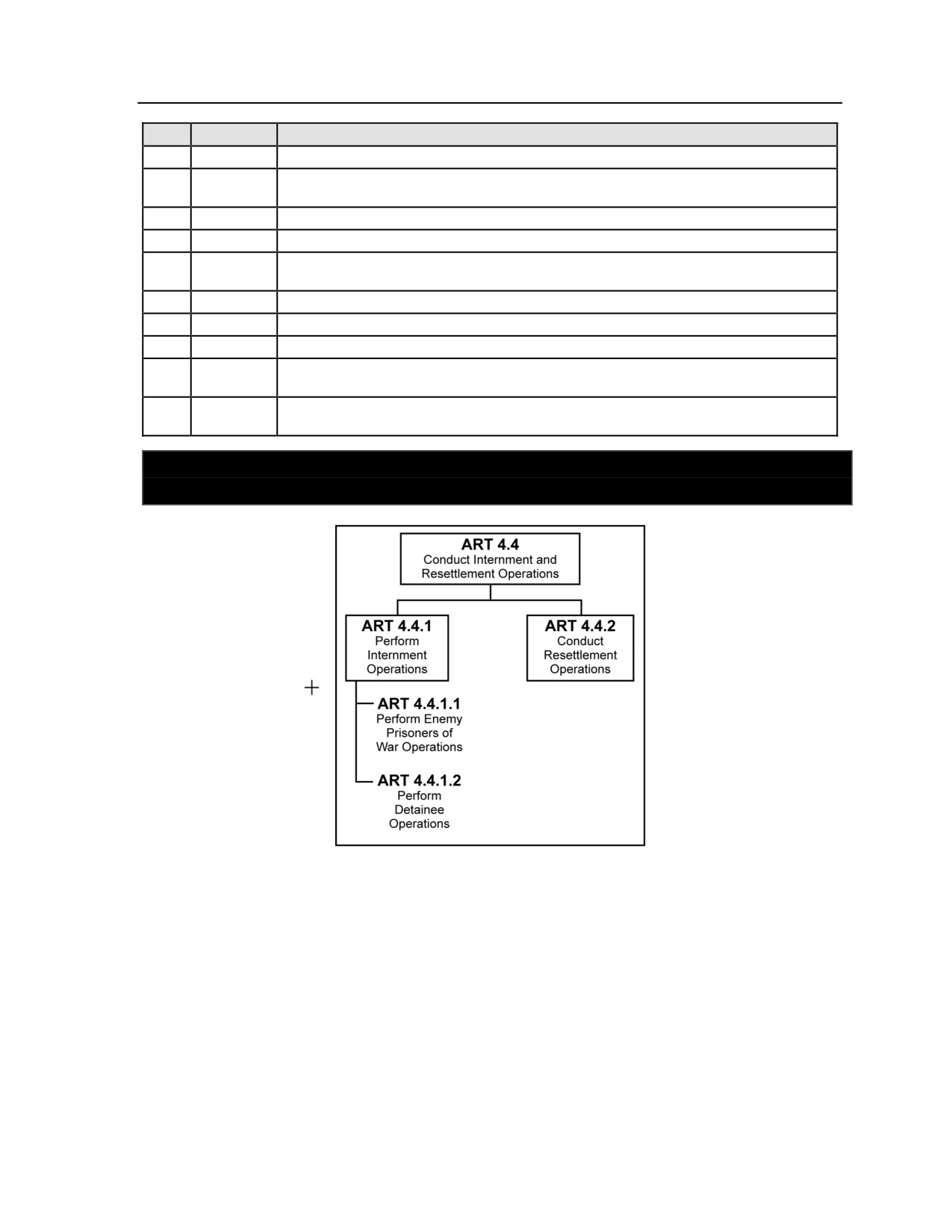
+ SECTION IV - ART 4.4: CONDUCT INTERNMENT/RESETTLEMENT
OPERATIONS
4-136. Internment and resettlement (I/R) operations include the two major categories of internment
operations and resettlement operations. These categories are further refined focusing on specific types of
detainees and U.S. military prisoners while discriminating between civilian internees included as part of
internment and those dislocated civilians (DCs) that may be retained as part of resettlement operations.
Internment operations focus on all types of detainees and U.S. military prisoners. Although a part of
internment operations, confinement refers to U.S military prisoners rather than internment (U.S. military
prisoners are covered under ART 5.8.2). Resettlement operations focus on DCs, those civilians that are not
part of the population of detainees. Military police conduct internment/resettlement operations to shelter,
sustain, guard, protect, and account for populations (enemy prisoners of war (EPWs), civilian internees,
DCs, or U.S. military prisoners) as a result of military or civil conflict, of natural or man-made disaster, or
to facilitate criminal prosecution. Internment involves detaining a population or group that poses some
level of threat to military operations. Resettlement involves quartering members of a population or group
20 October 2010
FM 7-15, C4
4-73

Chapter 4
for their protection. These operations inherently control the movement and activities of their specific
population for imperative reasons of security, safety, or intelligence gathering. (FM 3-39.40) (USAMPS)
Note: ART 4.1.7.5.4 (Construct, Manage, and Maintain Bases and Installations) addresses the
construction, management, and maintenance of bases and installations to include facilities such
as those required for the internment of detainees.
ART 4.4.1 PERFORM INTERNMENT OPERATIONS
4-137. Activities performed by units when they are responsible for interning detainees, to include
combatants, retained persons, and civilian internees. It ensures the safety and humane treatment of the
incarcerated individuals, the maintenance of law and order within the facilities, as well as the safety of the
guards and the surrounding civilian and military facilities and installations. All captured or detained
personnel, regardless of status, shall be treated humanely and in accordance with the Detainee Treatment
Act of 2005 and DODD 2310.1E, and no person in the custody or under the control of Department of
Defense, regardless of nationality or physical location, shall be subject to torture or cruel, inhumane, or
degrading treatment or punishment, in accordance with and as defined in U.S. law.
(FM 3-39.40)
(USAMPS)
No.
Scale
Measure
Internment activities did not prevent or seriously interfere with accomplishment of the
01
Yes/No
unit’s primary tactical mission.
Operations of U.S. forces performing internment activities observed international laws
02
Yes/No
of war, U.S. laws and regulations, rules of engagement, and status-of-forces
agreements.
Operations of U.S. forces performing internment activities observed local customs,
03
Yes/No
mores, and taboos where possible.
Detainees received adequate amounts of appropriate food, water, clothing, housing,
04
Yes/No
and medical care.
05
Yes/No
Order established and maintained in detention facilities.
Environmental regulations, laws, and considerations were taken into account during
06
Yes/No
planning and present in procedures being followed.
07
Time
To refine plans for the collection and internment of detainees.
To move detainees to their respective internment facilities from point of capture and
08
Time
detainee collection point.
09
Time
To construct camps to house detainees.
To develop and enforce internment control measures, such as lists of controlled
10
Time
supplies and contraband.
11
Time
To forward intelligence information collected to unit intelligence staff.
12
Time
From interrogation to internment of civilian internees.
13
Time
To assign International Serial Number.
14
Percent
Of interned detainees requiring medical treatment provided in the AO.
15
Percent
Of interned detainees requiring medical treatment requiring evacuation out of the AO.
16
Percent
Of friendly force personnel in AO involved in maintaining internment facilities.
17
Percent
Of detained civilians released after interrogation.
18
Percent
Of unit sustainment requirements provided by detainees.
19
Percent
Of unit sustainment capabilities needed to support internment operations.
20
Number
Of civilian internees who can be resettled within a given time.
21
Number
Of civilian internees.
4-74
FM 7-15, C4
20 October 2010

ART 4.0: The Sustainment Warfighting Function
No.
Scale
Measure
22
Quantity
By type of supply needed to support internment operations.
23
Number
Of detainees interned.
24
Number
Of facilities to intern civilian internees established.
25
Number
Of internment facilities established.
26
Number
Of military working dogs needed for patrol or the detection of narcotics and explosives.
27
Ratio
Of guards to detainees or civilian internees.
ART 4.4.1.1 PERFORM ENEMY PRISONERS OF WAR OPERATIONS
4-138. Provide safe and humane treatment for enemy prisoners of war (EPW). This task includes the
collection, screening, processing, transfer, internment, safeguarding, and release of EPW. (FM 3-39.40)
(USAMPS)
No.
Scale
Measure
Conduct of internment activities did not prevent or seriously interfere with
01
Yes/No
accomplishment of the unit’s primary tactical mission.
Operations of U.S. forces conducting internment activities observed international laws
02
Yes/No
of war, U.S. laws and regulations, rules of engagement, and U.S.-host-nation
agreements.
Operations of U.S. forces conducting internment activities observed local customs,
03
Yes/No
mores, and taboos where possible.
04
Yes/No
EPWs received necessary food, water, pay, clothing, housing, and medical care.
05
Yes/No
Order established and maintained in EPW facilities.
06
Time
To construct facilities to intern EPWs.
To develop and enforce internment control measures, such as lists of controlled
07
Time
supplies and contraband.
08
Time
To conduct repatriation operations at the end of hostilities.
09
Percent
Of EPWs requiring medical treatment in the area of operations (AO).
10
Percent
Of EPWs requiring medical treatment requiring evacuation out of the AO.
11
Percent
Of unit sustainment capabilities needed to support internment operations.
12
Percent
Of unit sustainment capabilities needed to support internment operations.
13
Number
Of EPWs.
14
Number
Of facilities established to intern EPWs.
15
Number
Of military working dogs needed for patrol or the detection of narcotics and explosives.
16
Number
Of dollars paid to EPWs for work performed.
17
Number
Of retained persons used to support EPW operations.
18
Ratio
Of guards to EPWs.
ART 4.4.1.2 PERFORM DETAINEE OPERATIONS
4-139. Provide safe and humane treatment for civilian internees and combatant’s not classified as enemy
prisoners of war (EPWs) in accordance with the Geneva Conventions. This task includes the collection,
screening, processing, transfer, internment, safeguarding, and release of EPWs. (FM 3-39.40) (USAMPS)
20 October 2010
FM 7-15, C4
4-75

Chapter 4
No.
Scale
Measure
Conduct of internment activities did not prevent or seriously interfere with
01
Yes/No
accomplishment of the unit’s primary tactical mission.
Operations of U.S. forces conducting internment activities observed international laws
02
Yes/No
of war, U.S. laws and regulations, rules of engagement, and U.S.-host-nation
agreements.
Operations of U.S. forces conducting internment activities observed local customs,
03
Yes/No
mores, and taboos where possible.
Civilian internee’s members of armed groups received necessary food, water, pay,
04
Yes/No
clothing, housing, and medical care.
05
Yes/No
Order established and maintained in internment facilities.
06
Time
To construct facilities to intern detainees.
To develop and enforce internment control measures, such as lists of controlled
07
Time
supplies and contraband.
08
Time
To conduct repatriation operations at the end of hostilities.
09
Percent
Of detainees requiring medical treatment in the area of operations (AO).
10
Percent
Of detainees requiring medical treatment requiring evacuation out of the AO.
11
Percent
Of unit sustainment capabilities needed to support internment operations.
12
Number
Of detainees.
13
Number
Of facilities established to intern detainees.
14
Number
Of military working dogs needed for patrol or the detection of narcotics and explosives.
15
Ratio
Of guards to detainees.
ART 4.4.2 CONDUCT RESETTLEMENT OPERATIONS
4-140. Provide support for resettlement of dislocated civilians to include their safety and security. This
task includes controlling the movement of civilians, providing relief to human suffering, protecting
civilians from combat operations or other threats, and establishing resettlement facilities in support of civil
affairs operations. Establishing a facility requires collection, screening, processing, evacuation, housing,
safeguarding, and releasing displaced civilians. ART 4.4.2 occurs in temporary and long-term facilities and
points. (FM 3-39.40) (USAMPS)
No.
Scale
Measure
Resettlement activities did not prevent or seriously interfere with accomplishment of the
01
Yes/No
unit’s primary tactical mission.
Operations of U.S. forces performing resettlement activities observed international laws
02
Yes/No
of war, U.S. laws and regulations, rules of engagement, and status-of-forces
agreements.
Operations of U.S. forces performing resettlement activities observed local customs,
03
Yes/No
mores, and taboos where possible.
Dislocated civilians received necessary food, water, pay, clothing, housing, and medical
04
Yes/No
care.
Unit supervised incarceration process and transfer to prison facilities for dislocated
05
Yes/No
civilians guilty of criminal activity.
Environmental considerations planning and procedures were present and being
06
Yes/No
followed.
07
Yes/No
Unit determined the reliability of local markets to meet needs.
08
Yes/No
Unit provided emergency food, water, sanitation, shelter, and medicine.
4-76
FM 7-15, C4
20 October 2010
ART 4.0: The Sustainment Warfighting Function
No.
Scale
Measure
09
Yes/No
Unit coordinated with other donors and humanitarian agencies.
10
Yes/No
Unit established registration and health screening mechanisms.
Unit assessed prevalence for human immunodeficiency virus (HIV) and acquired
11
Yes/No
immunodeficiency syndrome (AIDS).
To refine plans for the movement, security and support of resettlement of dislocated
12
Time
civilians.
13
Time
To establish dislocated civilian collection points.
To develop and enforce resettlement and population control measures, such as curfew,
14
Time
travel permits, and lists of controlled supplies and contraband.
15
Time
To forward intelligence information collected to unit intelligence staff.
To move dislocated civilians to their respective resettlement facilities from their initial
16
Time
collection points.
17
Percent
Of dislocated civilians who received medical treatment.
Of friendly force personnel in area of operations involved in maintaining dislocated
18
Percent
civilian resettlement facilities.
19
Percent
Of unit sustainment capabilities needed to support resettlement operations.
20
Number
And types of supplies needed to support resettlement operations.
21
Number
Of dislocated civilians.
22
Number
Of resettlement facilities and camps established.
23
Ratio
Of guards to dislocated civilians.
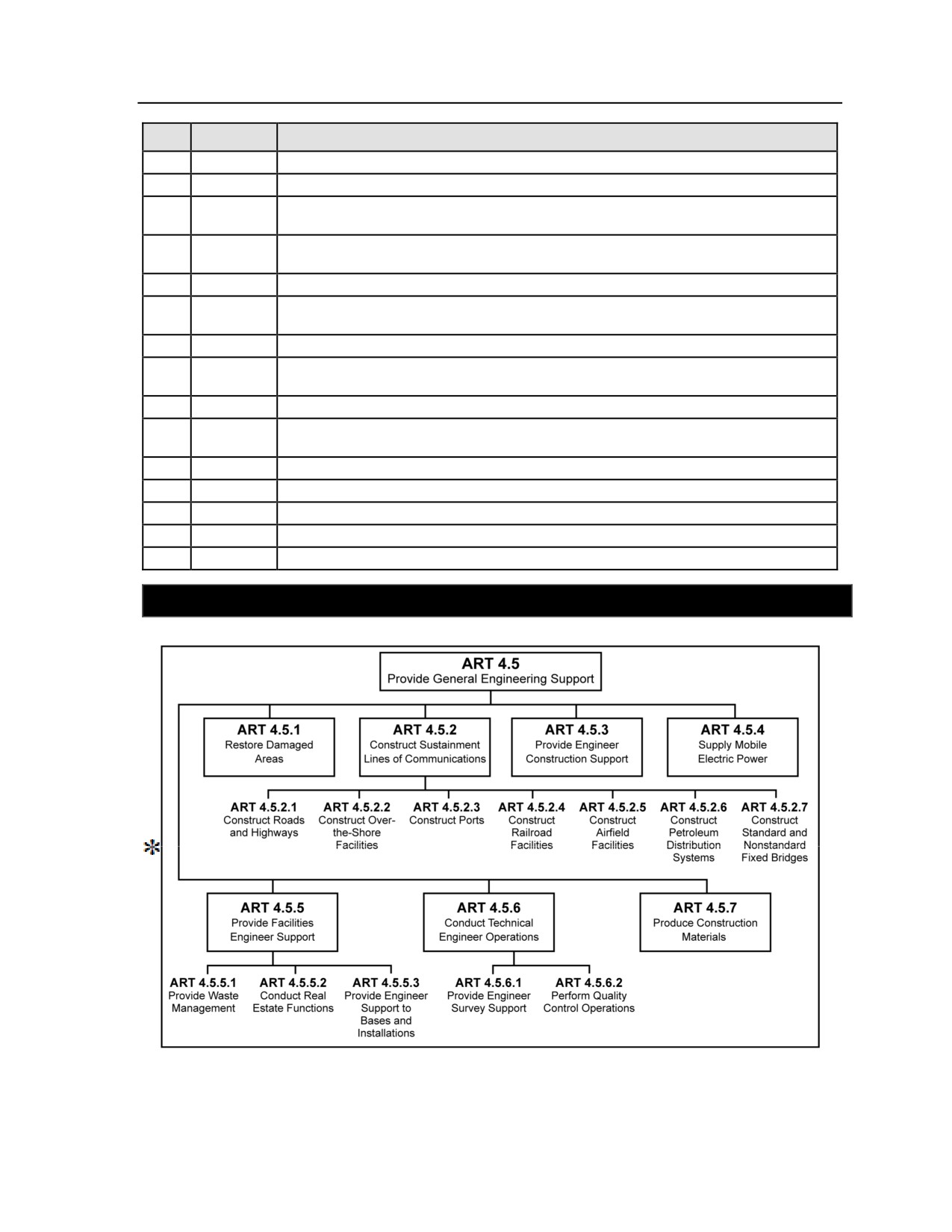
*SECTION V - ART 4.5: PROVIDE GENERAL ENGINEERING SUPPORT
4-141. General engineering modifies, maintains, and protects the physical environment, including
infrastructure, facilities, airfields, lines of communication and bases, protection of natural and cultural
20 October 2010
FM 7-15, C4
4-77

Chapter 4
resources, terrain modification and repair, firefighting and aircraft crash rescue services, and selected
explosive hazard activities. (FM 3-34.400) (USAES)
No.
Scale
Measure
01
Yes/No
Quantity or quality of general engineering support in the area of operations (AO) did not
degrade or delay unit operations.
02
Yes/No
Environmental considerations planning and procedures were present and being followed.
03
Time
To assess and repair airfields for aviation operations throughout the AO.
04
Time
To construct and restore damaged utilities in AO.
05
Time
To refine general engineering support program for AO after receipt of warning order.
06
Time
To identify and marshal forces, equipment, and materials to construct or repair facilities
in the AO.
07
Time
To construct or repair damaged lines of communications in AO to include aerial ports of
debarkation and seaports of debarkation.
08
Time
Between arrival of building supplies and equipment and construction of sustainment
facilities.
09
Time
To complete construction of sustaining base facilities in the AO.
10
Time
To begin building facilities (after final project approval and authorization).
11
Time
To have those bases identified in operation plan or operations order.
12
Time
To validate asset requests.
13
Time
To have assets at requesting location.
14
Percent
Of preventative maintenance activities completed based on the recommended activities
from each systems owner’s manual or generally accepted maintenance standards such
as ASHRAE (American Society of Heating, Refrigerating, and Air Conditioning
Engineers).
15
Percent
Of difference between planned general engineering support requirements and actual
requirements in AO.
16
Percent
Of planned general engineering capability performed in AO.
17
Percent
Of supplies protected from the elements by weatherproof covers.
18
Percent
Of maintenance facilities protected from the elements.
19
Percent
Of overall cargo and equipment deliveries accommodated by sustaining base.
20
Percent
Of required installation throughput capacity available at execution.
21
Percent
Of tasks correctly assigned (correct engineers, location, and time).
22
Percent
Of general engineering support provided by host nation.
23
Number
In square meters of temporary facilities emplaced or constructed per day.
24
Number
In square meters of permanent facilities emplaced or constructed per day.
*ART 4.5.1 RESTORE DAMAGED AREAS
4-142. Inspect and repair surface and underwater facilities or restore terrain damaged by combat (such as
clear rubble and restore electrical power), natural disaster, environmental accidents, or other causes.
(FM 3-34) (USAES)
No.
Scale
Measure
01
Yes/No
Restoration completed per the schedule the operation order specifies.
Commander of the unit restoring a damaged area planned operations, established
02
Yes/No
priorities, and allocated assets.
03
Yes/No
Restoration was per the standards the operation order specified.
04
Yes/No
Environmental considerations planning and procedures were present and being followed.
05
Time
To locate and stockpile repair materials.
4-78
FM 7-15, C4
20 October 2010

ART 4.0: The Sustainment Warfighting Function
No.
Scale
Measure
To refine area damage control plan for the area of operations (AO) after receipt of
06
Time
warning order.
To establish communications between the unit restoring the damaged areas and the
07
Time
unit or organization controlling the AO where the area to be restored is located.
To perform engineer estimate to identify and prioritize potential tasks and determine
required specialized support from engineers, explosive ordnance disposal, and other
08
Time
units; bill for needed materials; locate routes; identify replacement facilities; identify
available host-nation assets; and perform other tasks as appropriate.
To construct an expedient or alternate facility or bypass while restoration or repair is
09
Time
being competed if required.
10
Time
To repair facilities damaged by combat or natural disaster.
11
Time
To restore damaged utilities in AO.
Of difference between planned area damage control requirements and actual
12
Percent
requirements in AO.
13
Percent
Of planned general engineering capability performed in AO.
14
Percent
Of facilities damaged beyond repair.
Of operations in AO degraded, delayed, or modified due to combat or natural disaster
15
Percent
damage.
16
Percent
Of general restoration support provided by host nation.
17
Percent
Of restoration effort completed.
18
Number
Of Soldiers and civilians impacted by combat or natural disaster in the AO.
19
Number
And type of facilities damaged by combat or natural disaster in the AO.
*ART 4.5.2 CONSTRUCT SUSTAINMENT LINES OF
COMMUNICATIONS
4-143. Construct and maintain land, water, and air routes that connect an operating military force with
one or more bases of operations and along which supplies and reinforcements move. Sustainment lines of
communications include main and alternate supply routes. (FM 3-34.400) (USAES)
No.
Scale
Measure
An inability to use lines of communications located in the area of operations (AO) did
01
Yes/No
not degrade or delay unit operations.
02
Yes/No
Unit developed detailed plans for project.
Unit inspected project for quality control and ensured that the project was completed on
03
Yes/No
time.
04
Yes/No
Environmental considerations planning and procedures were present and being followed.
To reconnoiter to determine how the local environment will affect construction and if
existing facilities or natural resources are available near the construction or
maintenance site. This includes determining terrain features and their effect on the
05
Time
project; environmental considerations; problems involved in traveling to and from work
site; what will be needed to keep the job site drained before, during, and after
construction; and soil type and effort required to allow vehicle traffic and construction.
06
Time
To coordinate additional personnel, equipment, and critical items.
To review available information in construction directive, intelligence reports, and site
07
Time
investigation to develop an operation plan or order.
To plan the project including construction estimate, construction directive, and quality
08
Time
control.
To prepare construction estimate including preparing a project activity list and a
09
Time
construction sequencing network; preparing materials, equipment, and personnel
estimates; determining activity work rates; and preparing critical path.
20 October 2010
FM 7-15, C4
4-79

Chapter 4
No.
Scale
Measure
To prepare construction directive and issue it to construction unit. Directive states the
exact assignment, project location, and start and completion times; specifies additional
10
Time
personnel, equipment, and materials available; prioritizes the entire project; and
specifies type and frequency of construction reports, time needed for special
procurement, and coordination instructions with user agency.
11
Time
To monitor construction and perform quality assurance inspections.
12
Time
To perform final inspection of finished construction and turn it over to the user.
13
Time
To construct and maintain sustainment lines of communications.
That scheduled arrivals in AO are delayed due to interruption in lines of communication
14
Time
(on average).
Of difference between planned and actual requirements for lines of communications
15
Percent
construction and maintenance requirements.
Of force becoming casualties due to enemy action or accidents during construction or
16
Percent
repair.
Increase in the carrying capability of the lines of communications due to construction or
17
Percent
maintenance of the lines of communications.
18
Percent
Of planned general engineering capability performed in AO.
19
Percent
Of personnel in AO required for building and maintaining lines of communications.
20
Percent
Of general engineering support provided by host nation.
21
Number
Of lines of communications requiring construction or maintenance in AO.
Of instances of delays in scheduled arrivals due to interruption of lines of
22
Number
communications.
*ART 4.5.2.1 CONSTRUCT ROADS AND HIGHWAYS
4-144. Determine road network requirements (such as classify roads in the area of operations (AO) per
location, trafficability, and degree of permanence, traffic-bearing capabilities, and improvements needed).
Maintain and repair existing roads (such as inspect and supervise, stockpile materials, keep road surfaces in
usable and safe condition, prompt repair, correct basic cause of surface failure, and perform maintenance
inspections) and construct new roads (such as route reconnaissance, site selection, surveys, drainage,
construction, paving, and soil stabilization). (FM 3-34.400) (USAES)
Note: For construction of combat roads and trails to support maneuver of tactical forces, see
ART 1.6.2.1 (Construct and Maintain Combat Roads and Trails).
No.
Scale
Measure
An inability to construct or maintain highways and roads in the AO within the time the
01
Yes/No
construction directive specifies did not degrade or delay unit operations.
02
Yes/No
Unit developed detailed plans for project.
Unit inspected project for quality control and ensured that the road or highway
03
Yes/No
construction project was completed on time.
04
Yes/No
Environmental considerations planning and procedures were present and being followed.
To reconnoiter to determine how the local environment will affect roads and highway
construction and determine if existing facilities or natural resources are available near
the construction or maintenance site. This includes determining terrain features and
05
Time
their effect on the project; environmental considerations; problems involved in traveling
to and from work site; what will be needed to keep the job site drained before, during,
and after construction; and soil type and effort required to allow vehicle traffic and
construction.
To review available information in construction directive, intelligence reports, and site
06
Time
investigation to develop an operation plan or order.
4-80
FM 7-15, C4
20 October 2010

ART 4.0: The Sustainment Warfighting Function
No.
Scale
Measure
To plan the road or highway project. This includes construction estimate, construction
07
Time
directive, and quality control.
To prepare a road or highway construction estimate. This includes preparing a project
08
Time
activity list and a construction sequencing network; determining material, equipment, or
personnel estimates; determining work rates for activities; and preparing critical path.
To prepare road or highway construction directive and issue it to construction unit.
Directive states the exact assignment, project location, and start and completion times;
09
Time
specifies additional personnel, equipment, and materials available; prioritizes the entire
project; and specifies type and frequency of construction reports, time needed for
special procurement, and coordination instructions with user agency.
10
Time
To coordinate additional personnel, equipment, and critical items.
11
Time
To monitor construction and perform quality assurance inspections.
12
Time
To perform final inspection of finished road or highway and turn it over to the user.
13
Time
For building and maintaining roads and highways.
That scheduled arrivals in AO are delayed on the average due to interruptions in roads
14
Time
and highways by combat actions or natural disasters.
Of difference between planned and actual requirements for road and highway
15
Percent
construction and maintenance requirements.
Of force becoming casualties due to enemy action or accidents during road and
16
Percent
highway construction or repair.
17
Percent
Increase in the carrying capability of a road or highway due to construction or maintenance.
18
Percent
Of planned road or highway construction or maintenance capability realized in AO.
19
Percent
Of personnel in AO required for building and maintaining roads and highways.
20
Percent
Of road and highway construction and repair capability provided by host nation.
21
Percent
Of existing roads and highways in AO improved.
Of roads and highways in AO that can be used in their current condition by unit combat
22
Percent
and tactical vehicles.
Of unit operations degraded, delayed, or modified in AO due to road or highway
23
Percent
impassability.
24
Percent
Of roads and highways in the AO damaged by enemy fire or natural disaster.
25
Percent
Of roads upgraded from gravel to asphalt.
26
Number
And types of quarries required to support this task.
27
Number
Of roads and highways in the AO requiring construction or maintenance.
28
Number
Of roads and highways constructed or improved in the AO.
29
Number
Of kilometers of roads and highways constructed or improved in the AO within a given time.
Of instances of delays in scheduled arrivals due to interruption of roads and highways in
30
Number
the AO by combat actions or natural disaster.
Of instances in which troop movement or sustaining operations were prevented due to
31
Number
road or highway impassability.
32
Number
Of road or highway maintenance inspections performed per month in the AO.
*ART 4.5.2.2 CONSTRUCT OVER-THE-SHORE FACILITIES
4-145. Provide construction, repair, and maintenance support to logistics over-the-shore operations.
Construct piers and causeways. Prepare and stabilize beaches. Construct access and egress routes. Provide
access to marshalling and storage areas and adjoining logistics over-the-shore sites, which may also need
constructing. Provide road and rail links to existing lines of communications. Construct utility systems and
petroleum, oils, and lubricants storage and distribution systems. (FM 5-480) (USAES)
20 October 2010
FM 7-15, C4
4-81
Chapter 4
No.
Scale
Measure
An inability to construct or maintain over-the-shore facilities within the time the
01
Yes/No
construction directive specifies did not degrade or delay unit operations.
02
Yes/No
Unit developed detailed plans for project.
Unit inspected over-the-shore facility projects for quality control and ensured that the
03
Yes/No
project was completed on time.
04
Yes/No
Environmental considerations planning and procedures were present and being followed.
To reconnoiter to determine how the local environment will affect over-the-shore
facilities construction and determine if existing facilities or natural resources are
available near the construction or maintenance site. This includes determining terrain
05
Time
features and their effect on the project; environmental considerations; problems
involved in traveling to and from work site; what will be needed to keep the job site
drained before, during, and after construction; and soil type and effort required to allow
vehicle traffic and construction.
To review available information in construction directive, intelligence reports, and site
06
Time
investigation to develop an operation plan or order.
To plan the over-the-shore facility project. This includes construction estimate,
07
Time
construction directive, and quality control.
To prepare a construction estimate for the over-the-shore facility. This includes
preparing a project activity list and a construction sequencing network; preparing
08
Time
material, equipment, or personnel estimates; determining work rates for activities; and
preparing critical path.
To prepare construction directive for the over-the-shore facility and issue it to the
construction unit. Directive states the exact assignment, project location, and start and
09
Time
completion times; specifies additional personnel, equipment, and materials available;
prioritizes the entire project; and specifies type and frequency of construction reports,
time needed for special procurement, and coordination instructions with user agency.
10
Time
To coordinate additional personnel, equipment, and critical items.
11
Time
To monitor construction and perform quality assurance inspections.
12
Time
To perform final inspection of finished over-the-shore facility and turn it over to the user.
13
Time
For building and maintaining over-the-shore facilities.
That scheduled arrivals in the area of operations (AO) are delayed (on average) due to
14
Time
interruptions in the construction and maintenance of over-the-shore facilities by combat
actions or natural disasters.
Of difference between planned and actual requirements for the construction or
15
Percent
maintenance of over-the-shore facilities in the AO.
Of force that becomes casualties due to enemy action or accidents during the
16
Percent
construction or maintenance of over-the-shore facilities.
Of increase in the throughput capability of a surface port due to the construction or
17
Percent
maintenance of over-the-shore facilities.
Of planned construction or maintenance capability for over-the-shore facilities
18
Percent
completed in AO.
19
Percent
Of personnel in AO required for building and maintaining over-the-shore facilities.
20
Percent
Of over-the-shore facilities in the AO damaged by enemy fire or natural disaster.
21
Percent
Of over-the-shore facilities in AO that can be used in their current condition.
Of unit operations degraded, delayed, or modified in AO due to an inability to use
22
Percent
existing over-the-shore facilities.
23
Percent
Of over-the-shore construction or repair capability provided by host nation.
24
Percent
Of existing over-the-shore facilities improved in AO.
Of existing logistics over-the-shore facilities connected to existing roads, pipelines, or
25
Percent
railroads.
26
Percent
Of supplies lost or destroyed during logistics over-the-shore offload activities in the AO.
4-82
FM 7-15, C4
20 October 2010

ART 4.0: The Sustainment Warfighting Function
No.
Scale
Measure
27
Number
Of over-the-shore facilities in the AO requiring construction or maintenance.
And types of over-the-shore facilities such as piers, causeways, and marshaling or
28
Number
storage sites constructed or improved in the AO.
29
Number
And types of over-the-shore facilities in the AO damaged by enemy fire or natural disaster.
Of meters of piers, causeways, and beaches constructed, improved, or stabilized in the
30
Number
AO within a given time.
Of instances of delays in scheduled arrivals due to the destruction or damage of over-
31
Number
the-shore facilities in the AO by combat actions or natural disaster.
Of instances that troop movement or sustaining operations were prevented due to an
32
Number
inability to use over-the-shore facilities.
33
Number
Of port facility inspections performed per month in the AO.
*ART 4.5.2.3 CONSTRUCT PORTS
4-146. Construct and rehabilitate ship unloading and cargo handling facilities in the area of operations
(AO). Repair and maintenance can include emergency repair, major repair, rehabilitation of breakwater
structures, and expedients. (FM 5-480) (USAES)
No.
Scale
Measure
An inability to construct or maintain seaport facilities within the time the construction
01
Yes/No
directive specifies did not degrade or delay unit operations.
02
Yes/No
Unit developed detailed plans for project.
Unit inspected seaport projects for quality control and ensured the project was
03
Yes/No
completed on time.
04
Yes/No
Environmental considerations planning and procedures were present and being followed.
To review available information in construction directive, intelligence reports, and site
05
Time
investigation to develop an operation plan or order.
To plan the seaport construction project. This includes construction estimate,
06
Time
construction directive, and quality control.
To reconnoiter to determine how the local environment will affect the construction and
maintenance of seaports. This includes determining if existing facilities or natural
resources are available near the work site; terrain features and their effects on the
07
Time
project; environmental considerations; problems involved in traveling to and from work
site; what will be needed to keep the job site drained before, during, and after
construction; and soil type and effort required to allow vehicle traffic and construction.
08
Time
To coordinate additional personnel, equipment, and critical items.
09
Time
To monitor construction and perform quality assurance inspections.
10
Time
To perform final inspection of finished seaport and turn it over to the user.
11
Time
For building and maintaining port facilities.
To prepare a construction estimate for the seaport. This includes preparing a project
12
Time
activity list and a construction sequencing network; preparing material, equipment, and
personnel estimates; determining work rates for activities; and preparing critical path.
To prepare construction directive for the seaport and issue it to the construction unit.
This directive states the exact assignment, project location, and start and completion
13
Time
times; specifies additional personnel, equipment, and materials available; prioritizes the
entire project; and specifies type and frequency of construction reports, time needed for
special procurement, and coordination instructions with user agency.
Of difference between planned and actual requirements for the construction or
14
Percent
maintenance of port facilities in the AO.
Of force that become casualties due to enemy action or accidents during the
15
Percent
construction or maintenance of port facilities.
20 October 2010
FM 7-15, C4
4-83

Chapter 4
No.
Scale
Measure
Of increase in the throughput capability of a surface port due to the construction or
16
Percent
maintenance of port facilities.
17
Percent
Of planned construction or maintenance capability for port facilities completed in AO.
18
Percent
Of personnel in AO required for building and maintaining port facilities.
19
Percent
Of port construction or repair capability provided by host nation.
20
Percent
Of existing port facilities improved in AO.
21
Percent
Of port facilities in AO that can be used in their current condition.
Of unit operations degraded, delayed, or modified in AO due to an inability to use
22
Percent
existing port facilities.
23
Percent
Of port facilities in the AO damaged by enemy fire or natural disaster.
24
Percent
Of existing logistic port facilities connected to existing roads, pipelines, or railroads.
25
Percent
Of supplies lost or destroyed during logistic offload activities in the AO.
26
Percent
Of underwater habitat destroyed.
27
Number
Of port facilities in the AO requiring construction or maintenance.
And types of port facilities—such as piers, causeways, cranes, and marshaling or
28
Number
storage sites—constructed or improved in the AO.
29
Number
And types of port facilities in the AO damaged by enemy fire or natural disaster.
Of meters of breakwater, piers, and causeways, constructed or improved in the AO
30
Number
within a given time.
31
Number
Of port facility inspections performed per month in the AO.
Of instances of delays in scheduled arrivals due to the destruction or damage of port
32
Number
facilities in the AO by combat actions or natural disaster.
Of instances in which troop movement or sustaining operations were prevented due to
33
Number
an inability to use port facilities.
*ART 4.5.2.4 CONSTRUCT RAILROAD FACILITIES
4-147. Provide construction, major rehabilitation, and major repair of railroads. ART 4.1.7.2.4 includes
all design, new construction, and modification of existing railroads to meet military traffic needs.
(FM 3-34.400) (USAES)
No.
Scale
Measure
An inability to construct or maintain railroad facilities within the time the construction
01
Yes/No
directive specifies did not degrade or delay unit operations.
02
Yes/No
Unit developed detailed plans for project.
Unit inspected railroad projects for quality control and ensured the project was
03
Yes/No
completed on time.
04
Yes/No
Environmental considerations planning and procedures were present and being followed.
To reconnoiter to determine how the local environment will affect the construction and
maintenance of railroad facilities. This includes determining if existing facilities or
natural resources are available near the work site; terrain features and their effect on
05
Time
the project; environmental considerations; problems involved in traveling to and from
work site; what will be needed to keep the job site drained before, during, and after
construction; and soil type and effort required to allow vehicle traffic and construction.
To review available information in construction directive, intelligence reports, and site
06
Time
investigation to develop an operation plan or order.
To plan the railroad facility construction project—includes construction estimate,
07
Time
construction directive, and quality control.
To prepare a construction estimate for railroad facilities. This includes preparing a project
08
Time
activity list and a construction sequencing network; preparing material, equipment, or
personnel estimates; determining work rates for activities; and preparing critical path.
4-84
FM 7-15, C4
20 October 2010

ART 4.0: The Sustainment Warfighting Function
No.
Scale
Measure
To prepare construction directive for the railroad facility and issue it to the construction
unit. This directive states the exact assignment, project location, and start and
09
Time
completion times; specifies additional personnel, equipment, and materials available;
prioritizes the entire project; and specifies type and frequency of construction reports,
time needed for special procurement, and coordination instructions with user agency.
10
Time
To coordinate additional personnel, equipment, and critical items.
11
Time
To monitor construction and perform quality assurance inspections.
12
Time
To perform final inspection of finished railroad facilities and turn it over to the user.
13
Time
To construct or maintain railroad facilities.
Of delay in scheduled arrivals in the area of operations (AO) (on average) due to
14
Time
interruptions in the construction or maintenance of railroad facilities by combat actions
or natural disasters.
Of difference between planned and actual requirements for the construction or
15
Percent
maintenance of railroad facilities in the AO.
Of force that become casualties due to enemy action or accidents during the
16
Percent
construction or maintenance of railroad facilities.
Of increase in the throughput capability of a railroad port due to the construction or
17
Percent
maintenance of railroad facilities.
18
Percent
Of planned construction or maintenance capability for railroad facilities completed in AO.
19
Percent
Of personnel in AO required for building and maintaining railroad facilities.
20
Percent
Of railroad construction or repair capability provided by host nation.
21
Percent
Of existing railroad facilities improved in AO.
22
Percent
Of railroad facilities in AO that can be used in current condition.
Of unit operations degraded, delayed, or modified in AO due to an inability to use
23
Percent
existing railroad facilities.
24
Percent
Of railroad facilities in the AO damaged by enemy fire or natural disaster.
25
Percent
Of existing logistic facilities connected to existing railroads.
26
Number
Of railroad facilities in the AO requiring construction or maintenance.
27
Number
And types of railroad facilities constructed or improved in the AO.
28
Number
And types of railroad facilities in the AO damaged by enemy fire or natural disaster.
29
Number
Of kilometers of rail lines constructed or improved in the AO within a given time.
Of instances of delays in scheduled arrivals due to the destruction or damage of
30
Number
railroad facilities in the AO by combat actions or natural disaster.
Of instances in which troop movement or sustaining operations were prevented due to
31
Number
an inability to use rail facilities.
32
Number
Of tons per day of supplies transported.
33
Number
Of railroad facility inspections performed per month in the AO.
*ART 4.5.2.5 CONSTRUCT AIRFIELD FACILITIES
4-148. Provide for planning military airfields; new airfield and heliport construction, expansion, and
rehabilitation; and maintenance and repair of airfields and heliports in the area of operations (AO).
(FM 5-430-00-2) (USAES)
No.
Scale
Measure
An inability to construct or expand airfield facilities within the time the construction
01
Yes/No
directive specifies did not degrade or delay unit operations.
02
Yes/No
Airfield facilities supported the aircraft for which they were designed.
03
Yes/No
Unit inspected airfield or heliport projects for quality control.
20 October 2010
FM 7-15, C4
4-85

Chapter 4
No.
Scale
Measure
04
Yes/No
Airfield or helipad project completed on time.
05
Yes/No
Environmental considerations planning and procedures were present and being followed.
To prepare engineer construction estimate that determines the effort to meet the
06
Time
requirements, assign operational and construction responsibilities, and determine
additional personnel and equipment requirements.
To prepare construction directive for the airfield or heliport and issue it to the construction
unit. This directive states the exact assignment, project location, and start and completion
07
Time
times; specifies additional personnel, equipment, and materials available; prioritizes the
entire project; and specifies type and frequency of construction reports, time needed for
special procurement, and coordination instructions with user agency.
To reconnoiter and evaluate the site for suitability and conditions, integrate
08
Time
environmental considerations, identify construction problems and possible courses of
action, and update or revise the engineer estimate.
09
Time
To coordinate for and receive engineer assets to perform task.
10
Time
To monitor construction and perform quality assurance inspections.
To perform location survey to establish permanent benchmarks for vertical control and
11
Time
well-marked points for horizontal control.
12
Time
To perform construction layout survey.
To perform earthwork estimation that calculates the earthwork volume or quantity,
13
Time
determines final grade balancing of cuts and fills, and determines most economical haul
of materials.
14
Time
To design a storm-drainage system.
15
Time
To conduct clearing, grubbing, and stripping operations.
16
Time
To conduct subgrade and base-course operations.
17
Time
To stabilize soil and provide dust control if required.
18
Time
To install surface matting if required.
19
Time
To conduct airfield marking operations.
20
Time
To install airfield lighting.
21
Time
To mark all obstructions.
22
Time
To prepare and submit status, progress, or completion reports to higher headquarters.
23
Time
To establish job site security.
That scheduled arrivals in AO are delayed on the average due to interruptions in the
24
Time
construction, expansion, or maintenance of airfield or heliport facilities by combat
actions or natural disasters.
Of difference between planned and actual requirements for the construction or
25
Percent
maintenance of airfields or heliports and their associated support facilities in the AO.
Of force becoming casualties due to enemy action or accidents during the construction
26
Percent
or maintenance of airfields or heliports.
Of increase in the throughput capability of an airfield or heliport due to the construction
27
Percent
or maintenance of aviation support facilities.
28
Percent
Of planned airfield or heliport construction or maintenance capability completed.
Of personnel in AO required for building and maintaining airfields, heliports, and their
29
Percent
associated aviation support facilities.
30
Percent
Of airfield or helipad construction or repair capability provided by host nation.
Of existing airfields or heliports and their associated aviation support facilities improved
31
Percent
in AO.
Of existing airfields or heliports and their associated aviation support facilities in AO that
32
Percent
can be used in their current condition.
Of unit operations degraded, delayed, or modified in AO due to an inability to use
33
Percent
existing airfields or helipads.
4-86
FM 7-15, C4
20 October 2010

ART 4.0: The Sustainment Warfighting Function
No.
Scale
Measure
Of airfield or heliport and aviation support facilities in the AO damaged by enemy fire or
34
Percent
natural disaster.
35
Percent
Of existing logistic facilities with access to existing airfields or heliports.
36
Number
Of airfields constructed, expanded, or rehabilitated in the AO.
37
Number
Of heliports constructed or rehabilitated in AO.
Of airfields or heliports and aviation support facilities in the AO requiring construction or
38
Number
maintenance.
And types of airfields or heliports and associated aviation support facilities in the AO
39
Number
damaged by enemy fire or natural disaster.
Of meters of airfield runway constructed, improved, or repaired in the AO within a given
40
Number
time.
Of instances of delays in scheduled arrivals due to the destruction or damage of
41
Number
airfields and helipads in the AO by combat actions or natural disaster.
Of instances in which troop movement or sustaining operations were prevented due to
42
Number
an inability to use airfields or helipads and associated aviation support facilities.
43
Number
Of tons per day of supplies transported by aviation platforms in the AO.
44
Number
Of passengers per day transported by aviation in the AO.
45
Number
Of inspections of aviation support infrastructure completed per month in the AO.
*ART 4.5.2.6 CONSTRUCT PETROLEUM DISTRIBUTION SYSTEMS
4-149. Provide construction, major rehabilitation, and major repair of water and petroleum pipelines and
tank farms. ART 4.1.7.2.6 includes all design, new construction, and modification of existing pipelines and
tank farms to meet military traffic needs. This task will always include environmental considerations.
(FM 5-482) (USAES)
No.
Scale
Measure
An inability for building and maintaining pipelines and tank farms within the time the
01
Yes/No
construction directive specifies did not degrade or delay unit operations.
02
Yes/No
Size of storage tanks or tank farm was adequate for anticipated demand.
03
Yes/No
Unit constructed the system per plans and specifications.
04
Yes/No
The system was operational and leak proof.
Buried pipes were below frost line and deep enough that vehicle movement did not
05
Yes/No
damage system.
Environmental regulations or considerations observed during construction or repair of
06
Yes/No
petroleum distribution systems.
07
Yes/No
Environmental considerations planning and procedures were present and being followed.
08
Time
To respond to reportable tasks.
To reconnoiter to evaluate the site for suitability and conditions, identify construction
09
Time
problems and possible courses of action, and update or revise the engineer estimate.
To prepare engineer construction estimate that determines the effort needed to meet
10
Time
the requirements, assign operational and construction responsibilities, and determine
additional personnel and equipment requirements.
To prepare construction directive for the pipeline or tank farm and issue it to the
construction unit. This directive states the exact assignment, project location, and start and
11
Time
completion times; specifies additional personnel, equipment, and materials available;
prioritizes the entire project; and specifies type and frequency of construction reports, time
needed for special procurement, and coordination instructions with user agency.
12
Time
To coordinate for and receive engineer assets to perform task.
13
Time
To monitor construction and perform quality assurance inspections.
20 October 2010
FM 7-15, C4
4-87

Chapter 4
No.
Scale
Measure
To perform location survey to establish permanent benchmarks for vertical control and
14
Time
well-marked points for horizontal control.
15
Time
To perform construction layout survey.
To perform earthwork estimation that calculates the earthwork volume or quantity,
16
Time
determines final grade balancing of cuts and fills, and determines most economical haul
of materials.
17
Time
To excavate trenches per construction or repair plans.
18
Time
To lay pipe, make connections, install valves, and perform pressure tests.
19
Time
To conduct backfill and tamping operations.
To construct pipeline supports and bracing for locations where the pipeline must be
20
Time
above ground.
To construct pipeline suspension bridges for locations where the pipeline must be
21
Time
above ground.
22
Time
To install pipeline pumping stations.
23
Time
To ensure water distribution system functions properly.
24
Time
To install storage tanks or liquid storage facilities.
25
Time
To install underwater pipeline.
Of difference between planned and actual requirements for water and petroleum
26
Percent
pipelines and tank farms in an area of operations (AO).
27
Percent
Of planned construction or repair program completed.
28
Number
Of pipelines constructed, expanded, or rehabilitated in the AO.
29
Number
Of tank farms constructed or rehabilitated in AO.
30
Number
Of kilometers of pipelines and tank farms in the AO required to support unit operations.
Of pipelines and tank farms and associated support facilities in the AO damaged by
31
Number
enemy fire or natural disaster.
32
Number
Of meters of pipeline constructed, improved, or repaired in the AO within a given time.
Of liters or metric tons of water or bulk petroleum products currently stored in tank
33
Number
farms in the AO.
Of instances in which troop movement or sustaining operations were prevented due to
34
Number
lack of water or bulk petroleum products.
35
Number
Of liters or metric tons of supplies transported per day by pipelines in the AO.
36
Number
Of pipeline, tank, or pumping station inspections performed per month in the AO.
Of casualties because of accidents during the construction, repair, or maintenance of
37
Number
pipelines and tank farms.
Of incidents that result in the release of hazardous material because of accidents or
38
Number
spills resulting from combat actions.
39
Number
Of liters or metric tons of hazardous material released.
40
Number
Of water wells drilled in the AO.
41
Number
Of leaks per day.
*ART 4.5.2.7 CONSTRUCT BRIDGES
4-150. Provide construction and repair of bridges. ART 4.5.2.7 includes all design, new construction, and
modification of existing bridges to meet military traffic needs. (FM 3-34.343) (USAES)
No.
Scale
Measure
An inability for building and maintaining standard and nonstandard fixed bridges within
01
Yes/No
the time the construction directive specifies did not degrade or delay unit operations.
02
Yes/No
Fixed bridges supported the traffic loads for which they were designed.
03
Yes/No
Unit inspected fixed bridge projects for quality control.
4-88
FM 7-15, C4
20 October 2010

ART 4.0: The Sustainment Warfighting Function
No.
Scale
Measure
04
Yes/No
Bridge construction projects completed on time.
05
Yes/No
Environmental considerations planning and procedures were present and being followed.
To prepare engineer construction estimate that determines the effort needed to meet
06
Time
gap crossing requirements, assign operational and construction responsibilities, and
determine additional personnel and equipment requirements.
To reconnoiter to evaluate proposed bridge site for suitability and conditions, identify
07
Time
construction problems and possible courses of action, and update or revise the
engineer estimate.
08
Time
To adapt standard fixed bridge construction designs to specific situation.
09
Time
To coordinate for and receive engineer assets to perform task.
To prepare construction directive or operation order to construct or maintain a fixed
bridge. This directive states exact assignment, project location, and start and
10
Time
completion times; specifies additional personnel, equipment, and materials available;
prioritizes projects; and specifies type and frequency of construction reports, time
needed for special procurement, and required coordination with user agency.
To perform location survey to establish permanent benchmarks for vertical control and
11
Time
well-marked points for horizontal control.
12
Time
To monitor construction and perform quality assurance inspections.
13
Time
To perform construction layout survey.
Of difference between planned and actual requirements for fixed bridge construction or
14
Percent
maintenance in the area of operations (AO).
Of force becoming casualties due to enemy actions or accidents while building or
15
Percent
maintaining fixed bridges.
Of increase in the throughput capability of a line of communications or main supply
16
Percent
route because of the replacement of tactical assault bridges with fixed bridges.
17
Percent
Of planned fixed bridge construction or maintenance capability completed in AO.
18
Percent
Of personnel in AO required for building and maintaining fixed bridges.
19
Percent
Of fixed bridge construction or repair capability provided by host nation.
20
Percent
Of existing fixed bridges repaired or improved in AO.
21
Percent
Of existing fixed bridges in AO that can be used in current condition.
Of unit operations degraded, delayed, or modified in AO due to an inability to use
22
Percent
existing fixed bridges.
23
Percent
Of fixed bridges in the AO damaged by enemy fire or natural disaster.
24
Percent
Of tactical assault bridging in the AO replaced by fixed bridges.
25
Number
Of fixed bridge kits available for employment in the AO.
26
Number
Of fixed bridges constructed, improved, or rehabilitated in the AO.
27
Number
Of existing fixed bridges in the AO requiring maintenance or repair.
28
Number
And types of fixed bridges in the AO damaged by enemy fire or natural disaster.
Of meters of gaps crossed by fixed bridges constructed, improved, or repaired in the
29
Number
AO within a given time.
Of instances of delays in scheduled arrivals due to the destruction or damage of fixed
30
Number
bridges in the AO by combat actions or natural disaster.
Of instances in which troop movement or sustaining operations were prevented due to
31
Number
an inability to use a fixed bridge.
32
Number
Of tons per day of bridge construction supplies required in the AO.
33
Number
Of inspections of fixed bridges performed per month in the AO.
20 October 2010
FM 7-15, C4
4-89

Chapter 4
*ART 4.5.3 PROVIDE ENGINEER CONSTRUCTION SUPPORT
4-151. Construct or renovate facilities. ART 4.1.7.3 includes construction of orderly, distribution, and
storage facilities; construction or renovation of fixed facilities; construction, repair, maintenance, and
operation of permanent and semipermanent water facilities, such as wells for water; and dismantling
fortifications. (FM 3-34) (USAES)
No.
Scale
Measure
Engineer construction support provided the supported unit in accomplishing its mission
01
Yes/No
in the area of operations (AO).
Environmental considerations planning and procedures were present and being
02
Yes/No
followed.
03
Time
To refine general engineering service program for the AO after receipt of warning order.
To prepare engineer construction estimate that determines the effort needed to meet
04
Time
the requirements, assign operational and construction responsibilities, and determine
additional personnel and equipment requirements.
05
Time
To establish demobilization camps.
To reconnoiter to evaluate the site for suitability and conditions, identify construction
06
Time
problems and possible courses of action, and update or revise the engineer estimate.
To prepare construction directive for the construction or renovation of fixed facilities and
issue it to the construction unit. This directive states the exact assignment, project
location, and start and completion times; specifies additional personnel, equipment, and
07
Time
materials available; prioritizes the entire project; and specifies type and frequency of
construction reports, time needed for special procurement, and coordination instructions
with user agency.
08
Time
To coordinate for and receive engineer assets to perform task.
09
Time
To monitor construction and perform quality assurance inspections.
To perform location survey to establish permanent benchmarks for vertical control and
10
Time
well-marked points for horizontal control.
11
Time
To perform construction layout survey.
12
Time
To develop concept of engineer construction support after receipt of warning order.
Between arrival of building supplies and equipment and construction of sustainment
13
Time
facilities in the AO.
14
Time
To decommission demobilization camps.
Of difference between planned construction report requirements and actual
15
Percent
requirements in the AO.
16
Percent
Of planned engineer construction support capability realized in the AO.
17
Percent
Of engineer construction support provided by host nation.
18
Percent
Of engineer construction projects damaged by combat action or natural disaster.
Of preventative maintenance activities completed based on the recommended activities
19
Percent
from each systems owner’s manual or generally accepted maintenance standards such as
the American Society of Heating, Refrigerating, and Air Conditioning Engineers.
20
Percent
Of permanent facilities emplaced or constructed.
21
Number
Of water wells drilled in AO.
22
Number
Of storage facilities constructed in AO.
23
Number
Of pipelines constructed in AO.
24
Number
Of fixed facilities constructed or renovated in AO.
25
Number
Of square meters of temporary storage facilities emplaced or constructed per day.
Of facilities holding enemy prisoners of war per current international conventions and
26
Number
standards.
4-90
FM 7-15, C4
20 October 2010

ART 4.0: The Sustainment Warfighting Function
*ART 4.5.4 SUPPLY MOBILE ELECTRIC POWER
4-152. Supply electric power generation and distribution to military units through mobile generation and
a tactical distribution grid system. ART 4.1.7.4 includes power production, power distribution, and power
management. (FM 3-34.480) (USAES)
Note: ART 7.3.5 (Support Economic and Infrastructure Development) addresses providing
electrical power to nonmilitary organizations.
No.
Scale
Measure
01
Yes/No
Mobile electric power met users’ needs.
Electrical system constructed and power generation and regulation devices installed per
02
Yes/No
operation order specifications and within the time stated in the directive.
03
Yes/No
Mobile electric power systems adhered to local and national electric code specifications.
04
Yes/No
Environmental considerations planning and procedures were present and being followed.
To refine mobile electric power service program for the area of operations (AO) after
05
Time
receipt of warning order.
To prepare engineer construction estimate that determines the effort needed to meet
06
Time
the requirements, assign operational and construction responsibilities, and determine
additional personnel and equipment requirements.
To reconnoiter to evaluate the site for suitability and conditions, identify construction
07
Time
problems and possible courses of action, and update or revise the engineer estimate.
To prepare construction directive for a facility to house mobile electric power
generators, power grid substations or transformers, and electric power lines and issue it
to the construction unit. This directive states the exact assignment, project location, and
08
Time
start and completion times; specifies additional personnel, equipment, and materials
available; prioritizes the entire project; and specifies type and frequency of construction
reports, time needed for special procurement, and coordination instructions with user
agency.
09
Time
To coordinate for and receive engineer assets to perform task.
10
Time
To monitor construction and perform quality assurance inspections.
To perform location survey to establish permanent benchmarks for vertical control and
11
Time
well-marked points for horizontal control.
12
Time
To perform construction layout survey.
To verify accuracy of construction plans and specifications to include ensuring the bill of
13
Time
materials includes all required materials to complete construction.
14
Time
To rough in the structure to accommodate electrical service.
15
Time
To install cable and conduit.
To complete installation by connecting joints; grounding system at service entrance;
connecting bonding circuit; attaching wire to switch terminal, ceiling and wall outlets,
16
Time
fixtures, and devices; and connecting service entrance cable and fusing or circuit
breaker panels.
17
Time
To test and repair the system.
Of difference between planned mobile electric power requirements and actual
18
Percent
requirements in the AO.
19
Percent
Of planned mobile electric power generation and distribution capability gained in the AO.
20
Percent
Of units in AO that require mobile generation power.
Of electrical power in AO generated by mobile generation units and distributed through
21
Percent
a tactical grid.
Of electrical power in AO provided by existing power generation facilities and distributed
22
Percent
through a commercial grid.
23
Percent
Of power generation systems operational.
20 October 2010
FM 7-15, C4
4-91

Chapter 4
No.
Scale
Measure
24
Percent
Of required kilowatt hours provided by mobile generation units.
25
Percent
Of power provided in the AO that meets voltage, frequency, and amperage standards.
26
Number
And types of mobile generation systems required meeting user requirements.
27
Number
Of kilometers of electric power lines that form the tactical grid in the AO.
28
Number
Of substations and transformers required by the tactical grid.
*ART 4.5.5 PROVIDE FACILITIES ENGINEER SUPPORT
4-153. Sustain military forces in the theater by providing waste management; acquiring, maintaining, and
disposing real property; providing firefighting support; and constructing, managing, and maintaining bases
and installations. ART 4.1.7.5 includes the design of facilities. (FM 3-34.400) (USAES)
No.
Scale
Measure
The provision of facilities engineering support did not cause the abandonment,
01
Yes/No
modification, or delay in execution of the unit’s chosen course of action.
02
Yes/No
Facility systems constructed to plan specifications within allotted time.
Facility engineering systems safeguarded the health of Soldiers and noncombatants in
03
Yes/No
the area of operations (AO).
04
Yes/No
Environmental considerations planning and procedures were present and being followed.
05
Time
To refine facilities engineering support program in the AO.
To reconnoiter to evaluate the site for suitability and conditions, identify construction
06
Time
problems and possible courses of action, and update or revise the engineer estimate.
To prepare construction directive for facility engineering support facilities and issue it to the
construction unit. This directive states the exact assignment, project location, and start and
07
Time
completion times; specifies additional personnel, equipment, and materials available;
prioritizes the entire project; and specifies type and frequency of construction reports, time
needed for special procurement, and coordination instructions with user agency.
08
Time
To coordinate for and receive engineer assets to perform facility engineer task.
09
Time
To monitor construction and perform quality assurance inspections.
To verify accuracy of construction plans and specifications to include ensuring the bill of
10
Time
materials includes all required materials to complete construction.
11
Time
To design new construction requirements.
12
Time
To manage and administer facilities engineering program in the AO.
13
Time
To develop guidance for acquiring, managing, and disposing real estate in the AO.
To complete environmental baseline surveys on real estate being considered for
14
Time
acquisition or use by U.S. forces.
15
Time
To inventory installed and personal property located on installations.
16
Time
To maintain facility engineering records.
17
Time
To complete legal and environmental reviews of real estate transactions in the AO.
18
Time
To develop a system for submitting real estate claims in the AO.
19
Percent
Of real estate required to conduct and support unit operations acquired.
20
Percent
Of required real estate and facilities provided by host nation.
21
Percent
Of difference between planned and actual requirements for facilities engineering in the AO.
22
Percent
Of planned facilities acquired or constructed in the AO.
23
Percent
Of required facilities provided by host nation.
24
Percent
Of existing facilities modernized in the AO.
25
Percent
Of existing facilities that can be used in current condition.
26
Percent
Of existing facilities damaged by combat actions or natural disaster.
4-92
FM 7-15, C4
20 October 2010

ART 4.0: The Sustainment Warfighting Function
No.
Scale
Measure
Of nonbattle injuries and disease in the AO attributable to inadequate facility engineer
27
Percent
support.
Of each utility’s (water, wastewater, power, and natural gas) reliability factor in each
28
Percent
base camp.
Of kilograms or liters and types of waste, refuse, and hazardous materials produced per
29
Number
day in the AO.
30
Number
And types of facilities constructed or acquired to support unit operations.
*ART 4.5.5.1 PROVIDE WASTE MANAGEMENT
4-154. Operate, maintain, or upgrade existing utilities. Construct, operate, and maintain new utilities
systems for the purpose of waste management. ART 4.1.7.5.1 includes wastewater collection and treatment
systems, refuse collection, and disposal. Special consideration is given to disposing hazardous waste.
(FM 3-34.400) (USAES)
No.
Scale
Measure
The supported unit was not delayed, disrupted, or prevented from accomplishing its
mission. Soldiers and civilians residing in the area of operations (AO) were not placed
01
Yes/No
at risk of injury or disease because of the improper collection, treatment, and disposal
of sewage, refuse, and hazardous waste.
02
Yes/No
Sewer system constructed to plan specifications within allotted time.
Waste management facilities safeguarded the health of Soldiers and noncombatants in
03
Yes/No
the AO.
Sewage in the AO stabilized so that it did not overload the disposal media in lake,
04
Yes/No
stream, or drain field.
Environmental considerations planning and procedures were present and being
05
Yes/No
followed.
Unit considered or included the Overseas Environmental Baseline Guidance Document
06
Yes/No
or final governing standards in construction.
07
Yes/No
Unit used transportation assets to backhaul waste for disposal.
08
Time
To refine waste management program after receipt of warning order.
To prepare engineer construction estimate that determines the effort needed to meet
09
Time
the waste management requirements in the AO, assign operational and construction
responsibilities, and determine additional personnel and equipment requirements.
To reconnoiter to evaluate the site for suitability and conditions, identify construction
10
Time
problems and possible courses of action, and update or revise the engineer estimate.
To prepare construction directive for a sewage or hazardous treatment facility and issue
it to the construction unit. This directive states the exact assignment, project location,
and start and completion times; specifies additional personnel, equipment, and
11
Time
materials available; prioritizes the entire project; and specifies type and frequency of
construction reports, time needed for special procurement, and coordination instructions
with user agency.
12
Time
To coordinate for and receive engineer assets to perform task.
13
Time
To monitor construction and perform quality assurance inspections.
To perform location survey to establish permanent benchmarks for vertical control and
14
Time
well-marked points for horizontal control.
15
Time
To perform construction layout survey.
16
Time
To install sheeting and bracing on sewer trenches.
To verify accuracy of construction plans and specifications to include ensuring the bill of
17
Time
materials includes all required materials to complete construction.
18
Time
To install or repair plumbing and sewage pipes in facilities.
19
Time
To install lavatories or sinks, water closet, and urinals.
20 October 2010
FM 7-15, C4
4-93

Chapter 4
No.
Scale
Measure
Of sewage or hazardous material produced per day in the AO that are disposed of in a
20
Percent
manner that safeguards the health of Soldiers and noncombatants and the environment.
21
Percent
Of difference between planned and actual requirements for waste management in the AO.
22
Percent
Of planned waste management capabilities completed in AO.
23
Percent
Of required waste management capabilities provided by host nation.
24
Percent
Of existing waste management capabilities modernized in the AO.
25
Percent
Of existing waste management capabilities that can be used in their current condition.
Of existing waste management capabilities in AO damaged by combat actions or
26
Percent
natural disaster.
27
Percent
Of nonbattle injuries and disease in the AO attributable to inadequate waste management.
28
Percent
Of waste reduced through recycling.
29
Number
Of kilograms and types of hazardous material produced per day in the AO.
30
Number
Of liters of sanitary sewage produced per day in the AO.
31
Number
Of liters of industrial sewage produced per day in the AO.
32
Number
Of liters of storm sewage produced by individual storms in the AO.
33
Number
Of liters of ground water that enters the sewage system per day.
34
Number
Of cesspools constructed in the AO.
35
Number
And capacity of septic tanks constructed in the AO.
36
Number
And capacity of sewage treatment plants constructed in the AO.
37
Number
Of kilograms per day of disinfectants added to chemically treat sewage in the AO.
38
Number
And capacity of sewage lagoons constructed in the AO.
39
Number
Of meters of sewer systems constructed per day in the AO.
*ART 4.5.5.2 CONDUCT REAL ESTATE FUNCTIONS
4-155. Furnish technical real estate guidance and perform additional real estate duties.
(FM 3-34)
(USAES)
No.
Scale
Measure
The acquisition, management, and disposition of real estate in the area of operations
01
Yes/No
(AO) did not cause the abandonment, modification, or delay in execution of the unit’s
chosen course of action.
02
Yes/No
Environmental considerations planning and procedures were present and being followed.
03
Time
To acquire, manage, administer, and dispose of real estate in the AO.
To develop guidance for the acquisition, management, and disposition of real estate in
04
Time
the AO.
To complete environmental baseline surveys on real estate being considered for
05
Time
acquisition or use by U.S. forces.
06
Time
To inventory installed and personal property located on installations.
07
Time
To maintain real estate records.
08
Time
To complete legal and environmental reviews of real estate transactions in the AO.
09
Time
To develop a system for submitting real estate claims in the AO.
10
Percent
Of real estate required to conduct and support unit operations acquired.
11
Percent
Of required real estate and facilities provided by host nation.
12
Number
Of real estate teams operational in the AO.
13
Number
Of hectares of real estate acquired, managed, or disposed of in an AO within a given time.
14
Number
Of property claims submitted in the AO within a given time.
15
Cost
Of real estate restoration activities necessary to dispose of real estate in the AO.
4-94
FM 7-15, C4
20 October 2010

ART 4.0: The Sustainment Warfighting Function
No.
Scale
Measure
16
Cost
Of claims for damages to real estate in the AO.
17
Cost
Of rent for the use of real estate in the AO.
*ART 4.5.5.3 PROVIDE ENGINEER SUPPORT TO BASES AND INSTALLATIONS
4-156. Manage and maintain or upgrade existing facilities and utilities. Construct, manage, and maintain
new facilities and utility systems for bases and installations. (FM 3-34.400) (USAES)
No.
Scale
Measure
The construction, management, and maintenance of bases and installations in the area
01
Yes/No
of operations (AO) contributed toward unit mission accomplishment.
02
Yes/No
Construction requirements determined per existing doctrine and regulations.
03
Yes/No
Environmental considerations planning and procedures were present and being followed.
04
Time
To plan maintenance and repair of fixed facilities.
To determine potential requirements for repairing damage resulting from combat
05
Time
actions and natural disasters.
To plan the operation and maintenance or upgrade of existing utilities, such as electrical
generating and distribution systems, waste water collection and treatment systems, and
06
Time
other special utilities systems including cooling and refrigeration, compressed air, and
heating systems.
07
Time
To plan and perform fire prevention and protection programs in the AO.
08
Time
To plan refuse collection and disposal.
09
Percent
Of maintenance and repair of facilities that can be performed by unit self-help teams.
10
Percent
Of facilities in the AO meeting initial and temporary standards.
11
Number
Of incinerators and landfills operating in the AO.
12
Number
Of metric tons of refuse per day that are recycled in the AO.
Of metric tons of hazardous waste per day disposed of per appropriate laws and
13
Number
regulations.
14
Number
And types of ports, bases, and installations in the AO.
15
Number
Of Soldiers supported by bases and installations in the AO.
And types of engineer units used for building and maintaining bases and installations
16
Number
located in the AO.
17
Cost
Of base and installation construction, management, and maintenance.
*ART 4.5.6 CONDUCT TECHNICAL ENGINEER OPERATIONS
4-157. Provide technical support to engineering services in the area of operations. ART 4.5.6 includes
quality assurance and control inspections, materials testing, surveying. Technical Engineering provides
oversight to the regulatory construction, safety and environmental standards. Quality control for
construction projects and facilities upgrades. Quality control includes planning, designing, and monitoring
the construction process to achieve a desired end result. (FM 5-412) (USAES)
No.
Scale
Measure
01
Yes/No
Unit operations were not delayed by an inability to provide technical engineering support.
02
Yes/No
Technical engineering enhanced the supported unit’s ability to accomplish its mission.
03
Time
To develop plans and designs in support of requirements after receipt of warning order.
04
Time
Required to develop or update plans to support operations after receipt of warning order.
05
Percent
Of planned technical engineering support delivered in the area of operations (AO).
06
Percent
OF requested technical engineering support delivered in the AO.
07
Percent
Of technical engineering support available in the AO compared to requirements.
20 October 2010
FM 7-15, C4
4-95

Chapter 4
No.
Scale
Measure
08
Percent
Of operations degraded, delayed, or modified due to delays in providing technical
engineer support.
09
Percent
Of accuracy of survey operation.
10
Number
Of facilities inspected in the AO to support operations.
11
Number
Of projects requiring technical engineer support.
12
Number
Of technical engineer inspections in the AO to support operations.
*ART 4.5.6.1 PROVIDE ENGINEER SURVEY SUPPORT
4-158. Use mechanical or electronic systems to determine dimensional relationships—such as locations,
horizontal distances, elevations, directions, and angles—on the earth’s surface. ART 4.5.6.1 includes
airfield surveys and obstacle evaluation assessments within airfield operational surfaces. (FM 3-34.400)
(USAES)
No.
Scale
Measure
01
Yes/No
Unit completed survey by time specified in order.
02
Yes/No
Survey order detailed the priorities and accuracies required by the requesting unit.
03
Time
To plan survey operation to include traverse, triangulation, and three-point resection.
04
Time
To prepare for survey operation.
05
Time
To execute survey operation.
06
Time
To enter a new survey control point into the database.
07
Time
To update survey control point in the database.
08
Time
From requesting information to providing desired survey information to units.
09
Percent
Of accuracy of survey operation.
10
Percent
Of accuracy of survey control available.
11
Percent
Of positioning and azimuth determining systems operational.
12
Number
Of positioning and azimuth determining systems available.
*ART 4.5.6.2 PERFORM QUALITY CONTROL OPERATIONS
4-159. Quality control and quality assurance are performed by the government to determine that
requirements and specifications are met. Quality control and quality assurance ensures products meet
quality and safety standards, before acceptance from contractors, as well as transfer between government
agencies or issued to users. Quality control is imperative to ensure that materials meet the critical
construction tolerances/standards.
(FM 5-42) (USAES)
Note: Quality control includes planning, designing and monitoring the construction process to
achieve a desired end result.
No.
Scale
Measure
01
Yes/No
Unit inspected project for compliance with appropriate standards and completion in
accordance with the established timeline.
02
Yes/No
Unit quality control and quality assurance program did not cause delay of project.
03
Time
To monitor construction and conduct quality assurance inspections.
04
Time
To perform final inspection of finished project and turn over to the user.
05
Time
To coordinate inspection and quality surveillance of contracted project specifications.
06
Time
To monitor contractor performance.
07
Time
To provide technical advice and assistance to staffs, subordinate units, and contracting
officers’ representatives.
4-96
FM 7-15, C4
20 October 2010

ART 4.0: The Sustainment Warfighting Function
No.
Scale
Measure
08
Percent
Of construction material analysis completed to ensure compliance to project specifications.
09
Percent
Of soils analysis completed to ensure compliance to construction project specifications.
*ART 4.5.7 PRODUCE CONSTRUCTION MATERIALS
4-160. Produce limited types of construction materials to support military operations. (FM 3-34.400)
(USAES)
No.
Scale
Measure
01
Yes/No
Procedures to provide construction material production support did not negatively affect
supported unit’s ability to perform its missions.
02
Yes/No
Environmental considerations planning and procedures were present and being followed.
To reconnoiter to evaluate the site for suitability and conditions, identify problems and
03
Time
possible courses of action.
04
Time
Required to set up quarry operations.
05
Time
Required to set up asphalt production operations.
06
Percent
Of required production rate of concrete delivered in the area of operations (AO).
07
Percent
Of required production rate of mineral product delivered in the AO.
08
Percent
Of required production rate of asphalt delivered in the AO.
09
Number
Of cubic yards of concrete produce per day in the AO.
10
Number
Of tons of asphalt produce per day in the AO.
11
Number
Of tons of mineral products produce per day in the AO.
20 October 2010
FM 7-15, C4
4-97
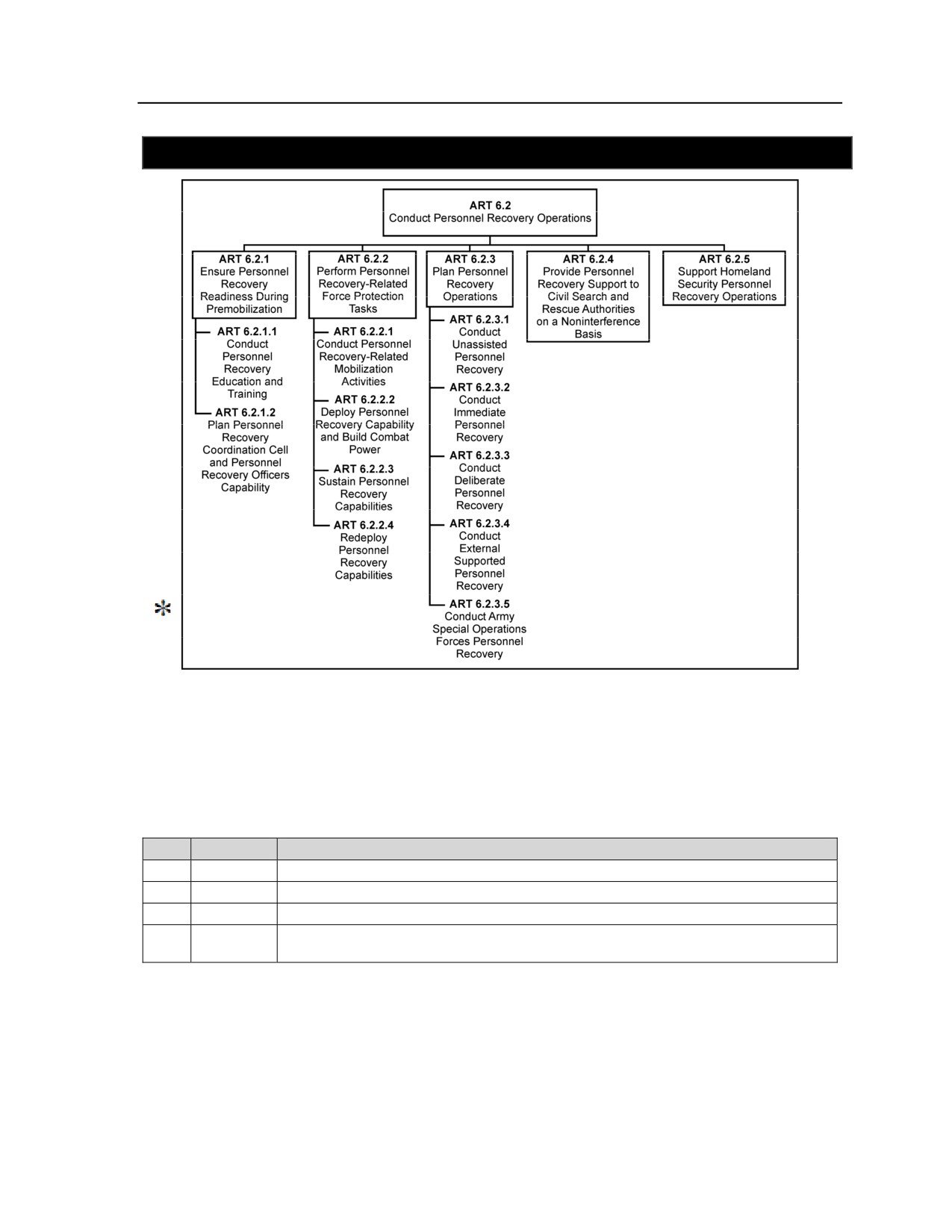
ART 6.0: The Protection Warfighting Function
SECTION II - ART 6.2: CONDUCT PERSONNEL RECOVERY OPERATIONS
6-23. Conduct personnel recovery (PR) operations to recover and return own personnel, whether Soldier,
Army civilian, selected Department of Defense (DOD) contractors, or other personnel as determined by the
Secretary of Defense who are isolated, missing, detained, or captured
(IMDC) in an operational
environment. IMDC personnel consist of U.S. forces, Army civilians, and DOD contractors who deploy
with the force, or other personnel as designated by the President who are beyond the Army positive or
procedural control of their unit, in an operational environment requiring them to survive, evade, resist, or
escape. It is every unit’s task to have procedures in place to be ready to recover personnel, whether Soldier,
civilian, or contractor. (FM 3-50.1) (USACAC)
No.
Scale
Measure
01
Yes/No
The commander, staff, units, and individuals reviewed and developed PR guidance.
02
Yes/No
The commander, staff, and units acquired PR equipment.
03
Yes/No
The commander, staff, units, and individuals conducted PR-focused education and training.
Subordinate commands and units integrated PR into internal standing operating
04
Yes/No
procedures consistent with guidance from higher headquarters.
ART 6.2.1 ENSURE PERSONNEL RECOVERY READINESS DURING
PREMOBILIZATION
6-24. Ensure personnel recovery (PR) readiness during premobilization by including PR in all efforts
during peacetime to organize, train, and equip to accomplish missions. Premobilization preparation actions
are necessary for commanders and their staffs, units, and individuals and consist of reviewing and
developing PR guidance, acquiring PR equipment, ensuring PR administrative requirements are met, and
conducting PR-focused education and training. (FM 3-50.1) (USACAC)
20 October 2010
FM 7-15, C4
6-13

Chapter 6
No.
Scale
Measure
01
Yes/No
The commander, staff, units, and individuals reviewed and developed PR guidance.
02
Yes/No
The commander, staff, and units acquired PR equipment.
The commander, staff, units, and individuals conducted PR-focused education and
03
Yes/No
training.
Subordinate commands and units integrated PR into internal standing operating
04
Yes/No
procedures consistent with guidance from higher headquarters.
ART 6.2.1.1 CONDUCT PERSONNEL RECOVERY EDUCATION AND TRAINING
6-25. Ensure all required personnel recovery (PR) individual education and training requirements are
conducted per established policies and directives. Coordinate code of conduct; survival, evasion,
resistance, and escape; and PR education and training related to the country (theater). Department of
Defense; Headquarters, Department of the Army; and combatant commanders establish education and
training requirements. (FM 3-50.1) (USACAC)
No.
Scale
Measure
Unit reviewed policy, doctrine, regulations, and operation plans to develop guidance
01
Yes/No
and intent for training.
02
Yes/No
Individual PR education and training requirements were included in individual training plans.
Units established training management systems to ensure all required training was
03
Yes/No
accomplished.
Unit developed processes and procedures to ensure all incoming Soldiers, civilians,
04
Yes/No
and contractors received required PR training.
05
Yes/No
All leaders and Soldiers received required PR training.
06
Yes/No
All Army civilians and Department of Defense contractors receive required training.
ART 6.2.1.2 PLAN PERSONNEL RECOVERY COORDINATION CELL AND PERSONNEL
RECOVERY OFFICERS CAPABILITY
6-26. While the staff members collect personnel recovery (PR)-related information in their specialty areas,
a central point for gathering the information from all the staff members is required to establish a usable
common operational picture. The PR coordination cells at the division level and personnel recovery
officers at brigade and below are the fusion points for the staffs’ collaborative efforts to gather PR-related
information for their respective units. PR coordination cells and officers coordinate with the individual
staff members to collect, process, store, display, and disseminate this information. Personnel recovery
coordination cells and officers are collectively referred to as PR cells. (FM 3-50.1) (USACAC)
No.
Scale
Measure
Unit ensured reliable communications with subordinate unit PR officers, other personnel
01
Yes/No
recovery coordination cells, and the joint personnel recovery center.
02
Yes/No
Unit coordinated deliberate recoveries for the component.
03
Yes/No
Unit reviewed accountability and movement reporting procedures of subordinate units.
04
Yes/No
Unit assisted in immediate recoveries when requested by subordinate units.
05
Yes/No
Unit coordinated for component fire support to the operation.
Unit ensured subordinate units have access to standing operating procedures
06
Yes/No
developed by the joint personnel recovery center.
07
Yes/No
Unit ensured subordinate units have sufficient evasion aids.
08
Yes/No
Unit coordinated for air and ground transportation and medical support.
Unit gathered PR-specific information developed by joint personnel recovery center and
09
Yes/No
personnel recovery coordination cells and disseminated to subordinate units.
Unit identified subordinate unit PR equipment shortfalls to the personnel recovery
10
Yes/No
coordination cell.
6-14
FM 7-15, C4
20 October 2010

ART 4.0: The Sustainment Warfighting Function
*ART 6.2.2 PERFORM PERSONNEL RECOVERY-RELATED FORCE
PROTECTION TASKS
6-27. Perform personnel recovery (PR)-related tasks in planning and preparing for deployment. Unit PR
personnel update and obtain equipment and materials necessary to perform assigned mission. Commanders
and staffs ensure adequate PR capability is programmed into personnel and equipment flow to assure
ability to support the force. PR personnel must be included in the time-phased force and deployment list
and equipment included in the updated deployment equipment list. PR organizations should ensure that all
unit personnel complete all necessary PR deployment requirements. (FM 3-50.1) (USACAC)
No.
Scale
Measure
01
Yes/No
Guidance and intent synchronized with the theater plan.
02
Yes/No
Processes, plans, and procedures integrated into the theater plan.
03
Yes/No
Maps and charts were standardized.
04
Yes/No
Special and personal staff integrated into family support plan.
05
Yes/No
Interoperability of location methods ensured.
06
Yes/No
Personnel and equipment were programmed into deployment plans per commander’s intent.
07
Yes/No
Location techniques and systems synchronized.
08
Yes/No
All unit personnel completed PR-related training prior to deployment.
Personnel recovery coordination cells and personnel recovery officers received all
09
Yes/No
necessary training.
ART 6.2.2.1 CONDUCT PERSONNEL RECOVERY-RELATED MOBILIZATION ACTIVITIES
6-28. Conduct personnel recovery (PR)-related mobilization activities by obtaining specific PR guidance
from the supported combatant commander. Focus previous training and tailor existing guidance to the
specific requirements of the supported combatant command. Examples of combatant command guidance
include theater PR regulations, appendix 5 to annex C of joint operation plans and orders, theater PR
standing operating procedures
(SOPs), PR special instructions, and isolated personnel guidance.
(FM 3-50.1) (USACAC)
No.
Scale
Measure
PR coordination cells and personnel recovery officers reviewed operation specific
01
Yes/No
command and control procedures provided by theater specific guidance.
Training and rehearsals were scheduled against identified shortfalls in organization,
02
Yes/No
equipment, and procedures.
Unit conducted integrated rehearsals for PR operations such as joint, combined arms,
03
Yes/No
and warfighting function.
Unit operation plans and orders included PR guidance as PR appendix to annex C as
04
Yes/No
required.
Unit updated all PR SOPs and other guidance to synchronize with theater PR guidance
05
Yes/No
as necessary.
ART 6.2.2.2 DEPLOY PERSONNEL RECOVERY CAPABILITY AND BUILD COMBAT POWER
6-29. During deployment, commanders must determine who will be providing personnel recovery (PR)
coverage for their arriving forces. Until commanders can build sufficient combat power to provide PR for
their forces, other forces in theater must provide PR support. Build combat power through reception,
staging, onward movement, and integration (RSOI). Early and continuous connectivity with the theater PR
architecture enables commanders to report isolated, missing, detained, or captured (IMDC) incidents
during deployment. This also allows commanders to report unit status when ready to assume responsibility
for assigned PR missions. (FM 3-50.1) (USACAC)
20 October 2010
FM 7-15, C4
6-15