FM 3-92 Corps Operations (November 2010) - page 3
Chapter 4
strategic communications. Incorporating information engagement into the corps concept of operations is a
staff responsibility of the assistant chief of staff, information engagement (G-7). With the assistance of the
functional and integrating cells, the assistant chief of staff for information engagement coordinates the use
of the information engagement capabilities: leader and Soldier engagement, public affairs, psychological
operations, combat camera, and strategic communication and defense support to public diplomacy.
4-45. The corps focuses information engagement efforts within its AO. However, the efforts must be
nested with those of higher and lower echelons to provide synergistic effects and not disrupt or confuse
friendly forces rather than the target audience. Actions by corps Soldiers, both positive and negative,
influence how the local populace perceives the military. Therefore, in all actions, leaders focus on
managing expectations and informing the people about friendly intentions and actions. The assistant chief
of staff for information engagement works with the assistant chief of staff, civil affairs operations (G-9).
The latter normally works in the command and control cell to integrate civil affairs operations into the
corps operations. The vehicle most often used for this is a civil affairs operations working group. It solves
civil affairs operations problems and makes recommendations to the CG on how to incorporate civil affairs
operations into corps operations.
SUPPORTING PROCESSES
4-46. The corps main CP uses information actions integral to the various processes to solve problems.
Corps planning uses the military decisionmaking process to identify the problem, develop alternative
solutions, subject them to thorough analysis, and make a recommendation to the commander. These results
inform ISR activities, are developed into operation plans and orders, and provide the starting point to solve
the next problem. The structure of the military decisionmaking process enables commanders to consider
both lethal and nonlethal actions when developing corps plans and orders.
4-47. Information tasks are synchronized and integrated through activities such as the period
synchronization meeting. With regards to targeting, the corps chief of fires leads the targeting working
group and participates in the targeting meeting and joint targeting coordination board, when formed, in the
corps main CP. Once the operation order is published and the operation controlled by the current operations
integration cell, the daily operations synchronization meeting serves as a forum for final integration of
lethal and nonlethal actions.
APPLYING THE ELEMENTS OF COMBAT POWER
4-48. The corps CG primarily provides resources. By applying the elements of combat power, the CG
establishes priorities and provides resources to subordinates. Early in the planning process and throughout
execution, the CG clearly articulates priorities of effort and support and identifies which units get resources
in what order to accomplish the mission. The CG and staff identify the requirements to accomplish its
mission and constantly communicate them to the force provider in the continental United States and the
theater army. The corps headquarters establishes the objective, gives subordinate headquarters required
resources for the current operation, monitors execution, and ensures that the force has the assets available
to execute probable branches and sequels that will lead to or reinforce success. The CG applies the
elements of combat power, allocates enablers, and lifts and shifts the main effort as required.
WEIGHTING DECISIVE OPERATIONS
4-49. Weighting decisive operations is the most direct means to resource for mission accomplishment. The
CG can weight these operations by providing resources, setting priorities, shaping current operations, and
planning future operations. In the corps operation order, the CG directs how corps forces are to cooperate.
The concept of operations describes the commander’s visualization. The CG synchronizes the operation so
the main effort carries most of the combat power. The CG also establishes command and support
relationships that provide immediate combat power and sustainment to the main effort. The ability of the
CG to give the main effort the advantage in combat power depends on those assets tailored to the corps
from the theater army or force generators in the continental United States.
4-8
FM 3-92
26 November 2010
The Corps in Full Spectrum Operations
4-50. Examples of corps actions to weight the main effort include the following:
z
Task-organizing maneuver forces.
z
Massing fires to support offensive operations. The corps can place one or more fires brigades in
support of a BCT or division with priority of fires to the main effort.
z
Nominating targets to the air component via the battlefield coordination detachment to employ
joint fires and interdiction as part of corps shaping operations.
z
Placing one or more internment and resettlement battalions to process the detainee population
from an operation.
z
Coordinating with the theater sustainment command to reinforce the main effort’s sustainment
organization (such as a BCT’s brigade support battalion) with one or more sustainment brigades.
z
Prioritizing sustainment support to the main effort to provide them mobility, munitions,
maintenance, and other logistic activities.
z
Placing additional engineers, military police, or civil affairs operations units under the OPCON
of a BCT or division conducting a stability operation concurrently with an offensive operation.
z
Placing aviation assets under the tactical control of a BCT or division to provide lift support for
troop movement and resupply of critical items or ammunition.
z
Attaching ISR units and assets—such as unmanned aircraft systems, ground cavalry, and
military intelligence analysis capability—to the main effort.
z
Placing psychological operations teams under OPCON of the main effort to conduct
psychological operations before an operation.
z
Attaching national assets, such as a forward contact team from the United States Army Medical
Research Institute of Infectious Diseases, to provide vector analysis.
z
Elevating priority of network resources, such as bandwidth and preemption level of information,
dynamically enforceable by the network.
INTELLIGENCE, SURVEILLANCE, AND RECONNAISSANCE
4-51. The corps establishes priorities and allocates resources by apportioning enabling capabilities. Key
among these is ISR. It enables the selected force to know the threat, the weather, and the terrain over which
it must conduct operations. Intelligence, surveillance, and reconnaissance is an activity that synchronizes
and integrates the planning and operation of sensors, assets, and processing, exploitation, and dissemination
systems in direct support of current and future operations. This is an integrated intelligence and operations
function. For Army forces, this activity is a combined arms operation that focuses on priority intelligence
requirements while answering the commander’s critical information requirements (FM 3-0). The main CP
controls ISR. The corps sets the conditions for successful mission accomplishment by providing the lowest
levels of the corps with the assets necessary to gain and report required information.
4-52. In the corps AO, the main CP has responsibility for intelligence. Subordinate divisions, functional
brigades, and BCTs perform surveillance and reconnaissance tasks to collect information on the enemy,
terrain, weather, and civil conditions. The corps requires intelligence to maintain situational understanding,
support targeting, and facilitate information engagement. To accomplish these tasks, the CG directs the
staff how to plan for, provide, and employ collection assets and subordinate forces. Surveillance is a
continuing task; it is not oriented to a specific target. It is designed to provide warning of enemy initiatives
and threats and to detect changes in enemy activities. Reconnaissance complements surveillance by
obtaining specific information about activities and resources of an enemy, potential enemy, or geographic
characteristics of a particular area.
4-53. Corps ISR operations vary in collection techniques in full spectrum operations. The ability to collect
information, provide competent analysis, and exploit it as rapidly as possible, act on it at a measured pace,
or not to act on it at all, is the key to mission accomplishment. A multidivisional corps force fighting a
similar enemy requires applying ISR assets differently from a fragmented counterinsurgency operation. At
the high end of the spectrum of conflict, a centralized approach to ISR synchronization and integration
often differs from a decentralized approach at the low end. The CG determines the approach based on the
situation.
26 November 2010
FM 3-92
4-9
Chapter 4
4-54. The main CP directs ISR efforts. As directed, corps subordinate forces conduct ISR activities.
Intelligence activities receive directions from the corps operation order and operations synchronization
process. Corps-controlled collection assets are allocated to subordinate forces. Results of the corps-wide
collection and preliminary analysis efforts are passed to the main CP. The main CP centers ISR
synchronization in the intelligence cell and ISR integration in the movement and maneuver cell.
4-55. ISR synchronization entails analyzing information requirements, identifying intelligence gaps, and
developing commander’s critical information requirements. It results in an intelligence plan and requests
for information to corps subordinate organizations to fill knowledge gaps. ISR assets collect information
from all sources, provide preliminary analysis, and develop the situation. ISR forces normally conduct
economy of force so that most corps forces avoid contact with the enemy without adequate intelligence.
4-56. The assistant chief of staff for intelligence, with input from all functional and integrating cells,
oversees corps ISR synchronization. All staff elements in the intelligence cell contribute to the effort by
providing subject matter experts. The intelligence cell, with the help of the communications integration
element and others, designs the intelligence architecture so that it can pass information rapidly. The
intelligence cell’s ISR operations element develops priority intelligence requirements with input from the
entire staff and requests for information. The intelligence cell refines and pairs the requirements with
collection means. The intelligence fusion element receives, processes, analyzes, and disseminates
intelligence. Other cells participate. The fires cell contributes to ISR synchronization during the targeting
process as they detect potential targets for lethal or nonlethal activities. These activities include identifying
potential electronic warfare targets. The staff weather officer describes weather effects. Such identification
enables the staff to further determine how weather may affect collection activities and how weather impacts
their areas of expertise.
4-57. ISR integration requires assigning and controlling the corps’s ISR assets with regards to time, space,
and purpose. In coordination with the intelligence cell, the assistant chief of staff, operations
(G-3)
integrates corps ISR activities. The intelligence cell’s ISR operations element integrates intelligence
products and collection planning into current operations. It is the interface between the intelligence cell and
the movement and maneuver cell. The ISR operations section coordinates the collection effort across all
functional and integrating cells matching tasks with required assets. The ISR operations section’s target
development element ensures that targets are developed, prioritized, and sequenced into current and future
operations.
4-58. The corps can push ISR assets to the lowest tactical level. The CG can weight the ISR effort with
assets from theater army and corps forces based on commander’s critical information requirements.
Potential units for ISR collection are battlefield surveillance brigades, combat aviation brigades, maneuver
enhancement brigades, and reconnaissance units of subordinate divisions and BCTs. These forces combine
with national- and strategic-level collection platforms to fill information and intelligence requirements.
Decentralized ISR collection assets, including providing BCTs with unmanned aircraft systems, give the
lowest tactical-level imagery and signals intelligence support. Control of ISR assets at the lowest level
possible is the key to adequate and timely intelligence at corps level.
4-59. See FM 2-0 for additional information on ISR operations.
UNMANNED AIRCRAFT SYSTEM SUPPORT
4-60. The unmanned aircraft system (UAS) is a force multiplier for the corps. The joint UAS normally
focuses on theater-wide intelligence gathering and surveillance activities. Commanders can focus a UAS on
reconnaissance. As an Army intermediate tactical headquarters, the corps cannot always rely on full-time
joint UAS availability to support its operations. Even if allocated to support corps operations, higher
priority missions may divert a joint UAS mission before friendly forces begin or prior to mission
accomplishment.
4-10
FM 3-92
26 November 2010
The Corps in Full Spectrum Operations
4-61. The UAS supports corps in several ways. Army UAS provide direct support to ongoing operations.
The UAS provides surveillance, reconnaissance, attack, communications relay, and convoy overwatch. The
UAS acquires the enemy force, and either keeps it under observation or hands it over to aviation or ground
assets for continued observation or destruction. After the UAS receives targets from ground maneuver or
manned aircraft, it continues to observe or engage with organic fires. The UAS also facilitates engagement
by other assets such as field artillery, attack helicopters, close air support, or ground maneuver. Able to
loiter longer than helicopters, the UAS assists in continued intelligence collection and battle damage
assessment. By prioritizing UAS assets, the corps main CP can extend its reach beyond the limited or
ground-based systems.
4-62. UASs can locate and identify targets by day or night and during reduced visibility to provide real-
time surveillance by data-linked, electro-optical, or infrared sensors. They also can provide laser
designation of targets for attack.
Unmanned Aircraft System Platforms
4-63. The corps has access to the following UAS platforms:
z
Raven.
z
Shadow.
z
Hunter.
z
Extended range multipurpose.
4-64. The Raven small unmanned aircraft system
(RQ-11B) provides a small unit with enhanced
situational awareness and increased force protection by providing expanded reconnaissance and
surveillance coverage of marginal maneuver areas. Raven is a hand-launched and rucksack portable UAS.
It consists of three air vehicles, a ground control station and remote video terminal, electro-optical and
infrared payloads, a ground antenna, a field repair kit, and one initial spares package. It can fly for 90
minutes with a range of 10 kilometers. As a small UAS operating at the same altitudes as manned aircraft,
the Raven creates challenges in airspace coordination and deconfliction.
4-65. The Shadow-200 tactical unmanned aircraft system (RQ-7B) is the Army’s current force UAS for the
BCT. The Shadow system provides Army brigade commanders with tactical-level reconnaissance,
surveillance, target acquisition, laser designation, battle damage assessment, and communications relay. It
is catapulted from a rail launcher, lands via an automated take-off and landing system and is supported by a
platoon of 22 Soldiers. The Shadow system provides over 6 hours endurance and can be operated at 120
kilometers. It has an early-entry configuration that can be transported via three C-130s (Hercules).
4-66. The Hunter unmanned aircraft system (MQ-5B) is a multimission system which provides ISR, target
acquisition, and battle damage assessment capability to division and corps commanders. The modular
Hunter system uses the tactical command data link. Such systems enable the Hunter to be tailored to the
specific location and mission requirements, including electro optical infrared laser designator,
communications relay, Greendart, and weaponization. Hunter provides 18 hours endurance and can be
operated at 200 kilometers.
4-67. The extended range multipurpose system (MQ-1C, sometimes known as Warrior) provides the
division commander with a dedicated, assured, multimission UAS for the tactical fight assigned to the
combat aviation brigade in each division and supports the division commander’s priorities. The extended
range multipurpose system provides reconnaissance, surveillance, target acquisition, command and control,
communications relay, signals intelligence, electronic warfare, attack, detection of weapons of mass
destruction, and battle damage assessment capabilities. A company of 128 Soldiers within a combat
aviation brigade operates and maintains the system. The extended range multipurpose system can operate
beyond the line-of-sight at distances greater than 300 kilometers.
26 November 2010
FM 3-92
4-11
Chapter 4
Unmanned Aircraft System Contributing Cells
4-68. Functional and integrating cells contribute to synchronize and integrate UAS operations. The
movement and maneuver cell contains seven elements, two of which contribute to UAS. The aviation
element coordinates and synchronizes UAS activities in corps planning and monitors UAS operations to
deconflict operations with other airspace users. Deconfliction requires constant attention. The airspace over
the corps AO can become crowded with unmanned aircraft, manned rotary- and fixed-wing aircraft, and
indirect fires. The airspace command and control element develops and coordinates the airspace control
architecture during planning. It develops the required airspace coordinating measures and fire support
control measures and monitors operations for compliance.
4-69. The intelligence cell provides tasks for UASs, focusing on intelligence collection. The intelligence
collection management element monitors UAS collection activities and integrates and synchronizes UAS
use to satisfy commander’s critical information requirements. The intelligence signals element develops
tasks to optimize collection of electronic intelligence. The imagery intelligence element receives, processes,
and disseminates UAS imagery to meet information requirements.
4-70. The fires cell develops targets suitable for UAS attack resources and integrates them into the fire
support plan. The fires cell provides input to the ISR plan to synchronize it with regards to designated
targets. The field artillery intelligence officer coordinates with the intelligence cell for target selection,
prioritization, and assessment. The electronic warfare element coordinates with the intelligence cell to
synchronize electronic warfare and counter-electronic warfare activities for current operations and plans.
The fires cell coordinates clearance of fires with other cells and elements in the main CP.
4-71. The protection cell coordinates with other functional and integrating cells. Together they conduct the
Army support to joint personnel recovery and corps protection operations facilitated by UASs.
4-72. The sustainment cell coordinates with the intelligence cell for appropriate sustainment support such
as repairs, parts, and maintenance of the UAS.
4-73. The command and control cell is the lead organization in the main CP. It ensures the necessary
communication networks are in place and maintained during UAS operations. The cell coordinates with the
other functional and integrating cells to synchronize network management, communications security, and
information assurance into UAS operations. Depending on the situation, the network management element
supports UAS communications relay activities. The command and control cell coordinates UAS actions
that affect psychological operations, civil affairs operations, and information engagement activities in the
corps AO.
4-74. Depending on the situation, the ISR operations section can be given tasking authority and tactical
control over Army UAS in the corps AO. In coordination with the functional cells, the ISR operations
section integrates UAS activities with the corps concept of operations and directs lethal and nonlethal
actions. When the UAS ground control station exercises tactical control, the ISR operations section and
other current operations integration cell support sections monitor the situation and provide necessary
support.
4-75. For additional information on UASs, see FM 3-04.15.
TARGET ACQUISITION
4-76. Resourcing for target acquisition enhances corps operational capabilities. Without knowledge of the
enemy and its intentions, the corps fire support and other systems cannot contribute to mission
accomplishment, or worse will spend its resources on unproductive or counterproductive targets. Target
acquisition is the detection, identification, and location of a target in sufficient detail to permit the effective
employment of weapons (JP 3-60). At the corps level and below, ground reports commonly provide target
acquisition. Soldiers on the battlefield observe the situation as they perform a task. They are augmented by
human intelligence. Scouts, reconnaissance patrols, observation posts, long-range surveillance units,
detachments left in contact, artillery observers, combat observation and lasing teams, and fire support teams
at battalion and BCT levels provide this intelligence. Ground observers receive assistance from remote
4-12
FM 3-92
26 November 2010
The Corps in Full Spectrum Operations
electronic and acoustic sensor systems. Electronic systems augment human intelligence by using the
electromagnetic spectrum to detect information in the AO. Manned and unmanned aircraft support target
acquisition.
4-77. Target acquisition information is received, processed, analyzed, and disseminated at the main CP in
the intelligence and fires cells. In the intelligence cell, several sections coordinate and help synchronize
target acquisition, including the ISR operations and G-2X (counterintelligence and human intelligence
operations) sections. The current operations integration cell integrates target acquisition activities into
day-to-day operations.
CIVIL SUPPORT OPERATIONS
4-78. In the continental United States, the Army National Guard, Active Army, and sometimes Army
Reserve, civilians, and contractors work together to conduct civil support operations. Proper resourcing of
the corps facilitates this part of corps operations. The corps can be called upon to interact with civil
authorities. Civil support is Department of Defense support to U.S. civil authorities for domestic
emergencies and for designated law enforcement and other activities (JP 3-28). Army forces provide this
support when requested and private, local, state, and other federal government resources are insufficient to
protect the life, limb, or property of citizens. Most Army civil support operations are conducted by the
state-controlled Army National Guard. Generally, the Active Army is called upon when the Army National
Guard requires augmentation for a disaster or other incident response.
4-79. The Army’s roles and responsibilities for civil support operations fall under four primary tasks:
z
Provide support for domestic disasters.
z
Provide support for domestic chemical, biological, radiological, nuclear, or high-yield explosives
incidents.
z
Provide support for domestic civilian law enforcement agencies.
z
Provide other designated support.
4-80. For more information about Army civil support operations, see FM 3-28.
THE CORPS ROLE IN THEATER AIR AND MISSILE DEFENSE
4-81. Air defense and its twin air superiority are always a consideration of the joint force commander. The
enemy may be able to strike from the air with rockets, ballistic, and cruise missiles, fixed- and rotary-wing
aircraft. However, the enemy’s capabilities, or lack of capability, and UASs may enable the theater
commander to accept risk and establish theater air and missile defense (TAMD) as an economy of force
effort.
4-82. TAMD falls under the control of the area air defense commander. Normally, the area air defense
commander is the joint force air component commander or a senior officer reporting to that commander.
The area air defense commander integrates all aspects of air and missile defense (AMD) in the joint
operations area. Specifically, the area air defense commander contributes to force protection through the
suite of command and control systems, sensors, and shooters. TAMD systems provide information on the
threat from the airspace to facilitate situational awareness and the COP.
4-83. The centralized approach of the TAMD fight commanded and controlled by the area air defense
commander includes both Air Force and Army command and control, sensor, and strike assets in its
decentralized execution. The theater army’s senior air and missile defense headquarters is the Army air and
missile defense command, a theater-level organization to which subordinate air defense units are assigned.
Normally its commander is the deputy commander for the area air defense commander. Depending on the
situation, these units can include air defense brigades, air defense battalions, and air defense batteries. The
battalions are equipped with Patriot antiaircraft and antimissile units and short-range air defense systems
such as the Avenger. The battalions can be all Patriot, all Avenger, or a mix depending on the threat.
Separate air defense artillery batteries may include terminal high-altitude air defense and joint elevated
networked sensor units. Because the threat from aircraft is much reduced, most air defense units
26 November 2010
FM 3-92
4-13
Chapter 4
concentrate on ballistic missile defense with some units identified as counterrocket, artillery, and mortar
formations.
4-84. The corps main CP contributes to the TAMD effort by coordinating the TAMD assets provided by
the theater army. The corps main CP’s protection cell and its AMD element integrate TAMD assets into the
corps plans and operation orders. The air defense brigade commanders advise the CG on counterair. These
commanders work closely with the AMD element on synchronizing, integrating, and employing AMD
capabilities. The corps AMD element plans, provides early warning, recommends asset allocation, develops
the defended and critical asset list, and works with other main CP cells to coordinate airspace. The corps
AMD tasks focus on these objectives:
z
Ensuring freedom of maneuver by eliminating the air and missile threat.
z
Achieving information superiority by collecting, processing, and disseminating airspace
information.
z
Protecting corps assets from attack.
z
Protecting geopolitical assets—those friendly or host-nation locations deemed for priority
protection.
4-14
FM 3-92
26 November 2010

Chapter 5
Corps Headquarters Transition to a Joint Task Force
Headquarters
Army transformation aims to improve the Army’s ability to provide flexible and
responsive capabilities to joint force commanders. The corps headquarters primarily
serves as an intermediate Army land force headquarters. This chapter describes the
process as the corps headquarters transitions into a joint task force headquarters or as
a joint force land component command headquarters. It discusses the joint force, the
transition to training cycles, the joint task force headquarters organization,
augmentation, and joint land operations.
THE JOINT FORCE
5-1. The Army corps headquarters uses joint doctrine and procedures when serving as joint force
headquarters. As such, it operates in an environment with its own lexicon as described in Joint Publication
(JP) 3-33. Army commanders must know and understand joint terms in addition to Army terms. Table 5-1
depicts several terms that the corps will encounter when transitioning to a JTF headquarters, and some are
used to describe this process below.
Table 5-1. Common joint terms
Term
Definition
Service component
A combat force that is organized, manned, equipped, and trained to
headquarters
perform Service and functional roles.
designated Service
A Service headquarters selected by the geographic combatant
component
commander to be trained and serve as a joint capable headquarters.
headquarters
joint task force (JTF)-
A designated Service headquarters that is certified and reports its
capable headquarters
readiness to perform as a joint headquarters.
A headquarters designated by the Secretary of Defense, geographic
joint task (JTF) force
combatant commander, subunified commander, or an existing joint
headquarters
task force commander to conduct military operations or support to a
specific situation.
standing joint force
A full-time joint command and control element that is part of the
headquarters (core
geographical combatant commander’s staff and focuses on
elements)
contingency and crisis action planning.
5-2. The Army provides forces and capabilities to the joint force commander through the Army force
generation process. When designating the corps as a joint task force (JTF) headquarters organization, the
combatant commander expects a trained and ready force. Often corps forces demonstrate more proficiency
in Army operations than in joint operations. Army forces train using a three-phased readiness cycle that
mirrors the Army force generation cycle. Training and readiness in the Army force generation cycles
around the reset, train/ready, and available phases. In concept, the reset phase contains units returned from
a deployment or window of opportunity for deployment. Units perform those recovery, reconstitution, and
minimal training activities required to become ready for future operations. Reset focuses on the Soldier, the
Soldier’s family, and equipment. Units in the train/ready phase conduct individual and collective training
and perform other tasks necessary to prepare for deployment. While training, train/ready phase units still
26 November 2010
FM 3-92
5-1
Chapter 5
support civil authorities for national emergencies. The command still might call on the units to conduct a
second major contingency (though they would not be as ready as if they were in the available pool).
Finally, units in the available phase, including corps headquarters, deploy as required or are available for
contingency operations. Units in the available force phase can deploy worldwide. This is the highest state
of readiness. While this is an Army concept, the joint force commander directs the incorporation of joint
training to ready the corps headquarters for immediate use.
THE TRANSITION TRAINING LIFE CYCLE
5-3. The combatant commander may maintain a standing joint force headquarters (core element) fully
integrated into the planning and operations, which can quickly form the nucleus of a JTF headquarters. The
end state is not to have a JTF headquarters for every conceivable contingency, but to have one or more
Service headquarters certified through pre-crisis training to respond when called. Pre-crisis training aims to
enhance basic capabilities and skill sets resident in the Service component. These capabilities and skill sets
enable the headquarters—in this case an Army corps—to function with augmentation as a JTF
headquarters. After training and certification, the JTF-capable headquarters has a foundation of staffing,
training, and equipment to serve as a joint headquarters.
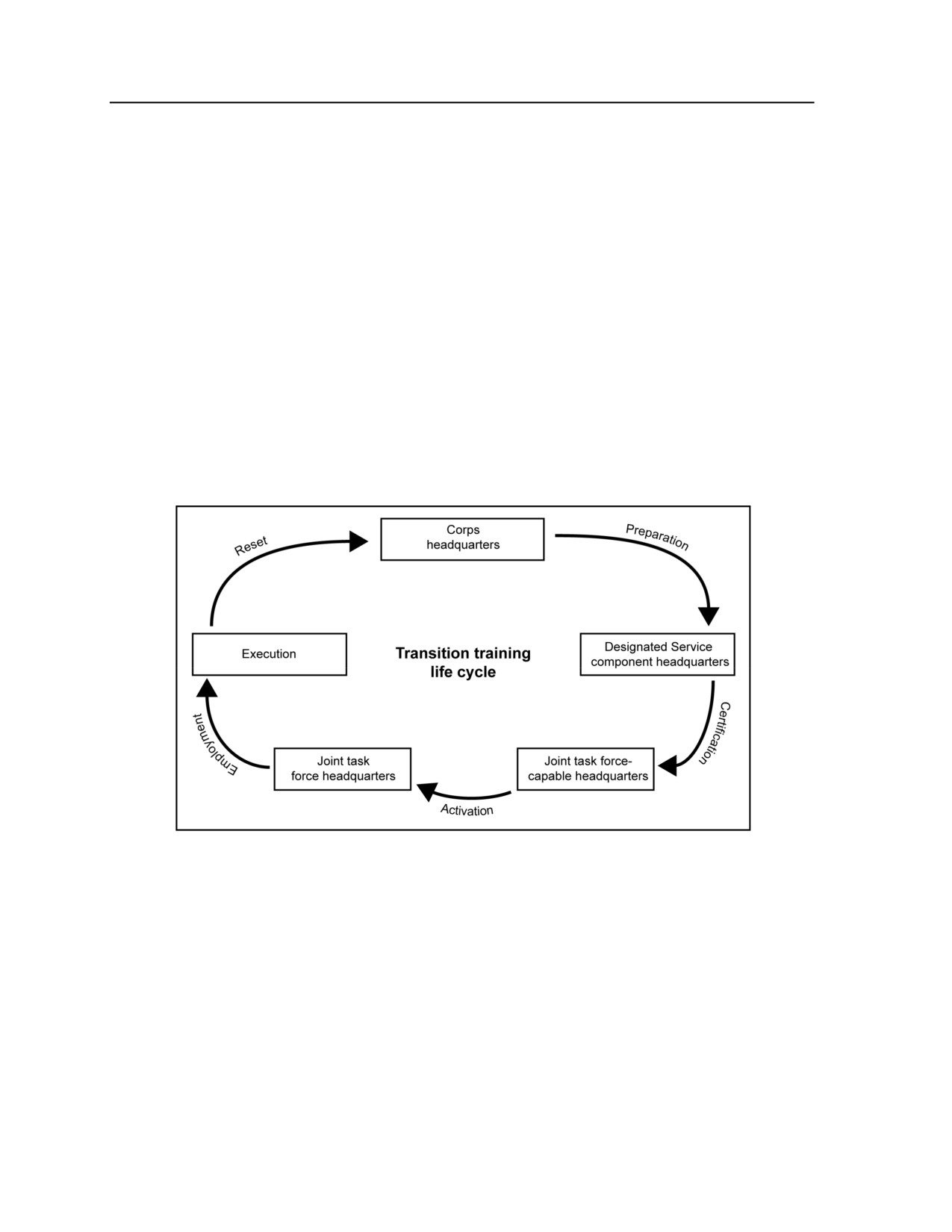
5-4. For an Army corps headquarters, the transition training life cycle contains five phases: preparation,
certification, activation, employment, and reset. (See figure 5-1.) The phases represent the combined
actions required to organize, staff, equip, train, and certify the corps headquarters as joint capable.
Figure 5-1. Transition training life cycle
PREPARATION PHASE
5-5. The preparation phase for a corps headquarters begins simultaneously with the Army force
generation train/ready phase. Training a corps headquarters to become joint capable may prove intensive.
Regardless, a corps headquarters retains its capacity to perform the required Army-specific tasks. Its
designation as a Service headquarters does not relieve the corps from maintaining an appropriate C-level
for equipment and training to accomplish its wartime Army missions as directed in Army Regulation
(AR) 220-1.
5-6. The corps headquarters also trains on joint tasks such as those contained in the Universal Joint Task
List (see the References for the Universal Joint Task List Portal Web address; for additional information,
refer to Chairman of the Joint Chiefs of Staff Manual (CJCSM) 3500.04E). The combatant commander
directs or identifies these tasks as the corps headquarters conducts its mission analysis and readiness
5-2
FM 3-92
26 November 2010
Corps Headquarters
Transition to
a Joint Task Force Headquarters
training. Regardless of any joint designation, the corps headquarters remains available to deploy
in the
continental United States for civil support operations.
5-7. The Army
corps headquarters develops a joint mission-essential
task list for approval by the
joint
commander. Concurrently, the designated Service headquarters develops two other documents: the
joint
manning document (JMD), and a joint mission-essential equipment list.
The JMD and
its companion
joint
mission-essential equipment list implicitly guide the corps
commander and staff as they develop, approve,
execute, and assess the training
plan to accomplish the mission.
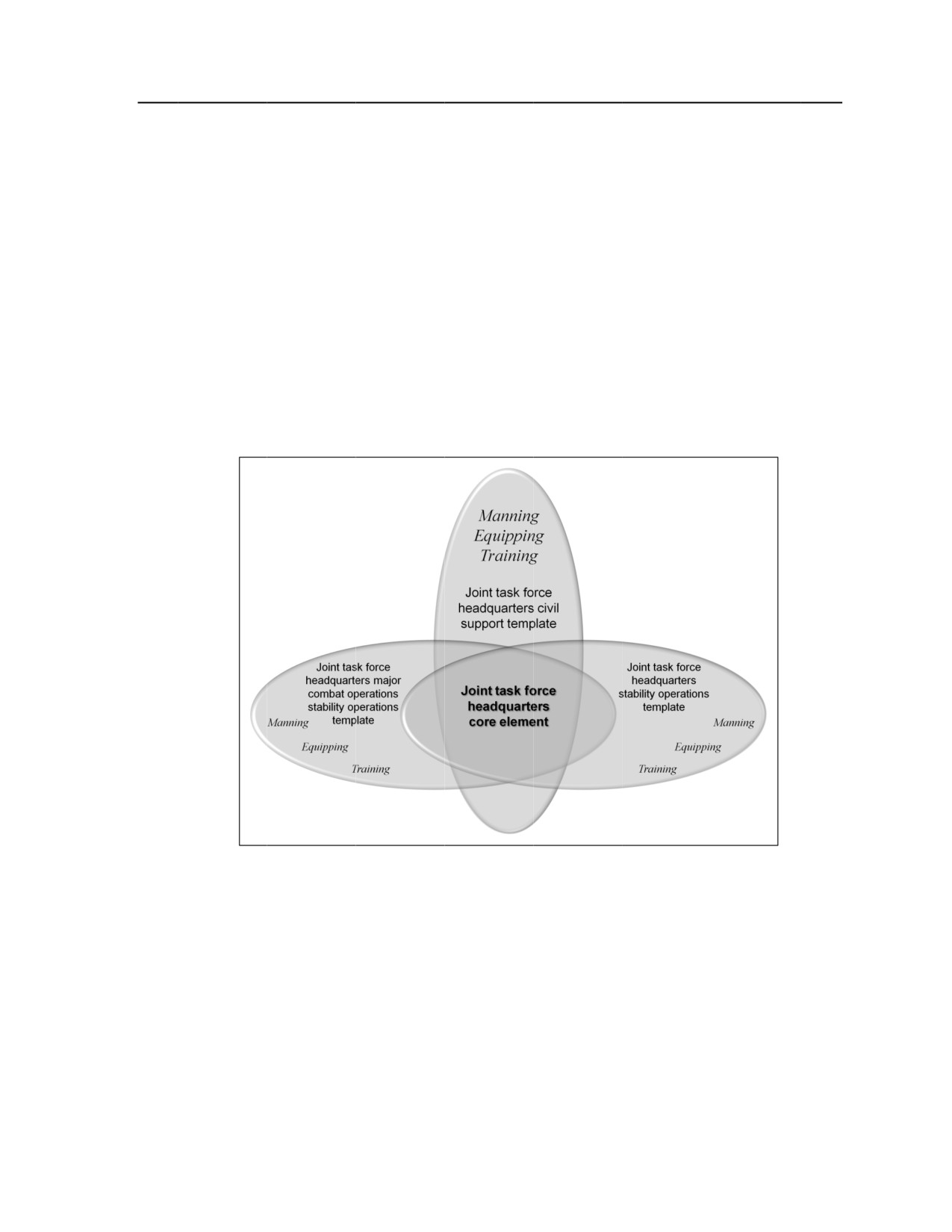
5-8. As the joint force provider, United States Joint Forces Command has developed three JMD templates
to
address likely missions: civil support operations, stability operations, and major
combat operations.
These templates
serve as the
starting point
for mission-specific JMDs. Figure 5-2 shows the templates
address manning needs of likely missions. The core element JMD serves as the base with additional
augmentees to support the specific mission.
Once designated as the core of a JTF, the
corps trains
on the
core element tasks and, based
on guidance
and the geographic combatant commander’s intent, focus the
training effort on one of the three joint missions. These documents guide
the corps headquarters and enable
it
to establish a
training plan,
a battle roster
(including required augmentees), and the equipment necessary
to
operate in a joint and combined environment.
Figure 5-2. Joint task force augmentation templates
5-9. Unit equipment varies.
A joint mission-essential equipment list
begins with
the designated unit
developing a thorough mission analysis.
This equipment list contains information on the required
equipment available in-theater and identified as shortfall. With the
theater army
or Army Service
component command and the
joint community, the designated Army JTF headquarters works to make up
shortfalls through requisitions
and redistribution.
5-10. The preparation phase
ends when
a corps headquarters is identified as a
designated Service
headquarters.
CERTIFICATION
PHASE
5-11. The certification phase begins when
the corps headquarters is identified as a designated Service
headquarters.
26 November 2010
FM 3-92
5-3
Chapter 5
5-12. Certification is based on Department of Defense policies that direct the JTF-capable headquarters to
develop joint mission-essential tasks and provide periodic reports on readiness. Reports usually occur every
30 days or when the readiness posture of the JTF-capable headquarters changes. To facilitate certification,
the certifying commander identifies possible missions, so the corps headquarters can concentrate its
resources on tasks based on the certifying commander’s intent. The certification process consumes
resources, requiring a commitment from both the combatant-level commander and the designated unit. The
certifying headquarters determines the length of the training and the time the designated JTF-capable
headquarters will remain certified. The corps headquarters, when designated as a JTF-capable headquarters
makes the initial certification step by conducting a thorough mission analysis to determine what the
directing headquarters has told the corps headquarters to do. This analysis enables the corps to focus on
those missions most aligned with the geographic combatant commander or joint force commander and the
most likely circumstances for employment. It can isolate those areas that require the most training time and
resourcing help from the geographic combatant commander, the potential theater army, the ARFOR, or
others, especially the joint force enablers discussed in paragraphs 5-60 through 5-68.
5-13. Certification requires close coordination between the directing joint force and the corps
headquarters. As training proceeds, draft documents—joint mission-essential tasks, JMD, joint mission-
essential equipment list—are submitted to the certifying headquarters for review and approval. Close
coordination enables the corps to identify shortfalls and develop strategies to address them. Although
criteria for certification depends on the mission, the joint force commander (JFC) identifies several key
certification standards:
z
Competency in the JTF headquarters core joint mission-essential tasks.
z
Competency in other mission-related tasks.
z
A valid and resourced JMD, to include adequate liaison to sister Services, other government
agencies, and, if required, multinational entities.
z
A valid and resourced joint mission-essential equipment list.
z
Acceptable mission readiness posture as measured by the unit status report or the Department of
Defense Readiness Reporting System.
5-14. Certification training includes field training, orientation visits, joint command post (CP) exercises,
and other assessment events. Because all required augmentation of personnel and equipment may not be
available for every exercise, training exercises may occur in discrete increments. Simulation-driven
exercises must stress the ability of the corps to accept augmentation, operate and maintain joint-capable
equipment, and demonstrate its understanding of the missions. The corps headquarters can expect a
graduation exercise as a final check on its mastery of the required skills.
5-15. The end state of the certification process is the designation of a corps headquarters as a JTF-capable
headquarters.
ACTIVATION PHASE
5-16. The activation phase starts when the corps headquarters is formally designated as a JTF-capable
headquarters by a combatant commander.
5-17. Once activated for a mission by the combatant commander, the joint and the corps commanders are
jointly responsible for maintenance of a positive readiness posture as the corps and its apportioned forces
prepare for action. This is accomplished by monthly readiness reporting through both Army and joint
channels, continued execution of the joint training plan, periodic training to sustain both individual and
collective skills, refinement of the JMD and joint mission-essential equipment list, and joint training
exercises to keep unit skills sharp. The key to success of this continuous process is constant information
sharing to maintain situational understanding.
5-18. The corps headquarters uses joint doctrine when preparing for deployment as a JTF in support of a
combatant commander. As forces assemble and conduct pre-deployment exercises, the combatant
commander monitors and mentors the process. The corps commander and staff receive, integrate, and train
with the augmentees in live, virtual, or constructive training exercises. In most cases, this training occurs
for the first time with personnel and equipment augmentation. Assuming the mission profile is known at the
5-4
FM 3-92
26 November 2010
Corps Headquarters Transition to a Joint Task Force Headquarters
time of activation, the joint mission-essential task list, refined for the mission at hand, drives training. The
joint mission-essential task list is both directed by the combatant commander and derived from doctrinal
sources, such as CJCSM 3500.04E and JP 3-33.
5-19. The activation phase ends when the corps headquarters is trained and ready to serve as a JTF
headquarters with adequate personnel and equipment augmentation.
EMPLOYMENT PHASE
5-20. The employment phase begins when the corps headquarters and its advanced echelon deploys to the
joint operations area. As a subordinate of the combatant command in a joint operations area, the corps
headquarters serving as a JTF headquarters exercises command and control over operations using joint
doctrine. The employment phase ends when the mission is accomplished and residual operations are passed
to a follow-on joint, multinational, or host-nation forces.
RESET PHASE
5-21. The reset phase starts when the corps headquarters redeploys to home station or another location to
recover from the operation. The reset phase of the transition training life cycle is the same as the reset pool
activities in as described in Field Manual (FM) 7-0 with its focus on the rehabilitation of the Soldier, the
family, and equipment. The reset phase ends when the corps headquarters again joins the train/ready pool.
JOINT TASK FORCE HEADQUARTERS ORGANIZATION
5-22. The JTF commander exercises command and control. The properly designated JTF commander
exercises authority and direction over assigned and attached forces to accomplish the mission. The
commander assesses the situation, makes decisions, and directs action. The joint staff performs functions
that help the commander exercise command and control responsibilities, including providing information,
performing analysis, preparing plans and orders, and providing assessments on the progress of operations.
5-23. If designated to serve as the core of a JTF headquarters, the corps headquarters transforms into a joint
staff. The corps headquarters organizes with its functional cells based on the warfighting functions and its
integrating cells transitioned into a joint staff with its similar but more complex mixture of functional and
integrating elements. During this transformation process, the assistant chief of staff, plans (G-5) and plans
directorate of a joint staff (J-5) force integration section coordinates with other staff sections to maintain
visibility of the process. It prepares the JTF headquarters as it grows in size, receives new capabilities, and
becomes a truly joint organization. To facilitate this process, the corps staff, with augmentation, uses joint
doctrine for staff functions and activities, referring to joint publications, Chairman, Joint Chiefs of Staff
directives, and materials found in the Joint Electronic Library for direction and guidance.
5-24. Organization of the JTF headquarters includes—
z
Staff organization.
z
Joint staff augmentation.
z
Joint Force headquarters formation.
z
Reception, integration, and training.
STAFF ORGANIZATION
5-25. The JTF command group is similar to that of an Army organization with a commander, one or more
deputies, a senior enlisted advisor, and several aides and personal assistants. The command group is
assisted by personal and special staff groups to handle special matters over which the JTF commander
wants to exercise personal control. Typical members of this group include a public affairs officer, staff
judge advocate, chaplain, inspector general, command surgeon, provost marshal, safety advisor, and
political advisor. This group may expand to fit the circumstances—for example, personal interpreters or
translators, a cultural advisor, and special liaison officers. The staff is led by the chief of staff who
supervises staff actions and serves as the principal integrator. Established and managed staff processes and
procedures support the command’s decisionmaking process. Typically reporting through a deputy
26 November 2010
FM 3-92
5-5
Chapter 5
commander to the JTF commander, the chief of staff oversees organizational integration, efficiency, and
effectiveness. (See JP 3-33 for additional information on the organization and function of the joint staff.)
JOINT STAFF AUGMENTATION
5-26. Individual and unit augmentation to the JTF is crucial to operational readiness. Augmentation for
each JTF staff section is available from the various agencies and organizations that support the joint
community, including the theater army, theater-level commands, other geographic combatant commander
Service commands, and national agencies. Each staff section has two key tasks for mission analysis. The
first is to forecast the required fill of its battle roster. The second task is to identify vacancies that must be
filled from external sources. To be most effective, augmentation requires a quick fill of slots in a joint
manning document or other force generation mechanism. Team building and a thorough understanding of
the specific mission and associated tasks are facilitated when the team comes together early and trains
together in all preparation activities.
JOINT FORCE HEADQUARTERS FORMATION
5-27. As the primary U.S. land component, the designated Army joint force headquarters is often required
to respond to crisis situations on short notice. The deployments can be as small as a no-notice permissive
noncombatant evacuation operation during unstable peace or as broad as a general war involving a large
multinational coalition. The corps headquarters provides a base structure on which to build a joint force
headquarters for a small contingency with minimal additional Army augmentation, usually when most
forces involved are land units. To serve as a joint force headquarters, the corps headquarters will always
require joint augmentation.
5-28. As a joint force headquarters, the corps headquarters uses its own information systems, such as the
Army Battle Command System (ABCS). It also confronts a numerous joint and multinational command
and control information systems and their associated databases. Integrating these systems with corps
information systems presents training, technical, and operations security challenges for the corps
headquarters as it continues to effectively exercise command and control. A significant part of the pre-
deployment preparation in the CPs involves training in using these systems.
5-29. Often, the technical integration of differing command and control information systems presents a
greater challenge since forces do not share databases and operating systems across technical boundaries.
With hundreds of potential applications and thousands of potential users, the staff establishes and monitors
the corps and joint network infrastructure architectures for reliability. Potentially many commercial
business and command and control systems compete for the same bandwidth. An overreliance on an
untrustworthy system can lead to command and control problems if the system fails and hampers a
commander’s ability to lead the force. Likewise, operations security is an important consideration,
especially for systems using an air gap to transfer voice and data from one command and control node to
another. Commanders and staffs understand the levels of security to understand the security classifications
of all the systems resident in the corps CPs.
RECEPTION, INTEGRATION, AND TRAINING
5-30. The appropriate number of augmentees in the correct slots may not contribute fully to mission
accomplishment without proper reception, integration, and training. To facilitate this effort, the operational
plans and interoperability directorate of a joint staff (J-7) has developed a series of joint education and
training publications to integrate and train those assigned to a joint force headquarters. These publications
describe the joint training system for the entire joint community. As described in Chairman of the Joint
Chiefs of Staff Guide (CJCS Guide) 3501, the joint training system stems from these guiding principles:
z
Use joint doctrine. It provides the basis for education and training as well as describing the
employment means of U.S. forces in support of national ends.
z
Use commanders as primary trainers. Commanders are responsible for preparing their
commands to accomplish assigned missions.
5-6
FM 3-92
26 November 2010
Corps Headquarters Transition to a Joint Task Force Headquarters
z
Focus on the mission. Training focuses on mission-essential tasks of the command in support of
assigned missions.
z
Train the way you intend to fight. As much as possible, make conditions and standards
resemble those expected during a deployment or other mission thorough live, virtual, or
constructive training.
z
Centralize planning and decentralize execution. With overarching training objectives always
in mind, the training and exercise program of the command trains every echelon from the
commander to the Soldier.
z
Link training assessment to readiness assessment. The command must be fit to fight and all
aspects of the training and exercise program must be measured to determine organizational
readiness.
5-31. Establishing a joint reception center facilitates the reception, initial processing, accountability,
onward movement, and integration of replacements, augmentees, contractors, and others. Normally the
responsibility of the manpower and personnel directorate of a joint staff (J-1), the joint reception center
coordinates with the logistics directorate of a joint staff (J-4) for billeting, transportation, food service,
medical support, and other requirements for newly arrived personnel. In one location or dispersed, the joint
reception center accounts for multiple entry and exit points into the joint operations area. It provides such
things as orientations, briefings, religious support, initial billeting, joint training, onward movement of units
or personnel, and accountability of all personnel joining the JTF. Briefings can cover rules of engagement,
rules for the use of force, cultural concerns, safety, operations security, and familiarization with JTF
headquarters, dining areas, and other facilities. See JP 3-33 and JP 1-0 for additional information on the
joint reception center. For strength accountability, the joint reception center is equally important as an
outprocessing center.
5-32. The staff principal, with the help of the JTF joint reception center, has responsibility to orient and
train each staff element. For ease of integration, the joint reception center should be staffed with JTF
personnel from all Services to handle Service-specific requirements.
5-33. The corps headquarters staff and battle-rostered augmentees have integration and training
opportunities to master the tasks identified in JP 3-33. The joint force command’s knowledge development
and distribution capability uses Internet-based distance learning. This learning prepares staff and
augmentees for joint duty before and during deployment, exercise participation, and collective training. Its
courses serve to orient those with limited knowledge of joint operations and reinforce previous training.
This self-study combines with the periodic augmentee training provided by the geographic combatant
commanders and others to ground the students in joint doctrine and practice. Individual training efforts
expose students to joint doctrine, tactics, techniques, and procedures as well as subject matter experts. Such
efforts enable students to develop a knowledge base so they can more quickly interact with joint staff
colleagues.
5-34. The foundation built during individual training is further enhanced with a series of collective training
events. Some events are previously scheduled or part of a predeployment readiness program. The Joint
Chiefs of Staff sponsors CP exercises, mission readiness exercises, mission rehearsals, and staff assistance
visits from the joint staff, JFC, and others. Such training reinforces learning, builds cohesion, and generates
lessons learned. The corps headquarters designated as a potential JTF headquarters can expect to execute
these collective training exercise in a combination of training environments:
z
Live (real people in real locations using real equipment).
z
Virtual simulation (real people in a simulation-driven situation).
z
Constructive simulation (wholly simulated).
The combination of each of these environments creates a more realistic training environment for the corps
headquarters.
5-35. A non-unit augmentee or deploying joint enabling capability member can join a JTF deploying to an
area of operations outside the continental United States for an exercise or an operational deployment. This
member completes the pre-deployment process and training for overseas service at a home station,
continental replacement center, or individual deployment sites. All military, civilian, and contractor
26 November 2010
FM 3-92
5-7
Chapter 5
personnel destined for joint or multinational positions attend training at the activity. The supported
geographic combatant commander may waive the requirement for an individual to train at the center on a
by-exception basis. (See Department of the Army Pamphlet (DA Pam) 600-81 for more information.)
5-36. Integration and training occur once the JTF is formed and begins its work. The integration occurs in
two environments: when the augmentee arrives at the JTF location and when the augmentee is assigned to a
staff section or other staff element. Integrating the JTF staff proves challenging whether during the initial
organizational phase or the training and replacement of individuals and capabilities for a mission of long
duration. The JTF headquarters commandant, normally the corps headquarters battalion commander, is
usually identified as the integration point of contact. This commandant controls reception, administrative
processing and life support resources—billeting, messing, transportation—that are the initial concern. With
oversight by the corps chief of staff, the JTF staff establishes procedures for reception, initial orientation,
personnel accountability, and strength reporting, training, and security.
AUGMENTATION TO THE CORPS HEADQUARTERS
5-37. The corps commander and staff may not have the required expertise to fill all JTF positions based on
the mission. Some are readily available from the combatant commander and Army sources, but others
require lead time and must be formally requested, especially one-of-a-kind national-level assets such as the
joint communications support element. Paragraphs
5-42 through
5-52 discuss joint organization
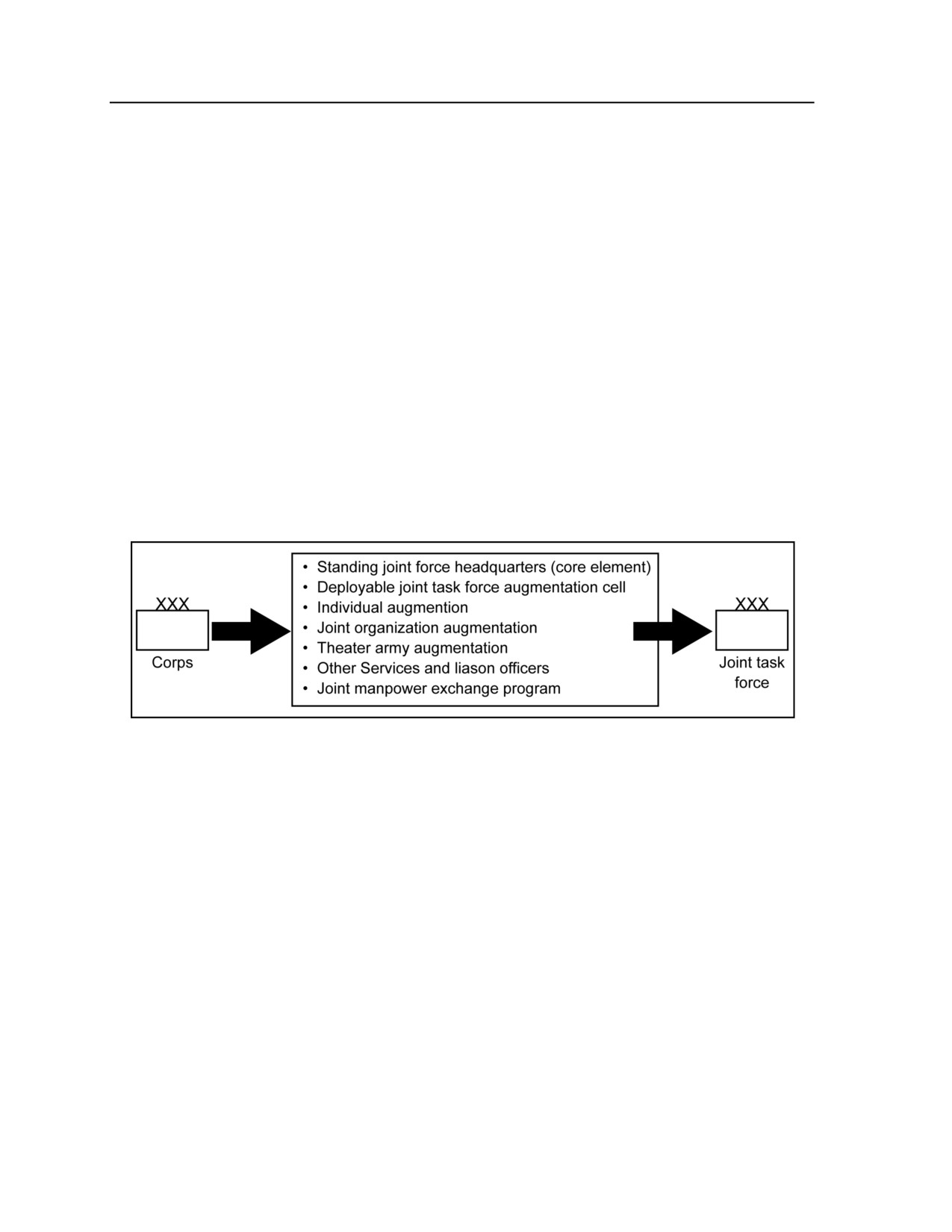
augmentations to the corps headquarters. JP 3-33 addresses this subject in some detail. Figure 5-3 portrays
some of the various enablers available to augment the corps headquarters forming it into a joint
headquarters.
Figure 5-3. Augmenting the corps staff
STANDING JOINT FORCE HEADQUARTERS (CORE ELEMENT)
5-38. The standing joint force headquarters (core element) (SJFHQ(CE)) is a full-time, cross-functional
command and control element on the combatant commander’s staff. Commanded by a general or flag
officer, it fully integrates into the geographic combatant commander’s planning and operational activities
and stands ready to conduct deliberate or crisis action planning in support of current or future operations.
Augmenting a corps headquarters with an SJFHQ(CE) provides a minimum joint capability. The
geographic combatant commander directs its internal organization that is usually arranged into functional
teams. A colonel commands each team. This officer often has joint experience in planning, operations,
information superiority, knowledge management, and logistics. Depending on the situation, additional
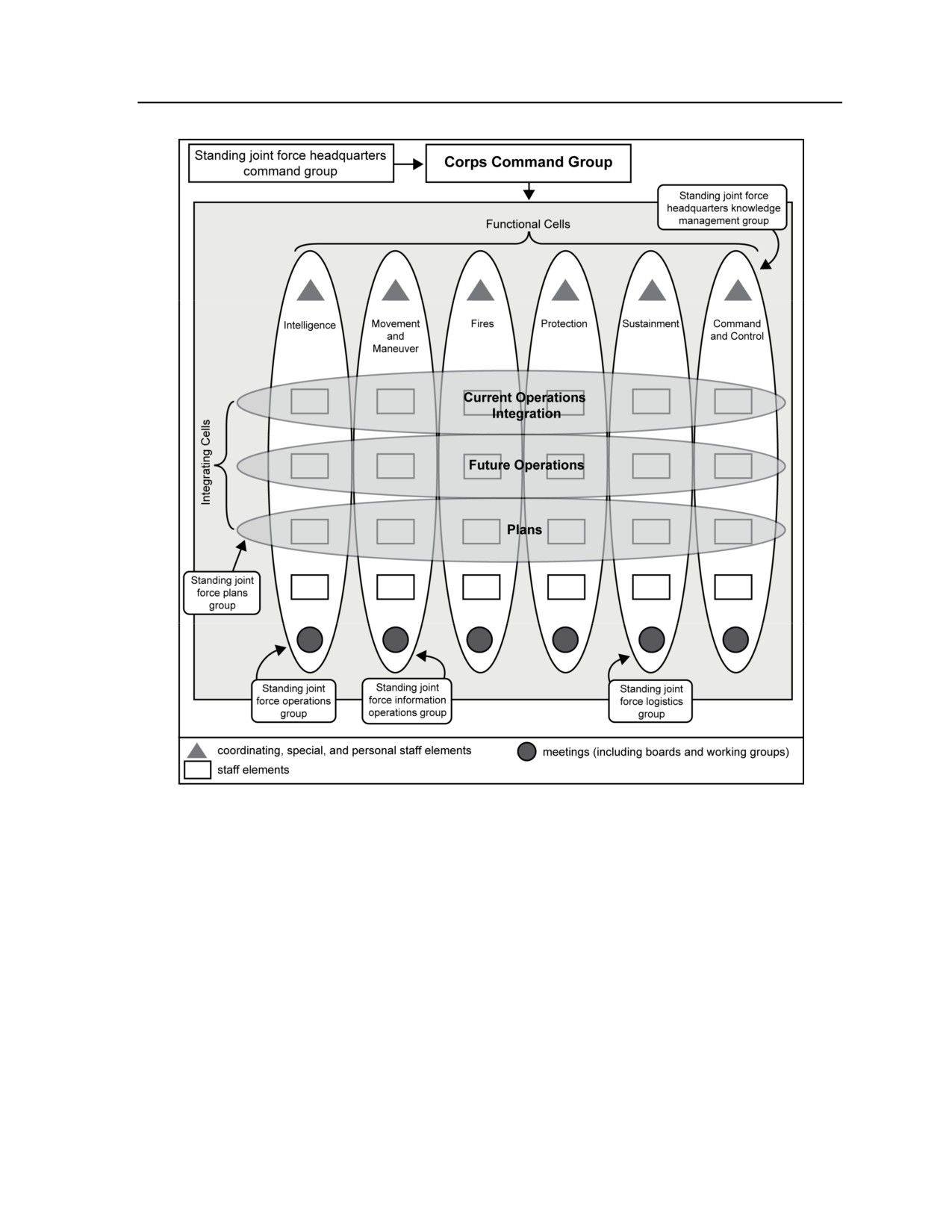
groups are formed, generally to provide capabilities not normally found in a corps headquarters. See figure
5-4 (page 5-9) for an example of SJFHQ(CE) support to a corps headquarters.
5-8
FM 3-92
26 November 2010
Corps Headquarters Transition to a Joint Task Force Headquarters
Figure 5-4. Standing joint force headquarters support to a corps headquarters example
5-39. The SJFHQ(CE) is used in three modes: the core of a JTF headquarters for the geographic combatant
commander, a specialized cell within the geographic combatant commander, and a joint augmentation for a
Service component as the JTF headquarters. A corps headquarters designated as a JTF headquarters will
most likely see the latter option. The SJFHQ(CE)’s purpose is to jump-start the joint planning process with
a trained, well-equipped plug. When serving as the core of a JTF headquarters, the corps can expect to
receive a SJFHQ(CE). Depending on the level of activity in the combatant commander’s area of operations,
the SJFHQ(CE) may stay for the length of the mission or redeploy—in whole or in part—before mission
accomplishment.
DEPLOYABLE JOINT TASK FORCE AUGMENTATION CELL
5-40. The deployable JTF augmentation cell is similar to a SJFHQ(CE), but it is not a standing
organization. It is a tailored pool of augmentees hand-picked for their expertise and trained in crisis action
procedures. Commanders use the deployable JTF augmentation cell like a standing joint force headquarters.
This cell may be phased out as the SJFHQ(CE) concept matures and combatant commanders develop
JMDs.
26 November 2010
FM 3-92
5-9
Chapter 5
INDIVIDUAL AUGMENTATION
5-41. Every forming JTF headquarters receives individual augmentees. They can be Army personnel
identified and requested by the corps commander and principal staff or plugs to fill slots in the JMD.
Identifying suitable individual augmentees is one of the earliest tasks the corps staff must perform.
Determining the number, skill set, type, and availability of augmentees occurs while the JTF is still in the
forming stages. This enables the headquarters to request military, Army civilians, representatives from
other government agencies, and contractors. Frequently, individual augmentees are functional experts to
chair, provide guidance, or serve on meetings (to include working groups and boards), centers, cells, and
planning teams associated with joint operations. As with other augmentation, individual augmentees may
not remain until mission accomplishment.
JOINT ORGANIZATION AUGMENTATION
5-42. Several joint organizations exist to augment the joint community in the execution of military
operations. As the joint force provider, United States Joint Forces Command arranges for these joint
enabling capabilities. In addition to deployment support, many of these entities can support training
exercises as resources allow. Some joint enabling capability entities are self-supporting, while others
require support from the supported headquarters. The entities in JP 3-33 are valuable assets to the JTF
headquarters.
Joint Communications Support Element
5-43. The joint communications support element is a joint command that provides rapidly deployable
communications augmentation. It consists of a headquarters support squadron and communications support
detachment, three active squadrons, two Air National Guard squadrons, and one Army Reserve squadron.
As a low-density, high-value asset, the joint communications support element may not remain in support of
a JTF headquarters for the duration of its mission.
National Intelligence Support Team
5-44. A national intelligence support team provides a rapidly deployable and mission-tailored national
intelligence reachback capability to provide a national-level, deployable, all-source intelligence team to
meet a JTF’s intelligence requirements. National intelligence support teams are nationally sourced and
composed of expert intelligence and communications analysts, communicators, and managers from the
Defense Intelligence Agency, Central Intelligence Agency, National Security Agency, National Geospatial-
Intelligence Agency (formerly the National Imagery and Mapping Agency), and other agencies.
Defense Threat Reduction Agency
5-45. The Defense Threat Reduction Agency is a Department of Defense agency providing subject matter
expert augmentees to counter weapons of mass destruction (chemical, biological, radiological, nuclear, and
high-yield explosives). This agency provides capabilities to reduce, eliminate, and counter the threat, and
mitigate its effects. It supports combatant commanders and JTF staffs with specialists on developing
necessary offensive and defensive tools, and equipping Soldiers for chemical or biological attacks.
Joint Information Operations Warfare Command
5-46. The United States Strategic Command’s Joint Information Operations Warfare Command augments
planning, coordinating, and executing efforts for the joint information operations community. It rapidly
deploys information operations planning teams to deliver tailored, highly skilled support and sophisticated
models and simulations to joint commanders and JTF headquarters. Its core capabilities include command
and control warfare, computer network operations, psychological operations, military deception, and
operations security. These capabilities work with specified supporting and related capabilities to influence,
disrupt, corrupt, or usurp adversarial human and automated decisionmaking while protecting friendly
operations and organizations. A reachback capability enables it to respond to emerging situations within a
joint operations area.
5-10
FM 3-92
26 November 2010
Corps Headquarters Transition to a Joint Task Force Headquarters
Joint Personnel Recovery Agency
5-47. The Joint Personnel Recovery Agency is a United States Joint Forces Command subordinate serving
as the principle Department of Defense agency for coordinating and executing personnel recovery. With
regards to JTF operations, this agency augments personnel recovery efforts in four areas: guidance,
education and training, operational support (including exercises and deployments), and lessons learned and
research and development.
Joint Public Affairs Support Element
5-48. United States Joint Forces Command’s joint public affairs support element augments the geographic
combatant commander and JFC with a rapidly deployable, trained, equipped, and expert team with
knowledge in joint public affairs, media operations and both Service and joint policies. Training teams for
the joint public affairs support element provide a standing, rapidly-deployable, turn-key joint public affairs
capability to support various operational requirements. Each training team forms the core of a scalable
public affairs response capability, a ready, mission-tailored force package to support exercises and to
deploy in support of the combatant commands for operations and contingencies.
Defense Logistics Agency
5-49. The Defense Logistics Agency supports the JTF using various capabilities, to include Defense
Logistics Agency contingency support teams and other experts imbedded physically or virtually with the
JTF. These teams provide liaison officers and functional experts with logistic planning experience, logistic
surge, and sustainment expertise to the agency. Team capabilities include logistics assistance teams to
address supply management issues, disposal remediation teams to manage disposal of hazardous waste,
distribution operations teams to provide expertise in distribution management, and fuel support teams to
serve as a liaison in bulk fuel operations. (For more information, see the Defense Logistics Agency Web
site, listed in the References.)
Deployable Joint Command and Control System
5-50. The deployable joint command and control system is a command and control element providing the
geographic combatant commander and subordinate JTF headquarters with a full range of interoperable,
robust, standardized, and scalable systems and tools for planning, executing, and assessing joint operations.
This system provides the integrated hardware and software suites that allow commanders to exercise
command and control over widely dispersed forces using multiple data sources and communications
alternatives.
Joint Fires Integration and Interoperability Team
5-51. The Joint Fires Integration and Interoperability Team provides rapidly deployable battlefield
assessment teams to augment large-scale training exercises and operational deployments to gather data on
the planning, preparation, and execution of joint fires integration. When deployed, they focus on joint
intelligence, surveillance, and reconnaissance, joint air-to-ground fires integration with maneuver,
command and control, and combat identification. Each battlefield assessment team aims to produce
effective target acquisition, command and control, and interoperable firing systems to reduce fratricide and
collateral damage. (For more information, see the Joint Fires Integration and Interoperability Team Web
site, listed in the References.)
Joint Systems Integration Center
5-52. United States Joint Forces Command’s Joint Systems Integration Center brings together operational
and technical expertise, technology, state-of-the-art facilities, and repeatable scientific methodology to
augment joint command and control capabilities, and solve joint interoperability problems, focusing at the
JTF level. It ensures identified capabilities are interoperable from the geographic combatant commander
level down through the JTF and its subordinates. The end result is a recommendation that will lead to
26 November 2010
FM 3-92
5-11
Chapter 5
improved interoperable capabilities. Onsite assistance and reachback capability support the JTF. (For more
information, see the Joint Systems Integration Center Web site, listed in the References.)
THEATER ARMY AUGMENTATION
5-53. Wherever deployed, the corps headquarters serving as a JTF headquarters falls under the
administrative control of a theater army. Depending on the type and duration of the mission, the theater
army may provide individual or unit augmentation from the following Army organizations to enable the
JTF headquarters to accomplish its mission. These include—
z
Theater sustainment command.
z
Signal command (theater).
z
Military intelligence brigade.
z
Civil affairs brigade.
z
Medical command (deployment support).
z
Theater aviation command.
5-54. Other potential augmenting organizations include a battlefield coordination detachment, Army air
and missile defense command, and other functional organizations. These organizations often deal with
contracting; chemical, biological, radiological, nuclear, and high-yield explosives (CBRNE); engineering;
military police; information tasks; aviation; and space support.
OTHER SERVICES AND LIAISON OFFICERS
5-55. Liaison often forms the glue that holds joint, coalition, and multinational operations together. The
JTF headquarters provides trained and knowledgeable liaison teams. Both the composition of the teams and
the number required is maintained throughout the mission. Liaison detachments have four basic functions:
monitor, coordinate, advise, and assist. Each team sent to superior, subordinate, adjacent, or supporting
organizations has enough staff to provide 24-hour coverage and sufficient rank structure to gain access to
the appropriate level at the receiving command. Each liaison team received from a sending unit is
integrated into the staff and accommodated with work space, communications, protection, life support, and
sufficient access to the commander and appropriate staff to accomplish its mission. Each corps liaison team
has a magnified challenge when it sets up at distant locations. Often the teams have limited transportation
assets to receive guidance, supplies, mail, and morale support.
5-56. Current doctrine identifies the chief of staff as the central point of contact for liaison operations.
However, the sheer number of liaison teams in joint operations with a large military, intergovernmental,
and multinational force may make that impractical. An alternative involves establishing a liaison office in
the main CP associated with the movement and maneuver cell. This office contains a director and a small
staff to control liaison operations, both those sent from and those received by the corps headquarters. An
individual of sufficient rank directs and staffs the office to control the operation and has ready access to
corps senior leaders to facilitate information exchange. Liaison office functions include maintaining liaison
rosters, managing status reporting and accountability, serving as an information clearinghouse, and
providing communications systems. The liaison office also acts as the single point of contact for life
support and other liaison support operations, such as protection, medical assistance, and security.
5-57. Digital liaison detachments augment corps headquarters, especially when serving as a JTF or joint
force land component command. Each detachment of 30 personnel can establish a liaison with a
multinational division or higher headquarters and provide digital connectivity with ABCS for maneuver,
fires, intelligence, sustainment, and air and missile defense. Alternatively, these detachments can be split
into two or more teams to provide connectivity to two or more brigade-sized elements.
5-58. Adequate liaison is most important to a corps headquarters transitioning to a joint headquarters in
those critical situations that will determine success or failure. Examples include situations during
predeployment academic and training exercises; during reception, staging, onward movement, and
integration; before new equipment training; and during the first few weeks as a joint headquarters.
5-12
FM 3-92
26 November 2010
Corps Headquarters Transition to a Joint Task Force Headquarters
JOINT MANPOWER EXCHANGE PROGRAM
5-59. The joint manpower exchange program places qualified military personnel in billets outside their
Service. When mature, this program will ensure that each geographic combatant commander and many of
their Service components commands have officers from another Service embedded in their staffs. Such a
program provides in-house liaison and staffs knowledgeable of both their specialty in their parent Service
and in the operations of the organization in which they serve.
OTHER AUGMENTATION OR COLLABORATIVE CAPABILITES
5-60. Capabilities can be augmented or collaborative. The joint enabling capabilities are a type of
augmentation. The interagency enabling capabilities; linguistic, interpreter, and cultural support; and
multinational enabling capabilities do not augment. Rather, they are often collaborators focusing on the
same objectives. They often join the corps headquarters serving as a JTF headquarters after it has arrived in
the joint operational area.
INTERAGENCY ENABLING CAPABILITIES
5-61. Modern operational environments contain more than just military organizations, especially if the JTF
is engaged in stability or civil support activities. The Army corps headquarters as a JTF headquarters can
expect to interact with and perhaps receive and provide direct support to many other government agencies.
These include the American embassy country team, the Department of State, Department of Homeland
Security, Department of Agriculture, Department of Commerce, and Department of Transportation.
Likewise, independent agencies of the federal government often are involved in military operations,
including the Central Intelligence Agency, the Environmental Protection Agency, National Aeronautics and
Space Administration, and especially the United States Agency for International Development. The list
expands considerably when including the state and local government entities.
5-62. Overseas, the corps as a JTF headquarters comes in contact with representatives of international
organizations, such as the United Nations, International Committee of the Red Cross, International Red
Cross and Red Crescent Movement, and the hundreds of nongovernmental organizations. While many of
these organizations try to remain neutral by not associating directly with the JTF, many interact with it as
they pursue their specialized missions. Host-nation governments, whether they welcome the U.S. presence
or not, will interact with the JTF headquarters and will have to be accommodated. (See JP 3-08 for further
information on interagency, intergovernmental, and nongovernmental coordination.)
5-63. Interagency capabilities provide skills lacking in sufficient quantities to support mission
accomplishment. Inadequate staffing and training of required interagency personnel can inhibit this
process. The interagency representative provided by non-Department of Defense activities of the United
States Government may come with a skill set not fully ready for the mission at hand. Early in the forming,
orientation, and training of JTF members, JTF leadership must identify knowledge shortfalls and provide
the training to fill the knowledge gaps. This orientation and training may involve providing equipment to
facilitate access to the common operational picture and JTF databases.
LINGUIST, INTERPRETER, AND CULTURAL SUPPORT
5-64. Linguists and interpreters (to include translators) often are critical to JTF operations. Interpreters
transfer the meaning of one spoken language into another spoken language. Translators render the meaning
of one written language into another written language. Foreign deployments often require language
proficiency—especially for local dialects—that require language skills beyond those typically resident in
the geographic combatant commander or JTF staffs. Linguists can provide valuable training to the JTF staff
and key personnel for specific joint operations area. Early in the planning and forming stages of the JTF’s
lifecycle, staff identify and resource the requirements for linguists, interpreters and translators. Integrating
interpreters and translators into the JTF occurs as soon as possible to obtain security clearance and finalize
contractual agreements. In-place procedures are required to identify the interpreter chain of command and
the scope of interpreter duties. The corps headquarters develops procedures to vet interpreters and
26 November 2010
FM 3-92
5-13
Chapter 5
translators to uncover biases. The staff considers the possibility that they may not have the best interests of
the JTF foremost in their minds. Other positions may be sourced through vetted, contracted interpreters.
5-65. Cultural support goes beyond the use of local interpreters and local hires to perform life support
tasks. Inserting U.S. forces into a different culture creates a dynamic to address. Each JTF requires cultural
intelligence to successfully deal with the local population. Knowledge of the local culture in terms of the
social, political, economic, and demographic factors contributes to understanding a people or a nation’s
history, institutions, psychology, religious beliefs, and behaviors. Increasing cultural awareness using
Department of State regional experts, special operations forces with regional expertise, or civilian
academics with language and cultural understanding facilitates the planning, preparation, and execution of
military operations. Additionally, foreign area officers from the security cooperation division of the theater
army headquarters may serve as political or cultural advisors to the corps or subordinate commanders.
MULTINATIONAL ENABLING CAPABILITIES
5-66. When deployed outside the continental United States, the U.S. military rarely operates alone.
Whether a part of a formal treaty organization such as the North Atlantic Alliance or as an ad hoc coalition
like that for Operation Iraqi Freedom, the JTF headquarters multinational participation complicates normal
unilateral organization, planning, and operations. Operating in a multinational environment presents
challenges as well as opportunities. A JTF operating with multinational forces follows multinational
doctrine and procedures if the United States has ratified that doctrine and those procedures. A lead nation
uses its national doctrine for operations. When no multinational doctrine exists, the JTF follows U.S. joint
doctrine where possible. For doctrine and procedures not ratified by the United States, commanders
evaluate and follow the multinational command’s doctrine and procedures, where applicable and consistent
with U.S. law, regulations, and doctrine.
5-67. Command relationships, interoperability, combined planning, information and intelligence sharing,
communications systems, and logistic support complicate JTF operations. However, the opportunity to take
advantage of embedded linguistic and cultural competence, regional and local intergovernmental contacts,
and military expertise of multinational partners makes the effort worthwhile. Most often, the United States
serves as the lead nation with the largest forces on the ground, but effective exchange of liaison teams and
combined preparation, planning, and execution facilitates JTF operations.
5-68. The JTF headquarters with a multinational component facilitates integration. It prompts thoroughly
understanding national restrictions on operations, organization of the force, sustainment requirements, early
identification of command relationships, and responsibilities and expectations. Clarity of these
considerations at the start of operations enables the JTF headquarters to get the most from its multinational
forces. See JP
3-16 and the ABCA Coalition Operations Handbook for additional information on
multinational enabling capabilities.
JOINT TASK FORCE HEADQUARTERS EQUIPPING CAPABILITIES
5-69. Equipping a corps headquarters as it transitions to a JTF headquarters goes hand-in-hand with force
generation and augmentation. No single Service possesses all the command and control information
systems and equipment required by a JTF headquarters. A Service headquarters allocated to the geographic
combatant commander is a JTF headquarters so the former can provide a core element that has engaged in
preparation and certification, to include identifying the required equipment and accompanying shortfalls.
The joint enabling capabilities can supply, either permanently or on a temporary basis, shortfalls or
shortages in equipment. Most equipment necessary to give the JTF full capabilities is acquired from other
sources to include commercially. A start on this activity is a detailed joint mission-essential equipment list,
most of which will be electronic communications equipment.
5-70. The joint mission-essential equipment list consists of required equipment and capabilities to build on
the base. Equipment can be added in blocks, each block to incrementally plus up the JTF headquarters to
meet the specific projected or mission demands. For a corps headquarters, the foundation block consists of
its organic Service-provided capabilities, followed by equipment received from the theater army and the
theater signal command or brigade. Usually these capabilities—internal systems—consist of computers
5-14
FM 3-92
26 November 2010
Corps Headquarters Transition to a Joint Task Force Headquarters
with software applications. Such capabilities consist of operating systems, office applications and security,
associated peripherals, and servers. To fill the gaps, units identify any continuing shortfall between needs
and capability, refine a joint mission-essential equipment list, and submit a request through joint or Army
channels.
5-71. For the Army-based JTF headquarters and associated Army units, equipping a transitioning corps
headquarters involves the theater army. The equipment available in theater comes from three sources:
theater property, Army pre-positioned stocks, and theater sustainment stocks. The theater army, geographic
combatant commander, and the joint enablers sometimes cannot provide equipment. Some equipment is not
commercially available. In those cases, units can source up the chain of command to the joint staff to
process an operational needs statement. Often, needed equipment includes technical systems related to
worldwide communications, additional bandwidth, and video, voice, and data services from military and
commercial sources. Deployable joint enablers such as the joint communications support element and the
deployable joint command and control system element are the first line of support for outside assistance.
(Appendix C provides additional information on communication support.)
JOINT LAND OPERATIONS
5-72. The Army corps headquarters can serve as joint force land component command headquarters. Land
operations support the JFC’s operation or campaign objectives or support other components of the joint
force. Joint land operations require synchronizing and integrating the instruments of national power to
achieve strategic and operational objectives. These forces conducting joint land operations include the
Army, Marine, and Naval forces operating on or from land to accomplish missions and tasks. Normally,
joint land operations also involve multinational land forces. Joint land operations specifically include land
control operations. They employ land forces, supported by naval and air forces (as appropriate), to
accomplish military objectives in vital areas of the operational area.
JOINT FORCE LAND COMPONENT ORGANIZATION
5-73. When organizing joint forces, simplicity and clarity are critical: by providing the joint force land
component a single commander for joint land operations, the JFC can enhance synchronization of
operations not only between U.S. ground components, but with multinational land forces as well. Forming
a joint force land component builds unity of effort, an integrated staff, a single voice for land forces and
land control operations, one single concept and focus of effort for land control operations, and a
synchronized and integrated land force planning and execution. The disadvantages are that joint force land
component normally retains Service component responsibilities to the JFC (requires split focus of the staff),
it challenges integrating staffs, it requires more lead-time to establish headquarters before execution, and it
lacks the ability to resource the staffs. See JP 3-31 for additional doctrinal guidance on establishing the
joint force land component.
CORPS HEADQUARTERS AS A JOINT FORCE LAND COMPONENT HEADQUARTERS
5-74. Normally, a Service headquarters provides the joint force land component commander (JFLCC). If
possible, the joint force land component may have a separate Army forces or Marine forces commander
and headquarters responsible for the administrative control of the respective Services in the land
component. If not, the JFLCC continues to be responsible for Service component functions. This latter
arrangement has the potential to over task the JFLCC’s staff while performing its dual role. It may be
advantageous for the JFLCC to delegate as many of duties related to Service component as practical to a
subordinate Service force headquarters.
5-75. Within the joint force land component headquarters, the corps commander, deputy commander, chief
of staff, and key members of the staff fully integrate with representation from the forces and capabilities
made available to the JFLCC. The staff includes the manpower and personnel directorate of a joint staff
(J-1) through the communications system directorate of a joint staff (J-6). The corps commander when
designated as the JFLCC provides the core elements of the staff to assist in planning, coordinating, and
executing functional land component operations. See JP 3-31 and Chairman of the Joint Chiefs of Staff
Instruction (CJCSI) 1301.01C.
26 November 2010
FM 3-92
5-15
Chapter 5
5-76. Combatant commanders follow appropriate guidance for their assignments. An annually updated
“Forces for Unified Commands” memorandum from the Secretary of Defense assigns forces to combatant
commanders. During crisis action planning, forces allocated to combatant commanders may differ from
those apportioned for contingency planning. For more information about how Department of Defense
assigns forces, see CJCSI 3100.01B and Chairman of the Joint Chiefs of Staff Notice (CJCSN) 3500.01.
JOINT FORCE LAND COMPONENT COMMAND HEADQUARTERS
5-77. The headquarters is organized according to the JFC’s implementing directive. This document
establishes the roles and responsibilities of the JFLCC and designates the mission and forces. Normally, the
staff will be built around the corps staff and augmented with members of the other Service component or
forces as described in paragraphs 5-37 through 5-59. The JFLCC’s staff allocates key staff billets so that all
Services are appropriately represented and shared equitably in staffing tasks. Ideally, the deputy JFLCC or
chief of staff comes from a different Service. Replicating this construct throughout the staff leadership
ensures all leaders understand the distinct capabilities of each Service to optimize employment of the
forces. See JP 3-31 for a depiction of a notional joint force land component headquarters organization.
JOINT FORCE LAND COMPONENT COMMAND RESPONSIBILITIES AND ROLES
5-78. The corps headquarters serving as a joint force land component headquarters exercises
responsibilities under the authority of the combatant commander. The commander of the joint force land
component has responsibilities that include, but are not limited to, the following:
z
Advise the JFC on the proper employment of forces and capabilities.
z
Develop joint plans and orders in support of the JFC’s concept of operations and optimize the
operations of task-organized land forces.
z
Execute and assess land control operations.
z
Coordinate the planning and execution of joint land operations with the other components and
supporting agencies.
z
Synchronize and integrate all aspects of combat power in support of land operations.
z
Designate the target priorities, effects, and timing for joint land operations.
z
Establish a personnel recovery element to account for and report the status of isolated personnel
and to coordinate and control land component personnel recovery events.
z
Provide mutual support to other components by conducting operations within the operational area.
z
Coordinate with other functional and Service components in support of accomplishment of
JFC’s objectives.
z
Provide an assistant or deputy to the area air defense commander for land-based joint theater air
and missile defense operations as determined by the JFC.
z
Support the JFC’s information operations by developing the information operations
requirements that support land control operations and synchronize land force information
operations assets when directed.
z
Integrate the joint force land component’s command and control system and resources into the
theater’s command and control system.
z
Integrate special operations as required into overall land operations.
z
Perform joint security functions.
z
Supervise detainee operations.
z
Establish standing operating procedures and other directives based on the JFC’s guidance.
z
Provide inputs to the JFC-approved joint area air defense plan and the airspace control plan.
z
Assess and as necessary restore or reconstruct civilian infrastructure.
5-16
FM 3-92
26 November 2010
Appendix A
Sustainment
As a part of its transformation, the Army is changing how it sustains its forces. The
concept of centralized control with decentralized execution is a new one for logistics
but not new to the Army. This appendix discusses the historical background for
transformation, transformation, functions of sustainment, corps sustainment, and
corps support requirements.
BACKGROUND
A-1. In World War II, Army doctrine established that the commander of the communications zone was co-
equal to the commander of the Army Air Forces and the commander of Army ground forces in the combat
zone. While most Service forces were retained at theater-level, selected Service units provided direct
support to field armies. After World War II, this was reversed with most sustainment units subordinated to
maneuver commanders at every echelon.
TRANSFORMATION
A-2. Transformation in Army sustainment doctrine in support of full spectrum operations at the
operational and tactical levels is provided by highly trained modular sustainment forces, integrated and
synchronized with the operational plan. The goals of sustainment transformation are to develop a
sustainment infrastructure—
z
More responsive to the needs of an expeditionary and joint capable force.
z
Free of redundancy.
z
Streamlined (by reducing unnecessary layers).
A-3. Responding to these imperatives, sustainment leaders have designed a capability that leverages
emerging technologies and links support to supported organizations and the Army-to-joint organizations
from the continental United States to areas of operations (AOs) and within those AOs. The design of the
capability accounts for the explicit guidance from Headquarters, Department of the Army that makes no
Reserve Component sustainment units available within the first 30 days of an operation. The design also
clarifies that the sustainment force will be as capable as the current sustainment force after transformation.
SUSTAINMENT FUNCTIONS
A-4. Sustainment is the provision of personnel, logistic, and other support required to maintain and
prolong operations until mission accomplishment. The sustainment warfighting function is the related tasks
and systems that provide support and services to ensure freedom of action, extend operational reach, and
prolong endurance (Field Manual (FM) 3-0). It includes the functions of—
z
Personnel services. These services include human resources support, financial management,
legal support, religious support, and band support functions related to Soldiers’ welfare,
readiness, and quality of life.
z
Logistics. Logistics is the military art and science of carrying out the movement and
maintenance of forces. Logistics includes maintenance, transportation, supply, field services,
distribution, operational contract support, and general engineering support.
z
Health service support. This includes all support and services performed, provided, and
arranged by the Army medical department to promote, conserve, or restore the mental and
physical well-being of Army personnel and, as directed, personnel in other Services, agencies,
and organizations. This includes casualty care, medical evacuation, and medical logistics.
26 November 2010
FM 3-92
A-1
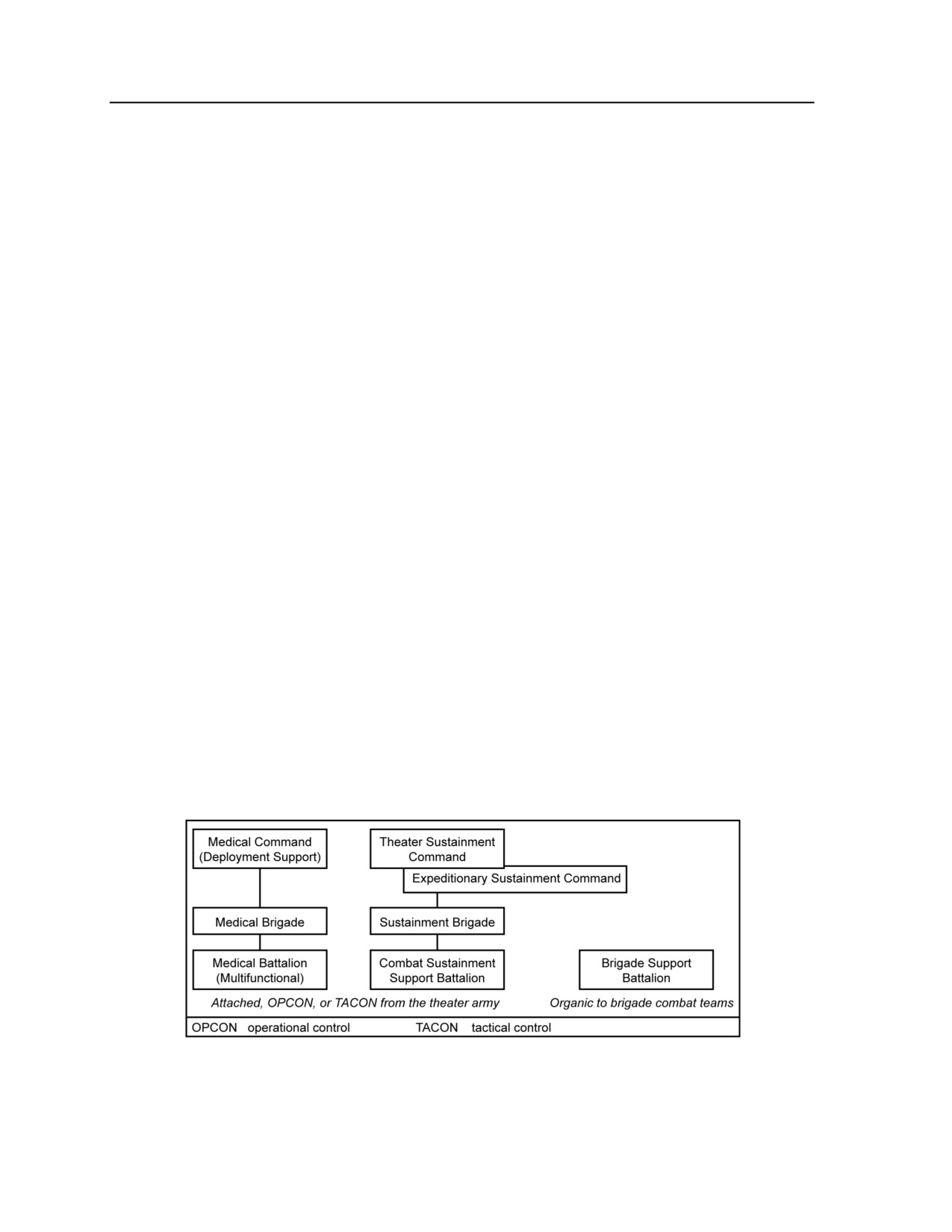
Appendix A
A-5. The force structure required to execute effective and efficient sustainment operations is never static.
As the theater matures and operational requirements change, the modular sustainment structure also
changes in anticipation of operational requirements.
A-6. While basic sustainment functions do not change as the corps headquarters assumes the missions,
staffing does change. As discussed in chapter 5, transitioning from an Army corps headquarters to a joint
headquarters requires significant augmentation, including Army augmentation to the corps headquarters.
The level and type of augmentation depends on the joint commander’s intent, mission, and concept of
operations.
CORPS SUSTAINMENT
A-7. Normally, modular sustainment forces are assigned or under operational control (OPCON) to the
TSC for the theater army with support provided at every echelon of command: theater army, corps,
division, and brigade. Integral to the success of modular sustainment is its ability to leverage and
synchronize support from joint and national or strategic partners. These partners can include the United
States Transportation Command, the Defense Logistics Agency, Air Mobility Command, General Services
Administration, and United States Army Materiel Command. The corps main command post (CP)
sustainment cell monitors each of the four functions of sustainment with a different staff principal taking
the lead:
z
Assistant chief of staff, personnel (G-1) leads the function of personnel.
z
Assistant chief of staff, logistics (G-4) leads logistics.
z
Assistant chief of staff, financial management (G-8) leads the function of resource management
and coordinates with the appropriate level financial management support officer—TSC or
expeditionary sustainment command (ESC)—for finance operations capability.
z
Surgeon leads Army Health System support.
A-8. Normally the G-4 serves as both the chief of sustainment and the logistics section chief, but the corps
commanding general may also designate a chief of sustainment. Requisitions and requests for assistance are
initiated at the user level and processed in the TSC support chain. The main CP sustainment cell monitors
the process. A sustainment organization is assigned, OPCON, or in support of units at every echelon. The
TSC and its forward echelon ESC provide the support. Whether provided from a brigade support battalion,
a sustainment brigade, a TSC or ESC, or the national or strategic-level, the corps benefits from the
transformed Army’s centralized execution model.
A-9. As depicted in figure A-1, the corps and its assigned, attached, OPCON, or tactical control (TACON)
units receive their support from a number of modular sustainment units. Medical and other sustainment
comes from the theater army or the continental United States force generation base and the brigade combat
team from its organic brigade support battalion.
Figure A-1. Major components of the modular force sustainment structure
A-2
FM 3-92
26 November 2010
Sustainment
MEDICAL COMMAND (DEPLOYMENT SUPPORT)
A-10. The medical command (deployment support) is the senior medical command within a theater. It
provides the requisite command and control necessary to deliver timely and responsive Army Health
System support for deployed forces. The medical command (deployment support) is a dedicated, regionally
focused command with a basis of allocation of one per theater. This command provides subordinate
medical organizations that operate under the medical brigade and/or medical battalion (multifunctional). It
also provides medical augmentation as forward surgical teams or other augmentation required by supported
units.
Medical Brigade
A-11. The medical brigade is designed to provide command and control to medical units supporting the
corps and other units in the theater of operations. The design and flexibility of the medical brigade enables
the supported commander to meet the medical support requirements of early-entry forces. As the supported
commander’s forces grow in size and complexity, the medical brigade can deploy additional modules that
build upon one another to support operations. The medical brigade also provides the commander the
appropriate medical command and control to continue to build medical force capabilities by integrating
Army, joint, and multinational medical forces to ensure the ability to identify and counter health threats in
the AO. The medical brigade is assigned to the medical command (deployment support) and may be
attached or OPCON to a corps or division headquarters depending on the situation.
Medical Battalion (Multifunctional)
A-12. The medical battalion
(multifunctional) exercises flexible command and control and provides
administrative assistance, medical logistics, and technical supervision of assigned and attached functional
medical organizations.
Medical Augmentation
A-13. Based on the situation, the expected duration of the operation, and any unique requirements (such as
being parachute qualified), teams to address anticipated requirements augment medical formations.
Augmentation is either a team or an individual augmentee. Teams such as plans and operations, clinical
services, preventative medicine, mental health, veterinary services, medical logistics, and optometry are
available to meet the need. Individual professional fillers also augment units. The professional filler system
provides augmentees with low-density, high-demand medical qualifications.
EXPEDITIONARY SUSTAINMENT COMMAND
A-14. The ESC deploys to exercise command and control when multiple sustainment brigades are
employed or when a forward command presence is required. The ESC provides operational reach and
improved span of control for the TSC. The ESC functions as an extension of the TSC rather than another
echelon of command. The ESC plans and executes sustainment; distribution; theater opening; and
reception, staging, and onward movement for Army forces. It may serve as the basis for an expeditionary
joint command when directed by the geographic combatant commander or designated coalition or joint task
force commander.
Sustainment Brigade
A-15. The sustainment brigade is a subordinate command of the TSC. It is a multifunctional sustainment
organization, tailored and task-organized according to the situation. It conducts sustainment operations
within its specified AO. Sustainment brigades consolidate selected functions previously performed by corps
and division support commands and area support groups into a single operational echelon. These brigades
exercise command and control of theater opening, theater distribution, and sustainment operations. Their
core competency is command and control of sustainment operations. Normally sustainment brigades are
used in a supporting to supported relationship. See FMI 4-93.2.
26 November 2010
FM 3-92
A-3
Appendix A
A-16. Sustainment brigades are an integral component of the joint and Army battlefield communications
network. They use satellite and network-based communications that enable command and control, have
visibility of the distribution system, and identify support requirements. However, not all sustainment
brigades have an organic network signal element. Those without this capability rely on theater-level signal
network capability for command and control network integration.
Combat Sustainment Support Battalion
A-17. The combat sustainment support battalion is the building block on which TSC sustainment
capabilities are developed. Typically attached to a sustainment brigade, the combat sustainment support
battalion is tailored to meet specific mission requirements. Attached capabilities drawn from the force pool
can include transportation, maintenance, ammunition, supply, mortuary affairs, airdrop, field services,
water, and petroleum.
A-18. Employed on an area basis, the combat sustainment support battalion plans, coordinates,
synchronizes, monitors, and controls sustainment operations (less medical) within a specified AO. It
supports units in or passing through its geographic area.
BRIGADE SUPPORT BATTALION
A-19. Brigade support battalions are organic to brigade combat teams and multifunctional support brigades
(except for the battlefield surveillance brigade). The battlefield surveillance brigade is supported by a
brigade support company. Their capabilities are tailored to the specific type of brigade they support. For
example, the brigade support battalion of a heavy brigade combat team has more fuel distribution and
maintenance capabilities than a fires brigade. Brigade support battalion capabilities include supply,
maintenance, motor transport, and medical support. They plan, coordinate, synchronize, and execute
logistic operations in support of brigade operations.
CORPS SUSTAINMENT REQUIREMENTS
A-20. Effective sustainment from a corps commander’s perspective ensures freedom of action, extends
operational reach, and prolongs endurance. Effective sustainment provides responsive and agile support at
the right place, at the right time, and in the right quantity. Regardless of the perspective, successful
sustainment operations depend on a commander understanding requirements, capabilities, priorities, and
the operational environment.
A-21. In most instances, the TSC and its subordinate organizations maintain a supporting to supported
relationship with the corps. The actual command and control relationship is usually specified by an
operation order. Collaborative planning and coordination among the TSC, ESC, sustainment brigade, and
the corps main CP sustainment cell provides the situational understanding necessary for synchronizing and
integrating sustainment operations with the corps battle rhythm. Paragraphs A-22 through A-64 describe
the sustainment warfighting function in the context of corps operations.
PERSONNEL SERVICES
A-22. Personnel services include human resources support, financial management support, legal support,
religious support, and band support functions related to Soldiers’ welfare, readiness, and quality of life.
Human Resources Support
A-23. Human resources support to corps units is provided by TSC sustainment brigades that provide
support on an area basis within their specified AO. Realigned human resources capabilities result from the
emergence of the sustainment warfighting function, clarifications of definitions, and the loss of traditional
human resources command and control structure above company level in the modular force structure.
A-24. Depending on the function a sustainment brigade performs—theater opening, theater distribution, or
sustainment—it exercises command and control of human resources companies, military mail terminal
teams, theater gateway personnel accountability teams, or a combination of these. A human resources
A-4
FM 3-92
26 November 2010
Sustainment
sustainment center, functioning as a staff element of the TSC, provides technical guidance and ensures
execution of human resources support as defined by the policies and priorities established by the Army
Service component command and G-1. A sustainment brigade human resources branch plans, coordinates,
integrates, and manages human resources support within the sustainment brigade’s specified AO.
A-25. Human resources unit capabilities include personnel accounting, casualty operations, and postal
operations. Each capability is fully integrated and synchronized with all other facets of the sustainment
function. This integration effectively and efficiently sustains units in or passing through the sustainment
brigade’s specified AO. For more detailed information on human resources support, see FM 1-0 and
FMI 4-93.2.
Financial Management Support
A-26. Financial management operations support to corps units is provided by TSC sustainment brigades
that provide support on an area basis within their specified AO. A financial management center that
functions as a staff element of the TSC provides technical oversight of finance operations.
A-27. Subordinate financial management company and detachment capabilities include determining
currency requirements and replenishment, receiving collections, and making payments on certified
vouchers
(commercial vendor services and payments). Other capabilities include conducting enemy
prisoner of war and civilian internee support; safeguarding funds and protecting funds from fraud, waste,
and abuse; and providing pay support. See FM 1-06 and FMI 4-93.2.
Legal Support
A-28. Corps offices of the staff judge advocate provide legal support to strategic-level planning of
operations. They further support the efforts to advise commanders of division offices of the staff judge
advocate and brigade legal sections. Corps offices of the staff judge advocate also provide analysis and
advice regarding lower-echelon legal actions that require broader oversight due to law, regulation, or
policy. When deployed, irregular operational efforts may require direct contact between brigade and corps
legal personnel. Corps offices of the staff judge advocate maintain the capability to analyze specific brigade
mission requirements. As with a better-resourced organization, reporting requirements flow upward, but the
general burden of support flows from the corps office of the staff judge advocate to the division office of
the staff judge advocate to the brigade legal section. FM 1-04 discusses legal support.
A-29. The staff judge advocate advises the commander on legal obligations concerning the local
population, detained and displaced persons, and on other matters. Those other matters can include combat
contingency contracting, fiscal law, processing claims arising in an operational environment, and
environmental law. Legal personnel frequently serve in support of stabilization efforts led by other entities,
such as a civil affairs section or other United States Government agency.
A-30. Judge advocates serve at all levels in today’s operational environment and advise commanders on
various operational legal issues, including the law of war, rules of engagement, lethal and nonlethal
targeting, treatment of detainees and noncombatants, fiscal law, foreign claims, contingency contracting,
the conduct of investigations, and military justice. They also serve as staff officers and on boards, centers,
and cells, where they fully participate in the planning process.
A-31. Legal support in today’s operational environment applies to all warfighting functions. Typically, staff
judge advocate personnel assist in command and control, sustainment, and personnel functional areas.
However, judge advocates and paralegal Soldiers assist in planning and operations that bridge all areas of
full spectrum operations.
A-32. Legal support to personnel services support includes the operation of each command’s claims
program and supervision of the area claims office or claims processing office designated by the United
States Army Claims Service. It also includes providing personal civil legal services to Soldiers, their family
members, and other eligible personnel.
26 November 2010
FM 3-92
A-5
Appendix A
Religious Support
A-33. The three broad functions of religious support include nurturing the living, caring for the wounded,
and honoring the dead. Several other aspects of religious support provided by the unit ministry team
include—
z
Facilitating individual freedom of worship and observation of holy days according to Army
regulations and mission requirements.
z
Advising the commander on morals and morale as affected by religion and the impact of
indigenous religions.
z
Advising the commander on the ethical impact of command decisions, policies, and procedures.
z
Resolving medical treatment, religious and ethical issues, religious apparel issues, and religious
dietary restrictions in accordance with Army Regulation (AR) 600-20.
z
Respecting the constitutional, statutory, and regulatory requirements ensuring freedom of
religion for every Soldier, family member, and authorized civilian.
A-34. The unit ministry team is a task-organized team designed to support the religious, spiritual, and
ethical needs of Soldiers and their families, members of other Services, and authorized civilians. The corps
chaplain section advises the corps commanding general and supports the full corps by—
z
Giving guidance from the commanding general in coordination with other staff.
z
Establishing links with representatives of joint, multinational, interagency, faith-based
organizations and religious leaders of the host nation.
z
Planning and executing religious support for corps operations.
z
Monitoring religious support in major subordinate commands.
z
Executing support operations to sustain subordinate Army forces.
A-35. Additional chaplain resources may provide direct support and general support to the corps and other
unit ministry teams depending on the mission and where assigned. See FM 1-05.
Band Support
A-36. The corps commanding general determines what musical assets are necessary in the corps AO. Bands
are designed with the flexibility to employ musical performance teams in support of military operations.
The corps assistant chief of staff for sustainment is the coordinating staff element responsible for band
operations.
LOGISTICS
A-37. Logistics is the military art and science of carrying out the movement and maintenance of forces.
Logistics includes maintenance, transportation, supply, field services, distribution, operational contract
support, and general engineering support.
A-38. The corps main CP sustainment cell provides oversight for corps logistic operations. Major
responsibilities include—
z
Developing the corps operation plan service support annex.
z
Coordinating external logistic support.
z
Formulating policy, procedures, and directives related to materiel readiness.
z
Formulating and implementing policy and procedures for classes of supply and related services.
z
Monitoring and reporting the status of corps logistic automated information systems.
z
Coordinating with internal and external activities and agencies regarding mobility operations.
z
Monitoring corps logistic operations.
Maintenance
A-39. The Army uses a two-level maintenance system: field maintenance and sustainment maintenance.
Field maintenance is repair and return to user. Field maintenance relies upon line replaceable unit and
A-6
FM 3-92
26 November 2010
Sustainment
component replacement, battle damage assessment and repair, recovery, and services to return end items to
a serviceable condition. Sustainment maintenance is repair and return to supply system. See FM 4-30.3.
A-40. TSC field maintenance activities involve collecting and analyzing maintenance data and reports.
Such activities enable the TSC to enforce Army Service component command priorities relating to the
repair of specific types of equipment or support of specific units. These same activities provide the means
to identify significant trends and deviations from established standards. Hence, TSC maintenance managers
can take action to ensure the maximum number of combat systems remain fully mission capable. TSC
actions may include disseminating technical information and allocating or reallocating resources and
capabilities to support maintenance requirements.
Transportation
A-41. Corps transportation requirements beyond organic lift capabilities are supported by the TSC and
ESC. Collaborative planning enables units to use transportation assets efficiently and to move supplies,
personnel, equipment, and units in support of corps operations. Movement throughout the theater is
controlled by the TSC movement control battalion and its subordinate movement control teams. See
FM 55-1.
A-42. Movement control teams process movement requests and arrange transport for moving personnel,
equipment, and supplies. They process convoy clearance requests and special hauling permits. Movement
control teams coordinate with the movement control battalion for the optimal mode (air, rail, inland
waterway, or highway) for unprogrammed moves. These teams commit mode operators from the
sustainment brigade, the logistics civil augmentation program, multinational elements, and the host nation.
A-43. The corps main CP deals with three elements of the transportation and distribution system: mode
operations (how it gets there), terminal operations (how it is received and processed), and movement
control (how it moves about the corps AO). While monitoring all three, the corps is most concerned with
the latter. Movement control is the planning, routing, scheduling, controlling, and coordinating personnel,
units, equipment, and supplies moving over multiple lines of communications. It involves synchronizing
and integrating logistics efforts with other elements that span the spectrum of conflict. The corps can
facilitate mission accomplishment by ensuring controlled movement of all elements. Several elements of
the corps main CP focus on movement. In the main CP, the G-4’s transportation element plans and
monitors movement in the corps AO. The movement and maneuver cell executes terrain management for
the commanding general.
Supply
A-44. Supply operations within the corps are conducted in accordance with the corps operation plan service
support annex and related polices and directives. TSC directed supply and resupply actions are executed in
accordance with priorities of support established by the Army Service component command. Collaboration
and coordination between corps and TSC planners provides for seamless integration and synchronization
with corps operations. See FM 10-27.
A-45. Typically, during the early stages of a major operation, the TSC pushes certain classes of supplies (I,
IIIB, and V) to subordinate sustainment brigades and supported units. The supplies pushed stem from an
analysis of the applicable supported operation plan, supported commander’s priorities, and planning
factors. The TSC may rely on Army pre-positioned stocks to meet initial surge requirements for
sustainment. As distribution capabilities expand, a pull system is implemented to achieve greater
effectiveness and efficiencies.
A-46. The TSC provides all classes of supply (less class VIII) and related services necessary to sustain
Army forces throughout a major operation in the quantities and at the time and place needed. This
capability includes requesting, receiving, producing, procuring, storing, protecting, relocating, and issuing
the necessary supplies and services. It also includes building the necessary stockage levels in staging areas
for conducting the operation and collecting, providing, and processing in-transit visibility data.
A-47. Based on parameter settings established by the TSC, the corps and theater automatic data processing
service center determines if the requested item is available from within the theater and directs a materiel
26 November 2010
FM 3-92
A-7
Appendix A
release order to the sustainment brigade capable of satisfying the requirement. In most instances, the
processing service center automatically performs these actions in accordance with TSC-controlled
parameter settings that include referral tables. Such centralized control and decentralized execution enables
responsive and agile support throughout the theater, effectively minimizing customer wait time.
Field Services
A-48. The TSC plans, resources, monitors, and analyzes field services support to deployed Army forces.
TSC field services operations include field laundry, showers, light textile repair, force provider, mortuary
affairs, aerial delivery support, and coordination with Defense Logistics Agency for hazardous waste
removal. FMI 4-93.2 discusses the field services support in detail.
Distribution
A-49. The Army distribution system is designed to optimize available infrastructure, reduce response time,
maximize throughput, and support time-definite delivery. Effective distribution management synchronizes
and optimizes the various subelements of the distribution system. Methods may include, but are not limited
to—
z
Maximizing containerization.
z
Increasing standardized transportation and materials handling equipment.
z
Integrating aerial resupply as a routine method of delivery.
z
Synchronizing and integrating retrograde operations across all available transportation modes.
z
Reducing storage.
z
Reducing transportation mode transfer handling requirements.
z
Increasing in-transit visibility in an AO or joint operations area (JOA).
A-50. The TSC is the distribution manager of the intra-theater segment of the global distribution system. If
an ESC is deployed, it performs the role of distribution manager for its specified theater of operations or
JOA. The ESC and sustainment brigades monitor, track, and execute distribution operations in accordance
with TSC guidance. TSC distribution managers conduct parallel and collaborative planning with the corps
headquarters to help effectively execute distribution operations throughout the corps AO.
A-51. TSC distribution managers—
z
Synchronize materiel and movement management operations by maintaining logistics situational
understanding through a common operational picture.
z
Ensure visibility of theater distribution assets, including international organization for
standardization shipping containers, aerial delivery platforms, and palletized loading system
flatracks.
z
Enforce established theater priorities established by the TSC or the Army Service component
command.
z
Maintain continuous liaison with the corps to ensure the uninterrupted flow of materiel, units,
personnel, mail, and other goods.
z
Synchronize retrograde support operations with an established return priority of international
organization for standardization shipping containers, aerial delivery platforms, and flatracks to
the distribution system.
z
Coordinate directly with the theater aviation command or designated theater aviation brigades
G-3 or operations staff officer (S-3) to move commodities via rotary- or fixed-wing aircraft.
z
Advise the commander on the use of air movement to support distribution operations.
Operational Contract Support
A-52. Operational contract support provides additional sources of support for required supplies and
services. Because of the cost of repair, complexity, system uniqueness, and maintenance capabilities, many
systems are and will continue to be supported using operational contract support. The unique challenges of
A-8
FM 3-92
26 November 2010
Sustainment
operational contract support require that the corps commander and staff fully understand their roles in
planning for and managing contract support. Currently, three broad categories of contracted support exist:
z
Theater support.
z
External support.
z
System support.
A-53. Theater support contracts are prearranged contracts, or contracts awarded from the mission area, by
contracting officers under the command and control of the contracting support brigade or joint theater
support contracting command. Contracting officers use these contracts to acquire goods, services, and
minor construction support, usually from local commercial sources, to meet the immediate needs of
commanders. Typically, commanders associate theater support contracts with contingency contracting. The
corps headquarters often is the requiring activity (the unit requesting the support) for theater support
contract support actions related to corps missions.
A-54. External support contracts provide various support to deployed forces. These contracts may be
prearranged contracts or contracts awarded during the contingency itself to support the mission. Often these
contracts include a mix of U.S. citizens, third country nationals, and local national subcontractor
employees. The largest and most commonly used external support contract is the logistics civilian
augmentation program (LOGCAP). This Army program commonly provides life support, transportation
support, and other support functions to deployed Army forces and other elements of the joint force.
Depending on the situation, the corps headquarters may serve as the requiring activity for major LOGCAP
support requirements such as base lift support.
A-55. System support contracts are prearranged contracts by the United States Army Materiel Command
life cycle management commands and separate assistant secretary of the Army (acquisition, life cycle
logistics, and technology) program executive and product/project management offices. System contractors,
made up mostly of U.S. citizens, provide support in garrison and may deploy with the force to both training
and real-world operations. They may provide either temporary support during the initial fielding of a
system (interim contracted support) or long-term support for selected materiel systems (contractor logistic
support). The Army field support brigade, normally in direct support to the TSC and general support to the
corps, has the lead for planning and coordinating system support contract actions. To gain an understanding
of contractors on the battlefield, see FM 3-100.21.
A-56. The expeditionary contracting command field contracting support brigades, contingency contracting
battalions, and senior contingency contracting teams plan and provide operational contract support for
Army echelons of command from theater army through brigade. Contracting support brigades plan and
provide operational contract support for Army forces operating throughout their area of operations and
normally provide direct support to corps headquarters.
A-57. The contracting support brigade, normally in direct support to either ARFOR headquarters or senior
sustainment command in the AO, provides the corps headquarters with general contracting planning
assistance and control theater support contracting actions. The contracting support brigade staff works
closely with the corps headquarters and senior sustainment command staff to ensure that the theater support
contracting and LOGCAP effort is closely integrated into the overall corps sustainment effort. See
FM 4-94.
A-58. For the corps headquarters, commanders ensure theater support and external contract support
(primarily LOGCAP-related support) actions are properly integrated and synchronized with the overall
corps sustainment effort. It is imperative the corps intelligence cell and the assistant chief of staff for
sustainment work closely with the supporting sustainment command support operations, the contracting
support brigade, and the supporting team LOGCAP forward. Routine corps headquarters operational
contract support staff tasks include—
z
Planning. The corps staff, with the supporting sustainment command and supporting contracting
support brigade, develops applicable contract support integration plans and associated contractor
management plans.
z
Developing in-theater requirements. The corps headquarters and the command, serving as the
requiring activity, prepare to develop acquisition-ready requirement packets for submission to
26 November 2010
FM 3-92
A-9
Appendix A
the supporting contracting activity. The packets include a detailed performance work statement
for service requirements or detailed item descriptions for a commodity requirement. In addition
to the performance work statement, these packets include an independent cost estimate and
DA Form 3953 (Purchase Request and Commitment). Finally, the corps must be prepared to
support, and possibly lead, an acquisition review board to approve and set priorities on high
demand, special command interest contract support actions.
z
Assisting the contract management and contract quality control process. In support of corps
operations, the corps staff assists the contracting support brigade and team LOGCAP forward by
tracking and nominating contract officer representatives. Normally these representatives are
required for every service contract and LOGCAP task order. The corps headquarters and
subordinate commands also need to provide receiving officials for supply contracts. Contract
officer representatives and receiving officials ensure that contractors provide the contracted
service or item and that this support is executed safely and effectively.
z
Assisting in contract close out. The corps headquarters completes receiving reports. These
reports certify that the Army received the contracted goods or services. The contracting officer
receives a copy of the receiving report from the corps headquarters, closes the contract, and pays
the contractor.
z
Participating in award fee and performance evaluation boards. The corps headquarters or its
subordinate commands often provide formal input to LOGCAP award fee and performance
evaluation boards.
z
Providing contractor management oversight. The corps commander and staff—with the
theater army, contracting support brigade, team LOGCAP forward, and Army field support
brigade—ensures proper contractor management execution in accordance with the contract
management plan.
A-59. The corps headquarters ensures direct coordination and transfer of information related to operational
contract support before transferring contracts. Additionally during unit rotations, incoming designated unit
personnel actively seek out current information on contract support capabilities, policies, and procedures
for their specified AO. These individuals prepare to coordinate the formal transition of existing contract
management responsibilities with the redeploying unit.
A-60. Use of construction contracting and contingency funding can play an important role in support of
corps operations. Civilian construction contractors and host-nation engineering support provide a
significant engineering capability that becomes a force multiplier when combined with military engineering
units. Construction agents often enable harnessing and directing this means of support. United States Army
Corps of Engineers (USACE) support provides for technical and contract engineering support, integrating
its capabilities with those of other Services and other sources of engineering-related reachback support.
USACE integrates assets into the corps or theater headquarters or makes them available through a senior
engineer headquarters. Whether providing construction contract and design support in the AO or outside
the contingency area, USACE can obtain necessary data, research, and specialized expertise absent in
theater through tele-engineering and other reachback capabilities.
General Engineering Support
A-61. General engineering requirements are coordinated with the corps movement and maneuver cell. The
movement and maneuver cell recommends the allocation and employment of corps engineer assets.
However, the movement and maneuver cell coordinates with the protection cell concerning general
engineering support requirements related to base camp planning, development, and maintenance. General
engineering support requirements beyond corps capabilities may be supported by a theater-level engineer
brigade providing general support, host-nation support, or LOGCAP.
ARMY HEALTH SYSTEM SUPPORT
A-62. Army Health System support is a complex system of interrelated and interdependent systems that are
designed to improve the health of Soldiers, prepare them for deployment, prevent casualties, and promptly
treat injuries or illnesses that do occur. Army Health System support encompasses health service support,
A-10
FM 3-92
26 November 2010
Sustainment
which supports the sustainment warfighting function and the force health protection mission, which falls
under the protection warfighting function. While health service support (as a function of sustainment) is the
primary focus of this publication, it is important to show the force health protection support that is also
provided as part of the duties of the surgeon and members of his/her staff operating in the sustainment cell.
Health Services Support
A-63. Health service support is to the care provided to Soldiers and others with prompt treatment of
wounds, injuries and illness, including behavioral illness. At the corps main CP, the corps surgeon section
in the sustainment cell coordinates health service support with the modular medical units supporting the
corps headquarters and its attached, OPCON, and TACON organizations. Medical activities include
medical treatment, medical logistics, medical evacuation, hospitalization, dental support, preventive
medicine, behavioral health, and clinical medical laboratory support. Actions of the corps surgeon and
others in the sustainment cell in the main CP oversee casualty care, medical evacuation (see FM 4-02.2),
and medical logistics (see FM 4-02.1).
Force Health Protection
A-64. Force health protection involves the actions taken to promote, improve, or conserve the mental and
physical well-being of Soldiers. It involves identifying health threats to the force and mitigating those
threats to the extent possible. The corps surgeon must stay abridged of the command and execute
responsibilities in force health protection in coordination with elements of the protection functional cell.
These measures protect the force from health hazards and include the prevention aspects of a number of
Army Medical Department functions
(preventive medicine—including food inspection, animal care
missions, and prevention of zoonotic diseases transmissible to man), combat and operational stress control,
dental services (preventive dentistry), and laboratory services (area medical laboratory support).
26 November 2010
FM 3-92
A-11
Appendix B
Fires
Army doctrine identifies the fires warfighting function as the related tasks and
systems that provides collective and coordinated use of Army indirect fires, joint
fires, and command and control warfare, including nonlethal fires, through the
targeting process. This appendix discusses fire support and fires brigade from a corps
perspective.
FIRE SUPPORT
B-1. The corps headquarters has no organic fires units, but it has access to the fires battalions of its
attached and operational control (OPCON) brigade combat teams (BCTs). Army fires brigades, combat
aviation brigades, and other Service air and maritime fires contribute fires assets to enable the corps to
accomplish its mission.
JOINT FIRE SUPPORT
B-2. Joint fire support is defined as joint fires that assist air, land, maritime, and special operations forces
to move, maneuver, and control territory, populations, airspace, and key waters (Joint Publication (JP) 3-0).
Synchronization of joint lethal fires and nonlethal fire support actions with the supported maneuver force is
essential. The joint force commander (JFC) provides guidance on objectives, priorities, and desired effects.
B-3. These fires assets can be augmented with fires from land-based Marine cannon and rocket artillery
and rotary- and fixed-wing assets, Air Force and Navy fixed-wing aircraft, and land- and sea-based and
airborne command and control warfare systems from all Services.
ARMY FIRES
B-4. The Army is an integral part of joint fires. When deployed in support of full spectrum operations, the
corps is always part of a joint force. Thoroughly understanding all aspects of joint planning and joint
operations facilitates mission accomplishment. The corps commander and staff understand how to plan,
develop, employ, and assess the effectiveness of joint fires.
B-5. Assets for lethal and nonlethal fires are available to the corps headquarters from the theater army.
The corps headquarters synchronizes the use of Army and joint fires in support of the commander’s intent
by physically destroying selected enemy combat capabilities and selectively degrading or paralyzing an
enemy’s command and control systems through command and control warfare and other nonlethal actions.
The corps commander task-organizes lethal and nonlethal assets and makes them available to the divisions
and BCT assigned, attached, OPCON or under tactical control (TACON) to the corps headquarters.
B-6. The process of delivering lethal fires and nonlethal fires require two activities: integration and
synchronization. Integration is the combining of fires and their effects with the other warfighting functions;
synchronization is causing something to happen at the same time or in a specific time sequence. Normally
commanders use fires to enable movement and maneuver; however, they can use fires separately to be
decisive in an operation or to shape the fight for a follow-on decisive maneuver.
26 November 2010
FM 3-92
B-1