FM 3-92 Corps Operations (November 2010) - page 4

Appendix B
B-7. Several categories of Army fires exist: mortars, cannon, rockets and missiles, attack helicopters, and
ground and airborne command and control warfare systems. Army protection fires include air defense
artillery systems. Fires assets organic to the ground maneuver BCTs are supported by the joint fires and by
other Service augmentation. Augmentation includes assets from the Marine Corps, Navy, and Air Force.
Detachments from Marine and Navy liaison teams provide terminal guidance and observation for Marine
and Navy seaborne and airborne weapons systems. The Air Force tactical air control party provides
terminal attack control for close air support and air-based electronic warfare missions.
TARGETING
B-8. Targeting is the process of selecting and prioritizing targets and matching the appropriate response to
them, considering operational requirements and capabilities
(JP
3-0). The selection of targets and
determination of the appropriate response to them—lethal or nonlethal fires or lethal or nonlethal actions—
depends on the situation. The targeting process is an integral part of how Army headquarters uses the
military decisionmaking process to solve problems (see Field Manual (FM) 5-0). As the corps commander
and the main command post (CP) plans cell conduct the early steps of the military decisionmaking process,
they combine the intelligence derived from the intelligence preparation of the battlefield and the running
estimates to identify tasks in the targeting process as portrayed in table B-1.
Table B-1. Decide targeting process tasks
Targeting
Task
Mission analysis.
• Develop high-value targets.
• Develop targeting guidance and objectives.
• Designate potential high-payoff targets.
• Deconflict and coordinate high-payoff targets.
Course of action analysis.
• Develop high-payoff target list.
• Establish target selection standards.
Decide
• Develop attack guidance matrix.
• Determine target damage assessment requirements.
Orders production.
• Finalize high-payoff target list.
• Finalize target selection standards.
• Finalize attack guidance matrix.
• Submit info requirements and request for information to G-2 (assistant
chief of staff, intelligence).
B-9. Future doctrine will describe how the fires warfighting function has several basic and sequential
tasks. These tasks make up a methodology that incorporates intelligence to find the enemy and fires to kill
or degrade the enemy.
CHIEF OF FIRES
B-10. The chief of fires is a coordinating staff officer serving at division to theater army level. This officer
advises the commander on the best use of available fire support resources, provides input to necessary
orders, and develops and implements the fire support plan. The chief of fires and the deputy chief of fires
head the fires cell in the main CP and tactical CP, respectively.
B-11. The chief of fires has the fire support staff responsibility and the senior field artillery commander,
normally the fires brigade commander, has a commander-to-commander relationship with the corps
commander. Consequently, the relationship between the chief of fires and the organic or supporting field
artillery unit commanders is analogous to the traditional relationship that has long existed between the
assistant chief of staff for operations and maneuver unit commanders. The corps commander clearly
B-2
FM 3-92
26 November 2010
Fires
delineates the personnel duties and responsibilities of the chief of fires and fires cell. The chief of fires also
provides input to necessary orders and develops and implements the fire support plan. The chief of fires’
primary responsibilities include—
z
Developing, with the commander, chief of staff, executive officer, and assistant chief of staff,
operations (G-3), a scheme of fires to support the commander’s concept of operations.
z
Planning and coordinating fire support tasks.
z
Coordinating and synchronizing joint fires.
z
Coordinating fire support assets.
z
Conducting all aspects of Army indirect fires, joint fires, and command and control warfare
(including nonlethal fires) through the targeting process.
z
Advising the commander and staff of available fire support capabilities and limitations, as well
as those of the assets available for conducting physical attack, electronic warfare, and computer
network operations against enemy and adversary command and control.
z
Synchronizing fire support physical attack, electronic warfare, and computer network operations.
z
Leading the targeting working group and participating in the targeting meeting.
z
Recommending fire support coordination measures to support current and future operations, and
managing changes to those measures.
z
Recommending and implementing, with the senior field artillery unit commander, the
commander’s counterfire plan (including radar zones), and other target engagement priorities.
z
Assisting in developing the ammunition required supply rate (with the G-2, G-3, and G-4).
z
Coordinating and planning for scatterable-mine use
(with the engineer coordinator and
supporting fires unit commander).
B-12. The corps chief of fires plans and coordinates the fires warfighting function. This officer works
closely with the chief of staff and the assistant chief of staff for operations. Such cooperation ensures a
clear understanding of all aspects of planning, preparation, execution, and assessment of fire support and
selected aspects of command and control warfare for operations. The chief of fires assists the G-3 as
needed to ensure plans flow smoothly during the transition to execution. Chapter 2 describes the corps chief
of fires’ primary responsibilities.
FIRE SUPPORT LIAISON AND COORDINATION
B-13. The corps and other Army commanders are supported in the use of lethal and nonlethal fires by many
organizations and activities providing specialized services to the fires warfighting function. Joint force
elements directly facilitate liaison and coordination with regards to fires. Liaison elements—such as the
Naval and amphibious liaison element and the special operations liaison element—provide component
planning and systems expertise enabling corps commanders to integrate their respective fires into the
concept of operations.
B-14. Effective liaison is as important in stability and civil support operations as it is in offensive and
defensive operations. This particularly applies in fire support when commanders have to communicate the
effects of lethal and nonlethal fires on the target area to entities outside of the fire support system. Host
nations, intergovernmental organizations, and nongovernmental organizations must understand what is
happening and how it can impact their operations.
B-15. The corps command and control of fires is assisted by several organizations that provide specific
joint fires expertise. These include the corps fires cell, joint targeting coordination board, and battlefield
coordination detachment.
26 November 2010
FM 3-92
B-3
Appendix B
THEATER ARMY FIRES CELL
B-16. The theater army fires cell plans, coordinates, synchronizes, and executes operational joint fire
support for the theater army. This cell works with the Army battlefield coordination detachment to identify
the requirements for air, maritime, and special operations fire support from the appropriate joint
headquarters. Coordination aims to provide the optimum lethal and nonlethal fires to support the theater
commander.
JOINT TARGETING COORDINATION BOARD
B-17. The corps can serve as a joint force land component command or a joint task force headquarters.
When serving in this role, the commander typically organizes a joint targeting coordination board. The joint
targeting coordination board’s focus is to develop broad targeting priorities and other guidance in
accordance with the commander’s operational objectives. The joint targeting coordination board may be an
integrating center for targeting oversight efforts or a mechanism for a JFC-level review. It must be a joint
activity comprised of representatives from the joint force staff, all components, and, if deemed necessary,
other agencies, multinational partners, and subordinate units. The joint targeting coordination board
normally facilitates and coordinates joint force targeting activities with the components’ schemes of
maneuver to ensure activities meet the JFC’s priorities. Generally, direct coordination between elements of
the joint force resolves targeting issues below the level of the joint targeting coordination board, but the
joint targeting coordination board or JFC may address specific target issues not previously resolved. It
addresses broad targeting oversight, coordinates targeting information, provides targeting guidance, and
refines the joint integrated prioritized target list for the commander’s review. See JP 3-30.
BATTLEFIELD COORDINATION DETACHMENT
B-18. Per the global force management document, each battlefield coordination detachment is assigned to
an Army Service component command, which is assigned to a specific unified command. The battlefield
coordination detachment—an Army liaison to a joint or combined air operations center—performs at the
operational level. Its assigned tasks include ensuring the successful integration of airpower into Army
ground maneuver operations. It represents Army forces or the theater army in the joint air operations
center. The battlefield coordination detachment synchronizes air operations with Army ground operations
by coordinating air support and exchanging operational and intelligence information. The battlefield
coordination detachment helps the ground commander weight the efforts for close air support, air
interdiction, tactical air reconnaissance, command and control warfare, battle status, and special weapons
employment information to the land force. For additional information on the battlefield coordination
detachment, see appendix E and ATTP 3-09.13.
FIRES BRIGADE
B-19. The primary Army fires organization available to the theater, corps, and division commanders is the
fires brigade. It is tailored to the division operating in the joint operations area. The Army’s fires brigades
are tailored for a specific theater and may be task-organized based on the situation. The fires brigades give
corps and other senior commanders a headquarters with which to plan, synchronize, and execute fires. The
fires brigade mission provides organic and joint fires of close support and precision strike capabilities for
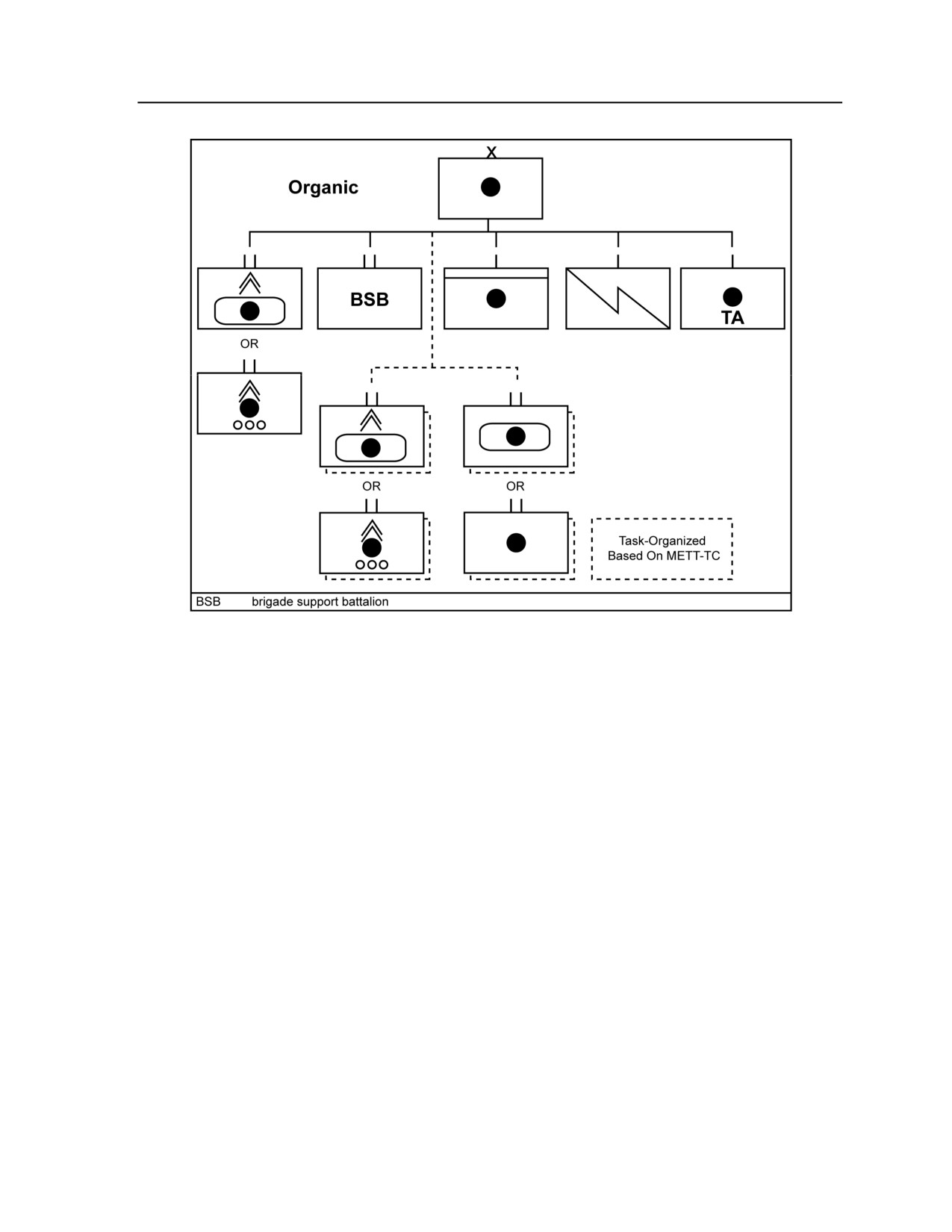
Army and joint forces. As depicted in figure B-1 (page B-5), the brigade has organic elements to provide
command and control, target acquisition, signal support, sustainment, and multiple launch rocket systems.
Because fires are never left in reserve, additional fires assets are task-organized to the brigade based on the
situation.
B-4
FM 3-92
26 November 2010
Fires
Figure B-1. Fires brigade
B-20. The fires brigade is capable of being a supported or supporting unit and providing and coordinating
lethal and nonlethal fires. Fires brigades also have the necessary fire support and targeting structure to
effectively execute the entire detect-decide-deliver-assess targeting process for its mission. The fires
brigade can be a force field artillery headquarters capable of coordinating, synchronizing, and employing
multiple Army and joint lethal and nonlethal fires units and assets in support of the force commander’s
concept of operation. Its capabilities include strike, counterfire, reinforcing fires for BCT organic fires,
electronic attack, suppression of enemy air defense, and support of other brigades. Additionally, the fires
brigade provides technical oversight of all field artillery specific training within the corps and its assigned,
attached, operational control, and tactical control and supporting units.
B-21. Future doctrine discusses the capabilities of the fires brigade and fires battalion. Additional
information on joint fire support coordination is found in JP 3-09.
26 November 2010
FM 3-92
B-5
Appendix C
Corps Signal Operations
As discussed in chapter 3, effective and reliable communications allow the corps’
command and control system to receive and disseminate information throughout the
corps area of operations and beyond. This appendix discusses corps command and
control in terms of its communications capabilities and those responsible for carrying
out communications.
COMMUNICATIONS CAPABILITIES
C-1. The Army corps is a networked entity. The network links decisions to actions. The corps
headquarters and its assigned organizations network with higher, lower, and adjacent military and
nonmilitary formations via organic and external network capabilities.
ORGANIC NETWORK CAPABILITIES
C-2. Organic network capabilities consist of LandWarNet, tactical network support, company
headquarters, and command post (CP) platoons.
LandWarNet
C-3. LandWarNet is the Army’s portion of the Global Information Grid. It consists of all globally
interconnected, end-to-end Army information capabilities that support warfighters, policy makers, and
support personnel. LandWarNet includes all Army networks that move information that facilitates joint
warfighting and supporting operations from the operational base to the edge of tactical formations, down to
the individual Soldier. Paragraphs C-4 through C-17 describe how the corps’ organic signal company and
external signal organizations support LandWarNet capabilities for the corps headquarters.
Tactical Network Support
C-4. The corps headquarters connects, interfaces with, and draws information from the LandWarNet in
garrison and when deployed. When deployed, the corps headquarters will interface with the theater army or
joint task force (JTF) to gain access to required information for mission accomplishment. The Global
Command and Control System (GCCS), and its Army component, GCCS-Army, are the command and
control components of the Army Battle Command System employed for this purpose.
C-5. The corps headquarters tactical communications systems are mobile, deployable, quickly installed,
secure, and durable. The corps headquarters network requirements include:
z
Extending services from home station to the corps’ area of operations (AO).
z
Connecting corps CPs to higher headquarters, all Service component command headquarters, the
Army Force headquarters (if the corps is not the ARFOR), and special operations forces.
z
Establishing communications with forces assigned, attached, under operational control
(OPCON), or under tactical control (TACON) of the corps headquarters.
C-6. In addition, the corps assistant chief of staff, signal (G-6) must:
z
Coordinate for resources to meet the communication needs of lower echelon organizations
without organic communications support that are attached, OPCON, or TACON to the corps
headquarters.
z
Provide electromagnetic spectrum management and deconfliction.
26 November 2010
FM 3-92
C-1
Appendix C
z
Coordinate services for remote or non-standard users, such as multinational forces, host nations,
nonstate actors, nongovernmental organizations, and others with unique communications needs.
z
As required, coordinate network support for joint enablers without adequate communications.
z
Support liaison operations at corps headquarters and coordinate support for corps liaison
personnel at remote locations.
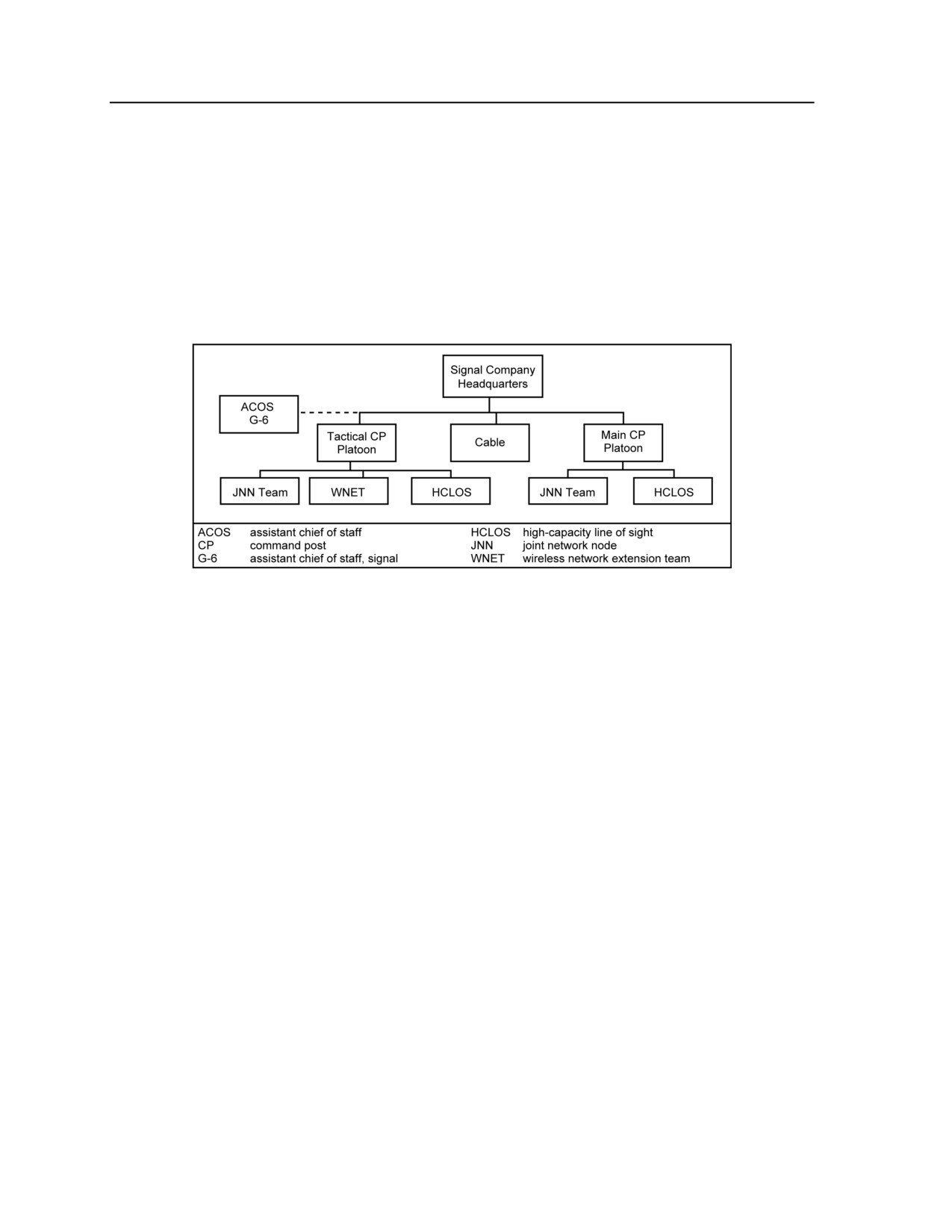
C-7. The corps headquarters is supported by the corps signal company (see figure C-1). The corps signal
company, part of the headquarters and headquarters battalion, is configured to provide support to the corps
main and tactical CPs, and the tables of organization and equipment also include the corps assistant chief of
staff, signal (G-6) structure. The corps signal company is commanded by a major, who receives technical
oversight from the corps G-6, a colonel.
Figure C-1. The corps signal company
Company Headquarters
C-8. The corps signal company provides 24-hour support to the corps headquarters. The company consists
of a headquarters, two CP support platoons, and a cable section. The platoons install, operate, maintain, and
defend the communications links connecting the corps main and tactical CPs with higher, lower, and
adjacent echelons.
C-9. The corps signal company headquarters provides command and control to the company. It supervises
the signal elements assigned or attached to the company and provides personnel and equipment to support
the company’s operational mission in garrison or when deployed. It is responsible for company
administrative, logistics, and maintenance support. It consists of a company headquarters and logistics
support personnel
(supply noncommissioned officer, armorer, and nuclear, biological, and chemical
noncommissioned officer).
Command Post Platoons
C-10. The main and tactical CP platoons provide sections to install, operate, and maintain communications
and connectivity to the LandWarNet for the corps’ CPs. The main CP platoon has a platoon headquarters; a
joint network node (JNN) section with two JNN teams and two secure, mobile, anti-jam, reliable tactical
terminal teams (sometimes known as SMART-T teams); and a high-capacity line-of-sight section with two
high-capacity line-of-sight teams. The tactical CP platoon has a platoon headquarters; a JNN section with
one JNN team and one secure, mobile, anti-jam, reliable tactical terminal team; a high-capacity line-of-
sight section with one high-capacity line-of-sight team; and two wireless network extension teams. The
cable section supports the main and tactical CPs as required.
Joint Network Node Section
C-11. The JNN section includes JNN teams (Warfighter Information Network-Tactical Increment 1) and
secure, mobile, anti-jam, reliable tactical terminal teams. The section installs and operates beyond line of
C-2
FM 3-92
26 November 2010
Corps Signal Operations
sight links, secure voice (tactical and Defense Switched Network), Non-Secure Internet Protocol Router
Network (known as NIPRNET), SECRET Internet Protocol Router Network (known as SIPRNET), Joint
Worldwide Intelligence Communications System (Limited), Defense Red Switch Network, and video
teleconferencing capabilities. The teams are capable of supporting forcible entry operations.
High-Capacity Line-of-Sight Section
C-12. The high-capacity line-of-sight section provides high-capacity multichannel radio links to augment
or replace satellite links where feasible.
Wireless Network Extension Teams
C-13. Wireless network extension teams provide wireless network retransmission, early entry and en route
communications, and support for unique communications systems such as Land Mobile Radio and
Wideband Harris Radio.
Cable And Wire Section (Main CP Platoon Only)
C-14. The cable and wire section provides cable and wire teams to the main and tactical CPs as required to
install, troubleshoot, repair, and evacuate cable and wire equipment. Cable and wire teams are capable of
performing outside plant cable functions once the corps cable infrastructure is established.
EXTERNAL NETWORK CAPABILITIES
C-15. Because the Army corps headquarters can operate at any point across the spectrum of conflict, it may
require access to signal assets from theater level and above. When needed, the corps’ organic
communications equipment may be augmented by systems from a theater signal command or by a national
or strategic asset such as the Joint Communications Support Element. The theater army’s signal
organization—either a signal command
(theater) or signal brigade—provides communications and
information systems support to the theater army headquarters, to theater army subordinate units, and, as
required, to joint and coalition organizations throughout the supported geographic combatant commander’s
area of responsibility. The signal command (theater) commander can assume the roles and responsibilities
as the senior signal officer in the theater to include acting as the communications system directorate of a
joint staff (J-6) or G-6 of the joint task force headquarters or senior Army command.
C-16. The theater signal command or brigade exercises command and control over signal organizations that
have been allocated to the theater. These may include theater tactical signal brigades, subordinate
expeditionary signal battalions, theater and subordinate strategic signal battalions, the theater network
operations and security center, combat camera teams, and a tactical installation and networking company
(see Field Manual Interim (FMI) 6-02.45). The theater signal organizations install, operate, and defend the
Army portion of the joint interdependent theater network, including the theater network service center. The
theater network service center provides connection, information services, and network operations
capabilities. These capabilities enable the corps headquarters and units allocated to the corps to interface
with both senior and subordinate units and the Global Information Grid. Currently, both the corps
headquarters and units allocated to the corps may also connect to the network through a deployed division
tactical hub node.
C-17. Units allocated to the corps that have no organic signal organization may receive dedicated support
from an expeditionary signal battalion, or they may be located at a site that permits sharing of existing
network support. Exact support requirements and allocations of pooled network resources are normally
determined during the deployment planning process. Following deployment, requests for additional signal
support are coordinated by the G-6 through the corps G-3.
COMMUNICATIONS RESPONSIBILITES
C-18. Responsibilities for communications falls to the corps assistant chief of staff, signal (G-6) and corps
headquarters G-6 section. The latter consists of the main CP G-6 section and tactical CP signal systems.
26 November 2010
FM 3-92
C-3
Appendix C
CORPS ASSISTANT CHIEF OF STAFF, SIGNAL (G-6)
C-19. The G-6 provides the plans, operations, staff oversight, and coordination for information systems and
communications to the corps headquarters and attached, OPCON, and TACON units. The G-6 is the senior
signal officer in the corps and coordinates with peer counterparts at lower, adjacent, and higher echelons of
command to ensure adequate network support. Should the corps headquarters serve as the core element for
a joint task force, the corps assistant chief of staff, signal will become the joint task force J-6 unless
superseded by a more senior signal officer.
C-20. The corps headquarters G-6 section manages the extension of Defense Switched Network and
LandWarNet services throughout the corps AO. It also integrates LandWarNet assets, including strategic
and tactical signal and network operations organizations, in support of corps operations. The corps G-6
coordinates with the G-3 to obtain theater resources when network missions exceed the capability of the
organic signal units.
C-21. The corps G-6 section is responsible for network operations and information management functions
within the corps AO. The section provides advice, direction, and guidance concerning network operations.
The G-6 develops the corps network architecture and is responsible for LandWarNet operations within the
corps AO, to include support of subordinate elements, if required. The G-6 section consists of elements to
support the main and tactical CPs. These elements are not static and can be tailored to suit the situation.
MAIN COMMAND POST G-6 SECTION
C-22. The main CP is the corps’ primary command and control element, and as such has the largest signal
representation. The G-6 section manages connectivity to audio, video, written, and data systems supporting
corps staff elements operating in the main CP. The corps G-6 is the senior signal officer in the corps and is
chief of the signals section. Signal Soldiers are assigned to the corps signal company of the headquarters
and headquarters battalion, with duty in the main CP. The main CP G-6 section—
z
Monitors, manages, and controls organic communications systems that interface with the Global
Information Grid.
z
Plans signal support for current and future operations.
z
Manages installation and operation of the main and tactical CPs local area networks and operates
the corps help desk.
z
Assists units allocated to the corps with network installation and troubleshooting.
z
Serves as the corps information service support office.
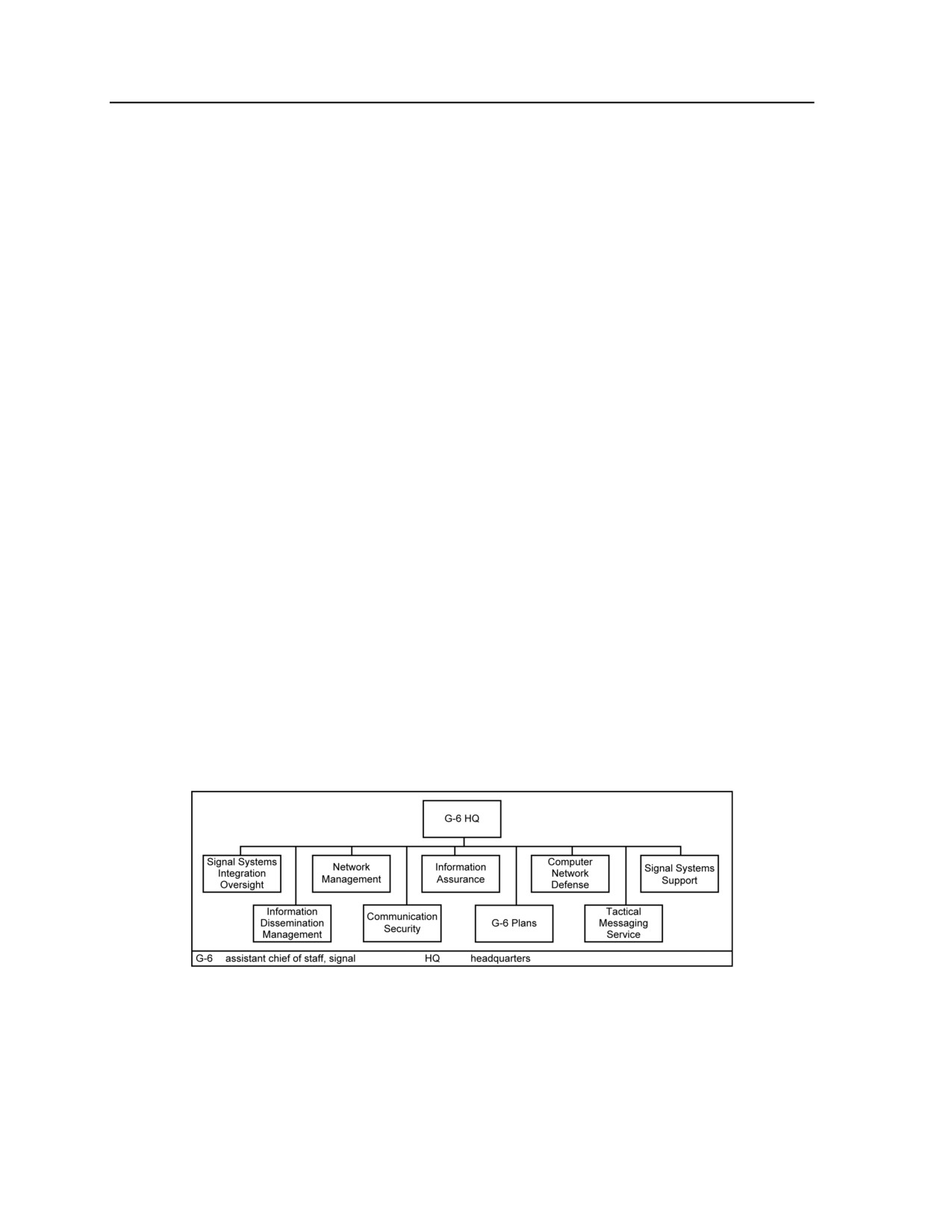
C-23. The subordinate elements of the G-6 section are organized as shown in figure C-2.
Figure C-2. Corps main command post G-6 section
TACTICAL COMMAND POST SIGNAL SYSTEMS SUPPORT ELEMENT
C-24. The tactical CP signal systems support element performs functions in the tactical CP similar to those
performed by the assistant chief of staff, signal element in the main CP. The element of 26 Soldiers can be
tailored (augmented or reduced) by the G-6 to meet specific mission requirements. When the tactical CP
C-4
FM 3-92
26 November 2010
Corps Signal Operations
deploys, the tactical CP signal systems support element manages the local equipment and facilities that
collect, protect, process, store, display, and disseminate information in the tactical CP. These Soldiers
monitor, manage, and control organic communications systems that interface with the Global Information
Grid, and manage a set of integrated applications, processes, and services that provide the capability for
corps tactical CP staff elements to locate, retrieve, send, and receive information. Network operations
functions supporting the tactical CP are normally performed by the corps network operations and security
center located at the main CP.
26 November 2010
FM 3-92
C-5
Appendix D
Airspace Command and Control
A corps commander synchronizes forces and warfighting functions in the vertical
dimension in near-real time. Friendly surface, subsurface-, and air-launched weapon
systems from multiple components share the airspace above the corps area of
operations without hindering the application of combat power. The conduct of
airspace command and control is a major responsibility. To accomplish this mission,
corps commanders routinely coordinate airspace requirements with the joint,
multinational, and nonmilitary airspace users. This appendix discusses the application
of airspace command and control and its elements to corps headquarters operations.
This appendix also discusses the responsibilities and connectivity of airspace
command and control. See Field Manual 3-52 for details on airspace command and
control.
AIRSPACE COMMAND AND CONTROL APPLICATION
D-1. All airspace is joint. Each joint operations area has unique airspace control requirements for its
various airspace users: joint, multinational, nonmilitary, and Army (air and missile defense, Army aviation,
unmanned aircraft, and field artillery). Airspace command and control focuses on integrating airspace used
by this diverse set of airspace users.
D-2. Airspace control includes identifying, coordinating, integrating, and regulating airspace to increase
operational effectiveness. Air Force Doctrine Document (AFDD) 2-1.7 explains that airspace control is
essential to combat effectiveness in accomplishing the joint force commander’s (JFC’s) objectives at all
levels of conflict. Marine Corps Warfighting Publication (MCWP) 3-25 states that airspace management is
used to optimize the use of available airspace to allow maximum freedom, consistent with the degree of
operational risk acceptable to the commander. Finally, Field Manual (FM) 3-52 reminds the reader that
airspace control is provided to prevent fratricide, enhance air defense operations, and permit greater
flexibility of operations. (Joint Publication (JP) 3-52 discusses joint doctrine on airspace command and
control.)
D-3. Joint forces use airspace to conduct air operations, deliver fires, provide air defense, and facilitate
intelligence operations. The inherent multi-Service and multinational character of airspace operations are
part of an overall theater air ground system. The theater air ground system community—
z
Establishes close liaison and coordination among all airspace users to facilitate unity of effort.
z
Maintains common airspace control procedures implemented in an uncomplicated manner.
z
Emphasizes flexibility and simplicity to retain the ability to respond to evolving enemy threat
conditions and evolving friendly operations.
z
Supports 24-hour and adverse weather operations.
z
Strives for fratricide reduction and risk balance.
z
Uses durable, reliable, redundant, and secure networks and intelligence, surveillance, and
reconnaissance systems for airspace command and control.
z
Ensures members of the airspace command and control team—combined arms headquarters,
combat air traffic controllers, airfield operations, tactical air control parties (TACPs), air crews,
airspace planners, fire support coordinators, air defenders—train as they will fight.
D-4. Airspace command and control is a command and control warfighting function task. It integrates all
joint airspace users as they plan and execute the commander’s intent, vision, priorities, and acceptable level
of risk that maximize all airspace user capabilities and minimize adverse impacts. Airspace command and
26 November 2010
FM 3-92
D-1
Appendix D
control contributes to situational understanding, enhances the common operational picture (COP), fosters
coordination with organic and outside organizations, and communicates with all affected organizations.
Airspace command and control employs established, agreed-upon doctrine and procedures.
D-5. Airspace command and control integrates airspace use just as other corps staff elements integrate
terrain use. The corps main and tactical command posts (CPs) contain movement and maneuver cells. The
main CP airspace command and control section and tactical CP airspace command and control element
implement the commander's guidance as it affects airspace using the airspace command and control annex
to the operation plan or operation order. They also implement the commander’s priorities in the corps input
to the airspace control order. Sometimes conflicts arise between requirements of different airspace users or
when commander’s risk guidance is exceeded. In these cases, the airspace command and control section or
element attempts to integrate the requirements by modifying planned airspace use without degrading the
mission effectiveness of any airspace user. If the airspace conflict cannot be resolved without degrading the
mission effectiveness of an airspace user, or if the risk still exceeds risk guidance, the airspace command
and control section or element deconflicts airspace use based on the commander’s priorities and seeks a
decision from the assistant chief of staff for operations.
D-6. Army airspace command and control doctrine does not denote that any airspace contiguous to the
battlefield, or any other geographical dimension of airspace, is designated as Army airspace. Nor does it
imply command of any asset that is not attached to or under operational control (OPCON) or tactical
control of an Army commander. Under joint doctrine, airspace is not owned in the sense that assignment of
an area of operations confers ownership of the ground. Airspace is used by multiple components, and the
JFC designates an airspace control authority—usually the joint force air component commander
(JFACC)—to manage airspace in the joint operations area. Even the JFC has varying degrees of control of
the airspace. The commander’s control depends on the characteristics of the area of operations (AO) and
the political and international agreements with the host nation. Therefore, for each operation (or phase of
the operation), the JFC will have more or less authority in controlling the airspace. Airspace use is
negotiated as the limits of the JFC’s authority changes and priorities shift.
D-7. Airspace, like ground space, is not an unlimited resource. The airspace over a corps AO is constantly
in use by multiple users and can easily become saturated. Two key functions of the airspace command and
control are to identify to the commander and senior staff when airspace is approaching saturation and to
make recommendations for the most effective use of the airspace with the associated risk or benefit.
AIRSPACE COMMAND AND CONTROL ELEMENTS
D-8. Airspace command and control staff are organic to Army forces, brigade and higher. Corps and
division both contain an airspace command and control section in their main and an airspace command and
control element in their tactical CPs. The brigade combat teams (BCTs) and support brigades (except
sustainment) contain a version of an air defense airspace management/brigade aviation element
(ADAM/BAE). These elements integrate brigade airspace command and control, including air and missile
defense and aviation functions. Each element coordinates with higher, subordinate, and adjacent elements
to maximize the efficiency of airspace management and the lethality of weapon systems occupying or
transiting the airspace.
THEATER-LEVEL AIRSPACE COMMAND AND CONTROL
D-9. The airspace command and control section at theater army plans and organizes the theater-level
airspace command and control architecture, establishing standards and policy, publishing the airspace
command and control annex, and providing the Army’s input to the theater’s airspace control plan, the
airspace control order, and special instructions. The airspace control plan—the joint document approved by
the JFC—provides specific planning guidance and procedures for the airspace control system for the joint
operations area. Theater army airspace command and control planners ensure these documents adequately
address subordinate units’ airspace requirements. An excessively restrictive airspace control plan can
hinder operations conducted by theater army subordinate units.
D-10. Most airspace command and control coordination among the joint force land component commander
(JFLCC), the JFACC, the joint force maritime component commander, and other senior headquarters
D-2
FM 3-92
26 November 2010
Airspace Command and Control
occurs at the joint air operations center. The JFC designates the airspace control authority and defines the
relationship between it and component commanders. Normally, the JFC designates the JFACC as the
airspace control authority. However, regardless of who is designated as the airspace control authority, the
airspace control authority does not have the authority to approve, disapprove, or deny combat operations.
That authority is only vested in operational commanders. The Army battlefield coordination detachment
(BCD) serves as the ARFOR or theater army liaison to the JFACC in the joint air operations center. At this
level of command, the BCD provides an airspace command and control interface between the theater
airspace information systems and subordinate Army and other Service elements executing airspace
command and control functions.
CORPS-LEVEL AIRSPACE COMMAND AND CONTROL
D-11. The corps headquarters oversees airspace command and control policy and standardization of tactics,
techniques, and procedures throughout the corps AO. The corps airspace command and control sections in
the main and tactical CPs enable this standardization by integrating all airspace requirements for the corps
staff and subordinate units. The corps airspace command and control section links to the theater army
airspace command and control section with the BCD to ensure that the airspace control authority planning
and execution documents and policies account for corps requirements and issues.
D-12. The corps airspace command and control section is designed to execute airspace command and
control even if the corps serves as an intermediate tactical headquarters, an ARFOR, a joint force land
component headquarters, or a joint task force (JTF) headquarters. Airspace command and control personnel
in the main and tactical CPs integrate airspace operations with the functional cells and with the integration
cells. The airspace command and control element also coordinates with the tactical air control party
(TACP) and the air support operations center (ASOC) colocated with the corps headquarters.
D-13. As the airspace command and control functional lead for the corps staff, the airspace command and
control section develop standing operating procedures and airspace command and control annexes that help
standardize airspace command and control operations among subordinate units. These procedures and
annexes ensure consistency with joint airspace procedures and the theater airspace control plan,
Aeronautical Information Publication, and associated plans and orders. Airspace command and control
sections in the main CP perform the following functions in support of the corps mission:
z
Provide airspace management expertise for the corps AO.
z
Monitor joint airspace operations.
z
Plan and update input to the joint airspace control plan.
z
Integrate the corps airspace command and control architecture into the joint airspace command
and control architecture.
z
Develop the airspace control architecture to support corps plans.
z
Draft all airspace command and control input for operation orders, operation plans, annexes, and
estimates.
z
Plan and request immediate airspace coordinating measures (ACMs).
z
Deconflict airspace through appropriate authority.
z
Coordinate with the corps movement and maneuver (for aviation), intelligence (for intelligence,
surveillance, and reconnaissance), and fires and protection (for air and missile defense) cells.
z
Provide air traffic service expertise to the corps headquarters.
D-14. The corps can be a tactical headquarters subordinate to a theater army functioning as a joint force
land component or JTF. In this case, the airspace command and control section provides airspace
requirements to the higher headquarters’ airspace command and control section for integration into their
daily airspace requests. This integration applies to the next airspace control order and for inclusion into the
higher headquarters’ airspace command and control annex.
D-15. During the execution phase of tactical operations, the corps headquarters normally decentralizes
airspace integration to subordinate divisions and BCTs within their respective AOs. It also authorizes direct
liaison between them and other theater air ground system execution airspace control nodes provided by
other Services. These entities include Air Force control and reporting centers and Airborne Warning and
26 November 2010
FM 3-92
D-3
Appendix D
Control System (AWACS), Marine Corps direct air support center and tactical air operations center, and
other airspace command and control entities for rapid resolution of airspace issues. For corps assigned,
attached, OPCON, or tactical control BCTs or other brigades assigned their own AO, the corps delegates
control over Army airspace users within the respective AOs while corps retains responsibility for
integrating joint, multinational, and nonmilitary airspace users. The corps integrates all airspace
requirements for corps BCTs and other brigades not assigned an AO. The corps airspace command and
control section retains responsibility for airspace control over portions of the AO not assigned to
subordinate units. However, even when authorizing direct liaison to subordinate units, corps retains
responsibility for policy. The corps may have OPCON of a Marine air-ground task force (MAGTF). How a
MAGTF integrated with corps airspace command and control depends on the size and capabilities of the
MAGTF. The MAGTF’s aviation combat element includes Marine air command and control system
capabilities tailored for the size of the aviation combat element. Smaller regimental-based MAGTFs (with
unmanned aircraft systems) may integrate in a similar manner to BCTs. Larger MAGTFs bring the full
joint capability to control airspace over the MAGTF AO. Large MAGTFs can include a division-based
Marine expeditionary force with the full range of Marine rotary- and fixed-wing aviation as well as a robust
Marine air command and control system. A joint doctrinal relationship exists between the JFACC and
JFLCC. In this case, the MAGTF requires authorized direct liaison to coordinate airspace and air operations
directly with the joint air operations center.
D-16. The corps headquarters can provide airspace command and control support to multinational forces
OPCON to the corps. These forces may lack airspace control capabilities and will require assistance from
the corps airspace command and control section. They can be supported in a manner similar to Army
functional brigades working directly for the corps.
D-17. The corps can function as a joint force land component headquarters or JTF headquarters with
appropriate augmentation. (See chapter 5.) As the joint force land component headquarters, the corps
airspace command and control section integrates airspace requirements among a wide range of airspace
users (Army, joint, and multinational). As a JTF headquarters, the airspace command and control section
works with the airspace control authority and the components to build a responsive airspace control
structure. In both cases, the corps airspace command and control section develops joint force land
component or JTF input to the airspace control authority through the BCD for the airspace control order,
the airspace control plan, and associated plans and orders.
DIVISION AIRSPACE COMMAND AND CONTROL
D-18. Division airspace command and control oversees airspace command and control for the entire
division AO, regardless of whether the AO has been further assigned to the BCT. When a division allocates
part of its AO to a BCT, some airspace command and control responsibilities are delegated to the BCT.
Division airspace command and control still integrates joint, multinational, and nonmilitary airspace users
over the entire division AO both in planning and in execution. If the division has an unusually large AO or
if the division AO is noncontiguous, then the division can delegate more airspace command and control
responsibilities to the BCTs, but this may require augmentation of additional airspace command and control
personnel to the BCT.
CORPS AIRSPACE COMMAND AND CONTROL ELEMENT ORGANIZATION
D-19. The airspace command and control element consists of air traffic services and air defense artillery
personnel. The teaming of these Soldiers is the key to the flexibility of the airspace command and control
element. Their complementary skills help the airspace command and control element perform the full range
of its functions (integration, identification, coordination, regulation) necessary to control Army users of
airspace. The corps airspace command and control element has personnel in the main CP’s movement and
maneuver cell, current operations integration cell, and in the tactical CP, if deployed. While both the main
and the tactical CPs have airspace command and control personnel, only the main CP can perform all
airspace command and control tasks without augmentation.
D-4
FM 3-92
26 November 2010
Airspace Command and Control
MAIN COMMAND POST AIRSPACE COMMAND AND CONTROL SECTION
D-20. The main CP’s airspace command and control section has personnel in both the current operations
integration cell and movement and maneuver cell. The main CP airspace command and control section can
perform all airspace command and control tasks required for a tactical or operational headquarters. The
corps airspace command and control section has the digital compatibility to interface with the Marine
Corps and multinational automation systems (if the multinational forces receive a digital liaison officer
team). The airspace command and control section lacks the capability to function as an airspace control
authority. (See FM 3-52, appendix B.)
CURRENT OPERATIONS INTEGRATION CELL AIRSPACE COMMAND AND CONTROL
D-21. The current operations integration cell airspace command and control support section consists of the
corps airspace command and control officer and an airspace command and control noncommissioned
officer. The current operations integration cell airspace command and control support section ensures the
current operations integration cell has the latest available airspace information. This support section
presents airspace issues, airspace risk decisions, and airspace benefit decisions to the chief of the current
operations integration cell for decisions.
MOVEMENT AND MANEUVER CELL AIRSPACE COMMAND AND CONTROL
D-22. The movement and maneuver cell airspace command and control section coordinates airspace users
across warfighting functions, produces the corps’ unit airspace plan, coordinates with higher airspace
command and control sections, and produces the corps’ input to the airspace control order. The airspace
command and control section coordinates with the air and missile defense element to integrate the air and
missile defense plan and air picture with the fires cell for integrated fires and with the TACP or ASOC for
integrated JFACC airspace users. The main CP’s airspace command and control section routinely works
with the air battle manager from the ASOC if an ASOC is supporting the corps.
D-23. The airspace command and control section is manned, equipped, and trained to provide airspace
control with volumes of airspace allocated to the corps by the airspace control authority. This could be
control of a high-density airspace control zone or control of various types of restricted operations zones.
However, the size of the corps AOs may make it impractical to control a corps high-density airspace
control zone. Normally, corps decentralizes airspace command and control current operations to the
divisions or BCTs AOs within the corps AO.
D-24. The corps can improve joint airspace coordination during the execution of operations by
collaborating with the JFACC’s control and reporting centers or AWACS. This collaboration improves the
control and reporting center’s situational awareness of ground operations and multi-Service coordination
during operations. The corps positions some of its airspace command and control personnel at the JFACC’s
control and reporting center as one method to improve collaboration.
D-25. The airspace command and control section can send an airspace command and control planner with
an airspace workstation to support the assistant chief of staff, plans (G-5) if required. It can shift personnel
to the tactical airspace command and control section as required.
TACTICAL COMMAND POST AIRSPACE COMMAND AND CONTROL
D-26. The tactical CP can be deployed as a corps command and control facility under many circumstances.
(See chapter 3.) The deputy airspace command and control officer or other designated airspace command
and control leader is located in the tactical CP. The tactical CP’s airspace command and control officer
advises the commander and staff on airspace issues and provides increased situational awareness. This
officer sends airspace issues identified by the tactical CP to the main CP for resolution, if it is available.
Normally, the corps only designates the tactical CP as the lead airspace command and control element
when the main CP must reposition or is otherwise unavailable. In this case, for the tactical CP to integrate
airspace command and control for the corps, additional airspace command and control personnel augment
the tactical CP.
26 November 2010
FM 3-92
D-5
Appendix D
SHARED AIRSPACE COMMAND AND CONTROL RESPONSIBILITIES
D-27. Within the corps headquarters, airspace command and control is a combined effort requiring the
work of several cells and sections supervised by the commander and senior leaders. These cells and
sections consist of the future operations and plans integrating cells, fires cell, movement and maneuver-
aviation section, protection cell-air and missile defense section, and Air Force element.
FUTURE OPERATIONS AND PLANS INTEGRATING CELLS
D-28. The corps planning elements, future operations for short-term planning, and plans for long-range
planning coordinate with the airspace command and control section to ensure the integration of air
maneuver, fires, and protection airspace requirements. This input is forwarded to the BCD in the joint air
operations center for input into the theater’s airspace control order and the daily air tasking order.
D-29. During operations, the corps’ three integrating cells in the main CP—current operations integrating
cell, future operations cell, and plans cell—rely on the airspace command and control section for input to
operation orders, operation plans, branches, and sequels. These inputs include analyzing the course of
action during planning, appropriate ACMs to support current and future operations, and recommended
changes to the theater airspace control plan.
FIRES CELL
D-30. Airspace command and control works with the fires cell to ensure that fire support coordination
measures are integrated with the unit airspace plan. Although the airspace command and control section
reviews and integrates the fire support overlay with other airspace requirements, fire support coordination
measures are normally sent to higher headquarters through fires channels. The airspace command and
control section and the fire support cell ensure the corps standing operating procedures and the respective
annexes address the procedures for forwarding fire support coordination measures and associated airspace
control measures for the appropriate chain of command. This parallel teamwork also applies to control
measures such as joint fires areas, counterfire, restricted operations zones, and airspace coordination areas.
The TACP element in the fires cell needs to review the airspace control order to ensure that ACMs do not
unnecessarily interfere with fires and that the ACMs are in a format that the fires command and control
system can process. If a conflict exists between the fires plan and the airspace control order, the airspace
command and control element coordinates with the higher airspace command and control elements to
correct or modify the appropriate ACM.
D-31. The airspace command and control element and the fires cell can integrate immediate fires with other
airspace users. If the coverage and clarity of the air picture is good and the corps has communications with
airspace users, the airspace command and control element and the fire support cell can work together to
provide the corps the option of clearing fires based on the COP. This process requires near-real-time sensor
data, communication with both fire units and airspace users, and integration of this process with the corps
decisionmaking process for risk and benefit decisions. Airspace clearance may involve direct coordination
with other theater air ground system airspace control elements, such as AWACS and the Marine Corps
direct air support center. This joint coordination occurs at all levels controlling fires. Often the corps
authorizes divisions and BCTs to coordinate directly with the theater air ground system airspace control
elements for immediate fires. However, some situations will require the corps to retain joint fires or
airspace coordination at corps level.
MOVEMENT AND MANEUVER AVIATION SECTION
D-32. Army aviation depends on the effective use of airspace to accomplish missions. Rotary- and fixed-
wing assets—including unmanned aircraft systems—are generally conducted close to the ground and
linked to ground maneuver at all echelons. The aviation section provides Army aviation mission data for
manned and unmanned aircraft to the airspace command and control section. The airspace command and
control section ensures that aviation airspace requirements are integrated into the corps airspace plan.
D-33. Most aviation mission planning (manned and unmanned) occurs at the combat aviation brigade.
However, when necessary, the corps aviation section in the movement and maneuver cell can perform
D-6
FM 3-92
26 November 2010
Airspace Command and Control
aviation mission planning. The airspace command and control section supports the aviation element by
taking aviation mission planning data and building the appropriate ACM structure necessary to accomplish
the mission. The airspace command and control section with air traffic service warrant officers and
noncommissioned officers in the main and tactical CPs provides the aviation section with air traffic service
expertise to assist with planning the use of air traffic service assets.
PROTECTION CELL AIR AND MISSILE DEFENSE SECTION
D-34. The air and missile defense section in the main CP protection cell is the lead staff element for the
coordination of air and missile defense activities with the airspace command and control, fires, and other
cells. The corps air and missile defense (AMD) section is the staff lead for integration into the joint tactical
digital information link network and for the production of the COP. The airspace command and control
section coordinates with the AMD section to ensure that the corps has the necessary sensor architecture to
provide a complete and timely air operational picture. This includes planning the employment of air
defense radars, weapons systems, and appropriate communications links. The AMD section provides the
AMD plan to the airspace command and control section for integration into the corps unit airspace plan.
Although the airspace command and control section reviews and integrates the corps air defense plan with
other corps coordinating measures, normally the coordinating measures for the AMD plan are sent to
higher headquarters through AMD channels.
AIR FORCE ELEMENTS
D-35. Some elements of the theater air control system are liaisons provided to the corps or theater army by
the Air Force. These include the air mobility liaison officer, the TACP, and the ASOC. They function as a
single entity in planning, coordinating, deconflicting, and integrating air support operations with ground
elements. They work with the airspace command and control, AMD, and aviation section and fires cell of
the main and tactical CPs. They also coordinate with liaisons, such as the battlefield coordination
detachment, the theater army air and missile defense coordinator, and ground liaison officers. If an ASOC
supports the corps, the ASOC and its subordinate TACPs provide direct support to the corps subordinate
Army units. The ASOC plays a major role in airspace control in the corps AO providing Army procedural
control of all close air support aircraft supporting corps operations.
AIRSPACE COMMAND AND CONTROL CONNECTIVITY
D-36. The corps airspace command and control section is linked to subordinate airspace command and
control sections at the division and with the ADAM/BAE or air defense airspace management cells at the
BCT or brigade. Together they form a network of airspace command and control capable of controlling
airspace users in the low-to-medium altitudes over a corps AO.
D-37. The corps airspace command and control collaborates with theater airspace control system nodes
such as the control and reporting center, AWACS, ASOC, and TACP. The corps airspace command and
control section also can communicate to joint, multinational, and nongovernmental aircrafts. Airspace
command and control can integrate with ASOC controllers and air battle managers to provide an integrated
Army and Air Force airspace command and control control node. The corps airspace command and control
section is capable of voice and digital airspace data exchange with Marine air command and control system
airspace control elements and can receive digital airspace requests from a Marine Corps regiment if one is
OPCON to a corps.
D-38. The corps main CP airspace command and control section contains a full suite of airspace
workstations, ground-to-air radios, and communications equipment necessary to bring in the joint air
operations picture independent of the other networks. The airspace command and control element in the
tactical CP has airspace workstations but relies on the AMD element to bring in the air operations picture.
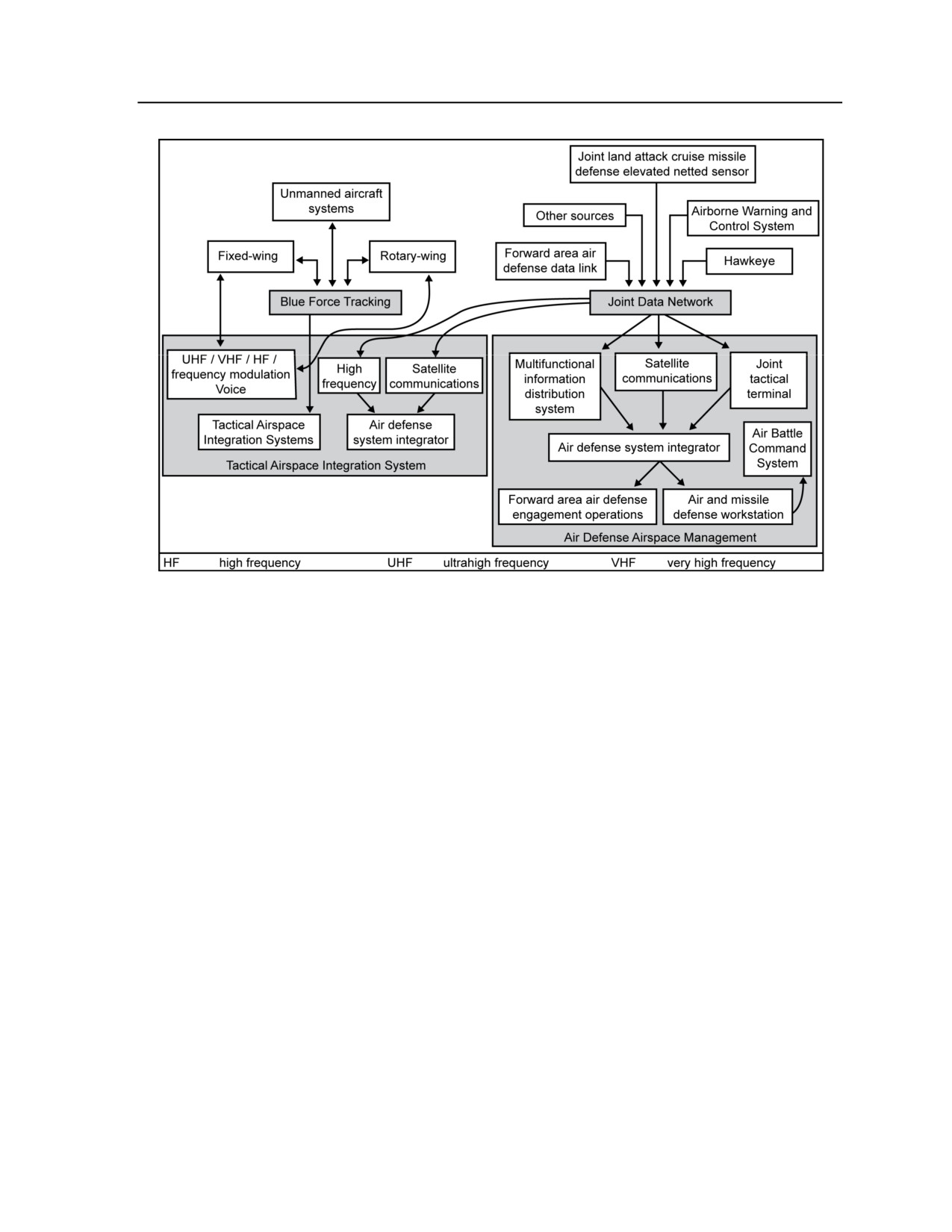
Figure D-1 (page D-9) depicts corps airspace command and control connectivity.
D-39. Airspace command and control capabilities within the divisions, BCTs, and modular supporting
brigades supplement but do not replace corps airspace command and control capabilities. Airspace
command and control capabilities of the units allow the corps to focus on joint airspace integration within
26 November 2010
FM 3-92
D-7
Appendix D
the corps AO. These capabilities also allow control of airspace users over portions of the corps AO
unassigned to divisions and BCTs while delegating authority to the divisions and BCTs to integrate all
Army airspace use within their AOs.
BRIGADE AIRSPACE COMMAND AND CONTROL
D-40. All the BCTs, multifunctional brigades, and support brigades (except sustainment) have a version of
an organic ADAM/BAE. This staff element consists of air defense artillery and aviation personnel and does
the airspace command and control integration function for the brigade in addition to its AMD and aviation
functions. While other members of the brigade staff are key airspace command and control members (fire
support cell, air liaison officer, and tactical unmanned aircraft system operators), the ADAM/BAE officer
in charge is the airspace command and control integrator for the operations staff officer (S-3).
Note: An ADAM/BAE has additional aviation personnel, providing a larger aviation planning
capability than the air defense airspace management element. Both have the same airspace
command and control capabilities.
D-41. When a BCT controls an AO, the authority that the BCT has over Army airspace users is the same as
the BCT’s authority over ground units transiting its AO. All Army airspace users transiting a BCT AO
coordinate with the BCT responsible for the AO they are transiting. The BCT’s higher headquarters
(division or corps) only integrate Army airspace use between BCTs if adjudication between BCTs is
necessary. Often BCTs have the authority to coordinate directly with joint airspace control elements
controlling airspace over the BCT (control and reporting center or AWACS) to coordinate fires or
immediate airspace. In some situations, for example, in heavily used airspace or airspace with many joint
and nonmilitary airspace users, the higher headquarters may withhold this authority. For certain situations,
it may be necessary to request approval for a BCT to control a volume of airspace such as a high-density
airspace control zone. However, if a BCT is to control airspace within a high-density airspace control zone
for extended periods, the ADAM/BAE should be augmented. Augmentation can include additional air
traffic service airspace command and control assets from the division or corps airspace command and
control section or airspace information center of the combat aviation brigade and airfield operations
battalions.
D-8
FM 3-92
26 November 2010
Airspace Command and Control
Figure D-1. Corps main command post joint airspace connectivity
D-42. Functional brigades without an organic ADAM/BAE still retain all of the brigade responsibilities for
airspace command and control but rely on their higher headquarters for airspace command and control
integration. If a functional brigade is under the control of a support brigade (for example, military police
brigade under a maneuver enhancement brigade), the support brigade integrates the functional brigade
airspace command and control requirements. If the functional brigade is directly under the control of a
corps, then the corps airspace command and control section integrates the brigade airspace command and
control requirements.
D-43. Several multifunctional support brigades such as the combat aviation brigade or fires brigade do not
routinely control AOs but conduct operations throughout the corps AO. Normally these brigades coordinate
their airspace use with the divisions and BCTs whose AOs they will transit (or with corps airspace
command and control for portions of the corps AO unassigned to a division or BCT). Airspace command
and control becomes more complex when corps tasks these brigades to execute a mission (such as
interdiction attack or strike) that affects airspace use by other divisions or brigades. The brigade conducting
the operation is the lead airspace command and control planner with the higher headquarters airspace
command and control section providing planning and airspace integration support to the brigade air defense
airspace management. The division or corps airspace command and control section checks that its airspace
plan is adjusted to take into account the brigade commander’s priorities and concept of operations.
26 November 2010
FM 3-92
D-9
Appendix E
Air Force Interface in Corps Operations
Air support is vital to the conduct of successful corps operations. Using ground-, air-,
and space-based capabilities, the Air Force supports corps operations. This appendix
focuses on the Air Force airpower support to the Army. It describes the organizations
involved in coordinating air support with corps headquarters. It briefly discusses each
air function in support of corps headquarters and introduces common airspace
coordinating measures.
INTRODUCTION
E-1. The Army corps primarily serves as an intermediate tactical headquarters under a land component
command with assigned, attached, operational control (OPCON), or tactical control (TACON) of multiple
divisions, including multinational or Marine Corps formations. The theater army tailors forces for the corps
headquarters to meet mission requirements. As a part of the joint force, Air Force support is available to
facilitate corps operations. Air Force support includes close air support (CAS); intelligence, surveillance,
and reconnaissance
(ISR); air interdiction; information engagement; command and control warfare;
counterair; and airlift missions. The Air Force systems enhance how the Army conducts strike or attack
operations using fires brigades, combat aviation brigades, or other assigned, attached, OPCON, or TACON
formations.
E-2. The Air Forces’ inherent ability to mass airpower—with other lethal and nonlethal fires, and
maneuver at the desired place and time—makes it an important component of the operations process.
Massing airpower can involve ground maneuver shaping operations to cause enemy forces to mass and
become more vulnerable to air attack. Massing airpower can also support a decisive operation to attack
massed enemy forces so ground forces can destroy the enemy in pieces. Air Force support is conducted at
any location within the corps’ area of operations (AO), including those areas assigned to subordinate
divisions, brigade combat teams (BCTs), and functional brigades. Air Force ISR, command and control
warfare, CAS, air interdiction, counterair, suppression of enemy air defenses, and space capabilities are
important components of corps operations in unassigned areas. Those areas of the corps AO have not been
further sub-allocated to subordinate organizations. (Chapter 4 discusses unassigned areas.)
E-3. Air Force support of the corps’ sustaining operations routinely involves the tactical or strategic
airlifting of all classes of supplies, equipment, or augmentation to corps subordinate units. Further,
counterair support to preempt or counter enemy air attacks and CAS are not usually allocated to units in the
corps support area. This support may be diverted from other missions to help a maneuver enhancement
brigade counter a level II or III threat.
AIR SUPPORT ELEMENTS
E-4. To achieve the necessary degree of joint coordination, the Army and Air Force provide qualified
personnel to work with each others’ headquarters. The supporting Air Force personnel remain under the Air
Force chain of command but receive logistics support from the supported Army unit. Air Force personnel
come from the theater air control system and the Army air-ground system. The theater air control system
consists of the air support operations center, air component coordination element, wing operations center,
airborne command and control elements, and control and reporting center. The Army air-ground system
consists of personnel from the battlefield coordination detachment, tactical operations center, and tactical
command post (CP). See Joint Publication (JP) 3-09.3 for a thorough discussion of these organizations and
their personnel.
26 November 2010
FM 3-92
E-1
Appendix E
THEATER AIR CONTROL SYSTEM
E-5. The commander, Air Force forces exercises command and control over assigned and attached forces
through the theater air control system. Theater air control system provides the commander the capability to
conduct joint air operations. The commander of Air Force forces’ focal point for tasking and exercising
OPCON over Air Force forces allocated in support of the Army is the Air Force air support operations
center
(ASOC), which is subordinate to the joint air operations center. Closely related to, and
interconnected with the theater air control system, is the Army air-ground system. More information on the
theater air control system is found in JP 3-09.3 and JP 3-30.
ARMY AIR-GROUND SYSTEM
E-6. The Army air-ground system provides the control system for synchronizing, coordinating, and
integrating air operations with the land component commander’s scheme of maneuver. Some elements
attached to the Army air-ground system are liaisons provided by the Air Force. These elements are the air
mobility liaison officer, the tactical air control party (TACP), and the ASOC. They function as a single
entity in planning, coordinating, deconflicting, and integrating the air support operations with ground
elements. The principal Army agencies are CPs, fire support elements, air and missile defense elements,
airspace command and control elements, and coordination and liaison elements. The latter can consist of
the battlefield coordination detachment (BCD), theater army air and missile defense coordinator, and
ground liaison officers.
AIR SUPPORT OPERATIONS CENTER
E-7. When the corps operates as the senior tactical Army echelon (not to be confused with the term
intermediate tactical headquarters), the air component provides the corps an air support operations center.
The air support operations center has five primary functions. It manages CAS assets within the supported
ground commander’s AO; processes CAS requests and controls the flow of CAS aircraft; deconflicts
airspace coordinating measures and fire support coordination measures with aircraft; assigns and directs
attack aircraft, when authorized, to the joint terminal attack controllers (JTACs); and manages the Air
Force air request net and its specific tactical air direction net frequencies.
AIR COMPONENT COORDINATION ELEMENT
E-8. For large operations, the joint force air component commander (JFACC) or commander, Air Force
forces establishes an air component coordination element. This element better integrates air and space
operations with surface operations and provides liaison with the theater army, corps headquarters, or other
Army headquarters. The air component coordination element is colocated with the joint force land
component commander (JFLCC) staff. The air component coordination element is the senior Air Force
element assisting the senior-level Army staff in planning air component supporting and supported
requirements. The air component coordination element exchanges current intelligence, operational data,
and support requirements, as well as coordinates the integration of JFACC requirements for airspace
coordinating measures, joint fire support coordination measures, space support, airlift support, and CAS.
The air component coordination element is organized with expertise in the following areas: plans,
operations, intelligence, airspace management, space, and airlift. The air component coordination element
acts as the JFACC senior liaison element to senior-level Army headquarters and can also perform many air
support planning functions. The air component coordination element director and corps or division air
liaison officers both report directly to the air component commander. The air liaison officer does not work
for the air component coordination element.
TACTICAL AIR CONTROL PARTY
E-9. The TACP is the principal Air Force liaison element aligned with the corps and division main CPs
and other subordinate Army maneuver units down to battalion and company, when required. They consist
of air liaison officers and JTACs. TACPs assigned to the BCT and maneuver battalion primarily advise
their respective ground commanders on the capabilities and limitations of air power and assist the ground
commander in planning, requesting, and coordinating CAS. The TACP provides the primary terminal
E-2
FM 3-92
26 November 2010
Air Force Interface in Corps Operations
attack control of CAS in support of ground forces. By coordinating directly with Army airspace and fire
support agencies, the TACP deconflicts air operations in the ground sector. The TACP can use formal and
informal fire support coordination measures to prevent fratricide or synchronize air operations with surface
fire support. Often the corps has a TACP assigned to each division, BCT, and battalion as well as pooled
terminal attack control teams. The latter provide a flexible capability to deploy down to the company level.
Each BCT is supported by a TACP. However, the support brigades (battlefield surveillance, maneuver
enhancement, fires, and aviation) are supported by a brigade-level TACP—depending on their assigned
mission and the applicable situation—by shifting a BCT TACP to support these brigades. The supported
unit is responsible for moving TACP personnel.
FIRES CELL INTERFACE WITH AIR SUPPORT OPERATIONS CENTER AND TACTICAL AIR
CONTROL PARTY
E-10. The fires functional cell links the corps main CP and the ASOC or TACP for CAS missions. This
cell coordinates the airspace usage with the unit’s airspace command and control and air and missile
defense elements. The chief of fires, ASOC, and TACP synchronize and integrate CAS for the corps
headquarters. The ASOC and the corps’ air liaison officer or TACP coordinates CAS with the chief of fires
and the movement and maneuver cell. The TACP is also the initial point of contact for planning the
integrated use of multiple effects supplied by air in addition to fire support. Additional expertise in
planning integrated air operations (the use of synchronized ISR, strike, and ground forces) exists at the joint
air operations center. If Navy or Marine Corps CAS is available, the air and naval gunfire liaison company
may provide the corps main CP with additional liaison.
BATTLEFIELD COORDINATION DETACHMENT
E-11. The BCD supports the battlefield functions of the ARFOR commander. The BCD is an Army liaison
provided by the Army Service component commander to the air operations center or component designated
by the joint force commander (JFC) to plan, coordinate, and deconflict air operations. It may establish
liaison with the air operations center of any Service component. See ATTP 3-09.13. The BCD—
z
Processes Army requests for air support.
z
Monitors and interprets the ground battle situation for the JFACC in the joint air operations
center.
z
Facilitates the exchange of current intelligence and operational data.
E-12. A single Army Service component command or ARFOR may consist of several corps. It is possible
for the controlling ARFOR to be designated as joint force land component command or as the joint force
command. In either case, the BCD singularly represents the ARFOR interests of the joint force land
component command. Normally other Service or functional components provide their own liaisons to the
JFACC and JFLCC as appropriate.
E-13. In a multicorps environment, each corps provides liaison to the echelons above corps headquarters.
This liaison speeds the flow of information received from the BCD to the corps staff. In a single corps
operation in which the corps commander is the ARFOR commander, the BCD supports the corps
headquarters and colocates with the joint air operations center. If a corps or subordinate organization
conducts concurrent contingency operations, the Army Service component command tailors the BCD to
support the requirements of the deployed headquarters.
E-14. The BCD communicates the ARFOR commander’s decisions and interests to the JFACC. As the
ARFOR commander’s representative in the joint air operations center, the BCD ensures the JFACC is
aware of—
z
The ARFOR commander’s intent.
z
The scheme of effects and maneuver.
z
The concept for application of ground, naval, and air assets in the ARFOR AO.
26 November 2010
FM 3-92
E-3
Appendix E
E-15. The BCD monitors and interprets the land battle for the JFACC and staff. It passes ARFOR
operational data and operational support requirements from the ARFOR commander to the JFACC and
participating multinational forces. These support requirements include the following:
z
Close air support.
z
Air interdiction and mobile air interdiction.
z
Manned and unmanned reconnaissance.
z
Joint suppression of enemy air defenses.
z
Electronic warfare.
z
Airlift requirements.
E-16. The BCD does not participate directly in the ARFOR commander’s estimate or decisionmaking
process. The BCD supplies information regarding all the warfighting functions to ARFOR staff during the
process. The ARFOR commander may delegate decisionmaking authority for specific events or situations
to the BCD commander. This authority speeds action on various functions supporting the commander’s
plan and must be clearly defined by the ARFOR commander. The BCD eases planning, coordination, and
execution of—
z
Battle command.
z
Intelligence.
z
Firepower.
z
Airspace management.
z
Air and missile defense.
z
Theater missile defense (when the Army air and missile defense command is not at the joint air
operations center).
z
Army information tasks.
z
Airlift support.
JOINT TERMINAL ATTACK CONTROLLER
E-17. The JTAC is the forward Army ground commander’s CAS expert. JTACs provide the ground
commander recommendations on the use of CAS and its integration with ground maneuver. They are
members of TACPs and perform terminal attack control of individual CAS missions. In addition to being
current and qualified to control CAS, the JTAC must—
z
Know the enemy situation, selected targets, and location of friendly units, and support the unit’s
plans, position, and needs.
z
Validate targets of opportunity.
z
Advise the commander on proper use of air assets.
z
Submit immediate requests for CAS.
z
Control CAS with supported commander’s approval.
z
Perform battle damage assessment.
JOINT FIRES OBSERVER
E-18. A joint fires observer can request, adjust, and control surface-to-surface fires; provide targeting
information in support of Type 2 and Type 3 CAS terminal attack controls; and perform autonomous
terminal guidance operations. A Type 2 observer can see either target or attacking aircraft whereas a
Type 3 observer can see neither target nor attacking aircraft. JTACs cannot be in a position to see every
target on the battlefield. Trained joint fires observers work with JTACs to assist maneuver commanders
with the timely planning, synchronization, and responsive execution of all joint fires. Autonomous terminal
guidance operations independent of CAS require the joint fires observer to communicate directly or
indirectly with the individual commanding the delivery system. The observer also requires command and
control connectivity with the maneuver commander or appropriate weapons release authority. Although any
military member could be required to perform CAS with unqualified controller procedures, joint fires
observers are better trained and prepared to execute CAS in the absence of a JTAC. A joint fires observer
E-4
FM 3-92
26 November 2010
Air Force Interface in Corps Operations
adds joint warfighting capability, without circumventing the need for qualified JTACs. Joint fires observers
provide the capability to exploit those opportunities that exist in the corps AO. Such trained observers can
efficiently support air delivered surface-to-surface fires and facilitate targeting for the JTAC in situations
that are joint CAS.
AIR LIAISON OFFICER
E-19. The air liaison officer is the senior TACP member attached to a corps headquarters or subordinate
ground unit who functions as the primary advisor to the ground commander on air operations. Above the
battalion level, an air liaison officer is an expert in the capabilities and limitations of air power. The air
liaison officer plans and executes CAS in accordance with the ground commander’s intent and guidance.
The air liaison officer coordinates external requests for electronic warfare support with the corps electronic
warfare officer in support of corps operations. The senior air liaison officer exercises OPCON of all Air
Force personnel assigned to the unit.
AIR MOBILITY LIAISON OFFICER
E-20. Air mobility liaison officers are rated Air Force officers specially trained to advise Army and Marine
units on the optimum, safe use of air mobility assets. They normally support Army units at the corps,
division, BCTs, and selected brigade echelons, but may support echelons above corps.
STAFF WEATHER OFFICER
E-21. The staff weather officer supports air and ground Army units with weather and weather impact
information that is vital to the military decisionmaking process, including intelligence preparation of the
battlefield, coordination with higher and adjacent weather teams, and support to flight mission planning.
The staff weather officer performs these and other tasks within the corps assistant chief of staff, intelligence
(G-2) section under the ISR operations element.
AIR FUNCTIONS IN SUPPORT OF CORPS OPERATIONS
E-22. The commander, Air Force forces supports the JFC, the JFLCC, and the corps headquarters—
including its assigned, attached, OPCON, TACON, and supporting units. This support includes counterair,
counterland, terminal attack control, airlift, surveillance and reconnaissance, and weather services. In
addition, the commander, Air Force forces is normally dual-hatted as the JFACC and serves as the airspace
control authority and the area air defense commander.
COUNTERAIR
E-23. Counterair operations aim to gain control of the air environment to achieve air supremacy.
Counterair operations protect friendly forces, ensure freedom to perform other missions, and deny that
freedom to the enemy. Forces conduct these operations at a distance or so to render unnecessary detailed
integrating with fires and the movement of friendly ground forces. Counterair operations are consistent
with the JFC’s objectives and may initially involve the highest priority of all air operations. These
operations involve offensive and defensive counterair operations, including the suppression of enemy air
defenses. The JFACC determines the ratio of forces assigned among these counterair operations, based
on—
z
JFC guidance.
z
Level of enemy air threat.
z
Vulnerability of friendly forces to air attack.
z
Enemy air defense capability.
26 November 2010
FM 3-92
E-5
Appendix E
E-24. Offensive counterair operations are essential to gaining air superiority and should be conducted at the
start of hostilities to seize the offense. They are typified by attacks against—
z
Command and control facilities.
z
Munitions and missile storage sites.
z
Aircraft on the ground or in the air.
z
Any target that contributes to the enemy’s airpower capability.
E-25. Suppression of enemy air defense operations are a form of offensive counterair operations designed
to neutralize, destroy, or temporarily degrade enemy air defense systems and thus detract from the enemy’s
airpower capabilities. These operations allow friendly aviation forces to accomplish other missions
effectively without interference from enemy air defense. The corps’ attached, OPCON, and TACON
surface-to-surface weapons complement the efforts of joint systems. The JFACC conducts suppression of
enemy air defense operations against surface-to-air defensive systems. Battalion and larger ground units
plan and conduct these operations in localized areas to protect fixed- and rotary-wing aircraft. The units use
available field artillery cannon and rocket systems, attack helicopters, direct fire weapons, offensive
information engagement, and command and control warfare.
E-26. Defensive counterair operations detect, identify, intercept, and destroy enemy airpower attempting to
attack friendly forces or penetrate friendly airspace. Initially, they may be the priority mission if the enemy
has seized the initiative through surprise or friendly political constraints. Defensive counter air operations
involve active measures such as using combat fighter aircraft and air defense artillery. They also involve
passive measures, not involving weapons systems, such as—
z
Radar coverage for early warning.
z
Protective construction (for example, hardened sites).
z
Cover, camouflage, deception, dispersion, and frequent movement of personnel and equipment.
See JP 3-01 for additional information on countering air and missile threats.
COUNTERLAND
E-27. Counterland is air and space operations against enemy land force capabilities to create effects that
achieve JFC objectives. These operations dominate the surface environment and prevent the opponent from
doing the same. Although historically associated with support to friendly land forces, counterland
operations may encompass missions either without the presence of friendly land forces or with only a few
land forces providing target cueing. This independent or direct attack of adversary surface operations by air
and space forces is the key to success when seizing the initiative during early phases of a campaign.
Counterland provides two discrete air operations for engaging enemy land forces: air interdiction and CAS.
Air interdiction uses air maneuver to indirectly support land maneuver or directly support an air scheme of
maneuver. CAS uses air maneuver to directly support land maneuver.
E-28. Interdiction operations are joint actions to divert, disrupt, delay, or destroy the enemy’s military
potential before it can be used effectively against friendly forces, or otherwise meet JFC objectives. It
may—
z
Reduce the enemy’s capability to mount an offensive.
z
Restrict the enemy’s freedom of action and increase vulnerability to friendly attack.
z
Prevent the enemy from countering an increase in friendly strength.
z
Decrease the enemy’s reserves.
Air Interdiction
E-29. Normally the JFACC executes air interdiction as part of a systematic and persistent operation in
support of the JFC’s intent. Air interdiction includes actions against land targets positioned to have a near-
term effect on the corps’ operations but still not in proximity to the corps maneuver and support forces. The
corps headquarters nominates these air interdiction targets. The theater army and JFLCC prioritize corps-
nominated air interdiction targets. The theater army and JFLCC priorities are submitted to the JFACC
E-6
FM 3-92
26 November 2010
Air Force Interface in Corps Operations
along with those of other functional or Army Service components in theater and the JFC’s objectives. Air
interdiction requires joint coordination during planning.
E-30. Air interdiction occurs at such distance from friendly forces that detailed integration of each air
mission with the fire and movement of friendly forces is not required. When air interdiction occurs inside
the fire support coordination line, the ASOC is the principal command and control node for direction and
controls the missions, ensuring the necessary coordination with ground operations.
E-31. Conducting accurate and effective attacks on targets far beyond the corps’ maneuver forces helps to
establish the conditions necessary for the conduct of the division’s decisive operation. The JFLCC may
provide a portion of the sorties allocated to air interdiction to the division commander. Normally, however,
the division commander may only nominate targets for the air commander to attack.
E-32. The JFACC oversees executing air interdiction operations. Air interdiction in support of the Army
commander disrupts the continuity of the enemy’s operations. Objectives may include—
z
Reducing the enemy’s capability to employ follow-on forces.
z
Preventing the enemy from countering friendly maneuver.
z
Hindering the enemy’s ability to resupply its committed forces.
E-33. In truly joint interdependent operations, the corps commander may be the supporting commander
during air interdiction operations by using friendly fire and maneuver forces to cause the enemy to mass or
break cover, thus increasing the enemy’s vulnerability to air attack. Although forces can nominate air
interdiction targets by specific unit, time, and place of attack, describing the desired results or objectives to
the air commander often proves more effective. This use of mission-type targets allows the air commander
greater flexibility in planning and executing the attack. However, commanders can recommend or request
specific munitions against a target that is particularly vulnerable to the munitions requested.
E-34. The corps’ air interdiction targeting process does not stop with nomination of the targets or mission-
type requests. Target intelligence continues from when the target nomination is made to when the unit
detects and tracks the target to when the unit finally attacks the target. The corps main CP allocates
intelligence and surveillance assets to support the combat assessment of targets attacked by both CAS and
air interdiction. The corps headquarters and Air Force share close and continuous intelligence, particularly
for targets that have limited dwell time or cannot be accurately located until just prior to attack. (See
JP 3-03 for additional information on joint interdiction operations.)
Close Air Support
E-35. Close air support is an attack against hostile surface forces in proximity to friendly forces and
requires detailed integration into the supported commander’s scheme of fires and maneuver. To be
successful, CAS responds to the ground commander’s needs. CAS targets are selected by the ground
commander. Elements of the theater airspace control system plan, direct, and control CAS. CAS enhances
ground force operations by providing the capability to deliver many weapons and massed firepower at
decisive points. CAS is conducted to—
z
Blunt an enemy attack on a friendly position.
z
Help obtain and maintain the ground offensive.
z
Provide cover for friendly movements.
E-36. Normally the JFLCC distributes CAS to subordinate Army commanders who then redistribute their
CAS distribution to their subordinate commanders. By retaining control over most of the CAS sorties, the
corps and its subordinate commands can shift priorities, weight its effort, and rapidly respond to emerging
opportunities without shifting CAS sorties from one BCT to another. Combining CAS with attack
helicopters and artillery produces a highly effective joint air attack team.
TERMINAL ATTACK CONTROL
E-37. Recent technological advances in aircraft capabilities, weapons systems, and munitions have
provided joint terminal attack controllers with additional tools to maximize effects of fires while mitigating
risk of fratricide when employing air power near friendly forces. During CAS, some technologies can be
26 November 2010
FM 3-92
E-7
Appendix E
exploited: aircraft and munitions equipped with a global positioning system, laser range finders and
designators, and digital system capabilities. Terminal attack control procedures exploit advances in
technology.
E-38. Three types of terminal attack control exist. Each type follows a set of procedures with an associated
risk. Commanders consider the situation and issue guidance to the joint terminal attack controller based on
recommendations from their staff and associated risks identified in the tactical risk assessment. The aim is
to offer the lowest-level supported commander, within the restraints established during risk assessment, the
latitude to determine which type of terminal attack control best accomplishes the mission. Specific levels of
risk should not be associated with a given type of terminal attack control (for example, digital targeting
systems used in Type 2 control may be a better mitigation of risk than using Type 1). The three types of
control are not ordnance specific.
AIRLIFT
E-39. Airlift is the transportation of personnel and materiel through the air, which can be applied across the
spectrum of conflict to achieve or support objectives. Airlift can achieve tactical and strategic effects. It
provides rapid and flexible mobility options that allow civilian and military forces as well as government
agencies to respond to and operate in a wider variety of circumstances and timeframes. It provides U.S.
forces with the global reach to apply strategic global power quickly to crisis situations by delivering
necessary forces. The power projection capability for airlift supplies is vital since it provides the flexibility
to get rapid-reaction forces to the point of a crisis with minimum delay. Airlift can serve as a United States
presence worldwide, demonstrating the Nation’s resolve and serving as a constructive force during times of
humanitarian crisis or natural disaster.
E-40. Corps requests for intertheater (between different theaters) airlift are handled by the Air Force air
mobility liaison officer supporting the corps through United States Transportation Command. Corps
requests for intratheater (within a theater) airlift support are handled through Army logistic channels, with
variations for the immediacy of the request. See JP 3-17 and Air Force Doctrine Document (AFDD) 2-6 for
additional information concerning air mobility.
SURVEILLANCE AND RECONNAISSANCE
E-41. Surveillance is the function of systematically observing air, space, surface, or subsurface areas,
places, persons, or things by visual, aural, electronic, photographic, or other means. Surveillance is a
continuing process not oriented to a specific target. In response to the requirements of military forces,
surveillance must be designed to provide warning of enemy initiatives and threats and to detect changes in
enemy activities.
E-42. Air- and space-based surveillance assets exploit elevation to detect enemy initiatives at long range.
For example, its extreme elevation makes space-based, missile-launch detection and tracking indispensable
for defense against ballistic missile attack. Surveillance assets are now essential to national and theater
defense and to the security of air, space, subsurface, and surface forces.
E-43. Reconnaissance complements surveillance by obtaining specific information about activities and
resources of an enemy or potential enemy through visual observation or other detection methods.
Reconnaissance also complements surveillance by securing data concerning the meteorological,
hydrographic, or geographic characteristics of a particular area. This can be an important part of the corps
targeting process. Locations and activities targeted for surveillance and reconnaissance also reveal
important civil considerations during operations focused on the conduct of stability operations.
Reconnaissance generally has a time constraint associated with the tasking. The corps main CP normally
handles preplanned requests for aerial reconnaissance; the appropriate TACP handles immediate requests.
See AFDD 2-9 for additional information on this air operational function.
E-8
FM 3-92
26 November 2010
Air Force Interface in Corps Operations
E-44. Combining the effects of ISR, strike, and ground assets provides a synergistic effect and maximizes
the use of limited assets ensuring joint force success. Integrating air and space assets to supply multiple
effects toward accomplishing operations objectives requires coordination among the corps main CP
functional, integrating, and coordinating cells and staffs.
WEATHER SERVICES
E-45. Weather services conducted by the Air Force provide timely and accurate environmental information,
including both space environment and atmospheric weather, to Army and joint commanders. Weather
services gathers, analyzes, and provides meteorological data for mission planning and execution.
Environmental information is integral to the decision process and timing for employing forces and
conducting air, ground, and space launch operations. Weather services also influences the selection of
targets, routes, weapons systems, and delivery tactics, and act as a key element of information superiority.
See JP 3-59 and AFDD 2-9.1 for additional information on weather services.
COMMON AIRSPACE COORDINATING MEASURES
E-46. Often highly concentrated friendly surface, subsurface, and air-launched weapon systems share the
airspace without hindering the application of combat power with the JFC’s intent. Normally the JFC
designates an airspace control authority to meet the airspace requirements of subordinate commanders. The
airspace control authority assumes responsibility for operating the airspace control system and achieves
unity of effort primarily through centralized planning and control. Airspace coordination primarily
enhances combat effectiveness of the joint force. Basic principles of airspace coordination include the
following:
z
The airspace control system supports JFC objectives and facilitates unity of effort.
z
Close coordination between air traffic control and air defense elements reduces the risk of
friendly fires and increases the effectiveness of air defense.
z
Close liaison and coordination among all airspace users inside and outside the operational area
promotes timely and accurate information flow to airspace managers.
z
Airspace control procedures provide maximum flexibility by effectively mixing positive and
procedural control measures.
z
The procedural control measures are uncomplicated and readily accessible to all forces.
z
The airspace control system in the combat zone has a reliable, jam-resistant, and secure
communications network.
z
Air control assets of the airspace control system have built in redundancy for survivability on the
battlefield.
z
The structure of the airspace control system responds to developing enemy threats and the
unfolding operation.
z
Airspace control functions rely on airspace coordinating measures resources, but these functions
are separate and distinct from real-time control of aircraft and the terminal air traffic controller
environment.
z
Flexibility and simplicity is emphasized throughout to maximize the effectiveness of forces
operating within the system.
z
Airspace control needs to support
24-hour operations in all-weather and environmental
conditions.
26 November 2010
FM 3-92
E-9
Appendix E
E-47. The methods of airspace control range from positive control of all air assets in an airspace control
area to procedural control of all such assets, or any effective combination of the two. Airspace control
systems need to accommodate these methods based on component, joint, and national capabilities and
requirements. Positive control relies on radars; other sensors; identification, friend or foe selective
identification features; digital data links; and other elements of the air defense system to positively identify,
track, and direct air assets. Procedural control relies on airspace coordinating measures such as—
z
Comprehensive air defense identification procedures and rules of engagement.
z
Low-level transit routes.
z
Minimum-risk routes.
z
Aircraft identification maneuvers.
z
Fire support coordination measures.
z
Coordinating altitudes.
z
Restricted operations zones and restrictive fire areas.
z
Standard use Army aircraft flight routes.
z
High-density airspace control zones.
See JP 3-52, AFDD 2-1.7, and FM 3-52 for additional information concerning airspace coordinating
measures.
E-10
FM 3-92
26 November 2010
Glossary
The glossary lists acronyms and terms with Army or joint definitions, and other
selected terms. Where Army and joint definitions are different, (Army) follows the
term. The proponent manual for terms is listed in parentheses after the definition.
SECTION I - ACRONYMS AND ABBREVIATIONS
ABCS
Army Battle Command System
ACM
airspace coordinating measure
ADAM/BAE
air defense airspace management/brigade aviation element
AFDD
Air Force doctrine document
AMD
air and missile defense
AO
area of operations
AR
Army regulation
ARFOR
See ARFOR under terms.
ASOC
air support operations center
AWACS
Airborne Warning and Control System
BCD
battlefield coordination detachment
BCT
brigade combat team
CAS
close air support
CBRN
chemical, biological, radiological, and nuclear
CBRNE
chemical, biological, radiological, nuclear, and high-yield explosives
CG
commanding general
CJCS Guide
Chairman of the Joint Chiefs of Staff guide
CJCSI
Chairman of the Joint Chiefs of Staff instruction
CJCSM
Chairman of the Joint Chiefs of Staff manual
CJCSN
Chairman of the Joint Chiefs of Staff notice
COP
common operational picture
CP
command post
DA
Department of the Army
ESC
expeditionary sustainment command
FM
field manual
FMI
field manual-interim
G-1
assistant chief of staff, personnel
G-2
assistant chief of staff, intelligence
G-3
assistant chief of staff, operations
G-4
assistant chief of staff, logistics
G-5
assistant chief of staff, plans
G-6
assistant chief of staff, signal
G-7
assistant chief of staff, information engagement
G-8
assistant chief of staff, financial management
26 November 2010
FM 3-92
Glossary-1
Glossary
G-9
assistant chief of staff, civil affairs operations
ISR
intelligence, surveillance, and reconnaissance
J-1
manpower and personnel directorate of a joint staff
J-4
logistics directorate of a joint staff
J-5
plans directorate of a joint staff
J-6
communications system directorate of a joint staff
J-7
operational plans and interoperability directorate of a joint staff
JFACC
joint force air component commander
JFC
joint force commander
JFLCC
joint force land component commander
JMD
joint manning document
JNN
joint network node
JOA
joint operations area
JP
joint publication
JTAC
joint terminal attack controller
JTF
joint task force
LOGCAP
logistics civilian augmentation program
MCWP
Marine Corps warfighting publication
NIPRNET
Non-Secure Internet Protocol Router Network
OPCON
operational control
S-3
operations staff officer
SIPRNET
SECRET Internet Protocol Router Network
SJFHQ(CE)
standing joint force headquarters (core element)
TACON
tactical control
TACP
tactical air control party
TAMD
theater air and missile defense
TSC
theater sustainment command
UAS
unmanned aircraft system
U.S.
United States
SECTION II - TERMS
ARFOR
The Army Service component headquarters for a joint task force or a joint and multinational force.
(FM 3-0)
Glossary-2
FM 3-92
26 November 2010
References
Field manuals and selected joint publications are listed by new number followed by
old number.
REQUIRED PUBLICATIONS
These documents must be available to intended users of this publication.
FM 1-02 (101-5-1). Operational Terms and Graphics. 21 September 2004.
JP 1-02. Department of Defense Dictionary of Military and Associated Terms. 12 April 2001.
RELATED PUBLICATIONS
These documents contain relevant supplemental information.
JOINT AND DEPARTMENT OF DEFENSE PUBLICATIONS
Most joint publications are available online: http://www.dtic.mil/doctrine/new_pubs/jointpub.htm.
CJCS Guide 3501. The Joint Training System - A Primer for Senior Leaders. 31 July 2008.
CJCSI 1301.01C. Individual Augmentation Procedures. 1 January 2004.
CJCSI 3100.01B. Joint Strategic Planning System. 12 December 2008.
CJCSM 3500.04E. Universal Joint Task Manual. 25 August 2008.
CJCSN 3500.01. 2009-2010 Chairman’s Joint Training Guidance. 8 September 2008.
JP 1. Doctrine for the Armed Forces of the United States. 2 May 2007.
JP 1-0. Personnel Support to Joint Operations. 16 October 2006.
JP 2-03. Geospatial Intelligence Support to Joint Operations. 22 March 2007.
JP 3-0. Joint Operations. 17 September 2006.
JP 3-01. Countering Air and Missile Threats. 5 February 2007.
JP 3-03. Joint Interdiction. 3 May 2007.
JP 3-08. Interagency, Intergovernmental Organization, and Nongovernmental Organization
Coordination During Joint Operations (2 volumes). 17 March 2006.
JP 3-09. Joint Fire Support. 30 June 2010.
JP 3-09.3. Close Air Support. 8 July 2009.
JP 3-16. Multinational Operations. 7 March 2007.
JP 3-17. Air Mobility Operations. 2 October 2009.
JP 3-18. Joint Forcible Entry Operations. 16 June 2008.
JP 3-28. Civil Support. 14 September 2007.
JP 3-30. Command and Control for Joint Air Operations. 12 January 2010.
JP 3-31. Command and Control for Joint Land Operations. 29 June 2010.
JP 3-50. Personnel Recovery. 5 January 2007.
JP 3-52. Airspace Control. 20 May 2010.
JP 3-59. Meteorological and Oceanographic Operations. 24 September 2008.
JP 3-60. Joint Targeting. 13 April 2007.
JP 3-63. Detainee Operations. 30 May 2008.
26 November 2010
FM 3-92
References-1
References
JP 4-0. Joint Logistics. 18 July 2008.
JP 5-0. Joint Operation Planning. 26 December 2006.
ARMY PUBLICATIONS
Most Army doctrinal publications are available online: <http://www.army.mil/usapa/doctrine/
Active_FM.html>. Army regulations are produced only in electronic media. Most are
AR 20-1. Inspector General Activities and Procedures. 1 February 2007.
AR 27-1. Judge Advocate Legal Services. 30 September 1996.
AR 165-1. Army Chaplain Corps Activities. 3 December 2009.
AR 220-1. Army Unit Status Reporting and Force Registration - Consolidated Policies. 15 April 2010.
AR 360-1. The Army Public Affairs Program. 15 September 2000.
AR 600-20. Army Command Policy. 18 March 2008.
ATTP 3-09.13. The Battlefield Coordination Detachment. 21 July 2010.
DA Pam 600-81. Information Handbook for Operating Continental United States (CONUS)
Replacement Centers and Individual Deployment Sites. 15 July 2001.
DA Pam 690-47. DA Civilian Employee Deployment Guide. 1 November 1995.
FM 1. The Army. 14 June 2005.
FM 1-0. Human Resources Support. 6 April 2010.
FM 1-01. Generating Force Support for Operations. 2 April 2008.
FM 1-04. Legal Support to the Operational Army. 15 April 2009.
FM 1-05. Religious Support. 18 April 2003.
FM 1-06. Financial Management Operations. 21 September 2006.
FM 2-0. Intelligence. 23 March 2010.
FM 3-0. Operations. 27 February 2008.
FM 3-04.15. Multi-Service Tactics, Techniques, and Procedures for the Tactical Employment of
Unmanned Aircraft Systems. 3 August 2006.
FM 3-04.111. Aviation Brigades. 7 December 2007.
FM 3-05 (100-25). Army Special Operations Forces. 20 September 2006.
FM 3-05.40. Civil Affairs Operations. 29 September 2006.
FM 3-07. Stability Operations. 6 October 2008.
FM 3-24. Counterinsurgency. 15 December 2006.
FM 3-28. Civil Support Operations. 20 August 2010.
FM 3-28.1. Multi-Service Tactics, Techniques, and Procedures for Civil Support (CS) Operations.
3 December 2007.
FM 3-34. Engineer Operations. 2 April 2009.
FM 3-39. Military Police Operations. 16 February 2010.
FM 3-50.1. Army Personnel Recovery. 10 August 2005.
FM 3-52. Army Airspace Command and Control in a Combat Zone. 1 August 2002.
FM 3-90.31. Maneuver Enhancement Brigade Operations. 26 February 2009.
FM 3-100.21 (100-21). Contractors on the Battlefield. 3 January 2003.
FM 4-0. Sustainment. 30 April 2009.
FM 4-02.1. Army Medical Logistics. 8 December 2009.
FM 4-02.2. Medical Evacuation. 8 May 2007.
FM 4-30.3. Maintenance Operations and Procedures. 28 July 2004.
FM 4-94 (FM 4-93.4). Theater Sustainment Command. 12 February 2010.
References-2
FM 3-92
26 November 2010
References
FM 5-0.The Operations Process. 26 March 2010.
FM 5-19. Composite Risk Management. 21 August 2006.
FM 6-0. Mission Command: Command and Control of Army Forces. 11 August 2003.
FM 6-02.43. Signal Soldier’s Guide. 17 March 2009.
FM 7-0. Training for Full Spectrum Operations. 12 December 2008.
FM 10-27. General Supply in Theaters of Operations. 20 April 1993.
FM 55-1. Transportation Operations. 3 October 1995.
FMI 4-93.2. The Sustainment Brigade. 4 February 2009.
FMI 6-02.45. Signal Support to Theater Operations. 5 July 2007.
OTHER PUBLICATIONS
ABCA Coalition Operations Handbook. 14 April 2008.
AFDD 2-1.7. Airspace Control in the Combat Zone. 13 July 2005. Available at
http://www.cadre.maxwell.af.mil/.
AFDD 2-6. Air Mobility Operations. 1 March 2006. Available at http://www.cadre.maxwell.af.mil/.
AFDD 2-9. Intelligence, Surveillance, and Reconnaissance Operations. 17 July 2007. Available at
http://www.cadre.maxwell.af.mil/.
AFDD 2-9.1. Weather Operations. 3 May 2006. Available at http://www.cadre.maxwell.af.mil/.
MCWP 3-25. Control of Aircraft and Missiles. 26 February 1998. Available at
https://www.doctrine.quantico.usmc.mil/.
United States Code, Title 32. National Guard. Available at http://www.gpoaccess.gov/.
WEB SITES RECOMMENDED FOR ADDITIONAL INFORMATION
Sites listed were accessed October 2010.
Combined Arms Support Command. http://www.cascom.army.mil/.
Defense Logistics Agency. http://www.dla.mil/.
Defense Threat Reduction Agency. http://www.dtra.mil/.
Joint Personnel Recovery Agency. http://www.jpra.jfcom.mil/.
Joint Public Affairs Support Element. http://www.jfcom.mil/about/abt_jpase.htm.
Joint Fires Integration and Interoperability Team. http://www.eglin.af.mil/jfiit.asp.
Joint Systems Integration Center. http://www.jfcom.mil/about/com_jsic.htm.
Joint Communications Support Element. http://www.jcse.mil/live09/index_n.htm.
Navy Warfare Development Command. http://www.navy.mil/local/nwdc/.
Navy Doctrine Library System. https://ndls.nwdc.navy.mil/.
North East Regional Response Center-Special Projects Office.
http://peoc3t.monmouth.army.mil/spo/spo_djc2.html.
Sustainment Center of Excellence Battle Command Knowledge System. https://lognet.bcks.army.mil/.
Universal Joint Task List (UJTL). http://www.dtic.mil/doctrine/training/ujtl_tasks.htm
PRESCRIBED FORMS
None.
REFERENCED FORMS
DA Form 2028. Recommended Changes to Publications and Blank Forms.
DA Form 3953. Purchase Request and Commitment.
26 November 2010
FM 3-92
References-3