FM 3-92 Corps Operations (November 2010) - page 2
Corps Headquarters
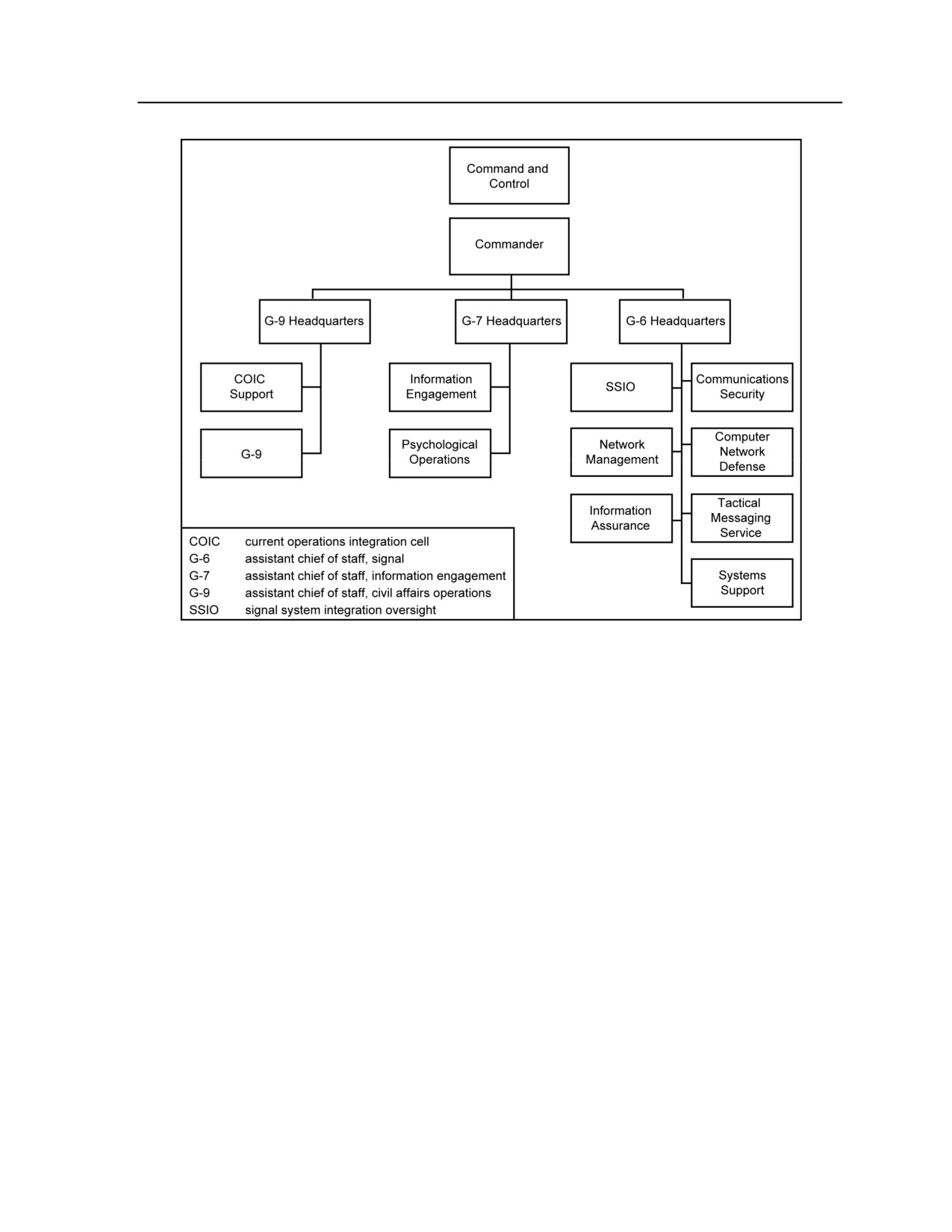
Figure 2-8. Main command post command and control cell
Civil Affairs
2-115. The assistant chief of staff, civil affairs operations
(G-9) integrates civil affairs operations
functions and capabilities into corps operations. The civil affairs operations staff serves in the command
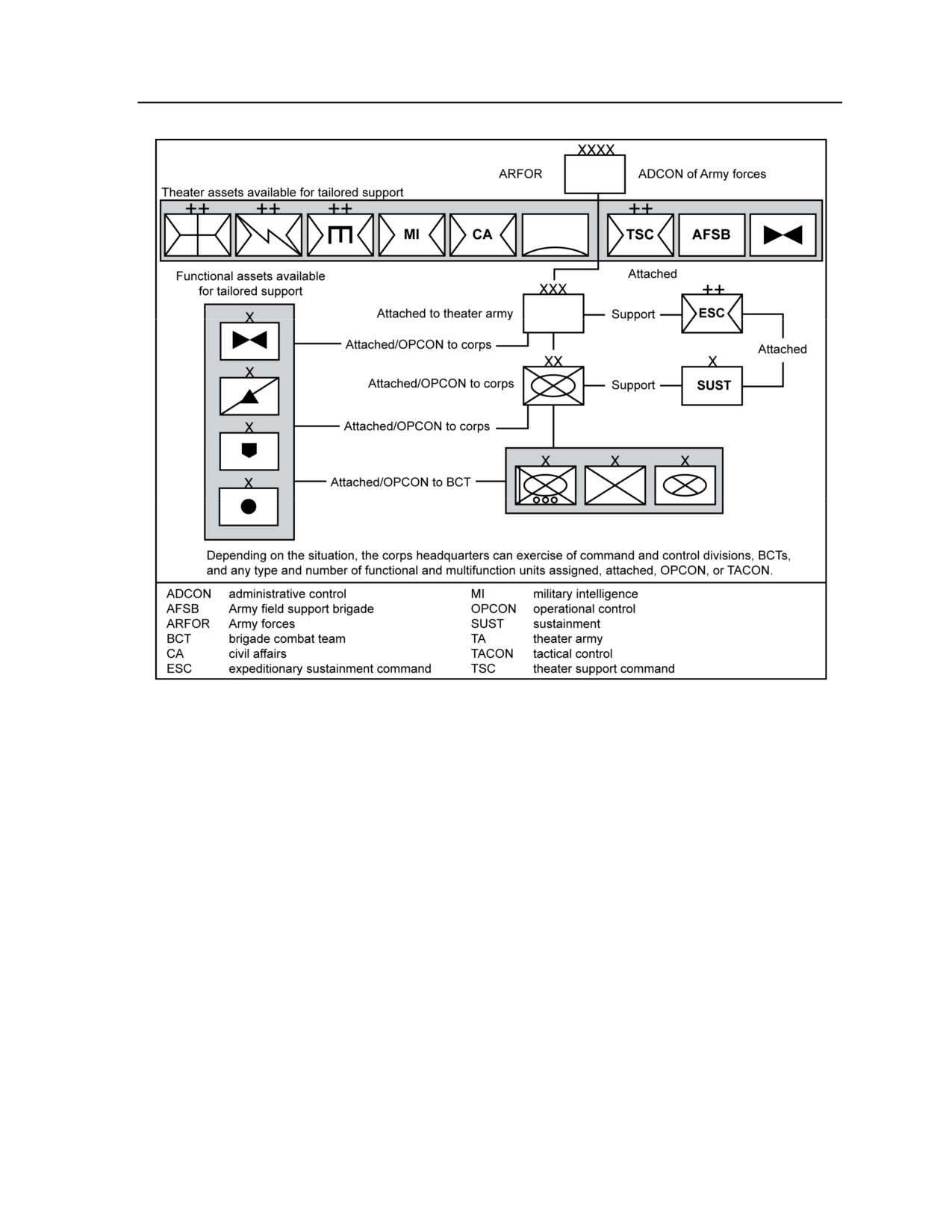
and control cell in the main CP under the chief of staff. The civil affairs operations staff provides
representatives to the current operations integration cell as a current operations integration cell support
element from civil affairs. Civil affairs operations staff members are also assigned in the future operations
and plans cells in the main CP. Additionally, civil affairs operations staff members participate in meetings
(including boards and working groups) as needed. The civil affairs operations staff performs these
functions (see FM 3-05.40):
z
Advises the corps commander on allocating and using civil affairs units under corps control.
z
Develops the civil affairs operations annex to corps plans.
z
Recommends civil affairs operations augmentation, including appropriate functional specialists.
z
Reviews higher headquarters’ plans.
z
Informs the corps main CP staff on the civil affairs operations capabilities and units.
z
Supports ISR activities of the corps.
z
Shares enemy information and possible indicators and warnings collected through passive
observation by the G-9 staff and supporting civil affairs operations units.
z
Coordinates with the fires cell for lethal and nonlethal target development, measures of
effectiveness, and synchronization of nonlethal activities with lethal fires, ensuring that civilian
property, public buildings, and infrastructure are protected to the maximum extent possible.
z
Coordinates and synchronizes corps civil affairs operations with higher headquarters’ civil
affairs efforts.
26 November 2010
FM 3-92
2-25
Chapter 2
z
Establishes a civil-military operations center or coordinates with an existing center to perform
collaborative planning and coordination with interagency, intergovernmental, nongovernmental,
and host-nation organizations.
z
Analyzes how civilians impact military operations and how military operations impact civilians.
z
Provides civil affairs analysis to meetings (including boards and working groups).
z
Chairs the civil affairs operations working group, if formed.
z
Supports the integrating cells.
Information Engagement
2-116. Information engagement is the integrated employment of public affairs to inform U.S. and friendly
audiences; psychological operations, combat camera, U.S. Government strategic communication and
defense support to public diplomacy, and other means necessary to influence foreign audiences; and, leader
and Soldier engagements to support both efforts (FM 3-0). The assistant chief of staff, information
engagement (G-7) oversees information engagement activities. (See FM 3-0.) The information engagement
staff serves in the command and control cell in the main CP. As required, this staff augments the current
operations integration, future operations, and plans cells. The staff also provides expertise to meetings
(including boards and working groups).
2-117. The G-7 (assistant chief of staff, information engagement)—
z
Serves as the principal information engagement advisor to the corps CG and staff principal
advisors.
z
Advises the corps CG on allocating and employing information engagement capabilities.
z
Integrates information engagement into corps operations.
z
Provides representation in the ISR operations section of the intelligence cell.
z
Coordinates information engagement actions directly with adjacent and subordinate unit staffs.
z
Chairs the corps information engagement working group.
z
Participates in the targeting board and other boards and working groups, as required.
2-118. The psychological operations element conducts and assesses psychological operations capabilities
within the main CP. The element leader advises the CG, coordinates with the G-7, and supervises the
psychological operations element.
Signal
2-119. The assistant chief of staff, signal (G-6) oversees all corps communications, command and control
information systems, and information management systems. The assistant chief of staff for signal is the
chief of the command and control signal section. This section includes the elements shown in figure 2-10
(page 2-33).
2-120. The G-6 (assistant chief of staff, signal)—
z
Advises the CG, staff, and subordinate commanders on communication and information
networks.
z
Directs development of network requirements and estimates.
z
Oversees network planning.
z
With the assistant chief of staff for operations and chief of the knowledge management element,
establishes procedures for developing the COP.
z
Oversees the management of corps internal networks.
z
Coordinates external network support to the corps.
z
Plans, manages, and executes electromagnetic spectrum operations.
2-26
FM 3-92
26 November 2010
Corps Headquarters
Signal System Integration Oversight
2-121. The signal system integration oversight element involves the following:
z
Providing technical staff support to Army and joint units allocated to the corps.
z
Overseeing network certification and integration.
z
Monitoring the state of network modernization, readiness, communications-electronics
maintenance, and sustainment.
z
Overseeing contractor support of the corps network.
z
Coordinating commercialization of corps communication and information technology
capabilities.
z
Supervising the installation of corps main and tactical CPs wire and cable networks.
Network Management
2-122. The network management element involves the following:
z
Managing the corps network, from the applications residing on corps platforms through the
points at which the corps network connects to the Global Information Grid.
z
Maintaining network connectivity to all corps forces, including deployed units, units en route to
the theater of operations, and units at home station.
z
Monitoring network performance and quality of service, including interoperability of the corps
network with external networks not controlled by the corps.
z
Managing frequency assignments for the corps.
z
Deconflicting electromagnetic spectrum for all corps emitters.
z
Supervising delivery of defense message system services to the main and tactical CPs.
z
Coordinating with the knowledge management section to develop and align tactical network
enforceable information dissemination management policies and services.
Information Assurance
2-123. The information assurance element ensures the availability, integrity, reliability, authentication,
and nonrepudiation of information. It does the following:
z
Coordinates command and control information systems interface with joint and multinational
forces.
z
Develops, promulgates, and monitors information assurance policies.
z
Oversees performance of communications security functions.
Communications Security
2-124. The communications security element provides communications security operational support and
facilitates communications security planning for corps forces. Associated responsibilities include the
following:
z
Receiving, transferring, accounting, safeguarding, and destroying communications security
materials for the corps CPs.
z
Providing training and instructions to communications security hand-receipt holders and users in
the proper handling, control, storage, and disposition of communications security materials.
z
Performing communications security key compromise recovery and reporting of
communications security incidents.
26 November 2010
FM 3-92
2-27
Chapter 2
Computer Network Defense
2-125. The computer network defense element—
z
Establishes network defense policies (such as, accreditation, information assurance vulnerability
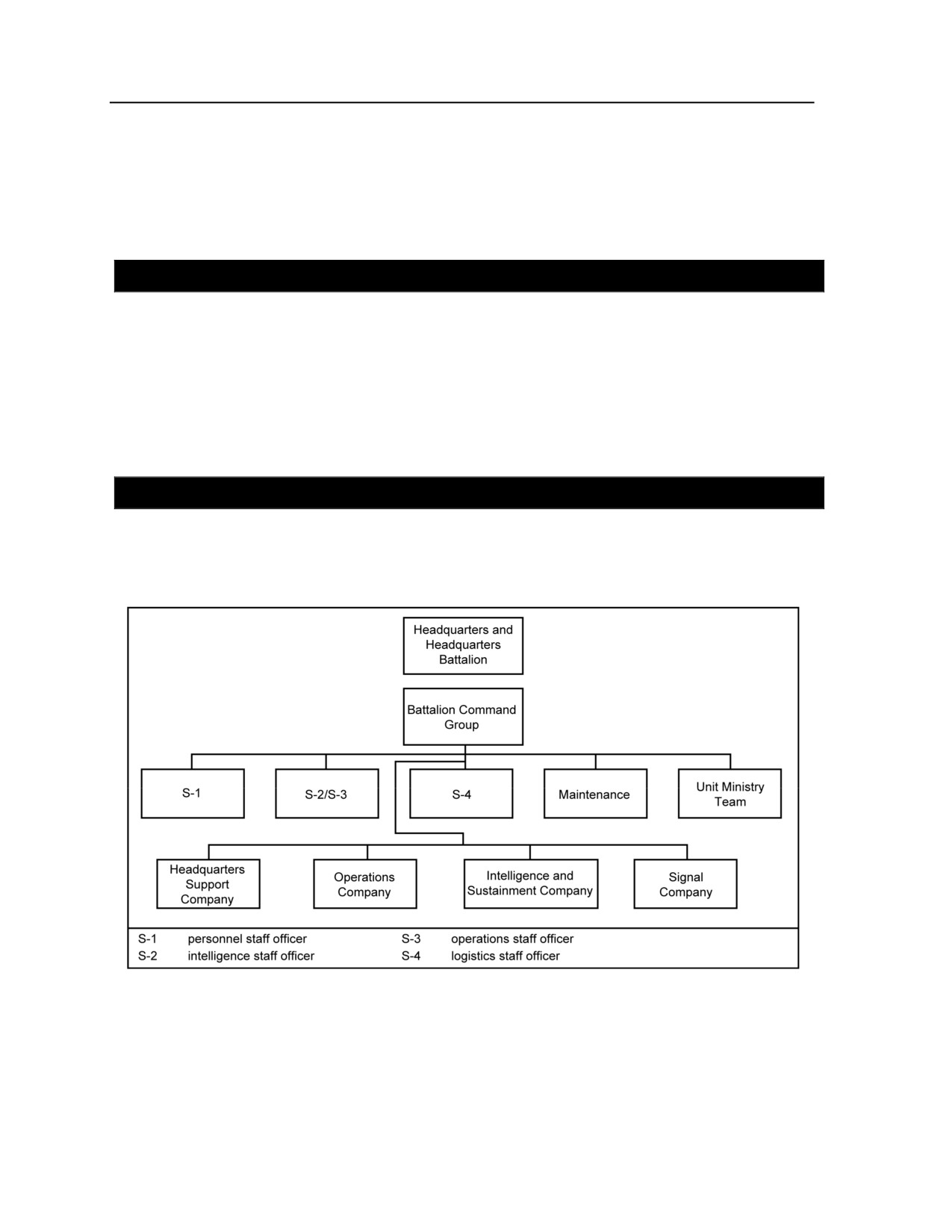
assessment compliance, and access control).
z
Provides staff oversight of the network defense policy implementation by corps forces.
z
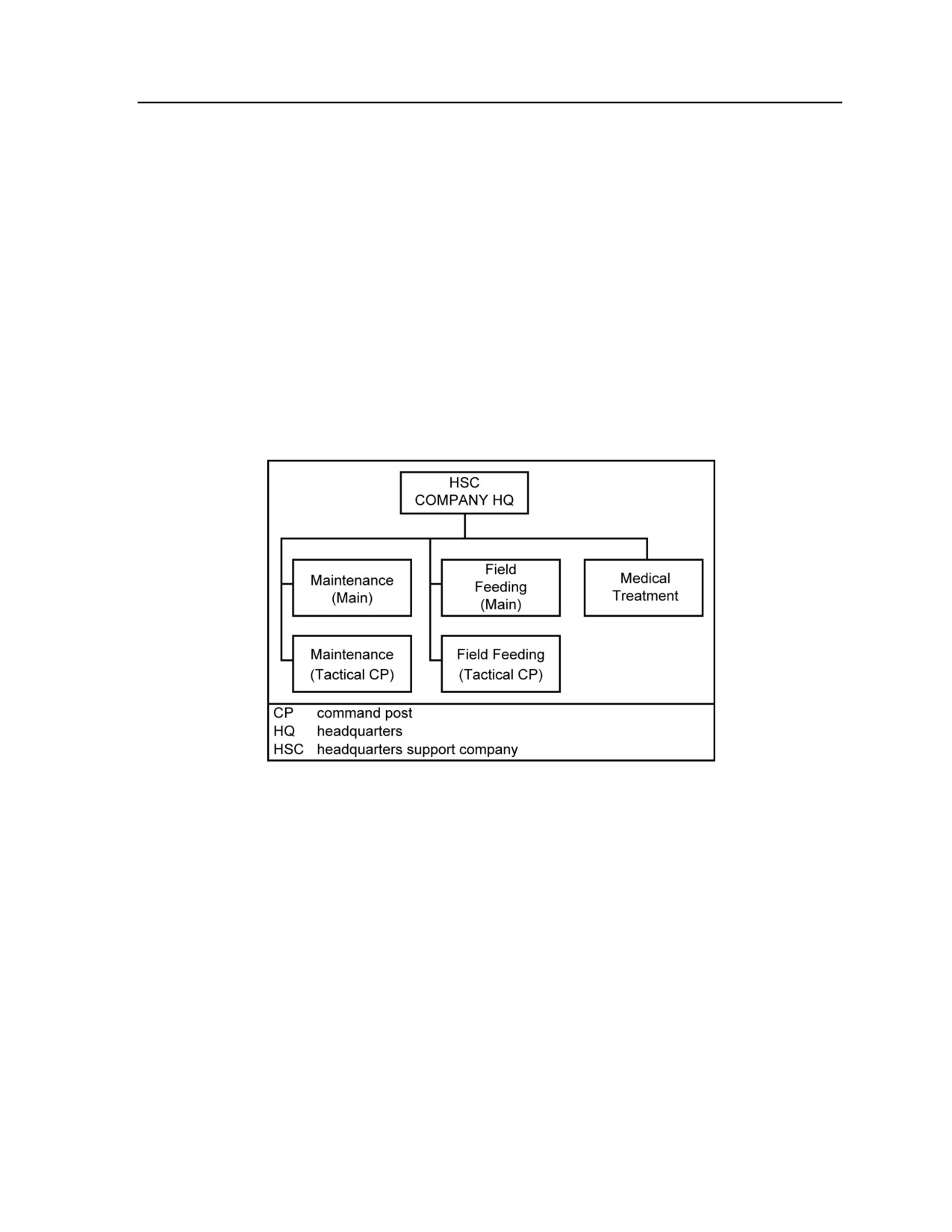
Ensures establishment and maintenance of security boundaries for network operations under
corps control with military and civilian, joint and multinational organizations.
z
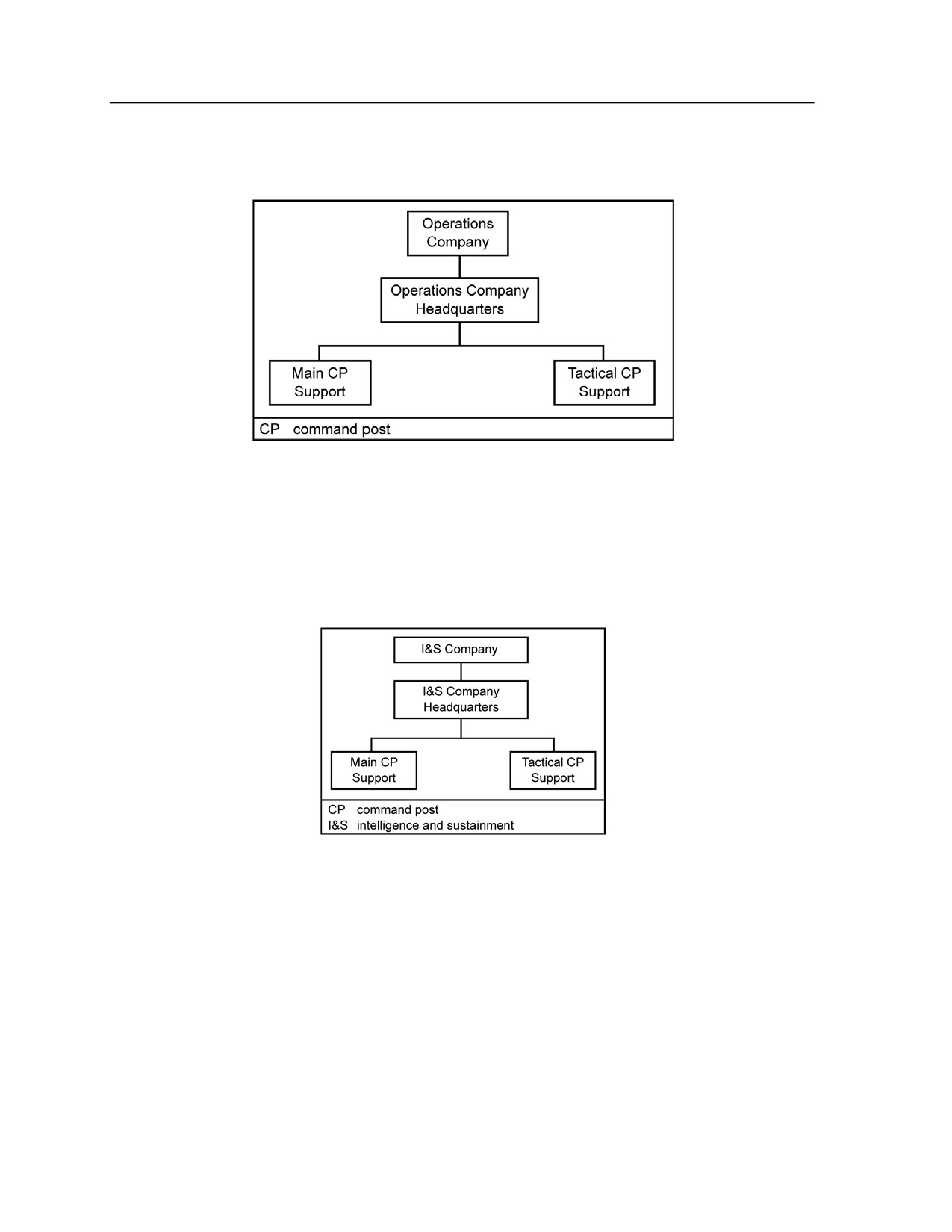
Manages corps headquarters intrusion detection systems.
Tactical Messaging Service
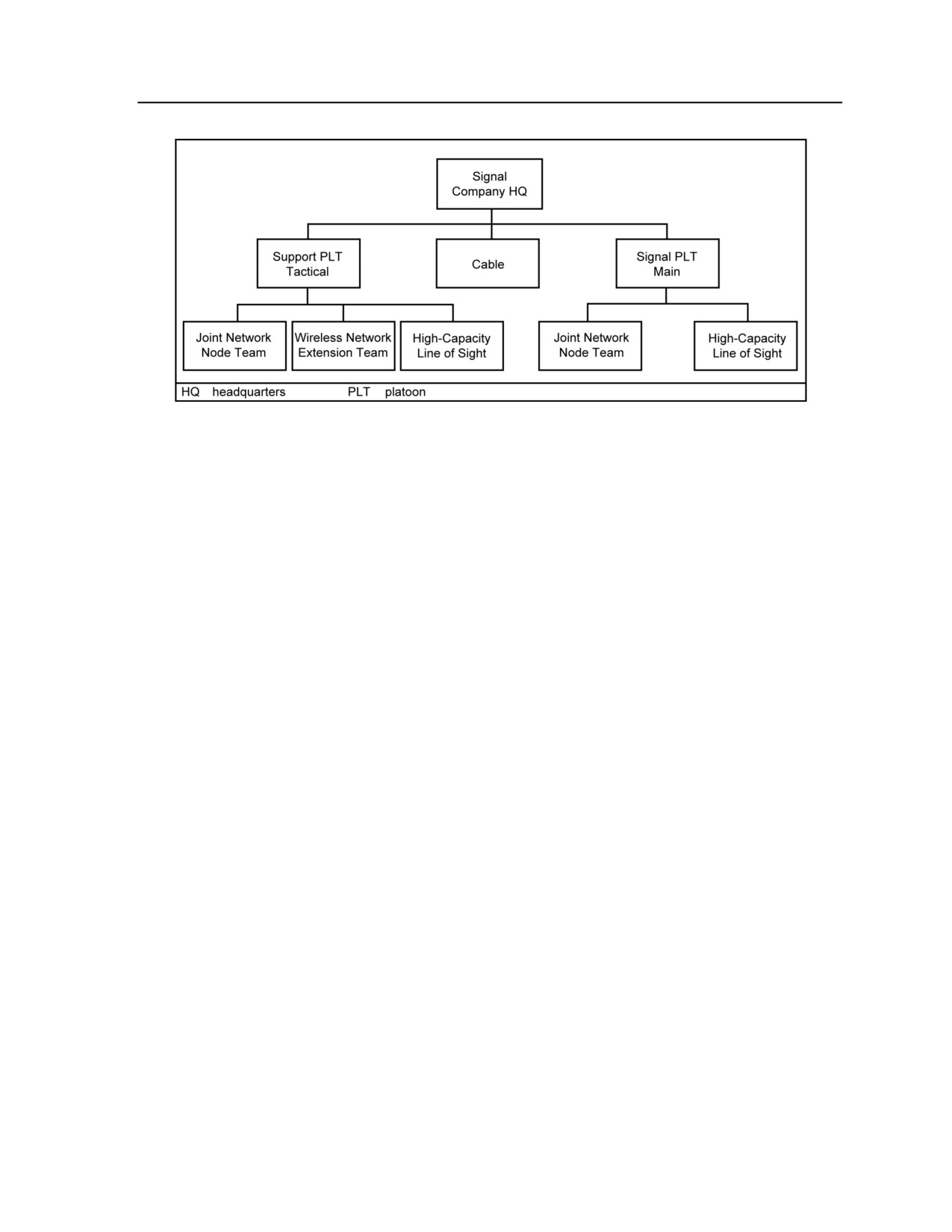
2-126. The tactical messaging service element provides tactical defense message system services to the
main and tactical CPs. Services include access to the defense message switch global address directory and
the capability to send and receive signed and encrypted record message traffic.
Systems Support
2-127. Signal system support teams from the headquarters battalion signal company perform—
z
Coordinate and supervise construction, installation, and recovery of cable and wire
communications systems and auxiliary equipment within main and tactical CPs.
z
Install and operate the corps information technology help desk.
z
Provide voice, video teleconference, e-mail—Non-Secure Internet Protocol Router Network
(NIPRNET), SECRET Internet Protocol Router Network (SIPRNET), and other communication
networks—assistance, and other help desk functions.
z
Assist Army and joint forces under corps control with network installation and troubleshooting
as directed by the assistant chief of staff for signal.
MAIN COMMAND POST INTEGRATING CELLS
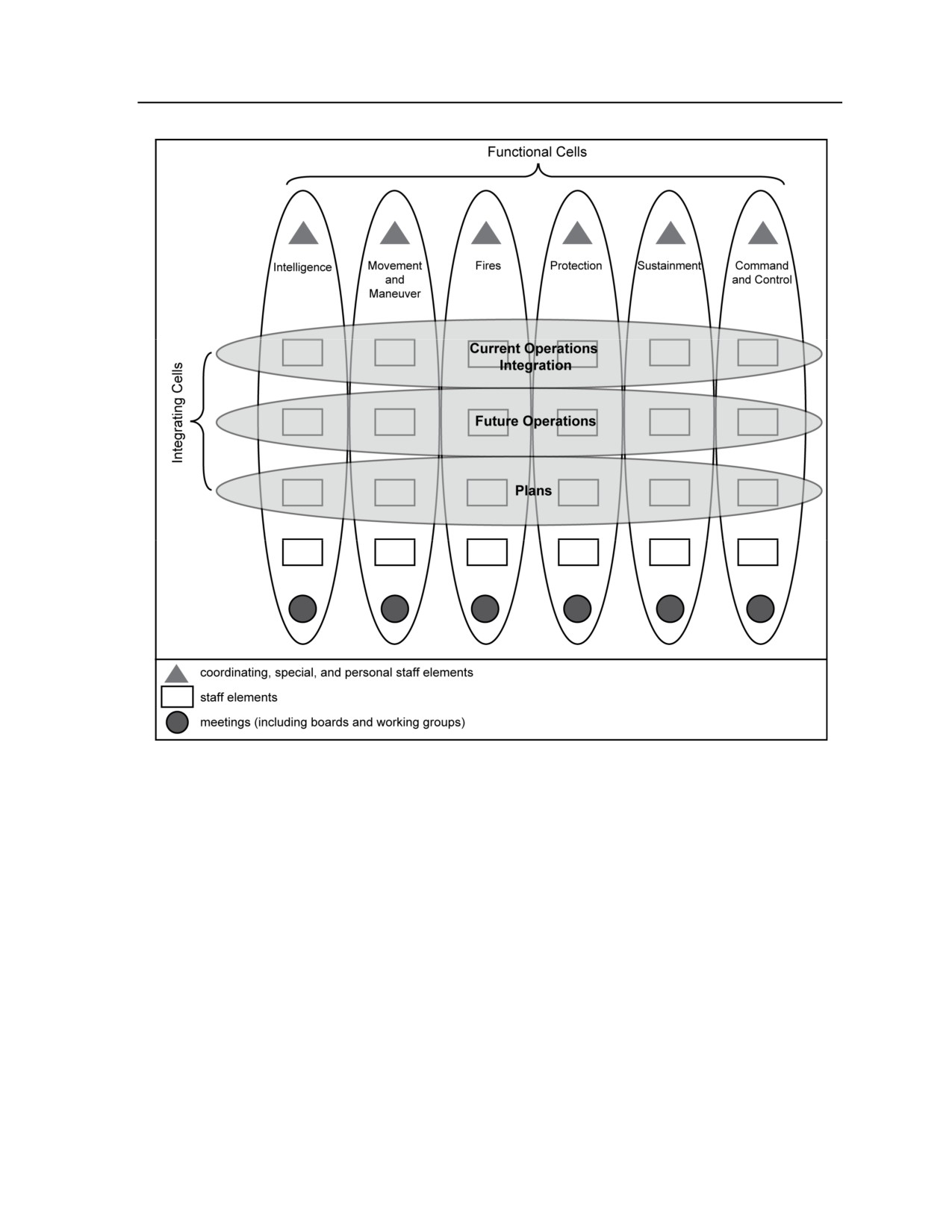
2-128. All cells and elements of the corps CPs are responsible for integrating information. The three
integrating cells of the main CP apply information from the functional cells to the corps’s operations with
regards to time. As depicted in figure 2-9 (page 2-29) these cross-functional cells—current operations
integration, future operations, and plans—coordinate across the artificial boundaries often created by
functional designations.
2-28
FM 3-92
26 November 2010
Corps Headquarters
Figure 2-9. Main command post integrating and functional cells
CURRENT OPERATIONS INTEGRATION CELL
2-129. The current operations integration cell monitors the operational environment and directs and
synchronizes operations in accordance with the concept of operations and commander’s intent. Current
operations focus on the “what is,” and rapidly progress through the decision cycle through executing battle
drills. Current operations produce a larger volume of orders including administrative fragmentary orders
and tactical and operational fragmentary orders. The current operations integration cell is the element that
synchronizes all staff actions. This cell is the hub of daily activities within the corps main CP. Members of
functional, special, and personal staffs who provide their support to ongoing operations augment the current
operations integration cell. The cell is led by the chief of operations (a colonel), a lieutenant colonel deputy,
and an operations noncommissioned officer. The cell’s planning horizon is hours and days. Primary tasks
include the following:
z
Implement and maintain the current operations cell standing operating procedures.
z
Assess the tactical situation.
z
Recommend the commander’s critical information requirements and keep them current.
z
Maintain the COP.
z
Build and maintain the battle rhythm.
26 November 2010
FM 3-92
2-29
Chapter 2
z
Control operations by issuing operation and fragmentary orders.
z
Serve as the central clearinghouse for incoming messages, orders, requests for information, and
taskings.
z
Synchronize actions among the other CP cells, elements, meetings
(including boards and
working groups), and other entities, such as personal and special staff sections that operate
independently.
z
Establish and conduct liaison operations to and from corps units and other organizations.
z
Provide the current situation to the future operations and plans cells to support their operations.
z
Perform near-term task assessment.
2-130. The current operations integration cell staffs these positions for 24-hour coverage:
z
Operations officers.
z
Battle command officers.
z
Request for information and orders managers.
z
Request for information and orders noncommissioned officers.
z
Operations sergeants.
2-131. The noncommissioned officers in the current operations integration cell should be graduates of the
battle staff noncommissioned officer course. The CG augments the current operations integration cell as
necessary. Augmentees may include representatives from other main CP integrating cells, the other
Services, other government agencies, and multinational partners to include the host-nation.
FUTURE OPERATIONS CELL
2-132. The future operations cell plans and assesses operations for the mid-range planning horizon. Future
operations focus on the “what if” and normally move relatively slowly, with more deliberate assessment
and planning activities. For a corps, this planning horizon is days and weeks. The cell’s primary tasks
include the following:
z
Serving as the link between the current operations integration cell and plans cell.
z
Monitoring current operations.
z
Contributing to the COP.
z
Turning command guidance into executable orders.
z
Modifying plans to support current operations.
z
Assisting in or producing fragmentary orders to support current operations.
z
Developing branches to current operations.
z
Recommending commander’s critical information requirements.
z
Conducting short- to mid-range planning to support current operations.
z
Participating in the targeting process.
z
Performing mid-term operations assessment.
2-133. The future operations cell includes a general plans element and a functional plans element. The
cell is staffed with a mix of officers and noncommissioned officers led by a graduate from the School of
Advanced Military Studies. When possible, the noncommissioned officers are graduates of the battle staff
noncommissioned officer course. As with the current operations integration cell and plans cell, the future
operations cell is augmented whenever a skill set—such as special operations—is required.
2-134. Normally ongoing operations mean that several plans undergo refinement simultaneously with
associated working groups and joint planning teams. The work of these elements occasionally overlaps, and
it is important that one individual or agency is appointed to maintain situational awareness of all planning
efforts.
2-30
FM 3-92
26 November 2010
Corps Headquarters
General Plans Element
2-135. The general plans element in the future plans cell includes a mix of majors led by a lieutenant
colonel assisted by a senior noncommissioned officer. They develop and enhance the current order’s
common elements. This element provides the concept of operations that the functional plans element
completes with detailed, specific knowledge.
Functional Plans Element
2-136. The functional plans element includes members who concentrate on the parts of planning that
require functional expertise. Composed of majors with noncommissioned officer support, the functional
plans element contains many specialties. These include intelligence, aviation, human resources, logistics,
protection, command and control warfare, civil affairs operations, and special technical operations.
PLANS CELL
2-137. The plans cell is responsible for mid- to long-range planning. It focuses on the “what’s next,” and
interacts with the higher headquarters planning efforts. Using the military decisionmaking process, it
develops complete operation plans, branches, and sequels. The cell monitors the COP for situational
awareness. It stays abreast of current operations by coordinating with the current operations integration
cell. It is staffed by specialists, including a planner who graduated from the School of Advanced Military
Studies, a strategic plans officer, and an officer certified in the Joint Operation Planning and Execution
System. Individuals with specific expertise from elsewhere in the main CP and from entities external to the
corps augment the plans cell as required. The plans cell’s primary tasks include the following:
z
Monitoring current operations.
z
Conducting tactical planning in support of major operations and battles.
z
Conducting operational-level planning, to include developing supporting plans to higher
headquarters plans.
z
Coordinating with the current operations integration and future operations cells to understand the
current situation and planned short-term activities.
z
Supervising and coordinating the preparations for all operation plans and some branches.
z
Managing Joint Operation Planning and Execution System planning, including input and review
of the time-phased force and deployment data.
z
Using the joint operations planning process to support joint requirements, activities, and
processes. (See JP 5-0 for a discussion of the joint operations planning process.)
z
Coordinating and managing force structure.
z
Planning force management for corps forces to include Army Reserve and Army National Guard
capabilities.
z
Coordinating with respective theater army plans activities on all aspects of planning within their
respective combatant commander’s areas of responsibility.
z
Conduct military deception planning.
2-138. The assistant chief of staff, plans (G-5) leads the plans cell. The cell has two elements: the plans
element and the force integration element.
2-139. The deputy plans officer, a lieutenant colonel, leads the plans element. It is staffed by specialists in
the following fields:
z
Sustainment.
z
Intelligence.
z
Military deception.
z
Civil affairs operations.
z
Space and special technical operations.
z
Information engagement.
z
Psychological operations.
26 November 2010
FM 3-92
2-31
Chapter 2
z
Fires.
z
Protection.
z
Engineer.
z
Aviation (augment).
2-140. The force integration element deals with the functions and processes employed in raising,
provisioning, sustaining, maintaining, training, and resourcing corps forces in garrison and when deployed.
SECTION III - TACTICAL COMMAND POST
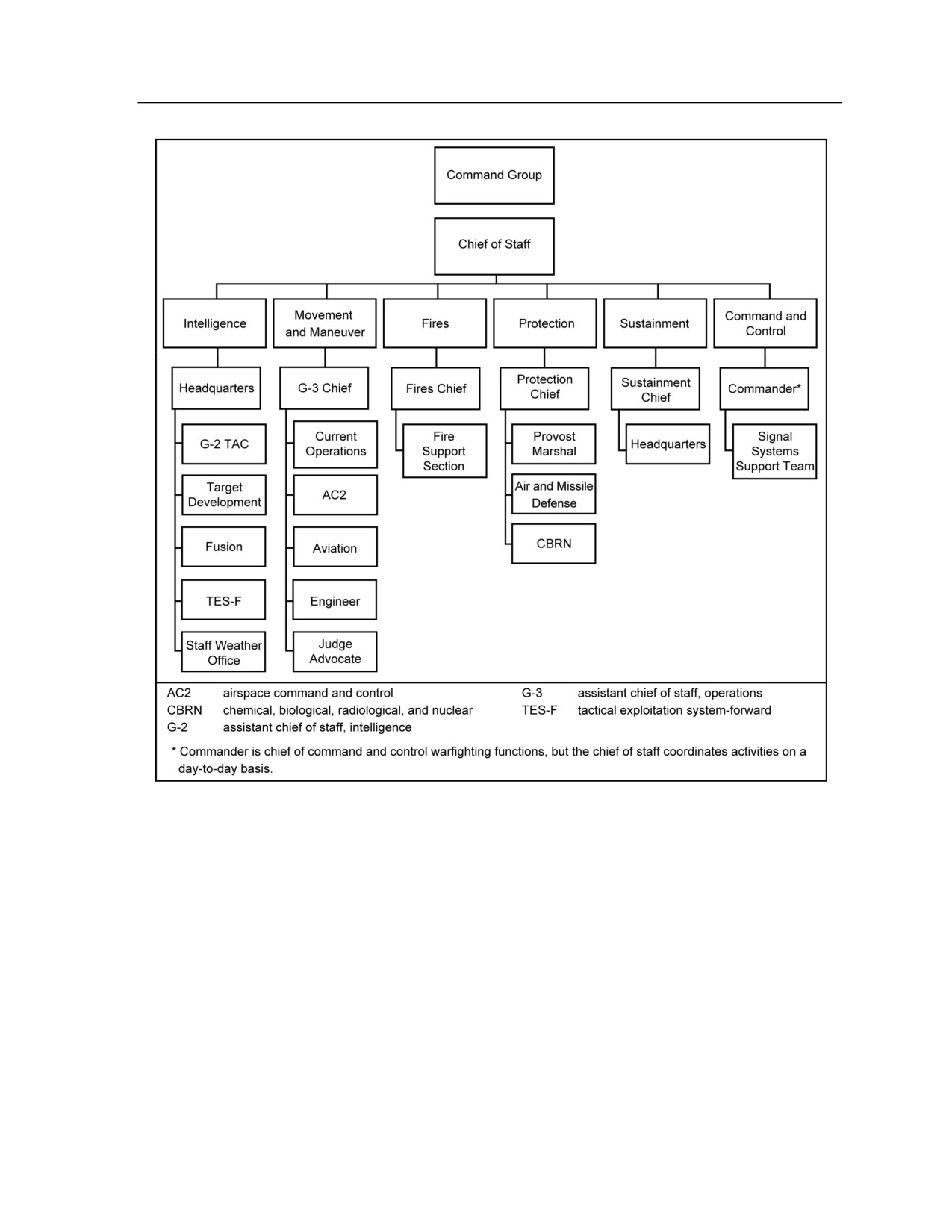
2-141. The corps tactical CP is organized as an additional current operations cell encompassing six
functional cells. It is capable of 24-hour operations. This CP can control corps operations for a limited time
and can form the nucleus of an early-entry CP. It normally colocates with the main CP but remains fully
operational as a current operations cell so that it can operate independently. This requires staff, equipment,
and procedures to be in place and fully exercised. When employed, the deputy assistant chief of staff for
operations usually oversees its activities. The cell and section chiefs for the tactical CP are normally deputy
coordinating staff officers, deputy CP cell chiefs, or officers with special expertise.
2-142. Figure 2-10 (on page 2-33) depicts a basic corps tactical CP. This CP may be established and task-
organized for specific missions of varying duration with augmentation from planning, sustainment, civil
affairs, or mobility staff elements. The headquarters battalion provides the tactical CP with a task-organized
communications and life support element. The headquarters battalion commander designates a leader for
the support element when deploying the tactical CP.
2-143. The tactical CP can provide command and control continuity while the main CP is moving. It can
also be used—
z
As a task force headquarters for a specific corps operation—such as a river crossing, vertical
envelopment, or sensitive site exploitation—while the main CP retains control of the overall
operation.
z
In support of separate operations in a noncontiguous AO.
z
In control of a shaping or sustainment operation while the main CP controls the decisive
operation.
2-144. The tactical CP includes representatives from all six functional cells. Depending on the situation
and with suitable augmentation, the tactical CP performs the same functions as the main CP.
INTELLIGENCE CELL
2-145. There are five elements in the tactical CP intelligence cell:
z
Headquarters section.
z
Target development.
z
Fusion.
z
Distributed tactical exploitation system.
z
Staff weather office.
HEADQUARTERS
2-146. The headquarters element is led by the deputy assistant chief of staff for intelligence and oversees
the intelligence cell. Its tasks include—
z
Providing intelligence support for current operations.
z
Interfacing with the movement and maneuver cell to integrate intelligence products and
intelligence synchronization into current operations.
2-32
FM 3-92
26 November 2010
Corps Headquarters
Figure 2-10. Corps tactical command post
TARGET DEVELOPMENT ELEMENT
2-147. The target development element—
z
Participates in the targeting process.
z
Develops and nominates priority targets.
z
Integrates prioritized and sequenced targets into current operations.
FUSION ELEMENT
2-148. The fusion element receives, processes, analyzes, and disseminates all-source intelligence to
support current operations.
26 November 2010
FM 3-92
2-33
Chapter 2
TACTICAL EXPLOITATION SYSTEM-FORWARD
2-149. Using the Distributed Command Ground Station-Army, the distributed tactical exploitation
system-forward receives, processes, analyzes, exploits, and disseminates the following products to support
current operations:
z
Signals intelligence.
z
Imagery intelligence.
z
Measurement and signature intelligence.
z
Geospatial intelligence.
STAFF WEATHER OFFICE
2-150. The staff weather office provides weather analysis and coordinates with other weather teams in
support of the tactical CP.
MOVEMENT AND MANEUVER CELL
2-151. The tactical CP movement and maneuver cell consists of five elements:
z
Current operations.
z
Airspace command and control.
z
Aviation.
z
Engineer.
z
Judge advocate.
CURRENT OPERATIONS ELEMENT
2-152. The current operations element oversees operations of the tactical CP. This includes the following:
z
Monitoring ongoing corps operations.
z
Directing current operations.
z
Collecting relevant information.
z
Producing and disseminating a COP when operating independently.
z
Maintaining liaison with higher headquarters, subordinate units, and joint and multinational
headquarters as appropriate.
z
Synchronizing actions among the other CP cells, elements, meetings (including boards and
working groups), and other entities (such as personal and special staff sections that operate
independently).
AIRSPACE COMMAND AND CONTROL ELEMENT
2-153. The airspace command and control element oversees the airspace command and control function.
This includes providing tactical airspace requirements to the main CP airspace command and control
element and integrating tactical operations with the main CP airspace command and control element.
AVIATION ELEMENT
2-154. The aviation element coordinates and synchronizes the execution of aviation maneuver, unmanned
assets, and sustainment operations when the tactical CP operates independently.
ENGINEER ELEMENT
2-155. The engineer element coordinates with the primary engineer element at the main CP and advises
the CG and staff on current operations requirements to enable freedom of movement and maneuver and
protection. This element also recommends how to allocate and use engineering assets to fulfill those near-
term requirements. It coordinates the application of the engineer functions (combat, general, and geospatial
2-34
FM 3-92
26 November 2010
Corps Headquarters
engineering). With a focus on the movement and maneuver function, the engineer element coordinates and
synchronizes engineer operations within the tactical CP and with other headquarters, between echelons, and
with multinational forces and governmental and nongovernmental organizations as required.
JUDGE ADVOCATE ELEMENT
2-156. The judge advocate element provides support in all legal disciplines, including advice on—
z
Rules of engagement.
z
Rules of law activities.
z
Stability operations.
z
Treatment of detainees.
z
Lawfulness of targets and weapons.
z
The law of war.
FIRES CELL
2-157. The tactical CP fires cell is led by the deputy chief of fires who may locate elsewhere as the
situation requires. The cell consists of an assistant fire support coordinator, fire support noncommissioned
officers, and fire support specialists. Normally, the tactical CP fires cell executes lethal fires and nonlethal
activities for a specific operation or for short durations. The fires cell may require additional augmentation
from the main CP fires cell, depending on mission requirements.
2-158. The fires cell—
z
Plans fires.
z
Requests and coordinates close air support and air interdiction.
z
Interfaces with the battlefield coordination detachment, air liaison officer, Army and joint
airspace control elements, and higher and joint fires elements.
z
Coordinates air requirements through the battlefield coordination detachment at the ARFOR
liaison to the joint force air component command with the corps air liaison officer.
z
Synchronizes Army, joint, interagency, and multinational lethal fires and nonlethal activities.
z
Conducts combat assessments and recommends reattacks.
z
Coordinates with special operations forces in the corps AO.
z
Coordinates with Army and joint airspace control elements.
z
Coordinates with higher and joint fires elements.
PROTECTION CELL
2-159. The protection cell includes the following elements:
z
Provost marshal office.
z
Air and missile defense.
z
Chemical, biological, radiological, and nuclear (CBRN).
PROVOST MARSHAL ELEMENT
2-160. The provost marshal element does the following:
z
Tracks current operations.
z
Recommends the employment of military police assets.
z
Coordinates military police support for ongoing operations, including processing of detainees.
26 November 2010
FM 3-92
2-35
Chapter 2
AIR AND MISSILE DEFENSE ELEMENT
2-161. The air and missile defense element plans, coordinates, and synchronizes air and missile defense
operations. This includes the following:
z
High-value target protection analysis.
z
Coordination with main CP and external organizations.
CHEMICAL, BIOLOGICAL, RADIOLOGICAL, AND NUCLEAR ELEMENT
2-162. The CBRN element is responsible for the following:
z
Providing 24-hour operations.
z
Advising the CG and staff on all CBRN issues.
z
Overseeing immediate CBRN logistics functions.
z
Contributing to information superiority analysis-track key indicators.
z
Performing CBRN response analysis.
z
Coordinating for and providing input to estimates (intelligence and vulnerability analysis),
orders, and plans.
z
Recommending the employment of CBRN assets.
z
Supporting the CBRN warning and reporting system managed by the main CP.
SUSTAINMENT CELL
2-163. The sustainment cell monitors, collects, assesses, prioritizes, and executes all sustainment
functions at the tactical CP, including movement operations, asset in-transit visibility, and requirements
estimation. It provides input to the COP.
COMMAND AND CONTROL CELL
2-164. The command and control cell includes support from the corps headquarters battalion tactical CP
signal systems support team. As with the main CP command and control cell, the tactical CP can include
civil affairs, psychological operations, and information engagement elements if required. The command
and control cell—
z
Synchronizes and integrates information engagement components
(public affairs, combat
camera, strategic communications, defense support to public diplomacy, and leader and Soldier
engagement).
z
Integrates psychological operations.
z
Integrates civil affairs operations.
z
Coordinates network operations support.
z
Plans and executes computer network defense.
z
Synchronizes and integrates information assurance.
z
Establishes and monitors information protection and communications security.
z
Installs, operates, maintains, and defends NIPRNET and SIPRNET. Manages the installation and
operation of local area networks, including cable and wire installation and troubleshooting.
z
Monitors, manages, and controls organic communications systems.
z
Performs, as required, network operations functions, including enterprise management,
electromagnetic spectrum operations, information dissemination management, and information
assurance.
z
Installs, operates, and maintains information services within the information network enabling
all battle command functions across all corps and below formations.
2-36
FM 3-92
26 November 2010
Corps Headquarters
SECTION IV - ADDITIONAL COMMAND AND CONTROL FACILITIES
2-165. There are two temporary command and control facilities that may see action depending on the
situation: the mobile command group and the early-entry CP. Subordinate forces may form a third type of
facility, the center, to exercise command and control of all or part of a function.
MOBILE COMMAND GROUP
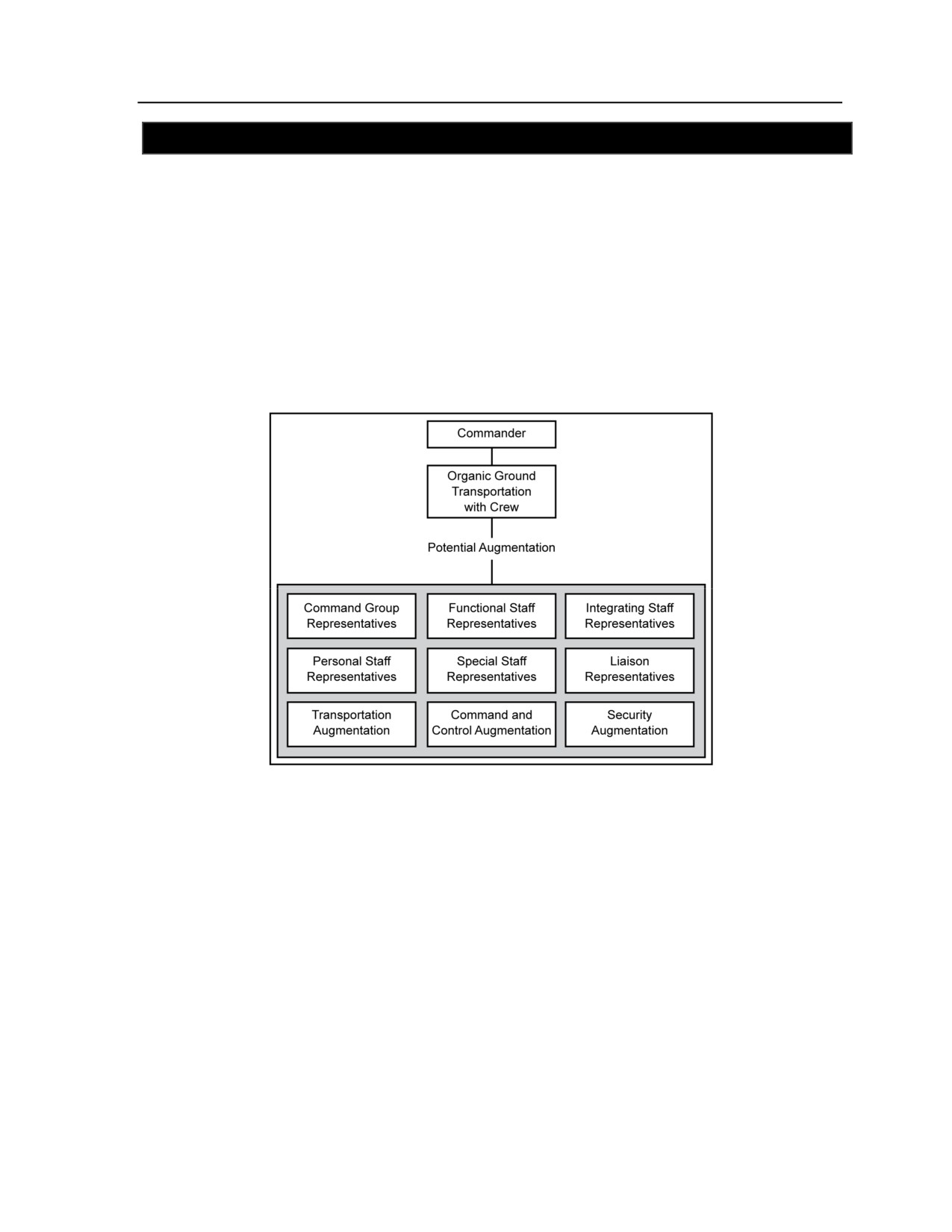
2-166. The mobile command group is the CG’s mobile CP. It permits the CG to exercise command and
control while on the move. The mobile command group has two armored wheeled vehicles, each with a
crew and elements of the Army Battle Command System suite of terminals. Its composition depends on the
CG’s desires and the situation. The group is augmented as required, including additional vehicles,
communications equipment, and security. If aerial transportation is required, the corps requests aviation
assets from the theater aviation command or brigade or other aviation assets. (See figure 2-11 for a possible
mobile command group composition.)
Figure 2-11. Mobile command group
EARLY-ENTRY COMMAND POST
2-167. Occasionally the CG needs to establish a CP at a remote location ahead of other corps headquarters
elements. In those circumstances, the corps creates and deploys an early-entry CP. The early-entry CP may
deploy and set up alone. Alternatively, it may colocate with another Army CP, a joint CP, an interagency or
multinational organization, or a host-nation command and control facility.
2-168. The early-entry CP is usually organized and tailored around the tactical CP. It draws equipment
and personnel from the tactical CP, main CP, and other corps communications and security elements. The
CG staffs the early-entry CP with a mix of current operations personnel able to coordinate the reception of
the corps and plan its initial operations. The corps standing operating procedures normally designate the
sources of personnel and equipment. Depending on the situation, the CG may augment the early-entry CP
with such capabilities as language and regional expertise.
2-169. The corps early-entry CP performs the functions of the main and tactical CPs until those CPs are
deployed and fully operational. A deputy commander, chief of staff, or assistant chief of staff for operations
leads the early-entry CP.
26 November 2010
FM 3-92
2-37
Chapter 2
CENTERS
2-170. A center is a command and control facility established for a specific purpose. Centers are similar to
CPs in that they are facilities with staff members, equipment, and a leadership component. However,
centers have a more narrow focus and are normally formed around a subordinate unit headquarters. For
example, a civil affairs unit under corps control may establish a civil-military operations center or a
logistics organization supporting the corps may establish movement control centers.
SECTION V - AIR FORCE SUPPORT TO THE CORPS
2-171. Air Force support to the corps headquarters consists of a corps tactical air control party, staff
weather officer, and the air mobility liaison officer. These Air Force elements function as a single entity in
planning, coordinating, deconflicting, and integrating the air support operations with ground elements. Air
mobility liaison officers advise ground commanders and staffs on the capabilities and limitations of air
mobility assets. The Air Force provides tactical control parties to Army maneuver unit headquarters down
to the combined arms battalion. Additionally, the Air Force pools terminal attack control teams to provide
support down to the maneuver company level as required. See appendixes B and E for additional
information. When serving as a senior tactical echelon the corps will normally have an air support
operations center.
SECTION VI - CORPS HEADQUARTERS AND HEADQUARTERS BATTALION
2-172. The only troops organic to the corps are in the headquarters battalion. The battalion is commanded
by a lieutenant colonel. It consists of the battalion command group, headquarters battalion staff, and four
companies. (See figure 2-12.) The subordinate elements of each company report to the company chain of
command. The company commander, in turn, reports to the headquarters battalion commander.
Figure 2-12. Headquarters battalion
BATTALION COMMAND GROUP
2-173. The battalion command group provides supervision and exercises command and control of
personnel assigned to the corps headquarters. It consists of a commander, executive officer, command
sergeants major, rear detachment commander, rear detachment noncommissioned officer, and a vehicle
drive. The battalion commander also serves as the headquarters commandant for the corps headquarters.
2-38
FM 3-92
26 November 2010
Corps Headquarters
2-174. The battalion provides communications, transportation, and medical support to the corps
headquarters. The battalion’s personnel, equipment, and services are split among the main CP, tactical CP,
and mobile command group. The battalion provides administrative and life support to the additional
resources assigned or attached to the corps headquarters—such as a band, security assets, and joint or
interagency augmentation—as required.
BATTALION STAFF
2-175. The headquarters battalion staff consists of five staff sections. They provide administrative, human
resources, logistic support, religious support, and life support to corps headquarters elements in garrison
and the field. When deployed, the battalion staff sections are responsible for unit-level command and
control, communications support, property accountability, transportation, medical, food service, and
maintenance support for the main CP, tactical CP, and mobile command group.
HEADQUARTERS SUPPORT COMPANY
2-176. The headquarters support company contains the components shown in figure 2-13. All members of
the headquarters battalion staff are assigned to the headquarters support company.
Figure 2-13. Headquarters support company
MAINTENANCE SECTIONS FOR MAIN AND TACTICAL COMMAND POSTS
2-177. The headquarters support company has two sections that support headquarters battalion Soldiers in
the corps CPs, one for the main CP and one for the tactical CP. When deployed these sections provide
command and control and the following support to the personnel assigned to the respective CPs:
maintenance and field feeding.
MEDICAL TREATMENT SECTION
2-178. The medical treatment section provides Army Health System support for the corps main CP
personnel as well as emergency and advanced trauma management to main and tactical CP personnel. It
also provides sick call services, medical surveillance and preventive medicine, and unit-level ground and en
route patient care.
OPERATIONS COMPANY
2-179. The operations company (A Company) provides company-level administrative and logistic support
to Soldiers in the movement and maneuver cell, protection cell, and fires cell, as well as the tactical CP
26 November 2010
FM 3-92
2-39
Chapter 2
elements of these cells. When the tactical CP deploys, the headquarters and headquarters battery
commander may direct the operations company headquarters to deploy as well, to synchronize all aspects
of support to the tactical CP from the headquarters and headquarters battery. (See figure 2-14.)
Figure 2-14. Operations company
INTELLIGENCE AND SUSTAINMENT COMPANY
2-180. The intelligence and sustainment company (B Company) provides company-level administrative
and logistical support to the Soldiers in the intelligence cell and the sustainment cell, as well as the tactical
CP elements of these cells. When the tactical CP deploys, the headquarters and headquarters battery
commander may direct the intelligence and sustainment headquarters to deploy as well so to synchronize
all aspects of support to the tactical CP from the headquarters and headquarters battery. (See figure 2-15.)
Figure 2-15. Intelligence and sustainment company
SIGNAL COMPANY
2-181. The signal company provides information network and communications support to the corps
headquarters. It includes platoons that directly support the corps main and tactical CPs. (See figure 2-16,
page 2-41.) Signal Soldiers supporting the corps CPs are assigned to and receive their administrative
support from the signal company.
2-40
FM 3-92
26 November 2010
Corps Headquarters
Figure 2-16. Signal company
COMPANY HEADQUARTERS
2-182. The signal company headquarters provides logistic support to the company. The company receives
maintenance support from the headquarters battalion. The company headquarters oversees installation and
operation of the following support for the main and tactical CPs, and others as directed:
z
Network.
z
Radio (line-of-sight and satellite communications).
z
Wireless network extension.
z
Wire.
z
Cable.
MAIN AND TACTICAL COMMAND POST SUPPORT PLATOONS
2-183. Each CP support platoon provides communications support using the joint network node to
connect user devices such as telephones and computers. The two platoons have nearly identical capabilities
to provide terrestrial and space-based communications support to each CP. Platoon capabilities include
secure tactical defense switched network voice, NIPRNET, SIPRNET, Joint Worldwide Intelligence
Communications System, and video teleconferencing. The tactical CP has the wireless network extension
teams for extended frequency modulation retrains. The platoon cable section provides support to the main
CP and tactical CP on a mission basis.
CIVILIAN, CONTRACTOR, AND OTHER AUGMENTATION
2-184. The Army is supported by Army civilians, contractors, and other partners during peace and war.
As combat multipliers, they perform critical duties in virtually every facet of Army operations at home and
when deployed.
ARMY CIVILIANS
2-185. Army civilians have long been an integral part of the Army team. They fill key leadership and
support positions. The augmentation for a typical corps includes civilian employees in almost every part of
the organization. This is true especially for a corps based overseas. There, many civilians serve in host-
nation relations, maneuver management, programs such as Partnership for Peace, and plans and operations.
Many of these positions require continuity, such as historian, protocol, safety office, training division,
special security office, budget office, and transportation.
26 November 2010
FM 3-92
2-41
Chapter 2
2-186. Army civilians with critical skills may deploy. The corps headquarters plans for civilian
deployment regardless of the projected or actual corps mission. The headquarters identifies emergency
essential civilians during deployment planning. Emergency essential positions meet two criteria. They
cannot be converted to uniformed positions without a loss of continuity of performance. And they are
required to ensure the success of combat operations or to support combat-essential systems. In unforeseen
situations, Army civilians in positions not previously identified as essential can be required to deploy.
2-187. During military operations and once medically cleared, Army civilians fall under the military chain
of command. They perform their specialty just as they would before deployment with regards to
evaluations, assignments, discipline, and recognition. The corps is responsible for predeployment training,
life, and other support for deployed Army civilians, including physical security. (See Department of the
Army Pamphlet (DA Pam) 690-47 for more information.)
CONTRACTORS
2-188. Contractors’ contributions to deployed forces include support other than direct participation in
hostile actions in sustainment, language services, communications, and infrastructure.
2-189. Frequently, a desire to limit the presence of U.S. forces in a region leads to a cap on the number of
Service members deployed. When military force caps are imposed, contractor support allows commanders
to maximize the number of combat Soldiers by replacing military support units with contractor support.
This force-multiplier effect lets the combatant commander provide sufficient support in the theater of
operations while strengthening the deployed force’s fighting capability. At the conclusion of operations,
contractors also facilitate early redeployment of forces.
2-190. In the initial stages of an operation, supplies and services provided by local contractors improve
response time and free strategic airlift and sealift for other priorities. Contractor support drawn from
resources in the theater of operations augments existing support capabilities to provide a new source of
critically needed supplies and services.
2-191. The corps should identify and provide qualified personnel as required by supporting contracting
units and organizations to serve as contracting officer representatives. These representatives must be
familiar in the goods or services provided by the contracts they help administer as well as trained,
appointed, and managed by a contracting officer to whom they report. Contracting officer representatives
ensure contractors provide the goods and services as specified in the supported unit’s statement of work,
thereby ensuring the supported unit receives the support necessary to support their mission.
UNIFIED ACTION
2-192. Within the U.S. Government, Army and other government agencies perform in both supported and
supporting roles with other commands and agencies. However, this support command relationship differs
from that described in joint doctrine. Relationships between the Army and other government agencies and
organizations do not equal the command and control of a military operation. Whether supported or
supporting, close coordination between the military and other agencies is key. (See JP 3-08.)
2-193. Coordination and integration among the joint force and other civil and military, joint and
multinational organizations does not equal the command and control of a military operation. Military
operations depend upon a command structure that differs from that of civilian organizations. These
differences may present significant challenges to coordination efforts. The various government agencies’
different—and sometimes conflicting—goals, policies, procedures, and decisionmaking techniques make
unity of effort a challenge. Still more difficult, some intergovernmental and nongovernmental organizations
may have policies that are explicitly antithetical to those of the United States, and particularly U.S. forces.
2-42
FM 3-92
26 November 2010
Chapter 3
Corps Headquarters Operations
This chapter describes the corps headquarters operations as a command and control
headquarters. It highlights the importance of the support to the corps headquarters
and their command and support relationship. It discusses the placement of the corps
headquarters for command and control during operations and also how the corps uses
its command and control systems throughout the operation.
SUPPORT TO CORPS HEADQUARTERS
3-1. Exercising command and control of land forces for operations is the corps headquarters’ first
priority. The corps is capable of carrying out this mission alone, but it is often augmented with personnel to
assist the commander and staff in accomplishing their assigned tasks and missions. The types and quantity
of augmentation depends on the situation and normally arrives from theater army assets or from the
available Army force pool. The augmentation timeframe can be temporary or can last the entire operation.
For example, the plans cell and the movement element of the movement and maneuver cell may receive the
greatest command attention and resources during the predeployment phase. The augmentation to the corps
headquarters may be limited in time and scope to support the successful deployment of the corps
headquarters. While deployed and engaged in sustained major combat land operations in an area of
operations (AO), the current operations integration cell may be the center of attention and receive the
majority of augmentation
3-2. In its role as an intermediate tactical headquarters, the corps headquarters can exercise command and
control of mixed brigades and divisions, as well as joint or multinational forces supported by theater assets.
To control this force mix, the corps headquarters serves as a hierarchical organization combining the
commanding general (CG), staff cells, and associated liaison elements into an integrated whole. As such
the corps headquarters organizes to control a wide array of assets. To command and control this force mix,
the commander relies on staff execution and optimizing available command and control systems within the
corps headquarters. Staff execution through functional and integrating cells, to include personal and special
staff coordination, enables the commander to control a wide array of assets.
3-3. Corps headquarters augmentation happens during all phase of predeployment, deployment, and
redeployment. During major operations. Assets not available in theater are requested from the force
generating base and from Army commands and direct reporting units (See Field Manual (FM) 1-01).
Representative force generating force organizations include—
z
Headquarters, Department of the Army.
z
Headquarters, United States Army Forces Command.
z
United States Army Training and Doctrine Command.
z
United States Army Reserve Command.
z
United States Army Special Operations Command.
z
United States Army Materiel Command.
z
United States Army Medical Command.
z
United States Army Space and Missile Defense Command/United States Army Forces Strategic
Command.
z
United States Army Network Enterprise Technology Command/9th Signal Command (Army).
z
United States Army Intelligence and Security Command.
z
Military Surface Deployment and Distribution Command.
26 November 2010
FM 3-92
3-1
Chapter 3
z
Headquarters, United States Army Criminal Investigation Command.
z
United States Army Installation Management Command.
z
United States Army Cadet Command.
z
United States Army Corps of Engineers.
3-4. Available brigade and lower echelon units are generally part of theater-level commands tailored into
smaller components to meet the corps’s mission requirements. For example, the requirements for chemical,
biological, radiological, nuclear, and high-yield explosives defense may not require an entire chemical
brigade, only a small component such as a biological hazard detection team.
3-5. In its turn, the corps headquarters task-organizes the divisions, brigade combat teams, and functional
and support brigades provided to it by the Department of the Army, the theater army, and other force
generators for employment in land operations in an AO.
COMMAND AND SUPPORT RELATIONSHIPS
3-6. The command relationship of units providing support to the corps headquarters varies depending on
the situation. Forces available to the corps headquarters for land operations are assigned, attached, or
placed under corps operational or tactical control. (See FM 3-0 for a discussion of command and support
relationships.)
3-7. The Army develops the capability to rapidly tailor and task-organize expeditionary forces (see
FM 3-0). Each expeditionary force is a flexible, modular organization. The theater army is the Army
Service component command of the geographic combatant command. In that role, the theater army
exercises administrative control over all Army forces in the combatant commander’s area of responsibility.
The theater army tailors available forces to support corps headquarters. Each corps can control a mix of
divisions, brigade combat teams, and functional and support brigades as an intermediate land force
headquarters or a joint task force. Figure 3-1 (page 3-3) portrays the command and support relationships,
including operational control (OPCON), associated with a corps headquarters serving as an intermediate
tactical headquarters.
3-8. The corps headquarters normally exercises command and control of land forces at the brigade and
division levels. Its maneuver, sustainment, and other forces are normally attached, OPCON, in support, and
occasionally under tactical control to the corps headquarters.
COMMAND AND CONTROL
3-9. Exercising command and control is a dynamic process in which the corps staff supports the CG
throughout the operations process. The speed and accuracy with which the staff plans, prepares, executes,
and assesses contributes to the CG’s situational understanding. Commanders use several processes to solve
problems: design, the military decisionmaking process, rapid decisionmaking and synchronization process,
and Army problem solving. Additionally, the CG and staff integrates composite risk management
throughout this process. FM 5-0 discusses these processes at length.
3-10. The corps relies on information, knowledge, and battle command systems and staff activities to
support the execution and assessment of operations. In full spectrum operations, the corps has three goals
for execution: it extends the operational reach of its forces, synchronizes operations, and prioritizes and
allocates resources. The CG and corps staff balance these goals only with adequate information. They
receive information from several knowledge management and information systems. Through information
management, the corps headquarters provides relevant information to the right person at the right time in a
usable form to facilitate situational understanding and decisionmaking.
3-11. Effective command and control of units attached, under OPCON, under tactical control, and in
support to the corps headquarters also relies on effectively placing the corps main command post (CP). Its
placement must maximize the full capabilities of the corps command and control system and
communications support system. The corps gains execution support from the Army Battle Command
System, the command post of the future, battle rhythm, operations synchronization meetings, and battle
update briefings.
3-2
FM 3-92
26 November 2010
Corps Headquarters Operations
Figure 3-1. Corps command and support relationships
COMMAND POST PLACEMENT
3-12. The corps’ placement of its main CP is vital to the success of command and control. The location of
the main CP depends on such factors as communication reliability, security, concealment, and accessibility.
The CG’s location depends on the situation. A routine mission on the less violent end of the spectrum of
conflict, such as a joint or multinational training exercise, may place less of a demand on the CG for rapid
decisions and the necessary situational understanding. Conversely, a major combat operation against a
near-peer enemy may demand frequent guidance and ever-changing decisions. The level of trust the CG
has in the staff and their level of training influences this decision. Well-trusted senior leaders on a well-
trained staff allow the CG more freedom of action.
3-13. The location of the corps main CP also affects how the CG commands the operation. The corps CP
can be located in any of a number of places, including—
z
As a joint headquarters colocated with the geographic combatant command.
z
Colocated with the theater army CP.
z
Located in a sanctuary or staging base remote from the AO.
z
Located within the corps AO with noncontiguous subordinate command AOs.
z
Positioned within the corps AO with contiguous subordinate units.
z
Colocated with a division headquarters or other subordinate CP in a contiguous AO.
z
Colocated with a subordinate CP in an AO with noncontiguous subordinate unit AOs.
26 November 2010
FM 3-92
3-3
Chapter 3
3-14. Each CP location has its own distinct communications, travel, security, and time requirements.
Secure satellite communications can reduce the impact of distance from the CG’s location to that of
superior or subordinate commanders, but it cannot eliminate the distance requirement. Travel from a
sanctuary or a corps main CP location separated by hours from that of its subordinates adds to the time the
commander is away from the main CP. Travel also adds to integrating and synchronizing the operation,
reviewing plans and orders, and contributing to non-routine decisionmaking. In addition, the CG does not
travel alone, and the staff, no matter how small, requires long-haul vehicles, aircraft, and en route security
precautions that may make it inconvenient to travel long distances, especially if the enemy situation is
uncertain. The CG and senior leaders and staffs weigh the benefit gained by command presence visits by
the CG at remote subordinate CP locations with the loss of communication, the time the CG is away from
the activities at the main CP, and the chance of capture or worse.
3-15. Regardless of the location selected by the CG, there must be a plan for continuity of command and
control. Command and control continuity has two requirements. The first is to have a properly designated
commander available to command, including a predesignated succession of command. The second is to
organize the command and control system so the CG can exercise that authority continuously. Continuity
depends on alternate and redundant facilities, time for transitions, and mitigating the effects of sleep
deprivation.
3-16. The corps tactical CP is not designed to replace the main CP for extended periods, but it must be
trained and ready to assume control of operations for short periods or special concurrent missions. Usually
the tactical CP is colocated with the main CP and is operational at all times. The tactical CP becomes the
corps command and control hub when the main CP is unavailable or when the corps forms a separate
command and control entity for a specific operation. The latter might be running an air or sea port of
debarkation or a distinct mission such as humanitarian assistance. As discussed in earlier chapters, the
corps tactical CP is organized as a current operations cell capable of 24-hours-a-day operations. Unless
employed for an extended period, the tactical CP does not deal with planning or the transitions from plans
to operations.
3-17. The corps tactical CP maintains the same level of situational awareness as the current operations
integrating cell and other elements of the main CP. To do so, the tactical CP establishes a transfer standing
operating procedure. This standing operating procedure ensures the tactical CP replicates all the
information systems that support command and control. Each of the six tactical CP cells coordinates with
its main CP counterpart. Depending on the current situation, capabilities not programmed for the tactical
CP but required to conduct current operations may deploy with the tactical CP to support the corps mission.
The CG aims to continue to lead the corps and the staff to retain the capacity to control it. Maintaining the
common operational picture (COP) and other situational awareness activities at the main CP during the
time it is not in control reduces the time the main CP requires to achieve full readiness and effectively
reassume command and control responsibilities.
3-18. Transferring and maintaining information is crucial during any handover of control between the main
and the tactical CPs. The corps automated information systems allow information to be entered from
several points at once into a central processing system. This electronic collaboration simplifies the
handover of information and provides a level of information assurance to protect all information systems
when the tactical CP controls operations. Each tactical CP functional cell ensures that the digital and other
information systems databases appropriate to their area of expertise are maintained while the tactical CP is
controlling operations.
3-19. Dynamic and fast-paced operations require the corps staff to keep abreast of operations. Depending
on the time the tactical CP is expected to control operations in the absence of a fully operational main CP,
portions of the plans and future operations cells may deploy with the tactical CP to sustain continuity of the
planning effort. Cell members may deploy as individuals to become a part of the tactical CP movement and
maneuver cell or form a provisional plans cell in the tactical CP. When the tactical CP controls operations,
the headquarters battalion elements that support it are tailored to support augmentation from the plans cell,
liaison sections, and other capabilities that accompany the CP to the new location. As with digitization,
sustainment and security are integrated into the separated deployment of the tactical CP.
3-4
FM 3-92
26 November 2010
Corps Headquarters Operations
COMMAND AND CONTROL SYSTEMS
3-20. Command and control systems (see paragraph 2-19 for the definition of command and control
systems) enable the commander to arrange personnel, information management, procedures, equipment,
and facilities essential for the commander to conduct operations. Because of the complexity of
commanding and controlling a mixed force conducting full spectrum operations, success of the corps
headquarters relies on commanders effectively using available command and control systems. By using the
Army Battle Command System, command post of the future system, and other communications support to
the corps headquarters, the commander, staff, and subordinate commands can share a COP during the
conduct of operations.
Army Battle Command System
3-21. The Army Battle Command System (ABCS) is a collection of information management systems that
provides automated network information systems for the corps and its subordinates to support the
operations process. The goal of this system of systems is to facilitate Army operations by integrating
information from internal and external sources. The ABCS provides a COP using a common map set and
database to present a visual display of the AO. Additionally, the ABCS is a suite of common service tools.
These collaboration tools include:
z
Video teleconferencing.
z
Interactive whiteboard.
z
File transfer services.
z
Calendar and schedule applications.
z
Task management tools.
z
Internet browsers.
z
Database query tools.
3-22. When deployed, travel limitations, distance, physical security concerns, and other factors frequently
limit face-to-face contact throughout the corps’ AO and beyond. Therefore, collaboration must occur
virtually through interactive tools available to the corps headquarters, such as the ABCS. The ABCS, along
with the command post of the future, facilitates near real-time collaboration and enable effective battle
command. They allow Army commanders at all echelons to provide a COP to higher and subordinate
echelon commanders and their staffs. However, face-to-face is the preferred method and it is often required
to build commander-to-commander personal relationships.
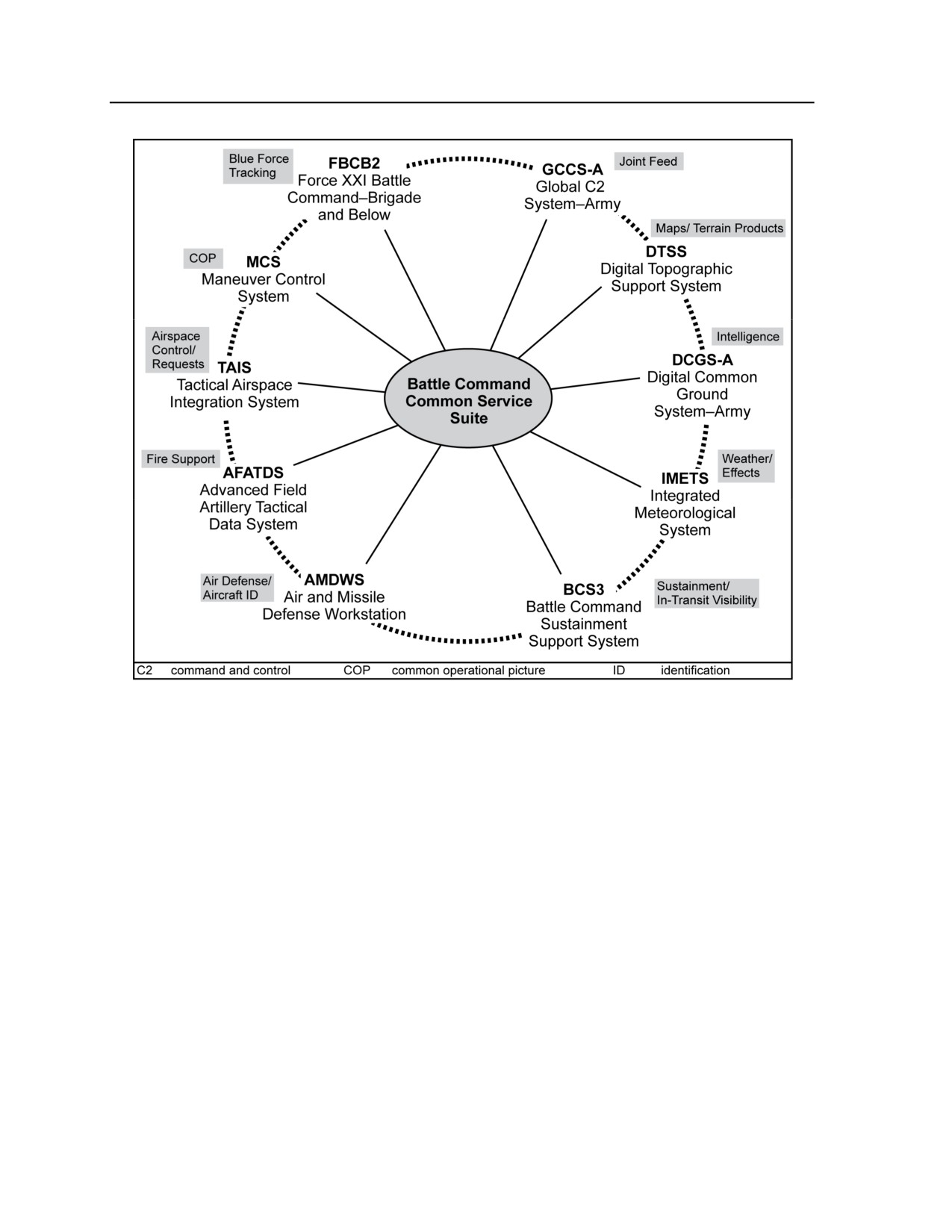
3-23. Figure 3-2 (page 3-6) diagrams the ABCS. These ten battlefield automated systems make up the
capabilities required to support corps operations. The ABCS integrates the information systems that support
the Army warfighting functions and link them to strategic, operational, and tactical headquarters.
3-24. The ABCS requires trained and skilled operators. The corps uses the system often in garrison
functions, so that the transition to deployed operations causes minimal friction in the corps headquarters’
ability to effectively exercise command and control. See FM 6-0 for a description of these systems.
26 November 2010
FM 3-92
3-5
Chapter 3
Figure 3-2. Army battle command system components
Command Post of the Future
3-25. The command post of the future is an executive-level decision support system that provides
situational awareness and situational understanding for the commander and staff. This collaborative system
is commonly used and provides additional capability for the commander to exercise command and control
24/7 throughout the AO. Key capabilities are—
z
Second dimension and third dimension information visualization.
z
Information liquidity-drag and drop information analysis across visualization products.
z
Visibility of evolving understanding among distributed subordinates and team members.
3-26. Commanders often use the command post of the future to conduct battle updates, track enemy and
friendly actions, and interface with the ABCS to allow sharing a COP. Efficient use of the system relies on
trained and skilled operators. Commanders should use the command post of the future regularly in the
garrison environment to ensure operators maintain skill proficiency.
Communications Support to Command and Control
3-27. An effective command and control system provides the CG with relevant information to adjust
operations rapidly in response to changing situations. It informs staff members of the status of the
operation, so they can communicate that information internally and externally to all echelons. This timely
flow of information ensures all levels share a common understanding of the situation. The communications
support to the corps’ command and control system plays an important part in the equation. For commanders
3-6
FM 3-92
26 November 2010
Corps Headquarters Operations
to exercise command and control throughout the operation, they need reliable and survivable
communications.
3-28. Effectively integrating communication networks with information systems that support command
and control enables the corps to manage, disseminate, and protect information throughout its AO. For
example, LandWarNet, the Army’s portion of the Global Information Grid, supports commanders by
linking information to decisions and decisions to actions. This maturing capability unifies function-unique
networks, interdependent battle command and information systems, and key network services to enable
commanders, staffs, and subordinate units to collect, process, store, retrieve, disseminate, and protect
information. LandWarNet connects all components and echelons of the generating force and the
operational Army, giving corps operating in a joint environment access to global information resources and
support services.
3-29. The CG and staff have access to a suite of communications systems as a part of the joint network
node-network. The network provides the corps headquarters with a high-speed and high-capacity backbone
of voice, video, and data communications tools designed to meet corps, division, and brigade battle
command and information requirements. Communication links are provided by several satellite systems—
Ku (Kurtz-under band) and Ka (Kurtz-above band) terminals, standard tactical entry point terminal, and
extremely high-frequency band terminals. High-capacity line-of-sight communications systems are also
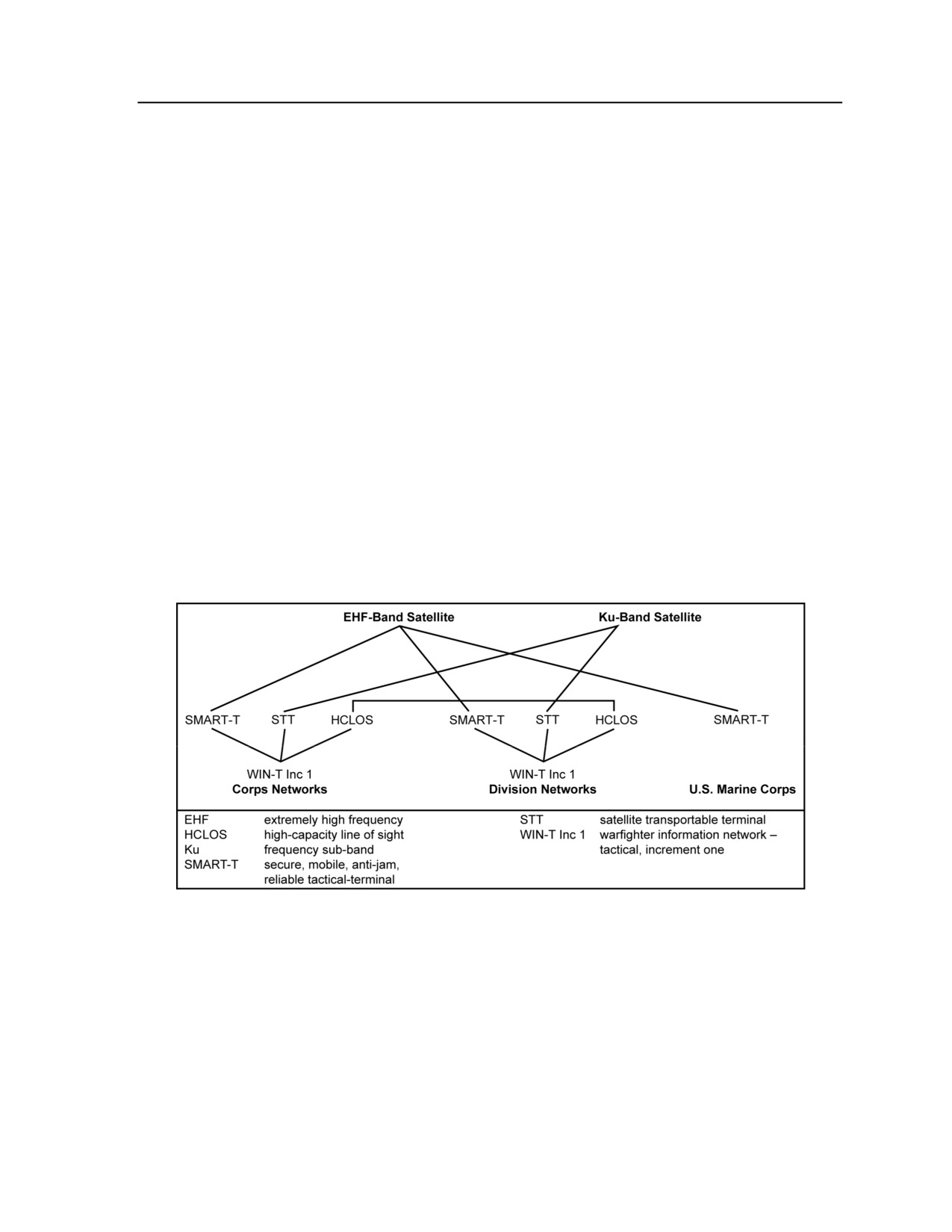
available for use where appropriate. Figure 3-3 identifies standard corps systems (see FM 6-02.43 for
details):
z
Warfighter information network-tactical, increment one (known as WIN-T Inc 1).
z
Satellite transportable terminal.
z
High-capacity line of sight system.
z
Secure, mobile, anti-jam, reliable, tactical terminal (known as SMART-T).
z
Wideband satellite terminals.
Figure 3-3. Corps communications
3-30. Warfighter information network-tactical, increment one refers to the communication equipment that
provides switching for voice, video, and data communications. It also provides information assurance
equipment to secure data and provides interoperability with legacy systems such as mobile subscriber
equipment. It is a satellite communication and switching package that enables the corps, division, and
brigade CPs to operate independently within the Global Information Grid or directly with a joint
headquarters. Warfighter information network-tactical, increment one works with military or commercial
satellites and ground systems.
3-31. The satellite transportable terminal uses a satellite transportable trailer equipped with a 2.4 meter
Ku band satellite dish, which will be upgraded to Ka band as it becomes available. The network will work
with existing terrestrial transport
(high-capacity line-of-sight and line-of-sight) and satellite
26 November 2010
FM 3-92
3-7
Chapter 3
communications systems such as ground mobile forces (AN/TSC-85/93), tropospheric scatter (AN/TRC-
170), and secure, mobile, anti-jam, reliable tactical terminal (AN/TSC-154).
3-32. The high-capacity line-of-sight system is a terrestrial microwave radio system paired with joint
network node to provide high bandwidth line of sight capability.
3-33. The secure, mobile, anti-jam, reliant tactical terminal is a tactical military strategic satellite
communication terminal which provides a satellite interface to permit protected uninterrupted voice and
data communication as forces move beyond the line-of-sight capability of terrestrial communications
systems fielded to corps, division, and brigade signal companies.
3-34. Wideband satellite terminals consist of older tactical satellite systems (AN/TSC-85D and AN/TSC-
93D) used by theater-level expeditionary signal battalions to support corps and below operations.
3-35. LandWarNet subsystems directly impact the corps ability to communicate throughout the AO.
Efficient and effective execution is supported by the voice, text, and imagery components that provide
commanders and staffs accurate and timely information. Relevant information passed by all three modes of
communication aims to be concise yet complete and clear enough to preclude misunderstanding. A COP
designed to display information in an easy-to-understand format enables rapid adjustments during
execution to keep an accurate portrayal of the situation in the AO.
BATTLE RHYTHM
3-36. The corps headquarters’ battle rhythm supports the commander’s effective command and control.
Different battle rhythm may occur within the corps headquarters to accomplish simultaneous activities, but
they all support the commander’s overall battle rhythm. For example, the corps normally conducts a daily
synchronization meeting and a battle update briefing to the commander or a designated officer to share the
COP and receive guidance. The battle rhythm is both a process and the various forums identified as part of
the process. When the battle rhythms of all the headquarters in the chain of command are nested with one
another, they work more effectively. For example, unit activities are scheduled so that the information
output in one activity is available as an input to higher or lower headquarters. Battle rhythms nested by
echelon let corps subordinate commands offset their events to provide information needed by the corps
headquarters. In addition, nested battle rhythms enable the corps CPs to supply necessary information to
higher headquarters.
3-37. The battle rhythm is frequently portrayed on a daily basis, but it can be illustrated over weeks or
months. An effective battle rhythm helps the CG and staff to synchronize the various information
management processes—among them, update briefings, shift changes, and conference calls. A corps battle
rhythm provides anchor points around which the CG and staff can plan their day. Chronological by nature,
battle rhythm depends on inputs from earlier events and provides outputs needed for later events. Individual
elements within the battle rhythm may be progressive; for example, a daily meeting, followed by a working
group every three days, leading up to a board meeting every sixth day.
3-38. The battle rhythm operates best when the officer in charge can direct changes to fit the situation. As a
guide to time management, battle rhythm is flexible enough to accommodate changes in the type of
operation, availability of key individuals, and other interruptions in the routine. Failing to adhere to a
disciplined battle rhythm results in the CG and staff working harder, longer, and less effectively.
Establishing and maintaining a battle rhythm provides a disciplining mechanism to support rest and sleep
plans for the CG and staff. This practice has the added benefit of training the second- and third-level
leadership in the conduct of CP operations when the principals are not present.
3-39. A corps headquarters may have several types of battle rhythms: a live assembly of key individuals at
a central location, a virtual meeting through use of the COP and the ABCS, or a combination of the two
when the command group, primary, and selected others meet in a central location while others participate
by video teleconference, Web camera, or ABCS. A battle rhythm is not a rigid tool to rob the CG of the
opportunity to seize the initiative. The CG and staff need time to think. With the advent of ABCS and other
command and control tools, the commander can receive the current COP at any time in any of the
command and control facilities. Battle rhythm can be graphically depicted in a table, line, or circle. Figure
3-4 (page 3-9) illustrates a tabular battle rhythm. (See FM 5-0 for a further discussion of battle rhythm.)
3-8
FM 3-92
26 November 2010
Corps Headquarters Operations
Time
Event
Chair
0700
Battle update briefing
CG / DCG
Shift change briefing / shift change in accordance
chief of staff /
0730
with CP cell standing operating procedures
assistant chief of staff, operations
chief of staff/assistant chief of staff,
0800
Operations synchronization meeting
operations
Teleconference with higher headquarters
CG / DCG / chief of staff
0900
Common operational picture synchronization
assistant chief of staff, operations
drill/virtual CP huddle
0930
Plans update
assistant chief of staff, plans
Working groups/boards (on call of working group
1000
officers in charge
officer in charge)
1100
Running estimate updates
cell officers in charge
Common operational picture synchronization drill /
1300
assistant chief of staff, operations
virtual CP huddle
Working groups (on call of working group officer in
1400
officers in charge
charge)
Common operational picture synchronization drill /
1700
assistant chief of staff, operations
virtual CP huddle
1900
Battle update briefing
CG / DCG
Shift change briefing / shift change as per cell
chief of staff /
1930
standing operating procedures
assistant chief of staff, operations
Teleconference with higher (on call)
commander / deputy / chief of staff
2100
Common operational picture synchronization
assistant chief of staff, operations
drill/virtual CP huddle
2130
Running estimate updates
cell officers in charge
Working groups (on call of working group officer in
2200
officers in charge
charge)
Common operational picture synchronization
0100
assistant chief of staff, operations
drill/virtual TOC huddle
0500
Running estimate updates
cell officers in charge
Common operational picture synchronization
0600
assistant chief of staff, operations
drill/virtual CP huddle
CG
commanding general
DCG deputy commanding general
CP
command post
TOC tactical operations center
Figure 3-4. Example of corps battle rhythm
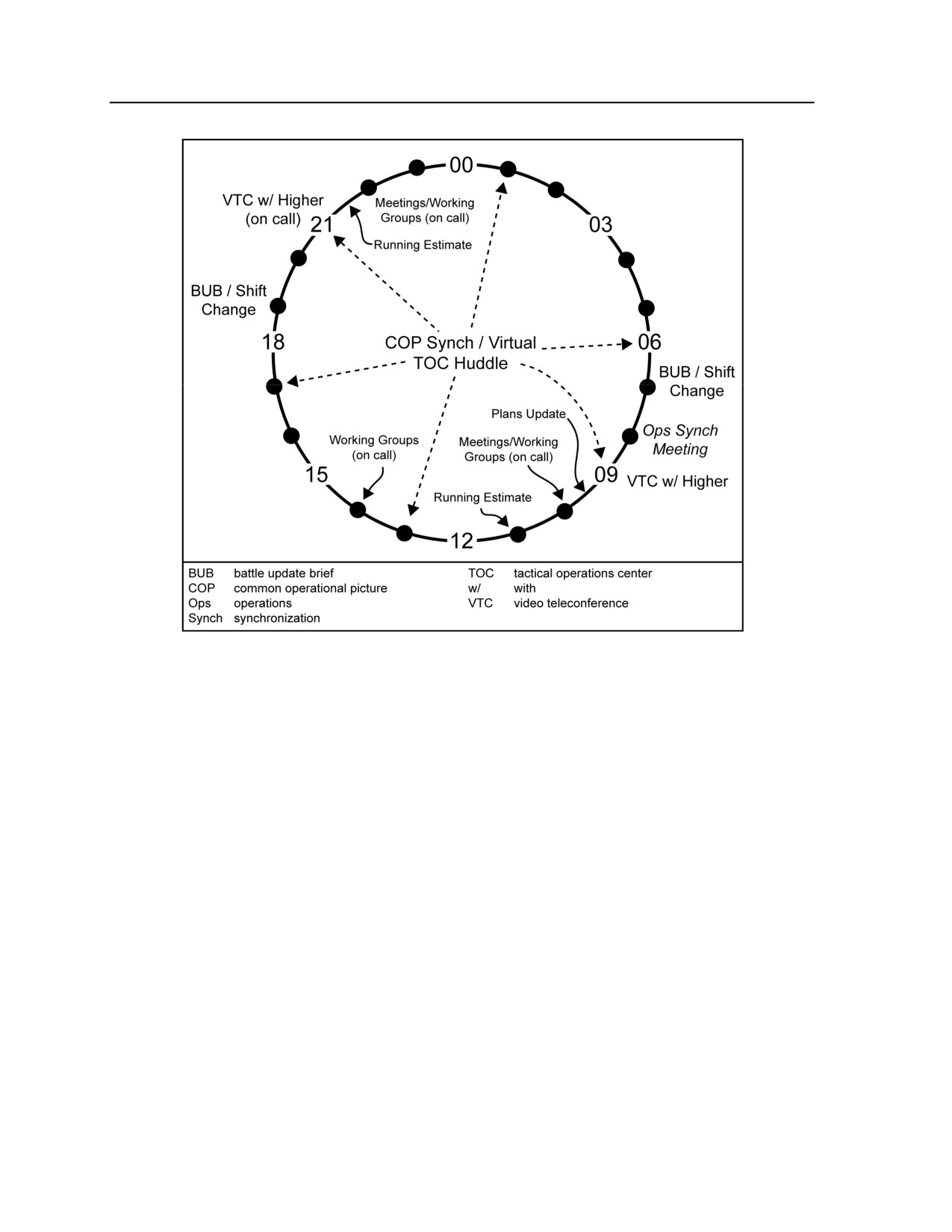
3-40. The battle rhythm can also be depicted in a circular fashion with internal activities inside the circle
and external events on the outside. Figure 3-5 (page 3-10) shows an example of a circular or graphic battle
rhythm chart. It assumes that the updated information disseminated at those briefings will enable the higher
headquarters to receive the latest information when the corps CG communicates with the higher
commanders and staff.
26 November 2010
FM 3-92
3-9
Chapter 3
Figure 3-5. Example of a graphic battle rhythm
OPERATIONS SYNCHRONIZATION MEETING
3-41. Chaired by the corps chief of staff or assistant chief of staff for operations, the operations
synchronization meeting is attended by senior leaders and is a key event in the corps headquarters’ battle
rhythm. The meeting provides information on the current operation. Principal members of the functional
and integrating cells, separate staff sections, standing working groups and boards attend. They brief the
status of ongoing projects and tasks with a focus on CG’s priorities. The meeting’s purpose is to
synchronize warfighting functions for the short-term planning horizon and provide guidance that drives the
operations of other components of the battle rhythm.
BATTLE UPDATE BRIEFING
3-42. The corps headquarters daily battle update briefing is an integral part of the corps headquarters
ability to command and control. Because of the modern digital communications systems and databases
available, the CG and staff can receive a battle update at any time. The CG is briefed in person, over a
voice communications system, or by visual display. Typically part of the corps main CP battle rhythm, the
battle update briefing provides analyzed information so the commander can make decisions and
synchronize the staff’s actions. Based on the updated COP, this briefing is intended to be short,
informative, and selective. It provides the CG with limited information that addresses the current operation
and activities planned for the near future. The corps tactical standing operating procedures, command
guidance, and operational requirements determine what information is briefed. Normally, the CG reviews
the status charts and displays before the battle update briefing to get familiar with the current situation of
the corps. This enables the battle update briefing to focus on by-exception issues requiring CG attention
and guidance.
3-10
FM 3-92
26 November 2010
Chapter 4
The Corps in Full Spectrum Operations
Often the corps is the highest echelon that commands and controls Army, joint, and
multinational forces in offense or defense against an enemy or in a situation requiring
stability or civil support operations. Meeting these challenges requires a corps
headquarters able to assign missions to its subordinate formations, extend its
operational reach, synchronize actions, and apply the elements of combat power.
EMPLOYING THE CORPS
4-1. Field Manual (FM) 3-0 articulates five operational themes: peacetime military engagement, limited
intervention, peace operations, irregular warfare, and major combat operations. The themes are so
interrelated that four of the five themes can occur at the same time. These themes give the commanding
general (CG) and staff a way to characterize the dominant major operation underway in the corps area of
operations (AO). These overlapping themes each require a different weighting of the elements of full
spectrum operations. Often the main effort in each theme differs; the CG and staff shift the effort as the
situation requires.
4-2. The Army’s operational concept is full spectrum operations. Full spectrum operations span from
benign, internationally sanctioned weapons inspections to major combat operations. Effective corps
commanders exercise command and control for any operation. They must be as adept at planning a short
noncombatant evacuation operation as supporting a multiyear major combat operation.
4-3. Corps headquarters controls Army and, when directed, joint and multinational forces and
organizations when conducting (planning, preparing, executing, and assessing) full spectrum operations.
The corps uses mission command to direct the application of full spectrum operations to seize, retain, and
exploit the initiative through combinations of its four elements—offense, defense, and stability or civil
support—and associated doctrinal tasks.
4-4. The corps headquarters is an essential element in the Army’s expeditionary capabilities. These
capabilities enable the Army to deploy combined arms forces into any operational environment and operate
effectively upon arrival. Expeditionary operations require the corps and its subordinate forces to deploy
quickly and shape conditions to seize the initiative and accomplish the mission.
4-5. Inherent in military operations is the reality of constrained resources. In most cases, too few human,
material, and financial resources or too little time exists to support all operations equally. Units in the
operational environment pool their resources to accomplish the mission rather than work independently.
Corps forces are no exception. All corps operations aim to fully engage corps subordinate and supporting
units in mission accomplishment.
4-6. As with many doctrinal tenets, operational reach, synchronization, and resourcing overlap. For
example, the operational reach of the corps depends on factors such as the forces assigned, their ability to
work together, and the priority of resourcing from the theater army or the joint headquarters.
EXTENDING OPERATIONAL REACH
4-7. Operational reach is the distance and duration across which a unit can successfully employ military
capabilities (Joint Publication (JP) 3-0). Consistent with the higher commander’s intent and mission, the
CG tries to extend the corps’ operational reach. The limit of the corps’ operational reach is its culminating
point—that moment in time and space when the force cannot continue its present operation. Operational
reach depends on factors such as space, time, and available support. Corps operations design the operation
26 November 2010
FM 3-92
4-1
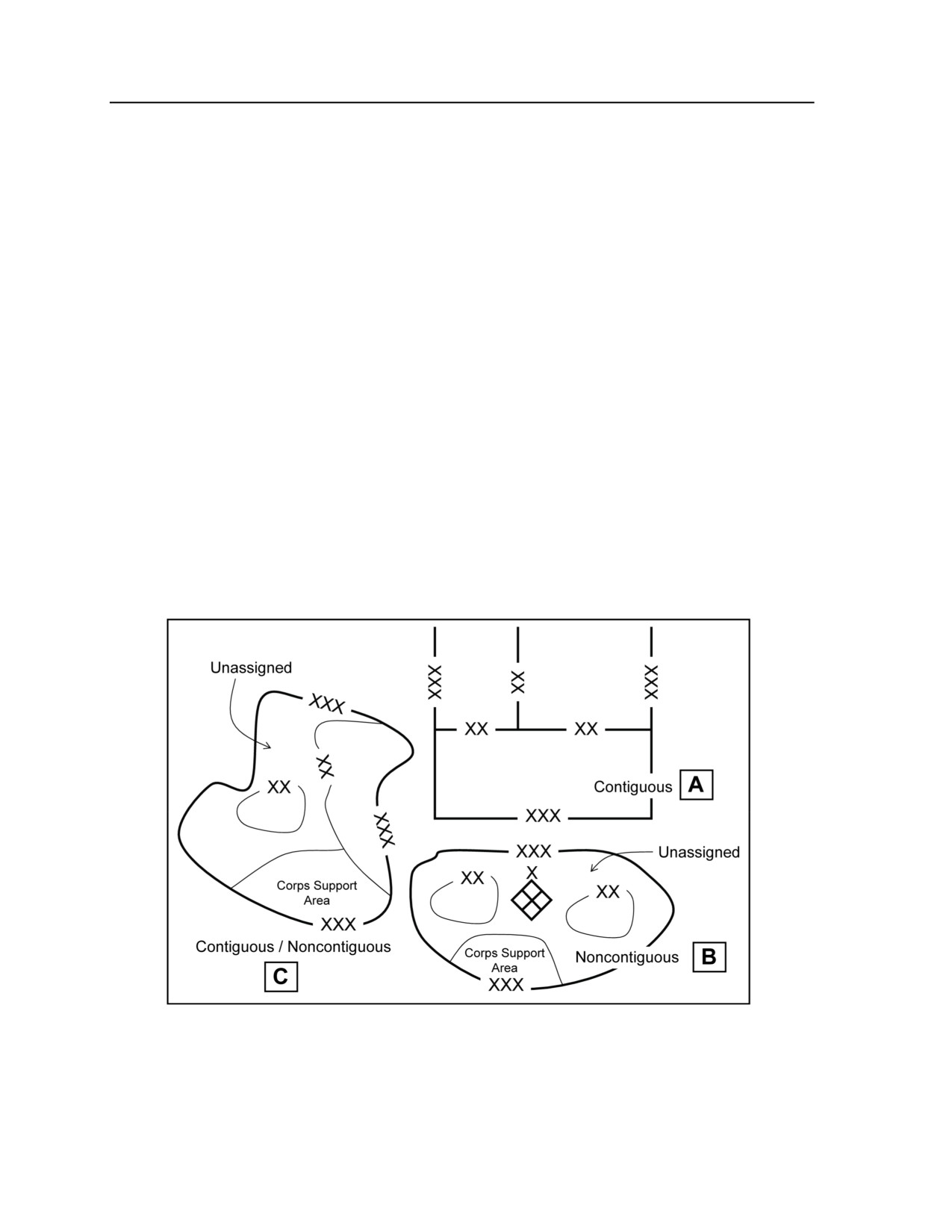
Chapter 4
so that its operational reach equals its culminating point. The corps expands the operational reach through
the AO, available forces, a reserve, stability operations, forcible entry, and consequence management.
AREA OF OPERATIONS
4-8. A key component of operational reach is the corps AO and its associated area of influence—a
geographical area wherein a commander is directly capable of influencing operations by maneuver or fire
support systems normally under the commander’s command or control (JP 3-16). The CG oversees and
authorizes terrain management. This requires balancing the forces available with the size of the AO. Too
large an area with regard to the available forces and the corps may not accomplish its mission. Too small an
area and the corps will fail to use available forces as intended. One of the CG’s first command decisions
determines how to control the AO. Commanders also focus on their area of influence.
4-9. The CG begins terrain management by assigning subordinate forces to AOs. Such assignments
empower individual initiative and maximize the opportunity for decentralized execution. When assigned an
AO, the subordinate division or brigade commander takes responsibility for managing terrain, collecting
intelligence, conducting security operations, tracking air and ground movement, clearing fires, and
conducting operations in that AO. Normally, the corps also establishes a corps support area for the conduct
of corps sustaining and enabling operations. (See FM 3-0 for a discussion of AO.)
4-10. The CG may divide the corps AO in one of three ways: contiguous AOs, noncontiguous AOs, or a
combination of the two. Contiguous AOs enable subordinate units to share a common boundary.
Noncontiguous AOs lack a common boundary between subordinate units. Combined contiguous and
noncontiguous AOs contain some unassigned areas. (See figure 4-1.) An unassigned area is the area
between noncontiguous areas of operations or beyond contiguous areas of operations. The higher
headquarters is responsible for controlling unassigned areas within its area of operations (FM 3-0). The
type of AO affects the corps’s requirement to resource the mission. The unit controlling the ground has
responsibility for terrain.
Figure 4-1. Possible configurations of corps areas of operations
Contiguous Area of Operations
4-11. In figure 4-1, the two divisions assign missions, set conditions, and influence the fight within their
AOs. These divisions integrate and synchronize the warfighting functions. The corps headquarters supports
4-2
FM 3-92
26 November 2010
The Corps in Full Spectrum Operations
the divisions’ operations and provides the intelligence, movement and maneuver, fires, protection,
sustainment, and other resources consistent with corps priorities. Sometimes no unassigned areas exist or
the CG retains an unassigned area forward of the subordinates’ AOs. In either case, the corps headquarters
continues to observe the corps AO.
Noncontiguous Area of Operations
4-12. Figure 4-1 illustrates a corps AO divided into noncontiguous AOs. From the corps’ perspective, this
is more complex since the corps headquarters controls unassigned areas within its AO as well as supports
division operations. The corps headquarters has responsibility of unassigned areas; it monitors those areas
to counter any risks to the force.
Contiguous and Noncontiguous Mix
4-13. Also in figure 4-1 (page 4-2) is an area that falls between the two other options. The corps
headquarters adequately resources its two divisions, each with a different terrain management challenge.
4-14. A division with an AO contiguous to the corps support area benefits from sharing a boundary with its
higher headquarters. A shared boundary can facilitate moving resources to support the division mission.
Likewise, the division can benefit from the intelligence, fires, protection, and sustainment activities
exercised by the corps in the unassigned area. This division remains responsible for monitoring its portions
of its area of influence that overlaps with the corps-controlled unassigned area.
4-15. The division in a noncontiguous AO surrounded by the corps-controlled unassigned area has two
responsibilities. First, it coordinates for support from the corps and for movement of resources between its
AO and the contiguous areas of the corps AO. Second, it monitors activities in its area of interest and
requests the corps to counter any threats originating outside the division AO but within its area of interest.
Unassigned Areas
4-16. The unassigned area is not empty. At a minimum, civilians and possibly enemy elements live there.
Regarding unassigned areas, corps actions aim to prevent the enemy from massing forces and capabilities
that endanger the corps. The CG assesses the risk and reacts accordingly. In all or portions of the
unassigned area, the CG may accept risk. When accepting risk, the CG has a branch plan to cover the areas
with intelligence collection assets and sufficient forces to defeat a potential threat. Areas with a low risk of
enemy occupation and action can be handled in many ways. For example, areas with no permanent force
only receive periodic intelligence, surveillance, and reconnaissance (ISR) efforts. Other approaches include
employing a full-time economy of force effort or assigning the mission to a corps major subordinate unit to
deter a threat from intelligence collection, staging, or attacking from that area. At a minimum, the CG can
assign “be prepared” tasks to subordinate units in the corps AO to anticipate operations and intelligence
requirements.
4-17. The CG has several options available to gain and maintain control of the initially unassigned areas.
The CG coordinates with joint, host-nation, and multinational forces to take responsibility for all or
portions of the area. The CG may elect to assign the entire area to parts of the corps, including having the
division headquarters divide the entire area. Control of initially unassigned areas can be an essential or
supporting task for the unit given the mission. For example, friendly forces always transit from contiguous
to noncontiguous areas or from one noncontiguous area to another. These forces can provide intelligence
and coverage of the areas. The forces required to control an unassigned area differ depending on the
situation, but often they will conduct economy of force. When the corps conducts decisive or shaping
operations, a small force or a small portion of a larger force then monitors and controls unassigned areas.
AVAILABLE CORPS FORCES
4-18. The number of forces available, their capabilities, and their expected duration in the corps force
structure impact operational reach. In general, a mix of capable forces in the appropriate numbers enables
the corps to accomplish its objectives and achieve them before reaching its culminating point. Depending
on how the theater army tailors the forces to the corps, the CG has several forces available. These include a
26 November 2010
FM 3-92
4-3
Chapter 4
combination of one or more brigade combat teams (BCTs), support brigades (aviation, fires, maneuver
enhancement, battlefield surveillance, and sustainment), functional brigades (including but not limited to
engineer, chemical, military intelligence, and military police), and Army Reserves and its functional
commands. Furthermore, the forces required to accomplish the mission come from more than Army
sources. Manned and unmanned joint air assets and special operations forces (including special operations
aviation) can support the corps mission.
Division Headquarters
4-19. The role of the division headquarters is to employ land forces as part of a joint, interagency, and
multinational force during full spectrum operations. The division executes simultaneous offensive,
defensive, and either stability or civil support operations (depending on whether or not it is operating in a
foreign country or the United States) in an assigned AO to establish specific conditions. It combines tactical
tasks and missions through its organization of decisive, shaping, and sustaining operations to accomplish its
assigned mission. The division is the primary tactical warfighting headquarters for command and control of
land force BCTs.
4-20. The trained and ready division headquarters supports the CG in exercising authority and direction of
operations of subordinate BCTs and other brigades. Division headquarters subordinate to the corps
facilitates flexibility and enables the CG to shape the operational environment.
Brigade Combat Team
4-21. Capabilities differ with each of the three BCTs (infantry, heavy, and Stryker); however, each can
conduct sustained offensive, defensive, and stability operations in most environments. In support of corps
operations, they train for small-unit operations, security missions, heavy-light integration, forcible entry,
and early-entry operations. Each unit can conduct surveillance and reconnaissance operations. The heavy
BCT and Stryker BCT can conduct strike operations. When assigned an AO, the BCT and armored cavalry
regiment can provide ISR and protection required to monitor and counter or delay enemy action from
unassigned areas. As powerful combat formations, they can defeat threats from their areas of interest alone
or as a part of a larger force.
Maneuver Enhancement Brigade
4-22. Normally the maneuver enhancement brigades (MEBs) are assigned to, attached, or placed under the
operational control (OPCON) of a division. However, they may be attached to or placed OPCON of a
corps. The MEB is designed to control the following capabilities: engineers; military police; chemical,
biological, radiological, and nuclear; and civil affairs. When provided to the corps, the brigade is usually
assigned an AO, normally the corps support area, where it conducts terrain management, movement
control, clearance of fires, security, personnel recovery, ISR, stability operations, area damage control, and
infrastructure development. The MEB coordinates air and ground movement. The MEB can conduct route
and convoy security operations for the corps or protect units as they move in movement corridors from one
area to another. It coordinates with the theater distribution center to maintain visibility during movement
operations within movement corridors and unassigned areas in the corps AO. The brigade’s task to manage
terrain in the corps support area may require it to establish a tactical combat force to counter threats to the
support area from unassigned areas. (See FM 3-90.31 for additional information on the MEB.)
Combat Aviation Brigade
4-23. The combat aviation brigade provides reconnaissance, air attack, command and control, medical
evacuation, and medium lift for corps operations. The brigade’s digital connectivity lets it synchronize fires
from supporting fires assets and ground maneuver forces with the brigade’s own firepower to eliminate or
suppress enemy threats. Depending on how it is tailored by the force provider or the theater army, the
combat aviation brigade can support the corps’s coverage of unassigned areas by aerial reconnaissance or a
movement to contact. The brigade supports movements between noncontiguous AOs with heavy- and
medium-lift and attack reconnaissance helicopters and with command and control assets. (See FM 3-04.111
for more information on the combat aviation brigade.)
4-4
FM 3-92
26 November 2010
The Corps in Full Spectrum Operations
Military Intelligence Brigade
4-24. The organization of the typical theater-level military intelligence brigade includes three tactical-level
units: an operations battalion, a forward counterintelligence and human intelligence collection battalion,
and a forward signals intelligence collection battalion. The military intelligence brigade contributes to the
corps’ ability to assess the threat in its AO by conducting intelligence collection and analysis, as well as
developing and disseminating intelligence products.
Battlefield Surveillance Brigade
4-25. The organic ISR battalion of the battlefield surveillance brigade and support organizations in support
of corps operations can be augmented as required. Augmentation can include additional military
intelligence and ground maneuver units, aviation assets, unmanned aircraft systems, and engineer units.
The brigade executes a corps-level ISR plan for the AOs and unassigned areas. The battlefield surveillance
brigade enables the corps to exercise command and control over assets that collect against the corps’s
information requirements, including in the unassigned areas. The battlefield surveillance brigade
headquarters can serve the corps as an intelligence fusion cell to pull in intelligence assessments and
provide situational understanding.
Fires Brigade
4-26. Fires brigades are normally assigned to, attached to, or placed under the OPCON of a division but
may be attached to or placed under OPCON to the corps. The fires brigade gives the corps a headquarters
the ability to conduct close support fires, counterfires, and reinforcing fires across the corps AO. The
brigade exercises command and control of Army and joint lethal and nonlethal fires. The fires brigade
develops and recommends fire support coordination measures that enable it to support corps operations.
These measures include fire support coordination lines, free-fire areas, kill boxes, no-fire areas, and
restrictive fire areas. Depending on the situation, the corps CG may direct a commander of a supporting
fires brigade to serve as a principle advisor or the force field artillery headquarters commander.
Engineer Brigade
4-27. The engineer brigade supports the corps, conducts engineer missions, and controls up to five
mission-tailored engineer battalions, including capabilities from all three of the engineer functions. It also
provides command and control for other non-engineer units focused on accomplishing missions such as
support of a deliberate gap (river) crossing as needed. The engineer brigade headquarters design enables
conducting operations to build local technical and engineering capacity.
Military Police Brigade
4-28. The military police brigade provides support to the corps as well as plans, integrates, and executes
military police operations by up to five mission-tailored military police battalions and integrating
capabilities from all five of the military police functions. It may also provide command and control for
other non-military police units focused on accomplishing such missions as area support, internment and
resettlement, or host-nation police development operations.
CONSTITUTE AND EMPLOY A RESERVE
4-29. The ability of the corps to command and control available forces closely relates to its ability to
employ a reserve. Often operational reach depends on the combat power available later in an operation
when the corps can reinforce a weak capability or exploit success. The CG relies on the staff and the main
command post’s (CP’s) effectiveness when deciding on the corps reserve employment. Establishment, size,
positioning, level of preparation directed, adjustment, movement, support, commitment, and replacement of
the corps reserve all tie to the situation and the CG’s situational understanding. These decisions stem from
how the CG understands the operations process; visualizes the operations’ evolution, potential branches,
and decision points; and recognizes that events do not always go as planned. The main CP functional and
integrating cells maintain the common operational picture (COP) so the CG can make decisions about the
26 November 2010
FM 3-92
4-5
Chapter 4
reserve and its employment. The main CP cells continually assess the situation, especially during
transitions from one operation to another.
4-30. The corps maintains a reserve based on the situation and its mission analysis. The CG determines
how to commit and use the corps reserve, although the current operations integration cell can execute the
order to commit the reserve when certain conditions are met based on the CG’s guidance. The corps plans
for the use of a reserve to deal with emergencies or expected contingencies, and, in the case of an offensive
operation, to reinforce success. Often the corps needs a reserve for offensive or defensive operations.
However, stability operations may require a reserve to reinforce efforts to ensure civil security and civil
control. Rarely do civil support operations require a reserve, unless the incident or natural disaster could
reoccur in another unexpected location requiring rapid response.
4-31. The CG can take risk and have no reserve. The CG can also identify one risk which to respond such
as expected contingencies or emergency situations. The reserve needs enough combat power, mobility, and
sustainment resources to accomplish its projected mission. The terrain or projected missions may require a
division or more than one BCT. The CG assembles the forces most likely to succeed in the current
operation. Likely they consist of a ground maneuver formation. Although fire assets are never kept in
reserve, they often receive on-order missions to support the reserve, such as with reinforcing fires,
suppression of enemy air defense, or blocking fires to shape the battlefield.
4-32. Sometimes, especially in stability and civil support operations, the CG may place a multifunctional
or functional brigade in reserve. This unusual reserve works well since they have capabilities that facilitate
all warfighting functions. However, the situation may call for potential reinforcement to ongoing operations
with engineers, military police, chemical defense, explosive ordnance disposal, quartermaster, general
aviation, or medical forces. As with all reserves, all or part of a functional brigade receives an on-order
mission to support an operation. Additionally, the CG may keep functional brigades in reserve during
offensive and defensive operations to overcome unexpected obstacles or protect the corps from air and
missile, chemical, unruly population, or health threats.
CONDUCT OF STABILITY OPERATIONS
4-33. The operational reach of the corps is enhanced by its ability to engage in all aspects of full spectrum
operations. The corps’ mission determines the relative weight of efforts among the offensive, defensive,
and stability or civil support elements. The corps continuously and simultaneously prepares to control
forces engaged across the spectrum of conflict. The corps conducts operations to leverage the coercive and
constructive capabilities of their force by using the appropriate combination of defeat and stability
mechanisms that best accomplish the mission. The corps headquarters contributes to establish conditions
that facilitate future success. (See FM 3-07 for further information on stability operations.)
FORCIBLE ENTRY
4-34. The operational reach of the corps is extended by forcible entry—seizing and holding of a military
lodgment in the face of armed opposition (JP 3-18). Commanders typically use it in operations where the
entry force either can hold on its own against the expected enemy force, or they anticipate a ground force
can link up with the entry force to protect it and continue operations. Units can execute forcible entry via
parachute, air assault, amphibious assault, or rapid movement over land. A forcible entry operation is
inherently joint. Forcible entry operations can use a single method (such as air assault forces) or be
integrated (when combinations of early entry forces participate). If forces use more than one method, their
operations can be concurrent or integrated. In concurrent operations, forces execute different types of
operations simultaneously to accomplish different objectives. In an integrated forcible entry, different
capabilities seize different objectives, but the friendly forces are mutually supporting.
4-35. The corps headquarters trains to conduct Army and joint forcible entry operations. These operations
may use any combination of divisions or BCTs and supporting units from multiple aerial ports of
embarkation and seaports of embarkation. The corps headquarters, once designated a joint task force
headquarters, may also be required to conduct a joint forcible entry operation employing assault and
support forces from the other Services and the United States Special Operations Command. To respond
rapidly to many contingencies, the corps headquarters prepares to echelon command and control facilities
4-6
FM 3-92
26 November 2010
The Corps in Full Spectrum Operations
into the fight, starting with the early-entry CP, the mobile command group, or the tactical CP. For large-
scale operations, the main CP serves as the command and control headquarters.
4-36. The command and control headquarters charged with conducting a forcible entry operation
establishes command and supporting relationships with the joint, Service, or functional headquarters
commanding and controlling the operation.
4-37. See JP 3-18 for additional information on the conduct of forcible entry operations.
CONSEQUENCE MANAGEMENT
4-38. The operational reach of the corps expands with its ability to respond to results of combat actions or
a disaster that requires a focused response by the corps to reduce the severity of the impact. Often, this
limited intervention activity occurs with other combat actions in the corps AO. When this occurs, the CG
decides whether the consequence management or the initial operation will be the economy of force effort.
4-39. To perform consequence management tasks, the corps coordinates support to maintain or restore
essential services and manage and mitigate problems. These problems can result from disasters and
catastrophes, including natural, man-made, or terrorist incidents. Many incidents requiring a response fit in
three categories: natural disasters; high-yield explosives; and chemical, biological, radiological, and nuclear
hazards. Each incident requires a different response with varying military contributions.
4-40. Consequence management can be foreign or domestic. Foreign consequence management is a
stability operation. The host nation has responsibility of foreign consequence management; however, other
nations may request U.S. assistance through the Department of State. Since the Department of Defense
possesses many assets required to respond to a consequence management incident, the President may direct
the Department of Defense to support the Department of State or other U.S. Government agencies.
Domestic consequence management is a component of civil support. Military support for domestic
consequence management normally falls to the Army and Air National Guard, which can be employed by
civil authorities while serving in a United States Code, Title 32 status. The deployed corps headquarters
with a consequence management mission encounters a level of risk. This risk occurs not only as a result of
the disaster itself, but also because of a potential military threat. Sometimes consequence management
requires combat operations against an enemy to provide a secure environment permitting forces to perform
consequence management tasks. Protecting joint and multinational military and civilian forces and other
responders requires constant effort. Often the need to respond requires the use or threat of force by friendly
forces to create conditions for successful consequence management operations.
4-41. The corps headquarters can serve as a joint task force headquarters, serve as an ARFOR headquarters
under a joint task force, or provide command and control for the consequence management operation in its
own right. Regardless of its status, the corps headquarters plans, prepares, executes, and assesses the
response and recovery operations in the AO. The corps headquarters marshals resources of its subordinate
units and makes requests for available resources from the theater army and national-level force providers.
During foreign consequence management situations, the corps subordinates its assets to assist the
organizations of the local government. The main CP organizes in the same way for operations
predominated by stability or civil support as it does for combat operations. The functional and integrating
cells operate according to standing operating procedures, fulfilling their tasks in support of the corps
command and control system.
4-42. FM 3-28.1 contains additional information on consequence management.
SYNCHRONIZING INFORMATION ACTIONS
4-43. Synchronizing information actions involves information engagement and supporting processes.
INFORMATION ENGAGEMENT
4-44. Information engagement (see paragraph 2-116 for the definition of information engagement) seeks to
use the power of knowledge to inform and influence internal and external audiences. The corps and its
subordinates develop integrated information engagement tasks with theater army, joint, and National
26 November 2010
FM 3-92
4-7