FM Field 3-04.104 Tactics, Techniques, and Procedures for Forward Arming and Refueling Point (August 2006) - page 3
Operational Environment
solution, however, is to avoid open snowfields when selecting FARP locations. Instead, the FARP should
be located near partially wooded or urban areas.
5-25. Electrically grounding FARP equipment and aircraft is another problem. Frozen ground makes the
emplacement of grounding rods difficult and reduces the effectiveness of the electrical ground. To emplace
a grounding rod, a hole must be dug, drilled, blasted, or melted and the rod placed in the hole. To ensure
the proper flow of electricity, paper or other absorbent material is filled in around the rod and then soaked
with salt water.
5-26. Maintenance requirements for aircraft and FARP equipment will be increased on the winter
battlefield. When aircraft icing occurs, FARP personnel may have to deice the aircraft. In cases of
extremely thick ice, a Herman Nelson heater or an aviation ground power unit may be the only effective
deicing equipment available. At times, ammunition can freeze. Deice caps for the Hellfire missile are
available. They are fitted over the seeker to prevent it from freezing. Rocket pod covers also are available.
These covers fit snugly over the rockets, and the rockets can be fired through them. All of the FARP
equipment must be "winterized" with additional antifreeze or low-temperature lubricants.
Note. Static electricity is more prevalent in cold environments because of low humidity.
3 August 2006
FM 3-04.104
5-5
Chapter 6
Environmental Protection Considerations
While the commander's responsibilities extend across every aspect of the mission,
there is one area of responsibility that impacts virtually every action and operation—
the environment. Accomplishing the mission always has been and always will be the
top priority. However, successfully blending the military mission with the
environmental challenge is now equally important. Conserving, protecting, and
restoring our natural and cultural resources is the first line of defense for the heritage
of future generations and the Army's mission.
ARMY ENVIRONMENTAL MANAGEMENT POLICY
6-1. The Army Chief of Staff and the Secretary of the
Army, as stated below, have endorsed the Army
Contents
Environmental Management Policy. "Protection of
Army Environmental Management
precious environmental resources is the duty of every
Policy
6-1
member of the Total Army. Charged with the
Liability
6-2
stewardship of over 20 million acres of land, we must
Spill Definitions
6-2
never lose sight of our responsibility to preserve and
Spill Discovery
6-3
protect the resources that have been entrusted to our
Assessment
6-3
care
” The guiding principle is that work and
Spill Cleanup
6-4
actions must be environmentally sustainable; meeting
Spill Kits
6-4
current needs without compromising the integrity of the
Reacting to a Small Primary Spill
6-5
environment for future generations. As a basis to our
Reacting to a Small/Large Spill
6-6
Environmental Management Policy we must:
Integrate environmental consideration into all of our activities.
Allocate resources and training to protect our environment.
Ensure that installation operations are environmentally acceptable and enhance the life of
military and civilian members.
Minimize the generation of waste.
Clean up sites of past contamination.
6-2. Personnel must comply with the following references for the environmental policy to be effective:
AR 200-1.
AR 200-3.
AR 200-4.
DA PAM 200-1.
YOU SPILL, YOU DIG!, An Environmental Handbook for Deployment, published by U.S.
Army Corp of Engineers, Europe District.
The website for the handbook is
https://www.denix.osd.mil/denix/Public/News/Army/Dig/cover.html.
3 August 2006
FM 3-04.104
6-1
Chapter 6
6-3.
“All of us, Total Army members and leaders, military and civilian, must ensure that we are well
aware of our responsibilities as we set the standard for the Department of Defense and the Nation in
meeting the environmental challenges of the 1990s and beyond."
-The Department of the Army
Environmental Management Policy
Memorandum, 17July 1990
LIABILITY
6-4. Several civil and criminal penalties are associated with improper environmental management. The
commander has ultimate responsibility and therefore should familiarize himself with the laws. Some of
these are—
Hazardous Materials Transportation Act.
Occupational Safety and Health Act.
Clean Air Act.
Toxic Substances Control Act.
Resource Conservation and Recovery Act.
Safe Drinking Water Act.
6-5. Maximum penalties vary by statute and include fines ranging from $10,000 to $25,000 per day of
violation and imprisonment from 1 to 15 years. In case of a civil enforcement, the installation and its
budget would suffer the consequences of enforcement. As far as personal liability, the commander must
understand that direct participation in the violation of an environmental statute is but one theory of liability
that could subject him to prosecution in the Federal district court.
6-6. The commander should act promptly to correct environmental violations. Failure to promptly correct
environment violations could result in prosecution even though the commander had no direct or indirect
involvement in the violation. If violations of the law do occur, the best course of action (COA) for the
commander is to inform the appropriate regulatory authorities immediately and engage in good faith efforts
to comply.
SPILL DEFINITIONS
6-7. A spill is broadly defined as a release of any kind of a petroleum product or hazardous substance to
the environment. Spill reaction is based largely on the nature of the material spilled. Three types of spills
are small priming spills, small spills, and large spills.
A small priming spill covers less than 18 inches in all directions.
A small spill extends less than 10 feet in any direction, covers less than 50 square feet, and is
not continuous.
A large spill extends farther than 10 feet in any direction, covers an area in excess of 50 feet,
or is continuous; for example, a leaking tank.
6-8. For purposes of reporting to federal, state, and local authorities, an oil spill is defined as any spill
that reaches a stream, creek, river, or any other body of water in harmful quantities. Additionally, any oil
spill that could possibly come into contact with the aqua line of the local water table will be reported.
Harmful quantities violate applicable water quality standards or cause a film or sheen upon, or
discoloration of, the surface of the water or adjoining shorelines. They also cause a sludge or emulsion to
be deposited beneath the surface of the water or upon adjoining shorelines.
6-2
FM 3-04.104
3 August 2006
Environmental Protection Considerations
6-9. The information relative to spill size and reportable spills discussed in this chapter applies only to
oil spills and not to hazardous substances. The commander or on-site coordinator is the only person
authorized to report spills. He will report all spills of any kind that he deems significant, including any spill
that results in fire or explosion.
SPILL DISCOVERY
6-10. The initial component in the spill-response plan is discovery. The primary responsibility of a
discoverer is to notify the proper authorities, who are trained and equipped to deal with an environmental
incident. When a spill is discovered, the person discovering the spill will—
Use personal protective equipment, including gloves, goggles and suits.
Extinguish all cigarettes.
Do the spill drill—REACT! A helpful reminder is to:
Remove the source.
Envelop the spill.
Aborb/accumulate.
Containerize the hazardous waste (HW).
Transmit a report.
6-11. Defensive actions should begin as soon as possible to prevent or minimize damage to public health
and welfare or to the environment. Some general actions are—
Eliminate sources of sparks or flames.
Control the source of the discharge.
Place physical barriers, such as berms or dikes, to deter the spread of the oil.
Prevent the discharge of contaminated water into storm drains or the sewer system.
Recover the oil or minimize its effects.
Place recovered oil and contaminated absorbents, such as rags, in Department of
Transportation (DOT)-approved containers for disposal as HW.
ASSESSMENT
6-12. During every step of the spill-response process each responding individual will continually assess
the situation and make decisions on the next appropriate action to be taken. Upon initial discovery the
discoverer and/or the supervisor will provide the following information:
Time and type of incident.
Name and quantity of spilled material involved (to the extent known) and the rate of release.
Direction of the spill vapor or smoke release.
Fire and/or explosion possibility.
Coverage area of spill and the intensity of any fire or explosion.
Extent of injuries, if any.
Status of cleanup.
Whether spill team is on-site or en route.
Whether spill team is adequate.
Estimated time to completion.
Name of on-scene commander and how to contact him.
6-13. The commander or on-site coordinator will determine the appropriate response based upon the
potential risks associated with the spill and whether an imminent or actual threat exists to human health or
3 August 2006
FM 3-04.104
6-3
Chapter 6
the environment. The appropriate notifications will be made and the response team will be mobilized to
control, contain, and clean up any spilled material if the following situations occur:
The spill could result in the release of flammable or combustible liquids or vapors thus causing
a fire or gas explosion hazard.
The spill could cause the release of toxic liquid or fumes.
The spill can be contained on the site, but the potential exists for ground water contamination.
The spill cannot be contained on the site, resulting in off-site soil contamination and/or
surface-water contamination.
SPILL CLEANUP
6-14. Specific actions to be taken for oil spills—small priming spill, small spill, and larger spill—are
discussed below. The commander or on-site coordinator will direct cleanup operations.
SMALL PRIMING SPILL
6-15. A fireguard will be posted at the spill until the vapors have dissipated.
SMALL SPILL
6-16. Operations in the area will be stopped and a fireguard posted. If the fuel spill is on concrete or a
similar hard surface, an absorbent cleaning agent will be used to clean up the spill. After the spill is cleaned
up, the absorbent material will be placed in a closed metal container until it can be burned. If aviation
gasoline (AVGAS) or jet propulsion fuel, type 4 (JP4) has been spilled, do not use rags to absorb the spill.
If the fuel is spilled on the ground or on a hard surface and is well removed from operational areas, the
spill area will be roped off until the fuel has evaporated and the vapors have dispersed. Operations will
cease and personnel will not be allowed in the area until the fuel is vapor-free.
LARGE SPILL
6-17. The fire department will be called immediately, and the flow of fuel will be stopped. After all safety
precautions have been taken, personnel will consider—
Removing aircraft and personnel from the spill area.
Removing refueling vehicles from the spill area.
Shutting engines off.
Blanketing large fuel spills with foam.
Note. The fire chief will direct subsequent recovery of fuels. The area must not be used for
operations until it is declared free of fuel and fuel vapors.
SPILL KITS
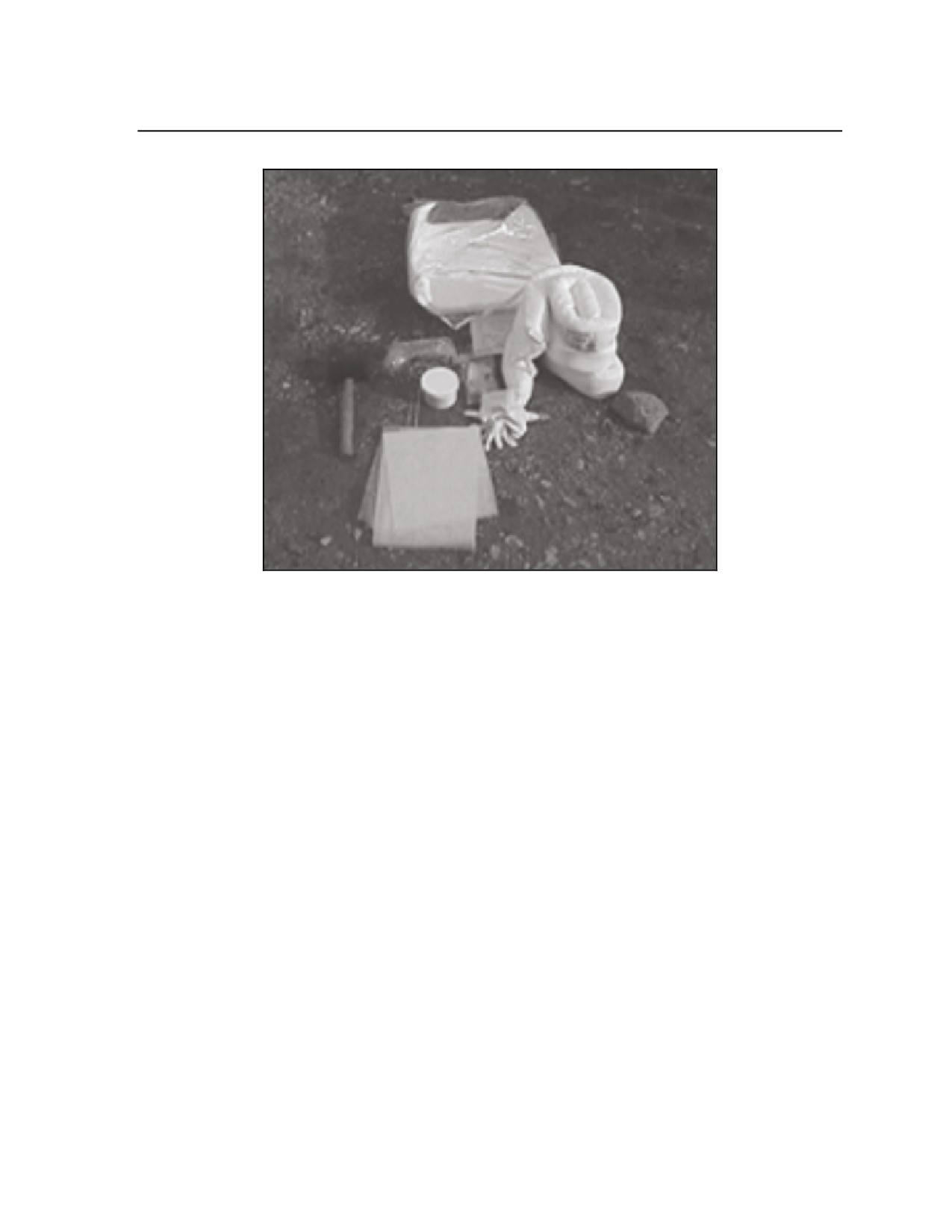
6-18. Spill kits (figure 6-1, page 6-5) should be maintained in and around all locations where hazardous
material (HM)/HW are stored, handled or disposed of. Various types of kits can be ordered through the
Army Supply System (see Appendix H) and should include rubber gloves, safety goggles, putty, rubber
mallet, wooden plugs, absorbent booms, absorbent pads, plastic bags, and in some cases a disposal barrel.
6-4
FM 3-04.104
3 August 2006
Environmental Protection Considerations
Figure 6-1. Spill kit.
REACTING TO A SMALL PRIMARY SPILL
6-19. By REACTing quickly, personnel eliminate hazards that could cause injury. This also give the spill
less of a chance to seep into the ground, which makes cleanup easier and helps protect water resources.
After personnel have protected themselves from exposure, they will—
Remove the source
If it is dripping: stop the drip with a wooden plug or putty.
If it is from a leaky connection: tighten the connection or replace the broken parts.
Envelop the spill.
If it is flowing, put an absorbent sock or pad down to catch the flow.
Use your shovel to build a small dam or berm.
Absorb/accumulate.
On a hard surface put down dry sweep.
On a gravel or mud surface, lay an absorbent sock or pad on the spill.
Containerize it.
Place used absorbent material in a plastic bag or container.
Use your on-vehicle equipment shovel or entrenching tool to dig up the contaminated soil
and place it in a container or plastic bag. Be sure to bring the container or bag to a proper
HW collection point.
Transmit a report.
Tell your boss or supervisor what you spilled and what you did about it.
Report regulatory enforcement actions and reportable spills through command channels,
according to DA PAM 200-1.
3 August 2006
FM 3-04.104
6-5
Chapter 6
REACTING TO A SMALL/LARGE SPILL
6-20. After personnel have protected themselves from exposure, they will—
Remove the Source.
Attempt to stop the flow from the container.
Place the leaking container into another container or try to catch the leak with another
container
Secure the area.
Envelop the spill.
Break out the nearest spill response kit.
Put the booms at the bottom of the flow or
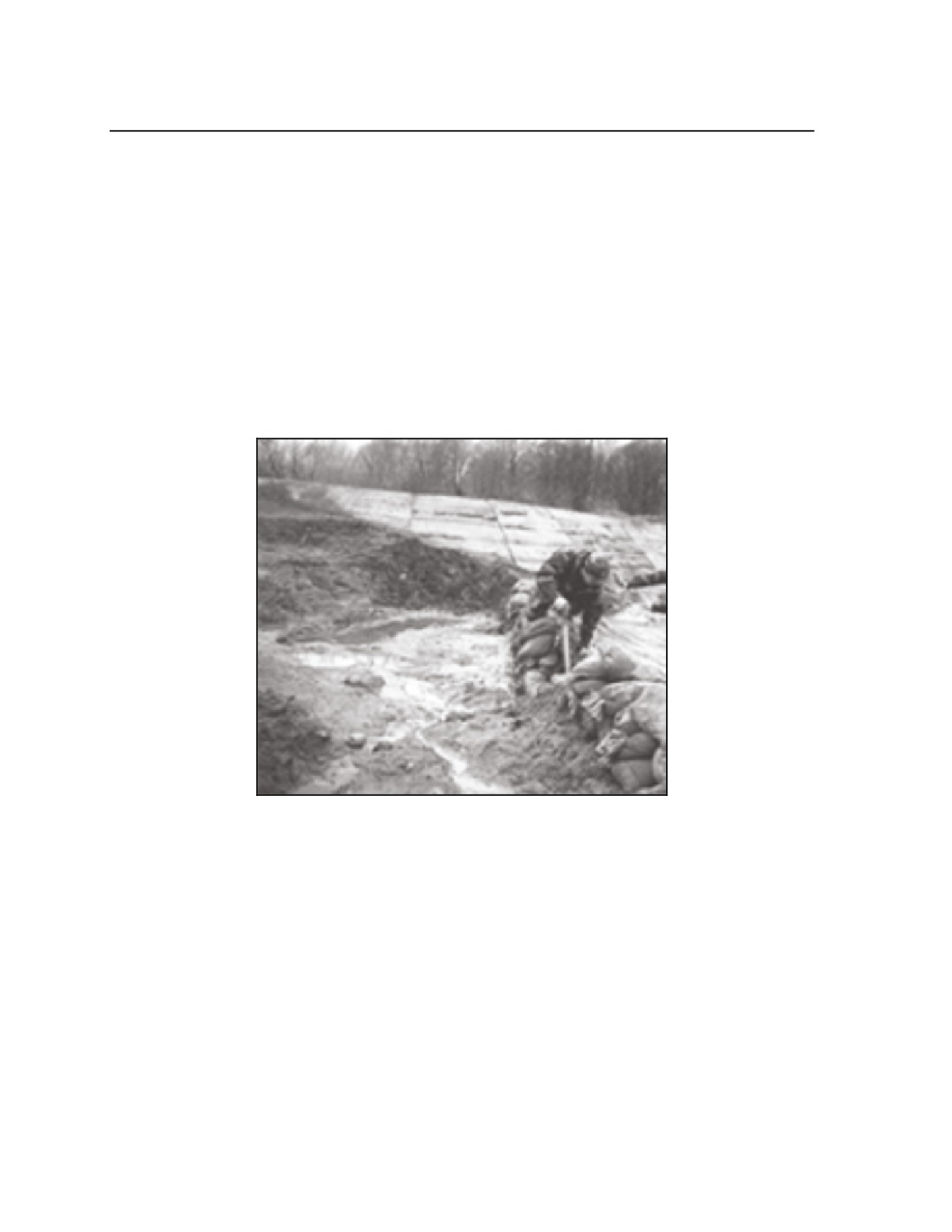
Dig a dike/berm (figure 6-2) to stop the flow into streams.
Figure 6-2. Digging a dike/berm.
Absorb/accumulate. Place appropriate absorbent material (dry sweep, pads) on the spill in the
middle of the boomed-off area.
Containerize the HW. Use a shovel to place contaminated materials (including soil, booms,
pads or other materials) in a plastic bag or a waste drum.
Transmit a report. If a spill is too large to handle alone—REACT as best you can and get help!
6-6
FM 3-04.104
3 August 2006
Appendix A
Standard Hand and Arm Signals
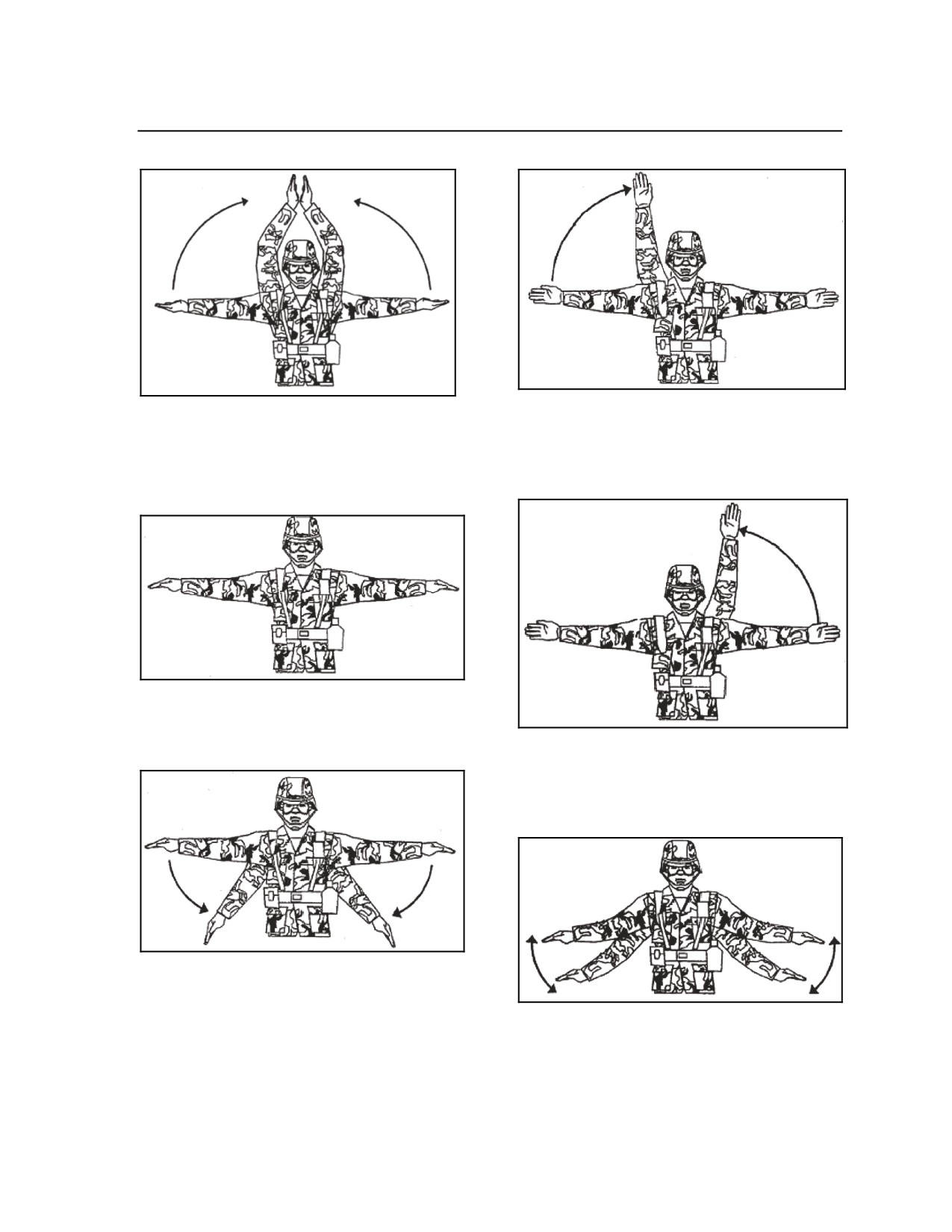
This appendix implements portions of Standardization Agreements (STANAGs) 3117
and 2999 (Allied Tactical Publication-49[D], Volumes 1 & II). See FM 3-04.140,
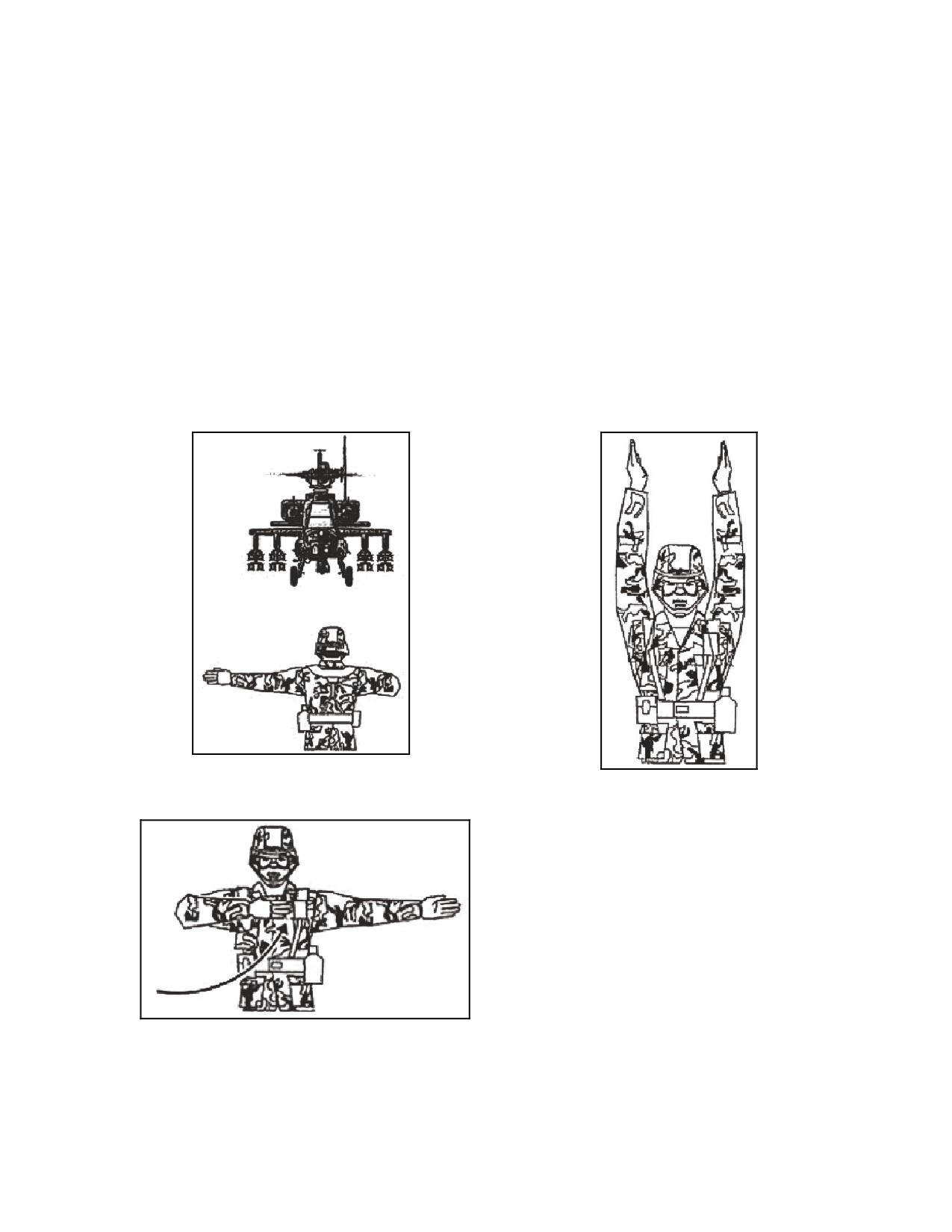
figure 3-1 for arming hand signals. Figures A-1 through A-48 show standard hand
and arm signals.
Figure A-1. Position of ground guide for a
rotary-wing aircraft
Figure A-3. This way
Arms above head in vertical position with
palms facing inward.
Figure A-2. Proceed to next ground guide
Both arms extended on same side of shoulder
level to indicate direction of next ground guide.
3 August 2006
FM 3-04.104
A-1
Appendix A
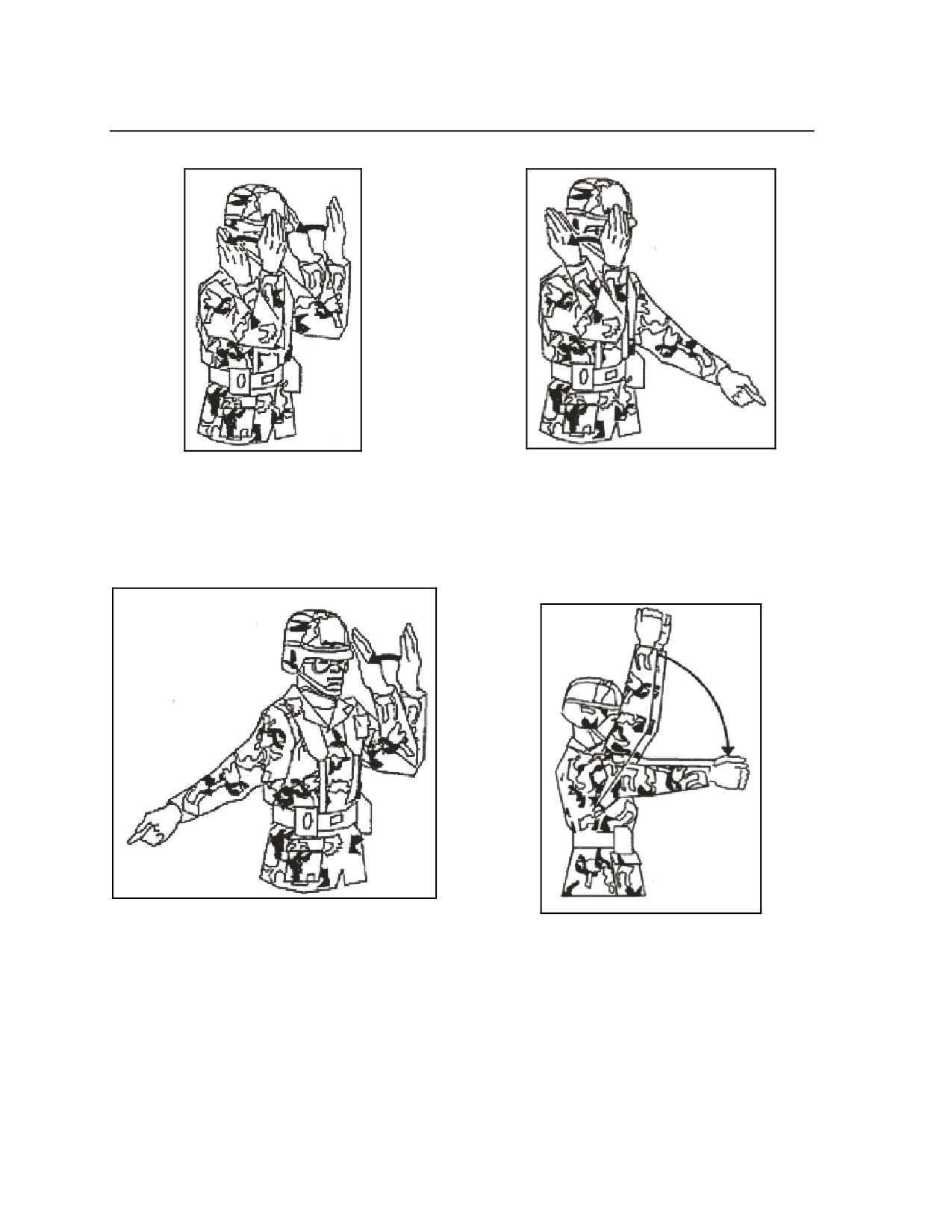
Figure A-4. Move ahead
Figure A-6. Turn to right (starboard)
Arms a little apart with palms facing backward
Position left arm down and point to right wheel
and repeatedly moved upward and backward
or skid; move right arm repeatedly upward and
from shoulder height. Indicate the aircraft
backward. Indicate rate of turn by rapidity of
speed desired by rapidity of arm motions.
arm motions.
Figure A-5. Turn to left (port)
Position right arm down, and point to left
Figure A-7. Landing directions
wheel or skid; move left arm repeatedly
Ground guide stands with arms raised
upward and backward. Indicate rate of turn by
vertically above head and facing toward the
rapidity of arm motions.
point where the aircraft is to land. The arms
are lowered repeatedly from a vertical to a
horizontal position, stopping finally in the
horizontal position.
A-2
FM 3-04.104
3 August 2006
Standard Hand and Arm Signals
Figure A-11. Move to right
Figure A-8. Move upward
Left arm extended horizontally sideways in
Extend arms horizontally to the side,
direction of movement and right arm swung
beckoning upward with palms turned up.
over the head in same direction in a repeating
Indicate rate of ascent by speed of movement.
movement.
Figure A-9. Hover
Extend arms horizontally sideways with palms
turned down.
Figure A-12. Move to left
Right arm extended horizontally sideways in
direction of movement and left arm swung
over the head in same direction in a repeating
movement.
Figure A-10. Move downward
Extend arms horizontally to the side,
beckoning downward with palms turned down.
Indicate rate of descent by rapidity of arm
Figure A-13. Slow down
motions.
Arms down with palms toward ground and
then move up and down several times.
3 August 2006
FM 3-04.104
A-3
Appendix A
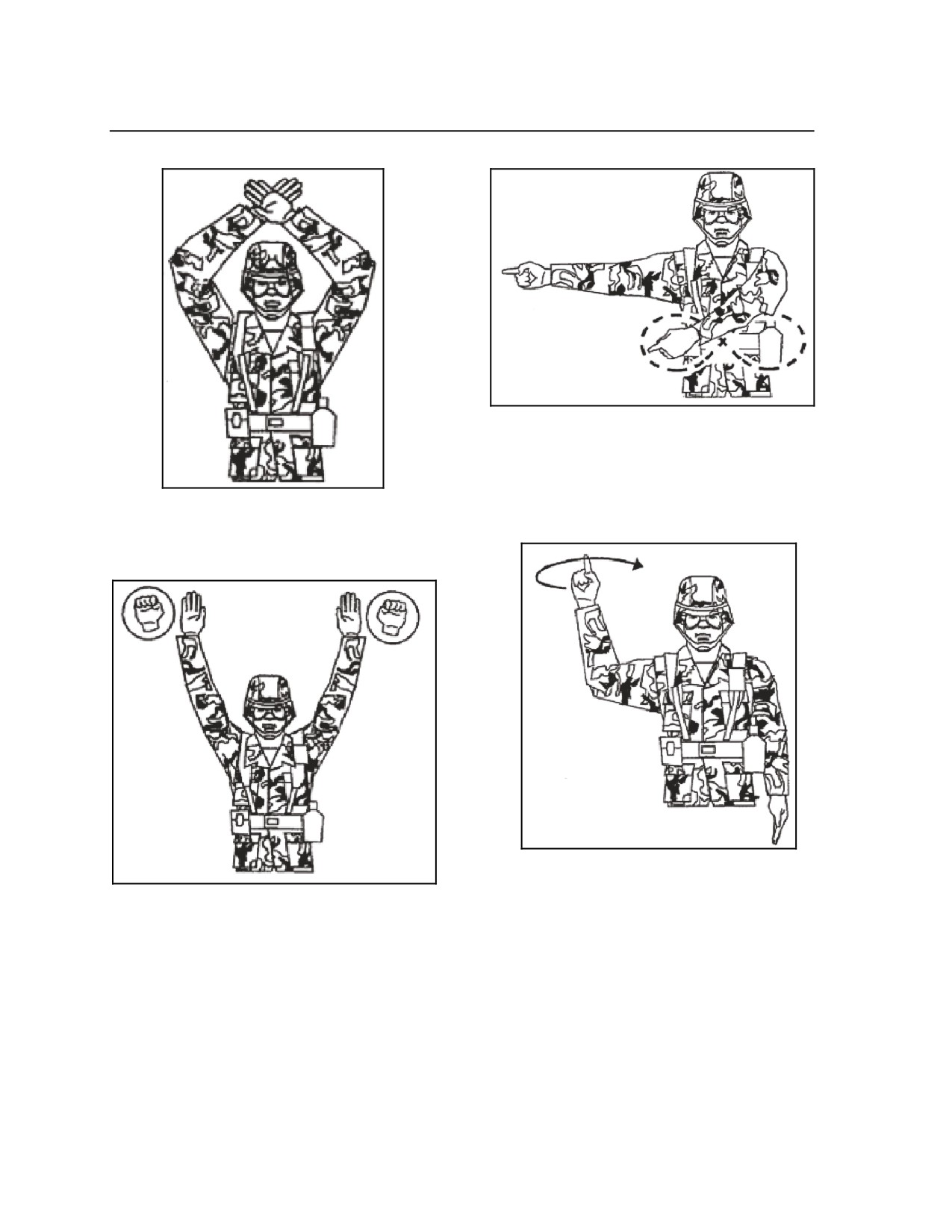
Figure A-16. Fire
Make rapid horizontal figure-eight motion at
waist level with either arm, pointing at source
of fire with the other.
Figure A-14. Stop
Cross arms above head with palms facing
forward.
Figure A-17. Engage rotor(s)
Circular motion in horizontal plane with right
Figure A-15. Brakes
hand above head.
On (Day). Arms above head, open palms, and
fingers with palms toward aircraft, and then fist
closed.
On (Night). Arms above head and then wands
crossed.
Off (Day). Reverse of above.
Off (Night). Crossed wands and then
uncrossed.
A-4
FM 3-04.104
3 August 2006
Standard Hand and Arm Signals
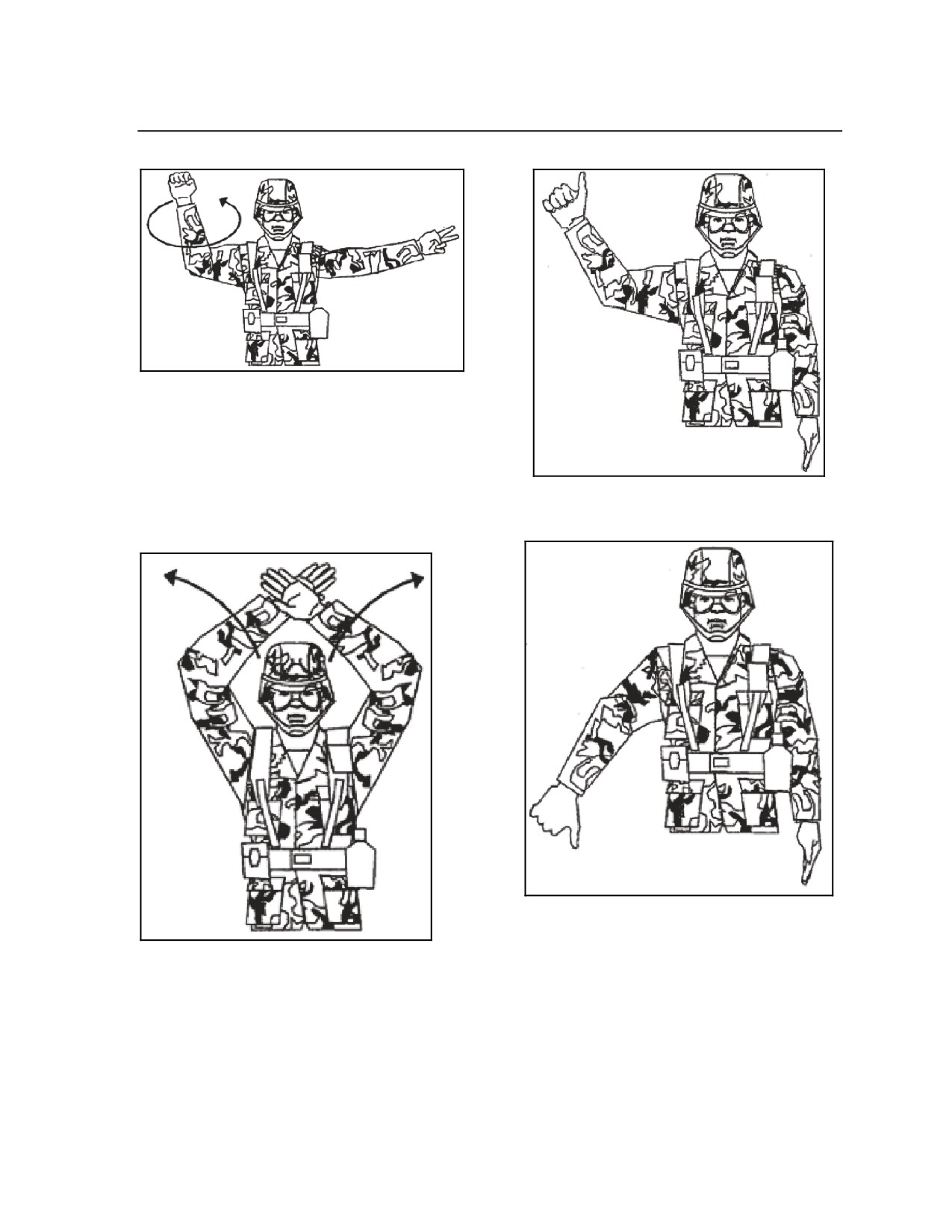
Figure A-18. Start engine(s)
Day. Left hand overhead with appropriate
number of fingers extended to indicate the
number of the engine to be started and
circular motion of right hand at head level.
Night. Similar to day signal except that the
wand in the left hand will be flashed indicating
Figure A-20. Affirmative (all clear)
the engine to be started.
Hand raised with thumb up.
Figure A-21. Negative (not clear)
Arm held out, hand below waist level, and
thumb turned down.
Figure A-19. Wave-off
Waving of arms over the head.
3 August 2006
FM 3-04.104
A-5
Appendix A
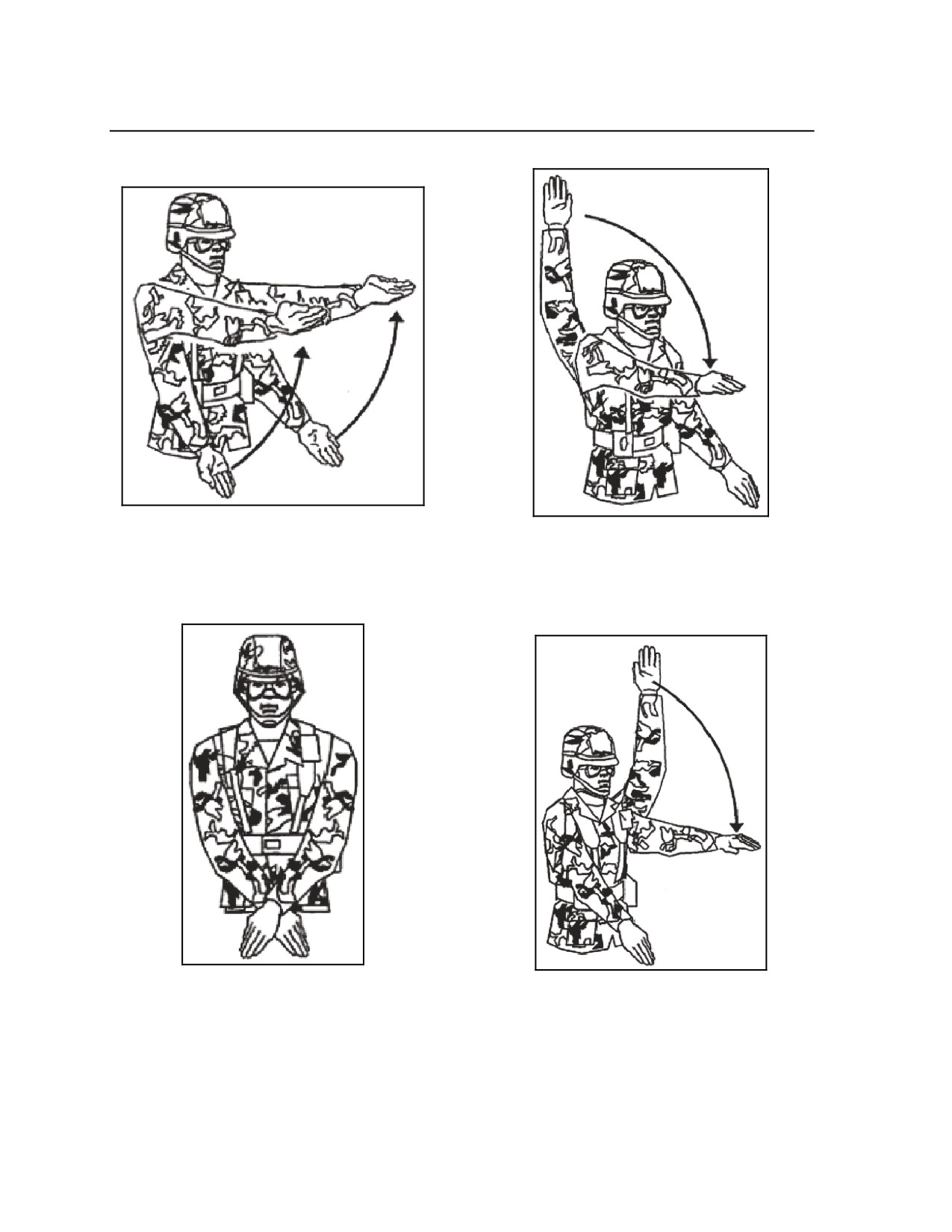
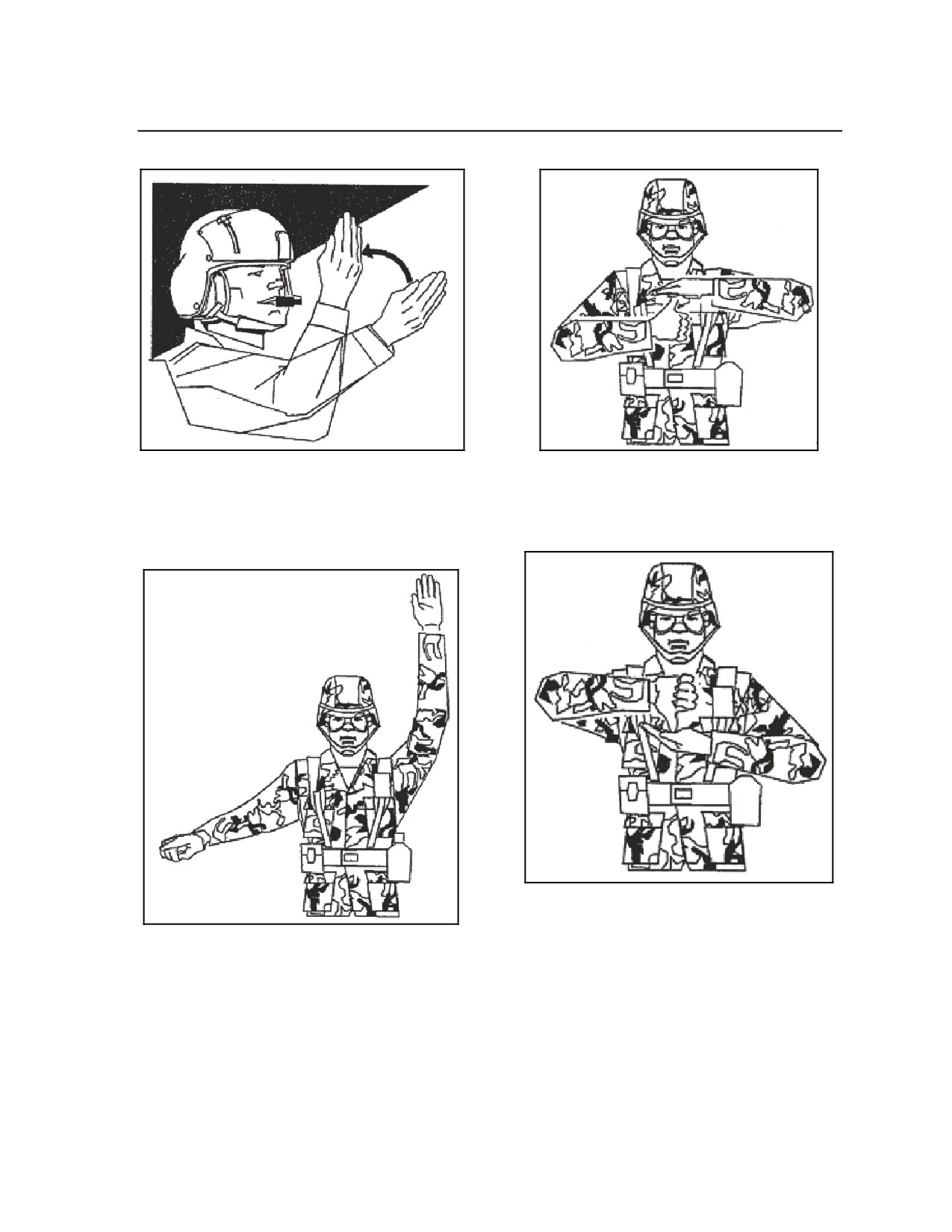
Figure A-22. Move back
Figure A-24. Tail to right (starboard)
Hold hands down by side; face palms forward;
Point left arm down, and move right arm from
and, with elbows straight, repeatedly move
overhead vertical position to horizontal
arms forward and upward to shoulder height.
forward position. Repeat right arm movement.
Figure A-23. Land
Figure A-25. Tail to left (port)
Cross hands and extend arms downward in
Point right arm down, and move left arm from
front of the body.
overhead vertical position to horizontal
forward position. Repeat left arm movement.
A-6
FM 3-04.104
3 August 2006
Standard Hand and Arm Signals
Figure A-26. Clearance for personnel to
Figure A-28. Up hook
approach aircraft
Right fist, thumb extended upward, raised
A beckoning motion with right hand at eye
suddenly to meet horizontal palm of left hand.
level.
Figure A-29. Down hook
Right fist, thumb extended downward, lowered
suddenly to meet horizontal pain of left hand.
Figure A-27. Personnel approach the
aircraft (given by ground crewmember)
Left hand raised vertically overhead with palm
toward aircraft. The right hand indicates the
persons concerned and gestures toward
aircraft.
3 August 2006
FM 3-04.104
A-7
Appendix A
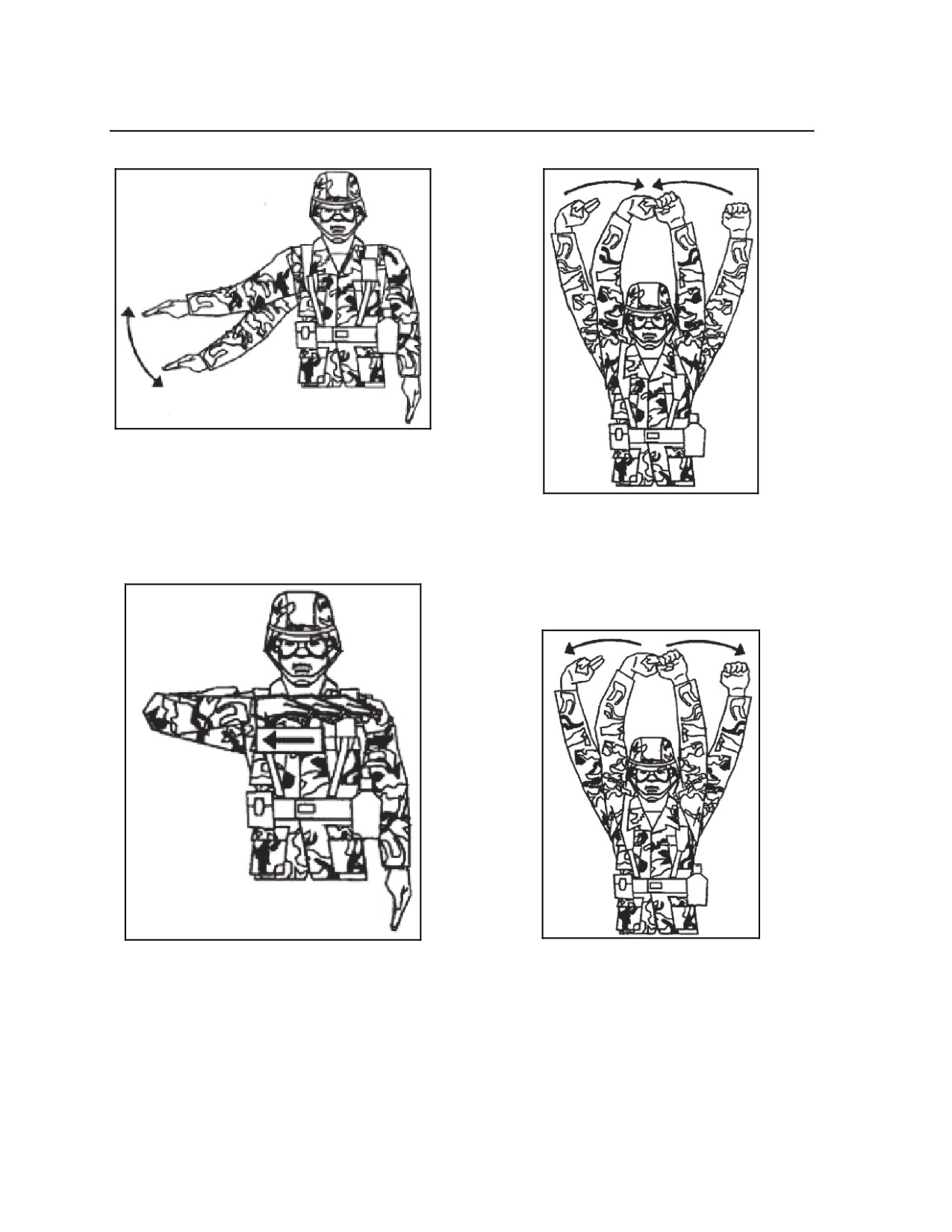
Figure A-30. Slow down engine(s) on
indicated side
Arms down with palms toward ground and
then either right or left arm waved up and
Figure A-32. Connect auxiliary power unit
down to indicate the left- or right-side engines,
Day. Extend hands overhead; push first two
respectively, should be slowed down.
fingers of right hand into fist of left hand.
Night. Same movement with the left-hand
lighted wand vertical and the right-hand
lighted wand horizontal.
Figure A-31. Cut engine(s) or stop rotor(s)
Figure A-33. Disconnect auxiliary power
Either arm or hand level with shoulder with
unit
palm down; draw the extended hand across
Day. Extend hands overhead; pull first two
neck in a “throat-cutting” motion.
fingers of right hand away from left fist.
Night. Same movement except that left-hand
lighted wand is vertical and right-hand lighted
wand is horizontal.
A-8
FM 3-04.104
3 August 2006
Standard Hand and Arm Signals
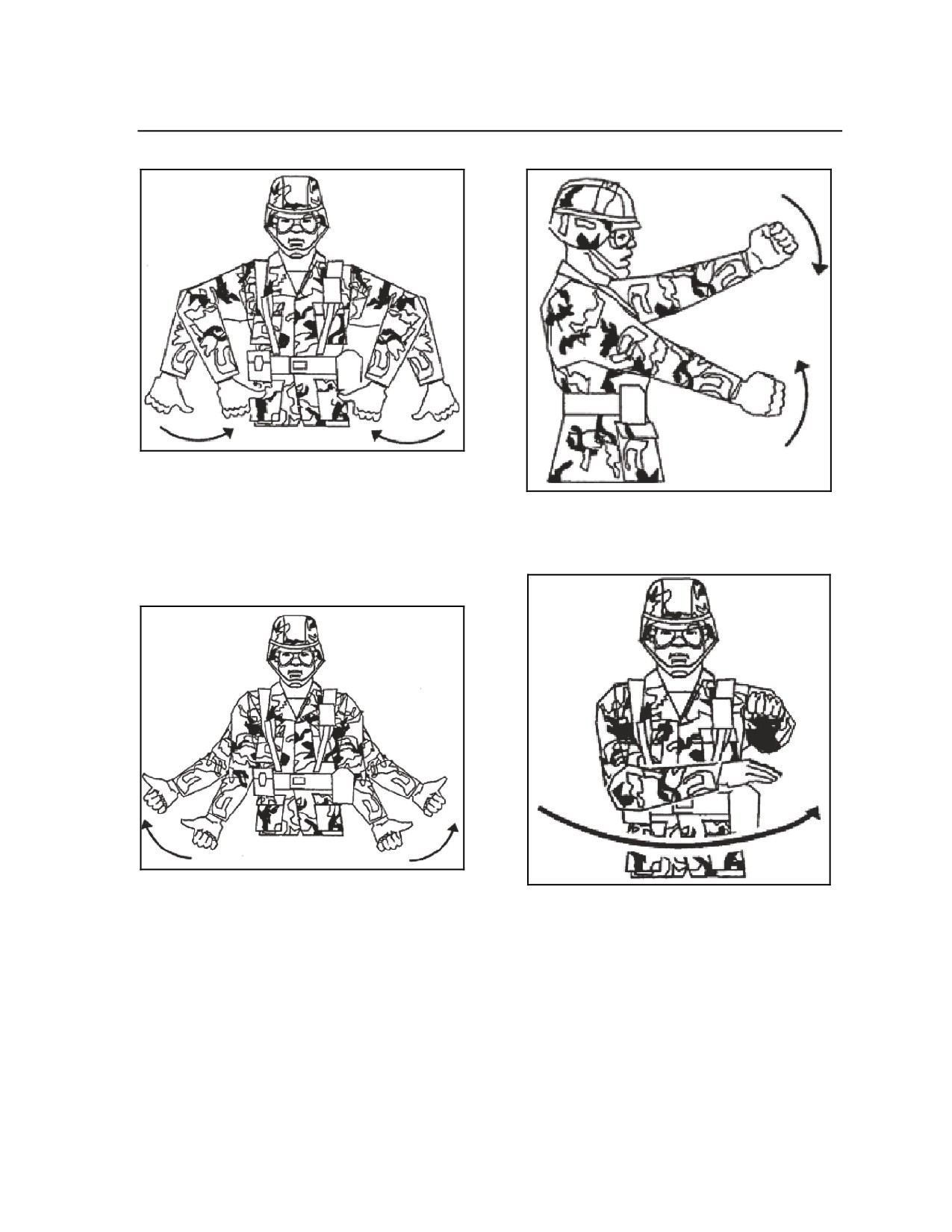
Figure A-34. Insert chocks/chocks inserted
Arms down, fists closed, and thumbs
extended inward. Swing arms from extended
Figure A-36. Hook up load
position inward.
Rope climbing motion with hands.
Figure A-35. Remove chocks
Arms down, fists closed, and thumbs
Figure A-37. Release load
extended outward. Swing arms outward.
Left arm forward horizontally with fists
clenched; extended right hand making
horizontal slicing motion below left arm with
palm down.
3 August 2006
FM 3-04.104
A-9
Appendix A
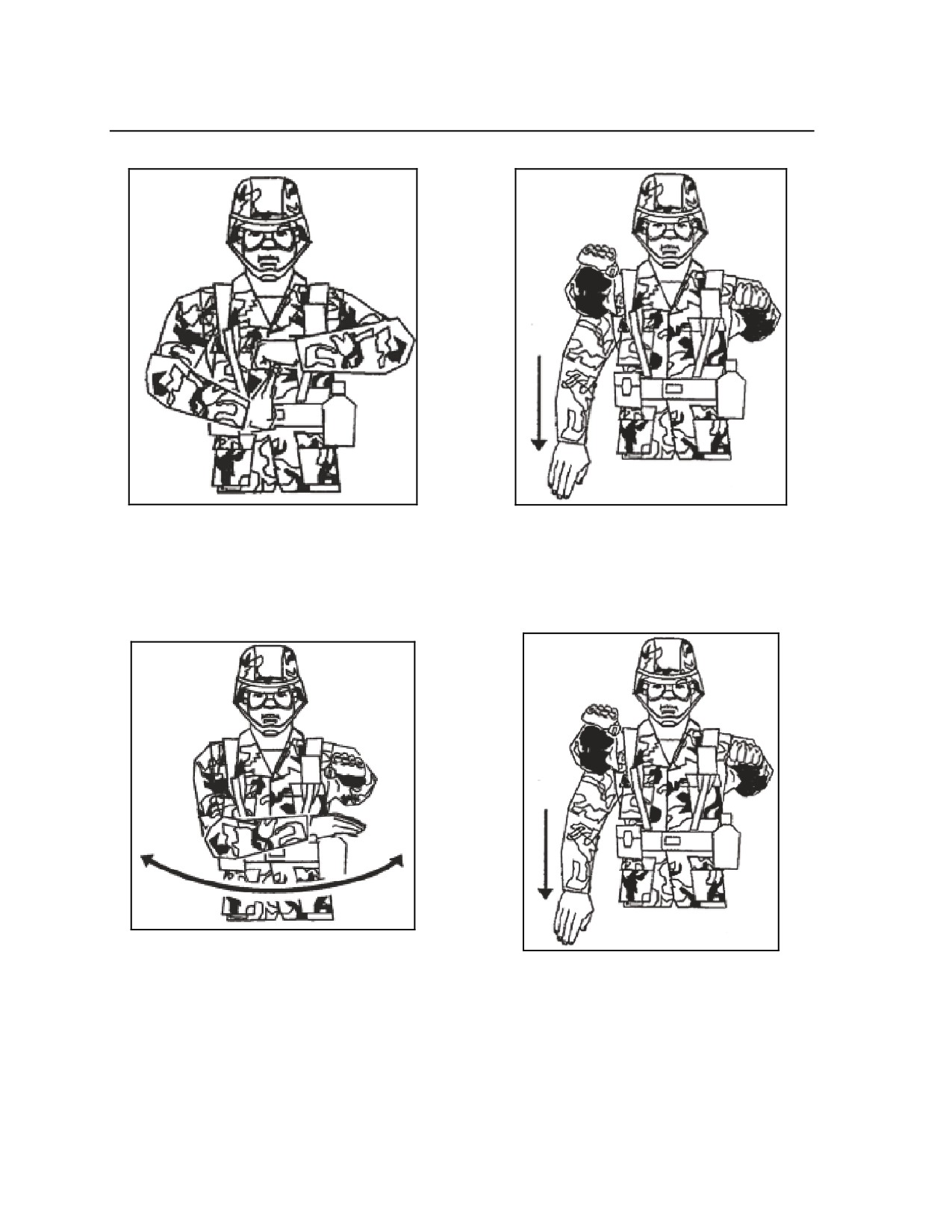
Figure A-38. Load has not been released
Figure A-40. Winch up
Bend left arm horizontally across chest with
Extend left arm horizontally in front of body
fist clenched and palm turned down; open
with fist clenched; extend right arm forward
right hand pointed up vertically to center of left
with palms turned up and make an upward
fist.
motion.
Figure A-39. Cut cable
A signal similar to “release load” except that
Figure A-41. Winch down
the left hand has the palm turned down and
Extend left arm horizontally in front of body
not clenched. Rapid repetition of right-hand
with fist clenched; extend right arm forward
movement indicates urgency.
with palm turned down and make a downward
motion.
A-10
FM 3-04.104
3 August 2006
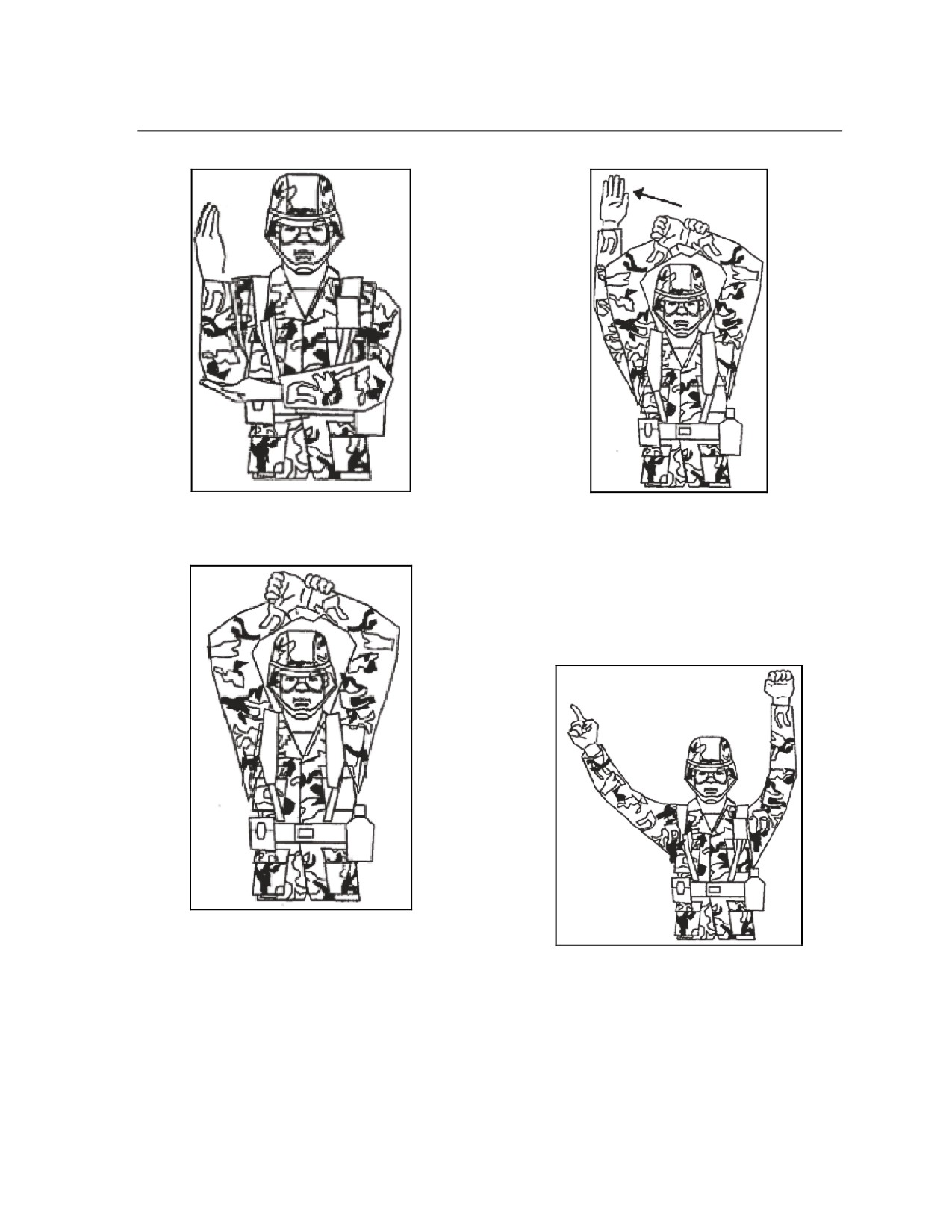
Standard Hand and Arm Signals
Figure A-42. Lock wings/helicopter blades
Figure A-44. Remove
Hit right elbow with palm of left hand
Day. With arms and hands in “install-
downlocks” position, the right hand unclasps
the left forearm.
Night. Similar to the day signal except that the
right wand is placed against the left forearm.
(Downlocks/Undercarriage Pins)
Figure A-43. Install
Day. With arms above head, the right hand
clasps left forearm and the left fist is clenched.
Figure A-45. Remove blade tie-downs
Night. Similar to the day signal, except that the
Left hand above head and right hand pointing
right wand is placed against the left forearm.
to individual boots for removal.
The wand in the left hand is held vertically.
(Downlocks/Undercarriage Pins)
3 August 2006
FM 3-04.104
A-11
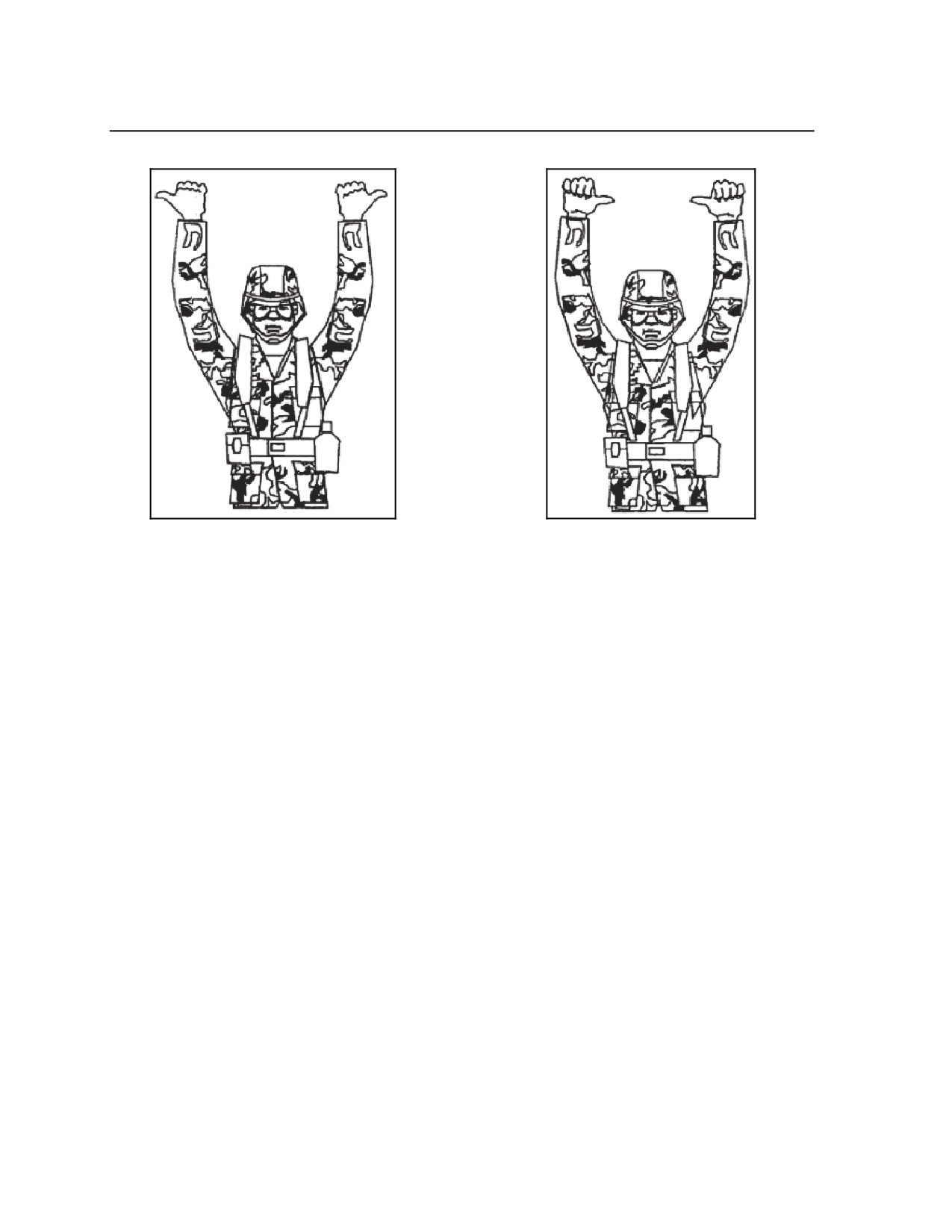
Appendix A
Figure A-46. Droop stops out
Figure A-47. Droop stops in
When rotor starts to “run down,” ground guide
When droop stops go in, ground guide turns
stands with both hands raised above head,
thumbs inward.
fists closed, and thumbs pointing out.
A-12
FM 3-04.104
3 August 2006
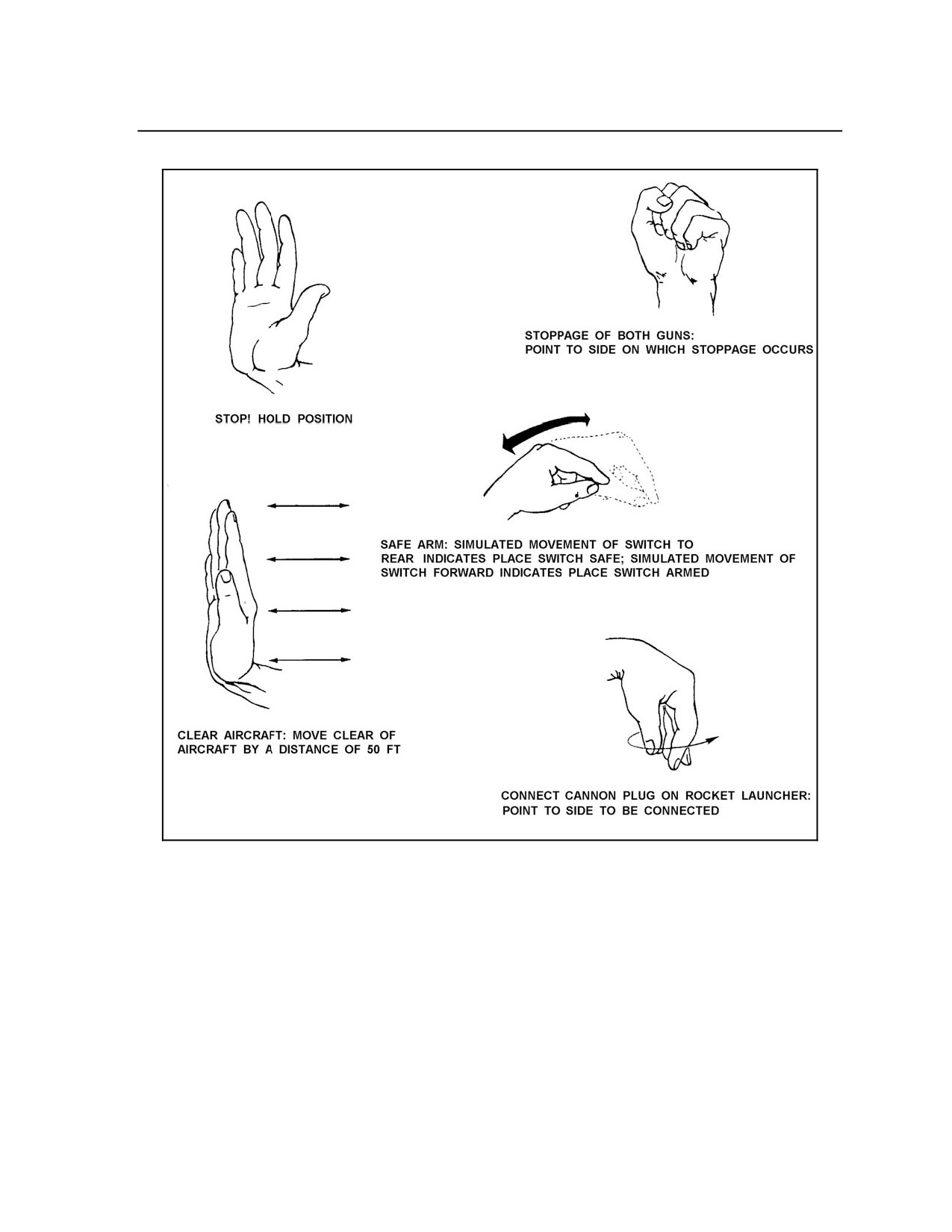
Standard Hand and Arm Signals
Figure A-48. Ground hand signals
3 August 2006
FM 3-04.104
A-13
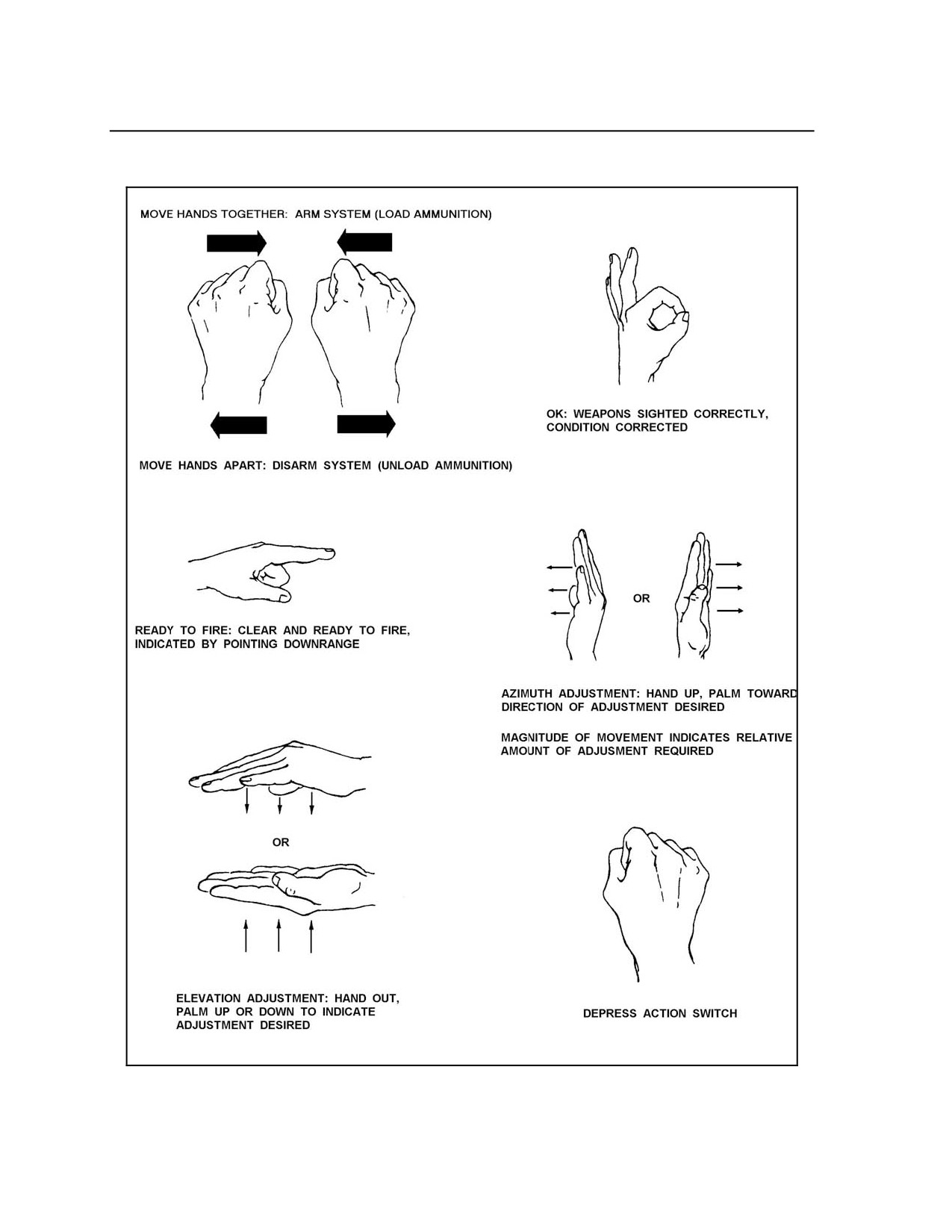
Appendix A
Figure A-48. Ground hand signals (concluded)
A-14
FM 3-04.104
3 August 2006
Appendix B
Sample Forward Arming and Refueling Point Standing
Operating Procedure
Forward arming and refueling point operations should be an integral part of the unit’s
SOP. Figure B-1 is an example of a FARP operations annex to a tactical SOP.
1.
EQUIPMENT.
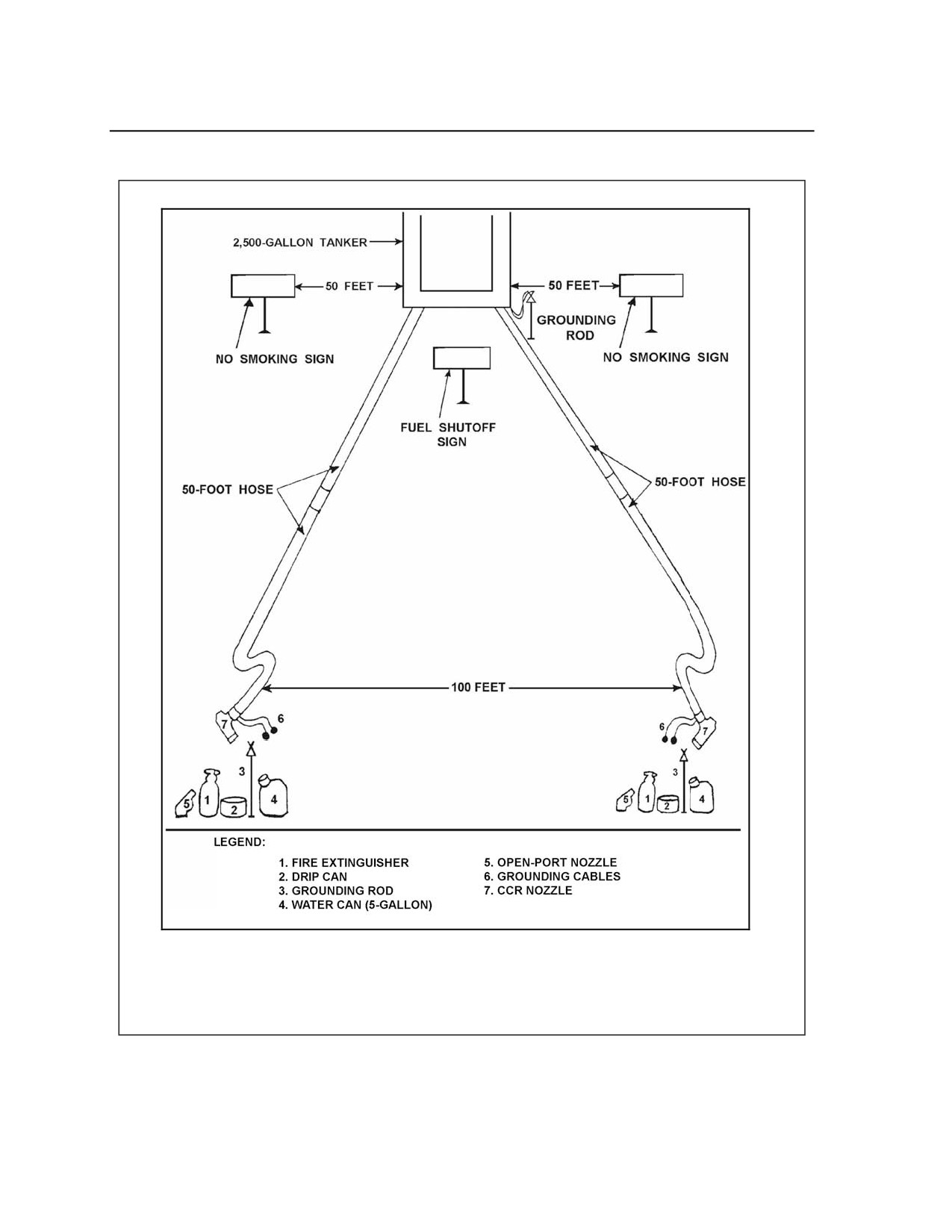
a. HEMTT FARP. Two HEMTTs will be placed on-line, and one will remain in reserve. Figure 1
shows the layout of a HEMTT FARP. The FARE or AAFARS FARP will be configured similarly to the
HEMTT FARP as shown in Figure 2. They use at least eight points or as needed to support simultaneous
refueling of an attack helicopter company or troop.
b. FARP Layout. The standard FARP layout for simultaneous rearming and refueling operations will
be configured as shown in Figure 3.
2 . SITE SELECTION. FARP personnel—
a. Use tree lines, vegetation, terrain folds, and reverse slopes to mask the FARP.
b. Do not collocate the FARP with the TOC or unit trains.
c. Consider the following:
• The number and type of aircraft to be refueled.
• The minimum spacing requirement of 100 feet between refueling points (180 feet for CH-47).
• Adequate obstacle clearance for a safe takeoff and landing.
• Designated HAs for waiting aircraft.
3 . WORK PRIORITIES.
a. Security. FARP personnel—
Establish a perimeter and prepare fighting positions and range cards.
Sweep the site for CBRN contamination and set up CBRN equipment.
Reconnoiter the site for appropriate refuel and rearm points.
Setup crew-served and AD weapons to protect the site.
NOTE: FARP personnel must maintain security throughout occupation of the site unless other personnel
are attached specifically to provide security.
1
Figure B-1. Example of a forward arming and refueling operations annex to a tactical standing
operation procedure
3 August 2006
FM 3-04.104
B-1
Appendix B
b. Communications. Upon arrival, the FARP NCOIC will establish communications with the TOC,
giving the closing report and anticipated time of operation. This communication will be on a secure FM from a
location other than the FARP. Inbound or outbound aircraft can relay critical messages from the FARP to the
TOC. This reduces the chances of enemy detection by radio transmission. FARP personnel use the FARP
radio only under the following circumstances:
• Requesting resupply.
• Reporting that the site is under attack.
• Reporting that the FARP is not operational.
• Reporting a serious FARP incident such as a fire or an aircraft accident.
c. Setup. FARP personnel will—
• Establish positions of refuel and rearm points (100 feet separation for all aircraft except the CH-
47).
• Break down ammunition and prepare the aircraft standard loads and another load in the RASA.
• Reposition vehicles into final parking locations.
• Camouflage vehicles and equipment.
• Perform PMCS on vehicles, radios, CBRN equipment, weapons, and platoon equipment.
d. Resupply. FARP personnel resupply ammunition and fuel as necessary. After ammunition trucks
offload, depending on the FARP’s expected duration of operation, vehicles may need to depart for resupply of
Class V. HEMTT tankers may transload into other tankers as they become empty or can fill empty 500-gallon
drums. This practice allows these vehicles to go for additional Class III at distribution points or LRPs. In all
cases, personnel diverted to resupply vehicles are not available to assist in arming and refueling. With a
silent FARP prepared to assume the mission, the initial FARP vehicles can resupply without disrupting the
mission.
e. Mess, Personal Hygiene, and Rest. These are accomplished after mission-essential duties are
completed.
4. AIRCRAFT PROCEDURES. Unit SOPs and orders specify procedures. The following provides
recommendations and describes standard signals.
a. Landing.
(1)
When 5 kilometers from the FARP, the air mission commander will make a call in the blind on
the administrative/logistics frequency stating that he is inbound to the FARP. An example of a call is "T14
(FARP), this is T56 (air mission commander) with five on blue." The air mission commander is telling the
FARP that five aircraft are inbound on the Blue route. This alerts the FARP and other aircraft of his
intentions. The FARP does not reply unless the area is not safe or secure. Terms that violate operations
security (OPSEC) will not be used, for example, "aircraft," "inbound," "outbound," and "FARP."
(2)
Aircraft will be flown at NOE within 3 kilometers of the FARP. Approaching aircraft must
maintain visual contact with departing aircraft.
2
Figure B-1. Example of a forward arming and refueling operations annex to a tactical standing
operation procedure (continued)
B-2
FM 3-04.104
3 August 2006
Sample Forward Arming and Refueling Point Standing Operating Procedure
b. Positioning.
(1)
FARP personnel will use standard hand and arm signals (Appendix A) to assist pilots in
positioning aircraft into refuel and rearm points.
(2)
Pilots will not point aircraft weapons at personnel or equipment after aircraft depart the "Y" for
refueling or rearming.
(3)
Pilots will position their aircraft at the refuel points so that the CCR nozzle is on the right side
of the aircraft.
5. REFUELING PROCEDURES. An inspection of fuel and equipment will be conducted according to
regulations and the unit accident prevention program. Authority to conduct open-port refueling rests with the
commander.
WARNING
Exercise the following precautionary measures if wearing the Extended Cold Weather Clothing
System (ECWCS) while performing aircraft arming and refueling operations:
Fuel handlers wearing ECWCS should ground/bond themselves to the aircraft, truck, or
refueling component for several seconds before fuel/defuel operations.
Do not remove ECWCS within 50 feet of fueling operations or near flammable vapor-air
mixture.
Rinse fuel-soaked ECWCS with water before removal.
a. Hot Refueling. FARP personnel—
• Ensure that a 100-foot separation exists between refueling points.
• Ensure that armament systems are on SAFE or OFF.
• Stabilize the aircraft at flat pitch and deplane all passengers before conducting refueling
operations. Although no transmissions are permitted except during an emergency, monitor all
communications.
• Ground the closed circuit refueling nozzle (when used) to a grounding rod and bond it to the
aircraft.
• Ensure that the cap is secured and the grounding cable is disconnected before the aircraft
takes off.
• Turn the strobe lights off before refueling the aircraft and back on before it takes off (day only).
NOTE: FARP personnel and crew chiefs will wear protective equipment, including eye and hearing protection
and gloves while refueling operations are being conducted. The fire extinguisher will be manned by FARP
personnel or by a crewmember.
3
Figure B-1. Example of a forward arming and refueling operations annex to a tactical standing
operation procedure (continued)
3 August 2006
FM 3-04.104
B-3
Appendix B
b. Emergency Procedures. FARP personnel take the following actions:
• The POL operator will immediately shut down the pump on the tanker or the pump on the
FARE/AAFARS or HEMTT.
• Whoever is tending the nozzle will remove it from the aircraft and, if the fire is small, attempt to
put it out using the available fire extinguishers. The first priority is crew safety.
• Aircraft that are not directly involved will be flown to their respective HAs.
• If the situation permits, every attempt will be made to remove the tanker from the scene of the
fire. If time permits, ensure that all butterfly valves and elbow couplers are closed on the
FARE/AAFARS with the 500-gallon collapsible drums (if one is in use).
• At the first opportunity, notify the TOC and maintain communications between the FARP and
the TOC by whatever means available.
• After all of the above procedures are complete, personnel will move to a safe distance.
6. REARMING OPERATIONS. The standard refueling/rearming line will consist of four/eight points and the
maintenance point. The maintenance point will be located where it will not interfere with normal operations.
a. Maintenance point. This point will be equipped as follows:
• One fire extinguisher and a ground rod with cable.
• One metric (for AH-64) and one standard toolbox.
• Two pallets for down-loading rockets, .50 caliber and 30mm ammunition.
• Special tools as determined by the maintenance OIC.
• Spare parts.
b. Rearm points. Each rearm point will be equipped as follows:
• One standard toolbox.
• One metric toolbox (AH-64).
• One fire extinguisher and a grounding rod with cable.
• One up loader/downloader (AH-64).
• One wing mike cord.
• Two pallets for rockets.
c. Personnel Requirements. Each FARP will include the following:
• One noncommissioned officer (NCO).
• One line safety officer.
• One OIC.
• Two 92F/pad (minimum)
• Three armament personnel (preferred); two armament personnel (minimum) for each rearm
pad. Note: On scout aircraft when cross training has been completed between MOSs, 1
armament and 1 fuel handler are all that is required.
• A contact team (maintenance point only).
4
Figure B-1. Example of a forward arming and refueling operations annex to a tactical standing
operation procedure (continued)
B-4
FM 3-04.104
3 August 2006
Sample Forward Arming and Refueling Point Standing Operating Procedure
d. Procedures. Aircraft will be safed, armed, or disarmed according to the appropriate aircraft
operator's manual.
(1)
When all armament switches on the aircraft are off, the pilot will turn off the anticollision light.
No radio transmissions will be made during loading/downloading operations.
(2) After the anticollision light is off, armament personnel will ground the airframe and install the
wing store jettison pins and chock the wheels, as applicable. Then they will plug in their headsets and
establish communication with the aircrew. No radio transmissions will be made during loading/downloading
operations.
(3)
The aircrew will assist and monitor armament personnel conducting loading/downloading
operations.
(4)
Ground crews will load subsystems inboard to outboard, remaining clear of the front of the
systems and the back-blast areas. If simultaneous refueling is conducted, ground crews will load the off-side
first.
(5)
When the loading is completed, the ground crew removes all safety pins and moves away from
the aircraft.
(6)
The pilot will turn on the anticollision light after the weapon system is armed. He will then
depart the rearm point.
d. Aircraft Departure. The departure heading will be as briefed; or right turns will be executed after
the takeoff. All takeoffs will be at minimum airspeed. Vehicles or other aircraft will not be over-flown.
7. AIRCRAFT CONTROL AND SAFETY
a. Safety. All safety aspects must be considered during the planning and execution phases of the air
assault FARP mission; and special safety considerations must be given night operations. The unit
commander sets the safety limitations depending on the actual mission; however, safety will not be sacrificed
for mission completion during training. The following actions will be taken at the FARP:
NOTE: Any incident involving a fire or suspected fuel contamination will close the FARP until the safety
officer has investigated the incident and authorizes further operations.
• Refuel nozzles will be marked with a red/orange light source attached to the grounding rod.
• The landing area will be marked with either beanbag lights or chemical lights. Hot rocks that
have been heated in cans may also be used for easier forward looking infrared (FLIR)
detection.
• While in the FARP, aircraft position lights will be placed on steady bright or dim. However, they
will be turned off if the tactical situation requires it or if NVDs are in use.
5
Figure B-1. Example of a forward arming and refueling operations annex to a tactical standing
operation procedure (continued)
3 August 2006
FM 3-04.104
B-5
Appendix B
• Ground guides will guide aircraft into and out of refueling points using white wands or chemical
lights in a color other than green. Ground guides will not stand in front of the aircraft weapon
system at any time.
• Aircraft position lights will be flashed to alert ground guide that the aircraft is ready to refuel or
to depart.
• The pilot will signal to the refueler to stop refueling the aircraft.
• Radio transmissions will not be made within 100 feet of refuel or rearm points.
• Pilots will ensure that personnel are clear and all grounding clips and cables are removed prior
to takeoff.
b.
Emergency Procedures During Nontactical Situations.
(1)
Fire in the refueling area. In case of fire in the refueling area, personnel should—
• Stop refueling at all points.
• Turn all pumps off.
• Close all valves.
• Evacuate personnel from the area.
• Evacuate aircraft from the area.
• Attempt to fight the fire.
• Notify higher command, if possible.
(2)
Fire on supported aircraft. In case of fire on board supported aircraft, personnel should—
• Stop refueling at all points.
• Turn all pumps off.
• Close all valves.
• Evacuate personnel from the aircraft that is on fire.
• Attempt to shut down the aircraft that is on fire.
• Evacuate all other aircraft from the area.
• Attempt to fight the fire.
• Notify higher command, if possible.
(3)
Fire on FARP aircraft. In case of fire on board FARP aircraft, personnel should—
• Stop refueling at all points.
• Turn all pumps off.
• Close all valves.
• Evacuate personnel from the aircraft that is on fire.
• Attempt to shut down the aircraft that is on fire.
• Evacuate all other aircraft from the area.
• Attempt to fight the fire.
• Notify higher command, if possible.
(4)
Fuel leaks. In case of fuel leaks, personnel should—
• Stop refueling at the affected refueling point.
6
Figure B-1. Example of a forward arming and refueling operations annex to a tactical standing
operation procedure (continued)
B-6
FM 3-04.104
3 August 2006
Sample Forward Arming and Refueling Point Standing Operating Procedure
• Turn all pumps off.
• Turn the valves to the leak off.
• Repair or replace the affected pieces.
• Open valves and start the pumps.
• Check for additional leaks.
• Proceed with refueling operations.
c. Emergency Procedures During Tactical Situations. If the FARP site is under attack or under a
threat of being overrun—
• Stop refueling.
• Evacuate supported aircraft.
• Disconnect aircraft or vehicle being fueled from the fuel supply source/system by disconnecting
the 50-foot pot hose from the side of the aircraft or port of the vehicle.
• Abandon the system, such as FARE/AAFARS and evacuate the FARP area.
NOTE: The mission commander will brief all personnel on emergency procedures before the FARP mission
begins.
8.
EXTENDED RANGE FUEL SYSTEM (FAT COW) OPERATIONS.
a. Storage. FARP personnel will—
• Defuel fuel tanks according to TM 55-1560-307-13&P and the unit SOP.
• Secure all 600-gallon tanks on an asphalt or concrete hardstand that is away from aircraft and
ground vehicle operation.
• Statically ground all tanks at the storage area.
• Empty the 600-gallon tanks before storage (except for residual fuel in the bottom of the tanks).
• Drain all fuel supply lines of excess fuel before storage.
• Store all ERFS equipment, such as the pump board, fuel lines, and tie-down straps, in the
ERFS storage cases provided by the shipping facility. Ensure that the storage area is enclosed
and well-ventilated.
b. Preventive Maintenance Checks and Services. All PMCS criteria for the ERFS are covered in
TM 55-1560-307-13&P. FARP personnel will—
• Develop a program for PMCS storage when the ERFS is not installed on the aircraft.
• Conduct a monthly PMCS and an inventory each ERFS system.
• Record PMCS, faults, and corrective actions on DA Form 2404 (Equipment Inspections and
Maintenance Worksheet).
c. Installation and Operation. TMs 1-1520-240-10 and 55-1560-307-13&P cover the installation,
operation, and PMCS of the ERFS.
(1) When the ERFS is installed on the aircraft, enter the following statement on the DA Form 2408-
13-1 (Aircraft Maintenance and Inspection Record):
“Aircraft allowed to operate with ERFS installed
according to TM 55-1560-307-13&P, dated 11 December 1990”. This entry will be carried forward daily until
the ERFS is removed.
7
Figure B-1. Example of a forward arming and refueling operations annex to a tactical standing
operation procedure (continued)
3 August 2006
FM 3-04.104
B-7
Appendix B
(2)
All system faults will be recorded on DA Form 2408-13-3 (Aircraft Technical Inspection
Worksheet).
(3)
When the ERFS is removed, all faults will be reentered from the aircraft logbook to the ERFS’
existing or new DA Form 2404.
d. Mission Equipment. Equipment requirements are divided between two sections. The unit assigned
the mission will supply one or more CH-47s, the ERFS system with FARE/AAFARS attachments, and one
50-foot suction hose (pot hose). It will also supply one grounding rod with a grounding cable for the aircraft
and all the necessary ground covers, tie-down ropes, and aviation life support equipment. The POL section
will supply all of the items shown in Figure 4 and one extra 100-GPM pump, one of each type of refueling
nozzle, and one 50-foot refueling hose.
NOTE: The mission unit will install the required number of tanks according to TM 55-1560-307-13&P and
Figure 5. If the mission is conducted at extended ranges, this includes the installation of the ERFS fuel
management control panel (FMCP).
(1)
Hoses and fittings. The Army uses the unisex (dry-lock) fitting. The unisex is the preferred
fitting because it reduces fuel spillage during assembly and disassembly and it is self-grounded when
connected. These fittings are used with the AAFARS, which are the same fittings used with the HTARS
hoses.
(2)
Pump system. If the 250-GPM self-contained pump system is used, the filter separator can
be dropped from the equipment list and the pump placed in the 100-GPM position (Figure 4). The size of the
pump prevents a spare pump from being loaded.
(3)
Nozzles. Two types of nozzles are used. The D-1 single-point nozzle is used on CH-47, UH-
60, and AH-64 aircraft, and CCR nozzles with attachments are used OH-58D aircraft, unless the D-1 is
specified.
e. Site Selection.
(1)
The landing zone (LZ) must be large enough to accommodate FARP aircraft with no less than
150 feet between supported aircraft refueling points.
(2)
Multiship FARP aircraft will be separated with no less than 300 feet between aircraft. This
allows for the 150-foot separation between supported aircraft refueling points.
(3)
The FARP site may also serve as the AA and takeoff area for the supported units.
(4)
An additional site should be considered if the current site is also being used for rearming.
8
Figure B-1. Example of a forward arming and refueling operations annex to a tactical standing
operation procedure (continued)
B-8
FM 3-04.104
3 August 2006
Sample Forward Arming and Refueling Point Standing Operating Procedure
(5)
Planners should consider the tactical advantages of the site to include the distance to the
FARP, stability of the FARP, the required time on station, camouflage, and security requirements. They
should also consider wind direction and the type of aircraft to be refueled.
f.
Site Layout. For daytime operations, the landing point will be designated and marked with standard
visual signals and markers. For night operations, the landing point will be designated and marked with a
chemical lights or tactical "Y".
(1)
Refueling points and equipment will be set up as shown in Figure 4.
(2)
The extra 100-GPM pump will be placed beside the operating pump.
(3)
For ease of replacement, all spare pieces of equipment will be placed so they are readily
accessible.
(4)
Each FARP aircraft will be grounded to its own grounding point.
(5)
The 100-GPM pumps and filter separator will be grounded as shown in Figure 4.
(6)
Emergency equipment, such as a 5-gallon water can and a fire extinguisher will be placed at
the pump station and the refueling points.
g. Fire Extinguishers. All fire extinguishers must have current inspection tags and seals. Authorized
fire extinguishers include the following:
• Twenty-pound Halon 1211.
• Twenty-pound (KH CO3) Purple K.
• Fifteen-pound CO2.
h . Blade Ropes and Tail Cone Covers.
(1)
Blade ropes. Crew chiefs install and secure at least one blade rope per rotor system on ERFS
aircraft.
(2)
Tail cone covers. Crew chiefs install engine tail-cone covers on ERFS aircraft to prevent
engine foreign-object damage and keep rotors from turning.
i.
Crew Duties.
(1)
Pilot in command.
(a) The pilot in command (PC) of the supporting aircraft is in charge of the FARP operation.
He directs all operations and monitors the safety of the FARP setup and refueling operations. He ensures
that the FARP is set up according to the SOP and that all required points are grounded. An Air Assault
FARP reference checklist (Enclosure 1) may be used upon arrival at the site.
9
Figure B-1. Example of a forward arming and refueling operations annex to a tactical standing
operation procedure (continued)
3 August 2006
FM 3-04.104
B-9
Appendix B
(b) The PC's station is at the fuel pump, which enables him to monitor all phases of the
operation. The PC is responsible for turning off the fuel supply at the pump in the event of a mishap or an
emergency.
(2)
Copilot. The copilot will assist in marshaling and fire guard duties and any other duty that the
PC assigns.
(3)
Flight engineer. The flight engineer (FE) is responsible for safely loading the aircraft before the
mission and unloading it after the aircraft is shut down. He also controls the fuel flow from inside the aircraft.
In addition, the FE is responsible for cutting off the fuel supply from inside the aircraft in case of a mishap or an
emergency.
(4)
Crew chief. The crew chief will assist in setting up the refueling points. He will also assist with
marshaling and fire guard duties.
(5)
POL refuelers. Refuelers are responsible for setting up the FARP and conducting refueling
operations.
j.
Standard Flight Equipment. Crew members will use standard flight equipment. POL refuelers will
use safety equipment and clothing as stated in the SOP and the appropriate regulations.
k. FARP Operations.
(1)
Aircraft position. When aircraft arrive at the refueling point, there will be assigned personnel
on the ground who positions the first aircraft at the first point and the second aircraft at the second point. This
procedure continues in chalk order for all aircraft. All aircraft will remain in position until they all have been
refueled, and then they will be repositioned to the assembly/takeoff area.
(2)
Fuel transfer. Fuel will be transferred from the internal tanks in the same manner as if the
tanks were being self-deployed. A Fuel Transfer Checklist is included in Enclosure 2. Four-tank fuel transfer
will be completed as follows: To maintain the aircraft center-of-gravity, complete fuel transfer in the following
sequence:
• Four-tanks: 4, 1, 3, and 2
• Three-tanks: 3, 1, and 2.
(3)
Auxiliary power unit (APU). The aircraft APU will not be operated during refueling operations.
(4)
Mission operation checklist. Refer to TM 55-1560-307-13&P for proper ERFS operation and
fuel transfer procedures. A mission operation checklist is shown in Enclosure 3.
l.
Environmental Factors. Environmental factors, such as local water tables, wildlife, and agriculture,
will be considered during the planning and execution of the air assault FARP mission.
10
Figure B-1. Example of a forward arming and refueling operations annex to a tactical standing
operation procedure (continued)
B-10
FM 3-04.104
3 August 2006
Sample Forward Arming and Refueling Point Standing Operating Procedure
9. AQUA-GLO TEST PREPARATION PROCEDURES. FARP personnel will follow the guidance in the
applicable TMs for the conduct of Aqua-Glo testing. These procedures are briefly listed below but may not be
all-inclusive due to the changes in FM 10-67-1.
a. Put a fully charged battery into the meter assembly. (A fully charged battery will operate the
ultraviolet light for about 1 hour. About 30 tests can be performed on one charge.)
b. Turn the ultraviolet lamp assembly upside down and open the test pad slot. Using tweezers take the
recalibration standard pad and put it, colored side in toward the lamp, in the test pad slot. Do not touch the
pad with your fingers; always handle it with the tweezers. Turn the lamp assembly right side up.
c. Slide the meter assembly into the tracks on the ultraviolet lamp assembly.
d. Recalibrate the meter assembly after each battery change and before each working day as follows:
(1)
Turn the ultraviolet lamp on by pushing the lamp switch to ON and by holding the switch down
for 10 seconds. When the switch is pushed down, a high-pitched sound is emitted that should drop to a low-
pitched sound when the pressure on the switch is released. These sounds indicate that the lamp is on. If the
pitch of the sound does not drop when the pressure is released on the switch, the battery needs to be
recharged.
CAUTION
Do not leave the switch in the ON position if the red battery test indicator light stays on. If
you do, the battery will be ruined and cannot be recharged. If the red light stays on, remove
the battery and recharge it. Tester can be connected to vehicle for operation or recharge.
(2)
Move the lever on the lamp assembly across its scale to the set number indicated on the
recalibration standard pad. For example, if the set number on the pad is 5.3, move the lever to 5.3. Hold the
hooded meter switch button in for about 30 seconds until the pointer above the meter scale becomes steady
and holds its position.
(3)
If the meter pointer does not point to zero, unscrew the plug screw on the side of the meter.
Use the small screwdriver provided with the kit to adjust the meter so that the pointer points to zero.
(4)
Take the recalibration standard pad out of the test pad slot, using the tweezers, and put it back
in the kit pocket.
e. Wipe the green glass light filters with a clean, soft cloth or paper towel.
11
Figure B-1. Example of a forward arming and refueling operations annex to a tactical standing
operation procedure (continued)
3 August 2006
FM 3-04.104
B-11
Appendix B
10. FUEL SAMPLING PROCEDURES.
a. Couple the detector pad holder assembly, with the toggle valve closed (parallel to the line), to the
sampling coupler. The detector pad holder assembly includes plastic tubing, detector pad holder, toggle
valve, and sampling coupler.
b. Flush the detector pad assembly as follows:
• Put the end of the plastic tubing in a container that will hold more than a gallon of fuel.
• Open the toggle valve by turning the handle up (at a right angle to the line).
• Let about a gallon of fuel flow through the assembly into the container.
• Close the toggle valve and uncouple the detector pad assembly.
c. Unscrew the two halves of the detector pad holder. Using the tweezers, take a detector pad out of
its envelope and put it, yellow side out, in the recess in the outlet side of the pad holder. Screw the pad holder
assembly back together. Do not open the pad envelope until you are ready to put the pad in the holder. Do
not touch the pad with your fingers; always use the tweezers. The pad can absorb moisture from the air and
from skin, causing the test results to be false.
d. Couple the detector pad holder assembly back to the sampling coupler, with the toggle valve closed,
and put the end of the plastic tubing into the neck of the plastic sampling bottle.
e. Open the toggle valve and allow 500 milliliters of fuel to flow into the sample bottle. Close the valve.
f.
Uncouple the detector pad holder assembly from the sampling coupler, and unscrew the detector
pad holder. Slip one prong of the tweezers into the notch in the pad holder, and lift the test pad out.
g. Press the wet test pad between dry paper towels or blotters to remove the excess fuel. Press down
on the pad firmly, move the pad with the tweezers to a dry place on the towel or blotter, and press again. Do
this several times.
11. FUEL TEST PROCEDURES.
a. Use the tweezers to lift the damp test pad off the towel or blotter, and put it in the test pad slot in the
bottom of the ultraviolet lamp assembly. Ensure that the yellow side faces the ultraviolet lamp.
b. Turn on the lamp.
c. Push in on the hooded button of the meter assembly with your left hand. While watching the meter
scale, move the lever of the ultraviolet lamp assembly with your right hand until the meter points to zero.
12
Figure B-1. Example of a forward arming and refueling operations annex to a tactical standing
operation procedure (continued)
B-12
FM 3-04.104
3 August 2006
Sample Forward Arming and Refueling Point Standing Operating Procedure
d. Release pressure on the hooded button and shut off the lamp switch as soon as the meter pointer
settles to zero. The meter pointer should stabilize in about one minute.
e. Take the reading from the scale behind the lever at the point where the lever is. With a 500-milliliter
sample, this scale reads directly into parts per million (ppm) of water in the fuel. If the reading is 9 ppm or
below, the test is finished and the fuel may be used. If the reading is 10 ppm (the lever is at 10) and the meter
will not point to zero, follow these procedures:
(1)
Repeat the procedures in paragraph 10a through d.
(2)
Open the toggle valve and allow 100 milliliters of fuel to flow into the sample bottle. Close the
valve.
(3)
Repeat the procedures in paragraph 11 and then a through d above.
f.
Take the reading from the scale behind the point where the lever is. Multiply that reading by 5 to find
the ppm of water in the sample. For example, if the scale reading is 3, there are 15 ppm of water in the fuel.
(The maximum reading with the Aqua-Glo test for a 100-milliliter sample is 60 (5 times 12). A 100-milliliter
sample is the smallest that will give an accurate test result.
g. Take the fuel and the fuel system equipment out of service immediately if the fuel on retest shows
more than 10 ppm of water. Follow the guidance in FM 10-67-1 for inspecting and testing the fuel and
equipment.
13
Figure B-1. Example of a forward arming and refueling operations annex to a tactical standing
operation procedure (continued)
3 August 2006
FM 3-04.104
B-13
Appendix B
Figure 1. Heavy expanded mobility tactical truck forward arming and refueling point two-point
layout
14
Figure B-1. Example of a forward arming and refueling operations annex to a tactical standing
operation procedure (continued)
B-14
FM 3-04.104
3 August 2006