FM Field 3-04.104 Tactics, Techniques, and Procedures for Forward Arming and Refueling Point (August 2006) - page 4
Sample Forward Arming and Refueling Point Standing Operating Procedure
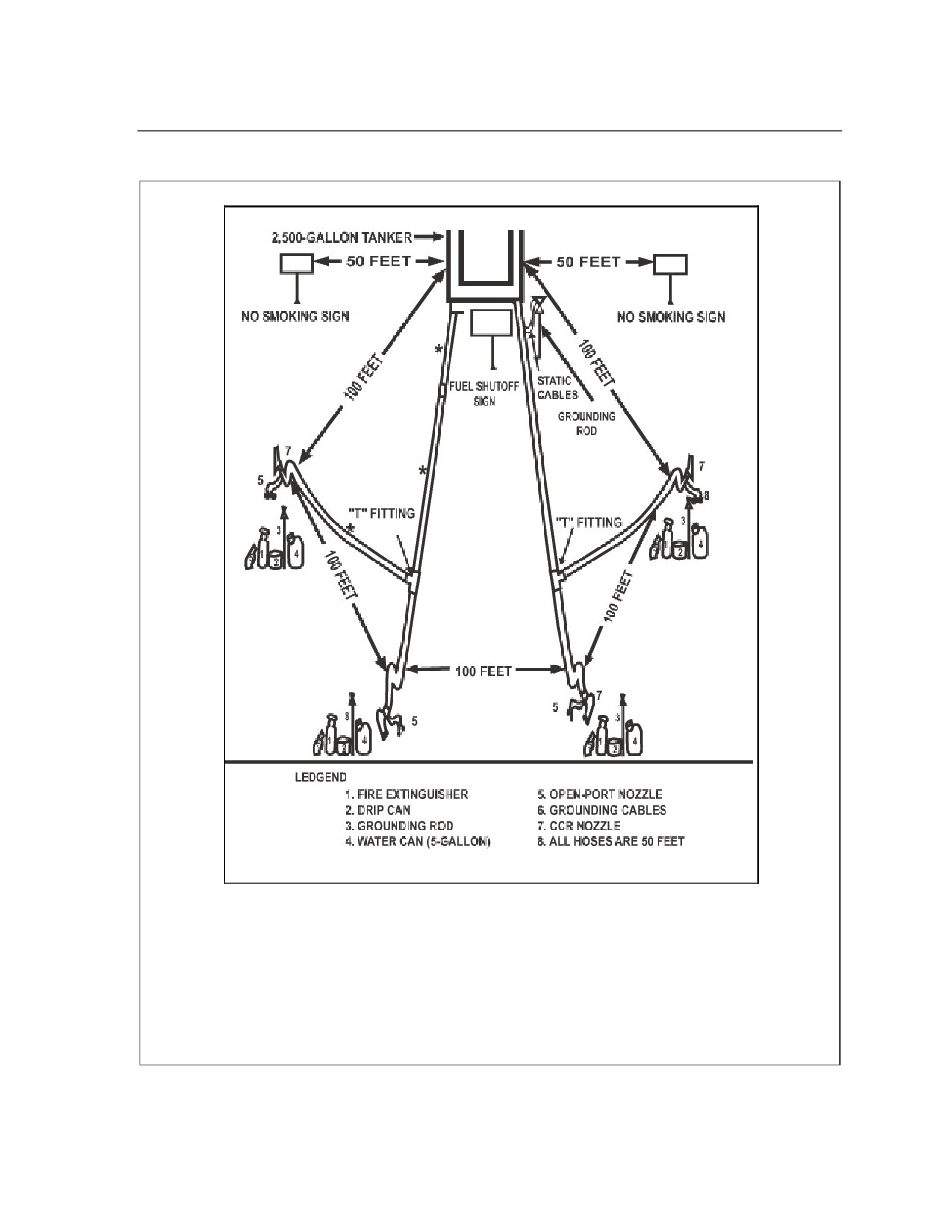
Figure 2. Heavy expanded mobility tactical truck forward arming and refueling point four-point layout
15
Figure B-1. Example of a forward arming and refueling operations annex to a tactical standing
operation procedure (continued)
3 August 2006
FM 3-04.104
B-15
Appendix B
NOTES:
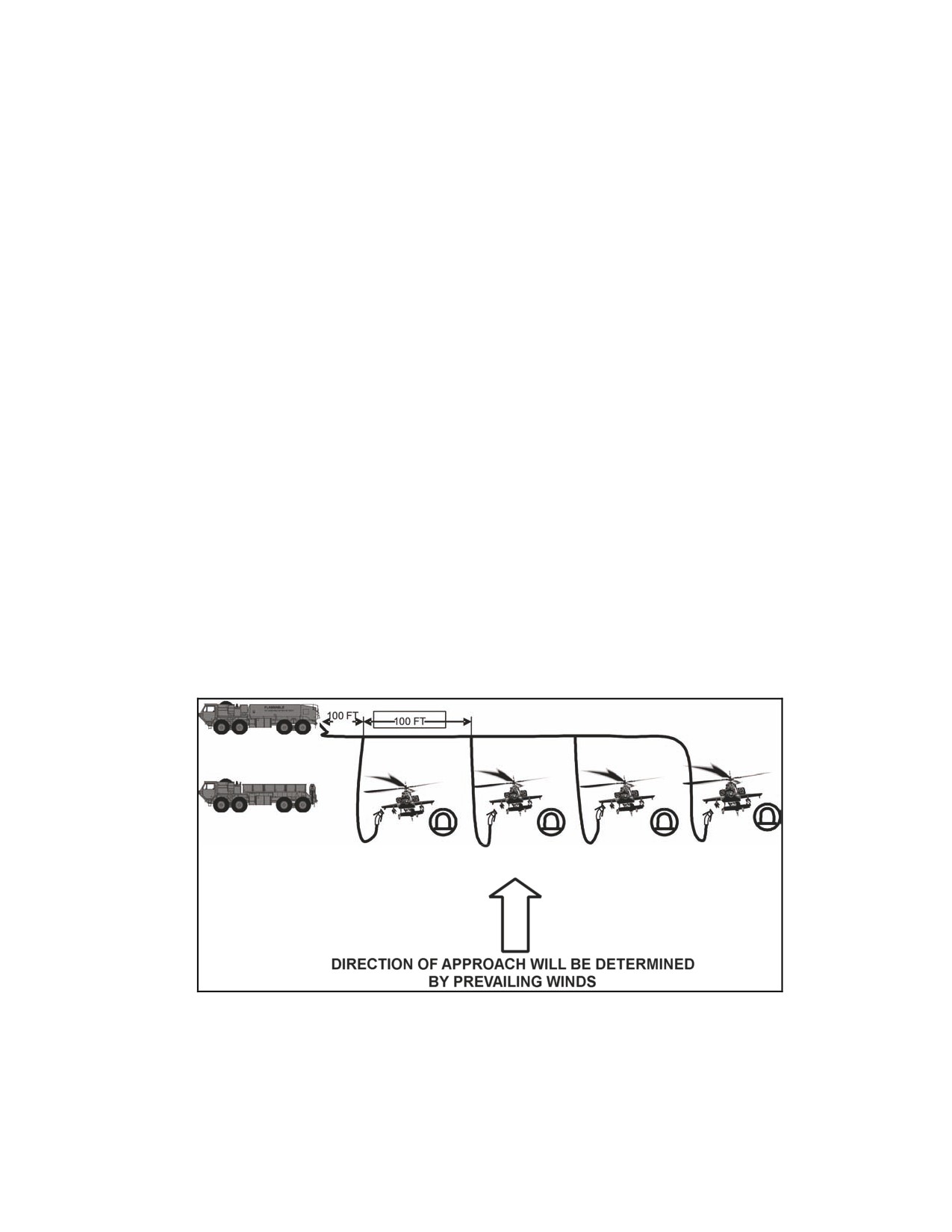
1. Eight-points rearming and refueling is used.
2. Rearming intent is to minimize 30mm upload. This is accomplished at end of mission (EOM) for day
operations or during the crew endurance period.
3. Fuel tankers are in the tree line or are camouflaged.
4. Hoses are dispersed from junction to parallel points.
5. Point feeder hoses are 100 feet apart (180 feet for CH-47s).
6. Aircraft routine is as follows:
Point “Y” in the direction of the refuel line.
Turn the nose of the aircraft into the point (no lateral hover).
Continue straight out when refueling is completed.
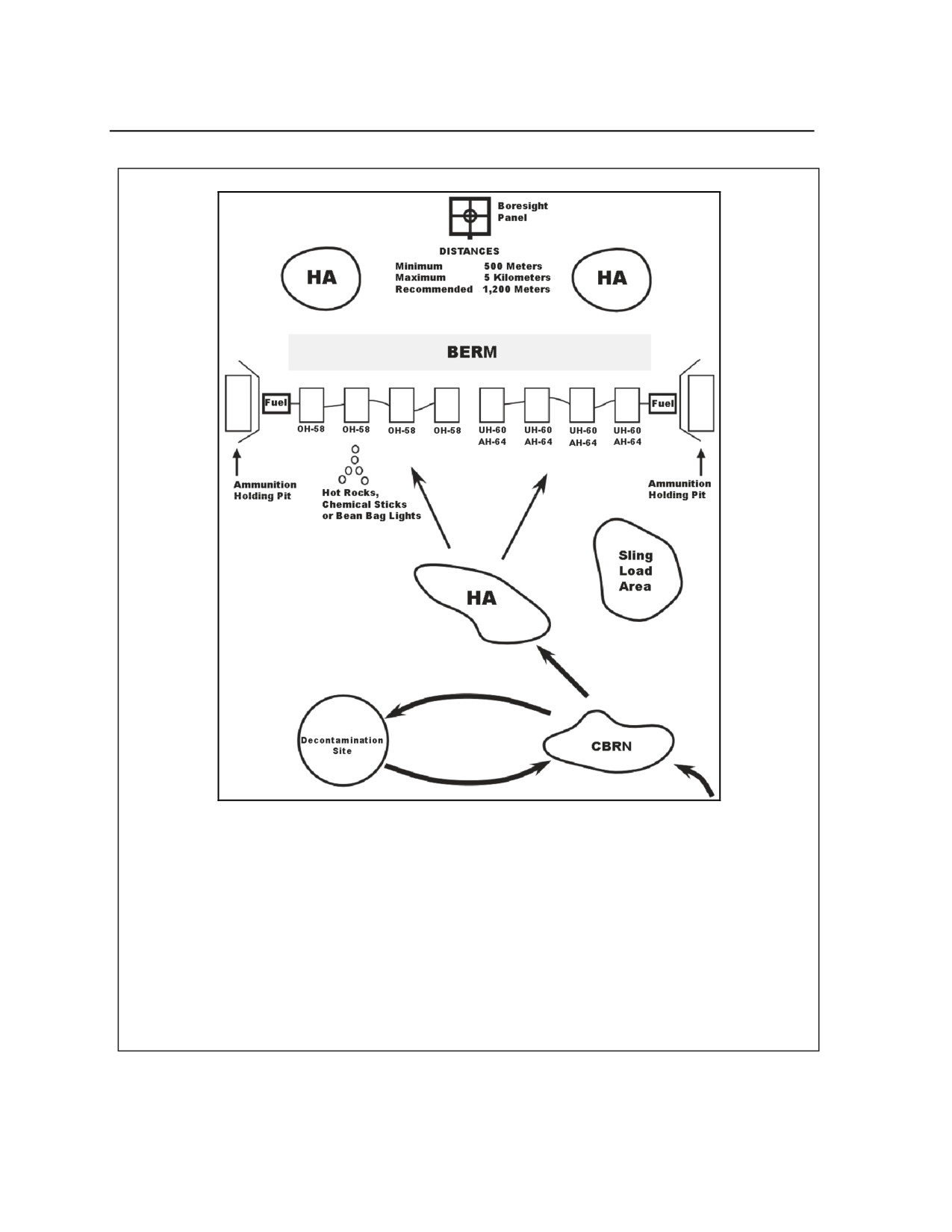
Figure 3. Standard forward arming and refueling point layout for simultaneous rearming and refueling
operations
16
Figure B-1. Example of a forward arming and refueling operations annex to a tactical standing
operation procedure (continued)
B-16
FM 3-04.104
3 August 2006
Sample Forward Arming and Refueling Point Standing Operating Procedure
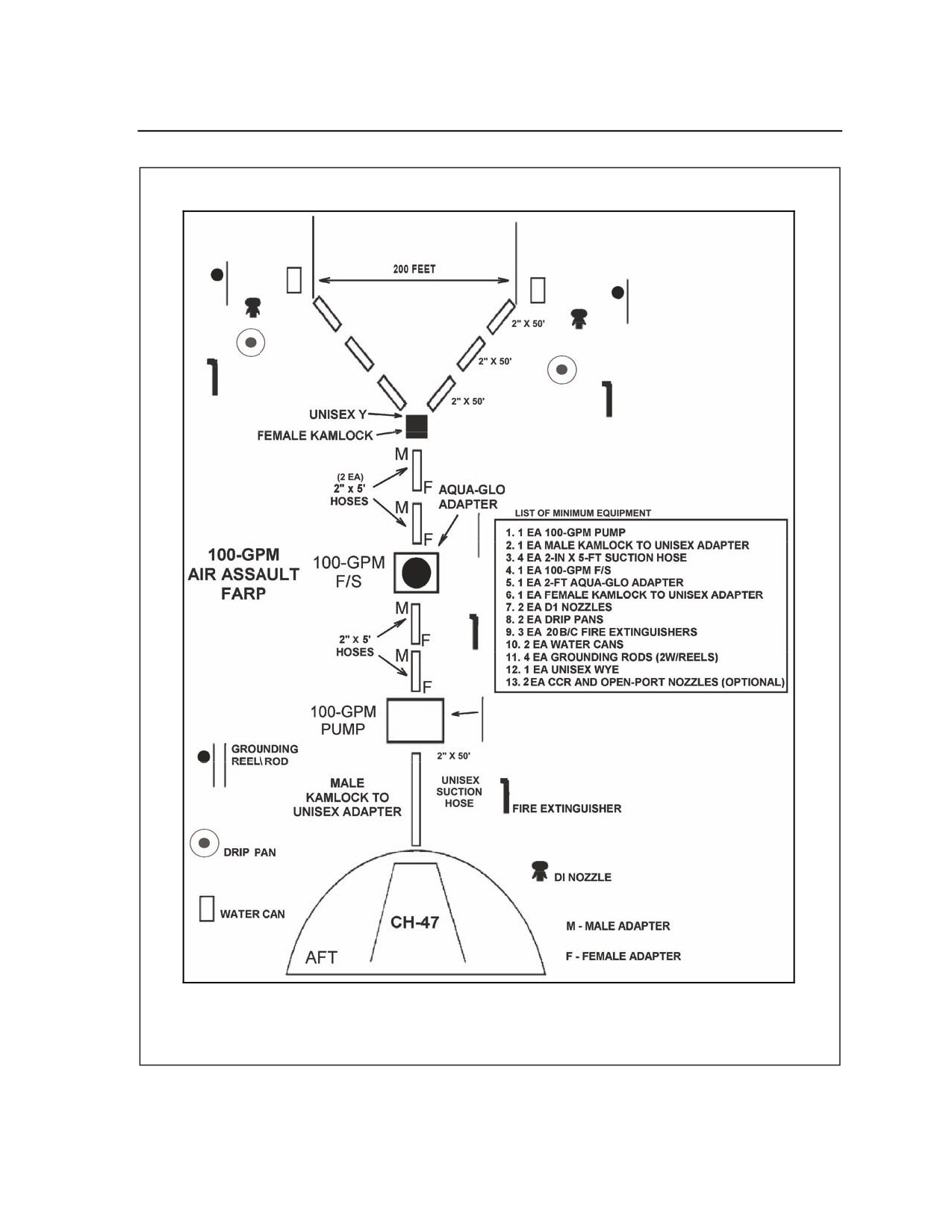
Figure-4. List of minimum equipment
17
Figure B-1. Example of a forward arming and refueling operations annex to a tactical standing
operation procedure (continued)
3 August 2006
FM 3-04.104
B-17
Appendix B
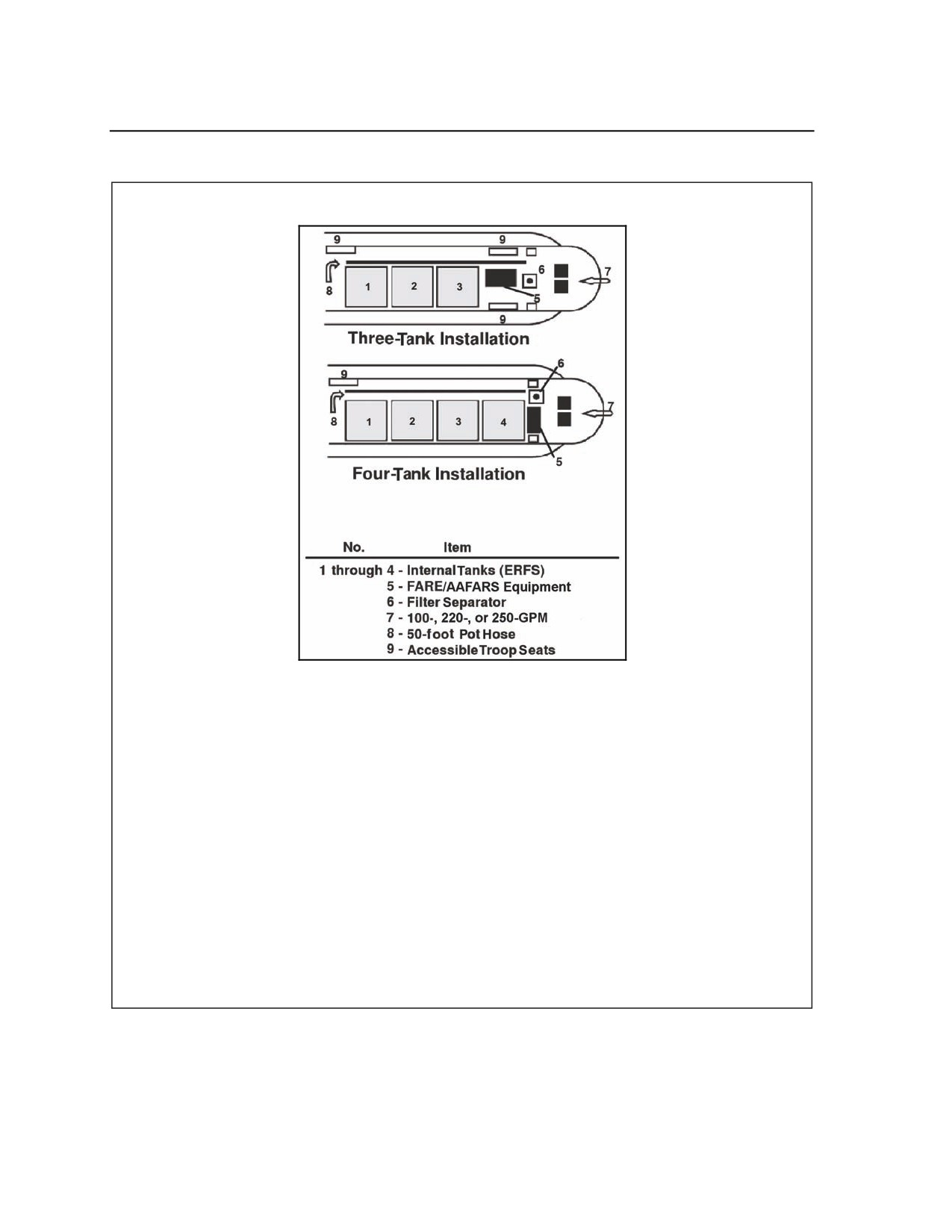
Figure 5. Extended range fuel system tank installation
18
Figure B-1. Example of a forward arming and refueling operations annex to a tactical standing
operation procedure (continued)
B-18
FM 3-04.104
3 August 2006
Sample Forward Arming and Refueling Point Standing Operating Procedure
1. Ensure that aircraft to be fueled can land into the wind.
2. Conduct a normal engine shutdown.
NOTE: POL personnel may start unloading and setting up equipment. Unless' the chief engineer is needed
during the shutdown phase, he may assist with the FARP layout.
3. Stop engines after two minutes.
4. Ensure that the PC/FE secures the aircraft (APU to stop).
5. Ensure that the PC observes and directs the FARP site layout.
6. Ensure that the PC inspects the FARP site layout. (A safety inspection should be conducted to ensure the
proper installation of FARP equipment.)
7. Check the FARP system under pressure for leaks.
8. Take a fuel sample using Aqua-Glo test procedures.
9. Record the fuel sample reading.
10. Brief FARP personnel and place them in position.
11. Commence refueling operations.
NOTE: Anyone observing an unsafe practice or procedure will alert FARP personnel. All refueling operations
will cease immediately.
Enclosure 1. AIR ASSAULT FARP REFERENCE INSTRUCTIONS UPON ARRIVAL AT SITE
19
Figure B-1. Example of a forward arming and refueling operations annex to a tactical standing
operation procedure (continued)
3 August 2006
FM 3-04.104
B-19
Appendix B
NOTE 1: To maintain aircraft center of gravity, the tank burn sequence should be 4, 1, 3, 2.
NOTE 2: After all of the aircraft ground checks have been completed, ensure that there is positive fuel flow
from the ERFS to the aircraft.
1. Open the cam lever for the appropriate tank.*
2. Turn the forward auxiliary fuel switches off.
3. Turn the aft auxiliary fuel switches off.
4. Place the fuel selector switch to the main tank having the lowest amount of fuel.
5. Initiate fuel transfer when the main fuel tanks on the aircraft have decreased 1,000 pounds or sooner.
6. Turn Pumps #1 and #3 on and hold. (Allow at least a la-second delay between each pump switch
actuation.)*
7. Turn Pumps #2 and #4 on if faster fuel transfer is desired. *
8. Check all hoses and fittings for leaks.*
NOTE: Do not use liquid level indicators for continuous fuel quantity readings during flight.
9. Monitor the fuel levels in the main tanks. Turn all fuel pumps off when the main fuel tanks indicate 1,600
pounds. *
10. Transfer fuel until the low-level warning lights illuminate. Fuel pumps will shut off automatically. Confirm
that the fuel pumps are off.*
11. Ensure that the cam lever is closed for the affected tank. *
12. After the refueling operation is complete, verify that all fuel pumps are off and all tank cam levers are
closed.*
*These steps require a response from the FE or crew chief when called for by the pilot.
Enclosure 2. EXTENDED RANGE FUEL SYSTEM FUEL TRANSFER SYSTEM INSTRUCTIONS
20
Figure B-1. Example of a forward arming and refueling operations annex to a tactical standing
operation procedure (continued)
B-20
FM 3-04.104
3 August 2006
Sample Forward Arming and Refueling Point Standing Operating Procedure
1. Before applying electrical power for system operation, perform the checks and services listed in the PMCS,
Table 2-6, TM 55-1560-307-13&P.
2. Check all fuel manifold lines, electrical lines, grounding cables, and vent lines for installation, security, and
chafing.
3. Check the tank tie-down strap for security and chafing.
4. Check to ensure that the ERFS tank is properly serviced (maximum of 580 gallons per tank). Confirm that
the vent lines are uncapped when fuel is in the tank.
5. Take a fuel sample from each tank.
6. Apply power to the ERFS with the APU or with the aircraft engines running.
7. Open the appropriate tank cam levers (dump valves) one at a time.
8. Perform power-on checks as follows:
a. Check the operation of the press-to-test indicator lights.
b. Turn on Pump #1 and hold it on until the pump engages. Ensure that the ON light illuminates and the
pump is running. Turn Pump #1 off, and ensure that the pump shuts off.
c. Check to ensure that each pump switch remains engaged after the pressure switch indicates that all
pumps are operating. Allow at least a 10-second delay between each pump switch actuation. Turn all
pump switches off when the fuel transfer is verified.
d. Ensure that the press-to-test fuel low-level light indicates one minute of fuel remains in the tank.
e. Turn the override switch to ON, then momentarily turn on anyone pump. Check to ensure that the pump
is operative. If it is not, the override switch is defective.
f. Check to ensure that all system circuit breakers are in when the power is on.
g. Check the entire system for fuel leaks.
h. Verify that all pump switches are off.
i. Close all tank cam levers.
Enclosure 3. EXTENDED RANGE FUEL SYSTEM MISSION OPERATIONAL PREFLIGHT INSPECTION
21
Figure B-1. Example of a forward arming and refueling operations annex to a tactical standing
operation procedure (continued)
3 August 2006
FM 3-04.104
B-21
Appendix C
Load Plans
Three primary ground vehicles are used to support FARP operations—M978 HEMTT
tanker, M977 HEMTT cargo vehicle, and M989A1 HEMAT. Efficient loading of
these vehicles will facilitate smooth operations and help ensure adequate support for
the mission.
HEAVY EXPANDED MOBILITY TACTICAL TRUCK TANKER
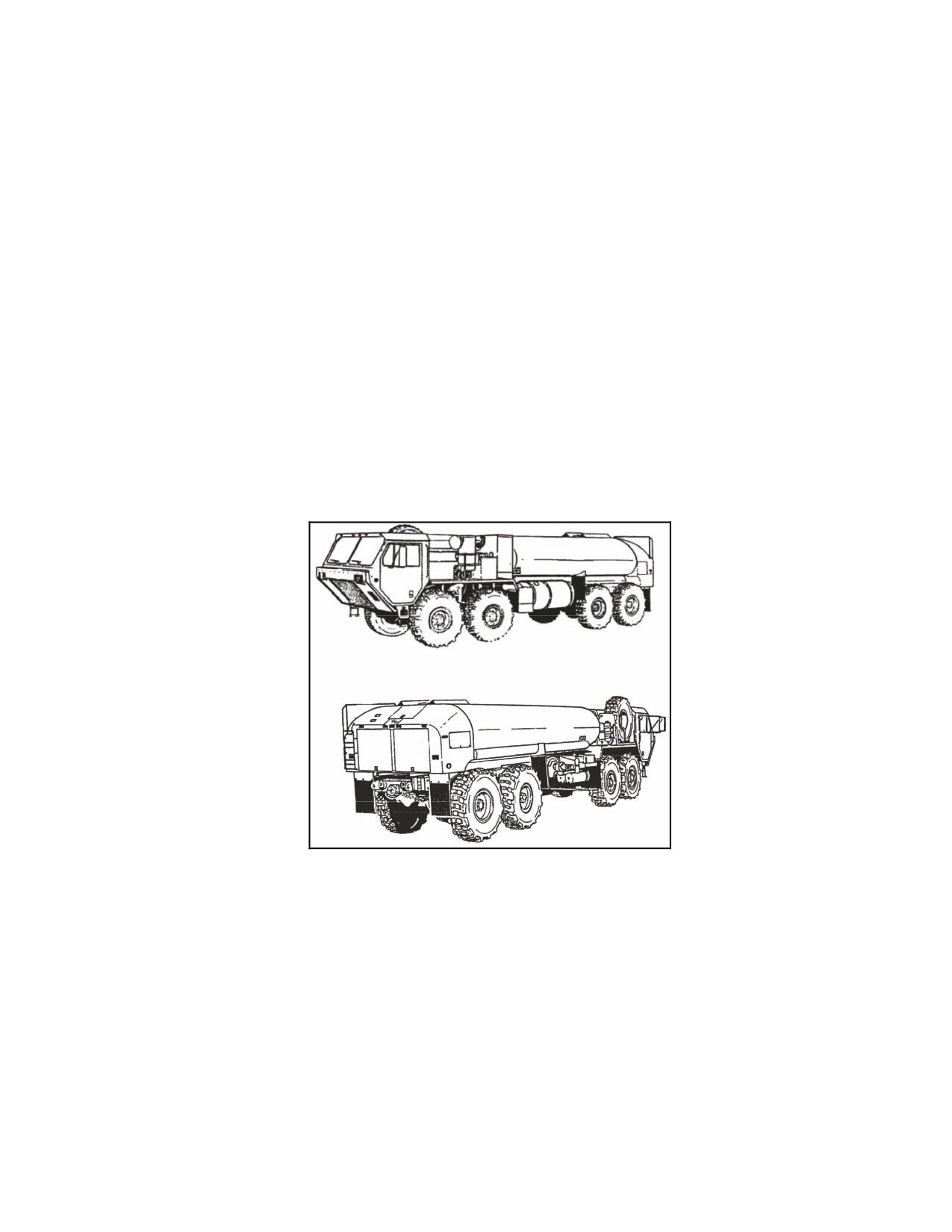
C-1. The HEMTT tanker can carry 2,500 gallons, of which 2,250 gallons are usable. When paired with
the HTARS/AAFARS, the HEMTT tanker can simultaneously refuel four aircraft. Figure C-1 shows the
front and rear views of the M978 HEMTT tanker.
Figure C-1. M978 heavy expanded mobility tactical truck tanker
HEAVY EXPANDED MOBILITY TACTICAL TRUCK CARGO
VEHICLE
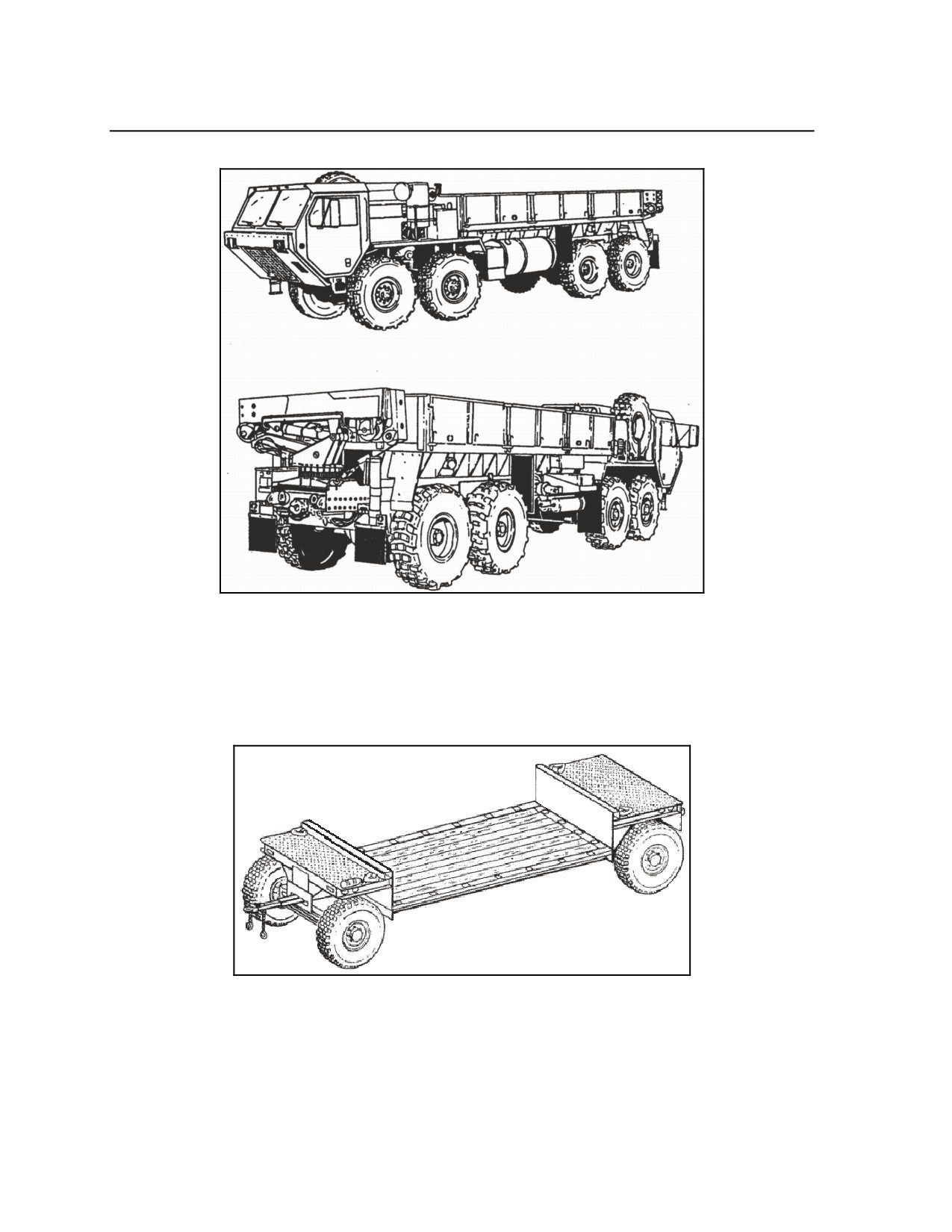
C-2. The HEMTT cargo vehicle is equipped with a materiel-handling crane with a 2,500-pound load
capacity at a 19-foot boom radius. The 18-foot cargo body can carry 22,000 pounds. When carrying
ammunition, this truck will cube out before it weighs out. Figure C-2, page C-2, shows the front and rear
views of the M977 HEMTT cargo vehicle.
3 August 2006
FM 3-04.104
C-1
Appendix C
Figure C-2. M977 heavy expanded mobility tactical truck cargo vehicle
HEAVY EXPANDED MOBILITY AMMUNITION TRAILER
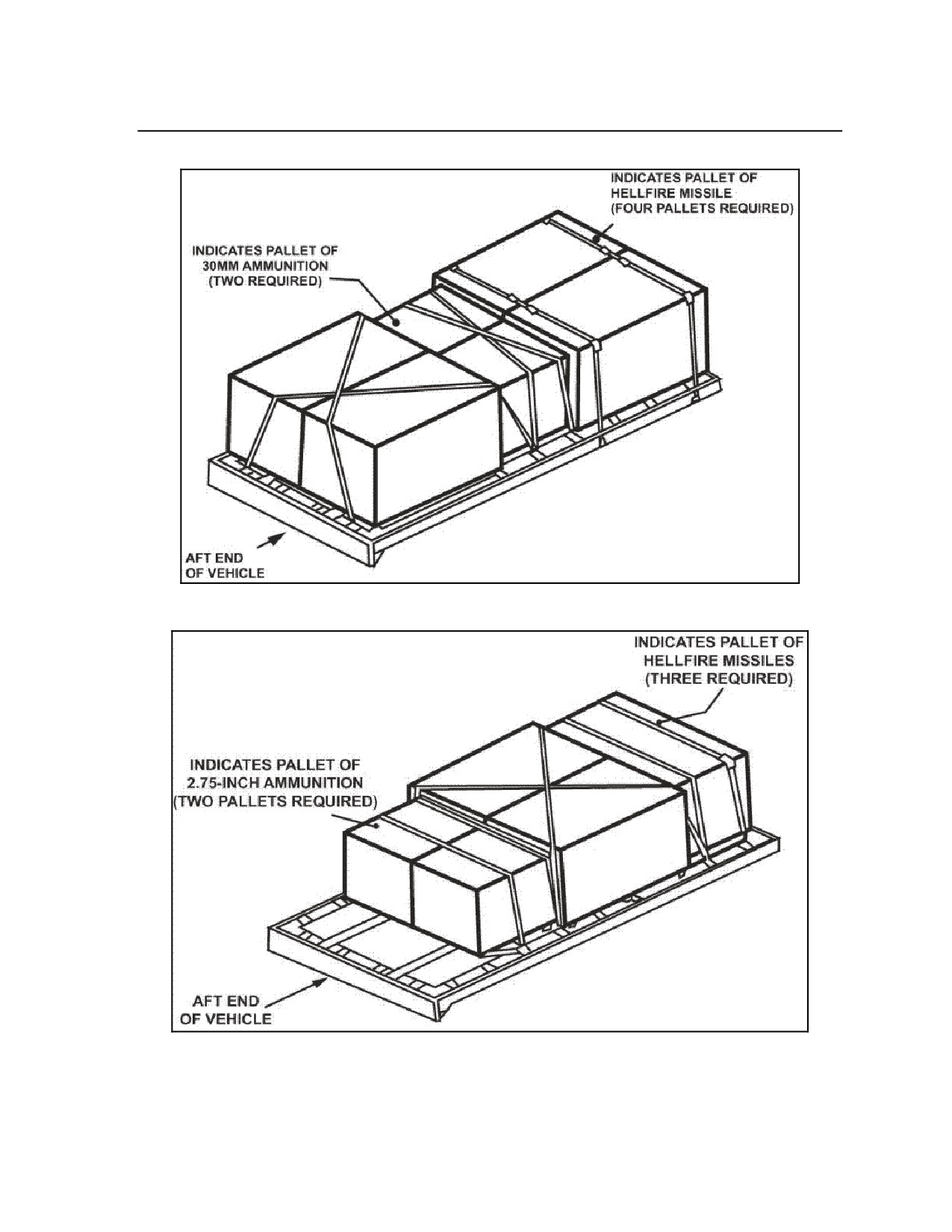
C-3. The HEMTT is the prime mover for the HEMAT. The HEMAT can carry 22,000 pounds. Figure C-3
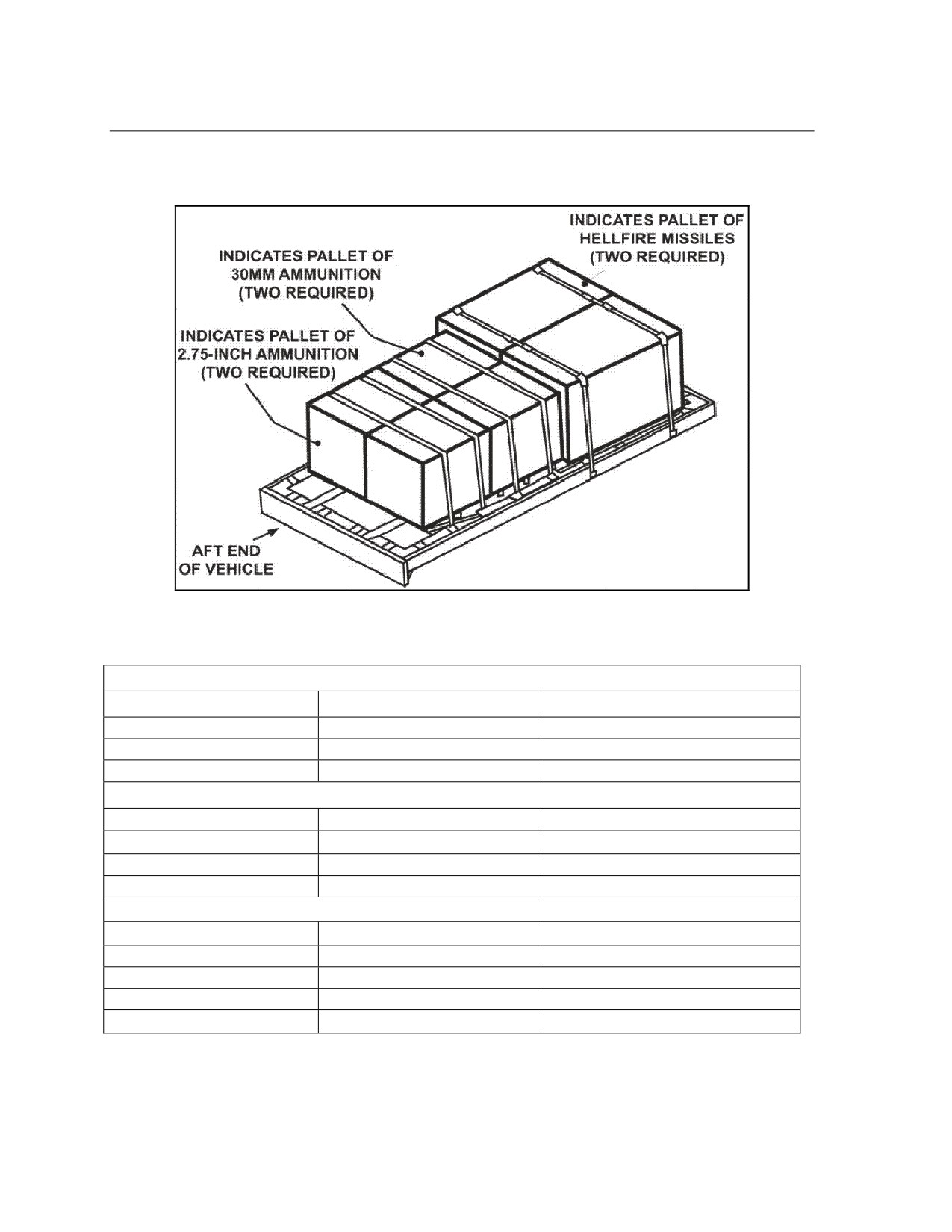
shows the M989A1 HEMAT. Figures C-4 and C-5 (page C-3) and Figure C-6 (page C-4) show suggested
ammunition load plans. Figure C-7, page C-4, is the essential load plan key for figures C-4 through C-6.
Figure C-3. M989A1 heavy expanded mobility tactical truck
C-2
FM 3-04.104
3 August 2006
Load Plans
Figure C-4. Suggested ammunition load plan 1
Figure C-5. Suggested ammunition load plan 2
3 August 2006
FM 3-04.104
C-3
Appendix C
Figure C-6. Suggested ammunition load plan 3
Load Plan 1
Item
Quantity
Approximate Weight (pounds)
30mm Pallet
2
7,472
Hellfire Pallet
4
7,200
Total Weight
14,672
Load Plan 2
Item
Quantity
Approximate Weight (pounds)
2.75-inch Rocket Pallet
2
5,032
Hellfire Pallet
3
5,400
Total Weight
10,432
Load Plan 3
Item
Quantity
Approximate Weight (pounds)
Hellfire Pallet
2
3,600
30mm Pallet
2
7,472
2.75-inch Rocket Pallet
2
5,032
Total Weight
16,104
Note. Units that have aircraft weapons systems that fire .50-calibur ammunition; will configure Load Plan 1 and 3
to meet unit requirements.
Figure C-7. Load plan key
C-4
FM 3-04.104
3 August 2006
Appendix D
Multiple Forward Arming and Refueling Point Operations
Army doctrine dictates that combat operations be conducted 24 hours a day in any
weather. Therefore, FARP operations must be scheduled to provide around-the-clock
support. The best way to provide 24-hour support is to employ a two FARP sequence.
A schedule that includes two or more FARPs ensures that one FARP is always active,
reduces personnel fatigue, and facilitates efficient resupply. This appendix describes
multiple FARP operations.
MISSION
D-1. The degree of air superiority and the factors of METT-TC will determine the number of FARPs and
the number of refueling points at each FARP. Multiple FARP operations may be necessary. To accomplish
this, assets should be arranged to set up two or three independent and mobile FARP operations. The ideal
situation would include an active FARP, a silent or relocating FARP preparing to go active, and a rapid
reaction air emplaced jump FARP on standby.
D-2. The mode of transportation is determined by the availability of assets and the urgency of the mission.
No FARP should stop operation until another FARP becomes operational unless the tactical situation
demands otherwise. Splitting Class III/V personnel and equipment into three independent FARPs will be
difficult. The organization of each FARP will depend on the mission and the way the commander wants to
employ his FARPs. Figure D-1 shows multiple FARP operations.
Figure D-1. Multiple forward arming and refueling point operations
D-3. The timing of supplies must be coordinated when multiple FARPs are used. If Class III/V supplies
are being pushed forward, the FARP should stop receiving supplies at a designated time. The time should
be based on estimated Class III/V usage rates and should allow the FARP to use all of its supplies. Any
Class III/V products not used should be transported to the new site. Otherwise, the supplies should be
3 August 2006
FM 3-04.104
D-1

Appendix D
camouflaged and picked up later. The supplies should be destroyed only as a last resort. TM 750-244-3
provides guidance on the destruction of assets.
D-4. A typical ground-emplaced mobile FARP consists of a HEMTT, HTARS, FARE or AAFARS, a
HEMTT cargo truck with trailer, and a HMMWV. This mobile FARP can rearm and refuel four aircraft
simultaneously. This FARP will have 9 personnel—two personnel per pad at four pads and one personnel
on the truck. This package will support a short duration four-point FARP with no security. The HMMWV
is used to lead vehicles to planned FARP locations. This FARP can be done twice, which would provide
eight refueling points. When the mobile FARP requires additional Class III or Class V products, it may
proceed to the battalion trains area for resupply or it may be aerially resupplied. The silent FARP is
identically configured and prepared to assume operations.
D-5. In this example, the mission is to deploy two FARPs forward to support a continuous attack, making
the transition to a phased attack of a different target. The S-3 designates two primary sites and their
alternates. The scheduled operational times for FARP 1 are 1930. The operational times for FARP 2 are
1,400 and 2,000. In this example, the transition to phased attack requires one of the FARP teams to further
split to allow drivers to travel to supply points and/or throughput LRP.
SUGGESTED SCHEDULE
D-6. Figure D-2 illustrates a suggested FARP schedule. It assumes that when one FARP is active, a
second silent FARP is inactive. This example also illustrates how a mission change to phased attack would
require both FARPs to operate simultaneously.
Team 1 (Platoon Sgt leads) FARP
Team 2 (Platoon Leader leads) FARP
0800
FARP 1 ACTIVE, Supports A Co
Shuts down old FARP 2; drives to resupply point
0900
FARP 1 ACTIVE, Supports B Co
Drives to resupply point/LRP
1000
FARP 1 ACTIVE, Supports C Co
Arrives at resupply point/LRP; loads/transloads
1100
FARP 1 ACTIVE, Supports A Co
Drives to FARP 2 location
1200
FARP 1 ACTIVE, Supports B Co
Drives to & arrives at FARP 2 location; sets up
1300
FARP 1 ACTIVE, Supports C Co
Continues setup, priority-of-work tasks
Shuts down FARP; drives to resupply
FARP 2 ACTIVE. Supports A Co; offloads Class V trucks;
1400
points/LRPs
prepares to go to supply point
FARP 2 ACTIVE. Supports B Co; platoon leader prepares
1500
Drives to resupply points/LRPs
to split his team; transloads fuel into empty tankers/drums
Arrives at resupply points/LRPs, loads/
Team 2A: Supports C Co. in FARP 2; Team 2B: takes
1600
transloads
offloaded trucks/tankers and drives to LRPs
Team 2A: Supports A Co. in old FARP 2; Team 2B:
1700
Drives to new FARP 1 location
arrives at LRPs, loads/transloads
Arrives at new FARP 1 location; off-
Team 2A: Supports B Co. in old FARP 2, Team 2B:
1800
loads/ sets up
loaded trucks return to new FARP site
Team 2A: Services C Co. in old FARP 2; tears down,
Continues setup, priority of work FARP
1900
moves to new FARP/LRP; Team 2B: loaded trucks
1 ACTIVE
arrive/set up new FARP
2000
FARP 1 ACTIVE, Supports A Co
FARP 2 ACTIVE. Supports B Co. (phased attack)
2100
FARP 1 ACTIVE, Supports C Co
FARP 2 ACTIVE. Continues offload of Class V
2200
FARP 1 ACTIVE, Supports A Co
FARP 2 ACTIVE. Supports B Co. (phased attack)
Figure D-2. Suggested forward arming and refueling point schedule
D-2
FM 3-04.104
3 August 2006
Appendix E
Forward Arming and Refueling Point Safety Requirements
Figure E-1 gives the FARP requirements for safety equipment, nozzles and hoses,
aircraft control and equipment, site preparation, before-refueling operations, and site
operations.
SAFETY EQUIPMENT
a. Fire extinguishers are present, one for the pump assembly and one for each refueling nozzle. (FM 10-67-
1)
b. Fire extinguishers meet the requirements. (FM 10-67-1)
c. Sufficient water is available to wash fuel spills from personnel or to wet fuel-soaked clothing before
removing the clothing. (FM 10-67-1)
d. POL handlers are wearing protective clothing. (FM 10-67-1)
e. Explosion-proof flashlights are available for night operations. (FM 10-67-1)
f. NO SMOKING, DANGER, PASSENGER MARSHALING AREA, RESTRICTED AREA, ALARM, and
EMERGENCY SHUTOFF signs are posted. (FM 10-67-1)
g. Ignition sources are collected outside the dispensing area. (FM 10-67-1)
h. Grounding rods are being used at pump-filter separator locations and at each dispensing point nozzle. (FM
10-67-1)
i. Grounding rods conform to specifications. (FM 10-67-1)
NOZZLES AND HOSES
a. Each nozzle has proper grounding cable and handling wire attached. (FM 10-67-1)
b. Both closed-circuit and open-port nozzles are available for use. (FM 10-67-1)
c. Dust covers are attached to the nozzle and are used. (FM 10-67-1)
d. The hose has been tested at normal operating pressure with the nozzle closed. (FM 10-67-1)
e. The dispensing hose is long enough to allow minimum required distance between aircraft. (FM 10-67-1)
f. Hoses show signs of blistering, saturation, nicks, or cuts. (FM 10-67-1)
g. Hose nozzle screens are clean. (FM 10-67-1)
h. The hoses are configured in a curved pattern. (FM 3-04.104)
AIRCRAFT CONTROL AND EQUIPMENT
a. The parking area for each fuel dispensing point is clearly marked. (FM 10-67-1)
b. A trained air traffic controller or pathfinder is available at each refueling site (nontactical environment).
(FM 10-67-1)
c. The FARP has two-way radio communications with aircraft before and immediately after refueling
(nontactical environment). (FM 10-67-1)
d. The refueling site is equipped with a lighting system for night operations. (FM 10-67-1)
SITE PREPARATION
a. The size of the site is adequate for the operation. (FM 10-67-1)
b. The area has been cleared of loose sticks, stones, and other debris that might cause FOD. (FM 10-67-1)
c. The layout ensures proper spacing between aircraft refueling points.(FM 10-67-1)
d. All pieces of equipment and materiel that can be camouflaged are covered with appropriate camouflage.
(FM 10-67-1)
e. Vehicles are using one set or existing track marks to reduce the number of tracks. (FM 3-04.104)
f. The selected FARP area and perimeter have been secured. (FM 3-04.104)
g. The vehicles are emplaced to allow timely exit. (FM 3-04.104)
Figure E-1. Forward arming and refueling point requirements
3 August 2006
FM 3-04.104
E-1
Appendix E
BEFORE-REFUELING OPERATIONS
a. Sufficient personnel are assigned to the equipment—a fireguard, one person to operate the pump, and one
person to operate each nozzle. (FM 10-67-1)
b. A fuel sample has been taken from each dispensing nozzle and each fuel source. (FM 10-67-1)
c. The complete system has been checked for proper operation, pressure, and leaks. (FM 10-67-1)
SITE OPERATION
a. There are established communication means to control traffic at refueling locations. (FM 10-67-1)
b. Passengers have been briefed about proper dismounting/mounting procedures, and they go to the
marshaling area while the aircraft is refueling. (FM 10-67-1)
c. Ground guides are provided for aircraft. (FM 10-67-1)
d. Ground guides use proper marshaling signals. (FM 10-67-1)
e. Nonessential personnel deplane before refueling. (FM 10-67-1)
f. The fire extinguisher is carried from its position by the grounding rod to the side of the aircraft by the
refueling port. (FM 10-67-1)
g. Refueling personnel ensure that all radios are turned off except the radio used to monitor air traffic. (FM 10-
67-1)
h. Refueling personnel ensure that armament aboard the aircraft is set on SAFE. (FM 10-67-1)
i. Aircraft are properly grounded before they are refueled. (FM 10-67-1)
j. The nozzle is bonded to the aircraft before the refueling cap is opened. (FM 10-67-1)
k. The dust cap is replaced on the nozzle after each refueling. (FM 10-67-1)
1. Nozzles are replaced on the nozzle hanger (grounding rod) after use. (FM 10-67-1)
m. The nozzle grounding cable is attached to the grounding rod when not in use. (FM 10-67-1)
n. If tank vehicles are used as the fuel source for rapid refueling, the refueling will be properly conducted. (FM
10-67-1)
o. Refueling personnel are familiar with emergency fire and rescue procedures. (FM 10-67-1)
p. Refueling personnel are familiar with procedures in case of a fuel spill. (FM 10-67-1)
q. A copy of the unit's refueling SOP is available, and POL personnel are familiar with its contents. (AR 385-
95)
r. Appropriate measures are in place to facilitate reconstitution and recovery of FARP assets in case of
damage. (FM 3-04.104)
Figure E-1. Forward arming and refueling point requirements (concluded)
E-2
FM 3-04.104
3 August 2006
Appendix F
Armament Configurations for the AH-64 and OH-58D
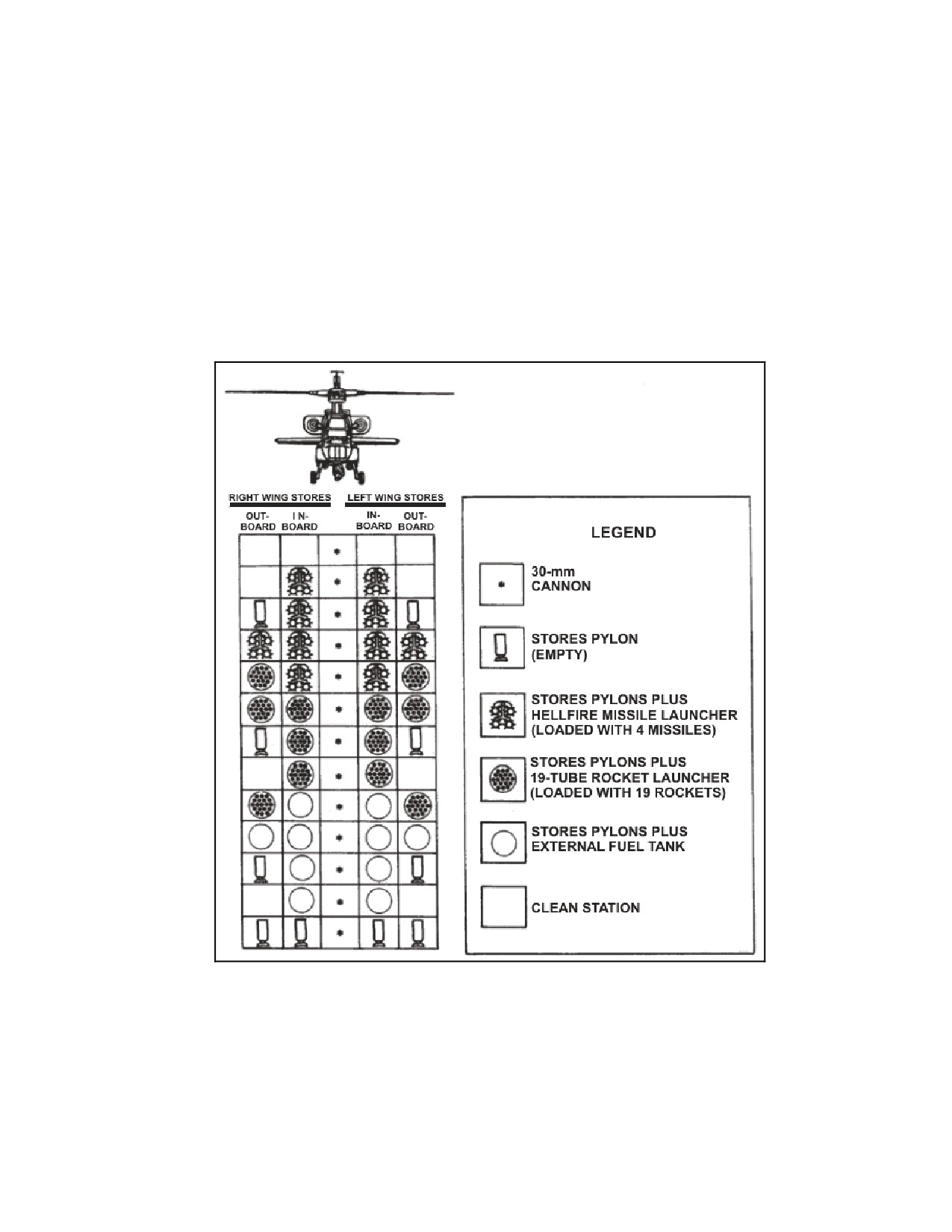
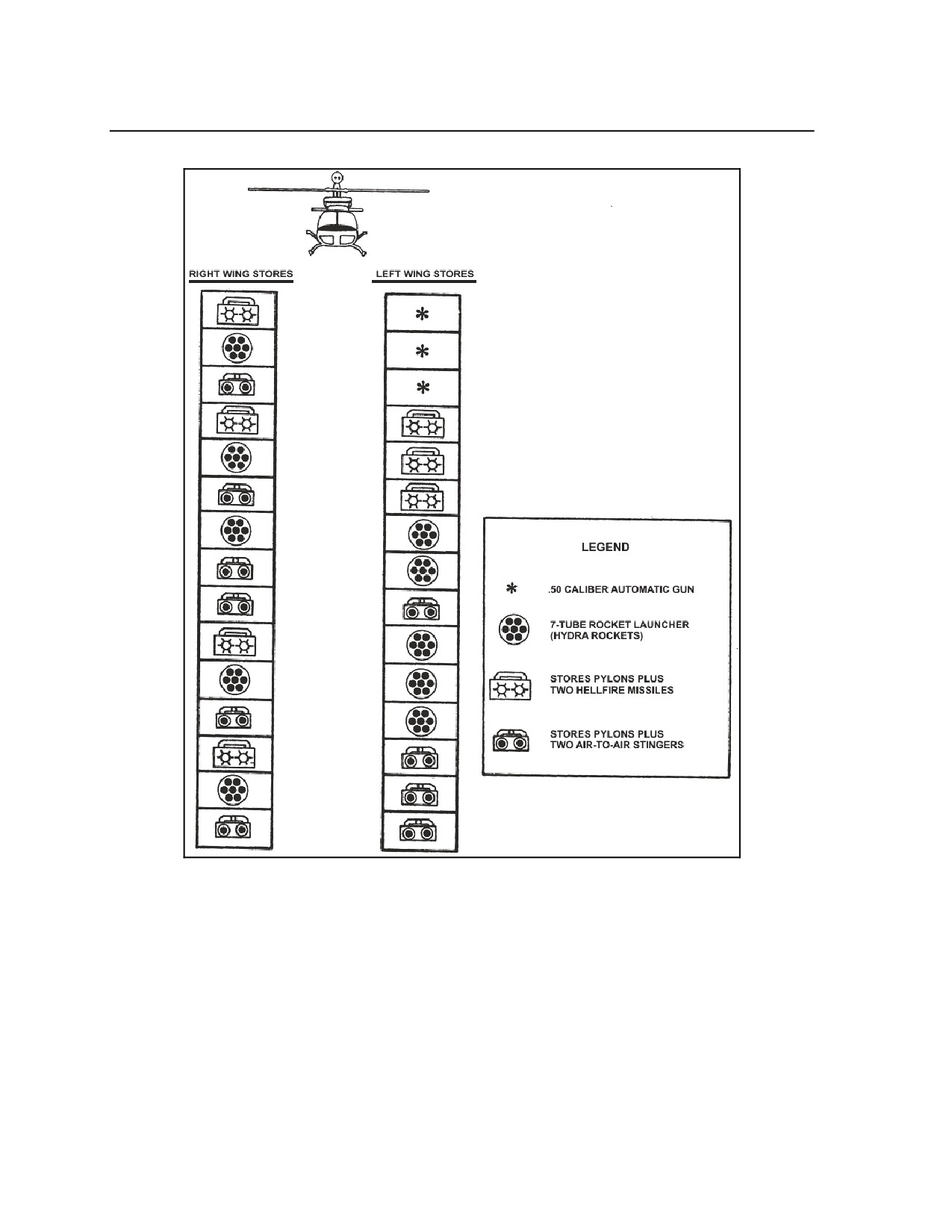
The authorized armament configurations for the AH-64 and OH-58D are shown in
figure F-1 and figure F-2, page F-2.
Figure F-1. AH-64 armament configurations
3 August 2006
FM 3-04.104
F-1
Appendix F
Figure F-2. OH-58D authorized armament configurations
F-2
FM 3-04.104
3 August 2006
Appendix G
Troop Leading Procedures
The FARP mission requires that certain critical elements be considered during the
planning, preparation, and execution phases of the operation. Subordinate leaders
will use troop leading procedures to implement the commander’s intent (refer to FM
5-0, chapter 4). Figure G-1 outlines these elements.
A. RECEIVE THE MISSION. (Perform an initial assessment and allocate the available time.)
B. ISSUE THE WARNING ORDER.
C. MAKE A TENTATIVE PLAN. (Coordinate with the XO, S-3, S-4, and/or HSC commander.)
PLANNING
1. Mission Analysis. (Based on the factors of METT-TC and risk assessment.)
a. Mission.
Noncontiguous operations.
(2) Maximum destruction, phased, and continuous attacks.
(3) Site location (primary and alternates).
(a) Distance between battle positions and trains.
(b) Location of air corridors.
(c) Layout.
(4) Number of points and type of nozzles at each point.
(5) Duration of the mission (number of turns).
(6) Class III/V estimate versus amount on hand.
(7) Simultaneous rearming and refueling.
Figure G-1. Critical elements of the forward arming and refueling point planning sequence
3 August 2006
FM 3-04.104
G-1
Appendix G
(8) Resupply.
(9) Certification and safety of FARP plan.
b. Enemy.
(1) Threat briefing from the S-2.
(2) Threat weapon system ranges (artillery).
(3) CBRN threat.
(4) Critical elements of the FARP planning sequence
c.Terrain and Weather. (Use of terrain to hide aircraft and FARP signature)
d.Troops Available. (Enough troops available to support the mission)
e.Time Available. (Duration of mission versus security and Class III/V requirements)
f. Civilian Considerations. (Civilian populations, cultures, organizations, and leaders within the AO.)
2. COA Development. (Analyze relative combat power, generate options, array forces, develop the
concept of operations, assign responsibilities, and prepare COA statement and sketch.)
a. Emplacement Plan.
(1) Air and Ground.
(2) Resupply Route Clearance.
b. Movement Plan.
(1) Major Supply Route Clearance.
(2) Advance and/or Quartering Parties.
(3) Movement of Assets (separate serials).
(4) Convoy Briefing.
c. Security Plan.
(1) ADA.
(2) CBRN (M8 alarms and so forth).
(3) Perimeter.
d. Site Layout.
(1) Sketch or Diagram.
(2) Availability of FARP Site Layout to Personnel Before the Mission Begins.
(3) Traffic Pattern and Pad Locations.
Figure G-1. Critical elements of the forward arming and refueling point planning sequence
(continued)
G-2
FM 3-04.104
3 August 2006
Troop Leading Procedures
(4). Type of Nozzles Used.
(5) Radio Frequencies.
(6) Designated Maintenance Area.
e. Command, Control, and Communications.
(1) OIC (FSC Commander/Platoon Leader, S-4, XO, HSC commander, or Maintenance
commander).
(2) Radios (primary and alternate frequencies).
(3) Lost Communications Procedures.
(4) Lighting.
f. CBRN Decontamination (Contaminated FARP Plan).
(1) Location (on graphics).
(2) Pilot and Decontamination Team Awareness.
(3) Signals.
g. Extraction and Displacement Plan.
(1) Event-Driven (DP based on enemy situation).
(2) Communications (person who makes decision to move the FARP).
(3) Subsequent Location.
3. Analyze COA. (Wargame)
4. Compare COAs and Make a Decision.
D. INITIATE MOVEMENT.
PREPARATION
1. Troop-Leading Procedures. (Warning order, precombat inspection, and rehearsal.)
2. Site Preparation. (FOD and police call.)
3. Personnel. (MOS-qualified 15J/X/Ys, 89Bs, 92Fs, technical inspectors, and combat lifesavers.)
4. Equipment.
a. Up-Loader/Down-loaders (working and available).
b. Boresighting of the aircraft.
c. Loading of Class V on the aircraft.
Figure G-1. Critical elements of the forward arming and refueling point planning sequence
(continued)
3 August 2006
FM 3-04.104
G-3
Appendix G
5. Briefing for the Platoon and Noncommissioned Officers.
a. Mission.
b. Friendly Situation.
c. Enemy Situation.
d. Graphics on Maps.
6. Compliance with Standard Operating Procedures.
E. CONDUCT RECONNAISSANCE.
1. Site Preparation. (FOD and police call.)
F. COMPLETE THE PLAN.
G. ISSUE ORDER.
1. Normally Verbally
2. Supplemented by graphics and other control measures. (Sand table, detailed sketch, maps, and other
products to depict the AO and situation.)
3. Security around AO.
H. SUPERVISE AND REFINE.
1. Confirmation Brief. (Ensure subordinate leaders understand the commander’s intent.)
2. Backbrief.
(Planning versus reacting.)
3. Combined Arms Rehearsal. (Requires considerable resources, but provides the most planning and
training benefit.)
4. Support Rehearsal. (Typically involves coordination and procedure drills for aviation, fire, combat
service, engineer support, or casualty evacuation.)
5. Battle Drills or SOP Rehearsal. (A collective action rapidly executed without applying a deliberate
decision making process; ensures that all parties understand techniques and procedures.)
EXECUTION
1. Planning Versus Reacting.
2. Enforcing FARP Turnaround Times.
3. Gathering and Compiling Class III/V Premission and Postmission Statistics.
4. Ensuring Safe Operations.
Figure G-1. Critical elements of the forward arming and refueling point planning sequence
(concluded)
G-4
FM 3-04.104
3 August 2006
Appendix H
Hazardous Material/Hazardous Wastes Supplies
The supplies listed below can be ordered through the Army Supply System.
CONTAINERS (DOT OR EQUIVALENT)
NSN ITEM
8105-00-848-9631 Bag. Plyolefin. 5 ml. 36 x 54 inch
8125-00-174-0852 Bottle. Plastic 1 gal. (Polyethylene)
8125-00-731-6016 Bottle. Plastic 13 gal.
8125-00-888-7069 Bottle. Plastic 5 gal.
8110-00-254-5719 Drum. Steel. 1 gal.
8100-00-128-6819 1 gal. steel drum (17C)*
8110-00-254-5722 4 gal. steel drum*
8110-00-282-2520 5 gal. steel drum (17C)*
8110-00-254-5713 Drum, steel, 6 gal. (w/Ring)*
8110-01-204-8697 Pail shipping steel 5 gal. (DOT 17E)*
8110-00-519-5618 Drum steel 10 gallon (DOT 17C)*
8110-00735-4643 19 gal. steel drum (17C)*
8110-00-366-6809 30 gal. steel drum (17C)*
8110-00-030-7779 30 gallon steel drum*
8110-00-030-7780 50 gal. steel drum (17C)*
8110-00-823-8121 55 gal. steel drum (17M)*
8110-00-030-9783 Drum steel 55 gal. (Bung & Vent) (DOT 17E)*
8110-01-282-7615 Drum polyethylene 55 gal*
8110-01-101-4055 85 gal. steel Disposal drum (no lining)*
*Refers to Open Top Containers
3 August 2006
FM 3-04.104
H-1
Appendix H
8110-01-101-4056 85 gal. steel Recovery drum 8Expoxy Phenolic lining)*
8110-01-101-4055 Drum HM*
*Refers to Open Top Containers
For Bung Container refer to Federal Logistics or contact your Assistant Chief of Staff for Logistics
(G-4)
ABSORBENT
NSN ITEM
7930-00-296-1272 Clay ground (UL-bag)
1939-01-154-7001 Non Skid Absorbent (UL-40 bag skid)
5640-00-801-4176 Insulation Thermal Vermiculite (Ul bag) (packaging material)
4235-01-423-1466 Loose Absorbent 1 CF Bag (4 ea. per box)
4235-01-423-0711 Loose Absorbent 2 CF Bag (3 ea. per case)
4235-01-423-1463 Pads, 18 x 18 x 3 in. (30 ea. per box)
4235-01-423-1465 Socks, 4 in. x 8 ft. (10 ea. per box)
4235-01-423-1467 Socks, 2 in. x 10 ft. (20 per box)
4235-01-423-2787 Boom w/ clamps, 10 in. x 10 ft.
SPILL KITS
NSN ITEM
4235-01-432-7909 Includes: 4 ea. 18 in. x 18 in. pads, 2ea. 2 in. x 5 ft. socks, 1 ea. 3/4 CF bags, 2 ea. waste
disposal bags, 1 ea. water resistant nylon tote bag
4235-01-432-7912 Includes: 25 gal. drum with seven 8x18x3-in. pads, one 4-in.x8-ft. sock, two 4-in.x4-ft. socks,
one 3/-cu. ft. bag, two Tyvek suits, two pair nitrile gloves, one pair safety goggles and three disposable bags.
4235-01-423-7214 Includes: 55-gal drum with fifteen 18x18x3-in. pads, two 4-in.x8-ft. socks, two 4-in.x4-ft. socks,
three 3/4-cu. ft. bags, three Tyvek suits, three pair nitrile gloves, three pair safety goggles and five disposal bags.
4235-01-423-7221 Includes: 55-gal drum with ten 18x18x3-in. pads, five 2x10-ft. socks, five 3/4-cu. ft. bags, two
quarts of emulsifier, two pair nitrile gloves, one folding shovel, one 3.5-gal. bucket, two Tyvek suits, two pair
safety goggles, one scoop, five disposal bags.
H-2
FM 3-04.104
3 August 2006
Glossary
SECTION I - ACRONYMS AND ABBREVIATIONS
AA
assembly area
AAFARS
advanced aviation forward area refueling system
ACO
airspace control order
AD
air defense
ADA
air defense artillery
AF
Airframe (see Figure 1-3)
AH
attack helicopter
AMC
aviation maintenance company
AMC/T
aviation maintenance company/troop
AO
area of operations
AOD
airfield operations detachment
APU
auxiliary power unit
AR
Army regulation
ARB
attack reconnaissance battalion
ARMT
Armament (see figure 1-3)
ARS
attack reconnaissance squadron
ASB
aviation support battalion
ASC
aviation support company
ASP
ammunition supply point
AT
antitank
ATHP
ammunition transfer holding point
ATP
ammunition transfer point (see figure 1-3)
ATS
air traffic services
ATTN
attention
AVGAS
aviation gasoline
AVNX
avionics (see figure 1-3)
BAT
battery
(see figure 1-3)
BCT
brigade combat team
BDA
battle damage assessment
bde
brigade
BLSA
basic load storage area
BSA
brigade support area
3 August 2006
FM 3-04.104
Glossary-1
Glossary
C2
command and control
C3
command, control, and communications
CAB
combat aviation brigade
CAFAD
combined arms for air defense
CBRN
chemical, biological, radiological, nuclear
CCR
closed-circuit refueling
CH
cargo helicopter
cl
class
COA
course of action
COM
communication (see figure 1-3)
CP
command post
CTA
common table of allowances
CSS AMO
combat service support automation management office (see figure 1-3)
DA
Department of the Army
DISTRO
Distribution
DOT
Department of Transportation
DP
decision point
DSA
division support area
EA
each
ECWCS
Extended Cold Weather Clothing System
EETF
electronic equipment test facility (see figure 1-3)
ELEC
electrical
(see figure 1-3)
EOD
explosive ordnance disposal
EOM
end of mission
ERFS
extended range fuel system
ESSS
External Stores Support System
FARE
forward area refueling equipment
FARP
forward arming and refueling point
FC
fire control (see figure 1-3)
FE
flight engineer
fld
field
FLD FEED
field feeding team (see figures 1-1 and 1-3)
FLIR
forward looking infrared
FLOT
forward line of own troops
FM
field manual or frequency modulation
FMCP
fuel management control panel
Glossary-2
FM 3-04.104
3 August 2006
Glossary
FOD
foreign object damage
FRAGO
fragmentary order
FSC
forward support company
FSO
fire support officer
ft
foot
G-4
Assistant Chief of Staff for Logistics
GCU
gas charging unit
GPH
gallons per hour
GPM
gallons per minute
GPS
global positioning system
GSAB
general support aviation battalion
HA
holding area
HARRP
helmet assembly, rearming refueling personnel
HE
high explosive
HF-ALE
high frequency-automated link establishment
HEMAT
heavy expanded mobility ammunition trailer
HEMTT
heavy expanded mobility tactical truck
HMMWV
high mobility multipurpose wheeled vehicle
HQ
headquarters
HSC
headquarters and support company
HTARS
HEMTT tanker aviation refueling system
HM
hazardous material
HW
hazardous waste
HYD
hydraulic (see figure 1-3)
IED
improvised explosive device
in
inch
IR
infrared
JP4
jet propulsion fuel, type 4
JP5
jet propulsion fuel, type 5
JP8
jet propulsion fuel, type 8
km
kilometer(s)
kph
kilometers per hour
3 August 2006
FM 3-04.104
Glossary-3
Glossary
lbs
pounds
LHS
load handling system (see figure 1-3)
LMTV
light medium tactical vehicle (see figure 1-3)
LRP
logistics release point
LZ
landing zone
MED
medical (see figure 1-3)
METT-TC
mission, enemy, terrain and weather, troops available, time available,
civilian considerations
MHE
materials handling equipment
mm
millimeter(s)
MOPP
Mission-oriented protective posture
MOS
military occupational specialty
MTF
maintenance test flight (see figure 1-3)
MTOE
modified table of organization and equipment
NATO
North Atlantic Treaty Organization
NAV
navigation (see figure 1-3)
NCO
noncommissioned officer
NCOIC
noncommissioned officer in charge
NEW
net explosive weight
NOE
nap-of-the-earth
NSN
national stock number
NVD
night vision device
OH
observation helicopter
OIC
officer in charge
OPSEC
operations security
OPTEMPO
operating tempo
PAM
pamphlet
PC
pilot in command
PC
production control (see figure 1-3)
PLS
palletized load system
PMCS
preventive maintenance checks and services
POL
petroleum, oils, and lubricants
ppm
parts per million
psi
pounds per square inch
PT
power train (see figure 1-3)
Glossary-4
FM 3-04.104
3 August 2006
Glossary
QC
quality control (see figure 1-3)
RASA
ready ammunition storage area
RSR
required supply rate
S-2
Intelligence Staff Officer
S-3
Operations Staff Officer)
S-4
Logistics Staff Officer
SB
supply bulletin
SEC
section (see figure 1-3)
SO
safety officer
SHORAD
short-range air defense
SOP
standing operating procedure
SPR
single point receptacle
SPO
support operations office (see figure 1-3)
SPLY
supply (see figure 1-3)
spt
support
SSA
supply support activity (see figure 1-3)
STANAG
Standardization Agreement
SVC
service (see figure 1-3)
TACT
tactical aviation control team
TBFDS
tactical bulk fuel delivery system
TM
technical manual
TNDB
tactical nondirectional radio beacon
TOC
tactical operations center
TOE
table of organization and equipment
TPU
tank pump unit
Trans
transportation (see figure 1-3)
TTCS
tactical terminal control system
TSU
telescopic sight unit
UH
utility helicopter
US
United States (of America)
UHF-AM
ultra high frequency-amplitude modulation
UMT
unit ministry team (see figure 1-3)
USAAWC
United States Army Aviation Warfighting Center
3 August 2006
FM 3-04.104
Glossary-5
Glossary
USAF
United States Air Force
VHF-AM
very high frequency-amplitude modulation
VHF-FM
very high frequency-frequency modulation
WPN
weapon (see figure 1-3)
WTR
water (see figure 1-3)
XO
executive officer
SECTION II - TERMS
None
Glossary-6
FM 3-04.104
3 August 2006
References
These publications are sources for additional information on the topics in this Field Manual. Most joint
publications can be found at http://www.dtic.mil/doctrine/index.html/. Most Army doctrinal publications are
available online at https://akocomm.us.army.mil/usapa/doctrine/index.html.
SOURCES USED
These are the sources quoted or paraphrased in this publication.
ARMY PUBLICATION
AR 95-1. Flight Regulations. 3 February 2006.
AR 200-1. Environmental Protection and Enhancement. 21 February 1997.
AR 200-3. National Resources—Land, Forest, and Wildlife Management. 28 February 1995.
AR 200-4. Cultural Resources Management. 1 October 1998.
AR 385-64. U.S. Army Explosives Safety Program. 1 February 2000.
AR 385-95. Army Aviation Accident Prevention. 10 December 1999.
AR 710-2. Supply Policy Below the National Level. 8 July 2005.
COMMON TABLE OF ALLOWANCES
CTA 50-900, Clothing and Individual Equipment. 9 April 2005.
CTA 50-909, Field and Garrison Furnishings and Equipment. 9 April 2005
DEPARTMENT OF THE ARMY PAMPHLET
DA PAM 200-1. Handbook For Environmental Impact Analysis. 17 January 2002.
DA PAM 385-64. Ammunition and Explosives Safety Standards. 15 December 1999.
FIELD MANUALS
FM 3-04.140. Helicopter Gunnery. 14 July 2003.
FM 3-19.1. Military Police Operations. 22 March 2001.
FM 4-30.1. Munitions Distribution in the Theater of Operations. 16 December 2003.
FM 5-0. Army Planning and Orders Production. 20 January 2005.
FM 10-67-1. Concepts and Equipment of Petroleum Operations. 2 April 1998.
FM 10-450-3. Multiservice Helicopter Sling Load: Basic Operations and Equipment. 10 April 1997.
FM 20-3. Camouflage, Concealment, and Decoys. 30 August 1999.
FM 20-32. Mine/Countermine Operations. 29 May 1998.
FM 10-67-1. Concepts and Equipment of Petroleum Operations. 2 April 1998.
FM 10-450-3. Multiservice Helicopter Sling Load: Basic Operations and Equipment. 10 April 1997.
SUPPLY BULLETIN
SB 710-2. Supply Control Combat Consumption Rates for Ground and Aviation-Type Petroleum
Products. 12 March 1993.
3 August 2006
FM 3-04.104
References-1
References
STANDARDIZATION AGREEMENTS
STANAG 2999 (Edition 6). Use of Helicopters in Land Operations. 13 September 2004. Allied
Tactical Publication-49(D), Volumes 1 (Doctrine) and II (Tactics, Techniques, and
Procedures). Use of Helicopters in Land Operations. September 2004
STANAG 3117 (Edition 7). Aircraft Marshalling Signals. 11 June 1999.
TECHNICAL MANUALS
TM 1-1520-240-10. Operator's Manual for Army CH-47D Helicopters. 31 January 2003.
TM 1-1520-248-10. Operator's Manual for Army OH-58D Helicopters. 15 March 2005.
TM 1-1560-312-10, Operator's Manual for Extended Range Fuel System II (ERFS II) Configured for
the Army Ch-47 Helicopter. 30 September 2000.
TM 9-1340-222-20. Unit Maintenance Manual for 2.75-Inch Low Spin, Folding Fin Aircraft Rockets:
2.75-inch Spin Stabilized Wrap Around Fin Aircraft Rockets; 66-MM Light Antitank Weapon
Systems: 3.5-Inch Rockets and M3A2E1 Rocket Mortar (JATO). 30 September 1994.
TM 55-1560-307-13&P. Operator, Aviation Unit and Aviation Intermediate Maintenance Manual
With Repair Parts and Special Tools List for Extended Range Fuel System Army Model CH-
47 Helicopter. 11 December 1990.
TM 750-244-3. Procedures for Destruction of Equipment to Prevent Enemy Use. 23 September 1969.
DOCUMENTS NEEDED
These documents must be available to the intended users of this publication.
DEPARTMENT OF THE ARMY FORMS
DA Form 581. Request for Issue and Turn-in of Ammunition.
DA Form 2028. Recommended Changes to publications and Blank Forms.
DA Form 2404. Equipment Inspection and Maintenance Worksheet.
DA Form 2408-13-1. Aircraft Maintenance and Inspection Record.
DA Form 2408-13-3. Aircraft Technical Inspection Worksheet.
READINGS RECOMMENDED
These sources contain relevant supplemental information.
AR 700-19. U.S. Army Munitions Reporting Systems. 1 January 2001.
FM 3-0. Operations. 14 June 2001.
FM 44-8. Combined Arms for the Air Defense. 1 June 1999.
FM 1-100. Army Aviation Operations. 21 February 1997.
FM 3-04.111. Aviation Brigades. 21 August 2003.
FM 21-60. Visual Signals. 30 September 1987.
FM 3-34. Engineer Operations. 2 January 2004.
FM 71-100. Division Operations. 28 August 1996.
FM 55-30. Army Motor Transport Units and Operations. 27 June 1997.
FM 8-10-6. Medical Evacuation in a Theater of Operations, Tactics, Techniques, and Procedures. 14
April 2000.
FM 10-450-4. Multiservice Helicopter Sling Load: Single-Point Rigging Procedures. 30 May 1998.
References-2
FM 3-04.103
3 August 2006
References
FM 10-450-5. Multiservice Helicopter Sling Load: Dual-Point Rigging Procedures. 30 August 1999.
FM 4-25.11. First Aid. 23 December 2002.
FM 21-16. Unexploded Ordnance (UXO) Procedures. 30 August 1994.
FM 4-30.13. Ammunition Handbook: Tactics, Techniques, and Procedures for Munitions Handlers. 1
March 2001.
STANAG 2946 (Edition 1(4)). Forward Area Refueling Equipment. 19 July 1983.
TM 1-1520-237-10. Operator's Manual for Army UH-60A Helicopters, EH-60A Helicopters, EH-60A
Helicopters. 1 May 2003.
TM 1-1520-238-10. Helicopter, Attack, AH-64A Apache. 22 December 2005.
3 August 2006
FM 3-04.104
References-3