FM Field 3-04.104 Tactics, Techniques, and Procedures for Forward Arming and Refueling Point (August 2006) - page 2
Chapter 3
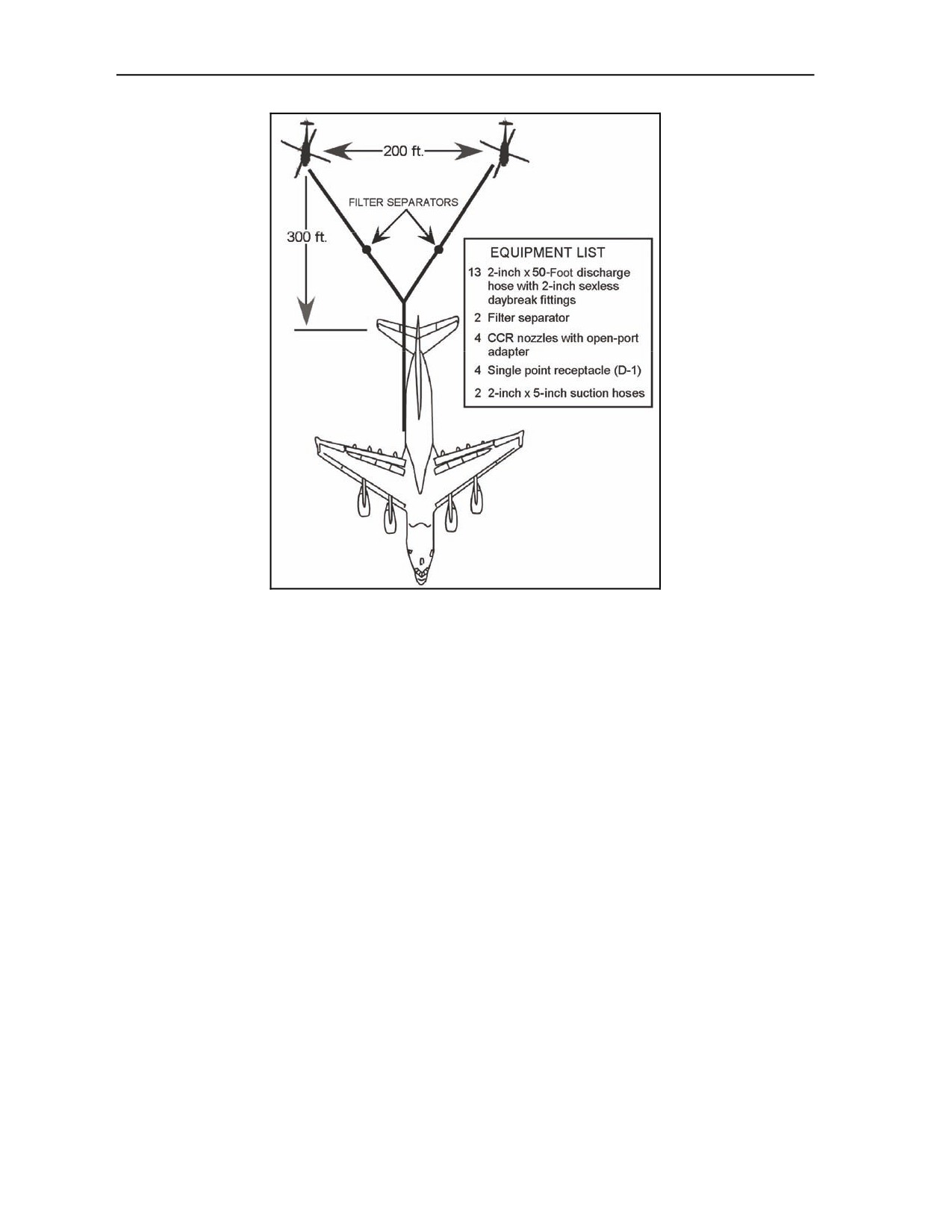
Figure 3-13. Heavy expanded mobility tactical truck tanker aviation refueling system
configuration and additional components for C-17 forward arming and refueling point
SITE CONSIDERATIONS
3-55. The KC-130 or C-17 can operate from small airfields with limited supporting infrastructure. The
airfield runway must be 3,000- to 5,000-feet long and 90-feet wide. The KC-130 and C-17 do not require
paved runways. Graded and compacted gravel or clay will suffice. However, if KC-130 or C-17 resupply
becomes a primary means of resupply for a forward operating base or base camp airfield—such as
occurred in Afghanistan—runway repair requirements will increase, dictating engineer augmentation.
3-56. The CH-53 TBFDS does not require a runway. It requires a large relatively flat area similar in size
to that required for CH-47 Fat Cow refueling.
EQUIPMENT LAYOUT
3-57. The CH-53 TBFDS has enough hoses to refuel two aircraft or refuel vehicles located 200 feet away.
Hoses run out of the cargo compartment in the form of a “V” in the same manner as a CH-47 Fat Cow.
The TBFDS uses the standard D-1 nozzle compatible with Army and other joint aircraft. Army aircraft
must approach Marine Corps refueling points hovering at a 45-degree angle with the aircraft fuel port
facing the nozzle.
3-58. Marine KC-130s have organic refuel equipment and compatible D-1 nozzles as they perform the
same ground mission for Marine helicopters and fixed-wing aircraft. Fuel in the wing-mounted external
fuel tanks and internal 3,600-gallon stainless steel tank (if installed) can be dispensed for rapid ground
refueling. The aircraft external fuel pods use ram-air turbine-driven fuel boost pumps in each pod.
3-59. Required equipment for the C-17 includes the HTARS, two 100-GPM filter separators, five fire
extinguishers, four water cans, and spill containers. Post operation evacuation of fuel lines requires a 100-
3-16
FM 3-04.104
3 August 2006
Forward Arming and Refueling Point Utilization
GPM pump. FARP or FARE personnel configure the HTARS and additional components as figure 3-12
shows. They lay out the system to achieve minimum safe distance between aircraft.
3-60. To connect system components for the C-17; starting at the supply aircraft, FARP or
FARE/AAFARS personnel—
Connect using a single-point nozzle (D-1 type) and perform a locked nozzle check.
Connect a 2-inch by 50-foot discharge hose to the nozzle, using the sexless dry break fitting.
Install a T-fitting to the end of the discharge hose.
Connect a 2-inch by 50-foot discharge hose to both remaining ends of the T-fitting.
Connect a 100-GPM filter/separator, after these lengths of hose.
3-61. Lay out the remainder of the HTARS into a modified configuration, resulting in two refueling
points, separated by at least 200 feet between points and 300 feet from the C-17. At each refueling point,
FARP or FARE personnel—
Connect the applicable closed-circuit refueling (CCR) or D-1 nozzle.
Ensure that the sexless fitting valves are in the open position.
Attempt to manually disconnect the dry break connection after opening each valve. Properly
assembled hardware will not disconnect; if it does disconnect, replace the faulty connection.
GROUNDING AND OTHER EQUIPMENT FOR THE C-17, KC-130, OR CH-53
3-62. FARP or FARE personnel—
Drive a grounding rod into the ground 10 feet from the end of each dispensing hose.
Loop the dispensing hose back to the ground rod, and hang the nozzle on the ground-rod
hanger.
Connect the clip of the nozzle grounding wire to the ground rod at each point.
Place a fire extinguisher, a spill container, and a 5-gallon can of water at each point.
Place a grounding rod at the filter/separator, and connect using the filter/separator grounding
wire.
Place a fire extinguisher at the filter/separators.
OPERATION
3-63. One critical aspect of refueling operation with other service aircraft is that their rules and
regulations differ from and supersede the Army’s. For instance, Marine doctrine prohibits simultaneous
arming and refueling and requires a separation distance of at least 300 feet from separate arming and
refueling activities. In addition, while hot refueling is permissible, hot refueling with explosive ordnance
on board is not authorized unless approved by Headquarters, U.S. Marine Corps, and Naval Air Systems
Command.
3-64. In wartime, attack units may be authorized to refuel while armed. In peace and lesser contingencies,
units must disarm, then refuel, then rearm. This restriction effectively requires aircraft to shut down after
refueling to preserve onboard fuel. Marine Corps aircraft use jet propulsion fuel, type 5 (JP5). The USAF
and Army use jet propulsion fuel, type 8 (JP8). This disparity poses no problem for Army aircraft.
3-65. Unless Marine Corps or USAF regulations supersede the Army’s, operate the system in compliance
with safety procedures and follow these steps:
Refuelers guide aircraft into position using coordinated signals; they check with the pilot to
ensure that all armaments are on safe.
Aircrew members, except the pilot, should assist with refueling or as fire guards.
Refuelers place fire extinguishers near the aircraft and within reach of fuel fill points.
Refuelers ground the aircraft.
Refuelers bond the nozzle to the aircraft. They insert the bonding plug into the aircraft plug
receiver or attach the nozzle bonding cable clip to bare metal on the aircraft.
3 August 2006
FM 3-04.104
3-17
Chapter 3
After bonding the nozzle, refuelers remove the nozzle dust cap and open the fill port.
Refuelers verify that all valves are open.
Refuelers signal the refueling supervisor that the point is ready to fuel and open the nozzle
and refuel. They do not leave the nozzle at any time during the refueling. They stop the flow
of fuel if there is any emergency at the refueling point.
After the receiving aircraft is full, refuelers shut off the nozzle, disconnect the nozzle from the
aircraft, and replace the fuel fill port cover and the nozzle dust cap.
Refuelers unplug the nozzle-bonding plug and return the nozzle to the nozzle hanger.
3-66. For C-17 refueling, refuelers use a FARE pump to evacuate fuel lines and recover components as
follows:
Close the D-1 nozzle.
Install the FARE pump 10 feet away from the single point receptacle (SPR) panel.
Reverse the flow direction of each filter/separator.
Start the pump and run at idle.
Recover hoses, starting at the refueling point.
Stop the pump and disconnect from the tanker aircraft.
ADVANTAGES/DISADVANTAGES
3-67. The advantages of the CH-53 TBFDS, KC-130, or C-17 FARP are the following:
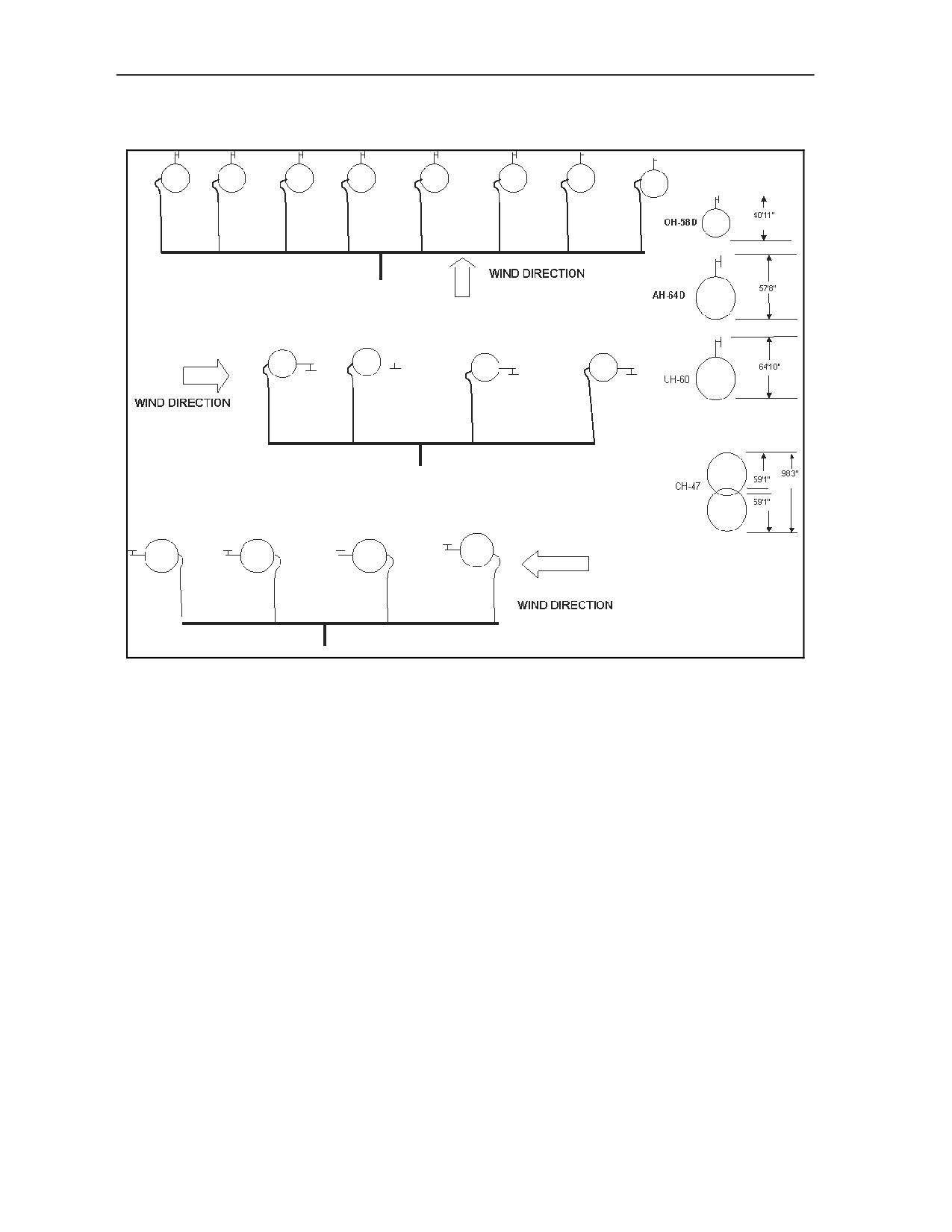
Ability to deliver bulk fuel to remote areas using small airfields with unimproved runways
(no runway for CH-53) and little supporting infrastructure.
Ability to provide substantial fuel and be set up and operational quickly.
Useful for selected operations in deep areas using intermediate staging bases or forward
operating bases.
Ability of the CH-53 TBFDS to aerial refuel and rapidly return with additional fuel.
Ability of joint fixed-wing aircraft can also transport ammunition in the cargo compartment
for substantial resupply capability.
3-68. The disadvantages of the CH-53 TBFDS, KC-130, or C-17 FARP are the following:
It requires diversion of these aircraft from other valuable missions.
Because of other priorities and the airspace control order (ACO)/air tasking order process, it
may require substantial time to request and get approval for such missions.
The KC-130 or C-17 requires a 3,000-foot by 90-foot minimum runway for landing. Engineer
requirements can be extensive if the runway is dirt or clay, and the unit anticipates repeated
use.
The aviation unit operating the FARP must transport personnel and equipment to the FARP
site. Marine CH-53s or KC-130s may wish to provide their own refuelers/operators.
Marine Corps’ aircraft refueling regulations prohibit simultaneous arming and refueling
activities.
VOLCANO ARMING OPERATIONS
3-69. UH-60 aircraft equipped with the Volcano system require arming in a manner similar to attack
reconnaissance helicopters. However, AHBs AMC/Ts lack the arming personnel organic to attack
reconnaissance HSCs. Therefore, units must use crew chiefs, combat engineers, or other trained personnel
to load and arm Volcano canisters. This level of training is essential for safe arming operations. If the unit
forecasts operations, it should request additional engineer personnel for the duration of the operation.
3-70. Loading and arming can occur in the unit AA or near the rapid refuel point. FM 20-32 specifies
that, because of more than 1,200 pounds of explosives in 160 mine canisters on fully loaded Volcano
aircraft, loading aircraft should position at least 1,000 meters from command posts (CPs), major routes,
3-18
FM 3-04.104
3 August 2006
Forward Arming and Refueling Point Utilization
and nonessential personnel. If positioning proves impractical in combat, units should exercise feasible
caution and avoid potential sources of secondary explosions such as fuel storage areas.
3-71. The total weight of the armed air Volcano system is 2,886 kilograms (more than 6,350 pounds).
Because fully loaded Volcano aircraft approach maximum gross weight, ground conditions should be firm
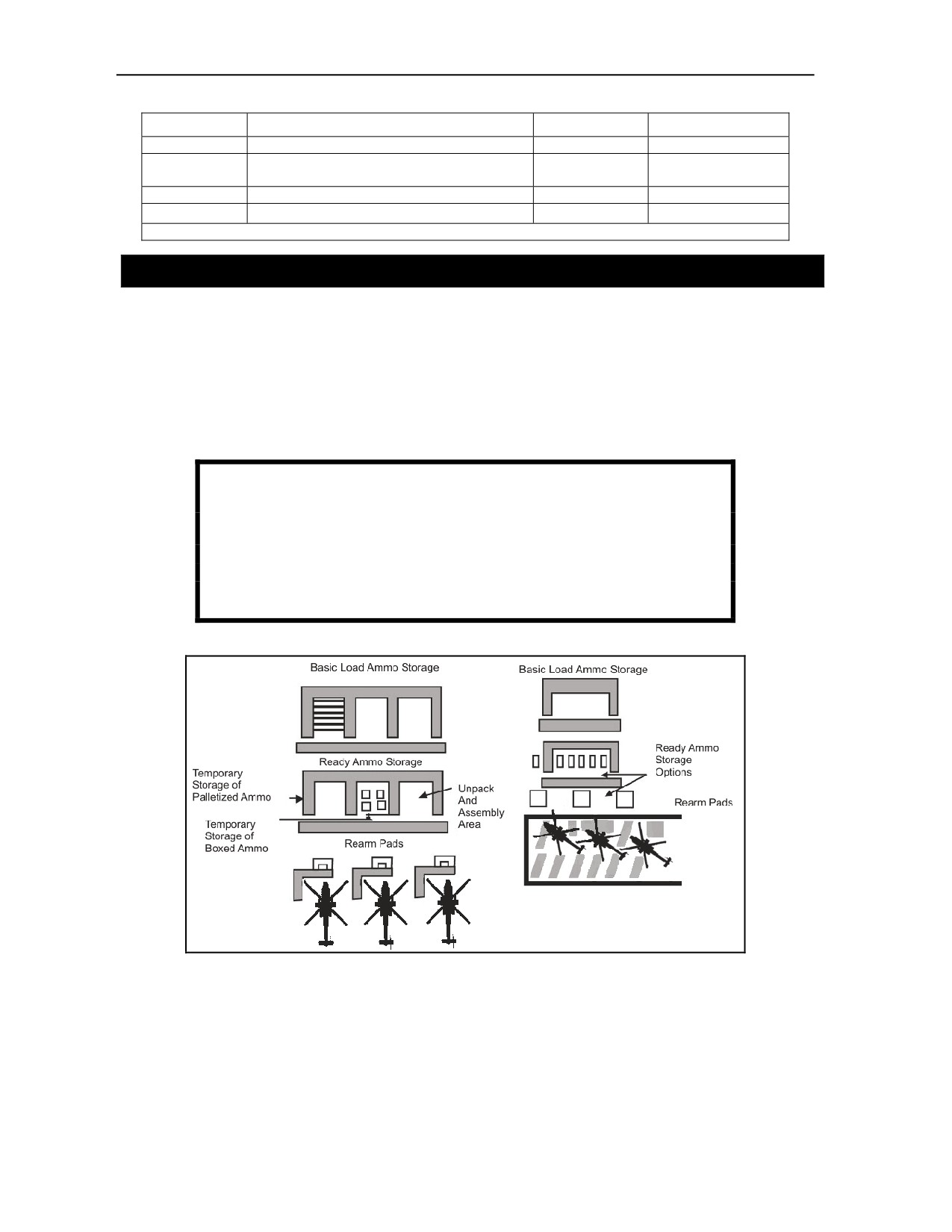
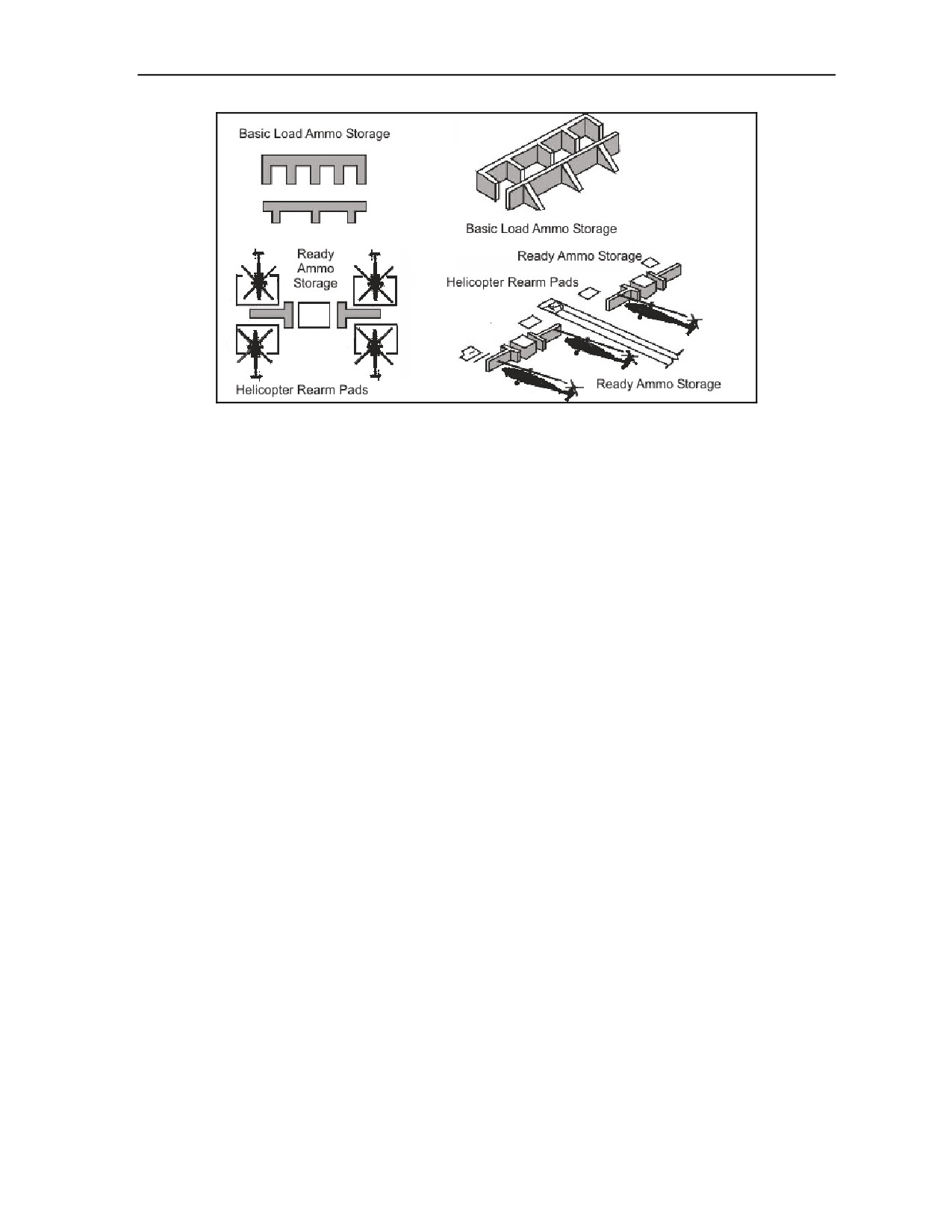
or steel/wood planking landing pad should be provided. Armed aircraft should avoid refueling near
(within 375 meters) other aircraft. Simultaneous arming and refueling is not necessary or recommended.
Obstacles should not hinder takeoff at high gross weight.
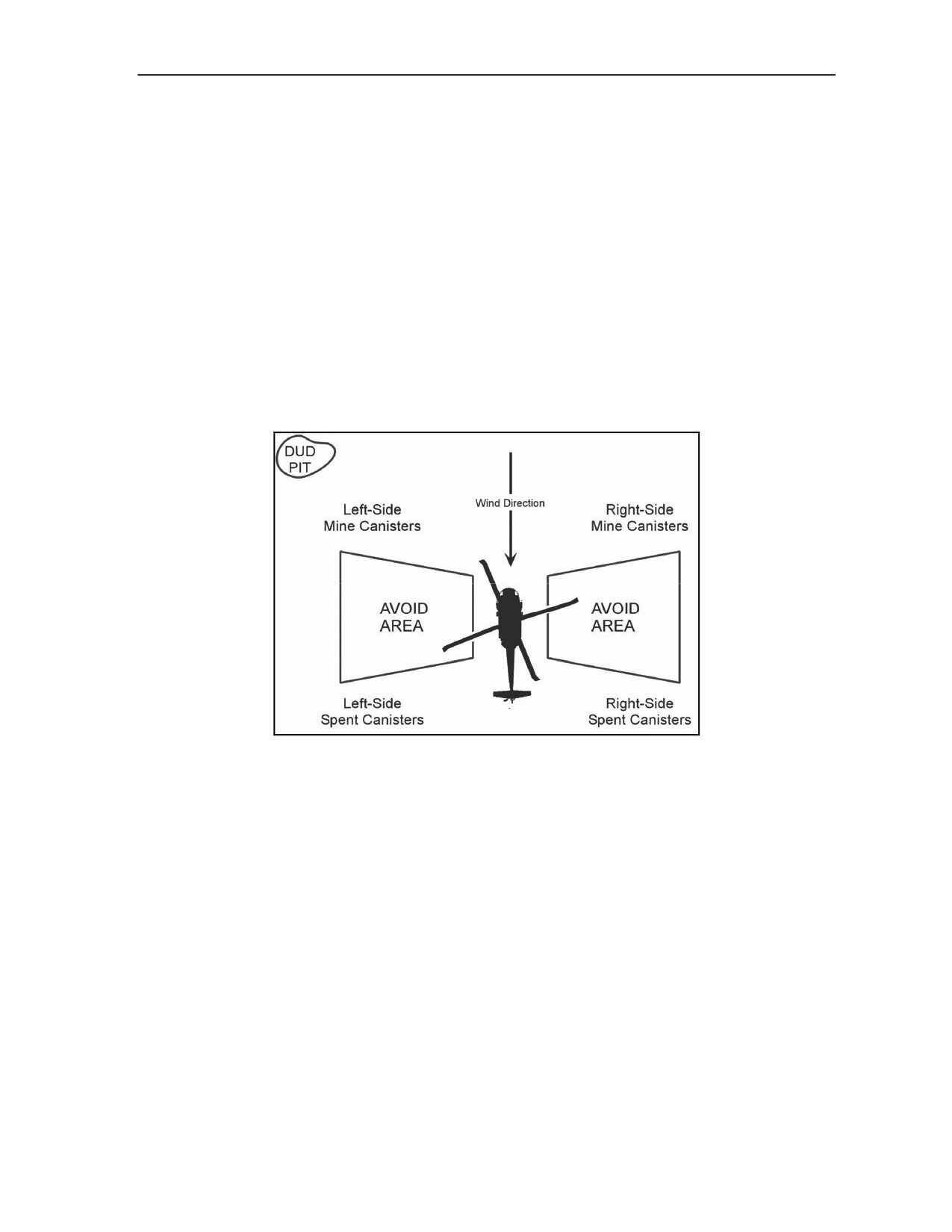
3-72. Figure 3-14 shows an example of a site layout for Volcano arming. As with normal FARP
operations, fire extinguishers and grounding rods must be available at the arming point. Arming personnel
dig a dud pit where they place damaged or misfired canisters. Personnel store live canisters to the front
left and right of the aircraft and spent canisters to the rear left and right, taking care to avoid the tail rotor.
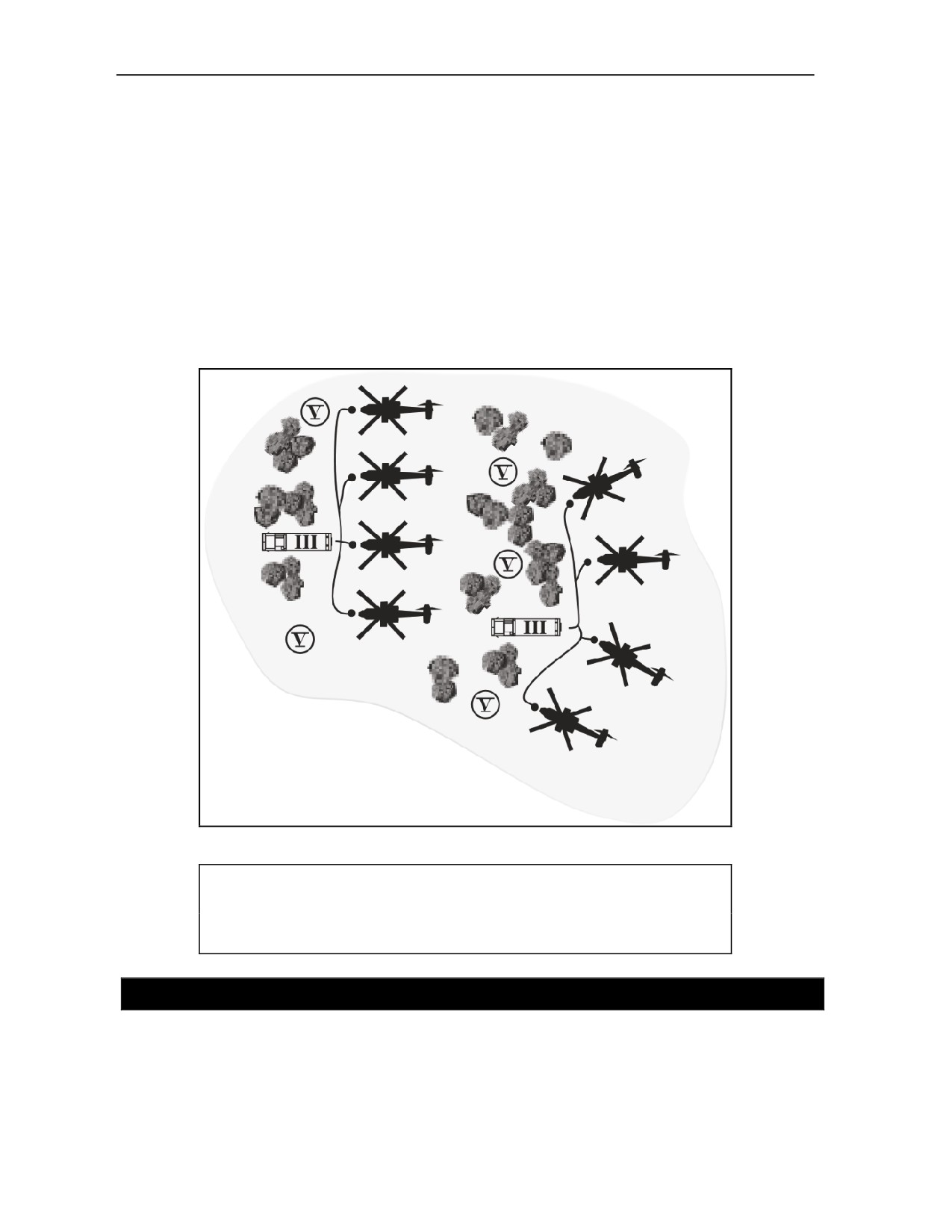
Personnel and vehicles must avoid areas directly adjacent to the M139 dispensers. Accidental discharge
could strike personnel, and mine arming would occur within 2.5 minutes. If such discharge occurs, the
aircraft and loading personnel should reposition at least 640 meters away and loading personnel should
notify explosive ordnance disposal (EOD) personnel. That distance extends to 1,000 meters if a fire
occurs near the live canisters and personnel are unable to extinguish it in a reasonable time.
Figure 3-14. Example of a site layout for a volcano arming point
3-73. Each launcher rack functions as a carrier and launcher platform for a 40-mine canister. Aircraft can
mount up to four M139 dispenser racks, two on each side of the UH-60. Loaders insert canisters into the
40 keyholes, rows 1 through 4 from bottom to top and columns 1 through 10 from left to right. This
loading sequence can be important if the rack carries less than a full load of mines. As loaders insert the
mine canisters, a green latch latches the canister to the rack and a red latch arms the canister. The rack has
two electric receptacles—one for the power connector and one for the launcher rack cable running to the
dispensing control unit.
3-74. After mission completion, aircraft return to the arming point to disarm the users—
Discard spent canisters at least 30 meters to the left or right rear of the aircraft at the 4- and 8-
o'clock positions.
Return live canisters to ammunition supply points (ASPs) for future use or repackaging.
3-75. Place misfired canisters in the dud pit and contact EOD. The most efficient use of assets combines
ground and air capabilities. When time is critical, the FARE/AAFARS, limited quantities of Class III/V
products, and required personnel can be aerially emplaced. The remaining Class III/V products, MHE,
and support personnel can then be moved to the site with ground transportation. The FARP should only
be aerially resupplied when the expenditure rate exceeds the organic ground support capability of the unit
or when the enemy occupies ground resupply routes. Cargo or utility aircraft could temporarily augment
3 August 2006
FM 3-04.104
3-19
Chapter 3
ground vehicles until the supply flow returns to normal or the enemy no longer threatens the supply
routes.
SECURITY
3-76. The FARP should have enough organic security to defend itself against the anticipated threat. Too
much security equipment will hinder the movement of the FARP. Adequate security will most often have
to be attached to the FARP and will not be organic. For example, a short duration FARP (less than 6
hours) trades security for “austereness.” Long duration “rear area” FARPS will require attached security.
Nonlinear battlefields are the same way. However, inadequate security will rob the FARP of its ability to
protect itself long enough to move.
3-77. The MP may be tasked to provide detail security to key facilities, assets, and personnel. Other types
of critical site security include ASPs; deep-water ports; POL terminals and pipelines; trains and railways;
and air bases. The MP may provide convoy security for top-priority units transporting especially critical
supplies to combat forces (see FM 3-19.1).
3-78. The unit must coordinate with the operational brigade responsible for the sector in which the FARP
is located for AD and, if necessary, ground security to protect the FARP. Normally, the FARP will be
integrated into the aviation brigade's AD umbrella. The supported brigade or division may provide Stinger
assets for FARP AD. AD assets must be in positions that protect the FARP from aerial attack. For
example, the Stinger should be placed 3 kilometers from the FARP. If the FARP is designated a priority
target, then division AD assets—such as Bradley M6 Linebacker, short-range air defense (SHORAD),
combined arms for air defense (CAFAD), and other forward area weapon systems—are employed near
the FARP. These AD assets should cover friendly ingress and egress routes. Checkpoints should be
established for friendly aircraft using the FARP to provide positive identification to AD teams. Stinger
assets also should be employed to protect the FARP during convoys.
3-79. The advance party may include Stinger assets, CBRN attack monitoring and warning equipment
and personnel, and crew-served weapons. The first asset that should be employed is the CBRN attack
monitoring and warning equipment. Monitoring equipment must be placed upwind of the FARP site.
Using light antitank (AT) weapons can provide a limited AT capability. If available, electronic early
warning systems should be placed on likely avenues of approach not covered by listening or observation
posts. Quick reaction forces may be formed from attack helicopters in or near the FARP. A quick reaction
force may also be formed from nonflying members of the unit that have been organized into a UH-60
transportable quick reaction team.
3-80. If the FARP is attacked, FARP personnel must be able to execute a scatter plan, which includes
movement to rallying points. These points increase personnel survivability and allow personnel to regain
control of the situation.
RELOCATION
3-81. Several factors should be considered when determining the relocation of a FARP. By definition, the
FARP should be temporary, not staying anywhere longer than 3 to 6 hours (unless it is hardened and
located in a secure area such as an airhead). When the battle lines are changing rapidly or when the rear
area threat dictates, the FARP must be moved often. Otherwise frequent movement of the FARP may not
be necessary. Where air parity or enemy air superiority exists, the FARP must be moved often. The
FARP should be moved only after it fulfills the support requirements of mission aircraft or if
compromised.
Note. If CBRN contaminants exist, equipment should be decontaminated before it is moved
from the FARP site.
3-82. A FARP may be relocated for any of the following reasons:
The FARP comes under attack.
3-20
FM 3-04.104
3 August 2006
Forward Arming and Refueling Point Utilization
The order to relocate is received by radio, face-to-face message, or by last unit occupying the
FARP.
A preplanned relocation time has been set.
A preplanned relocation occurs after a specific event (a decision or target point); for example,
after the FARP has serviced a specific company or a specific number of aircraft.
3-83. The message to relocate a FARP is passed in fragmentary order (FRAGO) format and should
contain, as a minimum, the following information:
Eight-digit grid coordinates of the next site and alternate site.
Time the FARP is to be mission ready.
Fuel and ammunition requirements.
Passage-of-lines contacts, frequencies, call signs, and ingress and egress points.
Enemy situation at the next site.
March table or movement overlay.
An LRP to the FRAGO.
3-84. The remaining FARP elements will break down the remaining points. The sequence of the
breakdown events will be mission-dependent and SOP-driven. When personnel arrive at the new site, they
move into new locations as directed by the advance party and set up the arming and refueling points.
DAMAGED OR DESTROYED ASSETS
3-85. Once the location of the FARP has been compromised, the site must be vacated. The nature of the
compromise will determine what can be taken from the site. The refueling equipment must be saved if
possible. Without the FARE/AAFARS or HEMTT tankers, getting the fuel out of storage tanks and
tankers into aircraft will be difficult. Higher echelon 5,000-gallon semitrailers may need to replace
destroyed HEMTT tankers.
3-86. At a minimum, FSC commander should ensure the following actions take place when damaged or
destroyed assets occur:
Report injuries of personnel.
Report damaged vehicles.
Report damage to supplies.
Coordinate with S-4.
Replace equipment.
Inform higher headquarters of any changes of FARP site.
Request emergency support, such as boring equipment or using another battalion’s FARP.
Request alternate arming and refueling instructions.
Destroy extra equipment according to SOP.
Inform FARP personnel of priorities.
SECTION II - FORWARD ARMING AND REFUELING POINT EQUIPMENT
FORWARD AREA REFUELING EQUIPMENT
Note. The FARE system is an antiquated system, but will remain in this book until all systems
are replaced with the AAFARS, 4930-01-495-0024 and exhausted from the Army’s inventory.
3-87. Equipment at the refueling site for the FARE system (national stock number [NSN] 4930-00-133-
3041) consists of a pump assembly, a filter/separator, hoses, nozzles, grounding equipment, and valves.
Other support equipment that is not a component of the FARE includes the fuel source and the fuel
sampling kit.
3 August 2006
FM 3-04.104
3-21
Chapter 3
3-88. This pump assembly has two hose connections and is rated at 100 GPM. When two hoses are used,
actual flow rate may be as low as 50 GPM.
3-89. The filter/separator provided with the FARE is rated at 100 GPM. It has a working pressure of 75
pounds per square inch (psi).
3-90. Hoses, nozzles, grounding equipment, and valves must be available to support the FARE setup that
is envisioned, (that is, the one-point or two-point setup).
3-91. Support equipment includes items such as fire extinguishers, grounding rods, waste cans, 5-gallon
water cans, and absorbent material. The FARE system without a fuel source weighs 340 pounds and
occupies 64 cubic feet.
3-92. The fuel source is usually 500-gallon collapsible drums. However, other sources may be used. They
include
600-gallon pods, l,200-gallon TPU,
3,000 or
10,000-gallon collapsible tanks,
2,500-gallon
HEMTT tanker, 5,000-gallon semitrailer, railroad tank cars, and USAF cargo plane fuel tanks. The fuel
sampling kit that should be used is Aqua-Glo Series III (NSN 6630-00-706-2302).
3-93. Skilled, experienced personnel can set up a FARE within 15 minutes of its delivery to a site. The
ammunition portion of the FARP can be set up within 45 minutes of delivery to a site. This time includes
the unpacking of ammunition. (See FM 10-67-1.)
ADVANCED AVIATION FORWARD AREA REFUELING SYSTEM
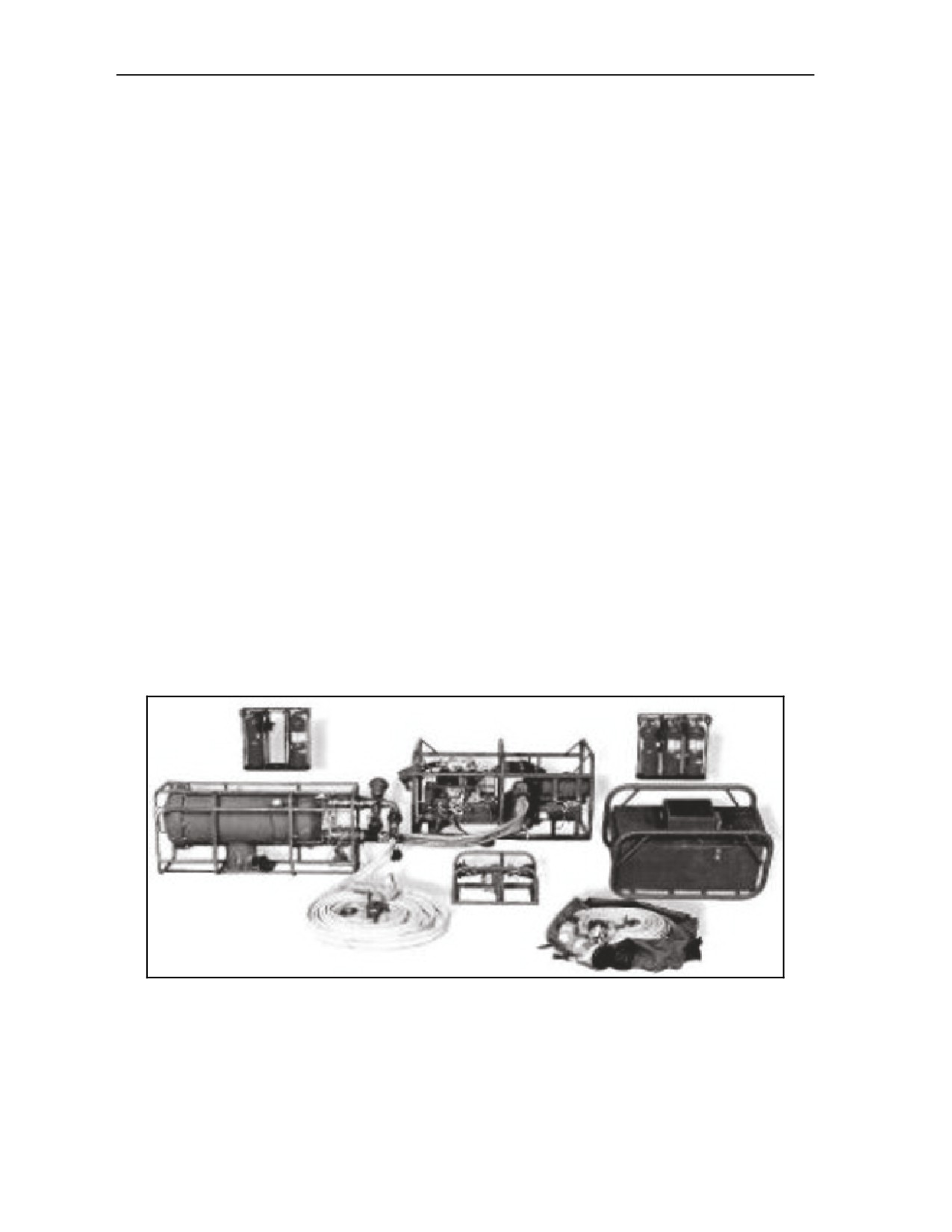
3-94. The AAFARS (figure 3-15 and figure 3-16, page
3-23) is a two-man portable system. Its
components include a
220-GPM diesel engine pump, a standard element separator, lightweight
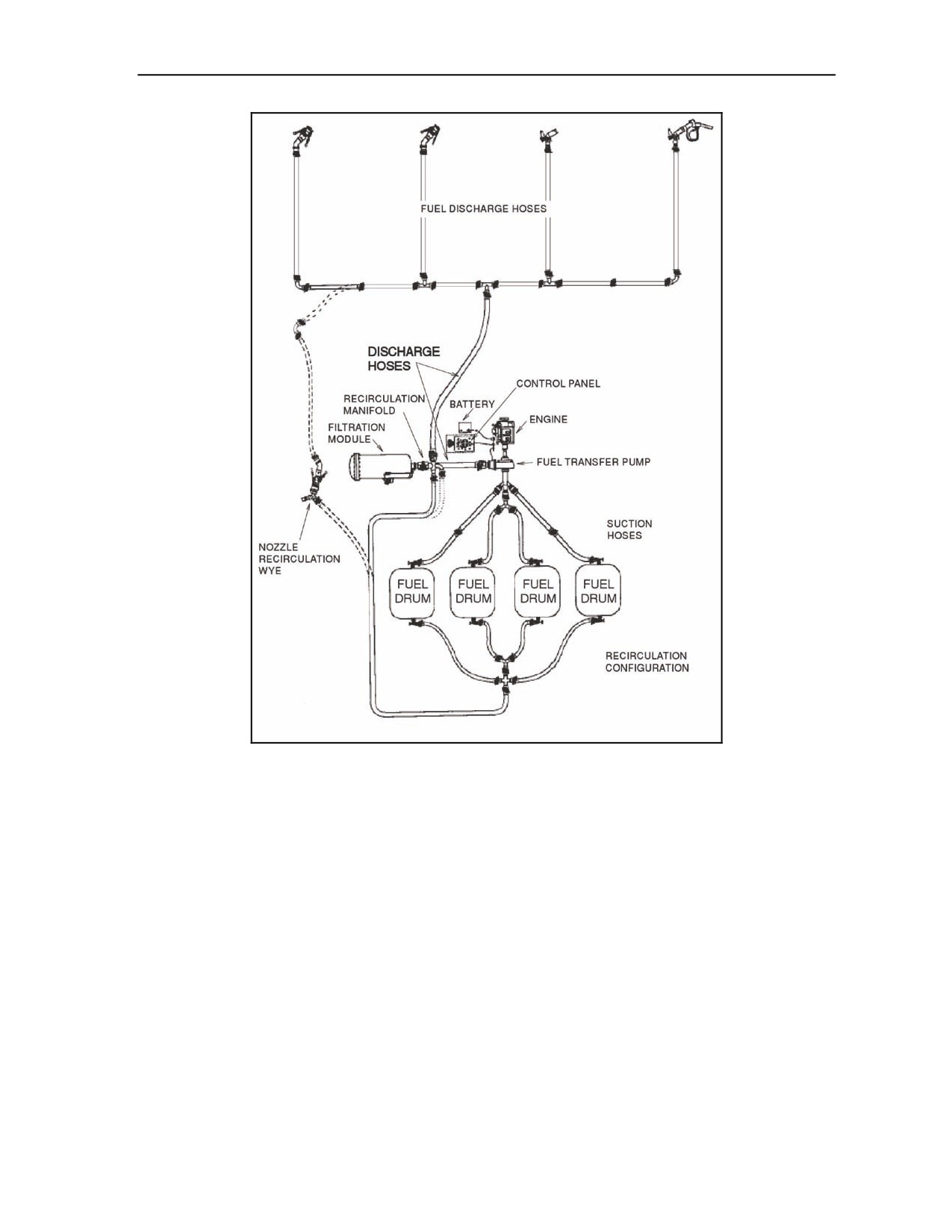
suction/discharge hoses, and dry-break couplings. The AAFARS is a four-point refuel system providing a
minimum of 55 GPM at each refuel point simultaneously. A distance of 100 feet separates each refueling
point. There is only a 2-3 GPM pressure drop to the last point of the system. The primary fuel source is
the 500-gallon collapsible drum although, like the FARE, the system is compatible with other fuel
sources. The key AAFARS function is to simultaneously refuel four helicopters in tactical locations using
center point refueling (D-1 nozzle), CCR, or open-port nozzles. The system interfaces with existing
Army, USAF, Navy, and Marine Corps aircraft and is interoperable with North Atlantic Treaty
Organization (NATO) and other joint, interagency, and multinational nation refuel equipment.
Figure 3-15. Advanced aviation forward area refueling system
3-22
FM 3-04.104
3 August 2006
Forward Arming and Refueling Point Utilization
Figure 3-16. Advanced aviation forward area refueling system layout
3-95. The setup of the FARE/AAFARS system should take advantage of terrain features, achieve
maximum dispersion, avoid obstacles, and accommodate the type of aircraft the FARP will service. When
planning the layout of the FARE/AAFARS system, personnel must consider the minimum spacing
required between aircraft during refueling. The spacing will depend on the type of aircraft and its rotor
size. Proper spacing reduces the possibility of collision and prevents damage caused by rotor wash. The
minimum rotor hub to rotor hub spacing for all helicopters, except the CH-47, is 100 feet. When CH-47s
land side by side to refuel, the minimum rotor hub to rotor hub spacing is 180 feet. When they land nose
to tail, the minimum spacing required is 140 feet.
3-96. If the area has a prevailing wind pattern, the refueling system should be placed at a right angle to
the wind. Thus helicopters can land, refuel, and take off into the wind. The refueling points should also be
laid out on the higher portion of a sloped site, not in a hollow or valley. Fuel vapors are heavier than air,
and they flow downhill. Also, the fuel source should be kept downwind of the aircraft's exhaust to reduce
the explosion hazard. These same considerations apply to any FARP set up with the FARE/AAFARS,
5,000-gallon semitrailer tanker, or HEMTT. Aircraft movement should be limited in desert and snow
environments where wind and rotor wash may cause brownout or whiteout. Special considerations will be
necessary when aircrews are operating with NVDs. Figure 3-17, page 3-24, shows a FARE/AAFARS
setup under various wind conditions.
3 August 2006
FM 3-04.104
3-23
Chapter 3
Figure 3-17. Forward area refueling equipment setup under various wind conditions
HEAVY EXPANDED MOBILITY TACTICAL TRUCK TANKER
AVIATION REFUELING SYSTEM
CHARACTERISTICS
3-97. The HTARS is a kit that consists of enough hoses, fittings, and nozzles to expand the HEMTT
tankers capability to hot refuel up to four helicopters simultaneously using the on-board fuel-servicing
pump. The equipment is lightweight, has manually operated controls, and is equipped with valve and
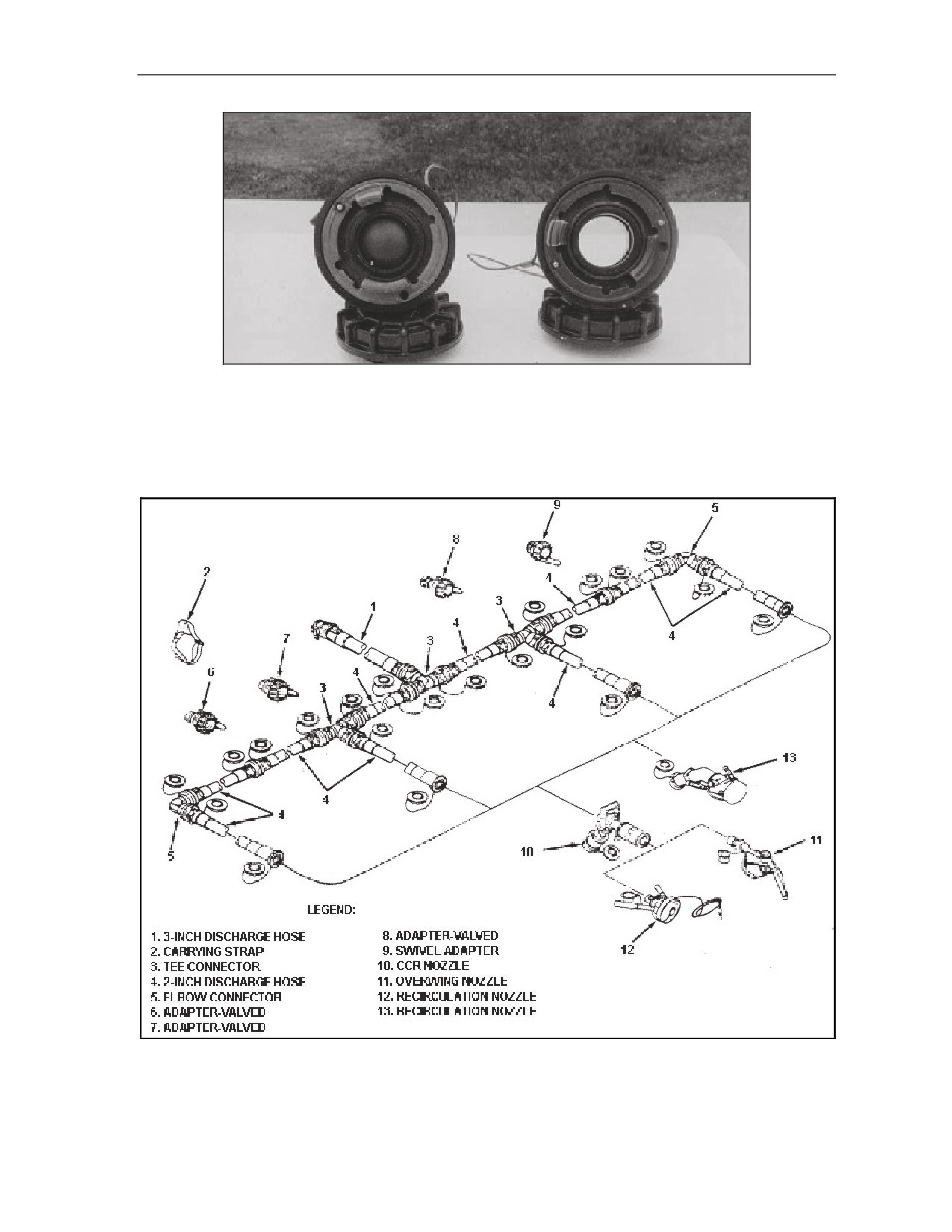
swivel adapters that allow connections between camlock and unisex type fittings. See figure 3-18, page 3-
25 for unisex connections. This equipment can be used in forward areas. It can be transported in the
storage box of the HEMTT tanker.
3-24
FM 3-04.104
3 August 2006
Forward Arming and Refueling Point Utilization
Figure 3-18. Unisex connections
EQUIPMENT
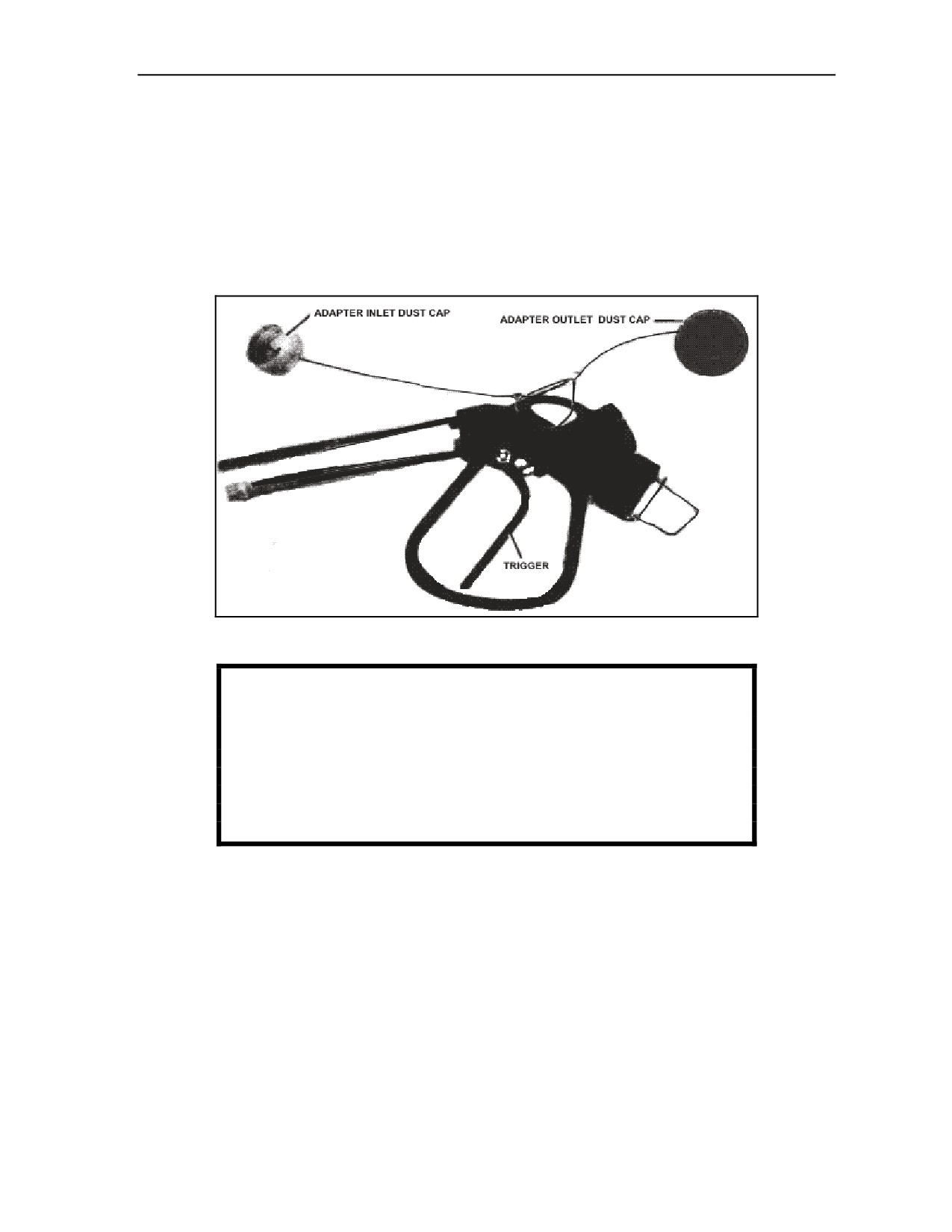
3-98. The HTARS (NSN 4930-01-269-2273) consists of discharge hoses, valves and fittings, nozzles,
and overpack spares. The components of the system are shown in figure 3-19.
Figure 3-19. Heavy expanded mobility tactical truck tanker aviation refueling system
components and layout
3 August 2006
FM 3-04.104
3-25
Chapter 3
DISCHARGE HOSES
3-99. The system consists of both 2- and 3-inch discharge hoses. One 3-inch by 50-foot hose is used to
connect the HTARS to the HEMTT tanker. Ten 2-inch by 50-foot discharge hoses transfer the fuel from
the HEMTT tanker to the aircraft. Six hoses are used in the manifold and one in each of the four issue
lines. There are 11 carrying straps for easy handling of rolled hoses.
VALVES AND FITTINGS
3-100. The following valves and fittings are components of the HTARS:
Three T-connectors with a flow control handle to open and close the valve. The T-connector
splits the flow of fuel.
Two elbow connectors to direct the flow of fuel.
Three valved adapters to connect threaded and unisex parts as well as camlock and unisex
parts.
One swivel adapter to connect camlock and unisex parts.
NOZZLES
3-101. The HTARS is equipped with four types of nozzles. There are four CCR nozzles with unisex
adapters used with this system. Four overwing nozzles can be mated to the CCR nozzles to perform open-
port refueling. The system has one recirculation nozzle that can be connected to the HEMTT tanker to
recirculate fuel in the system. It is equipped with a fuel sample port to obtain a sample of fuel. The
recirculation nozzle mates to the CCR nozzle. There are four D-1 nozzles to equip the system for
centerpoint refueling.
OVERPACK SPARES
3-102. Each system has one overpack spare with additional parts and accessories. The following parts
are in the overpack spares: one T-connector, one 2-inch by 50-foot discharge hose, one carrying strap for
easier handling of the rolled hoses, 10 dust seals, two dust caps, and four grounding rods.
OTHER REQUIRED ITEMS
3-103. Other items of equipment are required to conduct aircraft refueling operations with the HTARS.
A minimum of five fire extinguishers are required—one to be within reach of the on-board pump and one
at each refueling point. The signs described in Chapter 2 will need to be posted at the refueling site. Also,
water cans and spill containers will need to be available.
SUPPORT EQUIPMENT
3-104. A fire extinguisher (table 3-1, page 3-27) must be located at each refueling nozzle and at the
pump and filter assembly. A water can and a waste fuel pan should be located at each refueling point. This
would enable operators to wash fuel off skin and clothes, wash dirt off fuel nozzles, and contain fuel if a
spill occurs.
3-26
FM 3-04.104
3 August 2006

Forward Arming and Refueling Point Utilization
Table 3-1. Portable fire extinguisher types
SUBJECT
ELECTRICAL
TO
TYPE
AGENT
EFFECT
USE
EXPELLANT
CONDUCTOR
FREEZING
CO2 gas
from
Cooling and
chemical
Soda-acid
Water
quenching
Class A
reaction
Yes
Yes
Stored
pressure,
Calcium
Cooling and
cartridge, or
Antifreeze
chloride
quenching
Class A
chemicals
Yes
No
Cooling,
Loaded
Alkali-metal
quenching and
Class A
Cartridge or
stream
salts
retarding.
Class B
chemicals
Yes
No
Self-
Carbon
Diluting or
Class B
contained
dioxide
Gas and dry ice
smothering
Class C
pressure
No
No
Treated sodium
Class B
Gas or
Dry chemical
bicarbonate
Smothering
Class C
cartridge
No
No
Interference
with chemical
Class A
Self-
Bromochlorodi-
chain reaction
Class B
contained
BCF
fluromethane
of fire
Class C
pressure
No
No
Potassium bi-
Class B
Purple K
carbonate
Smothering
Class C
CO2 gas
No
No
3-105. A waste fuel pan is required to limit fuel spillage. Fuel spills will be recovered; contaminated soil
will be dug up and placed in containers. The containers will be disposed of according to the unit SOP. If
the spillage is 50 liters (13.2 gallons) or more, the local facility engineers must be notified. The spillage
will also be reported to the environmental protection person, who will determine the actions necessary to
retrieve the spillage. Unit SOPs will include a waste fuel plan for all refueling operations during
peacetime.
WARNING
All fuel spills will be considered a fire and an environmental
hazard.
PERSONNEL REFUELING REQUIREMENTS
3-106. During refueling, one person operates the fuel nozzle, the second remains at the emergency fuel
shutoff valve, and the third mans a suitable fire extinguisher. The third person stands outside the main
rotor disk of the aircraft at a point where he can see both the pilot at the controls and the refueler with the
nozzle. This person may be from the FARP or one of the aircraft crewmembers. Additional personnel may
be supplemented from existing assets, or, in a combat situation, METT-TC may override the availability
of a third person to operate the fire extinguisher. (See FM 10-67-1.)
3-107. The refueler must wear protective clothing. This clothing consists of a uniform, a helmet,
goggles, hearing protection, gloves, and leather boots. Each item is briefly discussed below.
3-108. The uniform is a serviceable, fire retardant flight suit or battle dress uniform. It will be worn with
the sleeves rolled down.
3 August 2006
FM 3-04.104
3-27
Chapter 3
3-109. The HARRP (CTA 50-900) is the authorized helmet. Two versions are available for issue—
HGU-24/P (communications-equipped) and HGU-25/P (aural protector only). The helmets are provided
in four hat sizes and include eye protection. The cranial impact shells are available in seven different
colors and can be used to differentiate between the functions of personnel in the FARP (for example,
POL, ammunition, medical, and maintenance personnel). The decision to use different colored cranial
impact shells will depend on the factors of METT-TC. If the HARRP is not available, a motorcycle
helmet, a flight helmet, a Kevlar helmet, or an infantry helmet is acceptable.
3-110. Sun, wind, and dust goggles (CTA 50-900) will be worn if the HARRP or flight helmet is not
available. Ensure goggles are “Splash Proof.” Splash proof goggles will save the unit time and money
that’s required to order replacement goggles, due to sand and dust.
3-111. Earplugs, ear protectors, or both will be worn for hearing protection.
3-112. Gloves must be worn at all times during refueling operations. If they become saturated with fuel,
they should be replaced. CTA 50-900 lists specific gloves that are authorized for refueling operations.
3-113. The standard rubber-soled, leather combat boots will be worn. Boots will not have heel or toe
taps or cleats. Any metal on the sole, to include exposed nails on a worn-down sole, could cause a spark
on contact with a hard surface. Fuel vapors are heavier than air; a spark at ground level could cause a fire.
3-114. If a fuel handler's clothes become soaked with fuel, the fuel handler should—
Discontinue the refueling operation and leave the area immediately.
Wet clothes with water before taking them off. (If water is not available, the fuel handler
should hold onto a grounding rod to prevent sparks when removing his clothes.)
Wash fuel off the skin with soap and water as soon as possible.
WARNING
If fuel is splashed in the eyes, flush eyes with water and seek
medical attention immediately. If fuel is swallowed, seek medical
attention immediately.
WARNING
Entering a warm room wearing fuel- soaked clothing can be
dangerous. The chance of a fire starting because of static
electricity is increased.
REFUELING NOZZLES
3-115. Refueling can be accomplished with the aircraft engines running (hot or rapid refuel) or with the
engines off (cold). In a field environment, a unit will normally use the "hot" refueling method. The two
hot methods of refueling an aircraft are open-port refueling and CCR.
Note. POL handlers should be aware that the rate at which fuel is pumped differs with each
type of aircraft.
3-28
FM 3-04.104
3 August 2006
Forward Arming and Refueling Point Utilization
OPEN-PORT REFUELING
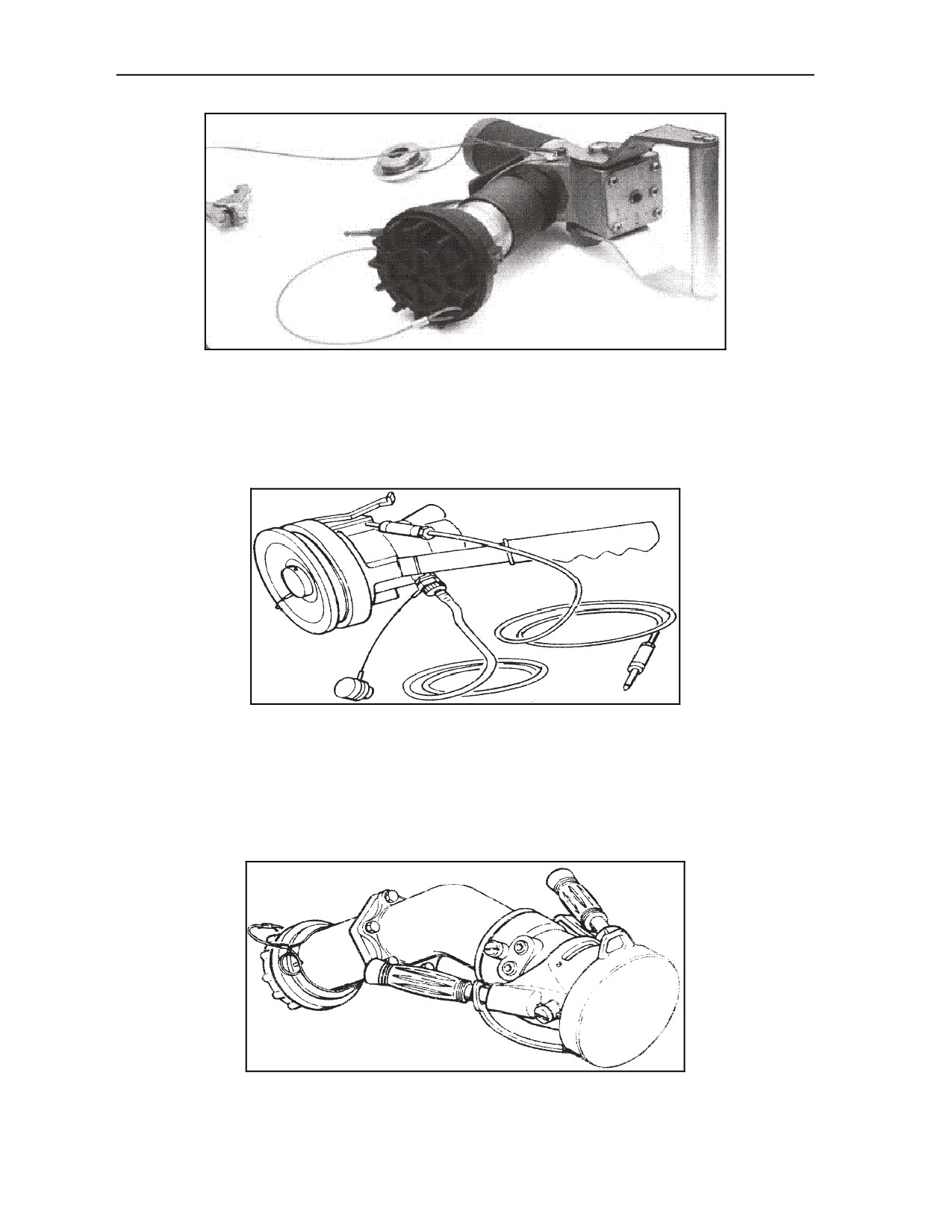
3-116. Open-port refueling is accomplished with an automotive type nozzle (figure 3-20), which is
inserted into a fill port of a larger diameter. It is not as fast or as safe as CCR. The larger port allows fuel
vapors to escape. Also, airborne dust, dirt, rain, snow, and ice can get into the fill port during refueling;
therefore, the quality of the fuel could be degraded. Spills from overflowing tanks also are more likely.
Rapid refueling by the open-port method is restricted to combat or vital training. In these cases, the
aviation unit commander makes the final decision. Simultaneous arming and open-port refueling activities
will only be conducted when the combat situation and benefits of reduced ground time outweigh the risks
involved.
Figure 3-20. Closed circuit refueling open-port (gravity-fill) nozzle adapter
WARNING
As aircraft move through the air, they build up static electricity.
Static electricity also builds up on refueling equipment as fuel
passes through the hoses. The refueler must ground the aircraft,
fuel nozzle, and pump assembly to prevent sparks and
explosions. Static electricity buildup is greater in cool, dry air
than in warm, moist air.
CLOSED-CIRCUIT REFUELING
3-117. CCR is accomplished with a nozzle (figure 3-21, page 3-30) that mates with and locks into the
fuel tank. This connection prevents fuel spills and vapors from escaping at the aircraft fill port and
reduces fuel contamination.
3 August 2006
FM 3-04.104
3-29
Chapter 3
Figure 3-21. Model 125-1000 closed-circuit refueling nozzle
3-118. The Army has two systems—the CCR system and the D-1 pressure system (also called the center
point system). The D-1 pressure system components, except for the receiver, are mounted on the M970
(5,000-gallon semitrailer tanker) and M978 HEMTT (2,500-gallon tank vehicle). The system includes a
recirculation nozzle (figure 3-22).
Figure 3-22. Recirculation nozzle
3-119. The main difference between the CCR nozzle and the D-1 nozzle is that the D-1 nozzle (figure 3-
23) provides a higher fuel flow rate. Also, the CCR nozzle can be adapted to open-port refueling; the D-1
nozzle cannot. The CCR nozzle is 2 inches wide. The D-1 nozzle is either 2 1/2 inches or 3 inches wide.
The CCR provides 100 GPM compared to 150 to 200 GPM for the 2 1/2-inch D-1 nozzle and 300 GPM
for the 3-inch D-1 nozzle. (See FM 10-67-1.)
Figure 3-23. D-1 center-point refueling nozzle
3-30
FM 3-04.104
3 August 2006
Forward Arming and Refueling Point Utilization
Note. The pilot is normally responsible for monitoring the fuel gauge and signaling the refueler
when to stop refueling the aircraft.
Note. A 15-psi differential return pressure restricts the fuel flow rate of the AH-64 to 56 GPM
during CCR.
EQUIPMENT SETUP
3-120.
The following checks must be made to ensure that the refueling equipment is set up properly:
Check pump assembly and filter/separator for proper grounding.
Check pump engine for oil leaks and oil level.
Check filter/separator pressure differential indicators.
Replace filter elements and drain accumulated water from pump assembly, as necessary.
Ensure couplings are properly seated and free of cracks.
Ensure sandbags are used to elevate the couplings.
Check exterior of the hoses for signs of blistering, saturation, and nicks or cuts.
Check the hose for weak or soft spots within 12 inches of the couplings.
Test hose at normal operating pressure.
Check hose for abnormal twisting or ballooning.
Ensure nozzles have serviceable couplings and dust covers.
Ensure refuel points have all required nozzles to conduct closed-circuit and open-port
refueling operations.
Check nozzle filter screen daily.
Ensure each nozzle has two ground wires. One has an alligator clip on the end of it; it is the
grounding cable. The other wire has a plug; it is the bonding wire. These wires are used to
connect the aircraft to a 5-foot grounding rod.
Ensure the nozzle is kept off the ground by hanging it on the grounding rod. See appendix E
for FARP safety requirements.
Ensure dust cap or plug are never removed from an opening until it is ready to be coupled to
the next piece of equipment.
Ensure equipment is drained immediately after uncoupling.
Ensure removed caps and plugs are coupled together to keep them clean.
WARNING
As an aircraft moves through the air, static electricity builds up
on it. Static electricity also builds up on the refueling equipment
when fuel is pumped through the hoses. The aircraft, fuel nozzle,
and pump assembly must be grounded to prevent sparks and
explosions. Static electricity buildup is greater in cool, dry air
than in warm, moist air. Care must be taken not to damage the
aircraft port.
3 August 2006
FM 3-04.104
3-31
Chapter 3
SECTION III - AMMUNITION OPERATIONS, EQUIPMENT, AND STORAGE
AMMUNITION STORAGE
3-121. The ready ammunition storage area (RASA) contains the ammunition required to support the
arming of aircraft. Ready ammunition is that quantity of ammunition required to support the mission
beyond the amount needed for one load. The RASA requires separate areas for the assembling and
disassembling of rockets, aircraft flares, and malfunctioned ammunition. More information is contained in
AR 385-64.
3-122. The basic load storage area (BLSA) is a separate area from the RASA. The BLSA contains the
specific quantity of ammunition required and authorized to be on hand at the unit to support three days of
combat. A basic load includes a variety of ammunition such as small arms, grenades, and mines in
addition to aircraft specific ammunition.
3-123. Personnel store ammunition by lot number at all locations so that all lots on hand can be properly
accounted. Ammunition handlers should consider the following procedures:
Ensure ammunition accountability.
Maintain accurate lot number records.
Ensure lot is not mixed at the RASA, the BLSA, or on the rearm pads.
Improvise means of transporting ready ammunition to the rearm pads.
Ensure rated load weight of the trailer or cart is not exceeded.
Secure and balance the load to prevent the ammunition from tumbling or the vehicle from
tipping over.
Cover the trailer or cart to protect the ammunition in inclement weather.
AMMUNITION SAFETY PROCEDURES
3-124. All personnel must observe required safety procedures to prevent the accidental firing of
ammunition or propellants. Improper handling or stray electricity may cause ammunition to explode and
result in loss of life or serious injury to personnel.
3-125. Fin protector springs are designed to short-circuit the igniter leads, thus preventing accidental
ignition. The shorting wire clips and fin protectors must be installed on all rockets immediately after an
aircraft launcher is unloaded and when the rockets are not in a launcher. A sufficient quantity of clips and
protectors must be on hand at each rearm pad. Therefore, personnel should not discard the clips and
protectors once an aircraft is armed. Also, personnel should remember that the wires and clips can cause
FOD to aircraft if they are not properly secured.
3-126. Complete rounds, rocket motors, or fuze-warhead combinations that have been dropped may
cause the fuze or warhead to function prematurely. This may result in the loss of a life or an aircraft.
Rocket motors and complete rockets that have been dropped from higher than 2 feet, whether crated or
uncrated, must be turned in to the supporting ASP. DA Form 581 (Request for Issue and Turn-in of
Ammunition) must reflect the reason for the rejection.
3-127. Personnel must assemble rockets according to the instructions in TM 9-1340-222-20. Returned
unfired rockets and rockets remaining in aircraft launchers after a mission must be retorqued before the
next mission.
3-128. In base camps or semipermanent training facilities, units should build barricades around the
RASA, the BLSA, and the rearm pads. Barricades should be at least 3-feet thick to effectively reduce
hazards from a fire or an explosion. Rocket motors may go off, so point rockets away from aircraft,
personnel, and built-up areas and towards berms, barricades, and open spaces.
3-129. Ammunition should be protected from the weather. If ammunition is covered in a high-
temperature environment, it is important to ensure that the covering does not create excessive heating of
3-32
FM 3-04.104
3 August 2006

Forward Arming and Refueling Point Utilization
the ammunition. As was learned in Southwest Asia, dark covers placed directly on pallets of ammunition
can create temperatures up to 180 degrees Fahrenheit. Missile systems especially can be damaged by these
high temperatures. The covering selected for use in high-temperature environments should shade the
ammunition and provide for air circulation.
3-130. Rockets should not be stored on top of one another. The weight will damage the bottom layers. If
rockets need to be unpacked, they should be stored on racks built at the site. Rockets should not be
stacked directly on the ground. Wooden pallets are practical to place under the rockets since they allow air
to circulate. The rockets should be blocked to keep them from rolling off the stack.
3-131. For maximum safety, the amount of ammunition stored at the RASA and the rearm pads should
be kept to a minimum. The following limits— designed to meet operational needs—should not be
exceeded:
z
Each rearm pad is limited to the ammunition required to fully arm one aircraft plus the
number of rockets required for a second load. This facilitates switching the missile launcher
for rocket launchers if the mission dictates.
z
The ammunition for a second aircraft should be stored off the pad, properly covered, and
barricaded.
z
The RASA is limited to 2,000 pounds of net explosive weight (NEW) per cubicle. The
following example illustrates this limitation: 1,340 of H490 (10 pounds NEW) = 200 rounds
per cubicle (200 x 10 = 2,000). The NEW is computed based on the weight of the explosive
filler in the item of ammunition. In the case of rockets, the NEW is the combined explosive
weight; that is, the amount of explosive filler and the propellant in the motor. Table 3-2
shows the common items used during helicopter rearm operations. Table 3-3 shows the
minimum distances permitted between rearm points, RASAs, and nonammunition related
activities that require safety distances. Inhabited buildings also include tents used as living
quarters.
Note: When completing these calculations, refer to TM 9-1340-222-20.
Table 3-2. Common items used during helicopter rearm operations
ITEM
NET EXPLOSIVE WEIGHT
Hellfire missile
34.4 pounds
Rocket, 2.75-in, high explosive (HE) (H489 or H490)
10.0 pounds
Rocket, 2.75-in, HE (H488 or H534)
11.0 pounds
Cartridge, 30mm, HE (B130 or B131)
.058 ounces
Cartridge, 20mm, HE (A653)
.028 ounces
.50 caliber, all brass
.121 ounces
.50 caliber, all steel
.111 ounces
Table 3-3. Minimum safe distances (in feet) between rearm points and ready ammunition
storage area
From
To
Barricaded
Unbarricaded
Rearm Point
100-180*
100-180*
Rearm Point
Inhabited buildings and unarmed aircraft
400
800
Public Highways
240
480
POL storage or refuel facilities
450
800
3 August 2006
FM 3-04.104
3-33
Chapter 3
From
To
Barricaded
Unbarricaded
Rearm Point
75
140
Ready
Inhabited buildings and unarmed aircraft
505
1,010
Ammunition
Public Highways
305
610
POL storage or refuel facilities
50
1,010
*Distance based on rotor clearance
SECTION IV - ARMING OPERATIONS
ARMAMENT PAD SETUP
3-132. The setup of the armament pad will affect overall aircraft turnaround times. During combat
missions, enough ammunition for at least one arming sequence should be placed on the armament pad
before the aircraft arrive. The ammunition should be laid out in the order it will be loaded. A full load of
ammunition must be ready to load in case the aircraft has expended its entire initial load. Figure 3-24
shows two typical layouts for helicopter rearm points, and figure 3-25, page 3-35, shows a three-
dimensional view of one plan.
WARNING
An aircraft is positioned so that its weapons are not pointed
toward the fuel source, ammunition holding area (HA), or troop
sleeping tent in case a weapon discharges by accident. FARP
personnel will not walk in front of aircraft weapons systems.
Figure 3-24. Two typical layouts for helicopter rearm points
3-34
FM 3-04.104
3 August 2006
Forward Arming and Refueling Point Utilization
Figure 3-25. Three-dimensional view of a helicopter rearm point plan
PERSONNEL REQUIREMENTS
3-133. The weight of the ammunition containers and Hellfire missiles requires that two people load the
aircraft weapon systems. Two personnel are required to upload/download the turret system. When a full
complement of ammunition types is required, the safest approach is to load the turret weapon system first,
followed by the inboard wing stores. The authorized armament configurations for the AH-64 and OH-58D
are in appendix F. Arming instructions are in the appropriate aircraft operator's manual.
3-134. A FARP with eight service points theoretically requires at least 10 refuelers—8 to refuel aircraft
and 2 manning the emergency shut-off valves. It also requires 12 arming personnel (2 per service point).
This requirement can overextend the FSC’s Class III/V personnel especially if there is a need for a second
silent or resupplying FARP.
3-135. One solution is cross training personnel to assist in multiple FARP functions. Units can train
89Bs, 92Fs, and copilots to assist in arming functions. At a 50-gallon-per-minute rate, a 92F can finish
refueling in as little as 6 minutes and then assist in arming.
3-136. If aircraft are in the FARP up to 40 minutes, pilots and copilots may stretch by alternately leaving
the aircraft. They can assist some arming functions such as lifting Hellfire missiles and loading rockets.
Units also can arrange UH-60 transport of FARP personnel, minus drivers, to other FARPs.
SIMULTANEOUS ARMING AND REFUELING
3-137. Minimizing aircraft ground time in the FARP is important for two reasons. First, aircraft are
extremely vulnerable on the ground. Second, the longer it takes to service aircraft, the less time they are
on the battlefield. Depending on task organization and the number of mission-capable aircraft, FARPs
require eight armament/refuel points. This quantity supports simultaneous servicing of most company-
sized organizations. Each HEMTT tanker and upcoming AAFARS can service up to four refuel points.
Extra refuel hose capacity allows units to cross-level fuel from HEMTT tankers to 500-gallon drums
without interrupting aircraft refueling. With sufficient drums in place, as fuel gets low, units can transfer
tanker fuel to drums, allowing tankers to go for top off. This practice is a good strategy as the FARP
prepares to displace and needs fuel resupply at the next location. An alternate strategy is to initially locate
all filled drums at the silent FARP, thereby allowing tankers from the initial location to resupply without a
lull in the next FARP’s mission. Simultaneous arming and refueling minimizes ground time. However,
simultaneous rearming and refueling is risky and the aviation commander must ensure that his personnel
receive training to accomplish the tasks. This SOP requirement must be a well-rehearsed team effort.
3 August 2006
FM 3-04.104
3-35
Chapter 3
3-138. Arming the weapon systems is most efficiently accomplished in a specific sequence. Initially, the
weapon systems must be inspected for safe operation, starting with the outboard weapon systems and
moving inboard. The system is left on and a stray current check is conducted on the rocket pod. The turret
weapon system and the wing stores opposite the refueling port are the only weapon systems that should be
armed while the aircraft is being refueled. Once the refueling is completed, the inboard weapon systems
are loaded, followed by the outboard weapon systems on the refueling port side of the aircraft. The
necessary maintenance equipment must be brought to the FARP to maintain the weapon systems. For
example, materials for cleaning weapons, oils for lubricating weapons, tools for removing hung rockets,
and a multimeter for conducting stray current checks should be available.
3-139. When planning the number of rearm and refuel points for a FARP, the platoon leader should
consider how aircraft armament problems will be addressed. For example, one aircraft with a maintenance
problem can tie up a refueling and rearming pad and degrade the FARP operation. An example of a
simultaneous rearming and refueling FARP layout is shown in figure 3-26.
Figure 3-26. Simultaneous rearming and refueling forward arming and refueling point layout
CAUTION
Weapon systems should be safed before the aircraft is refueled.
SECTION V - AIRCRAFT FLOW AND MIX
LIMITATIONS
3-140. A successful FARP operation is characterized by rapid turnaround times. However, there are
several factors that can either degrade efficiency or increase turnaround times. These factors include crew
3-36
FM 3-04.104
3 August 2006
Forward Arming and Refueling Point Utilization
size, night operations, CBRN environment, weapons and ordnance mix, attrition, and maintenance
problems.
3-141. Rapid turnaround times cannot be accomplished unless sufficient personnel are available to
service the mission aircraft. Separating the available personnel and equipment into more than one FARP
requires careful planning. During the day, under ideal conditions, a well-trained crew of two can fully arm
the AH-64 aircraft in about 40 minutes. However, a crew of four can substantially improve these times.
3-142. Personnel shortages may require members of the aircrew to assist in arming and refueling. At
least two people are needed to load the turret ammunition and Hellfire missiles.
3-143. When arming turret weapons at night, personnel will need NVDs or supplemental lighting such
as flashlights. Also, arming times will be 3 to 8 minutes longer at night, especially under low-light
conditions.
3-144. The wearing of chemical protective clothing will increase refueling times by 2 to 4 minutes and
rearming times by 2 to 6 minutes. Fatigue increases the longer a soldier remains under mission-oriented
protective posture (MOPP) conditions. Personnel must remember to drink more water when in MOPP to
reduce the possibility of heat injuries.
3-145. Weapons and ordnance mix could be a limiting factor. For example, an AH-64 may have a
weapons load of two Hellfire missile launchers and two 19-tube rocket launchers. A mission change may
require that AH-64s be set up for Hellfire heavy (four Hellfire missile launchers). The two 19-tube rocket
launchers would then have to be removed and replaced with Hellfire missile launchers. The equipment
and tools to accomplish this must be at the FARP. In addition, the launchers may have to be bore sighted,
which requires special equipment. Therefore, this time-consuming changeover must be in the
commander's mission-support decision matrix.
3-146. Aircraft with armament and/or maintenance problems may interrupt the flow of FARP
operations. Provisions in the FARP site selection and planning process should include a maintenance pad.
The maintenance pad should be positioned away from the arming and refueling area to keep the aircraft
flow constant.
AIRCRAFT MIX
3-147. As a planning guide, refueling points should number half as many as there are aircraft in the
troop, company, or platoon using the FARP. For example, there should be at least two refueling points to
support the 2:2 mix. The FARP site should be large enough to set up two separate arming points to
maintain attack section integrity during arming and refueling. Typically, ARB/attack reconnaissance
squadrons (ARSs) rotate companies through the FARP to support the battalion’s continuous or phased
attack. Tests show that well-trained crews require up to 40 minutes to fully arm an AH-64. This means it
is critical to maintain company integrity at the FARP. Otherwise, platoons and teams waiting for open
armament/refuel points may not be able to rejoin already serviced aircraft in the battle for another 40
minutes. Meanwhile, other companies begin to arrive at the FARP creating additional backlog and less
time on station. When possible, all company aircraft must arm and refuel at the same time. The order in
which sections are serviced is not important. However, the attack team that returns to the FARP with the
least unexpended ammunition should perform an over-watch while other aircraft refuel and rearm.
SECTION VI - TRAINING
QUALIFICATION TRAINING
3-148. The commander must ensure that all personnel are thoroughly trained in handling ammunition
before they attempt any FARP operations. The different arming configurations of aircraft require
armament personnel to be trained in the handling, loading, and arming of all armament systems. One
solution is cross training personnel to assist in multiple FARP functions. Units can train 89Bs, 92Fs, and
3 August 2006
FM 3-04.104
3-37
Chapter 3
copilots to assist in arming functions. A 92F and 89B, upon completion of their mission, can assist in
arming, such as lifting Hellfire missiles and loading rockets.
TRAINING REALISM
3-149. The training program must be as realistic as possible. All facets of the FARP's operation—from
site preparation to rapid displacement—must be practiced and conducted under combat-like condition.
FARP personnel should be trained to operate around the clock and under varying levels of MOPP.
3-150. Commanders must provide soldiers with the quality of training required to do their jobs. Realistic
training benefits the commander as well as FARP personnel. The commander will know from observing
the training how long rearming really takes, and he can then plan accordingly. In addition, realistic
training can surface problems that may have been ignored otherwise. For example, attack reconnaissance
units have vehicles and aircraft with limited personnel- and equipment-carrying capacities. These kinds of
problems can hinder the efficiency of the FARP.
OPERATION SKILLS
3-151. A successful FARP operation is the final product of a series of progressive skill-building
programs to include the cross-training of assigned and attached personnel. Coordinated operations are
achieved by integrating team training with programs that emphasize personal skill development. Training
progresses as individuals are integrated into operational teams.
3-152. The commander must evaluate the FARP team's ability to deploy and operate. Weak areas will
require specific training to bring the operation up to the required standards. The evaluation process should
be continuous so that the capabilities and limitations of the FARP are known. Therefore, a training
program should be developed to meet specific unit needs.
INDIVIDUAL AND COLLECTIVE TRAINING
3-153. FARP operations will be successful when all FARP personnel are trained to operate as a team.
Individual and collective training should not be limited to just arming and refueling activities. All FARP
personnel should be trained in firefighting and rescue procedures according to FM 10-67-1. Also, FARP
personnel should be trained in receiving and preparing Class III/V helicopter external sling loads. FM 10-
450-3 describes the procedures for sling load training.
3-154. Every team member should be proficient in day and night land navigation. Because night
relocation of the FARP is common, night land navigation skills should be emphasized. Team members
must receive standardized NVD training as required.
3-155. Team members should have extensive driver training and know how to accomplish operator
maintenance procedures using the appropriate vehicle operator's manual. Delivering the product to the
FARP is just as important as operating the FARP. Team members must also be able to check fuel quality
using the visual sample, Aqua Glo, and American Petroleum Institute gravity testing methods.
3-156. Team members should be trained in CBRN detection and decontamination. This training will
reemphasize FARP vulnerability to direct CBRN attack and cross contamination from aircraft. It stresses
the need for FARP operations in MOPP gear to survive and continue the mission.
3-157. Personnel must be able to recognize any aircraft that may use the FARP. They should be able to
identify all Army, Navy, USAF, Marine, and allied aircraft and at a minimum know the proper refuel
procedures for each aircraft. If extensive use of the FARP by other than Army aircraft is anticipated, the
supported aircraft team leader should provide a subject matter expert to the FARP to oversee refuel/rearm
procedures.
3-158. Personnel should be proficient in self-aid and buddy-aid
(Combat Life Saver Qualified)
procedures. They also should be familiar with medical evacuation request procedures. All personnel
3-38
FM 3-04.104
3 August 2006
Forward Arming and Refueling Point Utilization
should attend escape and evasion courses. To maintain security rotation, unit should train and provide a
large number of crew served weapon operators to support the FARP operation.
3 August 2006
FM 3-04.104
3-39

Chapter 4
Sustainment
FARP operations require close staff coordination. The battalion staff must anticipate
and coordinate the unit's Class III/V needs with higher echelons. The CAB must
coordinate and rely on support from the divison’s sustainment brigade or theater
sustainment base. This chapter discusses Class III/V considerations, resupply, and
requirements. It also discusses argon gas, transportation planning, rear operations,
and nonlinear/noncontiguous battlefield operations.
CONSIDERATIONS
4-1. The following are considerations for sustainment
of FARP operations:
Contents
Availability of higher echelon support.
Sustainment units support for aviation
Considerations
4-1
mission (Class III/V).
Resupply
4-1
Class III Requirements
4-3
Location on the battlefield.
Class V Requirements
4-4
Duration of the mission.
Argon Gas
4-4
Aircraft configurations/ammunition mix.
Transportation
4-6
Table 4-1 shows the cargo capacities for
Nonlinear/Noncontiguous Battlefield
various types of vehicles.
Operations
4-7
MHE transportation requirements
(for
example, the variable reach forklift may require a flatbed trailer).
Table 4-1. Cargo capacity comparison in rounds
Munition
HEMTT
HEMAT
5-ton short bed
5-ton long bed
1-½-ton trailer
Hellfire
36
36
27
45
9
Stinger
54
72
36
54
9
Hydra 2.75-inch
240
240
180
300
60
30-mm
10,368
10,368
10,560
10,560
2,640
.50 caliber
152,582
54,142
24,610
24,610
7,792
RESUPPLY
4-2. Resupply operations must keep pace with the tempo of the battle. However, resupply is best
accomplished during lulls in combat or when vehicles can be protected from enemy observation and
indirect fires. Resupply actions should start as soon as the operation permits. These actions are affected by
unit resupply time and capability, current situation, expected usage rates, and/or mission changes.
4-3. Periodic status reports on bulk POL are processed from the FSC commander through the unit S-4
and then sent to the division materiel management center to forecast user needs. Bulk Class III is provided
by elements of the theater sustainment base in the theater area support. An emergency reserve of Class III
3 August 2006
FM 3-04.104
4-1
Chapter 4
is maintained at the division sustainment brigade Class III supply point in the division support area (DSA).
The theater delivers Class III supplies, using throughput distribution, as far forward as the BSA. However,
the supplies may be delivered farther to the combat trains (FARP) in specific situations. The aviation unit
will use its vehicles to transport the fuel from the transfer point to the FARP. The Class III transfer points
should be located with the division Class III supply point and the BSA Class III transfer point. Aviation
units in the theater rear area will receive Class III from the theater sustainment base. The two methods used
to distribute Class III are unit distribution and supply point distribution.
UNIT DISTRIBUTION
4-4. This method is used when the issuing agency delivers supplies to the receiving unit. Throughput
distribution is a type of unit distribution used by the theater sustainment base or division sustainment
brigade to deliver Class III. Unit distribution is the preferred method of distribution, and it is normally the
method associated with getting supplies to the BSA.
SUPPLY POINT DISTRIBUTION
4-5. This method is used when the receiving unit is issued Class III supplies at a distribution point. The
unit moves the supplies with its organic transport vehicles.
4-6. If demand exceeds the unit's supply capabilities, limited aerial resupply may be available from other
division sustainment brigade or theater sustainment base. During emergencies, the theater may deliver
supplies as far forward as the battalion trains area; however, this will require extensive coordination.
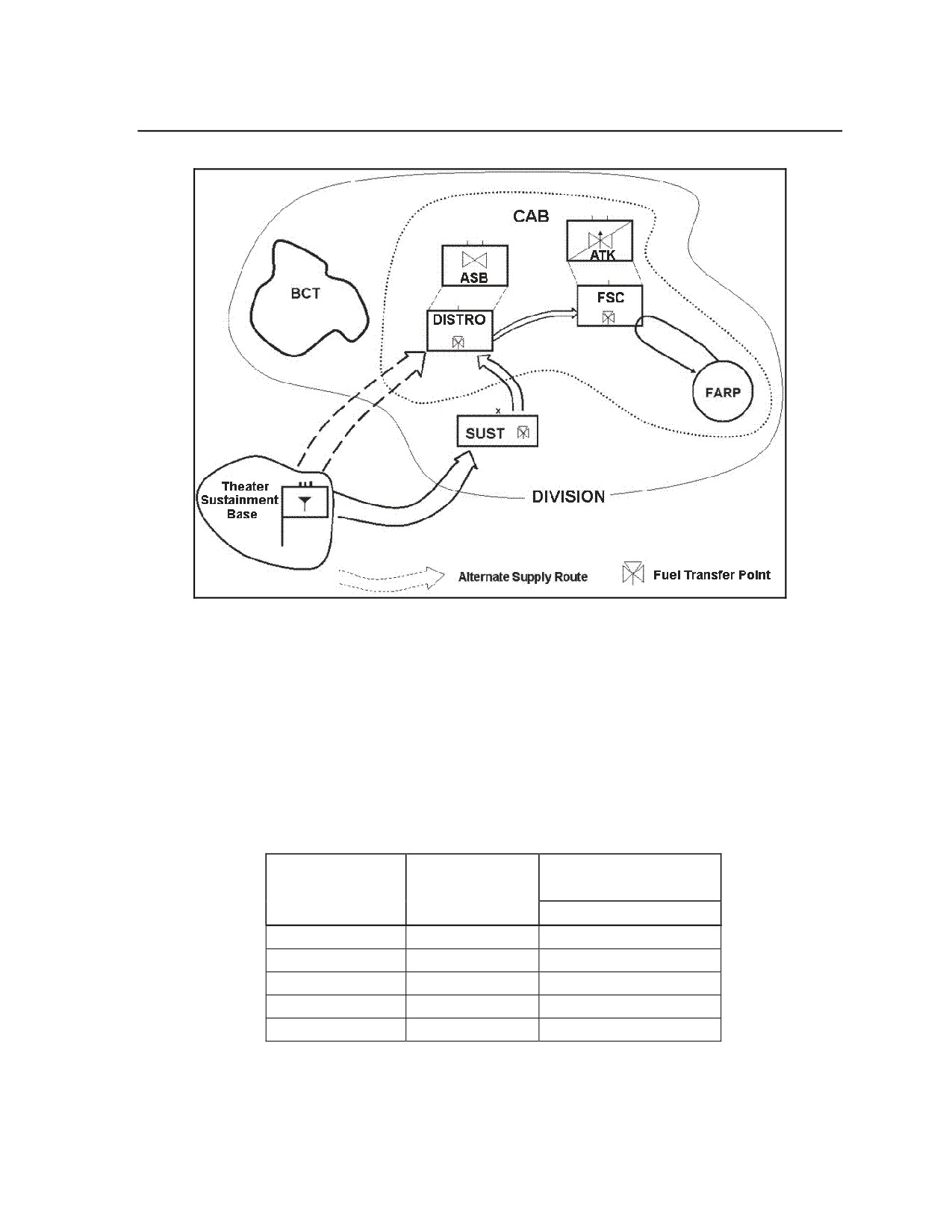
Figure 4-1 shows the flow of Class III supplies.
4-7. The supplying unit tests fuel. In addition, the receiving unit also must test it. POL products should
not be transloaded between carriers if it can be avoided.
4-8. The battalion S-4 normally uses DA Form 581 to request ammunition. The form is forwarded to the
appropriate materiel management center or designated ammunition transfer point (ATP) representative.
Once the request has been authenticated to ensure that they are consistent with the controlled supply rate,
the supplying unit issues ammunition to aviation unit trucks via supply point distribution at either the ATP
or the division ASP.
4-9. Within the division’s CAB, the ASB DISTRO company and the individual battalion’s FSC can
operate one ATP. The division sustainment brigade provides an additional ATP, which is located in the
division area. The ATPs normally are located in the DSA, and they contain high tonnage, high-usage
ammunition to support all the division units, such as BCTs and CABs operating in the division area. The
ammunition is transported to the ATP via throughput distribution from the theater. It is then transferred to
the battalion trucks or off-loaded for future transfer. All other ammunition is kept in the ASP in the theater
area or at the division sustainment brigade, within the division. Figure 4-1, page 4-3, shows the flow of
Class V supplies.
4-2
FM 3-04.104
3 August 2006
Sustainment
Figure 4-1. Flow of class III/V supplies
CLASS III REQUIREMENTS
4-10. Two factors determine the amount of fuel required in the FARP. The first is the total number of
aircraft to be supported. For planning purposes, 100 percent availability must be assumed. This will
provide fuel for unplanned aircraft that may need support. The second and probably the most important
factor is the expected duration of the mission. The mission fuel requirement can then be calculated as
“mission duration multiplied by number of aircraft multiplied by fuel consumption in gallons per hour
(GPH).” Supply Bulletin (SB) 710-2 contains more information about fuel consumption rates. Table 4-2
shows the fuel consumption rates for helicopters that may need fuel in the FARP.
Table 4-2. Fuel Consumption Rates
CONSUMPTION RATE
(Gallons per Hour)
CAPACITY
HELICOPTER
(In Gallons)
JP8
AH-64A
370
178.94
AH-64D
370
178.94
CH-47D
1,030
522.78
OH-58D
112
49.25
UH-60A/L
362
181.00
4-11. Figure 4-2, page 4-4, shows how to calculate the mission's Class III (JP8) requirement for an AH-64
ARB. The mission is expected to last 3 hours.
3 August 2006
FM 3-04.104
4-3
Chapter 4
(Hours for mission) x (Number of Aircraft by Type) x 181 GPH = xxxx
(Hours for mission) x (Number of Aircraft by Type) x 49 GPH = xxxx
(Hours for mission) x (Number of Aircraft by Type) x 179 GPH = xxxx
Total = xxxx
3 hours x 3 (UH-60) x 181 GPH = 1,629 gallons
3 hours x 13 (OH-58D) x 49 GPH = 1,755 gallons
3 hours x 18 (AH-64) x 179 GPH = 9,666 gallons
Total = 17,705 gallons
Figure 4-2. Formulas for calculating class III (JP8)
4-12. Once the fuel requirements have been calculated, the transportation assets needed to move that fuel
can be determined. The example above assumes that the FSC of an ARB has seven mission-capable
HEMTT tankers, as authorized on the table of organization and equipment (TOE). Because each HEMTT
tanker holds 2,500 gallons of fuel, eight HEMTT tankers would be required to support the battalion.
Note. Fuel capacities for HEMTT tankers will vary depending on operational and environmental
conditions.
4-13. If fuel shortages occur during the mission, the turnaround times to resupply points become a critical
planning factor. If supplies are flown in, planning may include support for those CH-47s or UH-60s
carrying supplies.
CLASS V REQUIREMENTS
4-14. The battalion S-4 is responsible for calculating the amount of ammunition needed for the mission.
He bases his figures on the S-3's plan. To calculate Class V requirements during aerial gunnery refer to FM
3-04.140. For combat operations, wartime policy (AR 710-2) for units will be used to calculate required
supply rate (RSR). Once the Class V requirements have been determined, these figures can be used to
calculate how much transportation will be required.
4-15. The approximate number of vehicles needed to transport the Class V products can be calculated
using Table 4-1. Appendix C contains suggested load plans. The example assumes that the FSC in an ARB
has six mission-capable cargo HEMTTs, as authorized on the TOE. Seven HEMTTs with trailers are
required to support the Hellfire needs of the AH-64 battalion. The 30-millimeter cannon would require one
more HEMTT with trailer for a total of eight HEMTTs with trailers. The example illustrates that the Class
V requirements exceed the transport capability of the unit and that thorough planning and prior
coordination are needed to ensure that the Class V requirements at the FARP are met.
ARGON GAS
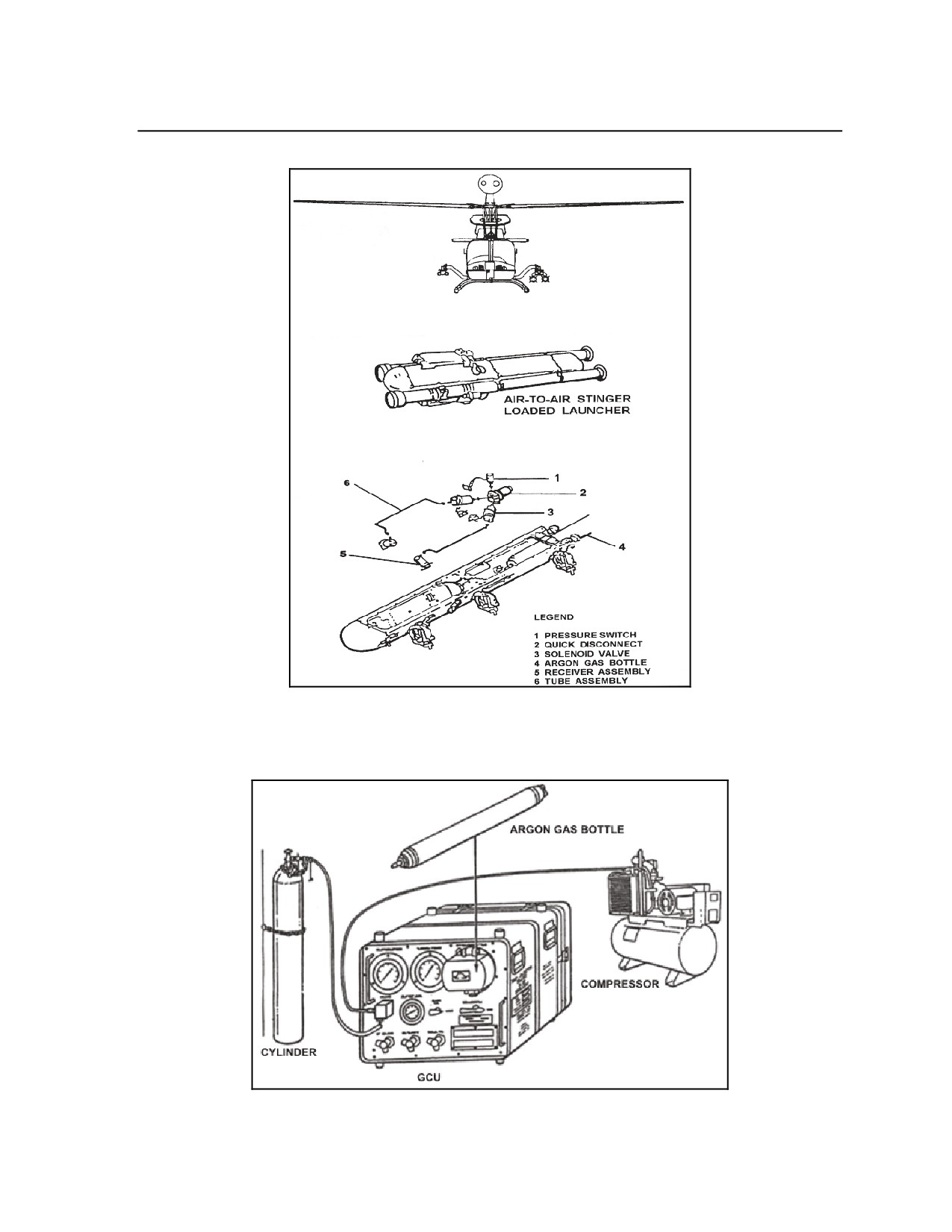
4-16. The OH-58D air-to-air stinger system (figure 4-3, page 4-5) requires argon gas for missile seeker
cooling. A fully charged coolant bottle (6,000 psi) will provide forty 45-second engagements or ten 3-
minute engagements. Based on the mission and the anticipated usage a 3-day supply of argon should be on
hand. (See TM 1-1520-248-10). The bottles must be removed for recharging when—
The pressure reads below 4,500 psi during preventive maintenance checks and services
(PMCS).
An argon sensor message on the terminal display indicates a pressure of about 3,500 psi or
less.
(Bottles may be usable between
3,000 and
3,500 psi, depending on the outside
temperature.)
4-4
FM 3-04.104
3 August 2006
Sustainment
Figure 4-3. Air-to-air stinger launcher
4-17. Figure 4-4 shows the components necessary to charge an argon bottle. They are briefly described
below.
Figure 4-4. Basic charging unit
3 August 2006
FM 3-04.104
4-5
Chapter 4
ARGON GAS BOTTLE
4-18. This bottle is used to store argon gas in the fire unit (launcher). It is 31.5 inches long and 3 inches in
diameter. The weight of the bottle when full of argon gas is 10.5 pounds. Its capacity is 2 liters.
ARGON RESUPPLY CYLINDER
4-19. This is the argon source used to recharge the bottles. It is 51 inches long and 9.24 inches in diameter.
The weight of the cylinder when full of argon gas is 378 pounds. Its capacity is 43.26 liters.
GAS CHARGING UNIT
4-20. The gas charging unit (GCU) is the mechanism by which argon gas is transferred from the supply
cylinder to the bottles at the requisite pressure. The GCU can provide 97 to 125 psi and be operated off the
air brake of a tactical vehicle.
AIR COMPRESSOR
4-21. An air compressor may also be used to power the GCU if the GCU can provide 97 to 125 psi. Two
GCU systems are assigned to the ASC. Empty bottles will be transported to the rear to be recharged. An
additional GCU will be located at the ASP or ATP. When the 89B makes an ammunition resupply run, the
89B can get the bottles recharged at the same time and location. Another option is to have a task-organized
section from the ASC move forward to support the FARP.
TRANSPORTATION
PLANNING CONSIDERATIONS
4-22. When the demand is greater than the support capability, resupply turnaround times become critical
considerations during the planning sequence. The distance between the FARP and the resupply point can
directly affect continuous FARP operations. If it takes too long to get supplies, the unit's mission could be
jeopardized because of a Class III or Class V shortage.
4-23. The example in Table 4-3, page 4-7, illustrates how time critical the resupply effort is to the FARP,
assuming that the theater sustainment base or division sustainment brigade does not deliver Class III/V
products to an ATP by throughput distribution. The data in the table are based on the following
assumptions:
TOE equipment assigned.
OPTEMPO (intense commitment).
Maximum speed on primary roads during day is 30 kilometers per hour (kph); night is 16 kph.
Maximum speed on secondary roads during day is 21 kph; night is 16 kph.
Vehicles will travel on primary roads 25 percent of the time.
Vehicles will travel on secondary roads 75 percent of the time. For example, daytime speed is
.75 x 21 kph + .25 x 30 kph = 23.25 kph; nighttime speed is .75 x 16 kph + .25 x 16 kph = 16
kph.
Distance between FARP and ASP should not be more than 30 to 50 kilometers.
ASP service time is varies.
Round-trip travel times.
4-6
FM 3-04.104
3 August 2006
Sustainment
Table 4-3. Round-trip travel times
DISTANCE (Kilometers)
DAY (Hours)
NIGHT (Hours)
30
3.6
5.25
40
4.4
6.5
50
5.3
7.75
PLANNING OPTIONS
4-24. Several transportation options are available to the commander. All available unit vehicles can be
used, not just the FSC vehicles. FARP vehicles may have to preposition Class III (collapsible drums) and
Class V and then be sent immediately to the ASP or ATP for resupply. Utility or cargo aircraft may have to
transport the shortfall to the FARP.
4-25. A potential solution to Class V transportation shortfalls is PLS ammunition throughput. Theater and
division ammunition units employ PLS trucks and hydraulically off-loading flat racks. Units can
coordinate throughput to battalion AAs or future FARP locations. An ideal situation would be to place
eight flat racks near the eight armament pads in a silent FARP location. This act would simplify silent
FARP setup with available personnel.
NONLINEAR/NONCONTIGUOUS BATTLEFIELD OPERATIONS
4-26. A nonlinear/noncontiguous battlefield may have extremely long supply lines. To ease the Class III/V
logistics problems, the FARP may be located and operated out of a fixed base or an airhead and rely on the
throughput of assets from higher echelons. Locating the FARP at a fixed base or an airhead will give it
more security from the effects of any drastic changes in the battle direction. If a FARP is located outside a
fixed base, the distance between it and the BSA and the lack of secure routes may require air assets to
accomplish the resupply mission.
3 August 2006
FM 3-04.104
4-7
Chapter 5
Operational Environments
Successful FARP operations under varied environmental conditions require prior
planning and training. Different environments require different considerations. This
chapter discusses considerations for night, desert, and winter FARP operations.
NIGHT OPERATIONS
5-1. The unit should establish a detailed SOP for night operations because of limited visibility. Delays
will occur because of low-light levels. Light discipline is extremely important, and personnel must guard
against the tendency to ignore it.
5-2. Once the FARP is in position, it should remain
blacked out until friendly aircraft arrive. Arriving
Contents
aircraft should use a prearranged signal to let FARP
personnel know that friendly aircraft are present.
Night Operations
5-1
Aviators should be able to navigate to the FARP by
Desert Operations
5-2
using maps, GPS devices, or Doppler navigation
Winter Operations
5-4
systems. Once in the area, the aircraft should transmit a
simple, short message. For example, using a single word from the phonetic alphabet such as “Bravo" is
sufficient. Use of the phonetic alphabet would alert FARP personnel that friendly aircraft are nearby and
that they can safely turn on the site location markers.
5-3. The location of the FARP can be marked in several ways. If aircrews are equipped with NVDs, a
low-level IR light source may be used. Alternate marking techniques include a flashlight with colored lens,
chemical lights, or colored beanbag lights. If the existing light level is high, such as during a full moon,
engineer tape or other high-contrast materials that are staked to the ground may adequately mark the site.
5-4. During arming and refueling operations, artificial lights may be needed because of the low natural
light level. Color-coded, low-intensity light sources may be used to indicate direction, takeoff and landing
areas, and pad sites.
Note. Only red lights should be used to mark obstacles.
5-5. The use of artificial lights in the FARP poses several problems. The FARP will probably be in total
darkness until aircraft arrive. When personnel start working with lights, their night visual acuity may be
impaired. FARP personnel will be constantly adjusting from a no-light to a low-light working environment.
Each time the light level changes, FARP personnel may need time for their night vision to readapt.
5-6. The glow from a chemical light when placed nearby can disturb a worker's vision. Objects may be
blurred when looked at closely. Artificial light sources are a problem because they cannot be placed to
adequately illuminate the work and leave both hands free.
5-7. To overcome the low-light limitations, FARP personnel may use NVDs. However, their use requires
extensive training or aircraft turnaround times will increase. NVDs may be the best choice for night FARP
operations. They have advantages and disadvantages.
3 August 2006
FM 3-04.104
5-1
Chapter 5
5-8. The following are advantages for using NVDs:
Passive lighting greatly reduces the enemy's ability to detect the FARP.
Aircrews and FARP personnel will be using systems that are compatible, and FARP lighting
will not interfere with aircraft night sight systems.
The same signals, such as hand and arm signals and flags, can be used during the day and at
night.
5-9. The following are disadvantages for using NVDs:
Green chemical lights are difficult to see while using NVDs.
Minimum focus distance is 10 inches; therefore, objects any closer will be blurred.
Close work space around weapon systems may impair the individual's efficiency.
NVDs may not be compatible with current CBRN equipment.
The unit may not have enough NVDs to support both aircrew and FARP personnel.
DESERT OPERATIONS
5-10. The desert environment poses many difficult problems for FARP operations. Adequate water
supplies should be available. Aircrews and ground personnel will perspire profusely. To prevent heat
casualties or extensive dehydration, each individual must drink plenty of water—up to 5 gallons every 24
hours. Factors to be considered are terrain, mobility, communications, flying techniques, high-density
altitude, and FARE/AAFARS systems.
DESERT TERRAIN
5-11. The desert has many different types of sand. Sand may be as fine as talcum powder or as coarse as
gravel. Off-road vehicle mobility will be affected by the type of sand. In many areas, a crust may form on
the surface of the sand. If the crust is dark-colored, the sand is very coarse. In such situations, the light
sand has been blown away, leaving a gravel and sand mix. This surface crust may become so hard that a
helicopter could land with almost no dust signature. Using hard surfaces is critical for eliminating
brownout conditions (see rolling FARP, paragraph 3-4).
5-12. The flat terrain and poor relief of the desert create serious navigational problems. Therefore, FARPs
must be established in easily recognizable positions. The use of NVDs will assist in locating FARP
positions. Night navigation equipment, such as a GPS, makes desert navigation easier.
5-13. Desert activities can be observed from as far away as 10 kilometers. From a vantage point of high
ground, activity can be observed from as far away as 20 kilometers. The FARP will be a target of
opportunity for any enemy who can see it without cover and concealment; the FARP must have AD
protection.
MOBILITY
5-14. The easiest and fastest way to establish a FARP in the desert is to sling load it into position. Two
FARE/AAFARS systems oriented into the prevailing wind and set up in a T-formation, as shown in figure
5-1 (page 5-2), will allow for adequate separation from the turning rotors. This system can support four
refueling points. The FARP should be positioned to facilitate ground vehicle support. This eases the strain
of trying to aerially support the FARP.
5-2
FM 3-04.104
3 August 2006
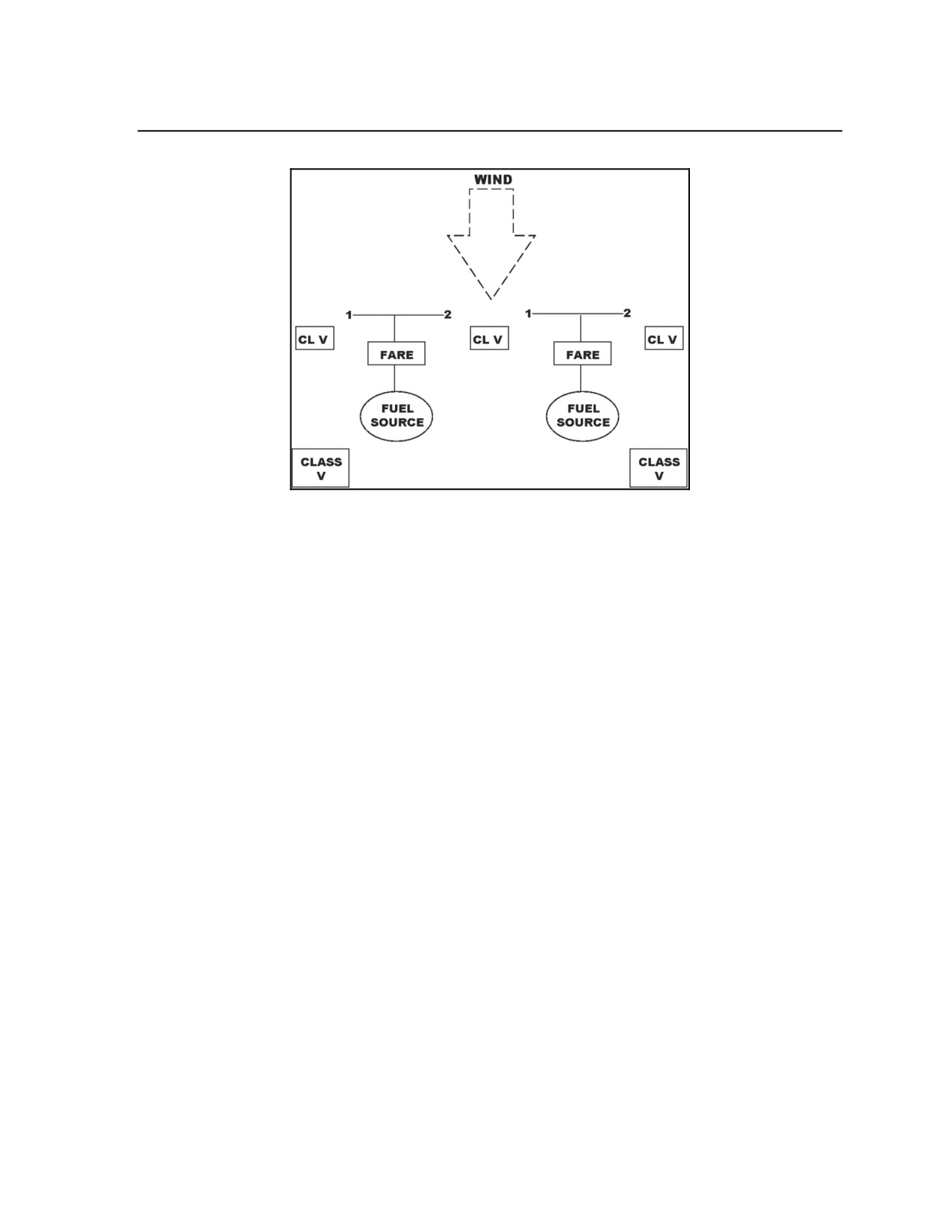
Operational Environment
Figure 5-1. T-Formation forward area refueling equipment/advanced aviation forward area
refueling system setup
COMMUNICATIONS
5-15. Electronic communication capabilities will vary from day to day. Communicating with an element
more than 25 kilometers away may require a relay station.
FLYING TECHNIQUES
5-16. The dust signatures of aircraft operating in the desert will be reduced if airspeed is kept above 40
knots. In-ground effect hovering should not be attempted. Instead, approaches should be planned and
executed to the ground. Correct desert flying techniques will help ensure that the aircrew maintains visual
contact with the ground.
HIGH-DENSITY ALTITUDE
5-17. High-density altitudes will affect most desert operations. High-density altitudes will degrade aircraft
performance. For example, in the early morning when density altitude is lowest, the UH-60 may be able to
carry two full 500-gallon collapsible fuel drums. By noon, the UH-60 may only be able to carry one
collapsible fuel drum. An attack helicopter may have to carry less than a full load of ammunition and/or
fuel. In either case, more frequent trips to the FARP will be necessary. The FARP must be logistically
prepared for them.
FORWARD AREA REFUELING EQUIPMENT SYSTEMS
5-18. FARE as well as AAFARS will function well in a desert environment, but they must be dug in or
sandbagged. For optimum performance, the fuel source (500-gallon collapsible drum) should be at a level
equal to or higher than the pump. All small engine-driven equipment must be protected from blowing sand
to prevent mechanical problems. In a desert environment, special attention should be given to FARP
equipment. The following procedures will help ensure the continued operation of the FARE/AAFARS
system:
Replace filter/separator elements when contaminated or when the pressure differential
indicator shows that they must be changed.
3 August 2006
FM 3-04.104
5-3
Chapter 5
Change or clean oil filters according to operator’s manual.
Clean all small engine air filters
Operate generators according to operator’s manual.
ADDITIONAL CONDITIONS AND CHARACTERISTICS
5-19. Other conditions and characteristics peculiar to the desert that all personnel should be aware of are
listed below.
Visual illusions (mirages) will affect all personnel.
Dust storms will restrict the ability to see and breathe.
Preventive maintenance checks and services should be performed twice a day.
Continued exposure to bright sunlight will cause severe eyestrain or sun blindness unless
personnel take proper preventive measures.
Light can be seen for great distances over flat terrain. A pink filter can be seen more than 5
miles away by someone using a NVD.
Ground vehicles are easy to identify in the desert. Silhouettes and shadows are easily detected
because they contrast with the lighter natural background.
In sandy areas, turret weapon systems will need frequent cleaning and a light coat of lubricant.
The use of lubricants without proper cleaning will cause a buildup of sand in the gear
mechanism. This will cause weapons to jam. Optical sights should be protected from blowing
sand that could scar the glass window of the telescopic sight unit (TSU).
WINTER OPERATIONS
5-20. Aviation units must be prepared to operate in cold environments. Low temperatures, fog, freezing
rain, snow, ice, frozen ground, and, at times, muddy ground characterize the winter battlefield. FARP
operations are difficult under these conditions. Detailed planning and training are necessary to overcome
them.
5-21. Snow, ice, and mud may reduce vehicle mobility on the winter battlefield, complicating FARP
displacement. Commanders should plan for aerial displacement when possible. If ground displacement is
necessary, more time for movement should be allowed. Regardless of the displacement method used, the
breakdown and setup of the FARP will take more time on the winter battlefield than in other environments.
5-22. Low temperatures will make it difficult for FARP personnel to keep warm and function. Windchill
caused by helicopter rotor wash will result in cold injuries even when air temperatures are not very cold.
Fuel accidentally spilled on bare skin or soaked into clothing will have a cooling effect as it evaporates,
increasing the probability of cold injury. Personnel handling cold ammunition will need mittens or other
protection. They also will need a lighter pair of gloves when manual dexterity is needed to perform delicate
operations. Commanders should ensure that FARP personnel are properly equipped and trained to function
in a cold environment.
5-23. Marking the FARP for aircraft control requires special consideration on the winter battlefield.
Engineer tape cannot be used on snow as a marker for aircraft control. Marker panels can quickly become
obscured by falling snow. Hand and arm signals, flashlights, or smoke may be used, depending on weather
conditions. Maneuvering aircraft on loose snow surfaces may cause clouds of blowing snow, which can
partially or totally obscure ground guides or other control measures. Blowing snow could cause aircrews to
become disoriented and lose aircraft control. These problems can be reduced by packing the snow or by
spraying the snow surface with water to form a crust of ice.
5-24. Camouflage of the FARP on the winter battlefield can be difficult, particularly where there is
complete snow cover. The use of white covers and snow as camouflage is a possible solution. The best
5-4
FM 3-04.104
3 August 2006