FM Field 3-04.104 Tactics, Techniques, and Procedures for Forward Arming and Refueling Point (August 2006) - page 1
Field Manual
Headquarters
Department of the Army
No. 3-04.104
Washington, DC, 3 August 2006
Tactics, Techniques, and Procedures for Forward Arming
and Refueling Point
Contents
Page
PREFACE
viii
Chapter 1
INTRODUCTION
1-1
Definition
1-1
Purpose
1-1
Organization
1-1
Planning Factors
1-3
Personnel
1-4
Tactical Enablers
1-5
Threat
1-5
Chapter 2
COMMAND, CONTROL, AND COMMUNICATION
2-1
Command and Control
2-1
Aircraft ControL
2-1
Traffic Layout
2-3
Radio Communications
2-5
Chapter 3
FORWARD ARMING AND REFUELING POINT UTILIZATION
3-1
Section I - Employment Factors
3-1
Types of Forward Arming and Refueling Points
3-1
Site Selection
3-2
Engineering Considerations
3-3
Movement Plan
3-3
Emplacement
3-4
Security
3-20
Relocation
3-20
Damaged or Destroyed Assets
3-21
Section II - Forward Arming and Refueling Point Equipment
3-21
Forward Area Refueling Equipment
3-21
Advanced Aviation Forward Area Refueling System
3-22
Heavy Expanded Mobility Tactical Truck Tanker Aviation Refueling System
3-24
Support Equipment
3-26
Personnel Refueling Requirements
3-27
Refueling Nozzles
3-28
Equipment Setup
3-31
Distribution Restriction: Approved for public release; distribution is unlimited.
3 August 2006
FM 3-04.104
i
Contents
Section III - Ammunition Operations, Equipment, and Storage
3-32
Ammunition Storage
3-32
Ammunition Safety Procedures
3-32
Section IV - Arming Operations
3-34
Armament Pad Setup
3-34
Personnel Requirements
3-35
Simultaneous Arming and Refueling
3-35
Section VI - Aircraft Flow and Mix
3-36
Limitations
3-36
Aircraft Mix
3-37
Section V - Training
3-37
Qualification Training
3-37
Training Realism
3-38
Operation Skills
3-38
Individual and Collective Training
3-38
Chapter 4
SUSTAINMENT
4-1
Considerations
4-1
Resupply
4-1
Class III Requirements
4-3
Class V Requirements
4-4
Argon Gas
4-4
Transportation
4-6
Nonlinear/Noncontiguous Battlefield Operations
4-7
Chapter 5
OPERATIONAL ENVIRONMENTS
5-1
Night Operations
5-1
Desert Operations
5-2
Winter Operations
5-4
Chapter 6
ENVIRONMENTAL PROTECTION CONSIDERATIONS
6-1
Army Environmental Management Policy
6-1
Liability
6-2
Spill Definitions
6-2
Spill Discovery
6-3
Assessment
6-3
Spill Cleanup
6-4
Spill Kits
6-4
Reacting to a Small Primary Spill
6-5
Reacting to a Small/Large Spill
6-6
Appendix A
STANDARD HAND AND ARM SIGNALS
A-1
Appendix B
SAMPLE FORWARD ARMING AND REFUELING POINT STANDING
OPERATING PROCEDURE
B-1
Appendix C
LOAD PLANS
C-1
Appendix D
MULTIPLE FORWARD ARMING AND REFUELING POINT OPERATIONS
D-1
Appendix E
FORWARD ARMING AND REFUELING POINT SAFETY REQUIREMENTS
E-1
Appendix F
ARMAMENT CONFIGURATIONS FOR THE AH-64 AND OH-58D
F-1
Appendix G
TROOP LEADING PROCEDURES
G-1
Appendix H
HAZARDOUS MATERIAL/HAZARDOUS WASTES SUPPLIES
H-1
GLOSSARY
Glossary-1
ii
FM 3-04.104
3 August 2006
Contents
REFERENCES
References-1
INDEX
Index-1
3 August 2006
FM 3-04.104
iii
Contents
Figures
Figure 1-1. Sample structure for a forward support company
1-2
Figure 1-2. Aviation support battalion
1-2
Figure 1-3. Aviation support battalion (support of combat aviation brigade)
1-3
Figure 2-1. Air traffic services company in general support aviation battalion
2-2
Figure 2-2. AN/TSQ-198 tactical terminal control system
2-2
Figure 2-3. Traffic layout at a forward arming and refueling point
2-3
Figure 2-4. Forward arming and refueling point layout for simultaneous operations
2-4
Figure 3-1. Rolling forward arming and refueling point
3-2
Figure 3-2. Typical disposition of theater and division class III/V products
3-5
Figure 3-3. Heavy expanded mobility tactical truck forward arming and refueling point
layout
3-8
Figure 3-4. Configuration of the extended range fuel system (fat cow)
3-10
Figure 3-5. Gear board
3-10
Figure 3-6. Refueling point setups
3-11
Figure 3-7. Extended range fuel system layout configuration
3-11
Figure 3-8. Extended range fuel system II functional components
3-12
Figure 3-9. Forward area refueling equipment kit assembly
3-12
Figure 3-10. Configuring the forward area refueling equipment components
3-13
Figure 3-11. Heavy expanded mobility tactical truck tanker aviation refueling system
configuration and additional components for CH-53 forward arming and
refueling point
3-14
Figure 3-12. Heavy expanded mobility tactical truck tanker aviation refueling system
configuration and additional components for KC-130 forward arming and
refueling point
3-15
Figure 3-13. Heavy expanded mobility tactical truck tanker aviation refueling system
configuration and additional components for C-17 forward arming and
refueling point
3-16
Figure 3-14. Example of a site layout for a volcano arming point
3-19
Figure 3-15. Advanced aviation forward area refueling system
3-22
Figure 3-16. Advanced aviation forward area refueling system layout
3-23
Figure 3-17. Forward area refueling equipment setup under various wind conditions
3-24
Figure 3-18. Unisex connections
3-25
Figure 3-19. Heavy expanded mobility tactical truck tanker aviation refueling system
components and layout
3-25
Figure 3-20. Closed circuit refueling open-port (gravity-fill) nozzle adapter
3-29
Figure 3-21. Model 125-1000 closed-circuit refueling nozzle
3-30
Figure 3-22. Recirculation nozzle
3-30
Figure 3-23. D-1 center-point refueling nozzle
3-30
Figure 3-24. Two typical layouts for helicopter rearm points
3-34
Figure 3-25. Three-dimensional view of a helicopter rearm point plan
3-35
iv
FM 3-04.104
3 August 2006
Contents
Figure 3-26. Simultaneous rearming and refueling forward arming and refueling
point layout
3-36
Figure 4-1. Flow of class III/V supplies
4-3
Figure 4-2. Formulas for calculating class III (JP8)
4-4
Figure 4-3. Air-to-air stinger launcher
4-5
Figure 4-4. Basic charging unit
4-5
Figure 5-1. T-Formation forward area refueling equipment/advanced aviation
forward area refueling system setup
5-3
Figure
6-1. Spill kit
6-5
Figure
6-2. Digging a dike/berm
6-6
Figure A-1. Position of ground guide for a rotary-wing aircraft
A-1
Figure A-2. Proceed to next ground guide
A-1
Figure A-3. This way
A-1
Figure A-4. Move ahead
A-2
Figure A-5. Turn to left (port)
A-2
Figure A-6. Turn to right (starboard)
A-2
Figure A-7. Landing directions
A-2
Figure A-8. Move upward
A-3
Figure A-9. Hover
A-3
Figure A-10. Move downward
A-3
Figure A-11. Move to right
A-3
Figure A-12. Move to left
A-3
Figure A-13. Slow down
A-3
Figure A-14. Stop
A-4
Figure A-15. Brakes
A-4
Figure A-16. Fire
A-4
Figure A-17. Engage rotor(s)
A-4
Figure A-18. Start engine(s)
A-5
Figure A-19. Wave-off
A-5
Figure A-20. Affirmative (all clear)
A-5
Figure A-21. Negative (not clear)
A-5
Figure A-22. Move back
A-6
Figure A-23. Land
A-6
Figure A-24. Tail to right (starboard)
A-6
Figure A-25. Tail to left (port)
A-6
Figure A-26. Clearance for personnel to approach aircraft
A-7
Figure A-27. Personnel approach the aircraft (given by ground crewmember)
A-7
Figure A-28. Up hook
A-7
Figure A-29. Down hook
A-7
Figure A-30. Slow down engine(s) on indicated side
A-8
Figure A-31. Cut engine(s) or stop rotor(s)
A-8
Figure A-32. Connect auxiliary power unit
A-8
3 August 2006
FM 3-04.104
v
Contents
Figure A-33. Disconnect auxiliary power unit
A-8
Figure A-34. Insert chocks/chocks inserted
A-9
Figure A-35. Remove chocks
A-9
Figure A-36. Hook up load
A-9
Figure A-37. Release load
A-9
Figure A-38. Load has not been released
A-10
Figure A-39. Cut cable
A-10
Figure A-40. Winch up
A-10
Figure A-41. Winch down
A-10
Figure A-42. Lock wings/helicopter blades
A-11
Figure A-43. Install
A-11
Figure A-44. Remove
A-11
Figure A-45. Remove blade tie-downs
A-11
Figure A-46. Droop stops out
A-12
Figure A-47. Droop stops in
A-12
Figure A-48. Ground hand signals
A-13
Figure B-1. Example of a forward arming and refueling operations annex to a tactical
A-standing operation procedure
B-1
Figure C-1. M978 heavy expanded mobility tactical truck tanker
C-1
Figure C-2. M977 heavy expanded mobility tactical truck cargo vehicle
C-2
Figure C-3. M989A1 heavy expanded mobility tactical truck
C-2
Figure C-4. Suggested ammunition load plan 1
C-3
Figure C-5. Suggested ammunition load plan 2
C-3
Figure C-6. Suggested ammunition load plan 3
C-4
Figure C-7. Load plan key
C-4
Figure D-1. Multiple forward arming and refueling point operations
D-1
Figure D-2. Suggested forward arming and refueling point schedule
D-2
Figure E-1. Forward arming and refueling point requirements
E-1
Figure F-1. AH-64 armament configurations
F-1
Figure F-2. OH-58D authorized armament configurations
F-2
Figure G-1. Critical elements of the forward arming and refueling point planning
sequence
G-1
vi
FM 3-04.104
3 August 2006
Contents
Tables
Table 3-1. Portable fire extinguisher types
3-27
Table 3-2. Common items used during helicopter rearm operations
3-33
Table 3-3. Minimum safe distances (in feet) between rearm points and ready
ammunition storage area
3-33
Table 4-1. Cargo capacity comparison in rounds
4-1
Table 4-2. Fuel Consumption Rates
4-3
Table 4-3. Round-trip travel times
4-7
3 August 2006
FM 3-04.104
vii
Preface
This FM describes forward arming and refueling point (FARP) operations. It provides aviation commanders,
staff elements, and Class III and V personnel with a comprehensive view of the purpose, organization, and
operation of the FARP. It also describes planning considerations for setup of the FARP as well as transportation
planning for Class III and V products.
This FM primarily applies to aviation unit commanders, their staffs, and Class III and V personnel operating a
FARP. It applies to aviation units operating on the battlefield. The principles contained herein apply to all
aviation units that may be involved in forward arming and refueling missions.
The Combined Arms Support Command is the proponent for operations and military occupational specialties
(MOSs) related to fueling and ammunition operations. This FM provides tactics, techniques, and procedures for
arming and refueling of Army aircraft.
Units must refer to FM 10-67-1 for greater detail and applicable checklists. FM 10-67-1 consolidates and
supersedes FMs 10-18, 10-20, 10-68, 10-69, 10-70-1, and 10-71. Units ensure that FARP personnel have the
most current version of FM 10-67-1 available during FARP operations.
For ammunition operations, the user should refer to FM 4-30.1.
Other technical manuals (TMs) are cited in this appendix, and these are available at www.logsa.army.mil.
This publication applies to the Active Army, the Army National Guard/Army National Guard of the United
States, and the United States Army Reserve unless otherwise stated.
The proponent of this publication is Headquarters, United States Army Training and Doctrine Command. Send
comments and recommendations on Department of the Army (DA) Form 2028 (Recommended Changes to
publications and Blank Forms) or automated link (http://www.usapa.army.mil/da2028/daform2028.asp ) to
Commander, United States Army Aviation Warfighting Center (USAAWC), ATTN: ATZQ-TD-D, Fort
Rucker, Alabama 36362-5263. Comments may be e-mailed to the Directorate of Training and Doctrine
(DOTD) at av.doctrine@us.army.mil.
Unless this publication states otherwise, masculine nouns and pronouns do not refer exclusively to men.
This publication has been reviewed for operations security considerations.
viii
FM 3-04.104
3 August 2006
Chapter 1
Introduction
The forward arming and refueling point (FARP) is vital to the success of the aviation
combat mission. Attack, air assault, and support aviation units all depend on the
FARP to provide fuel and ammunition where and when they are needed. This chapter
defines the FARP and discusses its purpose. It also discusses organization, planning
factors, personnel, tactical enablers, and the threat.
DEFINITION
1-1. A FARP is a temporary facility—organized, equipped, and deployed by an aviation commander, and
normally located in the main battle area closer to the area where operations are being conducted than the
aviation unit’s combat service area—to provide fuel and ammunition necessary for the employment of
aviation maneuver units in combat. The forward arming and refueling point permits combat aircraft to
rapidly refuel and rearm simultaneously.
Contents
PURPOSE
Definition
1-1
1-2. The FARP increases the time on station and
Purpose
1-1
extends the range of aircraft for the commander by
Organization
1-1
reducing the turnaround time associated with refueling
Planning factors
1-3
and rearming. FARPs thereby give the commander
Personnel
1-4
more time to apply continuous pressure on the enemy.
They are usually employed when the turnaround time at
Tactical enablers
1-5
the unit trains is too long or when time on station must
Threat
1-5
be optimized. FARPs also are employed in support of
deep attacks or special operations when the distance covered exceeds the normal range of the aircraft.
Additionally, FARPs are employed during rapid advances when field trains are unable to keep pace. The
most efficient use of a FARP is simultaneous arming and refueling.
ORGANIZATION
1-3. Under the combat aviation brigade (CAB), aviation battalions have forward support companies
(FSCs)/distribution (DISTRO) companies and maintenance personnel. The attack reconnaissance battalion
(ARB) is assigned Class III/V (89B-ammunition specialists) assets under the FSC structure and armament
personnel are assigned under the component repair platoon. The assault helicopter battalion (AHB) and the
general support aviation battalion (GSAB) are assigned Class III and Class V (89B-ammunition specialists)
assets under the FSC, armament personnel are not required. The aviation support battalion (ASB) is
assigned Class III assets under the DISTRO and armament personnel are assigned under the component
repair platoon. These structures allow commanders and platoon leaders the ability to task organize FARP
operations. Task organizing Class III/V assets at the unit level may present some challenges, if proper
coordination is not taken and necessary resources are not available.
FORWARD SUPPORT COMPANY
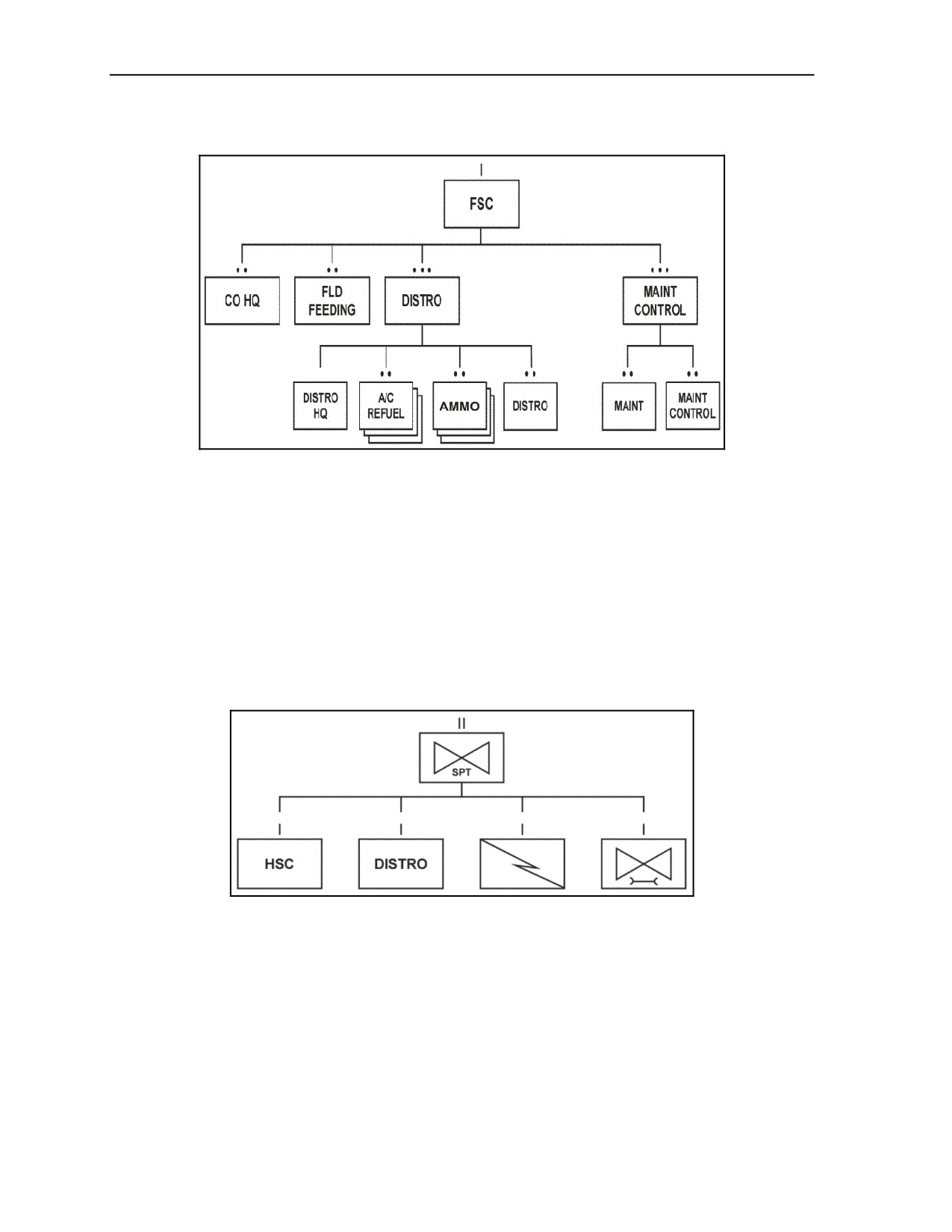
1-4. The ARB, AHB, and GSAB FSC have a headquarters platoon, field feeding, DISTRO platoon, and
ground maintenance platoon. The DISTRO section provides aircraft refuel capability, ammunition
3 August 2006
FM 3-04.104
1-1
Chapter 1
specialists (89B), water, and transportation. Also, with proper coordination the ARB, AHB, and GSAB can
be augmented by the ASB. (See figure 1-1 for general structure of a FSC.)
Figure 1-1. Sample structure of a forward support company
AVIATION SUPPORT BATTALION ORGANIZATION
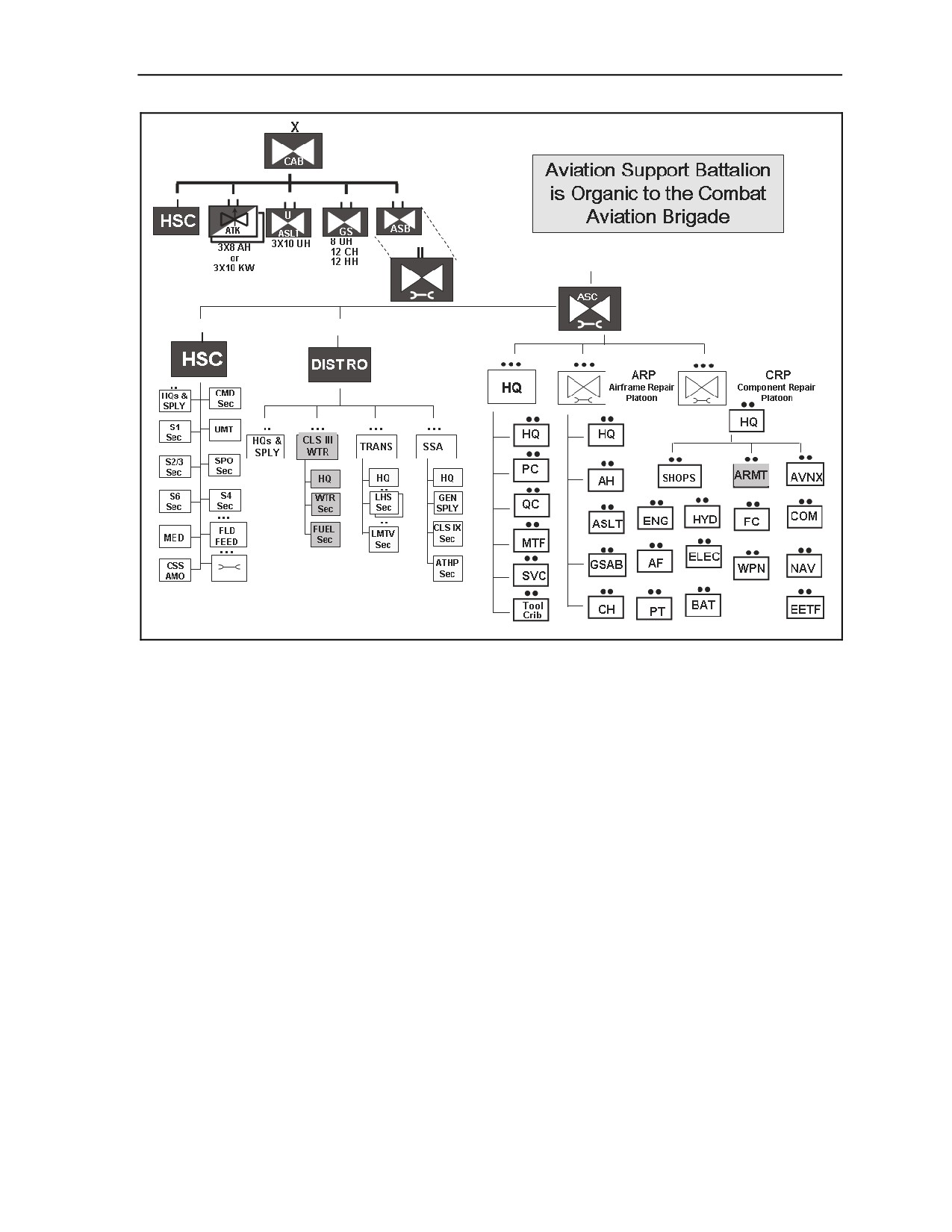
1-5. The ASB (figure 1-2) consists of four companies—the headquarters and support company (HSC),
the DISTRO company, the network signal company and the aviation support company (ASC). The ASB
provides aviation and ground field maintenance, network communications, resupply, and medical support.
The HSC provides medical support and conducts field-ground maintenance and recovery. The DISTRO
company functions as a supply support activity and distributes supplies to subordinate units of the CAB.
The network signal company provides network and signal support to the CAB headquarters. The ASC
provides intermediate maintenance and support for on-aircraft and critical off-aircraft field level
maintenance and the maintenance of unmanned aerial systems. The ASC also conducts battle damage
assessment (BDA) and repair and provides backup support to the aviation maintenance company (AMC).
Figure 1-2. Aviation support battalion
1-6. The DISTRO company provides logistics support for the aviation brigade. The DISTRO company
receives, temporarily stores, and issues bulk Class III. It also establishes and operates Class III (aviation
fuel) transload sites in the brigade support area
(BSA) to resupply brigade operations. Using the
brigade/battalion rear FARP, the DISTRO company provides fuel to all brigade aircraft. Figure 1-3, page
1-3, shows the unit organization of the ASB in support of the aviation brigade.
1-7. The ASC provides armament personnel to FSCs upon request. The additional armament personnel
will assist the FSCs with arming and dearming operations to fulfill mission requirements and provides the
FSC advanced field maintenance support.
1-2
FM 3-04.104
3 August 2006
Introduction
Figure 1-3. Aviation support battalion (support of combat aviation brigade)
PLANNING FACTORS
1-8.
The following basic principles should be satisfied when planning a FARP to support aviation units:
The FARP should meet unit mission requirements.
The FARP should provide support throughout the battlefield under all conditions.
The FARP should avoid threat observation and engagement.
PLANNING CONSIDERATIONS
1-9. The intensity of the battle will affect FARP activities. The commander should be aware of the
following planning considerations:
Command, control, and communication (C3).
Terrain analysis (maps, overlays, databases, software).
Weather analysis.
Analysis of other characteristics of the battlefield.
Wet or dry cross-country mobility
Transportation systems (road and bridge information).
Vegetation type and distribution.
Surface drainage and configuration.
Surface materials (soils).
Ground water.
3 August 2006
FM 3-04.104
1-3
Chapter 1
Manmade structures.
Obstacles (placed by the enemy).
Higher operation tempo.
Distance between the battle positions and logistics trains.
FARP location.
Flight time to and from FARP position.
Threat.
Availability of cover and concealment.
Road conditions.
Availability of higher-echelon throughput of Class III/V.
Distance to Class III/V distribution points.
FARP mobility and ability to displace rapidly.
Armed escort for Fat Cow/Wet Hawk operation.
Minimum personnel and equipment. (It may be impractical to use aircraft assets to transport
materials handling equipment (MHE). However, the absence of MHE can seriously degrade
the ammunition-handling and breakdown capability of the FARP (Department of the Army
Pamphlet [DA PAM] 385-64).
Effective camouflage.
Survivability.
FIGHTER MANAGEMENT/CREW ENDURANCE
1-10. Managing crew endurance is a command function that is an integral part of the risk management
process. Using the chain of command, experience and judgment, the commander must make the decision as
to who is best capable of performing the mission. This does not relieve individuals from informing the
commander when they feel they are incapable of completing the mission due to fatigue. When everyone is
tired from extended operations, it takes a cooperative effort from all team members to insure that personnel
and assets are not expended uselessly. The following definitions are provided to support the fighter
management process:
Fighter management. Management of human resources to maximize combat effectiveness by
providing for individual rejuvenation, both physically and mentally, from stress or fatigue
resulting from work activities and environmental factors.
Non-Aviation Related Duties. Any military duties not defined as aviation-related duties or
flight duty.
Rest Period. Off-duty personal time that precedes or follows a duty period. The rest period
begins when the soldier has completed all job-related tasks associated with the mission and/or
has been released from duty to individually manage his/her own time.
Reverse Cycle. A duty period that changes the normal circadian rhythm. Reverse cycle is
when the individual is required to alter the normal duty schedule by 6 hours or more.
1-11. The primary factor in effective fighter management/crew endurance is scheduling. Proper prior
planning ensures that the proper crew mix is available at optimum performance levels for the mission.
Fighter management is first and foremost a risk management tool for commanders. As a risk management
tool, the fighter management program provides guidance for high operating tempo (OPTEMPO) operations
and ensures risk decisions are made at the proper command levels. The final authority for fighter
management decisions lies with the brigade commander.
PERSONNEL
1-12. Personnel allocations for the FARP include military occupational specialties (MOSs) 92F, 89B, 15J,
15X, and 15Y. Petroleum specialists, MOS 92F, transport Class III and fuels aircraft. Ammunition
specialists, MOS
89B, transport, unpack, maintain, and account for ammunition. Aircraft armament
1-4
FM 3-04.104
3 August 2006
Introduction
repairers, MOSs 15J/X/Y, repair fire control systems and arm observation helicopter (OH)-58D, attack
helicopter (AH)-64A, and AH-64D aircraft, respectively. As required, commanders augment the FARP
with other medical, BDA/maintenance teams, and security forces.
1-13. In the ARB, AHB, and GSABs MOSs 92F and 89B are assigned to the battalion’s FSC. ASB MOSs
92F and 89B are assigned to the DISTRO companies. MOSs 15J, 15X, and 15Y are assigned to the aircraft
component repair section of the aviation maintenance company/troop (AMC/T). Commanders should
ensure command and control (C2) is established before FARP personnel depart from area of operation
(AO).
1-14. The increased tempo of operations and/or density of traffic may require air traffic services (ATS)
assets. In such cases, the commander or his representative may request from the GSAB a tactical aviation
control team (TACT) consisting of four MOS 15Q, Air Traffic Control Operators. TACTs are also
available from the Airfield Operations Detachments (AODs) at the theater areas of operation.
TACTICAL ENABLERS
AIR DEFENSE
1-15. The aviation unit commander occasionally uses other elements such as air defense (AD) depending
on the mission requirements. AD support is staffed through air defense artillery (ADA) headquarters. The
Operations Staff Officer (S-3) coordinates and supervises the support and activities of the AD force
throughout the operation. Based on the commander's priorities, the AD officer and the S-3 allocate specific
AD weapons and designate the positions that the weapons will occupy.
1-16. The FARP has a limited organic AD capability. The firepower of the FARP includes M240 machine
gun, semiautomatic weapons, and other small arms. These weapons can make a difference during an air
attack. Small arms fire may not destroy attacking enemy aircraft; however, they may distract pilots long
enough for them to miss their target.
FIELD ARTILLERY
1-17. The CAB supports the maneuver brigade combat teams (BCTs). The aviation brigade’s fire support
officer (FSO) coordinates with the BCT or fires brigade FSO for fire support. The battalion FSO will
coordinate with the aviation brigade FSO to ensure requirements are relayed to the BCT or fires brigade
FSO. The aviation battalion S-3 designates the locations of the FARPs. The S-3 should provide the FSC
leadership and the FSO these locations along with the projected movement time to the locations so that the
FSO can plan a schedule of fires to protect the FARP.
INTELLIGENCE
1-18. To defeat the enemy, the aviation commander must "see" the battlefield better than his opponent. He
must know as much as possible about the enemy, weather, and terrain. This intelligence helps the
commander make decisions, issue orders, and successfully employ his forces on the battlefield. It also
helps the commander determine the best locations for his FARPs. The Intelligence Staff Officer (S-2) is the
intelligence coordinator for the battalion. He collects, processes, and interprets information from
subordinate units. Appendix G shows the critical elements that must be considered during FARP planning.
1-19. The FSC commander/platoon leader must keep abreast of the intelligence situation so that he can
anticipate and plan for future FARP operations. Armed with up-to-date intelligence, the platoon leader can
help the S-3 determine how to best support the mission. Current knowledge of the enemy will help the FSC
leadership avoid threat targeting of the FARP through sensor weapons.
THREAT
1-20. The threat can neutralize aviation force effectiveness by preventing aircraft from arming and
refueling. Therefore, the FARP will be a high-priority target for the enemy. Class III/V stocks in the AO
3 August 2006
FM 3-04.104
1-5
Chapter 1
will likely be subject to chemical, biological, radiological, and nuclear (CBRN) ground, tactical air, air
assault, and artillery attacks. Local sympathizers and insurgents may even harass FARP operations.
1-21. Units fight as they train and must regard force protection as a priority. Aviation units that do not
spend adequate time training on force protection measures are often unsuccessful at repelling threat
assaults.
1-6
FM 3-04.104
3 August 2006
Chapter 2
Command, Control, and Communications
One of the most difficult aspects of FARP operations is C3 with other elements in
the aviation unit without compromising the FARP. This chapter discusses the C3
responsibilities of the commander and his staff relative to the FARP. It also includes
modes and methods for aircraft control into, within, and out of the FARP.
COMMAND AND CONTROL
2-1. The commander is responsible for the overall success of the FARP. Based on the factors of mission,
enemy, terrain and weather, troops available, time available, civilian considerations (METT-TC), the
commander decides how his FARP assets will be used to support his operational intent.
2-2. The Executive Officer
(XO) is the principal
assistant to the commander. He must be prepared to
Contents
assume command at any time. The XO supervises the
Command and Control
2-1
S-3 and Logistics Staff Officer (S-4) as they coordinate
Aircraft Control
2-1
the logistics support for the unit.
TrafficLayout
2-3
2-3. The S-3 formulates the commander's plan, which
Radio Communications
2-5
includes the FARP, to accomplish the mission. The S-3
consults with the S-4 and the HSC commander to ensure that the plan can be supported logistically.
2-4. The S-4 calculates the fuel and ammunition required for the mission and plans the distribution of
these supplies. He then coordinates these requirements with higher headquarters.
2-5. The FSC commander is responsible for accomplishing the FARP mission. He assists the S-3 in
formulating the FARP plan and coordinates fuel and ammunition needs with the S-4.
2-6. A safety officer (SO) will certify the FARP prior to use. If a SO is not available, a pilot of the first
aircraft in the FARP will certify the FARP according to the FARP checklist that is provided by the FARP
noncommissioned officer in charge (NCOIC).
AIRCRAFT CONTROL
2-7. The control of aircraft within the FARP is critical to safety and overall efficiency of the operation.
The proximity of the FARP to the battlefield may restrict the use of radars for positive aircraft control.
The most effective means of control will be a thorough briefing and a well-written and rehearsed standing
operating procedure (SOP) that outlines the FARP procedures to be followed by both aircrews and FARP
personnel. Additionally, offset, low-output nondirectional radio beacons and global positioning system
(GPS) may be a low risk method for locating FARPs. Also, various signaling methods may be used to
maintain procedural aircraft control.
AIR TRAFFIC SERVICES
2-8. The use of ATS in a FARP is METT-TC dependent. Under some circumstances, such as during
situations other than war, ATS units can provide the aviation commander with a greater measure of safety
and synchronization. However, ATS should be considered in the planning for FARP operations.
2-9. One ATS company will be assigned to each CAB GSAB (figure 2-1, page 2-2) to provide a full
range of terminal and en route ATS for the division areas of operation. The airfield operations
3 August 2006
FM 3-04.104
2-1
Chapter 2
detachment (AOD) has like capabilities at the theater level. The ATS company or AOD TACT is best
suited for FARP operations. A TACT can manage the flow of airborne and taxiing aircraft for a faster,
safer, and more efficient operation, with a minimal footprint on the FARP area.
Figure 2-1. Air traffic services company in general support aviation battalion
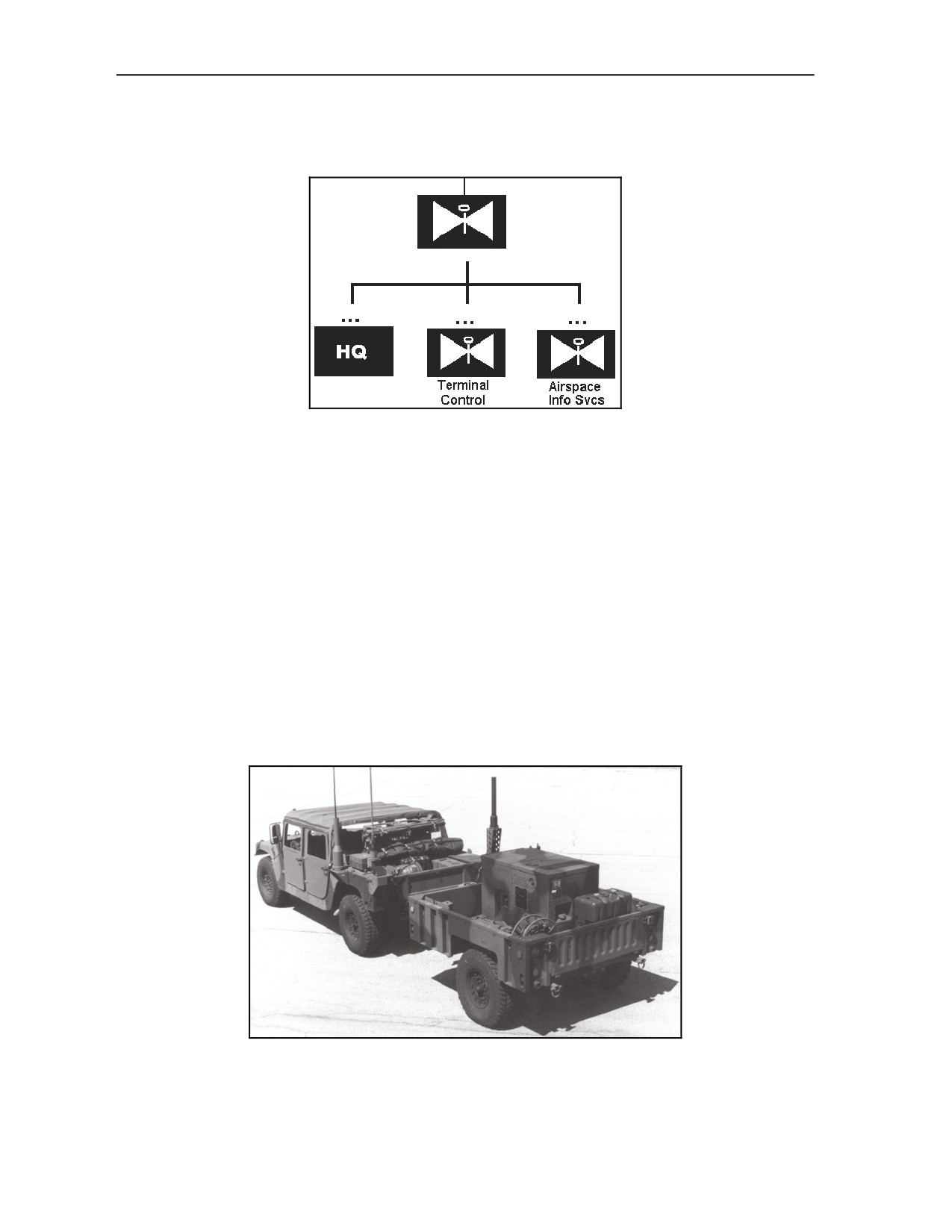
2-10. Each TACT is equipped with the AN/TSQ-198 Tactical Terminal Control System (TTCS) (figure
2-2) and the AN/TRN-30(V)1 Tactical Nondirectional Radio Beacon (TNDB). The TTCS is a high
mobility multipurpose wheeled vehicle (HMMWV)-mounted air traffic control system used to provide
arrival/departure information, limited weather, wind direction, and speed information, and sequencing
instructions. The TTCS is equipped to provide secure ultra high frequency-amplitude modulation (UHF-
AM), very high frequency-amplitude modulation (VHF-AM), very high frequency-frequency modulation
(VHF-FM), and high frequency-automated link establishment (HF-ALE) ground-to-air and ground-to-
ground voice and data communications. Recent upgrades provide a satellite communication capability.
The TTCS communications system can also convert to a battery-operated, man-pack configuration for
dismounted and remote operations. A multi-color, light signal gun is available for no-radio or noise
discipline operations. The TNDB, operated continuously or by demand-activation, provides automatic
direction finder-equipped aircraft a means to electronically locate a landing area, such as a FARP, out to
25 nautical miles. A nonprecision instrument approach procedure may be developed for the TNDB to
safely recover aircraft during marginal and less than visual meteorological conditions. The TTCS and
mission equipment are sling loadable by a UH-60 or larger helicopter and can be transported by a single
C-130 aircraft sortie.
Figure 2-2. AN/TSQ-198 tactical terminal control system
2-2
FM 3-04.104
3 August 2006
Command, Control, and Communications
TRAFFIC LAYOUT
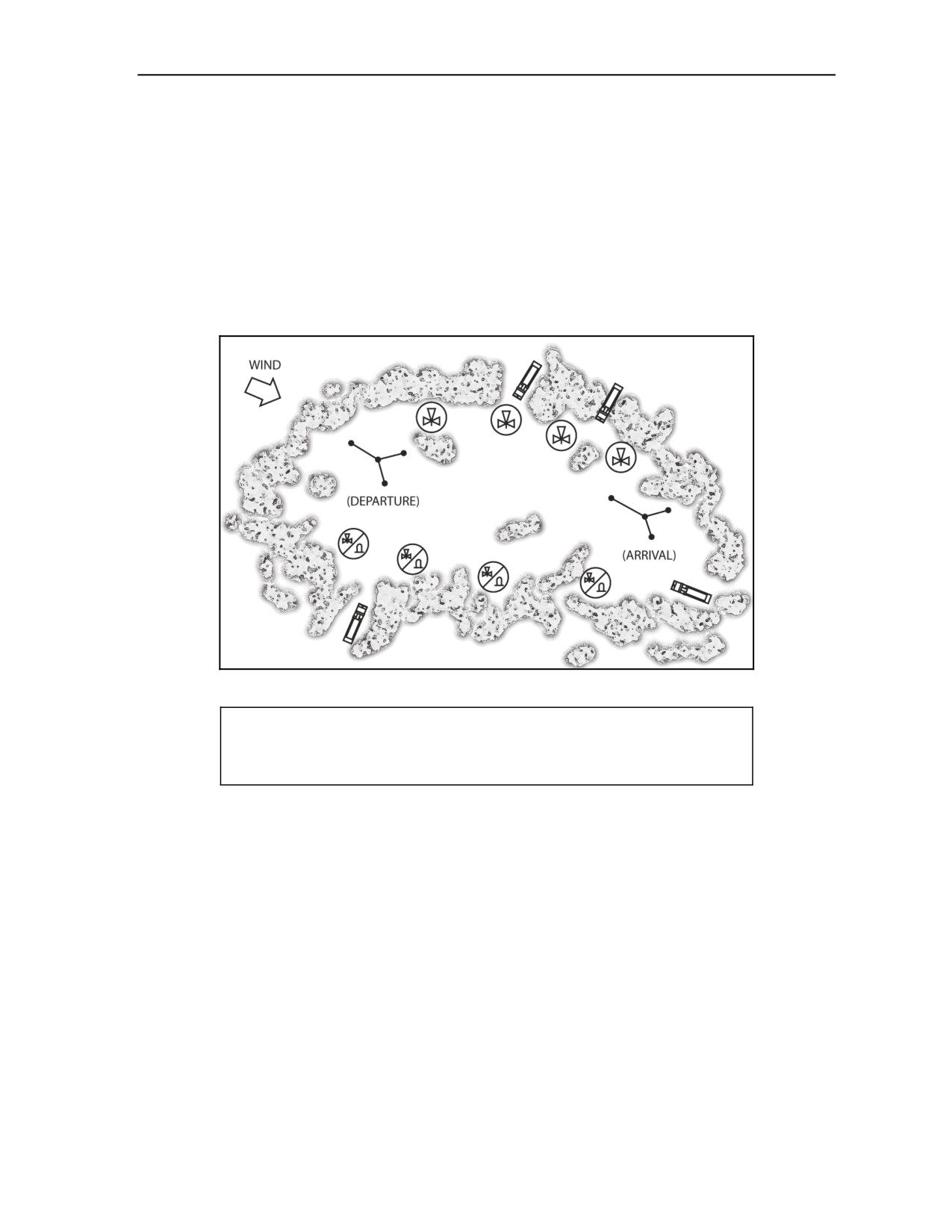
2-11. Standard marker panels on departure and arrival points will improve the procedural control of
aircraft. Engineer tape, chemical lights, or beanbag lights can be used at night to indicate the desired
direction of aircraft movement or the location of ground guides. The aircraft should move to the ground
guide's location for arming and refueling. After the aircraft has been serviced, the ground guide should
direct it toward the departure end of the FARP. Additional aircraft control can be achieved by maintaining
section integrity during FARP operations. Selected waiting areas and separate ingress and egress routes
also improve aircraft control. As much as possible, the unit safety officer should be involved in planning
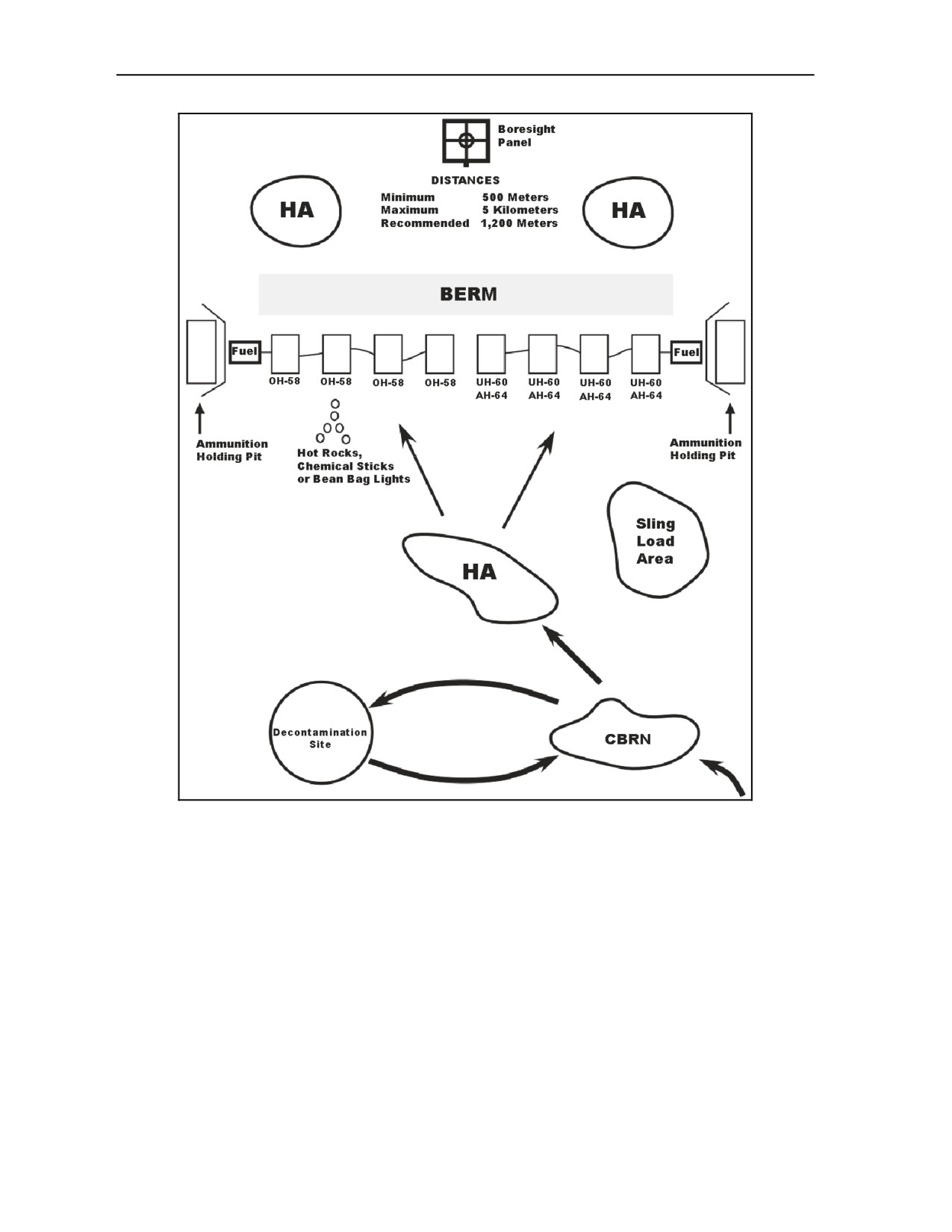
safe routes in and out of the FARP and establishing checkpoints along the routes. Figure 2-3 shows an
example traffic layout at the FARP. Figure 2-4, page 2-4, shows the FARP layout for simultaneous
operations.
Figure 2-3. Traffic layout at a forward arming and refueling point
CAUTION
If marker panels and engineer tape are used, they must be properly
secured to prevent foreign object damage (FOD) to aircraft.
VISUAL SIGNALS
2-12. Visual signals include hand and arm signals, pyrotechnic, signal flags, marker panels, and light
signals (see FM 21-60). Ground guides will normally control the movement of aircraft within the FARP.
Because ground guides may direct other allied aircraft, they must use standard hand and arm signals.
These signals are shown in appendix A.
Pyrotechnic
2-13. Smoke is not the preferred visual signal, but it has several advantages. For instance, it can indicate
wind direction. Different colors can indicate the current situation of the FARP or the availability of Class
III/V products. Smoke also has some disadvantages, such as day use only, obscures obstacles, and can
compromise the FARP location.
3 August 2006
FM 3-04.104
2-3
Chapter 2
Figure 2-4. Forward arming and refueling point layout for simultaneous operations
Light and Flags
2-14. Flashlights and light wands are other types of visual signals. The flashlight can be used with color-
coded disks to relay information. A separate colored disk, which is easily seen at night, can indicate the
FARP situation or supply availability. During the day, signal flags of different colors can serve the same
purpose. Flashlights can be used with hand and arm signals. Sites should be concealed that limit enemy
ability to detect FARP light sources. FARP personnel maintain light discipline until aircraft arrive.
Personnel use light wands with hand-and-arm signals to mark departure, landing, and arming and
refueling points.
2-15. Chemical lights come in a variety of colors to include infrared (IR), which can be seen only through
night vision devices (NVDs). They can be used in the same manner as flashlights and light wands. An
effective technique for lighting the landing area using chemical lights is to dig a shallow trench in the
shape of the landing area and place chemical or beanbag lights in the trench. The landing area can be seen
only at a certain angle from the air. On the ground, the landing area is difficult to see.
2-4
FM 3-04.104
3 August 2006
Command, Control, and Communications
Arming Signals
2-16. In peacetime, aircrews turn off the anticollision light to signal the ground crew to begin arming. As
an alternate combat signal, aircrews may employ hand-and-arm signals during the day and cockpit
navigation lights at night to signal the start of arming. Ground personnel can talk via intercom to the
aircrew with the helmet assembly, rearming refueling personnel
(HARRP) (Common Table of
Allowances [CTA] 50-900) with communications (HGU-24/P).
RADIO COMMUNICATIONS
2-17. The use of radios must be kept to a minimum to reduce the enemy's ability to target and engage
electronic emissions. However, each FARP (active and silent) should have two FM radios capable of
secure voice or secure data burst transmissions. This allows simultaneous monitoring of both the
command and administrative and logistics networks. The internal network (alternate network) would
provide FARP personnel with information about the current status of inbound aircraft and ammunition
requirements. The command-designated network would provide information that may affect the FARP's
operation. Because FM radios are limited by line of sight and range, the distance and/or location of the
FARP may prevent FARP personnel from monitoring and/or transmitting on the designated command
frequency. In such cases, using aircraft as retransmission or relay is an option as long as the factors of
METT-TC are considered. These radios should be used to transmit only when—
The FARP is under attack.
The FARP relocates or ceases operations.
The FARP is not operational at the scheduled time.
A request is made to resupply Class III/V products.
The status of the FARP changes. (In this case, the radio is used to report damage or
contamination.)
2-18. The tactical situation and SOP will dictate the use of radio frequencies. When possible, outbound
aircraft should relay critical messages from the FARP to unit headquarters or unit trains. This will help
prevent the enemy from electronically pinpointing the FARP's location for attack. FARP reports and other
communications should be made in person.
3 August 2006
FM 3-04.104
2-5
Chapter 3
Forward Arming and Refueling Point Utilization
The FSC/DISTRO must be prepared to sustain aviation forces with fuel and
ammunition during maneuver and tactical enabler missions. The success of the
aviation mission is directly related to the effectiveness of the FARP and the
personnel who run it. This success depends on planning and coordination before
FARP operations begin. This chapter discusses employment factors, refueling and
arming operations, aircraft flow and mix, and training.
SECTION I - EMPLOYMENT FACTORS
TYPES OF FORWARD ARMING AND REFUELING POINTS
ACTIVE
3-1. The active FARP is normally located in the main battle area closer to the area where operations are
being conducted. It provides fuel and ammunition necessary for the employment of aviation maneuver
units in combat. The active FARP conducts refueling and rearming operations and permits combat aircraft
to rapidly refuel and rearm simultaneously.
SILENT
Contents
3-2. For longer missions, units employ a FARP with
Section I - Employment Factors
3-1
additional displaced FARPs (called silent FARPs until
Section II - Forward Arming and
activated) waiting to assume the mission at preplanned
Refueling Point Equipment
3-21
times or decision points (DPs). The silent FARP has all
Section III - Ammunition Operations,
equipment and personnel at the future site, but it is not
Equipment, and Storage
3-32
operational.
Section IV - Arming Operations
3-34
Section V - Aircraft Flow and Mix
3-36
JUMP
Section VI - Training
3-37
3-3. A jump FARP may be necessary if the enemy
occupies the roads in the area. Air-emplaced jump FARPs support limited resupply behind enemy lines
and support mobile strikes involving major air assaults. The jump FARP is employed for a special
mission. It is composed of a forward area refueling equipment (FARE), 500-gallon collapsible fuel drums,
and/or ammunition (as the mission dictates). The jump FARP is transported and emplaced by ground or
air and employed when dictated by time or geographical constraints. It allows the uninterrupted support of
attack elements during FARP relocation and resupply.
ROLLING
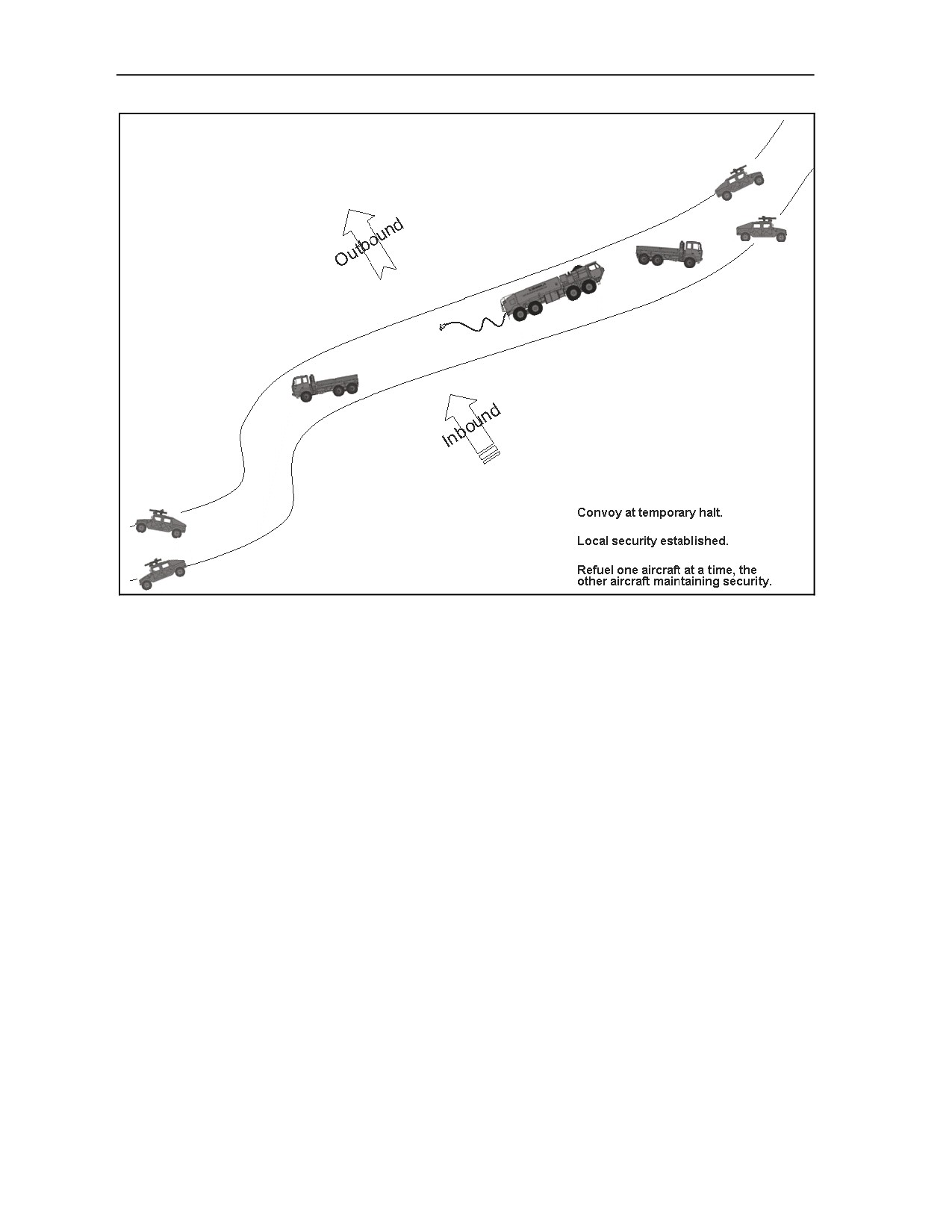
3-4. The rolling FARP allows aircraft providing convoy security for fuel tankers, ammunition, supplies,
and FARP movement to refuel and or rearm at the convoy’s location. This minimizes the compromising
of security by reducing the travel times associated with returning to the FARP. If time allows, a map
reconnaissance of the route should be conducted (figure 3-1, page 3-2).
3 August 2006
FM 3-04.104
3-1
Chapter 3
Figure 3-1. Rolling forward arming and refueling point
3-5. The security configuration of the rolling FARP should remain the same as the convoy security. As
the convoy comes to a temporary halt, block the road from any traffic entering at each end of the convoy
posting armed lead and trail vehicles during the FARP operation. The inner vehicles will provide left and
right flank security giving the FARP operation a 360-degree perimeter security.
3-6. Taking into consideration the selected aircraft landing area, determine positions of refueling and
rearm point. Ensure 100 feet separation from aircraft to nearest vehicle. Break down ammunition and
prepare the load depending on the needs of the aircraft, and reposition vehicle to parking location. Place
fuel hose in position. One aircraft will land on the hard surface road for refuel/rearm operations as the
other aircraft maintains aerial security. After the first aircraft has rearmed/refueled it will resume aerial
security as the second aircraft lands for rearm/refuel. FARP personnel must take safety into consideration
because of the hasty nature of this type FARP.
SITE SELECTION
3-7. If time allows, a map reconnaissance and a survey of the proposed site should be conducted before
a FARP site is selected. A site survey is critically important; maps may not be current and sites are not
always as they are depicted on the map. For example, an open field on a map may actually be overgrown
with trees.
3-8. Once ordered to relocate, the FARP elements should begin an orderly movement. After the FARP
has been moved, no evidence should remain that the area was ever occupied.
3-9. The advance party breaks down one unit, consisting of one heavy expanded mobility tactical truck
(HEMTT) or one FARE/advanced aviation forward area refueling system (AAFARS). Next, it rolls up
and packs hoses and refuels the tanker if fuel is available. The advance party then transports, when
possible, enough ammunition for two mission loads per aircraft, rolls up the camouflage nets, and sets up
3-2
FM 3-04.104
3 August 2006
Forward Arming and Refueling Point Utilization
a convoy. The advance party, equipped with CBRN detection equipment, and a security team should be
sent to the proposed site to determine its suitability. If the site is not suitable for FARP operations, then
time would be available to move the FARP to an alternate location. If the site is usable, the advance party
will identify areas for the placement of equipment. Appendix B shows an example of a FARP operations
annex to a tactical SOP
3-10. When the convoy is ready, the advance party moves out to the new location. Upon arrival,
personnel establish security, conduct a CBRN survey, reconnoiter the site, and perform other tasks
outlined in the unit SOP and the applicable Army training and evaluation program publication. If the site
is unsuitable or the enemy is nearby, the advance party reports this information to the tactical operations
center (TOC). The advance party then requests to move to the alternate site and notifies the remaining
FARP elements. When the site is deemed suitable, the advance party:
Determines the landing direction.
Determines and marks refuel and rearm points, truck emplacements, and ammunition
emplacements.
Sets up the equipment.
3-11. When the rest of the FARP personnel and equipment arrive, the advance party should guide each
vehicle into its position. When determining the site location, the FARP officer in charge (OIC) will take
into consideration the following:
Tactical dispersion of aircraft and vehicles, such as ingress and egress routes.
Brownout condition.
Tree lines.
Vegetation, such as scrub brush, small trees, and dried grass and leaves.
Shadows.
Built-up areas.
Weather condition, such as fog, cloud cover, rain, snow, and prevailing winds.
Gullies that could fill quickly during flash floods.
Marsh areas.
Site is clear of debris, such as sticks, stones, and other potential flying objects.
Use of pierced steel planking or other suitable material.
ENGINEERING CONSIDERATIONS
3-12. With the advent of airpower and its associated support requirements, engineers have acquired a
mission to support aviation assets. If engineer assets are available, they can increase the mobility, counter-
mobility, survivability, and sustainment of the FARP. Engineer support is requested through the S-3 at the
brigade/battalion responsible for the sector where the FARP will be located. The engineer staff officer
will recommend changes about the priority of engineer support to the brigade commander.
MOVEMENT PLAN
3-13. Detailed planning of the move will improve the accuracy of the FARP's operational time. Planning
should include details about individual vehicle and trailer load plans. Standard load plans do not exist for
current equipment because equipment varies in each unit's modified table of organization and equipment
(MTOE); although the Army is moving toward standardizing MTOEs of like battalions. Additionally, the
varying Class V requirements for different missions will greatly affect vehicle load plans. Appendix C
contains suggested load plans.
3-14. In a FARP convoy, the platoon should use concealed routes as much as possible. Leaders should be
aware and knowledgeable of improvised explosive devices (IEDs). They should brief the convoy on the
seriousness of their threat. If the FARP is attacked from the air while moving, vehicles should turn 90
degrees from the direction of the attack. (Aircraft normally attack parallel to the movement of a convoy.)
This countermeasure quickly removes vehicles from the line of fire.
3 August 2006
FM 3-04.104
3-3
Chapter 3
3-15. Air guards should be posted on vehicles and in dismounted positions to warn of approaching
aircraft. They should be rotated often because scanning for long periods dulls an individual's ability to
spot approaching aircraft. Vehicle horns are the standard method of warning for an air attack.
EMPLACEMENT
MISSION, ENEMY, TERRAIN AND WEATHER, TROOPS AVAILABLE, TIME AVAILABLE,
CIVILIAN CONSIDERATIONS
3-16. The FARP location is METT-TC dependent and a function of the battalion S-3. The FARP should
be located as close to the AO as the tactical situation permits. The intent is to reduce the distance or time
traveled for the aircraft, thereby increasing aircraft time on station while simultaneously striking a
balance that exposes the FARP to the least possible risk. Aviation's ability to move quickly also requires
that the FARP be able to move quickly to maintain support.
Mission
3-17. Today’s missions are focused on noncontiguous battlefields. The paragraphs below give guidance
for future FARP operations on a linear, nonlinear, or noncontiguous battlefield.
3-18. The employment of the FARPS is METT-C dependent. Commanders can employ and configure
their assets as the mission dictates to complete the mission requirements. The commander can choose to
have one large FARP or several small FARPs. The attack battalion can employ three FARPS under the
modular design (three sections of Class III and three sections of armament personnel) and so can the
remaining battalions (three sections of Class III-rapid refueling points, rocket and missile armament not
required). Each battalion owns a FSC that is modular (three sections), except for the ASB, which has a
distribution section. The CAB in its entirety can setup a maximum of 12 FARPs and one ASB refuel point
to operate in a division area, supporting three BCTs. Also, the attack, assault, and GSABs can be
augmented by the ASB and the use of Fat Cow (extended range fuel system [ERFS]/ERFS II) and Fat
Hawk/Wet Hawk operations to enhance Class III/V requirements. In most other circumstances, aircraft
could rearm and refuel at FARPs within the close area. If a FARP must be located behind enemy lines, the
following factors should be considered:
The composition of the FARP should be austere.
Security will be limited because the FARP will be emplaced for a very short time.
A thorough map reconnaissance and intelligence update must be accomplished for the area.
A helicopter with a sling load cannot fly nap-of-the-earth (NOE), which puts it at greater risk
and broadcasts the unit's intentions.
3-19. The FARP is located as close to the AO as the tactical situation permits. It is usually located as far
forward as 18 to 25 kilometers (METT-TC dependent) behind the forward line of own troops (FLOT) or
METT-TC dependent on a nonlinear battlefield. This distance increases aircraft time on station by
reducing the travel times associated with refueling. If possible, the FARP is kept outside the threat of
medium-range artillery. Movement and resupply of the FARP are conducted by ground or aerial means.
The FARP should remain in one location for only 3 to 6 hours; however, these times may be reduced by
the factors of METT-TC. The size of the FARP will depend on the number of aircraft that will use the
FARP and the type of refueling equipment (FARE/AAFARS or HEMTT) that is available. Four to eight
refueling points are normally sufficient for continuous mission sustainment. Appendix D provides
multiple FARP missions and schedules.
3-20. The aviation brigade provides rapid reaction force that can quickly shift its effort and engage enemy
forces in the rear area. Depending on their distance from other supply facilities, aviation units in the rear
may require FARP support. A FARP located in the rear will probably remain in one location longer than
the recommended 3 to 6 hours. If so, the FARP must be hardened and have adequate security. Movement
and resupply of the FARP can be accomplished by ground or aerial means.
3-4
FM 3-04.104
3 August 2006
Forward Arming and Refueling Point Utilization
3-21. Ground and air maneuver forces strike decisive blows. Ammunition palletized load system (PLS)
trucks with mission-configured loads push supplies down to the close area where FARP elements meet
them at logistics release points
(LRPs). When possible, the FSC commander coordinates for direct
delivery to the silent FARP to avoid transloading. Units travel to supply points for fuel or receive
throughput from higher echelon 5,000-gallon tankers for transloading. Mobile strikes, operations in deep
areas, special operations, and air assaults characterize these operations. The aviation brigade’s aircraft
conduct operations in deep areas using extended-range fuel tanks so that only Class V FARP support may
be necessary behind enemy lines. Special operations aircraft also may require Class V support. Air assault
mission aircraft often employ extended-range fuel tanks but may need limited Class V support for armed
aircraft providing assault security.
3-22. Air-emplaced jump FARPs support aviation brigade reaction aviation forces as they attack Level III
rear threats to sustainment. Airheads and base camps support stability and reconstruction operations and
initial deployment aviation needs at intermediate support bases. Cargo helicopter (CH)-47D and utility
helicopter (UH)-60A/L aircraft conduct air movement to supplement ground-emplaced FARP activities
and emplace jump FARPs supporting aerial resupply of ground forces in shaping operations in deep areas.
The versatility of the aviation brigade makes it ideally suited to support sustainment operations. The ARB
usually emplaces a FARP using its combat trains. At this site, rearming and refueling operations take
place for a specific mission. When that mission is complete, the air assets transition to the fixed FARP site
in the rear to reconfigure ammunition loads, refuel, and perform the required maintenance in preparation
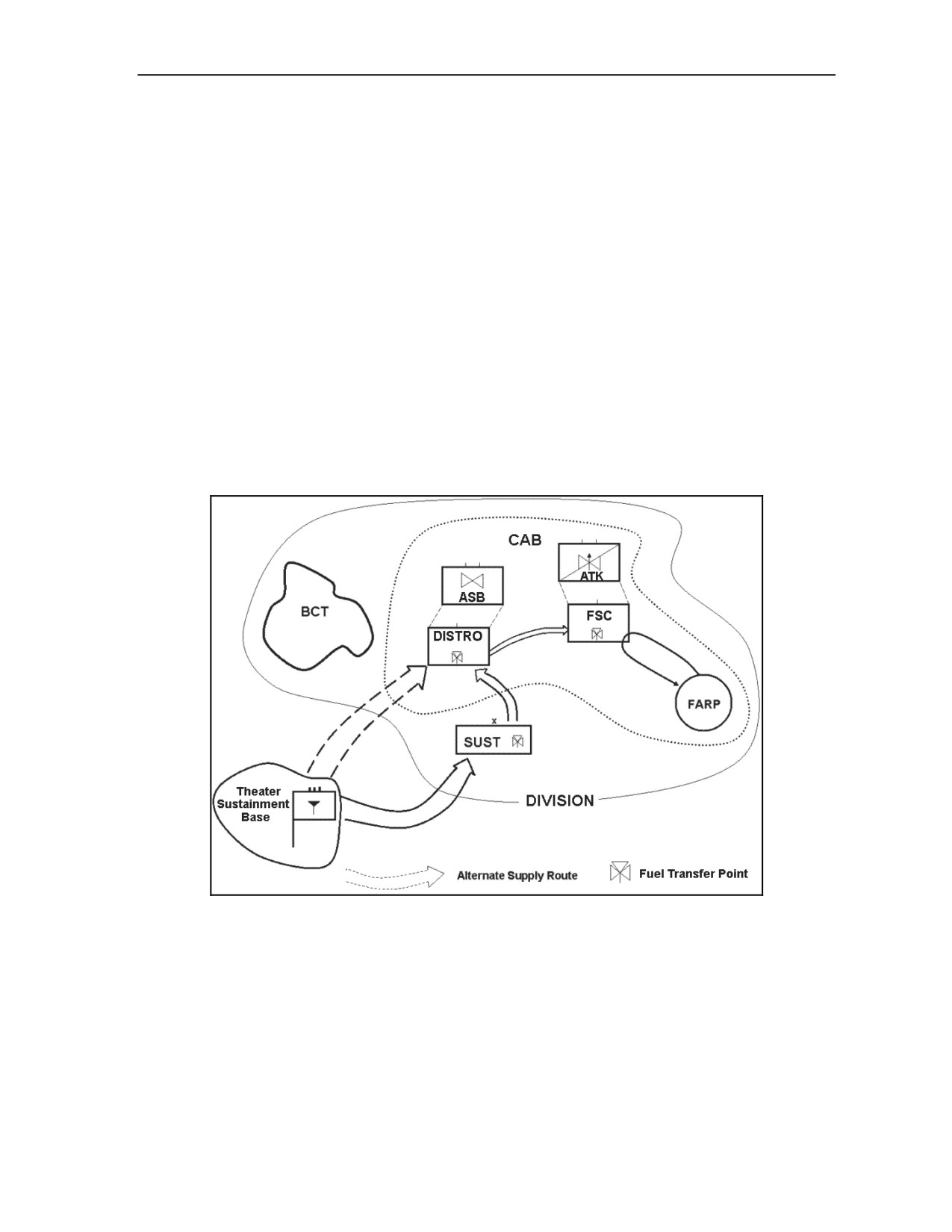
for other missions. Figure 3-2 shows a typical disposition of theater and division Class III/V products.
Figure 3-2. Typical disposition of theater and division class III/V products
Enemy
3-23. The S-2 is responsible for determining the type of threat the FARP is likely to encounter in a certain
location. This includes the enemy's capabilities, posture, and weapon systems. For example, a FARP
located in the close area may encounter an enemy reconnaissance element. A FARP in the rear area may
be the target of special operations forces. The S-2 also determines the type of intelligence-gathering
devices and sensors that the enemy has oriented at the proposed FARP location.
3 August 2006
FM 3-04.104
3-5
Chapter 3
Terrain and Weather
3-24. During terrain analysis the following effects must be taken into consideration, including weather:
Tactical dispersement of aircraft and vehicles.
Terrain folds and reverse slopes for cover and concealment.
Ground main supply routes.
Air avenues of approach, such as ingress and egress.
Sand.
Snow.
Heat.
Flash floods.
Gullies filling with water.
Tornadoes.
Lightning.
Wind.
3-25. Terrain in the urban environment is severely limited and suitable FARP locations are rare. Aviation
units must take a detailed look at urban areas and locate potential sites for FARP operations. Leaders
should take the following into consideration:
City maps.
Overhead imagery.
Reconnaissance flights.
City parks, parking lots, stadium fields, and athletic fields.
Major highways and large multi-lane roads.
Lighting.
Increased security.
Civilian activity.
Hazards to FARP operations, such as antennas, light poles, debris, and wires.
Buildings.
Note. Consider placing the FARP on a hard surface to minimize the possibilities of a brown out
condition.
Troops Available
3-26. The FSC commander must determine if enough troops are available to operate the desired size and
number of FARPs and to complete resupply deliveries in the allotted time. Also, the proper personnel
skills must be available in the proper numbers. For example, MOSs 15J, 15X, and 15Y personnel are
school-trained to arm and repair weapon systems. Other personnel at unit level must be cross-trained to
fuel aircraft and load weapon systems, but they cannot be cross-trained to perform specific repair
functions. Depending on the location of the FARP, the number of soldiers required to provide security
will vary. In most cases, the FARP will provide its own security.
Time Available
3-27. Mission duration is a critical planning factor. Longer missions require either multiple FARPs for
different phases of the mission or a mid-mission FARP displacement combined with Class III/V
throughput to a new FARP location.
3-28. Planners must consider how long it will take to drive or fly to the proposed FARP site. They must
allow sufficient time for FARP setup and consider how far the FARP is from the supply points. They
3-6
FM 3-04.104
3 August 2006
Forward Arming and Refueling Point Utilization
either plan supply throughput or arrange for a second silent FARP to go active to support the next phase
of the mission.
Civilian Considerations
3-29. Civil considerations relate to civilian populations, cultures, organizations, and leaders within the
AO. Commanders consider the natural environment, to include cultural sites, in all operations directly or
indirectly affecting civilian populations. Commanders include civilian political, economic, and
information matters as well as more immediate civilian activities and attitudes.
3-30. At the operational level, civil considerations include the interaction between military operations and
the other instruments of national power. Civil considerations at the tactical level generally focus on the
immediate impact of civilians on the current operation; however, they also consider larger, long-term
diplomatic, economic, and informational issues. Civil considerations can tax the resources of tactical
commanders while shaping force activities. Civil considerations define missions to support civil
authorities.
3-31. Political boundaries of nations, provinces, and towns are important civil considerations. Conflict
often develops across boundaries, and boundaries may impose limits on friendly action. Boundaries,
whether official or not, determine which civilian leaders and institutions can influence a situation. These
considerations can be important at all levels.
3-32. The local population and displaced persons influence commanders' decisions. Their presence and
the need to address their control, protection, and welfare affect the choice of courses of action and the
allocation of resources. In stability operations and support operations, these people are a central feature of
AOs.
GROUND VEHICLES
3-33. FARPs are normally emplaced using ground vehicles that carry bulk quantities of Class III/V
products. Ground vehicles are the primary means of displacing and resupplying the FARP. Ground
mobility offers the advantages of moving and positioning large amounts of bulk petroleum, oils, and
lubricants (POL). However, ground-mobile FARPs have several disadvantages when emplacing FARPs,
such as limited rapid positioning of FARPs, subject to road and traffic conditions, and vehicle
accessibility terrain limits. At mission completion, empty vehicles must return to distant supply points
before they are available to emplace a new FARP. The same vehicles transporting the FARP normally
accomplish resupply. If a single vehicle is lost, the success of the mission may be jeopardized. Therefore,
a backup operation must be planned.
3-34. The advantages of using small ground vehicles, such as the HMMWV, as a FARE platform to
emplace the FARP are mobility, maneuverability, and ease of concealment. The disadvantage is that
additional support is required to complete the FARP package.
3-35. The 3/4-ton trailer offers the FARP a tremendous capability. The entire FARE system (pump and
filter/separator) can be bolted to the frame. When set up, this system provides an extremely mobile
refueling capability. The system is light enough to be transported by HMMWV or sling load by UH-60.
To complete the FARP package, fuel and ammunition can be emplaced by air or ground.
3-36. Another advantage of the HMMWV is that it can transport ammunition from the cargo truck to the
armament pad. It can also move the 500-gallon collapsible fuel drums around the FARP, if the collapsible
fuel drum tow assembly is available.
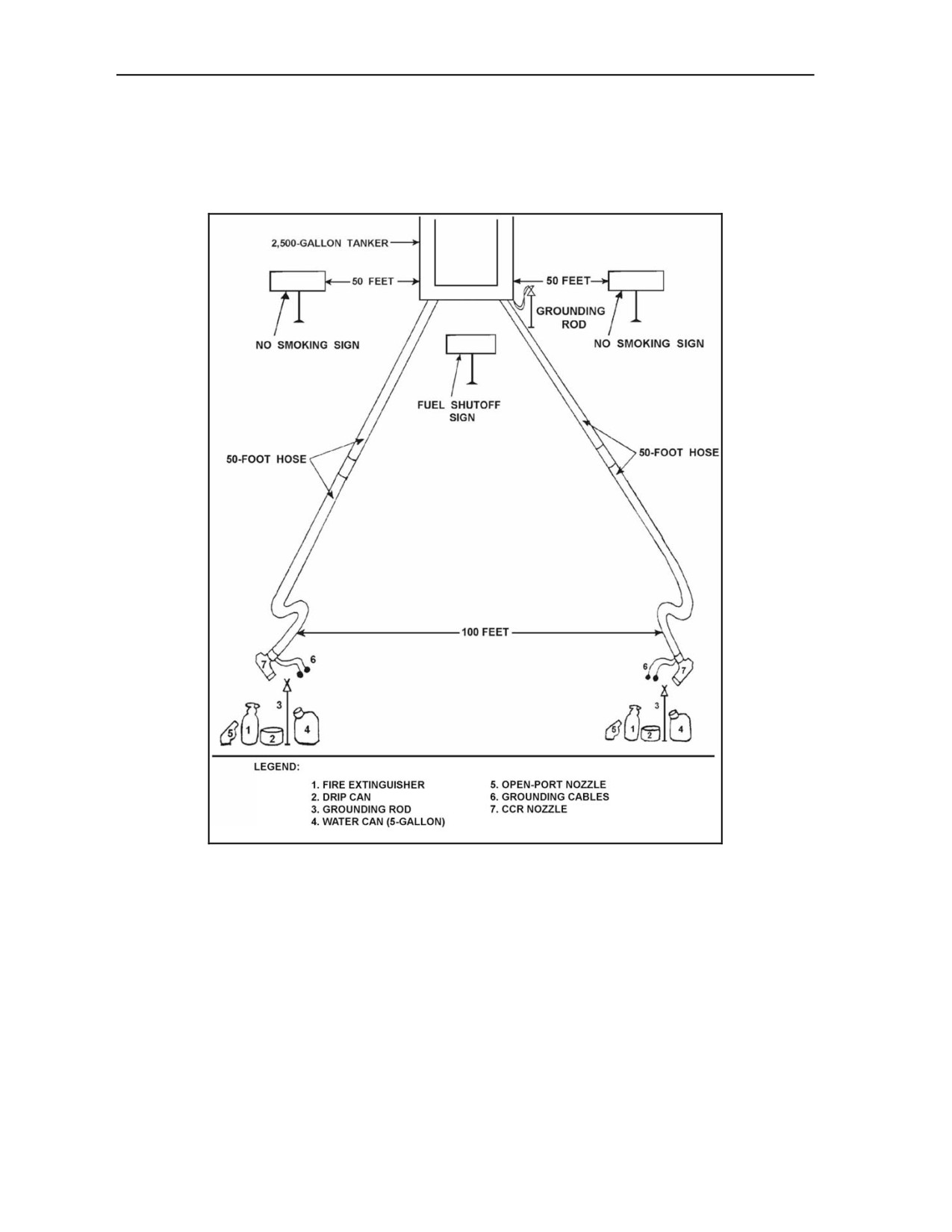
3-37. The HEMTT (M977) and the HEMTT tanker (M978) are the primary movers of Class III/V
supplies to the FARP (figure 3-3, page 3-8). The M977 can carry 22,000 pounds of cargo. An onboard
crane mounted on the rear of the vehicle has a 2,500-pound lift capability. The crane enables the HEMTT
to load and off-load ammunition without the need for MHE. The M978 tanker holds 2,500 gallons of fuel
and provides two refueling points. When paired with the HEMTT tanker aviation refueling system
(HTARS) and the AAFARS (see AAFARS, B-7), the M978 can simultaneously refuel four aircraft. When
two M978 trucks are positioned properly you can run an eight-point refueling operation. Leadership must
3 August 2006
FM 3-04.104
3-7
Chapter 3
ensure that proper manning and equipment assets are forecasted. The heavy expanded mobility
ammunition trailer (HEMAT) (M989) is used with the M977 or M978. It can carry 22,000 pounds of
ammunition. The HEMAT can also carry four 500-gallon collapsible drums or two 600-gallon pods of
fuel. Generally, one armament HEMTT with HEMAT can support up to four OH-58D or three AH-64
aircraft.
Figure 3-3. Heavy expanded mobility tactical truck forward arming and refueling point layout
3-38. The 5-ton truck can transport either ammunition or fuel. When it transports fuel, the truck is
normally set up with a tank pump unit (TPU) consisting of two 600-gallon fuel pods and refueling
equipment for two fuel points. The 5-ton truck also can tow a 1 1/2-ton trailer with either a 600-gallon
fuel pod or a 500-gallon fuel drum, or the trailer can be used to transport ammunition.
AIRCRAFT DELIVERY
3-39. Emplacing FARPs by air offers three major advantages.
The FARP can move about the battlefield much faster by air than by ground.
Nearly every open field becomes a potential FARP site.
It is generally more practical, from a threat perspective, to air emplace FARPs in support of
shaping operations in deep areas.
3-8
FM 3-04.104
3 August 2006
Forward Arming and Refueling Point Utilization
3-40. Air emplacement of the FARP has the following disadvantages:
Aerial emplacement depends on availability of supporting aircraft. If the enemy is advancing
and no utility or heavy helicopters are available for FARP displacement, the entire FARP can
be lost.
Requires dedicated aircraft to move bulk quantities of Class III/V products and MHE.
Additional aircraft traffic could compromise the FARP's location, increasing the likelihood of
an enemy attack.
Aircraft that are sling loading equipment and supplies cannot fly NOE and are more visible to
enemy sensors and missiles.
If the FARP is contaminated by CBRN attacks, it cannot be moved until it has been
decontaminated or the commander must accept the contamination of support aircraft and the
spread of contamination to clean areas.
Jump Forward Arming and Refueling Point
3-41. Two UH-60s can deliver an austere jump FARP to its new location. One UH-60 can carry up to two
500-gallon collapsible fuel drums and part of the FARP crew. The other UH-60 transports the rest of the
FARP and sling loads the FARE or the AAFARS, which may be mounted on a 3/4-ton trailer. If the
FARE or AAFARS is mounted on the trailer and the sides of the trailer are built up with wood, to include
a cover, then some ammunition can also be transported. This ensures that the jump FARP will have some
ammunition as well as fuel at the scheduled time. The UH-60s can then transport the bulk of the
ammunition required for the mission in a second lift as well as additional fuel drums. A UH-60 can sling
load three Hellfire pallets at once for a total of 27 missiles.
Fat Cow
3-42. The CH-47's ERFS or ERFS II, better known as Fat Cow, is a modular, interconnectable system.
The primary mission is to provide a safe and convenient means of increasing the range and endurance of
the CH-47D helicopter to include worldwide self-deployment capability and transporting fuel for forward
area refueling operations.
3-43. The operational advantages of the Fat Cow are the following:
The CH-47 is an instant FARP. Once the CH-47 is on the ground, the system can be rapidly
employed.
The Fat Cow is especially useful for deep operations.
When refueling operations are completed, FARP equipment is packed up, the CH-47 takes
off, and the site is cleared within minutes.
The Fat Cow may also be pressure refueled for faster turnaround missions.
3-44. The operational disadvantages of the Fat Cow are the following:
A safety hazard may be created if the blades are turning on the aircraft during refueling.
Due to additional weight of fuel, the CH-47 fuel burn rate increases tremendously.
The signature of the CH-47 makes the operation vulnerable to detection and attack.
Extended Range Fuel System
3-45. This system can provide up to 2,320 gallons of fuel to refuel other aircraft. When using the FARE
or AAFARS with the CH-47 aircraft, two refueling points can be employed at approximately 200 feet
apart. Any additional distance can be obtained by adding fittings and hoses.
3-46. Figure 3-4, page 3-10, shows the configuration of the ERFS for the CH-47. With the ERFS, little
space for cargo and passengers remains. Each side of the aircraft can seat four people. Figure 3-5, page 3-
10, shows the proper placement for the rest of the required equipment to include the FARE/AAFARS.
With a Army Command seats out waiver, units can transport additional FARP or security personnel. (See
Army Regulation [AR] 95-1.)
3 August 2006
FM 3-04.104
3-9
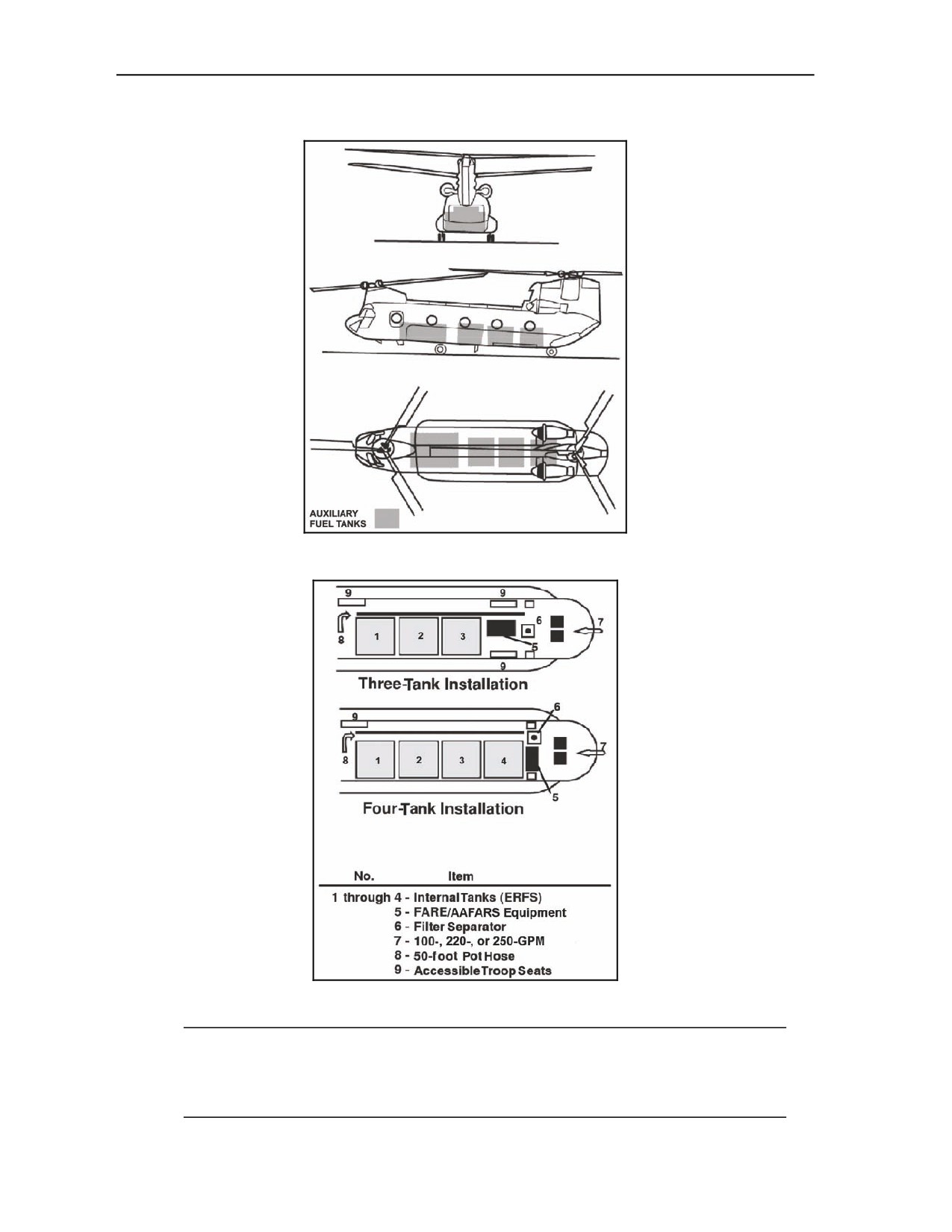
Chapter 3
Figure 3-4. Configuration of the extended range fuel system (fat cow)
Figure 3-5. Gear board
Note: The ERFS is airworthy when it is installed, operated, and maintained as described in
Technical Manual (TM) 55-1560-307-13&P. With this configuration, however, fuel can leak
into the cabin and a catastrophic incident can occur in case of a hard landing or an accident.
When the noncrashworthy ERFS is installed, the potential for fires during a crash increases.
3-10
FM 3-04.104
3 August 2006
Forward Arming and Refueling Point Utilization
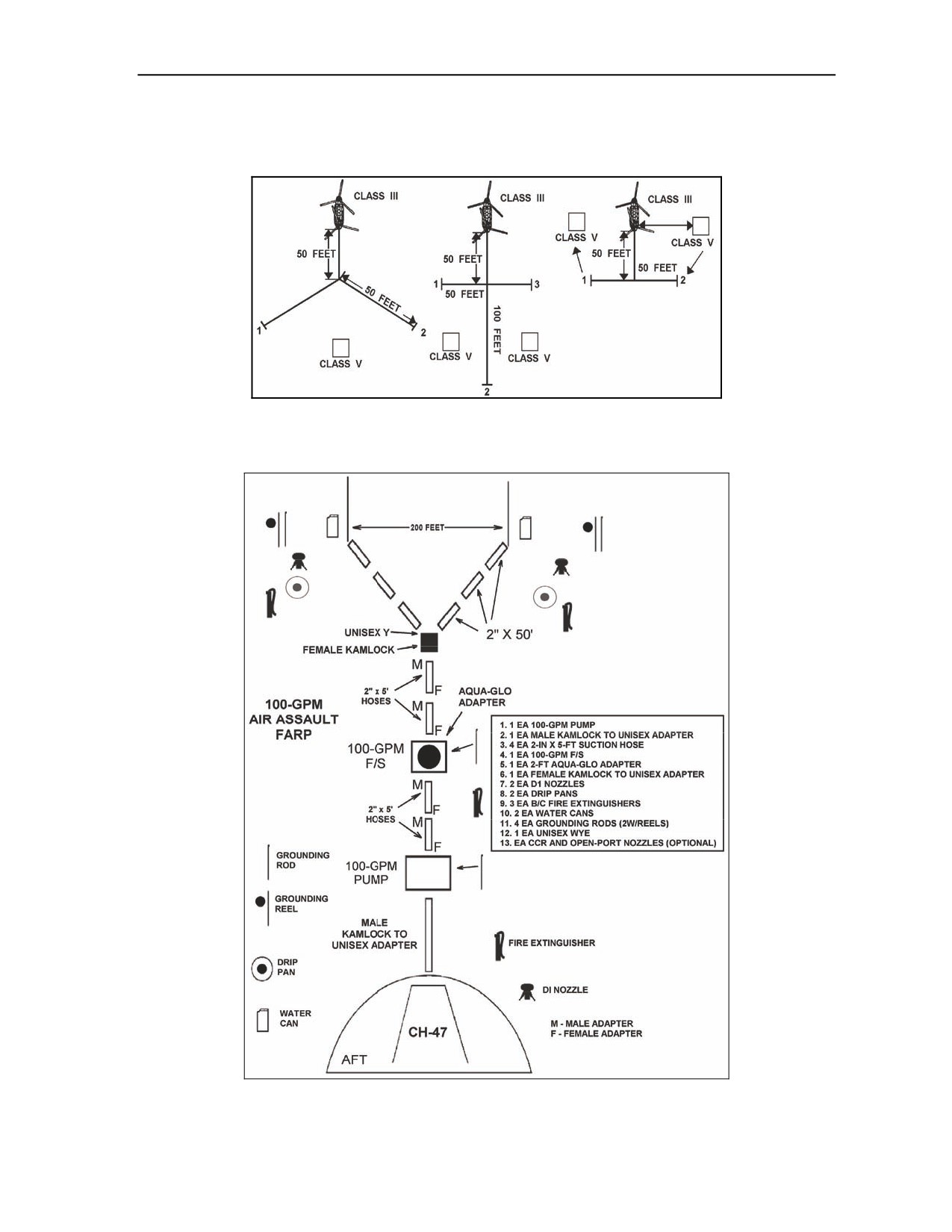
3-47. After the aircraft lands, the fuel pods can be used to set up refueling points quickly. Figure 3-6
shows how the refueling points may be set up. However, the actual setup will depend on the equipment
available.
Figure 3-6. Refueling point setups
3-48. Figure 3-7 shows how the refueling points may be set up.
Figure 3-7. Extended range fuel system layout configuration
3 August 2006
FM 3-04.104
3-11
Chapter 3
Extended Range Fuel System II
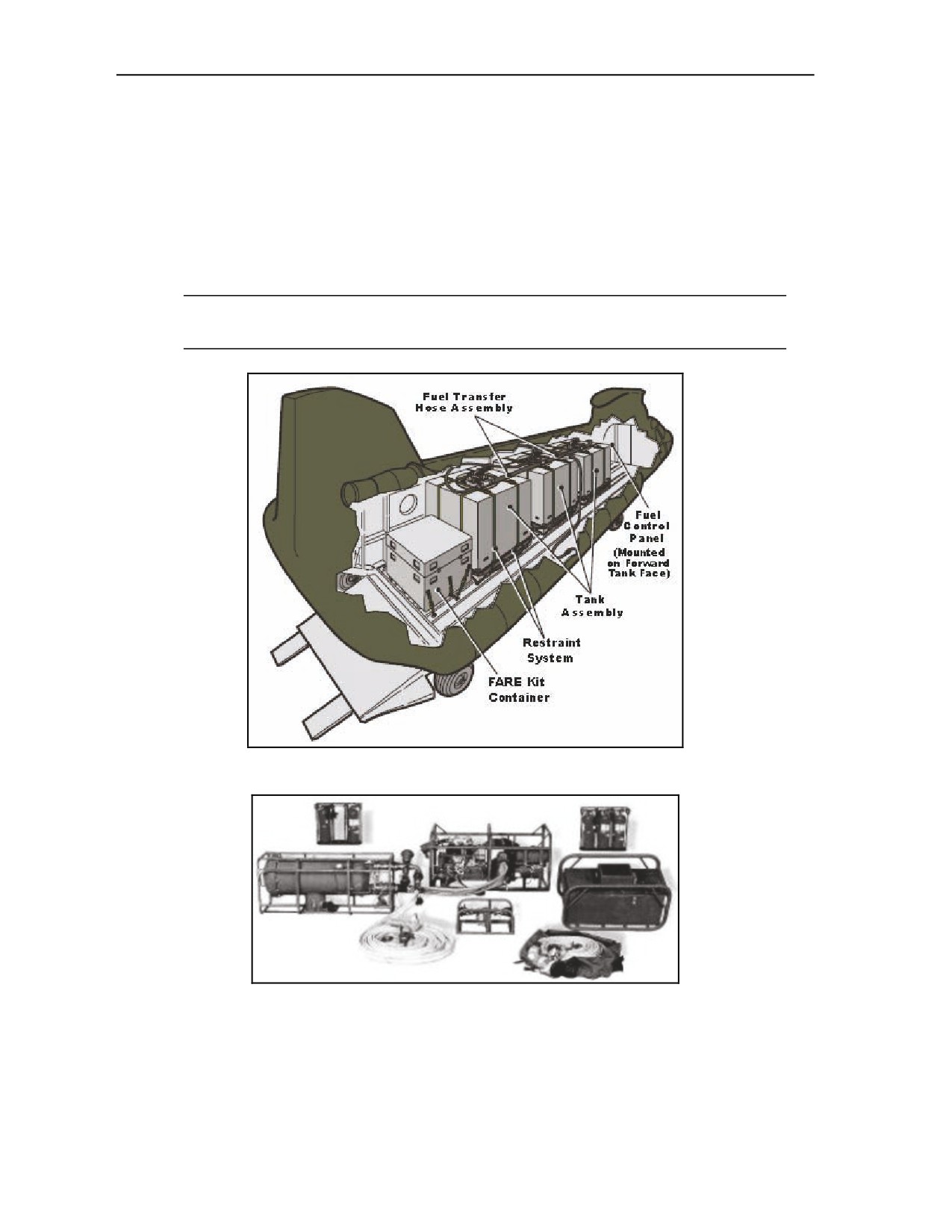
3-49. ERFS II is an autonomous system (figure 3-8); the power to operate both types of pumps is
supplied by the helicopter electrical system. Unlike the ERFS, the FARE transfer is accomplished by a
pump rated at 120 gallons per minute (GPM) located on the aft tank of the ERFS II (figure 3-9). The
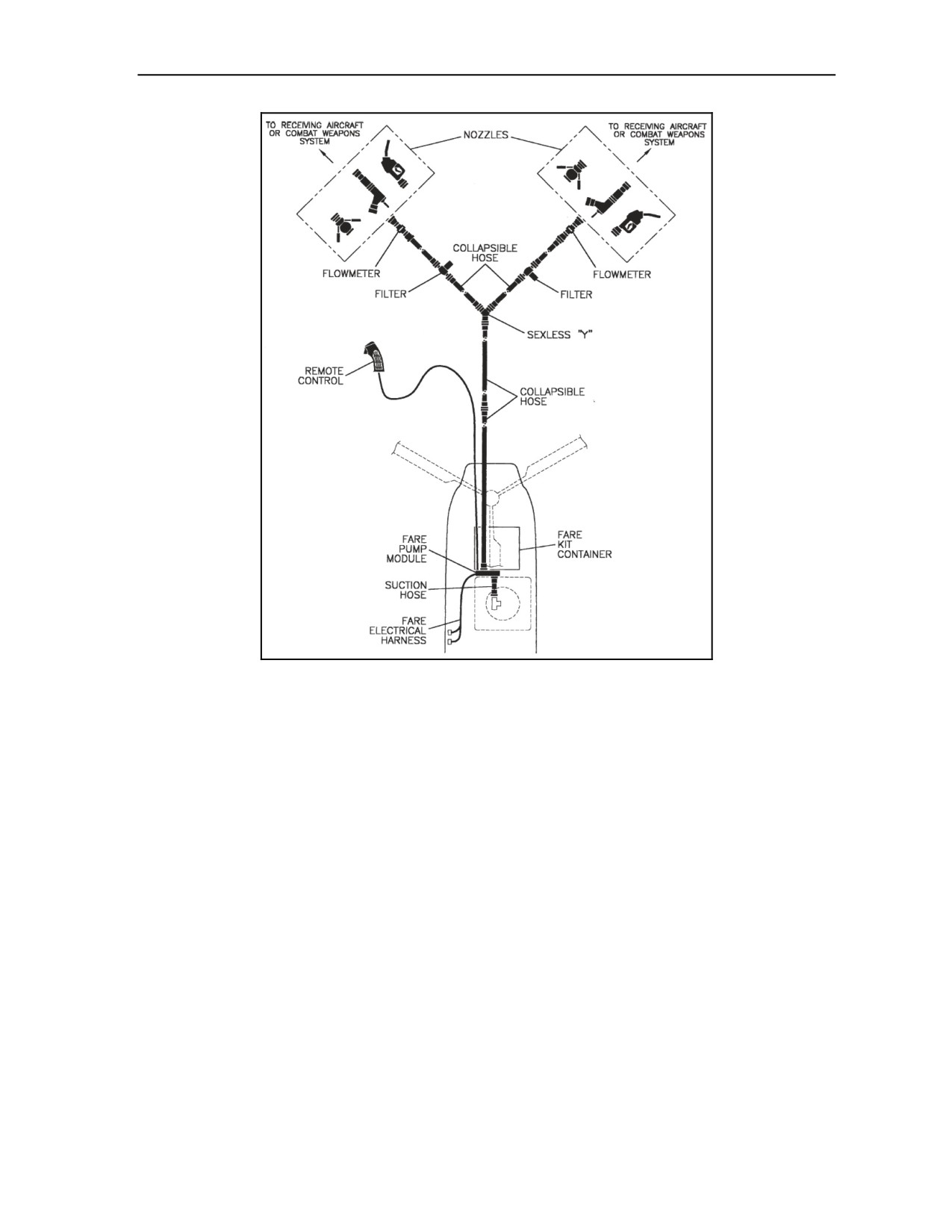
pump supplies two refueling points 200 feet from the helicopter (figure 3-10, page 3-13). The ERFS II
provides the CH-47D with up to 2,400 U.S. gallons of auxiliary fuel for worldwide self-deployment or
tactical forward area refueling. For mission flexibility, one, two, or three tanks (each with a capacity of
approximately 800 U.S. gallons) can be installed. Regardless of configuration, the principles of operation
remain the same. (See TMs 1-1560-312-10 and 1-1520-240-10.)
Note: The ERFS II is crashworthy and ballistically self-sealing when it is installed, operated,
and maintained as described in TM 1-1560-312-10.
Figure 3-8. Extended range fuel system II functional components
Figure 3-9. Forward area refueling equipment kit assembly
3-12
FM 3-04.104
3 August 2006
Forward Arming and Refueling Point Utilization
Figure 3-10. Configuring the forward area refueling equipment components
Wet Hawk/Fat Hawk
3-50. Similar refueling operations can be accomplished with the UH-60. The FARE is carried inside the
aircraft while the two 500-gallon drums are sling loaded. Advantages and disadvantages that apply to this
operation also apply to the ERFS operation. (Refer to TM 55-1560-307-13&P for additional information.)
A Wet Hawk is a UH-60 that provides fuel to another aircraft from its own internal or
external fuel tanks via a micro-FARE system.
A Fat Hawk is a UH-60 that provides both fuel and ammunition.
The absence of an external load increases UH-60 survivability, reduces emplacement time,
and limits enemy capability to target the FARP.
Normal operations consists of two external stores support system (ESSS) equipped UH-60
aircraft with full crew, three to four POL personnel, a combat lifesaver/medic, security
personnel, armament personnel, and armament and refuel equipment to support the mission.
JOINT AIRCRAFT ASSETS AVAILABLE FOR REFUEL AND RESUPPLY
3-51. If the brigade or battalion assembly area (AA) is located at an airfield base camp or forward
operating base or if an austere airfield is available, units may be able to request joint fixed-wing
refuel/resupply support.
3-52. Marine Corps CH-53s have a unique refueling capability that can support supply points, operations
in deep areas, and other specialized mission applications. Marine Corps CH-53 units are equipped with
3 August 2006
FM 3-04.104
3-13
Chapter 3
the tactical bulk fuel delivery system (TBFDS) that includes one to three 800-gallon internal fuel tanks
and a 120-GPM refueling system, allowing transport of 800, 1,600, or 2,400 gallons of fuel. However, the
fuel system is tied into the aircraft’s main fuel tanks, allowing delivery of additional fuel. Because the
CH-53 can air refuel, it can quickly join with a KC-130 at altitudes as low as 500 feet above ground level
to replenish TBFDS tanks and rejoin the ground FARP or fuel supply location to replenish additional
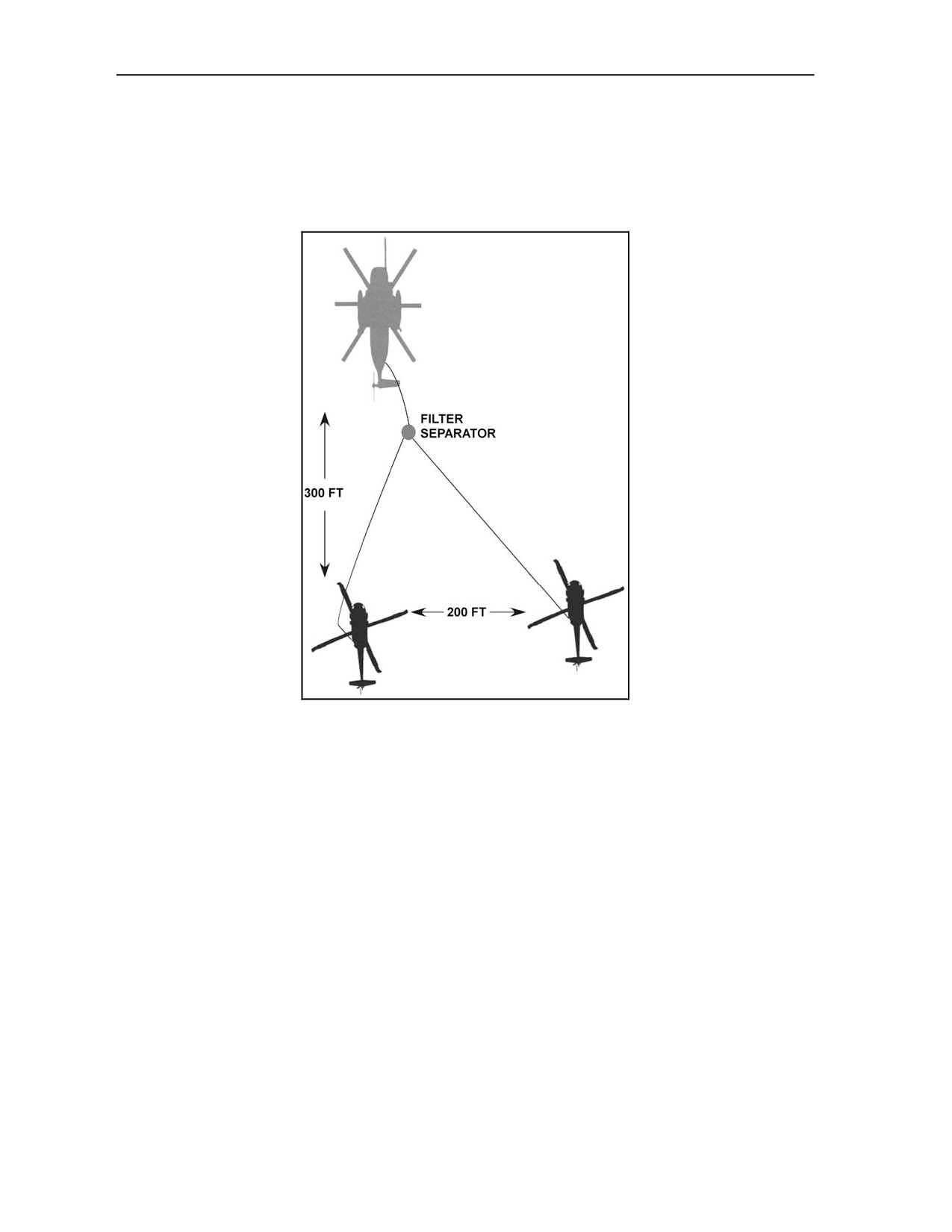
aircraft (figure 3-11).
Figure 3-11. Heavy expanded mobility tactical truck tanker aviation refueling system
configuration and additional components for CH-53 forward arming and refueling point
3-53. The Marine Corps KC-130F/R/T/J models are equipped for airborne refueling but also rapid ground
refueling of Marine or, in this case, Army helicopters and ground vehicles. Aircraft refuel from wing fuel
and pods mounted under the wings. They also can carry a 3,600-gallon stainless steel tank inside the
cargo compartment for additional fuel delivery. Older model KC-130s require this cargo compartment
tank for refueling and can only transport 5,588 gallons in wing and wing-pod fuel tanks. The new KC-
130J can deliver up to 8,455 gallons from wing pods and wing fuel and an additional 3,600 gallons from
the cargo compartment tank. It can also refuel without the cargo compartment tank, allowing palletized
ammunition and other supplies to be transported. It has its own pumps and hoses that can dispense up to
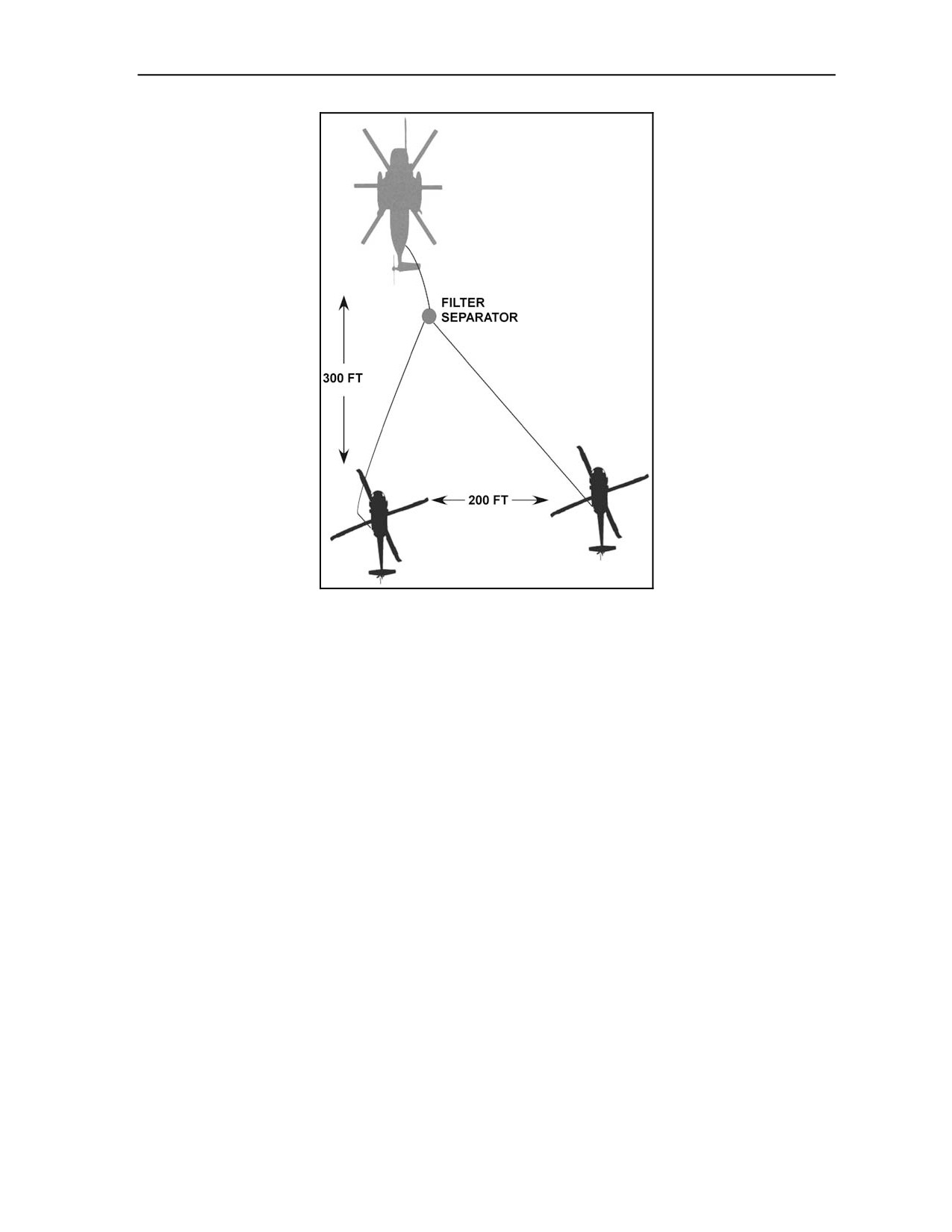
300 GPM from each pod (figure 3-12, page 3-15).
3-14
FM 3-04.104
3 August 2006
Forward Arming and Refueling Point Utilization
Figure 3-12. Heavy expanded mobility tactical truck tanker aviation refueling system
configuration and additional components for KC-130 forward arming and refueling point
3-54. The United States Air Force (USAF) C-17 also can function as a tanker providing fuel to ground
receivers using HTARS. The receivers can be Army aircraft, trucks, bladders, or other equipment. The C-
17 can deliver fuel through either one or both of its single-point receptacles. The C-17 booster pumps
defuel the aircraft using the HTARS and additional Army components. Aircraft can defuel at a rate of 520
GPM, depending on the number of booster pumps (figure 3-13, page 3-16).
3 August 2006
FM 3-04.104
3-15
///////////////////////////////////////