FM 5-415 Fire-Fighting Operations - page 4
FM 5-415
• Mileage traveled.
• Weather.
• Remarks made by people around the burning structure.
ORIGIN OF A FIRE
8-105. In a serious fire (loss of life, extensive property damage), the fire
marshal or another person from higher fire-department HQ may assist in the
investigation as an impartial party. The investigators may collect more
detailed information than required. The information may include the—
• Reasons for delay in the alarm.
• Extensive spread of the fire.
• Heavy property loss.
• Inability of occupants to escape.
• Fire-fighting methods used.
• Adequacy of the water supply.
• Correction of previously noted deficiencies.
8-106. In a less serious fire, the information recorded on the fire report is
sufficient. However, until all evidence is examined, you may not accurately
account for a fire's origin and cause and the damage estimates.
8-107. To locate a fire's origin, you may have to reconstruct the walls, replace
the loose boards and doors, or rearrange the furniture. Obtain as much
information as possible about the types of materials that were in an area.
Examine the remains because they can indicate the direction of the heat flow.
However, factors such as drafts can also affect a fire's spread and heat flow.
The condition of metals, grass, wood, plastics, and other materials are good
indications of the temperatures at certain spots.
WOOD
8-108. Char depth indicates the length of time that wood burned. Most woods
will char at the rate of 1 inch per 40 to 45 minutes burn time at 1400 to
1600°F. Demarcation lines between charred and uncharred material are
indicators of the type of heat involved. For example, if you chop or saw
through charred boards located near a fire's origin, there should be sharp,
distinct lines between charred and uncharred wood. This will occur if the fire
was fast and intense and extinguished quickly. The wood will show a
gradation of char and a flat, baked appearance throughout, if a fire was long
and slow.
GLASS
8-109. Glass is composed principally of silicon and lime. Glass will soften at
1200° to 1400°F and will become molten above 1600°F. Examining the glass
Structural Fire-Fighting Operations 8-33
FM 5-415
can provide information as to how a fire's heat reacted on the glass or if other
forces acted on the glass.
•
Heat. The following explains how heat can react on glass:
— Broken pieces from windows in clear, irregular, block-shaped
pieces indicate a rapid, intense buildup of heat in a 1- to 5-
minute time frame.
— Heavily glazed pieces with little or no stain indicate an
intense heat with a slow buildup.
— Heavily stained pieces with no crazing indicate a slow buildup
with considerable smoke. Half-moon checks on a stained side
indicate that the glass was still in the frame during a fire and
that water splashed on the glass.
— Unstained or heat-checked pieces found on the floor indicate
that the glass was broken by intense heat early in a fire.
•
Other forces. The following lists reactions glass has from other forces:
— Clear, long, rectangular pieces inside a building indicate that
some other force (forced entry) broke the glass.
— Radial cracks in glass emitting from the point of impact and
concentric cracks around the point of impact indicate that the
glass was broken by a blow from a hard object. The glass near
the break comes out in rectangular- or triangular-shaped
pieces.
— Thermal cracks in glass have no pattern and pieces are odd-
shaped.
— High-intensity explosives (dynamite) cause glass to sliver.
— Low-intensity explosives (dust or gas) cause glass to break off
in chunks.
METAL
8-110. Most chromium or shiny metal surfaces, such as light fixtures,
toasters, and irons, turn different colors when subjected to intense heat. The
color variance could indicate the progress of a fire.
CAUSE OF A FIRE
8-111. When investigating the cause of a fire, first consider common causes,
such as discarded cigarettes, overheated or defective stoves or flues, faulty
electrical appliances, and slag or sparks from welding and cutting machines.
If none are the cause of a fire, question all the people who are at the fire scene
(mainly building occupants), the people who were present at the time of or
immediately before the discovery of the fire, and the people who had left the
building and may have returned. When investigating a fire's cause—
• Reconstruct all the areas as much as possible.
• Determine the heat path and the fire's point of origin.
8-34 Structural Fire-Fighting Operations
FM 5-415
• Determine the approximate burning time.
• Evaluate the combustion characteristics of the materials involved.
• Compare similar materials and situations, if possible.
• Fit the known facts to the various possibilities.
• Compare the information from the occupants and neighbors as to the
activities before the fire.
8-112. Extensive investigations are required for high property-loss fires or
those involving loss of life. Appointed officials, assisted by the fire marshal
and appointed aides, usually conduct these investigations. Before moving or
shoveling out any material, carefully examine the layers of material as you
work to the floor. This method could show the sequence of materials burned
from the point of origin. In a fire, aluminum and similar alloys will melt fairly
early, splash or run on other materials, solidify at lower temperatures, and
protect the material from further damage.
LOSS ESTIMATE
8-113. Loss estimates are calculated after you complete salvage operations.
Inventory all remains and compare that list with a prefire inventory list. Loss
includes damages from smoke, heat, water, and fire. Installation engineers
often assist in estimating loss value. The fire chief examines the fire scene and
writes a brief description of the extent of the physical damage.
8-114. On an installation, the organization that is responsible for construction
contracts estimates partial losses of Army structures. Total structural loss is
the structural value taken from a recent prefire real-property report. Because
construction costs fluctuate, evaluators should make an estimate based on
current restoration costs. Vehicle and aircraft losses will be determined by
replacement in kind for partial losses and recorded inventory value less
salvage for total losses.
8-115. When preparing a preliminary report, the fire chief should not go into
detail in a loss estimate. If available, the fire chief should use the estimate
that the evaluators provide. If the two estimates vary greatly, a further
investigation may be necessary. Either party may have overlooked important
evidence during their evaluation, which would account for a discrepancy.
FINAL ACTION
8-116. In large fire operations, the SFO must obtain as much information as
possible, such as the names of witnesses, statements, photographs, a sketch of
the building, and the location of apparatus and hose lines. Firefighters not
involved in salvage and overhaul operations should return to the station.
Crew chiefs should double check the area to ensure that all the equipment and
tools are back on the fire apparatus. If a building occupant borrows fire
equipment, the fire personnel must have a receipt for the equipment and leave
instructions on returning the equipment.
8-117. Before leaving, reload hose lines in the bed of the fire truck in case an
emergency occurs before returning to the fire station. If you used only a few
sections, you may roll and stack the hose line on the tailgate.
Structural Fire-Fighting Operations 8-35
FM 5-415
RETURN TO QUARTERS
8-118. Once back at the station, the crew chief in charge reports on the status
of his truck to the alarm-room operator. He also notifies the alarm-room
operator when his truck is back in service. The fire chief or crew chief
completes the required fire reports and makes entries in the daily log book.
Firefighters—
• Check the fire apparatus.
• Wash the tires and inspect them for cuts, nails, and other damages.
• Check and resupply the fuel, oil, and water levels in the radiator and
booster tank.
• Replace the used hose lines with clean, dry hose lines.
• Wash the dirty hose lines and place them on racks to dry.
• Roll clean, dry hose lines.
• Wash wet salvage covers, inspect them for cuts and tears, and hang
them to dry.
• Inspect the ladders for damages.
• Clean and dry all dirty and wet tools and appliances.
• Apply a light coat of oil on the metal surfaces that might rust.
• Wash the entire fire apparatus to remove mud, dirt, and carbon.
8-119. After completing all clean-up operations, the crew chief or assistant
chief should conduct a general discussion with all fire personnel involved in
the operation. The crew chief should review the entire operation, pointing out
negative and positive aspects of the firefighter's actions. Before conducting a
general discussion, the crew chief should administer private reprimands as a
means of correcting individuals who committed serious mistakes. If the entire
crew needs improvement, the crew chief should conduct training sessions and
drills. If an individual or the entire crew does exceptionally well, the crew
chief should extend praise during the general discussion.
8-36 Structural Fire-Fighting Operations
Chapter 9
Miscellaneous Facility-Based Fire-Fighting Operations
9-1. Miscellaneous fire fighting generally refers to any fire-fighting
activity that does not involve structural or crash/rescue fire fighting.
Tactical petroleum terminals (TPTs), logistics bases, internment/
dislocated civilian camps, and general support hospitals are some of the
special mission areas that firefighters support. These infrequently
encountered, vital missions probably require firefighters to focus even
harder on training because they see so little of them.
TACTICAL PETROLEUM TERMINAL
MISSION
9-2. One of the major facilities that will require fire-fighting support in the AO
will be the TPT. The mission of the fire-fighting team with a TPT in its AO
will be to—
• Position organic fire-fighting teams.
• Conduct sustainment training of POL crews to use the organic fire-
fighting equipment.
• Respond to all incidents involving the TPT.
SITE DESIGN
9-3. The TPT has organic fire-fighting equipment in its design, but the
equipment is a first-response measure only. The fire-prevention section of the
LA or the LB team will conduct an on-site inspection to ensure that the fire-
fighting suppression sets have been placed in the most effective locations. The
TPT personnel will inspect within their area to ensure that—
• Berms are properly placed around storage areas in case of leaks or
spills.
• All leaks and spills are reported as required, to include the
appropriate Army safety and environmental protection functional
offices.
• The areas are spaced out to control the spread of fire.
TRAINING
9-4. Personnel assigned to a TPT will have little or no training on how to use
fire-suppression equipment. Therefore, fire-fighting teams will have to train
Miscellaneous Facility-Based Fire-Fighting Operations 9-1

FM 5-415
key personnel at the terminal so that TPT personnel can perform in case of an
emergency. Training will include—
• Putting the fire suppression sets into service.
• Conducting daily preventive maintenance checks and services (PMCS)
of the set and their personal protective clothing.
• Using the sets effectively in an emergency.
ADDITIONAL SUPPORT
9-5. In any incident, the fire-fighting teams should respond to extinguish the
fire and contain the vapors. They will also ensure that fire-suppression sets
are reserviced and back in operation in a timely manner.
9-6. When responding to fires in a TPT, the fire-fighting teams must ensure
that they do not cause more damage than the fire; therefore, prefire planning
is important in a TPT. Networks of piping, valves, pumps, and storage
bladders will be interconnected throughout the site. Special care should be
noted for shut-off valves and response routes.
9-7. If a storage unit is fully involved and extinguishing the fire poses more of
a threat because of vapors, the fire-fighting teams will protect the other
storage areas and allow the fire to burn. Controlling runoff is very important
in fighting a fire in a TPT. Firefighters must channel the runoff and control it
to ensure proper cleanup after extinguishing the fire.
FIRE-SUPPRESSION EQUIPMENT
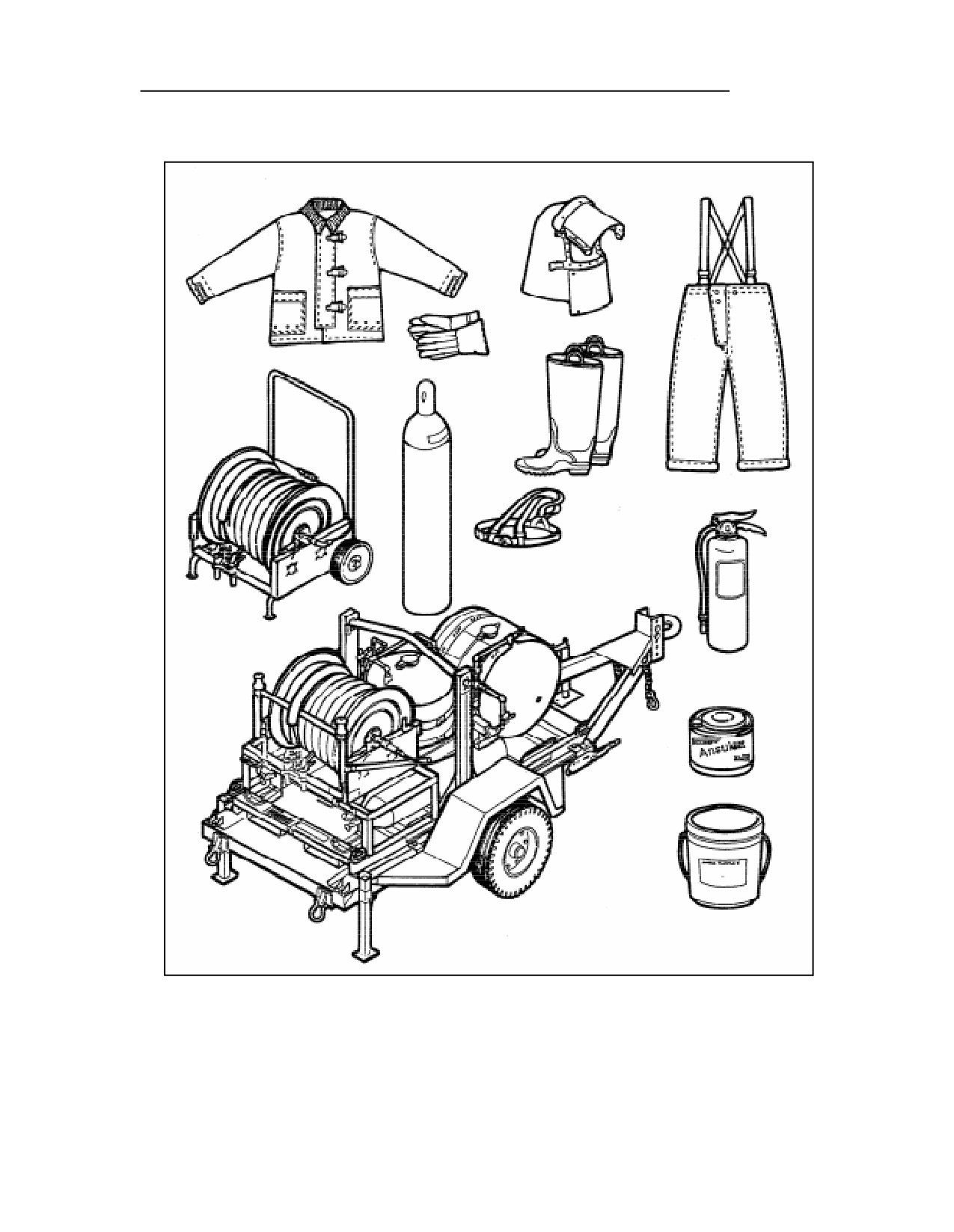
9-8. The basic load in a TPT will be 18 fire-suppression equipment sets. Table
9-1 lists the components of one set; Figure 9-1 shows one set. Each set must be
inspected and placed in service, according to TM 10-4210-235-13, before a TPT
can operate.
Table 9-1. Items in one fire-suppression equipment set
Number
Component
1
Trailer-mounted, twin-agent unit, 100-gallon AFFF, premixed/250-pound Purple K, 150-foot attack
line
1
Auxiliary hose cart with additional 150-foot attack line
3
Set of aluminized protective gear, 1 each of small, medium, and large
5
20-pound, dry-chemical extinguisher
3
Complete recharges for twin-agent unit
9-9. The fire-suppression equipment sets are designed so that the POL
handlers use them as a first response to a fire. Pre-positioning the sets is key
to their successful use in an emergency. Once the sets are in place, they are
considered fixed. The sets must be placed close enough to the danger areas
(300 feet maximum for the attack line) but not in the immediate area to
preclude their use. Each storage area should be accessible by at least two sets.
Additional sets should be in loading and unloading areas where pumps are
located. If possible, a free set should be available for hooking up to a vehicle
and repositioned, as required, to support other fixed locations in case of an
incident.
9-2 Miscellaneous Facility-Based Fire-Fighting Operations
FM 5-415
Figure 9-1. Fire-suppression equipment set
Miscellaneous Facility-Based Fire-Fighting Operations 9-3
FM 5-415
LOGISTICS BASE
9-10. Fire-fighting teams assigned to major logistics bases will be involved in
emergencies involving internal and external storage, bulk POL products,
HAZMAT storage, tent cities, vehicles, and personnel incidents. Their
missions will include the following:
FIRE PROTECTION AND PREVENTION
9-11. Fire-fighting teams will assist in planning a base. The LA team should
be available to the commander during site planning and once the operations
begin. Fire prevention should be a high priority on a commander's list. Access
to storage areas must allow for movement of fire-fighting apparatus, including
water tankers. Temporary water points should be placed for maximum usage
in high risk areas. Areas that store HAZMATs should be noted on response
charts, and all crews must be made aware of these areas. Material data sheets
should be available before an incident occurs for prefire planning.
HAZARDOUS MATERIALS
9-12. Fire-fighting teams must ensure that—
• HAZMATs are stored according to current safety and environmental
protection regulations.
• All reactive materials are stored in separate locations in case of a
breech of containers.
• All personnel, including the fire-fighting crews, who work in an area
where containers are stored are aware of the possible dangers
involved with a container breech.
OTHER MISSIONS
9-13. Fire-fighting teams on a logistics base will also assist in rescue
operations and in emergency medical services, as required.
INTERNMENT/DISLOCATED-CIVILIAN CAMP
9-14. Fire-fighting teams assigned to protect internment/dislocated-civilian
camps are responsible for the following:
• Fire protection and prevention. Fire prevention should be a high
priority on the commander's list.
• Assistance in base planning. Fire-fighting teams will be required to
assist in base planning. Members of the LA team should be available
to the commander during site planning and once operations begin.
They should ensure that access to their stations allows for movement
of fire-fighting apparatus, including water tankers.
9-4 Miscellaneous Facility-Based Fire-Fighting Operations
FM 5-415
GENERAL-SUPPORT HOSPITAL
9-15. Fire-fighting teams assigned to protect a hospital are responsible for the
following:
• Fire protection and prevention. Prevention should be a high priority
on the commander's list. Fire-fighting operations must be quick and
confining the fire, a priority. Prefire plans and control points should be
developed during set up or as soon as possible. The fire-prevention
section must monitor the storage of HAZMATs and compressed
gasses.
• Support of all MEDEVAC missions. Fire-fighting teams will assist
medical personnel in evacuating the sick and injured, when required.
• Assistance in base planning. Members of the LA team should be
available during site planning and once the operations begin. They
should ensure that access to their stations allows for movement of fire-
fighting apparatus, including the water tankers.
Miscellaneous Facility-Based Fire-Fighting Operations 9-5
Chapter 10
Fire-Fighting Operations Involving Explosives
10-1. This chapter addresses the basic knowledge that firefighters need to
handle incidents when munitions, ordnance, or chemical weapons are
involved in a fire. The chapter will show the various types of warning
signs/placards, how to mark ordnance, and what ordnance should look
like. Emergency procedures on when to fight such fires or when to
evacuate will be discussed. The last section will cover UXO. In recent
operations, lack of knowledge and/or training about UXO has killed more
soldiers than the enemy has. Whether at an incident or responding to one,
firefighters need to know how to report UXO.
RESPONSIBILITIES
COMMANDERS
10-2. All commanders are responsible for preventing accidents involving
personnel operations and activities under their jurisdiction. They are
responsible for storing and transporting nuclear, chemical weapons and
munitions, and any other HAZMATs. Commanders will ensure that—
• Personnel who handle and transport HAZMATs understand the
procedures to initiate when spills, leaks, fires, and other emergencies
occur. Chapter
11 details procedures personnel should use in
HAZMAT fires.
• Fire departments in the mutual-aid agreement chain are informed of
the type of situation that they are responding to and the procedures to
use at the scene.
• SOPs address nuclear, chemical, and HAZMAT control and
movement, fire-equipment placement, exposure control, and
evacuation procedures.
FIRE DEPARTMENTS
10-3. Fire departments provide C2, fire extinguishment, and HAZMAT
stabilization at an emergency site. After controlling an emergency, fire-
department personnel monitor the cleanup operations to prevent further life
or property loss.
SUPPORT AGENCIES
10-4. Fire departments are not equipped to handle large HAZMAT
emergencies. They will need assistance from many of the following:
• Bioenvironmental engineer.
• Base environmental coordinator.
• NBC section personnel.
Fire-Fighting Operations Involving Explosives 10-1
FM 5-415
• Containment and decontamination personnel.
• Medical personnel.
FIRE DIVISIONS
DIVISION 1
10-5. Division 1 deals with Hazard Class 1.1 materials, which are explosives
and liquid propellants. The primary hazard is mass detonation. The
Department of Transportation (DOT) classifies this division as explosive Class
A. When dealing with this hazard, firefighters—
• Perform rescue operations before extinguishing a fire.
• Attempt to extinguish a fire if nonexplosive and explosive materials
are separated or if the fire chief approves extinguishing procedures.
• Take protective cover if personal safety is in jeopardy.
DIVISION 2
10-6. Division 2 deals with Hazard Class 1.2 materials, which are
fragmentation ammunition and explosives. The primary hazard is explosion
with fragments. When dealing with this hazard, firefighters—
• Fight a fire when possible. If not possible, they prevent it from
spreading.
• Provide protection from fragments because such items could detonate.
DIVISION 3
10-7. Division 3 deals with Hazard Class 1.3 materials, which are ammunition
and explosives. The primary hazard is mass fire. The DOT classifies this
division as explosive Class B. When dealing with this hazard, firefighters—
• Fight the fire, if explosives are not directly involved.
• Immerse the white phosphorus (WP) in water or continuously spray it
with water if WP ammunition is involved.
• Apply dry sand or dry powder if hexachloroethane
(HC) and
incendiaries are involved.
• Allow magnesium to cool if pyrotechnics and magnesium incendiaries
are involved and if the magnesium is not on flammable materials. If
the magnesium is on flammable materials, they spread a 2-inch layer
of dry sand or powder on the floor, rake the burning material onto the
layer, and mix them together. They protect the adjacent facilities and
equipment. Firefighters will not use carbon dioxide (CO2), Halon
extinguisher, or water.
10-2 Fire-Fighting Operations Involving Explosives
FM 5-415
DIVISION 4
10-8. Division 4 deals with Hazard Class 1.4 materials, which are ammunition
and explosives. The primary hazard is moderate fires without a blast hazard.
When dealing with this hazard, firefighters—
• Fight the fires.
• Should be aware that minor explosions could occur, resulting in the
release of hot fragments.
FIRE SYMBOLS
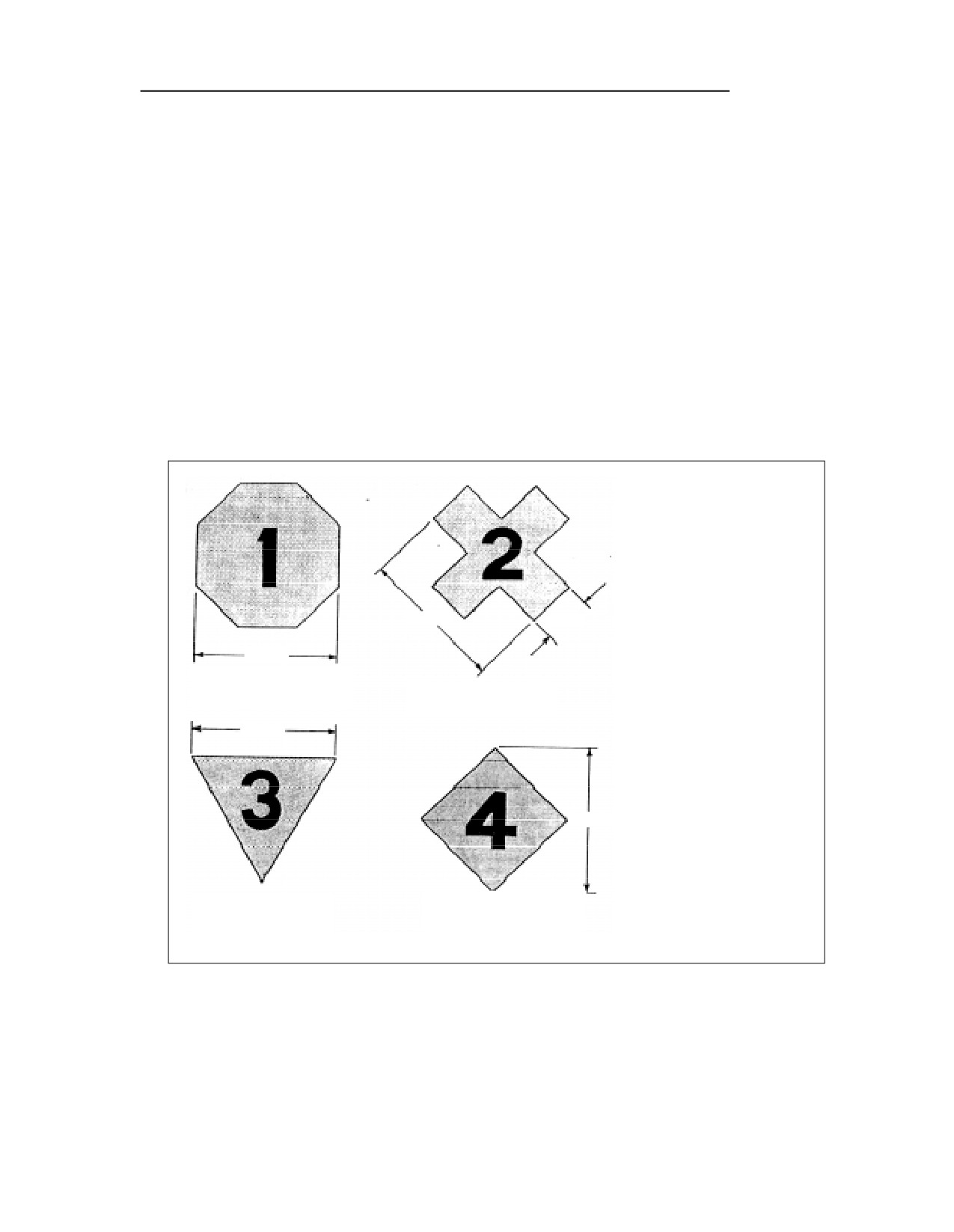
10-9. Figure 10-1 shows the fire symbols that identify the fire divisions. The
background color is orange, and the number that identifies the division is
black. The symbol color follows the DOT labels and placards for explosive
Classes A and B. Symbols indicating special hazards, such as toxic chemicals
and nuclear weapons, are displayed in addition to the fire symbols.
24 in
8 in
24 in
Background: Orange No.
Fire Division 1
12246; see GSA catalog.
Fire Division 2
Hazard Class 1.1
Hazard Class 1.2
Numbers: 10 inches high and
2 inches thick; black No.
24 in
17038; see GSA catalog.
24 in
Fire Division 3
Fire Division 4
Hazard Class 1.3
Hazard Class 1.4
Figure 10-1. Fire symbols
10-10. Fire symbols are displayed on the exterior of buildings and storage
sites containing explosives or ammunition. Removable placards or boards
showing the symbols may be used on buildings or storage sites in which
explosive contents frequently change. The symbols must be visible to
Fire-Fighting Operations Involving Explosives 10-3
FM 5-415
approaching fire-fighting crews from the maximum practicable distance. Fire
symbols are not required on earth-covered magazines or on outdoor riveted
sites restricted to storing hazard Class 1.1, (18)1.2, (12)1.2, and (08)1.2
materials. However, for safety, commanders may designate blocks in earth-
covered magazines as areas containing HAZMATs and may require the
display of the appropriate fire symbol.
10-11. Warehouses and other facilities used for storing empty explosive
containers that have not been decontaminated will display a division 4
symbol. Buildings containing radioactive materials will use the standard
radiation symbol described in 10 Code of Federal Regulations (CFR) 20.1901
and 20.1902.
10-12. While on Army installations, all railroad cars and vehicles containing
ammunition, explosives, and HAZMATs must display a fire symbol.
Installation railroad cars and vehicles not destined for movement off the
installation shall display at least two fire symbols. Installation transport
vehicles destined for shipments off the installation, commercial railroad cars,
and motor vehicles will display placards according to DOT regulations when
containing ammunition or explosives. Fire symbols or placards are placed on
all transport vehicles before loading and are removed after unloading. See
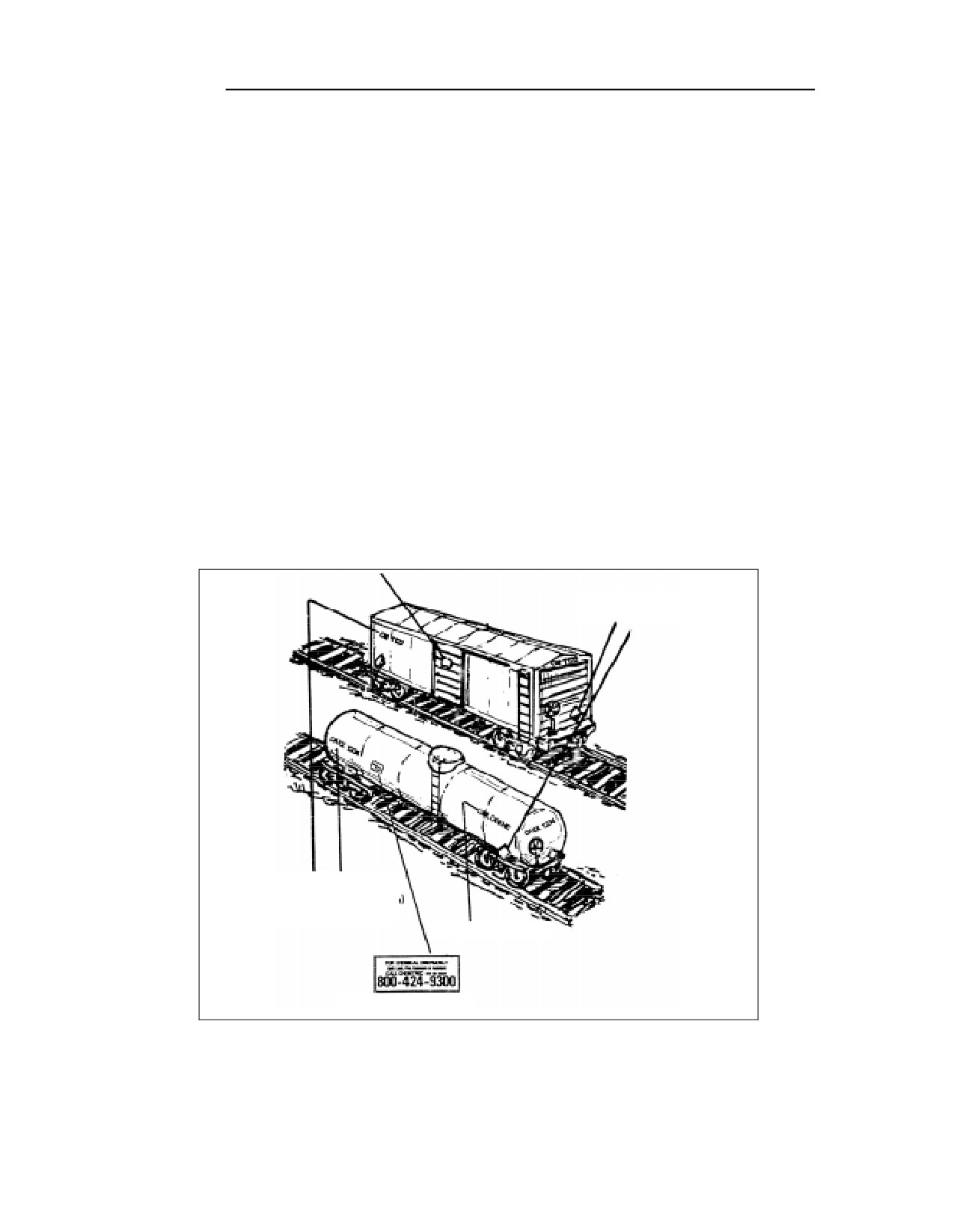
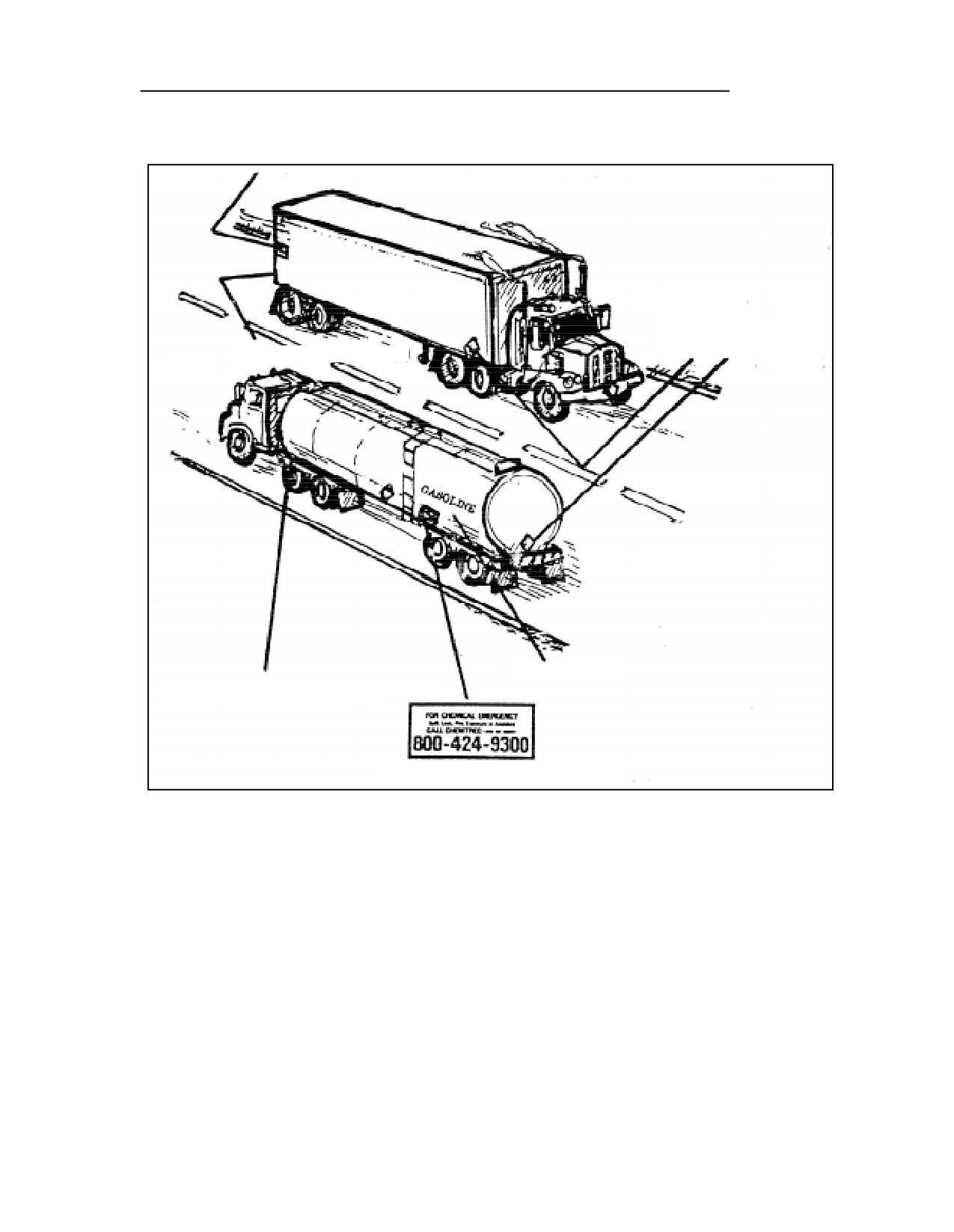
Figures 10-2 and 10-3 for placard locations on railcars and vehicles.
DOT placards
(on both ends and sides)
Car ID number
(on both ends and sides)
match to waybill
Product name
Emergency info
Figure 10-2. Placard placement on railcards
10-4 Fire-Fighting Operations Involving Explosives
FM 5-415
DOT placards
(on both ends and sides)
State(s) license plate(s)
Product name
Spec./cert./data plate(s) license plate(s)
Emergency info
Figure 10-3. Placard placement on trucks
10-13. When the fire symbols or topography- and vegetation-shield symbols
are not displayed on structures, maintain a master list or map indicating the
storage-site locations, fire and chemical symbols, and empty sites. Update and
post this list or map at all the entrances, control stations, and control points
servicing the storage location. Fire-fighting, guard, and emergency forces
should have a copy of this list or map. This provision for lists and maps does
not apply to chemical agents and chemical-munitions storage and operating
facilities. The personnel in charge of HAZMAT storage or shipping are
responsible for changing the fire symbols or DOT placards when necessary.
Fire-Fighting Operations Involving Explosives 10-5
FM 5-415
CHEMICALS
10-14. Storage and operating facilities and vehicles that deal with chemical
agents and munitions will display the appropriate chemical-agent symbol.
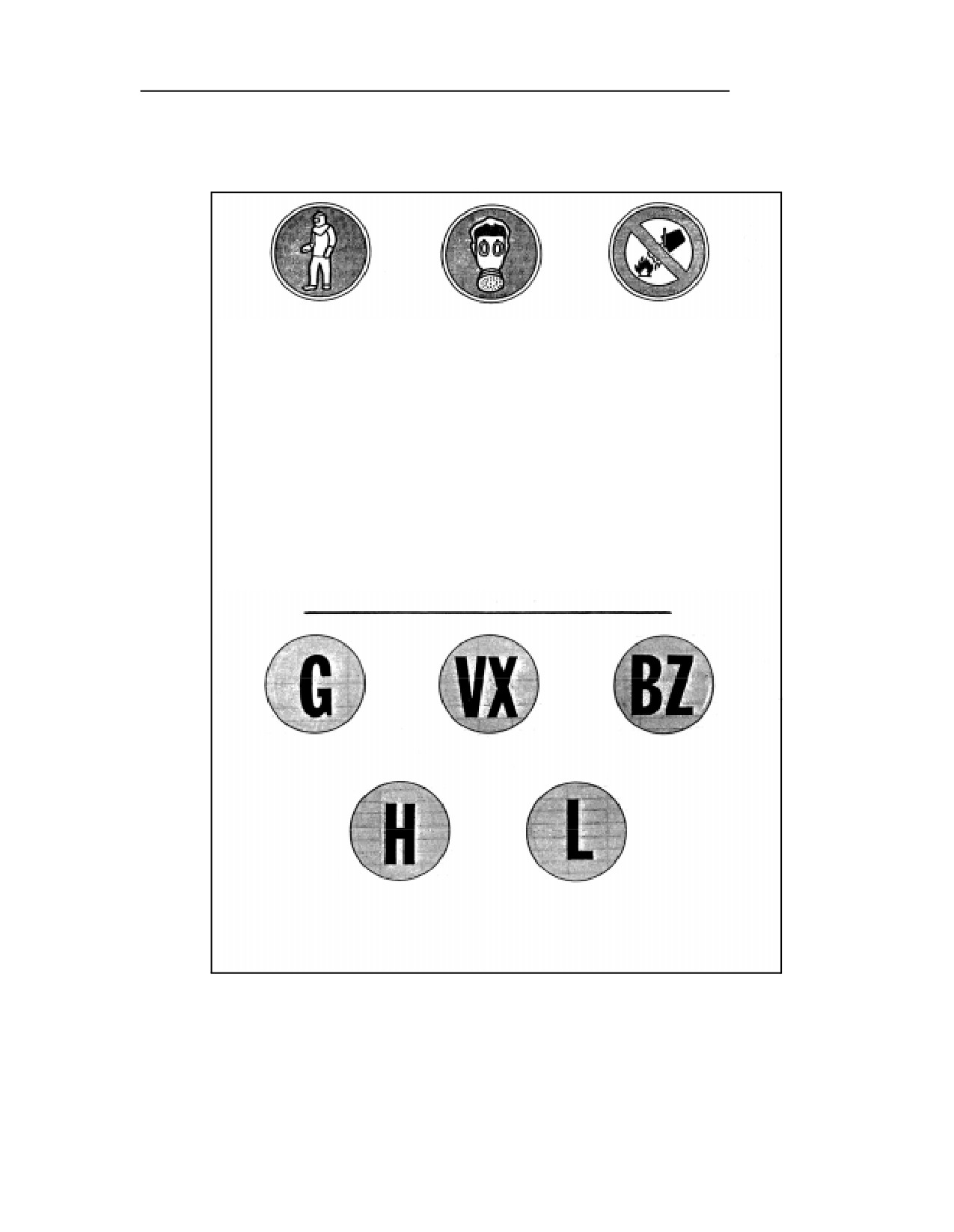
Figure 10-4 shows the chemical-hazard symbols. The color of symbol 1 (Figure
10-4) will indicate which set of protective clothing that fire crews must wear.
Symbol 2 (Figure 10-4) is posted when there is a presence of incendiary and
readily flammable chemical agents. This symbol indicates that fire crews
must wear breathing apparatus. Symbol 3 (Figure 10-4) is a warning against
extinguishing a fire with water. A dangerous reaction will occur if water is
applied. This symbol may be posted with other symbols, if required.
10-15. Below is a description of the chemical-symbol sets. If fire crews are
equipped with heat-resistant bunker gear and a protective mask or a SCBA,
they do not need the protective clothing identified in sets 2 and 3 when
fighting fires involving materials identified in these sets.
• Set 1. The symbols in this set have a blue background and a red rim
and figure. The symbol indicates the presence of highly toxic chemical
agents that may cause death or serious damage to bodily functions.
Fire crews must use the M9 protective mask or SCBA and
impermeable suit (hood, boots, undergarments, coveralls, gloves, and
protective footwear).
• Set 2. The symbols in this set have a blue background and a yellow
rim and figure. The symbol indicates the presence of harassing agents
(riot-control agents and smokes). Fire crews must use the M9
protective mask or SCBA, coveralls, and protective gloves.
• Set 3. The symbols in this set have a blue background and a white rim
and figure. The symbol indicates the presence of WP and other
spontaneously combustible materials. Fire crews must use the M9
protective mask or SCBA and flame-resistant bunker gear.
10-16. Table 10-1, page 10-8, shows the chemical agents most used in
ammunition and the combinations of chemical-hazard symbols that are
required on chemical-storage facilities.
10-6 Fire-Fighting Operations Involving Explosives
FM 5-415
Symbol 1
Symbol 2
Symbol 3
Wear full protective clothing
Wear breathing
Apply no water
apparatus
Color:
Color:
Color:
Background is blue.
Background is blue.
Background is white.
Figure and rim are
Figure and rim are
Circle and diagonal are
Red for set 1 protective
white.
red.
clothing.
Figures are black.
Yellow for set 2 protective
clothing.
White for set 3 protective
clothing.
Note: Colors per GSA Catalog: red No. 11105, blue No. 15102, yellow No.
13538, white No. 17875, black No. 17038
1. G-type nerve agents
2. VX nerve agent
3. Incapacitating agent BZ
4. H-type mustard agents
5. Lewisite
Figure 10-4. Chemical-hazard symbols
Fire-Fighting Operations Involving Explosives 10-7

FM 5-415
Table 10-1. Chemical agents used in ammunition
Chemical Agents and
Breathing
Apply no
Fillers in Ammunition
Apparatus
Water
Full Protective Clothing
G
VX
BZ
H
L
Set 1
Set 2
Set 3
GB
X
X
VX
X
X
H, HD, HT
X
X
L
X
X
CL, CG, CK, CN, CNS,
X
CS, BBC, DA, DC, DM,
FS, FM
HC
X
X
BZ
X
X
WP, PWP
X
TH, PT
X
X
IM, NP
X
TEA, TPA
X
X
Colored smokes
X
FIRE-FIGHTING PROCEDURES
10-17. How to fight a particular fire will depend on the type of ordnance
involved, how long the fire has been burning, how large the fire is, how long
the ordnance has been exposed to the fire, and whether or not any personnel
are trapped. The SFO must make a quick, accurate decision. However, any
decision that he makes must ensure the crew’s safety above all considerations.
AMMUNITION AND EXPLOSIVES
10-18. The fire crews must know the specific reactions that occur when
ammunition and explosives are exposed to heat or fire. They must be informed
of the known hazards and conditions that exist at a fire scene before
proceeding to a fire. Ammunition fires containing explosives and chemical
agents require special precautions. The crews will follow the procedures for
the fire division covering the materials involved in a fire.
Divisions 1 and 2
10-19. Materials in these divisions could detonate, causing a moderate-to-
severe fragmentation hazard. The fire crews will not approach the area closer
than 1,000 feet for every 50,000 pounds of explosives involved in a fire. Mobile
equipment will be kept at a protected location. The fire chief and SFO of the
responding unit determine if the facility is safe to approach. They agree on
procedures and then direct fire crews on how to approach the facility and
10-8 Fire-Fighting Operations Involving Explosives
FM 5-415
extinguish a fire. The same procedures apply to protecting adjacent buildings
from fire.
Division 3
10-20. Fires involving materials in this division produce wide-spread, intense
radiant heat that is dangerous to personnel and equipment. If a fire is minor
and controllable, fire crews will confine operations to preventing it from
spreading to other buildings.
Division 4
10-21. Generally, materials in this division present only a fire hazard. The fire
crews fight a fire with portable and mobile fire-extinguishing equipment until
it is extinguished.
CHEMICAL WEAPONS
10-22. Chemical weapons are designed to cause injury, disability, or death
from skin contact, inhalation, or ingestion of chemical agents. Responding
crews must approach the emergency scene cautiously. The success of a
chemical-rescue operation will depend on the—
• Knowledge that the fire crews have about chemical-weapons
procedures.
• Training that personnel receive using rescue equipment.
• Implementation of suggested changes or improvements that result
from discussions about chemical incidents.
10-23. Chemical weapons contain flammables or explosives that propel and
disseminate the chemical agent. When exposed to high heat, the agent is
consumed and dissipated; however, responding crews cannot accurately
determine if a fire has consumed the chemical. Therefore, they must assume
that these chemicals are present and must use extreme caution when in or
near the smoke from such chemical fires. Military installations that routinely
handle chemical weapons will have teams or fire-rescue personnel trained and
equipped to perform rescue and decontamination operations. Most fire
departments will have HAZMAT teams to assist when necessary.
10-24. The chemicals in weapons are stored as a solid, liquid, or gas but are
disseminated as a gas. Therefore, fire crews may not see spills or agents on
the ground. They must recognize the symptoms of chemical contamination.
The five basic categories of chemical agents and the exhibited symptoms of
exposure follow:
Nerve Agents
10-25. Nerve agents are designed to cause death or disability by disrupting
the voluntary nervous system (arms, legs, and throat) and the involuntary
nervous system (eyes, lungs, and heart). The agents are inhaled or absorbed
through the skin. Symptoms include pinpointing of the pupils, tightness of the
chest, runny nose, vomiting, and diarrhea, followed by total paralysis and
death.
Fire-Fighting Operations Involving Explosives 10-9
FM 5-415
Blister Agents
10-26. Blister agents cause severe blistering, disability, and injury to mucous
membranes (mouth, throat, lungs, and eyes). The liquid or fumes of blister
agents are inhaled or absorbed by the skin. Symptoms include formation of
blisters in the lining of the mouth, throat, and lungs.
Blood Agents
10-27. Blood agents inhibit the blood from using and transporting oxygen to
muscle and tissue. Blood agents are absorbed through the skin. Symptoms
include disruption of the victim's metabolism and eventual suffocation.
Choking Agents
10-28. Choking agents, which are inhaled, cause inflammation of tissues and
of the air passageways. Symptoms include restricting and narrowing of the air
passageway, causing the victim to choke.
Riot-Control Agents
10-29. Riot-control agents cause eye irritation and skin burns. The agents are
absorbed through the skin. Symptoms include burning sensations and
excessive tearing. When notified of a chemical accident, the responding crews
will don SCBA and rubber suits, if available. If this equipment is not
available, the crews will don full turnout clothing. When turnout clothing is
used, access to contaminated areas is restricted.
10-30. The responding crews will advance to the emergency site using the
most direct route, keeping in mind wind direction, temperature, and other
weather conditions. The fire crews should approach a fire from the upwind
side to minimize their exposure. If winds are low or variable, the hazardous
areas will be broad. If winds are high, the hazardous areas will be narrow, but
will extend further downwind.
10-31. At the scene, the technical advisor determines the action of the
responding crews. If a rescue or life-threatening situation does not exist, the
fire crews' actions will be to evacuate personnel and prevent a fire from
spreading to other areas. If rescue is necessary and the fire crews have
adequate protection, they enter the site from the upwind side and cover
burning materials with AFFF before attempting rescue operations. When
rescue is possible, the rescue personnel—
• Locate the victims.
• Wash the victims' faces with plain water.
• Move the victims to a safe, upwind location.
• Examine the victims for injuries and agent symptoms.
• Wash the victims’ open wounds with clear water and cover them with
an uncontaminated dressing.
• Release the decontaminated victims to the medical personnel.
10-32. After completing rescue operations, all fire-department personnel will
remove their contaminated clothing and wash or shower, using a 5-percent
bleach-in-water (HTH) solution. They will check each other for agent
10-10 Fire-Fighting Operations Involving Explosives
FM 5-415
symptoms. No personnel or clothing will be allowed from a site until the
commander's technical representative certifies that the clothing and
personnel have been decontaminated.
NUCLEAR WEAPONS
10-33. DA policy states that fire personnel should continue to fight a nuclear-
weapons or nuclear-components fire as long as they can—
• Prevent loss of life or serious injury.
• Prevent contaminants from scattering, especially plutonium.
• Save burning aircraft, vehicles, and structures and any nuclear
contents.
• Prevent property or material damage.
10-34. Nuclear weapons are designed to prevent nuclear yield if accidentally
detonated. However, nuclear weapons can yield nuclear material if the mass
of nuclear material receives even compression by the detonation of
surrounding high explosives. The high explosives and nuclear material are
the most hazardous components of nuclear weapons. Other components may
produce hazards; however, precautions taken against the high explosive and
nuclear materials adequately cover other components.
10-35. Burning high explosives have certain characteristics that fire crews
should recognize. The high temperature that oxidizes the explosive causes
torching (a hot, forceful flame from burning petroleum fuels or other
materials). The smoke of burning explosives has a lighter color than the
smoke of other burning fuels. As high explosives burn, they melt and drip,
flow, spread, and mix with surrounding materials. High explosives can pick
up impurities that make them more dangerous than before they melted.
10-36. Nuclear materials disperse as finely divided particles when the high
explosives in the weapons impact or detonate. The nuclear materials in the
weapons disperse as oxides if they burn. These particles and oxides are alpha
emitters that have very short ranges and cannot pierce the skin. When
particles or oxides are suspended in the air, they can be swallowed or inhaled
or absorbed through cuts in the skin (a more dangerous source of entry into
the bloodstream).
10-37. Inhaling oxidized nuclear material is the principal method by which
personnel are contaminated. The hazards are reduced once the particles settle
to the ground. Fire crews must be careful not to disturb these particles once
they have settled. If they must enter a contaminated area, they should—
• Occupy the area as little as possible.
• Use the SCBA or respirators and wear protective clothing.
• Use a wet handkerchief over their nose and mouth if the SCBA or
respirators are not available.
10-38. In any nuclear-weapons emergency, the first priority is to evacuate all
nonessential personnel. The minimum clearance distance is 3/4 mile. The SFO
assesses the situation and decides whether to fight a fire, maintain fire-
fighting efforts, or withdraw from the scene. The amount of time available to
Fire-Fighting Operations Involving Explosives 10-11
FM 5-415
fight a fire varies from a few minutes to an indefinite period, depending on the
weapon casings and the intensity and proximity of the fire to the nuclear
weapons.
10-39. When possible, fire crews should cool the weapons while controlling a
main fire. Water is the most effective agent for cooling. If the available water
supply is adequate, they may be able to cool the weapons and extinguish a
main fire simultaneously. If the water supply is not adequate for both
operations, fire crews should use other agents, such as AFFF, to cool the
weapons. The disadvantage of AFFF is that it conceals the extinguished but
dangerous residue. If the nuclear weapons are in an area adjacent to a fire,
fire crews must try to cool the weapons while extinguishing the fire. If the
water supply is not adequate to cover both operations and the weapons are in
an area where heat absorption is minimal, they should extinguish the fire.
10-40. When an explosion is imminent, fire crews must withdraw to an area at
least 2,000 feet from the fire. They must not attempt to fight the fire. After fire
crews do extinguish a fire, they should withdraw to a minimum distance of
2,000 feet from the fire area. Trained disposal and decontamination teams will
be the only authorized personnel allowed in the fire area to monitor the
activity of the nuclear weapons. All fire personnel and equipment that may be
contaminated from the smoke of burning nuclear weapons will be isolated in a
separate area. Trained teams will monitor the fire personnel and equipment
and release them after decontamination is completed.
10-41. The military services and the Energy Research and Development
Administration (ERDA) maintain trained teams. These teams are responsible
for and equipped to detect radiation, neutralize weapons, and decontaminate
areas containing explosives or nuclear materials. When the military or ERDA
is notified of a nuclear-weapons accident, they will dispatch any of the
following to the accident area:
• Nuclear emergency teams.
• EOD detachments.
• Radiological-contamination (RADCON) teams.
• Alpha teams.
• Radiological emergency medical teams (REMT).
10-42. On the battlefield, one common hazard is the UXO emergencies that
fire-fighting units will respond to as the EOD units conduct their UXO
reconnaissance. Because of this, fire-fighting units must coordinate with EOD
before entering an area that is contaminated with UXO.
10-12 Fire-Fighting Operations Involving Explosives
FM 5-415
UNEXPLODED ORDNANCE
DROPPED MUNITIONS
10-43. Dropped munitions are those munitions that are dropped by high-
attack aircraft or by helicopter. They may be designed to explode on impact or
as an airburst, or they may lie in place until disturbed. Dropped types of UXO
include the following subgroups:
• Bombs—includes general purpose; demolition; rocket-assisted, armor-
piercing; fragmentation; chemical; fire; incendiary; and smoke bombs.
• Submunitions—includes mines and grenades.
PROJECTED MUNITIONS
10-44. Projected munitions are fired by artillery, rockets, or mortars. They
may be designed to explode on impact or as an airburst, or they may lie in
place until disturbed. Subgroups of projected munitions include the following:
• Projectiles—includes artillery, fine-stabilized, and rocket-assisted
projectiles.
• Mortars—includes high explosives, illumination rounds, and WP/
smoke rounds.
• Rockets.
• Guided missiles.
• Rifle grenades.
THROWN AND PLACED MUNITIONS
10-45. Thrown munitions are commonly referred to as hand grenades. They
are classified as fragmentation, offensive, antitank, smoke, and illumination.
Placed munitions are referred to as land mines. The two types are
antipersonnel and antitank.
UXO HAZARDS
10-46. UXO is a hazard to a fire-fighting team because it can kill people and
destroy objects, or it may delay a team's response to an emergency, thus
causing more destruction. Fire-fighting crews must be observant of response
routes and of the AO, especially when responding during or immediately after
an attack. Vehicle operators must be aware of all the activities occurring
around the vehicle at all times. Crews must watch the entry and exit points
for any signs of placed charges set to inflict injuries or death to emergency
crews. UXO hazards may also be present at aircraft incidents. The munitions
may be scattered on the area of the incident from the impact.
UXO SPOT REPORT
10-47. When crews encounter UXO, their first action should be to stay clear of
the area and report to the higher command. An UXO spot report will contain
Fire-Fighting Operations Involving Explosives 10-13
FM 5-415
as much of the following information as possible and be forwarded to the
supporting EOD team(s) by the most expeditious means available:
• Line 1—date/time group.
• Line 2—reporting activity unit identification code
(UIC) location
(grid).
• Line 3—contact method (radio frequency, call sign, phone number).
• Line 4—type of munitions (dropped, placed, projected, thrown).
• Line 5—NBC contamination.
• Line 6—resources threatened.
• Line 7—impact on mission.
• Line 8—protective measures taken.
• Line 9—recommend priority (immediate, indirect, minor, no threat).
10-14 Fire-Fighting Operations Involving Explosives
Chapter 11
HAZMAT Incidents and Fire Procedures
11-1. This chapter sets the doctrinal standards for actions that the initial-
response team will take when responding to a HAZMAT release in the TO.
The chapter also outlines the minimum requirements and specific
operating guidelines that should be considered when dealing with
HAZMAT incidents. All Army fire-fighting teams and soldiers who
respond to HAZMAT incidents and the incident commanders who are
responsible for managing HAZMAT incidents should follow these
recommendations.
SECTION I. HAZMAT INCIDENTS
SCOPE
11-2. Engineer fire-fighting teams will initially handle HAZMAT incidents
that they encounter during operations in a combat environment or stability
operations and support operations. The degree of response and mitigation of
the incident will depend on available resources and the danger to personnel
and equipment. The mission of the fire-fighting teams is to provide initial
control and containment, investigate, decontaminate, safeguard, and secure
the scene of the HAZMAT incident.
11-3. The following items are guidelines for initial-response teams dealing
with HAZMAT incidents in a TO. Most of the guidelines also apply to
installation fire-fighting detachment initial-response teams.
• Initial-response teams do not correct HAZMAT release sites. They will
do everything possible to contain a spill. A specialist
(probably
contracted) will correct a situation.
• Since each initial-response team is different, the area commander will
establish an initial-response team or teams to meet the threat of a
HAZMAT release.
• Releases that will require an initial response are located in the rear
areas.
• Releases in a main battle area will not require an immediate response;
however, they must be corrected after a battle is over.
• During contingency operations, a HAZMAT incident may require
initial-response actions, depending on the mission and the HN's
requirements.
HAZMAT Incidents and Fire Procedures 11-1
FM 5-415
RESPONSIBILITIES
11-4. Whether military or civilian, all leaders must know how and what to do
in case of a HAZMAT incident. The following paragraphs will define those
responsibilities and who must carry them out. Regardless of size, a HAZMAT
incident can have a serious impact on an operation in either a tactical or
nontactical environment.
DEPLOYED MILITARY PERSONNEL
11-5. All military and civilian personnel deployed to a TO will immediately
report incidents involving hazardous wastes (HWs) or HAZMATs through
their chains of command. All commanders will forward the reports of these
incidents to the division or corps Assistant Chief of Staff, G3 (Operations and
Plans) (G3).
FIRE-FIGHTING TEAMS
11-6. All fire-fighting units responsible for HAZMAT incidents will be
prepared to respond to all HAZMAT incidents within their AO. The primary
operational goal of the fire-fighting teams/HAZMAT response teams when
dealing with HAZMATs will be isolating and containing the materials.
INCIDENT COMMANDER
11-7. The incident commander will assume control of the scene beyond the
capabilities of the first-responder's awareness level. The commander must
have training at least equal to that of the operational-level responder's and
have additional training relating to HAZMAT incident management. No
matter what the level of the incident or the personnel operating at an
incident, the incident commander must be trained and competent in the
following areas:
• The unit’s SOPs and the TO’s response plans.
• The emergency operations plans.
• The hazards and risks of operating at a scene.
• The unit’s and HN’s resources.
• The importance of decontamination.
• Incident-reporting requirements for before-, during-, and after-
response operations.
11-8. The incident commander works from the strategic level and develops the
overall response objectives; he should not become involved in tactical
operations. He is responsible for the safety of the response personnel, the
soldiers in an affected vicinity, and the public. He controls an incident and
ensures that only minimal harm occurs to the environment and property.
HAZMAT-INCIDENT RESPONSE PROCEDURES
11-9. The fire-fighting teams and the SFO or noncommissioned officers
(NCOs) arriving on the scene of a HAZMAT incident must meet many basic
11-2 HAZMAT Incidents and Fire Procedures
FM 5-415
objectives. These objectives parallel those associated with a fire response and
include the following:
• Sizing up the situation and establishing command.
• Controlling access to the scene, securing the scene, and isolating the
hazard.
• Identifying the hazard and evaluating the risk.
• Rescuing and evacuating personnel and victims.
• Staging the resources.
• Confirming that applicable hazardous-substance-release reporting
requirements have been met.
• Reevaluating the situation (ongoing).
SIZING UP AND ESTABLISHING COMMAND
11-10. The first step in a HAZMAT incident is to size up the situation and
establish command. Sizing up is an ongoing process and impacts all the
phases of planning and decision making that take place during any incident.
Sizing up starts when an incident is dispatched and continues through the
entire incident as more information is obtained. Upon receiving a report of a
potential HAZMAT incident from military, civilian, or HN sources, the LA
team shall initiate a HAZMAT response.
NOTE: HAZMAT incidents could affect tactical missions; the local
commands should be contacted immediately.
11-11. An initial HAZMAT response may consist of—
• First responders.
• A local unit/area response team, if applicable or available.
• An incident commander.
• Other fire-fighting teams.
11-12. A HAZMAT incident requires a more cautious, methodical, and
deliberate sizing up than most fire situations. Prematurely committing
equipment and personnel to unknown, potentially hazardous situations or
locations must be avoided. Recognizing and identifying HAZMATs must be
performed first. (In HAZMAT incidents involving military personnel and
equipment, response teams should already know what materials are involved
because of the placards that are on the containers or buildings and the
documentation that is on file.)
11-13. After sizing up the situation, the incident commander will establish a
set of objectives and the amount of resources that are needed to accomplish
the objectives. Factors such as preplanning information, reports from
responsible parties or witnesses, odors, visual factors (placards, labels,
container size and shape), time, location, and weather play a vital role in
formulating the objectives. The critical step to objective development is
identifying the hazard and assessing the potential harm.
HAZMAT Incidents and Fire Procedures 11-3
FM 5-415
11-14. First responders should always size up a situation conservatively, with
an orientation toward public health and safety. They should concern
themselves with their safety and that of the personnel in the vicinity. The
SFO will notify the adjacent units and response teams.
CONTROLLING ACCESS TO THE SCENE, SECURING THE SCENE, AND ISOLATING THE HAZARD
11-15. The first action that the commanding officer should take during a
HAZMAT incident is to close all access areas to the scene. (If necessary, he
could establish controlled access areas to secure a given area properly and
prevent needless exposure to dangerous substances.) If the quantity of
chemicals or materials involved in the incident is significant, then the
incident commander will advise the area commander and his chain of
command.
11-16. In most cases, establishing a controlled access area should start with
an outside perimeter and work toward isolating the HAZMAT incident. The
hot, warm, and cold zones should be established after the outer perimeter is
secured. As soon as the zones are defined, and possibly marked with different
tape colors, personnel should be assigned to control entry to the zones. These
zones are defined as follows:
• Hot—the area that immediately surrounds a HAZMAT incident and
then extends far enough to prevent adverse effects from HAZMAT
releases to personnel outside the zone. The zone is also referred to as
the exclusion zone or restricted zone.
• Warm—the area where personnel and equipment are decontaminated
and the hot-zone support takes place. It includes control points for the
access corridor and thus assists in reducing the spread of
contamination. The zone is also referred to as the decontamination,
contamination reduction, or limited-access zone.
• Cold—the area that contains the command post (CP) and other
support functions that are deemed necessary to control an incident.
The zone is also referred to as the clean zone or support zone.
11-17. The incident commander will establish control as soon as possible.
Doing so is necessary to control and direct the operations and movements of
the on-site personnel to prevent possible contamination. A site map that
shows wind direction and topography could be helpful. Boundaries for the
various control zones are established using information based on the—
• Contaminant.
• Wind speed and direction.
• Degree of risk (toxicity) from the HAZMATs.
• Size and location of the spill or release.
• Tactical situation.
• Other factors that are gathered at the incident site.
11-18. Personnel should move only through the access control points to
prevent contamination across the zones. Assigned team members should
monitor the control zones to ensure that they are properly located as an
11-4 HAZMAT Incidents and Fire Procedures
FM 5-415
incident progresses. Depending on the incident, the control zones may have to
be expanded or reduced.
IDENTIFYING THE HAZARD AND EVALUATING THE RISK
11-19. Once a scene is initially secured, the access controlled, and the hazard
isolated, the types of HAZMATs must be more positively identified. The
incident commander will secure additional information Further
identification is necessary to assess the risk that the hazards present to the
fire personnel, populace, resources, and environment. Knowing more about a
HAZMAT allows the first responders or a HAZMAT team to do the following:
• Determine who must be evacuated.
• Define what personal protective equipment must be used.
• Establish the decontamination sites and procedures.
• Relocate the zones and areas as necessary.
• Identify the needed resources.
• Identify any environmentally sensitive areas.
• Determine what experts and contractors may be required.
RESCUING AND EVACUATING PERSONNEL AND VICTIMS
11-20. Another important factor that the incident commander must evaluate
is what is needed to rescue and evacuate victims. Firefighters should not
attempt rescuing the people at HAZMAT incidents unless their own safety can
be assured. Initial rescue actions should be on removing the ambulatory
people from immediate danger. The more complicated rescues or extrications
should be evaluated first and then a possible rescue attempt made.
11-21. If a victim cannot be saved or is already dead, fire-fighting teams
should not attempt a rescue if they will be at risk. They could be exposed to an
unknown chemical or a potential explosion, which makes the risk
unacceptable. For information on the suggested minimum safe distances for
evacuating personnel, see the North American Emergency Response
Guidebook. When determining the safe distance, fire-fighting teams should
use the worst-case criteria, because it is better to evacuate too large an area
than too small an area.
11-22. When fire-fighting teams rescue contaminated victims, the incident
commander must arrange to isolate, decontaminate, and treat the victims, as
well as the rescuers, as possible casualties. Fire-fighting teams, therefore,
must be familiar with handling contaminated people, to include having full
protective clothing and equipment available. The incident commander may
have to establish a holding area for the contaminated victims until they can be
decontaminated or the treatment personnel can be protected. This holding
area should be located close to the decontamination area and be considered
part of the hot zone. Some of the safety considerations that should be
HAZMAT Incidents and Fire Procedures 11-5
FM 5-415
addressed before attempting to rescue victims during a HAZMAT incident
emergency are listed below:
•
Has the location of the victims been confirmed?
•
How much time will the rescue require? Are the victims trapped by a
vehicle or other debris?
•
Are the victims conscious or responsive?
•
How long have the victims been trapped or exposed to the HAZMATs?
Can they function on their own?
•
Is the leaking material pooling or vaporizing around the victims?
•
What are the hazardous properties of the material involved in the
incident?
•
Is a large fire or explosion likely?
•
What is the release rate of the escaping HAZMATs? What is the
concentration of the material in the area by the victims?
•
Does the PPE that is available to the rescuer offer a reasonable level
of protection against the HAZMATs?
•
Is the vehicle or the structure resting in a stable position?
•
Are the skill and experience levels of the rescuer(s) adequate?
•
Are the proper tools available to initiate a rescue?
•
Are adequate personnel resources available for support positions, such
as fire suppression, safety, and back-up crews?
•
Is decontamination possible?
STAGING THE RESOURCES
11-23. Staging is divided into two levels. Level I involves positioning the
standard equipment that occurs as part of any routine response. Equipment
and personnel are staged as defined by internal SOPs. Level II involves
designating an area in a safe location that provides access for the arriving
units and for the units that are assigned to work. A Level II area is usually
established after the initial size-up is completed. The incident commander
ensures that the arriving units are directed into the appropriate staging area.
11-24. In HAZMAT incidents, Level II staging is recommended because it
keeps uncommitted units in a safe location. The area must be far removed
from a HAZMAT scene to prevent the worst foreseeable outcome from
affecting operations. The route to the Level II staging should not expose
personnel to any danger. When units are expected to be on standby for a long
time, the Level II staging may be placed at the nearest base camp. It can also
be in another area that is close to the incident and offers the personnel a place
to eat, rest, or plan and review their potential role. The incident commander
must keep a sufficient level of resources in the staging area to handle any
escalation of an incident.
11-6 HAZMAT Incidents and Fire Procedures
FM 5-415
REEVALUATING THE SITUATION
11-25. The incident commander must constantly reevaluate a HAZMAT
incident and his resources as he obtains new information about them. He does
this to ensure that the response process will lead to a safe and proper control
of the hazard, cleanup, decontamination, and termination of the incident.
Also, he must continually update the chain of command and local area
commanders.
FIRST RESPONDER
11-26. First responders are those likely to witness or discover a HAZMAT
release and those who would be expected to begin emergency-response
procedures. First responders include truck drivers, train crews, MP, and
others whose duties require them to work in facilities where HAZMATs are
transported, stored, or used. Responders are not expected to take any action
that would require a great deal of training and experience; their actions are
basic and limited.
11-27. First responders may be involved in several different roles and
responsibilities at HAZMAT incidents beyond the initial-action stage. The
fire-fighting/HAZMAT teams are frequently manned only to a level that
allows them to deal with the complex and specialized technical issues during
an incident. The other tasks that are required to support a fire-fighting/
HAZMAT team must fall to the first responders. They and a HAZMAT team
must be able to work together and function as an effective team. This
teamwork approach allows the incident commander to manage the incident in
a safe and timely manner. First responders are the support system for the
HAZMAT team. Tasks typically assigned to first responders include entry
control, decontamination, and logistical and medical support. Other tasks that
first responders might do include diking and blanketing nonlethal liquid
substances or transferring liquids from damaged containers.
ENTRY CONTROL
11-28. First responders may control the entry point from a cold zone to a
warm zone. If they do, they can allow only those people with specific
assignments and who are wearing the appropriate protective equipment to
enter a warm zone. This task may be assigned to the MP who are supporting
the AO.
DECONTAMINATION
11-29. Special attention will be given to personnel and equipment during all
HAZMAT operations. Efforts will be made to minimize the number of
personnel and the amount of equipment in a contaminated area. The specific
decontamination procedures necessary to handle a particular product must be
determined carefully. Before fire-department personnel enter a contaminated
area, the incident commander shall set up a decontamination station.
Weather and/or other factors may make decontamination outdoors impossible.
If so, the nearest suitable firehouse (or similar facility) shall be used to
decontaminate all personnel and apparatus. During the decontamination
process, close attention must be given to water runoff. Wherever possible, this
water will be collected and properly disposed of.
HAZMAT Incidents and Fire Procedures 11-7
FM 5-415
SUPPORT
11-30. Support may encompass a wide variety of functions to assist a fire-
fighting/HAZMAT team, to include—
• Laying out equipment (suits, radios, and tools).
• Logging information.
• Assisting the entry and backup/rescue team in dressing.
• Communicating.
• Moving bulk equipment.
• Providing rapid-reaction teams.
MEDICAL SUPPORT/EMERGENCY MEDICAL SUPPORT (EMS)
11-31. EMS tasks include those usually associated with basic and advanced
life-support treatment of patients or personnel exposed to toxic chemicals.
Advanced life-support personnel should function under the direction of a
military or civilian medical facility that can best meet and manage the victims
who were exposed to toxic substances. Medical personnel will remain in the
Level II staging area. Only the incident commander can allow them to enter
any other area to provide medical services.
INCIDENT COMMAND
11-32. Incident-command procedures should be used at major HAZMAT
emergencies. For major emergencies, you will need to use the resources of and
coordinate with units outside the local unit for resolution. The incident
commander should establish a CP. He must consider the location of a CP
carefully to ensure that it is safe from contamination. He will also determine
the safe areas and the restricted areas. The restricted areas will have either a
hot, warm, or cold zone.
11-33. Personnel and equipment not immediately needed will be maintained
in a ready condition within the Level II staging area. The MP may be called
on, as needed, to maintain these restricted areas. The incident commander
will ensure that the situation is continually monitored to detect any change in
spills, run-off, or vapor clouds. Additional evacuation or other measures
should be ordered, as needed.
NOTES:
1. When the specific properties and methods of handling a material
are absolutely certain, the incident commander will communicate
either directly or indirectly with the Chem-Trec Office at (800) 424-
9300 CONUS and (703) 483-7616 outside CONUS, 24 hours a day. If you
use the outside CONUS number, you can place collect calls and Chem-
Trec will accept them.
2. For incidents involving explosives and/or ammunition, call the US
Army Operations Center at (703) 697-0218/0219.
SAFETY PROCEDURES AND SITE SAFETY
11-34. When dealing with a HAZMAT release, following safety procedures is
critical for a successful mission and the safe removal of the spill in a timely
11-8 HAZMAT Incidents and Fire Procedures
FM 5-415
manner. HAZMAT incidents present unusual threats that may result in
immediate injury (burns from a flash gasoline fire) or long-term injury
(unexpected future illness from brief exposure to poisons). The severity of
harm from exposure to a HAZMAT depends on the composition and basic
properties of the material; the dosage, route, and conditions of exposure; the
susceptibility of the person exposed; and other factors. All unit personnel
must be extremely cautious to ensure minimum exposure.
11-35. Some of the immediate effects of high-level, brief exposures include
burns, rashes, nausea, loss of eyesight, and poisoning. Prolonged exposure to
low doses of certain materials can cause chronic lung disease, heart disease, or
sterility. Firefighters working in a HAZMAT release area must follow specific
safety considerations. They must—
• Walk cautiously to avoid tripping.
• Never walk on drums and be very careful when working with stacked
drums.
• Always stand to the side when opening doors of vehicles containing
HAZMATs.
• Always use a pike pole to open the doors because the items inside the
vehicle have probably shifted during the accident.
• Determine the condition of all containers before trying to move them.
• Assume all unlabeled containers contain HAZMATs.
• Stay out of all liquid material when possible.
• Always ground and bond when transferring flammable liquids.
• Stay upwind of the release.
• Spend as little time as possible in the hot zone to avoid prolonged
exposure.
• Always have a decontamination area set up.
• Always have a backup team ready.
TECHNICAL INFORMATION
11-36. Early into an incident, the response team should obtain as much
information as possible about the immediate and long-term health effects of
the material and the way it reacts. All unidentified materials should be
considered harmful until proven otherwise.
PROTECTION OF PERSONNEL
11-37. Full protective equipment and clothing should be the minimum
protection for all personnel who are in an incident's area. This rule is very
important when the HAZMAT class is unknown, the approach to the incident
is downwind, or the harmful effects are obvious (for example, victims are
down or the surroundings are discolored). Information on health aspects will
obviously determine the type of personal protection required to operate safely
inside a contaminated area and will ultimately assist the incident commander
with determining the response teams' objectives.
HAZMAT Incidents and Fire Procedures 11-9
FM 5-415
OPERATIONS
11-38. Personnel assigned to work in a potentially dangerous HAZMAT area
should have an operations plan for that area. The command and the personnel
assigned to work in such an area should develop the plan. However, the
incident commander and an officer assigned to carry out the operations
usually develop the operations plan. Including the incident commander in the
developing process helps to—
• Determine the objectives.
• Determine if the proper tools are available for plugging or controlling
a spill.
• Reduce exposure time of the personnel at the incident.
• Establish the areas of responsibility.
11-39. The plan should include other factors such as the following:
• Personnel assigned to work within an incident's area should never
enter the warm or hot zone until the health risks and how the
material reacts have been checked.
• Units are not to enter a vapor cloud or otherwise contaminated area
until the area is deemed safe or until personnel wear proper protective
clothing.
11-40. Because the conditions in a HAZMAT area can deteriorate at any time,
changes may be necessary. Determining and enforcing any changes should be
based on an evaluation of the conditions, a judgment of alternatives, and the
experience and training of the persons suggesting the changes. Above all,
safety in determining and enforcing changes must be the top consideration.
EMERGENCY MEDICAL TREATMENT
11-41. A MEDEVAC vehicle/ambulance should be positioned upwind of a
HAZMAT release at the perimeter of the incident's area. Doing so prevents
the ambulance and personnel from being contaminated or from spreading a
contaminant. Medical personnel should be briefed on the materials involved
in an incident so that they can prepare for potential problems. If possible, one
fire-fighting team should be assigned to a medical-treatment area to assist
with decontamination. The team could help in removing contaminated
clothing, operating emergency showers, and administering general treatment.
If poisons are involved, the manufacturer and/or a poison-control center for
treatment information should be contacted, in case there is injury or
contamination.
11-42. When airborne contaminants are involved, additional eyewash kits and
oxygen may be needed. Specifically requesting these supplies, rather than
additional medical units, may be necessary. There are several problems
related to emergency medical personnel safety that should be considered:
• Medical personnel usually do not have positive-pressure SCBA and
should not be committed to a dangerous area without protection.
11-10 HAZMAT Incidents and Fire Procedures
FM 5-415
• Victims of HAZMAT incidents may be contaminated and could
contaminate emergency medical personnel, hospital personnel, and
others.
• Medical personnel should consider the reactivity of HAZMATs when
handling victims (for example, oxygen could cause a deflagration).
• Contact lenses of victims should be removed and their eyes flushed
well.
PERSONAL PROTECTION EQUIPMENT
11-43. Protecting personnel during a HAZMAT incident must begin before one
occurs. A clearly written policy about wearing PPE and clothing must be
established and enforced at the unit level. You must learn and know about the
necessity of PPE before responding to an incident. Full protection includes the
helmet, positive-pressure SCBA, coat, pants, rubber boots, and gloves. Full
PPE and clothing prevent vapors, liquids, and solids from contacting the skin.
11-44. At many incidents, your conventional gear is insufficient. For example,
corrosives can eat away turnout coats in 1 to 2 minutes. In such an incident,
you will need clothing that is especially designed to protect against a specific
hazard. You will need vinyl or rubber acid suits, for example, when operating
in corrosives, concentrated anhydrous ammonia, and some types of poisons.
Several safety problems, and their solutions, associated with PPE and
clothing include the following:
COMMUNICATING INSIDE ACID SUITS
11-45. You must adopt and practice hand signals to use when you are in
trouble. The most important are—
•
“Cool me down.”
•
“I'm low on air.”
•
“My suit has been breached.”
•
“Let's back out.”
REMOVING FACE PIECES BEFORE LEAVING AN AREA
11-46. Always walk clear of an incident area to where others are breathing
without protective equipment. Decontaminate your clothing by letting
someone else flush it with water. Never take your gloves off to remove the
breathing apparatus face piece until your clothes have been decontaminated.
11-47. If a HAZMAT incident involves poisons or radioactive materials, a
separate decontamination site should be established. This area should be used
only for cleaning or disposing of equipment. If your clothing has been
contaminated with any of these materials, use that site. Also, the runoff water
from cleaning should be retained by diking or diverting or by using ponds.
WORKING WITH AN AIR SUPPLY
11-48. Always keep your air cylinders full, and check their gauges before
entering an incident area. Never use compressors within 2,000 feet of any
HAZMAT incident. Contaminants may enter the filtering system and the
HAZMAT Incidents and Fire Procedures 11-11
FM 5-415
resupplied air cylinder. Never fill cylinders downwind of a spill, leak, or
burning fire. The purpose of PPE and clothing is to shield or isolate
individuals from the chemical, physical, and biological hazards that they may
encounter during HAZMAT responses.
TOOLS AND EQUIPMENT
11-49. Small hand tools are readily accessible, easy to use, and relatively
inexpensive. When used with readily available supplies, hand tools can
effectively control nearly 80 percent of all HAZMAT container leaks. For
example, a 1-inch hole in a leaking gasoline drum can be controlled to a slow
drip by driving a wooden plug into the hole. One way to determine the tools
you may need is to survey the HAZMAT sites in your response area and
compile a kit, or kits, accordingly. Table 11-1 shows a list of items to include in
response kits.
Table 11-1. Suggested tools for response kits
Tools
Equipment
Expendable Supplies
Flashlights
Portable hand pumps
Wood and plastic plugs
Pocketknife for carving wooden plugs
Explosimeter
Aluminum and lead tape
Medium-weight ball-peen hammer
Epoxy
Rubber mallet
Gasket materials
Sledge hammer
Drum clamps
8-inch vice grips
Recovery drums/
overpacks
10-inch crescent wrench
Wire brush with long handle
Slip-joint pliers
Bolt cutter capable of cutting heavy chain
Hacksaw with quick disconnect for blades
Screwdriver set with various blades
Ratchet screwdriver
Pliers, regular and needle nose
Tin snips
Sheet-metal shears
Point, flat, half-round, and rat-tail files
Chisel set for cutting metal
Drive socket sets, 3/8 and 1/2 inch
Box-and open-end wrench set
11-12 HAZMAT Incidents and Fire Procedures