FM 5-415 Fire-Fighting Operations - page 3
FM 5-415
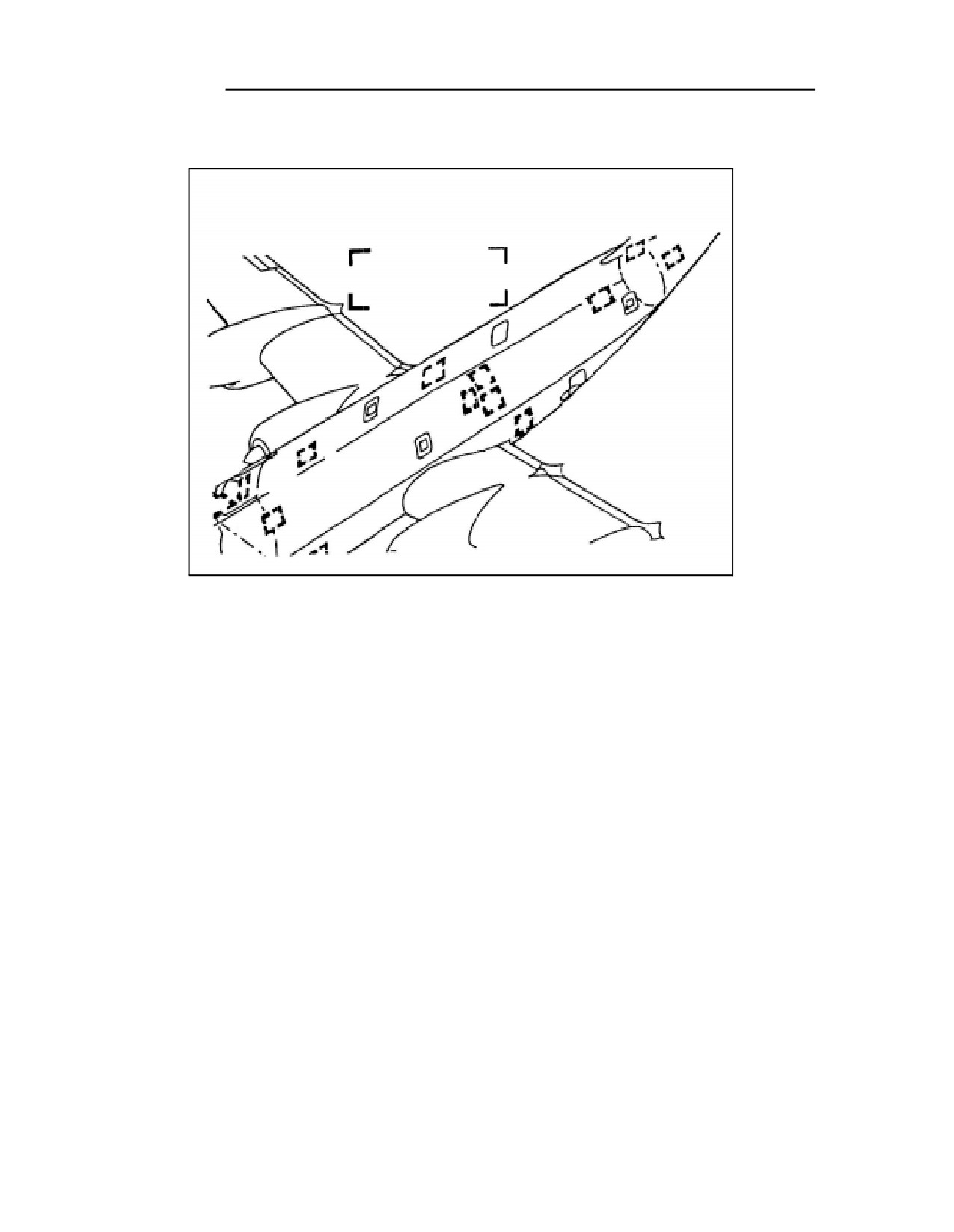
Typical emergency
entrance markings
Cut here for
emergency rescue.
Figure 7-4. Emergency cut-in areas
VICTIM RESCUES
7-72. After gaining entrance, rescue personnel should locate and determine
the condition of injured victims. If they cannot control hazards, they must
evacuate the victims immediately. If evacuation is not possible, rescue
personnel should attempt to keep the fire away from trapped victims. They
must be careful when removing victims pinned in wreckage to prevent
aggravating existing injuries or causing additional ones. If possible, they
should obtain medical advice before moving injured victims. To remove a
victim from the aircraft, one rescuer works from within or on the aircraft and
another rescuer stays on the ground. The rescuer on the aircraft removes the
victim from the aircraft and hands the victim to the rescuer on the ground.
Together they carry the victim to safety.
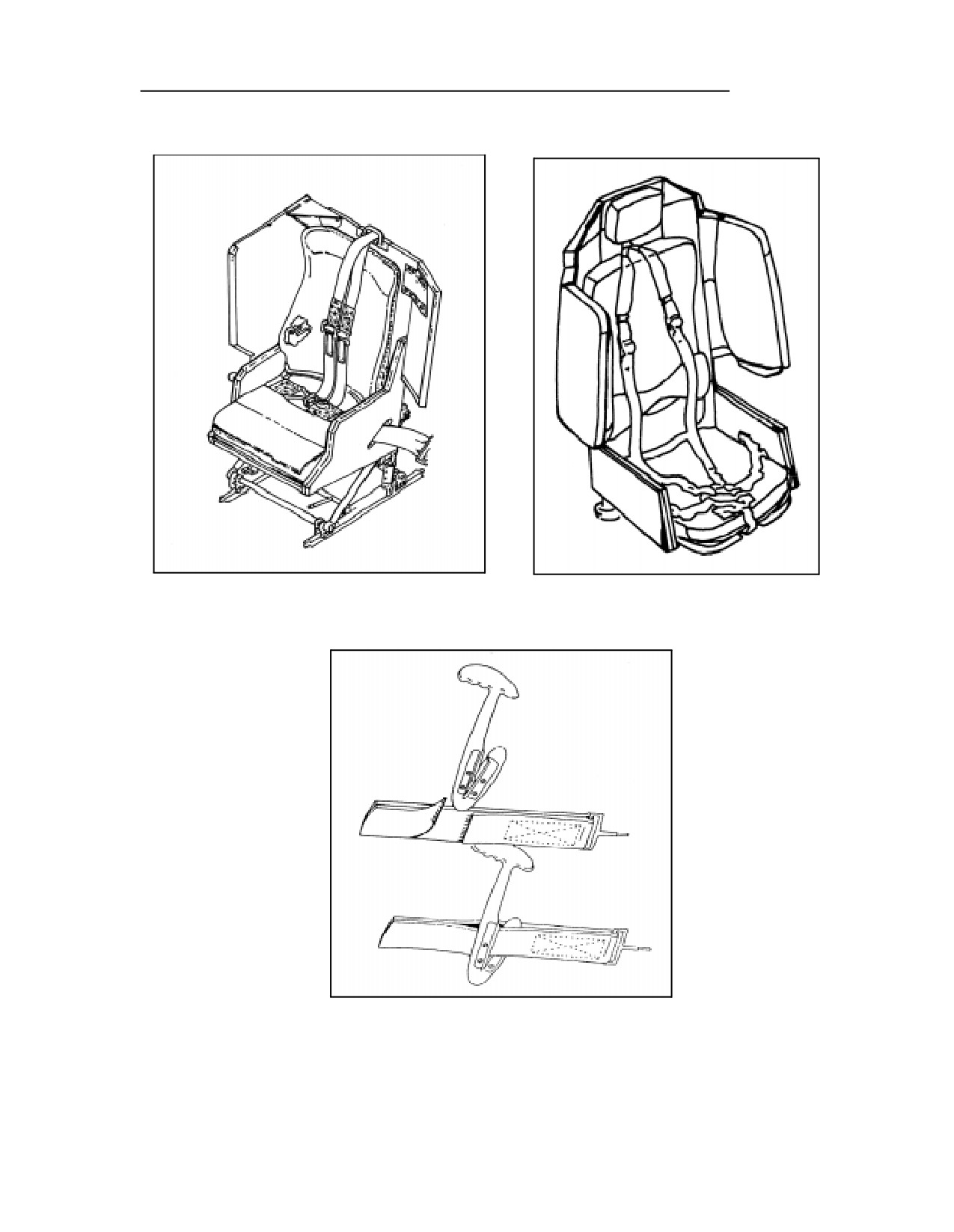
7-73. All Army aircraft have seat belts and many have shoulder harnesses.
Seat belts and shoulder harnesses are constructed of strong, webbed material
and are difficult to cut. Rescue personnel must be familiar with the release
mechanisms of these belts and harnesses. Figures 7-5 and 7-6 show different
seat belts and shoulder harnesses. Figure 7-7 shows how to cut a harness.
7-18 Aircraft Crash/Rescue Fire-Fighting Operations
FM 5-415
Figure 7-5. Seat belt and harness
Figure 7-6. 5-point harness
Figure 7-7. Cutting a double harness
Aircraft Crash/Rescue Fire-Fighting Operations 7-19
FM 5-415
EXTINGUISHMENT AND OVERHAUL
7-74. Extinguishment usually occurs after rescue personnel complete rescue
operations. Tankers or backup crash trucks assist in applying water or
extinguishing agents. Light and air units and wreckers or cranes are used
when necessary. Rescue personnel must overhaul all aircraft, even if fire does
not occur. Overhauling includes—
• Inspecting the aircraft thoroughly to ensure that no hidden dangers
remain.
• Securing the electrical system and disconnecting the batteries.
• Tagging, removing, and relocating bodies.
(Medical authorities
usually perform this function.)
7-20 Aircraft Crash/Rescue Fire-Fighting Operations
Chapter 8
Structural Fire-Fighting Operations
8-1. This chapter addresses many of the basic priorities and procedures
that will be used throughout the rest of this manual for other fire-fighting
purposes. The structural fire-fighting mission will include responding to
all fire incidents that involve structures (including TO structures), tents,
warehouses, and hangers. Responding to structural fires will be according
to the fire-response chart. Factors such as total fire involvement, life
hazards, fire-fighting resources, security, and mission-essential priorities
will determine the type and degree of response.
SECTION I. FIRE OPERATIONS
8-2. Fire operations include all actions from the time a call comes into an FCC
to the after-action review that is conducted following an incident. Responding
to an incident, fighting a fire, rescue, and salvage/overhaul are considered
components of fire operations.
STRUCTURAL OPERATIONS
8-3. When a crew chief or an SFO arrives at a fire scene, he assesses the
situation and decides what actions firefighters will take. The crew chief/SFO
bases his decisions on different factors. Prefire plans list constant factors such
as the type of building construction, the building’s dimensions, or the fire-
department connection/standpipe locations. The weather; traffic; use of the
building; types of materials stored; and time, size, and location of a fire are
changing factors.
8-4. Fire crews must conduct prefire plans on all high-priority/high-target
facilities. Response routes (primary and alternate), water sources, hazardous
areas, and an attack strategy can all be determined before an incident occurs.
If the crew is familiar with the facilities, the fire-fighting operations could
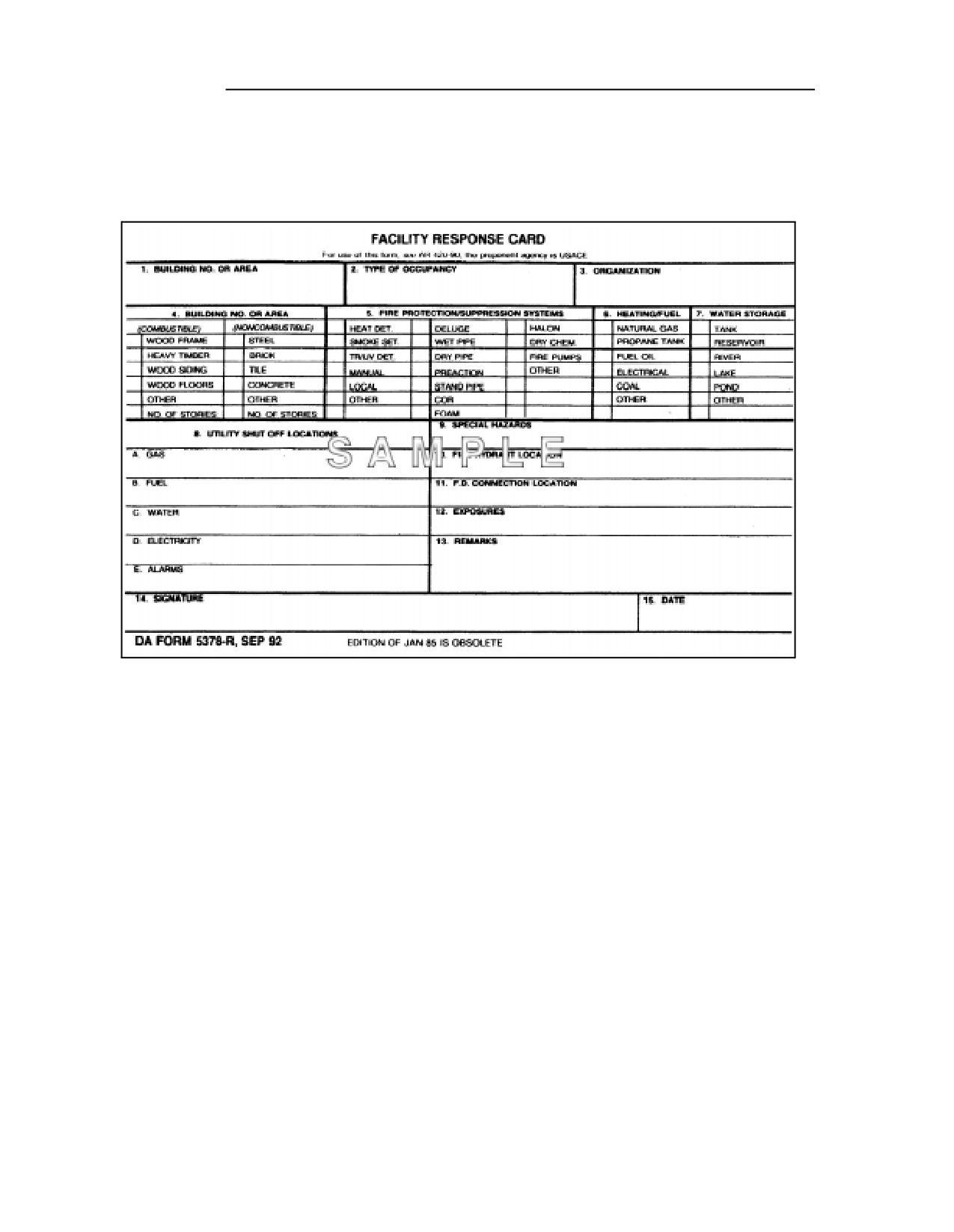
occur quickly. DA Form 5378-R (see Figure 8-1, page 8-2) should be filled out
for this purpose. If the form is not available, the following information should
be included on the prefire plan:
• Building identification.
• Construction type.
• Occupancy.
• Response requirements.
• Special hazards, such as HAZMATs storage and presence of
significant quantities of asbestos.
Structural Fire-Fighting Operations 8-1
FM 5-415
• Water supply.
• Building sketch.
Figure 8-1. Sample DA Form 5873
EMERGENCY NOTIFICATION
8-5. When notified of an emergency, the dispatcher should try to get as much
information as possible from the caller. The FCC will dispatch the required
response teams and notify the subordinate support units. The FCC will supply
as much of the following information as available to the responding crews:
• Location and nature of the emergency.
• Number of personnel involved.
• Types of HAZMATs involved (explosives, radioactive, flammable, and/
or toxic).
STRATEGY AND TACTICS
8-6. The strategy and tactics employed at a fire scene are based on the
situation. The on-scene SFO's evaluation of the situation will dictate how,
when, and where firefighters will attack or control a fire. The SFO’s ability to
evaluate the incident correctly will determine the overall success or failure of
the fire-fighting efforts. Although there are SOPs for most fire-fighting
incidents, the SFO must be prepared for rapid changes and adjust the
8-2 Structural Fire-Fighting Operations
FM 5-415
strategy and tactics accordingly. The following factors could have a large
effect on those efforts:
ACCESSIBILITY TO A FIRE
8-7. Conditions such as mud, snow, evacuations, traffic jams, ditches across
roads, and blocked alleys can prevent easy access to a fire. To prevent delays,
the crew chief should check such conditions before fire crews depart to a fire.
FIRE-FIGHTING EQUIPMENT
8-8. Some fire emergencies require additional equipment and personnel. One
way to determine the need for more equipment is for the SFO to observe the
nature and extent of a fire's progress. Another way is to consider the volume of
water or other extinguishing agents that are available in relation to the
estimated requirements, which are annotated on the facility response card
(prefire plan). To determine how much water is needed at a fire, use the
following formula and example:
GPM = N (LW/3)
where—
GPM = amount of water needed for a fire
L
= building length, in feet
W
= building width, in feet
N
= number of floors in the building
Fully involved building= 100%
50 percent-involved building= 50%
25 percent-involved building= 25%
8-9. To cover the exposures, take 25 percent of the fire flow for each exposure.
For example, you have a fully involved two-story house that is 30 by 72 feet
with two exposures. Multiply 30 by 72, divide by three, and multiply by 2 to
get the total GPM needed to extinguish a fire. Take 25 percent of the fire flow
for each exposure and add to the other GPM to get the total GPM needed for a
fire.
BUILDING FEATURES
8-10. An SFO must consider the following factors to determine when a
building could collapse:
• Type of construction (brick, wood, or aluminum siding).
• Percentage of the building involved in fire.
• Extent of the damages.
• Length of the burning time.
• Types and quantities of the materials in the building.
• Ability of the materials to absorb water and expand.
Structural Fire-Fighting Operations 8-3
FM 5-415
8-11. After assessing these factors, the SFO determines if the fire crews can
use ladders or enter the building to fight a fire.
PROTECTIVE SYSTEMS
8-12. The SFO should examine the building's protective equipment: sprinkler
systems, fire doors, fire shutters, and wired glass windows. He should
determine if these devices will be effective during a fire operation.
EXPOSURE HAZARDS
8-13. The SFO examines exposures such as furnishings, adjacent rooms, or
areas where fire spread is most likely, so that fire crews can effectively attack
a fire. For example, if a fire is in the basement, a quick attack on the areas
where the fire could spread could stop the fire.
8-14. Heat radiation or heated smoke and gases from the initial fire could
endanger exposures such as the roofs and walls of adjacent buildings. In an
advanced fire, fire crews must protect exposed buildings. They should consider
the wind direction, the ground slope, the distance between buildings, and the
extent of the fire's spread before taking action. However, life hazards, the
content value, or the current need could determine the fire crews’ actions.
TIME OF EMERGENCY
8-15. The month, day, and hour are important factors in a fire emergency. For
example, a fire in a school building at 0900 hours on a Tuesday in late
September could present different problems than a fire in the same building
at 2100 hours on a Tuesday in early July. Fire crews must know if people are
in a building before beginning fire-fighting operations.
HAZARDS FROM CONTENTS
8-16. The crew chief must determine if a building contains explosive stock,
toxic fumes, chemicals, acids, compressed-gas cylinders, and high-voltage
wires. When these items are heated or subjected to a hose stream, they could
be a safety hazard.
STRUCTURAL FEATURES
8-17. Most modern buildings have continuous foundations of concrete, brick,
or stone. The foundation wall that supports the frame construction may
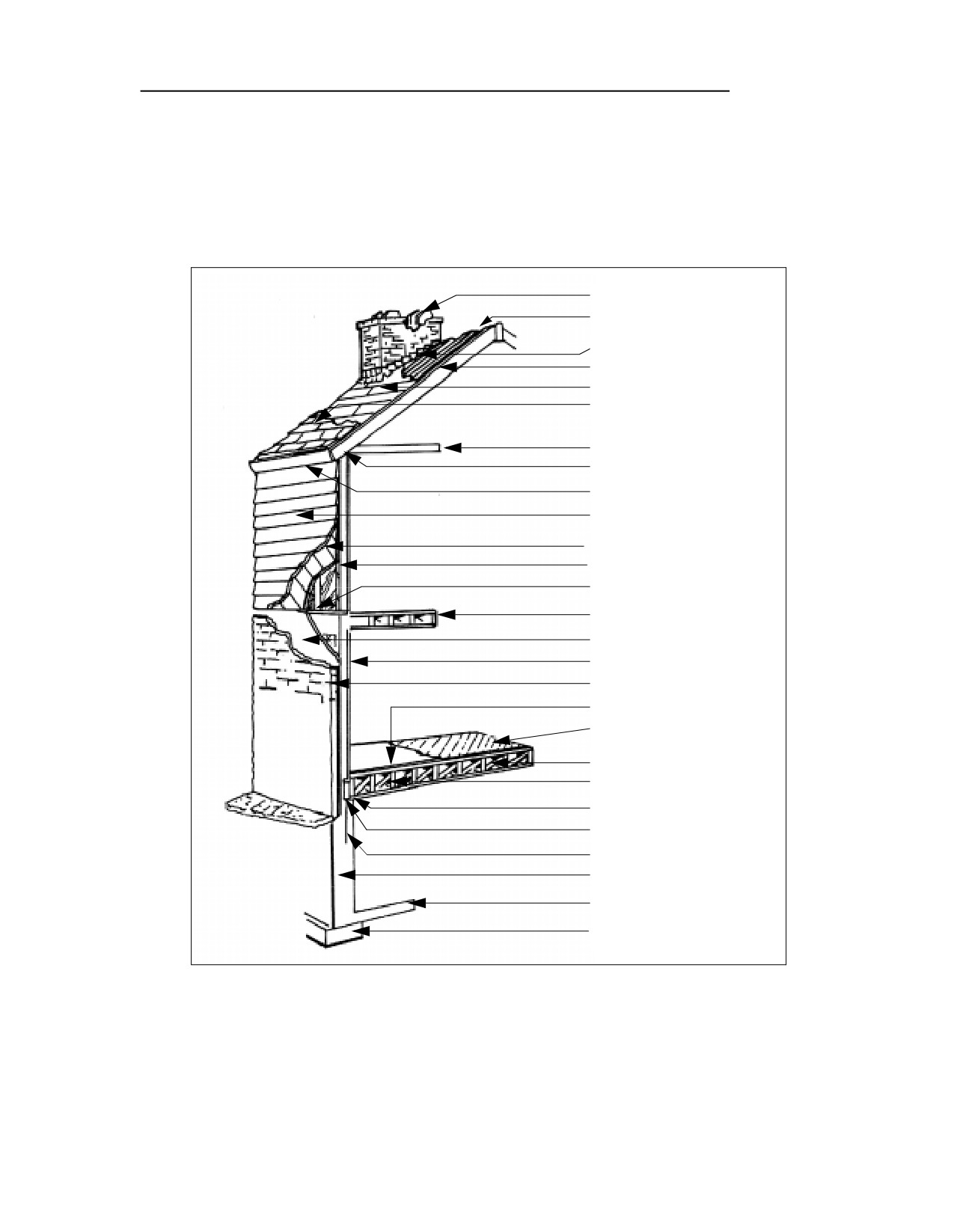
extend above the ground. Figure 8-2 shows arrangements of structural
components.
EXTERIOR WALLS
8-18. The list below describes various types of exterior walls:
• Masonry walls. These walls are usually
8 to
12 inches thick,
depending on the material used. Masonry walls provide the best fire
protection.
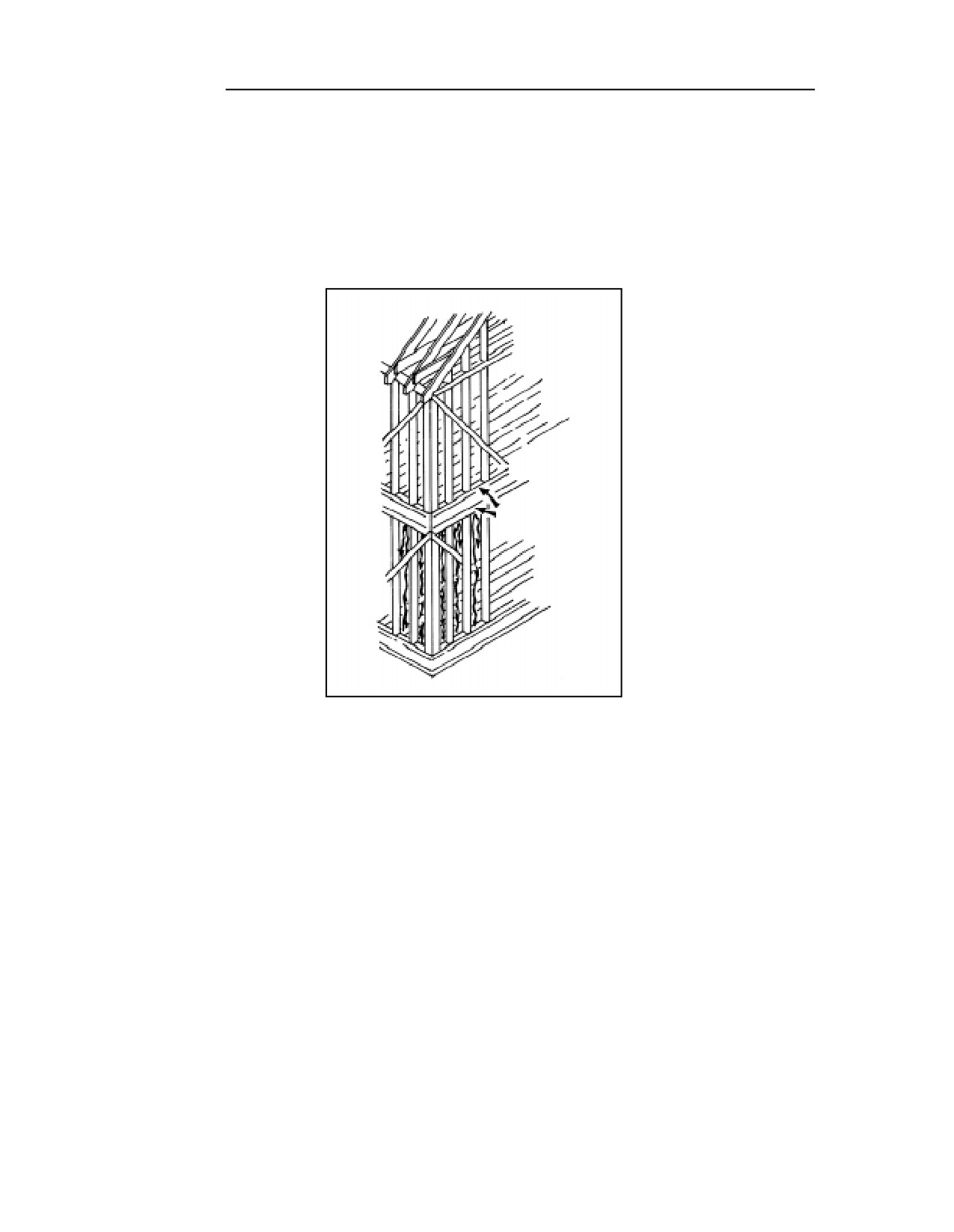
• Masonry-veneered walls. These are frame walls that have wooden
support members with one veneer of brick or stone. The upright,
wooden support members in these walls are studs. Studs are usually
2- by 4-inch pieces, spaced at 16-, 18-, or 24-inch intervals. Fire stops
are usually short, 2- by 4-inch wooden pieces placed in walls, ceilings,
8-4 Structural Fire-Fighting Operations
FM 5-415
partitions, and stairways between the studs at each floor level and at
the upper end of the stud channels in the attic. Fire stops cut off the
draft in the walls and help prevent fire and smoke from spreading.
Figure 8-3, page 8-6, shows fire stops.
Tile flu liner
Ridge board
Metal flashing
Rafter
Roof decking
Shingles
Ceiling joist
Top plate
Eave closure
Wood siding
Sheathing
Stud
Sole or sill
Header
Rigid insulation and/or shear
Plaster or Sheetrock
Brick veneer
Finish floor
Rough floor
Cross bridge
Joist
Box sill
Plate
Anchor
Foundation
Basement floor
Footing
Figure 8-2. Arrangements of structural components
• Wooden-frame walls. These walls are constructed entirely of wood.
The wood is usually treated with fire retardants to enhance the fire
Structural Fire-Fighting Operations 8-5
FM 5-415
resistiveness of the wood. Fire stops are of the same type and used in
the same way as masonry-veneered walls.
• Metal walls. These walls are constructed of metal sections or panels
and are fastened to wooden studs with bolts or screws. Metal walls
may have a painted or porcelain-coated surface
Fire stops
Figure 8-3. Fire stops
ROOFS
8-19. Roofs are constructed in layers using different materials. The main
support comes from the rafters, which run at right angles from the beam and
ridge of the roof. Sheathing covers the rafters. Sheathing is 4- by 8-foot sheets
of 1-inch plywood or 1-inch boards. Thin metal sheets or felt paper is nailed
over the sheathing. The final layer can be a layer of tar or asphalt, 4- by 8-foot
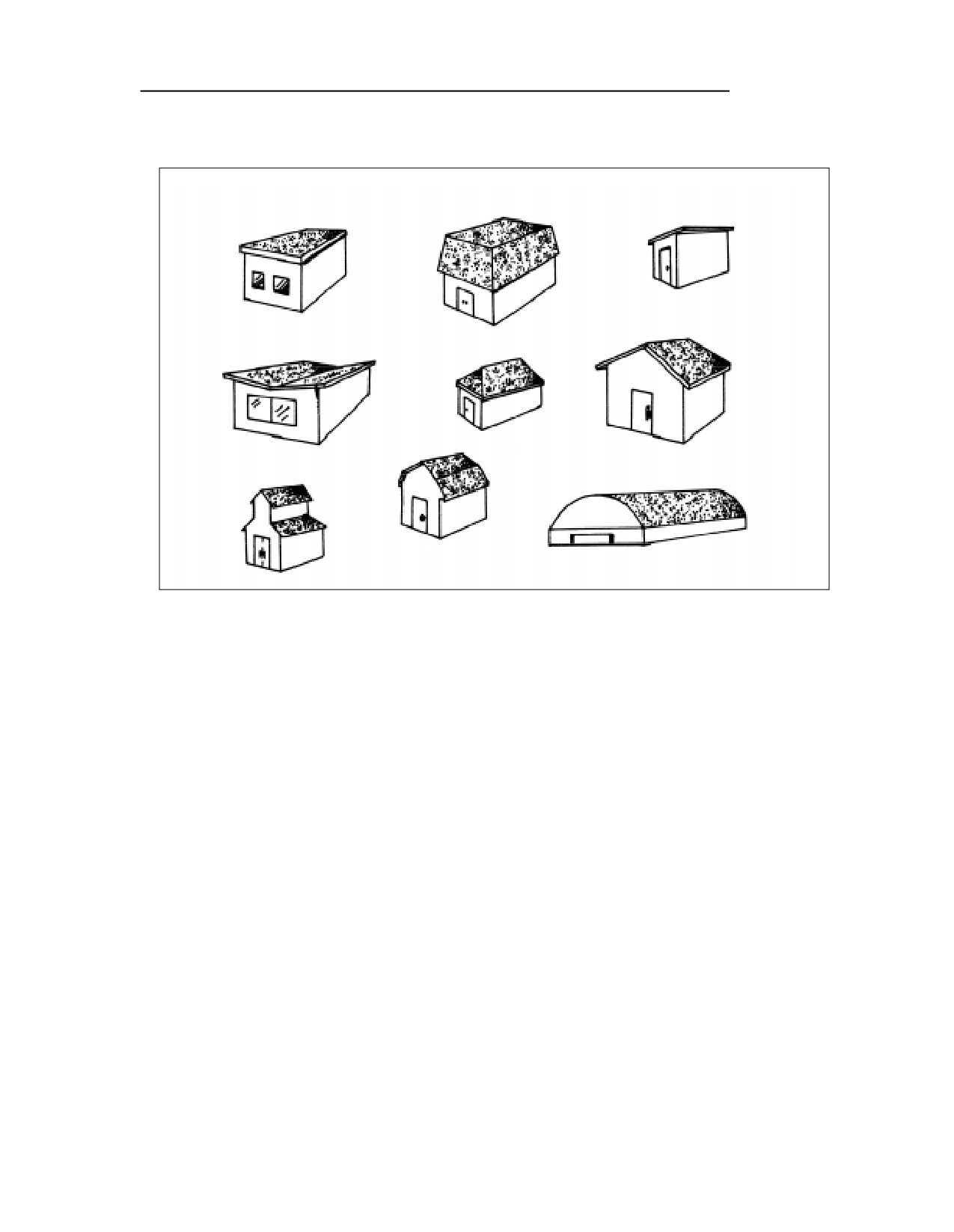
metal sheets, or other types of waterproof coverings. Figure 8-4 shows
different types of roofs.
Shingled Roofs
8-20. These roofs are made of small sections of material (wood, asphalt,
fiberglass, or metal) that are fastened to sheathing. To open shingled roofs,
strip off the shingles and cut away the sheathing.
8-6 Structural Fire-Fighting Operations
FM 5-415
Mansard
Flat
Shed
Gable
Butterfly
Hip
Gambrell
Arch
Lantern
Figure 8-4. Roof types
Composition Roofs
8-21. These roofs are made of one to six sheets of roofing material nailed to the
sheathing. Hot asphalt is spread over the entire covering and allowed to cool.
To open these roofs, first cut and roll back the covering and then cut the
sheathing close to the joists to make an opening.
Metal Roofs
8-22. These roofs are made of metal sheets that are crimped or soldered
together and fastened to the sheathing. Use a pike pole or similar tool to open
them. When using a fire ax to cut a roof, use short, quick, forceful strokes to
prevent the ax from striking other fire personnel and from catching in
overhead obstructions. Make diagonal cuts close to a joist or stud. Do not cut
with the grain of the board.
8-23. In flooring, roofing, or sheathing, make a cut at a 60-degree angle
instead of straight down. Cut diagonal sheathing the direction of the
sheathing so that the chips will split outward. If you make cuts against the
sheathing, the ax may bind. Make cuts through a lath-and-plaster wall in a
direction diagonal to the grain. After cutting the boards, use the pick end of
the ax to pry and remove the boards.
FLOORS
8-24. In older buildings, wooden floors are laid double on joists, which are
generally set on 16-inch centers. The subfloor is usually laid at a 45-degree
Structural Fire-Fighting Operations 8-7
FM 5-415
angle to the joists and the finish floor laid at right angles to the joists. To open
these floors, cut through the subfloor and the finish floor. Both cuts should
follow the side of the joists toward the inside of the required opening. In
mobilization-type buildings, a single floor is laid directly on joists, which are
set on 16-inch centers. Open single floors the same as flat roofs.
DOORS
8-25. Doors can be swinging, revolving, sliding, or overhead. Before using
force, try the door. If the door is locked, examine it to determine the forcible-
entry method to use. Wooden, swinging doors are panel, slab, or ledge. Doors
in residential buildings usually open inward and doors in public buildings
open outward. Slab doors are either hollow- or solid-core. Hollow-core doors
are constructed of wooden strips formed into a grid or mesh. Solid-core doors
are constructed of solid material. The core can be either tongue-and-groove
blocks or boards glued in the frame or a fire-resistant, compressed mineral
substance.
DOOR LOCK AND FASTENER
8-26. On a swinging door, the lock is a bolt (bar) that protrudes from the door
to the fastener (metal keeper), which is part of a door jamb. The bolt may be
part of the lock assembly or it may be separate. Use forcible entry to spring
the jamb so that the bolt passes the keeper. Outside doors in barracks, store
buildings, and recreation halls are set either against stops in the frame or
against a rabbeted shoulder in the door jamb. Insert the wedge of a door
opener just above or below the lock to gain entry. Use a spanner wrench with
a wedge end when leverage is not a problem.
FORCIBLE ENTRY
8-27. You can use forcible entry to open roofs, floors, skylights, partitions,
walls, and locked doors and windows. You must know how the building is
constructed to determine the best places for forcible entry. Practice handling
and using forcible-entry tools to ensure safety during an operation.
DOORS
8-28. Before using forcible entry to open a door, determine how the door hangs
on the frame and how the door locks. Locks are either surface or mortised and
can be pried until they spring free. Usually, the best method for opening these
locks is to remove the hinge pins from the hinge with an ax or a spanner
wrench.
Overhead Doors
8-29. Forcible entry on steel, overhead, rolling doors is difficult. These doors
can only be opened by operating the gears and chain. Prying may spring the
doors so that the gears will not function. Some doors have glass windows.
Break a section of the glass to reach the latch and raise the door. On overhead
lift doors, pry upward from the bottom of the door using a crowbar or claw
tool. After the lock bar breaks, the door opens.
8-8 Structural Fire-Fighting Operations
FM 5-415
Stopped-Frame Doors
8-30. On these doors, raise the stop with a sharp wedge and swing the door
clear of the fastener. When using a door opener, separate the lock and the
jamb so that the lock passes the keeper.
Rabbeted-Frame Doors
8-31. Method 1: Split the jamb or break the lock bolt with a door opener.
Insert the opener and push the door inward. Method 2: Insert a wedge above
or below the lock and pry the door until the bolt passes the keeper. The door
and jamb will be slightly damaged, but the door will close.
Double Doors
8-32. Open double doors by prying between the doors until the bolt clears the
keeper. If an astragal or wooden molding covers the opening, remove it before
inserting the wedge. Many double warehouse doors are secured with a bar
that is dropped in the stirrups, which are located on the inside of the wall. Use
forcible entry by battering down the door. On brick walls, batter a large hole
through the wall and crawl through the hole and unlock the doors. This
method is usually the quickest and least destructive entry method.
Latched Doors
8-33. Night latches will normally yield to the same prying tactics as mortised
locks. However, if night latches are fastened to the door with screws, remove
the locks by hitting them with a heavy object, such as a battering ram. When a
battering ram is not available, push your shoulder against the side of the door
opposite the hinges to spring the lock.
Single-Hinged Doors
8-34. On single-hinged doors locked with a hasp and padlock, such as those on
sheds and stables, use a door opener to pry or twist off the hasp staple.
Fire Doors
8-35. These doors are mainly used to protect openings in division walls of
vertical shafts. On fire doors that close automatically, pry open the doors
using forcible-entry tools. On fire doors with exterior openings, force the lock
by prying between the jamb and lock. Block the open fire doors to prevent
cutting off the water supply in a hose line or trapping yourself in the building.
WINDOWS
8-36. A working knowledge of the various types of windows is necessary to
effect successful forcible entry with minimal damage. This is only possible by
becoming familiar with the types of windows used in your AO and learning
how they operate.
Factory-Type Windows
8-37. These windows consist of steel sashes that are often set in the frame so
that only a portion of the window can open. The movable portion is either
pivoted at the center or hinged at the top and latched on the inside. Factory-
type windows have small panes. Breaking the glass near the latches is the
fastest, simplest entry method.
Structural Fire-Fighting Operations 8-9
FM 5-415
Check-Rail Windows
8-38. These windows have two frames (sashes) that are in contact at the top
and bottom horizontals. If the window has no weights, the sash locks either
with bolts in the window stiles or with a friction lock pressing against the
window jamb. Open these windows by prying upward on the lower sash rail. If
the window is locked on the check rail, the screws of the lock give way and the
sashes separate. When the window is locked with spring-activated bolts,
break or bend the sash before raising the sash. Pry the window where the lock
is located.
Basement Windows
8-39. Open these windows the same as a door in a rabbeted frame. If you pry
at the center of the lower rail, you can pull or spring the lock.
Casement Windows
8-40. Open these windows the same as double doors. When these windows are
locked, break the glass to enter. Wooden casement sashes are generally
hinged at the top and locked at the bottom or top. In some instances, breaking
the glass causes less damage than other entry methods. If you follow the
procedure below, the glass falls down away from your hands and to your side.
• Use an ax, crowbar, or pike pole.
• Stand to the windward side of the glass pane that you intend to break,
if possible.
• Strike the top of the pane.
• Keep your hands above the point of impact.
CEILINGS
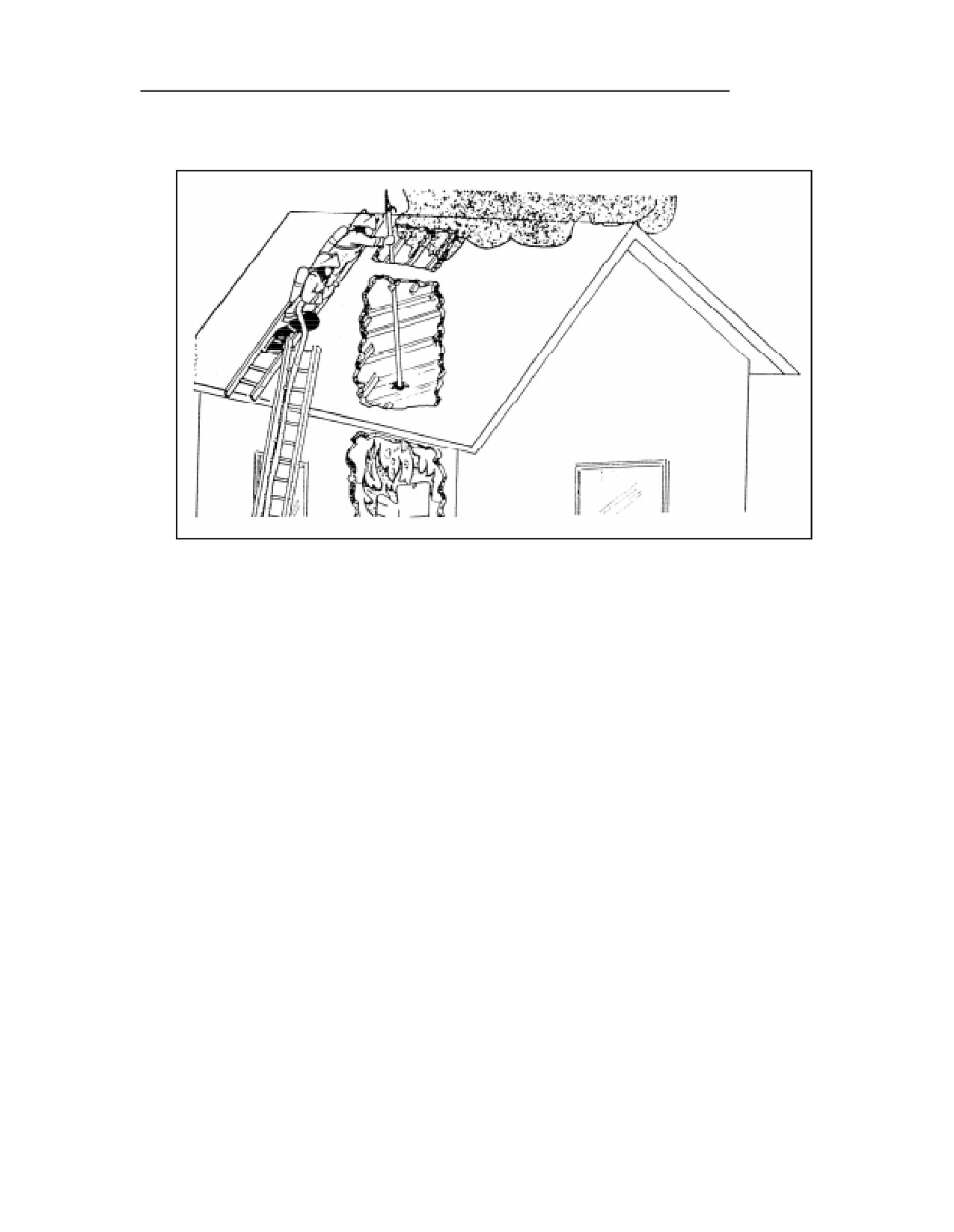
8-41. Use a pike pole to open plastered ceilings. Break the plaster and pull off
the laths (Figure 8-5). Pull the metal and composition ceilings from the joists.
Board ceilings are difficult to remove because the lumber resists when you
jam a pole between the boards.
WALLS
8-42. Wooden-framed walls are constructed of wooden or fiberboard sheathing
that is nailed over studs. The exterior siding, which may be wooden clapboard,
board and batten siding, stucco, or other exterior finishes, is fastened over the
sheathing. Open these walls as you would floors and roofs. Metal walls are
metal sheets that are either fastened to wood or metal studs with bolts,
screws, or rivets or are welded to metal studs. Use a breach-entry method.
FENCE LOCKS
8-43. Wood, metal, masonry, or woven-wire fences usually have gates that are
locked with padlocks and hasps. Either pull these locks apart, using a claw
tool, or cut the locks, using a cutting tool.
8-10 Structural Fire-Fighting Operations
FM 5-415
Figure 8-5. Opening a plastered ceiling
SAFETY PRECAUTIONS
8-44. The following are some of the safety precautions and procedures you
should use during forcible-entry operations:
• Try opening a door or window before prying it.
• Carry your tools safely.
• Watch for explosive materials.
• Block open a door or window after entering, if possible.
• Place your tools in a safe place to avoid tripping.
• Stand to the side when breaking the glass; remove all jagged pieces.
• Block all overhead doors (up position) after entering.
• Be aware of obstructions and bystanders when using an ax; keep the
area clear whenever possible.
• Watch for electrical wires and pipes when opening walls and ceilings.
• Make one large opening rather than several small ones.
VENTILATION
8-45. Ventilation is the systematic removal of smoke, heat, and toxic gases
from a structure and the replacement of these gases with cooler air.
Ventilating an area makes rescue and fire-fighting operations safer. In rescue
operations, a ventilated area decreases the danger for trapped occupants
Structural Fire-Fighting Operations 8-11
FM 5-415
because the hot, toxic gases are channeled out of the structure. In fire-fighting
operations, a ventilated area increases the fire crew's visibility and makes the
working area more bearable. After fire crews properly ventilate an area, they
can enter the area and locate and extinguish the seat of the fire. Proper
ventilation usually reduces the chance of back draft.
8-46. An SFO decides when fire crews ventilate an area to avoid problems. If
fire crews are not ready and told to ventilate, a fire could advance to a more
difficult stage. If fire crews ventilate too late, a back draft could occur, causing
extensive property damage, injury, or death. When a building is not
immediately ventilated, the smoke and gases rise, spread, and fill the entire
room or structure (mushrooming). When this occurs, fire crews must ventilate
the area quickly before starting fire operations.
TYPES
8-47. The three basic methods of ventilation are horizontal (cross), vertical
(top), and forced. The two subtypes of forced ventilation are mechanical and
hydraulic. Vertical ventilation involves opening the structure directly above
(or as close to) the seat of a fire as possible. Horizontal ventilation involves
opening one side of the structure and then the opposite side (probably
windows) to remove heated gases and smoke. Forced (mechanical) ventilation
uses blowers or ejectors at a doorway or window to help remove the smoke and
heated gases.
Horizontal
8-48. To cross ventilate, first open one side of the structure so that the heat
and smoke can escape, and then open the other side so that the fresh air can
enter the structure. Cross ventilation is more effective in certain types of
structural fires than in others, such as the following:
• Residential buildings, when the attic is not on fire.
• Buildings with windows near the eaves.
• Attics of residential buildings with louver vents in the walls.
• Involved floors of multistoried structures.
• Buildings with large, unsupported open spaces under the roof. In this
situation, a fire is not contained by fire curtains nor has the structure
been weakened by the burning process.
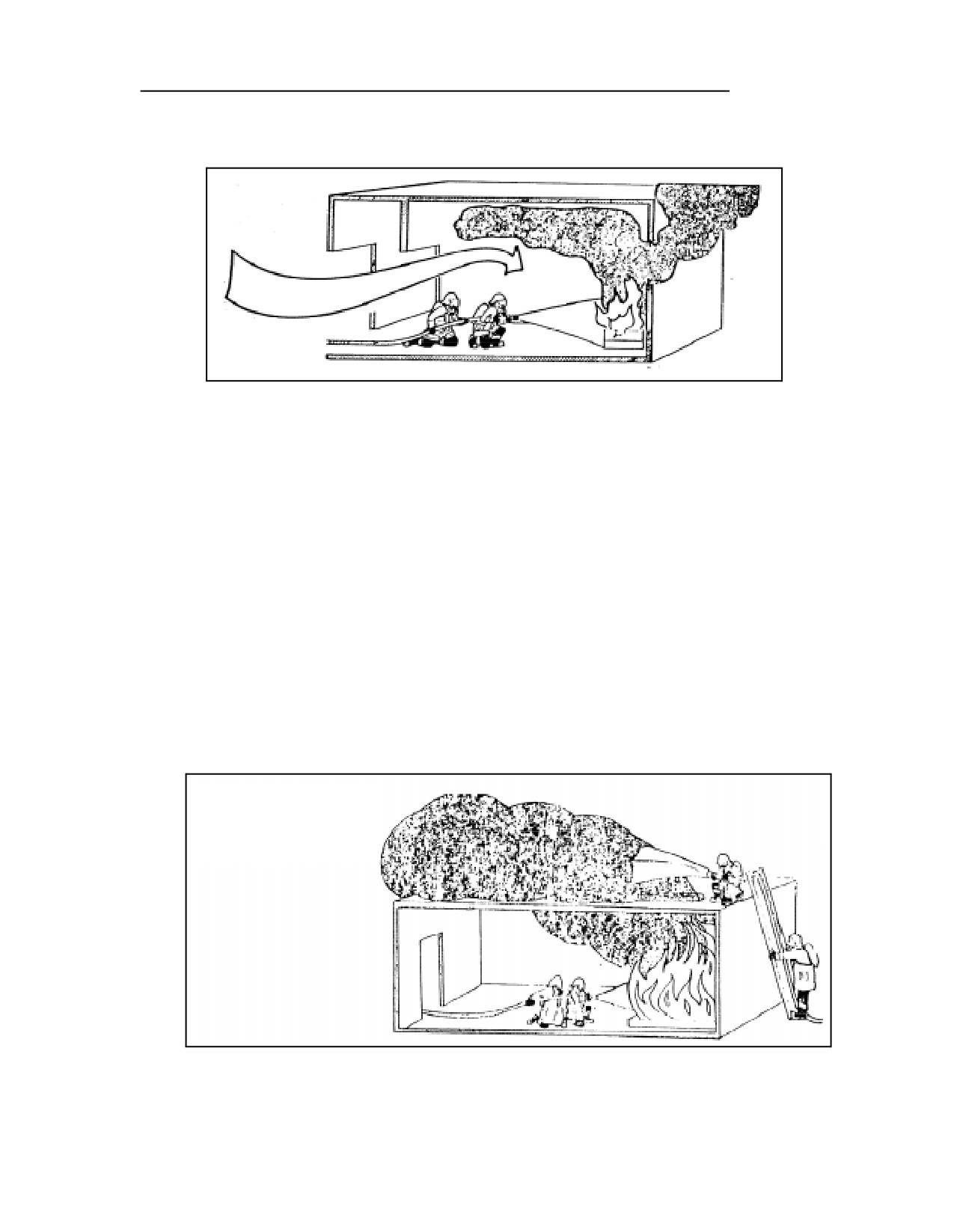
8-49. You must consider wind conditions when cross ventilating. If there is no
wind or if it is too windy, cross ventilation is not effective. Determine the wind
direction and ventilate. First, open the top section of the windows on the
leeward side to relieve the smoke and heat pressure. Second, open the lower
section of the windows on the windward side to allow cool air to enter. Figure
8-6 shows horizontal ventilation.
8-50. Consider the interior and exterior building exposures when cross
ventilating because you may have to route a fire. Be cautious; fire could
spread from cross ventilating. Do not block the wind flow once you establish a
cross-ventilation pattern. If the cool air flow is interrupted, hot air and gases
could fill up the structure. If possible, avoid using an opening in the cross-
ventilation pattern for applying a hose stream.
8-12 Structural Fire-Fighting Operations
FM 5-415
Figure 8-6. Horizontal ventilation
Vertical
8-51. Opening roofs is the primary method of top ventilation (Figure 8-7). To
top ventilate, cut a hole in the roof above the seat of a fire. Hot air currents
rise and remove the heat and gases. Before ventilating, consider—
• Coordinating your efforts with the ground and attack units.
• The wind direction.
• Obstructions or weight on the roof.
• Additional escape methods, such as a lifeline to the roof.
• Installed roof openings as a ventilation source.
• The size and number of the holes to cut.
• The condition of the structural supports.
• Possible accidents from opening.
Figure 8-7. Top ventilation
Structural Fire-Fighting Operations 8-13
FM 5-415
Forced
8-52. Forced ventilation uses two removal techniques. Negative-pressure
ventilation uses smoke ejectors to develop artificial circulation and pull the
smoke out of a structure. The ejector is placed by a window, door, or roof vent.
Positive-pressure ventilation uses a blower or smoke ejector to force air (at a
doorway or window) into the structure creating a pressure differential. The
higher pressure that is created inside the building forces the smoke through
openings to the outside (area of lower pressure). The hydraulic technique uses
a hand line with a fog pattern (at a door or window) to draw heat and smoke
out of the building. In forced ventilation, mechanical blowers, fans, and fog
streams move the air currents out of the structure.
Portable Machines
8-53. When using gasoline- or electric-powered, portable fans, locate them so
that they will either pull out the smoke or force in fresh air. Place smoke
ejectors at the highest level to draw out more heat. Seal a fan with curtains or
drapes so the air cannot circulate around the fan and reduce its effectiveness.
Fog Streams
8-54. When using fog streams, fire crews must be inside the area that they are
ventilating. The nozzle man will place the hose stream in an area at the top of
the windowsill with just enough fog pattern to fill the window opening about
3/4 and hold the nozzle there. The smoke and heat will be drawn into the
pattern and forced out of the structure.
COMMON ROOF TYPES AND OPENING TECHNIQUES
8-55. The more common roof types that a firefighter will encounter are listed
below:
• Flat roof. To ventilate a flat roof—
— Locate the roof supports.
— Mark the roof area to be cut.
— Use an ax to remove the built-up material or metal.
— Cut the wood decking diagonally along the joist toward the
center of the hole that you are making.
— Use short strokes when chopping. If you use high strokes,
clear the area and check for overhead obstructions.
— Pry up the roof boards with the pick head of an ax. Use the
blunt end of a pike pole, or similar tool, to knock through the
ceiling.
— Use power tools when necessary, such as a rotary-disc saw
(K-12 saw) or chain saw, to speed up the operation.
• Pitched roof. To ventilate a pitched roof—
— Determine where to make an opening, and place a roof ladder
on either side of the opening. Use the ladder for support.
— Remove the shingles or roofing felt.
8-14 Structural Fire-Fighting Operations
FM 5-415
— Cut the sheathing along each side of the rafters.
— Remove the sheathing boards with the pick of an ax.
— Use the blunt end of a pike pole to knock down the ceiling.
• Metal roof. To ventilate a metal roof, either pry up the metal sheets with
a prying tool or cut the metal sheets with a cutting saw.
• Arch roof. To ventilate an arch roof, use the same procedures as for flat
or pitched roofs. Roof ladders will be difficult to handle; use aerial or
long, straight ladders.
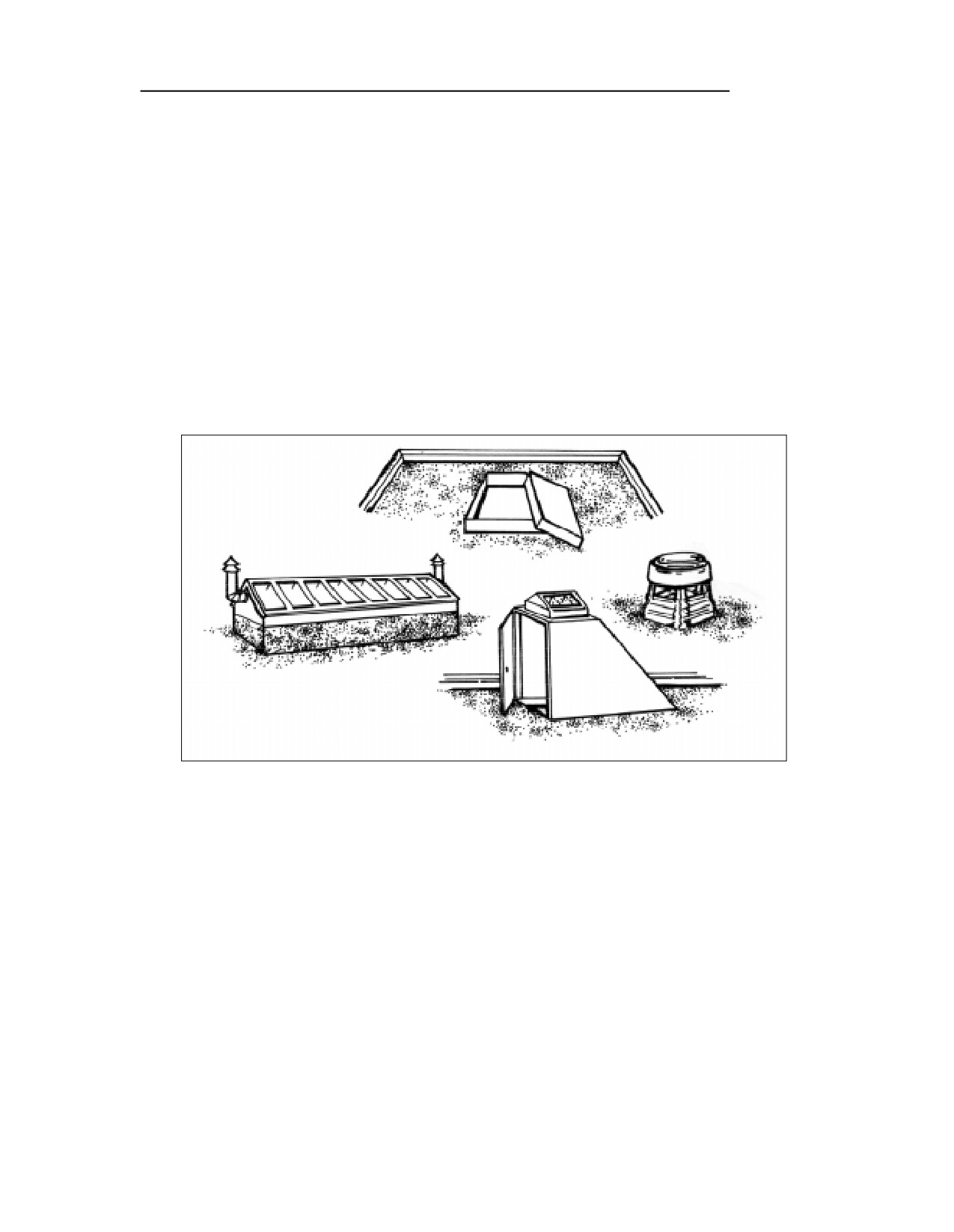
• Installed roof openings. Be aware that a building can contain several
types of roof openings: skylights, scuttle hatches, stairways, and
ventilators (Figure 8-8). You can easily force most of these open without
damaging the roof. If possible, use these openings to save time.
Figure 8-8. Roof openings
8-56. Do not disrupt top-ventilation patterns. With an opening in the roof of a
structure, the natural convection of air currents expels the heat and gases.
When this flow is interrupted, ventilation is ineffective. Do not direct a hose
stream into ventilated openings. Heat and gases cannot escape. Direct hose
streams above the horizontal plane of the opening to control hot embers and
sparks. When deciding to ventilate, the SFO should—
• Ensure that the firefighters doing the ventilating wear full protective
clothing and SCBA and that they stand on the windward side of the cut.
• Provide a secondary means of escape.
• Prevent personnel from walking on spongy roofs.
• Ensure that firefighters work from ladders to prevent slipping and
sliding.
Structural Fire-Fighting Operations 8-15
FM 5-415
• Ensure that a hand line is positioned at the roof when the cut is made
to provide protection to the firefighters on the roof.
• Ensure that the firefighters are cautious when using power tools.
LOCATION
8-57. The SFO should consider the following factors when determining a
ventilation site:
• Availability of the installed roof openings.
• Location of a fire and the direction in which he wants the fire crews to
draw the fire.
• Type of building construction.
• Wind direction.
• Extent of the fire and conditions of the structure and its contents.
• Bubbles or melting of roof tar.
• Indications of roof sag.
SECTION II. RESCUE
8-58. The primary function of rescue operations is to remove victims from
inescapable places. A firefighter's first consideration is to save lives. He does
this by removing victims from hazardous situations, carrying them to a safe
place, and administering first aid. Rescue personnel must act cautiously when
transporting victims to ensure that further injuries do not occur.
PROCEDURES
8-59. When performing rescue operations in a building, firefighters should—
• Always wear full protective clothing and SCBA.
• Not attempt rescue operations if the building is unsafe because of
advanced fire conditions.
• Ventilate the building before entering it, if a back draft is possible.
• Work in pairs, when possible, and keep in contact with each other.
• Develop a plan and work from it to avoid becoming disoriented.
• Carry forcible-entry tools.
• Use a charged hose line when operating on the floor above a fire.
• Tie a rope to their body for safety when working in the dark or under
extremely hazardous conditions.
• Remember the direction that they turned to enter a room. They should
keep in contact with a wall while moving around and ventilate the
area, if doing so will not enhance a fire.
8-16 Structural Fire-Fighting Operations
FM 5-415
• Exit a room by turning in the opposite direction from which they
entered the room.
• Feel the doors before opening them. They should stand to one side,
keep low, and open the door. If fire is behind the door, they should
close the door to contain a fire temporarily so that they can continue
searching. Once they complete a search, they should report their
findings to the SFO.
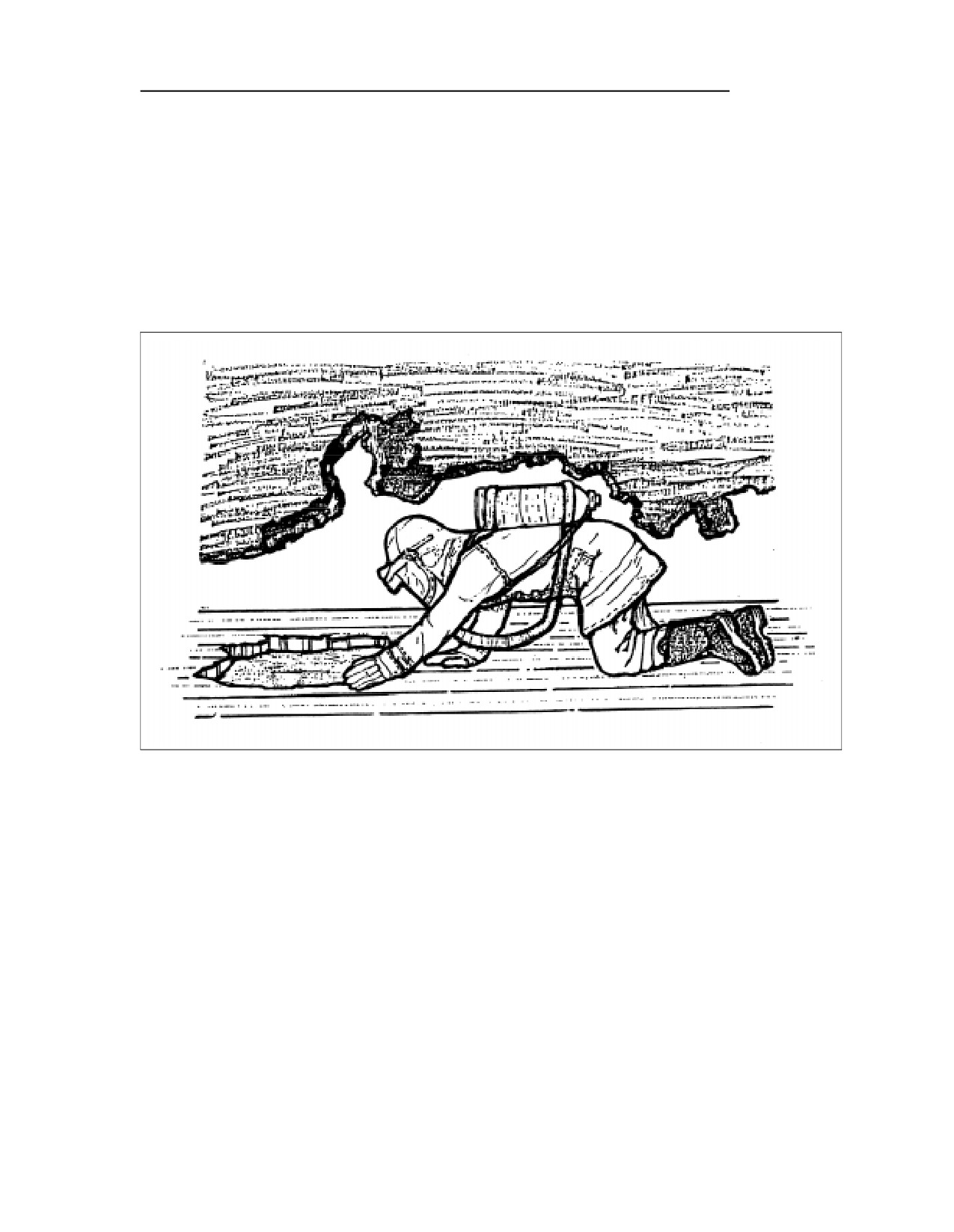
• Stay low, move cautiously (Figure 8-9), and carry a hand light.
Figure 8-9. Rescue position
• Stay alert and use all their senses. Occasionally they should pause
during the search and listen for signs or signals (moans, coughing,
cries for help) from trapped victims.
• Watch for weakened structure or hot spots.
• Follow a wall if they lose their direction. If they see a hose line, they
should crawl along the hose line; it will lead them to a nozzle man or
outside.
• Follow a wall to the nearest window and signal for help if they become
trapped. If they cannot find a window, they should stop momentarily
and consider other escape actions.
• Push a door slowly, if it is initially difficult to open. A victim may be
blocking the door. They should feel behind the door and check for a
victim. They should not kick the door open.
Structural Fire-Fighting Operations 8-17
FM 5-415
SEARCH PATTERN
8-60. Your main consideration in a search is locating victims in relation to a
fire. A primary search is a rapid search of the building to verify removal of all
victims. A secondary search is a thorough search of a fire area after initial fire
control. Always work in pairs when searching for victims. First check the fire
floor and then the floor directly above the fire. If personnel are available,
conduct rescue operations on both floors.
8-61. If multiple rooms or apartments lead into a center hallway, conduct a
search in a series. Enter the first room and turn right or left to establish the
search pattern. When exiting the room, turn in the same direction as you
entered and continue searching. Always exit a room as you entered it to
ensure a complete search. After searching a room, mark it as stated in your
standing operating procedure (SOP). Doing so avoids duplicating efforts. If
you abort a search or are removing a victim, exit the area by turning in the
opposite direction from which you entered the area.
SEARCH AND RESCUE
8-62. Whether searching a room or an entire building, use a systematic
approach. Do not just go into an area and start a haphazard search. Evaluate
each area quickly and start a search and rescue based on your evaluation.
ROOMS
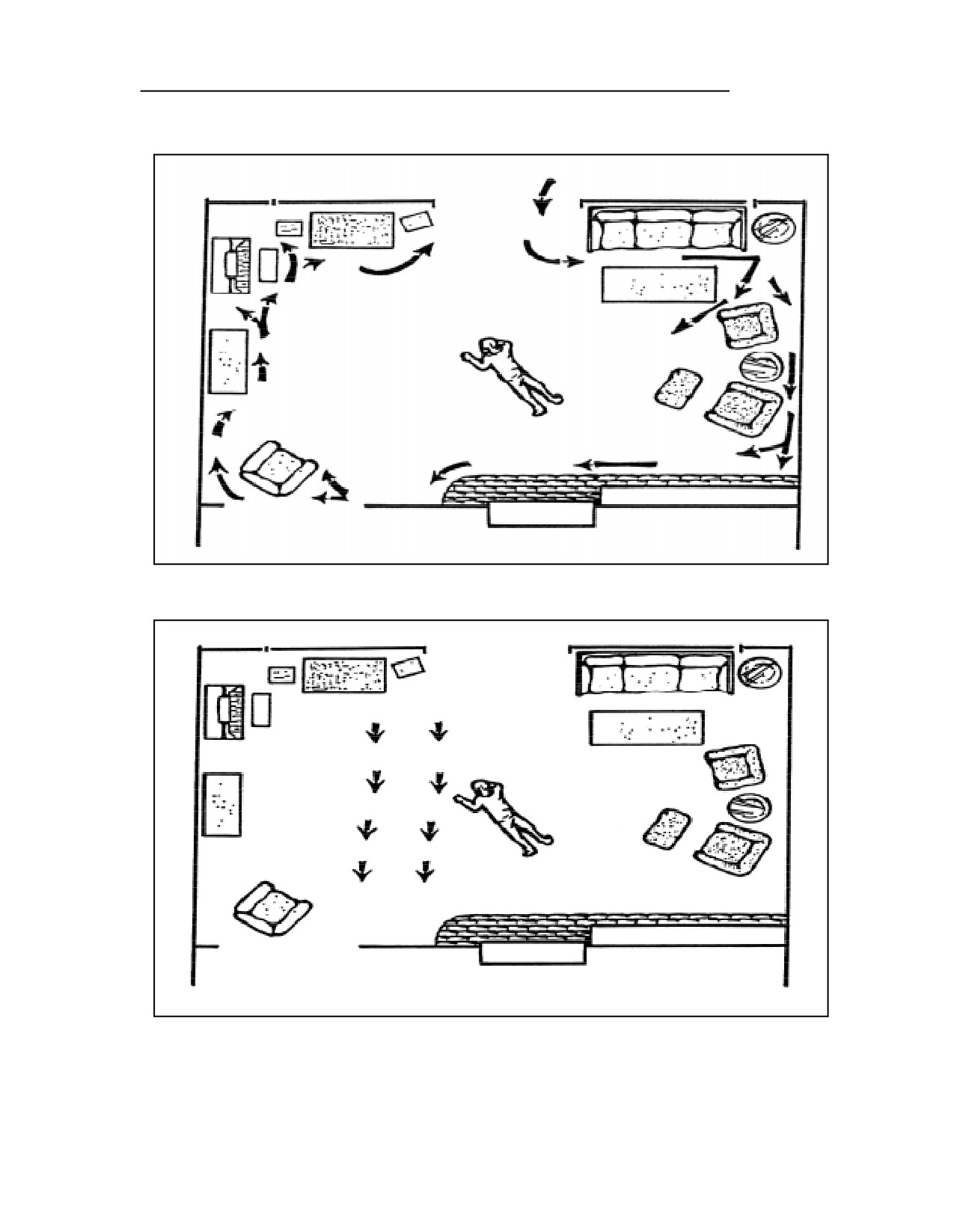
8-63. After entering a room, follow the wall around the room. Keep low and
feel ahead for obstacles or pitfalls. Reach out with your hand or foot to cover a
greater area. Keep in constant and direct contact with the wall. This method
brings you back to your entry point (Figure 8-10). Search the center of the
room (Figure 8-11).
8-64. Search all areas: behind the furniture; inside the closets, toy chests, and
bathrooms; and on top of and underneath the beds. Follow the search pattern
to avoid overlooking any area. Flip a mattress into a U-shape, indicating that
you have searched the room.
COLLAPSED BUILDINGS
8-65. A building's condition determines the difficulty that you will have in
rescuing victims. First, rescue the victims whom you can easily reach so that
they can receive medical attention. Second, rescue victims who are in areas
that are difficult and require more time to reach.
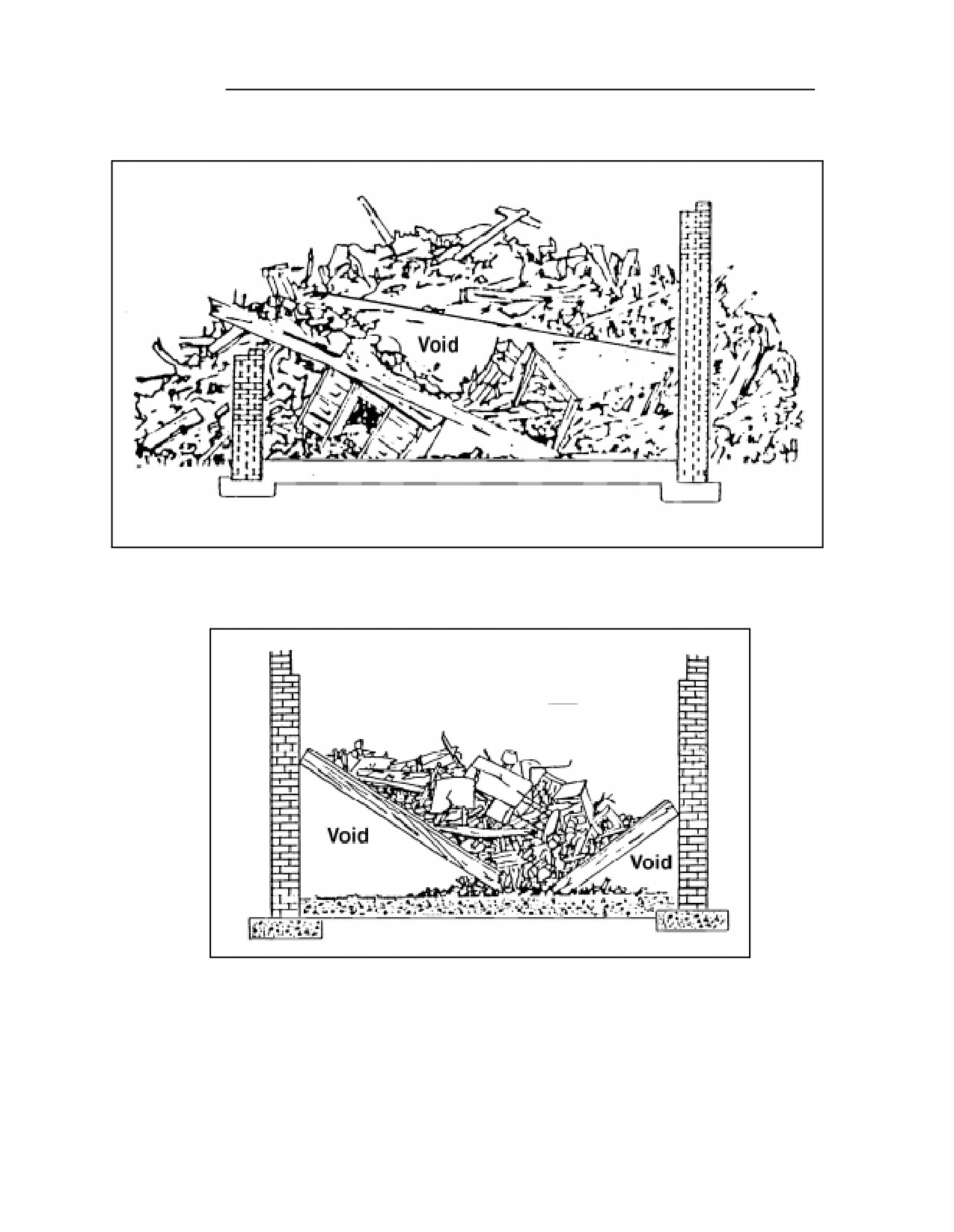
8-66. When the floor supports fail in any building, the floors and roofs may
drop in large sections, causing the floors and roofs of the lower levels to
collapse (pancake collapse, Figure 8-12, page 8-20). When heavy loads of
furniture and equipment are located near the center of a floor, the excess
weight may cause the floor to collapse. Figure 8-13, page 8-20, shows a V-type
collapse.
8-18 Structural Fire-Fighting Operations
FM 5-415
Table
Coffee
table
Bookcase
Fireplace
Figure 8-10. Searching a room’s perimeter
Speaker
Speaker
Stereo
Table
Coffee table
TV
Bookcase
Fireplace
Figure 8-11. Searching the center of a room
Structural Fire-Fighting Operations 8-19
FM 5-415
Figure 8-12. Pancake collapse
Figure 8-13. V-type collapse
8-20 Structural Fire-Fighting Operations
FM 5-415
8-67. To reach a buried or trapped victim, you may have to dig a tunnel.
Tunneling is a slow, dangerous process. Try other rescue methods before
tunneling. Do not dig tunnels to conduct a general search of an area. However,
you can use tunnels to reach a void under a floor to continue a search. The
following lists some tunneling procedures:
• Start a tunnel at the lowest level possible.
• Dig the tunnels large enough to accommodate the firefighters and
victims.
• Do not construct the tunnels with abrupt turns.
• Drive the tunnels along a wall when possible. Doing so simplifies the
framing required to prevent cave-in.
CAVE-INS
8-68. Use either shoring or cribbing to hold back weakened earth formations
in a building or to secure tunnel openings and passages. Shoring is a series of
timbers or jacks used to strengthen a wall or prevent collapse of a building or
earth opening. Cribbing is usually adapted to roof and ceiling supports, but it
can be used on walls.
8-69. Do not force beams, floor sections, or walls back into place. This action
may cause further collapse and damage. When removing debris, watch for
timbers or rocks that hold up other portions of earth or debris. Moving these
pieces could cause a collapse or slide. Leave the timbers or rocks in place.
ELECTRICAL CONTACT
8-70. If a victim is in contact with electrical wires, do not touch the victim or
the wire until the victim is clear of the wire. If the victim is not free from the
wire or the wire will not endanger you, use a pike pole (made of a
nonconductive material) to rescue the victim. Hook the victim's clothing and
drag the victim clear of the wire.
VEHICLES
8-71. To rescue victims from vehicles, you must know basics about motor-
vehicle design, hand and power tools, and patient care. You must also be
prepared to face victims who are badly burned, mortally injured, or hysterical.
Safety Considerations
8-72. Observe safety precautions during an operation. Wear complete turnout
gear during the operation. The following lists hazards resulting from vehicle
accidents:
• Fire and its products.
• Glass fragments.
• Sharp metal edges on vehicles.
• Flying glass and metal.
• Dangerous chemicals and radiation.
Structural Fire-Fighting Operations 8-21
FM 5-415
• Tool failure.
• Unstable vehicles.
Assessment
8-73. An alarm-room operator must obtain as much information about a
vehicle emergency as possible. He should record the—
• Location of the accident.
• Number and types of vehicles involved.
• Number of people injured and the types of injuries.
• Information on any special hazards at the scene.
• Name of the person calling and the call-back number.
Stabilization and Access
8-74. If a vehicle is on its side or upside down in a gully or on a hillside, do not
rock or push the vehicle. Stabilize any vehicles that are in such difficult
positions. Use jacks, wedges or cribbing, or come-alongs. In emergencies, use
the bumper jacks or ropes or open the trunk lid and hood. Do not tip a vehicle
if victims are trapped inside.
8-75. Choose the easiest route available to gain access to a victim. Try opening
the doors. If they are jammed, break a window. If any window is broken in the
accident and the frame is not bent, remove a victim through that window. If
not, break the rear window. This window provides a large opening, and glass
should not fall on the victim as readily as from a side window. The primary
objective is to gain access and stabilize and protect the victim from further
injury from sparks, glass, metal, and extrication tools.
8-76. After accessing the vehicle, stabilize the victim. Try to identify any life-
threatening injuries, and administer first aid when necessary. Vehicle parts
(steering wheel, seats, pedals, dashboard) often trap a victim. Free the victim
from any vehicle parts and treat his injuries. The following is a checklist
covering injuries and treatment:
• Watch for breathing problems. Open an airway, when necessary.
• Perform cardiopulmonary resuscitation (CPR).
• Treat for shock.
• Control the bleeding.
• Immobilize the victims that have fractures or spinal-cord, neck, and
back injuries.
• Position the victims according to sustained injury.
• Strap the victims in securely.
VICTIM CARE AND REMOVAL
8-77. If the situation and time permit, carefully try to remove all the victims
from an incident. However, if a fire, an explosion, or some other danger is
8-22 Structural Fire-Fighting Operations
FM 5-415
imminent, use whatever method you can to remove the victims and yourself
from the area immediately.
CARRIES
8-78. If a victim cannot walk or has severe injuries, carry him. Use any of the
following carries that is appropriate for the situation:
•
One-man-supporting carry. Use this method if a victim is in the prone
position. Assist him to a sitting position and then to his feet. Grab one
arm, place it over your shoulder, and secure his arm by holding his
wrist. Place your other arm around his waist and help him walk.
•
Two-man-supporting carry. This method is similar to the one-man
method except that the victim puts an arm over a shoulder of each
firefighter. Each firefighter secures the victim’s arm by grabbing his
wrist. Firefighters place their other arm around his waist for support.
•
Lone-rescue carry. If you have difficulty raising a victim to carry
him—
— Place the victim on his back.
— Push his feet close to his buttocks and hold his feet in place
with your foot.
— Grab the victim’s hands and rock him up and down several
times.
— Jerk him up, at the top of the upswing, and onto your
shoulder.
•
Fireman's carry. To execute this carry—
— Kneel on one knee near the victim’s head and turn his face
down. Place both hands under his armpits and gradually work
your hands down the side and across his back.
— Raise the victim to his knees.
— Take a firm hold across his back.
— Hold the victim around his waist with your right arm, grab
his right wrist with your left hand, and draw his arm over
your head. (Change sides if the victim is wounded on the right
side.)
— Bend at the waist and knees, and pull the victim’s right arm
down over your left shoulder so that his body comes across
your shoulders. At the same time, pass your right arm
between his legs and grab his right knee with your right hand.
— Lift the victim as you straighten up.
— Grab the victim’s right wrist with your right hand.
Structural Fire-Fighting Operations 8-23
FM 5-415
•
Two-firefighter carry. In this method, two firefighters form a chair
with their arms to carry a victim. To execute this carry—
— Each firefighter kneels on one side of the victim, near his hips,
and raises him to a sitting position, supporting him by placing
an arm around his back.
— Each firefighter slips his free arm under the victim’s thighs
and clasps each other’s wrist.
— The firefighters rise slowly and lift the victim from the
ground. When erect, they adjust their upper arms to form a
comfortable back rest to secure the victim. If he is conscious,
the firefighters should tell him to place his arms around their
necks.
•
Chair carry. In this method, two firefighters carry a victim in a chair.
To execute this carry—
— The firefighters should place the victim on his back.
— One firefighter grabs the legs of the victim and raises his legs,
buttocks, and back. The other firefighter slips the chair under
the victim.
— One firefighter is in front and one is in back of the chair. They
grab the chair, tip it to a 45-degree angle, and walk forward.
•
Extremities carry. This is a good carry method when a victim is
conscious or unconscious and does not have leg or back injuries. Two
firefighters execute this carry. To do so, the—
— Firefighters lay the victim on his back with his feet apart.
They face each other, one standing between the victim’s legs
and the other at the victim’s head. They kneel and raise the
victim to a sitting position.
— Firefighter at the victim’s head grabs him from behind, plac-
ing his arms around the victim’s body under the armpits.
— Firefighter standing between the victim’s legs turns around
and grabs the victim’s knees.
— Firefighters rise and carry the victim.
•
Severe-injuries carry. If a victim is severely injured, at least three
firefighters should carry the victim. To execute this carry, the—
— Firefighters must designate one person to be the leader who
will give the commands.
— Firefighters stand on one side of the victim.
— Leader gives the command prepare to lift.
— Firefighters kneel on the knee nearest the victim’s feet: one
firefighter at the victim’s shoulders, one at his hips, and one
at his knees.
8-24 Structural Fire-Fighting Operations
FM 5-415
— Firefighters place their hands and forearms under the victim’s
neck and shoulders; pelvis, hips, and small of the back; and
knees and ankles.
— Firefighters, at the command lift, raise the victim and place
him on their knees.
— Firefighters, at the command prepare to raise, slowly turn the
victim on his side toward them until he rests in the bend of
their elbows.
— Firefighters, at the command rise, slowly rise to a standing
position, holding the victim close against their chests.
— Leader gives the command march, if the firefighters can move
forward, and all lead off on the left foot. If they must move
sideways, the leader gives the command side step left (or
right), and all lead off with the foot the leader commands.
— Firefighters reverse the operation to lower the victim, at the
command of the leader.
OTHER REMOVAL METHODS
Dragging
8-79. Drag a victim when only one firefighter is available and speed is
important. To drag a victim—
• Roll him onto a coat, blanket, or similar object.
• Grab the object on each side of his head; lift him so that his head and
shoulders are off the ground.
• Drag him to safety.
Using a Stretcher
8-80. Use the same procedure for placing a victim on a stretcher as for
preparing to lift in a severe-injuries carry.
Using a Ladder
8-81. Use a ladder as an escape means when a victim is trapped on a floor
above ground level. If he is conscious, descend the ladder first. Keep your
arms around him and one knee between his legs for support. To rescue an
unconscious victim—
• Raise a ladder just above the window where you are making the
rescue.
• Pass a lifeline underneath the bottom rung so that the rope feeds from
the underside of the ladder.
• Thread the rope up and over three consecutive rungs when you reach
the bottom of the windowsill.
• Feed about 20 feet of rope through the window. A ground crew will
assist in feeding the rope.
Structural Fire-Fighting Operations 8-25
FM 5-415
• Step into the room, tie the rope around the victim, and assist him onto
the window. The ground crew will help lower the victim to the ground.
• Use a stokes basket to lower a victim if he has severe injuries. Lace
him inside the stokes and lower him to the ground.
SECTION III. CONTROL AND EXTINGUISHMENT
8-82. Rescuing victims is the primary concern of any fire operation. The
secondary concerns are fire control and extinguishment and related
procedures essential to preserving property. Before starting extinguishing
operations, fire crews must consider the type, quantity, and locations of the
materials in the building.
LOCATING A FIRE
8-83. Structural fires generally fall into two categories, interior and exterior.
Both involve the same basic materials but in different conditions, quantities,
and proportions. Fire crews can often observe an interior structural fire
through open doors or windows; sometimes they must enter the structure to
locate a fire. A red or orange glow usually indicates the presence or location of
a fire.
INTERIOR FIRES
8-84. These fires normally involve excessive smoke and ventilation problems,
back-draft possibilities, and difficulty in locating the fire. Fire crews must
anticipate suffocation possibilities for themselves and building occupants.
Interior fires do not threaten adjacent buildings unless the roof or walls of the
burning building collapse. A delay in controlling a fire, rekindling before fire
crews arrive, or widespread smoldering before ventilation could cause the
building to collapse. Fire crews should not use a hose line inside the building
until they see a fire or if they need a fog curtain to reach the seat of a fire.
EXTERIOR FIRES
8-85. Fires outside of a building could start from various causes (discarded
cigarettes or embers falling on rooftops). Also, an exterior fire could result
from an interior fire burning through the roof or outside walls. A fire crew's
main objective is to prevent a fire from spreading to other buildings.
CONFINING A FIRE
8-86. After locating a fire, try to confine it to its point of origin. Cover the
internal exposures with hose streams, and shut the external doors and
windows to localize a fire. The leeward side of a fire is the most difficult to
approach. The wind carries the heat and smoke toward the fire crews.
However, the leeward side is a good place to make a fire stop and prevent a
fire from intensifying and spreading.
8-87. Attack a fire from as many sides as possible. Use proper ladder work and
ventilation procedures when locating, confining, and closing in on a fire. If
there is a danger of back draft, position and charge hose lines before opening
them. Watch for heavy smoke escaping from cracks around doors or beneath
8-26 Structural Fire-Fighting Operations
FM 5-415
eaves. This is a sign of back draft. Close in on a fire as conditions permit. Do
not advance hose lines too quickly; a fire could rekindle and spread. When
using extinguishing agents on Class B fires, back up the agents using a water-
fog line or a foam line. This precaution guards against a flashback of Class B
materials.
8-88. Walk cautiously when working in dark areas or on weakened floor
supports. Crawl on your hands and knees, if necessary. If large cracks appear
in masonry walls, leave the area immediately. When advancing a hose line in
radiated heat, use the helmet shield to protect the face piece of the air pack.
The nozzle man receives the impact of a fire's heat, so rotate the firefighter at
this position to ensure that each person rests and cools off. If you must retreat
from a forward position, follow a hose line back to safety.
SECTION IV. SALVAGE AND OVERHAUL
8-89. Salvage is the prevention of excessive fire, smoke, and water damage.
Firefighters move material either outside the burning building or to an area
not involved in a fire. The amount of salvage work firefighters must do
depends on the amount of salvage equipment available, the number of
personnel available, the type and amount of material involved in a fire, and
the storage method of the material. Overhaul is the complete check of all
structures involved in a fire. Firefighters look for hidden fires, ensure that all
sparks and embers are extinguished, and look for and protect the area
containing the cause of a fire.
PROTECTION PROCEDURES
8-90. You can cause excessive damage to stored material if you use large
amounts of water to extinguish a fire or improperly apply water, such as using
a straight stream instead of a water fog. Cover the material stored on lower
floors with large tarpaulins. If possible, move the material outside or to an
area in the building not involved in a fire. Cover heavy crates, packing cases,
machinery, and similar articles. Wipe dry and oil all metal. Protect food items
from smoke and water exposure.
8-91. To prevent excessive water damage, apply water to the base of a fire.
Watch for leaky hose connections. Do not spray water on dry material. Do not
over spray absorbent-type materials. The excess weight could collapse the
floors. After extinguishing a fire, use sawdust to absorb the water and to form
barriers so that you can direct the water through doorways or other openings.
If necessary, drill holes in the wooden floors for drainage.
8-92. Remove valuable items as soon as you extinguish a fire. Remove debris
from the building; sweep the floors; and remove excess water with brooms,
squeegees, and water vacuums. In administrative, HQ, and other office
buildings, cover the records and files with canvas covers and secure the
records. If a roof has been damaged, cover the hole with a tarpaulin or roofing
paper. If the roof is destroyed, the post engineers should install temporary
roofs of canvas truck covers.
Structural Fire-Fighting Operations 8-27
FM 5-415
SALVAGE COVERS
8-93. Salvage covers have a number of functions. They are used to cover
furniture and carpet and are used as carpet runners and catch basins to divert
water outside the structure during and/or after fire-fighting operations are
completed. If used in a timely manner, salvage covers can save valuable
property and prevent unnecessary smoke and water damage.
TYPES
8-94. Conventional salvage covers are made from closely woven, waterproof
canvas materials. The covers have reinforced corners and hems with
grommets for hanging or draping the covers. Newer covers are made of
polyethylene plastic and are lightweight. They are not affected by alkalines,
oils, acids, caustics, or solvents. These covers remain flexible in subzero
temperatures; will not mold, mildew, or absorb moisture; and are not affected
by abnormal temperatures.
MAINTENANCE
8-95. Clean salvage covers by spraying them, scrubbing them with detergent,
and rinsing them thoroughly. Examine the covers for damages after they are
dry. Make sure that the covers are completely dry before folding and placing
them in service. To roll a salvage cover, bring the ends together in the center
of the cover. Continue this process to the desired width. Complete the
operation by rolling the cover.
THROWS AND SPREADS
8-96. The most common type of salvage-cover throws are the one-man throw,
the two-man spread, the counter payoff, and the catch basin. What needs to be
covered and how much manpower is available will determine the method
used.
• One-man throw. Use the following procedures to throw and spread a
12- by 14-foot salvage cover:
— Place the center of the folded cover over your forearm and
grab the bottom of the fold.
— Grab the three folds, with your other hand, between the
thumb and fingers, thumb down.
— Swing your arm up and over your shoulder and place the
three folds over the back of your hand to give weight to the
throw. Bring your hand forward and throw the cover over the
object with a straight-arm throw.
— Open the cover and tuck the edges in at the bottom.
• Two-man spread. Two firefighters should use the following procedures
to carry and spread a 14- by 18-foot salvage cover:
— One firefighter carries the cover. He grabs the grommet ropes
at the corners nearest his body. The second firefighter grabs
the remaining ropes and moves away from the first fire-
fighter.
8-28 Structural Fire-Fighting Operations
FM 5-415
— Both firefighters drop the cover and stretch it out near the
material to be covered. They drop the inside edge of the cover
while holding the outside edge.
— The firefighters raise the outside edge and cover the material,
allowing the air to balloon the cover. This ensures correct
placement. They should tuck all corners and edges in at the
bottom.
•
Counter payoff. Use this method to cover material to prevent damage,
destruction, or disarrangement of the material. This method requires
two firefighters. One firefighter holds the cover by the bottom fold.
The second firefighter grabs the top fold and walks backward. Both
firefighters raise the cover as it unfolds and place it over the material.
They tuck in the cover's edges at the bottom.
•
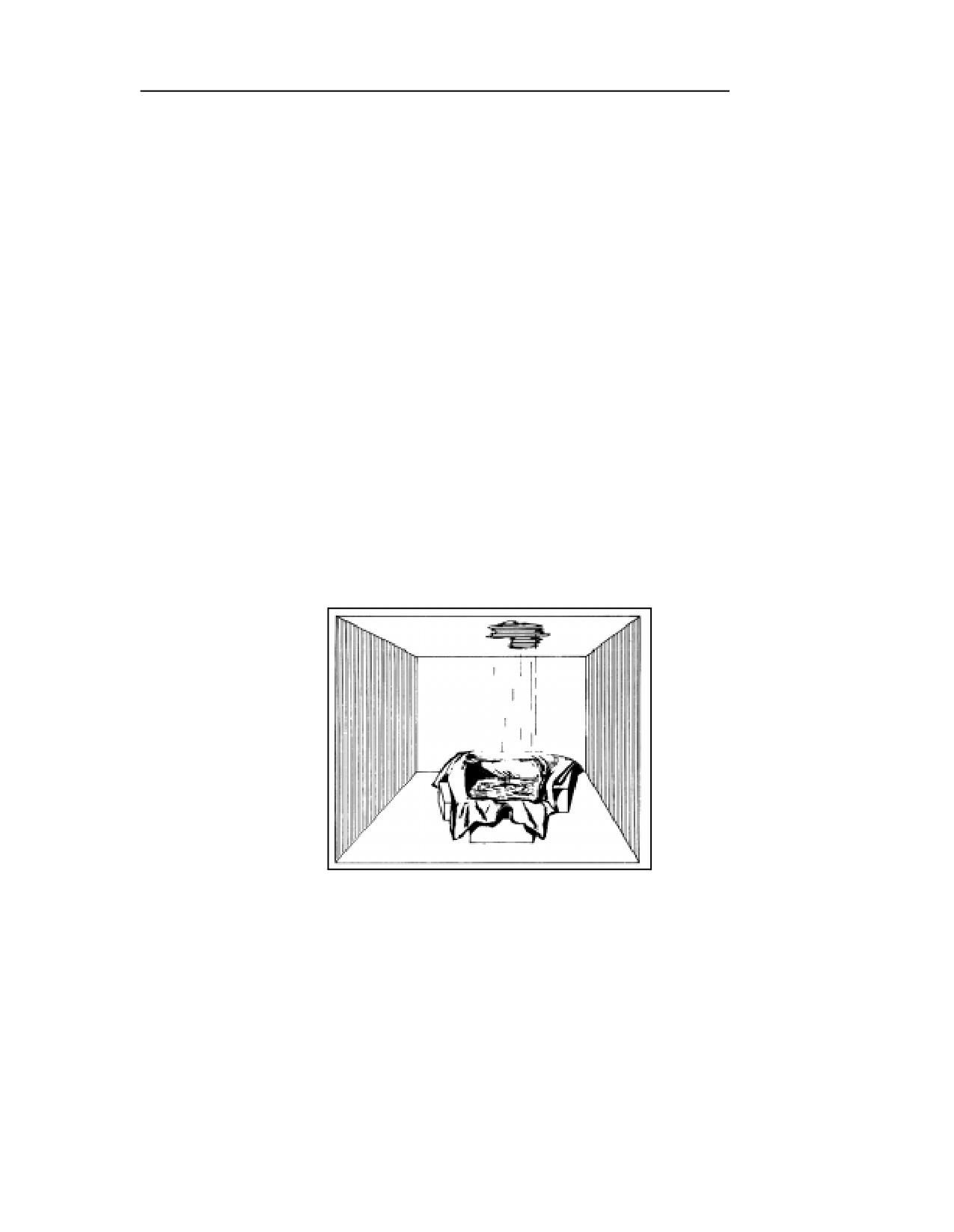
Catch basin. To catch large amounts of water dripping through a floor
or ceiling, use a salvage cover to construct a deep catch basin. Place
furniture, boxes, or other items in a circle or square beneath the leak
(Figure 8-14). Spread the salvage cover over the framework, tuck in
the loose edges, and tie the cover to the items. To catch small amounts
of water, use a salvage cover to construct a shallow basin. Roll two
sides of the cover in about 5 feet. Roll the other sides in about 1 foot.
Lift the corners in and tuck under to lock the corners.
Figure 8-14. Catch basin
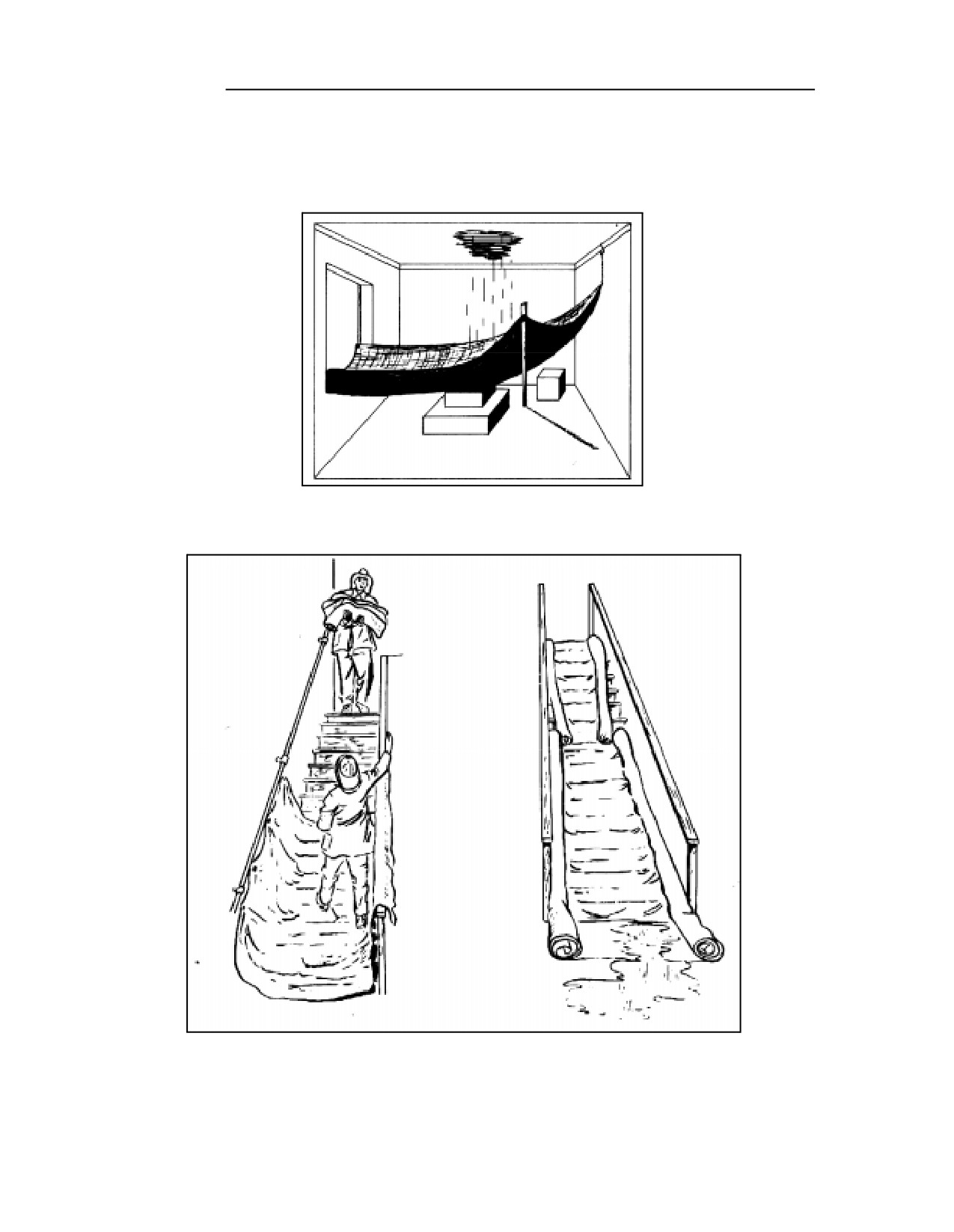
• Water chute. Use a water chute to drain water from a ceiling to the
windows or doors. Spread a salvage cover over two pike poles and roll
the poles toward the center to form the chute. The water's weight will
tighten the rolls (Figure 8-15, page 8-30). An alternate method of
constructing a water chute is by using S-hooks, cord, salvage covers,
and pike poles. You can tie light rope or heavy cord through the
grommets to support the covers. To protect interior structures and
contents from water damage, use canvas covers as stairway drains to
Structural Fire-Fighting Operations 8-29
FM 5-415
direct the water from upper floors to a lower level and outside. Figure
8-16 shows how to form a chute on a stairway.
Figure 8-15. Spreading a salvage cover
Figure 8-16. Forming a chute on a stairway
8-30 Structural Fire-Fighting Operations
FM 5-415
OVERHAUL
8-97. During this operation, check the entire structure to ensure that hidden
fires or embers do not cause reignition. The salvage methods you execute
during an operation will affect any required overhaul work.
STRUCTURAL CONDITIONS
8-98. Before searching for hidden fires, determine the building's structural
condition. Check for weakened floors, spalled concrete, weakened steel roof
members, offset walls, opened mortar in wall joints, and melted wall ties.
Cover or block off holes that have been burned or cut in the floor. Block off
approaches to damaged stairways or elevator shafts. Pull down walls or
chimneys that are weak and possibly dangerous.
HIDDEN FIRES
8-99. You can detect hidden fires by sight, touch, or sound. Look for discolored
materials, peeling paint, or smoke emitting from cracks, cracked plaster, and
dried wallpaper. Feel the walls and floors. Listen for popping, hissing, and
crackling sounds. Carefully check the entire area to determine a fire's spread.
If a fire spreads to other areas, determine its path. Check for hidden fires in
• Floor beams. If the ends that enter a party wall are burned, flush
water into the voids in the wall. Check the far side of the wall to see if
fire or water has come through.
• Areas containing insulation. Remove insulation because it can hide
fires for prolonged periods.
• Casings. If a fire has burned around windows or doors, open the
casings and inspect for fire.
• Cornices. If a fire has burned around the roof, open the cornices and
inspect for fire.
• Concealed spaces. Open the areas below floors, above ceilings, or
within walls and partitions. Remove only enough material to check for
hidden fires. Move any room item that could be damaged during
overhaul operations. Do not overhaul weight-bearing members.
SECTION V. INVESTIGATION AND RETURN TO SERVICE
8-100. Investigating a fire involves looking for and safeguarding evidence that
could determine the cause of a fire. This procedure could occur during control,
extinguishment, and overhaul operations. If fire personnel suspect arson, they
should inform fire investigators (LA team).
INITIAL INVESTIGATION
8-101. Take colored photographs of the entire fire scene. If arson is suspected,
label items, such as gasoline cans, cotton trails, film trails, candles, oil-soaked
rags, cleaning-fluid containers, matches, and cigarettes. Labels should include
Structural Fire-Fighting Operations 8-31
FM 5-415
the name of the person who found the item and where and when the item was
found. Take notes on the following items:
• The number of people present when the fire personnel arrived.
• The number of fires burning when the fire personnel arrived.
• The color and aroma of the smoke.
• The color of the flame and from where it was coming.
• Where the doors were locked (inside or outside).
• The condition of the contents and if they were disarranged.
• The nature of the burning material.
• The wind direction, humidity, temperature, and general weather
conditions.
• The direction of the fire's spread.
• The condition of the area where the fire may have started.
• The statements from observers who may have seen unusual
occurrences before the fire broke out.
8-102. Make detailed sketches of the area. These sketches may be needed
during a board of inquiry or investigation proceedings, especially if an
arsonist is brought to trial.
8-103. If the fire building contained classified documents or equipment (reels
of film, models drawings, files), the SFO should request that guards be posted
over the area until the classified material is moved to a secure location. Since
firefighters are not authorized to examine classified materials, they must be
careful during salvage and overhaul operations. They should set aside
classified items in a designated area for proper authorities to examine.
8-104. Before returning to the station, the SFO should gather all the facts
necessary to complete the required fire-report form, Department of Defense
(DD) Form 2324 or DD Form 2324-1. This report should include the—
• Type of alarm.
• Location of the fire.
• Building number.
• Description, origin, cause, and confinement of the fire.
• Property damage.
• HAZMATs (type, amount, path of released substances).
• Containment measures taken during and after fire-fighting
operations.
• Agents used.
• Time required to extinguish the fire.
• Number of personnel near the burning structure.
8-32 Structural Fire-Fighting Operations