FM 4-02.21 DIVISION AND BRIGADE SURGEONS HANDBOOK (DIGITIZED): TACTICS, TECHNIQUES, AND PROCEDURES (November 2000) - page 3
FM 4-02.21
3-10. Combat Health Support for Stability Operations
a. Overview of Stability Operations.
(1) Stability operations apply military power to influence the political environment, facilitate
diplomacy, and interrupt specified illegal activities. Stability operations include both developmental and
coercive actions. Developmental actions enhance a governments willingness and ability to care for its
people. Coercive actions apply carefully prescribed limited force and/or the threat of force to achieve
objectives. The types of activities conducted in stability operations include
Peace operations.
Operations in support of diplomatic efforts.
Combatting terrorism operations.
Counterdrug operations.
Noncombatant evacuation operations (NEO).
Arms control.
Nation assistance and foreign internal defense.
Support to insurgencies and counterinsurgencies.
Shows of force.
Civil disturbance operations.
(2) While each operation in this environment is unique, there are seven broad imperatives
that enhance the deployed forces ability to develop concepts and schemes for executing stability operations.
These imperatives are
Stressing force protection.
Emphasizing information operations.
Maximizing interagency, joint, and multinational cooperation.
Displaying the capability to apply force without threatening.
Understanding the potential for disproportionate consequences to individual and
small-unit actions.
3-24
FM 4-02.21
Applying force selectively and discriminatingly.
Acting decisively to prevent escalation.
b. Combat Health Support for Stability Operations.
(1) Combat health support to forces deployed for stability operations is dependent upon the
specific type of operation, anticipated duration of the operation, number of forces deployed, theater
evacuation policy, medical troop ceiling, and anticipated level of violence. In most situations, CHS follows
the traditional support provided to combat forces. If there is a shortened theater evacuation policy, a limited
medical troop ceiling, and limited hospitalization assets within the AO, organic and DS ambulance support
is provided from the point of injury to the supporting Echelons I or II MTF. The patient is stabilized at the
MTF, then evacuated from the treatment element to an airfield for evacuation out of the theater.
(2) During NEO, those persons who are injured, wounded, or ill are treated and stabilized
by the medical element accompanying the NEO force. Once stabilized, the NEO force evacuates them. In
NEO conducted in a permissive environment (no apparent physical threat to the evacuees), sick, injured, or
wounded persons should be evacuated on dedicated MEDEVAC platforms, if at all possible. In an
uncertain or hostile environment, the transportation assets used to insert and extract the NEO force are
normally used to evacuate the patients. The medical personnel accompanying the force provide en route
medical care until the NEO force reaches an intermediate staging base (ISB) or safe haven. Those evacuees
requiring medical care are then transferred to dedicated MEDEVAC platforms for further evacuation to
MTFs capable of providing the required care.
(3) During combatting terrorism operations, planning considerations for CHS include
Using medical and nonmedical transportation assets to evacuate casualties in mass
casualty situations. If nonmedical assets are used, planning should include augmenting these assets with
medical personnel, adequate litters, and medical supplies to provide en route medical care.
Applying techniques for acquiring and evacuating patients under hostile fire or on
adverse terrain (from rubble or from above or below ground level).
(Refer to FM 8-10-6 for additional
information.)
Ensuring security measures (such as establishing checkpoints, screening personnel
and vehicles, and limiting access to the MTF area) are implemented.
(4) Medical personnel in nation assistance, support to insurgencies, and support to counter-
insurgencies could be called upon to assist in the development of a MEDEVAC system. This system would
provide for the supported nation/group; teach civilian, military, or paramilitary personnel basic evacuation
techniques and the treatment protocols for providing en route medical care. It could also provide the more
traditional support from the point of injury to the supporting treatment element.
(5) For additional information, refer to FM 8-42.
3-25
FM 4-02.21
3-11. Combat Health Support for Support Operations
a. Support operations provide essential supplies and services to assist designated groups. They
are conducted mainly to relieve suffering and help civil authorities respond to crises. In most cases, Army
forces achieve success by overcoming conditions created by man-made or natural disasters. The ultimate
goal of support operations is to meet the immediate needs of designated groups and transfer responsibility
quickly and efficiently to appropriate civilian authorities. Support operations, which consist of humanitarian
assistance and environmental assistance, accomplish one or more of the following: save lives; reduce
suffering; recover essential infrastructure; improve quality of life; and restore situations to normal. The
seven broad support imperatives are
Secure the force.
Provide essential support to the largest number of people.
Coordinate actions with other agencies.
Hand over to civilian agencies as soon as feasible.
Establish measures of success.
Conduct robust information operations.
Ensure operations conform to legal requirements.
b. Humanitarian assistance operations can include a number of activities such as disaster relief,
domestic support, refugee assistance, the provision of medical care to isolated populations, and refeeding
programs resulting from natural or human-related disasters. Medical evacuation assets could be used to
evacuate the injured from disaster sites, to provide the emergency transport of critically needed medical
supplies and personnel to remote locations, or to perform emergency rescues during times of flooding, wild
fires, or other natural disasters.
c.
Further, medical personnel may perform community assistance missions such as the Military
Assistance to Safety and Traffic Program, where an air ambulance unit provides evacuation support to the
nearby civilian community. See FM 8-42 for definitive information.
3-12. Mass Casualty Operations
Mass casualty situations occur when casualties exceed CHS capabilities. Procedures for mass casualty
operations should be contained in the TSOP of each unit. Tactical standing operating procedures for mass
casualty operations are coordinated through the principal staff, approved by the command, and coordinated
with subordinate and higher commands. If mass casualty operations are viewed as part of area damage
control missions, then the medical requirements will be integrated into the overall plan. See FMs 8-10 and
8-10-6 for definitive information.
3-26
FM 4-02.21
3-13. Combat Health Support in Nuclear, Biological, and Chemical Defensive Operations
Nuclear, biological and chemical weapons of mass destruction and strategic delivery systems exist throughout
the world. Delivery systems once limited to the superpowers are now available to third world nations. The
corps and divisions sustainment and support capabilities are prime target for the threats NBC weapons.
The division and brigade medical units/elements can expect to conduct operations in an NBC environment.
Although medical companies, platoons, or teams cannot be specifically targeted, locating close to supported
CS and CSS units and near road junctions make them vulnerable to NBC weapons. Prompt notification of,
and reaction to, downwind messages in the event of NBC employment will enhance both unit and individual
NBC defensive measures. Defensive measures include all measures necessary to increase the effectiveness
of operations, reduce the degradation to the operational tempo, and to minimize casualties. To successfully
operate in a NBC environment, the DSS must focus on pre-and postdeployment training and realistic
operational plans. Realistic training, SOPs considering NBC, and appropriate anticipation and preparation
will greatly increase medical capability. This includes contamination avoidance and control, protection,
and decontamination. Field Manuals 3-3, 3-3-1, 3-4, and 3-5 provide specific guidance for NBC avoidance
and protection. For information on NBC casualty estimates, see NATO Pub AMED P-8. For definitive
information on CHS in an NBC environment, see FMs 8-10-7 and 8-9. For information on NBC patient
treatment, see FMs 8-9, 8-284, and 8-285.
a. Combat health support planning factors for NBC defensive operations include
Increased casualties.
Increased MEDEVAC requirements with compromised MEDEVAC capabilities.
Supply and resupply disruptions.
Contamination of unit equipment, supplies, and personnel.
Mission performance degradation due to individual protective postures.
Prolonged treatment procedures due to decontamination.
Increased medical treatment requirements.
Disruption of LOC.
Equipment damage (chemical corrosion and nuclear electromagnetic pulse).
Select sites for medical units that are away from likely targeted areas.
The need to adjust CHS to meet the complexities generated.
Increased number of battle fatigue (BF) and stress-related casualties.
3-27
FM 4-02.21
b. The battlefield operations under NBC conditions can present mass casualty situations that will
develop quickly and have long-lasting residual effects. The range of threat weapons, NBC weapons/agents,
directed-energy weapons, and weapon delivery systems could cause high casualty rates, especially in poorly
trained and improperly equipped troops and units. Medical treatment facilities could be in target areas; this
will compromise medical treatment and other CHS services.
c.
The flexibility of Echelons I and II medical units and their modular design allows reconstitution
of other Echelons I and II units, or the ability to task-organize to meet the CHS requirements of the
supported units.
d. The requirement for patient sorting (RTD and non-RTD [NRTD]) is of extreme importance.
Many of the patients, particularly those with mild symptoms or combat stress, have excellent RTD potential.
These individuals, if promptly and properly treated, could RTD within hours or a couple of days which
can significantly influence the outcome of the battle. Additionally, many of these soldiers who only have
BF will present physical signs and symptoms which resemble true exposure. It is important not to evacuate
soldiers with minimal or no exposure to NBC hazards to hospitals. Putting BF soldiers in hospitals could
reinforce their perceptions or beliefs that there is something wrong with them, other than simple fatigue
and stress. It could influence their thinking and cause them to exaggerate the severity of their conditions.
Also, hospitalization could slow BF soldiers recovery and possibly result in their developing a chronic
disability.
e.
Those potential RTD patients with biological or chemical effects and those with radiation
exposure requiring hospitalization will be evacuated to combat support hospitals (CSHs). Restoration
programs will be conducted for BF and stress-related casualties within the division. See FMs 22-51 and
8-51 for definitive information on the prevention, control, and treatment of BF and other stress-related
casualties.
f.
In decontamination of NBC environments, immediate operational (individual and buddy)
decontamination is absolutely critical for soldier survival. It is then essential the surgeon inform supported
commanders that delaying decontamination of casualties will greatly increase their mortality and morbidity.
Establishing decontamination sites, coordinating manning and training is a time-consuming task and needs
to be part of the pre-operation preparation. Decontamination is the responsibility of the unit and not the
medical unit. The medical unit is responsible for ensuring that the few casualties which bypass the
decontamination sites are decontaminated before admission to the MTF, protecting the medical unit from
contamination (verifying casualties are clean), and individual decontamination. Under medical supervision,
patient decontamination is performed by nonmedical personnel from supported units. Decontamination can
be greatly reduced by protecting supplies and equipment prior to attack. Surgeons can train troops to
support this by integrating the training into their Combat Lifesaver Program.
3-14. Force Protection and Security Measures
a. Force protection is a complex process in which each action impacts upon many others.
Planning for force protection is a continuous process. Force protection in stability operations and support
operations scenarios can pose significant challenges.
3-28
FM 4-02.21
b. The commander is responsible for providing security for his unit and the patients under his
care. In some scenarios, a combat or CS unit can provide security forces to assist in the defense of medical
units/elements. In other situations, the medical units/elements may not be collocated with other types of
CSS units and the medical commander/leader must then provide completely for his own security. In the
division, the DSMC and FSMCs are located in the DSA and BSAs with their respective battalions. The
DSB and FSB commanders have the overall responsibility for the security of their battalions.
c.
In stability operations and support operations, medical units could be deployed into a given
geographical area prior to the deployment of combat and CS forces. During humanitarian assistance and
disaster relief operations, the perceived threat may be low, but the commander must ensure that his security
measures are adequate for the appropriate threat level. Further, he must ensure he has the capability to
increase these protective measures should the operational scenario change and mission creep occur. If the
political, social, or economic status of the HN or region deteriorates, an increase in the potential for local
inhabitants to raid convoys, steal from base camps, or attack the base camp is possible. The commander
must continuously evaluate the potential threat activity and adjust his force protection plan accordingly.
d. Unit and individual protective measures are discussed in detail in Joint Pub 3-07.3.
3-15. Combat Health Support Tactical Standing Operating Procedures
The DSS and the BSS are responsible for the development of the CHS annexes for the division and brigade
TSOPs. The purpose of a TSOP is to establish routine protocols. The procedures in the TSOP should not
be dependent upon the METT-TC factors. If a specific decision is required each time, it should not be
included in the TSOP. The division and brigade surgeons assists in development of the TSOPs by their
staffs and by division and brigade medical activities that include medical cells, medical platoons, and
medical companies. The division and brigade TSOPs are based on the corps TSOPs and serve as the
foundation for subordinate units to develop their TSOPs. The division and brigade CHS annexes to the
TSOPs should be clear and concise, yet provide sufficient detail of procedural requirements. The CHS
annexes to the TSOPs must reflect procedural guidance that supports current mission and doctrinal
requirements. The CHS annexes to the division and brigade TSOPs should be maintained and reviewed at
least every 6 months and revised as required. Most importantly, the TSOP must be trained and understood
at all levels prior to deployment or it has no real value.
3-29
FM 4-02.21
APPENDIX A
GUIDE FOR GENEVA CONVENTIONS COMPLIANCE
A-1. General
a. Sources for the law of war obligations of the US are customary international law and treaties
ratified by the US. As such, they are part of the supreme law of the land.
b. The US is obligated to adhere to these obligations even when an opponent does not.
Department of Defense and Army policy is to conduct military operations in a manner consistent with
customary international law and treaty obligations.
c.
An in-depth discussion of the provisions applicable to medical units and personnel is provided
in FM 8-10 and FM 27-10.
A-2. Distinctive Markings and Camouflage of Medical Facilities and Evacuation Platforms
This paragraph implements STANAG 2027 and QSTAG 512.
a. All US medical facilities and units, except veterinary, display the distinctive flag of the
Geneva Conventions. This flag consists of a red cross on a white background. It is displayed over the unit
or facility and in other places as necessary to adequately identify the unit or facility as medical.
This paragraph implements STANAG 2931.
b. Camouflage of medical facilities (medical units, medical vehicles, and medical aircraft on the
ground) is authorized when the lack of camouflage might compromise the tactical operation. If the failure
to camouflage endangers or compromises tactical operations, the camouflage of medical facilities could be
ordered by a NATO commander of at least brigade level or equivalent. Such an order is to be temporary
and local in nature and is rescinded as soon as circumstances permit. It is not envisioned that large, fixed
medical facilities will be camouflaged.
NOTE
As used in this context, camouflage means to cover up or remove
the emblem. The black cross on an olive background is not a
recognized emblem of the Geneva Conventions and is not authorized
for use.
A-1
FM 4-02.21
A-3. Self-Defense and Defense of Patients
Medical personnel may carry small arms for personal defense of themselves and defense of their patients.
Self-defense of medical personnel or defense by medical personnel of their patients is always permitted.
This does not mean that they may resist capture or otherwise fire on the advancing enemy. It means that, if
civilian or enemy military personnel are attacking and ignoring the marked medical status of medical
personnel, medical transportation, or the medical unit, the medical personnel may provide self-protection.
If an enemy military force merely seeks to assume control of a military medical facility or a vehicle for the
purpose of inspection and without firing on it, the facility or vehicle may not resist.
A-4. Enemy Prisoners of War
a. Sick, injured, or wounded EPW are treated and evacuated through medical channels, but are
physically segregated from US or allied patients. The EPW patient is evacuated from the combat zone as
soon as his medical condition permits.
b. Personnel resources to guard EPW patients are provided by the echelon commander. Medical
personnel DO NOT guard EPW patients.
A-5. Compliance with the Geneva Conventions
a. As the US is a signatory to the Geneva Conventions, all medical personnel should thoroughly
understand the provisions that apply to CHS activities. Violation of these Conventions can result in the loss
of the protection afforded by them or prosecution. Medical personnel should inform the tactical commander
of the consequences of violating the provisions of these Conventions.
b. The following acts are inconsistent with an individual or facility claiming protected status
under the Geneva Conventions:
Medical personnel are used to man or help man the perimeter of nonmedical facilities,
such as unit trains, logistics areas, or base clusters.
Medical personnel are used to man any offensive-type weapons or weapons systems.
Medical personnel are ordered to engage enemy forces other than in self-defense or in
the defense of patients and MTFs.
Crew-served weapons are mounted on a medical vehicle.
Mines or booby traps are placed in and around medical units and facilities.
Hand grenades, light antitank weapons, grenade launchers, or any weapons other than
rifles and pistols are issued to a medical unit or its personnel.
A-2
FM 4-02.21
The site of a medical unit is used as an observation post, a fuel dump, or an ammunition
storage site.
c.
Possible consequences of violations described in b above are
Loss of protected status for the medical unit and personnel.
Medical facilities attacked and destroyed by the enemy.
Medical personnel being considered prisoners of war rather than retained persons when
captured.
Combat health support capabilities decremented.
Prosecution for violations of the law of war.
d. Other examples of violations of the Geneva Conventions include
Making medical treatment decisions for the wounded and sick on any basis other than
medical priority, urgency, or severity of wounds.
Allowing the interrogation of enemy wounded or sick even though medically not
recommended.
Allowing anyone to kill, torture, mistreat, or in any way harm a wounded or sick enemy
soldier.
Marking nonmedical unit facilities and vehicles with the distinctive emblem, or making
any other unlawful use of this emblem.
Using medical vehicles marked with distinctive Geneva Conventions emblem for
transporting nonmedical troops, equipment, and supplies.
Using a medical vehicle as a TOC.
e.
Possible consequences of violations described in d above are
Criminal prosecution for war crimes.
Medical personnel being considered prisoners of war rather than retained persons when
captured.
NOTE
The use of smoke and obscurants by medical personnel is not a
violation of the Geneva Conventions (see FMs 8-10-6 and 3-50 for
information on the use of smoke).
A-3
FM 4-02.21
APPENDIX B
TACTICAL STANDING OPERATING PROCEDURE
B-1. General
All DSS and BSS must establish TSOPs. These TSOPs should be detailed and cover all aspects of division
or brigade CHS operations. This is an example TSOP which can be used by both the DSS and the BSS to
guide them in the development of their TSOPs.
B-2. Sample Tactical Standing Operating Procedure
The sample shown is an annex from a division service support SOP (wartime and other operations). There
is not a standard format for all TSOPs; however, it is recommended that the annex follow the format used
by its higher headquarters.
Volume II of Division Service Support Standing Operating
Procedure (WAR AND OTHER OPERATIONS)
ANNEX T (MEDICAL), ___ INFANTRY DIVISION SUPPORT COMMAND
TACTICAL STANDING OPERATING PROCEDURES
I.
PURPOSE
This annex has been prepared to standardize operations and CHS procedures for the division in time of war
and other operations.
II.
GENERAL
A. The division surgeon is normally located at the division main CP.
B. The DSS will be located with the division main CP and a DSS element deploys with the
division forward TOC.
III.
ORGANIZATION AND MISSION
A. Medical Plans and Operations Cell. The medical plan and operations cell is responsible for
1.
Developing and coordinating patient evacuation support plans among the division and
corps MEDEVAC elements.
2.
Coordinating corps-level CHS for the division with the corps medical brigade/group.
3.
Submitting A2C2 requirements for aeromedical evacuation elements to the division G3
and aviation brigade.
B-1
FM 4-02.21
4.
Ensuring A2C2 information is provided to supporting corps air ambulance assets. The
A2C2 information is normally provided by G3 Air at division and by the brigade S3 Air in the maneuver
brigades.
5.
Coordinating aviation weather information from USAF WX detachment in the aviation
brigade.
6.
Ensuring that the road clearance information provided to and received from the division
MCO is disseminated to all ground ambulance assets. This information should include
a. Nuclear, biological, and chemical threat.
b. Priorities for use of evacuation routes.
c.
Information reported by MEDEVAC assets.
7.
Monitoring medical troop strength to determine task organization for mission accomplish-
ment.
8.
Forwarding all medical information of potential intelligence value to the division G2 and
G3 sections.
9.
Obtaining updated medical threat and intelligence information through the G2 and G3
sections for evaluation and applicability.
10. Managing the disposition of captured medical materiels according to TSOPs.
11. Coordinating corps CSC support to forward areas, as required.
12. Monitoring optometry services.
B. Combat Health Logistics Cell. The CHL cell is responsible for planning, coordinating, and
prioritizing CHL and medical equipment maintenance programs for the division. The specific responsibilities
of CHL cell include the following:
1.
Providing the division CHL input to the CHS plan in coordination with the DMSO.
2.
Coordinating medical maintenance training with the DMSO and supporting the MEDLOG
battalion, as required.
3.
Establishing maintenance priorities for repair and exchange of medical equipment (this is
coordinated by the MMMB).
4.
Ensuring that a viable preventive maintenance program is established and monitored.
B-2
FM 4-02.21
5.
Coordinating the evacuation and replacement of medical equipment with the supporting
MEDLOG company.
6.
Verifying emergency supply requests for submission to the corps MEDLOG company
and taking the necessary action to expedite shipment.
7.
Analyzing Class VIII resupply operations, identifying trends in performance, and
coordinating with the MEDLOG company/battalion any changes that would enhance the Class VIII delivery
system.
8.
Establishing and managing, in coordination with the division and brigade surgeons, the
medical critical items list.
9.
Interfacing with the MCO to ensure necessary coordination with the division supply and
transportation system occurs.
10. Establishing transportation procedures, based on the tactical situation, with the MMMB
and MEDLOG company/battalion.
11. Providing technical staff assistance for the MMMB, as required, to ensure divisionwide
support for CHL and blood management.
12. Establishing coordination procedures for the disposition of captured medical materiel.
C. Responsibilities of the Patient Disposition and Reports Cell. The patient disposition and
reports cell is responsible for coordinating patient disposition throughout the division. The branch obtains
and coordinates disposition of patients with the medical plans and operations cell and the corps MRO. It
prepares and forwards appropriate medical statistical reports as required.
D. Preventive Medicine Cell. The division PVNTMED cell is responsible for supervising the
command PVNTMED program according to the division CHS plan and AR 40-5. The PVNTMED cell is
staffed to provide advice and consultation in the areas of environmental sanitation, epidemiology
environmental surveillance, entomology, and sanitary engineering services. The primary mission of the
PVNTMED cell is to protect division personnel against food-, water-, vectorborne diseases, as well as
environmental injuries by implementing preventive measures. All PVNTMED missions are coordinated by
the PVNTMED officer through the medical plan/operations cell. Additional information pertaining to the
PVNTMED cell and its specific functions is discussed in FMs 8-10, 8-10-1, 8-10-3, and 4-02.17 (8-10-17).
IV.
ECHELON II COMBAT HEALTH SUPPORT
A. The division provides Echelon II medical treatment, and evacuation. Class VIII resupply for
the division medical elements is supported by the MEDLOG company using throughput resupply system to
the FSMCs and the DSMC. One FSMC operates in DS of each maneuver brigade and locates an MTF in
the BSA of the supported brigade. The DSMC locates and establishes an MTF in the DSA.
B-3
FM 4-02.21
B. Combat health support is provided on an area support basis to nondivisional units operating
within the division AO.
V.
MEDICAL EVACUATION
A. General.
1.
Evacuation is based on the principle that rear higher echelon medical units are responsible
for evacuating patients from supported units. Lower echelon supported and supporting units must ensure
evacuation support plans are complete and current by close, direct coordination. See FM 8-10-6 for an in-
depth discussion of MEDEVAC; for additional information, refer to FMs 8-10, 8-10-1, 8-10-4, 4-02.24
(8-10-24), 8-42, 8-55, 63-20, and 63-21.
2.
Patients are evacuated no further to the rear than that necessary to obtain the medical
care which will return them to duty. Patients are evacuated by the means of transportation that most clearly
meets the treatment demands of their wounds, injury, or illness.
3.
Allied military personnel, treated or held in a division MTF within reasonable proximity
of their own national facility, are classified and processed as follows:
a. Allied military personnel requiring further treatment, but in stable condition for
immediate transfer, are returned to their own national medical facility, as coordinated through liaison with
the corps or division surgeon.
b. Allied military personnel requiring further stabilization are retained in US medical
channels until they can be safely transferred to their own national MTFs. Complete arrangements for
reception of the patient by the gaining MTF are completed prior to the evacuation.
c.
The preferred method for evacuation of neuropsychiatric (NP) and BF casualties
who can be managed without medications or physical restraints is a nonambulance ground vehicle. If
physical restraints and/or medications are required during transportation, ground ambulance is preferred.
An air ambulance should only be used if no other means of evacuation is available. Physical restraints are
used only during transport and medications are given only if needed for reasons of safety. Those NP/BF
patients with life- or limb-threatening conditions are evacuated by the most expedient means available. If
evacuation is by air ambulance, physical restraints will be used. See FMs 8-10-6 and 8-51.
d. Patients are not held longer than 72 hours in the division holding elements of the
MTFs. If patients cannot be treated and returned to duty within 72 hours, they are evacuated as soon as
possible.
B. Control of Property and Equipment.
1.
Soldiers evacuated from Echelon I medical elements will be transported to the next
higher (Echelon II) MTF with their protective mask and clothing only.
B-4
FM 4-02.21
2.
Any property and equipment arriving with casualties other than the protective mask and
clothing at the FSMC will be collected and turned into the parent unit for final disposition. The FSB S4
coordinates the return of property and equipment to the casualtys unit.
3.
Under combat conditions, protective masks are kept in the immediate proximity of each
patient throughout their period of evacuation and stay at MTFs. In other operations the protective mask
policy for patients will be based on the NBC threat and the policy established by higher headquarters.
C. Medical Evacuation In the Division.
1.
Ground evacuation is considered the primary means of evacuation in the combat zone
under most scenarios. However, due to the limited numbers of available air ambulances, medical planners
should plan to use air ambulances for urgent and urgent surgical category patients. Ground MEDEVAC will
be accomplished by supporting ambulance element; however, in emergencies any military vehicle could be
used to transport a casualty to the nearest MTF.
2.
When dedicated MEDEVAC means are not available, nonmedical ground/air assets will
be used to backhaul casualties to MTFs. The FSC medical platoon in support of a maneuver battalion will
provide ground ambulance evacuation from the maneuver elements back to the BAS. Company aid posts
and patient collecting points will be established as part of the battalion medical support plan. The medical
platoon/section of separate battalions attached to the brigade will receive ambulance support on an area
basis. The ambulance platoon also provides area support ambulance coverage for the BSA.
3.
The ambulance platoon of the FSMC will provide ground ambulance support from the
BAS operated by the medical platoons of the FSCs back to the BSA. It also provides area support
ambulance support for the BSA. The ambulance platoon of the division support medical company provides
area support ambulance coverage for the DSA and supporting corps units attached/OPCON to the division.
4.
Attached/OPCON corps air ambulance will be pre-positioned in the division. Air
ambulances that are positioned in the BSAs will provide MEDEVAC from the forward areas back to the
FSMC. Medical evacuation by air ambulance is normally accomplished for urgent and urgent surgical
category patients. Air ambulance evacuation from point of injury is METT-TC dependent. Corps air
ambulances positioned in the DSA or those dispatched from the corps area will be tasked with MEDEVAC
from the BSAs and DSA to corps CSHs. Corps ground ambulances will provide MEDEVAC from the
BSAs and DSA to the corps CSHs.
D. Rules for Employment of Ambulance and Ambulance Personnel.
1.
The use of MEDEVAC vehicles will be restricted to
a. Transportation of sick or injured personnel.
b. Transportation of medical personnel.
c.
Transportation of Class VIII supplies/equipment and blood.
B-5
FM 4-02.21
2.
Medical personnel assigned to the ambulances will
a. Adhere to the tactical commanders standards for uniform and camouflage and
other requirements identified in the supported units TSOP.
b. Participate in the medical training being conducted at the supported medical element.
c.
Assist with patient treatment as required.
NOTE
Caution should be exercised by officers in charge or noncommissioned
officers in charge to ensure the ambulance crew has adequate rest in
order that they can safely perform their evacuation duties.
d. Perform PMCS on their vehicles.
e.
Ensure their vehicle is restocked with required Class VIII supplies, full of fuel, and
ready for the next evacuation mission.
3.
Medical personnel assigned to the ambulances which are positioned with the supported
medical element will not
a. Be required to perform duties as kitchen police (KP), EPW or perimeter guards, or
drivers of other than their assigned vehicle.
b. Violate the provisions of the Geneva Conventions.
E. Use of Aeromedical Evacuation.
1.
Aeromedical evacuation is the preferred method of evacuation and will routinely be used
when
a. Life, limb, or eyesight is in jeopardy (urgent or urgent surgical category).
b. Speed, distance, and time are factors in assuring prompt and adequate treatment.
c.
There is a critical need for resupply of Class VIII supplies or whole blood/blood
products.
d. There is a critical need for movement of medical personnel and equipment.
B-6
FM 4-02.21
2.
Helicopter LZs are established when and where tactical situations permit. A helicopter
LZ should be marked with a letter H or a letter Y, using identification panels or other appropriate
marking material. See FMs 8-10-6 and 57-38 for a complete description and guidelines for establishing a
helicopter LZ.
3.
Precedence for air ambulance evacuation is provided in FM 8-10-6.
VI.
DECEASED PERSONNEL
A. Principles Governing Medical Disposition of Deceased Personnel.
1.
Deceased personnel are segregated from other casualties.
2.
The deceased, as determined by the senior medical authority, are not evacuated with
other casualties nor are they routinely evacuated on medical vehicles. Especially if the threat of biological
or chemical contamination will render the vehicle unfit for subsequent MEDEVAC missions. A US Field
Medical Card (FMC), DD Form 1380, should be initiated and attached to the remains, if possible.
3.
All casualties requiring medical treatment are evacuated prior to transporting any
deceased personnel.
4.
Medical evacuation resources should not be used to transport deceased personnel.
5.
All deceased personnel should have an FMC that is signed by a medical officer prior to
their departure from a graves registration collection point operating in forward areas.
B. Use/Nonuse of Principles Governing Medical Disposition of Deceased Personnel.
1.
These principles are not an absolute.
2.
Field commanders should have an understanding of the rationale behind the above
principles when making command decisions pertaining to deceased personnel.
VII.
ENEMY PRISONERS OF WAR
A. All EPW will be provided medical care according to the articles of the Geneva Convention for
the Amelioration of the Condition of the Wounded and Sick in Armed Forces in the Field, dated 12 August
1949.
B. Enemy prisoner of war patients will be segregated from US and allied personnel.
C. Enemy prisoner of war patients will be reported through normal medical reporting procedures.
B-7
FM 4-02.21
D. Enemy medical personnel are considered retained personnel and shall receive the benefits
provided by the Geneva Conventions. Retained enemy medical personnel will be used to the maximum
extent possible to care and treat EPW patients.
E. Enemy prisoner of war patients will be evacuated through medical channels.
F. Enemy prisoner of war patients will be under armed guard at all times. Guards are the
responsibility of the echelon commander. Medical personnel will not be used as guards for EPW according
to the Geneva Conventions.
G. Enemy prisoner of war patients will be searched prior to each move in the MEDEVAC
system.
H. Information on EPW patients will be coordinated with the prisoner of war information center
to maintain accountability of captives in medical channels. See FM 19-4 for additional information on
EPWs.
VIII. CLASS VIII SUPPLY
A. The medical platoon of the FSCs will digitally request Class VIII resupply as a passing action
through their FSMC from MEDLOG company.
B. Forward support medical companies will request Class VIII resupply from the MEDLOG
company.
C. Property exchange will be accomplished for all medical materiel (litters, evacuation bags,
wool blankets, IV stands, and splints) accompanying patients during evacuation.
D. The MMMB coordinates throughput Class VIII resupply for the division. Maximum use of air
and ground ambulances moving forward, should be used to carry Class VIII resupply and replacement
medical personnel.
E. Medical maintenance will consist of
1.
Operator/user-level maintenance which requires that medical personnel exercise their
responsibilities by performing operator PMCS, to include
a. Maintaining equipment by performing routine services like cleaning, dusting,
washing, and checking for frayed cables, loose hardware, and cracked or rotting seals.
b. Performing equipment operational testing.
c.
Replacing operator-level spares and repair parts that will not require extensive
disassembly of the end item, critical adjustment after the replacement, or extensive use of tools.
B-8
FM 4-02.21
d. Annotating appropriate documentation.
2.
Division medical equipment repairers will exercise their responsibilities by
a. Scheduling and performing their PMCS functions, electrical safety inspections and
tests, and calibration, verification, and certification services.
b. Performing unscheduled maintenance functions with emphasis upon the component-
level repairs and replacement of assemblies, modules, and printed circuit boards.
c.
Conducting a medical equipment repair parts program.
d. Maintaining a technical library of operator and maintenance TMs and/or associated
manufacturers manuals.
e.
Conducting inspections for new or transferred equipment.
f.
Maintaining documentation of maintenance functions in accordance with the
provisions of TB 38-750-2 or the DA standard automated system.
g. Collecting and reporting data for readiness reportable medical equipment according
to AR 700-138.
h. Notifying the supporting MEDLOG company of requirements for maintaining
support services, repairable exchange, or replacement from the MEDSTEP (see AR 40-61).
IX.
BLOOD MANAGEMENT POLICIES AND PROCEDURES
A. Responsibilities.
1.
The division surgeon is ultimately responsible for the divisions blood program.
2.
The DSS, in coordination with the division surgeon, is responsible for the overall planning
and execution of the divisions blood program.
3.
The HSMO of the CHL cell monitors and coordinates the division blood program. The
HSMO, in coordination with the DISCOM MMMB, is responsible for managing blood inventory levels and
ordering blood for the division.
4.
Medical company commanders, through their treatment platoon leaders, monitor blood
usage and inventory levels.
5.
The medical laboratory specialists of each area support treatment squad are the technical
advisors to the medical company commanders and treatment platoon leaders on all matters pertaining to the
blood program.
B-9
FM 4-02.21
6.
Each medical company will maintain an inventory of 50 units of Group O packed red
blood cells for wartime operations. In other operations, the division surgeon will establish inventory levels.
The blood support detachment will maintain 30 to 50 units of Group O packed red cells for each medical com-
pany supported. Blood stockage levels will be adjusted as necessary to meet division blood requirements.
B. Delivery of Blood.
1.
Blood will be shipped by air when circumstances permit. Unless otherwise specified, 15
percent of the blood requested should be Rh negative. During shipment, blood will be continuously
maintained at a temperature within the range of 1 degree to 10 degrees Centigrade.
2.
Blood still on hand 5 days before the expiration date will be kept properly refrigerated
and returned to the blood support detachment.
C. Blood Management Report.
1.
Depending on the tactical situation and the command policy, the blood report (BLDREP)
could be transmitted by voice or written means (transmitted electronic message, telephonically, or by
courier).
2.
Medical companies will submit their requirements for the following day and the status of
blood on hand to the blood support detachment with information copies to the DSS and brigade surgeon.
Medical companies will consolidate and submit requirements according to timelines provided by higher
headquarters.
X.
MANAGEMENT OF MASS CASUALTIES
A. Mass casualty situations occur when the number of casualties exceed the available medical
capability to rapidly treat and evacuate them. The surgeon working with the G4 and the G3 advises the
commander on integrating all available resources into an effective mass casualty plan.
B. All division medical companies must have procedures in place to respond effectively to mass
casualty situations. The potential of disasters in war and other operations require that division medical
companies be prepared to support mass casualty situations. They must be able to receive, triage, treat, and
evacuate large numbers of casualties within a short period of time. Contingency plans for supporting mass
casualty operations must be developed by all division medical companies in coordination with their battalion
S3. Unit mass casualty plans, as a minimum, will address the following subject areas:
1.
Planning and training requirements.
2.
Medical duty positions.
3.
Nonmedical personnel positions and duties, including litter teams, perimeter guards
crowd control, and information personnel.
B-10
FM 4-02.21
4.
Location of treatment areas, to include triage, immediate care, minimal care, delayed
care, and expectant care areas.
5.
Support requirements beyond the units capability.
6.
Medical evacuation.
7.
Use of nonmedical transportation assets.
8.
Nuclear, biological, and chemical casualties.
9.
Return to duty procedures.
10. Medical records and reports.
11. Locating deceased personnel away from and out of sight of all patients.
C. The DSS or brigade surgeons sections should be informed of any mass casualty situation by
the most expedient means available. As a minimum, information provided should include location,
anticipated number of casualties, and additional support required.
D. The DSS directs and coordinates CHS requirements for the requesting unit. Supporting corps
and division medical units in the chain of evacuation are alerted of the situation.
XI.
PREVENTIVE MEDICINE
A. The division PVNTMED cell will oversee all PVNTMED activities in the division.
B. The PVNTMED cell is responsible for supervising the divisions PVNTMED program as
described in AR 40-5. This cell ensures PVNTMED measures are implemented to protect division personnel
against food-, water-, and arthropodborne diseases, as well as environmental injuries (for example, heat and
cold injuries). This cell provides advice and consultation in the areas of environmental sanitation,
epidemiology, sanitary engineering, and pest management.
C. Preventive medicine personnel will conduct evaluations to identify actual and potential health
hazards, recommend corrective measures, and assist in training personnel in disease prevention pro-
grams.
D. Preventive medicine support is requested through the DSS or brigade surgeons sections and
formal tasking is accomplished through the division or brigade headquarters.
E. All deployable company size units in the division will establish unit field sanitation teams.
Preventive medicine personnel will assist in the training of these teams in the aspects of environmental
sanitation and the limited control of animal reservoirs and disease vectors.
B-11
FM 4-02.21
F. Company/battery/troop commanders will
1.
Use trained field sanitation team members on all field exercises to assist in preserving the
health of the unit and reducing the incidence of DNBI which will hinder mission accomplishment (FM 21-
10).
2.
Ensure the field sanitation team members take to the field all required field sanitation
equipment and supplies to perform their duty (AR 40-5).
3.
Enforce food and water safety standards. Unless otherwise stated, water will be treated
to at least 5 parts per million chloride residual and will be obtained from approved sources only. Safe
handling, storage, and preparation of food will be according to AR 30-21, AR 40-5, and FM 21-10.
4.
Plan for the construction of hygienic devices, such as handwashing devices in the unit
area. They will also enforce personal hygiene measures to reduce the threat of disease.
5.
Motivate subordinates to execute individual preventive measures (such as carrying an
extra pair of dry socks; and/or eating or drinking from approved sources only).
6.
Enforce the use of the DOD repellent systems requiring the use of repellents on skin
(DEET [75 percent N, N-diethyl-M-toluamide]) and clothing (permethrin).
7.
Develop and enforce the unit sleep plan that provides soldiers with a minimum of 4 hours
of uninterrupted sleep in a 24-hour period. If sleep is interrupted, then 5 hours should be given. During
continuous operations when uninterrupted sleep is not possible, blocks of sleep which add up to 6 hours in a
24-hour period are adequate for most people. Remember, 4 hours each 24-hour period is far from ideal.
Do not go with only 4 hours sleep each 24 hours for more than 2 weeks before paying back sleep debt.
Recovery time should be approximately 8-10 hours sleep each 24 hours over a 5 to 7 day period. If at all
possible, give 6 hours of sleep a day to those individuals (such as ambulance drivers) whose key tasks are
vulnerable to sleep loss.
8.
Plan for measures to prevent environmental injuries (such as heat or cold) (see FM
21-10).
9.
Obtain and disseminate information on the medical threat so soldiers can reduce their
risk of DNBIs.
10. Request PVNTMED consultation/assistance. Requests can be submitted to the DSS, the
brigade surgeons section, or any medical company/element in the division.
XII.
DIVISION DENTAL SERVICES
A. Dental treatment facilities are located in each FSMC and in the support medical company.
Each medical company establishes dental sick call hours; supported units are notified of the sick call hours
available.
B-12
FM 4-02.21
B. The division dental surgeon (appointed by division surgeon) establishes policies and procedures
for dental services in the division. He plans and supervises the preventive dentistry program for the division
according to AR 40-35.
C. In wartime operations, division dental services are limited to emergency, preventive, and
general dental care (see FM 8-10-19).
D. In other operations, dental services are METT-TC driven; however, as a minimum, include
emergency and preventive dental care. In other operation scenarios, general dental care is provided in the
division.
E. Dental personnel will assist medical treatment personnel in mass casualty situations.
XIII. DIVISION MENTAL HEALTH/COMBAT STRESS CONTROL
A. Under the guidance of the division psychiatrist (assigned to the DSMC) CSC teams assigned to
division medical companies provide mental health/CSC services. Responsibilities for the NP/CSC personnel
include
1.
Monitoring indicators of dysfunctional stress in units.
2.
Evaluating NP, BF, and misconduct stress behavior cases.
3.
Providing consultation and triage as requested for medical/surgical patients exhibiting
signs of combat stress or NP disorders.
4.
Supervising selective short-term restoration for HOLD category BF casualties (1 to 3
days).
5.
Coordinating support activities of attached corps-level CSC elements. A CSC team is
assigned to each medical company to provide CSC support for each of the maneuver brigade. The division
psychiatrist has technical control over all division mental health/CSC staff. The division psychiatrist is
responsible for supervising, coordinating, and requesting additional mental health/CSC support for the
division as required.
B. The division psychiatrist, assisted by mental health/CSC personnel, prepare mental health/
CSC estimates as directed or required to support CHS operations. These mental health/CSC estimates will
pertain to the following subject areas:
1.
Mental health status of the division.
2.
Current status of morale and unit cohesion in division units.
3.
Battle fatigue casualty estimates.
B-13
FM 4-02.21
4.
Effects of fatigue and sleep loss.
5.
Percent of casualties; intensity of combat.
6.
Home-front stressors (natural disaster, unpopular support of the conflict, and terrorist
attack in or around home base).
7.
Restoration requirements.
8.
Corps CSC support requirements.
9.
Coordination of consultations (critical events debriefings) following critical events such
as a fatal accident, rear battle incident, or other catastrophic event.
C. The division psychiatric or mental health staff should be consulted prior to the evacuation of
NP patients from the division.
XIV. OPTOMETRY SERVICE
A. The optometry section is organic to the DSMC.
B. Optometry services in the division include
1.
Routine vision evaluation and refractions.
2.
Evaluation and management of ocular injuries and disease.
3.
Spectacle frame assembly using presurfaced single-vision lenses.
4.
Spectacle repair services for units within the division AO.
C. The optometry officer will advise commanders as required on all matters relating to vision, to
include protective eyewear (ballistic and laser protection).
D. This section ensures that division procedures are established for personnel who require
optometry services. These procedures should include the following:
1.
Each soldier requiring prescription eyewear deploying with two pair plus inserts for
protective mask.
2.
Personnel authorized to wear contact lenses deploying with two pairs of standard eyewear.
3.
Supporting optometry section maintaining a copy of the most recent prescription for each
soldier assigned to the division.
B-14
FM 4-02.21
4.
Soldiers requiring optometry services being referred from their supporting MTF.
5.
Eyewear that is broken or in need of repair being sent to the MEDLOG company for
repair or replacement.
6.
Request for replacement of lost eyewear being forwarded to the MEDLOG company.
XV. GENEVA CONVENTIONS COMPLIANCE
A. Medical Facilities.
1.
All US medical facilities and units, except veterinary, will display the distinctive flag of
the Geneva Conventions. This flag consists of a red cross on a white background. It is displayed over the
unit or facility and in other places as necessary to adequately identify the unit or facility. Nondisplay of the
flag can be ordered by a brigade or higher level commander.
2.
Camouflage of the medical facility (medical units, medical vehicle, and medical aircraft
on the ground) is authorized when a lack of camouflage might compromise the tactical operation.
3.
The order to camouflage can be given by a brigade-level or higher commander.
NOTE
As used in this context, camouflage means to cover up or remove the
Geneva Conventions emblem. The black cross on an olive background
is not a recognized emblem of the Geneva Conventions.
B. Defense of Medical Units.
1.
Medical personnel may carry small arms for personal defense of themselves and defense
of their patients. Self-defense of medical personnel or defense by medical personnel of their patients is
always permitted. This does not mean that they may resist capture or otherwise fire on the advancing
enemy. It means that, if civilian or enemy military personnel are attacking and ignoring the marked medical
status of medical personnel, medical transportation, or the medical unit, the medical personnel may provide
self-protection. If an enemy military force merely seeks to assume control of a military medical facility or a
vehicle for the purpose of inspection and without firing on it, the facility or vehicle may not resist.
2.
An overall defense plan may not require medical units to take offensive or defensive
actions against enemy troop at any time. If a medical force is part of a defensive area containing nonmedical
units, medical personnel may not be responsible for manning part of the overall perimeter. If located in
isolation, the medical unit may provide its own local and internal security if other support is not available.
However, all soldiers (medical and nonmedical) providing this internal and local security must comply with
the requirements in subparagraph 1 above.
B-15
FM 4-02.21
XVI. MEDICAL REPORTING
A. Field Medical Card. The FMC will be initiated for each new patient and for cases required to
be carded for record only. This will be accomplished according to AR 40-66 and FMs 8-10-6 and 8-230.
Field Medical Cards will be conspicuously attached to the patients clothing.
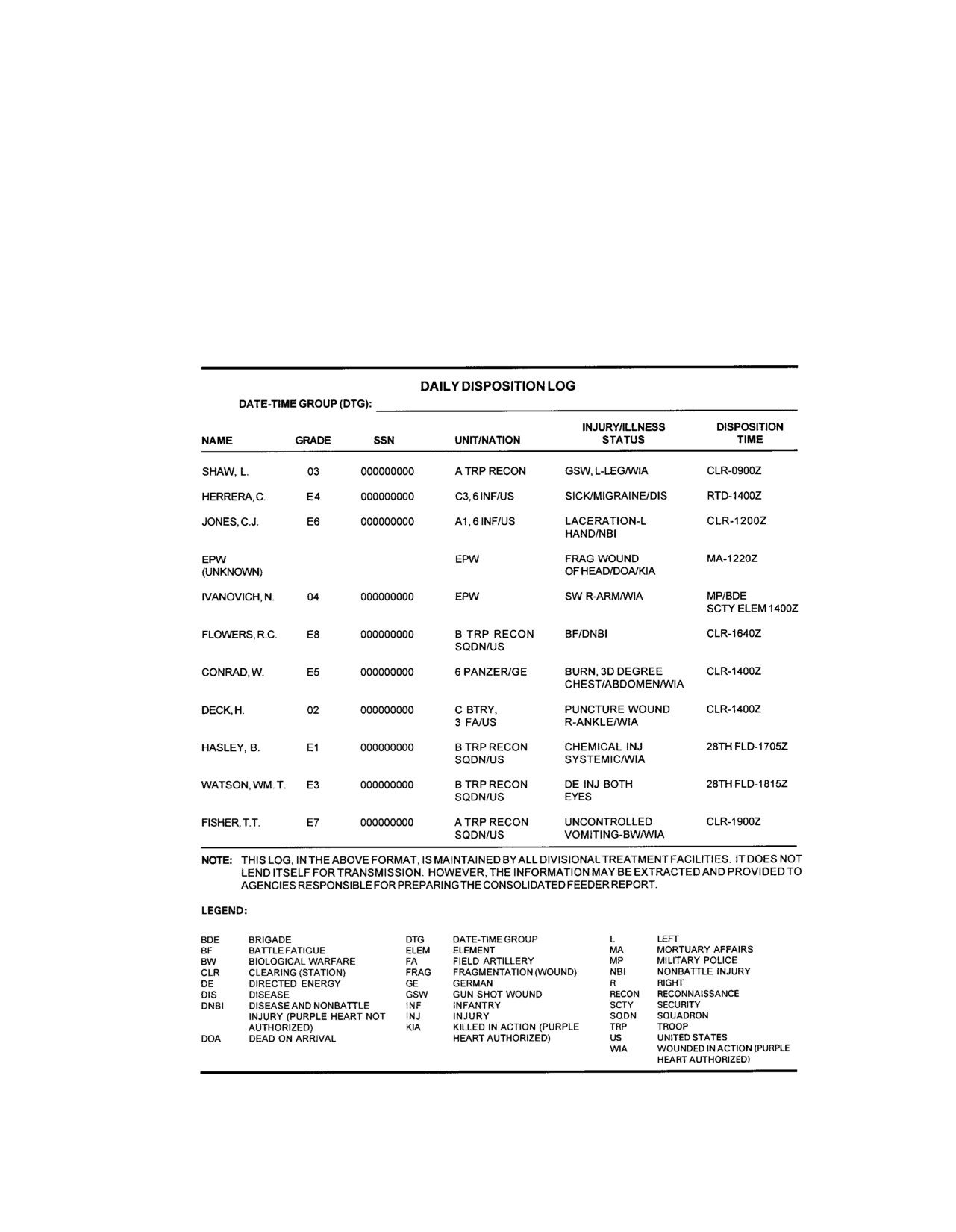
B. Daily Disposition Log (DDL). The DDL is maintained by all Echelon I and Echelon II MTFs
assigned or attached to the division. Information from this log is extracted, when required, and provided to
the S1 or the supported unit requesting the information. The DDL is also the primary source document for
information needed in the preparation of the Patient Summary Report (PSR) and the Patient Evacuation and
Mortality Report (PE&MR). See Appendix 1 for a sample format.
C. Medical Reports Format. Medical reporting will be accomplished using the FBCB2, FAX or
voice, transmitted via radio/MSE. A manual backup system will be developed. Formats for medical
reports are required to maintain consistency and continuity in reporting procedures for information submitted
to the BSS and the DSS. Data contained in these reports are required to support the DSS's capability
projections and to assist the BSS, HSSO, and FSMC commander in coordinating and planning CHS
operations. Data is also extracted for consolidated reporting to higher headquarters. The guidelines
presented below should be followed exactly.
1.
Each line of information is divided into a number of fields. Each field has a minimum
number of alphanumeric characters as indicated in the sample format provided (see Appendix 2).
2.
Each field is separated by a single slash(/).
3.
The end of each set of fields is indicated by a double Slash (//).
4.
If information from a prior report has not changed, NC will be entered in that field (/NC/).
5.
Reports are formatted according to special instructions and reports format. A sample
message is provided with each appendix.
D. Medical Situation Report, Battalion Aid Station. The Medical Situation Report, BAS, is a
daily patient summary report. This report is used to inform the commander of the battalions patient, Class
VIII, and medical equipment status. This report is submitted daily, covering the events in a 24-hour time
period based on timelines provided by the higher headquarters. It is submitted to the supporting medical
company. The battalion surgeon (platoon leader) or platoon sergeant is responsible for this report. This
report could be dispatched via courier, FAX, and/or teletype. See Appendix 2 for a sample format.
E. Medical Situation Report, Medical Companies. The Medical Situation Report, Medical
Companies, is a daily patient summary report. This report is submitted daily to the DSS according to time-
lines provided by higher headquarters. The following information will be included in line six of this report:
1.
Status of all assigned and attached ambulances, to include
a. Total number of ambulances.
B-16
FM 4-02.21
b. Number of ambulances that are operational.
c.
Number of ambulances that are nonoperational.
2.
Status of personnel; identify shortages by AOC or MOS.
3.
Treatment of any EPW will be entered in this section.
4.
Identify all patients seen during the reporting period with a number and provide the
following information in the order provided below:
a. Nationality.
b. Name.
c.
Rank.
d. Service number.
e.
Unit.
f.
Date of birth.
g. Diagnosis.
h. Disposition.
i.
Date of disposition.
j.
Gaining unit.
5.
A hard copy of each aid stations Medical Situation Report must accompany the
submitting medical companys report. See Appendix 3 for a sample format.
F. Medical Situation Report, Medical Operations. The Medical Situation Report, Medical
Operations, is a consolidated patient summary report. This report is consolidated by the DSS and pertains
to the previous 24 hours. It is submitted from the DSS daily to the division based on timelines established
by the division surgeon. See Appendix 4 for a sample format.
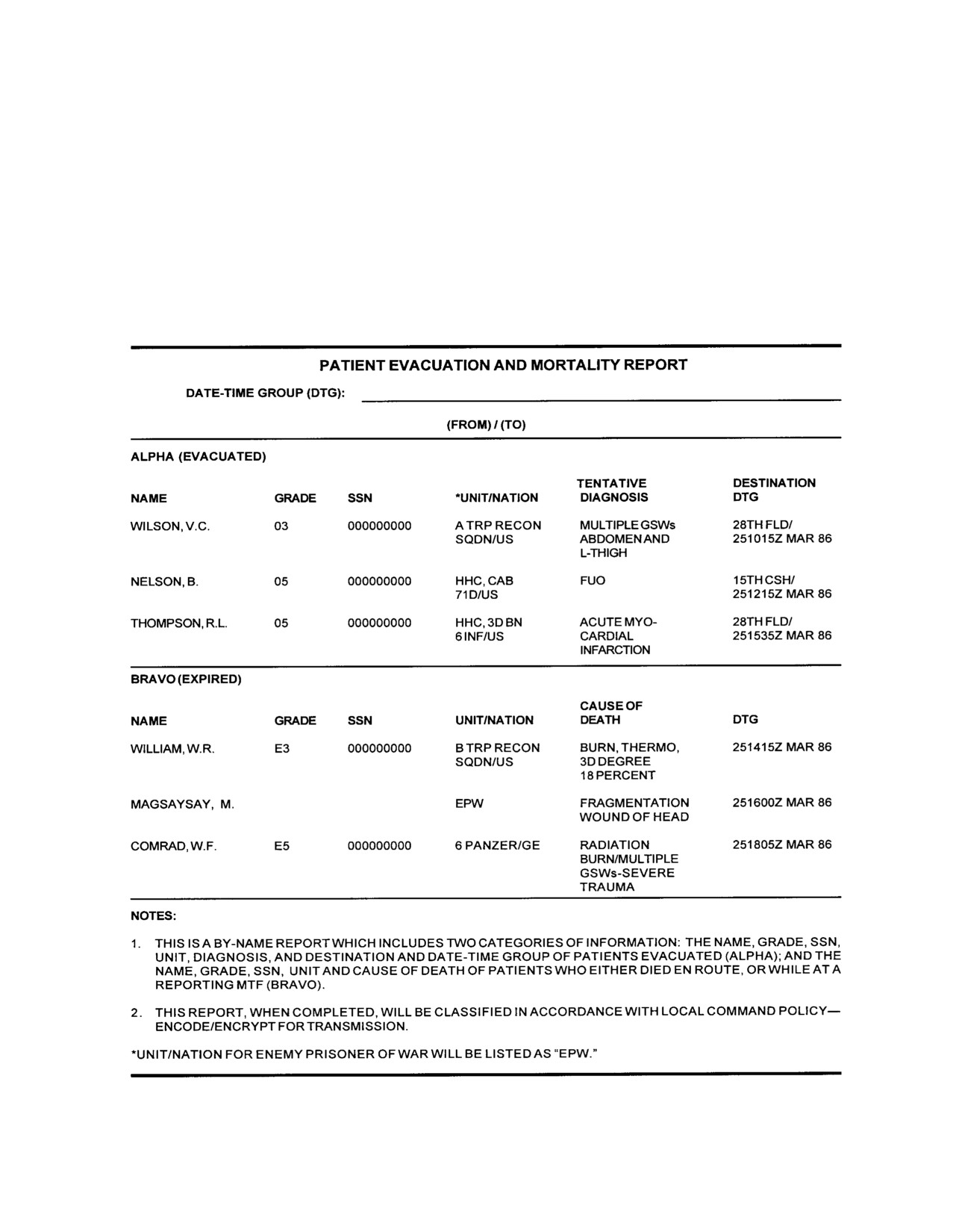
G. Patient Evacuation and Mortality Report. All Echelons I and II MTFs assigned or attached to
the division prepare the PE&MR. The purpose of this report is to provide a status of patients seen by
division MTFs. This is a weekly report compiled as of 2400 each Sunday and distributed each Monday to
supported units. See Appendix 5 for a sample format.
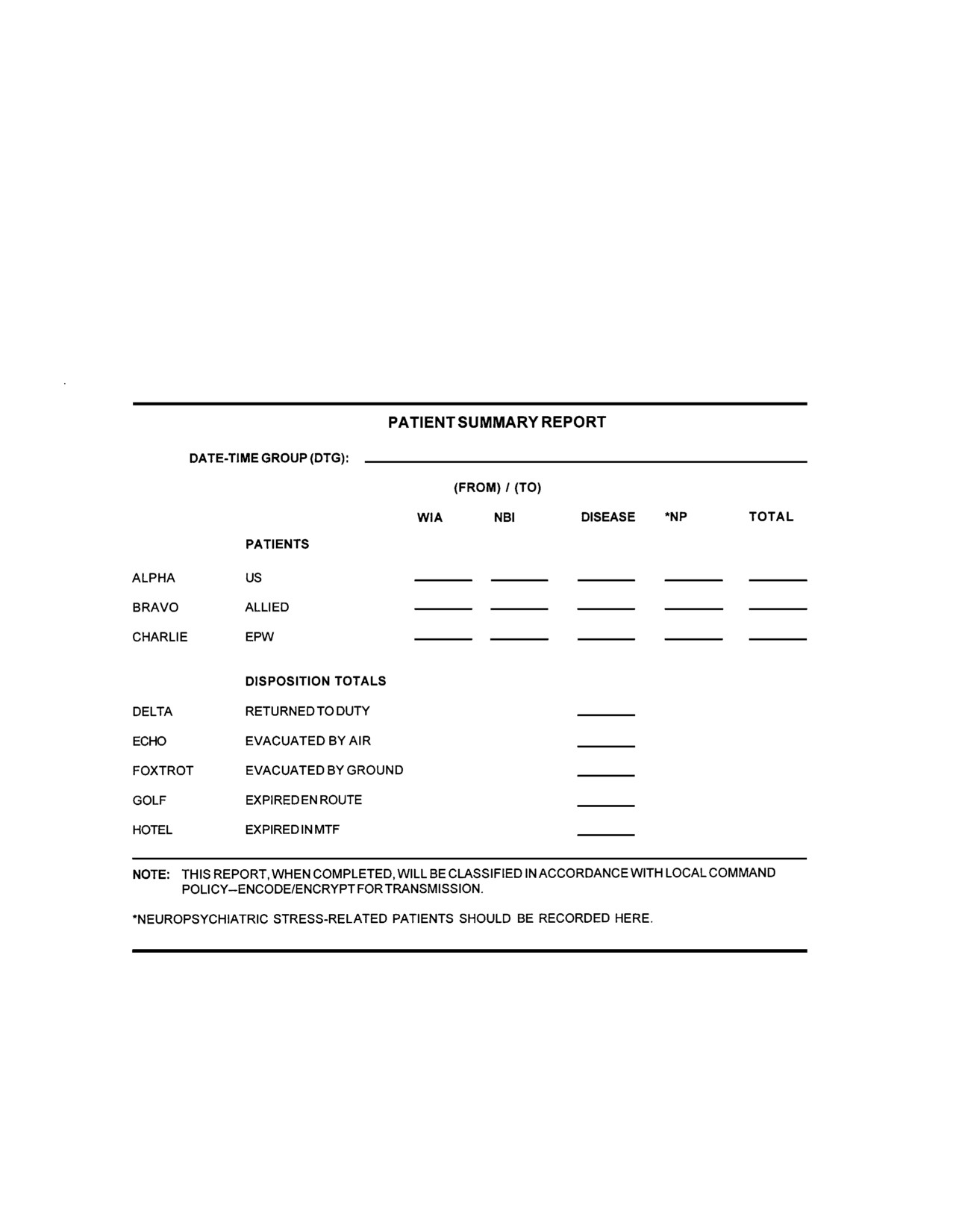
H. Patient Summary Report. The PSR provides the status of patients seen by division medical
companies and includes their subordinate elements (dental, optometry, mental health, or attached units).
B-17
FM 4-02.21
The PSR is a weekly report compiled as of 2400 each Sunday. It is prepared by all Echelons I and II MTFs
operating in the division AO. It is submitted each Monday to the DSS. See Appendix 6 for a sample
format.
I.
Blood Report. The Blood Report is a required report for requesting blood support. Echelon II
MTFs will request only Group O Positive and Group O Negative liquid red blood cells. See Appendix 7 for
sample formats (Sample Format A for written blood report and Sample Format B for voice message
format).
J.
Team Movement Report. The Team Movement Report is used to track the status and location
of teams (PVNTMED, combat stress, veterinary, ambulance, and treatment teams). See Appendix 8 for a
sample format.
B-18
FM 4-02.21
APPENDIX 1
SAMPLE FORMAT (DAILY DISPOSITION LOG)
TO ANNEX T, MEDICAL REPORTS
_______ INF DIV TSOP
B-19
FM 4-02.21
APPENDIX 2
SAMPLE FORMAT (MEDICAL SITUATION REPORT, BATTALION AID STATION)
TO ANNEX T, MEDICAL REPORTS
_______ INF DIV TSOP
FM: BAS
TO: BSS//
INFO: FSB/FSMC // DSS (AS APPROPRIATE) //
CLASSIFICATION: (AS APPROPRIATE)
SUBJECT: MEDICAL SITUATION REPORT (BAS)
LINE ONE
AS OF DTG IN ZULU TIME
LINE TWO
LOCATION (SIX DIGIT GRID COORDINATES)
LINE THREE NUMBER OF PATIENTS SEEN (INCLUDING TYPE OF PATIENTS
[W=WIA, D=DNBI])
LINE FOUR
NUMBER OF PATIENTS RETURNED TO DUTY
LINE FIVE
NUMBER OF PATIENTS EVACUATED FROM BATTLE AREA
LINE SIX
NUMBER OF PATIENTS AWAITING EVACUATION
LINE SEVEN NUMBER OF OPERATIONAL AMBULANCES BY TYPE OF
VEHICLE (M996, M113)
LINE EIGHT LOGISTIC STATUS (GREEN, AMBER, OR RED)/USE REPORT
CODES IN APPENDIX 9
B-20
FM 4-02.21
APPENDIX 3
SAMPLE FORMAT (MEDICAL SITUATION REPORT, MEDICAL COMPANY)
TO ANNEX T, MEDICAL REPORTS
_______ INF DIV TSOP
FM: FSMC COMMANDER
TO: BRIGADE SURGEON'S SECTION
INFO: FSB COMMANDER
CLASSIFICATION: (AS APPROPRIATE)
SUBJECT: MEDICAL SITUATION REPORT
LINE ONE:
AS OF: DTG IN ZULU TIME
LINE TWO:
PATIENT STATUS (WIA, DNBI) UNIT DESIGNATION//** TOTAL NEW PA-
TIENTS SEEN/CONSOLIDATED BY EACH FSMC (AS TOTAL [W=,D=])
FSB (W=,D=)/PNT RTD (BAS TOTAL=+FSB=#//TOTAL # PATIENTS EVAC-
UATED TO BDE REAR(DSA=#, TO CORPS)//# OF NEW PATIENT HOLDING//
END OF DAY HOLDING CENSUS
LINE THREE:
UNIT STATUS
**6 DIGIT COORDINATES//# OF COTS AVAILABLE FOR HOLDING//# OF
COTS OCCUPIED//# OF COTS UPLOADED ON VEHICLE, TIME NEEDED TO
GET HOLDING AREA OPERATIONAL
**INDICATES THAT OPERATIONAL COTS ARE ASSEMBLED AND READY
FOR PATIENTS
LINE FOUR
ANTICIPATED UNIT MOVE IN NEXT 24 HOURS; IF NONE, REPORT "0"
UNIT//ANTICIPATED NEW LOCATION//ANTICIPATED TIME BECOMING
OPERATIONAL (DTG)//*PROJECTED NUMBER OF PATIENTS REQUIRING
EVACUATION TO REAR
LINE FIVE
HEALTH SERVICE LOGISTICS
**GREEN, AMBER, OR RED
**DENOTES MEDICAL PERSONNEL MAKING DETERMINATION OF COLOR
STATUS BY UNIT STOCKAGE LEVEL AND PROJECTED OPERATIONS.
CLARIFY ALL AMBER AND RED STATUS IN REMARKS. GREEN=80-100%;
AMBER=65-80%; RED=LESS THAN 65% OF INITIAL STOCKAGE LEVEL
LINE SIX
EVACUATION ASSETS
NUMBER OF AMBULANCES OPERATIONAL IN BSA/DSA
LINE SEVEN
INCLUDE # OF NBC PATIENTS//# OF EPW PATIENTS// PERSONNEL SHORT-
AGES//MAJOR END ITEM SHORTAGES (BASIS FOR LINE FIVE STATUS)
USE
REPORT CODES IN APPENDIX 9
B-21
FM 4-02.21
APPENDIX 4
SAMPLE FORMAT (MEDICAL SITUATION REPORT, MEDICAL OPERATIONS)
TO ANNEX T, MEDICAL REPORTS
_______ INF DIV TSOP
FM: 1ST BDE SURGEON'S SECTION
TO: DIVISION SURGEON'S SECTION
INFORMATION: NONE
CLASSIFICATION: AS APPROPRIATE
SUBJECT: COMBAT HEALTH SUPPORT SITUATION REPORT
LINE ONE:
AS OF: DTG IN ZULU TIME
LINE TWO:
PATIENT STATUS
TOTAL NEW PATIENTS W-#, D=#//NUMBER OF RTD//# OF PATIENTS
EVACUATED TO CORPS//# OF NEW PATIENTS IN HOLDING STATUS//END
OF DAY HOLDING STATUS CENSUS
LINE THREE:
UNIT STATUS
*UNIT DESIGNATION//6 DIGIT GRID COORDINATES//# OF OPERATIONAL
COTS//# OF UNOCCUPIED COTS//# OF COTS UPLOADED ON VEHICLES,
TIME NEEDED TO BE OPERATIONAL
*ONE PARAGRAPH FOR EACH FSMC ASSIGNED OR ATTACHED TO THE
DIVISION AND ONE FOR THE SUPPORT MED COMPANY. TO BE REPORT-
ED AS ALPHA, BRAVO, CHARLIE, ETC
LINE FOUR:
ANTICIPATED OPERATIONS IN NEXT 24 HOURS; IF ONE, STATE UNIT
DESIGNATION//ANTICIPATED DTG CLOSING TIME (NONOPERATIONAL)//
ANTICIPATED NEW LOCATION//ANTICIPATED OPERATIONAL TIME//
LINE FIVE:
COMBAT HEALTH LOGISTICS
UNIT ID WITH AMBER OR RED//UNIT ID WITH AMBER OR RED, STATUS
LEVEL (AMBER OR RED)
B-22
FM 4-02.21
APPENDIX 5
SAMPLE FORMAT (PATIENT EVACUATION AND MORTALITY REPORT)
TO ANNEX T, MEDICAL REPORTS
________ INF DIV TSOP
B-23
FM 4-02.21
APPENDIX 6
SAMPLE FORMAT (PATIENT SUMMARY REPORT)
TO ANNEX T, MEDICAL REPORTS
_______ INF DIV TSOP
B-24
FM 4-02.21
APPENDIX 7
SAMPLE FORMAT (BLOOD REPORT)
TO ANNEX T, MEDICAL REPORTS
SAMPLE FORMAT A, BLOOD REPORT
________ INF DIV TSOP
Sample Format A
Message Blood Report
FM: CDR CHARLIE MED 34FSB
TO: BLOOD SUPPORT DETACHMENT OFFICE
INFO: DIVISION SURGEON
CLAS UNCLAS
OPER/VALIANT EAGLE
MSGID/BLDREP/CMED34FSB/1012221//
REF/A/CDRUSACOM/090300ZJAN92/-/TOTAL//
ASOFDTG/100001ZJAN92//
(Line 1)
REPUNIT/CMED34FSB/G/BZ44327432//
(Line 2)
BLDINVT-/-/20JS//
(Line 3)
BLDREQ/30JSW//
(Line 4)
BLDEXP/2JS//
(Line 5)
BLDEST/30JS//
(Line 6)
RMKS/RECEIVED 30JS/TRANSFUSED 30JS/SHIPPED O/
(Line 7)
REFRIGERATOR NEEDS REPAIR//
DECLAS
(Line 8)
*Report Explanation:
(1)
Line 1, ASOFDTG: Day-time zone of the BLDREP.
(2)
Line 2, REPUNIT: Name, designator code, and activity brevity code of reporting unit.
(3)
Line 3, BLDINVT: Used to report the total number of each blood product on hand at the end of the
reporting period. Total the blood products at the end of the reporting period.
(4)
Line 4, BLDREQ: Used to report the total number of each blood product requested and time frame
needed.
(5)
Line 5, BLDEXP: Used to report the estimate of the number of each blood product which will
expire within the next seven days.
(6)
Line 6, BLDEST: Used to report the estimate of the total number of each blood product required
for resupply within the next 7 days.
(7)
Line 7, CLOSTEXT OR RMKS: Used to provide additional amplifying information if required.
(8)
Line 8, DECL: Mandatory if the message is classified.
B-25
FM 4-02.21
APPENDIX 7 (CONTINUED)
SAMPLE FORMAT (BLOOD REPORT)
TO ANNEX T, MEDICAL REPORTS
SAMPLE FORMAT B, BLOOD REPORT
________ INF DIV TSOP
Sample Format B
Voice Transmitted Blood Report
LINE 1
151215Z
LINE 2
CHARLIE MIKE 34 HOTEL
LINE 3
20 JS
LINE 4
32 JSW
LINE 5
2 JS
LINE 6
140 JS
LINE 7
RECEIVED 30 JS/ TRANS 20 JS NO UNITS SHIPPED,
REFRIGERATOR NEEDS REPAIR
LINE 8
(AUTHENTICATION IN ACCORDANCE WITH SOI)
*Report Explanation
(1)
Line 1, ASOFDTG: Day-time zone of the BLDREP.
(2)
Line 2, REPUNIT: Name, designator code, and activity brevity code of reporting unit.
(3)
Line 3, BLDINVT: Used to report the total number of each blood product on hand at the end of the
reporting period. Total the blood products at the end of the reporting period.
(4)
Line 4, BLDREQ: Used to report the total number of each blood product requested and time frame
needed.
(5)
Line 5, BLDEXP: Used to report the estimate of the number of each blood product which will
expire within the next seven days.
(6)
Line 6, BLDEST: Used to report the estimate of the total number of each blood product required
for resupply within the next 7 days.
(7)
Line 7, CLOSTEXT OR RMKS: Used to provide additional amplifying information if required.
(8)
Line 8, AUTHENTICATE: Authentication, if required.
B-26