FM 4-02.21 DIVISION AND BRIGADE SURGEONS HANDBOOK (DIGITIZED): TACTICS, TECHNIQUES, AND PROCEDURES (November 2000) - page 4
FM 4-02.21
APPENDIX 8
SAMPLE FORMAT (TEAM MOVEMENT REPORT)
TO ANNEX T, MEDICAL REPORTS
________ INF DIV TSOP
FM: FSMC
TO: SUPPORT OPERATIONS FSB//BRIGADE SURGEONS SEC//DIVISION SURGEONS SECTION
INFORMATION: NONE
CLASSIFICATION: AS APPROPRIATE
SUBJECT: TEAM MOVEMENT REPORT
LINE ONE:
UNIT WILL BE REPORTED AS ALPHA, BRAVO, CHARLIE, ETC
LINE TWO:
CURRENT LOCATION, SIX DIGIT GRID COORDINATES
LINE THREE: DEPARTURE AS OF: (DTG IN ZULU TIME)
LINE FOUR: DESTINATION AND ROUTE
LINE FIVE:
ARRIVAL AS OF: (DTG IN ZULU TIME)
LINES TWO THROUGH FOUR ARE REPORTED PRIOR TO DEPARTURE FROM
ANY SITE; LINE FIVE IS REPORTED UPON ARRIVAL
B-27
FM 4-02.21
APPENDIX 9
SAMPLE FORMAT (REPORTS CODES)
TO ANNEX T, MEDICAL REPORTS
________ INF DIV TSOP
1.
PURPOSE: To list medical codes used to assist medical units in filling out medical reports and
Class VIII resupply requests.
2.
FREQUENCY: NA.
3.
RESPONSIBILITY: Division surgeon.
4.
ADDRESSEES: All medical units.
5.
TRANSMISSION: NA.
6.
REPORTS FORMAT: NA.
7.
REMARKS:
A. Each major command (MACOM) establishes reporting codes which meet operational require-
ments for their units.
B. The following tables (TABs) will assist in compiling the report as required.
(1) TAB A: Table of Minimum Essential Supply Items
(2) TAB B: Disease Codes
(3) TAB C: Authorized Abbreviations
(4) TAB D: Cause of Casualty
B-28
FM 4-02.21
TAB A (TABLE OF MINIMUM ESSENTIAL SUPPLY ITEMS) TO
APPENDIX 9 (REPORT CODES) TO ANNEX T, MEDICAL REPORTS
_______INF DIV TSOP
SURGICAL DRESSING MATERIEL
090
BANDAGE, GAUZE ROLLER
091
FIRST AID DRESSING
092
BURN DRESSING
093
GAUZE, ABSORBENT
094
BANDAGE, COTTON PLASTER OF PARIS, IMPREGNATED
095
COTTON WOOL, ABSORBENT
GASTROINTESTINAL
100
ANTIHELMINTIC
101
ANTIDIARRHEAL
102
ANTIDYSENTERIC
103
ANTACIDS
MISCELLANEOUS
110
DISINFECTANTS
111
ANTISEPTICS
112
DETERGENTS, SURGICAL
113
HYPODERMIC SYRINGES AND NEEDLES
114
SURGICAL SUTURE/LIGATURE MATERIEL
115
SPLINTING MATERIEL
B-29
FM 4-02.21
TAB B (DISEASE CODES) TO APPENDIX 9 (REPORT CODES)
TO ANNEX T, MEDICAL REPORTS
_______INF DIV TSOP
DISEASE
CODE
Cholera
000
Typhoid Fever
001
Paratyphoid Fever
002
Other Salmonella Infections
003
Bacillary Dysentery
004
Amoebiasis
006
Other Enteric Infection
008
Pulmonary Tuberculosis
010
Plague
020
Tularemia
021
Anthrax
022
Brucellosis
023
Dyptheria
032
Scarlet Fever
034
Erysipelas
035
Meningococcal Infection
036
Tetanus
037
Acute Poliomyelitis
043
Smallpox
050
Chicken Pox
052
Measles
055
Rubeola
056
Yellow Fever
060
Viral Encephalitis (unspecified)
065
Infectious Hepatitis
070
Epidemic Parotitis
072
Mononucleosis
075
Epidemic Louse-Borne Typhus
080
Q-Fever
083
Malaria
084
Relapsing Fever
088
Syphilis
090
Blennorrhea
098
Venereal Ulcers
099
Leptospirosis
100
Influenza
470
Other
989 (If this code is used, provide details.)
B-30
FM 4-02.21
TAB C (AUTHORIZED ABBREVIATIONS) TO APPENDIX 9 (REPORT CODES)
TO ANNEX T, MEDICAL REPORTS
_______INF DIV TSOP
AUTHORIZED ABBREVIATIONS
ARMS AND SERVICES:
AVN
AVIATION
EMPLOYED MEANS:
ABN
AIRBORNE
MORTARS
AD
AIR DEFENSE
POISON
AMINF
ARMED INFANTRY
ROCKETS
AMPB
AMPHIBIOUS
SABOTAGE
ARMD
ARMORED
TUBEARTY
ARTY
ARTILLERY
MISSILES
AT
ANTITANK
ATAGM
ANTITANK GUIDED MISSILE
COMMAND LEVEL:
AG
ADJUTANT GENERAL
ARMY
ARMY
BDE
BRIGADE
BN
BATTALION
CO
COMPANY
CORPS
CORPS
DIV
DIVISION
GP
GROUP
HQ
HEADQUARTERS
PLT
PLATOON
RGT
REGIMENT
NATIONALITY:
BE
BELGIAN
CA
CANADIAN
GE
GERMAN
NL
NETHERLANDS/HOLLAND
UK
BRITISH
US
AMERICAN
B-31
FM 4-02.21
TAB D (CAUSE OF CASUALTY) TO APPENDIX 9 (REPORT CODES)
TO ANNEX T, MEDICAL REPORTS
_______INF DIV TSOP
CAUSE OF CASUALTY TO BE USED FOR MASS CASUALTY REPORTING.
ACCIDENT:
AIRCRASH
ACCIDENT:
MARITIME
ACCIDENT:
MOTOR VEHICLE
ACCIDENT:
RAILWAY
ACCIDENT:
FIRE
ACCIDENT:
INDUSTRIAL
ACCIDENT:
POISON
ACCIDENT:
NATURAL DISASTERS
ACCIDENT:
OTHER CAUSES
BATTLE:
CONVENTIONAL
BATTLE:
NUCLEAR
BATTLE:
BIOLOGICAL
BATTLE:
CHEMICAL
B-32
FM 4-02.21
APPENDIX C
BRIGADE SURGEONS SECTION INITIAL BRIGADE
COMBAT TEAM
C-1. Mission of the Brigade Surgeons Section
The mission of the BSS is to plan, coordinate, and synchronize CHS for the brigade. This is accomplished
under the supervision of the brigade surgeon. The BSS looks at the total CHS package in support of the
brigade and plans its employment to ensure maximum coverage and effective utilization of brigade medical
personnel. For definitive information on developing CHS input for the OPLAN/OPORD, see FMs 8-55, 101-5,
and 101-5-1.
C-2. Brigade Surgeons Section
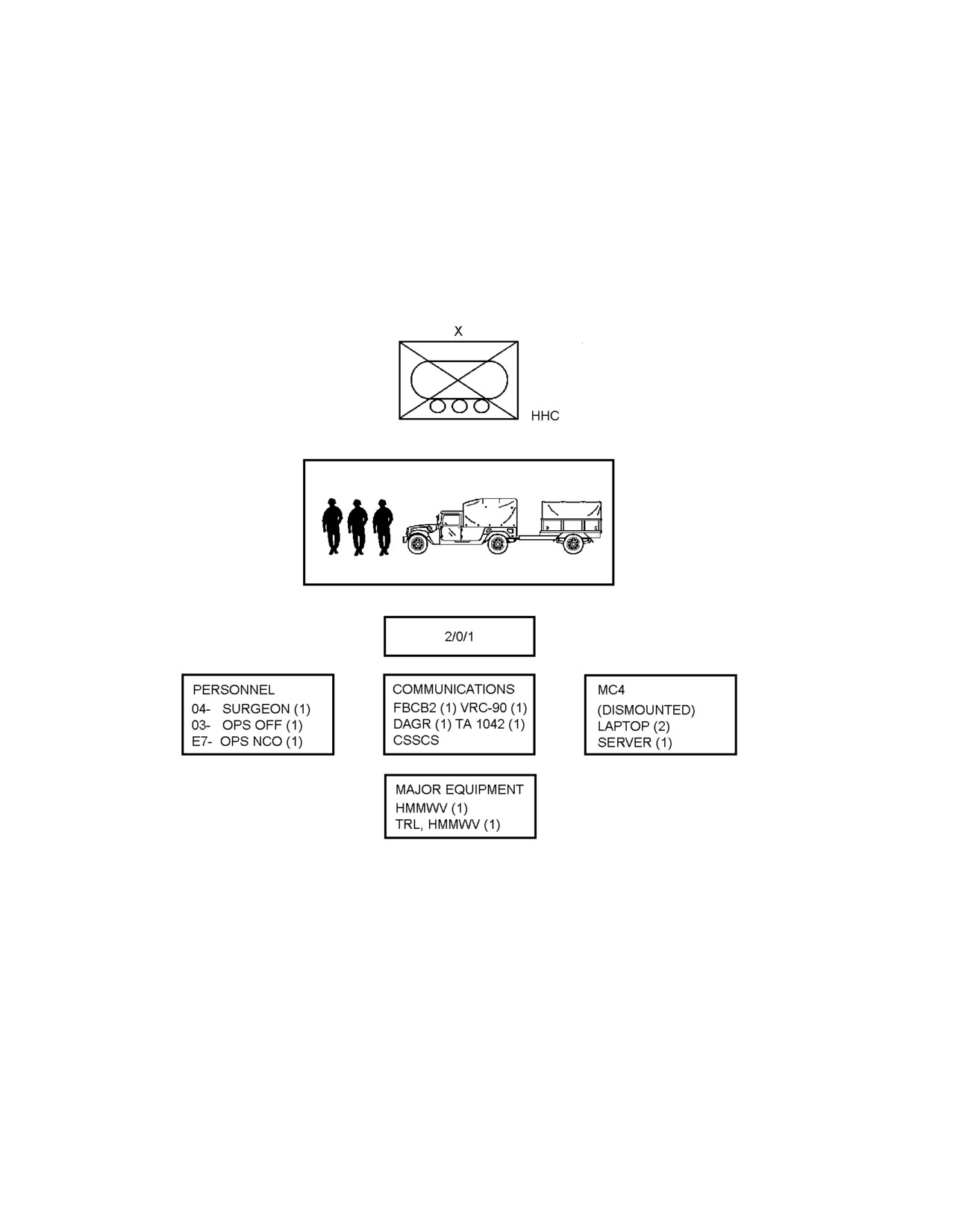
a. The BSS (Figure C-1) is assigned to the HHC of the brigade and operates out of the brigade
TOC. The BSS is an integral part of the brigades main CP and the staff of the BSS is intimately involved
with the S3 and his staff in the planning process. A surgeons cell and a medical plans and operations cell
form the BSS. This section, in coordination with the HSSO and HSMO of the brigade support battalion
(BSB) support operations section, and the brigade support medical company (BSMC) commander, is
responsible for the development of the medical portion of the brigade OPLAN/OPORD and takes part in the
brigade planning process. The BSS staff is responsible to the brigade commander for staff supervision of
CHS within the brigade. The BSS is also responsible for coordinating GS and DS relationships of organic
medical units and other medical units/elements whether under OPCON or attached to the brigade. The
brigade commander is updated as required on the status of CHS in the brigade.
b. The brigade surgeon is the chief of the BSS and is assisted by the medical plans and operations
cell. Specific functions of the BSS include
Planning and ensuring that Echelons I and II CHS for the brigade are provided in a
timely and efficient manner.
Planning and coordinating CHS operations for brigade medical assets and attached or
OPCON corps assets. This includes reinforcement and reconstitution.
Coordinating with the FSB support operations CHS cell HSSO and HSMO for prioritizing
the reallocation of organic and corps medical augmentation assets as required by the tactical situation.
Ensuring that the medical annex of the brigade TSOPs, plans, policies, and procedures
for CHS, prescribed by the brigade surgeon, are prepared and executed.
Overseeing medical training (collective and individual) and providing information to the
brigade surgeon and brigade commander.
Coordinating and prioritizing CHL and blood management requirements for the brigade.
C-1
FM 4-02.21
Collecting medical threat information and coordinating combat health intelligence
requirements with the brigade S2 according to FM 8-10-8.
Coordinating and directing patient evacuation from the brigade AO to supporting MTFs.
Figure C-1. Brigade surgeons section.
Coordinating the medical evacuation of all EPW casualties from the brigade AO.
Coordinating the disposition of captured medical materiel.
Coordinating, planning, and prioritizing PVNTMED missions.
Coordinating with the supporting veterinary element for subsistence and animal disease
surveillance.
C-2
FM 4-02.21
Coordinating medical intelligence preparation of the battlefield.
Advising on the ramification of using nonlethal weapons and how this might affect the CHS
plan.
C-3. Duties and Responsibilities of the Brigade Surgeon
The brigade surgeon is an MC officer (Major, AOC 62B00). He is a special staff officer who plans with
and coordinates brigade CHS activities with the brigade S1. The surgeon is responsible for the technical
control of all medical activities in the command. The brigade surgeon oversees and coordinates CHS
activities through the BSS and the brigade S3. The brigade surgeon keeps the brigade commander informed
on the status of CHS for brigade operations and the health of the command. He provides input and obtains
information to facilitate medical planning. For definitive information pertaining to the brigade surgeon's
duties and responsibilities, see FM 8-10-21.
C-4. Medical Plans and Operations Cell
The medical plans and operations cell is typically staffed with a
Medical plans officer (Captain, AOC 70H67).
Medical operations NCO (E-7, MOS 91B40).
This cell is responsible for
Developing CHS staff estimates for supporting brigade operations.
Developing and coordinating the brigade CHS plan with the brigade staff, the BSB staff, the
BSMC, and the maneuver battalion medical platoons.
Developing the CHS annex of the brigade OPLAN/OPORD.
Overseeing and synchronizing brigade CHS operations.
Monitoring medical troop strength to determine task organization for mission accomplish-
ment.
Forwarding all medical information of potential intelligence value to the brigade S2 and S3
sections.
Obtaining updated medical threat and intelligence information through the brigade S2 and S3
sections and from the higher headquarters for evaluation and applicability.
C-3
FM 4-02.21
Coordinating the disposition of captured medical materiels according to the TSOPs.
Coordinating through the higher headquarters for corps-level medical support reinforcement/
augmentation, as required.
Verifying emergency supply requests and taking the necessary action to expedite delivery.
Monitoring Class VIII resupply levels to ensure adequate stockage for support of brigade
operations.
Tracking and managing critical Class VIII items in coordination with the maneuver battalion
medical platoons and the BSMC.
Ensuring that clear and accurate patient records are maintained of all clinical encounters for
supported deployed personnel through the use of a DA Form 8007-R or through the use of digital patient
records, as they become available. See AR 40-66 and FM 8-10-1 for management of individual health
records in the field. Also, digital patient records at the division and brigade level will be available through
the fielding of MC4 and the TMIP.
C-5. Information and Communications
a. The Brigade Surgeons Sections Communications and Information Systems. Information and
communications assets available to the BSS include radio sets (AN/VRC 90 series [FM]); digital nonsecure
voice telephone (1 each); MSE FAX; TACLAN WS; LAN router; MCS; CSSCS; and FBCB2/position/
navigation (1 each). The CSSCS in the BSS will aid with maintaining real-time situational awareness and
with understanding what is happening on the battlefield. This system tracks unit information down to the
company level. Included in the classes of supplies tracked by the CSSCS is Class VIII. Using the CSSCS
to track Class VIII will enhance the BSSs ability to identify critical Class VIII items. The BSS will
exchange information with the FSB and higher headquarters, using the CSSCS. For definitive information
on the CSSCS, see FMs 63-20-1, 63-21-1, and 63-23-2.
b. Combat Health Support Functions, Force XXI Battle Command Brigade and Below System.
Force XXI Battle Command Brigade and Below is a hardware/software suite that digitizes C2 at brigade and
below level. The FBCB2 system provides a seamless battle command capability for performance of
missions throughout the operational continuum at the tactical level. The FBCB2 system is the implementation
of information technology to provide increased battlefield operational capabilities. The system is positioned
on specified platforms and will perform combat, CS, and CSS functions for the planning and execution of
operations. This system gives the BSS a common relevant picture of the current CHS situation at BAS,
AXPs, and the BSMC. For the first time, the medical organizations and elements are digitally linked to the
platforms and organizations they support, providing current information on the status of those units. This
common battlefield picture will enable CHS providers to maintain the operational tempo set by the maneuver
commander. There are three medical screens incorporated into the CSS FBCB2 function. They are the
medical functionality in the LOGSITREP, the MEDSITREP, and the MEDEVAC request. It is important
that units use standard message and report formats to eliminate confusion.
C-4
FM 4-02.21
c.
Radio Nets. Radio nets used by the BSS includes the following:
(1) The BSS maintains communication with medical elements supporting the brigade through
its FM radio. Single-channel ground and airborne radio system components provide the BSS with an AN/
VRC 90. A technique for operating a brigade medical net is to use the BSMC command net for brigade-
wide medical communications while using the administrative/logistics net for other CSS integration.
Situation awareness is monitored using FBCB2 and by face-to-face contact with other brigade staff members
in the brigade TOC.
(2) The brigade logistics operations net (AM-SSB), which is controlled by the BSB support
operations section, provides the necessary long-range C2 link between the FSB, the brigade, and supporting
corps logistics elements.
d. Mobile Subscriber Equipment. Mobile subscriber equipment allows the BSS to communicate
throughout the battlefield in either a mobile or static situation. As the Army continues to digitize the
battlefield and modernize the force, the use of automation continues to develop. Mobile subscriber
equipment packet switching network gives units the ability to connect to division and corps LANs or WAN.
A WAN is similar to the LAN but covers a larger distance. This allows units/CPs to connect computer
systems, such as the CSSCS, MCS, and FBCB2, to an ethernet cable (coaxial) and send and receive
information in an extremely efficient manner. Because of the limitations of a network constructed with
coaxial cable, a WAN uses a combination of the MSE packet network and radio networks to distribute the
data through the system where necessary. Packet switching does not use or take up existing telephone lines.
Instead, telephone lines are freed up even more because information is being sent over a network on
computers and related equipment. Using the ATCCS, common hardware/software facilitates the interface
and exchange of information between the BSS, medical platoons operating BAS, BSMC, and corps medical
elements. See FM 63-2-2 for information concerning ADP continuity of the operations plan.
e.
Combat Service Support Control System. The CSSCS is the CSS component of ABCS. This
is the primary CSS information tool used within the brigade. The CSSCS provides a concise picture of unit
requirements and support capabilities by collecting, processing, and displaying information on key items of
supplies, services, and personnel that the commanders deem crucial to the success of an operation. The
CSSCS currently provides situation awareness of critical elements within supply Classes I, II/IV, IIIB, IIIP,
V, VII, and VIII and personnel strength management. Maintenance, transportation, and medical
functionality are a few features to be added as the system matures.
C-6. Medical Standard Army Management Information System
The MC4 system will be a theater, automated CHS system, which links commanders, health care providers,
and supporting elements, at all echelons, with integrated medical information. The BSS has one MC4
system (dismounted) with two laptops and one server. The system provides digital enablers to connect both
vertically and horizontally, all ten CHS functional business systems. See Chapter 2 for definitive information
on MC4.
C-5
FM 4-02.21
C-7. Brigade Combat Health Support Planning
The brigade plan/operations cell has the primary responsibility for developing and coordinating the brigades
CHS plan. The foundation of the brigades CHS plan is the brigade commanders guidance and the higher
headquarters CHS plan. The BSS is an integral member of the planning staff and participates in all phases
of the tactical decision making process. For definitive information on planning and conducting CHS
operations for the digitized force, see FM 8-10-21.
C-8. Combat Health Support Tactical Standing Operating Procedures
The BSS is responsible for the development of the CHS annex for the brigade TSOPs. The purpose of a
TSOP is to establish routine protocols. The procedures in the TSOP should not be dependent upon the
METT-TC factors. If a specific decision is required each time, it should not be included in the TSOP. The
brigades TSOP is based on its higher headquarters TSOP and serves as the foundation for subordinate
units to develop their TSOP. The brigades CHS annexes to the TSOP should be clear and concise, yet
provide sufficient detail of procedural requirements. The CHS annexes to the TSOP must reflect procedural
guidance that supports current mission and doctrinal requirements. The CHS annexes to the brigades
TSOP should be maintained and reviewed at least every 6 months and revised as required. Most importantly
the TSOP must be trained and understood at all levels prior to deployment or it has no real value.
C-6
FM 4-02.21
GLOSSARY
ABBREVIATIONS, ACRONYMS, AND DEFINITIONS
A2C2
Army airspace command and control
ABCA American, British, Canadian, and Australian
ABCS Army Battle Command System
ACM airspace control measures
ACUS area common-user system
ADCS assistant division commander for support
ADP automatic data processing
AEV armored evacuation vehicle
AFATDS Advanced Field Artillery Tactical Data System
AM amplitude modulated
AMDWS air missile defense workstations
AMEDD Army Medical Department
AMEDDC&S Army Medical Department Center and School
AO area of operations
AOC area of concentration
AR Army regulation
Armed Services Whole Blood Processing Laboratories (ASWBPL)
Triservice operated facilities located
at United States Air Force airheads in continental United States that receive blood from continental
United States-based blood donor centers. Its functions include replacing blood from the blood donor
centers, storing blood, and distributing blood to Blood Transshipment Centers located in the communi-
cations zone.
ASMB area support medical battalion
ASOFDTG as of date-time group
ASWBPL See Armed Services Whole Blood Processing Laboratories.
Glossary-1
FM 4-02.21
ATCCS Army Tactical Command and Control System
ATM advanced trauma management
attn attention
augmentation The addition of specialized personnel and/or equipment to a unit.
authorized stockage list A list of items from all classes of supply authorized to be stocked at a specific
echelon of supply.
AVIM aviation intermediate maintenance
AXP ambulance exchange point
BAS battalion aid station
basic load For other than ammunition, basic loads are supplies kept by using units in combat. The
quantity of each item of supply in a basic load is related to the number of days in combat the unit may
be sustained without resupply.
BCT brigade combat team
BD battlefield distribution
bde brigade
BF battle fatigue
BLDEST blood estimate
BLDEXP blood expired
BLDINVT blood inventory
BLDREP blood report
BLDREQ blood request
boundary A control measure normally drawn along identifiable terrain features and used to delineate
areas of tactical responsibility for subordinate units. Within their boundaries, units may maneuver
within the overall plan without close coordination with neighboring units unless otherwise restricted.
Direct fire may be placed across boundaries on clearly identified enemy targets without prior
Glossary-2
FM 4-02.21
coordination, provided friendly forces are not endangered. Indirect fire also may be used after prior
coordination.
Lateral boundaries are used to control combat operations of adjacent units.
Rear boundaries are established to facilitate command and control.
br branch
brigade support area (BSA) A designated area in which combat service support elements from the
division support command and the corps support command provide logistic support to a brigade. The
brigade support area normally is located 20 to 25 kilometers behind the forward edge of the battle
area.
BRIL baseline resource item list
BSA See brigade support area.
BSB brigade support battalion
BSMC brigade support medical company
BSS brigade surgeons section(s)
BSU blood supply unit
C2
See command and control.
camouflage The use of concealment and disguise to minimize detection or identification of troops, wea-
pons, equipment, and installations. It includes taking advantage of the immediate environment as well
as using natural and artificial materials.
casualty Any person who is lost to his organization by reason of having been declared dead, wounded,
injured, diseased, interned, captured, retained, missing in action, beleaguered, besieged, or detained.
cbt combat
CDR commander
chain of command The succession of commanding officers from a superior to a subordinate through
which command is exercised.
CHL combat health logistics
CHS See combat health support.
Glossary-3
FM 4-02.21
CIP combat identification panel
cl class
CLAS classified
CMCC corps movement control center
co company
COA course(s) of action
coll collecting/collection
combat health support (CHS) All support services performed, provided, or arranged by the Army
Medical Department to promote, improve, conserve, or restore the mental and/or physical well-being
of personnel in the Army and, as directed, in other services, agencies, and organizations. These ser-
vices include, but are not limited to, the management of health service resources such as manpower,
monies, and facilities; preventive and curative health measures; the health service doctrine; evacuation
of the sick (physically and mentally), injured, and wounded; selection of the medically fit and disposi-
tion of the medically unfit; medical supply, equipment, and maintenance thereof; and medical, dental,
veterinary, laboratory, optometry, and medical food services.
combat intelligence That knowledge of the enemy, weather, and geographical features required by a
commander in planning and conducting combat operations. It is derived from the analysis of informa-
tion on the enemys capabilities, intentions, and vulnerabilities and the environment.
combat maneuver forces Those forces which use fire and movement to engage the enemy with direct
fire weapon systems, as distinguished from those forces which engage the enemy with indirect fires or
otherwise provide combat support. These elements are primarily infantry, armor, cavalry (air and
armored), and aviation.
combat medic A medical specialist, trained in emergency medical treatment procedures, and assigned or
attached in support of a combat or combat support unit.
combat service support (CSS) The support provided to sustain combat forces, primarily in the fields of
administration and logistics. It may include administrative service, chaplain service, civil affairs, food
service, finance, legal service, maintenance, medical service, military police, supply, transportation,
and other logistical services. The basic mission of combat service support is to develop and maintain
maximum combat power through the support of weapons systems.
combat support (CS) Fire support and operational assistance provided to combat elements. May include
artillery, air defense, aviation (less air cavalry and attack helicopter), engineer, military police, signal,
and electronic warfare.
Glossary-4
FM 4-02.21
combat trains The portion of unit trains that provides the combat service support required for immedi-
ate response to the needs of forward tactical elements. At company level, medical, recovery, and
maintenance elements normally constitute the combat trains. At battalion, the combat trains normally
consist of ammunition and petroleum, oil and lubricants vehicles, maintenance/recovery vehicles and
crews, and the battalion aid station.
command and control (C2) The exercise of command that is the process through which the activities of
military forces are directed, coordinated, and controlled to accomplish the mission. This process en-
compasses the personnel, equipment, communications, facilities, and procedures necessary to gather
and analyze information, to plan for what is to be done, and to supervise the execution of operations.
command post (CP) The principal facility employed by the commander to command and control combat
operations. A command post consists of those coordinating and special staff activities and representa-
tives from supporting Army elements and other services that may be necessary to carry out operations.
Corps and division headquarters are particularly adaptable to organization by echelon into a tactical
command post, a main command post, and a rear command post.
commanders estimate The procedure whereby a commander decides how best to accomplish the
assigned mission. It is a thorough consideration of the mission, enemy, terrain, troops available, time,
and other relevant factors. The commanders estimate is based on personal knowledge of the situation
and on staff estimates.
commanders intent Commanders vision of the battlehow he expects to fight and what he expects to
accomplish.
concealment The protection from observation.
concept of operations A graphic, verbal, or written statement in broad outline that gives an overall
picture of a commanders assumptions or intent in regard to an operation or series of operations; in-
cludes at a minimum the scheme of maneuver and the fire support plan. The concept of operations is
embodied in campaign plans and operation plans particularly when the plans cover a series of connect-
ed operations to be carried out simultaneously or in succession. It is described in sufficient detail for
the staff and subordinate commanders to understand what they are to do and how to fight the battle
without further instructions.
CONUS continental United States
COTS commercial off-the-shelf
CP See command post.
CS See combat support.
CSC combat stress control
CSH combat support hospital
Glossary-5
FM 4-02.21
CSS See combat service support.
CSSCS Combat Service Support Control System
CTCP combat trains combat post
CTIL commanders tracked item(s) list
DA Department of the Army
DAGR defense advanced GPS receiver
DASB division aviation support battalion
DDL daily disposition log
DECL declassified
direct support (DS)
(1) A mission requiring a force to support another specific force and authorizing
it to answer directly the supported forces request for assistance.
(2) In the North Atlantic Treaty
Organization, the support provided by a unit or formation not attached to, nor under command of, the
supported unit or formation, but required to give priority to the support required by that unit or
formation.
DISCOM division support command
disp disposition
div division
division support area (DSA) An area normally located in the division rear positioned near air landing
facilities and along the main supply route.
DMC distribution management center
DMLSS Defense Medical Logistics Standard Support
DMMC division materiel management center
DNBI disease and nonbattle injury
DOD Department of Defense
DS See direct support.
Glossary-6
FM 4-02.21
DSA See division support area.
DSB division support battalion
DSMC division support medical company
DSS division surgeons section
DTG date-time group
DTO division transportation office
DVE drivers vision enhancer
E-mail electronic mail
EAD echelons above division
Echelon I (Level I) Unit levelThe first medical care a soldier receives is provided at this level. This
care includes immediate lifesaving measures, advanced trauma management, disease prevention,
combat stress control prevention, casualty collection, and evacuation from supported unit to supporting
medical treatment. Echelon I elements are located throughout the combat and communications zones.
These elements include the combat lifesaver, combat medic, and battalion aid station. Some or
all of these elements are found in maneuver, combat support, and combat service support units. When
Echelon I is not present in a unit, this support is provided to that unit by Echelon II medical
units.
Echelon II (Level II) Duplicates Echelon I and expands services available by adding dental, laboratory,
x-ray, and patient holding capabilities. Emergency care, advanced trauma management, including
beginning resuscitation procedures, is continued.
(No general anesthesia is available.) If necessary,
additional emergency measures are instituted; however, they do not go beyond the measures dictated by
the immediate needs. Echelon II units are located in the combat zonebrigade support area, corps
support area, and communications zone. Echelon II medical support may be provided by a clearing
station, forward support medical company, main support medical company, forward support battalion
medical company, main support battalion medical company, corps area medical companies, area support
medical company (Medical Force 2000), and communications zone medical companies.
Echelon III (Level III) This echelon of support expands the support provided at Echelon II (division
level). Casualties who are unable to tolerate and survive movement over long distances will receive
surgical care in hospitals as close to the division rear boundary as the tactical situation will allow.
This may be provided within the division area under certain operational conditions. Echelon III
characterizes the care that is provided by units such as the mobile army surgical hospital, the combat
support hospital, and the evacuation hospital. Operational conditions may require Echelon III units to
locate in offshore support facilities, third country support bases, or in the communications zone.
Glossary-7
FM 4-02.21
Echelon IV (Level IV) This echelon of care is provided in a general hospital and in other communica-
tions zone-level facilities which are staffed and equipped for general and specialized medical and
surgical treatment. This echelon of care provides further treatment to stabilize those patients requiring
evacuation to continental United States. This echelon also provides area combat health support to
soldiers within the communications zone.
Echelon of Care A North Atlantic Treaty Organization term which can be used interchangeably with the
term level of care.
emergency medical treatment (EMT) The immediate application of medical procedures to the wound-
ed, injured, or sick by specially trained medical personnel.
EMT See emergency medical treatment.
EPLRS Enhanced Position Location Reporting System
EPW enemy prisoner(s) of war
ETA estimated time of arrival
evac See evacuation.
evacuation (evac)
(1) A combat service support function which involves the movement of recovered
materiel from a main supply route, maintenance collecting point, and maintenance activity to higher
levels of maintenance.
(2) The process of moving any person who is wounded, injured, or ill to and/
or between medical treatment facilities.
evacuation policy A command decision indicating the length in days of the maximum period of non-
effectiveness that patients may be held within the command for treatment. Patients who, in the
opinion of an officiating medical officer, cannot be returned to duty status within the period prescribed
are evacuated by the first available means, provided the travel involved will not aggravate their
disabilities.
fax facsimile
FBCB2
See Force XXI Battle Command Brigade and Below System.
1SG first sergeant
FLOT forward line of own troops
FM field manual (when used with a number), frequency modulated
FMC US Field Medical Card
Glossary-8
FM 4-02.21
FMS Force XXI manning system
Force XXI Battle Command Brigade and Below (FBCB2 ) This is a digital, battle command information
system that provides mounted/dismounted tactical combat, combat support, and combat service support
commanders, leaders, and soldiers integrated, on-the-move, real-time/near real-time, battle command
information and situational awareness from brigade down to the soldier/platform level across all
battlefield functional areas. The FBCB2 is located in the mounted and dismounted maneuver (divi-
sional, separate, heavy, and light) armor/cavalry/reconnaissance, and armored cavalry, mechanized
infantry, infantry, and aviation units.
FSB forward support battalion
FSC forward support company
FSMC forward support medical company
FSMT forward support MEDEVAC team
FST forward surgical team
G1
Assistant Chief of Staff (Personnel)
G2
Assistant Chief of Staff (Intelligence)
G3
Assistant Chief of Staff (Operations and Plans)
G4
Assistant Chief of Staff (Logistics)
G5
Assistant Chief of Staff (Civil Affairs)
G6
Assistant Chief of Staff (Signal)
GCCS-A Global Command and Control System-Army
general support (GS) Support that is given to the supported force as a whole and not to any particular
subdivision thereof.
GOTS government off-the-shelf
GPS global positioning system
GS See general support.
Glossary-9
FM 4-02.21
GSO general supply office
GTN Global Traffic Network
HHC headquarters and headquarters company
HMMWV high mobility multipurpose wheeled vehicle
HN host nation
HSMO health service materiel officer
HSSO health service support officer
I/R Internment/Resettlement
ID identification
IHFR improved high-frequency radio
inf infantry
information requirements Those items of information regarding the enemy and his environment which
need to be collected and processed in order to meet the intelligence requirements of a commander.
intel See intelligence.
intelligence (intel) The product resulting from the collection, evaluation, analysis, integration, and inter-
pretation of all available information concerning an enemy force, foreign nations, or areas of operations,
and which is immediately or potentially significant to military planning and operations.
intelligence preparation of the battlefield A systematic approach to analyzing the enemy, weather, and
terrain in a specific geographic area. It integrates enemy doctrine with the weather and terrain as they
relate to the mission, and the specific battlefield environment. This is done to determine and evaluate
enemy capabilities, vulnerabilities, and probable courses of action.
IPB intelligence preparation of the battlefield
ISB intermediate staging base
KP kitchen police
Glossary-10
FM 4-02.21
LAN local area network
LD line of departure
lines of communication (LOC) All the routes (land, water, and air) that connect an operating military
force with one or more bases of operations, and along which supplies and military forces move.
LOC See lines of communication.
local security Those security elements established in the proximity of a unit to prevent surprise by the
enemy.
logistics The planning and carrying out of the movement and the maintenance of forces. In its most
comprehensive sense, those aspects of military operations which deal with(1) design and develop-
ment, acquisition, storage, movement, maintenance, and distribution of material; (2) movement, evac-
uation, and hospitalization of personnel; (3) acquisition or construction, maintenance, operation, and
disposition of facilities; and (4) acquisition or furnishing of services.
LOGPAC logistical package
LOGSITREP logistics situation report
LTC lieutenant colonel
LZ landing zone
MACOM major command
maint maintenance
MAT materiel
MC Medical Corps
MC4
Medical Communications for Combat Casualty Care
MCO movement control office(r)
MCS maneuver control system
MDMP military decision-making process
MDT medical detachment-telemedicine
Glossary-11
FM 4-02.21
med/MED medical
MEDCOM medical command
MEDEVAC medical evacuation
medical equipment set(s) (MES) A chest containing medical instruments and supplies designed for
specific table of organization and equipment units or missions.
medical intelligence A functional area of technical intelligence resulting from the collection, evaluation,
analysis, and interpretation of foreign medical, biotechnological, and environmental information.
medical treatment facility (MTF) Any facility established for the purpose of providing medical treat-
ment. This includes aid stations, clearing stations, dispensaries, clinics, and hospitals.
MEDLOG medical logistics
MEDLOG-D medical logistics-division
MEDSITREP medical situation report
MEDSTEP Medical Standby Equipment Program
MES See medical equipment set(s).
METT-TC mission, enemy, terrain, troops, time available, and civilian considerations
mgt management
MMMB medical materiel management branch
MOS military occupational specialty(ies)
MPL mandatory parts list
MRO medical regulating office(r)
msg message
MSE mobile subscriber equipment
MSGID message identification
MSRT mobile subscriber radiotelephone
Glossary-12
FM 4-02.21
MTF See medical treatment facility.
MTOE modification table(s) of organization and equipment
MTS movement tracking system
NA not applicable
NATO North Atlantic Treaty Organization
NBC nuclear, biological, and chemical
NCO noncommissioned officer
NEO noncombatant evacuation operation(s)
NP neuropsychiatric
NRTD nonreturn to duty
NVG night vision goggles
OCOKA observation and fields of fire, concealment and cover, obstacles, key terrain, and avenues of
approach
OEG operational exposure guidance
ofc office
off officer
oper operation
OPCON See operational control.
operational control (OPCON) The authority delegated to a commander to direct forces assigned so that
the commander may accomplish specific missions or tasks that are usually limited by function, time,
or location; to deploy units concerned, and to retain or assign tactical control of those units. It does
not of itself include administrative or logistic control. In the North Atlantic Treaty Organization, it
does not include authority to assign separate employment of components of the units concerned.
operation order (OPORD) A directive issued by a commander to subordinate commanders for effecting
the coordinated execution of an operation; includes tactical movement orders.
Glossary-13
FM 4-02.21
operation plan (OPLAN) A plan for a military operation. It covers a single operation or series of con-
nected operations to be carried out simultaneously or in succession. It implements operations derived
from the campaign plan. When the time and/or conditions under which the plan is to be placed in
effect occur, the plan becomes an operation order.
OPLAN See operation plan.
OPORD See operation order.
ops/OPS operations
OPSEC operations security
PA physician assistant
pam pamphlet
PE&MR Patient Evacuation and Mortality Report
PERSITREP personnel situation report
PIC Personal Information Carrier
PLL prescribed load list
plt platoon
PMCS preventive maintenance checks and services
pnt/PNT patient
POL petroleum, oils and lubricants
PSR Patient Summary Report
PSYOP psychological operations
pub publication
PVNTMED preventive medicine
QSTAG Quadripartite Standardization Agreement
Glossary-14
FM 4-02.21
R/T receiver/transmitter
RAU radio access unit
Reconstitution The total process of keeping the force supplied with various supply classes, services, and
replacement personnel and equipment required to maintain the desired level of combat effectiveness
and of restoring units that are not combat effective to the desired level of combat effectiveness through
the replacement of critical equipment and personnel. Reconstitution encompasses unit regeneration
and sustaining support.
REPUNIT reporting unit
rpts reports
rtd return(ed) to duty
S1
Adjutant (US Army)
S2
Intelligence Officer (US Army)
S3
Operations and Training Officer (US Army)
S4
Supply Officer (US Army)
S6
Communication Staff Officer (US Army)
SAAFR standard Army aircraft flight routes
SB supply bulletin
sec section
SINCGARS Single-Channel Ground and Airborne Radio System
SIP Systems Improvement Program
SITREP situation report
SOI signal operation instructions
SOP standing operating procedures
spt support
Glossary-15
FM 4-02.21
SRC standard requirements code
SSB single sideband
STAMIS Standard Army Management Information System
STANAG Standardization Agreement
sup supply
surg surgeon
TA theater Army
TAB table
TACCS Tactical Army Combat Service Support (CSS) Computer System
TACLAN tactical local area network
TAMMIS Theater Army Medical Management Information System
TB technical bulletin
TCAIMS Transportation Coordinators Automated Information for Movement System
TM/tm technical manual/team
TMIP Theater Medical Information Program
TOC tactical operations center
TOE table(s) of organization and equipment
trans transportation
trl trailer
trmt treatment
TSOP tactical standing operating procedure(s)
ULC unit-level computer
Glossary-16
FM 4-02.21
US United States
USAF United States Air Force
USR unit status reporting
WAN wide area network
WARNO warning order
WIA wounded in action
WIN warfighter information network
WS weather system, work station
WX weather
XO executive officer
Glossary-17
FM 4-02.21
REFERENCES
SOURCES USED
These are the sources quoted or paraphrased in this publication.
NATO STANAGs
These agreements are available on request using DD Form 1425 from Standardization Document Order
Desk, 700 Robin Avenue, Building 4, Section D, Philadelphia, Pennsylvania 19111-5094.
2027. Marking of Military Vehicles.
18 December 1975. (Latest Amendment, 25 April 1991.)
2874. Planning Guide for the Estimation of Battle Casualties (Nuclear)AMedP-8.
27 November 1981.
(Latest Amendment, 26 April 1994.)
2931. Orders for the Camouflage of the Red Cross and Red Crescent on Land in Tactical Operations
(Edition 2).
19 January 1998.
(Latest Amendment, 3 April 1998.)
ABCA QSTAG
This agreement is available on request using DD Form 1425 from the Standardization Document Order
Desk, 700 Robins Avenue, Building 4, Section D, Philadelphia, Pennsylvania 19111-5094.
512.
Marking of Military Vehicles.
31 January 1979.
(Latest Amendment, 9 October 1980.)
Joint and Multiservice Publications
Joint Pub 3-07.3. Joint Tactics, Techniques and Procedures for Peace Operations.
12 February 1999.
Joint Pub 4-02. Doctrine for Health Services Support in Joint Operations.
26 April 1995.
FM 3-3. Chemical and Biological Contamination Avoidance. FMFM 11-17.
16 November 1992.
(Change 1, 29 September 1994.)
FM 3-3-1. Nuclear Contamination Avoidance. FMFM 11-18. 9 September 1994.
FM 8-284 (4-02.284). Treatment of Biological Warfare Agent Casualties. NAVMED P-5042; AFMAN(I)
44-156; MCRP 4-11.1C. 17 July 2000.
FM 8-285 (4-02.285). Treatment of Chemical Agent Casualties and Conventional Military Chemical
Injuries. NAVMED P-5041; AFJMAN 44-149; FMFM 11-11. 22 December 1995.
*FM 21-10 (4-02.10). Field Hygiene and Sanitation. MCRP 4-11.1D.
21 June 2000.
FM 90-13. River Crossing Operations. MCWP 3-17.1. 26 January 1998.
*FM 101-5-1. Operational Terms and Graphics. MCRP 5-2A. 30 September 1997.
TM 8-227-12. Armed Services Blood Program Joint Blood Program Handbook. NAVMED P-6530; AFH
44-152.
21 January 1998.
*This source was also used to develop this publication.
References-1
FM 4-02.21
Army Publications
AR 220-1. Unit Status Reporting.
1 September 1997.
AR 310-25. Dictionary of United States Army Terms (Short Title: AD).
15 October 1983.
(Reprinted
with basic including Change 1, 21 May 1986.)
FM 100-5. Operations. 14 June 1993.
FM 100-7. Decisive Force: The Army in Theater Operations.
31 May 1995.
FM 101-5. Staff Organization and Operations.
31 May 1997.
DOCUMENTS NEEDED
These documents must be available to the intended users of this publication.
Joint and Multiservice Publications
FM 3-100. Chemical Operations Principles and Fundamentals. MCWP 3-3.7.1. 8 May 1996.
Army Publications
AR 30-21. The Army Field Feeding System. 24 September 1990.
AR 40-3. Medical, Dental, and Veterinary Care.
30 July 1999.
AR 40-5. Preventive Medicine.
15 October 1990.
AR 40-35. Preventive Dentistry.
26 March 1989.
AR 40-61. Medical Logistics Policies and Procedures.
25 January 1995.
AR 40-66. Medical Record Administrative and Health Care Documentation.
3 May 1999.
AR 40-216. Neuropsychiatry and Mental Health.
10 August 1984.
AR 71-32. Force Development and DocumentationConsolidated Policies.
3 March 1997.
AR 700-138. Army Logistics Readiness and Sustainability. 16 September 1997.
DA Pam 710-2-1. Using Unit Supply System (Manual Procedures). 31 December 1997.
FM 1-120. Army Air Traffic Services Contingency and Combat Zone Operations.
22 May 1995.
FM 3-4. NBC Protection. FMFM 11-9.
29 May 1992.
(Reprinted with basic including Change1,
28 October 1992; Change 2, 21 February 1996.)
FM 3-5. NBC Decontamination. FMFM 11-10. 17 November 1993.
FM 3-50. Smoke Operations. 4 December 1990.
FM 4-02.17. Preventive Medicine Services.
28 August 2000.
FM 4-02.24 (8-10-24). Area Support Medical BattalionTactics, Techniques, and Procedures. 28 August
2000.
*FM 8-10 (4-02). Health Service Support in a Theater of Operations.
1 March 1991.
*FM 8-10-1 (4-02.6). The Medical CompanyTactics, Techniques, and Procedures.
29 December 1994.
*FM 8-10-3 (4-02.3). Division Medical Operations CenterTactics, Techniques, and Procedures.
12 November 1996.
References-2
FM 4-02.21
*FM 8-10-4 (4-02.4). Medical Platoon Leaders' HandbookTactics, Techniques, and Procedures.
16 November 1990.
*FM 8-10-5 (4-02.5). Brigade and Division Surgeons' HandbookTactics, Techniques, and Procedures.
10 June 1991.
*FM 8-10-6 (4-02.2). Medical Evacuation in a Theater of OperationsTactics, Techniques, and Proce-
dures.
14 April 2000.
FM 8-10-7 (4-02.7). Health Service Support in a Nuclear, Biological, and Chemical Environment.
22 April 1993.
(Change 1, 26 November 1996.)
*FM 8-10-8 (4-02.8). Medical Intelligence in a Theater of Operations.
7 July 1989.
FM 8-10-9 (4-02.9). Combat Health Logistics in a Theater of OperationsTactics, Techniques, and
Procedures.
3 October 1995.
FM 8-10-18 (4-02.18). Veterinary ServiceTactics, Techniques, and Procedures.
22 August 1997.
FM 8-10-19 (4-02.19). Dental Service Support in a Theater of Operations.
12 May 1993.
*FM 8-42 (4-02.42). Combat Health Support in Stability Operations and Support Operations.
27 October
1997.
*FM 8-51 (4-02.51). Combat Stress Control in a Theater of OperationsTactics, Techniques, and Proce-
dures.
29 September 1994.
(Change 1, 30 January 1998.)
*FM 8-55 (4-02.55). Planning for Health Service Support.
9 September 1994.
FM 8-230 (4-02.230). Medical Specialist.
24 August 1984.
FM 9-43-1. Maintenance Operations and Procedures.
21 February 1997.
FM 11-43. The Signal Leaders' Guide. 12 June 1995.
FM 11-55. Mobile Subscriber Equipment (MSE) Operations. 22 June 1999.
FM 17-95. Cavalry Operations. 24 December 1996.
FM 20-3. Camouflage, Concealment and Decoys. 30 August 1999.
*FM 21-10-1 (4-25.12). Unit Field Sanitation Team.
11 October 1989.
FM 22-51 (4-02.22). Leaders' Manual for Combat Stress Control.
29 September 1994.
*FM 24-1. Signal Support in the AirLand Battle.
15 October 1990.
FM 24-24. Signal Data References: Signal Equipment.
29 December 1994.
*FM 27-10. The Law of Land Warfare. 18 July 1956. (Reprinted with basic including Change 1, 15 July
1976.)
FM 34-54. Technical Intelligence.
30 January 1998.
*FM 63-2. Division Support Command, Armored, Infantry, and Mechanized Infantry Divisions.
20 May 1991.
*FM 63-2-1. Division Support Command, Light Infantry, Airborne, and Air Assault Divisions. 16 November
1992.
(Reprinted with basic including Change 1, 20 September 1994.)
FM 63-2-2. Division Support Command (Digitized). To be printed.
*FM 63-20. Forward Support Battalion.
26 February 1990.
*FM 63-21. Main Support Battalion. 7 August 1990.
FM 63-20-1. Forward Support Battalion (Digitized). To be printed.
FM 63-21-1. Division Support Battalion (Digitized). To be printed.
FM 63-23-2. Division Aviation Support Battalion (Digitized). To be printed.
*FM 100-10. Combat Service Support. 3 October 1995.
FM 100-17. Mobilization, Development, Redeployment, Demobilization.
28 October 1992.
FM 101-5. Staff Organization and Operations.
31 May 1997.
SB 8-75 S1. Department of the Army Supply Bulletin Army Medical Supply Information. 20 January 2000.
(Expires 1 year from date of issue.)
References-3
FM 4-02.21
TB 38-750-2. Maintenance Management Procedures for Medical Equipment. 12 April 1987.
(Reprinted
with basic including Changes 13, 1 November 1989.)
Department of the Army Forms
DA Form 2404. Equipment Inspection and Maintenance Worksheet. 1 April 1979.
DA Form 8007-R. Individual Medical History (LRA). November 1996.
Department of Defense Forms
DD Form 314. Preventive Maintenance Schedule and Record.
1 December 1953.
DD Form 1380. US Field Medical Card. December 1991.
DD Form 2163. Medical Equipment Verification/Certification.
1 November 1978.
DD Form 2164. X-ray Verification/Certification Worksheet.
1 November 1978.
READINGS RECOMMENDED
These readings contain relevant supplemental information.
Joint and Multiservice Publications
AR 190-8. Enemy Prisoners of War, Retained Personnel, Civilian Internees, and other Detainees.
OPNAVINST 3461.6; AFJI 31-304; MCO 3461.1. 1 October 1997.
FM 8-9. NATO Handbook on the Medical Aspects of NBC Defensive Operations AMEDP-6 (B), Part I
Nuclear, Part IIBiological, Part III-Chemical. NAVMED P-5059; AFJMAN 44-151V1V2V3).
1 February 1996.
Army Publications
FM 5-424. Theater of Operations Electrical Systems.
25 June 1997.
FM 12-6. Personnel Doctrine.
9 September 1994.
FM 19-1. Military Police Support for the AirLand Battle.
23 May 1988.
FM 19-4. Military Police Battlefield Circulation Control, Area Security, and Enemy Prisoners of War
Operations.
7 May 1993.
FM 19-40. Enemy Prisoners of War, Civilian Internees, and Detained Persons.
27 February 1976.
FM 34-3. Intelligence Analysis.
15 March 1990.
FM 41-10. Civil Affairs Operations.
14 Febuary 2000.
FM 57-38. Pathfinder Operations. 9 April 1993.
FM 63-3. Corps Support Command. 30 September 1993.
FM 71-3. The Armored and Mechanized Infantry Brigade. 8 January 1996.
FM 71-100. Division Operations. 28 August 1996.
FM 100-103. Army Airspace Command and Control in a Combat Zone. 7 October 1987.
References-4