FM 4-02.21 DIVISION AND BRIGADE SURGEONS HANDBOOK (DIGITIZED): TACTICS, TECHNIQUES, AND PROCEDURES (November 2000) - page 2
FM 4-02.21
Operating a medical equipment repair parts program, to include Class VIII supplies as
well as other commodity class parts.
Maintaining a technical library of operator and maintenance technical manuals (TMs)
and/or associated manufacturers manuals (printed and/or digital).
Conducting inspections for new or transferred equipment.
Maintaining documentation of maintenance functions according to the provisions of
Technical Bulletin (TB) 38-750-2 or DA standard automated system.
Collecting and reporting data for readiness reportable medical equipment in accordance
with AR 700-138.
Requesting through the DISCOM, MMMB for maintenance support services, repairable
exchange, or replacement from the Medical Standby Equipment Program (MEDSTEP), see AR 40-61.
b. Mandatory Parts and Prescribed Load Lists. Mandatory parts lists (MPLs) and prescribed
load lists (PLLs) need to be monitored routinely. An MPL to support medical equipment is published
annually in the Supply Bulletin (SB) 8-75 Series. Most medical equipment repair parts can be requisitioned
through the Class VIII supply system; however, some repair parts are needed to repair medical equipment
that falls in the category of Class IX repair parts (that is, common fasteners, electrical components, and
others). Requisitions for Class IX repair parts are sent through the organizations supporting motor pool
and require stringent monitoring and follow-up efforts. Special considerations for medical repair parts are
explained in AR 40-61.
1-17. Division Blood Management
Blood requirements for the division are determined by the division surgeon. Only packed liquid red blood
cells are expected to be available to the division. Blood products are shipped to Army MTFs in the division
by the blood support detachment of the MEDLOG battalion. The DSS (HSMO) coordinates with the blood
support detachment for division blood requirements.
a. Blood Shipment. Shipment of blood from the corps to the division is coordinated by the blood
support detachment with the corps movement control center (CMCC). It is then transported to the requesting
MTF by dedicated medical vehicles (air and ground). The blood support detachment notifies the DISCOM
MMMB when blood is shipped. Emergency resupply can be accomplished by air ambulances from the
medical battalion, evacuation or by medical personnel on nonstandard medical transports.
b. Blood Support System. Blood support is a combination of four systems (medical, technical,
operational, and logistical). Blood support must be considered separate from laboratory support. In the
long term, theater blood management is based on resupply from the CONUS donor bases (Armed Services
Whole Blood Processing Laboratories [ASWBPLs]). At the corps level, storage and transportation
refrigerators allow the blood support detachment to provide blood as far forward as the FSMCs of the
division. See FMs 8-10, 8-10-9, 8-55, and TM 8-227-12 for definitive information on blood management.
1-30
FM 4-02.21
CHAPTER 2
BRIGADE MEDICAL STAFF
Section I. BRIGADE SURGEON
2-1.
Duties of the Brigade Surgeon
The brigade surgeon is an MC officer (Major, AOC 62BOO). He is a special staff officer who plans with
and coordinates brigade CHS activities with the brigade S1. The brigade surgeon is assigned to the
headquarters and headquarters company (HHC) of the maneuver brigade. The surgeon is responsible for
the technical control of all medical activities in the command. The brigade surgeon oversees and coordinates
CHS activities through the BSS and the brigade S3. The brigade surgeon keeps the brigade commander
informed on the status of CHS for brigade operations and the health of the command. He provides input
and obtains information to facilitate medical planning. His specific duties in this area include
Ensuring implementation of the CHS section of the brigade TSOP.
Determining the allocation of medical resources within the brigade.
Supervising technical training of medical personnel and the combat lifesaver program within
the brigade.
Determining procedures, techniques, and limitations in the conduct of routine medical care,
emergency medical treatment (EMT), and advanced trauma management (ATM).
Monitoring aeromedical and ground ambulance evacuation.
Monitoring the implementation of automated medical systems.
Informing the division surgeon on the brigades CHS situation.
Monitoring the health of the command and advising the commander on measures to counter
disease and injury threats.
Exercising technical supervision of subordinate battalion surgeons and PAs.
Providing consultation and mentoring for subordinate battalion surgeon, physicians, and PAs.
Providing the medical estimate and medical threat for inclusion in the commanders estimate.
2-2.
Responsibilities of the Brigade Surgeon
The brigade surgeon, assisted by the BSS, is responsible for
Planning and coordinating the following CHS operations:
The system of treatment and medical evacuation (MEDEVAC), including aeromedical
evacuation.
2-1
FM 4-02.21
Dental services.
Preventive medicine services.
Combat stress control.
Medical supply and medical maintenance support, including technical inspection and
status reports.
Medical humanitarian assistance (see FM 8-42 pertaining to Title 10, United States Code
requirements).
Combat health support within the command.
Preparation of reports regarding medical administrative records of injured, sick, and
wounded personnel.
Advising on health status of the command and of the occupied or friendly territory within the
commanders area of responsibility.
Reviewing all brigade OPLANs and contingency plans to identify potential medical hazards
associated with geographical locations and climatic conditions.
Advising on the medical effects of the environment, NBC, and directed-energy devices on
personnel, rations, and water.
Identifying and tracking critical Class VIII items and establishing priorities for procurement.
Determining requirements for medical personnel and making recommendations concerning
their assignments.
Coordinating with the FSB HSSO and maneuver battalion staff elements for continuous CHS.
Submitting to higher headquarters those recommendations on professional medical problems
that require research and development.
Providing recommendations on allocation and redistribution of AMEDD personnel, CHL, and
CHS during the reconstitution process.
Advising commanders about the PVNTMED aspects of all operations and the availability and
use of CSC teams.
Advising commanders on the effects of accumulated fatigue, radiation exposure, possible
delayed effects from exposure to chemical or biological agents, and use of countermeasures and
pretreatments.
2-2

FM 4-02.21
Advising commanders on policy for personnel exposed to lethal but not immediately life-
threatening doses of radiation or chemical and biological agents.
Ensuring that clear and accurate patient records are maintained of all clinical encounters for
supported deployed personnel through the use of a DA Form 8007-R or through the use of digital patient
records, as they become available. See AR 40-66 and FM 8-10-1 for management of individual health
records in the field. Also, digital patient records at the division and brigade level will be available through
the fielding of MC4 and the TMIP.
Section II. ORGANIZATION AND FUNCTIONS OF THE BRIGADE
SURGEONS SECTION
2-3.
Mission of the Brigade Surgeons Section
The mission of the BSS is to plan, coordinate, and synchronize the brigades CHS under the supervision of
the brigade surgeon. An overview of the process for developing the OPLAN/OPORD is provided in
Chapter 3. For definitive information on developing the OPLAN/OPORD, see FM 101-5.
2-4.
Responsibilities and Functions of the Brigade Surgeons Section
a. The BSS is assigned to the HHC of the brigade and operates out of the brigade TOC. The
section, in coordination with the HSSO of the FSB support operations section and the FSMC commander, is
responsible for the development of the medical portion of the brigade OPLAN/OPORD and takes part in the
brigade planning process. The BSS staff is responsible to the brigade commander for staff supervision of
CHS within the brigade. The BSS is also responsible for coordinating GS and DS relationships of organic
medical units and medical units/elements whether under OPCON or attached to the brigade. The brigade
commander is updated as required on the status of CHS in the brigade.
b. Figure 2-1 shows the typical organization and staffing of the BSS. It consists of a medical
plans and operations cell and a patient disposition and reports cell.
Figure 2-1. Brigade surgeons section.
2-3
FM 4-02.21
The staff of the BSS assists the brigade surgeon in planning and conducting brigade CHS operations.
Specific functions of the BSS include
Planning and ensuring that Echelons I and II CHS for the brigade are provided in a
timely and efficient manner.
Planning and coordinating CHS operations for brigade medical assets, attached, or
OPCON corps assets. This includes reinforcement and reconstitution.
Coordinating with the DISCOM support operations section, the DISCOM medical
operations branch, and the FSB support operations CHS cell (HSSO) for prioritizing the reallocation of
organic and corps medical augmentation assets as required by the tactical situation.
Ensuring that the medical annex of the brigade TSOPs, plans, policies, and procedures
for CHS, prescribed by the brigade surgeon, are prepared and executed.
Overseeing medical training and providing information to the brigade surgeon and brigade
commander.
Coordinating and prioritizing CHL and blood management requirements for the brigade.
Collecting medical threat information and coordinating combat health intelligence
requirements with the brigade S2 according to FM 8-10-8.
Coordinating and directing patient evacuation from forward areas to supporting MTFs.
Coordinating the MEDEVAC of all EPW casualties from the brigade AO.
Coordinating the disposition of captured medical materiel.
Coordinating, planning, and prioritizing PVNTMED missions.
Coordinating with the supporting veterinary element for subsistence and animal disease
surveillance.
2-5.
Medical Plans and Operations Cell
The medical plans and operations cell is typically staffed with a
Medical plans officer.
Medical operations sergeant.
Medical operations/intelligence NCO.
2-4
FM 4-02.21
This cell is responsible for
Developing CHS staff estimates for supporting brigade operations.
Developing and coordinating the medical brigade CHS plan with the brigade staff, FSB,
FSMC, and maneuver battalion medical platoons.
Developing the CHS annex of the brigade OPLAN/OPORD.
Overseeing and synchronizing brigade CHS operations.
Monitoring medical troop strength to determine task organization for mission accomplishment.
Forwarding all medical information of potential intelligence value to the brigade S2 and S3
sections.
Obtaining updated medical threat and intelligence information through the brigade S2 and S3
sections and from the DSS for evaluation and applicability.
Coordinating the disposition of captured medical materiels according to the TSOPs.
Coordinating through the DSS for corps medical support reinforcement/augmentation, as
required.
Verifying emergency supply requests and taking the necessary action to expedite delivery.
Monitoring Class VIII resupply levels to ensure adequate stockage for support of brigade
operations.
Tracking and managing critical Class VIII items in coordination with the maneuver battalion
medical platoons, FSMC, DSS and brigade surgeons.
2-6.
Patient Disposition and Reports Cell
The patient disposition and reports cell assists the operations officer with tracking patient disposition of
brigade personnel. This cell prepares and forwards appropriate patient statistical reports to the division
headquarters according to the division TSOP.
2-7.
Information and Communications
a. The Brigade Surgeons Section Communications and Information Systems. Information and
communications assets available to the BSS include radio sets (AN/VRC 89 series [FM]); digital nonsecure
voice telephone (1 each); MSE FAX; TACLAN work station (WS); local area network (LAN) router;
2-5
FM 4-02.21
MCS; CSSCS; and FBCB2/position/navigation (1 each). The BSS has a CSSCS that aids the BSS with
maintaining real-time situational awareness and understanding of what is happening on the battlefield. This
system tracks unit information down to the company level. Included in the classes of supplies tracked by the
CSSCS is Class VIII. Using the CSSCS to track Class VIII will enhance the BSSs ability to identify critical
Class VIII items. The BSS will exchange information with the FSMC, the DSMC, and the DSS, using the
CSSCS. For definitive information on the CSSCS, see FMs 63-20-1, 63-21-1, and 63-23-2.
b. Combat Health Support Functions on Force XXI Battle Command Brigade and Below System.
The FBCB2 is a hardware/software suite that digitizes C2 at brigade and below level. The FBCB2 system
provides a seamless battle command capability for performance of missions throughout the operational
continuum at the tactical level. The FBCB2 system is the implementation of information technology to
provide increased battlefield operational capabilities. The system is positioned on specified platforms and
will perform combat, combat support (CS) and CSS functions for the planning and execution of operations.
This system gives the BSS a common relevant picture of the current CHS situation at BAS, AXPs, and the
FSMC. For the first time, the medical organizations and elements are digitally linked to the platforms and
organizations they support. The current CSS functionality on FBCB2 gives the combatant a common
relevant picture of the current CSS situation at his echelon of command and at subordinate levels. It also
provides the personnel and logistics leaders CSS situational awareness and understanding throughout their
battle space. It also provides enhanced capability to synchronize support to customer units. Combat service
support functionally on FBCB2 includes the following:
Logistics situation report (LOGSITREP).
Personnel situation report (PERSITREP).
Medical situation report.
Situation awareness.
Logistics call for support.
Logistics task order.
Currently the FBCB2 also permits information to be entered using free text such as comments and other
pertinent CSS information. This common battle space picture will enable CHS providers to maintain the
operational tempo set by the maneuver commander. There are three medical screens incorporated into the
CSS applique function. They are the medical functionality in the LOGSITREP, the MEDSITREP, and the
MEDEVAC request. It is important that units use standard message and reports formats to eliminate
confusion. As the system is further developed and additional CHS screens are added, there will be less
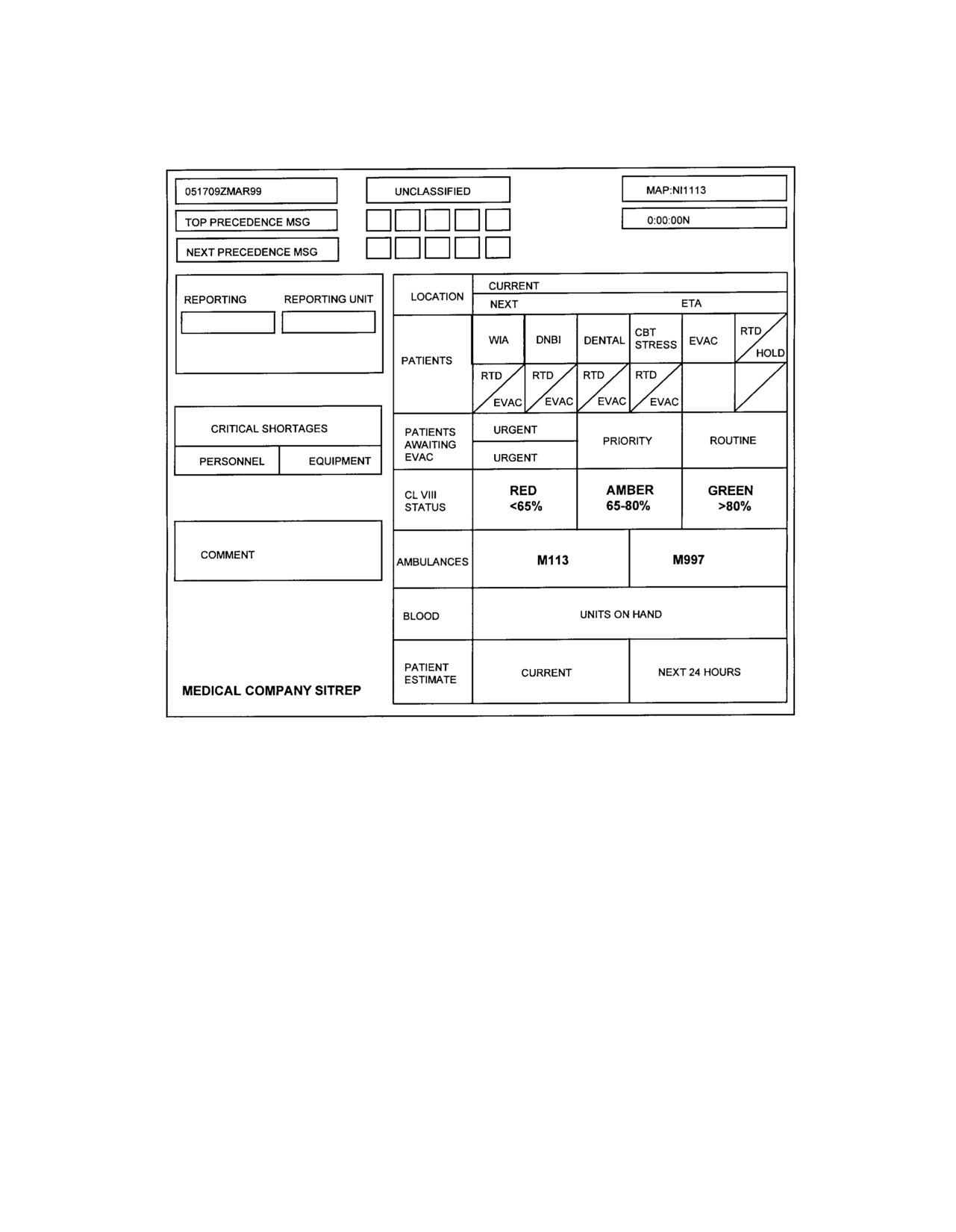
space for using free text. Figure 2-2 is the medical screen as seen on the CSS function of FBCB2.
Descriptions of each screen are provided below.
(1) Medical functionality in the logistics situation report. This message provides visibility of
selected Class VIII items at the BAS and FSMC levels, date-time group (DTG) of the most recent
report, and location of medical units. Recipients of the report are the forward support company (FSC), the
2-6
FM 4-02.21
Figure 2-2. Sample of medical screen incorporated into the combat service support Force XXI Battle
Command Brigade and Below function.
FSB support operations (HSSO), the BSS, and the DSS. This report does not replace TAMMIS; however,
it is entered into CSSCS by the BSS.
(2) Medical situation report. The FSMC and BAS prepare and submit this report. The
recipients of the report are maneuver commanders and their S1, the FSCs, the FSB support operations
(HSSO), the FSMC, the BSS, and the DSS. The BSS and FSMC receive roll up from the BAS. The DSS
receives a roll up of the FSMC reports. Adjacent units can receive information copies of the MEDSITREP.
This message reports the following information:
(a) Current location and proposed next location with estimated time of arrival (ETA).
(b) Number of patients seen and classified as wounded in action (WIA), DNBI, dental,
and combat stress. The field will also show the number of patients evacuated and the number returned to
duty (RTD).
2-7
FM 4-02.21
(c) Patient(s) awaiting MEDEVAC.
(d) The Class VIII status of the element/unit, the number of ambulances that are
mission capable, and the number of units of blood and type on hand.
(e) Free text field for critical Class VIII or other supply shortages and commanders
comments.
(3) Medical evacuation request. This request is currently embedded into the FBCB2 and is a
digitized standard 9-line MEDEVAC request. The current messaging is from the requestor to the medical
platoon leader (with an information copy to the maneuver battalion commander). The medical platoon
leader either responds or forwards the request to the FSMC commander who dispatches the appropriate
MEDEVAC asset. Information copies of all MEDEVAC requests are sent to the BSS so they can maintain
real-time situation awareness on the volume of requests. The FSMC commander sends an information copy
to the BSS with after-action information that includes destination of evacuated patient(s).
c.
Radio Nets. Radio nets used by the BSS include
(1) The division logistics operations net (AM-SSB), which is controlled by the DISCOM S2/
S3 support operations section. The net provides the necessary long-range C2 link between the DISCOM,
the FSBs, the DSB, and the DMMC.
(2) The BSS maintains communication with medical elements supporting the brigade through
its FM medical net. Single-channel ground and airborne radio system components provide the BSS with an
AN/VRC 89 series (FM) which has a receiver/transmitter (R/T) capable of using two FM nets for reception
and transmission. This permits the BSS to communicate with CHS elements via the administrative/logistic
net (FM). The AN/VRC-89 series has two R/Ts (and one power amplifier). The two R/Ts allow the BSS to
participate in two FM nets. These nets include the brigade administrative/logistics net and one of the three
medical platoons operations nets. The BSS also communicates using AM-IHFR with its AN/GRC 213
or AN/GRC 193A radio. Another technique is to use the FSMC command net for brigadewide medical
communications while using the administrative/logistics net for other CSS integration. Situation awareness
is monitored using FBCB2 and by face-to-face contact with other brigade staff members in the brigade
TOC.
d. Mobile Subscriber Equipment. Mobile subscriber equipment will allow the BSS to com-
municate throughout the battlefield in either a mobile or static situation. As the Army continues to digitize
the battlefield and modernize the force, the use of automation continues to develop. Mobile subscriber
equipment packet switching network gives units the ability to connect to division and corps LANs or wide
area network (WAN). A WAN is similar to the LAN but covers a larger distance. This allows units/CPs to
connect computer systems such as the CSSCS, MCS, and FBCB2 to an ethernet cable (coaxial) and send
and receive information in an extremely efficient manner. Because of the limitations of a network
constructed with coaxial cable, a WAN uses a combination of the MSE packet switch network and radio
networks to distribute the data where necessary through the system. Packet switching does not use or take
up existing telephone lines. Instead, telephone lines are freed up even more because information is being
sent over a network on computers and related equipment. Using the common hardware/software facilitates
2-8
FM 4-02.21
the interface and exchange of information between the BSS, medical platoons operating BAS, FSMCs,
DSS, corps, and division medical elements. See FM 63-2-2 for information concerning ADP continuity of
the operations plan.
e.
Combat Service Support Control System. The CSSCS is the CSS component of ABCS. This
is the primary CSS information tool used within the DISCOM. The CSSCS provides a concise picture of
unit requirements and support capabilities by collecting, processing, and displaying information on key
items of supplies, services, and personnel that the commanders deem crucial to the success of an operation.
The CSSCS does not duplicate Standard Army Management Information System (STAMIS) functions. The
management of all items within a class of supply or support functions remains STAMIS functions. Items
tracked in CSSCS represent a small, but critical portion of the items managed by STAMIS. The CSSCS
also supports the decision-making process with course of action (COA) analysis. Staffs can analyze up to
three COA for a 4-day period. Variables include combat intensity, combat posture, unit task organization,
miles traveled, and geographical region. This system maintains a database of unit personnel and equipment
authorizations by standard requirements code (SRC) (similar to table of organization and equipment [TOE])
and unit and equipment planning factors. It includes a database of equipment and personnel called a
baseline resource item list (BRIL). The items that a commander identifies as critical to the operation can be
selected from the BRIL to establish the CTIL. The CSSCS currently provides situation awareness of critical
elements within supply Classes I, II/IV, IIIB, IIIP, V, VII, and VIII, and personnel strength management.
Maintenance, transportation, and medical functionality are a few features to be added as the system
matures.
(1) Data collection on the combat service support control system. Unit supply status and
requirements can be entered manually using standard input forms (screens) at the brigade S4, DSB, DASB,
or FSB CSSCS terminal. Electronic interfaces to systems such as the FBCB2 will greatly enhance the entry
of unit data. The CSSCS tracks unit information down to the company level. Battle loss spot reports can be
inputted to the CSSCS node at any level (brigade, division, or corps). Information is entered either
manually, as in the case of Class III, or by electronic transfer as when a STAMIS disk is downloaded into
the CSSCS terminal. The CSSCS automatically updates the database. The data is then distributed to other
CSSCS nodes. The primary means of communication is MSE. The CSSCS nodes then manipulate the data
through a series of algorithms that are based on Army planning factors, the specified task organization, and
the established support relationships. This way, large quantities of data are presented in comprehensive, but
usable, decision support information formats. This information is graphically portrayed to the commander
through green, amber, red, and black bubble charts; situational awareness; subordinate unit locations; and
supply point status. Status can be projected out to 4 days using a combination of planning factors and
manually generated estimates. The commander and his staff can further evaluate simplified color status by
accessing more detailed numerical data that supports the color status displayed. At the divisional brigade
level, two CSSCS devices (or nodes) will exist. One is located in the brigade S1 and S4 operational facility
and the other in the FSB support operations section. The brigade node is the point of entry into the CSSCS
for all organizational-level CSS status and requirements of the brigade and its subordinate units. The
brigade S1/S4 can also view the status of its supporting FSB/DASB and higher echelon supply points.
Through interfaces to the other Army Tactical Command and Control System (ATCCS), a CSSCS node
provides the brigade S1/S4 with the battlefield common picture. The FSB, DASB, and DSB CSSCS node
serves as the entry point for some supply point data that is not supported by a STAMIS and all organizational
status of their elements. The FSB, DASB, and DSB use CSSCS to
2-9
FM 4-02.21
Track and anticipate customer logistic status and requirements.
Track supply point status, issues, receipts, and due-ins of CTIL items.
(2) Combat service support control system interfaces. All CSSCS nodes will be able to
interface with all other CSSCS devices and are also able to interface with other ATCCS such as air missile
defense workstations (AMDWS), MCS, all source analysis system, and Advanced Field Artillery Tactical
Data System (AFATDS). The CSSCS connects to the FBCB2 at the brigade S1/S4 level. The FBCB2 will
serve as a data source for CSSCS by passing aggregate data (MEDSITREP, LOGSITREP, and PERSITREP)
that has been rolled up from squad/section, platoon, company, and battalion. The LOGSITREP includes
roll-ups of Classes I, IIIP, IIIB, IV, V, VII, and VIII. Class VII data also includes nonmission capable
information. The CSSCS consolidates battalion data selected by the commander on the CTIL, up to 120
items. The CSSCS reports to higher headquarters and then provides the lower echelons with the location of
supply points via FBCB2. Force XXI Battle Command Brigade and Below transmits personnel strength
information by officer/warrant officer/enlisted through the PERSITREP. This information is rolled up from
platform through battalion to brigade S1 where it is entered directly into CSSCS or the Army XXI manning
system resident on the CSSCS. The CSSCS uses this information to update its database on those personnel
categories listed on the CTIL. The CSSCS updates supply point locations whenever supply points moves an
electronic map overlay format and passes it down to platform level via FBCB2.
2-8.
Medical Standard Army Management Information System
The MC4 system will be a theater automated CHS system, which links commanders, health care providers,
and supporting elements, at all echelons, with integrated medical information. The system provides digital
enablers to connect, both vertically and horizontally, all ten CHS functional business systems. The MC4
system receives, stores, processes, transmits, and reports medical C2, medical surveillance, casualty
movement/tracking, medical treatment, medical situational awareness, and MEDLOG data across all levels
of care. This will be achieved through the integration of a suite of medical information systems linked
through the Army data telecommunications architecture. The MC4 system begins with the individual
soldier and continues throughout the health care continuum. The best way to visualize the MC4 system
capability is as a piece of the Army digital computer network where all ten CHS functional areas have been
digitized and the CHS information made available to specified commands, supported units, and their
personnel. Not only will the MC4 system provide the Army commanders with CHS information, but will
provide him with a seamless transition to the joint CHS environment.
a. Components of Medical Communications for Combat Casualty Care System. The MC4 system
will consist of three basic components: software, hardware, and telecommunications capabilities.
(1) Software capability.
(a) The joint TMIP will provide government off-the-shelf (GOTS)/commercial off-the-
shelf (COTS) software and interoperability standards to support joint theater operations. The software
provides an integrated medical information capability that will support all levels of care in a TO with links
to the sustaining base. Medical capabilities provided by the software to support commanders in the theater
2-10
FM 4-02.21
will address medical C2 (including medical capability assessment, sustainability analysis, and medical
intelligence); MEDLOG (including blood product management and medical maintenance management);
casualty evacuation; and health care delivery.
(b) The MC4 system will support Army-unique requirements and any software needed
to interface with Army information systems such as CSSCS, Global Command and Control System-Army
(GCCS-A), FBCB2, Warrior Programs, and the MTS.
(2) Hardware capability. The hardware capability will consist of COTS automation
equipment supporting the above software capabilities. Examples include, but are not limited to, computers,
printers, networking devices, and the personal information carrier (PIC).
(3) Telecommunications capability. The MC4 capability will rely on current and proposed
Army solutions for tactical, operational, and strategic telecommunications systems to transmit and receive
digitized medical information throughout the theater and back to the sustaining base. There will be no
separate AMEDD communication system. Telecommunications at brigade and below will be accomplished
through the tactical internet; above brigade level, telecommunications will be accomplished through the
warfighter information network (WIN) architecture. The MC4 system will include hardware or software
required to interface with current and emerging technologies supporting manual, wired, and wireless data
transmission. At end-state, the MC4 system users will exchange data electronically via the WIN architecture.
In the interim, commercial satellite and/or high-frequency radios will be fielded to selected medical units
(for example, medical detachment-telemedicine [MDT]) receiving the MC4 system to support high band-
width requirements until the WIN architecture is fully fielded. Personnel operating satellite assets are
resourced in the MDT TOE and will be located with the MDT.
b.
Patient Treatment Recording System. Under the MC4 system, medical information about each
soldier will be entered into a local database maintained at the supporting BAS or troop medical clinic. This
information will include the soldiers immunization status, medical deployability status, and dental
deployability status. A commander, faced with a deployment, will be able to simply query the database to
gain the deployability status of the entire command. Time previously spent on physically searching paper
records will be available for other tasks. Under the MC4 system each soldier will be issued a PIC. The
PIC is an electronic device that will store personal information about the individual soldier. The PIC
specifications are addressed in a separate DOD requirements document, which incorporates Army
operational requirements into this standard joint device. The PIC will be used to record all of the soldiers
health care events and the soldiers readiness status. Each time a soldier receives medical care or
immunizations, the medical history on the PIC will be updated. When a soldier is deployed, his PIC will
contain baseline clinical data. During processing for deployment, the medical staff will be able to read all
immunizations, medical and dental patient history data directly from the PIC, speeding up the process. Once
in an operational theater, the soldiers PIC will continue to provide a backup record of all medical events
that occur during the deployment. Any medical data generated by a medical event will be entered onto the
PIC as well as being entered into the MC4 information system. The preservation of medical data will no
longer rely on safeguarding and transporting stacks of paper records.
2-11
FM 4-02.21
CHAPTER 3
DIVISION AND BRIGADE COMBAT HEALTH
SUPPORT OPERATIONS
Section I. PLANNING COMBAT HEALTH SUPPORT FOR
DIVISION AND BRIGADE OPERATIONS
3-1.
Division Combat Health Support Planning
a. Division CHS operations involve all of the factors that must be considered in the initial
developmental stages of the division CHS plan. The CHS plan is updated to meet tactical or CHS
operations requirements. The following factors should be considered:
Information requirements (current task organization structure, medical troop strengths,
projected weather and environmental factors, and maintenance status of medical equipment).
Results of the mission analysis.
Commanders intent.
Planning guidance.
Courses of actions.
Tactical plan.
Enemy.
Terrain.
Troops.
Weather.
Threat (including medical threat).
Operational conditions and constraints.
Military population supported.
Civilian populace in the AO.
Medical personnel status.
Equipment status of medical units and elements.
3-1
FM 4-02.21
Supply status including Class VIII.
Wartime HN support.
Indigenous medical services.
Communications capability.
Nuclear, biological, and chemical defense including OEG.
Nuclear, biological, and chemical casualty considerations.
Training status.
Casualty estimates.
Medical evacuation requirements and capabilities.
Corps CHS status.
Nonmedical support requirements from division.
Area support requirements.
Special operations support requirements.
Army airspace command and control.
Medical records and reports requirements.
Phases of operations.
Allied/coalition health assets requirements.
Policy and procedure updates.
b.
The division CHS plan is developed by the DSS staff with assistance from the DISCOM
medical staff. See FMs 8-10, 8-10-6, 8-10-8, 8-10-9, 8-42, 8-55, 63-2-2, 63-20-1, 63-21-1, 63-23-2, 100-5
and 101-5 for doctrinal guidance on CHS operations. After the CHS plan is completed, it is incorporated
into the CSS plan. After the CSS and other areas of the division plan are approved by the division
commander, it is incorporated into the division OPORD.
3-2.
Division Operation Plan and Operation Order
The G3 section, using input from each of the staff elements of the division headquarters, develops the
division OPLAN and OPORD.
3-2
FM 4-02.21
NOTE
An approved plan becomes an order.
a. The division surgeon is responsible for supervision and development of CHS input for the
division OPORD. The division CHS plan serves as the base document for this input. The division CHS
plan is revised or updated based on mission analysis or changes in CHS requirements. The division surgeon
is tasked by the G3 for CHS input to the division OPORD for support of division operations. The G3
indicates time-line requirements. The division surgeon is involved in all stages of the planning process. He
and his staff participate in all phases of the planning process. This allows them to identify all CHS
requirements. Information for development of staff estimates and the OPLAN/OPORD are discussed
below.
b. The medical plan/operations cell develops a CHS plan based on guidance received from the
division commander and the division surgeon. The DSS provides CHS operational planning updates to the
division surgeon. The CHS plan is briefed to the division commander for approval, as required. The CHS
plan is provided to the G3 according to the format of the CHS outline in FM 8-55.
c.
The DSS has a primary responsibility for the coordination of division and corps medical assets
in support of the division. Supporting medical elements should be pre-positioned according to the CHS plan
and anticipated requirements. Division and corps evacuation assets should be task-organized to support the
area of greatest casualty density. All supporting medical elements should be issued the maximum allowable
levels of Class VIII and other required supplies. The DSS must establish and maintain continuous
communications with the DISCOM medical operations branch and the BSS. The DISCOM medical
operations branch and the BSS maintain continuous communication with the DSB and FSB HSSOs. The
medical plan/operations cell maintains a situational map that includes overlays with friendly, as well as
threat information. The cell should use charts to monitor functional areas. Subject areas that could enhance
situational awareness or mission areas that are critical to CHS operations should be tracked. In digitized
units, situational awareness will be maintained using the CSSCS modules for locations of friendly units,
corps ground and air ambulance assets, and all other areas listed below which are normally maintained on a
situational map. For digitized units the traditional situational map is only maintained as a back up to the
ATCCS and programs. The subject areas that are to be tracked should be identified by the division surgeon
and/or the chief medical planner and may include
Corps ground and air ambulance assets.
Army airspace command and control overlays.
Threat picture (includes tracking reports and posting updates so that the threat is portrayed
on the situational map).
Current routes and their status.
Maintenance status of evacuation platforms.
3-3
FM 4-02.21
Status of units operating in high-risk environments or with threat/enemy contact.
Division to corps evacuation schedule and evacuation delays.
Supply status including critical Class VIII shortages.
Critical medical personnel and equipment shortages.
Pending resupply missions from corps.
Medical maintenance backlog.
Patient status board (for example, awaiting evacuation from division to corps).
Hospitals supporting the division with latest bed spaces available, additional/shortages of
specialties, and locations (this is a division-level requirement, except for some stability operations or
support operations).
Blood status.
Dirty routes and patient decontamination sites.
Brigade operations and CSS overlays.
3-3.
Brigade Combat Health Support Planning
Brigade CHS planning is accomplished based on the same factors found in division CHS planning. The
brigade surgeon is responsible for development of the brigade CHS plan. He tasks the BSS with development
of the brigade CHS plan. The brigade plan/operations cell has the primary responsible for developing and
coordinating the brigade CHS plan. The foundation of the brigade CHS plan is the brigade commanders
guidance and the division CHS plan.
3-4.
Brigade Operation Plan and Operation Order
Planning starts with mission analysis. The brigade begins mission analysis when the division provides
enough information for the brigade staff to analyze. Mission analysis is done by the entire brigade staff and
is an integral part of the planning for an operation. Information that the brigade staff analyzes will normally
be provided with a well-written warning order (WARNO) or after receiving several WARNOs from the
division. The first WARNO from the brigade should be issued as soon as possible after receiving the
division WARNO for a new operation. The mission analysis (see Table 3-1) is Step 1 of the military
decision-making process (MDMP). See FM 101-5 for further discussion on the MDMP. For guidance on
military decision making in abbreviated planning for a time-constrained situation, see Center for Army
3-4
FM 4-02.21
Lessons Learned Newsletter, Number 99-12 Update, located at http://call.army.mil/call/homepage/
newsltr.htm. The BSS must ensure all available CHS information is included in the brigade WARNO. The
BSS could also forward additional coordinating instructions down to the medical platoon level. These
coordinating instructions are normally transmitted in a force text E-mail message via the TACLAN. As part
of the mission analysis and based on the brigade commanders intent and guidance, the BSS develops CHS
staff estimates for supporting brigade operations. An understanding of the brigade combat teams (BCT)
time lines or battle rhythm will assist the medical planner in developing the CHS input to the brigade
OPLAN/OPORD. Bear in mind that parallel planning is occurring at different levels of command; for
example, the brigade WARNO allows the subordinate unit to begin their planning process, allowing
maximum use of the available time for planning. Timely WARNOs are the key to effective parallel
planning. When decisions are made or pertinent information becomes available, the brigade staff issues
WARNOs as a part of the planning process. See Chapter 5 and Appendix H of FM 101-5 for additional
information on WARNOs. Mission analysis includes
Assessing CHS capabilities (organic and attached assets with current status and location).
Assessing limitations for CHS assets that are not available, specify reason.
Identifying specified, implied, and essential CHS tasks in the division OPORD.
The following is an example of subject areas that should be addressed during mission analysis:
Treatment (to include surgical requirements).
Emergency and sustaining dental treatment.
Patient holding.
Combat stress control.
Preventive medicine.
Medical evacuation support by air and ground ambulances (and nonmedical evacuation
platforms, if necessary).
Class VIII resupply and blood support.
Medical maintenance.
Nuclear, biological, and chemical operations.
The threat to treatment and evacuation assets capable of causing CHS failure.
Likely targeted area of threat chemical weapons strike and types of agents (the S2 and the
chemical officer should brief the BSS on the effects possible requirement).
3-5
FM 4-02.21
Casualty estimates (number and types of casualties).
Terrain effects on evacuation.
Current medical status of brigade personnel.
Table 3-1. Mission Analysis of the Situation
1.
MISSION ANALYSIS
A. MISSION AND INTENT OF COMMANDER TWO LEVELS UP.
B. MISSION AND INTENT OF IMMEDIATE COMMANDER.
C. ASSIGNED TASKS (SPECIFIED AND IMPLIED).
D. CONSTRAINTS AND LIMITATIONS.
E. MISSION-ESSENTIAL TASKS.
F. RESTATED MISSION.
G. TENTATIVE TIME SCHEDULE.
2.
ESTIMATE THE SITUATION AND DETERMINE COURSES OF ACTION
A. TERRAIN AND WEATHER.
(1) TERRAINOBSERVATION AND FIELDS OF FIRE, CONCEALMENT AND COVER, OBSTACLES, KEY
TERRAIN, AND AVENUES OF APPROACH (OCOKA).
(2) WEATHERVISIBILITY, MOBILITY, SURVIVABILITY.
B. ENEMY SITUATION AND COA.
(1) COMPOSITION.
(2) DISPOSITION.
(3) RECENT ACTIVITIES.
(4) CAPABILITIES.
(5) WEAKNESS.
(6) MOST PROBABLE COA (ENEMY USE OF METT-TC)
(7) MOST DANGEROUS COA.
C. FRIENDLY SITUATIONMETT-TC.
D. FRIENDLY COA. DEVELOP A MINIMUM OF TWO.
3.
ANALYSIS OF COURSES OF ACTION
A. SIGNIFICANT FACTORS.
B. WARGAME.
4.
COMPARISON OF COURSES OF ACTION.
5.
DECISION.
a. The restated mission (Step F of mission analysis) goes directly into paragraph 2 of the brigade
OPORD after approved by the commander (S3 responsibility).
b. Brigade COA development/analysis and wargaming are accomplished after mission analysis.
Course of action development and wargaming result in the production of the OPORD and the CHS annex.
During wargaming, the evacuation and treatment facets of the medical plan are synchronized with the
maneuver plan. Also, during wargaming, the questions of how many casualties; at what point in the fight
3-6
FM 4-02.21
(when); where they will occur; and how they are produced (direct fire, artillery, chemical, and so forth) can
be forecasted based on input from the S1. This information allows the CHS planner options to select
preplanned locations. It also provides the triggers that will allow medical elements to occupy these
positions at appropriate times and in a manner that reduces the risk from threat actions. This information
becomes the CHS plan and is published in the brigade order. The following is an example of key areas that
will be analyzed during this process; they include
Casualty estimates broken down to the lowest level possible, by task force, by phase line,
and so forth.
Task organizations established (attachment/detachment or OPCON relationships in
division order). Do they adequately support the brigade mission? If not, recommend changes to the
brigade commander.
Division-directed actions as part of the division CHS plan.
Current CHS unit status (maintenance status on all brigade key items of equipment, both
medical and nonmedical, and recommendations of the BSS).
c.
Once the task force or maneuver battalions receive the brigade WARNO, they conduct mission
analysis and determine their tactical plan. Part of determining their plan is the emplacement of medical
treatment elements (BAS or treatment teams). This information is provided to the medical plan/operations
officer in the BSS, so he can review the plans from the brigade-level perspective. Time permitting, the BSS
plan/operations officer, the FSMC commander, and the HSSO should meet with the medical platoon leaders
to synchronize the brigade plan prior to the brigade combined arms rehearsal. Provided below in Table 3-2
is an example of an OPORD format. When the commander approves the OPLAN, it becomes the OPORD.
The BSS staff is responsible to the brigade commander for staff supervision of CHS within the brigade. The
BSS is also responsible for coordinating DS relationships of organic medical units and medical elements
OPCON or attached to the brigade. The brigade commander is updated as required on the status of CHS in
the brigade. The brigade OPLAN and OPORD are developed by the S3 section using input from each of
the staff elements of the brigade headquarters. The brigade CHS plan is revised or updated based on
mission analysis or changes in CHS requirements.
d. The BSS has a primary responsibility for the coordination of corps medical assets in support of
the brigade, both OPCON and attached, and for supporting corps MEDEVAC assets positioned forward in
the brigade AO. Brigade and corps evacuation assets should be task-organized to support the area of
greatest casualty density. All supporting medical elements should be issued the maximum allowable levels
of Class VIII and other required supplies. The BSS must establish and maintain continuous communications
with the HSSO, the FSMC commander, and the DSS. The medical plan/operations cell maintains a
situational map and should use charts to monitor functional areas that will include
Units in contact or in high-risk environments.
Threat situation.
3-7
FM 4-02.21
Table 3-2. Operation Order or Plan Outline Format
REFERENCES:
TIME ZONE USED THROUGHOUT THE PLAN (ORDER):
TASK ORGANIZATION:
1.
SITUATION.
A. ENEMY FORCE
B. FRIENDLY FORCE
C. ATTACHMENT AND DETACHMENTS
D. ASSUMPTION (OPLAN ONLY)
2.
MISSION.
3.
EXECUTION.
INTENT:
A. CONCEPT OF OPERATION
(1) MANEUVERS
(2) FIRES
(3) RECONNAISSANCE AND SURVEILLANCE
(4) INTELLIGENCE
(5) ENGINEER
(6) AIR DEFENSE
(7) INFORMATION OPERATIONS
B. TASK TO MANEUVER UNITS
(1) ENGINEER
(2) AIR DEFENSE
(3) FIELD ARTILLERY
C. TASKS TO COMBAT SUPPORT UNITS
(1) INTELLIGENCE
(2) FIRE SUPPORT
(3) SIGNAL
(4) NBC
(5) PROVOST MARSHAL
(6) PSYCHOLOGICAL OPERATIONS
(7) CIVIL MILITARY
(8) AS REQUIRED
D. COORDINATING INSTRUCTIONS
(1) TIME OR CONDITION WHEN A PLAN OR ORDER BECOMES EFFECTIVE
(2) COMMANDERS CRITICAL INFORMATION
(3) RISK REDUCTION CONTROL MEASURES
(4) RULES OF ENGAGEMENT
(5) ENVIRONMENTAL CONSIDERATIONS
(6) FORCE PROTECTION, AS REQUIRED
(7) AS REQUIRED
4.
SERVICE SUPPORT.
A. SUPPORT CONCEPT
B. MATERIEL AND SERVICE
C. MEDICAL EVACUATION AND HOSPITALIZATION
D. PERSONNEL
E. CIVIL MILITARY, AS REQUIRED
F. AS REQUIRED
5.
COMMAND AND SIGNAL.
A. COMMAND
B. SIGNAL
ACKNOWLEDGE:
NAME (COMMANDERS LAST NAME)
RANK (COMMANDERS RANK)
OFFICIAL: NAME AND POSITION
ANNEXES:
(CLASSIFICATION)
SEE FM 101-5 FOR DEFINITIVE INFORMATION ON OPERATION PLANS/ORDERS.
3-8
FM 4-02.21
Evacuation routes and/or main supply route status.
Supporting corps ground and air ambulance assets.
Army airspace command and control overlays.
Status of evacuation platforms (all assets under the brigade's control).
Supply status, to include critical Class VIII shortages.
Pending resupply missions from corps.
Critical medical personnel and equipment shortages.
Medical maintenance backlog.
Patient status board (for example, awaiting evacuation).
Blood status.
Dirty routes/patient decontamination sites.
Location of BAS (current/projected).
Area medical support responsibilities.
3-5.
Rehearsal
Developing a good brigade CHS plan is not an easy process. It requires a major coordinated effort with
sound preparation, discipline, and significant amounts of the precious commodityleader time. Properly
rehearsing the plan is a critical step in achieving synchronized execution with the brigade commander's
plan. The brigade rehearsal provides an excellent opportunity to practice C2 and integrate the CHS
operations. For successful implementation of the CHS annex of the brigade plan, the CHS plan must be
coordinated and synchronized with the maneuver plan so that CHS requirements are met. The BSS
provides coordinating instruction to the brigade medical elements as the plan is developed. This permits
informed development and affords the time to better develop the initial plans. To achieve optimal
synchronization, the CHS plan is rehearsed as an integral part of the combined arms plan at the combined
arms rehearsal. The CHS rehearsal by itself as a technique will increase understanding and synchronization,
but is not as effective as when it is integrated into the combined arms rehearsal. The rehearsal of the CHS
plan will allow subordinate medical elements and leaders to analyze the tactical CHS plan to ascertain its
feasibility, its common sense, and the adequacy of its C2 measures prior to execution.
a. Medical platoon leaders of the maneuver battalions also provide input to the task force CHS plan.
In the digitized brigade, the BSS develops the concept for the CHS plan. During the decision-making/
3-9
FM 4-02.21
orders process, the CHS planners identify critical events and synchronize their plans. In addition to medical
locations on the CSS overlay, these plans indicate the triggers for CHS events. At the brigade rehearsal, the
brigade leaders practice their synchronized plans that include CHS. The sequence of events for the CHS
portion of the brigade rehearsal includes
The FSMC commander and ambulance platoon leader practicing execution of triggers
for AXP movement.
The FSMC commanders detailing the concept and procedures for MEDEVAC (both
ground and air ambulances) in the brigade.
The battalion/task force executive officer (XO) or S4 explains triggers for BAS and
combat trains command post (CTCP) movement and ensures that brigade level and adjacent units understand
their internal plan.
The BCT medical elements with area support missions indicate which units are supported and the areas they
cover. They will also provide projected triggers and times they will be at projected locations.
b.
The CSS/CHS annex of the brigade OPORD that includes map overlays is the culmination of
the medical planning efforts and the CHS rehearsal is the culmination of the preparation phase for an
operation. In the digitized division, the brigade medical planner has the responsibility for rehearsing CHS
operations. Rehearsals are done to achieve a common understanding and a picture of how the plan will be
implemented.
All plans must be complete prior to the CHS rehearsal.
The brigade OPORD is then issued through effective troop leading procedures.
The CHS rehearsals should focus on the events that are critical to mission accomplish-
ment. A successful rehearsal ensures explicit understanding by subordinate medical leaders of their
individual missions, how their missions relate to each other, and how each mission relates to the maneuver
commander's plan. It is important for all medical echelons to see the total CHS concept.
Rehearsing key CHS actions allows participants to become familiar with the operation
and to visualize the triggers which identify the circumstances and timing for friendly actions. This visual
impression helps them understand both their environment and their relationship to other units during the
operation. The repetition of critical medical tasks during the rehearsal helps leaders remember the sequence
of key actions within the operation and when they are executed.
NOTE
To achieve the last two bullets above, the CHS rehearsal needs to be a
part of the Brigade combined arms rehearsal along with all the
battlefield operating systems. It is just as important for the supported
units to understand the CHS plan as it is for the medical unit to
understand the maneuver plan.
3-10
FM 4-02.21
c.
Planning and rehearsing CSS is the responsibility of the brigade S4. His responsibilities
include
Deciding what events must be rehearsed in coordination with the medical planner and/or
brigade surgeon.
Determining all the CHS activities on the CSS synchronization matrix to be rehearsed.
Focusing on key events that must be carried out from just prior to line of departure (LD)
time, through reorganization and consolidation.
Deciding on the participants and observers for the rehearsal.
Participants providing information or performing actions that cause triggered events to
occur. Observers do not have a direct impact on triggered events, but gather information and answer
questions as required.
The FSB support operations officer representing CSS elements of the FSB along with
FSB company commanders. The CHS activities may include the brigade surgeon, the brigade medical
planner, the FSB HSSO, and the FSMC commander, his ambulance and treatment platoon leaders, and the
forward support MEDEVAC team (FSMT).
NOTE
As many executors of the plan as possible should be included in the
rehearsal. The FSMC commander and the ambulance platoon leader
as a minimum are participants for the FSB. The task force medical
platoon leaders should also be active participants.
All task force medical platoon leaders participating. The reserve task force will rehearse
the conditions under which the commander expects to employ them; this medical platoon leader should
participate as well. If the medical platoon leader cannot participate, the medical platoon sergeant should
represent that task force.
Allow adequate time between the end of planning and the beginning of the CHS rehearsal
for subordinates to develop their plans and synchronize them with the brigade (this is normally accomplished
using the 1/3 2/3 rule).
Holding the CHS rehearsal on the same terrain model as the combined arms rehearsal.
(Ideally it should be part of the combined arms rehearsal.)
The BSS must inform all CHS personnel about the CHS rehearsal. This may be SOP or issued as part of the
CHS annex in the brigade order. If not, then send a fragmentary order to all medical elements with time,
place, and required participants.
3-11
FM 4-02.21
Section II. CONDUCTING COMBAT HEALTH SUPPORT
FOR MILITARY ACTIONS
3-6.
Force Projection
a. The force projection process includes eight related activities. These activities include
mobilization; predeployment; deployment (including basing); entry (including reception, staging, onward
movement, and integration) and force buildup; decisive operations; postconflict and postcrisis actions;
redeployment; and demobilization. For detailed information on the force projection process, see FMs
100-7 and 100-17.
b. The first rule of anticipation for the staff of the BSS in a force projection era is to expect to be
alerted and deployed. A high level of anticipation causes military forces to mentally and physically prepare
for force projection. If the brigade has been assigned a region of focus in peacetime, planning can occur
long before alert and deployment. Appropriate actions include ordering and posting maps, studying
available infrastructures, familiarizing soldiers with language, training soldiers for deployment, and
sensitizing soldiers to a particular culture. Key to successful anticipation is continuous force tracking, total
asset visibility during deployment, and continuous intelligence preparation of the battlefield (IPB) of the
contingency area.
c.
Many of the missions assigned to US Army forces will be received as short-notice deployments
(such as deployments in support of contingency operations). The advance preparation time will be limited.
Normally, due to the sensitivity of the operations security (OPSEC) level of the operation, the number of
individuals that engaged in the planning process could be restricted. It is, therefore, necessary that the BSS
ensure that the medical platoons organic to the brigades maneuver battalion are administratively ready for
short-notice deployment. For definitive information on the CHS aspects of short-notice deployments for
stability operations and support operations, see FMs 8-42 and 100-5.
3-7.
Combat Health Support for the Offense and the Defense
a. Support to the Offense.
(1) The offense is the decisive form of war, the commanders only means of attaining a
positive goal, or of completely destroying an enemy force (FM 100-5). Rapid movement, deep penetrations,
aggressive action, and the ability to sustain momentum regardless of counterfires and countermeasures
characterize the offense.
(2) When developing the CHS plan to support the offense, the CHS planner must consider
many factors (FM 8-55). The forms of maneuver, as well as the threats capabilities, influence the
character of the patient workload and its time and space distribution. The analysis of this workload
determines the allocation of CHS resources and the location or relocation of MTFs.
3-12
FM 4-02.21
(3) Combat health support for offensive operations must be responsive to several essential
characteristics. As operations achieve success, the areas of casualty density move away from the supporting
MTF. This causes the routes of MEDEVAC to lengthen. Heaviest patient workloads occur during
disruption of the threat's main defenses, at terrain or tactical barriers, during the assault on final objectives,
and during threat counterattacks. The accurate prediction of these workload points by the CHS planner is
essential if MEDEVAC operations are to be successful.
(4) As advancing combat formations extend control of the battle area, supporting medical
elements have the opportunity to clear the battlefield. This facilitates the acquisition of the battle wounded
and reduces the vital time elapsed between wounding and treatment. There are two basic problems
confronting the supporting medical units and MEDEVAC elements. First, contact with the supported units
must be maintained. Responsibility for the contact follows the normal CHS patternhigher echelon
evacuates from lower echelon. Contact is maintained by forward deployed air and ground evacuation
resources. Secondly, the mobility of the MTFs supporting the combat formations must be maintained. The
requirement for prompt MEDEVAC of patients from forward MTFs requires available ambulances to be
echeloned well forward from the outset. Air ambulance and ground ambulance support beyond the
capabilities of the FSMC is requested from the supporting corps MEDEVAC battalion. The requirement for
periodic movement of large numbers of patients from divisional and corps facilities further stresses the
MEDEVAC system.
(5) In traditional combat operations, the major casualty area of the operation is normally the
zone of the main attack. As the main attack accomplishes the primary task of the tactical combat force, it
receives first priority in the allocation of combat power. The allocation of combat forces dictates roughly
the areas that are likely to have the greatest casualty density. In the division, CHS (Echelon I) for the
brigade is provided by the maneuver battalion medical platoons. Each platoon consists of three treatment
teams, an ambulance section, and a combat medics section. The medical platoon operates the BAS, places
combat medics in DS of the maneuver companies, provides patient evacuation from forward areas, and
deploys treatment teams in DS of the maneuver battalion elements for up to 48 hours without resupply. The
FSMC (Echelon II) located in the BSA provides MEDEVAC support from the BAS back to the BSA and
reinforces treatment capabilities at BASs for limited periods of time. When combat operations commence,
the medical platoon normally locates its BAS as far forward as combat operations permit. As the battle
moves from the original area of contact, coordinated movement of the three treatment teams are able to
provide continuous CHS. Once patients are received, a treatment team from the BAS will care for and treat
these patients until their MEDEVAC or appropriate disposition. The remaining teams of the BAS move
with the battle and provide CHS to the maneuver elements according to the task force order or current
execution conditions. If patients are received, one of the other treatment teams performs its treatment and
evacuation mission. After MEDEVAC or appropriate disposition of their patients, the treatment team
prepares for its next move. This leap frog technique provides for maximum utilization of medical platoon
treatment teams and permits continuous uninterrupted CHS to maneuver battalions on the move. Each of
the above actions must be coordinated with the CTCP and the supporting FSMC.
(6) In operations that feature deep battles with weapons of mass destruction targeted at
supporting logistical bases, mass casualty operations could be conducted in rear areas.
3-13
FM 4-02.21
(7) Types of operations in the offense include
(a) Movement to contact. Medical evacuation support in movement to contact is keyed
to the tactical plan. Prior deployment of FSMC ground ambulances with the maneuver battalions organic
medical platoons permits uninterrupted and effective MEDEVAC support from the BAS to the FSMC
located in the BSA. Movement to contact operations are executed when there is little or no threat
information. The FSMC and treatment teams from maneuver BAS in support of these operations must
maintain their flexibility and be prepared to adjust CHS support once contact is established.
(b) Exploitation and pursuit. Medical evacuation support of exploitation and pursuit
operations resemble those discussed for the envelopment (paragraph 3-8a[2]). Since exploitation and
pursuit operations can rarely be planned in detail, evacuation operations must adhere to TSOPs and
innovative C2. These actions are often characterized by
Fewer casualties.
Decentralized operations.
Unsecured ground evacuation routes.
Exceptionally long distances for evacuation.
Increased reliance on convoys and air ambulances.
More difficult communications (maximum radio range).
(c) Deliberate attack. The deliberate attack is based on a more detailed knowledge of
the threat disposition and likely actions. The brigades actions in contact will be more predictable than the
fluid situation found in the movement to contact, or exploitation and pursuit. Specific terrain and routes/
avenues of approach can be selected. Units can conduct at least a map reconnaissance of their planned
locations. While there may be CHS requirements during the approach, the assault on the objective will
produce the greatest number of casualties. Some of the CHS considerations for the deliberate attack
include
Higher percentage of casualties.
Casualties will be more concentrated in time and space.
Treatment teams moving to the objective instead of evacuating patients from
the objective to the treatment teams once the objective is secured.
Use of air ambulance to overcome some obstacles may be required.
b. Support to the Defense. There are three forms of the defense: area defense, mobile defense,
and retrograde. The area defense concentrates on denying threat access to designated terrain for a specific
3-14
FM 4-02.21
period of time, rather than on the outright destruction of the threat. The mobile defense focuses on denying
the threat force by allowing him to advance to a point where he is exposed to a decisive counterattack by the
striking force. The primary defeat mechanism, the counterattack, is supplemented by the fires of the fixing
force. The third form of defense is the retrograde. The retrograde is an organized movement to the rear
and away from the threat. The threat could force these operations or a commander can execute them
voluntarily. Delay, withdrawal, and retirement are the three forms of retrograde operation.
(1) Combat health support is generally more difficult to provide in the defense. The patient
load reflects lower casualty rates, but threat actions and the maneuver of combat forces complicate forward
area patient acquisition. Medical personnel are permitted much less time to reach the patient, complete vital
EMT, and remove him from the battle site. Increased casualties among exposed medical personnel further
reduce the medical treatment and evacuation capabilities. Heaviest patient workloads, including those
produced by threat artillery and NBC weapons, can be expected during the preparation or initial phase of
the threat attack and in the counterattack phase. The threat attack can disrupt ground and air routes and
delay evacuation of patients to and from treatment elements. The depth and dispersion of the defense create
significant time and distance problems for evacuation assets. Combat elements could be forced to withdraw
while carrying their remaining patients to the rear. The threat exercises the initiative early in the operation,
which could preclude accurate prediction of initial areas of casualty density. This makes the effective
integration of air assets into the MEDEVAC plan essential. The use of air ambulances must be coordinated
with the FSMT, normally positioned in the BSA. The utilization of corps air ambulances must be integrated
into the CHS annex to the OPORD and also into the brigades A2C2 annex. In addition, frequent
coordination with the corps MEDEVAC team is essential.
(2) The CHS requirements for retrograde operations can vary widely depending upon the
tactical plan, the threat reaction, and the METT-TC factors. Firm rules that apply equally to all types of
retrograde operations are not feasible, but considerations include
A requirement for maximum security and secrecy in movement.
The influence of refugee movement conducted in friendly territory, which could
impede MEDEVAC missions.
The integration of evacuation routes and obstacle plans.
Difficulties in controlling and coordinating movements of the force, that could
produce lucrative targets for the threat.
Movements at night or during periods of limited visibility.
Time and means available to remove patients from the battlefield. In stable
situations and in the advance, time is important only as it affects the physical well-being of the wounded. In
retrograde operations, time is more important. As available time decreases, CHS managers at all echelons
closely evaluate the capability to collect, treat, and evacuate all patients.
Medical evacuation routes required for the movement of troops and materiel. This
causes patient evacuation in retrograde movements to be more difficult than in any other type of operation.
3-15
FM 4-02.21
The threat could disrupt C2 and communications. Successful MEDEVAC requires including ambulances
on the priority list for movement; providing for the transportation of the slightly wounded in cargo vehicles;
and providing guidance to subordinate commanders defining their responsibilities in collecting and evacuating
patients. Special emphasis must be placed on the triage of patients and consideration given to the type of
transportation assets available for evacuation.
Decisions concerning patients left behind. When the patient load exceeds the
means to move them, the tactical commander must make the decision as to whether patients are to be left
behind. The medical staff officer keeps the tactical commander informed so that he can make timely
decisions. Medical personnel and supplies must be left with patients who cannot be evacuated.
(Refer to
FM 8-10 for additional information.)
3-8.
Combat Health Support for Maneuver and Enabling Operations
a. Choices of Maneuver.
(1) Penetration. In this tactic, the attack passes through the threats principal defensive
position, ruptures it, and neutralizes or destroys the threat forces. Of all forms of offensive maneuver, the
penetration of main threat defenses normally produces the heaviest patient workload. Patient acquisition
starts slowly, but becomes more rapid as the attack progresses. The evacuation routes lengthen as the
operation progresses. Heavy preparatory fires which can evoke heavy return fire often precede the
penetration maneuver. These threat fires could modify the decision to place evacuation assets as far
forward as possible. The FSMC can reinforce the penetration force medical elements. Patient evacuation
could be slow and difficult due to bottleneck at the penetration. Medical evacuation support problems
multiply when some combat units remain near the point of original penetration. This is done to hold or
widen the gap in threat defenses while the bulk of tactical combat forces exploit or pursue the threat.
Treatment elements are placed near each shoulder of the penetration; ground evacuation cannot take place
across an avenue of heavy combat traffic. Because of the heavy traffic, the area of the penetration is
normally a target for both conventional and NBC weapons. The trigger to push treatment team/BASs
through the penetration and where they will go must be identified in the OPORD.
(2) Envelopment. In the envelopment, the main or enveloping attack passes around or over
the threats principal defensive positions. The purpose is to seize objectives that cut the threat's escape
routes and subject him to destruction in place from flank to rear. Since the envelopment maneuver involves
no direct breach of the threats principal defensive positions, the MEDEVAC system is not confronted with
a heavy workload in the opening phase. However, ambulances are positioned well forward in all echelons
of CHS to quickly evacuate the patients generated by suddenly occurring contact. Medical treatment
facilities moving with their respective formations assist with clearing the battlefield to reduce delays in
treatment. After triage and treatment, the patients are evacuated to MTFs in the rear by supporting ground
ambulances from the FSMC. When the isolated nature of the envelopment maneuver precludes prompt
evacuation, the patients are carried forward with the treatment element. This must be planned for in detail
and is an extreme measure when no other option is feasible. Expect an increase in mortality from wounds.
Again, nonmedical vehicles could be pressed into emergency use for this purpose. When patients must be
carried forward with the enveloping forces, CHS commanders use halts at assembly areas and phase lines to
3-16
FM 4-02.21
arrange combat protection for ground ambulance convoys through unsecured areas. Further, the commander
should take advantage of friendly fires and suppression of threat air defenses to call for prearranged air
ambulance support missions, or emergency use of medium-lift helicopter backhaul capabilities.
(3) Infiltration.
(a) Infiltration is a choice of maneuver used during offensive operations. The division
can attack after infiltration or use it as a means of obtaining intelligence and harassing the threat. Though it
is not restricted to small units or dismounted actions, the division employs these techniques with a portion of
its units, in conjunction with offensive operations conducted by the remainder of its units.
(b) Combat health support of infiltration is restricted by the amount of medical
equipment, supplies, and transportation assets that can be introduced into the attack area. No deployment of
BAS treatment teams without their organic transportation should be attempted. Elements of unit-level CHS
should be accompanied by their organic vehicles, and ambulances should receive priority for deployment.
It could be necessary to man-carry enough BAS equipment into the attack area to provide EMT and ATM;
this, however, results in degrading mobility. When the element is committed without its ambulances,
patients are evacuated to the BAS by litter bearer teams. These litter teams must be designated and
equipped by the commanders in their orders. Noise, light, and litter discipline during evacuation in an
infiltration depends on how the casualty was wounded. Disease and nonbattle-injured soldiers may not have
been noticed by the enemy. If the casualty is a battle injury, the enemy has already detected that element.
Once the enemy has detected and engaged the force, causing casualties, maximum allowable use of standard
and nonstandard MEDEVAC platforms should be used. This will increase lift capabilities and save time
and soldier's lives. Patient evacuation from the BAS and medical resupply of the force could be provided
by litter bearers, depending upon distances and degree of secrecy required.
(c) When airborne and air assault forces are used, infiltrating elements can land at
various points within the threats rear area and proceed on foot to designated attack positions. As in surface
movement, the amount of medical equipment taken could be limited. In airborne operations, the evacuation
of patients will be by litter bearers or frontline ambulances to collecting points or the BAS and then by
FSMC ambulances to the clearing station operated by the FSMC treatment platoon. In air assault operations,
the evacuation is by litter bearers to collecting points or the BAS and then by air ambulances to a clearing
station. Once the combat element begins the assault on the objective, secrecy is no longer important and its
isolated location requires CHS characteristic to airborne and air assault operations until ground linkup.
(4) Turning movement. A turning movement is a variation of the envelopment in which the
attacking force passes around or over the threat's principal defense positions to secure objectives deep in the
threat's rear and force the threat to abandon his position, or to divert major forces to meet the threat. As
stated above, the turning movement is a variant to the envelopment in which the attacker attempts to avoid
the defense entirely; rather, the attacker seeks to secure key terrain deep in the threats rear and along his
lines of communication (LOC). Faced with a major threat to his rear, the threat is thus turned out of his
defensive positions and forced to attack rearward at a disadvantage. Medical evacuation support to the
turning movement is provided basically in the same manner as to the envelopment. As the operation is
conducted in the threats rear area, LOC and evacuation routes could be unsecured, resulting in delays in
resupply and evacuation.
3-17
FM 4-02.21
b. Enabling Operations.
(1) Passage of lines. This situation presents a challenge for the CHS planner. There will be
a number of MEDEVAC units using the same air and road networks. Coordination and synchronization are
essential if confusion and overevacuation are to be avoided. The medical units of the force manning the line
should provide area support to the force passing through. This allows continued mobility for the moving
force. The below information facilitates this coordination.
Radio frequencies and call signs.
Operation plans and TSOPs.
Location of MTFs.
Location of patient collecting points and AXPs.
Main supply route, forward arming and refueling points, and A2C2 data.
(2) Security operations. Security operations obtain information about the enemy and provide
reaction time, maneuver space, and protection to the main body. Security operations are characterized by
aggressive reconnaissance to reduce terrain and enemy unknowns, gaining and maintaining contact with the
enemy to ensure continuous information and provide early and accurate reporting of information to
the protected force. See FM 17-95 for definitive information on security operations. The discussion
below focuses on how CHS is provided for security operations. Security operations include the following
missions:
Cover.
Screen.
Guard.
Area security.
(a) Cover. The covering forces are dependent upon organic resources found in the
maneuver battalion medical platoon for initial support. The level of command for the covering force
determines the responsibility for the subsequent evacuation plan. In a corps covering force, for example,
the corps CHS structure has the responsibility for establishing and operating the MEDEVAC system to
support the forward deployed corps forces. This is done to prevent the tactical combat force following the
covering forces from becoming overloaded with patients prior to the hand off and passage of lines. The use
of patient collecting points, AXPs, and nonmedical transportation assets (casualty evacuation) to move the
wounded is essential. The covering force battle could be extremely violent. Patient loads will be high and
the distance to MTFs can be much longer than usual. The effectiveness of the MEDEVAC system depends
upon the forward positioning of a number of ground ambulances and the effective integration of corps air
ambulances into the evacuation plan.
3-18
FM 4-02.21
(b) Screen. The primary purpose of a screen is to provide early warning to the main
body. Screen missions are defensive in nature and largely accomplished by establishing a series of
observation posts and conducting patrols to ensure adequate surveillance of the assigned sector. The screen
provides the protected force with the least protection of any security mission. Combat health support will
be provided by organic medical elements and ambulances teams deployed from the supporting medical
company.
(c) Advance, flank, and rear guards. A guard force accomplishes all the task of a
screening force. Additionally, a guard force prevents enemy ground observation of and direct fire against
the main body. A guard force reconnoiters, attacks, defends, and delays as necessary to accomplish its
mission. A guard force normally operates within the range of the main bodys indirect fire weapons. A
guard force is deployed over a narrower front, then a screen to permit concentration of combat power.
These forces normally receive MEDEVAC support through the attachment of evacuation teams. The
teams evacuate patients to predesignated patient collecting points along a main axis of advance or to the
nearest treatment element providing area support. Employment of air ambulances provide a measure of
agility and flexibility.
(d) Area security. Area security is a form of security that includes reconnaissance and
security by designated personnel of airfields, unit convoys, facilities, main supply routes, LOCs, equipment,
and critical points. Area security operations are conducted to deny the enemy the ability to influence
actions in a specific area or to deny the enemy use of an area for his own purpose. This may entail
occupying and establishing a 360-degree perimeter around the area being secured, or taking actions to
destroy enemy forces already present. The area to be secured may range from specific points (bridges,
defiles) to areas such as terrain features (ridgelines, hills) to large population centers and adjacent areas.
Combat health support will be provided by organic and attached medical elements. In area security,
Echelon I CHS is provided by organic or attached treatment teams. Echelon II CHS is provided by the
supporting medical company via DS and on an area support basis. Depending on the type of area security
operations being conducted, both air and ground ambulances may be employed.
(3) River crossing operations. The river barrier itself exerts decisive influence on the use of
medical units. An attack across a river line creates a CHS delivery problem comparable to that of the
amphibious assault. Combat health support elements cross as soon as combat operations permit. Early
crossing of treatment elements reduces turnaround time for all crossing equipment that is used to load
patients on the far shore. Maximum use of air ambulance assets is made to prevent excessive patient
buildup in far shore treatment facilities. Near-shore MTFs are placed as far forward as assault operations
and protective considerations permit to reduce ambulance shuttle distances from off-loading points. For
detailed information on river-crossing operations, refer to FM 90-13. Rescuing casualties in the water must
be considered by the task force medical planner.
(4) Reconnaissance operations. The reconnaissance in force is an attack to discover and test
the threats position and strength or to develop other intelligence. The tactical combat force usually probes
with multiple combat units of limited size, retaining sufficient reserves to quickly exploit known threat
weaknesses. Combat health support techniques follow those discussed above for a movement to contact.
Ambulances are positioned well forward and moved at night to enhance secrecy. The echeloning of
ambulances is an indication to the threat that an attack is imminent due to the forward placement of CHS.
3-19
FM 4-02.21
Clearing stations are not established until a significant patient workload develops. Patients received at BAS
of reconnoitering units are evacuated to clearing stations as early as practical, or are carried forward with
the force until a suitable opportunity for evacuation presents itself. The maximum possible use of air
ambulance assets is made to cover extended distances and to overcome potentially unsecured ground
evacuation routes.
(5) Unified action. The majority of the operations occurring at the present time are joint,
interagency, or multinational operations. The CHS planner must determine in the initial planning stages of
these operations whose responsibility it is to provide MEDEVAC support to the force. The CHS planner
must also ensure that duplications in support do not exist, that guidelines are established as to eligible
beneficiaries, when individuals are to be returned to their own nations health care delivery system, and
what mechanisms exist for reimbursement of services. For additional information, refer to FM 8-42 and
JP 4-02.
(6) Integrated warfare operations. Medical evacuation in an NBC environment is discussed
in FMs 8-10-4, 8-10-6, and 8-10-7.
3-9.
Combat Health Support During Night Operations
The BSS must anticipate that the brigade does a substantial amount of its work at night or in limited
visibility. For night operations to be successful, they require tactics, techniques, and procedures that
maximize the night-fighting technological advantages. Command and control is one of the most important
factors in conducting night operations. The mission of maneuver forces is to destroy the enemy without
committing fratricide. To achieve this end state, all soldiers must operate as efficiently at night as during
the day. Moreover, leaders must master night C2.
a. General Considerations.
(1) The DSS and BSS, along with medical company commanders, must anticipate that
supported maneuver brigades and division units do a substantial amount of their work at night or in limited
visibility. They must ensure that TSOPs are available and used throughout the division and brigade for
providing MEDEVAC and treatment at night. Real-life trauma care at night will be enhanced by the ability
to use white light (visible light) at the earliest opportunity. Therefore, medical units/elements must establish
standard procedures to use white light without compromising the tactical environment. This means training
to erect shelters as soon as possible and routinely during hours of darkness. Personnel must understand that
some shelters block visible light but those same shelters glow when viewed through night vision goggles
(NVGs). In some extremely mobile situation ambulance/vehicles could be used to enclose patients and care
providers thus allowing treatment to proceed under white-light conditions. The DSS and BSS, along with
medical company commanders, must understand the technology and their capabilities for conducting night
operations. The brigade surgeons and medical company commanders should know how to use both far
infrared devices (and how their capabilities can enhance CHS operations at night) such as the combat
identification panel (CIP) and near infrared devices such as the BUD light and Phoenix light. See the
discussion below on infrared and night vision devices. They need to know status and amount of equipment
on-hand and to identify equipment needed. The BSS must plan the SOPs and METT-TC specific techniques
3-20
FM 4-02.21
necessary to perform the CHS mission. For these types of operations, the commander should be advised to
consider
Appropriating civilian buildings to reduce light and thermal signatures.
Lightproofing shelters.
Using nonvisible spectrum light in conjunction with night vision devices.
Reducing noise signature to a minimum.
(2) In addition, divisional units, the DSA, and BSAs are susceptible to a night attack. This
further slows logistics and CHS activities. Use of chemical lights may be applicable. However, overuse of
chemical lights degrades light discipline and security. Chemical lights are visible from a distance of a
kilometer or more. Possible techniques for medical units/elements to use include
Chemical lights to light CP areas, thus eliminating generator noise and thermal
signature.
Magnetic holders to allow placement of color chemical lights on vehicles.
Chemical lights to illuminate vehicle engine compartment areas for night repairs.
Chemical light holders to regulate the amount and direction of light.
b. Combat Health Support Considerations.
(1) Light discipline requirements affect CHS operations much as they do supply and
maintenance operations. Medical units/elements will use additional fuel to operate power generation
equipment. Treatment operations require lightproof shelters. Patient acquisition is more difficult. Units
should employ some sort of casualty-marking system such as luminous tape.
(2) Limited visibility slows MEDEVAC. This requires additional ground ambulances to
compensate. In the offense, ambulances move forward with BASs. However, personnel have to accomplish
this movement carefully to avoid signaling the threat. Personnel use predesignated AXPs. Medical
evacuation by air ambulance is difficult and requires precise grid coordinates as well as prearranged signals
and frequencies. As in daylight, CHS operations conducted at night require active participation of all
involved units. Operational procedures must include near and far recognition, signaling, predetermined
marking of patient collection points, routes, and MTFs. Maximum use of modern navigation tools such as
the Global Positioning System (GPS), infrared, and night visions devices will enhance the ability of medical
units/personnel to carry out CHS in support of night missions. Night operating procedures must be routine
and practiced as a part of routine operating procedures. This is especially true for medical units/personnel
since they have a 24-hour responsibility under all conditions, not just combat operations.
c.
Infrared and Night Vision Devices.
3-21
FM 4-02.21
(1)
Far-infrared device, such as the CIP, is a QUICK FIX device for friendly identification.
The thermal taped-covered CIP provides an aid in distinguishing friendly from threat vehicles when thermal
sights are used. Combat identification panels do not replace current acquisition, identification, or
engagement procedures. They provide a device visible through thermal sights to increase situational
awareness and provide a safety net at normal engagement range. For additional information on the CIP go
to http://call.army.mil/call/user-gui/95-3/chapter2.htm. These devices can be used to further identify
medical vehicle and units.
(2) Near-infrared devices that aid in C2 may be used for signaling and marking devices.
The infrared beam is an effective means to increase situational awareness, improve identification, and
increase combat effectiveness. These devices reduce fratricide risk when used for marking obstacles,
seized terrain, and breached sites. Additionally, these lights are super signaling devices (that is, configuring
of certain patterns to indicate unit identification, turning on/off to signal accomplishment of a task, crossing
a phase line, signaling from one ground position to another specific position, or from ground to air). They
are also useful in specialized units such as pathfinders for marking pickup, drop, or landing zones (LZs).
These are excellent devices for near recognition signaling to guide incoming evacuation vehicles.
(a) BUD light. The BUD light operates using active near-infrared light viewed through
image-intensifying devices. These image-intensifying devices are only effective during nighttime conditions.
Near-infrared devices can be directional or omnidirectional and emit a steady pulse or a codable pulse. The
BUD light is a compact near-infrared source using a standard 9-volt (BA-3090) battery as its power source.
Both the BUD light and its power source will fit in the palm of the hand. The average life span of the battery
power for a BUD light is 8 hours of continuous use. The near infrared pulse emitted by the BUD light is
similar to a strobe light, and pulses every 2 seconds. It is invisible to the naked eye and thermal imagers.
The pulse is clearly visible out to 4 kilometers under optimal conditions when pointing the beam directly at
the viewer. The directional characteristic of the beam makes it possible to limit observation by an enemy.
If used to mark vehicles, care should be taken to minimize the light illuminating the vehicle's surface. The
enemy has to have image intensifying devices to see the lights directly; however, they may see the light
being reflected off of vehicles when the lights are employed in a directional mode. This device is most
effective for C2 purposes. The BUD light is also very useful for dismounted operations at night.
(b) Phoenix light. The Phoenix light operates using active near-infrared light viewed
through image intensifying devices. The Phoenix light can be used as a codable infrared beacon. The light
is powered by a standard 9-volt (BA-3090) battery. The Phoenix light is ideal for use when positive
identification at night must be made out to 4 kilometers under optimal conditions. The infrared beacon has
a range equal to the BUD light. One advantage is the ability to code many beacons with different codes
(sequence of flashesincluding Morse codeup to 4 seconds) enabling anyone to be distinguished in a
group. A programmed sequence will repeat until canceled or when the battery expires (same as BUD
light). Operating instructions include connecting the battery to the Phoenix light. Using a metal objecta
coin is bestmake connection across the two pins on top of the light. A microminiature red indicator
flashes the sequence as the code is entered. At the end of the 4-second memory, a green microminiature
indicator will flash, indicating the end of the input sequence. The Phoenix light is now emitting the desired
code. To check the code, make a connection across the pins. The green microminiature indicator will flash
the code. To change the code, disconnect the battery and repeat the instructions. The Phoenix light also can
be used during dismounted operations. The programming of a code can assist in distinguishing one unit
3-22
FM 4-02.21
from another. An active Phoenix light or BUD light can be covered or uncovered as necessary to ensure the
light is visible only when necessary.
(c) Night vision devices. There are numerous types of night vision devices in the Army
inventory but this subparagraph will focus on what the FSMC has on its TOE. Each vehicle in the FSMC
will have two night vision devices. The wheeled vehicle driver will use either the AN/PVS-7B (discussed
below) or the driver's vision enhancer (DVE). The DVE is a thermal imaging system capable of operating
in degraded visibility conditions such as fog, dust, smoke, and darkness. In conditions of reduced visibility,
the DVE allows a vehicle to maintain speeds up to 55 to 60 percent of those attained during normal daylight
operations. Unlike traditional night vision devices that magnify ambient light, the DVE generates a picture
based on very minute variances in temperature in the surrounding environment. It gives the operator
visibility to the horizon in total darkness and the ability to recognize a 22-inch object at a distance of 360
feet. It can elevate 35 degrees, depress 5 degrees, and rotate 170 degrees in either direction. The DVE
consists of a sensor module, display control module, positioning module, wiring harness, and mounting
equipment. A combat DVE and a tactical wheeled vehicle DVE will be available. The tracked ambulances
(M113) and M577 tracked treatment vehicle drivers will use DVE if available, or will continue to wear
NVGs. The NVGs (AN/PVS-7B) is a hand-held, head-mounted, or helmet-mounted night vision system
that enables walking, driving, weapons firing, short-range surveillance, map reading, treatment of patients,
vehicle maintenance in both moonlight and starlight. It has an infrared projector that provides illumination
at close ranges and that can be used for signaling. There is a high-light level shutoff if the device is exposed
to damaging levels of bright light. There is a compass that attaches to the device that allows for reading an
azimuth through the goggles. This device has a weight of 1.5 pounds and operates on two AA batteries.
Armored medical vehicles (M577, treatment vehicle, M113, armored ambulance, and the new armored
evacuation vehicle [AEV] when fielded) have infrared headlights. These infrared headlights can be used for
assisting drivers who wear NVGs and can be used for signaling. As with all lights, extreme caution must be
taken in tactical situations. The infrared headlights are typically very bright to personnel wearing NVGs.
d. Example Techniques for Using Chemical Lights for Marking and Signaling.
NOTE
Techniques are only limited to available equipment and imagination.
The METT-TC should always take precedence.
(1) For marking, chemical lights can be placed inside standard military short or long tent
stakes/pickets to mark routes and positions. The concave side of the tent stake contains the chemical light
and the convex side faces the most likely direction of enemy observation. This techniques controls the
direction of the light while assisting with such things as a MEDEVAC route, supported unit collection point,
AXP, or link up point identification.
(2) For signaling, tying a chemical light to a length of cord or string and slinging it in a
circle overhead is an unmistakable signal. This only needs to be use once for recognition (radio) to be
established and is ended once the signal is seen. This technique makes use of widely available common
supplies. It is especially useful for a unit guiding an incoming ground or air ambulance.
3-23