FM 4-02.21 DIVISION AND BRIGADE SURGEONS HANDBOOK (DIGITIZED): TACTICS, TECHNIQUES, AND PROCEDURES (November 2000) - page 1
FM 4-02.21
DIVISION AND BRIGADE
SURGEONS HANDBOOK
(DIGITIZED)
TACTICS, TECHNIQUES, AND PROCEDURES
HEADQUARTERS, DEPARTMENT OF THE ARMY
DISTRIBUTION RESTRICTION: Approved for public release; distribution is unlimited.
FM 4-02.21
FIELD MANUAL
HEADQUARTERS
NO. 4-02.21
DEPARTMENT OF THE ARMY
WASHINGTON, DC, 15 November 2000
DIVISION AND BRIGADE SURGEONS™ HANDBOOK
(DIGITIZED)
TACTICS, TECHNIQUES, AND PROCEDURES
TABLE OF CONTENTS
Page
PREFACE
.......................................................................................................………..
iii
CHAPTER
1.
DIVISION MEDICAL STAFF
………...
1-1
Section
I.
Division Surgeon
………...
1-1
1-1.
Duties of the Division Surgeon
………...
1-1
1-2.
Responsibilities of the Division Surgeon
…..…...
1-1
Section
II.
Division Surgeon™s Sectio n
………
1-4
1-3.
Missions and Capabilities of the Division Surgeon™s Section ..…
1-4
1-4.
Organization
…
………...
1-4
1-5.
Functions
…
………
1-9
Section
III.
Staff and Command Interface
……
1-11
1-6.
Interface with the Division Staff
….…
1-11
1-7.
Interface with the Major Commands of the Division
1-13
1-8.
Interface with the Corps Medical Units
…
1-16
1-9.
Interface with the Division Support Battalion
1-22
1-10.
Interface with the Forward Support Battalions
1-22
1-11.
Interface with the Maneuver Battalions
1-22
Section
IV.
Command Post Setup and Communications
1-23
1-12.
Command Post, Division Headquarters
1-23
1-13.
Information, Communications, and Digitization
1-23
Section
V.
Combat Health Logistics and Blood Management
1-25
1-14.
Class VIII Resupply
……
1-25
1-15.
Assemblage Management Reporting Under Unit Status
Reporting ………………………………………………………………
1-27
1-16.
Medical Equipment Maintenance
…
1-29
1-17.
Division Blood Management
…
1-30
CHAPTER
2.
BRIGADE MEDICAL STAFF
……
2-1
Section
I.
Brigade Surgeon
……
2-1
2-1.
Duties of the Brigade Surgeon
…
2-1
2-2.
Responsibilities of the Brigade Surgeon
2-1
Section
II.
Organization and Functions of the Brigade Surgeon™s
Section
……………………………………………………………
2-3
2-3.
Mission of the Brigade Surgeon™s Section
2-3
2-4.
Responsibilities and Functions of the Brigade Surgeon™s
Section …………………………………………………………………
2-3
DISTRIBUTION RESTRICTION: Approved for public release; distribution is unlimited.
i
FM 4-02.21
Page
2-5.
Medical Plans and Operations Cell
2-4
2-6.
Patient Disposition and Reports Cell
2-5
2-7.
Information and Communications
2-5
2-8.
Medical Standard Army Management Information System
2-10
CHAPTER
3.
DIVISION AND BRIGADE COMBAT HEALTH SUPPORT
OPERATIONS
3-1
Section
I.
Planning Combat Health Support for Division and Brigade
Operations
3-1
3-1.
Division Combat Health Support Planning
3-1
3-2.
Division Operation Plan and Operation Order
3-2
3-3.
Brigade Combat Health Support Planning
3-4
3-4.
Brigade Operation Plan and Operation Order
3-4
3-5.
Rehearsal
3-9
Section
II.
Conducting Combat Health Support for Military Actions
3-12
3-6.
Force Projection
3-12
3-7.
Combat Health Support for the Offense and the Defense
3-12
3-8.
Combat Health Support for Maneuver and Enabling Operations
3-16
3-9.
Combat Health Support During Night Operations
3-20
3-10.
Combat Health Support for Stability Operations
3-24
3-11.
Combat Health Support for Support Operations
3-26
3-12.
Mass Casualty Operations
3-26
3-13.
Combat Health Support in Nuclear, Biological, and Chemical
Defensive Operations
3-27
3-14.
Force Protection and Security Measures
3-28
3-15.
Combat Health Support Tactical Standing Operating Procedures
3-29
APPENDIX
A.
GUIDE FOR GENEVA CONVENTIONS COMPLIANCE
A-1
A-1.
General
A-1
A-2.
Distinctive Markings and Camouflage of Medical Facilities and
Evacuation Platforms
A-1
A-3.
Self-Defense and Defense of Patients
A-2
A-4.
Enemy Prisoners of War
A-2
A-5.
Compliance with the Geneva Conventions
A-2
APPENDIX
B.
TACTICAL STANDING OPERATING PROCEDURE
B-1
B-1.
General
B-1
B-2.
Sample Tactical Standing Operating Procedure
B-1
APPENDIX
C.
BRIGADE SURGEONS SECTION INITIAL BRIGADE COMBAT
TEAM
C-1
C-1.
Mission of the Brigade Surgeons Section
C-1
C-2.
Brigade Surgeons Section
C-1
ii
FM 4-02.21
Page
C-3.
Duties and Responsibilities of the Brigade Surgeon
C-3
C-4.
Medical Plans and Operations Cell
C-4
C-5.
Information and Communications
C-4
C-6.
Medical Standard Army Management Information System
C-5
C-7.
Brigade Combat Health Support Planning
C-6
C-8.
Combat Health Support Tactical Standing Operating Procedures
C-6
GLOSSARY
Glossary-1
REFERENCES
References-1
INDEX
Index-1
PREFACE
This publication provides information on the structure and operation of the division and brigade head-
quarters medical staff. It is directed toward the surgeons and staff members of the division surgeons
section (DSS) and brigade surgeons section (BSS).
This field manual (FM) outlines the responsibilities of the division and brigade surgeons and their staffs
for the heavy conservative divisions (digitized). It provides tactics, techniques, and procedures for directing,
controlling, and managing combat health support (CHS) within the division. It describes the interface
required of the DSS and BSS, other division elements, and the interface with supporting corps medical
elements in accomplishing the CHS mission. It further defines each cell of the DSS and BSS. This manual
is the foundation for the continued development and refinement of division CHS doctrinal fundamentals,
tactics, techniques, and procedures for Army XXI. In that light, it serves as conceptual mark on the wall
for thinking about experimenting with and employing new right-sized medical units/elements in the Army
XXI light infantry, airborne and air assault divisions, separate brigades, and armored cavalry regiments.
This FM is not a stand-alone reference. It is a doctrine publication that speaks to the digitized division
and brigade CHS and will require the user to be familiar with FMs 8-10, 8-10-1, 8-10-3, 8-10-4, 8-10-5,
8-10-6, 8-10-7, 8-10-9, 8-42, and 8-55. Users should also be familiar with the coordinating drafts of FMs
63-2-2, 63-20-1, 63-21-1, and 63-23-2.
iii
FM 4-02.21
This publication implements the following North Atlantic Treaty Organization (NATO) Standard-
ization Agreements (STANAGs) and American, British, Canadian, and Australian (ABCA) Quadripartite
Standardization Agreement (QSTAG):
Title
STANAG
QSTAG
Marking of Military Vehicles
2027
512
Orders for the Camouflage of the Red Cross and
the Red Crescent on Land in Tactical Operations
2931
When amendment, revision, or cancellation of this publication is proposed which will effect or violate
the international agreements concerned, the preparing agency will take appropriate reconciliatory action
through international standardization channels.
As the Army Medical Department (AMEDD) transitions to the 91W military occupational specialty
(MOS), positions for 91B and 91C will be replaced by 91W when new unit modification table(s) of
organization and equipment (MTOE) take effect.
Users of this publication are encouraged to submit comments and recommendations to improve
the publication. Comments should include the page, paragraph, and line(s) of the text where the change
is recommended. The proponent for this publication is the United States (US) Army Medical Depart-
ment Center and School (AMEDDC&S). Comments and recommendations should be forwarded directly
to Commander, AMEDDC&S, ATTN: MCCS-FCD-L, 1400 East Grayson Street, Fort Sam
Houston, Texas
78234-6175, or by using the E-mail addresses on the Doctrine Literature website at
Unless this publication states otherwise, masculine nouns and pronouns do not refer exclusively to men.
Use of trade or brand names in this publication is for illustrative purposes only and does not imply
endorsement by the Department of Defense (DOD).
iv
FM 4-02.21
CHAPTER 1
DIVISION MEDICAL STAFF
Section I. DIVISION SURGEON
1-1.
Duties of the Division Surgeon
The division surgeon, a Medical Corps (MC) officer (Lieutenant Colonel [LTC], area of concentration
[AOC] 60A00), is a division level special staff officer. He normally works under the staff supervision of
the division chief of staff. The division surgeon is responsible for the technical control of all medical
activities in the command. He oversees and coordinates CHS activities through the DSS. The division
surgeon advises the division commander on all medical or medical-related issues. These issues include, but
are not limited to
Health of the command.
Preventive medicine (PVNTMED).
Medical treatment provided to personnel in the division area of operations (AO).
Status of wounded.
Medical surveillance.
Medical evacuation.
Combat health logistics (CHL).
Medical intelligence.
Combat stress control (CSC).
Dental services.
Medical training.
Civil-military operations.
1-2.
Responsibilities of the Division Surgeon
The division surgeon, assisted by the DSS, is responsible for
Advising on the health status of the command and of the occupied or friendly territory within
the commanders area of responsibility.
1-1
FM 4-02.21
Briefing the division commander on CHS operations and/or his representative during all
routine and emergency division briefings. This is normally accomplished using Combat Service Support
Control System (CSSCS).
Participating in the preparation of division operation plans
(OPLANs) and contingency
plans and identifying potential medical hazards associated with geographical locations and climatic
conditions.
Determining reporting frequencies (the times that reports are submitted) for digital reports
using, Force XXI Battle Command Brigade and Below System (FBCB2) and CSSCS.
Advising on the health effects of the environment.
Advising on the health effects of nuclear, biological, and chemical (NBC) devices/weapons to
include operational exposure guidance (OEG).
Exercising technical supervision of subordinate brigade surgeons, physicians, and physician
assistants (PAs).
Providing consultation and mentoring to subordinate brigade surgeons, physicians, and
physician assistants.
Advising on the health effects of directed-energy devices/weapons.
Determining requirements for the requisition, procurement, storage, maintenance, distribution
management, and documentation of Class VIII supplies within the division.
Providing the Assistant Chief of Staff (Logistics) (G4) a list of medical items that should be a
part of the CSSCS commanders tracked items list (CTIL).
Determining requirements for medical personnel and making recommendations concerning
their assignments.
Coordinating with medical unit commanders (to include leaders of medical platoons and
sections) for continuous CHS.
Submitting to higher headquarters those recommendations on professional medical problems
that require research and development.
Recommending use of captured medical supplies in support of enemy prisoners of war (EPW)
and other recipients.
1-2
FM 4-02.21
Advising on medical intelligence requirements (including the examination and processing of
captured medical supplies as directed by the corps surgeon).
Providing recommendations on allocation and redistribution of AMEDD personnel, CHL, and
CHS during the reconstitution process.
Advising commanders about the PVNTMED aspects of reconstitution and availability and use
of CSC teams.
Forwarding the Command Health Report (RCS MED-3 [R7]) according to Chapter 3, Army
Regulation (AR) 40-5.
Advising commanders on the effects of accumulated fatigue, radiation exposure, possible
delayed effects from exposure to chemical or biological agents, and use of countermeasures and pre-
treatments.
Advising commanders on disposition of personnel exposed to lethal, but not immediately life-
threatening, doses of radiation or chemical and biological agents.
Preparing the division CHS annex to all division plans. For CHS planning factors, see
FM 8-55.
Ensuring that clear and accurate patient records are maintained of all clinical encounters for
supported deployed personnel through the use of a Department of the Army (DA) Form 8007-R or through
the use of digital patient records as they become available. See AR 40-66 and FM 8-10-1 for management
of individual health records in the field. Also, digital patient records at the division and brigade level will
be available through the fielding of Medical Communications for Combat Casualty Care (MC4) and the
Theater Medical Information Program (TMIP).
NOTE
The purpose of a medical record is to provide a complete medical
and dental history for patient care, medicolegal support (for example,
reimbursement and tort claims), research, and education. A medical
record also provides a means of communication where necessary
to fulfill other Army functions (such as, identification of remains).
Therefore, each time a patient encounter occurs, an entry will
be made on the medical record. It is the responsibility of the divi-
sion and brigade surgeons to ensure that written or digital entries
made in patient records in the field are transcribed or downloaded
to the patients permanent medical or dental records as soon as
possible.
1-3
FM 4-02.21
Section II. DIVISION SURGEONS SECTION
1-3.
Missions and Capabilities of the Division Surgeons Section
a. The DSSs mission is to plan, coordinate, and synchronize the divisions CHS under the
supervision of the division surgeon.
b. The DSS is also responsible for coordinating relationships of organic medical units and
medical units/elements under operational control (OPCON) or attached to the division for general support
(GS) or direct support (DS).
1-4.
Organization
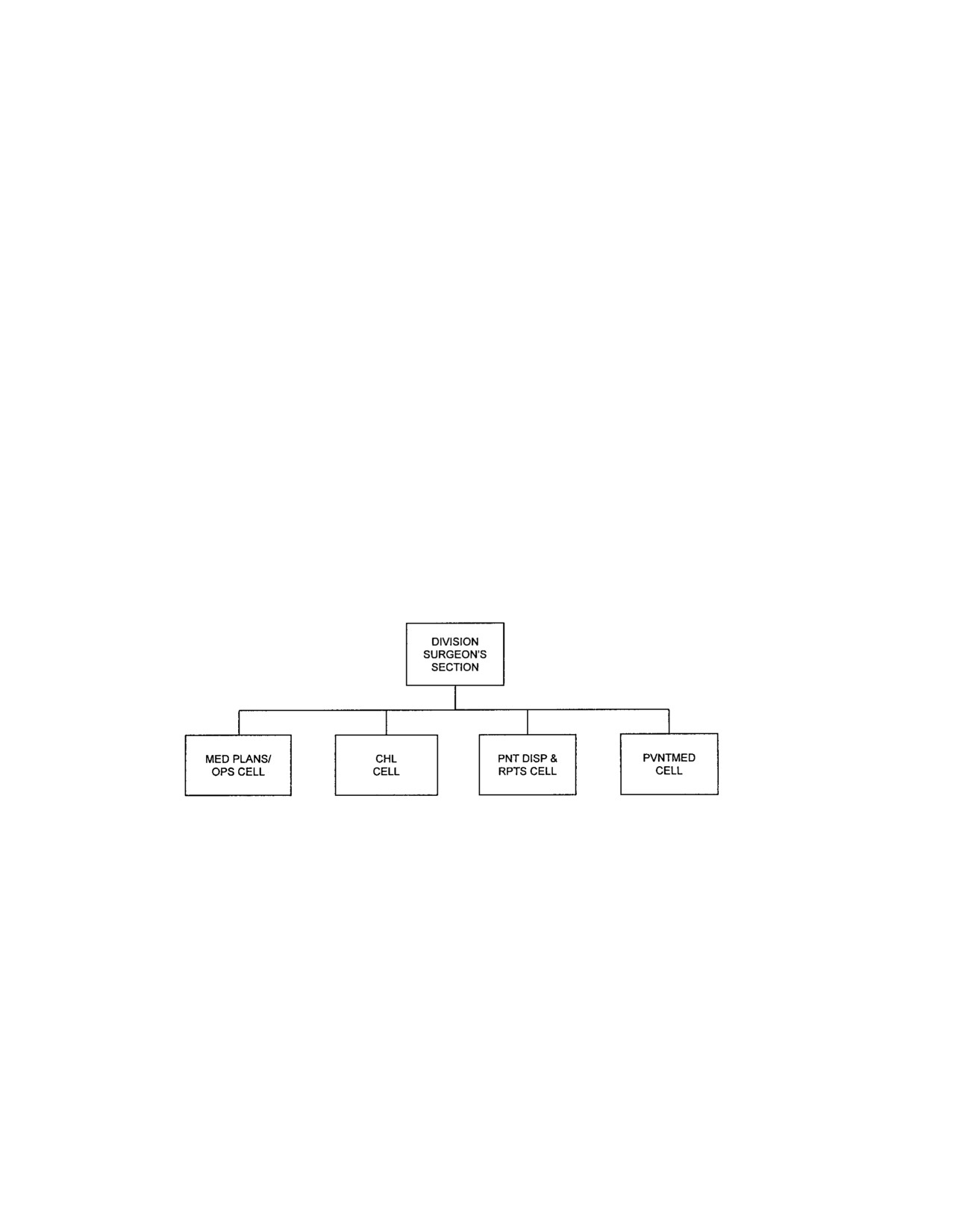
Figure 1-1 shows the typical organization and staffing of the DSS. The DSS is normally located with the
division main and consists of a medical plan and operations cell, a CHL cell, a patient disposition and
reports cell, and a PVNTMED cell.
Figure 1-1. Division surgeons section.
a. Medical Plans and Operations Cell. The medical plans and operations cell is responsible
for
Developing and coordinating patient evacuation support plans among the division and
corps medical evacuation elements.
Coordinating corps-level CHS for the division with the corps medical command
(MEDCOM)/brigade.
Submitting Army airspace command and control (A2C2) requirements for aeromedical
evacuation elements to the division Assistant Chief of Staff (Operations and Plans) (G3) (Air).
1-4
FM 4-02.21
Ensuring A2C2 information is provided to supporting corps air ambulance assets. The
A2C2 information is normally provided by the G3 (Air) at division and by the brigade Operations and
Training Officer (US Army) (S3) (Air) in the maneuver brigades.
Coordinating for aviation weather information from US Air Force (USAF) weather
(WX) detachment in the aviation brigade.
Obtaining updated road clearance information from the division movement control office
(MCO). All road clearance information is passed to ground ambulance assets. This information should
include
The NBC threat.
Priorities for use of evacuation routes.
Information reported by medical evacuation assets.
Road and weather conditions.
Security.
Monitoring medical troop strength to determine task organization for mission accomplish-
ment.
Forwarding all medical information of potential intelligence value to the division Assistant
Chief of Staff (Intelligence) (G2) and G3 staffs.
Obtaining updated medical threat and intelligence information through the G2 and G3
staff for evaluation and applicability.
Managing the disposition of captured medical materiels according to tactical standing
operating procedures (TSOPs).
Coordinating corps CSC support to forward areas as required.
Monitoring optometry services.
The medical plans and operations cell is typically staffed with a
Chief medical planner.
Plans and operations officer, medical evacuation.
Plans and operations officer.
1-5
FM 4-02.21
Chief operations sergeant.
Senior medical noncommissioned officer (NCO).
Medical intelligence NCO.
Medical operations sergeant.
(1) Chief Medical Planner. The chief medical planner (LTC, AOC 70H67) assists the
division surgeon with developing and maintaining the medical troop basis. He recommends task organization
for mission accomplishment. He is the chief of the medical plans and operations cell. He is the primary
architect of the division CHS plan, based on the division commanders intent and guidance from the division
surgeon. He monitors brigade and division operations to ensure adequacy of CHS for the supported force.
(2) Plans and Operations Officer, Medical Evacuation. The plans and operations officer for
medical evacuation (Captain, AOC 67JOO) coordinates patient evacuation to corps-level medical facilities
by Army assets. This officer develops and coordinates medical evacuation plans with the supporting corps-
level and joint medical elements. He coordinates with division A2C2 elements to ensure that the supporting
corps aeromedical evacuation units receive up-to-date overlays and A2C2 information. He coordinates for
aviation weather information from the USAF WX detachment in the aviation brigade.
(3) Plans and Operations Officer. The plans and operations officer (Major, AOC 70H67)
assists the medical planner with developing and coordinating the division CHS plan. He monitors and
tracks CHS operations and updates the chief medical planner and division surgeon as necessary. He
coordinates with division command and control (C2) elements to ensure task organization for mission
accomplishment. This officer deploys with the division forward tactical operations center (TOC).
(4) Chief Operations Sergeant. The chief operations sergeant (E-9, MOS 91B50) assists the
medical planner in accomplishing his operational duties. He coordinates and supervises the administration
functions within the DSS.
(5) Senior Medical Noncommissioned Officer. The senior medical NCO (E-8, MOS 91B50)
assists the medical planner. He assists the chief operations sergeant with supervising the activities of
subordinate enlisted personnel assigned to this branch.
(6) Medical Intelligence Noncommissioned Officer. The medical intelligence NCO (E-7,
MOS 91B40) reviews medical information of potential intelligence value. He coordinates with the G2 and
G3 to receive and pass medical information of potential intelligence value and intelligence of a medical
nature. He works in conjunction with the G2 staff in determining likely threat movement and expected
actions that will affect CHS requirements. He assists in coordinating the disposition of captured medical
materiel with the medical logistics (MEDLOG) battalion. This NCO prepares and monitors the division
medical intelligence program.
(7) Medical Operations Sergeant, Medical Evacuation. The medical operations sergeant
(E-6, MOS 91B30) assists the plans and operations officer, medical evacuation in accomplishing his duties.
1-6
FM 4-02.21
b. Combat Health Logistics Cell. The CHL cell is responsible for planning, coordinating, and
prioritizing CHL and medical equipment maintenance programs for the division. The specific responsibilities
of the CHL cell include the following:
Providing the division CHL input to the CHS plan through the plans and operations
cell.
Coordinating medical maintenance training.
Establishing maintenance priorities for repair and exchange of medical equipment with
the MEDLOG company (ensuring that critical items are included on the division CSSCS/FBCB2 CTIL).
Ensuring that a viable preventive maintenance program is established and monitored.
Coordinating the evacuation and replacement of medical equipment with the MEDLOG
company.
Verifying emergency supply requests for submission to the supporting MEDLOG com-
pany and taking the necessary action to expedite shipment.
Analyzing Class VIII resupply operations, identifying trends in performance, and
providing technical advice, as necessary.
Establishing and managing, in coordination with the division support command (DISCOM)
medical materiel management branch (MMMB), the medical critical items list.
Interfacing with the DISCOM MMMB to ensure that the necessary coordination with the
division supply and transportation system occurs.
Establishing transportation procedures, based on the tactical situation, with the MEDLOG
company and DISCOM MMMB.
Providing technical staff assistance for the DISCOM MMMB and division medical unit/
elements, as required, to ensure divisionwide support for CHL and blood management.
Monitoring the CHL picture and reporting its status using CSSCS.
Establishing coordination procedures for the disposition of captured medical materiel.
Prioritizing Class VIII supply requests and distribution, as required.
The CHL cell is staffed with a health service materiel officer (HSMO). The HSMO (Major, AOC 70K67)
works closely with the DISCOM MMMB and MEDLOG company. The HSMO coordinates and oversees
the CHL support for the division.
1-7
FM 4-02.21
c.
Patient Disposition and Reports Cell. The patient disposition and reports cell is responsible
for coordinating patient disposition throughout the division. The branch obtains and coordinates disposition
of patients with the medical plans and operations cell and the corps medical regulating office(r) (MRO). It
prepares and forwards appropriate medical statistical reports as required. The patient disposition and reports
cell is staffed with a patient administration NCO and two patient administration specialists.
(1) Patient Administration Noncommissioned Officer. The patient administration NCO (E-5,
MOS 71G20) assists the operations officer, medical evacuation in the coordination of patient disposition in
the division. This NCO prepares the required patient statistical reports and coordinates their timely
submission to higher headquarters. He also supervises the patient administration specialists.
(2) Patient Administration Specialists. The two patient administration specialists (E-4, MOS
71G10) assist the patient administration NCO in preparing patient statistical reports and in performing other
patient administration functions. They also operate the Tactical Army CSS Computer System (TACCS).
d. Preventive Medicine Cell. The division PVNTMED cell is responsible for
Supervising the command PVNTMED program; see AR 40-5 and FM 4-02.17 (8-10-17).
Ensuring PVNTMED measures are implemented that protect division personnel against
food-, water-, and vectorborne diseases, as well as environmental injuries (for example, heat and cold
injuries).
Monitor disease trends within the division.
The PVNTMED missions are accomplished according to the division CHS plan and coordinated by the
PVNTMED officer through the medical plans and operations cell with the division support medical company
and forward support medical companies (FSMCs). Division PVNTMED personnel provide advice and
consultation in the areas of environmental sanitation, epidemiology, and entomology, as well as limited
sanitary engineering services and pest management. Additional information pertaining to the PVNTMED
personnel and their specific functions is discussed in FMs 8-10, 8-10-1, 8-10-3 and 4-02.17 (8-10-17). The
PVNTMED cell is staffed with a PVNTMED officer. The PVNTMED officer (Major, AOC 60C00) is re-
sponsible for the implementation of the command PVNTMED program. The PVNTMED officer determines
the status of and conditions influencing the health of units located in the division AO. He formulates and
recommends measures for health improvements. Based on command, corps, and theater Army (TA)
guidance, he plans, directs, and prioritizes PVNTMED activities within the division. The PVNTMED
officer serves as the principal advisor on medical threats encountered by division units. He recommends
PVNTMED measures to minimize these threats within the division AO. He is also involved in PVNTMED
activities that must begin prior to deployment to minimize disease and nonbattle injury (DNBI). Actions
taken prior to deployment must include
Performing medical threat analysis.
Ensuring command awareness of potential medical threats and that appropriate PVNTMED
measures are being implemented.
1-8
FM 4-02.21
Monitoring immunization and chemoprophylaxis status of division personnel.
Monitoring the status of individual and small unit PVNTMED measures.
Monitoring PVNTMED measures against heat and cold injuries and food-, water-, and
vectorborne diseases.
Preparing PVNTMED estimates.
Planning considerations must include the following issues:
Water.
Environmental conditions.
Vectors.
Food.
Waste/sanitation.
Nuclear, biological, and chemical.
1-5.
Functions
The staff of the DSS assists the division surgeon in planning and conducting division CHS operations.
Specific functions of the DSS include
Planning and ensuring that Echelons I and II CHS for the division is provided in a timely and
efficient manner.
Developing and maintaining the medical troop basis, revising as required, to ensure task
organization for mission accomplishment.
Planning and coordinating CHS operations for division and attached/OPCON corps medical
assets. This includes reinforcement and reconstitution.
Preparing and presenting, as directed by the division surgeon, routine CHS portion of the
division briefings.
Coordinating with the G3 for prioritizing the reallocation of organic and corps medical
augmentation assets as required by the tactical situation.
Overseeing division TSOPs, plans, policies, and procedures for CHS as prescribed by the
division surgeon.
1-9
FM 4-02.21
Overseeing individual and collective medical training and providing information to the division
surgeon and division commander.
Coordinating and prioritizing CHL and blood management requirements for the division.
Coordinating with the Assistant Chief of Staff (Personnel) (G1) for tracking critical AOC and
MOSs.
Monitoring disease trends within the division.
Collecting and disseminating medical threat information and coordinating combat health
intelligence requirements with the division G2 according to FM 8-10-8.
Facilitating functional integration between CHS and military intelligence staff elements within
the division. This is done in support of the intelligence preparation of the battlefield.
Coordinating and redirecting patient evacuation within the division.
Coordinating patient evacuation from division-level medical treatment facilities (MTFs) to
corps-level MTFs.
Coordinating with the G3, G4, and division chemical officer for nonmedical assets for assisting
with mass casualties and patient decontamination operations.
Coordinating with the G3 for additional corps evacuation assets, as required.
Coordinating the medical evacuation of all EPW casualties.
Coordinating and managing the disposition of captured medical materiel.
Coordinating, planning, and prioritizing PVNTMED missions.
Coordinating corps dental support when the tactical situation permits.
Coordinating with the supporting veterinary element pertaining to subsistence and animal
disease surveillance.
Developing and publishing the medical reporting schedule for FBCB2 (medical situation
report [MEDSITREP]), CSSCS (medical unit status reporting), evacuation requests, and other reports as
necessary.
1-10
FM 4-02.21
Section III. STAFF AND COMMAND INTERFACE
1-6.
Interface with the Division Staff
a. The G1 provides and coordinates personnel support for the division. The G1s functions are
listed in FM 101-5.
(1) The G1s responsibilities include
(a) Tracking critical medical AOCs and MOS.
(b) Reporting casualties.
(c) Conducting replacement operations.
(d) Making casualty projections for the division.
(e) Monitoring patient evacuation and mortality.
(2) Reports submitted from the DSS to the G1 should be identified in the division TSOP.
These reports can vary depending on the needs of the command and are submitted using CSSCS.
(3) The DSS and the G1 staff must work together and coordinate their staff and operational
activities to ensure mission accomplishment.
b. The G2 and G3 staffs are primarily involved with plans, operations, intelligence, and security.
The functions of the G2 and G3 are listed in FM 101-5.
c.
The G4 functions are listed in FM 101-5. The G4 is primarily concerned with the logistical
status of the division. The G4 has the responsibility for planning and supervising the supply, service,
maintenance, and transportation activities to support the command.
d. The Assistant Chief of Staff (Civil Affairs) (G5) functions are listed in FM 101-5. These
functions include those actions that embrace the relationship between the command and host nation (HN),
civil authorities and the local nationals in the AO.
e.
The DSS works with other division staff elements to inform, coordinate, and achieve
synchronization of CHS activities for division operations. Examples of the coordination that must take
place between the DSS and other division staff elements are shown in Table 1-1. The division surgeon, the
DSS chief medical planner, and other DSS staff members must be informed of division staff activities and
be involved with the decision-making process. Areas of mutual interest are shown in Table 1-2.
1-11
FM 4-02.21
Table 1-1. Coordination Between Division Surgeons Section and Division Staff
SUBJECT AREA
DIVISION STAFF ELEMENT
DSS
PLANNING
G2/G3/G4
MED PLANS/OPS CELL
CHL CELL
RELOCATING CHS ELEMENTS
G2/G3/G4
MED PLANS/OPS CELL
PREVENTIVE MEDICINE
G1/G2/G3/G4/G5
MED PLANS/OPS CELL
DIV FOOD ADVISOR
PVNTMED CELL
MEDICAL SUPPORT REQUEST
G3/G5
MED PLANS/OPS CELL
CHL CELL
MEDICAL INFORMATION OF POTENTIAL
G2
MED PLANS/OPS CELL
INTELLIGENCE VALUE
PVNTMED CELL
CORPS SUPPORT MEDICAL ELEMENTS
G1/G3/G4
MED PLANS/OPS CELL
MEDICAL ELEMENTS
CHL CELL
CIVIL AFFAIRS ACTIVITIES
G5/G3/G2
MED PLANS/OPS CELL
PVNTMED CELL
CLASS VIII RESUPPLY
G4/G3
CHL CELL
DIV MCO/DTO
MED PLANS/OPS CELL
NUCLEAR, BIOLOGICAL, CHEMICAL DEFENSE
G2/G3
MED PLANS/OPS CELL
SMOKE/OBSCURATION
PVNTMED CELL
ENEMY PRISONER OF WAR OPERATIONS
G2/G3
MED PLANS/OPS CELL
MAINTENANCE
G4
MED PLANS/OPS CELL
CHL CELL
CASUALTY ESTIMATES AND REPORTING
G1
MED PLANS/OPS CELL
PNT DISP & RPT CELL
A2C2
G3 (AIR)
MED PLANS/OPS CELL
HEALTH CARE POLICY
G1/G3
DIV SURGEON
MED PLANS/OPS CELL
1-12
FM 4-02.21
Table 1-2. Areas of Mutual Interest for Division Surgeons Section and Division Staff
SUBJECT
DIVISION STAFF SECTION
MEDICAL INFORMATION OF A POTENTIAL INTELLIGENCE
VALUE OR INTELLIGENCE OF A MEDICAL NATURE
G2
COMBAT HEALTH SUPPORT
G1/G3
CONTINGENCY OPERATIONS
G3
REPLACEMENT AND RECONSTITUTION OPERATIONS
G1/G3/G4
PREVENTIVE MEDICINE
G1/G2/G3/G4/G5
CIVIL AFFAIRS/HOST-NATION SUPPORT
G5/G2/G3/G4
INTERNMENT/RESETTLEMENT (I/R) OPERATIONS
G1/G2/G3
MASS CASUALTY PLAN
G1/G2/G3/G4
NUCLEAR, BIOLOGICAL, CHEMICAL DEFENSE
G1/G2/G3/G4
1-7.
Interface with the Major Commands of the Division
a. Maneuver Brigades. Interface with each of the maneuver brigades is accomplished through
the BSS and through the DISCOM support operations section, DISCOM medical operations branch, and the
health service support officers
(HSSOs) of the division support battalion (DSB) and forward support
battalions (FSBs) and other staff elements as appropriate. This interface will focus on CHL and CHS
requirements for the brigades. It also includes coordination for A2C2 information for air evacuation assets
supporting maneuver elements.
b. Aviation Brigade. Interactions between the aviation brigade and the DSS should include
(1) Coordination for area medical support.
(2) Coordination for evacuation of patients using helicopters with heavy lift capabilities.
(3) Coordination for air delivery of Class VIII emergency resupply.
(4) Coordination for appropriate aviation plans and overlays supporting division operations.
(5) Coordination for aviation logistics support (aviation fuel maintenance and spare parts) to
support air ambulances, when required.
(6) Coordination for aviation weather information from the USAF WX detachment in the
aviation brigade.
(7) Coordination through the division aviation support battalion (DASB) CHS requirements
for the aviation brigade and the division cavalry squadron. For further discussion, see FM 63-23-2.
c.
Division Support Command. Interface with the DISCOM will include most of its staff elements.
1-13
FM 4-02.21
(1) The Adjutant (US Army) (S1) provides and coordinates personnel support for the
command. The DISCOM S1s responsibilities are listed in FM 63-2-2.
(a) Some of the S1s responsibilities include
Tracking critical AOCs and MOS by skill indicators.
Reporting casualties.
Conducting replacement operations.
Making casualty projections for the DISCOM.
Monitoring patient evacuation and mortality.
(b) Reports submitted from the medical operations cell, DISCOM to the S1 should
be identified in the DISCOM TSOP. These reports can vary depending on the needs of the command.
(c) The DSS and DISCOM medical operation branches work together and coordinate
their staff and operational activities to ensure mission accomplishment.
(2) The Intelligence Officer (US Army)(S2)/S3 section is primarily involved with plans,
operations, intelligence, and security. The elements of the S2/S3 and its numerous responsibilities are listed
in FM 63-2-2.
(a) Elements of the DSS, DISCOM medical operations cell and elements of the S2/S3
work together to synchronize CHS activities to division operations. The DSS will use its CSSCS to receive
and transmit information and prepare briefings, overlays and plans with the DISCOM staff. Examples of
the coordination that must take place between elements of the DSS, DISCOM medical operations cell and
elements of the DISCOM S2/S3 section are shown in Table 1-3.
(b) The DISCOM support operations officer, DISCOM S2/S3 and the DSS chief
medical planner must be informed of staff activities and be involved with the decision-making process.
(3) The DISCOM Supply Officer (US Army) (S4) is responsible for all logistics matters
pertaining to DISCOM units. The DISCOM S4s responsibilities are listed in FM 63-2-2.
(a) The DSS coordinates with the DISCOM S4 for logistical requirements, other than
medical, that impact on CHS operations.
(b) The DSS must coordinate with the S4 for critical supply items list (nonmedical)
requirements.
1-14
FM 4-02.21
Table 1-3. Coordination Between Division Surgeons Section and Division Support Command
SUBJECT AREA
DISCOM
DSS
PLANNING
S2/S3 PLANS-INTEL BR
MED INTEL NCO
DMC MED OPS BR
MED PLANS/OPS CELL
DMC OPS SEC
MED PLANS/OPS CELL
GSO MMMB
HSMO
RELOCATING CHS ELEMENTS
DMC OPS SEC
MED PLANS/OPS CELL
DMC MED OPS BR
PREVENTIVE MEDICINE
DMC OPS SEC
MED PLANS/OPS CELL
S4 DIV FOOD ADVISOR
PVNTMED CELL
S2/23 PLANS-INTEL BR
PVNTMED CELL
MED INTEL NCO
PVNTMED CELL
MED PLANS/OPS CELL
MEDICAL SUPPORT REQUEST
S2/S3 OFC
MED PLANS/OPS CELL
S2/S3 PLANS-INTEL BR
MED INTEL NCO
GSO MMMB
CHL CELL
DMC OPS SEC
MED PLANS/OPS CELL
MEDICAL INFORMATION OF POTENTIAL
S2/S3 PLANS-INTEL BR
MED INTEL NCO
INTELLIGENCE VALUE OR
DMC MED OPS BR
MED PLANS/OPS CELL
INTELLIGENCE A MEDICAL NATURE
PVNTMED CELL
CORPS SUPPORT
DMC OPS SEC
MED PLANS/OPS CELL
DMC MED OPS BR
MEDICAL ELEMENTS
S2/S3 PLANS-INTEL BR
MED PLANS/OPS CELL
CIVIL AFFAIRS ACTIVITIES
PVNTMED CELL
CLASS VII RESUPPLY
GSO MMMB
CHL CELL
DMC MED OPS BR
MED PLANS/OPS CELL
DMC OPS SEC
CHL CELL
MCO
CHL CELL
NUCLEAR, BIOLOGICAL, CHEMICAL DEFENSE
S2/S3 PLANS-INTEL BR
PVNTMED CELL
SMOKE/OBSCURATION
S2/S3 PLANS-INTEL BR
MED PLANS/OPS CELL
ENEMY PRISONER OF WAR OPERATIONS
S2/S3 PLANS-INTEL BR
MED PLANS/OPS CELL
MAINTENANCE
SPT OPS SEC MAINT MGT OFC
MED PLANS/OPS CELL
GSO MMMB
MED PLANS/OPS CELL
CHL/PVNTMED CELL
NUTRITION INITIATIVES AND MENU
S4 DIV FOOD ADVISOR
DIV SURGEON
APPROVAL
USE OF DIGITAL SYSTEMS
S6
MED OPS OFFICER
1-15
FM 4-02.21
1-8.
Interface with the Corps Medical Units
Interface with corps medical units is accomplished through the corps MEDCOM/brigade. Direct interface
can occur with those medical units providing support to the division and will be coordinated by the DSS and
the corps staff. The MEDCOM/brigade will provide subordinate units to support the division by establishing
a command relationship of OPCON or attachment. The MEDCOM/brigade could also choose to maintain
only a support relationship of DS or GS to support the division. The DSS interfaces with corps medical
units according to the MEDCOM/brigade TSOP. The DSS and other division staff elements must be
prepared to integrate corps-level medical units/elements into the medical, as well as the logistical, support
structure. The MEDCOM/brigade will normally deploy a liaison officer to the division to coordinate and
synchronize corps CHS. Information concerning the organization, functions, and responsibilities of the
corps MEDCOM/brigade is found in FM 8-10.
a. Corps Medical Command and Medical Brigade. The corps MEDCOM and medical brigade
provide C2, including
Staff planning.
Supervision of operations.
Administration of the assigned and attached units.
(1) The following areas are subjects of mutual concern for division and corps medical staff
elements:
Medical regulating.
Division CHS requirements.
Ground and air ambulance support.
Class VIII resupply, blood management, and medical maintenance.
Status of corps medical elements attached, or OPCON, to the division.
Disease surveillance.
Medical threat and intelligence estimates.
Captured medical supplies and equipment.
Reinforcement and reconstitution of CHS elements.
Civil affairs and HN support.
1-16
FM 4-02.21
Communications.
Locations of medical elements in support of the division.
Preventive medicine, mental health, dental, or veterinary assistance.
(2) Logistical support requirements for corps medical elements operating in the division are
identified and coordinated with the corps support battalion. When corps medical elements deploy to the
division, logistical support is normally provided by the corps support battalion. Coordination could be
required for
Class ISubsistence items and gratuitous issue health and welfare items.
Class IIItems of equipment other than principal items which are prescribed in
authorization and allowance tables (individual equipment, clothing items, tents, tool sets, and administrative
and housekeeping supplies).
Class IIIPetroleum, oils, and lubricants (POL) (petroleum fuels, hydraulic and
insulating oils, chemical products, antifreeze compounds, compressed gases, and coal).
Class IVConstruction and barrier materials, lumber, sandbags, and barbed wire.
Class VAmmunition.
Class VIPersonal demand items such as health and hygiene products (soap and
toothpaste), writing material, snack food, beverages, batteries, and cameras (nonmilitary sales items).
Class VIIMajor end items(final combination of items which are ready [assem-
bled] for intended use).
Class VIII and BloodMedical materiel, including repair parts peculiar to medical
equipment, and blood products
Class IXRepair parts.
Field services (billeting, showers, and services).
Personnel replacements (corps supported).
b. Medical Logistics Battalion. The MEDLOG battalion is organic to the corps medical brigade.
The MEDLOG battalion provides C2 for assigned MEDLOG companies and the blood support detachment.
The MEDLOG battalion is responsible for receiving, storing, and distributing medical materiel; single and
multivision optical fabrication and repair; medical maintenance; blood and blood product collection,
manufacturing, and distribution; medical gas production and distribution; and building of medical
assemblages/push packages. The MEDLOG battalion will employ standard state-of-the-art MEDLOG
1-17
FM 4-02.21
information management and communications systems to include satellite links. Interface between the DSS
and the MEDLOG battalion, MEDLOG company, or blood support detachment could be required for
Emergency Class VIII resupply.
Repair of medical equipment.
Blood management.
Optical fabrication requirements.
Management of captured medical materiel.
Storage and decontamination techniques to minimize NBC contamination of Class VIII
supplies.
(1) Medical logistics company. The MEDLOG company provides Class VIII supplies, DS/
GS medical maintenance, and optical support. The MEDLOG company will use line item requisitioning to
support customers and will have the capabilities of building and maintaining preconfigured push packages in
support of forward deployed medical units.
(2) Blood support detachment. The MEDLOG battalions blood support detachment serves
as the Armys blood supply unit (BSU). Blood and blood products will be stored and distributed under rigid
specifications and managed by standard automated systems. Air movement will be the mode of choice for
transporting blood and blood products. Army blood support in the AO will be the responsibility of the
supporting MEDLOG battalion. The MEDLOG battalions blood support detachment will collect and
manufacture, receive, store, and distribute blood and blood products on an area basis.
c.
Medical Evacuation Battalion. The headquarters and headquarters detachment, medical
evacuation battalion serves as the central manager of ground and air evacuation assets in the corps. Its
mission is to provide C2 of ground and air medical evacuation units within its AO. Information pertaining
to the organization, functions, and capabilities of this unit is discussed in FM 8-10-6. The DSS interfaces
with the medical evacuation battalion or subordinate units concerning
Air and ground movement liaison within the division AO.
Reinforcement of division CHS assets.
Mass casualty evacuation plans.
Evacuation of patients from division to supporting corps hospitals.
Emergency movement of medical personnel, supplies, and blood.
Ambulance shuttle operations, to include ambulance exchange points (AXPs) and patient
collection points.
1-18
FM 4-02.21
The status of medical evacuation battalion elements operating in the division.
Management and decontamination of ground/air evacuation assets.
Support requirements for forward deployed medical evacuation battalion assets.
Location of medical evacuation battalion assets.
Location of division medical elements.
The tactical situation and threat updates.
Delivery of blood and blood products.
Reinforcement of covering force and deep operations evacuation assets.
Road and movement clearances.
Maintenance support, to include aviation intermediate maintenance (AVIM).
Emergency resupply of medical and nonmedical items (if required).
Communications requirements and signal operation instructions (SOI).
Updated tactical maps and evacuation overlays.
Terrain considerations and barrier plans for ambulances.
Evacuation destinations (MRO functions).
Division and brigade A2C2 requirements.
Combat search and rescue missions.
(1)
Within the division area, the air ambulance company provides aeromedical evacuation on
a DS basis. This company is normally attached for support (less OPCON) to the division aviation brigade.
Air ambulances will operate from the division support area (DSA) and brigade support areas (BSAs)
providing 24-hour immediate response medical evacuation capability.
(2) Successful aeromedical evacuation support to the division requires current and accurate
operational information. This information includes A2C2, current intelligence, friendly situation, air traffic
service procedures, weather, combat service support (CSS), and aviation safety and standardization data.
To enhance the safety and effectiveness of aeromedical operations, operations information should flow
between air ambulance units and the GS aviation battalion or assault helicopter battalion of the respective
aviation brigade.
1-19
FM 4-02.21
(3) Information is exchanged by various methods including on-site coordination or communi-
cations systems. The air ambulance company can obtain information through various sources such as the
DSS and BSSs of the maneuver brigade TOCs. However, during the planning and execution phases
of operations, the medical evacuation battalion and the aviation unit to which the air ambulance com-
pany is attached are the primary sources for providing this information. The DSS also provides A2C2
planning information to the air ambulance company. This information includes, but is not limited to, the
following:
Location of medical units.
Locations of forward arming and refueling points.
Liaison requirements with supported units.
Evacuation corridors recommendation.
The air ambulance company, in turn, continually provides the medical evacuation battalion, aviation brigade,
and DSS with updated information about its current and planned operations. The company also provides
pertinent combat information obtained during missions. This information includes threat disposition,
downed aircraft, weather, and other factors obtained by air ambulance crews during the performance of
their duty. All medical evacuation crews communicate directly with the division air traffic service and
execute A2C2 while operating behind brigade boundaries.
(4) When air ambulances operate in the DSA, they execute the A2C2 plan and communicate
directly with the division air traffic service. Emergency requests for aeromedical evacuation is relayed as
necessary from the DSS through the DSMC to the air ambulance elements position at their location for the
mission.
(5) Air ambulances deployed forward into the BSA normally collocate with the FSB or
aviation task force. When deployed forward to the BSA, the air ambulance teams evacuation missions are
coordinated by the FSMC commander. The FSMC assisted by the support operations section provides real-
time tactical information to the air ambulance crew about evacuation missions from the maneuver battalion/
company to the brigade rear area. When air ambulances operate forward of the BSA, they will execute the
A2C2 plan through the maneuver brigade S3. The FSB support operations section provides planning and
coordination between aeromedical evacuation and the supported maneuver brigade. The brigade S3 provides
the A2C2 plan which includes the air corridors, air control points, and communications checkpoints. The
brigade S3 will provide updates as required. Air ambulances deployed to the BSA will normally provide
medical evacuation from forward areas (battalion aid station [BAS]) back to the BSA. Air ambulance
evacuation from the point of injury will be mission, enemy, terrain, troops, time available, and civilian
considerations (METT-TC) dependent. Air ambulances from the corps or those positioned in the DSA will
evacuate from the BSA to corps hospitals.
(6) The medical evacuation battalion communications link to the air ambulance company is
accomplished by a combination of wire, frequency modulated (FM) voice, and mobile subscriber equipment
(MSE). To enable air-to-air communications between medical evacuation aircraft and aviation brigade
1-20
FM 4-02.21
aircraft during the conduct of missions, air ambulance companies obtain aviation unit call signs, frequencies,
and cryptonet variables.
(7) Corps aeromedical elements will operate from the DSA and BSAs providing around the
clock immediate response evacuation aircraft. To accomplish this, elements must maintain a close tie with
the A2C2 system in the division. The division A2C2 element provides an airspace plan through the division
operation order (OPORD)/OPLAN A2C2 annex. The aircrew must also be familiar with the daily airspace
control order and the airspace control plan. These documents contain all airspace control measures (ACM),
to include free fire areas, no-fly/fire areas, restricted operations zones, and established and standard Army
aircraft flight routes (SAAFRs). These route and ACMs change on a daily basis and cannot be integrated
into the division OPORD. The DSS will ensure all A2C2 information is provided to corps aeromedical
elements. The DSS does not generate A2C2 information, but does provide A2C2 planning information to
division A2C2 elements. This information includes, but is not limited to, the following:
Locations of medical aviation and medical units.
Locations of forward air refueling equipment.
Locations of supported units and liaison requirements.
Locations of evacuation corridors and recommendations on usage.
(8) All medical air-flight crews will communicate directly with the division air traffic service
and execute division A2C2 while operating behind brigade boundaries. The medical evacuation battalion
normally deploys air ambulance elements to the division. These elements include an air ambulance
company or a selected element of the company. When the air ambulance company deploys to the division,
it collocates with the aviation brigade, or according to the division TSOP. Air ambulance companies will
obtain A2C2 information from the division A2C2 section and coordinate with the DSS. Air ambulance
teams can be deployed forward into the BSA and collocate with the FSB. When deployed forward, the air
ambulance team is totally dependent on the FSB for communications support. When air ambulance
elements operate forward of the BSA, they will execute the A2C2 plan through the brigade S3. The FSBs
support operations section provides planning and coordination between air evacuation elements and the
maneuver brigade S3. Information provided to the maneuver brigade S3 should include, but not be limited
to, the following:
Location of MTFs and AXPs.
Location and number of aircraft in sections.
Location of AMEDD forward air refueling equipment.
Locations of supported units and liaison requirements.
Locations of evacuation corridors and recommendations on usage.
1-21
FM 4-02.21
(9) The brigade S3 provides the A2C2 plan which includes the air corridors, air control
points, and communications checkpoints. The brigade S3 will provide updates as required.
1-9.
Interface with the Division Support Battalion
The DSS coordinates through the DISCOM medical operations branch, and interfaces with staff elements of
the DSB on CHS issues pertaining to the DSA, and attachment/OPCON of corps medical elements.
Interface with the division support medical company will primarily concern area medical support activities
for the DSA. All medical issues are coordinated with the DSB HSSO who is located in the headquarters
section. For further discussion on the DSB, see FM 63-21-1.
1-10. Interface with the Forward Support Battalions
After coordination with the DISCOM medical operations branch, the DSS can interface with elements of the
FSB through the CHS cell (HSSO) of the support operations section. This interface between the DSS and
elements of the FSB is driven by CHS requirements in the forward areas. This information will assist the
DSS in planning, coordinating, and managing division medical elements and resources in support of the
battle. Communications and coordination between elements of the DSS, DISCOM support operations
section and medical operations branch and the FSBs are essential for continuous CHS. The DSS will
normally interface through the HSSO with the following FSB elements:
a. S2/S3. The S2 or S3 advises and assists the FSB commander in planning, coordinating, and
supervising the communications, operations, training, security, and intelligence functions of the battalion.
b. Support Operations Section. The support operations sections mission includes DS supply,
field services, DS maintenance, CHS, and limited transportation functions. The section must ensure that
logistics and CHS to the supported units remain at a level consistent with the type of tactical operations
being conducted. Interface between the support operations section and the DSS will be direct or indirect.
The FSB HSSO is assigned to the support operations section.
c.
Forward Support Medical Company. The FSMC provides CHS for the brigade as well as area
medical support for the brigade rear and BSA. Combat health support operations are coordinated by the
DSS through the DISCOM with the BSS and the FSB (HSSO). The DSS tasks elements of the FSMC,
through DISCOM support operations chain of command, to provide division-level CHS. The HSSO,
FSMC commander, and brigade surgeon are the principal managers of the CHS assets assigned or attached
to the brigade.
1-11. Interface with the Maneuver Battalions
Medical platoons organic to the maneuver battalion provide Echelon I CHS for the battalion and area
medical support in forward areas. Coordination is made with the medical platoons through the BSS.
1-22
FM 4-02.21
Section IV. COMMAND POST SETUP AND COMMUNICATIONS
1-12. Command Post, Division Headquarters
The DSS, as an element of the division sustainment cell relocates and establishes itself as part of the division
main command post (CP). The sustainment cell consists of several 5-ton expandable vans. These expandable
vans house the assistant division commander for support (ADCS), DISCOM headquarters, and division and
DISCOM CSS staffs. The ADCS conducts the rear fight from the sustainment cell. For sample setup of the
division sustainment cell, see FM 63-2-2.
a. Command posts are organized in many different ways to accomplish their missions. There are
several options for setting up the division CPs. The division has changed to a main CP (tactical command
post administrative center). The main CP combines all of the functions of the old division main and division
rear CPs. For example of division CPs, see FM 71-100.
b. The DSSs area is setup according to division TSOPs.
1-13. Information, Communications, and Digitization
Effective management and control of division CHS operations are dependent on the DSSs ability to
communicate with division and corps elements. The use of the area common-user system (ACUS),
digitization of all echelons of CHS communications, digitization of the battlefield distribution
(BD)
transportation assets and lastly, modular medical organization structure provides the DSS information
needed to tailor and synchronize CHS. Through real-time situational awareness, the DSS anticipates,
coordinates, and provides CHS for the division to include all units attached, DS, and OPCON to the
division. Information and communications assets available to the DSS include are provided in Table 1-4.
Table 1-4. Information and Communications Assets Available to the Division Surgeons Section
RADIO SETS
TELEPHONES & FACSIMILE (FAX)
AN/VRC 88F (1 EACH)
DIGITAL NONSECURE VOICE TELEPHONE (4 EACH)
AN/VRC 89F (1 EACH)
DIGITAL SECURE VOICE TELEPHONE (1 EACH)
AN/GRC 213 (2 EACH)
MSE FACSIMILE
ROUTERS
COMPUTER SYSTEMS
TACTICAL LAND AREA NETWORKS
COMBAT SERVICE SUPPORT CONTROL SYSTEM
LOCAL AREA NETWORK ROUTER
THEATER ARMY MEDICAL MANAGEMENT INFORMATION SYSTEM
MEDICAL COMMUNICATIONS FOR COMBAT CASUALTY CARE
OTHERS
THEATER MEDICAL INFORMATION PROGRAM
WEATHER SYSTEM
FORCE XXI BATTLE COMMAND BRIGADE AND BELOW (3 EACH)
POSITION/NAVIGATION DEVICE (1 EACH)
1-23
FM 4-02.21
NOTE
Mobile subscriber equipment support for the DSS is
provided by elements of the division signal battalion.
a. Army Battle Command System. The primary means of communications within the digital
division is through the use of the Army Battle Command System (ABCS). The DSS uses CSSCS to receive
and transmit information and prepare briefings, overlays and plans. In addition, the DSS maintains an
updated status of the tactical and logistics situations through the use of CSSCS. The division surgeon is re-
sponsible for establishing the CHS and CHL reporting procedures in the division using CSSCS and FBCB2.
Complete details for use of the CSSCS at the CSSCS homepage @ http://www.lee.army.mil/CSSCS/.
b. Radio Communications Networks and Radios used by the DSS. Radio communications
networks and radios used by the DSS include
(1) The division logistics operations net (amplitude modulated [AM]single sideband [SSB])
which is controlled by the DISCOM S2/S3 support operations section. The net provides the necessary long-
range C2 link between the DISCOM, the FSBs, the DSB, the division materiel management center (DMMC)
and the distribution management center (DMC) medical operations branch.
(2) The DSS maintains continual communications with division and DISCOM medical ele-
ments through its FM and AM radios. Single-Channel Ground and Airborne Radio System (SINCGARS)
components provide the DSS with AN/VRC 89 series (FM) which has a receiver/transmitter capable of
using two FM nets for reception and transmission. This permits the DSS to operate a medical net (FM).
The DSS AM radio is an AN/GRC 213 radio (AM-improved high-frequency radio [IHFR]).
c.
Mobile Subscriber Equipment. Mobile subscriber equipment is a part of the ACUS, which
goes from the corps rear boundary forward to the division maneuver battalions rear area. This system will
allow the DSS to communicate throughout the battlefield in either a mobile or static situation. The mobile
subscriber system is managed by the organic MSE signal battalion. The signal support company normally
provides subscriber services to the division/DISCOM main CP. This system integrates the functions of
transmission, switching, control, and terminal equipment. Additional information pertaining to MSE is
found in FM 11-55 and FM 63-2-2.
(1) The MSE telephones, mobile subscriber radiotelephones (MSRTs), FAXs, data terminals,
and computer systems, as part of the ACUS, are user-owned and operated. The DSS is responsible for
running wire to the designated junction boxes. These boxes tie the DSS MSE telephones into the extension
switches that access the system. The subscriber terminals used by the units are digital secure and nonsecure
voice telephones. These provide full duplex digital, four-wire voice, as well as data ports, for interfacing
the AN/UXC-7 FAX, the TACCS computer, and the unit-level computer (ULC). See FM 11-43 for
information on how to connect the entry point terminal communications systems.
(2) Wire subscriber access points provide the entry points (interface) between fixed subscriber
terminal equipment owned and operated by users and the MSE area system operated by signal units.
1-24
FM 4-02.21
See FM 63-2-2 for information pertaining to fixed subscriber terminal equipment assignments for the DSS.
The MSE MRST terminal is the AN/VRC-97. This MSRT, which consists of a very high-frequency radio
and a digital secure voice terminal, is a vehicle-mounted assembly. It interfaces with the MSE system
through a radio access unit (RAU). The primary use of the MSRT terminal is to provide mobile subscribers
access to the MSE area network. Radio access units are deployed to maximize area coverage and MSRT
terminal concentrations. Mobile subscriber radiotelephone terminals can also operate in CPs to allow staff
and functional personnel access. Local standing operating procedures (SOP) will determine use of MSRTs
in CP areas based on the possibility of interference with SINCGARS radios operating in the immediate area.
As the Army continues to digitize the battlefield and modernize the force, the use of automation continues
to develop.
(3) Mobile subscriber equipment Packet Switching Network gives units the ability to connect to
division and corps tactical local area network (TACLAN). This allows units/CPs to connect computer
systems such as the CSSCS and the maneuver control system, (MCS) to an ethernet cable (coaxial) and send
and receive information in an extremely efficient manner. Packet switching does not utilize or take up
existing telephone lines. Instead, telephone lines are freed up even more because information is being sent
over a network on appliques. Using ABCS, common hardware/software facilitates the interface and
exchange of information between the DSS, corps elements, and division medical elements. See FM 63-2-2
for information concerning automatic data processing (ADP) continuity of the OPLAN.
Section V. COMBAT HEALTH LOGISTICS AND BLOOD MANAGEMENT
1-14. Class VIII Resupply
a. Management. Class VIII resupply management in the Army XXI division is accomplished by
medical units/elements through the use of a functional business system called Medical Logistics-Division
(MEDLOG-D). Currently the functional business system for Class VIII wholesale/retail management at
echelons above division (EAD) is the Theater Army Medical Management Information System (TAMMIS),
which is a legacy system. This system will be replaced in the future by the Defense Medical Logistics
Standard Support (DMLSS) System. Medical Logistics-Division is a module of DMLSS and is scheduled
for fielding to division and corps medical units/elements. This system provides division and corps medical
units/elements a direct link with the supporting MEDLOG battalions units. The HSMO of the DSS and the
DISCOM MMMB in the division support operations section coordinates Class VIII resupply for division
medical units/elements. Each medical unit maintains its own basic load of 3 days of medical supplies. The
MEDLOG battalion assigns one MEDLOG company in DS of each division. Once established, it provides
Class VIII resupply for the division and corps medical elements operating in the division AO.
b. Resupply during (Employment and Initial) Employment.
(1) During deployment, lodgment, and early buildup phases, medical units operate from
planned, prescribed loads and from existing pre-positioned war reserve stockpiles identified in applicable
contingency plans.
1-25
FM 4-02.21
(2) During the initial employment phase, each FSMC will receive a preconfigured medical
resupply push-package every 48 hours from pre-positioned stock or the continental United States (CONUS)
base. Preconfigured medical resupply push-packages will continue until appropriate units of the corps
MEDLOG battalion are established.
(3) Initial resupply efforts will consist of preconfigured medical supply packages tailored to
meet specific mission requirements. Preconfigured push-packages will normally be shipped directly to the
division support medical company (DSMC) and FSMCs until replenishment line item requisitioning is
established with the supporting MEDLOG company. During this time, medical company treatment and
ambulance teams deployed with maneuver or other division elements are resupplied from their medical
company. Maneuver battalion medical platoons/BAS will receive standard push-packages every 12 to 24
hours. Contents of push-packages can be adjusted as the battle changes. Line item requisitioning will be by
exception only during this time. While resupply by preconfigured packages is intended to provide support
during the initial phase, continuation on an exception only basis will be dictated by operational needs.
Planning for such a contingency must be directly coordinated with the DSS. Other than line item
requisitioning from the FSMCs and DSMC, the HSMO of the DSS and the DISCOM MMMB will
coordinate all Class VIII requirements for the division with the supporting MEDLOG battalion and/or
MEDLOG company, as appropriate.
c.
Medical Logistics-Division. Divisional medical elements use MEDLOG-D to requisition Class
VIII supplies. Users of this system in the division include maneuver battalion medical platoons, FSMCs,
the DSMC, and the DISCOM MMMB. The MEDLOG-D system is the primary source for Class VIII line
item requisitions from the FSMCs and DSMC. Forward support medical companies and the DSMC request
Class VIII resupply from the supporting MEDLOG company.
d. Routine Requisitions. Routine requisitions from maneuver battalion medical platoons for
Class VIII resupply from their supporting FSMC will be via a digital request. An information copy of all
requisitions within the brigade will be forwarded by the FSMC on-line to the DISCOM MMMB and off-line
to the BSS. Routine requisitions submitted by FSMCs, division or corps medical elements operating in the
BSAs are forwarded directly to the supporting MEDLOG company. An information copy goes to the
DISCOM MMMB. The MMMB coordinates shortfalls in throughput distribution with the DSS and divisions
support operations branch. The MMMB updates priorities with the MEDLOG company to correct
deficiencies in the delivery system. If the requested items are available for issue, a materiel release order is
printed and the requested supplies are prepared for shipment. For items not available for issue, the requests
are passed to the MEDLOG battalions logistics support company. Using TAMMIS, the MEDLOG
company forwards information to the unit on items shipped and on those requests which were not filled. An
information copy is forwarded to the MMMB.
e.
Emergency Requisitions. Emergency requisitions from maneuver battalion medical platoons
are submitted to the supporting FSMC. When the supporting FSMC is unable to fill the request, the
requisition is forwarded to the DISCOM MMMB. The DISCOM MMMB will expedite handling of this
request to ensure tracking of critical Class VIII items and timely delivery. Cross-leveling in the division
should be accomplished if it is the most expedient method of obtaining and shipping required items to the
requesting unit/element. If the DISCOM MMMB is unable to locate requested item(s) in the division, the
request is forwarded to the supporting MEDLOG company. Emergency requisitions from FSMCs are sent
1-26
FM 4-02.21
through the DISCOM MMMB for management and to ensure visibility of the requisitions. The DISCOM
MMMB maintains a record of the requisition until it is filled. All emergency requests received by the
MEDLOG company are processed for shipment by the most expedient transportation available. When
feasible delivery of these emergency supplies are accomplished using air ambulances which is coordination
with the medical evacuation battalion. The MEDLOG company immediately forwards all emergency
requests not filled to the MEDLOG battalion logistics support company located in the corps rear. The
DISCOM MMMB has the responsibility of monitoring all emergency requisitions not filled by the MEDLOG
company. The DISCOM MMMB reports all emergency Class VIII requests to the DSS/CHS cell.
f.
Delivery of Class VIII Supplies. Delivery of throughput Class VIII supplies to the requesting
medical units in the division is accomplished by logistical packages (LOGPACs) and nonmedical transports.
Shipment of these Class VIII LOGPACs from the MEDLOG company is coordinated with the corps support
battalion and the corps MCO. The management and in-transit visibility of Class VIII delivery is
accomplished through document number and transportation number tracking. The systems that work
together to provide this management and coordination are TAMMIS, Transportation Coordinators
Automated Information for Movement System (TCAIMS), Movement Tracking System (MTS), and Global
Traffic Network (GTN). These systems are located in the MEDLOG company and the DISCOM MMMB.
In some cases, delivery of medical materiel into the division AO is achieved through use of the directed
Class VIII resupply using medical evacuation resources that are returning to the division medical units.
From the FSMCs, delivery of Class VIII supplies to maneuver battalion medical platoons via LOGPAC or
nonmedical transports is coordinated by the FSMC with the FSB support operations section. For directed
Class VIII resupply, medical transports can be used. Emergency Class VIII resupply will be processed for
shipment by the most expedient means available. Based on casualty estimates, medical push-packages
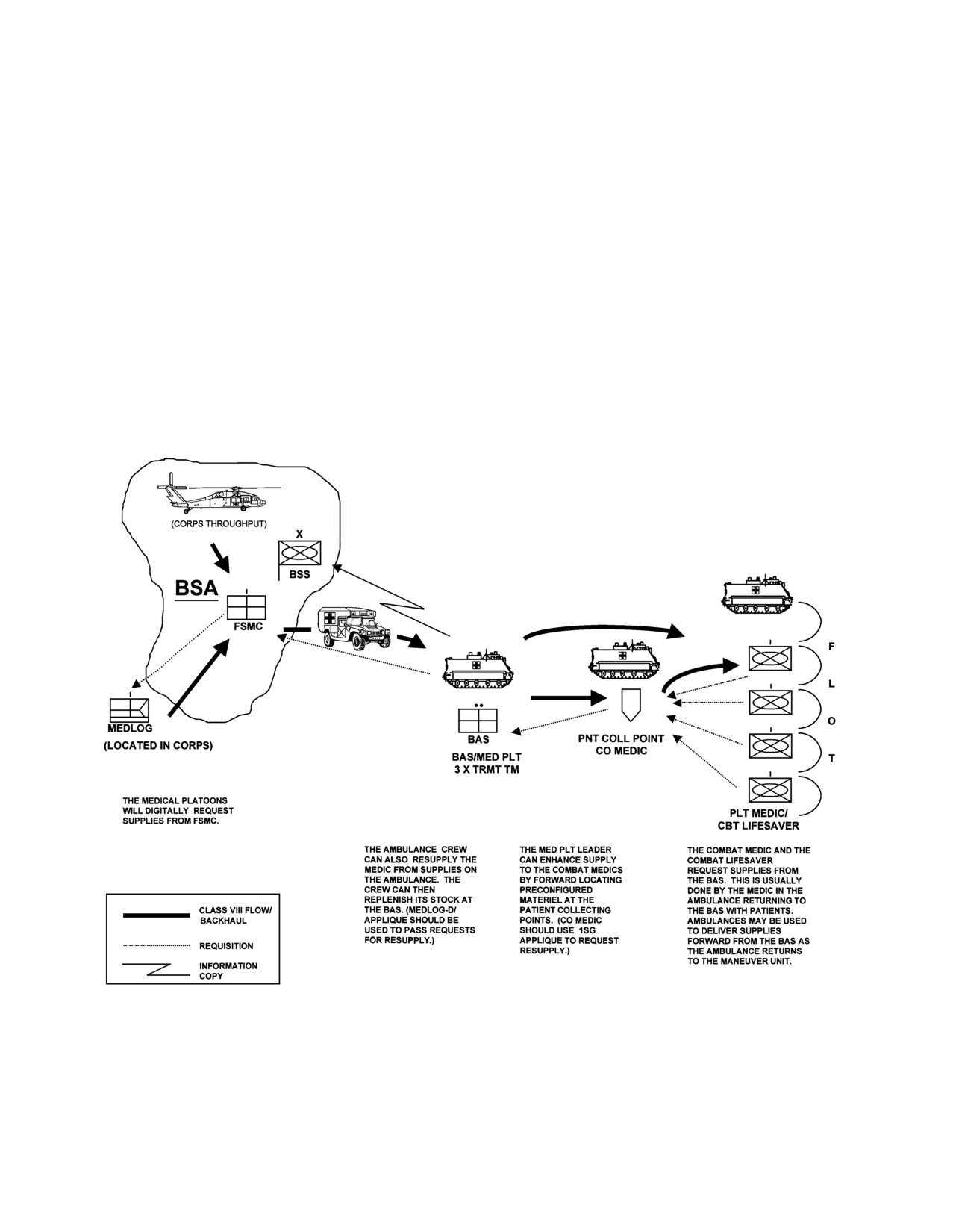
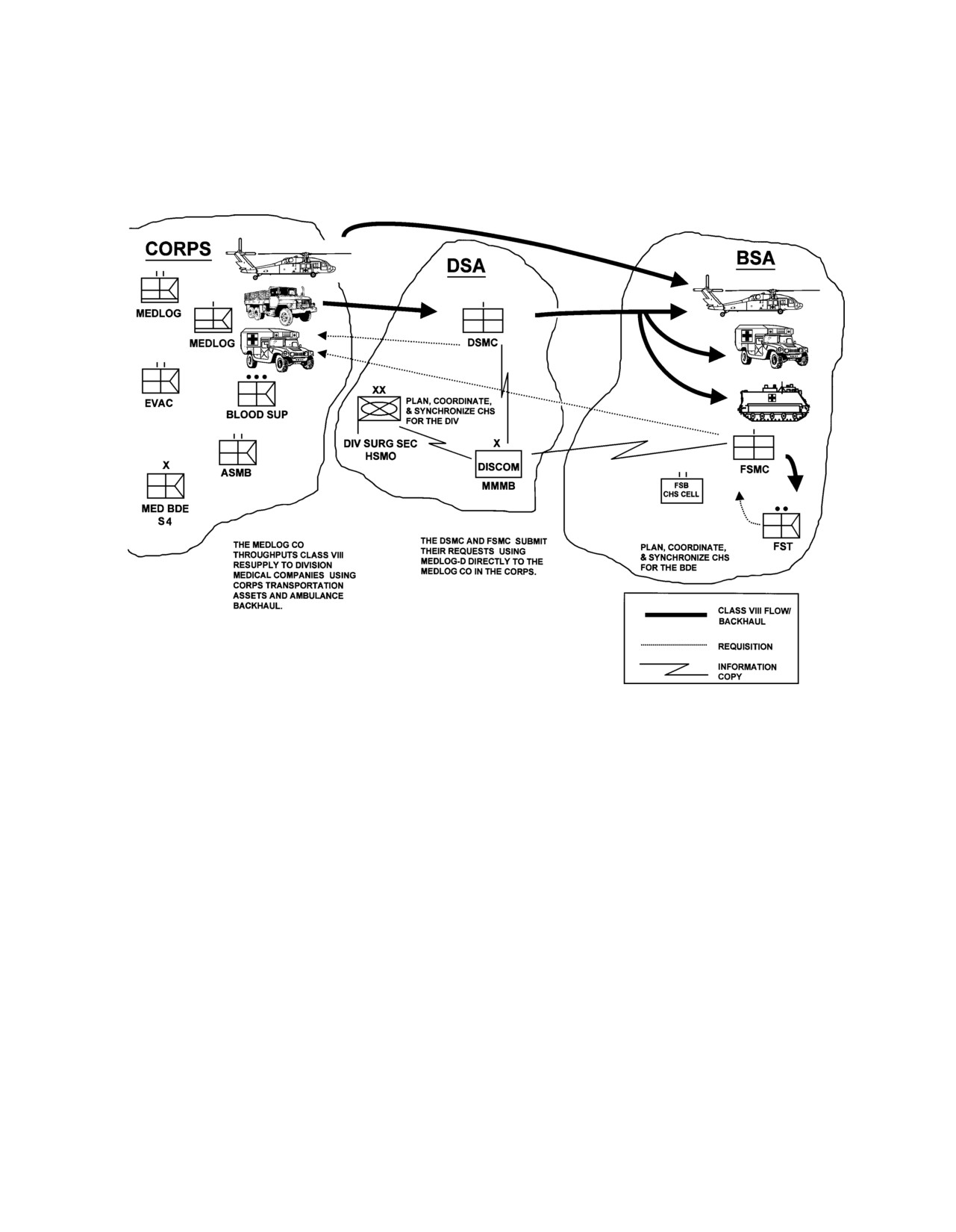
should be pre-positioned with maneuver battalion medical platoons or with the FSMC. Figure 1-2 provides
an overview of Class VIII requisitions and resupply flow at Echelon I. Figure 1-3 provides an overview of
ClassVIII requisitions and resupply flow at Echelon II.
1-15. Assemblage Management Reporting Under Unit Status Reporting
a. Unit Status Reporting. With the fielding of MEDLOG-D, unit status reporting (USR) of
medical equipment sets (MES) in the division will be created using the MEDLOG-D USR feeder report. It
calculates percentage fill of sets according to AR 220-1 and AR 40-61 and does not create a roll-up of
equipment on-hand calculations. Minus the potency or dated items while units are not deployed, 70 percent
fill of the combined expendable, durable, and nonexpendable items within a set constitute an on-hand set for
accountability purposes. Medical equipment must be maintained at an acceptable degree of readiness to the
level above 70 percent as determined by the division surgeon and unit commander. Division medical units/
elements will prepare a requisition plan to immediately replenish all potency, dated, and other items that are
not being maintained and missing items from sets. Units will coordinate with the supporting MEDLOG
company prior to implementation of the plan.
b. Transmission of Requisitions and Status Reports Data. Transmission of Class VIII requisitions
and status reports data will be accomplished by one of a number of ways. The baseline method will always
be by disk and hard copy. The preferred method will be by radio or MSE transmission if signal capabilities
allow. At the battalion level, units will attempt to transmit requisition and report data using SINCGARS
1-27
FM 4-02.21
Systems Improvement Program (SIP) or Enhanced Position Location Reporting System (EPLRS) linked to
the hyperlink or modem capability of DMLSS-AM. Given the line of site limitations of FM radio, this
attempt is best accomplished in synchronization with previously coordinated retransmission. Within the
BSA and higher, transmission of data will be by either MSE or Harris radio (FM) if allowed. Note that if
MSE is used, the unit must accomplish prior coordination with the division Assistant Chief of Staff (Signal)
(G6) to obtain a net encryption system or other encryption hardware system in order to send data.
Figure 1-2. Overview of Class VIII resupply at Echelon I.
1-28
FM 4-02.21
Figure 1-3. Overview of Class VIII resupply at Echelon II.
1-16. Medical Equipment Maintenance
The CHL Cell of the DSS will establish a list of critical medical equipment for the division. Units are to
report the status of items on this list to the CHL cell.
a. Medical Equipment Repairer. The medical equipment repairer provides operational and unit-
level medical equipment maintenance for the FSMC and the brigade. He exercises his responsibilities by
Scheduling and performing preventive maintenance checks and services (PMCS).
Performing electrical safety inspections and tests.
Accomplishing calibration, verification, and certification services.
Performing unscheduled maintenance functions with emphasis upon the replacement of
assemblies, modules, and printed circuit boards.
1-29
///////////////////////////////////////