FM 3-57 Civil Affairs Operations (October 2011) - page 3
Chapter 3
Data Mining
3-51. Data mining is the process of extracting patterns from raw data. Conducted by all CA Soldiers, data
mining is a collection activity that uses a combination of open- and restricted-source materials for routine
and continuous study and research. Data mining is focused by CCIR and the civil information collection
requirements and provides corroboration of other collected civil data. Data mining is focused on—
z
Priority intelligence requirements.
z
Requests for information.
z
Running estimates.
z
Gaps remaining in the area study and area assessment.
Collaboration
3-52. Collaboration is a coordinated effort focused on sharing data. Collaboration increases overall
operational efficiency by eliminating redundant collection efforts. Collaborative tools are information
systems that include online capabilities that enhance team development and facilitate collaboration.
Examples of collaborative tools include the following:
z
Information operations working groups.
z
Civil-military operations working groups (CMOWGs).
z
IGOs, NGOs, and IPI.
z
The MDMP.
z
Multinational forces.
z
Chat rooms, white-boarding, professional forums, and communities of interest.
z
Battle update briefs, commanders update briefs, and targeting boards.
z
Maneuver force observations.
z
Debriefings of Soldiers involved in daily operations.
z
International relief Web sites.
z
Geographic information system cell working groups.
z
Coordination with academic and research institutions.
Collation (Step Two)
3-53. Collation is the ordering of the data into groupings. The tools and methods for this step vary, and
most are still developing. Available computer-based software programs can accomplish this step.
Additional Web tools to catalog vast amounts of data continue to emerge. Collation focuses on data
management.
Processing (Step Three)
3-54. Processing is the physical and cognitive manipulation of the separate pieces of data into information.
Processing structures the collated data into a usable form for the analyst. The data collector often collates
and processes the data into information. CA Soldiers often gather articles of data into a processed form,
such as a book, article, Web site, film, or previously compiled database on the subject. The analyst should
provide feedback to the civil information collection manager to improve the effectiveness of the collection.
Analysis (Step Four)
3-55. Analysis is the process by which collected information is evaluated and integrated with existing
information to produce intelligence that describes the current, and predicts the future, impact of the threat
and/or environment on operations. The analysts and civil information manager mold the civil information
into a knowledge product. The most difficult analysis performed uncovers the “unknown unknowns.”
Unknown unknowns are indicators of future events previously obscured in the background data. The CIM
supervisor must direct the analytical efforts to those gaps in the COP rather than exhaustively refining
3-12
FM 3-57
31 October 2011
Civil Affairs Operations
known data. Analysis of civil information is similar to the normal red team-blue team analysis in process,
but instead focuses on—
z
Identifying mission variables.
z
Identifying operational variables.
z
Identifying centers of gravity (COGs).
z
Identifying trends.
z
Conducting predictive analysis.
z
Identifying civil vulnerabilities.
Production (Step Five)
3-56. Production is the packaging of civil information into easily disseminated forms and structures. The
production phase of the CIM process ensures CIM products and services are relevant, accurate, timely, and
useable by commanders and decision makers. Products of civil information analysis are—
z
Layered geospatial information.
z
Civil information for the COP.
z
COGs.
z
Civil considerations products.
z
Answers to requests for information.
z
Reported PIRs.
z
Updates to ongoing CAO assessments, area studies, and running estimates.
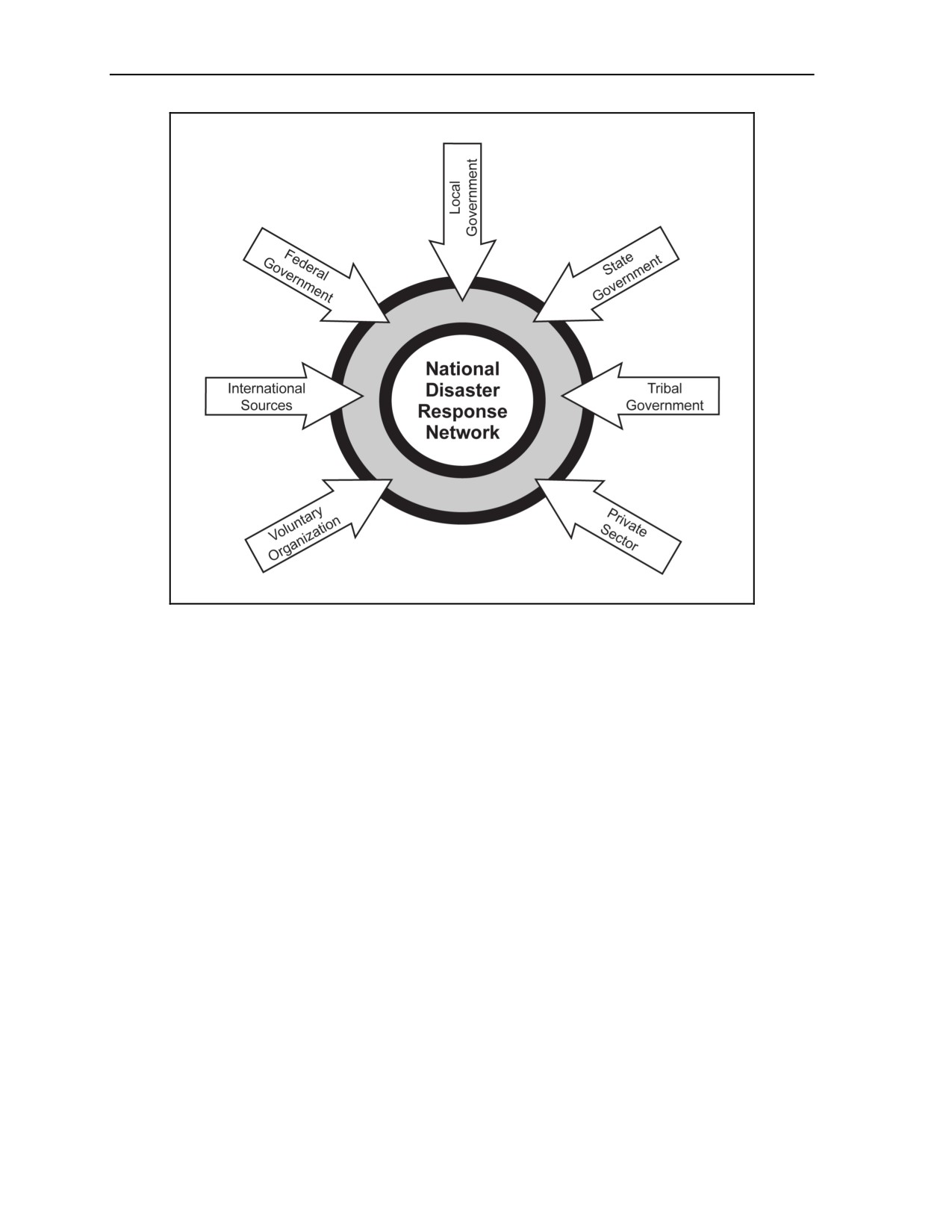
Dissemination (Step Six)
3-57. Dissemination is actively pushing knowledge products to consumers. The consumers may not realize
what they need; therefore, CA forces must anticipate the information needs of the supported unit or agency.
Requests for information should not initiate the production of an estimate or assessment; production should
be an ongoing task. Sharing is the cornerstone of CIM and is the hallmark of interagency cooperation.
Thorough dissemination of civil information reduces redundancy and ensures that the maximum effects are
achieved by using limited resources to their fullest potential. Mechanisms for dissemination may vary by
situation and echelon but the process and goal remain constant. The G-9/S-9 should always be a key
manager in the dissemination of civil information being pushed out from the CMOC. Examples of
dissemination include—
z
Integration with the COP.
z
Civil information repositories.
z
Reports.
z
Update briefs.
z
Online databases.
NATION ASSISTANCE
3-58. NA is civil or military assistance (other than FHA) rendered to a nation by U.S. forces within that
nation’s territory during peacetime, crises or emergencies, or war based on agreements mutually concluded
between the United States and that nation. NA operations support a HN by promoting sustainable
development and growth of responsive institutions. The goal is to promote long-term regional stability. NA
programs often include, but are not limited to, SA, foreign internal defense
(FID),
10 USC (DOD)
programs, and activities performed on a reimbursable basis by Federal agencies or IGOs. All NA
operations are usually coordinated with the U.S. Ambassador through the country team.
SECURITY ASSISTANCE
3-59. SA consists of groups of programs that the Foreign Assistance Act of 1961 (as amended), the Arms
Export Control Act of 1976 (as amended), and other related statutes authorized. The United States provides
31 October 2011
FM 3-57
3-13
Chapter 3
defense articles, military training, and other defense-related services by grant, loan, credit, or cash sales in
furtherance of national policies and objectives.
3-60. SA is a broad program aimed at enhancing regional security in areas of the world facing internal or
external threats. SA is under the supervision and general direction of the DOS. The DOD administers
military portions of the program under the direction of the Assistant Secretary of Defense (International
Security Affairs). GCCs have the responsibility for planning FID operations for their AOR; however, they
interface directly with the SA process through the SA organization, which is located in the HN. This action
is coordinated with the U.S. COM (or Ambassador). GCCs are active in the SA process by advising the SA
organization and by coordinating and monitoring ongoing SA efforts in their AORs. SA support areas
include equipment and training. CA support to SA can include training foreign military forces in CMO and
civil-military relations.
FOREIGN INTERNAL DEFENSE
The use of force plays a role, yet military efforts to capture or kill terrorists are likely to
be subordinate to measures to promote local participation in government and economic
programs to spur development, as well as efforts to understand and address the
grievances that often lie at the heart of insurgencies. For these reasons, arguably, the
most important military component of the struggle against violent extremists is not the
fighting we do ourselves, but how well we help prepare our partners to defend and
govern themselves.
Secretary of Defense Robert Gates
31 July 2008, Washington Post
3-61. FID is that participation by civilian or military agencies of a government in any of the action
programs taken by another government to free and protect its society from subversion, lawlessness, and
insurgency. FID is an umbrella concept that covers a broad range of activities. Its primary intent is always
to assist the legitimate host government in addressing internal threats and their underlying causes.
Commensurate with U.S. policy goals, the focus of all U.S. FID efforts is support of the HN program of
internal defense and development (IDAD). FID is not restricted to times of conflict. It also can take place in
the form of training exercises and other activities that show U.S. resolve to and for the region.
TITLE 10 UNITED STATES CODE (DEPARTMENT OF DEFENSE) PROGRAMS
3-62. Sources of funding are always important in military operations, to include those conducted in support
of the GCC’s CMO strategy. Congress appropriates funds for various purposes, to include military
operations. Fiscal law requires that the USG spend funds for the purpose they were appropriated, in no
more than the amount appropriated, and within the time constraints imposed on the appropriation. Failure
to comply with the restrictions of fiscal law can result in criminal sanctions.
3-63. Congress appropriates funds to assist the GCC in accomplishing NA objectives using the following
four sections of Title 10 USC:
z
Section
401, Humanitarian and Civic Assistance Provided in Conjunction With Military
Operations.
z
Section 407, Humanitarian Demining Assistance: Authority Limitations.
z
Section 166a, Combatant Commands Funding Through the Chairman of the Joint Chiefs of Staff.
z
Section 168, Military-to-Military Contacts and Comparable Activities.
HUMANITARIAN AND CIVIC ASSISTANCE PROVIDED IN CONJUNCTION WITH MILITARY
OPERATIONS, SECTION 401, TITLE 10, UNITED STATES CODE
3-64. Section 401, Title 10, United States Code (10 USC 401) authorizes the U.S. military to conduct HCA
activities. A special condition of HCA operations is that they must fulfill valid unit training requirements.
Although all HCA operations should strive to meet desired MOEs, benefit to the local populace is
3-14
FM 3-57
31 October 2011
Civil Affairs Operations
secondary to meeting the training requirements prescribed under law for any such operation. HCA activities
are defined in the statute as the following:
z
Medical, dental, and veterinary care provided in rural or underserved areas of a country.
z
Construction of rudimentary surface transportation systems.
z
Well drilling and construction of basic sanitation facilities.
z
Rudimentary construction and repair of public facilities.
3-65. Initiation of HCA projects begins with embassy country teams and the Service components of the
geographic combatant commands providing lists of projects for their respective countries to the GCC
responsible for that country. HCA funding comes directly from the Services to the GCCs. The Services
restrict funds within Service operations and maintenance accounts specifically for HCA. Each Service is
responsible for funding a particular combatant command (for example, the Department of the Army
provides funding for USSOUTHCOM and USEUCOM).
3-66. Congress imposed certain restrictions on the conduct of HCA. The DOS must approve all HCA
projects. HCA must promote the security interests of the United States and the receiving nation. The
mission must serve the basic economic and social needs of the people involved. HCA must complement but
not duplicate any other form of social or economic assistance. No individual, group, or organization
engaged in military or paramilitary activity can receive the aid. Personnel must conduct HCA in
conjunction with an authorized military operation, such as an exercise or a training deployment. The HCA
activity must promote specific operational readiness skills of the individual Soldier.
3-67. HCA funds pay for expenses incurred as a direct result of HCA activities. These expenses include the
following:
z
Consumable materials.
z
Equipment leasing.
z
Supplies.
z
Necessary services.
3-68. These expenses do not include costs associated with the military operations that the USG would
incur regardless of the HCA activity, such as transportation; military personnel; USG equipment repair; and
petroleum, oils, and lubricants. DOD must report HCA expenditures each year to Congress by country,
type, and amount.
3-69. Opportunities often arise during the course of an exercise or operation in a foreign country to
perform minor HCA. For example, during the conduct of a combined exercise, a young boy near the
exercise site may require minor medical attention to treat a broken arm. Title 10, USC 401(c)(2) authorizes
the military commander to permit the treatment of the child by the unit’s assigned doctor or medic. The
costs associated with this treatment would likely be minimal, and the unit’s operations and maintenance
funds would pay for it. DOD refers to this kind of activity as “minimal cost” HCA. Commanders can only
provide HCA amounting to “minimal expenditures.” Department of Defense Instruction (DODI) 2205.02,
Humanitarian and Civic Assistance (HCA) Activities, provides guidance for commanders in determining
what “minimal” means. Minimal cost HCA activities must fall into one of the four activities statutorily
allowed as an HCA activity. In addition, all of the restrictions for the conduct of HCA mentioned above
apply to minimal cost HCA.
HUMANITARIAN DEMINING ASSISTANCE: AUTHORITY LIMITATIONS, SECTION 407,
TITLE 10, UNITED STATES CODE
3-70. Prior to October
2006,
10 USC
401 authorized humanitarian demining assistance. Public
Law 109-364 revised Section 401, removing references to humanitarian demining assistance and adding
Section 407 to Title 10 USC.
3-71. Like Section 401, Congress imposed certain restrictions on the conduct of humanitarian demining
assistance. The specific constraints are as follows:
z
Humanitarian demining assistance activities must promote the security interests of both the
United States and the country in which forces will carry out the activities OR promote the
31 October 2011
FM 3-57
3-15
Chapter 3
specific operational readiness skills of the members of the Armed Forces who participate in the
activities.
z
Humanitarian demining assistance activities must complement but not duplicate any other form
of social or economic assistance.
z
While providing humanitarian demining assistance, no member of the Armed Forces may—
Engage in the physical detection, lifting, or destroying of landmines or other explosive
remnants of war (unless the member does so for the concurrent purpose of supporting a
U.S. military operation).
Provide such assistance as part of a military operation that does not involve the Armed
Forces.
z
The DOS must approve all humanitarian demining assistance projects.
3-72. The intent of Section 407 is to provide a HN the education, training, and technical assistance
necessary to detect and clear landmines and other explosive remnants of war.
COMBATANT COMMANDS FUNDING THROUGH THE CHAIRMAN OF THE JOINT CHIEF OF
STAFF, SECTION 166A, TITLE 10, UNITED STATES CODE
3-73. Section 166a, Title 10, United States Code (10 USC 166a) provides the CCDRs with a great deal of
legal flexibility to conduct NA and humanitarian operations and activities. The statute specifically lists HCA
as an authorized activity. Under certain conditions, personnel use this authority to fund MCA projects.
3-74. MCA involves operations intended to win support of the local population for the HN and its military.
MCA uses predominantly indigenous or paramilitary forces as labor. MCA plans consist of a series of
short-term projects with the long-term goal of fostering national development. Properly planned, executed,
and promulgated in close cooperation with local authorities, military, and community leaders, MCA
projects can be useful in reaching desired objectives and goals. In MCA programs, U.S. personnel are
limited to training and advising the HN military on planning and executing projects useful to the local
population, such as building schools and clinics, digging wells, and developing roads. The intent of MCA is
to enhance the image of the HN military and increase its acceptance and the supported government’s
acceptance with the local population.
3-75. MCA must comply with U.S. fiscal laws. Expenses for consumable materials, equipment leasing,
supplies, and necessary services incurred as a direct result of MCA projects may not be paid out of USG
funds unless authorized under a foreign aid or SA program for which funds are appropriated under 22 USC
or which have other authority and funding. These projects occur at all levels in such fields as education,
training, public works, agriculture, transportation, communications, health, sanitation, and others that
contribute to economic and social development of the area.
3-76. MCA projects are divided into two general categories—mitigating MCA projects and developmental
MCA projects. Mitigating MCA projects are immediate-response, short-term projects to provide emergency
assistance to a populace in the wake of a disaster and to reduce further damage or suffering as in HA.
Disasters in this category could be from natural causes—such as earthquake, hurricane, famine, or flood—
or from man-made causes—such as civil disturbance, accident, terrorism, or war. Some examples of
mitigating MCA projects are—
z
Operating an emergency medical clinic.
z
Distributing food.
z
Building temporary shelter and sanitation facilities.
z
Conducting damage clean-up operations, including decontamination of hazardous materials
spills or release of WMD.
3-77. Developmental MCA projects are long-term projects designed to enhance the infrastructure of a local
area. They are often preventive in nature and include any activities that actually eliminate or reduce the
probability of occurrence of a disaster. Developmental MCA projects require interagency cooperation,
3-16
FM 3-57
31 October 2011
Civil Affairs Operations
especially with USAID and the COM, and continuous support from HN government sources to be
effective. Some examples of developmental MCA projects are—
z
Building or redesigning facilities to reflect better land-use management.
z
Building or reinforcing structures to withstand the destructive elements predominant to the area.
z
Building or rehabilitating water sources and sanitation facilities to eliminate or prevent the
spread of disease.
z
Operating a long-term public health campaign to educate the populace on preventive health
measures (a medical readiness training exercise).
z
Conducting some humanitarian demining operations.
MILITARY-TO-MILITARY CONTACTS AND COMPARABLE ACTIVITIES, SECTION 168,
TITLE 10, UNITED STATES CODE
3-78. The SecDef is the program authority for the conduct of military-to-military contacts and comparable
activities. Generally, the CCDR conducts military-to-military contacts to promote a democratic orientation
of the defense establishment and military forces of partner nations—hopefully, developing a military-to-
military relationship with these organizations and the HN. Military-to-military contacts will usually be
Service to Service, whereas comparable activities will always be of a combined nature conducted by
CCDRs. 10 USC 168 provides CCDRs with flexibility to conduct humanitarian operations and activities
and NA. The statute specifically lists HCA as an authorized activity. Under certain conditions, this
authority is also used to fund MCA projects.
3-79. Military-to-military contact, although not defined in Army or joint doctrine, basically means contact
between members of the U.S. Armed Forces and members of foreign armed forces through activities, such
as the following:
z
Military liaison teams.
z
An exchange of civilian or military personnel between the DOD and defense ministries of
foreign governments.
z
Seminars and conferences held primarily in a theater of operations.
z
An exchange of military personnel between units of the Armed Forces and units of foreign
armed forces.
z
The distribution of publications primarily in a theater of operations.
CIVIL AFFAIRS MISSION
3-80. The CA supporting tasks in NA support the commander’s operational function. Generally, CA
Soldier tasks include—
z
Reviewing U.S. SA program goals and HN IDAD goals, and planning CAO/CMO to support the
HN program.
z
Identifying, validating, or evaluating NA project nominations.
z
Synchronizing NA projects with other programs, military and civilian.
z
Training HN military to plan, train for, and execute PRC and other CAO appropriate to the
IDAD plan of its country.
z
Tracking costs associated with execution of NA projects.
z
Performing quality control assessments of NA operations and costs.
z
Assisting in the arbitration of problems arising from the execution of NA operations.
z
Initiating or refine CIM process with geospatial products that depict affected populations and
civil vulnerabilities.
SUPPORT TO CIVIL ADMINISTRATION
3-81. SCA are military operations that help to stabilize or to continue the operations of the governing body
or civil structure of a foreign country, whether by assisting an established government or by establishing
military authority over an occupied population.
31 October 2011
FM 3-57
3-17
Chapter 3
3-82. SCA occurs most often in stability operations. Some SCA manifests in the other CAO areas of PRC,
FHA, and NA. SCA operations consist of the following two distinct mission activities:
z
Civil administration in friendly territory: The geographic combatant command’s support to
governments of friendly territories during peacetime, disasters, or war. Examples of support
include advising friendly authorities and performing specific functions within limits of the
authority and liability established by international treaties and agreements.
z
Civil administration in occupied territory: The establishment of a temporary government, as
directed by the SecDef, to exercise executive, legislative, and judicial authority over the
populace of a territory that U.S. forces have taken from an enemy by force of arms until an
indigenous civil government can be established.
CIVIL ADMINISTRATION TERMS
3-83. Within its capabilities, the occupying force must maintain an orderly government in the occupied
territory and must have, as its ultimate goal, the creation of a legitimate and effective civilian government.
During civil administration in occupied territory, the following terms apply:
z
Military governor. A military governor is the military commander or other designated person
who, in an occupied territory, exercises supreme authority over the civil population subject to the
laws and usages of war and to any directive received from the commander’s government or
superior.
z
Military government ordinance. A military government ordinance is an enactment on the
authority of a military governor promulgating laws or rules regulating the occupied territory
under such control.
CIVIL AFFAIRS MISSION
3-84. The CA supporting tasks in SCA vary between assistance to civil administration in friendly territory,
and civil administration in occupied territory. In either case, however, the CA mission is one of support to
the commander’s operational and support function with respect to the continuity of government in an
FN/HN. Generally, CA Soldier tasks include—
z
Identifying, validating, or evaluating FN/HN essential service infrastructure.
z
Assessing the needs of the IPI in terms of the six CA functional areas.
z
Monitoring and anticipating future requirements of the IPI in terms of the six CA functional areas.
z
Performing liaison functions between military and civilian agencies.
z
Coordinating and synchronizing collaborative interagency or multinational SCA operations.
z
Participating in the execution of selected SCA operations as needed or directed.
z
Performing quality control assessments of SCA operations and costs.
z
Assisting in the arbitration of problems arising from the execution of SCA operations.
z
Coordinating and synchronizing transition of SCA operations from military to indigenous
government or international transitional government control.
z
Initiating or refining CIM process with geospatial projects that depict affected populations and
civil vulnerabilities.
CIVIL AFFAIRS OPERATIONS SUPPORT TO UNIFIED LAND
OPERATIONS
3-85. CAO occur throughout unified land operations (offensive, defensive, stability, or DSCA operations).
CA forces and CAO planners support unified land operations at the strategic, operational, and tactical
levels of war. Commanders at all levels will encounter civilians during most military operations and must
plan CAO accordingly to support the JFC’s CMO objectives. Within the operational environment,
3-18
FM 3-57
31 October 2011
Civil Affairs Operations
indigenous supplies, facilities, services, and labor resources exist that U.S. commanders use to support
military operations. Combat operations can be disrupted by—
z
Uncontrolled and uncoordinated movement of civilians in the environment.
z
Hostile actions by factions within the populace.
z
Failure to coordinate unity of effort.
OFFENSIVE OPERATIONS
3-86. Offensive operations seek to seize, retain, and exploit the initiative to defeat the enemy decisively.
ARFOR attack simultaneously throughout the AO to throw enemies off balance, overwhelm their
capabilities, disrupt their defenses, and ensure their defeat or destruction. ARFOR conclude a phase of an
offensive operation by consolidating gains, resuming the attack, or preparing for future operations. During
offensive operations, the main effort is military-to-military contacts; however, the secondary effort is
military-to-civilian contacts. CAO support to offensive operations includes—
z
Identifying COGs within the AO based on civil component analysis.
z
Identifying decisive points along lines of operation.
z
Denying the enemy civil component resources.
z
Gaining civil information through CR and CIM to develop the civil component of the supported
commander’s COP.
z
Maneuvering CA forces and resources to advantageous positions before contact based on
METT-TC analysis.
z
Participating in the targeting process by nominating restricted-fire areas and no-fire areas to
minimize unnecessary damage to the civil infrastructure and culturally sensitive sites.
z
Tracking damage to infrastructure and other combat-related effects to the civil component.
z
Planning and coordinating branches and sequels.
DEFENSIVE OPERATIONS
3-87. Defensive operations defeat attack, gain time, economize forces, and develop conditions favorable
for offensive or stability operations. Defensive operations preserve control over land, resources, and
populations. CAO support to defensive operations includes—
z
Advising on the presence of culturally, economically, and politically significant assets and
resources within the AO.
z
Identifying COGs within the AO based on civil component analysis.
z
Identifying decisive points along lines of operation.
z
Denying the enemy civil component resources.
z
Advising on countermobility operations directed at economically significant roads, railways,
bridges, and other infrastructure.
z
Planning and executing PRC to evacuate endangered populations.
z
Participating in the targeting process by nominating restricted fire areas and no fire areas to
minimize unnecessary damage to the civil infrastructure and culturally sensitive sites.
z
Gaining civil information through CR and CIM to develop the civil component of the supported
commander’s COP.
z
Advising the commander regarding civilian movements during the planning for emplacement of
minefields.
z
Tracking damage to infrastructure and other combat-related effects to the civil component.
z
Planning and coordinating branches and sequels.
STABILITY OPERATIONS
3-88. CA forces conduct CAO during offensive and defensive operations to set the conditions for stability
operations. CA support to stability operations depends on the condition of the affected IPI. The CAO staff
31 October 2011
FM 3-57
3-19
Chapter 3
continually monitors the condition of the HN throughout the operation, applies available resources to affect
the civilian component, and recommends functional skills required to support this critical phase. CAO
support conventional forces, SOF, USG agencies, and the HN civil administration in transitioning power
back to the local government.
3-89. Time considerations normally are substantially different in stability operations. The goals of stability
operations may not be achievable in the short term. Success often requires perseverance—a long-term
commitment to solving the root causes of instability. The achievement of these goals may take years.
Conversely, daily operations may require rapid responses to changing conditions based on unanticipated
localized conflict among competing groups. Civil considerations analysis is especially critical in stability
operations. The civil population, HN government, IGOs, and NGOs can greatly affect achieving stability.
3-90. Forces conduct stability operations to support a HN government or a transitional civil or military
authority when no legitimate, functioning HN government exists. Stability operations do not necessarily
aim to reduce the military presence quickly but to achieve broader national policy goals that extend beyond
the objectives of military operations.
3-91. According to FM 3-07, Stability Operations, stability operations consist of five primary tasks that
correspond to the five stability sectors that the DOS Office of the Coordinator for Reconstruction and
Stabilization adopted. The primary stability tasks are fundamental to unified land operations and personnel
conduct them across the range of military operations, from stable peace to general war. Forces may execute
the primary tasks before, during, or after conflict. The five primary tasks of stability operations are:
z
Establish civil security.
z
Establish civil control.
z
Restore essential services.
z
Support to governance.
z
Support the economic and infrastructure development.
3-92. Unity of effort is fundamental to achieve national policy goals identified for the conduct of stability
operations. The end state for successful stability operations is best described by five broad conditions—a
safe and secure environment, established rule of law, social well-being, stable governance, and a
sustainable economy.
CIVIL AFFAIRS MISSION
3-93. FM 3-07 states that CA forces are essential to the conduct of successful stability operations. The full
capability of the CA force manifests in the conduct of stability operations at the strategic, operational, and
tactical levels. CAO support to stability operations includes the execution of all five CA core tasks,
employment of CA functional specialists, and continuous analysis of the civil component of the operational
environment in terms of both operational and mission variables by CAO staff elements.
3-94. Critical tasks executed by CA Soldiers supporting stability operations include the following:
z
Conduct interagency collaborative planning and coordination accessible to both U.S.
(the
interagency) and non-U.S. (IGOs, NGOs, and IPI) partners.
z
Assess the activities and capabilities of the interagency and IGOs, NGOs, and IPI in relation to
achieving national policy goals.
z
Coordinate, collate, and fuse civil information to the COP to continuously update the civil
dimension situation.
z
Provide CA functional specialist augmentation, as required, to support—
Advisory elements to HN ministerial, provincial, and local government agencies.
Deployed interagency civilian teams (PRT, advance civilian team, field advanced civilian
team or COM, and U.S. country team).
International or military transitional authority.
z
Program and manage spending implementation plans and policies to resource CAO projects and
programs in support of stability operations.
z
Provide dedicated liaison to the interagency and IGOs, NGOs, and IPI.
3-20
FM 3-57
31 October 2011
Civil Affairs Operations
z
Identify and assess MOPs and MOEs of supporting CAO.
z
Establish CMOCs to facilitate communications and coordinate with civilian agencies and
organizations.
z
Conduct analysis of the civil dimension as it applies to COGs (both adversary and friendly) to
identify root causes of instability.
DEFENSE SUPPORT OF CIVIL AUTHORITIES
3-95. ARFOR conduct DSCA operations within the United States and its territories. DSCA is a supporting
CA task because DOD normally plays a supporting role under the National Response Framework (NRF).
The NRF refers to DOD support of civil authorities.
3-96. The DOD established USNORTHCOM in 2002 to consolidate, under a single combatant command,
existing missions that other military organizations previously executed. The mission of USNORTHCOM is
homeland defense and DOD support of civil authority, which includes—
z
Conducting operations to deter, prevent, and defeat threats and aggression against the United
States, its territories, and its interests within the assigned AOR.
z
Providing, as directed by the President or SecDef, military assistance to civil authorities
including crisis management and consequence management (domestic incident management).
3-97. DSCA operations address the consequences of man-made or natural disasters and incidents beyond
the capabilities of civilian authorities. ARFOR do not conduct stability operations within the United States
and its territories; under U.S. law, the federal and state governments are responsible for those tasks. Instead,
U.S. ARFOR conduct DSCA operations when requested, providing Army expertise and capabilities to lead
agency authorities.
3-98. DSCA operations encompass the combined emergency management authorities, policies, procedures,
and resources of local, state, and national-level governments to mitigate, prepare for, respond to, and
recover from disasters of all kinds. Although DOD may support all phases of the emergency management
cycle (mitigation, preparation, response, and recovery), DOD usually only supports the response phase.
DOD can deploy large organizations on short notice and employ them during the response phase of a
disaster response operation. In the aftermath of a disaster, this effort includes incorporating voluntary
disaster relief organizations, the private sector, and international sources into the National Incident
Management System (NIMS) (Figure 3-2, page 3-22).
3-99. DSCA operations supplement the efforts and resources of state and local governments and
organizations. A Presidential declaration of a major disaster or emergency usually precedes civil support
operations. DSCA operations require extensive coordination and liaison among many organizations—
interagency, joint, Regular Army, and USAR—as well as with state and local governments. The NRF
provides national-level architecture to coordinate the actions of all supporting federal agencies through the
NIMS.
3-100. The NRF applies to major disasters or emergencies, as defined under the Stafford Act, which
include—
z
Natural catastrophes.
z
Fires, floods, or explosions, regardless of cause.
z
Any other occasion or instance in which the President deems that state and local efforts need
supplemental federal assistance.
3-101. The NRF and federal assistance to emergencies cover the full range of complex and constantly
changing requirements following a disaster. Emergency situation requirements might be—
z
Saving lives, protecting property, and meeting basic human needs (response).
z
Restoring the disaster area (recovery).
z
Reducing vulnerability to future disasters (mitigation).
31 October 2011
FM 3-57
3-21
Chapter 3
Figure 3-2. National Incident Management System
3-102. The government may implement the NRF in response to acts of terrorism, in accordance with the
Homeland Security Act of 2002. The Homeland Security Presidential Directive-5, Management of
Domestic Incidents, establishes clear objectives for a concerted national effort to—
z
Prevent terrorist attacks within the United States.
z
Reduce America’s vulnerability to terrorism, major disasters, and other emergencies.
z
Minimize the damage of, and recover from, attacks, major disasters, and other emergencies.
3-103. Under the Stafford Act and Executive Orders 12148, Federal Emergency Management, and 12656,
Assignment of Emergency Preparedness Responsibilities, the Department of Homeland Security primarily
coordinates federal emergency preparedness, planning, management, and disaster assistance functions. The
Department of Homeland Security also establishes federal disaster assistance policy. Under the law, state
governors can request that the President declare a major disaster or emergency if an event is beyond the
combined response capabilities of the affected state and local governments. On behalf of tribal government
representative, state governors can request the same level of support for reservations and tribal sovereign
territories. The affected government cannot receive federal assistance before a Presidential declaration of
emergency or disaster.
3-104. The DOD maintains significant resources (personnel, equipment, and supplies) it may make
available to support a federal response to a major disaster or emergency. The DOD will normally provide
support only when other resources are unavailable and only if such support does not interfere with its
primary mission or ability to respond to operational contingencies.
3-22
FM 3-57
31 October 2011
Civil Affairs Operations
CIVIL AFFAIRS ROLE
3-105. The CA supporting tasks in DSCA support the commander’s operational function. Generally, CA
Soldier tasks include—
z
Assessing and assisting in the restoration of essential government services.
z
Assisting in the protection of public health and safety (within the limits of Federal law and USC).
z
Assisting in the provision of emergency relief to government, businesses, and individuals.
z
Identifying and assessing the threat posed by hazardous materials (civil considerations analysis).
z
Providing consultation through the defense coordinating officer (DCO) to decisionmakers.
z
Participating in interagency assessment, planning, and synchronizing of DSCA operations
through the JTF and DCO.
z
Participating in the execution of selected DSCA operations, as needed or directed.
3-106. All six CA functional specialty areas may participate in DSCA operations based on METT-TC
analysis. Department of Defense Directive (DODD) 3025.18, Defense Support of Civil Authorities; and
JP 3-28, Civil Support, provide additional information on the role of U.S. forces in DSCA.
CIVIL AFFAIRS SUPPORT OF ARMY OPERATIONS
3-107. The commander’s intent links the mission, CONOPS, and tasks to subordinate units. CA staff
officers integrate the capabilities of supporting CA forces into the OPLAN in support of the commander’s
intent. Paragraph 3, Execution, of Annex K (Civil Affairs Operations) to the supported command’s OPLAN
addresses the CAO scheme of support, subordinate unit tasks, and coordination instructions CA and other
ARFOR execute in support of the commander’s intent. The Execution paragraph outlines what the support
commander wants CAO to achieve to accomplish the mission.
CONCEPT OF OPERATIONS
3-108. Commanders organize forces according to purposes by determining whether each unit’s operation
will be decisive, shaping, or sustaining. These decisions form the basis of the commander’s CONOPS through
the MDMP and METT-TC analysis. Through MDMP and METT-TC considerations, the CAO planner
recommends the allocation of CA forces in support of these operations to the supported commander.
DECISIVE OPERATIONS
3-109. Decisive operations are those that directly accomplish the task assigned by the higher HQ.
Decisive operations conclusively determine the outcome of major operations, battles, and engagements.
The decisive operation may include multiple actions conducted simultaneously throughout the AO.
Normally, CAO and CMO support the offensive or defensive decisive operations by an enabling maneuver,
mainly through planning PRC and providing critical civil information to increase the commander’s
situational awareness and understanding. CAO and CMO support to decisive operations in stability
operations do not always have immediate impacts. In DSCA operations, all CA core tasks support decisive
operations and normally prevent or mitigate the effects of natural or man-made disasters. CAO and CMO
support decisive operations in stability operations and DSCA operations by planning and assisting in
stabilizing and establishing order in the JOA or AO. CAO and CMO planners and CA forces support the
warfighting commander’s decisive operations by—
z
Coordinating the use by military forces of local resources, facilities, and support, such as civilian
labor, transportation, communications, maintenance or medical facilities, and miscellaneous
services and supplies through and with IPI.
z
Planning for possible population displacements and working with civilian organizations (IPI,
UN, and so on) to minimize local populace interference with U.S. decisive operations.
z
Coordinating with civilian organizations to identify the local resources, facilities, and support
available for U.S. operations.
z
Providing liaison and coordinating CAO and CMO with local IPI, OGAs, IGOs, and NGOs as
applicable.
31 October 2011
FM 3-57
3-23
Chapter 3
z
Predicting movement of civilians and establishing procedures and processes to minimize their
interference with decisive operations.
z
Estimating the availability of resources.
z
Preparing area studies of the assigned area to support the mission, as required.
z
Providing civil information and analysis to U.S. and other agencies on the political, economic,
social, and cultural characteristics of the local populace.
z
Recommending theater policy for FHA, civil assistance, and civil administration operations.
z
Acting as the focal point for cultural considerations.
z
Providing technical expertise in all civil functions.
z
Providing timely civil information for the development of the supported commander’s COP.
SHAPING OPERATIONS
3-110. Shaping operations at any echelon create and preserve conditions for the success of the decisive
operation. In stability operations, shaping operations often convert temporary gains into long-term political
success. Shaping operations can aim to keep newly gained stability from being undone. Shaping operations
may focus on identifying and mitigating potential flashpoints that can occur after initial stabilization
efforts. The main effort during shaping operations is military-to-civilian contact. The secondary effort is
civilian-to-civilian contact by the interagency. CA forces conduct CAO, and CMO planners plan CMO to
seek to deter a potential crisis, to reinforce or regain public support of the HN government and U.S. forces,
and to mitigate conditions that lead toward insurgent safe havens. CMO are shaping operations that gain
favor with the IPI and influence positive attitudes and perceptions. CMO directly support the commander’s
ability to conduct shaping operations in his JOA or AO by facilitating the transfer of responsibilities to
civilian control.
SUSTAINING OPERATIONS
3-111. Sustaining operations at any echelon can enable shaping and decisive operations by providing
logistics support, operational area security, movement control, terrain management, and infrastructure
development. CAO and CMO normally support sustaining operations through their planning abilities in
movement control and infrastructure development. CAO and CMO support sustaining operations working
with IPI and local authorities to protect local sources of essential supplies and services. CA forces support
sustaining operations by—
z
Providing liaison to local agencies and civilian authorities.
z
Identifying the local resources, facilities, and support available for U.S. operations.
z
Coordinating the use by military forces of local resources, facilities, and support, such as civilian
labor, transportation, communications, medical facilities, and miscellaneous services and supplies.
z
Facilitating military efforts to develop and implement plans for using local resources, as well as
supporting civil information programs and coordinating these efforts with those of IGOs, NGOs,
and IPI.
z
Minimizing the impact of U.S. military operations on civilians through inform and influence
activities and by planning for possible population displacements.
z
Managing civilian access to areas of ongoing operations using military police and other
designated units of the supported command.
z
Facilitating the passage of civilian humanitarian assistance and providers when possible.
z
Advising the command on cultural and moral considerations.
CIVIL AFFAIRS SUPPORT OF CIVIL MILITARY OPERATIONS
3-112. Doctrinally, CMO are a joint operational construct and the inherent responsibility of all
commanders. Within this construct, every contact between U.S. military forces and the civil component of
the operational environment is a CMO engagement (JP 3-57). Commanders at all levels must realize that
Soldier’s actions when dealing with the indigenous populace, local government officials, the interagency,
IGOs, and NGOs impact the overall CMO situation. Predeployment and sustainment training of all Soldiers
3-24
FM 3-57
31 October 2011
Civil Affairs Operations
regarding the culture and customs of the factions of the indigenous populace they may encounter enhance
the effectiveness of the overall CMO objectives.
3-113. Every U.S. military organization has some capability to support CMO. Certain types of
organizations, typically CA and MISO units, form the nucleus of CMO planning, execution, and
assessment efforts. Others—such as other SOF, engineers, medical support, transportation, military police,
and security forces—act as enablers. However, for CMO to be successful all commanders must carry out
their responsibilities regarding CMO. Personnel should not consider CMO something done only by CA and
MISO forces.
3-114. CMO are inherently joint, interagency, and multinational. Always subordinate to policy, they are at
the heart of unity of effort and unified action through their coordinating and information management
functions. CMO may include performance by military forces of activities and functions normally the
responsibility of local, regional, or national government. Interagency coordination, multinational
partnerships, and coordination with IPI, IGOs, and NGOs formulate and manage CMO that integrate with
strategic-, operational-, and tactical-level plans and operations.
3-115. CA forces are specifically organized, trained, and equipped to support CMO. All CAO support the
JFC’s CMO objectives in all phases of joint operations. CA elements support CMO by—
z
Assigning CA personnel to the CMO staff elements of joint, coalition, and multinational HQ.
z
Providing dedicated staff augmentation CMO planning capability to joint, coalition, and
multinational HQ at the operational and strategic levels.
z
Providing a dedicated liaison capability for the civil component of the operational environment.
z
Providing CA functional specialists in six functional specialty areas that support planning and
coordination of interagency or HN efforts and, in a general support role, to joint force
components requiring such capabilities.
INTERAGENCY COORDINATION
3-116. National Security Presidential Directive
(NSPD)
44, Management of Interagency Efforts
Concerning Reconstruction and Stabilization, directed the Secretary of State to coordinate and lead
integrated USG efforts to prepare, plan for, and conduct reconstruction and stabilization activities. These
activities depend on the conditions of the operational environment and may occur with or without U.S.
military engagement. The directive requires the Secretaries of State and Defense to coordinate and
synchronize civilian and military efforts to ensure integrated civilian and military planning. The
DODI 3000.05, Stability Operations, complements NSPD 44.
3-117. The issuance of DODI 3000.05 rescinded DODD 3000.05, Military Support for Stability, Security,
Transition, and Reconstruction (SSTR) Operations, updated DOD stability operations policy, and assigned
responsibilities for the identification and development of DOD capabilities to support stability operations.
This instruction reemphasized that stability operations are a core U.S. military mission equivalent to combat
operations and that U.S. forces must be prepared to conduct these operations across the range of military
operations.
3-118. DODI 3000.05 identifies stability operations tasks for which U.S. forces must prepare to act as the
lead agency “until such time as it is feasible to transition lead responsibility to other U.S. Government
agencies, foreign governments and security forces, or international governmental organizations.” These
tasks include—
z
Establishing civil security and civil control.
z
Restoring or providing essential services.
z
Repairing critical infrastructure.
z
Providing humanitarian assistance.
31 October 2011
FM 3-57
3-25
Chapter 3
3-119. The instruction further identifies stability operations tasks that U.S. forces must prepare to assist
other USG agencies, foreign governments and security forces, and international governmental
organizations in planning and executing reconstruction and stabilization efforts, to include—
z
Disarming, demobilizing, and reintegrating former belligerents into civil society.
z
Rehabilitating former belligerents and units into legitimate security forces.
z
Strengthening governance and the rule of law.
z
Fostering economic stability and development.
3-120. Interagency coordination is the cooperation and communication that occurs between agencies of
the USG, including the DOD, to accomplish an objective. The accomplishment of strategic objectives
identified in U.S. national security policy requires a whole-of-government approach that achieves unity of
effort. Successful CMO require the integration of a number of diverse entities found within the
commander’s operational environment. CMO necessitate interaction among the—
z
Interagency.
z
Multinational and indigenous security forces.
z
HN.
z
Other foreign government organizations.
z
IGOs.
z
NGOs.
3-121. The challenge is to create an atmosphere of cooperation among extremely diverse groups with
different and sometimes conflicting goals, policies, procedures, capabilities, and decision-making
techniques. In fact, some IGOs’ and NGOs’ policies may diametrically oppose U.S. national policy goals
and objectives.
3-122. CA forces enable interagency coordination through various means and organizational structures at
the strategic, operational, and tactical levels including—
z
CMOCs.
z
CLTs.
z
Direct support of PRTs and Civilian Response corps elements of the Office of the Coordinator
for Reconstruction and Stabilization (integration-planning cells, advance civilian teams, and
field advanced civilian teams). FM 3-07 contains additional information regarding the Civilian
Response Corps.
z
CMSE.
3-123. The publication of DODD 3000.07, Irregular Warfare (IW), identified the requirement to support
“Integrated civilian-military teams for steady-state and surge activities, and lead them if civilians are
unable.” The directive defined civilian-military team as: “Temporary organizations of civilian and military
personnel specifically task-organized to provide an optimal mix of capabilities and expertise to accomplish
specific operational and planning tasks, or to achieve objectives at the strategic, operational, or tactical
levels. Civilian-military teams may conduct both overt and clandestine operations.” CA forces are currently
supporting the civilian-military team construct globally.
CIVIL-MILITARY ENGAGEMENT
3-124. CME is a formal program initiated by USSOCOM to address specific shaping operations that
support global SOF contingency plans. CME is a supporting effort to USSOCOM for countering violent
extremist organizations. CME requires continuous coordination with the GCCs and TSOCs to identify
requirements and integrate actions into the TSCP. As defined, CME is a formal program that facilitates the
U.S interagency, HN indigenous authorities interagency, select intergovernmental and nongovernmental
partners, and the private sector to build, replace, repair, and sustain civil capabilities and capacities that
eliminate, reduce, or mitigate civil vulnerabilities to local and regional populations. CME is a globally
synchronized and regionally coordinated program of country-specific and regional actions executed
through and with indigenous and U.S. interagency partners to eliminate the underlying conditions and core
motivations for local and regional population support to violent extremist organizations and their networks.
3-26
FM 3-57
31 October 2011
Civil Affairs Operations
3-125. The TSOC manages and coordinates CME operations at the theater level. CA planners coordinate
CME operations with the GCC’s contingency and theater campaign plans and synchronize them with the
DOS Mission Strategic Plan of the American Embassy of the HN in which forces will conduct operations.
Best described as NA, CME operations identify and address critical civil vulnerabilities in undergoverned
and ungoverned areas or high-threat environments where indigenous authorities or the interagency
(specifically the country team and especially USAID) cannot engage. In some situations, the inability to
address these critical areas may be a function of indigenous and/or interagency lack of capacity.
3-126. CME is planned, prepared for, executed, and assessed by elements of USASOC assigned CA
forces. When forces deploy to support CME, they become a CMSE. A CMSE is a task-organized CA force
that conducts CME in a specified country or region. A CMSE is composed of a persistent-presence element
of CA leaders/planners and a presence-for-purpose element composed of a CAT that may include enablers
(for example, medical support, engineers, and so on) who are task organized for a specific time to execute a
coordinated mission.
3-127. CME as a concept is USSOCOM’s contribution, and part of DODs’ strategy, to building partner
capacity in a preventive, population-centric, and indirect approach to enhance the capability, capacity, and
legitimacy of partnered indigenous governments. The successful execution of CME identifies the causes or
drivers of instability or popular grievances of the indigenous population that violent extremist organizations
can exploit by destabilizing the civil component of the operational environment.
3-128. USSOCOM designs and intends CME to be preventive. Whereas FID represents one of the
primary operational activities associated with nation assistance, CME more directly supports a broader HN
IDAD strategy through its support of the American Embassy, country team, and HN government’s efforts
to counter violent extremism and achieve self-sustainable stability.
3-129. CME’s population-centric and indirect approach is manifested in three lines of effort:
z
Enable partners to combat violent extremist organizations by—
Improving interagency and HN capacity and legitimacy.
Supporting key communicators and marginalizing spoilers.
Developing and fostering relationships between HN and the geographic combatant
command, interagency, IGOs, and NGOs.
z
Deter tacit and active support of violent extremist organizations by—
Facilitating the denial of resources, disruption, degradation over time, and ultimate defeat
of violent extremist organizations and networks.
Setting the conditions and supporting other SOF elements to access the HN and target
adversaries.
z
Erode support for extremist ideologies by—
Facilitating proactive/persistent engagement with the HN and interagency.
Supporting American Embassy/SOF/HN information operations objectives.
3-130. The indirect approach focuses on both the adversary’s vulnerabilities and the vulnerabilities of the
indigenous civil society. Using targeted assessments and METT-TC analysis, actions are planned and
executed in coordination with interagency and HN partners to address these vulnerabilities. Building HN
capability and capacity to eliminate the causes and drivers of instability exploits adversary weaknesses and
addresses threats to civil society. The objective of these actions is to eliminate, reduce, and/or mitigate civil
vulnerabilities, ultimately deterring and eroding support for violent extremist organizations and their ideology.
CIVIL-MILITARY SUPPORT ELEMENT
3-131. The CMSE is task organized from the CA regionally aligned battalions of the USASOC-assigned
CA brigade. Each CMSE consists of a persistent-presence element and a presence-for-purpose element.
Upon deployment, the CMSE falls under OPCON of the TSOC and provides direct support to the
American Embassy of the country of employment. The CMSE may provide general support to other SOF
organizations present in-country, such as a military liaison element (SF-centric), a military information
support team (MISO-centric), or a JSOTF.
31 October 2011
FM 3-57
3-27
Chapter 3
3-132. CA leaders/planners make up the persistent-presence element of the CMSE. These individuals may
deploy for extended periods. This is the base element of CMSE tasked with—
z
CONOPS development and implementation.
z
Interagency and HN synchronization, coordination, and approval of the CONOPS.
z
Limited CR and area assessment.
3-133. The presence-for-purpose element of the CMSE is comprised of a task-organized CAT based on a
METT-TC analysis of the approved CONOPS. The task organization of the CAT may include additional
enabler personnel identified by specific mission analysis. This element of the CMSE is tasked with—
z
CR.
z
Tactical-level CAO planning.
z
CAO execution and assessment.
3-134. Essential tasks performed by the combined elements of the CMSE include the following:
z
Determining country-specific civil vulnerabilities in coordination with the American Embassy,
HN indigenous government authorities, and select IGO/NGO partners.
z
Developing country-specific plans, policies, programs, and/or projects to address prioritized civil
vulnerabilities.
z
Facilitating the implementation of American Embassy (USAID) and indigenous authorities’
country-specific policies, programs, and/or projects to address civil vulnerabilities and
underlying conditions for support to violent extremist organizations.
z
Collecting, analyzing, and fusing civil component information with American Embassy, SOF,
and indigenous and multinational partners.
z
Establishing priorities for CME operations, focusing nonlethal targeting, and developing action
plans.
z
Developing MOEs, evaluating the impacts of CME operations, and adjusting action plans, as
required.
z
Planning for and transitioning CME operations to the interagency, HN government, or other
partners.
z
Providing liaison to the American Embassy.
z
Providing liaison to the HN.
z
Conducting CR.
CIVIL AFFAIRS OPERATIONS AND INFORM AND INFLUENCE
ACTIVITIES
3-135. CAO are a primary enabler of inform and influence activities. CAO and CMO complement inform
and influence activities and facilitate mission accomplishment by enhancing the relationship between the
civilian populace and the overall force. CA forces must maintain their credibility with the civilian populace
and avoid the perception that their operations directly relate to inform and influence activities. However,
CAO and CMO can create conditions that contribute to information superiority.
3-136. Commanders and staffs at all levels encounter an expanding information domain termed the global
information grid (GIG). The GIG contains information processes and systems that are beyond the direct
influence of the military or the President and/or SecDef but may directly affect the success or failure of
military operations. The media, IGOs, NGOs, and selected individuals represent a partial list of GIG
participants.
3-137. All military operations occur within the GIG, which is interactive and pervasive in its presence and
influence. Electronic technologies permit a global audience, in near real time and without the effects of
filters, to be knowledgeable of any aspect of a military operation. With easy access to the global or national
information network, the suppression, control, or censorship of the spread of information may be neither
feasible nor desirable.
3-28
FM 3-57
31 October 2011
Civil Affairs Operations
3-138. Adversaries and other non-DOD organizations—including many participants, agencies, and
influences outside the traditional view of military conflict—intrude on the military information
environment. Adversaries, perhaps supported by nonaligned nations, seek to gain an advantage in the GIG
by using battlefield systems and organizations. In addition, the media, think tanks, academic institutions,
IGOs, NGOs, and individuals with access to information are all potentially significant participants in the
GIG. These entities can affect the strategic and operational direction of military operations before they
begin. Independent of military control, their impact is always situation-dependent. Their activities may
cause an unanticipated or unintentional effect on military operations. Such participants include—
z
Government agencies, such as the DOS or the Federal Emergency Management Agency.
z
IGOs (UN, ICRC, World Health Organization, International Organization for Migration) and
NGOs.
z
International agencies that provide a commercial service, such as the European Space Agency.
z
Social and cultural elements, including religious movements and their leaders.
z
Intelligence and military communications systems of allies, adversaries, and other Services.
z
Individuals with the appropriate hardware and software to communicate with a worldwide
audience.
3-139. Harnessing the information potential to transform how the commander operates is critical to
success in the future. Technology alone, however, cannot give commanders and staffs automatic
environment visualization, flawless situational awareness, easily expanded vision, or highly effective
information management. A command’s initiative to harness the potential of information can only support
the application of a leader’s judgment, wisdom, experience, and intuition to enhance his battle command.
3-140. Commanders currently synchronize CAO with inform and influence activities and PA to gain and
maintain information dominance, as well as effective mission command. Successful operations require
effective mission command to transform military capabilities into applied military power.
3-141. In many situations, GIG organizations are present in the AOR before conventional forces arrive.
GIG organizations are often entrenched, with an established logistics framework and long-standing
coordination and liaison arrangements. For example, media members may initially know the AOR better
than military personnel do. As media members cover the buildup, they gain a thorough understanding of
the situation, particularly in stability operations, and form their own perspectives. The projection of forces
into the situation is of national interest, with national and international media watching from the moment
forces arrive. CA personnel need to deploy early to support the commander and the force in their
interactions with these organizations. CA operations not only reduce the potential distractions to a
commander but also educate these organizations and facilitate their efforts to provide accurate, balanced,
credible, and timely information to local officials and agencies, as well as external audiences. Some unique
considerations apply to force-projection operations and stability operations. In addition, CA forces and
CAO planners need to leverage the commander’s plan with an inform and influence activities effort to
promote civilian legitimacy for IPI, not just to show what the United States is doing to help people.
3-142. Close integration of CAO with inform and influence activities provides an integral role of
interfacing with critical actors and influences in the GIG. Whether in stability operations or in war,
conducting military operations, consolidating combat power, and seeking information dominance are all
efforts that improve when commanders leverage CA support. Although conditions differ across the range of
military operations, CA forces support CMO by establishing, maintaining, influencing, or exploiting
relations among military forces, civil authorities, and the civilian populace in an AO to facilitate military
operations.
3-143. A CMOC can be established to interact with key participants and influences in the GIG, mainly
through the CMOC CIM cell and the fusion it provides into the GIG, such as local authorities, IGOs, and
NGOs. CATs support military operations by applying their skills and experience in public administration,
economics, public facilities, linguistics, cultural affairs, and civil information and by providing information
relevant to developing the commander’s COP.
3-144. Commanders must include CAO in their planning guidance. CAO planners must consider all
available support and information to ensure successful completion of the CAO mission. CA forces are well
suited to plan, coordinate, support, and, if directed, supervise various operations to support U.S. objectives.
31 October 2011
FM 3-57
3-29
Chapter 3
3-145. CAO, when interrelated with inform and influence activities and PA, support the commander’s
objective of achieving information dominance in any operational environment—combat or peacetime.
CAO provide liaison and connectivity with essential participants and influences in the GIG and interact
with specific elements of inform and influence forces.
3-146. The nature of CA operational support to CMO and the need for CA personnel to develop and
maintain a close relationship with the civilian populace put them in a favorable position to gather
information. CIM encompasses the complete spectrum of cultural, social, political, and economic issues
within the present or potential AOs. In their daily operations, CA personnel work with people, equipment,
and documents that are prime sources of information. Information gathered supports the COP and CCIRs
and is often important to other agencies and to staff sections of other units.
3-147. CA units are included in the information collection plan of the supported unit. CA units report
information that meets the criteria of the supported unit’s collection plan. Prime sources of information
available to CA units include but are not limited to—
z
Civilians billeted with, catered to, or associated with enemy personnel.
z
DCs and other personnel participating in movement control, relief, or other assistance (normally
referred to appropriate intelligence personnel).
z
Government documents, libraries, or archives.
z
Files of newspapers or periodicals.
z
Industrial and commercial records.
z
Technical equipment, blueprints, plans, or information of interest related to transportation,
signal, engineer, and medical fields.
3-148. The information collected can supplement the intelligence effort. U.S. forces need timely, accurate
information and intelligence to plan missions, to secure the element of surprise, to identify and develop
targets, and to protect U.S. interests across the range of military operations. CAO further provide timely
information to the CCIR.
3-149. CA personnel are not, and must not have the appearance of being, intelligence agents. The mission
of the supported unit drives the intelligence cycle. As operational planning begins, so does intelligence
planning. Requirements for operational planning are normally for finished intelligence studies, estimates, or
briefings. CAO planners prepare their estimates from basic intelligence documents not primarily written for
CA use, such as an area study. Appendix D provides a sample CA area study and assessment format.
Intelligence is the product resulting from the collection, evaluation, and processing of information.
CIVIL AFFAIRS OPERATIONS AND PUBLIC AFFAIRS
3-150. As an official spokesperson, the PA affairs officer can ensure through established PA guidance that
the command speaks with one voice and observes operations security. CA, MISO, and PA elements use
many of the same communications media with essentially the same messages but to different audiences.
CA and MISO personnel address local populations and enemy forces, respectively. PA personnel address
national and international news media and U.S. forces.
3-151. Popular U.S. public support contributes to the success of CMO. The U.S. Army gains this support
by allowing the news media access to Soldiers and to unclassified information. PA personnel escort news
media representatives whenever they are in the AO. Uncoordinated public support for CMO missions is
usually inappropriate, expensive, logistically difficult, time-consuming, and often not useful in humanitarian
relief operations. Financial contributions to favorite NGOs are much more desirable and helpful.
3-152. CA and MISO personnel provide news and information to the local populace on the effects of
combat operations. PA personnel provide U.S. and international news media representatives information on
Army operations. PA products are a valuable source of news and information to Soldiers in the AO. The
importance of coordinating CA efforts with MISO and PA activities cannot be overstressed. Information
released through one of these channels is available to, and has an effect upon, all audiences. If information
released to the HN populace by CA and MISO personnel conflicts with information released to U.S.
Soldiers through PA channels, the result may be a loss of credibility for all involved and a negation of any
positive accomplishments.
3-30
FM 3-57
31 October 2011
Civil Affairs Operations
CIVIL AFFAIRS OPERATIONS SUPPORT TO ARMY SPECIAL
OPERATIONS FORCES
3-153. ARSOF perform various missions and core activities. They are specifically organized, trained, and
equipped to accomplish the following core activities:
z
Unconventional warfare (UW).
z
FID.
z
Counterinsurgency (COIN).
z
Security force assistance (SFA).
z
Direct action.
z
Special reconnaissance (SR).
z
Counterterrorism.
z
MISO.
z
CAO.
z
Counterproliferation of WMD.
z
Information operations.
3-154. Successful CAO depend on the support of the populace. No matter the state of the environment or
the military operation, CAO are capable of supporting ARSOF to achieve U.S. goals in the AO. Most U.S.
military operations occur in a low-threat environment with the objective of winning popular support.
Therefore, CA units must help other SOF to mobilize this support, keeping in mind the impact of the
operation on the civilian populace. CA forces must remain politically attuned, regionally oriented, and
linguistically capable of supporting SO.
UNCONVENTIONAL WARFARE
3-155. The U.S. Army defines UW as activities conducted to enable a resistance movement or insurgency
to coerce, disrupt, or overthrow a government or occupying power by operating through or with an
underground, auxiliary and guerrilla force in a denied area. Forces can conduct UW operations across the
range of military operations against regular and irregular forces that may or may not possess State
sponsorship.
3-156. According to Training Circular (TC) 18-01, Special Forces Unconventional Warfare, CMO are
inherent to UW. The UW environment contains military and civilian components that are scattered and
intertwined within the JSOA. Although the Special Forces operational detachment (SFOD) generally
focuses its efforts on the military aspect of an insurgency, it must also consider the nonmilitary aspects of
the JSOA. Natural, routine, planned, or unpredictable indigenous activities may hinder or help the activities
of the guerrilla force during all phases of a U.S.-sponsored insurgency.
3-157. CMO are the commander’s activities that establish, maintain, influence, or exploit relations
between military (including guerrilla or insurgent) forces, government, NGOs, and the IPI in the JSOA.
CMO facilitate other military operations and consolidate and achieve U.S. objectives. In CMO, military
forces may perform activities and functions that are normally the responsibility of local, regional, or
national government. These activities will occur before, during, or after other military actions. They may
also occur, if directed, in the absence of other military operations in an UW environment.
3-158. The intent of U.S. military UW operations is to exploit a hostile power’s political, military,
economic, and psychological vulnerability by developing and sustaining resistance forces to accomplish
U.S. strategic objectives. CMO planners and CA forces are well equipped to assist SFODs in developing
the internal and external factors that make-up the operational environment of UW operations and in
achieving the support or neutrality of various segments of society within or influencing the JSOA.
3-159. Internal factors to which CA forces and CMO planners can contribute are as follows:
z
Strengths, weaknesses, vulnerabilities, functions, and COG within and influencing the JSOA.
z
Analysis of interrelationships the COGs and key members of the IPI within and influencing the
JSOA, using the ASCOPE.
31 October 2011
FM 3-57
3-31
Chapter 3
z
Analysis of goals and motivating factors for key civil sector factors.
z
Relationships with USG, OGAs, IGOs, and NGOs within and influencing the JSOA.
3-160. External factors to which CA forces and CMO planners can contribute are as follows:
z
Scope and limitations of each agency’s influence and programs.
z
Legal and political restrictions and considerations on SF activities.
z
Civil sources and assistance available to SF to further ensure mission accomplishment.
z
Intent and goals of NGOs and other key civilian IPI in the JSOA.
z
Status of relationships of IPI, IGOs, and NGOs with representatives of the USG.
z
Intent and goals of IGOs (for example, UN, African Union, and NATO).
3-161. All CAO may support UW, although the most important role of CAO is facilitating the swift
transition of power from the resistance forces to a legitimate government after the cessation of hostilities.
CA forces may also assist SFODs in planning and executing UW operations by—
z
Advising SFODs in cultural, political, and economic considerations within the JSOA.
z
Assessing impacts of proposed missions to the local populace.
z
Advising SFODs on development of resistance organizations and the expansion of the JSOA in
gaining and maintaining popular support.
z
Assisting partisan forces to develop auxiliaries and to conduct PRC operations.
z
Assisting SFODs in integrating with OGAs (for example; DOS, and USAID).
z
Advising and assisting SFODs in planning, coordination, and establishment of DC camps (key
recruitment source).
z
Advising and planning measures to gain support of the UW force’s civilian populace.
z
Planning mobilization of popular support to UW campaign.
z
Analyzing impacts of resistance on IPI and COGs through CA inputs to IPB.
z
Providing supported commander with critical elements of civil information to improve
situational awareness and understanding within the battlefield.
z
Assessing the knowledge, skills, abilities, and attitudes of individuals among the local populace
and resistance organizations to identify potential, post-hostilities social, political, and economic
leaders.
z
Advising SFOD and partisan forces on development of civil administration within JSOA as a
legitimate government begins to operate.
3-162. CA forces are capable of providing support to all seven phases of a UW campaign: preparation,
initial contact, infiltration, organization, buildup, combat employment, and transition
(Figure
3-3,
page 3-34). JP 3-05, Doctrine for Joint Special Operations, and TC 18-01 provide additional information
on CA support to the seven phases of UW.
FOREIGN INTERNAL DEFENSE
The war on terrorism will be fought with increased support for democracy programs,
judicial reform, conflict resolution, poverty alleviation, economic reform, and health and
education. All of these together deny the reason for terrorists to exist or to find safe
haven within borders.
Secretary of State Colin Powell
12 November 2001
3-163. FID is defined as participation by civilian and military agencies of a government in any of the
action programs taken by another government or designated organization to free and protect its society
from subversion, lawlessness, and insurgency.
3-164. Like UW, FID is an umbrella concept that covers a broad range of activities. Its primary intent is
always to help the legitimate host government address internal threats and their underlying causes.
Commensurate with U.S. policy goals, the focus of all U.S. FID efforts is to support the HN program of
3-32
FM 3-57
31 October 2011
Civil Affairs Operations
IDAD. FID is not restricted to times of conflict. It also can take place in the form of training exercises and
other activities that show U.S. resolve to and for the region.
3-165. The proper use of CA assets in FID is essential during all phases of an insurgency to counter a
resistance movement. When used to its full potential, CMO can be crucial in preventing the escalation of an
insurgency to higher phases. A national development program can solidify the position of the HN
government and improve conditions for the people. CAO vary with the capabilities of the host government
and with the level of insurgent activity. The economic, social, and political situations also are major
influences.
3-166. CA units conduct various CAO that support the internal development of a HN. CA forces may
support other military forces and nonmilitary agencies through direct or indirect support of FID, but they
must coordinate with the HN TSOC and the GCC. These operations focus on the indigenous infrastructures
and population in the operational areas.
3-167. CA forces provide expertise in PRC, FHA, NA (MCA is a subtask of NA), SCA, and CIM. They
also provide support in limited medical and engineer advisory capabilities. Plans normally assign CA
personnel supporting FID to the highest-level military elements supervising FID operations or to U.S.
military advisory elements that train and aid FN or HN military units. CA elements supporting FID—
z
Review U.S. SA program objectives and HN IDAD goals, and plan CMO to support the HN
IDAD plan.
z
Plan CMO based on the three phases of insurgency described in TC 18-01.
z
Train HN military to plan, train for, and conduct NA, PRC, and other CAO appropriate to the
IDAD of its country.
z
Train HN security forces and civilian agencies on tactics, techniques, and procedures required to
protect the HN from subversion, lawlessness, and insurgency.
z
Train HN security forces and civilian agencies on developing indigenous individual, leader, and
organizational skills to isolate insurgents from the civil population, and protect the civil
population.
z
Establish and maintain contact with nonmilitary agencies and local authorities.
z
Identify specific CMO missions the HN military can and should conduct.
3-168. JP 3-22, Foreign Internal Defense, JP 3-05, and FM 3-05.2, Foreign Internal Defense, provide
additional information on the roles of CA in FID.
COUNTERINSURGENCY
3-169. COIN is defined as those military, paramilitary, political, economic, psychological, and civic
actions taken by a government to defeat insurgency. Successful COIN operations are population-focused
because of the importance of building support for the HN government and its programs. Likewise, the
population is a COG for an insurgency, and is targeted as part of an integrated COIN effort. COIN draws
heavily on a broad range of the joint force’s capabilities and requires a different mix of offensive,
defensive, and stability operations from that expected in major combat operations. CA forces support both
SOF and conventional forces during COIN operations by—
z
Conducting CAO targeted to bolster or restore HN government legitimacy within the population.
z
Providing coordination and liaison between HN agencies and the supported commander,
interagency, IGOs, and NGOs to develop unity of effort.
z
Collecting, analyzing, and sharing civil information.
z
Conducting CR to satisfy civil information requirements.
z
Providing CAO and CMO training to HN and partner security forces and civilian agencies.
31 October 2011
FM 3-57
3-33
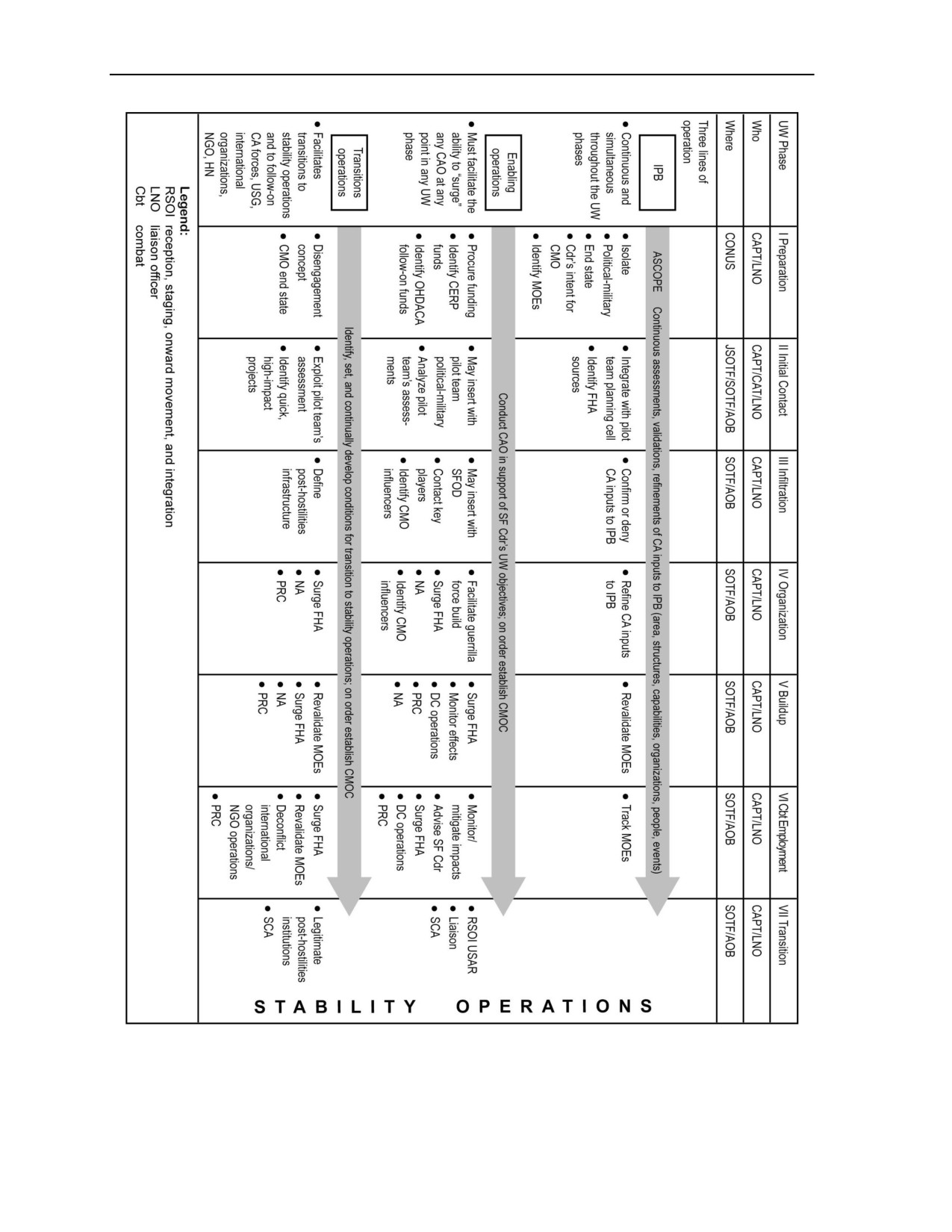
Chapter 3
Figure 3-3. Civil-military lines of operation in support of unconventional warfare
3-34
FM 3-57
31 October 2011
Civil Affairs Operations
DIRECT ACTION
3-170. Direct action operations are short-duration strikes and other small-scale offensive actions that
forces conduct as a special operation in hostile, denied, or politically sensitive environments and in which
forces use specialized military capabilities to seize, destroy, capture, exploit, recover, or damage designated
targets. Direct action differs from conventional offensive actions in the level of physical and political risk,
operational techniques, and the degree of discriminate and precise use of force to achieve specific
objectives. In the conduct of these operations, SOF may—
z
Use raid, ambush, or direct assault tactics, including close quarters battle.
z
Emplace mines and other munitions.
z
Conduct standoff attacks by fire from air, ground, or maritime platforms.
z
Provide terminal guidance for precision-guided munitions.
z
Conduct independent sabotage.
z
Conduct antiship operations.
3-171. JP 3-05 provides additional information on direct action. CA forces do not normally participate in
direct action missions; however, CA forces provide planning support to address possible adverse effects
and to mitigate those effects through METT-TC analysis.
SPECIAL RECONNAISSANCE
3-172. SR is reconnaissance and surveillance actions that forces conduct as a special operation in hostile,
denied, or politically sensitive environments to collect or verify information of strategic or operational
significance and in which forces use military capabilities not normally found in
conventional forces. These actions provide an additive capability for commanders and supplement other
conventional reconnaissance and surveillance actions. SOF conduct SR operations to—
z
Confirm, refute, or obtain by visual observation or other collection methods information on the
capabilities, intentions, and activities of an actual or potential enemy.
z
Secure data on the meteorological, hydrographic, or geographic characteristics of a particular
area.
SR operations include target acquisition, area assessments, and poststrike reconnaissance.
3-173. Army Tactics, Techniques, and Procedures (ATTP) 3-18.04, Special Forces Special Reconnaissance
Tactics, Techniques, and Procedures, provides additional SR information. CA forces do not normally
participate in SR missions.
COUNTERTERRORISM
3-174. Counterterrorism operations are those that include offensive measures taken to prevent, deter,
preempt, and respond to terrorism. ARSOF possess the capability to conduct these operations in urban
environments that political or threat conditions deny to conventional forces.
3-175. ARSOF activities within counterterrorism include, but are not limited to, intelligence operations,
attacks against terrorist networks and infrastructures, hostage rescue, recovery of sensitive material from
terrorist organizations, and nonlethal activities aimed at the ideologies or motivations that spawn terrorism.
CA forces best support counterterrorism operations through these nonlethal activities. Depending on the
METT-TC, all CA core tasks can support counterterrorism operations. Most counterterrorism activities are
classified. Further discussion of counterterrorism is beyond the scope of this publication.
MILITARY INFORMATION SUPPORT OPERATIONS
3-176. MISO are planned operations to convey selected information and indicators to foreign audiences
that influence their emotions, motives, objective reasoning, and behavior. The aim of MISO is to change
the behavior of foreign governments, organizations, groups, and individuals. The purpose of MISO is to
induce or reinforce attitudes and behaviors favorable to U.S. national goals in selected foreign target
audiences.
31 October 2011
FM 3-57
3-35
Chapter 3
3-177. FM 3-05.30, Psychological Operations; FM 3-05.301, Psychological Operations Process Tactics,
Techniques, and Procedures; and JP 3-13.2, Psychological Operations, provide additional information
on MISO.
3-178. CA forces integrate into the theater MISO plan by conducting public information activities and
providing timely feedback on the effectiveness of the MISO plan. CA planners integrate CAO into
operational plans and orders. CA forces provide accurate reporting of the operation and combat distorted or
misrepresented information disseminated by the adversary. CA planners can—
z
Represent CA concerns in MISO activities.
z
Coordinate with the Military Information Support task force to ensure consistency of messages
and operations security without compromising CA credibility.
z
Prepare CAO running estimates, assessments, and the annex to the OPLAN or OPORD to
identify and integrate CA support.
z
Coordinate the use of local resources, facilities, and support—for example, civilian labor,
transportation, communications, maintenance, or medical facilities and miscellaneous services
and supplies.
z
Provide liaison to local agencies and civilian authorities.
z
Coordinate civic action projects in support of MISO plans.
z
Advise on cultural and moral considerations.
3-179. Through civil inputs to the IPB process, CA forces can provide SOF elements with nominations
for targeted areas of interest and named areas of interest within the target area that will provide additional
information for the commander to analyze for current and follow-on operations planning.
COUNTERPROLIFERATION OF WEAPONS OF MASS DESTRUCTION
3-180. Counterproliferation is actions taken to defeat the threat and/or use of weapons of mass destruction
against the United States, our force, allies, and partners. Major objectives of counterproliferation policy
are to—
z
Prevent the acquisition of WMD and delivery systems.
z
Roll back proliferation where it has occurred.
z
Deter the use of WMD and their delivery systems.
z
Adapt U.S. military forces and planning to operate against the threats WMD and their delivery
systems pose.
3-181. Counterproliferation is a special mission, not applicable to most CA forces. Nevertheless, CA
forces are capable of responding to consequence management requirements involving WMD, under the
umbrella of FHA. CA forces are particularly well suited to address requirements that focus on regional,
cultural, and language capabilities.
3-36
FM 3-57
31 October 2011
Chapter 4
Planning
Planning is the process by which commanders (and the staff, if available) translate
the commander’s visualization into a specific course of action (COA) for preparation
and execution, focusing on the expected results.
CA Soldiers, elements, and units, are assigned to, have a command relationship with,
or provide support to Army, joint, or other Service HQ at the strategic, operational,
and tactical levels. As such, CA leaders and CAO/CMO planners must clearly
understand both Army planning and orders production and joint operations planning
(contingency, crisis action, and campaign planning). They must understand the
mechanics that underlie both Army and joint planning, and the manner in which CAO
integrate into the commander’s intent, planning guidance, and CONOPS. Although
there are many similarities between Army and joint planning, joint operations
planning is focused at the strategic-theater and operational levels within a GCC’s
AOR or joint force commander’s JOA. Army planning focuses on the tactical level
within a commander’s AO. This chapter provides doctrine for CA Soldiers
participating in both Army and joint planning processes. FM 5-0, The Operations
Process, provides detailed doctrine on Army planning. JP 5-0, Joint Operation
Planning, provides doctrine on joint operations planning.
CIVIL AFFAIRS METHODOLOGY
4-1. The focus of all CAO/CMO is to enable commanders to engage the civil component of their
operational environment. CAO/CMO is integrated into the conduct (plan, prepare, execute, and assess) of
all operations and includes those activities that establish, maintain, influence, or exploit relations between
military forces, governmental and nongovernmental civilian organizations and authorities, and the civilian
populace within an AOR, JOA, or AO. This effort focuses on assessing, monitoring, protecting,
reinforcing, establishing, and transitioning political, economic, social, and cultural institutions. CA Soldiers
assist commanders by conducting these operations and tasks both actively, through direct contact, and
passively, through observation, research, and analysis.
4-2. The CA methodology describes how CA Soldiers, elements, and units approach all CAO and CMO.
The methodology consists of the following six steps:
z
Assess.
z
Decide.
z
Develop and detect.
z
Deliver.
z
Evaluate.
z
Transition.
CA forces know the first five steps together as AD3E.
4-3. CA Soldiers apply the CA methodology equally at the strategic, operational, and tactical levels of
war. At each level, it supports the commander’s ability to visualize, describe, direct, and lead operations in
his exercise of mission command. FM 3-05.401 provides a detailed discussion of the six steps of the CA
methodology.
31 October 2011
FM 3-57
4-1
Chapter 4
ASSESS
4-4. Assess current conditions against a defined norm or established standards. This assessment begins at
receipt of the mission and continues through the mission analysis process focusing on defining the civil
components of the supported commander’s AO. This step looks at the nonmilitary factors (ASCOPE) that
shape the operational environment. CA personnel assess each of the 14 CA functional specialties, as well as
the general aspects of the AO. The product of this step is an initial estimate and restated mission statement.
DECIDE
4-5. Decide who, what, when, where, why, and how to focus CA assets and actions that support the
commander’s intent, planning guidance, and CONOPS. This step encompasses integrating CAO into unit
COAs, and analyzing and providing recommendations to the commander for COA decision from a CA
perspective. Upon the commander’s COA decision, CA leaders refine a concept of CAO/CMO and the
CAO/CMO plan. The plan directs task-organized CA elements and non-CA forces to create or observe
those conditions or events that would either mitigate or trigger a specific CAO/CMO response. It also
addresses all CAO/CMO from initial response through transition to other military or civilian authorities.
The products of this step include the commander’s concept for CMO, CA priorities, and the CMO annex.
In addition, this step identifies MOPs and MOEs for related objectives and tasks.
DEVELOP AND DETECT
4-6. Develop rapport and relationships with the nonmilitary participants of the operation (including the
IPI) and detect those conditions or events that would call for a specific CAO/CMO response. CA forces
accomplish this step through numerous actions and operations, such as facilitating the interagency process
in the CMOC, hosting meetings, participation in selected DC operations, conducting CR in support of CIM,
and monitoring public information programs and CAO/CMO-related reports from the field. The products of
this step include continuous assessments, revised or updated plans, formalized CMOC terms of reference,
and FRAGOs.
DELIVER
4-7. Engage the civil component with planned or on-call CAO (PRC, FHA, NA, SCA, and CIM)/CMO as
appropriate. CA Soldiers, CA enablers, IGOs, NGOs, and HN assets execute this step according to
synchronized plans. The product of this step is an executed mission.
EVALUATE
4-8. Evaluate the results of the executed mission. This step validates the CAO/CMO CONOPS and
supports the management of MOPs and MOEs to assess task accomplishment and attainment of objectives.
Evaluators analyze the effects of the operation (both desirable and undesirable) based on each of the 14 CA
functional specialties, determine the sustainability of any projects or programs initiated during the
execution phase, and recommend follow-on actions.
TRANSITION
4-9. Transition CAO or CMO to follow-on CA units, other military units, HN assets, UN organizations,
IGOs, NGOs, and other civilian agencies as appropriate. This step is the direct contribution of CA to a
sustainable solution and the commander’s ability to meet the desired end state. Planners execute this step
according to synchronized transition plans. The outcome of transition includes successful changeover of
authority or relief-in-place and durable, sustainable programs that the follow-on force or organization
can manage.
4-10. The developers of the CA methodology process embedded into the process elements of the common
problem-solving and decisionmaking processes that other various levels of command use. Table 4-1,
page 4-3, demonstrates the relationship between the CA methodology and these processes.
4-2
FM 3-57
31 October 2011

Planning
Table 4-1. Comparison of the Civil Affairs methodology
and the various problem-solving and decisionmaking processes
Basic
SO
Joint
Crisis-
Troop-
CA
Problem-
Operational
Operations
Action
MDMP
Leading
Methodology
Solving
Planning
Planning
Planning
Procedures
Steps
Procedures
Process
Phase 1—
Identify the
Receive
Receive
Receive
Initiation
Situation
Problem
Mission
Mission
Mission
Development
Identify Facts
Phase 2—
Initiate the
Mission
Analyze
Issue a
Assess
and
Crisis
SOMPF
Analysis
Mission
Warning Order
Assumptions
Assessment
Conduct
Mission
Analysis
Send
Phase 3—
Generate
CONOPS to
COA
Develop
Make a
COA
Alternatives
Mission-
Development
COAs
Tentative Plan
Development
Tasking HQ
Attend
Mission
Conference/
Phase 4—
Start
Analyze the
COA
Analyze
Orders Briefs
COA
Necessary
Alternatives
Analysis
COAs
and Conduct
Selection
Movement
Predeployment
Site Survey
Conduct a
Receive
Decide
Compare the
COA
Compare
Preliminary or
CONOPS
Alternatives
Comparison
COAs
Initial
Approval
Assessment
Refine
Concept into
OPLAN,
Make a
COA
Approve
CONPLAN,
Decision
Approval
COA
Supporting
Plan, or
OPORD
Develop
Issue the
Conduct
Produce
Plan or
Complete
Briefback
Orders
Order
Order
Phase 5—
Develop
Execute the
Deploy
Execution
Prepare
Supervise
and Detect
Decision
Planning
Execute the
Execute the
Phase 6—
Deliver
Execute
Decision
Mission
Execution
Document
Assess the
Evaluate
Results of
Results
Mission
Transition
Redeploy
Legend:
SOMPF Special Operations Mission-Planning Folder
CIVIL AFFAIRS AREA STUDIES, ASSESSMENTS, AND ESTIMATES
4-11. CA personnel analyze area studies, conduct assessments, and use and maintain running estimates.
CA produced area studies assessments, and running estimates include georeferences. This allows for future
geospatial application of these products. The following paragraphs describe these products in further detail.
31 October 2011
FM 3-57
4-3
Chapter 4
CIVIL AFFAIRS AREA STUDIES
4-12. CA personnel obtain, analyze, and record information in advance of need. The basic evaluation of an
area is the CA area study that establishes baseline information relating to the civil components of the area
in question. The CA area study is a premission study, prepared regionally by country, or to a specific
subnational area within a country as the baseline research document for CA forces. The CA area study
presents a description and analysis of the geography, historical setting, and the social, political, military,
economic, health, legal, education, governance, infrastructure, and national security systems and
institutions of a country using a combination of open- and restricted-source materials. CA personnel update
the information detailed in the CA area study periodically as required prior to the receipt of a mission. With
the evolution of CIM, the requirement for the future is that all information captured by CA teams globally
would reside in a single repository. When a CA force receives a mission to deploy, it should be able to
request an area study from the CIM repository. The software mechanism should allow for the printing of a
complete area study with the most current information.
4-13. This baseline information is used as the basis for the creation of the CAO running estimate during the
planning process. If an area study does not already exist then the CA force must, time permitting, create
one during mission preparation and planning, or it must conduct similar research and analysis required to
directly produce the CAO running estimate.
CIVIL AFFAIRS OPERATIONS RUNNING ESTIMATE
4-14. Upon receipt or in anticipation of a mission, each staff section begins updating its estimate based on
information requirements related to the mission. CA forces record relevant information in running
estimates. They maintain a continuous assessment of the civil domain as related to current operations as a
basis to determine if they are proceeding according to the mission, commander’s intent, and concept of
operations.
4-15. The CAO running estimate feeds directly into the MDMP process, whether conducted unilaterally as
part of CA-only operations or integrated into the supported unit’s planning process and development of the
COP. To focus the estimate process, planners first develop a restated mission statement that delineates
those CAO tasks necessary to successfully support the commander’s mission. The mission statement is a
short sentence or paragraph describing the unit’s CAO essential task (or tasks) and purpose that clearly
indicate the action to be taken and the reason for doing so. It contains the elements of who, what, when,
where, and why, as well as the reasons thereof, but seldom specifies how.
4-16. During COA development and war-gaming, CA staff officers ensure each COA effectively integrates
civil considerations (the “C” of METT-TC) and present a summary of their running estimate to describe
how their findings impact or are impacted by other staff functions. The CA staff officer must be able to
articulate how operations affect civilians and estimate the requirements for essential stability tasks
commanders might have to undertake based on the capability of the force and that of the interagency, IGO,
and NGO partners; ultimately, recommending the best COA from the CAO perspective even though it may
not be the COA the staff recommends to the commander.
4-17. CA planners and staff use the running estimate throughout the operations process to assess the
current situation, determine if the current operation is proceeding according to the commander’s intent,
determine if future operations are supportable, and develop branches and sequels to current operations.
CIVIL AFFAIRS ASSESSMENTS
4-18. CA assessments are techniques that provide a precise means to extract meaningful and significant
information. CA Soldiers perform three basic types of assessments—the initial assessment, deliberate
assessment, and the survey. Gathering information should not be a haphazard process. Each type of
assessment is based upon the information and analysis of the previous type. Additionally, each type of
assessment in the progression becomes more focused, specific, and detailed with an ultimate goal of
identifying and mitigating civil vulnerabilities that pose a threat to the successful and timely completion of
4-4
FM 3-57
31 October 2011
Planning
the mission. As with all military missions, this task must have a well-formed, practical plan. The basic steps
of this plan include the following:
z
Determine what information to gather (in concert with operational planning staff).
z
Determine the most likely source (such as a person, place, event, or reference) from which to
obtain the information.
z
Prepare a list of questions for the sources that supports the information requirements.
z
Engage the source (for example, research reference, observe activities, assess locations or
systems, and interview individuals).
z
Compile the results.
z
Report the results according to the CIM process and unit SOP.
4-19. Every assessment must contain well-defined, geographical boundaries and timeframes within which
the assessment is valid. As mere “snapshots in time,” assessments and surveys must be updated as often as
necessary to remain current. It is also crucially important to georeference what is reported.
Initial Assessments
4-20. The initial assessment is conducted upon entry into the designated AO. The objective and focus of
the initial assessment should be broad enough to allow CA forces to quickly get an updated baseline of the
general conditions within the entire AO to validate or refute the information and assumptions used in
planning as well as to update the CAO priorities and information collection plan. During continuous
operations, the initial assessment requirement may not be necessary for follow-on CA forces due to the
transfer of current and detailed operational data during transition. CA teams conducting initial assessments
must be aware of the security situation at all times.
4-21. The objectives of the initial assessment are to—
z
Obtain a rapid overview of the conditions in the AO.
z
Validate or refute information used during planning.
z
Validate or refute assumptions used during planning.
z
Determine general areas of perceived civil vulnerabilities.
z
Update the CAO running estimate.
z
Finalize or modify operations planned before deployment.
z
Update CAO priorities.
z
Identify key areas for follow-on deliberate assessments.
z
Update the CAO information collection plan to provide input to the PIR and CCIR.
z
Update the area study.
z
Identify patterns and indicators.
z
Identify requirements for follow-on CA forces.
z
Identify requirements for functional specialty support.
4-22. Products of the initial assessment include situations reports, spot reports, geospatial products, and
requests for assistance. The findings of an initial assessment may lead to refined mission statements,
updates to the CA area study, input to FRAGOs, and reallocation of forces and resources.
Deliberate Assessments
4-23. Deliberate assessments are conducted in a methodical manner in accordance with CAO priorities and
the CAO information collection plan on specific geographic areas or social, economic, governmental, or
infrastructure systems of interest. They are a determination of current conditions, capabilities, or attitudes
within these defined areas. Deliberate assessments are characterized by firsthand observation, key-leader
engagements, interviews, and other tools to gather information used to make knowledgeable decisions and
to determine locations and priorities for follow-on in-depth analysis. CA teams may use a wide variety of
detailed checklists or formats during a deliberate assessment to ensure it has scrutinized all aspects of the
assessment target. Deliberate assessments can be ongoing or direct.
31 October 2011
FM 3-57
4-5
Chapter 4
4-24. The objectives of deliberate assessments are to—
z
Update the area study.
z
Collect civil information on specific geographic areas (region, city, or town).
z
Collect civil information on social, economic, governmental, legal, health, educational or
infrastructure systems.
z
Determine specific areas of perceived civil vulnerabilities.
z
Provide greater detail on priorities identified during the initial assessment.
z
Update the CAO running estimate.
z
Update the CAO information collection plan to provide input to PIR and CCIR.
z
Identify key locations for follow-on surveys.
z
Identify patterns and indicators.
z
Identify key leaders for engagement.
z
Update requirements for follow-on CA forces.
z
Update requirements for functional specialty support.
z
Validate/assess MOE and MOP.
SURVEYS
4-25. Surveys are conducted in a methodical manner in accordance with CAO priorities and the CAO
information collection plan on specific locations identified as requiring in-depth analysis during deliberate
assessments. This may include specific people, groups, locations, facilities, or capabilities within a specific
location or a specific piece within a system. CA forces conduct surveys as time and circumstances permit.
The survey is a detailed assessment in which the object of the assessment is examined carefully, as during
an inspection or investigation. During the survey, the CA team may use a variety of detailed checklists or
formats within the CIM construct to ensure it has scrutinized all aspects of the specified group, location or
facility targeted for survey. Survey development should leverage operations/research analysis capabilities if
available. The findings of a survey may lead to refined mission statements or reallocation of forces and
resources. Surveys can be ongoing or directed.
4-26. The objectives of a survey are to—
z
Collect detailed civil information on specific location with a geographic area (forest, lake,
valley, or neighborhood).
z
Collect civil information on specific components of social, economic, governmental, legal,
health, educational, or infrastructure systems (religious sect, water treatment plant, hospital, or
prison).
z
Identify capabilities and capacities, to include shortfalls, of surveyed items.
z
Analyze specific areas of perceived civil vulnerabilities.
z
Identify patterns and indicators.
z
Identify possible project solutions to identified shortfalls and vulnerabilities when appropriate.
z
Update requirements for follow-on CA forces.
z
Update requirements for functional-specialty support.
z
Validate/assess MOE and MOP.
z
Identify/verify key leaders.
OPERATIONAL AND MISSION VARIABLE ANALYSIS
4-27. The operational environment includes physical areas—the air, land, maritime, and space domains. It
also includes the information that shapes the operational environment as well as enemy, adversary, friendly,
and neutral systems relevant to that joint operation. The operational environment for each campaign or
major operation is different, and it evolves as each campaign or operation progresses. ARFOR use
operational variables to understand and analyze the broad environment in which they are conducting
operations. They use mission variables to focus analysis on specific elements of the environment that apply
to their mission.
4-6
FM 3-57
31 October 2011
Planning
OPERATIONAL VARIABLE ANALYSIS
4-28. The operational environment is described in terms of eight interrelated operational variables:
political, military, economic, social, information, infrastructure, physical environment, and time known as
PMESII-PT. Analysis of the operational variables integrates people and processes, using multiple
information sources and collaborative analysis to build a common, shared, holistic knowledge base of the
operational environment. Operational variable analysis emphasizes a multidimensional approach toward
situational understanding. Detailed analysis of the operational variables normally occurs at joint level.
Tactical commanders use analysis of the operational variables to improve their understanding of their
environment.
4-29. The six CA functional specialty areas (rule of law, governance, infrastructure, economic stability,
public education and information, and public health and welfare) coincide with the operational variables.
Commanders may task individual CA functional specialists from supporting USAR CA units to provide
detailed analysis products relating to the various operational variable elements.
4-30. Although not all inclusive, CAO analysis of the operational variables normally provides relevant
information in many areas. The following paragraphs describe this information in detail.
Political
4-31. CAO analysis provides relevant political information that identifies the—
z
Overall strategic political situation in the AO.
z
Political leadership and type of government within the AO.
z
Key aspects of the commander’s operational environment, such as political boundaries and
centers of the FN government, including strengths, weaknesses, role in society, and so on.
z
IGOs present in the AO.
Military
4-32. CAO analysis provides relevant military information that identifies the—
z
CAO capabilities of all U.S. and non-U.S. forces available in the AO.
z
Potential influence of the military situation within the AO on the current mission requirement.
z
Affect of the current military situation on stability, government security, and the populace.
z
Role of the military and, as applicable, paramilitary security forces in the country.
z
Degree to which indigenous security forces are resourced, accountable, and capable.
z
Level of border security.
z
Degree of trust and cooperation between elements of the indigenous security apparatus.
Economic
4-33. CAO analysis provides relevant economic information that identifies the—
z
Strengths and weaknesses of the economic systems along with the HN’s plans for economic
development.
z
Economic goals and objectives affecting the military mission.
z
Shortages affecting the operation or the commander’s ability to use FN supplies, including the
ability of the FN to supply enough food to meet the need of the civil populace.
z
Agricultural calendar, including harvest, planting, and spraying seasons.
z
Economy fiscal calendar.
31 October 2011
FM 3-57
4-7
Chapter 4
Social
4-34. CAO analysis provides relevant social information that identifies the—
z
Current social climate in the AO.
z
Key civilian communicators inside and outside the AO and their link to the population. The most
important identifications are of various faction leaders in the population, including—
Figureheads.
Clerics.
SMEs associated with the operation of critical civil infrastructure (water production and
treatment, communications, electrical generation, transportation, health services, and so on).
z
Role of religion in society and the various religious and fraternal groups.
z
Key events that can affect the commander’s mission, such as elections, school events, fiscal
schedules, and holidays (religious periods and traditional vacation time).
Information
4-35. CAO analysis provides relevant information that identifies the—
z
Status and ability to transmit and receive information within the AO.
z
Legitimate government’s ability to inform its population.
z
Locations and meeting cycles of key nonmilitary agencies and programs in the AO (IGOs,
NGOs, UNHCR, World Food Program [UN], OFDA, governing bodies, health services, judicial
and law enforcement, and community organizations).
Infrastructure
4-36. CAO analysis provides relevant infrastructure information that identifies the—
z
Civil infrastructure in the AO. The analyst concentrates on how the state of the infrastructure
assists or hinders the commander’s mission.
z
Condition and location of key structures including—
Government facilities.
Medical treatment facilities.
Cultural sites, such as monuments, religious shrines, libraries, museums, and so on.
Facilities with practical applications, such as detention facilities and warehouses.
Power generation and transmission facilities.
Transportation grids and port, rail, and aerial facilities.
Water purification and sewage treatment plants.
Emergency management facilities, equipment, and response capabilities.
Radio and television production and transmission facilities.
z
Agricultural and mining regions and other significant geographic and economic features.
Physical Environment
4-37. CAO analysis provides relevant physical environment information that identifies—
z
Man-made structures, particularly urban areas.
z
Climate, weather, and significant reoccurring weather events (for example, floods).
z
Topography.
z
Hydrology.
z
Environmental conditions and hazards.
4-8
FM 3-57
31 October 2011
Planning
Time
4-38. CAO analysis provides relevant time information that identifies the implications of the duration of
the operation on—
z
Friendly forces.
z
Adversary forces.
z
Interagency timeline comparison.
4-39. Operational variable analysis and IPB are complementary processes that produce the awareness and
understandings necessary to plan and execute CAO/CMO. Operational variable analysis is a valuable
complement to the IPB as it integrates an expansive spectrum of information. In reality, perfect knowledge
and understanding of the adversary and environment are impossible to attain, but by applying a broader
approach to understanding both, commanders are better able to move beyond situational awareness to a
more comprehensive situational understanding.
Mission Variable Analysis
4-40. The mission variables are mission, enemy, terrain and weather, troops and support available—time
available, and civil considerations (METT-TC). Tactical level commanders use the mission variables to
synthesize operational variables and tactical-level information with local knowledge about conditions
relevant to their mission. CAO/CMO planners apply the factors of METT-TC, concentrating on the civil
considerations aspect of the AO during the conduct of MDMP. Planners analyze civil considerations using
the six factors of the memory aid, ASCOPE.
4-41. Areas are key localities or aspects of the terrain within an operational environment that a commander
would not normally think of as militarily significant. Failure to consider key civil areas, however, can
seriously affect the success of any military mission.
4-42. CAO planners analyze key civil areas from the following two perspectives:
z
How do these areas affect the military mission?
z
How do military operations affect civilian activities in these areas?
At times, the answers to these questions dramatically influence major portions of the COAs a commander is
considering.
4-43. Structures are existing civil structures that take on many significant roles. Some, such as bridges,
communications towers, power plants, and dams, are traditional high-payoff targets. Others, such as
churches, mosques, national libraries, and hospitals, are cultural sites that international law or other
agreements generally protect. Still others are facilities with practical applications, such as jails, warehouses,
schools, television stations, radio stations, and print plants, which may be useful for military purposes.
4-44. Structures analysis involves determining the location, functions, capabilities, and application in
support of military operations. It also involves weighing the consequences of removing them from civilian
use in terms of political, economic, religious, social, and informational implications; the reaction of the
populace; and replacement costs.
4-45. CAO planners view civil capabilities from several perspectives. The term capabilities may refer to—
z
Existing capabilities of the populace to sustain itself, such as public administration, public
safety, emergency services, and food and agriculture systems.
z
Capability shortfalls with which the populace needs assistance, such as public works and
utilities, public health, public transportation, economics, and commerce.
z
Resources and services that commanders can contract to support the military mission, such as
interpreters, laundry services, construction materials, and equipment. Local vendors, the HN, or
other nations may provide these resources and services. In hostile territory, civil capabilities
include resources that military forces can take and use within the constraints of international law.
4-46. CA personnel normally conduct analysis of the existing capabilities of the AO based on the 14 CA
functional specialties (Figure 2-11, page 2-18). The analysis also identifies the capabilities of partner
31 October 2011
FM 3-57
4-9
Chapter 4
countries and organizations involved in the operation. In doing so, CAO/CMO planners consider how to
address shortfalls, as well as how to capitalize on strengths in capabilities.
4-47. Civil organizations are organized groups that may or may not possess affiliation with government
agencies. They can be church groups, fraternal organizations, patriotic or service organizations, and
community watch groups. They might be IGOs or the NGO community.
4-48. Organizations can assist the commander in keeping the populace informed of ongoing and future
operations in an AO and influencing the actions of the populace. They can also form the nucleus of HA
programs, interim-governing bodies, civil defense efforts, and other activities.
4-49. People, both individually and collectively, can have a positive, negative, or no impact on military
operations. In the context of ASCOPE, the term people includes civilians or nonmilitary personnel that
Soldiers encounter in an AO. The term may also extend to those outside the AO whose actions, opinions, or
political influence can affect the military operations. In all military operations, U.S. forces must be
prepared to encounter and work closely with civilians of all types. When analyzing people, CA Soldiers
consider historical, cultural, ethnic, political, economic, and humanitarian factors. They also identify the
key communicators and the formal and informal processes used to influence the civilian populace.
4-50. Regardless of the nature of the operation, military forces will usually encounter various civilians
living and operating in and around the supported unit’s AO. To facilitate determining who they might be, it is
useful to separate civilians into distinct categories. In foreign operations, these categories might include—
z
Local nationals (town and city dwellers, farmers and other rural dwellers, and nomads).
z
Local civil authorities (elected and traditional leaders at all levels of government).
z
The DC population.
z
Expatriates.
z
Foreign employees of IGOs or NGOs.
z
Interagency and third-nation government agency representatives.
z
Contractors (U.S. citizens, local nationals, and third-nation citizens providing contract services).
z
DOD civilian employees.
z
The media (journalists from print, radio, and visual media).
4-51. The type of environment primarily dictates civilian activities. Personnel should consider each
category of civilian separately because each will affect the mission differently in both positive and negative
ways. Military operations affect civilian activities in various ways. Commanders should consider the
political, economic, psychological, environmental, and legal impact of operations on the categories of
civilians identified in the AO.
4-52. Just as there are different categories of civilians, there are different categories of civilian events that
may affect military operations. Some examples are planting and harvest seasons, elections, riots, and
evacuations (both voluntary and involuntary). Likewise, there are military events that affect the lives of
civilians in an AO. Some examples are combat operations, including indirect fires, deployments, and
redeployments. CAO/CMO planners determine what events are occurring, and analyze the events for their
political, economic, psychological, environmental, and legal implications.
SYNTHESIZING OPERATIONAL AND MISSION VARIABLE INFORMATION
4-53. Operational variable analysis defines how the physical and behavioral state of the operational
environment’s PMESII-PT considerations result from a military or nonmilitary action or set of actions.
Analysis of the operational variable data gathered details the prevailing conditions within the AO.
4-54. The application of the elements of ASCOPE during civil considerations analysis identifies the key
and decisive areas, structures, capabilities, organizations, people, and events of each operational variable.
For example, personnel would apply ASCOPE to the entire concept of “economics.” The staff would ask
the questions: “Where are the key and decisive areas of economic activity? Where are the key and decisive
structures (infrastructures) associated with economic activity? What are the key and decisive economic
capabilities that forces must engage and restore (for example, banking)? What are the key and decisive
economic organizations? Who are the key and decisive economic people? Finally, what are the key and
4-10
FM 3-57
31 October 2011