FM 3-57 Civil Affairs Operations (October 2011) - page 4
Planning
decisive economic events?” These questions would lead to effective CAO supporting plans to the
commander’s CONOPS, identify MOEs, and provide the basis for troops-to-task analysis.
4-55. An operational and mission variable analysis approach integrates people and processes, using
multiple information sources and collaborative analysis to build a common, shared, holistic knowledge base
of the operational environment. Operational variable analysis emphasizes a multidimensional approach
toward situational understanding, distinguished by an analysis of the six interrelated characteristics of
ASCOPE within each variable.
4-56. A fully developed collaborative environment is an aggregation of individuals, organizations,
knowledge management systems, infrastructure, and processes to create and share the data, information,
and knowledge necessary to plan, execute, prepare for, and assess operations. It enables commanders to
make informed decisions faster than the adversary. It offers commanders and staffs the capacity to facilitate
the creation of a shared situational awareness so they can plan and operate with an enhanced unity of effort.
4-57. Included in the collaborative environment are the knowledge management techniques and procedures
that govern collaboration within the HQ, the CMOC, and among subordinate forces. These techniques and
procedures encompass the processes and databases to integrate and synchronize the command and staff
activity to generate supporting information and directives such as FRAGOs and operational reports.
Collaboration through the CIM process, automation, and decision-support capabilities all enhance the
efficiency of the organization’s battle rhythm and the commander’s decisionmaking. The collaborative
environment seeks to provide the right information to the right people at the right time in an understandable
and actionable format or display.
CIVIL AFFAIRS SUPPORT OF JOINT OPERATIONS PLANNING
4-58. According to JP 5-0, joint operations planning is the overarching process that guides JFCs in
developing plans for the employment of military power within the context of national strategic objectives
and national military strategy to shape events, meet contingencies, and respond to unforeseen crises. Joint
operations planning prepares for the use of existing capabilities to achieve objectives defined in national
military strategy. The resultant plans are a measurement of the ability of the nation to successfully
prosecute the national military strategy within the constraints of available forces and resources.
STRATEGIC PLANNING
4-59. The GCCs plan at the strategic level of war through participation in the development of national
military strategy, the development of theater estimates, and theater strategies. The Joint Strategic
Capabilities Plan (JSCP) and Contingency Planning Guidance, prepared by the CJCS, task the GCCs to
develop plans for potential operational contingencies and deterrence. The JSCP is a single instruction that
covers planning guidance, objectives, tasks, assumptions, and forces. The JSCP tasks the development of
GCC-prepared OPLANs, selected CONPLANs, and functional supporting plans. The JSCP specifies which
plans planners submit to the CJCS for approval. The GCC approves the remaining plans.
4-60. The JOPES formalizes the planning process and provides for orderly and coordinated problem
solving and decisionmaking in two related but distinct categories—contingency planning and CAP—which
differ primarily in the amount of available planning time.
4-61. Within the context of JOPES, a crisis is an incident or situation involving a threat to the United
States, its territories, citizens, military forces, possessions, or vital interests. It typically develops rapidly
and creates a condition of such diplomatic, economic, political, or military importance that the President or
SecDef considers a commitment of U.S. military forces and resources to resolve the situation. It may occur
with little or no warning and requires accelerated decisionmaking. JOPES provides crisis action procedures
for the time-sensitive development of OPORDs for the likely use of military forces in response to a crisis.
4-62. Contingency planning relies heavily on assumptions regarding the circumstances that will exist when
a crisis arises. There is not a seamless transition between contingency plans and CAP since the products are
different. To transition to CAP, CMO planners must examine contingency planning assumptions and the
plans adjusted accordingly to account for any differences between the assumptions and the actual
circumstances at the time of crisis.
31 October 2011
FM 3-57
4-11
Chapter 4
4-63. Joint operation planning further encompasses campaign planning. Decision makers conduct
campaign planning when contemplated military operations exceed the scope of a single major joint
operation. A campaign is a series of related military operations aimed at accomplishing strategic and
operational objectives within a given time and space. Personnel may begin campaign planning during
contingency planning but normally do not complete it until after selection of the COA during CAP.
4-64. CAPTs of the regionally aligned CACOMs support strategic CMO planning at the theater level.
These teams develop complete CA plans, policy, and programs that support the GCC’s strategic CMO
plans. Each CACOM has the capability to employ five CAPTs that provide SME support at the GCC,
JFLCC, and the Service component staffs. The CAPTs support the GCC’s CMO staff and other military
planners with integrating the supported commander’s military campaign plans into comprehensive civil-
military strategic supporting plans.
4-65. Individual CA functional specialists from the CACOM’s organic CA functional specialty cells
support the CAPTs. SMEs in the areas of governance, rule of law, infrastructure, economic stability, public
health and welfare, and public education and information provide detailed analysis products relating to the
various elements of the operational variables during joint operational planning.
4-66. Analytical CMO products developed at the theater-strategic level focus on the analysis of the civil
component of a potential JOA. The various CMO estimates and annexes, when distributed, provide the
basis necessary for the development of detailed products at the operational level that define the corps and
JTF operational environment civil-military situation.
4-67. GCCs focus joint strategic planning on their specific AORs. They develop strategies that translate
national direction and multinational guidance into concepts to meet strategic objectives. In response to
direction in the DOD Security Cooperation Guidance, GCCs prepare security cooperation strategies in
accordance with Security Cooperation Guidance objectives for CJCS review and SecDef approval. These
strategies serve as the basis for security cooperation planning. Collaboration among the combatant
commands, Services, and supporting DOD agencies is essential. Equally important is the close coordination
with the interagency, and particularly with the U.S. COMs (Ambassadors) in the GCC’s AOR.
OPERATIONAL PLANNING
4-68. Planning at the operational level
(corps and JTF) synchronizes the achievement of national
operational objectives through the conduct of tactical operations. Operational-level planning concentrates
on developing plans for campaigns, subordinate campaigns, and major operations. CCDRs develop theater
campaign plans to accomplish multinational, national, and theater strategic objectives. Subordinate unified
commands typically develop subordinate campaign plans or operation plans that accomplish theater
strategic objectives. If the mission requires military operations of sufficient scope, size, complexity, and
duration, JFCs may develop subordinate campaign plans. Land component commanders normally develop
plans for major operations that support the campaign plan.
4-69. The Army’s force modernization of the staffs of corps and divisions has created organizations that
are joint-capable by design and need only joint manning augmentation to achieve JFLCC or JTF capability.
The Army functionally organized the HQ along joint operational lines. Important capabilities of the HQ are an
early entry command post and follow-on deployable mission command. The corps may serve as the ARFOR
HQ, exercising administrative control over ARFOR, as well as planning and controlling support to other
Services, interagency, and multinational forces with selected theater-wide support.
4-70. At the operational level, the CA brigade CAPT supports the G-9 staff and the CAO/CMO planning
staff at the corps or the division HQ (acting as a JTF). Likewise, the CAPT from the USASOC assigned
regionally aligned CA battalion (A) provides support to the TSOC. CAO and CMO operational planning
concentrates on the civil components of the supported commander’s AO at the regional and provincial
level. Key to this support relationship is the modular organizational structure of the CAPT. National level
CAO and CMO analysis data developed at the theater level is refined and validated as it pertains to the
assigned corps AO or JOA. The G-9 (designated as the J-9 or CJ-9 during joint and coalition operations)
staff section has the primary responsibility for the planning and integration of CAO and CMO at the
operational level.
4-12
FM 3-57
31 October 2011
Planning
4-71. When designated as a JTF, Army HQ follows joint doctrine and the JOPP in the development of
plans and orders. Joint doctrine incorporates a systems-perspective approach in the analysis of an
operational environment. System analysis defines how military and nonmilitary actions, or set of actions,
affect the physical and behavioral state of an adversary’s political, military, economic, social,
informational, infrastructure, and other systems
(the operational variables). Analysis of the gathered
systems data details the prevailing conditions within the JOA.
4-72. JOPP mission analysis of the systems data in an operational environment assists operational design
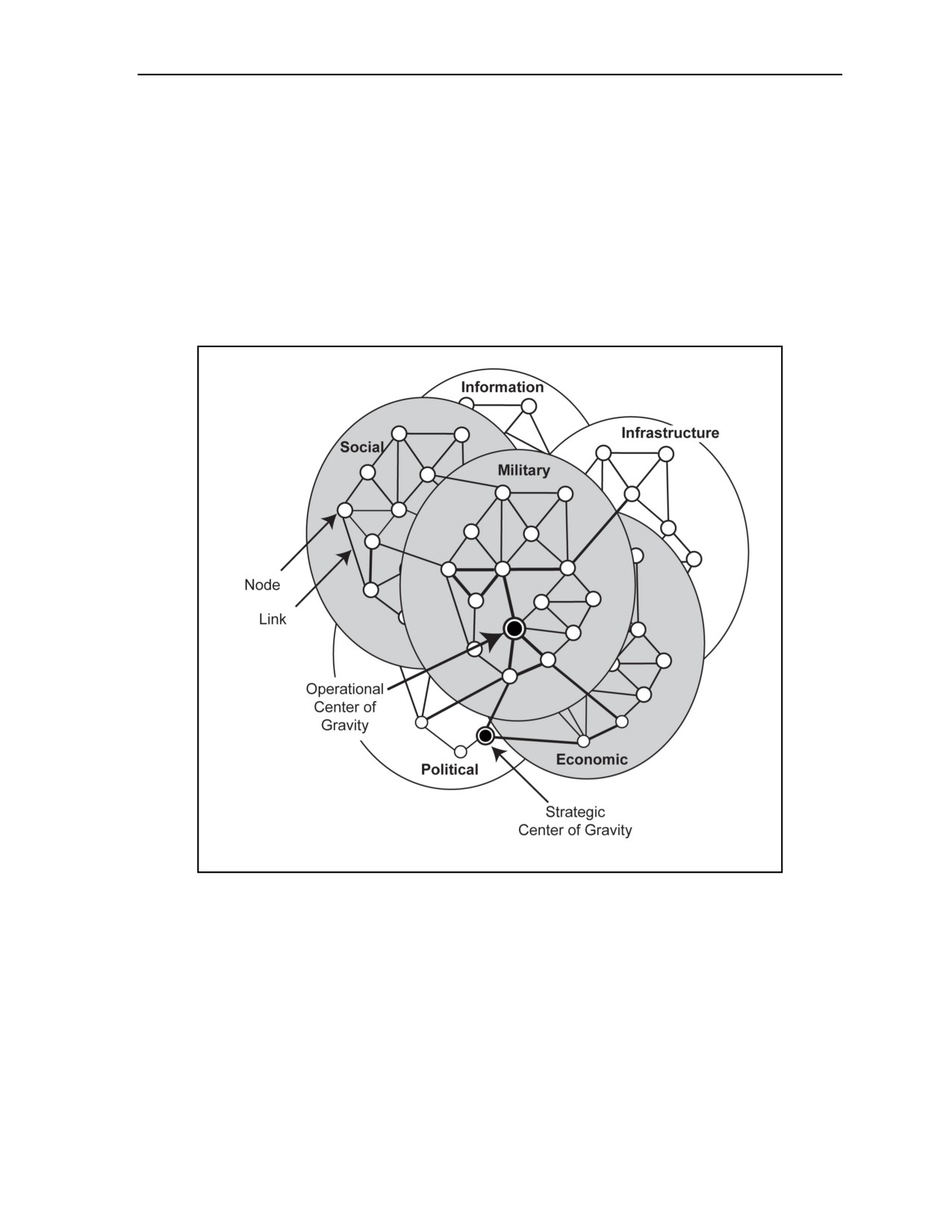
by identifying nodes (a person, place, or physical thing) that are a fundamental component of a system and
links (the behavioral, physical, or functional relationship) between the nodes (Figure 4-1). The analysis
includes an assessment of the important capabilities and vulnerabilities of the systems and nodes, which
enables the subsequent identification of COGs and decisive points. JP 5-0 contains additional information
on this subject.
Figure 4-1. Relationship of system, node, link, and centers of gravity
4-73. During initial mission analysis, the commander and staff ensure they understand the operational end
state and associated objectives, and design the tactical end states and supporting objectives. JOPP uses
“effects” as a way to clarify the relationship between objectives and tasks, which helps the JFC and staff
determine the conditions for achieving objectives. Effects can be categorized as desired effects or undesired
effects. Desired effects are conditions that support achieving an associated objective, while an undesired
effect is a condition that can inhibit progress toward an objective. An effect is achievable, measurable, and
can support more than one objective. Effects bridge the gap between objectives and tasks. Planners identify
tasks that, when executed against specified key nodes, should achieve the desired effects.
31 October 2011
FM 3-57
4-13
Chapter 4
4-74. The integration of CAO and CMO planning at the operational level requires the development of—
z
The commander’s CAO/CMO objectives supporting the attainment of strategic goals.
z
Prioritized CAO tasks required to meet CAO/CMO objectives.
z
MOPs that focus on task accomplishment.
z
MOEs focused on effects attainment.
MEASURES OF EFFECTIVENESS AND MEASURES OF PERFORMANCE
4-75. The primary purpose of continuous assessment is to identify progress toward the accomplishment of
objectives at any point in time, which provides the basis for plan adjustment. Through the effective use of
CR and the CIM processes, combat assessments are developed by using two primary criteria—MOPs and
MOEs—to assess task accomplishment and effects attainment, respectively. Together, MOPs and MOEs
support an overall assessment of objective accomplishment.
4-76. CAO and CMO planners identify MOEs for both desired and undesired effects. Measuring effects
improves planning and assessment by emphasizing the following:
z
The linking of operational objectives to tactical-level actions through a specified set of effects.
z
The systemic situational awareness and understanding of the adversary and operational
environment enabled by an operational variable analysis process.
z
The command and staff interaction across multiple echelons enabled by significant collaboration
capabilities through CIM support to the collaborative environment.
z
The enhanced unity of effort between joint, multinational, and interagency organizations.
z
A more accurate, rigorous assessment of the attainment of objectives focused on system
behavior rather than discrete task accomplishment.
4-77. CAO/CMO planners develop specific MOEs to determine how well or poorly an operation is
proceeding in achieving CMO objectives according to the commander’s mission statement and intent.
CMO MOEs identify effective strategies and tactics and determine points at which to shift resources,
transition to different phases, or alter or terminate the mission.
4-78. CAO/CMO planners develop plans to observe and validate each MOE. These plans determine—
z
Who will observe the MOE.
z
When the MOE will be observed.
z
How the MOE will be observed.
z
Where the observations will be made.
z
Who will approve and validate achievement of the MOE.
z
What actions will be taken when the MOE is satisfactorily achieved.
z
Who will take the actions achieved.
4-79. MOPs focus on task accomplishment by answering the following questions:
z
Was the task or action performed as the commander intended?
z
Did the force produce the fires, maneuver, or information required by the specified or implied
tasks, regardless of effect?
z
Have the expected results been accomplished after the completion of assigned tasks?
z
Are assigned forces doing things right?
4-80. Measuring performance is normally a quantitative analysis that determines whether the responsible
element or individual performed the task or action to a standard. Standards are either procedure-based (for
example, an SOP) or time-sensitive.
4-81. The JFC’s orders to subordinates specify the tasks, purpose, and associated effects for action. At
tactical levels, the higher commander’s intent statement identifies the desires effects. The intent statement
is the concise expression of the purpose of the operation and the desired end state that serves as impetus for
the subordinate unit planning effort.
4-14
FM 3-57
31 October 2011
Planning
CIVIL-MILITARY OPERATIONS WORKING GROUP
4-82. Commanders establish a CMOWG. CMOWG brings all the stakeholders in CMO together to focus
and synchronize their efforts in achieving the commander’s CMO priorities. In addition to the CMOWG,
CAO/CMO planners ensure that they are actively involved in the information operations working group,
the intelligence fusion working group, the joint effects-coordination board, and the targeting board at their
respective levels.
4-83. The composition of the CMOWG changes based on level of command but the S-9/G-9/J-9 should
chair the group (lead CMO planner). Other members of the CMOWG may include the following:
z
Director of the CMOC.
z
Subordinate CA unit representative.
z
Information operations representative (S/G-7).
z
Medical representative.
z
Engineer representative.
z
Provost marshal representative.
z
SJA representative with expertise in CMO, preferably the unit’s senior rule of law officer.
z
Political advisor, if applicable.
z
PA officer.
z
S/G/J-2 targeting officer representative.
z
S/G/J-3 current operations representative.
z
S/G/J-4 representative.
z
Resource management representative.
z
Subordinate liaison officer.
Civil-Military Operations Working Groups
in Operation ENDURING FREEDOM
During Operation ENDURING FREEDOM (May 2004 through March 2006), the
combined joint special operations task force-Afghanistan recognized the need to
secure the Shur Ghar Pass in southern Afghanistan. Close collaboration between
CA, coalition forces, IPI, NGOs, IGOs, USAID, DOS, US Department of Agriculture,
the UN, and others produced an excellent example of a CMOWG.
The Shur Ghar Pass is located in central Zabul Province in southern Afghanistan.
The pass sits in a mountain range that splits the province. The surrounding
mountains make approaches to the pass unobservable. In addition, the rock-strewn
sand road makes it an ideal location for improvised explosive devices and ambushes.
Several coalition soldiers lost their lives in the pass due to these threats.
Through numerous CMOWGs at Kandahar Air Base and Zabul Province, CA Soldiers
from the 96th CA Battalion (A) and coalition forces prepared a concept to secure the
Shur Ghar Pass. The concept included placing Afghan police in the pass, building a
hardened police barracks compound, and instituting numerous police checkpoints.
Personnel secured CERP funding to build the police barracks and checkpoints in the
pass. CA Soldiers supporting the task force coordinated with the Commander of Joint
Task Force 76 to use CERP funding provided by the PRT in Qalat, the capital of
Zabul Province. CA forces eventually transferred the plan to the Commander of Joint
Task Force 76, specifically 3d BCT, 25th Infantry Division, and the Qalat PRT. DOS
contractors from DynCorp ran a police training program in Zabul, in conjunction with
the 3d BCT, 25th Infantry Division, that produced trained police to staff the pass.
(continued)
31 October 2011
FM 3-57
4-15
Chapter 4
When the 3d BCT, 25th Infantry Division redeployed, the plan to secure the Shur
Ghar Pass was transferred to the 173d (A) BCT. The 173d (A) BCT dedicated
virtually all of its engineer assets to complete the initial road cut and base course.
With approval from Commander, Joint Task Force 76, the Qalat PRT funded road
construction equipment and a rock crusher and was able to provide training for
Afghans to operate them. USAID agreed to fund an asphalt-finish topcoat using a
private contractor to pave the road.
This collaborative effort took over a year from conception to completion. It involved
CMOWGs at the strategic, operational, and tactical levels and was composed of
elements from SOF and conventional forces, USAID, DOS, the government of
Afghanistan, and others to make it successful. The net result produced secure
access to southern Afghanistan for coalition and Afghan security forces. It stimulated
the economy in Zabul Province and southern Afghanistan, and legitimized the local
governments, the provincial government, and the government of Afghanistan.
4-16
FM 3-57
31 October 2011
Appendix A
Transition Considerations
It is DOD policy that Civil Affairs activities shall be undertaken to achieve an orderly
and prompt transition of civilian sector responsibilities from the DOD components to
non-DOD authorities.
DODD 2000.13, Civil Affairs
Termination or transition occurs when U.S. forces accomplish their mission or the
President or SecDef direct that the mission be completed. Leaders may base the
criteria for termination or transition on events, MOEs and success, availability of
resources, or a specific date. A successful harvest and restoration of critical facilities
in the crisis area are examples of events that might trigger termination of the mission.
An acceptable drop in mortality rates, a certain percentage of DCs returned to their
homes, or a given decrease in threat activity against the operation are examples of
MOEs that may prompt the end of U.S. forces’ involvement.
OVERVIEW
A-1. Transitions may occur randomly, sequentially, or simultaneously across the AO or within a theater.
Ideally, U.S. forces execute each type of transition according to synchronized transition plans. Depending
on the situation, CAO and CMO in transition operations may be—
z
Terminated.
z
Transferred to follow-on forces.
z
Transitioned to OGAs, IPI, or IGOs.
A-2. NSPD 44 establishes that the Secretary of State coordinates and leads integrated USG efforts,
involving all U.S. departments and agencies with relevant capabilities, to prepare, plan, and conduct
stabilization and reconstruction activities. When the U.S. military is involved, the Secretary of State
coordinates these efforts with the SecDef to ensure harmonization with any planned or ongoing U.S.
military operations. NSPD 44 further requires that the Secretary of State and SecDef integrate stabilization
and reconstruction contingency plans with military contingency plans and develop a general framework for
fully coordinating stabilization and reconstruction activities and military operations at all levels where
appropriate. The DOS Office of the Coordinator of Reconstruction and Stabilization is responsible for
implementing the requirements of NSPD 44. Integrated planning and effective management of USG agency
operations early in an operation provide an interagency framework at the national strategic level for follow-
on theater- and operational-level planning and create unity of effort within an operation that is essential for
mission success.
A-3. CAO and CMO planners play a major role in transition planning. Based upon their expertise, these
planners may be the best individuals to perform this function. Planners must have a clearly identifiable end
state and transition, transfer of authority, or termination criteria for the operation to accomplish the task of
transition planning.
PLANNING
A-4. Commanders must initiate transition planning during the initial phases of operation planning to
ensure they give adequate attention to this critical area. They should plan for transition when they plan for
intervention.
A-5. JP 3-57 states that transition may occur between the U.S. force, another military force (for example,
United States, multinational, and affected country), regional organization, the UN, or civilian organizations. A
31 October 2011
FM 3-57
A-1
Appendix A
detailed plan addressing the various functions and to whom they will transition will greatly reduce the turmoil
typically associated with transition. A comprehensive transition plan includes specific requirements for all
elements involved in the transition, summarizes capabilities and assets, and assigns specific responsibilities.
A-6. The transition plan is vital for successful stability operations. The transition plan prioritizes and plans
for the successful handover of missions to a civil agency or follow-on military force. Examples of follow-
on organizations are peacekeeping entities under a UN mandate, IGOs, NGOs, or IPI. CA forces and CMO
planners are uniquely qualified to advise supported commanders on activities that deconflict and stabilize
situations until international relief organizations or IPI assume control.
A-7. Transition planning must begin with the desired end state in mind and include the engagement of the
indigenous government or regional actors early in the postcrisis and postconflict planning phase. Involving
the indigenous government creates an atmosphere of cooperation, collaboration, and enfranchisement for
the recovering or reconstituting HN.
A-8. Transferring control of an operation from U.S. military to a nonmilitary organization or another
military force requires detailed planning and execution. The mission analysis
(analysis of mission
statement); identifiable end state; USG strategic plan for reconstruction, stabilization, or conflict
transformation; and U.S. national policy play an important roles in the transition process. Transferring
control of an operation is situation-dependent, and each situation possesses different characteristics and
requirements.
A-9. Areas that significantly affect the development of a transition plan are—
z
Issues identified.
z
Key events (past and present).
z
Work required to accomplish the transition.
z
Knowledge of the organization or force taking over control of the operation.
A-10. The following is a list of issues that may affect transition planning:
z
Who determines when the transition begins or ends?
z
Has the U.S. force accomplished the end state?
z
Who funds the transition?
z
What is the new mission?
z
What U.S. forces, equipment, and supplies remain behind?
z
What are the communications requirements for U.S. forces that remain behind?
z
Who supports the U.S. forces that remain behind?
z
Can the United States share intelligence with the incoming force or organization?
z
Will the United States establish new ROE?
z
Will ongoing operations (for example, engineering projects) cease or experience interruptions?
z
Will the incoming force or organization expect the United States to provide communications
capability?
z
Will the incoming force or organization use the same HQ facility as the departing force?
z
What is the policy for redeployment of the departing force?
z
Will there be sufficient security available to provide protection? Who provides it?
z
How will the United States and the incoming force or organization accomplish the turnover?
z
Who will handle PA for the transition?
z
Have redeployment airlift and sealift arrangements been approved and passed to the United
States Transportation Command?
A-11. An unclassified transition plan written in easily understood terms is necessary when transitioning to
nonmilitary organizations. Organizing the plan by specific functions (for example, provision of food,
restoration of facilities, and health services) also eases the transition.
A-12. The staff should periodically review the transition plan with all participating organizations. This
review helps verify that planning assumptions are still valid and determine if changes in the situation
require changes in the transition plan.
A-2
FM 3-57
31 October 2011
Transition Considerations
A-13. Termination occurs upon either the accomplishment of the mission or the direction of the President or
SecDef. Termination plans should cover transition to postdisaster or emergency activities and conditions, as
well as disposition of military forces. Leaders should prepare orders and termination plans simultaneously
and in conjunction with the deployment plan. The termination plan should serve as a supporting plan to an
order. The following is a list of questions that should be addressed when termination planning:
z
Has the U.S. force achieved the end state?
z
Can the United States safely withdraw forces from the operational area?
z
Have leaders considered when USAR forces will be released?
z
Have leaders coordinated with the appropriate commands, agencies, and other organizations for
redeployment of the force?
z
Has the commander identified postconflict requirements?
z
Have leaders accomplished transition planning if operations are transitioning to another military
force or a regional, UN, or civilian organization?
z
Has the U.S. force accomplished stated operational objectives?
z
Have the underlying causes of the conflict been considered, and how do they influence
termination planning?
z
What additional support will be required for redeployment?
z
What arrangements has the United States made with other organizations to accomplish
postconflict activities?
(For example, will there be humanitarian, governmental, and
infrastructure assistance requirements?)
z
What is the policy for evacuation of equipment used by the force?
z
What is the policy for redeployment?
z
How will postconflict requirements affect the timeline for redeployment of the force?
ROLE OF CIVIL AFFAIRS IN TRANSITION OPERATIONS
A-14. CA will play an integral role in both planning and executing the transition process. In any major
operation or lesser contingency, CA will significantly interface with and have an effect on the civilian
populace and the local government. CA personnel must ensure that the gains they make in this area are not
lost in the transition process. CA planners must ensure that the supported commander involves them in his
transition planning from the beginning.
A-15. The CMOC is heavily involved in the transition process. During transition, the CMOC prepares to
hand over its role as the facilitator between U.S. forces and IGOs, NGOs, other interagency organizations,
and local government agencies. CMOC personnel prepare a transition plan that includes all ongoing
projects and coordination POCs for all agencies working with the CMOC, possible resources, and any other
information that may facilitate the transition process. The CMOC supports joint, combined, or
single-Service operations from the strategic to the tactical level. In general, the CMOC is a structured
coordination center in which transition planning is an essential activity.
A-16. All CAO and CMO assets involved in an operation must be ready to assist in the planning and
execution of transition operations. The civil dimension may be the most complex portion of the transition
process. It is imperative that all teams or sections develop historical files to aid in the transition process. CA
forces play a major role in transition operations because of their functional expertise, regional focus, and
ability to operate and facilitate activities with a variety of organizations.
31 October 2011
FM 3-57
A-3
Appendix A
SUMMARY
A-17. Postconflict and postdisaster activities typically begin with significant military involvement and then
move increasingly toward civilian dominance with the diminishment of the threat and the reestablishment
of civil infrastructures. U.S. forces will frequently transition from one mission to another. The transitions
may cause the engagement of U.S. military forces in several types of operations. Transitions at the
conclusion of any major military operation require significant preparation, planning, and coordination
between the interagency community, NGOs, IGOs, and the HN or FN government. At the conclusion of
hostilities, U.S. military forces will support long-term U.S. interests and strategic objectives, including the
establishment of security and stability in the region.
A-4
FM 3-57
31 October 2011
Appendix B
Civil Affairs Operations Running Estimate
The CAO running estimate is the foundation for all aspects of the planning process
and therefore must be initiated, updated, and maintained as a written product. This
appendix discusses the CAO running estimate. It addresses how the CAO planner
develops and maintains the running estimate and how it relates to the tasks of the
MDMP. This appendix shows which paragraphs of the running estimate contribute to
the CAO annex of OPLANs and OPORDs. It includes an annotated CAO estimate
format.
ESTIMATE DEVELOPMENT
B-1. A running estimate is a staff section’s continuous assessment of current and future operations to
determine if the current operation is proceeding according to the commander’s intent and if future
operations are supportable.
B-2. The CAO running estimate supports decisionmaking throughout an operation. It is particularly
helpful during the MDMP (Table B-1, pages B-1 and B-2). The CAO running estimate shows how CAO
can best integrate with the overall operation and provides the means to describe actions supporting the
JFC’s CMO objectives. An effective CAO planner begins to compile the CAO running estimate
immediately upon receipt of the higher command’s warning order or sooner if possible.
Table B-1. Civil Affairs operations running estimate contributions
to the military decisionmaking process
MDMP Task
Running Estimate
Receipt of Mission
Prepare and begin recording information
Paragraph 1—Mission
Restated mission
Paragraph 2—Situation and Considerations
• ASCOPE analysis of the environment
• AO analysis
Weather
Mission Analysis
Terrain
Enemy forces CAO capability
Friendly forces CAO capability (include
interagency capability)
• Assumptions (prioritized)
Paragraph 3—COAs
• List war-gamed friendly COAs
• List templated enemy actions and COAs
COAs
affecting CAO
• List approved evaluation criteria for use
during analysis
31 October 2011
FM 3-57
B-1
Appendix B
Table B-1. Civil Affairs operations running estimate contributions
to the military decisionmaking process (continued)
MDMP Task
Running Estimate
Paragraph 4—Analysis
COA 1
• CAO concept of support
COA Analysis
• CAO objects in support of CMO
• Analysis of COA 1
• Risk analysis
COA 2 (and so on)
Paragraph 5—Comparison
COA Comparison
• Develop decision matrix
• Rank order COAs by each criterion
Paragraph 6—Recommendations and Conclusions
• Recommend most suitable COA from a
CAO support perspective
COA Approval
• Prioritize and list issues, deficiencies, and
risks
• Recommend mitigation strategies
Update running estimate to reflect approved COA
Orders Production
information
B-3. The running estimate format is an outline designed to organize information. Maintaining a CAO
running estimate means that the CAO planner keeps current information on all civil aspects of the situation
and is prepared to make recommendations on decisions the commander must make. The running estimate
format lists aspects of the situation in a logical sequence. The CAO planner may use it as a briefing aid to
ensure he addresses all aspects of a situation.
B-4. Normally, the CAO running estimate provides enough information to complete the first draft of the
CAO annex and to write paragraph 1.f., Civil Considerations, of the base OPORD or OPLAN. The CAO
running estimate’s depiction of the future also contributes to the commander’s visualization. The running
estimate-derived initial CAO annex should be enough to begin an operation. The planner should ensure the
CAO running estimate is as comprehensive as the time available allows.
B-5. CAO planners input paragraphs 1 and 2 of the CAO running estimate into the mission analysis
briefing. They input paragraphs 3, 4, 5, and 6 into the COA decision briefing.
B-6. During peacetime, units maintain running estimates for potential contingencies. These form the basis
of running estimates related to specific missions. During operations, they maintain running estimates.
These estimates address decision points, branches, and sequels. If no CAO running estimate exists, the
CAO planner begins developing one upon mission receipt and refines the estimate throughout the
operations process. Staff officers from supporting CA elements and attached CAPTs provide input to the
CAO running estimate.
B-7. The focus of running estimate development is on situation assessment rather than COA development.
The purpose is not to develop a perfect plan, but to assemble information underlying a CAO concept of
support that planners can modify to support the overall CONOPS and the JFC’s CMO objectives. Running
estimate development is continuous.
B-2
FM 3-57
31 October 2011
Civil Affairs Operations Running Estimate
MISSION ANALYSIS
B-8. During mission analysis, the CAO planner produces paragraphs 1 and 2 of the CAO running
estimate. This is an integral part of any mission and cannot be ignored. These paragraphs guide all
subsequent CAO planning—both for the current operation and for any branches and sequels. By the end of
mission analysis, the CAO running estimate includes the following information:
z
The restated CAO mission (paragraph 1, Figure B-1, page B-4 through B-6). The CAO planner
determines the initial CAO mission during the analysis of the higher HQs’ OPLAN or OPORD
and the restated CAO mission during mission analysis. The commander approves the restated
mission for the overall operation and the restated CAO mission at the same time.
z
Characteristics of the AO and the civil-military environment that may influence friendly and
adversary operations. The staff determine these characteristics during IPB (paragraphs 2.a. and
2.b., Figure B-1, page B-4 through B-6).
z
Assets, resources, and associated capabilities that the commander can use in a CAO role.
Planners determine this information during the review of available assets (paragraphs 2.b.[3] and
2.b.[4], Figure B-1, page B-4 through B-6).
z
Critical CAO facts and assumptions. Planners place facts that concern them in the CAO running
estimate subparagraph (usually 2.a. and 2.b.) and place assumptions in subparagraph 2.b.(6),
(Figure B-1, page B-4 through B-6).
z
CAO MOEs and MOPs for analyzing COAs (paragraph 4, Figure B-1, page B-4 through B-6).
z
CAO MOEs and MOPs for comparing COAs (paragraph 5, Figure B-1, page B-4 through B-6).
z
CAO-related high-payoff target recommendations.
z
CAO information requirements.
B-9. At the end of mission analysis, paragraph 2 of the CAO running estimate is well formed. However, it
is not complete. As part of a running estimate, planners update paragraph
2 as they receive new
information. Normally, paragraph 2 of the CAO running estimate becomes the CAO input to the mission
analysis briefing.
COURSE OF ACTION COMPARISON
B-10. The CAO planner uses the information in the CAO running estimate to refine CAO objectives and to
check the soundness of the CAO concept of support for each COA. The CAO planner assesses the CAO
concept of support for each COA to ensure it can accomplish the CAO objectives with available resources.
The CAO planner also assesses the general strengths and vulnerabilities of the CAO concept of support for the
COA. Planners pay special attention to critical vulnerabilities that, if exploited by the adversary, could cause
the overall joint force CMO strategy, objectives, or goals to fail. The CAO planner records the information
they gather during COA development for use during COA analysis. The information the planner develops
during COA comparison and analysis forms the basis for paragraph 3 of the CAO running estimate.
B-11. During COA analysis, the CAO planner confirms and refines the following CAO information:
z
Concept of support and CAO objectives.
z
Strengths and vulnerabilities.
z
Resource requirements in terms of amount and effectiveness.
z
Effectiveness of risk-control measures and resultant risk.
(FM
5-19, Composite Risk
Management, provides additional information.)
B-12. The assistant CAO planner assesses the CAO concept of support against the CAO MOEs and MOPs
as each COA is war-gamed. The results of this assessment are the basis for the COA comparison that
planners record in paragraph 5 of the CAO running estimate.
RECOMMENDATIONS AND CONCLUSIONS
B-13. CAO staff planners analyze the war gaming of the CAO concepts of support and compare the results
for each COA with the other staff sections. CAO staff planners accomplish this by participating in
established staff forums, such as working groups and targeting meetings. They organize CAO concepts of
31 October 2011
FM 3-57
B-3
Appendix B
support, ranking them according to how well they meet the evaluation criteria. CAO staff planners usually
show the comparison and ranking of the concepts of support on a COA decision matrix. They record the
matrix and a narrative explanation in paragraph 5 of the CAO running estimate and brief this information
during the COA decision brief.
B-14. After analyzing and comparing the CAO concepts of support, CAO staff planners recommend the
COA that CAO can best support. The recommendation and a summary of conclusions become the final
paragraph of the CAO running estimate.
B-15. Once the commander approves a COA, CAO planners prepare the CAO annex. This is not a total
reevaluation; rather, the planner explains the analysis done during COA comparison based on the approved
COA. The CAO planner prepares a CAO running estimate in the format shown in Figure B-1, pages B-4
through B-6.
Running Estimate
Issuing Headquarters
Place of Issue
Date/Time Group
CIVIL AFFAIRS OPERATIONS ESTIMATE NUMBER:
REFERENCES: List maps, charts, CAO-related documents, and local command guidance.
1. MISSION. Cite the restated CAO mission resulting from mission analysis—a short description of who
(unit or organization), what (task), when (by time or event), where (AO, objective, grid location), and why
(purpose, mission objective, end state).
2.
SITUATION AND CONSIDERATIONS.
a.
Area of Interest. Identify ASCOPE factors that affect CAO considerations.
(1)
Areas. Key civil localities or aspects of the terrain as follows:
• Locations of government centers.
• Areas defined by political boundaries (districts within a city or municipalities within a region).
• Social, political, religious, or criminal enclaves.
• Agricultural, industrial, and mining regions, and trade routes.
• Possible sites for the temporary settlement of DCs or other civil functions.
• Other significant geographic and economic features.
(2)
Structures. Structures analysis determines the location, functions, capabilities, and application
in support of military operations. It also involves weighing the consequences of removing
structures from civilian use in terms of political, economic, religious, social, and informational
implications; the reaction of the populace; and the costs of replacement. Key structures are as
follows:
• Key infrastructure
(ports, air terminals, transportation network, bridges, communications
towers, power plants, dams, and so on).
• Cultural and traditionally protected sites (churches, mosques, national libraries, shrines, and
hospitals).
• Governance and public safety sites (national, regional, and urban government facilities;
record archives; judiciary buildings; police, fire, emergency medical services structures; jails,
and prisons).
• Facilities with practical military application (warehouses, schools, television and radio stations
and transmission towers, water purification plants, and print plants).
• Economic and environmental facilities (banking, stock and commodity exchanges, toxic
industrial facilities, and pipelines).
(3)
Capabilities. Analysis of the existing capabilities of the AO based on the 14 CA functional
specialties. Capabilities are as follows:
• Existing capabilities of the populace to sustain itself, such as through public administration,
public safety, emergency services, and food and agriculture systems.
Figure B-1. Civil Affairs operations running estimate format
B-4
FM 3-57
31 October 2011
Civil Affairs Operations Running Estimate
Running Estimate (continued)
• Capabilities with which the populace needs assistance, such as public works and utilities,
public transportation, public health, economics, and commerce.
• Resources and services that the United States can contract to support the military mission,
such as interpreters, laundry services, construction materials, and equipment. In hostile
territory, civil capabilities include resources that military forces could use consistent with
international law.
(4)
Organizations. Groups with or without affiliation to government agencies. Groups are as follows:
• Church groups, fraternal organizations, patriotic or service organizations, and trade and
labor unions.
• Political organizations.
• Organizations capable of forming the nucleus for HA programs, interim governing bodies,
civil defense efforts, and other activities.
• NGOs and IGOs.
(5)
People. This factor includes civilians or nonmilitary personnel in an AO and extends to those
outside the AO whose actions, opinions, or political influence can affect the population or
mission. This factor includes the following:
• Local nationals (town and city dwellers, farmers and other rural dwellers, and nomads).
• Local civil authorities, including elected and traditional leaders at all levels of government.
• Expatriates.
• Tribal or clan figureheads and religious leaders.
• USG and third-nation government agency representatives.
• Foreign employees of IGOs or NGOs.
• Contractors, including U.S. citizens, local nationals, and third-nation citizens that providing
contract services.
• The media, including journalists from print, radio, and visual media.
• DCs, including refugees, displaced persons, internally displaced persons, evacuees,
expellees, migrants, and stateless persons.
(6)
Events. Determine what events, military and civilian, are occurring. Analyze the events for their
political, economic, psychological, environmental, moral, and legal implications. This category
includes the following:
• Planting and harvesting seasons.
• Local or national elections.
• National holidays, school year, and religious periods.
• Riots and demonstrations.
• Civilian evacuations (both voluntary and involuntary).
• Combat operations including indirect fires.
• Terrorist incidents.
• Natural or man-made disasters.
• Military deployments or redeployments.
b.
Area of Operations.
(1) Weather. State how weather affects CAO capabilities.
(2) Terrain. State how terrain affects CAO capabilities.
(3) Enemy Forces. Include key CAO factors from the intelligence estimate and CA area
assessments. Address enemy capabilities by considering sabotage, espionage, subversion,
terrorism, noncombatant movement, and noncombatant ability to influence or affect planned
military operations and CAO.
(4) Friendly Forces. List current CAO resources in terms of equipment, personnel, and systems.
Identify additional resources located at higher, adjacent, or other units available to support CAO.
Compare requirements to current capabilities, and recommend solutions for satisfying
discrepancies:
(a) Current capability and status of interagency resources within the AO.
Figure B-1. Civil Affairs operations running estimate format (continued)
31 October 2011
FM 3-57
B-5
Appendix B
Running Estimate (continued)
(b) Comparison of required CAO assets and resource requirements versus CAO capabilities
available.
(c) Mitigation strategy to resolve equipment, personnel, and systems discrepancies.
(5)
Civilian Considerations. Describe additional personnel, groups, or associations that cannot be
categorized as either friendly or enemy. Discuss the possible impact these entities may have on
CAO.
(a) Effects of the civilian population on the military operations.
(b) Effects of the military operations on the civilian population.
(c) Attitudes of the population (supportive, neutral, unsupportive).
(d) Availability of the population (supportive, neutral, unsupportive).
(e) Availability of indigenous material and labor to support military operations.
(f) Number, ethnicities, demographics, point of origin, direction of movement, and modes of
transportation of prospective DCs
(g) Amount and type of war damage affecting the economy, particularly in transportation, public
utilities, and communications infrastructure.
(h) Status and character of the civil government.
(i)
Health status of the population.
(j)
Ability of local law enforcement, judicial authorities, and penal institutions to maintain public
order.
(k) Assessment of key indigenous organizations influencing the population (political, religious,
economic, and private sector).
(l)
Assessment of key NGOs operating in the AO. For example, determine the ability of the
NGOs to support civil relief systems.
(m) Assessment of IGOs, especially UN agencies, operating in the AO.
(n) Develop a “no-strike list” and “restricted fire area” that includes cultural and traditionally
protected sites and high-density civilian population centers.
(6)
Assumptions. List all assumptions that affect CAO. It is best for planners to prioritize
assumptions based on operational requirements or to divide assumptions
(if many) into
categories, such as friendly assumptions and enemy assumptions.
3.
COURSES OF ACTION.
a. List friendly COAs that planners war-gamed.
b. List war-gamed enemy actions or COAs that affect CAO.
c. List the evaluation criteria that planners identified during COA analysis. All staff members use the
same criteria.
4.
ANALYSIS. Analyze each COA using the evaluation criteria from COA analysis. Review enemy actions
that affect CAO as they relate to COAs. Identify issues, risks, and deficiencies these enemy actions may
create with respect to CAO.
5. COMPARISON. Compare COAs. Rank order COAs for each key consideration. Use a decision matrix to
aid the comparison process.
6. RECOMMENDATION AND CONCLUSIONS.
a. Recommend the most supportable COAs from the perspective of executing required CAO.
b. Prioritize and list issues, deficiencies, and risks, and make recommendations on how to mitigate
them.
Figure B-1. Civil Affairs operations running estimate format (continued)
B-16. With the completion of the CAO running estimate, the CAO planner has most of the input necessary
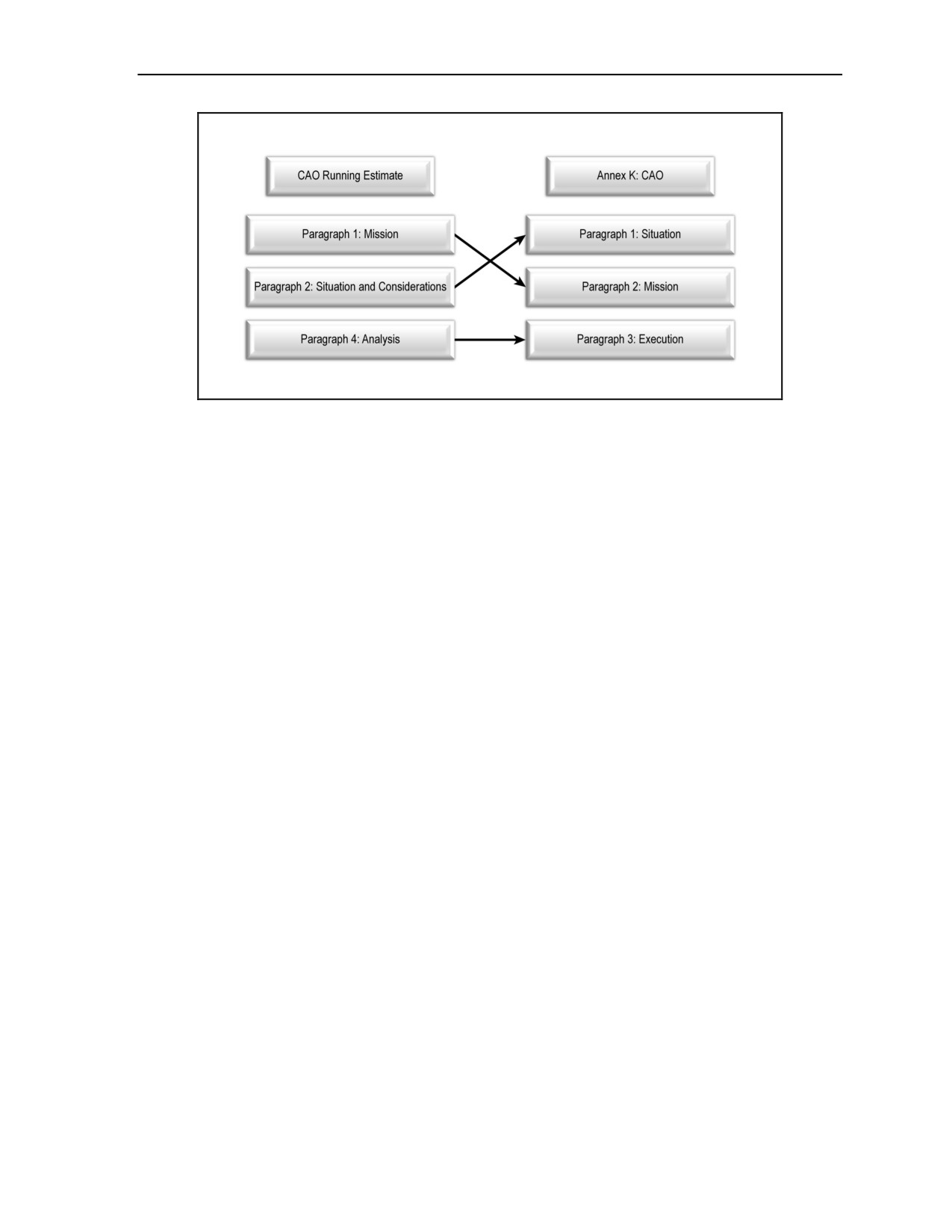
to complete Annex K (Civil Affairs Operations) of the OPLAN/OPORD (Figure B-2, page B-7).
B-6
FM 3-57
31 October 2011
Civil Affairs Operations Running Estimate
Figure B-2. Civil Affairs operations running estimate contributions to Annex K
RUNNING ESTIMATE BRIEFINGS
B-17. Planners may present the CAO running estimate as a briefing to provide civil considerations
information to the commander and staff. The planner uses the briefing to elaborate on the key points he
derived from preparing the running estimate, focusing principally on CAO strengths and vulnerabilities and
what support CAO can provide to the COAs. The briefing is part of either the mission analysis briefing
(paragraphs 1 and 2) or part of the commander’s decision briefing (paragraphs 3 through 6). The briefing
includes all the information in paragraph 1 and a summary of the information in paragraphs 2 through 6 of
the CAO running estimate.
SUMMARY
B-18. The CAO running estimate is both a process and a product. The process calls for a disciplined
approach to collecting, processing, and analyzing information, as well as recording the results. Automated
tools, such as databases and word processing programs, give the CAO planner the flexibility and
responsiveness necessary to tailor the estimate to meet a variety of requirements. The CAO running
estimate is a living document that the planner continuously refines as additional information becomes
available. A current running estimate allows the CAO planner to quickly provide accurate information to
meet planning requirements as they change.
31 October 2011
FM 3-57
B-7
Glossary
The Glossary lists acronyms and terms with Army, multi-Service, or joint definitions, and other selected terms.
Terms for which FM 3-57 is the proponent manual (the authority) are marked with an asterisk (*). The
proponent manual for other terms is listed in parentheses after the definition.
SECTION I - ACRONYMS AND ABBREVIATIONS
A
airborne
AD3E
assess, decide, detect and deliver, evaluate
ADP
Army doctrine publication
AO
area of operations
AOR
area of responsibility
ARFOR
Army forces
ARSOF
Army special operations forces
ASCC
Army Service component command
ASCOPE
areas, structures, capabilities, organizations, people, and events
BCT
brigade combat team
CA
Civil Affairs
CACOM
Civil Affairs command
CAO
Civil Affairs operations
CAP
crisis action planning
CAPT
Civil Affairs planning team
CAT
Civil Affairs team
CCDR
combatant commander
CCIR
commander’s critical information requirement
CERP
commander’s emergency response program
CIM
civil information management
CJ-9
civil-military operations directorate of a combined joint staff
CJCS
Chairman of the Joint Chiefs of Staff
CLT
civil liaison team
CME
civil-military engagement
CMO
civil-military operations
CMOC
civil-military operations center
CMOWG
civil-military operations working group
CMSE
civil-military support element
COA
course of action
COCOM
combatant command
COG
center of gravity
COIC
current operations integration cell
COIN
counterinsurgency
COM
chief of mission
CONOPS
concept of operations
31 October 2011
FM 3-57
Glossary-1
Glossary
CONPLAN
concept plan
CONUS
continental United States
COP
common operational picture
CR
civil reconnaissance
DA
Department of the Army
DC
dislocated civilian
DCO
defense coordinating officer
DOD
Department of Defense
DODD
Department of Defense Directive
DODI
Department of Defense Instruction
DOS
Department of State
DSCA
defense support of civil authorities
FHA
foreign humanitarian assistance
FID
foreign internal defense
FM
field manual
FN
foreign nation
FOG
Field Operations Guide
FORSCOM
United States Army Forces Command
FRAGO
fragmentary order
FY
fiscal year
G-2
assistant chief of staff, intelligence
G-3
assistant chief of staff, operations
G-4
assistant chief of staff, logistics
G-5
assistant chief of staff, plans
G-7
assistant chief of staff, information engagement
G-9
assistant chief of staff, Civil Affairs operations
GCC
geographic combatant commander
GIG
global information grid
HA
humanitarian assistance
HCA
humanitarian civic assistance
HHC
headquarters and headquarters company
HN
host nation
HQ
headquarters
ICRC
International Committee of the Red Cross
IDAD
internal defense and development
IDP
internally displaced person
IGO
intergovernmental organization
IPB
intelligence preparation of the battlefield
IPI
indigenous populations and institutions
J-2
intelligence directorate of a joint staff
J-3
operations directorate of a joint staff
Glossary-2
FM 3-57
31 October 2011
Glossary
J-4
logistics directorate of a joint staff
J-5
plans directorate of a joint staff
J-9
civil-military operations directorate of a joint staff
JCMOTF
joint civil-military operations task force
JFC
joint force commander
JFLCC
joint force land component commander
JFSOC
joint force special operations component
JOA
joint operational area
JOPES
Joint Operation Planning and Execution System
JOPP
joint operation planning process
JP
joint publication
JSCP
Joint Strategic Capabilities Plan
JSOA
joint special operations area
JSOTF
joint special operations task force
JTF
joint task force
MCA
military civic action
MDMP
military decisionmaking process
MEB
maneuver enhancement brigade
METT-TC
mission, enemy, terrain and weather, troops and support available—time
available, and civil considerations
MISO
Military Information Support operations
MOE
measure of effectiveness
MOP
measure of performance
NA
nation assistance
NATO
North Atlantic Treaty Organization
NEO
noncombatant evacuation operations
NGO
nongovernmental organization
NIMS
National Incident Management System
NRF
National Response Framework
NSPD
national security Presidential directive
OFDA
Office of U.S. Foreign Disaster Assistance
OGA
other government agency
OHDACA
Overseas Humanitarian Disaster and Civic Aid
OPCON
operational control
OPLAN
operation plan
OPORD
operation order
PA
public affairs
PIR
priority intelligence requirement
PMESII-PT
political, military, economic, social, information, infrastructure, physical
environment, time
POC
point of contact
PRC
populace and resources control
31 October 2011
FM 3-57
Glossary-3
Glossary
PRT
provincial reconstruction team
ROE
rules of engagement
S-1
personnel staff officer
S-2
intelligence staff officer
S-3
operations staff officer
S-4
logistics staff officer
S-7
information engagement staff officer
S-9
Civil Affairs operations staff officer
SA
security assistance
SCA
support to civil administration
SecDef
Secretary of Defense
SF
Special Forces
SFA
security force assistance
SFG
Special Forces group
SFOD
Special Forces operational detachment
SOTF
special operations task force
SJA
staff judge advocate
SME
subject-matter expert
SO
special operations
SOF
special operations forces
SOP
standing operating procedure
SR
special reconnaissance
TC
training circular
TJAG
the judge advocate general
TSCP
theater security cooperation plan
TSOC
theater special operations command
UN
United Nations
UNHCR
United Nations High Commissioner for Refugees
U.S.
United States
USACAPOC
United States Army Civil Affairs and Psychological Operations
Command
USAFRICOM
United States Africa Command
USAID
United States Agency for International Development
USAJFKSWCS
United States Army John F. Kennedy Special Warfare Center and School
USAR
United States Army Reserve
USASOC
United States Army Special Operations Command
USC
United States Code
USCENTCOM
United States Central Command
USEUCOM
United States European Command
USG
United States Government
USNORTHCOM
United States Northern Command
USPACOM
United States Pacific Command
Glossary-4
FM 3-57
31 October 2011
Glossary
USSOCOM
United States Special Operations Command
USSOUTHCOM
United States Southern Command
UW
unconventional warfare
WMD
weapons of mass destruction
SECTION II - TERMS
area assessment
The commander’s prescribed collection of specific information that commences upon employment and
is a continuous operation. It confirms, corrects, refutes, or adds to previous intelligence acquired from
area studies and other sources prior to employment. (JP 3-05)
center of gravity
The source of power that provides moral or physical strength, freedom of action or will to act. Also
called COG. (JP 3-0)
civil administration
An administration established by a foreign government in (1) friendly territory, under an agreement
with the government of the area concerned, to exercise certain authority normally the function of the
local government; or (2) hostile territory, occupied by United States forces, where a foreign
government exercises executive, legislative, and judicial authority until an indigenous civil
government can be established. (JP 3-05)
Civil Affairs
Designated Active and Reserve component forces and units organized, trained, and equipped
specifically to conduct civil affairs operations and to support civil-military operations. Also called CA.
(JP 3-57)
Civil Affairs operations
Those military operations conducted by civil affairs forces that (1) enhance the relationship between
military forces and civil authorities in localities where military forces are present; (2) require
coordination with other interagency organizations, intergovernmental organizations, nongovernmental
organizations, indigenous populations and institutions, and the private sector; and (3) involve
application of functional specialty skills that normally are the responsibility of civil government to
enhance the conduct of civil-military operations. Also called CAO. (JP 3-57)
*Civl Affairs operations project management
The six step process by which Civil Affairs forces identify, validate, plan, coordinate, facilitate, and
monitor both material and nonmaterial Civil Affairs operations projects to achieve a supported
commander’s objectives relating to the civil component of the operational environment. (FM 3-57)
*civil assistance
Assistance, based on a commander’s decision, in which life-sustaining services are provided, order is
maintained, and/or goods and services are distributed within the commander’s assigned area of
operations. (FM 3-57)
civil considerations
The influence of man-made infrastructure, civilian institutions, and attitudes and activities of the
civilian leaders, populations, and organizations within an area of operations on the conduct of military
operations. (FM 6-0)
*civil information
Information developed from data with relation to civil areas, structures, capabilities, organization,
people, and events within the civil component of the commander’s operational environment that can be
fused or processed to increase Department of Defense/Interagency/intergovernmental
organizations/nongovernmental organizations/indigenous populations and institutions situational
awareness, situational understanding, or situational dominance. (FM 3-57)
31 October 2011
FM 3-57
Glossary-5
Glossary
*civil information management
Process whereby civil information is collected, entered into a central database, and internally fused
with the supported element, higher headquarters, other United States Government and Department of
Defense agencies, intergovernmental organizations, and nongovernmental organizations to ensure the
timely availability of information for analysis and the widest possible dissemination of the raw and
analyzed civil information to military and nonmilitary partners throughout the area of operations. Also
called CIM. (FM 3-57)
*civil liaison team
Provides limited civil-military interface capability as a spoke for the exchange of information between
indigenous populations and institutions, intergovernmental organizations, nongovernmental
organizations, and other governmental agencies, and has limited capability to link resources to
prioritized requirements. The civil liaison team is a stand-alone team for the civil-military operations
center. It provides the supported level civil-military operations center with a storefront for Civil Affairs
operations and civil-military operations coordination capability without interfering with the regular
staff functions. Also called CLT. (FM 3-57)
*civil-military engagement
A formal program that facilitates the U.S. interagency, host nation indigenous authorities, select
intergovernmental and nongovernmental partners, and the private sector to build, replace, repair, and
sustain civil capabilities and capacities that eliminate, reduce, or mitigate civil vulnerabilities to local
and regional populations. Civil-military engagement is a globally synchronized and regionally
coordinated program of country-specific and regional actions executed through and with indigenous
and U.S. interagency partners to eliminate the underlying conditions and core motivations for local and
regional population support to violent extremist organizations and their networks. Also called CME.
(FM 3-57)
civil-military operations
The activities of a commander that establish, maintain, influence, or exploit relations between military
forces, governmental and nongovernmental civilian organizations and authorities, and the civilian
populace in a friendly, neutral, or hostile operational area in order to facilitate military operation to
consolidate and achieve operational U.S. objectives. Civil-military operations may include
performance by military forces of activities and functions normally the responsibility of local, regional,
or national government. These activities may occur prior to, during, or subsequent to other military
actions. They may also occur, if directed, in the absence of other military operations. Civil-military
operations may be performed by designated Civil Affairs, by other military forces, or by a combination
of Civil Affairs and other forces. Also called CMO. (JP 3-57)
civil-military operations center
An organization normally comprised of civil affairs established to plan and facilitate coordination of
activities of the Armed Forces of the United States with indigenous populations and institutions, the
private sector, intergovernmental organizations, nongovernmental organizations, multinational forces,
and other governmental agencies in support of the joint force commander. Also called CMOC.
(JP 3-57)
*civil-military support element
A task-organized Civil Affairs force that conducts civil-military engagement in a specified country or
region. A civil-military support element is composed of a persistent-presence element of Civil Affairs
leaders/planners, and a presence-for-purpose element composed of a Civil Affairs Team(s) that may
include enablers (for example, health service support, engineer, etc.) who are task organized for a
specific time to execute a coordinated mission. Also called CMSE. (FM 3-57)
*civil reconnaissance
A targeted, planned, and coordinated observation and evaluation of those specific civil aspects of the
environment. Civil reconnaissance focuses specifically on the civil component, the elements of which
are best represented by the mnemonic ASCOPE: areas, structures, capabilities, organizations, people,
and events. Civil reconnaissance can be conducted by Civil Affairs or by other forces, as required.
Also called CR. (FM 3-57)
Glossary-6
FM 3-57
31 October 2011
Glossary
country team
The senior, in-country U.S. coordinating and supervising body, headed by the chief of the U.S.
diplomatic mission, and composed of the senior member of each represented U.S. department or
agency as desired by the chief of the U.S. diplomatic mission. (JP 3-07.4)
defense support of civil authorities
Support provided by U.S. Federal military forces, Department of Defense civilians, Department of
Defense contract personnel, Department of Defense component assets, and National Guard forces
(when the Secretary of Defense, in coordination with the governors of the affected sates, elects and
requests to use those forces in Title 32, Untied States Code, status) in response to requests for
assistance from civil authorities for domestic emergencies, law enforcement support, and other
domestic activities, or from qualifying entities for special events. Also called DSCA. (DODD 3025.18)
deployable joint task force augmentation cell
A combatant commander’s asset composed of personnel from the regional combatant commander’s
staff and component representatives. The members represent a multi-Service, multi-disciplined group
of planners and operators who operationally report to the regional combatant commander’s Operation
Directorate until deployed to a joint task force. A cell can be tailored to meet the needs of a
commander, joint task force, and deploy within 48 hours from notification. Members can also act as
liaison officers between the regional combatant commander and the joint task force. Also known as
DJTFAC. (JP 3-0)
dislocated civilian
A broad term primarily used by the Deparment of Defense that includes a displaced person, an
evacuee, an internally displaced person, a migrant, a refugee, or a stateless person. Also called DC.
(JP 3-29)
displaced person
A broad term used to refer to internally and externally displaced persons collectively. (JP 3-29)
effect
1. The physical or behavioral state of a system that results from an action, a set of actions, or another
effect. 2. The result, outcome, or consequence of an action. 3. A change to a condition, behavior, or
degree of freedom. (JP 3-0)
foreign humanitarian assistance
Department of Defense activities, normally in support of the United States Agency for International
Development or Department of State, conducted outside the United States, its territories, and
possessions to relieve or reduce human suffering, disease, hunger, or privation. Also called FHA.
(JP 3-29)
foreign internal defense
Participation by civilian and military agencies of a government in any of the action programs taken by
another government or other designated organization to free and protect its society from subversion,
lawlessness, insurgency, terrorism, and other threats to its security. Also called FID. (JP 3-22)
hostile environment
Operational environment in which hostile forces have control as well as the intent and capability to
effectively oppose or react to the operations a unit intends to conduct. (JP 3-0)
host nation
A nation that receives the forces and/or supplies of allied nations, and/or NATO organizations to be
located on, to operate in, or to transit through its territory. Also called HN. (JP 3-57)
host nation support
Civil and/or military assistance rendered by a nation to foreign forces within its territory during
peacetime, crises or emergencies, or war based on agreements mutually concluded between nations.
Also called HNS. (JP 4-0)
31 October 2011
FM 3-57
Glossary-7
Glossary
humanitarian and civic assistance
Assistance to the local populace provided by predominantly United States forces in conjunction with
military operations and exercises. This assistance is specifically authorized by 10 USC 401, and funded
under separate authorities. Also called HCA. (JP 3-29)
humanitarian assistance coordination center
A temporary center established by a geographic combatant commander to assist with interagency
coordination and planning. A humanitarian assistance coordination center operates during the early
planning and coordination stages of foreign humanitarian assistance operations by providing the link
between the geographic combatant commander and other United States Government agencies,
nongovernmental organizations, and international and regional organizations at the strategic level.
Also called HACC. (JP 3-29)
*indigenous populations and institutions
The civilian construct of an area of operations, to include its population (legal citizens, legal and illegal
immigrants, and all categories of dislocated civilians), governmental, tribal, commercial, and private
organizations and entities. Also called IPI. (FM 3-57)
information superiority
The operational advantage derived from the ability to collect, process, and disseminate an
uninterrupted flow of information while exploiting or denying an adversary’s ability to do the same.
Also called IS. (JP 3-13)
insurgency
The organized use of subversion and violence by a group or movement that seeks to overthrow or force
change of a governing authority. Insurgency can also refer to the group itself. (JP 3-24)
internal defense and development
The full range of measures taken by a nation to promote its growth and to protect itself from
subversion, lawlessness, insurgency, terrorism, and other threats to its security. Also called IDAD.
(JP 3-22)
internally displaced person
Any person who has been forced or obliged to flee or to leave their home or places of habitual
residence, in particular as a result of or in order to avoid the effects of armed conflict, situations of
generalized violence, violations of human rights or natural or human-made disasters, and who have not
crossed an internationally recognized state border. (JP 3-29)
joint task force
A joint force that is constituted and so designated by the Secretary of Defense, a combatant commander, a
subunified commander, or an existing joint task force commander. Also called JTF. (JP 1)
knowledge management
The art of creating, organizing, applying, and transferring knowledge to facilitate situational
understanding and decisionmaking. Knowledge management supports improving organizational
learning, innovation, and performance. Its processes ensure that knowledge products and services are
relevant, accurate, timely, and usable to commanders and decisionmakers. Also called KM.
link
The behavioral, physical, or functional relationship between the nodes. (JP 3-0)
measure of effectiveness
A criterion used to assess changes in system behavior, capability, or operational environment that is
tied to measuring the attainment of an end state, achievement of an objective, or creation of an effect.
Also called MOE. (JP 3-0)
measure of performance
A criterion to assess friendly actions that is tied to measuring task accomplishment. Also called MOP.
(JP 3-0)
Glossary-8
FM 3-57
31 October 2011
Glossary
military civic action
The use of preponderantly indigenous military forces on projects useful to the local population at all
levels in such fields as education, training, public works, agriculture, transportation, communications,
health, sanitation, and others contributing to economic and social development, which would also serve
to improve the standing of the military forces with the population. (U.S. forces may at times advise or
engage in military civic actions in overseas areas.) (JP 3-57)
nation assistance
Civil and/or military assistance rendered to a nation by foreign forces within that nation’s territory
during peacetime, crises or emergencies, or war based on agreements mutually concluded between
nations. Nation assistance programs include, but are not limited to, security assistance, foreign internal
defense, other Title 10, U.S. Code programs, and activities performed on a reimbursable basis by
Federal agencies or intergovernmental organizations. (JP 3-0)
operational environment
A composite of the conditions, circumstances, and influences which affect the employment of
capabilities and bear on the decisions of the commander. Also called OE. (JP 3-0)
permissive environment
Operational environment in which host country military and law enforcement agencies have control as
well as the intent and capability to assist operations that a unit intends to conduct. (JP 3-0)
*populace and resources control
Operations which provide security for the populace, deny personnel and materiel to the enemy,
mobilize population and materiel resources, and detect and reduce the effectiveness of enemy agents.
Populace control measures include curfews, movement restrictions, travel permits, registration cards,
and resettlement of civilians. Resource control measures include licensing, regulations or guidelines,
checkpoints (for example, road blocks), ration controls, amnesty programs, and inspection of facilities.
Most military operations employ some type of PRC measures. Also called PRC. (FM 3-57)
priority intelligence requirement
An intelligence requirement, stated as a priority for intelligence support, that the commander and staff
need to understand the adversary or operational environment. Also called PIR. (JP 2-0)
reachback
The process of obtaining products, services, and applications, or forces, or equipment, or material from
organizations that are not forward deployed. (JP 3-30)
refugee
A person who owing to a well-founded fear of being persecuted for reasons of race, religion,
nationality, membership of a particular social group or political opinion, is outside the country of his or
her nationality and is unable or, owing to such fear, is unwilling to avail himself or herself of the
protection of that country. (JP 3-29)
risk management
The process of identifying, assessing, and controlling risks arising from operational factors and making
decisions that balance risk cost with mission benefits. Also called RM. (JP 2-0)
security assistance
Group of programs authorized by the Foreign Assistance Act of 1961, as amended, and the Arms
Export Control Act of 1976, as amended, or other related statutes by which the United States provides
defense articles, military training, and other defense-related services by grant, loan, credit, or cash sales
in furtherance of national policies and objectives. Security assistance is an element of security
cooperation funded and authorized by Department of State to be administered by Department of
Defense/Defense Security Cooperation Agency. Also called SA. (JP 3-22)
security assistance organization
(DOD) All Department of Defense elements located in a foreign country with assigned responsibilities
for carrying out security assistance management functions. It includes military assistance advisory
groups, military missions and groups, offices of defense and military cooperation, liaison groups, and
31 October 2011
FM 3-57
Glossary-9
Glossary
defense attaché personnel designated to perform security assistance functions. Also called SAO.
(JP 1-02)
special operations
Operations conducted in hostile, denied, or politically sensitive environments to achieve military,
diplomatic, informational, and/or economic objectives employing military capabilities for which there
is no broad conventional force requirement. These operations often require covert, clandestine, or low
visibility capabilities. Special operations are applicable across the range of military operations. They
can be conducted independently or in conjunction with operations of conventional forces or other
government agencies and may include operations through, with, or by indigenous or surrogate forces.
Special operations differ from conventional operations in degree of physical and political risk,
operational techniques, mode of employment, independence from friendly support, and dependence on
detailed operational intelligence and indigenous assets. Also called SO. (JP 3-05)
stability operations
An overarching term encompassing various military missions, tasks, and activities conducted outside
the United States in coordination with other instruments of national power to maintain or reestablish a
safe and secure environment, provide essential government services, emergency infrastructure
reconstruction, and humanitarian relief. (JP 3-0)
*support to civil administration
Assistance given by U.S. armed forces to stabilize or to continue the operations of the governing body
or civil structure of a foreign country, whether by assisting an established government or by
establishing military authority over an occupied population. Also called SCA. (FM 3-57)
terrorism
The unlawful use of violence or threat of violence to instill fear and coerce governments or societies.
Terrorism is often motivated by religious, political, or other ideological beliefs and committed in the
pursuit of goals that are usually political. (JP 3-07.2)
threat
The ability of an enemy or potential enemy to limit, neutralize, or destroy the effectiveness of a current
or projected mission, organization, or item of equipment. (TRADOC Reg 381-1)
uncertain environment
Operational environment in which host government forces, whether opposed to or receptive to
operations that a unit intends to conduct, do not have totally effective control of the territory and
population in the intended operational area. (JP 3-0)
unconventional warfare
Activities conducted to enable a resistance movement or insurgency to coerce, disrupt, or overthrow a
government or occupying power by operating through or with an underground, auxiliary, and guerrilla
force in a denied area. Also called UW. (FM 3-05)
unified command
A command with a broad continuing mission under a single commander and composed of significant
assigned components of two or more Military Departments that is established and so designated by the
President, through the Secretary of Defense with the advice and assistance of the Chairman of the Joint
Chiefs of Staff. Also called unified combatant command. (JP 1)
Glossary-10
FM 3-57
31 October 2011
References
REQUIRED REFERENCES
These documents must be available to intended users of this publication.
ARMY PUBLICATIONS
FM 1-02, Operational Terms and Graphics, 21 September 2004.
JOINT PUBLICATIONS
JP 1-02, Department of Defense Dictionary of Military and Associated Terms, 8 November 2010.
RELATED PUBLICATIONS
These documents contain relevant supplemental information.
ARMY PUBLICATIONS
ADP 3-0, Unified Land Operations, 11 October 2011.
ATTP 3-18.04, Special Forces Special Reconnaissance Tactics, Techniques, and Procedures,
5 January 2011.
FM 1-04, Legal Support to the Operational Army, 15 April 2009.
FM 3-05.30, Psychological Operations, 15 April 2005.
FM 3-05.131, Army Special Operations Forces Noncombatant Evacuation Operations,
16 November 2009.
FM 3-05.2, Foreign Internal Defense, 1 September 2011.
FM 3-05.301, Psychological Operations Process Tactics, Techniques, and Procedures, 30 August
2007.
FM 3-05.401, Civil Affairs Tactics, Techniques, and Procedures, 5 July 2007.
FM 3-07, Stability Operations, 6 October 2008.
FM 3-11.21, Multiservice Tactics, Techniques, and Procedures for Chemical, Biological,
Radiological, and Nuclear Consequence Management Operations, 1 April 2008.
FM 3-28.1, Multiservice Tactics, Techniques, and Procedures for Civil Support Operations,
3 December 2007.
FM 3-39, Military Police Operations, 16 February 2010.
FM 3-39.40, Internment and Resettlement Operations, 12 February 2010.
FM 5-0, The Operations Process, 26 March 2010.
FM 5-19, Composite Risk Management, 21 August 2006.
TC 18-01, Special Forces Unconventional Warfare, 28 January 2011.
ARMY FORMS
DA Forms are available on the Army Publishing Directorate web site (www.apd.army.mil).
DA Form 2028 (Recommended Changes to Publications and Blank Forms).
DEPARTMENT OF DEFENSE DIRECTIVES AND INSTRUCTIONS
DODD 2000.13, Civil Affairs, 27 June 1994.
DODD 3000.07, Irregular Warfare (IW), 1 December 2008.
DODD 3025.18, Defense Support of Civil Authorities (DSCA), 29 December 2010.
DODI 2205.02, Humanitarian and Civic Assistance (HCA) Activities, 2 December 2008.
DODI 3000.05, Stability Operations, 16 September 2009.
31 October 2011
FM 3-57
References-1
References
EXECUTIVE ORDERS AND OTHER PRESIDENTIAL DIRECTIVES
Executive Order 12148, Federal Emergency Management, 20 July 1979.
Executive Order 12656, Assignment of Emergency Preparedness Responsibilities, 18 November 1988.
Homeland Security Presidential Directive-5, Management of Domestic Incidents, 28 February 2003.
NSPD 44, Management of Interagency Efforts Concerning Reconstruction and Stabilization,
7 December 2005.
JOINT PUBLICATIONS
CJCSI 3214.01C, Military Support to Foreign Consequence Management Operations for Chemical,
Biological, Radiological, and Nuclear Incidents, 11 January 2008.
JP 3-0, Joint Operations, 11 August 2011.
JP 3-05, Special Operations, 18 April 2011.
JP 3-13.2, Psychological Operations, 7 January 2010.
JP 3-16, Multinational Operations, 7 March 2007.
JP 3-22, Foreign Internal Defense, 12 July 2010.
JP 3-28, Civil Support, 14 September 2007.
JP 3-29, Foreign Humanitarian Assistance, 17 March 2009.
JP 3-33, Joint Task Force Headquarters, 16 February 2007.
JP 3-57, Civil-Military Operations, 8 July 2008.
JP 3-68, Noncombatant Evacuation Operations, 23 December 2010.
JP 5-0, Joint Operation Planning, 11 August 2011.
UNITED STATES CODES
United States codes are available at http://www.gpoaccess.gov/uscode/index.html
10 USC 166a, Combatant Commands Funding Through the Chairman of the Joint Chiefs of Staff,
3 January 2007.
10 USC 168, Military-to-Military Contacts and Comparable Activities, 3 January 2007.
10 USC 401, Humanitarian and Civic Assistance Provided in Conjunction With Military Operations,
3 January 2007.
10 USC 407, Humanitarian Demining Assistance: Authority Limitation, 3 January 2007.
10 USC 3037, Judge Advocate General, Assistant Judge Advocate General, and General Officers of
Judge Advocate General’s Corps: Appointment; Duties, 3 January 2007.
22 USC 2292-2292k, Foreign Assistance, 3 January 2007.
OTHER
Field Operations Guide (FOG) for Disaster Assistance and Response, September 2005, can be
downloaded from the following link:
References-2
FM 3-57
31 October 2011