FM 3-57 Civil Affairs Operations (October 2011) - page 2
Chapter 2
Capabilities
2-66. The rule of law section is organized to—
z
Determine the capabilities and effectiveness of the HN legal systems and the impact of those on
joint force CMO strategy.
z
Evaluate the HN legal system, to include reviewing statutes, codes, decrees, regulations,
procedures, and legal traditions for compliance with international standards, and advising and
assisting the HN and other rule of law participants in the process of developing transitional
codes and procedures and long-term legal reform.
z
Evaluate the personnel, judicial infrastructure, and equipment of the HN court system to
determine requirements for training, repair, construction, and acquisition.
z
Provide support to transitional justice, to include acting as judges, magistrates, prosecutors,
defense counsels, legal advisors, and court administrators when required.
z
Coordinate rule of law efforts involving U.S. and coalition military, other U.S. agencies, IGOs,
NGOs, and HN authorities.
z
Assist the SJA in educating and training U.S. personnel in the indigenous legal system,
obligations, and consequences.
z
Advise and assist the SJA in international and HN legal issues as required.
z
Assist the SJA with regard to status-of-forces agreement and status-of-mission agreement issues.
z
Advise and assist in establishing the technical requirements for government public safety
systems to support penal systems’ administration.
ECONOMIC STABILITY FUNCTIONAL SPECIALTY AREA
2-67. The economic stability section consists of functional specialists in economic fields and business
administration. It provides technical expertise, staff advice, and planning assistance to the supported
command. The section assesses government, corporate, and private resources and systems. Using these
assessments, based on the civilian skills of its members, the team determines how to assist in the efficient
management of resources, goods, and services to enhance the viability of the society’s economic system.
The economic stability section provides recommendations and, when appropriate, directions to maintain,
sustain, and improve economic systems and services. Skills found in this section include economists,
bankers, civilian supply and distribution technicians, business administrators, entrepreneurs, agriculturalists
and farmers, food specialists and technicians, marketing and distribution specialists, and other officer and
enlisted personnel whose civilian skills make them suitable for improving a nation’s economic system.
Functions
2-68. The economic stability section has a number of functions; specifically, this section—
z
Develops plans, policies, and procedures and provides operational oversight and supervision in
rehabilitating or establishing food and agricultural systems, and agencies for producing,
processing, storing, transporting, distributing, and marketing.
z
Coordinates the use of indigenous government and commercial food and agricultural resources
for military use, for CMO, and in support of government administration.
z
Assists in coordinating IPI, IGOs, NGOs, and U.S. assistance and resources to support food and
agricultural systems as part of CMO (crop and livestock improvement, agricultural training, and
education).
z
Develops plans, policies, and procedures and provides operational oversight and supervision in
rehabilitating or establishing economic and commercial systems, agencies, and resources.
z
Develops and implements plans to reduce or mitigate black-market activities.
z
Conducts liaison and coordinates with local government administration agencies and commercial
enterprises in support of CAO.
z
In coordination with the SJA, ensures compliance with international laws and conventions
regarding use of labor and when acquiring and using local resources (supplies, equipment, and
facilities).
2-20
FM 3-57
31 October 2011
Civil Affairs Organization
z
Develops plans and provides operational oversight and supervision in rehabilitating or
establishing government and commercial supply systems and facilities.
z
Facilitates the coordination of government, commercial, and private property, facilities, supplies,
equipment, and other resources for military use, CAO, and government administration.
z
In coordination with the SJA, establishes policies and procedures on custody and administration
of public and private property.
Capabilities
2-69. The economic stability section is organized to—
z
Provide technical expertise, advice, and assistance in identifying and assessing food and
agriculture systems, agencies, services, personnel, resources, and facilities.
z
Determine the capabilities and effectiveness of food and agricultural systems and the impact of
those systems on CAO.
z
Advise and assist in establishing the technical requirements for food and agricultural resources
(livestock, poultry, grain, vegetables, fruit, fish, fiber, and forestry) management to support
government administration.
z
Advise and assist in rehabilitating, establishing, delivering, and maintaining food and
agricultural systems and agencies.
z
Assist in coordinating IPI, IGOs, NGOs, and U.S. assistance and resources to support food and
agricultural systems as part of CAO (crop and livestock improvement, agricultural training, and
education).
z
Provide technical expertise, advice, and assistance in monitoring and assessing the indigenous
economy, economic systems, commercial activities, agencies, services, personnel, and resources.
z
Determine the capabilities and effectiveness of economic systems and the impact of those
systems on CAO.
z
Advise and assist with budgetary systems, monetary and fiscal policies, revenue-producing
systems, and treasury operations.
z
Advise and assist in restoring, establishing, organizing, and operating economic and commerce
systems, agencies, and organizations.
z
Advise and assist in the technical administrative requirements of employing economic controls
(price controls, rationing programs, prevention of black-market activities, monetary and fiscal
policies, and labor).
z
Advise and assist in employing local commercial resources, including labor, to support
government administration, CMO, and military use.
z
Assist in coordinating IPI, IGOs, NGOs, and U.S. assistance and resources to support local
economic development as part of CMO.
z
Advise and assist the SJA and contracting officials concerning indigenous peoples’ cultural
intricacies.
z
Provide technical expertise, advice, and assistance in identifying and assessing public and
commercial supply systems, agencies, services, personnel, resources, and facilities.
z
Determine the capabilities and effectiveness of civilian supply systems and the impact of those
systems on CAO.
z
Determine the availability of local supplies.
z
Identify private and public property available for military use.
z
Advise and assist in rehabilitating, establishing, and maintaining government and commercial
supply systems and agencies.
z
Advise and assist in the technical administrative requirements for government and commercial
supply resources to support government administration (transportation, storage, distribution
[including rationing], and the use of captured and salvaged items).
31 October 2011
FM 3-57
2-21
Chapter 2
INFRASTRUCTURE FUNCTIONAL SPECIALTY AREA
2-70. The infrastructure section consists of functional specialists in public works, transportation, utilities,
and communications. It provides technical expertise, staff advice, and planning assistance to the supported
command. The section assesses the indigenous public infrastructure and systems. Using these assessments
and the civilian skills of its members, the team, in coordination with United States Army corps of
Engineers, USAID, HN officials, and vetted contractors, determines methods to design, build, and maintain
the organizations, the architecture, and the systems required to support transportation, water, sanitation,
communications, and power. The infrastructure section provides recommendations and, when appropriate,
directions to maintain, sustain, and improve the indigenous public systems and services, such as
transportation, utilities, and postal systems. Some skills required in this section include engineers (civil,
mechanical, electrical, and environmental); water and sanitation specialists; electrical distribution
specialists and administrators; road construction, telephone, radio, and television specialists; and other
officers and enlisted personnel whose civilian skills make them suitable for improving a nation’s basic
infrastructure.
Functions
2-71. The infrastructure section has a number of functions; specifically, this section—
z
Develops plans and provides operational oversight and supervision in rehabilitating or
establishing transportation equipment, facilities, and systems.
z
Facilitates the coordination of government and commercial transportation resources for military
use, for CAO, and in support of government administration.
z
Develops plans and provides operational oversight and supervision in rehabilitating or
establishing public works and utilities equipment, facilities, and systems.
z
Facilitates the coordination of government and commercial public works and utilities equipment,
facilities, and systems for military use, for CAO, and in support of government administration.
z
Develops plans and provides operational oversight and supervision in rehabilitating or
establishing communication equipment, facilities, and systems.
z
Facilitates the coordination of government, commercial, and private communication equipment,
facilities, and systems for military use, for CAO, and in support of government administration.
Capabilities
2-72. The infrastructure section is organized to—
z
Provide technical expertise, advice, and assistance in identifying and assessing foreign nation
(FN) or HN public and commercial transportation systems, agencies, services, personnel, and
resources.
z
Determine capabilities and effectiveness of transportation systems and the impact of those
systems on CAO.
z
Advise and assist in establishing the technical requirements for government and commercial
transportation resources to support government administration (motor vehicles and roads, trains
and railways, boats and waterways, aircraft and airports, and pipelines).
z
Advise and assist in rehabilitating, establishing, and maintaining government transportation
systems and agencies.
z
Provide technical expertise, advice, and assistance in identifying and assessing FN or HN public
and commercial works and utilities systems, agencies, services, and facilities.
z
Determine capabilities and effectiveness of public works and utilities systems and the impact of
those systems on CAO.
z
Advise and assist in establishing the technical requirements for government and commercial
works and utilities resources to support government administration (electric power; natural gas;
water production and distribution; sewage collection, treatment, and disposal; sanitation; and
public facilities).
z
Advise and assist in rehabilitating, establishing, operating, and maintaining government works
and utilities systems and agencies.
2-22
FM 3-57
31 October 2011
Civil Affairs Organization
z
Assist in employing (coordinating) public works and utilities resources to support government
administration and CAO.
z
Provide technical expertise, advice, and assistance in identifying and assessing government and
commercial communication systems, agencies, services, personnel, resources, and facilities.
z
Determine the capabilities and effectiveness of communication systems and the impact of those
systems on CAO.
z
Advise and assist in establishing the technical requirements for government and commercial
communications resources to support government administration (postal services, telephone,
radio, television, computer systems, and print media).
z
Advise and assist in rehabilitating, establishing, and maintaining government communications
systems and agencies.
GOVERNANCE FUNCTIONAL SPECIALTY AREA
2-73. The governance section consists of functional specialists in public administration and services
(excluding public health and welfare, cultural relations, and education). It provides technical expertise, staff
advice, and planning assistance to the supported command in creating, resourcing, managing, and sustaining
the institutions and processes that govern, protect, and bring prosperity to a society. Some skills required in
this section include public administrators, public safety administrators and managers, environmental
administrators and managers, and other administrators whose civilian duties include upper-level
management of any public institutions at various levels (for example, city, county, local, state, federal).
Functions
2-74. The governance section has a number of functions; specifically, this section—
z
Develops plans and provides operational oversight and supervision in rehabilitating or
establishing public administration systems, agencies, and resources.
z
Develops plans and provides operational oversight and supervision in rehabilitating or
establishing public safety systems, equipment, and facilities.
z
Assists in employing public safety resources to support government administration, CAO, and
military use.
z
Coordinates with HN government administrators and agencies in support of CAO.
z
Develops plans and provides operational oversight and supervision in rehabilitating or
establishing environmental resource management systems, agencies, equipment, and facilities.
z
Coordinates HN government and private environmental management resources for—
Military use.
CAO.
Support of the government administration to mitigate, prepare, respond to, and recover
from environmental activities.
Capabilities
2-75. The governance section is organized to—
z
Provide technical expertise, advice, and assistance in identifying and assessing FN or HN public
administration systems, agencies, services, personnel, and resources.
z
Determine the capabilities and effectiveness of public administration systems and the impact of
those systems on CMO.
z
Provide technical expertise, advice, and assistance in identifying and assessing indigenous public
safety systems, agencies, services, personnel, and resources.
z
Determine the capabilities and effectiveness of public safety systems and the impact of those
systems on the GCC’s or other supported commander’s mission.
z
Advise and assist in establishing the technical requirements for government public safety
systems to support government administration (police and law enforcement administration, fire
protection, and emergency rescue).
31 October 2011
FM 3-57
2-23
Chapter 2
z
Advise and assist in rehabilitating, establishing, and maintaining government public safety
systems and agencies.
z
Advise and assist in restoring, establishing, organizing, and operating public government
systems and agencies.
z
Advise and assist in developing technical administrative requirements, policies, and procedures
for providing government services to the local population.
z
Provide technical expertise, advice, and assistance in identifying and assessing FN
environmental and pollution control systems, agencies, services, personnel, resources, and
facilities.
z
Determine the capabilities and effectiveness of environmental and pollution control systems and
the impact of those systems on CMO.
z
Advise and assist in establishing the technical requirements for environmental management
services and resources to support government administration (plans, policies, and procedures to
protect natural resources and provide pollution control).
z
Advise and assist in rehabilitating, establishing, delivering, and maintaining government
environmental management systems and agencies.
z
Advise, assist, and support the coordination of IPI, IGOs, NGOs, and U.S. assistance and
resources to support local government environmental management as part of CMO.
PUBLIC HEALTH AND WELFARE FUNCTIONAL SPECIALTY AREA
2-76. The public health and welfare section consists of functional specialists qualified in public health and
medical services. It provides technical expertise, staff advice, and planning assistance to the supported
command in creating, resourcing, managing, and sustaining the institutions and processes through which a
society maintains the physical, mental, and social health of its people. Some professions required in this
section include doctors, dentists, hospital administrators, nurses, veterinarians, public health specialists,
environmental scientists and specialists, museum curators, archivists, and others whose civilian duties
include health and welfare management in addition to arts, monuments, and archives.
Functions
2-77. The public health and welfare section has a number of functions; specifically, this section—
z
Develops plans and provides operational oversight and supervision in rehabilitating or
establishing public health systems, agencies, equipment, and facilities.
z
Coordinates the use of IPI government and private sector health resources for use in CMO and in
support of HN government administration.
z
Assists in coordinating IPI, IGOs, NGOs, and U.S. assistance and resources to support local
government public health systems as part of CMO.
z
Develops plans and provides operational oversight and supervision in rehabilitating or
establishing public welfare systems, agencies, equipment, and facilities.
z
Assists in familiarizing, educating, and training U.S. personnel in the FN or HN social, cultural,
religious, ethnic characteristics, codes of behavior, and language.
z
Develops plans and provides operational oversight and supervision in protecting, preserving, and
restoring significant cultural property and facilities (religious buildings, shrines and consecrated
places, museums, monuments, art, archives, and libraries).
z
Assists in locating, identifying, and safeguarding cultural property and in determining ownership.
Capabilities
2-78. The public health and welfare section is organized to—
z
Provide technical expertise, advice, and assistance in identifying and assessing IPI public and
private health systems, animal husbandry systems, sanitation systems, agencies, services,
personnel, resources, and facilities.
2-24
FM 3-57
31 October 2011
Civil Affairs Organization
z
Determine the capabilities and effectiveness of health and sanitation systems and the impact of
those systems on CAO.
z
Advise and assist in establishing the technical requirements for public health services and
resources to support government administration (clinics, hospitals, pharmacies, food preparation
and storage, ambulance transportation, skilled personnel, and education).
z
Advise and assist in rehabilitating, establishing, delivering, and maintaining government public
health systems and agencies.
z
Advise and assist IPI, IGOs, NGOs, and U.S. agencies in preventing, controlling, and treating
diseases among both human and animal populations (education, immunization, and sanitation).
z
Determine the capabilities and effectiveness of public welfare systems regarding the most
vulnerable portion of the population
(mentally handicapped, aged, infirmed, women, and
children) and the impact of those systems on CAO.
z
Advise and assist in rehabilitating, establishing, delivering, and maintaining government public
welfare systems and agencies.
z
Advise and assist in establishing the technical requirements for public welfare services and
resources to support government administration.
z
Provide technical expertise, advice, and assistance on HN social and cultural matters and
determine the impact of those matters on social well-being of the society and the possible effects
on CAO.
z
Advise and assist in locating, identifying, preserving, and protecting significant cultural property.
z
Advise and assist in establishing the technical requirements for government, community, and
private systems and agencies to protect, preserve, and restore cultural property.
z
Advise and assist in rehabilitating, establishing, operating, and maintaining cultural property
systems and agencies.
PUBLIC EDUCATION AND INFORMATION FUNCTIONAL SPECIALTY AREA
2-79. The public education and information section consists of functional specialists in education and
information services. It provides technical expertise, staff advice, and planning assistance to the supported
command in designing, resourcing, and implementing public education and information programs and
systems through media and formal education institutions. Some skills required in this section include
educators at all levels, education specialists, school administrators, public relations personnel, media and
marketing specialists, and others whose civilian duties include education and information management.
Functions
2-80. The public education and information section has a number of functions; specifically, this section—
z
Develops plans and provides operational oversight and supervision in rehabilitating or
establishing public education systems, agencies, facilities, and resources.
z
Develops plans and provides operational oversight and supervision in the use of HN mass
communication in support of CAO and the supported commander’s inform and influence
objectives.
z
Recommends information control and civil censorship policies in occupied territory.
Capabilities
2-81. The public education and information section is organized to—
z
Provide technical expertise, advice, and assistance in identifying and assessing HN public,
parochial, and private education systems, agencies, services, personnel, and resources.
z
Determine the capabilities and effectiveness of education systems and the impact of those
systems on CAO.
z
Advise and assist in establishing the technical requirements for the public education system to
support government administration
(primary, secondary, postsecondary, and technical
educational systems).
31 October 2011
FM 3-57
2-25
Chapter 2
z
Advise and assist in rehabilitating, establishing, and maintaining public education systems and
agencies.
z
Determine the capabilities and effectiveness of government, commercial, and private mass
communication systems and determine the impact of those systems on the populace and the
possible effects on CAO.
z
Provide technical expertise, advice, and assistance in identifying and assessing mass
communication themes and the impact on inform and influence objectives.
z
Advise and assist HN institutions in developing and coordinating public relations activities to
support government administration and the “single voice” message.
CIVIL AFFAIRS BRIGADE (UNITED STATES ARMY RESERVE)
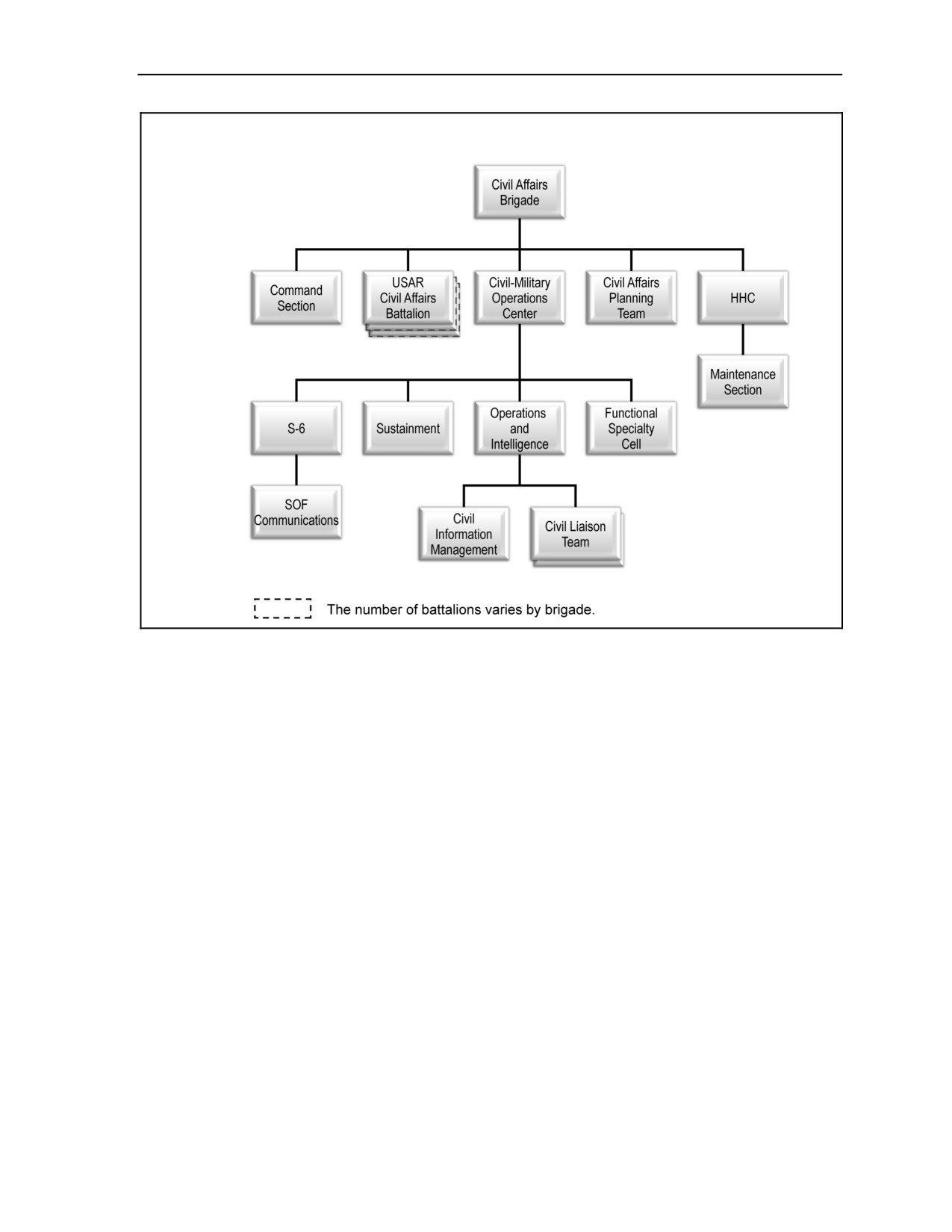
2-82. The CA brigade (USAR) (Figure 2-12, page 2-27) consists of a command section, an HHC, one
CAPT, a CMOC with two CLTs, one functional specialty cell, an operations and intelligence cell, a
communications cell, a sustainment cell, and one or more CA battalions.
2-83. The CA brigade functions as the regionally focused, expeditionary, operational-level CA capability
that supports the Army corps and the JTF HQ. The USAR CA brigade supports the corps and possesses a
CA functional specialist cell not present within the Regular Army CA brigades. The CA brigade focus is
development, reconstruction, and stabilization. The CA brigade enables SCA and is the operational mission
command system structure to form a JCMOTF. The brigade HQ provides mission command and staff
supervision of the operations of the CA brigade and assigned CA battalions or attached units. Its focus is on
tactical and operational employment of CA forces and attached CMO forces. The CA brigade plans,
enables, shapes, and manages CAO by and with IPI, IGOs, NGOs, and OGAs through its CLT. The brigade
has a functional specialty cell with limited capabilities in four of the six functional specialty areas (rule of
law, governance, public health and welfare, and infrastructure). The brigade provides operational-level
support to the corps or an equivalent level Army command/JTF during stability operations.
Functions
2-84. The CA brigade (USAR) has a number of functions; specifically, the brigade—
z
Provides the CA capability to support a corps/ASCC or three-star JTF.
z
Serves as the corps/JTF commander’s senior CA advisor (brigade commander).
z
Establishes an operational-level CMOC that is mission-command-system-capable to support
joint, interagency, multinational, and coalition operations by various means.
z
Serves as a mechanism for civil-military coordination to produce focused civil inputs to the COP.
z
Plans, coordinates, and enables operational-level stability operations in coordination with HN,
IGOs, NGOs, and OGAs focused on the regional to national levels of civil governments.
z
Provides mission command, as well as other CMO capabilities, for CA battalions and companies.
z
Provides cross-cultural communications capability to the supported command, advising the
commander on cultural influences in the AO.
z
Provides the capability to establish core of JCMOTF.
z
Provides the ability to assess, develop, resource, and manage operational-level HA and CAO
spending implementation strategy.
z
Conducts mission command of select operational-level CMO functions and capabilities (forces).
z
Provides regional- to national-level CLT capability.
z
Trains, equips, and deploys assigned or attached CA battalions and companies and other CAO
capabilities.
z
Provides unit-level administration for the brigade.
z
Provides limited sustainment capability for assigned vehicles/communications assets.
2-26
FM 3-57
31 October 2011
Civil Affairs Organization
Figure 2-12. Civil Affairs brigade (United States Army Reserve)
Capabilities
2-85. The CA brigade (USAR) is organized to provide the—
z
Operational-level CAPTs with regionally focused, rapidly deployable CA planning to augment
the staffs of the corps/ASCC or three-star JTF.
z
CMOC with operational-level management, coordination, and synchronization of CAO within
the supported commander’s AO. The CMOC operates over the horizon, away from the
supported unit, as a standing capability by—
Forming the core of the JCMOTF and maintaining mission command system capability.
Serving as the focal point for civil-military coordination for the supported command.
z
CLTs with a regional and national interface capability that includes civil military, HN, and
humanitarian elements in the JOA/AO. The CLT serves as the initial POC for the CA brigade
CMOC, where the military meets with the civilian, HN, and humanitarian community.
z
CIM cell as the focal point for operational-level collation, processing, and dissemination of civil
information; develop operational-level civil inputs to the COP in conjunction with the brigade
CMOC while linking civil information to the appropriate military and civil systems via
geospatially referenced data.
z
Functional specialty cell with a modular package of functional specialty capability for
intermediate-level assessment of threats to a civil component of the environment at the regional
to national level. The organization also allows it to assess mission-planning requirements and
31 October 2011
FM 3-57
2-27
Chapter 2
develop, coordinate, and synchronize resources to meet the immediate need in four of the six
functional areas (rule of law, governance, public health and welfare, and infrastructure).
z
CA augmentation to the interagency integration planning cell or advance civilian team, as
required, during stability operations.
CIVIL AFFAIRS BATTALION (UNITED STATES ARMY RESERVE)
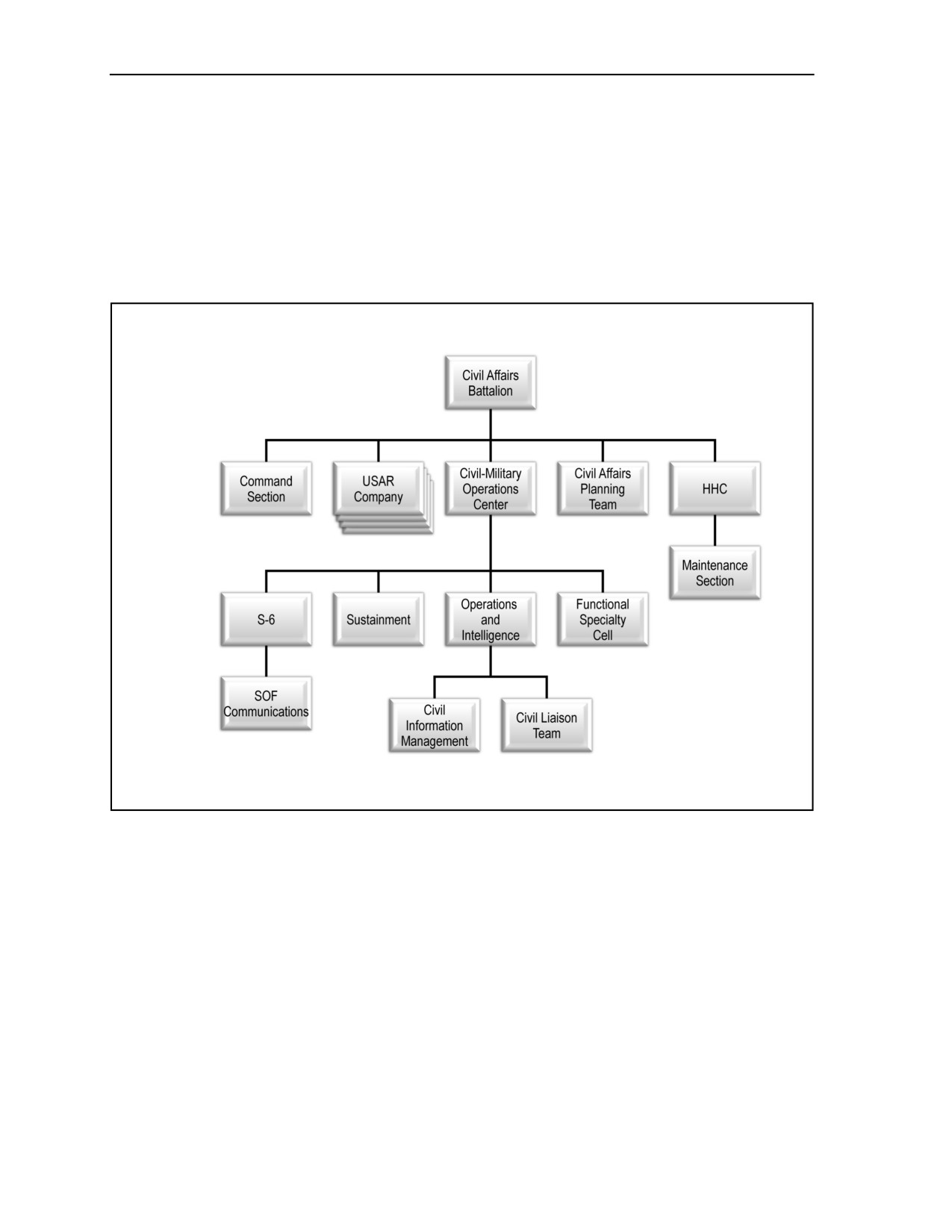
2-86. The CA battalion (USAR) (Figure 2-13) consists of a command section, an HHC, one CAPT, a
CMOC with one CLT, one functional specialty cell, an operations and intelligence cell, a communications
cell, a sustainment cell, and four CA companies.
Figure 2-13. Civil Affairs battalion (United States Army Reserve)
2-87. The CA battalion focus is on the division commander’s ready capability to plan, enable, shape, and
manage CAO; provide dedicated support to stability operations; and enable, reestablish, and support
governmental civil administration at the provincial level. The USAR CA battalions possess limited organic
CA functional specialty support. The battalion provides tactical CA support to the division command or an
equivalent-level Army command/JTF during stability operations.
Functions
2-88. The CA battalion (USAR) has a number of functions; specifically, the battalion—
z
Plans, coordinates, and enables tactical-level stabilization and reconstruction focused on
provincial-level and below civil institutions.
z
Provides CMOC with mission command system capability to division commander.
z
Provides CMOC, CAPT, CLT, CIM, functional specialty cells, and CATs for supported unit.
z
Plans, supports, and coordinates FHA, PRC, CIM, SCA, and NA.
2-28
FM 3-57
31 October 2011
Civil Affairs Organization
z
Synchronizes CAO with CMO, IGOs, and Military Information Support operations (MISO)
plans. The CA battalion receives and collates civil information from CAT, CLT, and CA
companies into tactical- to operational-level civil components for the supported commander’s
COP using classified and unclassified communications links.
z
Provides mission command of CA companies and other CAO capabilities.
z
Trains, equips, and deploys assigned or attached CA companies.
z
Provides unit-level administration for the companies.
z
Provides cross-cultural communications capability to the supported command, advising the
commander on cultural influences but may have only limited linguistics capability to
communicate in the target language within the AO.
Capabilities
2-89. The organization of the CA battalion (USAR) provides—
z
The CAPT at the tactical level with regionally focused, rapidly deployable CA planning. It also
provides plug-and-play capabilities to support the division HQ.
z
The CMOC with tactical-level management, coordination, and synchronization of key CMO
within the supported commander’s AO. The CMOC operates over the horizon, away from the
supported unit, as a standing capability by—
Supporting division HQ and providing mission command system capability.
Serving as the focal point for civil-military coordination, collaboration, and communication
for the supported unit HQ.
Communicating and exchanging information with CMOCs and CA elements within the
supported commander’s JOA/AO while leveraging reachback capability.
z
The CLT with local- to provincial-level interface/liaise capabilities between civil-military, HN,
and humanitarian elements within the AO. Serves as the initial POC for the CA battalion CMOC
where the military meets with the civil populace, the HN, and the humanitarian community.
z
The CIM cell with tactical-level collation and analysis of civil information. Develops tactical-
level civil inputs to the COP. Provides civil information input to the appropriate military and
civil systems via geospatially-referenced data.
z
A functional specialty cell of functional experts that plan, coordinate, enable, and manage CAO
and projects, and shape the commander’s civil environment. The CA battalion provides limited
functional specialty capability for intermediate level assessment of threats to civil components of
the environment. It also assesses mission-planning requirements and develops, coordinates, and
synchronizes the initial stability plan to meet immediate needs, mitigating threats to those areas
of special concern to division commanders in four of the six functional areas (rule of law,
governance, public health and welfare, and infrastructure).
CIVIL AFFAIRS COMPANY (UNITED STATES ARMY RESERVE)
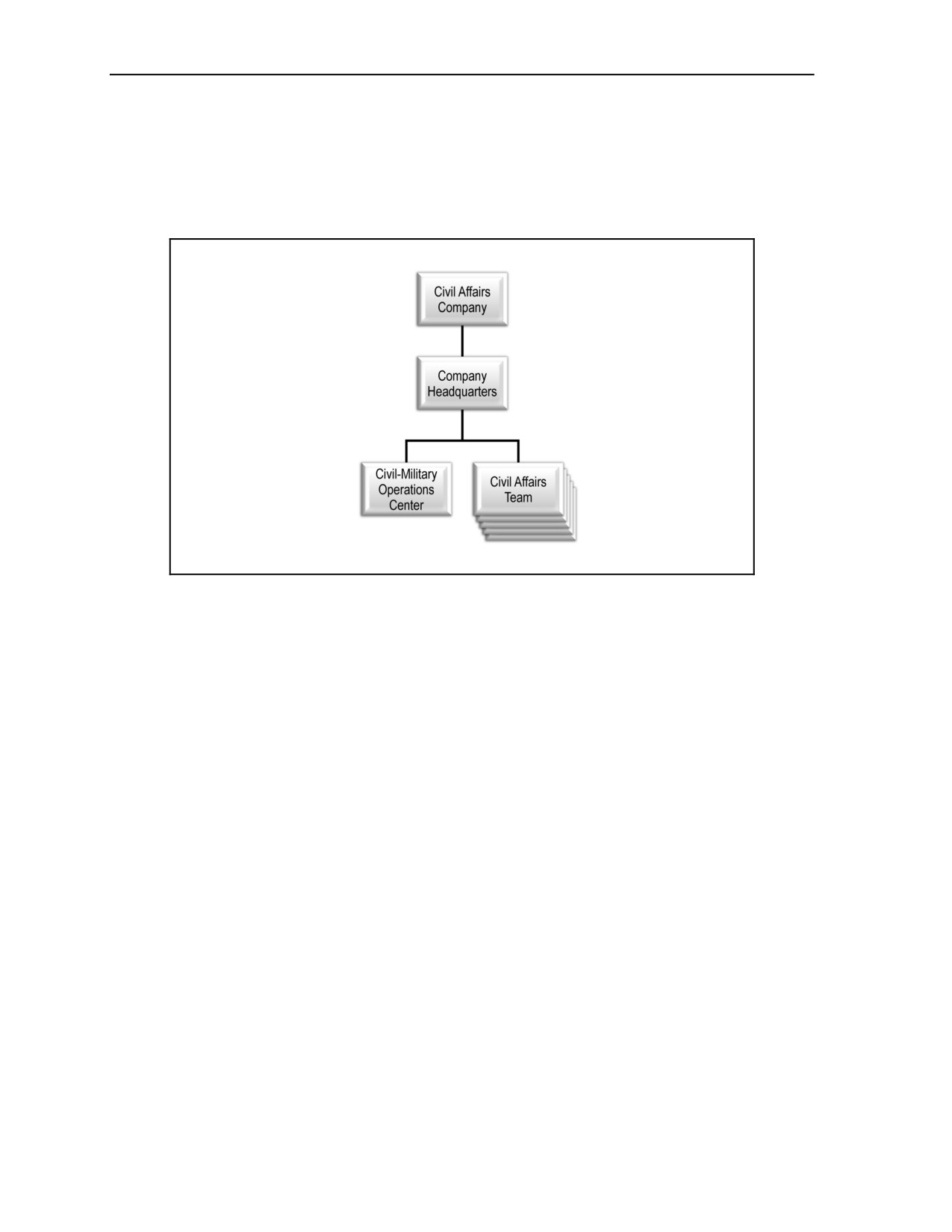
2-90. The CA company (Figure 2-14, page 2-30) consists of a HQ section, a CMOC that provides the
supported command with a CAO planning capability, and five CATs.
2-91. The CA company provides mission command to the assigned CA teams and provides CAO planning,
coordination, and assessment at the tactical level. The company provides support to the BCT, MEB, and
their subordinate elements. The company may also support deployed elements of the interagency, such as
the PRT or field advanced civilian team.
Functions
2-92. The CA company (USAR) has a number of functions; specifically, the company—
z
Conducts CR and plans, coordinates, and enables CAO and project management.
z
Assesses the civil component of the supported command’s AO.
z
Provides mission command system management through the company CMOC to the CATs.
31 October 2011
FM 3-57
2-29
Chapter 2
z
Provides a standing CMOC and CAO planning capability to the supported unit.
z
Provides five CATs to execute CAO in support of conventional forces or deployed interagency
organizations.
z
Facilitates integration of civil input into the supported command’s COP.
z
Provides cross-cultural communications capability to the supported command, advising the
commander on cultural influences in the AO.
Figure 2-14. Civil Affairs company (United States Army Reserve)
Capabilities
2-93. The CA company (USAR) is organized to—
z
Provide the CATs with tactical-level CR. In addition, it is able to plan, execute, and transition
CAO in the supported command’s operational environment.
z
Provide communications capability that links directly into the supported unit’s communications
architecture.
z
Provide the CMOC with tactical-level planning, management, coordination, and synchronization
of key CAO within the supported commander’s AO. The CA company operates over the
horizon, away from the supported unit, as a standing capability by providing—
CMOC support to the supported command.
A mechanism for civil-military coordination, collaboration, and communication.
Assessment of the civil component of the operational environment. The CA company
assesses the mission-planning requirements. The company develops and coordinates the
resources to meet immediate requirements that mitigate civil threats to the mission.
z
Provide limited CA functional specialty capability within the CMOC in the areas of public
safety and public facilities/utilities.
z
Collate, analyze, and fuse civil information for input to the supported command’s COP.
CIVIL AFFAIRS TEAM (UNITED STATES ARMY RESERVE)
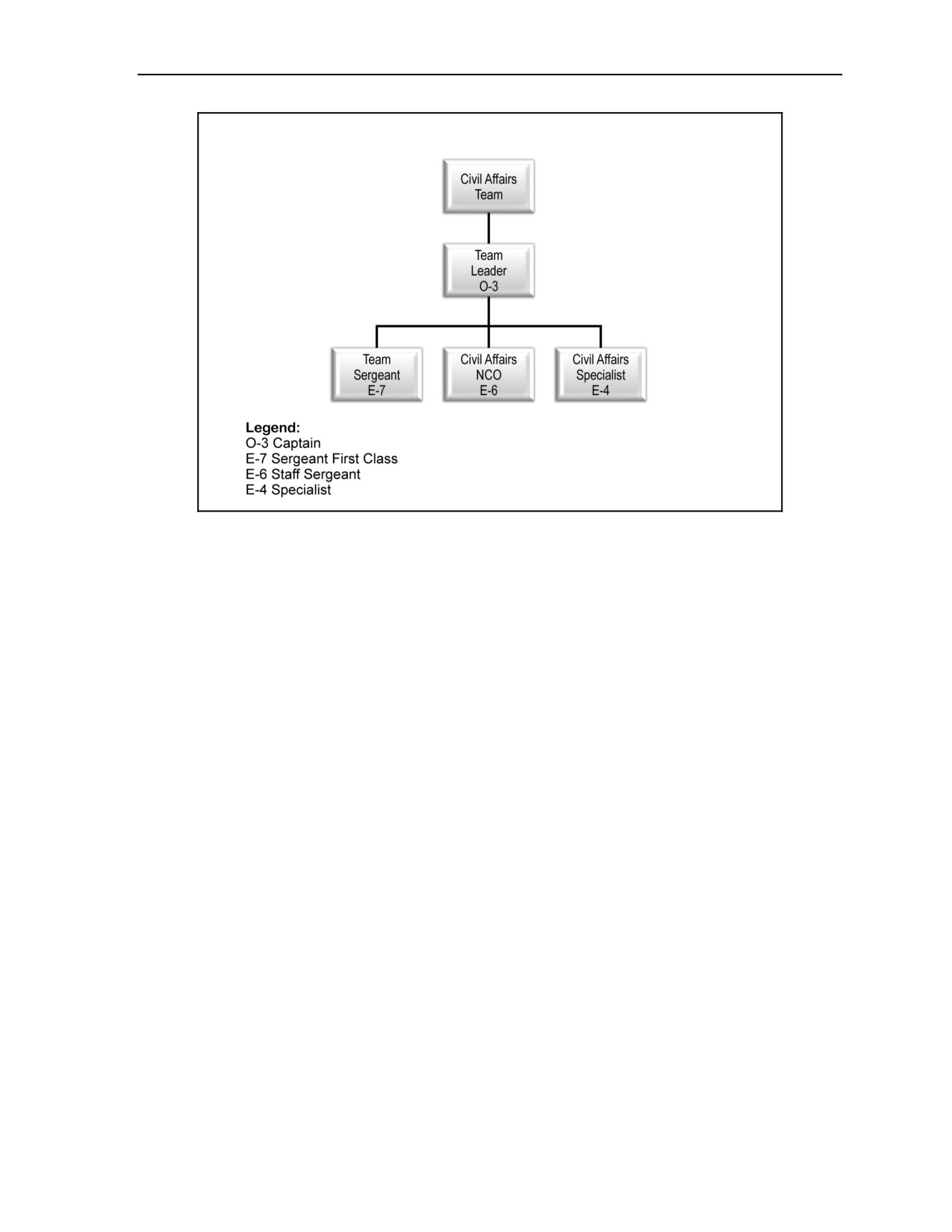
2-94. The CAT (Figure
2-15, page
2-31) conducts CAO and provides tactical-level planning and
assessment support of CMO to supported tactical-level commanders or deployed elements of the
interagency.
2-30
FM 3-57
31 October 2011
Civil Affairs Organization
Figure 2-15. Civil Affairs team (United States Army Reserve)
Functions
2-95. The CAT has a number of functions; specifically, the CAT—
z
Conducts CR.
z
Conducts key-leader engagement within the CAT’s AO.
z
Plans, coordinates, and enables CAO and CAO project management.
z
Provides civil information to the supported unit and CMOC for inclusion of civil inputs to the
supported commander’s COP.
z
Provides cross-cultural communications capability to the supported command, advising the
commander on cultural influences but may have only limited linguistics capability to
communicate in the target language within the AO.
Capabilities
2-96. The CAT is organized to—
z
Provide CAO staff augmentation and CA planning and assessment support to tactical maneuver
commanders.
z
Maintain direct data and voice communications with conventional forces, IPI, IGOs, NGOs, and
interagency elements with classified and unclassified connectivity.
z
Plan and support CMO conducted by military forces.
z
Conduct liaison with civilian authorities and key-leader engagement.
z
Minimize interference between civil and military operations, and synchronize CMO to enhance
mission effectiveness.
z
Conduct area studies and area assessments.
z
Assist the S-2/G-2 and other staff members with civil considerations analysis supporting
preparation of the operational environment as required.
z
Execute CAO in support of interagency deployed elements as directed.
31 October 2011
FM 3-57
2-31
Chapter 2
MISSION COMMAND
2-97. CA mission capabilities support broad and specific U.S. national policy objectives. Because the
conduct of CAO and CMO entails joint and interagency coordination, commanders and senior staff must
understand the U.S. organization for national security and the prevailing concepts of joint and multinational
military operations. Therefore, CA forces require a centralized, responsive, and unambiguous mission
command structure. Unnecessary layering of HQ decreases responsiveness and available mission planning
time and creates an opportunity for a security compromise.
2-98. Normally, CA forces are attached to supported commanders with minimal layering of subordinate
levels of command. This command organization may require an operational HQ (for example, CA brigade)
to interact directly with joint forces. Frequent involvement in joint and interagency operations requires an
understanding of the USG interagency management system and the various deployable elements within the
DOS Office of the Coordinator of Reconstruction and Stabilization.
2-99. When deployed, CA forces must be attached to the mission command HQ responsible for the terrain
management of an AO to efficiently conduct CAO. On occasion, CA forces supporting two different
commands may operate in the same AO (for example, a CAT supporting a maneuver commander is
operating in proximity to a PRT). During these situations, the CAO/CMO effort must be coordinated to
avoid redundancy and establish a unity of effort.
UNITY OF EFFORT
2-100. Unity of effort requires coordination among government departments and agencies within the
executive branch, between the executive and legislative branches, among information organizations and
NGOs, and among nations in any alliance or coalition.
2-101. The United States maintains diplomatic relations with more than 250 foreign countries through
embassies, consulates, and other diplomatic missions. The U.S. Ambassador to a country is responsible to
the President for directing, coordinating, and supervising official USG activities and personnel in that
country. These personnel include all U.S. military personnel not assigned to the unified CCDR or other
designated U.S. military area commanders. Protection and security of U.S. military personnel are a matter
of significant interest. Often specific agreements between the U.S. Ambassador (also known as the chief of
mission [COM]) and the GCC are required. CA forces deployed to a particular country for various
operational missions remain under the combatant command (assigned forces) or under operational control
(OPCON) (attached forces) of the geographic combatant command through a subordinate HQ. CA forces
on exercises or support missions (versus operational deployments) remain under OPCON of their chain of
command. Under no circumstances will CA forces operate in a GCC’s AOR or in the Ambassador’s
country of assignment without prior notification and approval.
2-102. Requests for CA forces may originate with the Ambassador, defense attaché, or security assistance
(SA) organization chief, who passes the requests through the appropriate geographic combatant command
to the Chairman of the Joint Chiefs of Staff (CJCS). The CJCS ensures proper interagency coordination. If
the forces are available in theater from theater-assigned forces and there are no restrictions on their
employment, the GCC can approve and support the request. If insufficient CA forces are available in
theater, the GCC requests additional forces through the Joint Chiefs of Staff to either the United States
Special Operations Command (USSOCOM) to validate requirements in support of SOF or to the Service
components to validate requirements in support of conventional missions.
ARMY HEADQUARTERS CIVIL AFFAIRS OPERATIONS
STAFF ELEMENTS
2-103. The G-9/S-9 is the principal and coordinating staff officer for synchronizing CAO and integrating
CMO. The G-9/S-9 conducts the initial assessment during mission analysis that determines CA force-
augmentation requirements. The CAPTs augment supported G-9 staffs at division and higher levels to
assist in this process. The G-9/S-9 staff provides direction and staff oversight of the supporting CA unit
during mission execution.
2-32
FM 3-57
31 October 2011
Civil Affairs Organization
2-104. The G-9 and his staff ensure each course of action
(COA) effectively integrates civil
considerations (the “C” of METT-TC). The G-9/S-9 and his staff consider not only tactical issues, but also
logistics support issues. Care of DCs is of particular concern. The G-9 analysis considers the impact of
operations on public order and safety, the potential for disaster relief requirements, noncombatant
evacuation operations (NEO), SCA, and protection of culturally significant sites. If the unit does not have
an assigned G-9/S-9, the commander may assign these responsibilities to another staff member.
2-105. The G-9/S-9 enhances the relationship between military forces and civilian authorities and personnel
in the AO to ensure mission success. The G-9/S-9 has staff planning and oversight responsibility for—
z
Managing assigned and attached CA forces.
z
Coordinating all aspects of the relationship between the military force and the civil component in
the operational environment of the supported commander.
z
Advising the commander on the effect of military operations on the civilian populations.
z
Minimizing civilian interference with operations. This includes DC operations, curfews, and
movement restrictions, or deconflicting civilian and military activities with due regard for the
safety and rights of refugees and internally displaced persons (IDPs).
z
Advising the commander on the long- and short-term effects (economic, environmental, and
health) of military operations on civilian populations.
z
Coordinating, synchronizing, and integrating civil-military plans, programs, and policies with
national and combatant command strategic objectives.
z
Advising on the prioritization and monitoring of expenditures of allocated OHDACA, CERP,
payroll, and other funds dedicated to CAO objectives. The G-9 ensures subordinate units
understand the movement, security, and control of funds. The G-9 coordinates with the fund-
controlling authority/financial manager to meet the commander’s objectives.
z
Coordinating and integrating contingency planning for CAO-related products.
z
Managing additional personnel assigned to the CAO staff.
z
Coordinating and integrating area assessments and area studies in support of CAO.
z
Supporting emergency management and civic action projects.
z
Supporting protection of culturally significant sites.
z
Supporting FHA.
z
Supporting emergency distribution of food, shelter, clothing, and fuel for local civilians.
z
Supporting PRC operations.
z
Staff coordination for the integration of civil information from supporting CA units into the COP.
2-106. The G-9/S-9 and his staff ensure the effective integration of the civil considerations mission
analysis into the planning cycle. Like operations and intelligence officers, the G-9/S-9 and his staff focus
on the operational area; however, as with personnel and logistics officers, they must also focus on logistics
issues, particularly those regarding FHA and the care of DCs.
2-107. To plan and orchestrate unit operations, in peace or in war, the supported unit’s operations officer
must rely heavily upon items from the intelligence officer and the CAO officer (G-9/S-9), such as—
z
Civil inputs to the COP.
z
Threat assessments that account for potential enemy actions and reactions to planned CAO.
z
Analysis of civil information that identifies concerns of population groups within the projected
JOA/AO and potential flash points that can result in civil strife and violence.
z
Cultural awareness briefings.
z
Situational and planning maps.
z
Overlays
(in this instance, overlays of DC movement routes, critical infrastructure, and
significant social, religious, and cultural shrines, monuments, and facilities).
2-108. The unit’s operations officer plans and integrates the overall operations effort. The unit G-9/S-9
plans, coordinates, and provides staff oversight of CAO and civilian component issues through direct
coordination with the operations officer. Throughout this process, the G-9/S-9 staff continuously ensures
31 October 2011
FM 3-57
2-33
Chapter 2
the fusion of the civil inputs received from subordinate CA elements, maneuver elements, OGAs, NGOs,
IGOs, and HN sources to the unit commander’s COP.
2-109. The G-9/S-9, like other primary staff officers, is authorized personnel on a modified table of
organization and equipment. Regular Army and USAR CA units regularly augment the G-9/S-9 staff. This
augmentation provides the unit an enhanced CAO/CMO-planning and assessment capability and the
G-9/S-9 the flexibility to sustain a staff presence at the various boards, working groups, and unit command
posts or operations centers (depending on the supported commander’s priority of efforts and the unit’s
standing operating procedures [SOPs]).
CIVIL AFFAIRS OPERATIONS STAFF ORGANIZATION FOR ARMY SERVICE
COMPONENT COMMAND (THEATER ARMY)
2-110. The transition of the operational Army to a modular force necessitated the refinement of the staff
designs of the division, corps, and theater Army HQ. U.S. Army senior leadership, through the execution of
the Army Campaign Plan, managed the process. The staff refinement process addressed directed changes in
the operational concept of the theater Army HQ that relieved the organization from its warfighting
operational mission command requirements.
2-111. The new Army strategy for global mission command of ARFOR relies on the modular corps HQ,
instead of theater armies, to provide mission command of major operations. Under the revised operational
concept, theater armies no longer require large, operational command posts to serve as the base
organization for the formation of JTF or JFLCC/Army force HQ for major operations. The theater Army
retains responsibility for AOR-wide contingency planning and coordination, including developing and
maintaining OPLANS and CONPLANs, updated intelligence estimates, and service support plans to the
geographic combatant command’s theater campaign plan.
2-112. The theater Army is a regionally focused, globally networked administrative Service HQ and
remains the senior Army HQ for the AOR. It is normally composed of a tailored main command post, a
standard contingency command post and a supporting headquarters and headquarters battalion. The revised
operational concept recognizes that every geographic combatant command has legitimate requirements for
an immediately available, deployable mission command capability for small-scale contingency operations
and provides every theater Army with a standard contingency command post.
2-113. The contingency command post provides the theater Army with the capability to direct mission
command limited types of small-scale contingency operations in both permissive and hostile environments
where it does not anticipate major combat operations. These types of operations range from NEO, FHA,
and disaster relief to limited intervention operations, such as peace enforcement (which may involve some
combat, but is limited in scale, scope, and complexity, as well as expected intensity and duration).
2-114. The theater Army commander exercises administrative control of all assigned and attached
ARFOR and OPCON of those ARFOR not under the OPCON of another commander. The theater Army
commander has Title 10, United States Code (10 USC) Service responsibilities for the administration and
support of all ARFOR assigned or attached to the geographic combatant command, including Army special
operations forces
(ARSOF). These responsibilities include organization, control of resources and
equipment, human-resources support, logistics, individual and unit training, readiness, mobilization,
demobilization, discipline, and other matters not included in the operational missions of the joint force.
Thus, the theater Army commander must organize, train, equip, and maintain all ARFOR in the theater,
including ARSOF.
2-115. CA representation on the theater Army staff is integrated with the plans division (G-5) and security
cooperation division of the movement and maneuver cell, the G-9 CAO division of the mission command
cell of the main command post, and the G-9 CAO division of the mission command cell of the contingency
command post. When not deployed, the contingency command post G-9 division integrates with the main
command post G-9 for the execution of assigned tasks.
2-34
FM 3-57
31 October 2011
Civil Affairs Organization
Functions
2-116. The functions of the theater Army CA staff are to—
z
Coordinate, collate, and fuse civil information provided by attached/OPCON CA units to update
the commander’s COP with current civil situation.
z
Coordinate and integrate CA area studies and area assessments in support of CAO and CMO.
z
Develop and maintain the CAO running estimate.
z
Review OPLANs and CONPLANs of higher HQ.
z
Conduct, coordinate, and integrate contingency or crisis action planning (CAP) for CAO and
CMO with the theater Army’s staff in support of theater Army operations.
z
Develop Annex K (Civil Affairs Operations) and assist the G-3 in the development of Annex V
(Interagency Coordination) to theater Army OPLANs and OPORDs or Annex G (Civil-Military
Operations) to JTF/JFLCC OPLANs/OPORDs within the Joint Operation Planning and
Execution System (JOPES).
z
Conduct interagency collaborative planning and coordination accessible to both USG and non-
USG agencies (IGOs, NGOs, and IPI).
z
Integrate interagency representation to the theater Army with the staff.
z
Support combined transition operations through planning and coordination with IGOs, NGOs,
and interagency partners.
z
Develop and recommend CMO portion of the TSCP.
z
Incorporate area assessments, HA training, humanitarian civic assistance (HCA) projects, and
military civic action (MCA) projects into the GCC’s TSCP.
z
Analyze civil issues and establish CAO priorities to provide input to the CCIRs and priority
intelligence requirements (PIRs).
z
Plan, coordinate, and synchronize CR mission orders in support of intelligence, surveillance, and
reconnaissance.
z
Participate in commissions, committees, or counsels concerning national-level governmental
efforts and emergency-relief activities.
z
Assist programming and manage theater-level spending implementation plans and policies to
resource CAO projects by using various resources
(OHDACA, CERP, and commander’s
quick-impact statement).
z
Recommend CA augmentation required to support and sustain CAO/CMO within the GCC’s
AOR.
z
Request CA functional specialist augmentation, as required, to plan unified land operations CAO
in the GCC’s AOR.
z
Coordinate and synchronize operational CAO/CMO with the geographic combatant command’s
efforts in support of the commander’s desired effects.
z
Provide cultural SME considerations to support the current operations integration cell (COIC),
future operations cell, or other staff elements and working groups, as required.
z
Serve as principal advisor to the commander on CAO/CMO.
z
Manage civil-military plans, programs, and policies (TSCP through transition).
z
Review national military strategy and strategic planning guidance to advise, make policy, or
provide recommendations on CAO/CMO matters.
z
Ensure CAO/CMO plans, programs, and policies synchronize with national and combatant
command strategic objectives.
z
Provide direction and ensure integration of CAO/CMO plans, programs, and policy in other
operational functions (COIC, other staff cells, boards, and working groups).
31 October 2011
FM 3-57
2-35
Chapter 2
Capabilities
2-117. The theater Army CA staff is organized to—
z
Provide operational-level and strategic-level planning, management, coordination, and
synchronization of key CAO/CMO within the GCC’s AOR.
z
Provide a mechanism for civil-military coordination, collaboration, and communication within
the GCC’s AOR with the interagency, IGOs, NGOs, multinational agencies, and IPI.
z
Provide analysis of civil information that identifies concerns of population groups within the
projected JOA/AO and potential flash points that can result in civil strife and violence.
z
Analyze civilian impact on military operations and the impact of military operations on civilians
in the JOA/AO (effects analysis).
z
Assist the G-4 with identifying and coordinating facilities, supplies, and other material resources
available from the local civil sector to support operations.
z
Provide staff oversight and advise the theater Army commander on the allocation and
employment of CA units attached/OPCON to the theater Army.
CIVIL AFFAIRS OPERATIONS STAFF ORGANIZATION FOR ARMY CORPS AND DIVISIONS
2-118. The Army Campaign Plan refined the staff designs of the Army’s corps and divisions. As with the
design of the theater armies, CA representation on the corps and division staff integrates with the G-5 of the
movement and maneuver cell and the G-9 CAO division of the mission command cell of the main
command post. In both the corps and division staff designs, the G-9 CAO division organization contains a
branch dedicated to providing CA functional support the COIC.
2-119. Both organizations, with augmentation, may form the core of the mission command HQ of a JTF.
In this case, the G-9 acts as the J-9 during joint operations or the CJ-9 during coalition operations.
Functions
2-120. The functions of the G-9 (J-9/CJ-9) staff cell of the corps or division are to—
z
Serve as staff proponent for the organization, use, and integration of attached CA forces.
z
Develop plans, policies, and programs to further the relationship between the division or corps
and the civil component in the corps or division AO or JOA.
z
Serve as the primary advisor to the corps or division commander on the effect of civilian
populations on division or corps operations.
z
Assist in the development of plans, policies, procedures, and programs to deconflict civilian
activities with military operations within the corps or division AO or JOA. This includes DC
operations, curfews, and movement restrictions.
z
Advise the corps or division commander on legal and moral obligations incurred from the long-
and short-term effects (economic, environmental, and health) of division or corps operations on
civilian populations.
z
Develop Annex K (Civil Affairs Operations) and assist the G-3 in the development of Annex V
(Interagency Coordination) to corps or division OPLANs and OPORDs, or Annex G (Civil-
Military Operations) to JTF/JFLCC OPLANs/OPORDs within JOPES.
z
Coordinate, synchronize, and integrate civil-military plans, programs, and policies with strategic
objectives and OGA efforts.
z
Advise on prioritizing and monitoring expenditures of allocated OHDACA, CERP, payroll, and
other funds dedicated to CMO; facilitate movement, security, and control of funds to subordinate
units; and coordinate with the funds controlling authority/financial manager to meet the
commander’s objectives.
z
Conduct, coordinate, and integrate contingency planning for CAO in support of corps or division
operations.
z
Coordinate and integrate area assessments and area studies in support of CAO.
z
Advise the corps or division commander and staff on protection of culturally significant sites.
2-36
FM 3-57
31 October 2011
Civil Affairs Organization
z
Coordinate, collate, and fuse civil information provided by attached/OPCON CA units to update
the commander’s COP with current civil situation.
z
Advise the corps or division commander on using military units and assets that can support joint
CMO missions.
Capabilities
2-121. The G-9 (J-9/CJ-9) staff of the corps or division is organized to—
z
Provide tactical- and operational-level planning, management, coordination, and synchronization
of key CAO/CMO within the division or corps commander’s AO.
z
Provide a mechanism for civil-military coordination, collaboration, and communication within
the modular Army corps or modular Army division AO.
z
Assist the G-4 with the identification and coordination of facilities, supplies, and other material
resources from the local civil sector to support modular Army corps or division operations.
CIVIL AFFAIRS OPERATIONS STAFF ORGANIZATION FOR BRIGADE COMBAT TEAM
OR MANEUVER ENHANCEMENT BRIGADE
2-122. The S-9 CAO staff normally consists of a CA major and a CA sergeant first class for the BCT and
the MEB. S-9 CAO staff sections also exist in SFGs and the Ranger Regiment.
Functions
2-123. The functions of the BCT/MEB S-9 are to—
z
Serve as staff proponent for the organization, employment, and integration of attached CA forces.
z
Develop Annex K (Civil Affairs Operations) and assist the S-3 in the development of Annex V
(Interagency Coordination) to BCT/MEB OPLANs and OPORDs.
z
Develop plans, policies, and programs to further the relationship between the BCT/MEB and the
civil component in the assigned AO.
z
Serve as the primary advisor to the BCT/MEB commander on the effect of civilian populations
on operations.
z
Assist in the development of plans, policies, and programs to deconflict civilian activities with
military operations within the BCT/MEB AO. This includes DC operations, curfews, and
movement restrictions.
z
Advise the BCT/MEB commander on legal and moral obligations incurred from the long- and
short-term effects (economic, environmental, and health) of operations on civilian populations.
z
Synchronize, and integrate CAO plans, programs, and policies with operational objectives.
z
Advise on prioritizing and monitoring expenditures of allocated OHDACA, CERP, payroll, and
other funds dedicated to CAO; facilitate movement, security, and control of funds to subordinate
units; and coordinate with the funds controlling authority/financial manager to meet the
commander’s objectives.
z
Conduct, coordinate, and integrate contingency planning for CAO in support of operations.
z
Coordinate and integrate area assessments and area studies in support of CAO.
z
Advise the BCT/MEB commander and staff on protection of culturally significant sites.
z
Coordinate, collate, and fuse civil information provided by attached/OPCON CA units to update
the commander’s COP with current civil situation.
z
Advise the commander on the employment of military units and assets that can support CAO
missions.
Capabilities
2-124. The S-9 CAO staff cell of the BCT/MEB is organized to—
z
Provide tactical-level planning, management, coordination, and synchronization of key CAO
within the BCT/MEB commander’s AO.
31 October 2011
FM 3-57
2-37
Chapter 2
z
Provide a mechanism for civil-military coordination, collaboration, and communication within
the BCT/MEB AO.
z
Assist the logistics staff officer (S-4) with identifying and coordinating for facilities, supplies,
and other material resources available from the local civil sector to support BCT operations.
COMBATANT COMMAND ORGANIZATION
2-125. Combatant commands have assigned forces of two or more Services and broad, continuing
missions. CA support is oriented toward the commanders of those geographic combatant commands with
specified geographic responsibilities. The GCCs report through the CJCS to the President and/or the
Secretary of Defense (SecDef). The mission requires the GCC to initiate, maintain, or improve peacetime
relations between the nations in his AOR and the United States. The mission also requires the GCC to plan
for and address conflicts that may threaten U.S. interests in the region. CA forces provide support across
unified land operations and, therefore, are familiar with the GCC’s concerns across the range of military
operations. The Army defines its specific actions in these areas of concern as offensive, defensive, and
stability (or DSCA) operations. Army commanders at all echelons combine offense, defense, and stability
(or DSCA) operations simultaneously or sequentially to accomplish assigned missions.
2-126. Combatant command (COCOM) is the command authority that statutory law vests in GCCs. The
GCCs exercise command authority over all military assets placed under their OPCON unless otherwise
directed by the President or SecDef. In the exercise of OPCON, the GCC can—
z
Determine CA force requirements and operational priorities.
z
Prescribe the chain of command for CA forces operating within his AOR.
z
Establish and maintain appropriate liaison with USG agencies and IPI.
2-127. CA personnel may perform liaison work with the USG and civilian agencies, such as the USAID
and the Department of Justice, as well as IGOs and supporting NGOs, to provide advice and assistance in
any or all of the six functional specialty areas. CCDRs determine mission command requirements of CA
personnel and forces supporting allied or multinational commanders within the policy constraints issued by
the President and/or SecDef.
UNITED STATES SPECIAL OPERATIONS COMMAND
2-128. USSOCOM is the combatant command for SOF. The USSOCOM commander assigns forces to
conduct special operations
(SO) as required. All CONUS-based SOF are assigned to USSOCOM.
USSOCOM has no geographic AOR; instead, it maintains global responsibilities. USSOCOM may act as a
supporting command by providing mission-ready SOF to the GCCs or as the supported commander for the
conduct of SO. CA units assigned to USASOC are under the combatant command of USSOCOM until a
change of OPCON occurs to one of the geographic combatant commands. USSOCOM coordinates with the
geographic combatant commands to validate all requests for USASOC-assigned CA units and individuals
during peace and war.
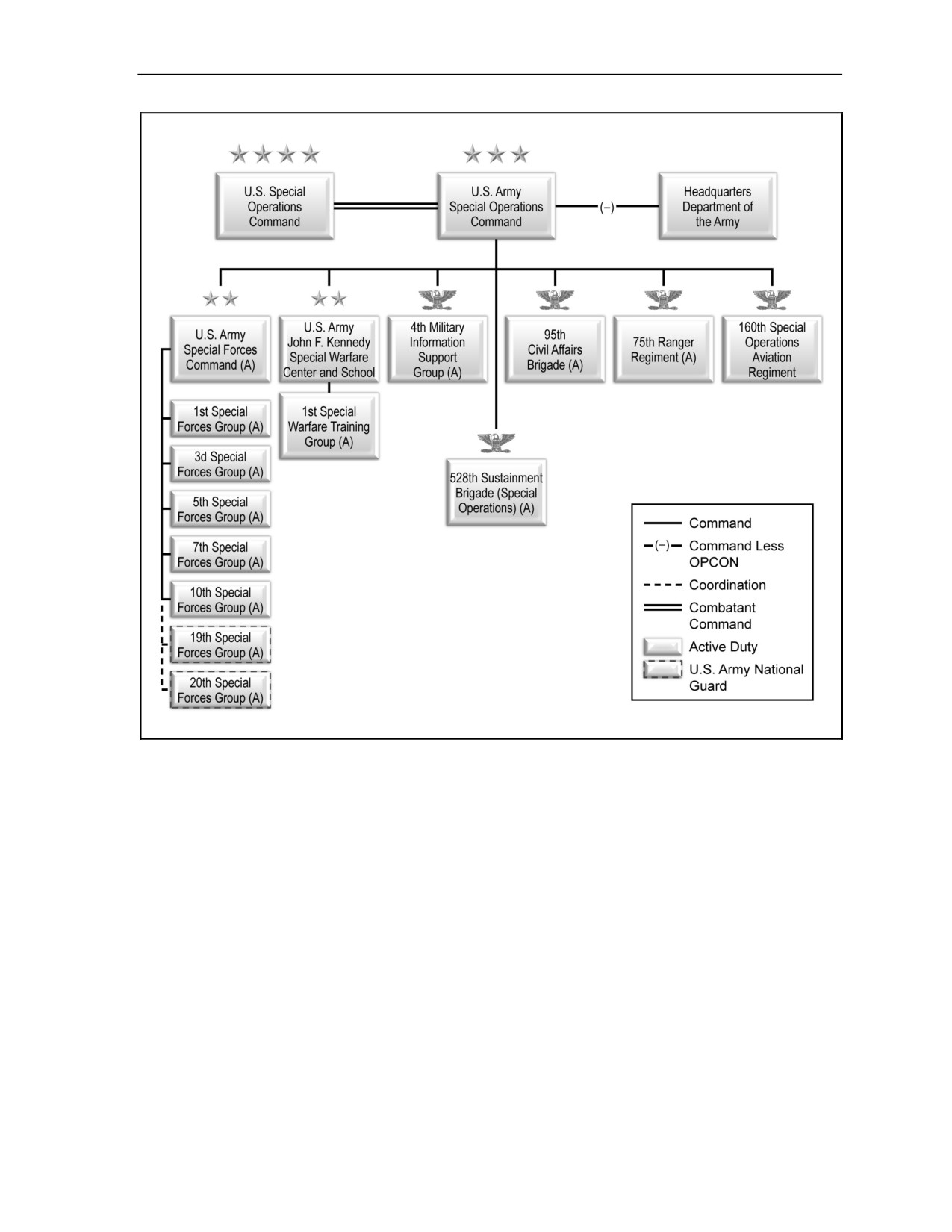
UNITED STATES ARMY SPECIAL OPERATIONS COMMAND
2-129. USASOC (Figure 2-16, page 2-39) is the ASCC assigned to USSOCOM. Its mission is to
command, support, and ensure the combat-readiness of assigned and attached ARSOF. As the Army’s
senior-level command of the 95th CA Brigade (A), USASOC has the responsibility, in conjunction with
USSOCOM, to recruit, organize, train, equip, mobilize, and sustain the Regular Army’s only CA brigade
assigned to ARSOF. As an ASCC, USASOC’s primary missions are to—
z
Develop policy.
z
Conduct long-range planning.
z
Perform programming and budgeting.
z
Manage and distribute resources.
z
Review and evaluate program performance.
2-38
FM 3-57
31 October 2011
Civil Affairs Organization
Figure 2-16. United States Army Special Operations Command organization
UNITED STATES ARMY FORCES COMMAND
2-130. FORSCOM trains, mobilizes, deploys, sustains, transforms, and reconstitutes assigned
conventional forces. In its role as the Army conventional force provider, FORSCOM commands and
controls CONUS-based conventional forces of the Regular Army, mobilized conventional forces of the
USAR, and federally mobilized ARNG conventional forces. FORSCOM mission command includes
mobilized USAR CA units and personnel and the activating Regular Army CA brigade supporting
conventional forces. Prior to mobilization, U.S. Army Reserve Command provides overall mission
command of CONUS-based CA units. U.S. Army Reserve Command exercises mission command of
USAR CA units through USACAPOC (A).
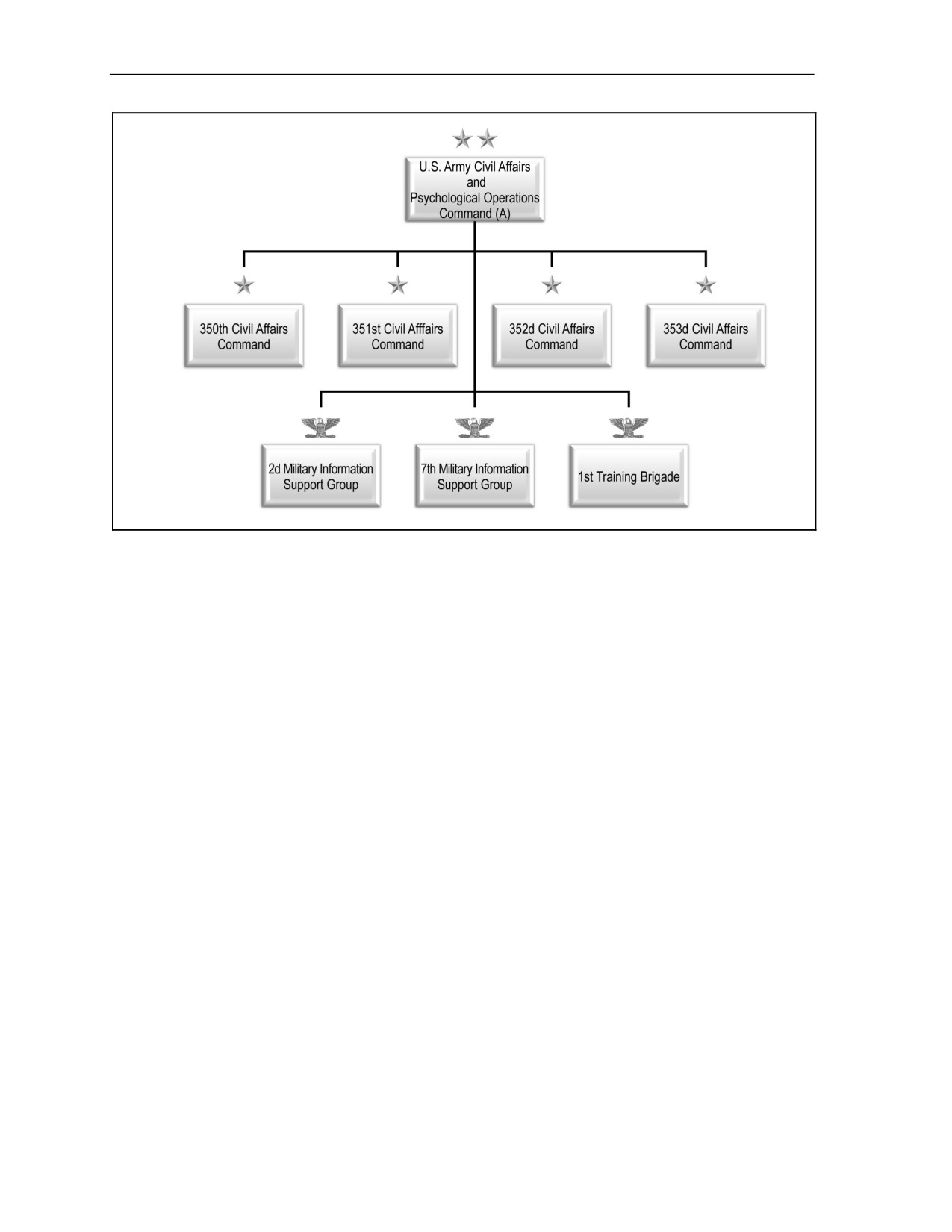
UNITED STATES ARMY CIVIL AFFAIRS AND PSYCHOLOGICAL OPERATIONS COMMAND (A)
2-131. USACAPOC (A) (Figure 2-17, page 2-40) is a table of distribution and allowance nondeploying
HQ with the mission to organize, train, equip, monitor readiness of, validate, and prepare assigned USAR
CA and MISO forces for deployment. These forces conduct worldwide CAO in support of CMO and
tactical MISO during unified land operations in support of the geographic combatant commands, Service
components, U.S. Ambassadors, and the interagency.
31 October 2011
FM 3-57
2-39
Chapter 2
Figure 2-17. U.S. Army Civil Affairs and Psychological Operations Command (airborne)
THEATER ORGANIZATION
2-132. When the President or SecDef authorizes military operations, the GCC organizes his theater to
orchestrate his joint operations with multinational and interagency activities. An integral part of this
organization is the CMO staff element on the theater staff.
2-133. The CMO staff cell of the TSOC provides contingency planning and CAP, maintenance of existing
plans, assessments, and support to the geographic combatant command’s TSCP. The CACOM supporting
each geographic combatant command serves as its senior CA advisor (CACOM commander) and as the
focal point for CMO coordination, collaboration, and consensus. The CACOM provides theater-level staff
augmentation to the geographic combatant command and to subordinate subunified and Service component
commands.
2-134. CCDRs with geographic responsibilities conduct operations within an AOR (theater) assigned by
the Unified Command Plan. When warranted, geographic combatant commands designate theaters of war,
theaters of operations, combat zones, and communications zones. JFCs at all levels may establish
subordinate operational areas. Joint doctrine discusses the assignment and responsibilities associated with
theater operational areas. The Joint Chiefs of Staff provide guidance and directives to the theater
commander. All combatant commands have CMO staffs to advise and assist the GCC in the execution of
CMO. They also participate in contingency planning and CAP and, when required, deploy as a member of
the deployable JTF augmentation cell. CAPTs from respective theater-aligned CACOMs augment the
geographic combatant command, theater Army commander, and JFLCC staffs. CA contributions to the
TSCP can include—
z
Liaison and coordination. In coordination with the GCC’s staff and American Embassy country
team, CA personnel conduct liaison with multinational forces, indigenous security forces, U.S.
forces, government agencies, IGOs, and NGOs.
z
Education and training. CA forces are uniquely qualified to train and prepare others for
conducting TSCP activities due to their area and linguistic orientation, cross-cultural
communications, and experiences in military to civil and HN advisory and assistance activities.
2-40
FM 3-57
31 October 2011
Civil Affairs Organization
z
Area assessments. TSCP activities provide an ideal opportunity for CA to collect current open-
source information obtained in the course of their normal duties to update assessments prior to a
crisis in the GCC’s AOR.
THEATER SPECIAL OPERATIONS COMMAND
2-135. Normally, the SOF chain of command should execute mission command of SOF. The
identification of a mission command organizational structure for SOF depends upon specific objectives,
security requirements, and the operational environment.
2-136. The TSOC is the joint SO command through which the geographic combatant command normally
exercises OPCON of SOF within the AOR. The exceptions are the USCENTCOM and USEUCOM AORs,
where the TSOC exercises OPCON of CA forces. The commander of the TSOC is also the permanent
theater joint forces special operations component commander. He commands the TSOC and is the principal
SO advisor to the GCC. The TSOC is a subordinate command of a combatant command or a functional
component command of another permanent joint command.
2-137. To provide the necessary unity of command, each GCC (except for United States Northern
Command [USNORTHCOM]) has established a TSOC as a subunified command within the geographic
combatant command. The TSOC is the primary theater SOF organization capable of performing broad
continuous missions uniquely suited to SOF capabilities. The TSOC commander has three principal roles:
z
Joint Force Commander. As the commander of a subunified command, the TSOC commander
is a JFC. As such, he has the authority to plan and conduct joint operations as directed by the
geographic combatant command. The JFC exercises OPCON of assigned commands and forces
and, normally, over attached forces as well. The TSOC commander may establish a JTF that
reports directly to him, such as a JSOTF, JCMOTF, or joint military information support task
force, to plan and execute these missions.
z
Theater SO Advisor. The TSOC commander advises the GCC and the other component
commanders on the proper employment of SOF. The TSOC commander may develop specific
recommendations for the assignment of SOF in-theater and opportunities for SOF to support the
overall theater campaign plan. The role of theater SO advisor is best accomplished when the
GCC establishes the TSOC commander as a special staff officer on the theater staff (in addition
to his duties as a commander—that is, “dual-hatted”). In this case, the TSOC commander may
appoint a deputy as his representative to the theater staff for routine day-to-day staff matters.
z
Joint Force Special Operations Component Commander. When designated by the GCC, the
TSOC commander will function as a JFSOC commander. This will normally be the case when
the GCC establishes functional component commanders for operations, absent the establishment
of a JTF. The GCC can also designate the TSOC commander as the JFSOC commander within a
JTF if the scope of the operations conducted by the JTF warrants it.
JOINT AND MULTINATIONAL ORGANIZATION
2-138. During joint and multinational operations, CA forces bridge the gap between U.S. military, HN
military, and civilian authorities supporting an operation. CAPTs from the CACOM or CA brigade provide
CMO staff augmentation for joint or multinational HQ conducting CMO. U.S. military staff planning and
coordination, as well as interagency activities, are the most likely mission support activities CA units
undertake in a joint or multinational environment. Participating nations normally develop directives
covering a multinational command’s political-military objectives. These include objectives and policies for
the conduct of CMO. Therefore, senior-level CA officers and noncommissioned officers are best suited to
augment the CMO staffs of JFCs and multinational commanders as they develop applicable plans, policies,
and programs.
2-139. CA forces assist the multinational force commander to achieve a greater degree of unity of effort
by informing him of the mandates, activities, and capabilities of IGOs and NGOs. CMO planners factor
these into the commander’s assessment of conditions and resources and integrate them into the selected
concept of operations (CONOPS). CMO planners on multinational force staffs also ensure the CMO annex
31 October 2011
FM 3-57
2-41
Chapter 2
(Annex G) to the OPLAN provides guidance to the multinational force commander regarding relationships
with and support to NGOs, IGOs and the private sector operating within the operational area. JP 3-16,
Multinational Operations, provides additional guidance.
JOINT TASK FORCE
2-140. The GCC may designate a corps and/or a division as a JTF. A JTF plans, conducts, and supports
military operations on a mission or area basis. It accomplishes a specific mission or campaign of limited
duration, but it can exist on a more permanent basis. During a war or prolonged conflict, the JTF may
control operations in a specific portion of the GCC’s AOR. The JTF may appear as a new organization, but
the GCC often forms the JTF by augmenting an existing Service HQ with elements from other Services.
CA units support JTFs by providing task-organized elements from a CA brigade or CA battalion to
augment the JTF CMO staff. JP 3-57 provides further guidance on CA support to joint operations.
JOINT CIVIL-MILITARY OPERATIONS TASK FORCE
2-141. Although not strictly a CA organization, the JCMOTF will most likely have CA units at its core or
as subordinate elements. A CA officer may command the JCMOTF. It is a special-purpose task force made
up of units from two or more Services. It is flexible in size and composition. The JCMOTF plans, prepares,
executes, and continually assesses CMO in a theater of operations or JOA. All CA brigades are task-
organized to form the core of a JCMOTF. The expertise of CA personnel in dealing with government
organizations, IGOs, NGOs, and IPI greatly enhances the opportunity for success. However, higher
elements may assign or attach conventional and SO forces to the JCMOTF to support the conduct of
specific missions. JP 3-57 provides additional information on joint CMO. If the JFC properly charters and
establishes the JCMOTF, it must meet the criteria that JP 3-33, Joint Task Force Headquarters, establishes.
2-142. The JFC may establish a JCMOTF to—
z
Accomplish a specific contingency mission, such as FHA or SCA.
z
Provide CMO support to U.S. or coalition military forces conducting military operations
concurrent with or subsequent to geographic or general conflict.
z
Perform other operations as directed by the commander, joint task force.
2-143. A JCMOTF could—
z
Be a stand-alone JTF or a subordinate unit in a JTF.
z
Assist other JTF unit commanders when the commander’s organic ability cannot meet the CMO
needs of his JOA.
z
Provide—as part of a larger JTF—the commander, joint task force, through a CMOC with
linkage between the JTF and nonmilitary agencies operating in the JOA.
2-144. A JCMOTF should not—
z
Be the CMO staff augmentation for a JTF.
z
Have, when subordinate to a JTF, the primary responsible force for accomplishing all CMO in
the JOA.
z
Eliminate the need for all units to train for CMO.
z
Eliminate the need for all commanders in the JOA to plan and conduct CMO.
2-145. Service component and other task force commanders are responsible for accomplishing the CMO
that is within their ability in their AOs. When their need exceeds their capability, a JCMOTF can assist in
meeting the shortfall.
JOINT SPECIAL OPERATIONS TASK FORCE
2-146. The structure of CA forces is to support SOF across the range of military operations and
throughout major combat operations, ongoing operations, and worldwide deterrence operations. Worldwide
deterrence missions require CA companies and their CATs to conduct shaping operations that promote
regional stability by deterring aggression. Elements can draw on CA forces to support ongoing operations
and to act as the TSOC’s CR element throughout the AOR.
2-42
FM 3-57
31 October 2011
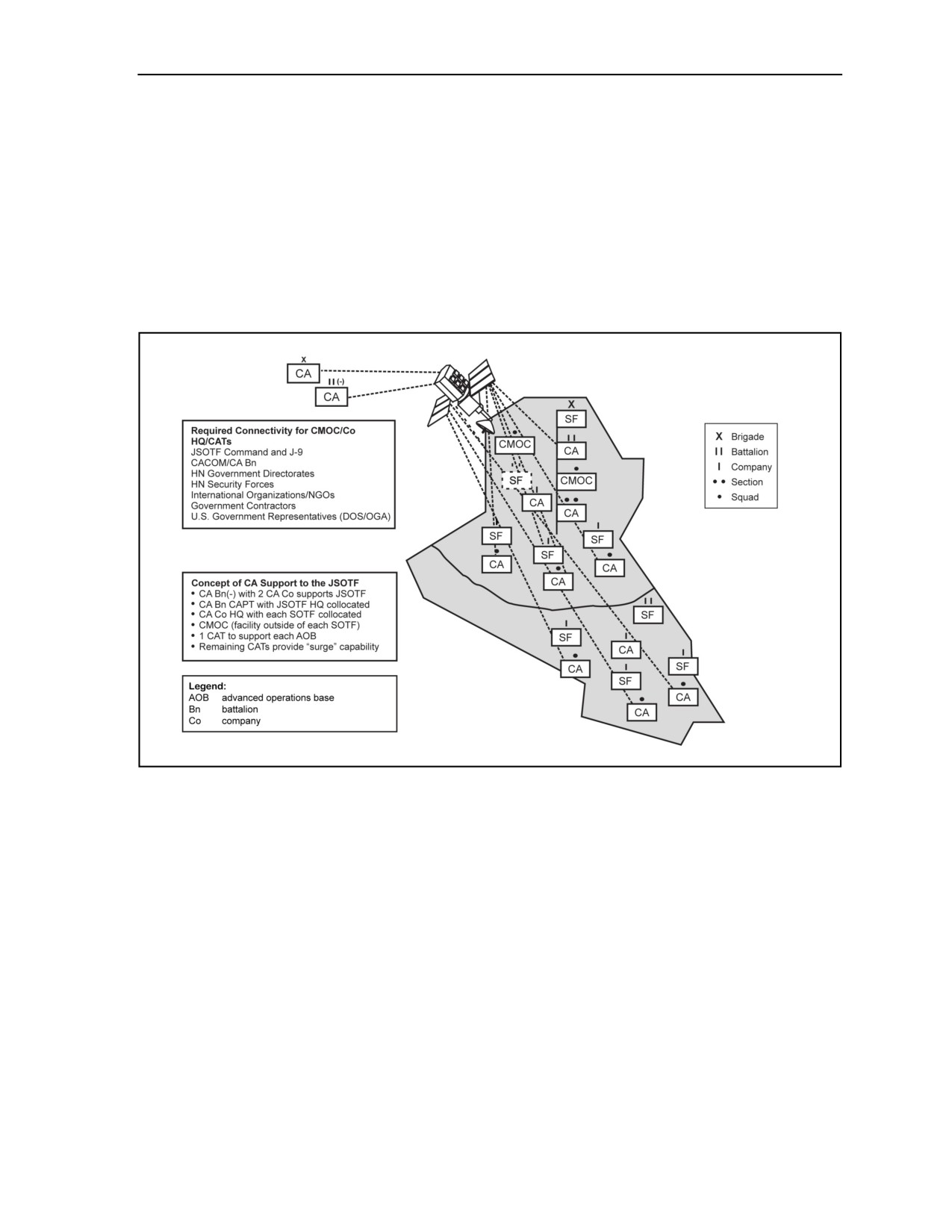
Civil Affairs Organization
2-147. The USASOC-assigned CA brigade (A), CAPT, and CMOC provide direct support to the TSOC
and the TSOC forward, as required, to support SOF. The TSOC uses the CA brigade (A) CMOC to manage
CMO. A CA battalion is apportioned to each JSOTF, and one CA company is apportioned to support
Ranger regimental operations, as well as other SOF operations.
2-148. USASOC-assigned CA forces are structured to support JSOTF operations at the strategic,
operational, and tactical levels while maintaining regional focus. CA support to the JSOTF stands on the
concept that a CA battalion HQ with two CA companies supports the JSOTF (Figure 2-18), and the CA
battalion CAPT is collocated with the JSOTF HQ to assist in CMO planning within the joint special
operations area (JSOA). A CA company HQ collocates with each SOTF and provides a CMOC, as
directed. A CAT supports each Special Forces (SF) advanced operational base, as directed. The remaining
CATs provide a surge capability for the special operations task force commander.
Figure 2-18. Example of Civil Affairs support to joint special operations
task force operations
31 October 2011
FM 3-57
2-43
Chapter 3
Civil Affairs Operations
The relationship between CMO and Civil Affairs operations (CAO) is best considered
within the broad context of unified action that involves the synchronization, coordination,
or integration of the activities of governmental and nongovernmental entities with
military operations to achieve unity of effort.
JP 3-57, Civil-Military Operations
8 July 2008
CAO are actions CA Soldiers plan, prepare, execute, and continuously assess. These
actions support the achievement of the JFC’s CMO operational and theater strategic
objectives.
CIVIL AFFAIRS CORE TASKS
3-1. The essence of CAO is the conduct of CA core tasks synchronized and integrated with the supported
commander’s intent and operational concept. They enable the relationship of military forces with the civil
component of the operational environment, including IGOs, NGOs, the interagency, IPI, and the private
sector in areas where military forces are present. CA core tasks are primary tasks that CA forces are
capable of planning, supporting, executing, or transitioning through and with outside actors to mitigate or
defeat threats and vulnerabilities to civil society.
Note. The North Atlantic Treaty Organization (NATO) and the UN modified the U.S. CMO
concept. These organizations refer to it as civil-military cooperation.
3-2. CA core tasks involve the application of CA functional specialty skills in areas normally the
responsibility of civil government to enhance conduct of CMO. The five CA core tasks are as follows:
z
Populace and resources control (PRC).
z
Foreign humanitarian assistance (FHA).
z
Civil information management (CIM).
z
Nation assistance (NA).
z
Support to civil administration (SCA).
3-3. CA functional specialists are task-organized to meet the various strategic, operational, and tactical
requirements of CAO. Elements may employ these functional specialists, especially at the operational and
strategic levels, in general support of interagency operations, in addition to direct support of CAO. When
called upon to perform specialized CAO tasks in the absence of CA functional specialists, CA generalists
seek clarification, support, and guidance in their missions from CA functional specialists via reachback.
3-4. CA core tasks supporting the GCC’s missions include operations that—
z
Promote U.S. policy objectives before, during, and after combat operations by influencing the
civil component of the operational area.
z
Reduce demands on the Army supply system by facilitating the coordination of indigenous
resources and supplies, where appropriate.
z
Fulfill responsibilities of the military under U.S. domestic and international laws relevant to
civilian populations (United Nations Universal Declaration of Human Rights and United Nations
Geneva Protocols).
31 October 2011
FM 3-57
3-1
Chapter 3
z
Minimize civilian interference with military operations and the impact of military operations on
the civilian populace.
z
Coordinate military operations with the interagency, IGOs, NGOs, and IPI.
z
Exercise civil administration in occupied or liberated areas until control returns to civilian or
non-U.S. military authority.
z
Support efforts to provide assistance to meet the life-sustaining needs of the civilian population.
Provide direct assistance in areas where HN or humanitarian agencies are not present in
accordance with internationally accepted standards and principles.
z
Provide expertise in civil-sector functions, normally the responsibility of civilian authorities,
applied to implement U.S. policy and advise or assist in rehabilitating or restoring civil-sector
functions.
POPULACE AND RESOURCES CONTROL
3-5. Soldiers do not conduct military operations in a vacuum free of civilian presence or influence. The
following can disrupt military operations:
z
Uncontrolled and uncoordinated movement of dislocated civilians in the environment.
z
Uncontrolled and uncoordinated movement of civilians conducting legitimate activities.
z
Illegal or illegitimate activities, such as insurgent operations or black-market activities.
3-6. The PRC operation consists of two distinct, yet linked, components: populace control and resources
control. These controls are normally the responsibility of indigenous civil governments. CCDRs define and
enforce these controls during times of civil or military emergency. For practical and security reasons,
military forces use PRC measures across the range of military operations. PRC operations are executed in
conjunction with and as an integral part of all military operations.
3-7. Military forces base the extent of PRC measures on their current operational environment. When
forces deploy in support of a HN, U.S. PRC policy upholds and strengthens the sovereignty of the
legitimate government to govern the people and resources within its borders. In the absence of a sovereign
government, implementation of PRC policy begins through the establishment of an interim governing plan,
whether its execution is through martial law or a transitional government. PRC measures implemented at the
operational and tactical levels result from policy developed at national strategic and theater strategic levels.
POPULACE CONTROL
3-8. Populace control provides security for the populace, mobilizes human resources, denies enemy
access to the population, and detects and reduces the effectiveness of enemy agents. Populace control
measures may include—
z
Establishing border security, including customs procedures to prevent trafficking of persons, to
regulate immigration and emigration, and to establish control over major points of entry.
z
Establishing identification procedures, including securing documents relating to personal
identification, property ownership, court records, voter registries, birth certificates, and driver’s
licenses.
z
Establishing and disseminating rules relevant to movement, including curfews, movement
restrictions, and travel permits.
z
Instituting policies regarding the regulation of air and overland movement.
z
Relocating the population as necessitated by military operations.
z
Establishing transitional political authority and interim civil administration.
3-9. DC operations and NEO are two special categories of populace control that require extensive
planning and coordination among various military and nonmilitary organizations.
Dislocated Civilian Operations
3-10. DC operations (also commonly referred to as resettlement operations) are actions required to move
civilians out of harm’s way or to safeguard them in the aftermath of a disaster. The disaster may be natural,
3-2
FM 3-57
31 October 2011
Civil Affairs Operations
such as a flood or an earthquake, or man-made, such as combat operations, social or political strife, or a
technological hazard. The requirement to conduct DC operations may occur across the range of military
operations.
3-11. DC operations include the planning and management of DC routes, collection points, assembly areas,
and camps, normally in support of the HN and IGO efforts. They also include FHA support to the affected
populace. The military police corps is a key component to the successful planning and execution of DC
operations. Commander should seek their involvement early in the planning process.
3-12. FM
3-05.401, Civil Affairs Tactics, Techniques, and Procedures; FM
3-39, Military Police
Operations; and FM 3-39.40, Military Police Internment/Resettlement Operations, provide additional
information on DC operations.
3-13. In DC operations, controlling agencies
(for example, United Nations High Commissioner for
Refugees [UNHCR], Office for the Coordination of Humanitarian Affairs, ICRC, or HN) normally care for
the basic needs of DCs, such as food, water, shelter, sanitation, and security. Controlling agencies must also
be prepared to prevent or arrest the outbreak of communicable disease among DCs. This last point is
important for the health of the populace and military forces.
Categories of Civilians
3-14. During military operations, U.S. forces must consider two distinct categories of civilians—those
remaining at their homes or places of habitual residence and those dislocating. U.S. policy dictates the
placement of people in one of these categories. The U.S. category may conflict with how IGOs, NGOs, and
the HN refer to the people. Therefore, CA Soldiers and CAO planners must be careful in how they describe
categories of civilians. The first category includes civilians who are indigenous and other local populace,
including civilians from other countries. Civilians within this category may or may not need help. If they
can care for themselves, they should remain in place.
3-15. DCs are civilians who have left their homes. Their movement and presence can hinder military
operations. They will likely require some degree of aid, such as medicine, food, shelter, clothing, and
similar items. DCs may not be indigenous to the area or to the country in which they reside. DC is a generic
term that further subdivides into eight categories. Legal and political considerations define these categories
as follows:
z
Displaced Person. A civilian who is involuntarily outside the national boundaries of his or her
country (JP 3-29, Foreign Humanitarian Assistance).
z
Refugee. A person who owing to a well-founded fear of being persecuted for reasons of race,
religion, nationality, membership of a particular social group or political opinion, is outside the
country of his or her nationality and is unable or, owing to such fear, is unwilling to avail
himself or herself of the protection of that country (JP 3-29).
z
Evacuee. A civilian removed from his place of residence by military direction for reasons of
personal security or the requirements of the military situation (JP 3-57).
z
Stateless Person. Civilian who has been denationalized, whose country of origin cannot be
determined, or who cannot establish a right to the nationality claimed (JP 3-29).
z
War Victim. A classification created during the Vietnam era to describe civilians suffering
injuries, loss of a family member, or damage to or destruction of their homes because of war.
War victims may be eligible for a claim against the United States under the Foreign Claims Act.
z
Internally Displaced Persons. Any person who has been forced or obliged to flee or to leave
their home or places of habitual residence, in particular as a result of or in order to avoid the
effects of armed conflict, situations of generalized violence, violations of human rights or natural
or human-made disasters, and who have not crossed an internationally recognized state border
(JP 3-29).
z
Returnee. A displaced person who has returned voluntarily to his or her former place of
residence (JP 3-29).
z
Resettler. Subset of a refugee or an internally displaced person—a civilian wishing to return
somewhere other than previously owned home or land within the country or area of original
displacement.
31 October 2011
FM 3-57
3-3
Chapter 3
Civil Affairs Mission in Dislocated Civilian Operations
3-16. The CA supporting tasks in DC operations support the commander’s operational function and the
administration of DC control measures. Generally, CA Soldier tasks include—
z
Identifying or evaluating existing HN and international community DC plans and operations.
z
Advising on DC control measures that would effectively support the military operation.
z
Advising on how to implement DC control measures.
z
Publicizing control measures among IPI.
z
Assessing MOEs.
z
Participating in the execution of selected DC operations as needed or directed and in
coordination with the internationally mandated organizations (for example, UNHCR, Office for the
Coordination of Humanitarian Affairs, and the ICRC) for their care.
z
Assisting in arbitration of problems arising from implementation of DC control measures.
Noncombatant Evacuation Operations
3-17. The term NEO refers to the authorized and orderly departure of noncombatants from a specific area
by the DOS, DOD, or other appropriate authority. Although the United States usually considers NEO in
connection with combat operations, it may also conduct a NEO in anticipation of or response to any natural
or man-made disaster in a foreign country. Civil unrest in a country may warrant evacuation to the United
States or other safe haven. CA forces will normally assist the CCDR or the Ambassador in the planning and
management of a NEO through their CAPTs; however, the geographic combatant command or U.S. country
team needs to include these teams early in the planning process for CA forces to provide effective support.
3-18. DOD defines two categories of noncombatant evacuees:
z
U.S. citizens that competent authority can order to evacuate, include—
Civilian employees of all agencies of the USG and their dependents.
Military personnel of the U.S. Armed Forces specifically designated for evacuation as
noncombatants.
Dependents of members of the U.S. Armed Forces.
z
U.S. (and non-U.S.) citizens that competent authority may authorize or assist (but not necessarily
order) to evacuate, include—
Civilian employees of USG agencies and their dependents who are residents in the country
but are willing to evacuate.
Private U.S. citizens and their dependents.
Military personnel and their dependents, short of an ordered evacuation.
Designated aliens, including dependents of civilian employees of the USG and military
personnel of the U.S. Armed Forces, as prescribed by the DOS.
Note. JP 3-68, Noncombatant Evacuation Operations, and FM 3-05.131, Army Special Operations
Forces Noncombatant Evacuation Operations, provide additional information on NEO.
3-19. NEO remove threatened civilians from locations in a FN or a HN to safe havens or to the United
States. The DOS directs the conduct of such operations. The United States uses military assets in an
evacuation only when civilian resources are inadequate. The DOS may request DOD assistance in
conducting evacuations to—
z
Protect U.S. citizens abroad.
z
Minimize the number of U.S. citizens at risk.
z
Minimize the number of U.S. citizens in combat areas to avoid impairing the combat
effectiveness of military forces.
3-4
FM 3-57
31 October 2011
Civil Affairs Operations
Types of Environments
3-20. The DOS may order NEO in any of the following environments:
z
Permissive. In permissive environments, forces conduct NEO with the full help and cooperation
of the affected nation. Evacuation of noncombatants is mutually beneficial to friends and allies.
The political stability of nations granting authority to evacuate noncombatants is secure. An
example of a permissive NEO is the evacuation of Subic Bay and Clark Air Base in the
Philippines after the eruption of the Mount Pinatubo Volcano in 1991.
z
Uncertain. In uncertain environments, forces conduct NEO in which overt or covert opposition
to the evacuation exist. The opposition may come from the host government, opposition forces,
outside forces, or from any combination of the three. Usually, a military show of force is
sufficient to maintain control of the situation.
z
Hostile. In hostile environments, operations to prevent or destroy the NEO are occurring or U.S.
forces can expect them to occur. To secure evacuees, military forces may need to enter the AO
by force or engage in combat operations. A good example of a hostile evacuation is the
American Embassy in Saigon, Republic of Vietnam, in 1975.
3-21. The DOS is the lead agency for planning and conducting NEO. The COM, normally the
U.S. Ambassador or other principal DOS officer-in-charge, has primary responsibility for conducting
evacuation operations. Every American Embassy must maintain an emergency action plan. One section of
this plan must cover the U.S. military NEO plan. The DOS in Washington, DC, maintains copies of these
plans. The Washington Liaison Group coordinates evacuation planning among DOS, DOD, and other
affected agencies for transportation options. Executive Order
12656 delegates responsibility for the
protection and evacuation of U.S. citizens to the DOS and directs the SecDef to advise and assist the
Secretary of State in preparing and implementing plans.
3-22. NEO are a political last step because they send a signal to the world that the United States has lost
faith in the ability of the foreign government to protect U.S. personnel. The U.S. military plays only a
supporting role in the implementation of a NEO. Military commanders have primary responsibility for
military involvement in NEO. This involvement may include support during all phases of a NEO. Military
planners must consider the terrain, weather, hydrography, designation and number of evacuees, and other
factors of the area, including dissidents.
Civil Affairs Mission in Noncombatant Evacuation Operations
3-23. The CA supporting tasks in a NEO are to support the commander’s operational function and
administer certain aspects of the NEO. Generally, CA Soldier tasks include—
z
Advising the commander of the CA aspects and implications of current and proposed NEO
plans, including assisting in writing the CMO annex in-theater and respective subordinate plans.
z
Supporting the operation of evacuation sites, holding areas for non-U.S. nationals denied
evacuation, and reception or processing stations.
z
Assisting in the identification of U.S. citizens and other evacuees.
z
Assisting in the screening and briefing of evacuees.
z
Performing liaison with the embassy, to include acting as a communications link with U.S.
forces in the operational area.
z
Recommending actions to the commander to minimize population interference with current and
proposed military operations.
z
Assisting in safe haven activities, as required.
31 October 2011
FM 3-57
3-5
Chapter 3
RESOURCES CONTROL
3-24. Resources controls regulate the movement or consumption of material resources, mobilize materiel
resources, and deny materiel to the enemy. Resources controls target specific sectors of a nation’s material
wealth and economy, including natural resources, food and agriculture, immoveable property, finances, and
cultural and critical infrastructure. Resources control measures may include—
z
Establishing procedures to resolve property rights for land and subterranean resources.
z
Implementing mechanisms to prevent unauthorized seizures of land or property.
z
Securing existing harvest storage facilities to prevent spoilage and looting of harvested crops.
z
Implementing rationing and distribution programs for key commodities (food and fuel).
z
Establishing border security, including customs procedures to prevent arms smuggling and stop
contraband, such as drugs and natural resources.
z
Regulating and securing access to valuable natural resources.
z
Stopping illicit trade in natural resources and developing governance mechanisms and incentives
to bring trade into the market.
z
Initiating processes for addressing and resolving resource ownership and access issues.
z
Freezing financial accounts of enemy combatants.
z
Locking international access of overseas financial accounts to prevent money laundering.
z
Protecting and securing strategically important institutions, such as government buildings and
archives, museums, religious sites, courthouses, and communications facilities.
CIVIL AFFAIRS MISSION IN POPULACE AND RESOURCES CONTROL
3-25. CA supporting tasks in PRC support the commander’s operations function. Generally, CA Soldier
tasks include—
z
Identifying or evaluating existing HN PRC measures.
z
Advising on PRC measures that would effectively support the commander’s objectives.
z
Recommending command guidance on how to implement PRC measures.
z
Publicizing control measures among IPI.
z
Identifying and assessing MOEs and MOPs.
z
Participating in the execution of selected PRC operations, as needed or directed.
z
Assisting in the arbitration of problems arising from the implementation of PRC measures.
z
Initiating or refining geospatial products that depict affected populations and civil
vulnerabilities.
FOREIGN HUMANITARIAN ASSISTANCE
3-26. FHA are programs conducted to relieve or reduce the results of natural or man-made disasters or
other endemic conditions, such as human pain, disease, hunger, or need that might present a serious threat
to life or that can result in great damage to or loss of property. Normally, FHA includes humanitarian
services and transportation; the provision of food, clothing, medicine, beds and bedding; temporary shelter
and housing; the furnishing of medical materiel and medical and technical personnel; and making repairs to
essential services. FHA provided by U.S. forces is limited in scope and duration. The United States
provides foreign assistance to supplement or complement the efforts of the HN civil authorities and IGOs
that possess the primary responsibility for providing FHA. FHA operations are those that U.S. forces
conduct outside the United States, its territories, and possessions. Examples of disasters include hurricanes,
earthquakes, floods, oil spills, famine, disease, civil conflicts, terrorist incidents, and incidents involving
weapons of mass destruction (WMD) (Figure 3-1, page 3-7). JP 3-29 provides additional information
on FHA.
3-6
FM 3-57
31 October 2011
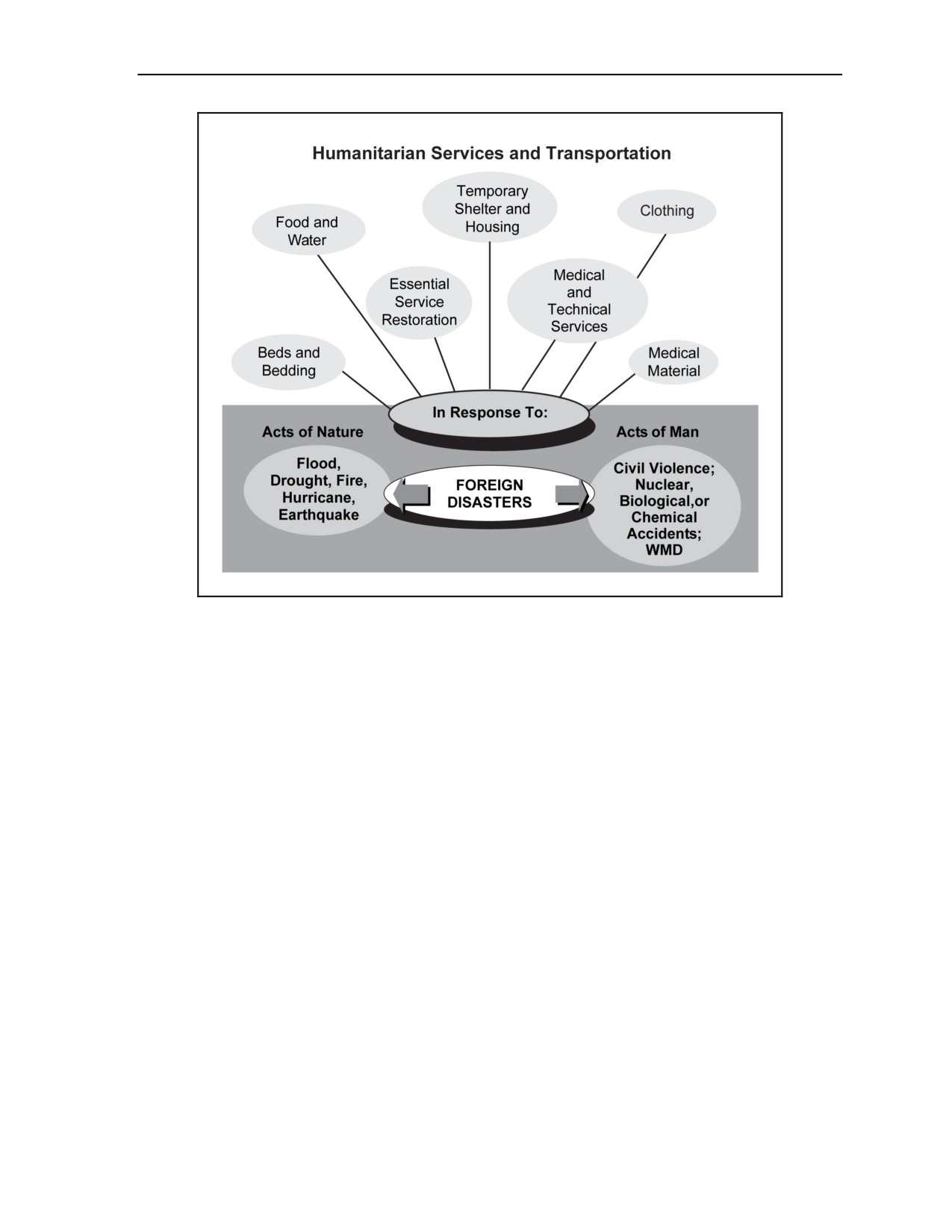
Civil Affairs Operations
Figure 3-1. Foreign humanitarian assistance
3-27. With the exception of an immediate response to prevent the loss of life, normally military forces
conduct FHA only upon the request of the DOS and in coordination with the COM and USAID. The
military normally plays a supporting role in FHA. Typical supporting roles include providing prompt aid to
alleviate the suffering of foreign disaster victims; making available, preparing, and transporting nonlethal
excess property to foreign countries; transferring on-hand DOD stocks to respond to unforeseen
emergencies; providing funded and space-available transportation of humanitarian and relief supplies;
conducting some DOD humanitarian demining assistance activities; and conducting foreign consequence
management.
3-28. The Office of U.S. Foreign Disaster Assistance (OFDA) is the office within USAID responsible for
facilitating and coordinating U.S. Government emergency assistance overseas. OFDA publishes the Field
Operations Guide (FOG) for Disaster Assistance and Response with an overview of USG roles during a
disaster. As the lead U.S. agency during a FHA response, OFDA provides guidance for the USG response.
U.S. military participation in FHA operations can include—
z
Providing security, which allows civilian agencies to operate safely and uninhibited.
z
Conducting assessments.
z
Conducting specific military capabilities applied in direct disaster relief roles, such as—
Providing food and medical care.
Constructing basic sanitation facilities.
Repairing public facilities.
Constructing shelters and temporary camps.
Providing helicopter and fixed-wing transport for supplies, commodities, and passengers, as
demonstrated by the Indian Ocean Tsunami response in 2004 and 2005.
31 October 2011
FM 3-57
3-7
Chapter 3
3-29. FHA operations are inherently complex. They require a significant amount of interagency
coordination. The United States directs FHA at the strategic level, coordinates and manages it at the
operational level, and conducts it at a tactical level. FHA operations require centralized coordination and
control. To help achieve FHA objectives, CAO planners ensure the nominated programs are—
z
Beneficial to a wide spectrum of the country in which the activity occurs.
z
Self-sustaining or supportable by HN civilian or military forces.
z
Consistent with internationally accepted standards and principles
(for example, the Sphere
Project: Humanitarian Charter and Minimum Standards in Disaster Relief).
Planners must closely coordinate FHA program development and implementation with the humanitarian
community, which includes IGOs, NGOs, and HN assistance agencies.
RELIEF MISSIONS
3-30. U.S. forces conduct relief missions supporting tasks across the range of military operations, from
domestic disasters that occur naturally to the aftermath of foreign conflicts. FHA missions in the area of
disaster relief include conducting technical assessments, transporting goods and supplies, securing
humanitarian infrastructure, and when deemed appropriate by civilian officials, directing efforts to mitigate
the results of natural or man-made disasters. Examples of disasters include hurricanes, earthquakes, floods,
oil spills, famine, and civil conflicts. Potential roles for U.S. forces include providing food and medical
care; constructing basic sanitation facilities; repairing public facilities; constructing shelters; and
responding quickly to relieve suffering, prevent loss of life, and protect property.
3-31. Normally, DOD is in a supporting role during relief missions. OFDA provides foreign disaster
assistance and coordinates the USG’s response to disasters abroad. OFDA’s mandate is to save lives,
alleviate suffering, and reduce the economic impact of disasters. If a foreign disaster is large enough in
scope for the United States to commit forces, OFDA is likely to have a team or teams on the ground in the
affected area as well. Disaster assistance response teams can vary in size and scope, but it is essential that
U.S. forces operating in the same disaster area coordinate with these teams. OFDA has a military liaison
unit, which can assign a liaison officer to a military unit for the relief missions; it is advisable for military
commanders supporting relief missions to assign liaison officers to OFDA. In any case, if no liaison
officers are available, it is critical that U.S. forces operating in a declared disaster area work closely with
any OFDA disaster assistance response team on the ground.
The Tsunami Disaster-Relief Effort in the Indian Ocean Region
The Indian Ocean tsunami disaster-relief effort at the end of 2004 is a good example
of interagency cooperation, collaboration, and communication. As both DOD and
OFDA rapidly responded to the disaster areas, both realized the need for close
cooperation and coordination. OFDA dispatched liaison officers at the tactical level to
CMOCs operating in Sri Lanka, Indonesia, and Thailand, as well as at USPACOM.
The DOD similarly embedded liaison officers at OFDA’s response management team
in Washington, DC. These steps greatly simplified the request for assistance process
from IGOs and NGOs and increased the ability of both organizations to respond
effectively and quickly to those affected by the disaster.
Office of U.S. Foreign Disaster Assistance
USAID
TECHNICAL ASSISTANCE AND SUPPORT FUNCTIONS
3-32. Technical assistance and support functions are generally short-term tasks, such as restoration of
communications; management of relief supplies; and provision of emergency medical care, humanitarian
demining activities, and high-priority relief supply delivery. Based upon Presidential and/or SecDef and
GCC’s guidance, the FHA force commander should establish policy regarding technical advice and
assistance to the affected country, IGOs, and NGOs as soon as possible.
3-8
FM 3-57
31 October 2011
Civil Affairs Operations
3-33. Technical assistance and support functions include—
z
Restoring the communications system.
z
Military relief supply management (to include high-priority relief supply delivery). The U.S.
military may also facilitate OGAs, IGOs, and NGOs with their relief supply efforts.
z
Providing emergency medical care.
z
Supporting humanitarian mine action (demining) operations by assisting in training the National
Mine Action Authority and conducting liaison activities with the HN infrastructure, IGOs or
NGOs.
z
Assisting the National Mine Action Authority to establish mission command and to
communicate effectively with subordinate organizations, as well as HN government officials.
z
Assisting the National Mine Action Authority with its integration into the HN and international
communities.
FOREIGN CONSEQUENCE MANAGEMENT
3-34. Foreign consequence management is DOD assistance provided by the USG to the HN to mitigate the
effects of a deliberate or inadvertent release of WMD or chemical, biological, radiological, nuclear, and
high-yield explosives and to restore essential government services. These operations involve those services
and activities necessary to manage and mitigate problems resulting from disasters and catastrophes. They
involve measures to alleviate the damage, loss, hardship, or suffering caused by emergencies abroad.
3-35. Foreign consequence management operations include—
z
Assisting with the restoration of essential HN government services.
z
Assisting with the protection of HN public health and safety.
z
Assisting with the provision of emergency relief to HN government, businesses, and individuals.
z
Identifying and assessing the threat posed by hazardous materials.
z
Providing consultation to HN decision makers.
3-36. FM
3-11.21, Multiservice Tactics, Techniques, and Procedures for Nuclear, Biological, and
Chemical Aspects of Consequence Management, and CJCSI 3214.01C, Military Support to Foreign
Consequence Management Operations for Chemical, Biological, Radiological, and Nuclear Incidents,
provide additional information on foreign consequence management.
CIVIL AFFAIRS MISSION IN FOREIGN HUMANITARIAN ASSISTANCE
3-37. The CA supporting tasks in FHA support the commander’s operational function and administer
certain aspects of FHA. Generally, CA Soldier tasks include—
z
Participating in the preparation and review of contingency plans that address assisting USG
agencies, IGOs, HN agencies, and NGOs to support FHA.
z
Monitoring all FHA operations for compliance with applicable laws, agreements, treaties, and
contracts.
z
Reviewing guidance from the GCC regarding FHA operations in TSCPs, FHA and disaster relief
plans, and foreign consequence management plans.
z
Incorporating FHA assessment and FHA training into TSCPs.
z
Assessing the environment in which U.S. forces will conduct FHA operations, including the—
Political situation.
Physical boundaries of the area.
Potential threat to forces.
Global visibility of the situation.
Media interest climate for FHA operations.
z
Confirming and validating the HN’s ability to manage HA in the AO.
z
Establishing a CMOC to coordinate and synchronize CAO and CMO efforts with interagency
and multinational HA efforts in the AO.
31 October 2011
FM 3-57
3-9
Chapter 3
z
Identifying shortfalls in HN HA plans and resources.
z
Identifying HA resources, including various government agencies, military units, NGOs, and IPI
in the theater of operations, and establishing contact and working relationships as appropriate.
z
Assessing, monitoring, and reporting the impact of FHA operations on the populace and the
populace on the operations.
z
Developing plans and strategies for long-range mitigation of political, economic, legal, social,
and military issues associated with FHA operations.
z
Understanding that, even in a permissive environment, elements may use nonthreatening means,
such as demonstrations, to impair the credibility or reduce the effectiveness of U.S. military
operations.
z
Initiating or refining CIM process with geospatial products that depict affected populations and
civil vulnerabilities.
RULES OF ENGAGEMENT DURING FOREIGN HUMANITARIAN ASSISTANCE OPERATIONS
3-38. The development of ROE for the forces participating in FHA operations is essential to the success of
the mission. Restraint characterizes ROE for FHA operations. Planners must evaluate and address the
levels of force, tactics, and weaponry.
3-39. The sensitive political and international nature of FHA operations means that the GCC must
coordinate the details of FHA ROE with the JFC. The details may change as the operation evolves. Under
normal circumstances, Joint Chiefs of Staff peacetime ROE apply to all military operations. The GCC, in
coordination with the JFC, must request supplemental measures to deal with specifics of the mission.
Actual ROE established for each FHA mission depend on the individual situation and operational
environment.
3-40. For multinational operations, all participating military forces should establish common FHA ROE to
provide consistency within the force. Individual nations using separate national ROE respond differently to
the same situation. The following precepts are essential to U.S. ROE:
z
The right of self-defense will never be prohibited.
z
A unit commander will defend against a hostile act or hostile intent.
3-41. The two elements of self-defense are necessity and proportionality. In necessity, a hostile act must
occur or a hostile intent must be apparent. In proportionality, the use of force must be reasonable in
intensity, duration, and magnitude to ensure the safety of forces.
CIVIL INFORMATION MANAGEMENT
3-42. CIM is the process whereby civil information is collected, entered into a central database, and
internally fused with the supported element, higher HQ, and other USG and DOD agencies, IGOs, and
NGOs. This process ensures the timely availability of information for analysis and the widest possible
dissemination of the raw and analyzed civil information to military and nonmilitary partners throughout
the AO. CA, through the proper execution of CIM, enhances operations by preventing the duplication of
information gathering efforts by follow-on forces. During episodic engagements, the capturing of key civil
data, results of key-leader engagements, and CR provide current civil domain information for dissemination
through the CIM process. Accessibility to current civil data by both military forces and civilian
stakeholders through a future single repository will positively impact the planning and conduct of
operations globally.
3-43. Civil information is information developed from data with relation to civil areas, structures,
capabilities, organizations, people, and events within the civil component of the commander’s operational
environment. The management of civil information is the fusion of the CIM process into the COP to benefit
the supported commander, DOD, interagency, IGO, NGO, and IPI situational awareness, situational
understanding or situational dominance.
3-44. CIM is not solely a task of the CA unit’s CIM cell. It is an essential task for all components of a CA
unit. CA commanders, in coordination with the G-9/S-9, should actively incorporate the supported unit’s
3-10
FM 3-57
31 October 2011
Civil Affairs Operations
intelligence and maneuver elements into the civil information collection requirements to enhance the COP
and the IPB process. CIM enhances situational awareness and facilitates understanding for all elements in
the operational environment, allowing those elements to achieve decision superiority.
CIVIL INFORMATION MANAGEMENT PROCESS
3-45. The CIM process generates civil information through the following six steps. The six steps are
discussed in the following paragraphs.
Collection (Step One)
3-46. Collection is the first step of the CIM process and refers to the literal gathering of relevant data.
Driven by CCIR and integrated with the ISR plan, civil information collection occurs at all levels through
CR, data mining and collaboration with IPI, IGOs, NGOs, and OGAs. At first there is little, if any, quality
screening of the data collection, everything related is relevant.
3-47. About 90 percent of intelligence starts as open-source information. The security classification
typically associated with intelligence products is due to the source and methods of collection. The intent of
CIM is to keep most of this information unclassified and easily shared with non-USG partners.
3-48. The heart of collection is the daily interaction between U.S. forces and the myriad of civilians in the
supported commander’s AO, and the capture of these contacts and data points. Every Soldier who
encounters the civilian elements of an AO is a potential sensor of civil information. Civil information
collection focuses on the following:
z
CR.
z
Data mining.
z
Collaboration.
Civil Reconnaissance
3-49. CR is a targeted, planned, and coordinated observation and evaluation of specific civil aspects of the
environment. CR focuses on the civil component, the elements of which are best represented by the
acronym ASCOPE: area, structures, capabilities, organizations, people, and events. Priority information
requirements focus on CR for the purpose of collecting civil information to enhance situational
understanding and facilitate decisionmaking. CAO and CMO planners (G-9/S-9 and supporting CAPTs) in
coordination with the CMOC integrate CR into the overall supported commander’s OPLAN, enhancing the
deployment of the COP.
3-50. Potential sources of civil information that a coordinated CR plan considers include—
z
Ongoing ASCOPE assessments of the AO that identify MOE trends.
z
Identified unknowns in civil information:
Gaps identified during collation and analysis.
Gaps remaining in the area study and area assessment.
z
CA interaction with IPI, including but not limited to—
HN government officials.
Religious leaders.
Tribal or clan leaders.
DC camp leadership.
DCs on the move.
Infrastructure managers and workers.
Local industry personnel.
Medical and educational personnel.
31 October 2011
FM 3-57
3-11