FM 3-57 Civil Affairs Operations (October 2011) - page 1
*FM 3-57
Field Manual
Headquarters
Department of the Army
No. 3-57 (FM 3-05.40)
Washington, DC, 31 October 2011
Civil Affairs Operations
Contents
Page
PREFACE
iv
Chapter 1
INTRODUCTION TO CIVIL AFFAIRS OPERATIONS
1-1
Mission
1-1
Terminology
1-2
Civil Affairs Operations Overview
1-3
Civil Affairs Functions and Capabilities
1-6
Civil Affairs Application of the Principles of War
1-8
Additional Principles of Joint Operations
1-11
Chapter 2
CIVIL AFFAIRS ORGANIZATION
2-1
Civil Affairs Organizations, Functions, and Capabilities
2-1
Common Civil Affairs Organizational Elements
2-1
Regular Army Civil Affairs Forces
2-2
United States Army Reserve Civil Affairs Forces
2-14
Mission Command
2-32
Unity of Effort
2-32
Army Headquarters Civil Affairs Operations Staff Elements
2-32
Theater Organization
2-40
Chapter 3
CIVIL AFFAIRS OPERATIONS
3-1
Civil Affairs Core Tasks
3-1
Populace and Resources Control
3-2
Foreign Humanitarian Assistance
3-6
Civil Information Management
3-10
Nation Assistance
3-13
Support to Civil Administration
3-17
Approved for public release; distribution is unlimited.
FOREIGN DISCLOSURE RESTRICTION (FD 1): The material contained in this publication has been
reviewed by the developers in coordination with the United States Army John F. Kennedy Special
Warfare Center and School foreign disclosure authority. This product is releasable to students from
all requesting foreign countries without restrictions.
*This publication supersedes FM 3-05.40, 29 September 2006.
i
Contents
Civil Affairs Operations Support to Unified Land Operations
3-18
Civil Affairs Support of Army Operations
3-23
Civil Affairs Support of Civil Military Operations
3-24
Civil Affairs Operations and Inform and Influence Activities
3-28
Civil Affairs Operations and Public Affairs
3-30
Civil Affairs Operations Support to Army Special Operations Forces
3-31
Chapter 4
PLANNING
4-1
Civil Affairs Methodology
4-1
Civil Affairs Area Studies, Assessments, and Estimates
4-3
Operational and Mission Variable Analysis
4-6
Civil Affairs Support of Joint Operations Planning
4-11
Civil-Military Operations Working Group
4-15
Appendix A TRANSITION CONSIDERATIONS
A-1
Appendix B CIVIL AFFAIRS OPERATIONS RUNNING ESTIMATE
B-1
GLOSSARY
Glossary-1
REFERENCES
References-1
INDEX
Index-1
Figures
Figure 1-1. Interrelationship of Civil Affairs operations, civil-military operations, and
unified land operations
1-3
Figure 1-2. Civil Affairs operational support structure
1-4
Figure 2-1. Civil Affairs brigade (airborne) (special operations)
2-3
Figure 2-2. Civil Affairs battalion (airborne) (special operations)
2-6
Figure 2-3. Civil Affairs company (airborne) (special operations)
2-7
Figure 2-4. Civil Affairs team (special operations)
2-8
Figure 2-5. Headquarters and headquarters company, Civil Affairs brigade (Regular
Army)
2-10
Figure 2-6. Civil Affairs battalion (Regular Army)
2-11
Figure 2-7. Civil Affairs company (Regular Army)
2-12
Figure 2-8. Civil Affairs team (Regular Army)
2-13
Figure 2-9. Civil Affairs command
2-15
Figure 2-10. Civil Affairs command functional specialty cell
2-17
Figure 2-11. Six Civil Affairs functional specialty areas with 14 functional specialties
2-18
Figure 2-12. Civil Affairs brigade (United States Army Reserve)
2-27
Figure 2-13. Civil Affairs battalion (United States Army Reserve)
2-28
Figure 2-14. Civil Affairs company (United States Army Reserve)
2-30
Figure 2-15. Civil Affairs team (United States Army Reserve)
2-31
Figure 2-16. United States Army Special Operations Command organization
2-39
Figure 2-17. U.S. Army Civil Affairs and Psychological Operations Command
(airborne)
2-40
ii
FM 3-57
31 October 2011
Contents
Figure 2-18. Example of Civil Affairs support to joint special operations task force
operations
2-43
Figure 3-1. Foreign humanitarian assistance
3-7
Figure 3-2. National Incident Management System
3-22
Figure 3-3. Civil-military lines of operation in support of unconventional warfare
3-34
Figure 4-1. Relationship of system, node, link, and centers of gravity
4-13
Figure B-1. Civil Affairs operations running estimate format
B-4
Figure B-2. Civil Affairs operations running estimate contributions to Annex K
B-7
Tables
Table 1-1. Civil Affairs functions and capabilities
1-7
Table 4-1. Comparison of the Civil Affairs methodology and the various problem-
solving and decisionmaking processes
4-3
Table B-1. Civil Affairs operations running estimate contributions to the military
decisionmaking process
B-1
31 October 2011
FM 3-57
iii
Preface
Field Manual (FM) 3-57, Civil Affairs Operations, provides the doctrinal basis for the conduct of operations in
support of the joint force commander’s (JFC’s) civil-military operations (CMO) concept. It provides Army
commanders with the information necessary for the integration of Civil Affairs (CA) capability in support of
unified land operations.
PURPOSE
FM 3-57 clarifies the role of CA forces in support of CMO with regard to the missions, employment, support
requirements, capabilities, and limitations of these forces. CA forces support missions in every theater, in peace
and war, throughout unified land operations. CA forces are a combat multiplier for every commander.
CA forces are one of the primary resources a commander has to assist him in dealing with the complex and
ever-changing civil component of the operational environment. CA forces are trained, organized, and equipped
to plan, execute, and assess the JFC’s concept for CMO. They are essential elements in the support of the
commander by virtue of their area and linguistic orientation, cultural awareness, training in military to host nation
(HN) advisory activities, and civilian professional skills that parallel common government functions.
SCOPE
Although written primarily to assist the Army Service component command (ASCC), Army corps, Army
divisions, brigade combat teams (BCTs), and maneuver enhancement brigades (MEBs) with the integration of
Civil Affairs operations (CAO) in planning, preparing for, executing, and assessing unified land operations, this
FM is applicable for joint force operations as well. The commander must always consider the engagement of the
civil component within the area of operations (AO).
APPLICABILITY
The principal audience for FM 3-57 is the leadership of the Army, officers and senior noncommissioned
officers who command Army forces (ARFOR) or serve on the staffs that support those commanders of
operations at all levels of war. It is also an applicable reference to the civilian leadership of the United States
(U.S.) interagency organizations. This publication applies to the Active Army, Army National Guard/Army
National Guard of the United States, and United States Army Reserve (USAR) unless otherwise stated.
FM 3-57 uses joint terms, where applicable. Most terms with joint or U.S. Army definitions are in both the
glossary and the text. FM 1-02, Operational Terms and Graphics, publishes these terms and their definitions.
ADMINISTRATIVE INFORMATION
The proponent of this manual is the United States Army John F. Kennedy Special Warfare Center and School
(USAJFKSWCS). Reviewers and users of this manual should submit comments and recommended changes on
Department of the Army (DA) Form 2028 (Recommended Changes to Publications and Blank Forms) to
Commander, United States Army John F. Kennedy Special Warfare Center and School, ATTN: AOJK-DTD-CA,
2175 Reilly Road, Stop A, Fort Bragg, NC 28310-5000.
Unless this publication states otherwise, masculine nouns and pronouns do not refer exclusively to men.
iv
FM 3-57
31 October 2011
Chapter 1
Introduction to Civil Affairs Operations
The United States Army Civil Affairs forces are the Department of Defense’s primary
force specifically trained and educated to shape foreign political-military
environments by working through and with host nations, regional partners, and
indigenous populations. These forces, and the operations they conduct, are the
commander’s asset to purposefully engage nonmilitary organizations, institutions,
and populations.
The U.S. military can expect escalating challenges from ever-increasing operations in
complex civil-military environments. Commanders at all levels must pursue
integrated whole-of-government approaches to successfully engage the civil
dimension of the modern battlefield. As such, CA forces offer unique capabilities that
not only enhance the military mission but also ultimately advance U.S. interests.
Properly employed CA forces help shape the environment and set the conditions for
transition operations. Appendix A provides additional information on transition
operations.
CAO involve the interaction of CA forces with the civilian populace and institutions
to facilitate military operations and consolidate operational objectives. A supportive
civilian population can provide resources and information that facilitate friendly
operations. It can provide a positive climate for the military and for the nation to
pursue diplomatic activities that achieve foreign policy objectives. A hostile civilian
population threatens the immediate operations of in-country friendly forces and often
undermines public support and the policy objectives of the United States and its
allies. Properly executed CAO reduces the friction between the civilian population
and the military force, and accelerates the return of civil functions to indigenous
control.
MISSION
1-1. The mission of CA forces is to support commanders by engaging the civil component of the
operational environment to achieve CMO or other stated U.S. objectives and ensure the sustained
legitimacy of the mission and the transparency and credibility of the military force before, during, or after
other military operations. CA forces plan, prepare for, execute, assess, and transition CAO at all levels of
war. Joint Publication (JP) 3-57, Civil-Military Operations, states Civil Affairs forces are designated Active
and Reserve Component forces and units organized, trained, and equipped specifically to conduct civil
affairs operations and to support civil-military operations. As defined, CA refers to the force structure—
Soldiers, teams, staff personnel, and units. CA forces conduct CAO supported by other forces. CAO
support the JFC’s CMO intent and are synchronized with the supported commander’s operational concept.
1-2. CA forces support unified land operations in every environment across the range of military
operations. During unified land operations, CA forces conduct CAO that support and are nested within the
overall mission and commander’s intent. CAO are a cornerstone to the successful execution of stability
tasks.
31 October 2011
FM 3-57
1-1
Chapter 1
TERMINOLOGY
1-3. JP 3-57 defines civil-military operations as the activities of a commander that establish, maintain,
influence, or exploit relations between military forces, governmental and nongovernmental civilian
organizations and authorities, and the civilian populace in a friendly, neutral, or hostile operational area
in order to facilitate military operations, to consolidate and achieve operational U.S. objectives.
Civil-military operations may include performance by military forces of activities and functions normally
the responsibility of the local, regional, or national government. These activities may occur prior to,
during, or subsequent to other military actions. They may also occur, if directed, in the absence of other
military operations. Civil-military operations may be performed by designated civil affairs, by other
military forces, or by a combination of civil affairs and other forces. Also called CMO.
1-4. CMO are an inherent command responsibility. They encompass the activities JFCs take to establish
and maintain relations with civil authorities, the general population, and other organizations. Within the
capstone mission of unified action, JFCs are responsible for the organization and centralized direction of
CMO in their operational areas to facilitate military operations in support of political and military
objectives derived from national strategic objectives.
1-5. U.S. forces conduct CMO to coordinate civil and military instruments of national power, minimize
civil military friction and threats from the civil component, maximize support for operations, and meet the
commander’s legal obligations and moral responsibilities to the civilian populations within the operational
area. During unified land operations, CA forces conduct operations that support and nest within the overall
mission and commander’s intent.
1-6. JP 3-57 defines Civil Affairs operations as those military operations conducted by civil affairs forces
that (1) enhance the relationship between military forces and civil authorities in localities where military
forces are present;
(2) require coordination with other interagency organizations, intergovernmental
organizations, nongovernmental organizations, indigenous populations and institutions, and the private
sector; and (3) involve application of functional specialty skills that normally are the responsibility of civil
government to enhance the conduct of civil-military operations. Also called CAO.
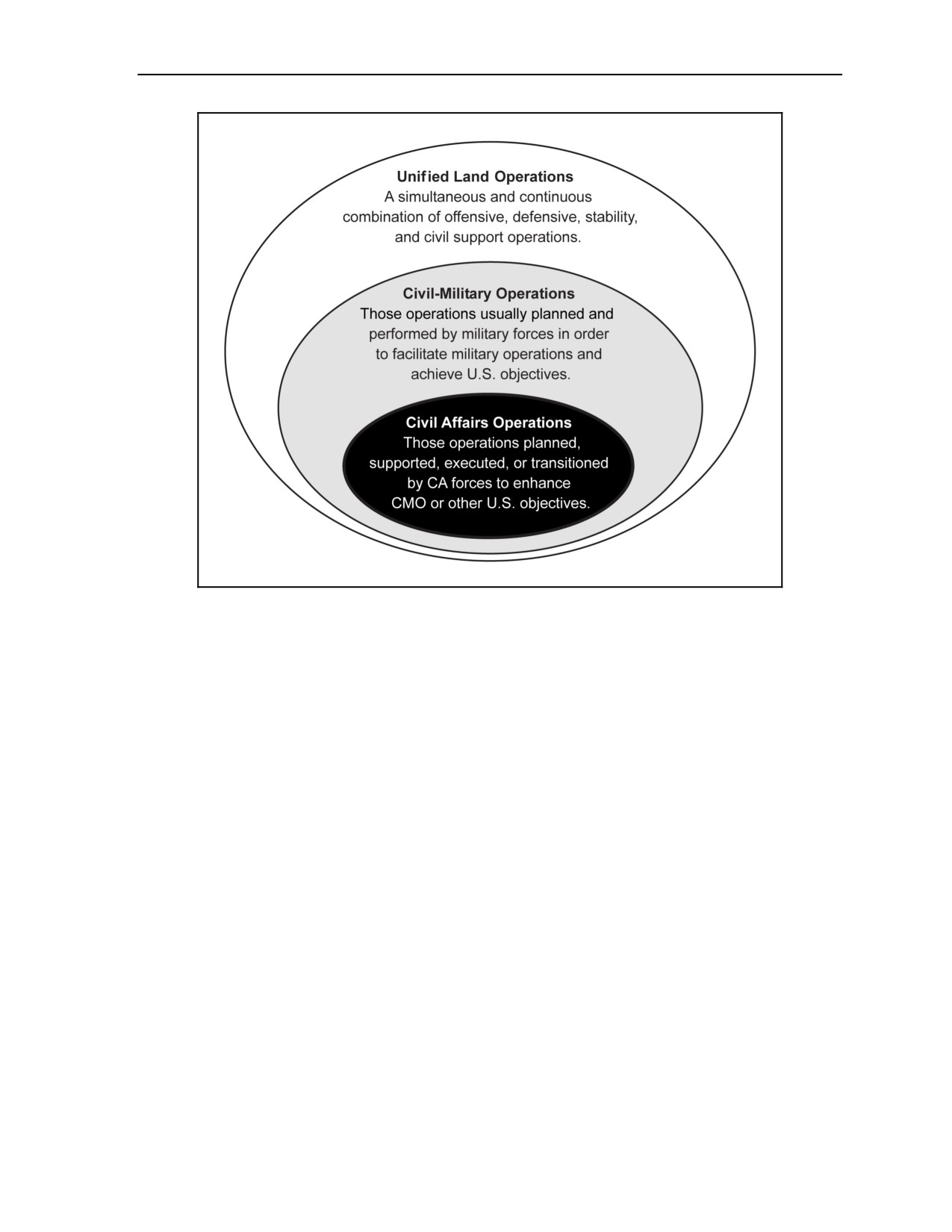
1-7. Figure 1-1, page 1-3, depicts the interrelationship of CAO, CMO, and unified land operations.
1-8. The CAO staff (G-9/S-9) is the principal advisor to the commander and staff on CAO. The G-9/S-9
integrates CAO into operations and exercises. He advises on the capabilities, allocation, and employment of
subordinate CA units and provides specific country information for training or deployment. The CAO staff
develops Annex K
(Civil Affairs Operations) to operation plans
(OPLANs) and concept plans
(CONPLANs). The G-9/S-9 coordinates with supporting CA forces and the civil-military operation center
(CMOC) to conduct interagency collaborative planning/coordination and integration of nonmilitary
stakeholders with the staff to synchronize operations. He ensures the timely update of the civil component
of the common operational picture (COP) through the civil information management process. The G-9/S-9
prepares and maintains the CAO running estimate (Appendix B) and advises the commander on the
obligations incurred from the long- and short-term effects
(economic, environmental, and health) of
military operations on civilian populations.
1-2
FM 3-57
31 October 2011
Introduction to Civil Affairs Operations
Figure 1-1. Interrelationship of Civil Affairs operations, civil-military operations,
and unified land operations
CIVIL AFFAIRS OPERATIONS OVERVIEW
1-9. CA forces are organized, trained, and equipped specifically to plan and execute all CAO across the
range of military operations, engaging many different indigenous populations and institutions
(IPI),
intergovernmental organizations (IGOs), nongovernmental organizations (NGOs), HN organizations, and
other government agencies (OGAs) to support the JFC’s CMO concept, which, in turn, supports the
attainment of national strategic objectives and achieves the JFC capstone mission of unified action. Senior-
level CA planning and policy representation across Army and Department of Defense (DOD) agencies is
required to ensure proper integration and early determination of requirements. These key pieces, coupled
with properly routed support requests, ensure timely access to CA forces.
1-10. IPI are the civilian construct of an AO and include its population (legal citizens, legal and illegal
immigrants, and all categories of dislocated civilians [DCs]) as well as governmental, tribal, commercial,
and private organizations and entities. The intent of CAO is to enhance stability, to mitigate or defeat
threats to civil society, and to assist in establishing local government capacity for deterring or defeating
future civil threats.
CIVIL AFFAIRS CORE TASKS
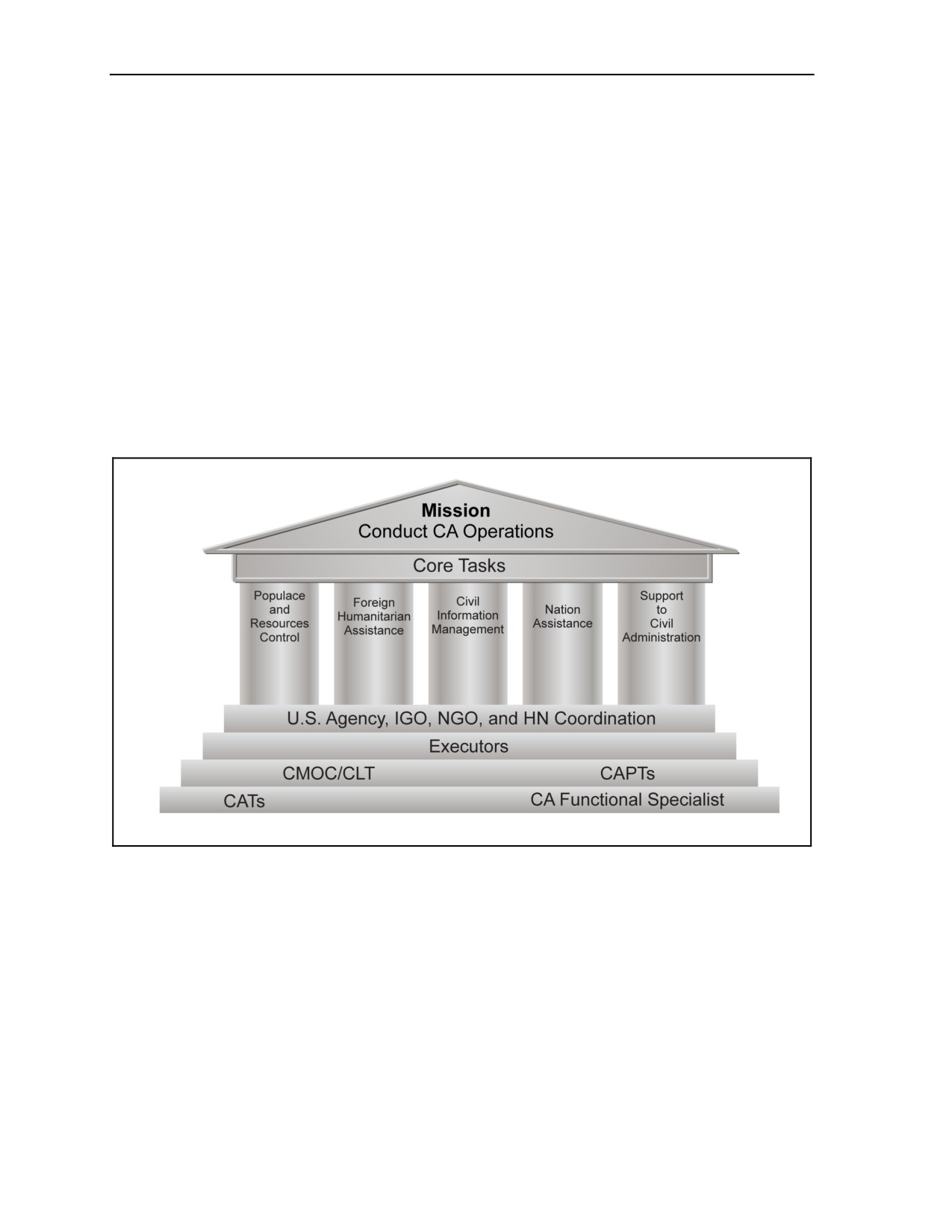
1-11. CAO consist of the following core tasks:
z
Populace and resources control (PRC).
z
Foreign humanitarian assistance (FHA).
z
Civil information management (CIM).
z
Nation assistance (NA).
z
Support to civil administration (SCA).
31 October 2011
FM 3-57
1-3
Chapter 1
1-12. CAO are conducted within the scope of five core tasks and may occur prior to, simultaneously, or
sequentially with combat operations depending on the operational environment. Although these tasks are
the focus for all CA force training, planning, execution, and assessment, these tasks are not solely the
responsibilities of CA forces. As part of the larger category of CMO, these core tasks nest within the
maneuver commander’s overall responsibility for planning and executing stability operations. The five core
tasks of CAO are interrelated with one another. Each of these core tasks may support the overall CMO
goals and objectives as outlined in the JFC’s civil-military strategy, but rarely do they do so independently.
Instead, the core tasks of CAO tie into and support one another. As such, CA forces are the maneuver
commander’s primary asset to plan, coordinate, support, and execute CAO across the range of military
operations.
CIVIL AFFAIRS OPERATIONS STAFF
1-13. Using the base of Figure 1-2 the CAO staff, augmented by Civil Affairs planning teams (CAPTs),
develops plans that use U.S. military (including CA) and coalition forces and all available nonmilitary
organizations or resources to optimize CMO. CMOCs and civil liaison teams (CLTs) coordinate plans and
operations with the civil component of the operational environment. Civil Affairs teams (CATs) and CA
functional specialists develop and implement plans by conducting key-leader engagement, CAO project
management, and civil reconnaissance (CR) that support the commander’s COP.
Figure 1-2. Civil Affairs operational support structure
Support to Unified Land Operations
1-14. Army Doctrine Publication (ADP) 3-0, Unified Land Operations, states Army leaders plan, prepare,
execute, and assess operations by analyzing the operational environment in terms of the operational
variables and mission variables. The operational variables consist of political, military, economic, social,
information, infrastructure, physical environment, time (known as PMESII-PT). Formal training of CA
Soldiers aids them in developing skills to analyze the operational environment by means of a political-
military assessment of the operational variables.
1-15. During the military decisionmaking process (MDMP), CA Soldiers on the CAO staff (G-9/S-9)
provide the commander with an analysis of the civil components that shape the operational environment.
As a part of mission analysis, the mission variables (mission, enemy, terrain and weather, troops and
support available—time available, and civil considerations [METT-TC]) are evaluated for those aspects of
1-4
FM 3-57
31 October 2011
Introduction to Civil Affairs Operations
the operational environment that directly affect a mission. The CAO staff provides the commander detailed
civil considerations analysis focused on the factors (areas, structures, capabilities, organizations, people,
and events [ASCOPE]) affecting the civil component of the AO. CAO planners further develop and
implement their plans in conjunction with civilian officials from other United States Government (USG)
agencies and other nonmilitary organizations in order to synchronize U.S. and multinational efforts.
1-16. ARFOR execute a simultaneous and continuous combination of offensive, defensive, and stability
operations as part of integrated joint, interagency, and multinational teams during overseas campaigns.
ARFOR within the United States and its territories combine offensive, defensive, and defense support of
civil authorities (DSCA) operations to support homeland security concurrently with overseas campaigns.
Strategically, the ability to conduct offensive, defensive, and stability operations in overseas campaigns while
supporting homeland security domestically is central to unified land operations. DSCA provide Army
capabilities to support homeland security directly. Overseas campaigns contribute to homeland security by
taking the fight to the enemy and stabilizing the international environment, thus removing potential
strategic threats.
Offensive Operations
1-17. Offensive operations carry the fight to the enemy by closing with and destroying enemy forces,
seizing territory and vital resources, and imposing the commander’s will on the enemy. Offensive
operations focus on seizing, retaining, and exploiting the initiative. This active imposition of land power
makes the offense the decisive type of military operation, whether undertaken against irregular forces or the
armed forces of a nation-state. In addition, the physical presence of land forces and their credible ability to
conduct offensive operations enable the unimpeded conduct of stability operations.
Defensive Operations
1-18. Defensive operations counter enemy offensive operations. Defensive operations defeat attacks,
destroying as many attackers as necessary. Defensive operations preserve control over land, protect key
resources, and guard populations. Defensive operations also buy time and economize forces to allow the
conduct of offensive operations elsewhere. Defensive operations not only defeat attacks but also create the
conditions necessary to regain the initiative and go on the offensive or execute stability operations.
Stability Operations
1-19. Stability operations sustain and exploit security and control over areas, populations, and resources.
Stability operations employ military capabilities to reconstruct or establish services and support civilian
agencies. Stability operations involve both coercive and cooperative actions. Stability operations may occur
before, during, and after offensive and defensive operations; however, they also occur separately. During
stability operations, there is a high demand placed on CA capabilities. This can lead to an environment in
which (in cooperation with a legitimate government) the other instruments of national power predominate.
Defense Support of Civil Authorities
1-20. DSCA operations address the consequences of man-made or natural disasters and incidents beyond
the capabilities of state and local civilian authorities. ARFOR do not conduct stability operations within the
United States and its territories because U.S. law holds the federal and state governments responsible for
those tasks. Instead, ARFOR conduct DSCA operations, when requested, by providing Army expertise and
capabilities to lead agencies (local, tribal, state, or federal government).
Note. Chapter 3 provides a detailed discussion of CA support to unified land operations.
Support to Homeland Defense
1-21. Within the United States and its territories, ARFOR support homeland security operations. Homeland
security operations provide the nation strategic flexibility by protecting its citizens and infrastructure from
conventional and unconventional threats. Homeland security has two components. The first component is
homeland defense. If the United States comes under direct attack or hostile forces threaten it, ARFOR
31 October 2011
FM 3-57
1-5
Chapter 1
under joint command conduct offensive and defensive missions as part of homeland defense. The other
component is DSCA.
Support to Theater Security Cooperation Plan
1-22. CAO typically support many elements of the geographic combatant commander’s (GCC’s) theater
plans. At the strategic and operational levels, especially during the implementation of the GCC’s theater
security cooperation plan (TSCP), the timely application of CAO (for example, FHA and NA) can mitigate
the need to apply other military operations in response to a crisis. When a crisis is unavoidable,
groundwork laid by CAO can facilitate rapid, decisive operations.
1-23. CAO planners contribute to the COP by assisting the supported commander and his staff to visualize
the entire situation. CAO planners do this by analyzing the mission variables (METT-TC) concentrating on
civil considerations. This includes—
z
Determining the need to establish one or more CMOCs, a CIM architecture, and supporting
networks as early as possible to facilitate communication and coordination with the nonmilitary
agencies operating in the AO.
z
Determining the need to employ a CLT to facilitate communication and coordination with
nonmilitary agencies for operations at all echelons.
z
Developing an analysis using ASCOPE to determine—
What, when, where, and why personnel might encounter civilians in the AO.
What activities civilians in the AO are engaging in that might affect the military operation
(and vice versa).
What the commander must do to support or interact with civil actions.
What nonlethal targeting to conduct within the civilian component of the operational
environment.
z
Developing the measures of effectiveness (MOEs) and measures of performance (MOPs) that
generate the definition and conditions for successful CAO and CMO contribution to the
supported unit’s mission. Planners must communicate and coordinate with the interagency in
developing MOEs and MOPs that support mutual goals and objectives toward the overall
national strategy.
CIVIL AFFAIRS FUNCTIONS AND CAPABILITIES
1-24. The primary function of all Army CA units is to support the commander by engaging the civil
component of the operational environment. CA forces interface with IPI, IGOs, NGOs, other civilian and
government organizations, and military forces to assist the supported commander to accomplish the
mission. To meet this broad requirement, Army CA units are organized to support conventional forces and
special operations forces (SOF), the Services, USG agencies, allied forces, agencies of other countries,
various IGOs, and their associated NGOs. Mission guidance and priorities—including prioritized regional
engagement activities and language requirements—from respective combatant commanders (CCDRs)
provide regional focus.
1-25. CA capability requirements shift to meet the transforming needs of the Army. CA capabilities now
align to support Army modularity while maintaining SOF support and to execute CAO across the range of
military operations. CA functions and capabilities consolidate to support the BCT, the division, the corps,
and echelons above corps with a CA planning capability, a CAO and CMO coordinating capability, and a
civil sector assessment and CAO project management capability.
1-26. The functional capability requirement for CAO and CMO reaches across the tactical, operational, and
strategic spectrums. Table 1-1, page 1-7, demonstrates how CA forces provide CAO and CMO planning
and coordinating capabilities, as well as functional CA specialty expertise, to supported commanders. The
CA support concept is also compatible at all levels to fuse and manage civil information to provide
commanders with increased situational awareness and understanding and achieve unified land dominance.
1-6
FM 3-57
31 October 2011

Introduction to Civil Affairs Operations
Table 1-1. Civil Affairs functions and capabilities
Level
Focus
Focus
Operational
Interagency
of Support
of Function
of Capabilities
Scope
Coordination
•
Enable IPI and
•
Develop and
•
American Embassy
Geographic
OGAs
build capacity of
•
USAID/OGAs
Combatant
IPI to provide
National
•
Shape operations
•
International
Command—
locally
to international
•
Promote
partners/donors
Strategic
sustainable
development
solutions
•
IGOs/NGOs
•
Reconstruction
•
Short-term civil
and
administration
development
•
American Embassy
•
Stabilization,
Corps—
•
Enable civil
reconstruction,
Subnational
•
USAID
Operational
administration
and development
to national
•
OGAs
to Strategic
•
Plan/enable/
•
Planning,
•
IGOs/NGOs
shape/manage
assessment, and
•
Regionally
implementation
focused
•
Conduct
•
Short-term civil
stabilization and
administration
reconstruction
•
USAID
•
Enable HN and
•
Enable civil
Division—
Province
•
Reconstruction
OGAs
administration
Tactical to
or large city
teams
•
Stabilization and
•
Plan, enable,
Operational
to subnational
•
OGAs
reconstruction
shape, and
•
IGOs/NGOs
•
Planning and
manage
assessment
(execution
oriented)
•
Immediate HA
to prevent crisis
•
Disaster assistance
•
Plan, assess, and
•
Enable local civil
response team
BCT—
enable local
administration
Large city
Tactical
stabilization
to province
•
OGA
•
Plan, enable,
activities
shape, manage
•
IGOs/NGOs
(execution
oriented)
Legend:
HA Humanitarian Assistance
USAID United States Agency for International Development
CIVIL AFFAIRS SOLDIER COMMON SKILLS
1-27. CA Soldiers and functional specialists are capable of planning, coordinating, executing, assessing,
and transitioning CAO and CMO at the joint, interagency, multinational, and coalition levels, while
maintaining the responsiveness and adaptability to operate in ambiguous situations. To meet these
challenges, CA Soldiers are well versed in the following common skill sets:
z
Warrior. CA Soldiers perform, as part of a combat operation using individual and squad
movement techniques (mounted and dismounted) and executing live-fire defensive protective
measures with common weapon systems. CA Soldiers are skilled in basic combative techniques
and protection measures.
z
Communications. CA Soldiers perform routine short- and long-range (secured and unsecured)
communications, including message formatting, encryption, and decryption.
z
Land navigation. CA Soldiers accurately navigate to destinations—
In all environments.
Over short and long distances.
31 October 2011
FM 3-57
1-7
Chapter 1
In groups or individually.
On mounted and dismounted operations.
With advanced positioning devices, orienteering techniques, map and compass, and terrain
association.
z
Medical. CA Soldiers administer immediate first aid and may provide combat lifesaving
measures to wounded or distressed individuals in preparation for emergency evacuation.
z
Language. Select CA units and individuals communicate in the assigned foreign language but
may have only limited ability to express themselves within the context of the customs, traditions,
and mores of a specific culture or mix of cultures endemic to the area of responsibility (AOR).
z
Regional focus and cultural awareness. CA Soldiers are knowledgeable of regional geography,
political, social, and economic systems. CA Soldiers are familiar with IPI and their specific
regional religious and ethnic differences, and are able to operate within the cultures indigenous
to the AOR.
z
Negotiation and mediation. CA Soldiers mediate, negotiate, and facilitate interaction across the
civil-military spectrum.
z
CAO mission planning. CA Soldiers plan, prepare for, execute, and continually assess CAO. CA
Soldiers advise conventional forces and SOF units in CMO, conduct CA support mission
planning, and prepare to transition CAO.
z
Inform and influence activities. CA Soldiers synchronize CAO with inform and influence
operational objectives, support the inform and influence plan, and integrate indigenous
information systems and institutions.
z
CAO project management. The six step process by which CA forces identify, validate, plan,
coordinate, facilitate, and monitor both material and nonmaterial CAO projects to achieve a
supported commander’s objectives relating to the civil component of the operational
environment.
z
International civilian response. CA Soldiers are familiar with the international civilian
organizations (for example, the United Nations [UN] and International Committee of the Red
Cross [ICRC]) mandated with responding to the needs of civilian populations (for example,
refugees, internally displaced persons, other vulnerable persons, and other categories of DCs).
CIVIL AFFAIRS FUNCTIONAL SPECIALISTS
1-28. CA force structure contains expertise in six functional specialty areas—rule of law, economic
stability, governance, public health and welfare, infrastructure, and public education and information.
Within each functional specialty area, technically qualified and experienced individuals, known as CA
functional specialists, advise and assist the commander and can assist or direct their civilian counterparts.
Within their area of specialization, they possess the critical skills necessary to establish that capability and
understand the regional and local impact of culture on that capability. The allocation of functional specialty
areas and functional specialists varies between unit levels as well as between units of the same level in the
Regular Army and USAR. This was done by design to account for the operational need for these specialties
at each level as well as for the ability of each component to maintain the high-level skills necessary for
specialized CAO. Commanders may employ these functional specialists (especially at the operational and
strategic levels) for general support of interagency operations in addition to direct support of military
operations. When civilian expertise normally provided by USG agencies is not available, CA functional
specialists may be required to fill key planning, operational, or liaison roles until replaced by their OGA
counterparts.
CIVIL AFFAIRS APPLICATION OF THE PRINCIPLES OF WAR
1-29. The nine principles of war represent the most important nonphysical factors that affect the conduct of
operations at the strategic, operational, and tactical levels. They are analysis tools. Although some
principles of war may not apply in all situations, Soldiers should consider them in all operations. Soldiers
use the principles to summarize the characteristics of successful operations.
1-8
FM 3-57
31 October 2011
Introduction to Civil Affairs Operations
OBJECTIVE
1-30. Direct every military operation toward a clearly defined, decisive, and attainable objective. A
strategic military objective is subordinate to, and must fulfill, a political objective. Likewise, operational
and tactical objectives must fulfill strategic military objectives and thus realize political objectives. Once
planners specify strategic, operational, and tactical military objectives, CA assets support commanders by—
z
Planning, coordinating, and executing CAO that supports the commander’s tactical and
operational objectives.
z
Planning, coordinating, and supporting CMO that supports the commander’s tactical and
operational objectives.
z
Developing and monitoring MOEs to ensure CAO are meeting civil component objectives,
which include political, economic, and informational goals.
z
Providing advice on the potential political, cultural, and economic impact of planned operations
and the effect of those operations on overall objectives.
z
Increasing the legitimacy of the HN government by consulting and coordinating with civilian
agencies to execute operations and projects in accordance with local government work priorities.
OFFENSIVE
1-31. Seize, retain, and exploit the initiative. CA forces support offensive operations by—
z
Gaining, maintaining, influencing, and enhancing positive relationships with the IPI while
promoting U.S. objectives.
z
Proactively engaging key IGOs, NGOs, OGAs, civil leaders, and community members to set
conditions for future success by synchronizing civilian support for and noninterference with
military operations.
z
Consulting and coordinating with civilian agencies to quickly begin posthostility operations and
projects that accelerate the return to normalcy.
z
Leveraging resources and encouraging friendly forces to minimize destruction of the civil
infrastructure.
MASS
1-32. Concentrate the effects of combat power at the decisive place and time. The principle of mass
requires the quick assembly of forces and resources at a particular place and time. CA units can recommend
secure areas where population density, local support, logistics support, and transportation routes support the
massing of friendly forces. CA units mass—
z
Functional specialists to assist the supported commander in achieving the desired effects.
z
CAO planners to support a commander’s main effort in support of the JFC’s CMO strategy.
z
CATs during unified land operations to—
Shape the operational environment in time and space for follow-on operations.
Determine the immediate needs and existing capabilities of the populace.
Shape the AO for transition.
ECONOMY OF FORCE
1-33. Allocate minimum essential combat power to secondary efforts. CA forces employ all combat
power available in the most effective way possible and allocate minimum-essential combat power to
secondary efforts. CA forces lessen the need to divert combat-ready troops from essential duties by
planning for and employing local resources. CA forces use local resources to maintain order and provide
logistics support and services. In consultation and coordination with civilian agencies, CA forces deliver
projects and programs that meet MOEs with the least expenditure of funds in order to achieve the greatest
positive effects in the supported commander’s AO.
31 October 2011
FM 3-57
1-9
Chapter 1
MANEUVER
1-34. Place the enemy in a disadvantageous position through the flexible application of combat power.
Related to mass, maneuver incorporates flexibility, mobility, and maneuverability. The local populace can
either help or hinder maneuver operations. CA forces support maneuverability by—
z
Developing, coordinating, and executing plans that positively influence target populations to
support the commander’s objectives. CA forces can minimize the negative impact of military
operations on civilian populations and the level of interference by civilians during combat
operations.
z
Recommending routes that minimize the impact on civil population centers.
z
Developing a restricted target list (civilian supplement). Items on a restricted target list might
include—
Cultural landmarks and humanitarian assets, such as hospitals, schools, and the offices of
IGOs and NGOs.
Critical infrastructure, such as electrical generation and water supply systems.
Social infrastructure, such as churches, mosques, and museums.
z
Developing and coordinating the commander’s critical information requirement (CCIR) related
to ASCOPE to assist the commander and staff to visualize the operational area.
UNITY OF COMMAND
1-35. For every objective, ensure unity of effort under one responsible commander. CA forces achieve
common purpose and direction through coordination, cooperation, and unity of command. Unity of effort is
an integral part of CAO and CMO synchronization with whole-of-government efforts. It is essential that
CAO planners and operators understand key interagency stakeholders’ cultural differences, capabilities, and
policy/legislative constraints.
SECURITY
1-36. Never permit the enemy to acquire an unexpected advantage. Security includes the measures a
military unit, an activity, or an installation takes for protection against acts that may impair its
effectiveness. CA forces support security by—
z
Providing cultural awareness, advice, and assistance to military forces that minimize cultural
conflict with the civil population.
z
Planning, managing, and providing oversight on projects according to existing principles and
standards, as well as engaging civil leaders to gain support for U.S. national objectives.
z
Separating potential adversaries from the support of the civilian populace by conducting projects
that meet the supported commander’s objectives while enhancing the legitimacy of the HN
government and addressing the needs of the local population.
z
Assessing the local AO, using ASCOPE, to develop situational awareness of current conditions
and enable military forces to discern patterns and changes to the environment that impact the
local security situation.
SURPRISE
1-37. Strike the enemy at a time or place or in a manner for which he is unprepared. It is not essential to
take enemy forces completely unaware; it is only necessary that they become aware too late to react
effectively. CA forces may achieve surprise by taking unexpected action. Establishing strong relationships
and enabling civilian populations with appropriate capabilities will help them resist enemy influences.
Additionally, CA forces can enhance the effectiveness of surprise by coordinating necessary aspects of the
plan with local authorities.
1-10
FM 3-57
31 October 2011
Introduction to Civil Affairs Operations
SIMPLICITY
1-38. Prepare clear, uncomplicated plans and clear, concise orders to ensure thorough understanding.
The CAO staff officer achieves simplicity by ensuring the CAO Annex to the operations order (OPORD) is
simple and direct, and input to fragmentary orders (FRAGOs) are clear and concise. This requirement
becomes amplified when operating with multinational partners, interagency, and NGOs due to differences
in language, doctrine, and culture.
ADDITIONAL PRINCIPLES OF JOINT OPERATIONS
1-39. JP
3-0, Joint Operations, adds three principles of operations—perseverance, legitimacy, and
restraint—to consider. The nine principles of war and the three principles of operations make up the
principles of joint operations.
PERSEVERANCE
1-40. Ensure the commitment necessary to attain the national strategic end state. Some joint operations
may require years to reach the transition or termination criteria set forth by the national strategic end state.
CA forces provide detailed area assessments that focus on the identifying the underlying causes of
instability. Once planners know these root causes, they can plan and execute unity of effort actions that
address the needs of the population. These actions frequently involve the application of the other elements
of national power (diplomatic, economic, and informational) to supplement military efforts.
LEGITIMACY
1-41. Develop and maintain the will necessary to attain the national strategic end state. CA forces
promote legitimacy by—
z
Supporting stakeholders at local levels.
z
Promoting the legitimacy and effectiveness of U.S. operations and the U.S. presence among the
IPI.
z
Minimizing friction between military and civilian organizations.
z
Conducting operations to stabilize the environment by enhancing the legitimacy and the
effectiveness of the HN government.
RESTRAINT
1-42. Limit collateral damage and prevent the unnecessary use of force. CA forces provide the supported
commander with a nonlethal capability when dealing with unarmed hostile elements of the operational
environment. This capability helps commanders avoid raising the level of conflict unnecessarily. Support
from the local population is essential in CAO, especially during stability operations. Commanders must
apply lethal military capability more prudently in CAO because support from the local population is
essential for mission success. CA forces provide cultural awareness advice that help commanders shape the
rules of engagement (ROE). Each Soldier must understand the reasons and need for restraint because a
single act could cause adverse political consequences.
31 October 2011
FM 3-57
1-11
Chapter 2
Civil Affairs Organization
Army validated requirements and authorized the expansion of the CA force structure
in both the Regular Army and the USAR. The U.S. Army organizes, equips, and
trains CA units to accompany and support joint and multinational forces, SOF,
conventional forces, and interagency organizations at the strategic, operational, and
tactical levels. CA units and elements support the geographic combatant commands
and subordinate Service component commands, the theater special operations
command (TSOC), and maneuver force—corps, divisions, BCTs, and MEBs—in the
conduct of unified land operations.
CIVIL AFFAIRS ORGANIZATIONS, FUNCTIONS,
AND CAPABILITIES
2-1. The primary function of all Army CA units is to provide the supported commander, from the GCC
and below, with the capability to engage the civil component of the operational environment. To
accomplish this broad function, the U.S. Army organizes CA units to support operations at all levels of
war—strategic, operational, and tactical. Mission guidance and priorities from GCCs provide regional
focus. This focus includes prioritizing regional engagement actions and identifying foreign language
requirements.
COMMON CIVIL AFFAIRS ORGANIZATIONAL ELEMENTS
2-2. CA companies, battalions, and brigades are force structured within the Regular Army and the USAR.
Civil Affairs Commands (CACOMs) are authorized only in the USAR. Exceptions do exist within the
organizational structures of like Regular Army and USAR units, but a number of CA-specific elements
within the company, battalion, brigade, and CACOM organizations are common to both components. These
common organizational elements include the following:
z
CMOC.
z
CAPT.
z
CLT.
z
CIM cell.
z
CAT.
CIVIL-MILITARY OPERATIONS CENTER
2-3. The CMOC is a standing capability formed by all CA units from the company level to the CACOM
level. Army CA units are organized to provide the supported commander the manpower and equipment, to
include a robust communications package, to form the nucleus of the CMOC. A CMOC is tailored to the
specific tasks associated with the mission and normally augmented by assets
(engineer, medical,
transportation) available to the supported commander. The CMOC serves as the primary coordination
interface for U.S. forces and IPI, humanitarian organizations, IGOs, NGOs, multinational forces, HN
government agencies, and other civilian agencies of the USG. The CMOC facilitates continuous
coordination among the key participants with regard to CAO from local levels to international levels within
a given AO, and develops, manages, and analyzes the civil inputs to the COP. The CMOC is the operations
and support element of the CA unit as well as a mechanism for the coordination of CAO.
31 October 2011
FM 3-57
2-1
Chapter 2
CIVIL AFFAIRS PLANNING TEAM
2-4. The CACOM is organized with five CAPTs; the brigade and battalion organizations have one CAPT.
The teams develop complete CAO plans, policy, and programs that support the GCC’s strategic CMO
plans. CAPT members are well skilled in MDMP and the joint operation planning process (JOPP). As
required, the CACOM CAPTs augment the staffs of the geographic combatant command, the Service
component commands, or a joint force land component command (JFLCC). The CAPTs assist CMO and
military planners with integrating the supported joint commander’s military campaign plans into wider
political-military or comprehensive civilian-military strategic plans.
2-5. The CA brigade and regionally aligned battalion CAPTs supporting SOF focus on strategic and
operational CMO plans, policy, and programs that support the GCC’s CMO strategy. These CAPTs
habitually support the TSOC, joint special operation task force (JSOTF), special operations task force
(SOTF), and Special Forces groups (SFGs). As required, these CAPTs augment the staffs of SOF
organizations.
2-6. The CA brigade and battalion CAPTs supporting conventional forces focus on the operational and
tactical CAO plans, policy, and programs that support the GCC’s strategic CMO objectives. These CAPTs
support corps and division organizations respectively or an equivalent joint task force (JTF) when directed.
As required, these CAPTs augment the G-9 and plans staff section (G-5) (or J-9/J-5, as appropriate) of
these organizations.
CIVIL LIAISON TEAM
2-7. CLTs exist at the CACOM, CA brigade, and CA battalion levels. The CLTs are organic components
of the CMOCs they support. The CLT extends the outreach of its parent CMOC into multiple areas. It
provides limited civil-military interface capability as a means for the exchange of information among IPI,
IGOs, NGOs, and OGAs, and has limited capability to link resources to prioritized requirements. The CLT
is a standalone team for the CMOC that acts in the same role as a CAT does for a battalion. The CLT
provides the supported CMOC with an engagement capability for CAO and CMO coordination without
interfering with the regular staff functions.
CIVIL INFORMATION MANAGEMENT CELL
2-8. The CIM cell is located within the CMOC from the CA battalion to the CACOM level. It collects
civil information, enters it into a central database, and internally fuses civil information with the supported
element, higher headquarters
(HQ), other USG/DOD agencies, and other agencies/organizations as
appropriate. Coordination among other elements will ensure the timely availability of information for
analysis and the widest possible dissemination of raw and analyzed civil information to all levels
throughout the AO.
CIVIL AFFAIRS TEAM
2-9. The CAT is the basic CA tactical support element provided to a supported commander. The CAT
executes CAO and is capable of conducting CR and assessments of the civil component of the AO. The
success of the overarching CAO plan is predicated on the actions of the CAT at the lowest tactical levels.
The CAT, due to its limited capabilities, relies on its ability to leverage other CA assets and capabilities
through reachback to the CA company CMOC in order to shape operations.
REGULAR ARMY CIVIL AFFAIRS FORCES
2-10. The U.S. Army authorized CA force structure additions in fiscal year (FY) 2010 through FY 2012
that affect the organizational structure of the United States Army Special Operations Command’s
(USASOC’s) existing CA brigade. The brigade’s structure will expand to a total of 5 CA battalions and
25 CA companies. Each regionally focused battalion supports one of the following five unified combatant
commands:
z
United States Pacific Command (USPACOM).
z
United States European Command (USEUCOM).
2-2
FM 3-57
31 October 2011
Civil Affairs Organization
z
United States Central Command (USCENTCOM).
z
United States Southern Command (USSOUTHCOM).
z
United States Africa Command (USAFRICOM).
2-11. Authorized expansion of the Regular Army CA force structure more than doubles the capacity of the
existing Regular Army CA force. Future force structure includes the activation of an additional CA brigade
HQ, associated battalions, and companies to create a dedicated Regular Army capacity to support
conventional forces. This enhanced capacity better supports Army force-generation deployment cycle
goals. The U.S. Army scheduled the fielding of the brigade HQ and five CA battalions for completion in
FY 2013. Each battalion will consist of a HQ company and six CA companies.
2-12. In July 2009, the Chief of Staff of the Army approved the redesign of the theater Army, corps, and
division HQ staffs. These mission command organizations base their structure on the six warfighting
functions—mission command, movement and maneuver, intelligence, fires, sustainment, and protection.
CA representation on the staffs will significantly increase, providing the capability to integrate CAO and
CMO throughout the operations process.
CIVIL AFFAIRS BRIGADE (AIRBORNE) (SPECIAL OPERATIONS)
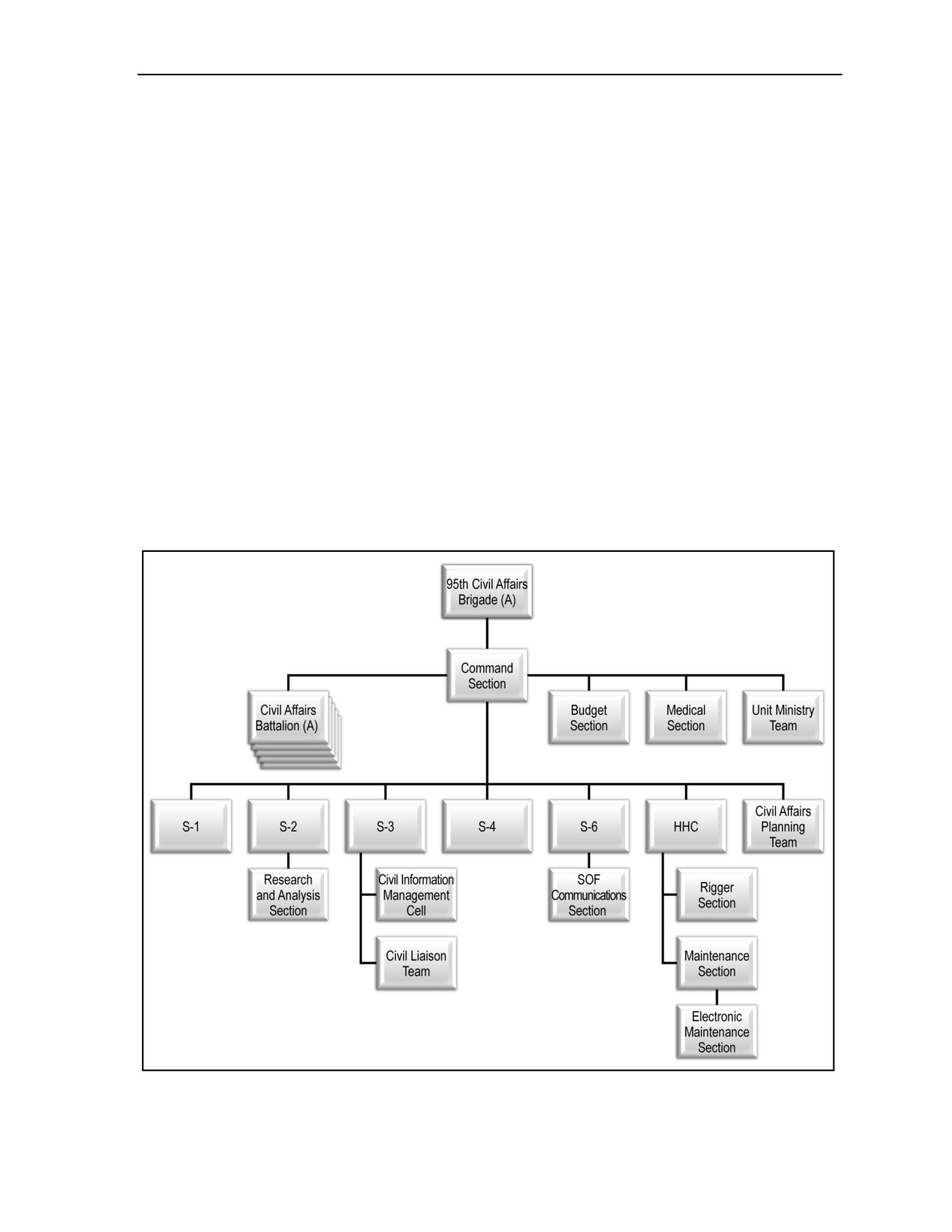
2-13. The USASOC CA brigade (Airborne [A]) (Figure
2-1) is composed of a headquarters and
headquarters company (HHC) with robust maintenance and rigger sections, a CAPT, and a CMOC with a
CLT and CIM cell. The USASOC CA brigade (A) does not have a CA functional specialty cell like the
USAR CA brigade, but has limited organic public health and welfare, veterinary, and rule of law capability.
Therefore, the CA brigade requires augmentation from the USAR CA brigade or CACOM for CA functional
specialty skill sets.
Figure 2-1. Civil Affairs brigade (airborne) (special operations)
31 October 2011
FM 3-57
2-3
Chapter 2
2-14. The U.S. Army activated the 95th CA Brigade (A) in FY 2007. The brigade’s mission is to rapidly
deploy regionally focused, initial-entry CAPTs, CMOCs, CA battalions, and CA companies to plan, enable,
shape, manage, and execute CAO in support of a geographic combatant command, JTF, TSOC, joint forces
special operations component (JFSOC), interagency, corps, division, or BCT. The brigade can serve as the
core of a joint civil-military operations task force (JCMOTF) and can provide mission command system
capabilities for assigned forces.
2-15. The CA brigade HQ provides mission command and staff supervision of the operations of the
brigade and assigned CA battalions or attached units. This HQ is rapidly deployable, providing USASOC
with a responsive, flexible, and modular CA force package. While serving in an initial-entry role during
contingency operations, the brigade is able to transition with the follow-on CA forces supporting
conventional forces.
2-16. Although the brigade’s primary mission focus is support of SOF, it maintains the capability to
support conventional forces during contingency operations. As the additional Regular Army CA brigade
activates and matures, planners anticipate the contingency initial-entry requirement to pass from the CA
brigade (A) assigned to USASOC to the new brigade designed to support conventional forces.
Functions
2-17. The functions of the USASOC CA brigade (A) are to—
z
Rapidly deploy as an initial-entry CA capability in support of the JFSOC, corps/ASCC, JTF,
geographic combatant command, or TSOC.
z
Serve as the initial-entry ground commander’s senior CA advisor (brigade commander) in
contingency operations.
z
Provide the initial-entry, operational-level CMOC with mission command system capabilities
within immature operational environments in support of joint, interagency, multinational, and
coalition operations by various means. The CA brigade operates in remote environments and
under austere conditions.
z
Serve as the core of a JCMOTF.
z
Provide cross-cultural communications and elementary linguistic capability to the supported
command, advising the commander on cultural influences in the AOR.
z
Provide the ability to assess, develop, obtain resourcing for, and manage an operational-level
CMO spending implementation strategy.
z
Conduct mission command system management of select operational-level CMO functions and
capabilities (forces).
z
Provide provincial- to national-level CLT capability.
z
Train, equip, and deploy assigned or attached CA battalions and companies.
z
Train, equip, and deploy civil-military support elements
(CMSEs) in support of TSOC
civil-military engagement (CME) strategies.
z
Assess, plan, coordinate, and enable operational-level stability operations focused on regional to
national civil institutions.
z
Provide mission command and information management for CA battalions, companies, and
other operational-level CMO capabilities.
z
Provide unit-level administration for the brigade.
z
Provide in-depth, operational- and strategic-level research and analysis of civil information
and the civil vulnerabilities of indigenous populations by means of an organic research and
analysis team.
Capabilities
2-18. The USASOC CA brigade (A) has the ability to deploy classified and unclassified communications
links that provide communications capability with supported SOF, conventional forces, IPI, IGOs, OGAs,
2-4
FM 3-57
31 October 2011
Civil Affairs Organization
and NGOs. This capability includes local area network, wide area network, satellite communications, high
frequency, and global commercial phones. In addition, the brigade has the following capabilities:
z
Provides a CAPT at the operational level with CA planning and regionally aligned, rapidly
deployable, staff augmentation capabilities that support the GCC, Service command, JSOTF, or
a JTF HQ with the ability to reinforce planning capability to the TSOCs if required.
z
Provides a CMOC at the operational level that manages, coordinates, and synchronizes key
CMO within the supported commander’s AO. The CMOC is able to operate over the horizon,
away from the supported unit, as a standing capability by—
Forming the core of the theater-level JCMOTF and possessing mission command system
capability.
Serving as the mechanism for civil-military coordination, collaboration, and communication.
Providing initial-entry and rapid deployment.
Communicating and exchanging information with CMOCs and CA elements within a
supported commander’s joint operational area
(JOA)/AO while leveraging reachback
capability.
z
Provides a CLT at the provincial to national level with interface/liaise capabilities between
military, IPI, IGOs, OGAs, and NGOs within the JOA/AO. The CLT serves as the initial point of
contact for the CA brigade CMOC where the military meet with the civil populace, the HN, and
the humanitarian community.
z
Provides a CIM cell as the focal point for the operational-level collation, processing, and
dissemination of civil information; develops operational-level civil inputs to the COP in
conjunction with the brigade CMOC while linking civil information to the appropriate military
and civil (OGA, IGO, NGO, and IPI) systems via geospatially-referenced data.
CIVIL AFFAIRS BATTALION (AIRBORNE) (SPECIAL OPERATIONS)
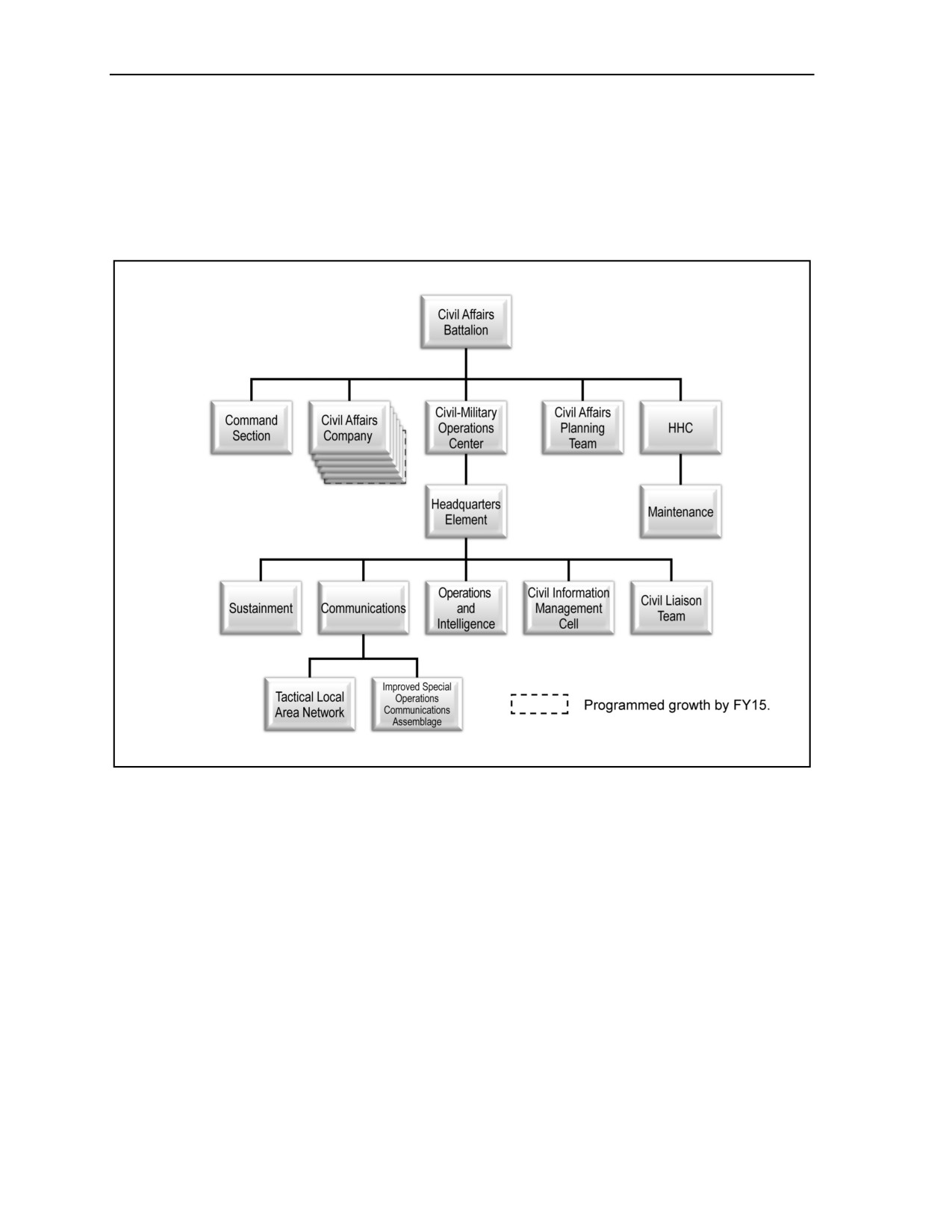
2-19. The organization of the CA battalion (A) (Figure 2-2, page 2-6) includes an HHC with a maintenance
section, a CAPT, a CMOC capable of providing a CLT and CIM cell, and five CA line companies (FY 2011).
The CA battalion (A) HQ does not have a CA functional specialty cell like the USAR CA battalion, but has
limited organic public health and welfare, veterinary, and rule of law capability. The battalion may request
augmentation from USAR CA forces when CA functional specialty skill sets are required.
2-20. The CA battalions (A), subordinate to the USASOC CA brigade, function as the tactical-level CA
capability that supports the JSOTF or SOTF. The battalions are regionally focused and primarily support SOF.
Although the battalions’ primary mission focus is support of SOF, they maintain the capability to support
conventional forces as the initial-entry CA force during contingency operations. As the additional Regular
Army CA brigade activates and matures, planners anticipate that the contingency initial-entry requirement
to pass from the CA brigade (A) assigned to USASOC to the new brigade.
Functions
2-21. The rapidly deployable CA battalion (A)—
z
Plans, coordinates, and enables tactical-level CAO in support of stability operations focused on
the supported commander’s AO.
z
Provides a CMOC with mission command system capabilities to the JSOTF, TSOC, or division
commander.
z
Provides mission command system management of CA companies and other CMO capabilities.
z
Prepares to serve as the core of a CMO task force.
z
Provides CMOCs, CLTs, CAPTs, and CATs for tactical support.
z
Plans, supports, and coordinates FHA, PRC, SCA, and NA.
z
Synchronizes CAO with CMO, inform and influence plans. The CA battalion receives, analyzes,
and collates civil information from CATs, CLTs, and CA companies into tactical- to operational-
level civil inputs to the supported commander’s COP using classified and unclassified
communications links.
31 October 2011
FM 3-57
2-5
Chapter 2
z
Operates in remote and austere environments in support of SOF and conventional commanders
as required.
z
Provides cross-cultural communications and elementary linguistic capabilities to the supported
maneuver commander.
z
Trains, equips, and deploys assigned or attached CA companies and elements.
z
Trains, equips, and deploys CMSEs in support of CME.
z
Provides unit-level administration for the companies.
Figure 2-2. Civil Affairs battalion (airborne) (special operations)
Capabilities
2-22. As organized, the CA battalion (A) is capable of providing—
z
A CAPT with regionally aligned, rapidly deployable CA planning capabilities that support the
JSOTF, TSOC, or the division HQ.
z
A CMOC with tactical- and operational-level capabilities to manage, coordinate, and
synchronize key CMO within the supported commander’s AO. The CMOC operates over the
horizon, away from the supported unit, as a standing capability by providing—
Mission-command-system capable support to the JSOTF, TSOC, or the division HQ.
A mechanism for civil-military coordination, collaboration, and communication.
An initial-entry, rapid-deployment capability.
Network capability to all CMOCs and CA elements within the supported commander’s
environment via technical lines of communication while leveraging the reachback capability.
z
A CLT with local- to provincial-level interface and liaise capability between civil-military, HN,
and humanitarian elements within the AO.
2-6
FM 3-57
31 October 2011
Civil Affairs Organization
z
A CIM cell with the tactical-level collation, processing, and dissemination of civil information.
The CA battalion develops tactical- and operational-level civil inputs to the COP and provides civil
information input to the appropriate military and civil systems via geospatially-referenced data.
z
CMSEs at the operational level with regionally aligned CAO planning, preparing, executing, and
assessing capabilities that support the TSOC and U.S. country teams.
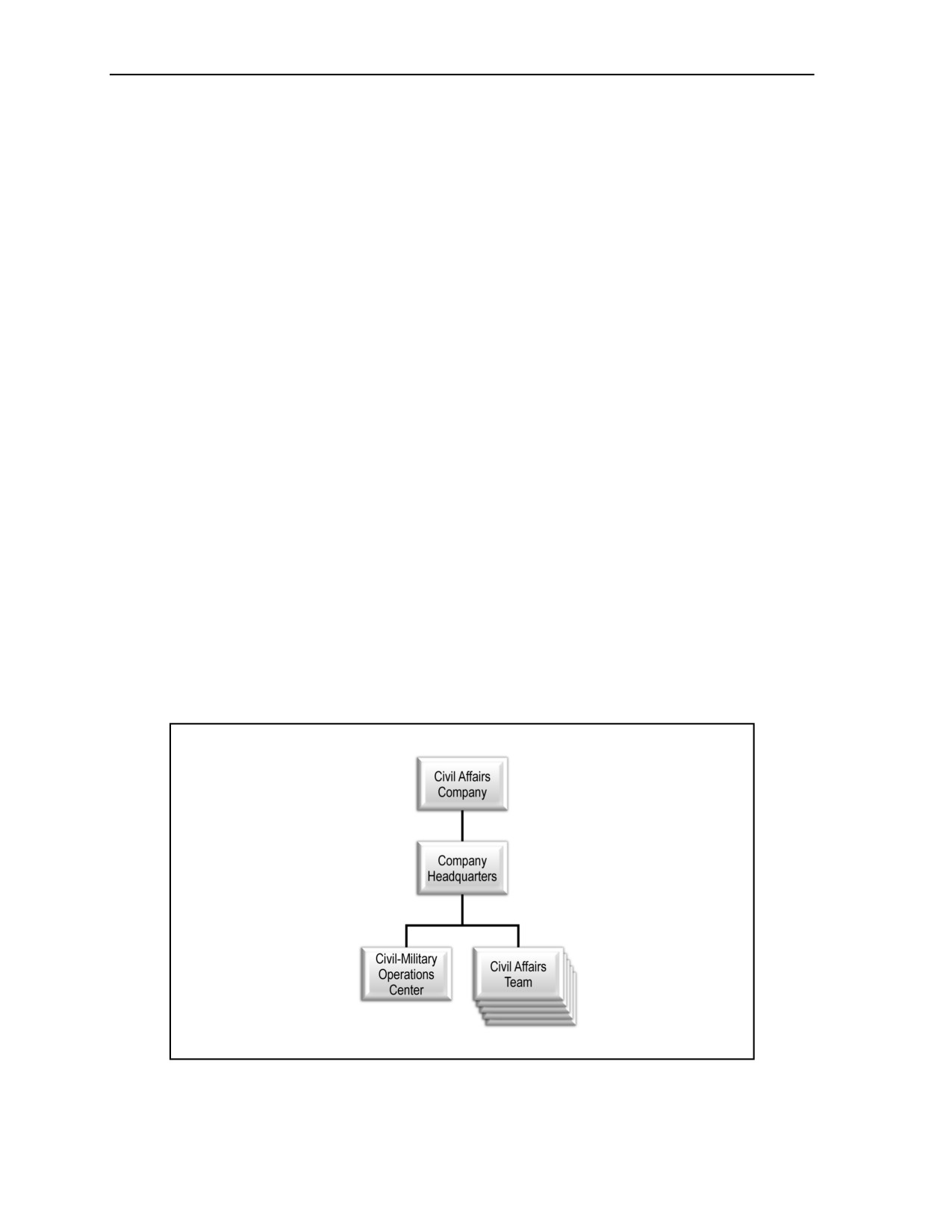
CIVIL AFFAIRS COMPANY (AIRBORNE) (SPECIAL OPERATIONS)
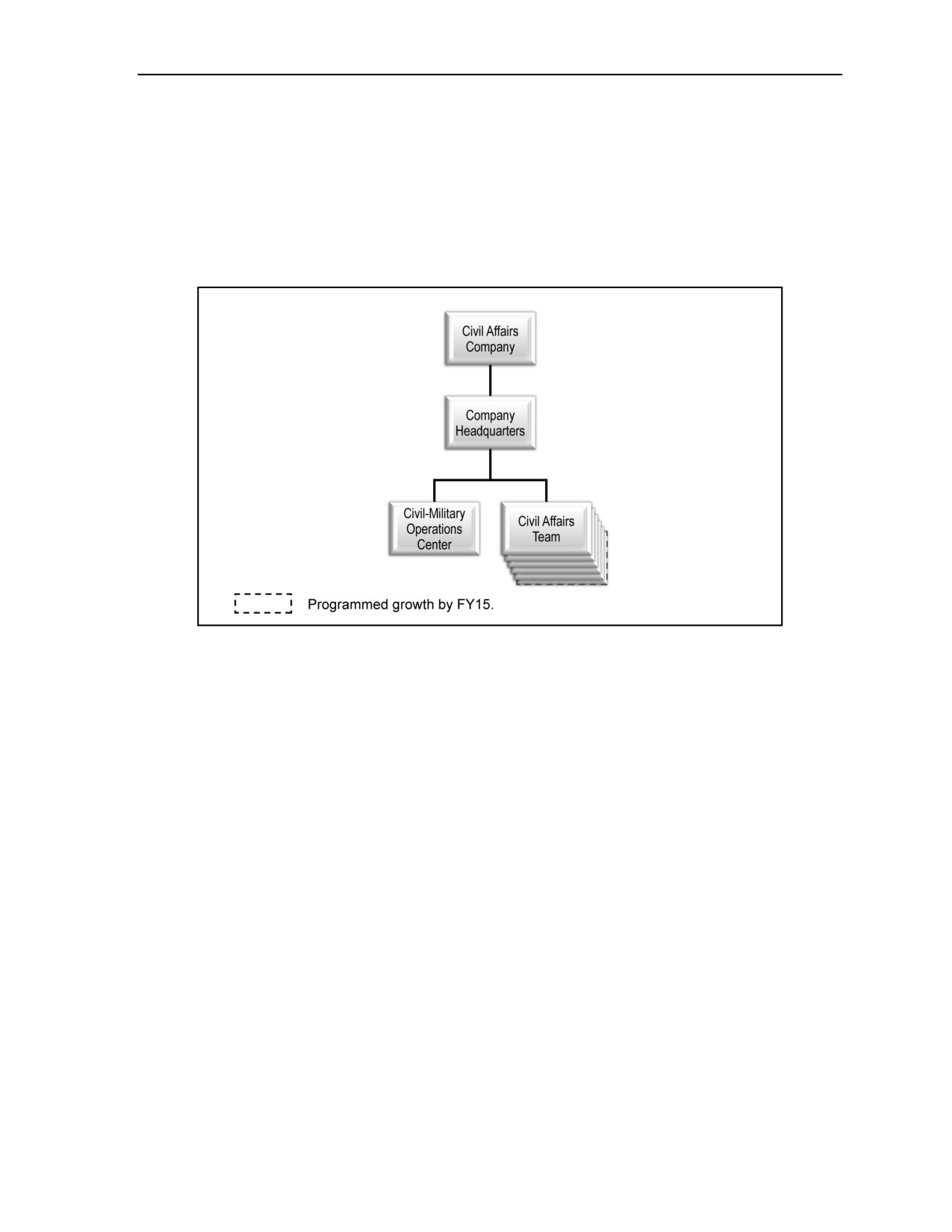
2-23. Figure 2-3 provides a graphic of the organizational structure of the CA company.
Figure 2-3. Civil Affairs company (airborne) (special operations)
2-24. The CA company (A) provides mission command to the assigned CA teams and provides CAO
planning, coordination, and assessment at the tactical level. The organization of the company includes a HQ
section, a CMOC that provides the supported command with a CAO planning capability, and five CATs.
Functions
2-25. The functions of the CA company (A) are to—
z
Rapidly deploy.
z
Conduct CR and plan, coordinate, and enable CAO and project management.
z
Conduct assessments of the civil component of the supported command’s AO.
z
Provide mission command system management through the company CMOC to the CATs.
z
Provide a standing CMOC and CAO planning capability to the supported unit.
z
Provide five CATs to execute CAO in support of SOF, conventional forces, or CME.
z
Facilitate integration of civil input into the supported command’s COP.
z
Provide cross-cultural communications and elementary linguistic capabilities to the supported
maneuver commander.
Capabilities
2-26. The CA company (A) is capable of providing—
z
Tactical-level CR by the CATs.
z
The ability to plan, execute, and transition CAO in all environments.
z
Communications capability that links directly into the supported unit’s communications
architecture.
31 October 2011
FM 3-57
2-7
Chapter 2
z
Tactical-level planning, management, coordination, and synchronization by the CMOC of key
CAO within the supported commander’s AO. The CA company operates over the horizon, away
from the supported unit, as a standing capability by providing—
CMOC support to the supported command.
A mechanism for civil-military coordination, collaboration, and communication.
An initial-entry and rapid deployment capability.
An initial assessment of the civil component of the operational environment. The CA
company assesses the mission-planning requirements and develops and coordinates the
resources to meet immediate requirements to mitigate civil threats to the supported
commander’s mission.
Collation, processing, and dissemination of civil information for input to the supported
command’s COP.
z
Limited medical/public health planning and support to supported units and deployed teams.
CIVIL AFFAIRS TEAM (SPECIAL OPERATIONS)
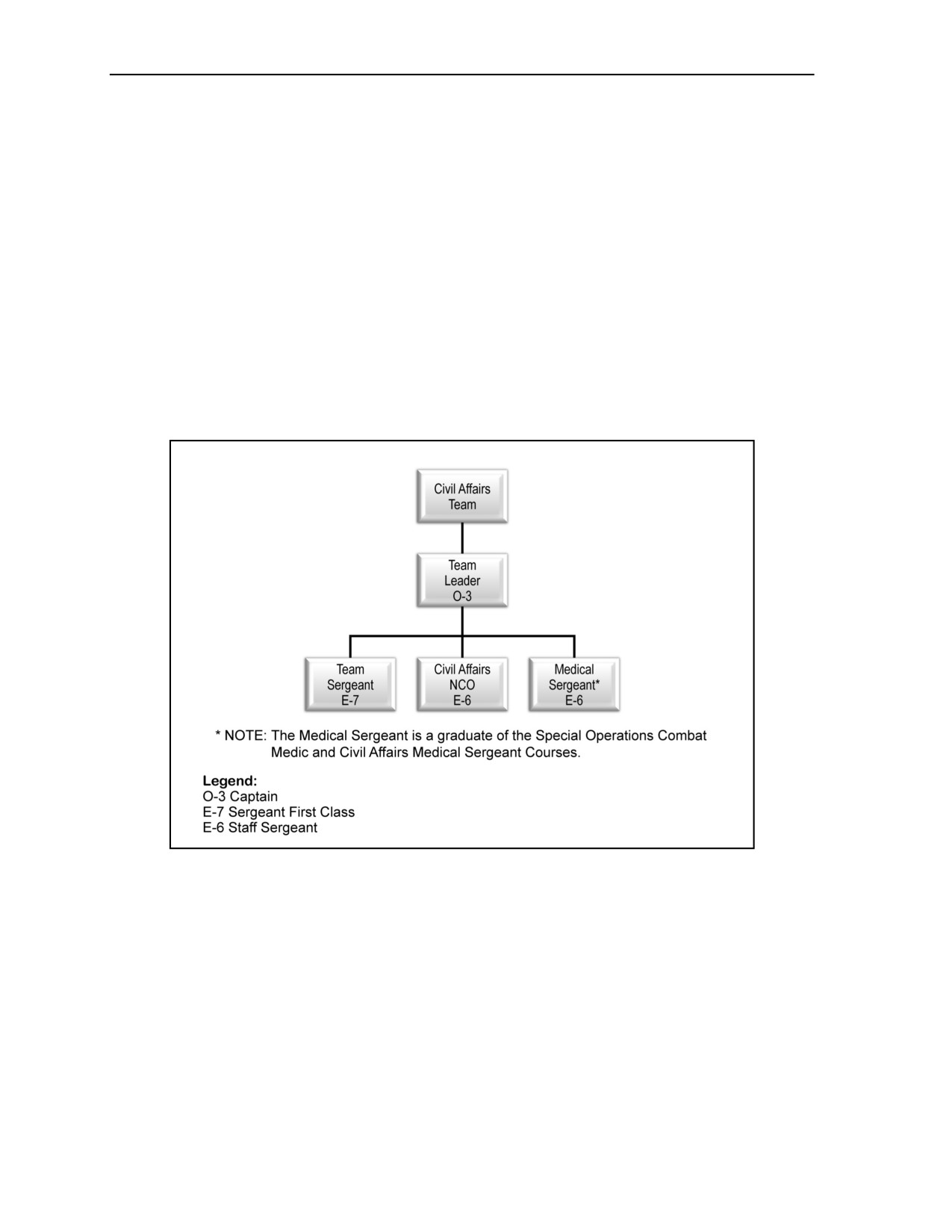
2-27. Figure 2-4 provides a graphic of the organizational structure of a CA team.
Figure 2-4. Civil Affairs team (special operations)
2-28. The CAT conducts CAO and provides tactical-level CMO planning and assessment support to
supported commanders.
Functions
2-29. The functions of the CAT are to—
z
Conduct CR.
z
Conduct key-leader engagement within the CAT’s AO.
z
Plan, coordinate, and enable CAO and project management.
2-8
FM 3-57
31 October 2011
Civil Affairs Organization
z
Provide civil information to the supported unit and CMOC for inclusion of civil inputs to the
supported commander’s COP.
z
Provide cross-cultural communications and elementary linguistic capabilities to the support
maneuver commander.
Capabilities
2-30. CATs maintain a number of capabilities; specifically, CATs—
z
Remain rapidly deployable.
z
Provide CAO staff augmentation and CA planning and assessment support to tactical maneuver
commanders.
z
Maintain direct data and voice communications with conventional forces, SOF, IPI, IGOs,
NGOs, and interagency elements with classified and unclassified connectivity.
z
Support CMO conducted by military forces.
z
Conduct liaison with civilian authorities and key leaders.
z
Minimize interference between civil and military operations.
z
Conduct area studies and area assessments.
z
Assist the intelligence staff section (G-2/S-2) and other staff members with civil considerations
analysis supporting preparation of the operational environment as required.
z
Execute CAO in support of CME objectives.
z
Maintain the ability to operate independently in remote and austere environments.
CIVIL AFFAIRS BRIGADE (REGULAR ARMY)
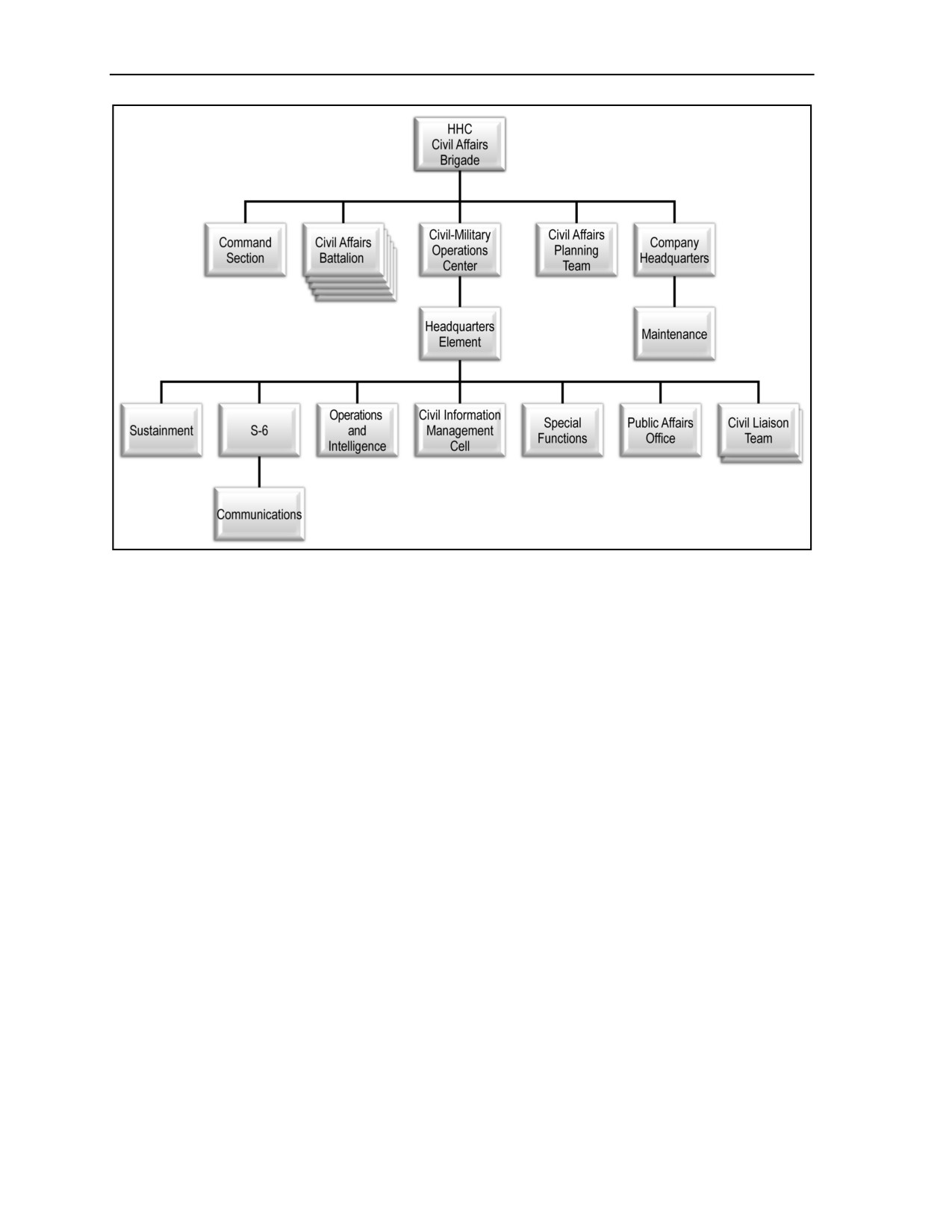
2-31. Figure 2-5, page 2-10, provides a graphic of the CA brigade HHC structure. Activation of an
additional CA brigade HQ and its associated battalions and companies within the Regular Army force
structure is programmed for FY 2011 through FY 2013.
2-32. The CA brigade functions as an operating force unit designated as theater available in the global
forces pool assigned to the United States Army Forces Command (FORSCOM). The CA brigade is
designed as an expeditionary, operational-level CA capability that supports the Army corps or an
equivalent JTF HQ. The CA brigade possesses a special functions cell and a public affairs (PA) staff
capability. Its mission focus is development, reconstruction, and stabilization. The CA brigade enables
support to civil administration and possesses the operational mission command system structure to form a
JCMOTF. The brigade HQ provides mission command and staff supervision of the operations of the CA
brigade and assigned CA battalions or attached units. Mission command focuses on tactical and operational
employment of CA forces and attached CMO forces. The CA brigade plans, enables, shapes, and manages
CAO with and through IPI, IGOs, NGOs, and OGAs by means of its CLTs and CMOC.
Functions
2-33. The FORSCOM assigned CA brigade has a number of functions; specifically, the brigade—
z
Provides mission command for assigned or attached CA battalions and companies and other
select operational-level CMO functions and forces.
z
Provides modular CA support to the corps, ASCC, or three-star command JTF.
z
Serves as a senior CA advisor (brigade commander) to the corps, ASCC, or JTF commander.
z
Trains, equips, and deploys assigned and attached CA battalions and companies, and other CMO
forces.
z
Provides operational-level management, coordination, and synchronization of CAO and CMO
within the supported commander’s area of operations.
z
Plans, coordinates, and enables operational-level stability operations in coordination with HN,
IGOs, NGOs, and OGAs focused on the regional to national levels of civil governments.
z
Provides unit-level administration for the brigade.
z
Provides limited sustainment for assigned vehicles and communications assets.
31 October 2011
FM 3-57
2-9
Chapter 2
Figure 2-5. Headquarters and headquarters company, Civil Affairs brigade (Regular Army)
Capabilities
2-34. The FORSCOM assigned CA brigade is organized to provide the—
z
Operational-level CMOC that is mission-command-system capable to support joint, interagency,
multinational, and coalition operations. The CMOC manages, coordinates, and synchronizes
CAO within the supported commander’s AO.
z
Operational-level CAPT with regionally focused CA planning capability to augment the staffs of
the corps, ASCC, or three-star command JTF.
z
CIM cell as the focal point for operational-level collation, processing, and dissemination of civil
information that develops operational-level civil inputs to the COP, in conjunction with the
brigade CMOC, while linking civil information to the appropriate military and civil systems via
geospatially-referenced data.
z
Mechanism for civil-military coordination to produce focused civil inputs to the supported
commander’s COP.
z
CLTs with a regional to national interface capability between the military and the HN,
interagency, IGOs and NGOs in the JOA/AO.
z
Special functions cell with a limited capability for intermediate-level assessment of threats to the
civil component of the environment at the regional to national level. The organization also
allows it to assess mission-planning requirements and develop, coordinate, and synchronize
resources for the conduct of stability operations.
z
Ability to assess, develop, resource, and manage operational-level HA and CAO spending
implementation strategy.
z
Core of the theater-level JCMOTF.
2-10
FM 3-57
31 October 2011
Civil Affairs Organization
CIVIL AFFAIRS BATTALION (REGULAR ARMY)
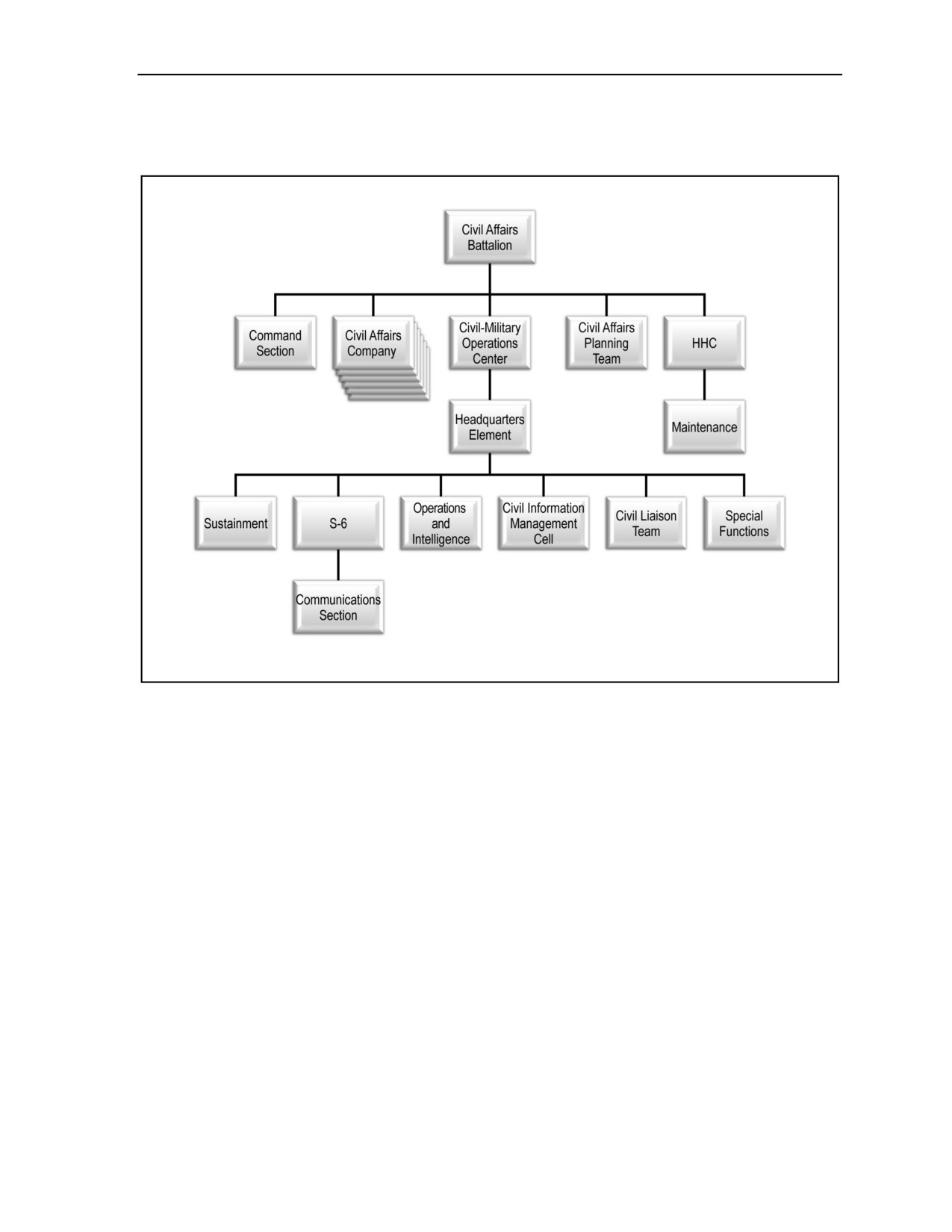
2-35. Figure 2-6 provides a graphic of the CA battalion structure.
Figure 2-6. Civil Affairs battalion (Regular Army)
2-36. The activation of five CA battalions is currently scheduled for completion in FY 2013. The activation
of each battalion includes the activation of its six subordinate CA companies. The battalions will provide
regionally focused CA support to the theater Army commands as well as conventional forces through the
Army force generation process.
2-37. The CA battalion focus is on the supported commander’s ready capability to plan, enable, shape, and
manage CAO; provide dedicated support to stability operations; and enable, enhance, and support CMO
missions assigned to the theater Army command by the TSCP. The battalion provides tactical-level CA
support to a division command or an equivalent-level Army command/JTF during stability operations.
Functions
2-38. The CA battalion has a number of functions; specifically, the battalion—
z
Plans and coordinates tactical-level stabilization and reconstruction focused on the
provincial-level and below civil institutions in coordination with HN, IGOs, NGOs, and OGAs
focused on the provincial to local levels of civil governments.
z
Assesses the civil component of the supported command’s AO facilitating integration of civil
considerations input into the supported command’s COP.
z
Serves as a senior CA advisor (battalion commander) to the supported command.
z
Provides a CMOC with mission command system capability to the supported commander.
z
Provides mission command of assigned or attached CA companies and other CMO capabilities.
z
Trains, equips, and deploys assigned or attached CA companies and teams.
31 October 2011
FM 3-57
2-11
Chapter 2
z
Provides unit-level administration for the HQ and assigned companies.
z
Provides limited sustainment capability for assigned vehicles and communications assets.
Capabilities
2-39. The organization of the CA battalion provides—
z
A tactical-level CAPT with regionally focused CA planning capability to augment the staff of
the supported command.
z
A mission-command-system capable, tactical-level CMOC capable of management,
coordination, and synchronization of CAO and CMO within the supported commander’s AO.
z
A provincial- to local-level CLT as interface/liaison between the military and the HN,
interagency, IGOs and NGOs within the AO.
z
A CIM cell with tactical-level collation, processing, and dissemination of civil information
capability. The battalion’s CMOC develops tactical-level civil inputs to the COP and provides civil
information input to the appropriate military and civil systems via geospatially referenced data.
z
A special function team with limited capability for intermediate-level assessment of threats to
the civil component of the environment at the provincial to local level. The organization also
allows it to assess mission-planning requirements and develop, coordinate, and synchronize
resources for the conduct of stability operations.
CIVIL AFFAIRS COMPANY (REGULAR ARMY)
2-40. The CA company (Figure 2-7) consists of a HQ section, a CMOC that provides the supported
command with a CAO planning capability, and five CATs.
2-41. The programmed activation of 30 CA companies by FY 2013 completes the directed growth of the
Regular Army CA force structure. The regional focus of these companies provides tactical-level CA
capability for missions involving theater security cooperation and support conventional forces through the
Army force generation process.
2-42. The CA company provides mission command to the assigned CA teams and provides CAO planning,
coordination, and assessment at the tactical level. The company provides support to the BCT, MEB, and
their subordinate elements. The company may also support deployed elements of the interagency, such as
the provincial reconstruction team (PRT) or field advanced civilian team.
Figure 2-7. Civil Affairs company (Regular Army)
2-12
FM 3-57
31 October 2011
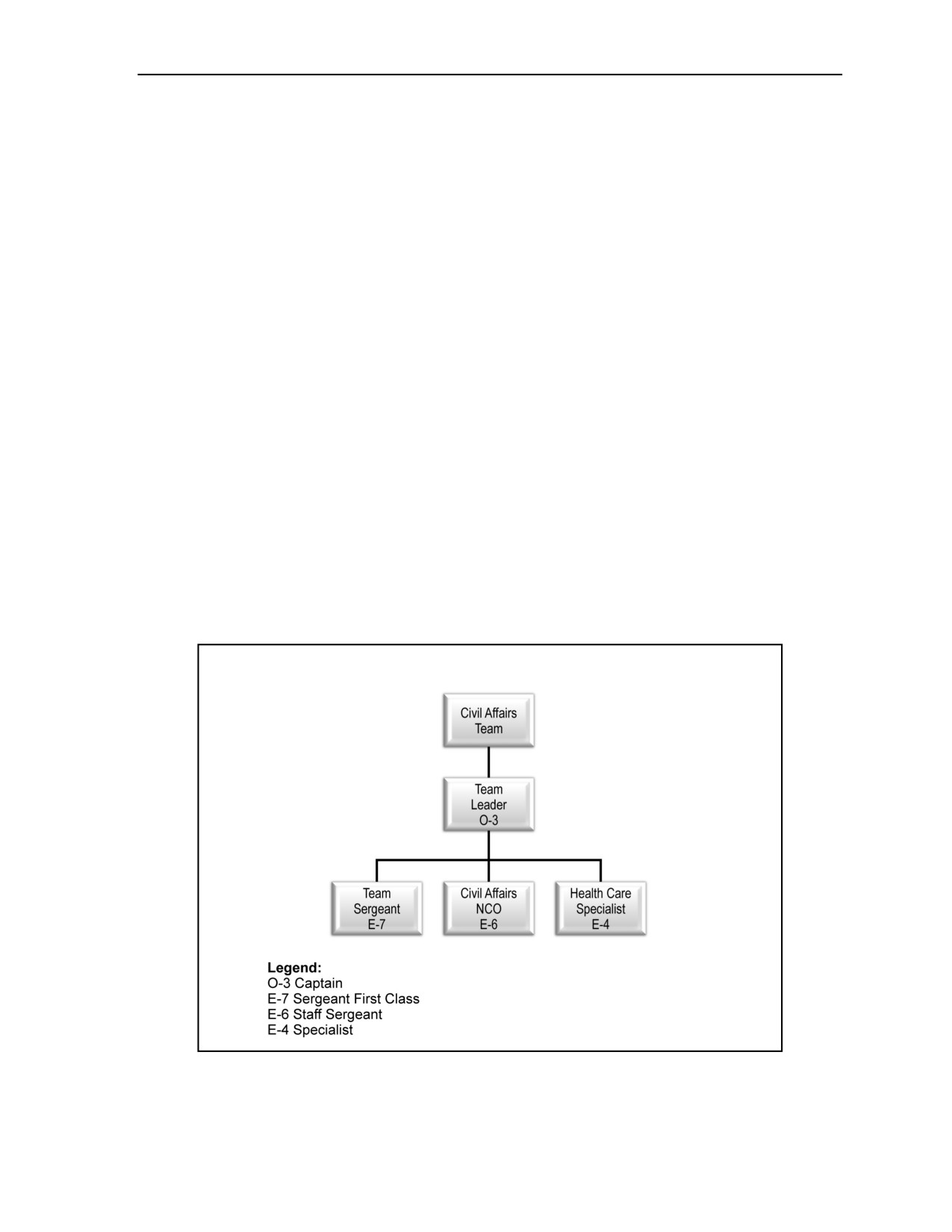
Civil Affairs Organization
Functions
2-43. The CA company has a number of functions; specifically, the company—
z
Conducts CR and plans, coordinates, and enables CAO and project management.
z
Assesses the civil component of the supported command’s AO.
z
Provides mission command system management through the company CMOC to the CATs.
z
Provides a standing CMOC and CAO planning capability to the supported unit.
z
Provides five CATs to execute CAO in support of conventional forces or deployed interagency
organizations.
z
Trains, equips, and deploys assigned or attached CMOC and CATs.
z
Conducts mission command of assigned or attached CMOC and CATs.
Capabilities
2-44. The CA company is organized to—
z
Provide a CMOC with tactical-level planning, management, coordination, and synchronization
of CAO capability within the supported commander’s AO.
z
Provide communications capability that links directly into the supported unit’s communications
architecture.
z
Provide CATs in support of elements of the supported command capable on conducting CR and
executing tactical level CAO.
z
Facilitate integration of civil component input into the supported command’s COP.
z
Collate, analyze, and fuse civil information for input to the supported command’s COP.
CIVIL AFFAIRS TEAM (REGULAR ARMY SUPPORT TO CONVENTIONAL FORCES)
2-45. The CAT (Figure 2-8) conducts CAO and provides tactical-level planning and assessment support of
CMO to supported tactical-level commanders or deployed elements of the interagency.
Figure 2-8. Civil Affairs team (Regular Army)
31 October 2011
FM 3-57
2-13
Chapter 2
Functions
2-46. The CAT has a number of functions; specifically, the CAT—
z
Conducts CR.
z
Conducts key-leader engagement within the CAT’s AO.
z
Plans, coordinates, and enables CAO and project management.
z
Provides civil information to the supported unit and CMOC for inclusion of civil inputs to the
supported commander’s COP.
Capabilities
2-47. The CAT is organized to—
z
Provide CAO staff augmentation and CA planning and assessment support to tactical maneuver
commanders.
z
Maintain direct data and voice communications with conventional forces, IPI, IGOs, NGOs, and
interagency elements with classified and unclassified connectivity.
z
Provide cross-cultural communications and elementary proficiency linguistic support to
supported commanders.
z
Support CMO conducted by military forces.
z
Conduct liaison with civilian authorities and key-leader engagement.
z
Minimize interference between civil and military operations, and synchronize CAO to enhance
mission effectiveness.
z
Conduct area studies and area assessments.
z
Assist the S-2 and other staff members with civil considerations analysis supporting intelligence
preparation of the battlefield (IPB) as required.
z
Execute CAO in support of interagency deployed elements as directed.
UNITED STATES ARMY RESERVE CIVIL AFFAIRS FORCES
2-48. The organizational structure of USAR CA forces consists of CACOMs, CA brigades, battalions, and
companies. Authorized CA force structure additions in FY 2010 through FY 2013 affect the organizational
structure of the USAR CA force. United States Army Civil Affairs and Psychological Operations
Command
(A)
(USACAPOC
[A]) provides mission command of continental United States
(CONUS)-based USAR CA units. USACAPOC (A) realizes the addition of 4 CA battalions and 16
companies headquartered in various locations within CONUS as a result of the force structure increase.
2-49. USAR CA force structure additions to 7th Civil Support Command, Europe (formerly 7th Army
Reserve Command, Europe) include one CA brigade HQ, one battalion, and four companies based in
Europe. The mission command of this brigade (like the one USAR CA brigade HQ based in Hawaii and
assigned to USPACOM) ultimately falls under the responsibility of USEUCOM.
CIVIL AFFAIRS COMMAND
2-50. A CACOM (Figure 2-9, page 2-15) is comprised of an HHC, five CAPTs, and a CMOC capable of
split operations (forward and rear) with three functional specialty cells, two CLTs and a CIM cell.
2-51. The USAR force structure has four CACOMs. The CACOM functions as the CA capability for five
geographic combatant commands—USPACOM, USEUCOM, USCENTCOM, USAFRICOM, and
USSOUTHCOM. The CACOMS regionally align with the geographic combatant commands; however, one
CACOM bears responsibility for both USEUCOM and USAFRICOM. The CACOM develops plans,
policy, and programs through planning teams, fusion of CIM, regional engagement, and civil component
analysis at the strategic and theater level.
2-52. The CACOM’s primary mission is to provide theater-level CAO planning, coordination, policies,
and programs in support of the GCC’s regional CMO strategy and stabilization, reconstruction, and
development efforts. The CACOM may deploy a theater-level CMOC to coordinate, analyze, and enable
2-14
FM 3-57
31 October 2011
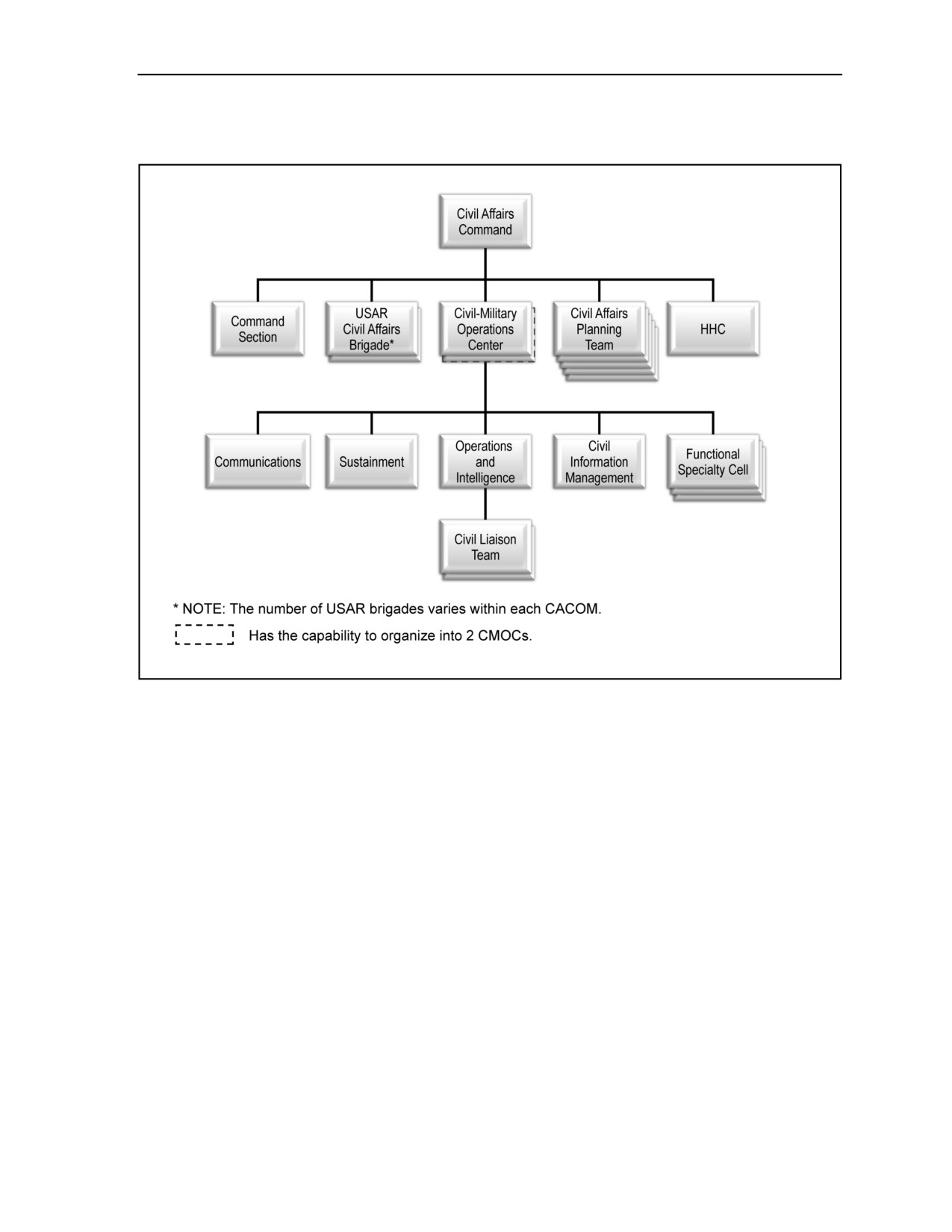
Civil Affairs Organization
policies, programs, and CMO capabilities in support of the GCC or JFLCC, and to develop and manage the
strategic-level civil inputs to the COP.
Figure 2-9. Civil Affairs command
Functions
2-53. The CACOM has a number of functions; specifically, the CACOM—
z
Serves as the geographic combatant command’s senior CA advisor (CACOM commander).
z
Serves as the theater-level focal point for civil-military coordination, collaboration, and
consensus by providing subject-matter experts (SMEs) to advise strategic-level military planners
in synchronizing their planning into a comprehensive civil-military strategy.
z
Provides theater-level staff augmentation to the geographic combatant command, subunified,
and Service component commands.
z
Formulates CAO OPLANs to support the theater policy for PRC, FHA, CIM, NA, and SCA
operations.
z
Assists in establishing plans and policies for CMO support of all CONPLANs and OPLANs for
the geographic combatant command and Service components.
z
Programs (assists) and manages theater-level spending implementation plans and policies to
resource CMO projects by using resources, such as Overseas Humanitarian Disaster and Civic Aid
(OHDACA), commander’s emergency response program (CERP), and commander’s quick impact.
z
Plans and helps to set the conditions for the transition of stabilization, reconstruction, and
development to civil authority.
z
Conducts short-term support to civil administration, enables HN government functions, and
routinely supports IGOs and interagency core capabilities in indigenous government capacity
building and delivery of government services.
31 October 2011
FM 3-57
2-15
Chapter 2
z
Provides theater-level analysis of specified civil information in coordination with the joint
interagency coordination group; develops strategic-level civil inputs to the supported
commander’s COP.
z
Conducts mission command systems management of CAO and select theater-level CMO
functions and capabilities (forces).
z
Prepares to establish theater-level core of JCMOTF and/or combined joint civil-military
operations task force.
z
Liaises with supported military, interagency, IGOs, NGOs, and IPI in theater.
z
Trains, equips, mobilizes, and deploys assigned or attached CA forces.
z
Employs modular packages of technical expertise in the six CA functional areas to plan,
coordinate, assess, or manage CAO based on mission requirements.
z
Provides predeployment mission command of assigned and attached CA brigades, battalions,
and companies.
z
Provides cross-cultural communications but may have only limited linguistics ability to
communicate in the target language within the AOR.
Capabilities
2-54. The CACOM is organized to provide—
z
The CAPTs at the theater level with CA planning and regionally aligned capabilities that support
the geographic combatant command, JFLCC, and theater Service component commands.
z
The geographic combatant command’s CMO staff with durational theater-level management of
plans, policies, and programs that the geographic combatant command’s civil-military objectives
(TSCP, interagency) by—
Forming the core of the operational-level JCMOTF and providing mission command
system capability.
Serving as a mechanism for theater-level civil-military coordination, collaboration, and
communication.
Networking to deployed CMOCs and CA elements within the theater of operations via
computer and communications systems.
Serving as the reachback capability for all CMOCs and CA elements within the theater of
operations.
Conducting split operations—forward and rear—in support of the geographic combatant
command’s HQ elements.
z
The CLTs with national- to international-level interface and liaise capabilities between civil-
military, HN, and humanitarian elements within and outside the theater of operations. Serve as
the initial point of contact (POC) for the CACOM CMOC, where the military meet with the civil
populace, the HN, and the humanitarian community.
z
The supported commander the CIM cell capability to manage the flow of civil information, and
develop the strategic-level civil components to the COP. Provide open access of data and
analysis to other elements of the supported unit HQ and subordinate units. Provide releasable
data and updates to IGOs, NGOs, and appropriate civilian entities.
z
The functional specialty cells with functional experts that plan and enable HN government
operations across the following six CA functional areas:
Rule of law pertains to the fair, competent, and efficient development, application, and
effective enforcement of the civil and criminal laws of a society through impartial legal
institutions and competent corrections systems. This functional area includes judge
advocates trained in international and comparative law as well as CA specialists in related
subjects.
Economic stability pertains to the efficient management
(for example, production,
distribution, trade, and consumption) of resources, goods, and services to ensure the
viability of a society’s economic system. This discipline includes CA specialists in
economic development, civilian supply, and food and agriculture.
2-16
FM 3-57
31 October 2011
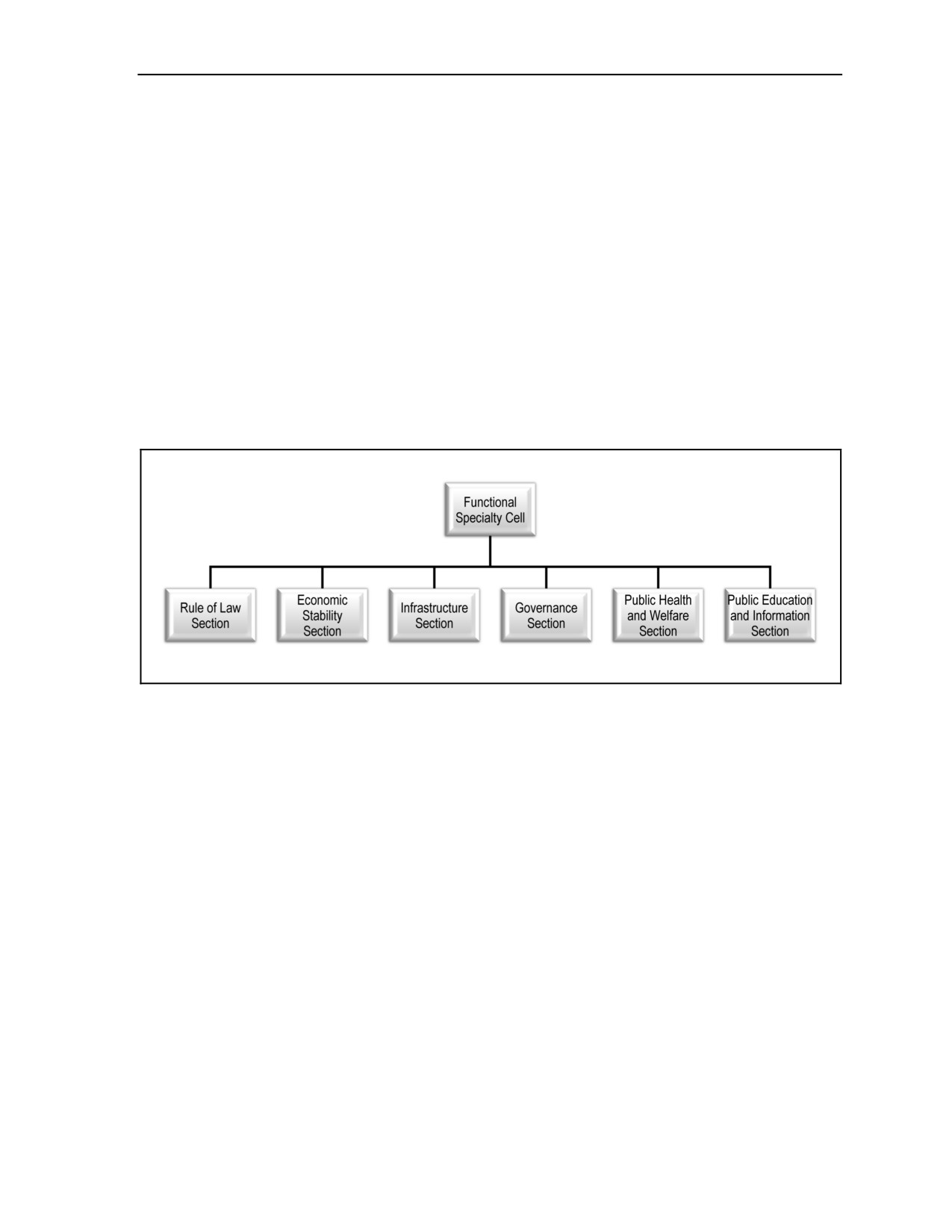
Civil Affairs Organization
Infrastructure pertains to designing, building, and maintaining the organizations, systems,
and architecture required to support transportation, water, communications, and power. This
discipline includes CA specialists in public transportation, public works and utilities, and
public communication.
Governance pertains to creating, resourcing, managing, and sustaining the institutions and
processes that govern, protect, and bring prosperity to a society. This discipline includes CA
specialists in public administration, environmental management, and public safety areas.
Public health and welfare pertains to the systems, institutions, programs, and practices that
promote the physical, mental, and social well-being of a society. This discipline includes
CA specialists in public health and cultural relations.
Public education and information pertains to designing, resourcing, and implementing
public education and public information programs and systems through media and formal
education institutions. This discipline includes CA specialists in public education and civil
information.
CIVIL AFFAIRS FUNCTIONAL SPECIALTY CELL
2-55. Figure 2-10 is a graphic of the CA functional specialty cell with the six functional specialty areas.
Figure 2-10. Civil Affairs command functional specialty cell
2-56. The CACOM provides three CA functional specialty cells containing specialists in all six of the CA
functional specialty areas. These cells are composed of Soldiers, both officer and enlisted, with technical
expertise (normally acquired by civilian education and career experience) in those civilian sectors most
likely to affect CMO. Each operation that a cell supports may require a different emphasis on skills and
team composition. For example, during a transition from combat operations to postconflict stability
operations or advise and assist missions, CA force requirements place greater emphasis on infrastructure,
economic stability, and governance expertise. FHA operations, on the other hand, may demand governance,
rule of law, and public health and welfare emphasis.
2-57. The brigade and battalion organizations have one functional specialty cell with limited capabilities in
four (rule of law, infrastructure, governance, and public health and welfare) of the six functional areas. The
roles of these cells are the same as those of the CACOM and the modular design allows for augmentation
across the operational spectrum. Depending on mission requirements, augmentation by specific technical
CA functional specialists from anywhere within the deployed CA assets may be necessary for mission
accomplishment.
2-58. CA functional specialists fall into 14 functional specialties within the six CA functional specialty
areas (Figure 2-11, page 2-18). Specialists in public health and environmental management are formally
trained Army Medical Department personnel, international law specialists are staff judge advocate (SJA)
personnel, and chaplains trained in world religions may act as cultural relations specialists.
31 October 2011
FM 3-57
2-17
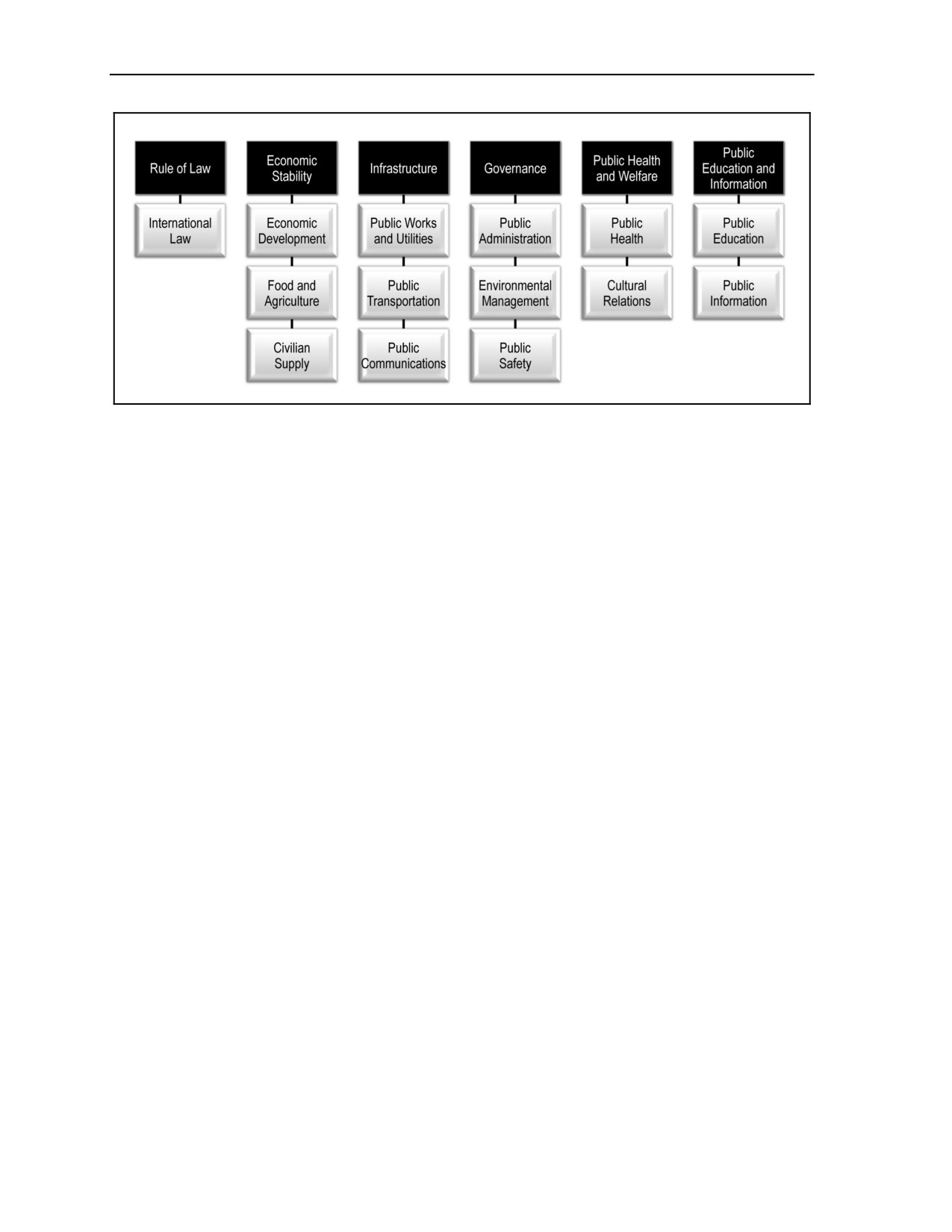
Chapter 2
Figure 2-11. Six Civil Affairs functional specialty areas with 14 functional specialties
RULE OF LAW FUNCTIONAL SPECIALTY AREA
2-59. The purpose of rule of law operations is to create security and stability for the civilian population by
restoring and enhancing the effective and fair administration and enforcement of justice. Rule of law
operations are of great importance in stability operations. Rule of law operations are particularly significant
in the immediate aftermath of major ground combat operations, when it is imperative to restore order to the
civilian population in the vacuum that almost inevitably results when combat disrupts the routine
administration of the society. Close coordination is critical between the rule of law section and the
governance section for synchronization and synergy between efforts to restore, reform, and assist the court
and legal system and efforts to restore, reform, and assist the public safety system. A judicial system is
powerless without an effective public safety system, whereas a public safety system is not legitimate
without a fair and efficient judicial system.
2-60. Rule of law operations include measures to—
z
Provide for the restoration of order in the immediate aftermath of military operations.
z
Restore and enhance the operation of the court system, to include vetting and training judges,
prosecutors, defense counsel, legal advisors and administrators, and restoring and equipping
court and administrative facilities.
z
Restore and reform the HN civil and criminal legal system, to include reviewing and revising
statutes, codes, decrees, and other laws to ensure compliance with international legal standards,
as well as adopting interim measures for the immediate administration of justice.
z
Provide for an effective corrections system that complies with international standards, to include
selecting, vetting, and training corrections officials, and constructing or renovating appropriate
facilities.
2-61. Rule of law operations are seldom exclusively a military or even a USG activity. Rule of law
operations must be a collaborative effort involving—
z
U.S. military assets, including military police, engineers, combat forces, logistics elements, legal
personnel, and CA personnel.
z
Other agencies of the federal government, to include Department of State (DOS), Department of
Justice, and USAID.
z
IGOs.
z
Coalition and other national elements, including military and civilian agencies.
z
NGOs engaged in judicial and legal reform.
z
HN legal professionals, including judges, prosecutors, defense counsels, legal advisors, legal
administrators, and legal educators.
2-18
FM 3-57
31 October 2011
Civil Affairs Organization
z
HN law enforcement personnel, including administrators, police, investigators, and trainers.
z
Other HN government officials.
2-62. In CA organizations and task-organized forces based on CA organizations, attached judge advocate
personnel, CA public safety specialists with law enforcement backgrounds, and others with backgrounds in
judicial administration, corrections, and other relevant areas carry out rule of law operations. Commanders
may detail rule of law section personnel to work with an HN interagency, international, or other group
carrying out rule of law operations. The judge advocates in the rule of law section must have extensive
training in international law, comparative law, and human rights law. FM 1-04, Legal Support to the
Operational Army, contains additional doctrine relating to legal support for rule of law operations.
Functions
2-63. By statute, the Judge Advocate General (TJAG) is the legal advisor of the Secretary of the Army and
of all officers and agencies of the Department of the Army (Section 3037, Title 10, United States Code
[10 USC 3037]). TJAG carries out this statutory mission thorough the military attorneys of TJAG corps and
the civilian attorneys who work under TJAG’s qualifying authority. These attorneys are responsible to the
TJAG under statute, Army regulations, and codes of professional conduct that govern licensed attorneys
and are the only personnel the U.S. Army authorizes to practice law.
2-64. Many activities conducted in rule of law operations involve the practice of law, and therefore, TJAG
or other attorneys under TJAG’s supervision must perform those activities. These activities include—
z
Evaluating and assisting in developing transitional decrees, codes, ordinances and other
measures intended to bring immediate order to areas in which the HN legal system is impaired or
nonfunctioning.
z
Evaluating the reform of HN laws to ensure compliance with international legal standards and
providing appropriate assistance to the drafting and review process when necessary.
z
Evaluating legal training given to HN judges, prosecutors, defense counsels, and legal advisors,
and providing appropriate training when necessary.
z
Evaluating the legal training given police and corrections officials to ensure compliance with
international human rights standards.
z
Serving as judges, magistrates, prosecutors, defense counsels, and legal advisors for transitional
courts.
z
Evaluating legal and administrative procedures to ensure compliance with international law, the
law of the power administering the territory, and the law of the supported country.
z
Determining which HN offices and functions have the legal authority to evaluate, reform, and
implement the law.
z
Advising U.S. military commanders and U.S., international, and HN authorities on the status of
the HN legal system and its compliance with international standards, and providing
recommended reforms.
z
Advising U.S. military commanders and others on the application of international law, U.S.
domestic law, and HN law to the process of restoring and enhancing rule of law in the HN.
2-65. Normally, a senior judge advocate (typically a lieutenant colonel or colonel) is assigned to act as the
SJA and senior rule of law officer for the brigade, CACOM, JCMOTF, or other organization conducting
CAO. The SJA/senior rule of law officer has two functions: as the SJA, he is the legal advisor to the
commander and is on the commander’s personal staff. As the senior rule of law officer, he is the chief of
the rule of law section. The SJA/senior rule of law officer provides staff supervision of rule of law
operations and other legal activities of the judge advocates in the organization. The SJA/senior rule of law
officer is under the technical supervision of the SJA of the higher-level command or task force.
31 October 2011
FM 3-57
2-19
///////////////////////////////////////