Multiservice Tactics, Techniques, and Procedures for Chemical, Biological, Radiological, and Nuclear Contamination Avoidance (April 2009) - page 3

NBC6 CHEM Report
Line Item
Description
Cond
Example
ALFA
Strike serial number
O
ALFA/US/A234/001/C//
DELTA
DTG of attack or detonation and
O
DELTA/201405ZSEP1997/
attack end
201420ZSEP1997//
FOXTROT
Location of attack and qualifier
O
FOXTROT/32UNB058640/EE//
INDIA
Release information on CB agent
O
INDIA/AIR/NERV/P/MSDS//
attacks or ROTA events
QUEBEC
Location and type reading/sample/
O
QUEBEC/32VNJ481203/-/MSDS//
detection
ROMEO
Level of contamination, dose rate
O
trend, and decay rate trend
SIERRA
DTG of reading
O
SIERRA/202300ZSEP1997//
GENTEXT
General text
M
GENTEXT/CBRNINFO/SICA LAB
REPORT HAS IDENTIFIED THE AGENT
AS VX//
Figure E-30. Sample NBC6 CHEM Report
30 April 2009 FM 3-11.3/MCWP 3-37.2A/NTTP 3-11.25/AFTTP(I) 3-2.56, C1
E-55
Appendix F
BIOLOGICAL-CONTAMINATION AVOIDANCE TACTICS,
TECHNIQUES, AND PROCEDURES
1.
Background
As with all forms of CBRN attacks or ROTA, an effective means of communication
must be trained and rehearsed for the avoidance of biological contamination to be
successful. Once a unit is aware that it may have been in a biological attack or is within a
possible hazard area, the avoidance procedures throughout this manual should be initiated.
The CBRNWRS should be used to relay information about the biological agents and
hazards in an efficient and timely manner. Biological avoidance requires an understanding
of what biological agents are, how they may be employed, and what happens to the agents
after they are released. Biological agents are broken down into two broad categories—
pathogens and toxins.
•
Pathogens are infectious agents that cause disease in man, animals, or plants.
Agents that constitute antipersonnel BW threats include bacteria, viruses, and rickettsias.
•
Toxins are poisonous substances produced as by-products of the microorganisms
(pathogens), plants, and animals.
2.
Biological-Agent Dissemination Methods
There are three general methods of disseminating biological agents—aerosol, vector,
and covert. Each method is designed to get the agent into the body, and each method
targets a specific portal of entry in order to infect the individual.
a.
Aerosol Dissemination.
(1)
Biological Agents. Biological agents may be disseminated by ground- or air-
bursting munitions, aircraft spray tanks, or boat- or truck-mounted aerosol generators. An
aerosol attack will most likely occur in a covert (hidden) manner. Dissemination is likely to
occur at altitudes of 1,000 feet or less (100 feet optimum). The estimation of the hazard
areas resulting from dissemination at altitudes greater than 1,000 feet aboveground
requires extensive MET analysis.
(2)
Toxins. Toxins can be disseminated as a liquid (such as “yellow rain”). This
makes the toxin highly visible and an immediate hazard. It will generally be limited to the
immediate area of the attack.
(3)
Aerosol Cloud Travel. In a tactical aerosol attack, the aerosol cloud (after
initial formation) will travel downwind at a rate determined by the wind speed. The cloud
will lengthen and widen as it travels downwind. The length of the agent cloud will equal
about one-third of the distance traveled. Units near the release point will encounter a more
concentrated cloud. However, units located farther downwind (even though exposed to a
less concentrated agent cloud) will be exposed for a longer period of time, so unprotected
personnel may inhale a higher total dose. The peak danger area will be located in the area
where the cloud stays intact, while at the same time, it is at its maximum width and
length. This distance is approximately the maximum downwind hazard prediction for a
30 April 2009 FM 3-11.3/MCWP 3-37.2A/NTTP 3-11.25/AFTTP(I) 3-2.56, C1
F-1
chemical agent; therefore, it is vital to determine whether or not the attack is biological or
chemical.
(4)
Casualty Production. The biological-agent cloud can cause immediate and
delayed casualties. This is due to the fact that each individual will receive a different dose,
and the time until the onset of symptoms will depend on the amount of agent received and
each individual’s physiological makeup. The onset of illness will also be affected by the
person’s reaction time and any other forms of protection (i.e., inoculation, masking time)
that were available against the agent. Biological-agent casualties can occur in an area as
much as two times the maximum DHD for a chemical agent.
(5)
Dispersal and Settling Out. Traveling farther downwind, the cloud is
exposed to the environmental elements. It is subjected to dispersal, settling, and impaction
on the terrain features. The agent cloud will lose much of its concentration, and the losses
will be such that the majority of unprotected personnel will not receive an infective
(pathogen) or effective (toxin) dose. Dispersal will not be uniform, and casualties may occur
as far as four to five times the maximum DHD of chemical agents.
(a) Bursting-Type Munitions. When a biological projectile or bomb bursts,
the filling (liquid slurry or dry powder) is initially dispersed in all directions. An effective
ground-bursting munition will project the majority of the filling into the air to form an
aerosol cloud. Air-bursting munitions may also form an aerosol cloud that will behave in a
similar manner to a spray attack. The agent may be designed to fall to the ground as a
surface contaminant, much like persistent chemical agents. The dimensions of the aerosol
cloud will be influenced by the means of delivery, weather conditions, and terrain.
(b) Spray Tanks and Generators. Aircraft and vehicle spray tanks or
aerosol generators may be employed to form an aerosol cloud. This form of attack is likely to
take place covertly.
b.
Vector Dissemination. Some pathogens may be delivered by the use of vectors,
such as fleas, ticks, lice, or mosquitoes. Many of these same vectors have carried diseases
since recorded history, and avoidance procedures should be practiced at all times to limit
the potential for infection.
(1)
Controlling Vectors. One of the major difficulties with vectors is control.
Once they are released, they are basically out of control and can attack anyone. Vectors are
quite mobile and can easily leave the area where they were released.
(2)
Logistical and Production Problems. Getting a live, infective pathogen
inside a vector is a difficult proposition. Getting the vector inside a delivery vehicle that will
not damage or kill the vector is another difficult issue. Doing these things and then
delivering sufficient quantities of the vectors to be effective in producing a disease outbreak
will be difficult.
c.
Covert Dissemination. Sabotage and terrorist personnel may possess a variety of
aerosol and contamination (poisoning) techniques for various targets. Aerosol techniques
can be fairly large operations, using aerosol generators (or foggers) that produce large,
open-air hazard areas. These techniques also can be more limited and selective, targeting
the enclosed air space of key C2 facilities, aircraft, ships, troop billets, and similar areas.
Biological agents in liquid, powders, or spray can be placed directly into foodstuffs at
harvest, processing, distribution, and preparation points. They can also be placed into the
water reservoir or distribution chain.
F-2
FM 3-11.3/MCWP 3-37.2A/NTTP 3-11.25/AFTTP(I) 3-2.56, C1
30 April 2009
3.
Avoidance Procedures
Avoidance procedures are broken down into actions—before, during, and after the
attack. For a biological attack, these procedures will also be broken down by the different
dissemination methods. The lists given, while not all-encompassing, will assist in
developing the unit SOP and directives.
a.
Aerosol Avoidance Procedures.
(1)
Preattack.
(a) Alert subordinate units.
(b) Establish and enforce preventive medicine (PVNTMED) programs to
include immunizations, area sanitation, personal-hygiene standards, and rest and
nutritional needs of the troops.
(c)
Gain intelligence on the threat capabilities and intentions.
(d) Seek out, intercept, and destroy enemy weapon systems, production
facilities, and storage sites.
(e) Instruct troops on the threat, how to recognize the attack, and
protective measures to be taken.
(f)
Train and drill on the fitting and donning of protective masks and
clothing.
(g) Set up collective protection systems for personnel, equipment, and
supplies.
NOTE: Field-expedient collective protection must be airtight.
(h) Identify backup (alternate) food, water, and supply sources.
(i)
Establish detection and sampling procedures.
(j)
Conduct a vulnerability analysis.
(k) Increase MEDSURV.
(l)
Increase food and water surveillance.
(m) Distribute prophylaxis if the threat agents are known and prophylaxis
for the agent exists.
(2)
During Attack.
(a) Recognize the attack.
(b) Initiate personnel protective measures. In the event of a potential
biological attack involving a munitions release, masking is the first priority; but since the
attack may be chemical or toxin, MOPP4 is initially required. For the maximum protection
and the lowest risk of incurring casualties, soldiers should wear protective clothing and
masks for at least 4 hours after the unit has been attacked or the agent cloud is predicted
or known to have passed through the unit area. Every effort must be made to identify the
exact agent, including its characteristics. If the skin is contaminated, remove the
contamination immediately using the procedures provided in the Multiservice Tactics,
30 April 2009 FM 3-11.3/MCWP 3-37.2A/NTTP 3-11.25/AFTTP(I) 3-2.56, C1
F-3
Techniques, and Procedures for Chemical, Biological, Radiological, and Nuclear
Decontamination.
(c)
Repulse or eliminate the delivery vehicle or weapons.
(d) Observe for distinguishing signs between a biological- and chemical-
agent attack or a mixture of a conventional and biological attack.
(e) Report the attack utilizing the CBRNWRS. A biological attack that
cannot be immediately identified will be reported as an NBC1 UNK.
(3)
Postattack.
(a) Estimate the downwind hazard. Significant casualties in unprotected
personnel can occur at two times the maximum DHD for a chemical agent.
(b) Determine the BW agent.
(c)
Initiate prophylaxis and vaccination against a biological attack. This
should be the first priority once the agent is known.
(d) Begin sampling and collection procedures according to the unit SOP.
(e) Consume only sealed rations and properly contained water. Outer-
container surfaces, if exposed, must be properly decontaminated. Call PVNTMED personnel
when the safety of the unit level water supplies is questionable. Inspect food storage depots
and supply points. Replenish water supplies from the water purification units.
(f)
Separate the biological casualties. Separate the ill from the well
individuals if the BW agent is contagious (isolation of ill). If possible, only properly
protected individuals (vaccinated, on prophylaxis, or in proper personal protective
equipment) should provide treatment to sick individuals. If unprotected individuals must
provide treatment, use a minimum number of personnel until protective prophylaxis or
equipment can be obtained. Keep in mind that when dealing with contagious individuals,
evacuation options may be limited.
(g) Implement movement restriction if the BW agent is contagious.
b.
Vector Avoidance Procedures.
(1)
Preattack.
(a) Apply insect repellant on the exposed skin.
(b) Gain intelligence on the threat capabilities and intentions.
(c)
Seek out, intercept, and destroy enemy weapon systems and
production and storage sites.
(d) Instruct troops on the threat, recognition of the attack, and protective
measures.
(e) Establish and enforce PVNTMED programs, to include
immunizations, area sanitation, personal-hygiene standards, and rest and nutritional
needs of the troops.
F-4
FM 3-11.3/MCWP 3-37.2A/NTTP 3-11.25/AFTTP(I) 3-2.56, C1
30 April 2009

NBC1 BIO Report
Line Item
Description
Cond
Example
ALFA
Strike serial number
Will be assigned be the servicing CBRN cell
BRAVO
Location of observer and direction of
M
BRAVO/32UNB062634/2500MLG//
attack or event
DELTA
DTG of attack or detonation and
M
DELTA/201405ZSEP1997/
attack end
201420ZSEP1997//
FOXTROT
Location of attack or event
O
FOXTROT/32UNB058640/EE//
GOLF
Delivery and quantity information
M
GOLF/OBS/AIR/1/BML/-//
INDIA
Release information on CB agent
M
INDIA/AIR/BIO/NP/UMPDS//
attacks or ROTA events
TANGO
Terrain/topography and vegetation
M
TANGO/FLAT/URBAN//
description
YANKEE
Downwind direction and downwind
O
YANKEE/270DGT/015KPH//
speed
ZULU
Actual weather conditions
O
ZULU/4/10C/7/5/1//
GENTEXT
General text
O
-
Figure F-1. Sample NBC1 BIO Report
6.
NBC2 BIO Report
The NBC2 BIO report is based on one or more NBC1 BIO reports. It is used to pass
evaluated data to higher, subordinate, and adjacent units. The CBRN cell is usually the
lowest level that prepares NBC2 BIO reports. However, CBRN personnel at an
intermediate HQ may prepare NBC2 BIO reports if they have sufficient data. These
intermediate HQ, however, will not assign a strike serial number. The CBRN cell prepares
the NBC2 BIO report, assigns it a strike serial number, and disseminates it to the
appropriate units. Each subordinate unit then decides whether to disseminate the report
further. Lines ALFA (strike serial number), DELTA (DTG), FOXTROT (location of attack),
GOLF (means of delivery), INDIA (release information), and TANGO (terrain, topography,
and vegetation description) are mandatory entries in the NBC2 BIO report. A sample
NBC2 BIO report is shown in Figure F-2, page F-8.
30 April 2009 FM 3-11.3/MCWP 3-37.2A/NTTP 3-11.25/AFTTP(I) 3-2.56, C1
F-7

NBC2 BIO Report
Line Item
Description
Cond
Example
ALFA
Strike serial number
M
ALFA/US/A234/001/B//
DELTA
DTG of attack or detonation and
M
DELTA/201405ZSEP1997/
attack end
201420ZSEP1997//
FOXTROT
Location of attack or event
M
FOXTROT/32UNB058640/EE//
GOLF
Delivery and quantity information
M
GOLF/OBS/AIR/1/BML/-//
INDIA
Release information on CB agent
M
INDIA/AIR/BIO/NP/UMPDS//
attacks or ROTA events
TANGO
Terrain/topography and vegetation
M
TANGO/FLAT/URBAN//
description
YANKEE
Downwind direction and downwind
O
YANKEE/270DGT/015KPH//
speed
ZULU
Actual weather conditions
O
ZULU/4/10C/7/5/1//
GENTEXT
General text
O
Figure F-2. Sample NBC2 BIO Report
7.
NBC3 BIO Report
Area CBRN centers use NBC2 BIO reports and current wind information to predict
the area of hazard. This prediction is disseminated as an NBC3 BIO report. It is sent to all
units or activities that could be affected by the hazard. Each unit or activity prepares a plot
of the NBC3 BIO report, determines which of its subordinate units or activities are affected,
and warns them accordingly. Commanders should use this report as battlefield intelligence
when planning missions. The NBC3 BIO report is a prediction of the hazard area. This
prediction is safe-sided to ensure that a significant hazard will not exist outside the
predicted hazard area. As the JWARN is developed and fielded, its built-in models will give
a more realistic depiction of the predicted hazard area. Units within the hazard area must
adjust their MOPP level if necessary. A sample NBC3 BIO report is shown in Figure F-3.
F-8
FM 3-11.3/MCWP 3-37.2A/NTTP 3-11.25/AFTTP(I) 3-2.56, C1
30 April 2009

NBC3 BIO Report
Line Item
Description
Cond
Example
ALFA
Strike serial number
M
ALFA/US/A234/001/B//
DELTA
DTG of attack or detonation and
M
DELTA/201405ZSEP1997/
attack end
201420ZSEP1997//
FOXTROT
Location of attack or event
M
FOXTROT/32UNB058640/EE//
GOLF
Delivery and quantity information
O
GOLF/OBS/AIR/1/BML/-//
INDIA
Release information on CB agent
M
INDIA/AIR/BIO/NP/MPDS//
attacks or ROTA events
OSCAR
Reference DTG for contour lines
O
PAPAA
Predicted attack/release and
M
PAPAA/1KM/3-10DAY/10KM/2-6DAY//
hazard area
PAPAX
Hazard area location for weather
M
PAPAX/201600ZSEP1997/
period
32VNJ456280/32VNJ456119/
32VNJ576200/32VNJ566217/
32VNJ456280//
TANGO
Terrain/vegetation information
O
XRAYB
Predicted contour information
C
YANKEE
Downwind direction and downwind
O
YANKEE/270DGT/015KPH//
speed
ZULU
Actual weather conditions
O
ZULU/4/10C/7/5/1//
GENTEXT
General text
O
Note: XRAYB is prohibited if OSCAR is not used.
Figure F-3. Sample NBC3 BIO Report
a.
Definitions. In order to avoid contamination, the commander needs to know
where the contamination is located. The biological prediction procedure provides
information on the location, extent of the hazard area, and duration of the hazard resulting
from attacks with biological weapons. It provides the necessary information for
commanders to warn units within the predicted hazard area. The following definitions are
used in predicting biological hazards.
(1)
Attack Area. This is the predicted area immediately affected by the
delivered biological agent.
(2)
Hazard Area. This is the predicted area in which unprotected personnel
may be affected by an agent spreading downwind from the attack area. The downwind
distance depends on the type of attack and on the weather and terrain in the attack and
downwind areas.
(3)
Contaminated Area. This is the area in which a biological hazard may
remain at hazardous levels for some time after the attack. The contamination may be in
solid or liquid form. The actual shape and duration can only be determined by surveys and
sampling.
30 April 2009 FM 3-11.3/MCWP 3-37.2A/NTTP 3-11.25/AFTTP(I) 3-2.56, C1
F-9
b.
Types of Biological Attacks. Biological attacks can be categorized into the
following four groups, based on the means of delivery and wind speed (see Table F-1,
page F-11).
(1) Type P. Type P consists of attacks with localized exploding munitions (such as
bomb [BOM], shell [SHL], rocket [RKT], mine [MNE], surface burst missile [MSL]), surface
release spray (SPR), or surface release aerosol generator (GEN).
(2) Type Q. Type Q consists of attacks with munitions that cover a large area
(such as bomblets [BML] or air burst MSL).
(3) Type R. Type R consists of attacks where the location of the attack is known,
but the type of container is unknown (UNK), or the attack was from an air release SPR or
GEN.
(4) Type S. Type S consists of detection after an unobserved attack.
NOTE: A surface release SPR or GEN should be treated as Type R if it is mobile
and releases material over a distance exceeding 1 km.
F-10
FM 3-11.3/MCWP 3-37.2A/NTTP 3-11.25/AFTTP(I) 3-2.56, C1
30 April 2009
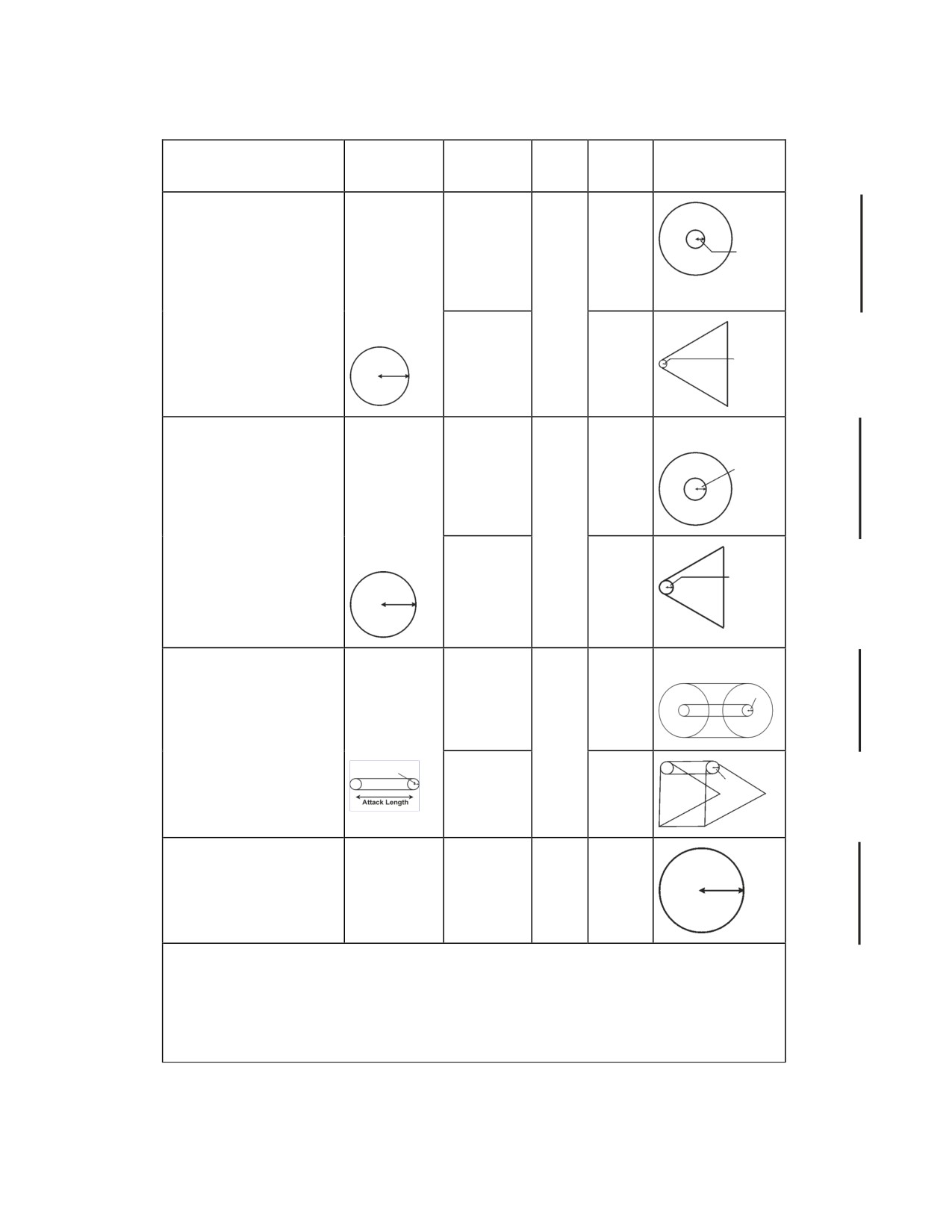
Table F-1. Types and Cases of Attacks
Type Of Agent Container
Radius Of
Wind
Type**
Case
Figure
Attack Area*
Speed
= 2KM
BOM, RKT, SHL, MNE,
Surface-burst MSL,
≤10 kph
1
Surface release SPR, or
GEN
P
>10 kph
2
= 10KM
BML or
Air-burst MSL
≤10 kph
1
Q
>10 kph
2
= 2KM
Air release SPR and GEN
or UNK
100 KM
≤10 kph
1
default
R
>10 kph
2
Detection after unobserved
= 50KM
attack
S
(NBC4 BIO message)
1/2
NOTE: An NBC1 BIO report may be received after an unobserved attack and should be
treated as an NBC4 BIO report.
*A different observed radius may be specified in GENTEXT.
**If two types of attack are found, use the following order to determine which type of attack
to use: Type R, Type Q, or Type P.
30 April 2009 FM 3-11.3/MCWP 3-37.2A/NTTP 3-11.25/AFTTP(I) 3-2.56, C1
F-11
c.
Hazard Prediction. Before a detailed prediction can be made, the CBRN staff will
determine the type of biological attack and the case. This information is crucial for the
hazard prediction.
(1)
Attack Location. Determine or estimate the location of the attack from the
NBC1 BIO reports, and mark it on a map overlay.
(2)
Attack Areas. Determine or estimate the type of attack from the NBC1 BIO
reports. The attack area is plotted as outlined below.
(a) Type P. The attack area for Type P is drawn as a 2 km radius circle,
centered at the release location.
(b) Type Q. The attack area for Type Q is drawn as a 10 km radius circle,
centered at the release location.
(c)
Type R. The attack area for Type R is defined by the line end points
entered as two positions in set FOXTROT. A 2 km radius circle is drawn at the center
position or at the two end positions, with tangents connecting the two circles together. If
the flight direction cannot be established, assume it to be perpendicular to the wind
direction. If only one position is reported in set FOXTROT, the line is 100 km, long-centered
on this point, oriented in the direction of the aircraft trajectory, and centered at the middle
of the observed flight path.
(d) Type S. The attack area for Type S is drawn as a 50 km radius circle,
centered at the detection location. The attack area is unknown; this is only an initial area.
NOTE: The attack area for Types P, Q, or R may be reduced or enlarged based on
the available information specified in GENTEXT. In computer-generated
messages, this information will be formatted as RDS: XXX km, always using three
digits for the radius (e.g., RDS: 045 km).
d.
Downwind Travel Distances.
(1)
Downwind Travel. The downwind travel distance is defined as the distance
traveled by the center of the cloud. The downwind travel distance is broken into three
segments corresponding to the three time periods of the NBC CDR as follows:
d1 = u1t1
d2 = 2u2
d3 = u3 * (4 - t1)
Where—
d1 = distance (in km) travelled within the first NBC CDR 2-hour period of the
attack.
d2 = distance (in km) travelled within the next NBC CDR 2-hour period.
d3 = distance (in km) travelled within the third NBC CDR 2-hour period.
u1 = wind speed (in kph) for the first NBC CDR 2-hour period following the
attack.
u2 = wind speed (in kph) for the next NBC CDR 2-hour period.
u3 = wind speed (in kph) for the third NBC CDR 2-hour period.
F-12
FM 3-11.3/MCWP 3-37.2A/NTTP 3-11.25/AFTTP(I) 3-2.56, C1
30 April 2009
t1 = hours remaining after the attack or detection within the NBC CDR 2-hour
period of validity corresponding to the attack.
(2)
Special Cases.
•
For any NBC CDR time periods where the wind speed is <10 kph, a value of
10 kph should be used for computations.
•
Weather information may not be available for the full 6-hour period after
an attack. If this is the case, the hazard distances can only be calculated for the time
weather is available.
(3)
Downwind Travel Distance. To calculate the downwind travel distance,
perform the following steps:
•
Step 1. If the attack or detection occurs in the first NBC CDR 2-hour time
period, three downwind distances are calculated: d1, using the first NBC CDR time period
(set WHISKEYM); d2, using the second NBC CDR time period (set XRAYM); and d3, using
the third NBC CDR time period (set YANKEEM).
•
Step 2. If the attack or detection occurs in the second NBC CDR time
period, downwind distances are calculated: d1, using the second NBC CDR time period (set
XRAYM) and d2, using the third NBC CDR time period (set YANKEEM).
•
Step 3. If the attack or detection occurs in the third NBC CDR time period,
only d1 can be calculated using set YANKEEM.
(4)
Total Downwind Distance. The total downwind distance of the center of the
biological cloud is the sum of the three distances:
DA = d1 + d2 + d3
Where —
DA = total downwind distance in km.
(5)
Leading and Trailing Edges. The leading and trailing edges for the current
NBC CDR should also be computed, based on the downwind distance path and using the
factors of 1.5 and 0.5, respectively:
DL = 1.5DA
DT = 0.5DA
Where—
DL = leading edge distance, in km
DT = trailing edge distance, in km
(f)
Third Time Period. If only the third time period is applicable, it must
be extended to include the leading edge:
DE = DL - d1 - d2
30 April 2009 FM 3-11.3/MCWP 3-37.2A/NTTP 3-11.25/AFTTP(I) 3-2.56, C1
F-13
Where—
DE = extended distance (in km) traveled within the third NBC CDR 2-hour
period.
e.
Determining Initial Hazard Areas.
(1)
Case 1 Attacks.
(a) Wind Speed. The wind speed is 10 kph or less, so a wind speed of 10
kph should be used.
(b) Radius of Hazard Area. The radius of the hazard area circle equals the
attack area radius plus the product of a wind speed of 10 kph times the time in hours
remaining after the attack or detection in the corresponding CDR time period. For example,
in a Type P, Case 1 attack having a 2-hour travel duration, the hazard area radius would
equal:
(time × wind speed) = radius for Case 1
(2 h × 10 km/h) + 2 km = 22 km
(c)
Types P, Q, and S. A single hazard area circle will result for Types P,
Q, and S. The area within this circle represents the hazard area. The attack area for Type S
is drawn as 50 km.
(d) Type R. Two circles are drawn for Type R, with tangents drawn
between the hazard area circles. The total enclosed area represents the hazard area.
(e) Downwind Distance. A value of zero is used for the downwind distance
path, leading edge, and trailing edge computations for Case 1 attacks, since the wind
direction is considered variable. The leading edge can be considered to be the edge of the
hazard area circle.
(2)
Case 2 Attacks.
(a) Downwind Direction. Determine the downwind direction from the
NBC CDM. Draw a line through the center of the attack circle, oriented in the downwind
direction.
(b) Type R. For a Type R release, choose one of the attack area circles.
Calculate the downwind distance for the first period (d1). The line should extend to distance
d1 in the downwind direction from the center of the circle. In the upwind direction along the
same line, mark a distance equal to twice the attack circle radius.
(c)
End of d1. Draw a line perpendicular to the downwind direction line,
at the downwind distance (d1), and extending in both directions.
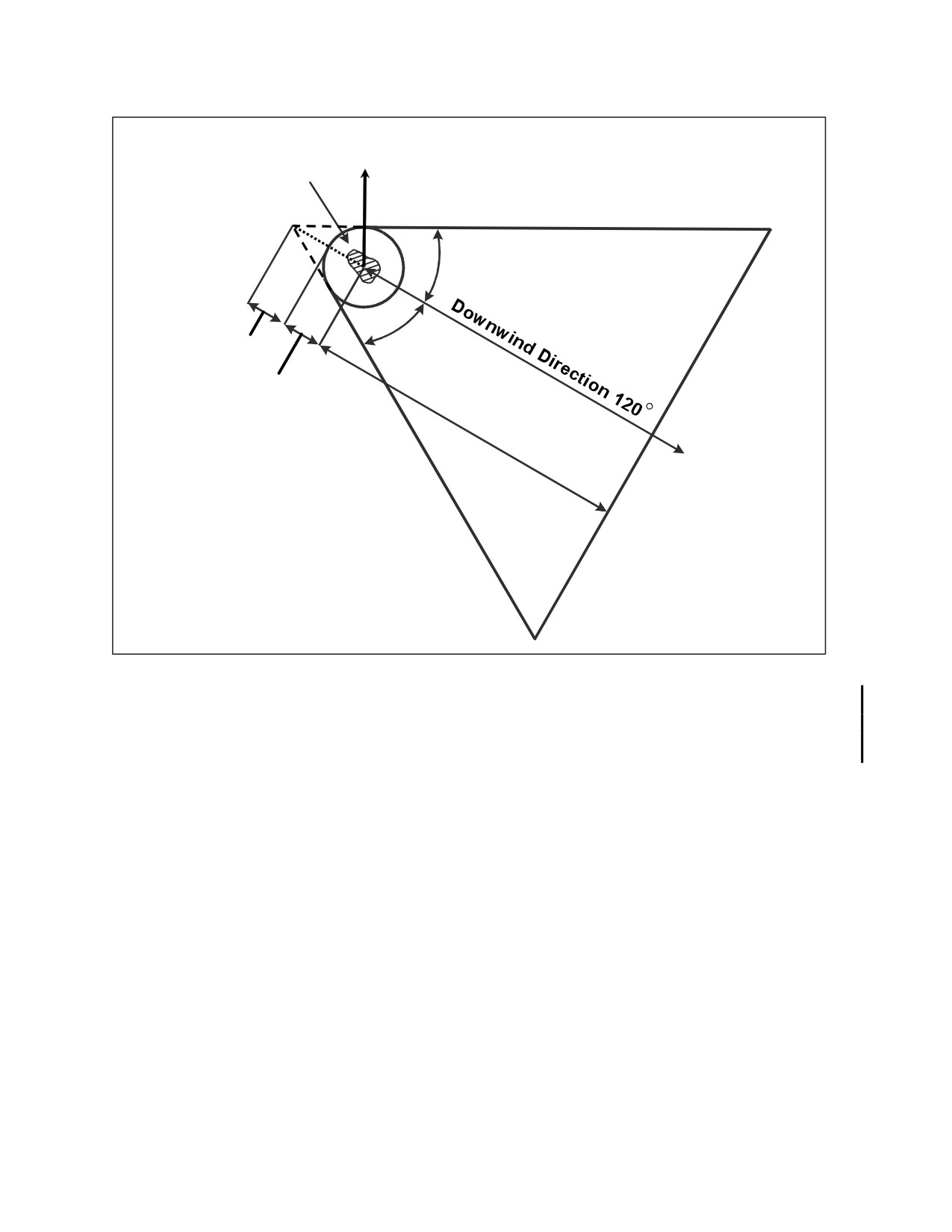
(d) Tangent Lines. Draw two lines tangent to the attack circle from the
upwind point marked, extending until they intersect with the perpendicular line. These
lines will form a 30° angle on either side of the downwind direction line.
(e) Type R. For a Type R release, repeat this procedure for the other
attack area circle and connect the lower hazard area corners to enclose the combined
downwind hazard area.
(f)
Type S. For a Type S release, there is no hazard area plotted because
the location and time of the release is unknown. A 50-km radius circle defines an area
F-14
FM 3-11.3/MCWP 3-37.2A/NTTP 3-11.25/AFTTP(I) 3-2.56, C1
30 April 2009
where there is a risk of being exposed to the biological agent. Informing friendly units
throughout the area of this risk should be considered. Before a hazard prediction can be
carried out, reports are required from units in the area or survey teams. Once more
information about the attack has been obtained, Type S attacks should then be treated as
Type P, Q, or R.
f.
Prediction of the Initial Hazard.
(1)
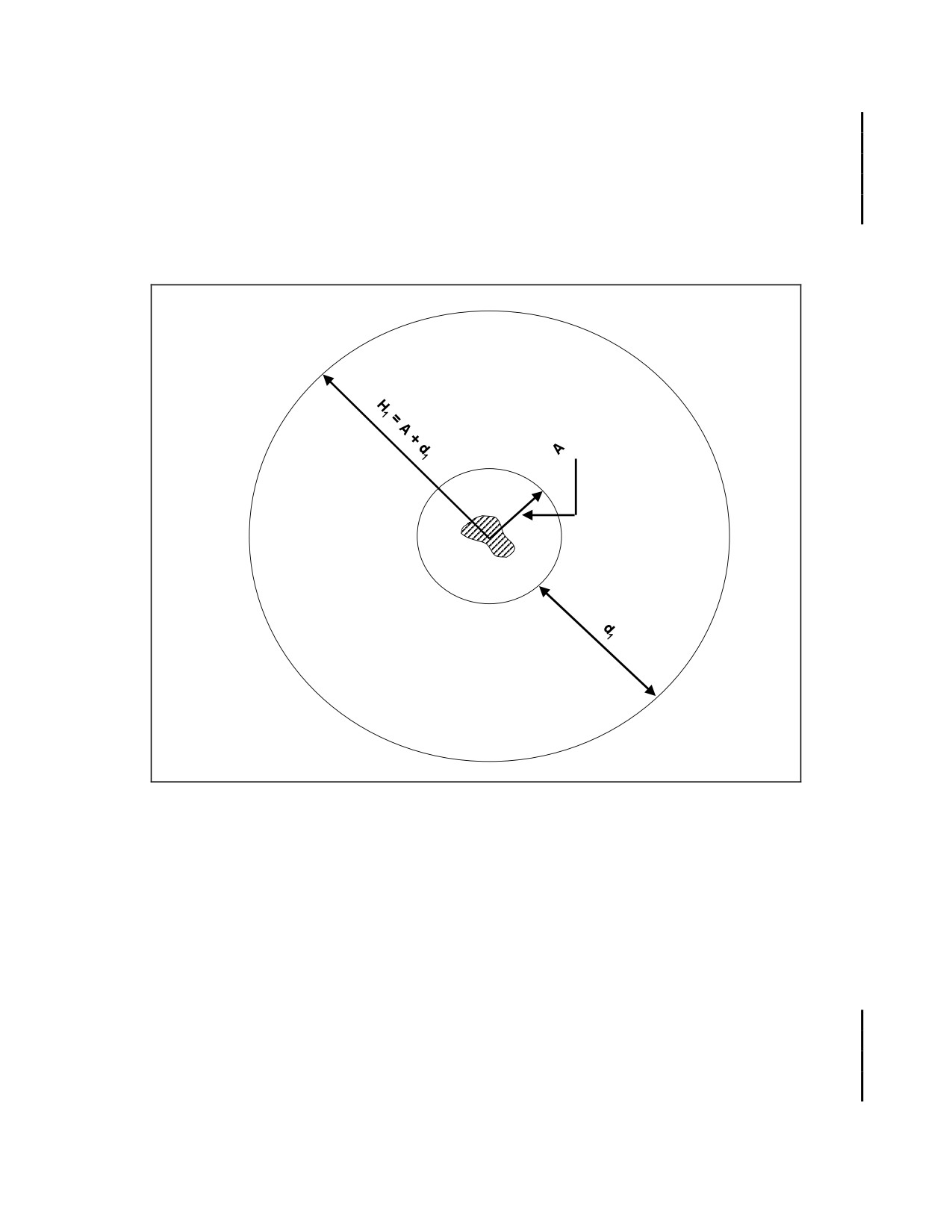
Type P, Case 1 Attack (Figure F-4).
ATTACK
AREA
HAZARD AREA
Figure F-4. Type P, Case 1, Attack
NOTE: A = radius of attack area, H1 = radius of initial hazard area, d1 = downwind
travel distance in the CDR time period,
t1 = time remaining from attack in the
CDR time period, u1 = wind speed (10 kph ), H1 = A + d1, d1 = u1 x t1. A wind speed
of 10 kph is assumed.
(a) Step 1. Obtain the location of the attack from the relevant NBC BIO
message (line FOXTROT), and plot it on the map.
(b) Step 2. Draw a circle with a radius (A) around the center of the attack
location. The area within this circle represents the attack area.
(c)
Step 3. Draw a circle with a radius (H1) that equals the radius of the
attack area (2 km) plus the downwind travel
distance (d1). Distance d1 is equal to the wind
speed (u1) for the CDR time period, times the remaining time (t1) from the attack within
that CDR time period.
30 April 2009 FM 3-11.3/MCWP 3-37.2A/NTTP
3-11.25/AFTTP(I) 3-2.56, C1
F-15
(d) Step 4. Prepare and transmit an NBC3 BIO report to units and
installations in the predicted hazard area in accordance with SOPs, using the prediction in
Figure F-4, page F-15.
(2)
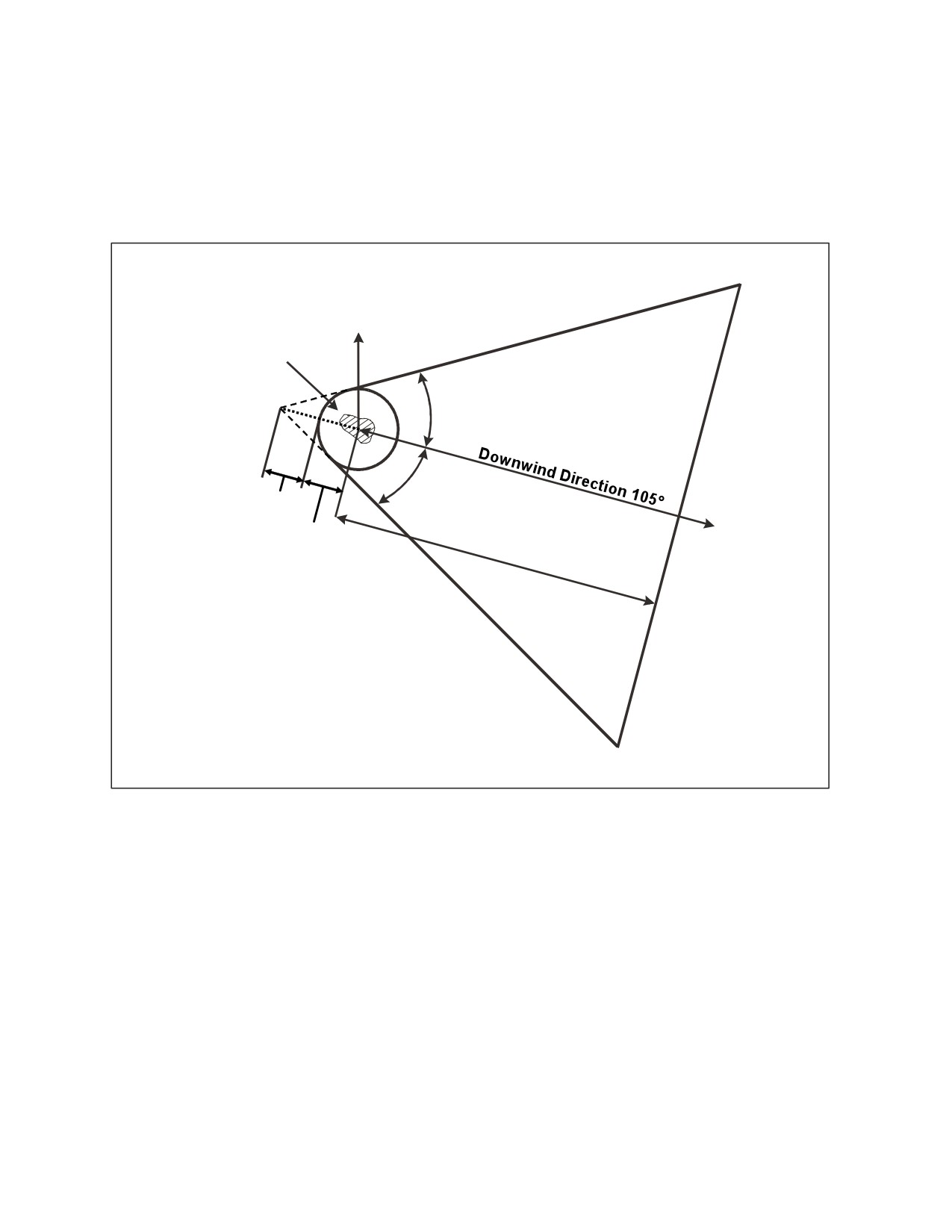
Type P, Case 2, Attack (Figure F-5).
GN
ATTACK
AREA
HAZARD
AREA
30°
30°
A
A
d1
Figure F-5. Type P, Case 2, Attack
NOTE: A = radius of attack area, d1 = downwind travel distance in the CDR time
period, t1 = time remaining from attack in the CDR time period, u1 = wind speed,
d1 = u1 x t1.
(a) Step 1. Obtain the location of the attack from the relevant NBC BIO
message(s) (set FOXTROT), and plot it on the map (see Figure F-5).
(b) Step 2. From the center of the attack location, draw a GN line.
(c)
Step 3. Draw a circle with the attack area radius around the center of
the attack location. The area within this circle represents the attack area.
(d) Step 4. Using the valid NBC CDM, identify the downwind direction
and the downwind speed.
F-16
FM 3-11.3/MCWP 3-37.2A/NTTP 3-11.25/AFTTP(I) 3-2.56, C1
30 April 2009
GN
ATTACK
AREA
30o
HAZARD
AREA
30o
A
A
d1
Figure F-7. Type Q, Case 2, Attack
NOTE: A = radius of attack area, d1 = downwind travel distance in the CDR time
period, t1 = time remaining from attack in the CDR time period, u1 = wind speed, d1 =
u1 x t1.
(a) Step 1. Obtain the location of the attack from the relevant NBC BIO
message(s) (set FOXTROT) and plot it on the map (see Figure F-7).
(b) Step 2. From the center of the attack location, draw a GN line.
(c)
Step 3. Draw a circle with the attack area radius around the center of
the attack location. The area within this circle represents the attack area.
(d) Step 4. Using the valid NBC CDM, identify the downwind direction
and the downwind speed.
(e) Step 5. From the center of the attack area, draw a line showing the
downwind direction.
(f)
Step 6. Determine the downwind travel distance (d1) (see paragraph
7d(3), page F-13). If d1 is less than the attack area radius, set it equal to the attack area
radius.
30 April 2009 FM 3-11.3/MCWP 3-37.2A/NTTP 3-11.25/AFTTP(I) 3-2.56, C1
F-19
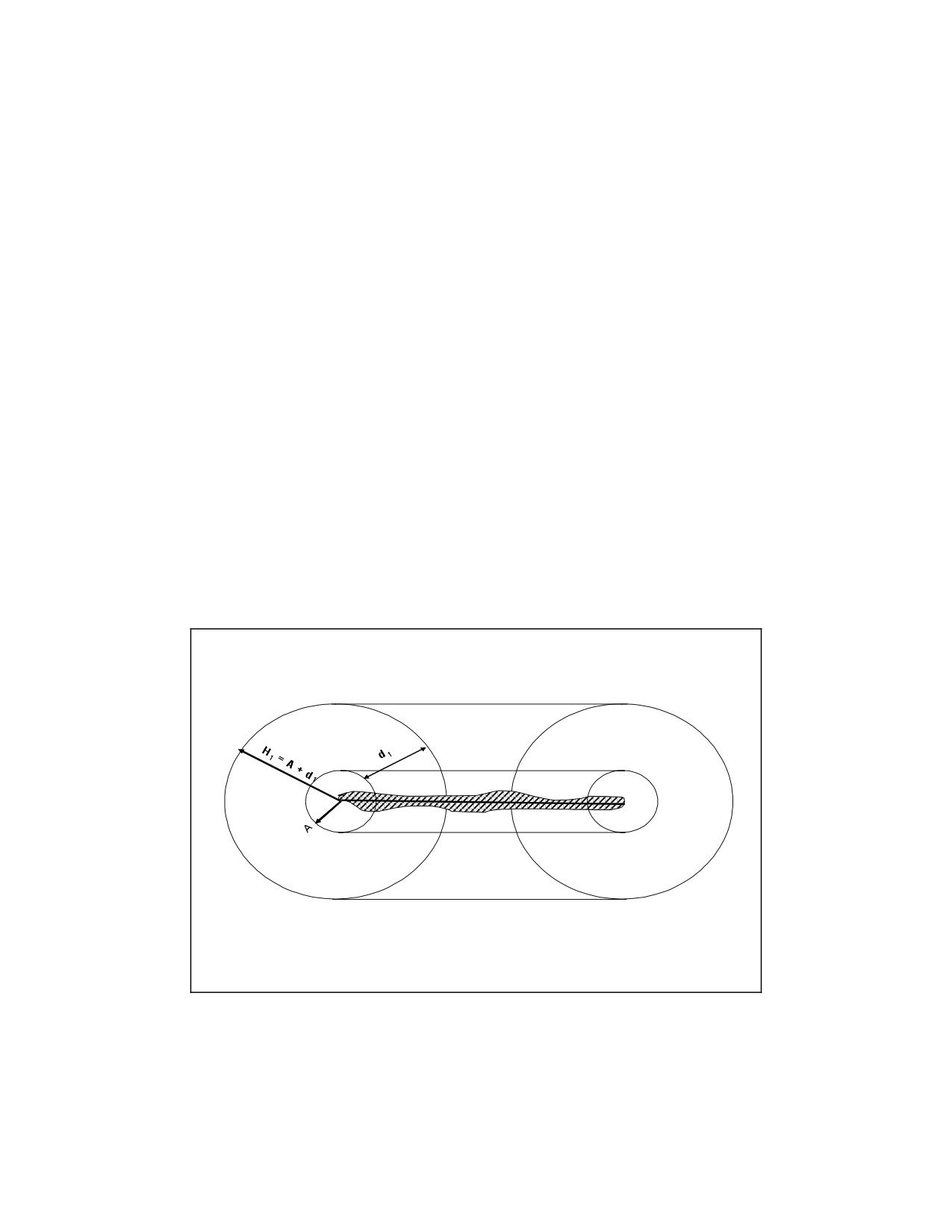
(g) Step 7. Plot the downwind travel distance from the center of the
attack area on the downwind direction line.
(h) Step 8. From the downwind travel distance, draw a line perpendicular
to the downwind direction line. Extend the line to either side of the downwind direction
line.
(i)
Step 9. Extend the downwind direction line, twice the attack area
radius, upwind from the center of the attack area. This is equal to twice the radius of the
attack area.
(j)
Step 10. From the upwind end of this line, draw two lines that are
tangents to the attack area circle, and extend them until they intersect with the
perpendicular to the downwind direction line. These lines will form a 30° angle on either
side of the downwind direction line.
(k) Step 11. The hazard area is bound by—
•
The upwind edge of the attack area circle.
•
The two 30° tangents.
•
The line perpendicular to the downwind direction line.
(l)
Step 12. Prepare and transmit an NBC3 BIO report to units and
installations in the predicted hazard area according to the SOP.
(5)
Type R, Case 1, Attack (Figure F-8).
HAZARD
AREA
Figure F-8. Type R, Case 1, Attack
F-20
FM 3-11.3/MCWP 3-37.2A/NTTP 3-11.25/AFTTP(I) 3-2.56, C1
30 April 2009

j.
Hazard Duration. Upon confirmation of a specific biological agent or toxin, the
expected duration of viability of the agent should be recorded in the second field of set
PAPAA. The attack area radius computed for the current NBC CDR should be entered into
the first field of set PAPAA. Agents may continue to be a hazard on the ground in the
contaminated area from days to, potentially, years.
8.
NBC4 BIO Report
The NBC4 BIO report (see Figure F-13) is the recorded result of an initial detection,
reconnaissance, survey, or monitoring action at a location being checked for the presence of
biological agents. Each line QUEBEC, ROMEO, SIERRA, TANGO, WHISKEY, YANKEE,
and ZULU segment in every NBC4 BIO report is a record of one contamination sample
point location, environment, time of reading, type and level of contamination, method of
sampling, and local MET conditions. The NBC4 BIO report will often be far downwind of
the attack area location as defined in the corresponding NBC2 and NBC3 BIO reports,
since biological agents will most likely be detected as airborne contamination. An NBC4
BIO report can be assumed to be associated with the same attack if —
•
It can be placed in the hazard area for an NBC3 BIO report between the
expected earliest and latest times of arrival.
•
It is within 10 km and 2 hours of another NBC4 BIO report, which has already
been assigned to an attack.
NBC4 BIO Report
Line Item
Description
Cond
Example
ALFA
Strike serial number
O
ALFA/US/A234/001/B//
INDIA
Release information on CB agent
M
INDIA/AIR/BIO/NP//
attacks or ROTA events
QUEBEC*
Location of reading/sample/detection
M
QUEBEC/32VNJ481203/-/DET//
and type of sample/detection
ROMEO*
Level of contamination, dose rate trend
O
ROMEO/20PPM//
and decay rate trend
SIERRA*
DTG of reading or initial detection of
M
SIERRA/202300ZSEP1997//
contamination
TANGO*
Terrain/topography and vegetation
M
TANGO/FLAT/URBAN//
description
WHISKEY
Sensor information
O
WHISKEY/POS/POS/NO/MED//
YANKEE
Downwind direction and downwind
O
YANKEE/270DGT/015KPH//
speed
ZULU
Actual weather conditions
O
ZULU/4/10C/7/5/1//
GENTEXT
General text
O
*Lines QUEBEC, ROMEO, SIERRA, and TANGO are a segment. With the exclusion of set ROMEO, this
segment is mandatory. Sets/segments are repeatable up to 20 times in order to describe multiple detection,
monitoring, or survey points.
Figure F-13. Sample NBC4 BIO Report
30 April 2009 FM 3-11.3/MCWP 3-37.2A/NTTP 3-11.25/AFTTP(I) 3-2.56, C1
F-27

9.
NBC5 BIO Report
The NBC5 BIO report (Figure F-14) is prepared from the contamination plot. This
report is last in order because it consists of a series of grid coordinates. Often, this message
must be sent on the radio nets. This requires lengthy transmission. If an overlay is not
sent, the recipient is required to plot each coordinate and redraw the plot. For NBC5 BIO
reports, lines INDIA (release information), OSCAR (reference time), and XRAYA (actual
contour information) are mandatory.
NBC5 BIO Report
Line Item
Description
Cond
Example
ALFA
Strike serial number
O
ALFA/US/A234/001/B//
DELTA
DTG of attack or detonation and
O
DELTA/201405ZSEP1997//
attack end
INDIA
Release information on CB agent
M
INDIA/AIR/BIO/NP//
attacks or ROTA events
OSCAR
Reference DTG for estimated contour
M
OSCAR/201505ZSEP1997//
lines
TANGO
Terrain/vegetation information
O
XRAYA*
Actual contour information
M
XRAYA/LCT50/32VNJ575203/
32VNJ572211/32VNJ560219/
32VNJ534218/32VNJ575203//
XRAYB*
Predicted contour information
O
YANKEE
Downwind direction and downwind
O
YANKEE/270DGT/015KPH//
speed
ZULU
Actual weather conditions
O
ZULU/4/10C/7/5/1//
GENTEXT
General text
O
*Sets are repeatable up to 50 times to represent multiple contours.
Figure F-14. Sample NBC5 BIO Report
10. NBC6 BIO Report
This optional NBC BIO report is a narrative description of biological attacks that have
occurred in the reporting unit AO. The NBC6 BIO report contains as much information as
is known about the attacks. It is submitted only when requested.
F-28
FM 3-11.3/MCWP 3-37.2A/NTTP 3-11.25/AFTTP(I) 3-2.56, C1
30 April 2009
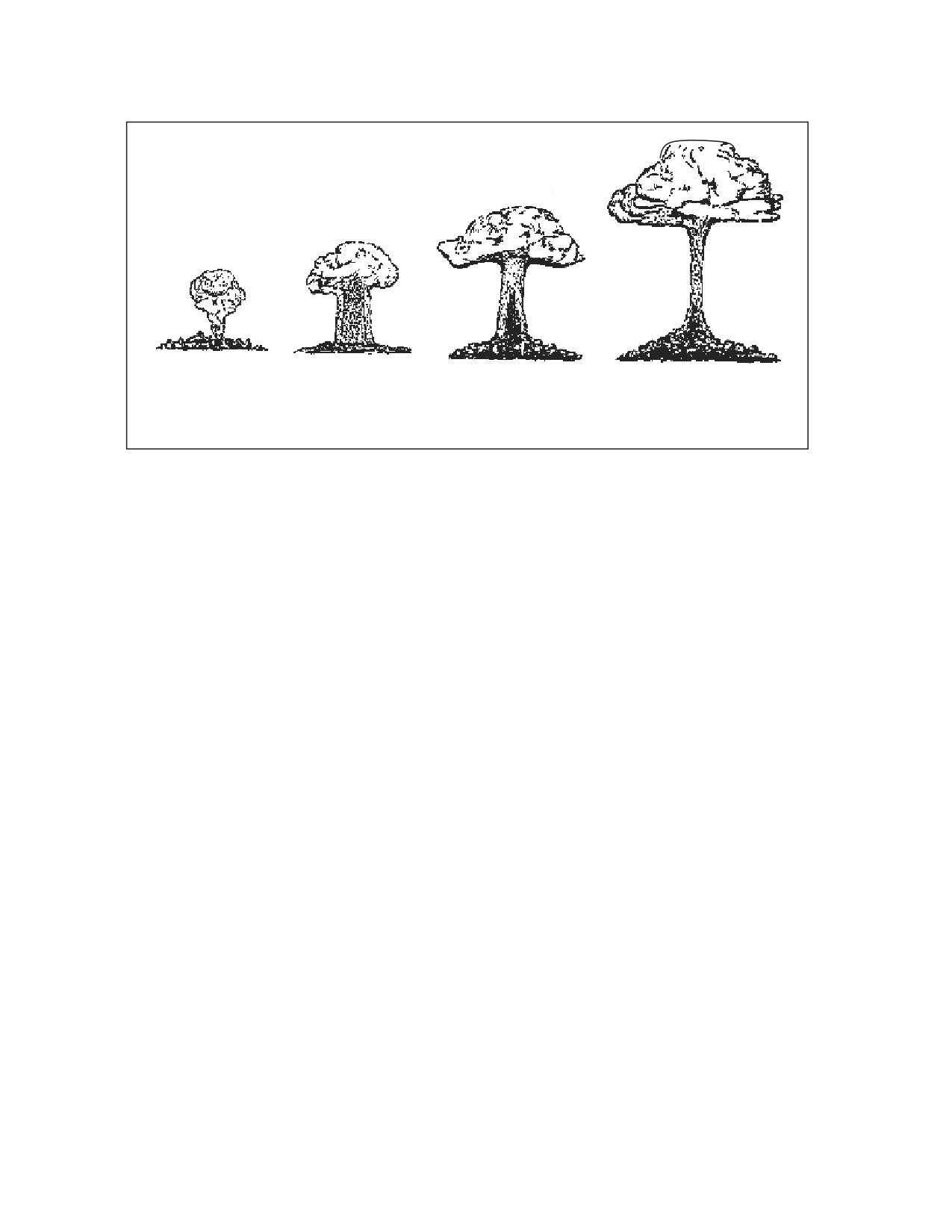
Fireball to
Growing Cloud
Growing Cloud
Stabilized Cloud
Initial Cloud
(10 minutes
(3 minutes
(4 to 14 minutes
(10 seconds
after burst)
after burst)
after burst)
after burst)
Figure G-2. Growth of a Nuclear Cloud
(4)
Nuclear-cloud measurements (parameters) have been correlated with the
yield of the weapon. This information can be extracted from nomograms and the
ABC-M4A1 nuclear yield calculator. The use of the nomograms and the ABC-M4A1 is
described in more detail later in this appendix.
(5)
Unit SOPs detail the duties and circumstances concerning when and how
measurements are taken. For accuracy, the following list of measurements (in order of
reliability) is provided to aid in SOP development:
(a) Nuclear-burst angular cloud width at H+5 minutes.
(b) Stabilized cloud top or cloud bottom height at H+10 minutes.
(c)
Stabilized cloud top or cloud bottom angle at H+10 minutes.
4.
NBC1 NUC Report
The NBC1 NUC report can have the most far-reaching consequences of all NBC
reports.
a.
Introduction. The NBC1 NUC report (Figure G-3, page G-10) is the most widely
used report. The observing unit uses this report to provide nuclear-attack data. All units
must be familiar with the NBC1 NUC report format and its information. The unit must
prepare this report quickly and accurately and send it to the next higher HQ. The battalion
(squadron) and higher elements decide which NBC1 NUC reports to forward to the next
higher HQ. If several reports are received on the same nuclear attack, then a consolidated
NBC1 NUC report is forwarded instead of separate reports. This reduces the number of
reports to a manageable level. The data in an NBC1 NUC report is used to locate GZ and to
determine the yield of the nuclear burst.
30 April 2009 FM 3-11.3/MCWP 3-37.2A/NTTP 3-11.25/AFTTP(I) 3-2.56, C1
G-9

NBC1 NUC Report
Line Item
Description
Cond*
Example
ALFA
Strike Serial Number
Will be assigned by the appropriate CBRN cell
BRAVO
Location of observer and direction
M
BRAVO/32UNB062634/2500MLG//
of attack or event
DELTA
DTG of attack or detonation and
M
DELTA/201405ZSEP2005//
attack end
FOXTROT
Location of attack or event
O
FOXTROT/32UNB058640/EE//
GOLF
Delivery and quantity information
M
GOLF/SUS/AIR/1/BOM/1//
HOTEL
Type of nuclear burst
M
HOTEL/SURF//
JULIET
Flash-to-bang time, in seconds
O
JULIET/57//
LIMA
Nuclear-burst angular cloud width
O
LIMA/18DGT//
at H+5 minutes
MIKE
Stabilized cloud measurement at
O
MIKE/TOP/33DGT/9KM//
H+10 minutes
PAPAC
Radar-determined external contour
O
of radioactive cloud
PAPAD
Radar-determined downwind
O
direction of radioactive cloud
YANKEE
Downwind direction and downwind
O
YANKEE/270DGT/015KPH//
speed
ZULU
Actual weather conditions
O
ZULU/4/10C/7/5/1//
GENTEXT
General text
O
*The Cond column shows that each line item is operationally determined (O) or mandatory (M).
Figure G-3. Sample NBC1 NUC Report
(1)
Purpose. The purpose of the NBC1 NUC report is to provide nuclear-attack
data.
(2)
Message Precedence. The first time a nuclear weapon is used against US
forces, the designated unit will send the NBC1 NUC report with a FLASH precedence. If a
previous NBC1 NUC report has been forwarded, an IMMEDIATE precedence will be used.
b.
Observer Position. Use universal transverse mercator (UTM) coordinates
latitude (LAT) and longitude (LONG) or a place name. Enter this location on line BRAVO of
the NBC1 NUC report. Line BRAVO is required on all reports from ground observers and
should be encoded. This is the location of the angle-measuring equipment. It may or may
not be the unit location. The direction of the attack from the observing unit is also reported
on this line.
G-10
FM 3-11.3/MCWP 3-37.2A/NTTP 3-11.25/AFTTP(I) 3-2.56, C1
30 April 2009
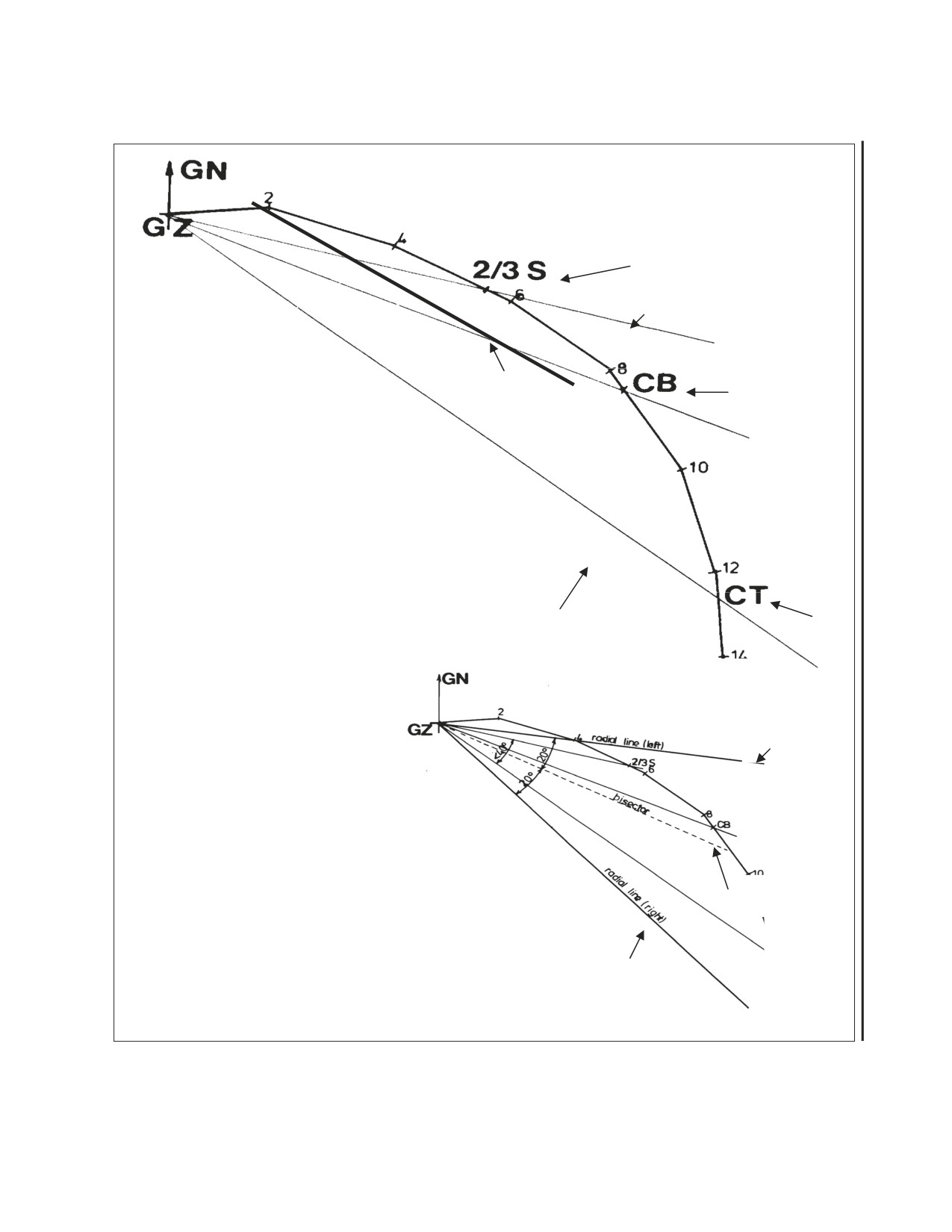
5.6 km
109 o
22 km
8.4 km
GZ to CB
NOTE: The left (109o) and right (136o) lateral
limits are less than a 40o angle
(136o - 109o = 27o).
For detailed fallout prediction, the warning
angle must be at least 40o. Add the angles,
divide by 2, add 20o, and subtract 20o to
obtain the new left and right lateral limits.
136o + 109o = 245o (246o)
246o / 2 = 123o (Bisected angle)
123o + 20o = 143o (Right lateral limit)
123o - 20o = 103o (Left lateral limit)
136 o
12.8 km
New lateral limits
will be annotated on the
wind vector plot, detailed
fallout prediction
work sheet Figure G-18,
page G-35, and the NBC3 report.
103 o
123 o
143 o
Figure G-19. Wind Vector Plot with Cloud and Stem Radial Lines (50 KT) (Example)
30 April 2009 FM 3-11.3/MCWP 3-37.2A/NTTP 3-11.25/AFTTP(I) 3-2.56, C1
G-37
g.
Detailed Fallout Prediction.
(1)
Purpose. The purpose of the detailed fallout prediction is to provide the
subordinate units an immediate warning of the predicted contamination resulting from a
nuclear detonation. The commander will use the detailed fallout prediction in the tactical
decision-making process.
(2)
Procedures. The CBRN cell is responsible for preparing and plotting the
detailed fallout predictions. The fallout prediction work sheet provides the CBRN cell with
a standard work sheet for recording the nuclear burst (surface) information data.
Completing the fallout prediction work sheet is the first step in drawing the prediction. Use
the steps listed below to complete the work sheet.
(a) Step 1. Obtain a current wind vector plot. Before any bursts occur, the
wind vector plots are drawn. Refer to Appendix D for detailed information regarding wind
vector plotting (see Figure G-19, page G-37).
(b) Step 2. Complete a detailed fallout prediction work sheet. Using an
NBC2 NUC report, determine the nuclear-burst information. Record this information on
the work sheet (see Figure G-20).
•
Lines ALFA, BRAVO, and ECHO are transcribed from the NBC2
NUC report.
•
Lines CHARLIE and DELTA are used if the enemy burst or friendly
burst data is unknown. When enemy or friendly burst information is unknown, assume
that a worst case (100 percent fission yield [FY]) scenario has occurred and enter a 1 on line
CHARLIE. When the height of burst (HOB) is unknown, enter a 0 (zero) on line DELTA,
which represents a worst case HOB.
•
A friendly burst with known data information will come from the fire
support element (target analyst) delivering the weapon. The data will include the weapon
yield, FY/total yield (TY) ratio, HOB, GZ coordinates, DTG of the attack, and strike serial
number.
(c)
Step 3. Determine the cloud parameters. Using the yield of the
weapon from line ECHO and the nomogram (Figure G-21, page G-40), locate the yield on
the right- or left-hand scale. Place a straightedge (hairline) on the yield, and align the
values on both scales. Read and record all cloud parameter values on lines FOXTROT
through JULIET of the fallout prediction work sheet.
NOTE: The following steps are exactly the same as the steps used in making an
EDM (refer to Appendix D for more information regarding EDMs).
(d) Step 4. Determine the lateral limits of the prediction using the wind
vector plot. Mark the points representing the cloud top height and the two-thirds stem
height. Draw radial lines from the GZ point through these height points.
NOTE: If the wind vectors between the two-thirds stem height point and the
cloud top height point fall outside the radial lines drawn from GZ, expand the
angle formed by these two radial lines to include these outside wind vectors.
G-38
FM 3-11.3/MCWP 3-37.2A/NTTP 3-11.25/AFTTP(I) 3-2.56, C1
30 April 2009

(1)
Purpose. The purpose of the NBC3 NUC report is to report immediate
warning of the predicted contamination and hazard areas to higher, subordinate, and
adjacent units.
(2)
Message Precedence. All other messages, after the initial NBC1 NUC
report has been sent, should be given a precedence, which reflects the operational value of
the contents. Normally IMMEDIATE would be appropriate.
NBC3 NUC Report
Line Item
Description
Cond*
Example
ALFA
Strike serial number
M
ALFA/US/A234/001/N//
DELTA
DTG of attack or detonation and
M
DELTA/201405ZSEP2005//
attack end
FOXTROT
Location of attack or event
M
FOXTROT/32UNB058640/EE//
GOLF
Delivery and quantity information
O
GOLF/SUS/AIR/1/BOM/4//
HOTEL
Type of nuclear burst
O
HOTEL/SURF//
NOVEMBER
Estimated nuclear yield, in KT
O
NOVEMBER/50//
OSCAR
Reference DTG of contour lines
O
PAPAB
Detailed fallout hazard prediction
M
PAPAB/019KPH/33KM/5KM/
parameters
272DGG/312DGG//
PAPAC
Radar-determined external contour of
O
PAPAC/32VNJ456280/32VNJ456119/
radioactive cloud
32VNJ556182/32VNJ576200/
32VNJ566217/32VNJ456280//
PAPAD
Radar-determined downwind direction
O
PAPAD /030DGT//
of radioactive cloud
XRAYB*
Predicted contour information
C
YANKEE
Downwind direction and downwind
O
YANKEE/270DGT/015KPH//
speed
ZULU
Actual weather conditions
O
ZULU/4/10C/7/5/1//
GENTEXT
General text
O
*The Cond column shows that each line item is operationally determined (O), mandatory (M), or conditional (C).
Note: XRAYB is prohibited if OSCAR is not used.
Figure G-26. Sample NBC3 NUC Report
b.
Plotting Detailed Fallout Predictions (NBC3 NUC) (see Figure G-27, page G-48).
(1)
Step 1. Identify the map scale to be used. Obtain a sheet of overlay paper or
other transparent material. Mark a GZ location and GN.
(2)
Step 2. Examine line PAPAB. Starting at the GZ location, draw the left
(dddd) and right (cccc) radials line measured from GZ.
(3)
Step 3. From line PAPAB, determine the downwind distance of
Zone I (xxx).
(a) Starting from GZ, draw an arc between the radial lines with a radius
equal to the distance of Zone I. Label this area Zone I.
(b) Draw a second arc between the radial lines at twice the radius as the
downwind distance of Zone II. Label this area Zone II.
30 April 2009 FM 3-11.3/MCWP 3-37.2A/NTTP 3-11.25/AFTTP(I) 3-2.56, C1
G-47
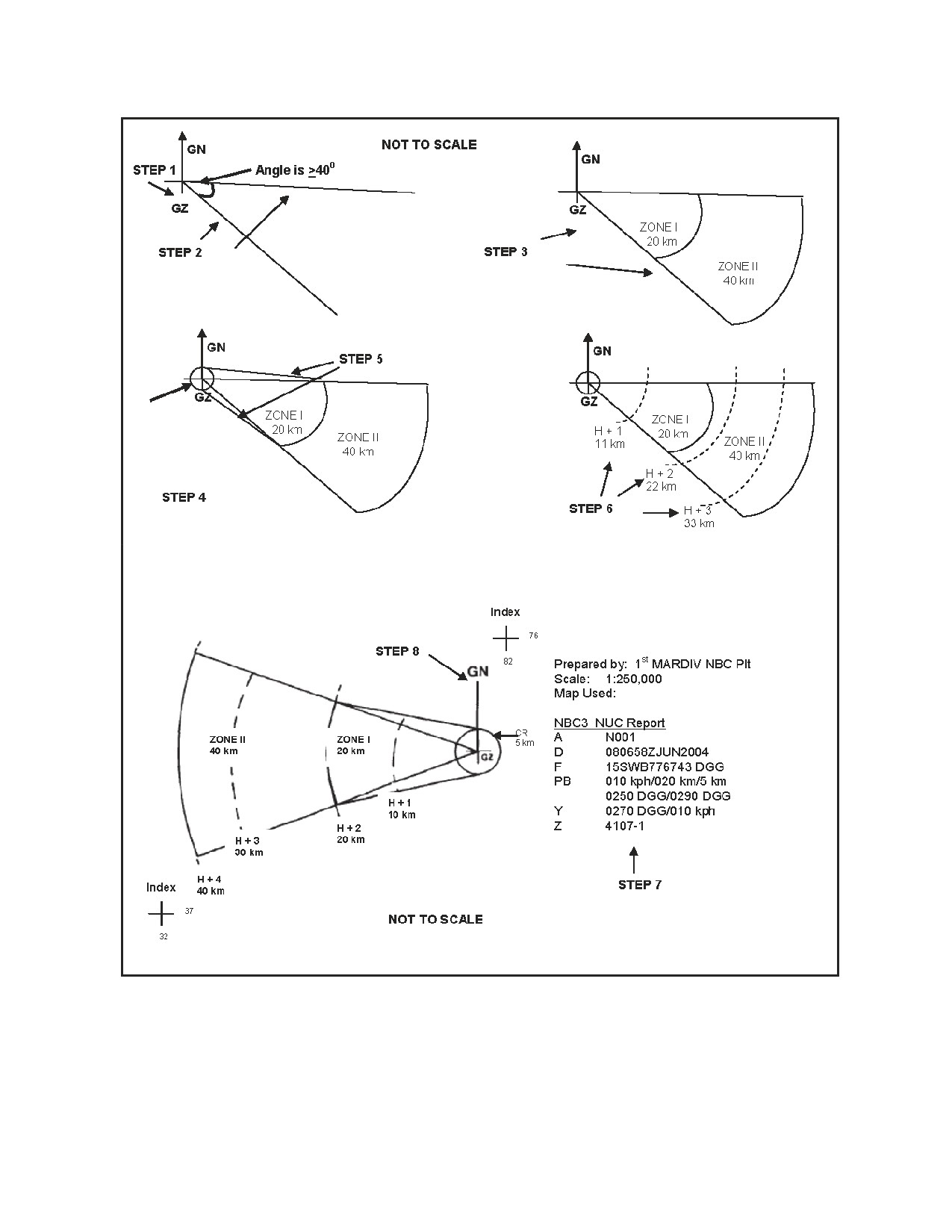
Figure G-27. Detailed Fallout Prediction
G-48
FM 3-11.3/MCWP 3-37.2A/NTTP 3-11.25/AFTTP(I) 3-2.56, C1
30 April 2009
d.
Time of Completion of Fallout.
(1)
Most contaminated particles in a radioactive cloud rise to considerable
heights. Therefore, fallout may occur over a large area. It may also last for an extended
period of time. A survey conducted before the fallout is complete would be inaccurate
because contaminants would still be suspended in the air. For this reason (and the hazard
to surveying personnel), nuclear surveys are not conducted before completion of fallout.
(2)
An estimate of the time of completion (Tcomp) of fallout for a particular
location may be determined using a mathematical equation. The time (in hours) after a
burst when the fallout will be completed at any specific point is approximately 1.25 times
the time of fallout arrival (in hours after burst). Add the time (in hours) required for the
nuclear cloud to pass over. This is expressed by using the following formula:
(2 x cloud radius)
Tcomp = (1.25 x Tarrival) +
EWS
Example: For a given location, the following data has been determined:
•
Time of detonation = H.
•
Time of arrival = H+2 hours (time of arrival is determined by dividing the
distance from GZ to the given point by the EWS).
•
Cloud diameter = 4 km (2 x cloud radius) (cloud diameter/radius [rr] is
determined from Figure G-20, page G-39, or from line item PAPAB of the NBC3 NUC
report).
•
EWS = 20 kph (EWS [sss] is determined from Figure G-19, page G-38, or
from line item PAPAB of the NBC3 NUC report).
4 km
Tcomp = (1.25 x 2 hr) +
20 kph
Tcomp = 2.5 hr + 0.2 hr
Tcomp = 2.7 hr
Therefore, fallout for the given location is expected to be complete by H+2.7 hours.
NOTE: To convert 2.7 hours into clock time, multiply 0.7 by 60. The product in
this example is 42. Therefore, Tcomp is 2 hours and 42 minutes.
(3)
The actual completion of fallout can be determined if a peak NBC4 NUC
report is received from the AOI. For detailed information regarding nuclear reconnaissance,
monitoring, and survey, refer to Multiservice Tactics, Techniques, and Procedures for
Nuclear, Biological, and Chemical Reconnaissance.
8.
NBC4 NUC Report
The NBC4 NUC report is a key tool used by units to define the type and extent of the
contamination.
a.
Locating and Reporting Nuclear Contamination.
(1)
Fallout predictions provide a means of defining possible areas of a nuclear
contamination. Militarily significant fallout is expected to occur only within the predicted
area. However, the prediction does not indicate exactly where the fallout will occur or what
30 April 2009 FM 3-11.3/MCWP 3-37.2A/NTTP 3-11.25/AFTTP(I) 3-2.56, C1
G-53

the dose rate will be at a specific location. Rainout or washout can also increase nuclear
contamination on the ground, creating local hot spots. Areas of neutron-induced radiation
can also be caused by low air bursts.
(2)
Before planning operations in a nuclear environment, commanders must be
aware of these residual contamination hazards. The information required for such planning
is derived from the equations and nomograms given in the following sections and in
Appendixes J and K. The basic information needed is contained in NBC4 NUC reports.
They provide information on the actual measured contamination in the form of dose rates.
b.
Message Precedence. All other messages, after the initial NBC1 NUC report has
been sent, should be given a precedence, which reflects the operational value of the
contents. Normally, IMMEDIATE would be appropriate (see Figure G-30 for a sample
NBC4 NUC report).
NBC4 NUC Report
Line Item
Description
Cond*
Example
ALFA
Strike serial number
O
ALFA/US/A234/001/N//
KILO
Crater description
O
KILO/UNK//
QUEBEC
Location of reading/sample/detection and
M
QUEBEC/32VNJ481203/GAMMA/-//
type of sample/detection
ROMEO
Level of contamination, dose rate trend
M
ROMEO/7CGH/DECR/DN//
and decay rate trend
SIERRA
DTG of reading or initial detection of
M
SIERRA/202300ZSEP1997//
contamination
TANGO
Terrain/vegetation information
O
WHISKEY
Sensor information
O
WHISKEY/POS/POS/YES/HIGH//
YANKEE
Downwind direction and downwind speed
O
YANKEE/270DGT/015KPH//
ZULU
Actual weather conditions
O
ZULU/4/10C/7/5/1//
GENTEXT
General text
O
-
*The Cond column shows that each line item is operationally determined (O) or mandatory (M).
Figure G-30. Sample NBC4 NUC Report
(1)
The location is sent as UTM or LAT/LONG grid coordinates; the level of
contamination reading is expressed in cGy/h.
(2)
Lines QUEBEC, ROMEO, and SIERRA may be repeated as many times as
necessary to give a specific picture of the contamination throughout an area. A zero dose
rate may also be reported on line ROMEO, and it is an extremely valuable piece of
information in determining the extent and duration of the contamination.
G-54
FM 3-11.3/MCWP 3-37.2A/NTTP 3-11.25/AFTTP(I) 3-2.56, C1
30 April 2009

(3)
Only outside unshielded dose (OD) rates are reported by the unit, and the
DTG is reported in Zulu time. Certain abbreviations are associated with the dose rate to
describe the circumstances surrounding the contamination. Note that the definition of line
ROMEO includes information on the dose rate trend and the relative or actual radiation
decay rate. The dose rate must be reported, while the latter two items are optional. They
require evaluation, which may be done above unit level. A monitor cannot provide this
information.
c.
Shielding. Shielding reduces the effects of gamma radiation on personnel and
equipment. The denser the material is, the better the shield. Low-density materials are as
effective as higher-density materials when the total thickness of the low-density material is
increased. It is not possible for gamma radiation to be completely absorbed. However, if
enough material is placed between the individual and the radiation source, the dose rate
can be reduced to negligible proportions.
(1)
Shielding Principles.
(a) Density. Density is defined as the number of molecules or mass per
unit of volume.
(b) Half-Thickness. This is the amount of material required to reduce the
dose rate by one-half. See Table G-2 for selected half-thicknesses.
Table G-2. Half-Thicknesses (X ½) of Materials
Material
Half-Thickness (Inches)
Steel
0.7
Concrete
2.2
Earth
3.3
Wood
8.8
(c)
Total Thickness. This is the actual thickness of the shielding material.
(d) Position of the Shield. The closer the shield is to the source, the better.
(e) Dose Rate Buildup. The dose rate buildup is produced by the shield.
The shield causes radiation to scatter; therefore, the closer to the shield, the higher the dose
rate.
(2)
Shielding Materials.
(a) Earth. Earth is the most common shielding material. About 1 foot of
earth makes an adequate shield.
(b) Concrete. About 6 to 8 inches of concrete makes a good shield.
(c)
Steel. Tanks and amtracks are very good shields against radiation.
(d) Buildings. Wood or brick buildings make good shields.
(3)
Effectiveness. The effectiveness of a given material in decreasing radiation
intensity is measured in units of half-value layer thickness (half-thickness). This unit is
30 April 2009 FM 3-11.3/MCWP 3-37.2A/NTTP 3-11.25/AFTTP(I) 3-2.56, C1
G-55
defined as the thickness of any material which reduces the dose rate of gamma radiation to
one-half its unshielded value.
NOTE: If personnel are surrounded by a 6-inch concrete wall (half-thickness) and
the gamma radiation outside is 200 cGy/h, they would receive gamma radiation at
the rate of 100 cGy/h. The addition of another 6 inches reduces the rate to 50
cGy/h. Each succeeding half-thickness of concrete would reduce the radiation.
d.
Measuring Nuclear Data.
(1)
Measurements of nuclear data must be taken in accordance with the unit
SOP. Measurements can be taken directly from an unshielded position if dose rates are low
enough or from a shielded position, such as a shelter or vehicle.
(2)
When the indirect technique is used, most of the readings are taken inside
the vehicle or shelter. However, at least one outside reading is necessary to determine the
TF, which relates the readings inside to the unshielded values outside. The latter readings
are to be reported since they are necessary for further calculations pertaining to troops in
the open or other vehicles or shelters.
(3)
To determine the TF, both the inside and outside readings must be taken
after fallout is complete. Calculate the TF using the following formula:
inside shielded dose (ID) rate
TF =
OD rate
NOTE: The TF is always less than 1. It can be determined from the measurement
of the dose.
(4)
The readings taken inside the vehicle or shelter represent the ID. These
readings must be converted to OD before reporting. Readings are converted using the
following formula:
OD = ID / TF
(5)
A precalculated list of TFs is contained in national manuals, an example of
which is shown in Table G-3. This information is not used by unit CBRN defense personnel
when calculating or reporting OD rates. Its principal use is to establish the relative
shielding ability of one shelter, structure, or vehicle as compared to another. It is also used
for instructional and practice purposes.
(6)
These factors are for the most exposed, occupied location. They are not
based on dose rates from fallout; they are based on gamma radiation from cobalt-60. Since
cobalt-60 radiation is almost twice as strong as the radiation from fallout, the actual TF
should be much lower (more protection).
(7)
In some cases the term CF is used. It is always the reciprocal of the TF. The
formula to convert a TF to a CF is:
1
OD
CF =
=
TF
ID
G-56
FM 3-11.3/MCWP 3-37.2A/NTTP 3-11.25/AFTTP(I) 3-2.56, C1
30 April 2009
(8)
Determination of Decay Rate for Induced Radiation. Decay characteristics
of an induced radiation are considerably different from those of a fallout. The Kaufmann
equation may not be applied.
(a) The decay of induced radiation depends on the elements in which it is
induced. Soil contains many different elements with varying half-lives, so the decay rate
changes in time and must be monitored constantly.
(b) The decay rate (n) at a fixed location can only be determined from
consecutive measurements, using the following equation:
1
Ra
X 1n
(
)
t
Ra + t
(c)
Ra is the dose rate reading in cGy/h at an arbitrary time and (Ra + t)
is a second reading taken at the same location after t hours.
(d) Manganese and sodium are two elements with relatively long half-
lives that are frequently found in soils. Therefore, they are expected to be the principal
sources of radiation after a burst. For sodium, with its half-life of 15 hours, the decay rate is
0.046. For manganese, with its half-life of 2.6 hours, the decay rate is 0.27.
(9)
Determination of Dose Rate for Arbitrary Time. The dose rate (R1+t), in
cGy/h, at an arbitrary time (t hours) after a reading is calculated as—
R1 + t = Ra(-n x t)
Ra is the dose rate at the time (t) of the reading, n is the decay rate at that time, and EXP ()
is the exponential function (inverse or INV; the argument is the power to which
e=2.71828…is raised).
(10) Determination of Dose Accumulated in Neutron-Induced Area. The dose D,
in cGy, accumulated between entry to and exit from a neutron-induced gamma activity
(NIGA) area is found by using the formula—
D = R1/n((-n x tin ) - (-n x tout))
R1 is the dose rate in cGy/h at the reference time, n is the decay rate at that time, tin and tout
are the time of entry and exit from the NIGA area, in hours, after the reference time.
(11) Determination of Earliest Time of Entry. To ensure that a limiting dose
(DL) is not accumulated during a stay in an NIGA area, the earliest time of entry (tin) can
be determined as follows:
Te = -1/n * (DL/(R * n * (1 -(-n * Ts)).
TS = Time of stay in the area in hours
R = Dose rate at the reference time H+1
n
= Decay rate at that time
(12) Determination of Time of Exit from Neutron-Induced Area Given a
Maximum Dosage. If a certain limit DL for the dose accumulated during a stay in an NIGA
30 April 2009 FM 3-11.3/MCWP 3-37.2A/NTTP 3-11.25/AFTTP(I) 3-2.56, C1
G-87

area is given, the time (tout) to leave the area can be determined from the following
equation:
Tout = -1/n*n((-n*Te)-(n*DL)/R1)
Te = Time of entry, in hours, after the reference time at which the dose rate was R1 and the
decay rate was D.
11. NBC6 NUC Report
The NBC6 NUC report (Figure G-42) provides commanders and staff with detailed
information that is vital to the operation.
a.
Purpose. The NBC6 NUC report is used to provide detailed information on a
nuclear attack. The NBC6 NUC report is submitted to higher HQ. It is written in narrative
form with as much detail as possible.
b.
Message Precedence. All other messages, after the initial NBC1 NUC report has
been sent, should be given a precedence, which reflects the operational value of the
contents. Normally, IMMEDIATE would be appropriate.
NBC6 NUC Report
Line Item
Description
Cond*
Example
ALFA
Strike serial number
O
ALFA/US/A234/001/N//
DELTA
DTG of attack or detonation and
O
DELTA/201405ZSEP2005//
attack end
FOXTROT
Location of attack and qualifier
O
FOXTROT/32UNB058640/EE//
QUEBEC
Location and type reading/sample/
O
QUEBEC/32VNJ481203/GAMMA/-//
detection
ROMEO
Level of contamination, dose rate
O
ROMEO/7CGH/DECR/DN//
trend, and decay rate trend
SIERRA
DTG of reading
O
SIERRA/202300ZSEP2005//
GENTEXT
General text
M
GENTEXT/NBCINFO/WEAPON YIELD
ESTIMATED FOR EVALUATION OF
COLLATERAL DAMAGE PURPOSES
ONLY//
*The Cond column shows that each line item is operationally determined (O) or mandatory (M).
Figure G-42. Sample NBC6 NUC Report
G-88
FM 3-11.3/MCWP 3-37.2A/NTTP 3-11.25/AFTTP(I) 3-2.56, C1
30 April 2009
information concerning this collection effort is addressed in Multiservice Tactics,
Techniques, and Procedures for Nuclear, Biological, and Chemical Reconnaissance.
c.
Evaluating ROTA Information. After the ROTA information has been collected,
it is evaluated. It is then used as battlefield intelligence. The CBRN cell is the primary
evaluation center. The units and intermediate HQ use this raw data to develop ROTA
intelligence for their own use until detailed results are available from the CBRN cell.
d.
Transmitting ROTA Information. The procedures used to transmit ROTA
information to and from the CBRN cell are an important part of the IM. The method of
transmitting information depends on the tactical situation and mission of the unit. Refer to
Chapter III for more detailed information.
4.
NBC1 ROTA Report
The NBC1 ROTA report (Figure H-1, page H-6) is the most widely used report. The
observing unit uses this report to provide ROTA data. All units must be completely familiar
with the NBC1 ROTA report format and its information. The unit must prepare this report
quickly and accurately and send it to the next higher HQ. Battalion (squadron) or the
service equivalent and higher elements decide which NBC1 ROTA reports to forward to the
next higher HQ. If several reports are received for the same ROTA event, a consolidated
NBC1 ROTA report is forwarded. This reduces the number of reports to a manageable level.
a.
Purpose. The purpose of the NBC1 ROTA report is to provide ROTA data.
b.
Precedence. The first time a ROTA event occurs, the designated unit will send
the NBC1 ROTA report with a FLASH precedence. If a previous NBC1 ROTA report has
been forwarded, an IMMEDIATE precedence will be used.
c.
Information Included. The report will include lines BRAVO, CHARLIE, GOLF,
INDIA, and TANGO and may include line items ALFA, FOXTROT, MIKER, YANKEE,
ZULU, and GENTEXT with the information as currently described for CBRN reports. Line
CHARLIE provides the same information as line DELTA, except it indicates an observed
ROTA event rather than an observed attack. Line GOLF will include the type of delivery if
applicable, the ROTA type of container (e.g., bunker, waste, reactor, transport, stockpile),
and the size of the release (small, large, or extra large) if appropriate. Line INDIA will
indicate the observed release height and indicate the type of release as ROTA nuclear
power plant, TIM, or the agent name or identification number. Line INDIA will indicate the
material persistency. Additional descriptive entries for a ROTA event can be entered into
line MIKER. Line TANGO will indicate a description of the terrain/topography and the
vegetation. Lines YANKEE and ZULU may indicate locally observed weather. Line
GENTEXT will provide the specific chemical compound or the type of biological agent if
available.
d.
Preparation. Determine the line items for this report by using the same
procedures as the previous contamination avoidance TTP appendixes per the type of attack
or event.
30 April 2009 FM 3-11.3/MCWP 3-37.2A/NTTP 3-11.25/AFTTP(I) 3-2.56, C1
H-5

NBC1 ROTA Report
Line Item
Description
Cond*
Example
ALFA
Strike serial number
O
BRAVO
Location of observer and direction of
M
BRAVO/32UNB062634/2500MLG//
attack or event
CHARLIE
DTG of report or observation and end
M
CHARLIE/281530ZSEP2005//
of event
FOXTROT
Location of attack or event
O
FOXTROT/32UNB058640/EE//
GOLF
Delivery and quantity information
M
GOLF/SUS/TPT/1/TNK/SML//
INDIA
Release information on CB agent
M
INDIA/SURF/2978/-/MPDS//
attacks or ROTA events
MIKER
Description and status
O
MIKER/LEAK/CONT//
TANGO
Terrain/topography and vegetation
M
TANGO/URBAN/URBAN//
description
YANKEE
Downwind direction and downwind
O
YANKEE/270DGT/015KPH//
speed
ZULU
Actual weather conditions
O
ZULU/4/10C/7/5/1//
GENTEXT
General text
O
*The Cond column shows that each line item is operationally determined (O) or mandatory (M).
Figure H-1. Sample NBC1 ROTA Report
5.
NBC2 ROTA Report
The NBC2 ROTA report reflects the evaluated ROTA data. It is based on one or more
NBC1 ROTA reports. Users of the NBC2 ROTA reports are not limited to the use of the line
items shown in Figure H-2. Other line items may be added as appropriate.
a.
Purpose. The purpose of the NBC2 ROTA report is to pass the evaluated data to
higher, subordinate, and adjacent units.
b.
Precedence. All messages, after the initial NBC1 ROTA report has been sent,
should be given a precedence, which reflects the operational value of the contents.
Normally, IMMEDIATE would be appropriate.
c.
Preparation. The division (or designated higher HQ) CBRN cell prepares the
NBC2 ROTA report, assigns a strike serial number, and disseminates the report to the
appropriate unit.
d.
Subsequent Data. Subsequent data may be received after the NBC2 ROTA
report is sent. Use the same strike serial number and DTG of the attack or incident.
Determine the line items for this report using the same procedures as the previous
contamination avoidance TTP appendixes per the type of attack or event.
H-6
FM 3-11.3/MCWP 3-37.2A/NTTP 3-11.25/AFTTP(I) 3-2.56, C1
30 April 2009

NBC2 ROTA Report
Line Item
Description
Cond.
Example
ALFA
Strike serial number
M
ALFA/US/WEP/001/RN//
CHARLIE
DTG of report /observation and event
M
CHARLIE/281530ZSEP2005/
end
281545ZSEP1997//
FOXTROT
Location of attack or event
M
FOXTROT/32UNB058640/EE//
GOLF
Delivery and quantity information
M
GOLF/SUS/TPT/1/TNK/1//
INDIA
Release information on CB agent
M
INDIA/SURF/2978/-/MPDS//
attacks or ROTA events
MIKER
Description and status
M
MIKER/LEAK/CONT//
TANGO
Terrain/topography and vegetation
M
TANGO/URBAN/URBAN//
description
YANKEE
Downwind direction and downwind
O
YANKEE/270DGT/015KPH//
speed
ZULU
Actual weather conditions
O
ZULU/4/10C/7/5/1//
GENTEXT
General text
O
*The Cond column shows that each line item is operationally determined (O) or mandatory (M).
Figure H-2. Sample NBC2 ROTA Report
6.
NBC3 ROTA Report
The NBC3 ROTA report reflects the predicted areas of contamination. It is based on
the NBC2 ROTA report and any current relative data. Users of the NBC3 ROTA reports
are not limited to the use of the line items shown in Figure H-3, page H-8. Other line items
may be added as appropriate.
a.
Purpose. The purpose of the NBC3 ROTA report is to report the immediate
warning of the predicted contamination and hazard areas to higher, subordinate, and
adjacent units.
b.
Precedence. All messages after the initial NBC1 ROTA report has been sent
should be given a precedence, which reflects the operational value of the contents.
Normally, IMMEDIATE would be appropriate.
c.
Preparation. The report will use the information as described in this manual for
lines ALFA, CHARLIE, FOXTROT, GOLF, INDIA, MIKER, OSCAR, PAPAA, PAPAX,
TANGO, XRAYB, YANKEE, ZULU, and GENTEXT. The hazard area location is described
in line PAPAX, with the defining release area radius and protective action distance
summarized in line PAPAA. Determine the line items for this report using the same
procedures as the previous contamination avoidance TTP appendixes per the type of attack
or event.
30 April 2009 FM 3-11.3/MCWP 3-37.2A/NTTP 3-11.25/AFTTP(I) 3-2.56, C1
H-7

NBC3 ROTA Report
Line Item
Description
Cond*
Example
ALFA
Strike serial number
M
ALFA/US/WEP/001/RN//
CHARLIE
DTG of report /observation and event
M
CHARLIE/281530ZSEP2005//
end
FOXTROT
Location of attack or event
M
FOXTROT/32UNB058640/EE//
GOLF
Delivery and quantity information
O
GOLF/SUS/TPT/1/TNK/1//
INDIA
Release information on CB agent
M
INDIA/SURF/2978/-/MPDS//
attacks or ROTA events
MIKER
Description and status of ROTA event
O
MIKER/SPILL/CONT//
OSCAR
Reference DTG for contour lines
O
PAPAA
Predicted attack/release and hazard
M
PAPAA/1000M/-/5KM/-//
area
PAPAX**
Hazard area location for weather
M
PAPAX/081200ZSEP1997/
period
32VNJ456280/32VNJ456119/
32VNJ576200/32VNJ566217/
32VNJ456280//
TANGO
Terrain/vegetation information
O
XRAYB***
Predicted contour information
C
YANKEE
Downwind direction and downwind
O
YANKEE/270DGT/015KPH//
speed
ZULU
Actual weather conditions
O
ZULU/4/10C/7/5/1//
GENTEXT
General text
O
*The Cond column shows that each line item is operationally determined (O) or mandatory (M).
**Line item is repeatable up to three times in order to describe three possible hazard areas corresponding to the
time periods from the CDM. A hazard area for a following time period will always include the previous hazard
area.
***Line item is repeatable up to 50 times to represent multiple contours.
Note: XRAYB is prohibited if OSCAR is not used.
Figure H-3. Sample NBC3 ROTA Report
d.
Types of Releases. There may be chemical, biological, and/or radiological
material present in any AO, which will present a hazard to persons if it is released into the
atmosphere. Releases may be accidental or intentional. The amount of material released
may be small or extremely large. Such ROTA events can be divided into two types based on
their origin:
(1)
Type N, ROTA Nuclear. Nuclear material can be released into the
atmosphere from the core of a nuclear reactor, has been damaged or which has gone out of
control. Similar incidents may occur at nuclear-fuel reprocessing or production facilities.
Such a release can result in very high levels of radiation, covering distances of hundreds of
km.
H-8
FM 3-11.3/MCWP 3-37.2A/NTTP 3-11.25/AFTTP(I) 3-2.56, C1
30 April 2009