FM 3-07.1 Security Force Assistance (May 2009) - page 3
Sustainment
CURRENT ASSET PERFORMANCE
6-24. Asset performance is the most difficult portion of the asset management plan process to capture
while assessing conditions of facilities and infrastructure. While historical records may exist, combat
operations and possible instability of the host-nation government likely render these records irrelevant.
Remaining structures, when measured against U.S. construction standards (designed to protect occupants
from man-made or natural disasters), often are deficient, even if untouched by hostilities. Most existing
facilities require significant modification to be considered for future use. However, FSF may use them in
the interim until new facilities are completed.
6-25. Asset performance may also use gap analysis. Gap analysis defines the present state, the desired end
state, and the gap between them. Once a gap has been identified, the commander and staff can develop
courses of action to rectify or bridge the gap. Gap analysis alone is not adequate for all problem sets, as
goals may evolve and emerge during the course of problem solving. Most problems have many alternative
solutions.
COSTS
6-26. Establishing the short, medium, and long-term costs for facilities and infrastructure, from
construction to control, is a critical step in prioritizing which facilities get built or refurbished first, and
which get support at all. Units develop a forward-looking cost-profile for operating, maintaining,
refurbishing, and replacing assets. This profile explains to civilian and military officials the implications
and continued costs to maintain assets. SFA requires a plan for U.S. forces to hand off assets to FSF.
6-27. In constructing these models, the ideal cost-profile extends to cover the life of the longest-lived asset
in the system. By doing so, the profile estimates the whole-life cost as well as determines the average
annual costs. Furthermore, this cost evaluation may need to be revisited and updated annually, forming the
basis for an annual bid for funding.
BENEFITS
6-28. Assets should provide some measure of benefit to U.S. and foreign security forces that can be
measured or explained during and after SFA. This usually involves translating asset costs and projected
performance into a monetary figure. Other benefits may be social or environmental, which may be difficult
to quantify in monetary terms. Regardless, some attempt to record all the relevant benefits is important; the
more quantitative, the better.
6-29. A benefit evaluation is vital to demonstrating that the ongoing cost of an asset system is reasonable
given the scale of the benefits. The expenditure incurred by asset management needs to be justified in some
way.
IMPROVEMENTS
6-30. How assets of FSF perform may be improved by acquisition, enhancement, or some other means. An
improvement may address the potential reduction of performance and its effect on the rest of the asset
system. The improvements represent a potential change to the performance and are typically managed as a
project. Such management comes with an appraisal of the additional expenditure, comparing different
options and selecting a preferred option based on the commander’s guidance and host-nation requirements.
OPERATIONAL CONTRACT SUPPORT
6-31. Contracting is a key source of support for deployed forces across the spectrum of conflict. Because
of the importance and unique challenges of operational contract support, the commander and staff need to
fully understand their role in planning for and managing contracted support in the operational area. This
includes understanding the types of contracted support, contract management, and contract close out.
1 May 2009
FM 3-07.1
6-5
Chapter 6
TYPES OF CONTRACT SUPPORT
6-32. Current doctrine describes three broad types of contracted support: theater of operations support,
external support, and systems support.
Theater of Operations Support
6-33. Contracts for theater of operations support provide support to deployed forces under prearranged
contracts or contracts awarded from the mission area. They do so by contracting officers under the
command and control of the combat sustainment support battalion. Contractors for theater of operations
support acquire goods, services, and minor construction support, usually from local commercial sources, to
meet the immediate needs of operational commanders. Theater of operations support contracts are the type
of contract typically associated with contingency contracting. Sustainment brigades often are the requiring
activity for theater of operations support contract actions.
External Support
6-34. Contracts for external support provide a variety of support to deployed forces. External support
contracts may be prearranged contracts or contracts awarded during the contingency. These contracts
support the mission and may include a mix of personnel including U.S. citizens, third-country nationals,
and host-nation subcontractor employees. The largest and most commonly used external support contract is
the logistics civilian augmentation program. This Army program is commonly used to provide life support,
transportation support, and other support functions to deployed Army and joint forces.
System Support
6-35. System support contracts are prearranged and include, but are not limited to, newly fielded weapons
systems, command and control infrastructure, and communications equipment. System support contractors,
made up mostly of U.S. citizens, provide support in garrison and may deploy with the force to both training
and real-world operations. The unit does not normally have a significant role to play in planning for or
coordinating system support contracts other than coordinating and executing support of system support
contract-related personnel.
CONTRACT MANAGEMENT
6-36. Contract management requires nominating and tracking contracting officer representatives for every
service contract. It will also nominate a receiving official for all supply contracts. To ensure contractors
provide the service or item per the contract, they need a quality contracting officer representative and
official support. SFA units must identify and coordinate funding requirements in advance with the
supporting resource management staff element to secure the correct amount and type of contract funding
associated with the mission.
CONTRACT CLOSE OUT
6-37. In long-term operations like SFA, the advising unit ensures direct coordination and transfer of
information related to operational contract support before mission handoff. Additionally, when the advance
party arrives in the operational area, a designated Soldier actively seeks out current information on local
contract support capabilities, policies, and procedures. This individual coordinates the formal handover of
existing contract management responsibilities from the redeploying unit. This Soldier must know when
recurring service contracts end since it takes 30 to 60 days to obtain funding approval. If the unit waits
until the contract is about to expire before requesting additional funds, the sustainment brigade could lose
the contracted service until funds are available.
EXTERNAL AGENCIES SUPPORT MANAGEMENT
6-38. Some external agencies help support the management of FSF. External support comes from
interagencies, the host nation, and multinational organizations.
6-6
FM 3-07.1
1 May 2009
Sustainment
INTERAGENCY SUPPORT
6-39. The Department of Defense performs both supported and supporting roles with other agencies. It
often is the lead agency for logistic activities in SFA. When tasked to provide military support to civil
agencies, Army forces perform a supporting role. Sustainment forces may be tasked to support the U.S.
ambassador that, as the President’s representative, serves as senior U.S. Government officer in the country,
or may employ resources of other U.S. Government agencies or private firms. Whether supported or
supporting, close coordination is the key to efficient and effective interagency operations. In the absence of
an American Embassy, or during operations in austere environments or remote locations, the advising unit
may be the only organization able to provide supplies, services (including force protection), and life
support. More typically, during the early stages of the advising unit deployment, the unit may find the
American Embassy to be the primary source of supplies, services, and life support.
6-40. Nongovernmental organizations do not operate in either the military or governmental hierarchy.
Their relationship with an advisor organization is neither supported nor supporting. An associate or
partnership relationship exists between military forces and engaged nongovernmental organizations, ideally
focused on unity of effort. If formed, the focal point where U.S. forces provide coordinated support to
nongovernmental organizations would be the civil-military operations center of a joint task force
headquarters.
HOST-NATION SUPPORT
6-41. Host-nation support and local procurement may provide sustainment, operational support, and
tactical support. Host-nation support agreements fulfilling the command requirements for support need to
be prenegotiated. Such support arrangements must be integrated into the distribution plan and coordinated
with joint, allied, and multinational partners to prevent competition for resources and ensure high priority
requirements are met. Host-nation support may include functional or area support and may use host-nation
facilities, government agencies, civilians, or military units. Preestablished arrangements for host-nation
support can reduce the requirement for early deployment of U.S. assets and can offset requirements for
early strategic lift by reducing requirements for moving resources to the theater of operations.
MULTINATIONAL SUPPORT
6-42. Multinational support may consist of support provided from one multinational partner to another.
One or more of the following organizational and management options facilitates multinational support:
z
National support elements provide national support.
z
Individual acquisition and cross-servicing agreements provide limited support.
z
A lead nation provides specific support to other contributing nation forces.
z
A role-specialist nation provides a specific common supply item or service.
z
A multinational integrated sustainment unit provides limited common supply and support.
z
A multinational joint sustainment center manages common-user logistic support.
6-43. In all cases, the multinational force commander directs specific multinational support within the
applicable laws and regulations of the host nation. When operating within a formal alliance, the advising
unit executes support following applicable standardization agreements.
FACILITATING THE REDEPLOYMENT PROCESS
6-44. Sustainment assets facilitate the redeployment and the retrograde process through its command and
control of the distribution system. Many of the procedures are used to deploy forces, draw pre-positioned
stocks, conduct reception staging and onward movement, and distribute supplies within the theater of
operations apply to the redeployment process. Two factors in particular complicate redeployment
operations: supporting operations and meeting requirements.
6-45. The same elements that operate and manage the theater of operations distribution system during
deployment and sustaining operations perform similar roles during redeployment. When redeployment,
1 May 2009
FM 3-07.1
6-7
Chapter 6
deployment, and sustaining operations occur simultaneously, the theater sustainment command may find it
necessary to rebalance its forces or change the missions of subordinate units to effectively support ongoing
operations and redeployment.
6-46. Requirements vary widely depending on the nature and scale of redeployment operations,
infrastructure, and other factors. For example, redeployment operations could range from personnel only to
entire units and their equipment. Depending on the political and military strategy, unit rotations may occur
while decisive operations continue unabated or during operational transitions. Key considerations include,
but are not limited to, several characteristics. These characteristics include the size of the force redeploying
and deploying; infrastructure requirements and limitations; security requirements; traffic circulation;
staging areas; distribution system capacity; quantity of supplies and materials to be redistributed; the
amount and kinds of materials that require disposal agricultural inspections; and establishing accountability
of retrograde cargo. The challenge is effective coordination and synchronization, vertically and
horizontally, to ensure responsive simultaneous support to not only ongoing distributed operations, but also
redeployment.
6-8
FM 3-07.1
1 May 2009
Chapter 7
The Advisor
Advisors are the most prominent group of U.S. personnel that serve with foreign
security forces (FSF). They live, work, and fight with their FSF. The relationship
between advisors and FSF is vital. Advisors are not liaison officers, nor do they
command FSF units.
ROLES OF THE ADVISOR
7-1. The military advisor has three roles involving different responsibilities. First and foremost, advisors
are members of a U.S. military organization with a well-defined chain of command and familiar
responsibilities. Second, advisors embed themselves with their counterparts. Third, advisors are
interpreters and communicators between U.S. forces and their foreign counterparts.
7-2. As members of military organizations, advisors receive and execute the orders of superiors. These
orders may conflict with the orders their counterparts receive. Among other duties, advisors must act
unobtrusively, but nonetheless positively, as inspector general—often observing, evaluating, and reporting
on the performance of counterparts and their assigned unit.
7-3. Secondly, advisors live, eat, and work with the officers and men of their host units. Often, advisors
soon regard themselves as one of them. The sharing of common hardships and dangers forges potent
emotional ties. The success and good name of their units become matters of prime and personal importance
to the advisor.
7-4. Finally, advisors are interpreters and communicators between U.S. superiors and foreign
counterparts. Advisors must introduce and explain one to the other; they help resolve the myriad of
problems, misunderstandings, and suspicions which arise in any human organization, particularly when
people of starkly different cultures approach difficult tasks together. Advisors with quick and easy access
to influential counterparts can sometimes be the best possible means of communicating.
7-5. To be effective, advisors obviously must gain their counterparts’ trust and confidence. This
relationship, however, is only a prelude to the advisor’s major objective: inspiring and influencing a
counterpart to effective action. In pursuing this goal—constantly, relentlessly, and forcefully, yet patiently,
persuasively, and diplomatically—advisors must recognize conditions which can benefit or handicap their
cause.
CONSIDERATIONS OF THE ADVISOR
7-6. An advisor follows ten considerations when serving with FSF.
BY, WITH, AND THROUGH
7-7. All planned operations of a combat advisory mission must be conducted by, with, and through the
FSF. Not counting immediate action battle drill responses, the mark of an effective advisory effort is the
amount of personal involvement the FSF take in their own operations. Civilians must see that they are
secured by their own security forces to promote the legitimacy of the host nation and their capacity and to
build trust and confidence. In a word, combat advisors are shadows whose presence is felt at all times.
1 May 2009
FM 3-07.1
7-1
Chapter 7
EMPATHY LEADS TO COMPETENCY
7-8. Empathy can be defined as identification with and understanding of another’s situation, feelings, and
motives. This is tough for experienced U.S. leaders and often harder to explain, but it is the key to the
success of an advisory mission. Truly understanding other human beings and where they come from allows
for honest relationships to develop. In most cultures, the place to begin understanding another person’s
feelings and experiences is by understanding the other person’s narrative. The narrative is a collective
group’s identity as an interpretation of both ancient history and recent collective experiences. Delving into
the narrative, understanding it and how it affects people, is the beginning of empathy.
SUCCESS IS BUILT ON PERSONAL RELATIONSHIPS
7-9. Developing a sense of empathy allows advisors to begin nurturing relationships with those they are
tasked to advise. No amount of resources and firepower can compensate for the lack of a relationship
between advisors and their counterparts. It must be honest, genuine, and heartfelt. Mutual respect, trust,
and understanding create success. Both parties rely on each other for mission accomplishment and often for
survival. This relationship is likely to be challenged on numerous occasions; only one built on mutual trust
can survive and ensure mission success. Furthermore, advisors learn to pick their battles. Camaraderie and
rapport with FSF can vanish in an instant if one does not prioritize and define critical lines in the
relationship.
ADVISORS ARE BETWEEN U.S. AND FOREIGN SECURITY FORCES
7-10. Living and fighting with FSF allows for the development of true bonds, empathy, and trust. These
desired results have a price to pay. When addressing their own Army, advisors soon realize that they are
also not one of them, increasing their level of frustration. Advisors are often alone, navigating between two
military systems and two cultures, never quite fitting in with either one.
ADVISORS WILL NEVER WIN, NOR SHOULD THEY
7-11. Often advisors find it difficult to understand what victory looks like in this environment. Progress
tends to occur at a glacial pace and cannot usually be tracked on a day-to-day basis. The advisor attaining a
tactical objective does not achieve success; success is achieved by the foreign security force achieving the
objective. Advisors find it difficult to satisfy their own units, and they never fully satisfy the demands of
their FSF. They are figuratively and literally caught in the middle. Advising is the art of striving to make a
win-win situation for all parties. The advisor and foreign security force relationship is one in which the
advisor removes the obstacles in the way. Only a plan by FSF will succeed—and it will only succeed if it
is, in fact, their plan.
ADVISORS ARE NOT COMMANDERS
7-12. Advisors do not command FSF personnel or units. Advisors provide advice, training, and access to
coalition resources to FSF. They are not intended to lead FSF in combat; they are responsible for the
command and control of their own team of advisors. However, they can and should influence the
commander of the foreign unit.
ADVISORS ARE HONEST BROKERS
7-13. Advisors are advocates for FSF with conventional forces. They transparently assess capabilities and
reveal limitations of foreign units to the FSF’s and advisors’ higher command. They also provide access to
U.S. resources—from close air support to medical evacuation—to FSF they advise.
ADVISORS LIVE WITH SHADES OF GRAY
7-14. Black and white is not available to the advisor. Caught between two cultures, systems, and
narratives, the advisor works within a gray area. Unlike operations in a conventional unit, many of the
checks and balances are not present. Advisors often find themselves isolated with great autonomy and no
7-2
FM 3-07.1
1 May 2009
The Advisor
supervision. These conditions present moral and ethical dilemmas daily. Advisors need to be comfortable
in this environment. Often they lose sleep at night and question their actions and those of their FSF. Thus,
this mission calls for Soldiers of enormous character, moral courage, and intellect.
TALENT IS EVERYTHING, BUT ADVISORS MUST UNDERSTAND RANK
7-15. Military forces around the world approach rank and prestige in completely different ways. In some
cultures, rank equals experience; in others, it is nobility or education. Often many militaries have rewarded
loyalty with promotions, which results in rank-heavy armies. Some FSF recognize talent, while others
recognize rank. Advisors likely advise counterparts much more senior in rank. They must understand that
rank on the uniform is important to many armies.
MAKE DO
7-16. Advisors will never have everything they believe they need to succeed. However, their creativity
often distinguishes between success and failure. Austerity and economy of force can fail to meet the
prevalent expectations that FSF have of a U.S. unit in regards to resources. It is up to the advisor team to
close the expectation gap by its creativity and imagination. Scrounging, bartering, and negotiating are daily
activities of advisors. An enormous amount of energy must be devoted to these activities to achieve
mission success and endear them to their counterparts.
PERSONALITY TRAITS OF THE ADVISOR
7-17. Not every Soldier is well suited to perform advisory functions; even those considered to be the best
and most experienced have failed at being an advisor. Effective advisors are only the most capable
individuals. Advisors are Soldiers known to take the initiative and who set the standards for others;
however, they are also patient and personable enough to work effectively with FSF. Recognizing that not
all Soldiers are capable of performing as advisors, leaders should immediately remove advisors who do not
exhibit these qualities.
7-18. Because advisors operate in very subjective environments, it is difficult to establish objective criteria
by which to assess potential advisors. However, research and experience indicate that several personality
traits greatly enhance the advisor’s ability to adapt and thrive in a foreign culture. These traits include—
z
Tolerance for ambiguity.
z
Realistic when setting goals and tasks.
z
Open-mindedness.
z
Ability to withhold judgment.
z
Empathy.
z
Communicativeness.
z
Flexibility.
z
Curiosity.
z
Warmth in human relations.
z
Motivation of self and others.
z
Self-reliance.
z
Strong sense of self.
z
Tolerance for differences.
z
Perceptiveness.
z
Ability to accept and learn from failure.
z
Sense of humor.
7-19. Of the traits listed above, no single trait is paramount. Advisor selection and training programs seek
to develop an understanding of the contributions of each of them.
1 May 2009
FM 3-07.1
7-3
Chapter 7
SKILLS OF THE ADVISOR
7-20. Advisor-specific skills fall into two subcategories: enabling skills and developing skills. Enabling
skills build on the individual and collective skills of advisors. Developing skills are the main advisor tasks
of teaching, coaching, and advising. Advisors use these skills to develop the capabilities of the foreign
security force.
ENABLING SKILLS
7-21. Advisors use enabling skills to work individually and in a group. Enabling skills help advisors
communicate across cultures, build rapport, influence, and negotiate. Successfully employing these
enabling skills sets the conditions for advisors to move forward with their mission.
Individual Skills
7-22. Individual skills help advisors properly perform their mission. Initially advisors should be selected
based on subject matter expertise and not just rank. However, tactical proficiency does not necessarily
equate to proficiency as an advisor. Modern-day military advisors must be able to teach and advise FSF. To
do this, they must be knowledgeable and proficient in procedures and able to impart this knowledge
effectively. They may also be able to advise FSF in the areas of intelligence, communications, operations,
and logistics. Some advisors may be required to call in U.S. supporting arms, principally artillery and air
support, and coordinate both air and ground casualty evacuation. Finally, advisors should be proficient in
basic combat skills. These common skills, warrior skills, and survival skills are often required by advisors.
Since these skills are critical to an advisor due to the isolated and independent nature of the mission,
advisors should refresh them during predeployment training.
Collective Skills
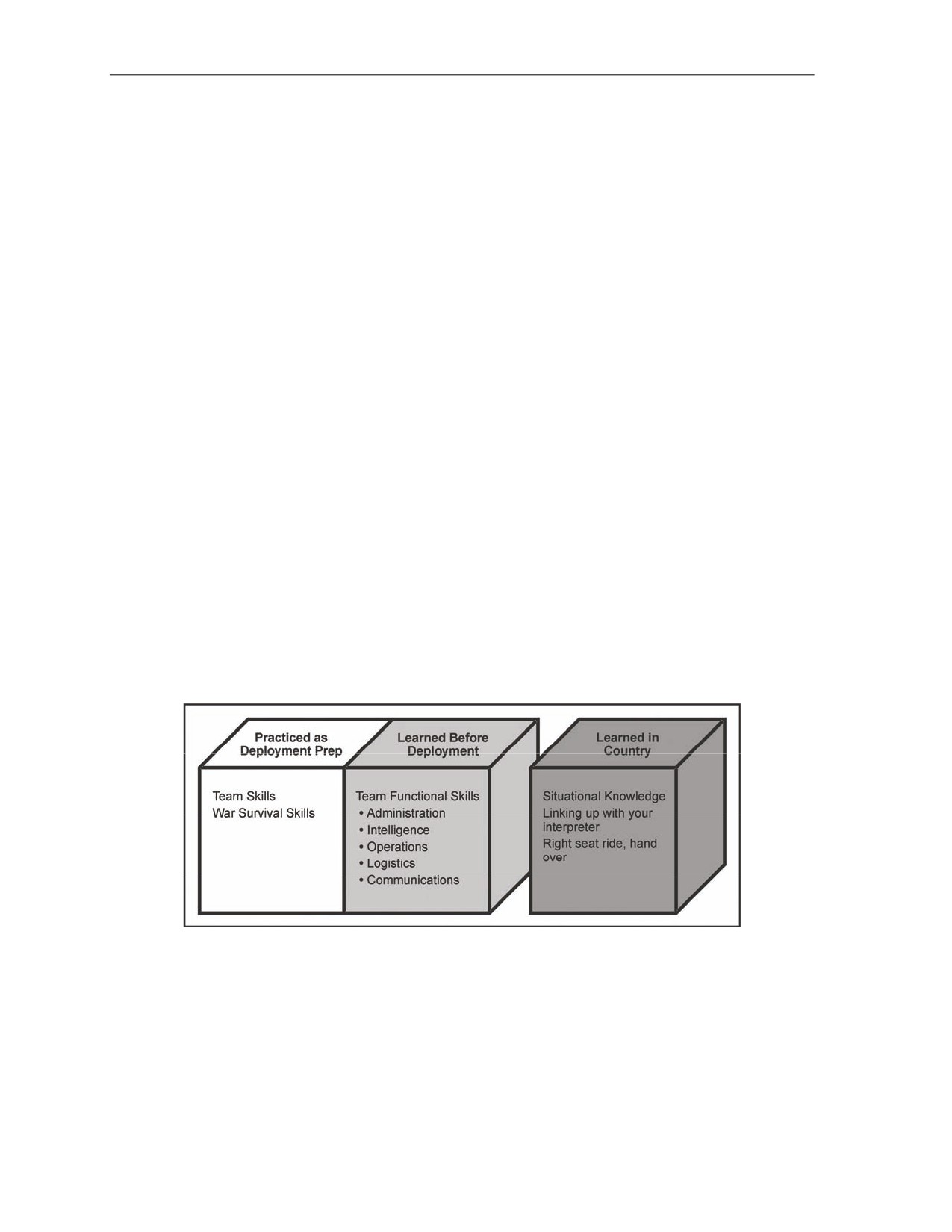
7-23. As a group of advisors form a team, they must practice their warrior tasks, organize to cover the
functions associated with any team, and familiarize its members with their duties and responsibilities. As
with individual advisor skills, some are refined before deploying and others are learned in country. Figure
7-1 depicts this graphically.
Figure 7-1. Collective advisor skills
DEVELOPING SKILLS
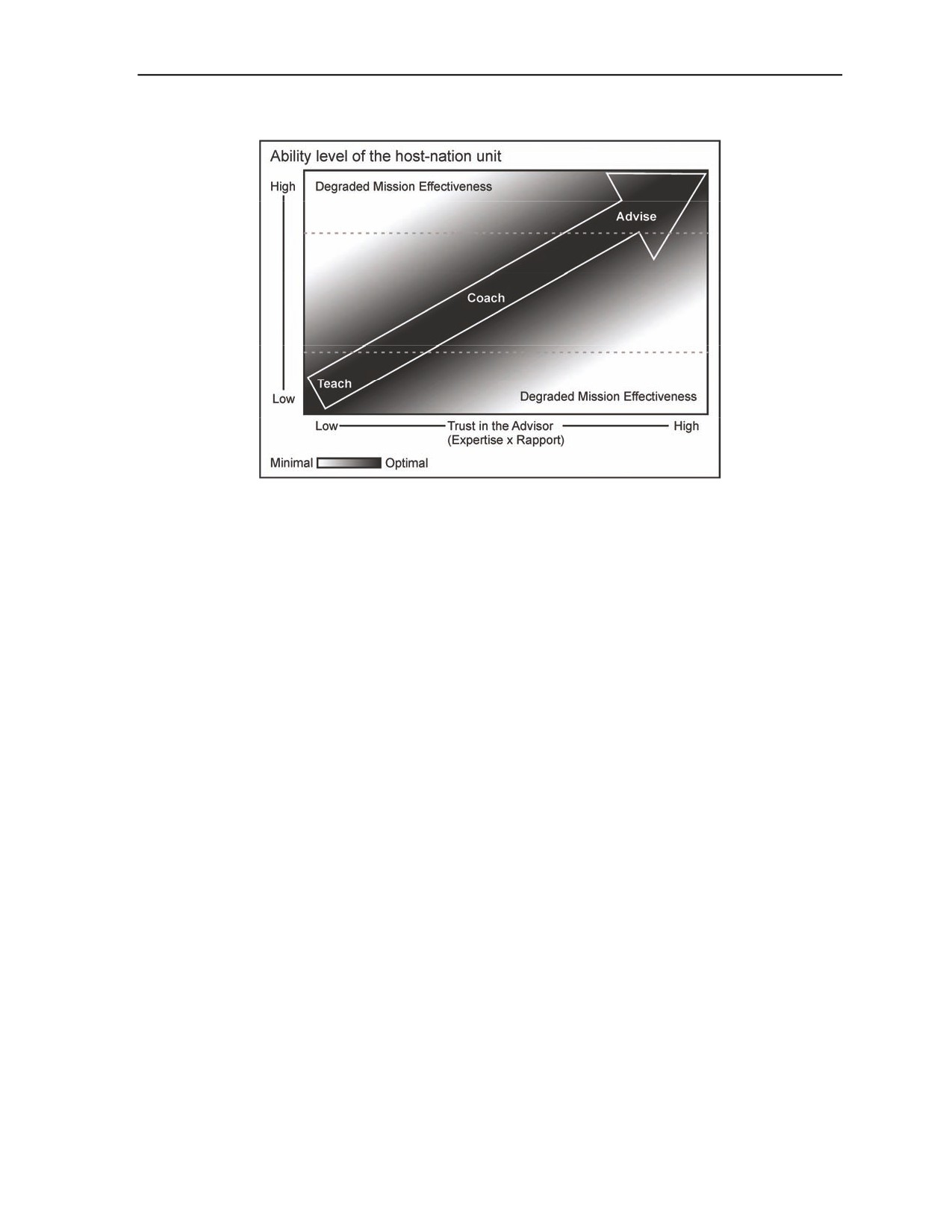
7-24. Developing skills—teaching, coaching, and advising—are required for every advisor. The advisor
will make an initial assessment to determine the foreign unit’s proficiency to determine the appropriate
developing skill with which to start. Figure 7-2 illustrates the appropriate level of advice that corresponds
to the foreign unit’s capabilities.
7-4
FM 3-07.1
1 May 2009
The Advisor
Figure 7-2. Appropriate advising level
7-25. Advisor teams have limited positional power and depend on personal influence to positively affect
FSF efforts through teaching, coaching, and advising. Advisor team members often work with people of
higher rank or grade than themselves. Advisors should remember the foreign unit’s experience and
capabilities and carefully choose opportunities to inject or impart knowledge. Foreign units are most
receptive to advisor teams that teach unobtrusively. Foreign units most value those who are subtle in their
teaching, coaching, and advising. Those advisors who master the ability to create a climate in which FSF
personnel feel they are teaching themselves often prove the most effective.
Teaching
7-26. Teaching includes training and education. Methods of teaching can include classroom lectures,
seminars, hands-on training, training exercises, and simulations.
Coaching
7-27. Coaching relies on guiding to bring out and enhance capabilities already present. Coaching refers to
the function of helping someone through a set of tasks. Those being coached may or may not have
appreciated their potential. The coach helps them understand their current level of performance and
instructs them how to reach the next level of knowledge and skill. Coaching requires identifying short- and
long-term goals and devising a plan to achieve those goals. The coach and the person being coached
discuss strengths, weaknesses, and a course of action to sustain or improve the goals.
Advising
7-28. Advising is a combat multiplier that boosts supported unit capability. Advisors have experience in
particular areas in which they are advising, but are not required to have similar backgrounds. Advisor
relationships are not based on superior to subordinate relationships.
7-29. Advisors provide an expert opinion, advice, and counsel by focusing on both personal development
(interpersonal and communication skills) and professional development (technical and tactical knowledge).
Advising develops mutual trust and respect.
1 May 2009
FM 3-07.1
7-5
Chapter 7
Advisor Versus Trainer
7-30. Advisors teach, coach, and advise work in a cycle. As FSF master one skill, the advisor can move on
to other skills and initiate the process for the new skills. If FSF require additional teaching or coaching, the
advisor can take them to that part of the cycle. Eventually, the teaching and coaching should decrease, and
most of the advisor’s time will be spent as an advisor providing an expert second opinion.
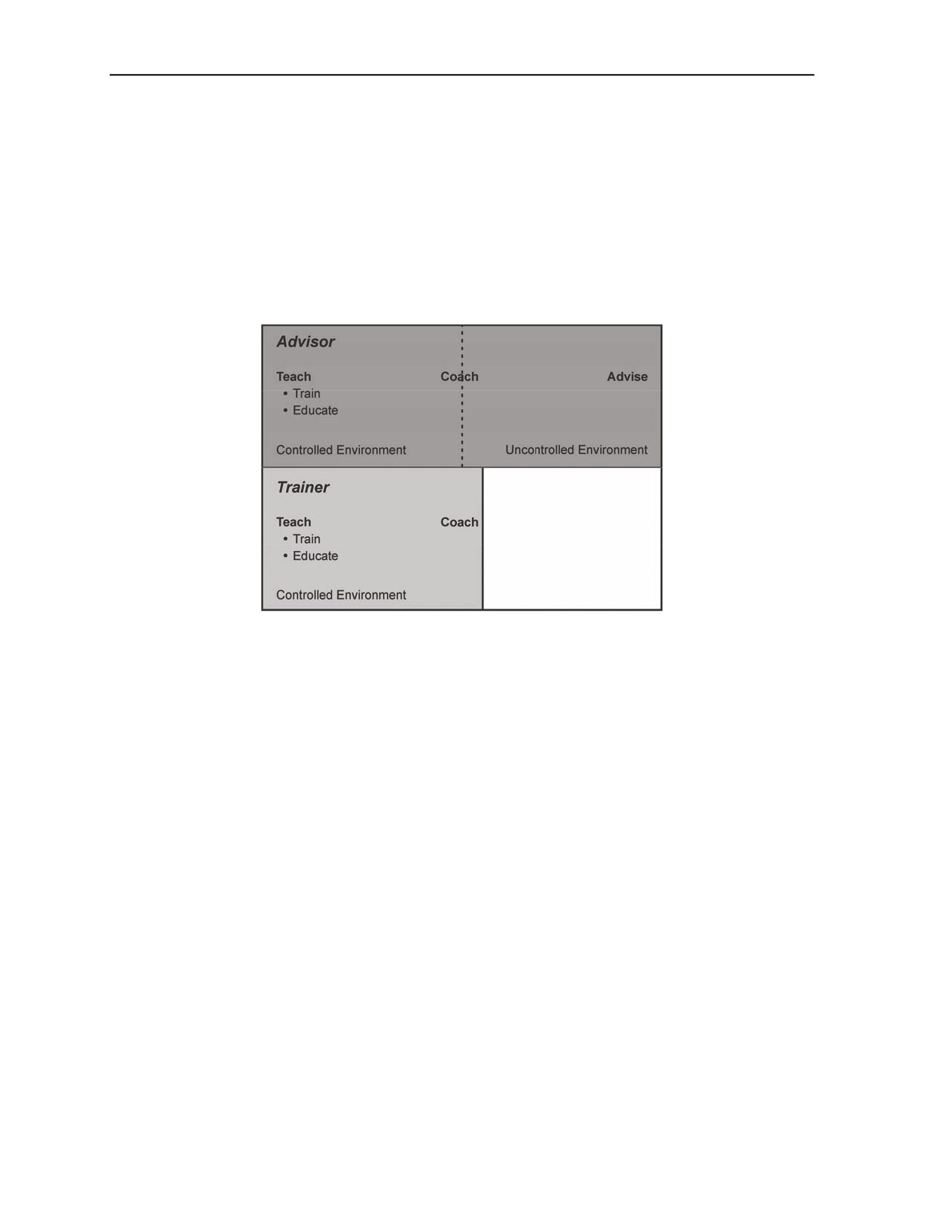
7-31. Ultimately, the question of what is the difference between being a trainer or an advisor will arise.
Figure 7-3 shows that every advisor will have to be able to be a trainer, but all trainers are not expected to
perform the more sophisticated task of advising. Hence, competent junior officers and enlisted Soldiers can
be trainers, but only more experienced individuals can be advisors.
Figure 7-3. Advisor versus trainer
7-6
FM 3-07.1
1 May 2009
Chapter 8
Culture and Communication
As an advisor, understanding the host-nation population is a crucial element of
premission planning and the development of foreign security forces (FSF). Prior
knowledge of sociocultural differences aids in building effective relationships and
prevents embarrassment, loss of rapport, and compromise of the mission. This
chapter discusses three aspects of the sociocultural environment to provide a
framework for analysis and comparison of foreign cultures for operational purposes.
These aspects are society, culture, and communications.
SOCIETY
8-1. People who have a common culture, share a group identity, occupy a common territory, and are
subject to the same political authority can be identified as a society. A society is not easily created or
destroyed. Though they share the above factors, societies are not homogeneous nor static. A society usually
has a dominant culture but can also have a vast number of secondary cultures, each influencing the other.
8-2. Advisors derive much of their effectiveness from their ability to understand and work with
counterparts from a foreign society. Advisors must also consider societies outside their immediate
operational environment whose actions, opinions, or political influence can affect the mission.
SOCIAL STRUCTURE
8-3. Society is composed of both social structure and culture. Social structure refers to the relations
among groups of persons within a system of groups and is persistent over time. For the purposes of
security force assistance, social structure includes groups, institutions, organizations, roles and statuses,
and social norms. FM 3-24 contains a more in-depth discussion of social structure.
Groups
8-4. Within societies, groups are composed of two or more people that interact based on mutual interests
and interrelated statuses and roles. These groups can be based on race, ethnicity, religion, or kinship. A
racial group is defined by its members or by outside groups as different based on physical characteristics or
descent. Race is a social category that has no biological basis. An ethnic group is a community whose
learned cultural practices, language, history, ancestry, or religion distinguish them from others. Similar to
racial groups, ethnic groups can be defined by their members or by outside groups. Religious groups may
be subsets of larger ethnic groups and an ethnic group may contain members of different religions. Kinship
groups are based on a link by blood relation. It may also be used to indicate a group of persons who live
and work together to satisfy basic collective needs and goals. The role of a kinship group is generally seen
to care for and educate offspring. This group provides for such needs as food, shelter, and clothing and
prepares offspring to be functional members of the society in which they live.
Institutions
8-5. Institutions are the basic building blocks of societies. They are made up of groups that are organized
to achieve a common task. Institutions are continuous through many generations and are built to continue
to function even as individuals are replaced. An example of an institution from FM 3-24 is a military
institution that brings together groups and individuals whose statuses and roles concern defense and
security.
1 May 2009
FM 3-07.1
8-1
Chapter 8
Organizations
8-6. Organizations are institutions that have a bounded membership with defined goals and established
operations. They include fixed facilities from which they conduct business or operations and a set means of
financial or logistic support. The four types of organizations are communicating, religious, economic, and
social. Communicating organizations are designed to influence perceptions. Religious organizations are
created to regulate societal norms, reaffirm beliefs and values, and provide social support. Economic
organizations provide employment and assist in economic development. Social organizations provide
support to groups in society, create social networks, and can influence ideologies. Organizations may
belong to more than one category and exist to affect the behavior, values, and beliefs of society. As such,
advisors must identify influential organizations both inside and outside of the FSF with which they are
partnered.
Roles and Statuses
8-7. As members of a group, individuals interact based on assumed or given social positions. These social
positions are referred to as statuses. Societies generally associate particular statuses with particular social
groups (such as family, lineage, ethnicity, or religion). Each status inherently contains a set of expected
behaviors known as a role, which includes how a person of that status should act, feel, and think. A status
includes expectations about how others in a society should treat a person of that status.
Social Norms
8-8. Violation of a role derived from a given status results in social disapproval. The standard of conduct
for social roles is a social norm. Norms may be either moral (incest prohibition, homicide prohibition) or
customary (prayer before a meal, removing shoes before entering a house). Advisors must understand the
roles, statuses, and social norms of groups they are advising. This knowledge will clarify the expected
behavior of their FSF partners and their role as advisors.
LANGUAGE
8-9. Language is a learned element of culture that is a system of symbols that people use to communicate
with one another. Successful communication within a society requires an understanding of the social
setting, appropriate behaviors towards different statuses and roles, and nonverbal cues. The languages used
in the advisors’ operational environment have a major impact on the advising mission. Languages must be
identified to facilitate language training during predeployment and employment, as well as in the
requisitioning of translators. Translators are critical for communicating with FSF and interacting with local
citizens and leaders.
CULTURE
8-10. Social structure comprises the relationships among groups, institutions, and individuals in a society;
in contrast, culture provides meaning to individuals within the society. Social structure can be thought of as
a skeleton with culture being the muscle on the bones. The two are mutually dependent and reinforcing. A
change in one results in a change in the other.
8-11. Culture influences an individual’s range of action and ideas, including what to do and not do, how to
do or not do it, and whom to do it with or not to do it with. It is neither a random jumble of customs nor a
laundry list of accepted practices and taboos that an advisor should know. It influences judgments about
what is right and wrong and what is important and unimportant. Cultural rules are flexible in practice; the
customs and actions that an individual practices are based largely on that particular environment.
CULTURAL CHARACTERISTICS
8-12. Culture is shaped by history, language, religion, and customs. Members of society use these shared
beliefs, values, customs, and behaviors to cope with their world and with one another. It is learned
behavior that is shared by members within a society. However, behaviors do not always define a culture.
8-2
FM 3-07.1
1 May 2009
Culture and Communication
Frequently, there are more telling cultural signs in the meaning attached to a behavior than in the actual
behavior. Culture influences its members’ identity, values, belief systems, and cultural forms. As such, it is
arbitrary; advisors should make no assumptions regarding what a society considers right and wrong, good
and bad. Culture is changeable through the social interactions between people and groups, both inside and
outside of that society. TC 31-73 discusses cultural characteristics in great detail.
Identity
8-13. Each individual belongs to multiple groups through birth, assimilation, or achievement. Each group
to which individuals belong influences their values and beliefs. Individuals consciously or unconsciously
rank their identities into primary and secondary identities. Primary identities are those seen as core to their
being; frequently these are national, racial, and religious. In contrast, secondary identities are more
peripheral and may include such things as an individual’s occupation or hobby.
Values
8-14. Values guide how individuals interact with the world around them. As deeply held beliefs about
rightness, values shape how individuals think things should be. Values may never be articulated—in fact,
they may not even be consciously held. At times, the beliefs of an individual may even contradict one
another. Advisors should have some understanding of a counterpart’s value system. Usually values are
nonnegotiable. In working with a counterpart with conflicting values, advisors should persuade the
individual that the advocated action or behavior really does not conflict with their values.
Belief Systems
8-15. Beliefs primarily take two forms: values (core) and opinions (peripheral). Values, or core beliefs, are
not easily changed. Opinions, or peripheral beliefs, stem from thought and decisions. The totality of the
identities, values, and beliefs that an individual holds compose that person’s belief system.
Forms of Beliefs
8-16. Values are broad moral conclusions about the way to live life. These core beliefs are unstated, taken
for granted, resistant to change, and not consciously considered. They reflect strong personal certainties
drawn from faith, childhood environments, and life experiences. They lend shape and order to people’s
lives, helping them to decide if they settled on the right actions, friends, leaders, religions, and careers.
8-17. Opinions, or peripheral beliefs, are immediate conclusions about some aspect of the environment.
They are usually quite specific and are open to debate, consciously considered, and easiest to change.
Types of Belief Systems
8-18. Belief systems involve cultural narratives and myths. The interpretation of these narratives and
myths provide people with insight into how they should feel, think, and behave. The most prominent
systems of beliefs tend to be those associated with religions and ideologies. However, any system of belief
in which the interpretation of narratives impacts people’s behavior
(such as superstitions) can be a
contributing component of a society’s culture.
8-19. A belief system acts as a filter for new information. It is the lens through which people perceive the
world. Beliefs of one group as to what is rational, normal, or true may appear strange, irrational, or
illogical to outsiders. Understanding belief systems of various groups in an operational environment allows
advisors to work with their foreign counterparts and influence civilians more effectively.
8-20. Belief systems play a fundamental role in the development of a society’s values. Careful analysis of
a region’s belief systems is crucial to understanding the local value system. These systems influence
religious doctrine, narratives, and myths and provide enormous insight into the culture of the community.
Ultimately, the values which are most prized within a belief system are religious. These beliefs affect that
culture’s systems of social organization, learned behaviors, and relationship to the physical environment.
1 May 2009
FM 3-07.1
8-3
Chapter 8
Religion as a Belief System
8-21. At its most basic level, religion is both the individual and communal expression of contact with the
sacred. Notions of the sacred can vary widely in societies and may include deities and sacred items. In most
cases, religions also involve symbols, rituals, and ethics or dogma. Religion can be both an individual
practice and a group phenomenon.
8-22. Most societies have some variety of religion—typically a set of sacred beliefs and rituals that provide
a common understanding of moral codes and proper conduct. Expressing a common religious
understanding helps people to make sense of their world. Often religion provides explanations for human
suffering, natural disasters, broken relationships, inequalities, and death. Some societies also have secular
equivalents of religion. For instance, America is often remarked to have a civil or civic religion that can be
seen in the images, symbols, ideas, and behavior of the political realm.
8-23. Because religion is such an integral part of culture, when advisors carefully prepare and analyze the
mission, they must examine the religions and religious groups in the operational environment. Religious
beliefs, leaders, and institutions are central to how many societies view the world. When planning any
advising operation, planners consider how religion affects FSF and civilians.
Broad Impact of Belief Systems
8-24. In almost every society, followers of dominant religions have a strong societal impact. This influence
may be exerted at varying degrees upon the individual citizen, sections of society, the economy, the
military, and the political structure. TC 31-73 discusses these in detail.
THE IMPORTANCE OF UNDERSTANDING CULTURE
8-25. Advisors derive their effectiveness from their ability to understand and work with foreign
counterparts from another culture. They must understand enough of their own culture and their
counterpart’s culture to accurately convey ideas, concepts, and purpose without causing counterproductive
consequences.
8-26. Advisors must be aware of aspects of the local culture and history that influence behavior in their
operational environment. Advisor team members must understand the reasons and motivations underlying
personal interaction and must practice patience when working with their counterparts. Group norms guide
individual behavior, and advisors must understand how individuals in a society tend to interact as members
of a group, whether a race, ethnic, or kinship group.
8-27. Cultural understanding is not derived from demographic information provided to the military
through country briefs prior to deployment. It is gained from studying, interacting, and understanding the
people, religion, history, customs, and social and political structures within an area. For true understanding,
it is necessary to live among the people, gradually understanding the subtleties and nuances of their culture.
CULTURAL EDUCATION
8-28. Culture influences a person’s perception of the world. People from one society tend to view people
from other societies through the prism of their own culture. Often, their perceptions are biased, are
inaccurate, or involve assumptions of superiority. For example, Americans view their society and its
culture very differently from the rest of the world. Likewise, as foreigners, advisors view local cultures
through the prism of their own idealized culture. This creates a large gap between the culture the advisor
observes and the host nation’s real culture.
8-29. To narrow the gap of cultural understanding an advisor will encounter, a program of cultural
learning should be undertaken. The end state of this cultural learning should be to gain the trust of foreign
partners and civilians. Advisors will do so by demonstrating their understanding and sensitivity towards the
host nation’s culture and social structures.
8-30. An awareness of the cultural aspects of the operational environment can significantly enhance the
effectiveness of an advisor. An extensive study program is best, but even a concise program is worthwhile
8-4
FM 3-07.1
1 May 2009
Culture and Communication
if it provides advisors with the necessary cultural information. The best programs involve credible teachers
who intimately understand the culture and have personal experience in the society. Training is dynamic and
moves beyond the standard lecture and handout format. Small groups or a discussion panel work quite
well. Cultural behavior and cultural familiarization handbooks can also be used. Since handbooks vary
greatly in accuracy and quality, credible subject matter experts should be consulted to determine which
documents to incorporate into the training. Table 8-1 discusses the training recommendations and tools.
Table 8-1. Cultural education recommendation
Training Recommendations
Cultural
• Comparison of cultural values and social structures (United States compared to
Education
those of the operational area).
• Local customs and traditions (for example, greetings do’s and don’ts).
• Geopolitical history (pre-colonial to contemporary and the orientation of each
faction or party).
• The role of religion in daily life.
Training Tools
Resources
• Guest speakers native to the country of interest (for example, nongovernmental
organization staff, foreign students, recent immigrants, or selected refugees).
• Others who have worked in or studied the mission area (for example, special
forces personnel, diplomats, and scholars).
• Cultural familiarization handbooks.
Format
• Combination of briefings, small group discussions, and question and answer
periods.
• Handouts to augment—not replace—speakers.
• Visual media, specifically slides and videos of the mission area.
8-31. Advisors with previous operational experience have addressed the importance of cultural education.
Many civilian agencies have developed intercultural effectiveness programs designed for their personnel
working overseas. Often these programs can be revised and tailored for military and paramilitary groups. If
available, these programs are an excellent resource for predeployment preparation.
CULTURAL GAP
8-32. Each culture has its own societal rules regarding who a person may speak to, how and when the
person may speak, and what topics the person may speak about. Many cultures rely on nonverbal signals to
communicate. In such cultures, posture, expression, and actions convey more than spoken or written
words. Advisors work to bridge the cultural gap by learning the language as well as nonverbal
communication cues. To bridge the gap, advisors develop a sense of cultural awareness, recognize
differences, learn to adapt, develop tolerance, and maintain personal contact.
Develop a Sense of Cultural Awareness
8-33. Advisors must recognize they are a product of their own culture. They must learn as much as
possible about the culture of the people with whom they need to communicate. When communicating with
people across cultures, advisors abandon any sentiments of ethnocentrism—the tendency of individuals to
judge all other groups according to their own group’s standards, behaviors, and customs. Such notions lead
an individual to see other groups as inferior by comparison.
Recognize Differences
8-34. Each culture has its own way of accomplishing required daily tasks. Advisors must understand that
each particular society may approach things differently; it does not mean that they are inefficient or less
valid. Differences should not be seen as negative. Respect for counterparts must be maintained at all times.
1 May 2009
FM 3-07.1
8-5
Chapter 8
Learn to Adapt
8-35. Advisors must be flexible and ready to adapt and adjust their behavior; however, they must be
careful not to overdo their adjustment. Individuals who are overly flexible are often perceived as being
insincere. The successful advisor must strive to act in a way that is appropriate to the target culture. Above
all, advisors should be themselves and show sincerity.
Develop Tolerance
8-36. Advisors must develop a tolerance for deviations from accepted norms. Events or activities that may
seem extraordinary to newcomers may be common practice in the culture. Advisors must be aware that
members of the foreign culture may be astounded by that which is commonplace in the United States.
Careful observation should be made before judgments are rendered about seemingly peculiar behavior.
Maintain Personal Contact
8-37. Personal contact is the most effective way to bridge organizational barriers. Interorganizational
stumbling blocks are very real and the prejudices that arise from them are exacerbated by misunderstanding
and ignorance. Often it is too easy to attribute negative attitudes and hostile motives to faceless groups. The
advisor must employ superior interpersonal skills and work directly and closely with individual members
of other organizations. This type of contact can effectively reinforce commonality and diminish the impact
of disparity. These personal relationships are the key to effective interorganizational relationships.
CULTURE SHOCK AND ADAPTATION
8-38. The term culture shock describes the anxiety experienced by persons in a completely new
environment. It is not the result of a single event. Rather, the condition develops slowly from a series of
minor events or conditions. Culture shock expresses the feelings of not having a set direction, not knowing
what to do or how to do things in a new environment, and not knowing what is appropriate or
inappropriate.
8-39. Culture shock occurs because the mind and body have to go through a period of psychological and
physiological adjustment when individuals move from a familiar environment to an unfamiliar one. The
cues received by all of the senses suddenly change. During the day the foreigner is bombarded with
unfamiliar sights, sounds, smells, tastes, languages, gestures, rules, requirements, interactions, demands,
systems, and expectations.
8-40. Some differences that advisors experience between their lives at their home station and their lives
when deployed to a foreign location are obvious. These differences include language, climate, religion,
food, educational system, and the absence of family and friends. Other differences may not be as obvious.
These differences include how people make decisions, spend their leisure time, resolve conflicts, express
their emotions, and use their hands, faces, and bodies to express meaning.
Stages of Shock
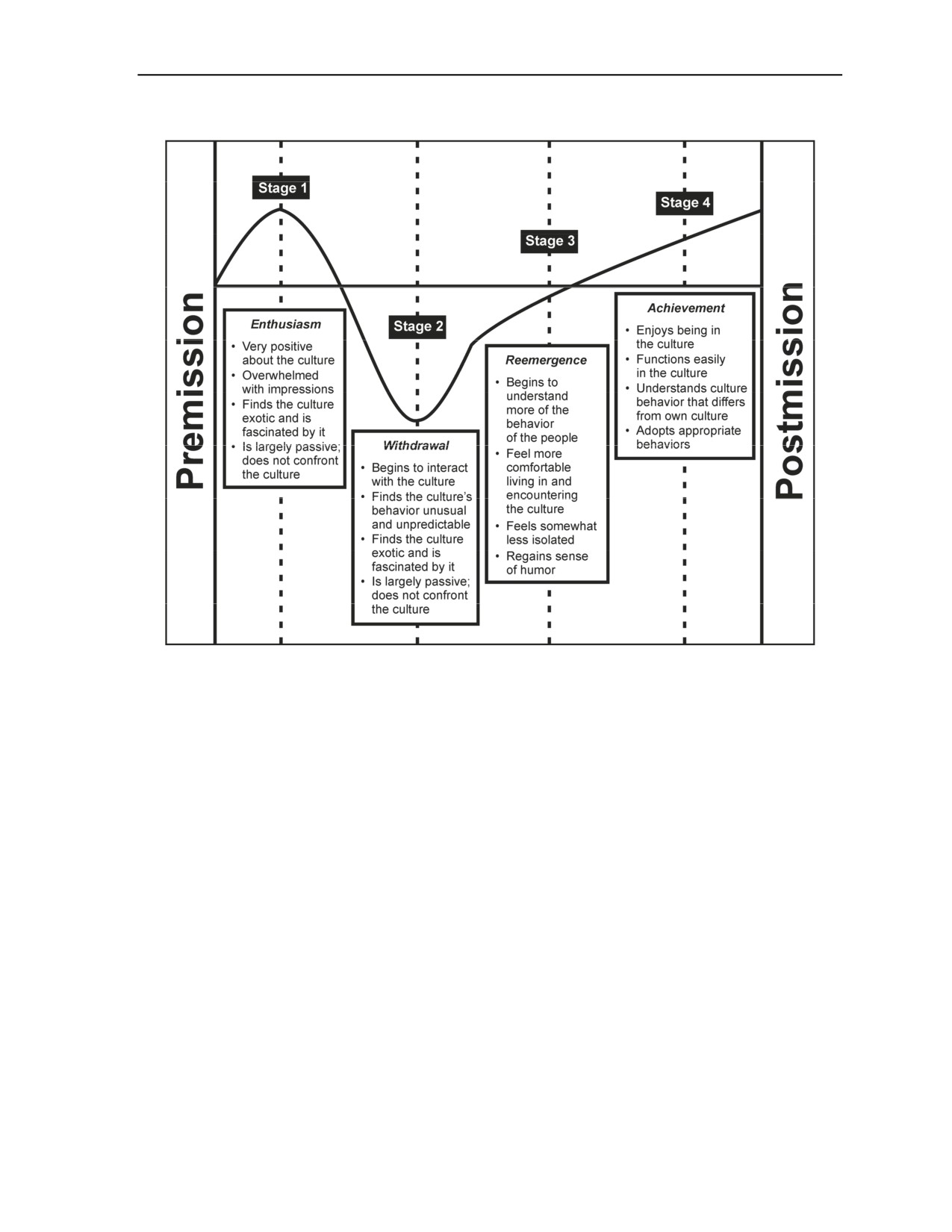
8-41. Five distinct stages occur in the culture shock process. These include enthusiasm, withdrawal,
reemergence, achievement and reentry. Figure 8-1 depicts the stages of shock.
8-6
FM 3-07.1
1 May 2009
Culture and Communication
Figure 8-1. Stages of culture shock
Stage 1 - Enthusiasm
8-42. In this stage, a person may feel self-confident and pleasantly challenged. The person may be
delighted by all of the new things encountered.
Stage 2 - Withdrawal
8-43. In this stage, a person begins to encounter difficulties and minor crises in daily life. It may be
difficult to make oneself understood and foreign counterparts may prove more difficult to work with than
anticipated. In this stage, one may have feelings of discontent, impatience, anger, sadness, and even
incompetence.
Stage 3 - Reemergence
8-44. This stage is characterized by gaining some understanding of the new culture. A person may not feel
as isolated, and a feeling of direction emerges. The individual is more familiar with the environment and is
better able to adjust to the circumstances.
Stage 4 - Achievement
8-45. In this stage, the person realizes that the new culture has both good and bad things to offer. This
stage is one of integration and the person is increasingly able to function in the new setting. A sense of
accomplishment, a reduction of routine annoyances, and a more solid sense of belonging accompany this
integration.
1 May 2009
FM 3-07.1
8-7
Chapter 8
Stage 5 - Reentry
8-46. This stage occurs when people return to their own culture. They may find that things are not as they
once were. Changes that occurred in their absence—their family, their friends, their communities, and
themselves—combine to present a distorted image of home that differs greatly from the one imagined or
remembered.
Culture Shock Symptoms
8-47. Being immersed in a society with extreme cultural differences tends to cause feelings of uncertainty
and anxiety. The body and mind may react in unusual ways. Some persons may experience more
pronounced physical symptoms of stress, such as chronic headaches or upset stomachs. Although
uncomfortable, some degree of culture shock is a normal part of the adjustment process. Some common
reactions include:
z
Feeling irritable with (or even anger toward) one’s own group or organization.
z
Feeling isolated or alone.
z
Tiring easily.
z
Changing normal sleep patterns (either too much sleep or not enough).
z
Suffering minor (but persistent) body pains, especially in the head, neck, back, and stomach.
z
Experiencing feelings of hostility and contempt toward local people.
z
Withdrawing from the local population (that is, spending excessive amounts of time alone
reading or listening to music).
Overcoming Culture Shock
8-48. An important tool to overcome the obstacles of a new cultural environment is familiarity with the
language. An ability to communicate in the new culture, even at the most basic level, reduces the effect and
shortens the period needed for adjustment. Other means of overcoming culture shock can include having
previous experience in the area (including a regular form of physical activity in personal routines) and
acknowledging even slight progress in adjusting to the new culture.
8-49. TC 31-73 discusses culture shock in depth. It identifies the symptoms, cues, and treatment.
CROSS-CULTURAL COMMUNICATIONS
8-50. Communication is the transfer of messages from one person to another. These messages may be
passed along verbally, in writing, or by signals (gestures, body language). The sender encodes the message
and the receiver decodes it. The type and style of encoding used is based upon the sender’s history, beliefs,
values, opinions, and belief systems. Communication is determined by culture; as a result it can be either
high context or low context. High context communication places an emphasis on clearly stating issues and
problems and working towards resolving them in a straightforward manner. Low context communication
places a premium on building relationships; as such, problem sets tend to be worked in a less formal matter
in societies that utilize this type of communication. Quickly and effectively identifying whether a society
uses high or low context communication is a key to effectively conveying material between the advisor and
the host-nation population.
8-51. The receiver decodes messages based upon lifestyle, group membership, status and role, worldview,
language, and social norms. Communication is a two-way process in which the encoding and decoding
methods can affect both sending and receiving. Effective communication occurs when the message is
perceived and responded to in the manner the sender intended. Ineffective communication can occur from
poorly chosen words, flawed timing, a confused mixture of verbal and nonverbal signals, poor listening
skills, and a failure to take culture into account. Communications can be broken into both levels and
factors.
8-8
FM 3-07.1
1 May 2009
Culture and Communication
LEVELS OF COMMUNICATIONS
8-52. The cross-cultural communications capabilities required by an effective advisor to FSF can be
described in three levels. At the lowest level is awareness followed by knowledge. The highest level is
reached when these two are combined with well-trained and refined skills. TC
31-73 discusses
communications in detail.
Awareness
8-53. Awareness is the basic level of cross-cultural capability. Awareness of cultural differences and their
impact is the first prerequisite for successful work with a counterpart. Simply being sensitive to the fact
that differences exist and carefully observing actions and reactions can assist the advisor in adjusting
behavior and modifying actions to achieve greater influence with the counterpart. Awareness is not region
specific and can be instilled in the advisor with relatively little training.
Knowledge
8-54. Knowledge of the details and nuances of a specific culture is the next level of cross-cultural
capability. Advisors attain this level through academic study and immersion. Such knowledge is inherently
area-specific and rarely transfers from one target area (or culture) to another. Developing in-depth regional
knowledge necessary for effective cross-cultural communications requires extensive and time-consuming
training. Appropriate personnel assignment policies must support this training.
Skills
8-55. Skills fundamental to effective cross-cultural communications, when combined with awareness and
knowledge, form the highest level of cross-cultural capability. These skills include professional
competence, language, nonverbal communication, negotiation, interpersonal skills, observation, problem
solving, leadership, instruction, and fitness. Although some individuals show greater natural talent for
these skills than others, all advisors require continual training in each to achieve and retain their full
potential as advisors to foreign counterparts. These skills are discussed in more detail in TC 31-73.
FACTORS AFFECTING COMMUNICATION ACROSS CULTURES
8-56. There are four aspects that can impact communication across cultures. These factors are level of
direct communication, perception of time, perception of the individual versus the group, and show of
emotion.
Level of Direct Communication
8-57. Cultures fall along a spectrum of formality, with some cultures being direct and explicit in their
communication and others less direct and more ambiguous. Cultures that rely on direct communication
place more emphasis on verbal communications that are precise and explicit. Context and nonverbal cues
are secondary to verbal communication. Cultures that rely on indirect communication rely less on verbal
communication and more on context and nonverbal cues. Their verbal communication can seem vague and
noncommittal to those from a culture that is more direct.
Perception of Time
8-58. Cultures can differ greatly in their perception of time. This difference divides into two cultural
concepts of time: monochronic-time and polychronic-time. In monochronic-time cultures, members
emphasize schedules, precise reckoning of time, and promptness. In such cultures, the schedule takes
precedence over the interpersonal relation. In polychronic-time cultures, time is viewed as fluid. Members
of polychronic-time societies do not observe strict schedules—agendas are subordinate to interpersonal
relations.
1 May 2009
FM 3-07.1
8-9
Chapter 8
Perception of the Individual Versus the Group
8-59. Cultures may be individualistic or collectivist in their orientation. An individualist culture is one in
which the ties between individuals are loose—where people are expected to take care of themselves and
their immediate families. In a collectivist culture, people are raised from birth into strong, cohesive groups.
These groups offer a lifetime of protection in exchange for unquestioning loyalty. Advisors must
understand from which culture their counterparts come to identify motivations accurately and communicate
effectively.
Show of Emotion
8-60. Each culture has its own system of expressing emotion. Some cultures tend to express their emotions
and show their feelings openly. Other cultures tend to repress those feelings more. Rather than showing
their feelings openly, members of these cultures keep their emotions controlled and subdued. Those from
the more expressive culture may view people from the repressive culture as cold or unfeeling. Similarly,
those from the more repressive culture may view their more expressive colleagues as eccentric. To
communicate effectively, advisors must be able to understand their foreign counterparts’ emotional
communication and display their own emotions carefully.
8-10
FM 3-07.1
1 May 2009
Chapter 9
Working with Counterparts
Rapport is a relationship marked by cooperation, conformity, harmony, or affinity.
When people discuss good rapport, they describe a relationship founded on mutual
trust, understanding, and respect. Relationships characterized by personal dislike,
animosity, and other forms of friction often lack rapport. For the advisor, rapport
describes the degree of effectiveness.
ESTABLISHMENT OF RAPPORT
9-1. Since advisors are in a unique military position, they establish rapport with their foreign
counterparts. That position is one in which the advisor has no positional authority over the actions of their
foreign counterparts. This lack of authority means that the doctrinal view of leadership is modified to
emphasize interpersonal relationships and deemphasize authoritarian roles. Advisors instead use their
people skills to influence the actions and decisions of their counterparts. Advisors use their people skills to
building rapport. They have a genuine interest in other people, smile, remember and use people’s names,
encourage others to talk about themselves, listen to others, discuss what the other person is interested in,
and make the other person feel important.
9-2. Advisors obtain certain knowledge before establishing effective rapport. First, they study FM 6-22 to
gain basic leadership knowledge for understanding human nature and motivation. Advisors then
incorporate information specific to the culture and society of their potential counterparts. This information
may take the form of thorough area studies, operational area studies, and other research materials.
Knowledge includes the components and techniques of rapport.
COMPONENTS OF RAPPORT
9-3. Three components compose rapport: understanding, respect, and trust. All the components of rapport
are two-way streets; to have counterparts share about their culture, language, and experiences, advisors
have to be willing and able to share also. Building this rapport may require the advisor to establish a
personal level of understanding with their counterparts. Understanding is the first component of rapport. It
begins before deployment and may include foreign cultural studies, language training, and equipment and
doctrine familiarization. Once in country, advisors continue to broaden their understanding by observing
and asking questions.
9-4. Respect is the next component of rapport. It is a reciprocal commodity. The foreign counterpart
should grow to respect advisors, what they know, and how they perform. Advisors should look for those
things that they respect in their counterparts. This may prove challenging. The counterpart may not fit the
mold of U.S. or other coalition officers. Lacking formal training or education, the foreign counterpart may
even be illiterate. The uniform standards of the host nation often may differ from the advisors’ standards.
Start with the basics and expand over time. Additional factors may affect the counterpart’s willingness and
motivation. For example, by accepting the duties, the counterparts (and their family) may be in mortal
danger. The counterpart may have proven to be a fearless warrior, even without formal training. In short,
traits deserving respect will exist even before the relationship matures. Mutual respect grows through
shared experiences and shared dangers. Advisors should live, eat, and if authorized, fight with their
counterparts. By sharing their hardships and dangers, advisors build respect.
9-5. Trust is the final critical component for building rapport. Trust grows gradually from understanding
and respect. Building trust needs to begin on day one, but it will not mature until later in the relationship.
1 May 2009
FM 3-07.1
9-1
Chapter 9
Advisors should begin by showing they are reliable and should do everything they say they will do. They
should be in the right place at the right time. Two things can enhance this growth. First, the advisor should
start out with confidence-building missions. Early success builds self-confidence and trust. Second,
advisors should not promise any support they might not be able to deliver.
TECHNIQUES OF RAPPORT
9-6. Foreign security forces (FSF) respect advisors who actually show them the right way to do a task
rather than just talk. Experience has shown that foreign units will not hesitate to go into danger if their
advisors are right there with them. To further contribute to building rapport, advisors should maintain
enthusiasm and a positive attitude; learn the language or how to use an interpreter; respect a counterpart’s
rank, age, status, and experience; develop negotiation skills; and improve interpersonal skills.
9-7. Other rapport-building techniques can include being confident, competent, and capable. Advisors
never expect or demand their counterparts to do something that they are unable or unwilling to do. They
demonstrate everything. Advisors learn their counterparts’ names and spend time with them at meals and
during holidays; they prepare mentally to interact with counterparts at all times. Advisors avoid creating an
American-only enclave; they avoid giving the impression of favoring any one group. They frequently
assess their counterparts’ perceptions. Advisors recognize threats to discipline and enforce the chain of
command.
ACCOMPLISHMENT OF RAPPORT
9-8. Advisors measure rapport by how well they can motivate their counterparts to act. The basic
techniques of motivation
(in the absence of authority) are advising, setting the example, seeking
compromise, and coercing. TC 31-73 discusses rapport in detail.
ADVISING
9-9. Advising the counterpart to select a particular course of action is only effective if the counterpart
trusts the advisor is professionally competent. If the counterpart does not perceive the proposed solution as
realistic, the advisor’s competence is questioned. Advisors carefully explain to their counterparts that
recommended courses of action are realistic and will be effective.
SETTING THE EXAMPLE
9-10. Setting the example for the counterpart must be an ongoing effort for the advisor to avoid the
appearance of a “do as I say, not as I do” attitude. In setting the example, advisors explain that what they
are doing is the most effective action for the situation. This is particularly true when the counterpart really
does not understand the behavior (or purpose).
SEEKING COMPROMISE
9-11. When seeking compromise with the foreign counterpart, advisors may create a situation in which the
counterpart has a personal interest in successful execution. In some cultures, seeking a compromise may
allow the counterpart to save face. Furthermore, in certain situations the counterpart—because of practical
experience—may have a better solution to the problem at hand.
9-12. When seeking a compromise in certain cultures, the perceived competence of the advisors may
suffer. This may be mitigated somewhat by approaching the compromise as two professionals (the advisor
and the counterpart) reaching a mutual conclusion. To reach an effective compromise, advisors may have
to conduct negotiations.
Note: Two areas of concern must never be compromised for the sake of maintaining rapport—
operations security and human rights.
9-2
FM 3-07.1
1 May 2009
Working with Counterparts
COERCING
9-13. Coercion is the least desirable method of motivation because it can cause irreparable damage to the
relationship. Advisors should use coercion only in extreme circumstances. Advisors must avoid
unintentionally forcing their counterparts into action. Instead, they establish and maintain good rapport by
conveying they are sincerely interested in their counterparts, their nation, and its cause. Advisors will not
belittle their counterparts’ efforts. Advisors must demonstrate that they have come to help because they
believe the counterparts’ goals are just, fair, and deserving of success.
POLICIES AND AGREEMENTS
9-14. Advisors must remember their primary aim is to forward U.S. policy. Therefore, they establish
relationships with foreign personnel, other U.S. forces, and other government agencies. Advisors promote
U.S. policy through agreements, command relationships, and operations. TC 31-73 discusses policy in
greater detail.
UNITED STATES AND HOST-NATION POLICIES
9-15. Advisors not only support U.S. national policy in the areas where they operate, they forward the
policies of the host-nation government (unless otherwise directed by higher authority). Advisors maintain
communications with higher headquarters to ensure activities align with U.S. objectives.
9-16. Host-nation policies may dictate practices and procedures that appear inefficient or uneconomical.
Advisors should avoid criticizing or condemning such practices and procedures until they thoroughly
understand them. Advisors should make private recommendations critical or contrary to host-nation policy.
AGREEMENTS
9-17. The status of advisors is normally specified by a status-of-forces agreement or other arrangement
between the U.S. and host-nation governments. These agreements vary widely; they may offer little
political protection or may provide for full diplomatic immunity. If no such agreement exists, advisors are
subject to local laws and customs. Even if a status-of-forces agreement or other agreement exists that
provides immunity, advisors are still expected to observe local laws.
COMMAND RELATIONSHIPS
9-18. Advisors must use the U.S. chain of command to obtain and disseminate guidance and assistance.
They carefully distinguish between the U.S. and foreign security forces’ chain of command. In particular,
advisors prevent their counterparts from attempting to control subordinates through the U.S. chain of
command. Advisors provide recommendations—not orders—to their counterparts. Only the counterpart
should issue orders to subordinates.
9-19. Nongovernmental organizations and other government agencies may be co-located in the operational
area. Advisors integrate the efforts of all organizations into their mission planning and should seek
opportunities for integrated efforts with their counterparts. This type of unified action at the tactical level
can be achieved through the planning process to integrate nonlethal actions. Holistically, nonlethal actions
include development and diplomatic efforts.
CONDUCT OF OPERATIONS
9-20. Advisors can expect to participate in stability operations. These operations use military and
paramilitary forces, as part of the interdepartmental team, to support internal defense and development
operations. U.S. assistance may include advice on military organization, training, operations, doctrine, and
materiel. In addition, the United States may provide and control U.S. logistics and sustainment for FSF.
The objective of this assistance is to increase the capability of foreign organizations to perform their
missions and operate efficiently in the given operational environment.
1 May 2009
FM 3-07.1
9-3
Chapter 9
LEVELS OF ADVISORS
9-21. Organizations and individuals possessing greater skills and resources assist by imparting their
knowledge through assistance efforts. The success of assistance depends largely on effective interaction
between advisors and their foreign counterparts. Advisors may operate in the national, operational, and
tactical levels. The national level is considered the largest national subdivision. This may be a nation’s
combined military headquarters, Service components, national-level government officials, or a
combination. Operational-level advisors work at a level below the national-level advisor. This may be with
military corps or division officers, with regional government officials, or a combination. Depending upon
the size of the nation and its military, operational-level advisors may be assigned as low as brigades.
Tactical-level advisors normally advise military units at or below the brigade level and provide counsel and
assistance across the spectrum of conflict. They advise and assist counterparts in developing unit combat
effectiveness and serve as liaisons between FSF and U.S. combat, support, sustainment and protection
forces. Chapter 3 of TC 31-73 discusses these levels in detail.
CONSIDERATIONS OF RAPPORT
9-22. When building and maintaining rapport, advisors consider intelligence, human rights, role shock,
ambiguity, personal relationships, bureaucracy, responsiveness, and diversity. These considerations are
discussed in greater detail in TC 31-73.
INTELLIGENCE
9-23. To promote national policy and attain overall objectives, advisors may need to plan and conduct
intelligence training. The advisor should assist the counterpart in developing a local intelligence collection
program, training intelligence personnel in their respective specialties, and utilizing trained intelligence
personnel properly.
9-24. The advisor should be familiar with area studies and area assessments. Pertinent documents should
be compared to detect trends or changes. The advisor also should evaluate the foreign intelligence staff, its
standing operating procedures, its chain of command, intelligence projects, and reference material available
from other intelligence agencies. Advisors should prepare and maintain a list of essential elements of
information.
HUMAN RIGHTS
9-25. Advisors stress the consequences of mistreating suspects, prisoners, or other persons taken into
custody. These persons must be treated per Article 3 of the Third Geneva Convention. Article 3 requires
care for the sick and wounded, protection of prisoners and detainees of all types from abuse or other harm.
Murder, mutilation, and torture are expressly forbidden, as is humiliating or degrading treatment. Advisors
must never be active participants in the conduct of such punishment. Furthermore, they must explain to
their counterparts that they are obliged to report any atrocities of which they have knowledge.
ROLE SHOCK
9-26. Role shock results from the discrepancy between the roles individuals expect to play and the roles
they actually do play. Role shock may also be a product of the tension created by individuals trying to do
jobs themselves versus advising others how to do the jobs. Role shock tends to increase until about the
anticipated midpoint of the tour and seldom disappears completely until redeployment. Symptoms of role
shock resemble those produced by other stressful life events.
9-27. Many advisors become entangled in complexities of bureaucracy—both foreign and American—and
become increasingly frustrated when seemingly familiar things fail to respond in expected ways. This
continuing frustration can be a key contributor to role shock.
9-28. Although most advisors undergo some degree of role shock, over time they learn to take the
personal, living, and social conditions in stride. More challenging are the problems that arise in connection
9-4
FM 3-07.1
1 May 2009
Working with Counterparts
with their jobs—their professional roles, relationships, personal achievement, self-development, self-
determination, and self-image. Often advisors find their duties and activities during deployments differ
somewhat from those expected. The actual duties and responsibilities are greater in scope, involve
technical work outside of their assigned specialties, and require honed administrative (rather than military)
skills.
AMBIGUITY
9-29. Most advisory assignments are ambiguous. What an advisor is expected to achieve is not always
made clear. Furthermore, assignments may conflict with what they have trained to do, what others expect
of them, or what they want or expect to do.
9-30. U.S. and foreign security forces may spend months—even years—negotiating a project. Still, the
overall objectives or definition of the mission to be accomplished might be expressed in general terms.
Various interpretations of what is to be accomplished arise. Even more views surface regarding the most
appropriate means of reaching those goals.
RELATIONSHIPS
9-31. Ideally, foreign counterparts provide a working context for advisors and help them to understand and
adjust to the new culture. Historically, those with good working relationships with their counterparts make
better adjustments than those who have no counterparts or bad relations with their counterpart. Good
working relationships may be difficult to establish and maintain. Most advisors approach their assignments
as teachers and mentors. Foreign counterparts may resist such a relationship, particularly if they were
expecting someone to take over and do all or part of the job. In addition, many counterparts want their
advisors to share in at least some of the blame if something goes wrong.
9-32. The United States has little control over the availability or capability of counterparts. The assigned
individual may be technically incompetent, lack professional commitment, have other interests, or be
unavailable when needed. In some cases, numerous counterparts are assigned and rotate in their workings
with the advisor. A single counterpart may not be assigned until the advisor has been on the scene for some
time. In some scenarios, a specific counterpart is never assigned.
BUREAUCRACY
9-33. Although some Americans might disagree, the United States maintains a system that is—by world
standards—relatively permissive and nonbureaucratic. As such, advisors may become aggravated when
confronted with or obstructed by host-nation bureaucracy, red tape, administrative centralization, and a
cumbersome decisionmaking process. Cultures that emphasize consensus in the decisionmaking process
often prove quite frustrating for advisors. To be successful, advisors strive to understand the bureaucracy
in which they operate.
9-34. Advisors should recognize the value of being or knowing the middleman. This role is sometimes one
of the key contributions an outsider can make. Middlemen can move in, around, and out of organizations
somewhat independently of the local hierarchy, protocol, and customs. They can link persons and offices
that might otherwise have difficulty communicating. Many advisors dislike this role and refuse to practice
it; however, the middleman can be a significant catalyst in any advisory operation.
RESPONSIVENESS
9-35. As frustrating as foreign bureaucracies may be, advisors often get even more irritated with the
responsiveness of U.S. forces. Advisors frequently fail to account for distances, lead times, diplomatic
issues, and other challenges when conducting security force assistance. Moreover, few Soldiers in the unit
conducting security force assistance have had substantive experience in working in an interagency
environment. These issues are further complicated by the usual tensions between headquarters and field
staffs and between administrators and technical specialists. Expectations, values, and styles of behavior
vary from group to group.
1 May 2009
FM 3-07.1
9-5
Chapter 9
9-36. Deploying personnel may not be familiar with the tasks of development and the vast range of
problems typical of underdeveloped areas. They come in eager to contribute their knowledge and skill, and
anxious to make maximum progress in the limited span of their assignment. In so doing, they may fail to
recognize that the factors that frustrate them—such as the lack of professional skills and facilities—are
actually their reason for being there.
DIVERSITY
9-37. Organizations attract individuals who differ in abilities, knowledge, skills, work ethics, social
behaviors, values, and attitudes. Advisors must be able to recognize personality types and develop
techniques to cooperate effectively with each type.
RECOMMENDED PRACTICES IN BUILDING RAPPORT
9-38. Advisors may adopt many practices to help work with counterparts. Practices that help advisors
build rapport are discussed in paragraphs 9-39 through 9-51.
ENSURE THAT THE ADVISOR PRESENCE IS UNDERSTOOD
9-39. Advisors entering an operational area work under the sponsorship of a military commander, mayor,
village head, or some other recognized local leader. Prior to this, the advisor’s arrival may need to be
coordinated through the district, sector, or other appropriate local office. Clearances from distant national,
state, province, or sector governments cannot compensate for a clear, local explanation of why an
American advisor is in the area. This particularly applies to small, isolated communities where it is unusual
for a stranger to appear for even an hour without being acknowledged and accepted by local leaders.
Without explanations from locally respected persons, civilians often arrive at their own explanations, often
to the detriment of the advisor effort.
FIND A BASIS FOR COMMON INTEREST WITH THE LOCAL PEOPLE
9-40. If advisors show appreciation for civilians as individuals, cultural gaps and language barriers can be
overcome and common ground can usually be found. Advisors should listen and show interest when the
locals speak. Initial conversations usually center on universal matters, such as food, shelter, clothing,
health, and education. Over time, discussions may naturally move to the matter the advisor wants them to
consider. Advisors are better received if they know something about earlier contributions in such matters as
agriculture, folk art, religion, and architecture. Naturally, advisors prove more effective and appreciated if
they can speak the language.
TRY TO UNDERSTAND WHY THINGS ARE DONE THE WAY THEY ARE
9-41. Although some local practices may seem strange, they generally have good reasons behind them.
Advisors can discover these reasons with careful observation and a creative imagination. Food habits,
family traditions, folk cures, and festive celebrations almost always have a great deal of human experience
at their root. The advisor also needs to be aware that many villages contain rival subgroups and factions.
This tension needs to be accounted for when working with the local people.
START WITH WHERE THE PEOPLE ARE AND WHAT THEY WANT
9-42. Advisors find out what the local people really want and work with them to achieve this aim. The
need felt by the local people often is the best starting point. Once advisors address this aim, people become
more appreciative and cooperative—they begin to raise their expectations and become interested in
working for other improvements. To address the initial desires of the people, the advisor may need to call
in personnel with the specialized skills needed for the particular project. Although this can result in a delay,
it will help the advisor to achieve better cooperation.
9-6
FM 3-07.1
1 May 2009
Working with Counterparts
WORK WITHIN THE LOCAL, CULTURAL FRAMEWORK
9-43. Advisors understand basic cultural matters such as ethnic backgrounds of the people, family
relationships, leadership patterns, and value systems. They also need some knowledge of local services
such as health, education, communications, and transportation.
HELP PEOPLE BELIEVE THEY CAN IMPROVE THEIR SITUATION
9-44. Most traditional peoples of South America, Asia, and Africa live in a largely static environment.
Through their experience with change, they are more fearful of losing status than they are hopeful of
bettering their condition. Therefore, changes suggested by advisors are often viewed with fear. Concrete
local projects that yield easily observed benefits help convince villagers that they can improve their
situation and make them more willing to cooperate in other projects.
BE CONTENT WITH SMALL BEGINNINGS
9-45. Change tends to come slowly in areas where there have been few in recent times. Advisors
remember that knowledge—technical or otherwise—is cumulative. Once a small beginning has been made,
greater activity and additional changes soon follow. It is easier to achieve momentum than to maintain it.
Regardless, advisors start within as promising a framework as possible and with the support needed to
sustain the momentum achieved.
UTILIZE LOCAL ORGANIZATIONS AND RECOGNIZE THEIR LEADERS
9-46. The surest way for an activity to be continued after the advisor leaves is for it to have been launched
and carried forward within the local organizational and leadership framework. People respond best when
their local organizations are recognized as important and useful. Advisors consult and encourage
recognized local leaders to contribute as they can. A well-conceived technical activity reflects credit on the
local leaders associated with it. Advisors give attention not only to officials and family heads of local
groups, but also to the quiet, behind-the-scenes leaders.
HELP THE GOVERNMENT GET ORGANIZED TO SERVE THE PEOPLE
9-47. For advisors to be most effective, they must understand the organization of the local government and
how their activities fit into the overall scheme. Usually a set of agreements exists between various local
agencies and the national government
(usually through some sort of interministerial council). This
agreement provides for a coordinated effort in servicing the varied needs of civilians. The advisor may
need to work with appropriate agencies to assist in getting such agreements made. If such agreements
already exist, advisors should be careful to recognize and strengthen them.
TRAIN AND USE SUBPROFESSIONAL, MULTIPURPOSE LOCAL WORKERS
9-48. Selected young people in the villages can be trained and used as subprofessional, multipurpose
village workers. Otherwise, advisors’ influence is restricted to where they are standing and the immediate
vicinity. Furthermore, advisors may spend so much time establishing and maintaining enough rapport with
the villagers that they may become incapable of rendering any real service at all. Often the gap between
civilians and the advisor is formidable because of their educational and cultural differences. Often the
advisor works with villagers who are poor, illiterate, and devoid of outside contacts. Volunteer or paid
local workers have proven quite helpful as they serve as a liaison between villagers and advisors.
EXPECT SLOW PROGRESS
9-49. As civilians begin to see successes from their joint efforts and begin to have new hope, they
naturally want a larger hand in their own matters. The advisor may sometimes feel they want to assume
more responsibility than they can carry. These evidences of growing pains should be appreciated, for they
are a necessary part of becoming able to assume responsibility. The advisor needs to adjust to the growing
desires of the people to help themselves.
1 May 2009
FM 3-07.1
9-7
Chapter 9
TRANSFER CONTROLS CONSTRUCTIVELY
9-50. Advisors need to help civilians see how they can build the new—what they want—upon the
foundations of the old—what they already have. From the beginning of a project, the advisor’s team needs
to talk with local leaders. Together they envision how to train local personnel, gather financial support, and
transfer responsibilities before transferring control of activities. If operating responsibility is transferred too
early, some breakage—usually of material things—will likely occur. If the team keeps control too long, the
civilians who wanted to take over may grow disillusioned with them for not relinquishing control when
they thought it should have been. Working with local leaders, the team determines when to phase out each
technical activity.
EXPECT LITTLE GRATITUDE FROM THOSE HELPED
9-51. People who benefit from assistance sometimes feel defensive. In accepting assistance they are, in a
sense, admitting their own insufficiency. The self-esteem of a person, community, or a nation as a whole is
delicate. The advisor’s team should not, therefore, expect thanks. Rather, the team should approach the
people in a spirit of fraternity and humility, taking satisfaction in their forward progress. The team should
do its job the best it can and accept work well done as is its own reward.
DYNAMICS OF ADVISING FOREIGN SECURITY FORCES
9-52. Advisors work in a complex environment that is heavily influenced by the unified effort of multiple
organizations, relationships, compartmentalization, and organizational cultures. Paragraphs 9-53 through 9-
57 discusses the probable dynamics that an advisor must take into account.
ADVISORS AND INTERDEPENDENT OPERATIONS
9-53. Advisors commonly operate in complex environments with interdependent operations.
Interdependent operations require near-seamless integration of agencies representing the instruments of
national power—diplomatic, informational, military, and economic. This same degree of integration must
be extended to include external organizations and those agencies representing the instruments of power in
partner states. The negotiation and cross-cultural skills that enhance their performance as advisors are also
well suited to the complex interrelationships that characterize such operations.
ORGANIZATIONAL RELATIONSHIPS
9-54. Often organizational relationships can often be misleading and must be clarified. The actual
interrelationships among and within organizations seldom follow a line-and-block diagram. Instead, they
are heavily influenced by circumstances, personalities, perceptions, and resources. All relationships and
lines of authority are subject to negotiation. Advisors understand that clarifying the roles, functions, and
responsibilities is a continuous process and that each statement or action sets a precedent for future
interrelationships.
9-55. The advisor must become hypersensitive to the most minor organizational disparities. The apparent
similarities—the common language, sociological backgrounds, and citizenship—can be disarming and lead
the advisor to overlook very real differences. If ignored, these differences can quickly impede
synchronization.
COMPARTMENTALIZATION
9-56. Advisors balance security and synchronization. Overcompartmentalizing must be avoided. Often
distrust can be prevented simply by not being overly secretive. Although advisors must conduct a careful,
continual risk assessment to avoid compromise, the sharing of critical information is necessary for
harmonious operations.
9-8
FM 3-07.1
1 May 2009
Working with Counterparts
ORGANIZATIONAL CULTURE
9-57. Advisors should approach external organizations as they would foreign counterparts—as unique
institutions with distinctive cultures. Organizational differences, biases, and approaches must be researched
and—whenever possible—accommodated. Each Service in the Department of Defense has unique
perspectives that lead to significant differences in objectives and approaches to various problems. Profound
differences in perspective may even be found between the different branches of the Army. If not
recognized and accommodated, these characteristics may create distrust, disharmony, and disruption during
critical operations.
1 May 2009
FM 3-07.1
9-9
Chapter 10
Cross-Cultural Influencing and Negotiating
Leveraging foreign counterpart cooperation can prove a difficult and critical task.
Although coercion may prompt surrogate forces to perform a specific action, it can
never lead to established conduct and legitimacy. Lasting advisors can achieve long-
term success only by patiently applying their influence.
Advisors analyze their counterparts and determine their motivations and needs. Basic
needs, culture, and individual personalities influence people. Advisors determine
what these three things are so the appropriate influence techniques can be applied.
Then advisors negotiate. Negotiation is fundamental to problem solving using the
study, development, and honing of negotiation skills critical to the advisor.
INFLUENCING
10-1. Advisors need to gain influence with their counterparts, leaders, civilians, coalition members, and
others beyond their chain of command. Advisors are self-aware, nonjudgmental, and capable. It is not
necessary to accept others’ beliefs or values, but advisors need to understand others’ ways of thinking and
operating. Knowing their own culture and understanding why they believe and value what they do helps
advisors find a common cause. A common cause unites a diverse set of decisionmakers with whom
advisors interact and try to influence.
10-2. Once advisors gain a minimum amount of influence, they can make things happen through others.
They can extend their influence beyond their chain of command. Influence is simply getting others to do
what you want.
10-3. Advisors identify the types and principles of influencing. They determine the best techniques with
which to influence and review vital considerations. Using measures of effectiveness, they check that their
influences have the desired results.
TYPES
10-4. Commitment, compliance, and resistance clarify how advisors understand the impact of their
attempts to influence their counterparts. These three types of influencing are determined by how committed
the foreign security forces (FSF) are to the task.
Commitment
10-5. Commitment is a willing dedication to a requirement or a cause because one wants to. Commitment-
focused influence generally produces longer lasting and broader effects. Whereas compliance only changes
immediate behavior, commitment reaches deeper—changing attitudes, beliefs, and behavior. For example,
when advisors build desire and responsibility for a task among FSF, they often demonstrate more initiative,
personal involvement, and creativity.
Compliance
10-6. Compliance is conforming to a requirement or demand because they feel like they have to avoid
punishment or to gain a desired reward. Compliance-focused influence is based primarily on the leader’s
authority. Giving a direct order to a follower is one approach to obtain compliance during a task.
1 May 2009
FM 3-07.1
10-1
Chapter 10
Compliance is appropriate for short-term, immediate requirements and for situations where little risk can
be tolerated. Compliance techniques are also appropriate for leaders to use with others who are relatively
unfamiliar with their tasks or unwilling or unable to commit fully to the request. If something needs to be
done with little time for delay, and there is not a great need for the target of influence to understand why
the request is made, then compliance is an acceptable approach. Compliance-focused influence is not
particularly effective when a leader’s greatest aim is to create initiative and high esteem with a counterpart.
Resistance
10-7. Resistance is a reaction against change. Resistance generally takes one of four forms—reactance,
distrust, scrutiny, and inertia. It is manifested behaviorally (I won’t do it), affectively (I don’t like it), and
cognitively
(I don’t believe it). Recognizing and lowering potential sources of resistance are key
components to gaining compliance and commitment.
MOTIVATIONS
10-8. Different motivations influence behavior. One type of motivation is the desire for something.
Another is the fear of something undesirable. As an agent of influence, advisors determine how to increase
approach motivations and how to decrease avoidance motivations. For instance, recruiting for a special
mission can use special badges as incentive (approach). Advisors can assure Soldiers that the mission is
relatively safe by providing extra training and better equipment (lowering risks or avoidance).
PRINCIPLES
10-9. Six influencing principles are relevant to virtually any culture and any group. Understanding and
applying these principles can increase an advisor’s effectiveness in persuading a group or individual:
z
Principle of scarcity.
z
Principle of authority.
z
Principle of social proof.
z
Principle of liking.
z
Principle of reciprocity.
z
Principle of consistency.
10-10. With the principle of scarcity, people value more of what they can have less. They typically
associate greater value with things that are rare, dwindling in availability, or difficult to acquire.
10-11. In the principle of authority, people are more easily persuaded by individuals perceived to be
legitimate authorities or experts. They defer to experts who provide shortcuts to decisions requiring
specialized information.
10-12. With the principle of social proof, people often look to the behavior of those around them for
direction about what choices to make. This action is heightened when those around them are similar in
terms of age, education, social standing, and experience.
10-13. In the principle of liking, people prefer to say yes and to comply with the requests of those they
like.
10-14. In the principle of reciprocity, if someone grants favors, invited or uninvited, an overpowering
need to repay that favor immediately blooms within the recipient of that favor. This human trait transcends
all cultures and races.
10-15. With the principle of consistency, the desire for consistency motivates behavior. The drive to look
and be consistent is a highly potent weapon of social influence, often causing people to act in ways clearly
contrary to their own best interests. People do not like to appear inconsistent to others. It is human nature
that people strive to feel good about themselves, which includes behaving per their important values and
beliefs. When the behavior is consistent with whom people are and what they value, they feel good. People
align with their clear commitments.
10-2
FM 3-07.1
1 May 2009

Cross-Cultural Influencing and Negotiating
TECHNIQUES
10-16. The art of influencing involves knowing what techniques to use based on the situation. Advisors
have to know the limits to which can use their influence; their influence is finite. They need to know when
to use their influencing skills to achieve the highest payoffs. Their counterparts will only accept so much
influencing if they don’t completely trust their advisors. Table 10-1 lists positive and negative techniques
delineated in FM 6-22. Table 10-2 lists resistance-based influence techniques. These are used when the
counterpart resists the advisor’s influences.
Table 10-1. Influencing and rapport techniques
Technique
Description
Characteristics
Outcomes
Explicit demands, persistent
Frequent checking
Gains compliance
reminders, sometimes
Nagging
Frequent use may
Pressure
appropriate in high stakes,
cause resentment,
urgent situations
undermine morale, and
harm relationship
Legitimate
Source of authority is used
Source credibility is important
Gains compliance
Request
Quid pro quo
Offer of reward or punishment
Gains compliance
not tied directly to getting job
Reward offered for task
Exchange
done, just something that
completion; punishment
counterpart wants or doesn’t
threatened for incomplete task
want
Request based on friendship or
Agent of influence highlights
Gains commitment
loyalty
talents of counterpart that make
Builds relationship
Personal
target the right person for the
Appeal
job (this is why you are the right
person for the job, will you do it
for me?)
Works with target of influence
Offer of assistance is directly
Gains commitment
by providing resources of some
tied to request
Collaboration
Builds relationship
type, or by removing barriers to
task completion
Rational
Using facts, evidence, or logic
Relies on agent being viewed
Gains commitment
in a persuasive message
as expert
Persuasion
Builds relationship
Explaining the consequences of
Decision is good for unit,
Gains commitment
Apprising
a potential action or decision
career, or mission
Builds relationship
accomplishment
Arousing strong emotion to
Appealing to values of the
Gains commitment
Inspiration
build conviction or commitment
counterpart
Builds relationship
Requests for counterpart to be
Promotes commitment
Gains commitment
a part of planning, active
Possibly more feasible and
Builds relationship
Participation
participation in development of
culturally appropriate course of
solution
action
Relationship
Build positive rapport and trust
Provide the foundation for using
Gains commitment
Building
influence or inspiring
1 May 2009
FM 3-07.1
10-3

Chapter 10
Table 10-2. Resistance-based techniques
Technique
Description
Characteristics
Outcomes
Agent defines own role as
Does not sell, just advises to
Gains compliance
consultant or advisor, but
prevent immediate resistance
Potentially gains
not commander
Puts less focus on immediate
commitment if paired with
Pushes the consequence
impact, more focus on long-
other influence techniques
Sidestep
of choice into future
term effect
like rational persuasion
Resistance
Depersonalize task to
Stating “leaders should”
gain commitment to
instead of “you should”
general idea
Stress mission
Focus on end state
accomplishment
instead of expended effort
Address reluctance by
Provide some of own
Builds commitment
Address
lowering costs associated
resources through
Resistance
with tasks
collaboration or counterargue
Directly
concerns
Address
Build confidence, esteem,
Acknowledge difficulties while
Builds commitment
Resistance
and self-efficacy for the
showing support for
Indirectly
task
counterpart’s abilities
Interfere with the
Distracting attention
Gains compliance
Distract
development of
Resistance
counterarguments
Disrupt complacency to
Shake up to motivate
Gains compliance
Disrupt
bring attention to
Resistance
message
Resistance is energy
Wear them down prior to
Gains compliance
Consume
opportunities to resist. Persist
Resistance
with requests until they
concede
Use
Reverse psychology
Issuing a challenge
Gains compliance; risky
Resistance
when you don’t know target
to Promote
of influence really well
Change
10-17. To succeed with any influence technique, the influence attempt should be perceived as authentic
and sincere. Positive influence comes from leaders who do what is right for Army forces, the mission, the
team, and each individual Soldier. Negative influence—real and perceived—emanates from leaders who
focus more on personal gain and lack self-awareness. False perception may trigger unintended side effects
such as resentment of the leader and the deterioration of unit cohesion. With each and every influence
attempt, Army leaders should ensure that the influence objective aligns with Army Values, ethics, the
Uniform Code of Military Justice, the Warrior Ethos, and the Civilian Creed.
Considerations when Choosing Techniques for Influencing
10-18. Advisors clearly understand what their counterparts value and fear. This information allows
advisors to quickly relate the objective of the influence to something that their counterparts treasure. Also,
a strong sense of self supports the advisor’s recognition of which techniques they can successfully execute.
Someone with an intimidating presence may achieve compliance with pressure more quickly than someone
without that presence. Understanding the context of the request is important. For instance, using
10-4
FM 3-07.1
1 May 2009
Cross-Cultural Influencing and Negotiating
participation in the midst of flying bullets would not make sense. However, a long-term project that
impacts many people might be a worthy situation for participation. Advisors also consider—
z
The motivation of their counterparts.
z
The relationship they have with their counterparts.
z
What they do or not have to offer.
z
An understanding of the second- and third-order effects their recommendations will have.
z
What has worked in the past.
z
Possession of an appropriate power based for use of a technique in particular context.
z
Consistency of technique with prevailing social norms and role expectations.
z
Level of resistance encountered or anticipated.
z
Costs of using a technique in relation to likely benefits.
10-19. The cost of a technique refers to the amount of effort, favor, or resources that accompany the
technique. A personal appeal that relies on friendship is quite effective; however, counterparts might
expect the favor to be returned. If resources or time are plentiful, then the exchange might not seem
expensive, but if they are not plentiful, then advisors must choose a different technique. Advisors balance
the costs and benefits of each technique.
Moderating Factors
10-20. Sometimes moderating factors diminish the impact of any influence technique. These factors may
include cultural misunderstanding, level of trust, or constraints on the counterpart like threats or corruption.
Advisors analyze and learn about these factors. Advisors must be flexible when using influencing
techniques. When one technique doesn’t work, switching strategies or adding techniques may be
appropriate.
CONSIDERATIONS
10-21. Seven considerations need to be addressed to influence behavior. These include determining the
goal; who to influence; motives; beliefs, values, and attitudes; cultural beliefs, values, and attitudes; and
susceptibility. These techniques are designed to help advisors achieve their goals. Just knowing that the
counterpart wants something is not enough. Whether it is time off, new weapons, or money, advisors have
a limited supply of stuff they can promise; they can only bend so much on rules, regulations, and laws. It is
at this point that the advisor enters the realm of negotiations.
Determine the Goal
10-22. Advisors influence others to achieve some purpose. To be successful at exerting influence,
advisors have an end state or goal in mind. Sometimes the goal will be very specific. Many goals are less
distinct and measurable but are still valid and meaningful.
Determine Who to Influence
10-23. Advisors develop a mental list of those whom they might need to influence. Getting a FSF platoon
to take action may be as simple as influencing the commander, but the advisor may have to influence the
soldiers and commander of the platoon. When practical, advisors consider many variations of whom to
influence. They look for circumstances in the immediate environment that significantly affect their
counterparts. Individual or group characteristics to consider can include—
z
Gender.
z
Religion.
z
Age.
z
Socioeconomic status.
z
Ethnicity.
z
Political affiliation.
1 May 2009
FM 3-07.1
10-5
Chapter 10
z
Level of education (important in determining how to access and persuade).
z
Occupation.
10-24. The challenge is to determine which characteristics impact emotional or behavioral responses and
under what circumstances. Ethnicity may significantly affect behavior and emotions regarding voting and
politics but may have almost no effect on the decision to enlist in the military. Individual and group
characteristics may provide additional insight on motivations.
Determine and Prioritze Motives
10-25. Motives are anything that is required or desired (needs and wants). Motives are the reasons behind
the decisions people make. Motives come from an inner desire to meet a need or want. Advisors use the
knowledge of what motivates others to influence them. Knowing one’s counterpart and others who may be
influenced gives advisors insight into influencing their behavior. The desires to fulfill, alleviate, or
eliminate a need or want provides the motivation to change behavior.
Basic Motives
10-26. Basic motives involve physiological needs—food, water, and air—and safety needs—security and
shelter. When people feel hunger, they are motivated to eat; when people feel pain, they are motivated to
reduce the source of the pain. Such basic motives are extremely powerful in driving behavior and
overwhelm psychological needs and wants.
Social Motives
10-27. Social motives associate access to other tangibles (money, goods, education, infrastructure, and
healthcare) or more complex psychological motives with basic motives. For example, people learn to want
money because it can be exchanged for food and other desired goods. Power, achievement, reassurance,
escape, justice, and acceptance illustrate types of learned social motives. Examples include:
z
Wanting better educational opportunities for their children.
z
Wanting better paying jobs.
z
Wanting their interests represented by the government.
z
Wanting revenge for perceived wrongs.
z
Wanting self rule.
Prioritize Motives
10-28. Advisors prioritize motives by immediacy of the need or want. Critical motives are immediate
needs. Short-term motives are currently being satisfied or active efforts are being made to satisfy them in
the near future. Long-term motives are desired but are not immediately important; satisfaction may be
delayed until some point in the future.
Determine Beliefs, Values, and Attitudes
10-29. Although often difficult to derive, beliefs, values, and attitudes can prove quite effective in
persuasion. Beliefs are what is thought to be true. People do not believe in something if they think it is not
true. People vary from being gullible to skeptical. Values prioritize what one believes. Values can be
ethical, doctrinal, social, aesthetic, or economic in nature. Attitudes reflect whether one likes or dislikes
something. Likes and dislikes can often be traced back to a person’s beliefs and values. This includes
loves, hates, frustrations, and fears. Frustrations occur when a want is not met. By examining causes of
frustration, the advisor may find another motive to address.
Compare Beliefs, Values, and Attitudes
10-30. The predominant cultural beliefs, values, and attitudes; traditions; and norms may differ greatly
from the group the advisor is trying to influence. Many Americans act differently in different cultures. This
change in behavior relates directly to their predominant culture.
10-6
FM 3-07.1
1 May 2009