FM 3-07.1 Security Force Assistance (May 2009) - page 2
Brigade Operations Process
Partnering or Augmenting Unit
3-33. Functions and requirements depend on the degree and level of partnering or augmenting. No
prescriptive way to partner or augment exists; it is based on specific conditions and subject to the needs of
policy, higher headquarters guidance, and needs of the FSF. A BCT may designate one battalion to partner
or augment while designating other battalions to advise. A partnering or augmenting unit conducting SFA
has specific functions and requirements. These can include, but are not limited to—
z
The functions of—
Partnering with foreign security under the BCT level.
Increasing capability, capacity, competency, confidence, and commitment of FSF by
conducting combined tactical operations.
Providing feedback on performance of FSF and certain shortfalls to embedded advisors and
BCT headquarters.
Conducting sustainment and medical training with FSF at their home station or on
operations.
Reporting conditions in the operational environment.
z
The requirements of—
Having U.S. forces that are capable, competent, committed, and confident.
Being interoperable with FSF.
Being available for an appropriate period.
Military Advisor Team
3-34. The functions and requirements of a military advisor team are based on conditions—requirements,
availability, and footprint. A military advisor team conducting SFA has specific functions and
requirements. These can include, but are not limited to—
z
The functions of—
Under the BCT headquarters, advising, training, and assisting FSF to which it is assigned.
Increasing capability, capacity, competency, confidence, and commitment of FSF by
providing advice and support during battalion level and higher operations.
Assessing partner leaders, staff, and certain shortfalls to BCT headquarters.
Conducting sustainment training with FSF at their home or on operations.
Reporting on conditions in the operational environment.
z
The requirements of—
Being manned with trained personnel who are properly equipped so as to be capable of
executing their mission in current conditions.
Providing personnel with rank, education, and experience corresponding to the echelon and
type of unit being advised.
Support and Sustainment Requirements
3-35. Support and sustainment requirements play a vital role in COA development (see chapter 6). The
BCT may operate across a broad geographical area when conducting or supporting SFA. Partnering may be
on certain levels with FSF and may support numerous embedded advisor teams or other actors. Since FSF
often have varied relationships with higher echelons and institutions, the BCT may be involved vertically
and spatially. These considerations may require more support and sustainment requirements than an initial
analysis might indicate. Support and sustainment considerations include, but are not limited to—
z
Distribution of FSF to which U.S. forces are providing SFA.
z
The capability of FSF to provide support, sustainment, and medical functions.
z
The technical capability and interoperability of U.S. and foreign security forces.
z
The infrastructure that supports SFA.
z
Overall security conditions where SFA occurs.
1 May 2009
FM 3-07.1
3-7
Chapter 3
z
The available contracting support.
z
The ability of the environment to accept and absorb the U.S. forces’ footprint.
Determining a Course of Action
3-36. COAs for SFA require an understanding of the breadth and width of the security sector. They may
have to account for the roles ranging from the individual soldier or policeman to the ministerial level. COA
development examines the roles other actors, for example, a gendarme or paramilitary force, in the security
sector. Because the United States does not have a gendarme, U.S. forces may not fully appreciate its
importance.
3-37. COAs for SFA also need to be flexible and inclusive. Commanders consider the following when
examining a partner’s security sector:
z
The status and challenges of the host-nation security sector or regional security organization.
z
The composition and disposition of the partner’s security sector.
z
Supporting institutions.
z
Links among ministries, institutions, and components of the security sector.
z
Partner capability and capacity shortfalls and impediments to their development.
z
Environmental requirements to enable the building of security capability and capacity.
z
Functional requirements to assist building capability and capacity.
z
The impact of other actors within the comprehensive approach.
3-38. Once planners analyze the security sector, they can develop COAs that best combine SFA tasks,
activities, and types (see chapter 2). While the advising type of SFA can be of any duration, partnering and
augmenting tend to be enduring if used.
3-39. All SFA types tend to be more effective if they are long-term efforts. Advising fosters a more
personal relationship and infers a stronger commitment to see the partner succeed. Partnering and
augmenting include U.S. and foreign security forces conducting operations together. There are levels of
partnering. Different advisory relationships use advisor teams embedded within various partner echelons
and units, use one advisor team to advise multiple entities, or have a senior leader visit a partner unit to
give advice.
3-40. Using any form or combination of forms depends on conditions (such as the level of competency),
capability of FSF, and resources available. Policy, guidance, or formal agreements can also help
commanders determine which form to use. Historically, a combination of forms appears to be the most
effective. However, combining forms often proves more resource intensive and affected by time,
geography, and the number of forces. COAs should remain flexible with respect to the form of SFA. Some
example changes in conditions are the increased capability of one element in the security sector over
another, the desire to increase one element over another based on partner objectives, or the increased
targeting of one element over another by the enemy.
3-41. If a desired COA is not feasible given the scope of the security sector or due to other considerations,
it may be useful to sequence SFA forms with portions of FSF. For example, a COA that affects smaller
portions of the FSF, but in the right area and at the right time, may do more for achieving an objective or
end state than a COA that attempts to support all FSF at one time.
3-42. BCTs are task-organized and augmented to accomplish a specific mission. How BCTs are
specifically task-organized and augmented is based on the phase and types of SFA that policy and higher
headquarters have directed. Chapter 4 describes augmentation in detail.
3-43. Attached units or units under operational control are task-organized under different headquarters as
necessary to accomplish assigned and implied SFA missions. Deciding to task-organize specific formations
for SFA may reflect previously approved contingency plans or result from current planning efforts. As
these missions end, units return to their parent headquarters or are further task-organized by the controlling
headquarters.
3-8
FM 3-07.1
1 May 2009
Brigade Operations Process
3-44. As with other operations, gaining commanders task-organize for SFA by designating operational
control, attached, or support relationships to another unit or headquarters. Within each BCT, the brigade
commander task-organizes all organic, assigned, attached, or operational control units to best suit the
operational environment and types of SFA. Commanders may choose to use a support relationship (direct
support, reinforcing, or general support reinforcing) among units of the BCT instead of a command
relationship. This can also apply to relationships with foreign units.
3-45. SFA is often highly dispersed, as BCTs may have individuals or units assisting FSF over a wide
area. This dispersion increases communications and sustainment requirements for the BCT. The nature of
SFA also requires BCTs to help FSF meet requests for assets. To do so, the BCT and other units may need
to task-organize to provide tactical support or sustainment. Dispersion and the nature of SFA often
necessitate a decentralized leadership approach to facilitate effective and rapid support of FSF.
3-46. BCT commanders use the three types of SFA—advising, partnering, or augmenting—to accomplish
the mission. The exact nature of a unit’s assigned mission, the operational variables, and the mission
variables drive modifications to headquarters and maneuver units. For example, a commander may need a
unit tasked with advising, a unit tasked with partnering, and a unit tasked with augmenting. In this case, the
unit tasked to advise would provide teams for the appropriate FSF while other foreign units continue their
traditional missions. The unit that is partnering may provide the host-nation staff to assist the FSF
headquarters. The third unit may provide squads to augment foreign platoons. Units may request additional
support, sustainment, and medical support. However, BCTs conducting SFA must retain a reserve to
conduct full spectrum operations.
3-47. Based on the overall mission analysis, including an analysis of functions and requirements,
commanders and staffs begin to determine how to task organize. Due to the level of detail that may be
involved, task organization should begin early in the military decisionmaking process, especially during
COA development. No standard task organization exists since conditions vary. For example, a squad of
infantry and three additional leaders may work as an advisor team for one mission, where another mission
may require an advisor team with specialists for different warfighting functions. The art in SFA involves
determining where, when, and if to allocate resources; it involves either breaking up or simply moving
personnel and units from one foreign unit to another.
3-48. The techniques used by BCT commanders and staffs to allocate other resources and support are just
as valid in SFA as in other types of operations. For example, if it is determined that the most important
effort is advising, then the BCT commander may weight that effort with additional resources, such as
communications equipment or experienced personnel.
3-49. BCTs emphasize unity of effort with FSF. Ideally, interoperability and shared resources extend to the
lowest level. This means having one tactical operations center, dining facility, clinic, motor pool, and so
on. Not only does this use resources more efficiently, but it also facilitates understanding, trust, and rapport
between U.S. and foreign security forces. For Soldiers to effectively conduct SFA work by, with, and
through FSF requires a close rapport and high level of trust.
3-50. Part of COA development for SFA includes an analysis of where to focus the brigade’s subordinate
units. This analysis includes determining which subordinate units support key elements of FSF. The
brigade’s subordinate units may support provincial reconstruction teams or transition teams that are not
organic to the brigade. Another method is for the brigade may provide organic forces to make up transition
teams or the military portion of provincial reconstruction teams or transition teams. Transition teams may
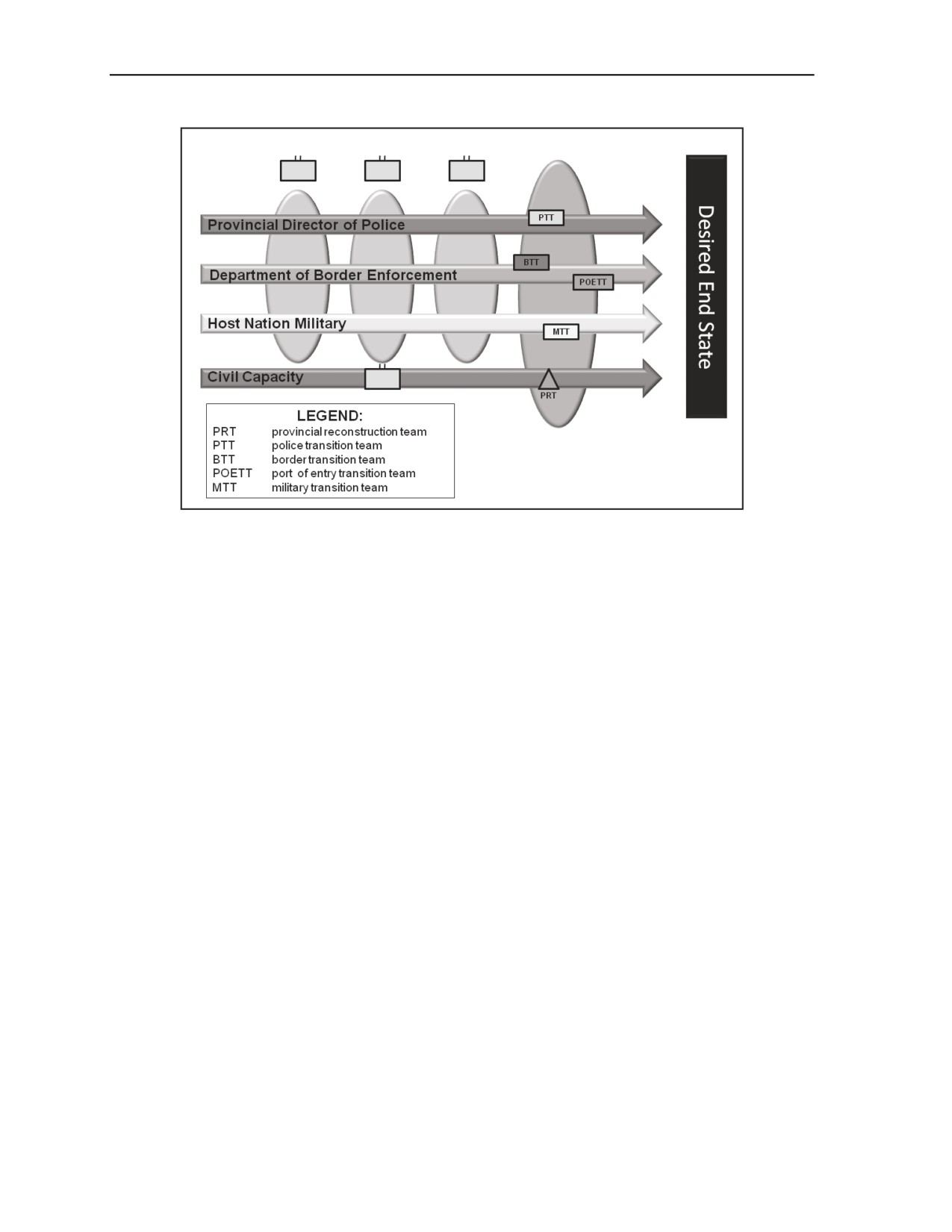
include, but are not limited to police, border, point of entry, or military transition teams. Figure 3-2 depicts
an example for a brigade providing forces as part of a provincial reconstruction team as well as providing
the other transition teams. Figure 3-2 is an example of how a brigade may focus its subordinate units.
Additionally, the teams are only examples. All of these teams may not be necessary for all brigades, and
some brigades may require other types of advisor teams.
1 May 2009
FM 3-07.1
3-9
Chapter 3
Figure 3-2. Example of brigade focus for subordinate units
PREPARE
3-51. Preparation consists of activities performed by units to improve their ability to execute an operation.
Preparation includes, but is not limited to, plan refinement; rehearsals; intelligence, surveillance, and
reconnaissance; coordination; inspections; and movement (FM 3-0). Like any operation, preparation for
SFA creates conditions that improve friendly forces’ opportunities for success. It facilitates and sustains
transitions, including those to branches and sequels, which are of vital importance for the often dynamic
operational environment for SFA. Chapter 5 covers preparation for units conducting SFA, including the
BCT.
EXECUTE
3-52. Execution is putting a plan into action by applying combat power to accomplish the mission and
using situational understanding to assess progress and make execution and adjustment decisions (FM 3-0).
Execution of SFA focuses on supporting the needs of the FSF and, like many other operations, is often
characterized by phases and transitions between phases. Chapter 4 examines BCT phases for SFA.
Acceptance of Prudent Risk
3-53. SFA, like any other operation, requires prudent, disciplined risk-taking focused on winning rather
than preventing defeat. Because uncertainty exists in all operations, every decision involves risk. Among
key elements of the art of command are deciding how much risk to accept and minimizing the effects of
accepted risk (see FM 6-0). Due to SFA’s inherent collaborative nature, determining prudent risk is
complex and requires a comprehensive approach.
3-54. Risk reduction measures identified in planning add to the plan’s flexibility during execution. A
flexible plan can mitigate risk by partially compensating for a lack of intelligence. Again, SFA requires a
thorough comprehensive approach to analyzing and agreeing upon risk reduction measures.
3-10
FM 3-07.1
1 May 2009
Brigade Operations Process
Execution Keys to Success
3-55. History and recent operations point to several keys to success for BCTs executing SFA:
z
Communication is vital, especially when the BCT shares its operational area with other entities
that have cultural differences and lack of communication. It can include FSF or multinational
forces, as well as U.S. forces with another mission. For example, an advisor team can develop
effective relationships with its foreign security force and local authorities only to have another
unit conduct an operation that unhinges those relationships.
z
BCTs establish close and continuing relationships with all advisor teams, other actors operating
in their operational area, and foreign area officers with local or regional expertise. In addition to
advisor teams assigned to military units in direct contact with the BCT, advisors may embed
with local police, border, and other forces.
z
BCTs establish close and continuing relationships with all foreign units (military, police, and
others) operating in their operational areas.
z
BCTs establish close and continuing relationships with all political entities and actors in their
operational areas.
z
Before each operation, as part of the military decisionmaking process, the BCT considers
second- and third-order effects of the operation. The team coordinates the commander’s intent
with advisor teams of FSF and other units in the operational area.
z
Unit leaders develop cultural awareness and use this awareness so that operations and
relationships achieve the desired end state. In short, the closer a maneuver commander works
with advisor teams and the more they interact with local political and cultural leaders, the better
the overall chances of mission success.
ASSESS
3-56. The operations process and effective battle command require commanders to continuously assess
and lead. Assessment helps commanders to better understand current situations and how SFA is
progressing. Assessment is the continuous monitoring and evaluation of the current situation, particularly
the enemy, and progress of an operation (FM 3-0). Assessment is conducted during planning, preparation,
and execution and is evaluated against measures of effectiveness and performances to make decisions and
adjustments (see FM 6-0).
3-57. Assessment of SFA requires a comprehensive approach that analyzes the overall operational
environment and focuses on FSF and their impact. SFA assessment is performed in close collaboration
with the U.S. country team, the host-nation government, and other multinational partners. These partners
continually assess the security situation and its influence on other operations. From the assessment,
planners develop short-, mid-, and long-range plans. As circumstances change, so do the plans. An
insurgency might require employing host-nation forces at earlier stages of development. Some existing
security forces may be so dysfunctional or corrupt that the organizations ideally should be disbanded rather
than rehabilitated. In some cases, commanders will need to be replaced before their units will become
functional. Political realities, however, may make both prospects undesirable. Minimizing and
marginalizing particularly corrupt units or leaders while focusing on other units can be effective in this
case.
3-58. While every situation differs, BCT leaders assess the following factors throughout planning,
preparation, and execution of the operation:
z
The operational environment.
z
The civil considerations of the operational environment (see appendix B of FM 6-0).
z
The core grievances and the threat (possibly including the prerequisites of insurgency).
z
FSF elements.
z
Methods, successes, and failures of FSF security efforts.
z
State of training at all levels, and the specialties and education of leaders.
1 May 2009
FM 3-07.1
3-11
Chapter 3
z
Equipment and priority placed on maintenance.
z
Logistic and support structure and their ability to meet the force’s requirements.
z
Extent of acceptance of ethnic and religious minorities.
z
Laws and regulations governing the security forces and their relationships to national leaders.
Initial Assessment
3-59. An initial comprehensive assessment offers the BCT a baseline for establishing the scope of effort
required. This assessment includes a troop-to-task analysis that determines the type and size of forces
needed. FSF may require complete reestablishment or only assistance to increase capacity. They may
completely lack a capability (such as internal affairs, corrections, or formal schools for leaders) or they
may require temporary reinforcement. As with other military operations, efforts to assist FSF should
reinforce success, not failure. For example, instead of building new police stations in every town, improve
the good stations and use them as models for other organizations.
3-60. BCT leaders need to make decisions on what shortfalls to address first. The extent of the threats
combined with resource limitations inevitably forces commanders to set priorities. However, making
efforts to legitimize the host-nation leaders by encouraging them to make the decisions often proves more
successful.
3-61. A key effort for SFA is the initial assessment of the DOTMLPF and policy capabilities of a foreign
security force. During the early phases of a campaign, a geographic combatant command receives an initial
assessment or a unit operating in the area has an assessment of FSF. The incoming BCT updates this
assessment as it begins SFA.
3-62. Assessments require objective and subjective reporting, which may require a classification level. At
a minimum, a BCT should assess—
z
Doctrine.
z
Organization.
z
Training.
z
Materiel and equipment.
z
Leadership.
z
Personnel.
z
Command, control, communications, and intelligence.
z
Operational effectiveness.
3-63. The doctrine assessment provides the BCT with an analysis on how the FSF operate. This
assessment could focus on formal doctrine or more localized practices.
3-64. The organization portion of the overall assessment provides a perspective on how the FSF are
organized. This includes the array of foreign institutions and units.
3-65. The level of training for FSF is a vital consideration. While this assessment is partly subjective, it
should objectively examine individual and collective training strategies and mission-essential task lists. In
the absence of mission-essential task lists, the BCT should compare FSF to U.S. equivalents.
3-66. The materiel and equipment assessment includes, but is not limited to, weapons, vehicles, equipment,
and communications. It should be divided into equipment on hand, equipment readiness, and sustainment.
Equipment on hand is quantitative and based on the type of equipment available to security operations.
Equipment readiness reflects the operational readiness condition or serviceability of on-hand equipment.
Sustainment readiness provides a qualitative and quantitative assessment that reflects how well FSF
perform supply, maintenance, transportation, and medical functions. This includes facilities, systems, and
structures.
3-67. The leadership assessment analyzes FSF commanders, officers, noncommissioned officers, and other
leaders. This includes an assessment of staff members.
3-12
FM 3-07.1
1 May 2009
Brigade Operations Process
3-68. The foreign personnel assessment is quantitative and examines manning, staff manning, and
administrative capabilities. It also examines officers, noncommissioned officers, and other personnel.
3-69. The command, control, communications, and intelligence assessment is qualitative and should reflect
how well FSF conduct these functions.
3-70. The operational effectiveness assessment examines the foreign security force’s ability to execute
operations. This portion of the assessment should not be confused with the examination of training, as
relatively high levels of training do not necessarily mean that FSF will perform in operations. This
assessment is highly subjective.
Assessment During Operations
3-71. Assessment for the BCT conducting SFA should be part of a comprehensive approach. Assessment
is directly tied to the commander’s decisions throughout planning, preparation, and execution. Critical to
effective assessment is developing criteria to evaluate progress toward task accomplishment, achievement
of objectives, and attainment of the end state conditions. Assessment criteria are expressed as measures of
effectiveness or measures of performance.
3-72. During operations, BCT and FSF commanders and staffs periodically assess the underlying
framework of the plan itself. This involves reexamining the logic and assumptions used to develop the
original plan, and it requires a deliberately conceived effort to learn as a part of the operation. BCT and
FSF collaboration among higher, lower, and adjacent commanders, staffs, and other actors, backed up by
qualitative and quantitative assessments, contributes to this learning. Based on this reexamination,
commanders update their visualization, direct changes to the order, or develop an entirely new plan to
adapt the force to better accomplish the mission.
1 May 2009
FM 3-07.1
3-13
Chapter 4
The Modular Brigade Augmented for Security Force
Assistance
This chapter examines the typical phases for the brigade combat team conducting
security force assistance, including a discussion of baseline augmentation by phase.
The final section examines some of the subordinate units and elements of the
modular brigade augmented for security force assistance.
THE BRIGADE COMBAT TEAM
4-1. The brigade combat team (BCT) is the cornerstone for Army modularity and is designed to operate
at the tactical level across the spectrum of conflict. The modular brigade can be augmented, based on the
requirements of the operational environment, with enabling assets and capabilities to support distributed
security force assistance (SFA). However, the BCT augmented for SFA retains the capability to conduct
full spectrum operations—offense, defense, and stability. Any of the three modular BCTs—heavy,
infantry, or Stryker—can support SFA. Battalion-sized maneuver, fires, reconnaissance, and sustainment
subordinate elements of the BCT support foreign security forces (FSF).
4-2. The gaining theater army force tailors all modular Army forces for use in major combat operations
and contingencies. The theater army commander, working for the geographic combatant commander,
determines the mix of forces and capabilities required for the BCT. This force tailoring can be done as part
of the joint deliberate planning process or as a result of crisis action planning. Force tailoring includes
providing BCTs with additional forces, personnel, or capabilities, including the possibility of an embedded
provincial reconstruction team. Additional assets and capabilities can include, but are not limited to,
command and control, communications, sustainment, engineering, military police, and intelligence.
4-3. In recent operations, the BCT has proven its versatility and capability to learn at the individual and
collective levels. It supported other U.S. units conducting SFA and directly increased the effectiveness of
FSF. The BCT has operated under varying levels of enemy activity, host-nation capabilities, objectives,
and other conditions.
4-4. Because the BCT can operate in nonpermissive and permissive environments, it can conduct SFA
across the spectrum of conflict. Thus, it can support civilian and military joint and multinational actors.
The support can range from movement security and sustainment to augmentation of reconstruction teams
and security for elections.
4-5. BCTs conducting SFA may support FSF development, assist FSF operations, and support and assist
the development of host-nation institutions and infrastructure. While providing this support to the host
nation, the BCT remains capable of conducting full spectrum operations independently.
BRIGADE COMBAT TEAM PHASES
4-6. If a force lacks the means to accomplish its mission in a single effort, then commanders normally
phase the operation. A phase is a planning and execution tool used to divide an operation in duration or
activity. A change in phase usually involves a change of mission, task organization, or rules of
engagement. Phasing helps in planning and controlling and may be indicated by time, distance, terrain, or
an event (FM 3-0). Phasing SFA assists in planning and controlling these dispersed and complicated
operations. These phases often involve key changes in supporting SFA tasks and types employed.
1 May 2009
FM 3-07.1
4-1
Chapter 4
4-7. BCT phases for SFA are initial response, transformation, and fostering sustainability. These phases
mirror the stability operations framework described in FM
3-07 and are based on the operational
environment. SFA can start in any phase or may even move to a previous phase due to changes in the
conditions of the operational environment.
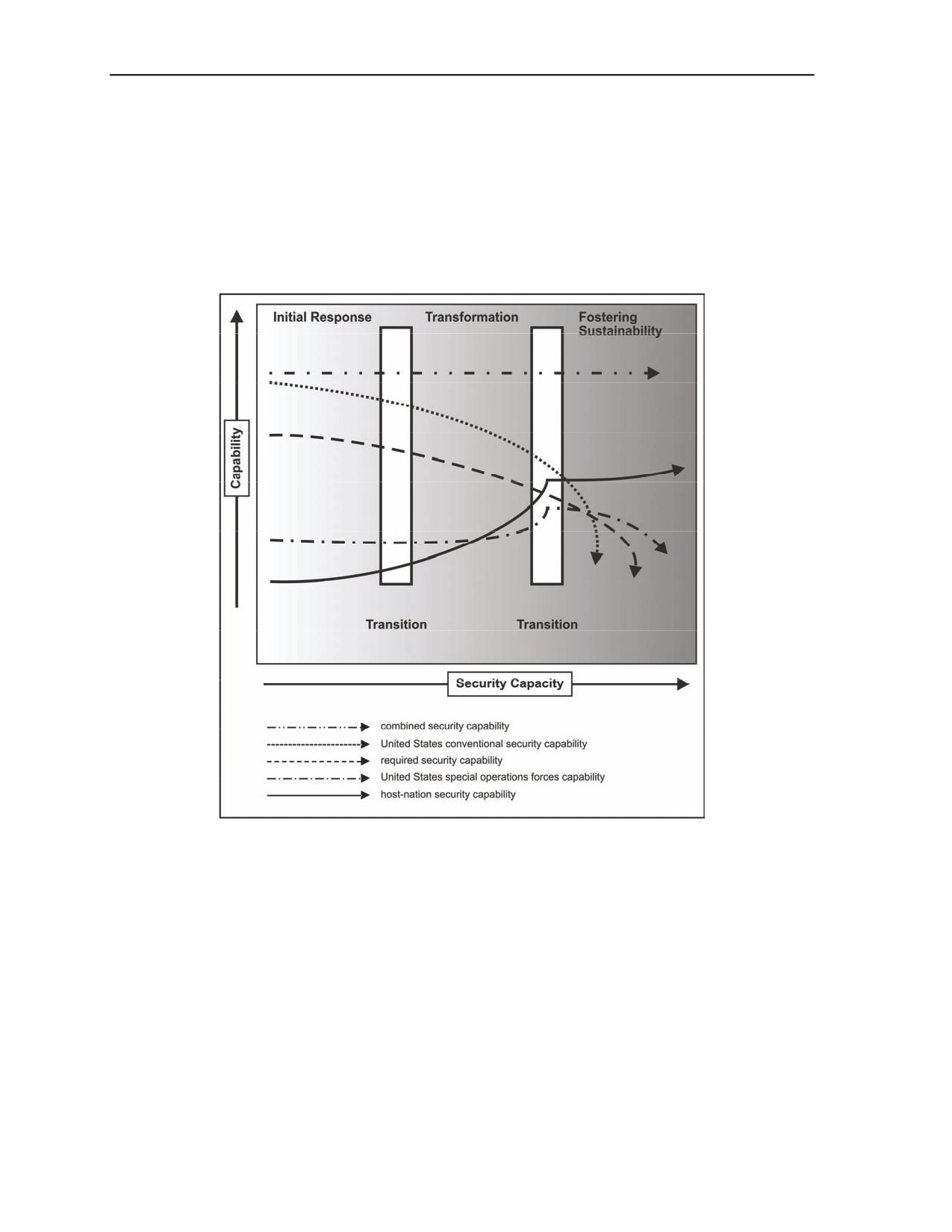
4-8. Figure 4-1 illustrates an SFA operation that includes all three SFA phases. The horizontal axis
depicts an improving security situation, and the vertical axis depicts security capability. The example
depicts an ideal situation, although this may not be the case in actual execution. Issues that arise require
proper assessment and potentially the use of branches or sequels.
Figure 4-1. Example of phases of security force assistance
4-9. In figure 4-1, the combined security capability represents the overall security capacity of all security
forces involved; it is the sum of U.S. conventional security, host-nation security, and the U.S. special
operations forces security capabilities. This example assumes that the combined security capability exceeds
the required security capability to effectively maintain a secure environment and counter any threat. The
U.S. conventional security capability refers to tactical U.S. elements, such as the BCT. It does not refer to
higher tactical or operational headquarters or support, sustainment, or medical assets. The U.S. special
operations forces capability is depicted as declining in the end of the sustainment phase; as the FSF
capability improves, the need for special operations forces declines. The host-nation or regional security
organization and U.S. policy determine the end state for special operations.
4-10. For figure 4-1, a major change to enemy resources may require more FSF or additional. Drastic
changes to the situation may even require a new operation plan. The figure focuses on capability, not
forces, so host-nation security capability may increase without increasing the number or size of host-nation
forces.
4-2
FM 3-07.1
1 May 2009
The Modular Brigade Augmented for Security Force Assistance
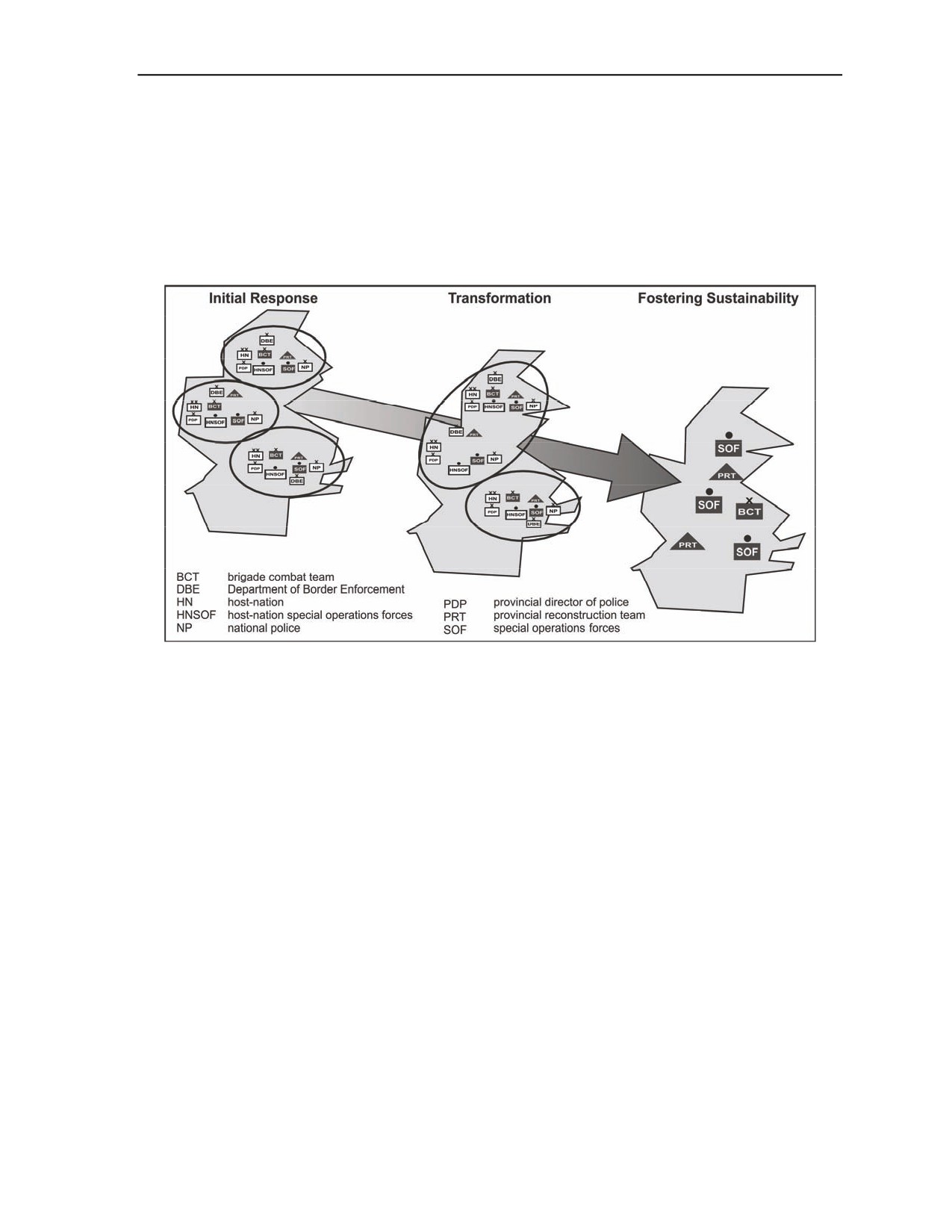
4-11. Figure 4-2 illustrates how the area of operations for a modular brigade augmented for SFA may
change throughout the SFA phases. The differences between the initial response phase and the
transformation phase may not change on the surface, but the BCT’s relationship with FSF changes
drastically. For example, FSF in the north met required conditions so that one of the U.S. brigades
conducting SFA was no longer required. The responsibility of the other U.S. brigade thus expanded from
providing assistance to one division to two divisions. This brigade’s span of control and area of operations
similarly expanded. The latter stage of the transformation phase can differ greatly. Areas of operation
generally increase in size as they provide SFA to more FSF.
Figure 4-2. Example of changes to a brigade combat team’s area of operations
AUGMENTATION BY PHASE SUMMARY
4-12. BCT augmentation is based on the operational environment and mission. As the three phases are
based on the operational environment, they provide a baseline for augmentation. Potential augmentation
may require military police, legal, public affairs, civil affairs, psychological operations, engineering,
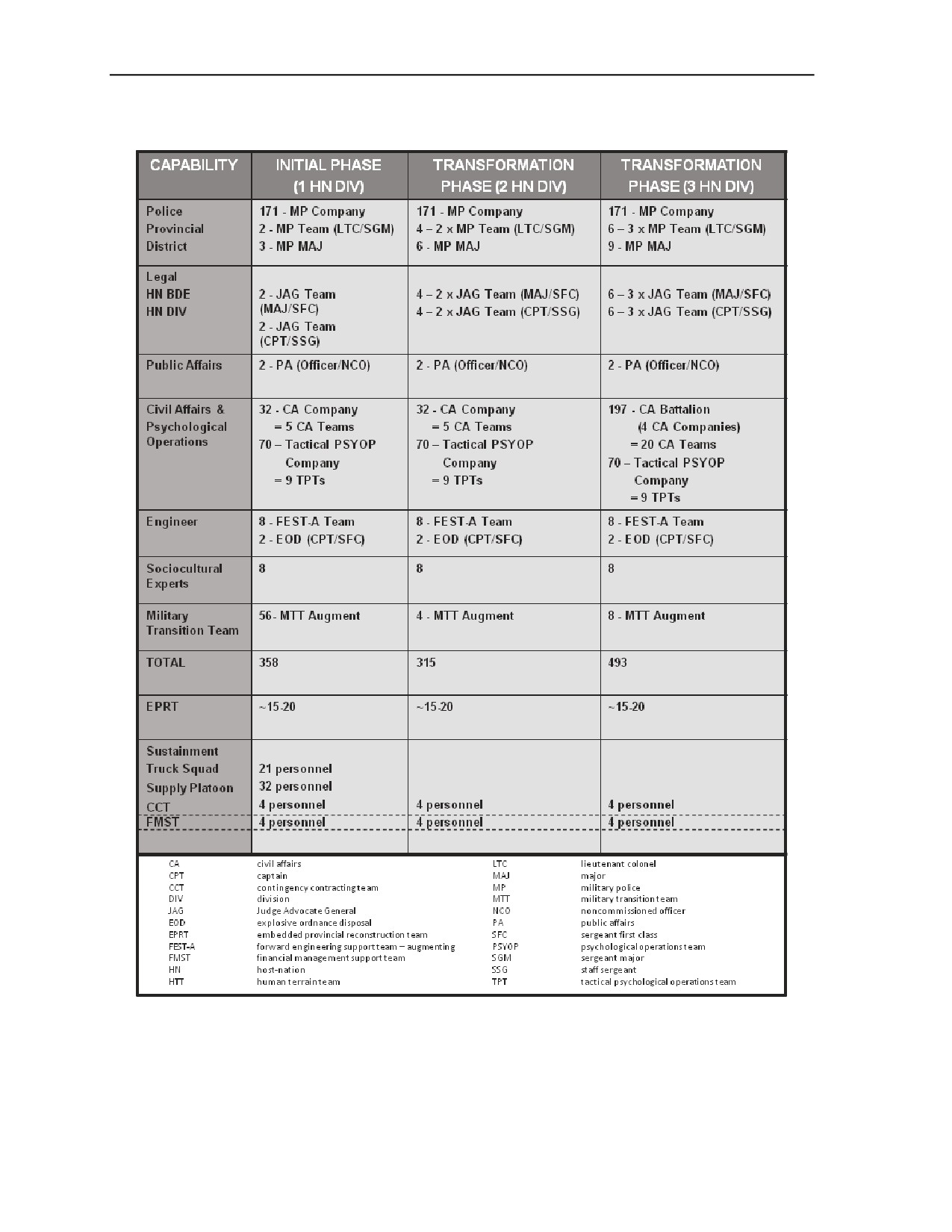
sociocultural experts, sustainment, and military transition team personnel. Table 4-1 illustrates a baseline
for augmentation by phase for BCTs.
4-13. An embedded provincial reconstruction team is a key element of a BCT conducting security for
assistance. The BCT has the lead on the following tasks: establish civil security, establish civil control
(when approved by Congress), and develop and enable foreign security forces. An embedded provincial
reconstruction team has the lead for the following tasks: support to economic and infrastructure
development, restore essential services, and support to governance. Thus, the BCT and an embedded
provincial reconstruction team are able to effectively support FSF and execute all five stability tasks.
1 May 2009
FM 3-07.1
4-3
Chapter 4
Table 4-1. Baseline augmentation for modular brigade
INITIAL RESPONSE PHASE
4-14. The initial response phase seeks to assist FSF stabilize the operational environment in a crisis state.
This phase occurs during or immediately after a conflict where the operational environment prevents
civilian personnel from operating effectively. The operational environment is typified as nonpermissive.
4-4
FM 3-07.1
1 May 2009
The Modular Brigade Augmented for Security Force Assistance
Thus, the objective of this phase is to improve the security situation, reducing the threat to the populace
and creating the conditions that allow civilian personnel to safely operate.
4-15. SFA in the initial response phase is normally required when FSF lack the capability or capacity to
provide the required level of security. This phase often requires SFA efforts to help generate and train or
assist new and existing FSF. This phase may require a combination of the types of SFA and considerable
support, sustainment, and medical resources. BCT activities during the initial response may have to be
conducted with multinational major combat operations, to include providing a safe, secure environment for
the local populace.
4-16. The BCT’s SFA efforts during this phase focus on improving the foreign security force’s capability
and capacity so all security forces—U.S., other, and foreign security forces—provide a secure environment
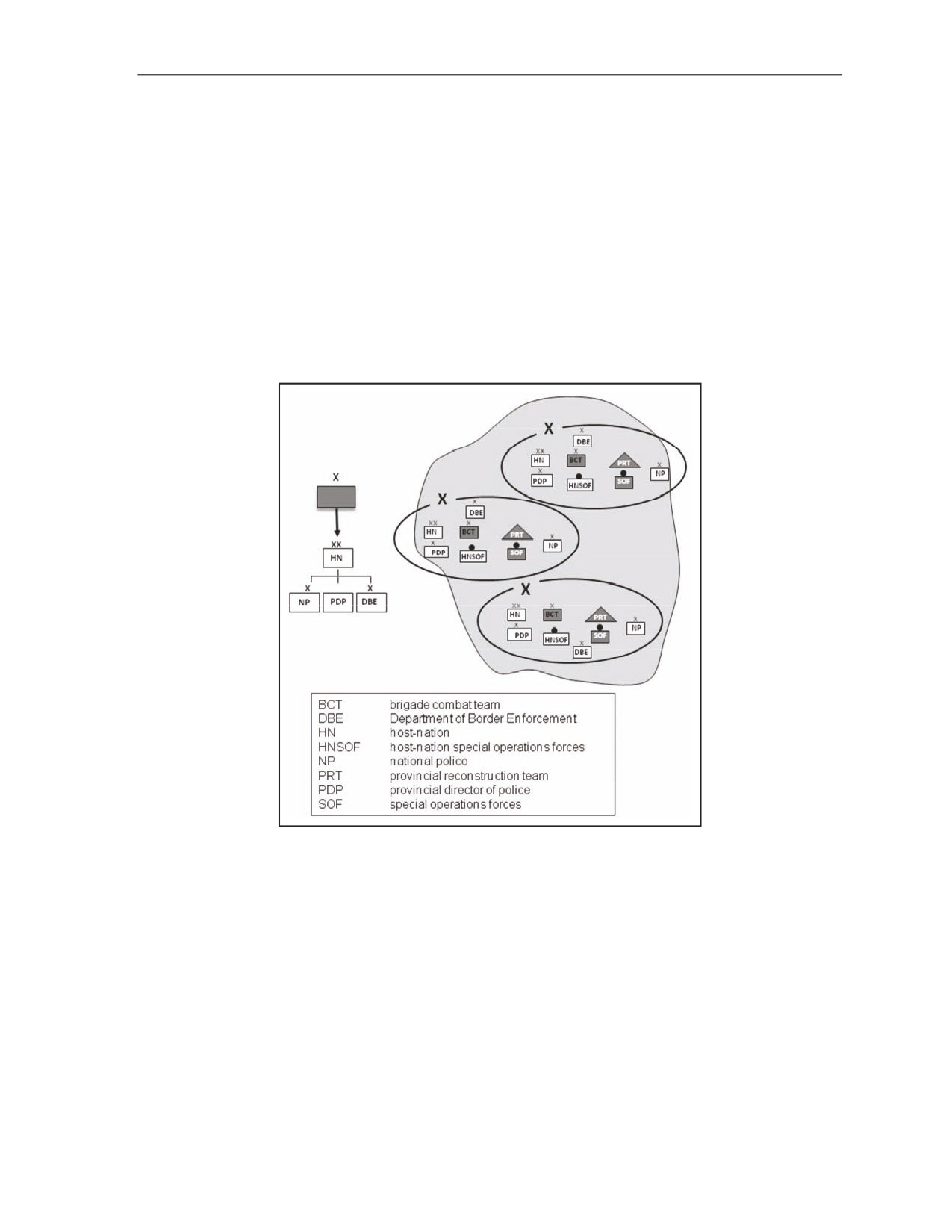
and reduce the threat. Figure 4-3 illustrates the BCT’s span of control. The figure also depicts three BCTs’
operational areas in the initial response phase. As security conditions improve, transition to the
transformation phase begins.
Figure 4-3. Example of initial response span of control and area of operations
4-17. The BCT requires augmentation for the initial response phase. These embedded units provide key
enabling capabilities for the brigade, supported FSF, and other supported actors. The embedded provincial
reconstruction team is one of the most important of the brigade’s augmentation, as it provides interim
civilian expertise in developing local institutions to take the lead in national governance, the provision of
basic services, fostering economic development, and enforcement of the rule of law. Column two of table
4-1 summarizes augmentation during the initial phase. Although each brigade’s mission and conditions in
its area of operations are unique, the baseline augmentation for the modular brigade operating in this phase
is as follows:
z
Embedded provincial reconstruction team.
z
Forward engineering support team-augmenting.
z
Explosive ordnance disposal team.
z
Sociocultural experts.
1 May 2009
FM 3-07.1
4-5
Chapter 4
z
Military police company (provincial police transition team).
z
Military police team (district police transition team).
z
Three military police majors (district police transition team).
z
Two judge advocate general teams.
z
Civil affairs company.
z
Tactical psychological operations company.
z
Public affairs team.
z
Contingency contracting team.
z
Financial management support team.
z
Military transition team (specific augmentation personnel include two lieutenant colonels, thirty-
one majors, and twenty-three master sergeants).
TRANSFORMATION PHASE
4-18. In the transformation phase, the BCT seeks to assist FSF to stabilize the operational environment in a
crisis or vulnerable state. The operational environment in this phase is more permissive than the initial
response phase; however, military forces will often be required to provide security to some actors.
Activities in this phase normally include a broad range of post-conflict reconstruction, stabilization, and
capacity-building efforts, which the embedded provincial reconstruction team is essential for long-term
success. Objectives in this phase include continuing efforts to improve the security situation, reducing the
threat to the populace, building host-nation capacity across the stability sectors, and facilitating the
comprehensive approach to assist FSF.
4-19. The transformation phase represents a broad range of SFA activities that the BCT could perform to
support FSF. The initial response phase differs from the transformation phase in the foreign security
force’s capability to provide for a safe and secure environment. More specifically, FSF have a level of
proficiency so they no longer need a permanent U.S. and foreign security forces relationship for tactical
operations. However, they may still need full-time advisors and support, sustainment, and medical
assistance. The embedded provincial reconstruction team will continue to play a vital role in assisting
governance and development efforts throughout this phase.
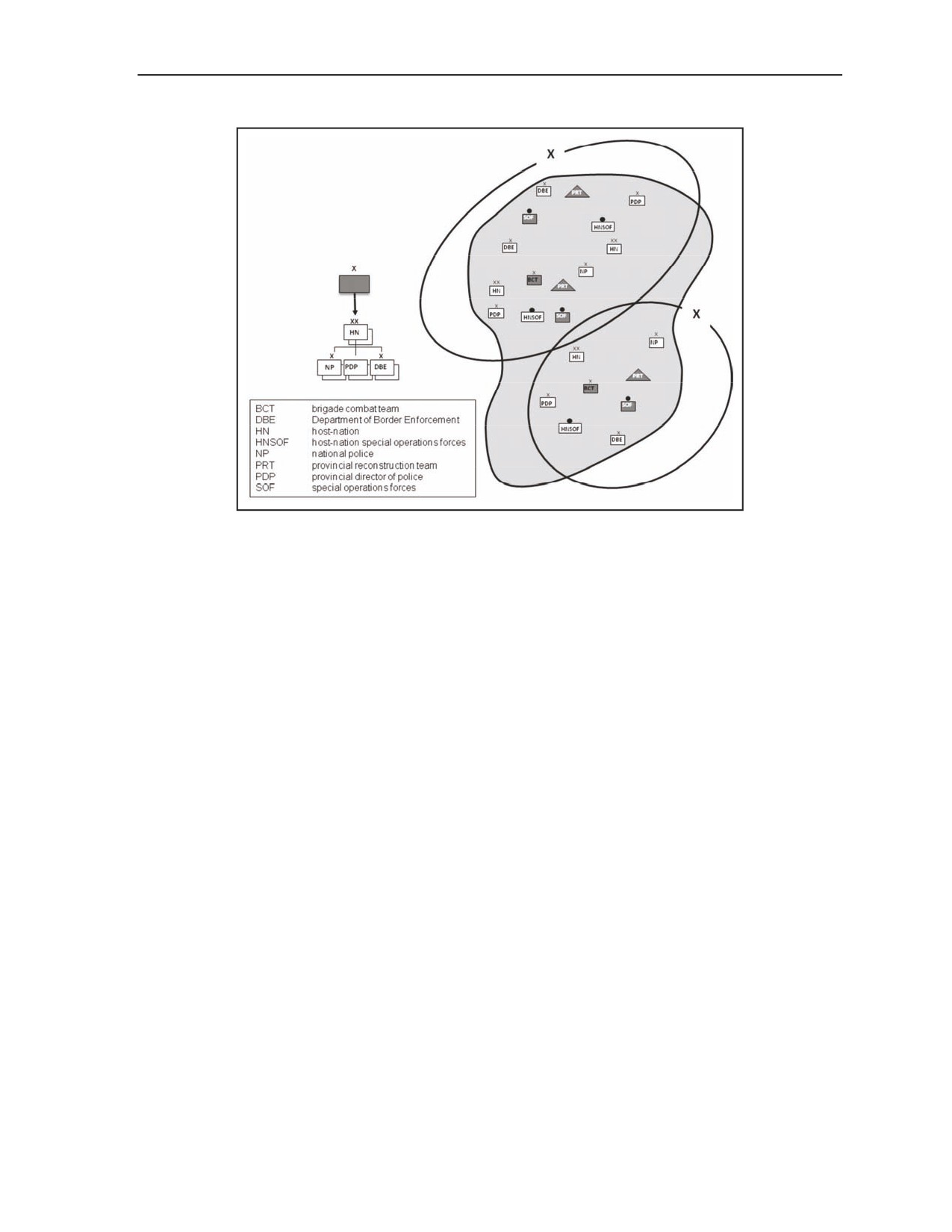
4-20. Figure 4-4 illustrates the BCT conducting SFA in the transformation phase. In this example, the
BCT’s span of control expands from assisting one foreign division to assisting two foreign divisions. The
figure also depicts how a BCT’s operational area has similarly expanded. SFA activities in this phase seek
to establish conditions so the host nation’s security sector can provide a secure environment with its own
security forces.
4-6
FM 3-07.1
1 May 2009
The Modular Brigade Augmented for Security Force Assistance
Figure 4-4. Example of transformation phase span of control and area of operations
4-21. The BCT requires augmentation for the transformation phase, like the initial response phase. It often
requires similar augmentation due to its greater span of control and area or operations. Column three of
table
4-1 summarizes augmentation during the transformation phase with two foreign divisions. The
baseline augmentation for the brigade in this phase is as follows:
z
Embedded provincial reconstruction team.
z
Forward engineering support team-augmenting.
z
Explosive ordnance disposal team.
z
Sociocultural experts.
z
Military police company (provincial police transition team).
z
Two military police teams (district police transition team).
z
Six military police majors (district police transition team).
z
Four judge advocate general teams.
z
Civil affairs company.
z
Tactical psychological operations company.
z
Public affairs team.
z
Contingency contracting team.
z
Financial management support team.
z
Military transition team (specific augmentation personnel include two lieutenant colonels and
two master sergeants).
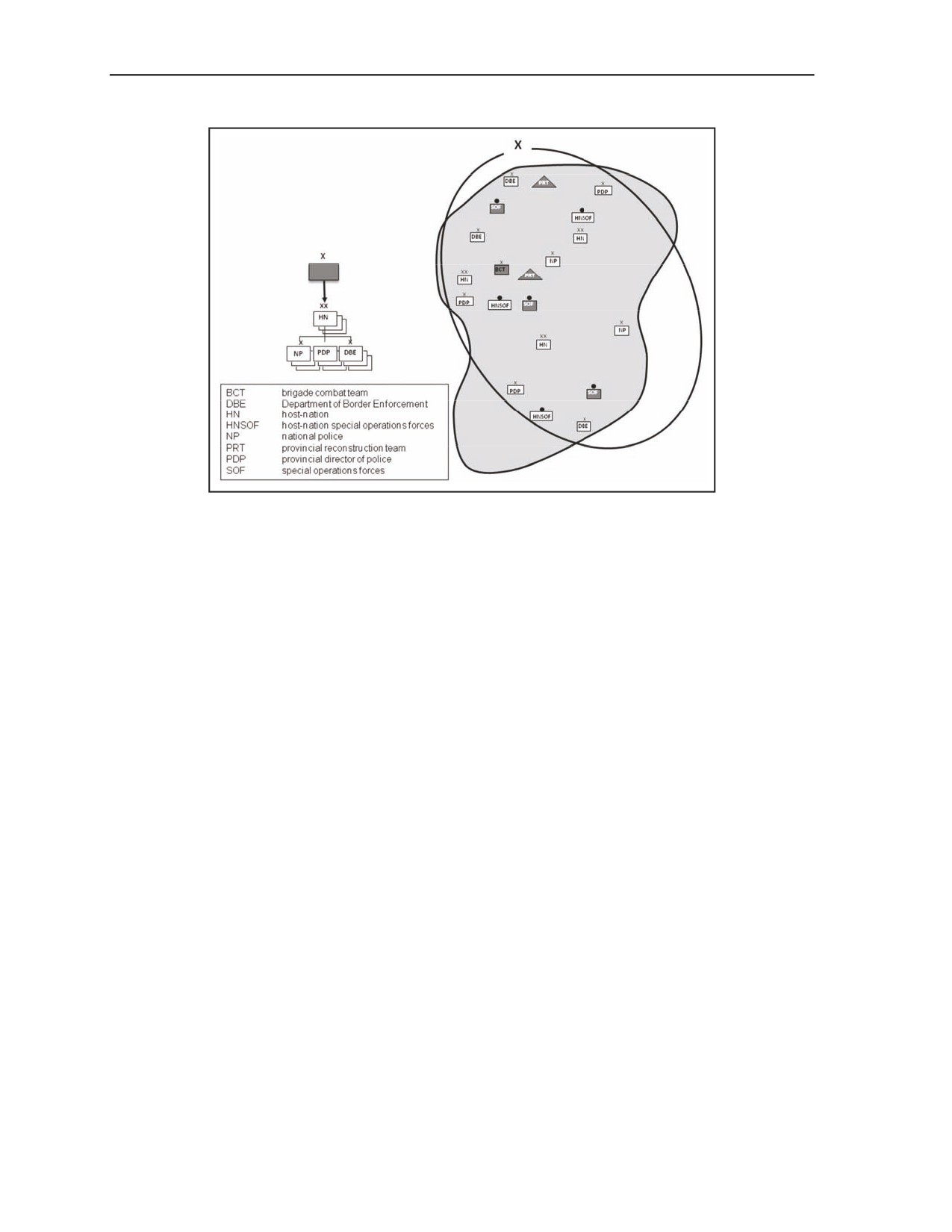
4-22. As conditions of the operational environment improve, the BCT may require a transition to assist
three foreign divisions, rather than two divisions as depicted in figure 4-4. This represents a significant
expansion of the span of control and area of operations, with a corresponding expansion of required
augmentation. Figure 4-5 depicts the BCT supporting three foreign divisions.
1 May 2009
FM 3-07.1
4-7
Chapter 4
Figure 4-5. Example of a three-division span of control and area of operations
4-23. As in other phases, the BCT requires augmentation to support three divisions. Column four of table
4-1 summarizes augmentation during the transformation phase with three foreign divisions. The baseline
augmentation for the brigade in this phase is as follows:
z
Embedded provincial reconstruction team.
z
Forward engineering support team-augmenting.
z
Explosive ordnance disposal team.
z
Sociocultural experts.
z
Military police company (provincial police transition team).
z
Three military police teams (district police transition team).
z
Nine military police majors (district police transition team).
z
Six judge advocate general teams.
z
Civil affairs company.
z
Tactical psychological operations company.
z
Public affairs team.
z
Contingency contracting team.
z
Financial management support team.
z
Military transition team (specific augmentation personnel include four lieutenant colonels and
four master sergeants).
FOSTERING SUSTAINABILITY PHASE
4-24. In this phase, the focus of SFA continues to shift toward assisting institutions required to sustain
FSF. This phase encompasses long-term efforts to assist FSF. In this phase, FSF are capable and viable.
They conduct independent operations and can provide a safe, secure internal environment. While the
brigade may be initially required during this phase, it is normally withdrawn during this phase. The
determination to withdraw the brigade is based on the policy and conditions of the operational
environment. Special operations forces, provincial reconstruction teams, and other forces may remain to
support a theater security cooperation plan. Thus, remaining SFA missions are normally special operations
4-8
FM 3-07.1
1 May 2009
The Modular Brigade Augmented for Security Force Assistance
forces missions, not a BCT mission (special operations forces will normally be involved in all phases of
SFA).
TRANSITIONS
4-25. SFA can require a vast array of transitions. These transitions are conducted according to the tactical,
operational, and strategic conditions identified during planning (which must support the internal defense
and development strategy and using an overall comprehensive approach). Transitions can occur
simultaneously or sequentially in different levels or war and in separate echelons. This includes potentially
having tactical transitions for different units within one brigade’s area of operations.
4-26. There are several major transitions. First, the supported unit may be the U.S. BCT in the beginning
of an initial response phase but the foreign security forces will transition to be the supported unit. At this
point in the transformation phase, the area in which the BCT conducts SFA will expand. This expansion
can occur multiple times during the transformation phase, which is based on conditions, especially the
capability and capacity of FSF.
4-27. Operations never proceed exactly as planned. To facilitate flexibility, commanders incorporate
branches and sequels into the overall plan. Visualizing and planning branches and sequels are important
because they involve transitions. Unless planned, prepared for, and executed efficiently, transitions can
reduce the tempo of the operation, slow its momentum, and surrender the initiative to the adversary.
SUBORDINATE UNITS
4-28. The modular brigade augmented for SFA has subordinate units whose sole focus is working with
FSF. These advisor teams may be formed from brigade organic resources, external augmentation, or a
combination. These teams optimally are embedded with the counterpart unit, or they may reside on a U.S.
camp and commute to FSF they support. The method depends on U.S. policy, direction from higher
headquarters, the conditions of the operational environment, and capacity of the foreign security force’s
camps to accommodate the U.S. forces.
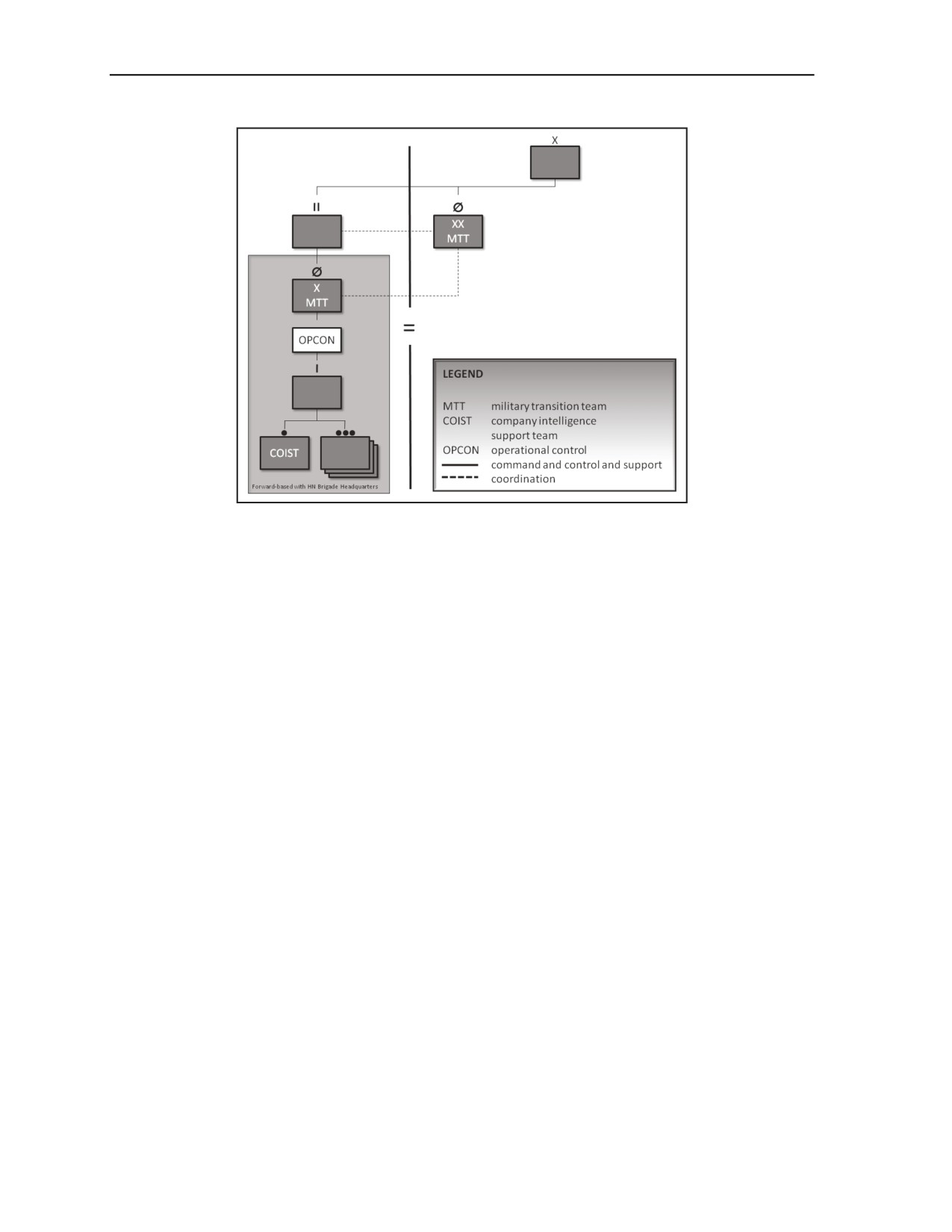
4-29. The military transition team (MTT) is a key subordinate unit for the brigade conducting SFA. The
MTT mission is to assist FSF units. Figure 4-6 illustrates the relationship between a brigade conducting
SFA and a MTT assisting a foreign brigade. In this example, the brigade has a battalion and a division
MTT as subordinate units, although it would have other subordinate units. The brigade MTT is subordinate
to the battalion and has operational control of one of the parent U.S. battalion’s company teams.
4-30. When the brigade provides organic forces to form the basis for the brigade MTT, the company team
is the foundation of a brigade MTT. The company team will be augmented with additional personnel and
assets. The U.S. brigade must facilitate the MTT operations, such as force protection, transportation,
communications, and reachback.
4-31. As companies do not have organic intelligence analysts, personnel must be used to form company
intelligence support teams (COISTs). A COIST, an ad hoc organization, assists the MTT and its FSF.
Ideally, the COIST should consist of six individuals, which will allow for 24 hour operations and the depth
in the team to both integrate with the staff and to successfully support the company’s mission. The team
should consist of an officer, a noncommissioned officer, and four Soldiers, although the cell can be
minimally manned with four personnel. The company intelligence cell works most effectively if its work
complements the battalion S-2’s work.
1 May 2009
FM 3-07.1
4-9
Chapter 4
Figure 4-6. Military transition teams
SAMPLE TROOP-TO-TASK MODEL
4-32. The BCT may support assigned to multiple missions, including potentially supporting multiple
foreign units in their operational area. Additionally, these FSF organizations may each report through
different host-nation government channels and even to different ministries. To synchronize efforts in this
case, U.S. forces must achieve unity of command and effort. Similarly, each of the FSF organizational
commanders should synchronize their efforts with the host-nation government representatives, as
appropriate.
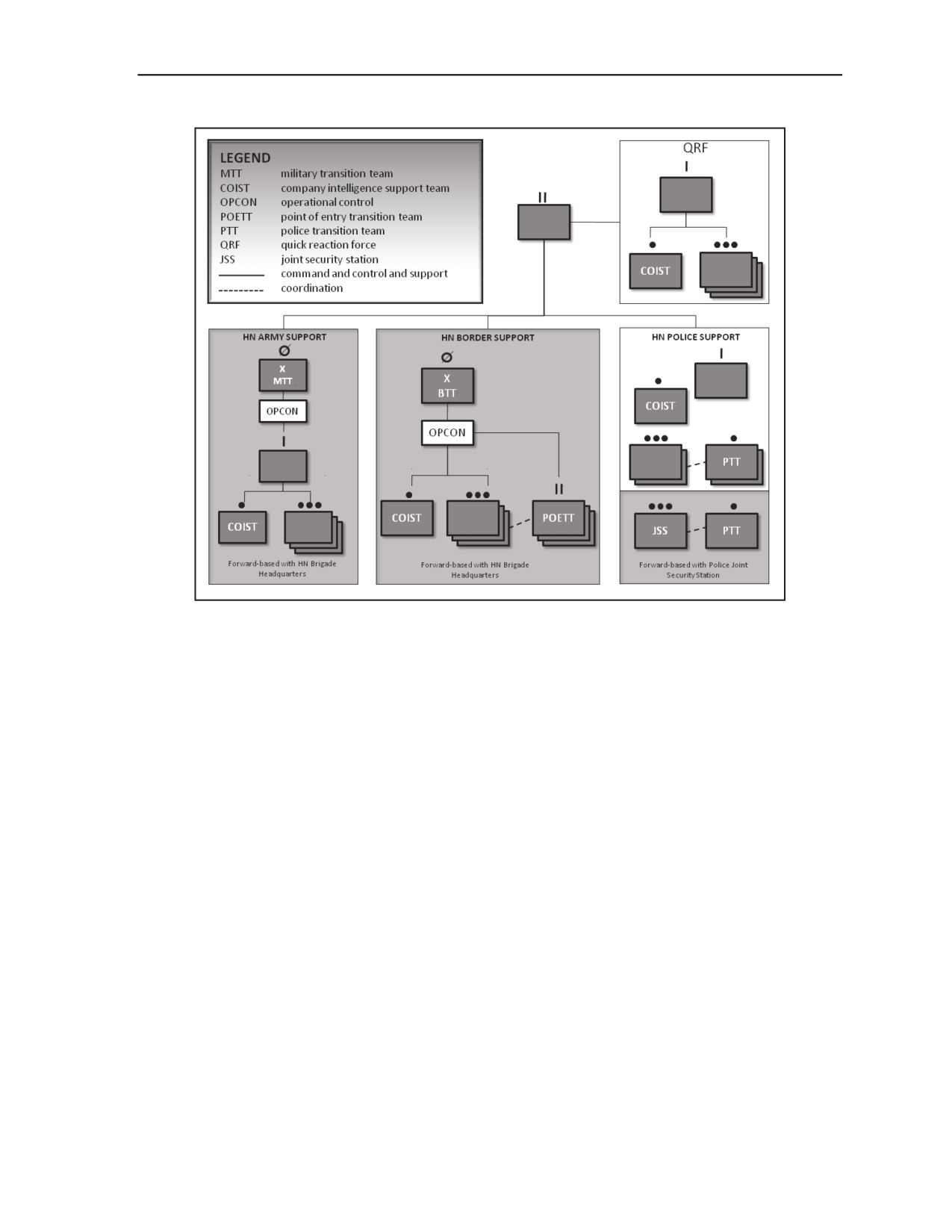
4-33. Figure 4-7 depicts a sample troop-to-task model for a U.S. brigade. It depicts one company team
acting as a quick reaction force; thus, the battalion retains the capability to conduct independent full
spectrum operations. The figure depicts how U.S. company teams may form the basis of a brigade MTT or
a brigade border transition team (and subordinate point of entry transition teams). The figure also depicts
how a company team may provide police support. This support is in the form of two platoons supporting
police transition teams and a third platoon in a joint security station providing support to a police transition
team.
4-10
FM 3-07.1
1 May 2009
The Modular Brigade Augmented for Security Force Assistance
Figure 4-7. Battalions conducting security force assistance
4-34. Subordinate units of BCTs conducting SFA are best located inside a FSF base—not an American
base. Co-location facilitates integration with the FSF. It allows the two forces to form mutual
understanding and trust. Co-location and the close cooperation it facilitates often improves the population’s
perception of the legitimacy U.S. and foreign security forces, which can be an essential condition of the
overall mission’s end state.
4-35. If force protection requires, a U.S. area may be established in the FSF base, although this is not
optimal. Key considerations for co-location may include the threat, FSF acceptance, physical space inside
the FSF base, sustainment capabilities, medical facilities, and availability of quick reaction forces.
4-36. When U.S. forces are operating out of smaller outposts in an urban environment, the local populace
sees the integration and presence of the U.S. and foreign security forces working together. This integration
not only enhances overall operational effectiveness and trust, living and working together builds legitimacy
of the two forces as well as FSF; it reinforces trust between the FSF and the people they are tasked to
protect.
1 May 2009
FM 3-07.1
4-11
Chapter 5
Unit Operations
Unit operations require continuous activities. Commanders plan for premission,
deployment, in-country preparation, employment, redeployment, and postdeployment
activities.
PREMISSION
5-1. After receiving a mission, the unit continues detailed preparation activities. The unit obtains
supplies, equipment, and training materials and prepares for deployment. Personnel prepare for and
rehearse classes to be given in-country. They hone their military skills and conduct extensive area
orientation. Paragraphs 5-2 through 5-10 discuss staff actions particular to security force assistance (SFA).
OPERATION PLAN
5-2. The S-3 disseminates the operation plan to unit staff and subordinates. The S-3 ensures
predeployment training for Soldiers, to include preparation for training foreign security forces (FSF) and
rehearsals for movement. The S-3 reviews the program of instruction for training FSF, to include getting
approval from the commander and higher headquarters, if necessary.
CIVIL-MILITARY OPERATIONS
5-3. The civil-military operations section ensures the operation plan minimizes how operations affect the
civilian population and addresses ways to mitigate the civilian impact on military operations. Civil-military
operations also ensure the operation plan discusses coordination with any augmenting actors. These actors
might include civil affairs battalions or brigades, provincial reconstruction teams, or United States Agency
for International Development project officers in the operational area. During predeployment training,
Soldiers receive training, materials, and briefings on the operational area. This training can cover the
history, culture, religion, language, tribal affiliations, local politics, and cultural sensitivities as well as any
significant nongovernmental organizations operating in the operational area.
TRAINING
5-4. As discussed in chapter
2, advisors should focus their premission training on the specific
requirements of developing FSF. The training emphasizes the host-nation culture and language and
provides cultural tips for developing a good rapport with foreign personnel. All premission training for
SFA follows the training principles described in FM 7-0.
5-5. Based on the higher commander’s training guidance, unit commanders assign missions and approve
the draft mission-essential task list that supports SFA. The staff plans, conducts, and evaluates training to
support this guidance and the approved mission-essential task list for SFA missions. Commanders
prioritize tasks that need training. Since there is never enough time to train in every area, commanders
focus on tasks essential for mission accomplishment.
5-6. Once commanders select tasks for training, the staff builds the training schedule and plans on these
tasks. The staff provides the training requirements to the commander. After approving the list of tasks to be
trained, the commander includes the tasks in the unit training schedule. The staff then coordinates the
support and resource requirements with the S-3 and S-4. Finally, the commander ensures standards are
enforced during training.
1 May 2009
FM 3-07.1
5-1
Chapter 5
Evaluation
5-7. Evaluations can be either internal or external. Internal evaluations occur at all levels, and they must
be inherent in all training. External evaluations are usually more formal and conducted by a headquarters
two levels above the unit being evaluated. This subject must be carefully planned and discussed with FSF
leaders to account for cultural sensitivities and current capabilities.
5-8. A critical weakness in training is the failure to evaluate each task every time it is executed. Every
training exercise provides potential for evaluation feedback. Every evaluation is also a training session.
Leaders and trainers must continually evaluate to optimize training. Evaluation must occur as training takes
place. Emphasis is on direct, on-the-spot evaluations. However, leaders allow Soldiers to complete the task
first. Leaders plan after action reviews at frequent, logical intervals during exercises. This technique allows
the correction of shortcomings while they are still fresh in everyone’s mind. The after action review
eliminates reinforcing bad habits.
Specified Training
5-9. Augmentation elements require area orientation, refresher combat training, field training exercises,
and the like. Unit training objectives are for developing capabilities to conduct internal defense and
development (IDAD) activities for tactical operations, intelligence operations, psychological operations,
populace and resources control operations, and civil affairs and advisory assistance operations in the host-
nation language. Units identified for SFA begin intensified training immediately upon deployment
notification.
5-10. After deployment to the host nation and before commitment to operations, the unit may receive in-
country training at host-nation training centers or at designated training locations. This training helps
personnel become psychologically and physically acclimated to the host nation. This training also allows
commanders and staff some time to coordinate and plan within their own command and with civilian and
military joint and multinational organizations. After commitment, training continues and is stressed
between operations, using needed improvements identified in operations as the basis for training.
DEPLOYMENT
5-11. SFA is often conducted in semipermissive environments in which U.S. forces are guests of the host-
nation or partner organization. Units move into the operational area by following their deployment
standing operating procedures and the operation plan. Paragraphs
5-12 through
5-25 highlight
organizations and procedures critical to SFA deployment. This information, however, does not obviate the
need for extensive standing operating procedures and an operation plan.
PREDEPLOYMENT SITE SURVEY
5-12. The predeployment site survey unit aims to report accurately to its parent unit the existing FSF
mission variables—mission, enemy, terrain and weather, troops and support available, time available, civil
considerations (METT-TC). See table 5-1. It also establishes in-country command and control, support,
protection, and sustainment relationships for the follow-on unit’s mission execution. The site survey
coordinates the in-country reception of SFA forces. This coordination wards off most friction during the
handoff. This coordination requires all units—outgoing and incoming—to apply a comprehensive
approach at all levels of command. Appendix D of FM 3-05.202 discusses site survey procedures in detail.
5-2
FM 3-07.1
1 May 2009
Unit Operations
Table 5-1. Advisor team predeployment site survey checklist
Tasks
Characteristics
•
Map familiarization.
Area of operations
•
In sector orientation.
overview
•
Areas of emphasis.
•
Unit boundaries.
•
Routes.
•
Other United States and multinational support locations.
Graphic control measures
•
Maintenance support location.
•
Medical support locations.
•
Other points of interest.
•
Responsibilities.
United States and
•
Battle rhythm.
multinational unit
•
Required reports.
interviews by specialty
•
Standing operating procedures, continuity book.
staff
•
Stay-behind equipment.
•
Foreign security forces task organization.
•
Foreign security forces key leadership.
Briefings on advised unit
•
Intelligence assessment.
•
Unit operational assessment.
•
Among commanders.
Advised unit introductions
•
Among staffs.
ADVANCE PARTY DEPLOYMENT
5-13. An advance party deploys to the host-nation or partner organization area of operations after the unit
completes its mission planning and the proper commander representative declares it deployable. The
advance party conducts predeployment activities and coordinates necessary travel documentation and
country clearances. The advance party reviews the rules of engagement and any status-of-forces
agreements before deploying. If applicable, the proper staff provides an updated threat briefing to the unit.
The S-4 section and support company help with out-loading in the unit area. The unit places all supplies
and materials on pallets beforehand and prepares the load manifest.
5-14. Upon arrival, the advance party processes through customs and immediately notifies the higher
headquarters of its arrival and status. Often the higher headquarters provides point of contacts to the
advance party. These contacts help the advance party obtain the proper identification, documentation, and
weapons permits.
5-15. The advance party establishes contact with all U.S. and foreign security forces tactical unit
commanders and conducts final premission planning activities. The advance party procures secure
working, storage, and living areas for the unit and reconnoiters and prepares the training sites. The advance
party coordinates for special support equipment to unload heavy supplies and transport the supplies and
personnel to the training site.
MAIN BODY DEPLOYMENT
5-16. The unit deploys after completing its planning and the appropriate commander declares the unit
ready. The unit follows the same procedures performed by the advance party. Members of the advance
party meet the main body on its arrival and brief the main body on any required changes to the operation
order.
1 May 2009
FM 3-07.1
5-3
Chapter 5
5-17. After arriving in-country, the unit processes through customs and immediately notifies the higher
headquarters of its arrival and status. The unit obtains the proper identification, documentation and
weapons permits from U.S. or other sources, if applicable. Often the security assistance organization
provides to the unit the necessary point of contacts that expedite this process.
5-18. The unit off-loads equipment and personnel onto vehicles for movement to the training site, or it
stores the equipment in a secure area until the processing is completed. FSF secure the equipment but the
unit members remember the commander is ultimately accountable for the advisor team’s physical and
personal security. Supply personnel stay with the equipment and help to guard it.
IN-COUNTRY PREPARATION
5-19. Upon arrival, the commander and S-3 brief the higher headquarters on the planned execution of the
mission and reconfirm the required command relationship. Local conditions may require the unit to
confirm or establish its in-country and external command and control, support, and sustainment
relationships from outside its operational area upon arrival. The unit establishes direct working
relationships with its next higher in- or out-of-country supporting element to—
z
Determine the limits of the available support and expected reaction time between the initiation
of the support request and its fulfillment.
z
Confirm or establish communications procedures between the supporting element and the unit,
to include alternative and emergency procedures for command and control, all available support,
and medical evacuation.
5-20. The unit establishes procedures to promote interagency cooperation and synchronization. The unit—
z
Identifies the location of the concerned host-nation, U.S., or other agencies.
z
Contacts the concerned agency to establish initial coordination.
z
Exchanges information or intelligence.
z
Confirms or establishes other coordination protocols as necessary.
z
Incorporates the newly established or changed procedures into the plans for mission execution.
5-21. The unit immediately establishes operations security procedures to support its mission execution and
identifies rally points incorporated into its defensive, evasion, and personnel recovery plans.
5-22. After receiving a detailed briefing and further guidance from the advance party, unit personnel
continue to develop effective rapport with the FSF commander and counterparts. They also assess their
working, storage, and living areas for security and verify the location of the training site, communications
center, dispensary area, and FSF troop area. With the FSF commander, the unit commander—
z
Establishes rapport.
z
Conducts introductions in a businesslike, congenial manner.
z
Briefs on the unit’s mission, its capabilities, and the restrictions and limits imposed on the
detachment by the higher U.S. commander.
z
Ensures all unit personnel fully support FSF and firmly believes a joint U.S.-FSF effort will
succeed. Requests counterpart linkup be made under the mutual supervision of the FSF
commander and the unit commander.
z
Ensures all current unit plans are tentative and that assistance is needed to finalize them.
z
Deduces or solicits the actual estimate of unit capabilities and perceived advisory assistance and
material requirements.
z
Recommends the most desirable courses of action (COAs) while emphasizing how they satisfy
present conditions, achieve the desired training, and meet advisory assistance goals.
z
Informs the higher in-country U.S. commander of any significant changes in the unit’s plan to
assist FSF.
5-4
FM 3-07.1
1 May 2009
Unit Operations
5-23. The S-2 supervises the dissemination of intelligence and other operationally pertinent information
within the unit and, as applicable, to higher, lower, or adjacent units or agencies. The S-2 also—
z
Monitors the implementation of the intelligence collection plans to include updating the
commander’s priority intelligence requirements
(PIRs), conducting area assessment, and
coordinating for additional intelligence support.
z
Establishes liaison with FSF intelligence and security agencies (within the guidelines provided
by applicable higher authority). Assesses the intelligence threat and resulting security
requirements, including coordination with the S-3 on specific security and operations security
measures.
5-24. Through the S-2, the commander’s PIRs are based on the latest information available and
requirements for additional PIRs that arise from modified estimates and plans. The S-2 also—
z
Analyzes the foreign unit’s status to finalize unit plans for advisory assistance. These plans can
include task organization of unit with counterparts, staff functions for planning SFA, and
advisory assistance for executing SFA.
z
Explains analysis to counterparts and encourages them to help with—and participate in—
analyzing, preparing, and briefing the analysis to the foreign unit commander.
z
Prepares and briefs the plans for training and advisory assistance.
z
Helps the foreign unit inspect the available facilities to identify deficiencies. If the unit finds
deficiencies, the S-2 prepares estimates of COAs for the FSF commander to correct them.
z
Supervises the preparation of the facilities with their counterparts and informs unit and FSF
commanders on the status of the facilities.
5-25. The unit ensures its security is based on the present or anticipated threat. Some recommended actions
the unit may take include—
z
Hardening its positions based on available means and requirements to maintain low visibility.
z
Maintaining unit internal guard system with at least one Soldier who is awake and knows the
locations of all other unit personnel. The guard reacts to an emergency by following an internal
alert plan and starting defensive actions.
z
Maintaining communications with all subordinate unit personnel deployed outside the
immediate area controlled by the main body.
z
Establishing plans for immediate defensive actions in the event of an attack or a loss of rapport
with hostile reaction.
z
Discussing visible security measures with foreign counterparts to ensure understanding and to
maintain effective rapport. Unit personnel do not divulge sensitive information for the sake of
possible rapport benefits.
z
Encouraging the foreign unit, through counterparts, to adopt additional security measures
identified when analyzing the foreign unit’s status and inspecting its facilities.
z
Coordinating defensive measures with the foreign unit to develop a mutual defensive plan. Unit
personnel obtain from the unit’s present reaction and defensive plans for attack. They encourage
the foreign unit to conduct mutual full-force rehearsals of defensive plans; if unsuccessful, the
unit conducts internal rehearsals of the plans.
EMPLOYMENT
5-26. Once the unit has deployed and arrived in-country, it begins employment. Employment is the
conduct of SFA to support the FSF commander. Employment occurs within the advisor team itself. It
includes foreign counterparts in the mission planning (preparing the FSF for the mission itself) to increase
the capability and capacity of their planning processes, as well as increase the probability of success.
1 May 2009
FM 3-07.1
5-5
Chapter 5
PERSONNEL
5-27. During employment, individual unit personnel perform functions described in paragraphs 5-28
through 5-38.
Commander
5-28. Before the mission, the U.S. commander advises and assists the FSF commander. The latter issues
planning guidance for planning the execution of the mission and clarifies commander’s intent. The U.S.
commander advises and assists the FSF unit commander in the command and control process of tactical
operations. By accompanying the FSF unit commander when the mission is received from higher
headquarters, the U.S. commander assists any subsequent missions. The U.S. commander monitors how
FSF understand the commander’s intent and all specified or implied tasks.
5-29. During execution of the mission, the U.S. commander helps the foreign unit commander provide
command and control during operations. After monitoring the tactical situation, the U.S. commander
recommends changes to the COAs to exploit the situation. After monitoring the flow of information, the
U.S. commander recommends improvements to use intelligence collection assets and to keep subordinates
reporting required information.
Staff
5-30. Before the mission, the advisor staff advises and assists the foreign counterparts in preparing
estimated COAs for essential tasks. The staff helps write tentative plans based on the planning guidance
and unit’s standing operating procedures. These plans include primary, alternate, contingency, and
emergency plans.
5-31. During execution, the staff helps foreign counterparts coordinate the execution of the tasks. They
disseminate portions of their plans to other personnel, senior and subordinate staff sections, and supporting
elements. They help notify higher, lower, or adjacent staff sections of modified estimates and plans.
Finally, the staff—with the S-2 and the S-2 counterpart—helps update the commander’s critical
information requirements with the latest information and requirements that arise from operations.
Executive Officer
5-32. The executive officer performs the organizational analysis of the unit’s coordinating staff sections to
ensure efficiency during the planning process according to initial planning guidance. With the foreign
counterpart, this officer directs foreign staff sections as they develop estimates and plans. The executive
officer monitors the liaison and coordination with FSF higher headquarters, recommending changes to
improve efficiency.
Adjutant
5-33. The adjutant provides advice, assists, and makes recommendations to the foreign counterpart for
conducting human resources. This includes monitoring the maintenance of foreign unit strength,
accountability of casualties, unit morale, and postal activities. This may also include concerns with the
foreign pay system, leave procedures, and casualty pay procedures.
Intelligence Officer
5-34. The intelligence officer advises and assists the monitoring of FSF operations security to protect
classified and sensitive material and operations and recommends improvements. By helping the foreign
counterpart update the situation map, the intelligence officer helps to keep the map current. The
intelligence officer recommends improvements to the standing operating procedures of the tactical
operations center communications so the intelligence section receives situation reports. This officer helps
the counterpart monitor the collection, evaluation, interpretation, and dissemination of information. The
intelligence officer assists in the examination of captured insurgent documents and material. This officer
helps gather and disseminate intelligence reports from available sources to ensure the exploitation of all
5-6
FM 3-07.1
1 May 2009
Unit Operations
assets. The intelligence officer helps the counterpart to brief and debrief patrols operating as a part of
reconnaissance and surveillance activities. Finally, the intelligence officer assists, with the advisor
operations officer, developing reconnaissance and surveillance plans.
Operations Officer
5-35. The operations officer helps the foreign counterpart to prepare tactical plans using estimates,
predictions, and information. This officer monitors command and communications nets, assists in
preparing all orders and plans, and helps to supervise the training and preparation for operations. Finally,
the operations officer monitors the planning process and makes recommendations for consistency with
IDAD goals.
Supply Officer
5-36. The supply officer advises and assists the foreign counterpart in maintaining equipment readiness;
monitoring the support provided to the foreign unit, its subunits, and attachments; and recommending
improvements. Finally, this officer helps to supervise the use of transportation assets.
Civil-Military Team
5-37. Upon deployment, civil-military teams advise the commander and staff on civil-military
considerations and coordinate efforts of any civil affairs units supporting the unit. The civil-military team
mentors the counterpart team on the supported foreign element staff on civil-military operations, the legal
and moral obligations of military commanders to civilian populations under their control, and the
importance of respecting human rights. The civil-military team may introduce the counterpart to relevant
nongovernmental organizations, United States Agency for International Development project officers, and
provincial reconstruction team staff.
Company-Level Advisors
5-38. Advisors sent to elements below battalion level help foreign counterparts to analyze the mission and
commander’s intent from higher headquarters. They assist FSF leaders restate the mission, conduct an
initial risk assessment, identify a tentative decisive point, and define their own intent. They also assist their
foreign counterparts to analyze the mission variables. From these variables, advisors help their foreign
counterparts to develop a COA that meets the higher headquarters concept of operations and commander’s
intent. Finally, they advise and assist in the conduct of operations and the flow of information to the FSF
higher commander.
TRAINING
5-39. Training FSF during SFA parallels the training of U.S. forces. Training follows the principles of
training described in FM 7-0. This training tailors the objectives to account for cultural differences and
focus on the FSF mission and problem set.
Training Assessment
5-40. The commander of the advising unit begins with a training assessment of training plans designed
during predeployment and passed on from the preceding U.S. units conducted in coordination with the FSF
commander. This assessment is important to both evaluate the foreign security force but also as an exercise
to establish and enhance the working relationship between U.S. and foreign security forces. The training
assessment should cover all aspects of leadership, training, sustainment, and professionalization. To
support an assessment, the advising unit should analyze the following specific foreign unit considerations:
z
The unit’s mission and mission-essential task list and capability to execute them.
z
Staff capabilities.
z
Personnel and equipment authorization.
z
Physical condition.
1 May 2009
FM 3-07.1
5-7
Chapter 5
z
Any past or present foreign influence on training and combat operations.
z
Operational deficiencies identified during recent operations or exercises with U.S. personnel.
z
Sustainment capabilities, to include sustainment training programs.
z
Internal training programs and personnel.
z
Training facilities.
5-41. The level of professionalism of FSF, both units and individuals, should also be assessed. Adhering to
established rules of engagement, ethics that meet the established laws and regulations of the commanding
authority, laws for land warfare, and human rights, promotions based on merit and the security forces’
support of civilian leaders and political goals all fall within this assessment.
5-42. The advisor unit, working with FSF leaders, also evaluates current members of the security forces
for past military skills and positions. Often military reorganizations arbitrarily shift personnel to fill
vacancies outside their knowledge and experience.
Training Plan
5-43. After completing the training assessment, advisors analyze the prepared training plan and determine
if changes are necessary. The training plan stresses the deficiencies identified in the training assessment. It
also identifies those in the host nation able to help train FSF and to strengthen the legitimacy of the
process. Finally, the training plan should consider the unit’s eventual self-sustainment. As the foreign
security force gains sufficient capacity and capabilities to perform independently, advisors transition from
a leading role to a mentoring role.
5-44. The plan for training FSF uses a comprehensive approach, supports the IDAD strategy, and has
many echelons. Working with other echelons and actors within the area of operations can provide support
and expertise that enhance the training and operations process as well as limit redundancy.
Program of Instruction
5-45. In coordination with the FSF commander and training staff, the advising unit develops a program of
instruction. This program incorporates all training objectives that satisfy the training requirements
identified during the assessment. The training program must support these requirements. The FSF
commander approves the program of instruction prior to execution. When executing the program of
instruction, advisors adhere to a training schedule consistent with changes in the mission variables.
Advisors ensure through their counterparts and the FSF commander that all personnel receive training.
Foreign counterpart trainers rehearse all classes approved on the program of instruction.
Presentation of Instruction
5-46. To present the training material properly, trainers follow the lesson outlines approved in the program
of instruction. All training clearly states the task, conditions, and standards desired during each lesson,
ensuring the foreign students understand them. Trainers state all warning and safety instructions in the
host-nation language. The training to reinforce the concepts includes demonstrations of the execution of
each task, stressing the execution as a step-by-step process. Trainers monitor students’ progress during
instruction and practical exercises, correcting mistakes as they are made.
Training Methods
5-47. An effective method of training used by U.S. forces is the crawl-walk-run method of teaching
individual tasks, battle drills, collective tasks, and field exercises. (See FM 7-0.) This method is employed
to develop well-trained leaders and units. During all phases, the training must include the mission of the
unit in the context of the higher unit’s mission to assist with the practical application of the training.
Identifying the higher commander’s mission and intent, as well as the tasks and purposes of other units in
the area, would also add context to the training. This method can also be expanded to include the role of
other actors.
5-8
FM 3-07.1
1 May 2009
Unit Operations
5-48. At a minimum, units continue individual training to improve and sustain individual task proficiency
while training on collective tasks. Collective training requires interaction among individuals or
organizations to perform tasks, actions, and activities that contribute to achieving mission-essential task
proficiency. Collective training includes performing collective, individual, and leader tasks associated with
each training objective, action, or activity.
Collective Training
5-49. Collective training starts at the squad level. Squad battle drills provide key building blocks that
support operations. Trainers can link battle drills and collective tasks through a logical, tactical scenario in
a situational training exercise. Although this exercise is mission-oriented, it results in more than mission
proficiency. Battle drills and collective tasks support situational training exercises, while these exercises
support operations. Advisors must understand the operational environment when training FSF; training
incorporates how internal and external threats and civilians affect the environment. Flexibility in using
U.S. doctrine in training enhances efforts to make training realistic. Trainers modify U.S. doctrine to fit the
FSF level of expertise, their command and control, the tactical situation, and sustainment base. Often the
structure and capabilities of FSF differ from that required by U.S. doctrine. When FSF counter an
insurgency, these exercises emphasize interplay among psychological and tactical, populace and resources
control, intelligence, and civil affairs operations. Similarly, scenarios for each tactical exercise must
include interplay among the various possible aspects of IDAD.
Individual Training
5-50. Training individuals of FSF emphasizes physical and mental conditioning, tactical training, basic
rifle marksmanship, first aid, combatives, and the operational environment. Individual training also
includes general tactics and techniques of security operations and the motivation, operations, and
objectives of internal and external threats. Tough and realistic training conditions troops to mentally and
physically withstand the strain of continuous offensive operations.
5-51. Foreign personnel cross-train on all types of weapons, communications and other equipment, and
skills particular to their unit. Personnel losses must never cause weapons, communications equipment, or
essential skills to be lost due to a lack of fully trained replacement personnel.
Small-Unit Leader Training
5-52. SFA frequently entail rapidly changing circumstances; thus, FSF small-unit leaders must be able to
plan and execute operations with little guidance. Therefore, trainers stress small-unit leadership training
which can occur concurrently with individual training. Tools the trainer uses to train leaders are manuals,
previously established training, tactical exercises without troops, battle simulations, and unit missions. This
training develops aggressiveness, tactical proficiency, and initiative. Small-unit leader training should
include combined arms technical training such as procedures for forward observer and close air support.
Leadership training must also include land navigation in difficult terrain and under conditions of limited
visibility. Mission readiness and the health and welfare of subordinates are also continuous parts of
training.
After Action Review
5-53. In any training, the after action review provides the critical link between training and evaluation. It is
a professional discussion that includes the training participants and focuses directly on the training goals.
An after action review occurs after all collective foreign unit training. Effective after action reviews review
training goals with the concerned FSF unit commander. Advisor personnel ask leading questions, surface
important tactical lessons, explore alternative COAs, assist the retention teaching points, and keep the after
action review positive.
5-54. The advisor encourages the FSF unit commander to review the training with the entire unit or key
subordinate leaders. At this review, the FSF commander stresses how to strengthen the chain of command.
During the after action review, advisors avoid criticizing or embarrassing the FSF unit commander or
subordinates.
1 May 2009
FM 3-07.1
5-9
Chapter 5
5-55. If possible, after action reviews occur during the field portion of the training when the unit assembles
at logical stopping points. These reviews provide feedback from instructors and leaders that increases and
reinforces learning. This feedback provides a richer database for key points. During the after action review,
the senior evaluator draws information from unit leaders to form possible alternative COAs.
Assessment
5-56. In all operations, including SFA, success is generally measured for three periods: short-, mid-, and
long-term. Success in SFA is normally defined within the context of these three periods. In the short-term
period, FSF make steady progress in fighting threats, meeting political milestones, building democratic
institutions, and standing up security forces. In the mid-term period, FSF lead fighting threats and provide
security, have a functioning government, and work towards achieving economic potential. In the long-term
period, FSF are peaceful, united, stable, and secure; integrated into the international community; and a full
partner in international security concerns.
Measures of Effectiveness
5-57. A measure of effectiveness is a criterion used to assess changes in system behavior, capability, or
operational environment that is tied to measuring the attainment of an end state, achievement of an
objective, or creation of an effect (JP 3-0). A measure of effectiveness provides a benchmark against which
the commander assesses progress toward accomplishing the mission.
5-58. The following are tools to assess the effects of operations in meeting expectations defined for the
short, mid, and long term. Although all SFA is not focused on a host nation, these tools are based on the
four IDAD pillars:
z
Balanced development attempts to achieve national goals through political, social, and
economic programs.
z
Security includes all activities implemented to protect the populace from the threat and to
provide a safe environment for national development.
z
Neutralization is a political concept that encompasses the physical and psychological
separation of the threatening elements from the population.
z
Mobilization provides organized manpower and resources and includes all activities to motivate
and organize popular support of the government.
Measures of Performance
5-59. A measure of performance is a criterion used to assess friendly actions that is tied to measuring task
accomplishment (JP 3-0). This quantitative analysis determines whether the task or action was performed
to standard. The standard may be derived from a procedure or may be time-sensitive. Examples of
measures of performance are listed in the appropriate Army tasks in FM 7-15.
5-60. The advisor helps the foreign counterpart to monitor the current situation for unanticipated
successes, failures, or enemy actions. As the commanders assess the progress of foreign security
operations, they look for opportunities, threats, and acceptable progress. Throughout the operation, the
commanders visualize, describe, and direct changes to the operation, feeding the assessments of progress
or regression back into the planning process.
REDEPLOYMENT
5-61. Redeployment is the return of forces and materiel to the home or mobilization station. Before
redeployment, a unit conducting SFA inventories all supplies and equipment (jointly, if possible) to be
passed on to the foreign unit or the relieving U.S. or multinational unit. These actions ensure all items are
accounted for and the custody chain for property and equipment is unbroken. The outgoing unit also—
z
Prepares a final evaluation report showing its estimate of the foreign unit’s capabilities and
giving an opinion of its future employment.
z
Discusses the foreign unit’s performance with its commander. The unit submits a copy of the
foreign unit’s final evaluation to the next higher FSF commander.
5-10
FM 3-07.1
1 May 2009
Unit Operations
z
Passes custody of training schedules, lesson plans, foreign operational records, and the foreign
unit’s final evaluation to the foreign unit and relieving U.S. or coalition unit.
z
Presents debriefings, after action reviews, and the foreign unit’s final evaluation to the higher in-
country U.S. commander.
5-62. The outgoing unit commander supervises the redeployment. This commander approves prepared
redeployment plans or, as necessary, directs changes to the redeployment plans. The commander and
operations officer assess and select alternatives or changes to the present redeployment COAs based on the
intelligence officer’s intelligence estimate. They develop and disseminate a fragmentary order for selected
alternatives or changes.
5-63. Unit personnel prepare all accompanying supplies and equipment for shipment. They brief ground
support personnel on equipment handling procedures, routes, convoy procedures, and actions to take if a
terrorist or insurgent incident occurs. They load personnel and equipment for movement to the departure
airfield or airport following the load plan in the unit’s operation order. They maintain accountability for all
their personnel, supplies, and equipment.
MISSION HANDOFF PROCEDURES
5-64. During long-term SFA, conditions determine the rotation of in-theater units. Time is not the only
governing factor. Changes in the operational environment may require reshaping force packages as
situations change. In addition, internal administrative concerns might prompt or support a commander’s
decision to rotate units. Regardless, mission handoff is necessary and defined as the process of passing an
ongoing mission from one unit to another with no discernible loss of continuity.
5-65. The overall authority for the handoff and the subsequent transfer of authority lies with the
commander ordering the change. The authority for determining the handoff process lies with the incoming
commander assuming responsibility for the mission. This changeover process may affect conditions under
which the mission will continue.
REDEPLOYMENT CONSIDERATIONS
5-66. Although intended for a direct handoff between U.S. units, commanders must make specific
considerations when making a handoff to a multinational force. The considerations include mission,
enemy, terrain and weather, troops and support available, time available, and civil considerations. For units
relieved of a function by a government agency, procedures typically entail longer handoff times and more
complex coordination. However, the other areas of consideration still apply and may in fact be a greater
issue for an agency. Outgoing units that have past, present, or future projects planned with agencies
prepare to transfer these projects to responsible agents in the incoming unit.
Mission
5-67. The outgoing unit must prepare a detailed study of their unit’s mission statement and detail the
current and implied mission tasks. The mission may also require an incoming unit with additional skill sets,
such as advanced special operations, near real-time connectivity, civil affairs functional specialists, or
complex media production ability. Knowing the mission, commander’s concept of the mission,
commander’s critical information requirement, PIRs, and information requirements helps the incoming unit
understand the mission. After a complete in-depth study of the operational area, the outgoing unit should
help the incoming staff complete the handoff in a manner that allows for continued, uninterrupted mission
accomplishment. The changeover must not allow the adversary to gain any operational advantages.
Enemy
5-68. The outgoing unit must provide the latest available intelligence on all threats that affect the mission.
This intelligence includes comprehensive data on terrorists and terrorist-related incidents over the previous
1 May 2009
FM 3-07.1
5-11
Chapter 5
several months. In addition to the normal intelligence provided to the incoming unit on a regular basis, the
situation may call for a liaison from the outgoing unit. Operations security is critical to prevent the enemy
from discovering the impending handoff and then exploiting the fluidity of the change and the
concentration of U.S. or multinational forces.
5-69. The in-country unit provides continuous information updates to the incoming unit. PIRs and
information requirements were established for the original mission along with operational, strategic, and
tactical information. The incoming unit must become familiar with the ongoing and upcoming mission
PIRs and information requirements along with their links to planned nonlethal effects.
Troops and Support Available
5-70. To the incoming unit, learning about the friendly forces is as important as knowing the enemy
situation. The unit must be familiarized with the command and control structure with which it will work
daily. The incoming unit must know all friendly units in adjacent operational environments. It also must be
aware of joint and multinational units and the capabilities of their mission support base. The incoming unit
must also be aware of other operations, units, and their capabilities.
5-71. Mission handoff is the time for the outgoing unit leadership to introduce the incoming unit
leadership to leaders of FSF. This practice helps prevent breaks in intelligence networks already developed
by the outgoing unit and reduces the time the incoming unit needs to build trust. The outgoing unit
supports the incoming unit’s plans to prepare for the transition in counterpart relations. However, potential
or anticipated friction between a foreign security force and the incoming unit may cause the relief to occur
more slowly. Therefore, incoming and outgoing units need time for overlap to allow for in-country, face-
to-face contact with their counterparts before the mission handoff. If possible, outgoing unit members
should provide biographical data on their counterparts to include photographs. This information allows unit
members to become familiar with their counterparts before deployment and to determine which advisor
techniques may need more emphasis. Execution of the mission must continue within the capabilities of the
incoming unit, the foreign unit, and the available supporting assets.
Time
5-72. The depth and dispersion of units and the number of operations conducted determines the time
required to exchange units. Ideally, an overlap occurs to allow the incoming unit to become familiar with
the operational environment and to establish rapport with their foreign counterparts. However, the handoff
must occur as quickly as possible. The longer it takes, the more vulnerable become personnel in the
operational environment. However, both outgoing and incoming units should not sacrifice continued and
uninterrupted execution of ongoing operations for speed. The incoming unit needs enough time to observe
training techniques and procedures and to conduct debriefing on lessons learned. Outgoing unit personnel
need sufficient time to put incoming unit personnel in contact with agency counterparts.
Civil Considerations
5-73. The outgoing unit provides an in-depth area study, giving close attention to local problems. Often
sister units can provide general demographic data that can be expanded upon for unit-specific needs.
Popular support for U.S. activities occurring in the operational environment may directly influence changes
in the mission statement. The outgoing unit provides this critical information and describes all completed
and progressing civic action projects. The incoming unit considers how the host-nation government
functions and international civilian or government agencies are involved in or influence the situation in its
operational environment.
POSTDEPLOYMENT
5-74. The unit commander debriefs to provide an overview of the mission and all relevant information
subsets. Topics can range from military geography, political parties, and military forces to insurgents,
security forces, and ongoing agency operations. Concerns specific to a foreign security force and relevant
5-12
FM 3-07.1
1 May 2009
Unit Operations
in one SFA operation may not be relevant in another operation. The commander should codify and debrief
any information subset that may affect mission success.
POSTMISSION DEBRIEFING
5-75. Redeployment is not the end of the mission. Upon arrival at the redeployment location, the unit
undergoes an extensive debriefing. The intelligence staff section officer typically organizes and conducts
the debriefing. The intelligence officer coordinates with higher-level intelligence organizations to take part
in the returning unit’s debriefing, particularly if other organizations tasked the unit to obtain information.
All deployed personnel, to include attachments, must be available for the debriefing.
DOCUMENTATION
5-76. After the debriefing, the unit commander and staff prepare two documents—an after action review
and a report of lessons learned.
5-77. The after action review states the who, what, when, where, and how of the operation. It is a
permanent record of the major activities of the unit from receipt of mission to debriefing. As such, it is an
extremely important template on which past missions may be compared and future missions planned.
Within 48 hours of being debriefed, the unit normally submits an after action review through command
channels to the higher command. The intelligence and operations officers at each echelon keep copies of
unit after action reviews.
5-78. Shortly after completion of the after action review, or simultaneously with its submission, the unit
submits a report of lessons learned. This report documents the commander and staff’s reflection of the
operation and recommendations for the future. Units often prepare the lessons according to the six
warfighting functions: movement and maneuver, intelligence, fire support, sustainment, command and
control, and protection. This method addresses what worked and did not work during the operation, why it
did or did not work, and what changes or substitutions are needed for existing tactics, techniques, and
procedures in the unit.
5-79. As a minimum, the lessons learned report is forwarded to appropriate Service- and joint-level lessons
learned agencies to allow integration into subsequent unit training and leader education. These agencies
might include the Center for Army Lessons Learned and Joint Center for Operational Analysis.
1 May 2009
FM 3-07.1
5-13
Chapter 6
Sustainment
A brigade combat team may be required to execute operations across the spectrum of
conflict. Hence, providing security force assistance
(SFA) may require the
sustainment staff to analyze the mission to determine support requirements and
available capabilities. Since brigade combat teams conducting SFA may be
responsible for a large operational area, an accurate and thorough assessment of U.S.
assets as well as the foreign security force’s assets is critical to mission success. The
sustainment planner understands that though the mission can change, methods by
which logistics are distributed within a theater of operations do not. Army
sustainment enables the commander to execute a mission and sustain the force
through full spectrum operations. Sustainment assets are allocated based on those
requirements; no standard arrangement fits all situations.
As discussed in chapter 2, one of the principles of SFA is to ensure long-term
sustainment. This principle dictates that all policies, strategies, and programs must be
durable, consistent, and sustainable by foreign security forces
(FSF) and their
government once U.S. forces have completed assistance. This can be accomplished
by developing the foreign security force’s capability and capacity for asset
production, management, performance, and maintenance.
SUSTAINMENT IN FOREIGN SECURITY FORCES CAPACITY
6-1. Sustainment is the provision of the logistics, personnel services, and medical support necessary to
maintain operations until mission accomplishment. The endurance of SFA forces is primarily a function of
their sustainment. Sustainment determines the depth to which the forces can conduct decisive operations,
allowing the commander to seize, retain, and exploit the initiative. Endurance is the ability to employ
combat power anywhere for protracted periods. Endurance stems from the ability to generate, protect, and
sustain a force. It involves anticipating requirements and making the most effective, efficient use of
available resources. Sustainment also enables strategic and operational reach. SFA forces require strategic
and operational reach to deploy and immediately conduct operations anywhere with little or no advanced
notice. FM 4-0 discusses sustainment in detail.
CORE LOGISTIC CAPABILITIES
6-2. Similar to any operation, the core logistic capabilities in SFA provide a framework to facilitate
integrated decisionmaking, synchronize and allocate resources, and optimize logistic processes. The
challenges associated with support cut across all the core logistic capabilities: supply, maintenance,
deployment and distribution, engineering, medical support, logistic services, and operational contract
support.
Supply
6-3. Supply operations include identifying requirements; selecting supply sources; scheduling deliveries;
receiving, verifying, and transferring products; and authorizing supplier payments. To provide responsive
supply operations in SFA to both the advising organization and FSF, logistic planning requires a
1 May 2009
FM 3-07.1
6-1
Chapter 6
collaborative environment that includes operations planning, maintenance operations, and the distribution
system.
Maintenance
6-4. In SFA, maintenance operations aim to reduce repair cycle times by replacing components, modules,
and assemblies as far forward as possible as well as maximizing reliance on parts distribution, visibility,
and replacement. Advisors and their foreign counterparts require maintenance capacity for their freedom of
action. Force movement and maneuver depends on sufficient readiness levels of transportation equipment
and weapons systems. In SFA, maintenance encompasses both intermediate and organizational levels and
consists of shop maintenance supporting the supply chain, transportation assets, and weapon systems.
Deployment and Distribution
6-5. The deployment and distribution capability moves forces and logistic support on time by meeting the
required delivery date and providing time-definite delivery. By sharing critical information, units create
unity of effort among diverse distribution organizations. This unity of effort enhances foreign support
efforts and provides end-to-end support to satisfy deployment execution and sustainment operations for
advisors and host-nation forces.
Engineering
6-6. Engineering provides capabilities to maximize freedom of action. These include capabilities and
activities that support the maneuver of land combat forces; modify, maintain, or protect the physical
environment; and contribute to a clear understanding of the physical environment by providing geospatial
information and services to commanders and staffs.
Medical Support
6-7. A component of Army health systems oversee operational management of the health service support
and force health protection missions for training, predeployment, deployment, and postdeployment
operations. Army health system includes all mission support services performed, provided, or arranged by
Army Medical Department to support health service support and force health protection mission
requirements for civilian and military joint and multinational forces. For more information on Army health
systems, see FM 4-02.
Health Service Support
6-8. All support and services performed, provided, and arranged by Army Medical Department promote,
improve, conserve, or restore the mental and physical well-being of Soldiers and personnel in other
Services, agencies, and organizations as directed. This includes casualty care, medical evacuation, and
medical logistics. The health service support mission is a function of the sustainment warfighting function.
Force Health Protection
6-9. Force health protection measures promote, improve, or conserve the mental and physical well-being
of Soldiers. These measures enable a healthy and fit force, prevent injury and illness, and protect the force
from health hazards. They include some prevention aspects of Army Medical Department functions,
combat and operational stress control, dental services, and laboratory services. The force health protection
mission is a function of the protection warfighting function.
Logistic Services
6-10. Logistic services comprise the support capabilities that collectively enable the United States to
rapidly provide global sustainment for U.S. forces. Logistic services include many disparate activities that
are highly scalable capabilities. Included in this area are food, water and ice, base camp, and hygiene
services.
6-2
FM 3-07.1
1 May 2009
Sustainment
Contract Support
6-11. Operational contract support provides acquisition functions to obtain materials, services, and
construction of facilities for U.S. and host-nation forces in the local operating areas. The Department of
Defense increasingly relies on contractors to perform many functions and tasks and then provides technical
oversight. The expeditionary nature of SFA creates an even greater need for this capability.
PRINCIPLES OF SUSTAINMENT
6-12. The principles of sustainment are critical to maintaining combat power, maintaining strategic and
operational reach, and providing Army forces with endurance. The principles of sustainment are
anticipation, responsiveness, simplicity, economy, survivability, continuity, improvisation, and integration.
While these principles are independent, they are also interrelated when used in planning and executing
operations. For more information on sustainment principles, see FM 4-0.
MISSIONS
6-13. All brigade support battalions have the same general capability to manage distribution and
sustainment operations. The brigade support battalion provides support within an assigned operational
area. It is force tailored and task-organized and uses subordinate companies, platoons, and teams to
perform specific functions. In the sustainment role, the brigade support battalion is primarily concerned
with the continuous management and distribution of stocks and allocation of maintenance in the
operational area. Such assistance provides operational reach to maneuver commanders.
6-14. The brigade support battalion contains the following sustainment capabilities:
z
Provides supplies, field services, field maintenance, recovery, and field feeding for itself and its
assigned subordinates.
z
Plans and conducts base and base cluster self-defense; defends against level I threats, assists in
destruction of level II threats, and escapes or evades against level III threats.
z
Has ability to operate as part of an Army or joint force.
z
Coordinates host-nation support.
z
Has ability to deploy an advance party to support early entry operations.
z
Provides opening, distribution, and sustainment management information and advice to
commanders and staff within its operational area.
z
Exercises technical supervision over operations for all assigned units.
z
Provides limited materiel management for internal stocks—classes I, II, III, IV, V, VII, and IX
and maintenance management of internal assets.
z
Provides a liaison team to augment other headquarters as necessary.
z
Manages and maintains the its property records.
z
Maintains data in support of Army equipment status reporting database and Army equipment
status reporting system.
z
Appoints contracting officer representatives to oversee contractor performance, certify receipt of
services, and act as liaisons between the requiring activity and the contracting officer.
6-15. A brigade combat team often has attached companies such as an engineering company, a military
intelligence company, an antitank company, or a network support company. Similar to the brigade
headquarters and headquarters company, these attached companies are supported by the brigade support
battalion regardless of where they are located on the battlefield. If one or part of these companies is task-
organized to a maneuver battalion, it remains under the support of the brigade support battalion.
1 May 2009
FM 3-07.1
6-3
Chapter 6
CRITICAL CONSIDERATIONS IN BUILDING HOST-NATION SUSTAINMENT CAPACITY
6-16. Effective SFA planning begins with accurately assessing and understanding U.S. policy objectives,
determining the end state, and identifying resources available. Some possible logistic planning
considerations—
z
Have a holistic perspective.
z
Address the causes, not the symptoms.
z
Understand the desired end state.
z
Understand the level of FSF senior leader support.
6-17. Logistic planning during SFA uses a holistic perspective. Operational environments can range from
peacetime cooperation to counterinsurgency, stabilization to reconstruction. SFA forces determine the
foreign security force’s logistic and reconstruction requirements based on their internal defense and
development strategy; they develop a sustainment end state to support the plan. Rebuilding the host
nation’s infrastructure and industrial capacity not only provides long-term job opportunities, but also builds
trust and legitimacy in FSF, the host-nation government, and partner organizations.
6-18. Logistic planning during SFA addresses the causes, not the symptoms. Operational logistic support
problems are the symptoms, not the causes. They result from problems that exist in the supporting systems
or in the society’s industrial capacity and economic strength. Teaching unit-level inventory management
alone will not result in any sustainment improvement.
6-19. Logistic planning during SFA understands the desired end state. Depending on the U.S. strategic
interest in a host nation and its security forces, levels of engagement can vary significantly to achieve the
desired end state. Sustainment capacity-building activities can be force tailored and scaled to assist in any
of the sustainment capability areas.
6-20. Logistic planning during SFA understands the level of FSF senior leader support. These leaders
develop and set the policies for resource allocation. They support the various development projects and
skills enhancement assistance activities. These senior-level advisors must fully understand the problems
identified and an assistance strategy developed by SFA planners. From the beginning, SFA planners work
with their counterparts to decide the plans and strategy to promote the vision and ensure continued effort.
6-21. SFA depends on capable logistic support for maneuver and sustainment. Without an improvement in
sustainment capacity, FSF cannot significantly improve regardless of how much effort is devoted to
advising and training. When planning for sustainment capacity building, planners thoroughly understand
the logistic systems to identify causes that lead to functional deficiencies. They must have a holistic
perspective and understand the various goals and resources required to formulate an operational approach
that effectively and efficiently achieves U.S. objectives.
ASSET MANAGEMENT AND PERFORMANCE
6-22. One tool at the disposal of the commander and planners during an evaluation of foreign
infrastructure and industrial capacity is called an asset management plan. This plan, commonly employed
in the industrial community, manages an organization’s infrastructure and assets to deliver a standard of
service. An asset management plan provides information to FSF so they can analyze the capacity,
condition, and current and future requirements of their facilities and infrastructure. Physical development
should include facilities, transportation networks, area development, utilities, and other infrastructure
components.
6-23. A description of the perceived problems of current foreign facilities, or problems created by missing
assets, is also important. The description includes how the advisor intends to address deficiencies in
foreign facilities and infrastructure. Each organization needs to determine each facility’s function and value
to their organizational mission by analyzing the current asset performance, costs, benefits, and
improvements.
6-4
FM 3-07.1
1 May 2009