FM 3-07.1 Security Force Assistance (May 2009) - page 1
FM 3-07.1
Field Manual
Headquarters
Department of the Army
No. 3-07.1
Washington, DC, 1 May 2009
Security Force Assistance
Contents
Page
PREFACE
iv
INTRODUCTION
v
Chapter 1
THE STRATEGIC CONTEXT
1-1
Security Force Assistance and the Strategic Context
1-1
National Strategy and Defense Policies
1-2
Related Operations and Programs
1-3
Chapter 2
FRAMEWORK
2-1
Mindset
2-1
Imperatives
2-1
Tasks
2-2
Activities
2-8
Types
2-9
Chapter 3
BRIGADE OPERATIONS PROCESS
3-1
Battle Command
3-1
Operations Process
3-5
Chapter 4
THE MODULAR BRIGADE AUGMENTED FOR SECURITY FORCE
ASSISTANCE
4-1
The Brigade Combat Team
4-1
Brigade Combat Team Phases
4-1
Subordinate Units
4-9
Sample Troop-to-Task Model
4-10
Chapter 5
UNIT OPERATIONS
5-1
Premission
5-1
Deployment
5-2
In-Country Preparation
5-4
Employment
5-5
Redeployment
5-10
Postdeployment
5-12
Distribution Restriction: Approved for public release; distribution is unlimited.
i
Contents
Chapter 6
SUSTAINMENT
6-1
Sustainment in Foreign Security Forces Capacity
6-1
Asset Management and Performance
6-4
Operational Contract Support
6-5
External Agencies Support Management
6-6
Facilitating the Redeployment Process
6-7
Chapter 7
THE ADVISOR
7-1
Roles of the Advisor
7-1
Considerations of the Advisor
7-1
Personality Traits of the Advisor
7-3
Skills of the Advisor
7-4
Chapter 8
CULTURE AND COMMUNICATION
8-1
Society
8-1
Culture
8-2
Cross-Cultural Communications
8-8
Chapter 9
WORKING WITH COUNTERPARTS
9-1
Establishment of Rapport
9-1
Accomplishment of Rapport
9-2
Policies and Agreements
9-3
Levels of Advisors
9-4
Considerations of Rapport
9-4
Recommended Practices in Building Rapport
9-6
Dynamics of Advising Foreign Security Forces
9-8
Chapter 10
CROSS-CULTURAL INFLUENCING AND NEGOTIATING
10-1
Influencing
10-1
Cross-Cultural Negotiating
10-7
Appendix A
ARMY SPECIAL OPERATIONS FORCES IMPERATIVES
A-1
Appendix B
LEGAL CONSIDERATIONS
B-1
Appendix C
INFORMATION ENGAGEMENT
C-1
GLOSSARY
Glossary-1
REFERENCES
References-1
INDEX
Index-1
Figures
Figure 1-1. The spectrum of conflict and security force assistance
1-1
Figure 1-2. Security cooperation, security assistance, and foreign internal defense
1-6
Figure 1-3. Relationship of security force assistance with security cooperation,
security assistance, and foreign internal defense
1-7
Figure 2-1. Security force assistance activities
2-8
Figure 2-2. Security force assistance tasks, activities, and assessment
2-11
Figure 3-1. The operations process
3-5
ii
FM 3-07.1
1 May 2009
Contents
Figure 3-2. Example of brigade focus for subordinate units
3-10
Figure 4-1. Example of phases of security force assistance
4-2
Figure 4-2. Example of changes to a brigade combat team’s area of operations
4-3
Figure 4-3. Example of initial response span of control and area of operations
4-5
Figure 4-4. Example of transformation phase span of control and area of operations
4-7
Figure 4-5. Example of a three-division span of control and area of operations
4-8
Figure 4-6. Military transition teams
4-10
Figure 4-7. Battalions conducting security force assistance
4-11
Figure 7-1. Collective advisor skills
7-4
Figure 7-2. Appropriate advising level
7-5
Figure 7-3. Advisor versus trainer
7-6
Figure 8-1. Stages of culture shock
8-7
Tables
Table 4-1. Baseline augmentation for modular brigade
4-4
Table 5-1. Advisor team predeployment site survey checklist
5-3
Table 8-1. Cultural education recommendation
8-5
Table 10-1. Influencing and rapport techniques
10-3
Table 10-2. Resistance-based techniques
10-4
Table 10-3. Mediator roles and tactics
10-11
Table A-1. Army special operations forces imperatives
A-1
Table B-1. Summary of the law-of-war rules
B-2
Table C-1. Specific guidelines for media interviews
C-4
This publication is available at
and the Reimer Digital Library (RDL) at
1 May 2009
FM 3-07.1
iii
Preface
This field manual (FM) is the Army’s doctrinal publication for security force assistance (SFA). It provides
doctrinal guidance and direction for how U.S. forces contribute to SFA. It focuses on the brigade combat team
(BCT) conducting SFA and advising foreign security forces. It is based on lessons learned from previous
advising efforts and recent combat operations with a view to the future. It supports the Army Education System
instruction on the theory and conduct of SFA.
The two primary audiences for this manual are leaders in BCTs conducting SFA and Soldiers assigned as
advisors. The BCT is the largest fixed tactical organization and the key formation of the Army’s modular
organization. Army modularity allows commanders to add selective units to assist the BCT as it conducts SFA.
The BCT and higher echelons provide the framework for advisors to function and accomplish the mission—
developing foreign security forces and, when appropriate, working by, with, and through foreign security forces
to achieve the desired end state of the host nation’s internal defense and development. Thus, Soldiers assigned
as advisors are the key element of SFA.
This FM provides the conceptual framework for conventional forces to conduct SFA within the construct of full
spectrum operations, across the spectrum of conflict. It addresses SFA at operational and tactical levels.
Army doctrine is consistent and compatible with joint doctrine. FM 3-07.1 expands on fundamental principles
for SFA expressed in FM 3-07. FM 3-07.1 uses text and concepts developed with North Atlantic Treaty
Organization partners and ABCA (America, Britain, Canada, Australia, and New Zealand program armies).
Terms that have joint or Army definitions are italicized and the number of the proponent manual follows the
definition. FM 3-07.1 will be the proponent manual for foreign security forces as a term.
FM 3-07.1 applies to the Active Army, Army National Guard/U.S. Army National Guard, and U.S. Army
Reserve unless otherwise stated.
Headquarters, US Army Training and Doctrine Command is the proponent for this publication. The preparing
agency is the Combined Arms Doctrine Directorate, US Army Combined Arms Center. Send written comments
and recommendations on Department of the Army (DA) Form 2028 (Recommended Changes to Publications
and Blank Forms) directly to: Commander, US Army Combined Arms Center and Fort Leavenworth, ATTN:
ATZL-CD (FM 3-07.1), 201 Reynolds Avenue (Building 285), Fort Leavenworth, KS 66027-1352. Send
comments and recommendations by e-mail to leav-cadd-web-cadd@conus.army.mil. Follow the DA Form 2028
format or submit an electronic DA Form 2028.
iv
FM 3-07.1
1 May 2009
Introduction
Our strategy emphasizes building the capacities of a broad spectrum of partners as the
basis for long-term security. We must also seek to strengthen the resiliency of the
international system to deal with conflict when it occurs.
National Defense Strategy, June 2008
In an era of persistent conflict, the United States supports the internal defense and development of international
partners, regardless of whether those partners are highly developed and stable or less developed and emerging.
While many of these partners are nations, they can also include alliances, coalitions, and regional organizations.
U.S. support to these partners ranges from providing humanitarian assistance to major combat operations. U.S.
support includes conducting conflict transformation, bolstering partner legitimacy, and building partner
capacity. A vital part of these three aspects of U.S. support is assisting partner security forces.
Security force assistance (SFA) is not new for Army forces. In fact, General George Washington’s Inspector
General of the Army acted as an advisor for Army forces. Baron Friedrick Wilhelm von Steuben instilled
discipline and professionalism into an army that previously lacked formalized training. His 1779 Regulations
for the Order and Discipline of the Troops of the United States, adapted from the Prussian army, formed the
doctrinal backbone of the Continental Army throughout the Revolutionary War. Additionally, the lineage of the
Army’s operations field manual, FM 3-0, can be traced to this document. As a benefactor of advisors such as
von Steuben, the Army has since undertaken what is called SFA several times throughout its history.
Army doctrine defines security force assistance as the unified action to generate, employ, and sustain local,
host-nation, or regional security forces in support of a legitimate authority (FM 3-07). SFA is part of the FM 3-
0 construct of full spectrum operations. Similarly, it is conducted across the spectrum of conflict or in any of
the operational themes. SFA is normally part of a larger security sector reform effort, while in other instances,
SFA is not tied to reform but to building partner capacity.
Three general situations exist in which SFA may occur: an internally focused bilateral relationship, an
externally focused bilateral relationship, and a multilateral relationship. Consequently, SFA supports the
appropriate partner’s plans. When SFA supports a host nation, it also supports that host nation’s strategy. If
SFA supports a host nation’s externally focused efforts, it must support the host nation’s national security
strategy. SFA may support regional security forces, such as those of the African Union or the Organization of
American States. In these cases, SFA supports that organization’s plans.
ORGANIZATION
This FM primarily focuses on the brigade combat team and advisors. It also provides a wider doctrinal
framework for SFA. It is organized in the following manner:
z
Chapter 1 focuses above the brigade combat team. It provides the overall doctrinal context
for SFA.
z
Chapters 2 through 6 focus on the brigade combat team level. These chapters provide a
framework for SFA, its considerations for the brigade combat team operations process,
considerations for augmenting the modular brigade for security force assistance, its
considerations for the unit employment, and its sustainment considerations.
z
Chapters 7 through 10 focus on the individual advisor. These chapters discuss the advisor,
advisor cultural and communication considerations, the advisor working with counterparts, and
cross-cultural influencing and communication.
z
The appendices discuss Army special operations forces imperatives, legal considerations, and
media considerations.
1 May 2009
FM 3-07.1
v
This page intentionally left blank.
Chapter 1
The Strategic Context
This chapter places security force assistance in strategic context. First, it explains
security force assistance and its relationship to full spectrum operations, spectrum of
conflict, and operational themes (see FM 3-0). A discussion of U.S. national strategy
and defense policies that impact security force assistance follows. This chapter then
examines operations and programs related to security force assistance. Finally, it
discusses the relationship of security force assistance and related operations and
programs.
SECURITY FORCE ASSISTANCE AND THE STRATEGIC CONTEXT
1-1. Security force assistance is the unified action to generate, employ, and sustain local, host-nation or
regional security forces in support of a legitimate authority (FM 3-07). Security force assistance (SFA)
improves the capability and capacity of host-nation or regional security organization’s security forces.
These forces are collectively referred to as foreign security forces. Foreign security forces are forces—
including but not limited to military, paramilitary, police, and intelligence forces; border police,
coast guard, and customs officials; and prison guards and correctional personnel—that provide
security for a host nation and its relevant population or support a regional security organization’s
mission.
1-2. SFA occurs within the framework of full spectrum operations (see FM 3-0). In most situations
involving this assistance, there is relatively little weight on offensive and defensive operations from a U.S.
perspective. However, when U.S. forces accompany foreign security forces (FSF) in combat, the weight of
offensive and defense operations will change to address the situation and align with the foreign security
force’s efforts. SFA is not just a stability operation, although it is a key contributor to the primary stability
tasks of establish civil security and establish civil control.
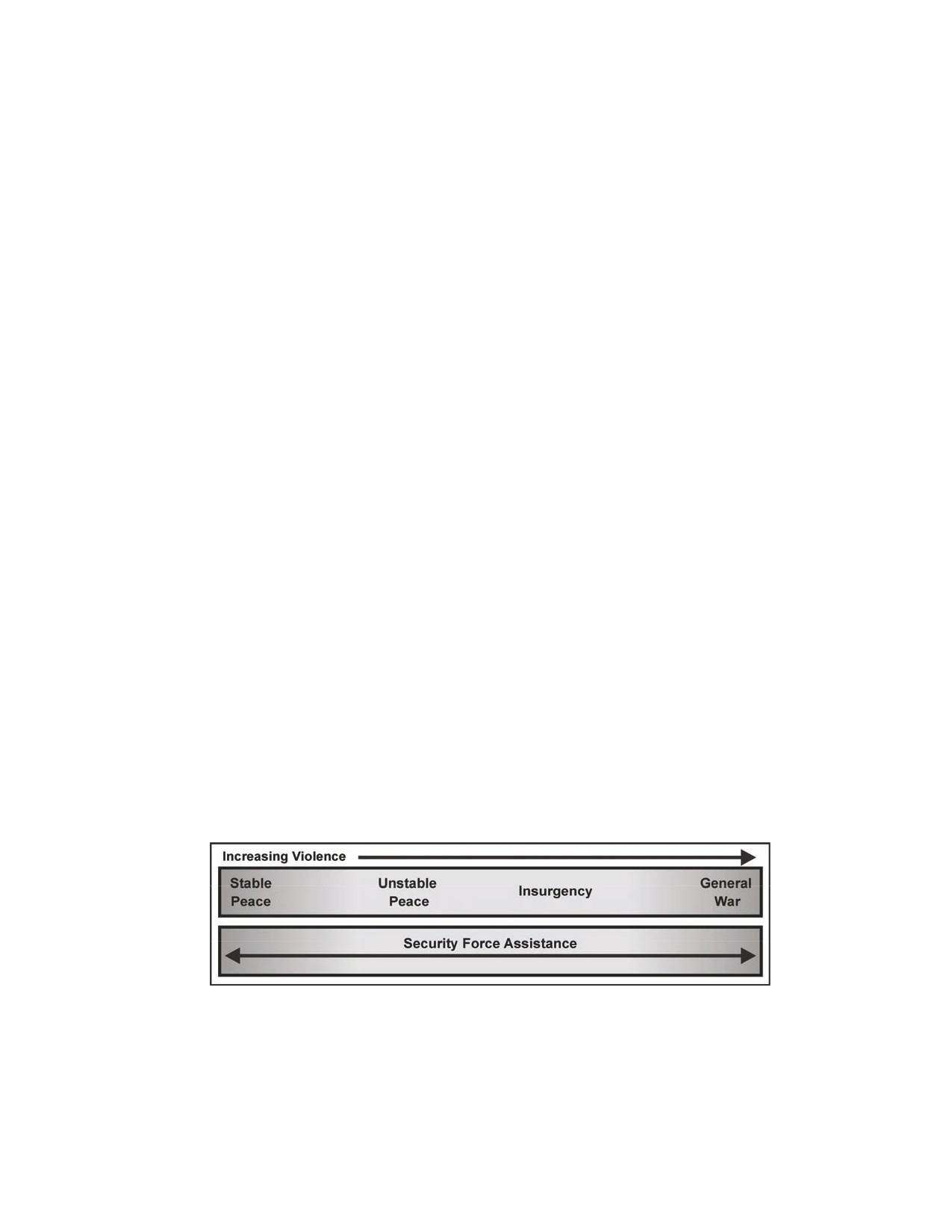
1-3. SFA can be conducted across the spectrum of conflict, from stable peace to general war. This
assistance could focus on improving the security forces of a host nation that is currently under no
immediate threat, on paramilitary forces to counter an insurgency, or on advising FSF in major combat
operations against an external threat. Figure 1-1 illustrates how SFA spans the spectrum of conflict.
Figure 1-1. The spectrum of conflict and security force assistance
1-4. SFA can occur as part of any operational themes—peacetime limited engagement, limited
intervention, peace operations, irregular warfare, and major combat operations. SFA often occurs during
peacetime military engagement, peace operations, and irregular warfare. SFA involving paramilitary forces
will often be limited to the irregular warfare operational theme, although paramilitary forces should
1 May 2009
FM 3-07.1
1-1
Chapter 1
eventually be absorbed, disbanded, or maintained in a long-term relationship with special operations
forces.
1-5. While Army units are vital contributors, SFA is part of a comprehensive approach. This
comprehensive approach should include close collaboration with military and civilian joint and
multinational forces. The host-nation or regional security organization is the key actor within the
comprehensive approach. It is vital that SFA is based on an objective, continuous assessment that examines
the organization, training, equipment, rebuilding, and advising of the forces involved.
1-6. Law enforcement, military, intelligence, and border forces operate and cooperate within the security
sector. U.S. forces understand how these units are intended to operate in the host-nation scheme, not
necessarily using a U.S. model. U.S. forces should plan to help develop the respective capabilities so that
these units can carry out their security functions.
1-7. Fully developed and institutionalized FSF plan, prepare, and execute at all the appropriate levels.
Thus, U.S. forces must integrate SFA into the operations process at all levels. SFA should be designed to
work seamlessly with the host-nation government at all levels, from ministries addressing the security
sector to initial entry-level FSF training.
NATIONAL STRATEGY AND DEFENSE POLICIES
1-8. U.S. strategy and foreign policy affects all SFA. More importantly, SFA is critical to these policies
as it is a primary tool for building partnership capacity with other nations. Key strategy documents for SFA
include the National Security Strategy, the National Defense Strategy, the National Military Strategy, the
Quadrennial Defense Review, and DODD 3000.05.
1-9. The National Security Strategy outlines the President’s vision for providing enduring security for the
American people in a volatile, uncertain, complex, and ambiguous strategic environment. The National
Security Strategy of 2006 addresses stability operations within the broad engagement strategy for regional
conflict. It supports SFA by “tailoring assistance and training of military forces to support civilian control
of the military and military respect for human rights in a democratic society.” This strategy also states that
“[t]he world has found through bitter experience that success often depends on the early establishment of
strong local institutions such as effective police forces and a functioning justice and penal system. This
governance capacity is critical to establishing the rule of law and a free market economy, which provide
long-term stability and prosperity.”
1-10. The National Defense Strategy encompasses the Secretary of Defense’s vision for the Department of
Defense role in protecting the American people and U.S. interests. This strategy stems from the National
Security Strategy. The 2008 National Defense Strategy highlights SFA. It states that “[o]ur strategy
emphasizes building the capacities of a broad spectrum of partners as the basis for long-term security.…
[l]ocal and regional conflicts in particular remain a serious and immediate problem…we will help build the
internal capacities of countries at risk…[b]y helping others to police themselves and their regions, we will
collectively address threats to the broader international system.”
1-11. The National Military Strategy supports the National Security Strategy, National Defense Strategy,
and Quadrennial Defense Review. The 2004 National Military Strategy states “[t]he Department will also
work to strengthen alliances and partnerships by helping other nations increase their ability to defend
themselves and protect common security interests.” Working with other nations and strengthening
partnerships appears throughout the National Military Strategy, which supports the importance of SFA.
1-12. The Quadrennial Defense Review is a congressionally mandated Department of Defense (DOD)
review of strategy, programs, and resources. The 2006 Quadrennial Defense Review directed that joint
ground forces
“possess the ability to train, mentor and advise FSF and conduct counterinsurgency
campaigns.” This review also stated that conventional forces need to be capable of training, equipping, and
advising local forces; deploying and engaging with partners; and supporting stability operations.
Additionally, the review envisioned conventional ground forces continuing to perform more of the tasks
traditionally performed by special operations forces. Conventional forces must understand foreign cultures
and societies as well as be able to train, mentor, and advise FSF.
1-2
FM 3-07.1
1 May 2009
The Strategic Context
1-13. DODD 3000.05 provides guidance on stability operations. DODD 3000.05 establishes that stability
operations are a core military mission and equal in importance to combat operations. DODD 3000.05 also
reinforces the importance of SFA by stating “[t]he immediate goal often is to provide the local populace
with security, restore essential services, and meet humanitarian needs. The long-term goal is to help
develop host-nation capacity for securing essential services, a viable market economy, rule of law,
democratic institutions, and a robust civil society.”
RELATED OPERATIONS AND PROGRAMS
1-14. Several operations or programs directly or potentially relate to SFA. These operations and programs
provide the context for SFA. They include security cooperation, security assistance, foreign internal
defense, internal defense and development (IDAD), and security sector reform. For more information on
operations related to SFA, see DOD 5105.38M, DOD security cooperation guidance, JP 3-07.1, FM 3-07,
FM 3-05.137, and AR 11-31.
SECURITY COOPERATION
1-15. Security cooperation is all Department of Defense interactions with foreign defense establishments
to build defense relationships that promote specific U.S. security interests, develop allied and friendly
military capabilities for self-defense and multinational operations, and provide U.S. forces with peacetime
and contingency access to a host nation (JP 3-07.1). Finally, security cooperation occurs across the
spectrum of conflict and is not exclusively a peacetime activity. Security cooperation includes security
assistance programs administered by the DOD as well as activities that enhance interoperability and the
collective capability of combined forces (using Title 10 or exercise funding and authority). Security
cooperation consists of a focused program of bilateral and multilateral defense activities conducted with
foreign countries to serve mutual security interests and build defense partnerships. Security cooperation is
governed by various sections of Title 10 and specific public laws addressing DOD interactions with other
nations.
1-16. AR 11-31 establishes Department of the Army policy and prescribes responsibilities and procedures
for the planning, integration, programming, budgeting, and execution of Army security cooperation
activities. It is the policy of the U.S. Army to conduct security cooperation activities in compliance with
higher-level guidance and in the execution of Army responsibilities under Title 10 and Title 22 which
governs the transfer, exchange, conduct, and development of articles and services via a variety of U.S.
Government programs.
1-17. Army security cooperation consists of official, cooperative, and noncombat interactions among any
Army elements, Active Army, or Reserve Components. This includes any U.S. Government or
nongovernment entity supporting the military and civilian joint and multinational organizations.
1-18. Commanders distinguish security cooperation from SFA based its emphasis in building relationships
and capacities by using programmatic activities. Thus, security cooperation may support or be supported
by SFA.
SECURITY ASSISTANCE
1-19. Security assistance is a group of programs authorized by the Foreign Assistance Act of 1961, as
amended, and the Arms Export Control Act of 1976, as amended, or other related statutes by which the
United States provides defense articles, military training, and other defense-related services by grant, loan,
credit, or cash sales in furtherance of national policies and objectives (JP 3-57). Security assistance is a
specific subset of security cooperation and may focus on external or internal threats.
1-20. DOD 5105.38-M describes the scope of security assistance programs in detail. Security assistance
allows the transfer of military articles and services to friendly foreign governments. These transfers may be
carried out via sales, grants, leases, or loans. If these transfers are essential to the security and economic
well-being of allied governments and international organizations, they are equally vital to the security and
economic well-being of the United States. U.S. forces can use security assistance to deliver defense
1 May 2009
FM 3-07.1
1-3
Chapter 1
weapon systems to foreign governments; to train international students; to advise other governments on
improving internal defense capabilities; and to provide guidance and assistance in establishing
infrastructures and economic bases for regional stability. Finally, security assistance cannot be conducted
using Title 10 or exercise funds.
1-21. The military component of security assistance, implemented by DOD with policies established by the
Department of State, has four principal components. They are international military education and training,
foreign military sales, foreign military financing program, and peace operations. The foreign military
financing program and international military education and training fall inside the military assistance
budget process of the Department of State. Security assistance can also include funding peace operations.
International Military Education and Training
1-22. International military education and training contributes to internal and external security of a country
by providing training to selected foreign militaries and related civilian personnel on a grant aid basis (see
JP 3-07.1). These programs help to strengthen foreign militaries through training for the proper functioning
of a civilian-controlled, apolitical, professional military. International military education and training
serves as a foreign policy tool where the United States shapes doctrine; promotes self sufficiency in
maintaining and operating U.S. acquired defense equipment; encourages the value of rule of law; and
occasionally has a marked effect on the policies of the recipient governments. Foreign students, many of
who occupy the middle and upper echelons of their country’s military and political establishments, are
taught U.S. doctrine and weapons systems employment resulting in greater cooperation and
interoperability. All international military education and training activities are SFA.
Foreign Military Sales
1-23. Foreign military sales is a nonappropriated program through which foreign governments can
purchase defense articles, services, and training from the United States (see JP 3-07.1). Eligible nations use
this program to help build national security infrastructures. However, nations that require assistance are
often unable to finance their needs. SFA supports foreign military sales when these sales include U.S.
forces providing equipment and related training. It does not support foreign military sales when these sales
provide equipment without related training.
Foreign Military Financing Program
1-24. The foreign military financing program provides funding to purchase defense articles and services,
design and construction services, and training through foreign military sales or commercial channels (see
JP 3-07.1). This program can assist nations with weak economies that would otherwise be unable to afford
U.S. assistance. The foreign military financing program can fund foreign military sales. SFA and the
foreign military financing program may be separate activities, although they can also be complementary.
FOREIGN INTERNAL DEFENSE
1-25. Foreign internal defense is the participation by civilian and military agencies of a government in any
of the action programs taken by another government or other designated organization to free and protect its
society from subversion, lawlessness, and insurgency (JP 3-05). U.S. foreign internal defense efforts
involve all instruments of national power to support host-nation IDAD programs. The military instrument
of foreign internal defense includes indirect support, direct support (not involving U.S. combat operations),
and combat operations. Foreign internal defense can occur across the spectrum of conflict and within any
operational theme. Foreign internal defense is often a part of irregular warfare or peacetime military
engagement operational theme. SFA may support the military instrument of foreign internal defense.
JP 3-07.1 discusses foreign internal defense in detail.
Note: It is a national policy decision for U.S. forces to accompany FSF on combat operations.
1-4
FM 3-07.1
1 May 2009
The Strategic Context
Military Instrument of Foreign Internal Defense
1-26. The military instrument of foreign internal defense supports the other instruments of national power
through activities ranging from peacetime military engagement to major combat operations. Although
foreign internal defense may include capacity building across the host nation, U.S. forces focus on
combating internal threats to help the host nation maintain legitimacy and influence over the population.
As such, foreign internal defense may be part of irregular warfare.
1-27. SFA and foreign internal defense support the host nation’s IDAD. Consequently, forces conducting
SFA must have proper mindset—they are part of a developmental and supporting effort. This applies even
if SFA is part of working with a potential adversary or an existing enemy. SFA and foreign internal
defense focus on working by, with, and through FSF and not conducting unilateral efforts to achieve
objectives.
Indirect Support
1-28. Indirect support efforts are foreign internal defense operations that emphasize the principle of host-
nation self-sufficiency. Indirect support focuses on building strong national infrastructures through
economic and military capabilities that contribute to self-sufficiency. For example, indirect support could
include U.S. assistance in improving a host-nation’s intelligence infrastructure. Contributions from U.S.
forces to indirect support come from security cooperation guidance through security assistance. They are
supplemented by multinational exercises, exchange programs, and selected joint exercises. Indirect support
that is focused on assisting security forces is SFA.
1-29. Although they indirectly assist those involved, military exchange programs are not SFA. Military
exchange programs foster mutual understanding between forces; familiarize each force with the
organization, administration, and operations of the other; and enhance cultural awareness. These exchange
programs often have long-term implications for strengthening democratic ideals and respect for human
rights among supported governments. However, such exchange programs (funded with Title 10 monies) do
not themselves become vehicles for security assistance training, as they do not intend to assist security
forces but to foster mutual understanding and enhance cultural awareness.
1-30. Joint and multinational exercises strengthen U.S. and host-nation relations and interoperability of
forces, but they are not SFA. They complement security assistance and civil-military operations by
validating host-nation needs and capabilities and by providing a vehicle for the conduct of humanitarian
and civic assistance programs (see JP 3-07.1). Strict legal restrictions clarify the type of support that U.S.
forces can provide and on the monetary limits of such support. These efforts are not SFA as they do not
intend to directly assist security forces; instead, they intend to improve relations and interoperability. See
appendix B.
Direct Support
1-31. Direct support does not involve combat operations but includes the use of U.S. forces providing
direct assistance to the host-nation civilians or military. Direct support often focuses on civil-military
operations (primarily, providing services to local civilians), psychological operations, intelligence and
communications sharing, and logistic support. Sometimes direct support will be SFA, such as
psychological operations, military training support, logistic support, and intelligence and communications
sharing. SFA is not a civil affairs activity such as foreign humanitarian assistance, humanitarian and civic
assistance, or military civic action.
1-32. Direct support differs from security assistance in that direct support is joint- or Service-funded.
Direct support does not usually involve transferring arms and equipment and does not often include
training local military forces. Direct support operations are normally conducted when the host nation has
not attained or regained self-sufficiency and when it still faces social, economic, or military threats beyond
its capability.
1 May 2009
FM 3-07.1
1-5
Chapter 1
Combat Operations
1-33. The introduction of U.S. combat forces into foreign internal defense operations requires a
Presidential decision. These operations are a temporary solution until host-nation forces can stabilize the
situation and provide security for civilians. In all cases, U.S. combat operations support the host-nation
IDAD program and remain strategically defensive in nature. When U.S. forces are advising, mentoring,
partnering, or augmenting host-nation forces in foreign internal defense combat operations, this is SFA.
When Army units conduct independent combat operations alongside FSF, this is not SFA.
1-34. U.S. tactical participation in host-nation internal conflicts requires judicious and prudent rules of
engagement and guidelines for applying force. Inappropriate destruction and violence attributed to U.S.
forces may easily reduce the legitimacy and sovereignty of the supported government. Adversaries may
also use such incidents to fuel anti-American sentiments and assist their cause.
SECURITY RELATIONSHIPS
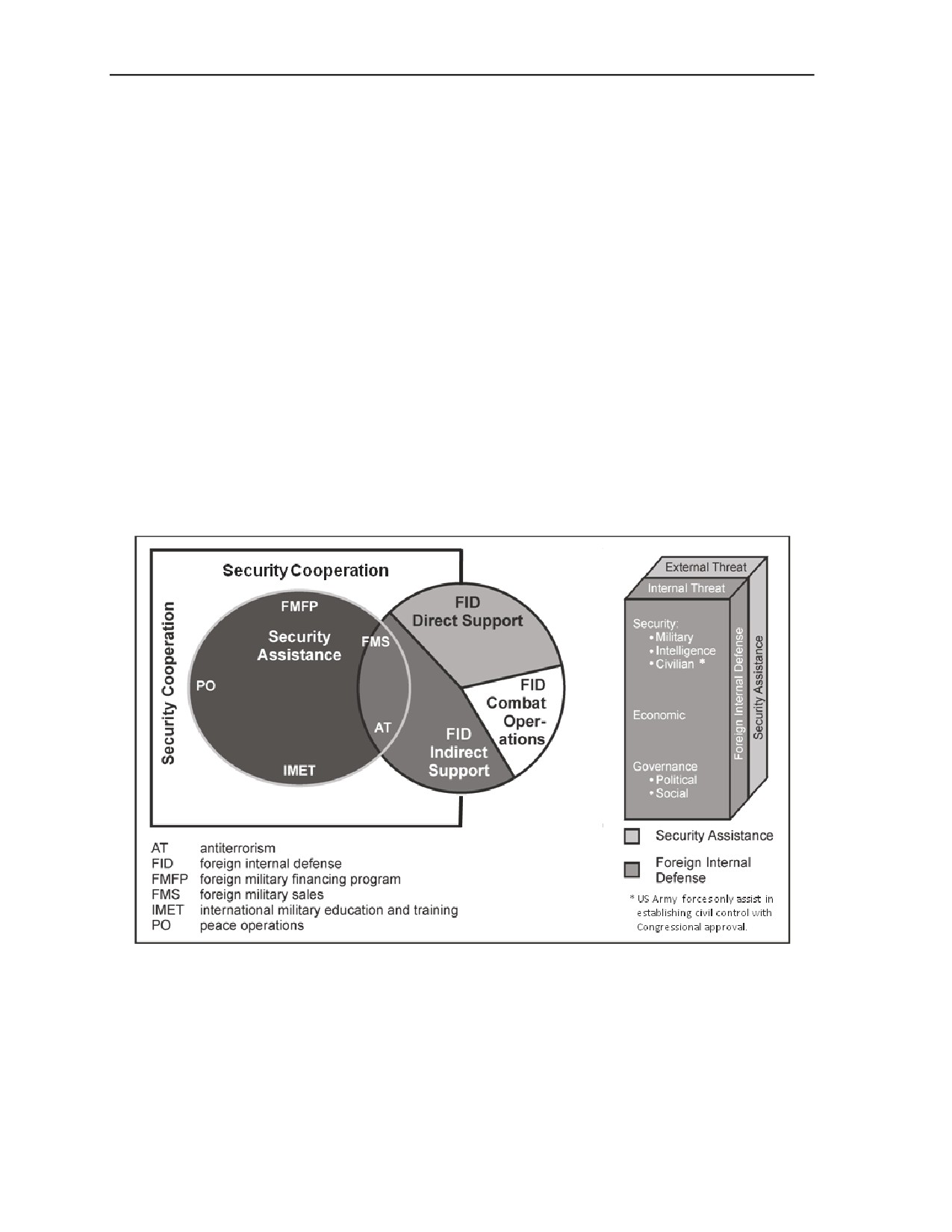
1-35. A complex relationship exists among security cooperation, security assistance, and the military
instrument of foreign internal defense. The left side of figure 1-2 depicts this relationship, including how
aspects of foreign internal defense and security assistance overlap. The right side of figure 1-2 illustrates
how foreign internal defense focuses on internal threats to a host nation and how security assistance
focuses on external threats. The column depicts how security
(military, intelligence, and civilian),
economic, and governance are considerations common to both foreign internal defense and security
assistance.
Figure 1-2. Security cooperation, security assistance, and foreign internal defense
INTERNAL DEFENSE AND DEVELOPMENT
1-36. Internal defense and development is the full range of measures taken by a nation to promote its
growth and to protect itself from subversion, lawlessness, and insurgency. It focuses on building viable
institutions (political, economic, social, and military) that respond to the needs of society (JP 3-07.1).
IDAD aims to forestall or defeat the threat and to correct core grievances that prompt violence. Ideally it is
1-6
FM 3-07.1
1 May 2009
The Strategic Context
a preemptive strategy. However, if an insurgency or other threat develops, it becomes an active strategy to
combat that threat. To support the host nation effectively, U.S. forces, especially planners, consider the
host-nation’s IDAD strategy.
1-37. IDAD focuses on building viable institutions that respond to the needs of society. IDAD is a U.S.
doctrinal term; it is not used universally by all countries. Internal defense and development blends four
interdependent functions to prevent or counter internal threats: balanced development, security,
neutralization, and mobilization. Finally, IDAD involves a cyclic interaction of execution, assessment, and
adaptation. JP 3-07.1 discusses IDAD and its functions in detail.
SECURITY SECTOR REFORM
1-38. Security sector reform is the set of policies, plans, programs, and activities that a government
undertakes to improve the way it provides safety, security, and justice (FM 3-07). Security sector reform
aims to provide an effective and legitimate public service that is transparent, accountable to civil authority,
and responsive to the needs of the public. It may include integrated activities to support defense and armed
forces reform; civilian management and oversight; justice, police, corrections, and intelligence reform;
national security planning and strategy support; border management; disarmament, demobilization, and
reintegration; and concurrent reduction of armed violence. SFA is a vital component of security sector
reform when security sector reform includes U.S. assistance to FSF. See chapter 6 of FM 3-07 for an
additional discussion of security sector reform.
SECURITY FORCE ASSISTANCE RELATIONSHIP
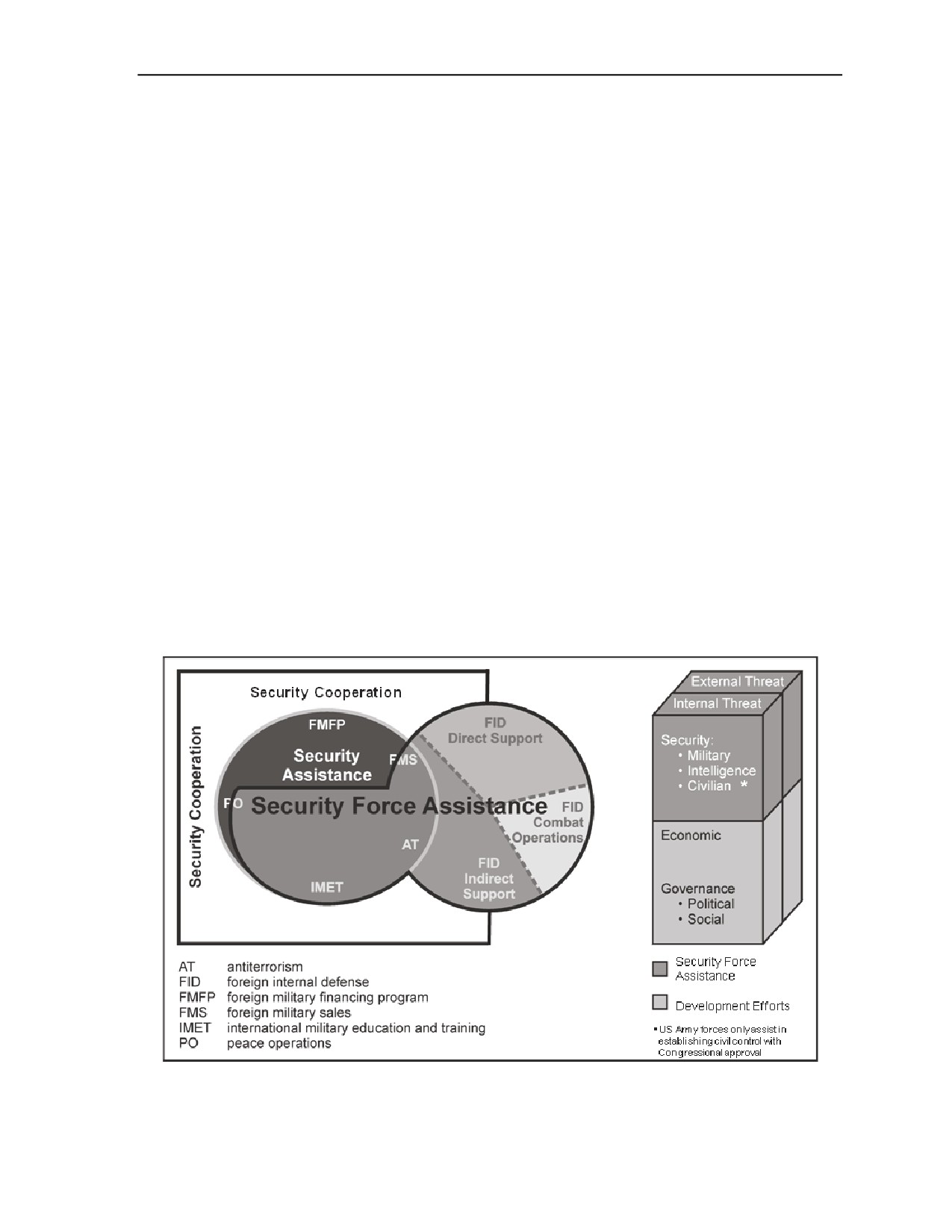
1-39. Paragraph
1-35 explained and figure
1-2 supported the complex relationship among security
cooperation, security assistance, and the military instrument of foreign internal defense. Figure
1-3
explains the relationship of SFA to security cooperation, security assistance, and the military instrument of
foreign internal defense. SFA supports the military instrument of foreign internal defense, much of security
assistance efforts, and some security cooperation efforts. The right side of figure 1-3 also shows that SFA
addresses security issues, but not economic or governance issues.
Figure 1-3. Relationship of security force assistance with security cooperation, security
assistance, and foreign internal defense
1 May 2009
FM 3-07.1
1-7
Chapter 1
COUNTRY TEAM
1-40. The country team will play a vital role with respect to SFA. The country team is the senior in-
country U.S. coordinating and supervising body headed by the U.S. chief of mission. The chief of mission
leads the country team and integrates U.S. efforts in support of the host nation. The chief of mission is the
highest U.S. civil authority in a foreign country. As the senior U.S. Government official permanently
assigned in the host nation, the chief of mission is responsible to the President for policy oversight of all
U.S. Government programs. The Foreign Service Act assigns the chief of mission to a foreign country with
responsibility for the direction, coordination, and supervision of all government executive branch
employees in that country except for Service members and employees under the command of a U.S. area
military commander.
1-41. The country team is composed of the senior member of each represented department or agency. As
permanently established interagency organizations, country teams represent a priceless resource. They
often provide deep reservoirs of local knowledge and interaction with the host-nation government and
population. See FM 3-07 and JP 3-07.4 for more information on the country team.
THEATER COMMAND STRUCTURES
1-42. SFA is inherently multinational. Nations do not relinquish their national interests by participating in
multinational operations. As in any multinational operation, commanders conducting SFA prepare to
address issues related to legality, mission mandate, and prudence early in the planning process. In
multinational operations, consensus often stems from compromise.
1-43. Political considerations heavily influence the ultimate shape of the command structure in which U.S.
forces will conduct SFA. However, participating nations should strive to achieve unity of command for the
operation to the maximum extent possible. All participants must understand missions, tasks,
responsibilities, and authorities. While well defined in U.S. doctrine, command relationships are not
necessarily part of the doctrinal lexicon of nations with which the United States may operate in coalition or
combined operations.
1-44. Command and control relationships of higher echelons take precedence when conducting SFA. As a
result, the brigade combat team (BCT) may be a supported command from a U.S. perspective as well as
acting as a supporting command for FSF in the BCT’s area of operations. For example, a BCT may support
a joint interagency task force conducting international police training. Another example is a joint command
supporting a BCT with joint fires; intelligence, surveillance, and reconnaissance; or other capabilities while
the BCT supports FSF in training. The basic structures for multinational operations fall into one of three
types: lead nation, integrated, or parallel command. Alliance and coalition commands use these structures.
Lead Nation Command Structure
1-45. A lead nation command structure exists when all member nations place their forces under the control
of one nation. The lead nation command has a dominant lead nation command and staff arrangement with
subordinate elements retaining strict national integrity. This command may also have an integrated staff
and multinational subordinate forces. Integrating the staff allows the commander to draw upon the
expertise of allied or coalition partners in areas where the lead nation may have less experience. This is the
most desirable command structure for SFA.
Integrated Command Structure
1-46. Multinational commands organized under an integrated command structure provide unity of effort in
a multinational setting. An integrated, combined command has several distinguishing features. Besides a
designated single commander, the staff consists of representatives from all member nations. Subordinate
commands and staffs are integrated into the lowest echelon necessary. Although effective for SFA, the
integrated command structure works less effectively than the lead nation command structure.
1-8
FM 3-07.1
1 May 2009
The Strategic Context
Parallel Command Structure
1-47. Under a parallel command structure, no single force commander is designated. The coalition
leadership develops a means for coordination among the participants to attain unity of effort. They can
accomplish this by using coordination centers. Nonetheless, because of the absence of a single commander,
the use of a parallel command structure should be avoided if at all possible. This is the least desirable
command structure for SFA.
Alliance Command Structures
1-48. In combined commands, national political objectives are addressed and generally subsumed within
multinational force objectives at the alliance treaty level. Combined command relationships often reflect
either an integrated command structure or a lead nation command structure. In combined operations such
as SFA, these structures should be used to the maximum practical extent. Combined command and force
structures often mirror the degree of allied member participation. Senior military officers from member
nations often lead subordinate commands. Effective operations within an alliance, including SFA, require
senior political and military authorities to agree on the type of command relationships that will govern the
operations of the forces. Potential political sensitivities associated with SFA can impact command
relationships and operating procedures.
Coalition Command Structures
1-49. Coalitions often form in response to unforeseen crises that occur outside the area of an established
alliance, which is often the case for SFA. Coalition command relationships routinely evolve as a coalition
develops. Coalitions often have one of two basic structures: lead nation or parallel. For SFA, all
participating coalition members should augment the host-nation headquarters staff with representatives.
These representatives might include designated deputies or assistant commanders, planners, and
logisticians. Such staffing provides the coalition commander with representative leadership and accessible
expertise on the capabilities of the coalition members as well as facilitates the planning process. This
integration of the multinational command elements into the coalition planning process should occur as
early as practical.
Integration of Conventional and Special Operations Forces
1-50. Many criteria determine when conventional forces, special operations forces, or a combination are
appropriate to conduct SFA. Both force levels and force characteristics suggest optimal, acceptable, and
undesirable force package options in planning and resourcing SFA. Options for the deployment of a
modular brigade augmented for SFA, a select number of conventional military transition teams, or special
operations forces depend on conditions of the operational environment, priorities of the IDAD strategy,
overall U.S. national policy, and forces available.
1-51. Rarely will U.S. forces conducting SFA be homogenous in terms of conventional or special
operations forces, but rather contain both. FM 3-0 and other Army doctrine define command and control
relationships and support relationships when both forces operate in the same area. Recent operational
experience has shown that, in improving the effectiveness of FSF, the supported commander conducting
SFA may be either a conventional force or special operations force commander. Subordinate commanders
and staffs of both conventional and special operations forces may act in the supporting role to the U.S.
ambassador. Typically this is done through the security assistance officer or the defense attaché at the
American Embassy.
1-52. If U.S. forces are to train a large number of FSF in a short time, then the requirement may exceed the
capacity of available special operations forces. Large SFA missions occur at the geographic command level
or higher headquarters. Planners at these levels determine the number of conventional and special
operations forces as part of their mission analysis aimed at training enough FSF in the given time frame. To
best prepare for a large SFA, U.S. forces might deploy one or more augmented modular brigades supported
by Army special operations forces. These forces conduct complementary foreign internal defense tasks
under Title 22 authorities. Another option involves using special operations forces training FSF over
1 May 2009
FM 3-07.1
1-9
Chapter 1
several years while using a broad mix of funding and authorities. Another option uses a modular brigade to
support a select number of company- or battalion-sized foreign units.
1-53. A force analysis of how best to integrate conventional and special operations forces to accomplish
SFA considers host-nation and U.S. national policies. Skill sets among conventional and special operations
forces trainers, advisors, and mentors avoid universally excluding or including final, integrated force
packages for SFA. Planners leverage skill sets by integrating and coordinating conventional and special
operations units with assigned tasks within SFA. Force analysis of the FSF to be trained often suggests a
two-phase approach to training. This analysis also suggests a transition to the FSF by either conventional
or special operations forces using basic and advanced training. The type of training depends on the nature
of the foreign security force being trained. Additionally, integrating the advisor may be a phased process
using either conventional or special operations forces as the initial advisor. This method lends itself to the
classic crawl-walk-run approach to assisting FSF.
1-10
FM 3-07.1
1 May 2009
Chapter 2
Framework
This chapter discusses a doctrinal framework for the conduct of security force
assistance. This security force assistance framework is composed of the mindset
required of units and Soldiers, imperatives for success, inherent tasks and activities,
and the three types of security force assistance.
MINDSET
2-1. Conducting successful security force assistance (SFA) requires a specific mindset. This mindset
focuses on working by, with, and through foreign security forces (FSF) to support the host nation’s internal
defense and development (which includes local security requirements) or regional organization’s charter.
Soldiers conducting SFA must also understand that legitimacy is vital. The relevant population must
perceive FSF as legitimate for long-term success. Those conducting SFA must understand that the military
instrument of national power is only one part of a comprehensive approach. The imperatives of SFA
provide the foundation for proper mindset.
Note: Host nation includes partner organization.
2-2. SFA focuses on how FSF organizations, institutions, systems, capabilities, and limitations—not U.S.
organizations, systems, procedures, and equipment—can be enabled to address the host-nation or partner
organization problems. Local forces have advantages over outsiders. They inherently understand the local
culture and behavior that outsiders simply lack. To tap into those advantages, advisors must resist blatant
military solutions. To overcome the temptation to do what they know and do best, whether relevant or not
to the situation, advisors must accept that they are bound by unique situations.
IMPERATIVES
2-3. The imperatives of SFA come from the historical record and recent experience. These imperatives do
not replace the principles of war or the principles of joint operations. Rather, they provide focus on how to
successfully conduct SFA. The six imperatives apply to SFA at every level of war, for any echelon, and for
any Soldier.
2-4. Since there is a close relationship between SFA and Army special forces conducting foreign internal
defense, SFA planners should also consider the twelve Army special operations forces imperatives,
especially at the tactical level (see appendix A).
UNDERSTAND THE OPERATIONAL ENVIRONMENT
2-5. An in-depth understanding of the operational environment—including available FSF, opposing
threats, and civil considerations—is critical to planning and conducting effective SFA. Units and Soldiers
conducting SFA must clearly understand the theater, population, and FSF with which they are working,
especially FSF capabilities. Diplomatic, informational, military, economic, sociological, psychological, and
geographic research and understanding are essential prerequisites for successful SFA. Tactically,
successful SFA requires identifying the friendly and hostile decisionmakers, their objectives and strategies,
and the ways they interact. Further, the conditions of the operational environment can rapidly change, and
those conducting SFA must anticipate these changes and exploit potential and possibly fleeting
opportunities.
1 May 2009
FM 3-07.1
2-1
Chapter 2
PROVIDE EFFECTIVE LEADERSHIP
2-6. Leadership, a critical aspect of any application of combat power, proves important in the dynamic
and complex environments associated with SFA. The operational environment in which SFA occurs places
a premium on effective leadership at all levels, from the most junior to the most senior general officer and
agency director. Leading FSF or a combined group of U.S. and foreign security forces is inherently more
challenging due to differences in culture, language, training, and other aspects. Leaders focus on
transitions; their decisions move the foreign security force toward independent operations.
BUILD LEGITIMACY
2-7. Ultimately, SFA aims to develop security forces that contribute to the legitimate governance of the
local populace. Significant policy and legal considerations may apply to SFA activities. Legitimacy is the
most crucial factor in developing and maintaining internal and international support. The United States
cannot sustain long-term SFA without legitimacy. Legitimacy is a concept that goes beyond a strict legal
definition; it includes the moral and political legitimacy of a host-nation government or partner
organization. Local civilians and the international community determine the government’s legitimacy
based on collective perception of the credibility of its cause and methods.
MANAGE INFORMATION
2-8. Successful SFA disseminates timely and protected relevant information, integrates it during
planning, and leverages it appropriately during execution. Effective and efficient information management
supports decisionmaking throughout capacity building. Managing information encompasses the collection,
analysis, management, application, and preparation of information. Maintaining continuity between
rotating SFA elements is critical. For long-term SFA efforts, FSF expect more professional abilities from
U.S. advisors. To meet expectations and success in general, units conducting SFA establish and integrate
lessons learned. Capturing and incorporating evolving tactics, techniques, and procedures and aspects of
the operational environment is vital; with each successive rotation, planners strive to maintain continuity
and momentum. Finally, planners synchronize effective information engagement with the entire mission.
See appendix C. SFA operations inherently affect the dynamic operational environment.
ENSURE UNITY OF EFFORT
2-9. SFA often includes many actors, making unity of effort essential for success. SFA will include U.S.
and foreign security forces, including conventional forces, special forces, or a combination. Other civilian
and military joint and military organizations are often involved in SFA. Planners integrate them into one
cohesive effort.
SUSTAIN THE EFFORT
2-10. Sustainability consists of two major components: the ability to sustain SFA effort throughout the
operation and the ability of the FSF to sustain their operations independently. While each situation will
vary, Army personnel conducting SFA must avoid assisting FSF in techniques and procedures beyond the
FSF’s capability to sustain. U.S. tactics, techniques, and procedures must be modified to fit the culture,
educational level, and technological capability of the FSF. Those involved in SFA must recognize the need
for programs that are durable, consistent, and sustainable by both the U.S. and FSF. They must not begin
programs that are beyond the economic, technological, or cultural capabilities of the host nation to
maintain without U.S. assistance. Such efforts are counterproductive.
TASKS
2-11. SFA aims to establish conditions that support the partner’s end state, which includes legitimate,
credible, competent, capable, committed, and confident security forces. This requires a force capable of
securing borders, protecting the population, holding individuals accountable for criminal activities,
2-2
FM 3-07.1
1 May 2009
Framework
regulating the behavior of individuals or groups that pose a security risk, and setting conditions in the
operational area that enable the success of other actors.
2-12. This section addresses the six SFA tasks: organize, train, equip, rebuild and build, and advise and
assist. When supporting the development of FSF, commanders understand their role with the host-nation or
regional security organization. These tasks facilitate SFA planners to assess and allocate resources based
on conditions.
ORGANIZE
2-13. Organize is a SFA task that encompasses all measures taken to assist FSF in improving its
organizational structure, processes, institutions, and infrastructure. U.S. forces must understand the existing
security organizations of FSF to better assist them. Subsequently, SFA personnel may help the host nation
organize its security forces to meet the needs of its security environment.
2-14. Organizing a foreign security force depends on the host nation’s social and economic conditions,
cultural and historical factors, and security threats. SFA aims to create an efficient organization with a
command, intelligence, logistic, and operations structure viable for the host nation. Conventional forces
with limited special purpose teams (such as explosive ordnance disposal) are preferred. Doctrine or
standing operating procedures should apply across the force, as should unit structures. The organization
must facilitate the collection, processing, and dissemination of intelligence across and throughout all
security forces. As the foreign security force strengthens, U.S. leaders and trainers should expect more
independent organizational decisions.
2-15. The host nation determines the structure of its military forces, to include approving all organizational
designs. These may include changing the numbers of forces, types of units, and internal organizational
designs.
2-16. Organization should address all FSF, from the ministerial level to the patrolling police officer and
soldier. Building a competent FSF infrastructure—including civilian information systems—is critical for
success. Commanders work with ministries responsible for national and internal security, including the
ministry of national defense, the interior ministry, and the justice ministry. Commanders assess strengths
and weaknesses of the ministerial organization as well as training requirements of their employees. The
joint and multinational advisor team at the ministry level helps the host nation develop a procurement and
management system to meet its requirements.
2-17. Organizing a foreign security force requires resolving issues related to—
z
Recruiting.
z
Promotion screening and selection.
z
Pay and benefits.
z
Leader recruiting and selection.
z
Personnel accountability.
z
Demobilization of security force personnel.
Recruiting
2-18. Recruiting is critical when establishing FSF. The recruiting program assimilates local culture and
themes that resonate with the populace. The program ensures that FSF have members from all major
demographic groups. Joint and multinational partners should encourage and support efforts to recruit from
minority populations. Mobile recruiting can target specific areas, ethnic groups, or tribes. Forces should
encourage moderate groups and factions within hostile or potentially hostile ethnic groups to join the
foreign security force. Often host-nation governments resist recruiting disaffected ethnic groups. However,
even moderate success in recruiting from these groups provides enormous payoffs. It builds the security
forces’ legitimacy and often quiets legitimate fears of such groups regarding their relationship to the host-
nation government. Effectively disarming, demobilizing, and reintegrating former enemies or other armed
groups should be part of the overall plan. These programs should be mentioned in recruiting efforts.
1 May 2009
FM 3-07.1
2-3
Chapter 2
2-19. A proper recruiting program specifies appropriate behavioral, physical, and moral standards. Ideally,
recruits are centrally screened and inducted. Recruiting centers reside in safe areas safe. All recruits
undergo a basic security check and are vetted against lists of suspected enemies. Foreign agencies and
personnel perform this screening. Membership in illegal organizations needs to be carefully monitored.
Past membership need not preclude a person from joining the foreign security force; however, any ongoing
relationship with an illegal organization requires constant monitoring. FSF personnel limits the members of
an illegal unit, tribal militia, or other militant faction to a single military or police unit.
Promotion Screening and Selection
2-20. Selection for promotion must stem from proven performance and aptitude for increased
responsibility. Objective evaluations ensure promotion is by merit and not through influence or family ties.
One method of selection identifies the most competent performers, trains them, and recommends them for
promotion. The second method identifies those with social or professional status within the training group,
then trains and recommends them for promotion. The first method may lead to more competent leaders but
could be resisted for cultural reasons. The second method ensures the new leader will be accepted
culturally but may sacrifice competence. The most effective solution comes from combining the two
methods.
Pay and Benefits
2-21. Appropriate compensation precludes a culture of corruption in FSF. Spending the money needed for
adequate wages and producing quality security forces is less costly than ending up with corrupt and
abusive forces that alienate the populace. Paying the police adequately is especially important; their duties
and contact with civilians often expose them to opportunities for corruption.
2-22. Payroll procedures and systems are also vitally important. They must be transparent and accountable,
so FSF members receive their full pay and entitlements. Centralized administration of compensation
through secure, automated systems minimizes the risk for corruption and manipulation; however, the
supporting infrastructure will have to be available or developed over time.
2-23. Effective FSF can help improve host-nation social and economic development through the benefits
each member receives. Every recruit should receive a basic education, job training, and morals and values
inculcation.
Leader Recruiting and Selection
2-24. Officer candidate standards should be high. Candidates should have good health and pass an
academic test with higher standards than the test for enlisted recruits. Recruiters carefully vet officer
candidates to ensure that they do not have close ties to any radical or enemy organization.
2-25. Noncommissioned officers should be selected from the best enlisted FSF members. Objective
standards, including proficiency tests, should be established and enforced to ensure that promotion to their
ranks comes from merit. Many armies lack a professional noncommissioned officer corps; establishing one
for a foreign security force may prove difficult. In the meantime, adjustments will have to be made, placing
more responsibility on commissioned officers.
Personnel Accountability
2-26. Host-nation leaders carefully track and account for FSF. Proper personnel accountability reduces
corruption, particularly in countries with manual banking systems where soldiers are paid in cash. In
addition, many personnel failing to report for duty can indicate possible attacks, low unit morale, or enemy
and militia influences on the foreign security force.
Demobilization of Foreign Security Force Personnel
2-27. Host nations develop programs to keep a class of impoverished and disgruntled former officers and
soldiers from forming. As the foreign security force mature, officers who perform poorly or fail to meet the
2-4
FM 3-07.1
1 May 2009
Framework
standards will need to be removed. Providing some form of government-provided education grants or low-
interest business loans enables discharged personnel to earn a living outside the military. All soldiers who
serve for several years and are then removed should receive a lump-sum payment or pension to ease their
transition to civilian life. These programs should not apply to those guilty of major human rights abuses or
corruption. Transition or demobilization planning should start as soon as commanders anticipate the need
(it may not be required in all cases). Similar programs may be required when demobilizing nongovernment
militias.
TRAIN
2-28. Train is a SFA task to assist FSF by developing programs and institutions to train and educate. These
efforts must fit the nature and requirements of their security environment. The imperatives of Army special
operations forces for facilitating a comprehensive approach and engaging the threat discriminately apply to
the train task (see appendix A).
Training the U.S. Trainers
2-29. Soldiers assigned training missions should receive training on the requirements of developing FSF.
The training should emphasize the host nation’s cultural background, introduce its language, and provide
cultural tips for developing a good rapport. Training should also include protection for troops working with
FSF. U.S. trainees must become familiar with FSF organization and equipment, especially weapons not in
the U.S. inventory. This training must emphasize the following:
z
Sustaining training and reinforcing individual and team skills.
z
Using the smallest possible student-to-instructor ratio.
z
Developing host-nation trainers.
z
Training to standards—not to time.
z
Providing immediate feedback; using after action reviews.
z
Respecting the culture but learning to distinguish between cultural practices and excuses.
z
Learning the language.
z
Working with interpreters.
2-30. U.S. forces should show respect for local religions and traditions. They should willingly accept many
aspects of the local and national culture, including food (if sanitation standards permit). U.S. forces must
stress that they do not intend to undermine or change the local religion or traditions. However, they have to
strive to reduce how dysfunctional social practices affect the foreign security force’s ability to conduct
operations. U.S. trainers and advisors must have enough awareness to identify and stop inappropriate
behavior, or at least report it to the appropriate chains of command.
Establishing Training Standards
2-31. Training in SFA involves many of the individual and collective skills performed in conventional
military operations. All levels of training for all components should include values training. Metrics for
evaluating units should include subjective measures, such as loyalty to the host-nation government, as well
as competence in military tasks. Soldiers know how to evaluate military training. However, the acceptance
of values, such as ethnic equality or the rejection of corruption, may be a better measure of training
effectiveness. Gauging this acceptance is far more difficult than evaluating task performance. While the
operational environment varies widely, FSF and trainers can still establish clear measures to evaluate the
training of individuals, leaders, and units.
2-32. Effective training programs require clear, detailed individual, leader, and unit performance
standards. These standards take into account cultural factors that directly affect the ability of the individual
or unit to operate. For example, training a staff or unit to conduct effective operations requires more time in
countries where the average soldier is illiterate. Building a security force from the ground up takes far more
time than creating one around a trained cadre. Thus, using existing military personnel to form units and
cadres for units often proves better than creating novice security forces.
1 May 2009
FM 3-07.1
2-5
Chapter 2
2-33. Often, poorly trained leaders and units commit more human rights violations than well-trained, well-
led units. Leaders and units unprepared for the pressure of active operations tend to use indiscriminate
force, target civilians, and abuse prisoners. These actions can threaten the popular support and government
legitimacy essential for SFA success. Badly disciplined and poorly led FSF can facilitate insurgent
recruiting and propaganda efforts.
2-34. Setting realistic measures for FSF and following through on training plans consume time. The
pressure is strong to find training shortcuts, employ quick fixes, or train personnel on the job. Trainers
should resist such approaches. Such approaches often create more problems than they solve. However,
trainers should also avoid the temptation to create long, complex training programs based on unrealistic
standards. Effective programs account for the host nation’s culture, resources, and short-term security
needs. No firm rules exist on how long particular training programs should take. Trainers can use existing
and historical training programs to determine how long training should take. To a certain extent, the enemy
threat dictates the length of training. As security improves, training programs can expand to facilitate
achievement of the long-term end state.
Training Foreign Security Forces
2-35. Members of FSF develop through a systematic training program (individual training and education
as well as collective training). The program builds basic skills, then teaches them to work as a team, and
finally allows them to function as a unit. Basic military, intelligence, or law enforcement training focuses
first on basic skills such as legal considerations, first aid, marksmanship, and fire discipline. Leaders have
training in tactics, including patrolling, urban operations, and legal evidence collection. Everyone must
master rules of engagement and the law of armed conflict. FSF units should train to standard for
conducting the major operations they will face.
Training Leaders
2-36. The effectiveness of FSF directly relates to the quality of their leadership. Building effective leaders
requires a comprehensive program of officer, staff, and specialized training. The ultimate success of any
SFA effort depends on creating viable FSF leaders able to carry on the fight at all levels and build their
nation on their own.
2-37. The standards of leader training reinforce different levels of authority within the foreign security
force. Clearly established responsibilities for commissioned and noncommissioned officers specify what is
expected of recruits and leaders. To ensure civilian control, subordinate relationships to civilian authorities
also are reinforced. In addition, training should establish team dynamics. In some cultures, security forces
may need training to understand the vital role of members not in primary leadership positions. For
example, noncommissioned officers may be a new or different concept for some FSF.
Employing Newly Trained Forces
2-38. SFA must build the morale and confidence of FSF. Committing poorly trained and badly led forces
results in high casualties and invites tactical defeats. While defeat in a small operation may have little
strategic consequence in a conventional war, often a small tactical defeat of FSF has serious strategic
consequences. If the foreign security force fails, the local populace may begin to lose confidence in the
host-nation government’s ability to protect them. FSF must prepare for operations so they have every
possible advantage. As much as possible, FSF should begin with simpler missions. As their confidence and
competence grows, these forces can assume more complex assignments. Collaborating with joint or
multinational units can help new forces to adjust to combat stress.
2-39. Newly trained units should enter their first combat operation in support of more experienced foreign
units. Operational performance of such inexperienced organizations should be carefully monitored and
evaluated to correct weaknesses quickly. The employment plan for FSF should allow enough time for
additional training after each operation. Gradually introducing units into combat allows the command to
identify poor leaders for retraining or other actions. Competent leaders are also identified and given greater
authority and responsibility.
2-6
FM 3-07.1
1 May 2009
Framework
EQUIP
2-40. Equip is a SFA task encompassing all efforts to assess and assist FSF with the procurement, fielding,
and sustainment of equipment. All equipment must fit the nature of the operational environment. The SFA
principle of ensuring long-term sustainment is a vital consideration for the equip task.
2-41. The strategic plan for security force development should outline equipment requirements.
Appropriate equipment is affordable and suitable against the threat. Forces must be able to train on the
equipment. Interoperability may be desired in some cases. A central consideration includes the host
nation’s long-term ability to support and maintain the equipment.
2-42. The initial FSF development plan should use a comprehensive approach with local, regional,
national, and other appropriate actors. Fundamentally, it should support the internal defense and
development strategy. It should include phases with objectives for FSF to meet over three to four years.
Since potential enemies adapt rapidly and situations change, commanders must continually assess the
direction and progress of developing FSF.
2-43. The requirement to provide equipment may be as simple as assisting with maintenance of existing
formations or as extensive as providing everything from shoes to communications and investigation kits. If
the enemy uses heavy machine guns and rocket-propelled grenades, then FSF need comparable or better
equipment. This especially applies to police forces, which are often lightly armed and vulnerable to well-
armed enemies.
2-44. Primary considerations should include maintainability, ease of operation, and long-term sustainment
costs. Few developing nations can support highly complex equipment. In most operations, having many
versatile vehicles that require simple maintenance is often better than having a few highly capable armored
vehicles or combat systems that require extensive maintenance. Effective maintenance systems for FSF
often begin with major maintenance performed by contractors. The program then progresses to
arrangements with U.S. forces as they train foreign personnel to conduct the support mission.
2-45. Sources of materials for FSF include U.S. foreign military sales (not technically SFA), multinational
or third-nation resale of property, contracts with internal suppliers, or purchases on the international
market. The organizations responsible for equipping FSF require flexibility to obtain equipment that meets
their needs for quality, timeliness, and cost. As part of their training, FSF also need to learn property
accountability to reduce corruption and ensure proper equipment usage. FSF provide equipment the same
level of control and protection that U.S. forces provide for similar equipment.
(See AR 12-1 and
DOD 5105.38M.)
REBUILD AND BUILD
2-46. Rebuild and build is a SFA task to assess, rebuild, and build the existing capabilities and capacities
of FSF and their supporting infrastructure. This task requires an in-depth analysis of the capability,
capacity, and structures required to meet the desired end state and operational environment. Some FSF may
require assistance in building and rebuilding, while other FSF may only need assistance in building.
2-47. FSF need infrastructure support. People need buildings for storage, training, and shelter. Often
requirements include barracks, ranges, motor pools, and other military facilities. Construction takes time;
the host nation needs to invest early in such facilities if they are to be available when needed. Forces must
plan to protect any infrastructures, including headquarters facilities, since these building are attractive
targets for insurgents. (See FM 3-34.400 for information on hardening measures to increase infrastructure
survivability and improve protection.)
2-48. During some operations, such as counterinsurgency, foreign military and police forces often operate
from local bases. Building training centers and unit garrisons requires a long-term force-basing plan. If
possible, garrisons should include housing for the host-nation soldiers and their families; government-
provided healthcare for the families; and other attractive benefits.
1 May 2009
FM 3-07.1
2-7
Chapter 2
2-49. The host nation may need to make large investments in time and resources to restore or create the
nationwide infrastructure necessary to effectively command and control FSF. The host nation will build
functional regional and national headquarters and ministries as well as local bases and police stations.
ADVISE AND ASSIST
2-50. Advise and assist is a SFA task in which U.S. personnel work with FSF to improve their capability
and capacity. Advising establishes a personal and a professional relationship where trust and confidence
define how well the advisor will be able to influence the foreign security force. Assisting is providing the
required supporting or sustaining capabilities so FSF can meet objectives and the end state. The level of
advice and assistance is based on conditions and should continue until FSF can establish required systems
or until conditions no longer require it. Leaders cannot permit FSF to fail critically at a point that would
undermine the overall effort. See chapter 6 for a discussion on advisors.
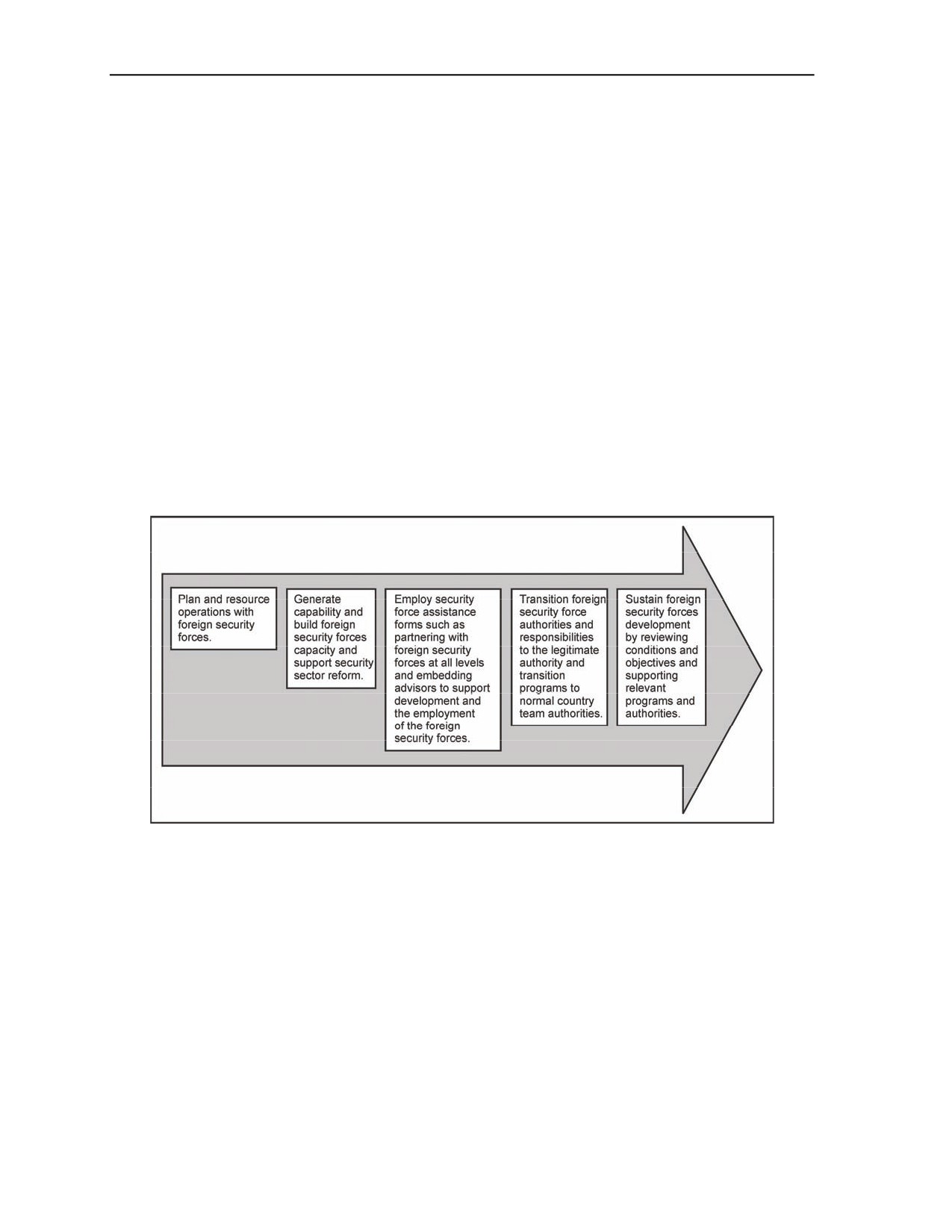
ACTIVITIES
2-51. SFA is inherently a developmental effort. Success is measured by the increase in the foreign security
force’s capability, capacity, competency, commitment, and confidence in areas in which U.S. forces are
assisting them and as a whole. SFA activities include plan and resource, generate, employ, transition, and
sustain. Figure 2-1 depicts the SFA activities. These activities blend over time based on the capability and
capacity of FSF.
Figure 2-1. Security force assistance activities
PLAN AND RESOURCE
2-52. The plan and resource SFA activity begins as commanders understand the operational environment
and determine the requirements of FSF. It also ensures that the United States provides SFA that achieves
the objectives and end state of both the host nation and United States. The host nation and United States
should then analyze the resource requirements and efforts so that developing FSF have sufficient and
appropriate resources. Chapter 4 provides additional detail on planning for facilities and infrastructure.
GENERATE
2-53. The generate SFA activity includes generation of FSF, including the forces, leaders, and warfighting
function capabilities (movement and maneuver, intelligence, fires, sustainment, command and control, and
protection) based on the desired end state.
2-8
FM 3-07.1
1 May 2009
Framework
EMPLOY
2-54. The employ SFA activity involves FSF transitioning from force generation to mission employment.
It does not rely on the maturity of the force or supporting institutions as a whole but is focused on the
foreign element in question. Conditions determine when to use an element of FSF. Leaders of U.S. and
foreign security forces assess the risk associated with employment and mitigate that risk as much as
possible.
TRANSITION
2-55. The transition SFA activity defines the transition between two security forces, when applicable. This
could be a transition of authority between U.S. forces to a new foreign security force. Another example
could be from a regional foreign security force to a foreign security force with U.S. advisors. It could also
be from a host-nation military force to a host-nation police force, with or without U.S. advisors.
SUSTAIN
2-56. The sustain SFA activity occurs when the institutional capacity of the foreign security force has been
developed to a point where it is self sustaining. It may continue to have SFA contact through combined
exercises, educational opportunity exchange, intelligence sharing, and foreign military sales.
TYPES
2-57. The U.S. or other actors use three types of SFA—augmenting, partnering, and advising—to develop
confident, competent, capable, committed, and credible FSF. These types of SFA define the relationship
between outside actors and the foreign security force. They may be employed simultaneously, sequentially,
or in combination. The progression and types of SFA are determined by the operational environment, the
assessment of the FSF, and by resources available. Each of these types requires decidedly different
requirements, objectives, and legal considerations.
ADVISING
2-58. Advising is the primary type of security force assistance. Advising is the use of influence to teach,
coach, and advise (see chapter 6) while working by, with, and through FSF. This type of SFA relies on the
ability of the advisor to provide relevant and timely advice to FSF. Advising helps FSF conduct
independent decisionmaking and operations. Advisors may also provide FSF with direct access to joint and
multinational capabilities such as air support, artillery, medical evacuation, and intelligence. However, the
advisor and advisor team require proper manning and equipment to perform these secondary support
functions while staying focused on advising. Multiple sources will pressure advisors as they perform their
missions. For example, nearby maneuver units may have other priorities and may focus on accomplishing
their missions with or without FSF.
2-59. Advisor teams require a clearly defined and structured chain of command under which to operate.
This is not only for logistics and support, but also keeps the advisor focused on developing FSF. Advisor
teams will often find themselves answering to their higher military assistance group, the brigade combat
team they are attached to, and the host-nation unit with which they are embedded. A well-defined chain of
command alleviates confusion concerning who tasks or monitors the team’s progress as well as ensures
constant and adequate team sustainment.
2-60. Advisors are not partners; U.S. forces act as partners. Advising and partnering are complementary
but inherently different activities. Advising requires relationship building and candid discourse to influence
development of a professional security force. Partnering incorporates training with combined operations to
achieve the same SFA goals. Advisors perform partnership shaping functions, shape discussions with their
counterparts, and create opportunities for the partner units.
1 May 2009
FM 3-07.1
2-9
Chapter 2
PARTNERING
2-61. Partnering attaches units at various levels to leverage the strengths of both U.S. and foreign security
forces. As a foreign security force’s capabilities mature, the echelon and degree of partnering decrease. As
the foreign security force conducts more autonomous operations, U.S. forces still provide quick reaction
forces and other assistance as appropriate.
2-62. Partner units should establish combined cells for intelligence, operations, planning, and sustainment.
While effective coordination is always required and initial efforts may require completely fused efforts,
FSF should eventually build the capability and capacity to conduct all efforts autonomously. These
combined cells have several functions. They support transparent operations and a comprehensive approach.
They also enhance the relationships among U.S. and foreign security forces by demonstrating trust. Finally,
they develop the capacity of FSF in key staff areas. However, combined cells are not without risk.
Operations and plans always at risk of compromise and prudent precautions should be taken.
2-63. Another partnering technique establishes relationships among command and staff elements of U.S.
and foreign security forces. It requires less reorganization. It also allows counterparts to understand each
other since foreign personnel can observe U.S. personnel performing their duties. This construct works
well when the foreign culture is extremely sensitive to maintaining honor. In this case, foreign personnel
can observe without having to expose their lack of knowledge or appear subordinate.
2-64. Unit partnerships do not replace advisor roles or functions. If partnering and advising are used in
combination, it forms a three-part relationship amongst FSF, advisors, and the partner units. Partner units
should look to the advisor to identify, shape, and facilitate operational partnering opportunities and training
events. Advisors support U.S., coalition, and partner unit objectives, but, depending on the operational
phase, the partner unit may support advisors or advisors may support the partner unit. Therefore, some
level of advisor skills training should be included in the partner unit training program if those units will be
conducting SFA activities.
AUGMENTING
2-65. Augmenting is an arrangement where FSF provide individuals or elements to combine with U.S.
units, or U.S. individuals or elements combine with FSF. Augmentation improves the interdependence and
interoperability of U.S. and foreign security forces. Augmentation can occur at many levels and in many
different forms. For example, a U.S. squad can be augmented with host-nation individuals, a U.S. company
can be augmented with a host-nation platoon, or a U.S. battalion can be augmented with a company from a
foreign security force. Similarly, augmentation can be of short duration for a specific operation or of a
longer duration for an enduring mission. Augmenting immerses FSF in a U.S. environment to provide
language and cultural awareness to the U.S. unit. U.S. forces can also augment FSF.
COMBINING TASKS, ACTIVITIES, AND ASSESSMENT
2-66. Execution of successful SFA links its activities, tasks, and assessment. Figure 2-2 depicts how to
arrange SFA activities, tasks, and assessment in time and purpose. The tasks that occur in one SFA activity
will normally continue throughout operations. For example, organize, train, equip, rebuild and build, and
advise and assist tasks will continue throughout the SFA activities of employment, transition, and sustain.
2-10
FM 3-07.1
1 May 2009
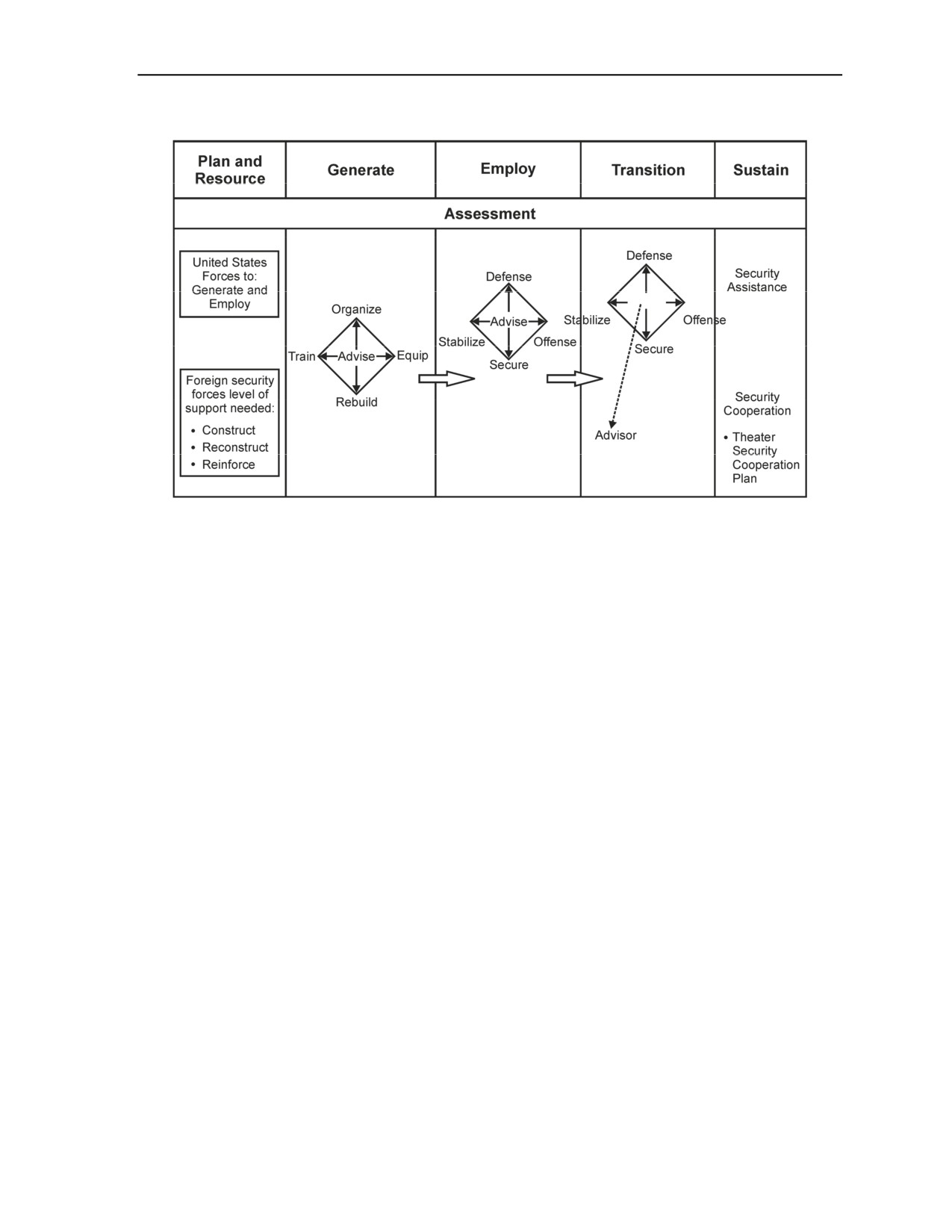
Framework
Figure 2-2. Security force assistance tasks, activities, and assessment
Plan and Resource
2-67. The plan and resource SFA activity determines the level of support and number of U.S. forces
needed. As all efforts in SFA this activity is part of a comprehensive approach. Planners assess whether
they will be constructing a foreign security force from the ground up, reconstructing a foreign security
force based on existing capabilities and structure, or merely reinforcing an existing foreign security force.
Understanding what capability and capacity the foreign security force should have and what capability and
capacity they currently have is vital. Commanders and planners can then determine the size and structure,
resources, and funding for the U.S. unit or units that will facilitate or assist the generation of FSF. Chapters
3 and 4 discuss planning and execution considerations for SFA.
Generate
2-68. In the generate SFA activity, U.S. forces focus on organizing, training, equipping, and advising FSF.
During generation of FSF, the condition of the existing foreign security force’s infrastructure and
capabilities determine the assistance needed from U.S. forces. The generate activity adapts to the needs and
requirements of the foreign security force. It can be designed to take the individual recruit from initial entry
through to an employable unit, or it can augment an existing foreign unit with additional or enhanced
capabilities. Like all SFA efforts, generate focuses on bringing a foreign security force’s capabilities to a
level where it can conduct its mission. With help from advisors in the next phase, FSF can work toward
independent and sustained employment. In large SFA efforts, an organization may be required to command
and control this activity.
2-69. Once elements of FSF are trained, the focus shifts from organizing, training, equipping, and
rebuilding to employing the foreign security force. However, not all FSF units and organizations are ready
for employment at the same time. As one unit is employed, others may be part of the generation activity,
while still others may be completing the transition activity. FSF may be employed for offensive, defensive,
or stability operations while other FSF may be employed against internal or external threats. The primary
SFA task for U.S. forces is to advise and assist to facilitate the foreign security force operations.
1 May 2009
FM 3-07.1
2-11
Chapter 2
Transition
2-70. The transition activity focuses on removing the U.S. elements and advisors once FSF are ready to
conduct independent operations. All involved actors work in a comprehensive approach to assess when this
can be achieved and to coordinate the transition itself. As FSF gradually progress toward the transfer of
authority, close relationships forged between the FSF and their partners prove essential to sustainable
development and successful transition. Genuine relationships engender trust and confidence, enabling
increased responsibility and a well-executed transition process. These relationships also foster a clear
understanding of command responsibilities and authorities. Such an understanding ensures FSF approach
transition prepared to assume the full weight of their future role in the security sector. Success in
developing FSF often depends more on relationships and personalities at the unit level than any other
factor.
2-12
FM 3-07.1
1 May 2009
Chapter 3
Brigade Operations Process
This chapter examines operational considerations for the modular brigade augmented
for security force assistance (SFA). It uses battle command and the operations process
to examine these considerations.
BATTLE COMMAND
3-1. Battle command is the art and science of understanding, visualizing, describing, directing, leading,
and assessing forces to impose the commander’s will on a hostile, thinking, and adaptive enemy. Battle
command applies leadership to translate decisions into actions—by synchronizing forces and warfighting
functions in time, space, and purpose—to accomplish missions (FM 3-0). Commanders are central to battle
command for brigade combat team (BCT) operations just as they are for any other operation. However,
there are key considerations for successful battle command of a BCT conducting SFA. Most importantly,
BCT commanders must work with their foreign counterparts, which may require facilitating operations
when the foreign security forces (FSF) commander has the lead for the operations process.
UNDERSTAND
3-2. Successful SFA requires that BCT commanders thoroughly understand the operational environment.
Conditions of the operational environment affect what SFA commanders provide. Commanders must
understand the conditions that make up the current situation, including the relevant population, other
actors, and FSF. From this understanding, commanders visualize desired conditions that represent a desired
end state. Commanders must understand the capacity and capabilities of foreign security. The host-nation
or regional security organization helps to determine desired conditions associated with the foreign security
forces. After envisioning a desired end state, commanders then conceptualize how to change the current
situation to the desired end state.
3-3. BCT commanders must understand the host-nation’s security and political concerns. Security
concerns focus on internal and external threats, their capability to affect the operational environment, and
the foreign security force’s strength and capability to counter those threats. Politically, the considerations
associated with the security sector are the legitimacy of the foreign security force, FSF capability and
capacity, host-nation or partner organization policy, and the ability to support the host-nation and U.S.
Government objectives.
3-4. Commanders use the information obtained from intelligence preparation of the battlefield and
intelligence, surveillance, and reconnaissance (ISR) to determine objectives and requirements for assessing
and mitigating risk. Risk applies to how well FSF, U.S. Government, host-nation, partner organization, and
international organizations can tolerate changes in the operational environment, as well as the challenges
and conditions inherent to the operation.
VISUALIZE
3-5. Commander’s visualization is the mental process of developing situational understanding,
determining a desired end state, and envisioning the broad sequence of events by which the force will
achieve that end state (FM 3-0). Visualization begins with assignment of the mission, which provides the
focus for developing the commander’s visualization. However, visualization must be continuous as SFA is
dynamic. During planning, commander’s visualization provides the basis for developing plans and orders.
1 May 2009
FM 3-07.1
3-1
Chapter 3
3-6. The nature and extent of assistance provided to FSF are determined by this desired end state. SFA is
often a slow process that does not lend itself to quick solutions. To ensure long-term success, commanders
and host-nation or regional security organizations clarify early what conditions they desire. These
conditions include the desired end state for FSF, which often include being—
z
Flexible. FSF can accomplish broad missions. Flexibility requires an effective command and
control organization appropriate for the partner or host-nation. This can include both internal
and external threats.
z
Proficient. The level of proficiency of FSF should include—
The capability of working effectively within a comprehensive approach.
The capability to integrate their operations with those of multinational partners.
Nonmilitary security forces competent in maintaining civil order, enforcing laws,
controlling borders, securing key infrastructure, and detaining criminal suspects.
Nonmilitary security forces thoroughly trained in modern police ethos and procedures and
which understand the basics of investigation, evidence collection, and proper court and
legal procedures.
z
Self-sustained. FSF can manage their own equipment throughout its lifecycle and perform
administrative support.
z
Well led. Leaders at all levels possess sound professional standards and appropriate military
values; they are selected and promoted based on competence and merit.
z
Professional. FSF are—
Honest, impartial, and committed to protecting and serving the entire population; they
operate under the rule of law and respect human rights.
Loyal to the partner organization or host-nation government and serving partner or national
interests; they recognize their role as the servants and not masters.
z
Integrated into society. In the case of a host nation, FSF represent the host nation’s major
social groups; they are not seen as elements of just one faction.
3-7.
These conditions may vary in different countries, but well-trained FSF should—
z
Provide reasonable levels of security from external threats without threatening regional security.
z
Provide reasonable levels of internal security without infringing on the populace’s civil liberties
or posing a coup threat to the host-nation government.
z
Be founded upon the rule of law, including international principles of the rule of law.
z
Be sustainable after joint and multinational forces depart.
3-8.
When addressing internal threats, foreign military and police forces often perform unconventional
functions. The military may have to fill an internal security role usually reserved for the police, or police
may have forces so heavily armed that they would normally be part of the military. In the near term, FSF
should—
z
Integrate military capabilities with those of local, regional, and national police.
z
Maintain the flexibility to transition to more conventional roles of external and internal defense
based on long-term requirements.
3-9. To achieve this end state and intermediate objectives, the host nation should develop an internal
defense and development (IDAD) strategy (with multinational assistance if required). This strategy should
have a section on IDAD that addresses all aspects of SFA.
3-10. U.S. doctrine divides force development into domains: doctrine, organization, training, materiel,
leadership and education, personnel, and facilities (DOTMLPF), which may be useful to analyze the
IDAD. DOTMLPF elements are tightly linked, simultaneously pursued, and difficult to prioritize.
Commanders monitor progress in all domains. Often military forces involved in such programs are tempted
to impose their own doctrine and judgment on the host nation. Foreign security force doctrine, like the
remaining DOTMLPF domains, must be appropriate to host-nation capabilities and requirements.
Paragraphs 3-59 through 3-70 use DOTMLPF as a tool to assess FSF.
3-2
FM 3-07.1
1 May 2009
Brigade Operations Process
DESCRIBE
3-11. After BCT commanders visualize how to conduct SFA, they describe it to their staffs and
subordinates to facilitate shared understanding of the mission and commander’s intent. Commanders
ensure subordinates understand the visualization well enough to begin planning. Commanders express their
initial visualization as—
z
Initial commander’s intent.
z
Planning guidance, including an initial concept of operations.
z
Commander’s critical information requirements.
z
Essential elements of friendly information that must be protected.
Commander’s Intent
3-12. Like any operation, SFA requires a clear, concise statement of what the force must do and the
conditions the force must meet to succeed with respect to the enemy, terrain, and desired end state. In such
an operation, the end state should include a description of desired conditions with respect to FSF capability
and capacity. The commander’s intent links the mission and concept of operations. It describes the key
tasks and end state that, along with the mission, form the basis for subordinates’ initiative.
3-13. A sample end state could discuss—
z
How civilians perceive FSF as credible and legitimate and representing a legitimate authority.
z
How FSF have the capability to support stability and security, retain the initiative and freedom
of movement, disrupt enemy activities, influence the population, operate with other friendly
forces, and sustain themselves.
3-14. Like any operation, how the BCT supports the higher organization’s mission is vital. Additionally,
the BCT supports FSF. Some sample key tasks are:
z
Support the organization of a division of foreign infantry and two battalions of foreign police.
z
Train leaders of FSF to create a cadre that can sustain their own training programs.
z
Oversee the equipping of FSF and provide new equipment training.
z
Support the rebuilding or building of infrastructure required to develop FSF.
z
Advise FSF to develop the required capabilities and competencies associated with shared
objectives.
z
Assist the partner’s security forces in meeting their operational requirements.
Planning Guidance
3-15. Commanders develop planning guidance for the staff from the commander’s visualization. Planning
guidance may be as broad or detailed as circumstances require; however, it must convey to the staff the
essence of the commander’s visualization. Due to the complex and dynamic nature of FSF, SFA often
requires detailed planning guidance. Commanders ensure the staff understands their visualization while
still permitting the staff to explore different options. Some considerations are:
z
Friendly courses of action (COAs) with differing SFA forms and differing methods on how to
augment, partner, or advise.
z
Command and control architecture, intelligence architecture, and communications architecture
to support dispersed SFA.
z
Enemy COAs as they seek to defeat friendly efforts with respect to SFA activities.
z
Enemy adaptation given the development of the foreign security force.
z
Guidance for security during the conduct of SFA, including the BCT securing its advisor teams.
The BCT determines the staging, needs, and ad hoc arrangements of advisor teams.
z
ISR guidance to include identifying the focus of effort as it relates to SFA.
1 May 2009
FM 3-07.1
3-3
Chapter 3
Commander’s Critical Information Requirements
3-16. Commander’s critical information requirements (CCIRs) will be developed for SFA just as for any
other operation. These requirements are what commanders need to make decisions or the information they
think is important for understanding the operational environment. These CCIRs should be compatible with
the FSF commander’s information requirements. CCIRs include priority intelligence requirements and
friendly force information requirements.
3-17. Priority intelligence requirements are vital to support decisionmaking. During SFA, priority
intelligence requirements must be focused on the enemy and the operational environment, not on FSF. U.S.
forces do not focus intelligence efforts, such as collection, on the foreign forces they assist.
3-18. Friendly force information requirements provide the information that commanders need to
understand the conditions of their own forces, as well as the conditions of the foreign security forces. For
example, a BCT commander may direct the staff to better define a foreign security force’s critical
equipment shortages or maintenance requirements. During execution, commanders may focus on when
FSF meet certain objectives or conditions. This information allows the commander and FSF commander to
make adjustments, such as changes to the task organization, support requirements, or even the type of SFA.
Essential Elements of Friendly Information
3-19. An essential element of friendly information is a critical aspect of a friendly operation that, if known
by the enemy, would subsequently compromise, lead to failure, or limit success of the operation, and
therefore should be protected from enemy detection (FM 3-0). Essential elements of friendly information
should be determined through a comprehensive approach. Information sharing and trust are vital elements
of SFA. U.S. commanders must be aware of the inherent risks in this context and employ prudent risk
mitigation efforts. Thus, successful SFA requires a balance between sharing information and risk
mitigation efforts. Although essential elements of friendly information are not CCIRs, they have the same
priority.
Intelligence, Surveillance, and Reconnaissance
3-20. Intelligence, surveillance, and reconnaissance is an activity that synchronizes and integrates the
planning and operation of sensors, assets, and processing, exploitation, and dissemination systems in direct
support of current and future operations. This is an integrated intelligence and operations function. For
Army forces, this activity is a combined arms operation that focuses on priority intelligence requirements
while answering the commander’s critical information requirements (FM 3-0). For the brigade, these
efforts will often support FSF. Moreover, the BCT must have means that allow effective intelligence
collaboration, such as an intelligence fusion cell with the participation of all appropriate actors.
3-21. ISR efforts focus on the enemy and operational environment within the context of SFA. ISR efforts
in SFA are not used on the foreign security force. Rather, U.S. forces assess the foreign security force
within a comprehensive approach.
DIRECT
3-22. BCT commanders direct all aspects of operations, although a comprehensive approach, including
FSF and other appropriate actors is fundamental to successful SFA. The commander’s direction takes
different forms during planning, preparation, and execution. Commanders make decisions and direct
actions based on their situational understanding, which they maintain by continuous assessment and
coordination with FSF. SFA is directed by—
z
Preparing and approving plans and orders with FSF.
z
Assigning and adjusting missions, tasks, task organization, and control.
z
Positioning units to maximize their support to FSF, anticipate threat actions, or create or
preserve options.
z
Positioning key leaders to ensure observation and supervision of FSF at critical times and
places.
3-4
FM 3-07.1
1 May 2009

Brigade Operations Process
z
Adjusting SFA and other support priorities and allocating resources based on FSF priorities, as
well as opportunities and threats.
z
Changing support arrangements, either internally or with respect to FSF.
ASSESS AND LEAD
3-23. Effective battle command requires commanders to continuously assess and lead. Assessment helps
commanders to better understand current conditions and determine how the operation is progressing and
how best to support FSF. Based on an assessment that is the product of a comprehensive approach,
commanders modify plans and orders to better accomplish the mission. This may include changing the type
or combination of SFA, support, sustainment, or task organization. If their assessment reveals a significant
variance from the original shared commander’s visualization, a comprehensive approach must be used to
reframe the visualization and develop a new plan.
3-24. Commanders in a BCT conducting SFA lead by example and presence, as Army commanders do in
any operation. However, commanders have the additional challenge of leading by, with, and through FSF.
Command posts for BCTs conducting SFA have similar challenges in that they should be integrated
headquarters as much as practical.
OPERATIONS PROCESS
3-25. As they would in any other mission, BCT commanders conducting SFA balance their time and the
staff’s time and resources among four major activities in a continuous learning and adaptive cycle called
the operations process. The operations process consists of the major command and control activities
performed during operations: planning, preparing, executing, and continuously assessing the operation.
The commander drives the operations process (FM 3-0). While simple in concept, the operations process is
complex in execution. The operations process activities may be sequential or simultaneous.
3-26. Figure 3-1 depicts the operations process activities as a cycle that is driven by battle command. This
cyclic process applies equally to a BCT conducting major combat operational theme or operations within
an irregular warfare operational theme. During the operations process involving SFA, commanders
consider the presence and inclusion of other actors, including FSF. Policy, the operational environment,
and the forms of SFA determine how U.S. forces, FSF, and other actors interact in the operations process.
Figure 3-1. The operations process
PLAN
3-27. Planning for SFA, like any other operation, begins either with the anticipation of a new mission or
the receipt of mission as part of the military decisionmaking process. Planning is the process by which
commanders (and the staff, if available) translate the commander’s visualization into a specific course of
1 May 2009
FM 3-07.1
3-5
Chapter 3
action for preparation and execution, focusing on the expected results
(FM 3-0). SFA requires a
comprehensive approach to ensure the U.S. commander’s visualization synchronizes with policy and the
foreign commander’s visualization. SFA is the major requirement for a BCT conducting SFA, but the
mission may require the brigade to perform other tasks.
3-28. Continuous and open to change, planning for SFA includes identifying how to best assist the FSF
and developing a sequence of actions to change the situation. This planning must occur within a
comprehensive approach that includes FSF, U.S. forces, and other actors. Similarly, this plan must be
nested within policy, IDAD strategy, the campaign plan, and any other higher-echelon plans. It also
involves anticipating consequences of actions and developing ways to mitigate them.
3-29. The plan, which includes the commander’s intent, provides a common understanding to U.S. and
foreign security forces on the actions to take. Plans and orders also provide decision points and branches
that anticipate options that enable the force to adapt as the operation unfolds. This is especially important
for SFA, as these operations tend to be prolonged efforts. BCTs conducting SFA often rotate before
achieving all objectives. As a result, the planning team should establish objectives and milestones that can
be achieved during the brigade’s mission. These BCT objectives and milestones must support higher-
echelon plans, including the campaign plan and IDAD strategy.
Functional Requirements
3-30. The composition of advisor teams is subject to objectives and conditions. For example, security
conditions may require three armored vehicles, a crew-served weapon, and nine personnel to conduct
independent movement. Another example involves the difference in the number of advisors. Newly
generated FSF may require many advisors whereas experienced FSF may only require assistance in a few
warfighting functions and consequently need fewer advisors. Understanding the functional requirements
provides flexibility to the units assisting FSF. Three examples of determining functional requirements
based on the understanding the operational environment include the BCT, a partnering or augmenting unit,
and an advisor team.
Brigade Combat Team
3-31. A BCT headquarters has specific functions and requirements. These can include, but are not limited
to—
z
The functions of—
Carrying out SFA tasks and assisting FSF in support of objectives and the end state.
Facilitating partnerships between U.S. and foreign security forces.
Requesting, coordinating, and synchronizing resources.
Providing command and control of subordinate units and assigned advisor teams.
Coordinating with other commands and adjacent units.
Coordinating with other participants integrated within the comprehensive approach.
Developing, implementing, and synchronizing information engagement in assigned areas.
Developing relationships and an understanding with appropriate actors involved in SFA.
3-32. The requirements of—
z
Having enough staff to handle the communications traffic generated by conditions.
z
Being able to analyze information to aid commander and subordinate elements.
z
Being able to articulate resource requirements in support of subordinate elements and efforts to
conduct SFA tasks.
z
Being organized and equipped to conduct operations and support and sustain FSF.
z
Including regionally oriented host-nation officers to provide regional expertise.
3-6
FM 3-07.1
1 May 2009
///////////////////////////////////////