FM 3-37 PROTECTION (SEPTEMBER 2009) - page 3
Chapter 4
4-75. Postoperational evaluations typically—
z
Identify threats that were not identified as part of the initial assessment or identify new threats
that evolved during the operation or activity. For example, when personnel, equipment,
environment, or mission changes the initial assessments, the control measures are reevaluated.
z
Assess effectiveness in supporting operational goals and objectives. For example, determine if
the controls positively or negatively impacted training or mission accomplishment and determine
if the controls supported existing doctrine and TTP.
z
Assess the implementation, execution, and communication of controls.
z
Assess the accuracy of residual risk and effectiveness of controls in eliminating hazards and
controlling risks.
z
Ensure compliance with the guiding principles of CRM.
Was the process integrated throughout all phases of the operation?
Were risk decisions accurate?
Were risk decisions made at the appropriate level?
Did any unnecessary risks or benefits outweigh the cost in terms of expense, training
benefit, or time?
Was the process cyclic and continuous throughout the operation?
4-18
FM 3-37
30 September 2009
Chapter 5
Protection Cells
The protection warfighting function applies to all levels of command. The Army
structure provides established protection cells at division level and above. Protection
cells are found in main and tactical command posts at division and corps levels and in
main or contingency command posts at theater Army headquarters. This chapter uses
examples from the modular division design since the protection cells in the modular
division and corps closely resemble each other. At the Headquarters DA level, the G-
3/assistant chief of staff, civil affairs
(G-5)/assistant chief of staff, information
engagement (G-7) is the staff agent for the Army protection policy. In order to
enhance integration and coordination of all protection-related activities, the Army
Oversight Board for Protection serves as the protection cell for the Army. This board
is the central source that provides senior leaders with the requisite situational
awareness to deconflict efforts, reduce duplication, prioritize areas of focus, and
approve new initiatives.
ROLES AND RESPONSIBILITIES
5-1. The protection cell is generally responsible for integrating or coordinating the tasks and systems that
fall under the protection warfighting function. Protection cells help craft protection strategies that are
reflected in the concept of protection included in the base order and appropriate annexes and appendixes.
Some protection tasks, such as FHP and AMD, may also have representation in other operational cells at
higher level organizations. At the theater army level, the protection cell may recommend that the
commander tailor protective elements when required for the campaign or major operation. Tailoring
includes the makeup of the force and the recommended sequence of its deployment. In addition to tailoring
force packages, the theater army protection cell—
z
Examines other protection plans, concepts, and strategies for insights on survivability, security
force employment, task organization, and economy-of-force options.
z
Considers multinational and host nation capabilities and determines how to integrate them into
protection.
z
Determines if other capabilities or disciplines (civil-military activities, information engagement
tasks) from within the force can provide complementary or reinforcing capabilities to achieve
protection and reduce the likelihood of successful attacks.
5-2. The protection cell advises commanders on the priorities for protection and coordinates the
implementation and sustainment of protective measures to protect assets according to the commander’s
priorities. During the planning process, the protection cell provides input to the commander’s MDMP by
integrating the threat and hazard assessment with the commander’s EEFI, CAL, and DAL. While the
planning cell develops plans, the protection cell attempts to minimize vulnerability based on the developing
COA. The intent is to identify and recommend refinements to the COA that are necessary to reduce
vulnerability and ensure mission success. The protection cell provides vulnerability mitigation measures to
help reduce risks associated with a particular COA and conducts planning and oversight for full spectrum
operations. Representatives from the protection cell may provide input to plans and future operations,
depending on the OE and the commander’s preference. Commanders tailor and augment the protection cell
with functional expertise to form a protection working group as the mission requires.
5-3. A chief of protection is assigned to the modular division, corps, and theater Army headquarters. At
brigade and below, the commander normally designates a senior leader to this role. The AMD coordinator,
30 September 2009
FM 3-37
5-1
Chapter 5
engineer coordinator, provost marshal, or CBRN officer may be designated as a protection coordinator to
support integration. Chiefs of protection and protection coordinators participate in various forums to
facilitate the continuous integration of protection tasks and systems in the operations process. This typically
occurs through protection working groups in a theater of operations and in force protection working groups
and executive forums as part of the installation force protection program.
5-4. The protection working group is led by the chief of protection and normally consists of—
z
AMD officer.
z
AT officer.
z
CBRN officer.
z
Engineer officer.
z
EOD officer.
z
OPSEC officer.
z
Provost marshal.
z
Intelligence representative.
z
PR officer.
z
G-6 representative.
z
Public affairs officer.
z
Staff judge advocate.
Note. Depending on the OE or type of operation, the commander may add G-7; assistant chief of
staff, civil affairs operations (G-9); surgeon; and safety; information engagement; medical; and
CA staff officers.
5-5. At the division level, subordinate units normally provide a liaison officer to the working group
meetings. The protection cells in division, corps, and Army headquarters integrate protection functions into
the operations process.
5-6. The protection working group—
z
Helps the commander establish protection priorities by developing the CAL and DAL.
z
Provides a forum for evaluating assumptions made in protection planning and for recommending
adjustments to protection efforts.
z
May help deconflict protection responsibilities, recommend C2 relationships necessary for
specific protection efforts, facilitate adjacent unit coordination, or allocate protection resources.
z
Considers various time horizons from the current organizational battle rhythm through future
operations.
5-7. While there are subtle differences, each is organized along similar lines and can perform similar
functions. The division and corps differ in that the corps is more likely to be a joint or multinational
headquarters, and it often has a larger AO. All protection cells, especially at the theater level, have unique
characteristics with different organizations, coordinators, sections, and abilities, depending on the mission
they are conducting.
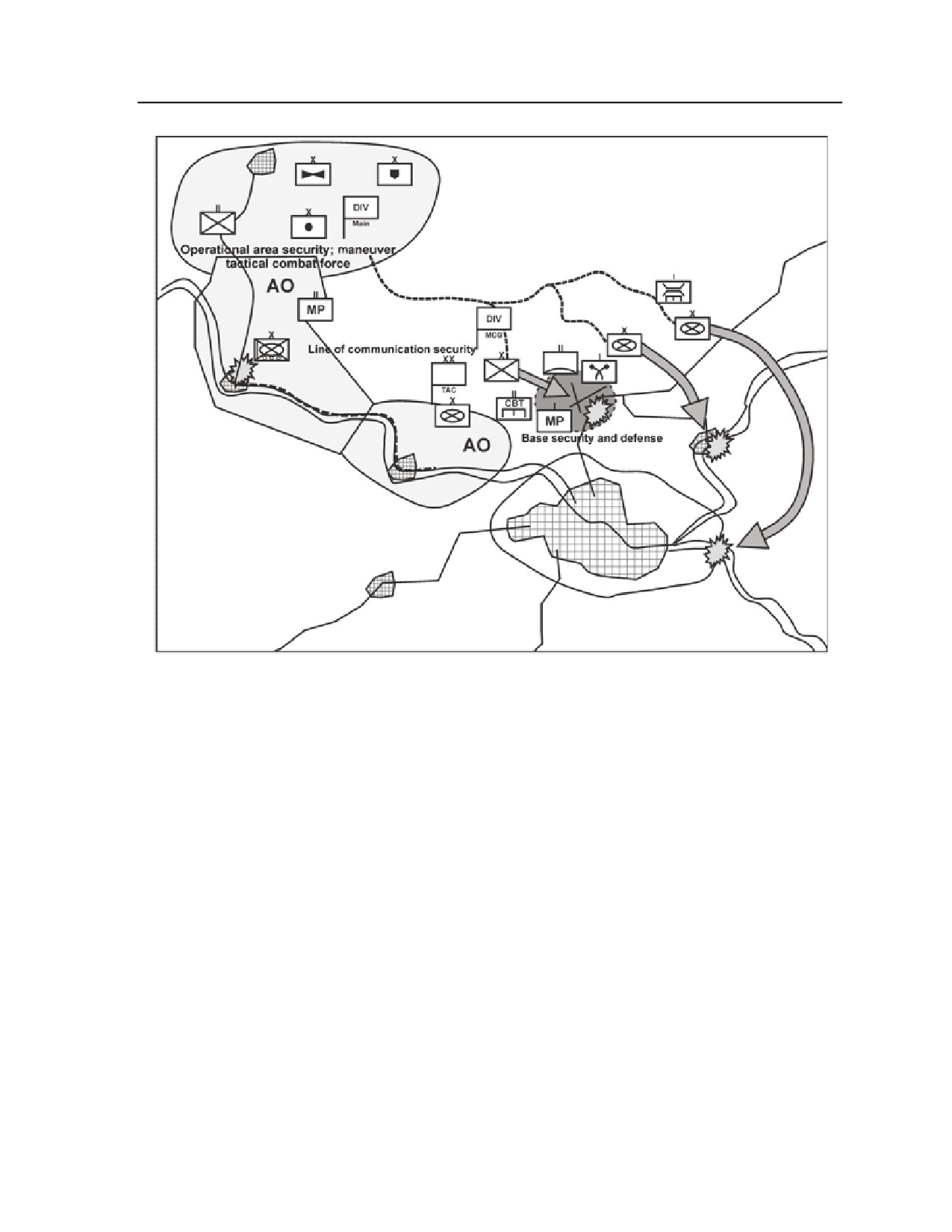
5-8. The protection cell helps develop a concept of protection tailored to the type of operation the unit is
conducting. Figure 5-1 shows an MEB supporting a division with three BCTs and one aviation brigade. A
mission analysis for the operation determined requirements that could be best satisfied by one or more
MEBs. Based on the mission variables, the protection working group in the division main command post
recommended the mix of capabilities needed for the MEB. Here, the MEB is focused on completing
specific protection tasks and providing support to maneuver units. The MEB typically adjusts command
and support relationships accordingly. The protection cell may make recommendations to the division on
the task organization of protection assets or the type of C2 relationship needed to reduce high risks. This
example depicts the employment of an MEB for protection tasks; however, in operations without an MEB,
the protection cell may recommend protection strategies from reinforcing and complementary capabilities
found in other formations for use in primary and economy-of-force roles.
5-2
FM 3-37
30 September 2009
Protection Cells
Figure 5-1. Sample protection concept for offensive operations
COMPOSITION
5-9. The protection cell membership does not require representatives from every functional element of
protection. However, these members provide a dedicated staff that is able to coordinate with other
appropriate coordinating, personal, and special staff elements. Primary members of the protection cell
typically include the chief of protection, AMD officer, PR officer, OPSEC officer, provost marshal, CBRN
officer, EOD officer, engineer officer, and AT officer.
CHIEF OF PROTECTION
5-10. The chief of protection may be designated by tables of organization and equipment or by the unit
commander. He is the principal advisor to the commander on all matters relating to the protection
warfighting function. A chief of protection—
z
Plans and coordinates protection functions and missions.
z
Advises the commander on where to allocate and employ protection capabilities.
z
Chairs protection working group meetings, coordinates input, and makes recommendations to
the commander regarding CALs and DALs.
z
Manages the writing of the protection annex and provides input to plans, orders, branches, and
sequels.
z
Synchronizes with other staff cells, nodes, and functional groups.
z
Provides guidance on the execution of protection tasks and systems.
z
Continually monitors and assesses the overall protection effort.
30 September 2009
FM 3-37
5-3
Chapter 5
AIR AND MISSILE DEFENSE OFFICER
5-11. The AMD officer coordinates and synchronizes the AMD tasks in the AO. He—
z
Advises, monitors, and makes recommendations regarding the current enemy air and missile
threat.
z
Collaborates with higher headquarters to protect critical and defended assets.
z
Coordinates current operations of subordinate air defense artillery forces.
z
Coordinates adjustments of sensor and engagement coverage based on changes in the mission
variables.
z
Leads or augments other protection components when operating in a low-threat air environment.
PERSONNEL RECOVERY OFFICER
5-12. The PR officer advises the commander on all aspects of PR operations. He plans and coordinates
operations necessary to obtain the release or recovery of captured, missing, or isolated personnel from
uncertain or hostile environments and denied areas.
OPERATIONS SECURITY OFFICER
5-13. The OPSEC officer identifies and recommends critical information requirements. He—
z
Analyzes adversaries and vulnerabilities as part of the IPB process.
z
Assesses OPSEC risk.
z
Develops, coordinates, and applies OPSEC measures across the staff.
z
Writes the OPSEC estimate and tab to the protection appendix.
z
Monitors, assesses, and adjusts OPSEC measures in terms of their MOE and MOP.
z
Reviews internal staff documents, information system logs, and news releases for sensitive
information and compromised EEFI.
z
Searches news sources, weblogs, and other Web sites for sensitive information and compromised
EEFI.
PROVOST MARSHAL
5-14. The provost marshal plans military police support for operations and provides advice on military
police capabilities. He—
z
Makes recommendations on developing and allocating military police resources that protect
CALs and DALs.
z
Synchronizes military police operations and law enforcement guidance between main and
tactical command posts and among subordinate, adjacent, and higher units.
z
Provides military police and physical security planning expertise, including—
Area security.
Police engagement.
Internment/resettlement and detainee operations.
Area damage control.
Consequence management operations.
Base defense operations.
Response force operations.
Critical site and asset security.
C2 node protection.
Straggler and displaced-civilian control.
Law enforcement.
Criminal investigations.
5-4
FM 3-37
30 September 2009
Protection Cells
U.S. customs operations.
Host nation police development and transition operations.
AT operations.
Police intelligence operations.
z
Makes recommendations on assigning protective service details to HRP. These protective
service details may be organic unit assets or an adjacent or higher unit passing through the
division AO.
z
May serve as a member of a vulnerability assessment team.
z
Coordinates with the engineer officer to plan support and protection of river-crossing operations
and main supply route security and protection.
CHEMICAL, BIOLOGICAL, RADIOLOGICAL, AND NUCLEAR OFFICER
5-15. The CBRN officer conducts planning for and oversees all CBRN operations. He—
z
Provides response analysis, written estimates and plans, and advice.
z
Provides staff supervision for CBRN site assessments and consequence management operations
in the AO.
z
Plans CBRN support with higher and adjacent units.
z
Supports the CBRN warning and reporting system.
z
Recommends how to employ CBRN assets.
z
Coordinates with the engineer officer for explosive hazard operations by identifying the
appropriate mix of complementary and reinforcing capabilities.
EXPLOSIVE ORDNANCE DISPOSAL OFFICER
5-16. The EOD officer incorporates EOD requirements into plans and orders. He—
z
Recommends how to implement EOD-unique skills.
z
Tracks UXO, IED, and WMD incident support.
z
Recommends reinforcing support.
5-17. If assigned to the headquarters, the explosive hazards coordination cell can assist the protection cell
through the collection, analysis, and dissemination of explosive hazard information. This cell is a
specialized Army engineer force pool unit assigned to corps, division, or brigade staffs. Within the theater,
it can predict, track, distribute information on, and mitigate explosive hazards that affect force application,
focused logistics, survivability, and situational awareness.
ENGINEER OFFICER
5-18. The engineer officer identifies requirements and prioritizes engineer capabilities and assets. He—
z
Identifies current and future operations that require force packaging to meet operational
requirements.
z
Identifies and synchronizes requirements for the mobility of friendly forces.
z
Identifies requirements for safeguarding bases.
z
Advises on the aspects of survivability as defined in chapter 2.
z
Facilitates the sustainment of friendly forces.
z
Identifies general engineering operations.
z
Synchronizes with the CBRN officer to apply battlefield obscuration and decontamination
support as appropriate.
z
Provides reachback to the Army Corps of Engineers.
z
Contributes to a clear understanding of the physical environment.
z
Provides support to noncombatants, other nations, and civilian authorities and agencies.
30 September 2009
FM 3-37
5-5
Chapter 5
ANTITERRORISM OFFICER
5-19. The AT officer—
z
Establishes an AT program.
z
Collects, analyzes, and disseminates threat information.
z
Assesses and reduces critical vulnerabilities (conducts AT assessments).
z
Increases AT awareness in Soldiers, civilians, and family members.
z
Maintains defense according to the FPCON.
z
Establishes civil/military partnerships for terrorist incident crises.
z
Conducts terrorism threat/incident response planning.
z
Conducts exercises and evaluates/assesses AT plans.
PROTECTION IN BRIGADES AND BELOW
5-20. Commanders at brigade and below echelons are not organized with dedicated protection staff cells,
but they are still responsible for integrating the protection warfighting function into full spectrum
operations. Protection integration at these echelons may require commanders to designate a staff lead
(protection officer) who has the experience to integrate risk management and other integrating processes.
These duties could be accomplished by the deputy brigade commander, executive officer, operations
officer, or a sergeant major. Assistant operations officers and other staff members could be designated as
protection coordinators to facilitate the integration of the twelve protection tasks and systems into
operations. In all cases, protection officers and coordinators work with higher and lower echelons to nest
protection activities with complementary and reinforcing capabilities.
DIVISION PROTECTION CELL
5-21. The protection cell in the main command post consists of seven staff groups, including the chief of
protection. The staff members focus their particular areas of expertise and on the integration and
synchronization of division protection efforts. The protection cell informs the commander of changes or
threats to CALs and DALs.
5-22. The tactical command post contains a small protection cell that consists of provost marshal, AMD,
and CBRNE sections. It plans, coordinates, and synchronizes protection and functional capabilities for
units under the tactical command post C2. Staff members in the main command post provide other critical
protection information to the tactical command post organization as required. These members work
throughout the coordinating and support staff and in designated cells. The two groups work closely together
to integrate and synchronize the protection effort across the AO (internally and externally) with joint,
interagency, and multinational assets.
CORPS PROTECTION CELL
5-23. The protection cell at the corps level is similar in organization and purpose to the division protection
cell. It is comprised of CBRN, EOD, engineer, military police, and AMD personnel and is typically led by
the chief of protection. This cell serves to coordinate, synchronize, and integrate complementary and
reinforcing capabilities supporting the corps headquarters to provide protection throughout corps
subordinate units and in the corps AO. The corps protection cell integrates and monitors OPSEC actions at
all levels, while managing the effects of CBRNE, physical and area security, survivability, and air and
missile threats to corps operations. The corps protection cell is typically augmented for stability operations
and may serve as the center of consequence management efforts to manage and mitigate problems resulting
from natural and man-made disasters or terrorist incidents.
ARMY SERVICE COMPONENT COMMAND PROTECTION CELL
5-24. Theater command posts have a dedicated protection element instrumental for reachback. Reachback
is the process of obtaining products, services, and applications, or forces, or equipment, or material from
5-6
FM 3-37
30 September 2009
Protection Cells
organizations that are not forward deployed. (JP 3-30) Theater command posts can exploit resources,
capabilities, and expertise while physically located outside the theater or in a joint operations area. They
also coordinate unified actions and oversee protection for the theater within the combatant commander’s
area of responsibility.
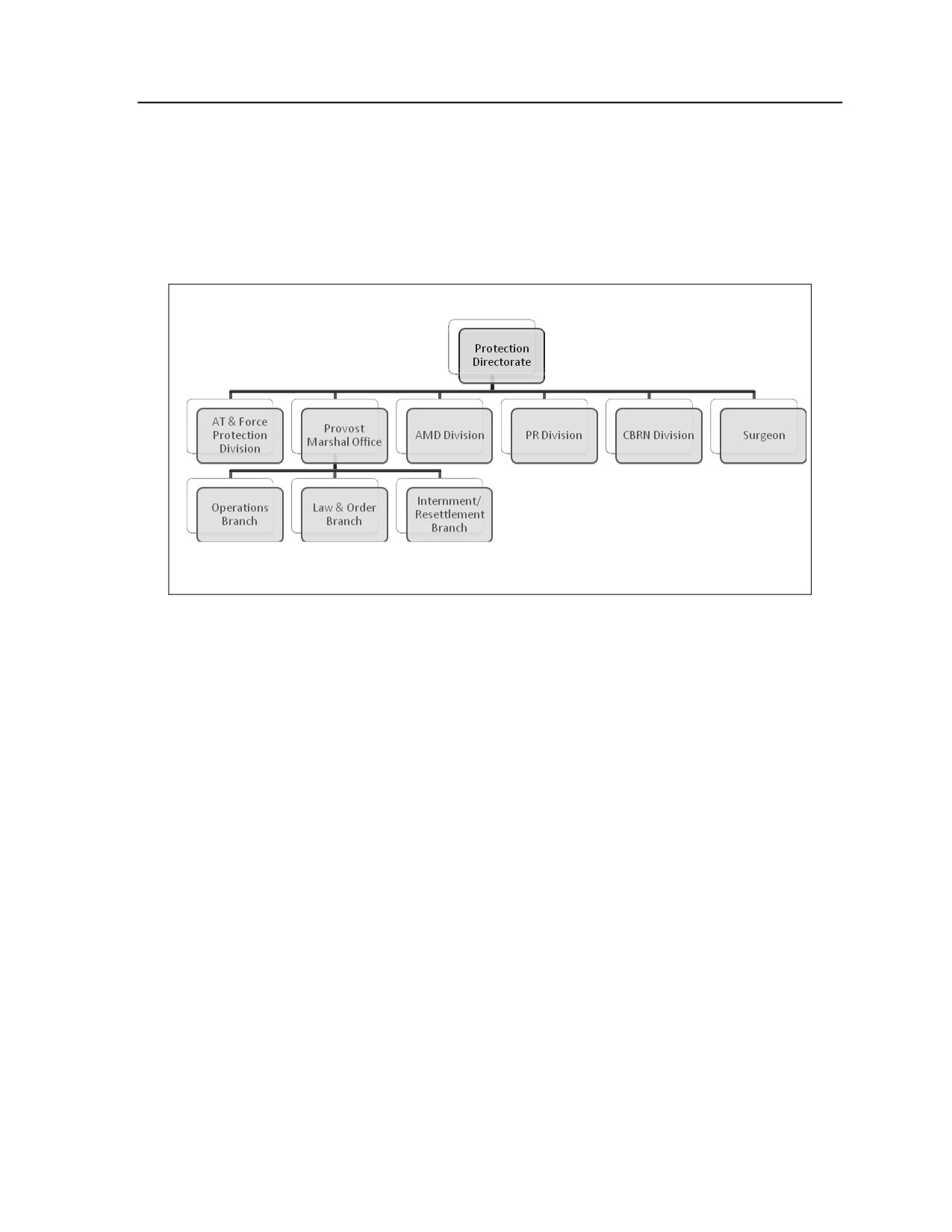
5-25. Figure 5-2 shows the operational protection directorate at the theater level, which is where corps or
other task-organized units normally receive protection guidance from higher headquarters. Similar to the
cells at corps and division, the operational protection directorate requires expertise from other staff sections
to synthesize the information required to oversee the entire protection function.
Figure 5-2. Sample protection directorate at theater level
5-26. The theater is the first level of command with a dedicated AT and protection division that adds an in-
theater source of staff support for subordinates. This command is also the first level with a dedicated
surgeon cell to conduct casualty prevention planning. Protection cells at division and corps require
assistance from these elements when planning casualty prevention measures. The early-entry command
post protection cell is tailored to the needs of the mission at hand but has full reachback to main and
operational command posts. Protecting information in the theater is not the responsibility of the operational
protection directorate; the theater G-6 and G-7 share responsibility for information protection.
5-27. With the exception of U.S. Army North, the theater typically resources the protection warfighting
function to support Army forces in theater and joint and allied forces. Often, the theater may be designated
as the joint security coordinator and be responsible for the joint security area. (See JP 3-10 for more
information.) The theater protection cell (with augmented joint, interagency, and multinational forces)
provides the nucleus of the joint security coordination center. The theater may designate an MEB to serve
as its operational protection headquarters, receiving mission orders to supervise selected forces (including
TCFs). Rear operations centers (area) may provide specified base C2 and security management for critical
bases and facilities.
PROTECTION WORKING GROUP
5-28. OCONUS, the theater typically resources the protection warfighting function to support Army forces
in theater and joint and allied forces. Consequently, Army service component commands have several
theater level commands and brigades that contribute force in support of the protection function.
5-29. The protection cell forms the core membership of the protection working group and includes other
agencies as required. Protection cell and protection working group members differ, in that additional staff
officers are brought into the working group. These additional officers meet operational requirements for
threat assessments, vulnerability assessments, and protection priority recommendations. The protection
working group does not merit additional manpower, but calls upon existing resources across the staff.
30 September 2009
FM 3-37
5-7

Chapter 5
5-30. Commanders incorporate daily, weekly, or monthly protection working group meetings into the unit
battle rhythm as needed. The meetings have the same purpose, regardless of the echelon. Protection
functions at different echelons of command differ mostly in the size of the AO and the number of available
protection capabilities. The protection working group—
z
Determines likely threats and hazards from updated enemy tactics, the environment, and
accidents.
z
Determines vulnerabilities as assessed by the vulnerability assessment team.
z
Establishes and recommends protection priorities, such as the CAL.
z
Provides recommendations for the CAL and DAL.
z
Reviews and coordinates unit protection measures.
z
Recommends FPCONs and random AT measures.
z
Determines required resources and makes recommendations for funding and equipment fielding.
z
Provides input and recommendations on protection-related training.
z
Makes recommendations to commanders on protection issues that require a decision.
z
Performs tasks required for a force protection working group and a threat protection working
group according to Department of Defense Instruction (DODI) 2000.16.
z
Accesses assets and infrastructure that are designated as critical by higher headquarters.
5-31. Table 5-1 shows a sample purpose, agenda, and composition of a protection working group with staff
inputs and outputs, and Table 5-2 shows a sample protection working group created for vulnerability
assessments.
Table 5-1. Sample protection working group activities
PURPOSE
AGENDA
The protection working group monitors and
• Operations/intelligence update.
assesses the risks and threats to forces in the AO
• CCIR/concept of operation review.
and implements control measures to maintain the
• DAL update.
protection by—
• New vulnerabilities (next 72 hours).
• Reviewing threats and hazards.
• Extremely high/high-risk mitigation measures.
• Identifying vulnerabilities.
• Recommendations (security posture adjustments, troop behavior,
• Recommending countermeasures, FPCON
command information engagement, resource allocation, required
levels, assessments, missions, and tasks to
training).
components.
• Conclusion.
• Monitoring corrective actions.
• Directing vulnerability assessment teams.
COMPOSITION
INPUT
OUTPUT
• Chief of protection (chair).
• Commander’s guidance and
• Updated protection
intent.
assessment.
• G-2.
• Major subordinate command and FOB AT
• Current and emerging
• Identified vulnerabilities.
threats and trends.
officers.
• Recommended FPCON.
• Staff judge advocate.
• Current operations update.
• Recommended mitigation
• EOD officer.
• Major subordinate
TTP and tasks.
command/FOB vulnerability
• Recommended changes to
• Engineer officer.
assessments.
EEFI.
• Provost marshal.
• Vulnerability assessment
• Recommended changes to
• Surgeon.
team assessments and
the CAL and DAL.
• Safety officer.
trends.
• CBRN officer.
• OPSEC officer.
• Others, as required.
5-8
FM 3-37
30 September 2009

Protection Cells
Table 5-2. Sample protection working group for vulnerability assessment
MISSION
ASSESSMENT OUTLINE
The protection working group works with the higher
• AT/force protection plan review (all).
headquarters vulnerability assessment team. It
• Local threat assessment (G-2).
evaluates implemented protection measures and
• Physical security (provost marshal).
identifies existing vulnerabilities at specified sites and
all locations, facilities, and bases used by contractors
• Entry control point procedures (provost marshal).
and coalition personnel. The end result is that the
• Perimeter defense (protection noncommissioned officer).
protection working group provides a safe, secure
• Base defense operations center (chief of protection).
environment in which friendly forces can live and
• High-density facilities (protection noncommissioned officer).
perform their duties by—
• Identifying and assessing threats and
• Emergency medical response (surgeon).
vulnerabilities.
• Structural and facility force protection standards (engineer
• Recommending countermeasures.
officer).
• CBRN defense (protection noncommissioned officer).
• Reporting through the chief of protection to the
commander.
• HRP (provost marshal).
COMPOSITION
REFERENCES/STANDARDS
• Chief of protection.
• OPORDs.
• Protection noncommissioned officer.
• Protection Plans.
• OPSEC officer.
• GTA 90-01-010, JCOB Force Protection Handbook.
• G-2.
• DOD O-2000.12-H.
• Engineer officer.
• DODI 2000.16.
• Provost marshal.
• UFC 4-010-01.
• Surgeon.
• UFC 4-010-02.
• Safety officer.
• G-7.
30 September 2009
FM 3-37
5-9
Appendix A
Protection in Force Projection Operations
Army forces need strategic and operational reach to deploy and immediately conduct operations with little
or no advanced notice anywhere in the world. Expeditionary operations require units that can deploy and
conduct extended operations. Units depend on joint-enabled force projection and protection for
deployment, sustainment, and protection across intercontinental distances in full spectrum operations. Units
available and ready to deploy begin the force projection process upon receiving a warning order or
deployment order. Army and joint operations require successful onward movement, protected personnel,
and accompanied materiel. Continuing protection measures must be taken from home station, to reception
in theater, and to integration into the AO. In each phase, deploying and supported commanders apply
elements of the protection warfighting function based on the analysis and recommendations of their
respective protection cells.
PLANNING AND PREPARATION DURING PREDEPLOYMENT
ACTIVITIES
A-1. During the movement from home station to the deployment location, unit personnel and equipment
may arrive at different ports of debarkation. Protection during movement can be difficult as units pass
through various areas of responsibility. The Army uses five steps in planning and preparation during
predeployment activities. During deployment, commanders apply protection measures in each step to
protect the force.
z
Step 1. Analyze the mission.
z
Step 2. Structure the forces.
z
Step 3. Refine the deployment data.
z
Step 4. Prepare the force.
z
Step 5. Schedule movement.
Note. See FMI 3-35 for more information.
ANALYZE THE MISSION
A-2. Commanders examine the mission and develop COAs, using employment considerations as the
primary planning factor. A primary protection consideration depends on the type of entry operation
conducted. Forced-entry operations require extensive mission analysis to adequately protect the force.
Deployment into a permissive environment requires forces to assess the host nation security, police forces,
and port security operations. Planners do not assume that existing or host nation units at the site will
automatically provide protection. All deployed U.S. units arrive prepared to protect themselves based on
the threat at the site location.
STRUCTURE THE FORCE
A-3. While developing COAs, planners identify forces based on their capabilities to accomplish specific
missions. Commanders establish protection measures and force requirements based on the threat
assessment of theater ports and intermediate staging bases. Intelligence and threat information is critical in
determining the force structure. Commanders factor protection requirements into time-phased, force and
deployment data planning. Experiences from worldwide deployments, especially those in Operations Iraqi
Freedom and Enduring Freedom, demonstrate how early protection planning and the execution of
protective measures can substantially reduce the risk to deploying forces.
30 September 2009
FM 3-37
A-1
Appendix A
REFINE THE DEPLOYMENT DATA
A-4. As planners identify forces, they begin developing time-phased, force and deployment data. The
supported combatant commander defines the intent for deployment. The commander’s intent may be
specific and direct the sequence of units or simply identify a general deployment timeline. Protection
considerations often determine the first deployers for protection-related missions and tasks in the joint
operations area. Commanders compare the situation in the joint operations area against available lift assets
to determine the appropriate deployment sequence. Host nation restrictions and sensitivities may limit
protection options, creating a need for close coordination with assets already in the joint operations area.
While protecting the initial-entry force, commanders balance the need for rapid response with the mix of
combat power and resources that accomplish the mission. This balance provides protection, efficient
deployment, and a range of options for responding to possible conditions.
PREPARE THE FORCE
A-5. Planners develop force packages to ensure that the right capabilities, in the proper combinations,
support the combatant commander. Protection considerations include determining the casualty prevention
measures required to protect the force against health risks. Before deploying, units conduct risk
assessments to determine their vulnerabilities. These assessments provide a baseline from which to
implement appropriate protection measures that reduce or mitigate risk.
SCHEDULE MOVEMENT
A-6. Correctly sequencing forces to deploy provides the commander with capabilities to achieve the
desired objectives. Once commanders put a strategic lift schedule into motion, it is difficult to change
without losing the transportation capacity. Protection considerations consist of front-loading appropriate
units to provide protection and security. The units draw equipment first and then support follow-on units
with staging and onward movement. These units should arrive in theater early in the deployment process to
provide better protection and movement security. Protection and security are essential to promptly move
combat forces forward.
A-7. Commanders also implement another protection consideration—proactive OPSEC measures. These
measures limit public knowledge of in-transit force movements, including U.S. military ship and aircraft
flights and intratheater movements of key personnel, equipment, and logistics.
A-8. A final protection consideration includes reviewing and, if necessary, modifying contracting
processes and transportation agreements. This consideration meets DOD protection and AT standards.
DEPLOYMENT
A-9. Table A-1 lists theater and deploying division or corps protection cell requirements for the
synchronization and execution of protection measures during deployment.
A-10. During the force projection process, four distinct and interrelated deployment phases occur. These
phases may not be sequential; they can overlap or occur simultaneously.
z
Predeployment activities.
z
Movement to and activities at the port of embarkation.
z
Movement to the port of debarkation.
z
Reception, staging, onward movement, and integration (RSO&I).
A-2
FM 3-37
30 September 2009

Protection in Force Projection Operations
Table A-1. Protection synchronization for deployment
Protection
Movement to Port of
Movement to Port of
Tasks and
Predeployment Activities
RSO&I
Embarkation
Debarkation
Systems
• Perform AMD threat
• Coordinate transportation
• Maintain transportation
• Coordinate advance
assessment.
protective measures for
protective measures for
deployment of force
AMD
• Prepare force packages.
sensitive arms,
sensitive arms,
packages.
ammunition, and
ammunition, and
explosives.
explosives.
• Complete DD Form 1833
• Establish PR
• Establish PR organization.
• Transfer unit isolated
(Isolated Personnel Report).
organization.
• Cross-staff coordination.
personnel report data
• Establish PR organization.
• Cross-staff coordination.
• Analyze PR gap.
to theater staff.
• Cross-staff coordination.
• Analyze PR gap.
• Integrate diplomatic/
• Establish PR
• Analyze PR gap.
• Integrate diplomatic/
military/civil PR.
organization.
• Integrate diplomatic/
military/civil PR.
• Exercise PR SOPs.
• Cross-staff
military/civil PR.
• Review PR SOPs.
• Exercise/rehearse.
coordination.
PR
• Establish PR SOPs.
• Exercise/rehearse
• Coordinate PR support
• Analyze PR gap.
• Exercise/rehearse.
• Coordinate PR support
while in transit.
• Integrate diplomatic/
while in transit.
military/civil PR.
• Exercise PR SOPs.
• Exercise/rehearse.
• Coordinate PR
support while building
combat power.
• Deconflict host nation
• Prestage critical BCCS
• Ensure immediate satellite
• Assist in coordinating
frequency, taboo
data at OCONUS area
access to retrieve current
business continuity
frequencies (911), friendly
processing centers.
battle command data
and disaster recovery
radars, or jammers.
• Support en route mission
updated during
solutions.
• Ensure uninterrupted access
planning and updating of
communications blackout.
• Assist in updating risk
to joint distributed planning
critical information
• Deploy liaison officers to
analysis.
Information
(virtual collaboration) and
(orders, overlays,
OCONUS area processing
• Assist in meeting
protection
training amongst
intelligence).
centers to ensure or
legal and regulatory
geographically dispersed
coordinate access to unit
compliance.
units.
prestaged data.
• Assist in coordinating
• Gain theater network
physical
configuration and resource
(environmental)
allocation to DISN services
security.
or SATCOM.
• Train on combat
• Maintain situational
• Maintain situational
• Review fratricide
identification processes and
awareness.
awareness.
prevention
Fratricide
procedures.
procedures with
avoidance
Soldiers and check
equipment.
• Plan for adequate protection
• Coordinate and assess
• Assign supercargoes.
• Ensure that adequate
during RSO&I.
port security
• Store cargo and measures
security forces are
• Plan for proper sequencing
transportation protective
in place.
available to protect
Operational
of forces to ensure adequate
services.
• Ensure that the Army
the force during
area security
combat power.
• Coordinate movement
Criminal Investigation
RSO&I and
• Establish CAL.
with local police.
Command conducts
movement to tactical
logistics security
assembly areas.
operations.
• Provide Level I AT training.
• Coordinate interagency
• Track all units during
• Conduct port
• Complete threat
security measures.
transit.
vulnerability
assessment.
• Submit AT plan to
• Employ countersurveillance
assessments.
• Complete criticality
combatant commander.
and counterintelligence
• Brief unit on threat
AT
assessment.
• Assemble port readiness
resources.
levels.
• Complete vulnerability
committees.
• Brief unit on ROE.
assessment.
• Develop HRP security
• Implement planned
• Form installation force
measures.
security measures.
protection working group.
• Assess Soldier, equipment,
• Conduct survivability.
• Conduct survivability.
• Conduct necessary
Survivability
and vehicle protective
survivability support.
requirements.
30 September 2009
FM 3-37
A-3

Appendix A
Table A-1. Protection synchronization for deployment (continued)
Protection
Movement to Port of
Movement to Port of
Tasks and
Predeployment Activities
RSO&I
Embarkation
Debarkation
Systems
• Coordinate for individual
• Conduct continual
• Conduct continual
• Continue to execute
medical readiness processing
assessment.
assessment.
the mission plan,
programs.
adjusting to protect
• Survey the AO to determine
Soldiers from
health threats.
potential health
• Plan and coordinate for
threats.
preventive medicine support
requirements.
• Perform food and water
vulnerability assessments.
• Plan and coordinate for
veterinary services.
• Develop procedures to
FHP
inspect, monitor, and submit
food and water samples.
• Plan for animal disease
prevention and control
program.
• Develop a plan to meet or
improve the stress control
needs of Soldiers and units.
• Inform Soldiers about good
oral hygiene and preventive
dentistry measures.
• Plan and coordinate area
medical laboratory
deployment.
• Complete CBRN threat
• Maintain situational
• Maintain situational
• Review AT plan with
assessment and enemy
awareness.
awareness.
combatant
CBRN
capability evaluation.
commander
operations
• Complete friendly forces unit
(command
status evaluation.
authority).
• Develop CBRN defense plan.
• Train and license Soldiers in
• Provide quality
• Provide troop rest and
• Acclimatize troops.
handling hazmat.
assurance specialist
hydration.
• Train with night
• Conduct safety oversight.
ammunition surveillance
• Review accident/near-miss
vision.
• Conduct safety awareness
support.
data to develop loss
• Enforce safe vehicle
briefings.
• Train load team to
reduction plans.
operations.
standards.
• Train rollover and
• Review accident/near-
recovery operations.
Safety
miss data to develop
• Conduct safety
loss reduction plans.
oversight.
• Conduct safety
awareness briefings.
• Review
accident/near-miss
data to develop loss
reduction plans.
• Recommend CCIR.
• Conduct OPSEC.
• Conduct OPSEC.
• Conduct OPSEC.
• Conduct OPSEC vulnerability
assessment.
OPSEC
• Conduct OPSEC training.
• Incorporate OPSEC into
planning activities.
• Provide EOD threat
• Maintain situational
• Maintain situational
• Review current
assessment and enemy
awareness.
awareness.
enemy procedures
evaluation.
for future AO or
EOD
• Provide IED awareness
movement to tactical
training.
assembly areas.
• Ensure equipment readiness.
• Provide theater-
specific training.
A-4
FM 3-37
30 September 2009
Protection in Force Projection Operations
PREDEPLOYMENT ACTIVITIES
A-11. During predeployment activities through the fort-to-port phase, the U.S. Army Installation
Management Command is a critical protection and force projection enabler. This command manages most
Army installations worldwide. Its garrison commanders play a critical role in successfully protecting
deploying forces as they execute force projection operations in CONUS. Installation provost marshals (with
military police) protect assets as the unit prepares to deploy. Safety, medical, and information management
personnel protect personnel and information. Division and corps protection cells coordinate closely with
the installation and garrison staff to identify which information and assets to protect and to apply
appropriate protection and security measures that are consistent with the threat analysis.
A-12. At Army installations, AT working groups work as forums to involve installation protection
personnel with federal, state, and local law enforcement officials. Together, they identify potential threats
to the installation and improve interagency communications. Before deployment, division and corps
protection cells coordinate with the installation staff to develop protective measures as required by the local
threat assessments. In addition, coordination may be required with port security personnel and the
combatant commander for protection requirements in the AO.
A-13. OPSEC and information protection are also key protection tasks during predeployment activities.
Effective OPSEC keeps adversaries from exploiting friendly deployment and staging information.
Commanders also ensure that their rear detachment commanders and family readiness groups take
appropriate OPSEC measures.
A-14. Commanders consider the AT element of protection during predeployment activities. Each deploying
unit (battalion or larger) should have at least one assigned Level II AT officer. This individual must have
completed a service-sponsored certification course. The deploying unit commander (assisted by the AT
officer) ensures that AT plans are integrated into movements through high-threat areas. Before deployment,
units assess risk by conducting threat, criticality, and vulnerability assessments. Units conduct the
assessments far enough in advance of deployment to allow for the development of necessary protection
measures for deploying assets.
A-15. After the notification, commanders at all levels begin to issue planning guidance as they plan,
prepare, execute, and assess the deployment order. Unit commanders analyze the protection requirements
and determine which resources adequately protect the deploying force. Finding the proper balance between
protecting the force and rapidly projecting the force is critical. Commanders seek an appropriate balance of
protection, rapid deployment, and adequate support.
A-16. Before arriving in an area of responsibility, commanders submit protection plans through their higher
headquarters to the geographic combatant commander (this does not apply to the units deploying to the
USNORTHCOM area of responsibility). The protection measures in the deploying unit plan must match
the guidance developed by the geographic combatant commander, who coordinates and approves individual
plans.
MOVEMENT TO AND ACTIVITIES AT THE PORT OF EMBARKATION
A-17. During some phases of deployment, DOD transfers custody of its military equipment to non-DOD
entities, including foreign-owned ships crewed by non-U.S. citizens. The protection cell ensures that
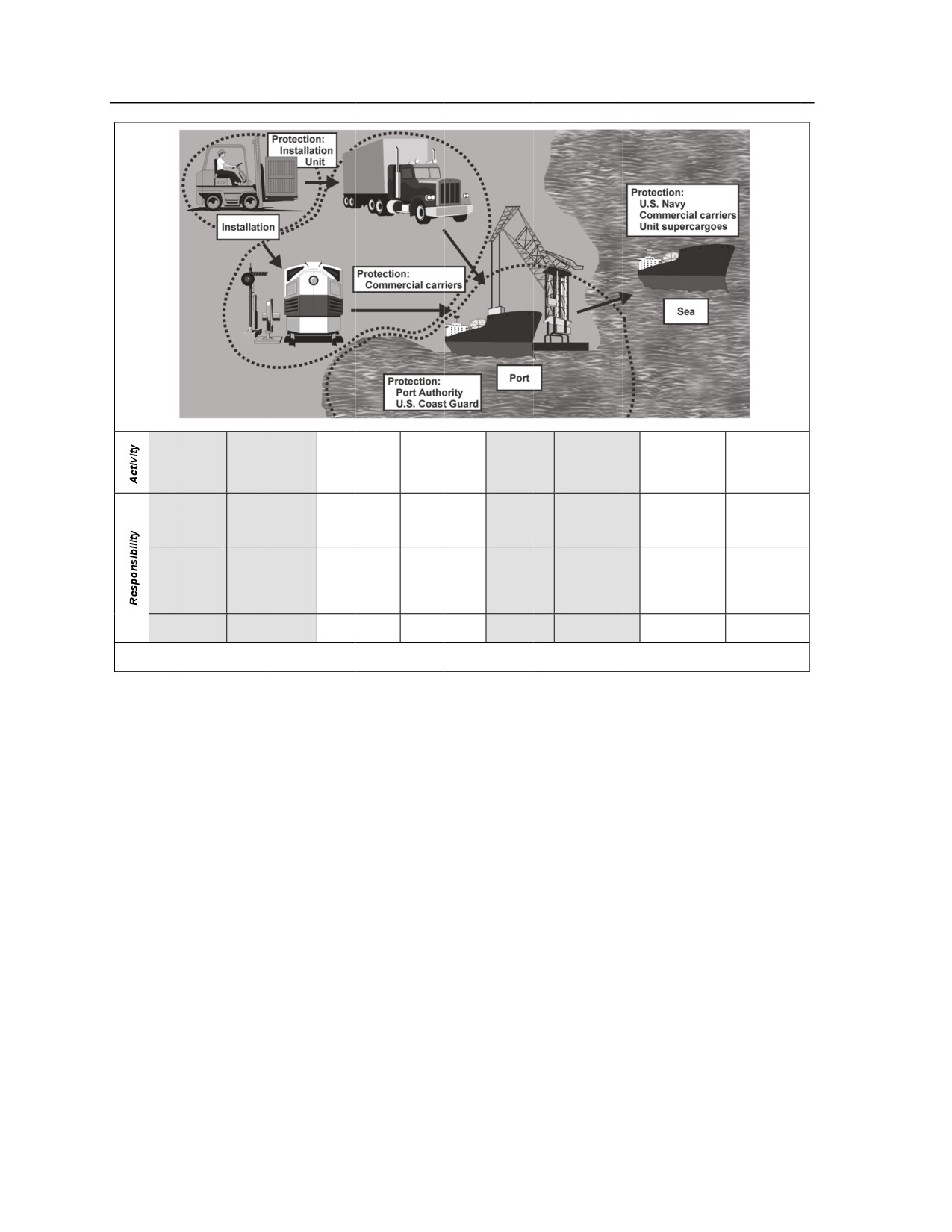
contract processes for transportation movements meet DOD security requirements. Figure A-1, page A-6,
shows various deployment activities and the agencies responsible for them.
30 September 2009
FM 3-37
A-5
Appendix A
Stage
Load
Transport
Cargo
Transport by
Protection
Protection
Protection
Protection
Material
by Land
and Load
Sea
Vessel
Installation
Installation:
Commercial
Commercial
Port
Port authority
U.S. Navy
U.S. Navy
DA police
rail and
carriers
readiness
U.S. Coast
Military police
moving
committee
Guard
carriers
Commander
Unit guards
Surface
Local law
Unit
Supercargoes
Commercial
Commercial
Deployment
enforcement
carriers
carriers
and
Distribution
Command
Unit
Supercargoes
Unit
Supercargoes
NA
NA
Maritime
Unit
administration
supercargoes
Note. The protection cell must
assess the assets
and carriers and,
in coordination with the Surface Deployment and Distribution Command,
provide additional protection measures consistent with threat and sensitive-cargo requirements.
Figure A-1. Protection responsibilities
during deployment
A-18.
Deploying units traditionally focus protection efforts
on their impending overseas operations.
However, the protection cell staff must frequently coordinate with CONUS-based agencies. Protection
responsibilities for
Army units deploying through commercial seaports are divided among joint and
interagency organizations. These
organizations
include the
U.S. Army
Materiel Command (Surface
Deployment Distribution Command, Army Contracting Command, and Army Sustainment Command),
U.S. Transportation
Command, Military Sealift Command,
USNORTHCOM, and U.S. Army Forces
Command. Because
the protection
tasks that the
Army may conduct outside its installations
are limited, the
protection staff works closely with
federal, state, and local agencies. Together, they ensure that adequate
protection measures
exist and that they are executed during deployments through strategic seaports.
A-19.
Although transportation organizations and activities may provide limited organic
protection, the
deploying unit commander plans protection measures for rail and highway movements. The
protection cell,
in coordination with
the Surface Deployment and Distribution
Command, continually assesses the assets
and carriers. It also
provides additional protection measures consistent with
the threat and
sensitive-cargo
requirements. These
measures may
include the use of contract
security personnel or unit guards to protect
unit assets, but the
commander
makes the final determination based on
security requirements. The
protection cell coordinates with the installation transportation officer (CONUS) or movement control team
(OCONUS) and authorized railroad
or commercial truck carriers on guard and
escort matters.
A-20.
The protection
cell coordinates with the
port readiness committee
at each strategic port. These
committees provide
deploying unit commanders
with common
coordination
structures for
DOD; the U.S
Coast
Guard; and other federal, state, and local agencies at the port level. When military equipment is being
moved, the committees act as principal interfaces
between DOD and other officials at ports.
A-6
FM 3-37
30 September 2009

Protection in Force Projection Operations
A-21. In coordination with other DOD activities and port authorities, the U.S. Transportation Command
and Surface Deployment and Distribution Command administer the DOD transportation security program.
This program provides standardized transportation security measures, constant oversight, and central
direction. In CONUS, commanders plan protection measures for units and equipment en route to the port,
while the Surface Deployment and Distribution Command coordinates security at the port.
A-22. Depending on the threat assessment, units may guard equipment while at the installation, at
railheads, or en route to ports of embarkation. Units may consider assigning supercargoes to accompany the
equipment during transit from the seaport of embarkation to the seaport of debarkation.
A-23. DOD 4500.9-R specifies governing requirements for moving sensitive military cargo. It establishes
various levels of required protection and monitoring based on risk categories. Protection and monitoring
measures range from simple seals used in shipping to continuous cargo surveillance. The regulation
establishes protection requirements for cargo and outlines the transportation protective services available to
meet them. The cargo sensitivity and means of transportation determine how the Surface Deployment and
Distribution Command protects military cargo. Table A-2 provides examples of transportation protective
services required for various types of sensitive items and equipment.
Note. See DOD Regulation 4500.9-R, part II, chapter 205 for more information.
Table A-2. Examples of transportation protective services
Security Risk
Risk Category
Example
Minimum TPS
Code
Highest risk AA&E
PSS/SNS/EXC
1
Man-portable missiles
CAT I
SEV
Medium-high risk
Automatic weapons,
PSS/SNS/EXC1
CAT II
landmines
SEV if FPCON Charlie
2
Medium risk
PSS/SNS/EXC1
High-explosive grenades2
CAT II
SEV if FPCON Charlie
Low risk
3
Small arms, smoke grenades
DDP/SNS
CAT III and IV
Low risk
4
Small arms, smoke grenades
DDP/SNS
CAT III and IV
Weapons with secret
PSS/SNS/EXC
5
CAT I
guidance systems
SEV
Weapons with confidential
PSS/SNS/EXC
6
CAT I
guidance systems
SEV
Uncategorized demolitions
Retrograde AA&E, howitzer
7
DDP/SNS
(Div 1.1, 1.2, and 1.3 AA&E)3
cannons and barrels
Weapons with confidential
PSS/SNS/EXC1
8
Confidential CAT II
guidance systems2
SEV if FPCON Charlie
Uncontrolled/unclassified
U
Bombs, torpedoes
DDP/SNS
(Div 1.1, 1.2, and 1.3 AA&E)3
S
Secret
Documents/hardware
DDP/SNS4
C
Confidential
Documents/hardware
CIS5
CIS and security tarps
Pilferable, uncontrolled/
Communications, electronics,
P
required for open-bed
unclassified
high-value items
trailers5
1SEV is required for all U.S. Army CAT II shipments when pickup or drop off is in FPCON Charlie locations; SEV is not
required for U.S. Air Force, Marine Corps, or Navy CAT II shipments at FPCON Charlie. However, SEV is required for
CAT II shipments for all Services in FPCON Delta locations.
2Examples are not all-inclusive.
3For AA&E shipments weighing 150 pounds or less and 15 or fewer items, small arms weapons (CAT II through IV)
and M-16 rifles (excluding .50-caliber and above rifles) use CIS.
4SNS is optional.
5DDP replaces CIS when the mileage exceeds 150.
30 September 2009
FM 3-37
A-7
Appendix A
A-24. The U.S. Army Criminal Investigation Command supports force projection and protection operations
by providing logistics security to prevent theft, misappropriation, and other criminal acts.
A-25. During major combat operations, the U.S. Coast Guard conducts operations in littoral regions. These
regions include port security and safety, military environmental response, maritime interdiction, coastal sea
operations, and protection in territorial waters of the United States and overseas. In addition to waterside
physical security, Coast Guard duties include—
z
Regulating the shipping, handling, and pier side storage of hazardous cargo.
z
Interfacing with military authorities as the senior DOD port safety agent.
z
Issuing hazardous-cargo permits.
z
Supervising vessel fire prevention programs.
MOVEMENT TO THE PORT OF DEBARKATION
A-26. Supercargoes are personnel that accompany cargo on board a ship for the purpose of accomplishing
en route maintenance and security. (JP 1-02). Supercargoes represent the deploying unit commander when
moving unit equipment by ship. They perform liaison during cargo reception at the seaport of embarkation,
shipload and discharge operations, and clearance at the seaport of debarkation. The deploying unit may be
required to provide supercargoes to accompany cargo aboard ships. At a minimum, commanders protect
equipment against theft and pilferage.
A-27. Unit commanders recommend the composition of supercargoes. They determine the amount and
types of equipment loaded aboard the ship, the number of units with equipment on the ship, and the
required physical security measures. However, the Military Sealift Command determines the actual number
of supercargoes permitted onboard based on the berthing capacity of the ship. Offload preparation parties
may deploy with the advance party to help unload the vessel.
A-28. The size of the supercargo teams dedicated to each ship coincides with the team role. Commanders
ensure that enough members to guard and maintain equipment are onboard, enough resources are available
onboard, and enough money is available to finance additional costs for equipping and maintaining the team
during the voyage. To prevent unnecessary commitment of personnel and resources, commanders closely
coordinate supercargo teams with the Surface Deployment and Distribution Command, commercial
carriers, and port facilities.
RECEPTION, STAGING, ONWARD MOVEMENT, AND INTEGRATION
A-29. RSO&I is the process of force closure in the AO. It requires a logistics infrastructure provided by the
host nation or deployed sustainment assets. Force closure is the point in time when a supported joint force
commander determines that sufficient personnel and equipment resources are in the assigned operational
area to carry out assigned tasks. (JP 3-35) Reception is the first and most critical step of RSO&I. It marks
the end of the strategic leg of deployment and the beginning of the operational use of forces. RSO&I aims
to build the combat power necessary to support the combatant commander’s concept of operation.
Protection for units undergoing RSO&I falls under the protection cell of the theater supporting the
combatant commander.
A-30. Planners carefully consider the threat assessment in the OE of RSO&I operations. A threat
assessment gives commanders details of potential threats that can disrupt or block operations. The
assessment also provides the level of infrastructure transportation and protection assets available to assist
with onward movement. Commanders use this information to develop CALs and DALs.
A-31. When developing CALs and DALs, protection planners consider how changes in the tactical
situation can create an urgent need for newly arrived units. Some units may be tasked for immediate
employment. Heavy-equipment transport, military police, engineers, fuel support, and other assets
necessary to move or protect equipment and personnel may become critical to mission success.
A-32. In a permissive environment, the host nation may be able to provide services and facilities to support
protection. These services can lessen the requirement for U.S. forces to provide equivalent capabilities,
thereby reducing the U.S. logistics footprint.
A-8
FM 3-37
30 September 2009
Protection in Force Projection Operations
A-33. RSO&I operations can provide enemies with numerous opportunities to inflict serious casualties.
These operations can delay the buildup of combat power by exploiting the vulnerability of units in transit
from the theater staging base to the theater assembly area.
A-34. Units undergoing RSO&I present enemies with high-value, high-payoff targets. Any damage or
destruction could result in serious delays in force closure. The advance deployment of military police units
or other forces designated for area security become extremely important targets.
30 September 2009
FM 3-37
A-9
Appendix B
Combat Identification
Combat identification gives U.S. forces the ability to avoid fratricide and differentiate
among friendly, enemy, neutral, and unknown personnel and objects. Obtaining
accurate combat identification is a problem as old as combat itself. Combat always
has been, and always will be, confusing, complex, and deadly. Combat identification
has become increasingly difficult with the advent of modern weaponry and tactics,
the introduction of rapid fire and non-line-of-sight systems, and the desire to
minimize collateral damage. A combat identification fratricide research study found
that surface-to-surface and air-to-surface mission areas encompassed more than 90
percent of fratricide incidents. Primarily, target identification error and the lack of
situational awareness caused these incidents.
DETECTION PROCESS
B-1. Combat identification is the process of attaining an accurate characterization of detected objects in
the OE sufficient to support an engagement decision. (JP 3-09) (See JP 3-0 for more information.) Units
achieve combat identification by applying situational awareness and target identification capabilities and by
adhering to doctrine, TTP, and approved ROE that directly support a Soldier’s engagement decision against
objects in an OE. Combat identification attempts to avoid fratricide and unnecessary collateral damage.
B-2. Proper identification provides an accurate characterization of potential targets to allow engagement
decisions with high confidence. Combat identification is not hardware-dependent; its capability combines
the following:
z
Situational awareness. Situational awareness provides the immediate knowledge of operation
conditions, constrained geographically and in time.
z
Target identification. Target identification provides the accurate and timely characterization of
detected personnel and objects as friendly, neutral, enemy, or unknown. It is time-sensitive and
directly supports a Soldier’s target engagement decision. Quick and accurate target identification
involves training and technology to maximize correct identification. Target identification
provides two methods to distinguish targets:
Cooperative. Cooperative target identification requires intentional collaboration by the
target.
Noncooperative. Noncooperative target identification exploits physical characteristics of
the object and requires no cooperative action or response by the target.
z
Doctrine. Sound doctrine provides a source of common understanding and interoperability. This
knowledge directly contributes to Soldier ability to distinguish between friend and foe.
z
TTP. TTP for combat identification provides the ability to identify a target, engage it while
maintaining awareness of unknown targets, and avoid fratricide. Inadequate TTP or failure to
rehearse them can cause hesitation, fratricide, and unnecessary collateral damage.
z
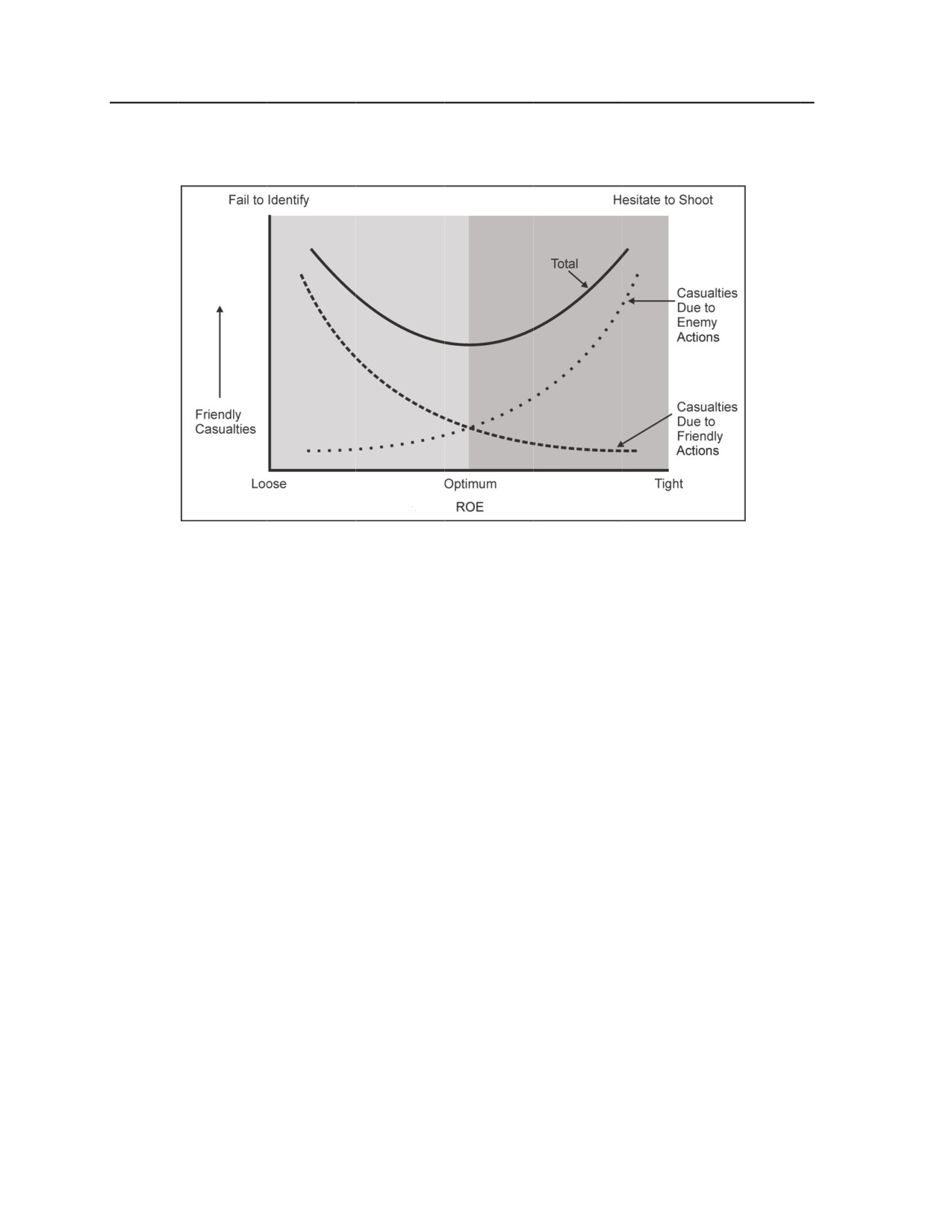
ROE. ROE are directives issued by competent military authority that delineate the
circumstances and limitations under which U.S. forces will initiate and/or continue combat
engagement with other forces encountered. (JP 1-02) Critical to ROE is the rapid, accurate
identification of potential targets. ROE are standardized throughout the AO to comply with
higher headquarters guidance. If too restrictive, ROE could reduce combat effectiveness and put
the force at greater risk. However, if ROE are too lax, they can lead to unnecessary collateral
damage and fratricide. The greater the Soldier’s ability to discriminate among friendly, enemy,
neutral, and unknown personnel and objects, the less restrictive ROE may become. The military
30 September 2009
FM 3-37
B-1
Appendix B
authority
developing ROE should consider combat identification capabilities
when defining
engagement criteria. Figure B-1 compares nonrestrictive and restrictive ROE
and shows how
they relate
to casualties
caused by enemy or friendly
fires.
Figure
B-1. Relationship between ROE and
combat identification
LINKAGE
B-3.
The range at
which current weapons are effective exceeds the human ability
to quickly and
accurately identify all entities in the AO. Not only are Soldiers unable to fully exploit weapon advantages
due to
combat identification limitations, but
these limitations also increase potential
fratricide and
unnecessary collateral damage. Enemies may use equipment
with the same characteristics as those of
friendly forces, or they may blend
into the civilian populace during operations. To counter
the enemy, U.S.
forces
can maneuver
over larger areas, in more dispersed formations, and in contiguous and
noncontiguous
AOs.
However, these abilities place more stress on existing
fire control measures. When these factors
combine with multinational operations (whose forces may have
different or no
combat identification aids or
procedures), leaders
must remain aware of how combat identification is functioning at all times.
B-4.
Regardless of
the combat identification,
commanders need to interface technology
with doctrine,
TTP, and ROE. Combat identification standardizes the approach in deciding
the appropriate level of force
against all types of targets. It consists of—
z
Detection—the discovery of any phenomena (personnel, equipment, objects) that are potential
targets. Commanders can use detection from various
means (visual observation,
radar detection,
electronic
signals measurement).
z
Location—the determination (by direction, reference point, or grid) of where a potential military
target is located in the AO (ground or
air).
z
Identification—the determination of
the friendly,
hostile, unknown, or neutral character of
a
detected,
potential target by its physical traits (size, shape, functional characteristics).
z
Classification—the categorization of a potential
target by the
relative level of danger
it
represents
z
Confirmation—the rapid verification of a target
in terms of
the initial identification and
classification. Soldiers
and leaders confirm identification and classification of
the target as an
enemy before engaging. When engagement is considered, Soldiers answer
the following
questions:
Can I
engage the target based on ROE?
What are the second- and third-order effects if I engage the target?
B-2
FM 3-37
30 September 2009
Combat Identification
Which target should I engage first (if there are multiple targets)?
What is the best weapon system to use?
B-5. Planners and executors must remember that current cooperative target identification technology does
not identify friend or foe—it only identifies friendly or unknown. Soldiers must decide whether to engage
the target. Cooperative target identification is a tool for a final check before engagement; Soldiers should
never use it as the sole criterion for target engagement.
B-6. Combat identification capability can be enhanced before detecting a potential target. It starts before
operations, with planned fire and maneuver controls that minimize potential fratricide. Maintaining an
accurate common operational picture provides continuously updated situational awareness to commanders
and units, allowing leaders to control fires more effectively. Consequently, when Soldiers engage a target,
they increase the likelihood of engaging correct targets with fewer or no negative, second- or third-order
effects. These factors apply with surface-to-surface, air-to-surface, and surface-to-air engagements.
SURFACE TO SURFACE
B-7. The U.S. Army and Marine Corps developed combat identification capabilities to improve combat
identification. Those capabilities are partitioned into the categories of information management tools,
active and passive marking tools, and training tools:
z
Information management tools. This category provides automatic locations of friendly forces,
reported enemy sightings, obstacles, and known battlefield hazards. It provides satellite
communications links to key leaders and critical platforms. There is a man-portable component
that provides one-way, location data to the common operational picture. The system is typically
composed of software and a hardware device.
z
Active marking tools. Active marking tools include near-infrared programmable emitters for
vehicles and flashing beacons for dismounted troops; second- and third-generation radar;
forward-looking infrared imagers; active radio frequency identification tags that can be queried
at standoff ranges; and digital line-of-sight hazard markers.
z
Passive marking tools. Passive tools include combat identification panels that provide a
contrast against a vehicle hull, cloth thermal identification panels, infrared strobe lights,
dismounted combat identification marking devices, highly reflective markers to identify
battlefield hazards and noncombat sensitive sites; individual glow tape; and infrared helmet
markers. The passive capabilities are enhanced by night vision equipment, long-range optics,
close combat optics, vehicle fire control systems, and vehicle thermal viewers.
z
Training tools. Virtual and live training tools include conduct-of-fire trainers, close combat
tactical training systems, active targets, and vehicle recognition systems.
B-8. Technologies include, but are not limited to, the following:
z
The Joint Combat Identification Marking System consists of combat identification panels, cloth
thermal identification panels, infrared strobe lights, dismounted combat identification marking
systems, individual glow tape, and infrared helmet markers.
z
The U.S. military has many units equipped with differing combat identification capabilities.
Although commanders know the capabilities within their command, the challenge is to integrate
these capabilities across echelons to complement ROE.
AIR TO SURFACE
B-9. Air-to-surface combat identification begins after detecting an object and ends with exchanging
information between the detectors and the shooter. Major tasks in air-to-surface combat identification
include—
z
Detecting objects in the AO.
z
Locating object positions.
30 September 2009
FM 3-37
B-3
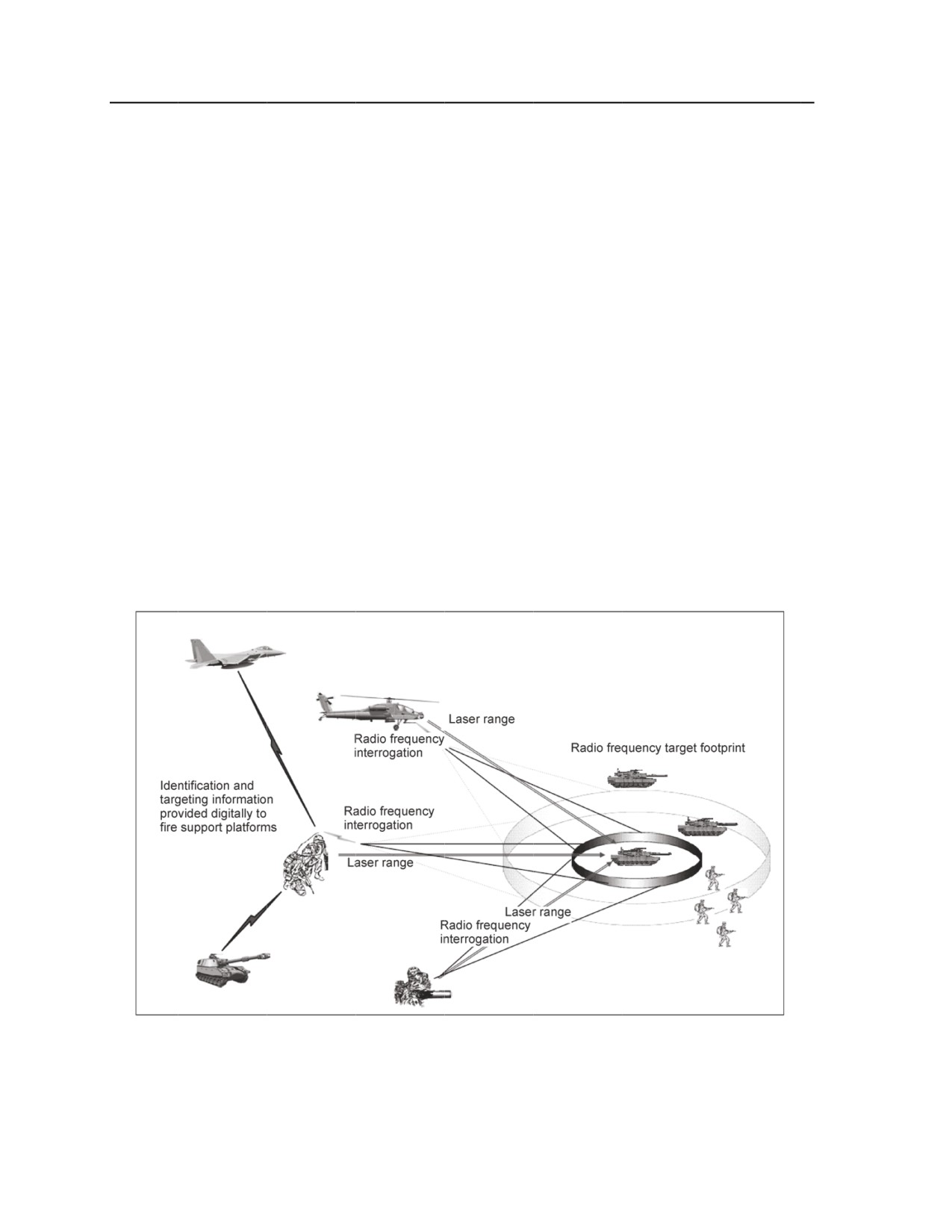
Appendix B
z
Identifying the object as friendly, enemy, neutral, or unknown. If
unknown, personnel continue
identification procedures until determining object characteristics or they shift to
another target
if
there is no
immediate threat.
z
Classifying information
relevant to
the targeted
enemy. Personnel categorize the target in
relation to
the level of
danger it represents. The proximity of friendly and neutral entities in
relation to
an identified
target may impact the decision to engage
due to second- or third-order
effects, such as blast or
rubble damage
z
Confirming the initial identification and classification of the target.
z
Providing
and verifying
the information exchange to
and from the shooter.
B-10.
Achieving these tasks requires a weapons platform that can—
z
Detect, locate, and identify the potential target before
engaging it.
z
Receive situational awareness on the
target and the relevant target area, including friendly,
enemy, and neutral entities.
z
Communicate with a controller, such
as an observer on the target
or a C2 node. The controller
quickly transmits relevant information
in an easily understood format before target engagement
z
Engage the target.
z
Assist with target assessment.
B-11.
Air-to-surface
attacks begin
by a request from a ground or aerial observer. When an attack is initiated
by a
ground observer, friendly
forces may be close to enemy targets, thus requiring clear target
identification. Personnel mark friendly and enemy locations
by multiple
means when operating under
dangerously close conditions. Aerial and ground
combatants should agree that they understand the location
of all
relevant forces
before engagement. (See figure B-2.) Some aircraft, such as the AC-130, can paint
a
target
with infrared before engagement so that a ground observer can verify the target identification.
Figure
B-2. Multiple target identification
B-4
FM 3-37
30 September 2009
Combat Identification
B-12. Before initiation by an aerial platform, the pilot already has situational awareness and situational
understanding of the target and surrounding target area. A pilot engages a target only after accessing all
available knowledge providers and obtaining a positive visual confirmation.
B-13. Other air-to-surface considerations include the following:
z
Combat identification features that ground forces can easily identify are not always as
identifiable from an aviation platform.
z
The Target Identification Panel System is a thermal, tape-marked cloth that mounts atop a
vehicle. This surface-to-air identification device has limited surface-to-surface utility.
z
Terminal attack controller training and equipment fully integrates with ground forces to ensure
teamwork and understanding.
z
Ground observers use a geographic designation system visible to aerial platforms.
z
Communication links connect all aircraft and ground forces when maneuvering and fighting,
including during darkness and limited visibility. Ground forces can “see” each other using Blue
Force Tracker and are better able to avoid fratricide. All aircraft is not capable of interrogating a
ground target as friendly before a lethal engagement occurs. One option is to pair the aircraft
with a C2 aircraft that is equipped with Blue Force Tracker to quickly clear targets for
engagement. If an aircraft lacks a combat identification system, leaders ensure that SOPs compel
pilots to contact ground elements for aircraft clearance before engaging.
SURFACE TO AIR
B-14. Preventing enemy aerial attack is the responsibility of all joint force components. The correct
identification of airspace users protects the force from enemy air attack and the erroneous engagement of
friendly aircraft. Identification, friend or foe (IFF) is a device that emits a signal positively identifying it as
friendly. (JP 1-02) (See FM 44-100 for more information.) It is the primary means of identifying friendly or
unknown aerial platforms at an extended distance. Training must emphasize IFF procedures, manual
identification procedures when IFF is not available, and the coordination requirements and procedures for
engaging threats while protecting friendly aircraft. One technology used for IFF is the Mark XII (Mode 4),
the current air-to-air and surface-to-air identification system that consists of a transponder on aircraft and
an interrogator on air defense artillery sensors.
B-15. Army and other forces (joint, coalition, multinational) use airspace to conduct air operations, deliver
fires, conduct air defense operations, and conduct intelligence operations. AC2 is the Army’s operational
approach to integrate airspace users and maximize the effectiveness of systems, while minimizing risks to
friendly aircraft. By maintaining complete situational awareness of airspace users, AC2 enables early
identification and coordinated air defense engagements of threat aircraft to prevent aerial attacks of friendly
forces.
B-16. AC2 does not denote that any airspace contiguous to the AO or other geographical dimension of
airspace is designated “Army” airspace. Neither does it imply command of any asset that is not assigned or
under operational control to an Army commander. Under joint doctrine, airspace is not owned in the sense
that assignment of an AO confers ownership of the ground. Airspace is used by multiple components and
the joint force commander designates an airspace control authority (usually the joint force airspace control
authority) to manage airspace.
B-17. AC2 personnel can effectively integrate Army, joint, and multinational airspace users operating
within the ground commander’s AO by maintaining complete situational awareness of the airspace, and
maintaining communications with airspace users. As components of the Army Air Ground System, AC2
and AMD elements develop SOPs and annexes to facilitate AC2 and air defense operations that
consistently follow joint procedures defined in JP 3-01, JP 3-30, JP 3-52, and the theater Airspace Control
Plan:
z
AMD and AC2 staff elements are organic to modular forces (brigade and higher).
z
Multifunctional BCTs and support brigades (except sustainment) contain a version of an air
defense airspace management (ADAM)/brigade aviation element (BAE) that is responsible for
integrating brigade AC2, including AMD and aviation functions.
30 September 2009
FM 3-37
B-5
Appendix B
z
Division and corps units contain an AC2 element in their main and tactical command posts.
z
Numbered armies contain an AC2 element in their main and contingency command posts.
z
The U.S. Army also has airspace managers as part of the battlefield coordination detachment, the
combined arms liaison organization to the Air Operations Center.
B-6
FM 3-37
30 September 2009
Appendix C
Protection of Military Bases
Campaigning Armies have always required areas from which military operations and
combat power can be supported, generated, and protected. These areas are generally
known as FOBs, base camps, installations, or facilities. The static nature of these
areas over time can lead to vulnerability of the force due to the inability to conduct
offensive maneuver. Effective protection is generally achieved at these locations by
developing protection strategies that utilize the forms and principles of protection and
often benefit by collective security efforts with response forces.
PERMANENT BASES AND BASE CAMPS
C-1. A base is a locality from which operations are projected or supported. (JP 1-02) Army bases overseas
typically fall into two general categories: permanent bases (or installations) and base camps. A base camp
is an evolving military facility that supports the military operations of a deployed unit and provides
the necessary support and services for sustained operations. Base camps consist of intermediate staging
bases and FOBs and support the tenants and equipment. While base camps are not permanent bases or
installations, they develop many of the same functions and facilities the longer they exist. A base or base
camp can contain one or more units from one or more Services. It has a defined perimeter and established
access controls and takes advantage of natural and man-made features. Terrain around many permanent
installations in CONUS, Korea, and Europe has changed since initial occupation; some installations lost
initial terrain advantage due to urban growth and changes in the physical environment. This may present
protection planning challenges in relation to standoff distances and traffic and access control.
C-2. Generally, permanent bases are in host nations where the United States has a long-term lease
agreement and a status-of-forces agreement. Intermediate staging bases are bases that are established near,
but not in, the AO.
C-3. A FOB is an area used to support tactical operations without establishing full support facilities.
(FM 3-0). FOBs are located in friendly territory and are established to extend C2 or communications or to
provide support for training and tactical operations. Commanders may establish a FOB for temporary or
enduring operations. A FOB may include an airfield, unimproved airstrip, anchorage, or pier. FOBs range
from small outposts to large, complex structures encompassing joint, interagency, and multinational forces.
A large, intermediate staging base or FOB may require dedicated units, such as an MEB to serve as the
base C2 headquarters and provide management for the protection warfighting function.
C-4. Units often conduct operations from a FOB in a noncontiguous AO. These FOBs provide four key
services: protection, critical infrastructure, C2, and sustainment. Whether establishing a FOB in
Afghanistan, establishing an intermediate staging base in Iraq, or protecting an installation in Germany,
leaders consider protection when planning mission accomplishment.
C-5. Protecting bases and the units occupying the bases depends on units identifying and mitigating
vulnerabilities based on the vulnerability assessment. Several levels of vulnerability assessments exist with
varying degrees of scope and focus:
z
Higher headquarters assessment. This is an overall assessment by a higher headquarters of
how an organization is managing its AT program, including the management and compliance
efforts by subordinate organizations. The higher headquarters assessment can include a joint
staff-integrated vulnerability assessment.
z
Local assessment. Local assessments are conducted by installation or unit AT officers, using
key force protection working group members as the assessment team in a collaborative effort.
30 September 2009
FM 3-37
C-1
Appendix C
z
Specialized assessment. Specialized assessments include assessments that are specifically
aimed to test base defenses and assessments that are directed by commanders to assess specific
threat capabilities.
C-6. Vulnerability assessments help base and unit commanders identify weaknesses, inefficiencies, and
enhancements in security and protection programs. They need to be continuous and identify areas where
protection efforts and resources should be focused.
C-7. Commanders are responsible for protecting military bases. They consider the twelve protection tasks
and systems when developing military base protection plans.
AIR AND MISSILE DEFENSE CONSIDERATIONS
C-8. Air and missile attacks can pose significant threats to units in the AO. Bases in the AO often protect
themselves from enemy air threats with passive air defense measures. Base commanders are responsible for
base defense. Most bases lack support from short-range air defense systems. Instead, they receive
protection from high-to-medium altitude missile air defense systems. Base commanders do not normally
control positioning of these systems since they are a theater level asset. However, base and unit
commanders ensure that they have adequate air defense procedures in place to defend their units and bases.
C-9. Air defense commanders have the authority to establish local ADWs that are higher but not lower
than the ADW established by the area air defense commander. An early warning alerts units and bases to a
possible air attack before it occurs. Commanders identify threat aircraft early enough to sound the local
warning system. Base commanders ensure that the base defense operations center receives information and
warnings from the air battle management operations center. Base commanders prepare units to face an air
threat with no supporting air defense artillery.
C-10. During an air threat, bases and units comply with passive air defense measures. Base and unit
commanders address passive air defense measures in SOPs at all levels and develop a routine to implement
these measures. Hazard assessment includes analyzing enemy air activity. This analysis drives the
implementation of select measures. For example, if enemy air activity is likely to occur during the day
only, most movement should occur during hours of limited visibility. Passive air defense measures become
more significant when changes in ADWs exist. Units follow specific passive air defense measures if
defense systems issue a notification of imminent enemy air attack.
C-11. Some bases may have a dedicated, indirect-fire protection capability, including a base targeting
surveillance system. The base defense operations center often controls this asset. Indirect-fire protection
intercept systems, like all air defense artillery systems, cannot protect all base assets and personnel with
100 percent surety. Therefore, commanders prioritize which assets receive dedicated, indirect-fire
protection.
FRATRICIDE AVOIDANCE CONSIDERATIONS
C-12. Fratricide can occur anywhere on the battlefield, including bases. Unit commanders must have a plan
to reduce the risk of friendly fire that results in fratricide. Key fratricide avoidance principles include—
z
Control measures. Commanders distribute adequate control measures to the lowest level.
z
Operation concept. Commanders ensure that all Soldiers understand the commander’s concept
of operation and that of adjacent units. When operating from FOBs in large urban environments,
units remain aware of operational friendly forces and NGOs in the AO.
z
Rehearsal. Commanders ensure that Soldiers understand the operation and rehearse the plan to
become familiar with the unit orientation during the mission.
z
Navigation devices. Soldiers need to become familiar with and use available navigation devices
to avoid becoming lost or disoriented. SOPs ensure that lost or disoriented units know how to
immediately contact higher headquarters for instructions and assistance.
z
Common operational picture updates. Units and Soldiers constantly update their operational
picture to keep up with changes to enemy and friendly situations.
C-2
FM 3-37
30 September 2009
Protection of Military Bases
z
Positive identification. Leaders ensure that Soldiers make positive identification before
engaging targets.
z
Visual identification panels. Units mark vehicles so that other friendly units operating in the
area can identify them.
z
ROE. Commanders ensure that Soldiers clearly understand the ROE.
OPERATIONAL AREA SECURITY CONSIDERATIONS
C-13. Commanders establish bases for a defined mission or purpose, and the base location should support
that mission or purpose. When considering a base location, commanders select a site that they can defend,
not one that is convenient. Units often operate without a well-defined support area. In some cases, support
units are not colocated with combat units. This means that support units are centrally located in the AO and
have to provide their own security. (See FMI 2-01.301 for more information.) Base locations also benefit
from established lines of communications that are sustainable and defensible. To maximize protection,
commanders select base locations based on OAKOC.
C-14. All bases are designed and manned to defeat Level I and Level II threats. Three levels of threat
categories exist:
z
Level I—a small enemy force that can be defeated by a unit’s organic resources.
z
Level II—an enemy activity that requires the commitment of a reaction force to defeat it.
z
Level III—a threat that requires the commitment of a TCF to defeat it.
C-15. In some operations and areas, a conventional force, Level III threat
(insurgents that have
consolidated to form a Level III threat) may exist. In these situations, the base response force or mobile
security force engages the Level III threat until another response force or TCF arrives to help defeat the
enemy. (See JP 3-10 for more information.)
BASE COMMANDER
C-16. A base commander—
z
Integrates the protection warfighting elements to protect and secure personnel, physical assets,
and information.
z
May appoint a base defense force commander to help execute base defense functions. (The base
defense force commander tasks units to provide Soldiers and materiel needed to form a base
defense force.)
z
Organizes the base defense force as required by the threat assessment and the types of units
located on or near the base.
z
Requests support from specialized forces (EOD, CBRN reconnaissance) if required.
BASE DEFENSE OPERATIONS CENTER
C-17. The base defense operations center is a C2 facility. The base commander establishes the center to
serve as the focal point for base security and defense. It plans, directs, integrates, coordinates, and controls
all base defense efforts. If the base commander is a battalion commander, the base defense operations
center forms on the nucleus provided by the battalion staff. On large bases with multiple units conducting
varied missions, the base defense operations center consists of units tasked with base defense
responsibilities.
C-18. A base cluster in base defense operations is a collection of bases, geographically grouped for mutual
protection and ease of C2. (JP 3-10) A base cluster normally lacks a defined perimeter or established access
points. The base cluster commander and base cluster operations center provide C2 to multiple bases and
integrate protection efforts and defense plans.
30 September 2009
FM 3-37
C-3
Appendix C
BASE DEFENSE FORCE
C-19. Base defense forces are troops assigned or attached to a base for the primary purpose of base defense
and security as well as augmentees and selectively armed personnel available to the base commander for
base defense from units performing primary missions other than base defense. (JP 3-10) This security
element provides local perimeter security and base defense. It may consist of one unit or a combination of
units assigned to the base. It consists of the guard force, which may include static or roving elements
comprised of joint, multinational, host nation, contracted security, or quick-reaction forces based on the
mission variables. The quick-reaction force often has a squad- to platoon-size element located on the base.
It reinforces the guard force in the event of a Level I or Level II attack.
MOBILE SECURITY FORCE
C-20. The mobile security force is a dedicated security force designed to defeat Level I and Level II threats
on a base and/or base cluster. (JP 3-10) A platoon- or company-size mobile security force may be assigned
to one base, but may support multiple bases. Regardless, planners incorporate the mobile security force into
the base defense plan. These units reinforce threatened areas, block enemy penetrations of primary security
positions, and counterattack. They often arrive as mechanized or motorized elements with armor protection.
The mobile security force “shapes” a Level III threat until a TCF arrives that is capable of destroying
armor-protected vehicles and dismounted infantry.
PROTECTION CONSIDERATIONS
C-21. Base AT protection requires the close cooperation and integration of activities, units, and planning.
Most failures to protect bases from terrorist attacks can be attributed to the failure of various organizations
to coordinate activities, share responsibilities, and disseminate intelligence information.
C-22. The same principles of defense apply to base AT protection. Considerations for access to the base
perimeter and various clusters, effective communications, control measures, and integrated barrier systems
play an important role in building necessary protection against prospective terrorist attacks.
C-23. Contracting is often part of base defense. Base defense responsibilities should include necessary
checks on contracts. Whether the contract involves products (food, water, construction) or personnel
(contracted guards, workers) it should be vetted through a system which ensures that AT considerations are
taken into account.
ACCESS CONTROL
C-24. Thorough base protection includes identification checks of all personnel entering bases in high-threat
areas. The proper vetting of host nation support and contract personnel enhances security. Incorporating
random AT measures into the access control plan varies the level of detail required for access. This keeps
the guard force alert and keeps the enemy off balance. Additional identification measures (biometrics,
metal detectors, X-ray devices) are critical to effective access control.
PERIMETER DEFENSE
C-25. An effective and alert base defense force best deters Level I and Level II threats. Adequate standoff
distances from buildings and other structures outside the perimeter greatly enhance perimeter defense. An
accurate threat assessment, combined with defense in depth, helps determine the standoff distance required.
The staff EOD or engineer can help determine the appropriate standoff distances to protect against blasts
from IEDs. Random patrols inside and outside the perimeter (as part of the base random AT measures and
direct-fire positions on key access points and critical locations) also enhance security. In addition, some
strategies randomly use countersurveillance teams to defeat enemy surveillance.
PROTECTION AND DEFENSE IN DEPTH
C-26. Protection and defense in depth include available friendly forces and physical barriers. Both should
be deployed in depth, in a concentric fashion, to allow maximum protection. The base defense force
C-4
FM 3-37
30 September 2009
Protection of Military Bases
deploys physical barriers in depth beginning with the perimeter fence line. It also clears fields of fire and
uses barriers and other entry control measures to control pedestrian and vehicle egress from and ingress to
the base. The base defense force uses barriers to protect critical assets and infrastructures inside the base.
AIR BASE APPROACH AND DEPARTURE CORRIDOR SECURITY
C-27. Aircraft are especially vulnerable when operating in the “low and slow” takeoff and landing flight
regimes. Airbase approach and departure corridor security operations protect aircraft from shoulder-
launched, surface-to-air threats when they take off and land at airbases. Base commanders of any Service
who command installations with active airfields identify considerations for planning and securing air
operations that are subject to threat systems. This includes approach and departure corridors used by the
aircraft. (See JP 3-10 for more information.)
CONTROL MEASURES
C-28. Control measures in base defense operations resemble those used in other defense operations. The
area commander establishes base boundaries in coordination with the base or base cluster commander.
Area, base, and base cluster commanders coordinate base boundaries and establish phase lines, contact
points, objectives, and checkpoints that are necessary to control base clusters. The base boundary is not
necessarily the base perimeter. Rather, it is established on the mission variables, specifically balancing the
need of the base defense forces to control key terrain with their ability to accomplish the mission. The base
boundary may or may not be contiguous to other base AOs. Commanders may further subdivide the unit’s
assigned area into subordinate AOs, bases, and base clusters and assign maneuver forces to assembly areas
and battle positions. They establish fire support coordination measures to permit or restrict fires in and
around the base. (See FM 3-09.32 for more information.) No-fire areas may be required to protect civilians;
prevent the disruption of sustaining operations; or protect combat outposts, observation posts, and patrols
from friendly fire. Commanders coordinate all established control graphics with host nation organizations
to minimize interference, misunderstandings, and collateral damage. The base defense force commander (in
coordination with the base commander) designates the base perimeter, target reference points, and sectors
of fire to organizations located at the base.
PHYSICAL SECURITY, BARRIER, AND SURVIVABILITY PLAN
C-29. Commanders use obstacles to provide Soldiers, equipment, facilities, and supplies with a level of
survivability in the event of an attack or attempted attack. Obstacles can be categorized as tactical or
protective:
z
Tactical. Tactical obstacles directly attack the enemy’s ability to move, mass, and reinforce.
z
Protective. Protective obstacles provide close-in protection for the friendly force and are
categorized as hasty or deliberate. They range from tetrahedrons and concrete barriers to
networked munitions.
C-30. Physical barriers provide a protection capability and are available in many forms; some are
inexpensive and flexible (such as tetrahedrons), and others are resource-intensive and inflexible (such as
walls). Networked munitions replace conventional mines and provide a rapidly emplaced intrusion
detection and denial system for base and perimeter security. These munitions are remotely controlled from
a central station and provide scalable, lethal and nonlethal effects. The base survivability plan includes
other measures of hardening and the construction of supporting structures, such as entry control points and
guard towers.
EARLY WARNING SYSTEM
C-31. All bases should have an electronic and audio early warning system that personnel on the base can
understand. For an effective defense, bases rehearse immediate battle drills to protect Soldiers and units.
30 September 2009
FM 3-37
C-5
Appendix C
SURVIVABILITY AND BARRIER CONSIDERATIONS
C-32. The development of a base and the ability to defend it relies on the innovation, adaptability, and use
of engineer assets. Local contractors often make up for shortages in organic equipment and personnel.
Commercial engineer equipment can often provide the greatest versatility throughout base development
and maintenance.
C-33. Commanders construct protective shelters and defensive positions to protect Soldiers from direct and
indirect fire and explosives. They might modify existing structures to meet survivability needs. Units
construct structurally sound fighting positions under the supporting engineer’s supervision. The supporting
engineer determines the required construction materials and whether the positions meet safety
considerations.
C-34. Reduced vulnerability to explosives occurs if units establish adequate perimeters and move critical
areas as far from the perimeter as practical. Standoff distances and window protection reduce blast effects.
The supporting engineers can determine adequate standoff distances based on the threat.
C-35. All barrier plans include measures to block high-speed avenues of approach to the entrance and high-
risk targets.
Note. See United Facilities Criteria (UFC) 4-010-01, UFC 4-010-02, UFC 4-022-01, FM 5-103,
and GTA 90-01-010, Joint Contingency Operations Base Force Protection Handbook for more
information.
FORCE HEALTH PROTECTION CONSIDERATIONS
C-36. Base commanders are responsible for protecting the health of their Soldiers. One of the most
important FHP considerations is ensuring the quality of base food and water supplies. Base commanders
develop procedures to protect these supplies from environmental threats and intentional tampering.
Otherwise, personnel may risk exposure to harmful levels of contaminants, such as physical hazards, TIM,
radiation, or biological agents. Harmful levels of contaminants can be high-level or low-level exposures:
z
High-level exposure. High-level exposure results in immediate health effects.
z
Low-level exposure. Low-level exposure results in delayed, long-term effects.
C-37. Base and unit commanders use the Army’s CRM process to evaluate risks posed by hazards.
Through the protection cell, a commander can implement a specific team that looks at food and water
security. A multidisciplinary approach systematically reviews and assesses food systems. This team
consists of—
z
Protection officer.
z
Preventive medicine officer.
z
Veterinary corps officer.
z
Unit food advisor.
z
Provost marshal representative.
z
Military intelligence representative.
C-38. The exact process for the base and unit food and water security program varies. The program
depends on information such as base or unit type, location, and size; distribution chain; and personnel
involved. The protection working group considers the unique conditions of each food system when
developing a program. The group evaluates food supply and distribution systems for current safety and
security operations. After developing initial procedures, the protection working group completes periodic
reviews to validate vulnerabilities and verifies and updates the program assumptions, guidelines, and
restrictions.
C-6
FM 3-37
30 September 2009
Protection of Military Bases
CHEMICAL, BIOLOGICAL, RADIOLOGICAL, AND NUCLEAR
CONSIDERATIONS
C-39. Base commanders coordinate CBRN defense of their base and of bases designated in their AO. The
base commander and the protection staff identify the CBRN threat and notify units and at-risk civilians of
the threat. They recommend appropriate training and early warning measures based on the threat, assess
readiness and vulnerabilities, and identify CBRN defense requirements. Defensive planning should account
for likely transient units that may only occupy the base for a short term. (See FM 3-11.34 for more
information.)
C-40. Base commanders ensure that CBRN defense planning integrates closely with AMD planning. They
consider that threat missile delivery systems range from mortars to surface-to-surface missiles. (See the
following vignette.)
CBRN Defense
On 27 March 2003, an Iraqi surface-to-surface missile was launched against coalition forces at
Camp Doha, Kuwait. PATRIOT missile batteries successfully intercepted the inbound missile 7
kilometers east of Camp Doha, headquarters of the Combined Forces Land Component
Command, which controlled ground forces involved in Operation Iraqi Freedom.
About 90 minutes later, an unknown biological agent triggered several aerosol sensors within
the Mishref District of Kuwait City. The sensors were the first line of defense and could detect
biological agents with particles of a certain size. The Czech contingent of the task force
deployed a biological sampling team. The team determined the agents to be Escherichia coli
(E. coli) bacteria, which the team believed to be the result of high winds blowing the bacteria
from an unregulated dump near Kuwait City. Since the alarms were sounded on the basis of a
missile attack, Kuwaiti officials issued a warning to residents in Mishref to stay in their homes
or to don protective masks. Once the Czech analysts gave the all clear, Kuwaitis went about
their business.
SAFETY CONSIDERATIONS
C-41. The proper storage of arms and ammunition critically affects mission accomplishment and the safety
of deployed Soldiers. Even in high-threat areas, where renewed combat operations can happen, base
protection requires properly stored arms and ammunition.
C-42. A significant loss of combat power resulted from the Camp Doha explosion shown in the following
vignette. This incident nearly destroyed an entire squadron and sharply reduced the regiment’s overall
combat power. Logisticians estimated total losses at more $40 million.
30 September 2009
FM 3-37
C-7
Appendix C
Improper Storage of Arms and Ammunition
Causes Damage and Destruction
In June 1991, four months after Operation Desert Storm ended, the 11th Armored Cavalry
Regiment (ACR) deployed from Germany to occupy Camp Doha, Kuwait, and serve as a
deterrent and rapid response force. By July 1991, the 11th ACR was the only U.S. ground
combat unit remaining in the Gulf Theater. Due to the threat of renewed hostilities, the 11th
ACR kept its combat vehicles “combat loaded” with ammunition while in garrison. The regiment
stored an equal amount of ammunition in military vans (containers) located in the north
compound motor pool complex near the combat vehicle parking ramps.
On the morning of 11 July 1991, the 11th ACR deployed two of its three combat formations to
the field, leaving behind a single squadron to serve as a guard force. The squadron was
parked in Camp Doha’s north compound. This fenced-off area contained several motor pool
pads, some administrative buildings, a wash rack, and living quarters for about 250 British
soldiers.
At approximately 1020 hours, a defective heater in an M992 ammunition carrier caught on fire.
The carrier was loaded with 155-millimeter artillery shells. Troops unsuccessfully tried to
extinguish the fire before being ordered to evacuate the north compound. This evacuation was
still underway when the burning M992 exploded at
1100 hours, scattering artillery
submunitions over nearby, combat-loaded vehicles and ammunition stocks.
This set off an hours-long series of explosions and fires that devastated vehicles and
equipment in the north compound and scattered UXO and debris over much of the camp. The
fires produced billowing clouds of smoke that rose hundreds of feet into the air and drifted
across portions of the north and south compounds, in the direction of Kuwait City.
By midafternoon, the fires had died down enough to allow a preliminary damage assessment.
There were no fatalities; however, 49 Soldiers were injured, 2 seriously. Most injuries were
fractures, sprains, contusions, or lacerations suffered when Soldiers scrambled over the 15-
foot-high perimeter wall. The destruction was overwhelming. The fire and explosions damaged
or destroyed 102 vehicles, including 4 M1A1 tanks and other combat vehicles, and more than
2 dozen buildings sustained damage. The fires destroyed about
$15 million worth of
ammunition and highlighted the importance of having ammunition supply point accident
cleanup procedures in place
OPERATIONS SECURITY CONSIDERATIONS
C-43. OPSEC is vital to protecting information. In addition to protecting classified information, a good
OPSEC program denies the enemy access to unclassified, critical information about friendly forces. This
critical information could allow an enemy to delay or disrupt friendly plans, operations, or missions;
determine the base commander’s next move; or assess base vulnerabilities, weaknesses, and strengths.
Examples of a weakness or vulnerability include—
z
Perimeter surveillance cameras not working properly.
z
Perimeter gates malfunctioning.
z
Guard force reductions.
z
Communications vulnerabilities.
z
Access control vulnerabilities.
C-44. The base or unit OPSEC officer works with the AT officer to create a CAL. The CAL changes
according to the threat environment, and commanders adjust it periodically. They brief it only to
appropriate personnel in a need-to-know status.
CONTRACTOR PERSONNEL CONSIDERATIONS
C-45. Commanders consider protection as it pertains to contractor personnel. Commanders decide whether
to use contractors and then determine whether to use U.S. contractors. The type of contractor employed
affects protection considerations. (See the following vignette.)
C-8
FM 3-37
30 September 2009
Protection of Military Bases
Coordinating Non-DOD Contractor Support
In many contingencies, Army commanders coordinate with the DOS or other government
agencies to integrate non-DOD contractor support into the overall joint security plan. For
example, during Operation Iraqi Freedom, DOS coordinated directly with Multinational Force-
Iraq. This coordination properly integrated major DOS-sponsored reconstruction efforts into the
military security plan. Such efforts included DOS-funded, contracted security forces. Protection
requirements became so challenging that commanders created a combined DOS-DOD
contracting coordination center. This center provided the necessary planning capabilities,
information sharing, and coordination measures. It directly linked regional reconstruction
coordination centers into area commander operations centers. These regional coordination
centers provided area commanders with key information on DOS missions being conducted in
their AOs. This critical information assisted area commanders when they provided backup
security support to DOS missions, facilities, and personnel.
C-46. From the base security perspective, commanders carefully consider using local or third-country
national employees. In some operational situations, using such personnel creates significant risks. The
theater subordinate Army force planners and their contract oversight organizations assess the security risk
of using local or third-country national personnel instead of U.S. contractors and military support
capabilities. This assessment includes an analysis of security risks versus the negative strategic impact of
not employing these personnel. Based on joint force and component commander decisions, base
commanders conduct a local vulnerability assessment as it relates to using local or third-country national
personnel. Answer the following questions when considering the use of local or third-country national
employees to support base operations:
z
Will contractor personnel reside on or off base? If they live off base, what base access control
measures are required?
z
How will access be controlled to specific areas within the base?
z
Is there a vetting and badging process in place? If so, who will enforce it and how will it be
enforced?
z
Will contractor personnel be physically screened or searched in order to enter the base?
z
Will armed escorts be required? If so, who will do this and how will it be resourced?
z
Are special technologies (metal detectors, X-ray machines) needed and available?
C-47. Area, base, and supported unit commanders provide individual protection support. Sometimes, they
provide security to contractors as determined by the Army force commander. To perform such tasks
properly, area and base commanders maintain requisite visibility over supporting contingency contractors
in their AOs.
Note. See FM 3-100.21 for more information.
30 September 2009
FM 3-37
C-9
Appendix D
Operations Security
Leaders and Soldiers implement OPSEC as part of protection. OPSEC is not a
collection of specific measures to apply to every operation; it is the part of the CRM
process that protects information. OPSEC applies to all operations and activities at all
levels of command.
OPERATIONS SECURITY APPLICATION
Note. See chapter 2 for a definition of OPSEC.
D-1. OPSEC is how commanders manage risks to information. All units conduct (plan, prepare, execute,
and continually assess) OPSEC to preserve essential secrecy. OPSEC is vital to the success of operations.
Information that friendly forces take for granted is often what adversaries need to obtain defeat. Practicing
effective OPSEC, however routine, denies adversaries information and protects friendly forces.
D-2. Everyone must practice OPSEC and understand the cost of OPSEC compromises. It covers a range
of activities, from avoiding predictable patterns of behavior to camouflaging equipment. Good OPSEC
involves communicating why OPSEC is important and what Soldiers are supposed to accomplish.
Understanding why they do something and what their actions are supposed to accomplish allows Soldiers
to perform tasks more effectively. Successful OPSEC requires Soldiers to take deliberate and
knowledgeable actions. (See AR 530-1 for more information.)
OPERATIONS SECURITY AS PART OF THE COMPOSITE RISK
MANAGEMENT PROCESS
D-3. The OPSEC officer helps the G-3 integrate OPSEC into the operations process. Risk management is
an integral part of protection and the MDMP.
Note. See FM 5-19 for more information.
D-4. Commanders practice OPSEC to protect information. OPSEC planning produces a set of coordinated
OPSEC measures and tasks that Soldiers and units perform to protect the force. OPSEC measures are
methods and means to gain and maintain essential secrecy about EEFI. Throughout the MDMP, the
protection cell treats OPSEC measures as protection tasks. During orders production, planners incorporate
OPSEC measures as protection tasks and tasks to subordinate units.
STEP 1. IDENTIFY HAZARDS
D-5. The first step of OPSEC is to identify hazards. Hazards within the context of OPSEC are identified
by analyzing the EFFI, the capability and intent of adversaries to collect EEFI, and friendly vulnerabilities
that may aid enemy collection. Figure D-1, page D-2, shows how OPSEC integrates with the operations
process and CRM.
30 September 2009
FM 3-37
D-1