FM 3-37 PROTECTION (SEPTEMBER 2009) - page 1
FM 3-37
Field Manual
Headquarters
Department of the Army
No. 3-37
Washington, DC, 30 September 2009
Protection
Contents
Page
PREFACE
...............................................................................................................................iv
Chapter 1
PRESERVING THE FORCE
1-1
Protection Role
1-1
Operational Environment
1-3
Threats and Hazards
1-3
Combat Power
1-5
Forms of Protection
1-6
Principles of Protection
1-7
Warfighting Functions
1-9
Protection Warfighting Function
1-9
Composite Risk Management
1-11
Chapter 2
PROTECTION WARFIGHTING FUNCTION
2-1
Protection Tasks and Systems
2-1
Air and Missile Defense
2-1
Personnel Recovery
2-3
Information Protection
2-4
Fratricide Avoidance
2-6
Operational Area Security
2-7
Antiterrorism
2-9
Survivability
2-12
Force Health Protection
2-13
Chemical, Biological, Radiological, and Nuclear Operations
2-15
Safety
2-17
Operations Security
2-18
Explosive Ordnance Disposal
2-18
Chapter 3
PROTECTION IN FULL SPECTRUM OPERATIONS
3-1
Full Spectrum Operations
3-1
Operational Design
3-3
Security Operations
3-4
Distribution Restriction: Approved for public release; distribution is unlimited.
30 September 2009
FM 3-37
i
Contents
Stability
3-10
Civil Support
3-15
Chapter 4
PROTECTION INTEGRATION IN ARMY OPERATIONS
4-1
Operations Process
4-1
Battle Command and Protection Strategies
4-2
Protection and the Operations Process
4-5
Chapter 5
PROTECTION CELLS
5-1
Roles and Responsibilities
5-1
Composition
5-3
Protection in Brigades and Below
5-6
Division Protection Cell
5-6
Corps Protection Cell
5-6
Army Service Component Command Protection Cell
5-6
Protection Working Group
5-7
Appendix A PROTECTION IN FORCE PROJECTION OPERATIONS
A-1
Appendix B COMBAT IDENTIFICATION
B-1
Appendix C PROTECTION OF MILITARY BASES
C-1
Appendix D OPERATIONS SECURITY
D-1
GLOSSARY
Glossary-1
REFERENCES
References-1
INDEX
.................................................................................................................... Index-1
Figures
Figure 1-1. Protection as an element of combat power
1-2
Figure 1-2. Security environment
1-4
Figure 1-3. METT-TC and hazard assessment factors
1-5
Figure 1-4. Elements of combat power
1-6
Figure 1-5. Forms of protection
1-6
Figure 1-6. Principles of protection
1-8
Figure 1-7. Warfighting functions
1-9
Figure 1-8. CRM process
1-12
Figure 3-1. Full spectrum operations
3-1
Figure 3-2. Screen security operation
3-4
Figure 3-3. Guard security operation
3-5
Figure 3-4. Cover security operation
3-8
Figure 3-5. Movement corridor operation
3-11
Figure 3-6. Whole-government, integrated approach to stability operations
3-12
Figure 3-7. Stability operations framework
3-12
Figure 3-8. Controlling freedom of movement for protection
3-13
Figure 4-1. Operations process
4-1
Figure 4-2. Continuing activities and integrating processes
4-2
ii
FM 3-37
30 September 2009
Contents
Figure 4-3. Battle command
4-3
Figure 4-4. MEB task-organized for protection tasks
4-4
Figure 4-5. CAL and DAL in the operations process
4-8
Figure 4-6. Protection cell and planning process
4-8
Figure 5-1. Sample protection concept for offensive operations
5-3
Figure 5-2. Sample protection directorate at theater level
5-7
Figure A-1. Protection responsibilities during deployment
A-6
Figure B-1. Relationship between ROE and combat identification
B-2
Figure B-2. Multiple target identification
B-4
Figure D-1. Integration of OPSEC
D-2
Tables
Table 1-1. Protection tasks and corresponding significant activities
1-10
Table 1-2. Army risk assessment matrix
1-12
Table 3-1. Elements of full spectrum operations
3-3
Table 4-1. Expanded operations process with supporting topics
4-5
Table 4-2. CRM process
4-10
Table 5-1. Sample protection working group activities
5-8
Table 5-2. Sample protection working group for vulnerability assessment
5-9
Table A-1. Protection synchronization for deployment
A-3
Table A-2. Examples of transportation protective services
A-7
30 September 2009
FM 3-37
iii
Preface
Field Manual (FM) 3-37 provides doctrinal guidance for commanders and staffs who are responsible for
planning and executing protection in support of full spectrum operations. It describes protection as both an
element of combat power and as a warfighting function. FM 3-37 corresponds with Army operations doctrine
introduced in the FM 3-0 capstone manual.
As the Army keystone manual for protection, FM 3-37 will help commanders understand and visualize
protection concepts and ideas and enable them to describe protection tasks and systems for integration into the
operations process. FM 3-37 expands on the protection and combined arms terminology outlined in FM 3-0. It
explains how protection can be achieved and applied through the combination and integration of reinforcement
and complementary capabilities to preserve combat power or to protect personnel, physical assets, or
information. This manual recognizes that protection has no direct antecedent from the former battlefield
operating systems, so protection is realized in many ways. Therefore, the text introduces the five forms and five
principles of protection to provide a context for battle command and a framework for task assignment:
z
Forms of protection.
Deterrence.
Prevention.
Active security.
Passive defense.
Mitigation.
z
Principles of protection.
Full-dimension.
Integrated.
Layered.
Redundant.
Enduring.
FM 3-37 also introduces and explains the twelve Army tasks that comprise the protection warfighting function
and describes how those tasks are realized and represented during full spectrum operations:
z
Air and missile defense (AMD).
z
Personnel recovery (PR).
z
Information protection.
z
Fratricide avoidance.
z
Operational area security.
z
Antiterrorism (AT).
z
Survivability.
z
Force health protection (FHP).
z
Chemical, biological, radiological, and nuclear (CBRN) operations.
z
Safety.
z
Operations security (OPSEC).
z
Explosive ordnance disposal (EOD).
iv
FM 3-37
30 September 2009
Preface
This manual affirms the composite risk management (CRM) process as the overarching process for integrating
protection into Army operations and depicts a broad methodology for determining protection priorities from
which specific decision support tools can nest. FM 3-37 provides guidance on how the protection cell within the
division, corps, and Army headquarters is formed for protection planning, preparation, execution, and
continuous assessment.
Note. It is Department of the Army (DA) policy to develop and employ all measures that prevent
attacks and minimize risks from hazards to Soldiers, civilians, their Families, infrastructures, and
information to achieve mission assurance. To adapt to an evolving environment and to achieve a
broad, coherent, and comprehensive approach to protection, the Army applies an all-hazards
approach to protection. This approach focuses on protecting personnel, physical assets, and
information from traditional, irregular, disruptive, and catastrophic threats, including criminal
activity and naturally occurring disasters. The Army will prepare to recover quickly if prevention
and protection efforts fail.
Commanders should be aware that homeland defense and civil support operations in the continental United
States (CONUS) are governed by a distinct set of laws and policies regarding the employment of forces, types
of operations, and use of force. These laws and policies must be factored into determining the appropriate use of
protection principles and tasks and systems for an operation in CONUS.
This manual follows joint doctrine and introduces several ideas to provide a context for understanding
protection within the military art and science of operations to achieve its purpose of preserving the force—
personnel
(combatant and noncombatant), physical assets, and information. FM 3-37 strives for a broad
application of some universal concepts regarding protection and also integrates lessons learned from five years
of combat operations.
This manual is organized as follows:
• Chapter 1, Preserving the Force.
• Chapter 2, Protection Warfighting Function.
• Chapter 3, Protection in Full Spectrum Operations.
• Chapter 4, Protection Integration in Army Operations.
• Chapter 5, Protection Cells.
• Appendix A, Protection in Force Projection Operations.
• Appendix B, Combat Identification.
• Appendix C, Protection of Military Bases.
• Appendix D, Operations Security.
Definitions for which FM 3-37 is the proponent publication (the authority) are in boldfaced text and have an
asterisk in the glossary. These terms and their definitions will be incorporated into the next revision of FM 1-02.
For other definitions in the text, the term is italicized and the number of the proponent publication follows the
definition.
This publication applies to the Active Army, the Army National Guard (ARNG)/the Army National Guard of
the United States (ARNGUS), and the United States Army Reserve (USAR) unless otherwise stated.
The proponent for this publication is the U.S. Army Training and Doctrine Command (TRADOC). Send
comments and recommendations on DA Form 2028 (Recommended Changes to Publications and Blank Forms)
directly to Commanding General, U.S. Army Maneuver Support Center, ATTN: ATZT-TDD, 320 MANSCEN
Loop, Suite 270, Fort Leonard Wood, Missouri 64573-8929. Submit an electronic DA Form 2028 or comments
and recommendations in the DA Form 2028 format by e-mail to <leon.mdottdddoc@conus.army.mil>.
Unless this publication states otherwise, masculine nouns and pronouns do not refer exclusively to men.
30 September 2009
FM 3-37
v
Chapter 1
Preserving the Force
Protection of the fighting force is inherent to command. Every military activity, from
training and predeployment preparation through mission accomplishment, requires
the commander to assume responsibility for protecting the force while achieving the
objective. This chapter defines and examines protection as an element of combat
power and as a warfighting function. It introduces and discusses the forms and
principles of protection and the CRM process. The purpose of these protection
constructs, methodologies, and processes is to help frame and organize protection
activities for their integration into the operations process where they can facilitate
decisionmaking.
PROTECTION ROLE
1-1. Military activities and operations are intrinsically hazardous. Commanders and leaders conducting
full spectrum operations must assume prudent risks every day based on the significance of the mission, the
exigency of the operation, and opportunity. In warfare, this reality defines a sacred trust that must exist
between leaders and Soldiers regarding mission accomplishment and protection. A commander’s inherent
duty to protect the force should not lead to risk aversion or inhibit the freedom of action necessary for
maintaining initiative and momentum or achieving decisive results during operations. Leaders balance
these competing responsibilities and make risk decisions based on experience, ethical and analytical
reasoning, and their knowledge of the unit and the situation and through intuitive judgment. It is through
protection that commanders and leaders preserve combat power and reduce the risk of loss, damage, or
injury to their formations.
Note. In an environment where terrorism persists, protection considerations must be considered
in garrison and in preparatory phases to operations.
1-2. Protection is the preservation of the effectiveness of mission-related military and nonmilitary
personnel, equipment, facilities, information, and infrastructure deployed or located within or
outside the boundaries of a given operational area.
1-3. Protection is an element of combat power and a warfighting function. As a contributor to overall
combat power, protection represents relative potential; as a warfighting function, protection refers to twelve
specific tasks and systems that are explained in chapter 2. It is easy to confuse these two constructs while
conceptualizing, visualizing, or describing protection means and capabilities. Commanders reference
protection as an element of combat power when they understand and visualize all possible activities,
actions, and effects available for protection. Some of these actions or effects may be achieved through the
combined integration of the other five elements of combat power (movement and maneuver, intelligence,
fires, sustainment, and command and control [C2]), focused by leadership and information and resulting in
an increasingly effective and efficient concept of protection. (See figure 1-1, page 1-2.)
30 September 2009
FM 3-37
1-1

Chapter 1
Protection as an
Element of Combat
Power
Protection
Overall protection
Warfighting
potential is achieved
Function
through the combined
The protection
integration of the
warfighting
elements of combat
function
power (protection,
employs the
movement and
twelve specific
maneuver,
tasks and
intelligence, fires,
systems of
sustainment, and C2),
protection.
focused by leadership
and information.
Figure 1-1. Protection as an element of combat power
1-4. Commanders and leaders typically describe or give guidance using the warfighting functions to
identify specific tasks from which operations and missions can be developed. The protection warfighting
function—
z
Serves to specifically focus the broad range of protection activities into quantifiable tasks and
relevant systems for simplification, integration, and synchronization in the Army operations
process.
z
Describes the twelve specific tasks and systems that must be analyzed during planning,
organized during preparation, monitored and evaluated during execution, and continually
assessed to protect the force from threats and hazards.
1-5. All military activities have some inherent or organic protection capability. Protection capability can
be realized as complementary or reinforcing, making its application or contribution illusive to combat
power generation (see FM 3-0 for more information):
z
Complementary. Complementary capabilities protect the weakness of one system or
organization with the capabilities of a different warfighting function.
z
Reinforcing. Reinforcing capabilities combine similar systems or capabilities within the same
warfighting function to increase the function’s overall capabilities.
1-6. When Soldiers don a helmet or protective mask or add reactive armor to vehicles, protection is
applied and existing or inherent protection is reinforced. Protection can be applied to a convoy or high-risk
personnel (HRP) by surrounding them with security assets to reinforce their organic protection capacity.
Physical barriers, ditches, and other tangible efforts can be applied to a base camp to reinforce or apply
protection. Soldiers have vaccines applied to protect them from disease, while sensors and markings are
applied to tactical vehicles to prevent fratricide.
1-7. Protection can also be realized or achieved through task organization changes that reinforce similar
protection capabilities by a common purpose or by effect when dissimilar functions complement
predominant protection activity. Some level of protection is achieved through complementary movement
and maneuver capabilities by changing tempo, taking evasive action, or maneuvering to gain positional
1-2
FM 3-37
30 September 2009
Preserving the Force
advantage in relation to a threat. Formations often derive protection by integrating complementary
intelligence capabilities, using terrain and weather data or the cover of darkness to mask or protect
movement. Some physical terrain features can offer more protection than others and are considered to
complement force positioning during operational design. Protection from enemy indirect fire can be the
result of reinforcing inherent survivability capabilities by dispersing command posts, while protection from
enemy reconnaissance may be the result of reinforcing inherent concealment capabilities achieved from
massing command posts.
1-8. Protection can be achieved from knowledge and understanding. An intelligence summary may
provide Soldiers with indicators or warnings of a specific threat tactic. This knowledge may result in force
preservation if actions are taken that prevent, or reduce the probability of, the success of enemy tactics.
Army leaders use mission variables and assessments of environmental threats and hazards to determine
when and where protection can be achieved through reinforcing action and application or through
complementary effect.
OPERATIONAL ENVIRONMENT
1-9. The nature and outcome of military operations are shaped within a complex framework of
environmental factors. The operational environment (OE) is defined as a composite of the conditions,
circumstances, and influences that affect the employment of capabilities and bear on the decisions of the
commander. (Joint Publication [JP] 3-0) (See FM 3-0 for more information.) Commanders and leaders
charged with providing or ensuring protection must begin with a thorough understanding of the OE, the
risks and opportunities resident there, and the ways and means available for preserving combat power
through protection. Army doctrine recognizes eight operational variables (political, military, economic,
social, information, infrastructure, physical environment, and time
[PMESII-PT]) that can provide a
foundation for a broad assessment and understanding of the OE. These operational variables can be further
translated for use at the tactical level to support military operations, plans, missions, and orders through the
six Army mission variables (mission, enemy, terrain and weather, troops and support available, time
available, and civil considerations
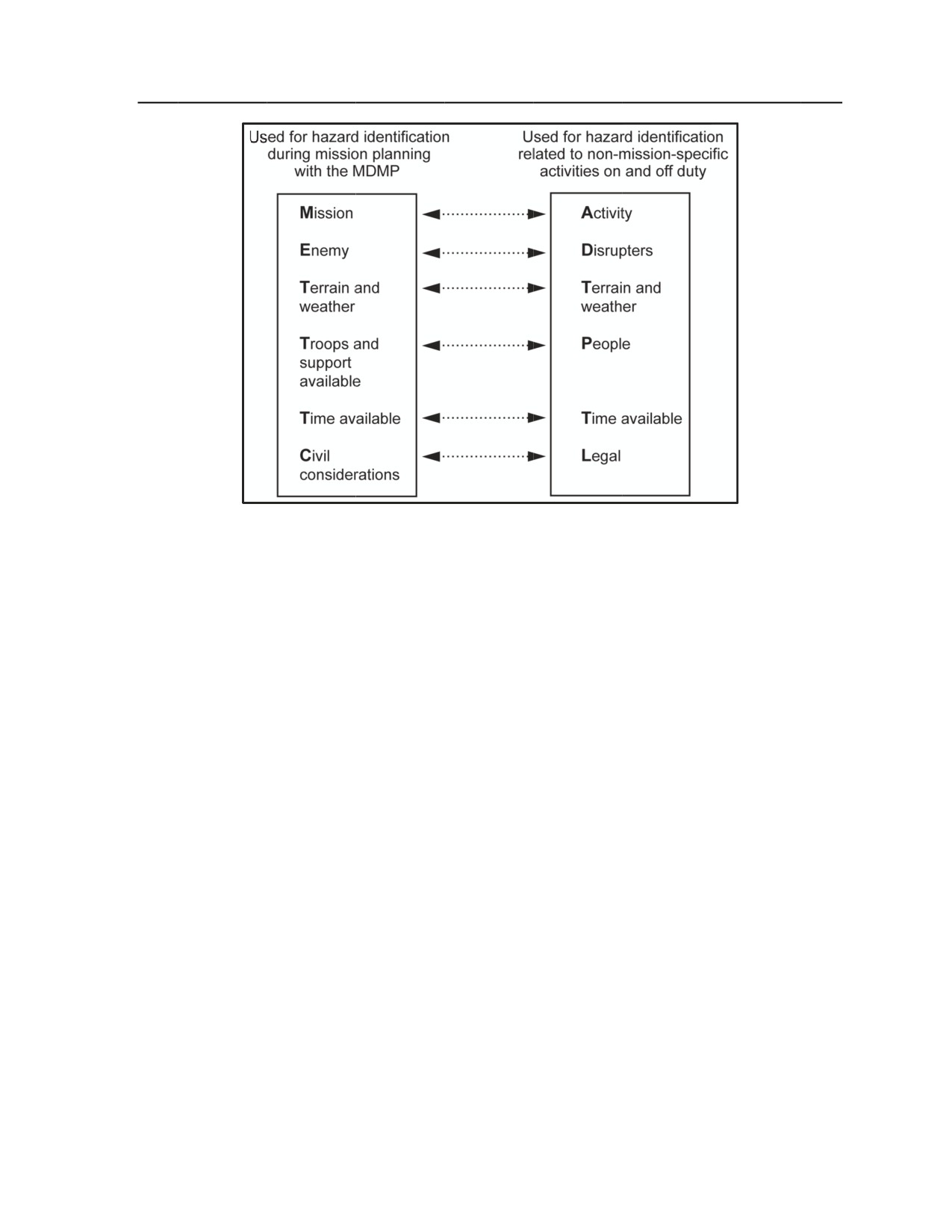
[METT-TC]). Using the METT-TC factors, leaders examine the
environment as it relates to their mission and begin the process of identifying threats and hazards.
THREATS AND HAZARDS
1-10. The protection warfighting function preserves the combat power potential and survivability of the
force by providing protection from threats and hazards.
THREATS
1-11. Threats are nation states, organizations, people, groups, conditions, or natural phenomena able to
damage or destroy life, vital resources, or institutions. (See FM 3-0 for more information.) Commanders
focus on threats to military operations that are generally coercive activities or information deliberately
conducted or implemented by an adaptable enemy or a willful threat. Army doctrine describes threats
through a range of four major categories or challenges—irregular, catastrophic, traditional, and disruptive.
(See FM 3-0 for more information.) These categories can be used to begin threat identification and
analysis; enhance situational understanding; and support plans, operations, and orders. (See figure 1-2, page
1-4.) Both threats and hazards have the potential to decrease combat power and the operational
effectiveness of the force. For this reason, their overall assessment and mitigation is accomplished through
the CRM process and applied throughout the operations process. Commanders develop risk reduction
measures and controls and threat mitigation strategies for all phases of military operations and activities.
30 September 2009
FM 3-37
1-3
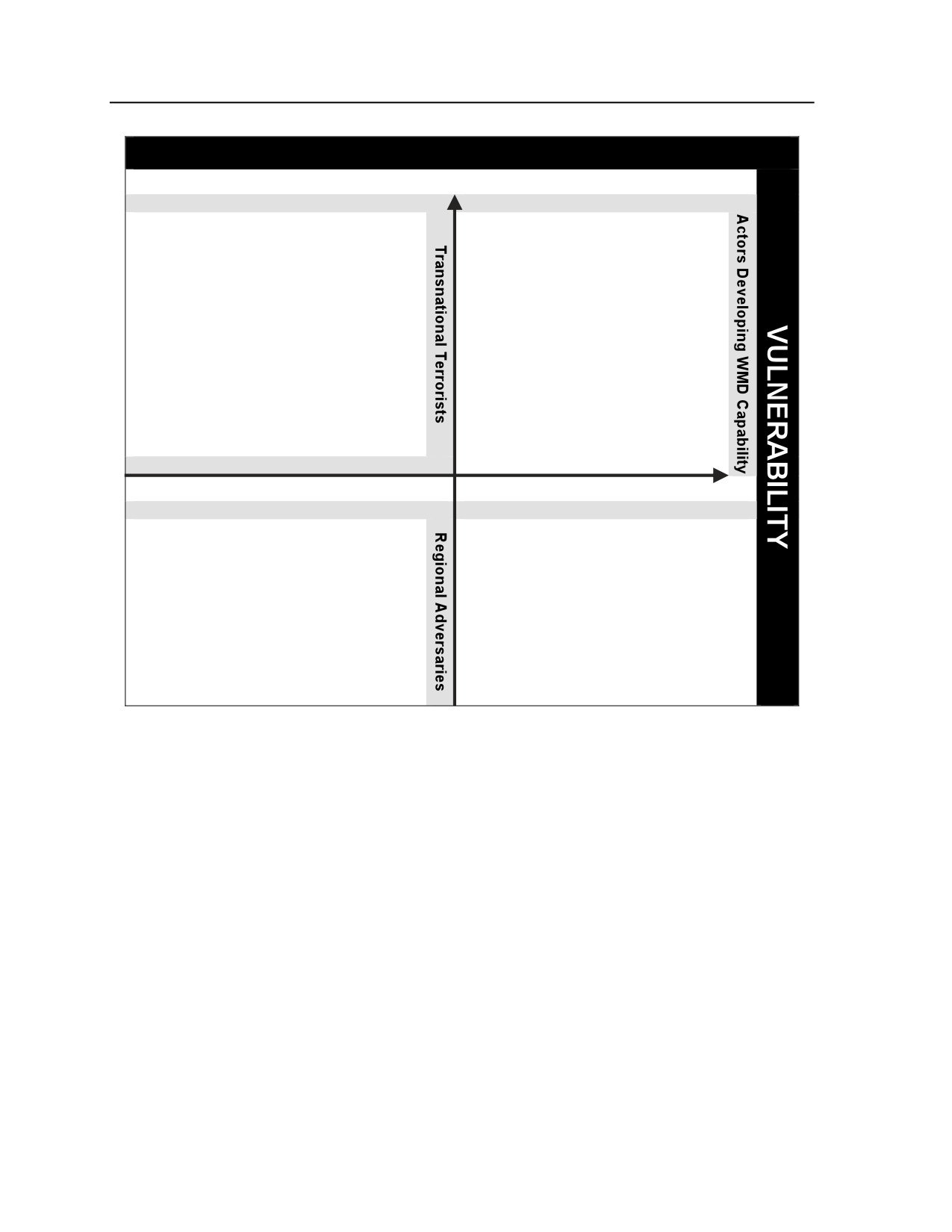
Chapter 1
LIKELIHOOD
IRREGULAR
CATASTROPHIC
Guerilla Forces
Hostile Nations and Rogue States
• Escalates gradually
• Seeks to paralyze U.S. forces
• Seeks to erode U.S. power
• Uses WMD threat as a deterrent
• Protracts the struggle
• Seeks to match WMD and delivery
• Relies on sanctuaries
capabilities
• Employs close combat
• Requires strategic deterrence
Radical Fundamentalists
TRADITIONAL
DISRUPTIVE
Uniformed Military Forces
Other Adversaries
• Seeks to avoid conflict with the United
• Seeks to challenge U.S. power
States
• Employs modern conventional
• Directs actions against regional threats
equipment
or rivals
• Executes developed antiaccess strategy
• Seeks to marginalize U.S. power
• Avoids U.S. strength
• Employs latest or niche technologies
• Exploits U.S. vulnerabilities
• Avoids U.S. strengths
• Includes small-scale to theater war
• Exploits U.S. vulnerabilities
Figure 1-2. Security environment
HAZARDS
1-12. Hazard is a condition with the potential to cause injury, illness, or death to personnel; damage to or
loss of equipment or property; or mission degradation. (JP 3-33) (See FM 5-19 for more information.)
Army risk management doctrine provides six categories (activity, disrupters, terrain and weather, people,
time available, and legal factors) to further focus METT-TC analysis for hazard identification. (See figure
1-3.) Accidental hazards are usually predictable and preventable and can be reduced through effective risk
management efforts. Commanders differentiate hazards from threats and develop focused protection
strategies and priorities that match protection capabilities with the corresponding threat or hazard while
synchronizing those efforts in space and time. However, hazards can be enabled by the tempo or friction or
by the complacency that sometimes develops during extended military operations.
1-4
FM 3-37
30 September 2009
Preserving the
Force
Figure 1-3. METT-TC
and hazard
assessment
factors
COMBAT POWER
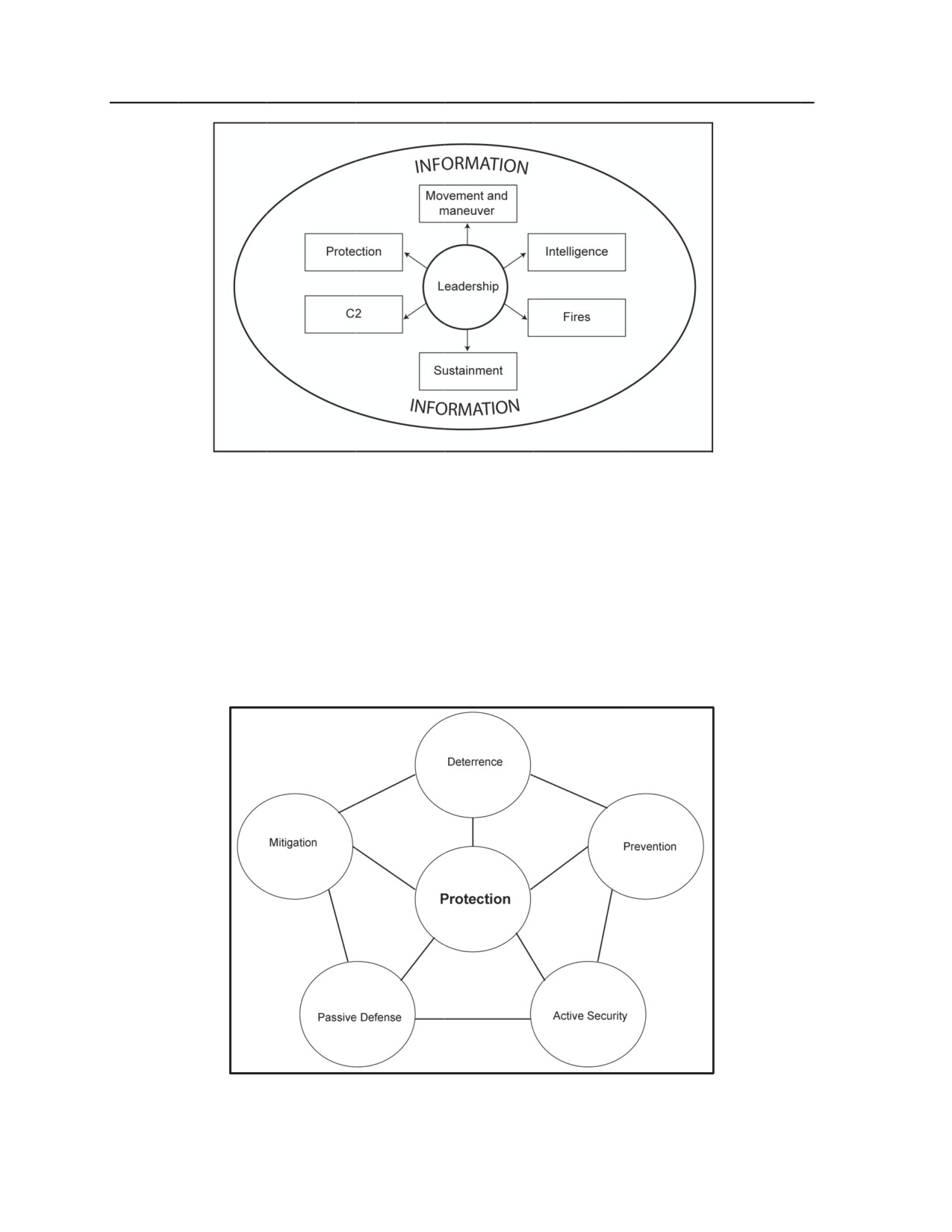
1-13. Combat power is the total means of
destructive, constructive, and information
capabilities
that a
military unit or
formation can
apply at a given time. Army forces generate combat power by converting
potential into effective action.
(FM 3-0) (See
FM 3-0 for more information.) Combat power is generated by
transforming potential into effective action
that is accomplished as leaders use information to organize,
integrate, and focus specific movement and
maneuver, intelligence, fires, sustainment, C2, and protection
capabilities to
form combined arms operations.
(See figure
1-4, page 1-6.) Combined arms
is the
synchronized and simultaneous application
of the elements of combat power to achieve an effect greater
than if each element were used
separately or
sequentially. (FM 3-0)
1-14. Combat power cannot be exactly quantified, and its
measure leads
to relative combat power analysis
and assessments at best. Tactical information systems and controls measure and monitor the relative
combat power potential through established
running estimates and measures of effectiveness (MOEs) or
measures of performance (MOPs) to provide
the context for power accumulation and expenditure. Leaders
interpret and use
the information to provide the purpose, direction, and motivation that
is necessary to
focus
the operation and accomplish the mission.
1-15. As an element of combat power, protection represents potential that reflects the
totality of protective
means in a given situation. Protection potential is not absolute and, therefore, has
a latent quality that
depends on leadership, mission prioritization, and resource
allocation as
its catalyst. Mission prioritization
is
simply tangible commodities and time. Protection potential can be maximized by integrating the
other
five elements of combat power with leadership and information to reinforce protection or to achieve
complementary
protective effects. The goal of protection
integration
at the tactical
level is to balance
protection potential with the
freedom of action throughout the duration of military
operations. This is
accomplished by incrementally integrating
reinforcing
or complementary protection capabilities into
operations until
all significant vulnerabilities
have been mitigated or eliminated.
30
September 2009
FM 3-37
1-5
Chapter 1
Figure 1-4. Elements of combat power
FORMS OF PROTECTION
1-16.
Protection can
take many
forms. Military operations
recognize five broad forms of protection
(deterrence, prevention, active security, passive
defense, and
mitigation) to
help organize
the protection
element of combat power. (See figure 1-5.) These forms of
protection support battle command and the
leader’s visualization to provide a
context within which all protection activities can be
understood and
further
described. They are nonsequential, reflect the continuous nature of protection, and
may serve as
a
method to conceptualize protection capabilities
for conducting operations.
Some military
activities may
support more than one form of protection at a time in an overlapping manner, reflecting the dual nature of
protection as an element of combat power and as a warfighting function. Unlike maneuver, the forms of
protection may orient on the terrain, the protected
asset, and/or
the enemy.
Figure 1-5. Forms of protection
1-6
FM 3-37
30 September 2009
Preserving the Force
DETERRENCE
1-17. The posture of an individual, formation, or structure can have a deterrent effect on threat
decisionmaking and result in protection. The presence of well-trained, equipped, disciplined troops can
often deter confrontation or conflict and protect the success of an operation or organization. Well-armed
vehicles and fortifications may also deter enemy action and provide some level of protection for occupants
and inhabitants. Random AT measures help deter terrorist attacks by disrupting routine patterns and
presenting the appearance of greater security.
PREVENTION
1-18. Prevention involves the ability to neutralize, forestall, or reduce the likelihood of an imminent attack
before it occurs; it can be achieved through deliberate action or as an effect. When linked to effective
action, information sharing can increase situational awareness and increase protection. AT, OPSEC, and
information security programs rely on situational awareness and individual protective measures to reduce
the likelihood of an accident or attack. Alert and warning systems can reduce the effectiveness of an attack
or environmental event. Prevention does not typically represent an offensive, preemptive capability, but
may employ other measures (information engagement, civil and public affairs, preventive medicine).
ACTIVE SECURITY
1-19. Dynamic activities with the organic ability to detect, interdict, avert, disrupt, neutralize, or destroy
threats and hazards while maintaining the freedom of action can provide protection to the overall operation
or force. Aggressive patrolling, route security, or local security measures in the vicinity of critical assets
and bases provide protection. Some air missile defense assets represent active security measures.
PASSIVE DEFENSE
1-20. Protection can be achieved from survivability positions, fortifications, and physical barriers that are
designed to protect forces and material from identified threats and hazards. Some level of protection can
also be derived from the geographic positioning of a formation or critical asset; this may often be the most
expedient method of providing protection for some assets or resources. Bases, base clusters, tactical
command posts, refuel-on-the-move positions, forward logistics elements, and detainee holding areas are
all positioned after considering the protection potential of a particular location. The proximity to threats and
hazards, exploitable terrain and water features, and infrastructures can contribute to combat power potential
by influencing the protection potential of a specific area. The use of camouflage or smoke provides
protection through passive means.
MITIGATION
1-21. Mitigation is the activities and efforts that—
z
Have the ability to minimize the effects or manage the consequence of attacks and designated
emergencies on personnel, physical assets, or information.
z
Preserve the potential, capacity, or utility of a force or capability.
z
Have a protective quality.
CBRN decontamination and PR, AT, and consequence management efforts may provide protection through
mitigation and enable the restoration of essential capabilities.
PRINCIPLES OF PROTECTION
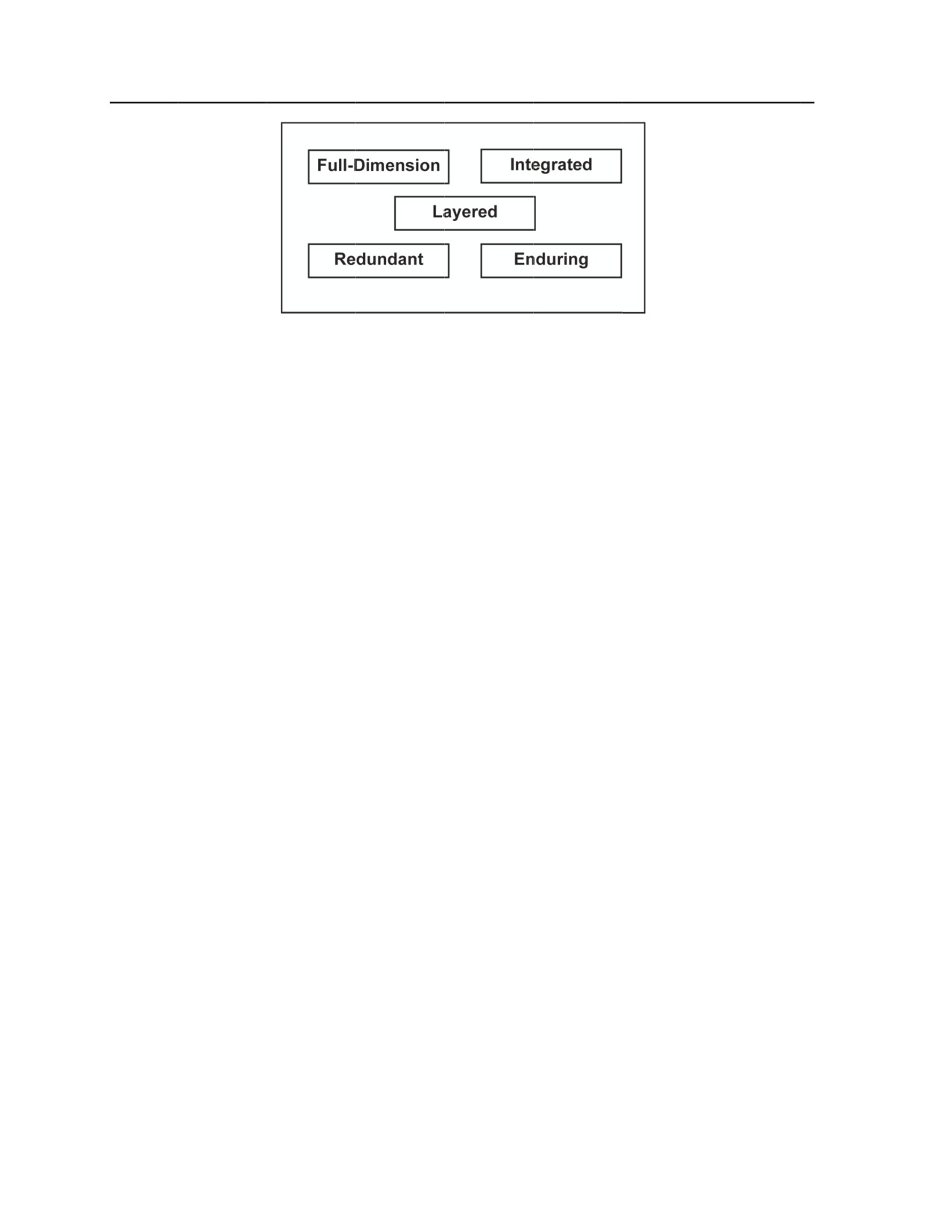
1-22. The five principles of protection—full-dimension, integrated, layered, redundant, and enduring—
represent or summarize the characteristics of successful protection integration and practice. These
principles provide military professionals with a context for implementing protection efforts, developing
protection strategies, and allocating resources. They are not a checklist and may not apply the same way in
every situation. (See figure 1-6, page 1-8.)
30 September 2009
FM 3-37
1-7
Chapter 1
Figure 1-6. Principles of protection
FULL-DI
MENSION
1-23.
Protection is not a linear activity—it is a
continuing and enduring activity. Protection efforts and
activities must consider and account for threats and hazards
in all directions, at all times, and in all
environments. Protection planning, coordination,
and implementation from home camp or station to an area
of operations (AO) occur anywhere Soldiers or national interests are located.
(See appendix
A.) Situational
awareness supports this principle and leads to an
informed protection response.
INTEGRATED
1-24.
Protection is
integrated with
all other activities, systems, efforts, and capabilities
associated with
military operations to provide strength and structure to the overall protection
effort. Integration must occur
vertically and horizontally in all phases of
the operations process. Protection integration should
complement other warfighting functions without significantly
inhibiting the potential of
combat power.
Protection is typically integrated through various
forcing functions such as working groups, meetings, and
boards. (See chapter
5 for further information.)
LAYERED
1-25.
Protection capabilities should be arranged
using a layered approach to
provide strength and depth to
the overall protection
system. Layering also reduces the destructive effect of
a threat or hazard through the
dissipation of energy
or the culmination of force
and may provide time to focus identification, assessment,
target
acquisition, or response efforts and actions. Exclusion
areas, barriers, sally ports,
passwords, and
identity badges are
examples of
layering tactics, techniques, and procedures (TTP) and resources for
protection.
REDUNDANT
1-26.
Redundancy ensures that specific activities, systems, efforts, and capabilities critical
for the success
of the
overall protection effort
have a secondary or auxiliary effort of
equal or greater capability
Redundant capabilities are not merely duplicative; they emphasize the overlapping of capabilities so that
there are no seams in the protective posture. Redundancy may
not be achieved in all protection measures,
making it necessary
to identify the
critical point
of failure or
the critical path associated with each major
protection activity, system, effort,
and capability
to ensure that
redundancy is
applied. Protection efforts are
often
redundant and
overlapping
anywhere vulnerability, weakness, or failure is identified or expected.
Power
generation systems, water purification systems, and patrol distribution patterns are
often resourced
for redundancy.
ENDURING
1-27.
Protection has
an enduring quality that differentiates it from defense and specific security operations.
Whereas a tactical force defends only until it can
resume the offense and a formation provides security in
a
manner that maintains freedom of
action, protection has a persistent character that serves one dominant
1-8
FM 3-37
30 September 2009
Preserving the
Force
purpose—the preservation of
the protected
asset or capability. The enduring character of protection
may
affect freedom of action and resource allocation.
WARFIGHTING FUNCTIONS
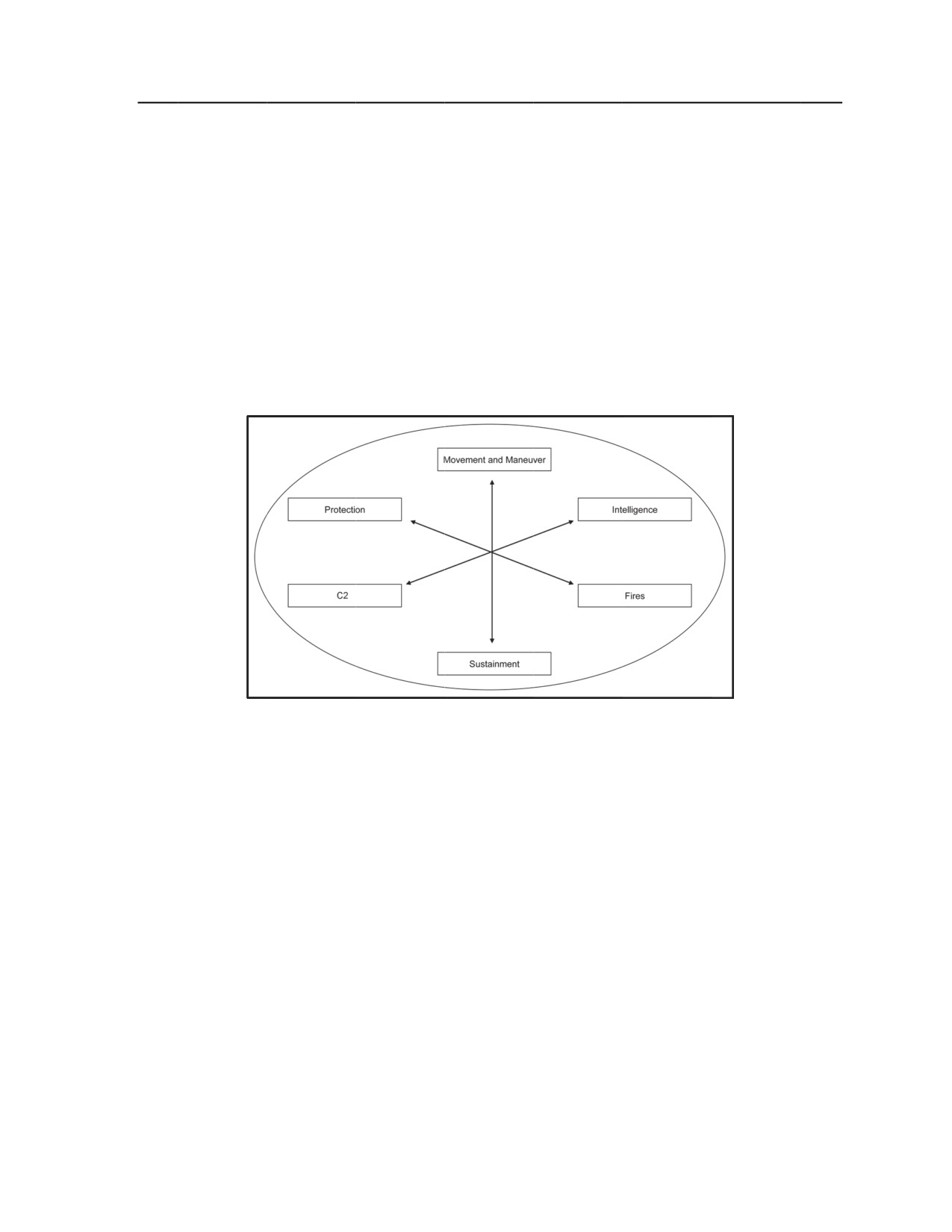
1-28. Protection
is one of the
six warfighting functions. (See figure 1-7.)
A warfighting
function is a
group
of
tasks and systems (people, organizations,
information, and processes),
united by a common purpose, that
commanders use to accomplish missions
and training
objectives.
(FM 3-0) Commanders understand,
visualize, describe, and direct
operations in
terms of the
warfighting functions as they represent tangible
tasks that become plans, orders, and missions. Commanders integrate the
warfighting functions to generate
combat power and achieve its
full destructive, disruptive,
informational, or constructive potential through
combined arms. Combined arms use information and the
capabilities
of each warfighting function
in a
complementary
and/or reinforcing relationship with other
warfighting functions. Protection is not a
linear
function; it is a
continuing activity that can
be sequentially planned but its execution
and assessment are
continual.
Figure 1-7.
. Warfighting
functions
PROTECTION WARFIGHTING
FUNCTION
1-29. The protection warfighting function
is the related
tasks and systems that preserve the force
so the
commander can
apply maximum combat
power.
(FM
3-0) Preserving the force
includes protecting
personnel (combatants and noncombatants), physical assets, and information of the
United States and
multinational military and
civilian partners. The protection warfighting function facilitates the
commander’s ability to maintain force integrity and combat power. Protection determines the degree to
which potential
threats can disrupt operations and counters
or mitigates those threats.
1-30. Whereas
protection as an element of
combat power
represents protection potential with an infinite
character, the protection warfighting function serves to focus protection efforts on twelve specific tasks or
systems:
z
AMD
z
PR.
z
Information protection.
z
Fratricide avoidance.
z
Operational area security.
z
AT.
z
Survivability.
z
FHP.
30
September 2009
FM 3-37
1-9

Chapter 1
z
CBRN operations.
z
Safety.
z
OPSEC.
z
EOD.
1-31. At a minimum, commanders consider the fundamentals of each task during military operations to
ensure the timely integration of proper protection efforts that are necessary in time and space to preserve the
force while supporting decisive, shaping, or sustaining operations. (See table 1-1.) (See chapter 2 for more
information on these tasks and systems.)
Table 1-1. Protection tasks and corresponding significant activities
Protection Task
Significant Activities
AMD
Employment Principles
(FM 44-100)
•
Mass.
•
Mix.
•
Mobility.
•
Integration.
PR
•
Establish PR organization.
(FM 3-50.1)
•
Perform cross-staff coordination.
•
Analyze PR gap.
•
Integrate diplomatic/military/civil PR.
•
Establish PR SOPs.
•
Exercise/rehearse.
•
Report.
•
Locate.
•
Support.
•
Recover.
•
Return/reintegrate.
Information protection
•
Protect against threat events.
(FM 3-13)
•
Monitor/detect threat events.
•
Analyze threat events.
•
Respond to threat events.
Fratricide avoidance
•
Identify battlefield hazards.
(FM 3-90)
•
Verify equipment markings.
•
Conduct reconnaissance.
•
Analyze sectors of fire.
•
Employ ROE.
•
Implement fire and maneuver control measures.
•
Track battlefield effects.
•
Rehearse.
Operational area security
•
Conduct ISR.
(FM 3-90, Appendix E)
•
Control movement.
•
Prepare response forces.
•
Employ passive defense measures.
•
Position sniper teams.
•
Defend against attacks by fire.
•
Support area damage control.
AT
•
Establish AT program.
(AR 525-13)
•
Collect, analyze, and disseminate threat information.
•
Assess and reduce critical vulnerabilities.
•
Plan response to terrorist threat/incident.
•
Increase AT awareness.
•
Maintain installation defense according to FPCON.
•
Establish civil/military partnership for WMD crises.
•
Conduct exercises and evaluate/assess AT plans.
Survivability
•
Achieve situational awareness.
(FM 5-103)
•
Determine degree of acceptable risk.
•
Analyze terrain features.
•
Establish priorities of work.
•
Employ camouflage, cover, and concealment.
1-10
FM 3-37
30 September 2009

Preserving the Force
Table 1-1. Protection tasks and corresponding significant activities (continued)
Protection Task
Significant Activities
FHP
• Prevent and control diseases.
(FM 4-02.17)
• Assess environmental and occupational health.
• Determine force health activities protection.
• Employ PVNTMED toxicology and laboratory services.
• Perform health risk assessments.
• Disseminate health information.
CBRN operations
• Identify threat.
(FM 3-11, FM 3-11.21, and FM 4-02.7)
• Assess situation.
• Identify vulnerability reduction measures.
• Conduct operations.
• Provide logistics and health support.
• Decontaminate.
Safety
• Manage safety and occupational health program.
(AR 385-10; DA Pamphlet 385-10, Appendix J)
• Investigate mishaps and near misses.
• Conduct hazard analysis and recommend countermeasures.
• Provide safety education, training, and promotion.
• Conduct inspections, surveys, assessments, and technical
consultations.
OPSEC
• Identify EEFI.
(AR 530-1)
• Analyze adversaries and vulnerabilities.
• Assess risk.
• Recommend countermeasures.
EOD
• Advise commanders on EO/IEDs (including CBRN).
(FM 4-30.51)
• Positively identify, respond to, and dispose of EO/IEDs
(including CBRN).
• Perform EO/IED site exploitation and technical intelligence
collection.
• Perform postblast analysis.
COMPOSITE RISK MANAGEMENT
1-32. Army leaders take prudent risks and make risk decisions on the basis of informed judgment and
intuition. Risk is a function of the probability of an event occurring and the severity of the event expressed
in terms of the degree to which the incident impacts combat power or mission capability. CRM is the
Army’s primary decisionmaking process for identifying hazards and controlling risks across the full
spectrum of Army missions, functions, operations, and activities. (See FM 5-19 for more information.)
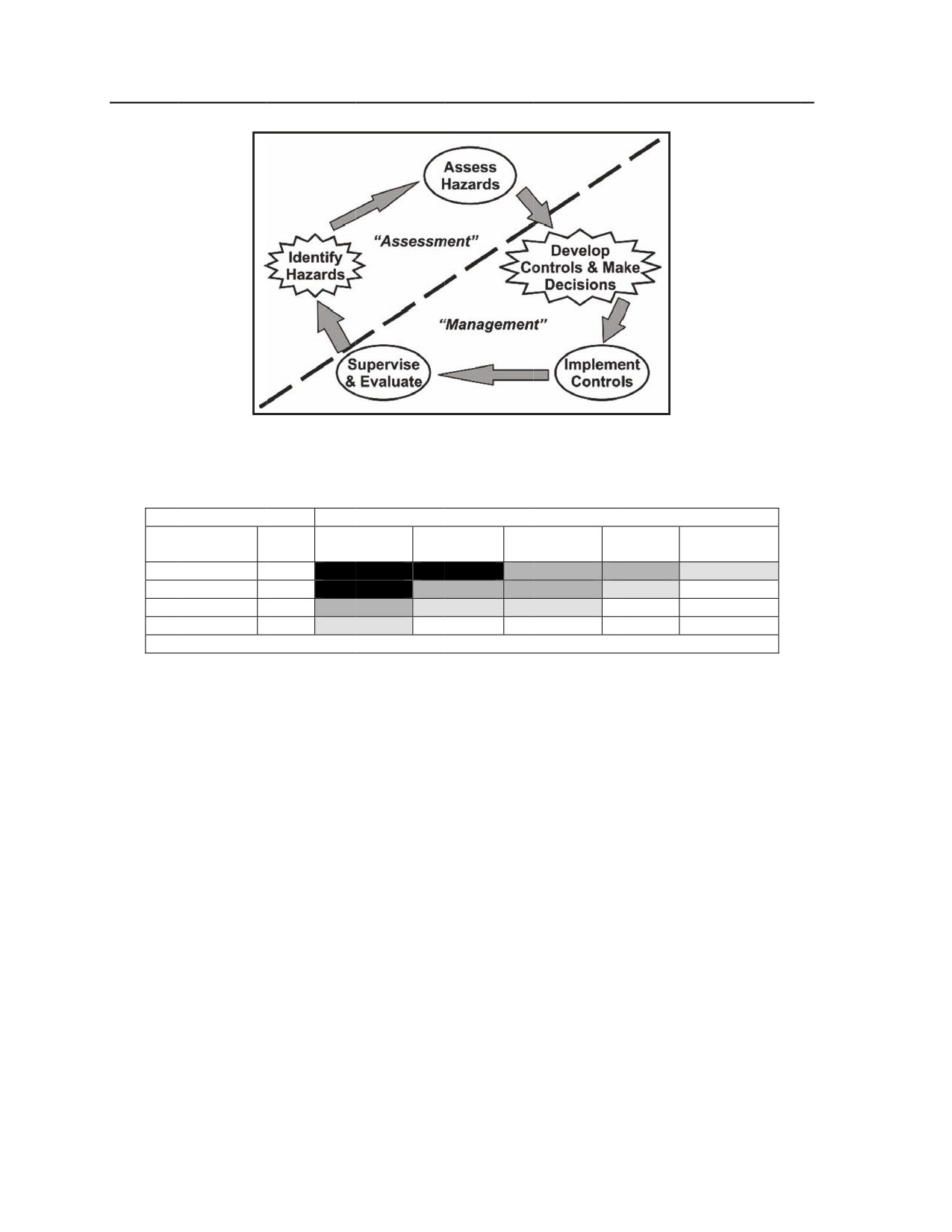
CRM is a five-step process that also serves as an integrating process for the protection warfighting function
in Army operations. (See figure 1-8, page 1-12.) The CRM process subjectively quantifies probability and
severity through the use of the Army risk assessment matrix, leading to a determination of the risk level.
(See table 1-2, page 1-12.) Risk levels help show relative significance and serve to alert and inform leaders
as they make decisions regarding the course of action (COA) selection and resource allocation. CRM also
helps leader decide where and when to apply protection assets and information.
1-33. The CRM process provides a general framework for identifying and reducing risks and is often
supported by other, more specific tools, expertise, and processes for use in assessment and execution.
30 September 2009
FM 3-37
1-11
Chapter 1
Figure 1-8. CRM process
Table
1-2. Army risk assessment matrix
Probability
Frequent
Likely
Occasional
Seldom
Unlikely
Severity
A
B
C
D
E
Catastrophic
I
E
E
H
H
M
Critical
II
E
H
H
M
L
Marginal
III
H
M
M
L
L
Negligible
IV
M
L
L
L
L
E—Extremely high
H—High
M—Moderate
L—Low
1-12
FM 3-37
30 September 2009
Chapter 2
Protection Warfighting Function
Army operations and missions are built around tactical tasks. While protection is
broadly conceptualized as an element of combat power, the protection warfighting
function narrows the focus of protection to specific Army tasks. This chapter
examines the twelve tasks and systems that comprise the Army protection
warfighting function. FM 3-0 identifies these tasks as AMD, PR, information
protection, fratricide avoidance, operational area security, AT, survivability, FHP,
CBRN operations, safety, OPSEC, and EOD.
PROTECTION TASKS AND SYSTEMS
2-1. Military operations are inherently complex. Commanders must deliberately plan and integrate the
application of military force against an enemy while protecting the force and preserving combat power. The
OE requires a capability-based approach to mission accomplishment. Operational and functional concepts
are translated through the warfighting functions into tasks and systems for the development of plans, orders
and, ultimately, unit missions. Commanders develop protection strategies for each phase of an operation or
major activity. They integrate and synchronize protection tasks and systems to reduce risk, mitigate
identified vulnerabilities, and act on opportunity. When properly integrated and synchronized, the tasks and
systems that comprise the protection warfighting function effectively protect the force, enhance the
preservation of combat power, and increase the probability of mission success.
2-2. Units must consider the twelve protection tasks and systems and apply them as appropriate. Each
task and its associated system are typically associated with a staff or staff proponent that performs specific
duties.
AIR AND MISSILE DEFENSE
2-3. An air defense system protects the force from air and missile attacks and aerial surveillance.
Additionally, maneuver and fires elements in the OE must be prepared to augment air defense systems
using direct-fire weapons. AMD elements protect installations and personnel from over-the-horizon strikes
by conventional and weapons of mass destruction (WMD) warheads according to METT-TC. Army
ground-based systems include the Phased Array Tracking Radar to Intercept of Target (PATRIOT);
Avenger short-range, air defense systems; Stinger; and Norwegian Advanced, Surface-to-Air Missile
System (NASAMS). Army AMD capabilities increase airspace situational awareness and complement the
area air defense commander.
2-4. Indirect-fire protection systems protect forces from threats that are largely immune to air defense
artillery systems. The indirect-fire protection intercept capability is designed to detect and destroy
incoming rocket, artillery, and mortar fires. This capability assesses the threat to maintain friendly
protection and destroys the incoming projectile at a safe distance from the intended target.
2-5. The AMD task consists of active and passive measures that protect personnel and physical assets
from an air or missile attack. Passive measures include camouflage, cover, concealment, hardening, and
OPSEC. Active measures are taken to destroy, neutralize, or reduce the effectiveness of hostile air and
missile threats.
2-6. When designing AMD protective systems, protection planners use the six employment guidelines—
mutual support, overlapping fires, balanced fires, weighted coverage, early engagement, and defense in
depth—and additional considerations necessary to mass and mix AMD capabilities. These employment
30 September 2009
FM 3-37
2-1
Chapter 2
guidelines enable air defense artillery forces to successfully accomplish combat missions and support
overall force objectives. (See FM 44-100 for more information.)
AIR DEFENSE WARNING SYSTEM
2-7. The Air Defense Warning (ADW) System is an established Army system used to disseminate the
probability of an air attack, air intrusion, or insertion by air into the AO. The ADW System is routinely
used by ground-based air defense commanders at all levels, but can be used by all commanders to protect
their forces through advanced warning. The ADW System provides collated data that can be quickly
understood, facilitating a rapid response. For this reason, the ADW System is not normally tied to any other
alert status or tactical warning procedure. Army doctrine recognizes the following ADWs:
z
RED. ADW RED warns that an attack by hostile aircraft or missiles is imminent or in progress.
This means that hostile aircraft or missiles are within a respective AO or that they are in the
immediate vicinity of a respective AO with a high probability of entry.
z
YELLOW. ADW YELLOW warns that an attack by hostile aircraft or missiles is probable.
This means that hostile aircraft or missiles are en route toward a respective AO or that unknown
aircraft or missiles suspected to be hostile are en route toward, or are within, a respective AO.
z
WHITE. ADW WHITE warns that an attack by hostile aircraft or missiles is improbable. ADW
white can be declared before or after ADW YELLOW or RED.
2-8. The ADW System is one of many tools commanders can use to rapidly influence the readiness
posture of their forces in response to the probability of hostile action.
WEAPON CONTROL STATUS
2-9. Weapon control status describes the relative degree of control of air defense fires. (FM 44-100)
Weapon control statuses can apply to weapon systems, volumes of airspace, or types of air platforms. The
tactical situation normally determines the degree or extent of control necessary over particular weapon
systems. AMD coordinators typically establish or recommend separate weapon control statuses for various
air threats, including fixed- and rotary-wing aircraft, missiles, or unmanned aircraft systems. Air defense is
optimized when all forces have the ability to rapidly receive and disseminate weapon control statuses for all
air platforms. The three weapon control statuses are—
z
Weapons-free. Fire at any air target that is not positively identified as friendly. This is the least
restrictive weapon control status.
z
Weapons-tight. Fire only at air targets positively identified as hostile according to the
prevailing hostile criteria. Positive identification can be determined by a number of means
(including aided or unaided visual identification) or by other designated hostile criteria
(including radar identification and information network identification).
z
Weapons-hold. Do not fire except in self-defense or in response to a formal order. This is the
most restrictive weapon control status.
2-10. Any unit can receive urgent or flash message traffic in the form of a directed warning or alert of an
immediate or possible threat to the force or in a specific area of the battlefield. The AMD cell provides the
AMD plan to the airspace command and control (AC2) cell for integration into the corps/division unit
airspace plan. Although the AC2 cell reviews and deconflicts the corps/division air defense plan with other
division control measures, the control measures for the air defense plan are normally sent to higher
headquarters through AMD channels. The AC2 and AMD sections must ensure that the division standing
operating procedure (SOP) and respective annexes address the procedures for forwarding air defense and
air control measures.
Note. See appendix B for more information on AMD and airspace management.
2-2
FM 3-37
30 September 2009
Protection Warfighting Function
PERSONNEL RECOVERY
2-11. PR is the sum of military, diplomatic, and civil efforts to prepare for and execute the recovery and
reintegration of isolated personnel. (JP 3-50) PR is the overarching term for operations that focuses on
recovering isolated or missing personnel before becoming detained or captured and extracting those
detained or captured personnel through coordinated and well-planned operations.
2-12. PR operations occur within a complex framework of environmental factors that shape their nature
and affect their outcomes. Commanders must understand the OE and the impact of PMESII-PT to ensure
that PR is incorporated into and supports each mission. This includes the characteristics of the particular
OE to each mission and how aspects of the environment become essential elements in shaping the way
Army forces conduct operations. Threats to isolated Soldiers will vary significantly across the spectrum of
conflict.
2-13. PR is not a separate mission; it is incorporated into planning for all missions. PR guidance must
synchronize the actions of commanders and staffs, recovery forces, and isolated individuals. In order to
synchronize the actions of all three, commanders develop PR guidance based on command capabilities to
conduct recovery operations. By knowing what actions they have dictated to potential isolated Soldiers,
commanders develop situational understanding and provide guidance to their staffs and recovery forces to
synchronize their actions with those of isolated Soldiers.
2-14. Commanders must integrate PR throughout the full spectrum of operations. This requires
understanding the complex, dynamic relationships among friendly forces, enemies, and the environment
(including the populace). This understanding helps commanders visualize and describe their intent for PR
and develop focused planning guidance. As commanders develop PR guidance for subordinate units, they
must ensure that subordinates have adequate combat power for PR. Commanders must also provide
resources and define command relationships with the requisite flexibility to plan and execute PR
operations.
2-15. Commanders provide PR planning guidance within their initial intent statement. PR planning
guidance conveys the essence of the commander’s visualization with respect to incorporating PR into
mission planning. PR guidance provides a framework for how the unit and subordinates will synchronize
the actions of isolated personnel and the recovery force. Effective PR planning guidance accounts for the
OE and the continuum of operations. PR guidance is addressed in the synchronization of each warfighting
function. It broadly describes how the commander intends to employ combat power to accomplish PR
execution tasks within the higher commander’s intent.
CORPS AND DIVISION
2-16. At corps and division levels, commanders nest PR planning variables within mission analysis and
provide subordinates with PR guidance during the orders process. PR guidance allocates resources and
authority to subordinate commanders, defines an overarching concept for planning and execution, and
describes specific PR control measures within the overall concept. PR guidance should address available
joint/interagency PR assets, procedures for coordinating those assets, and reporting
procedures/requirements of PR-specific commander’s critical information requirements (CCIR).
BRIGADE/GROUP AND BELOW
2-17. At brigade/group level and below, commanders refine the PR guidance from higher headquarters as
it pertains to their directed mission and specific AO. This refinement results in a greater level of specificity
manifested in the orders process.
BATTALION AND COMPANY
2-18. At battalion and company levels, PR guidance becomes isolated Soldier guidance (ISG). ISG is a
specific directive to individual Soldiers that defines what events constitute being “isolated” and what
actions to take during an isolating event. Such PR guidance is refined at battalion level, further refined at
30 September 2009
FM 3-37
2-3
Chapter 2
company level, and issued to Soldiers as mission-specific ISG. Samples of information to be incorporated
into ISG are—
z
Definition of “isolation.” ISG should clearly tell the Soldier under what circumstances he
should execute the ISG.
z
Where to go. ISG must consider numerous factors, such as the scheme of maneuver (for the
directed mission), friendly situation, enemy situation, preestablished and higher C2 measures,
and battlefield control measures. Rally points may be designated in the higher order or
established in the unit order. Rally points may be established specifically for the PR purpose or
may be generic rally points that can serve several purposes. The “where to go” aspect may be
accomplished by directing Soldiers to move in a general direction until they reach a “lateral”
rally point, such as a road or river.
z
What to do. ISG should describe actions that isolated Soldiers take, from initiating the ISG to
arriving at the designated location, including actions en route to the location. The ISG should
define actions (friendly and hostile) or the lack of actions that facilitate changes from the
primary location and may provide alternate, contingency, and emergency locations. Security
considerations that may have a bearing on friendly and hostile actions should also be addressed.
z
Signals. This guidance can pertain to individual actions from the initiation of the ISG through
the linkup with a recovery force. It covers equipment that has been issued to the Soldier and
incorporates other data from paragraph 5 (Command and Control) of the unit order. It can
include procedures for linking up with a recovery force and specific instructions on using a
challenge and password, radios and beacons, and visual signals to overhead platforms.
2-19. Civil efforts to recover personnel or isolated persons may include sanctioned or unsanctioned
intervention by intergovernmental organizations, nongovernmental organizations
(NGOs), influential
persons, or private citizens. Sometimes, civil organizations act independently without the knowledge of the
U.S. military or government.
2-20. Diplomatic and civil PR options can be requested or can be imposed upon the senior defense
representative and are most common when the isolated person has been captured or detained. (See JP 3-50
for more information.)
2-21. The ability of the Army to meet PR responsibilities hinges on leaders at every level preparing for the
recovery of isolated, missing, detained, or captured personnel. Leaders must integrate PR into ongoing
planning, preparation, and execution activities and consider many options for successful execution.
Reintegration must be planned, giving the operator knowledge that he and his family will be taken care of
during the entire PR process.
INFORMATION PROTECTION
2-22. Information protection is active or passive measures that protect and defend friendly information and
information systems to ensure timely, accurate, and relevant friendly information. It denies enemies,
adversaries, and others the opportunity to exploit friendly information and information systems for their
own purposes. (FM 3-0) When pursuing their objectives, adversaries attempt to keep commanders from
exercising effective C2 and, therefore, often target key decision makers and C2 information systems.
Information systems are typically vulnerable along the following primary attack vectors:
z
Unauthorized access.
z
Malicious software.
z
Electromagnetic deception.
z
Electronic attack.
z
Physical destruction.
z
Propaganda.
2-23. Protecting information is an enduring requirement that occurs in all environments. Information
protection is accomplished with a full range of protective means. Passive information protection measures
are those technical and nontechnical measures that are inherent to everyday operations and directly impact
users. They are designed to conceal information from, and deny information to, the threat; protect
2-4
FM 3-37
30 September 2009
Protection Warfighting Function
information from unauthorized modification; and protect information from unauthorized destruction.
Measures include, but are not limited to, the implementation of access controls, application security,
physical security, security education, communications security, and network security. Passive measures are
readily standardized in unit policies and procedures.
2-24. Although carefully designated and implemented, passive protection measures reduce risk; they do
not provide total protection. In order to enhance the Army’s ability to safeguard information and
information systems against increased threats, vulnerabilities, and attacks, protection in a dynamic network
environment requires an active operational component at all echelons. Active processes consist of proactive
measures that enable an organization to protect against, and counteract the dynamic nature of, a threat by
using known TTPs to detect friendly vulnerabilities before the adversary. Additionally, active processes
enable a unit to react decisively during an incident and recover quickly after an incident.
2-25. External and internal information perimeter protection prevents unknown or unauthorized users or
data from entering a network. External efforts include communications security, router filtering, access
control lists, and security guards. Where necessary, units physically isolate or place barriers between
protected and unprotected networks. Internal perimeter protection consists of firewalls and router filters to
serve as barriers between echelons or functional communities.
INFORMATION OPERATIONS CONDITION SYSTEM
2-26. The assistant chief of staff, signal (G-6) executes the information protection mission. The G-6 cell
includes system administrators, information assurance managers, network managers, communications
security personnel, and network planners. The assistant chief of staff, intelligence
(G-2) provides
information and intelligence regarding threats to Army information and information systems.
2-27. The G-6 disseminates the information operations condition (INFOCON), which includes electronic
protection measures to units and staffs. The INFOCON demonstrates prevention through an integrated,
coordinated, and structured approach to defense against and reaction to attacks on computers, networks,
and information systems. (See FM 3-36 for more information.) The following INFOCON levels define
preestablished, directed defensive postures designed to mitigate risks:
z
INFOCON 1. Maximum readiness procedures.
z
INFOCON 2. Greater readiness procedures.
z
INFOCON 3. Enhanced readiness procedures.
z
INFOCON 4. Increased military vigilance procedures.
z
INFOCON 5. Network operations (NETOPS) procedures according to strategic command directive.
INFORMATION PROTECTION STRATEGIES
2-28. Information protection strategies are developed among three information protection elements—
computer electronic protection, network defense, and information assurance. They protect the force from
the enemy’s attempts to attack friendly C2 information systems. (See FM 3-36 and FM 6-20.10 for more
information.)
Nonlethal Electronic Protection
2-29. Electronic protection is that division of electronic warfare involving actions taken to protect
personnel, facilities, and equipment from any effects of friendly or enemy use of the electromagnetic
spectrum that degrade, neutralize, or destroy friendly combat capability. (JP 3-13.1) Examples of electronic
protection include spectrum management, emission control procedures, hardening of equipment from
electromagnetic effects, and the use of wartime reserve modes.
2-30. During operations, electronic protection includes, but is not limited to, the application of
electromagnetic spectrum operations tools and associated TTP for countering enemy electronic attacks.
Army forces must understand the threat and vulnerability of friendly electronic equipment to enemy
electronic attack capabilities and take appropriate actions to safeguard friendly combat capability from
30 September 2009
FM 3-37
2-5
Chapter 2
exploitation and attack. To be successful, electronic protection must minimize the enemy’s ability to
conduct electronic warfare support and electronic attack operations against friendly forces.
Computer Network Defense
2-31. Computer network defense (CND) includes actions taken to protect, monitor, analyze, detect, and
respond to unauthorized activity within Department of Defense (DOD) information systems and computer
networks. (JP 6-0) It includes all measures to detect unauthorized network activity and adversary computer
network attacks and to defend computers and networks against such threats. CND also employs
intelligence, counterintelligence, law enforcement, and other military capabilities to defend information and
computer networks. CND is an operational component of information assurance and is an enabling
component of computer NETOPS. CND employs information assurance capabilities to respond to
unauthorized activity within information systems and computer networks in response to a CND alert or
threat information. The application of CND as a subset of information assurance provides true end-to-end,
defense-in-depth protection that ensures data confidentiality, integrity, and availability as well as protection
against unauthorized access.
2-32. Although the G-6 has staff responsibility for CND, effective protection is achieved through the
integrated efforts of communications, law enforcement, and intelligence capabilities. System administrators
ensure that users follow the appropriate procedures to prevent network intrusion.
Information Assurance
2-33. Information assurance consists of measures that protect and defend information and information
systems by ensuring their availability, integrity, authentication, confidentiality, and nonrepudiation. This
includes providing for restoration of information systems by incorporating protection, detection, and
reaction capabilities. (JP 3-13) These attributes consist of—
z
Availability—timely, reliable access to information and services by authorized users. (Available
information systems operate when needed.)
z
Integrity—protection from unauthorized change including destruction.
z
Authentication—certainty of user or receiver identification and authorization to receive specific
categories of information.
z
Confidentiality—protection from unauthorized disclosure.
z
Nonrepudiation—proof of message receipt and sender identification so that neither can deny
having processed the information.
2-34. Information assurance, along with CND, demonstrates a layered approach through defense in depth
that protects DOD systems against exploitation, degradation, and the denial of service. It does this by
employing vigorous protection, detection, reaction, and restoration capabilities. This incorporation allows
effective defensive measures or the timely restoration of degraded networks and information systems.
Information assurance defense in depth protects all networks, including their information systems,
computers, radios, infrastructure implementation, gateways, routers, and switches.
(See FM 3-36 and
FM 6-20.10 for more information.)
FRATRICIDE AVOIDANCE
2-35. Fratricide is the unintentional killing of friendly personnel by friendly firepower. The
destructive power and range of modern weapons, coupled with the high intensity and rapid tempo of
combat, increase the potential for fratricide. Tactical maneuvers, terrain, and weather conditions may also
increase the danger of fratricide.
2-36. Fratricide is accidental and is usually the end product of an error by a leader and/or Soldier. Accurate
information about locations and activities of friendly and hostile forces and an aggressive airspace
management plan help commanders avoid fratricide. Liaison officers increase situational understanding and
enhance interoperability. Leaders and Soldiers must know the range and blast characteristics of their
weapon systems and munitions to prevent ricochet, penetration, and other unintended effects.
2-6
FM 3-37
30 September 2009
Protection Warfighting Function
2-37. Commanders and leaders are responsible for preventing fratricide. They must lower the probability
of fratricide without discouraging boldness and audacity. Good leadership that results in positive weapons
control, control of troop movements, and disciplined operational procedures contributes to achieving this
goal. Situational understanding and friendly personnel and combat identification methods also help.
Eliminating fratricide increases Soldier willingness to act boldly with the confidence that misdirected
friendly fires will not kill them. Additionally, more host nation contractors, day laborers, and NGO
personnel who support Army operations face the same risks as U.S. forces. Since these personnel work and
often live in and among U.S. forces, commanders must include them in protection and combat
identification plans. This may significantly increase the protection responsibility of commanders.
2-38. Commanders protect the fighting spirit of Soldiers through effective leadership and morale. Incidents
of fratricide can degrade unit effectiveness and combat power potential. The loss of confidence, hesitation,
oversupervision, and excessive caution are just some of the negative reactions that can afflict leaders and
Soldiers following a fratricide incident.
2-39. Fratricide avoidance is normally accomplished through a protection strategy that emphasizes
prevention, centered on two fundamental areas—situational awareness and target identification. Fratricide
may also be more prevalent during joint and coalition operations when communications and
interoperability challenges are not fully resolved.
z
Situational awareness. Situational awareness is the immediate knowledge of the conditions of
the operation, constrained geographically and in time.
(FM 3-0) It includes the real-time,
accurate knowledge of one’s own location and orientation and the locations, activities, and
intentions of other friendly, enemy, neutral, or noncombatant elements in the AO, sector, zone,
or immediate vicinity.
z
Target identification. Target identification is the accurate and timely characterization of a
detected object on the battlefield as friend, neutral, enemy, or unknown. (FM 3-20.15) Unknown
objects should not be engaged; rather, the target identification process continues until positive
identification has been made. An exception to this is a weapons-free zone where units can fire at
anything that is not positively identified as friendly.
2-40. The potential for fratricide may increase with the fluid nature of the noncontiguous battlefield and
the changing disposition of attacking and defending forces. The presence of noncombatants in the AO
further complicates operations. Simplicity and clarity are often more important than a complex, detailed
plan when developing fratricide avoidance methods. (See appendix B for more information.)
OPERATIONAL AREA SECURITY
2-41. Operational area security is a form of security operations conducted to protect friendly forces,
installations, routes, and actions within an AO. (See FM 3-90 for a detailed discussion of security
operations.) Forces engaged in area security operations focus on the force, installation, route, area, or asset
to be protected. Although vital to the success of military operations, area security is normally an economy-
of-force mission, often designed to ensure the continued conduct of sustainment operations and to support
decisive and shaping operations. (FM 7-15 provides a critical task list for area security operations.)
2-42. Area security may be the predominant method of protecting support areas that are necessary to
facilitate the positioning, employment, and protection of resources required to sustain, enable, and control
tactical forces. Area security operations are often emphasized in noncontiguous AOs to compensate for the
lack of protection integrity that large or distant, unoccupied areas often create. Area security operations are
often an effective method of providing civil security and control during some stability operations. Forces
engaged in area security operations can saturate an area or position on key terrain to provide protection
through early warning, reconnaissance, or surveillance and guard against unexpected enemy attack with an
active response. Area security operations often focus on named area of interests in an effort to answer
CCIR, aiding in tactical decisionmaking and confirming or denying threat intentions. Forces engaged in
area security operations are typically organized in a manner that emphasizes their mobility, lethality, and
communications capabilities. The maneuver enhancement brigade (MEB) and some military police units
are specifically equipped and trained to conduct area security and may constitute the only available force
30 September 2009
FM 3-37
2-7
Chapter 2
during some phases of an operation. However, area security operations take advantage of the local security
measures performed by all units, regardless of their location in the AO.
2-43. Commanders at all levels apportion combat power and dedicate assets to protection tasks and
systems based on an analysis of the OE, the likelihood of threat action, and the relative value of friendly
resources and populations. Although all resources have value, the mission variables of METT-TC make
some resources, assets, or locations more significant to successful mission accomplishment from enemy
and friendly perspectives. Commanders rely on the CRM process and other specific assessment methods to
facilitate decisionmaking, issue guidance, and allocate resources. Criticality, vulnerability, and
recuperability are some of the most significant considerations in determining protection priorities that
become the subject of commander guidance and the focus of area security operations. Area security
operations often focus on the following assets and activities:
z
Base and base cluster defense. Base defense is the local military measures, both normal and
emergency, required to nullify or reduce the effectiveness of enemy attacks on, or sabotage of, a
base to ensure that the maximum capacity of its facilities is available to U.S. forces. (JP 1-02) A
division or corps may be required to protect multiple forward operating bases (FOBs). Units may
be assigned base defense operations on a permanent or rotating basis, depending on the mission
variables.
z
Critical asset security. Critical asset security is the protection and security of personnel and
physical assets and/or information analyzed and deemed essential to the operation and
success of the mission and the required resources for protection. This designation generally
comes as a result of a deliberate assessment or as a directed mission.
z
C2 node protection. Command posts and operations centers are often protected through area
security techniques that involve the employment of an array of protection and security assets in a
layered, integrated, and redundant manner. This can often keep hostile threats at a distance by
maximizing the standoff distance from explosive effects while keeping the protected asset
outside the range of enemy direct-fire weapons and observation.
z
HRP security. HRP are personnel who, by their grade, assignment, symbolic value, or relative
isolation, are likely to be attractive or accessible terrorist targets. (JP 3-07.2) Special precautions
are taken to ensure the safety and security of these individuals and their family members. When
units identify a significant risk to selected personnel, the local commander normally organizes
security details from internal resources. However, under certain circumstances, designated
personnel may require protective service details by specially trained units.
z
Physical security. Physical security consists of that part of security concerned with physical
measures designed to safeguard personnel; to prevent unauthorized access to equipment,
installations, material, and documents; and to safeguard them against espionage, sabotage,
damage, and theft. (JP 6-0) (See FM 3-19.30 for more information.) Physical security measures
as they pertain to AT identify physical vulnerabilities to terrorist attacks of bases, personnel, and
materiel and take actions to reduce or eliminate those vulnerabilities. Survivability operations
and general engineering support may be required to emplace compensatory measures for
identified vulnerabilities. The physical security system builds on the premise that baseline
security and the preparedness posture are based on the local threat, site-specific vulnerabilities,
identified critical assets, and available resources.
z
Response force operations. Response force operations expediently reinforce a unit’s organic
protection capabilities or complement that protection with maneuver capabilities based on the
threat. Response force operations include the planning for defeat of Level I and Level II threats
and the shaping of Level III threats until a designated combined arms, tactical combat force
(TCF) arrives for decisive operations. (Threat levels are discussed in appendix C.) Response
force operations use a mobile force with appropriate fire support (usually designated by the area
commander) to deal with Level II threats in the AO. (See FM 3-19.1 for more information.)
z
Lines of communications security. The security and protection of lines of communications and
supply routes are critical to military operations since most support traffic moves along these
routes. The security of supply routes and lines of communication (rail, pipeline, highway, and
waterway) presents one of the greatest security problems in an AO. Route security operations are
defensive in nature and are terrain-oriented. A route security force may prevent an enemy force
2-8
FM 3-37
30 September 2009
Protection Warfighting Function
from impeding, harassing, or destroying traffic along a route or portions of a route by
establishing a movement corridor. (See FM 3-90.31.) Units conduct synchronized operations
(reconnaissance, security, mobility, information engagement) within the movement corridor. A
movement corridor may be established in a high-risk area to facilitate the movement of a single
element, or it may be an enduring operation.
z
Checkpoints and combat outposts. It is often necessary to control the freedom of movement in
an AO for a specific period of time or as an enduring operation. This may be accomplished by
placing permanent or temporary checkpoints and combat outposts along designated avenues and
roadways or on key terrain identified through METT-TC. Checkpoints are used for controlling,
regulating, and verifying movement; and combat outposts are used for sanctuary; support;
information, surveillance, and reconnaissance (ISR); or area denial. (See FM 3-24.2 for more
information on combat outposts.)
z
Convoy security. Convoy security operations are specialized area security operations conducted
to protect convoys. (FM 3-90) Units conduct convoy security operations anytime there are
insufficient friendly forces to continuously secure routes in an AO and there is a significant
danger of enemy ground action directed against the convoy. Commanders may also conduct
convoy security operations in conjunction with route security operations. Planning includes
designating units for convoy security, providing guidance on TTP for units to provide for their
own security during convoys, or establishing protection and security requirements for convoys
carrying critical assets. Local or theater policy typically dictates when or which convoys receive
security and protection. (See FM 4-01.45 for more information on convoy security training
requirements and TTP.)
z
Port area and pier security. Ground forces may typically provide area security for port and pier
areas. The joint force commander and subordinate joint force commanders ensure that port
security plans and responsibilities are clearly delineated and assigned. Area commanders who
are assigned a port area as part of their AO must develop and organize plans to ensure that forces
are trained, led, and equipped to concentrate the necessary combat power at the decisive time
and place to protect or secure port areas and cargo as necessary. The patrol of harbors and
anchorages is generally the mission of a dedicated port security unit and may include waterfront
security operations. (See JP 3-10 for more information on port security units.)
z
Surveillance. Surveillance is the systematic observation of aerospace, surface or subsurface
areas, places, persons, or things by visual, aural, electronic, photographic, or other means.
(JP 3-0) (See JP 1-02 and FM 2-0 for more information.) The protection working group uses
staff analysis and coordination with higher headquarters to determine which critical assets or
locations are likely to be attractive targets and require surveillance.
z
Area damage control. Commanders conduct area damage control when the damage and scope
of the attack are limited and they can respond and recover with local assets and resources.
Optimally, commanders aim to recover immediately. This recovery involves resuming
operations, maintaining or restoring order, evacuating casualties, isolating danger or hazard
areas, and mitigating personnel and materiel losses. Some attacks may rise to the level of
incidents of national significance and require additional resources for mitigation, recovery, and
investigation. In the latter case, commanders transition from area damage control to consequence
management activities.
ANTITERRORISM
2-44. AT is the Army’s defensive program to protect against terrorism. Army AT focuses on risk
management, planning (including the AT plan), training, exercises, resource generation, comprehensive
program review, and the conduct of random AT measures. AT planning coordinates specific AT security
requirements with the efforts of other security enhancement programs, such as intelligence support to AT,
law enforcement, physical security, and others. Effective AT programs synchronize intelligence, CRM, and
existing security programs to provide a holistic approach to defend against terrorist threats. Units at each
echelon typically have at least one qualified AT officer assigned. (See DODI 2006.16 and Army Regulation
[AR] 525-13 for more information.)
30 September 2009
FM 3-37
2-9
Chapter 2
Note. Units at each echelon should have at least one assigned Level II AT officer.
ANTITERRORISM PROGRAMS, TASKS, AND SYSTEMS
2-45. AT is an integral part of Army efforts to defeat terrorism. Terrorists can target Army elements at any
time, in any location. By effectively preventing and, if necessary, responding to terrorist attacks,
commanders protect all activities and people so that Army missions can proceed unimpeded. AT is neither
a discrete task nor the sole responsibility of a single branch; all bear responsibility. AT must be integrated
into all Army operations and considered at all times. CONUS installations, recruiting stations, Corps of
Engineers projects, and combat actions should consider AT principles in every assigned task. Awareness
must be built into every mission, every Soldier, and every leader. Integrating AT represents the foundation
that is crucial for Army success. Typical Army AT programs are composed of several adjunct and
information programs, including the following areas at a minimum:
z
Risk management (threat, critical asset, and vulnerability assessments of units, installations,
facilities, and bases).
z
AT planning (units, installations, facilities, and bases).
z
AT awareness training and command information programs.
z
Integration of various vulnerability assessments of units, installations, facilities, bases,
personnel, and activities.
z
AT protection measures to protect individual personnel, HRP, physical assets (physical security),
designated critical assets (area security), and information.
z
Resource application.
z
Civil and military partnerships for domestic and foreign consequence management.
z
Force protection condition (FPCON) system to support terrorist threat and incident response
plans.
z
Comprehensive AT program review.
2-46. Army commanders implement eight standard AT tasks to support DOD AT objectives. These
objectives aim to deter incidents, employ countermeasures, mitigate effects, and conduct incident recovery.
The AT tasks are—
z
Establish an AT program. Commanders communicate the spirit and intent of all AT policies
throughout the chain of command or line of authority by establishing AT programs. The
programs provide standards, policies, and procedures to reduce the vulnerabilities from terrorist
attacks.
z
Collect, analyze, and disseminate threat information. Commanders develop a system to
collect, analyze, and disseminate terrorist threat information and apply the appropriate FPCONs.
z
Assess and reduce critical vulnerabilities. Commanders continuously assess AT efforts. These
assessments review the overall program, individual physical and procedural security measures,
and unit predeployment preparation.
z
Increase AT awareness in every Soldier, civilian, and Family member. Commanders inform
all personnel of the terrorist threat and adequately train them to apply protective measures. Unit
collective training includes AT training, regardless of the unit location.
z
Maintain installation defenses according to FPCONs. Commanders use AT-specific security
procedural and physical measures to protect personnel, information, and materiel from terrorist
threats.
z
Establish civil/military partnerships for a terrorist incident crisis. Commanders coordinate
with local civilian communities to establish working relationships and formulate partnerships to
combat and defend against terrorism.
2-10
FM 3-37
30 September 2009
Protection Warfighting Function
z
Establish terrorist threat and incident response planning. Commanders and agency and
activity heads develop reactive plans. These plans prescribe appropriate actions for reporting
terrorist threat information, responding to terrorist threats and attacks, and reporting terrorist
incidents.
z
Conduct exercises and evaluate and assess AT plans. Commanders institute an exercise
program that develops, refines, and tests AT response procedures to terrorist threats and
incidents. This exercise program ensures that AT is an integral part of exercise planning.
FORCE PROTECTION CONDITION SYSTEM
2-47. The FPCON system standardizes DOD identification, recommended preventive actions, and
responses to terrorist threats against U.S. personnel and facilities. This system is the principal means for a
commander to apply an operational decision on how to protect against terrorism, and it facilitates inter-
Service coordination and support for AT activities. DOD establishes the baseline FPCON levels and
measures, and commanders develop site-specific measures and procedures for implementing them. Well-
designed AT measures facilitates threat detection, assessment, delay, denial, and notification. FPCON
measures include provisions for reinforcing physical security; increasing security personnel and inspections
of vehicles, handcarried items, and packages; random AT measures; and other emergency measures.
FPCON measures are designed to be scalable and proportional to changes in the local threat (See
AR 525-13 for more information.) The five FPCON levels are—
z
NORMAL. FPCON NORMAL applies when a general global threat of possible terrorist activity
exists and warrants a routine security posture. At a minimum, access control will be conducted at
all DOD installations and facilities.
z
ALPHA. FPCON ALPHA applies when there is an increased general threat of possible terrorist
activity against personnel or facilities, and the nature and extent of the threat are unpredictable.
FPCON ALPHA measures must be capable of being maintained indefinitely.
z
BRAVO. FPCON BRAVO applies when an increased or more predictable threat of terrorist
activity exists. Sustaining FPCON BRAVO measures for a prolonged period may affect
operational capability and military-civil relationships with local authorities.
z
CHARLIE. FPCON CHARLIE applies when an incident occurs or intelligence is received that
indicates some form of terrorist action or targeting against personnel or facilities is likely. The
prolonged implementation of FPCON CHARLIE measures may create hardship and affect the
activities of the unit and its personnel.
z
DELTA. FPCON DELTA applies in the immediate area where a terrorist attack has occurred or
when intelligence has been received that terrorist action against a specific location or person is
imminent. This FPCON is usually declared as a localized condition. FPCON DELTA measures
are not intended to be sustained for an extended duration.
Note. A complete list of site-specific AT security measures linked to each particular FPCON is
generally contained in the installation, facility, or base AT plan.
2-48. Successful AT activities involve the overlapping of several protection tasks and systems. Incident
response clarifies procedures for C2 and the actions of responders. These actions include determining the
full nature and scope of the incident, containing damage, and reporting information to higher headquarters.
These measures can contribute to deterring attacks if potential adversaries recognize that U.S. forces are
vigilant and ready to respond to an incident. Incident response measures include emergency response,
disaster planning, and preparedness to recover from a terrorist attack.
2-49. Perimeter security requires a combination of physical security measures, such as protective obstacles,
physical barriers, fencing, protective lighting, and electronic security systems. Security personnel
continuously observe and assess measures, access control, entry control points, and guard towers.
Survivability operations help enable perimeter security by emplacing physical barriers, building
survivability positions, and hardening sites.
30 September 2009
FM 3-37
2-11
Chapter 2
SURVIVABILITY
2-50. Survivability includes all aspects of protecting personnel, weapons, and supplies while
simultaneously deceiving the enemy. Survivability tactics include building a good defense; employing
frequent movement; using concealment, deception, and camouflage; and constructing fighting and
protective positions for both individuals and equipment. (JP 3-34)
2-51. Survivability operations are the development and construction of protective positions (such as earth
berms, dug-in positions, overhead protection, and countersurveillance means) to reduce the effectiveness of
enemy weapon systems. (FM 3-34) It also includes other mitigation TTP, such as fire prevention and
firefighting.
(See FM 5-415 for more information.) Survivability and survivability operations combine
technology and methods that afford the maximum protection to Army forces. Survivability operations
range from employing camouflage, concealment, and deception (including the supporting task of battlefield
obscuration) to hardening facilities, C2 nodes, and critical infrastructure.
2-52. Survivability operations frequently enable other protection tasks and systems, including AMD,
operational area security, AT, and CBRN operations. Survivability operations also provide support to the
movement and maneuver warfighting function by conducting mobility and countermobility operations.
2-53. Commanders may call on engineers to support the protection efforts of combat or sustainment units.
Engineers can mass their skills and equipment to develop defensive positions into fortifications or
strongpoints and improve existing defensive positions. Within a missile threat environment, engineers
provide field fortification support to harden key assets against missile attacks. They also provide
survivability applications to host nation facilities and U.S.-operated facilities. These applications can
include entry control points, guard towers, and other means of hardening. Engineers provide protective
measures against terrorists that threaten U.S. forces or national interests.
(See FM 5-103 for more
information.)
2-54. While survivability operations are traditionally recognized as an engineer task, units at all echelons
have an inherent responsibility to improve their positions, whether a fighting position, bunker, or FOB.
Survivability consists of four areas that are designed to focus efforts toward mitigating friendly losses to
hostile actions or environments:
z
Mobility. Survivability of friendly forces is much more likely when they are moving or when
they possess the ability to reposition quickly. Maintaining freedom of movement and
repositioning often increases survivability. Static units must maintain the capability to move on
short notice.
z
Situational understanding. Situational understanding is the product of applying analysis and
judgment to relevant information to determine the relationship among the mission variables to
facilitate decisionmaking. (FM 3-0) It requires the ability to identify, process, and comprehend
the critical elements of information about what occurs inside a commander’s AO. Having
accurate situational understanding provides the baseline for hazard assessments.
Note. The situational understanding of terrain, through proper terrain analysis, is important to
survivability and the development of survivability positions, minimizing the requirements to
adjust terrain and leading to the efficient use of survivability assets.
z
Hardening. Hardening is the act of using natural or man-made materials to protect personnel,
equipment, or facilities. Hardening measures protect resources from blast, direct and indirect
fire, heat, radiation, or electronic warfare. Hardening is accomplished by using barriers, walls,
shields, berms, or other types of physical protection. It is intended to defeat or negate the effects
of an attack and includes fighting positions, protective positions, armored vehicles, Soldiers, and
information systems.
z
Camouflage, concealment, and deception. Camouflage, concealment, and deception use
materials and techniques to hide, blend, disguise, decoy, or disrupt the appearance of military
targets and their backgrounds to prevent visual and electronic detection of friendly forces.
Camouflage, concealment, and deception help prevent an enemy from detecting or identifying
2-12
FM 3-37
30 September 2009
Protection Warfighting Function
friendly troops, equipment, activities, or installations and include battlefield obscuration
capabilities to obscure, screen, mark, or deceive. Battlefield obscuration is a major supporting
task of camouflage, concealment, and deception and is typically provided by specialized CBRN
elements or fires.
2-55. Fire prevention, fire suppression, and firefighting encompass all efforts aimed at preventing or
stopping fires. Fire prevention programs exist at all levels, and all levels of command are responsible for
the Army’s fire protection plan. Commanders and supervisors are responsible for the fire safety policies
and plans in their organizations. Army firefighting capabilities consist of general firefighting and tactical
firefighting:
z
General firefighting. General firefighting skills are embedded into all Army safety programs
(annual drivers’ training, unit fire safety, unit fire prevention) and during the transportation of
personnel, petroleum, munitions, and explosives.
z
Tactical firefighting, Tactical firefighting requires more specialized capabilities and is typically
provided by engineer, host nation, or other identified firefighting units. In addition to normal fire
protection/suppression, tactical firefighting capabilities include administering first aid; providing
initial response to hazmat incidents; and rescuing entrapped, sick, and injured personnel from
aircraft, buildings, equipment, vehicles, water, confined spaces, and high angles.
Note. See FM 5-415 for more information.
FORCE HEALTH PROTECTION
2-56. FHP includes measures taken by commanders, leaders, individual Soldiers, and the military health
system to promote, improve, or conserve the behavioral and physical well-being of Soldiers. These
measures enable a healthy and fit force, prevent injury and illness, and protect the force from health
hazards. It includes the prevention aspects of several Army Medical Department functions, such as—
z
Preventive medicine, including medical surveillance and occupational and environmental health
surveillance.
z
Veterinary services, including food safety and surety, animal care missions, and the prevention
of zoonotic diseases transmissible to man.
z
Combat and operational stress control.
z
Laboratory services, including area medical laboratory (AML) support.
z
Dental services, including preventive dentistry.
2-57. Army personnel must be physically and behaviorally fit. This requirement demands programs that
promote and improve the capacity of personnel to perform military tasks at high levels, under extreme
conditions, and for extended periods of time. These preventive and protective capabilities include physical
exercise, nutritional diets, dental hygiene and restorative treatment, combat and operational stress
management, rest, recreation, and relaxation that are geared to individual and/or organizations.
2-58. Methods to prevent disease are best applied synergistically. Sanitation practices, waste management,
and pest and vector control are crucial to disease protection. Regional spraying and insect repellent
application to guard against hazardous flora and fauna are examples of prevention methods. Prophylactic
measures can encompass human and animal immunizations, dental chemoprophylaxis and treatment,
epidemiology, optometry, counseling on specific health threats, and protective clothing and equipment.
2-59. The key to preventive and protective care is information—the capacity to anticipate the current and
true health environment and its proper delivery to the affected human population. Derived from robust
health surveillance and medical intelligence, this information addresses occupational, local environmental,
and enemy-induced threat from industrial hazards; air and water pollution; endemic or epidemic disease;
and chemical, biological, radiological, nuclear, and high-yield explosives (CBRNE); and directed energy
device weapons (including high-powered microwaves, particle beams, and lasers). Health service support
must be capable of acquiring, storing, moving, and providing information that is timely, relevant, accurate,
concise, and applicable to the intended human user. In summary, this information capability is crucial to
FHP.
30 September 2009
FM 3-37
2-13
Chapter 2
PREVENTIVE MEDICINE SERVICES
2-60. Preventive medicine services are essential to maintaining and sustaining force health from garrison
through deployment, to combat, and upon return to the home station. These services primarily prevent
disease and nonbattle injuries from affecting Soldiers. Personnel actively monitor the AO for disease,
conduct preventive services (such as immunizations and prophylaxes), and provide subject matter expert
advice when Soldiers become exposed to hazards. Personnel provide assistance to control excessive
occupational and environmental health exposure to hazards, such as noise, toxic industrial material (TIM),
and climate extremes. Through field sanitation team training and water assessments, preventive medicine
personnel educate Soldiers in disease and nonbattle injury prevention. Preventive medicine services
establish medical, occupational, and environmental health screenings; connect to everything Soldiers do;
and are a constant requirement regardless of the enemy threat. (See FM 4-02.17 for more information.)
Medical Surveillance
2-61. Medical surveillance is the ongoing, systematic collection, analysis, and interpretation of data
derived from instances of medical care or medical evaluation, and the reporting of population-based
information for characterizing and countering threats to a population’s health, well-being, and performance.
(JP
4-02) Medical surveillance is essential to planning, implementing, and evaluating public health
practices. It closely integrates with the timely dissemination of data as required by higher authority. This
program provides the commander a trend analysis that is vital to hazard assessment for operations in an
AO.
Occupational and Environmental Health Surveillance
2-62. Occupational and environmental health surveillance is the regular or repeated collection, analysis,
archiving, interpretation, and dissemination of occupational and environmental health-related data for
monitoring the health of, or potential health hazard impact on, a population and individual personnel, and
for intervening in a timely manner to prevent, treat, or control the occurrence of disease or injury when
determined necessary. (JP 4-02) Occupational and environmental health surveillance is an ongoing process.
VETERINARY SERVICES
2-63. The focus of veterinary services is food and animals. It covers food safety and defense and the
quality assurance of food during all stages of procurement, storage, and distribution; veterinary medical
care for military working dogs; and veterinary preventive medicine. Veterinary personnel are trained to
perform surveillance inspections of operational rations; and they examine and inspect food, ice, and bottled
water sources for contamination. In the event of CBRN contamination, these personnel can determine
whether packaged food sources are consumable. Veterinary personnel inspect all service-owned
subsistence received, stored, issued, sold, or shipped from or to military installations (including those items
received from depots and supply points). (See AR 40-656 for more information.)
2-64. Veterinary personnel provide complete care for military working dogs, limited care for other DOD
and government-owned animals when time and resources permit, and limited care to indigenous animals as
directed. The veterinary preventive medicine mission includes prevention and control programs to protect
Soldiers from food-borne diseases. It establishes animal disease prevention and control programs to protect
Soldiers and their families, contractors, and other personnel from zoonotic diseases. Veterinary personnel
evaluate zoonotic disease data collected in the AO and advise preventive medicine elements and higher
headquarters on potential hazards to humans. They also investigate unexplained animal deaths, including
livestock and wildlife. (See FM 4-02.18 for more information.)
COMBAT AND OPERATIONAL STRESS CONTROL
2-65. Unit mental health sections provide combat and operational stress control for supported units.
Combat and operational stress control is accomplished through vigorous prevention, consultation, training,
education, and Soldier restoration programs. These programs provide behavioral health expertise to unit
leaders and Soldiers where they serve to sustain their mission focus and effectiveness under heavy and
2-14
FM 3-37
30 September 2009
Protection Warfighting Function
prolonged stress. Mental health sections identify Soldiers with combat and operational stress reactions and
those who need rest and restoration in or near their unit area for rapid return to duty. These programs aim to
maximize the return-to-duty rate of Soldiers who are temporarily impaired, have a behavior health
diagnosis, or have stress-related conditions. Preventing posttraumatic stress disorders is an important
objective for all Army leaders. (See FM 4-02.51 for more information.)
MEDICAL LABORATORY SERVICES
2-66. Medical laboratory services are needed to support FHP activities in identifying and evaluating
occupational and environmental health hazards in the AO. Services may be provided by capabilities that are
organic to deployed medical treatment facilities or by separate preventive medicine and medical laboratory
units like the AML. Services may include the accurate field confirmatory laboratory testing of suspect
biological and chemical warfare agents, endemic and zoonotic diseases, and occupational and
environmental agents.
PREVENTIVE DENTISTRY
2-67. Military preventive dentistry incorporates primary, secondary, and tertiary preventive measures taken
to reduce or eliminate oral conditions that decrease Soldier fitness to perform the mission and cause
absence from duty. Dental care measures for Soldiers are described under preventive dentistry and known
as the Dental Combat Effectiveness Program. Before operational deployment, preventive dentistry
measures include the Basic Combat Training/Advanced Individual Training Dental Program (a program to
treat Class
3 dental patients), the Soldier Readiness Program (described in AR 600-8-101), and the
preventive dentistry programs described in AR 40-35. (See FM 4-02.19 for more information.)
2-68. Deployed Soldiers are at higher risks of developing oral diseases, probably due to inadequate oral
hygiene and altered nutritional intake. Nearly all oral disease is preventable with the use of good personal
health habits
(proper diet and nutrition, oral hygiene, and substance abuse). Effective oral disease
prevention methods are simple, inexpensive, and readily available. During deployment, commanders must
ensure that primary preventive services are implemented and monitored to improve the dental readiness of
Soldiers in support of military operations. Leaders ensure that drinking water supplied to Soldiers is
optimally fluoridated, when possible, and provide oral health information in the AO at every opportunity.
Leaders ensure that Soldiers are aware of healthful stress reduction habits and techniques and that they
know the importance of avoiding harmful oral habits, such as tobacco use and improper diet. Soldiers
should have access to oral hygiene devices and have the opportunity to practice good oral hygiene. Soldiers
receive dental floss, toothbrushes, and fluoridated toothpaste in the Ration Supplement, Sundries Pack,
Type I. Local Post Exchanges also carry oral hygiene supplies.
CHEMICAL, BIOLOGICAL, RADIOLOGICAL, AND NUCLEAR
OPERATIONS
2-69. CBRN operations are the employment of tactical capabilities that counter the entire range of CBRN
threats and hazards through WMD proliferation prevention, WMD counterforce, CBRN defense, and
CBRN consequence management activities in support of operational and strategic objectives to combat
WMD and operate safely in CBRN environments. CBRN threats and hazards include WMD, improvised
weapons and devices, and TIM and can potentially cause mass casualties and large-scale destruction. Many
state and nonstate actors (including terrorists and criminals) possess or have the capability to possess,
develop, or proliferate WMD. U.S. policy prohibits the use of chemical or biological weapons under any
circumstances, but it reserves the right to employ nuclear weapons. Many potential enemies are under no
such constraint. (See FM 3-11 for more information.)
2-70. The CBRN and EOD elements of the protection cell plan and coordinate CBRNE operations. Key
capabilities also integrate with other warfighting functions. Among these, CBRN reconnaissance and
surveillance integrate with the intelligence warfighting function, the CBRN warning and reporting system
integrates with the command and control warfighting function, and CBRN decontamination operations
support the sustainment warfighting function.
30 September 2009
FM 3-37
2-15
Chapter 2
SUPPORT TO COMBATING WEAPONS OF MASS DESTRUCTION
2-71. The United States confronts the threat of CBRN threats and their means of delivery through the
mutually reinforcing strategic activities of nonproliferation, counterproliferation, and consequence
management. U.S. military CBRN units were once primarily defensive in nature, with heavy emphasis on
response and mitigation measures. Lessons learned from Operation Iraqi Freedom and Operation Enduring
Freedom have expanded this role from passive defense to tactical execution or support of the eight military
mission areas to combat WMD. (See JP 3-40 for more information.)
2-72. CBRN operations in support of combating WMD include—
z
Providing WMD security cooperation and partner activities support. WMD security
cooperation and partner activities improve or promote defense relationships and the capacity of
allied and partner nations to execute or support the other military mission areas to combat WMD
through military-to-military contact, burden-sharing arrangements, combined military activities,
and support to international activities.
z
Providing WMD threat reduction cooperation support. WMD threat reduction cooperation
activities are undertaken with the consent and cooperation of host nation authorities in a
permissive environment to enhance physical security and to reduce, dismantle, redirect, and/or
improve the protection of a state’s existing WMD program, stockpiles, and capabilities.
z
Conducting WMD interdiction operations. WMD interdiction operations track, intercept,
search, divert, seize, or otherwise stop the transit of WMD; WMD delivery systems; or related
materials, technologies, and expertise.
z
Conducting WMD offensive operations. WMD offensive operations disrupt, neutralize, or
destroy a WMD threat before it can be used or deter the subsequent use of WMD.
z
Conducting WMD elimination operations. WMD elimination operations are conducted in a
hostile or uncertain environment to systematically locate, characterize, secure, disable, or
destroy WMD programs and related capabilities. (See Field Manual Interim [FMI] 3-90.10 for
more information.)
z
Conducting CBRN active defense. CBRN active defense includes measures to defeat an attack
with CBRN weapons by employing actions to divert, neutralize, or destroy those weapons or
their means of delivery while en route to their target.
z
Conducting CBRN passive defense. CBRN passive defense includes measures taken to
minimize or negate the vulnerability to, and effects of, CBRN attacks. This mission area focuses
on maintaining force ability to continue military operations in a CBRN environment.
Commanders use measures that implement the principles of contamination avoidance (see FM 3-
11.3), protection (see FM 3-11.4), and decontamination (see FM 3-11.5).
z
Conducting CBRN consequence management operations. CBRN consequence management
includes activities that are undertaken, when directed or authorized, to mitigate the deliberate or
inadvertent release of CBRN hazards. (See FM 3-11.21 for more information.)
MISSION-ORIENTED PROTECTIVE POSTURE ANALYSIS
2-73. Protecting Soldiers from the harmful hazards associated with CBRN attacks in an AO is essential to
preserving combat power. When the probability of CBRN threat exists, commanders and leaders must
conduct a deliberate analysis to posture and equip forces for survival and mission effectiveness. CBRN and
medical personnel consider METT-TC and related information to provide recommendations on protection
requirements that are reflected in the mission-oriented protective posture (MOPP) level. Staff and leader
involvement is necessary to ensure safe and sustained operations under various climatic conditions.
Commanders should develop standard responses and COAs for each projected mission. The standard
MOPP levels are—
z
MOPP Ready. Carry a protective mask, and ensure that individual protective gear is nearby.
z
MOPP0. Carry a protective mask, and ensure that individual protective gear is available.
z
MOPP1. Don an overgarment.
z
MOPP2. Don protective boots.
2-16
FM 3-37
30 September 2009
Protection Warfighting Function
z
MOPP3. Don a protective mask.
z
MOPP4. Don protective gloves.
2-74. Leaders know that they cannot expect the same work rates in MOPP4 as they achieved in MOPP0.
They reevaluate the ability to meet mission requirements and communicate changes to the force. MOPP
reduction decisions are also among the most difficult to make because of the many considerations that
affect the final decision. Commanders must evaluate the situation from the Soldier and mission
perspectives. Factors include the criticality of the current mission, potential effects of personnel exposure,
and the impact on the casualty care system. Commanders can then determine what follow-on COAs to
employ.
2-75. Leaders determine the appropriate MOPP level by assessing METT-TC factors and weighing the
impact of increased protection levels. Higher headquarters also provide MOPP level directives to
subordinate elements.
2-76. The MOPP analysis process can be used as a tool to determine the appropriate protective posture,
estimate unit/personnel effectiveness
(mission degradation), estimate additional logistics requirements
(water resupply, individual protective equipment replenishment), and assess/weigh the tradeoffs between
agent exposures and degraded performance (wearing of MOPP4).
Note. For more information on MOPP levels, see FM 3-11.4.
SAFETY
2-77. Safety has a full spectrum mission. Operational conditions often impose significant hazards to
Soldiers through the increased probability of an accidental event. In extreme OEs, these hazards raise the
risk level as equipment and personnel are taxed. Leaders must know their Soldiers and trained crews, and
operators must know the capabilities and limitations of their platforms and systems. To maintain a
continuous operational tempo, commanders must know how to employ and sustain personnel and
equipment. When planning operations, commanders—
z
Consider human endurance limits and environmental conditions.
z
Balance the possible benefits of sustained, high-tempo operations with the level of risk.
z
Accept no unnecessary risks.
z
Conduct high-risk operations only when the potential gain or benefit outweighs the potential
loss.
2-78. Integrating safety into the operations process through the protection warfighting function and the
CRM process provides an opportunity to identify and assess hazards to the force and develop risk reduction
measures. (See FM 5-19 for more information.) The responsibility for safety starts with the commander and
continues through the chain of command to individuals. Safety works best when all leaders and Soldiers
receive training to recognize hazards and implement controls to reduce or mitigate risks in their daily
operations. (See AR 385-10 for more information.)
2-79. Commanders at all levels normally have a safety officer assigned to their personal or special staff.
The safety officer—
z
Assists commanders in evaluating and maintaining awareness of safety-related issues, while
facilitating safety integration.
z
Maintains a close, day-to-day working relationship with the protection cell.
z
Is a member of many forcing functions and forums, including the protection working group.
z
Travels throughout the AO.
z
Observes safety-related issues.
z
Provides technical assistance to leaders and planners as they develop and execute safety
programs, plans, orders, and SOPs.
30 September 2009
FM 3-37
2-17
///////////////////////////////////////