FM 4-30.31 Recovery and Battle Damage Assessment and Repair (September 2006) - page 3
Field Expedient Recovery
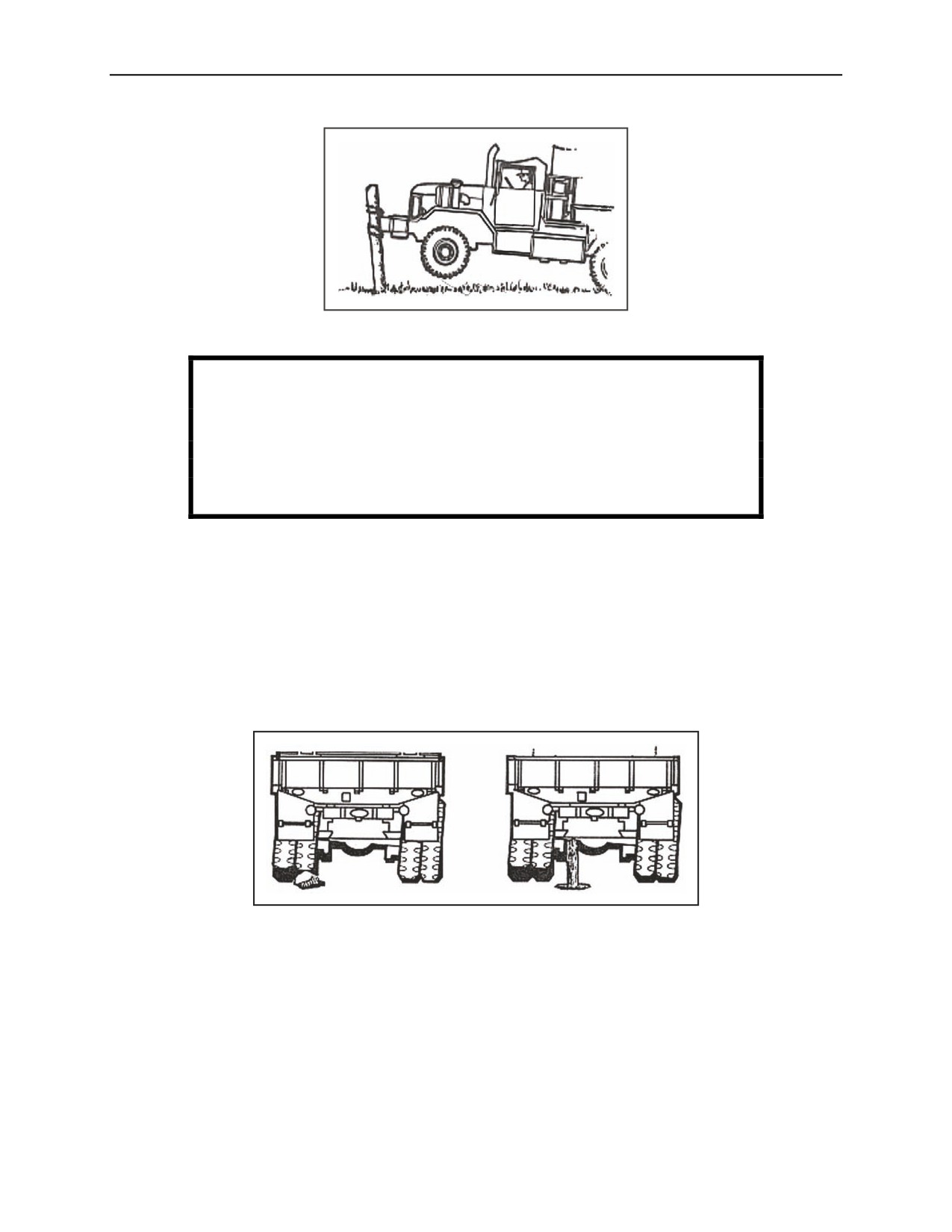
Figure 5-2. Substitute jack (front wheels)
WARNING
This method cannot be used with vehicles with aluminum front
bumpers, such as the USMC MK-23. If this method is used, it will
damage the front end of the vehicle and possibly cause injury to
personnel.
5-3. When an outside rear dual tire is flat and a jack is not available, run the inside dual wheel up on a small
log or rock (figure 5-3). This takes the weight from the outside wheel, which can then be removed for
replacement.
5-4. Another substitute jack is a piece of timber longer than the distance from the axle to the ground
(figure 5-3).
Place one end of the timber against the axle at an angle and the other end in a shallow hole.
Drive the vehicle forward against the angled timber, which will cause the timber to stand straight and
lift the axle off the ground.
Set the brakes and block the vehicle securely.
Figure 5-3. Substitute jack (rear or tandem wheels)
DUAL WHEEL WINCHING
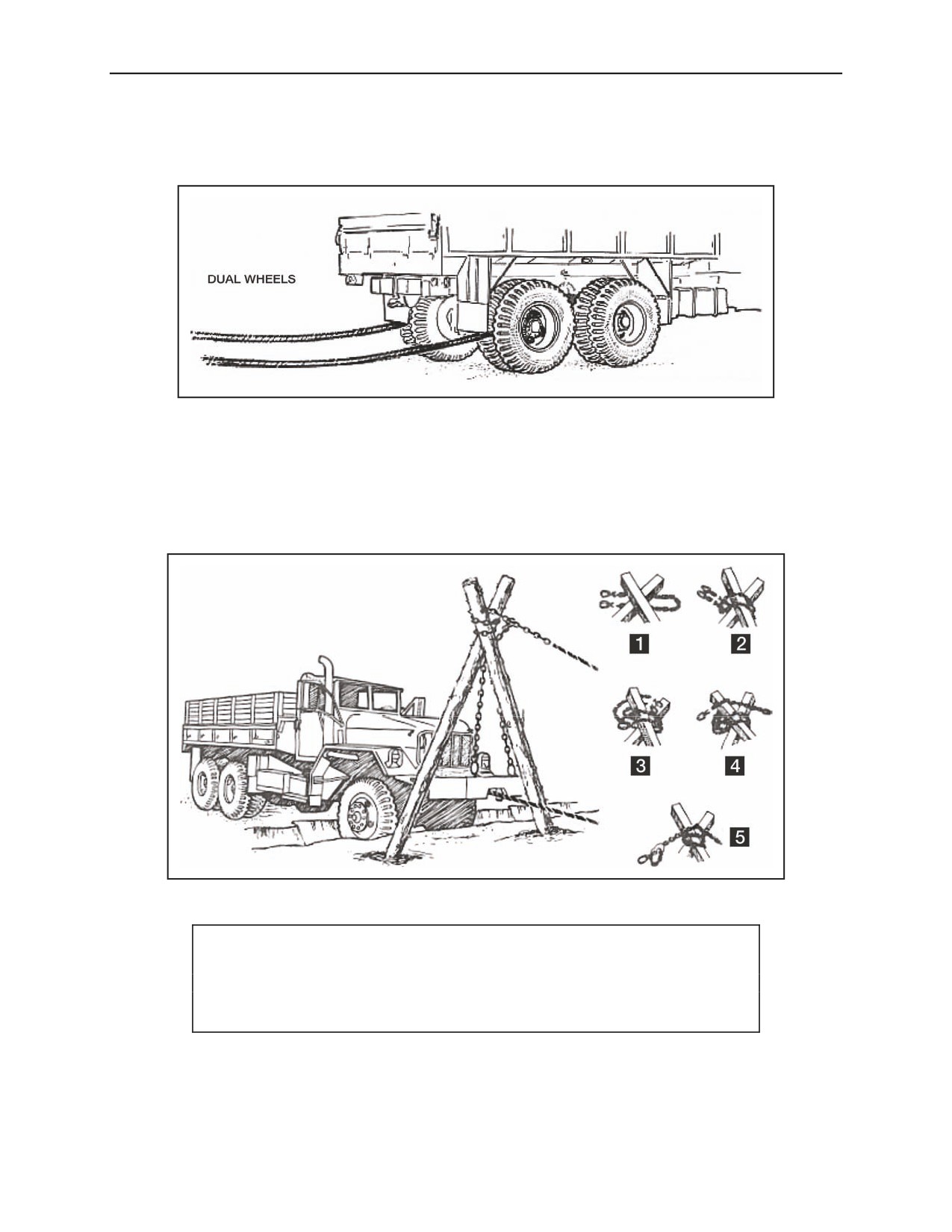
5-5. With dual-wheel vehicles (not equipped with a winch), use the rear wheels to aid in recovery (figure 5-4).
Fasten one end of the rope to the wheel hub and anchor the other end.
Run the end of the rope fastened to the wheel’s hub between the duals and through one of the holes
in the wheel disk. (Do not place the rope through a hole in the wheel disk where the valve stem is
located.)
Tie a knot in the end of the rope and slip it over the hub.
5-2
FM 4-30.31
19 September 2006
Field Expedient Recovery
Tie a second rope in the same way to the dual wheels on the other end of the axle.
Place the vehicle in reverse gear. The ropes will wind between the two duals and cause the vehicle to
move rearward.
Figure 5-4. Wheels used as winches
USING AN A-FRAME
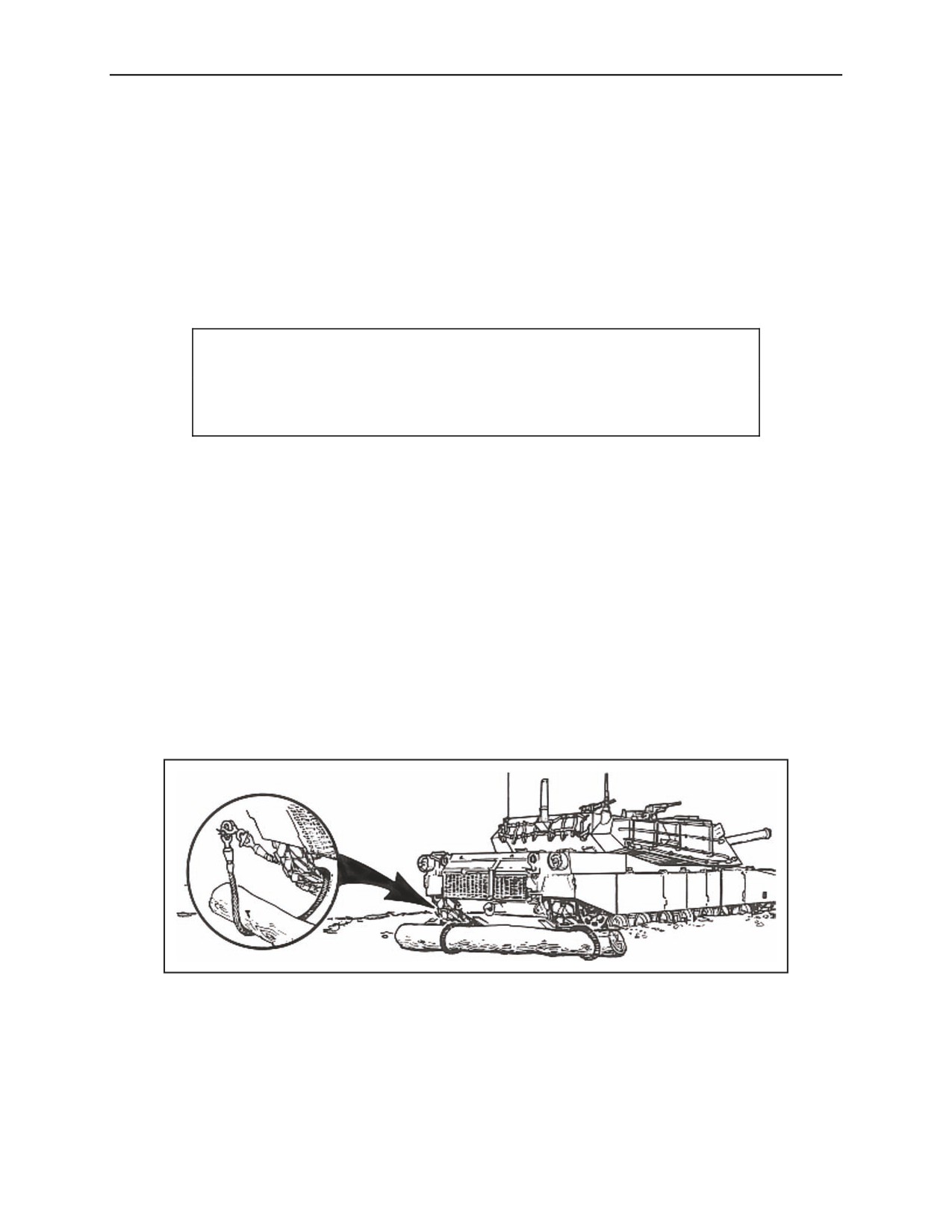
5-6. Frequently, a truck will become nosed in a shallow hole, narrow ditch, or munitions crater where both
lifting and pulling forces are required to make the recovery. If the nosed wheeled vehicle is equipped with a
winch, use the winch to supply the pulling force and an A-frame for the lifting force (figure 5-5).
Figure 5-5. Girth hitch and using an A-frame in recovery operations
CAUTION
This method cannot be used on vehicles with aluminum front bumpers
such as the Marine Corps MK-23 series trucks.
5-7. To build an A-frame, use two long poles.
Lash the poles together at the top using a figure eight or girth hitch.
19 September 2006
FM 4-30.31
5-3
Field Expedient Recovery
Place the lower end of the poles in the ground 10 to 12 inches deep to prevent them from sliding
when power is applied.
Lay the upper end of the A-frame against the front of the vehicle. Attach the A-frame to the vehicle.
5-8. A nosed wheeled vehicle’s winch and an A-frame can supply the lifting and pulling forces needed to
recover the vehicle.
Rig the winch cable for a 2-to-1 MA.
Secure the end of the cable to the apex of the A-frame. As the winch is wound in, the A-frame lifts
and pulls the truck forward.
Suspend the truck over the ditch or hole.
Fill the ditch with rocks, dirt, or other material so the vehicle can be driven forward or backward.
CAUTION
Do not wrap chains around the bumper or vehicle frame. Attach chains to
the vehicle by lifting shackles only.
REMOBILIZING TRACKED VEHICLES
ANCHORING TRACKS
5-9. Vehicles often become bellied (high-centered) on stumps, rocks, dry ridges, or mire. When this occurs,
they become immobilized due to lack of traction.
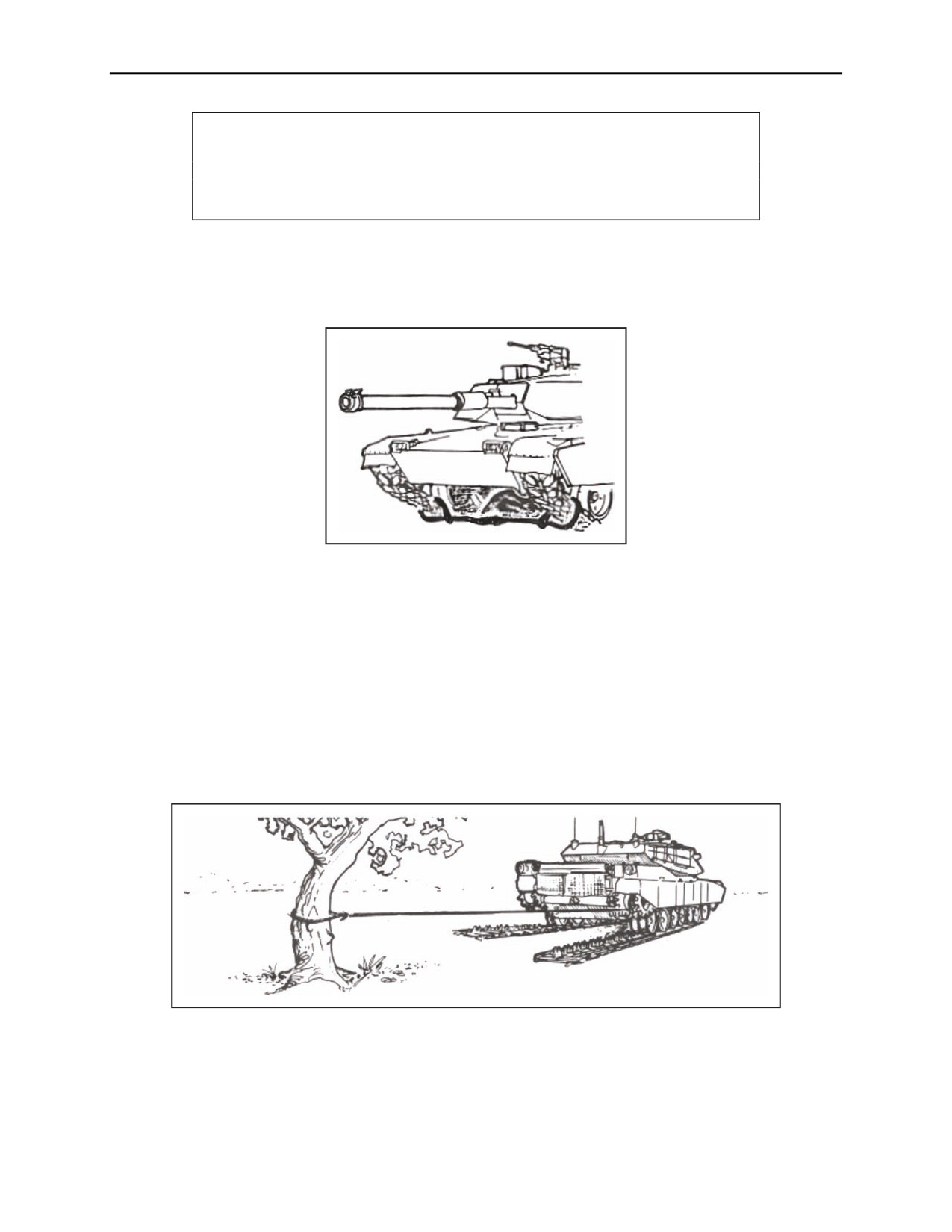
5-10. To recover a bellied vehicle, obtain a log long enough to span the width of the vehicle and of sufficient
diameter to support the vehicle weight (figure 5-6).
Place the log against both tracks.
Place a tow cable so that one end of the cable goes under the log and through the tracks from the
inside.
Place the other end of the tow cable underneath the log and connect the ends of the cable together
with a tow hook on the outside of the track to make disconnecting easier.
Figure 5-6. A log used to anchor tracks
5-11. Follow the same procedure to attach the log to the track on the opposite side of the vehicle. Take up the
slack in the tow cable by gradually applying power to the tracks. This pulls the log underneath the tracks until it
comes into contact with the obstacle, thereby anchoring the tracks and causing the vehicle to move.
5-4
FM 4-30.31
19 September 2006
Field Expedient Recovery
CAUTION
To prevent damage to the fenders and tow cables, stop the vehicle before
the log reaches the fenders or the cable reaches the drive sprocket.
5-12. For a bellied disablement (other than mire), anchor the tracks by using two tow cables (figure 5-7).
Connect the tow cables together with a tow hook and attach the cables to both tracks by passing the ends of the
cables through the tracks from the outside and attaching them to the standing parts of the cables with tow
hooks. When power is applied to the tracks, the cable will contact the obstacle and anchor the tracks.
Figure 5-7. Cables used to anchor tracks
MOVING A VEHICLE WITH BOTH TRACKS BROKEN
5-13. When both tracks are thrown, they may need to be separated before the vehicle can be moved to remount
the tracks (figure 5-8).
Break one track and attach a cable from the drive sprocket hub to an anchor. This will support the
vehicle so that the other track can be separated.
Chock the vehicle to keep it from rolling out of control.
Apply engine and steering power to the drive sprocket attached to the cable. When this is done, the
vehicle will move by the winching action of the drive sprocket hub.
Figure 5-8. Moving a vehicle with both tracks broken
19 September 2006
FM 4-30.31
5-5
Field Expedient Recovery
MOVING A VEHICLE ONTO A TRACK
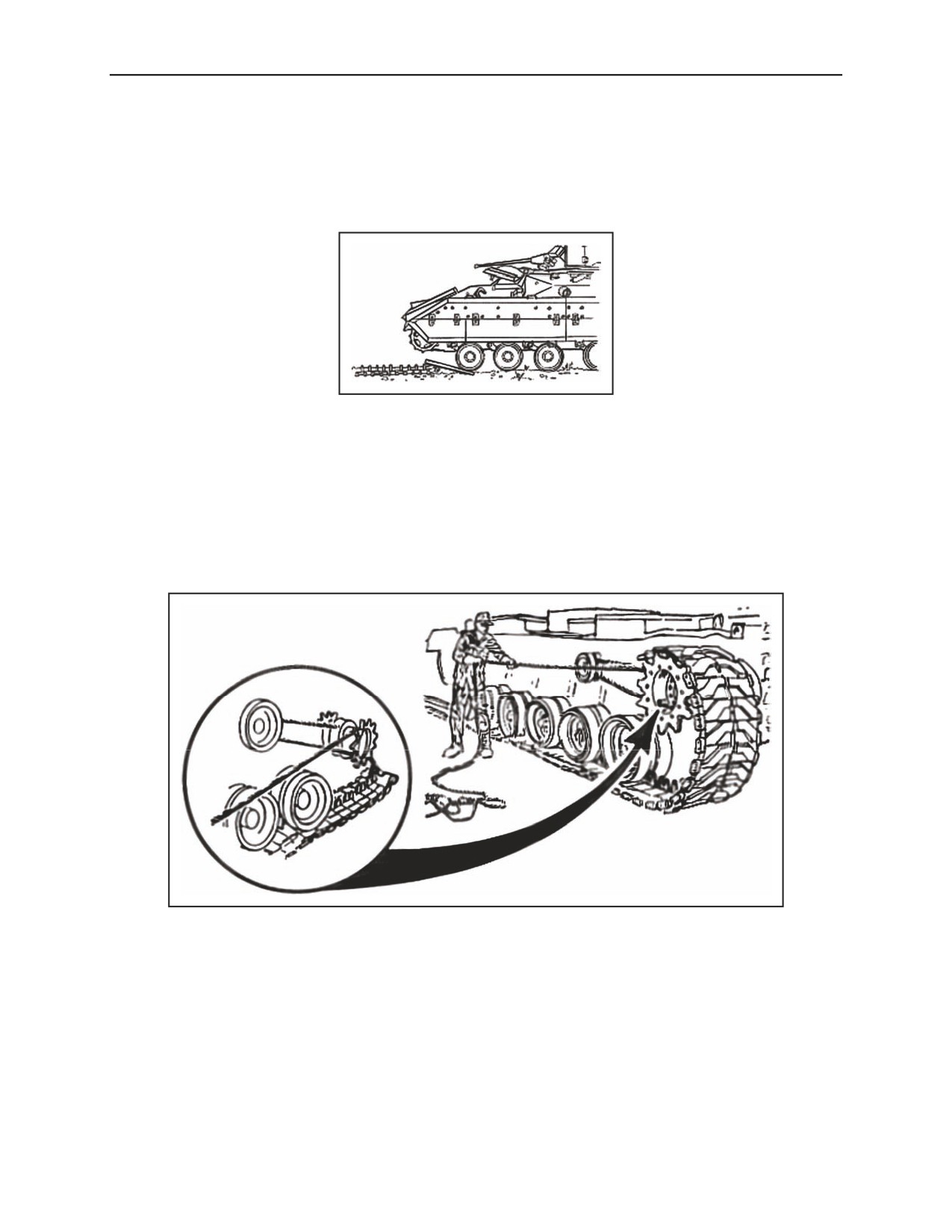
5-14. Align the vehicle with the track and position a plank-type ramp on the end of the track (figure 5-9).
When a ramp is not available, dig a shallow ditch where the end of the track can lie.
Figure 5-9. Moving a vehicle onto a track
INSTALLING A TRACK
5-15. To install a track—
Align the track with the road wheels so that the center guide(s) will pass between the road wheels
when the vehicle is moved (figure 5-10).
Stop the vehicle when the rear road wheel is resting forward far enough for the entire track to pass
over the sprocket.
Figure 5-10. Installing a track
z
Tie a rope to the center of the track pin on the rear track link.
z
Pass the rope over the center guide groove of the sprocket hub, around and between the rear support
roller wheels, and back around the sprocket hub, making two turns.
5-16. As power is applied to the sprocket, and the free end of the rope is held taut, the end of the track is pulled
up to the sprocket. Once the sprocket has engaged a minimum of three track links—
5-6
FM 4-30.31
19 September 2006
Field Expedient Recovery
Stop the sprocket, lock the brakes, and shut off the vehicle engine.
Remove the rope from the sprocket hub and extend it forward over the compensating idler wheel.
Restart the vehicle and move forward.
When the end of the track has passed over the compensating idler, connect the track.
19 September 2006
FM 4-30.31
5-7
Chapter 6
Battle Damage Assessment and Repair Procedures
BDAR procedures apply to most operational levels (from the crew through field level
maintenance) and depend on the extent of the damage, time allowances, available
personnel with required skills, and accessible parts, tools, and materials. Maintenance
personnel must act quickly to restore the vehicle to the combat-ready condition
required to continue the mission or allow the vehicle to self-recover.
BDAR PRINCIPLES
6-1. To be effective, BDAR should follow certain basic guiding principles:
Ensure standard maintenance practice is always the first consideration.
Base decisions of using BDAR versus standard maintenance on the METT-TC.
Provide an accurate assessment.
Ensure economy of maintenance effort (use maintenance personnel only when necessary).
Train multifunctional skills.
Repair only what is necessary to regain combat capability.
Remain flexible about repair priorities.
6-2. Commanders should address using BDAR in the logistics section of their operation order (OPORD).
This will provide the crews and maintainers with a clear understanding of when and at what risk level they
can perform BDAR. In wartime, BDAR may have to be liberally applied at the discretion of the
commander. In military operations other than war, local command policy will direct the degree of BDAR
to apply and when to use standard maintenance. However, commanders at all levels must ensure that both
crews and maintainers perform annual BDAR training.
BDA ACCURACY
6-3. BDA is the necessary first step and starts the moment a crewmember recognizes battle damage. The
assessment determines the extent of damage to include the subsystems and components damaged, the level
of repair, and the risk involved. The assessment will also include an estimate of personnel, time, and
materials required to perform expedient repairs. If not handled correctly, time, man-hours, parts, and
resources will be wasted and opportunities to get back in the fight will be missed.
ECONOMY OF MAINTENANCE EFFORT
6-4. Maintenance assets will be heavily taxed on the battlefield. Because resources are limited (personnel,
tools, and parts), it is imperative that maintenance resources are not wasted. Crewmembers must do repairs
within their capabilities immediately rather than requesting maintenance personnel to do simple mechanical
tasks.
MULTIFUNCTIONAL SKILLS
6-5. Personnel shortages and battlefield casualties mandate that maintenance team members have some
knowledge of other skills needed to achieve critical repairs. A lack of key repairmen must not deter a team
from doing battle repairs. Whenever possible, on-the-job training or cross-training of personnel should be
done.
19 September 2006
FM 4-30.31
6-1
Battle Damage Assessment and Repair Procedures
NECESSARY REPAIRS
6-6. On the battlefield, the objective is to return the system into battle with enough combat capability to
get the mission accomplished. Cosmetic repairs are not necessary and are a waste of time and resources. If
a broken item does not affect the ability to shoot, move or communicate, and does not pose a serious safety
concern, it should not be repaired until the equipment is returned to maintenance where standard repair
procedures can be performed.
FLEXIBILITY
6-7. Priorities of repair; a shortage of personnel, parts, and time; a chaotic battlefield environment; a
change of mission; the lack of a weapon systems crew; and a host of unforeseen circumstances demand a
flexible approach to BDAR. If specific repair techniques are not in the manuals, ingenuity can be the key to
successful BDAR.
BASIC RULES OF ASSESSMENT
THINK SAFETY FIRST
6-8. Personnel must be aware of live/loaded ammunition, damaged weapons or ammunition, fuel/oil
spills, and electrical cables and wiring.
Look for unexploded ordnance (UXO) in the area before performing the assessment. Do not
move or otherwise disturb UXO or any ammunition that has been fixed, armed, ignited, or
involved in an accident until qualified UXO personnel have rendered it safe.
Check the area for chemical contamination, to include depleted uranium (DU) when appropriate.
Use a radiac meter to determine if DU is present from damaged ammunition or from armor that
contains DU.
Avoid environmental contamination by spills of fuel and oil. All spills should be reported
through the chain of command to the unit’s logistical element, such as the battalion S-4.
BEWARE OF BOOBY TRAPS
6-9. Booby traps and improvised explosive devices present a unique challenge when recovering
abandoned vehicles. If equipment was abandoned or was unsupervised by friendly forces, the possibility of
booby traps exists. To ensure the safety of BDAR/recovery operations, inspect equipment for tampering
before attempting repairs.
RECOGNIZE BATTLE DAMAGE INDICATORS
6-10. Battle damage indicators (BDI) from an operator or crewman perspective include smoke, fire,
unusual odor, unusual mechanical noise, leaking fluids, fault warming lights and alarms, and loss of
mobility or system function. Immediate recognition and attention by crewmembers is important because
BDI may not be apparent once equipment stops functioning.
PERFORM AN ASSESSMENT
6-11. The senior man present decides when and if BDAR is performed during combat. This decision is
based on METT-TC and the appropriate risk repair level.
6-12. Do not attempt to operate systems or subsystems until the crew has performed an assessment to
prevent further damage to equipment or personnel. For example, if all circuit breakers are tripped,
including the main circuit breaker, the assessment process should lead to determining the best method or
sequence required to restore power to the vehicle. This could be done by initially resetting the main circuit
breaker followed by resetting the remaining circuit breakers one at a time.
6-2
FM 4-30.31
19 September 2006
Battle Damage Assessment and Repair Procedures
6-13. In the forward battle area, the crew must attempt to move the vehicle to a covered or concealed
position to prevent additional damage. The best “rule of thumb” is to move the vehicle at least one terrain
feature or one kilometer away from enemy contact.
6-14. If the vehicle is non-self-recoverable, use any like or heavier class vehicle to recover the vehicle or
to conceal it. If this is not possible, turn the turret (if the vehicle is equipped) in the direction of engaging
fire to limit damage and provide return fire capability.
6-15. To enable a systematic assessment, crews and maintenance personnel should use the 11 basic steps
to BDA. The 11 basic steps in this manual include—
Visually inspect interior and exterior for damaged parts and systems.
Visually determine if vehicle main systems appear to be operable.
Perform equipment self-test function-using a built-in test, built-in test equipment, and a function
test.
Assess system performance (exercise each system if engine can be safely started).
Determine which subsystems are affected.
Determine if crewmembers can repair the damage. (Are enough crewmembers with the required
skills available, and does METT-TC allow repairs at the current location?)
Estimate the repair time (by crew and by MST).
Estimate the number and type of repair personnel needed and the associated risk. Ensure
command approval to perform repairs.
Determine what materials are required.
Determine what the vehicle limitations will be after repairing using BDAR or standard repair.
Determine the recovery status—self/like/dedicated.
6-16. Based on METT-TC, the CRT/ MST/MT uses the assessment check information to—
Determine if the current risk repair level assigned is appropriate for the required repairs for the
CRT/MST/MT.
Conduct tests with maintenance test equipment, if required.
Perform additional vehicle operational tests, if necessary.
Determine what must be repaired or replaced.
Estimate repair times for each repair task.
Determine the sequence and priority of the repair action.
Determine the repair location and, if other than on-site, arrange for recovery of the vehicle to the
repair site.
6-17. The following safety checks are performed to identify any obvious hazards.
Is there a round of ammunition in the gun tube?
Is any ammunition in a critical state due to shock, fire, or physical damage?
Have any combustibles such as fuel, hydraulic fluid, or oil accumulated?
Does wiring appear to be safe? Could an arc occur to stored ammunition or leaking
combustibles?
Is the fire-extinguishing system operational? If not, station a crewmember in the vehicle—
prepared either to use a handheld fire extinguisher or to operate the onboard fire extinguishing
system manually. Station a second crewmember outside the vehicle with an additional fire
extinguisher.
For systems with built-in self-test procedures, has a functional/operator test been performed on
those systems that appear undamaged?
19 September 2006
FM 4-30.31
6-3
Battle Damage Assessment and Repair Procedures
BDA GUIDELINES
6-18. This section gives guidelines for BDA. Use these guidelines to rapidly assess battle-damaged
equipment and systematically determine which subsystems are affected, to include the time, personnel, and
materials required for repair.
6-19. These guidelines will also assist in performing “equipment triage.” Equipment triage is the process
used to decide the order that battle-damaged equipment will receive repairs. This determination is based on
combat or combat support equipment, time, urgency, materials, and personnel required to do the required
repairs.
6-20. Units can develop locally produced forms or checklists that best support authorized equipment and
unit maintenance structure, and that list personnel authorized by the command to approve BDAR actions
based on the BDA. Consider the following guidelines (figure 6-1) when assessing battle damage. These
guidelines can be tailored to fit your specific vehicle.
6-4
FM 4-30.31
19 September 2006
Battle Damage Assessment and Repair Procedures
System Assessment Summary
Determine vehicle status—
Can the vehicle shoot, move, and communicate?
Can the vehicle be repaired to shoot, move, and communicate?
Can the vehicle be self-recovered, towed, or transported?
Check engine, transmission, fuel system, electrical system, wheels and suspension, hydraulic
system, armor/ammunition storage, armament/fire control, and communications to see if
they can be repaired or recovered and identify any limitations.
Identify expendables, parts, and tools and National Stock Number (NSN) if applicable.
Estimate the time and personnel needed.
Hull Damage Assessment and Repair
Record applicable NSN for exchanged and cannibalized parts.
Check engine system—for example, starter, oil tank, air induction system, air cleaner, oil
filter, drain valve, accessory drive, shaft, low oil pressure.
Check transmission and final drive systems for faults—for example, transmission will not
shift, broken linkage, vehicle will not steer, final drive locked, transmission leaks, parking
and service brake serviceability, and oil cooler.
Check fuel systems—for example, fuel tanks, fuel lines, fuel filters, fuel pumps.
Check electrical systems—for example, wiring harness, slip ring, batteries, circuit breakers,
and power distribution box.
Check track and suspension systems—for example, compensating idlers, track adjusting link,
road wheel arms, road wheels, support rollers, sprockets, shock absorbers, torsion bars, and
track assembly.
Check hydraulic systems lines and fluids, driver controls, and instruments.
Communications Damage Assessment and Repair
Record applicable NSN for exchanged and cannibalized parts.
Check serviceability of intercommunications, receiver, transmitter, antennas, cables, and
security.
Turret Damage Assessment and Repair
Record applicable NSN for exchanged and cannibalized parts.
Check electrical system—for example, turret power, slip ring, circuit breaker, and wiring
harness.
Check armament—for example, bore evacuator, gun tube, breech group, and main gun
mount.
Check fire control system—for example, commander control handle and weapon sight,
gunner primary and auxiliary sight, range finder, crosswind sensor, wiring system, gunner
control handle, stabilization system, manual traverse and elevation, and loader’s panel.
Check hydraulic system—for example, auxiliary hydraulic pump, hydraulic fluid, and
hydraulic reservoir.
Figure 6-1. BDA guidelines
6-21. BDAR may enable the equipment to either self-recover or continue the mission. The BDA will
provide the commander with necessary information to make efficient decisions concerning whether to
continue the fight or recover the equipment to the appropriate maintenance location.
6-22. Always report battle damage as soon as possible. Ensure that the damage is reported according to the
local SOP and this manual.
19 September 2006
FM 4-30.31
6-5
Battle Damage Assessment and Repair Procedures
MAINTENANCE PROCEDURES AND BDAR
6-23. The operator/crew prepares and provides the initial damage assessment and reports to the vehicle
commander. They describe inoperable conditions, to include CBRN conditions and circumstances. (When
the inoperable equipment is subject to or in danger of hostile fire, another vehicle can be used to recover it
to a secure location.) The operator/crew assesses the situation and determines which type of maintenance
support is required.
6-24. If directed, the crew shall proceed to make any field expedient repairs possible. Usually these repairs
will consist of restoring firepower, communications, and/or vehicle mobility within the limit of their skills
and the availability of materials and tools. They must also consider repairing items to make the equipment
self-recovery capable. If repairs are beyond crew capabilities, they request assistance per the unit’s
standing operating procedure (SOP).
6-25. The vehicle commander will report the results of the crew/operator damage assessment to the
platoon leader. He will name the major known causes of the vehicle’s immobility and/or lack of firepower
and/or communication failures. If repairs by the crew are possible, the vehicle commander will report the
appropriate risk repair level, a total estimated repair time, and a list of functions that may be restored.
6-26. The platoon leader will respond with directives and, if required, will call a CRT to the location of the
damaged vehicle for assistance. If possible, he will provide sufficient information to enable the CRT to
bring any required repair parts, special tools, or recovery assets to the site.
6-27. Maintenance personnel will assess the equipment to verify the operator’s/crew’s damage assessment
for accuracy or reconsideration of repair methods. Based on the maintenance assessment, the decision will
be made to either attempt an on-site repair or request recovery assets to move the vehicle to a UMCP.
METT-TC will determine if on-site repair or evacuation is necessary.
6-28. The CRT and MST will perform BDAR, using the BDAR kits and any other field expedient material
on hand. Because standard maintenance repairs usually offer the best repair, maintenance personnel will
strive to perform standard repairs—if METT-TC permits.
6-29. Equipment that is damaged but mobile may be used to move disabled equipment. If recovery
vehicles are not available (and as the tactical situation permits), like or heavier classed vehicles may be
used to recover disabled equipment.
6-30. If all critical repairs can be done with the skills, tools, and equipment on hand, the CRT (assisted by
the crew) will proceed with the on-site repair. If the damage exceeds the repair capability of the CRT and
time is available for an MST on-site repair, the CRT will call the MST.
6-31. Sometimes there is not enough time available for an MST on-site repair. If the vehicle is reparable,
the CRT will recover the vehicle to a designated UMCP.
6-32. If the vehicle is not reparable, the CRT will provide—
Recovery to the UMCP for evacuation to the rear.
On site cannibalization, if approved by the commander and coordinated with support
maintenance.
Other needed replacement parts.
6-33. If the vehicle is contaminated, the CRT will mark the vehicle with the appropriate contamination
markers and arrange for recovery to a decontamination site.
RECORDING BDAR REPAIRS
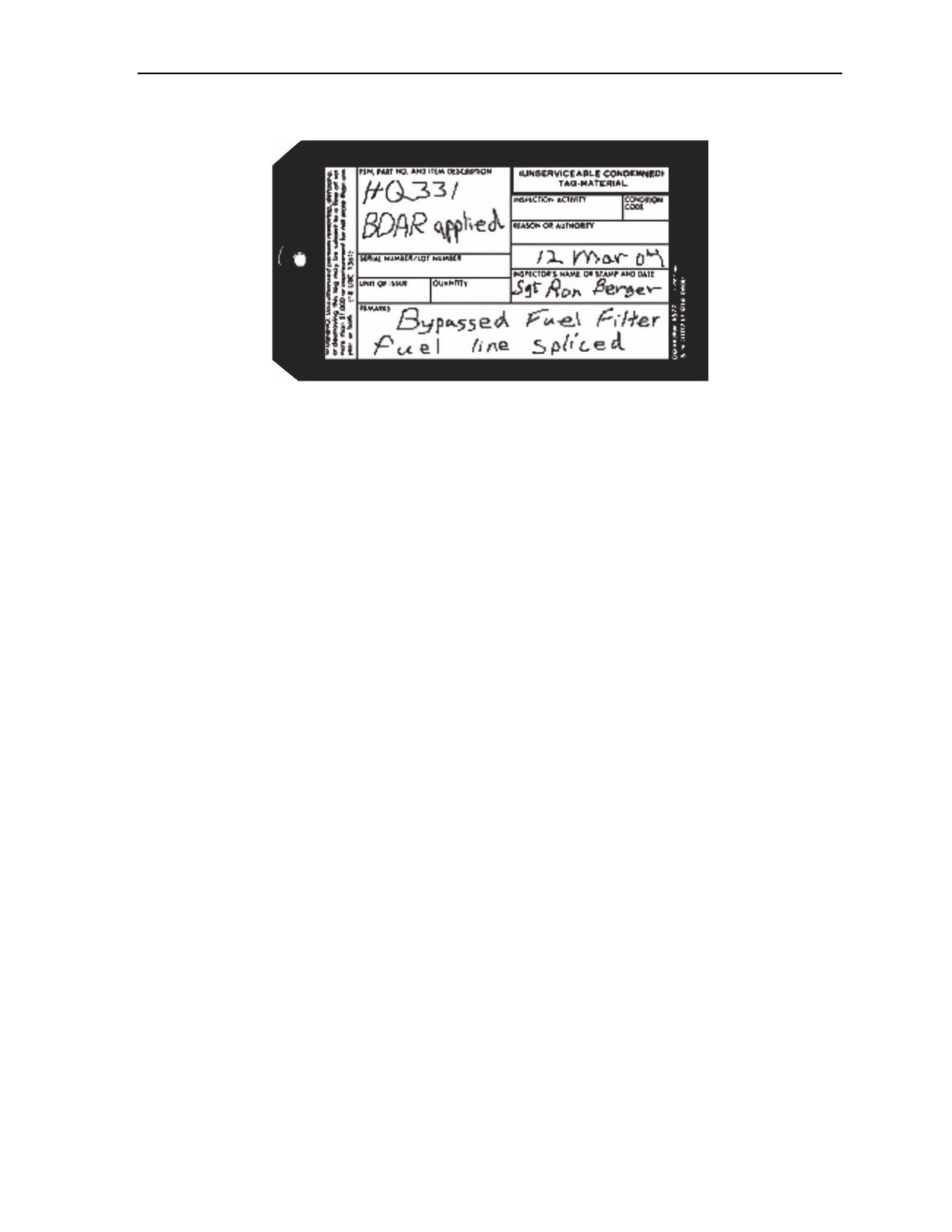
6-34. Attach a DD Form 1577 (Unserviceable [Condemned] Tag-Material) to all vehicle components
(figure 6-2) that are repaired using BDAR or other expedient techniques. In an emergency, it is not
necessary to complete the tag. The purpose of marking the component is to enable mechanics to recognize
BDAR quickly when the equipment is subsequently returned for permanent repairs.
6-6
FM 4-30.31
19 September 2006
Battle Damage Assessment and Repair Procedures
Figure 6-2. Example of a DD Form 1577
6-35. Because it is impractical to attach tags to some repairs located on the outside of the vehicle, place the
tag in the compartment normally reserved for the equipment record book/folder or in an obvious place in
the driver’s compartment.
6-36. Place a tag conspicuously in the vehicle (in the driver’s or commander's position) when a BDAR
procedure has resulted in a degraded operating capability. Mark this tag “BDAR,” and note its specific
limitations or cautions.
6-37. When a component is cannibalized from a reparable vehicle, attach a tag in the space created by the
missing part and near the master power switch. This will readily alert maintenance personnel that the part
has been removed.
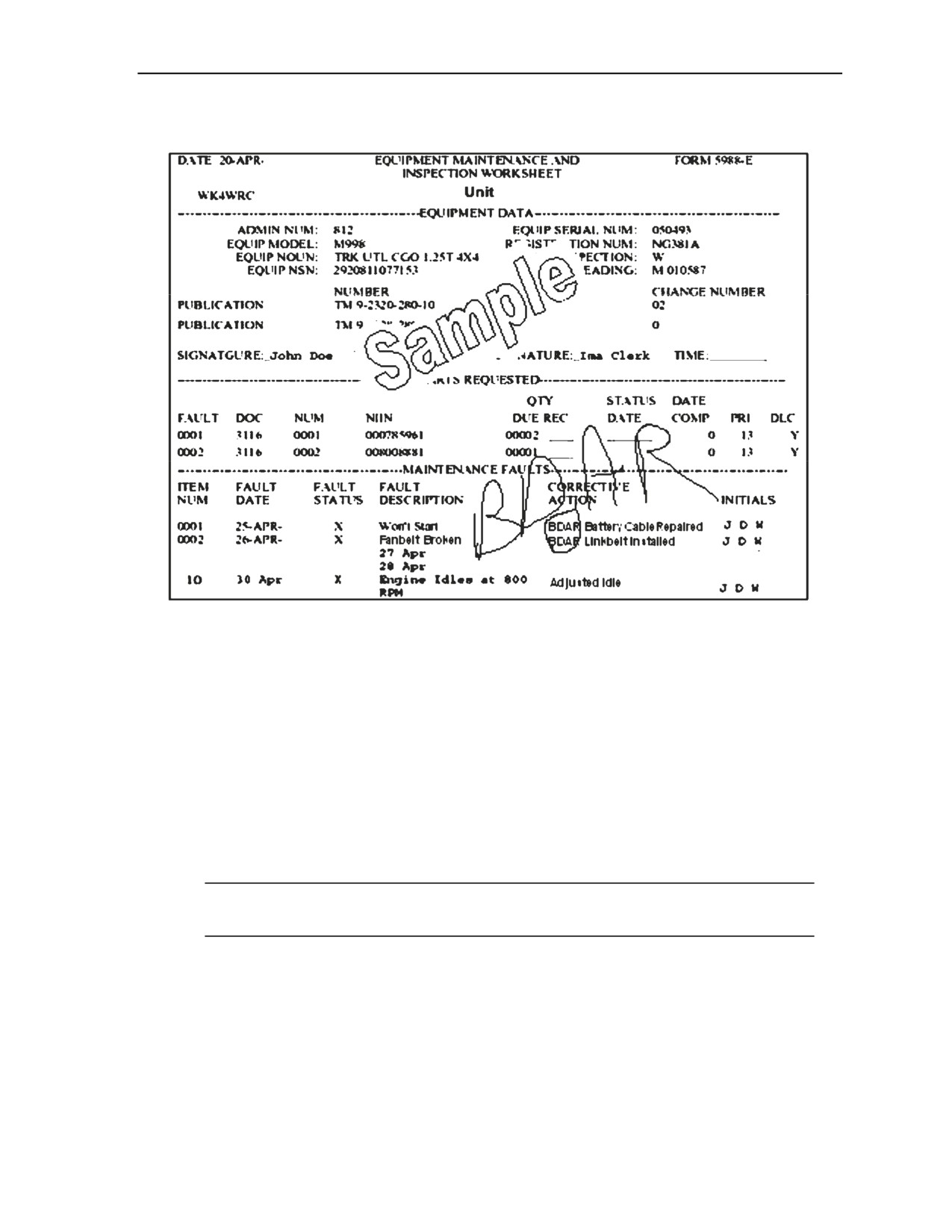
6-38. When a vehicle is recovered/evacuated for “standard” or “normal” repairs, a DA Form 2404
(Equipment Inspection and Maintenance Worksheet) (figure 6-3) is used. Also, a Unit Level Logistics
System (ULLS)-generated Form 5988-E, Equipment Inspection and Maintenance Worksheet (Automated)
(figure 6-4) is used as the electronic version of the DA Form 2404. Add the notation “BDAR” in the parts
requested/maintenance faults section.
19 September 2006
FM 4-30.31
6-7
Battle Damage Assessment and Repair Procedures
Figure 6-4. Example of a ULLS-generated DA Form 5988-E
6-39. When reporting a BDAR action, all details must be annotated on a DA Form 2404/DA Form 5988-E
and forwarded to: Survivability/Vulnerability Information Analysis Center (SURVIAC, ATTN: AF-FDL
FES-CDIC), Wright-Patterson AFB, OH 45433.
6-40. A second copy must be forwarded to: TRADOC Executive Agency BDAR and Recovery, 5046
Havre de Grace Street, Aberdeen Proving Ground, MD, 21005. Comments and BDAR action forms can
also uploaded to the Ordnance Mechanical Maintenance University (OMMU) web site at
https://ommu.army.mil or http://ommu.army.mil web site. Users must have an AKO account to access the
OMMU website. Comments, questions, and completed forms can be emailed to
bdarfeedback@apg.army.mil.
6-41. These documents will serve as examples that can be tested to prove principle and may be included in
future publications of this FM. Ensure all information provided is as accurate and detailed as possible.
Note. The procedures in paragraphs 6-39 through 6.41 do not apply to USMC. USMC observes
chain of command reporting procedures.
SPECIAL OPERATING ENVIRONMENTS
6-42. BDAR techniques may be more difficult in certain environments, such as extremely hot or cold
climates. For example, certain molecular compounds (polymers) may take longer to cure in a cold
environment but may cure very rapidly in hot environments. The instructions for these compounds are
provided in the BDAR kits.
19 September 2006
FM 4-30.31
6-9
Battle Damage Assessment and Repair Procedures
6-43. The BDA will be used to determine the time required to repair the system and whether repairs can be
performed on site or if recovery is necessary. Whenever possible, standard maintenance repairs should be
attempted. If that is not possible, then BDAR should be attempted to allow equipment to self-recover or
continue the mission even though it may be at a reduced level of capability. Upon completing the mission
and at the first practical opportunity, more complete, standard repairs should be performed to return the
equipment to FULLY MISSION CAPABLE status. Whether to use cannibalization or controlled exchange
is a decision rendered by the unit commander to whom the equipment belongs.
CANNIBALIZATION
6-44. Cannibalization is the authorized removal of serviceable and unserviceable parts, components, and
assemblies from material authorized for disposal. Another possible source of cannibalization is captured or
abandoned enemy equipment.
6-45. Supervised cannibalization and controlled exchange may be employed when parts are not available.
Conditions for cannibalization are usually controlled by local policy and will be employed when addressed
in an OPORD by higher headquarters.
CONTROLLED EXCHANGE
6-46. Controlled exchange is the removal of serviceable parts, components, and assemblies from
unserviceable, economically reparable equipment. These parts are for immediate use to restore a similar
item of equipment to a combat-capable or serviceable condition.
Note. Cannibalization and controlled exchange can be performed only when authorized by the
commander.
BDAR IN JOINT OPERATIONS
6-47. Military units can expect to deploy as a component of a joint force. Maintenance personnel should
work closely with other services to make collective use of tools and capabilities to perform BDAR. Despite
differences in equipment and doctrine, the services have much in common that can be shared. Navy
Seabees, Air Force maintenance activities, and most Navy ships have a machine shop and fabrication
capabilities that would prove useful in supporting BDAR. Prior joint-service agreements should be further
developed to use this capability between services. The same cooperation can be developed with allied
nations. Most armies have a BDAR program. Many of the allied tools, materials, and techniques are similar
to those of the United States. In addition, some foreign armies use our equipment, especially vehicles, and
are a possible source for repair parts, but only if cannibalization is allowed by the HN. HN agreements
should outline which BDAR or other maintenance services can be provided and the procedures required for
obtaining support.
BDAR TOOLS AND EQUIPMENT
6-48. Special kits are available to support crew and maintainers to perform BDAR with access to BII and
components of end items
(COEI). These kits are allocated to the crew, CRTs, MTs, MSTs, and
maintainers. Appendix A provides general information about the BDAR kits and the NSN for both crew
and maintainer kits. BDAR kits allow repair in numerous areas—such as fuel, hydraulics, cooling, tires,
electrical systems, and hull repair.
6-49. When possible, BDAR should first be performed by the crew using the crew/operator BDAR kit,
BII, COEI, and AAL, OVE. Maintenance personnel will have access to the same items available to the
crew/operator, as well as additional components.
6-10
FM 4-30.31
19 September 2006
Battle Damage Assessment and Repair Procedures
HULL AND METAL COMPONENT REPAIR
6-50. It is critical to maintain hull integrity, especially during fording operations and when faced with a
CBRN threat. Epoxies and polymers in the BDAR kit can be used to ensure hull integrity for small- to
medium-sized holes (figure 6-5). Other components in the crew and maintainer BDAR kits—such as
reinforcement tape and aluminum tape—can assist in patching armor tiles, vehicle fuel tanks, vehicle hulls,
and any other metal surface or components on the vehicles. This capability allows military personnel to
quickly reduce the effects of CBRN and other contaminants from entering their vehicle within minutes.
Hull patches do not provide any additional ballistic protection; they are designed to maintain hull integrity
(air/water tight).
Figure 6-5. Hull and metal component repair materials
FLUID LINE COMPONENTS AND REPAIR
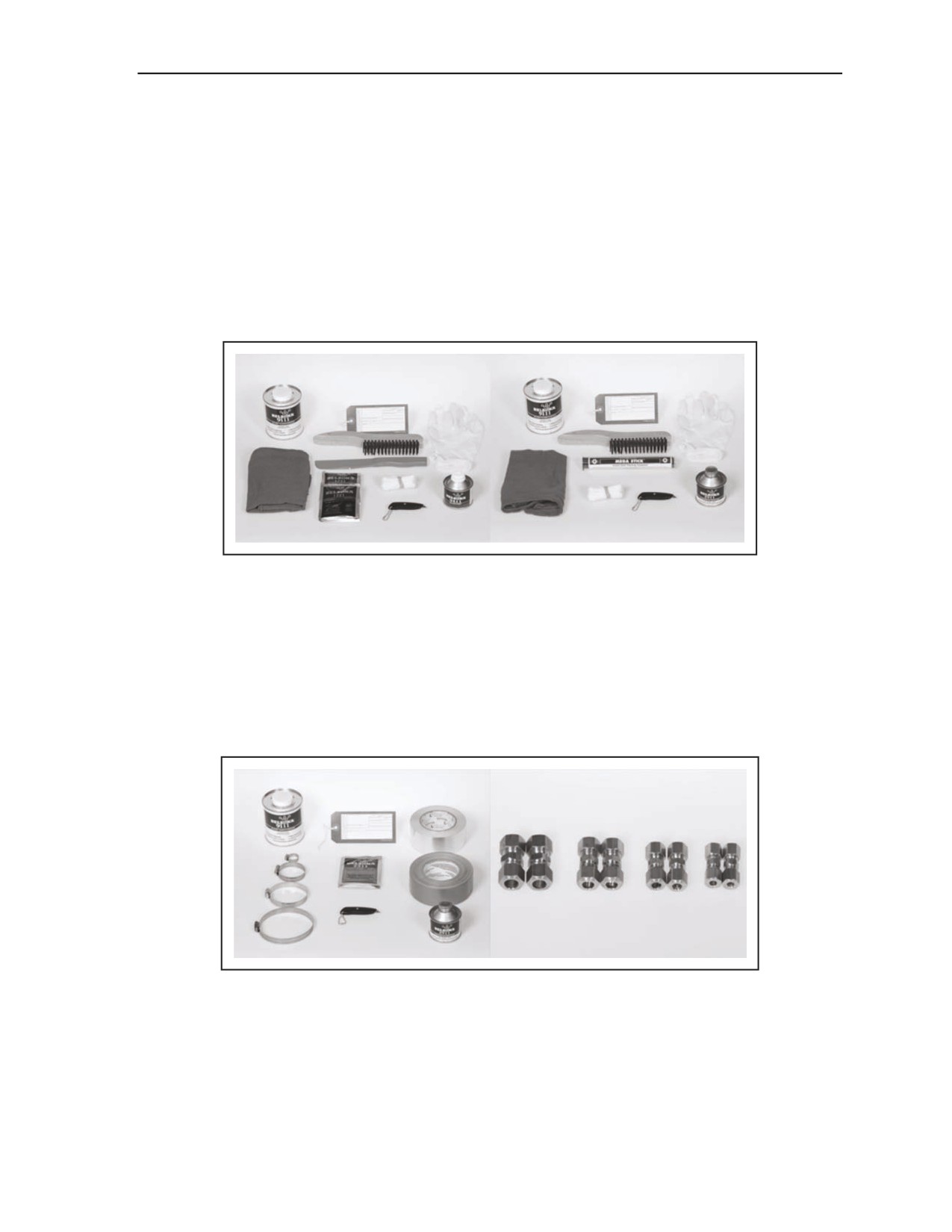
6-51. Fluid line repair items are in both kits. Hose clamps, duct tape, aluminum tape, and Belzona® SR
Elastomer can be used to repair low-pressure rubber hoses (figure 6-6, left). Fittings needed for fluid line
repair are found in the maintainer BDAR kit (figure 6-6, right). These fittings enable the maintainer to
repair low- to high-pressure lines on most equipment.
Figure 6-6. Fluid line repair items
LEAKING LOW-PRESSURE LINE FITTING
6-52. To repair a leaking low-pressure line fitting—
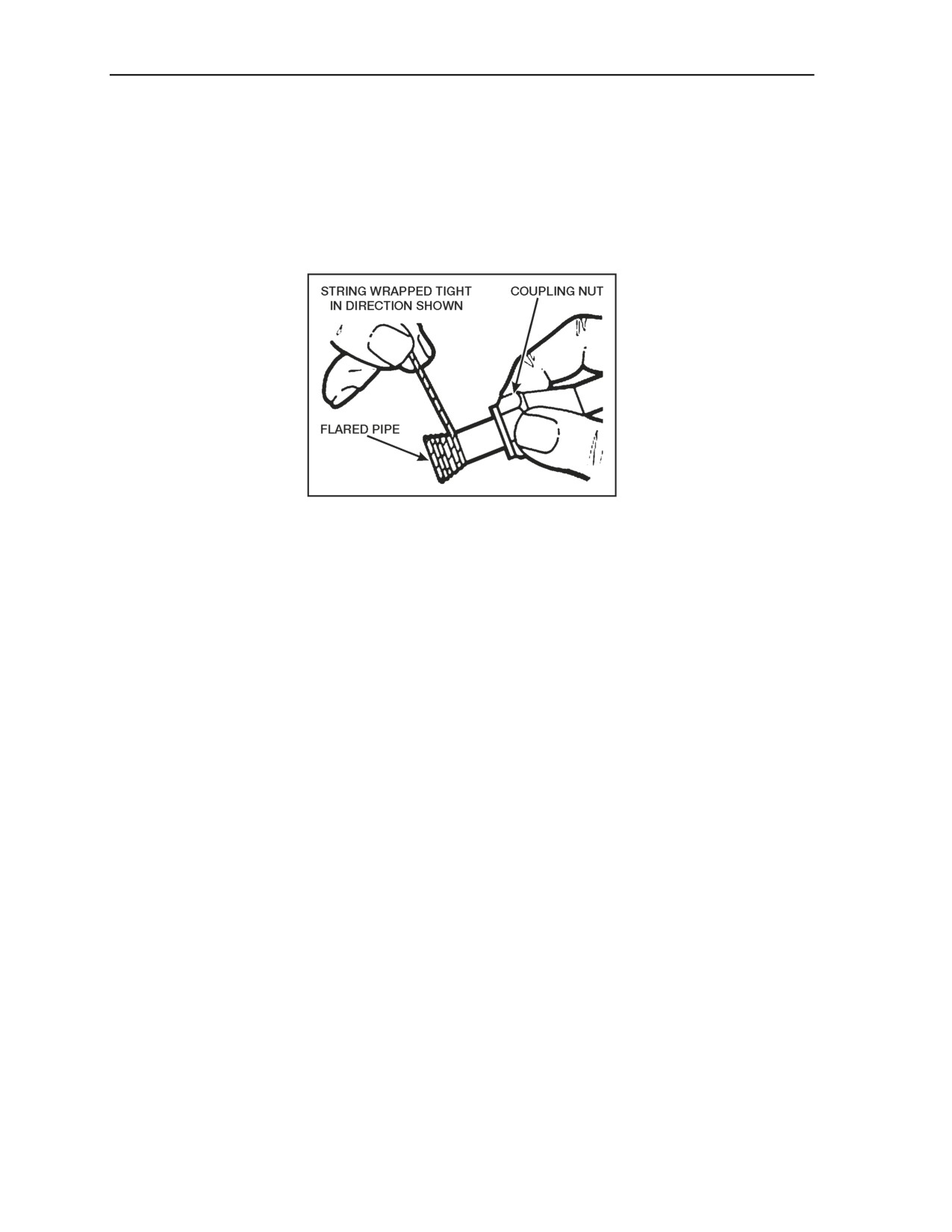
Wind a string or rag tightly around the line behind the flare (figure 6-7). Wind the string
clockwise in the same direction the coupling nut is turned for tightening.
19 September 2006
FM 4-30.31
6-11
Battle Damage Assessment and Repair Procedures
z
Slide the coupling nut over the material, screw it onto its connection, and tighten it securely
against the packing string with a wrench. The string will act as a gasket and seal the leak.
6-53. Anti-seize tape is also available in the BDAR maintainer kit. Anti-seize tape prevents threads from
seizing, but multiple wraps of this tape can serve as packing to seal damaged flared fittings and help seal
threaded fittings. Polymers included in BDAR kits may also be used to repair leaking or damaged fittings
because of their ability to flow into small spaces that caused the leak.
Figure 6-7. Low-pressure line fitting repair
CRACKED LOW-PRESSURE OIL OR FUEL LINES
6-54. Cracked low-pressure oil or fuel lines are usually caused by vibration or defective metal. If this
occurs, stop the leak by wrapping the line tightly with friction tape held in place by wire. The wire helps
the tape withstand pressure and usually stops the leak until a permanent repair can be performed.
6-55. Aluminum or electrical tape may also work if the surface can be cleaned to allow adhesion.
z
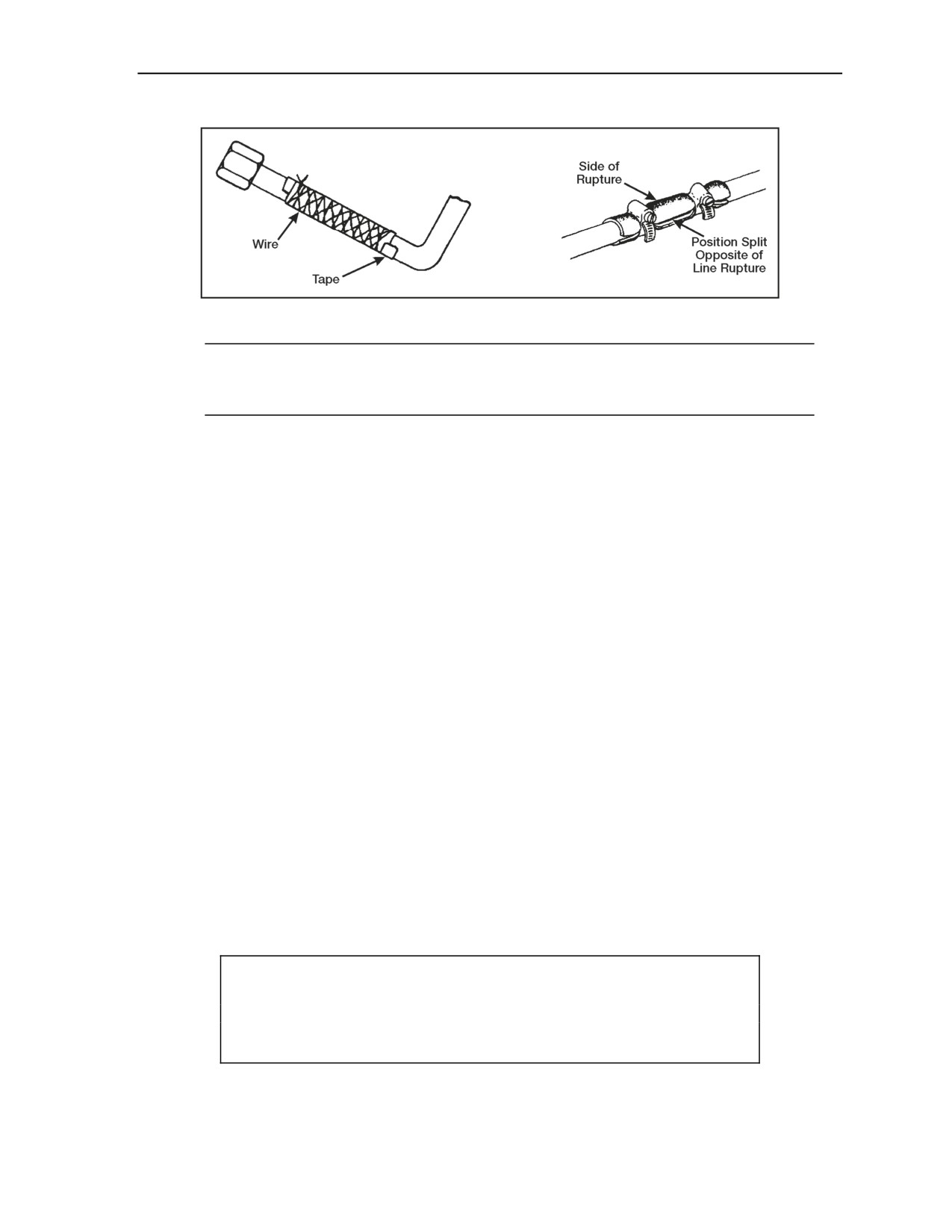
Clean the surface of the line and cover just the crack with a couple wraps of rubber electrical
tape.
z
Follow up with multiple wraps of aluminum tape.
z
Wrap wire around the tube or use hose clamps over the aluminum tape to reinforce the repair
(figure 6-8).
6-56. Another quick method to repair a cracked line is with a small piece of hose.
z
Use a piece of reinforced hose with an inside diameter equal to the outside diameter of the tube.
z
Split the hose lengthwise.
z
Coat the inside of the hose with sealant, if available.
z
Install the hose over the leak with the split opposite the leak.
z
Secure over the leaking area with hose clamps (figure 6-8). Additional clamps may be added to
further reinforce the repair.
6-57. Polymers are also available in both BDAR kits to perform this repair. Polymers can be applied over
the patch to provide additional reinforcement, or be included in the process before applying aluminum tape
to ensure a better seal. Polymers do not require air to cure so the tape can be applied immediately after
applying polymers.
6-12
FM 4-30.31
19 September 2006
Battle Damage Assessment and Repair Procedures
Figure 6-8. Low-pressure line repair
Note. If polymer is used before applying aluminum tape, the tape must be applied before the
polymer is allowed to fully cure. Failure to quickly apply the tape will result in irregular
surfaces and create a poor bonding surface for the aluminum tape.
COLLAPSED FLEXIBLE FUEL LINE
6-58. To repair a collapsed flexible fuel line—
z
Make a support for the inside of the fuel line by wrapping a thin wire around a pencil or another
object slightly smaller than the flexible line inside diameter.
z
Slide the coiled wire off the pencil and place it into the flexible line. Fuel will be able to flow
and the fuel line will not collapse.
6-59. Applying external structure support may also repair a collapsed flexible line. If the line collapses
during flow, but regains shape when flow stops, the following method may be used.
z
Clean the exterior of the line with Elastomer conditioner included in the BDAR kit.
z
Wrap the exterior of the line with wire, but allow at least 1/8 inch between successive wraps.
z
Coat the entire affected area with Elastomer from the BDAR kit and allow it to cure. The
Elastomer will bond to the flexible line and to the wire coil and provide external support to
prevent collapse without restricting internal flow.
6-60. If the line does not regain shape when flow stops, remove the line from the closest source to the
collapse and insert an object such as a pencil inside the hose to expand the collapsed hose. Then perform
the repair listed in the above paragraph. Remove the object from the hose once Elastomer cures and
reattach the hose to its original connection.
ELECTRICAL COMPONENTS AND REPAIR
6-61. Electrical repair capabilities are in both crew and maintainer BDAR kits. Electrical items and
consumable materials can repair numerous electrical connections used in current equipment. Simple
electrical repairs can be done with electrical tape, wire-nut connectors, 16-gauge or 22-gauge wire, and
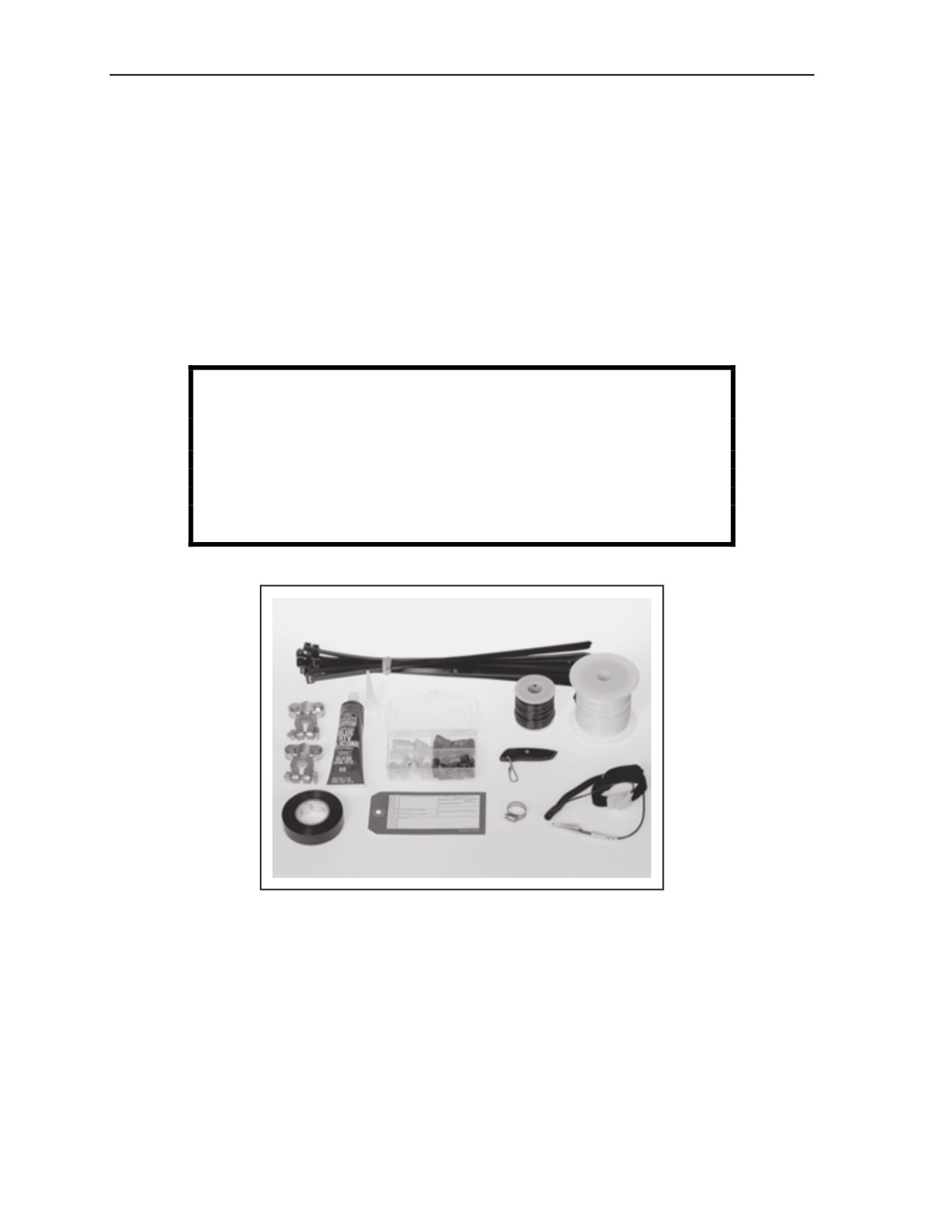
wire ties (figure 6-9). Pliers commonly found in most BII can act as cutters, crimpers, small bolt cutters,
and wire strippers.
CAUTION
Vehicle power must be disconnected before working on any electrical
wire.
6-62. Silicone sealant (included in the BDAR kits) should be applied to the inside of wire-nut connectors
before installing them to seal the connection from moisture and corrosion.
19 September 2006
FM 4-30.31
6-13
Battle Damage Assessment and Repair Procedures
LOOSE BATTERY CLAMP
6-63. When a battery cable clamp becomes loose and cannot be tightened—
z
Remove the clamp; clean the post and the clamp as much as possible.
z
Place the clamp on a flat surface and strike it with a hammer. This will compress the lead and
close the hole on the inside of the clamp.
z
Replace the clamp and tighten. If the clamp is still loose, use a nail or other metal object
between the clamp and the post as a wedge to make contact between the battery post and the
battery clamp.
z
Loosen the clamp, insert the wedge between the battery posts, and tighten the clamp. If the
clamp cannot be repaired, use a universal replacement battery clamp provided in the BDAR kit.
The clamps in the kit are for positive battery posts, but they can also close tight enough to fit a
negative post.
WARNING
When working around batteries and battery clamps, take care to
prevent tools and jewelry from arcing. This could cause damage
to vehicle electrical components and personnel injury. DO NOT
smoke or permit an open flame near the batteries because gas
from battery acid is explosive.
Figure 6-9. Electrical repair materials
TIRE REPAIR
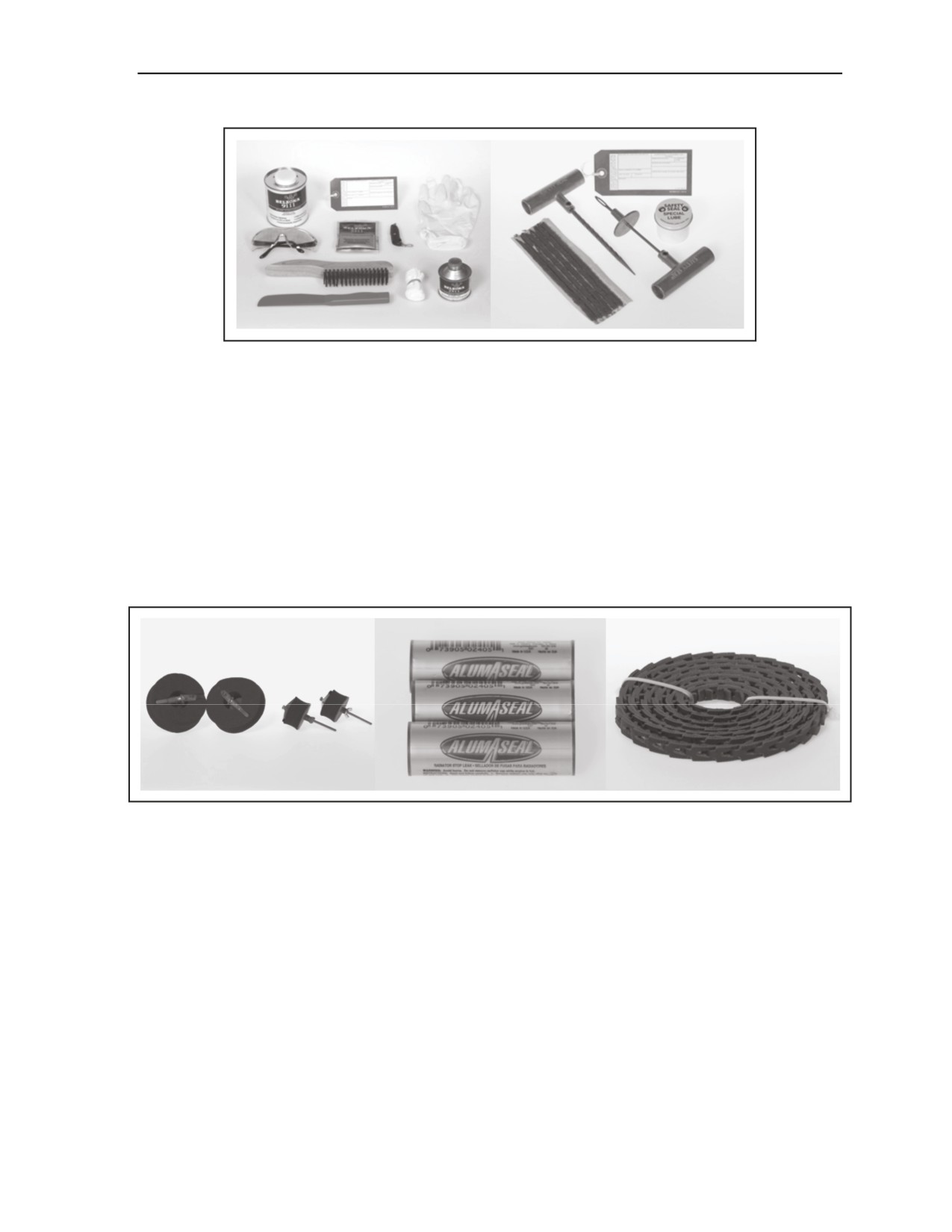
6-64. There are two methods of tire repair. Tire repair capabilities (figure 6-10) are in both crew and
maintainer BDAR kits. Fast, efficient tire repair is done with this kit if the hole is due to a nail or similar
item causing small gashes. The tire plug kit is used in this case. If the tire damage is from shrapnel, the
Belzona® SR Elastomer 2311 and reinforcement tape is used to patch the larger damage. Tire damage
larger than 4 inches cannot be patched with this kit. Tire repairs can be made while mounted on the
vehicle; however, the tire should not be under air pressure while patching.
6-14
FM 4-30.31
19 September 2006
Battle Damage Assessment and Repair Procedures
Figure 6-10. Tire patch materials and tire plug kit
COOLING SYSTEMS
6-65. Large holes in radiator reservoirs, fuel tanks, and oil reservoirs may be repaired using the
environmental plugs shown in figure 6-11. These plugs serve to slow down leakage until a metal plug and
other patching material are applied to the damaged area. The link belt (V-belt), included in the BDAR kit,
is used as a replacement for fan, alternator, air compressor, and other belt-driven engine components.
Radiator sealant can be used to seal small pinholes or seam leaks by pouring the sealant into the leaking
radiator and replacing the radiator cap. Unit personnel are encouraged to add other items they feel are
needed in their unit’s BDAR kit.
Figure 6-11. Environmental plugs, radiator sealant, and a link belt
LEAKING RADIATOR OR HEATER HOSES
6-66. To repair a leaking radiator or heater hose—
z
Allow the engine to cool so the hoses can be safely handled.
z
Patch the leak by wrapping it with standard issue electrical or reinforcing tape.
z
Refill the radiator with coolant and leave the radiator cap loosened.
z
Operate the vehicle at a reduced speed until the hose can be replaced.
Polymers and radiator sealer are available in both BDAR kits to perform alternate methods of repair or
reinforcement.
PUNCTURED TUBE-TYPE RADIATOR CORE
6-67. Radiators are often punctured when vehicles are operating in wooded or combat areas. When this
occurs—
19 September 2006
FM 4-30.31
6-15
Battle Damage Assessment and Repair Procedures
z
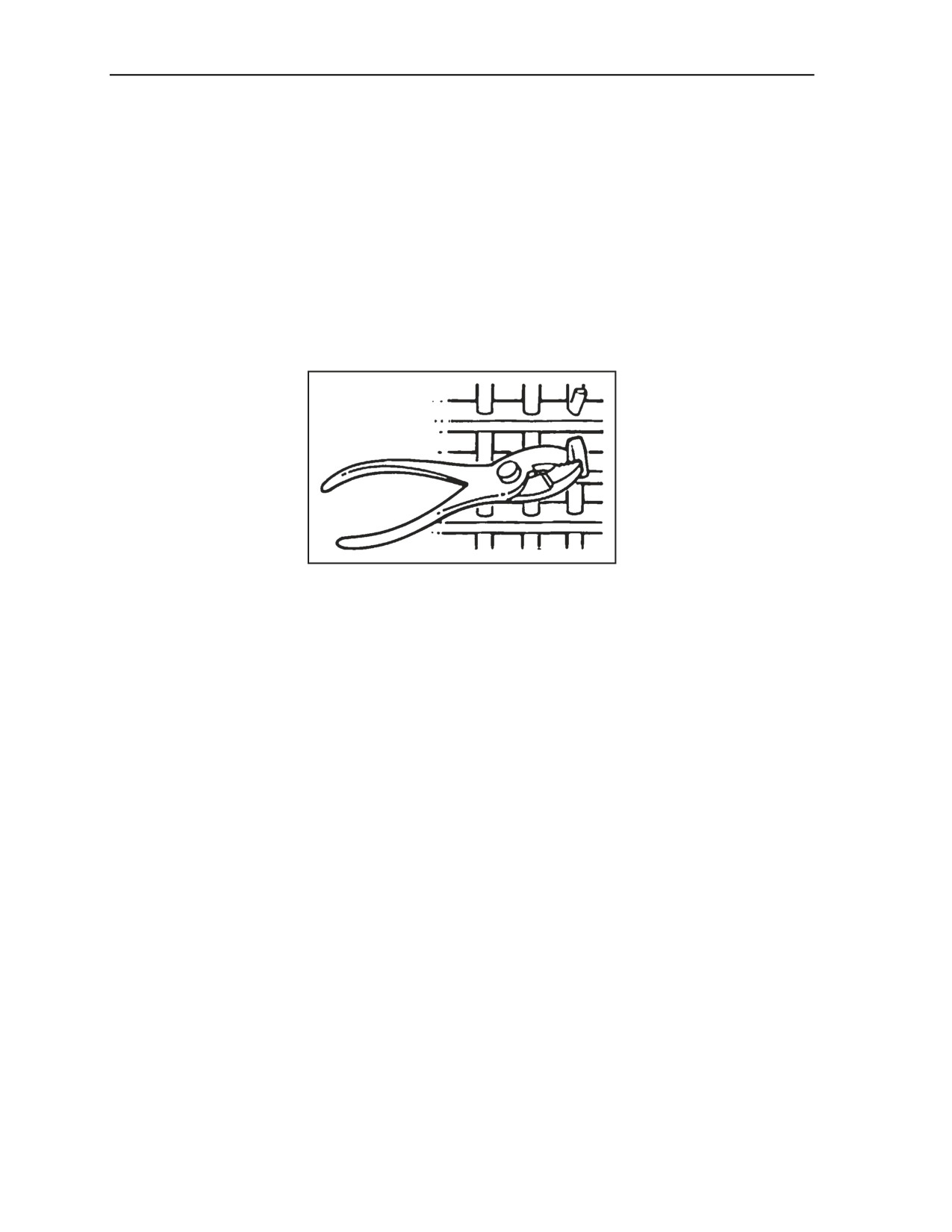
Cut the cooling fins and push them away from the leaking tubes.
z
Cut the leaking tube in half and fold the ends of the tube back approximately three-fourths of an
inch (figure 6-12).
z
Close the tube ends by pressing them flat with pliers.
6-68. Cooling system efficiency is reduced when several tubes are cut, causing the engine to overheat.
When field expedient radiator repairs are made, loosen the radiator cap. This keeps the radiator pressure
from building up and breaking the repair. High strength polymer kits are included in the crew and
maintainer kit to cover the damaged core tubes after bending them over. Ensure the damaged area is very
clean before applying polymer agents to ensure proper bonding. When these products are properly applied
and cured, the radiator cap can be installed. Radiator sealer should be added after any major repairs are
made to ensure small holes are sealed.
Figure 6-12. Tube-type radiator core repair
BROKEN FAN BELTS
6-69. When a fan belt breaks and a replacement is not available, mend or substitute it. To mend a broken
fan belt—
z
Punch holes in both ends of the broken belt and put a small gauge wire or bootlace through each
hole.
z
Secure the wire or laces.
z
Replace the belt with just enough tension to drive the vehicle accessories.
6-70. To substitute for the broken fan belt—
z
Use fiber rope from the vehicle tarpaulin or a piece of field telephone wire.
z
Loop the wire or rope around the pulleys several times, pull as taut as possible, and tie with a
square knot.
6-71. In both cases, operate the engine at low speed. This will prevent breakage or loss of the substitute
belt. Both BDAR kits contain a link belt to temporarily replace a broken belt. Add or remove links from the
belt to achieve the desired length.
6-16
FM 4-30.31
19 September 2006
Battle Damage Assessment and Repair Procedures
BROKEN FAN BLADES
6-72. A broken fan blade will cause the engine to vibrate and make it dangerous to operate.
z
On fans with an equal number of blades equally spaced, remove the remainder of the broken
blade, and then remove the blade located opposite the removed broken blade. The vehicle can
then operate, but be careful that it does not overheat.
z
On fans with unequally spaced blades, the entire fan can operate under the light load for short
periods of time. Trimming a small amount of fan blades opposite of the broken blade may also
help to reduce vibration.
EXPEDIENT REPAIRS
DEFECTIVE TANDEM AXLE
6-73. A tandem axle with a burned-out bearing or damaged wheel can disable a vehicle or cause further
damage if operation continues.
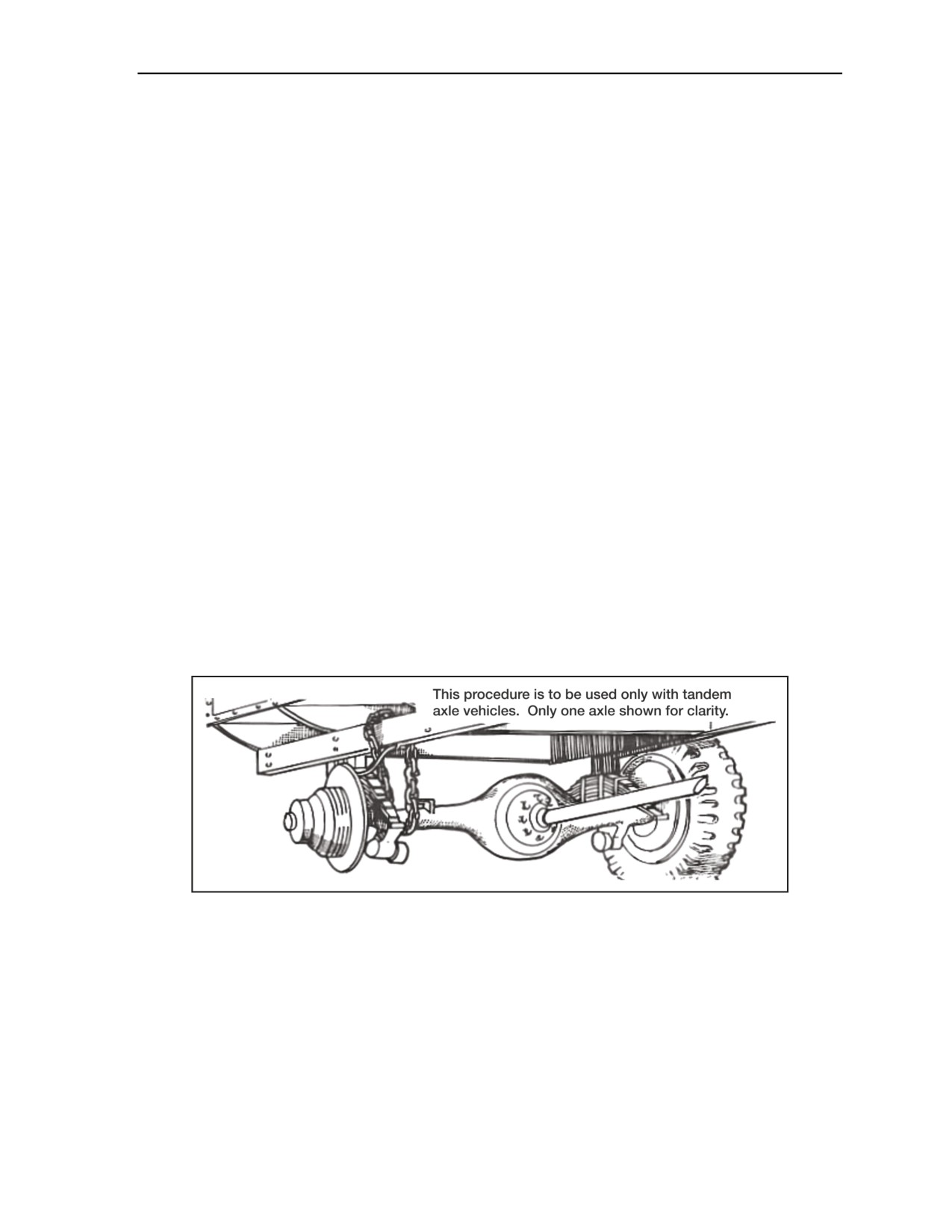
z
Move the wheel of the disabled axle onto a rock, log, or similar object to raise the wheel as high
as possible.
z
While the wheel is raised, tie the axle as tightly as possible to the frame using heavy wire,
ratchet strap, or a tow chain (figure 6-13). Do not let the chain, strap or wire cause damage to
the brake lines.
z
If the wheel bearing is burned out, or for some other reason the wheel does not turn, remove the
axle shaft from the axle housing.
z
Stuff the hole in the hub with rags to keep out foreign matter.
This expedient method allows the other wheels to drive. Reposition any cargo over good axles or transfer
cargo to a second vehicle.
Figure 6-13. Attaching tandem axle to frame
6-74. Use the same technique on both ends of the axle if both wheels are defective. Since both ends of the
axle are tied up, do not load the vehicle too heavily.
DEFECTIVE DIFFERENTIAL
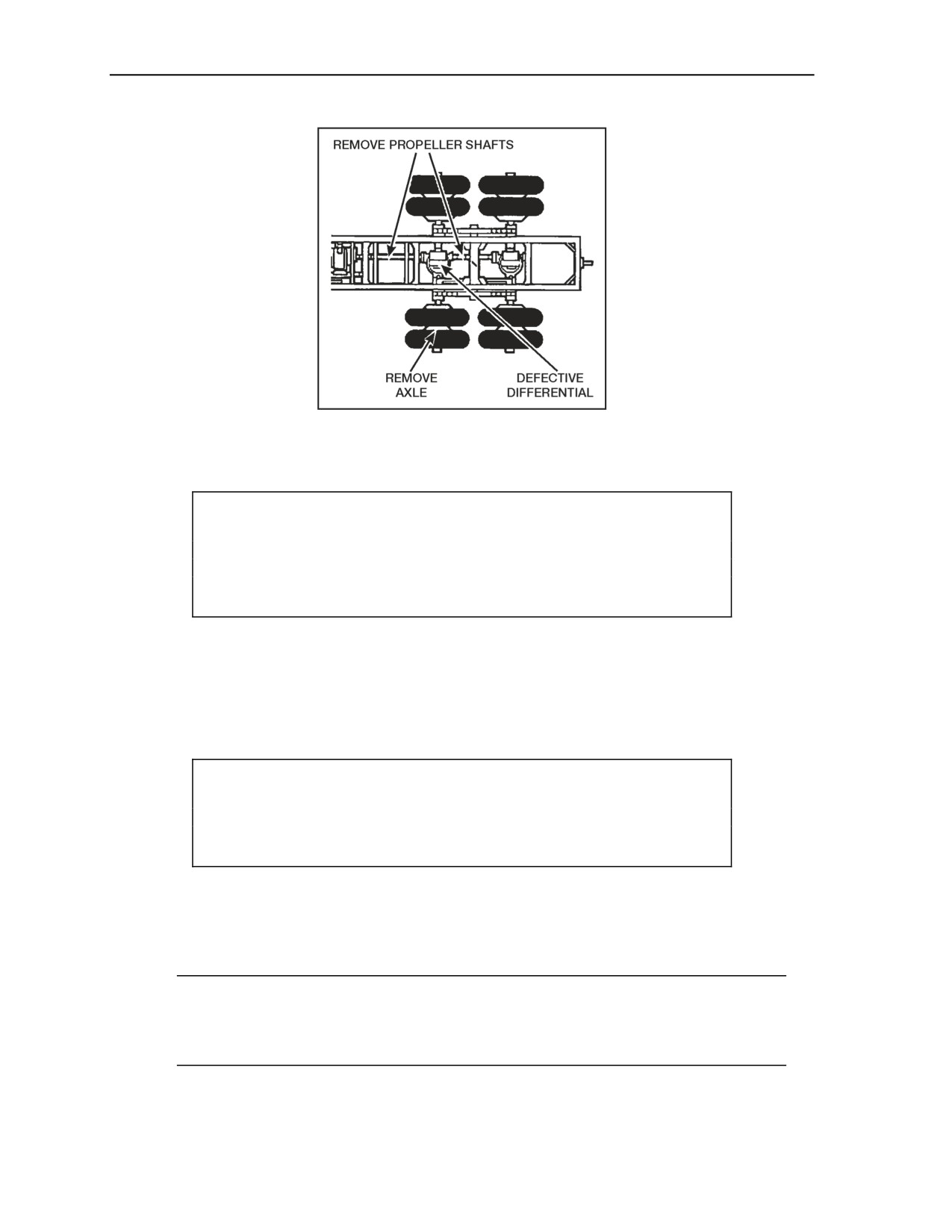
6-75. If the defect is in the differential of a 4 by 4, 6 by 6, or 8 by 8 vehicle, remove the propeller shaft and
drive axles (figure 6-14). For example, if the front rear differential is defective and the rear propeller shaft
is removed, the vehicle can still be powered by the front wheels. When the axle shafts are removed, cover
the openings securely to keep out dirt and foreign matter.
19 September 2006
FM 4-30.31
6-17
Battle Damage Assessment and Repair Procedures
Figure 6-14. Defective differential
CAUTION
Avoid unnecessary oil spills by applying materiel from the BDAR kit
over the holes. This also helps retain as much lubricating fluid as
possible.
DAMAGED FRONT AXLE BRAKE SYSTEM
6-76. When damage has occurred to the front axle brake system, close the line from the junction block to
the axle. If other damage to the air system exists, remove or repair leaking lines, install plugs where lines
are removed, bypass brake components, or interconnect brake hoses to stop air loss. This helps the driver
maintain steering control while braking and allows pressure to buildup to make rear brakes functional.
CAUTION
Report all corrective actions taken to stop air loss to maintenance
personnel before disconnecting from the recovery vehicle.
DAMAGED ROAD WHEEL COMPONENTS
6-77. To repair a vehicle with a damaged road wheel, spindle, or road-wheel arm—
z
Position the vehicle across a ditch.
Note. The ditch should be narrow enough to permit the front and rear road wheels to support the
weight of the vehicle and deep enough to permit the track to sag away from the defective road
wheel (figure 6-15). This will remove the tension from the torsion bar. If a ditch is not available,
dig a trench.
z
Tie the road-wheel arm up out of the way.
6-18
FM 4-30.31
19 September 2006
Battle Damage Assessment and Repair Procedures
Figure 6-15. Suspending road wheel
z
Remove the torsion bar by removing its cap screw and end plug, replacing the cap screw in the
torsion bar, and prying behind the cap screw head with a tanker’s crowbar.
z
Reposition the vehicle on level ground.
z
Remove the road wheel.
z
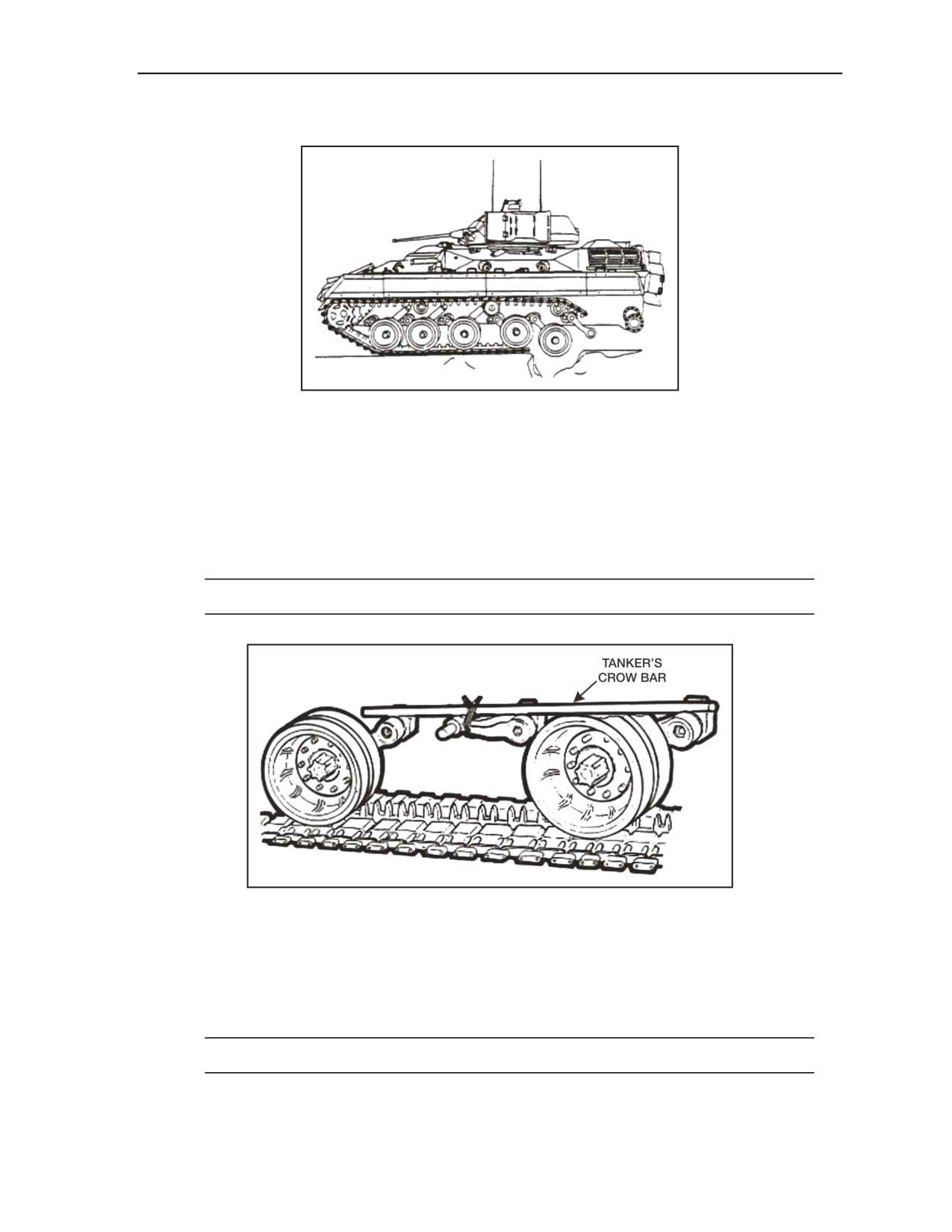
Position a tanker’s crowbar across two torsion bar support housings, and, using a rope from the
vehicle tarpaulin, tie the road-wheel arm to the tanker’s crowbar (figure 6-16).
Note. Use this expedient method with intermediate road wheels only.
Figure 6-16. Road wheel expedient technique
DAMAGED SUSPENSION COMPONENTS
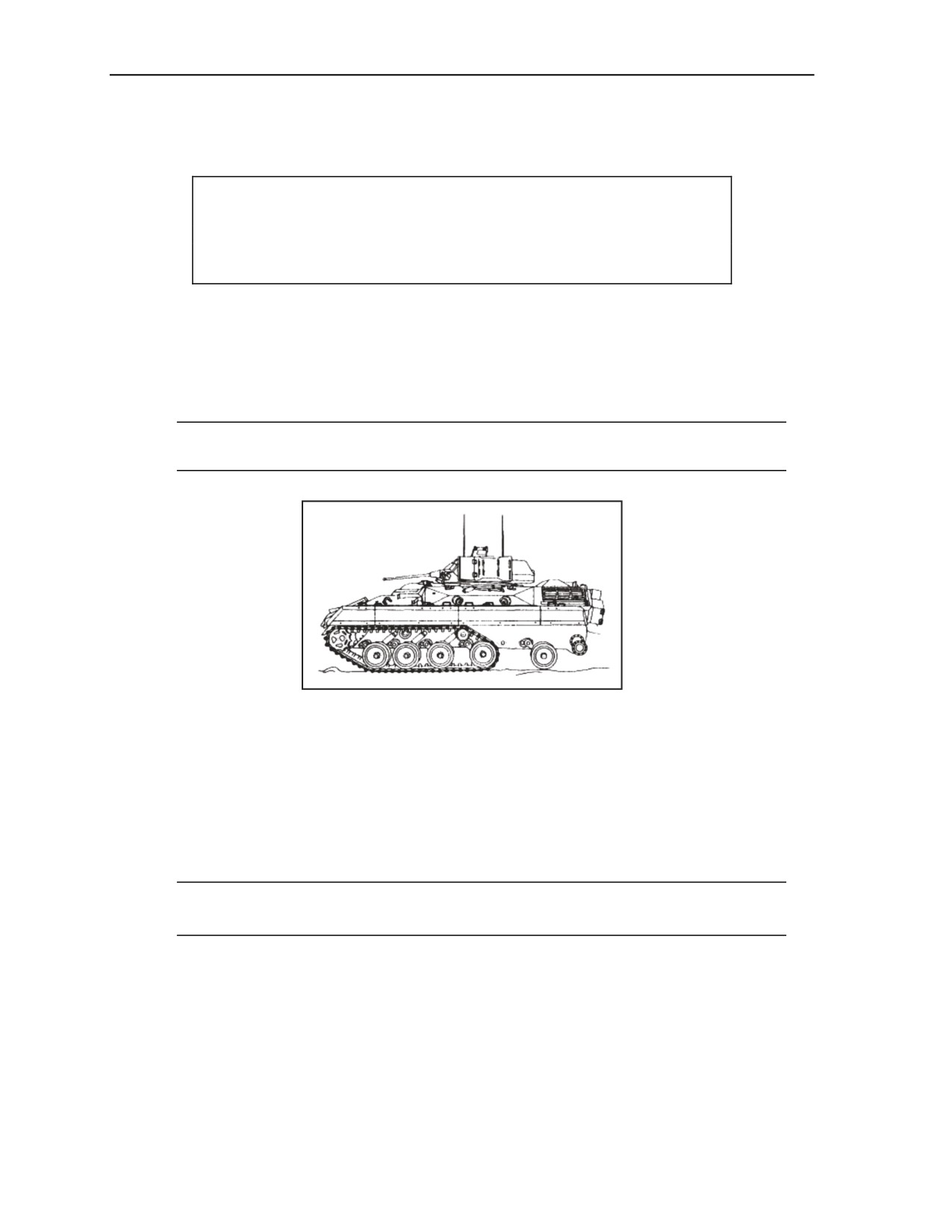
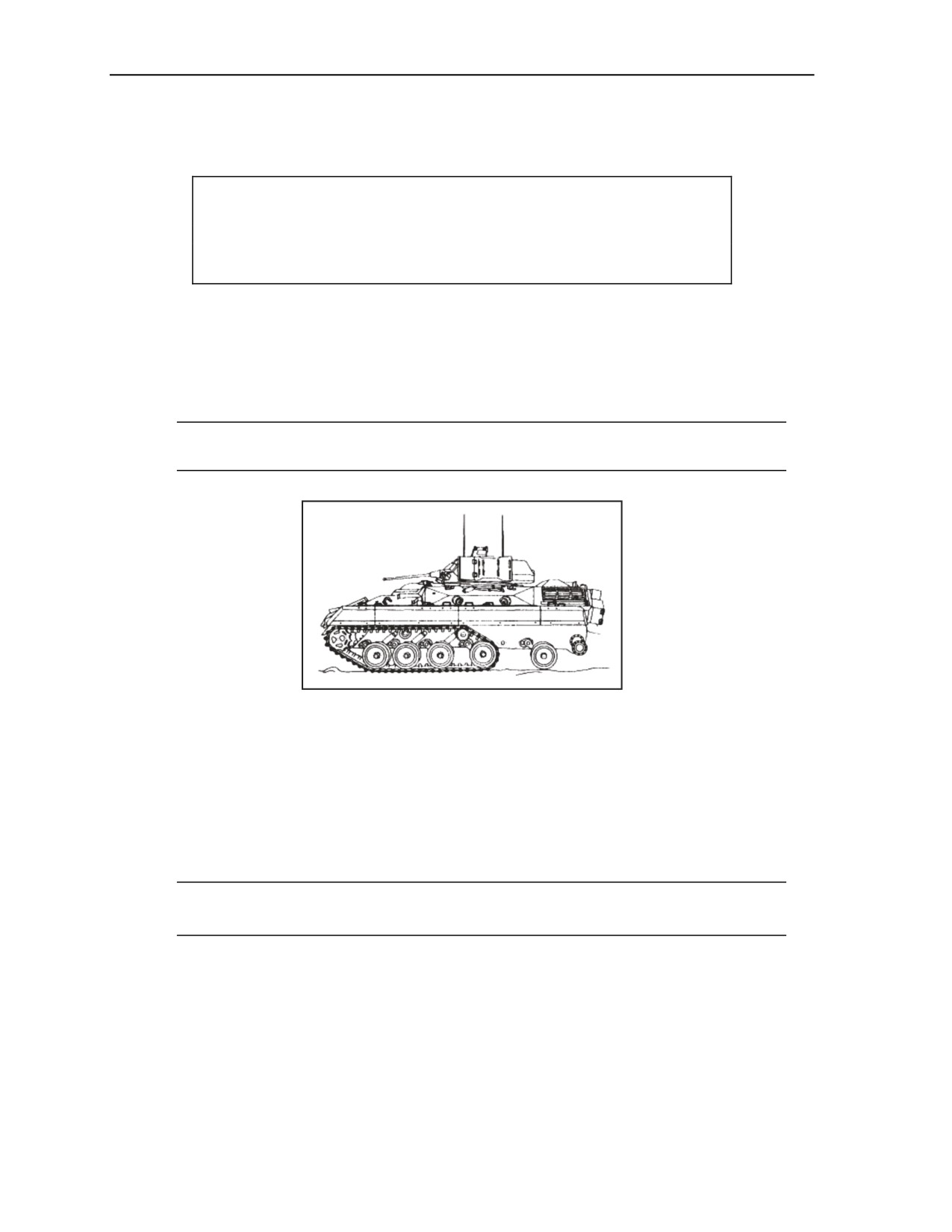
6-78. A tracked vehicle with a damaged track, rear road-wheel arm, or idler wheel can be operated, using
the short track expedient method (figure 6-17). However, the hull must not interfere with the shortened
track.
Note. This method is not recommended for AVLB or M1 family of vehicles.
19 September 2006
FM 4-30.31
6-19
Battle Damage Assessment and Repair Procedures
6-79. To apply this expedient repair, remove the companion components to the damaged suspension
parts—such as the rear shock absorber, track adjuster, road-wheel arm, and torsion bar. Before applying
short track expedient methods, check the procedures outlined in the appropriate TM.
CAUTION
This procedure is time-consuming and may cause injury to personnel
when performed.
6-80. The short track method is designed to regain mobility after component failure or combat damage. If
the idler wheel and road arms number 5 and number 6 are damaged beyond repair, it is possible to short
track to the number 4 road wheel. Whether damaged or not, the number 5 road wheel, road arm, and
torsion bars must be removed to allow short tracking to the number 4 road wheel. If possible, reinstall the
number 6 road wheel to improve vehicle stability. Sufficient track blocks must be removed to permit the
track to be connected.
Note. If both sides of vehicle must be short tracked, remove all damaged road arms and idler
wheels using the process described in paragraph 6-77.
Figure 6-17. Short track expedient technique
SHEAR PIN SUBSTITUTE
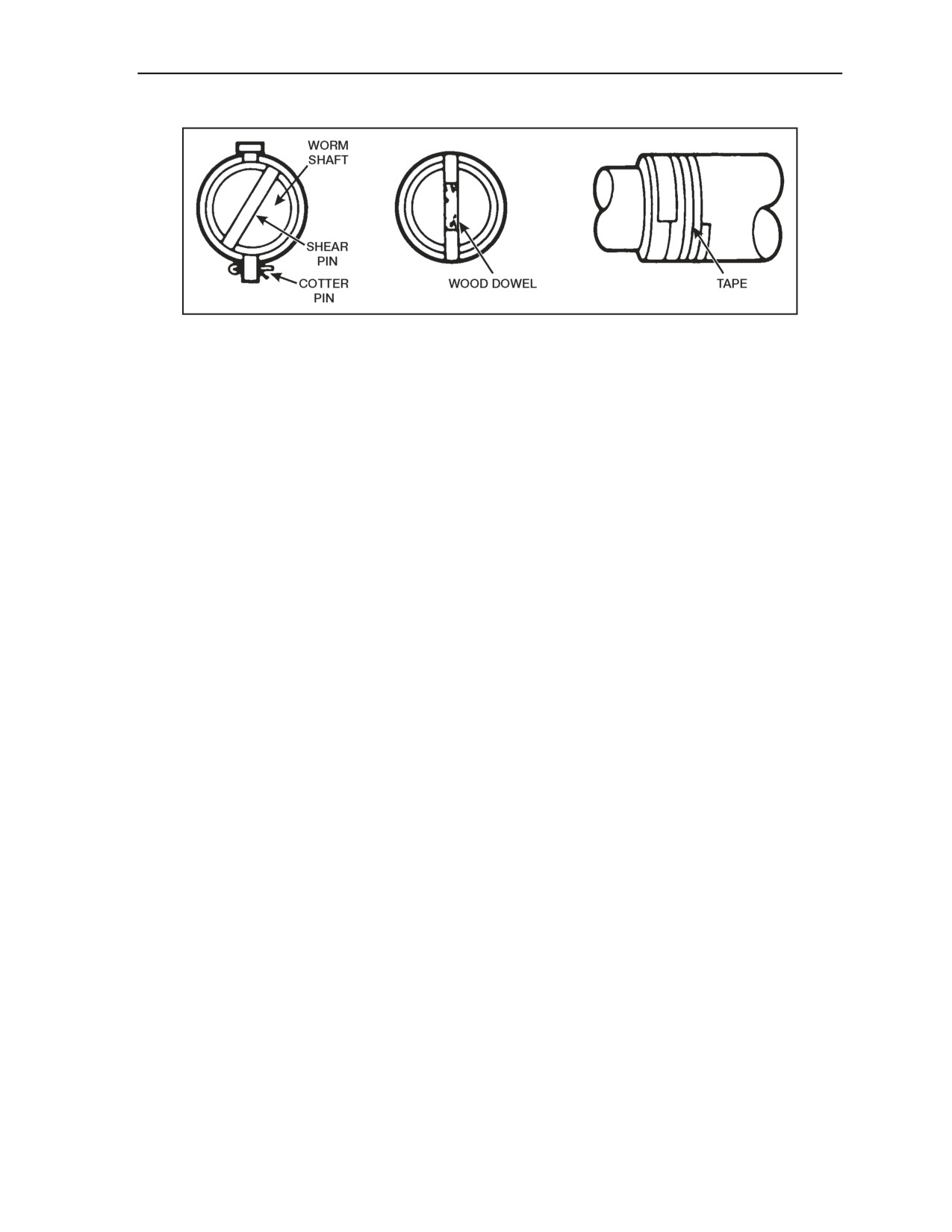
6-81. Make a substitute for a broken shear pin:
z
Punch out the remains of the broken shear pin, cut the remains in half, and insert the two shear
pin halves with a short, wooden dowel between them (figure 6-18).
z
Wrap friction tape around the shaft to cover the shear pinhole and prevent the end of the
substitute shear pin from dropping out.
Note. Do not use a steel bolt, spike, nail, or screwdriver blade as a substitute shear pin because it
could damage the winch and cable.
6-20
FM 4-30.31
19 September 2006
Battle Damage Assessment and Repair Procedures
6-79. To apply this expedient repair, remove the companion components to the damaged suspension
parts—such as the rear shock absorber, track adjuster, road-wheel arm, and torsion bar. Before applying
short track expedient methods, check the procedures outlined in the appropriate TM.
CAUTION
This procedure is time-consuming and may cause injury to personnel
when performed.
6-80. The short track method is designed to regain mobility after component failure or combat damage. If
the idler wheel and road arms number 5 and number 6 are damaged beyond repair, it is possible to short
track to the number 4 road wheel. Whether damaged or not, the number 5 road wheel, road arm, and
torsion bars must be removed to allow short tracking to the number 4 road wheel. If possible, reinstall the
number 6 road wheel to improve vehicle stability. Sufficient track blocks must be removed to permit the
track to be connected.
Note. If both sides of vehicle must be short tracked, remove all damaged road arms and idler
wheels using the process described in paragraph 6-77.
Figure 6-17. Short track expedient technique
SHEAR PIN SUBSTITUTE
6-81. Make a substitute for a broken shear pin:
z
Punch out the remains of the broken shear pin, cut the remains in half, and insert the two shear
pin halves with a short, wooden dowel between them (figure 6-18).
z
Wrap friction tape around the shaft to cover the shear pinhole and prevent the end of the
substitute shear pin from dropping out.
Note. Do not use a steel bolt, spike, nail, or screwdriver blade as a substitute shear pin because it
could damage the winch and cable.
6-20
FM 4-30.31
19 September 2006
Battle Damage Assessment and Repair Procedures
Figure 6-18. Shear pin substitute
19 September 2006
FM 4-30.31
6-21
Appendix A
Battle Damage Assessment and Repair Kits
BDAR kits were developed by military personnel for use by military personnel. It is
imperative that Soldiers and Marines provide feedback to the TRADOC Executive
Agency to upgrade the capabilities of the BDAR kits. Provide feedback by e-mailing
comments to the following address: bdarfeedback@apg.army.mil
BDAR kits consist of essential material and capability items that enable efficient
repair of common types of damage and random failures that occur during a mission.
Each unit is expected and encouraged to modify its BDAR kit to fit specific
operational needs and the unit’s geographical environment. This appendix discusses
the two primary types of BDAR kits.
Note. Additional information regarding BDAR kits and training can be found on the Ordnance
Mechanical Maintenance University Web site at https://ommu.army.mil. Visitors are required to
have an AKO username and password to access portions of this Web site. If you experience
problems accessing this Web site, contact ommuadmin@apg.army.mil
CREW/OPERATOR BDAR KIT
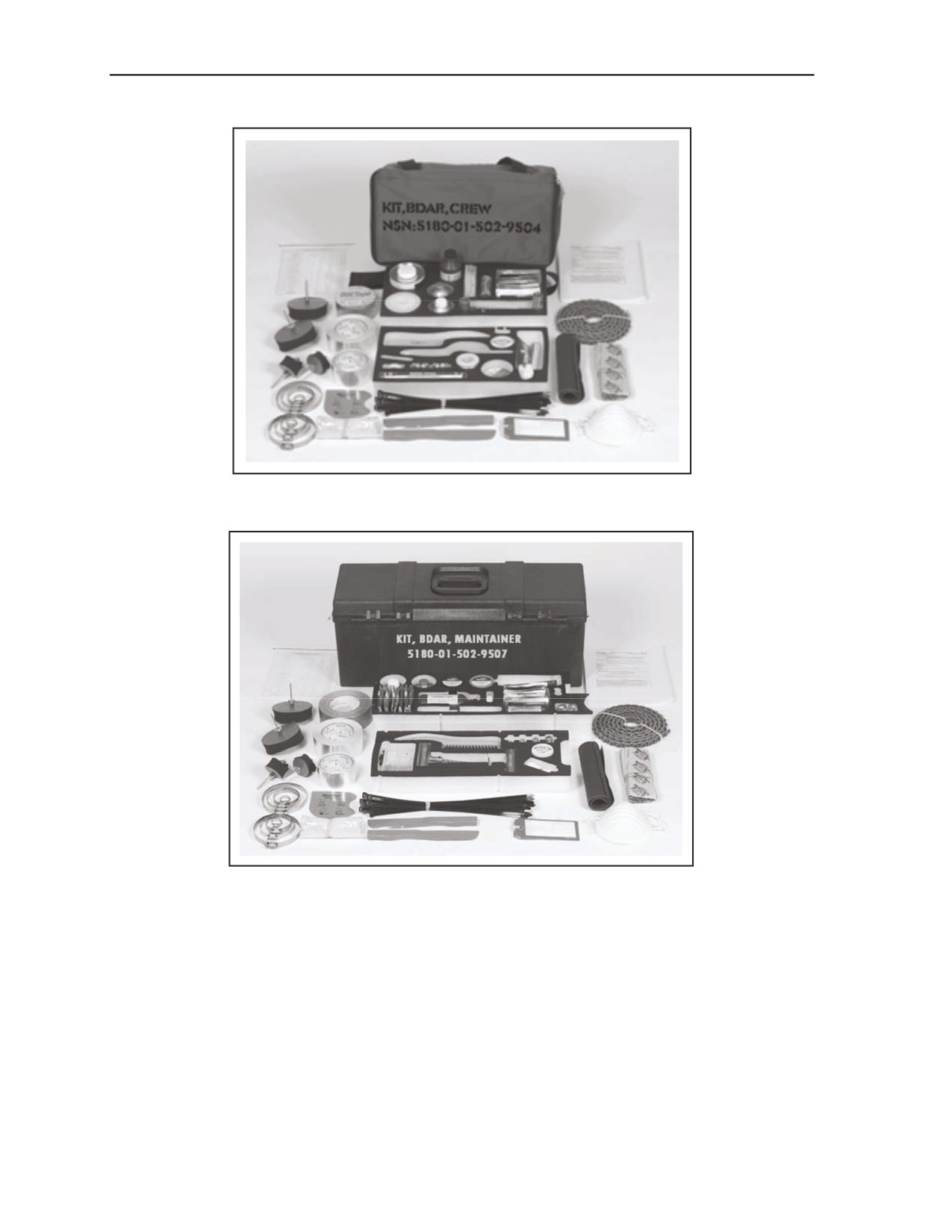
A-1. The crew/operator BDAR kit
(figure A-1) enables the crew to perform timely repairs. The
recommended basis of issue (BOI) is one kit per crewed vehicle—for example, M1 Tank, M2 Bradley,
M113 Personnel Carrier, M109 Howitzer, M9 ACE, M10 Stryker, and so forth. The crew/operator BDAR
kit can be requisitioned with NSN 5180-01-502-9504.
MAINTAINER’S BDAR KIT
A-2. The maintainer’s BDAR kit (figure A-2) supports operating forces. The recommended BOI is one kit
per recovery, contact maintenance truck, and forward repair system—for example, M88, M936, M984, and
M113. The maintainer’s BDAR kit can be requisitioned with NSN 5180-01-502-9507.
Note. Each BDAR kit contains a current and complete component listing with NSNs to allow
for inventory stock and replenishment.
19 September 2006
FM 4-30.31
A-1
Appendix A
Figure A-1. Crew/operator BDAR kit
Figure A-2. Maintainer’s BDAR kit
A-2
FM 4-30.31
19 September 2006
Appendix B
Combined and Multinational Recovery
and BDAR Operations
Today’s military missions increasingly call for combined and multinational recovery
and BDAR operations to be part of a multinational force. For BDAR managers and
operators, there are many opportunities and requirements to recover combined and
multinational vehicles. This appendix provides guidance for coordinating and
executing such operations. It also briefly discusses BDAR operations concerning
captured or abandoned enemy equipment.
COORDINATION CONSIDERATIONS CHECKLIST
B-1. When participating in an operation in which U.S. assets may be used to support combined and
multinational assets or vice versa, check the existing standardization agreement (STANAG) and SOP.
Make contact with the affected combined and multinational unit to exchange information. Although
coordination at initial phases of a combined and multinational operation will start at the highest level, as
the relationship matures, coordination or information exchanges should routinely occur at tactical unit
levels. This should be encouraged until continuous information exchange happens at the lowest level
possible. The questions listed will become mission detractors if not clearly resolved before initiating
BDAR missions. The following critical information should be exchanged, understood, and established
during combined and multinational operations.
Clearly establish command and control. Does a U.S. element revert to combined and
multinational command and control for the duration of support to that combined and
multinational unit, or does the U.S. parent organization retain command and control?
Identify who establishes priorities for BDAR assets in an area where more than one command
exists.
Determine where recovery assets should be towed and by whom. Potential combined and
multinational supporting units need the U.S. maintenance collection point (MCP) locations. U.S.
forces need the MCP locations or other collection points established according to the supported
combined and multinational unit.
Identify the point of contact (POC) for questions and guidance. One POC is established for
combined and multinational forces, and one for U.S. forces. U.S. elements need to contact these
POCs.
Establish the extent to which BDAR can be applied to combined and multinational units.
Identify specifics regarding the primary vehicles that each nation might recover for the other.
Exchange technical information regarding towing, preferred hookup locations for winching or
overturned vehicles, and any other information that would assist in avoiding unsafe or
dangerous BDAR operations.
Exchange information regarding special actions required to secure sensitive items, such as
radios, maps, signal operating instructions, or high cost or scarce components.
Determine what the combined and multinational unit doctrine is concerning the use of the
disabled crew on-site. Combined and multinational doctrine may be different from U.S.
doctrine, which requires crews to assist in BDAR operations, as well as provide local security.
Ascertain which type of coordination will be required concerning the passage of lines, if
required. Clearly established POCs must be contacted for such passages.
19 September 2006
FM 4-30.31
B-1
Appendix B
Exchange operational plans and graphics to preclude inadvertent distracters to combat
operations or placing U.S. assets in unnecessary danger.
Clearly establish recognition signals. These signals include challenges and passwords, as well as
identifying vehicle markings. Recognition markings are especially important in operations
where combined and multinational units and enemy forces use the same type of vehicle or in the
case where the enemy may be using U.S. vehicles.
Be aware of any special operational hazards, such as the use of CBRN elements or minefields.
As necessary and where possible, arrange for combined and multinational guides or provide
guides to U.S. supporting elements.
If possible, provide combined and multinational units with U.S. BDAR kits for effecting BDAR
on U.S. vehicles.
If time and situation permit, arrange for mutual training or orientation sessions with counterpart
personnel.
If translations are critical for ongoing BDAR operations, arrange to have translators available. A
better arrangement would be to have a technical advisor available from the nation owning the
equipment.
EXECUTION CONSIDERATIONS CHECKLIST
B-2. The primary consideration is returning equipment to battle as quickly as possible while creating as
little collateral damage as possible. Equally important is surviving to complete the mission. The following
considerations involve approaching the site; local security, camouflage, and actions taken on contact:
Before beginning recovery or BDAR operations on combined and multinational vehicles, ensure
authorization has been given and obtain any necessary guidance.
Attempt to locate a member of the crew or a technical representative to provide technical
guidance.
Before starting BDAR operations, obtain applicable manuals to determine proper BDAR
actions. Even where language is a problem, pictures and diagrams may prove useful.
Do not begin any operation until technical information has been obtained. Acting too quickly or
prematurely might cause damage.
Report completion of the mission to the U.S. chain of command. The U.S. chain of command
will pass that information to the command and control at the liaison officer level.
SECURITY OF SENSITIVE ITEMS AND SALVAGE OF DAMAGED
EQUIPMENT
B-3. Only divisional or higher commanders have the authority to order the destruction of equipment. With
OPORDs, this authority is usually delegated to subordinate commanders. When a piece of equipment is
destroyed, it must be reported through proper command channels.
SAFETY CONSIDERATIONS
B-4. Hazards that exist on the battlefield will also be present during the demolition of equipment (for
example, toxic fumes and spilled fluids). Safety is an important consideration. BDAR personnel must
become completely familiar with all aspects of the equipment being used. Applicable equipment technical
manuals provide necessary warnings, cautions, and hazards.
B-5. Classified documents, notes, and instructions of any kind are removed from the vehicle before
demolition. Classified materials must be rendered completely useless to the enemy.
B-2
FM 4-30.31
19 September 2006
Appendix C
Hand and Arm Signals
Visual signals are any means of communication that require sight and can be used to
transmit prearranged messages rapidly over short distances. This includes the devices
and means used for recovery operations.
VOICE CONTROL
C-1. Ground guides controlling all tracked vehicle recovery operations will use electronic voice means
whenever available, supplemented by minimal hand and arm signals as the primary means of ground
control during recovery and lift operations. Ground guides must also be familiar with recovery operations
during hours of darkness—using a flashlight to augment hand and arm signals. Until a wireless system is
developed, units will use clear voice capture (CVC) cables to link the ground guide with the vehicle
operator via the vehicle intercom system for operations within 30 feet of the recovery vehicle.
C-2. An alternative means, especially for operations in excess of 30 feet of the recovery vehicle, is to
connect a TA-312 (using an optional headset for hands-free operation) to the control box via WD-1 field
telephone wire. If voice means cannot be established, hand and arm signals will continue to be used.
C-3. Restrictions for using hand and arm signals are as follows:
Units must acquire extended CVC cables and/or other items needed in BDAR operations.
Units are responsible for conducting familiarization training—stressing potential hazards for an
extended cable or WD-1 wire to become snagged or severed during operations. The ground
guides must be careful that the cable or wire does not become wrapped or entangled while
moving. Therefore, if movement of the components is required, the wire or cable should be
disconnected during such movements and reconnected when the ground guides are positioned
safely.
The crew must be informed that if voice cannot be established or fails at any time, they will
return to hand and arm signals.
The CVC cable assembly can be connected to any C-2298 box in a vehicle, except for the
driver’s box.
When using either CVC cable or WD-1 wire with winching operations, the length must be such
that the ground guide can be located safely and sufficiently outside any hazard area as required.
Voice communications between the operator and the ground guide will make for safer
operations by removing the doubt associated with hand and arm signals. These communications
are particularly safer and more effective for limited visibility and night operations. They also
remove doubt as to who is controlling the operator.
HAND AND ARM SIGNALS
C-4. All hand and arm signals are outlined in FM 21-60 and FM 21-305, which will be incorporated into
the next release of FM 4-01.40. The most common types of visual signals are arm-and-hand, flag,
pyrotechnic, and ground-to-air signals. Soldiers are not limited to the types of signals discussed and may
use whatever mean is available. Chemical light sticks, flashlights, and other items can be used, provided
their use is standardized within a unit and understood by all Soldiers and units working in the area. Some
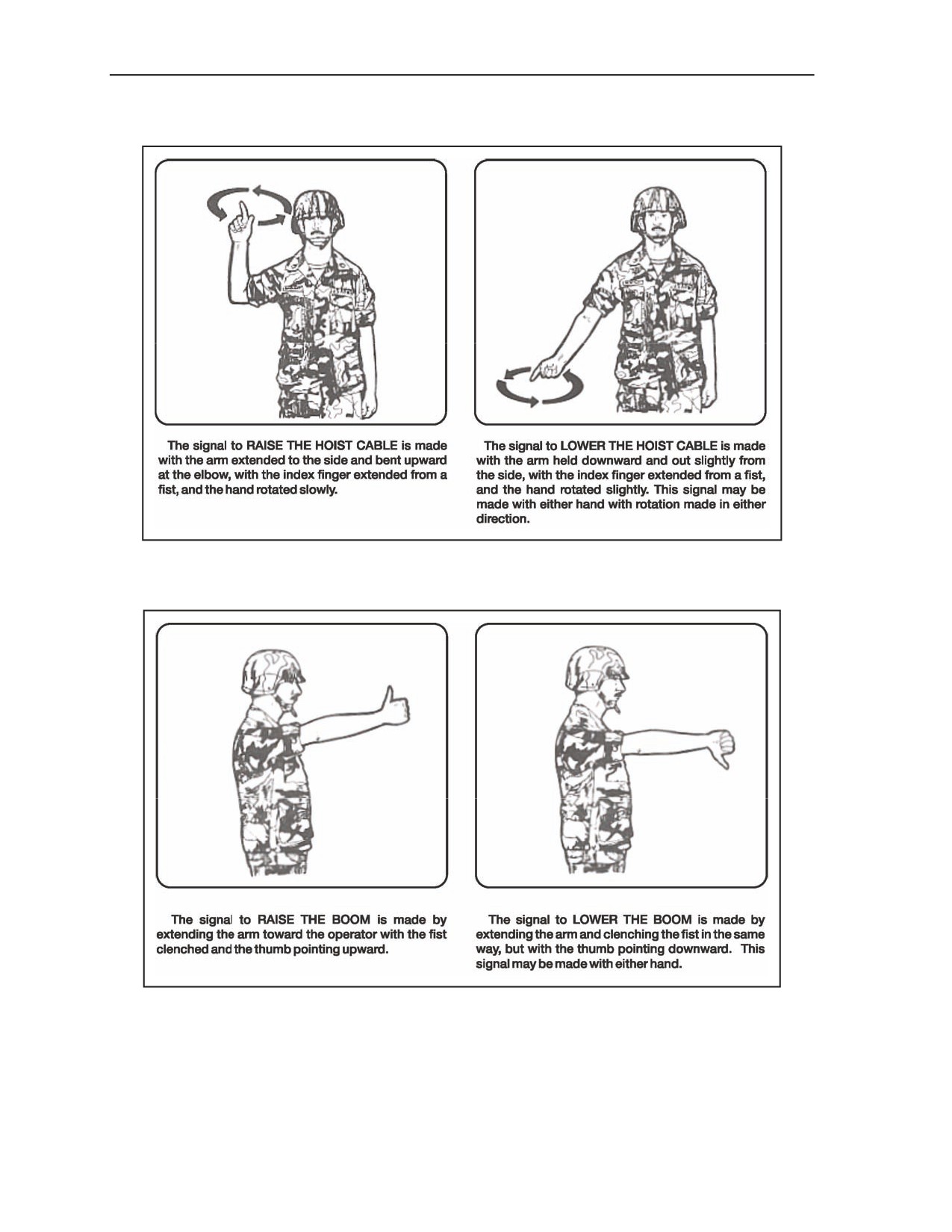
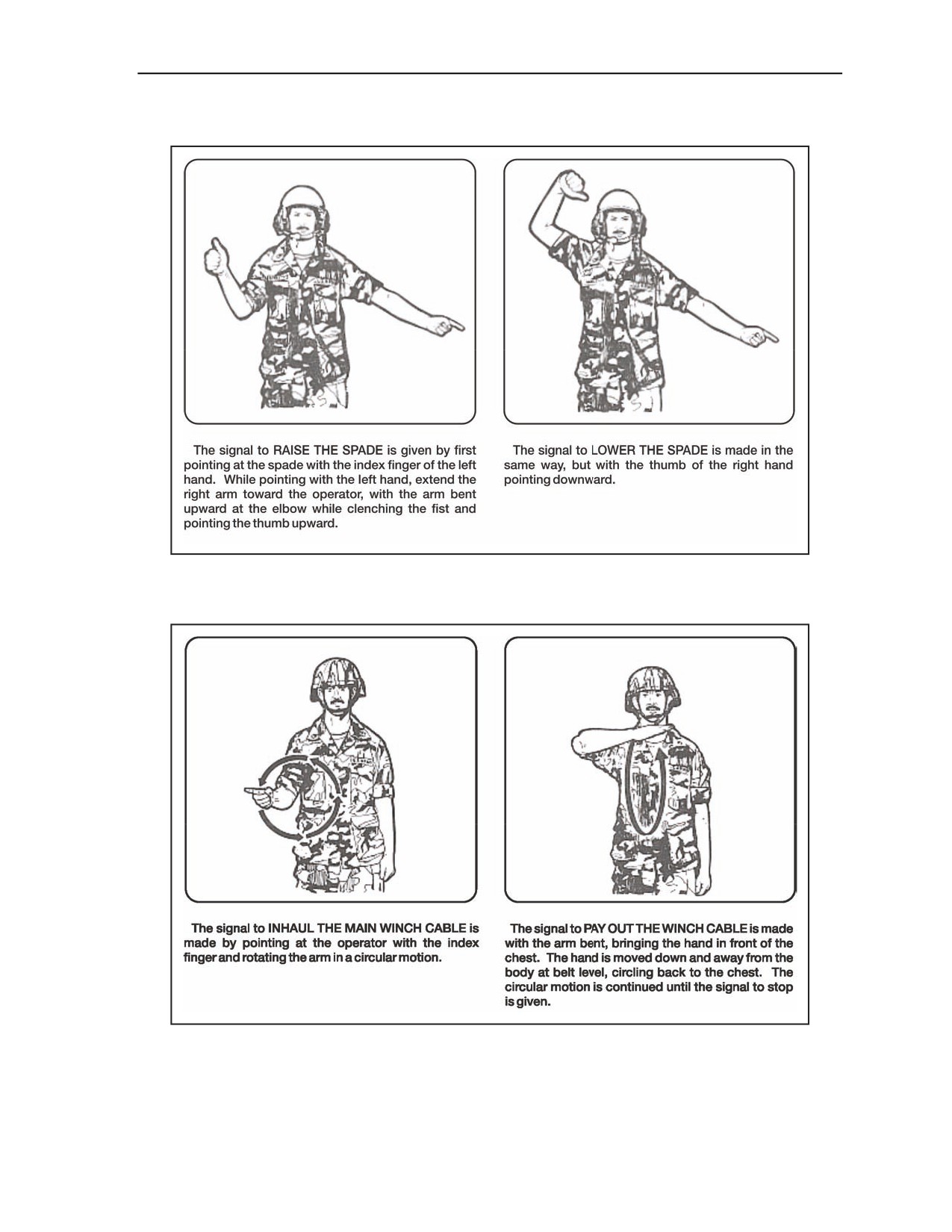
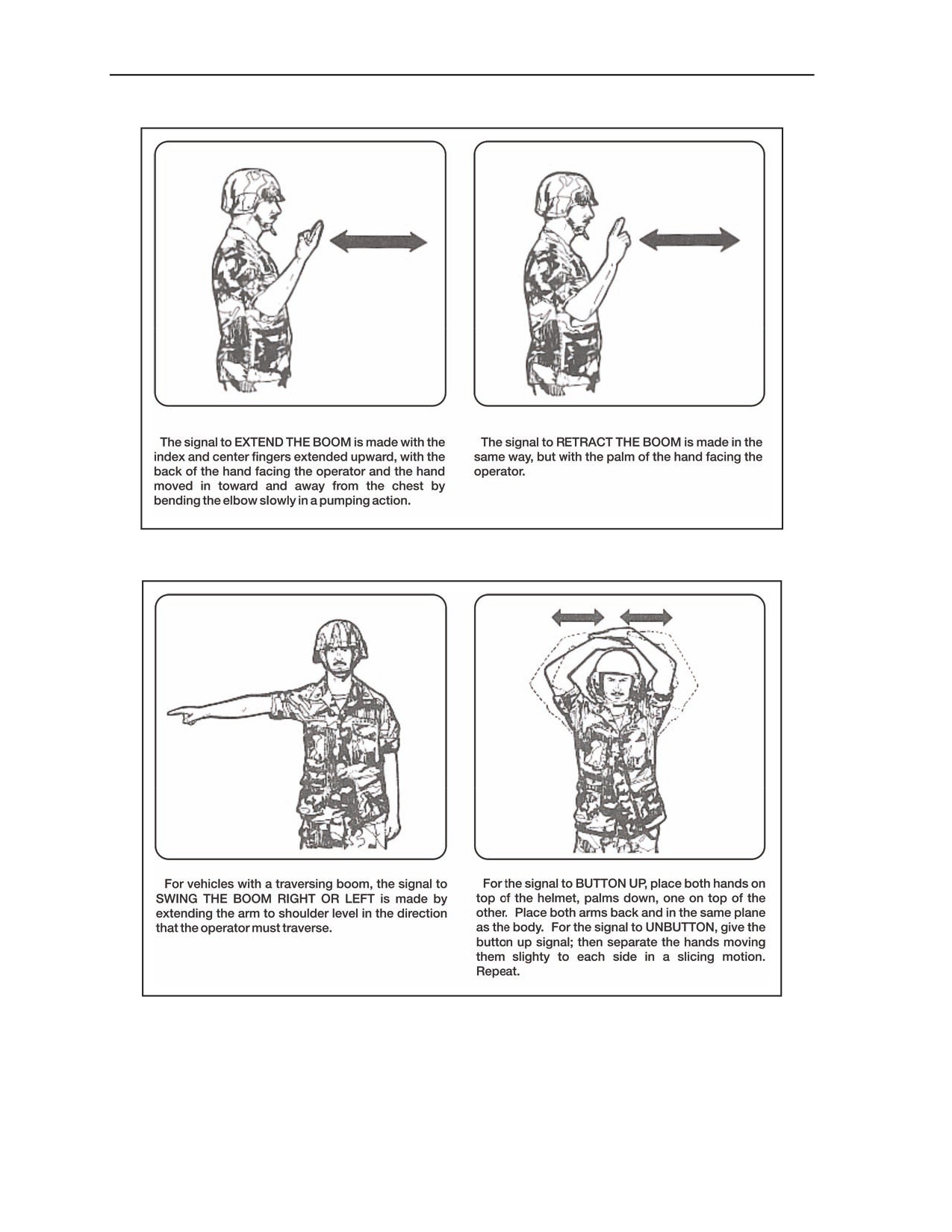
common arm-and-hand signals that might be used for BDAR operations are shown in figures C-1 through
C-7.
19 September 2006
FM 4-30.31
C-1
Appendix C
Figure C-1. Signals for raise the hoist cable and lower the hoist cable
Figure C-2. Signals for raise the boom and lower the boom
C-2
FM 4-30.31
19 September 2006
Hand and Arm Signals
Figure C-3. Signals for raise the spade and lower the spade
Figure C-4. Signals for inhaul the main winch cable and pay out the winch cable
19 September 2006
FM 4-30.31
C-3
Appendix C
Figure C-5. Signals for extend the boom and retract the boom
Figure C-6. Signals for swing the boom right or left and button up-unbutton
C-4
FM 4-30.31
19 September 2006