FM 4-30.31 Recovery and Battle Damage Assessment and Repair (September 2006) - page 4
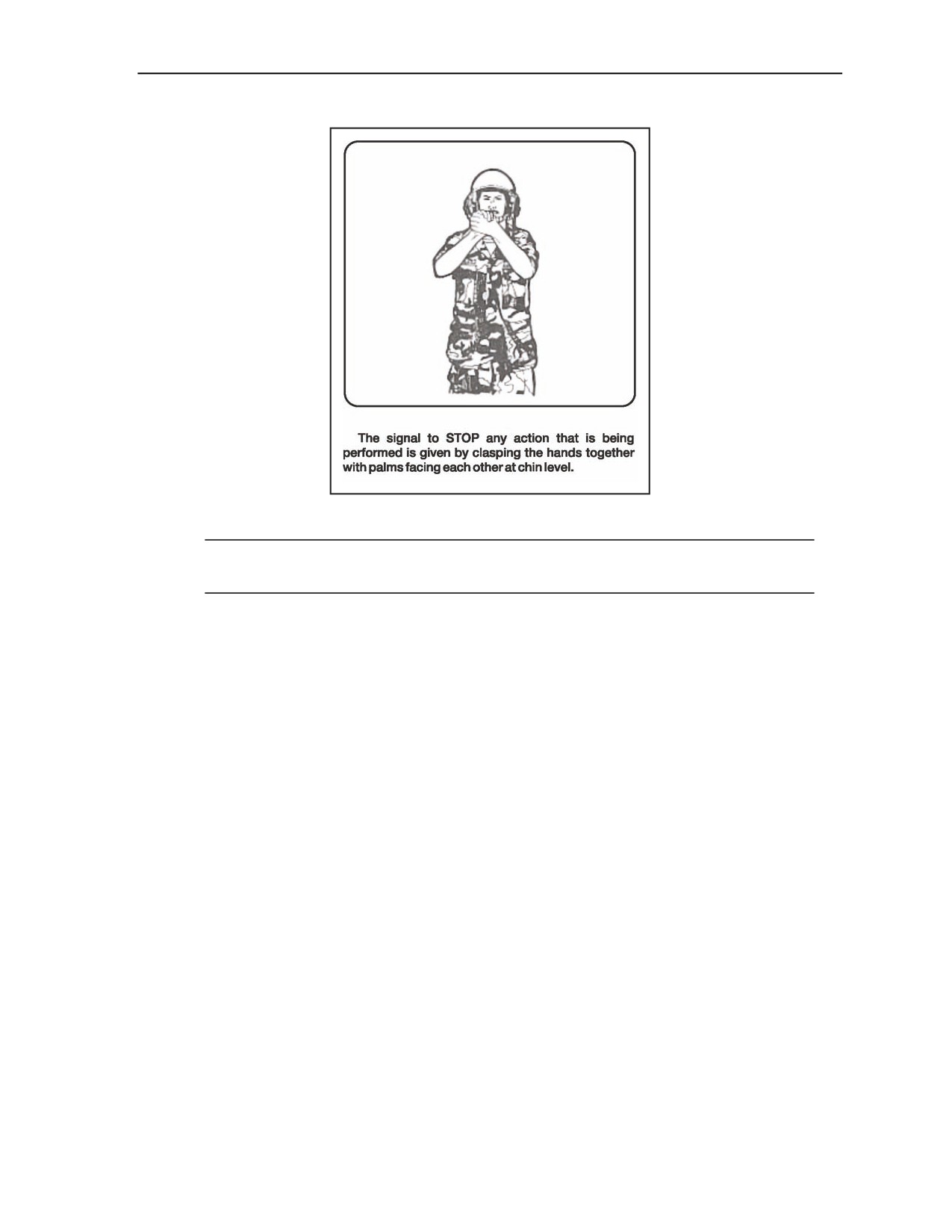
Hand and Arm Signals
Figure C-7. Signal for stop
Note. Refer to FM 21-60 for more information on hand and arm signals and using flashlights
during night operations.
19 September 2006
FM 4-30.31
C-5
Appendix D
Recovery Guidelines for Operators/Leaders
Mission success on the battlefield may be linked to a unit’s ability to perform vehicle
recovery, to return immobilized equipment to operation, and to continue with the
mission. Commanders must take aggressive actions to retrieve damaged equipment
and return it to use. However, for a recovery operation to be successful, operators and
leaders at all levels must be trained on recovery operations.
OPERATOR AND CREW
D-1. When the operator/crew detects disabled equipment, the damage is assessed and actions are initiated
based on analysis results and the tactical situation. The crew/operator informs the chain of command of the
status of the disabled equipment. Unit SOPs should prescribe notification procedures since these vary
based on the type of unit, equipment, communications, and location of equipment.
D-2. The operator/crew will be trained to perform self-recovery and like-recovery on assigned equipment.
This training will be practiced during garrison/field training exercises as prescribed in the unit’s SOP.
D-3. The operator/crew normally remains with the disabled equipment to provide local security and until
assistance arrives. When the maintenance personnel arrive, the operator/crew assists with the repair or
recovery and stays with the vehicle until it reaches support maintenance.
Note. When the maintenance personnel arrive, the operator/crew assists with the repair or
recovery and stays with the vehicle until it reaches support maintenance.
D-4. The following is a list of key items the operator/crew should know before requesting recovery from
support elements.
Location, map coordinates, and type of terrain.
Nature of the disability.
Tactical situation.
Can BDAR be applied?
Has BDAR been applied?
Repair parts required, if known.
Alternate radio frequencies.
RECOVERY PERSONNEL
D-5. Recovery equipment operators are usually highly trained mechanics and very familiar with the
mechanical functions of equipment they must recover. These personnel must be skilled in the technical
aspects of recovery, such as equipment rigging, towing, and uprighting procedures. They must also be
skilled in related tasks—such as using the specialized BII on assigned equipment and operating in a tactical
environment. Recovery equipment operators are assigned to company maintenance teams and to the
recovery support section of the maintenance platoon. Personnel participating in recovery operations must
be trained to check for and clear or disarm weapon systems of supported equipment. Specific procedures
for the disposition of contaminated equipment, contingency plans, and any special tactical or security
considerations should be covered in the unit SOP.
19 September 2006
FM 4-30.31
D-1
Appendix D
D-6. Recovery personnel are mechanics who perform repairs when not engaged in recovery missions. The
following is a list of key items recovery personnel must know.
Oxygen and acetylene tank operations for welding.
Cutting torches.
.50-caliber machine gun.
Communications (both radio, and hand and arms signals).
Map reading, compass use, and global positioning system.
Chemical and biological agents.
D-7. Those conducting repair or recovery need to have a plan for recovery operations. The unit SOP will
contain detailed checklists to assist in preparing for on-site support. Preparation should include—
A verification of location and the status of disabled equipment.
An update on the current tactical situation.
A selection of primary and alternate routes.
The availability of communications, to include communications checks, applicable call signs,
and primary and alternate frequencies.
Individual clothing and equipment, with emphasis on CBRN equipment.
A basic load of rations and ammunition to support a 24-hour continuous operation.
A selection of appropriate support equipment, vehicles, and personnel required for the mission.
D-8. Recovery teams need to be aware of classified communications devices and components, and other
classified materials. This will assist with maintaining proper security and reducing chances of compromise.
LEADERS
D-9. Platoon leaders and platoon sergeants have the responsibility for coordinating recovery assets and
manpower requirements for disabled equipment. This effort is performed simultaneously with the mission,
and if the recovery mission interferes with combat operations or in any way compromises security, it must
be coordinated with the tactical commander.
D-10. Leaders should be trained on the same tactical procedures as recovery personnel so they can
periodically check the rigging and equipment for proper hookups and adjustments. (Special attention must
be given to weight and clearance limitations when using bridges or underpasses.) The following is a list of
factors that leaders should determine before supervising or requesting recovery support.
Equipment identification.
Alternate radio frequencies.
Location (map coordinates if possible).
Alternate routes (when possible).
The condition of the disabled vehicle.
On site repair capability.
Repair parts required.
The organic recovery capability.
Tactical situation and security requirements, and risk level.
Cargo, road, and movement restrictions.
D-11. The recovery manager and leader must be alert to new situations and changing requirements.
Planning and prior preparation are needed for continued effective recovery support.
D-12. Specific leader, mechanic and operator BDAR training should encompass the following:
Risk assessment procedures; see FM 100-14.
BDAR assessment procedures; see chapter 6.
BDAR TM familiarization.
BDAR kit familiarization; see appendix A.
D-2
FM 4-30.31
19 September 2006
Recovery Guidelines for Operators/Leaders
Group equipment.
Suspension systems (short tracking); see chapter 5.
Electrical systems (bypassing components, wire repair); see chapter 6.
Cooling systems (radiator bypass and repair); see chapter 6.
Fuel systems (patching holes, replacing or making lines sections); see chapter 6.
Hydraulic/oil systems (repair high pressure lines, repair oil lines); see chapter 6.
Tire and track repair; see chapters 5 and 6.
19 September 2006
FM 4-30.31
D-3
Glossary
SECTION I: ACRONYMS AND ABBREVIATIONS
AAL
additional authorization list
ACE
armored combat earthmover
AE
available effort
AKERR
allied kinetic energy recovery rope
AR
Army regulation
AVLB
armored vehicle launched bridge
BDA
battle damage assessment
BDAR
battle damage assessment and repair
BDI
battle damage indicators
BII
basic issue items
BMO
battalion maintenance officer
BOI
basis of issue
CBRN
chemical, biological, radiological, and nuclear
COEI
components of end-items
CRT
combat repair team
CVC
clear voice capture
d
diameter
DA
Department of the Army
DD
Department of Defense
DRMO
Defense Reutilization and Marketing Office
DU
depleted uranium
E
effort
F
fahrenheit
FM
field manual
FMTV
family of medium tactical vehicles
FOV
family of vehicles
ft
feet
FWTD
fifth wheel towing device
GCWR
gross combination weight rating
HN
host nation
HNS
host-nation support
lb
pound
LR
load resistance
MA
mechanical advantage
MCP
maintenance collection point
19 September 2006
FM 4-30.31
Glossary-1

Glossary
MCRP
Marine Corps Reference Publication
MCWP
Marine Corps Warfighting Publication
METT-T
mission, enemy, terrain and weather, troops and support available-time
available
METT-TC
mission, enemy, terrain and weather, troops and support available, time
available, civil considerations
MOPP
mission-oriented protective posture
mph
miles per hour
MST
maintenance support team
MT
maintenance team
NSN
National Stock Number
OMMU
Ordnance Mechanical Maintenance University
OPORD
operation order
OVE
on-vehicle equipment
POC
point of contact
POL
petroleum, oil, and lubricants
QSTAG
Quadripartite Standardization Agreement
ROMO
range of military operations
S-4
supply officer
SOP
standing operating procedure
STANAG
standardization agreement
T
ton
TB
technical bulletin
TM
technical manual
TRADOC
U.S. Army Training and Doctrine Command
U.S.
United States
UI
unit of issue
ULLS
unit level logistics system
UMCP
unit maintenance collection point
USMC
United States Marine Corps
UXO
unexploded ordnance
WD-1
field wire, parallel pair
Glossary-2
FM 4-30.31
19 September 2006
Glossary
SECTION II: TERMS
Battle damage
All modes of equipment failures that occur during operations in
wartime and peacetime, which prevents that equipment from
completing its mission.
Battle damage assessment
The timely and accurate estimate of damage resulting from the
application of military force, either lethal or nonlethal, against a
predetermined objective. Battle damage assessment can be
applied to the employment of all types of weapon systems (air,
ground, naval, and special forces weapon systems) throughout
the range of military operations. Battle damage assessment is
primarily an intelligence responsibility with required inputs and
coordination from the operators. Battle damage assessment is
composed of physical damage assessment, functional damage
assessment, and target system assessment. Also called BDA.
Battle damage indicators
A measurable phenomenon, either quantitative or qualitative, that
can be used to indicate the damage/change of a target. (JP 2-01)
Also called BDI.
Battle damage indicator
The battle damage indicator concept can be related closely to
concept
equipment damage from the perspective of a crewmember.
Battle damage indicators from a crewman's perspective include
smoke, fire, unusual odor, unusual mechanical noise, leaking
fluids, faulty warning lights and alarms, loss of mobility or
system function. Any indication of trouble must be noted
immediately because it may not be apparent once equipment
stops functioning.
Battle damage repair
Essential repair, which may be improvised, carried out rapidly in
a battle environment in order to return damaged or disabled
equipment to temporary service. Also called BDR.
Brigade support area
A designated area in which the battalion field trains and combat
service support elements from the division support command
provide logistical support for a brigade.
Cannibalization
The authorized removal of serviceable and unserviceable
assemblies and serviceable repair parts from unserviceable,
uneconomically reparable, or excess end items of equipment
authorized for local disposal.
Combat capable
The equipment meets minimal functional combat capability
requirements.
Combat emergency capable
The vehicle meets the needs for a specific tactical maneuver or
firing mission; however, all systems (shoot-move-communicate)
are not fully functional.
Combat repair team
A team that consists of field level mechanics that should be
trained in battle damage assessment and repair procedures. Also
called CRT.
19 September 2006
FM 4-30.31
Glossary-3
Glossary
Fully mission capable
The equipment can perform all its combat missions for which it
was designed without endangering the life of the crew. To be
fully mission capable, the equipment must be complete and fully
operable with no faults listed in the “equipment is not
ready/available if” column of the operator’s preventive
maintenance checks and services -10 manual.
High-risk repair
Battle damage assessment and repair that may lead to further
damage to equipment and/or injury to personnel. EXAMPLE:
Emergency operation of an engine with inadequate lubrication
may explode causing injury to personnel and cause further
equipment damage.
Low-risk repair
Battle damage assessment and repair that may lead to minor
equipment failures but has no chance of injuring personnel.
EXAMPLE: Placing a plug in the face of a tire—this is not likely
to cause more damage to the equipment or injury to personnel.
Maintenance support team
The team that the combat repair team calls when equipment
damages exceed combat repair teams repair capability. Normally,
maintenance support teams have more capabilities than those
found in combat repair teams or maintenance teams. Also called
MST.
Medium-risk repair
Battle damage assessment and repair that may lead to further
damage of equipment. EXAMPLE: Bypassing a starter relay will
allow the equipment to start but may cause excessive heat.
Non-self-recoverable
The vehicle cannot move under its own power but does not meet
capable
the criteria for cannibalization.
Payed out
The act of letting out or feeding cable or rope from its source.
Self-recovery capable
The vehicle can move under its own power and is able to clear
the battlefield under its own power.
Unit maintenance collection
A unit maintenance collection point located behind the forward
point
line of own troops. It is the focal point of the unit/battalion
maintenance effort established by the battalion maintenance
technician and is near the unit’s combat train. At this spot, he
organizes maintenance personnel, recovery vehicles, tool trucks,
and POL assets to support the battle. Work at this location is
designed to return critical weapon systems to the battle.
Equipment not repaired or repairable at the unit maintenance
collection point is evacuated to a maintenance location where it
can be repaired within acceptable time limits. Also called UMCP.
Glossary-4
FM 4-30.31
19 September 2006
References
SOURCES USED
The following lists the sources quoted or paraphrased in this publication.
ARMY PUBLICATIONS
Note. The Army has a new numbering system for field manuals. If an FM has been published with
the new number, the bibliography lists the new number followed by the old number in
parentheses. If the FM has not yet been published with its new number, it is listed under the old
number.
AR 200-2. Environmental Effects of Army Actions. 23 December 1988.
AR 25-52. Authorized Abbreviations, Brevity Codes and Acronyms. 4 January 2005.
AR 385-10. The Army Safety Program. 29 February 2000.
AR 750-1. Army Materiel Maintenance Policy. 15 July 2005.
DA Form 2028. Recommended Changes to Publications and Blank Forms.
DA Form 2404. Equipment Inspection and Maintenance Worksheet.
DA Form 2406. Materiel Condition Status Report.
DA Form 2407. Maintenance Request.
DA Form 5988-E. Equipment Inspection Maintenance Worksheet (EGA).
DA Pamphlet 310-17. Joint Interest List of Technical Manuals (JIL). 01 October 1994.
DA Pamphlet 750-8. The Army Maintenance Management System (TAMMS) Users Manual.
22 August 2005.
DD Form 1577. Unserviceable (Condemned) Tag-Materiel.
FM 1-02 (FM 101-5-1). Operational Terms and Graphics. 21 September 2004.
FM 3-3. Chemical and Biological Contamination Avoidance. 16 November 1992.
FM 3-5. NBC Decontamination. 28 July 2000 (will be revised as FM 3-11.5).
FM 3-7. NBC Field Handbook. 29 September 1994 (will be revised as FM 3-11.7).
FM 21-60. Visual Signals. 30 September 1987 (will be revised as FM 3-21.60).
FM 3-25.26 (FM 21-26). Map Reading and Land Navigation. 18 January 2005.
FM 5-170. Engineer Reconnaissance. 5 May 1998 (will be revised as FM 3-34.212).
FM 5-125. Rigging Techniques, Procedures and Applications. 3 October 1995 (will be revised
as FM 3-34.311).
FM 3-100.4/MCRP 4-11B. Environmental Considerations in Military Operations.
15 June 2000 (will be revised as FM 4-04.4).
FM 55-30. Army Motor Transport Units and Operations. 27 June 1997 (will be revised as
FM 4-01.40).
FM 4-30.3 (FM 9-43-1). Maintenance Operations and Procedures. 28 July 2004.
FM 100-14. Risk Management. 23 April 1998 (will be revised as FM 5-19).
FM 7-0 (FM 25-100). Training the Force. 22 October 2002.
FM 21-305. Manual for the Wheeled Vehicle Driver. 27 August 1993.
TB 43-0142. Safety Inspection and Testing of Lifting Devices. 28 February 1997.
TB 43-0209. Color, Marking, and Camouflage Painting of Military Vehicles, Construction
Equipment and Materials Handling Equipment. 31 October 1990.
19 September 2006
FM 4-30.31
References-1
References
TB 43-0239. Maintenance in the Desert. 1 May 2004.
TB 385-101. Safe Use of Cranes, Crane-Shovels, Draglines and Similar Equipment Near
Electric Power Lines. 2 December 1987.
TB 600-1. Procedures for Selection, Training, Testing, and Qualifying Operators of
Equipment/Systems Excluding Selected Watercraft and Aircraft, Managed/Support
by US Army Troop Support and Aviation Materiel Readiness Command.
25 July 1977.
TC 9-237. Operator’s Circular Welding Theory and Application. 7 May 1993.
TC 24-20. Tactical Wire and Cable Techniques. 3 October 1988.
TC 43-35. Recovery Training. 3 October 1995.
TM 9-1025-211-10. Operator’s Manual (Crew) for Howitzer, Medium Towed 155-mm, M198
(NSN 1025-01-026-6648) (EIC: 3EL). 14 January 1991.
TM 9-2350-200-BD-1. Operator's, Unit, and Direct Support Maintenance for Tank, Combat,
Full-Tracked: 105-mm Gun, M1 (NSN 2350-01-061-2445) Tank, Combat, Full-
Tracked: 105-mm, Gun, IPM1 (2350-01-136-8738) and Tank, Combat, Full-Tracked:
120-mm Gun, M1A1 (2350-01-087-1095) General Abrams (Hull).
11 September 1991.
TM 9-2350-238-10. Operator’s Manual for Recovery Vehicle, Full Tracked, Light, Armored,
M578 (NSN 2350-00-439-6242) (EIC: 3LA). 27 April 1990.
TM 9-2350-252-BD. Battlefield Damage Assessment and Repair of Bradley Fighting Vehicles
Fighting Vehicle, Infantry M2 (NSN 2350-01-048-5920) M2A1 (2350-01-179-1027)
and Fighting Vehicle, Cavalry M3 (2350-01-049-2695) M3A1 (2350-01-179-1028).
11 September 1990.
TM 9-2350-256-10. Operator’s Manual for Recovery Vehicle, Full Tracked, Medium, M88A1
(NSN 2350-00-122-6826). 31 March 1998.
TM 9-2320-260-10. Operator’s Manual for Truck, 5-Ton, 6X6, M809 Series (Diesel): Truck,
Cargo: M813, M813A1 and M814; Truck, Bolster, Logging; M815; Truck, Wrecker,
Medium: M816; Truck, Dump: M817; Truck, Tractor: M818; Truck, Tractor, Wrecker:
M819; Truck, Van, Expansible: M820, M820A1 and M820A2 and Truck, Stake,
Bridge Transporting: M821. 14 June 1985.
TM 9-2320-272-10. Operator's Manual For Truck, 5-Ton, 6X6, M939, M939A1, and M939A2
Series Trucks (Diesel), Truck, Cargo: 5-TON, 6X6 Drop side, M923 (2320-01-050-
2084) (EIC: BRY); M923A1 (2320-01-206-4087) (EIC: BSS); M923A2 (2320-01-230-
0307) (EIC: BS7); M925 (2320-01-047-8769) (EIC: BRT); M925A1 (2320-01-206-
4088) (EIC: BST); M925A2 (2320-01-230-0308) (EIC: BS8); 6X6, M936 (2320-01-
047-8754) (EIC: BTF); M936A1 (2320-01-206-4078)(EIC: BS6); M936A2 (2320-01-
230-0304) (EIC:BTT). 15 August 1996.
TM 9-2350-276-BD. Operator’s, Organizational, Direct Support and General Support
Maintenance Battlefield Damage Assessment and Repair for Combat Vehicles.
10 February 1984.
TM 9-2350-284-BD. Battlefield Damage Assessment and Repair for Bradley Fighting
Vehicles M2A2 (NSN 2350-01-248-7619) M3A2 (2350-01-248-7620). 24 January
1992.
TM 9-2350-292-10. Operator’s Manual for Recovery Vehicle, Heavy Full-Tracked M88A2
(NSN 2350-01-390-4683) (EIC: ACQ). 1 January 2002.
TM 9-2320-307-10. Operator’s Manual for Model XM1117 Armored Security Vehicle (NSN
2320-01-437-6957). 1 April 2003.
TM 9-2320-356-BD. Operator’s, Organizational, Direct Support and General Support
Maintenance Battlefield Damage Assessment and Repair for Tactical Wheeled
Vehicles. 18 December 1987.
References-2
FM 4-30.31
19 September 2006
References
TM 9-2350-358-BD. Operator's, Unit, and Direct Support Maintenance Battlefield Damage
Assessment and Repair for Howitzer Medium Self-Propelled: 155 mm, M109A6
(NSN 2350-01-305-0028) (EIC: 3FC). 25 March 1994.
TM 9-2320-387-10. Operator’s Manual for Truck, Utility: S250 Shelter Carrier, 4X4, M1113
(NSN 2320-01-412-0143) (EIC: B6B), Truck, Utility: UP-Armored Carrier, 4X4,
M1114 (2320-01-413-3739) (EIC: B6C). 17 October 1997.
TM 9-2610-200-14. Operator’s, Unit, Direct Support, and General Support Maintenance
Manual for Care, Maintenance Repair, and Inspection of Pneumatic Tires and Inner
Tubes. 1 September 2000.
TM 9-4020-200-10. Operator’s Manual for Allied Kinetic Energy Recovery Rope (AKERR) Kit
(NSN 4020-01-211-8382). 31 January 1989.
TM 38-410. Storage and Handling of Hazardous Materials. 13 January 1999.
OTHER REFERENCES
GTA 05-08-002. Environmental-Related Risk Assessment. 1 October 1999.
GTA 05-08-003. Hazardous-Material-Spill Procedures. 1 April 1998.
GTA 05-08-017. The Environment and Deployment: Tactical Risk and Spill Reaction
Procedures. 1 January 2003.
STANAG 2113. Denial of a Unit’s Military Equipment and Supplies to an Enemy.
10 October 1995.
STANAG 2399. Battle Recovery and Evacuation Operations. 6 April 1992.
STANAG 2400. Battlefield Vehicle Recovery User Handbook (AEP-17). 16 July 1996.
STANAG 4101. Towing Attachments. 21 February 2000.
DOCUMENTS NEEDED
These documents must be available to the intended users of this publication.
None
READINGS RECOMMENDED
These readings contain relevant supplemental information.
None
19 September 2006
FM 4-30.31
References-3