FM 4-30.31 Recovery and Battle Damage Assessment and Repair (September 2006) - page 2
Rigging
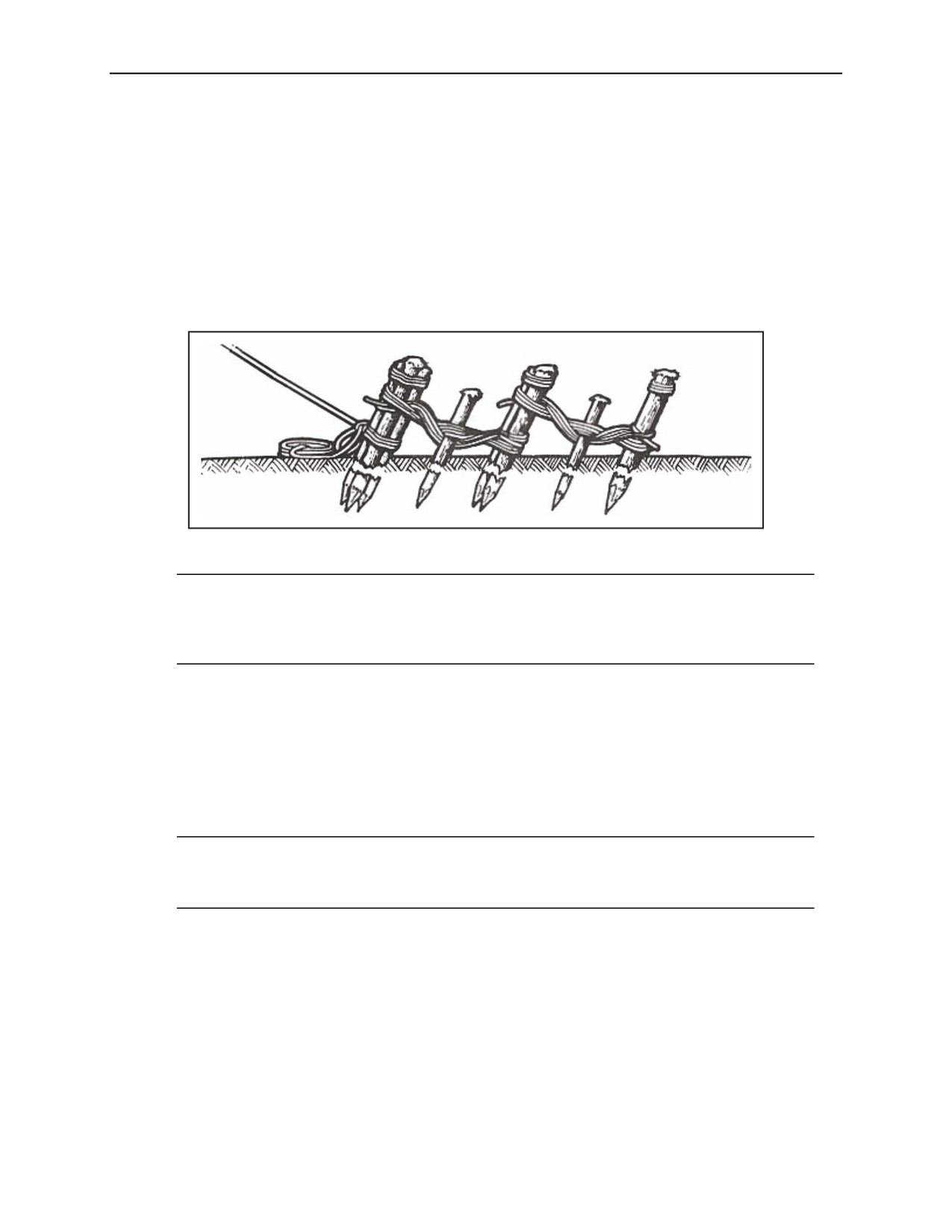
Drive the pickets approximately 3 feet into the ground, 3 to 6 feet apart, and in line with the dead
line.
Tie a pair of pickets together.
With fiber rope, tie one end of the rope to the top of the front picket with a clove hitch.
Then make four to six wraps of the rope from the top of the first picket to the bottom of the
second picket, ending with a clove hitch to the bottom of the second picket.
Insert a stake between the rope wraps midway between the pickets.
Tighten the rope by twisting it with the stake.
Drive the stake into the ground.
Repeat this procedure for each successive pair of pickets.
Figure 3-14. Combination picket holdfast
Note. The strength of the holdfast depends on the strength of the first or front picket. To reinforce it,
drive two or more pickets into the ground close to the front picket. Tie all pickets in the front picket
together using a clove hitch; wrap the front picket to the second picket, insert the stake, and drive the
stake into the ground.
Sand Parachute
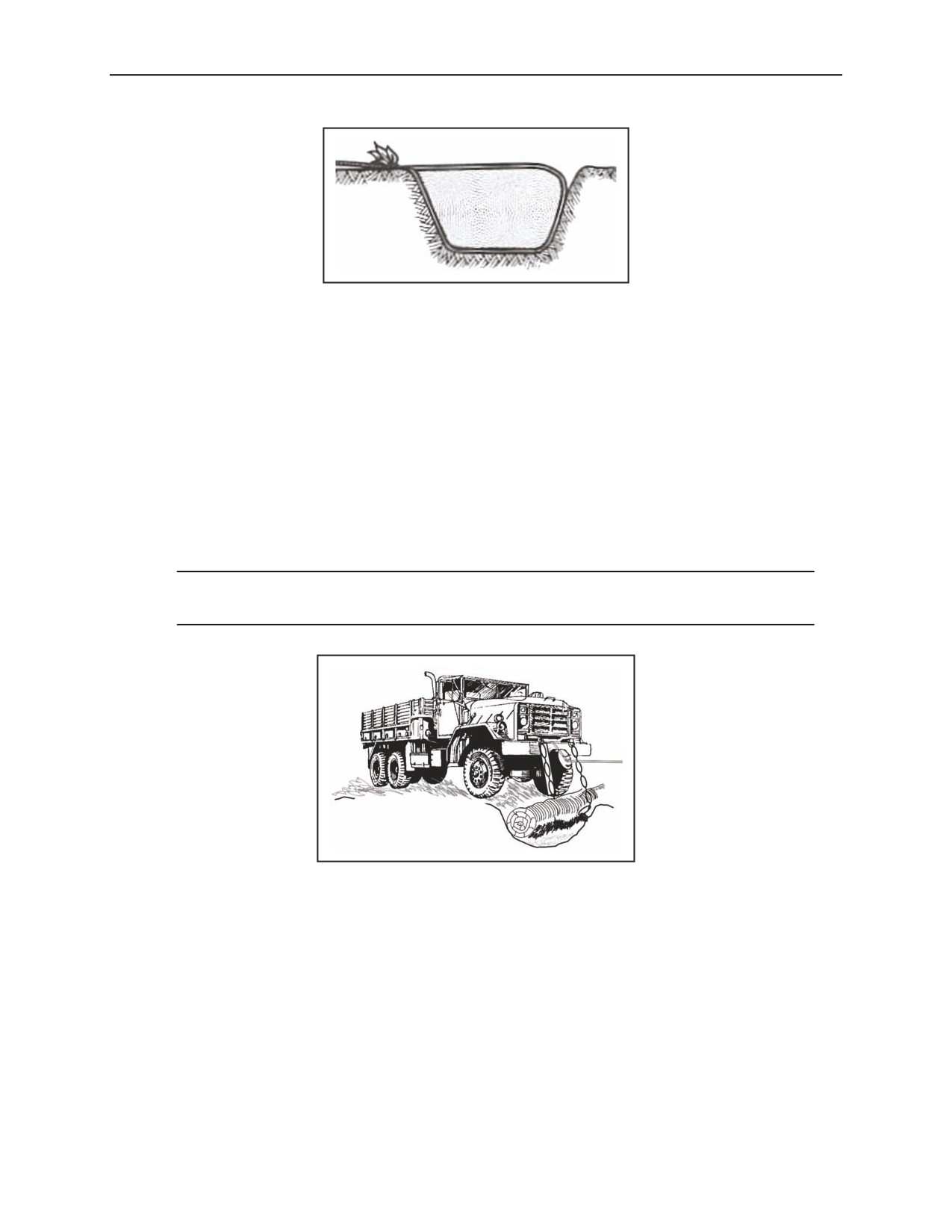
3-27. A sand parachute (figure 3-15) can be used in sandy areas when trees or other attachable devices are not
available. Construct a sand parachute as follows:
Dig a hole, line the hole with a tarpaulin, and fill the hole with sand removed from the hole.
Lash the four corners of the tarpaulin together with rope and attach rigging to the rope.
Note. Multiple sand parachutes can be used in tandem by attaching them to a chain or Y-sling. This
will provide additional holding strength, but the sand parachute has a limited holding ability. A sand
parachute should not be used when a major effort is required.
19 September 2006
FM 4-30.31
3-11
Rigging
Figure 3-15. Sand parachute
Scotch Anchor
Using One Tow Chain
3-28. A scotch anchor (figure 3-16) is used to anchor a wheeled vehicle (truck) during winching operations
when natural anchors are not available.
Select a log at least 6 inches in diameter and 2 feet longer than the width of the vehicle.
Dig a shallow trench (the length and width of the log and approximately 3 or 4 inches deep) parallel
to the front axle, just ahead of the front wheels.
Lay a tow chain across the center of the trench (width), place the log in the trench, and move the
vehicle forward until both front wheels are against the log.
Attach both chain ends to the bumper lifting shackles and remove all slack from the chain.
Note. As pressure is applied to the winch, the front wheels are pulled onto the log, making the chain
taut and anchoring the vehicle.
Figure 3-16. Scotch anchor
Using Two Tow Chains
3-29. If more than one tow chain is available, a similar method may be used.
Lay two tow chains across the center of the trench (width) next to the inside of each front wheel.
Place the log in the trench and move the vehicle forward until both front wheels are against the log.
Wrap the chains through the bumper lifting shackles, remove the slack from the chains, and fasten
them together using chain hooks.
3-12
FM 4-30.31
19 September 2006
Rigging
Vehicle
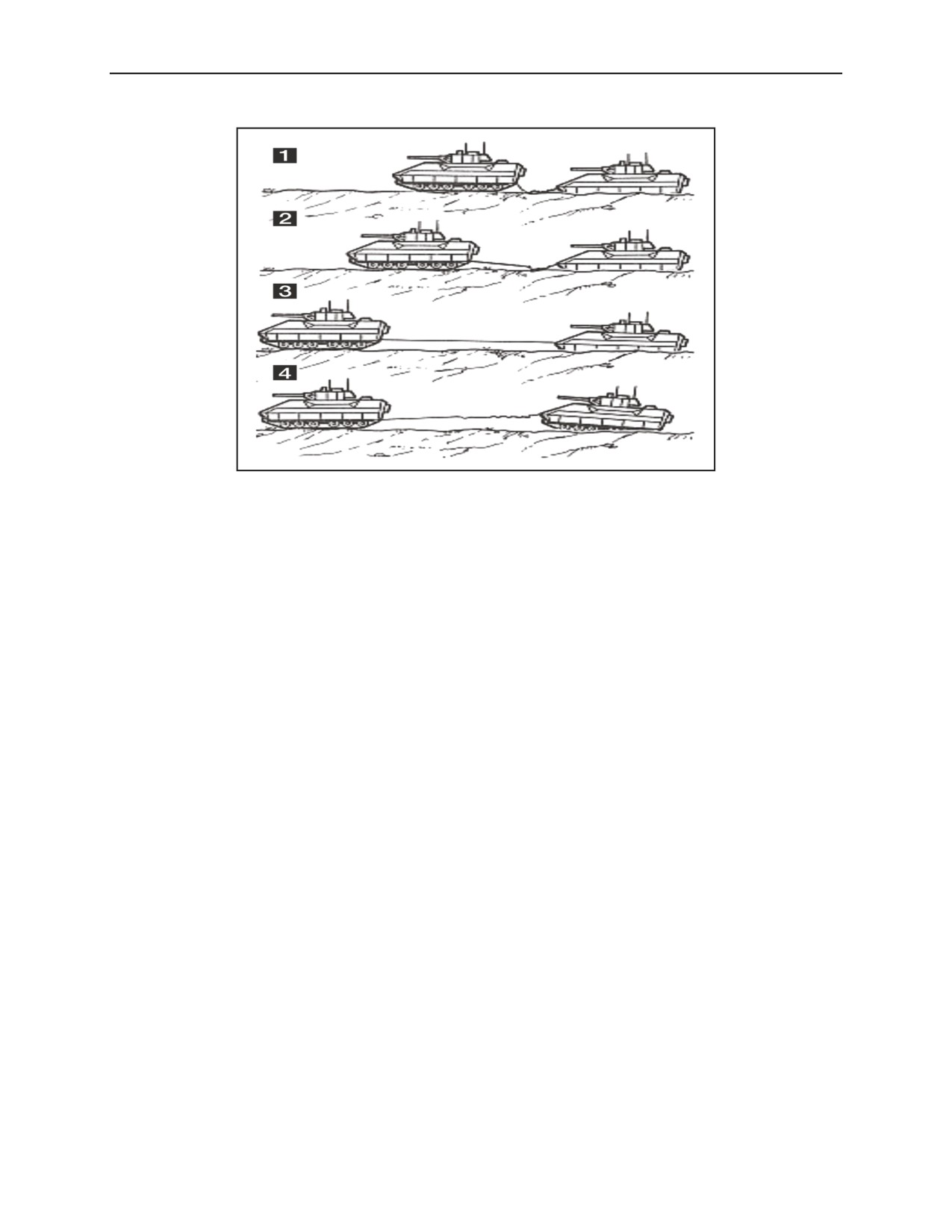
3-30. A vehicle can be used as an anchor to assist in the recovery of a mired vehicle equipped with a winch.
The winch cable from the mired vehicle is payed out to the anchoring vehicle and the mired vehicle winches
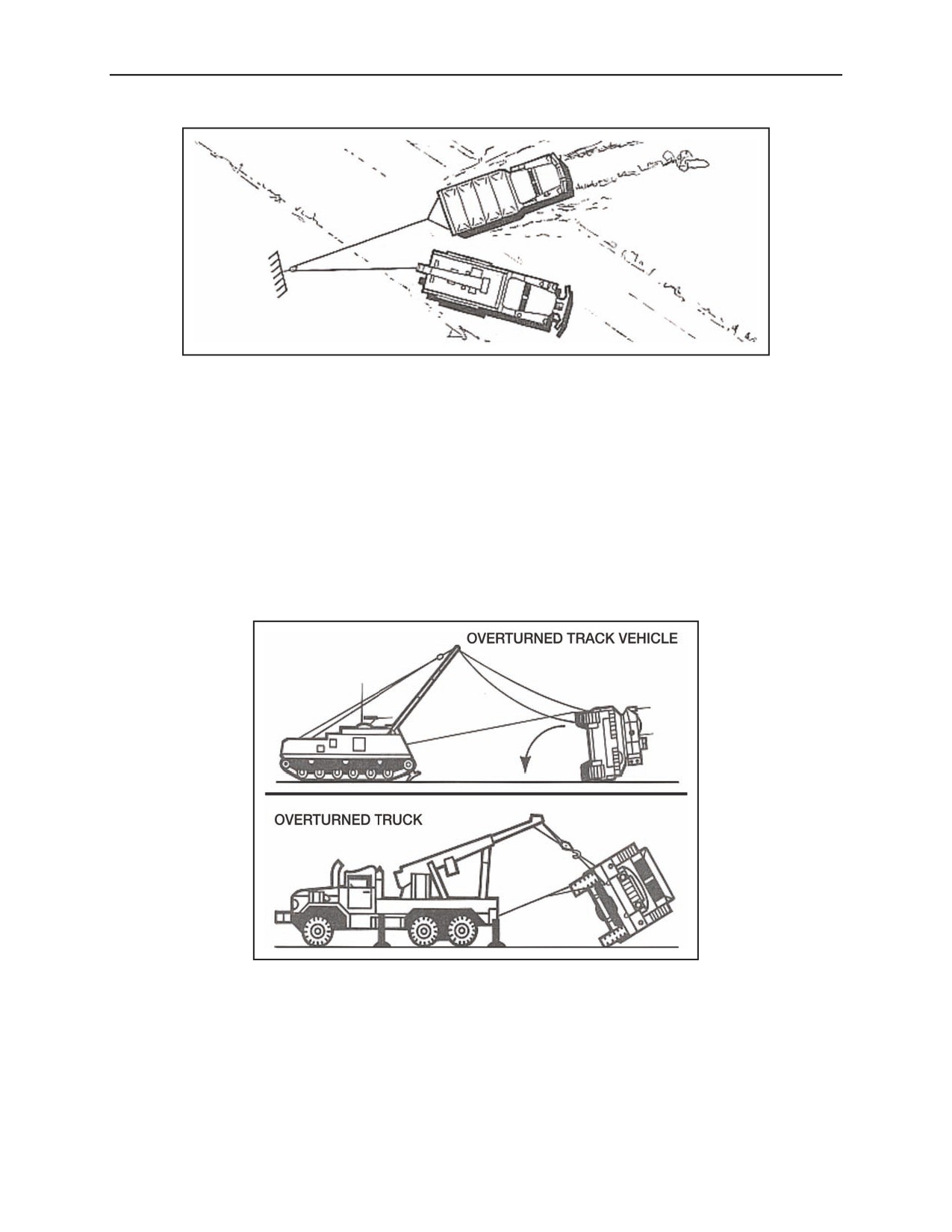
itself out. The anchoring vehicle should not attempt to pull; it is only an anchor.
19 September 2006
FM 4-30.31
3-13
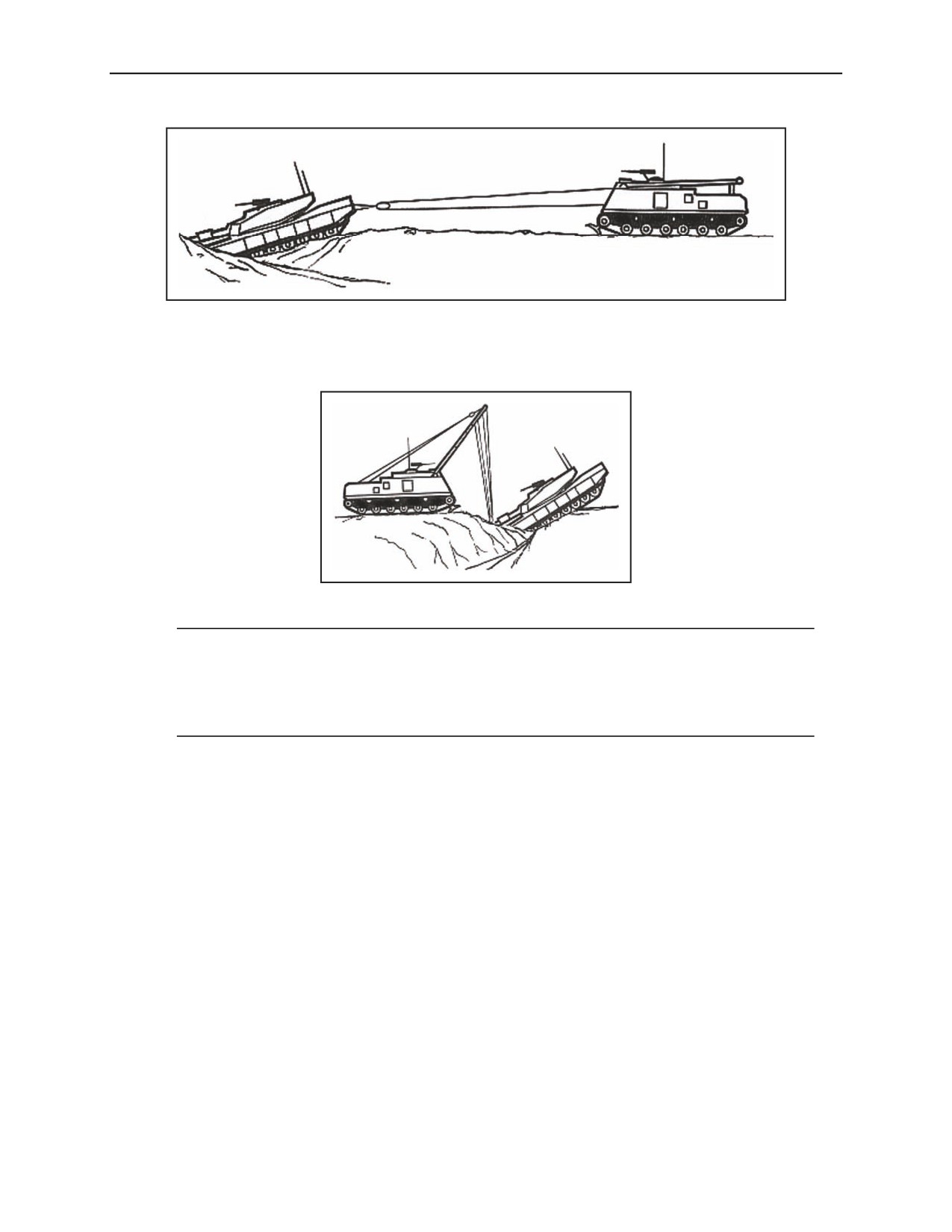
Chapter 4
Recovery Operations
A successful recovery operation is done quickly and safely. Care must be exercised when
erecting and using equipment to prevent damage to vehicles and equipment and to
prevent injury to personnel.
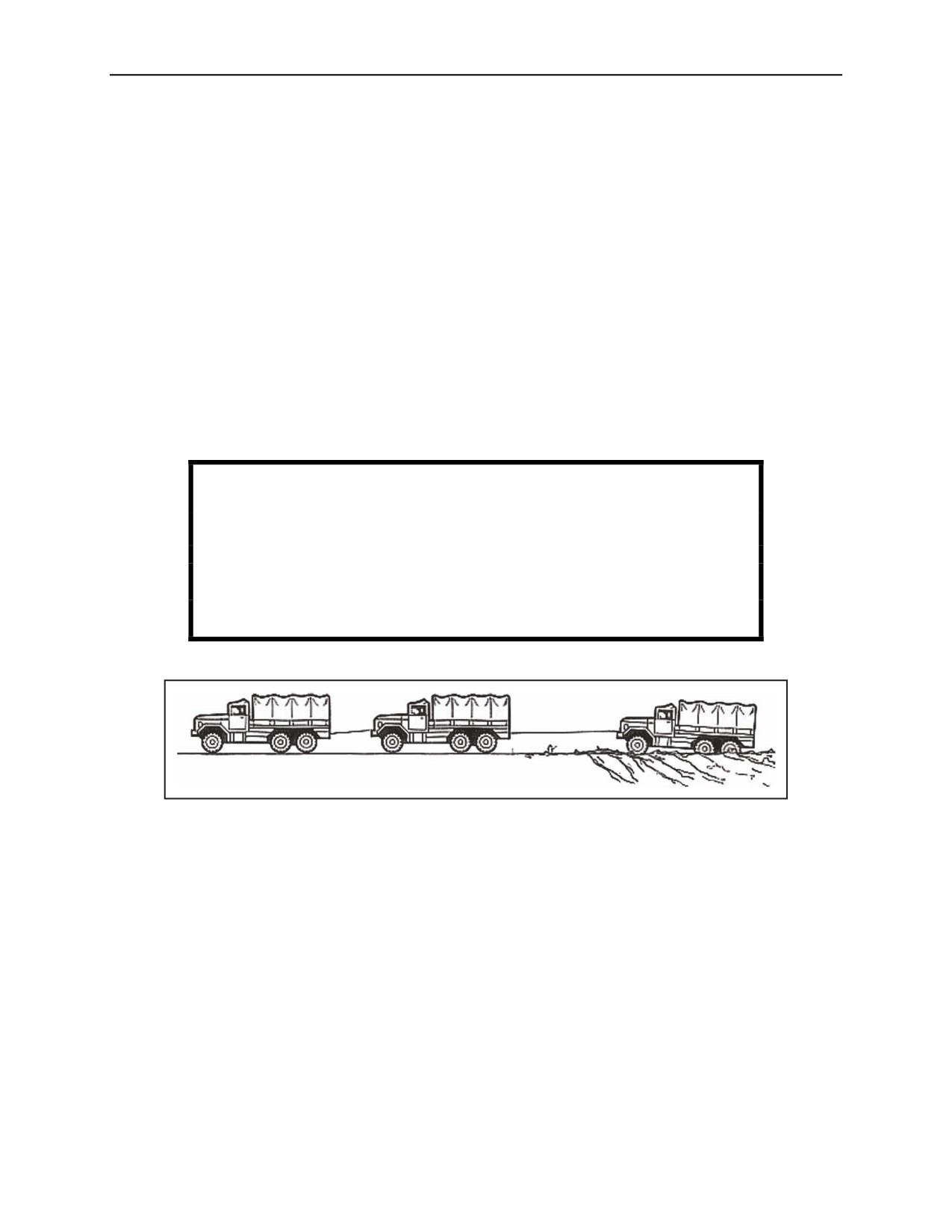
CAUTION
Think Safety
Recovery is a big job. Before any recovery operation, calculate the
resistance, inspect tackle, and keep rigging references handy. A
haphazard approach to recovery can lead to dismemberment, death,
and/or damaged equipment.
SAFETY PRECAUTIONS
ACCELERATION IMPACT
4-1.Failure occurs when a weight is allowed to fall for a distance and is suddenly stopped. A similar strong
force occurs when power is engaged suddenly to recovery vehicles when connected to a towed or mired
vehicle. Do not apply loads suddenly (shock load). This puts excessive strain on the equipment, and it may
fail.
CAUTION
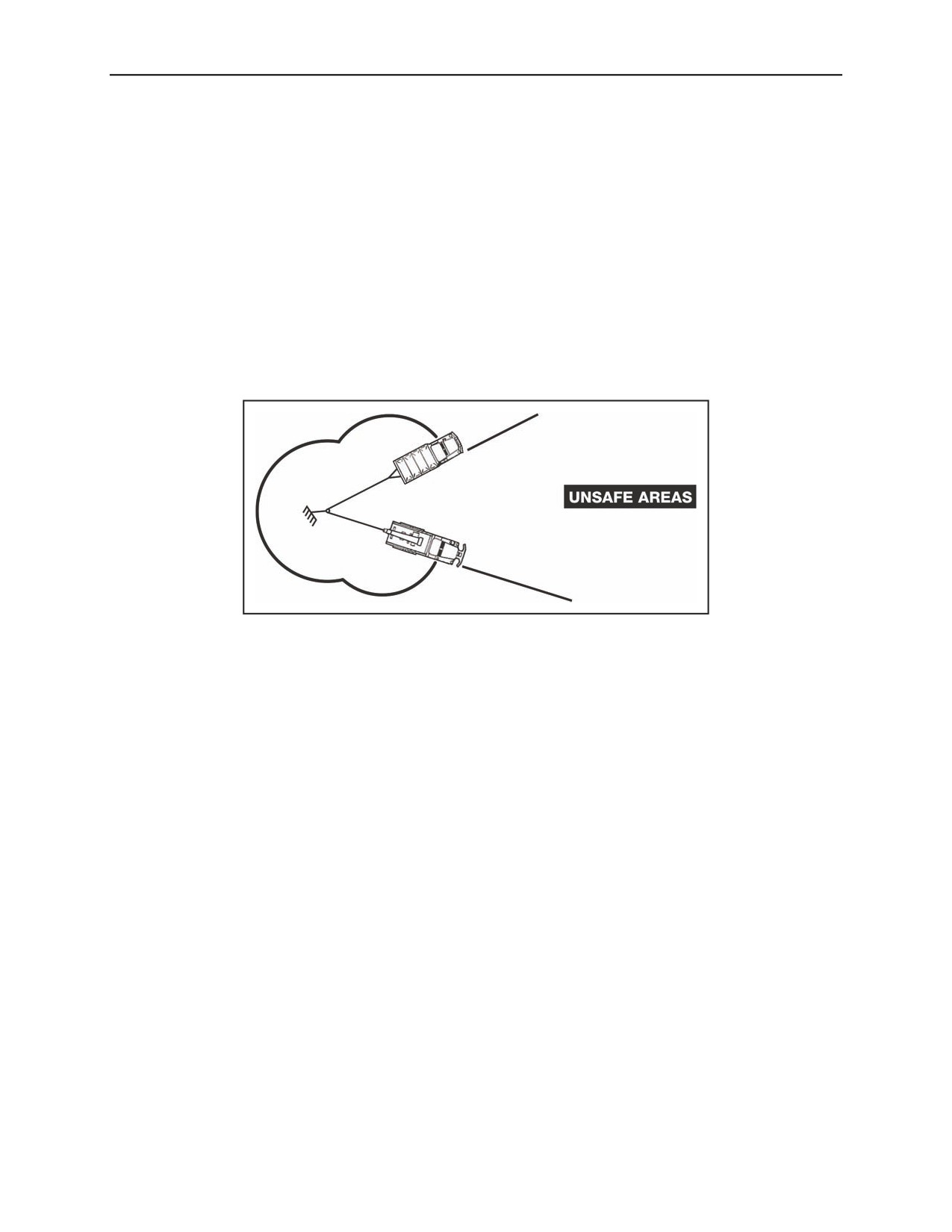
A winch line makes a deadly slingshot. If the dead line of a snatch block
breaks, a 200-pound snatch block can travel as far as 300 yards in the air.
All personnel observing should stand at least one cable length away from
(or the length designated by the recovery vehicle) and opposite of the
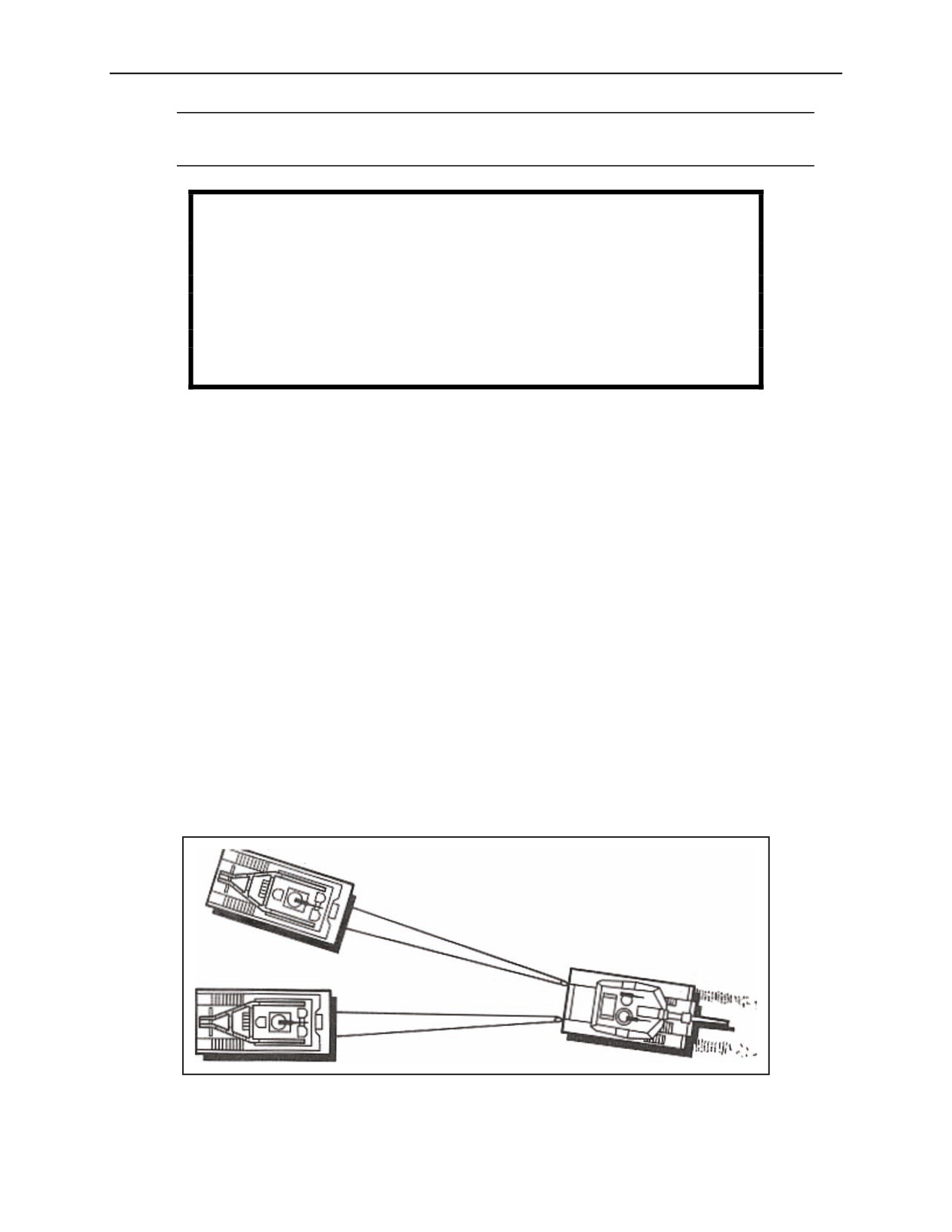
angle of pull (figure 4-1) when the cable is under stress. This will allow
greater reaction time for personnel to move out of the path of flying objects
if a cable or other attaching hardware breaks.
BACKLASH
4-2.Make every effort to stand clear of wire rope that is under tension. The minimum safe distance is twice
the length of the payed-out cable. When wire rope is drawn taut and then released suddenly by a break, its
recoil (or backlash) may cut a person into two pieces. A winch line under load stretches like a rubber band
and stores up tremendous potential kinetic energy. In fact, a steel winch cable weighing 50 to 500 pounds has
more spring to it than rubber.
19 September 2006
FM 4-30.31
4-1
Recovery Operations
CROSSED CABLES
4-3.Make sure the rigging lines are not crossing each other before the winching operation is continued.
Crossed rigging lines can rub against each other causing damage to the cable or an increased amount of
tackle resistance. Crossed cables are only recommended for towing a disabled vehicle when a tow bar is not
available.
GROUND GUIDES
4-4.To safely control a recovery operation, use two ground guides—one ground guide in the front and one in
the rear. Only one ground guide gives the signals to the operator. The ground guides should stand apart from
other personnel at the recovery site and be in a position where the vehicle operators can easily observe the
signals. The vehicle operators must know the meaning of the signals and act only on those signals (see
appendix C).
Figure 4-1. Unsafe areas during an angle pull
HOOK POSITIONS
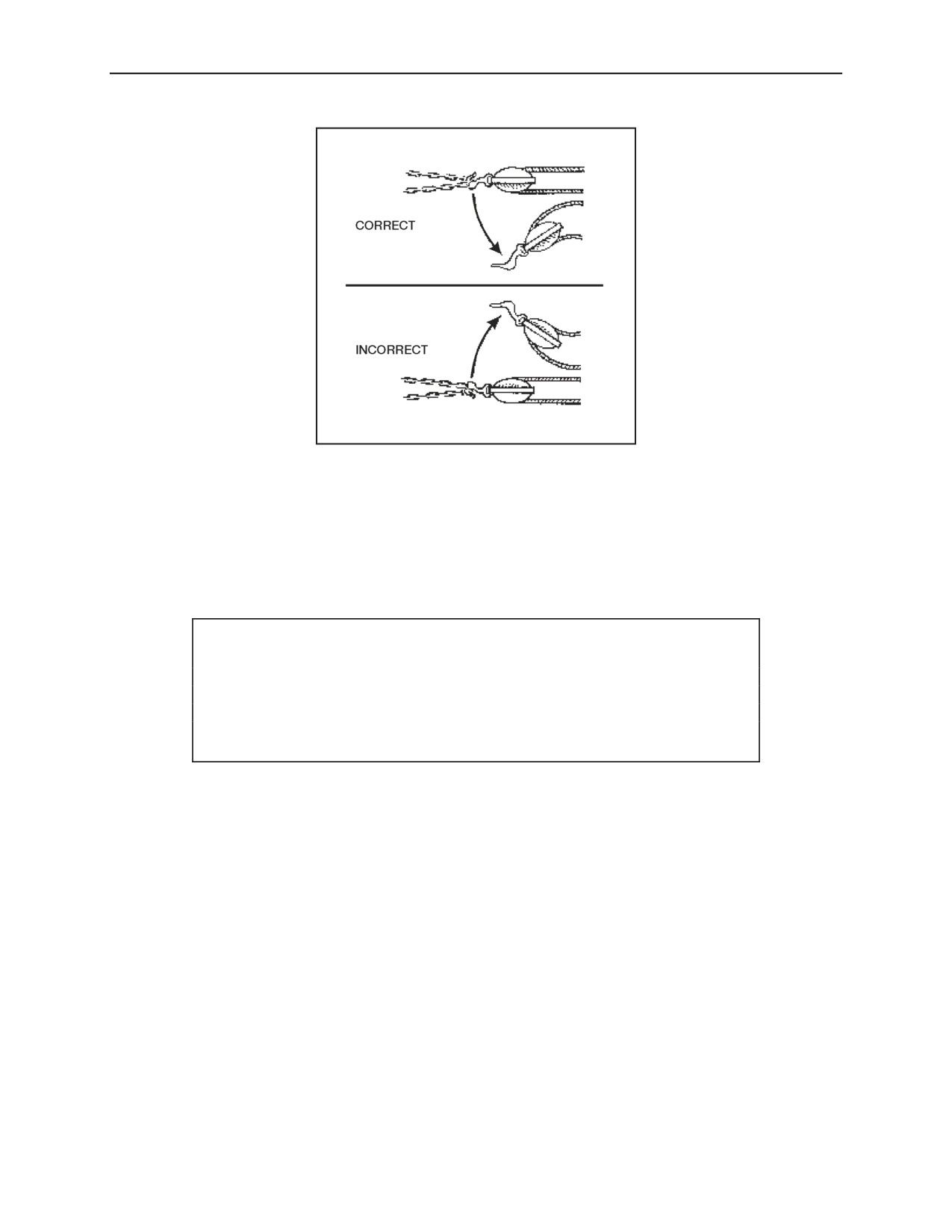
4-5.For rigging, position the hook with the open part (throat) upward (figure 4-2). If the hook should
straighten out from overload, the rigging would be forced downward. If the hook were positioned with the
open part (throat) down, the rigging would travel upward unrestricted and possibly cause injury to personnel
or damage to vehicles.
4-2
FM 4-30.31
19 September 2006
Recovery Operations
Figure 4-2. Hook positions
HOLDBACK VEHICLES
4-6.Towing tracked vehicles may require using a holdback vehicle.
A holdback vehicle or braking vehicle is mandatory when using tow cables.
When using tow bars, a holdback vehicle or braking vehicle may be necessary if the recovery vehicle
is lighter than the disabled vehicle.
CAUTION
Inspect rigging thoroughly at every connection to ensure that safety pins
are installed correctly and that proper shackles, pins, and hooks are used.
Ensure that tow cables are not crossed and are reeved correctly in the
snatch block.
INSPECTING RIGGING
4-7.Inspect equipment thoroughly before the recovery operation starts. Direct the recovery vehicle operator
to apply power to the winch to remove the slack from the rigging, and then stop the operation so the rigging
can be inspected without endangering personnel. When inspecting the rigging, never place the hands or body
between cables under tension.
OPERATOR/DRIVER SAFETY
4-8.Operators and other personnel, in both the recovery and disabled tracked vehicles, must keep their
hatches closed during winching and AKERR operations. Operators should use their periscopes to view hand
and arm signals.
POSITIONING GUN TUBES
4-9.During tank or tracked howitzer recovery, position the main gun tube so it will not be damaged. If the
gun tube of a disabled tank or tracked howitzer is involved in a collision (this might occur on a nosed or
overturned tank), maintenance support personnel should always check the gun tube before firing.
19 September 2006
FM 4-30.31
4-3
Recovery Operations
RIGGING BETWEEN VEHICLES
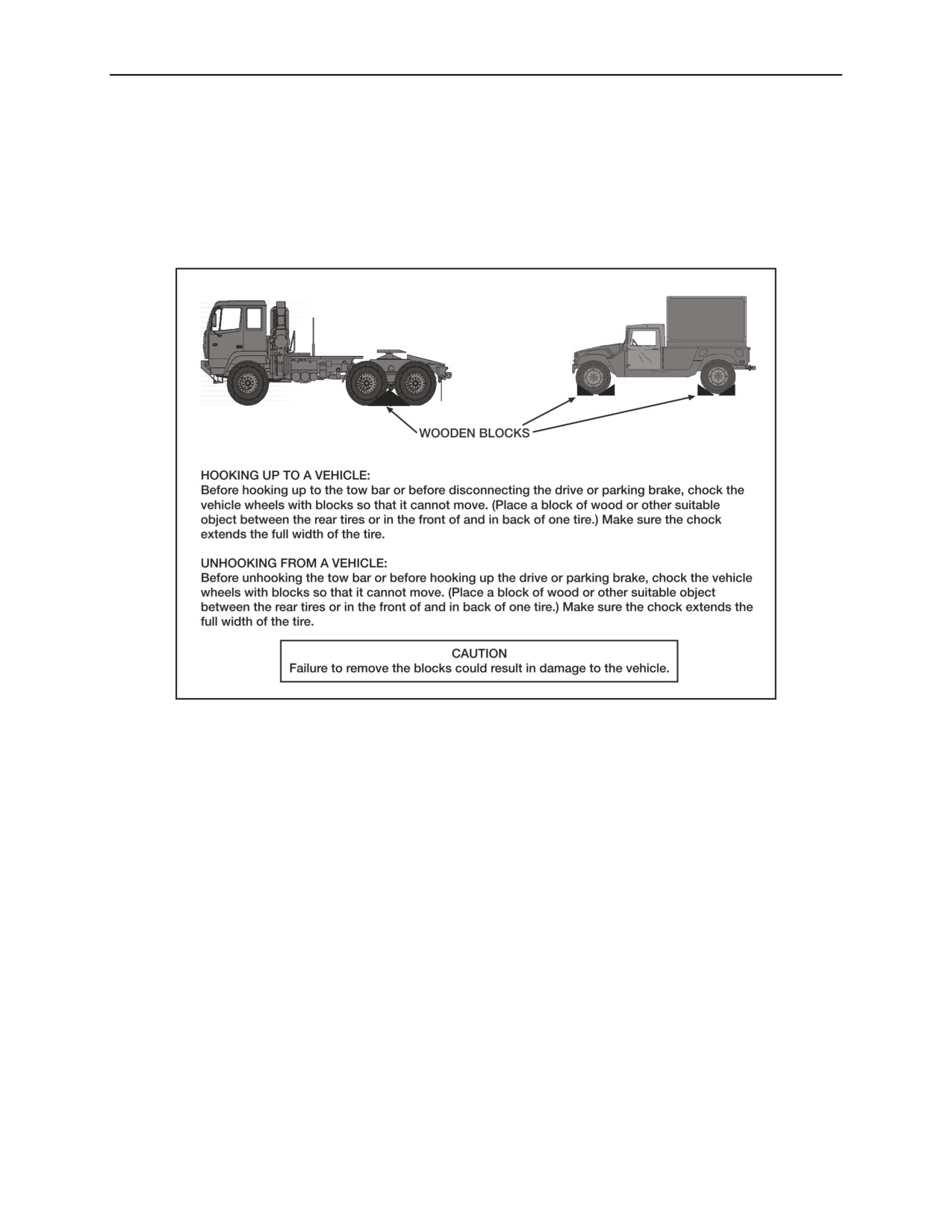
4-10. While rigging is being erected between vehicles, turn off the engines and apply the brakes. This
prevents possible injury to recovery personnel and/or damage to the vehicles. When riggings are erected
using a recovery vehicle that must have its engine running to operate the equipment, position the spade or
chocks (wheeled vehicle) and apply the brakes to prevent movement (figure 4-3). The driver remains in
position.
Figure 4-3. Chocking/blocking wheeled vehicles
SAFETY KEYS AND SHACKLE PINS
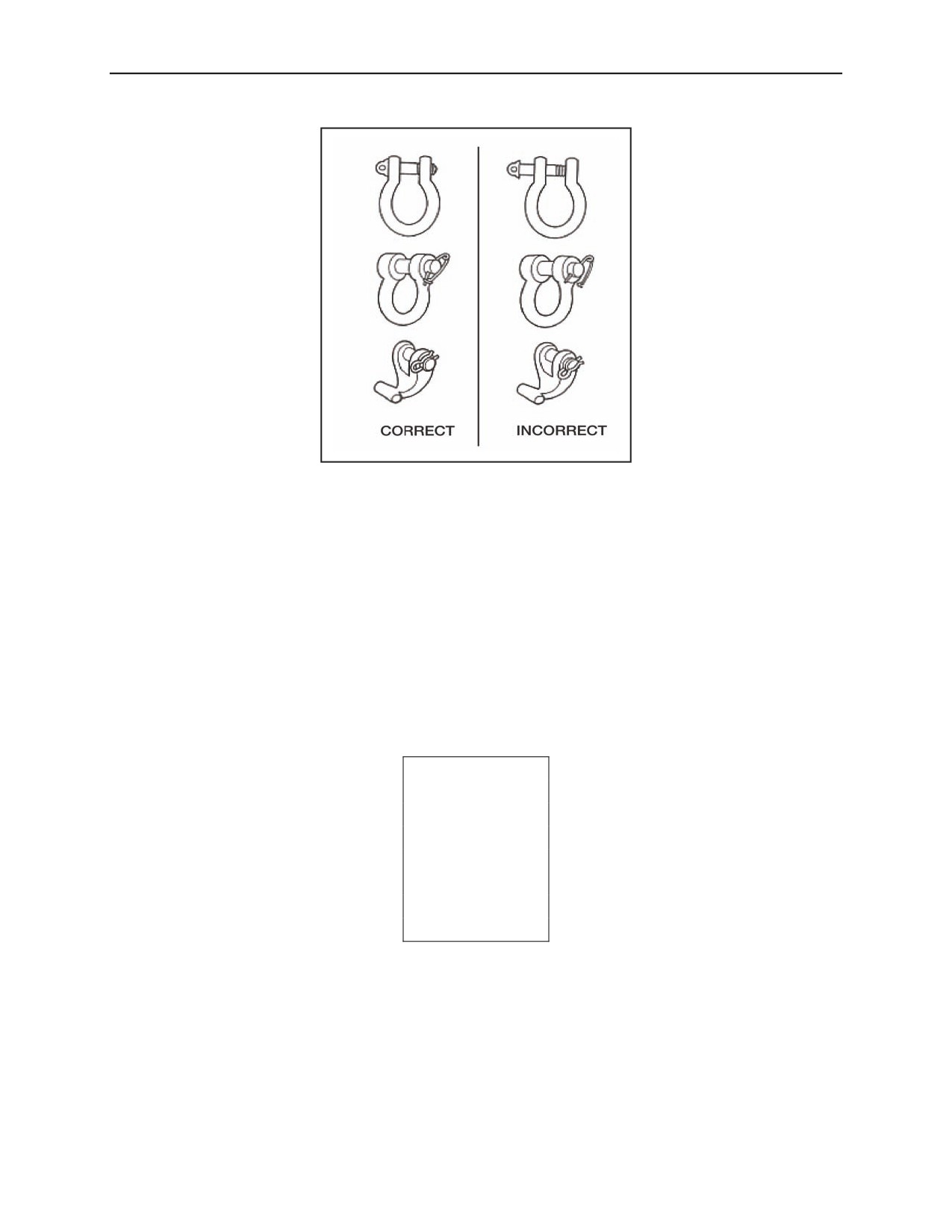
4-11. Safety keys/shackle pins should be in place on all tow hooks, shackles, or other items of equipment
(figure 4-4). Even though the safety key/shackle pin supports no great load, its absence can allow a pin to
move which places excessive force on only a part of a connection. Some shackles use a threaded-type pin. If
the pin is not completely inserted into the shackle threads, the shackle or pin can be bent or broken when
force is applied.
4-4
FM 4-30.31
19 September 2006
Recovery Operations
Figure 4-4. Safety keys and shackle pins
4-12. When using shackle pins with safety keys, such as the type used in tow bars, all shackle pins in a
vertical plane should have their heads pointing upward. Should the safety key break or fall out, the shackle
pins will remain in position if the load shifts.
SPEED
4-13. Maintain the correct speed when towing vehicles. Consider the terrain, weather, and road conditions
when determining speed. Never exceed the tow speeds listed in the operator’s manuals for the towed or
towing vehicle.
RECOVERY PROCEDURES
4-14. In any recovery operation, use the following eight-step method.
Reconnoiter area
Estimate situation
Calculate ratio
Obtain resistance
Verify solution
Erect rigging
Recheck rigging
You are ready
19 September 2006
FM 4-30.31
4-5
Recovery Operations
STEP 1. Reconnoiter area.
• Check the terrain for the best approach to the load; then determine the method of rigging and the availability
of natural anchors. A recovery crew must know the problem before making decisions.
• Conduct a complete ground survey of the area; then select the best route of approach to the disabled vehicle to
prevent possible disablement of the recovery vehicle. When selecting the evacuation route, ensure that the
military route classification number will support the combination vehicle classification (recovery plus towed
vehicles). Refer to FM 5-170 for further information.
STEP 2. Estimate situation.
• Estimate the resistance created by the load and determine the capacity of the AE. For most recovery
operations involving winching, the AE would be the maximum capacity of the winch. In some recovery
operations, the maximum distance between the winch and the disabled vehicle could be restricted, making the
AE as little as half of the winch capacity.
STEP 3. Calculate ratio.
• Compute an estimated MA for the rigging by dividing the resistance of the load (step 2) by the AE
(the capacity of the winch).
STEP 4. Obtain resistance.
• Compute the tackle resistance and total load resistance. Multiply the percent of the load resistance (as
determined in step 2) by the number of sheaves in the rigging. The determined resistance of the tackle added
to the load resistance equals the total resistance.
• Total effort available is winch capacity multiplied by the MA (as computed in step 3). If effort available is
more than total resistance, proceed to step 5. If it is less, return to step 3 and add MA.
STEP 5. Verify solution.
• Compute line forces to compare with the winch and dead line capacities. Divide the total load resistance (step
4) by the MA (step 3). The result is the fall line force. The fall line force must be less than the capacity of AE.
Therefore, this step of the recovery procedure is the key step to solving the problem.
Note. When verifying the solution, if the computed fall line force is greater than the effort, the MA must be
increased. Note that no physical work has occurred up to this point. As a result, no time is lost moving equipment or
having to re-erect rigging equipment.
• Compute the dead line force, determine the required strength of equipment capacity, and choose the correct
equipment to use as dead lines.
STEP 6. Erect rigging.
• Orient the crew, instruct them on how to assemble the tackle, and then move to a safe location.
• Advise the crewmembers of the plan, direct them to erect the tackle, and assign specific tasks for desired MA.
(Crewmembers that have finished their tasks should assist those who are having difficulty. The crewmembers
can save time by having a thorough knowledge of the tackle to be erected and by helping each other.)
• Observe all safety precautions.
STEP 7. Recheck rigging.
• Make sure that the tackle is rigged for proper and safe operation.
• Direct the operator to remove most of the slack from the lines and to inspect for correct assembly. If any
corrections must be made, direct the crewmembers to make them.
• Explain the details of the operations to the operators of the recovery vehicle and the other vehicles involved.
Direct operators to watch for signals and be prepared to act on them. Then move to a safe location where
signals can be observed by all vehicle operators.
STEP 8. You are ready.
• Signal the operators to apply winch power and recover the load. Be alert; make sure that nothing obstructs the
operations of the equipment and that all personnel on the ground remain at a safe location.
RECOVERY METHODS USING WHEELED RECOVERY VEHICLES
Types and Usage
4-15. Trained recovery personnel must perform recovery operations (see appendix D). Trained recovery
personnel use special purpose vehicles for recovery when methods used by the operator, crew, or platoon do
not fit the situation or when their efforts have had no success. The methods of recovery performed with
special purpose vehicles are winching, lifting, and towing.
4-6
FM 4-30.31
19 September 2006
Recovery Operations
Note. This section summarizes winch, lift, and tow procedures. For more in-depth information, refer
to the equipment operator’s manual, which relates to the operation of the equipment and its specific
capabilities.
Winching
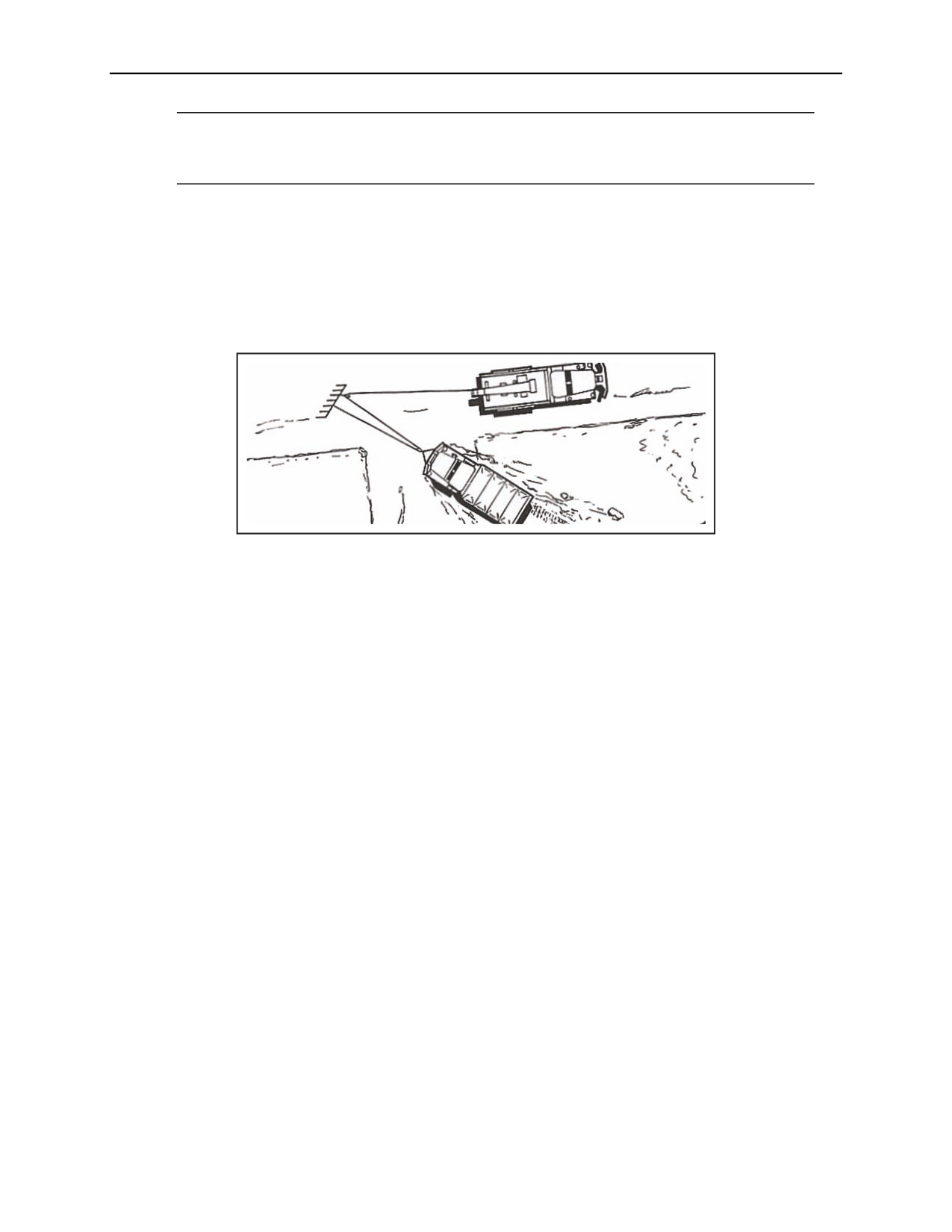
4-16. During the recovery of a mired truck using a wrecker, consider the following factors: the resistance of
the load, the approach to the load, and the distance between the wrecker and mired vehicle. Mired trucks may
have a resistance greater than the winch capacity of the wrecker. Also, the wrecker may not be able to align
itself with the truck because of the terrain. If so, use a 2-to-1 MA and a change of direction block (figure 4
5).
Figure 4-5. Winching using a 2-to-1 MA and a change of direction block
Wheeled Towing
4-17. Recovered vehicles must often be towed to a repair shop. The towing method depends on the terrain
and the mechanical condition of the disabled vehicle. A wrecker is capable of towing vehicles in the
following ways.
Highway Tow
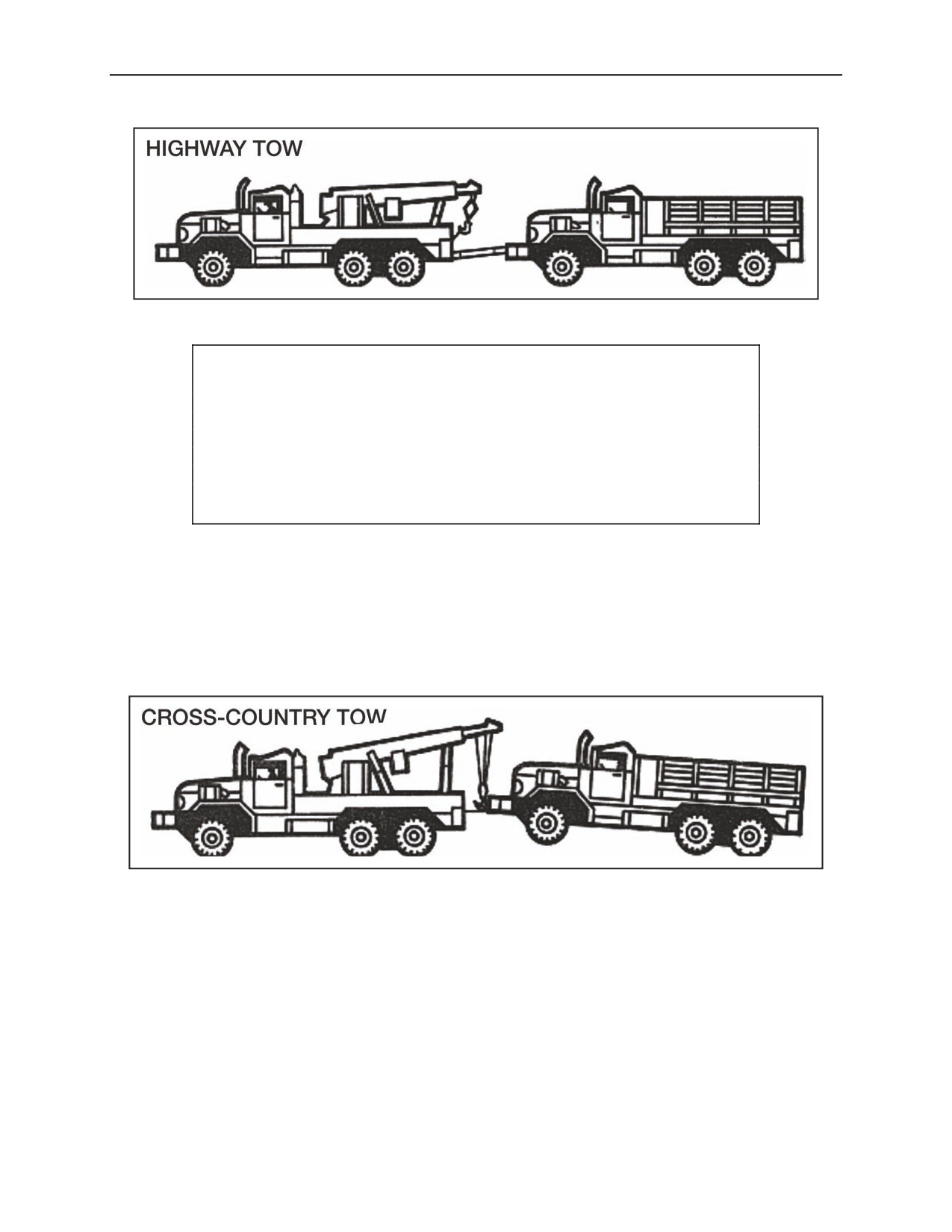
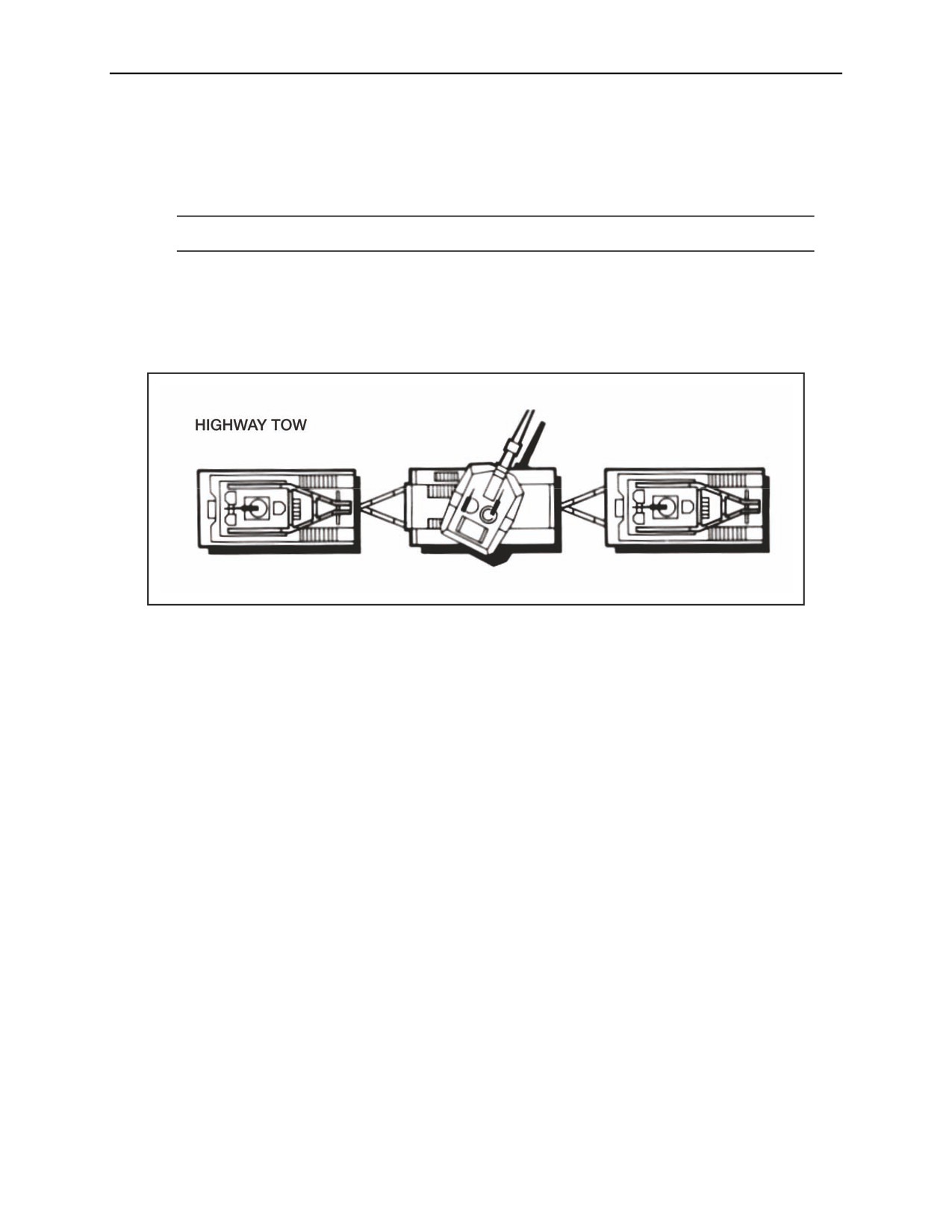
4-18. To use a highway tow—
Attach the tow bar to the disabled vehicle’s lifting eyes and the wrecker’s tow pintle (figure 4-6). All
wheels of the towed vehicle are on the ground. (A driver is not required in the towed vehicle.)
Determine terrain features prior to travel. If the hill is steep enough to require using brakes to reduce
speed, shift into the next lower gear at the crest of the hill, and use the engine compression as a
brake.
Take extreme care to prevent excessive engine speed while descending a hill. Determine the suitable
gear and shift, if necessary, at the crest of the hill before speed has increased from downhill
movement. Ordinarily the gear required to ascend a hill is proper to use to descend it. Refer to the
vehicle operator’s manual for additional information.
19 September 2006
FM 4-30.31
4-7
Recovery Operations
Figure 4-6. Highway towing
CAUTION
Safety chains must be used in addition to the tow bar. Properly used,
safety chains will retain a towed vehicle should the tow bar fail or become
disconnected. Cross the chains under and around the tow bar. Fasten it to
the shackles of the towing vehicle around a structural member or the
underside of the vehicle to be towed. Leave sufficient slack for turns, but
not enough to encounter road surface.
Cross-Country Tow
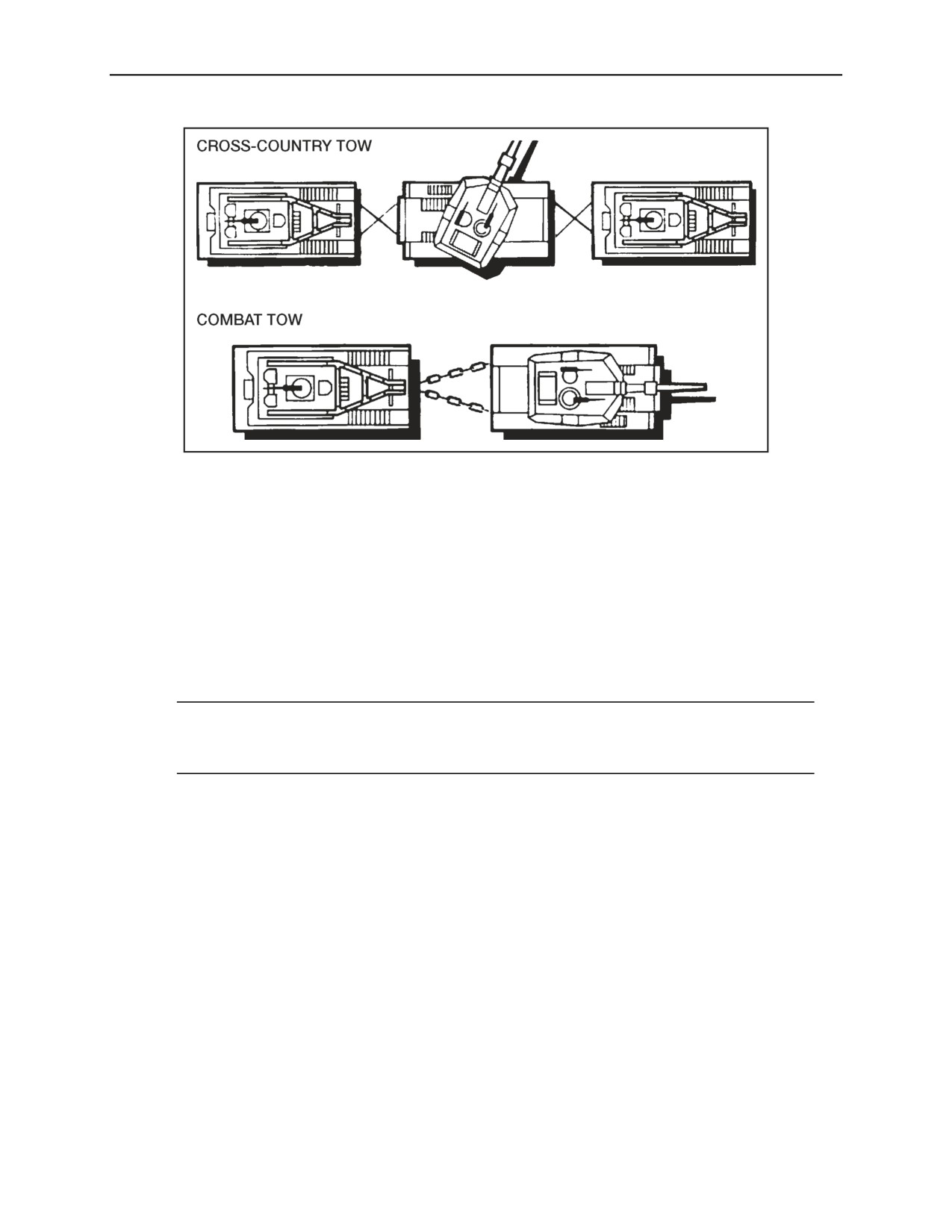
4-19. Over rough terrain, a cross-country tow (figure 4-7) has better control of the towed vehicle. To rig for
the cross-country tow—
Attach a chain-lifting sling or the hoisting bar between the truck’s front lifting shackles.
Attach a tow chain from the wrecker tow pintle to the disabled truck’s lifting shackles.
Place the hoist block hook in the lifting sling approximately 12 to 18 inches off the ground.
Figure 4-7. Cross-country towing
4-20. Extend the boom as little as possible to remove the slack from the tow chain to keep the towed vehicle
from ramming into the rear of the wrecker truck. Support the boom with the shipper braces to prevent impact
loads on the crane mechanism.
Lift-Tow
4-21. If the front end of the vehicle is damaged, use the lift-tow procedure even when the disabled vehicle is
being towed on the highway.
Attach the axle clamps to the front axle of the disabled vehicle.
Attach the tow bar to the axle clamps.
Be careful not to damage the brake lines.
4-8
FM 4-30.31
19 September 2006
Recovery Operations
Note. Procedures are the same as cross-country towing except that a tow bar is used in place of the
chain.
WARNING
Extreme caution should be exercised to avoid damage to the towed
vehicle. If possible, use the lift-tow procedure before using cross-
country tow or highway tow procedures. Refer to the equipment
operator's manual for lift-tow restrictions, vehicle preparation,
precautions that must be taken, and vehicle speed when performing
lift-tow operations.
RECOVERY METHODS USING TRACKED RECOVERY VEHICLES
Winching
4-22. One recovery vehicle is used for recovering most mired tracked vehicles. To prepare for winching,
position the recovery vehicle in line (as much as possible) with the mired vehicle.
Variable Winch
4-23. When recovering a mired tracked vehicle with a recovery vehicle that has a variable type winch, the
maximum winching capacity is gained when the cable is almost fully payed out or has less than three wraps
remaining on the drum. Always refer to the operator’s manual for guidance on achieving maximum winch
effectiveness.
Constant Pull Winch
4-24. Vehicles with constant pull winches can be positioned as close as practicable to the mired vehicle.
Always allow distance for the mired vehicle to get on solid ground. Testing has shown that the flat, smooth
hull of the Abrams-series tank provides less resistance than expected. This should allow most of the mired
tanks to be recovered using a single line pull. Recovery with two recovery vehicles (figure 4-8) is used only
when the load resistance of a mired tracked vehicle is so great that the calculated fall line force is more than
the winch capacity of one recovery vehicle with a 3-to-1 MA.
Figure 4-8. Winching with two recovery vehicles
19 September 2006
FM 4-30.31
4-9
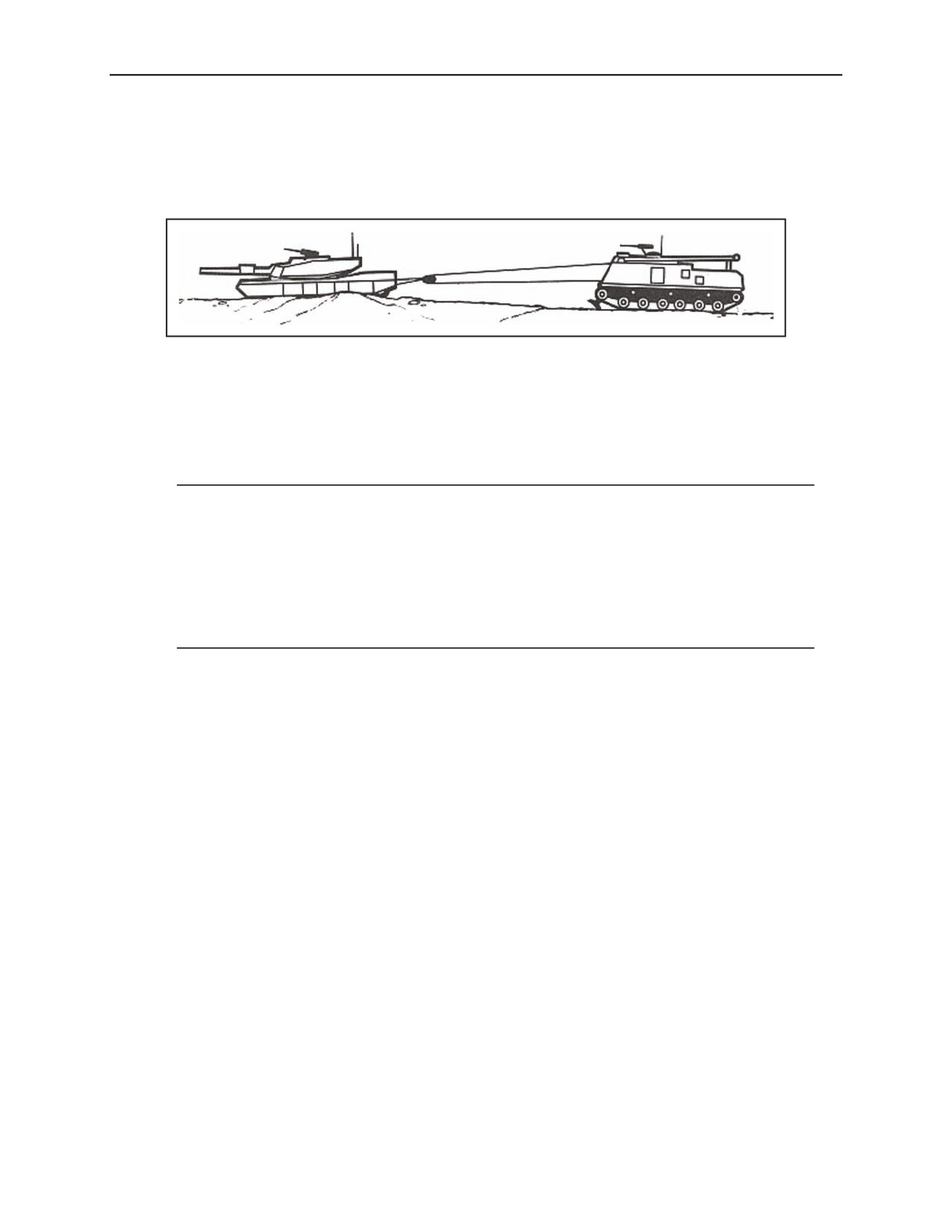
Recovery Operations
4-25. To take full advantage of their winch capacities, the recovery vehicles are positioned side by side
(figure 4-8). The same length of winch cable can then be used. Rig each recovery vehicle for a 2-to-1 MA
(figure 4-9). Attach each rigging snatch block to a tow lug on the mired vehicle. To synchronize winch
speeds, both recovery vehicle operators should use the hand throttle to set the engine speed at the desired
revolutions per minute (RPMs) and compensate with the winch control lever to maintain tension on cables.
Figure 4-9. 2-to-1 MA
Tracked Towing
4-26. Although towing can be done with similar vehicles, it is often necessary for the recovery vehicle to tow
a disabled vehicle to the UMCP where repairs can be made or evacuation effected. The towing method used
will depend on the type of terrain and available assets.
Note. An observer will be used to assist the operator during towing operations. The observer will be
located on the recovery vehicle and will have direct communication with the operator. The
observer’s responsibilities are to verify the tow connection throughout towing operations and alert
the driver of unsafe conditions of the towed vehicle, including but not limited to, disconnect and/or
jack knife. This may require that the recovery vehicle halt occasionally for the observer to exit the
vehicle and examine the condition of the rigging. At no time will the observer ride on the exterior
of the recovery vehicle or the towed vehicle during towing operations. The observer must be
positioned to use observation windows and rearview mirrors.
Towing with the M88A1
4-27. When towing an Abrams family of vehicles (FOV) or M88A1 series recovery vehicle, always use
another M88A1 or M1 series recovery vehicle as a holdback vehicle-even when using a tow bar.
Never allow anyone to ride in or on an M1 while it is being towed.
Never make sharp turns in first gear; make gradual wide turns.
Never make sudden stops.
Take care to protect Soldiers from exhaust heat and from skin contact with hot tow bars when
hooking and unhooking tow devices.
Towing with the M88A2
4-28. There are operational restrictions when towing an Abrams FOV.
Use an M88A2 recovery vehicle or, if dictated by the operational risk assessment, use another
Abrams FOV as the braking or holdback vehicle.
Use crossed tow cables as the method for attaching the braking or holdback vehicle.
Use the tow bar provided with the M88A2 for the tow vehicle.
When towing cross-country under extreme conditions, use crossed cables for the towing and braking
or use a holdback vehicle as described in paragraph 4-31.
Highway Tow
4-29. For highway tows—
Attach the recovery vehicle’s tow bar to the tow lugs of the disabled vehicle.
4-10
FM 4-30.31
19 September 2006
Recovery Operations
Place the lunette of the tow bar in the recovery vehicle’s tow pintle. (This could be done using a
small block and tackle—attaching one part to the tow bar and the other to a place on the recovery
vehicle higher than the tow pintle. This will allow a single Soldier to raise the tow bar to the pintle
without getting between the two vehicles.)
Secure the pintle in the closed position.
Note. A driver is not required in the towed vehicle.
4-30. If the recovery vehicle is lighter than the disabled vehicle, a holdback vehicle of the same weight class
as the disabled vehicle and cross tow cables are required so the towed vehicle will not overrun the recovery
vehicle. Figure 4-10 shows the holdback vehicle positions.
Figure 4-10. Tracked towing with holdback vehicle
Cross-Country Tow
4-31. Only in extreme cases, or as a backup, will crossed tow cables be used as a method of towing cross-
country (figure 4-11). Use crossed tow cables between the recovery vehicle and the disabled vehicle when
towing similar vehicles. A holdback vehicle is required so the towed vehicle will not overrun the recovery
vehicle.
19 September 2006
FM 4-30.31
4-11
Recovery Operations
Figure 4-11. Tracked towing
Combat Tow
4-32. Use a combat tow to make a towing connection under small-arms fire to provide the least possible
exposure of personnel (figure 4-11).
Attach the lifting V-chain to the recovery vehicle’s tow pintle before moving it to the disabled
vehicle.
Move the recovery vehicle into the danger area.
Back it up until contact is made with the front of the disabled vehicle. (If possible, a crewmember in
the disabled vehicle can connect the V-chain legs to the front tow hooks of the disabled vehicle.)
Move out the recovery vehicle, towing the disabled vehicle.
Note. METT-TC/METT-T is a key factor in determining combat towing distances. Do not use
combat tow for distances greater than one-fourth of a mile during peacetime operations. If conditions
permit, change the towing procedure after that distance.
TOW BAR HANDLING
4-33. Before attempting to tow a disabled vehicle, be familiar with the location, features, and operation of all
components of the tow bar. (Some tow bars have operator’s instruction decals mounted on them.) Ensure the
proper tow bar is used for the equipment being towed. Tow bars can be used to tow any vehicle up to the
gross weight of the tow bar’s towing capacity.
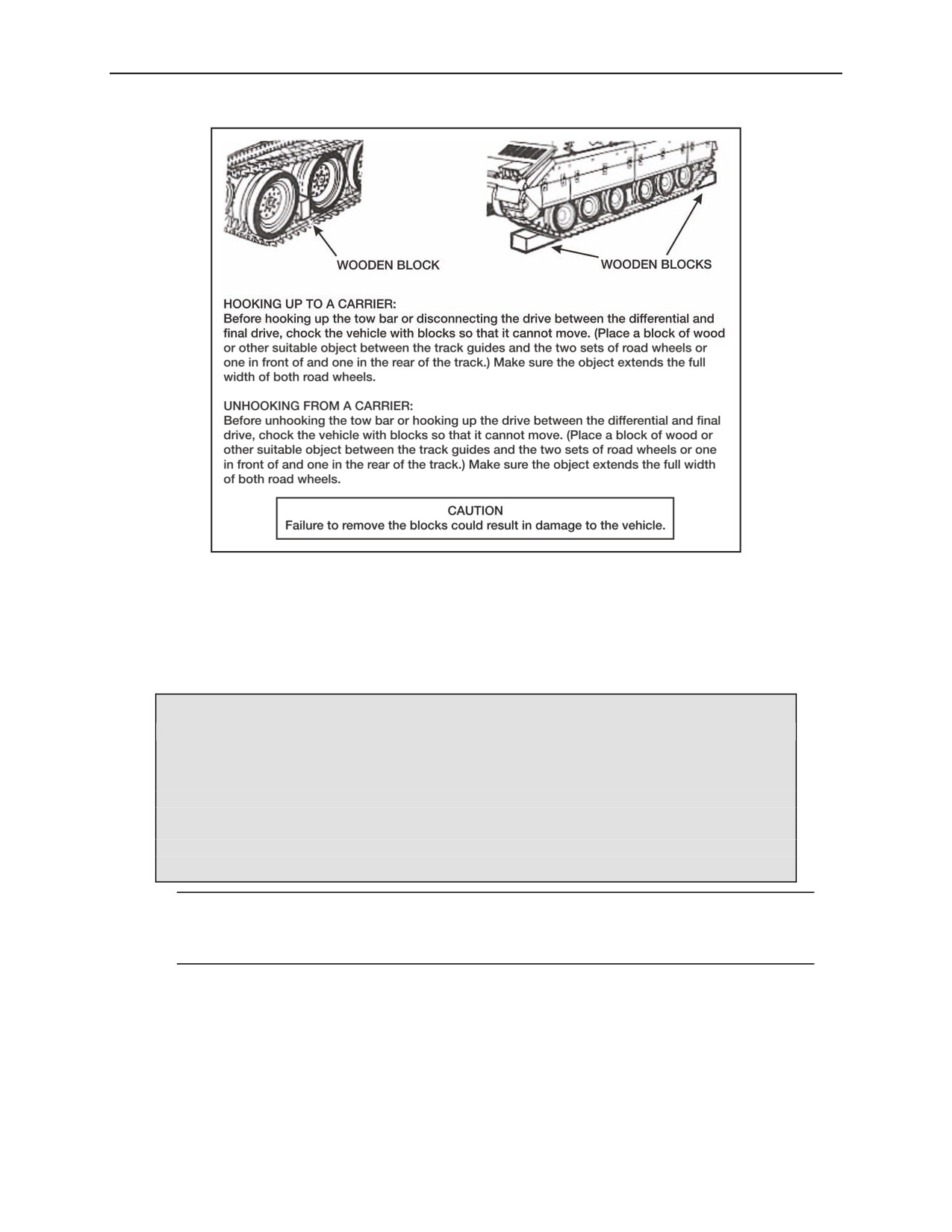
4-34. Before attaching a tow bar to a disabled vehicle, chock the wheels/tracks (figure 4-12) and/or set the
emergency brake. After attaching the tow bar to a disabled vehicle, remove the chocks and/or release the
emergency brake before moving.
4-12
FM 4-30.31
19 September 2006
Recovery Operations
Figure 4-12. Chocking/blocking tracked vehicles
4-35. Refer to the disabled vehicle’s TM for proper towing procedures (for example, automatic versus
standard transmission). Ensure that the proper pin assemblies are in the clevis holes, and always be sure the
quick-release pins (which snap automatically) are properly secured.
Towing Principle
A key towing principle is to keep as much weight as possible on the front wheels of the
towing vehicle. Do this by keeping the towed vehicle as close as possible to the towing
vehicle without causing damage to either vehicle.
Note. For M936 and M1089 wreckers, raising the boom slightly (one of three holes), not extending
the boom, or only extending it as little as possible and keeping the tow bar as short as possible, will
all help keep the weight on the front axle of the towing vehicle. This only applies to the M936 and
M1089 wreckers because they lose weight and steering ability as the load on the boom or lift device
increases.
Note. Use extreme care when lift-towing or flat-towing disabled vehicles. Check the disabled
vehicle’s technical manual for vehicle preparation, precautions that must be taken, and maximum
vehicle speed.
TOWING OPERATIONS ON GRADES
4-36. Towing a disabled vehicle is never easy, but towing up or down a grade can be even more difficult and
dangerous. While towing a disabled vehicle, do not attempt to negotiate a grade (either up or down) greater
than 25 percent unless there is express permission from the commander.
19 September 2006
FM 4-30.31
4-13
Recovery Operations
CAUTION
Under NO circumstances will a slope that is greater than 30 percent ever
be negotiated while towing a vehicle.
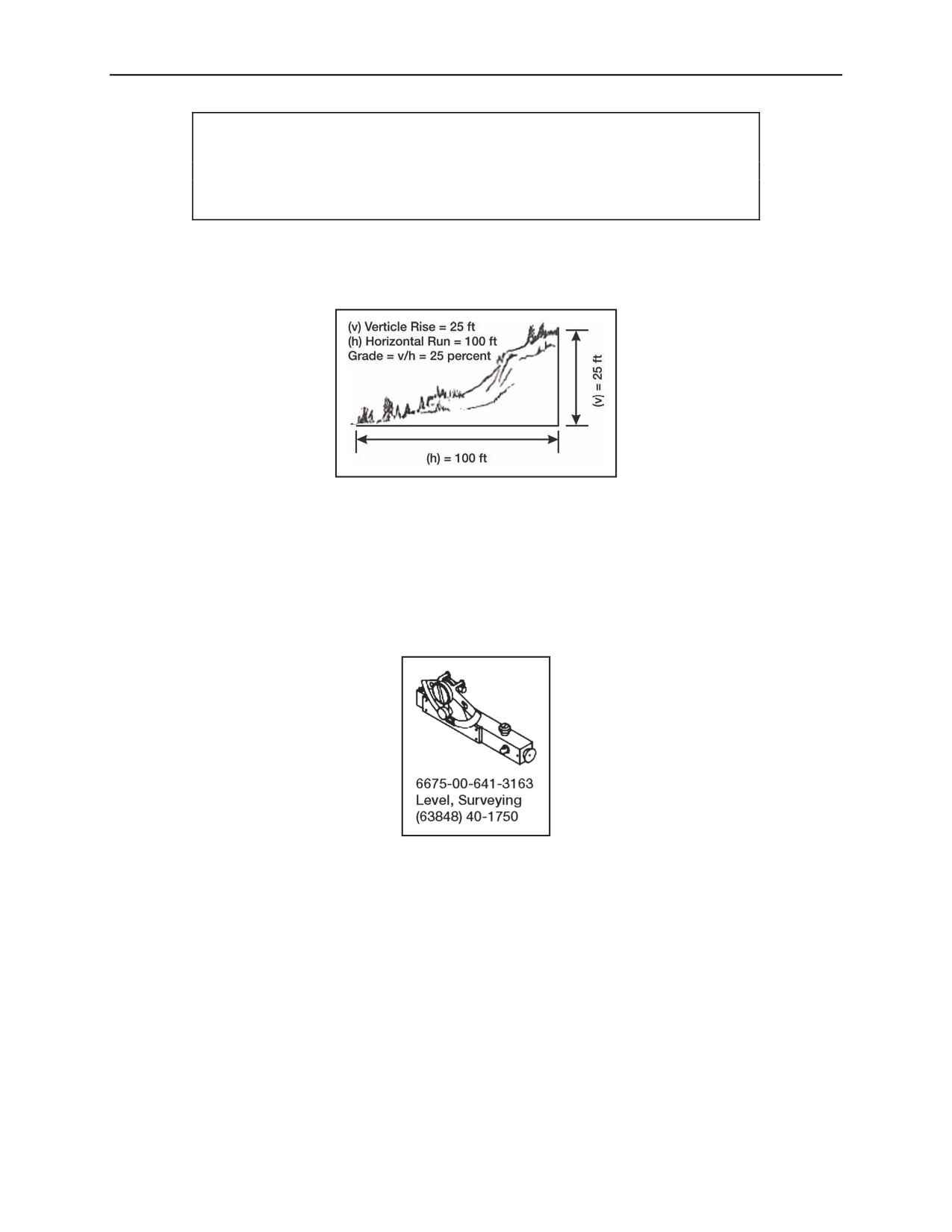
4-37. To know which grades to avoid, an operator must know how grades are classified. Grades are defined
in terms of percent or the amount of a grade’s vertical height (rise) over its horizontal length (run). If a road
gains 25 feet of height over 100 feet of length, it is classified as a 25 percent grade (figure 4-13).
Figure 4-13. Classifying a grade
4-38. The best way to classify a grade is with a surveying level (figure 4-14), which is a BII on the M88A2.
The operator stands at the top (or bottom) of the hill and chooses a point as close as possible to the bottom (or
top) of the hill where he will be traveling. The operator then looks through the sight of the level at the point
he has chosen and turns the level knob until he sees the level bubble centered between the witness marks.
Then the operator reads the percent grade on the indicator.
Figure 4-14. Surveying level
4-39. An improvised or field expedient method uses a small level, a 10-inch piece of flat wood, and a ruler.
Lay the piece of wood on the steepest part of the grade, with the length of wood running up and
down hill.
Put the level on the piece of wood and start to raise the downhill side of the wood up, until the
bubble in the level is between the witness marks.
Measure the distance between the road and the bottom of the wood. If it is 3 inches, there is a 30
percent slope; if it is 2.5 inches, there is a 25 percent slope; and so forth.
4-40. Another method is the eyesight and pace method (figure 4-15). The Soldier needs to know his height
and the length of his stride. If a Soldier is 6 feet tall and his step is 2 feet long—
He stands at the bottom of the hill and picks a spot on the hill that is the same height as his head.
He then walks to that spot, counting his steps.
4-14
FM 4-30.31
19 September 2006
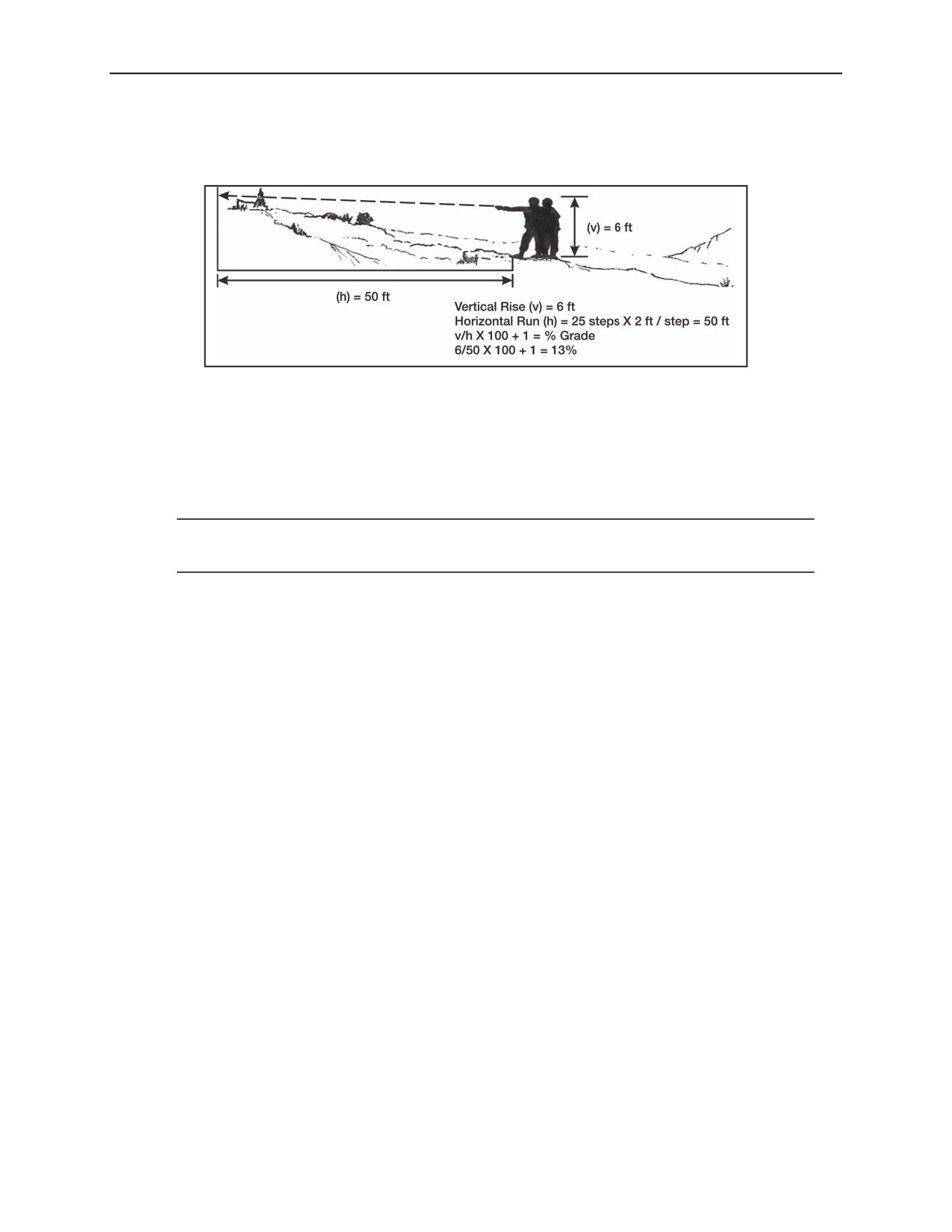
Recovery Operations
Once he reaches that spot, he multiples his steps by his stride (2 feet) and then divides his height (6
feet) by that number multiplied by 100 and adds 1.
Figure 4-15. Eyesight and pace method
4-41. The following items must be considered while performing terrain analysis:
z
Trails/grades with sharp curves mean additional control is needed during ascending and descending.
There is no safety zone in case of a runaway load.
z
Dry and dusty soil or wet and muddy soil can cause a loss in traction. Pay close attention to the soil
conditions that may alter as weather conditions change.
Note. Inclement weather (rain, snow, ice) will naturally affect the road conditions, making loss of
traction more probable.
4-42. If the operator has to shift into first gear to climb a grade, there is a good chance that it is too steep to
descend with a towed load. Measure the downhill grade before attempting to descend any hill that required
first gear to climb. Other options may include—
Using a braking or holdback vehicle behind the towed load.
Winching the disabled vehicle downhill, if possible.
4-43. If a way can be found to detour the steep grades, use it. If not, notify the commander. Inform him of
the grade percentage of the road, weather visibility, and road conditions (wet, dry, muddy, pavement). The
recovery vehicle driver’s experience and the type of load being towed will play an important role in the
commander’s decision. If the driver does not feel confident in negotiating the grade, he must inform the
commander. The best course of action may be to get the most experienced wrecker/recovery vehicle operator
on the site to handle the mission.
4-44. In summary, ensure a good route reconnaissance is conducted on the way to the disabled vehicle’s site.
When possible, avoid all hills or roads with a grade of 25 percent or greater while towing a load. If not,
notify your commander and take proper precautions. Ensure that no one rides in a towed vehicle.
RECOVERY AND TOWING WITH THE FIFTH WHEEL TOWING DEVICE
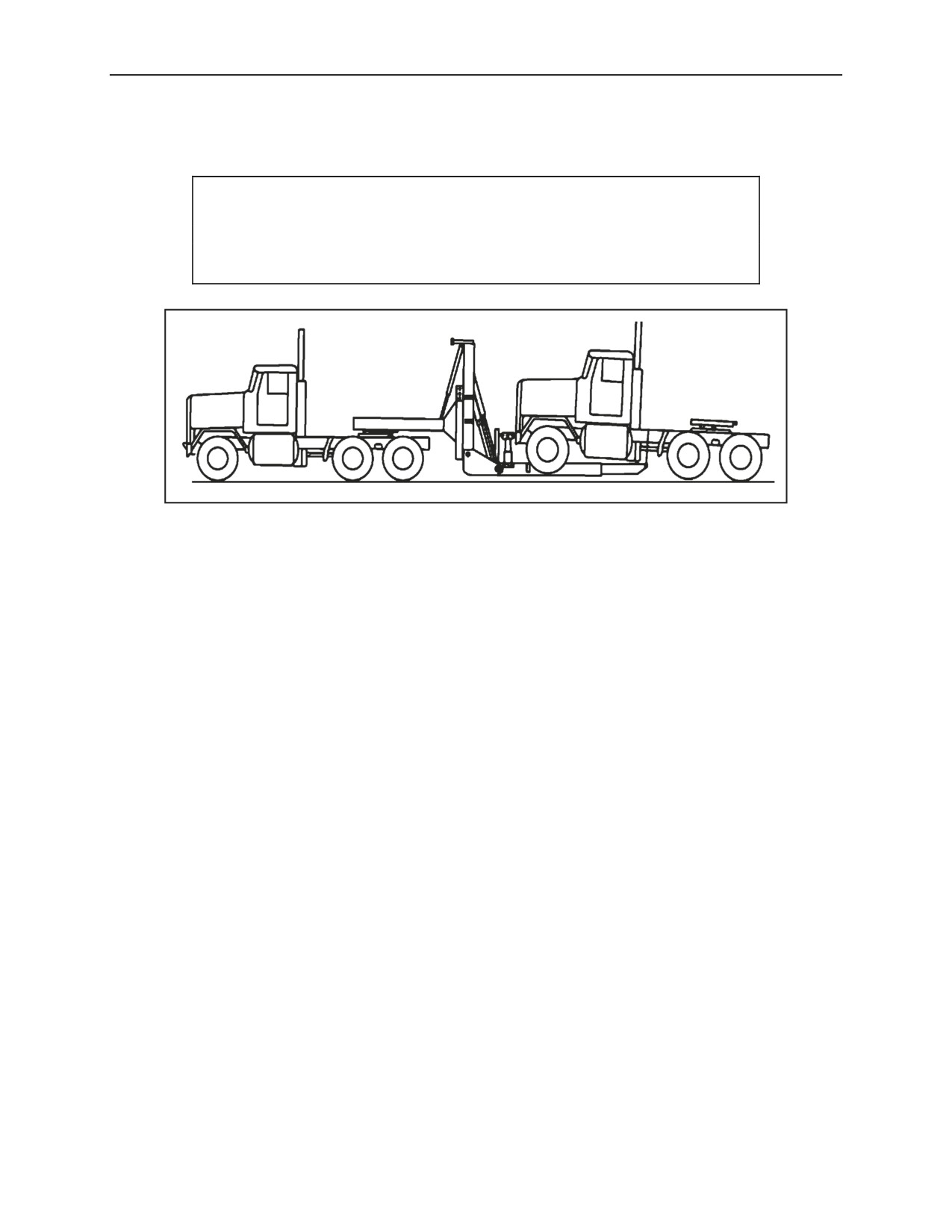
4-45. The fifth wheel towing device (FWTD) is a heavy-duty, under lift towing device that uses the fifth
wheel coupling as a pivotal connection between the pulling tractor and the truck in tow. (figure 4-16) The
weight of the towed vehicle is transferred evenly to all axles of the towing tractor. The front axle of the
towing tractor actually gains weight as the towed vehicle is lifted.
4-46. The 30,000 pounds lift capacity allows the FWTD to be used in recovering mired vehicles. The boom
assemblies can be extended under the mired vehicle and the mast raised to allow for rigging attachments.
This helps reduce the mired condition of a vehicle while transferring some of the weight to the recovery
tractor.
19 September 2006
FM 4-30.31
4-15
Recovery Operations
4-47. The FWTD is equipped with an onboard winch to aide in coupling the disabled vehicle to the FWTD.
Once the disabled vehicle is coupled to the FWTD, the system functions are similar to a semi-trailer. The
FWTD transports wheeled vehicles on highways, unimproved roads (graded level), and cross-country.
CAUTION
The winch on the FWTD is not designed to recover vehicles in mired
conditions. It is to be used only to assist in loading a disabled vehicle.
Figure 4-16. Fifth wheel towing device
4-48. Remember these important safety considerations when using the FWTD to transport or recover
disabled vehicles:
• Towing a single vehicle with nonfunctioning brakes must be limited to not more than 25 mph on the
highway and 15 mph off road.
• Stopping distances greatly increase when the towed vehicle has nonfunctioning brakes.
• Towing of vehicle combinations (tractor with trailer) with nonfunctioning brakes is prohibited.
• Visibility from the prime mover is significantly reduced when backing, whether the FWTD is loaded
or not.
• All wheels remaining on the ground of the towed vehicle should be serviceable to increase system
stability and reduce the risk of further damage.
• Never stand between the prime mover and FWTD when the prime mover is being backed up to the
FWTD. Serious injury or death may result.
• Proper procedures must be followed and extreme caution used when backing to prevent damage to
equipment and injury or death to personnel. See operator’s manual for additional cautions for the
FWTD.
4-49. Prime movers for the FWTD are listed in table 4-1.
4-16
FM 4-30.31
19 September 2006

Recovery Operations
Table 4-1. Prime movers for FWTD
Gross Combination
Prime Mover
Authorized Towed Vehicles
Weight Rating (GCWR)
*M915, A1, A2,
M915s, M818, M931 and M932 Models,
105,000 lb
A3, A4
FMTV Series, PLS Series
47,641 kg
M916, A1, A2,
M915s, M916s, M818, M931 and M932
120,000 lb
A3
Models, FMTV Series, PLS Series
54,446 kg
M915s, M916s, M920, M931 and M932
120,000 lb
M920
Models, FMTV Series, PLS Series
54,446 kg
M911, M915s, M916s, M920, M818,
59,589 lb
M931
M931 and M932 Models, FMTV Series,
27,036 kg
PLS Series
M911, M915s, M916s, M920, M818,
59,742 lb
M932
M931 and M932 Models, FMTV Series,
27,106 kg
PLS Series
M818, M931 and M932 Models, M915,
57,665 lb
M818
FMTV Series
26,164 kg
M911, M915s, M916s, M920, M818,
80,775 lb
M1088
M931 and M932 Models, FMTV Series,
36,649 kg
PLS Series
M911, M915s, M916s, M920, M818,
120,000 lb
M911
M931 and M932 Models, FMTV Series,
54,446 kg
PLS Series
M911, M915s, M916s, M920, M818,
100,000 lb
M983
M931 and M932 Models, M983, FMTV
45,372
Series, PLS Series
* Note. M1074 and M1075 (PLS series) can be transported only without a payload.
Allied Kinetic Energy Recovery Rope
4-50. The AKERR kit consists of a multi-strand, woven nylon rope, two large shackles, four small shackles,
and a canvas bag. The concept of operations behind the AKERR is that the stretch of the rope and its
subsequent attempt to return to its normal length will provide a sudden snatch effect. This effect provides
additional recovery force.
4-51. The AKERR is restricted to recovering full tracked, full armored vehicles. Only vehicles using the
proper attaching equipment (as listed in TM 9-4020-200-10, page 1-3) may participate in AKERR recoveries
as either the recovering vehicle or the vehicle to be recovered.
4-52. Any full track, full armored vehicle can be recovered. However, maximum effectiveness will be
achieved when the vehicle being recovered is within the same general weight range or lighter than the
recovering vehicles. Vehicles that are authorized by the technical manual to be the recovering vehicle are
listed in table 4-2.
19 September 2006
FM 4-30.31
4-17
Recovery Operations
Table 4-2. Vehicle weights
M11OA2
62,500 lb (28,350 kg)
M109A2/M109A3
55,000 lb (24,948 kg)
M2/M2A1-M3/M3Al
43,600 lb (19,777 kg)
M992
57,500 lb (26,082 kg)
M578
54,000 lb (24,494 kg)
M551/M551A1(with 1 1/4 inch
36,000 lb (16,330 kg)
tow cables)
Note. Only M5511M551Al vehicles with 1 1/4 inch diameter tow cables are
authorized to be recovering vehicles. Those with 3/4-inch tow cables are not
authorized to be recovering vehicles.
CAUTION
The AKERR may fail during use. If metal attachments fail or the rope
breaks while the rope is under tension, personnel may be injured or killed.
All personnel must either remain inside vehicles with hatches closed or
stay to the side at least
100-125 feet away from the vehicles during
recovery.
4-53. To use the AKERR, the towing vehicle travels in reverse as closely as possible to the mired vehicle.
The rope is connected and snaked to allow tangle-free deployment. For situations where it is not possible to
get close to the mired vehicle, extension cables may be used. (Rigging for individual vehicles is shown in TM
9-4020-200-10.) The AKERR must be connected directly to the vehicle.
Note. The gears are engaged in the mired vehicle to allow for travel in the same direction.
4-54. On a prearranged signal, the recovery vehicle will accelerate at maximum speed. At the same time, the
mired vehicle (if possible) will accelerate to assist the recovery effort. Maximum acceleration is continued
until the recovery vehicle is stopped or the mired vehicle is recovered (figure 4-17).
4-18
FM 4-30.31
19 September 2006
Recovery Operations
Figure 4-17. Recovery with AKERR
4-55. After acceleration, the recovering vehicle will slow or halt; its kinetic energy is converted into
potential energy as the rope stretches. The rope transfers the energy into the mired vehicle. After a slight
pause, the mired vehicle rises free. If the vehicle is not freed by the first attempt, the process should be
repeated. After recovery is complete, remove the AKERR, wash it with low-pressure water, and allow it to
dry before stowage.
SPECIAL RECOVERY SITUATIONS
NOSED TRUCK
4-56. The recovery of a nosed truck using a wrecker may require only a towing operation. However, some
situations may require using all three of the wrecker’s capabilities (winching, lifting, and towing) to complete
the recovery.
4-57. Figure 4-18 shows an example of a 2½-ton cargo truck that is nosed off of a narrow road and
mechanically disabled. Although the apparent fleet angle of the winch cable in the figure is greater than 1½
degrees, the wrecker winch has a level winding device which offsets the difference. (Not all vehicles with
winches have this device.) When possible, position the wrecker at the least possible fleet angle and on the
most solid surface to improve stability.
19 September 2006
FM 4-30.31
4-19
Recovery Operations
Figure 4-18. Recovery of a nosed cargo truck
4-58. To perform the recovery—
Position the wrecker truck on the road so the front end of the nosed truck, when pulled back up on
the road, will be in line with the rear of the wrecker truck.
Make a change of direction pull, using the wrecker’s rear winch to pull the truck onto the road.
Lift the front of the truck with the wrecker’s outriggers in place and turn the crane to place the truck
directly behind the wrecker truck to prepare for towing.
OVERTURNED TRUCK
4-59. To upright an overturned truck (figure 4-19) using the wrecker, a sling method of attachment must be
used because a pulling force applied to only one point of the frame may result in a bent frame.
Figure 4-19. Recovery of overturned vehicles
4-60. A sling attachment is made of two utility chains. The sling ends are attached to the front and rear lifting
shackles on the high side of the overturned truck. Then the winch cable is attached to the center of the sling.
4-61. A holding effort will be required to prevent the overturned vehicle from crashing onto its wheels. (The
holding force could be another vehicle, the wrecker boom, or a rope block and tackle with manpower.) The
attachment for the holding force is a holding sling attached to the same points on the overturned truck as the
4-20
FM 4-30.31
19 September 2006
Recovery Operations
pulling sling. The holding sling is then attached to the holding force with cable, rope, or chain—making sure
the holding force is attached to the center of the sling. If a holding vehicle is not available, use the wrecker
boom to hold the load.
4-62. Apply power gradually to the winch until the overturned truck is past the vertical position. Then, lower
the truck on its wheels with the hoist winch. This method should make maximum use of the boom jacks and
outriggers.
WARNING
Because of the danger of igniting spilled fuel and oil, smoking or
open flames are not allowed near the overturned vehicle.
OVERTURNED TRACKED VEHICLE
4-63. To upright an overturned tracked vehicle with a recovery vehicle, position the recovery vehicle so it is
facing the bottom of the overturned vehicle. It should be at a distance equal to the width of the overturned
vehicle, plus 2 feet for safety.
4-64. For the holding source of power, rig the boom with its maximum MA rigging and attach its hoist block
to two tow cables to form a sling. Pass the opposite ends of the sling under the track. Attach them to the front
and rear tow hooks on the high side of the overturned vehicle.
4-65. For the uprighting source of power—
Use a utility chain to attach the main winch cable to the center road-wheel arm support housing on
the high side.
Apply power to the main winch until the vehicle pulls past its point of balance and is supported by
the hoist rigging.
Lower the hoist winch rigging slowly to lower the overturned vehicle onto its suspension system.
HOWITZER
4-66. When uprighting a howitzer, follow procedures similar to uprighting a wheeled vehicle.
Attach the tow cable or chain to the lifting loops on the shoulder of the howitzer.
Ensure a holdback vehicle is used to slowly lower the howitzer to the ground.
Note. If the prime mover is also overturned, disconnect the howitzer from the vehicle and upright the
vehicle first. If the howitzer is positioned so that the prime mover cannot be uprighted, upright the
howitzer first.
FORKLIFTS
4-67. Forklifts can only be towed from the rear. Towing forklifts forward poses a serious overturn risk if the
forks make contact with the ground and dig in. Refer to the equipment operator’s manual for specific towing
instructions. To upright an overturned or mired forklift, use the overturned vehicle recovery procedure or the
mired-vehicle procedure.
ARMORED VEHICLE-LAUNCHED BRIDGE
4-68. When recovering the armored vehicle-launched bridge (AVLB), the bridge has to be removed by
another AVLB using a hydraulic slave procedure. (The bridge cannot be removed by the M88 hydraulic
system because the couplings differ in design.) Once the AVLB is removed from the prime mover, refer to
the operator’s manual for towing and hookup procedures.
19 September 2006
FM 4-30.31
4-21
Recovery Operations
COMBAT ENGINEER VEHICLE
4-69. Make sure the road wheels are chocked before disconnecting the final drives. When a tow bar or cables
are used, a second vehicle is required when descending a grade of 20 degrees or more. A second vehicle is
also required when the road conditions dictate. A combat engineer vehicle should be towed only from the
rear and only when the blade has been removed from the front of the vehicle.
MINE PLOW AND MINE ROLLER
4-70. Vehicles with mine plows and mine rollers attached cannot be towed from the front until the mine
rollers or mine plows have been removed. These vehicles can be towed from the rear provided the terrain and
situation permit. Once it is determined how the vehicle will be towed, refer to the operator’s manual for
towing and hookup procedures.
CRANE, WHEEL-MOUNTED
4-71. This vehicle can be towed but information on road conditions and possible restrictions along the route
must be obtained.
Use a vehicle with an air brake system capable of producing 120 psi in the system.
Place the boom over the front—which is the most stable position for towing.
If towing more than one-fourth of a mile, disconnect the propeller shafts from the front and rear
axles.
Caution must be used when turning and traveling through towns. For information on safely using cranes and
similar equipment, refer to TB 385-101.
ROAD GRADER
4-72. When towing the road grader for distances greater than half a mile, maintenance personnel must
remove the tandem drive chains. If the distance is less than half a mile, it is not necessary to remove the
tandem drive chains, but the speed must be kept below 5 miles per hour. When maintenance personnel are
not available to remove the tandem drive chains and the distance is more than half a mile, trailers must be
used to recover the road grader.
SCOOP LOADER
4-73. This vehicle should not be pushed or towed. A flatbed trailer must move this vehicle. In the event of an
emergency where the scoop loader must be towed, the maximum distance the loader may be towed or pushed
is half a mile—at low speed not exceeding 5 miles per hour. Refer to the operator’s manual.
M9 ARMORED COMBAT EARTHMOVER
4-74. The M9 armored combat earthmover (ACE) must be towed from the rear and the final drives must be
disconnected to prevent damage to the steering unit. When turning with the ACE in tow, turn in a wide arc to
prevent undue strain on the suspension of the disabled vehicle and tow bar. Make sure the disabled vehicle is
in the SPRUNG position. Refer to the operator’s manual for additional towing information.
NOSED TRACKED VEHICLE
4-75. Various factors must be considered before recovering a tracked vehicle nosed in a deep trench or
ravine. If the terrain behind the nosed vehicle is level, recover by towing. If the terrain is not suitable for
towing, perform a winching operation (figure 4-20) as follows:
Move the recovery vehicle to the opposite side of the trench or ravine (to the front of the nosed
vehicle).
Using the recovery vehicle’s boom with its maximum MA rigging, attach its hoist block to the front
lifting eyes on the nosed tank with a V-chain.
4-22
FM 4-30.31
19 September 2006
Recovery Operations
Figure 4-20. A recovery vehicle winching a nosed tracked vehicle
Lift the vehicle to a horizontal position and pull it to the opposite side of the ditch where towing or
winching can complete the recovery (figure 4-21).
Figure 4-21. Lifting operation
Note. Nosed vehicles may be recovered by towing, winching, or lifting operations. If the tow hooks
are accessible on the nosed vehicle, use rigging to attach them to the winch. Recover the nosed
vehicle with a combination of winching and hoisting. Control the weight and movement of the
disabled vehicle during the entire recovery operation by coordinating the hoist winch and the main
winch.
SELF-RECOVERY AND LIKE-VEHICLE RECOVERY
SOURCE OF EFFORT
4-76. The amount and type of equipment used as the source of effort during any recovery operation depends
on the level of recovery. Drivers and crews should evaluate the situation and determine if the crew can
recover the vehicle before calling on support from a higher level. During combat, it may be imperative that
cargo reach its destination at a definite time, that the personnel or cargo be picked up at a given time, or that a
combat vehicle be at a given place at a specific time.
4-77. Using like vehicles is usually the quickest method of recovery because they are readily available. Call
for recovery support only when self-recovery or like-vehicle recovery techniques cannot support the recovery
operation. A mired vehicle with no winch may be freed by using recovery expedient measures discussed
previously.
4-78. Combat vehicles, which need fuel, ammunition, or repairs not related to mobility (for example, a fire
control malfunction), can tow disabled vehicles to the refuel, rearm, or maintenance site. However, engaged
combat vehicles should never be diverted for recovery. METT-TC/METT-T will be the determining factor
for like-vehicle recovery.
19 September 2006
FM 4-30.31
4-23
Recovery Operations
4-79. Use like-wheeled vehicles as the source of effort to perform recovery by towing and winching. (For
vehicles not equipped with lifting shackles, attach a tow chain to the main structural members.) Before
towing or recovering a disabled vehicle, check the vehicle’s TM to ensure all physical and safety features are
considered (for example, automatic transmissions, fail-safe braking systems, and articulation). This must be
done so the disabled vehicle is not damaged further.
RECOVERING A MIRED TRUCK
4-80. To recover a mired truck by towing with a like vehicle, use a tow chain, cable, or bar between the
towing vehicle and the mired vehicle.
Attach a tow chain, cable, or bar to one lifting shackle (both, if possible) of the mired vehicle and the
tow pintle on the towing vehicle. If a greater working distance is required to enable the towing
vehicle to get better traction, use the towing chains or other device from both vehicles.
Apply power slowly to prevent placing an impact load on the towing device and lifting shackles. A
chain, unlike a cable, will not stretch and can be broken easily by impact loading. If one towing
vehicle cannot attain sufficient towing effort to overcome the resistance, use another towing vehicle
in tandem with the first (figure 4-22).
WARNING
Rigging should include a chain or Y-sling attached to both lifting
shackles whenever possible to minimize damage and create an even
pull effort. The risk of tearing off lifting shackles, bending the rear
cross member, or distorting the frame of a mired vehicle is even
greater if a second vehicle is used in tandem.
Figure 4-22. Recovering a mired cargo truck in tandem
PROPER HOOKUP WITH A LIKE VEHICLE
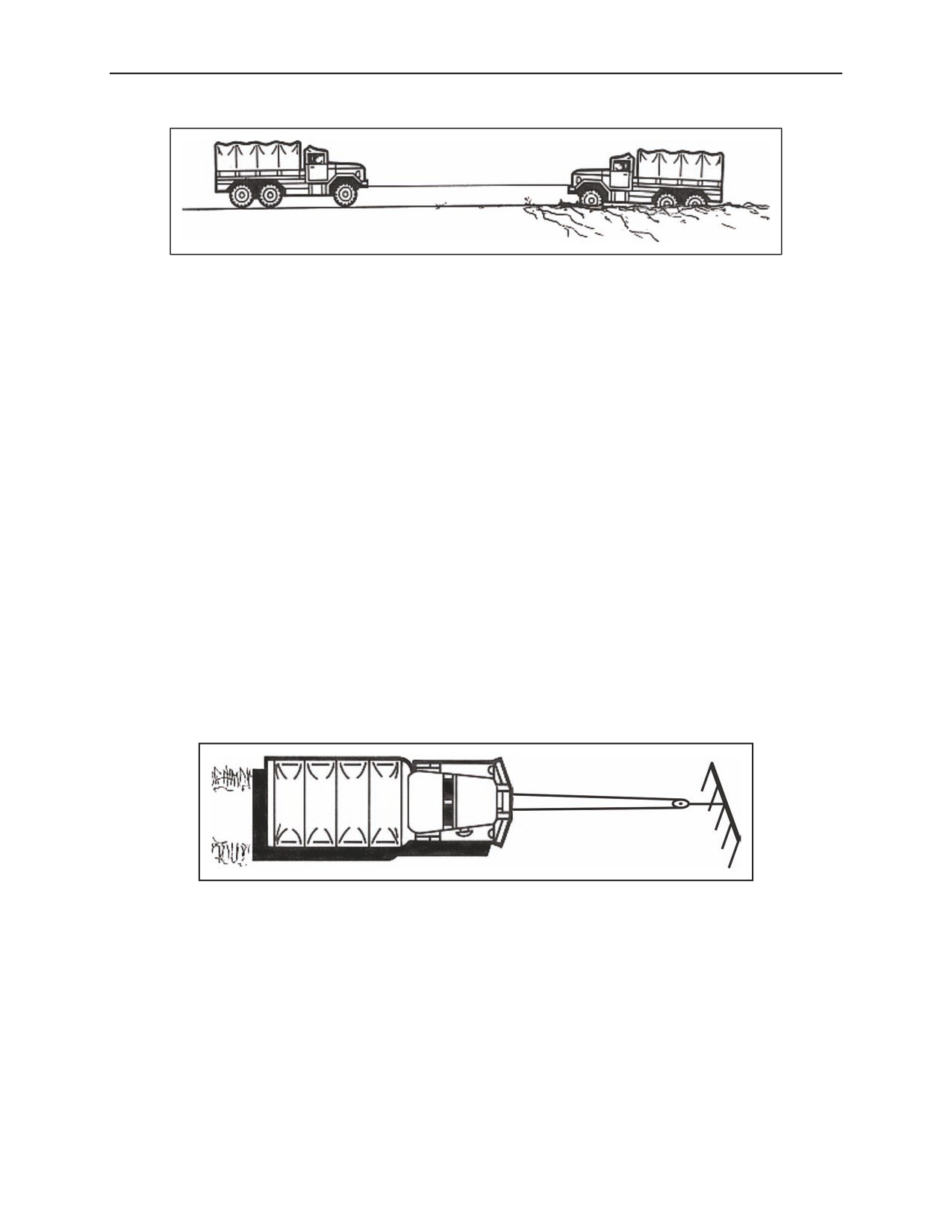
4-81. To recover a mired cargo truck, use a truck of an equal or heavier vehicle class as an anchor vehicle
(figure 4-23). Use the winch (if equipped) mounted on the mired vehicle to perform the winching operation.
A mired 2½-ton cargo truck may be winched with either a 2½-ton or a 5-ton vehicle only under emergency
conditions and a snatch block must be used in the rigging. All winch-equipped trucks are authorized a single
sheave snatch block and one tow chain for rigging.
4-24
FM 4-30.31
19 September 2006
Recovery Operations
Figure 4-23. Winching with like or heavier class wheeled vehicle
4-82. Determine if the resistance of the mired truck is greater than the winch capacity. If it does not exceed
the winch capability, MA is not required. Proceed as follows:
Position the anchor vehicle in line with the mired vehicle so the correct fleet angle is obtained.
Free-spool the winch cable from the drum.
Attach a Y-sling or chain to both front lifting shackles of the anchor vehicle, and attach the winch
cable clevis to the apex of the sling or the center of the chain. (See figure 3-7 for proper angles and
dimensions for Y-slings.) The angle of the Y-sling must be less than 30 degrees to reduce strain on
the lifting shackles.
4-83. If MA is required, proceed as follows:
Attach a snatch block to the center of the chain or apex of the Y-sling and the winch cable routed
through the snatch block back to the mired vehicle.
Place the loop formed in the winch cable in the snatch block.
Apply power to the winch to remove the slack from the cable.
If the anchor vehicle must be anchored by more than just its weight, place wheel blocks, chocks, or natural
material in front of the anchor vehicle’s front wheels. (See chapter 3).
SELF-RECOVERY
4-84. A winch-equipped, mired vehicle can perform self-recovery using an anchor (figure 4-24). Attach the
snatch block to a suitable anchor, and attach the free end of the cable to a chain sling connected to both of the
mired vehicle’s front lifting shackles. A fixed block can be used to gain MA when performing a self-
winching operation.
Figure 4-24. Self-recovery operation
USE OF LIKE-TYPE TRACKED VEHICLES FOR RECOVERY
4-85. The number of tracked vehicles required for a specific recovery depends on the resistance to be
overcome, the type of disablement, and the terrain conditions. To rig for recovery, attach the tow cables to
the tow hooks of both vehicles. All main battle tanks carry two tow cables. Light-tracked vehicles carry one
tow cable.
4-86. When a vehicle with a main gun cannon tube is recovered or towed, rotate or elevate the gun tube. This
prevents serious damage if the rigging fails or the towed vehicle rams the towing vehicle.
19 September 2006
FM 4-30.31
4-25
Recovery Operations
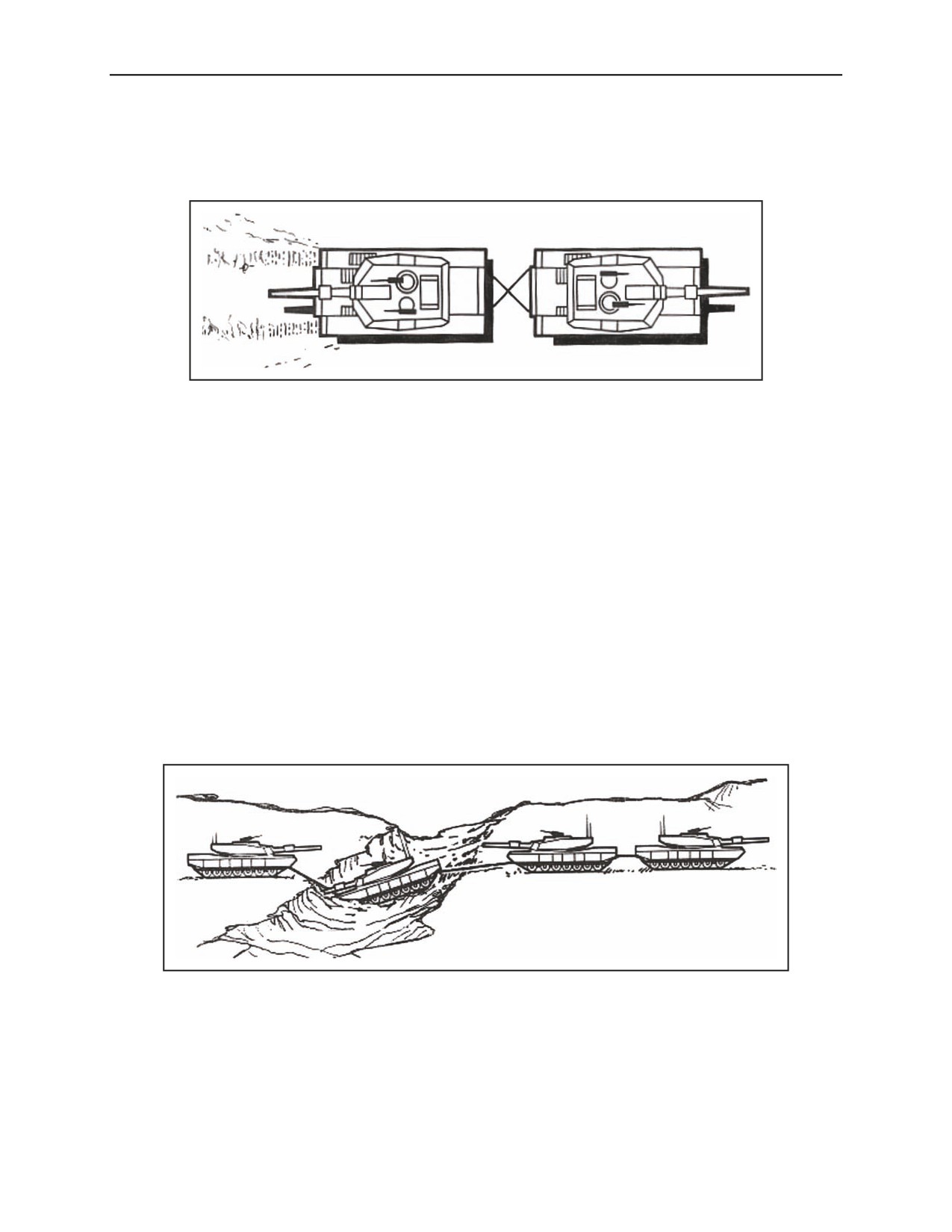
4-87. When using two tow cables between two vehicles, make sure the cables are crossed (figure 4-25). If a
greater working distance between the pulling vehicle and the mired vehicle is required, join the tow cables
together with tow hooks.
Figure 4-25. Recovery of a mired tank using one like vehicle
4-88. If two vehicles are required for an operation, one tow cable is enough because the strength of one tow
cable is slightly greater than the pulling effort of the second pulling vehicle. However, use two tow cables,
when available, to maintain alignment and equalize the pulling effort. When using two vehicles, turn the gun
tube of the center vehicle to the side to prevent contact and possible damage.
RECOVERING A NOSED TRACKED VEHICLE WITH LIKE VEHICLES
4-89. As many as three like vehicles may be needed to recover a nosed-tracked vehicle (figure 4-26). This
depends on the degree to which the vehicle is nosed and the terrain conditions on which the pulling vehicles
must operate. In extreme instances, another resource may be required to lift the front of the nosed vehicle.
Position the lifting vehicle to face the nosed vehicle.
Connect the cables of the pulling vehicles in the same way as for recovering a mired vehicle.
Apply power to all assisting vehicles at the same time. The front of the nosed vehicle will rise and
move toward the rear.
Slowly move the lifting vehicle forward.
Support the vehicle until it is recovered.
If any oil or fuel has spilled in the nosed vehicle, do not run the engine until the spill is cleaned.
Figure 4-26. Recovering a nosed tracked vehicle with like vehicles
RECOVERING AN OVERTURNED TRACKED VEHICLE WITH LIKE VEHICLES
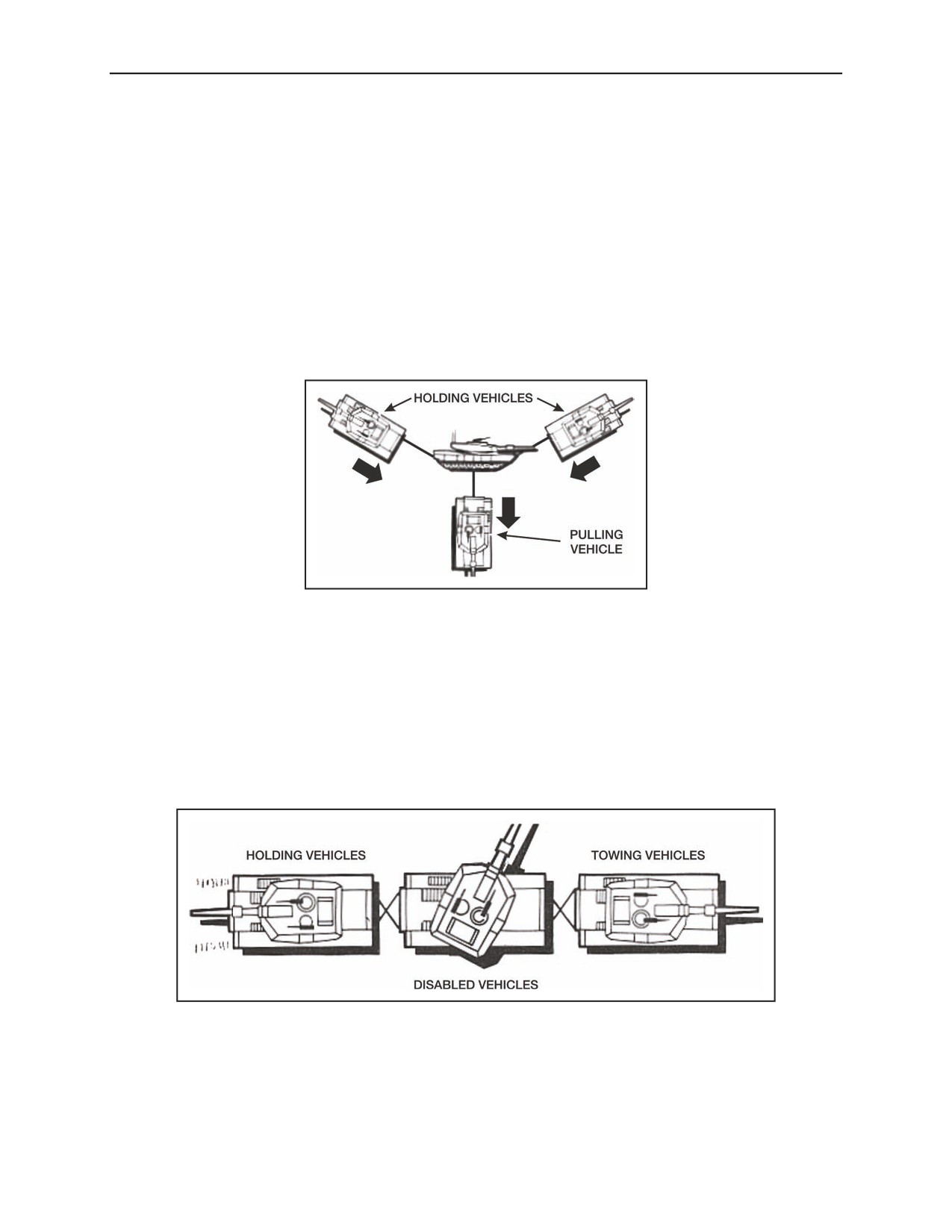
4-90. An overturned tracked vehicle can be uprighted by using three like vehicles (figure 4-27). Use one
vehicle to pull the overturned vehicle upright. Use the other two vehicles to hold and retard the fall of the
overturned vehicle so it does not crash down on its suspension system.
4-26
FM 4-30.31
19 September 2006
Recovery Operations
Connect tow cables together in pairs to allow a safe working distance.
Connect the cable used to upright the overturned vehicle to the nearest center road-wheel arm
support housing on the upper side of the overturned vehicle. Never connect to any other part of the
suspension system, turret, or the tie-down eyes.
Position the two vehicles used for holding at a 30-degree to 45-degree angle from the overturned
tracked vehicle, with their cables connected to the tow hooks on the high side of the overturned
vehicle. The holding vehicles must be positioned in this way to prevent damage to the cables,
fenders, or lights of the overturned vehicle as it is uprighted.
4-91. Drivers of the holding vehicles must shift to low range. The pulling vehicle gradually applies power in
reverse, while the holding vehicles move forward only enough to keep their cables taut until the overturned
vehicle passes through the point of balance. As the overturned vehicle passes through the balance point, the
holding vehicles move forward slowly, supporting the overturned vehicle and lowering it onto its suspension
system.
Figure 4-27. Recovering an overturned tracked vehicle with like vehicles
TOWING DISABLED TRACKED VEHICLES
4-92. Tow a disabled tracked vehicle with a like vehicle of the same weight class or heavier weight class
with a tow bar or two tow cables (figure 4-28). When using a tow bar on vehicles lighter than the 70-ton
class, no holdback vehicle is required, unless the terrain interferes. A holdback vehicle will be used when—
Tow cables are used.
The towed vehicle is heavier than 70 tons.
Terrain grades are more than 20 percent.
Figure 4-28. Towing a disabled tracked vehicle
4-93. Cross the tow cables to keep them from being tangled with the tracks. When towing tracked vehicles
with only one track, there will be a difference in resistance and steering capability between a complete track
on one side and road wheels on the other side. As a result, the towed vehicle will pull in the direction of the
side lacking the track. Compensate for this pull by properly attaching the towing cables. Check the TM
19 September 2006
FM 4-30.31
4-27
Recovery Operations
pertaining to the towed vehicle to determine the necessary preparations and precautions to be used to prevent
further damage. Never exceed the towing speed stated in the TM.
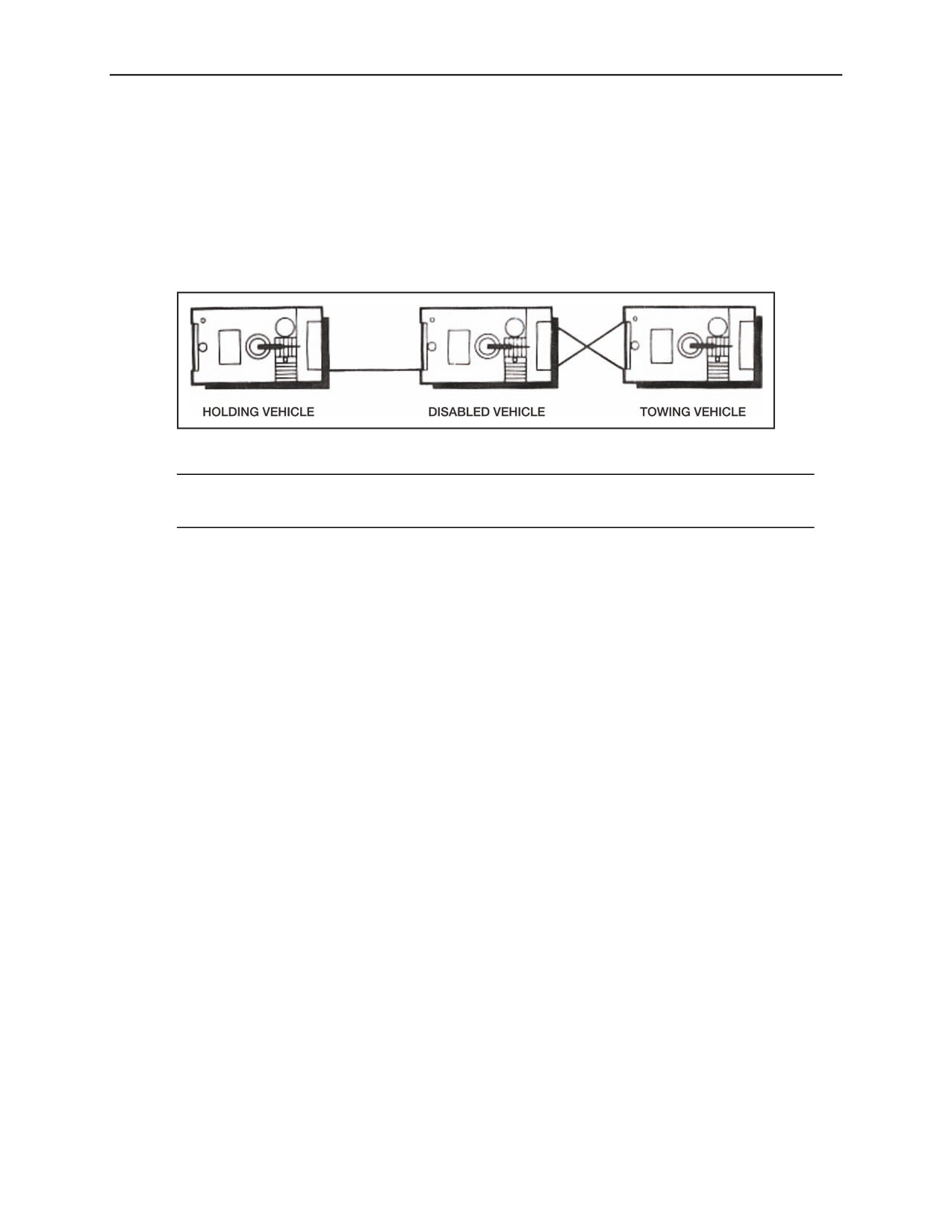
4-94. If the disabled vehicle has defective brakes or its universal joints are disconnected, use another similar
vehicle for holding (figure 4-29). Use crossed cables between the holding and disabled vehicles when
available. With vehicles that are issued only one tow cable, the vehicles will be connected with crossed
cables between the towing vehicle and the disabled vehicle. Connect a single tow cable between the disabled
vehicle and the holding vehicle.
Figure 4-29. Towing with vehicles issued one tow cable
Note. Use crossed tow cables between the holding and disabled vehicles when enough cables are
available.
MARINE RECOVERY
4-95. Many vehicles can now swim or ford. Some of these vehicles will fail while waterborne and will need
recovery. Situations may be as simple as stalled, floating vehicles or as complex as submerged vehicles. The
same methods of recovery apply to these situations but with a few unique considerations.
4-96. In the case of floating vehicles, swiftly moving current can carry the vehicle and crew downstream.
Water safety must be stressed to both vehicle and recovery crews engaged in these operations. Current and
stream bottom conditions interact effectively to bury a vehicle, thereby increasing resistance. When operating
on beaches or rivers with soft bottoms, time is critical. Recover the vehicle as quickly and safely as possible.
Fording Vehicle
4-97. Vehicles become mired, nosed, and overturned during fording operations just as they do during land
operations. As a result, estimate resistance in the same way by considering vehicle weight and type of
disablement.
Swimming Vehicles
4-98. A mechanically disabled swimming vehicle offers little resistance while floating. Compared with its
rolling resistance on land, it can be recovered with little effort. The same rigging is applied in floating vehicle
recovery as in land recovery. The only exception is that the attachments are made to the lifting eyes instead of
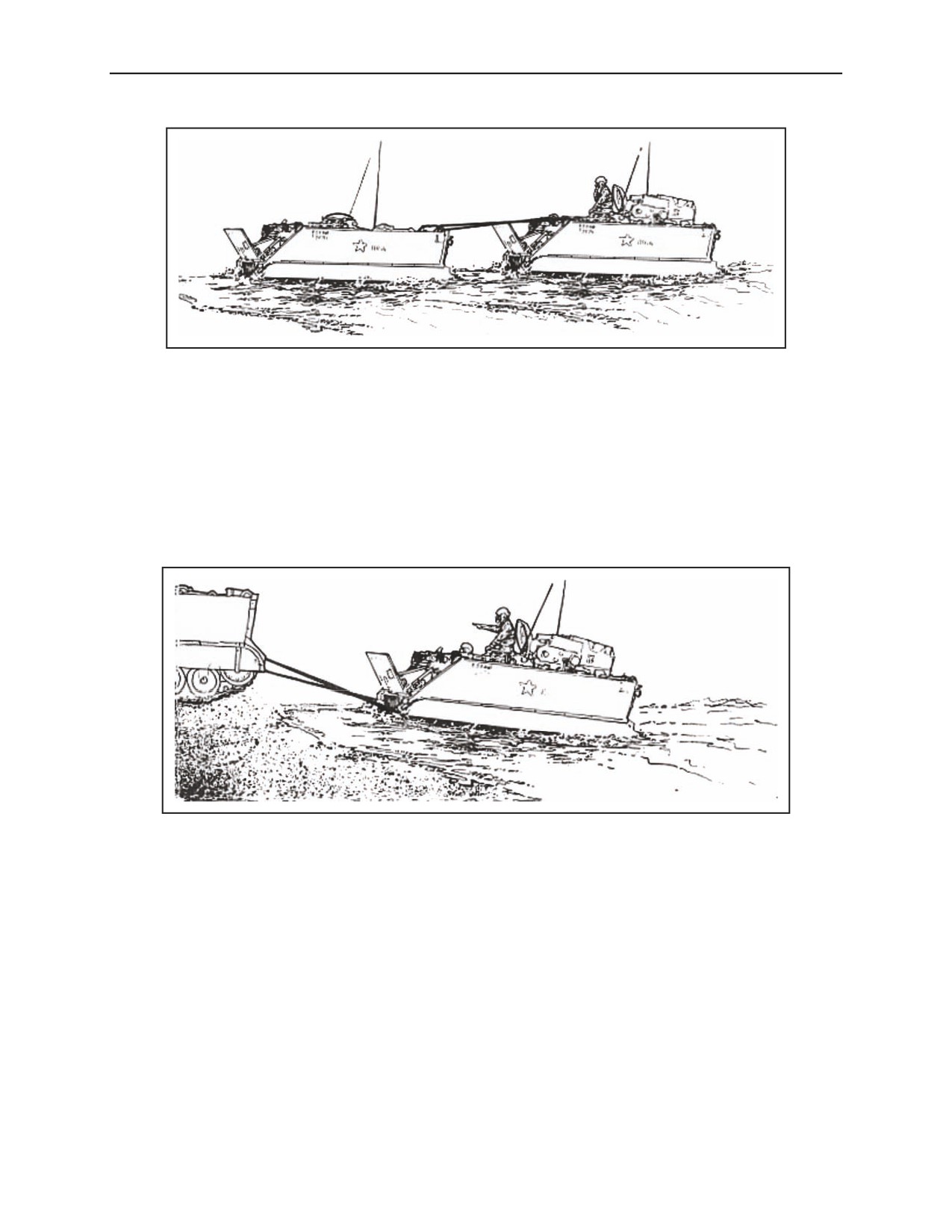
the tow lugs. This prevents the crew from having to work in the water (figure 4-30).
4-28
FM 4-30.31
19 September 2006
Recovery Operations
Figure 4-30. Marine recovery with tow hooks and ropes attached to lifting eyes
4-99. For example, if a like vehicle is used for this operation—
Attach its tow hooks to the lifting eyes before entering the water.
Cross the towropes and attach to the lifting eyes until the disabled vehicle is towed to shore. (Using
cables will prevent the quick disconnect of the towing vehicle if the towed vehicle begins to
submerge. The axe that must be with the rope is used to cut the rope in an emergency.)
Once the vehicle is close to the shore and the tow lugs are exposed, move the tow cables to the tow
lugs on both vehicles to pull the disabled vehicle ashore (figure 4-31).
Figure 4-31. Recovery to shore with tow hooks and cables attached to tow lugs
Submerged Vehicles
4-100. If a vehicle is flooded and submerged, determine the resistance on the river bottom in the same way
as on land. Consider the weight of the vehicle, the cargo, and the river bottom, which may be sand, gravel, or
mud. In addition, when pulling flooded vehicles from water to land, consider the weight of the water when
determining the resistance. Water weight is estimated to be equal to the vehicle’s weight. For example, a
tracked vehicle weighing 52,000 pounds sank. The vehicle is mired in the riverbed (mud) to fender depth.
The effort required to retrieve it is 156,000 pounds (2 x 52,000 - pound mire factor + 52,000 - pound water
weight).
4-101. The first problem in underwater recovery is locating the disabled vehicle in deep water. It may be
easier to use dragging devices to locate the vehicle. Divers can then determine the location of the vehicle’s
rigging and mark the location of the vehicle using lines and floats. Special purpose vehicles, such as wrecker
trucks and recovery vehicles, are readily adaptable to recovery operations on submerged vehicles. In most
19 September 2006
FM 4-30.31
4-29
Recovery Operations
situations, the winch cables of the recovery vehicles are long enough to allow winching operations from
water to land.
WATER OPERATIONS
4-102. Most vehicles currently in the inventory of the U.S. military have either a swim or fording
capability. Vehicles involved in fording, swimming operations sometimes become disabled from mechanical
or mobility malfunctions. A vehicle that has swim capability will usually remain afloat even if the main
engine fails. This is possible because amphibious vehicles are usually equipped with an auxiliary engine and
bilge pumps.
4-103. If a vehicle is completely disabled during water operations, it must have power restored using
BDAR or any other means available. Amphibious vehicles are at the mercy of the surf or river current when
power is lost. If left afloat without power, vehicles are at risk of sinking, causing further damage to the
vehicle and serious water contamination. If sinking does occur, all practicable efforts should be made to
avoid environmental contamination. Contamination over 1 gallon should be reported through the chain of
command. Should a vehicle become submerged (out of sight), qualified scuba personnel should be called to
assist in locating and rigging the vehicle for recovery.
Resistance in Water
4-104. Water resistance occurs when submerged vehicles are pulled from water to land. Water resistance is
estimated as additional resistance equal to the vehicle weight. Therefore, a vehicle weighing
25 tons
(including cargo) would require 50 tons of effort to winch it from the water. In the same situation, resistance
would increase if the vehicle went down in the surf and the sand was partially covering the vehicle. Vehicles
completely submerged, even for a short period, will usually be in a mired condition from sand, if in the
ocean, or mud, if in a river. If in doubt, rig for the greater resistance.
4-105. Whether the vehicle is upright or overturned will also be a factor in determining the total resistance.
Again, qualified divers should be used to locate and rig a vehicle for recovery. They will also be able to
recommend direction of recovery, depending on obstacles. Following are some examples of resistance
encountered when recovering floating-type vehicles:
Amphibious vehicle afloat, minimal - 1/64th of vehicle weight.
Amphibious vehicles completely submerged - equal to the weight of the vehicle. If the vehicle is
mired on a river or ocean bottom, calculate the additional resistance the same as for land mire.
Amphibious vehicles completely submerged and filled with water, the submerged vehicle weight is
the vehicle weight times two.
Fording-type vehicles that have become disabled must also be considered for weight of water but
only an additional 1/8th of the vehicle weight; that is, a 70-ton tank would be calculated to weigh
approximately 79 tons plus any mire encountered. The mire factor in this case is figured using 79
tons.
4-106. During underwater recovery operations, air bags can be placed inside the submerged vehicle and
inflated to provide buoyancy and decrease resistance. To employ air bags in this type of situation, qualified
divers are recommended. The air bags or 55-gallon drums need to be placed inside the vehicle in a location
where they will not escape the vehicle or cause additional damage. Once the air bags are in position, inflate to
the recommended capacity.
Methods Of Rigging
4-107. The rigging methods for underwater recovery are normally restricted to the manpower and/or lead
methods. Towing from water is recommended only if the disabled vehicle is located in very shallow water.
The method of rigging depends on the distance from the disabled vehicle; the type of disabled vehicle; the
type of recovery vehicle available; the equipment available (floats, air bags, tackle); and the condition of the
disabled vehicle.
4-30
FM 4-30.31
19 September 2006
Recovery Operations
Lead Method
4-108. The lead method of rigging is performed the same in water as on land. If in deep water, a boat or an
amphibious vehicle can transport tackle to the disabled vehicle. If the water is shallow, the tackle can be
manually carried to the disabled vehicle.
Manpower Method
4-109. The manpower method is much the same regardless of whether on water or land. However, flotation
devices can be attached to cable every few feet or to snatch blocks and other tackle to aid in getting the
recovery equipment to the disabled vehicle.
Note. Underwater recovery is usually limited to the manpower or lead methods.
19 September 2006
FM 4-30.31
4-31
Chapter 5
Field Expedient Recovery
An expedient measure is any method by which a task is done using on-hand materials.
For example, vehicles may be required to operate in remote areas where assistance in
recovery operations is not readily available. Under these conditions, the operator or crew
must attempt self-recovery by using methods similar to those described previously in this
manual.
RECOVERY EXPEDIENTS
PRY BAR
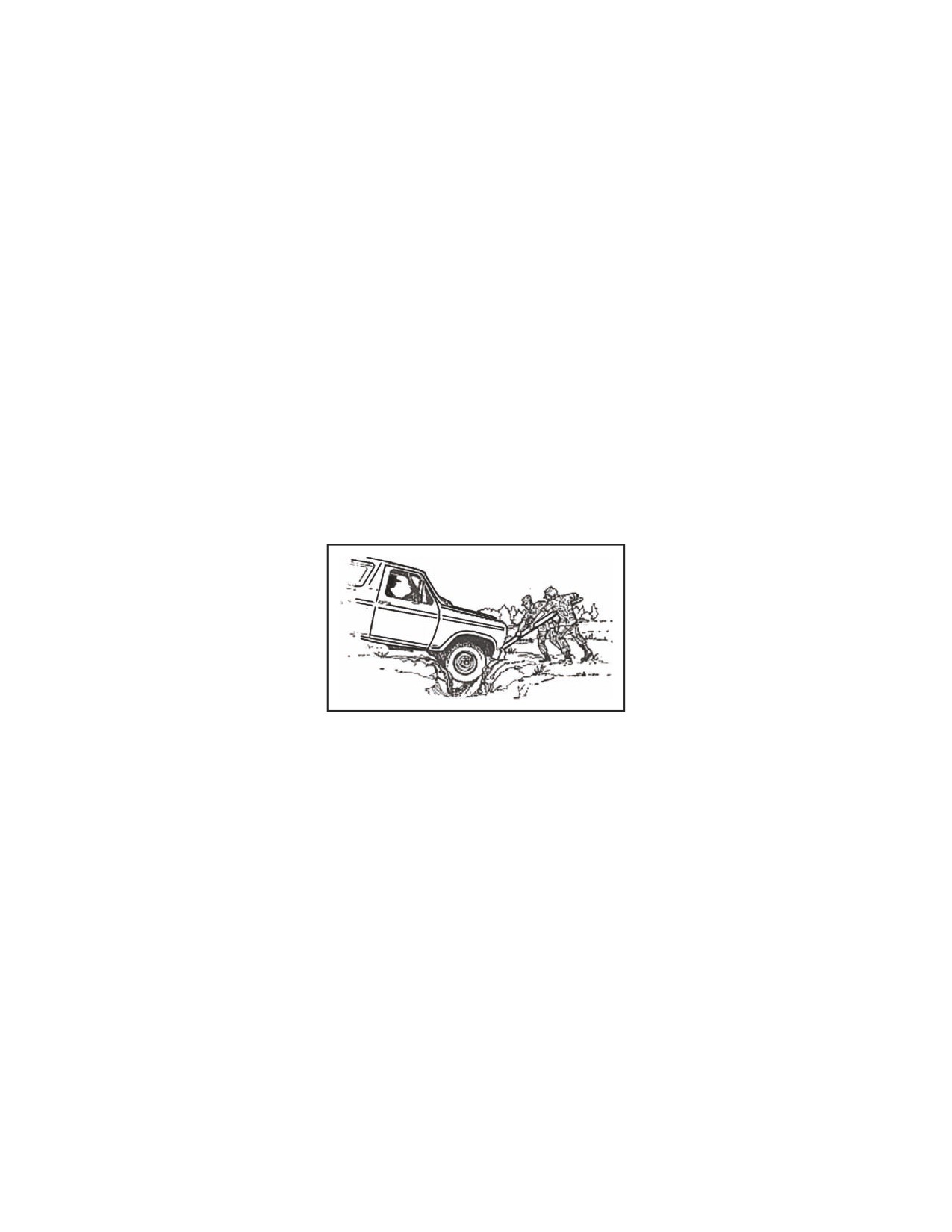
5-1. A pole can be used to pry a lightweight truck out of a ditch (figure 5-1) by—
Using the pole to lift the front end of the truck.
Applying power to the truck while in reverse gear.
Figure 5-1. Pry bar recovery
SUBSTITUTE JACKS TO REMOVE FRONT AND REAR WHEELS
5-2. To raise the front wheel of a cargo truck—
Locate a timber (approximately 5 feet long) to use as a pry bar.
Place the bottom of the timber in a shallow hole.
Secure the timber to the front bumper at an angle with a chain or rope.
Move the vehicle forward until the timber is in a vertical position and the wheel clears the ground.
(This “substitute jack” is shown in figure 5-2.)
Set the brakes and chock the wheels.
19 September 2006
FM 4-30.31
5-1