FM 4-30.31 Recovery and Battle Damage Assessment and Repair (September 2006) - page 1
*FM 4-30.31 (FM 9-43-2)/MCRP 4-11.4A (FMFRP 4-34)
Field Manual
Headquarters
Department of the Army
No. 4-30.31
United States Marine Corps
Marine Corps Reference Publication
Washington, DC, 19 September 2006
No. 4-11.4A
Recovery and Battle Damage
Assessment and Repair
Contents
Page
Preface
v
Chapter 1
Introduction to Recovery and Battle Damage Assessment and Repair
1-1
Recovery
1-1
Battle Damage Assessment and Repair
1-2
Chapter 2
Principles of Recovery
2-1
General
2-1
Fundamental Methods of Recovery
2-1
Chapter 3
Rigging
3-1
Rigging Fundamentals
3-1
Mechanical Advantage of Tackle
3-2
Anchors
3-9
Chapter 4
Recovery Operations
4-1
Safety Precautions
4-1
Recovery Procedures
4-5
Special Recovery Situations
4-19
Self-Recovery and Like-Vehicle Recovery
4-23
Chapter 5
Field Expedient Recovery
5-1
Recovery Expedients
5-1
Remobilizing Tracked Vehicles
5-4
Chapter 6
Battle Damage Assessment and Repair Procedures
6-1
BDAR Principles
6-1
Basic Rules of Assessment
6-2
BDA Guidelines
6-4
Distribution Restriction: Approved for public release; distribution is unlimited.
*This publication supersedes FM 9-43-2/FMFRP 4-34/TO 36-1-181, 3 October 1995.
i
Contents
Maintenance Procedures and BDAR
6-6
Special Operating Environments
6-9
BDAR in Joint Operations
6-10
BDAR Tools and Equipment
6-10
Expedient Repairs
6-18
Appendix A Battle Damage Assessment and Repair Kits
A-1
Appendix B Combined and Multinational Recovery and BDAR Operations
B-1
Appendix C Hand and Arm Signals
C-1
Appendix D Recovery Guidelines for Operators/Leaders
D-1
GLOSSARY
Glossary-1
REFERENCES
References-1
INDEX
Index-1
Figures
Figure
2-1. Block components
2-3
Figure
2-2. Block configurations
2-4
Figure
2-3. Block classifications
2-4
Figure
2-4. Grade resistance
2-5
Figure
2-5. Overturning resistance
2-6
Figure
2-6. Mire resistance
2-6
Figure
2-7. First-class lever
2-11
Figure
2-8. Second-class lever
2-11
Figure
2-9. Compound tackle system
2-12
Figure
3-1. Terminology of simple tackle
3-1
Figure
3-2. Fleet angle
3-2
Figure
3-3. Winch line(s) MA
3-3
Figure
3-4. 4-to-1 MA
3-5
Figure
3-5. Backup method of rigging
3-6
Figure
3-6. Lead method of rigging
3-6
Figure
3-7. Sling arrangement
3-7
Figure
3-8. Floating block attachment
3-8
Figure
3-9. Tow cable attachment
3-8
Figure
3-10. Tow bar method
3-9
Figure
3-11. 3-to-1 MA towing method
3-9
Figure
3-12. Anchor symbol
3-9
Figure
3-13. Log deadman
3-10
Figure
3-14. Combination picket holdfast
3-11
Figure
3-15. Sand parachute
3-12
Figure
3-16. Scotch anchor
3-12
ii
FM 4-30.31
19 September 2006
Contents
Figure
4-1. Unsafe areas during an angle pull
4-2
Figure
4-2. Hook positions
4-3
Figure
4-3. Chocking/blocking wheeled vehicles
4-4
Figure
4-4. Safety keys and shackle pins
4-5
Figure
4-5. Winching using a 2-to-1 MA and a change of direction block
4-7
Figure
4-6. Highway towing
4-8
Figure
4-7. Cross-country towing
4-8
Figure
4-8. Winching with two recovery vehicles
4-9
Figure
4-9. 2-to-1 MA
4-10
Figure
4-10. Tracked towing with holdback vehicle
4-11
Figure
4-11. Tracked towing
4-12
Figure
4-12. Chocking/blocking tracked vehicles
4-13
Figure
4-13. Classifying a grade
4-14
Figure
4-14. Surveying level
4-14
Figure
4-15. Eyesight and pace method
4-15
Figure
4-16. Fifth wheel towing device
4-16
Figure
4-17. Recovery with AKERR
4-19
Figure
4-18. Recovery of a nosed cargo truck
4-20
Figure
4-19. Recovery of overturned vehicles
4-20
Figure
4-20. A recovery vehicle winching a nosed tracked vehicle
4-23
Figure
4-21. Lifting operation
4-23
Figure
4-22. Recovering a mired cargo truck in tandem
4-24
Figure
4-23. Winching with like or heavier class wheeled vehicle
4-25
Figure
4-24. Self-recovery operation
4-25
Figure
4-25. Recovery of a mired tank using one like vehicle
4-26
Figure
4-26. Recovering a nosed tracked vehicle with like vehicles
4-26
Figure
4-27. Recovering an overturned tracked vehicle with like vehicles
4-27
Figure
4-28. Towing a disabled tracked vehicle
4-27
Figure
4-29. Towing with vehicles issued one tow cable
4-28
Figure
4-30. Marine recovery with tow hooks and ropes attached to lifting eyes
4-29
Figure
4-31. Recovery to shore with tow hooks and cables attached to tow lugs
4-29
Figure
5-1. Pry bar recovery
5-1
Figure
5-2. Substitute jack (front wheels)
5-2
Figure
5-3. Substitute jack (rear or tandem wheels)
5-2
Figure
5-4. Wheels used as winches
5-3
Figure
5-5. Girth hitch and using an A-frame in recovery operations
5-3
Figure
5-6. A log used to anchor tracks
5-4
Figure
5-7. Cables used to anchor tracks
5-5
Figure
5-8. Moving a vehicle with both tracks broken
5-5
Figure
5-9. Moving a vehicle onto a track
5-6
Figure
5-10. Installing a track
5-6
19 September 2006
FM 4-30.31
iii
Contents
Figure
6-1. BDA guidelines
6-5
Figure
6-2. Example of a DD Form 1577
6-7
Figure
6-3. Example of a DA Form 2404
6-8
Figure
6-4. Example of a ULLS-generated DA Form 5988-E
6-9
Figure
6-5. Hull and metal component repair materials
6-11
Figure
6-6. Fluid line repair items
6-11
Figure
6-7. Low-pressure line fitting repair
6-13
Figure
6-8. Low-pressure line repair
6-14
Figure
6-9. Electrical repair materials
6-15
Figure
6-10. Tire patch materials and tire plug kit
6-16
Figure
6-11. Environmental plugs, radiator sealant, and a link belt
6-16
Figure
6-12. Tube-type radiator core repair
6-17
Figure
6-13. Attaching tandem axle to frame
6-18
Figure
6-14. Defective differential
6-19
Figure
6-15. Suspending road wheel
6-20
Figure
6-16. Road wheel expedient technique
6-20
Figure
6-17. Short track expedient technique
6-21
Figure
6-18. Shear pin substitute
6-22
Figure A-1. Crew/operator BDAR kit
A-2
Figure A-2. Maintainer’s BDAR kit
A-2
Figure C-1. Signals for raise the hoist cable and lower the hoist cable
C-2
Figure C-2. Signals for raise the boom and lower the boom
C-2
Figure C-3. Signals for raise the spade and lower the spade
C-3
Figure C-4. Signals for inhaul the main winch cable and pay out the winch cable
C-3
Figure C-5. Signals for extend the boom and retract the boom
C-4
Figure C-6. Signals for swing the boom right or left and button up-unbutton
C-4
Figure C-7. Signal for stop
C-5
Tables
Table 2-1. Estimated winch variable capacity
2-9
Table 4-1. Prime movers for FWTD
4-17
Table 4-2. Vehicle weights
4-18
iv
FM 4-30.31
19 September 2006
Preface
This manual provides the authoritative doctrine guidance on using recovery and repair assets on the battlefield.
Practical methods of recovering or repairing equipment (disabled or immobilized) due to hazardous terrain,
mechanical failure, or a hostile action are also addressed.
Field manual (FM) 4-30.31 is directed toward both the leader and the technician. Tactically, it provides an
overview of how recovery and battle damage assessment and repair (BDAR) assets are employed on the
battlefield. Technically, it provides principles of resistance and mechanical applications to overcome them.
Equipment, rigging techniques, and expedient repairs are summarized as a refresher for recovery-trained
military personnel and as general guidance for others.
The procedures and doctrine in this manual apply to both wartime operations and military operations other than
war. Normally, BDAR should be used when and where standard maintenance practices are not practical
because of the mission, enemy, terrain and weather, troops and support available, time available, civil
considerations (METT-TC) or METT-T space and logistics (METT-TSL) for USMC. BDAR is not intended to
replace standard maintenance practices but rather to supplement them under certain conditions. Standard
maintenance procedures provide the best, most effective means of returning disabled equipment to the
operational commander—provided adequate time, parts, and tools are available.
High-risk battle damage repairs (involving possible danger to personnel or further damage to equipment) are
only permitted in emergencies, normally in a battlefield environment, and only when authorized by the unit
commander or his designated representative. The goal is to return a combat system to the battlefield in the least
amount of time, while minimizing danger to personnel and equipment.
BDAR techniques are not limited to simply restoring minimal functional combat capability. If full mission
capability can be restored expediently with a limited expenditure of time and assets, it should be restored. This
decision is based on METT-TC.
Some BDAR techniques, if applied, may result in shortened lifespan or further damage to components. The
commander must decide whether the risk of having one less piece of equipment outweighs the risk of applying
a potentially destructive field-expedient repair. Each technique provides appropriate warnings and cautions,
which list the system’s limitations caused by the action. Personnel must use ground guides and extreme caution
when operating recovery assets around or on an aircraft.
The proponent of this publication is the United States Training and Doctrine Command. Users of this manual
are encouraged to submit suggestions, changes, or comments to improve this manual. Comments with
justifications should be keyed to the specific page, paragraph, and line of text; prepared on Department of the
Army (DA), DA Form 2028 (Recommended Changes to Publications or Blank Forms); and forwarded to
Commander, U.S. Army Combined Arms Support Command, ATTN: ATCL-AO, Fort Lee, VA 23801-6000.
The provisions of this publication are subject to international Quadripartite Standardization Agreement 171.
This publication applies to the United States Marine Corps, Active Army, the Army National Guard/Army
National Guard of the United States, and the U.S. Army Reserve unless otherwise stated.
This is a joint service manual. Other Armed Forces should use their appropriate service forms in place of the
DA forms listed herein. All Department of Defense (DD) forms listed in this manual will be used by all Armed
Forces.
Basic issue items (BII) and additional authorization list (AAL) are Army terms. The Marine Corps’ equivalent
of these terms is on-vehicle equipment (OVE).
19 September 2006
FM 4-30.31
v
This page intentionally left blank.
Chapter 1
Introduction to Recovery and Battle Damage Assessment
and Repair
Recovery and battle damage assessment and repair (BDAR) are subsets of maintenance.
Both are the owning units’ responsibilities; both have a fundamental purpose of returning
combat assets to the battlefield as soon as possible. The purpose of recovery is to rapidly
remove disabled or mired equipment from the battlefield, while the purpose of BDAR is
to rapidly repair the equipment to continue the mission or allow self-recovery. Recovery
vehicles, both wheeled and tracked, should carry a minimum of one BDAR kit to assist in
recovery operations.
RECOVERY
1-1. Recovery is retrieving, that is, freeing immobile, inoperative, or abandoned equipment from its current
position and returning it to operation or to a maintenance site for repair. These actions typically involve towing,
lifting, or winching. Towing is usually limited to moving equipment to the nearest unit maintenance collection
point (UMCP). Recovery consists of—
Self-recovery: Actions require using only the equipment’s assets.
Like-recovery: Actions involve assistance from a second, like, or heavier class vehicle.
Dedicated-recovery: Actions require assistance from a vehicle specifically designed and dedicated to
recovery operations.
1-2. Unless specifically mentioned, recovery tactics, techniques, and procedures, and doctrine, organization,
training, materiel, leadership and education, personnel, and facilities considerations apply to both combat and
noncombat range of military operations (ROMO).
SELF-RECOVERY
1-3. Self-recovery starts at the location where the equipment becomes mired or disabled. The operator/crew
uses the BII and AAL or OVE items to perform self-recovery.
1-4. When the equipment has a mechanical failure, the operator/crew will use the equipment’s technical
manual (TM) to perform troubleshooting procedures with the tools available in the BII and AAL or OVE.
When self-recovery fails, the operator/crew can request assistance from available like vehicles.
Note. According to current Army doctrine, an equipment self-recovery winch can be used only to
recover the equipment on which it is mounted. Self-recovery winches should not be used to recover
other mired equipment. Self-recovery winches can be used to assist in a recovery effort by providing
stabilizing or holdback capabilities. Refer to the equipment operator’s manual for like-vehicle
recovery procedures and limitations. This does not apply to the United States Marine Corps
(USMC).
LIKE-RECOVERY
1-5. Like-vehicle recovery is used when self-vehicle recovery fails. The principle is to use another piece of
equipment—of the same weight class or heavier—to extract or tow the mired equipment by using tow bars,
19 September 2006
FM 4-30.31
1-1
Introduction to Recovery and Battle Damage Assessment and Repair
chains, tow cables, and/or allied kinetic energy recovery rope (AKERR). When self-recovery and like-recovery
are not practical or are unavailable, use dedicated recovery assets.
Note. AKERR is used to extract mired equipment; it is not designed as a towing device (see chapter
4 for more details on AKERR).
DEDICATED RECOVERY
1-6. Dedicated-recovery vehicles are used when self-recovery or like-vehicle recovery is not possible because
of the severity of the situation, safety considerations, or the inability to use like-vehicle assets employed in their
primary mission. Recovery managers and supervisors must ensure recovery vehicles are used only when
absolutely necessary. Dedicated recovery vehicles must be returned as quickly as possible to a central location
to support the unit. In addition to its recovery mission, this equipment is often used for the heavy lifting
required in maintenance operations. Recovery managers and supervisors must use all available resources
carefully to provide sustained support.
BATTLE DAMAGE ASSESSMENT AND REPAIR
1-7. BDAR is the procedure used to rapidly return disabled equipment to the operational commander by field-
expedient repair of components. BDAR restores the minimum essential combat capabilities necessary to
support a specific combat mission or to enable the equipment to self-recover. BDAR is accomplished by
bypassing components or safety devices, cannibalizing parts from like or lower priority equipment, fabricating
repair parts, jury-rigging, taking shortcuts to standard maintenance, and using substitute fluids, materials or
components. Depending on the repairs required and the amount of time available, repairs may or may not return
the vehicle to a fully mission-capable status. Operators/crew, maintenance teams (MTs), maintenance support
teams (MSTs), combat repair teams (CRTs), or recovery teams may perform BDAR.
PEACETIME BATTLE DAMAGE ASSESSMENT AND REPAIR APPLICATIONS AND TRAINING
1-8. Army Regulation (AR) 750-1, Army Maintenance Management Policy, paragraph 8-8, and USMC’s TM
4700-15/1 require unit commanders to conduct nondestructive peacetime BDAR training. Soldiers must
become familiar with the components in the BDAR kits that enable many repairs which otherwise would not be
possible. Each crewmember should know how to perform battle damage assessment (BDA) for assigned
equipment.
1-9. Maintenance standards are based on TMs and preventive maintenance checks and services. Low-risk,
nondestructive BDAR can be applied as training during a ROMO. The goal of training is to simulate combat
conditions as closely as possible. Commanders can direct the employment of BDAR for normal maintenance
failures to evaluate training or validate new procedures. Unit commanders should develop sustainment training
in which vehicle crews and field maintenance mechanics conduct BDAR and recovery operations. Skills
required to perform BDAR are found in individual and collective training tasks. Unit commanders should know
which military occupational specialties require knowledge of BDAR. Company and battalion Army Training
and Evaluation Program tasks, especially in combat service support units, require some knowledge of BDAR.
Military qualification standards also require ordnance officers of all grade levels to have awareness of BDAR
policy and doctrine incorporated in developmental training.
1-10. Peacetime BDAR training is necessary for Soldiers to perform these vital tasks on the battlefield. Recent
military operations have highlighted how U.S. forces can be deployed almost overnight into situations where
combat is expected and normal logistical arrangements are underdeveloped or unavailable.
1-11. Mechanics should master BDAR techniques very quickly since they have already received maintenance
and mechanical training. Vehicle crewmembers should be familiar with BDAR techniques for their specific
equipment. Cross training of mechanics is also necessary. Crewmembers and mechanics that can change a fan
belt or fuel filter can easily learn to perform BDAR for these same items. Experience in live-fire tests at
Aberdeen Proving Ground, MD, and Meppen, Germany, has shown that Soldiers can learn BDAR procedures
with minimal training. With the adoption of the U.S. Army Tank-automotive and Armaments Command ground
1-2
FM 4-30.31
19 September 2006
Introduction to Recovery and Battle Damage Assessment and Repair
equipment BDAR kits and easy-to-use instructions, the commander’s task of training will be much simpler. In
addition, the BDAR training techniques outlined in BDAR TMs are straightforward tasks with easy-to
comprehend illustrations.
1-12. Training BDAR does not require expensive or complicated training aids. During field exercises, low-risk
BDAR repairs can be applied to a unit’s equipment until standard maintenance procedures can be performed, if
required. Service members must use BDAR TMs and kits to become proficient in their use and assessment
procedures. If more sophisticated or difficult tasks are to be trained, unserviceable radiators, fuel tanks,
hydraulic lines, and condition code “H” equipment may be acquired through the local Defense Reutilization
and Marketing Office (DRMO) to support such training. Supervisors at all levels should use the low-, medium-,
and high-risk classifications when performing such training to minimize accidents and/or damage to equipment.
The unit commander decides whether to use low-risk peacetime BDAR during training.
1-13. To summarize, a unit BDAR training program should incorporate the following key training parameters:
Orient crews and maintainers on current BDAR doctrine and policy.
Train personnel in using BDAR TMs.
Train both crews and maintainers in using the crew and maintainer BDAR kits.
Periodically review BDAR training films.
Train personnel to identify BDAR repairs that can restore equipment to a mission-capable status
after a breakdown. This restoration includes the following:
Installing components from other equipment that can be modified to fit or interchange with
components to restore basic functional capability.
Fabricating parts, performing field-expedient repairs, and using substitute fuels, fluids, and
lubricants.
Bypassing or shortcutting components to restore operation of damaged mission essential
elements.
Allocating time in the unit-training schedule to practice BDAR and recovery.
Using local materials from the DRMO or other available equipment (such as vehicle hulls used
as range targets) for hull patching. This will be helpful in familiarizing personnel with BDAR
kits.
CHEMICAL, BIOLOGICAL, RADIOLOGICAL, AND NUCLEAR ENVIRONMENT
1-14. BDAR and recovery may be required in a chemically contaminated area or under adverse conditions with
severe limitations involving personnel, facilities, equipment, and materials. It may be necessary to perform
BDAR and recovery tasks while wearing protective gear. If the situation does not allow a recovery team to
recover the equipment, personnel should keep BDAR to a minimum, and then recover to a decontamination
area. Personnel can finish the BDAR or recovery task when decontamination procedures have been completed.
Note. For decontamination procedures, refer to FM 3-5 / Marine Corps Warfighting Publication
(MCWP) 3-37.3.
1-15. Recovery teams must be trained in chemical, biological, radiological, and nuclear (CBRN) defense
procedures, monitoring, and detection techniques. The teams should have additional decontamination
equipment, decontaminating agents, and protective clothing. Contaminated recovery equipment could spread an
agent along the evacuation route and pose a hazard to uncontaminated units and equipment. Commanders
should keep in mind that equipment used to recover contaminated equipment will also be contaminated.
Contaminated equipment should not be evacuated to uncontaminated areas until it is fully decontaminated. The
sooner the contamination is removed, the sooner mission-oriented protective posture (MOPP) levels can be
reduced, and restoration of combat power can begin.
19 September 2006
FM 4-30.31
1-3
Introduction to Recovery and Battle Damage Assessment and Repair
Depleted Uranium
1-16. A complete assessment must be performed before entering or attempting to repair any damage. Damaged
ammunition that has depleted uranium (DU) as a component material includes the risk of radioactivity.
1-17. DU is a dense, slightly radioactive metal used by the United States and other forces in munitions, armor,
and other applications. DU has properties similar to the more familiar heavy metals—such as lead and tungsten.
Under certain conditions, Soldiers could inhale or ingest DU “dust” or sustain injuries that could result in DU
intake exceeding U.S. safety standards. Following the precautions outlined in this section will help protect
personnel against DU and other heavy metal contaminants.
1-18. Personnel could receive a dose (or intake) of DU that exceeds U.S. safety standards if personnel are in,
on, or near an armored combat vehicle when it is struck by DU munitions, or when an M1A1/A2 heavy armor
tank is struck and breached by any munitions (DU or non-DU). When a DU round hits and penetrates armor
(specifically DU armor), fragments, oxides, and other particles are formed. DU can be taken into the body
through inhalation, ingestion, or wound contamination or as embedded fragments. (DU particles settle soon
after a munitions strike, reducing the risk of DU intake by inhalation.)
Depleted Uranium Preventative Measures
1-19. If any munitions penetrate the crew compartment of an armored vehicle, eventually the inside of the
vehicle will have to be decontaminated to remove all possible hazards. Such hazards could include DU
contamination, as well as contamination from burned plastics; petroleum, oils, and lubricants (POL) products;
and tungsten. When mission, enemy, terrain and weather, troops and support available-time available (METT
T) permit, decontaminate the crew compartment of the vehicle according to procedures in FM 3-5/MCWP 3
37.3. While decontaminating the crew compartment of a damaged vehicle, DU contamination could be re
suspended, as well as contamination from burned plastics, POL products, and tungsten that had previously
settled inside. While performing these actions, some type of respiratory protection (such as a dust mask,
protective mask, or other approved respirator) should be worn. Personnel should cover exposed skin. (An
increase in MOPP is not required.) After leaving the vehicle and before removing the protective mask,
personnel should dust off the uniform worn while performing the decontamination operations. They must
always observe standard field hygiene procedures, to include washing their hands and face.
1-20. Personnel must remain at least 50 meters from actively burning equipment involving DU. Personnel
should also treat all wounds involving DU in the same manner as any other wound and then notify medical
personnel. Additional training can be obtained by consulting the U.S. Chemical School Depleted Uranium
ENVIRONMENTAL PROTECTION
1-21. Fuel, oil, and other mechanical fluids spilled on the ground during BDAR operations can cause damage
to the environment. As with many BDAR considerations, the level of environmental protection will be mission-
dependent. During periods of heightened conflict, simple procedures can help to preserve and protect our
fragile environment. All practical efforts should be made to avoid environmental contamination. Spills of more
than one gallon should be reported through the chain of command to the unit’s logistical element, such as the
battalion S-4. Local policy or state laws may require spills of even lesser amounts to be reported.
TOOLS AND EQUIPMENT
1-22. The Training and Doctrine Command (TRADOC) Executive Agency for BDAR and Recovery has
designed special BDAR kits for ground equipment. These kits are use at the breakdown site to give the
operator/crew or maintenance personnel the capability to perform BDAR without access to special tools, parts,
and equipment. Maintainer kits are normally kept with the maintenance team, CRT, or the MST. A smaller,
lighter, less expensive crew-level kit is for the operator/crew to use aboard vehicles. BDAR is not limited to
what can be performed with these kits, but they do provide the crew and maintenance personnel with materiel
and tools on hand specifically designed for BDAR. Vehicle BII, organizational tools, and tools found with the
contact teams are to be used with the BDAR kits.
1-4
FM 4-30.31
19 September 2006
Introduction to Recovery and Battle Damage Assessment and Repair
1-23. Each unit is expected and encouraged to modify its kits to suit its special operational needs and
geographical environment. (See appendix A for additional information on BDAR kits.)
Note. Host-nation support (HNS) may be used to offset problems encountered by units deployed
overseas.
1-24. Units deployed overseas find themselves at the end of a long line of communications. In addition,
Soldiers operate in harsh terrain and less than desirable climatic conditions. Units may expend their basic load
of supplies quickly and may face a long wait for replenishment. Deployment flow may not allow delivery of
recovery assets until late in the deployment sequence. To offset these problems, HNS can be used to replenish
contents of BDAR kits and provide recovery assets, materiel, and equipment. Even in the most remote locations
of the world, HNS will usually have industrial resources and automotive repair capabilities and materiel
suitable for recovery. Procurement officers should be able to replenish BDAR kits and obtain other supplies
and tools required to perform BDAR and/or recovery operations. Higher headquarters publishes command
directives outlining HNS procurement procedures and sources of supply. BDAR kit contents are selected and
designed for replenishment from local sources. Commanders and maintenance personnel must be prepared to
avail themselves of this valuable resource.
1-25. Host or hostile nation service stations, industrial facilities, and automotive service and supply centers are
invaluable sources of supply. The responsible field procurement officer must closely supervise the use of local
sources. Prompt payment of purchases and payment for rental space and facilities is crucial to maintaining
friendly relations with the local population and retaining its support. If using abandoned HN or hostile nation
equipment suitable for BDAR and recovery operations, personnel should gain command approval prior to use.
Procurement offices should be involved in the HNS decision.
1-26. During operations in a HN, such as ROMO missions, U.S. forces will comply with all applicable
regulations, including status-of-forces agreements, treaties, and international agreements. HN laws governing
spills, such as fuel and oil, are important to BDAR. If HN laws do not exist, U.S. forces will follow the laws of
the United States. (See appendix B for information on combined and multinational BDAR operations.)
19 September 2006
FM 4-30.31
1-5
This page intentionally left blank.
Chapter 2
Principles of Recovery
Recovery assets are normally centrally managed. This chapter provides direction, permits
better management, and promotes quicker responses to task organization, workload, and
the tactical situation. In combat units, the recovery manager is designated at battalion
level and is normally the battalion maintenance officer (BMO) [Army] or battalion motor
transport officer
(MTO)
[USMC]. Some combat arms battalions
(for example,
nondivisional, defense battalions, engineer battalions, and so forth.) have company-sized
units that operate without a BMO or battalion maintenance team. In these types of units,
the senior maintenance supervisor manages these assets.
GENERAL
2-1. Recovery is performed to—
Retrieve damaged or mired equipment for repair and return to use.
Retrieve abandoned equipment for further use.
Prevent enemy capture of equipment.
2-2. The type and quantity of supported equipment, as well as the tactical situation, may require tailoring of
recovery assets. Only the minimum number of required recovery assets should be deployed for each mission.
The BMO or other designated individual coordinates recovery operations with overall repair efforts to support
the commander’s priorities and tactical situation most effectively. The following general principles apply to
recovery management:
Using units are responsible for their own equipment. The crew of using units should first attempt
self-recovery efforts, followed by unit-supported like-vehicle recovery. If necessary, limited backup
support is available from the next higher level of maintenance.
Using units are responsible for security during the entire recovery mission.
Recovery operations are coordinated with the maintenance effort.
Recovery vehicles of the correct weight class must be used to ensure safety. Recovery vehicle
winches and/or towing capabilities must be greater than those of the disabled or mired vehicle.
Recovery vehicles should not return equipment farther than the UMCP. This keeps recovery assets
forward.
Recovery teams must use CBRN contamination avoidance principles to avoid contamination and
minimize targeting.
Recovery teams must take all practical steps to avoid spills and other environmental contamination.
FUNDAMENTAL METHODS OF RECOVERY
2-3. A Soldier must answer the following questions when attempting a recovery task:
What must be done?
Which equipment must be used?
Which techniques must be used?
19 September 2006
FM 4-30.31
2-1
Principles of Recovery
WINCHING, LIFTING, TOWING, AND EXPEDIENTS
2-4. This chapter will answer these questions, beginning with a summary of the four methods of recovery. It
will provide details about recovery tackle and how to use and maintain it. The four methods of recovery
include—
Winching, using winches on special purpose or cargo vehicles. (According to current Army doctrine,
an equipment self-recovery winch can be used only to recover the equipment on which it is mounted.
Self-recovery winches cannot be used to recover other mired equipment.)
Lifting, using the lifting capabilities of special purpose vehicles.
Towing, using the towing capabilities of similar or special purpose vehicles.
Expedients, used when other methods are not adaptable to the situation or when appropriate like
vehicles or dedicated recovery vehicles are not available.
RECOVERY SAFETY
Note. Heed all safety warnings found in the appropriate operator’s manuals for all vehicles
performing recovery operations in order to prevent injury or damage to equipment. Ground chocks
and spades have their limitations. If overloaded, the recovery vehicle can slide out of control.
Excessive speed for conditions is a major contributor for towing accidents. Refer to the equipment
operator's manual for safe towing speeds for various terrain conditions. Place safety first during
recovery operations.
2-5. Recovery can be inherently dangerous unless safety is continually practiced. Each of the recovery
functions (winching, lifting, towing, and expedients) must be performed with safety as the primary concern.
Always follow the safety warnings found within this manual and in the operator’s manual for both the recovery
vehicle and the recovered vehicle or equipment. Maintaining an awareness of the following key factors and
actions can help prevent damage to equipment and injury to personnel.
Be aware that winch cables can break and backlash into personnel.
Exercise extreme caution when towing.
Check the operator’s manual for guidance and to validate repair procedures.
Establish minimum safe distances and clear all unnecessary personnel from the recovery site.
2-6. Know recovery equipment capabilities and limitations. Winches have tremendous power, and, if not
properly secured to the disabled vehicle, winches can rip off tow lugs, bumpers, and other attachments that
often become projectiles, injuring personnel and/or damaging equipment. Always follow the safe rigging
guidelines in this manual. Keep all but the minimum required personnel away from the recovery area. Each
recovery crewmember must know where other crewmembers are located at all times.
2-7. Towed tracked vehicles and some wheeled vehicles will not have any braking effect. The recovery
vehicle must provide braking for the towed vehicle as well as itself.
Note. Some tracked vehicles may also require a holdback vehicle during towing operations.
2-8. Wrecker lift-towing operations also require extreme caution. The towed vehicle performs abnormally
because the vehicle weight is not distributed on all wheels, and the wrecker steering control is degraded
because of reduced weight on the front wheels.
2-9. Other recovery lifting actions also require extreme caution to prevent injury to personnel and/or damage
to equipment. Suspended loads can drop or slide. If the crane has a remote control, use it to keep away from the
action. Using the remote control will allow the operator to observe equipment movement and recovery actions
and to locate other assisting crewmembers that are not visible from the fixed control station. Never exceed the
limitations of the crane or its outriggers.
2-2
FM 4-30.31
19 September 2006
Principles of Recovery
RECOVERY EQUIPMENT
Wire Rope
2-10. Refer to FM 5-125 for detailed information about wire ropes. This FM provides procedures for the care,
use, and maintenance of wire ropes.
CAUTION
Always wear leather gloves when handling wire rope. Small frays in wire strands
can cause severe lacerations to hands. Never slide the wire rope through hands,
even when wearing leather gloves. Use the hand-over-hand method when
inspecting or handling wire ropes. Kinked, frayed, or unlayed wire ropes are
unserviceable and will not be used.
Blocks
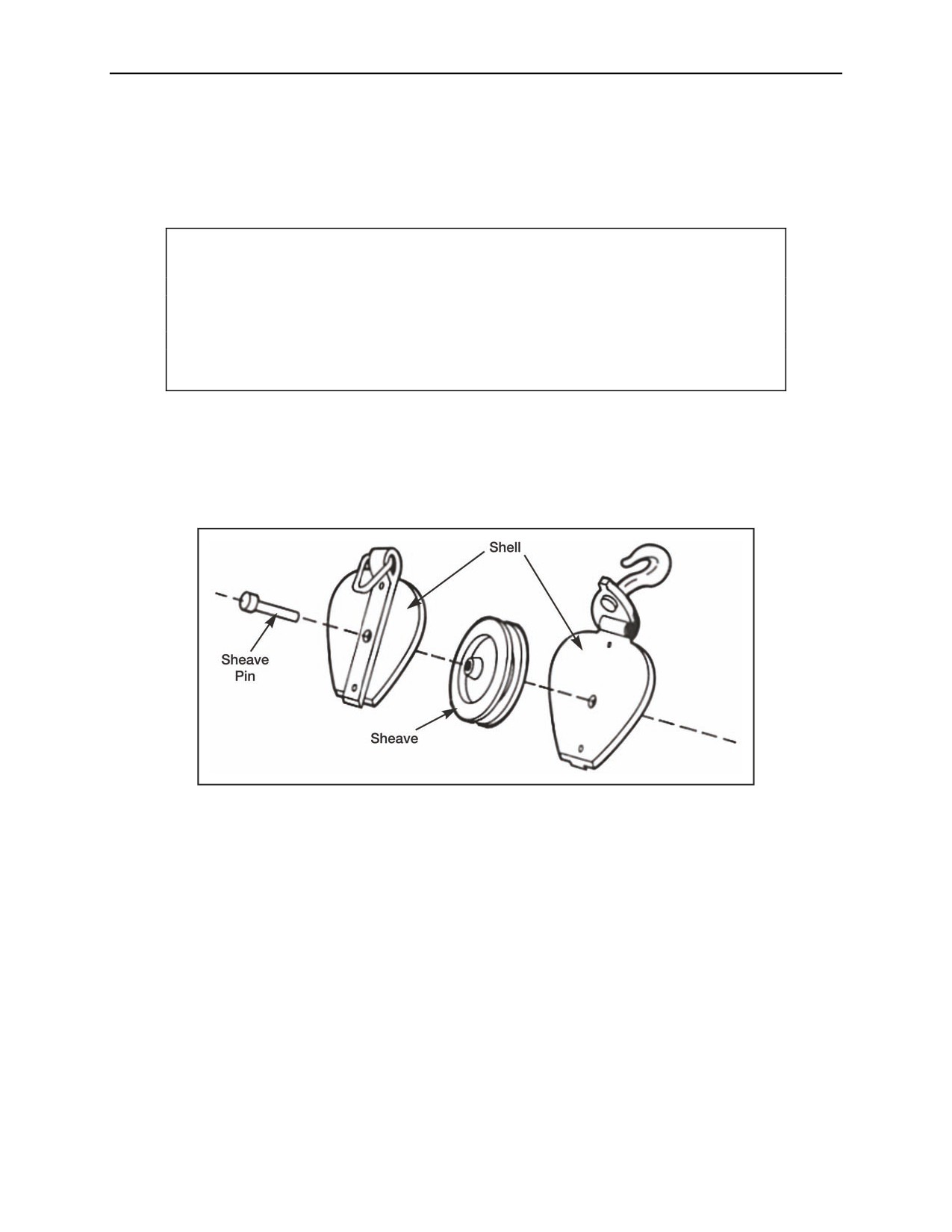
2-11. Blocks consist of a shell or frame with one or more grooved wheels called sheaves (figure 2-1). The
military uses two basic constructions—snatch and conventional blocks.
Figure 2-1. Block components
Snatch Block
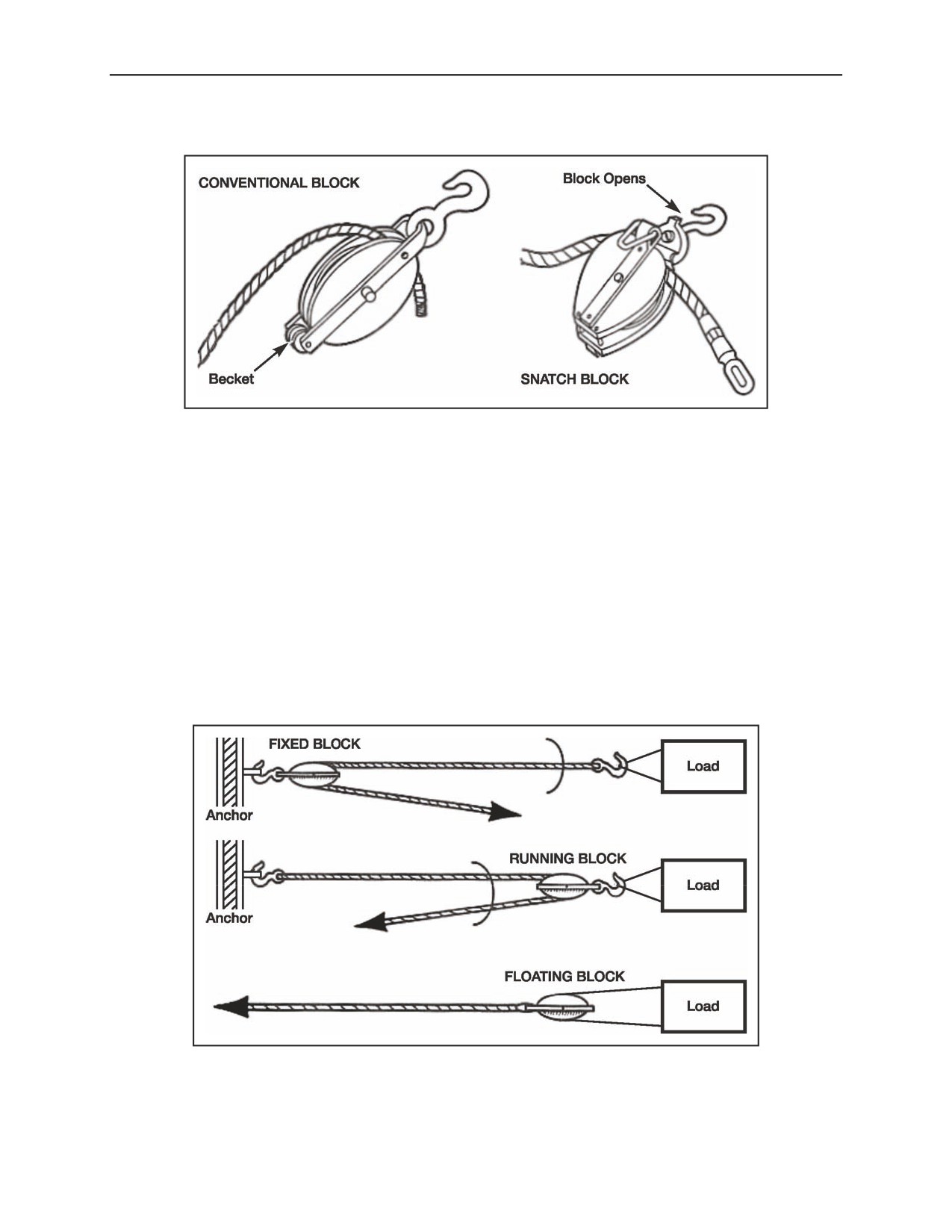
2-12. A snatch block (figure 2-2) is used when the block will not be a permanent part of a tackle system
(ropes, blocks, and pulleys used to raise and lower loads and/or apply tension); it can also be used as required
based on the situation. A snatch block is constructed so the shell can be opened to admit a cable without
reeving. Winch cables have attachment-like hooks or sockets on their free ends and can be reeved through a
block.
19 September 2006
FM 4-30.31
2-3
Principles of Recovery
Figure 2-2. Block configurations
Conventional Block
2-13. A conventional block (figure 2-2) is generally used where it will remain as part of a rigging system. On
recovery equipment, it is used with rope. To form a tackle with conventional blocks, lay out the blocks, and
thread or reeve the wire rope through the blocks.
2-14. Blocks have the following applications (figure 2-3):
A fixed block is a block attached to a stationary anchor. The sheave of a fixed block permits the rope
to change direction. A fixed block provides only a mechanical advantage during self-recovery
operations.
A running block is an attached block that moves the load.
A floating block is a block used with a tow cable, allowing the cable when pulled to align with the
power source. The pull can be distributed equally to both tow hooks of the disabled vehicle and does
not produce a mechanical advantage.
Figure 2-3. Block classifications
2-4
FM 4-30.31
19 September 2006
Principles of Recovery
Chains
2-15. Refer to FM 5-125, Rigging Techniques, Procedures, and Applications for detailed information about
chains. This FM also provides procedures for the care, use, and maintenance of chains.
Hooks
2-16. Refer to FM 5-125 for detailed information about hooks. This FM also provides procedures for the care,
use, and maintenance of hooks.
Allied Kinetic Energy Recovery Rope
2-17. The AKERR is a multi-strand, woven, nylon rope used for like-vehicle recovery. The rope is connected
between the mired vehicle and the towing vehicle. The towing vehicle accelerates, stretching the rope, which
creates potential energy. When the rope is fully stretched, it transfers the energy to the mired vehicle, giving it a
strong, sudden pull. Refer to TM 9-4030-200-10 for use and care of the AKERR.
RESISTANCE
2-18. Resistance is defined as opposition to movement. In recovery operations, resistance is caused most often
by terrain features; such as mud, sand, water, or the recovery tackle itself. This section will focus on vehicles
disabled by terrain conditions.
2-19. Two factors that can be applied during recovery operations to help reduce resistance are direction of
travel of recovery and power applied to tracks.
(Applied reduction factors discussed in the following
paragraphs do not apply to wheeled vehicles.) Once load resistance is determined, apply effort to affect
recovery.
Types of Resistance
2-20. Five types of resistance may occur when recovering vehicles are disabled by terrain conditions. They are
grade, overturning, mire, water, and tackle.
Grade Resistance
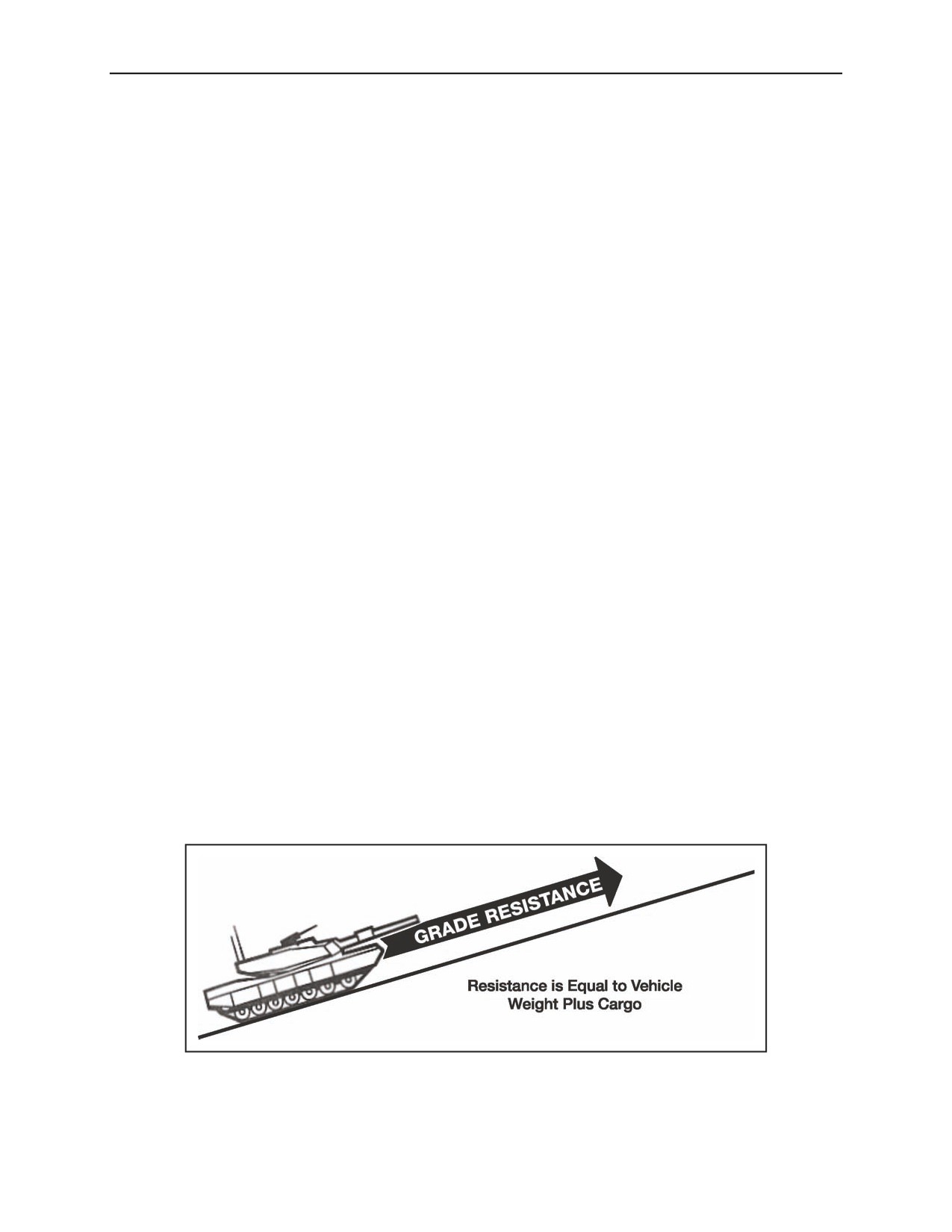
2-21. Grade resistance occurs when a vehicle moves up a slope (figure 2-4). Grade resistance (including nosed-
in vehicles) is estimated as equal to the weight of the vehicle plus cargo. Even though actual grade resistance
may be less than the weight of the vehicle, the most resistance encountered on a grade is the weight of the
disabled vehicle plus cargo.
Figure 2-4. Grade resistance
19 September 2006
FM 4-30.31
2-5
Principles of Recovery
Overturning Resistance
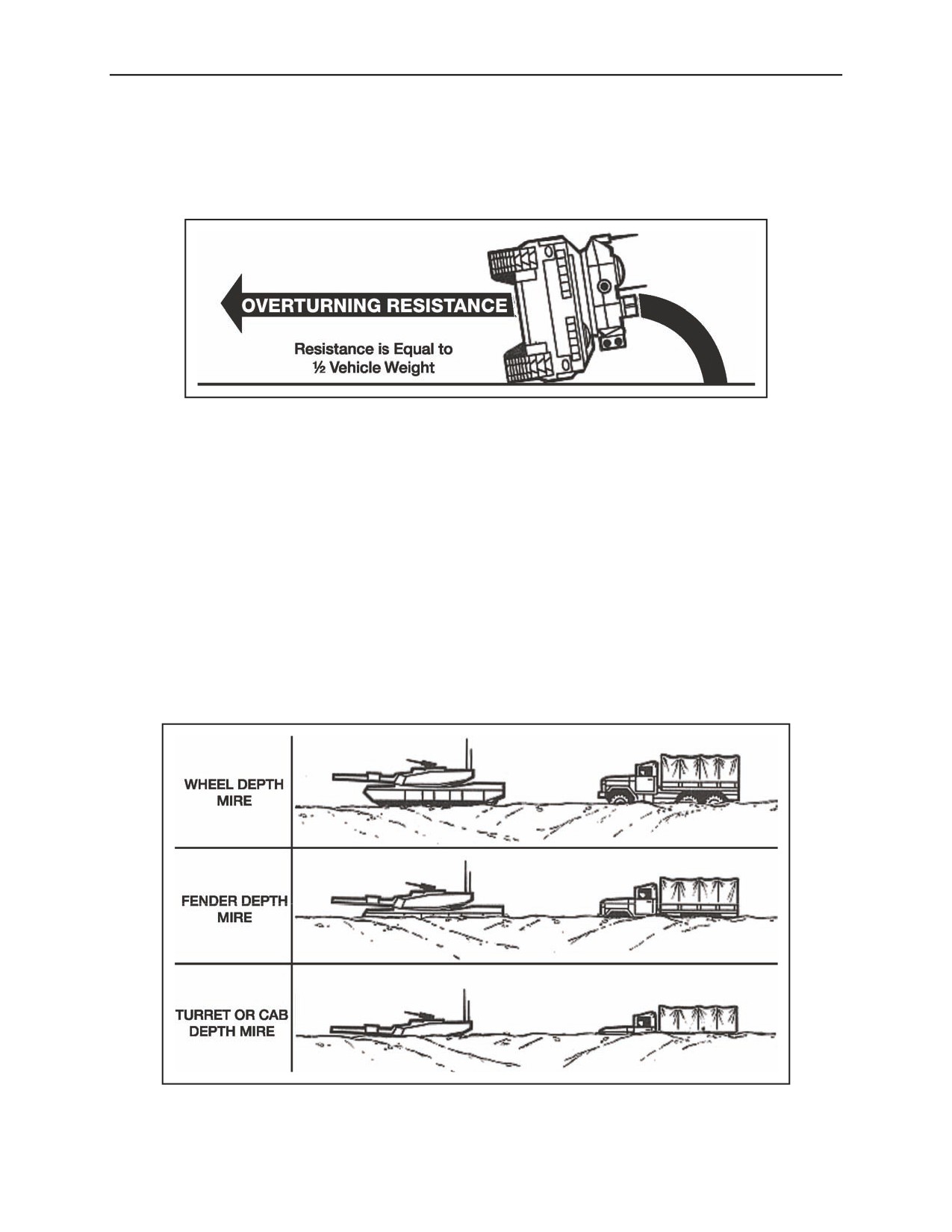
2-22. Overturning resistance is that weight of the vehicle that acts against the force exerted to bring it back on
its wheels or tracks (figure 2-5). This force is approximately one-half of the vehicle’s weight.
Figure 2-5. Overturning resistance
Mire Resistance
2-23. Mire resistance is created when mud, snow, or sand becomes impacted around the wheels, tracks, axle,
gear housing, or hull of the vehicle. Mire resistance is described as wheel/track, fender, or turret/cab depth
(figure 2-6).
2-24. Wheel depth mires occur when wheeled vehicles are mired up to the hub but not over the center. Tracked
vehicles are mired up to the road wheels but not over the top. Estimate wheel-depth resistance as equal to the
weight of the vehicle plus cargo.
2-25. Fender depth mires occur when wheeled vehicles are mired over the top of the hub but not over the
fender. Tracked vehicles are mired over the top of the road wheels but not over the fender. Estimate fender
depth mire resistance as twice the total weight of the vehicle plus cargo.
2-26. Turret or cab depth mires occur when vehicles are mired over the top of the fender. Estimate turret/cab
depth mire resistance as three times the total vehicle weight plus cargo.
Figure 2-6. Mire resistance
2-6
FM 4-30.31
19 September 2006
Principles of Recovery
Water Resistance
2-27. Water resistance occurs when submerged vehicles are pulled from water to land. Estimate the amount of
resistance met in the same way as for land recovery. In some instances, the resistance to overcome is less than
the rolling resistance of the same vehicle on land. (See chapter 4, paragraph 4-112, for more information.)
Tackle Resistance
2-28. Tackle resistance is that part of total resistance added to the recovery by friction in tackle. Tackle
resistance is friction created by a sheave rotating in its pin, the rope flexing around the sheave, or the rope
scuffing in the groove of the sheave, causing a loss in energy as the rope passes around the sheave. This loss is
resistance and must be overcome before the load resistance can be overcome. Each sheave in the rigging will
create resistance. To determine tackle resistance, multiply 10 percent (.10) of the load resistance by the number
of sheaves (not blocks) in the rigging. For example, in the following calculations, the load resistance is 40 tons
(80,000 pounds) and two sheaves are used.
Load resistance (vehicle + cargo)
= 80,000 lb
Number of sheaves
= 2
Tackle resistance
=.10 x 80,000 lb x 2 = 16,000 lb
CAUTION
Friction in tackle causes a loss in energy that must be overcome before the
load resistance can be moved.
TOTAL LOAD RESISTANCE
2-29. Because tackle resistance must be overcome before the load resistance can be moved, the load and tackle
resistance are added. This resistance is referred to as total resistance (the total amount of resistance the available
effort must overcome). For example, in the previous example of tackle resistance, the load resistance of 80,000
pounds plus the tackle resistance of 16,000 pounds equals a total resistance of 96,000 pounds.
Load resistance (vehicle + cargo)
= 80,000 lb
Tackle resistance
= 16,000 lb
Total load resistance
= 96,000 lb
RESISTANCE REDUCING FACTORS
2-30. Situation and mechanical resistance affect the load resistance of mired vehicles. Resistance reducing
factors do not apply to wheeled vehicles; they are only to be used for tracked vehicles.
Direction of Travel for Recovery
2-31. When a mired vehicle is recovered in the opposite direction of its travel, the tracks pass through ruts
made by the vehicle when going into the mire. This reduces estimated resistance approximately 10 percent and
is the preferred method of recovery. For example, a tank weighing 106,000 pounds is mired at wheel depth and
can be recovered in the opposite direction of travel. Estimate resistance as 106,000 pounds and subtract 10
percent for recovery in the opposite direction of travel. The load resistance equals 95,400 pounds.
19 September 2006
FM 4-30.31
2-7
Principles of Recovery
Vehicle weight
106,000 lb
Reduction factor
x .10
Estimated reduction
10,600 lb
106,000 lb
- 10,600 lb
Estimated load resistance
95,400 lb
Power Applied to Tracks
2-32. When power is applied to the tracks of a mired vehicle, the movement of the tracks helps to break the
suction of mud against the belly of the vehicle. This reduces estimated resistance by approximately 40 percent.
Before computing the 40 percent reduction, make sure the mire is not deep enough to prevent the operation of
the vehicle’s engine; that is, check the air intake and exhaust. For example, a tank weighing 106,000 pounds is
mired at fender depth. It cannot be recovered in the opposite direction of its original travel, but it can apply
power to its tracks. Estimated resistance (twice the weight of the vehicle) is 212,000 pounds minus 40 percent.
The load resistance equals 127,200 pounds.
Vehicle weight
106,000 lb
Mired factor (fender depth)
x 2
Resistance
212,000 lb
Reduction factor (40% for power to
x .40
track)
Estimated reduction
84,800 lb
212,000 lb
- 84,800 lb
Estimated load resistance
127,200 lb
2-33. In another example, a tank weighing 106,000 pounds is mired at fender depth. If the tank can be
recovered in the opposite direction of its original travel, and power can be applied to its tracks, the estimated
resistance (twice the weight of the vehicle) is 212,000 pounds, less 50 percent (10 percent for opposite direction
plus 40 percent for applying power to its tracks). The estimated load resistance equals 106,000 pounds.
Vehicle weight
106,000 lb
Mired factor
x 2
Resistance
212,000 lb
*Reduction factor
x .50
Estimated reduction
106,000 lb load
212,000 lb
-106,000 lb
2-8
FM 4-30.31
19 September 2006
Principles of Recovery
Estimated load resistance
106,000 lb
*40 percent for applying power to track plus 10 percent recovering
opposite direction to travel (50 percent)
Note. Reduction factors do not apply to wheeled vehicles due to lack of traction. However, power
applied to wheels may reduce resistance. Reduction factors are only a guide and apply more to wheel
depth than to either fender or turret depth mire situations.
SOURCE OF EFFORT
2-34. Like vehicles are the quickest, most available sources of recovery effort. On dry, level hardstand in first
gear or reverse, the average vehicle exerts a force equal to its own weight. Terrain conditions affect the towing
capability of a vehicle. These conditions may require two or more vehicles to exert the same force that one
vehicle normally could under ideal conditions. A winch is used when the situation does not permit recovery by
a like vehicle. (Most often, the approach to the disabled vehicle does not provide good traction.) A winch is a
more positive source of effort since its towing capability does not depend on terrain conditions.
WINCH VARIABLE CAPACITIES
2-35. A winch exerts its greatest force when it pulls by the first layer or the layer next to the bare winch drum.
As each successive layer of cable is wound onto the winch drum, the diameter increases and winch capacity
decreases.
2-36. An exception is the constant pull winch found on the M88A2—where the force of pull remains constant
regardless of the cable layer. See table 2-1 for a listing of estimated winch variable capacities. Refer to the
equipment’s operator’s manual for specified capabilities.
Table 2-1. Estimated winch variable capacity
Winch
Cable
Cable on Drum Capacity
Type
Layer
(Feet)
(Tons)
5 ton
1
0 - 39
5.000
2
40 - 85
4.225
3
86 - 138
3.670
4
139 - 199
3.230
5
200 - 266
2.890
10 ton
1
0 - 41
10.000
2
42 - 91
8.450
3
92 - 148
7.250
4
149 - 213
6.400
5
214 - 287
5.700
22.5 ton
1
0 - 42
22.500
2
43 - 93
18.850
3
94 - 153
16.250
19 September 2006
FM 4-30.31
2-9
Principles of Recovery
4
154 - 220
14.250
5
221 - 296
12.650
6
297 - 380
11.400
30 ton
1
0 - 55
30.000
2
56 - 128
26.000
3
129 - 208
23.000
4
209 - 300
20.000
45 ton
1
0 - 41
45.000
2
42 - 91
38.000
3
92 - 149
32.500
4
150 - 200
28.500
Note. The 70-ton recovery vehicle has a constant capacity of 70
tons anywhere on the cable.
OVERCOMING RESISTANCE
2-37. Applying effort to overcome resistance has always been a challenge. Modern machinery makes this
evident. Energy released by burning small amounts of fuel in a modern engine provides the effort to move
vehicles weighing thousands of pounds. The vehicle engine, with various mechanical devices, can move the
vehicle from a standstill through a wide range of speeds.
Mechanical Advantage
2-38. Mechanical advantage (MA) is a small amount of force applied over a long distance to move a heavy
load a short distance. MA is needed whenever the load resistance is greater than the capacity of the available
effort (AE).
2-39. To determine the amount of MA necessary in a recovery operation, divide the load resistance (LR) by the
AE and round any fraction to the next whole number. Rounding is required because only whole numbers can be
rigged.
LR = 106,000 lb (load)
= 1.1777
AE = 90,000 lb (winch)
Round the fraction off to the next whole number = 2
Required MA
= 2:1
Leverage Principle
2-40. Using levers is the most basic means to overcome resistance. A wrench handle and the gears of a truck
overcome resistance by applying the principles of leverage. The simplest form of a lever is a rigid bar free to
turn on a fixed pivot called a fulcrum. When effort is exerted on one end of the bar, the bar rotates around the
fulcrum. MA is increased by extending the distance between the point where effort is applied and the fulcrum.
Lever Classification
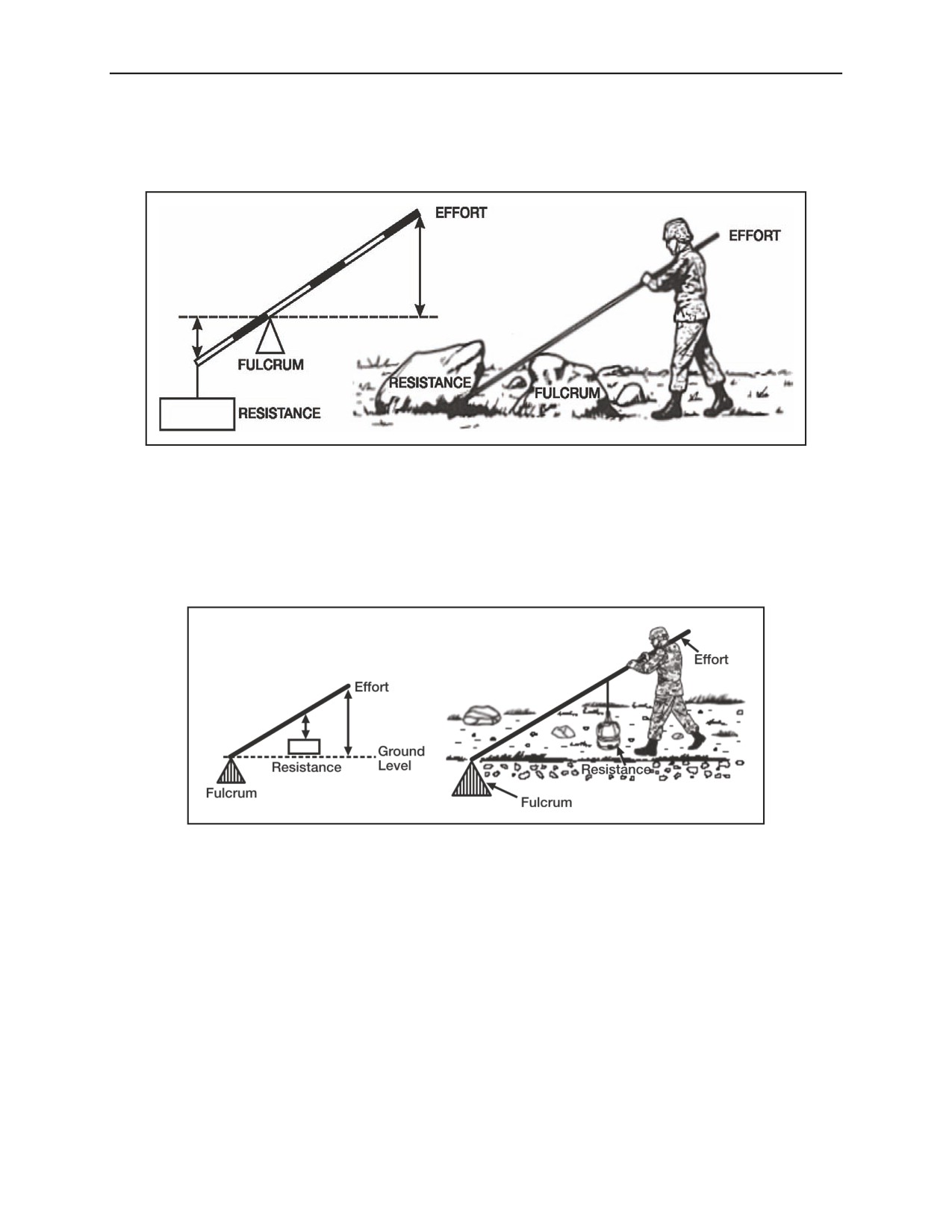
2-41. The location of the fulcrum with relation to effort and resistance determines if it is a first-class or second-
class lever.
2-10
FM 4-30.31
19 September 2006
Principles of Recovery
First-Class Lever
2-42. The fulcrum is located between the effort and the resistance (figure 2-7). A crowbar is a good example of
a first-class lever.
Figure 2-7. First-class lever
Second-Class Lever
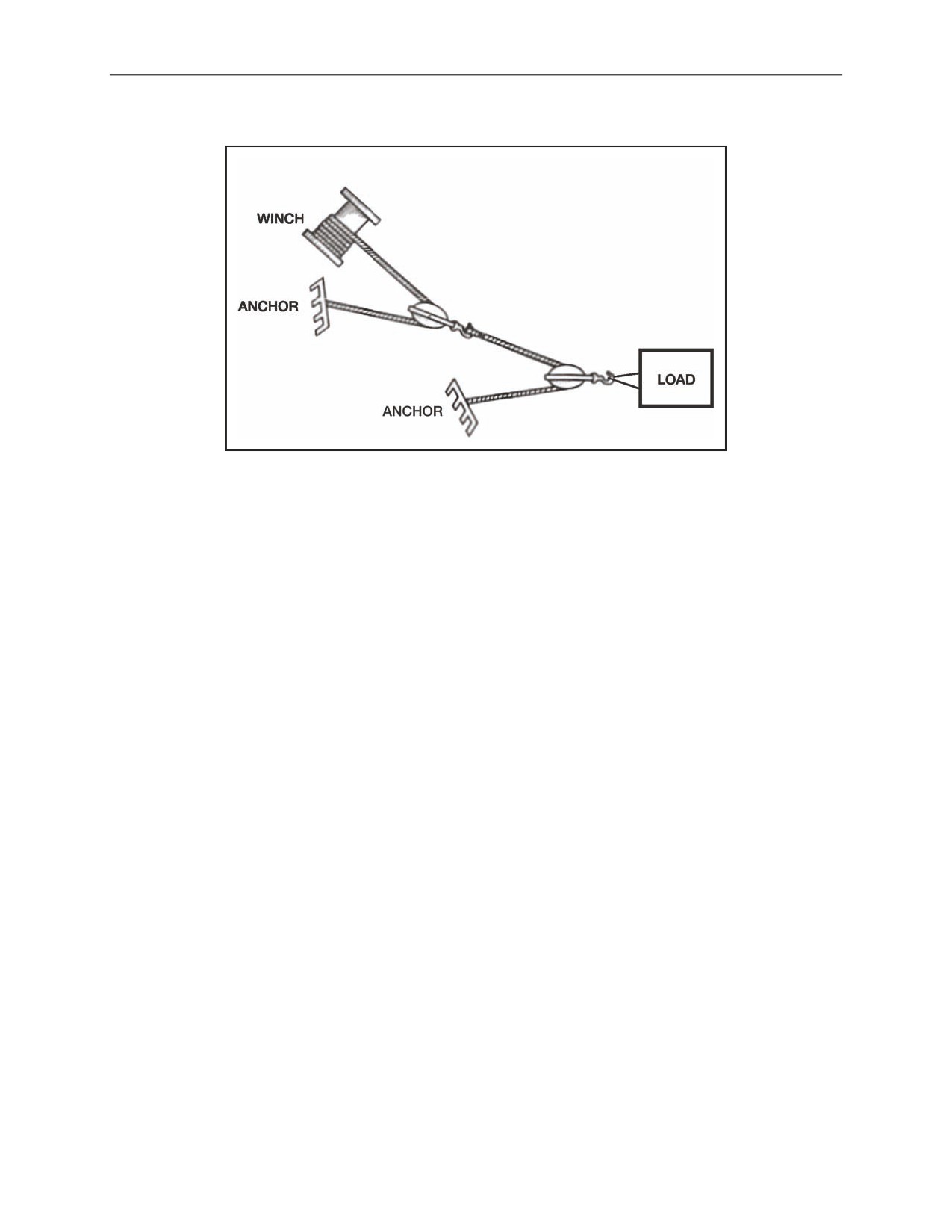
2-43. The point of resistance is between the fulcrum and the effort (figure 2-8). A wheelbarrow is a good
example of a second-class lever.
Figure 2-8. Second-class lever
Tackle Systems
2-44. Tackle is a combination of cables and blocks used to gain an MA or to change the direction of pull and
are classified as either simple or compound.
Simple Tackle System
2-45. Simple tackle is one cable with one or more blocks.
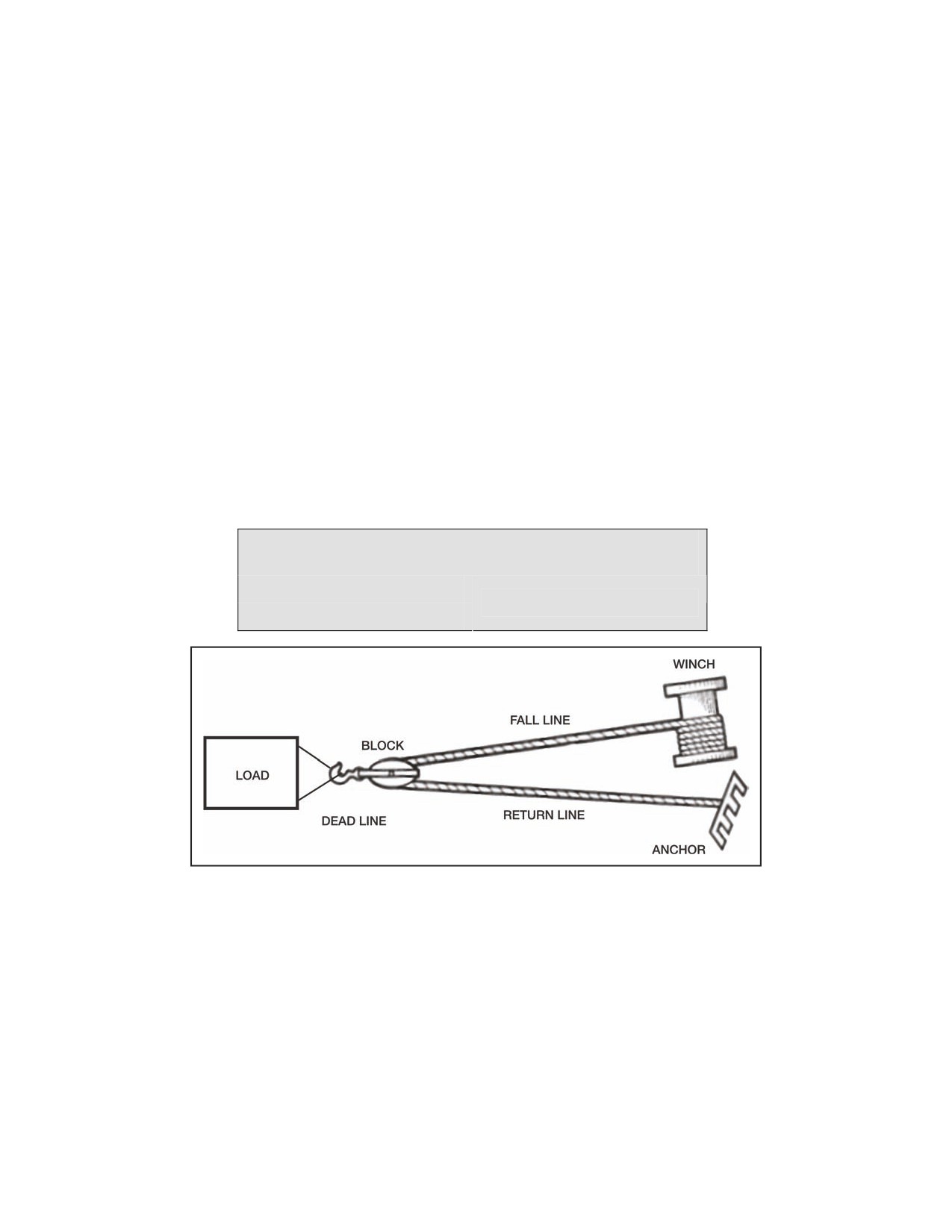
Compound Tackle System
2-46. Compound tackle is a series of two or more simple tackles (figure 2-9). The output of one simple tackle
is used as the effort for the other. Because a winch has only one cable, simple tackle will be used during most
recovery operations.
19 September 2006
FM 4-30.31
2-11
Principles of Recovery
Figure 2-9. Compound tackle system
2-12
FM 4-30.31
19 September 2006
Chapter 3
Rigging
Rigging is applying wire rope in various tackle combinations to raise or move loads.
Rigging involves installing the necessary equipment to use the AE, and it may or may not
produce MA.
RIGGING FUNDAMENTALS
FALL LINE
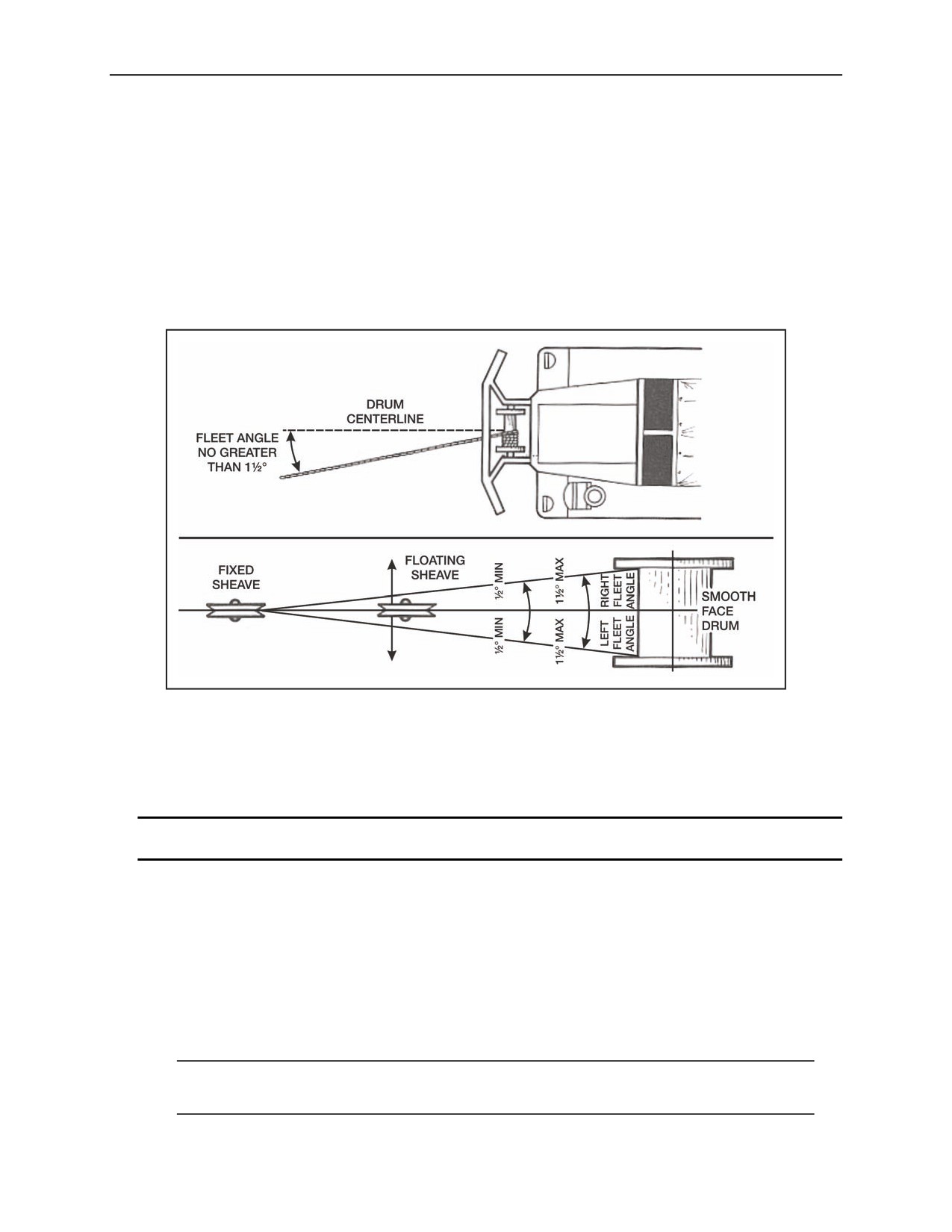
3-1. The fall line is the winch line that runs from the source of effort to the first block in the tackle. There is
only one fall line in a simple tackle system (figure 3-1). The amount of force that must be exerted on the fall
line relative to the AE must be considered in every problem. The fall line force must be less than the capacity of
the effort to accomplish the recovery. See the examples in paragraph 3-9, steps 1 through 4.
To determine the fall line force, divide the total resistance by the MA of
the tackle.
total resistance
= fall line force
MA of the tackle
Figure 3-1. Terminology of simple tackle
RETURN LINE
3-2. A return line is a winch line rigged between the block or the winch line from the sheave of a block to the
point where the end of the line is attached. This force is always the same as the fall line force (figure 3-1).
DEAD LINE
3-3. A dead line is a line used to attach blocks or other equipment to the load or to an anchor. To determine
the dead line force, multiply the fall line force by the highest number of winch lines supported by the dead line
(figure 3-1).
19 September 2006
FM 4-30.31
3-1
Rigging
FLEET ANGLE
3-4. Achieving even winding of the winch cable on the drum is important for wire rope life and winch
operations. This is best accomplished by working with the proper fleet angle.
3-5. Figure 3-2 displays the wire rope running from a fixed sheave, over floating sheaves, and then onto the
surface of a smooth drum. The fleet angle is defined as the included angle between two lines.
One line is drawn through the middle of the fixed sheave and the drum and perpendicular to the axis
of the drum.
A second line is drawn from the flange of the drum to the base of the groove in the fixed sheave.
Figure 3-2. Fleet angle
3-6. There are left and right fleet angles, measured to the left and right of the centerline of the sheave. The
fleet angle should be restricted when wire rope passes over a fixed sheave and onto a drum. For the most
efficient method and best service, the angle should not exceed 1½ degrees, for most vehicles. Refer to the
equipment operator’s manual for specific information on fleet angles.
Note. Although many vehicles have winches that can safely operate at higher fleet angles, maximum stability
and performance is achieved at lesser fleet angles.
MECHANICAL ADVANTAGE OF TACKLE
3-7. MA is needed whenever the load resistance is greater than the AE. The amount of MA needed is
estimated by dividing the load resistance by the AE. The MA of any simple tackle system is equal to the
number of winch lines supporting the load or the number of winch lines that become shorter as power is applied
to the winch (figure 3-3). The lines can be attached directly or indirectly through a block.
3-8. Placement of the block is critical to gaining MA. The block must be attached to the movable load and
effort applied in the opposite direction to divide the effort equally over the two lines. The arc over the lines
indicates lines that support the load (figure 3-3).
Note. The 1-to-1 ratio shown has an arc over only one line indicating the block is simply changing
the direction of effort. No mechanical advantage is gained in this configuration.
3-2
FM 4-30.31
19 September 2006
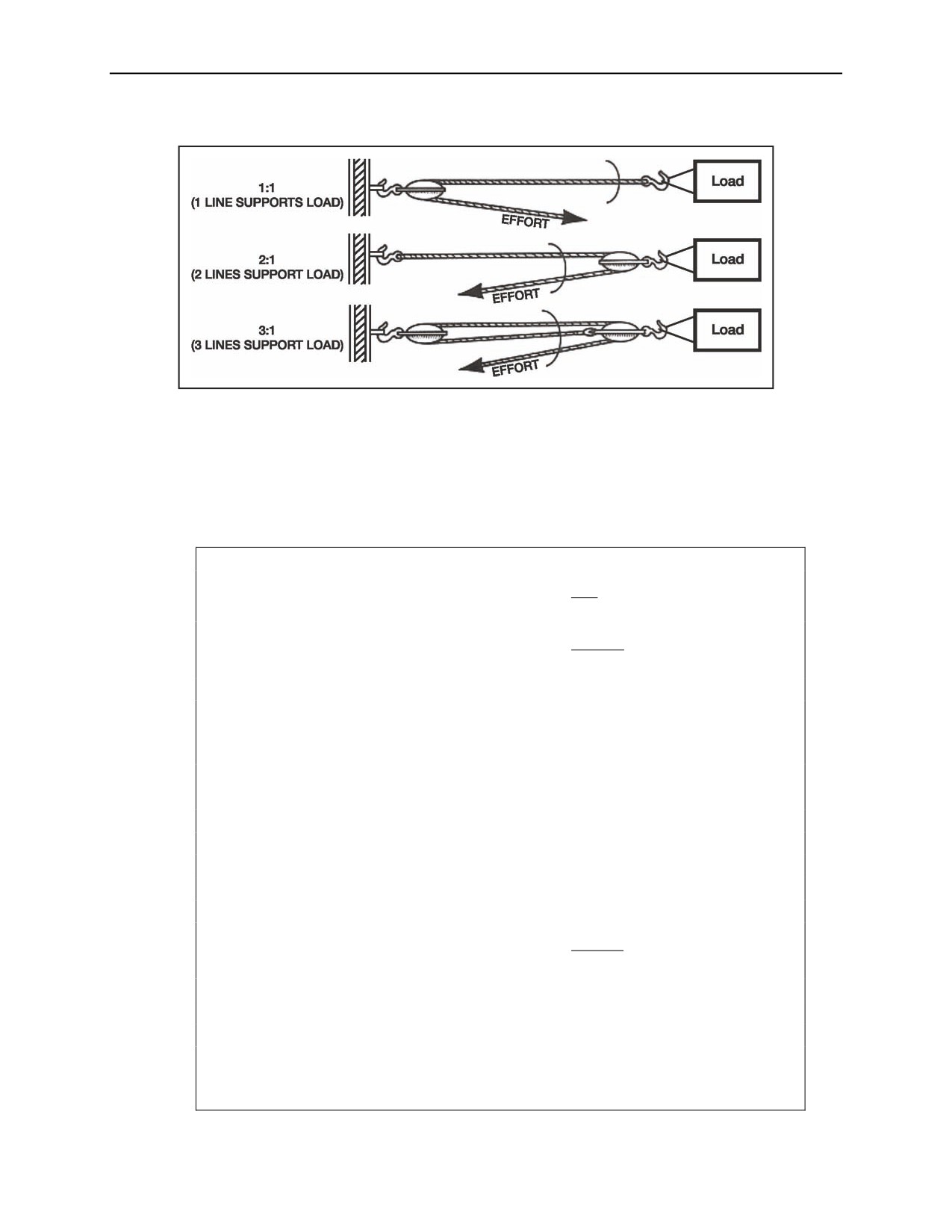
Rigging
Figure 3-3. Winch line(s) MA
DETERMINING LINE FORCES
3-9. The following example shows how to compute various line forces. A disabled vehicle had a load
resistance of 14 tons (28,000 pounds). The AE is a winch with a maximum capacity of 5 tons (10,000 pounds).
What MA must be rigged to recover this vehicle? What are the line forces?
STEP 1 - Determine initial estimate.
LR
Load resistance / AE
= Required MA
AE
28,000
28,000 (LR) / 10,000 (AE)
= 2.8
10,000
Required MA
= 3:1
STEP 2 - Add tackle resistance and verify solution.
An MA of 3 requires 2 sheaves. To determine the tackle resistance, multiply 10
percent (.10) of the load resistance by the number of sheaves.
(.10 x 28,000) x 2 = 5600
Then add the tackle resistance to the load resistance for total load resistance.
5600 + 28000 = 33,600
33,600
33,600 (LR) /10,000 (AE)
= 3.36
10,000
Required MA
= 4:1
This is not equal to the answer in step 1; therefore, the answer must be re-verified.
STEP 3 - Re-verify solution.
An MA of 4 requires 3 sheaves. Therefore, 3 x .10 (10% per sheave) or .30 (30%)
must be added to the load resistance.
19 September 2006
FM 4-30.31
3-3
Rigging
(.10 x 28,000) x 3 = 8400
8400 + 28,000 = 36,400
36,400
36,400 (LR) / 10,000 (AE)
= 3.64
10,000
Required MA
= 4:1
This is equal to the answer in step 2; therefore, a solution has been achieved.
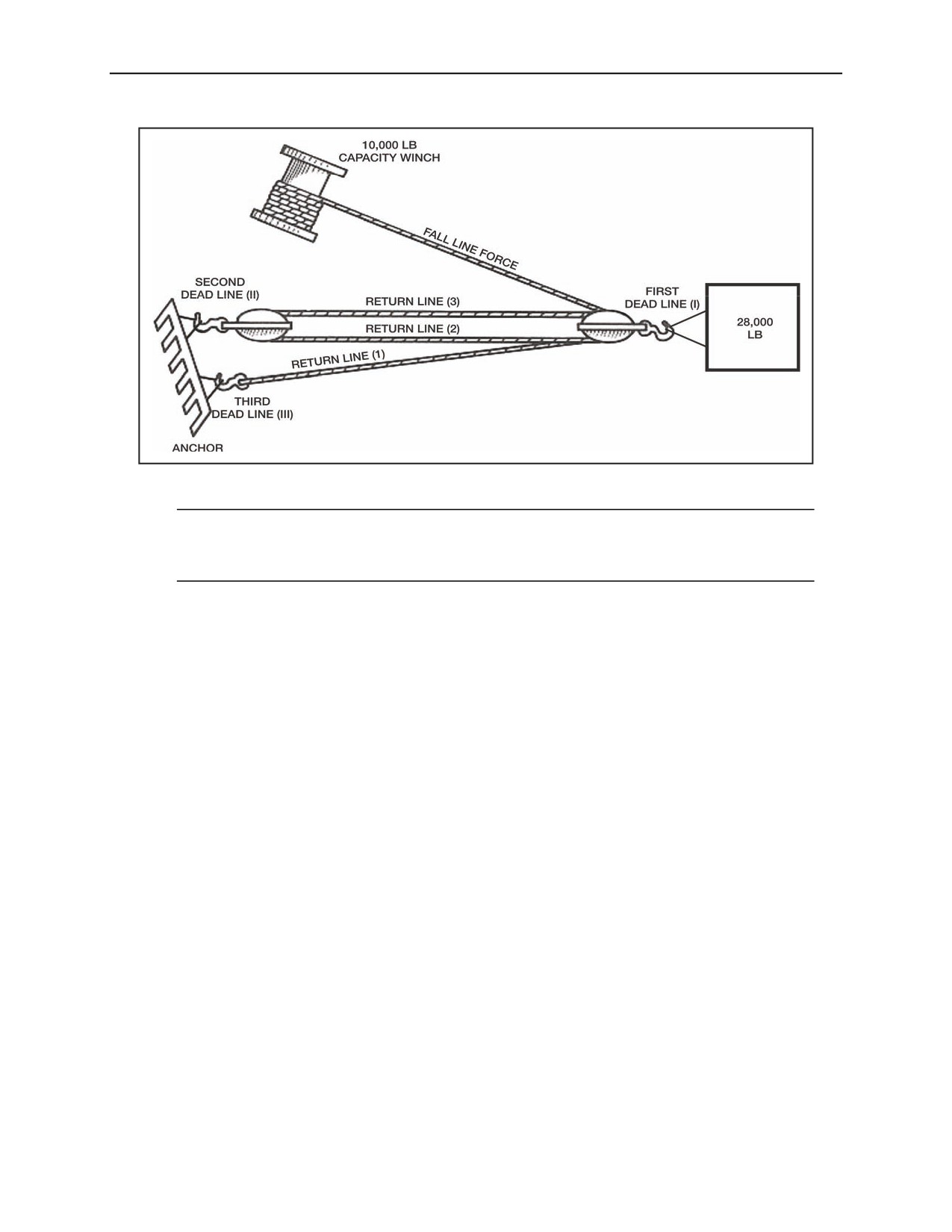
STEP 4 - Determine line forces (see figure 3-4).
From the previous step, the total resistance is equal to 36,400 pounds and the MA
needed is 4:1.
Total resistance (LR) / MA
= Fall line force
36,400
36,400 / 4 = fall line force
= 9,100 lb
4
Note. Double check: The fall line force is less than the winch capacity.
Return line force
= Fall line force
Fall line force
= 9,100 lb
Return lines 1, 2, and 3
= 9,100 lb each
The dead line force equals the number of support winch lines times the fall line force.
(See figure 3-4.)
Lines 1, 2, 3 (and fall line)
= 9,100 lb
Dead line I
= 4 x 9,100 lb
= 36,400 lb
Dead line II
= 2 x 9,100 lb
= 18,200 lb
Dead line III
= 1 x 9,100 lb
=
9,100 lb
Note. Ensure Y-slings used for dead lines in this rigging operation are rated to withstand the force applied
at the point of attachment.
3-4
FM 4-30.31
19 September 2006
Rigging
Figure 3-4. 4-to-1 MA
Note. If field expedient slings are used as dead lines, refer to FM 5-125 to determine sling leg forces.
Field expedient slings are considered slings that are constructed using materiel not part of the
recovery vehicle’s BII.
METHODS OF RIGGING
3-10. The rigging techniques used depend on terrain, the type of vehicle, and the distance between the recovery
vehicle and the disabled vehicle. Manpower, backup, and lead methods for rigging techniques are discussed
below.
Manpower Method
3-11. The manpower method is used when the winch cable and other rigging equipment are lightweight and
can be carried easily by the crewmembers to where they are needed. This method depends completely on
Soldier manpower.
Backup Method
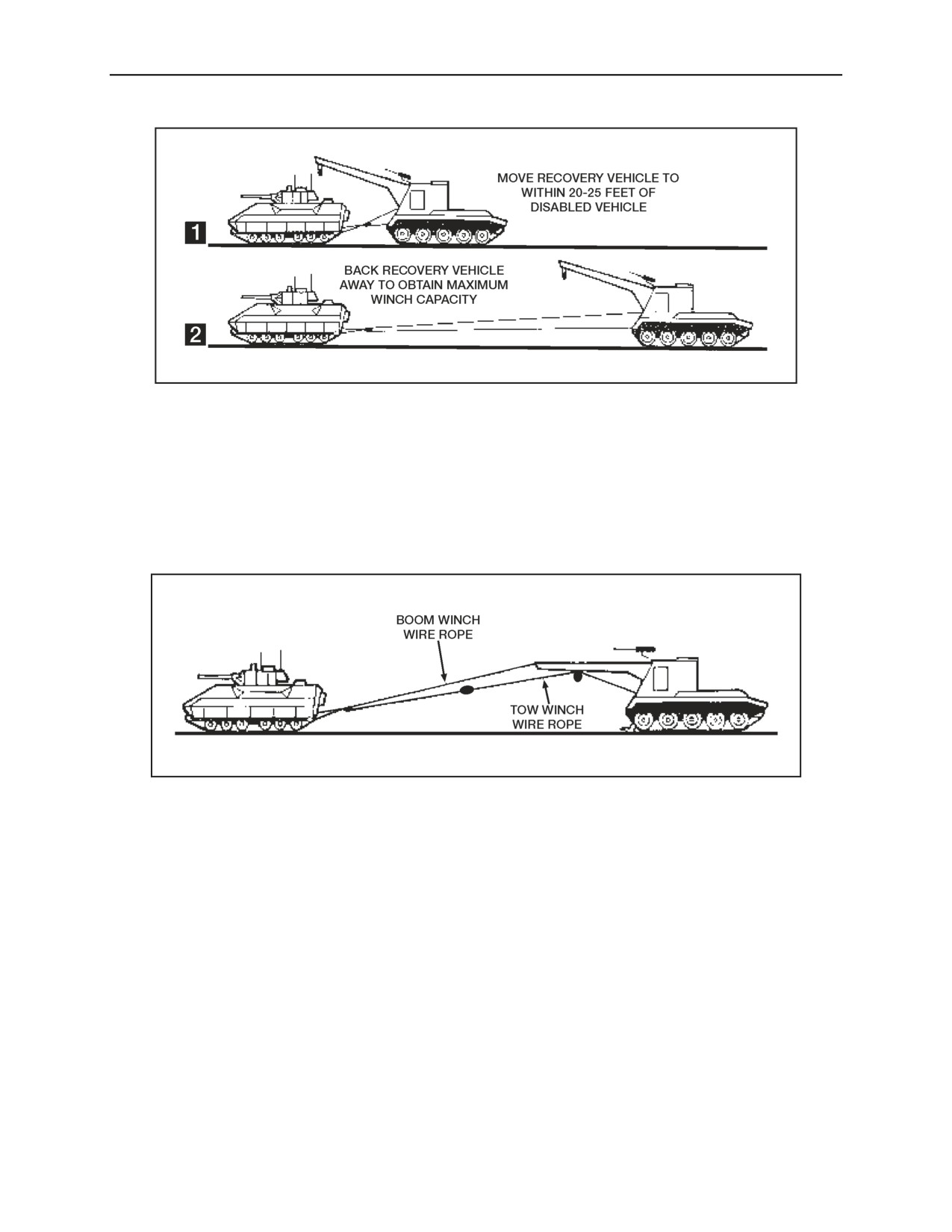
3-12. The backup method is used when the recovery vehicle can be safely positioned within 20 to 25 feet of the
disabled vehicle. Figure 3-5 shows the recovery vehicle in position to perform the winching operation.
Pull out enough main winch cable to attach to the disabled vehicle.
Place the main winch snatch block in the loop of the cable and attach the block to the disabled
vehicle.
Back up the recovery vehicle, allowing the main winch cable to be spooled from the winch drum
until sufficient cable is removed to obtain maximum winch capacity.
19 September 2006
FM 4-30.31
3-5
Rigging
Figure 3-5. Backup method of rigging
Lead Method
3-13. The lead method (figure 3-6) is used when terrain conditions do not permit close access to the disabled
vehicle. Use the boom winch or auxiliary winch cable to pay out the main winch rigging to the disabled vehicle.
Since the boom or auxiliary winch cable weighs less than the main winch cable, it can easily be carried to the
disabled vehicle.
Figure 3-6. Lead method of rigging
3-14. To rig for the lead method, assemble the main winch tackle just in front of the recovery vehicle as in
preparation for the backup method. Then do the following:
Attach the boom and crane or auxiliary winch cable to the main winch snatch block.
Manually pull out the loop formed by the boom and the crane or auxiliary winch cable, and place it
into a snatch block attached to the disabled vehicle.
Lastly, attach the cable to the rigging. (By paying in the boom and the crane or auxiliary winch
cable, the main winch tackle will be pulled to the disabled vehicle.)
METHODS OF ATTACHING TACKLE
Wheeled Vehicles
3-15. In recovery operations, rig the tackle to prevent damage to the vehicle or equipment. For instance, on
disabled wheeled vehicles, attach the rigging (tackle) to the bumper lifting shackles on both sides of the tow
pintle. If the pulling force is attached only to one frame member, the truck frame could be pulled out of
alignment.
3-6
FM 4-30.31
19 September 2006
Rigging
CAUTION
Even though the bumper lifting shackles can withstand force from a
horizontal or vertical pull, a sling attachment must be used to apply the
effort equally to both shackles. For vehicles not equipped with bumper
lifting shackles, effort should be applied to the main structural members,
not to the bumper or bumper brackets
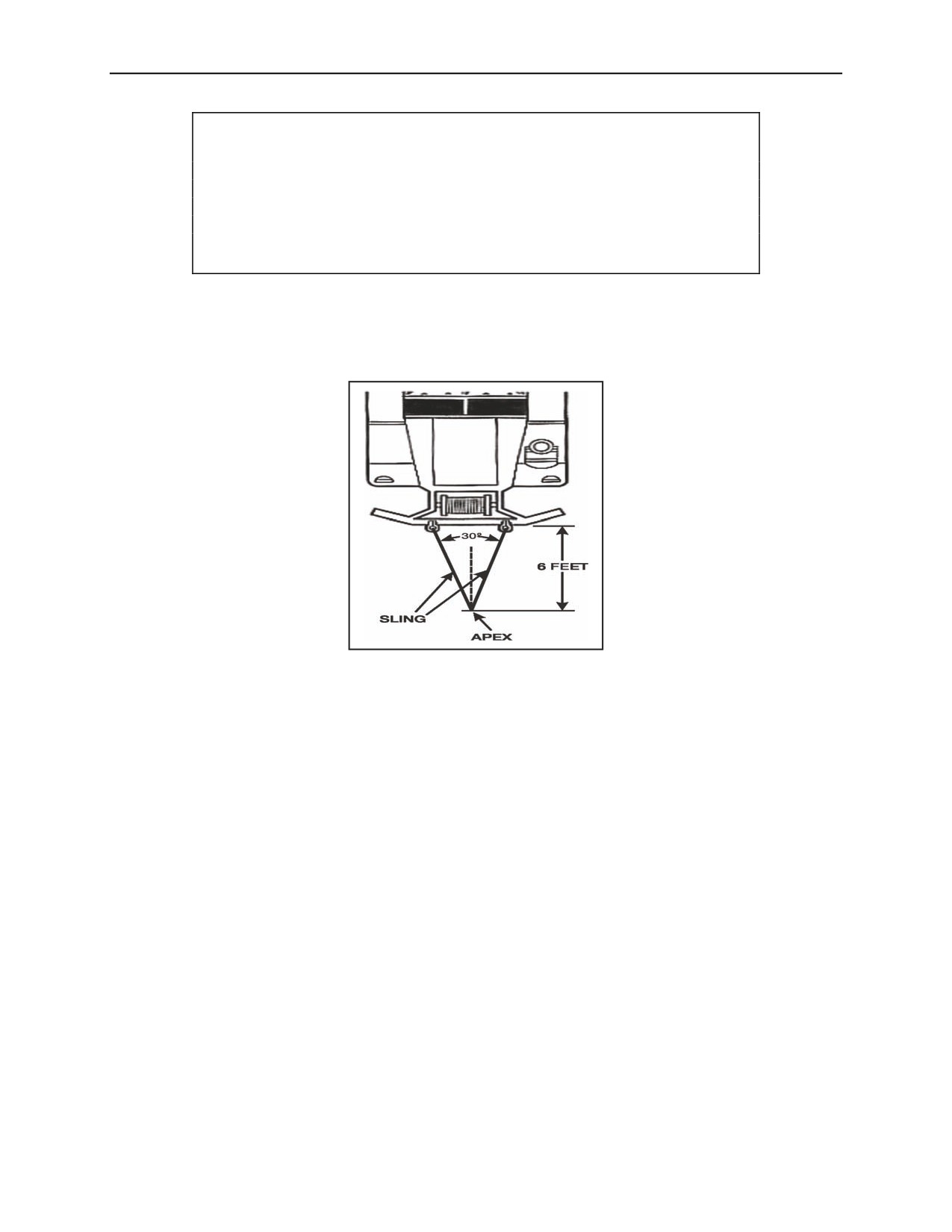
3-16. On wheeled vehicles, whether the pull is made from the front or rear, apply the effort to both of the
bumper lifting shackles (figure 3-7). The force exerted on each leg of the sling is slightly greater than half of
the resistance.
Figure 3-7. Sling arrangement
Tracked Vehicles
3-17. On tracked vehicles, always attach rigging to the tow hook or lugs. The lifting eyes are not designed to
withstand the pulling force required for recovery. Use an attachment that will distribute the applied force to
each side of the vehicle.
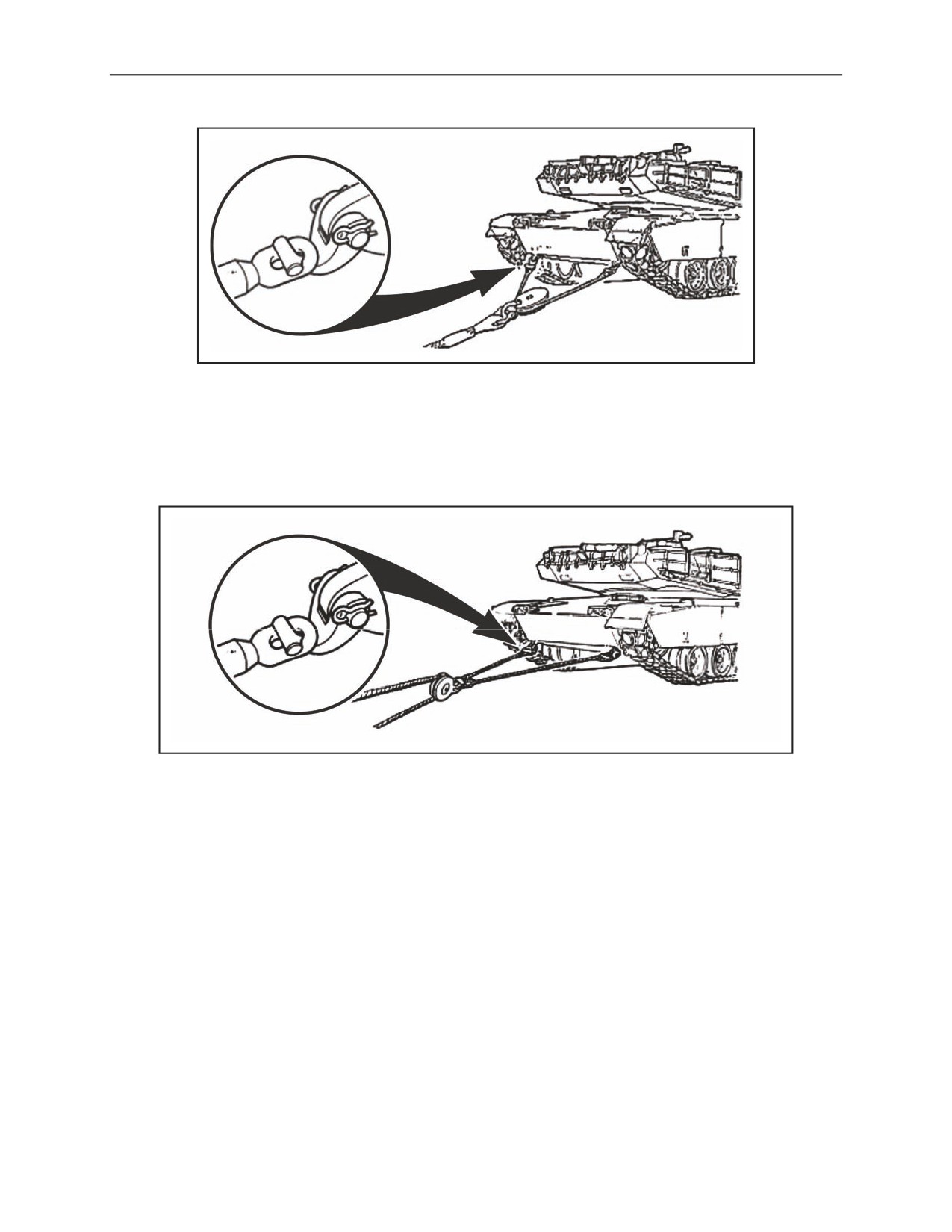
3-18. When a disabled tracked vehicle does not require towing or MA, use the main winch snatch block with
one tow cable to form a floating block hookup. This hookup is easy to install and distributes the effort evenly to
both tow hooks. To rig a floating block—
Attach the ends of the tow cable to the two tow hooks.
Place the snatch block in the loop formed by the tow cable.
Attach the winch cable to the snatch block.
Ensure that cables and attachments can withstand forces as shown in figure 3-8.
19 September 2006
FM 4-30.31
3-7
Rigging
Figure 3-8. Floating block attachment
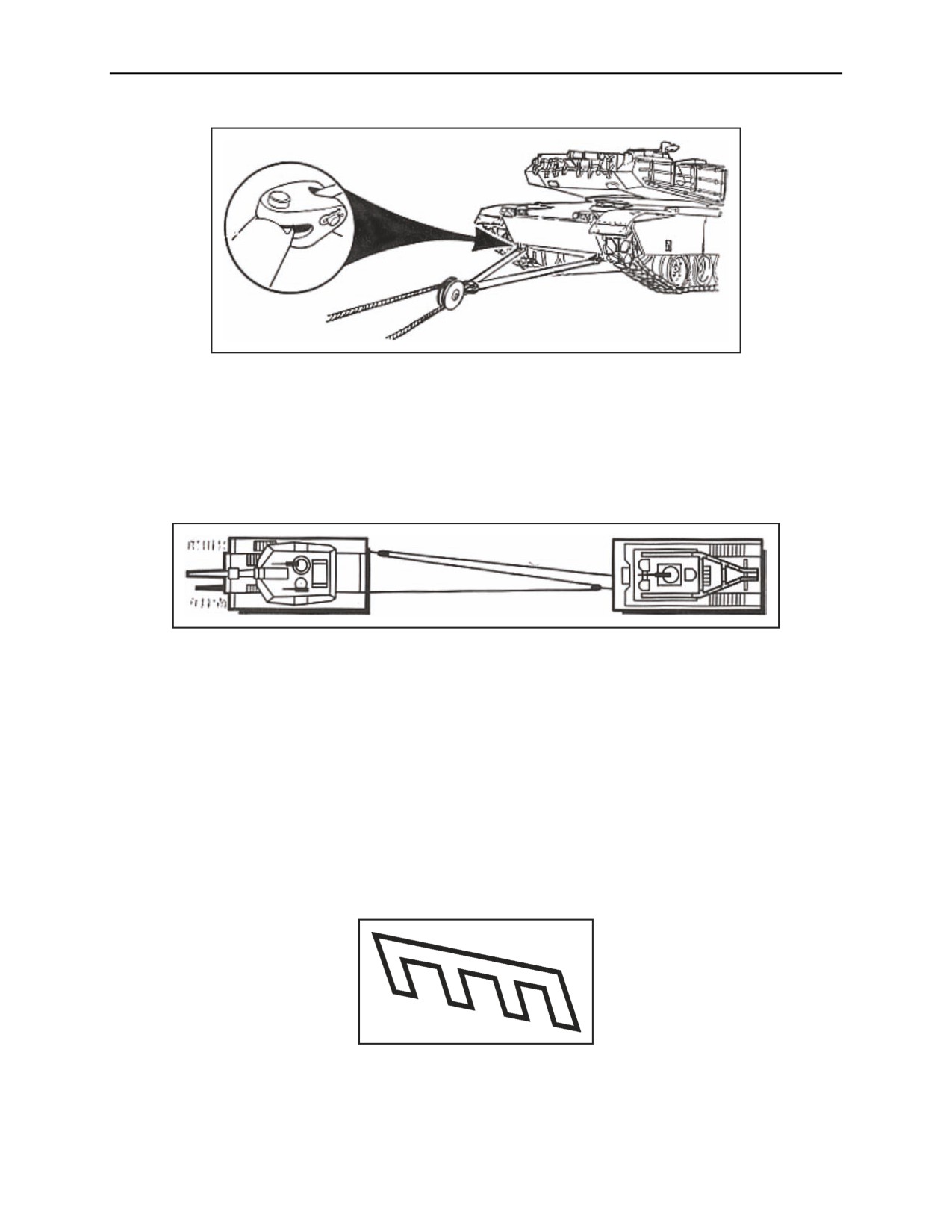
3-19. When a disabled tracked vehicle requires a 2-to-1 MA rigging and towing over rough terrain, after
winching, use two tow cables to make the attachment. The attachment, shown in figure 3-9, is the quickest to
rig.
Figure 3-9. Tow cable attachment
3-20. When towing a tracked vehicle over relatively level terrain or on highways, use the tow bar method of
attachment (figure 3-10). Attach the tow bar to the tow lugs of the disabled vehicle and attach the winch rigging
to the lunette of the tow bar. After winching, disassemble the rigging and place the tow bar lunette in the
recovery vehicle’s tow pintle.
3-8
FM 4-30.31
19 September 2006
Rigging
Figure 3-10. Tow bar method
3-21. If a 3-to-1 MA is required, attach the running block to one of the tow lugs of the disabled tracked vehicle,
attach the change-of-direction block to the tow lug on the recovery vehicle, and attach the end of the winch
cable to the other tow lug on the disabled tracked vehicle. This method can be used in the absence of tow cables
but a holdback vehicle is required. This is a time-consuming method in the absence of a holdback vehicle
because only one vehicle will move at a time. When the recovery vehicle is moved, the disabled tracked vehicle
will have to be chocked to prevent it from moving. Figure 3-11 shows the 3-to-1 MA towing method.
Figure 3-11. 3-to-1 MA towing method
ANCHORS
USE OF ANCHORS
3-22. Anchors are used to create a solid point of attachment for connecting rigging during recovery operations.
Multiple anchors provide additional points of attachment for rigging mechanical advantage, add resistance to
the effort, and prevent vehicle slide when recovering on a slope. Frequently, wheeled and tracked vehicles must
have some anchoring means when winching heavy loads with tackle (figure 3-12 shows the anchor symbol).
An anchor can assist in holding a recovery vehicle, improvising a change of direction pull, or supporting part of
the load during a winching operation. Most existing recovery vehicles have ground chocks or spades to provide
resistance while performing recovery; however, additional anchoring may be required if the recovery vehicle
continues to slide when the winch is operated.
Figure 3-12. Anchor symbol
19 September 2006
FM 4-30.31
3-9
Rigging
Note. Trees, tree stumps, large rocks, or other vehicles may be used as anchors in recovery
operations. Refer to FM 5-125 for additional information on anchors.
NATURAL ANCHORS
3-23. An anchor that does not have to be constructed is a natural anchor. Examples are trees, tree stumps, and
large rocks or other vehicles. Avoid dead or rotten trees or tree stumps, and examine rocks and trees carefully
to make sure they are large enough and embedded firmly in the ground.
MECHANICAL ANCHORS
3-24. There are several types of mechanical anchors. The anchor type used/ constructed depends on holding
ability requirements, the type of soil required, the availability of material, and the situation.
Log Deadman
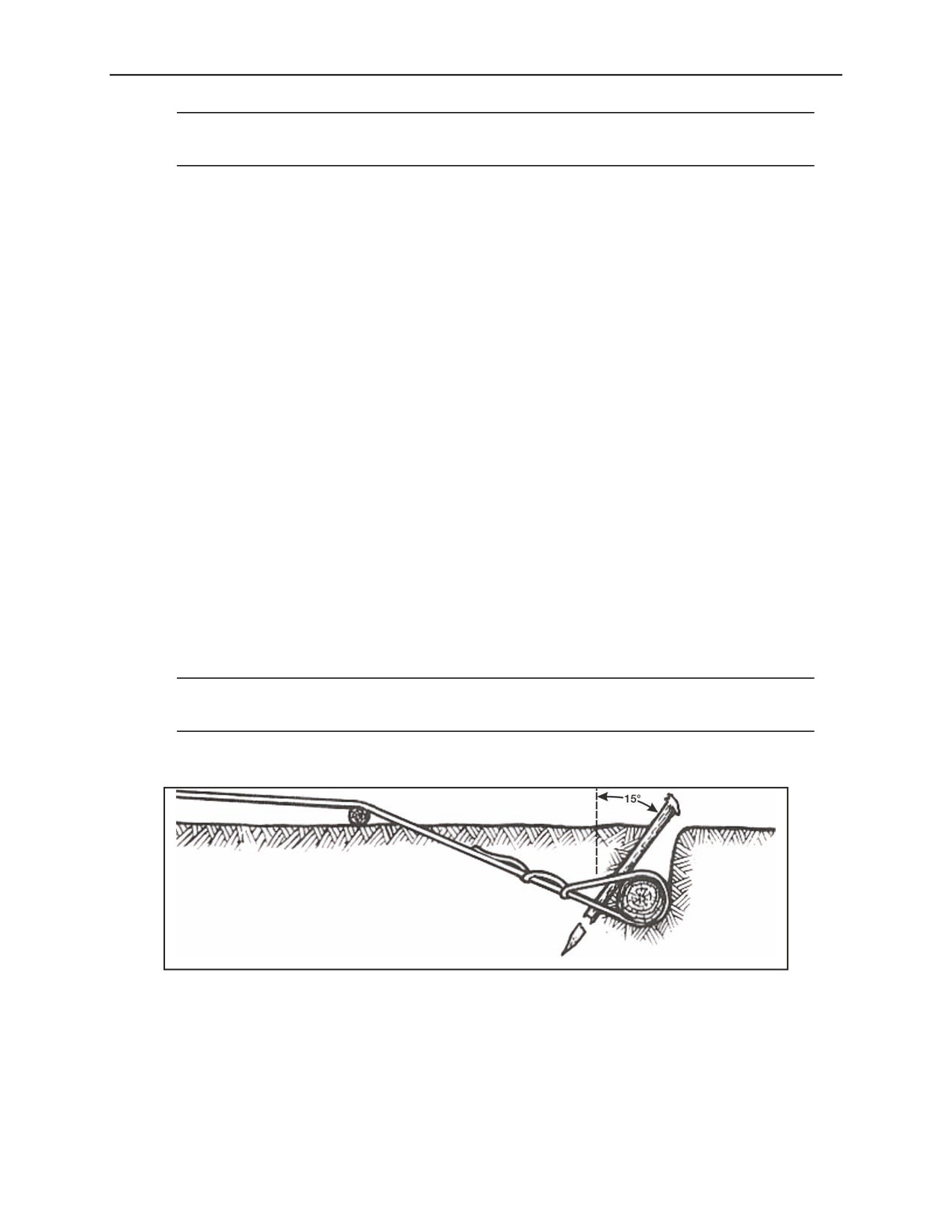
3-25. A log deadman (figure 3-13) is one of the best types of anchors for heavy loads. The deadman consists of
a log buried in the ground with the dead line connected to its center. When constructing a deadman—
Place the deadman where the direction of pull is as horizontal as possible. Take advantage of sharp
banks or crests to increase the holding power with less digging.
Dig a trench large enough for the deadman and as deep as necessary for good bearing. When
digging, slant the trench in the direction of the pull at an angle of approximately 15 degrees from the
vertical. To strengthen the anchor, drive stakes in front of the deadman at each end.
Dig a narrow inclined trench for the dead line at the center of the deadman.
Tie the dead line to the center of the deadman, so that the main or standing part of the line leads from
the bottom of the deadman. This prevents the deadman from rotating out of the trench. If the dead
line has a tendency to cut into the ground, place a small log under the line at the outlet of the trench.
The strength of the deadman depends on the strength of the log and the holding power of the earth.
Note. The procedures that follow in this chapter require an understanding of specific hitches and
knots. Refer to FM 5-125, chapter 2, for further explanations and illustrations of hitches and knots.
Figure 3-13. Log deadman
Picket Holdfasts
3-26. A picket holdfast (figure 3-14) is constructed by using two or more sound wooden pickets at least 3
inches in diameter and 5 feet long.
3-10
FM 4-30.31
19 September 2006
///////////////////////////////////////